EP4046801A1 - Elementsubstrat, flüssigkeitsausstosskopf und flüssigkeitsausstossvorrichtung - Google Patents
Elementsubstrat, flüssigkeitsausstosskopf und flüssigkeitsausstossvorrichtung Download PDFInfo
- Publication number
- EP4046801A1 EP4046801A1 EP22155129.4A EP22155129A EP4046801A1 EP 4046801 A1 EP4046801 A1 EP 4046801A1 EP 22155129 A EP22155129 A EP 22155129A EP 4046801 A1 EP4046801 A1 EP 4046801A1
- Authority
- EP
- European Patent Office
- Prior art keywords
- memory element
- liquid discharge
- current
- write
- elements
- Prior art date
- Legal status (The legal status is an assumption and is not a legal conclusion. Google has not performed a legal analysis and makes no representation as to the accuracy of the status listed.)
- Pending
Links
Images



Classifications
-
- B—PERFORMING OPERATIONS; TRANSPORTING
- B41—PRINTING; LINING MACHINES; TYPEWRITERS; STAMPS
- B41J—TYPEWRITERS; SELECTIVE PRINTING MECHANISMS, i.e. MECHANISMS PRINTING OTHERWISE THAN FROM A FORME; CORRECTION OF TYPOGRAPHICAL ERRORS
- B41J2/00—Typewriters or selective printing mechanisms characterised by the printing or marking process for which they are designed
- B41J2/005—Typewriters or selective printing mechanisms characterised by the printing or marking process for which they are designed characterised by bringing liquid or particles selectively into contact with a printing material
- B41J2/01—Ink jet
- B41J2/015—Ink jet characterised by the jet generation process
- B41J2/04—Ink jet characterised by the jet generation process generating single droplets or particles on demand
- B41J2/045—Ink jet characterised by the jet generation process generating single droplets or particles on demand by pressure, e.g. electromechanical transducers
- B41J2/04501—Control methods or devices therefor, e.g. driver circuits, control circuits
- B41J2/04541—Specific driving circuit
-
- B—PERFORMING OPERATIONS; TRANSPORTING
- B41—PRINTING; LINING MACHINES; TYPEWRITERS; STAMPS
- B41J—TYPEWRITERS; SELECTIVE PRINTING MECHANISMS, i.e. MECHANISMS PRINTING OTHERWISE THAN FROM A FORME; CORRECTION OF TYPOGRAPHICAL ERRORS
- B41J2/00—Typewriters or selective printing mechanisms characterised by the printing or marking process for which they are designed
- B41J2/005—Typewriters or selective printing mechanisms characterised by the printing or marking process for which they are designed characterised by bringing liquid or particles selectively into contact with a printing material
- B41J2/01—Ink jet
-
- B—PERFORMING OPERATIONS; TRANSPORTING
- B41—PRINTING; LINING MACHINES; TYPEWRITERS; STAMPS
- B41J—TYPEWRITERS; SELECTIVE PRINTING MECHANISMS, i.e. MECHANISMS PRINTING OTHERWISE THAN FROM A FORME; CORRECTION OF TYPOGRAPHICAL ERRORS
- B41J2/00—Typewriters or selective printing mechanisms characterised by the printing or marking process for which they are designed
- B41J2/005—Typewriters or selective printing mechanisms characterised by the printing or marking process for which they are designed characterised by bringing liquid or particles selectively into contact with a printing material
- B41J2/01—Ink jet
- B41J2/015—Ink jet characterised by the jet generation process
- B41J2/04—Ink jet characterised by the jet generation process generating single droplets or particles on demand
- B41J2/045—Ink jet characterised by the jet generation process generating single droplets or particles on demand by pressure, e.g. electromechanical transducers
- B41J2/04501—Control methods or devices therefor, e.g. driver circuits, control circuits
- B41J2/04581—Control methods or devices therefor, e.g. driver circuits, control circuits controlling heads based on piezoelectric elements
-
- B—PERFORMING OPERATIONS; TRANSPORTING
- B41—PRINTING; LINING MACHINES; TYPEWRITERS; STAMPS
- B41J—TYPEWRITERS; SELECTIVE PRINTING MECHANISMS, i.e. MECHANISMS PRINTING OTHERWISE THAN FROM A FORME; CORRECTION OF TYPOGRAPHICAL ERRORS
- B41J2/00—Typewriters or selective printing mechanisms characterised by the printing or marking process for which they are designed
- B41J2/005—Typewriters or selective printing mechanisms characterised by the printing or marking process for which they are designed characterised by bringing liquid or particles selectively into contact with a printing material
- B41J2/01—Ink jet
- B41J2/135—Nozzles
- B41J2/14—Structure thereof only for on-demand ink jet heads
- B41J2/14016—Structure of bubble jet print heads
-
- G—PHYSICS
- G11—INFORMATION STORAGE
- G11C—STATIC STORES
- G11C17/00—Read-only memories programmable only once; Semi-permanent stores, e.g. manually-replaceable information cards
- G11C17/14—Read-only memories programmable only once; Semi-permanent stores, e.g. manually-replaceable information cards in which contents are determined by selectively establishing, breaking or modifying connecting links by permanently altering the state of coupling elements, e.g. PROM
- G11C17/16—Read-only memories programmable only once; Semi-permanent stores, e.g. manually-replaceable information cards in which contents are determined by selectively establishing, breaking or modifying connecting links by permanently altering the state of coupling elements, e.g. PROM using electrically-fusible links
-
- G—PHYSICS
- G11—INFORMATION STORAGE
- G11C—STATIC STORES
- G11C17/00—Read-only memories programmable only once; Semi-permanent stores, e.g. manually-replaceable information cards
- G11C17/14—Read-only memories programmable only once; Semi-permanent stores, e.g. manually-replaceable information cards in which contents are determined by selectively establishing, breaking or modifying connecting links by permanently altering the state of coupling elements, e.g. PROM
- G11C17/18—Auxiliary circuits, e.g. for writing into memory
-
- B—PERFORMING OPERATIONS; TRANSPORTING
- B41—PRINTING; LINING MACHINES; TYPEWRITERS; STAMPS
- B41J—TYPEWRITERS; SELECTIVE PRINTING MECHANISMS, i.e. MECHANISMS PRINTING OTHERWISE THAN FROM A FORME; CORRECTION OF TYPOGRAPHICAL ERRORS
- B41J2/00—Typewriters or selective printing mechanisms characterised by the printing or marking process for which they are designed
- B41J2/005—Typewriters or selective printing mechanisms characterised by the printing or marking process for which they are designed characterised by bringing liquid or particles selectively into contact with a printing material
- B41J2/01—Ink jet
- B41J2/015—Ink jet characterised by the jet generation process
- B41J2/04—Ink jet characterised by the jet generation process generating single droplets or particles on demand
- B41J2/045—Ink jet characterised by the jet generation process generating single droplets or particles on demand by pressure, e.g. electromechanical transducers
- B41J2/04501—Control methods or devices therefor, e.g. driver circuits, control circuits
- B41J2/0458—Control methods or devices therefor, e.g. driver circuits, control circuits controlling heads based on heating elements forming bubbles
-
- B—PERFORMING OPERATIONS; TRANSPORTING
- B41—PRINTING; LINING MACHINES; TYPEWRITERS; STAMPS
- B41J—TYPEWRITERS; SELECTIVE PRINTING MECHANISMS, i.e. MECHANISMS PRINTING OTHERWISE THAN FROM A FORME; CORRECTION OF TYPOGRAPHICAL ERRORS
- B41J2202/00—Embodiments of or processes related to ink-jet or thermal heads
- B41J2202/01—Embodiments of or processes related to ink-jet heads
- B41J2202/13—Heads having an integrated circuit
Definitions
- the present invention mainly relates to an element substrate.
- a liquid discharge head used in, for example, a printer using an inkjet printing method includes an element substrate on which a plurality of liquid discharge elements are arrayed (see Japanese Patent Laid-Open No. 2014-58130 ).
- the element substrate is provided with memory elements that store whether to permit driving of the individual liquid discharge elements.
- whether to permit driving of each or the liquid discharge elements is decided based on the presence/absence of write to a corresponding memory element. For example, if a liquid discharge element cannot be driven, another liquid discharge element can be driven to complement that.
- the memory element a so-called one time programmable memory that is a memory element configured to permit write only once, for example, an anti-fuse element can be used.
- the impedance value mainly, the electric resistance value
- Japanese Patent Laid-Open No. 2008-299989 a configuration capable of determining the presence/absence of write to a memory element by detecting a voltage generated by supplying a current to the memory element is described.
- this configuration for example, if the amount of the current supplied to the memory element varies due to a peripheral environment such as a temperature, the impedance value of the memory element may vary. There is room for improvement from the viewpoint of increasing the accuracy of the determination.
- the first aspect of the present invention provides an element substrate as specified in claims 1 to 10.
- the second aspect of the present invention provides a liquid discharge head as specified in claim 11.
- the third aspect of the present invention provides a liquid discharge apparatus as specified in claim 12.
- the printing apparatus may be a single function printer having only a printing function or may be a multi-function printer having a plurality of functions such as a printing function, a FAX function, and a scanner function.
- the printing apparatus may be a manufacturing device configured to manufacture, for example, a color filter, an electronic device, an optical device, a microstructure, or the like using a predetermined printing method.
- print in this specification should be interpreted in a broader sense.
- the mode of "print” is irrespective of whether or not the target to be formed on a print medium is significant information such as a character or graphic pattern, and is also irrespective of whether the target is manifested in a way that can be perceived visually by humans.
- Print media should also be interpreted in a broader sense, like “print”.
- the concept of "print media” includes sheet-shaped members used in general, and any material capable of receiving ink, including paper, fabrics, plastic films, metals, glass, ceramics, resins, wood, and leathers can be used.
- Ink should also be interpreted in a broader sense, like "print”.
- the concept of "ink” can include not only a liquid that is applied to a print medium to form an image, a design, a pattern, or the like but also an incidental liquid that can be provided to process a print medium or process ink (for example, coagulate or insolubilize color materials in ink applied to a print medium).
- this can be expressed "liquid” in place of "ink”.
- a printing apparatus may be referred to as a liquid discharge apparatus, a discharge apparatus, or the like.
- a printhead provided in the printing apparatus may be referred to as a liquid discharge head, a discharge head, or the like.
- a print element substrate provided in the printhead may be referred to as a liquid discharge element substrate or a discharge element substrate, or simply as an element substrate.
- each of a plurality of print elements arrayed on the print element substrate may be referred to as a liquid discharge element, a discharge element, or the like.
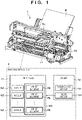
- Fig. 1 shows an example of the configuration of a printing apparatus 1 according to the first embodiment.
- the printing apparatus 1 includes a printhead 11 and a driver 12 and, in this embodiment, performs printing by an inkjet printing method.
- the printhead 11 is configured to execute printing on a predetermined print medium P, and includes a plurality of nozzles NZ and a print element substrate SB.
- Each nozzle NZ is a liquid discharge port that discharges a liquid received from a liquid tank TK that stores the liquid.
- the plurality of nozzles NZ are arrayed on a surface on a side to execute printing.
- the print element substrate SB includes a plurality of print elements PE corresponding to the plurality of nozzles NZ. When each print element PE is driven, a liquid is discharged from the corresponding nozzle NZ, thereby executing printing.
- a resistive element or simply called a heater
- a piezoelectric element may be used as the print element PE.
- the driver 12 includes a conveyance driver 121 and a head driver 122.
- the conveyance driver 121 conveys the print medium P set in the main body of the printing apparatus 1 to the printhead 11.
- the head driver 122 drives the printhead 11 with respect to the conveyed print medium P to cause the individual nozzles NZ to discharge the liquid, thereby performing printing.
- the printhead 11 is a serial head that performs printing on the print medium P while scanning in a direction crossing the conveyance direction of the print medium P.
- the printhead 11 may be a line head capable of printing at once on the whole region of the print medium P in the widthwise direction.
- Fig. 2 shows an example of the configuration of the print element substrate SB.
- the print element substrate SB In a planar view (a viewpoint in a direction vertical to the principal plane, a top view), the print element substrate SB has an outer shape including a long side (first side) E L and a short side (second side) Es.
- the print element substrate SB has a rectangular shape.
- the print element substrate SB may have a square shape, a parallelogram shape, or a trapezoidal shape.
- the print element substrate SB includes driving units 21, a plurality of memory elements ME, a plurality of write units 22, a current supply unit 23, and a determination unit 24.
- a channel LQ for a liquid is extended in a longitudinal direction (a direction parallel to the long side E L ) in a planar view, and the plurality of print elements PE are arrayed in the longitudinal direction on both sides of the channel LQ.
- the driving unit 21 is arranged, on each side of the channel LQ, between the long side E L and the plurality of print elements PE, and can individually drive the plurality of print elements PE.
- the liquid is supplied from the liquid tank TK to above the print element PE via the channel LQ, and after that, foamed and discharged when the driving units 21 drive the print elements PE.
- the driving units 21 can drive the plurality of print elements PE by a time division method. That is, the plurality of print elements PE are divided into a plurality of groups, and the driving units 21 sequentially drive each of two or more print elements PE of each group as a block. For example, if the number of groups is i, and each group includes j print elements PE as blocks, first, the driving units 21 drive a first block (i print elements PE) for each of the first to ith groups. Next, the driving units 21 drive a second block (i print elements PE) for each of the first to ith groups. According to the same procedure, the driving units 21 sequentially drive a third, fourth,..., jth blocks (i print elements PE in each block) for each of the first to ith groups.
- the driving unit 21 can typically include a decoder, a shift register, a latch circuit, a selector, an AND circuit, an OR circuit, and the like. Note that each of i and j is an integer of 2 or more. Also, the group can also be called a time division group, and the block can also be called a time division block.
- the plurality of memory elements ME are arrayed in the longitudinal direction, and the plurality of write units 22 are similarly arrayed in the longitudinal direction. Also, the current supply unit 23 and the determination unit 24 are juxtaposed in the widthwise direction (a direction parallel to the short side Es).
- a plurality of terminals T are arrayed in the widthwise direction. Supply of a power supply voltage to the print element substrate SB and signal transmission/reception of the print element substrate SB are performed via the plurality of terminals T.
- a power supply voltage VI shown in Fig. 2 is 3.3 [V (volt)]
- a power supply voltage V2 is 0 [V] (the voltage V2 can also be referred to as a ground voltage). Note that a voltage described in this specification represents a potential difference from the ground voltage V2.
- Fig. 2 shows two types of voltages, that is, the voltages VI and V2.
- another power supply voltage different from the voltage VI and/or V2 may further be supplied to the print element substrate SB. This/these other voltages may be supplied to some of the circuit portions shown in Fig. 2 in place of the voltage VI and/or V2.
- the memory elements ME can store the individual information of the print element substrate SB, such as correction information for individual variations of the print element substrate SB, the number of printed sheets, the remaining ink amount, and whether to permit driving of the print elements PE.
- a so-called OTP memory one time programmable memory
- an anti-fuse element is used.
- an anti-fuse element having a MOS (Metal Oxide Semiconductor) structure is used as the memory element ME.
- Each write unit 22 is configured to implement one or more writes to the memory element ME, and includes a high breakdown voltage transistor TR1 and a control inverter circuit INV1.
- the high breakdown voltage transistor TR1 is connected in serial with the memory element ME As will be described later in detail, when brought into a conductive state, the high breakdown voltage transistor TR1 functions as a write transistor in write to the memory element ME, and also functions as a read transistor when confirming the presence/absence of write to the memory element ME.
- a DMOS Double Diffused MOS
- the control inverter circuit INV1 is connected to the gate terminal of the high breakdown voltage transistor TR1, and controls the high breakdown voltage transistor TR1 based on a control signal received via a node n1(set the high breakdown voltage transistor TR1 in a conductive state or a non-conductive state).
- Write to the memory element ME is done by applying a relatively high voltage (for example, 32 [V]) to the memory element ME via a write terminal Tx that is one of the plurality of terminals T during the conductive state of the high breakdown voltage transistor TR1 to cause dielectric breakdown of the MOS structure of the memory element ME. For this reason, the impedance value of the memory element ME can be changed by the write.
- the memory element ME before write, is an insulated state, and exhibits a very large electric resistance value (or a high impedance of, for example, several [M ⁇ (megaohm)]).
- the memory element ME After write, the memory element ME is in a conductive state, and exhibits a relatively small electric resistance value (for example, several to several tens [k ⁇ (kiloohm)]. At the time of write, the high voltage is applied to the terminal Tx. Otherwise, the terminal Tx is in an open state.
- a relatively small electric resistance value for example, several to several tens [k ⁇ (kiloohm)].
- a fuse element may be used as the memory element ME In this case, before write, the memory element ME is in a short-circuited state, and exhibits a relatively small electric resistance value. After write, the memory element ME is in an open state, and exhibits a very large electric resistance value.
- the current supply unit 23 includes a current generation unit 231, a selection unit 232, and a current supply controller 233.
- the current generation unit 231 includes a plurality of transistors MP1 0 to MP1 K , and resistive elements R11 and R12. In this embodiment, p-channel MOS transistors are used as the transistors MPlo to MP1 K . Note that K is an integer of 2 or more.
- the transistors MP1 1 to MP1 K constitute a current mirror circuit with the transistor MP1 0 .
- the transistors MPlo to MP1 K have the same channel length and channel widths different from each other, letting m be an arbitrary one of integers 1 to K, a current according to the channel width ratio to the transistor MPlo flows to a transistor MP1 m .
- each of the transistors MP1 1 to MP1 K can output a current in an amount according to the size ratio.
- the resistive elements R11 and R12 are connected in series with the transistor MP1 0 , and the voltage between the resistive elements R11 and R12 is used as a reference voltage V REF .
- the selection unit 232 includes switch elements SW1 1 to SW1 K corresponding to the transistors MP1 1 to MP1 K , and can selectively connect the transistors MP1 1 to MP1 K to the memory element ME For example, letting m be an arbitrary one of integers 1 to K, if a switch element SW1 m is set in a conductive state, the transistor MP1 m is connected to the memory element ME, and a current according to the size ratio is supplied to the memory element ME From this viewpoint, it can be said that each of the transistors MP1 1 to MP1 K functions as a current supply element capable of supplying a current to the memory element ME
- the current supply controller 233 can individually control the switch elements SW1 1 to SW1 K of the selection unit 232, thereby selectively setting the switch elements SW1 1 to SW1 K in a conductive state.
- one of the switch elements SW1 1 to SW1 K is set in the conductive state by the current supply controller 233, that is, one of the transistors MP1 1 to MP1 K can selectively be connected to the memory element ME
- two or more of the switch elements SW1 1 to SW1 K may be set in the conductive state, that is, currents of two or more of the transistors MP1 1 to MP1 K may be superimposed and supplied to the memory element ME
- the current supply controller 233 need only be able to connect at least some of the transistors MP1 1 to MP1 K to the memory element ME by the selection unit 232.
- the current supply controller 233 outputs a control signal to the control inverter circuit INV1 via the node n1, thereby setting the high breakdown voltage transistor TR1 in the conductive state. During this, the current supply controller 233 controls the selection unit 232, thereby supplying a desired amount of current from the current generation unit 231 to the memory element ME via a node n2.
- the determination unit 24 is configured to determine the presence/absence of write to the memory element ME (that is, whether to permit driving of the print element PE).
- the determination unit 24 is a comparator than compares a voltage (the voltage of the node n2) Vm generated in the memory element ME with the reference voltage V REF . Determination of the determination unit 24 is performed by supplying a current from the current supply unit 23 (one of the transistors MP1 1 to MP1 K ) to the memory element ME during the time when the control inverter circuit INV1 sets the high breakdown voltage transistor TR1 in the conductive state. In general, if the memory element ME is in a written state, the voltage Vm is lower than that in the state before the write to the memory element ME.
- the result of determination of the determination unit 24 is output from a node n3 to the circuit portion of the subsequent stage, or output from the terminal T of the print element substrate SB to the outside via the node n3.
- the determination unit 24 can determine the presence/absence of write to the memory element ME based on the voltage Vm generated in the memory element ME by the current supplied from the current supply unit 23. If the memory element ME is in a written state, the driving unit 21 considers that, for example, the corresponding print element PE cannot be driven, and suppresses driving of the corresponding print element PE. To complement this, the driving unit 21 may alternatively drive another print element PE capable of recording almost the same position as the corresponding print element PE.
- the determination by the determination unit 24 is performed to determine the presence/absence of write to the memory element ME, and can also be performed for another purpose, usage, or function.
- the impedance value of the memory element ME can be changed by write.
- the impedance value may change depending on the conditions of the print element substrate SB. It is considered that the impedance value varies due to, for example, a peripheral environment such as a temperature, a manufacturing variation, a mode of dielectric breakdown of a MOS structure, and other factors.
- a peripheral environment such as a temperature, a manufacturing variation, a mode of dielectric breakdown of a MOS structure, and other factors.
- the variations of the power supply voltage VI and the like are also taken into consideration, it is also considered that the amounts of currents output from the transistors MP1 0 to MP1 K vary, and accordingly, the reference voltage V REF and the voltage Vm vary.
- the memory element ME that is an anti-fuse element in this embodiment is in an insulated state and exhibits a very large electric resistance value before write, and is in a conductive state and exhibits a relatively small electric resistance value after write.
- the determination unit 24 for example:
- the electric resistance value R 1M is 100 [k ⁇ ]
- the electric resistance value R 1K is 5 [k ⁇ ]
- the electric resistance value R 2K is 50 [k ⁇ ].
- the parameters are not limited to these values.
- the abscissa represents the electric resistance value of the memory element ME
- the ordinate represents the voltage Vm generated in the memory element ME in correspondence with current amounts I1 1 , I1 2 , and I1 3 output from the transistors MP1 1 , MP1 2 , and MP1 3 , respectively (I1 1 ⁇ I1 3 ⁇ I1 2 ).
- the current amount I1 1 is 10 [ ⁇ A (microampere)]
- the current amount I1 2 is 200 [ ⁇ A]
- the current amount I1 3 is 20 [ ⁇ A].
- the parameters are not limited to these values.
- a margin MG for determination is provided with respect to the cases (a) and (b).
- the margin MG includes a margin for a determination error in both the written state and the state before write.
- the integer K can be changed in accordance with the purpose, usage, or function.
- Fig. 4 is a sectional schematic view of a region including the memory element ME and the high breakdown voltage transistor TR1 on the print element substrate SB.
- a plurality of p-type wells 41 P and a plurality of n-type wells 41 N , and p-type regions 42 P and/or n-type regions 42 N in the wells 41 P or 41 N are provided in a p-type semiconductor substrate 40.
- LOCOS (Local Oxidation of Silicon) films are provided as thick insulating members OX.
- a gate electrode GT is provided such that a part thereof covers the insulating member OX.
- silicon can be used for the above-described semiconductor substrate 40
- silicon oxide can be used for the insulating member OX
- polysilicon can be used for the gate electrode GT.
- the net p-type impurity concentration in the semiconductor substrate 40 is, for example, about 1 ⁇ 10 16 [cm -3 ].
- the net p-type impurity concentration in the p-type well 41 P is, for example, about 1 ⁇ 10 18 [cm -3 ].
- the net n-type impurity concentration in the n-type well 41 N is, for example, about 1 ⁇ 10 18 [cm -3 ].
- the net p-type impurity concentration in the p-type region 42 P is, for example, about 1 ⁇ 10 19 [cm -3 ].
- the net n-type impurity concentration in the n-type region 42 N is, for example, about 1 ⁇ 10 19 [cm -3 ]. Note that the net impurity concentrations are not limited to these examples.
- the memory element ME is configured to store, by write, whether to permit driving of the print element PE and change the impedance value by the write.
- the transistors MP1 1 to MP1 K constitute a part of a current mirror circuit, and each transistor supplies a current in an amount according to the size ratio to the memory element ME.
- the transistors MP1 1 to MP1 K are provided in accordance with the purpose, usage, or function.
- the current is selectively supplied from one of the transistors MP1 1 to MP1 K to the memory element ME
- the determination unit 24 determines the presence/absence of write to the memory element ME based on the voltage Vm generated in the memory element ME at that time. According to this configuration, it is possible to increase the accuracy of determination of the determination unit 24 independently of the variation of the impedance value of the memory element ME caused by a factor such as the peripheral environment or manufacturing variation, or the variations of the power supply voltage VI and the like.
- the single channel LQ has been exemplified, and a configuration in which the plurality of print elements PE, the driving units 21, the plurality of memory elements ME, and the plurality of write units 22 are arranged on both sides of the channel LQ has been described.
- the number of channels LQ may be two or more.
- the plurality of print elements PE, the driving units 21, the plurality of memory elements ME, and the plurality of write units 22 are preferably arranged on both sides of each channel LQ.
- the two or more channels LQ are assumed to be juxtaposed in the widthwise direction. However, these may additionally/alternatively be juxtaposed in the longitudinal direction. Note that in accordance with the number of channels LQ juxtaposed in the widthwise direction, the relationship between the long sides E L and the short sides E S in the outer shape of the print element substrate SB may be reversed.
- the plurality of print elements PE are driven by the time division method, the plurality of memory elements ME and the plurality of write units 22 may be managed on a group basis.
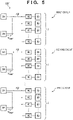
- Fig. 5 shows an example of the configuration of a print element substrate SB' according to an example of this embodiment.
- the plurality of memory elements ME and the plurality of write units 22 are divided into i groups, like the plurality of print elements PE. That is, j memory elements ME and j write units 22 are arranged in each of the first to ith groups.
- One current supply unit 23 can be provided for each group, and one determination unit 24 can be provided for each group.
- the i current supply units 23 and the i determination units 24, which are provided in this way, are preferably arrayed in the widthwise direction.
- the result of each determination unit 24 is obtained as a bit signal for each group. For this reason, i bit signals are obtained in total, and these can be read out as bit data using, for example, i flip-flop circuits connected in series.
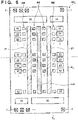
- Fig. 6 shows an example of the configuration of a print element substrate SB 2 according to the second embodiment.
- a current supply unit 23 and a determination unit 24 are juxtaposed in the widthwise direction on each of one side and the other side (the upper side and the lower side in Fig. 6 ) of short sides E S .
- a plurality of print elements PE, a plurality of memory elements ME, and a plurality of write units 22 are divided into the one side and the other side of the short sides E S . Note that this division is indicated by a broken line in Fig. 6 .
- the current supply unit 23 on the one side supplies a current. Based on a voltage Vm generated by this, the determination unit 24 on the one side determines the presence/absence of write to the memory elements ME. Similarly, to the memory elements ME on the other side of the short sides E S , the current supply unit 23 on the other side supplies a current. Based on the voltage Vm generated by this, the determination unit 24 on the other side determines the presence/absence of write to the memory elements ME.
- the current supply controller 233 may be provided only on the one side.
- the node between the high breakdown voltage transistor TR1 and the memory element ME is substantially in a floating state.
- Fig. 7 shows an example of the configuration of a print element substrate SB 3 according to the third embodiment.
- the print element substrate SB 3 further includes a resistive element R21 connected in parallel with each memory element ME. According to this configuration, it is possible to prevent write from being performed to the memory element ME in a case in which a high voltage is applied to the memory element ME via a write terminal Tx during the non-conductive state of a high breakdown voltage transistor TR1.
- An element substrate including a liquid discharge element comprising a memory element capable of storing individual information of the element substrate by write, the memory element being configured to change an impedance value by the write, a plurality of current supply elements capable of supplying a current to the memory element, and a determination unit configured to determine presence/absence of the write based on a voltage generated in the memory element by the current selectively supplied from the plurality of current supply elements, wherein the plurality of current supply elements constitute a part of a current mirror circuit and each supply the current in an amount according to a size ratio to the memory element.
Landscapes
- Semiconductor Memories (AREA)
- Particle Formation And Scattering Control In Inkjet Printers (AREA)
- Ink Jet (AREA)
Applications Claiming Priority (1)
| Application Number | Priority Date | Filing Date | Title |
|---|---|---|---|
| JP2021026638A JP7579173B2 (ja) | 2021-02-22 | 2021-02-22 | 素子基板、液体吐出ヘッドおよび液体吐出装置 |
Publications (1)
| Publication Number | Publication Date |
|---|---|
| EP4046801A1 true EP4046801A1 (de) | 2022-08-24 |
Family
ID=80218411
Family Applications (1)
| Application Number | Title | Priority Date | Filing Date |
|---|---|---|---|
| EP22155129.4A Pending EP4046801A1 (de) | 2021-02-22 | 2022-02-04 | Elementsubstrat, flüssigkeitsausstosskopf und flüssigkeitsausstossvorrichtung |
Country Status (6)
| Country | Link |
|---|---|
| US (1) | US11975536B2 (de) |
| EP (1) | EP4046801A1 (de) |
| JP (1) | JP7579173B2 (de) |
| KR (1) | KR102876963B1 (de) |
| CN (1) | CN114953737A (de) |
| BR (1) | BR102022002530A2 (de) |
Families Citing this family (1)
| Publication number | Priority date | Publication date | Assignee | Title |
|---|---|---|---|---|
| JP2024166106A (ja) * | 2023-05-16 | 2024-11-28 | 研能科技股▲ふん▼有限公司 | インクジェットヘッドチップ識別回路 |
Citations (4)
| Publication number | Priority date | Publication date | Assignee | Title |
|---|---|---|---|---|
| JPH08263994A (ja) * | 1995-03-23 | 1996-10-11 | Kawasaki Steel Corp | プログラマブルリードオンリメモリ |
| JP2008299989A (ja) | 2007-06-01 | 2008-12-11 | Elpida Memory Inc | 半導体記憶装置のアンチフューズ置換判定回路、およびアンチフューズ置換判定方法 |
| JP2014058130A (ja) | 2012-09-18 | 2014-04-03 | Canon Inc | 記録ヘッド用基板及び記録装置 |
| US10894403B2 (en) * | 2017-03-30 | 2021-01-19 | Canon Kabushiki Kaisha | Semiconductor apparatus, liquid discharge head substrate, liquid discharge head, and liquid discharge apparatus |
Family Cites Families (9)
| Publication number | Priority date | Publication date | Assignee | Title |
|---|---|---|---|---|
| AUPN232495A0 (en) * | 1995-04-12 | 1995-05-04 | Eastman Kodak Company | Integrated fault tolerance in printing mechanisms |
| US5668751A (en) * | 1996-08-01 | 1997-09-16 | Micron Technology, Inc. | Antifuse programming method and apparatus |
| JP4933057B2 (ja) * | 2005-05-13 | 2012-05-16 | キヤノン株式会社 | ヘッド基板、記録ヘッド、及び記録装置 |
| US7333383B2 (en) | 2005-08-23 | 2008-02-19 | Infineon Technologies Ag | Fuse resistance read-out circuit |
| JP5121439B2 (ja) * | 2007-12-26 | 2013-01-16 | 株式会社東芝 | 不揮発性半導体記憶装置 |
| US9938136B2 (en) * | 2016-08-18 | 2018-04-10 | Stmicroelectronics Asia Pacific Pte Ltd | Fluid ejection device |
| JP6789729B2 (ja) * | 2016-08-31 | 2020-11-25 | キヤノン株式会社 | 半導体装置、液体吐出ヘッド用基板、液体吐出ヘッド、及び液体吐出装置 |
| JP6843649B2 (ja) * | 2017-02-22 | 2021-03-17 | キヤノン株式会社 | 記録素子基板、液体吐出ヘッド及び記録装置 |
| EP3585617A4 (de) * | 2017-04-05 | 2020-11-18 | Hewlett-Packard Development Company, L.P. | Auf-chip-aktuator-fehlererkennung |
-
2021
- 2021-02-22 JP JP2021026638A patent/JP7579173B2/ja active Active
-
2022
- 2022-02-04 EP EP22155129.4A patent/EP4046801A1/de active Pending
- 2022-02-10 BR BR102022002530-4A patent/BR102022002530A2/pt unknown
- 2022-02-11 US US17/670,325 patent/US11975536B2/en active Active
- 2022-02-21 KR KR1020220022371A patent/KR102876963B1/ko active Active
- 2022-02-22 CN CN202210159396.9A patent/CN114953737A/zh active Pending
Patent Citations (4)
| Publication number | Priority date | Publication date | Assignee | Title |
|---|---|---|---|---|
| JPH08263994A (ja) * | 1995-03-23 | 1996-10-11 | Kawasaki Steel Corp | プログラマブルリードオンリメモリ |
| JP2008299989A (ja) | 2007-06-01 | 2008-12-11 | Elpida Memory Inc | 半導体記憶装置のアンチフューズ置換判定回路、およびアンチフューズ置換判定方法 |
| JP2014058130A (ja) | 2012-09-18 | 2014-04-03 | Canon Inc | 記録ヘッド用基板及び記録装置 |
| US10894403B2 (en) * | 2017-03-30 | 2021-01-19 | Canon Kabushiki Kaisha | Semiconductor apparatus, liquid discharge head substrate, liquid discharge head, and liquid discharge apparatus |
Also Published As
| Publication number | Publication date |
|---|---|
| KR102876963B1 (ko) | 2025-10-27 |
| US11975536B2 (en) | 2024-05-07 |
| US20220266590A1 (en) | 2022-08-25 |
| JP2022128224A (ja) | 2022-09-01 |
| KR20220120499A (ko) | 2022-08-30 |
| BR102022002530A2 (pt) | 2022-09-20 |
| CN114953737A (zh) | 2022-08-30 |
| JP7579173B2 (ja) | 2024-11-07 |
Similar Documents
| Publication | Publication Date | Title |
|---|---|---|
| JP5981815B2 (ja) | 記録ヘッド用基板及び記録装置 | |
| US10894403B2 (en) | Semiconductor apparatus, liquid discharge head substrate, liquid discharge head, and liquid discharge apparatus | |
| US20220126576A1 (en) | Recording element substrate, liquid ejection head and recording apparatus | |
| US10189249B2 (en) | Recording element substrate, liquid discharge head, and recording apparatus | |
| US10566069B2 (en) | Semiconductor apparatus, liquid discharge head substrate, liquid discharge head, and liquid discharge apparatus | |
| US11975536B2 (en) | Element substrate, liquid discharge head, and liquid discharge apparatus | |
| US10434772B2 (en) | Printhead and printing apparatus | |
| KR101659148B1 (ko) | 소자 기판, 기록 헤드, 및 기록 장치 | |
| US11837301B2 (en) | Substrate, printing apparatus, and manufacturing method | |
| US11981129B2 (en) | Element substrate, liquid discharge head, and printing apparatus | |
| US20230317186A1 (en) | Storage apparatus, liquid discharge head, and liquid discharge apparatus | |
| US20250077136A1 (en) | Printing apparatus and control method of printing apparatus | |
| US10532565B2 (en) | Print element substrate, printhead, and printing apparatus | |
| CN114083900A (zh) | 打印元件基板、打印头和打印装置 | |
| US12374414B2 (en) | Semiconductor device, liquid discharge head, and liquid discharge apparatus | |
| JP6470858B2 (ja) | 基板、液体吐出ヘッドおよび液体吐出装置 | |
| US12036798B2 (en) | Control device and method for controlling element substrate | |
| JP6302513B2 (ja) | 記録ヘッド用基板及び記録装置 |
Legal Events
| Date | Code | Title | Description |
|---|---|---|---|
| PUAI | Public reference made under article 153(3) epc to a published international application that has entered the european phase |
Free format text: ORIGINAL CODE: 0009012 |
|
| STAA | Information on the status of an ep patent application or granted ep patent |
Free format text: STATUS: THE APPLICATION HAS BEEN PUBLISHED |
|
| AK | Designated contracting states |
Kind code of ref document: A1 Designated state(s): AL AT BE BG CH CY CZ DE DK EE ES FI FR GB GR HR HU IE IS IT LI LT LU LV MC MK MT NL NO PL PT RO RS SE SI SK SM TR |
|
| STAA | Information on the status of an ep patent application or granted ep patent |
Free format text: STATUS: REQUEST FOR EXAMINATION WAS MADE |
|
| 17P | Request for examination filed |
Effective date: 20230224 |
|
| RBV | Designated contracting states (corrected) |
Designated state(s): AL AT BE BG CH CY CZ DE DK EE ES FI FR GB GR HR HU IE IS IT LI LT LU LV MC MK MT NL NO PL PT RO RS SE SI SK SM TR |
|
| STAA | Information on the status of an ep patent application or granted ep patent |
Free format text: STATUS: EXAMINATION IS IN PROGRESS |
|
| 17Q | First examination report despatched |
Effective date: 20240422 |