EP4039712A1 - Gegen cll1 gerichteter chimärer antigenrezeptor und dessen verwendung - Google Patents
Gegen cll1 gerichteter chimärer antigenrezeptor und dessen verwendung Download PDFInfo
- Publication number
- EP4039712A1 EP4039712A1 EP20958917.5A EP20958917A EP4039712A1 EP 4039712 A1 EP4039712 A1 EP 4039712A1 EP 20958917 A EP20958917 A EP 20958917A EP 4039712 A1 EP4039712 A1 EP 4039712A1
- Authority
- EP
- European Patent Office
- Prior art keywords
- seq
- cll1
- antigen receptor
- chimeric antigen
- acid sequence
- Prior art date
- Legal status (The legal status is an assumption and is not a legal conclusion. Google has not performed a legal analysis and makes no representation as to the accuracy of the status listed.)
- Pending
Links
Images


Classifications
-
- A—HUMAN NECESSITIES
- A61—MEDICAL OR VETERINARY SCIENCE; HYGIENE
- A61K—PREPARATIONS FOR MEDICAL, DENTAL OR TOILETRY PURPOSES
- A61K40/00—Cellular immunotherapy
- A61K40/10—Cellular immunotherapy characterised by the cell type used
- A61K40/13—B-cells
-
- C—CHEMISTRY; METALLURGY
- C12—BIOCHEMISTRY; BEER; SPIRITS; WINE; VINEGAR; MICROBIOLOGY; ENZYMOLOGY; MUTATION OR GENETIC ENGINEERING
- C12N—MICROORGANISMS OR ENZYMES; COMPOSITIONS THEREOF; PROPAGATING, PRESERVING, OR MAINTAINING MICROORGANISMS; MUTATION OR GENETIC ENGINEERING; CULTURE MEDIA
- C12N15/00—Mutation or genetic engineering; DNA or RNA concerning genetic engineering, vectors, e.g. plasmids, or their isolation, preparation or purification; Use of hosts therefor
- C12N15/09—Recombinant DNA-technology
- C12N15/63—Introduction of foreign genetic material using vectors; Vectors; Use of hosts therefor; Regulation of expression
- C12N15/79—Vectors or expression systems specially adapted for eukaryotic hosts
- C12N15/85—Vectors or expression systems specially adapted for eukaryotic hosts for animal cells
- C12N15/86—Viral vectors
-
- A—HUMAN NECESSITIES
- A61—MEDICAL OR VETERINARY SCIENCE; HYGIENE
- A61K—PREPARATIONS FOR MEDICAL, DENTAL OR TOILETRY PURPOSES
- A61K40/00—Cellular immunotherapy
- A61K40/10—Cellular immunotherapy characterised by the cell type used
- A61K40/11—T-cells, e.g. tumour infiltrating lymphocytes [TIL] or regulatory T [Treg] cells; Lymphokine-activated killer [LAK] cells
-
- A—HUMAN NECESSITIES
- A61—MEDICAL OR VETERINARY SCIENCE; HYGIENE
- A61K—PREPARATIONS FOR MEDICAL, DENTAL OR TOILETRY PURPOSES
- A61K40/00—Cellular immunotherapy
- A61K40/30—Cellular immunotherapy characterised by the recombinant expression of specific molecules in the cells of the immune system
- A61K40/31—Chimeric antigen receptors [CAR]
-
- A—HUMAN NECESSITIES
- A61—MEDICAL OR VETERINARY SCIENCE; HYGIENE
- A61K—PREPARATIONS FOR MEDICAL, DENTAL OR TOILETRY PURPOSES
- A61K40/00—Cellular immunotherapy
- A61K40/40—Cellular immunotherapy characterised by antigens that are targeted or presented by cells of the immune system
- A61K40/41—Vertebrate antigens
- A61K40/42—Cancer antigens
-
- A—HUMAN NECESSITIES
- A61—MEDICAL OR VETERINARY SCIENCE; HYGIENE
- A61K—PREPARATIONS FOR MEDICAL, DENTAL OR TOILETRY PURPOSES
- A61K40/00—Cellular immunotherapy
- A61K40/40—Cellular immunotherapy characterised by antigens that are targeted or presented by cells of the immune system
- A61K40/41—Vertebrate antigens
- A61K40/42—Cancer antigens
- A61K40/4202—Receptors, cell surface antigens or cell surface determinants
-
- A—HUMAN NECESSITIES
- A61—MEDICAL OR VETERINARY SCIENCE; HYGIENE
- A61K—PREPARATIONS FOR MEDICAL, DENTAL OR TOILETRY PURPOSES
- A61K40/00—Cellular immunotherapy
- A61K40/40—Cellular immunotherapy characterised by antigens that are targeted or presented by cells of the immune system
- A61K40/41—Vertebrate antigens
- A61K40/42—Cancer antigens
- A61K40/4202—Receptors, cell surface antigens or cell surface determinants
- A61K40/4224—Molecules with a "CD" designation not provided for elsewhere
-
- A—HUMAN NECESSITIES
- A61—MEDICAL OR VETERINARY SCIENCE; HYGIENE
- A61P—SPECIFIC THERAPEUTIC ACTIVITY OF CHEMICAL COMPOUNDS OR MEDICINAL PREPARATIONS
- A61P35/00—Antineoplastic agents
-
- A—HUMAN NECESSITIES
- A61—MEDICAL OR VETERINARY SCIENCE; HYGIENE
- A61P—SPECIFIC THERAPEUTIC ACTIVITY OF CHEMICAL COMPOUNDS OR MEDICINAL PREPARATIONS
- A61P35/00—Antineoplastic agents
- A61P35/02—Antineoplastic agents specific for leukemia
-
- C—CHEMISTRY; METALLURGY
- C07—ORGANIC CHEMISTRY
- C07K—PEPTIDES
- C07K14/00—Peptides having more than 20 amino acids; Gastrins; Somatostatins; Melanotropins; Derivatives thereof
- C07K14/435—Peptides having more than 20 amino acids; Gastrins; Somatostatins; Melanotropins; Derivatives thereof from animals; from humans
- C07K14/705—Receptors; Cell surface antigens; Cell surface determinants
-
- C—CHEMISTRY; METALLURGY
- C07—ORGANIC CHEMISTRY
- C07K—PEPTIDES
- C07K14/00—Peptides having more than 20 amino acids; Gastrins; Somatostatins; Melanotropins; Derivatives thereof
- C07K14/435—Peptides having more than 20 amino acids; Gastrins; Somatostatins; Melanotropins; Derivatives thereof from animals; from humans
- C07K14/705—Receptors; Cell surface antigens; Cell surface determinants
- C07K14/70503—Immunoglobulin superfamily
- C07K14/7051—T-cell receptor (TcR)-CD3 complex
-
- C—CHEMISTRY; METALLURGY
- C07—ORGANIC CHEMISTRY
- C07K—PEPTIDES
- C07K14/00—Peptides having more than 20 amino acids; Gastrins; Somatostatins; Melanotropins; Derivatives thereof
- C07K14/435—Peptides having more than 20 amino acids; Gastrins; Somatostatins; Melanotropins; Derivatives thereof from animals; from humans
- C07K14/705—Receptors; Cell surface antigens; Cell surface determinants
- C07K14/70503—Immunoglobulin superfamily
- C07K14/70517—CD8
-
- C—CHEMISTRY; METALLURGY
- C07—ORGANIC CHEMISTRY
- C07K—PEPTIDES
- C07K14/00—Peptides having more than 20 amino acids; Gastrins; Somatostatins; Melanotropins; Derivatives thereof
- C07K14/435—Peptides having more than 20 amino acids; Gastrins; Somatostatins; Melanotropins; Derivatives thereof from animals; from humans
- C07K14/705—Receptors; Cell surface antigens; Cell surface determinants
- C07K14/70503—Immunoglobulin superfamily
- C07K14/70521—CD28, CD152
-
- C—CHEMISTRY; METALLURGY
- C07—ORGANIC CHEMISTRY
- C07K—PEPTIDES
- C07K14/00—Peptides having more than 20 amino acids; Gastrins; Somatostatins; Melanotropins; Derivatives thereof
- C07K14/435—Peptides having more than 20 amino acids; Gastrins; Somatostatins; Melanotropins; Derivatives thereof from animals; from humans
- C07K14/705—Receptors; Cell surface antigens; Cell surface determinants
- C07K14/70578—NGF-receptor/TNF-receptor superfamily, e.g. CD27, CD30, CD40, CD95
-
- C—CHEMISTRY; METALLURGY
- C07—ORGANIC CHEMISTRY
- C07K—PEPTIDES
- C07K14/00—Peptides having more than 20 amino acids; Gastrins; Somatostatins; Melanotropins; Derivatives thereof
- C07K14/435—Peptides having more than 20 amino acids; Gastrins; Somatostatins; Melanotropins; Derivatives thereof from animals; from humans
- C07K14/705—Receptors; Cell surface antigens; Cell surface determinants
- C07K14/715—Receptors; Cell surface antigens; Cell surface determinants for cytokines; for lymphokines; for interferons
- C07K14/7151—Receptors; Cell surface antigens; Cell surface determinants for cytokines; for lymphokines; for interferons for tumor necrosis factor [TNF], for lymphotoxin [LT]
-
- C—CHEMISTRY; METALLURGY
- C07—ORGANIC CHEMISTRY
- C07K—PEPTIDES
- C07K16/00—Immunoglobulins [IG], e.g. monoclonal or polyclonal antibodies
- C07K16/18—Immunoglobulins [IG], e.g. monoclonal or polyclonal antibodies against material from animals or humans
- C07K16/28—Immunoglobulins [IG], e.g. monoclonal or polyclonal antibodies against material from animals or humans against receptors, cell surface antigens or cell surface determinants
- C07K16/2851—Immunoglobulins [IG], e.g. monoclonal or polyclonal antibodies against material from animals or humans against receptors, cell surface antigens or cell surface determinants against the lectin superfamily, e.g. CD23, CD72
-
- C—CHEMISTRY; METALLURGY
- C12—BIOCHEMISTRY; BEER; SPIRITS; WINE; VINEGAR; MICROBIOLOGY; ENZYMOLOGY; MUTATION OR GENETIC ENGINEERING
- C12N—MICROORGANISMS OR ENZYMES; COMPOSITIONS THEREOF; PROPAGATING, PRESERVING, OR MAINTAINING MICROORGANISMS; MUTATION OR GENETIC ENGINEERING; CULTURE MEDIA
- C12N15/00—Mutation or genetic engineering; DNA or RNA concerning genetic engineering, vectors, e.g. plasmids, or their isolation, preparation or purification; Use of hosts therefor
- C12N15/09—Recombinant DNA-technology
- C12N15/11—DNA or RNA fragments; Modified forms thereof; Non-coding nucleic acids having a biological activity
- C12N15/62—DNA sequences coding for fusion proteins
- C12N15/625—DNA sequences coding for fusion proteins containing a sequence coding for a signal sequence
-
- C—CHEMISTRY; METALLURGY
- C12—BIOCHEMISTRY; BEER; SPIRITS; WINE; VINEGAR; MICROBIOLOGY; ENZYMOLOGY; MUTATION OR GENETIC ENGINEERING
- C12N—MICROORGANISMS OR ENZYMES; COMPOSITIONS THEREOF; PROPAGATING, PRESERVING, OR MAINTAINING MICROORGANISMS; MUTATION OR GENETIC ENGINEERING; CULTURE MEDIA
- C12N5/00—Undifferentiated human, animal or plant cells, e.g. cell lines; Tissues; Cultivation or maintenance thereof; Culture media therefor
- C12N5/06—Animal cells or tissues; Human cells or tissues
- C12N5/0602—Vertebrate cells
- C12N5/0634—Cells from the blood or the immune system
- C12N5/0636—T lymphocytes
-
- C—CHEMISTRY; METALLURGY
- C12—BIOCHEMISTRY; BEER; SPIRITS; WINE; VINEGAR; MICROBIOLOGY; ENZYMOLOGY; MUTATION OR GENETIC ENGINEERING
- C12N—MICROORGANISMS OR ENZYMES; COMPOSITIONS THEREOF; PROPAGATING, PRESERVING, OR MAINTAINING MICROORGANISMS; MUTATION OR GENETIC ENGINEERING; CULTURE MEDIA
- C12N7/00—Viruses; Bacteriophages; Compositions thereof; Preparation or purification thereof
-
- A—HUMAN NECESSITIES
- A61—MEDICAL OR VETERINARY SCIENCE; HYGIENE
- A61K—PREPARATIONS FOR MEDICAL, DENTAL OR TOILETRY PURPOSES
- A61K2121/00—Preparations for use in therapy
-
- A—HUMAN NECESSITIES
- A61—MEDICAL OR VETERINARY SCIENCE; HYGIENE
- A61K—PREPARATIONS FOR MEDICAL, DENTAL OR TOILETRY PURPOSES
- A61K2239/00—Indexing codes associated with cellular immunotherapy of group A61K40/00
- A61K2239/46—Indexing codes associated with cellular immunotherapy of group A61K40/00 characterised by the cancer treated
- A61K2239/48—Blood cells, e.g. leukemia or lymphoma
-
- A—HUMAN NECESSITIES
- A61—MEDICAL OR VETERINARY SCIENCE; HYGIENE
- A61K—PREPARATIONS FOR MEDICAL, DENTAL OR TOILETRY PURPOSES
- A61K2300/00—Mixtures or combinations of active ingredients, wherein at least one active ingredient is fully defined in groups A61K31/00 - A61K41/00
-
- A—HUMAN NECESSITIES
- A61—MEDICAL OR VETERINARY SCIENCE; HYGIENE
- A61K—PREPARATIONS FOR MEDICAL, DENTAL OR TOILETRY PURPOSES
- A61K38/00—Medicinal preparations containing peptides
-
- C—CHEMISTRY; METALLURGY
- C07—ORGANIC CHEMISTRY
- C07K—PEPTIDES
- C07K2317/00—Immunoglobulins specific features
- C07K2317/60—Immunoglobulins specific features characterized by non-natural combinations of immunoglobulin fragments
- C07K2317/62—Immunoglobulins specific features characterized by non-natural combinations of immunoglobulin fragments comprising only variable region components
- C07K2317/622—Single chain antibody (scFv)
-
- C—CHEMISTRY; METALLURGY
- C07—ORGANIC CHEMISTRY
- C07K—PEPTIDES
- C07K2319/00—Fusion polypeptide
-
- C—CHEMISTRY; METALLURGY
- C07—ORGANIC CHEMISTRY
- C07K—PEPTIDES
- C07K2319/00—Fusion polypeptide
- C07K2319/01—Fusion polypeptide containing a localisation/targetting motif
- C07K2319/02—Fusion polypeptide containing a localisation/targetting motif containing a signal sequence
-
- C—CHEMISTRY; METALLURGY
- C07—ORGANIC CHEMISTRY
- C07K—PEPTIDES
- C07K2319/00—Fusion polypeptide
- C07K2319/01—Fusion polypeptide containing a localisation/targetting motif
- C07K2319/03—Fusion polypeptide containing a localisation/targetting motif containing a transmembrane segment
-
- C—CHEMISTRY; METALLURGY
- C07—ORGANIC CHEMISTRY
- C07K—PEPTIDES
- C07K2319/00—Fusion polypeptide
- C07K2319/33—Fusion polypeptide fusions for targeting to specific cell types, e.g. tissue specific targeting, targeting of a bacterial subspecies
-
- C—CHEMISTRY; METALLURGY
- C12—BIOCHEMISTRY; BEER; SPIRITS; WINE; VINEGAR; MICROBIOLOGY; ENZYMOLOGY; MUTATION OR GENETIC ENGINEERING
- C12N—MICROORGANISMS OR ENZYMES; COMPOSITIONS THEREOF; PROPAGATING, PRESERVING, OR MAINTAINING MICROORGANISMS; MUTATION OR GENETIC ENGINEERING; CULTURE MEDIA
- C12N2510/00—Genetically modified cells
-
- C—CHEMISTRY; METALLURGY
- C12—BIOCHEMISTRY; BEER; SPIRITS; WINE; VINEGAR; MICROBIOLOGY; ENZYMOLOGY; MUTATION OR GENETIC ENGINEERING
- C12N—MICROORGANISMS OR ENZYMES; COMPOSITIONS THEREOF; PROPAGATING, PRESERVING, OR MAINTAINING MICROORGANISMS; MUTATION OR GENETIC ENGINEERING; CULTURE MEDIA
- C12N2740/00—Reverse transcribing RNA viruses
- C12N2740/00011—Details
- C12N2740/10011—Retroviridae
- C12N2740/15011—Lentivirus, not HIV, e.g. FIV, SIV
- C12N2740/15021—Viruses as such, e.g. new isolates, mutants or their genomic sequences
-
- C—CHEMISTRY; METALLURGY
- C12—BIOCHEMISTRY; BEER; SPIRITS; WINE; VINEGAR; MICROBIOLOGY; ENZYMOLOGY; MUTATION OR GENETIC ENGINEERING
- C12N—MICROORGANISMS OR ENZYMES; COMPOSITIONS THEREOF; PROPAGATING, PRESERVING, OR MAINTAINING MICROORGANISMS; MUTATION OR GENETIC ENGINEERING; CULTURE MEDIA
- C12N2740/00—Reverse transcribing RNA viruses
- C12N2740/00011—Details
- C12N2740/10011—Retroviridae
- C12N2740/15011—Lentivirus, not HIV, e.g. FIV, SIV
- C12N2740/15041—Use of virus, viral particle or viral elements as a vector
- C12N2740/15042—Use of virus, viral particle or viral elements as a vector virus or viral particle as vehicle, e.g. encapsulating small organic molecule
-
- C—CHEMISTRY; METALLURGY
- C12—BIOCHEMISTRY; BEER; SPIRITS; WINE; VINEGAR; MICROBIOLOGY; ENZYMOLOGY; MUTATION OR GENETIC ENGINEERING
- C12N—MICROORGANISMS OR ENZYMES; COMPOSITIONS THEREOF; PROPAGATING, PRESERVING, OR MAINTAINING MICROORGANISMS; MUTATION OR GENETIC ENGINEERING; CULTURE MEDIA
- C12N2740/00—Reverse transcribing RNA viruses
- C12N2740/00011—Details
- C12N2740/10011—Retroviridae
- C12N2740/15011—Lentivirus, not HIV, e.g. FIV, SIV
- C12N2740/15041—Use of virus, viral particle or viral elements as a vector
- C12N2740/15043—Use of virus, viral particle or viral elements as a vector viral genome or elements thereof as genetic vector
-
- C—CHEMISTRY; METALLURGY
- C12—BIOCHEMISTRY; BEER; SPIRITS; WINE; VINEGAR; MICROBIOLOGY; ENZYMOLOGY; MUTATION OR GENETIC ENGINEERING
- C12N—MICROORGANISMS OR ENZYMES; COMPOSITIONS THEREOF; PROPAGATING, PRESERVING, OR MAINTAINING MICROORGANISMS; MUTATION OR GENETIC ENGINEERING; CULTURE MEDIA
- C12N2740/00—Reverse transcribing RNA viruses
- C12N2740/00011—Details
- C12N2740/10011—Retroviridae
- C12N2740/15011—Lentivirus, not HIV, e.g. FIV, SIV
- C12N2740/15051—Methods of production or purification of viral material
- C12N2740/15052—Methods of production or purification of viral material relating to complementing cells and packaging systems for producing virus or viral particles
-
- C—CHEMISTRY; METALLURGY
- C12—BIOCHEMISTRY; BEER; SPIRITS; WINE; VINEGAR; MICROBIOLOGY; ENZYMOLOGY; MUTATION OR GENETIC ENGINEERING
- C12N—MICROORGANISMS OR ENZYMES; COMPOSITIONS THEREOF; PROPAGATING, PRESERVING, OR MAINTAINING MICROORGANISMS; MUTATION OR GENETIC ENGINEERING; CULTURE MEDIA
- C12N2740/00—Reverse transcribing RNA viruses
- C12N2740/00011—Details
- C12N2740/10011—Retroviridae
- C12N2740/16011—Human Immunodeficiency Virus, HIV
- C12N2740/16041—Use of virus, viral particle or viral elements as a vector
- C12N2740/16043—Use of virus, viral particle or viral elements as a vector viral genome or elements thereof as genetic vector
-
- C—CHEMISTRY; METALLURGY
- C12—BIOCHEMISTRY; BEER; SPIRITS; WINE; VINEGAR; MICROBIOLOGY; ENZYMOLOGY; MUTATION OR GENETIC ENGINEERING
- C12N—MICROORGANISMS OR ENZYMES; COMPOSITIONS THEREOF; PROPAGATING, PRESERVING, OR MAINTAINING MICROORGANISMS; MUTATION OR GENETIC ENGINEERING; CULTURE MEDIA
- C12N2800/00—Nucleic acids vectors
- C12N2800/10—Plasmid DNA
- C12N2800/106—Plasmid DNA for vertebrates
- C12N2800/107—Plasmid DNA for vertebrates for mammalian
Definitions
- the present application belongs to the field of biomedicine, and relates to a chimeric antigen receptor targeting CLL1 and use thereof.
- CLL1 C-type lectin-like molecule 1
- CLEC12A C-type lectin domain family 12 member A
- CLL1 is restrictedly expressed on hematopoietic cells, mainly including myeloid-derived cells in peripheral blood and bone marrow, such as monocytes, dendritic cells, granulocytes, and most acute myeloid leukemia (AML) cells. It is worth noting that although CLL1 is abundantly expressed on myeloid cells in peripheral blood and bone marrow, it is not expressed on myeloid-derived cells in peripheral tissues, for example, neither tissue macrophages nor tissue dendritic cells express CLL1.
- CLL1 is expressed on AML stem cells (CD34+/CD38-) and a small part of hematopoietic progenitor cells (CD34+/CD38+ or CD34+/CD33+), but not on normal hematopoietic stem cells (CD34+/CD38- or CD34+/CD33-).
- CLL1 Due to this special expression pattern, CLL1 is expected to become a potential target for the diagnosis and treatment of AML. However, there are few reports of immunotherapy targeting CLL1.
- the present application provides a chimeric antigen receptor targeting CLL1 and use thereof.
- the chimeric antigen receptor targeting CLL1 uses anti-CLL1 antibody with binding ability to CLL1 as antigen binding domain, which can bind not only purified or free CLL1 protein but also CLL1 protein on the cell surface; and immune cells expressing the chimeric antigen receptor targeting CLL1 have important application in the field of tumor therapy.
- the present application provides a chimeric antigen receptor targeting CLL1 comprising an antigen binding domain, a hinge region, a transmembrane domain, and a signal transduction domain; wherein the antigen binding domain is an anti-CLL1 antibody.
- an anti-CLL1 antibody with binding ability to CLL1 is used as the antigen binding domain of the chimeric antigen receptor, so that the chimeric antigen receptor can specifically bind to CLL1 positive tumor cells, and achieve a specific targeting effect on CLL1 positive tumors.
- the antigen binding domain includes the amino acid sequence shown in SEQ ID NO: 1 and SEQ ID NO: 2, wherein SEQ ID NO: 1 and SEQ ID NO: 2 are connected by a linker peptide to form an anti-CLL1 antibody 19C1;
- the antigen binding domain includes the amino acid sequence shown in SEQ ID NO: 3 and SEQ ID NO: 4, wherein SEQ ID NO: 3 and SEQ ID NO: 4 are connected by a linker peptide to form an anti-CLL1 antibody 23D7; wherein
- the antigen binding domain includes the amino acid sequence shown in SEQ ID NO: 5 and SEQ ID NO: 6, wherein SEQ ID NO: 5 and SEQ ID NO: 6 are connected by a linker peptide to form an anti-CLL1 antibody 27H4; wherein
- the antigen binding domain includes the amino acid sequence shown in SEQ ID NO: 7 and the amino acid sequence shown in one of SEQ ID NO: 8 to 10, wherein SEQ ID NO: 7 and SEQ ID NO: 8 are connected by a linker peptide to form an anti-CLL1 antibody H27H4L1, SEQ ID NO: 7 and SEQ ID NO: 9 are connected by a linker peptide to form an anti-CLL1 antibody H27H4L2, or SEQ ID NO: 7 and SEQ ID NO: 10 are connected by a linker peptide to form an anti-CLL1 antibody H27H4L3; wherein
- the antigen binding domain includes the amino acid sequence shown in SEQ ID NO: 11 and SEQ ID NO: 12, wherein SEQ ID NO: 11 and SEQ ID NO: 12 are connected by a linker peptide to form an anti-CLL1 antibody 1075.7; wherein
- the hinge region includes a CD8 ⁇ hinge region.
- the transmembrane domain includes a CD8 ⁇ transmembrane region and/or a CD28 transmembrane region, preferably a CD8 ⁇ transmembrane region.
- the signal transduction domain includes CD3 ⁇ .
- the signal transduction domain further includes any one or a combination of at least two of 4-1BB, CD28 intracellular region, DAP10 or OX40.
- the chimeric antigen receptor targeting CLL1 further includes a signal peptide.
- the signal peptide includes a CD8 ⁇ signal peptide and/or an IgG ⁇ light chain signal peptide.
- the chimeric antigen receptor targeting CLL1 includes a signal peptide, an anti-CLL1 antibody, a CD8 ⁇ hinge region, a CD8 ⁇ transmembrane region, 4-1BB and CD3 ⁇ .
- the chimeric antigen receptor targeting CLL1 is 19C1-CAR, which includes the amino acid sequence shown in SEQ ID NO: 13; wherein SEQ ID NO: 13:
- the chimeric antigen receptor targeting CLL1 is 23D7-CAR, which includes the amino acid sequence shown in SEQ ID NO: 14; wherein SEQ ID NO: 14:
- the chimeric antigen receptor targeting CLL1 is 27H4-CAR, which includes the amino acid sequence shown in SEQ ID NO: 15; wherein SEQ ID NO: 15:
- the chimeric antigen receptor targeting CLL1 is H27H4-CAR, which includes the amino acid sequence shown in SEQ ID NO: 16; wherein SEQ ID NO: 16:
- the chimeric antigen receptor targeting CLL1 is 1075.7-CAR, which includes the amino acid sequence shown in SEQ ID NO: 17; wherein SEQ ID NO: 17:
- the present application provides a nucleic acid molecule comprising a coding gene of the chimeric antigen receptor targeting CLL1 described in the first aspect.
- the nucleic acid molecule includes the nucleic acid sequence shown in SEQ ID NO: 18, which is the coding gene of 19C1-CAR; SEQ ID NO: 18:
- the nucleic acid molecule includes the nucleic acid sequence shown in SEQ ID NO: 19, which is the coding gene of 23D7-CAR; SEQ ID NO: 19:
- the nucleic acid molecule includes the nucleic acid sequence shown in SEQ ID NO: 20, which is the coding gene of 27H4-CAR; SEQ ID NO: 20:
- the nucleic acid molecule includes the nucleic acid sequence shown in SEQ ID NO: 21, which is the coding gene of H27H4-CAR; SEQ ID NO: 21:
- the nucleic acid molecule includes the nucleic acid sequence shown in SEQ ID NO: 22, which is the coding gene of 1075.7-CAR; SEQ ID NO: 22:
- the present application provides an expression vector comprising the nucleic acid molecule described in the second aspect.
- the expression vector is a viral vector or a non-viral vector containing the nucleic acid molecule described in the second aspect.
- the viral vector includes any one of a lentiviral vector, a retroviral vector or an adeno-associated virus vector.
- the non-viral vector includes any one of a Piggybac transposon system, a Sleeping Beauty transposon system or a nanocarrier.
- the present application provides a recombinant lentivirus prepared from mammalian cells transfected with the expression vector described in the third aspect and a helper plasmid.
- the present application provides a chimeric antigen receptor immune cell expressing the chimeric antigen receptor targeting CLL1 described in the first aspect.
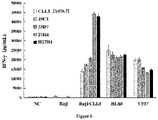
- immune cells expressing the chimeric antigen receptor targeting CLL1 use the antigen binding domain of the chimeric antigen receptor to target CLL1-positive tumor cells and secrete cytokine IFN- ⁇ by exerting the killing function of immune cells to achieve the killing effect on CLL1 tumors at different effector-to-target ratios.
- the nucleic acid molecule described in the second aspect is integrated into the genome of the chimeric antigen receptor immune cell.
- the chimeric antigen receptor immune cell includes the expression vector described in the third aspect and/or the recombinant lentivirus described in the fourth aspect.
- the immune cell includes any one of a T cell, an NK cell or a macrophage.
- the T cell includes an ⁇ T cell and/or a ⁇ T cell.
- the present application provides a pharmaceutical composition comprising the chimeric antigen receptor immune cell described in the fifth aspect.
- the pharmaceutical composition further includes any one or a combination of at least two of a pharmaceutically acceptable carrier, excipient or diluent.
- the present application provides use of the chimeric antigen receptor targeting CLL1 described in the first aspect, the nucleic acid molecule described in the second aspect, the expression vector described in the third aspect, the recombinant lentivirus described in the fourth aspect, the chimeric antigen receptor immune cell described in the fifth aspect, or the pharmaceutical composition described in the sixth aspect in the preparation of a medicine for treating a malignant tumor.
- the malignant tumor includes acute myeloid leukemia.
- the present application provides a method of treating cancer, comprising administering to a patient an effective dose of the chimeric antigen receptor immune cells described in the fifth aspect or the pharmaceutical composition described in the sixth aspect, and administering one or more antitumor agents simultaneously, separately or sequentially.
- the cancer includes acute myeloid leukemia.
- the embodiments shall be carried out according to the technology or conditions described in the literature in the field or according to the product specification.
- the reagents or instruments used without indicating the manufacturer are all conventional products that can be purchased through formal channels.
- anti-CLL1 antibodies 19C1, 23D7, 27H4, humanized 27H4 (H27H4) and 1075.7 were selected as antigen binding domains for the construction of CAR molecules, wherein, 19C1 included the variable regions shown in SEQ ID NO: 1-2, 23D7 included the variable regions shown in SEQ ID NOs: 3-4, 27H4 included the variable regions shown in SEQ ID NOs: 5-6, H27H4 included the variable regions shown in SEQ ID NOs: 7-8, and 1075.7 included the variable regions shown in SEQ ID NOs: 11-12.
- FITC anti-human CD371 (CLL1) antibody (biolegend) was incubated with target cells Jurkat and KG-1a, separately. Then the expression of CLL1 by the target cells was detected by flow cytometry.
- THP-1, U937 and HL-60 were CLL1 positive cells, and Jurkat and KG-1a were CLL1 negative cells.
- a chimeric antigen receptor targeting CLL1 was designed.
- the schematic diagram of the structure is shown in Figure 2 , including the CD8 ⁇ signal peptide, single-chain antibody that specifically binds to CLL1 antigen (Anti-CLL1 scFv), CD8 ⁇ hinge region (Hinge) and transmembrane region (Transmembrane), 4-1BB costimulatory domain and CD3 ⁇ signaling domain.
- the specific CAR molecules are as follows.
- the constructed lentiviral expression vector pBG-27H4 containing the 27H4 CAR gene is shown in Figure 3A and Figure 3B .
- a four-plasmid system was used to perform lentiviral packaging on the lentiviral expression vector constructed in Example 4. The specific steps are as follows:
- PBMCs were washed several times with saline and transferred to X-VIVO medium (containing 50 ng/mL OKT3, 300 IU/mL IL-2) for culture.
- PBMCs were isolated and activated with X-VIVO (containing 50 ng/mL OKT3, 300 IU/mL IL-2), and the medium was changed to X-VIVO containing 300 IU/mL for expanded culture after 2 days. Then cells were counted every two days and the medium was replaced by fresh X-VIVO containing 300 IU/mL to maintain the cell concentration at (0.5 ⁇ 1) ⁇ 10 6 cells/mL. The observation lasted for ten days.
- RetroNectin was used to improve the infection efficiency of lentivirus on T cells, and the steps were as follows: 30 ⁇ g RetroNectin was coated on a 6-well plate and maintained in a 37°C cell incubator for 2 h; RetroNectin was pipetted, the coated 6-well plate was blocked with Hank's solution containing 2.5% BSA and placed in a cell incubator at 37°C for 0.5 h; the blocking solution was pipetted, the 6-well plate was washed with Hank's solution containing 2% Hepes, added with X-VIVO medium, added with appropriate amount of lentivirus solution, centrifuged at 2000 g for 2 hours, and the supernatant was discarded; 1 ⁇ 10 6 T cells (CD3 positive >90%) were added, centrifuged at 1000 g for 10 min, and cultured in a cell incubator at 37°C, 5% CO 2 , and a certain humidity. Repeat the above steps the next day.
- Table 2 CAR Lentivirus Virus Infection Titer (TU/mL) Number of Starting Cells (pcs) MOI Lentivirus Usage Amount ( ⁇ L) 19C1-CAR 2.41E+07 4.00E+06 5 830.91 23D7-CAR 4.70E+07 4.00E+06 5 425.99 27H4-CAR 1.76E+08 4.00E+06 5 113.51 H27H4-CAR 3.91E+08 4.00E+06 5 51.22 1075.7-CAR 9.88E+07 4.00E+06 5 202.43
- Flow cytometry was used to detect the expression of CAR molecules on the surface of T cells, and the CLL1-Fc fusion protein (Acrobiosystems) was used to detect the expression of CAR.
- the secondary antibody was FITC-Labeled anti-human Fc, and T cell (T mock) not transfected with CAR was used as a negative control.
- the xCELLigence Real Time Cell Analysis was used to automatically detect the cell killing effect in the whole process.
- the xCELLigence ® Real Time Cell Analyzer (RTCA) was based on microelectronic impedance technology. There were a large number of micro-gold electrodes integrated at the bottom of the E-plate. When the adherent cells adhered to the micro-gold electrodes, the number, diameter and adhesion ability of the cells will affect the current conduction between the micro-gold electrodes, thereby causing the impedance value to change. This change was extremely delicate and sensitive. Under the toxic negative effect, the cell directly or indirectly affected the impedance value. Therefore, xCELLigence can monitor the cytotoxic effects caused by molecular targets.
- H27H4-CAR-T had the strongest killing ability
- 27H4-CAR-T had similar killing ability to H27H4-CAR-T
- 23D7-CAR-T was inferior
- 19C1-CAR-T and 1075.7-CAR-T had relatively weak killing ability
- the untransfected CAR T mock could not kill Raji-CLL1, indicating that the killing activity of anti-CLL1 CAR-T was dependent on the CAR element.
- the Human IFN- ⁇ ELISA kit (Neobioscience) was used to detect the concentration of IFN- ⁇ cytokine released by CAR-T cells, and the secretion of IFN- ⁇ was analyzed after CAR-T and target cells were co-cultured. Specifically, CLL1 positive cells Raji-CLL1, HL60, U937 were used as positive target cells, and CLL1 negative cells Raji were used as negative target cells.
- CAR-T cells and different target cells were incubated for 16 h according to an effector-to-target ratio of 1:1, and the supernatant was taken to detect the secretion of IFN- ⁇ in the culture supernatant by enzyme-linked immunosorbent assay (ELISA).
- ELISA enzyme-linked immunosorbent assay
- the principle of the assay was based on a double antibody sandwich ELISA in which anti-human IFN- ⁇ antibody was coated on an enzyme standard plate, human IFN- ⁇ in the sample or standard was bound to the coating antibody during the experiment, and the free components were washed away; biotinylated anti-human IFN- ⁇ antibody and horseradish peroxidase labeled avidin were added sequentially, the anti-human IFN- ⁇ antibody bound to human IFN- ⁇ that bound to the coating antibody, and biotin specifically bound to avidin to form an immune complex, and the free components were washed away; the chromogenic substrate (TMB) was added, which appeared blue under the catalysis of horseradish peroxidase, and turned yellow after adding the termination solution, and the OD value was measured at 450 nm with Microplate Reader, and there was a positive correlation between IFN- ⁇ concentration and OD450, and the concentration of IFN- ⁇ in the sample was calculated by plotting the standard curve.
- TMB chromogenic substrate
- the CAR-T cells targeting CLL1 of the present application have a significant killing effect on CLL1 positive tumor cells at different effector-to-target ratios, secrete a large amount of cytokine IFN- ⁇ after co-cultured with tumor cells, and have promising applications in the field of CLL1 positive tumor therapy.
Landscapes
- Health & Medical Sciences (AREA)
- Life Sciences & Earth Sciences (AREA)
- Chemical & Material Sciences (AREA)
- Organic Chemistry (AREA)
- Genetics & Genomics (AREA)
- General Health & Medical Sciences (AREA)
- Immunology (AREA)
- Engineering & Computer Science (AREA)
- Zoology (AREA)
- Biochemistry (AREA)
- Biomedical Technology (AREA)
- Medicinal Chemistry (AREA)
- Molecular Biology (AREA)
- Bioinformatics & Cheminformatics (AREA)
- Wood Science & Technology (AREA)
- Biophysics (AREA)
- Animal Behavior & Ethology (AREA)
- Veterinary Medicine (AREA)
- Public Health (AREA)
- Biotechnology (AREA)
- Cell Biology (AREA)
- Proteomics, Peptides & Aminoacids (AREA)
- General Engineering & Computer Science (AREA)
- Epidemiology (AREA)
- Toxicology (AREA)
- Gastroenterology & Hepatology (AREA)
- Microbiology (AREA)
- Hematology (AREA)
- Virology (AREA)
- Pharmacology & Pharmacy (AREA)
- General Chemical & Material Sciences (AREA)
- Plant Pathology (AREA)
- Chemical Kinetics & Catalysis (AREA)
- Physics & Mathematics (AREA)
- Nuclear Medicine, Radiotherapy & Molecular Imaging (AREA)
- Oncology (AREA)
- Peptides Or Proteins (AREA)
- Micro-Organisms Or Cultivation Processes Thereof (AREA)
- Medicines Containing Material From Animals Or Micro-Organisms (AREA)
- Developmental Biology & Embryology (AREA)
Applications Claiming Priority (2)
| Application Number | Priority Date | Filing Date | Title |
|---|---|---|---|
| CN202011461194.7A CN113234169B (zh) | 2020-12-11 | 2020-12-11 | 靶向cll1嵌合抗原受体及其应用 |
| PCT/CN2020/138257 WO2022120942A1 (zh) | 2020-12-11 | 2020-12-22 | 靶向cll1嵌合抗原受体及其应用 |
Publications (2)
| Publication Number | Publication Date |
|---|---|
| EP4039712A1 true EP4039712A1 (de) | 2022-08-10 |
| EP4039712A4 EP4039712A4 (de) | 2024-08-07 |
Family
ID=77129947
Family Applications (1)
| Application Number | Title | Priority Date | Filing Date |
|---|---|---|---|
| EP20958917.5A Pending EP4039712A4 (de) | 2020-12-11 | 2020-12-22 | Gegen cll1 gerichteter chimärer antigenrezeptor und dessen verwendung |
Country Status (8)
| Country | Link |
|---|---|
| US (1) | US12508312B2 (de) |
| EP (1) | EP4039712A4 (de) |
| JP (1) | JP7595961B2 (de) |
| KR (1) | KR102860449B1 (de) |
| CN (1) | CN113234169B (de) |
| AU (1) | AU2020480789B2 (de) |
| GB (1) | GB2606869B (de) |
| WO (1) | WO2022120942A1 (de) |
Cited By (1)
| Publication number | Priority date | Publication date | Assignee | Title |
|---|---|---|---|---|
| WO2024069165A1 (en) * | 2022-09-27 | 2024-04-04 | Coding Bio Limited | Cll1 binding molecules |
Families Citing this family (10)
| Publication number | Priority date | Publication date | Assignee | Title |
|---|---|---|---|---|
| CN113980134B (zh) | 2020-12-11 | 2022-05-31 | 广州百暨基因科技有限公司 | 抗cll1抗体及其应用 |
| CN115806625B (zh) * | 2021-09-15 | 2023-08-04 | 广州百暨基因科技有限公司 | T细胞限定表达的嵌合抗原受体及其应用 |
| WO2024032247A1 (zh) * | 2022-08-09 | 2024-02-15 | 合源康华医药科技(北京)有限公司 | 一种cll1抗体及其应用 |
| WO2024149225A1 (zh) * | 2023-01-10 | 2024-07-18 | 合源康华医药科技(北京)有限公司 | 一种人源化cll1抗体、嵌合抗原受体及其应用 |
| CN116640211A (zh) * | 2023-02-28 | 2023-08-25 | 浙江康佰裕生物科技有限公司 | 特异性结合cll1蛋白的单域抗体及其应用 |
| CN116445415A (zh) * | 2023-04-28 | 2023-07-18 | 浙江康佰裕生物科技有限公司 | 靶向cll1的car-t细胞及其制备方法与应用 |
| CN118994392A (zh) * | 2023-05-16 | 2024-11-22 | 苏州亘喜生物科技有限公司 | 特异性结合cll1的抗体及其制法和应用 |
| CN116515765A (zh) * | 2023-06-09 | 2023-08-01 | 浙江康佰裕生物科技有限公司 | Cll1-car-t细胞及其制备方法与应用 |
| CN116462761B (zh) * | 2023-06-14 | 2023-09-08 | 浙江时迈药业有限公司 | 针对cll1的抗体及其用途 |
| CN120058960A (zh) * | 2023-11-17 | 2025-05-30 | 亘喜生物科技(上海)有限公司 | 一种靶向cd38和cll1的双特异性嵌合抗原受体及其应用 |
Family Cites Families (21)
| Publication number | Priority date | Publication date | Assignee | Title |
|---|---|---|---|---|
| EP2211903A4 (de) | 2007-10-17 | 2011-07-06 | Nuvelo Inc | Cll-1-antikörper |
| US9163090B2 (en) | 2012-05-07 | 2015-10-20 | Cellerant Therapeutics, Inc. | Antibodies specific for CLL-1 |
| EP3593812A3 (de) * | 2014-03-15 | 2020-05-27 | Novartis AG | Behandlung von krebs mithilfe eines chimären antigenrezeptors |
| KR20170066421A (ko) | 2014-09-12 | 2017-06-14 | 제넨테크, 인크. | 항-cll-1 항체 및 면역접합체 |
| ES2869972T3 (es) | 2015-01-26 | 2021-10-26 | Cellectis | Sistemas de receptores de antígenos quiméricos dirigidos por mAb para clasificar/agotar células inmunitarias genomanipuladas |
| EP3310378B1 (de) | 2015-06-16 | 2024-01-24 | F. Hoffmann-La Roche AG | Anti-cll-1-antikörper und verfahren zur verwendung |
| US20180258149A1 (en) * | 2015-09-17 | 2018-09-13 | Novartis Ag | Car t cell therapies with enhanced efficacy |
| CN108290955A (zh) * | 2015-11-24 | 2018-07-17 | 塞勒兰特治疗公司 | 人源化抗-cll-1抗体 |
| KR20200068750A (ko) | 2016-04-01 | 2020-06-15 | 카이트 파마 인코포레이티드 | 키메라 수용체 및 그의 사용 방법 |
| PT3436079T (pt) | 2016-04-01 | 2021-10-06 | Kite Pharma Inc | Recetores de antigénios quiméricos e de células t e métodos de uso |
| SG10201606949QA (en) | 2016-08-19 | 2018-03-28 | Singapore Health Serv Pte Ltd | Immunosuppressive composition for use in treating immunological disorders |
| BR112019019426A2 (pt) * | 2017-03-22 | 2020-05-26 | Novartis Ag | Biomarcadores e terapias com células t car com eficácia intensificada |
| CN111432823A (zh) * | 2017-07-25 | 2020-07-17 | 得克萨斯大学体系董事会 | 增强的嵌合抗原受体及其用途 |
| WO2019139888A1 (en) | 2018-01-09 | 2019-07-18 | H. Lee Moffitt Cancer Center And Research Institute Inc. | Compositions and methods for targeting clec12a-expressing cancers |
| CN110357960A (zh) | 2018-04-10 | 2019-10-22 | 广州爱思迈生物医药科技有限公司 | 抗体及抗体改造方法 |
| WO2019246593A2 (en) * | 2018-06-22 | 2019-12-26 | Fred Hutchinson Cancer Research Center | Compositions and methods to target cll-1 and cd123 for the treatment of acute myeloid leukemia and related disorders |
| GB201813178D0 (en) * | 2018-08-13 | 2018-09-26 | Autolus Ltd | Cell |
| US12534532B2 (en) * | 2018-10-26 | 2026-01-27 | Crage Medical Co., Limited | CLL1-targeting antibody and application thereof |
| CN111116753A (zh) | 2018-10-30 | 2020-05-08 | 上海泰因生物技术有限公司 | 一种双特异性抗体的制备方法 |
| CN112961242B (zh) | 2020-06-30 | 2022-01-04 | 广州百暨基因科技有限公司 | 抗b7h3抗体及其应用 |
| CN113980134B (zh) | 2020-12-11 | 2022-05-31 | 广州百暨基因科技有限公司 | 抗cll1抗体及其应用 |
-
2020
- 2020-12-11 CN CN202011461194.7A patent/CN113234169B/zh active Active
- 2020-12-22 WO PCT/CN2020/138257 patent/WO2022120942A1/zh not_active Ceased
- 2020-12-22 EP EP20958917.5A patent/EP4039712A4/de active Pending
- 2020-12-22 AU AU2020480789A patent/AU2020480789B2/en active Active
- 2020-12-22 KR KR1020227011658A patent/KR102860449B1/ko active Active
- 2020-12-22 US US17/612,212 patent/US12508312B2/en active Active
- 2020-12-22 JP JP2022529577A patent/JP7595961B2/ja active Active
- 2020-12-22 GB GB2207722.6A patent/GB2606869B/en active Active
Cited By (1)
| Publication number | Priority date | Publication date | Assignee | Title |
|---|---|---|---|---|
| WO2024069165A1 (en) * | 2022-09-27 | 2024-04-04 | Coding Bio Limited | Cll1 binding molecules |
Also Published As
| Publication number | Publication date |
|---|---|
| CN113234169A (zh) | 2021-08-10 |
| JP2023510465A (ja) | 2023-03-14 |
| GB202207722D0 (de) | 2022-07-13 |
| JP7595961B2 (ja) | 2024-12-09 |
| EP4039712A4 (de) | 2024-08-07 |
| US20220354890A1 (en) | 2022-11-10 |
| US12508312B2 (en) | 2025-12-30 |
| GB2606869B (en) | 2026-02-18 |
| KR20220084040A (ko) | 2022-06-21 |
| KR102860449B1 (ko) | 2025-09-17 |
| WO2022120942A1 (zh) | 2022-06-16 |
| GB2606869A (en) | 2022-11-23 |
| CN113234169B (zh) | 2022-11-01 |
| AU2020480789B2 (en) | 2025-03-27 |
| AU2020480789A1 (en) | 2022-08-04 |
Similar Documents
| Publication | Publication Date | Title |
|---|---|---|
| US12508312B2 (en) | Chimeric antigen receptor targeting CLL1 and use thereof | |
| CN111748044B (zh) | Cd19和pd-l1双靶点嵌合抗原受体及其应用 | |
| CN113248621B (zh) | Cll1和cd33双靶点嵌合抗原受体及其应用 | |
| CN112048481B (zh) | 一种靶向cd19的嵌合抗原受体nk细胞及其应用 | |
| WO2018053885A1 (zh) | 一种加强型Slit2 CAR-T和CAR-NK细胞制备方法和应用 | |
| CN112195157B (zh) | Cd19和cd22双靶点嵌合抗原受体t细胞及其应用 | |
| CN112204133A (zh) | Car nk细胞 | |
| CN111234032B (zh) | 用于治疗卵巢癌的双靶点嵌合抗原受体及制备方法与应用 | |
| CN113248622B (zh) | 一种靶向cll1和nkg2d配体的双靶点嵌合抗原受体及其应用 | |
| CN114276454A (zh) | 一种抗间皮素的纳米抗体及其应用 | |
| CN117736335A (zh) | 靶向间皮素和nkg2d配体的双靶向car-t细胞及其应用 | |
| CN116854825B (zh) | 靶向bcma的人源化嵌合抗原受体及其用途 | |
| CN113493525B (zh) | 一种增效且抵抗耗竭的嵌合抗原受体t细胞及其在制备治疗肿瘤药物中的用途 | |
| AU2021389909A1 (en) | Ras mutant epitope peptide and t cell receptor recognizing ras mutant | |
| CN116178567B (zh) | 一种靶向TGFβRII的嵌合抗原受体及其用途 | |
| US20240109978A1 (en) | Chimeric antigen receptor (car) spacer modifications enhance car t cell functionality | |
| CN114031690B (zh) | 靶向ccr1和nkg2d配体的嵌合抗原受体及其应用 | |
| EP4520346A1 (de) | Zellen, verfahren und systeme zur verwendung bei der behandlung von krebs mit dual-car-t | |
| CN113563482B (zh) | Cd19靶向性的嵌合抗原受体及其应用 | |
| Lopes | Production, optimization and efficiency evaluation of CAR-T cells against HER2 positive breast cancer cells | |
| CN116554347A (zh) | 一种NKp46L嵌合抗原受体的构建及其应用 | |
| CN121426955A (zh) | 一种抗cd7的抗原结合片段、抗体及其应用 | |
| CN119708251A (zh) | 一种利用cd27逆转t和car-t细胞pd1信号的工程化细胞方法 | |
| CN116162170A (zh) | 以cd244抗原为靶点的嵌合抗原受体及其制备方法和用途 | |
| HK40036126A (en) | Car nk cells |
Legal Events
| Date | Code | Title | Description |
|---|---|---|---|
| STAA | Information on the status of an ep patent application or granted ep patent |
Free format text: STATUS: UNKNOWN |
|
| STAA | Information on the status of an ep patent application or granted ep patent |
Free format text: STATUS: THE INTERNATIONAL PUBLICATION HAS BEEN MADE |
|
| PUAI | Public reference made under article 153(3) epc to a published international application that has entered the european phase |
Free format text: ORIGINAL CODE: 0009012 |
|
| STAA | Information on the status of an ep patent application or granted ep patent |
Free format text: STATUS: REQUEST FOR EXAMINATION WAS MADE |
|
| 17P | Request for examination filed |
Effective date: 20220503 |
|
| AK | Designated contracting states |
Kind code of ref document: A1 Designated state(s): AL AT BE BG CH CY CZ DE DK EE ES FI FR GB GR HR HU IE IS IT LI LT LU LV MC MK MT NL NO PL PT RO RS SE SI SK SM TR |
|
| DAV | Request for validation of the european patent (deleted) | ||
| DAX | Request for extension of the european patent (deleted) | ||
| RIC1 | Information provided on ipc code assigned before grant |
Ipc: A61P 35/02 20060101ALI20240311BHEP Ipc: A61P 35/00 20060101ALI20240311BHEP Ipc: A61K 39/00 20060101ALI20240311BHEP Ipc: C12N 5/10 20060101ALI20240311BHEP Ipc: C12N 7/01 20060101ALI20240311BHEP Ipc: C12N 15/867 20060101ALI20240311BHEP Ipc: C12N 15/62 20060101ALI20240311BHEP Ipc: C07K 19/00 20060101AFI20240311BHEP |
|
| A4 | Supplementary search report drawn up and despatched |
Effective date: 20240709 |
|
| RIC1 | Information provided on ipc code assigned before grant |
Ipc: A61P 35/02 20060101ALI20240703BHEP Ipc: A61P 35/00 20060101ALI20240703BHEP Ipc: A61K 39/00 20060101ALI20240703BHEP Ipc: C12N 5/10 20060101ALI20240703BHEP Ipc: C12N 7/01 20060101ALI20240703BHEP Ipc: C12N 15/867 20060101ALI20240703BHEP Ipc: C12N 15/62 20060101ALI20240703BHEP Ipc: C07K 19/00 20060101AFI20240703BHEP |