EP4031431B1 - System zur erzeugung von druckluft und zur klimatisierung für ein schienenfahrzeug - Google Patents
System zur erzeugung von druckluft und zur klimatisierung für ein schienenfahrzeug Download PDFInfo
- Publication number
- EP4031431B1 EP4031431B1 EP20789664.8A EP20789664A EP4031431B1 EP 4031431 B1 EP4031431 B1 EP 4031431B1 EP 20789664 A EP20789664 A EP 20789664A EP 4031431 B1 EP4031431 B1 EP 4031431B1
- Authority
- EP
- European Patent Office
- Prior art keywords
- compressor
- electrical signal
- coupling means
- mechanical torque
- electric motor
- Prior art date
- Legal status (The legal status is an assumption and is not a legal conclusion. Google has not performed a legal analysis and makes no representation as to the accuracy of the status listed.)
- Active
Links
Images




Classifications
-
- B—PERFORMING OPERATIONS; TRANSPORTING
- B60—VEHICLES IN GENERAL
- B60T—VEHICLE BRAKE CONTROL SYSTEMS OR PARTS THEREOF; BRAKE CONTROL SYSTEMS OR PARTS THEREOF, IN GENERAL; ARRANGEMENT OF BRAKING ELEMENTS ON VEHICLES IN GENERAL; PORTABLE DEVICES FOR PREVENTING UNWANTED MOVEMENT OF VEHICLES; VEHICLE MODIFICATIONS TO FACILITATE COOLING OF BRAKES
- B60T13/00—Transmitting braking action from initiating means to ultimate brake actuator with power assistance or drive; Brake systems incorporating such transmitting means, e.g. air-pressure brake systems
- B60T13/10—Transmitting braking action from initiating means to ultimate brake actuator with power assistance or drive; Brake systems incorporating such transmitting means, e.g. air-pressure brake systems with fluid assistance, drive, or release
- B60T13/24—Transmitting braking action from initiating means to ultimate brake actuator with power assistance or drive; Brake systems incorporating such transmitting means, e.g. air-pressure brake systems with fluid assistance, drive, or release the fluid being gaseous
- B60T13/26—Compressed-air systems
-
- B—PERFORMING OPERATIONS; TRANSPORTING
- B61—RAILWAYS
- B61D—BODY DETAILS OR KINDS OF RAILWAY VEHICLES
- B61D27/00—Heating, cooling, ventilating, or air-conditioning
-
- B—PERFORMING OPERATIONS; TRANSPORTING
- B60—VEHICLES IN GENERAL
- B60H—ARRANGEMENTS OF HEATING, COOLING, VENTILATING OR OTHER AIR-TREATING DEVICES SPECIALLY ADAPTED FOR PASSENGER OR GOODS SPACES OF VEHICLES
- B60H1/00—Heating, cooling or ventilating devices
- B60H1/00357—Air-conditioning arrangements specially adapted for particular vehicles
- B60H1/00371—Air-conditioning arrangements specially adapted for particular vehicles for vehicles carrying large numbers of passengers, e.g. buses
-
- B—PERFORMING OPERATIONS; TRANSPORTING
- B60—VEHICLES IN GENERAL
- B60H—ARRANGEMENTS OF HEATING, COOLING, VENTILATING OR OTHER AIR-TREATING DEVICES SPECIALLY ADAPTED FOR PASSENGER OR GOODS SPACES OF VEHICLES
- B60H1/00—Heating, cooling or ventilating devices
- B60H1/32—Cooling devices
- B60H1/3204—Cooling devices using compression
- B60H1/3223—Cooling devices using compression characterised by the arrangement or type of the compressor
-
- B—PERFORMING OPERATIONS; TRANSPORTING
- B60—VEHICLES IN GENERAL
- B60T—VEHICLE BRAKE CONTROL SYSTEMS OR PARTS THEREOF; BRAKE CONTROL SYSTEMS OR PARTS THEREOF, IN GENERAL; ARRANGEMENT OF BRAKING ELEMENTS ON VEHICLES IN GENERAL; PORTABLE DEVICES FOR PREVENTING UNWANTED MOVEMENT OF VEHICLES; VEHICLE MODIFICATIONS TO FACILITATE COOLING OF BRAKES
- B60T17/00—Component parts, details, or accessories of power brake systems not covered by groups B60T8/00, B60T13/00 or B60T15/00, or presenting other characteristic features
- B60T17/002—Air treatment devices
- B60T17/004—Draining and drying devices
-
- B—PERFORMING OPERATIONS; TRANSPORTING
- B60—VEHICLES IN GENERAL
- B60T—VEHICLE BRAKE CONTROL SYSTEMS OR PARTS THEREOF; BRAKE CONTROL SYSTEMS OR PARTS THEREOF, IN GENERAL; ARRANGEMENT OF BRAKING ELEMENTS ON VEHICLES IN GENERAL; PORTABLE DEVICES FOR PREVENTING UNWANTED MOVEMENT OF VEHICLES; VEHICLE MODIFICATIONS TO FACILITATE COOLING OF BRAKES
- B60T17/00—Component parts, details, or accessories of power brake systems not covered by groups B60T8/00, B60T13/00 or B60T15/00, or presenting other characteristic features
- B60T17/02—Arrangements of pumps or compressors, or control devices therefor
-
- B—PERFORMING OPERATIONS; TRANSPORTING
- B60—VEHICLES IN GENERAL
- B60T—VEHICLE BRAKE CONTROL SYSTEMS OR PARTS THEREOF; BRAKE CONTROL SYSTEMS OR PARTS THEREOF, IN GENERAL; ARRANGEMENT OF BRAKING ELEMENTS ON VEHICLES IN GENERAL; PORTABLE DEVICES FOR PREVENTING UNWANTED MOVEMENT OF VEHICLES; VEHICLE MODIFICATIONS TO FACILITATE COOLING OF BRAKES
- B60T17/00—Component parts, details, or accessories of power brake systems not covered by groups B60T8/00, B60T13/00 or B60T15/00, or presenting other characteristic features
- B60T17/18—Safety devices; Monitoring
- B60T17/22—Devices for monitoring or checking brake systems; Signal devices
- B60T17/228—Devices for monitoring or checking brake systems; Signal devices for railway vehicles
-
- B—PERFORMING OPERATIONS; TRANSPORTING
- B61—RAILWAYS
- B61D—BODY DETAILS OR KINDS OF RAILWAY VEHICLES
- B61D27/00—Heating, cooling, ventilating, or air-conditioning
- B61D27/0018—Air-conditioning means, i.e. combining at least two of the following ways of treating or supplying air, namely heating, cooling or ventilating
-
- B—PERFORMING OPERATIONS; TRANSPORTING
- B61—RAILWAYS
- B61H—BRAKES OR OTHER RETARDING DEVICES SPECIALLY ADAPTED FOR RAIL VEHICLES; ARRANGEMENT OR DISPOSITION THEREOF IN RAIL VEHICLES
- B61H13/00—Actuating rail-vehicle brakes
-
- B—PERFORMING OPERATIONS; TRANSPORTING
- B61—RAILWAYS
- B61H—BRAKES OR OTHER RETARDING DEVICES SPECIALLY ADAPTED FOR RAIL VEHICLES; ARRANGEMENT OR DISPOSITION THEREOF IN RAIL VEHICLES
- B61H13/00—Actuating rail-vehicle brakes
- B61H13/20—Transmitting mechanisms
-
- B—PERFORMING OPERATIONS; TRANSPORTING
- B60—VEHICLES IN GENERAL
- B60Y—INDEXING SCHEME RELATING TO ASPECTS CROSS-CUTTING VEHICLE TECHNOLOGY
- B60Y2200/00—Type of vehicle
- B60Y2200/30—Railway vehicles
-
- Y—GENERAL TAGGING OF NEW TECHNOLOGICAL DEVELOPMENTS; GENERAL TAGGING OF CROSS-SECTIONAL TECHNOLOGIES SPANNING OVER SEVERAL SECTIONS OF THE IPC; TECHNICAL SUBJECTS COVERED BY FORMER USPC CROSS-REFERENCE ART COLLECTIONS [XRACs] AND DIGESTS
- Y02—TECHNOLOGIES OR APPLICATIONS FOR MITIGATION OR ADAPTATION AGAINST CLIMATE CHANGE
- Y02T—CLIMATE CHANGE MITIGATION TECHNOLOGIES RELATED TO TRANSPORTATION
- Y02T30/00—Transportation of goods or passengers via railways, e.g. energy recovery or reducing air resistance
Definitions
- This invention generally relates to the field of air conditioning and compressed air generation systems for railway vehicles.
- fixed trainset indicates that the configuration of the vehicle is defined in the design phase, where the composition defines which vehicles will be equipped with traction drive, and which vehicles will be towed. After the construction and composition of the train, said train will be broken down into individual vehicles only in case of maintenance due to serious structural damage associated with one of the vehicles making up the train.
- Fig. 1 illustrates a non-exclusive example of a fixed trainset 100 consisting of five cars 101, ..., 105.
- each railway vehicle making up the train 100 is equipped with a local HVAC (Heating, Ventilation, Air Conditioning) system, that is, a system for heating, ventilation and air conditioning of the passenger compartment.
- HVAC Heating, Ventilation, Air Conditioning
- the braking systems use compressed air appropriately injected into brake cylinders to generate braking force.
- Compressed air is generated by one or more compressors. Compressors for this purpose are available with different air flow rates.
- two compressors 121, 124 are installed, as illustrated by way of non-exclusive example in Fig. 1 .
- the dimensioning of the flow rate is derived from the filling speed requirements of the empty system at the daily start-up of the train, and from redundancy criteria in case of failure of at least one of the installed compressors.
- HVAC systems 111, ..., 115 are each integrated into self-contained structures, typically designed to be installed on the train roof.
- Fig. 3 illustrates a real 1:1 scale example of an HVAC system for regional trains.
- Fig. 2 shows how inside an HVAC system, in addition to various other devices, there is a compressor 201 used for compressing the refrigerant gas, said refrigerant gas exchanged with the rest 202 of the HAVC system.
- the compressor 201 is mechanically connected to a motor 203 by means of a shaft 204.
- a mechanical joint not shown in the figure, may be interposed between the motor 203 and the compressor 201 to compensate for misalignments of the two resulting half-shafts.
- An electronic unit 205 receives electrical signals 207 coming from sensors forming part of the HVAC system 202 and electrical signals 208 coming from the passenger compartments to be conditioned.
- the electronic unit 205 controls a power supply device 206.
- the power supply device 206 receives electrical energy 209 distributed on board the vehicle and powers the motor 203.
- Said power supply device 206 may be a simple remote control switch or a power frequency control device, to control said motor 203 with speed control criteria.
- a recurring power value for the motor 203 is on the scale of 10 KVA.
- An HVAC system similar in size to that illustrated in Fig. 3 , usually has a weight on the scale of 500 kg.
- AGTU systems 121, 124 are each integrated into self-contained structures, typically designed to be installed on the roof of the associated vehicle, or suspended under the body of the associated vehicle.
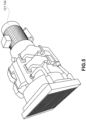
- Fig. 5 shows a real example in 1:1 scale of an AGTU system for passenger vehicles.
- Fig. 4 shows how inside an AGTU system, in addition to various other devices, there is a compressor 401 used for compressing air.
- the compressed air is sent to a dryer 402 and subsequently accumulated in a main tank 403, from which it is then distributed to the users through a main brake pipe 404.
- the compressor 401 is mechanically connected to a motor 405 by means of a resilient joint 406.
- the resilient joint 406 is used to compensate for misalignments of the two resulting half-shafts.
- a pressure switch 407 having a hysteresis turns on a power supply device 408 at a minimum pressure value, by way of non-exclusive example between 7 bar and 8 bar.
- the pressure switch 407 turns off the power supply device 408 at a maximum pressure value, by way of non-exclusive example, between 9 bar and 10 bar.
- the power supply device 408 may be a remote control switch, or more rarely, a power frequency control device, to control the motor 405 with speed control criteria, known as "soft start.”
- a typical power/flow rate ratio for the motor 405 is on the scale of 1 KVA for a flow rate of 100 L/min.
- a flow rate between 800 L/min and 1200 L/min is required, i.e. each motor 405 is required to have a power between about 8 KVA and 12 KVA.
- An AGTU system of similar dimensions to that illustrated in Fig. 5 , has a weight on the scale of 500 kg.
- the weight of the associated motor 405 is on the scale of 70 kg.
- the weight of the support frame for the complete AGTU may vary from 70 kg to 150 kg.
- oil-free In order to reduce the sources of pollution such as lubricating oils inside the compressors, the technology known as “oil-free” is currently preferred.
- the “oil-free” solution further improves the so-called “Life Cycle Cost” LCC, that is the total life cycle cost of the compressor, as the “oil-free” solution eliminates the periodic maintenance cycles linked to replacing the lubricating oil.
- air flow rates may be reached, through "oil-free” technologies, exclusively by means of piston compressors, characterized by high acoustic noise and high vibrations induced to the load-bearing structures, or to the cars of the vehicles to which they are attached.
- US 2016/377075 Al relates to a rail vehicle compressor system and method for controlling the same uses a compressor driven by an electrical machine via a drive shaft to produce compressed air for at least one compressed air tank.
- An object of this invention is to provide a solution which allows the integration of AGTU systems and HVAC systems forming part of at least one railway vehicle, or more railway vehicles of the same railway train.
- a further object is to provide a solution which allows the number of motors necessary for the generation of compressed air and for the air conditioning of at least one railway vehicle, or several railway vehicles of the same railway train, to be reduced.
- This patent relates to a solution for the integration of AGTU systems and HVAC systems forming part of the same train.
- Fig. 6 illustrates a system for the generation of compressed air and for air conditioning according to the invention.
- a single electric motor 601 may be selectively coupled to a first compressor 602 for compressed air by a first coupling means 603.
- the first compressor 602 is arranged to compress the air taken in at atmospheric pressure.
- the air is sent to a dryer 615 and subsequently accumulated in a main tank 616, from which it is then distributed to various users through a main brake pipe 617.
- the users may, by way of non-exclusive example, be the train braking system.
- the single electric motor 601 may be further selectively coupled to a second compressor 608 by a second coupling means 609.
- the second compressor 608 is joined to an HVAC 111, ..., 115 system.
- the second compressor 208 is arranged to compress the refrigerant gas, which is exchanged with the rest of the HAVC system 620.
- the system 600 comprises a single electric motor 601 arranged to generate a mechanical torque to be selectively supplied to the first compressor 602 and/or to the second compressor 608.
- the mechanical torque will be selectively supplied to the first compressor 602 and/or to the second compressor 608 as a function of a first electrical signal 619 generated by a pressure measurement device 618 and indicative of a pressure present in the main brake pipe 617, or in the main tank 616, and of at least a second electrical signal 621 coming from the air conditioning system 620 and indicative of a temperature value or a pressure value or a humidity value, and at least a third electrical signal 622 indicative of a temperature of an environment to be conditioned of the railway vehicle.
- the system may comprise an electronic control unit 607 arranged to generate a first control signal 606 for the first coupling means 603 so as to couple or uncouple the electric motor 601 and the first compressor 602, and a second control signal 612 for a second coupling means 609 so as to couple or uncouple the electric motor 601 and the second compressor 608.
- the first coupling means 603 and the second coupling means 609 may be respective electromagnetic joints.
- the first coupling means 603 connects the first and second half-shafts 604, 605, the electric motor 601 transmits mechanical torque to the first compressor 602.
- the first coupling means 603 decouples the first half-shaft 604 and the second half-shaft 605, the first compressor 602 receives no mechanical torque from the electric motor 601.
- the second coupling means 609 i.e. the electromechanical joint, couples/uncouples a third half-shaft 610 and a fourth half-shaft 611 as a function of the second electrical command 612 generated by the electronic control unit 607.
- the third half-shaft 610 is associated to the electric motor 601 and the fourth half-shaft 611 is associated to the second compressor 608.
- the electric motor 601 transmits mechanical torque to the second compressor 608.
- the second coupling means 609 decouples the third half-shaft 610 and the fourth half-shaft 611, the second compressor 608 receives no mechanical torque from the electric motor 601.
- the electromechanical joint of the first coupling means 603 and the electromechanical joint of the second coupling means 609 may each be an electromagnetic clutch.
- the electronic control unit 607 receives the first electrical signal 619 generated by the pressure measurement device 618.
- the pressure measurement device 618 may be, for example, but not exclusively, a pressure switch with hysteresis.
- the first electrical signal 619 may indicate the need to activate the first compressor 602, and therefore the need to supply the mechanical torque generated by the electric motor to the first compressor 602, when the first electrical signal 619 indicates that the pressure on the main brake pipe 617, measured by the pressure measurement device 618, reaches a minimum pressure, by way of non-exclusive example between 7 bar and 8 bar.
- the pressure measurement device 618 may be, by way of non-exclusive example, a pressure sensor generating a first electrical signal 619 proportional to the pressure value measured on the main brake pipe 617.
- the first electrical signal 619 may indicate the need to deactivate the first compressor 602, and therefore does not indicate the need to supply the mechanical torque generated by the electric motor to the first compressor 602, when the pressure on the main brake pipe 617, measured by the pressure measurement device 618, reaches a maximum pressure, by way of non-exclusive example between 9 bar and 10 bar.
- the electronic control unit 607 also receives the at least one second electrical signal 621 coming from the at least one sensor belonging to the HVAC system 620 and the at least one third electrical signal 622 coming from the at least one temperature sensor in a passenger compartment of the train to be conditioned.
- the second electrical signals 621 may be a plurality and come from several sensors, each suitable for measuring a pressure or temperature or humidity relating to the HVAC system 620
- the third electrical signals 622 may be a plurality and come from a plurality of temperature sensors arranged in various passenger compartments to be conditioned of the railway vehicle.
- the electronic control unit 607 may control a power supply device 613 arranged to receive electrical power 614 distributed on board the railway vehicle and to power the motor 601.
- the power supply device 613 may be for example a simple remote control switch or a power frequency control device, also known by the technical term of "inverter,” for controlling the electric motor 601 with speed control criteria.
- the electronic control unit 607 may activate the power supply device 613, and consequently the electric motor 601, if the first electrical signal 619 indicates the need to activate the first compressor 602, or if at least one of either the second electrical signal 621 or the third electrical signal 622 indicates the need to activate the second compressor 608, and therefore indicates the need to supply the mechanical torque generated by the electric motor to the second compressor 608.
- the electronic control unit 607 deactivates the power supply device 613, switching off the electric motor 601.
- the electronic control unit 607 continuously analyzes the first electrical signal 619 and the second electrical signal 621 and the third electrical signal 622, and decides when to activate the power supply device 613, and consequently the electric motor 601, and which one of either the first coupling means 603 or the second coupling means 609 to activate to supply suitable mechanical torque, generated by the electric motor, to the first compressor 602 and/or to the second compressor 608, respectively.
- the electric motor 601 is scaled to be able to supply a mechanical torque equivalent to the sum of the peak mechanical torques of the first and second compressors 602, 608, so that they may be activated simultaneously.
- the electronic control unit 607 activates the first coupling means 603 if the first electrical signal 619 indicates the need to activate the first compressor 602, and activates the second coupling means 609 if at least one of either the second electrical signal 621 or the third electrical signal 622 indicates the need to activate the second compressor 608.
- the electronic control unit 607 simultaneously activates both the first coupling means 603 and the second coupling means 609 so as to connect the electric motor 601 both to the first compressor 602 and to the second compressor 608.
- the electronic control unit 607 will deactivate the first coupling means 603 when the first electrical signal 619 indicates that the maximum pressure has been reached at the main tank 616, i.e. it does not indicate the need to supply the mechanical torque generated by the electric motor to the first compressor 602, or will deactivate the second coupling means 609 if at least one of either the second electrical signal 621 or the third electrical signal 622 indicates that the compression of the refrigerant gas is not necessary, i.e. it does not indicate the need to supply the mechanical torque generated by the electric motor to the second compressor 608.
- the electric motor 601 is scaled to provide the greater of either the peak mechanical torque of the first compressor 602 or the peak mechanical torque of the second compressor 608.
- the electric motor 601 may supply only the greater of the mechanical torques characteristic of the two compressors 602, 608, in the event of simultaneous requests to activate the electric motor 601 from the first electrical signal 619 and at least one of either the second electrical signal 621 or the third electrical signal 622, the electronic control unit 607 alternately activates the first coupling means 603 and the second coupling means 609, according to pre-loaded strategies, for example in a non-volatile memory 624 in the form of executable code or operating parameters, so as to alternately connect the electric motor 601 to the first compressor 602 and to the second compressor 608.
- a first strategy consists in giving absolute priority to the mechanical torque request coming from the first electrical signal 619 for the first compressor 602, since it is normally linked to the pressure request from the braking system.
- the electronic control unit 607 carries out the following steps:
- the electronic control unit 607 performs the following steps:
- a second strategy consists in giving temporary priority to the activation request coming from the first electrical signal 619, as it is normally linked to the pressure request from the braking system.
- This second strategy requires the pressure measurement device 618 to be comprised of a linear pressure transducer capable of supplying, as a first electrical signal 619, a continuous pressure value signal.
- the electronic control unit 607 carries out the following steps:
- any return of the first electrical signal 619 to the value indicating a minimum pressure at the main tank 616 reactivates the sequence from the beginning.
- the first and second compressors 602 and 608 may be volumetric compressors. It is well known that the mechanical torque required by a volumetric compressor may be considered proportional to the pressure at its output, unless torque contributions are necessary to overcome the friction of said compressor.
- the torque required by the first compressor 602 when the pressure at the main tank 616 is at its predetermined minimum value is less than the torque required by the first compressor 602 when the pressure at the main tank 616 has reached the predetermined maximum value.
- a similar consideration may be made for the second compressor 608. It is therefore possible that, if both the first and second compressors 602, 608 are at their respective minimum operating pressures, the sum of the mechanical torques necessary to move said compressors is lower than the maximum torque that may be supplied by the electric motor 601.
- an inverter device which is part of or constituting the power supply device 613 is capable of controlling the currents supplied to the electric motor 601, of knowing the instantaneous value of said currents, and of giving continuous information of said instantaneous value of said currents to the electronic control unit 607.
- a third strategy in the presence of a simultaneous request to supply mechanical torque to the respective compressors 602, 608 from the first electrical signal 619 and at least one of either the second electrical signal 621 or the third electrical signal 622 if the power supply device 613 comprises or is constituted of an inverter, provides for the electronic control unit 607 to activate simultaneously the first coupling means 603 and the second coupling means 609, so as to connect the electric motor 601 both to the first compressor 602 and to the second compressor 608, as long as the current delivered by the inverter 613 does not reach the maximum value that may be supplied by said inverter 613.
- the electronic control unit 607 may subsequently adopt the first strategy or the second strategy described above.
- Fig. 1 illustrates a non-exclusive example of a fixed trainset 100 constituted by five cars 101, ..., 105, where each car is equipped with a local HVAC system 111, ..., 115.
- the train 100 is further equipped with two local AGTU systems 121, 124. If the solution of this invention were adopted, the train 100 would take the form 700 shown in Fig. 7 , where each car 701, ..., 705 is provided with its own system for the generation of compressed air and for air conditioning 711, ..., 715.
- the air flow supplied by the two compressors integrated in the AGTU systems 121, 124 is divided between the various systems for the generation of compressed air and for air conditioning 711, ..., 715.
- This new configuration offers the benefit of eliminating the AGTU systems 121, 124, with a consequent reduction in the weight of the train 700 and an increase in the space available for the installation of other systems otherwise installed in the car.
- the distribution from a limited number of AGTU systems 121, 124 to a greater number of systems for the generation of compressed air and for air conditioning 711, ..., 715 allows the reduction of the flow rate of the compressors integrated in the systems for the generation of compressed air and for air conditioning 711, ..., 715, by way of non-exclusive example in the case of Fig. 1 and Fig. 7 with a 2:5 ratio.
- This flow rate reduction makes it possible to switch advantageously, for example, from non-lubricated piston compressors to non-lubricated "scroll" compressors, reducing the acoustic noise generated and the mechanical vibrations induced by the compressors to the relevant cars.
- the system described in Fig. 6 may be equipped with a connection to an on-board communication system 623 arranged to connect at least two of the plurality of systems for the generation of compressed air, AGTU, and for air conditioning, HVAC, 711, ..., 715 aboard said train 700. It should be considered that the main brake pipe 617 and the main tank 616 are the same for the whole train 700 and in common with all systems for the generation of compressed air and for air conditioning 711,..., 715.
- the strategy for attributing the drive torque provided by the electric motors 601 to the first and second compressors 602, 608 of each system for the generation of compressed air and for air conditioning 711, ..., 715 may be based on a distributed management.
- the first among the systems for the generation of compressed air and for air conditioning 711, ..., 715 which encounters the simultaneous request for mechanical torque to its first and second compressors 602, 608 from its electrical signals 619 and 621, 622, before prioritizing the request coming from the first electrical signal 619, as previously described in the first, second and third strategy, verifies, by exchanging information through the communication means 623, that at least one other system for the generation of compressed air and for air conditioning 711,..., 715 has requested mechanical torque to its second compressor 608 from at least one of either its second electrical signal 621 or third electrical signal 622.
- the first system for the generation of compressed air and for air conditioning will prioritize the request for mechanical torque to its first compressor 608 from at least one of its first electrical signal 621 or its second electrical signal 622.
Landscapes
- Engineering & Computer Science (AREA)
- Mechanical Engineering (AREA)
- Transportation (AREA)
- Physics & Mathematics (AREA)
- Thermal Sciences (AREA)
- Control Of Positive-Displacement Pumps (AREA)
- Electric Propulsion And Braking For Vehicles (AREA)
- Fluid-Pressure Circuits (AREA)
- Valves And Accessory Devices For Braking Systems (AREA)
Claims (10)
- System (600) zur Erzeugung von Druckluft und zur Klimatisierung für mindestens ein Schienenfahrzeug (701, ..., 705), wobei das System (600) einen ersten Kompressor (602) umfasst, der eingerichtet ist, Druckluft zu erzeugen, um einen Hauptbehälter (616) und eine Hauptbremsleitung (617) des Schienenfahrzeugs mittels einer Lufttrocknungseinheit (615) zu versorgen, und einen zweiten Kompressor (608), der eingerichtet ist, ein Kältemittelgas für ein Klimatisierungssystem (620) des mindestens einen Schienenfahrzeugs zu komprimieren;
wobei das System (600) dadurch gekennzeichnet ist, dass es einen einzigen Elektromotor (601) umfasst, der eingerichtet ist, ein mechanisches Drehmoment zu erzeugen, das eingerichtet ist, wahlweise dem ersten Kompressor (602), dem zweiten Kompressor (608) oder gleichzeitig sowohl dem ersten Kompressor (602) als auch dem zweiten Kompressor (608) als Funktion von:- einem ersten elektrischen Signal (619), das von einer Druckmessvorrichtung (618) erzeugt wird und das für einen in der Hauptbremsleitung (617) oder in dem Hauptbehälter (616) vorhandenen Druck bezeichnend ist; und- mindestens einem zweiten elektrischen Signal (621), das aus dem Klimatisierungssystem (620) kommt und für einen Temperaturwert, einen Druckwert oder einen Feuchtigkeitswert bezeichnend ist, sowie mindestens einem dritten elektrischen Signal (622), das für eine Temperatur einer zu klimatisierenden Umgebung des Schienenfahrzeugs bezeichnend ist, geliefert zu werden . - System (600) nach Anspruch 1, umfassend eine elektronische Steuereinheit (607) zum Steuern des Systems (600), ein erstes Kupplungsmittel und ein zweites Kupplungsmittel;wobei die elektronische Steuereinheit (607) eingerichtet ist, das erste elektrische Signal (619), das mindestens eine zweite elektrische Signal (621) und das mindestens eine dritte elektrische Signal (622) zu empfangen;wobei die elektronische Steuereinheit (607) eingerichtet ist, eine Stromversorgungsvorrichtung (613), die durch eine Stromquelle (614) versorgt wird, zu betreiben, um den einzigen Elektromotor (601) zu versorgen, wenn das erste elektrische Signal (619) den Bedarf an mechanischem Drehmoment für den ersten Kompressor (602) anzeigt, oder wenn mindestens eines des zweiten elektrischen Signals (621) oder des dritten elektrischen Signals (622) den Bedarf an mechanischem Drehmoment für den zweiten Kompressor (608) anzeigt;wobei die elektronische Steuereinheit (607) eingerichtet ist um:- ein erstes Steuersignal (606) für das erste Kupplungsmittel (603), das eingerichtet ist, den Elektromotor (601) und den ersten Kompressor (602) zu kuppeln oder zu entkuppeln;- ein zweites Steuersignal (612) für das zweite Kupplungsmittel (609), das eingerichtet ist, den Elektromotor (601) und den zweiten Kompressor (608) zu kuppeln oder zu entkuppeln, zu erzeugen.
- System (600) nach Anspruch 2, wobei die elektronische Einheit (607) einen nichtflüchtigen Speicher (624) umfasst, um Steuerstrategien des Systems (600) im Voraus zu speichern.
- System (600) nach Anspruch 2 oder 3, wobei:- der erste und der zweite Kompressor (602, 608) jeweils ihr eigenes Spitzen-Drehmoment fordern, und der Elektromotor (601) in der Lage ist, ein mechanisches Drehmoment zu liefern, das gleich oder größer als die Summe der durch den ersten und den zweiten Kompressoren (602, 608) geforderten Spitzen-Drehmomente ist;- wenn nur das erste elektrische Signal (619), das aus der Druckmessvorrichtung (618) kommt, den Bedarf an mechanischem Drehmoment für den ersten Kompressor (602) anzeigt, ist die elektronische Steuereinheit (607) eingerichtet, auf das erste Kupplungsmittel (603) und das zweite Kupplungsmittel (609) des Systems (600) zu wirken, um das durch den Elektromotor erzeugte Drehmoment nur dem ersten Kompressor (602) zu liefern; und- wenn nur mindestens eines des zweiten elektrischen Signals (621) oder des dritten elektrischen Signals (622) den Bedarf an mechanischem Drehmoment für den zweiten Kompressor (608) anzeigt, ist die elektronische Einheit (607) eingerichtet, auf das erste Kupplungsmittel (603) und das zweite Kupplungsmittel (609) zu wirken, um das durch den Elektromotor erzeugte Drehmoment nur dem zweiten Kompressor (608) zu liefern;- wenn gleichzeitig das erste elektrische Signal (619), das aus der Druckmessvorrichtung (618) kommt, den Bedarf an mechanischem Drehmoment für den ersten Kompressor (602) anzeigt und mindestens eines des zweiten elektrischen Signals (621) oder des dritten elektrischen Signals (622) den Bedarf an mechanischem Drehmoment für den zweiten Kompressor (608) anzeigt, ist die elektronische Einheit (607) eingerichtet, auf das erste Kupplungsmittel (603) und das zweite Kupplungsmittel (609) zu wirken, um gleichzeitig das durch den Elektromotor erzeugte Drehmoment sowohl dem ersten Kompressor (602) als auch dem zweiten Kompressor (608) zu liefern.
- System (600) nach Anspruch 2 oder 3, wobei:- der erste und der zweite Kompressor (602, 608) jeweils ihr eigenes Spitzen-Drehmoment fordern, und der Elektromotor (601) in der Lage ist, ein mechanisches Drehmoment zu liefern, das mindestens gleich dem größerem der durch den ersten und den zweiten Kompressoren (602, 608) geforderten Spitzen-Drehmomente ist;wenn nur das erste elektrische Signal (619), das aus der Druckmessvorrichtung (618) kommt, den Bedarf an mechanischem Drehmoment für den ersten Kompressor (602) anzeigt, ist die elektronische Einheit (607) eingerichtet, auf das erste Kupplungsmittel (603) und das zweite Kupplungsmittel (609) zu wirken, um das durch den Elektromotor erzeugte Drehmoment nur dem ersten Kompressor (602) zu liefern;wenn nur mindestens eines des zweiten elektrischen Signals (621) oder des dritten elektrischen Signals (622), das aus dem Klimatisierungssystem (620) oder aus der zu klimatisierenden Umgebung kommt, den Bedarf an mechanischem Drehmoment für den zweiten Kompressor (608) anzeigt, ist die elektronische Einheit dazu eingerichtet, auf das erste Kupplungsmittel (603) und das zweite Kupplungsmittel (609) zu wirken, um das durch den Elektromotor erzeugte Drehmoment nur dem zweiten Kompressor (608) zu liefern;wenn gleichzeitig das erste elektrische Signal (619), das aus der Druckmessvorrichtung (618) kommt, den Bedarf an mechanischem Drehmoment für den ersten Kompressor (602) anzeigt und mindestens eines des ersten elektrischen Signals (621) oder des zweiten elektrischen Signals (622), das aus dem Klimatisierungssystem (620) oder aus der zu klimatisierenden Umgebung kommt, den Bedarf an mechanischem Drehmoment für den zweiten Kompressor (608) anzeigt, ist die elektronische Einheit (607) eingerichtet, auf das erste Kupplungsmittel (603) und das zweite Kupplungsmittel (609) zu wirken, um das durch den Elektromotor erzeugte Drehmoment nur dem ersten Kompressor (602) zu liefern.
- System (600) nach einem der Ansprüche 2 bis 4, wobei:- der erste und der zweite Kompressor (602, 608) jeweils ihr eigenes Spitzen-Drehmoment fordern, und der Elektromotor (601) in der Lage ist, ein mechanisches Drehmoment zu liefern, das gleich dem größerem der durch den ersten und den zweiten Kompressoren (602, 608) geforderten Spitzen-Drehmomente ist;- wenn nur das erste elektrische Signal (619), das aus der Druckmessvorrichtung (618) kommt, einen Bedarf an mechanischem Drehmoment für den ersten Kompressor (602) anzeigt, ist die elektronische Einheit (607) eingerichtet, auf das erste Kupplungsmittel (603) und das zweite Kupplungsmittel (609) zu wirken, um das durch den Elektromotor erzeugte Drehmoment nur dem ersten Kompressor (602) zu liefern;- wenn nur mindestens eines des zweiten elektrischen Signals (621) oder des dritten elektrischen Signals (622), das aus dem Klimatisierungssystem (620) oder aus der zu klimatisierenden Umgebung kommt, den Bedarf an mechanischem Drehmoment für den zweiten Kompressor (608) anzeigt, ist die elektronische Einheit (607) eingerichtet, auf das erste Kupplungsmittel (603) und das zweite Kupplungsmittel (609) zu wirken, um das durch den Elektromotor erzeugte Drehmoment nur dem zweiten Kompressor (608) zu liefern;- wenn gleichzeitig das erste elektrische Signal (619), das aus der Druckmessvorrichtung (618) kommt, einen Druckwert des Hauptbehälters (616) anzeigt, der niedriger als ein vorbestimmter Zwischenwert ist, und mindestens eines des zweiten elektrischen Signals (621) oder des dritten elektrischen Signals (622), das aus dem Klimatisierungssystem (620) oder aus der zu klimatisierenden Umgebung kommt, den Bedarf an mechanischem Drehmoment für den zweiten Kompressor (608) anzeigt, ist die elektronische Einheit (607) eingerichtet, auf das erste Kupplungsmittel (603) und das zweite Kupplungsmittel (609) zu wirken, um das durch den Elektromotor erzeugte Drehmoment nur dem ersten Kompressor (602) zu liefern;- wenn gleichzeitig das erste elektrische Signal (619), das aus der Druckmessvorrichtung (618) kommt, einen Druckwert des Hauptbehälters (616) anzeigt, der höher als der vorbestimmte Zwischenwert ist, und mindestens eines des zweiten elektrischen Signals (621) oder des dritten elektrischen Signals (622), das aus dem Klimatisierungssystem (620) oder aus der zu klimatisierenden Umgebung kommt, den Bedarf an mechanischem Drehmoment für den zweiten Kompressor (608) anzeigt, ist die elektronische Einheit (607) eingerichtet, auf das erste Kupplungsmittel (603) und das zweite Kupplungsmittel (609) zu wirken, um das durch den Elektromotor erzeugte Drehmoment nur dem zweiten Kompressor (608) zu liefern.
- System (600) nach Anspruch 6, wobei der vorbestimmte Zwischendruckwert so gewählt ist, dass er mindestens eine Notbremsung gewährleistet.
- System (600) nach einem der Ansprüche 2 bis 7, wobei:- das erste Kupplungsmittel (603) eine elektromechanische Kupplung ist, die eingerichtet ist, eine erste Halbwelle (604), die dem ersten Kompressor (602) zugeordnet ist, und eine zweite Halbwelle (605), die dem Elektromotor (601) zugeordnet ist, auf Befehl der elektronischen Einheit (607) mechanisch zu kuppeln oder zu entkuppeln, um den Elektromotor (601) mit dem ersten Kompressor (602) zu verbinden; und- das zweite Kupplungsmittel (609) eine elektromechanische Kupplung ist, die eingerichtet ist, eine dritte Halbwelle (610), die dem Elektromotor (601) zugeordnet ist, und eine vierte Halbwelle (611), die dem zweiten Kompressor (608) zugeordnet ist, auf Befehl der elektronischen Einheit (607) zu kuppeln oder zu entkuppeln, um den Elektromotor (601) mit dem zweiten Kompressor (608) zu verbinden.
- System (600) nach einem der Ansprüche 2 bis 8, wobei die elektronische Einheit (607) eingerichtet ist, mit einer weiteren elektronischen Einheit eines weiteren Systems zur Erzeugung von Druckluft und zur Klimatisierung, das einem weiteren Schienenfahrzeug des Zuges zugeordnet ist, verbunden zu werden;
wobei die elektronische Einheit (607) und die weitere elektronische Einheit über ein Kommunikationsmittel (623) verbunden sind. - System (600) nach Anspruch 9, wobei das Kommunikationsmittel (623) eine serielle oder drahtlose Kommunikation umfasst.
Applications Claiming Priority (2)
| Application Number | Priority Date | Filing Date | Title |
|---|---|---|---|
| IT102019000016490A IT201900016490A1 (it) | 2019-09-17 | 2019-09-17 | Sistema per la generazione di aria compressa e per il condizionamento di aria, per un veicolo ferroviario |
| PCT/IB2020/058598 WO2021053524A1 (en) | 2019-09-17 | 2020-09-16 | System for the generation of compressed air and for air conditioning, for a railway vehicle |
Publications (2)
| Publication Number | Publication Date |
|---|---|
| EP4031431A1 EP4031431A1 (de) | 2022-07-27 |
| EP4031431B1 true EP4031431B1 (de) | 2025-02-26 |
Family
ID=69375742
Family Applications (1)
| Application Number | Title | Priority Date | Filing Date |
|---|---|---|---|
| EP20789664.8A Active EP4031431B1 (de) | 2019-09-17 | 2020-09-16 | System zur erzeugung von druckluft und zur klimatisierung für ein schienenfahrzeug |
Country Status (9)
| Country | Link |
|---|---|
| US (1) | US12377706B2 (de) |
| EP (1) | EP4031431B1 (de) |
| JP (1) | JP7640534B2 (de) |
| KR (1) | KR102904216B1 (de) |
| CN (1) | CN114401873A (de) |
| ES (1) | ES3026134T3 (de) |
| HU (1) | HUE071696T2 (de) |
| IT (1) | IT201900016490A1 (de) |
| WO (1) | WO2021053524A1 (de) |
Cited By (1)
| Publication number | Priority date | Publication date | Assignee | Title |
|---|---|---|---|---|
| US12377706B2 (en) | 2019-09-17 | 2025-08-05 | Faiveley Transport Italia S.P.A. | System for the generation of compressed air and for air conditioning, for a railway vehicle |
Families Citing this family (5)
| Publication number | Priority date | Publication date | Assignee | Title |
|---|---|---|---|---|
| US12344214B2 (en) * | 2021-02-19 | 2025-07-01 | Transportation Ip Holdings, Llc | Sensor assembly, dryer, and vehicle control system using the same |
| IT202100010484A1 (it) * | 2021-04-26 | 2022-10-26 | Faiveley Transport Italia Spa | Sistema per la generazione di aria compressa di almeno un veicolo ferroviario |
| IT202100011222A1 (it) * | 2021-05-03 | 2022-11-03 | Faiveley Transport Italia Spa | Procedimento e sistema per la generazione di aria compressa di almeno un veicolo ferroviario |
| ES3040902T3 (en) * | 2021-04-26 | 2025-11-05 | Faiveley Transport Italia Spa | Method and system for generating compressed air of at least one vehicle, particularly at least one railway vehicle |
| US12589724B2 (en) * | 2022-04-18 | 2026-03-31 | Transportation Ip Holdings, Llc | Systems and methods for controlling vehicle brake system compressors |
Family Cites Families (33)
| Publication number | Priority date | Publication date | Assignee | Title |
|---|---|---|---|---|
| JPS5718557A (en) * | 1980-07-09 | 1982-01-30 | Hitachi Ltd | Direct current air conditioner for car |
| JP2000023301A (ja) * | 1998-06-30 | 2000-01-21 | Hino Motors Ltd | 電気自動車又はハイブリッド車の補機駆動装置 |
| JP4043155B2 (ja) * | 1999-09-14 | 2008-02-06 | 北海道旅客鉄道株式会社 | 鉄道車両用補機駆動装置 |
| JP2002089456A (ja) * | 2000-09-20 | 2002-03-27 | Kawasaki Heavy Ind Ltd | 鉄道車両における電動空気圧縮機の制御装置 |
| TWI467541B (zh) | 2004-09-16 | 2015-01-01 | 半導體能源研究所股份有限公司 | 顯示裝置和其驅動方法 |
| DE102007019126B4 (de) * | 2007-04-23 | 2009-07-09 | Knorr-Bremse Systeme für Schienenfahrzeuge GmbH | Schallgekapselte Kompressoranordnung |
| KR20090119369A (ko) * | 2008-05-16 | 2009-11-19 | 고구려엔지니어링(주) | 철도차량의 배전반 제어시스템 |
| TWI524848B (zh) | 2008-07-24 | 2016-03-11 | 石原產業股份有限公司 | 殺蟲性組成物 |
| DE202009007803U1 (de) * | 2009-06-04 | 2010-10-21 | Samak, Nabil | Brems-(oder Ausroll-)-Energie-Nutzung in Bremsschub und/oder nur Rückgewinnung durch Pumpen-Druck-Bremsen, in Kompressionswärme (die durch den Wärmepumpeneffekt vervielfacht wird) als Wärmequelle für Anergie Antriebskreisläufe (u.a. der "NZPG") |
| JP2011011722A (ja) * | 2009-07-06 | 2011-01-20 | Mitsubishi Fuso Truck & Bus Corp | 車両用コンプレッサの制御装置 |
| DE102009035398A1 (de) * | 2009-07-30 | 2011-02-03 | Wabco Gmbh | Aggregate-Anordnung für ein Fahrzeug und Fahrzeug mit der Aggregate-Anordnung |
| WO2012029086A1 (ja) * | 2010-08-30 | 2012-03-08 | 三菱電機株式会社 | 車両用空気調和装置の組立方法 |
| CN102806833A (zh) * | 2011-06-02 | 2012-12-05 | 解志磊 | 新能源客车动力机组 |
| CN103057389B (zh) * | 2011-10-21 | 2015-08-12 | 北汽福田汽车股份有限公司 | 电动汽车动力集成机构以及电动汽车 |
| JP5988733B2 (ja) * | 2012-07-04 | 2016-09-07 | 三菱電機株式会社 | 車両用空調システム |
| DE102012014020A1 (de) | 2012-07-14 | 2014-01-16 | Wabco Gmbh | Kraftfahrzeug mit von einem Elektromotor angetriebenen Nebenaggregaten |
| ITBO20120425A1 (it) * | 2012-08-02 | 2014-02-03 | Ferrari Spa | Turbocompressore provvisto di macchina elettrica per un motore a combustione interna sovralimentato |
| CN103112351B (zh) * | 2013-02-17 | 2016-08-10 | 潍柴动力股份有限公司 | 电动车辆及其辅机驱动装置、辅机驱动系统 |
| DE102013013541B3 (de) * | 2013-08-14 | 2014-12-04 | Audi Ag | Kraftfahrzeug mit Klimakompressormotor als Starter der Brennkraftmaschine |
| DE102013113556A1 (de) * | 2013-12-05 | 2015-06-11 | Knorr-Bremse Systeme für Schienenfahrzeuge GmbH | Kompressorsystem und Verfahren zum Betrieb des Kompressorsystems in Abhängigkeit der aktuellen Situation des Schienenfahrzeugs |
| JP6419456B2 (ja) * | 2014-05-15 | 2018-11-07 | ナブテスコ株式会社 | 車両用空気圧縮装置 |
| KR20170069377A (ko) * | 2015-12-10 | 2017-06-21 | 동아전장주식회사 | 차량용 듀얼 전동압축기 |
| DE102015225103A1 (de) * | 2015-12-14 | 2017-06-14 | Robert Bosch Gmbh | Antriebsstrang für ein Fahrzeug |
| CN106143093A (zh) * | 2016-07-02 | 2016-11-23 | 江苏九龙汽车制造有限公司 | 纯电动客车辅助驱动集成模块 |
| CN106740779B (zh) * | 2016-12-05 | 2020-06-02 | 潍柴动力股份有限公司 | 一种纯电动汽车跛行控制方法及系统 |
| FR3061454B1 (fr) * | 2016-12-29 | 2019-07-05 | Liebherr-Aerospace Toulouse Sas | Procede d'alimentation en air a temperature controlee d'une cabine de vehicule terrestre et vehicule terrestre |
| CN108340758A (zh) * | 2017-01-25 | 2018-07-31 | I.E.T.股份公司 | 用于驱动车辆辅助系统的集成动力设备 |
| CN106948954A (zh) * | 2017-05-19 | 2017-07-14 | 重庆超力高科技股份有限公司 | 扭矩控制装置及扭矩控制方法、汽车扭矩控制系统 |
| KR101958836B1 (ko) * | 2018-01-17 | 2019-07-02 | (주)유한알에스 | 철도 차량용 브레이크 작동 장치 |
| US10919412B2 (en) * | 2018-09-24 | 2021-02-16 | Transportation Ip Holdings, Llc | Method and systems for an auxiliary power unit |
| CN109737044A (zh) * | 2019-02-18 | 2019-05-10 | 河北乘风科技有限公司 | 一种新能源客车空压机控制方法 |
| US20210010481A1 (en) * | 2019-07-08 | 2021-01-14 | Bendix Commercial Vehicle Systems Llc | Apparatus and method of controlling an air compressor to expel moisture from the air compressor |
| IT201900016490A1 (it) | 2019-09-17 | 2021-03-17 | Faiveley Transport Italia Spa | Sistema per la generazione di aria compressa e per il condizionamento di aria, per un veicolo ferroviario |
-
2019
- 2019-09-17 IT IT102019000016490A patent/IT201900016490A1/it unknown
-
2020
- 2020-09-16 US US17/753,906 patent/US12377706B2/en active Active
- 2020-09-16 CN CN202080065166.5A patent/CN114401873A/zh active Pending
- 2020-09-16 KR KR1020227011943A patent/KR102904216B1/ko active Active
- 2020-09-16 EP EP20789664.8A patent/EP4031431B1/de active Active
- 2020-09-16 ES ES20789664T patent/ES3026134T3/es active Active
- 2020-09-16 WO PCT/IB2020/058598 patent/WO2021053524A1/en not_active Ceased
- 2020-09-16 JP JP2022517168A patent/JP7640534B2/ja active Active
- 2020-09-16 HU HUE20789664A patent/HUE071696T2/hu unknown
Cited By (1)
| Publication number | Priority date | Publication date | Assignee | Title |
|---|---|---|---|---|
| US12377706B2 (en) | 2019-09-17 | 2025-08-05 | Faiveley Transport Italia S.P.A. | System for the generation of compressed air and for air conditioning, for a railway vehicle |
Also Published As
| Publication number | Publication date |
|---|---|
| ES3026134T3 (en) | 2025-06-10 |
| HUE071696T2 (hu) | 2025-09-28 |
| JP2022547731A (ja) | 2022-11-15 |
| US12377706B2 (en) | 2025-08-05 |
| BR112022004643A2 (pt) | 2022-05-31 |
| WO2021053524A1 (en) | 2021-03-25 |
| KR102904216B1 (ko) | 2025-12-26 |
| JP7640534B2 (ja) | 2025-03-05 |
| CN114401873A (zh) | 2022-04-26 |
| IT201900016490A1 (it) | 2021-03-17 |
| EP4031431A1 (de) | 2022-07-27 |
| KR20220058629A (ko) | 2022-05-09 |
| US20220355642A1 (en) | 2022-11-10 |
Similar Documents
| Publication | Publication Date | Title |
|---|---|---|
| EP4031431B1 (de) | System zur erzeugung von druckluft und zur klimatisierung für ein schienenfahrzeug | |
| US8013469B2 (en) | System and process for power supply to a railway vehicle, converter, control unit, and air-conditioning unit for the system | |
| CN102548817B (zh) | 具有智能促动器的用于制动沿轨道行驶的车辆的制动系统 | |
| CA2290162C (en) | Railway emulation brake | |
| US20100158702A1 (en) | Air compressor system | |
| EP2927086A1 (de) | Anordnung und Verfahren zur Ausrüstung eines Eisenbahntriebfahrzeugs mit Bremseenergierückgewinnung unter Verwendung standardisierter Traktionsmodule | |
| WO2012074682A1 (en) | Method and system for rail vehicle control | |
| EP3844393B1 (de) | Doppelluftverdichter für hybridfahrzeuge | |
| CN105151052B (zh) | 一种新型的米轨交流传动内燃机车 | |
| WO2000006435A1 (en) | Railcar air motor driven generator | |
| US20150210295A1 (en) | System and method for vehicle engine control | |
| RU130273U1 (ru) | Электропневматическая тормозная система | |
| JP2010520110A (ja) | ハイブリッド駆動装置、圧縮空気コンプレッサを制御するための方法およびハイブリッド駆動装置を備えた自動車 | |
| EA044451B1 (ru) | Система выработки сжатого воздуха и кондиционирования воздуха для железнодорожного транспортного средства | |
| CN115027434B (zh) | 一种机车风源系统运行控制方法及装置 | |
| EP4330111B1 (de) | Verfahren und system zur erzeugung von druckluft von mindestens einem fahrzeug, insbesondere mindestens einem schienenfahrzeug | |
| BR112022004643B1 (pt) | Sistema para a geração de ar comprimido e para condicionamento de ar | |
| EP3296180B1 (de) | Rollmaterial | |
| IT202100011222A1 (it) | Procedimento e sistema per la generazione di aria compressa di almeno un veicolo ferroviario | |
| IT202100010484A1 (it) | Sistema per la generazione di aria compressa di almeno un veicolo ferroviario | |
| JPS582521B2 (ja) | 車両用電空併用ブレ−キ装置 | |
| MXPA99011550A (en) | Railway emulation brake |
Legal Events
| Date | Code | Title | Description |
|---|---|---|---|
| STAA | Information on the status of an ep patent application or granted ep patent |
Free format text: STATUS: UNKNOWN |
|
| STAA | Information on the status of an ep patent application or granted ep patent |
Free format text: STATUS: THE INTERNATIONAL PUBLICATION HAS BEEN MADE |
|
| PUAI | Public reference made under article 153(3) epc to a published international application that has entered the european phase |
Free format text: ORIGINAL CODE: 0009012 |
|
| STAA | Information on the status of an ep patent application or granted ep patent |
Free format text: STATUS: REQUEST FOR EXAMINATION WAS MADE |
|
| 17P | Request for examination filed |
Effective date: 20220329 |
|
| AK | Designated contracting states |
Kind code of ref document: A1 Designated state(s): AL AT BE BG CH CY CZ DE DK EE ES FI FR GB GR HR HU IE IS IT LI LT LU LV MC MK MT NL NO PL PT RO RS SE SI SK SM TR |
|
| DAV | Request for validation of the european patent (deleted) | ||
| DAX | Request for extension of the european patent (deleted) | ||
| P01 | Opt-out of the competence of the unified patent court (upc) registered |
Effective date: 20230530 |
|
| GRAP | Despatch of communication of intention to grant a patent |
Free format text: ORIGINAL CODE: EPIDOSNIGR1 |
|
| STAA | Information on the status of an ep patent application or granted ep patent |
Free format text: STATUS: GRANT OF PATENT IS INTENDED |
|
| INTG | Intention to grant announced |
Effective date: 20240923 |
|
| GRAS | Grant fee paid |
Free format text: ORIGINAL CODE: EPIDOSNIGR3 |
|
| GRAA | (expected) grant |
Free format text: ORIGINAL CODE: 0009210 |
|
| STAA | Information on the status of an ep patent application or granted ep patent |
Free format text: STATUS: THE PATENT HAS BEEN GRANTED |
|
| AK | Designated contracting states |
Kind code of ref document: B1 Designated state(s): AL AT BE BG CH CY CZ DE DK EE ES FI FR GB GR HR HU IE IS IT LI LT LU LV MC MK MT NL NO PL PT RO RS SE SI SK SM TR |
|
| REG | Reference to a national code |
Ref country code: GB Ref legal event code: FG4D |
|
| REG | Reference to a national code |
Ref country code: CH Ref legal event code: EP |
|
| REG | Reference to a national code |
Ref country code: DE Ref legal event code: R096 Ref document number: 602020046837 Country of ref document: DE |
|
| REG | Reference to a national code |
Ref country code: IE Ref legal event code: FG4D |
|
| REG | Reference to a national code |
Ref country code: ES Ref legal event code: FG2A Ref document number: 3026134 Country of ref document: ES Kind code of ref document: T3 Effective date: 20250610 |
|
| REG | Reference to a national code |
Ref country code: NL Ref legal event code: MP Effective date: 20250226 |
|
| PG25 | Lapsed in a contracting state [announced via postgrant information from national office to epo] |
Ref country code: RS Free format text: LAPSE BECAUSE OF FAILURE TO SUBMIT A TRANSLATION OF THE DESCRIPTION OR TO PAY THE FEE WITHIN THE PRESCRIBED TIME-LIMIT Effective date: 20250526 |
|
| PG25 | Lapsed in a contracting state [announced via postgrant information from national office to epo] |
Ref country code: FI Free format text: LAPSE BECAUSE OF FAILURE TO SUBMIT A TRANSLATION OF THE DESCRIPTION OR TO PAY THE FEE WITHIN THE PRESCRIBED TIME-LIMIT Effective date: 20250226 |
|
| PG25 | Lapsed in a contracting state [announced via postgrant information from national office to epo] |
Ref country code: PL Free format text: LAPSE BECAUSE OF FAILURE TO SUBMIT A TRANSLATION OF THE DESCRIPTION OR TO PAY THE FEE WITHIN THE PRESCRIBED TIME-LIMIT Effective date: 20250226 |
|
| REG | Reference to a national code |
Ref country code: LT Ref legal event code: MG9D |
|
| PG25 | Lapsed in a contracting state [announced via postgrant information from national office to epo] |
Ref country code: IS Free format text: LAPSE BECAUSE OF FAILURE TO SUBMIT A TRANSLATION OF THE DESCRIPTION OR TO PAY THE FEE WITHIN THE PRESCRIBED TIME-LIMIT Effective date: 20250626 Ref country code: NO Free format text: LAPSE BECAUSE OF FAILURE TO SUBMIT A TRANSLATION OF THE DESCRIPTION OR TO PAY THE FEE WITHIN THE PRESCRIBED TIME-LIMIT Effective date: 20250526 |
|
| PG25 | Lapsed in a contracting state [announced via postgrant information from national office to epo] |
Ref country code: NL Free format text: LAPSE BECAUSE OF FAILURE TO SUBMIT A TRANSLATION OF THE DESCRIPTION OR TO PAY THE FEE WITHIN THE PRESCRIBED TIME-LIMIT Effective date: 20250226 |
|
| PG25 | Lapsed in a contracting state [announced via postgrant information from national office to epo] |
Ref country code: HR Free format text: LAPSE BECAUSE OF FAILURE TO SUBMIT A TRANSLATION OF THE DESCRIPTION OR TO PAY THE FEE WITHIN THE PRESCRIBED TIME-LIMIT Effective date: 20250226 |
|
| PG25 | Lapsed in a contracting state [announced via postgrant information from national office to epo] |
Ref country code: PT Free format text: LAPSE BECAUSE OF FAILURE TO SUBMIT A TRANSLATION OF THE DESCRIPTION OR TO PAY THE FEE WITHIN THE PRESCRIBED TIME-LIMIT Effective date: 20250626 Ref country code: LV Free format text: LAPSE BECAUSE OF FAILURE TO SUBMIT A TRANSLATION OF THE DESCRIPTION OR TO PAY THE FEE WITHIN THE PRESCRIBED TIME-LIMIT Effective date: 20250226 |
|
| PG25 | Lapsed in a contracting state [announced via postgrant information from national office to epo] |
Ref country code: GR Free format text: LAPSE BECAUSE OF FAILURE TO SUBMIT A TRANSLATION OF THE DESCRIPTION OR TO PAY THE FEE WITHIN THE PRESCRIBED TIME-LIMIT Effective date: 20250527 Ref country code: BG Free format text: LAPSE BECAUSE OF FAILURE TO SUBMIT A TRANSLATION OF THE DESCRIPTION OR TO PAY THE FEE WITHIN THE PRESCRIBED TIME-LIMIT Effective date: 20250226 |
|
| REG | Reference to a national code |
Ref country code: AT Ref legal event code: MK05 Ref document number: 1770386 Country of ref document: AT Kind code of ref document: T Effective date: 20250226 |
|
| PG25 | Lapsed in a contracting state [announced via postgrant information from national office to epo] |
Ref country code: SE Free format text: LAPSE BECAUSE OF FAILURE TO SUBMIT A TRANSLATION OF THE DESCRIPTION OR TO PAY THE FEE WITHIN THE PRESCRIBED TIME-LIMIT Effective date: 20250226 |
|
| REG | Reference to a national code |
Ref country code: HU Ref legal event code: AG4A Ref document number: E071696 Country of ref document: HU |
|
| PG25 | Lapsed in a contracting state [announced via postgrant information from national office to epo] |
Ref country code: SM Free format text: LAPSE BECAUSE OF FAILURE TO SUBMIT A TRANSLATION OF THE DESCRIPTION OR TO PAY THE FEE WITHIN THE PRESCRIBED TIME-LIMIT Effective date: 20250226 |
|
| PG25 | Lapsed in a contracting state [announced via postgrant information from national office to epo] |
Ref country code: DK Free format text: LAPSE BECAUSE OF FAILURE TO SUBMIT A TRANSLATION OF THE DESCRIPTION OR TO PAY THE FEE WITHIN THE PRESCRIBED TIME-LIMIT Effective date: 20250226 |
|
| PGFP | Annual fee paid to national office [announced via postgrant information from national office to epo] |
Ref country code: DE Payment date: 20250819 Year of fee payment: 6 |
|
| PGFP | Annual fee paid to national office [announced via postgrant information from national office to epo] |
Ref country code: IT Payment date: 20250818 Year of fee payment: 6 |
|
| PGFP | Annual fee paid to national office [announced via postgrant information from national office to epo] |
Ref country code: HU Payment date: 20250829 Year of fee payment: 6 Ref country code: GB Payment date: 20250916 Year of fee payment: 6 |
|
| PG25 | Lapsed in a contracting state [announced via postgrant information from national office to epo] |
Ref country code: AT Free format text: LAPSE BECAUSE OF FAILURE TO SUBMIT A TRANSLATION OF THE DESCRIPTION OR TO PAY THE FEE WITHIN THE PRESCRIBED TIME-LIMIT Effective date: 20250226 |
|
| PGFP | Annual fee paid to national office [announced via postgrant information from national office to epo] |
Ref country code: FR Payment date: 20250915 Year of fee payment: 6 |
|
| PG25 | Lapsed in a contracting state [announced via postgrant information from national office to epo] |
Ref country code: EE Free format text: LAPSE BECAUSE OF FAILURE TO SUBMIT A TRANSLATION OF THE DESCRIPTION OR TO PAY THE FEE WITHIN THE PRESCRIBED TIME-LIMIT Effective date: 20250226 Ref country code: CZ Free format text: LAPSE BECAUSE OF FAILURE TO SUBMIT A TRANSLATION OF THE DESCRIPTION OR TO PAY THE FEE WITHIN THE PRESCRIBED TIME-LIMIT Effective date: 20250226 |
|
| PG25 | Lapsed in a contracting state [announced via postgrant information from national office to epo] |
Ref country code: RO Free format text: LAPSE BECAUSE OF FAILURE TO SUBMIT A TRANSLATION OF THE DESCRIPTION OR TO PAY THE FEE WITHIN THE PRESCRIBED TIME-LIMIT Effective date: 20250226 |
|
| PG25 | Lapsed in a contracting state [announced via postgrant information from national office to epo] |
Ref country code: SK Free format text: LAPSE BECAUSE OF FAILURE TO SUBMIT A TRANSLATION OF THE DESCRIPTION OR TO PAY THE FEE WITHIN THE PRESCRIBED TIME-LIMIT Effective date: 20250226 |
|
| REG | Reference to a national code |
Ref country code: DE Ref legal event code: R097 Ref document number: 602020046837 Country of ref document: DE |
|
| PLBE | No opposition filed within time limit |
Free format text: ORIGINAL CODE: 0009261 |
|
| STAA | Information on the status of an ep patent application or granted ep patent |
Free format text: STATUS: NO OPPOSITION FILED WITHIN TIME LIMIT |
|
| PGFP | Annual fee paid to national office [announced via postgrant information from national office to epo] |
Ref country code: ES Payment date: 20251020 Year of fee payment: 6 |
|
| 26N | No opposition filed |
Effective date: 20251127 |