EP4006884A1 - Anzeigevorrichtung und herstellungsverfahren dafür - Google Patents
Anzeigevorrichtung und herstellungsverfahren dafür Download PDFInfo
- Publication number
- EP4006884A1 EP4006884A1 EP19939807.4A EP19939807A EP4006884A1 EP 4006884 A1 EP4006884 A1 EP 4006884A1 EP 19939807 A EP19939807 A EP 19939807A EP 4006884 A1 EP4006884 A1 EP 4006884A1
- Authority
- EP
- European Patent Office
- Prior art keywords
- support bars
- area
- support
- display module
- display device
- Prior art date
- Legal status (The legal status is an assumption and is not a legal conclusion. Google has not performed a legal analysis and makes no representation as to the accuracy of the status listed.)
- Granted
Links
Images









Classifications
-
- G—PHYSICS
- G09—EDUCATION; CRYPTOGRAPHY; DISPLAY; ADVERTISING; SEALS
- G09F—DISPLAYING; ADVERTISING; SIGNS; LABELS OR NAME-PLATES; SEALS
- G09F9/00—Indicating arrangements for variable information in which the information is built-up on a support by selection or combination of individual elements
- G09F9/30—Indicating arrangements for variable information in which the information is built-up on a support by selection or combination of individual elements in which the desired character or characters are formed by combining individual elements
- G09F9/301—Indicating arrangements for variable information in which the information is built-up on a support by selection or combination of individual elements in which the desired character or characters are formed by combining individual elements flexible foldable or roll-able electronic displays, e.g. thin LCD, OLED
-
- H—ELECTRICITY
- H04—ELECTRIC COMMUNICATION TECHNIQUE
- H04M—TELEPHONIC COMMUNICATION
- H04M1/00—Substation equipment, e.g. for use by subscribers
- H04M1/02—Constructional features of telephone sets
- H04M1/0202—Portable telephone sets, e.g. cordless phones, mobile phones or bar type handsets
- H04M1/026—Details of the structure or mounting of specific components
- H04M1/0266—Details of the structure or mounting of specific components for a display module assembly
- H04M1/0268—Details of the structure or mounting of specific components for a display module assembly including a flexible display panel
-
- G—PHYSICS
- G06—COMPUTING OR CALCULATING; COUNTING
- G06F—ELECTRIC DIGITAL DATA PROCESSING
- G06F1/00—Details not covered by groups G06F3/00 - G06F13/00 and G06F21/00
- G06F1/16—Constructional details or arrangements
- G06F1/1613—Constructional details or arrangements for portable computers
- G06F1/1633—Constructional details or arrangements of portable computers not specific to the type of enclosures covered by groups G06F1/1615 - G06F1/1626
- G06F1/1637—Details related to the display arrangement, including those related to the mounting of the display in the housing
- G06F1/1652—Details related to the display arrangement, including those related to the mounting of the display in the housing the display being flexible, e.g. mimicking a sheet of paper, or rollable
-
- G—PHYSICS
- G06—COMPUTING OR CALCULATING; COUNTING
- G06F—ELECTRIC DIGITAL DATA PROCESSING
- G06F1/00—Details not covered by groups G06F3/00 - G06F13/00 and G06F21/00
- G06F1/16—Constructional details or arrangements
- G06F1/1613—Constructional details or arrangements for portable computers
- G06F1/1633—Constructional details or arrangements of portable computers not specific to the type of enclosures covered by groups G06F1/1615 - G06F1/1626
- G06F1/1656—Details related to functional adaptations of the enclosure, e.g. to provide protection against EMI, shock, water, or to host detachable peripherals like a mouse or removable expansions units like PCMCIA cards, or to provide access to internal components for maintenance or to removable storage supports like CDs or DVDs, or to mechanically mount accessories
-
- H—ELECTRICITY
- H04—ELECTRIC COMMUNICATION TECHNIQUE
- H04M—TELEPHONIC COMMUNICATION
- H04M1/00—Substation equipment, e.g. for use by subscribers
- H04M1/02—Constructional features of telephone sets
- H04M1/0202—Portable telephone sets, e.g. cordless phones, mobile phones or bar type handsets
- H04M1/0206—Portable telephones comprising a plurality of mechanically joined movable body parts, e.g. hinged housings
- H04M1/0208—Portable telephones comprising a plurality of mechanically joined movable body parts, e.g. hinged housings characterized by the relative motions of the body parts
- H04M1/021—Portable telephones comprising a plurality of mechanically joined movable body parts, e.g. hinged housings characterized by the relative motions of the body parts using combined folding and rotation motions
-
- G—PHYSICS
- G06—COMPUTING OR CALCULATING; COUNTING
- G06F—ELECTRIC DIGITAL DATA PROCESSING
- G06F2203/00—Indexing scheme relating to G06F3/00 - G06F3/048
- G06F2203/041—Indexing scheme relating to G06F3/041 - G06F3/045
- G06F2203/04102—Flexible digitiser, i.e. constructional details for allowing the whole digitising part of a device to be flexed or rolled like a sheet of paper
-
- H—ELECTRICITY
- H04—ELECTRIC COMMUNICATION TECHNIQUE
- H04M—TELEPHONIC COMMUNICATION
- H04M1/00—Substation equipment, e.g. for use by subscribers
- H04M1/02—Constructional features of telephone sets
- H04M1/0202—Portable telephone sets, e.g. cordless phones, mobile phones or bar type handsets
- H04M1/0206—Portable telephones comprising a plurality of mechanically joined movable body parts, e.g. hinged housings
- H04M1/0208—Portable telephones comprising a plurality of mechanically joined movable body parts, e.g. hinged housings characterized by the relative motions of the body parts
- H04M1/0235—Slidable or telescopic telephones, i.e. with a relative translation movement of the body parts; Telephones using a combination of translation and other relative motions of the body parts
- H04M1/0237—Sliding mechanism with one degree of freedom
-
- H—ELECTRICITY
- H10—SEMICONDUCTOR DEVICES; ELECTRIC SOLID-STATE DEVICES NOT OTHERWISE PROVIDED FOR
- H10K—ORGANIC ELECTRIC SOLID-STATE DEVICES
- H10K2102/00—Constructional details relating to the organic devices covered by this subclass
- H10K2102/301—Details of OLEDs
- H10K2102/311—Flexible OLED
Definitions
- the present invention relates to a display device and a method for manufacturing the same.
- Electronic equipment for providing an image to a user such as smartphones, digital cameras, laptop computers, navigations, and smart televisions includes an display device for displaying an image.
- the display device generates an image to provide the image to the user through a display screen.
- a rollable display device of flexible display devices may include a display module wound around a roller and a support supporting the display module. When the display module is wound around the roller, stress may be generated in the display module. A technique for reducing such stress is required.
- An object of the present invention is to provide a display device that is capable of reducing stress generated in a display module.
- Another object of the present invention is to provide a method for manufacturing a display device capable of improving a surface quality of a display module.
- a display device includes a display module, a plurality of support bars disposed on a rear surface of the display module, a roller which is connected to one end of the display module and around which the display module and the plurality of support bars are wound, and a housing configured to accommodate the display module, the plurality of support bars, and the roller, wherein a gap between the plurality of support bars varies according to areas of the display module.
- a display device includes a display module extending in a first direction, a plurality of support bars disposed on a rear surface of the display module, extending in a second direction crossing the first direction, and arranged to be spaced apart from each other in the first direction, a roller which is connected to one end of the display module and around which the display module and the plurality of support bars are wound, and a housing which is configured to accommodate the display module, the support bars, and the roller and in which an opening, through which the display module and the support bars are inserted and withdrawn, is defined, wherein thicknesses of the plurality of support bars vary according to areas of the display module.
- a method for manufacturing a display device includes forming a plurality of grooves, which are arranged in a first direction and extend in a second direction crossing the first direction, in a first surface of a support plate, attaching a protective layer to a second surface of the support plate, which is an opposite surface of the first surface, applying tensile force to the protective layer and the support plate to cut portions of the support plate, in which the plurality of grooves are formed, so that a plurality of support bars spaced apart from each other in the first direction are formed, and attaching a display panel to a top surface of the protective layer, which is an opposite surface of a bottom surface of the protective layer, to which the plurality of support bars are attached.
- the gap between the support bars disposed on the first area of the display module wound around the roller gradually increases toward the central portion of the first area, the stress of the display module wound around the roller may be reduced.
- the portions of the support plate, in which the grooves are formed may be cut to form the support bars to improve the surface quality of the display module.
- FIG. 1 is a perspective view of a display device according to an embodiment of the present invention.
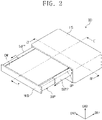
- FIG. 2 is a view of a display module withdrawn from a housing illustrated in FIG. 1 .
- a display device DD includes a housing HS, a display module DM accommodated in the housing HS, and a handle HND connected to the display module DM, and a support SUP adjacent to each of both sides of the display module DM.
- the housing HS may have a hexahedral shape, but the shape of the housing HS is not limited thereto.
- the housing HS may extend longer in a second direction DR2 crossing a first direction DR1 than the first direction DR1.
- a direction substantially perpendicularly crossing a plane defined by the first and second directions DR1 and DR2 is defined as a third direction DR3.
- An opening OP may be defined at one side of both sides of the housing HS, which are opposite to each other in the first direction DR1.
- the opening OP may be adjacent to an upper portion of the housing HS rather than a lower portion of the housing HS.
- the display module DM may be wound around a roller disposed in the housing HS.
- the display module DM may be inserted and withdrawn through the opening OP.
- the handle HND may be disposed outside the housing HS so as to be adjacent to the opening OP.
- the handle HND may be adjacent to the upper portion of the housing HS.
- the handle HND may move in the first direction DR1.
- the display module DM may be withdrawn to the outside of the housing HS through the opening OP.
- the handle HND may be manipulated by a user.
- the support SUP may be disposed at opposite sides of the display module DM, which are opposite to each other in the second direction DR2, to support the display module DM.
- the support SUP may include a first support SUP1 adjacent to one side of the display module DM and a second support SUP2 adjacent to the other side of the display module DM.
- One side and the other side of the display module DM may be opposite sides of the display module DM, which are opposite to each other in the second direction DR2.
- FIG. 3 is a schematic cross-sectional view of the display module illustrated in FIG. 2 .
- the display module DM may include a display panel DP, an input sensing part TSP disposed on the display panel DP, a window WIN disposed on the input sensing part TSP, a protective film PFL disposed on the window WIN, an adhesive OCA disposed between the input sensing part TSP and the window WIN, and a protective layer PTL disposed under the display panel DP.
- the display panel DP may be an emission type display panel, but is not limited thereto.
- the display panel DP may be an organic light emitting display panel or a quantum dot light emitting display panel.
- the organic light emitting display panel may include an organic light emitting material.
- An emission layer of the quantum dot light emitting display panel may include a quantum dot, a quantum rod, and the like.
- the display panel DP will be described as the organic light emitting display panel.
- the display panel DP may include a substrate SUB, a pixel layer PXL disposed on the substrate SUB, and a thin film encapsulation layer TFE disposed on the substrate SUB to cover the pixel layer PXL.
- the substrate SUB may be a transparent substrate and include a flexible plastic substrate.
- the substrate SUB may include polyimide (PI).
- the substrate SUB may include a display area DA and a non-display area NDA around the display area DA.
- the pixel layer PXL may be disposed on the display area DA.
- the pixel layer PXL may include a plurality of pixels, and each of the pixels may include a light emitting element.
- the thin film encapsulation layer TEF may include at least two inorganic layers and an organic layer disposed between the at least two inorganic layers.
- the inorganic layers may include an inorganic material and protect the pixel layer PXL against moisture/oxygen.
- the organic layer may include an organic material and protect the pixel layer PXL against foreign substances such as dust particles.
- the input sensing part TSP may sense an external input (e.g., a user's touch) to change the external input into a predetermined input signal, thereby providing the input signal to the display panel DP.
- the input sensing part TSP may include a plurality of touch sensing parts (not shown) for sensing the external input.
- the touch sensing parts may sense the external input in a capacitive manner.
- the display panel DP may receive an input signal from the input sensing part TSP and generate an image corresponding to the input signal.
- the window WIN may protect the display panel DP and the input sensing part TSP against external scratches and impact.
- the window WIN may be attached to the input sensing part TSP by using the adhesive OCA.
- the adhesive OCA may include an optical clear adhesive. An image generated in the display panel DP may pass through the window WIN and then be provided to the user.
- the protective film PFL may protect the window WIN, the display panel DP, and the input sensing part TSP from the external scratches and impact.
- the protective film PFL may include a hard coating layer and a soft coating layer.
- the protective layer PTL may include a protective substrate PS disposed under the display panel DP, an elastic layer ELS disposed under the protective substrate PS, and a cushion layer CSL disposed under the elastic layer ELS.
- the protective substrate PS may protect a lower portion of the display panel DP.
- the protective substrate PS may include a flexible plastic substrate.
- the protective substrate PS may include polyethylene terephthalate (PET).
- the elastic layer ELS may be defined as an elastomer.
- the elastic layer ELS may provide restoring force to the display module DM when the display module DM is bent.
- the cushion layer CUL may absorb an external impact applied to a lower portion of the display module DM to protect the display panel DP.
- the cushion layer CUL may include a foam sheet having predetermined elastic force.
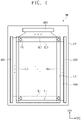
- FIG. 4 is a plan view of the display module illustrated in FIG. 3 .
- the display module DM may include a display panel DP, a scan driver SDV, a data driver DDV, and an emission driver EDV.
- a planar shape of the display panel DP is exemplified in FIG. 4
- a planar shape of the input sensing part TSP is omitted.
- the display panel DP may be a flexible display panel.
- the display panel DP may include a plurality of electronic elements disposed on a flexible substrate.
- the display panel DP may have a rectangular shape having long sides in the first direction DR1 and short sides in the second direction DR2.
- the display panel DP may include a display area DA and a non-display area NDA surrounding the display area DA.
- the display panel DP may include a plurality of pixels PX, a plurality of scan lines SL1 to SLm, a plurality of data lines DL1 to DLn, and a plurality of emission lines EL1 to ELm.
- m and n are natural numbers.
- the pixels PX may be arranged in a matrix form, but is not limited thereto and thus may be arranged in various forms.
- the pixels PX may be disposed on the display area DA and connected to the scan lines SL1 to SLm, the data lines DL1 to DLn, and the emission lines EL1 to ELm.
- the scan driver SDV, the data driver DDV, and the emission driver EDV may be disposed on the non-display area NDA.
- the scan driver SDV and the emission driver EDV may be disposed adjacent to the long sides of the display panel DP, respectively.
- the data driver DDV may be manufactured in the form of an integrated circuit chip and disposed adjacent to one short side of the display panel DP.
- the scan lines SL1 to SLm may extend in the second direction DR2 and be connected to the scan driver SDV.
- the data lines DL1 to DLn may extend in the first direction DR1 and be connected to the data driver DDV.
- the emission lines EL1 to ELm may extend in the second direction DR2 and be connected to the emission driver r EDV.
- the scan driver SDV may generate a plurality of scan signals, and the scan signals may be applied to the pixels PX through the scan lines SL1 to SLm.
- the scan signals may be sequentially applied to the pixel PX.
- the data driver DDV may generate a plurality of data voltages, and the data voltages may be applied to the pixels PX through the data lines DL1 to DLn.
- the emission driver EDV may generate a plurality of emission signals, and the emission signals may be applied to the pixels PX through the emission lines EL1 to ELm.
- the display module DM may include a timing controller (not shown) that controls operations of the scan driver SDV, the data driver DDV, and the emission driver EDV
- the timing controller may generate a scan control signal, a data control signal, and an emission control signal in response to control signals received from the outside.
- the timing controller may receive image signals from the outside and convert a data format of the image signals to match an interface specification with the data driver DDV and thus provide the converted data format to the data driver DDV
- the scan driver SDV may generate scan signals in response to the scan control signal
- the emission driver EDV may generate emission signals in response to the emission control signal.
- the data driver may receive image signals, in which the data format is converted, and generate data voltages corresponding to the image signals in response to the data control signal.
- the pixels PX may receive the data voltages in response to the scan signals.
- the pixels PX may emit light having luminance corresponding the data voltages in response to the emission signals to display an image.
- An emission time of the pixels PX may be controlled by the emission signals.
- FIG. 5 is a view illustrating an example of an equivalent circuit of any one pixel illustrated in FIG. 4 .
- the pixel PX may include a light emitting element OLED and a pixel circuit CC.
- the pixel circuit CC may include a plurality of transistors T1 to T7 and a capacitor CP.
- the pixel circuit CC may control an amount of current flowing to the light emitting element OLED to correspond to a data voltage.
- the light emitting element OLED may emit light having predetermined luminance corresponding to an amount of current supplied from the pixel circuit CC.
- a first voltage ELVDD may be set to a level greater than that of the second voltage ELVSS.
- Each of the transistors T1 to T7 may include an input electrode (or a source electrode), an output electrode (or a drain electrode), and a control electrode (or a gate electrode).
- an input electrode or a source electrode
- an output electrode or a drain electrode
- a control electrode or a gate electrode
- the first electrode of the first transistor T1 may receive the first voltage ELVDD via the fifth transistor T5, and the second electrode may be connected to an anode electrode the light emitting element OLED via the sixth transistor T6.
- the first transistor T1 may be defined as a driving transistor.
- the first transistor T1 may control an amount of current flowing to the light emitting element OLED according to the voltage applied to the control electrode of the first transistor T1.
- the second transistor T2 may be connected between the data line DL and the first electrode of the first transistor T1, and the control electrode of the second transistor T2 may be connected to an i-th scan line SLi.
- the second transistor T2 may receive an i-th scan signal Si through the i-th scan line SLi to turn on so that the data line DL and the first electrode of the first transistor T1 are electrically connected to each other.
- the third transistor T3 may be connected between the second electrode and the control electrode of the first transistor T1.
- the control electrode of the third transistor T3 may be connected to the i-th scan line SLi.
- the third transistor T3 may receive the i-th scan signal Si through the i-th scan line SLi to turn on so that the second electrode and the control electrode of the first transistor T1 are electrically connected to each other.
- the first transistor T1 may be connected in the form of a diode.
- the fourth transistor T4 is connected between a node ND and an initialization power generation part (not shown).
- the control electrode of the fourth transistor T4 may be connected to an (i-1)-th scan line SLi-1.
- the fourth transistor T4 may receive an (i-1)-th scan signal through an (i-1)-th scan line SLi-1 to turn on so that an initial voltage Vint is applied to the node ND
- the fifth transistor T5 may be connected between the power line PL and the first electrode of the first transistor T1.
- the control electrode of the fifth transistor T5 may be connected to an i-th emission line ELi.
- the sixth transistor T6 may be connected between the second electrode of the first transistor T1 and the anode electrode of the light emitting element OLED.
- the control electrode of the sixth transistor T6 may be connected to the i-th emission line ELi.
- the seventh transistor T7 may be connected between the initialization power generation part (not shown) and the anode electrode of the light emitting element OLED.
- the control electrode of the seventh transistor T7 is connected to an (i+1)-th scan line SLi+1.
- the seventh transistor T7 may receive an (i+1)-th scan signal through an (i+1)-th scan line SLi+1 to turn on so that the initial voltage Vint is applied to the anode electrode of the light emitting element OLED.
- the capacitor CP may be disposed between the power line PL and the node ND
- the capacitor CP may store the data voltage.
- an amount of current flowing through the first transistor T1 may be determined.
- the transistors T1 to T7 are illustrated based on a PMOS, but the present invention is not limited thereto. In another embodiment of the present invention, the transistors T1 to T7 may be provided as an NMOS.
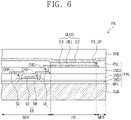
- FIG. 6 is a cross-sectional view of a portion corresponding to a light emitting element illustrated in FIG. 5 .
- the pixel PX may include the light emitting element OLED and the transistor TR connected to the light emitting element OLED.
- the light emitting element OLED may include a first electrode E1, a second electrode E2, and an organic emission layer OEL disposed between the first electrode E1 and the second electrode E2.
- the transistor TR may be the sixth transistor T6 of FIG. 5 .
- the light emitting element OLED may be defined as an organic light emitting element.
- the first electrode E1 may be an anode electrode, and the second electrode E2 may be a cathode electrode.
- the first electrode E1 may be defined as a pixel electrode, and the second electrode E2 may be defined as a common electrode.
- the pixel PX may be divided into a pixel area PA and a non-pixel area NPA around the pixel area PA.
- the light emitting element OLED may be disposed on the pixel area PA, and the transistor TR may be disposed on the non-pixel area NPA.
- the transistor TR and the light emitting element OLED may be disposed on the substrate SUB.
- a buffer layer BFL may be disposed on the substrate SUB, and the buffer layer may include an inorganic material.
- the semiconductor layer SM of the transistor TR may be disposed on the buffer layer BFL.
- the semiconductor layer SM may include a semiconductor made of an inorganic material such as amorphous silicon or polycrystalline silicon, or an organic semiconductor. Also, the semiconductor layer SM may include an oxide semiconductor. Although not shown in FIG. 6 , the semiconductor layer SM may include a source region, a drain region, and a channel region between the source region and the drain region.
- a first insulation layer INS1 may be disposed on the buffer layer BFL to cover the semiconductor layer SM.
- the first insulation layer INS1 may include an inorganic material.
- a gate electrode GE of the transistor TR overlapping the semiconductor layer SM may be disposed on the first insulation layer INS1.
- the gate electrode GE may be disposed to overlap a channel region of the semiconductor layer SM.
- a second insulation layer INS2 may be disposed on the first insulation layer INS1 to cover the gate electrode GE.
- the second insulation layer INS2 may include an organic material and/or an inorganic material.
- the source electrode SE and the drain electrode DE of the transistor TR may be disposed to be spaced apart from each other on the second insulation layer INS2.
- the source electrode SE may be connected to the source region of the semiconductor layer SM through a first contact hole CH1 that is defined in each of the first and second insulation layers INS1 and INS2.
- the drain electrode DE may be connected to the drain region of the semiconductor layer SM through a second contact hole CH2 that is defined in each of the first and second insulation layers INS1 and INS2.
- a third insulation layer INS3 may be disposed on the second insulation layer INS2 to cover the source and drain electrodes SE and DE of the transistor TR.
- the third insulation layer INS3 may be defined as a planarization layer that provides a flat top surface and include an organic material.
- the first electrode E1 may be disposed on the third insulation layer INS3.
- the first electrode E1 may be connected to the drain electrode DE of the transistor TR through a third contact hole H3 that is defined in the third insulation layer INS3.
- a pixel define layer PDL through which a predetermined area of the first electrode E1 is exposed may be disposed on the first electrode E1 and the third insulation layer INS3.
- An opening PX_OP through which a predetermined portion of the first electrode E1 is exposed may be defined in the pixel define layer PDL.
- An organic emission layer OEL may be disposed on the first electrode E1 within the opening PX_OP.
- the organic emission layer OEL may emit one of red light, green light, and blue light.
- the embodiment of the present invention is not limited thereto.
- the organic emission layer OEL may generate white light by combination of organic materials that respectively generate red, green, and blue light.
- the second electrode may be disposed on the pixel define layer PDL and the organic light emitting layer OEL.
- the thin film encapsulation layer TFE may be disposed on the light emitting element OLED to cover the pixel PX.
- a layer between the substrate SUB and the thin film encapsulation layer TFE may be defined as the pixel layer PXL.
- the first voltage ELVDD may be applied to the first electrode E1
- the second voltage ELVSS may be applied to the second electrode E2.
- Holes and electrons injected into the organic emission layer OEL may be coupled to each other to form exciton. While the exciton may be transitioned to a ground state, the organic light emitting element OLED may emit light.
- the light emitting element OLED may emit red, green, or blue light according to a flow of current to display an image.
- FIG. 7 is a cross-sectional view taken along line I-I' of FIG. 1 .
- FIG. 8 is a side view illustrating the inside of the housing when the inside of the housing illustrated in FIG. 1 is viewed in the second direction.
- the housing HS is omitted in FIG. 8 .
- the display device DD includes a housing HS, a display module DM, a roller ROL, a plurality of support bars SB, a support SUP, and a handle HND
- the display module DM, the roller ROL, the plurality of support bars SB, and the support SUP may be accommodated in the housing HS.
- the roller ROL may be disposed in the housing HS and may be adjacent to the other side of the housing HS, which is opposite to the one side of the housing HS in which the opening OP is defined.
- the roller ROL may have a circular shape.
- the roller ROL may have a cylindrical shape extending in the second direction DR2.
- the roller ROL may rotate in a clockwise and counterclockwise direction.
- the display module DM may extend in the first direction DR1 and then be wound around the roller ROL.
- One end of the display module DM may be connected to the roller ROL, and a portion of the display module DM may be wound around the roller ROL.
- the other end of the display module DM which is an end opposite to one end of the display module DM, may be connected to the handle HND
- the other end of the display module DM may be adjacent to the opening OP.
- the display module DM may include a first area AA1 connected to the roller ROL and wound around the roller ROL and a second area AA2 that is not wound around the roller ROL.
- the second area AA2 may be maintained in a flat state.
- a front surface of the display module DM may be defined as a surface for displaying an image.
- the support bars SB may be disposed on a rear surface of the display module DM, which is opposite to the front surface of the display module DM.
- the support bars SB may be connected to the rear surface of the display module DM.
- the support bars SB may be attached to the rear surface of the display module DM using a pressure-sensitive adhesive.
- the support bars SB may support the display module DM.
- each of the support bars SB may have a rectangular shape, but the shape of the support bar SB is not limited thereto.
- the support bars SB may be arranged to be spaced apart from each other in the first direction DR1.
- Each of the support bars SB may be provided in a rigid type.
- the support bars SB may include a metal.
- the support bars SB may be inserted and withdrawn through the opening OP.
- the support bars SB may include a plurality of first support bars SB1 disposed on a bottom surface of the first area AA1 and a plurality of second support bars SB2 disposed on a bottom surface of the second area AA2.
- the first support bars SB1 may be wound around the roller ROL with the first area AA1.
- the second support bars SB2 may be disposed on the support SUP.
- One end of the support SUP may be connected to the handle HND
- Gaps between the support bars SB may vary according to the areas of the display module DM. A more detailed arrangement structure of the support bars SB will be described in detail below with reference to FIG. 13 .
- Lower portions of the first support bars SB 1 wound around the roller ROL may be in contact with the top surface of the first area AA1 wound around the roller ROL.
- the protective film PFL of the display module DM may protect the display module DM from the first support bars SB1.
- a guide groove GG may be defined in the support SUP.
- the second support bars SB2 may be disposed in the guide groove GG to move in the first direction DR1 along the guide groove GG
- the second support bars SB2 may be disposed in the guide groove GG and supported by the support SUP, and the second support bars SB2 may support the display module DM. That is, substantially, the support SUP may serve to support the display module DM.
- the display module DM and the support bars SB may be withdrawn to the outside of the housing HS through the opening OP, and the support SUP may extend in the first direction DR1 like an antenna.
- FIG. 9 is a cross-sectional view taken along line II-II' illustrated in FIG. 2 .
- FIG. 10 is a side view illustrating the inside of the housing when the inside of the housing illustrated in FIG. 2 is viewed in the second direction.
- the housing HS is omitted in FIG. 10 .
- the handle HND may move in the first direction DR1 away from the housing HS.
- the display module DM connected to the handle HND may move in the first direction DR1.
- the display module DM may be unwound from the roller ROL, and the unwound display module DM may be withdrawn to the outside of the housing HS through the opening OP.
- the support bars SB wound around the roller ROL may also be unwound from the roller ROL to move to the outside of the housing HS according to the movement of the display module DM.
- An operation in which the display module DM is exposed to the outside of the housing HS may be defined as an open mode. In the open mode, an exposed portion of the display module DM may be expanded.
- the support SUP connected to the handle HND may extend to the outside of the housing HS through the opening OP.
- the support SUP may extend to the outside of the housing HS to support the display module DM at the outside of the housing HS.
- the support bars SB moving to the outside of the housing HS may be supported by the support SUP, and the support bars SB supported by the support SUP may support the display module DM.
- the support SUP may include a first extension part EX1, a second extension part EX2, and a third extension part EX3 to extend to the outside of the housing HS.
- the second extension part EX2 may be disposed between the first extension part EX1 and the third extension part EX3.
- the second extension part EX2 may be inserted into and withdrawn from the first extension part EX1, and the third extension part EX3 may be inserted into and withdrawn from the second extension part EX2.
- the first extension part EX1 may be disposed in the housing HS, and the second and third extension parts EX2 and EX3 may move to the outside of the housing HS.
- the third extension part EX3 may be connected to the handle HND
- a guide groove GG may be defined in each of the first, second, and third extension parts EX1, EX2, and EX3.
- the guide grooves GG defined in the first, second, and third extension parts EX1, EX2, and EX3 may be defined as continuous spaces overlapping each other in the first direction DR1.
- the support bars SB may be disposed in the guide grooves GG
- the handle HND When the handle HND moves in the first direction DR1 to be closer to the housing HS, as illustrated in FIGS. 7 and 8 , the handle HND may be disposed adjacent to the opening OP outside the housing HS. As the handle HND moves, the support SUP may be reduced in the first direction DR1 so as to be disposed in the housing HS, and the display module DM may be inserted into the housing HS. This operation may be defined as a closed mode.
- the first area AA1 and the first support bars SB1 may be wound around the roller ROL as illustrated in FIGS. 7 and 8 .
- FIG. 11 is a cross-sectional view taken along line III-III' of FIG. 2 .
- FIG. 12 is a perspective view of the support illustrated in FIG. 10 .
- FIG. 11 is a view for explaining a structure of the support bar SB disposed on the first and second supports SUP1 and SUP2. Therefore, for convenience of description, FIG. 11 illustrates portions of the support bar SB disposed on the first and second supports SUP1 and SUP2, the display module DM disposed on the support bar SB, and parts of the housing HS adjacent to the first and second supports SUP1 and SUP2, and other constituents are omitted.
- the support SUP may include the first support SUP1 and the second support SUP2, which extend in the first direction DR1 and are spaced apart from each other in the second direction DR2.
- the first support SUP1 and the second support SUP2 may support one side and the other side (hereinafter, referred to as both sides of the support bar SB) of the support bar SB, which are opposite to each other in the second direction DR2.
- both the sides of the support bar SB may be inserted into the guide grooves GG defined on an inner surface of the first support SUP1 and an inner surface of the second support SUP2, which face each other and then be disposed in the guide grooves GG, respectively.
- the support bar SB may move in the first direction DR1 along the guide grooves GG defined in the first and second supports SUP1 and SUP2.
- Each of the first support SUP1 and the second support SUP2 may include a first extension part EX1, a second extension part EX2, and a third extension part EX3 in which the guide grooves GG are defined. Since configurations of the first extension part EX1, the second extension part EX2, and the third extension part EX3 have been described in detail above, descriptions thereof will be omitted.
- One end of the first support SUP1 and one end of the second support SUP2, which are defined as ends of the support SUP, may be connected to the handle HND Specifically, the third extension parts EX3 of the first and second supports SUP 1 and SUP2 may be connected to the handle HND
- the first extension parts EX1 may be connected to the housing HS.
- the first extension parts EX1 may be connected and fixed to inner surfaces of the housing HS, which face each other in the second direction DR2.
- the first extension parts EX1 may be disposed in the housing HS, and the second and third extension parts EX2 and EX3 may move to the outside of the housing HS.
- the first and second supports SUP1 and SUP2 may extend to the outside of the housing HS in the open mode.
- the display module DM may be disposed on the support bar SB and may be disposed between the first support SUP1 and the second support SUP2.
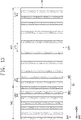
- FIG. 13 is a view of support bars disposed on the display module when the display module illustrated in FIG. 7 is unfolded.
- FIG. 13 may be a plan view of the support bars.
- first and second support bars SB1 and SB2 may extend in the second direction DR2 and may be arranged to be spaced apart from each other in the first direction DR1.
- a width of each of the support bars SB is defined as a value measured based on the first direction DR1
- a thickness of the support bars SB is defined as a value measured based on the third direction DR3.
- gaps between the support bars SB are defined as values measured based on the first direction DR1.
- Each of the gaps between the support bars SB may be defined as a gap between two adjacent support bars SB.
- a gap between the support bars SB may vary according to the areas of the display module DM. For example, in the first area AA1, gaps between the first support bars SB1 may vary, and in the second area AA2, gaps between the second support bars SB2 may be uniform.
- a first gap GP1 between the first support bars SB1 disposed at a central portion CTP of the first area AA1 among the first support bars SB1 may be greater than a second gap GP2 between the first support bars SB1 disposed at portions adjacent to both sides of the first area AA1 among the first support bars SB1.
- Both the sides of the first area AA1 may be one side and the other side of the first area AA1, which are opposite to each other in the first direction DR1.
- the gaps between the first support bars SB1 may gradually increase from both the sides of the first area AA1 toward the central portion CTP of the first area AA1.
- the gaps between the first support bars SB1 may vary to be symmetrical to each other with respect to the central portion CTP of the first area AA1.
- the first support bars SB1 may have the same width. Also, the first support bars SB1 may have the same thickness as illustrated in FIG. 9 .
- the second support bars SB2 may be equally spaced apart from each other in the first direction DR1.
- Each of the second support bars SB2 may have the same width and the same thickness as each of the first support bars SB1.
- Each of the gaps between the first support bars SB1 may be greater than each of the gaps between the second support bars SB2.
- each of the third gaps GP3 between the second support bars SB2 may be less than the smallest second gap GP2 among the gaps between the first support bars SB1.
- Stress may be generated in the display module DM wound around the roller ROL.
- stress may be generated in the first area AA1 that is bent.
- the larger stress may be generated by the support bars SB attached to the first area AA1 and may increase toward the central portion of the first area AA1.
- the stress caused by the support bars SB may increase.
- the stress may damage elements of the display module DM.
- the gaps between the first support bars SB1 may gradually increase from both the sides of the first area AA1 toward the central portion CTP of the first area AA1.
- the surface area on which the support bars SB are disposed is reduced toward the central portion CTP, at which the larger stress is generated, the stress of the first area AA1 of the display module DM wound around the roller ROL may be reduced.
- the display device DD may reduce the stress of the display module DM wound around the roller ROL.
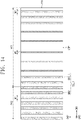
- FIG. 14 is a plan view illustrating support bars of a display device according to another embodiment of the present invention.
- the support bars SB_1 may include a plurality of first support bars SB1_1 disposed in a first area AA1 and a plurality of second support bars SB2 disposed in a second area AA2.
- Gaps between the first support bars SB1_1 and widths of the first support bars SB1_1 may vary according to the areas of a display module DM. In the first area AA1, the gaps between the first support bars SB1_1 and the widths of the first support bars SB1_1 may vary, and in the second area AA2, the gaps between the second support bars SB2 and the widths of the second support bars SB2 may be the same.
- the gaps between the first support bars SB1_1 may gradually increase from both the sides of the first area AA1 toward the central portion CTP of the first area AA1.
- Each of the gaps between the first support bars SB1_1 may be greater than each of the gaps between the second support bars SB2.
- a width W1 of the first support bar SB1_1 disposed at a central portion CTP of the first area AA1 among the first support bars SB1_1 may be greater than a width W2 of each of the first support bars SB1_1 disposed at portions adjacent to both sides of the first area AA1 among the first support bars SB1_1.
- the widths of the first support bars SB1_1 may gradually decrease from both sides of the first area AA1 toward the central portion CTP of the first area AA1.
- Each of the widths of the first support bars SB1_1 may be less than or equal to that of each of the second support bars SB2.
- the width W2 of each of the first support bars SB1_1 disposed adjacent to both the sides of the first area AA1 may be the same as the width W2 of each of the second support bars SB2.
- a width of each of the remaining first support bars SB1_1 may be less than that of each of the second support bars SB2.
- the thicknesses of the first support bars SB1_1 may be the same, and each of the first support bars SB1_1 may have the same thickness as each of the second support bars SB2.
- the gaps between the first support bars SB1_1 increase, and the widths of the first support bars SB1_1 decrease toward the central portion CTP of the first area AA1, a surface area on which the first support bars SB1_1 are disposed may be reduced toward the central portion CTP.
- the stress in the first area AA1 of the display module DM wound around the roller ROL may be reduced.
- FIG. 15 is a plan view illustrating support bars of a display device according to another embodiment of the present invention.
- the support bars SB_2 may include a plurality of first support bars SB1_2 disposed in a first area AA1 and a plurality of second support bars SB2 disposed in a second area AA2.
- Each of the gaps between the first support bars SB1_2 may be greater than each of the gaps between the second support bars SB2.
- the first support bars SB1_2 may be spaced apart from each other at equal gaps and arranged in the first direction DR1.
- the widths of the first support bars SB1_2 may gradually decrease from both sides of the first area AA1 toward the central portion CTP of the first area AA1.
- the thicknesses of the first support bars SB1_2 may be the same, and each of the first support bars SB1_2 may have the same thickness as each of the second support bars SB2.
- each of the gaps between the first support bars SB1_2 is greater than each of the gaps between the second support bars SB, and the widths of the first support bars SB1_2 decrease toward the central portion CTP of the first area AA1, a surface area on which the first support bars SB1_2 are disposed may be reduced toward the central portion CTP.
- stress in the first area AA1 of the display module DM wound around the roller ROL may be reduced.
- FIG. 16 is a plan view of a display apparatus according to another embodiment of the present invention.
- the support bars SB_3 may include a plurality of first support bars SB1_3 disposed in a first area AA1 and a plurality of second support bars SB2 disposed in a second area AA2 Each of the gaps between the first support bars SB1_3 may be greater than each of the gaps between the second support bars SB2.
- the first support bars SB1_3 may be equally spaced from each other and arranged in the first direction DR1.
- the first area AA1 may include a first sub area AA1_1, a second sub area AA1_2, and a third sub area AA1_3, which are arranged in the first direction DR1.
- the second sub area AA1_2 may be disposed between the first sub area AA1_1 and the third sub area AA1_3.
- a width of each of the first support bars SB1_3 disposed on the second sub area AA1_2 may be less than that of each of the first support bars SB1_3 disposed on the first sub area AA1_1 and the third sub area AA1_3.
- the thicknesses of the first support bars SB1_3 may be the same, and each of the first support bars SB1_3 may have the same thickness as each of the second support bars SB2.
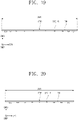
- FIGS. 17 to 20 are views illustrating thicknesses of support bars according to various embodiments of the present invention.
- FIGS. 17 to 20 are side views of first support bars SB1_4, SB1_5, SB1_6, and SB1_7 when viewed in the second direction DR2, and a second support bar SB2 is substantially the same as the second support bars SB2 illustrated in FIGS. 13 to 16 , and thus omitted in FIGS. 17 to 20 .
- the first support bars SB1_4 may be spaced apart from each other at equal gaps and arranged in the first direction DR1. That is, gaps between the first support bars SB1_4 may be uniform.
- the first support bars SB1_4 may have the same width. Thicknesses of the first support bars SB1_4 may vary according to areas of a display module DM.
- the thicknesses of the first support bars SB1_4 may gradually decrease from both sides of a first area AA1 toward the central portion CTP of the first area AA1.
- the thicknesses of the first support bars SB1_4 may vary to be symmetrical to each other with respect to the central portion CTP of the first area AA1.
- Stress may be proportional to the thicknesses of the first support bars SB1_4.
- the stress in the first area AA1 of the display module DM wound around the roller ROL may be reduced.
- widths of the first support bars SB1_5 and gaps between the first support bars SB1_5 may be substantially the same as those of the first support bars SB1 illustrated in FIG. 13 .
- the first support bars SB1_5 may have the same width, and the gaps between the first support bars SB1_5 may gradually increase from both sides of the first area AA1 toward the central portion CTP of the first area AA1.
- the thicknesses of the first support bars SB1_5 may gradually decrease from both the sides of the first area AA1 toward the central portion CTP of the first area AA1.
- the thicknesses of the first support bars SB1_5 may vary to be symmetrical to each other with respect to the central portion CTP of the first area AA1. Thus, the stress of the first area AA1 wound around the roller ROL may be reduced.
- widths of the first support bars SB1_6 and gaps between the first support bars SB1_6 may be substantially the same as those of the first support bars SB1_1 illustrated in FIG. 14 .
- widths of the first support bars SB1_6 may gradually decrease from both sides of the first area AA1 toward the central portion CTP of the first area AA1.
- Gaps between the first support bars SB1_6 may gradually increase from both the sides of the first area AA1 toward the central portion CTP of the first area AA1.
- Thicknesses of the first support bars SB1_6 may gradually decrease from both the sides of the first area AA1 toward the central portion CTP of the first area AA1.
- the thicknesses of the first support bars SB1_6 may vary to be symmetrical to each other with respect to the central portion CTP of the first area AA1.
- widths of the first support bars SB1_7 and gaps between the first support bars SB1_7 may be substantially the same as those of the first support bars SB1_2 illustrated in FIG. 15 .
- the first support bars SB1_7 may have the same gap and be arranged in the first direction DR1, and widths of the first support bars SB1_7 may gradually decrease from both the sides of the first area AA1 toward the central portion of the first area AA1.
- Thicknesses of the first support bars SB1_7 may gradually decrease from both the sides of the first area AA1 toward the central portion CTP of the first area AA1.
- the thicknesses of the first support bars SB1_7 may vary to be symmetrical to each other with respect to the central portion CTP of the first area AA1.
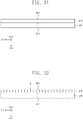
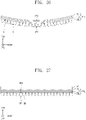
- FIGS. 21 to 27 are views for explaining a method for manufacturing a display device according to an embodiment of the present invention.
- FIGS. 21 to 27 are side views when viewed in the second direction DR2.
- a support plate SPT may be disposed on a stage STG
- the support plate SPT may include a metal.
- a top surface of the support plate SPT may be defined as a first surface SF1
- a bottom surface of the support plate SPT facing the stage STG may be defined as a second surface SF2.
- Each of the stage STG and the support plate SPT may have a plane defined by the first and second directions DR1 and DR2.
- a plurality of grooves G arranged in the first direction DR1 and extending in the second direction DR2 may be defined in the first surface of the support plate SPT.
- the grooves G may be defined in the support plate SPT in various manners.
- the grooves G may be defined in the support plate SPT using a knife or a laser.
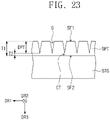
- FIG. 23 is an enlarged view illustrating a portion of the support plate SPT illustrated in FIG. 22 .
- the support plate SPT may have a first thickness T1 in the third direction DR3.
- the first thickness T1 of the support plate SPT may be defined as a distance between the first surface SF1 and the second surface SF2 of the support plate SPT, which is measured in the third direction DR3.
- a depth DPT of each of the grooves G may be 4/5 to 19/20 of the first thickness T1 based on the third direction DR3.
- Portions of the support plate SPT in which the grooves G are defined may be defined as cut portions CT.
- a second thickness T2 of each of the cut portions CT may be 1/5 to 1/20 of the first thickness T1 based on the third direction DR3.
- the first thickness T1 is 400 micrometers
- the depth DPT may be 320 micrometers to 380 micrometers
- the second thickness T2 may be 80 micrometers to 20 micrometers.
- the support plate SPT may be disposed so that the second surface SF2 of the support plate SPT faces an upper side, and the first surface SF1 of the support plate SPT faces a lower side.
- a protective layer PTL may be disposed on the second surface SF2 of the support plate SPT.
- the protective layer PTL may refer to the protective layer PTL illustrated in FIG. 3 .
- the protective layer PTL may be attached to the second surface SF2.
- a pressure-sensitive adhesive may be disposed between the protective layer PTL and the second surface SF2 to attach the protective layer PTL and the support plate SPT to each other.
- the protective layer PTL may be pressed toward the support plate SPT.
- each of the protective layer PTL and the support plate SPT may be tensioned in the first direction DR1.
- the protective layer PTL and the support plate SPT may be bent so that the top surface of the protective layer PTL is concave with respect to the first direction DR1. Cracks may be formed in the cut portions CT, and thus the cut portions CT may be cut due to an operation of tensioning and bending the protective layer PTL and the support plate SPT,
- the tensile operation and the bending operation have been described together, but if the cut portions CT are cut by any one operation, the other operation may be omitted.
- the cut portions CT may be separated from each other to form a plurality of support bars SB' under the protective layer PTL.
- the protective layer PTL may be first pressed to the support plate STP so as to be attached to the support plate STP, and then the support bars SB' may be formed.
- a display panel DP may be attached to the top surface of the protective layer PTL, which is an opposite surface of the bottom surface of the protective layer PTL, to which the support bars SB' are attached, to manufacture a display device.
- the support bars SB' may be individually first manufactured, and then the support bars may be attached to the bottom surface of the protective layer PTL by a pressure-sensitive adhesive. When the support bars are attached to the protective layer PTL, the protective layer PTL may be pressed toward the support bars.
- portions of the protective layer PTL When the support bars are spaced apart from each other, and the protective layer PTL is pressed toward the support bars, portions of the protective layer PTL, which overlap the support bars, may be pressed between the support bars and recessed between the support bars. In this case, top surfaces of portions of the protective layer PTL pressed between the support bars may also be recessed downward.
- the top surface of the protective layer PTL may not have a flat surface, and the display panel DP disposed on the protective layer PTL may also not be flat. That is, a surface quality of the display module may be deteriorated.
- the protective layer PTL may be first attached to the flat second surface SF2 before the support bars SB' are formed, and then the support bars SB' may be formed.
- the protective layer PTL may be maintained in the flat state.
- the surface quality of the display module may be improved.
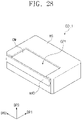
- FIG. 28 FIG. 29 are perspective views of a display device according to another embodiment of the present invention.
- a display device DD_1 illustrated in FIGS. 28 and 29 may have the same constituent as the display device DD illustrated in FIGS. 1 and 2 .
- the constituents of the housing HS' will be described below.
- a first opening OP1 exposing a predetermined portion of a display module DM may be defined on a top surface of the housing HS'.
- the first opening OP1 may be adjacent to a handle HND
- the first opening OP1 may be continuously defined from the opening OP through which the display module DM is inserted and withdrawn.
- an image may be displayed through a portion of the display module DM, which is exposed through the first opening OP1.
- the entire display modules DM may be closed within the housing.
- a portion of the display module DM may be exposed to the outside.
- the exposed portion of the display module DM may be expanded.
- the possibility of manufacturing a defective display module may be reduced due to the reduction of the stress of the display module wound around the roller, and thus, since this is a technology capable of improving yield of the display device, the present invention has high industrial applicability.
Landscapes
- Engineering & Computer Science (AREA)
- Computer Hardware Design (AREA)
- Theoretical Computer Science (AREA)
- General Engineering & Computer Science (AREA)
- Physics & Mathematics (AREA)
- General Physics & Mathematics (AREA)
- Human Computer Interaction (AREA)
- Signal Processing (AREA)
- Devices For Indicating Variable Information By Combining Individual Elements (AREA)
- Electroluminescent Light Sources (AREA)
Applications Claiming Priority (2)
| Application Number | Priority Date | Filing Date | Title |
|---|---|---|---|
| KR1020190092412A KR102754149B1 (ko) | 2019-07-30 | 2019-07-30 | 표시 장치 및 그것의 제조 방법 |
| PCT/KR2019/015626 WO2021020655A1 (ko) | 2019-07-30 | 2019-11-15 | 표시 장치 및 그것의 제조 방법 |
Publications (3)
| Publication Number | Publication Date |
|---|---|
| EP4006884A1 true EP4006884A1 (de) | 2022-06-01 |
| EP4006884A4 EP4006884A4 (de) | 2023-11-29 |
| EP4006884B1 EP4006884B1 (de) | 2026-01-14 |
Family
ID=74229190
Family Applications (1)
| Application Number | Title | Priority Date | Filing Date |
|---|---|---|---|
| EP19939807.4A Active EP4006884B1 (de) | 2019-07-30 | 2019-11-15 | Anzeigevorrichtung und herstellungsverfahren dafür |
Country Status (5)
| Country | Link |
|---|---|
| US (1) | US12153469B2 (de) |
| EP (1) | EP4006884B1 (de) |
| KR (1) | KR102754149B1 (de) |
| CN (1) | CN114207695A (de) |
| WO (1) | WO2021020655A1 (de) |
Families Citing this family (14)
| Publication number | Priority date | Publication date | Assignee | Title |
|---|---|---|---|---|
| KR102754149B1 (ko) * | 2019-07-30 | 2025-01-15 | 삼성디스플레이 주식회사 | 표시 장치 및 그것의 제조 방법 |
| KR20210041665A (ko) | 2019-10-07 | 2021-04-16 | 삼성디스플레이 주식회사 | 모듈 지지부를 포함하는 표시 장치 및 모듈 지지부의 제조 방법 |
| KR20220117373A (ko) * | 2021-02-15 | 2022-08-24 | 삼성디스플레이 주식회사 | 표시 장치 |
| CN113023409B (zh) * | 2021-03-09 | 2023-05-30 | 京东方科技集团股份有限公司 | 支撑组件和柔性显示面板的收纳展开装置 |
| TWI812237B (zh) * | 2021-08-12 | 2023-08-11 | 仁寶電腦工業股份有限公司 | 具有可撓螢幕的電子裝置 |
| CN113870712B (zh) * | 2021-09-29 | 2023-09-26 | 武汉天马微电子有限公司 | 一种显示装置 |
| KR20230085286A (ko) | 2021-12-06 | 2023-06-14 | 삼성디스플레이 주식회사 | 표시 장치 |
| CN114170911A (zh) * | 2021-12-15 | 2022-03-11 | 武汉华星光电半导体显示技术有限公司 | 可滑动的显示装置 |
| EP4394548A4 (de) | 2021-12-30 | 2025-01-15 | Samsung Electronics Co., Ltd. | Flexible anzeige und elektronische vorrichtung damit |
| KR20230134652A (ko) * | 2022-03-14 | 2023-09-22 | 삼성디스플레이 주식회사 | 표시 장치 |
| KR20230135190A (ko) * | 2022-03-15 | 2023-09-25 | 삼성디스플레이 주식회사 | 표시장치 및 이를 포함하는 전자장치 |
| WO2023182678A1 (ko) * | 2022-03-22 | 2023-09-28 | 삼성전자 주식회사 | 안테나 구조 및 이를 포함하는 전자 장치 |
| WO2023191346A1 (ko) * | 2022-04-01 | 2023-10-05 | 삼성전자 주식회사 | 안테나를 포함하는 전자 장치 |
| WO2024014673A1 (ko) * | 2022-07-15 | 2024-01-18 | 삼성전자 주식회사 | 플렉서블 디스플레이 어셈블리 및 이를 포함하는 전자 장치 |
Family Cites Families (27)
| Publication number | Priority date | Publication date | Assignee | Title |
|---|---|---|---|---|
| JP4777338B2 (ja) * | 2005-02-22 | 2011-09-21 | 富士フイルム株式会社 | 塑性変形を抑制する可撓性基材及び可撓性画像表示装置 |
| CN101689066B (zh) * | 2007-04-25 | 2012-12-12 | 创造者科技有限公司 | 包括具有边缘保护器的柔性显示器的电子装置 |
| EP2283636B1 (de) * | 2008-06-06 | 2014-10-01 | Creator Technology B.V. | Schutzvorrichtung für flexible anzeigevorrichtungen |
| KR101780419B1 (ko) * | 2011-02-15 | 2017-10-11 | 삼성디스플레이 주식회사 | 플렉시블 표시장치 |
| US8711566B2 (en) * | 2011-09-02 | 2014-04-29 | Microsoft Corporation | Expandable mobile device |
| CN103963389B (zh) * | 2014-04-30 | 2016-01-20 | 广州新莱福磁电有限公司 | 柔性膜片式陶瓷材料及其制备方法 |
| US9940892B2 (en) | 2014-05-20 | 2018-04-10 | Lg Display Co., Ltd. | Flexible display device |
| CN104536531A (zh) * | 2014-12-25 | 2015-04-22 | 上海创功通讯技术有限公司 | 具有柔性显示屏的电子设备 |
| KR102398162B1 (ko) | 2015-02-10 | 2022-05-17 | 삼성디스플레이 주식회사 | 롤러블 표시장치 |
| CN104732890B (zh) * | 2015-03-31 | 2017-03-01 | 京东方科技集团股份有限公司 | 一种卷轴显示装置 |
| US9625948B2 (en) * | 2015-08-24 | 2017-04-18 | Apple Inc. | Electronic devices with retractable displays |
| KR102454386B1 (ko) | 2016-04-29 | 2022-10-17 | 엘지디스플레이 주식회사 | 두루마리형 연성표시장치 |
| KR102534579B1 (ko) | 2016-06-17 | 2023-05-19 | 삼성디스플레이 주식회사 | 롤러블 디스플레이 장치 |
| KR102739830B1 (ko) | 2016-11-22 | 2024-12-09 | 삼성디스플레이 주식회사 | 표시 장치 및 표시 장치에 포함되는 윈도우 부재의 제조 방법 |
| KR102379216B1 (ko) * | 2017-04-24 | 2022-03-28 | 삼성디스플레이 주식회사 | 표시 장치 |
| KR102508251B1 (ko) * | 2017-11-28 | 2023-03-08 | 엘지디스플레이 주식회사 | 폴더블 표시장치 |
| KR102389189B1 (ko) * | 2017-11-29 | 2022-04-22 | 삼성전자주식회사 | 확장가능한 디스플레이 영역을 갖는 플렉시블 디스플레이를 구비한 전자 장치 |
| KR102504138B1 (ko) * | 2018-01-04 | 2023-03-02 | 삼성디스플레이 주식회사 | 롤러블 표시 장치 |
| KR102518748B1 (ko) * | 2018-01-05 | 2023-04-07 | 삼성디스플레이 주식회사 | 권취형 표시 장치 |
| KR102623425B1 (ko) * | 2018-07-10 | 2024-01-11 | 삼성디스플레이 주식회사 | 표시 장치 |
| KR102477229B1 (ko) * | 2018-07-30 | 2022-12-13 | 삼성디스플레이 주식회사 | 표시 장치 및 그 동작 방법 |
| KR102657401B1 (ko) * | 2018-08-20 | 2024-04-17 | 삼성디스플레이 주식회사 | 표시 장치 |
| CN109411620B (zh) * | 2018-09-28 | 2020-12-04 | 霸州市云谷电子科技有限公司 | 一种显示装置、柔性oled显示面板及其制作方法 |
| KR102867322B1 (ko) * | 2019-05-17 | 2025-10-02 | 삼성디스플레이 주식회사 | 표시 장치 |
| KR102754149B1 (ko) * | 2019-07-30 | 2025-01-15 | 삼성디스플레이 주식회사 | 표시 장치 및 그것의 제조 방법 |
| US11755074B2 (en) * | 2019-12-26 | 2023-09-12 | Samsung Display Co., Ltd. | Display device and method of manufacturing supporting part |
| CN214336182U (zh) * | 2021-01-11 | 2021-10-01 | 京东方科技集团股份有限公司 | 显示组件和显示装置 |
-
2019
- 2019-07-30 KR KR1020190092412A patent/KR102754149B1/ko active Active
- 2019-11-15 CN CN201980098908.1A patent/CN114207695A/zh active Pending
- 2019-11-15 WO PCT/KR2019/015626 patent/WO2021020655A1/ko not_active Ceased
- 2019-11-15 EP EP19939807.4A patent/EP4006884B1/de active Active
- 2019-11-15 US US17/623,884 patent/US12153469B2/en active Active
Also Published As
| Publication number | Publication date |
|---|---|
| EP4006884B1 (de) | 2026-01-14 |
| KR20210014801A (ko) | 2021-02-10 |
| CN114207695A (zh) | 2022-03-18 |
| EP4006884A4 (de) | 2023-11-29 |
| US20220357775A1 (en) | 2022-11-10 |
| KR102754149B1 (ko) | 2025-01-15 |
| US12153469B2 (en) | 2024-11-26 |
| WO2021020655A1 (ko) | 2021-02-04 |
Similar Documents
| Publication | Publication Date | Title |
|---|---|---|
| EP4006884B1 (de) | Anzeigevorrichtung und herstellungsverfahren dafür | |
| EP3757736B1 (de) | Anzeigevorrichtung | |
| US10535836B2 (en) | Display device with rollable display panel | |
| US9653528B2 (en) | Display apparatus and electronic apparatus | |
| US11755074B2 (en) | Display device and method of manufacturing supporting part | |
| US11245092B2 (en) | Display device | |
| US12022627B2 (en) | Display device | |
| KR20210041665A (ko) | 모듈 지지부를 포함하는 표시 장치 및 모듈 지지부의 제조 방법 | |
| KR20230044384A (ko) | 표시 장치 | |
| US10360840B2 (en) | Pixel circuit, driving method thereof and display device | |
| US11793062B2 (en) | Carrier panel including dummy adhesive layer | |
| US12096679B2 (en) | Display device | |
| KR20200087917A (ko) | 보호 필름, 그것의 제조 방법, 및 그것을 이용한 표시 장치의 제조 방법 | |
| CN112310156B (zh) | 显示设备 | |
| US11372452B2 (en) | Display device | |
| KR102522946B1 (ko) | 두루마리형 연성표시장치 | |
| KR100698695B1 (ko) | 발광 표시장치 및 그 제조방법 | |
| KR20160077555A (ko) | 곡면부 색 휘도를 개선한 측변 구부림 구조를 갖는 표시장치 |
Legal Events
| Date | Code | Title | Description |
|---|---|---|---|
| STAA | Information on the status of an ep patent application or granted ep patent |
Free format text: STATUS: THE INTERNATIONAL PUBLICATION HAS BEEN MADE |
|
| PUAI | Public reference made under article 153(3) epc to a published international application that has entered the european phase |
Free format text: ORIGINAL CODE: 0009012 |
|
| STAA | Information on the status of an ep patent application or granted ep patent |
Free format text: STATUS: REQUEST FOR EXAMINATION WAS MADE |
|
| 17P | Request for examination filed |
Effective date: 20220120 |
|
| AK | Designated contracting states |
Kind code of ref document: A1 Designated state(s): AL AT BE BG CH CY CZ DE DK EE ES FI FR GB GR HR HU IE IS IT LI LT LU LV MC MK MT NL NO PL PT RO RS SE SI SK SM TR |
|
| DAV | Request for validation of the european patent (deleted) | ||
| DAX | Request for extension of the european patent (deleted) | ||
| P01 | Opt-out of the competence of the unified patent court (upc) registered |
Effective date: 20230516 |
|
| RIC1 | Information provided on ipc code assigned before grant |
Ipc: H10K 102/00 20230101ALI20230703BHEP Ipc: H04M 1/02 20060101ALI20230703BHEP Ipc: G06F 1/16 20060101ALI20230703BHEP Ipc: G09F 9/30 20060101AFI20230703BHEP |
|
| A4 | Supplementary search report drawn up and despatched |
Effective date: 20231030 |
|
| RIC1 | Information provided on ipc code assigned before grant |
Ipc: H10K 71/00 20230101ALI20231024BHEP Ipc: H10K 102/00 20230101ALI20231024BHEP Ipc: H04M 1/02 20060101ALI20231024BHEP Ipc: G06F 1/16 20060101ALI20231024BHEP Ipc: G09F 9/30 20060101AFI20231024BHEP |
|
| STAA | Information on the status of an ep patent application or granted ep patent |
Free format text: STATUS: EXAMINATION IS IN PROGRESS |
|
| 17Q | First examination report despatched |
Effective date: 20250213 |
|
| GRAP | Despatch of communication of intention to grant a patent |
Free format text: ORIGINAL CODE: EPIDOSNIGR1 |
|
| STAA | Information on the status of an ep patent application or granted ep patent |
Free format text: STATUS: GRANT OF PATENT IS INTENDED |
|
| INTG | Intention to grant announced |
Effective date: 20250812 |
|
| GRAS | Grant fee paid |
Free format text: ORIGINAL CODE: EPIDOSNIGR3 |
|
| GRAA | (expected) grant |
Free format text: ORIGINAL CODE: 0009210 |
|
| STAA | Information on the status of an ep patent application or granted ep patent |
Free format text: STATUS: THE PATENT HAS BEEN GRANTED |
|
| AK | Designated contracting states |
Kind code of ref document: B1 Designated state(s): AL AT BE BG CH CY CZ DE DK EE ES FI FR GB GR HR HU IE IS IT LI LT LU LV MC MK MT NL NO PL PT RO RS SE SI SK SM TR |
|
| REG | Reference to a national code |
Ref country code: CH Ref legal event code: F10 Free format text: ST27 STATUS EVENT CODE: U-0-0-F10-F00 (AS PROVIDED BY THE NATIONAL OFFICE) Effective date: 20260114 Ref country code: GB Ref legal event code: FG4D |
|
| REG | Reference to a national code |
Ref country code: DE Ref legal event code: R096 Ref document number: 602019080486 Country of ref document: DE |
|
| REG | Reference to a national code |
Ref country code: IE Ref legal event code: FG4D |
|
| REG | Reference to a national code |
Ref country code: NL Ref legal event code: FP |