EP4005785B1 - Anomalitätsdetektionsvorrichtung, anomalitätsdetektionsverfahren und anomalitätsdetektionsprogramm - Google Patents
Anomalitätsdetektionsvorrichtung, anomalitätsdetektionsverfahren und anomalitätsdetektionsprogramm Download PDFInfo
- Publication number
- EP4005785B1 EP4005785B1 EP20844882.9A EP20844882A EP4005785B1 EP 4005785 B1 EP4005785 B1 EP 4005785B1 EP 20844882 A EP20844882 A EP 20844882A EP 4005785 B1 EP4005785 B1 EP 4005785B1
- Authority
- EP
- European Patent Office
- Prior art keywords
- index
- abnormality detecting
- value
- target device
- index value
- Prior art date
- Legal status (The legal status is an assumption and is not a legal conclusion. Google has not performed a legal analysis and makes no representation as to the accuracy of the status listed.)
- Active
Links
Images



Classifications
-
- G—PHYSICS
- G05—CONTROLLING; REGULATING
- G05B—CONTROL OR REGULATING SYSTEMS IN GENERAL; FUNCTIONAL ELEMENTS OF SUCH SYSTEMS; MONITORING OR TESTING ARRANGEMENTS FOR SUCH SYSTEMS OR ELEMENTS
- G05B23/00—Testing or monitoring of control systems or parts thereof
- G05B23/02—Electric testing or monitoring
- G05B23/0205—Electric testing or monitoring by means of a monitoring system capable of detecting and responding to faults
- G05B23/0218—Electric testing or monitoring by means of a monitoring system capable of detecting and responding to faults characterised by the fault detection method dealing with either existing or incipient faults
- G05B23/0224—Process history based detection method, e.g. whereby history implies the availability of large amounts of data
- G05B23/024—Quantitative history assessment, e.g. mathematical relationships between available data; Functions therefor; Principal component analysis [PCA]; Partial least square [PLS]; Statistical classifiers, e.g. Bayesian networks, linear regression or correlation analysis; Neural networks
-
- G—PHYSICS
- G05—CONTROLLING; REGULATING
- G05B—CONTROL OR REGULATING SYSTEMS IN GENERAL; FUNCTIONAL ELEMENTS OF SUCH SYSTEMS; MONITORING OR TESTING ARRANGEMENTS FOR SUCH SYSTEMS OR ELEMENTS
- G05B23/00—Testing or monitoring of control systems or parts thereof
- G05B23/02—Electric testing or monitoring
- G05B23/0205—Electric testing or monitoring by means of a monitoring system capable of detecting and responding to faults
- G05B23/0218—Electric testing or monitoring by means of a monitoring system capable of detecting and responding to faults characterised by the fault detection method dealing with either existing or incipient faults
-
- B—PERFORMING OPERATIONS; TRANSPORTING
- B30—PRESSES
- B30B—PRESSES IN GENERAL
- B30B15/00—Details of, or accessories for, presses; Auxiliary measures in connection with pressing
- B30B15/26—Program-control arrangements
-
- B—PERFORMING OPERATIONS; TRANSPORTING
- B30—PRESSES
- B30B—PRESSES IN GENERAL
- B30B15/00—Details of, or accessories for, presses; Auxiliary measures in connection with pressing
- B30B15/28—Arrangements for preventing distortion of, or damage to, presses or parts thereof
-
- G—PHYSICS
- G05—CONTROLLING; REGULATING
- G05B—CONTROL OR REGULATING SYSTEMS IN GENERAL; FUNCTIONAL ELEMENTS OF SUCH SYSTEMS; MONITORING OR TESTING ARRANGEMENTS FOR SUCH SYSTEMS OR ELEMENTS
- G05B19/00—Program-control systems
- G05B19/02—Program-control systems electric
- G05B19/18—Numerical control [NC], i.e. automatically operating machines, in particular machine tools, e.g. in a manufacturing environment, so as to execute positioning, movement or co-ordinated operations by means of program data in numerical form
- G05B19/406—Numerical control [NC], i.e. automatically operating machines, in particular machine tools, e.g. in a manufacturing environment, so as to execute positioning, movement or co-ordinated operations by means of program data in numerical form characterised by monitoring or safety
-
- G—PHYSICS
- G06—COMPUTING OR CALCULATING; COUNTING
- G06F—ELECTRIC DIGITAL DATA PROCESSING
- G06F18/00—Pattern recognition
- G06F18/20—Analysing
- G06F18/22—Matching criteria, e.g. proximity measures
-
- G—PHYSICS
- G05—CONTROLLING; REGULATING
- G05B—CONTROL OR REGULATING SYSTEMS IN GENERAL; FUNCTIONAL ELEMENTS OF SUCH SYSTEMS; MONITORING OR TESTING ARRANGEMENTS FOR SUCH SYSTEMS OR ELEMENTS
- G05B2219/00—Program-control systems
- G05B2219/30—Nc systems
- G05B2219/34—Director, elements to supervisory
- G05B2219/34465—Safety, control of correct operation, abnormal states
Definitions
- the present invention relates to an abnormality detecting device, an abnormality detecting method, and an abnormality detecting program that detect an abnormality of a target device.
- Patent Document 2 a technique is known to control a motor by using a probability density function depending on the speed of a servomotor (see, for example, Patent Document 2).
- Patent Document 1 or Patent Document 2 determines whether an abnormality occurs according to whether a measured value of the device in a machining operation for machining the work is within the standard deviation.
- EP 0733435 B1 relates to a diagnostic method of diagnosing a press for the presence of any abnormality that deteriorates a quality of a product manufactured by the press, wherein physical value such as a load generated at a selected portion of the press during operation of the press is detected, and the press is diagnosed for any abnormality, on the basis of the detected physical value, and according to a predetermined reference.
- US 2016/239015 Al relates to a diagnostic device and method for monitoring the operation of a slave or ratio control loop in a meshed control structure of an automation system.
- the prediction curve of the press load or the motor speed during the machining operation may sometimes have a steep part during the machining operation.
- whether an abnormality occurs is determined based on whether the measured value of the device in the machining operation is within the standard deviation as in the related art described above, when the prediction curve is steep, it is likely to determine that there is an abnormality even though no abnormality occurs.
- One aspect of the present invention has been made in view of the above circumstances, and an objective of the present invention is to provide a technique capable of appropriately performing an abnormality determination.
- an abnormality detecting method according to claim 10 is provided.
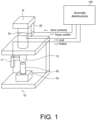
- FIG. 1 is a view schematically showing a site where an abnormality detecting device 100 according to the present embodiment is used.
- the abnormality detecting device 100 is, for example, a device used at a production site to detect an abnormality of a target device 10.
- the abnormality detecting device 100 is realized by, for example, a PLC (programmable controller).
- the abnormality detecting device 100 may have a configuration that controls the operation of the target device 10.
- the abnormality detecting device 100 is connected to one or more target devices 10 via a network such as a field network or a local network.
- the target device 10 is, for example, a press machine driven by a servomotor as a power source.
- the press machine which is an example of the target device 10, rotates a servomotor 20, converts the rotational motion of the servomotor 20 into a linear motion by an actuator 15, and press-fits a press-fitting work 5b into a press-fitted work 5a via a press tool 12.
- the contact surface with the press-fitting work 5b wears.
- metal powder is generated, and at the time of press-fitting, if the metal powder is brought into a space between the press-fitting work 5b and the press-fitted work 5a, an abnormality of foreign matter biting, an abnormality in which the press tool cannot be pulled out, etc. occurs.
- the abnormality detecting device 100 has a function of collecting, learning, and monitoring data related to the operation of the target device 10. From the target device 10, the abnormality detecting device 100 acquires, for example, information such as a torque, a speed, and a position of the servomotor, information of a load applied to the press tool 12 measured by a load cell 16, and a sensor value (position) detected by a displacement sensor 11.
- the abnormality detecting device 100 acquires a first index value associated with a first index, e.g., a value related to a stage of the operation of the target device 10, and a second index value associated with a second index, e.g., a value related to a load of the operation of the target device 10, and with reference to these two index values, determines whether an abnormality occurs in the target device 10.
- a first index value associated with a first index e.g., a value related to a stage of the operation of the target device 10
- a second index value associated with a second index e.g., a value related to a load of the operation of the target device 10
- the abnormality detecting device 100 determines whether an abnormality occurs in the target device 10 based on a distance from a predetermined reference curve to a point indicated by the first index value and the second index value on a two-dimensional plane with the first index and the second index being axes.
- the abnormality detecting device 100 can monitor from the start of the machining operation to the end of the machining operation of the target device 10 and detect an abnormality sign at an early stage. Further, even in a situation in which the sensor value suddenly changes in the operation process of the target device 10, it is possible to appropriately determine whether an abnormality occurs. Further, by performing an abnormality determination using a value related to the stage of the operation of the target device 10 and a value related to the load of the operation of the target device 10, it is possible to appropriately perform an abnormality determination at each stage of the operation of the target device 10.
- FIG. 2 is a block diagram showing a main configuration of the abnormality detecting device 100.
- the abnormality detecting device 100 includes a communication part 101, a control part 110, and a storage part 120.
- the communication part 101 performs communication with the target device 10 via a network and executes transmission/reception of data.
- the communication part 101 is realized using, for example, an integrated circuit (IC) such as a communication IC.
- IC integrated circuit
- the communication part 101 performs communication with the target device 10 by wired communication or wireless communication.
- the control part 110 is a computation device having a function of comprehensively controlling each part of the abnormality detecting device 100.
- the control part 110 may control each part of the abnormality detecting device 100 by, for example, executing a program stored in one or more memories (e.g., a RAM or a ROM) by one or more processors (e.g., a CPU).
- memories e.g., a RAM or a ROM
- processors e.g., a CPU
- the storage part 120 stores various data used by the control part 110 and various software executed by the control part 110. Further, the storage part 120 stores data related to the operation of the target device 10 acquired and learned from the target device 10 by the control part 110.
- the control part 110 includes an acquisition part 111, a reference generation part 112, a scale normalization part 113, and an abnormality detecting part 114.
- the acquisition part 111 acquires a first index value associated with a first index and a second index value associated with a second index in the operation of the target device 10 via the communication part 101.
- the value of the first index and the value of the second index in the operation of the target device 10 are values related to a position, a torque, a load applied to the press tool 12 (a load applied to the press-fitting work 5b), etc. indicated by the servomotor 20, the displacement sensor 11, or the load cell 16 of the target device 10.
- the load applied to the press tool 12 may also be estimated from the torque of the servomotor 20.
- the reference generation part 112 collects the first index value and the second index value acquired by the acquisition part 111 from the target device 10, and generates a regression prediction model, which is a method of machine learning, for the collected first index value and second index value. From the result of machine learning, the reference generation part 112 sets a reference curve on a two-dimensional plane with the first index and the second index being axes.
- the reference curve represents a relationship between the first index value and the second index value in a normal state of the target device 10.
- the abnormality detecting device 100 may also acquire information indicating the reference curve in advance from outside.
- the first index value associated with the first index is a value related to the stage of the operation of the target device 10, and when the target device 10 is a servo press machine, the first index value is, for example, a value indicating a degree of progress in a series of press operation (a value indicating a percentage at which the process has progressed from the start to the end of a series of press operation, e.g., the position of the servomotor 20 or the position of the press tool 12), or an elapsed time from the start of a series of press operation.
- the second index value associated with the second index is a value related to a load of the target device 10.
- the first index value and the second index value are not limited to a value indicating a degree of progress in a series of press operation and a value related to a load (a load of the load cell) of the target device 10, but values such as the position, torque, and speed of the servomotor, and measured values associated with the target device 10 may be appropriately selected and used.
- the scale normalization part 113 individually normalizes each of the scale of the first index and the scale of the second index on the two-dimensional plane with the first index and the second index being axes. Based on the result of machine learning of the first index value and the second index value by the reference generation part 112, the scale normalization part 113 normalizes the scale of the first index and the scale of the second index.
- a reference curve may be set for the two-dimensional plane with the normalized scales. In this manner, by appropriately normalizing each index value and performing the abnormality determination, it is possible to appropriately perform the abnormality determination.
- FIG. 3 is a graph showing the first index value and the second index value in the press operation performed multiple times collected from the target device 10 which is a servo press machine, in which the first index (position) is the horizontal axis, and the second index (load) is the vertical axis.
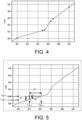
- FIG. 4 a graph showing a reference curve set by the reference generation part 112 using the scales normalized by the scale normalization part 113 using the collected data shown in FIG. 3 .
- the reference curve set according to machine learning by the reference generation part 112 is, for example, a line graph.
- the horizontal axis shows a value (e.g., position) related to the stage of the operation of the target device 10, which is the first index value associated with the first index normalized by the scale normalization part 113
- the vertical axis shows a value related to the load, which is the second index value associated with the second index normalized by the scale normalization part 113.
- the reference curve may be, for example, a correlation diagram between the position of the servomotor and the load applied to the press tool, or a correlation diagram between the speed of the servomotor and the torque of the servomotor.
- the abnormality detecting part 114 detects an abnormality of the target device 10 based on a distance from the reference curve to a point indicated by the first index value and the second index value on the two-dimensional plane with the first index and the second index being axes.
- FIG. 5 is a view showing parameters related to the first index value associated with the first index and the second index value associated with the second index on the reference curve of the regression prediction model f(x).
- the horizontal axis is the first index (x) indicating the stage of the operation, and the vertical axis is the second index (y).
- the scale normalization part 113 first obtains x norm and y norm obtained by normalizing a measured value x act of the first index value and a measured value y act of the second index value acquired by the acquisition part 111, using (Formula 2) and (Formula 3) below.
- x norm x act ⁇ x min / x max ⁇ x min
- y norm y act ⁇ y min / y max ⁇ y min
- x min and y min may respectively be minimum values of the measured values x act and y act of the first index value and the second index value stored in the storage part 120, or minimum values of the first index value and the second index value on the reference curve.
- x max and y max may respectively be maximum values of the measured values x act and y act of the first index value and the second index value stored in the storage part 120, or maximum values of the first index value and the second index value on the reference curve. Normalization is performed to match the scale of the first index and the scale of the second index.
- the abnormality detecting part 114 obtains y ideal for the normalized first index value x norm using (Formula 1).
- the abnormality detecting part 114 obtains x ideal for the normalized second index value y norm using (Formula 4) below.
- x ideal indicates the first index value on the reference curve.
- g(y) is the inverse function of f(x).
- y ideal indicates the second index value (ideal value of the second index) when the first index value is x norm in the case where the target device 10 is normal.
- x ideal indicates the first index value (ideal value of the first index) when the second index value is y norm in the case where the target device 10 is normal. [Math. 4]
- x ideal g y norm
- the abnormality detecting part 114 obtains ⁇ x and ⁇ y which are deviations of the normalized first index value x norm and second index value y norm from their respective ideal values x ideal and y ideal using (Formula 5) and (Formula 6) below.
- ⁇ x x ideal ⁇ x norm
- ⁇ y y norm ⁇ y ideal
- the abnormality detecting part 114 calculates a distance ⁇ h from the reference curve to the point indicated by the first index value and the second index value according to (Formula 7) below using the deviations ⁇ x and ⁇ y of the first index value and the second index value deviating from the ideal values x ideal and y ideal .
- ⁇ h h ⁇ x , ⁇ y
- the abnormality detecting part 114 detects an abnormality of the target device 10 based on the distance ⁇ h from the predetermined reference curve to the point indicated by the first index value and the second index value on the two-dimensional plane with the first index and the second index being axes. Accordingly, even at a process position where the slope changes sharply on the reference curve, the abnormality detecting device 100 can appropriately perform abnormality detection, and can suppress determination that there is an abnormality even though an abnormality does not occur.
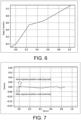
- FIG. 6 is a graph showing a reference curve based on the inverse regression prediction model g(y).
- the vertical axis is the first index (x) indicating the stage of the operation, and the horizontal axis is the second index (y).
- the reference curve is not limited to the configuration indicated by the regression prediction model f(x), but may also have a configuration indicated by the inverse regression prediction model g(y). Even when the reference curve is indicated by the inverse regression prediction model g(y), the abnormality detecting part 114 can calculate the distance ⁇ h from the reference curve to the point indicated by the first index value and the second index value according to the above method using (Formula 1) to (Formula 7).
- FIG. 7 is a view showing a time change of the distance ⁇ h.
- the horizontal axis is the time (first index), and the vertical axis is the distance ⁇ h.
- the abnormality detecting part 114 assigns a positive sign to the distance ⁇ h when the second index value (load) is on the large side with respect to the reference curve. Further, the abnormality detecting part 114 assigns a negative sign to the distance ⁇ h when the second index value is on the small side with respect to the reference curve. In this manner, the abnormality detecting part 114 switches the sign (positive or negative) assigned to the distance ⁇ h according to whether the second index value is on the large side or the small side with respect to the reference curve.
- the abnormality detecting part 114 determines whether an abnormality occurs in the target device 10.
- the abnormality detecting part 114 may also perform a determination on an abnormality based on an absolute value of the distance ⁇ h without distinguishing between the positive and negative.
- the abnormality detecting part 114 may have a different threshold value of the distance ⁇ h used for determining whether an abnormality occurs in the target device 10.
- the threshold value on the positive side and the absolute value of the threshold value on the negative side that indicate the boundary of the normal range associated with ⁇ h may be different.
- the abnormality detecting part 114 may select an appropriate threshold value according to the distance ⁇ h assigned with the positive/negative sign according to whether the second index value is on the side with a larger load or on the side with a smaller load with respect to the reference curve, to determine whether an abnormality occurs in the target device 10. Therefore, according to the configuration of the abnormality detecting part 114, it is possible to suppress an erroneous determination that an abnormality occurs even though an abnormality does not occur in the target device 10, and it is possible to appropriately perform an abnormality determination.
- FIG. 8 is a flowchart showing a flow of a reference curve generation process by the abnormality detecting device 100.
- the control part 110 of the abnormality detecting device 100 first acquires, by the function of the acquisition part 111, a first index value associated with a first index and a second index value associated with a second index from the target device 10 in the normal state via the communication part 101 (step S1).
- the control part 110 stores the first index value associated with the first index and the second index value associated with the second index acquired by the function of the acquisition part 111 to the storage part 120 (step S2).
- the control part 110 determines whether a series of machining operation such as a press-fitting process and a caulking process performed by the target device 10 has been completed (step S3). When the control part 110 determines that the series of machining operation performed by the target device 10 has been completed (YES in step S3), the process proceeds to step S4. When it is determined that the series of machining operation performed by the target device 10 has not been completed (NO in step S3), returning to step S1, the control part 110 continues the collection of the first index value associated with the first index and the second index value associated with the second index.
- control part 110 performs machine learning to generate a regression model for the first index value associated with the first index and the second index value associated with the second index related to the series of machining operation performed by the target device 10 that are stored in the storage part 120 (step S4).
- the control part 110 normalizes, by the function of the scale normalization part 113, the scales of the first index and the second index. Based on the scales normalized by the scale normalization part 113 and the result of machine learning, the reference generation part 112 sets a reference curve (normalized reference curve) associated with a series (one stroke from the start of operation to the completion of operation) of machining operation performed by the target device 10 (step S5).
- a reference curve normalized reference curve
- the control part 110 stores the set reference curve to the storage part 120. Further, the control part 110 presets a normal range associated with ⁇ h and stores it to the storage part 120. The normal range may also be inputted by a user.
- the abnormality detecting device 100 monitors, by the function of the abnormality detecting part 114, the machining operation performed by the target device 10, and detects when an abnormality occurs in the machining operation performed by the target device 10.
- FIG. 9 is a flowchart showing a flow of an abnormality detecting process by the abnormality detecting device 100.
- the control part 110 of the abnormality detecting device 100 acquires, by the function of the acquisition part 111, a first index value associated with the first index and a second index value associated with the second index from the target device 10 via the communication part 101 (step S12).
- the control part 110 normalizes, by the function of the scale normalization part 113, each of the first index value and the second index value acquired by the acquisition part 111 using (Formula 2) and (Formula 3) above (step S13).
- the scale normalization part 113 of the control part 110 normalizes each of the first index value and the second index value by using the maximum value and the minimum value on the reference curve before normalization.
- the control part 110 calculates, by the function of the abnormality detecting part 114, a deviation ⁇ x of the normalized index value x norm of the first index deviating from an ideal value x ideal , and a deviation ⁇ y of the normalized index value y norm of the second index deviating from an ideal value y ideal , using (Formula 5) and (Formula 6) above (step S14).
- the abnormality detecting part 114 calculates a distance ⁇ h from the reference curve to a point indicated by the first index value and the second index value on the two-dimensional plane according to (Formula 7) above using the deviation ⁇ x of the first index value and the deviation ⁇ y of the second index value (step S15).
- the control part 110 stores the distance ⁇ h to the storage part 120.
- the control part 110 determines, by the function of the abnormality detecting part 114, whether the distance ⁇ h is within a predetermined normal range corresponding to the sign (positive or negative) (step S16).
- the control part 110 determines by the abnormality detecting part 114 that the distance ⁇ h is within the normal range (YES in step S16)
- the process proceeds to step S18.
- the control part 110 determines by the abnormality detecting part 114 that the distance ⁇ h is outside the normal range (NO in step S16)
- the process proceeds to step S17.
- the control part 110 determines whether the entirety of the series of operation performed by the target device 10 has been completed (step S18). The control part 110 may also determine whether the entirety of the series of operation performed by the target device 10 has been completed with reference to, for example, the index value of the first index, the index value of the second index, and the reference curve. Further, the control part 110 may also acquire information as to whether the entirety of the series of operation has been completed from, for example, the target device 10 via the acquisition part 111.
- step S18 determines that the entirety of the series of operation performed by the target device 10 has been completed (YES in step S18).
- the process proceeds to step S19.
- the control part 110 determines that the entirety of the series of operation performed by the target device 10 has not been completed (NO in step S18), returning to step S12, the process continues. Accordingly, during the series of operation of the target device 10, for example, at a predetermined time interval, the control part 110 continues the acquisition of the first index value associated with the first index and the second index value associated with the second index from the target device 10 via the communication part 101.
- the control part 110 calculates, by the function of the abnormality detecting part 114, a feature amount of ⁇ h in the entirety of the series of operation (step S19).
- the abnormality detecting part 114 may calculate a mean, a variance, or a standard deviation of the distance ⁇ h calculated during the series of operation performed by the target device 10 as the feature amount. Further, the abnormality detecting part 114 may also calculate a feature amount in a frequency distribution of the distance ⁇ h calculated during the series of machining operation performed by the target device 10.
- the frequency distribution of the distance ⁇ h during the machining operation of the target device 10 may be a histogram with the distance ⁇ h during the machining operation taken as a bin, and the abnormality detecting part 114 may also calculate a kurtosis or a skewness in the histogram as the feature amount in the frequency distribution of the distance ⁇ h during the machining operation.
- control part 110 determines, by the function of the abnormality detecting part 114, whether or not an abnormality occurs in the entirety of the series of operation of the target device 10 (step S20).
- the abnormality detecting part 114 may determine that an abnormality occurs in the entirety of the series of operation of the target device 10. Further, if the skewness of the histogram with the distance ⁇ h taken as a bin is larger than a predetermined threshold value, the abnormality detecting part 114 may determine that an abnormality occurs in the entirety of the series of operation of the target device 10. Further, if the mean, the variance, or the standard deviation of the distance ⁇ h is larger than a predetermined threshold value, the abnormality detecting part 114 may determine that an abnormality occurs in the entirety of the series of operation of the target device 10.
- the abnormality detecting part 114 may determine whether or not an abnormality occurs in the entirety of the series of operation of the target device 10. Even in the case where an abnormality of the target device 10 is suspected from the feature amount of the distance ⁇ h, the abnormality detecting part 114 may determine that an abnormality does not occur in the series of operation of the target device 10 if the count amount (Flag) of the abnormality detection flag remains at the initial value (0).
- the abnormality detecting part 114 may determine that an abnormality occurs in the series of operation of the target device 10 if the count amount (Flag) of the abnormality detection flag is larger than a predetermined value.
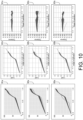
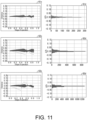
- FIG. 10 to FIG. 13 are views showing graphs corresponding to the first index value associated with the first index and the second index value associated with the second index collected when a series of operation is performed multiple times in the target device 10.
- Graphs 61a, 62a, and 63a of FIG. 10 are motion profiles showing the process of the operation of the target device 10 by the first index value (horizontal axis) and the second index value (vertical axis).
- Each of graphs 61b, 62b, and 63b of FIG. 10 is a graph obtained by respectively normalizing the first index value and the second index value of the graphs 61a, 62a, and 63a.
- FIG. 11 is a graph (the horizontal axis is the first index) showing a distribution of the distance ⁇ h from the reference curve to the point indicated by the normalized first index value and second index value respectively shown in the graphs 61b, 62b and 63b.
- Each of graphs 61d, 62d, and 63d of FIG. 11 is a histogram (the vertical axis is the distance ⁇ h, and the horizontal axis is the frequency) in which the distance ⁇ h respectively shown in the graphs 61c, 62c, and 63c is taken as a bin.
- the example shown in the graphs 61a, 61b, 61c, and 61d of FIG. 10 and FIG. 11 shows a case where it is determined that there is no abnormality as a result of performing an abnormality determination based on the distance ⁇ h as well as performing an abnormality determination based on the feature amount in the frequency distribution of the distance ⁇ h for the operation of the target device 10.
- the abnormality detecting part 114 does not detect an abnormality in the operation performed by the target device 10 (determining that there is no abnormality).
- the example shown in the graphs 62a, 62b, 62c, and 62d of FIG. 10 and FIG. 11 shows a case where the distance ⁇ h sometimes falls outside the range of the threshold value on the negative side in the process of the operation of the target device 10.
- the standard deviation in the frequency distribution of the distance ⁇ h may be within the predetermined range.
- the abnormality detecting part 114 can detect an abnormality in the operation performed by the target device 10 based on whether the kurtosis or the skewness of the histogram with the distance ⁇ h taken as a bin is within the predetermined range.
- the abnormality detecting part 114 may also be configured to detect an abnormality of the target device 10 at a time point when detecting that the distance ⁇ h falls outside the range of the threshold value on the negative side, or may also be configured to detect an abnormality of the target device 10 based on the standard deviation in the frequency distribution of the distance ⁇ h in the entirety of the series of operation and the kurtosis or the skewness of the histogram with the distance ⁇ h taken as a bin.
- the example shown in the graphs 63a, 63b, 63c, and 63d of FIG. 10 and FIG. 11 show a case where the distance ⁇ h sometimes falls outside the range of the threshold value on the positive side and the negative side in the process of the operation of the target device 10.
- the standard deviation in the frequency distribution of the distance ⁇ h may be within the predetermined range.
- the abnormality detecting part 114 can detect an abnormality in the operation performed by the target device 10 based on whether the kurtosis or the skewness of the histogram with the distance ⁇ h taken as a bin is within the predetermined range.
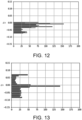
- FIG. 12 shows an example of a histogram (the vertical axis is the distance ⁇ h, and the horizontal axis is the frequency) of the distance ⁇ h in the target device 10 in which an abnormality occurs.
- the mean in the frequency distribution of the distance ⁇ h is well below 0 (the mean is less than the threshold value on the negative side).
- the abnormality detecting part 114 may detect an abnormality of the target device 10 according to whether a statistical value such as the mean in the frequency distribution of the distance ⁇ h is within a normal range.
- FIG. 13 shows another example of a histogram (the vertical axis is the distance ⁇ h, and the horizontal axis is the frequency) of the distance ⁇ h in the target device 10 in which an abnormality occurs.
- the standard deviation in the frequency distribution of the distance ⁇ h is larger than the threshold value.
- the abnormality detecting part 114 may detect an abnormality of the target device 10 according to whether a statistical value such as the standard deviation in the frequency distribution of the distance ⁇ h is within a normal range.
- the target device 10 is a press machine driven by a servomotor as a power source
- the target device 10 is not limited to a press machine, but may be any device driven by a servomotor as a power source, and it is also possible to appropriately detect an abnormality by the abnormality detecting device 100.
- the abnormality detecting process by the abnormality detecting device 100 is applicable not only to a servomotor but also to a stepping motor and other devices driven by a simple motor as a power source.
- the abnormality detecting process by the abnormality detecting device 100 is applicable not only to a motor but also to a device driven by a general actuator such as a hydraulic or pneumatic actuator as a power source.
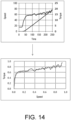
- FIG. 14 is a view showing a first index value associated with a first index, a second index value associated with a second index, and a reference curve in a case where the target device 10 is a device other than a press machine.
- the upper graph of FIG. 14 is a view showing measured values x act and y act of the rotation speed of the servomotor which is the first index value associated with the first index and the torque of the servomotor which is the second index value associated with the second index in a series of operation of the target device 10, with the horizontal axis being time.
- the lower graph of FIG. 14 a graph showing normalized first index value x norm and second index value y norm , and the reference curve on a two-dimensional plane with the first index being the x-axis and the second index being the y-axis.
- the target device 10 being any device driven by a servomotor as a power source, it is possible to detect an abnormality based on the distance ⁇ h between the reference curve and the point indicated by the normalized first index value x norm and second index value y norm on the two-dimensional plane with the first index being the x-axis and the second index being the y-axis.
- the control block (specifically, the acquisition part 111, the reference generation part 112, the scale normalization part 113, and the abnormality detecting part 114) of the abnormality detecting device 100 may be realized by a logic circuit (hardware) formed in an integrated circuit (IC chip) or the like, or may be realized by software.
- the abnormality detecting device 100 includes a computer executing commands of a program which is software realizing each function.
- the computer includes, for example, one or more processors and a computer-readable recording medium that stores the program. Then, in the computer, the objective of the present invention is achieved by the processor reading the program from the recording medium and executing the program.
- a processor for example, a CPU (central processing unit) may be used.
- the recording medium a "non-transitory tangible medium" such as a ROM (read only memory) and the like, a tape, a disk, a card, a semiconductor memory, a programmable logic circuit, etc. may be used. Further, a RAM (random access memory) or the like for developing the program may be further provided.
- the program may be supplied to the computer via an arbitrary transmission medium (communication network, broadcast wave, etc.) capable of transmitting the program.
- a transmission medium communication network, broadcast wave, etc.
- One aspect of the present invention may also be realized in the form of a data signal embedded in a carrier wave, in which the program is embodied by electronic transmission.
- an abnormality detecting method is an abnormality detecting method executed in an abnormality detecting device detecting an abnormality of a target device, and includes: an index value acquisition step of acquiring a first index value associated with a first index and a second index value associated with a second index in an operation of the target device; and an abnormality detecting step of detecting an abnormality of the target device based on a distance from a predetermined reference curve to a point indicated by the first index value and the second index value on a two-dimensional plane with the first index and the second index being axes.
- the first index value is a value related to a stage of the operation of the target device
- the second index value is a value related to a load of the operation of the target device
- the abnormality detecting device includes a scale normalization part that individually normalizes each of a scale of the first index value on the two-dimensional plane and a scale of the second index value on the two-dimensional plane.
- the abnormality detecting part switches a sign of positive and negative assigned to the distance according to whether the second index value is on a side with a large load or a side with a small load with respect to the reference curve, and detects an abnormality of the target device based on the distance assigned with the sign.
- the abnormality detecting part changes a threshold value of the distance from the reference curve, which is a threshold value used for determination on presence or absence of an abnormality of the target device, according to the sign assigned to the distance.
- the abnormality detecting part detects an abnormality of the target device based on a standard deviation of the distance during a machining operation.
- the abnormality detecting part detects an abnormality of the target device based on a feature amount in a frequency distribution of the distance during a machining operation.
- the feature amount in the frequency distribution is a kurtosis in a histogram in which the distance during the machining operation is taken as a bin.
- the feature amount in the frequency distribution is a skewness in a histogram in which the distance during the machining operation is taken as a bin.
- an abnormality detecting program is an abnormality detecting program for causing a computer to function as the above abnormality detecting device, and causes a computer to function as the acquisition part and the abnormality detecting part.
Landscapes
- Engineering & Computer Science (AREA)
- Physics & Mathematics (AREA)
- General Physics & Mathematics (AREA)
- Automation & Control Theory (AREA)
- Data Mining & Analysis (AREA)
- Theoretical Computer Science (AREA)
- Evolutionary Computation (AREA)
- Artificial Intelligence (AREA)
- Mechanical Engineering (AREA)
- Evolutionary Biology (AREA)
- General Engineering & Computer Science (AREA)
- Life Sciences & Earth Sciences (AREA)
- Bioinformatics & Cheminformatics (AREA)
- Bioinformatics & Computational Biology (AREA)
- Computer Vision & Pattern Recognition (AREA)
- Mathematical Physics (AREA)
- Manufacturing & Machinery (AREA)
- Human Computer Interaction (AREA)
- Testing And Monitoring For Control Systems (AREA)
Claims (11)
- Anomalitätsdetektionsvorrichtung (100), die konfiguriert ist, um eine Anomalität einer Zielvorrichtung zu detektieren, wobei die Anomalitätsdetektionsvorrichtung (100) umfasst:ein Erfassungsteil (111), das konfiguriert ist, um einen ersten Indexwert, der mit einem ersten Index verbunden ist, und einen zweiten Indexwert, der mit einem zweiten Index verbunden ist, in einem Betrieb der Zielvorrichtung zu erfassen; undein Anomalitätsdetektionsteil (114), das konfiguriert ist, umeine vorbestimmte Referenzkurve zu erfassen, die eine Beziehung zwischen dem ersten Indexwert und dem zweiten Indexwert in einem normalen Zustand der Zielvorrichtung auf einer zweidimensionalen Ebene darstellt, wobei der erste Index und der zweite Index Achsen sind, um einen ersten Idealwert als den Wert auf dem ersten Index der vorbestimmten Referenzkurve für den zweiten Indexwert auf dem zweiten Index zu erfassen, einen zweiten Idealwert als den Wert auf dem zweiten Index der vorbestimmten Referenzkurve für den ersten Indexwert auf dem ersten Index zu erfassen, undeinen Abstand von der vorbestimmten Referenzkurve zu einem Punkt zu berechnen, der durch den ersten Indexwert und den zweiten Indexwert basierend auf dem ersten Indexwert, dem zweiten Indexwert, dem ersten Idealwert und dem zweiten Idealwert angegeben ist, und eine Anomalität der Zielvorrichtung basierend auf dem Abstand zu erfassen.
- Anomalitätsdetektionsvorrichtung (100) gemäß Anspruch 1, wobei der erste Indexwert ein Wert ist, der mit einer Betriebsstufe der Zielvorrichtung in Beziehung steht, und
der zweite Indexwert ein Wert ist, der mit einer Betriebsbelastung der Zielvorrichtung in Beziehung steht. - Anomalitätsdetektionsvorrichtung (100) gemäß Anspruch 1 oder 2, umfassend:
ein Skalennormalisierungsteil (113), das konfiguriert ist, um jede Skalierung des ersten Indexwerts auf der zweidimensionalen Ebene und jede Skalierung des zweiten Indexwerts auf der zweidimensionalen Ebene einzeln zu normalisieren. - Anomalitätsdetektionsvorrichtung (100) gemäß Anspruch 2 oder 3, wobei das Anomalitätsdetektionsteil (114) konfiguriert ist, um ein dem Abstand zugeordnetes Vorzeichen von positiv und negativ umzuschalten, je nachdem, ob der zweite Indexwert größer oder kleiner als der zweite Idealwert auf der Referenzkurve ist, und eine Anomalität der Zielvorrichtung basierend auf dem Abstand, der dem Vorzeichen zugeordnet ist, zu erkennen.
- Anomalitätsdetektionsvorrichtung (100) gemäß Anspruch 4, wobei das Anomalitätsdetektionsteil (114) konfiguriert ist, um einen Schwellenwert des Abstands von der Referenzkurve, der ein Schwellenwert ist, der zur Bestimmung des Vorhandenseins oder Nichtvorhandenseins einer Anomalität der Zielvorrichtung verwendet wird, entsprechend dem Vorzeichen, das dem Abstand zugeordnet ist, zu ändern.
- Anomalitätsdetektionsvorrichtung (100) gemäß einem der Ansprüche 1 bis 5, wobei das Anomalitätsdetektionsteil (114) konfiguriert ist, um eine Anomalität der Zielvorrichtung basierend auf einer Standardabweichung des Abstands während eines Bearbeitungsvorgangs der Zielvorrichtung zu detektieren.
- Anomalitätsdetektionsvorrichtung (100) gemäß einem der Ansprüche 1 bis 5, wobei das Anomalitätsdetektionsteil (114) konfiguriert ist, um eine Anomalität der Zielvorrichtung basierend auf einer Merkmalsmenge in einer Häufigkeitsverteilung des Abstands während eines Bearbeitungsbetriebs der Zielvorrichtung zu detektieren.
- Anomalitätsdetektionsvorrichtung (100) gemäß Anspruch 7, wobei die Merkmalsmenge in der Häufigkeitsverteilung eine Kurtosis in einem Histogramm ist, in dem der Abstand während des Bearbeitungsbetriebs der Zielvorrichtung als Bin genommen wird.
- Anomalitätsdetektionsvorrichtung (100) gemäß Anspruch 7, wobei die Merkmalsmenge in der Häufigkeitsverteilung eine Schiefe in einem Histogramm ist, in dem der Abstand während des Bearbeitungsbetriebs der Zielvorrichtung als Bin genommen wird.
- Anomalitätsdetektionsverfahren, das in einer Anomalitätsdetektionsvorrichtung (100) ausgeführt wird, um eine Anomalität einer Zielvorrichtung zu detektieren, wobei das Anomalitätsdetektionsverfahren umfasst:einen Indexwerterfassungsschritt zum Erfassen eines ersten Indexwerts, der mit einem ersten Index verbunden ist, und eines zweiten Indexwerts, der mit einem zweiten Index verbunden ist, in einem Betrieb der Zielvorrichtung; undeinen Anomalitätsdetektionsschritt zum
Erfassen einer vorbestimmten Referenzkurve, die eine Beziehung zwischen dem ersten Indexwert und dem zweiten Indexwert in einem Normalzustand der Zielvorrichtung auf einer zweidimensionalen Ebene darstellt, wobei der erste Index und der zweite Index Achsen sind, Erfassen eines ersten Idealwerts als den Wert auf dem ersten Index der vorbestimmten Referenzkurve für den zweiten Indexwert auf dem zweiten Index, Erfassen eines zweiten Idealwerts als den Wert auf dem zweiten Index der vorbestimmten Referenzkurve für den ersten Indexwert auf dem ersten Index,Berechnen eines Abstands von der vorbestimmten Referenzkurve zu einem Punkt, der durch den ersten Indexwert und den zweiten Indexwert angegeben ist, basierend auf dem ersten Indexwert, dem zweiten Indexwert, dem ersten Idealwert und dem zweiten Idealwert, undDetektieren einer Anomalität der Zielvorrichtung basierend auf dem Abstand. - Anomalitätsdetektionsprogramm, das einen Computer veranlasst, als Anomalitätsdetektionsvorrichtung (100) gemäß Anspruch 1 zu arbeiten, wobei das Anomalitätsdetektionsprogramm einen Computer veranlasst, als Erfassungsteil (111) und als Anomalitätsdetektionsteil (114) zu arbeiten.
Applications Claiming Priority (2)
| Application Number | Priority Date | Filing Date | Title |
|---|---|---|---|
| JP2019135695A JP7367366B2 (ja) | 2019-07-23 | 2019-07-23 | 異常検知装置、異常検知方法、および異常検知プログラム |
| PCT/JP2020/008498 WO2021014670A1 (ja) | 2019-07-23 | 2020-02-28 | 異常検知装置、異常検知方法、および異常検知プログラム |
Publications (3)
| Publication Number | Publication Date |
|---|---|
| EP4005785A1 EP4005785A1 (de) | 2022-06-01 |
| EP4005785A4 EP4005785A4 (de) | 2023-07-26 |
| EP4005785B1 true EP4005785B1 (de) | 2025-03-19 |
Family
ID=74192721
Family Applications (1)
| Application Number | Title | Priority Date | Filing Date |
|---|---|---|---|
| EP20844882.9A Active EP4005785B1 (de) | 2019-07-23 | 2020-02-28 | Anomalitätsdetektionsvorrichtung, anomalitätsdetektionsverfahren und anomalitätsdetektionsprogramm |
Country Status (5)
| Country | Link |
|---|---|
| US (1) | US12276975B2 (de) |
| EP (1) | EP4005785B1 (de) |
| JP (1) | JP7367366B2 (de) |
| CN (1) | CN113924207B (de) |
| WO (1) | WO2021014670A1 (de) |
Families Citing this family (7)
| Publication number | Priority date | Publication date | Assignee | Title |
|---|---|---|---|---|
| JP7759583B2 (ja) * | 2021-03-04 | 2025-10-24 | パナソニックIpマネジメント株式会社 | 学習済み判定基準生成方法、プレス加工結果判定器生成方法、プレス加工結果推定方法、学習済み判定基準生成装置、およびプレス加工結果判定器 |
| JP7347468B2 (ja) * | 2021-03-26 | 2023-09-20 | 横河電機株式会社 | 装置、方法およびプログラム |
| CN113884889B (zh) * | 2021-10-29 | 2024-04-26 | 章鱼博士智能技术(上海)有限公司 | 一种电池安全预警的方法、装置、存储介质及电子设备 |
| US12072251B2 (en) * | 2022-03-01 | 2024-08-27 | Asmpt Singapore Pte. Ltd. | Force measurement device and method for bonding or encapsulation process and apparatus incorporating the device |
| WO2023233926A1 (ja) * | 2022-06-03 | 2023-12-07 | オムロン株式会社 | 異常予兆検知装置、異常予兆の検知方法およびプログラム |
| JP7746237B2 (ja) * | 2022-08-25 | 2025-09-30 | 株式会社栗本鐵工所 | 測定波形表示装置およびプログラム |
| JP2024112670A (ja) | 2023-02-08 | 2024-08-21 | オムロン株式会社 | 作業分析装置、作業分析システム、作業分析方法及びプログラム |
Family Cites Families (15)
| Publication number | Priority date | Publication date | Assignee | Title |
|---|---|---|---|---|
| US5119311A (en) * | 1988-07-14 | 1992-06-02 | Coors Brewing Company | Monitor and control assembly for use with a can end press |
| JP3231536B2 (ja) * | 1993-02-25 | 2001-11-26 | トヨタ自動車株式会社 | プレス機械の異常診断方法 |
| JP3996428B2 (ja) * | 2001-12-25 | 2007-10-24 | 松下電器産業株式会社 | 異常検知装置及び異常検知システム |
| JP4431415B2 (ja) * | 2004-02-12 | 2010-03-17 | 株式会社リコー | 異常診断方法、状態判定装置及び画像形成装置 |
| JP4250552B2 (ja) * | 2004-03-03 | 2009-04-08 | 株式会社東芝 | 製造装置管理システム、製造装置管理方法及びプログラム |
| JP2006158031A (ja) * | 2004-11-26 | 2006-06-15 | Yaskawa Electric Corp | モータ制御装置およびその制御方法 |
| JP4769983B2 (ja) * | 2007-05-17 | 2011-09-07 | 独立行政法人産業技術総合研究所 | 異常検出装置および異常検出方法 |
| US9962104B2 (en) * | 2011-04-14 | 2018-05-08 | Koninklijke Philips N.V. | Stress-measuring device and method |
| JP6326321B2 (ja) * | 2014-08-07 | 2018-05-16 | 株式会社日立製作所 | データ表示システム |
| JP6492555B2 (ja) * | 2014-11-07 | 2019-04-03 | 株式会社Ihi | 異常診断方法、異常診断装置及び異常診断プログラム |
| EP3056957B1 (de) * | 2015-02-16 | 2019-03-27 | Siemens Aktiengesellschaft | Diagnoseeinrichtung und -verfahren zur Überwachung des Betriebs eines Regelkreises |
| JP6585374B2 (ja) * | 2015-04-30 | 2019-10-02 | コマツ産機株式会社 | プレスシステムおよびプレスシステムの制御方法 |
| JP6895816B2 (ja) * | 2017-06-15 | 2021-06-30 | 株式会社 日立産業制御ソリューションズ | 異常診断装置、異常診断方法及び異常診断プログラム |
| JP6593715B2 (ja) * | 2017-10-27 | 2019-10-23 | 株式会社安川電機 | 異常判定システム、モータ制御装置 |
| JP7028625B2 (ja) * | 2017-12-14 | 2022-03-02 | 株式会社ジャノメ | 電動プレス、荷重判定方法およびプログラム |
-
2019
- 2019-07-23 JP JP2019135695A patent/JP7367366B2/ja active Active
-
2020
- 2020-02-28 WO PCT/JP2020/008498 patent/WO2021014670A1/ja not_active Ceased
- 2020-02-28 US US17/621,685 patent/US12276975B2/en active Active
- 2020-02-28 EP EP20844882.9A patent/EP4005785B1/de active Active
- 2020-02-28 CN CN202080041120.XA patent/CN113924207B/zh active Active
Also Published As
| Publication number | Publication date |
|---|---|
| JP7367366B2 (ja) | 2023-10-24 |
| EP4005785A4 (de) | 2023-07-26 |
| US20220357732A1 (en) | 2022-11-10 |
| WO2021014670A1 (ja) | 2021-01-28 |
| JP2021018753A (ja) | 2021-02-15 |
| CN113924207B (zh) | 2024-04-05 |
| US12276975B2 (en) | 2025-04-15 |
| EP4005785A1 (de) | 2022-06-01 |
| CN113924207A (zh) | 2022-01-11 |
Similar Documents
| Publication | Publication Date | Title |
|---|---|---|
| EP4005785B1 (de) | Anomalitätsdetektionsvorrichtung, anomalitätsdetektionsverfahren und anomalitätsdetektionsprogramm | |
| EP3394693B1 (de) | Diagnosevorrichtung, computerprogramm und diagnosesystem | |
| US10525563B2 (en) | Abnormality-detecting device and method for tool of machine tool | |
| JP7585368B2 (ja) | 状態監視装置、方法及びプログラム | |
| CN113867321A (zh) | 诊断设备、计算机程序和诊断系统 | |
| US12257704B2 (en) | Abnormality detection device and abnormality detection method | |
| US20190196458A1 (en) | Method for selecting leading associated parameter and method for combining critical parameter and leading associated parameter for equipment prognostics and health management | |
| US20260110599A1 (en) | Vibration monitoring in order to detect an error during a process automation | |
| CN119356207B (zh) | 一种自动混配生产线的plc控制方法及系统 | |
| CN114391093A (zh) | 异常判定装置以及异常判定方法 | |
| CN114077919A (zh) | 用于预测加工异常的系统 | |
| JP6915763B1 (ja) | 異常診断システム及び異常診断方法 | |
| US20070282548A1 (en) | Method and Apparatus for Assessing Condition of Motor-Driven Mechanical System | |
| US12044593B2 (en) | Diagnosis apparatus | |
| CN111936278B (zh) | 机器人控制装置、维护管理方法以及计算机可读存储介质 | |
| US20240192673A1 (en) | Data processing system and data processing method | |
| EP4328689A1 (de) | Datenverarbeitungssystem, datenverarbeitungsverfahren und programm | |
| JP7783297B2 (ja) | 異常診断装置、異常診断システム、及び記憶媒体 | |
| EP4328690A1 (de) | Datenverarbeitungssystem, datenverarbeitungsverfahren und programm | |
| EP4535104A1 (de) | Anomaliedetektionsvorrichtung, anomaliedetektionsverfahren und programm | |
| RU2809934C1 (ru) | Система диагностики аномалий и способ диагностики аномалий | |
| EP4597038A1 (de) | Anomaliediagnosevorrichtung und anomaliediagnoseverfahren | |
| US11269309B2 (en) | Analysis unit and method for determining at least one forming process characteristic of a servo press |
Legal Events
| Date | Code | Title | Description |
|---|---|---|---|
| STAA | Information on the status of an ep patent application or granted ep patent |
Free format text: STATUS: THE INTERNATIONAL PUBLICATION HAS BEEN MADE |
|
| PUAI | Public reference made under article 153(3) epc to a published international application that has entered the european phase |
Free format text: ORIGINAL CODE: 0009012 |
|
| STAA | Information on the status of an ep patent application or granted ep patent |
Free format text: STATUS: REQUEST FOR EXAMINATION WAS MADE |
|
| 17P | Request for examination filed |
Effective date: 20211209 |
|
| AK | Designated contracting states |
Kind code of ref document: A1 Designated state(s): AL AT BE BG CH CY CZ DE DK EE ES FI FR GB GR HR HU IE IS IT LI LT LU LV MC MK MT NL NO PL PT RO RS SE SI SK SM TR |
|
| DAV | Request for validation of the european patent (deleted) | ||
| DAX | Request for extension of the european patent (deleted) | ||
| A4 | Supplementary search report drawn up and despatched |
Effective date: 20230623 |
|
| RIC1 | Information provided on ipc code assigned before grant |
Ipc: G05B 19/406 20060101ALI20230619BHEP Ipc: G05B 23/02 20060101ALI20230619BHEP Ipc: B30B 15/26 20060101ALI20230619BHEP Ipc: B30B 15/28 20060101AFI20230619BHEP |
|
| GRAP | Despatch of communication of intention to grant a patent |
Free format text: ORIGINAL CODE: EPIDOSNIGR1 |
|
| STAA | Information on the status of an ep patent application or granted ep patent |
Free format text: STATUS: GRANT OF PATENT IS INTENDED |
|
| INTG | Intention to grant announced |
Effective date: 20241016 |
|
| GRAS | Grant fee paid |
Free format text: ORIGINAL CODE: EPIDOSNIGR3 |
|
| GRAA | (expected) grant |
Free format text: ORIGINAL CODE: 0009210 |
|
| STAA | Information on the status of an ep patent application or granted ep patent |
Free format text: STATUS: THE PATENT HAS BEEN GRANTED |
|
| AK | Designated contracting states |
Kind code of ref document: B1 Designated state(s): AL AT BE BG CH CY CZ DE DK EE ES FI FR GB GR HR HU IE IS IT LI LT LU LV MC MK MT NL NO PL PT RO RS SE SI SK SM TR |
|
| REG | Reference to a national code |
Ref country code: GB Ref legal event code: FG4D |
|
| REG | Reference to a national code |
Ref country code: CH Ref legal event code: EP |
|
| REG | Reference to a national code |
Ref country code: IE Ref legal event code: FG4D |
|
| REG | Reference to a national code |
Ref country code: DE Ref legal event code: R096 Ref document number: 602020048067 Country of ref document: DE |
|
| PG25 | Lapsed in a contracting state [announced via postgrant information from national office to epo] |
Ref country code: RS Free format text: LAPSE BECAUSE OF FAILURE TO SUBMIT A TRANSLATION OF THE DESCRIPTION OR TO PAY THE FEE WITHIN THE PRESCRIBED TIME-LIMIT Effective date: 20250619 |
|
| PG25 | Lapsed in a contracting state [announced via postgrant information from national office to epo] |
Ref country code: FI Free format text: LAPSE BECAUSE OF FAILURE TO SUBMIT A TRANSLATION OF THE DESCRIPTION OR TO PAY THE FEE WITHIN THE PRESCRIBED TIME-LIMIT Effective date: 20250319 |
|
| REG | Reference to a national code |
Ref country code: LT Ref legal event code: MG9D |
|
| PG25 | Lapsed in a contracting state [announced via postgrant information from national office to epo] |
Ref country code: NO Free format text: LAPSE BECAUSE OF FAILURE TO SUBMIT A TRANSLATION OF THE DESCRIPTION OR TO PAY THE FEE WITHIN THE PRESCRIBED TIME-LIMIT Effective date: 20250619 |
|
| PG25 | Lapsed in a contracting state [announced via postgrant information from national office to epo] |
Ref country code: HR Free format text: LAPSE BECAUSE OF FAILURE TO SUBMIT A TRANSLATION OF THE DESCRIPTION OR TO PAY THE FEE WITHIN THE PRESCRIBED TIME-LIMIT Effective date: 20250319 |
|
| PG25 | Lapsed in a contracting state [announced via postgrant information from national office to epo] |
Ref country code: LV Free format text: LAPSE BECAUSE OF FAILURE TO SUBMIT A TRANSLATION OF THE DESCRIPTION OR TO PAY THE FEE WITHIN THE PRESCRIBED TIME-LIMIT Effective date: 20250319 |
|
| PG25 | Lapsed in a contracting state [announced via postgrant information from national office to epo] |
Ref country code: GR Free format text: LAPSE BECAUSE OF FAILURE TO SUBMIT A TRANSLATION OF THE DESCRIPTION OR TO PAY THE FEE WITHIN THE PRESCRIBED TIME-LIMIT Effective date: 20250620 Ref country code: BG Free format text: LAPSE BECAUSE OF FAILURE TO SUBMIT A TRANSLATION OF THE DESCRIPTION OR TO PAY THE FEE WITHIN THE PRESCRIBED TIME-LIMIT Effective date: 20250319 |
|
| REG | Reference to a national code |
Ref country code: NL Ref legal event code: MP Effective date: 20250319 |
|
| REG | Reference to a national code |
Ref country code: AT Ref legal event code: MK05 Ref document number: 1776649 Country of ref document: AT Kind code of ref document: T Effective date: 20250319 |
|
| PG25 | Lapsed in a contracting state [announced via postgrant information from national office to epo] |
Ref country code: NL Free format text: LAPSE BECAUSE OF FAILURE TO SUBMIT A TRANSLATION OF THE DESCRIPTION OR TO PAY THE FEE WITHIN THE PRESCRIBED TIME-LIMIT Effective date: 20250319 |
|
| PG25 | Lapsed in a contracting state [announced via postgrant information from national office to epo] |
Ref country code: SE Free format text: LAPSE BECAUSE OF FAILURE TO SUBMIT A TRANSLATION OF THE DESCRIPTION OR TO PAY THE FEE WITHIN THE PRESCRIBED TIME-LIMIT Effective date: 20250319 |
|
| PG25 | Lapsed in a contracting state [announced via postgrant information from national office to epo] |
Ref country code: SM Free format text: LAPSE BECAUSE OF FAILURE TO SUBMIT A TRANSLATION OF THE DESCRIPTION OR TO PAY THE FEE WITHIN THE PRESCRIBED TIME-LIMIT Effective date: 20250319 |
|
| PG25 | Lapsed in a contracting state [announced via postgrant information from national office to epo] |
Ref country code: ES Free format text: LAPSE BECAUSE OF FAILURE TO SUBMIT A TRANSLATION OF THE DESCRIPTION OR TO PAY THE FEE WITHIN THE PRESCRIBED TIME-LIMIT Effective date: 20250319 Ref country code: PT Free format text: LAPSE BECAUSE OF FAILURE TO SUBMIT A TRANSLATION OF THE DESCRIPTION OR TO PAY THE FEE WITHIN THE PRESCRIBED TIME-LIMIT Effective date: 20250721 |
|
| PG25 | Lapsed in a contracting state [announced via postgrant information from national office to epo] |
Ref country code: IT Free format text: LAPSE BECAUSE OF FAILURE TO SUBMIT A TRANSLATION OF THE DESCRIPTION OR TO PAY THE FEE WITHIN THE PRESCRIBED TIME-LIMIT Effective date: 20250319 Ref country code: PL Free format text: LAPSE BECAUSE OF FAILURE TO SUBMIT A TRANSLATION OF THE DESCRIPTION OR TO PAY THE FEE WITHIN THE PRESCRIBED TIME-LIMIT Effective date: 20250319 |
|
| PG25 | Lapsed in a contracting state [announced via postgrant information from national office to epo] |
Ref country code: AT Free format text: LAPSE BECAUSE OF FAILURE TO SUBMIT A TRANSLATION OF THE DESCRIPTION OR TO PAY THE FEE WITHIN THE PRESCRIBED TIME-LIMIT Effective date: 20250319 |
|
| PG25 | Lapsed in a contracting state [announced via postgrant information from national office to epo] |
Ref country code: CZ Free format text: LAPSE BECAUSE OF FAILURE TO SUBMIT A TRANSLATION OF THE DESCRIPTION OR TO PAY THE FEE WITHIN THE PRESCRIBED TIME-LIMIT Effective date: 20250319 Ref country code: EE Free format text: LAPSE BECAUSE OF FAILURE TO SUBMIT A TRANSLATION OF THE DESCRIPTION OR TO PAY THE FEE WITHIN THE PRESCRIBED TIME-LIMIT Effective date: 20250319 |
|
| PG25 | Lapsed in a contracting state [announced via postgrant information from national office to epo] |
Ref country code: RO Free format text: LAPSE BECAUSE OF FAILURE TO SUBMIT A TRANSLATION OF THE DESCRIPTION OR TO PAY THE FEE WITHIN THE PRESCRIBED TIME-LIMIT Effective date: 20250319 |
|
| PG25 | Lapsed in a contracting state [announced via postgrant information from national office to epo] |
Ref country code: SK Free format text: LAPSE BECAUSE OF FAILURE TO SUBMIT A TRANSLATION OF THE DESCRIPTION OR TO PAY THE FEE WITHIN THE PRESCRIBED TIME-LIMIT Effective date: 20250319 |
|
| PG25 | Lapsed in a contracting state [announced via postgrant information from national office to epo] |
Ref country code: IS Free format text: LAPSE BECAUSE OF FAILURE TO SUBMIT A TRANSLATION OF THE DESCRIPTION OR TO PAY THE FEE WITHIN THE PRESCRIBED TIME-LIMIT Effective date: 20250719 |
|
| REG | Reference to a national code |
Ref country code: DE Ref legal event code: R097 Ref document number: 602020048067 Country of ref document: DE |
|
| PG25 | Lapsed in a contracting state [announced via postgrant information from national office to epo] |
Ref country code: DK Free format text: LAPSE BECAUSE OF FAILURE TO SUBMIT A TRANSLATION OF THE DESCRIPTION OR TO PAY THE FEE WITHIN THE PRESCRIBED TIME-LIMIT Effective date: 20250319 |
|
| PLBE | No opposition filed within time limit |
Free format text: ORIGINAL CODE: 0009261 |
|
| STAA | Information on the status of an ep patent application or granted ep patent |
Free format text: STATUS: NO OPPOSITION FILED WITHIN TIME LIMIT |
|
| REG | Reference to a national code |
Ref country code: CH Ref legal event code: L10 Free format text: ST27 STATUS EVENT CODE: U-0-0-L10-L00 (AS PROVIDED BY THE NATIONAL OFFICE) Effective date: 20260128 |
|
| 26N | No opposition filed |
Effective date: 20251222 |