EP3962993B1 - Zusatzstoffsysteme mit antioxidant und glycerolstearat für verbesserte farbe in polyethylenhärzen - Google Patents
Zusatzstoffsysteme mit antioxidant und glycerolstearat für verbesserte farbe in polyethylenhärzen Download PDFInfo
- Publication number
- EP3962993B1 EP3962993B1 EP20724363.5A EP20724363A EP3962993B1 EP 3962993 B1 EP3962993 B1 EP 3962993B1 EP 20724363 A EP20724363 A EP 20724363A EP 3962993 B1 EP3962993 B1 EP 3962993B1
- Authority
- EP
- European Patent Office
- Prior art keywords
- antioxidant
- ppm
- polymer
- ethylene
- composition
- Prior art date
- Legal status (The legal status is an assumption and is not a legal conclusion. Google has not performed a legal analysis and makes no representation as to the accuracy of the status listed.)
- Active
Links
Images







Classifications
-
- C—CHEMISTRY; METALLURGY
- C08—ORGANIC MACROMOLECULAR COMPOUNDS; THEIR PREPARATION OR CHEMICAL WORKING-UP; COMPOSITIONS BASED THEREON
- C08F—MACROMOLECULAR COMPOUNDS OBTAINED BY REACTIONS ONLY INVOLVING CARBON-TO-CARBON UNSATURATED BONDS
- C08F10/00—Homopolymers and copolymers of unsaturated aliphatic hydrocarbons having only one carbon-to-carbon double bond
- C08F10/02—Ethene
-
- C—CHEMISTRY; METALLURGY
- C08—ORGANIC MACROMOLECULAR COMPOUNDS; THEIR PREPARATION OR CHEMICAL WORKING-UP; COMPOSITIONS BASED THEREON
- C08J—WORKING-UP; GENERAL PROCESSES OF COMPOUNDING; AFTER-TREATMENT NOT COVERED BY SUBCLASSES C08B, C08C, C08F, C08G or C08H
- C08J3/00—Processes of treating or compounding macromolecular substances
- C08J3/12—Powdering or granulating
- C08J3/126—Polymer particles coated by polymer, e.g. core shell structures
-
- C—CHEMISTRY; METALLURGY
- C08—ORGANIC MACROMOLECULAR COMPOUNDS; THEIR PREPARATION OR CHEMICAL WORKING-UP; COMPOSITIONS BASED THEREON
- C08J—WORKING-UP; GENERAL PROCESSES OF COMPOUNDING; AFTER-TREATMENT NOT COVERED BY SUBCLASSES C08B, C08C, C08F, C08G or C08H
- C08J3/00—Processes of treating or compounding macromolecular substances
- C08J3/20—Compounding polymers with additives, e.g. colouring
- C08J3/22—Compounding polymers with additives, e.g. colouring using masterbatch techniques
- C08J3/226—Compounding polymers with additives, e.g. colouring using masterbatch techniques using a polymer as a carrier
-
- C—CHEMISTRY; METALLURGY
- C08—ORGANIC MACROMOLECULAR COMPOUNDS; THEIR PREPARATION OR CHEMICAL WORKING-UP; COMPOSITIONS BASED THEREON
- C08K—Use of inorganic or non-macromolecular organic substances as compounding ingredients
- C08K5/00—Use of organic ingredients
- C08K5/0008—Organic ingredients according to more than one of the "one dot" groups of C08K5/01 - C08K5/59
- C08K5/005—Stabilisers against oxidation, heat, light, ozone
-
- C—CHEMISTRY; METALLURGY
- C08—ORGANIC MACROMOLECULAR COMPOUNDS; THEIR PREPARATION OR CHEMICAL WORKING-UP; COMPOSITIONS BASED THEREON
- C08K—Use of inorganic or non-macromolecular organic substances as compounding ingredients
- C08K5/00—Use of organic ingredients
- C08K5/04—Oxygen-containing compounds
- C08K5/10—Esters; Ether-esters
- C08K5/101—Esters; Ether-esters of monocarboxylic acids
- C08K5/103—Esters; Ether-esters of monocarboxylic acids with polyalcohols
-
- C—CHEMISTRY; METALLURGY
- C08—ORGANIC MACROMOLECULAR COMPOUNDS; THEIR PREPARATION OR CHEMICAL WORKING-UP; COMPOSITIONS BASED THEREON
- C08K—Use of inorganic or non-macromolecular organic substances as compounding ingredients
- C08K5/00—Use of organic ingredients
- C08K5/04—Oxygen-containing compounds
- C08K5/13—Phenols; Phenolates
-
- C—CHEMISTRY; METALLURGY
- C08—ORGANIC MACROMOLECULAR COMPOUNDS; THEIR PREPARATION OR CHEMICAL WORKING-UP; COMPOSITIONS BASED THEREON
- C08K—Use of inorganic or non-macromolecular organic substances as compounding ingredients
- C08K5/00—Use of organic ingredients
- C08K5/36—Sulfur-, selenium-, or tellurium-containing compounds
- C08K5/38—Thiocarbonic acids; Derivatives thereof, e.g. xanthates ; i.e. compounds containing -X-C(=X)- groups, X being oxygen or sulfur, at least one X being sulfur
-
- C—CHEMISTRY; METALLURGY
- C08—ORGANIC MACROMOLECULAR COMPOUNDS; THEIR PREPARATION OR CHEMICAL WORKING-UP; COMPOSITIONS BASED THEREON
- C08K—Use of inorganic or non-macromolecular organic substances as compounding ingredients
- C08K5/00—Use of organic ingredients
- C08K5/36—Sulfur-, selenium-, or tellurium-containing compounds
- C08K5/41—Compounds containing sulfur bound to oxygen
- C08K5/42—Sulfonic acids; Derivatives thereof
-
- C—CHEMISTRY; METALLURGY
- C08—ORGANIC MACROMOLECULAR COMPOUNDS; THEIR PREPARATION OR CHEMICAL WORKING-UP; COMPOSITIONS BASED THEREON
- C08K—Use of inorganic or non-macromolecular organic substances as compounding ingredients
- C08K5/00—Use of organic ingredients
- C08K5/49—Phosphorus-containing compounds
- C08K5/51—Phosphorus bound to oxygen
- C08K5/52—Phosphorus bound to oxygen only
- C08K5/524—Esters of phosphorous acids, e.g. of H3PO3
-
- C—CHEMISTRY; METALLURGY
- C08—ORGANIC MACROMOLECULAR COMPOUNDS; THEIR PREPARATION OR CHEMICAL WORKING-UP; COMPOSITIONS BASED THEREON
- C08K—Use of inorganic or non-macromolecular organic substances as compounding ingredients
- C08K5/00—Use of organic ingredients
- C08K5/49—Phosphorus-containing compounds
- C08K5/51—Phosphorus bound to oxygen
- C08K5/52—Phosphorus bound to oxygen only
- C08K5/524—Esters of phosphorous acids, e.g. of H3PO3
- C08K5/526—Esters of phosphorous acids, e.g. of H3PO3 with hydroxyaryl compounds
-
- C—CHEMISTRY; METALLURGY
- C08—ORGANIC MACROMOLECULAR COMPOUNDS; THEIR PREPARATION OR CHEMICAL WORKING-UP; COMPOSITIONS BASED THEREON
- C08L—COMPOSITIONS OF MACROMOLECULAR COMPOUNDS
- C08L23/00—Compositions of homopolymers or copolymers of unsaturated aliphatic hydrocarbons having only one carbon-to-carbon double bond; Compositions of derivatives of such polymers
- C08L23/02—Compositions of homopolymers or copolymers of unsaturated aliphatic hydrocarbons having only one carbon-to-carbon double bond; Compositions of derivatives of such polymers not modified by chemical after-treatment
- C08L23/04—Homopolymers or copolymers of ethene
- C08L23/06—Polyethene
-
- C—CHEMISTRY; METALLURGY
- C08—ORGANIC MACROMOLECULAR COMPOUNDS; THEIR PREPARATION OR CHEMICAL WORKING-UP; COMPOSITIONS BASED THEREON
- C08L—COMPOSITIONS OF MACROMOLECULAR COMPOUNDS
- C08L23/00—Compositions of homopolymers or copolymers of unsaturated aliphatic hydrocarbons having only one carbon-to-carbon double bond; Compositions of derivatives of such polymers
- C08L23/02—Compositions of homopolymers or copolymers of unsaturated aliphatic hydrocarbons having only one carbon-to-carbon double bond; Compositions of derivatives of such polymers not modified by chemical after-treatment
- C08L23/04—Homopolymers or copolymers of ethene
- C08L23/08—Copolymers of ethene
- C08L23/0846—Copolymers of ethene with unsaturated hydrocarbons containing atoms other than carbon or hydrogen
- C08L23/0853—Ethene vinyl acetate copolymers
-
- C—CHEMISTRY; METALLURGY
- C08—ORGANIC MACROMOLECULAR COMPOUNDS; THEIR PREPARATION OR CHEMICAL WORKING-UP; COMPOSITIONS BASED THEREON
- C08L—COMPOSITIONS OF MACROMOLECULAR COMPOUNDS
- C08L23/00—Compositions of homopolymers or copolymers of unsaturated aliphatic hydrocarbons having only one carbon-to-carbon double bond; Compositions of derivatives of such polymers
- C08L23/02—Compositions of homopolymers or copolymers of unsaturated aliphatic hydrocarbons having only one carbon-to-carbon double bond; Compositions of derivatives of such polymers not modified by chemical after-treatment
- C08L23/10—Homopolymers or copolymers of propene
- C08L23/12—Polypropene
-
- C—CHEMISTRY; METALLURGY
- C08—ORGANIC MACROMOLECULAR COMPOUNDS; THEIR PREPARATION OR CHEMICAL WORKING-UP; COMPOSITIONS BASED THEREON
- C08J—WORKING-UP; GENERAL PROCESSES OF COMPOUNDING; AFTER-TREATMENT NOT COVERED BY SUBCLASSES C08B, C08C, C08F, C08G or C08H
- C08J2323/00—Characterised by the use of homopolymers or copolymers of unsaturated aliphatic hydrocarbons having only one carbon-to-carbon double bond; Derivatives of such polymers
- C08J2323/02—Characterised by the use of homopolymers or copolymers of unsaturated aliphatic hydrocarbons having only one carbon-to-carbon double bond; Derivatives of such polymers not modified by chemical after treatment
- C08J2323/04—Homopolymers or copolymers of ethene
-
- C—CHEMISTRY; METALLURGY
- C08—ORGANIC MACROMOLECULAR COMPOUNDS; THEIR PREPARATION OR CHEMICAL WORKING-UP; COMPOSITIONS BASED THEREON
- C08J—WORKING-UP; GENERAL PROCESSES OF COMPOUNDING; AFTER-TREATMENT NOT COVERED BY SUBCLASSES C08B, C08C, C08F, C08G or C08H
- C08J2323/00—Characterised by the use of homopolymers or copolymers of unsaturated aliphatic hydrocarbons having only one carbon-to-carbon double bond; Derivatives of such polymers
- C08J2323/02—Characterised by the use of homopolymers or copolymers of unsaturated aliphatic hydrocarbons having only one carbon-to-carbon double bond; Derivatives of such polymers not modified by chemical after treatment
- C08J2323/04—Homopolymers or copolymers of ethene
- C08J2323/08—Copolymers of ethene
-
- C—CHEMISTRY; METALLURGY
- C08—ORGANIC MACROMOLECULAR COMPOUNDS; THEIR PREPARATION OR CHEMICAL WORKING-UP; COMPOSITIONS BASED THEREON
- C08J—WORKING-UP; GENERAL PROCESSES OF COMPOUNDING; AFTER-TREATMENT NOT COVERED BY SUBCLASSES C08B, C08C, C08F, C08G or C08H
- C08J2423/00—Characterised by the use of homopolymers or copolymers of unsaturated aliphatic hydrocarbons having only one carbon-to-carbon double bond; Derivatives of such polymers
- C08J2423/02—Characterised by the use of homopolymers or copolymers of unsaturated aliphatic hydrocarbons having only one carbon-to-carbon double bond; Derivatives of such polymers not modified by chemical after treatment
- C08J2423/04—Homopolymers or copolymers of ethene
-
- C—CHEMISTRY; METALLURGY
- C08—ORGANIC MACROMOLECULAR COMPOUNDS; THEIR PREPARATION OR CHEMICAL WORKING-UP; COMPOSITIONS BASED THEREON
- C08J—WORKING-UP; GENERAL PROCESSES OF COMPOUNDING; AFTER-TREATMENT NOT COVERED BY SUBCLASSES C08B, C08C, C08F, C08G or C08H
- C08J2423/00—Characterised by the use of homopolymers or copolymers of unsaturated aliphatic hydrocarbons having only one carbon-to-carbon double bond; Derivatives of such polymers
- C08J2423/02—Characterised by the use of homopolymers or copolymers of unsaturated aliphatic hydrocarbons having only one carbon-to-carbon double bond; Derivatives of such polymers not modified by chemical after treatment
- C08J2423/04—Homopolymers or copolymers of ethene
- C08J2423/06—Polyethene
-
- C—CHEMISTRY; METALLURGY
- C08—ORGANIC MACROMOLECULAR COMPOUNDS; THEIR PREPARATION OR CHEMICAL WORKING-UP; COMPOSITIONS BASED THEREON
- C08J—WORKING-UP; GENERAL PROCESSES OF COMPOUNDING; AFTER-TREATMENT NOT COVERED BY SUBCLASSES C08B, C08C, C08F, C08G or C08H
- C08J2423/00—Characterised by the use of homopolymers or copolymers of unsaturated aliphatic hydrocarbons having only one carbon-to-carbon double bond; Derivatives of such polymers
- C08J2423/02—Characterised by the use of homopolymers or copolymers of unsaturated aliphatic hydrocarbons having only one carbon-to-carbon double bond; Derivatives of such polymers not modified by chemical after treatment
- C08J2423/10—Homopolymers or copolymers of propene
-
- C—CHEMISTRY; METALLURGY
- C08—ORGANIC MACROMOLECULAR COMPOUNDS; THEIR PREPARATION OR CHEMICAL WORKING-UP; COMPOSITIONS BASED THEREON
- C08J—WORKING-UP; GENERAL PROCESSES OF COMPOUNDING; AFTER-TREATMENT NOT COVERED BY SUBCLASSES C08B, C08C, C08F, C08G or C08H
- C08J2423/00—Characterised by the use of homopolymers or copolymers of unsaturated aliphatic hydrocarbons having only one carbon-to-carbon double bond; Derivatives of such polymers
- C08J2423/02—Characterised by the use of homopolymers or copolymers of unsaturated aliphatic hydrocarbons having only one carbon-to-carbon double bond; Derivatives of such polymers not modified by chemical after treatment
- C08J2423/10—Homopolymers or copolymers of propene
- C08J2423/12—Polypropene
-
- C—CHEMISTRY; METALLURGY
- C08—ORGANIC MACROMOLECULAR COMPOUNDS; THEIR PREPARATION OR CHEMICAL WORKING-UP; COMPOSITIONS BASED THEREON
- C08K—Use of inorganic or non-macromolecular organic substances as compounding ingredients
- C08K2201/00—Specific properties of additives
- C08K2201/014—Additives containing two or more different additives of the same subgroup in C08K
Definitions
- Ethylene polymers such as high density polyethylene (HDPE) homopolymer or copolymer and linear low density polyethylene (LLDPE) copolymer can be produced using various combinations of catalyst systems and polymerization processes.
- Ziegler-Natta, metallocene, and chromium-based catalyst systems are the most common catalyst systems used to produce such ethylene polymers.
- EP 0 781 803 A1 discloses an additive blend for HDPE (additive composition capable of hindering the oxidative degradation of a polymer composition which is subject to oxidative degradation in the presence of atmospheric oxygen).
- the present invention generally relates to polymer compositions having improved initial color, improved aged color, improved multi-pass extrusion color, or any combination of these improvements in color.
- Such polymer compositions contain an ethylene polymer, from about 50 ppm to about 1500 ppm by weight of a glycerol stearate, and from about 250 ppm to about 7500 ppm by weight of an antioxidant comprising a phenolic antioxidant, a phosphite antioxidant, a thioester antioxidant, or any combination thereof.
- a representative method comprises combining an ethylene polymer with an additive system comprising a glycerol stearate and an antioxidant to form the polymer composition.
- the polymer composition contains from about 50 ppm to about 1500 ppm by weight of a glycerol stearate, and from about 250 ppm to about 7500 ppm by weight of an antioxidant comprising a phenolic antioxidant, a phosphite antioxidant, a thioester antioxidant, or any combination thereof.
- Processes for producing polymer compositions with improved color are disclosed in other aspects of this invention.
- the process comprises (a) contacting a transition metal-based catalyst system with ethylene and an optional olefin comonomer under polymerization conditions in a polymerization reactor system to produce an ethylene polymer, and (b) combining the ethylene polymer with an additive system comprising a glycerol stearate and an antioxidant to form the polymer composition.
- the polymer composition contains from about 50 ppm to about 1500 ppm by weight of a glycerol stearate, and from about 250 ppm to about 7500 ppm by weight of an antioxidant comprising a phenolic antioxidant, a phosphite antioxidant, a thioester antioxidant, or any combination thereof.
- a masterbatch composition contains a carrier resin and an additive mixture comprising a glycerol stearate and an antioxidant comprising a phenolic antioxidant, a phosphite antioxidant, a thioester antioxidant, or any combination thereof, at a weight ratio of glycerol stearate:antioxidant in a range from about 6:1 to about 1:150.
- the weight ratio of the carrier resin:additive mixture in the masterbatch composition ranges from about 95:5 to about 20:80.
- an additive blend composition in another aspect, contains at least about 95 wt. % of an additive mixture comprising a glycerol stearate and an antioxidant comprising a phenolic antioxidant, a phosphite antioxidant, a thioester antioxidant, or any combination thereof, at a weight ratio of glycerol stearate:antioxidant in a range from about 6:1 to about 1:150, and less than or equal to about 3 wt. % of an ethylene polymer, a propylene polymer, or any combination thereof.
- a small percentage of a binding agent can be present in the additive blend composition.
- ppm ppm by weight of any additive or antioxidant component is based on the total weight of the polymer composition, unless specifically stated otherwise.
- groups of elements are indicated using the numbering scheme indicated in the version of the periodic table of elements published in Chemical and Engineering News, 63(5), 27, 1985 .
- a group of elements can be indicated using a common name assigned to the group; for example, alkali metals for Group 1 elements, alkaline earth metals for Group 2 elements, transition metals for Group 3-12 elements, and halogens or halides for Group 17 elements.
- a general reference to a compound includes all structural isomers unless explicitly indicated otherwise; e.g., a general reference to pentane includes n-pentane, 2-methyl-butane, and 2,2-dimethylpropane, while a general reference to a butyl group includes an n-butyl group, a sec-butyl group, an iso-butyl group, and a tert-butyl group.
- any general formula or name presented also encompasses all conformational isomers, regioisomers, and stereoisomers that can arise from a particular set of substituents.
- hydrocarbon whenever used in this specification and claims refers to a compound containing only carbon and hydrogen. Other identifiers can be utilized to indicate the presence of particular groups in the hydrocarbon (e.g., halogenated hydrocarbon indicates the presence of one or more halogen atoms replacing an equivalent number of hydrogen atoms in the hydrocarbon).
- hydrocarbyl group is used herein in accordance with the definition specified by IUPAC: a univalent group formed by removing a hydrogen atom from a hydrocarbon (that is, a group containing only carbon and hydrogen).
- Non-limiting examples of hydrocarbyl groups include alkyl, alkenyl, aryl, and aralkyl groups, amongst other groups.
- polymer is used herein generically to include ethylene homopolymers, copolymers, terpolymers, and so forth, as well as alloys and blends thereof.
- polymer also includes impact, block, graft, random, and alternating copolymers.
- a copolymer is derived from an olefin monomer and one olefin comonomer, while a terpolymer is derived from an olefin monomer and two olefin comonomers. Accordingly, “polymer” encompasses copolymers, terpolymers, and so forth.
- an ethylene polymer would include ethylene homopolymers, ethylene copolymers (e.g., ethylene/ ⁇ -olefin copolymers), ethylene terpolymers, and the like, as well as blends or mixtures thereof.
- an ethylene polymer encompasses polymers often referred to in the art as LLDPE (linear low density polyethylene) and HDPE (high density polyethylene).
- LLDPE linear low density polyethylene
- HDPE high density polyethylene
- an ethylene copolymer can be derived from ethylene and a comonomer, such as 1-butene, 1-hexene, or 1-octene.
- polymer also includes all possible geometrical configurations, if present and unless stated otherwise, and such configurations can include isotactic, syndiotactic, and random symmetries.
- co-catalyst is used generally herein to refer to compounds such as aluminoxane compounds, organoboron or organoborate compounds, ionizing ionic compounds, organoaluminum compounds, organozinc compounds, organomagnesium compounds, organolithium compounds, and the like, that can constitute one component of a catalyst composition.
- catalyst composition do not depend upon the actual product or composition resulting from the contact or reaction of the initial components of the disclosed or claimed catalyst composition/mixture/system, the nature of the active catalytic site, or the fate of the co-catalyst or transition metal component after combining these materials. Therefore, the terms “catalyst composition,” “catalyst mixture,” “catalyst system,” and the like, encompass the initial starting components of the composition, as well as whatever product(s) may result from contacting these initial starting components, and this is inclusive of both heterogeneous and homogenous catalyst systems or compositions.
- the terms “catalyst composition,” “catalyst mixture,” “catalyst system,” and the like may be used interchangeably throughout this disclosure.
- the present invention is directed generally to polymer compositions, methods for preparing the polymer compositions, and methods for using the polymer compositions to produce articles of manufacture.
- the present invention relates to polymer compositions with improved initial color, improved aged color, and improved multi-pass extrusion color.
- glycerol stearate can improve the initial color, aged color, and/or multi-pass extrusion color of polyethylene-based compositions. This is particularly surprising, given that glycerol stearates are not antioxidants, and there is no recognized mechanism for protecting phenolic antioxidants during high temperature processing, such as in multi-pass extrusion experiments.
- the ethylene polymer employed in the polymer composition encompasses homopolymers of ethylene as well as copolymers, terpolymers, etc., of ethylene and at least one olefin comonomer.
- Comonomers that can be copolymerized with ethylene often can have from 3 to 20 carbon atoms in their molecular chain.
- typical comonomers can include, but are not limited to, propylene, 1-butene, 1-pentene, 1-hexene, 1-heptene, 1-octene, and the like, or combinations thereof.
- the olefin comonomer can comprise a C 3 -C 18 olefin; alternatively, the olefin comonomer can comprise a C 3 -C 10 olefin; alternatively, the olefin comonomer can comprise a C 4 -C 10 olefin; alternatively, the olefin comonomer can comprise a C 3 -C 10 ⁇ -olefin; alternatively, the olefin comonomer can comprise a C 4 -C 10 ⁇ -olefin; alternatively, the olefin comonomer can comprise 1-butene, 1-hexene, 1-octene, or any combination thereof; or alternatively, the comonomer can comprise 1-hexene.
- the amount of the comonomer can be in a range from about 0.01 to about 20 wt. %, from about 0.05 to about 10 wt. %, from about 0.1 to about 5 wt. %, or from about 0.5 to about 8 wt. %.
- the ethylene polymer of this invention can comprise an ethylene/ ⁇ -olefin copolymer, while in another aspect, the ethylene polymer can comprise an ethylene homopolymer, and in yet another aspect, the ethylene polymer of this invention can comprise an ethylene/ ⁇ -olefin copolymer and an ethylene homopolymer.
- the ethylene polymer can comprise an ethylene/1-butene copolymer, an ethylene/1-hexene copolymer, an ethylene/1-octene copolymer, an ethylene homopolymer, or any combination thereof; alternatively, an ethylene/1-butene copolymer, an ethylene/1-hexene copolymer, an ethylene/1-octene copolymer, or any combination thereof; or alternatively, an ethylene/1-hexene copolymer.
- the ethylene polymer can comprise a polymer referred to in the art as a linear low density polyethylene (LLDPE); alternatively, a polymer referred to in the art as a high density polyethylene (HDPE); or alternatively, a combination of a LLDPE and a HDPE.
- LLDPE linear low density polyethylene
- HDPE high density polyethylene
- the densities of ethylene-based polymers disclosed herein often are greater than or equal to about 0.88 g/cm 3 , for example, greater than or equal to about 0.90 g/cm 3 , or greater than or equal to about 0.91 g/cm 3 .
- the density can be in a range from about 0.88 to about 0.97 g/cm 3 , from about 0.91 to about 0.93 g/cm 3 , from about 0.92 to about 0.96 g/cm 3 , from about 0.93 to about 0.96 g/cm 3 , from about 0.935 to about 0.955 g/cm 3 , or from about 0.937 to about 0.954 g/cm 3 .
- ethylene polymers described herein often can have a melt index (MI) in a range from 0 to about 10 g/10 min, from 0 to about 5 g/10 min, or from 0 to about 1 g/10 min, in some aspects, and from 0 to about 0.5 g/10 min, from 0 to about 0.3 g/10 min, from about 0.3 to about 10 g/10 min, or from about 0.5 to about 2.5 g/10 min, in other aspects.
- MI melt index
- the ethylene polymer can have a high load melt index (HLMI) in a range from about 0.5 to about 100 g/10 min, from about 0.5 to about 25 g/10 min, from about 0.5 to about 10 g/10 min, from about 1 to about 50 g/10 min, or from about 1 to about 15 g/10 min.
- HLMI high load melt index
- the ethylene polymers described herein have a molecular weight distribution, encompassing ratios of Mw/Mn ranging fromabout 5 to about 40.
- the Mw/Mn of the ethylene polymer can be in a range from about 7 to about 35, or from about 15 to about 40.
- ethylene polymers described herein can have a weight-average molecular weight (Mw) in a range from about 100,000 to about 750,000 g/mol, from about 100,000 to about 300,000 g/mol, or from about 150,000 to about 750,000 g/mol. In another aspect, ethylene polymers described herein can have a Mw in a range from about 175,000 to about 750,000 g/mol, from about 175,000 to about 500,000 g/mol, from about 250,000 to about 750,000 g/mol, or from about 250,000 to about 600,000 g/mol.
- Mw weight-average molecular weight
- ethylene polymers of this invention can have a unimodal molecular weight distribution (as determined using gel permeation chromatography (GPC) or other suitable analytical technique). In a unimodal molecular weight distribution, there is a single identifiable peak. However, in another aspect, the ethylene polymer can have a bimodal molecular weight distribution, and in yet another aspect, a multimodal molecular weight distribution.
- GPC gel permeation chromatography
- the ethylene polymer described herein can be a reactor product (e.g., a single reactor product), for example, not a post-reactor blend of two polymers, for instance, having different molecular weight characteristics.
- a reactor product e.g., a single reactor product
- a post-reactor blend of two polymers for instance, having different molecular weight characteristics.
- physical blends of two different polymer resins can be made, but this necessitates additional processing and complexity not required for a reactor product.
- the ethylene polymer can be produced using a metallocene-based catalyst system, a Ziegler-Natta based catalyst system, a chromium-based catalyst system, a titanated chromium-based catalyst system, or a combination thereof.
- the ethylene polymer can be produced using a metallocene-based catalyst system, while in another aspect, the ethylene polymer can be produced using a Ziegler-Natta based catalyst system, and in yet another aspect, the ethylene polymer can be produced using a chromium-based catalyst system, and in still another aspect, the ethylene polymer can be produced using a titanated chromium-based catalyst system.
- the ethylene polymer can be a metallocene-based ethylene polymer (the transition metal-based catalyst system comprises a metallocene compound).
- the ethylene polymer can be a Ziegler-Natta based ethylene polymer (the transition metal-based catalyst system comprises a Ziegler-Natta catalyst).
- the ethylene polymer can be a chromium-based ethylene polymer (the transition metal-based catalyst system comprises a chromium catalyst).
- the ethylene polymer can be a titanated chromium-based ethylene polymer (the transition metal-based catalyst system comprises a titanated chromium catalyst).
- the ethylene polymer can contain no measureable amount of zirconium, and additionally or alternatively, no measurable amount of hafnium (e.g., the ethylene polymer can be produced using a catalyst system that does not contain hafnium or zirconium). No measurable amount means below the level of detection.
- the ethylene polymer can contain, independently, less than 0.2 ppm (by weight), less than 0.1 ppm, less than 0.08 ppm, or less than 0.05 ppm, of hafnium and/or zirconium.
- the ethylene polymer can contain no measurable amount of titanium (e.g., the ethylene polymer can be produced using a catalyst system that does not contain titanium), where no measurable amount means below the level of detection.
- the ethylene polymer can contain less than 0.2 ppm (by weight), less than 0.1 ppm, less than 0.08 ppm, or less than 0.05 ppm, of titanium.
- the ethylene polymer can contain no measurable amount of chromium (e.g., the ethylene polymer can be produced using a catalyst system that does not contain chromium), where no measurable amount means below the level of detection.
- the ethylene polymer can contain less than 0.2 ppm (by weight), less than 0.1 ppm, less than 0.08 ppm, or less than 0.05 ppm, of chromium.
- the ethylene polymer can contain no measureable amount of magnesium (e.g., the ethylene polymer can be produced using a catalyst system that does not contain magnesium).
- the ethylene polymer can contain less than 5 ppm (by weight), less than 1 ppm, less than 0.5 ppm, or less than 0.1 ppm, of magnesium.
- the catalyst system used to produce the ethylene polymer contains zirconium (or hafnium, or titanium, or chromium)
- the ethylene polymer can contain, for instance, an amount (in ppm by weight) of zirconium (or hafnium, or titanium, or chromium, independently) that often ranges from about 0.5 ppm to about 15 ppm, from about 0.5 ppm to about 10 ppm, from about 1 ppm to about 15 ppm, or from about 1 ppm to about 10 ppm, of zirconium (or hafnium, or titanium, or chromium, independently).
- the ethylene polymer in such aspects of the invention, can be categorized as a titanated chromium-based ethylene polymer. While not wishing to be bound by the following theory, it is believed that the particular molecular weight distribution, long and short chain branching distribution, polymer unsaturation characteristics, and catalyst residuals of titanated chromium-based ethylene polymers make them more susceptible to color formation when a phenolic antioxidant is present, to a much greater extent than ethylene polymers produced using metallocene or Ziegler-Natta catalyst systems.
- Suitable ethylene polymers that can be used in the polymer compositions disclosed herein, and can benefit from improved color (initial color, aged color, or multi-pass extrusion color) include chromium-catalyzed ethylene polymers and titanated chromium-based ethylene polymers, such as can be produced in slurry polymerization reactors (e.g., loop slurry reactors).
- the ethylene polymer can be described by its unsaturation characteristics.
- the ratio of (vinylene + trisubstituted + vinylidene groups)/vinyl groups of the polymer (amounts per million total carbon atoms) can fall within a range from about 0.15 to about 0.7; alternatively, from about 0.15 to about 0.6; alternatively, from about 0.15 to about 0.5; alternatively, from about 0.15 to about 0.45; alternatively, from about 0.18 to about 0.6; alternatively, from about 0.18 to about 0.5; alternatively, from about 0.18 to about 0.45; or alternatively, from about 0.21 to about 0.41.
- the ethylene polymer can be characterized by a ratio of (vinylene + trisubstituted + vinylidene groups)/total unsaturated groups of the polymer (amounts per million total carbon atoms) within a range from about 0.12 to about 0.5, from about 0.12 to about 0.4, from about 0.12 to about 0.35, from about 0.14 to about 0.5, from about 0.14 to about 0.4, from about 0.14 to about 0.35, from about 0.16 to about 0.45, from about 0.16 to about 0.35, or from about 0.18 to about 0.29.
- the additive system employed in the polymer composition also can be referred to as an additive package or an additive composition, and contains a glycerol stearate and an antioxidant comprising a phenolic antioxidant, a phosphite antioxidant, a thioester antioxidant, or any combination thereof.
- the additive system can contain a glycerol stearate and a phenolic antioxidant, while in another aspect, the additive system can contain a glycerol stearate and a phosphite antioxidant, and in another aspect, the additive system can contain a glycerol stearate and a thioester antioxidant, and in another aspect, the additive system can contain a glycerol stearate, a phenolic antioxidant, and a phosphite antioxidant, and in yet another aspect, the additive system can contain a glycerol stearate, a phosphite antioxidant, and thioester antioxidant, and in still another aspect, the additive system can contain a glycerol stearate, a phenolic antioxidant, a phosphite antioxidant, and a thioester antioxidant.
- One or more than one glycerol stearate can be present in the additive system, one or more than one phenolic antioxidant can be present in the additive system, one or more than one phosphite antioxidant can be present in the additive system, and one or more than one thioester antioxidant can be present in the additive system.
- the phosphite antioxidant can be a monophosphite antioxidant, a diphosphite antioxidant, or a polyphosphite antioxidant, as well as any combination of these phosphite antioxidants.
- the polymer composition contains glycerol monostearate (GMS), while in another aspect, the polymer composition contains glycerol distearate, and in yet another aspect, the polymer composition contains both glycerol monostearate and glycerol distearate.
- GMS glycerol monostearate
- the polymer composition contains both glycerol monostearate and glycerol distearate.
- at least about 50 wt. % of the glycerol stearate is glycerol monostearate.
- at least about 65 wt. %, at least about 75 wt. %, at least about 85 wt. %, at least about 95 wt. %, or at least about 99 wt. %, of the glycerol stearate can be glycerol monostearate (GMS).
- the amount of glycerol stearates in the polymer composition ranges from about 50 ppm to about 1500 ppm.
- Illustrative and non-limiting ranges for the amount of glycerol stearate (for instance, GMS) in the polymer composition can include from about 100 ppm to about 1250 ppm, from about 100 ppm to about 850 ppm, from about 150 ppm to about 1000 ppm, from about 150 ppm to about 500 ppm, from about 200 ppm to about 1500 ppm, or from about 200 ppm to about 500 ppm.
- the total amount of phenolic antioxidant(s), phosphite antioxidant(s), and thioester antioxidant(s) that can be present falls within a range from about 250 ppm to about 7500 ppm; alternatively, from about 500 ppm to about 5000 ppm; alternatively, from about 500 ppm to about 3500 ppm; alternatively, from about 750 ppm to about 5000 ppm; or alternatively, from about 750 ppm to about 2500 ppm.
- the amount of the phenolic antioxidant can be in a range from about 200 ppm to about 3500 ppm; alternatively, from about 200 ppm to about 2500 ppm; alternatively, from about 350 ppm to about 2000 ppm; alternatively, from about 500 ppm to about 2000 ppm; or alternatively, from about 500 ppm to about 1000 ppm.
- the phenolic antioxidant can comprise IRGANOX TM 1010 (pentaerythritol tetrakis(3-(3,5-di-tert-butyl-4-hydroxyphenyl) propionate), IRGANOX TM 1076 (octadecyl-3-(3,5-di-tertbutyl-4-hydroxyphenyl) propionate), IRGANOX TM 1330 (1,3,5-trimethyl-2,4,6-tris(3,5-di-tert-butyl-4-hydroxybenzyl)benzene), IRGANOX TM 3114 (tris(3,5-di-tert-butyl-4-hydroxybenzyl) isocyanurate), IRGANOX TM 129 (2,2'-ethylidenebis (4,6-di-tertbutylphenol)), IRGANOX TM 1010 (pentaerythritol tetrakis(3-(3,5
- the amount of the phosphite antioxidant can be in a range from about 500 ppm to about 5000 ppm; alternatively, from about 500 ppm to about 3500 ppm; alternatively, from about 500 ppm to about 2000 ppm; alternatively, from about 750 ppm to about 5000 ppm; alternatively, from about 750 ppm to about 3500 ppm; or alternatively, from about 750 ppm to about 2000 ppm.
- the phosphite antioxidant can comprise a monophosphite antioxidant, a diphosphite antioxidant, a polyphosphite antioxidant, or any combination thereof.
- a monophosphite antioxidant can be present in the additive system (or polymer composition); alternatively, a diphosphite antioxidant; alternatively, a polyphosphite antioxidant; alternatively, a monophosphite antioxidant and a diphosphite antioxidant; alternatively, a monophosphite antioxidant and a polyphosphite antioxidant; alternatively, a diphosphite antioxidant and a polyphosphite antioxidant; or alternatively, a monophosphite antioxidant, a diphosphite antioxidant, and a polyphosphite antioxidant.
- the monophosphite antioxidant can comprise IRGAFOS TM 168 (tris(2,4,6-di-tert-butylphenyl) phosphite), HP-10 (2,2'-methylenebis(2,4-di-tert-butylphenyl) 2-ethylhexyl phosphite), and the like, or any combination thereof.
- IRGAFOS TM 168 tris(2,4,6-di-tert-butylphenyl) phosphite
- HP-10 2,2'-methylenebis(2,4-di-tert-butylphenyl) 2-ethylhexyl phosphite
- Other suitable monophosphite antioxidants are known to those of skill in the art, and likewise can be used in the polymer compositions encompassed herein.
- the amount of the monophosphite antioxidant (or antioxidants) in the polymer composition generally, can vary over the 200 ppm to 5000 ppm range. More typically, the monophosphite antioxidant can be present in the polymer composition at an amount in a range from about 200 ppm to about 3000 ppm, from about 500 ppm to about 2000 ppm, from about 750 ppm to about 3000 ppm, or from about 1000 ppm to about 2500 ppm, and the like.
- diphosphite antioxidant can comprise ULTRANOX TM 627A (bis(2,4-di-t-butylphenyl) pentaerythritol diphosphite plus stabilizer), ULTRANOX TM 626 (bis(2,4-di-t-butylphenyl) pentaerythritol diphosphite), PEP-36 (bis (2,6-di-tert-butyl-4-methylphenyl) pentaerythritol diphosphate), DOVERPHOS TM 9228 (bis(2,4-dicumylphenyl) pentaerythritol diphosphate), DOVERPHOS TM S9228T (bis(2,4-dicumylphenyl) pentaerythritol diphosphite plus stabilizer), and the like, or any combination thereof
- the amount of the diphosphite antioxidant (or antioxidants) in the polymer composition typically can encompass the same ranges as that of the monophosphite antioxidant, disclosed hereinabove. If both a diphosphite and monophosphite antioxidant are present in the polymer composition, then the weight ratio of the diphosphite antioxidant to the monophosphite antioxidant (diphosphite:monophosphite) in the polymer composition often can fall within a range from about 10:1 to about 1:10.
- the weight ratio of diphosphite:monophosphite can be in a range from about 5:1 to about 1:5, from about 2:1 to about 1:2, from about 1.5:1 to about 1:1.5, or from about 1.2:1 to about 1:1.2, and the like.
- any suitable polyphosphite antioxidant, or combination of polyphosphite antioxidants, can be used in the polymer composition.
- the polyphosphite antioxidant can comprise LGP 11, Weston 705, and the like, or any combination thereof.
- Other suitable polyphosphite antioxidants are known to those of skill in the art, and likewise can be used in the polymer compositions encompassed herein.
- the amount of the polyphosphite antioxidant (or antioxidants) in the polymer composition typically can encompass the same ranges as that of the monophosphite antioxidant, disclosed hereinabove.
- the amount of the thioester antioxidant can be in a range from about 20 ppm to about 2000 ppm; alternatively, from about 20 ppm to about 1500 ppm; alternatively, from about 40 ppm to about 1000 ppm; alternatively, from about 40 ppm to about 500 ppm; alternatively, from about 50 ppm to about 350 ppm; or alternatively, from about 50 ppm to about 250 ppm.
- any suitable thioester antioxidant, or combination of thioester antioxidants can be used in the polymer composition.
- the thioester antioxidant can comprise DSTDP (distearyl thiodipropionate), DLTDP (dilauryl thiodipropionate), and the like, or any combination thereof.
- DSTDP disearyl thiodipropionate
- DLTDP disilauryl thiodipropionate
- Other suitable thioester antioxidants are known to those of skill in the art, and likewise can be used in the polymer compositions encompassed herein.
- the antioxidant can comprise a phenolic antioxidant, a phosphite antioxidant, a thioester antioxidant, or any combination thereof.
- the polymer composition can contain a combination of antioxidants, such as a phenolic antioxidant and a phosphite antioxidant; alternatively, a phenolic antioxidant and a monophosphite antioxidant; alternatively, a thioester antioxidant and a phosphite antioxidant; or alternatively, a thioester antioxidant and a monophosphite antioxidant.
- the additive system (or additive package, or additive composition) can be in any suitable form for combining with the ethylene polymer to result in the polymer compositions disclosed herein.
- Two such forms of the additive system are a masterbatch composition and an additive blend composition, and these compositions are encompassed herein.
- the masterbatch composition contains a carrier resin and an additive mixture, and the additive mixture comprises a glycerol stearate and an antioxidant comprising a phenolic antioxidant, a phosphite antioxidant, a thioester antioxidant, or any combination thereof.
- the glycerol stearate, phenolic antioxidant, phosphite antioxidant, and thioester antioxidant in the additive mixture can be any glycerol stearate, phenolic antioxidant, phosphite antioxidant, and thioester antioxidant disclosed herein.
- the weight ratio of glycerol stearate:antioxidant falls within a range from about 6:1 to about 1:150. This ratio is based on the total weight of glycerol stearate(s) and the total weight of antioxidant(s) (phenolic, phosphite, and thioester antioxidants) present in the additive mixture.
- the amount of the carrier resin in the masterbatch composition is not particularly limited, but the weight ratio of carrier resin:additive mixture ranges from about 95:5 to about 20:80, such as from about 95:5 to about 50:50, or from about 50:50 to about 20:80, and the like.
- the masterbatch composition can contain 95 wt. % carrier resin and 5 wt. % additive mixture in one aspect, and 20 wt. % carrier resin and 80 wt. % additive mixture in another aspect.
- any suitable carrier resin can be used in the masterbatch composition.
- the carrier resin is the same as the ethylene polymer that the masterbatch composition is combined with to form the polymer composition.
- the carrier resin is different, and thus any suitable ethylene homopolymer (inclusive of LDPE) or ethylene copolymer can be used, and the carrier resin can have any suitable melt index (or other melt flow property), any suitable density, and any suitable molecular weight distribution (e.g., unimodal or bimodal).
- the carrier resin is not limited to ethylene-based polymers; the carrier resin also can be any suitable propylene-based polymer, such as a polypropylene homopolymer or a propylene-based copolymer.
- the masterbatch composition can be in any suitable form, but generally, the masterbatch composition is in the form of pellets. Accordingly, the pelleted masterbatch composition can be mixed or combined with the ethylene polymer and melt processed together - for example, in an extrusion system - to form the polymer composition, also often in the form of pellets.
- the masterbatch composition (or the additive mixture) can further comprise at least one other additive, illustrative examples of which can include an antiblock additive, a slip additive, a colorant, a filler, a UV additive, an anti-stat additive, a processing aid, an acid scavenger, a carbon centered radical scavenger, and the like, or any combination thereof.
- at least one other additive illustrative examples of which can include an antiblock additive, a slip additive, a colorant, a filler, a UV additive, an anti-stat additive, a processing aid, an acid scavenger, a carbon centered radical scavenger, and the like, or any combination thereof.
- this composition contains at least about 95 wt. % of the additive mixture (as described above, comprising a glycerol stearate and an antioxidant comprising a phenolic antioxidant, a phosphite antioxidant, a thioester antioxidant, or any combination thereof), and less than or equal to about 3 wt. % of an ethylene polymer, a propylene polymer, or any combination thereof.
- the additive blend composition contains less than or equal to about 1 wt. % of the polymer components, and often contains no measurable amount of a polymer component, and thus, the additive blend composition is often referred to as a neat composition - all or substantially all of the additive blend composition is an active additive component.
- the weight ratio of glycerol stearate:antioxidant in the additive blend composition ranges from about 6:1 to about 1:150.
- At least about 97 wt. %, at least about 98 wt. %, at least about 99 wt. %, or all of the additive blend composition is the additive mixture.
- any suitable binding agent can be used, often at levels of 3-4 wt. % or less, or 1-2 wt. % or less, based on the total weight of the additive blend composition.
- Various oils and waxes can be used as the binding agent, such as mineral oil.
- the additive blend composition can be in any suitable form, such as in powder form, pellet form, bead form (oval or generally spherical), and the like. Similar to the masterbatch composition, the additive blend composition can be mixed or combined with the ethylene polymer and melt processed together - for example, in an extrusion system - to form the polymer composition, often in the form of pellets.
- the additive blend composition (or the additive mixture) can further comprise at least one other additive, such as an antiblock additive, a slip additive, a colorant, a filler, a UV additive, an anti-stat additive, a processing aid, an acid scavenger, a carbon centered radical scavenger, and the like, or any combination thereof.
- at least one other additive such as an antiblock additive, a slip additive, a colorant, a filler, a UV additive, an anti-stat additive, a processing aid, an acid scavenger, a carbon centered radical scavenger, and the like, or any combination thereof.
- the weight ratio of glycerol stearate:antioxidant is in a range from about 6:1 to about 1:150.
- the weight ratio can be from about 3:1 to about 1:75, while in another aspect, the weight ratio can be from about 2:1 to about 1:50, and in yet another aspect, the weight ratio can be from about 1:1 to about 1:35, and in still another aspect, the weight ratio can be from about 1:1.5 to about 1:15.
- the additive mixture in both the masterbatch composition and the additive blend composition contains a glycerol stearate and an antioxidant comprising a phenolic antioxidant, a phosphite antioxidant, a thioester antioxidant, or any combination thereof.
- the additive mixture can contain a glycerol stearate and a phenolic antioxidant, while in another aspect, the additive mixture can contain a glycerol stearate and a phosphite antioxidant, and in another aspect, the additive mixture can contain a glycerol stearate and a thioester antioxidant, and in another aspect, the additive mixture can contain a glycerol stearate, a phenolic antioxidant, and a phosphite antioxidant (e.g., a monophosphite antioxidant), and in yet another aspect, the additive system can contain a glycerol stearate, a phosphite antioxidant, and thioester antioxidant, and in still another aspect
- the glycerol stearate can comprise glycerol monostearate (GMS), and in some instances, at least about 50 wt. %, at least about 85 wt. %, or at least about 95 wt. %, of the glycerol stearate is GMS.
- GMS glycerol monostearate
- the ethylene polymer can be produced using a metallocene-based catalyst system, a Ziegler-Natta based catalyst system, a chromium-based catalyst system, a titanated chromium-based catalyst system, or a combination thereof.
- An illustrative polymerization process can comprise contacting any suitable transition metal-based catalyst system, or any transition metal-based catalyst system disclosed herein, with ethylene and an optional olefin comonomer under polymerization conditions in a polymerization reactor system to produce the ethylene polymer.
- the ethylene polymer can be produced using a chromium-based catalyst system.
- the chromium-based catalyst system can contain a titanated chromium catalyst in aspects of this invention.
- Illustrative examples of such catalysts include MAGNAPORE TM 963, MAGNAPORE TM 964, and the like.
- Other suitable chromium catalysts are known to those of skill in the art, and likewise can be used to produce the ethylene polymer encompassed herein.
- the transition metal-based catalyst system in addition to the transition metal component, also can contain a co-catalyst.
- the co-catalyst can include, but is not limited to, metal alkyl, or organometal, co-catalysts, with the metal encompassing boron, aluminum, and the like.
- the catalyst systems provided herein can comprise a co-catalyst, or a combination of co-catalysts.
- alkyl boron and/or alkyl aluminum compounds often can be used as co-catalysts in such catalyst systems.
- Representative boron compounds can include, but are not limited to, tri-n-butyl borane, tripropylborane, triethylborane, and the like, and this include combinations of two or more of these materials.
- representative aluminum compounds e.g., organoaluminum compounds
- aluminoxane compounds can be used in the transition metal-based catalyst system.
- organoboron or organoborate compounds can be used in the transition metal-based catalyst system.
- activator-supports chemically-treated solid oxides, and the like, or combinations thereof, can be used in the transition metal-based catalyst system.
- Ethylene polymers can be produced from the transition metal-based catalyst system using any suitable olefin polymerization process using various types of polymerization reactors, polymerization reactor systems, and polymerization reaction conditions.
- a "polymerization reactor” includes any polymerization reactor capable of polymerizing olefin monomers and comonomers (one or more than one comonomer) to produce homopolymers, copolymers, terpolymers, and the like.
- the various types of polymerization reactors include those that can be referred to as a batch reactor, slurry reactor, gas-phase reactor, solution reactor, high pressure reactor, tubular reactor, autoclave reactor, and the like, or combinations thereof; or alternatively, the polymerization reactor system can comprise a slurry reactor, a gas-phase reactor, a solution reactor, or a combination thereof.
- the polymerization conditions for the various reactor types are well known to those of skill in the art.
- Gas phase reactors can comprise fluidized bed reactors or staged horizontal reactors.
- Slurry reactors can comprise vertical or horizontal loops.
- High pressure reactors can comprise autoclave or tubular reactors.
- Reactor types can include batch or continuous processes. Continuous processes can use intermittent or continuous product discharge.
- Polymerization reactor systems and processes also can include partial or full direct recycle of unreacted monomer, unreacted comonomer, and/or diluent.
- a polymerization reactor system can comprise a single reactor or multiple reactors (2 reactors, more than 2 reactors, etc.) of the same or different type.
- the polymerization reactor system can comprise a slurry reactor, a gas-phase reactor, a solution reactor, or a combination of two or more of these reactors.
- Production of polymers in multiple reactors can include several stages in at least two separate polymerization reactors interconnected by a transfer device making it possible to transfer the polymers resulting from the first polymerization reactor into the second reactor.
- the desired polymerization conditions in one of the reactors can be different from the operating conditions of the other reactor(s).
- polymerization in multiple reactors can include the manual transfer of polymer from one reactor to subsequent reactors for continued polymerization.
- Multiple reactor systems can include any combination including, but not limited to, multiple loop reactors, multiple gas phase reactors, a combination of loop and gas phase reactors, multiple high pressure reactors, or a combination of high pressure with loop and/or gas phase reactors.
- the multiple reactors can be operated in series, in parallel, or both.
- the present invention encompasses polymerization reactor systems comprising a single reactor, comprising two reactors, and comprising more than two reactors.
- the polymerization reactor system can comprise a slurry reactor, a gas-phase reactor, a solution reactor, in certain aspects of this invention, as well as multi-reactor combinations thereof.
- the polymerization reactor system can comprise at least one loop slurry reactor comprising vertical or horizontal loops.
- Monomer, diluent, catalyst, and comonomer can be continuously fed to a loop reactor where polymerization occurs.
- continuous processes can comprise the continuous introduction of monomer/comonomer, a catalyst, and a diluent into a polymerization reactor and the continuous removal from this reactor of a suspension comprising polymer particles and the diluent.
- Reactor effluent can be flashed to remove the solid polymer from the liquids that comprise the diluent, monomer and/or comonomer.
- Various technologies can be used for this separation step including, but not limited to, flashing that can include any combination of heat addition and pressure reduction, separation by cyclonic action in either a cyclone or hydrocyclone, or separation by centrifugation.
- a typical slurry polymerization process (also known as the particle form process) is disclosed, for example, in U.S. Patent Nos. 3,248,179 , 4,501,885 , 5,565,175 , 5,575,979 , 6,239,235 , 6,262,191 , 6,833,415 , and 8,822,608 .
- Suitable diluents used in slurry polymerization include, but are not limited to, the monomer being polymerized and hydrocarbons that are liquids under reaction conditions.
- suitable diluents include, but are not limited to, hydrocarbons such as propane, cyclohexane, isobutane, n-butane, n-pentane, isopentane, neopentane, and n-hexane.
- the polymerization reactor system can comprise at least one gas phase reactor (e.g., a fluidized bed reactor).
- a gas phase reactor e.g., a fluidized bed reactor
- Such reactor systems can employ a continuous recycle stream containing one or more monomers continuously cycled through a fluidized bed in the presence of the catalyst under polymerization conditions.
- a recycle stream can be withdrawn from the fluidized bed and recycled back into the reactor.
- polymer product can be withdrawn from the reactor and new or fresh monomer can be added to replace the polymerized monomer.
- Such gas phase reactors can comprise a process for multi-step gas-phase polymerization of olefins, in which olefins are polymerized in the gaseous phase in at least two independent gas-phase polymerization zones while feeding a catalyst-containing polymer formed in a first polymerization zone to a second polymerization zone.
- Representative gas phase reactors are disclosed in U.S. Patent Nos. 5,352,749 , 4,588,790 , 5,436,304 , 7,531,606 , and 7,598,327 .
- the polymerization reactor system can comprise a high pressure polymerization reactor, e.g., can comprise a tubular reactor or an autoclave reactor.
- Tubular reactors can have several zones where fresh monomer, initiators, or catalysts are added.
- Monomer can be entrained in an inert gaseous stream and introduced at one zone of the reactor.
- Initiators, catalysts, and/or catalyst components can be entrained in a gaseous stream and introduced at another zone of the reactor.
- the gas streams can be intermixed for polymerization. Heat and pressure can be employed appropriately to obtain optimal polymerization reaction conditions.
- the polymerization reactor system can comprise a solution polymerization reactor wherein the monomer/comonomer are contacted with the catalyst composition by suitable stirring or other means.
- a carrier comprising an inert organic diluent or excess monomer can be employed.
- the monomer/comonomer can be brought in the vapor phase into contact with the catalytic reaction product, in the presence or absence of liquid material.
- the polymerization zone can be maintained at temperatures and pressures that will result in the formation of a solution of the polymer in a reaction medium. Agitation can be employed to obtain better temperature control and to maintain uniform polymerization mixtures throughout the polymerization zone. Adequate means are utilized for dissipating the exothermic heat of polymerization.
- the polymerization reactor system can further comprise any combination of at least one raw material feed system, at least one feed system for catalyst or catalyst components, and/or at least one polymer recovery system.
- Suitable reactor systems can further comprise systems for feedstock purification, catalyst storage and preparation, extrusion, reactor cooling, polymer recovery, fractionation, recycle, storage, loadout, laboratory analysis, and process control.
- hydrogen can be added to the polymerization reactor as needed (e.g., continuously, pulsed, etc.).
- Polymerization conditions that can be controlled for efficiency and to provide desired polymer properties can include temperature, pressure, and the concentrations of various reactants.
- Polymerization temperature can affect catalyst productivity, polymer molecular weight, and molecular weight distribution.
- Various polymerization conditions can be held substantially constant, for example, for the production of a particular grade of the ethylene polymer.
- a suitable polymerization temperature can be any temperature below the de-polymerization temperature according to the Gibbs Free energy equation. Typically, this includes from about 60 °C to about 280 °C, for example, or from about 60 °C to about 185 °C, depending upon the type of polymerization reactor(s). In some reactor systems, the polymerization temperature generally can be within a range from about 60 °C to about 115 °C, or from about 130 °C to about 180 °C.
- Suitable pressures will also vary according to the reactor and polymerization type.
- the pressure for liquid phase polymerizations in a loop reactor is typically less than 1000 psig (6.9 MPa).
- Pressure for gas phase polymerization is usually at about 200 to 500 psig (1.4 MPa to 3.4 MPa).
- High pressure polymerization in tubular or autoclave reactors is generally run at about 20,000 to 75,000 psig (138 to 517 MPa).
- Polymerization reactors can also be operated in a supercritical region occurring at generally higher temperatures and pressures. Operation above the critical point of a pressure/temperature diagram (supercritical phase) may offer advantages to the polymerization reaction process.
- Olefin comonomers that can be employed with catalyst compositions and polymerization processes of this invention typically can include olefin compounds having from 3 to 20 carbon atoms per molecule and having at least one olefinic double bond.
- the olefin comonomer can comprise a C 3 -C 20 olefin; alternatively, a C 3 -C 20 ⁇ -olefin; alternatively, a C 3 -C 10 olefin; alternatively, a C 3 -C 10 ⁇ -olefin; alternatively, the olefin comonomer can comprise 1-butene, 1-pentene, 1-hexene, 1-octene, 1-decene, styrene, or any combination thereof; alternatively, the comonomer can comprise 1-butene, 1-hexene, 1-octene, or any combination thereof; alternatively, the comonomer can comprise 1-butene; alternatively, the com
- the ethylene polymer of this invention can comprise an ethylene/ ⁇ -olefin copolymer and/or an ethylene homopolymer.
- the ethylene polymer can comprise an ethylene/1-butene copolymer, an ethylene/1-hexene copolymer, an ethylene/1-octene copolymer, an ethylene homopolymer, or any combination thereof; alternatively, an ethylene/1-butene copolymer, an ethylene/1-hexene copolymer, an ethylene/1-octene copolymer, or any combination thereof; or alternatively, an ethylene/1-hexene copolymer.
- the polymer composition comprises an ethylene polymer, from about 50 ppm to about 1500 ppm of a glycerol stearate, and from about 250 ppm to about 7500 ppm of an antioxidant comprising a phenolic antioxidant, a phosphite antioxidant, a thioester antioxidant, or any combination thereof.
- the present invention also encompasses methods for improving the color - improving the initial color, and/or improving the aged color (improving the color after long-term aging or reducing aged color formation), and/or improving the multi-pass extrusion color (improving color after multi-pass extrusion processing or reducing color formation from multi-pass extrusion processing) - of a polymer composition.
- One such method can comprise combining an ethylene polymer with an additive system to form the polymer composition, and in this method, the additive system comprises a glycerol stearate and an antioxidant.
- the resultant polymer composition contains from about 50 ppm to about 1500 ppm of the glycerol stearate, and from about 250 ppm to about 7500 ppm of an antioxidant comprising a phenolic antioxidant, a phosphite antioxidant, a thioester antioxidant, or any combination thereof.
- the present invention also encompasses processes for producing polymer compositions with improved color - initial color and/or aged color and/or multi-pass extrusion color.
- the process comprises (a) contacting a transition metal-based catalyst system with ethylene and an optional olefin comonomer under polymerization conditions in a polymerization reactor system to produce an ethylene polymer, and (b) combining the ethylene polymer with an additive system to form the polymer composition.
- the additive system comprises a glycerol stearate and an antioxidant.
- the resultant polymer composition contains from about 50 ppm to about 1500 ppm of the glycerol stearate, and from about 250 ppm to about 7500 ppm of an antioxidant comprising a phenolic antioxidant, a phosphite antioxidant, a thioester antioxidant or any combination thereof.
- the features of the polymer compositions, methods, and processes disclosed herein are independently described herein and these features can be combined in any combination to further describe the disclosed compositions, methods, and processes.
- other steps can be conducted before, during, and/or after any of the steps listed in the disclosed methods and processes, unless stated otherwise.
- the polymer composition can be in the form of pellets, often referred to as polymer resin pellets.
- the polymer composition also can contain other additives, non-limiting examples of which can include an antiblock additive, a slip additive, a colorant, a filler, a UV additive (e.g., UV inhibitors and HALS additives), an anti-stat additive, a processing aid (e.g., fluoroelastomers), an acid scavenger, a carbon centered radical scavenger (e.g., hydroxylamines), and the like, as well as any combination thereof.
- additives non-limiting examples of which can include an antiblock additive, a slip additive, a colorant, a filler, a UV additive (e.g., UV inhibitors and HALS additives), an anti-stat additive, a processing aid (e.g., fluoroelastomers), an acid scavenger, a carbon centered radical scavenger (e.g., hydroxylamine
- the additive system can be combined with the ethylene polymer (and any additional additives, such as slip or antiblock, can be combined with the ethylene polymer) using any suitable technique, and at any time after formation of the ethylene polymer in a polymerization process and prior to fabrication into an article of manufacture.
- Exemplary methods of combining the additive system with the ethylene polymer component include, but are not limited to, blending, mixing, melt processing, extruding, and the like, or combinations thereof.
- the additive system can be preblended together and then combined with the ethylene polymer, or each additive can be combined individually with the ethylene polymer.
- the additive system can be combined with the ethylene polymer after polymerization, but prior to pelletizing of the ethylene polymer resin, such as in a pelletizing extruder (e.g., single screw extrusion, twin screw extrusion, etc.).
- a pelletizing extruder e.g., single screw extrusion, twin screw extrusion, etc.
- the present invention is not limited to any particular method of forming the polymer compositions disclosed herein.
- the polymer compositions disclosed herein, and polymer compositions produced by any method or process disclosed herein can have improved initial color, improved aged color, or improved multi-pass extrusion color, or any combination of two or more of these improvements.
- the polymer compositions e.g., resin pellets
- the polymer compositions can have superior initial color, such as more whiteness and less off-color (e.g., yellowing, pinking).
- the polymer compositions e.g., resin pellets
- resin pellets made from the polymer compositions disclosed herein can be stored for long periods of time at ambient conditions without unacceptable color formation (e.g., yellowing). Additionally, or alternatively, the polymer compositions (e.g., resin pellets) can have improved multi-pass extrusion color; the color is superior after multi-pass extrusion processing or there is a reduction in color formation after multi-pass extrusion processing. Accordingly, resin pellets made from the polymer compositions disclosed herein can have excellent high-temperature processing stability without unacceptable yellow/off-color formation, which is generally quantified in multi-pass extrusion experiments.
- the polymer compositions disclosed herein can have an initial PE color number of at least 200, and in some instances, at least 250, at least 275, at least 290, or at least 300. Generally, a polymer having a PE color number of 180 or less will have a yellow off-color that is visually noticeable.
- the polymer compositions of this invention can have an initial PE color number that is greater than that or within 50 of (or within 40 of, or within 20 of) a comparable (an otherwise equivalent) polymer composition that contains 200-700 ppm (e.g., 200 ppm, or 300 ppm, or 500 ppm, and so forth) by weight of a diphosphite antioxidant instead of the glycerol stearate.
- This comparison is meant to be under the same time-temperature conditions, such that the only difference is the glycerol stearate present in the polymer composition versus the diphosphite antioxidant in the polymer composition.
- aged color practical aged color performance for the polymer compositions disclosed herein extends for 3 months or more, or even 6 months or more, and at ambient temperatures typically ranging from 25 to 45 °C, and in the presence or absence of light. To accelerate any time-dependent color formation, testing is typically conducted at higher temperatures (80 °C), as demonstrated in the examples that follow (see FIGS. 2 , 5 , 7 , 9 , 10 , and 12 ).
- the polymer composition can have an aged PE color number of at least 200, and in some instances, at least 220, at least 240, at least 260, or at least 280 after storage for 3 weeks (or for 4 weeks, or for 6 weeks, or for 8 weeks) at a temperature of 80 °C. Since these time-temperature conditions are designed to simulate long-term color stability at lower temperatures, but are accelerated to obtain test data more quickly, the polymer compositions are stored in (or exposed to) an ambient/air atmosphere (i.e., not an inert atmosphere).
- the polymer compositions of this invention can have an aged PE color number that is greater than that or within 50 of (or within 40 of, or within 20 of) a comparable (an otherwise equivalent) polymer composition that contains 200-700 ppm (e.g., 200 ppm, or 300 ppm, or 500 ppm, and so forth) by weight of a diphosphite antioxidant instead of the glycerol stearate.
- this comparison is meant to be under the same time-temperature conditions, such that the only difference is the glycerol stearate present in the polymer composition versus the diphosphite antioxidant in the polymer composition.
- the polymer composition can have a multi-pass extrusion PE color number of at least 180, and in some instances, at least 200, at least 220, at least 240, or at least 260, after one extrusion pass (or 3 extrusion passes, or 5 extrusion passes) at a temperature of 240 °C.
- the polymer compositions of this invention can have a multi-pass PE color number that is greater than that or within 50 of (or within 40 of, or within 20 of) a comparable (an otherwise equivalent) polymer composition that contains 200-700 ppm (e.g., 200 ppm, or 300 ppm, or 500 ppm, and so forth) by weight of a diphosphite antioxidant instead of the glycerol stearate.
- this comparison is meant to be under the same time-temperature conditions, such that the only difference is the glycerol stearate present in the polymer composition versus the diphosphite antioxidant in the polymer composition.
- PE color number is described, for example, in U.S. Patent No. 6,613,823 .
- Articles of manufacture can be formed from, and/or can comprise, the polymer compositions of this invention and, accordingly, are encompassed herein.
- articles which can comprise polymer compositions of this invention can include, but are not limited to, an agricultural film, an automobile part, a bottle, a container for chemicals, a drum, a fiber or fabric, a food packaging film or container, a food service article, a fuel tank, a geomembrane, a household container, a liner, a molded product, a medical device or material, an outdoor storage product, outdoor play equipment, a pipe, a sheet or tape, a toy, or a traffic barrier, and the like.
- Various processes can be employed to form these articles.
- Non-limiting examples of these processes include injection molding, blow molding, rotational molding, film extrusion, sheet extrusion, profile extrusion, thermoforming, and the like. Additionally, additives (e.g., a slip additive, an antiblock additive) are often added to the polymer composition in order to provide beneficial polymer processing or end-use product attributes. Such processes and materials are described in Modern Plastics Encyclopedia, Mid-November 1995 Issue, Vol. 72, No. 12 ; and Film Extrusion Manual - Process, Materials, Properties, TAPPI Press, 1992 . In some aspects of this invention, an article of manufacture can comprise (or be produced from) any of the polymer compositions described herein, and the article of manufacture can be or can comprise a film, a pipe, or a blow molded product.
- additives e.g., a slip additive, an antiblock additive
- MI Melt index
- HLMI high load melt index
- Polymer density can be determined in grams per cubic centimeter (g/cm 3 ) on a compression molded sample, cooled at about 15 °C per hour, and conditioned for about 40 hours at room temperature in accordance with ASTM D1505 (2010) and ASTM D4703 (2016).
- Molecular weights and molecular weight distributions can be obtained using a PL-GPC 220 (Polymer Labs, an Agilent Company) system equipped with a IR4 detector (Polymer Char, Spain) and three Styragel HMW-6E GPC columns (Waters, MA) running at 145 °C.
- the flow rate of the mobile phase 1,2,4-trichlorobenzene (TCB) containing 0.5 g/L 2,6-di-t-butyl-4-methylphenol (BHT) is set at 1 mL/min, and polymer solution concentrations are in the range of 1.0-1.5 mg/mL, depending on the molecular weight.
- Sample preparation is conducted at 150 °C for nominally 4 hr with occasional and gentle agitation and before the solutions are transferred to sample vials for injection. An injection volume of about 200 ⁇ L is used.
- the integral calibration method is used to deduce molecular weights and molecular weight distributions using a Chevron Phillips Chemical Company's HDPE polyethylene resin, MARLEX ® BHB5003, as the broad standard.
- the integral table of the broad standard can be predetermined in a separate experiment with SEC-MALS.
- Mn is the number-average molecular weight
- Mw is the weight-average molecular weight
- Mz is the z-average molecular weight
- Mp is the peak molecular weight (location, in molecular weight, of the highest point of the molecular weight distribution curve).
- Color measurements were analyzed on a Hunterlabs Labscan XE. This analysis provided Hunter "a” and Hunter “b” color values for each sample.
- the Hunter “a” value indicates color variation between red and green: negative Hunter “a” values indicate greenness, while positive Hunter “a” values indicate redness.
- the Hunter “b” value indicates color variation between blue and yellow: negative Hunter “b” numbers indicate blueness, while positive Hunter “b” values indicate yellowness.
- the Hunter “L” value indicates color variation between white and black: negative Hunter “L” values indicate blackness, while positive Hunter “L” values indicate whiteness.
- PE color number L(0 .0382L-0 .056a-0 .3374b) .
- Metals content such as the amount of catalyst residue in the polymer composition, can be determined by ICP analysis on a PerkinElmer Optima 8300 instrument. Polymer samples can be ashed in a Thermolyne furnace with sulfuric acid overnight, followed by acid digestion in a HotBlock with HCl and HNO 3 (3:1 v:v).
- NMR data for vinylene groups, trisubstituted groups, vinylidene groups, vinyl groups, and total unsaturated groups were determined as follows. Polymer samples were dissolved in deuterated NMR solvent 1,1,2,2-Tetrachloroethane-d2 (TCE-d2). The sample and solvent mixture was heated in a heating block at 130 °C for 4-5 hours. The mixture was occasionally stirred with a stainless-steel stirrer to ensure homogeneous mixing. The resulting solution was then left overnight ( ⁇ 15-16 hours) in the heating block to ensure complete disentanglement of the polymer chains. The final concentration of the samples was about 3 wt. %. The sample was equilibrated at 125 °C inside the probe for 15 minutes before data collection started.
- Regular proton NMR data was collected with zg pulse sequence from Bruker's pulse sequence library using the following acquisition parameters: 5.0 s relaxation delay, 7.4 ⁇ s pulse width, 14 W pulse power, 4 dummy scans, 5.0 s acquisition time, 1024 scans, and 9 ppm spectral window.
- the data was processed with 0.3 Hz line broadening and zero filled to 65k data points.
- the spectrum was referenced to the residual proton peak of TCE-d2 (6.0 ppm).
- Presaturation proton NMR spectrum was collected with zgpr pulse sequence from Bruker's pulse sequence library using the following acquisition parameters: 5.0 s relaxation delay, 7.4 ⁇ s pulse width, 14 W pulse power, 4 dummy scans, 5.0 s acquisition time, 1024 scans, and 20 ppm spectral window.
- the data was processed with 0.3 Hz line broadening and zero filled to 131k data points.
- the transmitter offset was placed at the center of the proton peak arising from the backbone proton atoms of polyethylene (PE) for efficient suppression of that peak. This PE backbone peak appears in between 1.40-1.35 ppm region.
- PE polyethylene
- the area under the solvent peak was calibrated to 100.
- the regular proton spectrum was integrated for the area of the solvent and the polymer peak (3.4 - 0.25 ppm).
- the Presaturation proton spectrum was integrated for the solvent and the internal and terminal olefin peaks.
- the integral area was normalized to 1000 in order to report the content of the olefin structure fragments per 10 6 carbon atoms.
- Example 1 a polymer composition was produced with a titanated-chromium based polyethylene (5.5 HLMI, 0.954 g/cc), 700 ppm of IRGANOX TM 1010, 500 ppm of IRGAFOS TM 168, and 500 ppm of DOVERPHOS TM S9228T, while in Example 2, a polymer composition was produced with the titanated-chromium based polyethylene, 700 ppm of IRGANOX TM 1010, 500 ppm of IRGAFOS TM 168, and 300 ppm of glycerol monostearate (GMS).
- a titanated-chromium based polyethylene 5.5 HLMI, 0.954 g/cc
- 700 ppm of IRGANOX TM 1010 500 ppm of IRGAFOS TM 168
- DOVERPHOS TM S9228T 500 ppm of DOVERPHOS TM S9228T
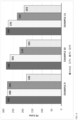
- FIG. 1 illustrates the initial PE Color Number for the polymer compositions of Examples 1-2 and multi-pass extrusion color after 1, 3, and 5 extrusion passes at 240 °C.
- a higher PE color number reflects less yellow/off-color formation.
- the polymer composition of Example 2 (containing 300 ppm of GMS) had superior initial color and multi-pass extrusion color - after each pass - as compared to that of the polymer composition of Example 1 (containing 500 ppm of S9228T).
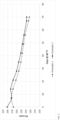
- FIG. 2 illustrates the PE Color Number for the pellets of the polymer compositions of Examples 1-2 after aging at 80 °C for 10 weeks
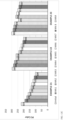
- FIG. 3 illustrates the PE Color Number for the 1st pass extrusion pellets of the polymer compositions of Examples 1-2 after aging at 80 °C for 11 weeks.
- the polymer composition of Example 2 (initial pellets) had superior aged color for up to 10 weeks, as compared to the polymer composition of Example 1.
- the aged color for Example 2 was less than that of Example 1, but generally within 20 PE color number units.
- Example 3 the polymer composition was produced with a chromium-based polyethylene (10 HLMI, 0.948 g/cc), 700 ppm of IRGANOX TM 1010, and 300 ppm of ULTRANOX TM 627A; the polymer composition of Example 4 was produced with the chromium-based polyethylene, 700 ppm of IRGANOX TM 1010, 500 ppm of IRGAFOS TM 168, and 500 ppm of DOVERPHOS TM S9228T; the polymer composition of Example 5 was produced with the chromium-based polyethylene, 700 ppm of IRGANOX TM 1010, 500 ppm of IRGAFOS TM 168, and 300 ppm of glycerol monostearate (GMS).
- a chromium-based polyethylene 10 HLMI, 0.948 g/cc
- 700 ppm of IRGANOX TM 1010 500 ppm of IRGAFOS TM 168,
- FIG. 4 presents a plot of the initial PE Color Number and multi-pass extrusion color after 1, 3, and 5 extrusion passes at 240 °C for the polymer compositions of Examples 3-5
- FIG. 5 presents a plot of the PE Color Number versus time at 80 °C for the pellets of the polymer compositions of Examples 3-5.
- the polymer composition of Example 5 (containing 300 ppm GMS) had superior initial color, aged color, and multi-pass extrusion color to that of Example 3.
- Example 5 (containing 300 ppm of GMS) had generally comparable initial color and aged color to that of the polymer composition of Example 4 (containing 500 ppm of S9228T).
- the initial and aged color for Example 5 was less than that of Example 4, but generally within 20-40 PE color number units.
- Example 6 the polymer composition was produced with a Ziegler-Natta based polyethylene (8 MI, 0.962 g/cc), 125 ppm of DSTDP, 1000 ppm of calcium stearate, and 750 ppm of IRGAFOS TM 168; the polymer composition of Example 7 was produced with the Ziegler-Natta based polyethylene, 1000 ppm of calcium stearate, 700 ppm of IRGANOX TM 1010, 500 ppm of IRGAFOS TM 168, and 500 ppm of DOVERPHOS TM S9228T; the polymer composition of Example 8 was produced with the Ziegler-Natta based polyethylene, 1000 ppm of calcium stearate, 700 ppm of IRGANOX TM 1010, 500 ppm of IRGAFOS TM 168, and 300 ppm of glycerol monostearate (GMS).
- GMS glycerol monostearate
- FIG. 6 presents a plot of the initial PE Color Number and multi-pass extrusion color after 1, 3, and 5 extrusion passes at 240 °C for the polymer compositions of Examples 6-8
- FIG. 7 presents a plot of the PE Color Number versus time at 80 °C for the pellets of the polymer compositions of Examples 6-8.
- the polymer composition of Example 8 (containing 300 ppm GMS) had the same initial color as that of Examples 6-7.
- Example 8 (containing 300 ppm GMS) had superior multi-pass extrusion color to that of Example 7, and aged color that was less than that of Example 7, but generally within 50 PE color number units.
- Example 9 the polymer composition was produced with a metallocene-based polyethylene (1.4 MI, 0.916 g/cc), 200 ppm of calcium stearate, 1000 ppm of IRGANOX TM 1010, and 1500 ppm of IRGAFOS TM 168; the polymer composition of Example 10 was produced with the metallocene-based polyethylene, 700 ppm of IRGANOX TM 1010, 500 ppm of IRGAFOS TM 168, and 500 ppm of DOVERPHOS TM S9228T; the polymer composition of Example 11 was produced with the metallocene-based polyethylene, 700 ppm of IRGANOX TM 1010, 500 ppm of IRGAFOS TM 168, and 300 ppm of glycerol monostearate (GMS). These polymer compositions also contained a fluoroelastomer processing aid.
- a metallocene-based polyethylene 1.4 MI, 0.916 g/cc
- FIG. 8 presents a plot of the initial PE Color Number and multi-pass extrusion color after 1, 3, and 5 extrusion passes at 240 °C for the polymer compositions of Examples 9-11
- FIG. 9 presents a plot of the PE Color Number versus time at 80 °C for the pellets of the polymer compositions of Examples 9-11.
- the polymer composition of Example 11 (containing 300 ppm GMS) had the same initial color as that of Examples 9-10.
- Example 11 containing 300 ppm GMS
- Example 11 had superior multi-pass extrusion color to that of Example 10, and aged color that was less than that of Example 10, but generally within 10 PE color number units.
- Example 12 the polymer composition was produced with a Ziegler-Natta based polyethylene (8 MI, 0.962 g/cc), 125 ppm of DSTDP, 1000 ppm of calcium stearate, and 750 ppm of IRGAFOS TM 168; the polymer composition of Example 13 was produced with the Ziegler-Natta based polyethylene, 1000 ppm of calcium stearate, 750 ppm of IRGAFOS TM 168, and 300 ppm of glycerol monostearate (GMS); the polymer composition of Example 14 was produced with the Ziegler-Natta based polyethylene, 125 ppm of DSTDP, 1000 ppm of calcium stearate, 750 ppm of IRGAFOS TM 168, and 300 ppm of glycerol monostearate (GMS).
- a Ziegler-Natta based polyethylene 8 MI, 0.962 g/cc
- 125 ppm of DSTDP 1000 ppm
- FIG. 10 illustrates the PE Color Number for the pellets of the polymer compositions of Examples 12-14 after aging at 80 °C for 5 weeks
- FIG. 11 illustrates the PE Color Number for the 1st pass extrusion pellets of the polymer compositions of Examples 12-14 after aging at 80 °C for 5 weeks.
- the polymer compositions of Examples 13-14 (which contained GMS) had superior aged color of the initial pellets for up to 5 weeks, and superior aged color of pellets subjected to 1 pass of extrusion processing for up to 5 weeks, as compared to Example 12 (which did not contain GMS).
- Example 15 the polymer composition was produced with a titanated chromium-based polyethylene (0.3 MI, 0.957 g/cc), 600 ppm by weight of IRGANOX TM 1076, 125 ppm by weight of IRGAFOS TM 168, and 125 ppm by weight of ULTRANOX TM 626; the polymer composition of Example 16 was produced with the titanated chromium-based polyethylene, 600 ppm of IRGANOX TM 1076, 125 ppm of IRGAFOS TM 168, 125 ppm of ULTRANOX TM 626, and 300 ppm of glycerol monostearate (GMS); the polymer composition of Example 17 was produced with the titanated chromium-based polyethylene, 600 ppm of IRGANOX TM 1076, and 125 ppm of IRGAFOS TM 168; the polymer composition of Example 18 was produced with the titanated chromium-based polyethylene, 600 ppm of
- FIGS. 12A-12D present plots of the PE Color Number versus time at 80 °C for the pellets of the polymer compositions of Examples 15-25
- FIGS. 13A-13B present plots of the initial PE Color Number and multi-pass extrusion color after 1, 3, and 5 extrusion passes at 240 °C for the polymer compositions of Examples 15-25.
- These figures demonstrate unexpected improvements in initial color, aged color, and multi-pass extrusion color with the incorporation of GMS, whether in additive systems containing a phenolic antioxidant, or a phosphite antioxidant, or both. Increasing the amount of GMS also tended to increase the aged PE color number and the multi-pass extrusion PE color number.
- GMS ethoxylated tallow amine
- Peg 400 polyethylene glycol
- Example 26 titanated chromium-based polyethylenes and chromium-based polyethylenes were analyzed via NMR to determine the respective amounts (per million total carbon atoms) of vinylene unsaturation, trisubstituted unsaturation, vinylidene unsaturation, vinyl unsaturation, and total unsaturation.
- the results are summarized in Table I.
- the titanated chromium resins had ratios of (vinylene + trisubstituted + vinylidene groups)/vinyl groups in the 0.21-0.41 range, whereas the ratios were in the 0.06-0.11 range for the chromium resins.
- the titanated chromium resins had ratios of (vinylene + trisubstituted + vinylidene groups)/total unsaturated groups in the 0.18-0.29 range, whereas the ratios were in the 0.05-0.10 range for the chromium resins.
- Table I NMR summary.
Landscapes
- Chemical & Material Sciences (AREA)
- Health & Medical Sciences (AREA)
- Chemical Kinetics & Catalysis (AREA)
- Medicinal Chemistry (AREA)
- Polymers & Plastics (AREA)
- Organic Chemistry (AREA)
- Crystallography & Structural Chemistry (AREA)
- Compositions Of Macromolecular Compounds (AREA)
Claims (15)
- Polymerzusammensetzung, umfassend:(i) ein Ethylenpolymer;(ii) von 50 ppm bis 1500 ppm eines Glycerolstearats;(iii) von 250 ppm bis 7500 ppm eines Antioxidants, umfassend ein phenolisches Antioxidant, ein Phosphit-Antioxidant, ein Thioester-Antioxidant oder eine beliebige Kombination davon; und wobei das Ethylenpolymer ein Verhältnis von Mw/Mn, wobei Mw und Mn wie in der Beschreibung angegeben bestimmt werden, in einem Bereich von 5 bis 40 aufweist.
- Zusammensetzung nach Anspruch 1, wobei:mindestens 75 Gew.-% des Glycerolstearats Glycerolmonostearat ist; unddas Ethylenpolymer ein Ethylenhomopolymer und/oder ein Ethylen/α-Olefin-Copolymer umfasst.
- Zusammensetzung nach Anspruch 1, wobei die Polymerzusammensetzung Folgendes umfasst:von 100 ppm bis 850 ppm des Glycerolstearats; undvon 750 ppm bis 5000 ppm des Antioxidants; oderwobei:die Polymerzusammensetzung in Form von Pellets vorliegt; unddie Polymerzusammensetzung eine anfängliche PE-Farbzahl, bestimmt wie in der Beschreibung angegeben, von mindestens 200 aufweist; oderwobei das Antioxidant Folgendes umfasst:das phenolische Antioxidant und ein Monophosphit-Antioxidant; oderdas Thioester-Antioxidant und ein Monophosphit-Antioxidant.
- Zusammensetzung nach Anspruch 1, wobei das Ethylenpolymer Folgendes enthält:weniger als 0,2 ppm Zirkonium;weniger als 0,2 ppm Hafnium; undweniger als 5 ppm Magnesium.
- Herstellungsartikel, umfassend die Polymerzusammensetzung nach Anspruch 4.
- Zusammensetzung nach Anspruch 1, wobei:die Polymerzusammensetzung eine anfängliche PE-Farbzahl, bestimmt wie in der Beschreibung angegeben, aufweist, die größer als die oder innerhalb von 20 einer ansonsten äquivalenten Polymerzusammensetzung ist, die 500 ppm eines Diphosphit-Antioxidants anstelle des Glycerolstearats enthält; die Polymerzusammensetzung nach 4-wöchiger Lagerung bei einer Temperatur von 80 °C eine gealterte PE-Farbzahl, bestimmt wie in der Beschreibung angegeben, aufweist, die größer als die oder innerhalb von 20 einer ansonsten äquivalenten Polymerzusammensetzung ist, die 500 ppm eines Diphosphit-Antioxidants anstelle des Glycerolstearats enthält;die Polymerzusammensetzung nach drei Extrusionsdurchgängen bei einer Extrusionstemperatur von 240 °C eine Multipass-Extrusions-PE-Farbzahl, bestimmt wie in der Beschreibung angegeben, aufweist, die größer als die oder innerhalb von 20 einer ansonsten äquivalenten Polymerzusammensetzung ist, die 500 ppm eines Diphosphit- Antioxidans anstelle des Glycerolstearats enthält; odereine beliebige Kombination davon.
- Zusammensetzung nach Anspruch 1, wobei das Ethylenpolymer ein Ethylenpolymer auf Metallocen-Basis, ein Ethylenpolymer auf Ziegler-Natta-Basis, ein Ethylenpolymer auf Chrom-Basis oder ein Ethylenpolymer auf titaniertem Chrom-Basis ist.
- Zusammensetzung nach Anspruch 1, wobei das Ethylenpolymer gekennzeichnet ist durch:eine Dichte, bestimmt in Gramm pro Kubikzentimeter (g/cm3) an einer formgepressten Probe, die mit etwa 15 °C pro Stunde abgekühlt und 40 Stunden lang bei Raumtemperatur gemäß ASTM D1505 (2010) und ASTM D4703 (2016) konditioniert wurde, in einem Bereich von 0,88 bis 0,96 g/cm3;ein Mw, bestimmt wie in der Beschreibung angegeben, in einem Bereich von 150.000 bis 750.000 g/mol;einen Schmelzindex (MI), bestimmt gemäß ASTM D1238 (2013) bei 190 °C mit einem Gewicht von 2.160 Gramm, in einem Bereich von 0 bis 0,5 g/10 min; undeinen Hochlast-Schmelzindex (HLMI), bestimmt gemäß ASTM D1238 (2013) bei 190 °C mit einem Gewicht von 21.600 Gramm, in einem Bereich von 0,5 bis 25 g/10 min.
- Zusammensetzung nach Anspruch 1, wobei die Polymerzusammensetzung ferner mindestens einen anderen Zusatzstoff umfasst, der aus einem Antiblock-Zusatzstoff, einem Gleitzusatzstoff, einem Farbstoff, einem Füllstoff, einem UV-Zusatzstoff, einem Antistatik-Zusatzstoff, einer Verarbeitungshilfe, einem Säurefänger, einem kohlenstoffzentrierten Radikalfänger oder einer beliebigen Kombination davon ausgewählt ist.
- Verfahren zum Herstellen einer Polymerzusammensetzung mit verbesserter Farbe, wobei das Verfahren Folgendes umfasst:(a) Inkontaktbringen eines Katalysatorsystems auf Übergangsmetall-Basis mit Ethylen und einem optionalen Olefincomonomer unter Polymerisationsbedingungen in einem Polymerisationsreaktorsystem, um ein Ethylenpolymer herzustellen, das ein Verhältnis von Mw/Mn, wobei Mw und Mn wie in der Beschreibung angegeben bestimmt werden, in einem Bereich von 5 bis 40 aufweist; und(b) Kombinieren des Ethylenpolymers mit einem Zusatzstoffsystem, das ein Glycerolstearat und ein Antioxidant umfasst, um die Polymerzusammensetzung zu bilden, wobei die Polymerzusammensetzung Folgendes enthält:von 50 ppm bis 1500 ppm des Glycerolstearats; undvon 250 ppm bis 7500 ppm des Antioxidants, wobei das Antioxidant ein phenolisches Antioxidant, ein Phosphit-Antioxidant, ein Thioester-Antioxidant oder eine beliebige Kombination davon umfasst.
- Verfahren nach Anspruch 10, wobei:das Katalysatorsystem auf Übergangsmetall-Basis ein Katalysatorsystem auf Metallocen-Basis, ein Katalysatorsystem auf Ziegler-Natta-Basis, ein Katalysatorsystem auf Chrom-Basis, ein Katalysatorsystem auf titaniertem Chrom-Basis oder eine Kombination davon ist;das Polymerisationsreaktorsystem einen Lösungsreaktor, einen Gasphasenreaktor, einen Suspensionsreaktor oder eine Kombination davon umfasst;das Ethylenpolymer ein Ethylenhomopolymer, ein Ethylen/1-Buten-Copolymer, ein Ethylen/1-Hexen-Copolymer und/oder ein Ethylen/1-Octen-Copolymer umfasst; undder Schritt des Kombinierens Mischen und/oder Schmelzverarbeiten umfasst; oderwobei:die Polymerzusammensetzung von 500 ppm bis 3500 ppm des Antioxidants umfasst;das Antioxidant ein Monophosphit-Antioxidant und das phenolische Antioxidant oder das Thioester-Antioxidant umfasst;die Polymerzusammensetzung nach 4-wöchiger Lagerung bei einer Temperatur von 80 °C eine gealterte PE-Farbzahl, bestimmt wie in der Beschreibung angegeben, von mindestens 200 aufweist; unddie Polymerzusammensetzung nach drei Extrusionsdurchgängen bei einer Extrusionstemperatur von 240 °C eine Multipass-Extrusions-PE-Farbzahl, bestimmt wie in der Beschreibung angegeben, von mindestens 200 aufweist.
- Verfahren zum Verbessern der Farbe einer Polymerzusammensetzung, wobei das Verfahren Folgendes umfasst:Kombinieren eines Ethylenpolymers, das ein Verhältnis von Mw/Mn, bestimmt wie in der Beschreibung angegeben, in einem Bereich von 5 bis 40 aufweist, mit einem Zusatzstoffsystem,umfassend ein Glycerolstearat und ein Antioxidant, um die Polymerzusammensetzung zu bilden, wobei die Polymerzusammensetzung Folgendes enthält:von 50 ppm bis 1500 ppm des Glycerolstearats; undvon 250 ppm bis 7500 ppm des Antioxidants, wobei das Antioxidant ein phenolisches Antioxidant, ein Phosphit-Antioxidant, ein Thioester-Antioxidant oder eine beliebige Kombination davon umfasst.
- Masterbatch-Zusammensetzung, Folgendes umfassend:(1) ein Trägerharz; und(2) eine Zusatzstoffmischung, umfassend ein Glycerolstearat und ein Antioxidant, umfassend ein phenolisches Antioxidant, ein Phosphit-Antioxidant, ein Thioester-Antioxidant oder eine beliebige Kombination davon, in einem Gewichtsverhältnis von Glycerolstearat:Antioxidant in einem Bereich von 6:1 bis 1:150;wobei ein Gewichtsverhältnis der Trägerharz:Zusatzstoffmischung in einem Bereich von 95:5 bis 20:80 liegt.
- Zusammensetzung nach Anspruch 13, wobei:das Trägerharz ein Ethylenpolymer, ein Propylenpolymer odereine beliebige Kombination davon umfasst; unddas Gewichtsverhältnis von Glycerolstearat/Antioxidant in einem Bereich von etwa 3:1 bis etwa 1:75 liegt; oderwobei:die Masterbatch-Zusammensetzung in Form von Pellets vorliegt; unddie Masterbatch-Zusammensetzung ferner mindestens einen anderen Zusatzstoff umfasst, der aus einem Antiblock-Zusatzstoff, einem Gleitzusatzstoff, einem Farbstoff, einem Füllstoff, einem UV-Zusatzstoff, einem Antistatik-Zusatzstoff, einer Verarbeitungshilfe, einem Säurefänger, einem kohlenstoffzentrierten Radikalfänger oder einer beliebigen Kombination davon ausgewählt ist.
- Zusatzstoffmischzusammensetzung, Folgendes umfassend:(1) mindestens 95 Gew.-% einer Zusatzstoffmischung, umfassend ein Glycerolstearat und ein Antioxidant, umfassend ein phenolisches Antioxidant, ein Phosphit-Antioxidant, ein Thioester-Antioxidant oder eine beliebige Kombination davon, in einem Gewichtsverhältnis von Glycerolstearat:Antioxidant in einem Bereich von 6:1 bis 1:150; und(2) weniger als oder gleich 3 Gew.-% eines Ethylenpolymers, eines Propylenpolymers oder einer beliebigen Kombination davon, vorzugsweise wobei die Zusammensetzung Folgendes umfasst:mindestens 98 Gew.-% der Zusatzstoffmischung; undweniger als oder gleich 1 Gew.-% des Ethylenpolymers, Propylenpolymers oder einer Kombination davon; oder wobei das Gewichtsverhältnis von Glycerolstearat: Antioxidant in einem Bereich von 1:1,5 bis 1:15 liegt.
Applications Claiming Priority (2)
| Application Number | Priority Date | Filing Date | Title |
|---|---|---|---|
| US16/396,866 US20200339780A1 (en) | 2019-04-29 | 2019-04-29 | Additive Systems Containing an Antioxidant and a Glycerol Stearate for Improved Color in Polyethylene Resins |
| PCT/US2020/029045 WO2020223055A1 (en) | 2019-04-29 | 2020-04-21 | Additive systems containing an antioxidant and a glycerol stearate for improved color in polyethylene resins |
Publications (3)
| Publication Number | Publication Date |
|---|---|
| EP3962993A1 EP3962993A1 (de) | 2022-03-09 |
| EP3962993B1 true EP3962993B1 (de) | 2025-02-12 |
| EP3962993C0 EP3962993C0 (de) | 2025-02-12 |
Family
ID=70554275
Family Applications (1)
| Application Number | Title | Priority Date | Filing Date |
|---|---|---|---|
| EP20724363.5A Active EP3962993B1 (de) | 2019-04-29 | 2020-04-21 | Zusatzstoffsysteme mit antioxidant und glycerolstearat für verbesserte farbe in polyethylenhärzen |
Country Status (8)
| Country | Link |
|---|---|
| US (3) | US20200339780A1 (de) |
| EP (1) | EP3962993B1 (de) |
| KR (1) | KR102914741B1 (de) |
| CN (2) | CN116355300A (de) |
| CA (1) | CA3128889A1 (de) |
| ES (1) | ES3013086T3 (de) |
| MX (1) | MX2021012978A (de) |
| WO (1) | WO2020223055A1 (de) |
Families Citing this family (2)
| Publication number | Priority date | Publication date | Assignee | Title |
|---|---|---|---|---|
| US20200339780A1 (en) | 2019-04-29 | 2020-10-29 | Chevron Phillips Chemical Company Lp | Additive Systems Containing an Antioxidant and a Glycerol Stearate for Improved Color in Polyethylene Resins |
| AT528083A1 (de) * | 2024-08-22 | 2025-08-15 | Constantia Pirk Gmbh & Co Kg | PFAS-freie Kunststofffolie |
Family Cites Families (49)
| Publication number | Priority date | Publication date | Assignee | Title |
|---|---|---|---|---|
| US3248179A (en) | 1962-02-26 | 1966-04-26 | Phillips Petroleum Co | Method and apparatus for the production of solid polymers of olefins |
| JPS5127462B2 (de) * | 1973-06-06 | 1976-08-12 | ||
| US4451604A (en) | 1981-05-18 | 1984-05-29 | Phillips Petroleum Company | Stabilized polyolefin compositions |
| JPS5829841A (ja) * | 1981-08-14 | 1983-02-22 | Asahi Chem Ind Co Ltd | 改良されたポリエチレン組成物 |
| US4501885A (en) | 1981-10-14 | 1985-02-26 | Phillips Petroleum Company | Diluent and inert gas recovery from a polymerization process |
| US4588790A (en) | 1982-03-24 | 1986-05-13 | Union Carbide Corporation | Method for fluidized bed polymerization |
| FR2609036B1 (fr) * | 1986-12-29 | 1989-04-14 | Bp Chimie Sa | Polymerisation ou copolymerisation d'ethylene en phase gazeuse en presence d'un prepolymere comprenant un catalyseur d'oxyde de chrome |
| JPH07101295B2 (ja) * | 1988-02-23 | 1995-11-01 | 富士写真フイルム株式会社 | 感光物質用包装材料 |
| FR2638165B1 (fr) * | 1988-10-21 | 1992-06-26 | Bp Chimie Sa | Composition stabilisee a base de polyolefine ayant une couleur amelioree |
| IT1231769B (it) * | 1989-08-02 | 1991-12-21 | Himont Inc | Procedimento per la stabilizzazione di poliolefine e prodotti da esso ottenuti. |
| US5565175A (en) | 1990-10-01 | 1996-10-15 | Phillips Petroleum Company | Apparatus and method for producing ethylene polymer |
| US5575979A (en) | 1991-03-04 | 1996-11-19 | Phillips Petroleum Company | Process and apparatus for separating diluents from solid polymers utilizing a two-stage flash and a cyclone separator |
| US5436304A (en) | 1992-03-19 | 1995-07-25 | Exxon Chemical Patents Inc. | Process for polymerizing monomers in fluidized beds |
| US5352749A (en) | 1992-03-19 | 1994-10-04 | Exxon Chemical Patents, Inc. | Process for polymerizing monomers in fluidized beds |
| DE69522652T2 (de) * | 1994-12-27 | 2002-07-04 | Solvay Polyolefins Europe - Belgium (S.A.), Bruessel/Bruxelles | Ethylenpolymer-Zusammensetzung |
| US6245823B1 (en) | 1995-10-20 | 2001-06-12 | Free-Flow Packaging International, Inc. | Composition and blowing agent for making foamed polyethylene material |
| EP0781803A1 (de) * | 1995-12-29 | 1997-07-02 | General Electric Company | Stabilisierte thermoplastische Polymerzusammensetzung |
| US5750584A (en) | 1996-02-01 | 1998-05-12 | Knaus; Dennis A. | Stability control agent composition for polyolefin foam |
| US6239235B1 (en) | 1997-07-15 | 2001-05-29 | Phillips Petroleum Company | High solids slurry polymerization |
| KR100531628B1 (ko) | 1998-03-20 | 2005-11-29 | 엑손모빌 케미칼 패턴츠 인코포레이티드 | 연속적인 슬러리 중합반응의 휘발물질 제거 |
| US6225363B1 (en) | 1998-04-07 | 2001-05-01 | Pactiv Corporation | Foamable composition using high density polyethylene |
| US6613823B1 (en) | 1998-10-21 | 2003-09-02 | Phillips Petroleum Company | Phosphite additives in polyolefins |
| US6262191B1 (en) | 1999-03-09 | 2001-07-17 | Phillips Petroleum Company | Diluent slip stream to give catalyst wetting agent |
| US7531606B2 (en) | 2004-05-26 | 2009-05-12 | Chevron Phillips Chemical Company Lp | Method for operating a gas phase polymerization reactor |
| US7598327B2 (en) | 2004-11-10 | 2009-10-06 | Chevron Phillips Chemical Company Lp | Method for polymerizing olefins in a gas phase reactor using a seedbed during start-up |
| GB0515602D0 (en) * | 2005-07-29 | 2005-09-07 | Great Lakes Chemical Europ | Colour stabilised polyolefins |
| US8070710B2 (en) * | 2006-08-04 | 2011-12-06 | Playtex Products, Inc. | Lubricious compositions and articles made therefrom |
| PL2397510T3 (pl) | 2006-09-14 | 2015-03-31 | Ingenia Polymers Inc | Wysoko stężone granulowane dodatki do polimerów w postaci koncentratów |
| US8217105B2 (en) * | 2006-10-16 | 2012-07-10 | Basf Se | Stabilized medium and high voltage insulation composition |
| CN101173013B (zh) * | 2006-10-31 | 2011-05-04 | 中国石油化工股份有限公司 | 负载型钛化的铬催化剂、制法及在乙烯聚合中的应用 |
| EP2147334B1 (de) | 2007-05-15 | 2019-07-03 | Cobham Colorado Springs Inc. | Energiesensitiver direktumwandlungsstrahlungsdetektor |
| MX2007009634A (es) | 2007-08-09 | 2009-02-26 | Ct De Investigacion En Aliment | Envase activo con liberacion controlada de tocoferol. |
| BR122018013925B1 (pt) | 2007-12-31 | 2019-10-29 | Dow Global Technologies Inc | composição e artigo |
| CN103119071B (zh) | 2010-09-28 | 2016-07-06 | 巴塞尔聚烯烃股份有限公司 | 聚乙烯挤出制品 |
| CN103849031A (zh) * | 2012-12-04 | 2014-06-11 | 青岛三利中德美水设备有限公司 | 聚乙烯抗静电爽滑色母料及其制备方法 |
| CA2800056A1 (en) | 2012-12-24 | 2014-06-24 | Nova Chemicals Corporation | Polyethylene blend compositions |
| EP2754678A1 (de) | 2013-01-14 | 2014-07-16 | Basell Poliolefine Italia S.r.l. | Verfahren zur Herstellung von Ethylenpolymeren |
| US8822608B1 (en) | 2013-03-12 | 2014-09-02 | Chevron Phillips Chemical Co. LP. | Polyolefin production with different diluents in multiple polymerization reactors |
| CN106458883A (zh) * | 2014-06-11 | 2017-02-22 | 弗纳技术股份有限公司 | 耐氯聚乙烯化合物和由其制造的制品 |
| CN106317585B (zh) * | 2015-07-01 | 2018-12-25 | 中国石油天然气股份有限公司 | 一种耐热聚乙烯树脂组合物及其应用 |
| JP6651938B2 (ja) | 2016-03-28 | 2020-02-19 | 日本ポリエチレン株式会社 | ポリエチレン及びその成形体 |
| EP3245864A1 (de) * | 2016-05-20 | 2017-11-22 | Akzo Nobel Chemicals International B.V. | Antibeschlagzusammensetzung |
| CN108794898A (zh) * | 2017-04-28 | 2018-11-13 | 中国石油化工股份有限公司 | 涂覆聚丙烯组合物及其制备方法 |
| WO2018217772A1 (en) * | 2017-05-25 | 2018-11-29 | Chevron Phillips Chemical Company Lp | Methods for improving color stability in polyethylene resins |
| CN107254085B (zh) * | 2017-06-20 | 2020-09-25 | 北京吉海川科技发展有限公司 | 一种具有高抗氧化性能的聚烯烃助剂组合物 |
| CN107474367A (zh) * | 2017-09-29 | 2017-12-15 | 民勤县邦德贸易有限公司 | 一种功能性母粒及其制备工艺 |
| CN109438603B (zh) * | 2018-09-07 | 2021-12-07 | 中国石油化工股份有限公司 | 一种透明抗冲无规共聚聚丙烯吹塑成型专用树脂及其制备方法 |
| CN109328791B (zh) * | 2018-09-18 | 2020-08-18 | 四川省福强包装有限责任公司 | 一种具有长效抗老化功能的pe防草地布 |
| US20200339780A1 (en) | 2019-04-29 | 2020-10-29 | Chevron Phillips Chemical Company Lp | Additive Systems Containing an Antioxidant and a Glycerol Stearate for Improved Color in Polyethylene Resins |
-
2019
- 2019-04-29 US US16/396,866 patent/US20200339780A1/en not_active Abandoned
-
2020
- 2020-04-21 CN CN202310365446.3A patent/CN116355300A/zh active Pending
- 2020-04-21 ES ES20724363T patent/ES3013086T3/es active Active
- 2020-04-21 EP EP20724363.5A patent/EP3962993B1/de active Active
- 2020-04-21 MX MX2021012978A patent/MX2021012978A/es unknown
- 2020-04-21 CN CN202080010599.0A patent/CN113330064A/zh active Pending
- 2020-04-21 WO PCT/US2020/029045 patent/WO2020223055A1/en not_active Ceased
- 2020-04-21 CA CA3128889A patent/CA3128889A1/en active Pending
- 2020-04-21 KR KR1020217023287A patent/KR102914741B1/ko active Active
-
2022
- 2022-10-07 US US17/938,689 patent/US12173136B2/en active Active
-
2024
- 2024-11-13 US US18/945,714 patent/US20250075057A1/en active Pending
Also Published As
| Publication number | Publication date |
|---|---|
| EP3962993A1 (de) | 2022-03-09 |
| ES3013086T3 (en) | 2025-04-10 |
| WO2020223055A1 (en) | 2020-11-05 |
| KR102914741B1 (ko) | 2026-01-19 |
| CN116355300A (zh) | 2023-06-30 |
| US20200339780A1 (en) | 2020-10-29 |
| US12173136B2 (en) | 2024-12-24 |
| KR20220002862A (ko) | 2022-01-07 |
| US20250075057A1 (en) | 2025-03-06 |
| US20230052912A1 (en) | 2023-02-16 |
| BR112021016652A2 (pt) | 2021-11-03 |
| EP3962993C0 (de) | 2025-02-12 |
| CA3128889A1 (en) | 2020-11-05 |
| CN113330064A (zh) | 2021-08-31 |
| MX2021012978A (es) | 2021-12-10 |
Similar Documents
| Publication | Publication Date | Title |
|---|---|---|
| EP3765535B1 (de) | Bimodale polyethylenharze und daraus hergestellte rohre | |
| US20250075057A1 (en) | Additive Systems Containing an Antioxidant and a Glycerol Stearate for Improved Color in Polyethylene Resins | |
| US11401405B2 (en) | Methods for improving color stability in polyethylene resins | |
| US7999046B2 (en) | Neutralization of deactivated polymerization catalyst using phosphoric or phosphonic acid salts | |
| EP4041781A1 (de) | Flexibler, rotationsgeformter gegenstand | |
| CA3213650C (en) | Peroxide treated blow molding polymers with increased weight swell and constant die swell | |
| RU2813479C2 (ru) | Системы добавок, содержащие антиоксидант и стеарат глицерина, для улучшения цвета полиэтиленовых смол | |
| RU2775725C2 (ru) | Методы повышения цветостойкости полиэтиленовых смол | |
| BR112021016652B1 (pt) | Composição de polímero, artigo de fabricação, processo para produzir uma composição de polímero com cor melhorada, método para melhorar a cor de uma composição de polímero, composição de batelada mestre e composição de mistura de aditivos |
Legal Events
| Date | Code | Title | Description |
|---|---|---|---|
| STAA | Information on the status of an ep patent application or granted ep patent |
Free format text: STATUS: UNKNOWN |
|
| STAA | Information on the status of an ep patent application or granted ep patent |
Free format text: STATUS: THE INTERNATIONAL PUBLICATION HAS BEEN MADE |
|
| PUAI | Public reference made under article 153(3) epc to a published international application that has entered the european phase |
Free format text: ORIGINAL CODE: 0009012 |
|
| STAA | Information on the status of an ep patent application or granted ep patent |
Free format text: STATUS: REQUEST FOR EXAMINATION WAS MADE |
|
| 17P | Request for examination filed |
Effective date: 20210806 |
|
| AK | Designated contracting states |
Kind code of ref document: A1 Designated state(s): AL AT BE BG CH CY CZ DE DK EE ES FI FR GB GR HR HU IE IS IT LI LT LU LV MC MK MT NL NO PL PT RO RS SE SI SK SM TR |
|
| DAV | Request for validation of the european patent (deleted) | ||
| DAX | Request for extension of the european patent (deleted) | ||
| P01 | Opt-out of the competence of the unified patent court (upc) registered |
Effective date: 20230519 |
|
| STAA | Information on the status of an ep patent application or granted ep patent |
Free format text: STATUS: EXAMINATION IS IN PROGRESS |
|
| 17Q | First examination report despatched |
Effective date: 20230926 |
|
| GRAP | Despatch of communication of intention to grant a patent |
Free format text: ORIGINAL CODE: EPIDOSNIGR1 |
|
| STAA | Information on the status of an ep patent application or granted ep patent |
Free format text: STATUS: GRANT OF PATENT IS INTENDED |
|
| RIC1 | Information provided on ipc code assigned before grant |
Ipc: C08L 23/04 20060101ALI20240729BHEP Ipc: C08K 5/00 20060101ALI20240729BHEP Ipc: C08J 3/22 20060101ALI20240729BHEP Ipc: C08K 5/526 20060101ALI20240729BHEP Ipc: C08K 5/38 20060101ALI20240729BHEP Ipc: C08K 5/13 20060101ALI20240729BHEP Ipc: C08K 5/103 20060101AFI20240729BHEP |
|
| INTG | Intention to grant announced |
Effective date: 20240902 |
|
| GRAS | Grant fee paid |
Free format text: ORIGINAL CODE: EPIDOSNIGR3 |
|
| GRAA | (expected) grant |
Free format text: ORIGINAL CODE: 0009210 |
|
| STAA | Information on the status of an ep patent application or granted ep patent |
Free format text: STATUS: THE PATENT HAS BEEN GRANTED |
|
| AK | Designated contracting states |
Kind code of ref document: B1 Designated state(s): AL AT BE BG CH CY CZ DE DK EE ES FI FR GB GR HR HU IE IS IT LI LT LU LV MC MK MT NL NO PL PT RO RS SE SI SK SM TR |
|
| REG | Reference to a national code |
Ref country code: GB Ref legal event code: FG4D |
|
| REG | Reference to a national code |
Ref country code: CH Ref legal event code: EP |
|
| REG | Reference to a national code |
Ref country code: DE Ref legal event code: R096 Ref document number: 602020045892 Country of ref document: DE |
|
| REG | Reference to a national code |
Ref country code: IE Ref legal event code: FG4D |
|
| U01 | Request for unitary effect filed |
Effective date: 20250212 |
|
| P04 | Withdrawal of opt-out of the competence of the unified patent court (upc) registered |
Free format text: CASE NUMBER: APP_8007/2025 Effective date: 20250218 |
|
| U07 | Unitary effect registered |
Designated state(s): AT BE BG DE DK EE FI FR IT LT LU LV MT NL PT RO SE SI Effective date: 20250220 |
|
| REG | Reference to a national code |
Ref country code: ES Ref legal event code: FG2A Ref document number: 3013086 Country of ref document: ES Kind code of ref document: T3 Effective date: 20250410 |
|
| PG25 | Lapsed in a contracting state [announced via postgrant information from national office to epo] |
Ref country code: RS Free format text: LAPSE BECAUSE OF FAILURE TO SUBMIT A TRANSLATION OF THE DESCRIPTION OR TO PAY THE FEE WITHIN THE PRESCRIBED TIME-LIMIT Effective date: 20250512 |
|
| PG25 | Lapsed in a contracting state [announced via postgrant information from national office to epo] |
Ref country code: PL Free format text: LAPSE BECAUSE OF FAILURE TO SUBMIT A TRANSLATION OF THE DESCRIPTION OR TO PAY THE FEE WITHIN THE PRESCRIBED TIME-LIMIT Effective date: 20250212 |
|
| PGFP | Annual fee paid to national office [announced via postgrant information from national office to epo] |
Ref country code: ES Payment date: 20250502 Year of fee payment: 6 |
|
| PG25 | Lapsed in a contracting state [announced via postgrant information from national office to epo] |
Ref country code: NO Free format text: LAPSE BECAUSE OF FAILURE TO SUBMIT A TRANSLATION OF THE DESCRIPTION OR TO PAY THE FEE WITHIN THE PRESCRIBED TIME-LIMIT Effective date: 20250512 Ref country code: IS Free format text: LAPSE BECAUSE OF FAILURE TO SUBMIT A TRANSLATION OF THE DESCRIPTION OR TO PAY THE FEE WITHIN THE PRESCRIBED TIME-LIMIT Effective date: 20250612 |
|
| PG25 | Lapsed in a contracting state [announced via postgrant information from national office to epo] |
Ref country code: HR Free format text: LAPSE BECAUSE OF FAILURE TO SUBMIT A TRANSLATION OF THE DESCRIPTION OR TO PAY THE FEE WITHIN THE PRESCRIBED TIME-LIMIT Effective date: 20250212 |
|
| PG25 | Lapsed in a contracting state [announced via postgrant information from national office to epo] |
Ref country code: GR Free format text: LAPSE BECAUSE OF FAILURE TO SUBMIT A TRANSLATION OF THE DESCRIPTION OR TO PAY THE FEE WITHIN THE PRESCRIBED TIME-LIMIT Effective date: 20250513 |
|
| U21 | Renewal fee for the european patent with unitary effect paid with additional fee |
Year of fee payment: 6 Effective date: 20250709 |
|
| PG25 | Lapsed in a contracting state [announced via postgrant information from national office to epo] |
Ref country code: SM Free format text: LAPSE BECAUSE OF FAILURE TO SUBMIT A TRANSLATION OF THE DESCRIPTION OR TO PAY THE FEE WITHIN THE PRESCRIBED TIME-LIMIT Effective date: 20250212 |
|
| PG25 | Lapsed in a contracting state [announced via postgrant information from national office to epo] |
Ref country code: CZ Free format text: LAPSE BECAUSE OF FAILURE TO SUBMIT A TRANSLATION OF THE DESCRIPTION OR TO PAY THE FEE WITHIN THE PRESCRIBED TIME-LIMIT Effective date: 20250212 |
|
| PG25 | Lapsed in a contracting state [announced via postgrant information from national office to epo] |
Ref country code: SK Free format text: LAPSE BECAUSE OF FAILURE TO SUBMIT A TRANSLATION OF THE DESCRIPTION OR TO PAY THE FEE WITHIN THE PRESCRIBED TIME-LIMIT Effective date: 20250212 |
|
| REG | Reference to a national code |
Ref country code: CH Ref legal event code: H13 Free format text: ST27 STATUS EVENT CODE: U-0-0-H10-H13 (AS PROVIDED BY THE NATIONAL OFFICE) Effective date: 20251125 |
|
| PLBE | No opposition filed within time limit |
Free format text: ORIGINAL CODE: 0009261 |
|
| STAA | Information on the status of an ep patent application or granted ep patent |
Free format text: STATUS: NO OPPOSITION FILED WITHIN TIME LIMIT |
|
| PG25 | Lapsed in a contracting state [announced via postgrant information from national office to epo] |
Ref country code: MC Free format text: LAPSE BECAUSE OF FAILURE TO SUBMIT A TRANSLATION OF THE DESCRIPTION OR TO PAY THE FEE WITHIN THE PRESCRIBED TIME-LIMIT Effective date: 20250212 |
|
| PG25 | Lapsed in a contracting state [announced via postgrant information from national office to epo] |
Ref country code: CH Free format text: LAPSE BECAUSE OF NON-PAYMENT OF DUE FEES Effective date: 20250430 |
|
| 26N | No opposition filed |
Effective date: 20251113 |
|
| GBPC | Gb: european patent ceased through non-payment of renewal fee |
Effective date: 20250512 |