EP3928375B1 - Pulverförmige festelektrolytverbindung für eine wiederaufladbare festkörper-lithium-ionen-batterie - Google Patents
Pulverförmige festelektrolytverbindung für eine wiederaufladbare festkörper-lithium-ionen-batterie Download PDFInfo
- Publication number
- EP3928375B1 EP3928375B1 EP20758964.9A EP20758964A EP3928375B1 EP 3928375 B1 EP3928375 B1 EP 3928375B1 EP 20758964 A EP20758964 A EP 20758964A EP 3928375 B1 EP3928375 B1 EP 3928375B1
- Authority
- EP
- European Patent Office
- Prior art keywords
- equal
- intensity
- solid solution
- superior
- solid
- Prior art date
- Legal status (The legal status is an assumption and is not a legal conclusion. Google has not performed a legal analysis and makes no representation as to the accuracy of the status listed.)
- Active
Links
Images

Classifications
-
- H—ELECTRICITY
- H01—ELECTRIC ELEMENTS
- H01M—PROCESSES OR MEANS, e.g. BATTERIES, FOR THE DIRECT CONVERSION OF CHEMICAL ENERGY INTO ELECTRICAL ENERGY
- H01M10/00—Secondary cells; Manufacture thereof
- H01M10/05—Accumulators with non-aqueous electrolyte
- H01M10/052—Li-accumulators
-
- H—ELECTRICITY
- H01—ELECTRIC ELEMENTS
- H01M—PROCESSES OR MEANS, e.g. BATTERIES, FOR THE DIRECT CONVERSION OF CHEMICAL ENERGY INTO ELECTRICAL ENERGY
- H01M10/00—Secondary cells; Manufacture thereof
- H01M10/05—Accumulators with non-aqueous electrolyte
- H01M10/052—Li-accumulators
- H01M10/0525—Rocking-chair batteries, i.e. batteries with lithium insertion or intercalation in both electrodes; Lithium-ion batteries
-
- H—ELECTRICITY
- H01—ELECTRIC ELEMENTS
- H01M—PROCESSES OR MEANS, e.g. BATTERIES, FOR THE DIRECT CONVERSION OF CHEMICAL ENERGY INTO ELECTRICAL ENERGY
- H01M10/00—Secondary cells; Manufacture thereof
- H01M10/05—Accumulators with non-aqueous electrolyte
- H01M10/056—Accumulators with non-aqueous electrolyte characterised by the materials used as electrolytes, e.g. mixed inorganic/organic electrolytes
- H01M10/0561—Accumulators with non-aqueous electrolyte characterised by the materials used as electrolytes, e.g. mixed inorganic/organic electrolytes the electrolyte being constituted of inorganic materials only
- H01M10/0562—Solid materials
-
- H—ELECTRICITY
- H01—ELECTRIC ELEMENTS
- H01M—PROCESSES OR MEANS, e.g. BATTERIES, FOR THE DIRECT CONVERSION OF CHEMICAL ENERGY INTO ELECTRICAL ENERGY
- H01M4/00—Electrodes
- H01M4/02—Electrodes composed of, or comprising, active material
- H01M4/04—Processes of manufacture in general
- H01M4/0471—Processes of manufacture in general involving thermal treatment, e.g. firing, sintering, backing particulate active material, thermal decomposition, pyrolysis
-
- H—ELECTRICITY
- H01—ELECTRIC ELEMENTS
- H01M—PROCESSES OR MEANS, e.g. BATTERIES, FOR THE DIRECT CONVERSION OF CHEMICAL ENERGY INTO ELECTRICAL ENERGY
- H01M4/00—Electrodes
- H01M4/02—Electrodes composed of, or comprising, active material
- H01M4/13—Electrodes for accumulators with non-aqueous electrolyte, e.g. for lithium-accumulators; Processes of manufacture thereof
- H01M4/131—Electrodes based on mixed oxides or hydroxides, or on mixtures of oxides or hydroxides, e.g. LiCoOx
-
- H—ELECTRICITY
- H01—ELECTRIC ELEMENTS
- H01M—PROCESSES OR MEANS, e.g. BATTERIES, FOR THE DIRECT CONVERSION OF CHEMICAL ENERGY INTO ELECTRICAL ENERGY
- H01M4/00—Electrodes
- H01M4/02—Electrodes composed of, or comprising, active material
- H01M4/13—Electrodes for accumulators with non-aqueous electrolyte, e.g. for lithium-accumulators; Processes of manufacture thereof
- H01M4/139—Processes of manufacture
- H01M4/1391—Processes of manufacture of electrodes based on mixed oxides or hydroxides, or on mixtures of oxides or hydroxides, e.g. LiCoOx
-
- H—ELECTRICITY
- H01—ELECTRIC ELEMENTS
- H01M—PROCESSES OR MEANS, e.g. BATTERIES, FOR THE DIRECT CONVERSION OF CHEMICAL ENERGY INTO ELECTRICAL ENERGY
- H01M4/00—Electrodes
- H01M4/02—Electrodes composed of, or comprising, active material
- H01M4/36—Selection of substances as active materials, active masses, active liquids
- H01M4/38—Selection of substances as active materials, active masses, active liquids of elements or alloys
- H01M4/381—Alkaline or alkaline earth metals elements
- H01M4/382—Lithium
-
- H—ELECTRICITY
- H01—ELECTRIC ELEMENTS
- H01M—PROCESSES OR MEANS, e.g. BATTERIES, FOR THE DIRECT CONVERSION OF CHEMICAL ENERGY INTO ELECTRICAL ENERGY
- H01M4/00—Electrodes
- H01M4/02—Electrodes composed of, or comprising, active material
- H01M4/36—Selection of substances as active materials, active masses, active liquids
- H01M4/48—Selection of substances as active materials, active masses, active liquids of inorganic oxides or hydroxides
- H01M4/50—Selection of substances as active materials, active masses, active liquids of inorganic oxides or hydroxides of manganese
- H01M4/505—Selection of substances as active materials, active masses, active liquids of inorganic oxides or hydroxides of manganese of mixed oxides or hydroxides containing manganese for inserting or intercalating light metals, e.g. LiMn2O4 or LiMn2OxFy
-
- H—ELECTRICITY
- H01—ELECTRIC ELEMENTS
- H01M—PROCESSES OR MEANS, e.g. BATTERIES, FOR THE DIRECT CONVERSION OF CHEMICAL ENERGY INTO ELECTRICAL ENERGY
- H01M4/00—Electrodes
- H01M4/02—Electrodes composed of, or comprising, active material
- H01M4/36—Selection of substances as active materials, active masses, active liquids
- H01M4/48—Selection of substances as active materials, active masses, active liquids of inorganic oxides or hydroxides
- H01M4/52—Selection of substances as active materials, active masses, active liquids of inorganic oxides or hydroxides of nickel, cobalt or iron
- H01M4/525—Selection of substances as active materials, active masses, active liquids of inorganic oxides or hydroxides of nickel, cobalt or iron of mixed oxides or hydroxides containing iron, cobalt or nickel for inserting or intercalating light metals, e.g. LiNiO2, LiCoO2 or LiCoOxFy
-
- H—ELECTRICITY
- H01—ELECTRIC ELEMENTS
- H01M—PROCESSES OR MEANS, e.g. BATTERIES, FOR THE DIRECT CONVERSION OF CHEMICAL ENERGY INTO ELECTRICAL ENERGY
- H01M4/00—Electrodes
- H01M4/02—Electrodes composed of, or comprising, active material
- H01M4/62—Selection of inactive substances as ingredients for active masses, e.g. binders, fillers
-
- H—ELECTRICITY
- H01—ELECTRIC ELEMENTS
- H01M—PROCESSES OR MEANS, e.g. BATTERIES, FOR THE DIRECT CONVERSION OF CHEMICAL ENERGY INTO ELECTRICAL ENERGY
- H01M50/00—Constructional details or processes of manufacture of the non-active parts of electrochemical cells other than fuel cells, e.g. hybrid cells
- H01M50/40—Separators; Membranes; Diaphragms; Spacing elements inside cells
- H01M50/409—Separators, membranes or diaphragms characterised by the material
- H01M50/431—Inorganic material
-
- H—ELECTRICITY
- H01—ELECTRIC ELEMENTS
- H01M—PROCESSES OR MEANS, e.g. BATTERIES, FOR THE DIRECT CONVERSION OF CHEMICAL ENERGY INTO ELECTRICAL ENERGY
- H01M4/00—Electrodes
- H01M4/02—Electrodes composed of, or comprising, active material
- H01M2004/026—Electrodes composed of, or comprising, active material characterised by the polarity
- H01M2004/028—Positive electrodes
-
- H—ELECTRICITY
- H01—ELECTRIC ELEMENTS
- H01M—PROCESSES OR MEANS, e.g. BATTERIES, FOR THE DIRECT CONVERSION OF CHEMICAL ENERGY INTO ELECTRICAL ENERGY
- H01M2220/00—Batteries for particular applications
- H01M2220/20—Batteries in motive systems, e.g. vehicle, ship, plane
-
- H—ELECTRICITY
- H01—ELECTRIC ELEMENTS
- H01M—PROCESSES OR MEANS, e.g. BATTERIES, FOR THE DIRECT CONVERSION OF CHEMICAL ENERGY INTO ELECTRICAL ENERGY
- H01M2300/00—Electrolytes
- H01M2300/0017—Non-aqueous electrolytes
- H01M2300/0065—Solid electrolytes
- H01M2300/0068—Solid electrolytes inorganic
-
- H—ELECTRICITY
- H01—ELECTRIC ELEMENTS
- H01M—PROCESSES OR MEANS, e.g. BATTERIES, FOR THE DIRECT CONVERSION OF CHEMICAL ENERGY INTO ELECTRICAL ENERGY
- H01M2300/00—Electrolytes
- H01M2300/0017—Non-aqueous electrolytes
- H01M2300/0065—Solid electrolytes
- H01M2300/0068—Solid electrolytes inorganic
- H01M2300/0071—Oxides
-
- Y—GENERAL TAGGING OF NEW TECHNOLOGICAL DEVELOPMENTS; GENERAL TAGGING OF CROSS-SECTIONAL TECHNOLOGIES SPANNING OVER SEVERAL SECTIONS OF THE IPC; TECHNICAL SUBJECTS COVERED BY FORMER USPC CROSS-REFERENCE ART COLLECTIONS [XRACs] AND DIGESTS
- Y02—TECHNOLOGIES OR APPLICATIONS FOR MITIGATION OR ADAPTATION AGAINST CLIMATE CHANGE
- Y02E—REDUCTION OF GREENHOUSE GAS [GHG] EMISSIONS, RELATED TO ENERGY GENERATION, TRANSMISSION OR DISTRIBUTION
- Y02E60/00—Enabling technologies; Technologies with a potential or indirect contribution to GHG emissions mitigation
- Y02E60/10—Energy storage using batteries
Definitions
- This invention relates to a solid electrolyte (SE) for solid-state rechargeable lithium-ion batteries suitable for electric vehicle (EV) applications.
- the solid electrolyte according to the invention has an improved lithium ionic conductivity.
- additional requirements rendering a battery eligible for EV applications should therefore include: high capacity, longer cycle lives, lower cost, and better safety.
- Solid electrolyte-based batteries are considerably safer and can be an alternative to liquid electrolyte-based batteries for the power source of electric vehicles. Since the decomposition temperature of SE is higher than the liquid electrolyte, an EV comprising such a SE-based battery, instead of a liquid electrolyte-based battery, would be safer and its battery manufacturing would also be safer.
- a SE-based battery is much safer than a liquid electrolyte-based battery, a SE-based battery is also more compact than liquid electrolyte-based batteries, and therefore lead to higher power densities
- a SE has a lower lithium ionic conductivity (typically included between 10 -7 to 10 -6 S/cm). The lower lithium ionic conductivity in a SE is due to the higher migration energy of lithium ions.
- La, Zr comprising garnet
- LSPO lithium silicon phosphorus oxide
- LISICON lithium superionic conductor
- electrolyte having a general formula: Li 4 ⁇ x Si 1-x P x O 4 .
- the La, Zr comprising garnet, especially the cubic garnet (Li 7 La 3 Zr 2 O 12 ), shows a high conductivity.
- those materials are expensive due to the La and Zr content.
- This compound also needs to be synthesized at a temperature higher than 1000°C which is not desired because of the volatility of lithium at the high temperature.
- the LSPO is well-known for its high chemical and electrochemical stability, high mechanical strength, and high electrochemical oxidation voltage, making such an electrolyte a promising candidate for EV applications.
- LSPO compounds like Li 3.5 Si 0.5 P 0.5 O 4 , have a relatively low lithium ionic conductivity.
- Li 3.5 Si 0.5 P 0.5 O 4 is a solid solution of Li 4 SiO 4 and Li 3 PO 4 having a crystal structure of ⁇ -Li 3 PO 4 with orthorhombic unit cell and tetrahedrally coordinated cations.
- a solid solution also called solid-state solution refers to a multicomponent solid-state solution as a result of a mixture of one or more solutes in a solvent.
- the solutes can be atoms or groups of atoms (or compounds).
- Such a multicomponent system is considered a solution rather than a compound when the crystal structure of the solvent remains unchanged by addition of the solutes, and when the chemical components remain in a single homogeneous phase.
- the solvent usually is a component with the largest portion and in this case is Li 3 PO 4 .
- the crystal structure of the solvent component is maintained after blending whereas the other component (solute, e.g. Li 4 SiO 4 ) dissolves in the solvent structure instead of forming a distinct compound having a structure that deviates from the structure of the solvent.
- Sokseiha et al. in Chem. Mater. (2016), 30, 5573-5582 contemplates Li 3 PO 4 -Li 3 VO 4 -Li 4 GeO 4 systems.
- Sokseiha et al and Kamphorst et al specify that Li 4 SiO 4 -Li 3 PO 3 solid solutions have a lower conductivity than Li 4 GeO 4 -Li 3 PO 3 teaching away from a possible substitution of Ge with Si.
- Burmakin et. al. in Russian Journal of Electrochemistry (2010), 46, No. 2, 243-246 discloses a lithium germanium phosphate solid electrolyte doped with a tetravalent cation, Zr like : Li 3.75 Ge 0.70 Zr 0.05 P 0.25 O 4 , Li 3.50 ZN 0.125 Ge 0.75 P 0.25 O 4 , respectively.
- the Ge content in these formulation would not allow the obtention of a solid solution in a LSPO-based SE.
- Metallic Li can be used in the scope of the present invention as an anode of a SSB comprising the electrolyte according to the invention.
- the SE according to the present invention can be destined to be contacted to a Li metal-based anode, it must therefore be compatible to said Li metal-based anode of the SSB, meaning that the SE while contacting said anode must remain chemically stable.
- a solid electrolyte having an improved lithium ionic conductivity whilst retaining a solid solution and being chemically and thermally stable while contacting a Li metal anode is achieved by providing a solid solution according to claim 1 which comprises a LSPO-based electrolyte comprising germanium (Ge) up to 60 mol%.
- a Ge doped LSPO is referenced hereunder as "LSPGO”.
- a LSPGO-based electrolyte comprises Ge of superior to 60 mol%, it comprises at least one impurity phase (i.e. Li 2 SiO 3 ), and such a Li 2 SiO 3 -bearing LSPGO-based electrolyte is not a solid solution according to the present invention.
- impurity phase i.e. Li 2 SiO 3
- a similar impurity phase is observed in Burmakin et. al. (Li 2 ZrO 3 in this case) for a high content of Ge.
- the electrolyte according to the present invention is stable in presence of a Li metal foil, confirming its suitability in a SSB wherein a Li metal foil is used as an anode.
- This invention discloses a germanium bearing LSPO compounds having a general formula Li (3.5+x) Si (0.5-x) P (0.5-x) Ge 2x O 4+a (LSPGO) wherein 0.00 ⁇ x ⁇ 0.30 and -0.40 ⁇ a ⁇ 0.40. It is a solid solution of Li 4 GeO 4 , Li 3 PO 4 , and Li 4 SiO 4 .
- Li 4 GeO 4 Li 3 PO 4
- Li 4 SiO 4 Li 4 SiO 4
- the lithium ionic conductivity of the compound according to claim 1 significantly increases (reaching at least 10 -5 S/cm) for x values higher or equal to 0.10.
- the conductivity of the compound according to claim 1 is unexpectedly higher (higher than 2.0 10 -5 S/cm) for the narrow range: 0.20 ⁇ x ⁇ 0.30, in particular for 0.25 ⁇ x ⁇ 0.30.
- this narrower range leads to an increase of the lithium ionic conductivity by a 1.5 to 3.0 factor, which is remarkable.
- This invention is also inclusive of a catholyte compound made from a mixture of a NMC type of positive electrode active material and the germanium bearing LSPO compound according to the present invention.
- Both polycrystalline and monolithic NMC can be used as a positive electrode active material in the catholyte according to the present invention.
- a "monolithic" morphology refers here to a morphology where a secondary particle contains basically only one primary particle. In the literature they are also called single crystal material, mono-crystal material, and one-body material. The preferred shape of the primary particle could be described as pebble stone shaped. The monolithic morphology can be achieved by using a high sintering temperature, a longer sintering time, and the use of a higher excess of lithium.
- a "polycrystalline” morphology refers to a morphology where a secondary particle contains more than one primary particles.
- the (solid-state) catholyte material is prepared by mixing the germanium bearing LSPO compound with the NMC composition so as to produce the catholyte which is subjected to a heat treatment at 600°C ⁇ 800°C for 1 ⁇ 20 hours under oxidizing atmosphere.
- the method for producing said catholyte is a co-sintering-based process wherein the germanium bearing LSPO and the NMC compositions are blended so as to provide a mixture which is then sintered.
- each of the compositions of the germanium bearing LSPO and NMC positive electrode active material in the catholyte There are several ways to obtain each of the compositions of the germanium bearing LSPO and NMC positive electrode active material in the catholyte. Whereas the difference of the median particle sizes (D50) between the solid electrolyte and positive electrode active material in the catholyte is superior or equal to 2 ⁇ m, they can be separated using a classifier such the elbow jet air classifier (https://elcanindustries.com/elbow-jet-air-classifier/). The compositions of separate particles are measured according to the protocol disclosed in the section F) Inductively Coupled Plasma method so as to determine each of the compositions of the germanium bearing LSPO material and NMC positive electrode active material in the catholyte.
- a classifier such as the elbow jet air classifier (https://elcanindustries.com/elbow-jet-air-classifier/).
- the compositions of separate particles are measured according to the protocol disclosed
- EELS Electron Energy Loss Spectroscopy
- TEM Transmission Electron Microscope
- a cylindrical pellet is prepared by following procedure. 0.175g of a powderous solid electrolyte compound sample is put on a mold having a diameter of 1.275cm. A pressure of 230MPa is applied to the mold. The pellet is sintered at 700°C for 3 hours in oxygen atmosphere. Silver paste is painted on both sides of the pellet to have a sample configuration of Ag/pellet/Ag in order to allow EIS measurements. Standard deviation of this measurement is 2.0 ⁇ 10 -8 .
- EIS is performed using an Ivium-n-Stat instrument, a potentiostat/galvanostat with an integrated frequency response analyzer.
- This instrument is common to be used in the battery/fuel cell-testing to collect impedance response against frequency sweep.
- the measurement frequency range is from 10 6 Hz to 10 -1 Hz.
- the setting point/decade is 10 and the setting voltage is 0.05V.
- Measurement is conducted at room temperature (at 25°C).
- a cylindrical pellet is prepared by following procedure. 0.175g of a powderous solid electrolyte compound sample is put on a mold having a diameter of 1.275cm. A pressure of 230MPa is applied to the mold. The pellet is sintered at 700°C for 3 hours in oxygen atmosphere.
- the X-ray diffraction pattern of the pellet sample is collected with a Rigaku X-Ray Diffractometer (D/MAX-2500/PC) using a Cu Ka radiation source emitting at a wavelength of 1.5418 ⁇ .
- the instrument configuration is set at: 1° Soller slit (SS), 1° divergence slit (DS) and 0.15mm reception slit (RS).
- Diffraction patterns are obtained in the range of 10 - 70° (2 ⁇ ) with a scan speed of 4° per a minute.
- Obtained XRD patterns are analyzed by the Rietveld refinement method using X'Pert HighScore Plus software.
- the software is a powder pattern analysis tool with reliable Rietveld refinement analysis results.
- FTIR transmission spectrum for the LSPGO powder is collected using Thermo Scientific FTIR Spectrometer (Nicolet iS 50) in the wave number range of 1200 to 500 cm -1 , with a resolution of 4 cm -1 , and scan cycle of 32 scan.
- the catholyte powder samples used in the particle-size distribution (psd) measurements are prepared by hand grinding the catholyte powder samples using agate mortar and pestle.
- the psd is measured by using a Malvern Mastersizer 3000 with Hydro MV wet dispersion accessory after having dispersed each of the catholyte powder samples in an aqueous medium.
- D50 and D99 are defined as the particle size at 50% and 99% of the cumulative volume% distributions obtained from the Malvern Mastersizer 3000 with Hydro MV measurements.
- a catholyte containing 0.16g of NMC, 0.03g conductor (Super P), and 0.125g of 8wt% PVDF binder are mixed in NMP solvent using a planetary centrifugal mixer (Thinky mixer) for 20 minutes.
- the homogenized slurry is spread on one side of an aluminum foil using a doctor blade coater with a 15 ⁇ m gap.
- the slurry-coated foil is dried and punched as 8mm diameter circular shape.
- a Swagelok cell is assembled in an argon-filled glove box with the configuration of positive electrode, separator having a diameter of 13mm, and lithium foil having a diameter of 11mm as a negative electrode.
- ICP Inductively Coupled Plasma
- composition of a positive electrode active material, a solid electrolyte, and a catholyte is measured by the inductively coupled plasma (ICP) method using an Agillent ICP 720-ES.
- ICP inductively coupled plasma
- 1 gram of a powder sample is dissolved into 50mL high purity hydrochloric acid (at least 37wt% of HCl with respect to the total amount of solution) in an Erlenmeyer flask.
- the flask is covered by a watch glass and heated on a hot plate at 380°C until complete dissolution of the powder. After being cooled to room temperature, the solution from the Erlenmeyer flask is poured into a 250mL volumetric flask.
- the volumetric flask is filled with deionized water up to the 250mL mark, followed by a complete homogenization.
- An appropriate amount of solution is taken out by a pipette and transferred into a 250mL volumetric flask for a second dilution, where the volumetric flask is filled with internal standard and 10% hydrochloric acid up to the 250mL mark and then homogenized. Finally, this solution is used for ICP measurement.
- CEX1 having a general formula Li 3.50 Si 0.50 P 0.50 O 4 was prepared by the following steps:
- Ge doped LSPO samples having a general formula Li (3.5+x) Si (0.5-x) P (0.5-x) Ge 2x O 4 were prepared in the same manner as CEX1 except that different amount of GeO 2 was added and the amount of Li 2 CO 3 , SiO 2 , and (NH 4 ) 2 HPO 4 were adjusted in the mixing step according to the target molar ratios.
- EX1-A, EX1-B, EX1-C, EX1-D, EX1-E, and EX1-F had the x of 0.05, 0.10, 0.15, 0.20, 0.25, and 0.30, respectively.
- CEX2-A1 and CEX2-A2 having a general formula Li (3.5-3x) Si (0.5-x) P (0.5-x) S 2x O 4+a were prepared in the same manner as samples in the Example 1 except that different amount of Li 2 SO 4 was added instead of GeO 2 .
- Ga doped LSPO sample CEX2-B having a general formula Li (3.5-3x) Si (0.5-x) P (0.5-x) Ga 2x O 4+a was prepared in the same manner as samples in the Example 1 except that Ga 2 O 3 was added instead of GeO 2 .
- CEX2-B had the x of 0.05.
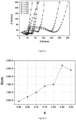
- the plot is composed of real part of impedance in X axis and imaginary part in Y axis.
- High frequency measurement appears on the left side of the graph forms a semicircle that is followed by a low angle spike as the result of the low frequency measurement.
- the semicircle formation corresponded to the lithium conduction in SE.
- the lithium ionic conductivity of CEX1 is 4.4 ⁇ 10 -6 at room temperature that is comparable with the earlier published works on LSPO.
- the reduction of the semicircle diameter with the higher Ge amount indicating lower resistance of sample suggesting a better conductivity.
- Figure 2 shows the improvement of lithium ionic conductivity where the value increases proportionally with more Ge in the structure.
- x is 0.30, the value reduces to 2.4x10 -5 , concluding that 0.25 is an optimal concentration.
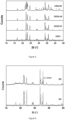
- Figure 3 shows the XRD patterns of CEX1 (undoped electrolyte) and EX1-A to EX1-F. It is observed that Ge bearing LSPO samples have a single LISICON phase without impurity, demonstrating that Ge is well doped. In all graphs, the ⁇ -Li 3 PO 4 structure is maintained, indicated by the characteristic double peak at 28°-29° representing (121) and (200) planes as well as four consecutive peaks at 34°-36° correspond to (220), (131), (211), and (002) planes. The shifted peak positions to the left related with the larger crystal volume showed in Table 1. The observed single phase also acts as an evidence of solid solution formation for the Ge bearing LSPO.
- FTIR measurement is displayed in Figure 4 with the vibration bands of P-O, Si-O, and Ge-O marked.
- the vibration bands at 580cm -1 , 910cm -1 , and around 1050cm -1 correspond to the vibration modes of tetrahedron P-O while band in area of 985-1005 cm -1 corresponds to the vibration modes of Si-O, also in tetrahedral structure. All bands show transmittance signal increase along with the addition of Ge in the structure. On the other hand, transmittance of 790cm -1 band which corresponds to Ge-O vibration decreases with the more Ge in the structure. It is concluded that the atomic substitution of Ge successfully occurred at Si and P sites without changing the structure. This observation matches with that of XRD where the structure of LSPO is maintained upon doping.
- CEX2-A S bearing LSPO structure
- CEX2-B Ga bearing LSPO structure
- a M-NMC622 compound having the target formula of Li(Ni 0.60 Mn 0.20 Co 0.20 )O 2 and a monolithic morphology is obtained through a double sintering process and a wet milling process running as follows:
- a catholyte material EX2-CAT-A is made by mixing M-NMC622 and EX1-B (Li 3.60 Si 0.40 P 0.40 Ge 0.20 O 4 ) according to a mixing ratio of 1:1 by weight, followed by a heat treatment at 700°C for 3 hours in an oxygen atmosphere (i.e. like air).
- EX1-B has a median particle size (D50) of 2 ⁇ m.
- a catholyte material EX2-CAT-B is obtained through a similar manner as the preparation of EX2-CAT-A except that the mixture is heated at 600°C.
- CEX3-CAT-A and CEX3-CAT-B are obtained through a similar manner as the preparation of EX2-CAT-A except that the mixture is heated at 500°C, 900°C, respectively, as displayed in Table 2.
- Table 2. Particle size distribution and ionic conductivity of EX2 and CEX3 material Sample ID* Co-sintering temperature (°C) D50 ( ⁇ m) D99 ( ⁇ m) Ionic conductivity (S/cm) First discharge capacity (mAh/g)
- EX2-CAT-A 700 10.2 34.7 1 ⁇ 10 -5 176.4
- EX2-CAT-B 600 10.3 31.0 2 ⁇ 10 -6 -** CEX3-CAT-A 500 10.4 28.1 1 ⁇ 10 -7 -** CEX3-CAT-B 900 10.5 143.0 9 ⁇ 10 -4 133.8 * -CAT- stands for "catholyte". ** - : not measured.
- EX2-CAT-A, EX2-CAT-B, CEX3-CAT-A, and CEX3-CAT-B have a similar D50 at around 10.2-10.5 ⁇ m.
- the D99 values are larger at the higher co-sintering temperature.
- the D99 of EX2-CAT-A (resulting from a sintering at 700°C) is 34.7 ⁇ m while the D99 of CEX3-CAT-B (resulting from a co-sintering at 900°C) is 143.0 ⁇ m.
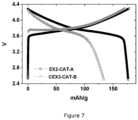
- the coin cell characterization of EX2-CAT-A and CEX3-CAT-B as displayed in Figure 7 shows the effect of the co-sintering temperature to the electrochemical performance.
- CEX3-CAT-B sintered at 900°C clearly shows a lower discharge capacity comparing to EX2-CAT-A sintered at 700°C.
- co-sintering temperature lower than 600°C is also unpreferable.
- the ionic conductivity data provided in Table 2 also demonstrate that the ionic conductivity of the catholyte depends upon the co-sintering temperature, wherein the catholyte is more conductive at a higher co-sintering temperature.
- EX2-CAT-A which results from a co-sintering prepared at 700°C has an ionic conductivity of 10 -5 S/cm while CEX3-CAT-A (resulting from a co-sintering at 500°C) has an ionic conductivity of 10 -7 S/cm, i.e. a decrease of x100 is observed for this sample with respect to CEX3-CAT-A's ionic conductivity.
Landscapes
- Chemical & Material Sciences (AREA)
- Chemical Kinetics & Catalysis (AREA)
- Electrochemistry (AREA)
- General Chemical & Material Sciences (AREA)
- Engineering & Computer Science (AREA)
- Manufacturing & Machinery (AREA)
- Inorganic Chemistry (AREA)
- Materials Engineering (AREA)
- Condensed Matter Physics & Semiconductors (AREA)
- General Physics & Mathematics (AREA)
- Physics & Mathematics (AREA)
- Battery Electrode And Active Subsutance (AREA)
- Secondary Cells (AREA)
- Conductive Materials (AREA)
- Composite Materials (AREA)
- Inorganic Compounds Of Heavy Metals (AREA)
Claims (12)
- Festlösungselektrolyt, der für eine wiederaufladbare Festkörper-Lithiumionenbatterie geeignet ist, umfassend eine Verbindung, die die allgemeine Formel Li(3,5+L+x)Si(0,5+s-x)P(0,5+p-x)Ge2x04+a aufweist, wobei -0,10 ≤ L ≤ 0,10, - 0,10 ≤ s ≤ 0,10, -0,10 ≤ p ≤ 0,10, -0,40 ≤ a ≤ 0,40 und 0,0 ≤ x ≤ 0,30, vorzugsweise 0,05 ≤ x ≤ 0,30, mehr bevorzugt 0,10 ≤ x ≤ 0,30.
- Festlösungselektrolyt nach Anspruch 1, wobei die Verbindung eine allgemeine Formel aufweist: Li(3,5+x)Si(0,5-x)P(0,5-x)Ge2xO4.
- Festlösungselektrolyt nach Anspruch 1 oder 2, der eine Lithiumionenleitfähigkeit von mindestens 10-5 S/cm bei Raumtemperatur aufweist.
- Festlösungselektrolyt nach Anspruch 1 oder 2, wobei 0,15 ≤ x ≤ 0,30, vorzugsweise 0,20 ≤ x ≤ 0,30, mehr bevorzugt 0,25 ≤ x ≤ 0,30.
- Festlösungselektrolyt nach Anspruch 1 oder 2, der eine Lithiumionenleitfähigkeit bei Raumtemperatur von höher oder gleich 2,0 × 10⁻⁵ S/cm und niedriger oder gleich 3,0 × 10⁻⁵ S/cm, vorzugsweise höher oder gleich 2,5 × 10⁻⁵ S/cm und niedriger oder gleich 3,0 × 10⁻⁵ S/cm aufweist.
- Festlösungselektrolyt nach Anspruch 1 oder 2, umfassend eine Kristallstruktur, die ein XRD-Muster aufweist, gemessen bei einer Wellenlänge von 1,5418 Å, umfassend einen ersten Peak, der eine erste Intensität aufweist, und einen zweiten Peak, der eine zweite Intensität aufweist, wobei der erste und der zweite Peak in einem Bereich von 2 θ höher oder gleich 27,5 und niedriger oder gleich 30,0±0,5° vorhanden sind, wobei das XRD-Muster ferner frei von Peaks bei 37,0±0,5° ≤ 2 θ ≤ 47,0±0,5° ist, die einer Intensität aufweisen, die höher als die erste oder zweite Intensität ist.
- Festlösungselektrolyt nach Anspruch 1 oder 2, umfassend eine Kristallstruktur, die ein XRD-Muster aufweist, gemessen bei einer Wellenlänge von 1,5418 Å, umfassend einen ersten Peak, der eine erste Intensität aufweist, und einen zweiten Peak, der eine zweite Intensität aufweist, wobei der erste und der zweite Peak in einem ersten Bereich von 2 θ höher oder gleich 27,5 und niedriger oder gleich 30,0±0,5° vorhanden sind, wobei in einem zweiten Bereich von 2 θ höher oder gleich 21,0 und niedriger oder gleich 25,0±0,5°, das XRD-Muster nicht mehr als drei Peaks aufweist und jeder der drei Peaks eine Intensität aufweist, die höher als die erste oder zweite Intensität ist.
- Festlösungselektrolyt nach Anspruch 1 oder 2, umfassend eine Kristallstruktur, die ein XRD-Muster aufweist, gemessen bei einer Wellenlänge von 1,5418 Å, umfassend einen ersten Peak, der eine erste Intensität aufweist, und einen zweiten Peak, der eine zweite Intensität aufweist, wobei der erste und der zweite Peak in einem ersten Bereich von 2 θ höher oder gleich 27,5 und niedriger oder gleich 30,0±0,5° vorhanden sind, wobei in einem zweiten Bereich von 2 θ höher oder gleich 34,0 und niedriger oder gleich 36,0±0,5°, das XRD-Muster nicht mehr als drei Peaks aufweist und jeder der drei Peaks eine Intensität aufweist, die höher als die erste oder zweite Intensität ist.
- Wiederaufladbare Festkörper-Lithiumionenbatterie, umfassend den Festlösungselektrolyt nach Anspruch 1 oder 2.
- Wiederaufladbare Festkörper-Lithiumionenbatterie, umfassend eine negative Elektrode, die eine Anode auf Li-Metall-Basis aufweist, die mit dem Festlösungselektrolyt nach Anspruch 1 oder 2 in Kontakt steht.
- Verwendung der Festkörperbatterie nach Anspruch 9 oder 10 in einem Elektrofahrzeug, insbesondere in einem Elektroauto, wobei die Betriebsspannung dieser Batterie höher oder gleich 200 V und niedriger oder gleich 500 V ist.
- Katholyt, umfassend den Festlösungselektrolyt nach Anspruch 1 oder 2 und ein Kathodenmaterial, das die allgemeine Formel aufweist: Lii+kM'1-kO2, wobei M'=Ni1-x'-y'-z'Mnx'Coy'Az' mit -0,05≤k≤0,05, 0≤x'≤0,40, 0,05≤y'≤0,40 und 0≤z'≤0,05, wobei A ein Dotierelement ist, das sich von Li, M' und O unterscheidet, das positive Aktivmaterialpulver umfassend Partikel, die eine geschichteten R-3m-Kristallstruktur aufweisen, wobei der Katholyt eine D99 ≤ 50 µm und eine Ionenleitfähigkeit von mindestens 1,0×10⁻⁶ S/m aufweist, wobei D99 als die Partikelgröße bei 99 % der kumulierten Volumenprozentverteilungen definiert ist, die aus dem unter Punkt D) der Beschreibung definierten Verfahren erhalten werden.
Applications Claiming Priority (6)
| Application Number | Priority Date | Filing Date | Title |
|---|---|---|---|
| US201962807863P | 2019-02-20 | 2019-02-20 | |
| US201962807833P | 2019-02-20 | 2019-02-20 | |
| EP19162591 | 2019-03-13 | ||
| EP19162577 | 2019-03-13 | ||
| EP19176362 | 2019-05-24 | ||
| PCT/IB2020/051354 WO2020170135A1 (en) | 2019-02-20 | 2020-02-19 | Powderous solid electrolyte compound for solid-state rechargeable lithium ion battery |
Publications (4)
| Publication Number | Publication Date |
|---|---|
| EP3928375A1 EP3928375A1 (de) | 2021-12-29 |
| EP3928375A4 EP3928375A4 (de) | 2023-07-26 |
| EP3928375B1 true EP3928375B1 (de) | 2025-04-09 |
| EP3928375C0 EP3928375C0 (de) | 2025-04-09 |
Family
ID=72143762
Family Applications (2)
| Application Number | Title | Priority Date | Filing Date |
|---|---|---|---|
| EP20758623.1A Pending EP3928374A4 (de) | 2019-02-20 | 2020-02-19 | Positivelektrodenmaterial mit einem festen elektrolyt für wiederaufladbare lithium-ionen-feststoffbatterie mit hoher thermischer stabilität |
| EP20758964.9A Active EP3928375B1 (de) | 2019-02-20 | 2020-02-19 | Pulverförmige festelektrolytverbindung für eine wiederaufladbare festkörper-lithium-ionen-batterie |
Family Applications Before (1)
| Application Number | Title | Priority Date | Filing Date |
|---|---|---|---|
| EP20758623.1A Pending EP3928374A4 (de) | 2019-02-20 | 2020-02-19 | Positivelektrodenmaterial mit einem festen elektrolyt für wiederaufladbare lithium-ionen-feststoffbatterie mit hoher thermischer stabilität |
Country Status (6)
| Country | Link |
|---|---|
| US (2) | US20220149427A1 (de) |
| EP (2) | EP3928374A4 (de) |
| JP (2) | JP7284281B2 (de) |
| KR (2) | KR102658590B1 (de) |
| CN (2) | CN113424350B (de) |
| WO (2) | WO2020170136A1 (de) |
Families Citing this family (2)
| Publication number | Priority date | Publication date | Assignee | Title |
|---|---|---|---|---|
| CN113422108A (zh) * | 2021-06-22 | 2021-09-21 | 万年县阿尔伯特新能源研究有限公司 | 一种新型lgsp固态电解质及制备方法 |
| WO2025222172A1 (en) * | 2024-04-18 | 2025-10-23 | Ohio State Innovation Foundation | Methods and compositions for fast-charging anodes for lithium ion batteries |
Family Cites Families (29)
| Publication number | Priority date | Publication date | Assignee | Title |
|---|---|---|---|---|
| US5500291A (en) | 1993-03-22 | 1996-03-19 | Matsushita Electric Industrial Co., Ltd. | Lithium ion conductive solid electrolyte and process for synthesizing the same |
| KR100312689B1 (ko) * | 1999-08-19 | 2001-11-03 | 김순택 | 리튬 이차 전지용 양극 활물질 조성물 및 그를 포함하는 리튬이차 전지 |
| US9580320B2 (en) * | 2005-10-13 | 2017-02-28 | Ohara Inc. | Lithium ion conductive solid electrolyte and method for manufacturing the same |
| US8182943B2 (en) * | 2005-12-19 | 2012-05-22 | Polyplus Battery Company | Composite solid electrolyte for protection of active metal anodes |
| JP5110850B2 (ja) * | 2006-10-31 | 2012-12-26 | 株式会社オハラ | リチウムイオン伝導性固体電解質およびその製造方法 |
| JP2011096630A (ja) * | 2009-10-02 | 2011-05-12 | Sanyo Electric Co Ltd | 固体リチウム二次電池及びその製造方法 |
| JP4762353B1 (ja) * | 2010-03-31 | 2011-08-31 | ナミックス株式会社 | リチウムイオン二次電池及びその製造方法 |
| US20110300432A1 (en) * | 2010-06-07 | 2011-12-08 | Snyder Shawn W | Rechargeable, High-Density Electrochemical Device |
| JP5602541B2 (ja) * | 2010-08-25 | 2014-10-08 | 株式会社オハラ | 全固体リチウムイオン電池 |
| KR101256641B1 (ko) * | 2010-11-02 | 2013-04-18 | 삼성에스디아이 주식회사 | 리튬 이차전지용 양극 활물질 및 이의 제조방법 |
| JP2012155994A (ja) * | 2011-01-26 | 2012-08-16 | Toyota Motor Corp | 固体電池用電極 |
| CN102420323B (zh) * | 2011-03-03 | 2014-03-19 | 中国科学院宁波材料技术与工程研究所 | 锂二次电池的电极复合材料及其制备方法 |
| CN104604012B (zh) | 2012-09-13 | 2017-03-08 | 富士通株式会社 | 离子导电体和二次电池 |
| CN104904038B (zh) * | 2012-12-14 | 2018-09-21 | 尤米科尔公司 | 用于可再充电电池的低孔隙率电极 |
| KR102443148B1 (ko) * | 2013-05-15 | 2022-09-13 | 퀀텀스케이프 배터리, 인코포레이티드 | 배터리용 고상 캐소라이트 또는 전해질 |
| WO2015016046A1 (ja) | 2013-07-31 | 2015-02-05 | 日産自動車株式会社 | 固溶体リチウム含有遷移金属酸化物、及び該固溶体リチウム含有遷移金属酸化物を正極に用いた非水電解質二次電池 |
| DE102013219606A1 (de) * | 2013-09-27 | 2015-04-02 | Robert Bosch Gmbh | Elektrodenmaterial mit Lithium-Argyrodit |
| KR101547972B1 (ko) | 2014-01-09 | 2015-08-27 | 주식회사 이엔드디 | 니켈―코발트―망간 복합 전구체 제조 방법 |
| TWI581489B (zh) * | 2014-02-27 | 2017-05-01 | 烏明克公司 | 具有經氧化表面之含硫酸鹽的可充電電池陰極 |
| WO2015187466A1 (en) * | 2014-06-04 | 2015-12-10 | Quantumscape Corporation | Electrode materials with mixed particle sizes |
| KR20160020627A (ko) * | 2014-08-13 | 2016-02-24 | 삼성에스디아이 주식회사 | 리튬 이차전지용 양극 활물질 |
| US10593998B2 (en) | 2014-11-26 | 2020-03-17 | Corning Incorporated | Phosphate-garnet solid electrolyte structure |
| KR102591083B1 (ko) * | 2014-12-23 | 2023-10-18 | 퀀텀스케이프 배터리, 인코포레이티드 | 리튬이 풍부한 니켈 망간 코발트 산화물 |
| CN106169607A (zh) * | 2016-08-10 | 2016-11-30 | 中国科学院西安光学精密机械研究所 | 一种掺氧锂离子固体电解质及其制备方法 |
| MX2019005336A (es) * | 2016-11-08 | 2019-10-14 | Fisker Inc | Baterias de iones de litio completamente de estado solido que comprenden electrolitos ceramicos mecanicamente flexibles y metodos de fabricacion para las mismas. |
| JP2018101466A (ja) * | 2016-12-19 | 2018-06-28 | セイコーエプソン株式会社 | 電池、および電子機器 |
| JP7102087B2 (ja) * | 2017-05-24 | 2022-07-19 | ビーエーエスエフ ソシエタス・ヨーロピア | 電極活物質の製造方法 |
| KR102396108B1 (ko) * | 2017-06-22 | 2022-05-10 | 삼성전자주식회사 | 3차원 전극구조체 및 이를 포함하는 이차전지 |
| HUE051555T2 (hu) * | 2017-07-14 | 2021-03-01 | Umicore Nv | NI alapú katódanyag újratölthetõ lítium-ion akkumulátorokhoz |
-
2020
- 2020-02-19 CN CN202080014246.8A patent/CN113424350B/zh active Active
- 2020-02-19 EP EP20758623.1A patent/EP3928374A4/de active Pending
- 2020-02-19 US US17/431,728 patent/US20220149427A1/en active Pending
- 2020-02-19 KR KR1020217029929A patent/KR102658590B1/ko active Active
- 2020-02-19 EP EP20758964.9A patent/EP3928375B1/de active Active
- 2020-02-19 WO PCT/IB2020/051355 patent/WO2020170136A1/en not_active Ceased
- 2020-02-19 JP JP2021549107A patent/JP7284281B2/ja active Active
- 2020-02-19 US US17/431,731 patent/US12401030B2/en active Active
- 2020-02-19 CN CN202080014288.1A patent/CN113424351B/zh active Active
- 2020-02-19 WO PCT/IB2020/051354 patent/WO2020170135A1/en not_active Ceased
- 2020-02-19 JP JP2021549106A patent/JP7209858B2/ja active Active
- 2020-02-19 KR KR1020217029927A patent/KR102660233B1/ko active Active
Also Published As
| Publication number | Publication date |
|---|---|
| CN113424350A (zh) | 2021-09-21 |
| JP7209858B2 (ja) | 2023-01-20 |
| EP3928375C0 (de) | 2025-04-09 |
| CN113424351A (zh) | 2021-09-21 |
| JP2022521910A (ja) | 2022-04-13 |
| JP7284281B2 (ja) | 2023-05-30 |
| KR102660233B1 (ko) | 2024-04-23 |
| EP3928375A4 (de) | 2023-07-26 |
| WO2020170135A1 (en) | 2020-08-27 |
| US12401030B2 (en) | 2025-08-26 |
| KR20210118482A (ko) | 2021-09-30 |
| KR102658590B1 (ko) | 2024-04-17 |
| WO2020170136A1 (en) | 2020-08-27 |
| CN113424351B (zh) | 2024-07-12 |
| EP3928374A1 (de) | 2021-12-29 |
| US20220085368A1 (en) | 2022-03-17 |
| KR20210118481A (ko) | 2021-09-30 |
| EP3928375A1 (de) | 2021-12-29 |
| EP3928374A4 (de) | 2023-08-02 |
| CN113424350B (zh) | 2024-07-19 |
| US20220149427A1 (en) | 2022-05-12 |
| JP2022521514A (ja) | 2022-04-08 |
Similar Documents
| Publication | Publication Date | Title |
|---|---|---|
| EP3728129B1 (de) | Positivelektrodenmaterial für wiederaufladbare lithium-ionen-batterien | |
| US11522186B2 (en) | Positive electrode material for rechargeable lithium ion batteries | |
| EP3514867B1 (de) | Aktivmaterial für eine positivelektrode für wasserfreien elektrolyt einer sekundärbatterie, verfahren zur herstellung davon und sekundärbatterie mit wasserfreiem elektrolyt mit dem aktivmaterial für besagte positivelektrode | |
| EP2717360B1 (de) | Herstellungsverfahren für ein positives elektrodenmaterial für eine lithiumbatterie | |
| Sun et al. | Hierarchical waxberry-like LiNi 0.5 Mn 1.5 O 4 as an advanced cathode material for lithium-ion batteries with a superior rate capability and long-term cyclability | |
| EP3653581A1 (de) | Metallverbundhydroxid, verfahren zur herstellung davon, positivelektrodenaktivmaterial für sekundärbatterie mit wasserfreien elektrolyten, verfahren zur herstellung des besagten positivelektrodenaktivmaterials und sekundärbatterie mit wasserfreien elektrolyten mit verwendung des besagten positivelektrodenaktivmaterials | |
| JP7665942B2 (ja) | リチウムイオン二次電池用正極活物質およびその製造方法、リチウムイオン二次電池 | |
| EP3929158A1 (de) | Positivelektrodenaktivmaterial für lithium-ionen-sekundärbatterie, verfahren zur herstellung davon und lithium-ionen-sekundärbatterie | |
| JP7713885B2 (ja) | リチウムイオン二次電池用正極活物質、およびリチウムイオン二次電池 | |
| JP2024163217A (ja) | リチウムイオン二次電池用正極活物質およびその製造方法 | |
| EP3928375B1 (de) | Pulverförmige festelektrolytverbindung für eine wiederaufladbare festkörper-lithium-ionen-batterie | |
| JP7744331B2 (ja) | 熱分解法により製造されたジルコニウム含有酸化物を含有するリチウム遷移金属混合酸化物 | |
| EP3832761B1 (de) | Aktivmaterial für negative elektroden einer lithium-ionen sekundärzelle, verfahren zur herstellung von aktivmaterial für negative elektroden für lithium-ionen sekundärzelle und lithium-ionen sekundärzelle | |
| EP3715332A1 (de) | Wolframtrioxid | |
| EP3929157A1 (de) | Positivelektrodenaktivmaterial für eine lithium-ionen-sekundärbatterie, verfahren zur herstellung des positivelektrodenaktivmaterials für eine lithium-ionen-sekundärbatterie und lithium-ionen-sekundärbatterie | |
| EP4614608A1 (de) | Positivelektrodenaktivmaterial für eine lithium-ionen-sekundärbatterie und lithium-ionen-sekundärbatterie | |
| EP4528854B1 (de) | Positivelektrodenaktivmaterial für eine lithium-ionen-sekundärbatterie sowie lithium-ionen-sekundärbatterie | |
| JP7413038B2 (ja) | リチウムイオン二次電池用正極活物質、リチウムイオン二次電池 | |
| Kebede et al. | Synthesis and electrochemical properties of Ni doped spinel LiNixMn2-xO4 (0≤ x≤ 0.5) cathode materials for Li-ion battery | |
| EP3951947A1 (de) | Positivelektroden-aktivmaterial für lithium-ionen-sekundärzelle, verfahren zur herstellung von positivelektroden-aktivmaterial und lithium-ionen-sekundärzelle | |
| JP2025019577A (ja) | リチウムイオン二次電池用正極活物質、リチウムイオン二次電池用正極活物質の製造方法、リチウムイオン二次電池 |
Legal Events
| Date | Code | Title | Description |
|---|---|---|---|
| STAA | Information on the status of an ep patent application or granted ep patent |
Free format text: STATUS: THE INTERNATIONAL PUBLICATION HAS BEEN MADE |
|
| PUAI | Public reference made under article 153(3) epc to a published international application that has entered the european phase |
Free format text: ORIGINAL CODE: 0009012 |
|
| STAA | Information on the status of an ep patent application or granted ep patent |
Free format text: STATUS: REQUEST FOR EXAMINATION WAS MADE |
|
| 17P | Request for examination filed |
Effective date: 20210920 |
|
| AK | Designated contracting states |
Kind code of ref document: A1 Designated state(s): AL AT BE BG CH CY CZ DE DK EE ES FI FR GB GR HR HU IE IS IT LI LT LU LV MC MK MT NL NO PL PT RO RS SE SI SK SM TR |
|
| DAV | Request for validation of the european patent (deleted) | ||
| DAX | Request for extension of the european patent (deleted) | ||
| REG | Reference to a national code |
Ref country code: DE Ref legal event code: R079 Free format text: PREVIOUS MAIN CLASS: H01M0010056200 Ipc: H01M0004040000 Ref country code: DE Ref legal event code: R079 Ref document number: 602020049136 Country of ref document: DE Free format text: PREVIOUS MAIN CLASS: H01M0010056200 Ipc: H01M0004040000 |
|
| A4 | Supplementary search report drawn up and despatched |
Effective date: 20230628 |
|
| RIC1 | Information provided on ipc code assigned before grant |
Ipc: H01M 4/02 20060101ALN20230622BHEP Ipc: H01M 4/505 20100101ALI20230622BHEP Ipc: H01M 4/62 20060101ALI20230622BHEP Ipc: H01M 10/0562 20100101ALI20230622BHEP Ipc: H01M 10/052 20100101ALI20230622BHEP Ipc: H01M 4/525 20100101ALI20230622BHEP Ipc: H01M 4/131 20100101ALI20230622BHEP Ipc: H01M 4/04 20060101AFI20230622BHEP |
|
| GRAP | Despatch of communication of intention to grant a patent |
Free format text: ORIGINAL CODE: EPIDOSNIGR1 |
|
| STAA | Information on the status of an ep patent application or granted ep patent |
Free format text: STATUS: GRANT OF PATENT IS INTENDED |
|
| RIC1 | Information provided on ipc code assigned before grant |
Ipc: H01M 4/02 20060101ALN20241212BHEP Ipc: H01M 4/505 20100101ALI20241212BHEP Ipc: H01M 4/62 20060101ALI20241212BHEP Ipc: H01M 10/0562 20100101ALI20241212BHEP Ipc: H01M 10/052 20100101ALI20241212BHEP Ipc: H01M 4/525 20100101ALI20241212BHEP Ipc: H01M 4/131 20100101ALI20241212BHEP Ipc: H01M 4/04 20060101AFI20241212BHEP |
|
| INTG | Intention to grant announced |
Effective date: 20241220 |
|
| GRAS | Grant fee paid |
Free format text: ORIGINAL CODE: EPIDOSNIGR3 |
|
| GRAA | (expected) grant |
Free format text: ORIGINAL CODE: 0009210 |
|
| STAA | Information on the status of an ep patent application or granted ep patent |
Free format text: STATUS: THE PATENT HAS BEEN GRANTED |
|
| AK | Designated contracting states |
Kind code of ref document: B1 Designated state(s): AL AT BE BG CH CY CZ DE DK EE ES FI FR GB GR HR HU IE IS IT LI LT LU LV MC MK MT NL NO PL PT RO RS SE SI SK SM TR |
|
| REG | Reference to a national code |
Ref country code: GB Ref legal event code: FG4D |
|
| REG | Reference to a national code |
Ref country code: CH Ref legal event code: EP |
|
| REG | Reference to a national code |
Ref country code: DE Ref legal event code: R096 Ref document number: 602020049136 Country of ref document: DE |
|
| REG | Reference to a national code |
Ref country code: IE Ref legal event code: FG4D |
|
| U01 | Request for unitary effect filed |
Effective date: 20250506 |
|
| U07 | Unitary effect registered |
Designated state(s): AT BE BG DE DK EE FI FR IT LT LU LV MT NL PT RO SE SI Effective date: 20250523 |
|
| PG25 | Lapsed in a contracting state [announced via postgrant information from national office to epo] |
Ref country code: ES Free format text: LAPSE BECAUSE OF FAILURE TO SUBMIT A TRANSLATION OF THE DESCRIPTION OR TO PAY THE FEE WITHIN THE PRESCRIBED TIME-LIMIT Effective date: 20250409 |
|
| PG25 | Lapsed in a contracting state [announced via postgrant information from national office to epo] |
Ref country code: GR Free format text: LAPSE BECAUSE OF FAILURE TO SUBMIT A TRANSLATION OF THE DESCRIPTION OR TO PAY THE FEE WITHIN THE PRESCRIBED TIME-LIMIT Effective date: 20250710 Ref country code: NO Free format text: LAPSE BECAUSE OF FAILURE TO SUBMIT A TRANSLATION OF THE DESCRIPTION OR TO PAY THE FEE WITHIN THE PRESCRIBED TIME-LIMIT Effective date: 20250709 |
|
| PG25 | Lapsed in a contracting state [announced via postgrant information from national office to epo] |
Ref country code: PL Free format text: LAPSE BECAUSE OF FAILURE TO SUBMIT A TRANSLATION OF THE DESCRIPTION OR TO PAY THE FEE WITHIN THE PRESCRIBED TIME-LIMIT Effective date: 20250409 |
|
| PG25 | Lapsed in a contracting state [announced via postgrant information from national office to epo] |
Ref country code: HR Free format text: LAPSE BECAUSE OF FAILURE TO SUBMIT A TRANSLATION OF THE DESCRIPTION OR TO PAY THE FEE WITHIN THE PRESCRIBED TIME-LIMIT Effective date: 20250409 |
|
| PG25 | Lapsed in a contracting state [announced via postgrant information from national office to epo] |
Ref country code: RS Free format text: LAPSE BECAUSE OF FAILURE TO SUBMIT A TRANSLATION OF THE DESCRIPTION OR TO PAY THE FEE WITHIN THE PRESCRIBED TIME-LIMIT Effective date: 20250709 |
|
| PG25 | Lapsed in a contracting state [announced via postgrant information from national office to epo] |
Ref country code: IS Free format text: LAPSE BECAUSE OF FAILURE TO SUBMIT A TRANSLATION OF THE DESCRIPTION OR TO PAY THE FEE WITHIN THE PRESCRIBED TIME-LIMIT Effective date: 20250809 |
|
| PG25 | Lapsed in a contracting state [announced via postgrant information from national office to epo] |
Ref country code: SM Free format text: LAPSE BECAUSE OF FAILURE TO SUBMIT A TRANSLATION OF THE DESCRIPTION OR TO PAY THE FEE WITHIN THE PRESCRIBED TIME-LIMIT Effective date: 20250409 |
|
| PG25 | Lapsed in a contracting state [announced via postgrant information from national office to epo] |
Ref country code: CZ Free format text: LAPSE BECAUSE OF FAILURE TO SUBMIT A TRANSLATION OF THE DESCRIPTION OR TO PAY THE FEE WITHIN THE PRESCRIBED TIME-LIMIT Effective date: 20250409 |
|
| PG25 | Lapsed in a contracting state [announced via postgrant information from national office to epo] |
Ref country code: SK Free format text: LAPSE BECAUSE OF FAILURE TO SUBMIT A TRANSLATION OF THE DESCRIPTION OR TO PAY THE FEE WITHIN THE PRESCRIBED TIME-LIMIT Effective date: 20250409 |
|
| PLBE | No opposition filed within time limit |
Free format text: ORIGINAL CODE: 0009261 |
|
| STAA | Information on the status of an ep patent application or granted ep patent |
Free format text: STATUS: NO OPPOSITION FILED WITHIN TIME LIMIT |
|
| REG | Reference to a national code |
Ref country code: CH Ref legal event code: L10 Free format text: ST27 STATUS EVENT CODE: U-0-0-L10-L00 (AS PROVIDED BY THE NATIONAL OFFICE) Effective date: 20260218 |
|
| 26N | No opposition filed |
Effective date: 20260112 |
|
| U20 | Renewal fee for the european patent with unitary effect paid |
Year of fee payment: 7 Effective date: 20260302 |
|
| PGFP | Annual fee paid to national office [announced via postgrant information from national office to epo] |
Ref country code: GB Payment date: 20260106 Year of fee payment: 7 |