EP3854530B1 - Antriebsmaschine - Google Patents
Antriebsmaschine Download PDFInfo
- Publication number
- EP3854530B1 EP3854530B1 EP19861758.1A EP19861758A EP3854530B1 EP 3854530 B1 EP3854530 B1 EP 3854530B1 EP 19861758 A EP19861758 A EP 19861758A EP 3854530 B1 EP3854530 B1 EP 3854530B1
- Authority
- EP
- European Patent Office
- Prior art keywords
- actuated
- transmission portion
- wheel
- striking unit
- rotating member
- Prior art date
- Legal status (The legal status is an assumption and is not a legal conclusion. Google has not performed a legal analysis and makes no representation as to the accuracy of the status listed.)
- Active
Links
Images





Classifications
-
- B—PERFORMING OPERATIONS; TRANSPORTING
- B25—HAND TOOLS; PORTABLE POWER-DRIVEN TOOLS; MANIPULATORS
- B25C—HAND-HELD NAILING OR STAPLING TOOLS; MANUALLY OPERATED PORTABLE STAPLING TOOLS
- B25C1/00—Hand-held nailing tools; Nail feeding devices
- B25C1/04—Hand-held nailing tools; Nail feeding devices operated by fluid pressure, e.g. by air pressure
- B25C1/047—Mechanical details
-
- B—PERFORMING OPERATIONS; TRANSPORTING
- B25—HAND TOOLS; PORTABLE POWER-DRIVEN TOOLS; MANIPULATORS
- B25C—HAND-HELD NAILING OR STAPLING TOOLS; MANUALLY OPERATED PORTABLE STAPLING TOOLS
- B25C1/00—Hand-held nailing tools; Nail feeding devices
- B25C1/06—Hand-held nailing tools; Nail feeding devices operated by electric power
Definitions
- the present invention relates to a driving tool including a striking unit configured to strike a fastener.
- a conventional driving tool including a striking unit configured to strike a fastener is described in Patent Document 1.
- the driving tool described in Patent Document 1 includes an electric motor, a striking unit, a pressure accumulation chamber, a power mechanism, an ejection unit, a magazine, a battery, a controller, and a trigger.
- the striking unit has a piston that receives a pressure of the pressure accumulation chamber and a driver blade fixed to the piston.
- the driver blade has a rack as a first transmission portion.
- the rack is composed of a plurality of protrusions.
- the power mechanism has a wheel and a second transmission portion. The wheel is rotated by a rotational force of the electric motor.
- the second transmission portion has a plurality of engaging portions provided along a rotation direction of the wheel. Nails are provided from the magazine to the ejection unit.
- the controller supplies the power of the battery to the electric motor, so that the electric motor is rotated.
- the striking unit is actuated toward the top dead center.
- the striking unit is actuated toward the bottom dead center by the pressure of the pressure accumulation chamber, and the driver blade strikes the nail of the ejection unit.
- Patent Document 1 International Publication No. WO2016-199670
- the inventors of the present invention have found the problem that the load on at least one of the first transmission portion and the second transmission portion increases in the process of releasing the second transmission portion from the first transmission portion.
- An object of the present invention is to provide a driving tool capable of suppressing the increase in the load on at least one of the first transmission portion and the second transmission portion.
- a driving tool includes: a striking unit capable of being actuated in a first direction and a second direction opposite to the first direction and capable of striking a fastener by being actuated in the first direction; a first transmission portion provided on the striking unit; a rotating member configured to be rotated in a predetermined direction; and a second transmission portion provided on the rotating member and capable of being engaged with and released from the first transmission portion, the striking unit can be actuated in the second direction when the second transmission portion is engaged with the first transmission portion and the striking unit can be actuated in the first direction when the second transmission portion is released from the first transmission portion, the second transmission portion includes: a first engaging portion arranged along a rotation direction of the rotating member and turned in a predetermined direction to be engaged with the first transmission portion, thereby actuating the striking unit in the second direction; and a second engaging portion actuated in the predetermined direction to be engaged with the first transmission portion and actuated in a different direction from the predetermined direction to be released from the first transmission portion, the second engaging
- the driving tool according to an embodiment can suppress the increase in the load on at least one of the first transmission portion and the second transmission portion.
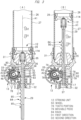
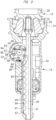
- a driving tool 10 shown in FIG. 1 and FIG. 2 includes a housing 11, a striking unit 12, a nose unit 13, a power source unit 14, an electric motor 15, a deceleration mechanism 16, a conversion unit 17, and a pressure accumulation container 18.
- the housing 11 is an outer shell element of the driving tool 10, and the housing 11 includes a cylinder case 19, a handle 20 connected to the cylinder case 19, a motor case 21 connected to the cylinder case 19, and a mounting unit 22 connected to the handle 20 and the motor case 21.
- the power source unit 14 is detachably attached to the mounting unit 22.
- the electric motor 15 is arranged in the motor case 21.
- the pressure accumulation container 18 includes a cap 23 and a holder 24 to which the cap 23 is attached.
- a head cover 25 is attached to the cylinder case 19, and the pressure accumulation container 18 is arranged across the inside of the cylinder case 19 and the inside of the head cover 25.
- a cylinder 27 is housed in the cylinder case 19.
- the cylinder 27 is made of metal, for example, aluminum alloy or iron.
- the cylinder 27 is positioned with respect to the cylinder case 19 in the direction of a center line A1 and the radial direction.
- a pressure chamber 26 is formed across the inside of the pressure accumulation container 18 and the inside of the cylinder 27.
- the pressure chamber 26 is filled with compressible gas.
- compressible gas inert gas can be used in addition to air. Examples of the inert gas include nitrogen gas and rare gas. In this embodiment, an example in which the pressure chamber 26 is filled with air will be described.
- the striking unit 12 is arranged across the inside to the outside of the housing 11.
- the striking unit 12 includes a piston 28 and a driver blade 29.
- the piston 28 can be actuated in the cylinder 27 in the direction of the center line A1.
- a sealing member 114 is attached to an outer peripheral surface of the piston 28.
- An outer peripheral surface of the sealing member 114 is in contact with an inner peripheral surface of the cylinder 27 to form a sealing surface.
- the driver blade 29 is made of, for example, metal.
- the piston 28 and the driver blade 29 are provided as separate members, and the piston 28 and the driver blade 29 are coupled to each other.
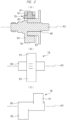
- the driver blade includes a rack 84 shown in FIG. 3(A) .
- the rack 84 has a plurality of protrusions 85 arranged at intervals in the direction of the center line A1.
- the striking unit 12 can be actuated in the direction of the center line A1.
- the nose unit 13 is arranged across the inside and outside of the cylinder case 19.
- the nose unit 13 includes a bumper support portion 31, an ejection unit 32, and a tubular portion 33.
- the bumper support portion 31 has a tubular shape and has a guide hole 34.
- the guide hole 34 is arranged to be centered about the center line A1.
- a bumper 35 is arranged in the bumper support portion 31.
- the bumper 35 may be made of synthetic rubber or silicone rubber.
- the bumper 35 has an annular shape and has a guide hole 36.
- the guide hole 36 is provided to be centered about the center line A1.
- the driver blade 29 can be actuated in the guide holes 34 and 36 in the direction of the center line A1.
- the bumper 35 is elastically deformed by receiving a load from the piston 28.
- the ejection unit 32 is connected to the bumper support portion 31 and protrudes from the bumper support portion 31 in the direction of the center line A1.
- the ejection unit 32 includes an ejection path 37 and the ejection path 37 is provided along the center line A1.
- the driver blade 29 is movable in the ejection path 37 in the direction of the center line A1.
- the electric motor 15 is arranged in the motor case 21.
- the electric motor 15 includes a rotor 39 and a stator 40.
- the stator 40 is attached to the motor case 21.
- the rotor 39 is attached to a rotor shaft 41 and a first end portion of the rotor shaft 41 is rotatably supported by the motor case 21 via a bearing 42.
- the electric motor 15 is a brushless motor, and the rotor 39 can rotate forward and backward when a voltage is applied to the electric motor 15.
- a gear case 43 is provided in the motor case 21.
- the gear case 43 has a tubular shape and is arranged to be centered about a center line A2.
- the deceleration mechanism 16 is provided in the gear case 43.
- the deceleration mechanism 16 includes plural sets of planetary gear mechanisms.
- An input element of the deceleration mechanism 16 is coupled to the rotor shaft 41 via a power transmission shaft 44.
- the power transmission shaft 44 is rotatably supported by a bearing 45.
- a rotating shaft 46 is provided in the tubular portion 33.
- the rotating shaft 46 is rotatably supported by bearings 48 and 49.
- the rotor shaft 41, the power transmission shaft 44, the deceleration mechanism 16, and the rotating shaft 46 are arranged concentrically about the center line A2.
- An output element 77 of the deceleration mechanism 16 and the rotating shaft 46 are arranged concentrically, and the output element 77 and the rotating shaft 46 are rotated integrally.
- the deceleration mechanism 16 is arranged on a power transmission path extending from the electric motor 15 to the rotating shaft 46.
- the conversion unit 17 is provided in the tubular portion 33.
- the conversion unit 17 is configured to convert a rotational force of the rotating shaft 46 into an actuation force of the striking unit 12.
- the conversion unit 17 includes a wheel 50 fixed to the rotating shaft 46 and tooth portions 78 formed on an outer peripheral surface of the wheel 50.
- the wheel 50 and the tooth portions 78 are integrally molded with a metal material.
- a plurality of tooth portions 78 are provided at intervals in the rotation direction of the wheel 50.
- the tooth portions 78 are arranged within a range of a predetermined angle in the rotation direction of the wheel 50, for example, within a range of 270 degrees.
- a movable piece 79 is attached to the wheel 50.
- the movable piece 79 is provided outside the range where the plurality of tooth portions 78 are arranged in the rotation direction of the wheel 50.
- the movable piece 79 can be actuated within a range of a predetermined angle about a support shaft 80.
- the movable piece 79 includes an engaging portion 81 and a contact portion 82.
- the movable piece 79 is made of, for example, metal.
- the engaging portion 81 and the contact portion 82 are provided in the same range in the direction of a center line A3 of the support shaft 80.
- the center line A3 is parallel to the center line A2.
- a guide portion 83 shown in FIG. 3(A) is arranged outside the rotating shaft 46 in the radial direction of the wheel 50.
- the guide portion 83 is provided so as not to be rotated.
- the guide portion 83 is provided within a range of a predetermined angle in the rotation direction of the wheel 50.
- the outer peripheral surface of the guide portion 83 has an arc shape to be centered about the center line A2.
- the guide portion 83 is arranged on an inner side than the support shaft 80 in the radial direction of the wheel 50.
- the striking unit 12 shown in FIG. 1 is actuated in a second direction D2, that is, moves upward by the rotational force of the wheel 50.
- the contact portion 82 comes into contact with the outer peripheral surface of the guide portion 83 within the range where the guide portion 83 is arranged in the rotation direction of the wheel 50.
- a circumscribed circle of the engaging portion 81 is common to a circumscribed circle of the tooth portion 78. Namely, the engaging portion 81 can be engaged with the protrusion 85.
- the contact portion 82 is separated from the outer peripheral surface of the guide portion 83 outside the range where the guide portion 83 is formed in the rotation direction of the wheel 50.
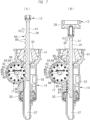
- the movable piece 79 is actuated clockwise in FIG. 4(B) by receiving a load from the protrusion 85, and the engaging portion 81 is released from the protrusion 85. Therefore, the rotational force of the wheel 50 is not transmitted to the striking unit 12.
- the striking unit 12 is constantly biased in a first direction D1 by the pressure of the pressure chamber 26 shown in FIG. 1 .
- the actuation of the striking unit 12 in the second direction D2 in FIG. 1 is defined as upward movement.
- the first direction D1 and the second direction D2 are parallel to the center line A1, and the second direction D2 is opposite to the first direction D1.
- the striking unit 12 is actuated in the second direction D2 against the pressure of the pressure chamber 26.
- the actuation of the striking unit 12 in the first direction D1 by the pressure of the pressure chamber 26 is defined as downward movement.
- a rotation preventive mechanism 53 is provided in the gear case 43.
- the rotation preventive mechanism 53 enables the rotating shaft 46 to rotate counterclockwise in FIG. 3(A) by the rotational force of the electric motor 15 rotating forward.
- the rotation preventive mechanism 53 prevents the clockwise rotation of the rotating shaft 46 in FIG. 3(B) when the actuation force of the striking unit 12 in the first direction D1 is transmitted to the wheel 50.
- a trigger 54 and a trigger sensor 57 are provided in the handle 20.
- the trigger sensor 57 detects the presence or absence of an operation force applied to the trigger 54, and outputs a signal in accordance with the detection result.
- the power source unit 14 includes a storage case 58 and a plurality of battery cells stored in the storage case 58.
- the battery cell is a secondary battery that can be charged and discharged, and a known battery cell such as a lithium ion battery, a nickel hydrogen battery, a lithium ion polymer battery, or a nickel cadmium battery can be used as the battery cell as appropriate.
- a magazine 60 is provided as shown in FIG. 1 , and the magazine 60 is supported by the ejection unit 32 and the mounting unit 22.
- the magazine 60 stores a plurality of nails 59.
- the magazine 60 includes a feeder, and the feeder feeds the nails 59 in the magazine 60 to the ejection path 37.
- the ejection unit 32 is made of metal or synthetic resin.
- a push lever 64 is attached to the ejection unit 32.
- the push lever 64 can be actuated with respect to the ejection unit 32 within a predetermined range in the direction of the center line A1.
- An elastic member 66 for biasing the push lever 64 in the direction of the center line A1 is provided.
- the elastic member 66 is, for example, a compression spring, and the elastic member 66 biases the push lever 64 in the direction away from the bumper support portion 31.
- the push lever 64 is stopped by coming into contact with a stopper.
- a control unit 67 is provided in the mounting unit 22.
- the control unit 67 includes a microprocessor mounted on a substrate 113.
- the microprocessor includes an input/output interface, a control circuit, an arithmetic processing unit, and a memory unit.
- a motor substrate 86 is provided in the motor case 21.
- An inverter circuit is provided on the motor substrate 86.
- the inverter circuit connects and disconnects the stator 40 of the electric motor 15 and the power source unit 14.
- the inverter circuit includes a plurality of switching elements, and the plurality of switching elements can be independently turned on and off.
- the control unit 67 controls the inverter circuit, thereby controlling the rotation and stop of the electric motor 15, the number of rotations of the electric motor 15, and the rotation direction of the electric motor 15.
- a push sensor and a position detection sensor are provided in the housing 11.
- the push sensor detects whether the push lever 64 is pressed to a workpiece W1, and outputs a signal based on the detection.
- the position detection sensor detects the position of the wheel 50 in the rotation direction, and outputs a signal based on the detection.
- a velocity sensor that detects the rotation speed of the rotor 39 of the electric motor 15 and a phase sensor that detect a phase of the rotor in the rotation direction are provided.
- Signals output from the trigger sensor 57, the push sensor, the position detection sensor, and the phase sensor are input to the control unit 67.
- the control unit 67 controls the inverter circuit by processing the input signals. In this manner, the control unit 67 controls the stop, the rotation, the rotation direction, and the rotation speed of the electric motor 15.
- the control unit 67 detects at least one of the fact that the operation force is not applied to the trigger 54 and the fact that the push lever 64 is not pressed to the workpiece W1, it stops the power supply to the electric motor 15.
- the electric motor 15 is stopped and the striking unit 12 is stopped at a standby position.
- the standby position of the striking unit 12 is defined as the state where the piston 28 is in contact with the bumper 35 as shown in FIG. 3(A) , that is, the bottom dead center.
- the pressure of the pressure chamber 26 is constantly applied to the striking unit 12, and the striking unit 12 is biased in the first direction D1.
- the contact portion 82 is in contact with the outer peripheral surface of the guide portion 83.
- control unit 67 When the control unit 67 detects that the operation force is applied to the trigger 54 and that the push lever 64 is pressed to the workpiece W1, it causes the power source unit 14 to apply a voltage to the electric motor 15, thereby rotating the electric motor 15 forward. The rotational force of the electric motor 15 is transmitted to the rotating shaft 46 via the deceleration mechanism 16. Then, the rotating shaft 46 and the wheel 50 are rotated counterclockwise in FIG. 3(A) . The deceleration mechanism 16 makes the rotation speed of the wheel 50 slower than the rotation speed of the electric motor 15.
- the piston 28 collides with the bumper 35 after the nail 59 is driven into the workpiece W1.
- the bumper 35 is elastically deformed by receiving a load in the direction of the center line A1, and the bumper 35 absorbs a part of the kinetic energy of the striking unit 12.
- the control unit 67 stops the electric motor 15 when the striking unit 12 reaches the bottom dead center.
- the load in the direction of the center line A1 that the striking unit 12 receives from the pressure chamber 26 is maximum when the striking unit 12 is located at the top dead center. Then, when the contact portion 82 of the movable piece 79 is separated from the outer peripheral surface of the guide portion 83, the movable piece 79 is actuated clockwise in FIG. 4(A) by the force of the driver blade 29, and the engaging portion 81 is released from the protrusion 85. Namely, the engaging portion 81 moves to the outside of the actuation region of the protrusion 85 of the driver blade 29.
- the movable piece 79 is designed to be independently attachable and detachable with respect to the wheel 50, what is required when the engaging portion 81 is worn out is just to exchange the movable piece 79, and it is not necessary to exchange the overall wheel 50.
- the engaging portion 81 and the contact portion 82 are provided in the same range in the direction of the center line A3 of the support shaft 80. Therefore, it is possible to suppress the support shaft 80 from being inclined with respect to the center line A3 when the contact portion 82 is in contact with the guide portion 83 and the engaging portion 81 is engaged with the protrusion 85.
- FIG. 2(C) shows a modification of the movable piece 79.
- an arrangement range of the engaging portion 81 and an arrangement range of the contact portion 82 differ in the direction of the center line A3.
- the actuation principle of the movable piece 79 shown in FIG. 2(C) is the same as the actuation principle of the movable piece 79 shown in FIG. 2 (B)
- FIG. 5(A) shows the first example of the conversion unit 17 having another configuration.
- the same configurations as those of FIG. 3(A) are designated by the same reference characters as those of FIG. 3 (A) .
- a groove 99 is provided in the wheel 50.
- the groove 99 is provided at a position where the tooth portion 78 is not provided in the rotation direction of the wheel 50.
- the groove 99 is provided along the radial direction of the wheel 50 and toward the center line A2.
- a movable piece 100 is attached to the wheel 50.
- the movable piece 100 includes a pin 101, a tooth portion 102, and a contact portion 115.
- the pin 101 is arranged in the groove 99 and can move in the groove 99 along the radial direction of the wheel 50 and in the direction toward and away from the center line A2. Further, the pin 101 is biased outward in the radial direction of the wheel 50 by a biasing member. Although the biasing member is not shown, for example, a metal torsion spring can be used. Therefore, the movable piece 100 can move within the range of the groove 99 in the radial direction of the wheel 50, and can be rotated within a range of a predetermined angle about the pin 101.
- the striking unit 12 is stopped between the bottom dead center and the top dead center. Namely, the striking unit 12 is stopped in the state where the piston 28 is separated from the bumper 35. Then, when the striking unit 12 is moved in the direction D2 by the wheel 50 of the conversion unit 17, a tip of the tooth portion 102 is pressed to a tip of the protrusion 85 in some cases as shown in FIG. 5(A) . Note that the contact portion 115 is in contact with the outer peripheral surface of the guide portion 83.
- the pin 101 when the wheel 50 is rotated counterclockwise, the pin 101 is biased toward the inner side in the radial direction of the wheel 50 by the reaction force of the tooth portion 102 pressed to the protrusion 85, and the pin 101 moves in the groove 99 toward the inner side in the radial direction of the wheel 50 against the biasing force of the biasing member as shown in FIG. 5(B) .
- the tip of the tooth portion 102 slides in the state of being in contact with the tip of the protrusion 85, and when the tip of the tooth portion 102 gets over the tip of the protrusion 85, the pin 101 is pressed by the biasing force of the biasing member, so that the tip of the tooth portion 102 moves between the protrusion 85 and the protrusion 85 as shown in FIG. 5(C) . Further, when the tooth portion 102 is engaged with the protrusion 85 by the rotation of the wheel 50 as shown in FIG. 5(D) , the driver blade 29 is actuated in the second direction D2.
- the protrusion 85 of the driver blade 29 can be engaged with the tooth portion 102 regardless of the position of the driver blade 29 in the direction of the center line A1, and the driver blade 29 can be actuated in the second direction D2. Therefore, the worker can remove the stuck nail 59 from the ejection path 37.
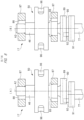
- the second example of the conversion unit 17 is shown FIG. 6(A), FIG. 6(B) , FIG. 7(A), FIG. 7(B) , FIG. 8(A), and FIG. 8(B) .
- the rotating shaft 46 is rotatably supported by two support portions 87.
- the two support portions 87 are fixed to the ejection unit, and the two support portions 87 each have a non-circular support hole 88.
- the two support portions 87 are arranged at intervals in the direction of the center line A2.
- a part of the rotating shaft 46 in the longitudinal direction is arranged in each of the two support holes 88.
- the rotating shaft 46 can move in the two support holes 88 in the direction intersecting the center line A2.
- the rotating shaft 46 has a boss portion 89, and the boss portion 89 has a linear groove 90 passing through the center line A2.
- the output element 77 has a boss portion 91, and the boss portion 91 has a pin 92.
- the pin 92 is provided at a position eccentric from the center line A2.
- the tip of the pin 92 is arranged in the groove 90.
- a positioning member 93 is provided in the tubular portion 33.
- the positioning member 93 can be elastically deformed.
- the positioning member 93 is, for example, a metal leaf spring, and both ends of the positioning member 93 are held by the tubular portion 33.
- the positioning member 93 does not move in either the direction intersecting the center line A1 or the direction of the center line A1.
- the positioning member 93 has a preventive portion 94 protruding toward the rotating shaft 46.
- the positioning member 93 is pressed to the outer peripheral surface of the rotating shaft 46.
- the positioning member 93 is elastically deformed and the rotating shaft 46 gets over the preventive portion 94, so that the rotating shaft 46 can move in the support hole 88.
- the wheel 50 has a plurality of pins 96 arranged on the same circumference centered about the rotating shaft 46.
- the plurality of pins 96 are made of, for example, metal and are fixed to the wheel 50, respectively.
- the plurality of pins 96 are arranged at equal intervals in the rotation direction of the wheel 50.
- the number of the plurality of pins 96 is larger than the number of the protrusions 85.
- the driver blade 29 has a biasing portion 97.
- the biasing portion 97 is provided between the protrusion 85 provided at the position closest to the tip of the driver blade 29 in the direction of the center line A1 among the plurality of protrusions 85 and the tip of the driver blade 29.
- the biasing portion 97 is a flat surface along the direction of the center line A1. Note that the tips of the plurality of protrusions 85 are curved.
- the rotating shaft 46 and the wheel 50 are stopped at the initial position as shown in FIG. 6(A) . Namely, the rotating shaft 46 and the wheel 50 are stopped at the position closest to the driver blade 29 in the direction intersecting the center line A2. Further, all the pins 96 are separated from the return portion 95.
- the pin 96 is separated from the return portion 95, any pin 96 moves into the actuation region of the protrusion 85, and the control unit stops the electric motor. Accordingly, the striking unit 12 is stopped at the bottom dead center.
- the wheel 50 moves in the direction away from the driver blade 29 together with the rotating shaft 46 in the process where the pin 96 is separated from the protrusion 85. Accordingly, the abrasion of at least one of the pin 96 and the driver blade 29 can be reduced, and the life of at least one of the pin 96 and the driver blade 29 can be improved.
- the pin 96 that receives the actuation force of the striking unit 12 at the time when the striking unit 12 reaches the top dead center is changed every time when the striking unit 12 is actuated from the bottom dead center to the top dead center. Therefore, the maximum load corresponding to the actuation force of the striking unit 12 can be dispersed to different pins 96. Accordingly, the life of the pins 96 is further improved.
- FIG. 9 shows a modification of the second example of the conversion unit 17 provided in the striking unit 10.
- the number of pins 96 provided on the wheel 50 is smaller than the number of protrusions 85 provided on the driver blade 29.
- the function and effect of the conversion unit 17 shown in FIG. 9 are the same as the function and effect of the conversion unit 17 shown in FIG. 6(A), FIG. 6(B) , FIG. 7(A), and FIG. 7(B) .
- the number of pins 96 provided on the wheel 50 is smaller than the number of protrusions 85 provided on the driver blade 29, and thus, the increase in the diameter of the wheel 50 can be suppressed. Therefore, it is possible to achieve the reduction in size and weight of the driving tool 10 shown in FIG. 1 .
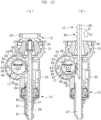
- FIG. 10(A) is another modification of the second example of the conversion unit 17.
- a plurality of tooth portions 98 are provided on the outer peripheral surface of the wheel 50.
- the tooth portions 98 and the wheel 50 are integrally made of a metal material.
- the plurality of tooth portions 98 are provided at equal intervals in the rotation direction of the wheel 50.
- the number of tooth portions 98 is larger than the number of protrusions 85.
- the other configuration of the conversion unit 17 shown in FIG. 10(A) is the same as the configuration of the conversion unit 17 shown in FIG. 6(A) .
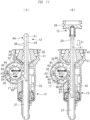
- the striking unit 12 is actuated from the top dead center to the bottom dead center by the pressure of the pressure chamber 26 as shown in FIG. 11(B) . Also, the tooth portion 98 is pressed to the return portion 95, the rotating shaft 46 is moved in the support hole 88 by the reaction force thereof from the actuated position, and the rotating shaft 46 returns to the initial position and is stopped there.
- the control unit 67 stops the electric motor 15 after the striking unit 12 reaches the bottom dead center.
- the conversion unit 17 shown in FIG. 10(A) can obtain the same effect as the conversion unit 17 shown in FIG. 6(A) .
- the number of tooth portions 98 provided on the wheel 50 may be smaller than the number of protrusions 85.
- FIG. 12(A) shows the third example of the conversion unit 17.
- Pins 103 are provided on the wheel 50.
- a plurality of the pins 103 are arranged at intervals in the rotation direction of the wheel 50.
- the pins 103 are arranged within a range of a predetermined angle, for example, 270 degrees in the rotation direction of the wheel 50.
- a guide hole 104 is provided in the wheel 50.
- the guide hole 104 is arranged outside the angle range in which the pins 103 are arranged in the rotation direction of the wheel 50.
- the guide hole 104 is arranged in the radial direction of the wheel 50.
- a movable pin 105 is attached to the wheel 50.
- the movable pin 105 is made of, for example, metal.
- the movable pin 105 can be actuated in the guide hole 104 in the radial direction of the wheel 50.
- a part of the movable pin 105 in the longitudinal direction is located outside the arrangement range of the wheel 50 in the direction of the center line A2.
- a biasing member 110 shown in FIG. 14 (A) is provided, and the biasing member 110 biases the movable pin 105 to the outer side in the radial direction of the wheel 50.
- the biasing member 110 is, for example, a metal compression spring.
- a pin holder 106 is attached to the wheel 50.
- the pin holder 106 is made of, for example, metal.
- the pin holder 106 is arranged outside the angle range in which the pins 103 are arranged in the rotation direction of the wheel 50.
- the pin holder 106 is arranged outside the arrangement range of the wheel 50 in the direction of the center line A2 and outside the actuation range of the driver blade 29.
- the pin holder 106 can be actuated within a predetermined angle range about a support shaft 107.
- the pin holder 106 has a hook 108.
- a stopper 109 is provided between the guide hole 104 and the pin holder 106.
- a biasing member 111 shown in FIG. 14(A) is provided, and the biasing member 111 biases the pin holder 106 counterclockwise in FIG. 12(A) .
- the biasing member 111 is, for example, a metal compression spring. The biasing force of the biasing member 111 is smaller than the biasing force of the biasing member 110.
- a return portion 112 protruding from the inner surface of the tubular portion 33 is provided.
- the return portion 112 is separated from the outer peripheral surface of the wheel 50.
- the control unit 67 stops the electric motor 15, and the striking unit 12 is stopped at the standby position shown in FIG. 1 .
- the movable pin 105 is biased by the biasing member 110, and the movable pin 105 is stopped by being held by the hook 108. Namely, the movable pin 105 is not engaged with the protrusion 85.
- the pin holder 106 is stopped by coming into contact with the stopper 109.
- the plurality of pins 103 are individually engaged with and released from the protrusions 85.
- the movable pin 105 is engaged with the protrusion 85 before all the pins 103 are released from the protrusions 85.
- the pin holder 106 is actuated counterclockwise by the biasing force of the biasing member 111, and the pin holder 106 is stopped by coming into contact with the stopper 109. Therefore, when the movable pin 105 is actuated toward the initial position by the biasing force of the biasing member 110 and the reaction generated by the collision of the movable pin 105 to the inner wall surface of the guide hole 104, the hook 108 supports the movable pin 105 as shown in FIG. 13(B) . Namely, the hook 108 prevents the movable pin 105 from colliding with the protrusion 85.
- the striking unit 12 is actuated in the first direction D1 by the pressure of the pressure chamber 26, that is, moves downward, and the striking unit 12 reaches the bottom dead center.
- the control unit 67 stops the electric motor 15 after the striking unit 12 reaches the bottom dead center.
- the operation in which the movable pin 105 engaged with the protrusion 85 is released from the protrusion 85 will be described with reference to FIG. 14(A) and FIG. 14(B) .
- a load F1 is applied to a contact position P1 between the protrusion 85 and the movable pin 105.
- the load F1 is parallel to the first direction D1.
- the movable pin 105 receives component forces F2 and F3 of the load F1.
- the component force F2 is a component in the longitudinal direction of the guide hole 104
- the component force F3 is a component in the direction perpendicular to the longitudinal direction of the guide hole 104.
- the movable pin 105 When the component force F2 is directed so as to bring the movable pin 105 closer to the driver blade 29 as shown in FIG. 14(A) , the movable pin 105 is stopped at the initial position. Namely, the movable pin 105 is engaged with the protrusion 85, and the rotational force of the wheel 50 is transmitted to the protrusion 85 via the movable pin 105.
- a load F4 is applied to the movable pin 105 in response to the load F1.
- the movable pin 105 receives component forces F21 and 31 of the load F4.
- the component force F21 is a component in the longitudinal direction of the guide hole 104
- the component force F31 is a component in the direction perpendicular to the longitudinal direction of the guide hole 104.
- the component force F21 is in the direction away from the driver blade 29. Therefore, the movable pin 105 is actuated from the initial position against the biasing force of the biasing member 110, and the movable pin 105 is separated, that is, released from the protrusion 85.
- the movable pin 105 is actuated from the initial position by the component force F21 of the load F4 applied from the protrusion 85 to the movable pin 105. Namely, the movable pin 105 moves to the outside of the actuation region of the protrusion 85, and the movable pin 105 is released from the protrusion 85. Therefore, it is possible to suppress the increase in the frictional force at the contact position P1 between the movable pin 105 and the protrusion 85 in the process of releasing the movable pin 105 from the protrusion 85. Accordingly, the abrasion of at least one of the movable pin 105 and the protrusion 85 can be reduced, and the product life of at least one of the movable pin 105 and the driver blade 29 can be improved.
- the movable pin 105 is designed to be independently attachable and detachable with respect to the wheel 50, what is required when the movable pin 105 is worn out is just to exchange the movable pin 105, and it is not necessary to exchange the overall wheel 50.
- the hook 108 supports the movable pin 105, it is possible to prevent the movable pin 105 from colliding with the protrusion 85, and the durability of the protrusion 85 and the movable pin 105 can be improved.
- the standby position of the striking unit may be a state where the piston 28 is separated from the bumper 35.
- the first direction D1 is an example of a first direction
- the second direction D2 is an example of a second direction
- the striking unit 12 is an example of a striking unit.
- the nail 59 is an example of a fastener.
- the rack 84 is an example of a first transmission portion.
- the movement in an arc shape about the center line A2 is an example of rotation in a predetermined direction.
- the tooth portion 78, the pins 96 and 103, the movable piece 79, and the movable pin 105 are examples of a second transmission portion.
- the tooth portion 78 and the pin 103 are examples of a first engaging portion.
- the engaging portion 81 of the movable piece 79 and the movable pin 105 are examples of a second engaging portion.
- the pin 96 that is engaged with and released from the protrusion 85 in the state where the pin 96 is not pressed to the biasing portion 97 in FIG. 6(A), FIG. 6(B) , FIG. 7(A), FIG. 7(B) , and FIG. 9 is an example of a first engaging portion.
- the pin 96 that is engaged with and released from the protrusion 85 in the state where the pin 96 is pressed to the biasing portion 97 is an example of a second engaging portion.
- the tooth portion 98 that is engaged with and released from the protrusion 85 in the state where the tooth portion 98 is not pressed to the biasing portion 97 in FIG. 10(A) is an example of a first engaging portion.
- the tooth portion 98 that is engaged with and released from the protrusion 85 in the state where the tooth portion 98 is pressed to the biasing portion 97 in FIG. 10(B) is an example of a second engaging portion.
- the direction in which the engaging portion 81 of the movable piece 79 shown in FIG. 4(A) and FIG. 4(B) is actuated toward the inner side in the radial direction of the wheel 50 is an example of a different direction.
- the direction in which the pin 96 is actuated in the direction away from the driver blade 29 by actuating the wheel 50 and the rotating shaft 46 along the support hole 88 as shown in FIG. 7(A) is an example of a different direction.
- the direction in which the pin 96 is actuated in the direction away from the driver blade 29 by actuating the wheel 50 and the rotating shaft 46 along the support hole 88 as shown in FIG. 9 is an example of a different direction.
- the direction in which the tooth portion 98 is actuated in the direction away from the driver blade 29 by actuating the wheel 50 and the rotating shaft 46 along the support hole 88 as shown in FIG. 11(A) is an example of a different direction.
- the direction in which the movable pin 105 is actuated in the guide hole 104 toward the inner side of the wheel as shown in FIG. 13(A) is an example of a different direction.
- the position where the contact portion 82 is in contact with the outer peripheral surface of the guide portion 83 and the engaging portion 81 can be engaged with the protrusion 85 as shown in FIG. 3(B) is an example of an initial position.
- the position where the rotating shaft 46 is at the initial position and the pin 96 can be engaged with the protrusion 85 as shown in FIG. 6(A) is an example of an initial position.
- the position where the rotating shaft 46 is at the initial position and the pin 96 can be engaged with the protrusion 85 as shown in FIG. 9 is an example of an initial position.
- the position where the rotating shaft 46 is at the initial position and the tooth portion 98 can be engaged with the protrusion 85 as shown in FIG. 10(A) is an example of an initial position.
- the position where the movable pin 105 is biased by the biasing member 110 and is stopped at the outermost side of the wheel 50 as shown in FIG. 12(A) is an example of an initial position.
- the guide portion 83, the return portion 95, and the biasing member 110 are examples of a return mechanism.
- the return portions 95 and 112 are examples of an overhanging portion.
- the tubular portion 33 is an example of a case.
- the tooth portions 78 and 98 are examples of a tooth portion.
- the pin 96 and the movable pin 105 are examples of a pin.
- the support shaft 80 is an example of a support shaft.
- the wheel 50 is an example of a rotating member.
- the biasing portion 97 is an example of a load receiving portion.
- the positioning member 93 is an example of a first stopper.
- the guide hole 104 is an example of a guide portion.
- the pin holder 106 is an example of a second stopper.
- the second engaging portion is engaged with the first transmission member in the state where the rotating member is being rotated in one direction, and the second engaging portion is released from the first transmission member by actuating the second engaging portion in a different direction in the state where the rotating member is being rotated in one direction.
- the standby position of the striking unit may be a position where the piston 28 is separated from the bumper 35.
- the rotation preventive mechanism 53 prevents the rotation of the wheel 50, and the striking unit 12 is stopped at the standby position.
- a biasing member for biasing the movable piece 79 clockwise in the conversion unit 17 shown in FIG. 3 (A), FIG. 3(B) , FIG. 4(A), and FIG. 4(B) .
- the contact portion 82 is separated from the guide portion 83
- the movable piece 79 is actuated clockwise from the initial position by the biasing force of the biasing member, and the engaging portion 81 is released from the protrusion 85.
- the first transmission portion provided on the driver blade 29 shown in FIG. 3(A), FIG. 3(B) , FIG. 4(A), and FIG. 4 (B) may be a plurality of pins attached to the driver blade 29 at intervals in the direction of the center line A1. Then, when the wheel 50 is rotated, the tooth portions 78 can be individually engaged with and released from the pins. Further, the engaging portion 81 can be engaged with and released from the pin. Further, the movable piece 79 is actuated clockwise by the load applied from the pin to the engaging portion 81, and the engaging portion 81 is released from the pin.
- the support hole 88 is a guide portion that restricts the actuation direction of the rotating shaft 46 to a different direction
- examples of the guide portion that restricts the actuation direction of the rotating shaft 46 to a different direction include a groove, a rail, and a notch in addition to the hole.
- the guide hole 104 is a guide portion that restricts the actuation direction of the movable pin 105 to a different direction, and examples of the guide portion that restricts the actuation direction of the movable pin 105 to a different direction include a groove, a rail, and a notch in addition to the hole.
- the actuation direction is a different direction is an actuation direction in the plane perpendicular to the center line A2 of the rotating shaft 46.
- the biasing mechanism for actuating the striking unit in the first direction may be a solid spring, synthetic rubber, or a magnetic spring in addition to the pressure chamber in which compressible gas is filled.
- the solid spring include a metal compression spring and a tension spring.
- the solid spring and the synthetic rubber actuate the striking unit in the first direction by the elastic restoring force.
- the magnetic spring actuates the striking unit in the first direction by the repulsive force between the magnets having the same polarity.
- the power source unit that applies a voltage to the electric motor 15 may be either a DC power source or an AC power source.
- the motor for actuating the striking unit in the second direction any one of a hydraulic motor, a pneumatic motor, and an engine can be used instead of the electric motor.
- the shape and structure of the first transmission portion and the second transmission portion are not particularly limited as long as they can be engaged with and released from each other.
- the first transmission portion and the second transmission portion can be formed by combining recesses, grooves, claws, and the like in addition to gears, pins, protrusions, and racks.
- Examples of the rotating member include a gear, a pulley, a rotating shaft, a drum, a cylindrical member, and the like in addition to the wheel.
- the first configuration includes a striking unit capable of being actuated in a first direction and a second direction opposite to the first direction and capable of striking a fastener by being actuated in the first direction, a biasing mechanism configured to actuate the striking unit in the first direction, a housing configured to support the striking unit, a motor supported by the housing, a rotating member configured to be rotated in a predetermined direction by a rotational force of the motor, a first transmission portion provided on the striking unit, and a second transmission portion provided on the rotating member and capable of being engaged with and released from the first transmission portion, wherein when the rotating member is rotated and the second transmission portion is engaged with the first transmission portion, the striking unit is actuated in the second direction against a force of a biasing mechanism, and when the second transmission portion is released from the first transmission portion, the striking unit is actuated in the second direction by the force of the biasing mechanism.
- the second configuration is that the motor in the first configuration is an electric motor configured to be rotated by applying a voltage, and a power source unit configured to apply the voltage to the electric motor is provided in the housing.
Landscapes
- Engineering & Computer Science (AREA)
- Mechanical Engineering (AREA)
- Physics & Mathematics (AREA)
- Fluid Mechanics (AREA)
- Portable Nailing Machines And Staplers (AREA)
Claims (10)
- Eintreibgerät umfassend:eine Schlageinheit (12), die in eine erste Richtung (D1) und eine zweite Richtung (D2) entgegengesetzt zur ersten Richtung betätigt werden kannund in der Lage ist, auf ein Befestigungsmittel zu schlagen, indem es in der ersten Richtung betätigt wird;einen ersten Übertragungsabschnitt (84), der an der Schlageinheit vorgesehen ist;ein Drehelement (50), das konfiguriert ist, dass es in eine vorbestimmte Richtung gedreht werden kann; undeinen zweiten Übertragungsabschnitt (78), der an dem Drehelement vorgesehen ist und mit dem ersten Übertragungsabschnitt in Eingriff gebracht und von diesem gelöst werden kann,wobei die Schlageinheit in der zweiten Richtung betätigt werden kann, wenn der zweite Übertragungsabschnitt mit dem ersten Übertragungsabschnitt in Eingriff steht, und die Schlageinheit in der ersten Richtung betätigt werden kann, wenn der zweite Übertragungsabschnitt von dem ersten Übertragungsabschnitt gelöst ist,dadurch gekennzeichnet, dass der zweite Übertragungsabschnitt Folgendes aufweist:einen ersten Eingriffsabschnitt (81), der entlang einer Drehrichtung des Drehelements angeordnet ist und in eine vorbestimmte Richtung gedreht wird, um mit dem ersten Übertragungsabschnitt in Eingriff zu kommen, wodurch die Schlageinheit in der zweiten Richtung betätigt wird; undeinen zweiten Eingriffsabschnitt (82), der in der vorbestimmten Richtung betätigt wird, um mit dem ersten Übertragungsabschnitt in Eingriff zu kommen, und der in einer anderen Richtung als der vorbestimmten Richtung betätigt wird, um von dem ersten Übertragungsabschnitt gelöst zu werden, undwobei der zweite Eingriffsabschnitt von dem ersten Übertragungsabschnitt gelöst wird, indem er in der unterschiedlichen Richtung von einer Anfangsposition durch eine Last betätigt wird, die von dem ersten Übertragungsabschnitt als eine Reaktionskraft einer Drehkraft empfangen wird, um das Drehelement in der vorbestimmten Richtung in einem Zustand zu drehen, in dem es in Kontakt mit dem ersten Übertragungsabschnitt ist, und ein Rückstellmechanismus, der so konfiguriert ist, dass er den zweiten Eingriffsabschnitt, der von dem ersten Übertragungsabschnitt gelöst ist, in eine Anfangsposition zurückführt, vorgesehen ist.
- Eintreibgerät nach Anspruch 1 ferner umfassend ein Gehäuse, das zum Lagern des Drehelements konfiguriert ist,
wobei der Rückstellmechanismus ein überhängender Abschnitt ist, der an einer Innenfläche des Gehäuses vorgesehen ist. - Eintreibgerät nach Anspruch 1 oder 2,
wobei der zweite Eingriffsabschnitt ein Stift oder ein Zahnabschnitt ist. - Eintreibgerät nach Anspruch 1,
wobei der zweite Eingriffsabschnitt um eine Stützwelle in Bezug auf das Drehelement gedreht werden kann und der zweite Eingriffsabschnitt in der anderen Richtung um die Stützwelle betätigt wird, um von dem ersten Übertragungsabschnitt gelöst zu werden. - Eintreibgerät nach einem der Ansprüche 1 bis 3,
wobei das Drehelement in einer Richtung zu dem ersten Übertragungsabschnitt und in einer Richtung von dem ersten Übertragungsabschnitt weg betätigt werden kann, und
wobei, wenn das Drehelement in der Richtung weg von dem ersten Übertragungsabschnitt betätigt wird, der zweite Eingriffsabschnitt in der anderen Richtung betätigt wird und der zweite Eingriffsabschnitt von dem ersten Übertragungsabschnitt gelöst wird. - Eintreibgerät nach Anspruch 5,wobei die Schlageinheit einen Lastaufnahmeabschnitt aufweist, an den der erste Eingriffsabschnitt gedrückt wird, undwobei das Drehelement durch eine Reaktionskraft des ersten Eingriffsabschnitts, der auf den Lastaufnahmeabschnitt gedrückt wird, in der Richtung weg von dem ersten Übertragungsabschnitt betätigt wird.
- Eintreibgerät nach Anspruch 5 oder 6, das ferner einen ersten Stopper umfasst, der konfiguriert ist, um zu verhindern, dass das Drehelement in Richtung des ersten Übertragungsabschnitts betätigt wird, nachdem das Drehelement in Richtung weg von dem ersten Übertragungsabschnitt betätigt worden ist.
- Eintreibgerät nach Anspruch 1,
wobei das Drehelement mit einem Führungsabschnitt versehen ist und der zweite Eingriffsabschnitt in der unterschiedlichen Richtung entlang des Führungsabschnitts betätigt werden kann. - Eintreibgerät nach Anspruch 8, das ferner einen zweiten Stopper umfasst, der so konfiguriert ist, dass er verhindert, dass der zweite Eingriffsabschnitt in eine Position zurückkehrt, in der er mit dem ersten Übertragungsabschnitt in Eingriff steht, nachdem der zweite Eingriffsabschnitt in der anderen Richtung betätigt wurde.
- Eintreibgerät umfassend:eine Schlageinheit (12), die in einer ersten Richtung (D1) und einer zweiten Richtung (D2), die der ersten Richtung entgegengesetzt ist, betätigt werden kann und ein Befestigungsmittel durch Betätigung in der ersten Richtung schlagen kann;einen ersten Übertragungsabschnitt (84), der an der Schlageinheit vorgesehen ist;ein Drehelement (50), das konfiguriert ist, dass es in eine vorbestimmte Richtung gedreht werden kann; undeinen zweiten Übertragungsabschnitt (78), der an dem Drehelement vorgesehen ist und mit dem ersten Übertragungsabschnitt in Eingriff gebracht und von diesem gelöst werden kann,wobei die Schlageinheit in der zweiten Richtung betätigt werden kann, wenn der zweite Übertragungsabschnitt mit dem ersten Übertragungsabschnitt in Eingriff steht, und die Schlageinheit in der ersten Richtung betätigt werden kann, wenn der zweite Übertragungsabschnitt von dem ersten Übertragungsabschnitt gelöst ist,wobei der zweite Übertragungsabschnitt so vorgesehen ist, dass er zwischen einer Ausgangsposition und einer betätigten Position betätigt werden kann, und der zweite Übertragungsabschnitt konfiguriert ist, um sich durch ein an der Schlageinheit vorgesehenes Vorspannelement von der Ausgangsposition in die betätigte Position zu bewegen,dadurch gekennzeichnet, dasseine Fronteinheit mit einem Rückführungsabschnitt ferner vorgesehen ist, undwobei sich der zweite Übertragungsabschnitt durch den Rückführungsabschnitt in die Ausgangsposition bewegt, nachdem sich der zweite Übertragungsabschnitt in die betätigte Position bewegt hat.
Applications Claiming Priority (2)
| Application Number | Priority Date | Filing Date | Title |
|---|---|---|---|
| JP2018176893 | 2018-09-21 | ||
| PCT/JP2019/036146 WO2020059666A1 (ja) | 2018-09-21 | 2019-09-13 | 打込機 |
Publications (4)
| Publication Number | Publication Date |
|---|---|
| EP3854530A1 EP3854530A1 (de) | 2021-07-28 |
| EP3854530A4 EP3854530A4 (de) | 2021-12-29 |
| EP3854530B1 true EP3854530B1 (de) | 2023-04-12 |
| EP3854530B8 EP3854530B8 (de) | 2023-05-17 |
Family
ID=69887392
Family Applications (1)
| Application Number | Title | Priority Date | Filing Date |
|---|---|---|---|
| EP19861758.1A Active EP3854530B8 (de) | 2018-09-21 | 2019-09-13 | Antriebsmaschine |
Country Status (6)
| Country | Link |
|---|---|
| US (2) | US11926027B2 (de) |
| EP (1) | EP3854530B8 (de) |
| JP (1) | JP7120316B2 (de) |
| CN (1) | CN112584978B (de) |
| TW (1) | TWI833787B (de) |
| WO (1) | WO2020059666A1 (de) |
Families Citing this family (21)
| Publication number | Priority date | Publication date | Assignee | Title |
|---|---|---|---|---|
| CN107708934B (zh) * | 2015-06-10 | 2022-01-11 | 工机控股株式会社 | 打入机 |
| CN110450108A (zh) * | 2018-05-08 | 2019-11-15 | 创科(澳门离岸商业服务)有限公司 | 气动工具 |
| US12179326B2 (en) | 2019-06-14 | 2024-12-31 | Milwaukee Electric Tool Corporation | Lifter mechanism for a powered fastener driver |
| CN217394880U (zh) * | 2019-06-14 | 2022-09-09 | 米沃奇电动工具公司 | 动力紧固件驱动器 |
| US12479074B2 (en) | 2019-06-14 | 2025-11-25 | Milwaukee Electric Tool Corporation | Lifter mechanism for a powered fastener driver |
| US11951601B2 (en) | 2019-06-14 | 2024-04-09 | Milwaukee Electric Tool Corporation | Lifter mechanism for a powered fastener driver |
| CN113070849B (zh) * | 2020-01-06 | 2024-07-19 | 朱益民 | 一种打钉工具 |
| WO2021195188A1 (en) | 2020-03-25 | 2021-09-30 | Milwaukee Electric Tool Corporation | Powered fastener driver |
| US11772250B2 (en) * | 2020-04-16 | 2023-10-03 | Nanjing Chervon Industry Co., Ltd. | Nail gun |
| CN114248234B (zh) * | 2020-09-21 | 2024-04-05 | 重庆弘愿工具(集团)有限公司 | 一种打钉工具 |
| US12162125B2 (en) | 2020-10-30 | 2024-12-10 | Milwaukee Electric Tool Corporation | Powered fastener driver |
| CN115229735B (zh) * | 2021-04-25 | 2024-08-06 | 重庆弘愿工具(集团)有限公司 | 一种紧固件驱动工具 |
| TWI762323B (zh) * | 2021-05-20 | 2022-04-21 | 鑽全實業股份有限公司 | 具有防誤擊作用的飛輪式電動釘槍及其擊釘裝置 |
| JP7760322B2 (ja) * | 2021-05-20 | 2025-10-27 | 株式会社マキタ | 打ち込み工具 |
| CN115366050A (zh) * | 2021-05-20 | 2022-11-22 | 株式会社牧田 | 打入工具 |
| JP7709360B2 (ja) | 2021-10-26 | 2025-07-16 | 株式会社マキタ | 打ち込み工具 |
| DE112023000460T5 (de) * | 2022-01-25 | 2024-10-24 | Milwaukee Electric Tool Corporation | Hebevorrichtungsmechanismus für einen elektrisch betriebenen befestigungsmitteleintreiber |
| US12251807B2 (en) | 2022-05-13 | 2025-03-18 | Makita Corporation | Driving tools |
| CN116061135A (zh) * | 2023-01-13 | 2023-05-05 | 乐清市中创工具有限公司 | 一种电动钉枪的枪针驱动机构 |
| JP2025084263A (ja) * | 2023-11-22 | 2025-06-03 | 株式会社マキタ | 打ち込み工具 |
| JP2025091962A (ja) * | 2023-12-08 | 2025-06-19 | 株式会社マキタ | 電動工具 |
Family Cites Families (22)
| Publication number | Priority date | Publication date | Assignee | Title |
|---|---|---|---|---|
| CN101367206B (zh) * | 2007-08-14 | 2010-06-02 | 南京德朔实业有限公司 | 打钉枪 |
| US8763874B2 (en) * | 2007-10-05 | 2014-07-01 | Senco Brands, Inc. | Gas spring fastener driving tool with improved lifter and latch mechanisms |
| JP5424009B2 (ja) * | 2008-01-15 | 2014-02-26 | 日立工機株式会社 | 留め具打込機 |
| EP3028817B1 (de) * | 2013-07-31 | 2019-03-20 | Koki Holdings Co., Ltd. | Eintreibmaschine |
| WO2015182508A1 (ja) * | 2014-05-30 | 2015-12-03 | 日立工機株式会社 | 打込機 |
| TWI671169B (zh) * | 2014-06-30 | 2019-09-11 | 日商工機控股股份有限公司 | 打釘機 |
| WO2016127101A1 (en) * | 2015-02-06 | 2016-08-11 | Milwaukee Electric Tool Corporation | Gas spring-powered fastener driver |
| NZ735578A (en) * | 2015-03-30 | 2019-03-29 | Senco Brands Inc | Lift mechanism for framing nailer |
| WO2016158131A1 (ja) * | 2015-03-31 | 2016-10-06 | 日立工機株式会社 | 電動工具 |
| CN107708934B (zh) * | 2015-06-10 | 2022-01-11 | 工机控股株式会社 | 打入机 |
| CN105818099B (zh) * | 2016-05-26 | 2017-11-17 | 杭州科龙电器工具股份有限公司 | 使用气弹簧的电动钉枪 |
| JP6794663B2 (ja) * | 2016-06-02 | 2020-12-02 | 工機ホールディングス株式会社 | 打込機 |
| CN108068059B (zh) * | 2016-11-09 | 2022-07-08 | 创科无线普通合伙 | 气弹簧紧固件驱动器的卡塞释放和升降器机构 |
| EP3603891B1 (de) * | 2017-03-29 | 2023-04-26 | Koki Holdings Co., Ltd. | Antriebsmaschine |
| CN206952919U (zh) * | 2017-05-03 | 2018-02-02 | 昆山汉升达传动科技有限公司 | 电动钉枪 |
| TWI744560B (zh) * | 2017-11-02 | 2021-11-01 | 鑽全實業股份有限公司 | 氣壓式釘槍及其撞針裝置 |
| NZ768772A (en) * | 2018-04-20 | 2022-09-30 | Kyocera Senco Industrial Tools Inc | Improved lift mechanism for framing nailer |
| CN110450108A (zh) * | 2018-05-08 | 2019-11-15 | 创科(澳门离岸商业服务)有限公司 | 气动工具 |
| US12427634B2 (en) * | 2018-06-11 | 2025-09-30 | Milwaukee Electric Tool Corporation | Gas spring-powered fastener driver |
| US11498194B2 (en) * | 2018-11-27 | 2022-11-15 | Milwaukee Electric Tool Corporation | Lifter assembly for a powered fastener driver |
| TW202039176A (zh) * | 2019-04-25 | 2020-11-01 | 鑽全實業股份有限公司 | 氣壓式釘槍及其舉升輪 |
| CN115229735B (zh) * | 2021-04-25 | 2024-08-06 | 重庆弘愿工具(集团)有限公司 | 一种紧固件驱动工具 |
-
2019
- 2019-08-12 TW TW108128474A patent/TWI833787B/zh active
- 2019-09-13 JP JP2020548468A patent/JP7120316B2/ja active Active
- 2019-09-13 WO PCT/JP2019/036146 patent/WO2020059666A1/ja not_active Ceased
- 2019-09-13 US US17/270,183 patent/US11926027B2/en active Active
- 2019-09-13 CN CN201980054576.7A patent/CN112584978B/zh active Active
- 2019-09-13 EP EP19861758.1A patent/EP3854530B8/de active Active
-
2024
- 2024-03-08 US US18/599,352 patent/US12594655B2/en active Active
Also Published As
| Publication number | Publication date |
|---|---|
| JP7120316B2 (ja) | 2022-08-17 |
| EP3854530A1 (de) | 2021-07-28 |
| US12594655B2 (en) | 2026-04-07 |
| EP3854530A4 (de) | 2021-12-29 |
| US11926027B2 (en) | 2024-03-12 |
| EP3854530B8 (de) | 2023-05-17 |
| US20240208021A1 (en) | 2024-06-27 |
| TWI833787B (zh) | 2024-03-01 |
| WO2020059666A1 (ja) | 2020-03-26 |
| US20210308852A1 (en) | 2021-10-07 |
| JPWO2020059666A1 (ja) | 2021-08-30 |
| TW202012123A (zh) | 2020-04-01 |
| CN112584978A (zh) | 2021-03-30 |
| CN112584978B (zh) | 2024-11-01 |
Similar Documents
| Publication | Publication Date | Title |
|---|---|---|
| US12594655B2 (en) | Driving tool with rotating member to move striking unit | |
| US12269150B2 (en) | Driving device | |
| JP7081595B2 (ja) | 打込機 | |
| EP3915731B1 (de) | Antriebsmaschine | |
| JP7115544B2 (ja) | 打込機 | |
| EP3549722B1 (de) | Treiber | |
| US12377528B2 (en) | Driving device | |
| CN107708934B (zh) | 打入机 | |
| JP2018034258A (ja) | 打込機 | |
| JP7359219B2 (ja) | 打込機 | |
| JP6766727B2 (ja) | 打込機 | |
| JP2018043294A (ja) | 打込機 | |
| JP7413856B2 (ja) | 作業機 | |
| JP7115260B2 (ja) | 打込機 |
Legal Events
| Date | Code | Title | Description |
|---|---|---|---|
| STAA | Information on the status of an ep patent application or granted ep patent |
Free format text: STATUS: THE INTERNATIONAL PUBLICATION HAS BEEN MADE |
|
| PUAI | Public reference made under article 153(3) epc to a published international application that has entered the european phase |
Free format text: ORIGINAL CODE: 0009012 |
|
| STAA | Information on the status of an ep patent application or granted ep patent |
Free format text: STATUS: REQUEST FOR EXAMINATION WAS MADE |
|
| 17P | Request for examination filed |
Effective date: 20210223 |
|
| AK | Designated contracting states |
Kind code of ref document: A1 Designated state(s): AL AT BE BG CH CY CZ DE DK EE ES FI FR GB GR HR HU IE IS IT LI LT LU LV MC MK MT NL NO PL PT RO RS SE SI SK SM TR |
|
| A4 | Supplementary search report drawn up and despatched |
Effective date: 20211125 |
|
| DAV | Request for validation of the european patent (deleted) | ||
| DAX | Request for extension of the european patent (deleted) | ||
| RIC1 | Information provided on ipc code assigned before grant |
Ipc: B25C 1/04 20060101ALI20211119BHEP Ipc: B25C 1/06 20060101AFI20211119BHEP |
|
| GRAP | Despatch of communication of intention to grant a patent |
Free format text: ORIGINAL CODE: EPIDOSNIGR1 |
|
| STAA | Information on the status of an ep patent application or granted ep patent |
Free format text: STATUS: GRANT OF PATENT IS INTENDED |
|
| INTG | Intention to grant announced |
Effective date: 20221021 |
|
| GRAS | Grant fee paid |
Free format text: ORIGINAL CODE: EPIDOSNIGR3 |
|
| GRAA | (expected) grant |
Free format text: ORIGINAL CODE: 0009210 |
|
| STAA | Information on the status of an ep patent application or granted ep patent |
Free format text: STATUS: THE PATENT HAS BEEN GRANTED |
|
| AK | Designated contracting states |
Kind code of ref document: B1 Designated state(s): AL AT BE BG CH CY CZ DE DK EE ES FI FR GB GR HR HU IE IS IT LI LT LU LV MC MK MT NL NO PL PT RO RS SE SI SK SM TR |
|
| REG | Reference to a national code |
Ref country code: GB Ref legal event code: FG4D |
|
| REG | Reference to a national code |
Ref country code: CH Ref legal event code: EP |
|
| REG | Reference to a national code |
Ref country code: DE Ref legal event code: R096 Ref document number: 602019027560 Country of ref document: DE |
|
| REG | Reference to a national code |
Ref country code: CH Ref legal event code: PK Free format text: BERICHTIGUNG B8 |
|
| REG | Reference to a national code |
Ref country code: IE Ref legal event code: FG4D |
|
| REG | Reference to a national code |
Ref country code: AT Ref legal event code: REF Ref document number: 1559508 Country of ref document: AT Kind code of ref document: T Effective date: 20230515 |
|
| REG | Reference to a national code |
Ref country code: LT Ref legal event code: MG9D |
|
| REG | Reference to a national code |
Ref country code: NL Ref legal event code: MP Effective date: 20230412 |
|
| REG | Reference to a national code |
Ref country code: AT Ref legal event code: MK05 Ref document number: 1559508 Country of ref document: AT Kind code of ref document: T Effective date: 20230412 |
|
| PG25 | Lapsed in a contracting state [announced via postgrant information from national office to epo] |
Ref country code: NL Free format text: LAPSE BECAUSE OF FAILURE TO SUBMIT A TRANSLATION OF THE DESCRIPTION OR TO PAY THE FEE WITHIN THE PRESCRIBED TIME-LIMIT Effective date: 20230412 |
|
| PG25 | Lapsed in a contracting state [announced via postgrant information from national office to epo] |
Ref country code: SE Free format text: LAPSE BECAUSE OF FAILURE TO SUBMIT A TRANSLATION OF THE DESCRIPTION OR TO PAY THE FEE WITHIN THE PRESCRIBED TIME-LIMIT Effective date: 20230412 Ref country code: PT Free format text: LAPSE BECAUSE OF FAILURE TO SUBMIT A TRANSLATION OF THE DESCRIPTION OR TO PAY THE FEE WITHIN THE PRESCRIBED TIME-LIMIT Effective date: 20230814 Ref country code: NO Free format text: LAPSE BECAUSE OF FAILURE TO SUBMIT A TRANSLATION OF THE DESCRIPTION OR TO PAY THE FEE WITHIN THE PRESCRIBED TIME-LIMIT Effective date: 20230712 Ref country code: ES Free format text: LAPSE BECAUSE OF FAILURE TO SUBMIT A TRANSLATION OF THE DESCRIPTION OR TO PAY THE FEE WITHIN THE PRESCRIBED TIME-LIMIT Effective date: 20230412 Ref country code: AT Free format text: LAPSE BECAUSE OF FAILURE TO SUBMIT A TRANSLATION OF THE DESCRIPTION OR TO PAY THE FEE WITHIN THE PRESCRIBED TIME-LIMIT Effective date: 20230412 |
|
| PG25 | Lapsed in a contracting state [announced via postgrant information from national office to epo] |
Ref country code: RS Free format text: LAPSE BECAUSE OF FAILURE TO SUBMIT A TRANSLATION OF THE DESCRIPTION OR TO PAY THE FEE WITHIN THE PRESCRIBED TIME-LIMIT Effective date: 20230412 Ref country code: PL Free format text: LAPSE BECAUSE OF FAILURE TO SUBMIT A TRANSLATION OF THE DESCRIPTION OR TO PAY THE FEE WITHIN THE PRESCRIBED TIME-LIMIT Effective date: 20230412 Ref country code: LV Free format text: LAPSE BECAUSE OF FAILURE TO SUBMIT A TRANSLATION OF THE DESCRIPTION OR TO PAY THE FEE WITHIN THE PRESCRIBED TIME-LIMIT Effective date: 20230412 Ref country code: LT Free format text: LAPSE BECAUSE OF FAILURE TO SUBMIT A TRANSLATION OF THE DESCRIPTION OR TO PAY THE FEE WITHIN THE PRESCRIBED TIME-LIMIT Effective date: 20230412 Ref country code: IS Free format text: LAPSE BECAUSE OF FAILURE TO SUBMIT A TRANSLATION OF THE DESCRIPTION OR TO PAY THE FEE WITHIN THE PRESCRIBED TIME-LIMIT Effective date: 20230812 Ref country code: HR Free format text: LAPSE BECAUSE OF FAILURE TO SUBMIT A TRANSLATION OF THE DESCRIPTION OR TO PAY THE FEE WITHIN THE PRESCRIBED TIME-LIMIT Effective date: 20230412 Ref country code: GR Free format text: LAPSE BECAUSE OF FAILURE TO SUBMIT A TRANSLATION OF THE DESCRIPTION OR TO PAY THE FEE WITHIN THE PRESCRIBED TIME-LIMIT Effective date: 20230713 Ref country code: AL Free format text: LAPSE BECAUSE OF FAILURE TO SUBMIT A TRANSLATION OF THE DESCRIPTION OR TO PAY THE FEE WITHIN THE PRESCRIBED TIME-LIMIT Effective date: 20230412 |
|
| PG25 | Lapsed in a contracting state [announced via postgrant information from national office to epo] |
Ref country code: FI Free format text: LAPSE BECAUSE OF FAILURE TO SUBMIT A TRANSLATION OF THE DESCRIPTION OR TO PAY THE FEE WITHIN THE PRESCRIBED TIME-LIMIT Effective date: 20230412 |
|
| REG | Reference to a national code |
Ref country code: DE Ref legal event code: R097 Ref document number: 602019027560 Country of ref document: DE |
|
| PG25 | Lapsed in a contracting state [announced via postgrant information from national office to epo] |
Ref country code: SK Free format text: LAPSE BECAUSE OF FAILURE TO SUBMIT A TRANSLATION OF THE DESCRIPTION OR TO PAY THE FEE WITHIN THE PRESCRIBED TIME-LIMIT Effective date: 20230412 |
|
| PG25 | Lapsed in a contracting state [announced via postgrant information from national office to epo] |
Ref country code: SM Free format text: LAPSE BECAUSE OF FAILURE TO SUBMIT A TRANSLATION OF THE DESCRIPTION OR TO PAY THE FEE WITHIN THE PRESCRIBED TIME-LIMIT Effective date: 20230412 Ref country code: SK Free format text: LAPSE BECAUSE OF FAILURE TO SUBMIT A TRANSLATION OF THE DESCRIPTION OR TO PAY THE FEE WITHIN THE PRESCRIBED TIME-LIMIT Effective date: 20230412 Ref country code: RO Free format text: LAPSE BECAUSE OF FAILURE TO SUBMIT A TRANSLATION OF THE DESCRIPTION OR TO PAY THE FEE WITHIN THE PRESCRIBED TIME-LIMIT Effective date: 20230412 Ref country code: EE Free format text: LAPSE BECAUSE OF FAILURE TO SUBMIT A TRANSLATION OF THE DESCRIPTION OR TO PAY THE FEE WITHIN THE PRESCRIBED TIME-LIMIT Effective date: 20230412 Ref country code: DK Free format text: LAPSE BECAUSE OF FAILURE TO SUBMIT A TRANSLATION OF THE DESCRIPTION OR TO PAY THE FEE WITHIN THE PRESCRIBED TIME-LIMIT Effective date: 20230412 Ref country code: CZ Free format text: LAPSE BECAUSE OF FAILURE TO SUBMIT A TRANSLATION OF THE DESCRIPTION OR TO PAY THE FEE WITHIN THE PRESCRIBED TIME-LIMIT Effective date: 20230412 |
|
| PLBE | No opposition filed within time limit |
Free format text: ORIGINAL CODE: 0009261 |
|
| STAA | Information on the status of an ep patent application or granted ep patent |
Free format text: STATUS: NO OPPOSITION FILED WITHIN TIME LIMIT |
|
| 26N | No opposition filed |
Effective date: 20240115 |
|
| REG | Reference to a national code |
Ref country code: CH Ref legal event code: PL |
|
| PG25 | Lapsed in a contracting state [announced via postgrant information from national office to epo] |
Ref country code: SI Free format text: LAPSE BECAUSE OF FAILURE TO SUBMIT A TRANSLATION OF THE DESCRIPTION OR TO PAY THE FEE WITHIN THE PRESCRIBED TIME-LIMIT Effective date: 20230412 |
|
| PG25 | Lapsed in a contracting state [announced via postgrant information from national office to epo] |
Ref country code: LU Free format text: LAPSE BECAUSE OF NON-PAYMENT OF DUE FEES Effective date: 20230913 |
|
| REG | Reference to a national code |
Ref country code: BE Ref legal event code: MM Effective date: 20230930 |
|
| PG25 | Lapsed in a contracting state [announced via postgrant information from national office to epo] |
Ref country code: SI Free format text: LAPSE BECAUSE OF FAILURE TO SUBMIT A TRANSLATION OF THE DESCRIPTION OR TO PAY THE FEE WITHIN THE PRESCRIBED TIME-LIMIT Effective date: 20230412 Ref country code: IT Free format text: LAPSE BECAUSE OF FAILURE TO SUBMIT A TRANSLATION OF THE DESCRIPTION OR TO PAY THE FEE WITHIN THE PRESCRIBED TIME-LIMIT Effective date: 20230412 Ref country code: LU Free format text: LAPSE BECAUSE OF NON-PAYMENT OF DUE FEES Effective date: 20230913 Ref country code: MC Free format text: LAPSE BECAUSE OF FAILURE TO SUBMIT A TRANSLATION OF THE DESCRIPTION OR TO PAY THE FEE WITHIN THE PRESCRIBED TIME-LIMIT Effective date: 20230412 |
|
| REG | Reference to a national code |
Ref country code: IE Ref legal event code: MM4A |
|
| PG25 | Lapsed in a contracting state [announced via postgrant information from national office to epo] |
Ref country code: IE Free format text: LAPSE BECAUSE OF NON-PAYMENT OF DUE FEES Effective date: 20230913 |
|
| PG25 | Lapsed in a contracting state [announced via postgrant information from national office to epo] |
Ref country code: CH Free format text: LAPSE BECAUSE OF NON-PAYMENT OF DUE FEES Effective date: 20230930 |
|
| PG25 | Lapsed in a contracting state [announced via postgrant information from national office to epo] |
Ref country code: IE Free format text: LAPSE BECAUSE OF NON-PAYMENT OF DUE FEES Effective date: 20230913 Ref country code: CH Free format text: LAPSE BECAUSE OF NON-PAYMENT OF DUE FEES Effective date: 20230930 |
|
| PG25 | Lapsed in a contracting state [announced via postgrant information from national office to epo] |
Ref country code: BE Free format text: LAPSE BECAUSE OF NON-PAYMENT OF DUE FEES Effective date: 20230930 |
|
| PG25 | Lapsed in a contracting state [announced via postgrant information from national office to epo] |
Ref country code: BG Free format text: LAPSE BECAUSE OF FAILURE TO SUBMIT A TRANSLATION OF THE DESCRIPTION OR TO PAY THE FEE WITHIN THE PRESCRIBED TIME-LIMIT Effective date: 20230412 |
|
| PG25 | Lapsed in a contracting state [announced via postgrant information from national office to epo] |
Ref country code: BG Free format text: LAPSE BECAUSE OF FAILURE TO SUBMIT A TRANSLATION OF THE DESCRIPTION OR TO PAY THE FEE WITHIN THE PRESCRIBED TIME-LIMIT Effective date: 20230412 |
|
| PG25 | Lapsed in a contracting state [announced via postgrant information from national office to epo] |
Ref country code: CY Free format text: LAPSE BECAUSE OF FAILURE TO SUBMIT A TRANSLATION OF THE DESCRIPTION OR TO PAY THE FEE WITHIN THE PRESCRIBED TIME-LIMIT; INVALID AB INITIO Effective date: 20190913 |
|
| PG25 | Lapsed in a contracting state [announced via postgrant information from national office to epo] |
Ref country code: HU Free format text: LAPSE BECAUSE OF FAILURE TO SUBMIT A TRANSLATION OF THE DESCRIPTION OR TO PAY THE FEE WITHIN THE PRESCRIBED TIME-LIMIT; INVALID AB INITIO Effective date: 20190913 |
|
| PGFP | Annual fee paid to national office [announced via postgrant information from national office to epo] |
Ref country code: DE Payment date: 20250919 Year of fee payment: 7 |
|
| PGFP | Annual fee paid to national office [announced via postgrant information from national office to epo] |
Ref country code: GB Payment date: 20250919 Year of fee payment: 7 |
|
| PGFP | Annual fee paid to national office [announced via postgrant information from national office to epo] |
Ref country code: FR Payment date: 20250922 Year of fee payment: 7 |
|
| PG25 | Lapsed in a contracting state [announced via postgrant information from national office to epo] |
Ref country code: TR Free format text: LAPSE BECAUSE OF FAILURE TO SUBMIT A TRANSLATION OF THE DESCRIPTION OR TO PAY THE FEE WITHIN THE PRESCRIBED TIME-LIMIT Effective date: 20230412 |