EP3851083B1 - Medizinischer mull - Google Patents
Medizinischer mull Download PDFInfo
- Publication number
- EP3851083B1 EP3851083B1 EP19860352.4A EP19860352A EP3851083B1 EP 3851083 B1 EP3851083 B1 EP 3851083B1 EP 19860352 A EP19860352 A EP 19860352A EP 3851083 B1 EP3851083 B1 EP 3851083B1
- Authority
- EP
- European Patent Office
- Prior art keywords
- yarn
- gauze
- fiber
- warp
- warp knitted
- Prior art date
- Legal status (The legal status is an assumption and is not a legal conclusion. Google has not performed a legal analysis and makes no representation as to the accuracy of the status listed.)
- Active
Links
Images





Classifications
-
- A—HUMAN NECESSITIES
- A61—MEDICAL OR VETERINARY SCIENCE; HYGIENE
- A61F—FILTERS IMPLANTABLE INTO BLOOD VESSELS; PROSTHESES; DEVICES PROVIDING PATENCY TO, OR PREVENTING COLLAPSING OF, TUBULAR STRUCTURES OF THE BODY, e.g. STENTS; ORTHOPAEDIC, NURSING OR CONTRACEPTIVE DEVICES; FOMENTATION; TREATMENT OR PROTECTION OF EYES OR EARS; BANDAGES, DRESSINGS OR ABSORBENT PADS; FIRST-AID KITS
- A61F13/00—Bandages or dressings; Absorbent pads
- A61F13/00051—Accessories for dressings
- A61F13/00063—Accessories for dressings comprising medicaments or additives, e.g. odor control, PH control, debriding, antimicrobic
-
- A—HUMAN NECESSITIES
- A61—MEDICAL OR VETERINARY SCIENCE; HYGIENE
- A61F—FILTERS IMPLANTABLE INTO BLOOD VESSELS; PROSTHESES; DEVICES PROVIDING PATENCY TO, OR PREVENTING COLLAPSING OF, TUBULAR STRUCTURES OF THE BODY, e.g. STENTS; ORTHOPAEDIC, NURSING OR CONTRACEPTIVE DEVICES; FOMENTATION; TREATMENT OR PROTECTION OF EYES OR EARS; BANDAGES, DRESSINGS OR ABSORBENT PADS; FIRST-AID KITS
- A61F13/00—Bandages or dressings; Absorbent pads
- A61F13/01—Non-adhesive bandages or dressings
- A61F13/01008—Non-adhesive bandages or dressings characterised by the material
- A61F13/01012—Non-adhesive bandages or dressings characterised by the material being made of natural material, e.g. cellulose-, protein-, collagen-based
-
- A—HUMAN NECESSITIES
- A61—MEDICAL OR VETERINARY SCIENCE; HYGIENE
- A61L—METHODS OR APPARATUS FOR STERILISING MATERIALS OR OBJECTS IN GENERAL; DISINFECTION, STERILISATION OR DEODORISATION OF AIR; CHEMICAL ASPECTS OF BANDAGES, DRESSINGS, ABSORBENT PADS OR SURGICAL ARTICLES; MATERIALS FOR BANDAGES, DRESSINGS, ABSORBENT PADS OR SURGICAL ARTICLES
- A61L15/00—Chemical aspects of, or use of materials for, bandages, dressings or absorbent pads
- A61L15/16—Bandages, dressings or absorbent pads for physiological fluids such as urine or blood, e.g. sanitary towels, tampons
- A61L15/22—Bandages, dressings or absorbent pads for physiological fluids such as urine or blood, e.g. sanitary towels, tampons containing macromolecular materials
- A61L15/225—Mixtures of macromolecular compounds
-
- A—HUMAN NECESSITIES
- A61—MEDICAL OR VETERINARY SCIENCE; HYGIENE
- A61L—METHODS OR APPARATUS FOR STERILISING MATERIALS OR OBJECTS IN GENERAL; DISINFECTION, STERILISATION OR DEODORISATION OF AIR; CHEMICAL ASPECTS OF BANDAGES, DRESSINGS, ABSORBENT PADS OR SURGICAL ARTICLES; MATERIALS FOR BANDAGES, DRESSINGS, ABSORBENT PADS OR SURGICAL ARTICLES
- A61L15/00—Chemical aspects of, or use of materials for, bandages, dressings or absorbent pads
- A61L15/16—Bandages, dressings or absorbent pads for physiological fluids such as urine or blood, e.g. sanitary towels, tampons
- A61L15/42—Use of materials characterised by their function or physical properties
- A61L15/54—Radio-opaque materials
-
- D—TEXTILES; PAPER
- D04—BRAIDING; LACE-MAKING; KNITTING; TRIMMINGS; NON-WOVEN FABRICS
- D04B—KNITTING
- D04B21/00—Warp knitting processes for the production of fabrics or articles not dependent on the use of particular machines; Fabrics or articles defined by such processes
- D04B21/10—Open-work fabrics
- D04B21/12—Open-work fabrics characterised by thread material
-
- D—TEXTILES; PAPER
- D04—BRAIDING; LACE-MAKING; KNITTING; TRIMMINGS; NON-WOVEN FABRICS
- D04B—KNITTING
- D04B21/00—Warp knitting processes for the production of fabrics or articles not dependent on the use of particular machines; Fabrics or articles defined by such processes
- D04B21/20—Warp knitting processes for the production of fabrics or articles not dependent on the use of particular machines; Fabrics or articles defined by such processes specially adapted for knitting articles of particular configuration
-
- A—HUMAN NECESSITIES
- A61—MEDICAL OR VETERINARY SCIENCE; HYGIENE
- A61F—FILTERS IMPLANTABLE INTO BLOOD VESSELS; PROSTHESES; DEVICES PROVIDING PATENCY TO, OR PREVENTING COLLAPSING OF, TUBULAR STRUCTURES OF THE BODY, e.g. STENTS; ORTHOPAEDIC, NURSING OR CONTRACEPTIVE DEVICES; FOMENTATION; TREATMENT OR PROTECTION OF EYES OR EARS; BANDAGES, DRESSINGS OR ABSORBENT PADS; FIRST-AID KITS
- A61F13/00—Bandages or dressings; Absorbent pads
- A61F13/15—Absorbent pads, e.g. sanitary towels, swabs or tampons for external or internal application to the body; Supporting or fastening means therefor; Tampon applicators
- A61F13/36—Surgical swabs, e.g. for absorbency or packing body cavities during surgery
-
- A—HUMAN NECESSITIES
- A61—MEDICAL OR VETERINARY SCIENCE; HYGIENE
- A61F—FILTERS IMPLANTABLE INTO BLOOD VESSELS; PROSTHESES; DEVICES PROVIDING PATENCY TO, OR PREVENTING COLLAPSING OF, TUBULAR STRUCTURES OF THE BODY, e.g. STENTS; ORTHOPAEDIC, NURSING OR CONTRACEPTIVE DEVICES; FOMENTATION; TREATMENT OR PROTECTION OF EYES OR EARS; BANDAGES, DRESSINGS OR ABSORBENT PADS; FIRST-AID KITS
- A61F13/00—Bandages or dressings; Absorbent pads
- A61F13/15—Absorbent pads, e.g. sanitary towels, swabs or tampons for external or internal application to the body; Supporting or fastening means therefor; Tampon applicators
- A61F13/44—Absorbent pads, e.g. sanitary towels, swabs or tampons for external or internal application to the body; Supporting or fastening means therefor; Tampon applicators with radio-opaque material or signalling means for residual material
-
- A—HUMAN NECESSITIES
- A61—MEDICAL OR VETERINARY SCIENCE; HYGIENE
- A61F—FILTERS IMPLANTABLE INTO BLOOD VESSELS; PROSTHESES; DEVICES PROVIDING PATENCY TO, OR PREVENTING COLLAPSING OF, TUBULAR STRUCTURES OF THE BODY, e.g. STENTS; ORTHOPAEDIC, NURSING OR CONTRACEPTIVE DEVICES; FOMENTATION; TREATMENT OR PROTECTION OF EYES OR EARS; BANDAGES, DRESSINGS OR ABSORBENT PADS; FIRST-AID KITS
- A61F13/00—Bandages or dressings; Absorbent pads
- A61F2013/00089—Wound bandages
- A61F2013/00238—Wound bandages characterised by way of knitting or weaving
-
- D—TEXTILES; PAPER
- D10—INDEXING SCHEME ASSOCIATED WITH SUBLASSES OF SECTION D, RELATING TO TEXTILES
- D10B—INDEXING SCHEME ASSOCIATED WITH SUBLASSES OF SECTION D, RELATING TO TEXTILES
- D10B2331/00—Fibres made from polymers obtained otherwise than by reactions only involving carbon-to-carbon unsaturated bonds, e.g. polycondensation products
- D10B2331/04—Fibres made from polymers obtained otherwise than by reactions only involving carbon-to-carbon unsaturated bonds, e.g. polycondensation products polyesters, e.g. polyethylene terephthalate [PET]
-
- D—TEXTILES; PAPER
- D10—INDEXING SCHEME ASSOCIATED WITH SUBLASSES OF SECTION D, RELATING TO TEXTILES
- D10B—INDEXING SCHEME ASSOCIATED WITH SUBLASSES OF SECTION D, RELATING TO TEXTILES
- D10B2509/00—Medical; Hygiene
- D10B2509/02—Bandages, dressings or absorbent pads
-
- D—TEXTILES; PAPER
- D10—INDEXING SCHEME ASSOCIATED WITH SUBLASSES OF SECTION D, RELATING TO TEXTILES
- D10B—INDEXING SCHEME ASSOCIATED WITH SUBLASSES OF SECTION D, RELATING TO TEXTILES
- D10B2509/00—Medical; Hygiene
- D10B2509/02—Bandages, dressings or absorbent pads
- D10B2509/022—Wound dressings
Definitions
- the present invention relates to medical gauze capable of absorbing blood or body fluids.
- Conventional medical gauze mainly used is cotton gauze prepared by plain weaving by using a large number of cotton yarns as warp yarn and weft yarn and crossing the warp yarn and weft yarn each other alternately.
- yarn waste is caused in the cotton gauze prepared by such plain weaving by the cotton yarn coming apart from a cutting plane.
- the cotton gauze is made of cotton yarn as a material prepared by spinning short fiber, part of the fiber forming the cotton yarn can drop from the gauze during use to cause lint.
- the lint is dropping fiber such as short fiber trash dropping from the gauze.
- the medical gauze of this type is used temporarily in a body for absorption of body fluids or blood or for blood stanching during an operation, for example.
- the occurrence of yarn waste or lint can be perceived as a problem, particularly by medical workers involved in surgery.
- a report has been issued so far relating to a medical accident caused by entry of yarn waste or lint into a blood-vascular system.
- While the medical gauze in PTL 1 is formed by the conventional method of plain weaving warp yarn and weft yarn, regenerated fiber-based yarn is used as at least one of the warp yarn and the weft yarn.
- Regenerated fiber is regeneration of natural fiber such as wood pulp or cotton as fiber prepared by dissolving the wood pulp or cotton and injecting the dissolved solution from a nozzle into a coagulating solution.
- Fat or foreign matters contained in the natural fiber are also dissolved during dissolving of the natural fiber.
- the fat or foreign matters attached to the natural fiber are absent in the regenerated fiber.
- regenerated fiber as both warp yarn and weft yarn achieves considerable reduction in lint, compared to medical gauze in which normal cotton yarn is used as warp yarn and weft yarn.
- Using the regenerated fiber as one of warp yarn and weft yarn and using cotton yarn as the other is expected to reduce the amount of lint by about half.
- a cellulose fiber nonwoven fabric more excellent in lint-free performance than cotton gauze is provided at one side or both sides of cotton gauze to form a composite of the cellulose fiber nonwoven fabric and the cotton gauze integrated with each other.
- PTL 1 Japanese Laid-open Utility Model Registration No. 3184588
- PTL 2 Japanese Laid-open Patent Publication No. 2002-238943
- PTL 3 WO2006/115266 .
- the gauze in PTL 1 is gauze as a plain woven fabric using regenerated fiber yarn as both or one of warp yarn and weft yarn.
- the regenerated fiber yarn has a smoother surface and has a considerably lower frictional resistance than cotton yarn.
- plain weaving using the regenerated fiber yarn as both the warp yarn and the weft yarn makes yarns crossing each other easy to slip.
- This makes the warp yarn and the weft yarn easy to move relative to each other if the warp yarn and the weft yarn are in a density (the number of yarns/cm) substantially equal to that in the conventional cotton gauze, unfortunately causing a mesh structure in which mesh distortion, namely, slippage is likely to occur.
- regenerated fiber yarn cotton yarn as only one of the warp yarn and the weft yarn for suppressing slippage certainly results in the occurrence of more lint than using regenerated fiber yarn as both the warp yarn and the weft yarn.
- the gauze disclosed in PTL 2 achieves improvement of lint-free performance compared to the conventional cotton gauze.
- using a nonwoven fabric made of short fiber of cellulose fiber in an upper layer or in both the upper layer and a lower layer causes a probability of dropping of such short fiber.
- Using a nonwoven fabric made of cellulose continuous long fiber in the upper layer or in both the upper and lower layers improves lint-free performance, compared to using a short-fiber nonwoven fabric.
- fiber in the cotton gauze used in an intermediate layer or in a cellulose short fiber layer will be exposed to the upper and lower layers or the short fiber will drop during cutting of the gauze.
- the present invention has been made in view of the foregoing points, and is intended to provide medical gauze with favorable lint-free performance.
- Medical gauze according to claim 1 includes a warp knitted fabric having a warp direction and a weft direction and composed of loops continued in the warp direction, and x-ray contrast yarn interlaced in the warp knitted fabric.
- the warp knitted fabric is made of 100% long fiber containing 70% by weight or more of regenerated cellulose-based long fiber.
- At least one chemical fiber is interwined with the x-ray contrast yarn in the warp direction and similar chemical fiber is arranged in the warp direction in the vicinity of the at least one chmical fiber.
- Medical gauze according to claim 2 is such that, in the medical gauze according to claim 1, the warp knitted fabric is configured in a marquisette construction.
- Medical gauze according to claim 3 is such that, in the medical gauze according to claim 1 or 2, the regenerated cellulose-based long fiber is cuprammonium rayon.
- Medical gauze according to claim 4 is such that, in the medical gauze according to any one of claims 1 to 3, the medical gauze has a width of equal to or greater than 5 mm and equal to or less than 600 mm, and a weight of equal to or greater.
- the x-ray contrast yarn is interlaced in the warp knitted fabric.
- At least one chemical fiber is intertwined with the x-ray contrast yarn in the warp direction, and similar chemical fiber is arranged in the warp direction in the vicinity of the chemical fiber.
- Medical gauze according to claim 5 is such that the total number of the chemical fibers is between four and eight.
- Medical gauze according to claim 6 is such that the chemical fiber is polyethylene terephthalate fiber.
- the warp knitted fabric is composed of the loops continued in the warp direction and made of 100% long fiber containing 70% by weight or more of the regenerated cellulose-based long fiber, the occurrence of lint can be reduced to allow improvement of lint-free performance.
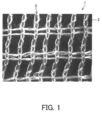
- Fig. 1, 1 shows medical gauze to be used for absorption of body fluids or blood, blood stanching, covering of a wound surface, etc. during implementation of medical practice such as an operation, for example.
- the medical gauze 1 includes a warp knitted fabric 3 of a warp knitted construction composed of loops 2 continued in a warp direction formed by a warp knitting method.
- the warp knitted fabric 3 is configured in a marquisette construction.
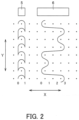
- the marquisette construction is prepared by forming chain stitches (loops) using a front reed, making a combination of inlaid knitting with two or more needles and one-needle interval inlaid knitting using one or two back reeds for connecting the chain stitches formed using the front reed, and making such combinations along several courses. That is, the marquisette construction is prepared by knitting yarn in the warp direction into a chain, connecting adjacent chain stitches to each other with inlaid yarn extending further in the weft direction, and forming the warp knitted fabric 3 as a whole into a square mesh-like shape.
- Yarn from a second guide bar 6 forms a construction (inlaid construction) by repeating movements of moving for three needles in the weft direction without being used for interlacing, then moving for one needle in the opposite direction, then moving further for one needle in the opposite direction, and thereafter moving for three needles in the opposite direction.
- Yarn is aligned in all guides in both of the first guide bar 5 and the second guide bar 6.
- first guide bar 5 does not provide connection between yarns adjacent to each other, so that a resultant construction does not fulfill a function as a fabric.
- second guide bar 6 does not achieve interlacing, so that a resultant construction does not fulfill a function as a fabric.
- combining these two constructions provides connection in the weft direction and achieves interlacing to fix an inlaid part, thereby fulfilling formation as a fabric.
- the marquisette construction is expressed in a numerical form as follows: GB1: 01-10 and GB2: 33-00-11-00.
- the warp knitted fabric 3 is made of 100% long fiber containing 70% by weight or more of regenerated cellulose-based long fiber.
- the long fiber is one continuous long yarn (filament yarn) with no cut.
- the warp knitted fabric 3 is formed by a warp knitting method using such long fiber.
- the percentage by weight of regenerated cellulose-based long fiber of being less than 70% by weight reduces fluid absorbing property, causing a probability of failing to absorb body fluids or blood sufficiently in medical use or a probability of softness reduction during fluid absorption.
- the percentage of the regenerated cellulose-based long fiber in the long fiber is set at equal to or greater than 70% by weight.
- the conventional medical gauze is generally required to be made of a material with high water absorbing property.
- a material for a surgical operation and the like is not always required to have high water absorbing property.
- a material to absorb a small quantity of body fluid such as blood may be required.
- synthetic fiber with no water absorbing property such as nylon, polyester, or polypropylene may also be used to control fluid absorbing property appropriately according to an expected purpose of use.
- the regenerated cellulose-based long fiber is one continuous long fiber with no cut, it does not cause short fiber trash.
- cotton yarn is spun yarn prepared by tying and twisting short fibers together, it is likely to cause fiber trash.
- the regenerated cellulose-based long fiber is highly-pure chemical fiber prepared by dissolving a natural product such as pulp or cotton linter in a chemical agent, extracting plant cellulose chemically, and regenerating the extracted plant cellulose into fiber.
- Conventional cotton gauze requires scouring process by means of degreasing process and bleaching process after weaving.
- the warp knitted fabric 3 is made of the regenerated cellulose-based long fiber having high cellulose purity and high water absorbing property, it does not require degreasing process intended for washing away impurity and applying water absorbing property.
- the degreasing process is performed by boiling gauze in a high-concentration alkaline liquid under high temperature and high pressure.
- spun cotton yarn short fiber
- this can inadvertently cause fiber trash on the verge of coming off during cutting of the gauze to drop during use of the gauze.
- the regenerated cellulose-based long fiber is preferably viscose rayon (rayon), cuprammonium rayon (cupra), or solvent spun fiber (Lyocell), for example, having more favorable absorbing property than other types of cellulose fiber, fulfilling excellent softness during fluid absorption, and containing a small amount of mixed impurity other than cellulose.
- viscose rayon rayon
- cuprammonium rayon cupra
- solvent spun fiber Liocell
- the total size of the regenerated cellulose-based long fiber to be used can be selected appropriately from a range of equal to or greater than 30 dtex and equal to or less than 200 dtex.
- a preferable range is equal to or greater than 50 dtex and equal to or less than 100 dtex.
- the single yarn size (filament size) of the regenerated cellulose-based long fiber is not particularly limited and in a range from 0.5 to 5 dtex. From a viewpoint of knitting performance and grade during implementation of warp knitting and the softness of warp knitted gauze, a preferable range is from 1 to 3 dtex.
- the regenerated cellulose-based long fiber is available, either it is untwisted or twisted.
- the number of twisted yarns is selected appropriately in response to the total size of fiber to be used.
- the regenerated cellulose-based long fiber may be bulky textured yarn.
- available yarn include false-twisted textured yarn, force textured yarn, textured yarn with loop pile prepared by intertwining long-fiber single yarns with each other using compressed air, and chenille yarn.
- These types of bulky textured yarn to be used can also be yarn having a composite structure of the regenerated cellulose-based long fiber and synthetic resin such as polyester or nylon, for example.
- the medical gauze 1 configured using the warp knitted fabric 3 described above is required to be sterilized for use in a case such as an operation.
- the medical gauze 1 is preferably given guaranteed sterilization by formation into the shape of the medical gauze 1 and then implementation of scouring process and sterilizing process.
- the scouring process is preferably performed by scouring the warp knitted fabric 3 at about 70°C using a bleaching agent such as hydrogen peroxide water. Implementation of this scouring process makes it possible to reduce the number of living bacteria in the warp knitted fabric 3, compared to that at the time of finish of the warp knitting.
- the bleaching process using the bleaching agent is not an absolute necessity in the scouring process.
- the scouring process to be applied may also be performed only through dipping into warm water.
- the sterilizing process after the scouring process is preferably performed through sterilization using ethylene oxide gas (EOG sterilization) or through sterilization using high-pressure steam(AC sterilization).
- EOG sterilization ethylene oxide gas
- AC sterilization high-pressure steam
- the medical gauze 1 preferably has a width of equal to or greater than 5 mm and equal to or less than 600 mm.
- the weight of the warp knitted fabric 3 of less than 28 g per square meter causes a probability of failing to ensure water absorbing property sufficiently in the medical gauze 1.
- conventional plain woven gauze normally has a weight of 36 g per square meter. In some causes, eight pieces of such gauze are stacked and sewed together to manufacture thick gauze having a weight of 288 g per square meter. Hence, use of the medical gauze 1 having a similar weight is also expected.
- the warp knitted fabric 3 preferably has a weight of equal to or greater than 28 g and equal to or less than 290 g per square meter.
- the warp knitted fabric 3 is composed of the loops 2 continued in the warp direction and is formed only of long fiber that is continuous yarn with no cut. This makes fiber unlikely to drop not only in use in a normal state but also in use in a cut state, making it possible to improve lint-free performance effectively.
- the long fiber contains 70% by weight or more of the regenerated cellulose-based long fiber. This makes it possible to ensure water absorbing property and softness for medical use as well as to improve lint-free performance.
- the warp knitted fabric 3 is configured in the marquisette construction. By doing so, a stable shape is easily retained using a chain construction continued in the warp direction and inlaid yarn stretching in the weft direction.
- the marquisette construction is also unlikely to cause defective stitches, even if it is thin or low-weight. This allows improvement of dimensional stability.
- Formation using the warp knitting method further allows interlacing in a thickness direction while such interlacing is infeasible by the plain weaving method. This allows the weight of gauze to be changed freely by increasing the fiber diameter of yarn or increasing a swing range of an inlaid construction, thereby facilitating formation into a configuration responsive to a purpose of use.
- viscose rayon, cuprammonium rayon, or solvent spun fiber particularly using cuprammonium rayon as the regenerated cellulose-based long fiber makes it possible to ensure proper water absorbing property and improve softness, thereby achieving improvement of the feel of use and usability.
- the medical gauze 1 is made available for use in a surgical operation by setting the width dimension of the medical gauze 1 at equal to or greater than 5 mm and equal to or less than 600 mm, and setting the weight thereof at equal to or greater than 28 g and equal to or less than 290 g per square meter.
- the gauze is not limited to the foregoing configuration described above but can be changeable, if appropriate, as long as the configuration includes a warp knitted fabric composed of loops continued in the warp direction, the warp knitted fabric is made of 100% long fiber containing 70% by weight or more of regenerated cellulose-based long fiber.
- a configuration including x-ray contrast yarn 4 interlaced in the warp knitted fabric 3 is applicable.
- the x-ray contrast yarn 4 is preferably aligned between the regenerated cellulose-based long fibers in the warp knitted fabric 3.
- the x-ray contrast yarn 4 is prepared by adding barium sulfate, for example, having x-ray contrast effect into plastic resin such as polyvinyl chloride, polypropylene, polystyrene, or silicon, or regenerated cellulose-based long fiber such as cuprammonium rayon, for example.
- plastic resin such as polyvinyl chloride, polypropylene, polystyrene, or silicon
- regenerated cellulose-based long fiber such as cuprammonium rayon, for example.
- the x-ray contrast yarn 4 to be used may either be monofilament yarn formed of a single filament, or a multifilament formed by mixing an x-ray contrast agent into fibrous resin.
- the x-ray contrast yarn 4 may further be composite yarn prepared by twisting the x-ray contrast yarn 4 with other synthetic resin or regenerated cellulose fiber with no x-ray contrast property, or by covering the x-ray contrast yarn 4 with such resin or fiber.
- the medical gauze 1 After being used in a surgical operation and the like, the medical gauze 1 is removed from a body after the operation. As the medical gauze 1 is frequently stained with blood during the operation, it becomes difficult to distinguish the medical gauze 1 from an organ, and the like. This causes a risk of proceeding to suture and finishing the operation while the medical gauze 1 is left in the body.
- arranging the x-ray contrast yarn 4 in the warp knitted fabric 3 makes it possible to check the retention of the medical gauze 1 easily in an x-ray photograph taken after the operation.
- the x-ray contrast yarn 4 is generally prepared by weaving yarn thicker than cotton yarn (generally, 40-cotton yarn) in order to facilitate check to see the presence or absence of the retention in the body.
- Such thick x-ray contrast yarn causes a probability that weaving performance will be deteriorated or the x-ray contrast yarn will drop easily.
- interlacing the x-ray contrast yarn into the warp knitted fabric 3 can prevent deterioration of knitting performance or dropping of the x-ray contrast yarn 4.
- the x-ray contrast yarn 4 can also be attached by welding as described later. However, forming the x-ray contrast yarn 4 as a part of the warp knitted fabric 3 achieves a higher level of x-ray contrast in an x-ray photograph than the attachment by welding.
- the x-ray contrast yarn 4 can be attached easily by welding.
- the x-ray contrast yarn 4 can be attached by welding by melting plastic resin (polyvinyl chloride, polypropylene, polystyrene, or silicon, for example) forming the x-ray contrast yarn 4 using a heat or ultrasonic welding machine, and pressing the resin under pressure against the warp knitted fabric 3.
- plastic resin polyvinyl chloride, polypropylene, polystyrene, or silicon, for example
- a medical gauze 1 of the claimed configuration is shown in Fig. 8 or a configuration shown in Fig. 9 , for example.
- At least one chemical fiber specifically, two chemical fibers (intertwined fibers) 21 and 22, for example, are intertwined with one x-ray contrast yarn (two needle swing) 4 thicker than the chemical fibers 21 and 22 in the warp direction.
- two chemical fibers 23 and 24 similar to the chemical fibers 21 and 22 are arranged in the warp direction in the vicinity of the chemical fibers 21 and 22 (at neighboring positions on the right and left sides of the x-ray contrast yarn 4) without being intertwined with the x-ray contrast yarn 4. Therefore, the total number of the chemical fibers 21 to 24 used as replacement for the long fiber is four.
- All the chemical fibers 21 to 24 are made of the same long fiber that is polyethylene terephthalate fiber (PET fiber), for example, having higher fiber strength and more favorable heat resistance than the long fiber before the replacement (regenerated cellulose-based long fiber such as cupra) . It is noted that, like the long fiber before the replacement, each of the chemical fibers 21 to 24 has a chain construction with the loops 2 continued in the warp direction.
- PET fiber polyethylene terephthalate fiber
- the total number of chemical fibers is eight, which is larger than that of the foregoing configuration shown in Fig. 8 .
- two chemical fibers (intertwined fibers) 31 and 32 are intertwined with one x-ray contrast yarn (two needle swing) 4 thicker than the chemical fibers 31 and 32, and six chemical fibers 33 to 38 similar to the chemical fibers 31 and 32 are arranged in the warp direction in the vicinity of the chemical fibers 31 and 32 without being intertwined with the x-ray contrast yarn 4.
- all the chemical fibers 31 to 38 are made of the same PET long fiber.
- the medical gauze 1 having the configuration described above shown in Fig. 8 or 9 achieves increased strength in an area around the x-ray contrast yarn 4 in addition to achieving the foregoing effect such as improvement of lint-free performance. Further, even if the medical gauze 1 is broken by pulling, this break occurs at a boundary area between the long fiber and the PET fiber (an area separated from the x-ray contrast yarn 4), thereby preventing dropping of the x-ray contrast yarn 4.
- the number of the foregoing chemical fibers is not always required to be an even number (four, six, or eight, for example), and these chemical fibers are not always required to be arranged bilaterally symmetrically. In consideration of right and left balance, however, the same number of chemical fibers are preferably arranged on the right and left sides of the x-ray contrast yarn 4.
- the chemical fiber to be used as replacement for the long fiber is preferably PET fiber having high heat resistance in consideration of the scouring process. It is noted that, not using PET fiber is not preferable, as it causes a risk of dropping of the x-ray contrast yarn 4 from the warp knitted yarn 3 if the long fiber is cut in a place adjacent to the x-ray contrast yarn 4 to break the warp knitted fabric 3.
- the x-ray contrast yarn 4 is intertwined with two long fibers.
- intertwining at least two chemical fibers (PET fibers, for example) as replacement for the long fibers with the x-ray contrast yarn 4 allows the chemical fibers to function to reduce the occurrence of break of the long fiber during pulling of the warp knitted fabric 3. By doing so, strength at the intertwining area can be reinforced.
- using only the two chemical fibers fails to remove stress on the long fiber completely to be applied in the area where the chemical fibers and the long fiber are intertwined with each other during pulling of the warp knitted fabric 3. In some cases, this cannot be considered to be sufficient for the reinforcement.
- the number of the chemical fibers is preferably equal to or greater than four.
- an upper limit number is preferably eight.
- the total number of chemical fibers is preferably between four and eight.
- the number of chemical fibers to be intertwined with x-ray contrast yarn may be at least one or more.
- the minimum number of chemical fibers settable at a knitting machine (marquisette construction) is two
- the minimum number of chemical fibers to be intertwined with the x-ray contrast yarn is preferably two.
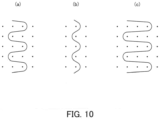
- the x-ray contrast yarn may be one needle swing yarn shown in Fig. 10(b) or three needle swing yarn shown in Fig. 10(c) .
- Medical gauze was formed into a configuration shown in Table 1, and then performance evaluation was conducted.
- the weight of the gauze was calculated as a mass per unit area (g/m2).
- Lint-free performance was evaluated as follows.
- Cellophane adhesive tape having a width of 10 mm was cut into about 30 mm and affixed to a surface of the medical gauze. After 60 seconds, the cellophane adhesive tape was removed from the medical gauze and affixed to slide glass. The affixed cellophane adhesive tape was given marks of a length of 10 mm and the number of lints within a range of 10 mm * 10 mm square was counted using an optical microscope of a magnification of 40. This measurement was conducted six times and an average thereof was employed as a numerical value showing the lint-free performance.
- the weight in the wet state is a weight determined after the medical gauze was dipped in water for 10 minutes, then taken out of the water, and left unattended for 10 minutes while being stretched on a wire mesh to remove excessive moisture from the medical gauze.
- Example 1 a warp knitted fabric (without x-ray contrast yarn) was formed under the following conditions using a 28GG warp knitting machine.
- Yarn used for forming the warp knitted fabric was Bemberg fiber 56 dtex/30f as cupra (available from Asahi Kasei Kabushiki Kaisha, Bemberg is a registered trademark).
- the warp knitted fabric formed in this way was subjected to scouring process at 70°C for 60 minutes in a solution containing 0.2% by weight of hydrogen peroxide water (a content from 30 to 30.5% by weight).
- Fig. 5 shows a photograph of the construction according to Example 1.
- Example 2 a warp knitted fabric (without x-ray contrast yarn) was formed under the following conditions using a 28GG warp knitting machine.
- Yarn used for forming the warp knitted fabric includes Bemberg fiber 56 dtex/30f available from Asahi Kasei Kabushiki Kaisha, and polyester fiber 56 dtex/24f (available from KB SEIREN LTD.).
- the Bemberg fiber was mixed to a ratio of 70% by weight.
- a weight was set at 28 g/m 2 , which is a lower limit of a preferable range.
- the warp knitted fabric formed in this way was subjected to process in the same way as Example 1, and then performance evaluation was conducted.
- Example 3 except for using viscose rayon fiber 56 dtex/24f instead of the Bemberg fiber used in Example 1, process was performed in completely the same way as in Example 1 and performance evaluation thereof was conducted.
- Example 4 one polystyrene-based contrast yarn as a 0.85 mm ⁇ monofilament (with a content of barium sulfate of 50 percent by weight) was bonded by thermal compression using an ultrasonic welding machine to the prototype of the medical gauze of 30 cm * 30 cm formed in Example 1, and then performance evaluation was conducted.
- Example 5 a warp knitted fabric (with x-ray contrast yarn) was formed under the following conditions using a 28GG warp knitting machine.
- the warp knitted fabric was configured in a marquisette construction as shown in Fig. 7 using Bemberg fiber 56 dtex/30f available from Asahi Kasei Kabushiki Kaisha, using one polystyrene-based contrast yarn as a 0.65 mm ⁇ monofilament (with a content of barium sulfate of 50 percent by weight), and with the number of reeds of 3 (guide bars 5, 6, 7), the number of courses on the machine of 45, and the number of wales on the machine of 28.
- this marquisette construction is expressed in a numerical form as follows: GB1: 01-10, GB2: 33-00-11-00, and GB3: 22-00.
- the warp knitted fabric formed in this way was subjected to process in the same way as Example 1 and then performance evaluation was conducted.
- Example 6 except for using Bemberg fiber 84 dtex/45f as cupra (available from Asahi Kasei Kabushiki Kaisha) instead of the Bemberg fiber 56 dtex/30f used in Example 5, process was performed in completely the same way as in Example 5 and then performance evaluation was conducted.
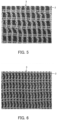
- Fig. 4 shows the configuration according to Example 6 with interlaced x-ray contrast yarn.
- Fig. 6 shows a photograph of the construction according to Example 6.
- Example 7 except for using yarn formed by twisting five Bemberg x-ray contrast yarns 300 dtex/60f together (sheath-core fiber with a content of barium sulfate of 60 percent by weight) at Z100t/m instead of the polystyrene-based x-ray contrast yarn used in Example 6, process was performed in the same way as in Example 6 to obtain performance evaluation result.
- plain woven gauze was formed using Bemberg fiber 167 dtex/70f available from Asahi Kasei Kabushiki Kaisha as warp yarn and weft yarn to a warp yarn density and a weft yarn density of 12/cm. Then, process was performed in the same way as in Example 1 and performance evaluation was conducted.
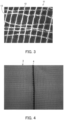
- Fig. 3 shows a photograph of the construction according to Comparative Example 1.
- the resultant gauze was determined to be incapable of retaining a shape as a woven fabric as at least one of the warp yarn and the weft yarn was moved easily only with touch by a hand to cause slippage phenomena frequently.
- This plain woven gauze was also subjected to degreasing process and bleaching process continuously under conditions same as scouring conditions for ordinary cotton gauze. Then, the gauze was cut into 30 cm * 30 cm and performance evaluation was conducted.
- Table 1 shows result of the performance study conducted on each of Examples and each of Comparative Examples described above.
- PS shows polystyrene-based x-ray contrast yarn
- BB shows Bemberg x-ray contrast yarn.
- [Table 1] FABRIC CONSTRUCTION REGENERATED CELLULOSE FIBER OTHER FIBER REGENERATED CELLULOSE WEIGHT PERCENT (%) PRESENCE/ABSENCE OF X-RAY CONTRAST YARN GAUZE PROPERTY GAUZE SIZE (mm) GAUZE WEIGHT (g/m 2 ) LINT FREE PERFORMANCE AMOUNT OF WATER ABSORPTION (%) X-RAY CONTRAST PERFORMANCE EXAMPLE 1 WARP KNITTING CUPRA 56 NO 100 NO 300 * 300 30 ⁇ 1 320 - 2 CUPRA 56 POLYE - STER 56 70 NO 28 ⁇ 1 230 - 3 RAYON 56 NO 100 NO 30 6 310 - 4 CUPRA 56 NO 100 YES (PS WE
- Comparative Example 1 corresponding to the weaving using cupra failed to retain the construction due to the occurrence of slippage while favorable lint-free performance was achieved.
- Comparative Example 2 corresponding to the plain weaving using natural fiber resulted in considerably bad lint-free performance.
- Specimens used include a specimen prepared by interlacing x-ray contrast yarn in a warp knitted fabric made of cupra 84 shown in Fig. 11(a) , a specimen prepared by interlacing four PET fibers in an area around x-ray contrast yarn shown in Fig. 11(b) , and a specimen prepared by interlacing eight PET fibers in an area around x-ray contrast yarn shown in Fig. 11(c) .
- cupra 84 is Bemberg fiber (long fiber) 84 dtex/45f.
- the x-ray contrast yarn is a 0.65 mm ⁇ monofilament.
- Scouring process was performed on the specimens using hydrogen peroxide water of 0.2% as a processing solution at a processing temperature from 65 to 70°C and for a processing duration of 60 minutes.
- Fig. 12 shows test result.
- the test specimens were sterilized with EOG having a width of 30 mm.
- Tensile strength in a CD direction was measured in a part including the x-ray contrast yarn (see Fig. 12(b) ).
- a specimen wet with water was reduced in strength in long fiber intertwined with the x-ray contrast yarn and was broken easily at this part (see Fig. 12 (c) ). This is considered to be caused for the reason that, as a result of a large difference in diameter between the long fiber and the x-ray contrast yarn, the long fiber was in a state of causing yarn breakage easily under heavy load and the long fiber became prone to cutting by being wet in water during implementation of the scouring process and implementation of the strength test.
- PET fiber higher in fiber strength than other long fiber is necessary and an appropriate number of PET fibers according to Examples is considered to be four.
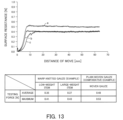
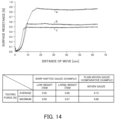
- Specimens used include a warp knitted gauze low-weight item (weight of 56 g/m 2 ) , a warp knitted gauze large-weight item (weight of 84 g/m 2 ) , and plain woven cotton gauze (weight of 38 g/m 2 ) . It is noted that the warp knitted gauze is gauze with a warp knitted fabric made of cupra 84.
- Petri dishes having glass petri dish bottom surfaces with affixed PP plates were placed over the specimens (gauze), and moved at a constant speed by a tensile testing machine.
- Tensile test strength was determined to be a resistance value at a gauze surface.
- the petri dishes with the affixed PP plates have a weight of 200 g, were installed in an area of 60 cm 2 , and were pulled at a speed of 30 cm/min.
- Fig. 13 shows test result obtained by using the PP plate with the smooth surface.
- Fig. 14 shows test result obtained by using the PP plate with the uneven surface. It is noted that, in each of these drawings, a is a graph of the plain woven cotton gauze, b is a graph of the warp knitted gauze large-weight item, and c is a graph of the warp knitted gauze low-weight item.
- a surface resistance value is lower than that of the plain woven cotton gauze, showing that the surface of the warp knitted gauze is more slippery than the surface of the plain woven cotton gauze.
- gauze is preferably easy to slip inside a cylindrical port.
- the warp knitted gauze can be loaded and unloaded more easily than the plain woven cotton gauze, so that the warp knitted gauze according to Examples is considered to be more superior to the plain woven cotton gauze according to Comparative Examples.
- Specimens used include a warp knitted gauze low-weight item (weight of 56 g/m 2 ) and plain woven cotton gauze (weight of 36 g/m 2 ).
- the warp knitted gauze is gauze with a warp knitted fabric made of cupra 84.
- a plate used is a test metallic plate used in the clinging measurement according to JIS L 1094.
- This metallic plate is a stainless steel plate having a size of about 100 mm * 450 mm and a thickness of about 1.3 mm, and with a 70-degree bend at a position of about 150 mm from one end thereof.
- Fig. 15 shows test result of fabric detachability about the two warp knitted gauze pieces.
- Fig. 16 shows test result of fabric detachability about the two plain woven cotton gauze pieces . Accordingly, in the case of the two warp knitted gauze pieces, by tilting the metallic plate slightly (an angle of tilt from three to four degrees), the fabrics were detached from each other. On the other hand, in the case of the two plain woven cotton gauze pieces, even by tilting the metallic plate largely (even tilted to an angle of 90 degrees), the fabrics remained attached without being detached from each other.
- warp knitted gauze has favorable fabric detachability compared to plain woven cotton gauze and thus achieves more excellent ease of handling during actual use.
- the warp knitted gauze is more detachable than the plain woven cotton gauze.
- the warp knitted gauze according to Examples is considered to be more superior (in terms of improvement of workability, and the like) to the plain woven cotton gauze according to Comparative Examples.
- Specimens used include a warp knitted gauze low-weight item, a warp knitted gauze large-weight item, and plain woven cotton gauze. It is noted that the warp knitted gauze is gauze with a warp knitted fabric made of cupra 84.
- Kawabata evaluation system KES tensile characteristic, KES bending characteristic, and bending resistance (JIS 1096) were measured. It is noted that a WET state was created by dipping gauze into water, then measuring a weight after dewatering for 30 seconds using a dryer of a twin-tub washing machine, and making adjustment to achieve a water content of about 80 wt%.
- Fig. 17 shows test result.
- Example 2 achieves higher air permeability and a higher open area ratio than Comparative Example 1 despite a larger weight than Comparative Example 1.
- linearity LT weft direction
- linearity LT a lower value shows increased ease of stretching at an initial stage of pulling
- a value tends to become smaller in the weft direction according to Examples than a corresponding value according to Comparative Examples. From this view, the warp knitted gauze is found to be stretched more easily in the weft direction than the plain woven cotton gauze at an initial stage of pulling.
- a value in each of the warp direction and the weft direction according to Examples tends to become larger than a corresponding value according to Comparative Examples. From this view, the warp knitted gauze is found to be stretched more easily than the plain woven cotton gauze in the warp direction and the weft direction.
- bending rigidity B bending rigidity B: a larger value means increased hardness of bending
- a value is smaller in the weft direction according to each of Examples 2 and 4 than a corresponding value according to each of Comparative Examples 1 and 2. From this view, the warp knitted gauze is found to be bent more easily in the weft direction than the plain woven cotton gauze.
- the weft direction according to Examples tends to provide a larger value than a corresponding value according to Comparative Examples. From this view, the warp knitted gauze is found to be bent more easily in the weft direction than the plain woven cotton gauze.
- the present invention is applied as medical gauze capable of absorbing blood or body fluids, for example.
Landscapes
- Health & Medical Sciences (AREA)
- Engineering & Computer Science (AREA)
- Life Sciences & Earth Sciences (AREA)
- Animal Behavior & Ethology (AREA)
- General Health & Medical Sciences (AREA)
- Public Health (AREA)
- Veterinary Medicine (AREA)
- Chemical & Material Sciences (AREA)
- Biomedical Technology (AREA)
- Heart & Thoracic Surgery (AREA)
- Vascular Medicine (AREA)
- Epidemiology (AREA)
- Textile Engineering (AREA)
- Materials Engineering (AREA)
- Hematology (AREA)
- Medicinal Chemistry (AREA)
- Nuclear Medicine, Radiotherapy & Molecular Imaging (AREA)
- Surgery (AREA)
- Materials For Medical Uses (AREA)
- Absorbent Articles And Supports Therefor (AREA)
Claims (6)
- Medizinische Gaze (1) umfassend:Ein Kettengewirke (3) mit einer Kettrichtung und einer Schussrichtung und bestehend aus Maschen (2), die in Kettrichtung fortgeführt werden; undRöntgenkontrastfaden (4), der mit dem Kettengewirke verflochten ist, wobei das Kettengewirke aus 100 % Langfaser mit 70 Vol.-% oder mehr aus wiedergewonnenen zellulosebasierten Langfasern hergestellt ist; dadurch gekennzeichnet dass:Mindestens eine chemische Faser (21 bis 24, 31 bis 38) mit dem Röntgenkontrastfaden (4) in Kettrichtung verflochten ist; undeine ähnliche chemische Faser in Kettrichtung neben der mindestens einen chemischen Faser angeordnet ist.
- Medizinische Gaze nach Anspruch 1, wobei
das Kettengewirke in einer Marquisette-Ausführung konfiguriert ist. - Medizinische Gaze nach Anspruch 1 oder 2,
wobei die wiedergewonnene zellulosebasierte Langfaser Kupfer-Ammonium-Rayon ist. - Medizinische Gaze nach einem der Ansprüche 1 bis 3, wobei
die medizinische Gaze (1) eine Breite gleich oder größer als 5 mm und gleich oder geringer als 600 mm und ein Gewicht von gleich oder höher als 28 g und gleich oder geringer als 290 g pro Quadratmeter hat. - Medizinische Gaze nach einem der der vorhergehenden Ansprüche, wobei
die Gesamtzahl der chemischen Fasern zwischen vier und acht liegt. - Medizinische Gaze nach einem der vorhergehenden Ansprüche, wobei
die chemische Faser eine Polyethylenterephthalat-Faser ist.
Applications Claiming Priority (2)
| Application Number | Priority Date | Filing Date | Title |
|---|---|---|---|
| JP2018172687 | 2018-09-14 | ||
| PCT/JP2019/033799 WO2020054434A1 (ja) | 2018-09-14 | 2019-08-28 | 医療用ガーゼ |
Publications (4)
| Publication Number | Publication Date |
|---|---|
| EP3851083A1 EP3851083A1 (de) | 2021-07-21 |
| EP3851083A4 EP3851083A4 (de) | 2022-06-15 |
| EP3851083B1 true EP3851083B1 (de) | 2024-06-19 |
| EP3851083C0 EP3851083C0 (de) | 2024-06-19 |
Family
ID=69777564
Family Applications (1)
| Application Number | Title | Priority Date | Filing Date |
|---|---|---|---|
| EP19860352.4A Active EP3851083B1 (de) | 2018-09-14 | 2019-08-28 | Medizinischer mull |
Country Status (4)
| Country | Link |
|---|---|
| US (1) | US20220040005A1 (de) |
| EP (1) | EP3851083B1 (de) |
| JP (1) | JP7341416B2 (de) |
| WO (1) | WO2020054434A1 (de) |
Family Cites Families (14)
| Publication number | Priority date | Publication date | Assignee | Title |
|---|---|---|---|---|
| US2677872A (en) * | 1951-11-20 | 1954-05-11 | Us Rubber Co | Leno weave elastic fabric |
| JPS5218596U (de) * | 1975-07-28 | 1977-02-09 | ||
| JP2002238943A (ja) | 2000-12-13 | 2002-08-27 | Asahi Kasei Corp | 手術用ガーゼおよびその製法 |
| JP3085852U (ja) * | 2001-11-06 | 2002-05-24 | 星二郎 奥沢 | 手術用ガーゼカウンター |
| JP2005177034A (ja) * | 2003-12-18 | 2005-07-07 | Nisshinbo Ind Inc | X線造影糸入りガーゼ及びその製造方法 |
| US8709023B2 (en) * | 2007-07-17 | 2014-04-29 | Poly-Med, Inc. | Absorbable / biodegradable composite yarn constructs and applications thereof |
| WO2006115266A1 (ja) | 2005-04-26 | 2006-11-02 | Unitika Fibers Ltd. | X線造影糸、x線造影被覆糸、前記x線造影糸および、またはx線造影被覆糸を用いた繊維構造体 |
| JP4657041B2 (ja) * | 2005-07-13 | 2011-03-23 | 白十字株式会社 | ガーゼ |
| JP3130538U (ja) * | 2007-01-17 | 2007-03-29 | 株式会社酒井商店 | 医療用ガーゼ |
| JP5686573B2 (ja) * | 2010-11-02 | 2015-03-18 | 前田工繊株式会社 | 角目組織経編地と、それを使用した剥落防止用ネット |
| JP5764397B2 (ja) * | 2011-06-22 | 2015-08-19 | 株式会社Shindo | モアレ縞模様の装飾帯体 |
| JP2013227689A (ja) * | 2012-04-24 | 2013-11-07 | Asahi Kasei Fibers Corp | 衛生材料 |
| JP3184588U (ja) * | 2013-04-23 | 2013-07-04 | オオサキメディカル株式会社 | 医療ガーゼ |
| CA3012973C (en) * | 2016-02-10 | 2020-06-02 | Asahi Kasei Kabushiki Kaisha | Carboxymethlated cellulose sheet for covering a wound |
-
2019
- 2019-08-28 JP JP2020546843A patent/JP7341416B2/ja active Active
- 2019-08-28 US US17/275,258 patent/US20220040005A1/en not_active Abandoned
- 2019-08-28 EP EP19860352.4A patent/EP3851083B1/de active Active
- 2019-08-28 WO PCT/JP2019/033799 patent/WO2020054434A1/ja not_active Ceased
Also Published As
| Publication number | Publication date |
|---|---|
| EP3851083A1 (de) | 2021-07-21 |
| EP3851083C0 (de) | 2024-06-19 |
| WO2020054434A1 (ja) | 2020-03-19 |
| EP3851083A4 (de) | 2022-06-15 |
| US20220040005A1 (en) | 2022-02-10 |
| JPWO2020054434A1 (ja) | 2021-10-14 |
| JP7341416B2 (ja) | 2023-09-11 |
Similar Documents
| Publication | Publication Date | Title |
|---|---|---|
| JP6556814B2 (ja) | 真空療法で使用するための創傷被覆材 | |
| JP5734280B2 (ja) | 織編物製造用の膨化糸及び巻き糸並びに織編物及びその製造方法 | |
| CN1934300B (zh) | 复合加捻纱线 | |
| JPS6192666A (ja) | 人工血管 | |
| WO2005087995A1 (ja) | 複合撚糸 | |
| JP5584297B2 (ja) | 多層構造布帛および繊維製品 | |
| CN101313094A (zh) | 具有改进的耐化学性和耐用性的阻燃耐热弹力织物 | |
| JP7015697B2 (ja) | 多層構造織編物および繊維製品 | |
| JP3394183B2 (ja) | 立体編物 | |
| BRPI0807520A2 (pt) | Suplemento elástico, método para sua produção e uso do mesmo | |
| JP6146718B2 (ja) | 人工血管の製造方法 | |
| EP3851083B1 (de) | Medizinischer mull | |
| JP2006225798A (ja) | 複合糸 | |
| JPS6331668A (ja) | 生体用補綴物およびその製法 | |
| JP5144193B2 (ja) | 編地 | |
| Uzumcu et al. | A review on yarns used in medical textiles | |
| JP4574264B2 (ja) | ガーゼおよびその製造方法 | |
| Subashini et al. | Study on mechanical properties for the development of reusable PPE for the health care workers | |
| Hakam et al. | A Study of the Properties of Fleece Knitted Fabrics Made from Cotton and Different Types of Regenerated Cellulosic Fibers for Apparel Use | |
| WO2006126669A1 (ja) | 複合撚糸 | |
| JPH11152662A (ja) | 起毛布帛 | |
| TWI529278B (zh) | Fiber products | |
| JP2002054037A (ja) | レーヨン交撚糸 | |
| JPH01118637A (ja) | 嵩高加工糸 | |
| JP2008308772A (ja) | 布帛 |
Legal Events
| Date | Code | Title | Description |
|---|---|---|---|
| STAA | Information on the status of an ep patent application or granted ep patent |
Free format text: STATUS: THE INTERNATIONAL PUBLICATION HAS BEEN MADE |
|
| PUAI | Public reference made under article 153(3) epc to a published international application that has entered the european phase |
Free format text: ORIGINAL CODE: 0009012 |
|
| STAA | Information on the status of an ep patent application or granted ep patent |
Free format text: STATUS: REQUEST FOR EXAMINATION WAS MADE |
|
| 17P | Request for examination filed |
Effective date: 20210312 |
|
| AK | Designated contracting states |
Kind code of ref document: A1 Designated state(s): AL AT BE BG CH CY CZ DE DK EE ES FI FR GB GR HR HU IE IS IT LI LT LU LV MC MK MT NL NO PL PT RO RS SE SI SK SM TR |
|
| DAV | Request for validation of the european patent (deleted) | ||
| DAX | Request for extension of the european patent (deleted) | ||
| A4 | Supplementary search report drawn up and despatched |
Effective date: 20220513 |
|
| RIC1 | Information provided on ipc code assigned before grant |
Ipc: D04B 21/00 20060101ALI20220509BHEP Ipc: A61L 15/42 20060101ALI20220509BHEP Ipc: A61L 15/28 20060101ALI20220509BHEP Ipc: A61F 13/44 20060101ALI20220509BHEP Ipc: A61F 13/36 20060101ALI20220509BHEP Ipc: A61F 13/00 20060101AFI20220509BHEP Ipc: A61L 15/54 20060101ALI20220509BHEP Ipc: A61L 15/22 20060101ALI20220509BHEP Ipc: D04B 21/16 20060101ALI20220509BHEP Ipc: D04B 21/12 20060101ALI20220509BHEP |
|
| GRAP | Despatch of communication of intention to grant a patent |
Free format text: ORIGINAL CODE: EPIDOSNIGR1 |
|
| STAA | Information on the status of an ep patent application or granted ep patent |
Free format text: STATUS: GRANT OF PATENT IS INTENDED |
|
| RIC1 | Information provided on ipc code assigned before grant |
Ipc: A61L 15/54 20060101ALI20231218BHEP Ipc: A61L 15/22 20060101ALI20231218BHEP Ipc: D04B 21/16 20060101ALI20231218BHEP Ipc: D04B 21/12 20060101ALI20231218BHEP Ipc: D04B 21/00 20060101ALI20231218BHEP Ipc: A61L 15/42 20060101ALI20231218BHEP Ipc: A61L 15/28 20060101ALI20231218BHEP Ipc: A61F 13/44 20060101ALI20231218BHEP Ipc: A61F 13/36 20060101ALI20231218BHEP Ipc: A61F 13/00 20060101AFI20231218BHEP |
|
| INTG | Intention to grant announced |
Effective date: 20240111 |
|
| GRAS | Grant fee paid |
Free format text: ORIGINAL CODE: EPIDOSNIGR3 |
|
| GRAA | (expected) grant |
Free format text: ORIGINAL CODE: 0009210 |
|
| STAA | Information on the status of an ep patent application or granted ep patent |
Free format text: STATUS: THE PATENT HAS BEEN GRANTED |
|
| AK | Designated contracting states |
Kind code of ref document: B1 Designated state(s): AL AT BE BG CH CY CZ DE DK EE ES FI FR GB GR HR HU IE IS IT LI LT LU LV MC MK MT NL NO PL PT RO RS SE SI SK SM TR |
|
| REG | Reference to a national code |
Ref country code: GB Ref legal event code: FG4D |
|
| REG | Reference to a national code |
Ref country code: CH Ref legal event code: EP |
|
| REG | Reference to a national code |
Ref country code: DE Ref legal event code: R096 Ref document number: 602019053995 Country of ref document: DE |
|
| U01 | Request for unitary effect filed |
Effective date: 20240620 |
|
| U07 | Unitary effect registered |
Designated state(s): AT BE BG DE DK EE FI FR IT LT LU LV MT NL PT SE SI Effective date: 20240702 |
|
| U20 | Renewal fee for the european patent with unitary effect paid |
Year of fee payment: 6 Effective date: 20240723 |
|
| PG25 | Lapsed in a contracting state [announced via postgrant information from national office to epo] |
Ref country code: HR Free format text: LAPSE BECAUSE OF FAILURE TO SUBMIT A TRANSLATION OF THE DESCRIPTION OR TO PAY THE FEE WITHIN THE PRESCRIBED TIME-LIMIT Effective date: 20240619 |
|
| PG25 | Lapsed in a contracting state [announced via postgrant information from national office to epo] |
Ref country code: GR Free format text: LAPSE BECAUSE OF FAILURE TO SUBMIT A TRANSLATION OF THE DESCRIPTION OR TO PAY THE FEE WITHIN THE PRESCRIBED TIME-LIMIT Effective date: 20240920 |
|
| PG25 | Lapsed in a contracting state [announced via postgrant information from national office to epo] |
Ref country code: NO Free format text: LAPSE BECAUSE OF FAILURE TO SUBMIT A TRANSLATION OF THE DESCRIPTION OR TO PAY THE FEE WITHIN THE PRESCRIBED TIME-LIMIT Effective date: 20240919 Ref country code: HR Free format text: LAPSE BECAUSE OF FAILURE TO SUBMIT A TRANSLATION OF THE DESCRIPTION OR TO PAY THE FEE WITHIN THE PRESCRIBED TIME-LIMIT Effective date: 20240619 Ref country code: GR Free format text: LAPSE BECAUSE OF FAILURE TO SUBMIT A TRANSLATION OF THE DESCRIPTION OR TO PAY THE FEE WITHIN THE PRESCRIBED TIME-LIMIT Effective date: 20240920 Ref country code: RS Free format text: LAPSE BECAUSE OF FAILURE TO SUBMIT A TRANSLATION OF THE DESCRIPTION OR TO PAY THE FEE WITHIN THE PRESCRIBED TIME-LIMIT Effective date: 20240919 |
|
| PG25 | Lapsed in a contracting state [announced via postgrant information from national office to epo] |
Ref country code: PL Free format text: LAPSE BECAUSE OF FAILURE TO SUBMIT A TRANSLATION OF THE DESCRIPTION OR TO PAY THE FEE WITHIN THE PRESCRIBED TIME-LIMIT Effective date: 20240619 |
|
| PG25 | Lapsed in a contracting state [announced via postgrant information from national office to epo] |
Ref country code: IS Free format text: LAPSE BECAUSE OF FAILURE TO SUBMIT A TRANSLATION OF THE DESCRIPTION OR TO PAY THE FEE WITHIN THE PRESCRIBED TIME-LIMIT Effective date: 20241019 |
|
| PG25 | Lapsed in a contracting state [announced via postgrant information from national office to epo] |
Ref country code: CZ Free format text: LAPSE BECAUSE OF FAILURE TO SUBMIT A TRANSLATION OF THE DESCRIPTION OR TO PAY THE FEE WITHIN THE PRESCRIBED TIME-LIMIT Effective date: 20240619 |
|
| PG25 | Lapsed in a contracting state [announced via postgrant information from national office to epo] |
Ref country code: RO Free format text: LAPSE BECAUSE OF FAILURE TO SUBMIT A TRANSLATION OF THE DESCRIPTION OR TO PAY THE FEE WITHIN THE PRESCRIBED TIME-LIMIT Effective date: 20240619 Ref country code: SK Free format text: LAPSE BECAUSE OF FAILURE TO SUBMIT A TRANSLATION OF THE DESCRIPTION OR TO PAY THE FEE WITHIN THE PRESCRIBED TIME-LIMIT Effective date: 20240619 |
|
| PG25 | Lapsed in a contracting state [announced via postgrant information from national office to epo] |
Ref country code: ES Free format text: LAPSE BECAUSE OF FAILURE TO SUBMIT A TRANSLATION OF THE DESCRIPTION OR TO PAY THE FEE WITHIN THE PRESCRIBED TIME-LIMIT Effective date: 20240619 Ref country code: SM Free format text: LAPSE BECAUSE OF FAILURE TO SUBMIT A TRANSLATION OF THE DESCRIPTION OR TO PAY THE FEE WITHIN THE PRESCRIBED TIME-LIMIT Effective date: 20240619 |
|
| PG25 | Lapsed in a contracting state [announced via postgrant information from national office to epo] |
Ref country code: SM Free format text: LAPSE BECAUSE OF FAILURE TO SUBMIT A TRANSLATION OF THE DESCRIPTION OR TO PAY THE FEE WITHIN THE PRESCRIBED TIME-LIMIT Effective date: 20240619 Ref country code: SK Free format text: LAPSE BECAUSE OF FAILURE TO SUBMIT A TRANSLATION OF THE DESCRIPTION OR TO PAY THE FEE WITHIN THE PRESCRIBED TIME-LIMIT Effective date: 20240619 Ref country code: RO Free format text: LAPSE BECAUSE OF FAILURE TO SUBMIT A TRANSLATION OF THE DESCRIPTION OR TO PAY THE FEE WITHIN THE PRESCRIBED TIME-LIMIT Effective date: 20240619 Ref country code: PL Free format text: LAPSE BECAUSE OF FAILURE TO SUBMIT A TRANSLATION OF THE DESCRIPTION OR TO PAY THE FEE WITHIN THE PRESCRIBED TIME-LIMIT Effective date: 20240619 Ref country code: IS Free format text: LAPSE BECAUSE OF FAILURE TO SUBMIT A TRANSLATION OF THE DESCRIPTION OR TO PAY THE FEE WITHIN THE PRESCRIBED TIME-LIMIT Effective date: 20241019 Ref country code: ES Free format text: LAPSE BECAUSE OF FAILURE TO SUBMIT A TRANSLATION OF THE DESCRIPTION OR TO PAY THE FEE WITHIN THE PRESCRIBED TIME-LIMIT Effective date: 20240619 Ref country code: CZ Free format text: LAPSE BECAUSE OF FAILURE TO SUBMIT A TRANSLATION OF THE DESCRIPTION OR TO PAY THE FEE WITHIN THE PRESCRIBED TIME-LIMIT Effective date: 20240619 |
|
| REG | Reference to a national code |
Ref country code: CH Ref legal event code: PL |
|
| PG25 | Lapsed in a contracting state [announced via postgrant information from national office to epo] |
Ref country code: MC Free format text: LAPSE BECAUSE OF FAILURE TO SUBMIT A TRANSLATION OF THE DESCRIPTION OR TO PAY THE FEE WITHIN THE PRESCRIBED TIME-LIMIT Effective date: 20240619 Ref country code: CH Free format text: LAPSE BECAUSE OF NON-PAYMENT OF DUE FEES Effective date: 20240831 |
|
| PLBE | No opposition filed within time limit |
Free format text: ORIGINAL CODE: 0009261 |
|
| STAA | Information on the status of an ep patent application or granted ep patent |
Free format text: STATUS: NO OPPOSITION FILED WITHIN TIME LIMIT |
|
| 26N | No opposition filed |
Effective date: 20250320 |
|
| GBPC | Gb: european patent ceased through non-payment of renewal fee |
Effective date: 20240919 |
|
| PG25 | Lapsed in a contracting state [announced via postgrant information from national office to epo] |
Ref country code: GB Free format text: LAPSE BECAUSE OF NON-PAYMENT OF DUE FEES Effective date: 20240919 |
|
| PG25 | Lapsed in a contracting state [announced via postgrant information from national office to epo] |
Ref country code: IE Free format text: LAPSE BECAUSE OF NON-PAYMENT OF DUE FEES Effective date: 20240828 |
|
| U20 | Renewal fee for the european patent with unitary effect paid |
Year of fee payment: 7 Effective date: 20250723 |
|
| PG25 | Lapsed in a contracting state [announced via postgrant information from national office to epo] |
Ref country code: CY Free format text: LAPSE BECAUSE OF FAILURE TO SUBMIT A TRANSLATION OF THE DESCRIPTION OR TO PAY THE FEE WITHIN THE PRESCRIBED TIME-LIMIT; INVALID AB INITIO Effective date: 20190828 |