EP3843934B1 - Methods for drilling vias in transparent materials - Google Patents
Methods for drilling vias in transparent materials Download PDFInfo
- Publication number
- EP3843934B1 EP3843934B1 EP19870433.0A EP19870433A EP3843934B1 EP 3843934 B1 EP3843934 B1 EP 3843934B1 EP 19870433 A EP19870433 A EP 19870433A EP 3843934 B1 EP3843934 B1 EP 3843934B1
- Authority
- EP
- European Patent Office
- Prior art keywords
- substrate
- laser pulses
- laser
- repetition rate
- thereabout
- Prior art date
- Legal status (The legal status is an assumption and is not a legal conclusion. Google has not performed a legal analysis and makes no representation as to the accuracy of the status listed.)
- Active
Links
Images

Classifications
-
- B—PERFORMING OPERATIONS; TRANSPORTING
- B23—MACHINE TOOLS; METAL-WORKING NOT OTHERWISE PROVIDED FOR
- B23K—SOLDERING OR UNSOLDERING; WELDING; CLADDING OR PLATING BY SOLDERING OR WELDING; CUTTING BY APPLYING HEAT LOCALLY, e.g. FLAME CUTTING; WORKING BY LASER BEAM
- B23K26/00—Working by laser beam, e.g. welding, cutting or boring
- B23K26/36—Removing material
- B23K26/38—Removing material by boring or cutting
- B23K26/382—Removing material by boring or cutting by boring
-
- B—PERFORMING OPERATIONS; TRANSPORTING
- B23—MACHINE TOOLS; METAL-WORKING NOT OTHERWISE PROVIDED FOR
- B23K—SOLDERING OR UNSOLDERING; WELDING; CLADDING OR PLATING BY SOLDERING OR WELDING; CUTTING BY APPLYING HEAT LOCALLY, e.g. FLAME CUTTING; WORKING BY LASER BEAM
- B23K26/00—Working by laser beam, e.g. welding, cutting or boring
- B23K26/02—Positioning or observing the workpiece, e.g. with respect to the point of impact; Aligning, aiming or focusing the laser beam
- B23K26/04—Automatically aligning, aiming or focusing the laser beam, e.g. using the back-scattered light
-
- B—PERFORMING OPERATIONS; TRANSPORTING
- B23—MACHINE TOOLS; METAL-WORKING NOT OTHERWISE PROVIDED FOR
- B23K—SOLDERING OR UNSOLDERING; WELDING; CLADDING OR PLATING BY SOLDERING OR WELDING; CUTTING BY APPLYING HEAT LOCALLY, e.g. FLAME CUTTING; WORKING BY LASER BEAM
- B23K26/00—Working by laser beam, e.g. welding, cutting or boring
- B23K26/02—Positioning or observing the workpiece, e.g. with respect to the point of impact; Aligning, aiming or focusing the laser beam
- B23K26/06—Shaping the laser beam, e.g. by masks or multi-focusing
- B23K26/062—Shaping the laser beam, e.g. by masks or multi-focusing by direct control of the laser beam
- B23K26/0622—Shaping the laser beam, e.g. by masks or multi-focusing by direct control of the laser beam by shaping pulses
-
- B—PERFORMING OPERATIONS; TRANSPORTING
- B23—MACHINE TOOLS; METAL-WORKING NOT OTHERWISE PROVIDED FOR
- B23K—SOLDERING OR UNSOLDERING; WELDING; CLADDING OR PLATING BY SOLDERING OR WELDING; CUTTING BY APPLYING HEAT LOCALLY, e.g. FLAME CUTTING; WORKING BY LASER BEAM
- B23K26/00—Working by laser beam, e.g. welding, cutting or boring
- B23K26/02—Positioning or observing the workpiece, e.g. with respect to the point of impact; Aligning, aiming or focusing the laser beam
- B23K26/06—Shaping the laser beam, e.g. by masks or multi-focusing
- B23K26/062—Shaping the laser beam, e.g. by masks or multi-focusing by direct control of the laser beam
- B23K26/0622—Shaping the laser beam, e.g. by masks or multi-focusing by direct control of the laser beam by shaping pulses
- B23K26/0624—Shaping the laser beam, e.g. by masks or multi-focusing by direct control of the laser beam by shaping pulses using ultrashort pulses, i.e. pulses of 1 ns or less
-
- B—PERFORMING OPERATIONS; TRANSPORTING
- B23—MACHINE TOOLS; METAL-WORKING NOT OTHERWISE PROVIDED FOR
- B23K—SOLDERING OR UNSOLDERING; WELDING; CLADDING OR PLATING BY SOLDERING OR WELDING; CUTTING BY APPLYING HEAT LOCALLY, e.g. FLAME CUTTING; WORKING BY LASER BEAM
- B23K26/00—Working by laser beam, e.g. welding, cutting or boring
- B23K26/36—Removing material
- B23K26/40—Removing material taking account of the properties of the material involved
-
- B—PERFORMING OPERATIONS; TRANSPORTING
- B23—MACHINE TOOLS; METAL-WORKING NOT OTHERWISE PROVIDED FOR
- B23K—SOLDERING OR UNSOLDERING; WELDING; CLADDING OR PLATING BY SOLDERING OR WELDING; CUTTING BY APPLYING HEAT LOCALLY, e.g. FLAME CUTTING; WORKING BY LASER BEAM
- B23K26/00—Working by laser beam, e.g. welding, cutting or boring
- B23K26/36—Removing material
- B23K26/40—Removing material taking account of the properties of the material involved
- B23K26/402—Removing material taking account of the properties of the material involved involving non-metallic material, e.g. isolators
-
- B—PERFORMING OPERATIONS; TRANSPORTING
- B23—MACHINE TOOLS; METAL-WORKING NOT OTHERWISE PROVIDED FOR
- B23K—SOLDERING OR UNSOLDERING; WELDING; CLADDING OR PLATING BY SOLDERING OR WELDING; CUTTING BY APPLYING HEAT LOCALLY, e.g. FLAME CUTTING; WORKING BY LASER BEAM
- B23K2103/00—Materials to be soldered, welded or cut
- B23K2103/50—Inorganic materials other than metals or composite materials
Definitions
- Embodiments of the present invention relate generally to processing of substrates and, more particularly, to laser-drilling vias such as through-vias in a substrate.
- interposers As compared to presently used interposer materials such as fiber reinforced polymer or silicon, glass has a number of advantageous properties.
- Glass can be formed thin and smooth in large sheets without the need for polishing, it has higher stiffness and greater dimensional stability than organic alternatives, it is a much better electrical insulator than silicon, it has better dimensional (thermal and rigidity) stability than organic options, and it can be tailored to different coefficients of thermal expansion to control stack warp in integrated circuits.
- a variety of hole formation methods can be used to create holes in glass, such as hot pressing, lithography of photo-machinable glass, electric-discharge drilling, powder blasting, and a wide variety of laser drilling processes.
- the challenge is generally around forming a hole of sufficient quality (low cracking, appropriate size or roundness) at a high enough via-formation rate (holes/sec) which ultimately affects cost.
- hot pressing of glass has difficulty forming holes of small enough dimensions (less than or equal to about 100 microns), electrical discharge drilling can be difficult to do with a tight hole pitch (i.e., a hole to hole distance of less than about 50 microns), laser drilling of holes using beam trepanning can be slow (e.g., about 1 hole/sec), and excimer laser processing and photomachinable glass can have large initial capital costs.
- a tight hole pitch i.e., a hole to hole distance of less than about 50 microns
- laser drilling of holes using beam trepanning can be slow (e.g., about 1 hole/sec)
- excimer laser processing and photomachinable glass can have large initial capital costs.
- a UV nanosecond laser can be used in a percussion drilling process to make pilot holes (each about 10 microns in diameter) in a glass part using multiple (e.g., hundreds) of laser pulses per hole.
- the part is then etched with acid to enlarge the pilot holes and achieve the target dimensions.
- the etched holes are subsequently metalized, redistribution layers are added to fan out electrical signals, and the parts are diced into smaller pieces to create functional interposers.
- laser drilling with UV nanosecond lasers can be a time consuming process, and with percussion drilling (i.e., one pulse after another at the same location), it can take hundreds of pulses to drill an individual hole to the desired depth.
- Another conventional laser drilling process involves a single-shot laser process in which a single laser pulse having a Bessel beam profile is used to modify the glass part wherever a via is desired, and the part is then etched with acid form the vias. While this process can be used to produce up to 5000 vias per second (200 ⁇ s per via), the process still requires etching which, as discussed above, can make it difficult to ensure uniform thickness of the glass parts in the finished product. Further, laser pulses having Bessel beam profiles are difficult to rapidly deflect using conventional beam-steering technologies (e.g., galvanometer mirrors, etc.). Accordingly, the time required to form a relatively sparse pattern of vias is typically much slower than 5000 vias per second.
- EP2876078 discloses a method for making an electromechanical chip using a plurality of transparent substrates, comprising the steps of machining using photoacoustic compression, full or partial voids in at least one o the plurality of substrates.
- the method of EP2876078 comprises : providing a substrate having a first surface and a second surface opposite the first surface; directing a focused beam of laser pulses into the substrate at a location through the first surface of the substrate and, subsequently, through the second surface of the substrate,wherein the focused beam of laser pulses has a wavelength to which the substrate is at least substantially transparent, wherein an optical intensity of the focused beam of laser pulses at the substrate is less than an optical breakdown intensity of the substrate, wherein laser pulses within the focused beam of laser pulses have a pulse width greater than 200 fs.
- a method for forming a through-via in a substrate as defined in claim 1 is provided.
- a range of values when recited, includes both the upper and lower limits of the range, as well as any sub-ranges therebetween.
- terms such as “first,” “second,” etc. are only used to distinguish one element from another. For example, one node could be termed a “first node” and similarly, another node could be termed a “second node”, or vice versa.
- the term “about,” “thereabout,” “approximately,” etc. means that amounts, sizes, formulations, parameters, and other quantities and characteristics are not and need not be exact, but may be approximate and/or larger or smaller, as desired, reflecting tolerances, conversion factors, rounding off, measurement error and the like, and other factors known to those of skill in the art.
- Spatially relative terms such as “below,” “beneath,” “lower,” “above,” and “upper,” and the like, may be used herein for ease of description to describe one element or feature's relationship to another element or feature, as illustrated in the FIGS. It should be recognized that the spatially relative terms are intended to encompass different orientations in addition to the orientation depicted in the FIGS.
- FIGS For example, if an object in the FIGS is turned over, elements described as “below” or “beneath” other elements or features would then be oriented “above” the other elements or features.
- the exemplary term “below” can encompass both an orientation of above and below.
- An object may be otherwise oriented (e.g., rotated 90 degrees or at other orientations) and the spatially relative descriptors used herein may be interpreted accordingly.
- a laser drilling process for drilling a through-via in a substrate includes directing a beam laser pulses into the substrate such that the beam of laser pulses is transmitted into the substrate through a first surface of the substrate and propagates within the substrate towards a second surface of the substrate that is opposite the first surface.
- the beam of laser pulses is focused to produce a beam waist that is located at or near the second surface (i.e., inside or outside the substrate).
- the substrate is provided as an article of glass (e.g., borosilicate glass, aluminoborosilicate glass, aluminosilicate glass, alkali-lead silicate glass, alkali alkaline earth silicate glass, germanium oxide glass, fused silica, etc.), synthetic quartz, a glass ceramic (e.g., lithium-aluminum-silicate), a ceramic, sapphire, a semiconductor material (e.g., Si, SiGe, GaAs, GaN, SiC, etc.), or the like or any combination thereof.
- borosilicate glass e.g., borosilicate glass, aluminoborosilicate glass, aluminosilicate glass, alkali-lead silicate glass, alkali alkaline earth silicate glass, germanium oxide glass, fused silica, etc.
- synthetic quartz e.g., borosilicate glass, aluminoborosilicate glass, alum
- the article may thus be provided as a glass interposer, a silicon interposer, a semiconductor wafer, a semiconductor die, a substrate (e.g., for a display screen, for wafer level packaging or other semiconductor packaging, for display panel level packaging, for a MEMS or sensor device, etc.) or the like or any combination thereof.
- the substrate is provided as an article (e.g., having a thickness in a range from 30 ⁇ m (or thereabout) to 150 ⁇ m (or thereabout)).
- the thickness of the substrate can be less than 30 ⁇ m or greater than 150 ⁇ m.
- the beam of laser pulses directed to the substrate has a wavelength to which substrate is substantially transparent.
- the substrate can be considered “substantially transparent" to the wavelength of the beam of laser pulses when absorption of the beam of laser pulses by the substrate is less than about 20% (e.g., less than about 15%, less than about 10%, less than about 5%, less than about 1%) per mm of material depth at this wavelength.
- the beam of laser pulses may have a wavelength in the ultraviolet, visible or infrared regions of the electromagnetic spectrum.
- the beam of laser pulses may have a wavelength in a range from 300 nm (or thereabout) to 1064 nm (or thereabout).
- the laser drilling process can be characterized by parameters including pulse wavelength, pulse width, pulse energy, pulse repetition rate, peak optical intensity at the substrate, drilling period (i.e., the period of time during which laser pulses are directed to a particular location at the substrate to form a through- via), and average power of the beam of laser pulses at the substrate.
- the beam of laser pulses ultimately directed to the substrate during the laser drilling process has a Gaussian energy profile.
- a beam of laser pulses having a Gaussian energy profile allows the beam of laser pulses to be rapidly deflected using conventional beam-steering technologies (e.g., galvanometer mirrors, fast-steering mirrors, rotating polygon mirrors, acousto-optical deflectors, electro-optical deflectors, etc.) to form through-vias in the substrate.
- conventional beam-steering technologies e.g., galvanometer mirrors, fast-steering mirrors, rotating polygon mirrors, acousto-optical deflectors, electro-optical deflectors, etc.
- percussion drilling can be employed (e.g., to form a via having a diameter in a range from 1 ⁇ m to 100 ⁇ m, e.g., 10 ⁇ m, 20 ⁇ m, 30 ⁇ m, 50 ⁇ m, etc.) or the beam can be deflected (e.g., as described above) to form vias having a similar or larger diameters. Since the beam can be rapidly deflected, it is also possible to form even a relatively sparse pattern of through-vias at a higher throughput than with conventional laser drilling processes. Lastly, the laser drilling process described herein does not require an acid etch process to obtain through-vias with acceptable diameters or surface morphologies.
- the laser drilling process can also be characterized by a parameter referred to herein as a "z range.”
- the z range is the range of distances between the second surface of the substrate and the beam waist of the beam of laser pulses that, during the laser drilling process is performed, produce a through- via in the substrate.
- the z range has been discovered by the inventors to be dependent upon at least some of the other aforementioned parameters of the laser drilling process. For example, at a given pulse wavelength, pulse width and pulse repetition rate, and above a threshold drilling period and average power at the substrate, the z range has been discovered to vary depending upon the drilling period and average power at the substrate during the laser drilling process.
- Identifying values for laser drilling process parameters (e.g., drilling period and average power at the substrate, for a given pulse wavelength, pulse width and pulse repetition rate) that yield a sufficiently large z range is significant because the substrate is typically not of perfectly uniform thickness (i.e., there may be thickness variability on the order of about 10 ⁇ m or more) and/or not perfectly flat when the laser drilling process is performed (i.e., there may be some waviness in the substrate, on the order of about 10 ⁇ m or more), and the thickness of one substrate may vary from the thickness of another substrate. Thus if the z range does not accommodate for variations in substrate thickness or flatness, then the laser drilling process will not reliably form through- vias.
- the substrate is typically not of perfectly uniform thickness (i.e., there may be thickness variability on the order of about 10 ⁇ m or more) and/or not perfectly flat when the laser drilling process is performed (i.e., there may be some waviness in the substrate, on the order of about 10 ⁇ m or more), and the thickness
- the through- vias may be coated and/or filled with an electrically conductive material, or the like.
- through-vias may be formed in a substrate such as a glass interposer and coated and/or filled with an electrically conductive material (e.g., copper, aluminum, gold, silver, lead, tin, indium tin oxide, or the like or any combination or alloy thereof).
- the process used to metallize the interior of the through-vias can be, for example, electro-plating, electroless plating, physical vapor deposition, or other evaporative coating methods.
- the through-vias may also be coated with catalytic materials, such as platinum, palladium, titanium dioxide, or other materials that facilitate chemical reactions within the holes.
- the through-vias may be coated with other chemical functionalization, so as to change surface wetting properties or allow attachment of biomolecules, and used for biochemical analysis.
- chemical functionalization could be silanization of the glass surface of the through-vias, and/or additional attachment of specific proteins, antibodies, or other biologically specific molecules, designed to promote attachment of biomolecules for desired applications.
- the beam of laser pulses can be characterized by parameters such as pulse repetition rate, pulse energy and pulse width.
- the pulse energy and pulse width are selected such that, when the beam of laser pulses is focused, the beam waist is spaced apart from the second surface of the substrate by the offset distance, each laser pulse in the focused beam of laser pulses irradiates a region of the substrate (i.e., corresponding to the spot size of the laser pulse at the region of the substrate) at a peak optical intensity that is less than an optical breakdown intensity of the substrate.
- the pulse repetition rate of the beam of laser pulses is selected (e.g., in consideration of the peak optical intensity at which the region of the substrate is irradiated by each laser pulse) to be sufficiently high such that the irradiated region of the substrate can accumulate heat over an initial period of time (e.g., also referred to herein as an "incubation period").
- the heating of the substrate during the incubation period initiates mainly due to multi-photon absorption by the substrate material.
- Absorption of laser pulses during the incubation period may also occur at point defects in the substrate that could create the defect states residing between the conduction band and the valence band for optical absorption.
- the irradiated region of the substrate (e.g., which may be at or near the second surface of the substrate, at or near the first surface of the substrate, or a combination thereof) has accumulated a sufficient amount of heat to locally increase temperature of the substrate and reduce the band gap energy thereof, enabling a transition to a regime in which the irradiated region of the substrate can melt and, eventually, evaporate. It is suspected that the bandgap of the substrate material decreases as a result of thermal ionization, i.e. the gradual overlay of the bandgap at high temperatures by electronic and vibrational states of molecules.
- the region of the substrate that becomes melted during the laser-drilling process can be characterized as a "melt zone.”
- the significant increase in the absorptivity of the laser pulses at the edge or boundary or interface of the high-temperature region within the substrate quickly causes the melt zone to progressively grow toward the first surface (i.e., in a direction opposite to the propagation direction of the beam of laser pulses from the scan lens 110).
- the peak power, peak optical intensity and pulse repetition rate of the focused beam of laser pulses should also be selected to prevent the substrate from accumulating heat too quickly, which can result in undesirable phenomena such as cracking in regions of the substrate that are not irradiated by the beam of laser pulses and ejection of molten material over an undesirably large area on the exterior of the substrate.
- the pulse repetition rate of the beam of laser pulses can be in a range from 5 MHz (or thereabout) to 5 GHz (or thereabout), provided that the peak power of the beam of laser pulses and, optionally, the peak optical intensity at the substrate, are adjusted as needed to compensate for change in pulse repetition rate.
- the pulse repetition rate can be in a range from 5 MHz (or thereabout) to 500 MHz (or thereabout). In other embodiments, the pulse repetition rate can be in a range from 25 MHz (or thereabout) to 40 MHz (or thereabout), in a range from 150 MHz (or thereabout) to 180 MHz (or thereabout).
- the drilling period can be in a range from 5 ⁇ s (or thereabout) to 120 ⁇ s(or thereabout). In some embodiments, the drilling period can advantageously be less than or equal to 50 ⁇ s (or thereabout), less than or equal to 30 ⁇ s (or thereabout), less than or equal to 20 ⁇ s (or thereabout), less than or equal to 15 ⁇ s (or thereabout), less than or equal to 10 ⁇ s (or thereabout), etc., or between any of these values.
- the first surface of the substrate is cleaned to remove (or reduce the amount of) contaminants on the first surface that would absorb energy within the beam of laser pulses.
- any through-vias that are formed within the substrate tend to have a relatively large opening at the first surface and a relatively small opening at the second surface.
- any through-vias that are formed within the substrate tend to have openings at the first surface and the second surface that are about the same diameter (e.g., within a range of 2 ⁇ m to 5 ⁇ m of each other).
- FIG. 1 illustrates an exemplary laser processing system for implementing the laser drilling process described in the embodiments above.
- the laser processing system 100 includes a laser 102, a beam expander 104, a beam modulator 106, a beam scanner 108, a scan lens 110 and a stage 112.
- the laser 102 can be provided as any suitable laser capable of generating the (e.g., a QCW laser capable of generating a beam of laser pulses having the characteristics noted above.
- the laser 102 may be configured to generate a beam of laser pulses at an average power of 100 W (or thereabout), a wavelength of 515 nm (or thereabout, e.g., 532 nm), a pulse width in a range from 20 ps (or thereabout) to 40 ps (or thereabout) and a pulse repetition rate in a range from 25 MHz (or thereabout) to 40MHz (or thereabout).
- the pulse width of the laser pulses is 28 ps (or thereabout), and the pulse repetition rate is 30 MHz (or thereabout).
- the beam expander 104 can be provided as any suitable device capable of expanding an incident beam from a first beam size (e.g., a diameter of 2 mm, or thereabout) to a second beam size (e.g., a diameter of 4.5 mm, or thereabout).
- the beam expander may be provided as a motorized variable beam expander.
- the beam modulator 106 can be provided as any suitable device capable of selectively attenuating (e.g., either partially, completely or not at all) the beam of laser an energy.
- the beam modulator 106 can be provided as an acousto-optic (AO) modulator (AOM) or an AO deflector (AOD).
- AO acousto-optic
- AOM acousto-optic
- AOD AO deflector
- the beam scanner 108 can be provided as any suitable device (or devices) capable of deflecting an incident beam of laser pulses (e.g., within a one-dimensional scan field, within a two-dimensional scan field, etc.). Accordingly, the beam scanner 108 can include one or more galvanometer mirrors, one or more fast-steering mirrors, one or more deformable mirrors, one or more AODs, a rotating polygon mirror, or the like or any combination thereof.
- the scan lens 110 can be provided as any suitable device (or devices) capable of focusing an incident beam of laser pulses so as to produce a focused beam of laser pulses.
- the scan lens 110 is provided as a telecentric scan lens.
- the scan lens 110 has a focal length of 100mm (or thereabout) and a numerical aperture (NA) of about 0.5 or less.
- NA numerical aperture
- the scan lens 110 can focus the beam of laser pulses to produce a beam waist (e.g., at the focal plane of the scan lens 110) that has a diameter in a range from 10 ⁇ m (or thereabout) to 13 ⁇ m (or thereabout), e.g., in a range from 11 ⁇ m to 12 ⁇ m.
- the stage 112 can be provided as any suitable device (or devices) capable of supporting and moving the aforementioned substrate (e.g., identified at 114).
- the stage 112 is configured to linearly move the substrate 114 along one axis, along two axes, or the like or any combination thereof.
- the substrate 114 can be characterized as including a first surface (e.g., which faces towards the scan lens 110) and a second surface, opposite the first surface (e.g., which faces away from the scan lens 110).
- the stage 112 is configured to support the substrate 114 such that the second surface of the substrate 114 does not contact an underlying structure, such as the stage 112.
- the first surface of the substrate 114 is also referred to as the "front surface” of the substrate 114 and the second surface of the substrate 114 is also referred to as the "back surface" of the substrate 114.
- the stage 112 supports the substrate 114 such that the focal plane of the scan lens 110 is located outside the substrate 114 (i.e., below the second surface of the substrate 114).
- the distance between the second surface of the substrate 114 and the focal plane of the scan lens 110 i.e., the aforementioned "offset distance" is set such that the focused beam of laser pulses irradiates a region of the substrate at a peak intensity that is less than the optical breakdown intensity of the substrate, while still producing a through-via in the substrate, as discussed above.
- the offset distance may be determined experimentally or may be calculated (e.g., based on the parameters of the laser drilling process, based on the material of the substrate, or the like or any combination thereof).
- the system 100 may further include one or more other components to polarize, reflect, expand, focus, etc., the beam of laser pulses propagating from the laser 102 to the scan lens 110 (e.g., along the dashed lines, as exemplarily illustrated in FIG. 1 ).
- components include a half-wave plate 116, a pair of relay lenses 118, and a plurality of fold-mirrors (e.g., fold mirror 120).
- the pair of relay lenses are arranged and configured to magnify the beam of laser pulses as output from the beam modulator 106 (e.g., double the beam size of the beam of laser pulses as output from the beam modulator 106).
- the beam of laser pulses as output from the beam modulator 106 had the aforementioned second beam size of 4.5 mm (or thereabout), then the beam of laser pulses output from the pair of relay lenses can be characterized as having a third beam size of 9 mm (or thereabout).
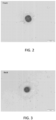
- FIGS. 2 and 3 are photographs illustrating a through-via drilled through a 50 ⁇ m thick glass substrate (i.e., a substrate formed of AF 32 ® , manufactured by SCHOTT Corporation), taken from the first and second surfaces of the glass substrate, respectively, using the aforementioned laser processing system 100 and implementing the laser drilling process described above.
- the glass substrate was uncoated, in that it did not have any absorptive coating formed on either surface, and the average power of the beam of laser pulses at the substrate (i.e., after having been reflected, transmitted, or diffracted by the aforementioned components of the laser processing system 100) was in a range from 66 W (or thereabout) to 67 W (or thereabout).
- the diameter of the through-via at the first surface was in a range from 9.5 ⁇ m to 10.1 ⁇ m; and the diameter of the through-via at the second surface (as shown in FIG. 3 ) was 9 ⁇ m.
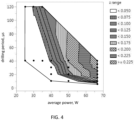
- FIG. 4 is a graph illustrating the results of experiments in which a 50 ⁇ m thick glass substrate (i.e., an uncoated substrate formed of AF 32 ® , manufactured by SCHOTT Corporation) was subjected to the laser drilling process described above.
- the average power of the beam of laser pulses at the substrate was varied from 25W (or thereabout) to 67 W (or thereabout) and the drilling period at each location in the substrate where an attempt to form a via was made was varied from 5 ⁇ s to 120 ⁇ s in 5 ⁇ s intervals.
- the dots in the graph represent actual data points obtained from each experiment, and the boundaries of the contours were derived from the experimentally-obtained data using the statistical analysis software JPM, produced by SAS INSTITUTE, INC.
- the z range of the laser drilling process is 0.05 mm.
- the z range of the laser drilling process was found to be capable of expansion, as illustrated in FIG. 4 , by increasing the average power at the substrate and/or by increasing the drilling period at each drilling location. For example, by increasing the drilling period from 40 ⁇ s to 120 ⁇ s (at an average power of 30 W), through-vias can be formed at a z offset of 0.075 mm.
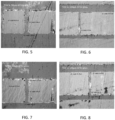
- FIGS. 5 to 8 are photographs of cross-sectioned glass substrates (i.e., formed of AF 32 ® , manufactured by SCHOTT Corporation), that are either 50 ⁇ m thick (in the case of FIGS. 5 and 7 ) or 100 ⁇ m thick (in the case of FIGS. 6 and 8 ) that were processed (e.g., using the laser processing system 100 and the laser drilling process described above) to form though-vias, wherein each via is formed for a drilling period of 15 ⁇ s.
- cross-sectioned glass substrates i.e., formed of AF 32 ® , manufactured by SCHOTT Corporation
- the glass substrates did not have any absorptive coating formed on either surface, and the average power of the beam of laser pulses at the substrate (i.e., after having been reflected, transmitted, or diffracted by the aforementioned components of the laser processing system 100) was in a range from 67 W (or thereabout) to 69 W (or thereabout).
- the ragged edge quality at the cross-sectioned plane is due to the fragility of glass material to the mechanical grinding method used to cross-section the substrate.
- the diameters identified in FIGS. 5 to 8 may have been smaller than those annotated thereon, prior to cross-sectioning.
- the main objective of FIGS. 5 to 8 is to illustrate how straight the sidewalls of the through-vias are, and the uniformity of the diameter of the through-vias through the entire thickness of the substrate.
- the beam of laser pulses can be scanned (e.g., by the beam scanner 108) to form a plurality of through-vias.
- the minimum via-to-via pitch i.e., the distance between nearest-neighbor vias
- the splash zone is a zone around the opening at the second surface where molten material is ejected from the substrate during formation of a through-via.
- the laser drilling process described above yields a splash zone having a diameter of about 30 ⁇ m.
- the via-to-via pitch can be at least 30 ⁇ m (or thereabout).
- through-vias having openings with a diameter of about 10 ⁇ m at the first surface and second surface of substrates having a thickness of either 50 ⁇ m or 100 ⁇ m have been described, it will be appreciated that through-vias having similarly- sized openings may be formed in substrates having a thickness that is less than 50 ⁇ m, between 50 ⁇ m and 100 ⁇ m, or greater than 100 ⁇ m.
- through-vias having openings at the first and second surfaces with a smaller diameter may be obtained by using a scan lens 110 with an NA higher than 0.5.
- the laser system 100 has been described above as including a laser 102 operative to generate a beam of laser pulses at a wavelength of 515 nm (or thereabout), it will be appreciated that the laser drilling process described in the embodiments above can be achieved using laser pulses at wavelengths other than 515 nm (or thereabout), depending on one or more other factors such as the average power at the substrate, pulse width, pulse repetition rate, the material from which the substrate is formed and the like.
- the aforementioned laser drilling process can be performed using a beam of laser pulses at wavelengths in the near-infrared region of the electromagnetic spectrum (e.g., at 1030 nm, at 1064 nm, or the like), provided that the beam of laser pulses has a pulse repetition rate as discussed above, and also provided that the average power of the beam of laser pulses at the substrate is 100 W (or thereabout) or greater (e.g., 110 W, 120 W, 130 W, or the like or between any of these values).
- laser pulses in the beam of laser pulses can have pulse widths as discussed above. However, it should be noted that the selection of the pulse width can affect the duration of the drilling period.
- a beam of laser pulses having a relatively short pulse width (e.g., 10 ps, or thereabout) will be able to form a through-via within a drilling period that is shorter than a beam of laser pulses having a relatively long pulse width (e.g., 30 ps, or thereabout).
- the laser-drilling process has been described above as eliminating need for an absorptive coating at the second surface of the substrate, it will be appreciated that the second surface of the substrate may be coated or otherwise treated with a material that is either more absorptive to the beam of laser pulses than the substrate or alters the absorptivity of the substrate (e.g., at or near the second surface thereof) to the laser pulses.
- the substrate may optionally be subjected to a thermal annealing process after the laser-drilling process has been performed to form the through-vias. In this case, the thermal annealing may act to reduce internal stresses present with the substrate due to the solidification of molten material ejected into the splash zone during the laser-drilling process.
Landscapes
- Engineering & Computer Science (AREA)
- Physics & Mathematics (AREA)
- Optics & Photonics (AREA)
- Plasma & Fusion (AREA)
- Mechanical Engineering (AREA)
- Laser Beam Processing (AREA)
- Surface Treatment Of Glass (AREA)
- Macromolecular Compounds Obtained By Forming Nitrogen-Containing Linkages In General (AREA)
- Metal-Oxide And Bipolar Metal-Oxide Semiconductor Integrated Circuits (AREA)
- Re-Forming, After-Treatment, Cutting And Transporting Of Glass Products (AREA)
Priority Applications (1)
| Application Number | Priority Date | Filing Date | Title |
|---|---|---|---|
| EP24199191.8A EP4474097A3 (en) | 2018-10-08 | 2019-10-02 | Systems and methods for drilling vias in transparent materials |
Applications Claiming Priority (2)
| Application Number | Priority Date | Filing Date | Title |
|---|---|---|---|
| US201862742694P | 2018-10-08 | 2018-10-08 | |
| PCT/US2019/054271 WO2020076583A1 (en) | 2018-10-08 | 2019-10-02 | Systems and methods for drilling vias in transparent materials |
Related Child Applications (1)
| Application Number | Title | Priority Date | Filing Date |
|---|---|---|---|
| EP24199191.8A Division EP4474097A3 (en) | 2018-10-08 | 2019-10-02 | Systems and methods for drilling vias in transparent materials |
Publications (3)
| Publication Number | Publication Date |
|---|---|
| EP3843934A1 EP3843934A1 (en) | 2021-07-07 |
| EP3843934A4 EP3843934A4 (en) | 2022-06-22 |
| EP3843934B1 true EP3843934B1 (en) | 2024-09-18 |
Family
ID=70164817
Family Applications (2)
| Application Number | Title | Priority Date | Filing Date |
|---|---|---|---|
| EP19870433.0A Active EP3843934B1 (en) | 2018-10-08 | 2019-10-02 | Methods for drilling vias in transparent materials |
| EP24199191.8A Pending EP4474097A3 (en) | 2018-10-08 | 2019-10-02 | Systems and methods for drilling vias in transparent materials |
Family Applications After (1)
| Application Number | Title | Priority Date | Filing Date |
|---|---|---|---|
| EP24199191.8A Pending EP4474097A3 (en) | 2018-10-08 | 2019-10-02 | Systems and methods for drilling vias in transparent materials |
Country Status (9)
| Country | Link |
|---|---|
| US (2) | US12070819B2 (https=) |
| EP (2) | EP3843934B1 (https=) |
| JP (3) | JP2022504439A (https=) |
| KR (1) | KR102640881B1 (https=) |
| CN (2) | CN112714681B (https=) |
| LT (1) | LT3843934T (https=) |
| SG (1) | SG11202101843SA (https=) |
| TW (2) | TWI816897B (https=) |
| WO (1) | WO2020076583A1 (https=) |
Families Citing this family (3)
| Publication number | Priority date | Publication date | Assignee | Title |
|---|---|---|---|---|
| DE102020201207A1 (de) * | 2020-01-31 | 2021-08-05 | Fraunhofer-Gesellschaft zur Förderung der angewandten Forschung e.V. | Anordnung zur Materialbearbeitung mit einem Laserstrahl, insbesondere zum Laserstrahl-Bohren |
| CN117226254B (zh) * | 2023-11-02 | 2024-06-21 | 武汉华日精密激光股份有限公司 | 基于超快激光-长脉冲激光复合的激光打孔装置及方法 |
| JP2026057143A (ja) | 2024-09-20 | 2026-04-02 | 新東工業株式会社 | 造型システム及び造型方法 |
Family Cites Families (30)
| Publication number | Priority date | Publication date | Assignee | Title |
|---|---|---|---|---|
| US4473737A (en) * | 1981-09-28 | 1984-09-25 | General Electric Company | Reverse laser drilling |
| FR2542327B1 (https=) | 1983-03-07 | 1986-03-07 | Bensoussan Marcel | |
| US5293025A (en) | 1991-08-01 | 1994-03-08 | E. I. Du Pont De Nemours And Company | Method for forming vias in multilayer circuits |
| US6417485B1 (en) * | 2000-05-30 | 2002-07-09 | Igor Troitski | Method and laser system controlling breakdown process development and space structure of laser radiation for production of high quality laser-induced damage images |
| JP2004337901A (ja) | 2003-05-14 | 2004-12-02 | Sumitomo Heavy Ind Ltd | グリーンシートの孔加工方法およびグリーンシート載置用定盤 |
| GB0403865D0 (en) * | 2004-02-20 | 2004-03-24 | Powerlase Ltd | Laser multiplexing |
| US7626138B2 (en) * | 2005-09-08 | 2009-12-01 | Imra America, Inc. | Transparent material processing with an ultrashort pulse laser |
| US9138913B2 (en) | 2005-09-08 | 2015-09-22 | Imra America, Inc. | Transparent material processing with an ultrashort pulse laser |
| US8624157B2 (en) * | 2006-05-25 | 2014-01-07 | Electro Scientific Industries, Inc. | Ultrashort laser pulse wafer scribing |
| US7767595B2 (en) | 2006-10-26 | 2010-08-03 | Semiconductor Energy Laboratory Co., Ltd. | Manufacturing method of semiconductor device |
| JP2008288577A (ja) | 2007-04-18 | 2008-11-27 | Fujikura Ltd | 基板の処理方法、貫通配線基板及びその製造方法、並びに電子部品 |
| US8736026B2 (en) | 2009-02-27 | 2014-05-27 | Picodrill Sa | Method of generating a hole or recess or well in a substrate |
| EP2480507A1 (en) * | 2009-08-28 | 2012-08-01 | Corning Incorporated | Methods for laser cutting articles from chemically strengthened glass substrates |
| US10357850B2 (en) | 2012-09-24 | 2019-07-23 | Electro Scientific Industries, Inc. | Method and apparatus for machining a workpiece |
| JP2016508069A (ja) | 2012-11-29 | 2016-03-17 | コーニング インコーポレイテッド | 基板をレーザー穿孔するための犠牲カバー層およびその方法 |
| US9102007B2 (en) | 2013-08-02 | 2015-08-11 | Rofin-Sinar Technologies Inc. | Method and apparatus for performing laser filamentation within transparent materials |
| US20150121960A1 (en) | 2013-11-04 | 2015-05-07 | Rofin-Sinar Technologies Inc. | Method and apparatus for machining diamonds and gemstones using filamentation by burst ultrafast laser pulses |
| US9517929B2 (en) | 2013-11-19 | 2016-12-13 | Rofin-Sinar Technologies Inc. | Method of fabricating electromechanical microchips with a burst ultrafast laser pulses |
| US10144088B2 (en) | 2013-12-03 | 2018-12-04 | Rofin-Sinar Technologies Llc | Method and apparatus for laser processing of silicon by filamentation of burst ultrafast laser pulses |
| US10293436B2 (en) * | 2013-12-17 | 2019-05-21 | Corning Incorporated | Method for rapid laser drilling of holes in glass and products made therefrom |
| US20150165560A1 (en) * | 2013-12-17 | 2015-06-18 | Corning Incorporated | Laser processing of slots and holes |
| US9938187B2 (en) * | 2014-02-28 | 2018-04-10 | Rofin-Sinar Technologies Llc | Method and apparatus for material processing using multiple filamentation of burst ultrafast laser pulses |
| JP6734202B2 (ja) | 2015-01-13 | 2020-08-05 | ロフィン−シナール テクノロジーズ エルエルシー | 脆性材料をスクライブして化学エッチングする方法およびシステム |
| WO2016122821A2 (en) | 2015-01-29 | 2016-08-04 | Imra America, Inc. | Laser-based modification of transparent materials |
| US10507544B2 (en) | 2015-02-27 | 2019-12-17 | Electro Scientific Industries, Inc | Fast beam manipulation for cross-axis miromaching |
| CN104759764B (zh) * | 2015-03-28 | 2018-02-02 | 大族激光科技产业集团股份有限公司 | 一种玻璃的激光钻孔方法 |
| US20160368086A1 (en) | 2015-06-16 | 2016-12-22 | Electro Scientific Industries, Inc. | Methods and apparatus for processing transparent materials |
| JP6813168B2 (ja) | 2016-07-29 | 2021-01-13 | 三星ダイヤモンド工業株式会社 | 脆性材料基板のレーザー加工方法およびレーザー加工装置 |
| US10366904B2 (en) | 2016-09-08 | 2019-07-30 | Corning Incorporated | Articles having holes with morphology attributes and methods for fabricating the same |
| CN108161250A (zh) * | 2018-01-30 | 2018-06-15 | 苏州德龙激光股份有限公司 | 多焦点动态分布激光加工脆性透明材料的方法及装置 |
-
2019
- 2019-10-01 TW TW108135498A patent/TWI816897B/zh active
- 2019-10-01 TW TW112133781A patent/TWI866446B/zh active
- 2019-10-02 EP EP19870433.0A patent/EP3843934B1/en active Active
- 2019-10-02 JP JP2021518967A patent/JP2022504439A/ja active Pending
- 2019-10-02 LT LTEPPCT/US2019/054271T patent/LT3843934T/lt unknown
- 2019-10-02 KR KR1020217012935A patent/KR102640881B1/ko active Active
- 2019-10-02 CN CN201980060712.3A patent/CN112714681B/zh active Active
- 2019-10-02 CN CN202311368358.5A patent/CN119407374A/zh active Pending
- 2019-10-02 US US17/272,155 patent/US12070819B2/en active Active
- 2019-10-02 EP EP24199191.8A patent/EP4474097A3/en active Pending
- 2019-10-02 SG SG11202101843SA patent/SG11202101843SA/en unknown
- 2019-10-02 WO PCT/US2019/054271 patent/WO2020076583A1/en not_active Ceased
-
2023
- 2023-09-04 JP JP2023142673A patent/JP7539539B2/ja active Active
-
2024
- 2024-08-08 US US18/797,580 patent/US20240391030A1/en active Pending
- 2024-08-13 JP JP2024134762A patent/JP7787259B2/ja active Active
Also Published As
| Publication number | Publication date |
|---|---|
| TWI816897B (zh) | 2023-10-01 |
| US20210245303A1 (en) | 2021-08-12 |
| JP2024164063A (ja) | 2024-11-26 |
| JP7539539B2 (ja) | 2024-08-23 |
| WO2020076583A1 (en) | 2020-04-16 |
| EP3843934A4 (en) | 2022-06-22 |
| SG11202101843SA (en) | 2021-03-30 |
| CN112714681B (zh) | 2023-09-22 |
| LT3843934T (lt) | 2024-11-25 |
| KR102640881B1 (ko) | 2024-02-27 |
| TW202023734A (zh) | 2020-07-01 |
| JP2022504439A (ja) | 2022-01-13 |
| US20240391030A1 (en) | 2024-11-28 |
| TWI866446B (zh) | 2024-12-11 |
| JP2023175728A (ja) | 2023-12-12 |
| JP7787259B2 (ja) | 2025-12-16 |
| CN119407374A (zh) | 2025-02-11 |
| EP4474097A2 (en) | 2024-12-11 |
| EP4474097A3 (en) | 2025-03-19 |
| TW202400349A (zh) | 2024-01-01 |
| CN112714681A (zh) | 2021-04-27 |
| KR20210057819A (ko) | 2021-05-21 |
| US12070819B2 (en) | 2024-08-27 |
| EP3843934A1 (en) | 2021-07-07 |
Similar Documents
| Publication | Publication Date | Title |
|---|---|---|
| US20240391030A1 (en) | Methods for drilling vias in transparent materials | |
| JP6381753B2 (ja) | 超高速のレーザーパルスのバーストによるフィラメンテーションを用いた透明材料の非アブレーション光音響圧縮加工の方法および装置 | |
| Knowles et al. | Micro-machining of metals, ceramics and polymers using nanosecond lasers | |
| US20110132885A1 (en) | Laser machining and scribing systems and methods | |
| TWI647187B (zh) | 自載體分離玻璃片的方法 | |
| CN107835794A (zh) | 在挠性基材板中连续制造孔的方法和与此相关的产品 | |
| TW201639652A (zh) | 雷射式修改透明材料的系統及其方法 | |
| KR20140137437A (ko) | 연장된 깊이 가식을 이용한 가공소재 레이저 스크라이빙 | |
| JP2007245173A (ja) | レーザ加工方法及びレーザ加工装置 | |
| JP2010536576A (ja) | 短パルスレーザを用いた固体材料切断方法およびシステム | |
| KR20220007072A (ko) | 관통 유리 비아를 소유하는 높은 실리케이트 유리 물품 및 이의 제조 및 사용 방법 | |
| Matsumoto et al. | Rapid formation of high aspect ratio through holes in thin glass substrates using an engineered, QCW laser approach | |
| CN114585470A (zh) | 激光光束加工透明脆性材料的方法和实施这种方法的装置 | |
| JP7782265B2 (ja) | ガラス板の加工方法 | |
| Sota et al. | Fabrication of depth-controlled high-quality holes and lines on a metal surface by nanosecond laser pulses at 1064 nm | |
| KR20240123798A (ko) | 기판 절단 및 쪼개기를 위한 기판 준비 | |
| Bhatt et al. | Excimer laser machining of microvias in glass substrates for the manufacture of high density interconnects | |
| JP2020021968A (ja) | 半導体加工対象物のスクライブ方法 |
Legal Events
| Date | Code | Title | Description |
|---|---|---|---|
| STAA | Information on the status of an ep patent application or granted ep patent |
Free format text: STATUS: THE INTERNATIONAL PUBLICATION HAS BEEN MADE |
|
| STAA | Information on the status of an ep patent application or granted ep patent |
Free format text: STATUS: REQUEST FOR EXAMINATION WAS MADE |
|
| PUAI | Public reference made under article 153(3) epc to a published international application that has entered the european phase |
Free format text: ORIGINAL CODE: 0009012 |
|
| 17P | Request for examination filed |
Effective date: 20210331 |
|
| AK | Designated contracting states |
Kind code of ref document: A1 Designated state(s): AL AT BE BG CH CY CZ DE DK EE ES FI FR GB GR HR HU IE IS IT LI LT LU LV MC MK MT NL NO PL PT RO RS SE SI SK SM TR |
|
| DAV | Request for validation of the european patent (deleted) | ||
| DAX | Request for extension of the european patent (deleted) | ||
| A4 | Supplementary search report drawn up and despatched |
Effective date: 20220520 |
|
| RIC1 | Information provided on ipc code assigned before grant |
Ipc: B23K 26/40 20140101ALI20220516BHEP Ipc: B23K 26/382 20140101AFI20220516BHEP |
|
| RAP3 | Party data changed (applicant data changed or rights of an application transferred) |
Owner name: ELECTRO SCIENTIFIC INDUSTRIES, INC. |
|
| GRAP | Despatch of communication of intention to grant a patent |
Free format text: ORIGINAL CODE: EPIDOSNIGR1 |
|
| STAA | Information on the status of an ep patent application or granted ep patent |
Free format text: STATUS: GRANT OF PATENT IS INTENDED |
|
| INTG | Intention to grant announced |
Effective date: 20231026 |
|
| GRAJ | Information related to disapproval of communication of intention to grant by the applicant or resumption of examination proceedings by the epo deleted |
Free format text: ORIGINAL CODE: EPIDOSDIGR1 |
|
| STAA | Information on the status of an ep patent application or granted ep patent |
Free format text: STATUS: REQUEST FOR EXAMINATION WAS MADE |
|
| INTC | Intention to grant announced (deleted) | ||
| GRAP | Despatch of communication of intention to grant a patent |
Free format text: ORIGINAL CODE: EPIDOSNIGR1 |
|
| STAA | Information on the status of an ep patent application or granted ep patent |
Free format text: STATUS: GRANT OF PATENT IS INTENDED |
|
| INTG | Intention to grant announced |
Effective date: 20240416 |
|
| GRAS | Grant fee paid |
Free format text: ORIGINAL CODE: EPIDOSNIGR3 |
|
| GRAA | (expected) grant |
Free format text: ORIGINAL CODE: 0009210 |
|
| STAA | Information on the status of an ep patent application or granted ep patent |
Free format text: STATUS: THE PATENT HAS BEEN GRANTED |
|
| AK | Designated contracting states |
Kind code of ref document: B1 Designated state(s): AL AT BE BG CH CY CZ DE DK EE ES FI FR GB GR HR HU IE IS IT LI LT LU LV MC MK MT NL NO PL PT RO RS SE SI SK SM TR |
|
| REG | Reference to a national code |
Ref country code: GB Ref legal event code: FG4D |
|
| RIN1 | Information on inventor provided before grant (corrected) |
Inventor name: LIN, ZHIBIN Inventor name: KLEINERT, JAN Inventor name: MATSUMOTO, HISASHI |
|
| REG | Reference to a national code |
Ref country code: CH Ref legal event code: EP |
|
| REG | Reference to a national code |
Ref country code: DE Ref legal event code: R096 Ref document number: 602019059239 Country of ref document: DE |
|
| REG | Reference to a national code |
Ref country code: IE Ref legal event code: FG4D |
|
| PG25 | Lapsed in a contracting state [announced via postgrant information from national office to epo] |
Ref country code: NO Free format text: LAPSE BECAUSE OF FAILURE TO SUBMIT A TRANSLATION OF THE DESCRIPTION OR TO PAY THE FEE WITHIN THE PRESCRIBED TIME-LIMIT Effective date: 20241218 |
|
| PG25 | Lapsed in a contracting state [announced via postgrant information from national office to epo] |
Ref country code: GR Free format text: LAPSE BECAUSE OF FAILURE TO SUBMIT A TRANSLATION OF THE DESCRIPTION OR TO PAY THE FEE WITHIN THE PRESCRIBED TIME-LIMIT Effective date: 20241219 Ref country code: FI Free format text: LAPSE BECAUSE OF FAILURE TO SUBMIT A TRANSLATION OF THE DESCRIPTION OR TO PAY THE FEE WITHIN THE PRESCRIBED TIME-LIMIT Effective date: 20240918 |
|
| PG25 | Lapsed in a contracting state [announced via postgrant information from national office to epo] |
Ref country code: BG Free format text: LAPSE BECAUSE OF FAILURE TO SUBMIT A TRANSLATION OF THE DESCRIPTION OR TO PAY THE FEE WITHIN THE PRESCRIBED TIME-LIMIT Effective date: 20240918 |
|
| PG25 | Lapsed in a contracting state [announced via postgrant information from national office to epo] |
Ref country code: LV Free format text: LAPSE BECAUSE OF FAILURE TO SUBMIT A TRANSLATION OF THE DESCRIPTION OR TO PAY THE FEE WITHIN THE PRESCRIBED TIME-LIMIT Effective date: 20240918 |
|
| PG25 | Lapsed in a contracting state [announced via postgrant information from national office to epo] |
Ref country code: HR Free format text: LAPSE BECAUSE OF FAILURE TO SUBMIT A TRANSLATION OF THE DESCRIPTION OR TO PAY THE FEE WITHIN THE PRESCRIBED TIME-LIMIT Effective date: 20240918 |
|
| REG | Reference to a national code |
Ref country code: NL Ref legal event code: MP Effective date: 20240918 |
|
| PG25 | Lapsed in a contracting state [announced via postgrant information from national office to epo] |
Ref country code: RS Free format text: LAPSE BECAUSE OF FAILURE TO SUBMIT A TRANSLATION OF THE DESCRIPTION OR TO PAY THE FEE WITHIN THE PRESCRIBED TIME-LIMIT Effective date: 20241218 |
|
| PG25 | Lapsed in a contracting state [announced via postgrant information from national office to epo] |
Ref country code: RS Free format text: LAPSE BECAUSE OF FAILURE TO SUBMIT A TRANSLATION OF THE DESCRIPTION OR TO PAY THE FEE WITHIN THE PRESCRIBED TIME-LIMIT Effective date: 20241218 Ref country code: NO Free format text: LAPSE BECAUSE OF FAILURE TO SUBMIT A TRANSLATION OF THE DESCRIPTION OR TO PAY THE FEE WITHIN THE PRESCRIBED TIME-LIMIT Effective date: 20241218 Ref country code: LV Free format text: LAPSE BECAUSE OF FAILURE TO SUBMIT A TRANSLATION OF THE DESCRIPTION OR TO PAY THE FEE WITHIN THE PRESCRIBED TIME-LIMIT Effective date: 20240918 Ref country code: HR Free format text: LAPSE BECAUSE OF FAILURE TO SUBMIT A TRANSLATION OF THE DESCRIPTION OR TO PAY THE FEE WITHIN THE PRESCRIBED TIME-LIMIT Effective date: 20240918 Ref country code: GR Free format text: LAPSE BECAUSE OF FAILURE TO SUBMIT A TRANSLATION OF THE DESCRIPTION OR TO PAY THE FEE WITHIN THE PRESCRIBED TIME-LIMIT Effective date: 20241219 Ref country code: FI Free format text: LAPSE BECAUSE OF FAILURE TO SUBMIT A TRANSLATION OF THE DESCRIPTION OR TO PAY THE FEE WITHIN THE PRESCRIBED TIME-LIMIT Effective date: 20240918 Ref country code: BG Free format text: LAPSE BECAUSE OF FAILURE TO SUBMIT A TRANSLATION OF THE DESCRIPTION OR TO PAY THE FEE WITHIN THE PRESCRIBED TIME-LIMIT Effective date: 20240918 |
|
| REG | Reference to a national code |
Ref country code: AT Ref legal event code: MK05 Ref document number: 1724277 Country of ref document: AT Kind code of ref document: T Effective date: 20240918 |
|
| PG25 | Lapsed in a contracting state [announced via postgrant information from national office to epo] |
Ref country code: NL Free format text: LAPSE BECAUSE OF FAILURE TO SUBMIT A TRANSLATION OF THE DESCRIPTION OR TO PAY THE FEE WITHIN THE PRESCRIBED TIME-LIMIT Effective date: 20240918 |
|
| PG25 | Lapsed in a contracting state [announced via postgrant information from national office to epo] |
Ref country code: PT Free format text: LAPSE BECAUSE OF FAILURE TO SUBMIT A TRANSLATION OF THE DESCRIPTION OR TO PAY THE FEE WITHIN THE PRESCRIBED TIME-LIMIT Effective date: 20250120 Ref country code: IS Free format text: LAPSE BECAUSE OF FAILURE TO SUBMIT A TRANSLATION OF THE DESCRIPTION OR TO PAY THE FEE WITHIN THE PRESCRIBED TIME-LIMIT Effective date: 20250118 |
|
| PG25 | Lapsed in a contracting state [announced via postgrant information from national office to epo] |
Ref country code: SM Free format text: LAPSE BECAUSE OF FAILURE TO SUBMIT A TRANSLATION OF THE DESCRIPTION OR TO PAY THE FEE WITHIN THE PRESCRIBED TIME-LIMIT Effective date: 20240918 Ref country code: RO Free format text: LAPSE BECAUSE OF FAILURE TO SUBMIT A TRANSLATION OF THE DESCRIPTION OR TO PAY THE FEE WITHIN THE PRESCRIBED TIME-LIMIT Effective date: 20240918 |
|
| PG25 | Lapsed in a contracting state [announced via postgrant information from national office to epo] |
Ref country code: ES Free format text: LAPSE BECAUSE OF FAILURE TO SUBMIT A TRANSLATION OF THE DESCRIPTION OR TO PAY THE FEE WITHIN THE PRESCRIBED TIME-LIMIT Effective date: 20240918 |
|
| PG25 | Lapsed in a contracting state [announced via postgrant information from national office to epo] |
Ref country code: EE Free format text: LAPSE BECAUSE OF FAILURE TO SUBMIT A TRANSLATION OF THE DESCRIPTION OR TO PAY THE FEE WITHIN THE PRESCRIBED TIME-LIMIT Effective date: 20240918 Ref country code: AT Free format text: LAPSE BECAUSE OF FAILURE TO SUBMIT A TRANSLATION OF THE DESCRIPTION OR TO PAY THE FEE WITHIN THE PRESCRIBED TIME-LIMIT Effective date: 20240918 |
|
| PG25 | Lapsed in a contracting state [announced via postgrant information from national office to epo] |
Ref country code: PL Free format text: LAPSE BECAUSE OF FAILURE TO SUBMIT A TRANSLATION OF THE DESCRIPTION OR TO PAY THE FEE WITHIN THE PRESCRIBED TIME-LIMIT Effective date: 20240918 Ref country code: CZ Free format text: LAPSE BECAUSE OF FAILURE TO SUBMIT A TRANSLATION OF THE DESCRIPTION OR TO PAY THE FEE WITHIN THE PRESCRIBED TIME-LIMIT Effective date: 20240918 |
|
| PG25 | Lapsed in a contracting state [announced via postgrant information from national office to epo] |
Ref country code: IT Free format text: LAPSE BECAUSE OF FAILURE TO SUBMIT A TRANSLATION OF THE DESCRIPTION OR TO PAY THE FEE WITHIN THE PRESCRIBED TIME-LIMIT Effective date: 20240918 Ref country code: SK Free format text: LAPSE BECAUSE OF FAILURE TO SUBMIT A TRANSLATION OF THE DESCRIPTION OR TO PAY THE FEE WITHIN THE PRESCRIBED TIME-LIMIT Effective date: 20240918 |
|
| REG | Reference to a national code |
Ref country code: DE Ref legal event code: R097 Ref document number: 602019059239 Country of ref document: DE |
|
| PG25 | Lapsed in a contracting state [announced via postgrant information from national office to epo] |
Ref country code: MC Free format text: LAPSE BECAUSE OF FAILURE TO SUBMIT A TRANSLATION OF THE DESCRIPTION OR TO PAY THE FEE WITHIN THE PRESCRIBED TIME-LIMIT Effective date: 20240918 |
|
| PG25 | Lapsed in a contracting state [announced via postgrant information from national office to epo] |
Ref country code: DK Free format text: LAPSE BECAUSE OF FAILURE TO SUBMIT A TRANSLATION OF THE DESCRIPTION OR TO PAY THE FEE WITHIN THE PRESCRIBED TIME-LIMIT Effective date: 20240918 |
|
| PG25 | Lapsed in a contracting state [announced via postgrant information from national office to epo] |
Ref country code: BE Free format text: LAPSE BECAUSE OF NON-PAYMENT OF DUE FEES Effective date: 20241031 Ref country code: LU Free format text: LAPSE BECAUSE OF NON-PAYMENT OF DUE FEES Effective date: 20241002 |
|
| PLBE | No opposition filed within time limit |
Free format text: ORIGINAL CODE: 0009261 |
|
| STAA | Information on the status of an ep patent application or granted ep patent |
Free format text: STATUS: NO OPPOSITION FILED WITHIN TIME LIMIT |
|
| REG | Reference to a national code |
Ref country code: BE Ref legal event code: MM Effective date: 20241031 |
|
| 26N | No opposition filed |
Effective date: 20250619 |
|
| GBPC | Gb: european patent ceased through non-payment of renewal fee |
Effective date: 20241218 |
|
| PG25 | Lapsed in a contracting state [announced via postgrant information from national office to epo] |
Ref country code: SE Free format text: LAPSE BECAUSE OF FAILURE TO SUBMIT A TRANSLATION OF THE DESCRIPTION OR TO PAY THE FEE WITHIN THE PRESCRIBED TIME-LIMIT Effective date: 20240918 |
|
| PGFP | Annual fee paid to national office [announced via postgrant information from national office to epo] |
Ref country code: LT Payment date: 20250918 Year of fee payment: 7 |
|
| PG25 | Lapsed in a contracting state [announced via postgrant information from national office to epo] |
Ref country code: GB Free format text: LAPSE BECAUSE OF NON-PAYMENT OF DUE FEES Effective date: 20241218 |
|
| PG25 | Lapsed in a contracting state [announced via postgrant information from national office to epo] |
Ref country code: IE Free format text: LAPSE BECAUSE OF NON-PAYMENT OF DUE FEES Effective date: 20241002 |
|
| REG | Reference to a national code |
Ref country code: CH Ref legal event code: U11 Free format text: ST27 STATUS EVENT CODE: U-0-0-U10-U11 (AS PROVIDED BY THE NATIONAL OFFICE) Effective date: 20251101 |
|
| PGFP | Annual fee paid to national office [announced via postgrant information from national office to epo] |
Ref country code: DE Payment date: 20251028 Year of fee payment: 7 |
|
| PGFP | Annual fee paid to national office [announced via postgrant information from national office to epo] |
Ref country code: FR Payment date: 20251027 Year of fee payment: 7 |
|
| PGFP | Annual fee paid to national office [announced via postgrant information from national office to epo] |
Ref country code: CH Payment date: 20251101 Year of fee payment: 7 |
|
| PG25 | Lapsed in a contracting state [announced via postgrant information from national office to epo] |
Ref country code: CY Free format text: LAPSE BECAUSE OF FAILURE TO SUBMIT A TRANSLATION OF THE DESCRIPTION OR TO PAY THE FEE WITHIN THE PRESCRIBED TIME-LIMIT; INVALID AB INITIO Effective date: 20191002 |
|
| PG25 | Lapsed in a contracting state [announced via postgrant information from national office to epo] |
Ref country code: HU Free format text: LAPSE BECAUSE OF FAILURE TO SUBMIT A TRANSLATION OF THE DESCRIPTION OR TO PAY THE FEE WITHIN THE PRESCRIBED TIME-LIMIT; INVALID AB INITIO Effective date: 20191002 |