EP3833807B1 - Schuhartikel - Google Patents
Schuhartikel Download PDFInfo
- Publication number
- EP3833807B1 EP3833807B1 EP19759167.0A EP19759167A EP3833807B1 EP 3833807 B1 EP3833807 B1 EP 3833807B1 EP 19759167 A EP19759167 A EP 19759167A EP 3833807 B1 EP3833807 B1 EP 3833807B1
- Authority
- EP
- European Patent Office
- Prior art keywords
- knitted component
- yarn
- footwear
- article
- component
- Prior art date
- Legal status (The legal status is an assumption and is not a legal conclusion. Google has not performed a legal analysis and makes no representation as to the accuracy of the status listed.)
- Active
Links
Images



Classifications
-
- D—TEXTILES; PAPER
- D04—BRAIDING; LACE-MAKING; KNITTING; TRIMMINGS; NON-WOVEN FABRICS
- D04B—KNITTING
- D04B1/00—Weft knitting processes for the production of fabrics or articles not dependent on the use of particular machines; Fabrics or articles defined by such processes
- D04B1/10—Patterned fabrics or articles
- D04B1/12—Patterned fabrics or articles characterised by thread material
- D04B1/123—Patterned fabrics or articles characterised by thread material with laid-in unlooped yarn, e.g. fleece fabrics
-
- D—TEXTILES; PAPER
- D04—BRAIDING; LACE-MAKING; KNITTING; TRIMMINGS; NON-WOVEN FABRICS
- D04B—KNITTING
- D04B1/00—Weft knitting processes for the production of fabrics or articles not dependent on the use of particular machines; Fabrics or articles defined by such processes
- D04B1/10—Patterned fabrics or articles
- D04B1/12—Patterned fabrics or articles characterised by thread material
-
- A—HUMAN NECESSITIES
- A43—FOOTWEAR
- A43B—CHARACTERISTIC FEATURES OF FOOTWEAR; PARTS OF FOOTWEAR
- A43B1/00—Footwear characterised by the material
- A43B1/02—Footwear characterised by the material made of fibres or fabrics made therefrom
-
- A—HUMAN NECESSITIES
- A43—FOOTWEAR
- A43B—CHARACTERISTIC FEATURES OF FOOTWEAR; PARTS OF FOOTWEAR
- A43B1/00—Footwear characterised by the material
- A43B1/02—Footwear characterised by the material made of fibres or fabrics made therefrom
- A43B1/023—Animal fibres
-
- A—HUMAN NECESSITIES
- A43—FOOTWEAR
- A43B—CHARACTERISTIC FEATURES OF FOOTWEAR; PARTS OF FOOTWEAR
- A43B1/00—Footwear characterised by the material
- A43B1/02—Footwear characterised by the material made of fibres or fabrics made therefrom
- A43B1/028—Synthetic or artificial fibres
-
- A—HUMAN NECESSITIES
- A43—FOOTWEAR
- A43B—CHARACTERISTIC FEATURES OF FOOTWEAR; PARTS OF FOOTWEAR
- A43B1/00—Footwear characterised by the material
- A43B1/02—Footwear characterised by the material made of fibres or fabrics made therefrom
- A43B1/04—Footwear characterised by the material made of fibres or fabrics made therefrom braided, knotted, knitted or crocheted
-
- A—HUMAN NECESSITIES
- A43—FOOTWEAR
- A43B—CHARACTERISTIC FEATURES OF FOOTWEAR; PARTS OF FOOTWEAR
- A43B23/00—Uppers; Boot legs; Stiffeners; Other single parts of footwear
- A43B23/02—Uppers; Boot legs
- A43B23/0205—Uppers; Boot legs characterised by the material
-
- D—TEXTILES; PAPER
- D04—BRAIDING; LACE-MAKING; KNITTING; TRIMMINGS; NON-WOVEN FABRICS
- D04B—KNITTING
- D04B1/00—Weft knitting processes for the production of fabrics or articles not dependent on the use of particular machines; Fabrics or articles defined by such processes
- D04B1/14—Other fabrics or articles characterised primarily by the use of particular thread materials
-
- D—TEXTILES; PAPER
- D04—BRAIDING; LACE-MAKING; KNITTING; TRIMMINGS; NON-WOVEN FABRICS
- D04B—KNITTING
- D04B1/00—Weft knitting processes for the production of fabrics or articles not dependent on the use of particular machines; Fabrics or articles defined by such processes
- D04B1/14—Other fabrics or articles characterised primarily by the use of particular thread materials
- D04B1/16—Other fabrics or articles characterised primarily by the use of particular thread materials synthetic threads
-
- D—TEXTILES; PAPER
- D04—BRAIDING; LACE-MAKING; KNITTING; TRIMMINGS; NON-WOVEN FABRICS
- D04B—KNITTING
- D04B1/00—Weft knitting processes for the production of fabrics or articles not dependent on the use of particular machines; Fabrics or articles defined by such processes
- D04B1/22—Weft knitting processes for the production of fabrics or articles not dependent on the use of particular machines; Fabrics or articles defined by such processes specially adapted for knitting goods of particular configuration
- D04B1/24—Weft knitting processes for the production of fabrics or articles not dependent on the use of particular machines; Fabrics or articles defined by such processes specially adapted for knitting goods of particular configuration wearing apparel
-
- D—TEXTILES; PAPER
- D04—BRAIDING; LACE-MAKING; KNITTING; TRIMMINGS; NON-WOVEN FABRICS
- D04B—KNITTING
- D04B1/00—Weft knitting processes for the production of fabrics or articles not dependent on the use of particular machines; Fabrics or articles defined by such processes
- D04B1/22—Weft knitting processes for the production of fabrics or articles not dependent on the use of particular machines; Fabrics or articles defined by such processes specially adapted for knitting goods of particular configuration
- D04B1/24—Weft knitting processes for the production of fabrics or articles not dependent on the use of particular machines; Fabrics or articles defined by such processes specially adapted for knitting goods of particular configuration wearing apparel
- D04B1/26—Weft knitting processes for the production of fabrics or articles not dependent on the use of particular machines; Fabrics or articles defined by such processes specially adapted for knitting goods of particular configuration wearing apparel stockings
-
- D—TEXTILES; PAPER
- D04—BRAIDING; LACE-MAKING; KNITTING; TRIMMINGS; NON-WOVEN FABRICS
- D04B—KNITTING
- D04B1/00—Weft knitting processes for the production of fabrics or articles not dependent on the use of particular machines; Fabrics or articles defined by such processes
- D04B1/10—Patterned fabrics or articles
-
- D—TEXTILES; PAPER
- D10—INDEXING SCHEME ASSOCIATED WITH SUBLASSES OF SECTION D, RELATING TO TEXTILES
- D10B—INDEXING SCHEME ASSOCIATED WITH SUBLASSES OF SECTION D, RELATING TO TEXTILES
- D10B2401/00—Physical properties
- D10B2401/04—Heat-responsive characteristics
- D10B2401/041—Heat-responsive characteristics thermoplastic; thermosetting
-
- D—TEXTILES; PAPER
- D10—INDEXING SCHEME ASSOCIATED WITH SUBLASSES OF SECTION D, RELATING TO TEXTILES
- D10B—INDEXING SCHEME ASSOCIATED WITH SUBLASSES OF SECTION D, RELATING TO TEXTILES
- D10B2401/00—Physical properties
- D10B2401/06—Load-responsive characteristics
- D10B2401/061—Load-responsive characteristics elastic
-
- D—TEXTILES; PAPER
- D10—INDEXING SCHEME ASSOCIATED WITH SUBLASSES OF SECTION D, RELATING TO TEXTILES
- D10B—INDEXING SCHEME ASSOCIATED WITH SUBLASSES OF SECTION D, RELATING TO TEXTILES
- D10B2501/00—Wearing apparel
- D10B2501/04—Outerwear; Protective garments
- D10B2501/043—Footwear
Definitions
- a variety of articles are formed from textiles.
- articles of apparel e.g., shirts, pants, socks, footwear, jackets and other outerwear, briefs and other undergarments, hats and other headwear
- containers e.g., backpacks, bags
- upholstery for furniture e.g., chairs, couches, car seats
- textiles are often formed by weaving or interlooping (e.g., knitting) a yarn or a plurality of yams, usually through a mechanical process involving looms or knitting machines.
- One particular object that may be formed from a textile is an upper for an article of footwear.
- Conventional articles of footwear generally include two primary elements: an upper and a sole structure.
- the upper is secured to the sole structure and forms a void within the article of footwear for comfortably and securely receiving a foot.
- the sole structure is secured to a lower surface of the upper so as to be positioned between the upper and the ground.
- the sole structure may include a midsole and an outsole.
- the midsole may be formed from a polymer foam material that attenuates ground reaction forces to lessen stresses upon the foot and leg during walking, running, and other ambulatory activities.
- the outsole may be secured to a lower surface of the midsole and forms a ground-engaging portion of the sole structure that is formed from a durable and wear-resistant material.
- the upper of the article of footwear generally extends over the instep and toe areas of the foot, along the medial and lateral sides of the foot, and around the heel area of the foot. Access to the void on the interior of the upper is generally provided by an ankle opening in a heel area of the footwear.
- a lacing system is often incorporated into the upper to adjust the fit of the upper, thereby facilitating entry and removal of the foot from the void within the upper.
- the upper may include a tongue that extends under the lacing system to enhance adjustability of the footwear, and the upper may incorporate a heel counter to limit movement of the heel.
- an upper for an article of footwear that has certain desirable characteristics and properties.
- one or more yarns and/or material elements may be selected for forming the upper.
- the upper may further include one or more additional optional elements or components that provide other desirable characteristics, including, but not limited to an inlaid component that may enhance comfort and fit, as well as provide enhanced gripping surfaces for certain activities including but not limited to skateboarding, soccer, climbing and the like where traction on at least a portion of the exterior surface of the footwear is desirable.
- WO 2017/123752 A1 discloses a method of knitting a knitted component for an upper of an article of footwear.
- the method may include performing multiple passes of at least one yarn feeder so as to form a first collar portion and a second portion of the knitted component.
- EP 3 011 854 A1 discloses a shoe upper in which a reinforcing section can be easily formed at the position of the heel or the toe, and a method for producing the same.
- the shoe upper comprises an instep cover section and a sole cover section which are integrally knitted in a seamless manner.
- the objective technical problem to be solved may be considered in overcoming or at least reducing the disadvantages according to the prior art.
- the problem is solved by the subject matter of the independent claim.
- articles of footwear include a skateboarding shoe, a climbing shoe, a basketball shoe, a biking shoe, a cross-training shoe, a global football (soccer) shoe, an American football shoe, a bowling shoe, a golf shoe, a hiking shoe, a ski or snowboarding boot, a tennis shoe, a running shoe, and a walking shoe.
- the upper may also be incorporated into a non-athletic shoe, such as a dress shoe, a loafer, and a sandal.
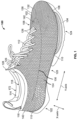
- an article of footwear 100 includes an upper 102 secured to a sole structure 104.
- the upper 102 may include a lateral side 106 and a medial side 108.
- the area of the shoe where the sole structure 104 joins the upper 102 may be referred to as the biteline 110.
- the upper 102 may be joined to the sole structure 104 in a fixed manner using any suitable technique, such as through the use of an adhesive, by sewing, etc. It is contemplated that the upper 102 may extend partially or completely around the foot of a wearer and/or may be integral with the sole, and a sockliner may or may not be used.
- the sole structure 104 may include a midsole (not shown) and an outsole.
- the article of footwear 100 may additionally include a throat area 112 and an ankle opening 114, which may lead to a void 118.
- the void 118 of the article of footwear 100 may be configured to accommodate a foot of a person.
- the throat area 112 may be generally disposed in a midfoot area 120 of the upper 102.
- the midfoot area 120 is generally an area of the upper 102 located between a heel area 122 and a toe area 124.
- a tongue may be disposed in the throat area 112, but a tongue is an optional component.
- the tongue may be any type of tongue, such as a gusseted tongue or a burrito tongue.
- the article of footwear 100 may include an optional fastening element, such as a lace (which may be associated with a plurality of lace apertures 126). The apertures may extend from a forefoot region, through a midfoot region and toward the throat area 112. Any suitable type of fastening element may be used.
- a fastening element such as a lace (which may be associated with a plurality of lace apertures 126). The apertures may extend from a forefoot region, through a midfoot region and toward the throat area 112. Any suitable type of fastening element may be used.
- At least a portion of the upper 102, and in some embodiments substantially the entirety of the upper 102, and in still further embodiments the entire upper, may be formed of at least one knitted component 132, such as made by a weft-knitting process on a flat knitting machine, for example.
- the knitted component 132 may additionally or alternatively form another element of the article of footwear, such as an underfoot portion, for example, and/or a heel element 134 as will be described in further detail below.
- a second or additional knitted component 136 separately formed from knitted component 132, may form another element of the article of footwear, such as an underfoot portion, for example, and/or a heel element 134.
- additional elements such as an underfoot portion and/or a heel element 134 (or other elements or components) may be integrally formed with the upper 102 as a one-piece structure, or, alternatively, one or more such additional elements may be formed separately from the upper 102 and then later attached, secured or otherwise assembled as necessary.
- the knitted component 132 has a first side 130 forming an inner surface of the upper 102 (e.g., facing the void 118 of the article of footwear) and a second side 138 forming an outer surface of the upper 102 (e.g. facing generally opposite the first side 130).
- the first side 130 and the second side 138 of the knitted component 132 may exhibit different characteristics (e.g., breathability, gripping ability, abrasion resistance, strength, structure and comfort, among other advantageous characteristics mentioned herein).
- the knitted component 132 may be formed as an integral one-piece element during a knitting process, such as a weft knitting process (e.g., with a flat knitting machine or circular knitting machine), a warp knitting process, or any other suitable knitting process.
- the knitting process on the knitting machine may substantially form the knit structure of the knitted component 132 without the need for significant post-knitting processes or steps.
- two or more portions of the knitted component 132 may be formed separately as distinct integral one-piece elements and then the respective elements attached.
- the heel element 134 can be knitted separately from the upper 102 and then attached or secured to the upper 102 by adhesives, stitching, bonding or other mechanisms or a combination thereof. Additional portions or details may also be secured or attached to the upper for structural or aesthetic purposes, including heel reinforcements, lace aperture reinforcements, to reinforcements and the like. These additional portions may be formed of a separate knitted component that is later attached or by other textiles or materials including, but not limited to leather, suede, rubber, plastic and others.
- Forming the upper 102 with the knitted component 132 may provide the upper 102 with advantageous characteristics including, but not limited to, a particular degree of elasticity (for example, as expressed in terms of Young's modulus), grip, breathability, bendability, strength, moisture absorption, weight, abrasion resistance, and/or a combination thereof.
- a particular degree of elasticity for example, as expressed in terms of Young's modulus
- grip for example, as expressed in terms of Young's modulus
- breathability for example, as expressed in terms of Young's modulus
- strength for example, as expressed in terms of Young's modulus
- moisture absorption weight
- abrasion resistance a combination thereof.
- a particular single layer or multi-layer knit structure e.g., a ribbed knit structure, a single jersey knit structure, or a double jersey knit structure
- a particular material e.g., a polyester material, a relatively inelastic material, or a relatively elastic material such as spandex
- yarns of a particular size e.g., dtex
- the knitted component 132 may also provide desirable aesthetic characteristics by incorporating yarns having different colors, reflectivity, textures, various degrees of transparency or translucency or other visual properties arranged in a particular pattern.
- other materials may be incorporated into the knitted component including but not limited to leather, suede, rubber, plastic or other materials.
- the yarns themselves and/or the knit structure formed by one or more of the yams or other materials of the knitted component 132 may be varied at different locations such that the knitted component 132 has two or more portions with different properties.
- at least a portion of the knitted component 132 may be formed by one or more yarns and/or knitting techniques to provide an upper 102 that is lightweight, having relatively high strength and containment and also breathable.
- Other areas of the upper 102 formed by the knitted component 132 may be formed by one or more different yams and/or formed by different knitting techniques and/or other materials that result in a portion of the upper 102 that has different characteristics.
- the yam(s) and/or the knitting techniques used to form the throat area 112 and/or the ankle opening 114 may be selected to provide relatively greater elasticity, soft hand, cushioning, enhanced comfort and moisture wicking properties to those regions.
- the knitted component 132 may incorporate one or more materials with properties that change in response to a stimulus (e.g., temperature, moisture, electrical current, magnetic field, or light).
- the knitted component 132 may incorporate one or more materials that provide other desirable characteristics including but not limited to enhanced gripping surfaces.
- the knitted component 132 may include one or more yams formed of a thermoplastic polymer material (e.g., polyurethanes, polyamides, polyolefins, and nylons) that transitions from a solid state to a softened or liquid state when subjected to certain temperatures at or above its melting point and then transitions back to the solid state when cooled.
- the thermoplastic polymer material may provide the ability to heat and then cool a portion of the knitted component 132 to thereby form an area of fused or bonded or continuous material that exhibits certain advantageous properties including a relatively high degree of rigidity, strength, and water resistance, for example.
- yams comprising a thermoplastic polymer material
- advantages of providing one or more yams comprising a thermoplastic polymer material may include, for example, locking or securing the yarns of the knitted component into a particular position or configuration upon cooling, such that the knitted component 132 may be retained in that particular configuration.
- this may include stretching the knitted component to a predetermined degree and then heating the knitted component 132 during a post processing method, such as steaming.
- the fusible yams may lock the adjacent and/or surrounding yams in the stretched configuration to retain the knitted component 132 in this stretched condition.
- the knitted component 132 includes one or more yarns having a relatively high degree of tenacity relative to the other yams used to form the upper.
- tenacity is understood to refer to the amount of force (expressed in units of weight, for example: pounds, grams, centinewtons or other units) needed to rupture a yarn (i.e., the breaking force or breaking point of the yarn), divided by the linear mass density of the yam expressed, for example, in (unstrained) denier, decitex, or some other measure of weight per unit length.
- the amount of force needed to break a yam is determined by subjecting a sample of the yam to a known amount of force by stretching the sample until it breaks, for example, by inserting each end of a sample of the yarn into the grips on the measuring arms of an extensometer, subjecting the sample to a stretching force, and measuring the force required to break the sample using a strain gauge load cell.
- Suitable testing systems can be obtained from Instron (Norwood, MA, USA).
- Yarn tenacity and yarn breaking force are distinct from burst strength or bursting strength of a textile, which is a measure of the maximum force that can be applied to the surface of a textile before the surface bursts.
- the minimum tenacity required is approximately 13,24 cN/dtex (1.5 grams per denier (g/D)).
- Most synthetic polymer continuous filament yams formed from commodity polymeric materials generally have tenacities in the range of about 13,24 cN/dtex to about 35,31 cN/dtex (1.5 g/D to about 4 g/D).
- polyester filament yarns that may be used in the manufacture of knit uppers for article of footwear have tenacities in the range of about 22,01 cN/dtex to about 35,31 cN/dtex (2.5 g/D to about 4 g/D).
- Filament yarns formed from commodity synthetic polymeric materials which are considered to have high tenacities generally have tenacities in the range of about 44,14 cN/dtex to about 88,27 cN/dtex (5 g/D to about 10 g/D).
- commercially available package dyed polyethylene terephthalate filament yam from National Spinning (Washington, NC, USA) has a tenacity of about 52,96 cN/dtex (6 g/D)
- commercially available solution dyed polyethylene terephthalate filament yam from Far Eastern New Century (Taipei, Taiwan) has a tenacity of about 61,79 cN/dtex (7 g/D).
- Filament yarns formed from high performance synthetic polymer materials generally have tenacities of about 97,01 cN/dtex (11 g/D) or greater.
- filament yarns formed of aramid typically have tenacities of about 176,54 cN/dtex (20 g/D)
- filament yams formed of ultra-high molecular weight polyethylene (UHMWPE) having tenacities greater than 264,81 cN/dtex (30 g/D) are available from Dyneema (Stanley, NC, USA) and Spectra (Honeywell-Spectra, Colonial Heights, VA, USA).
- the knitted component may also include one or more yams having relatively high elasticity.
- Suitable elasticated yarns may incorporate elastane fiber(s), such as those available from Invista Company under the LYCRA trademark.
- Such yams may have the configuration of covered LYCRA, for example yarns having a LYCRA core that is surrounded by a nylon sheath.
- Other fibers or filaments exhibiting elastic properties may also be utilized.
- the knitted component 132 may also incorporate additional materials or components.
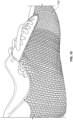
- the knitted component 132 may incorporate an inlaid component 152.
- the inlaid component 152 may comprise one or more yarns, rubbers, plastics, leathers and/or other natural or synthetic components.
- the knitted component 132 (which may be incorporated into an article of footwear 204) may include an inlaid component 152 that extends generally in a heel to toe direction when the knitted component 132 is incorporated into an article of footwear.
- FIG. 11 along with FIG.
- the inlaid component 152 may extend generally in a lateral to medial direction, and/or vertically when an associated article of footwear 206 is sitting on horizontal ground in a wearable state.
- the inlaid component 152 may extend in multiple directions and/or may be located in certain portions of the upper 102 and be absent from other areas of the upper 102. Such an arrangement may provide regional properties to certain portions of the upper, such that certain advantageous properties may deliberately be provided to certain parts of the upper while deliberately omitting certain properties from other parts of the upper 102.
- the knitted component 132 includes a seamless portion extending from the toe area 124, through a midfoot area 120, and to a heel area 122 on at least one of a lateral side 106 and a medial side 108 of the upper.
- the knitted component 132 may include a first edge and a second edge, which may be terminal ends of the knitted component 132 after the knitting process when the knitted component 132 is removed from the knitting machine. After the knitting process, the knitted component 132 may be folded or otherwise manipulated such that a first edge and the second edge are secured together at a seam 140 during formation of the upper 102.
- the seam 140 may be located on the lateral side 106 of the upper 102, on the medial side 108 of the upper 102, and/or in another location (e.g., at the back of the heel area 122 of the upper as shown in FIG. 1 ).
- Forming the upper 102 such that it is in an appropriate shape for inclusion in an article of footwear 100 may further include lasting the upper 102.
- An example of a lasting process is described in U.S. Patent Application Serial No. 12/848,352, filed August 2, 2010 , and issued as U.S. Patent No. 8,595,878 .
- the knitted component 132 When forming the knitted component 132, the knitted component 132 may be oriented with respect to a needle bed of a knitting machine such that a feeder of the knitting machine is capable of moving in a single pass (i.e., without changing its feed direction) to knit a first course from the lateral side 106 to the medial side 108 of the knitted component. As such, as subsequent courses are formed that are parallel to the first course, the toe area 124 of the knitted component 132 will be formed first, followed by the midfoot area 120 of the knitted component 132, and then the heel area 122 of the knitted component 132 (and/or vice versa, such that the knitted component is formed along a y-axis, in a heel-to-toe direction).
- the knitted component 132 may be oriented with respect to a needle bed of a knitting machine such that a first course is knit in a direction from heel to toe (or toe to heel). As such, when additional courses are formed parallel to the first course, one of the lateral or medial side is formed first, followed by a central portion such as the throat followed by the other of the lateral or medial side. As such, the knitted component is formed along an x-axis, in a side-to-side, or lateral-to-medial direction.
- the inlaid component 152 may be generally parallel to the course-wise direction of the knitted component 132. In an alternative embodiment, the inlaid component 152 may be generally perpendicular to the course-wise direction of the knitted component 132. It is also contemplated that the inlaid component 152 may be oriented in a particular direction in a forefoot and/or midfoot area of the upper 102 and be oriented in a different direction in a heel area of the upper 102, for example.
- the upper 102 may comprise a single layer 142.
- an outer surface (the second side 138) of the single layer 142 forms an external surface of an upper 102 and the inner surface (the first side 130) of the single layer 142 forms an inner surface of the upper 102, facing the void 118 of the upper configured to receive the foot of a wearer.
- one or more portions of the upper 102 may comprise more than a single layer 142, such as a first layer and a second layer that are coextensive and/or overlapping, which may form a pocket therebetween.
- the pocket may be filled with another element (e.g., a filler material, such as foam, down, or another suitable material or object), but this is not required, and in exemplary embodiments, the pocket may be empty and/or filled with just air.
- the upper 102 comprises an ankle opening 114, which leads to the void 118, configured to accommodate a foot of a wearer.
- the ankle opening 114 is formed of at least two collars.
- the collar 116 of the upper 102 may be referred to herein as a "first collar” which forms a "first collar opening.”
- the one or more of the yarns and/or knitting techniques used to form the collar 116 may be the same as the yams and/or knitting techniques used to form other portions of the upper 102 or they may be different.
- the one or more yarn(s), as well as the one or more knitting technique(s) used to form the collar 116, the throat area 112 and the remainder of the upper 102, respectively, may differ in order to impart desired properties and characteristics to different regions of the upper 102 as described below.
- a first yarn 144 may include a high tenacity polyester yarn.
- the high-tenacity polyester yarn may be formed from polyethylene terephthalate (PET).
- PET polyethylene terephthalate
- the first yarn 144 may have a tenacity of at least 5 grams per denier, and more preferably higher than 6 grams per denier and even more preferably from 6.5 - 7 grams per denier. In one example, three ends of 300 denier high tenacity polyester yarn may be used.
- the high tenacity polyester may be translucent or at least partially transparent in some embodiments.
- a second yarn 146 may be used to form at least a portion of the first knitted component 132, alone or in combination with the first yarn 144.
- the second yarn 146 may be the same as the first yarn 144 or it may be different.
- the second yarn 146 may have one or more thermoplastic polymers (collectively "the thermoplastic polymer material"), and in some embodiments, substantially the entirety of the second yam 146 may be formed of the thermoplastic polymer material.
- the thermoplastic polymer material of the second yam may have a melting temperature of between about 80-100 degrees C and more preferably 85-90 degrees C based on atmospheric pressure at sea level, though any other suitable melting temperatures is contemplated.
- the second yam 146 may be referred to as a "fusible yam" sold under the trade name Grilon K-85 by EMS-Griltech.
- the K-85 yam is a multifilament yarn where the polymer basis is a copolyamide.
- a yarn with a melting temperature below 140 degrees C that can be melted/post processed by steaming, heat and/or pressing to bind or fuse with the surrounding (non-low melt) yarns and hold them in place may be referred to as a 'fusible' or Tow melt' yam herein.
- two ends of 235 denier of the second yarn 146 may be used.
- fewer ends of a higher denier second yam 146 may be used, such as one end of a 500 denier yarn. More or fewer ends of the second yarn 146 having lower or higher denier or lower or higher melting temperature may be used as one of skill in the art would recognize to achieve the desired and necessary properties.
- a third yarn 148 may be used to form at least a portion of the knitted component 132, alone or in combination with the first yarn 144 and/or the second yam 146.
- the third yam 148 may also be a high tenacity polyester yarn formed from polyethylene terephthalate (PET).
- PET polyethylene terephthalate
- the third yarn 148 may sometimes be referred to herein as a high tenacity sewing thread or "M-60" and/or sold under the trade name "Gral” by Coats Group PLC.
- the term "thread” in reference to the third yarn 148 may infer to one of skill that this yam has an increased amount of twist to keep the filaments tighter/more compact, often useful for going smoothly and efficiently through sewing or knitting needles.
- the third yarn 148 (e.g. high tenacity polyester sewing thread) may provide a different aesthetic as compared to the first yarn 144 (e.g. also a high tenacity polyester yam).
- the third yam 148 may have a tenacity of at least 5 grams per denier, and in some examples approximately 6-8 grams per denier and more preferably approximately 7.5 grams per denier. In one example, one end of the third yam 148 may be used, but it will be recognized that more or fewer ends of the third yarn 148, having lower or higher tenacity and/or lower or higher denier, may be used as one of skill in the art would recognize to achieve the desired and necessary properties.
- the high tenacity yarns including the first yarn 144 (i.e. the high tenacity polyester yam) and/or the third yarn 148 (i.e. the high tenacity polyester sewing thread) may be knit alone or in combination with other yarns, such as the second yarn 146 (the fusible yarn).
- the high tenacity polyester yarns 144, 148 may be knit in combination with the fusible yam 146 mentioned above.
- the combination of yams as well as the knitting technique used to form the upper 102 is described in further detail below.
- a fourth yam 150 may be used to form the knitted component 132.
- the fourth yam 150 may be the same as the first, second and/or the third yarn 144, 146, 148, or it may be different.
- the fourth yarn 150 used to form at least a portion of the knitted component 132 comprises a yarn that is different than the first, second and third yams 144, 146, 148 and comprises a relatively more elastic yam than the aforementioned first, second and third yams.
- the fourth yarn 150 may comprise a combination of a polyester yarn with an elastic core.
- the fourth yam 150 may be referred to as"E08" which may be two strands of a textured polyester yam wrapped about an elastic (i.e. a 420D Spandex) core.
- Other suitable elastic yams may also include 'E06" which may be two strands of textured polyester wrapped around a 140D Spandex core or 'E04" which may be two strands of textured polyester wrapped around a 210D Spandex core, although other suitable elastane yarns may be used to achieve the necessary properties and characteristics.
- the combination of materials, such as the polyester yam and the elastic yarn that together form the fourth yarn 150 may be achieved by twisting, winding, braiding, and/or wrapping on about the other and the like, and/or the yarns may be a core/sheath configuration, and/or the yarns may be tacked along their length at a plurality of points.
- this inlaid component 152 may be the same as one or more of the first, second, third or fourth yams.
- the inlaid component 152 may be another material including leathers, rubbers, plastics, nylon and/or other natural and/or synthetic materials or combinations thereof.
- the material of the inlaid component 152 may be selected depending on the structural or aesthetic or advantageous characteristic that is desired.
- the inlaid component 152 may include a natural material such as leather, or a synthetic material such as synthetic leather.
- the inlaid component 152 may be in the form of a strip or cord or other type of elongated structure.
- a stimulus such as heat
- This heat may be in the form of steam, such as by a steam-providing device, for example.
- One or more effects may result from the exposure of the knitted component 132 to steam.
- the steam may cause one or more of the yams used to form the knitted component 132 to melt into a softened or liquid state.
- the steam may cause the second yarn 146 (the thermoplastic yarn, or "fusible yam," for example) having a melting temperature of 85 degrees C, to soften or become molten or enter into a relatively liquid state when the temperature reaches or exceeds the designated melting temperature of the yarn.
- a stimulus such as steam heat and/or pressure
- the thermoplastic polymer material included with the second yarn 146 described above may at least partially melt.
- the steam may activate thermoplastic polymer materials in the second yarn 146.
- the thermoplastic material present in the second yam 146 may at least partially fuse together with adjacent or surrounding yarns in its proximity within the knitted component 132.
- the second yarn 146 may infiltrate and/or permeate any of the adjacent or surrounding knit loops and/or courses of the knitted component 132 formed from any of the other yams used to form the knitted component 132 and/or the inlaid component 152.
- the at least a portion of one or more of the separate yams originally forming the knitted component 132 (and/or the inlaid component 152) may become bonded and/or continuous with the second yam 146 to form a "fused" area.
- the fused area may be small enough or they may be at least partially translucent or transparent such that they are not readily visible. When the thermoplastic material transitions back to a solid state upon cooling, this may cause the fused yams to remain fixed in (or at least have a tendency to remain fixed in) a desirable position and orientation.
- Heat-processing the fusible material of the fusible yarn may also enhance the rigidity, strength, and other mechanical properties of the knitted component at least in select locations and/or have the effect of securing or locking the relative positions of the yarns within the knitted component 132.
- At least a portion of the knitted component 132 forming the upper 102, and more preferably, a majority of (i.e. greater than 50%) or even more preferably a substantial majority (i.e. greater than 75% or more) of the knitted component is formed from the first, second and third yarns 144, 146, 148.
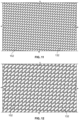
- the inlaid component 152 FIGS. 10-13 ) may be incorporated into the portion of the knitted component 132 formed from the first, second and third yams 144, 146, 148.
- the portion of the upper 102 formed from the first, second and third yarns 144, 146, 148 which, in one example, is the upper excluding the throat area 112 and/or the first collar 116, will be referred to as the "body" 154 of the upper 102.
- the body 154 of the upper 102 with the exception of the throat area 112 and/or the collar 116, is formed from the first, second and third yams, 144, 146, 148 and/or the inlaid component 152, while the throat area 112 and/or the collar 116 are formed at least in part from the fourth yarn 150.
- first, second and/or third yarns 144, 146, 148 may be present in lieu of, or in combination with, the fourth yarn 150 in the throat area 112 and/or the collar 116.
- the inlaid component 152 may also be incorporated into the throat area 112 and/or the collar 116.
- different characteristics and advantageous properties may be imparted to different areas or regions of the upper. This may be accomplished by not only selecting a particular yarn or yarns to form different regions of the upper 102. However, this may also be accomplished by selecting a particular knitting technique, selecting single layer or multi-layer knit structure (e.g., a ribbed knit structure, a single jersey knit structure, or a double jersey knit structure), by varying the size and tension of the knit structure, by using one or more yarns formed of a particular material (e.g., a polyester material, a thermoplastic material, a relatively inelastic material, or a relatively elastic material such as spandex, etc.), by selecting yams of a particular size (e.g., denier), and/or a combination thereof.
- a particular knitting technique selecting single layer or multi-layer knit structure (e.g., a ribbed knit structure, a single jersey knit structure, or a double jersey knit structure), by varying the size and tension of the knit structure, by using one or more yarn
- the first, second and third yarns 144, 146, 148 forming the body 154 of the upper 102 may be knit using a particular knitting technique to achieve a particular knit density, for example, including but not limited to a half-gauge knit (knitting on every other needle of a knitting machine). This may include a half-gauge jersey knit as shown in FIG. 1 and FIG. 3 , for example. It is also contemplated that the body 154 of the upper 102 may be formed from a lesser gauge knit, including but not limited to a third gauge knit (knitting on every third needle) or quarter gauge knit (knitting on every fourth needle).
- the body 154 of the upper 102 has a different stitch density than other portions, such as the throat area 112 and/or the collar 116.
- the body 154 has a half gauge stitch density or less-than half gauge stitch density.
- the terms "full gauge,” “half gauge,” and “less than full gauge,” may generally refer to the stitch density of a knit component.
- a knit component may include an area having a "full gauge” stitch density if that area contains stitches (e.g., loops or tucks) formed on at least two consecutive needles of a needle bed (often more than two consecutive needles).
- the same knit component may include an area having a "half gauge” stitch density, in which that area contains stitches formed on every other needle.
- the same knit component may have "less than full gauge” areas that are neither full gauge nor half gauge, for example one-third gauge (stitches formed on every third needle) or one-quarter gauge (stitches formed on every fourth needle).
- the relatively lower density knit structure provided by the half-gauge knitting technique therefore provides a lightweight, breathable upper.
- any one or more of the first, second, third and/or fourth yarns 144, 146, 148, 150 used to knit the upper 102 may be at least partially translucent and/or transparent either before and/or after any post-processing steps such as exposure to a stimulus (i.e. steam or other heat).
- the relatively low density of the knit combined with the translucency or transparency of one or more of the yarns used to form the knitted component 132 may result in the upper 102 also being at least partially translucent and/or transparent.
- This may reveal, display or otherwise show any auxiliary elements or components or other features (such as logos, decorative elements, colors, etc.) that may lie behind or underneath the first side 130 (the inner surface of the knitted component 132) and/or within the void 118.
- This may also allow the inlaid component 152 to be readily apparent, this providing an additional desirable aesthetic appearance to the upper 102 in addition to other advantages that may be provided by the inlaid component 152.
- FIG. 1 shows an auxiliary element 156 that extends at least partially around a lower perimeter of the article of footwear 100, such as near the biteline 110 where the upper 102 meets and/or joins the sole structure 104. While the auxiliary element 156 is shown generally as a band or a strip, the auxiliary element 156 may be of any shape, length, size and/or dimension. In another example shown in FIG.
- the auxiliary element 156 is a band that extends generally between the lateral and medial sides 106, 108 of the upper 102, over the top of the foot in the toe area 124.
- the auxiliary element 156 may be formed from a knit structure or a non-knit structure, including but not limited to other textiles, rubbers, plastics, metals, cables, foams and/or padding.
- the auxiliary element 156 may be integrally formed with the upper 102 during the knitting process or it may be formed separately and later attached to the upper 102 such as by stitching, bonding, adhesives or other suitable attachment mechanisms.
- the auxiliary element 156 may provide enhanced structure, support, rigidity, water repellency, comfort, strength or other advantageous properties to the article of footwear 100. Additionally or alternatively, the auxiliary element 156 may enhance the aesthetic visual and design properties of the upper, such as by providing additional colors, shine, reflectivity and allow the display of logos, placards, emblems and insignia as desired.
- the body 154 of the upper 102 may be formed by a series of courses of the first, second and third yarns 144, 146, 148.
- a first course may be knit with a combination of the first yarn 144 (e.g., the high tenacity polyester yam) and the second yarn 146 (e.g., formed thermoplastic polymer material, the "fusible yam").
- a second consecutive course may be formed from a combination of the third yarn 148 (e.g., the high tenacity polyester "sewing thread") and the second yarn 146 (e.g., formed thermoplastic polymer material, the "fusible yarn”).
- This pattern of yarn selection may be repeated, knitting on every other needle of a needle bed, to form a half-gauge knit body 154 for the upper 102.
- the use of one or more relatively high tenacity yarns, including the first yam 144 (e.g., the high tenacity polyester yarn) and/or the third yarn 148 (e.g., the high tenacity polyester "sewing thread") may provide the advantage of an upper 102 having relatively high strength and containment (e.g.
- the knitting machine may include an additional feeder that includes the component to be inlaid.
- a feeder may be provided with (or connected to) a spool or other reservoir containing a leather strip or band.
- the leather strip may be inlaid within the knitted component 132.
- materials other than leather may be inlaid within the knitted component depending on the advantageous characteristic to be achieved, including suede, faux leather, nylon, plastic, rubber and the like.
- an inlay process that may be used to inlay the inlaid component 152 of FIGS. 10-13 is described in U. S. Patent No. 8,839,532 .
- the inlaid component 152 provides an additional gripping characteristic that is advantageous to the wearer when participating in certain activities, including but not limited to skateboarding, soccer, climbing and the like. More specifically, the properties of the inlaid component 152 preferably provide at least a portion of the outer surface of the upper 102 with a greater or enhanced tackiness and ability to grip or temporarily adhere to another surface, such as a board, ball, wall or other surface. The result may be a greater friction between at least a portion of the upper 102 where the inlaid component 152 is present and the additional surface, such that the user experiences less slippage and feeling of enhanced tactile quality, feedback and control (e.g., "board feel" when referring to skateboarding, for example).
- the properties of the inlaid component 152 preferably provide at least a portion of the outer surface of the upper 102 with a greater or enhanced tackiness and ability to grip or temporarily adhere to another surface, such as a board, ball, wall or other surface. The result may be a greater friction between at least a portion
- one or more inlaid components 152 may provide an enhanced grip between the upper 102 and a surface of a skateboard, climbing wall and/or ball.
- each course of the knitted component 132 may include an inlaid component 152, but this is not required.
- the upper 102 further includes throat area 112.
- the knitting technique and/or yam(s) used to form the throat area 112 may be the same as the knitting technique and/or the yarn(s) used to form the body 154 or the yam(s) may be different.
- the throat area 112 is formed by a different knitting technique than the one used to form the body 154.
- the throat area 112 may be a rib structure, a rib structure with mesh, a full gauge jersey, double jersey or other suitable knit structures that may be selected to achieve a desired characteristic.
- the throat area 112 may be a ribbed structure that is a relatively more dense knit structure than the body 154.
- the throat area 112 may be formed at least in part from the fourth yam 150 (e.g., the relatively elastic yarn, such as E08 described above, or other relatively elastic yams). While the throat area 112 may be exclusively knit by the fourth yarn 150, it is also contemplated that one or more of the first, second and/or third yams 144, 146, 148 may be present in the throat area 112.
- the relatively high degree of stretch and/or elasticity provided by the fourth yarn 150 imparts stretch to the throat area 112 that may provide ease of entry of a wearer's foot into the void while also allowing the upper to conform to the foot when worn, and enhance comfort and fit.
- the upper 102 further includes collar 116.
- the knitting technique and/or yarn(s) used to form the collar 116 are different from the knitting technique and/or the yarn(s) used to form the body 154 or the throat area 112.
- the collar is formed by a different knitting technique than the one used to form the body 154 and the throat area 112.
- the collar may be a rib structure, a tubular structure, single full gauge jersey, double jersey or other suitable knit structures that may be selected to achieve a desired characteristic in the collar 116.
- the collar 116 is a double jersey knit structure that is a relatively more dense knit structure than the body 154 and the throat area 112.
- the collar 116 may be formed from the fourth yarn 150 (e.g., the relatively elastic yam, such as E08 described above). While the collar 116 may be exclusively knit by the fourth yarn 150, it is also contemplated that one or more of the first, second and/or third yarns 144, 146, 148 may be present in the collar 116.
- the relatively high degree of stretch and/or elasticity provided by the fourth yarn 150 imparts stretch to the collar 116 that may provide ease of entry of a wearer's foot into the void while also allowing the upper 102 to conform to the foot when worn, and enhance comfort and fit.
- the article of footwear 100 may include one or more additional components or elements.
- the additional components or elements may provide additional advantageous characteristics or properties
- the additional knitted component 136 are knitted to form a heel element 134. While the heel element 134 may be formed from the first knitted component 132 that forms the upper 102, the heel element 134 may be formed separately from the upper 102, such as from the second or additional knitted component 136, for example, and then secured to the knitted component 132 that forms the upper 102.
- the heel element 134 may be a single, unitary, one-piece structure formed by the additional knitted component 136 or it may be formed from multiple pieces that are attached together to form the heel element 134.
- the heel element 134 may be secured to the upper 102 by stitching, bonding, adhesives or other suitable mechanisms of coupling or attachment.
- the heel element 134 may be removable, such that attachment to the upper 102 may not necessarily be permanent or irreversible in some embodiments.
- the heel element 134 may have one or more holes or apertures 158 formed therein which may generally align with one or more of the lace apertures 126 formed in the throat area of the upper 102.
- the lace may secure the heel element 134 in place, snugly against the first side 130 or inner surface of the upper 102 within the void 118 in the heel area 122 of the article of footwear.
- Heel element 134 may provide additional structure, support and form to the heel area 122 of the upper, as well as soft hand, breathability, cushioning, comfort and enhanced fit, for example.
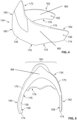
- FIGS. 4, 5 and 6 One example of a heel element 134 is shown in FIGS. 4, 5 and 6 .
- the heel element 134 generally comprises a central body portion 160 with a first arm 162 and a second arm 164 extending outwardly away from the central body portion 160.
- the heel element 134 has an inner surface 166 and an outer surface 168.
- the outer surface 168 of the heel element 134 When properly placed in its intended position within the void 118 of the article of footwear 100, the outer surface 168 of the heel element 134 is adjacent to and/or abut the first side 130 of the upper 102.
- the inner surface 166 of the heel element 134 would generally face the void 118.
- the first arm 162 would extend towards at least one of the lateral and medial side 106, 108 of the upper 102, while the second arm 164 would extend towards the other of the lateral and medial side.
- the central body portion 160 of the heel element 134 may generally align with a center portion or "spine" of the heel area 122 of the upper 102.
- the heel element 134 may have an upper or top edge 170 extending along the top of the first arm 162, across and along the top of the central body portion 160 and along the top of the second arm 164. According to the claimed invention, when the heel element 134 is positioned within the void 118 of the article of footwear 100, at least a portion of the top edge 170 may extend above the first collar 116 formed by the upper 102. As such, the top edge 170 of the heel element 134 forms a second collar 172 for receiving the foot of wearer as shown in FIG. 1 .
- the central portion of the body portion 160 may extend upwards, such that the top edge 170 of the body portion 160 extends above the top edge 170 of the first arm 162 and second arm 164.
- the central portion of the body portion 160 of the heel element 134 may extend higher upon a wearer's ankle to cover at least a portion of the Achilles tendon, for example.
- the heel element 134 may comprise a generally consistent knit density throughout, but in other versions, the heel element 134 may have different knit densities in different regions.
- the portion of the heel element 134 that extends above the first collar 116 of the upper 102 may be less densely knit than other portions of the heel element 134.
- the portions of the heel element 134 that lie behind the upper 102 and which may be adjacent the first side 130 of the upper 102 may have a relatively more densely knit structure.
- the first arm 162 and the second arm 164 each have a forward edge 174.
- a bottom edge 176 of the heel element 134 extends along the bottom of the first arm 162, across and along the bottom of the central body portion 160 and along the bottom of the second arm 164.
- the heel element 134 may be knitted in a generally flat or two-dimensional configuration as it comes off the knitting machine. However, it may be shaped into a three-dimensional configuration before it is placed in its desired location within the void 118 of the article of footwear 100.
- the heel element 134 may be shaped on a last to form a gently curved or concaved structure that generally corresponds to the shape of the heel area of the upper 102, such that it is configured to receive the foot of a wearer, for example.
- the first arm 162 and second arm 164 When formed into a three dimensional configuration, such as that shown in one exemplary embodiment of FIGS. 4-6 , the first arm 162 and second arm 164 extend generally forward in a direction towards the throat area 112 and/or the toe area 124 of the article of footwear 100. Thus, it can be seen that the forward edges 174 also face in a generally forward direction within the void 118.
- one or both of the first arm 162 and the second arm 164 may include one or more apertures, openings or holes 158 formed therein.
- the one or more holes 158 formed in either or both of the first arm 162 and/or the second arm 164 may generally align with one or more of the lace apertures 126 formed in the throat area 112 of the upper 102.
- the first arm 162 and the second arm 164 each include at least one opening or aperture or hole 158 which generally aligns with the top-most lace aperture 126 formed in the upper 102.
- the lace may also extend through the holes 158 formed in the first arm 162 and the second arm 164 formed in the heel element 134.
- the heel element 134 may include an underfoot portion 178 that is configured to extend at least partially under the foot of a wearer.
- the underfoot portion 178 may be integrally formed with the knitted component 136 that forms the heel element 134, such that the heel element 134 and the underfoot portion 178 are a unitary one-piece structure.
- the underfoot portion 178 is a separately formed knitted structure that is attached to the heel element 134. While the underfoot portion 178 of FIGS. 4-6 is a knitted component, it is contemplated that the underfoot portion 178 can be formed from other non-knitted textiles or materials.
- the underfoot portion 178 may extend only a small distance under the foot of a wearer, such that the underfoot portion 178 extends to approximately the biteline 110 where the upper 102 meets the sole structure 104. In other embodiments, the underfoot portion 178 may extend a farther distance underfoot, such as under the ball of the heel of the foot of a wearer. In still further embodiments, the underfoot portion 178 may extend still a further distance underfoot, such as far forward as the midfoot region 120 of the article of footwear 100. The underfoot portion 178 may extend the entire distance between the lateral and medial side 106, 108 of the upper 102 or the underfoot portion 178 may extend only a portion of the distance between the lateral and medial sides.
- a strobel, insert, liner or midsole structure may extend over the top of the underfoot portion 178 (sandwiching the underfoot portion 178 between the strobel and the upper surface of a sole structure 104, for example) or alternatively, the foot of a wearer may directly contact the underfoot portion 178 of the heel element 134.
- the heel element 134 may be formed by one or more yarns and knitting techniques to impart certain advantageous properties and characteristics.
- the heel element 134 may be formed from a full-gauge knit, half-gauge knit or lesser gauge, and may be a single layer or a double layer structure. In the case of a double-layer structure, a pocket may be formed between the layers which may be configured to receive one or more additional structures or elements, including but not limited to padding and the like.
- the heel element 134 is formed from a double jersey knit, although it shall be appreciated that other types of knit structures could be used including a single jersey, a ribbed structure, a mesh structure, a jacquard knit structure and combinations thereof.
- the heel element 134 may be formed of one or more of the same yarns of the first knitted component 132 that forms the upper 102, or the yams may be different.
- the heel element 134 comprises the first yarn, second yarn, and third yam 144, 146, 148 used to form the body 154 of the upper 102 as well as the fourth yarn 150 used to form the throat area 112 and the first collar 116 of the upper 102.
- the heel element 134 may further include a fifth yarn 151.
- the fifth yarn 151 may be the same as the other yarns or it may be different.
- the fifth yam 151 may comprise thermoplastic polymer materials.
- the fifth yarn 151 may comprise a thermoplastic polyurethane, or TPU.
- the TPU may be a coated yarn consisting of a multifilament polyester core yarn (150D) that is coated with a TPU resin sheath with a melting temperature of about 115-120 degrees C (having a 750D total yarn size).
- TPU resin sheath with a melting temperature of about 115-120 degrees C (having a 750D total yarn size).
- two ends of 550 denier TPU yam may be used, which may be sold under the trade name Dream-Sil ® , a thermoplastic polyurethane coated yarn manufactured by Sambu Fine Chemical Co., LTD.
- the resin sheath of the fifth yam 151 may melt, whereas the polyester core, having a higher melting temperature, does not.
- yams that have a melting temperature below about 140 degrees C may be referred to or identified as a "fusible yam" like the second yam 146 formed of thermoplastic polymer materials described above (i.e. the K-85).
- the first, second, third, fourth and fifth yams 144, 146, 148, 150, 152 may be knitted together to form the heel element 134, or the yarns may be knitted in certain combinations or patterns.
- one or more of the yams may be fed together on a particular feeder of a knitting machine or, in another example, a certain course of the knitted component 136 may include one or more of the first, second, third, fourth and fifth yams 144, 146, 148, 150, 152 or combinations thereof, while another course of the knitted component 136 may be formed from others of the aforementioned yarns or combinations thereof.
- the fifth yarn 151 may preferably have a higher melting temperature than any one or more of the first, second, third and/or fourth yarns 144, 146, 148, 150.
- the fifth yam 151 may impart certain properties that are advantageous for including in a heel element 134, such as, for example, stiffness, rigidity, shape, structure, durability and/or strength. When subjected to heat and/or pressure during a post-processing procedure (and, if desired, placing the heel element 134 on a last for molding and shaping) the fifth yarn 151 may allow the heel element 134 to retain its form and provide the desired rigidity shape and structure.
- the fifth yam 151 may be present in the entire heel element 134 and/or the underfoot portion 178 of the heel element 134, the fifth yarn 151 may be present in certain areas of the heel element 134 and present in only relatively small amounts or entirely absent from the underfoot portion 178.
- the fifth yarn 151 may be more concentrated in certain areas of the heel element 134 and less concentrated in others. This may provide more rigidity and structure to the areas where the fifth yarn 151 is more highly concentrated. As shown in FIG. 6 , the fifth yam 151 may be more concentrated in the central zone 180 of the central body portion 160 from an area just below the second collar 172 of the heel element 134 to an area adjacent to the bottom edge 176. The fifth yam 151 may also extend at least partially into the first arm 162 and the second arm 164 as necessary and desired to provide the appropriate stiffness, rigidity, shape and structure to the heel element 134.
- the top edge 170 of the heel element 134 which forms at least a portion of the second collar 172 may be formed from the fourth yarn 150 (the relatively elastic yam, such as E08 described above, or other relatively elastic yarns). It is also contemplated that the forward edges 174 of the first arm 162 and the second arm 164, as well as the bottom edge 176 of the heel element 134 may also be formed from the fourth yarn 150, or other suitable elastic yams.
- the underfoot portion 178 may also be formed from the fourth yam 150, and preferably, the underfoot portion 178 may be formed substantially or entirely of the fourth yarn 150 or other suitable elastic yarns.
- the fourth yarn 150 may be more concentrated in certain areas of the heel element 134 and less concentrated in others. This may provide more stretch, resilience and compliance to the areas where the fourth yarn 150 is more highly concentrated. As shown in FIGS. 4 and 6 , the fourth yarn 150 may be more concentrated in the top edge 170 and/or adjacent the top edge 170 including, in one example, the area formed by the second collar 172 of the heel element 134 that extends above the first collar 116 of the upper 102. The fourth yam 150 may also be more concentrated in the bottom edge 176 and/or in an area adjacent the bottom edge 176, such as an area adjacent to the biteline 110.
- the concentration of the fourth yarn 150 in an area that lies between the first area and the third area, including, for example, central zone 180, may be less concentrated, thus providing a "high-low-high” elastic "gradient" in the heel element 134.
- the fifth yam 151 may also extend at least partially into the underfoot portion 178 of the heel element 134.
- the heel element 134 is inserted through the first collar 116 of the upper 102 and into the void 118 of the article of footwear.
- the central body portion 160 of the heel element 134 generally aligns with the center of the heel area 122 of the upper 102.
- the heel element 134 may be attached to the upper 102 as already described above, and, if apertures or holes 158 are present in the first arm and/or second arm 162, 164, a lace element can be fed there through. As such, when the laces are tightened by a wearer, the tension of the laces may pull the heel element 134 slightly forward to enhance fit, containment and comfort.
- the knit program 182 described hereinafter forms the portion of the upper 102 formed from the first, second and third yarns 144, 146, 148, which, in exemplary FIG. 1 , is the majority of the upper (referred to herein as the "body" 154 of the upper) excluding the throat area 112 and/or the collar 116.
- the inlaid component 152 is not represented in the knit program 182.
- the inlaid component 152 may be incorporated into the knitted component 132 during the knitting process or it may be inlaid as a separate or additional step following the knitting process.
- the knitted component 132 is formed on a knitting machine having a single bed, although it is contemplated that two beds may be used to form at least a portion of the knitted component 132. It can be seen that the knitting is formed on every other needle of the needle bed, thus forming the previously described half-gauge structure, resulting in a lightweight and at least partially translucent or transparent upper, yet strong and having high containment (or "lock out") due to the use of one or more high tenacity yarns.
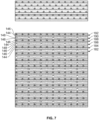
- the knit diagram illustrates a first course 184 knit on a single needle bed.
- the first course includes a combination of the first yarn 144 (the high tenacity polyester) and the second yarn 146 (the fusible yarn).
- the combination of the first yarn 144 and the second yam 146 is knit on every other needle of the needle bed.
- a second consecutive course 186 is then knit following the first course 184.
- the second course 186 includes a combination of the second yarn 146 (the fusible yam) and the third yarn 148 (the high tenacity polyester "sewing thread").
- the combination of the second and third yarn 146, 148 are tucked on one needle (shown as an upside-down "U” in the diagram) which tucks on top of the first and second yarns 144, 146 of the first course 184.
- the second and third yarns 146, 148 float three needles then knit on the fourth needle. As shown in the knit program 182, this sequence can then be repeated, starting again with a tuck stitch.
- a third consecutive course 188 is then knit following the second course 186.
- the third course 188 is a repeat of the first course 184, which includes a combination of the first yam 144 (the high tenacity polyester) and the second yarn 146 (the fusible yam).
- the combination of the first yarn and the second yarn 144, 146 is knit on every other needle of the needle bed.
- a fourth consecutive course 190 is then knit following the third course 188.
- the fourth course 190 includes a combination of the second yarn 146 (the fusible yarn) and the third yam 148 (the high tenacity polyester "sewing thread").
- the combination of the second and third yams 146, 148 are knitted on one needle, then float three needles. Following the three needle float, the combination of the second and third yarns 146, 148 are then tucked (shown as an upside-down "U" in the diagram) which forms a tuck stitch on top of the first and second yarns 144, 146 of the first course 184. Following the tuck stitch, the second and third yarns 146, 148 again float three needles then knit again on the fourth needle. As shown in the knit program 182, this sequence can then be repeated, starting again with the knit loop on the fourth needle following the float sequence.
- a fifth consecutive course 192 is then knit following the fourth course 190.
- the fifth course 192 is a repeat of the first and third courses 184, 188, which includes a combination of the first yarn 144 (the high tenacity polyester) and the second yarn 146 (the fusible yarn).
- the combination of the first yarn and the second yarn 144, 146 is knit on every other needle of the needle bed.
- the knit sequence of FIG. 7 may be repeated, as necessary, to form a knitted component with a suitable size. Further, it is noted that the sequence(s) may be varied to incorporate different features by changing certain knit structures, by varying yam types, by increasing or decreasing the number of courses at each step, or by any other suitable adjustment to the knitting process or materials used. Further, other sequences may be used before, after, or between the sequences described above.
- the knitted component 132 may be subjected to one or more post-processing methods. In one example, it may be desirable to remove or otherwise eliminate a pre-determined amount of mechanical stretch of the knitted component 132 before it is assembled onto a sole structure 104 to form an article of footwear 100. In one example, at least a portion of the mechanical stretch may be removed from the knitted component 132, and in other examples, it is preferable to remove substantially all of the mechanical stretch from the knitted component 132.
- test method used to illustrate the physical property measurements and stretch of a swatch or test sample of the knitted component 132 (comprising the first, second and third yarns 144, 146, 148) is set forth below: Sample Breaking Strength (kgf) Stiffness (kgf @ 10% strain) Basis Weight (g/m2) Machine Direction 82-96 10-17 250-375 Cross Machine Direction 63-72 12-19
- the stiffness may refer to the force needed to stretch the sample a certain amount. This may provide information relating to how much lock out or containment is provided when this textile is formed into an upper 102 for an article of footwear 100.
- the basis weight may refer to the grams per square meter for the specific sample size used. In other words, this measurement provides a normalized weight of a particular size sample swatch of the textile, which can then be used to calculate different sizes of the textile, such as the weight of an amount of the textile used to form an upper 102.
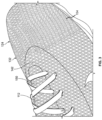
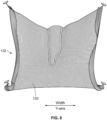
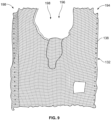
- the knitted component 132 may first be stretched from its original first unstretched state (see FIG. 8 ) to a second stretched state (see FIG. 9 ).
- the knitted component 132 may be stretched in a cross-machine direction, which comprises stretching the knitted component in a course-wise direction, or width along the x-axis.
- the knitted component 132 may also be stretched in a machine direction, which comprises stretching the knitted component in a wale-wise direction, or length along the y-axis.
- the knitted component 132 may be stretched in only one of these directions, but preferably, the knitted component 132 is stretched along both the length and width.
- the knitted component 132 may be stretched in a direction that is parallel to the inlaid component 152, in a direction that is perpendicular to the inlaid component 152, or both.
- the inlaid component extends in a heel to toe direction, there may be greater stretch in the lateral to medial direction (at least in a pre-processed state).
- the inlaid component 152 may have little to no effect on the general stretch characteristics of the knitted component 132 into which it is inlaid.
- the inlaid component 152 may initially include slack, and such slack may be removed during the stretching step such that the inlaid component 152 is substantially taught (and/or stretched relative to its relaxed state) after post-knit processing.
- the unprocessed state has a baseline of 100%, such that after processing (the "processed state") it has been stretched 14% in the width direction and 21% in the length direction. It can be seen that the unprocessed sample weighed 1.3 grams, and, after stretching and steaming, it weighed 0.9 grams. The loss of mass may be attributable to various factors, including but not limited to stretching, where the density of the textile is reduced while the size increases. Also, reduction in mass may also be the result of any fusible material present in the yarns being lost due to the steaming process. Unprocessed Processed Stretch % W (mm) 370 420 114% H (mm) 380 460 121% 50mmx50mm 1.3 grams 0.9 grams
- the upper 102 may be secured to a stretching mechanism or device. This may include stretching the upper 102 in one or more directions with the inlaid component 152 present/incorporated into the upper 102.
- the stretching device may be a jig 194.
- a jig 194 may be used to hold and/or position the upper 102 during the steaming (heat) process.
- the jig 194 may be used to hold and/or position the upper 102, or other knitted components (such as the heel element 134) during heating and exposure to pressure, such as by heat pressing.
- the jig 194 may be a separate element from the steaming device and/or, in the case of a heat press, the jig 194 may be disposed on a bottom plate of a heat press.
- the jig 194 may have a top section (not shown) and a bottom section 196, which may be formed using any material, such as rubber or metal or polymers or combinations thereof. If the material used to form the jig 194 has a melting temperature, the melting temperature should be above the typical temperature achieved during the steaming or heat-pressing process to ensure that the heat does not disfigure, alter, damage or otherwise negatively affect the jig 194.
- the shape and configuration of the jig 194 is also not limited. In FIG. 9 , the shape of the jig 194 is generally rectangular. Also, the jig 194 may be a solid surface or plate, or, as shown in the cut-away portion of the knitted component 132 in FIG. 9 , the jig 194 have cut outs or openings formed therein to allow steam or heat or other forms of stimulus to pass through the jig 194 and make contact with the knitted component 132.
- the jig 194 may also include a positioning mechanism or device.
- the positioning mechanism includes a plurality of spring-loaded pins 198 that are configured to position the upper 102 on the jig 194.
- the shape formed by the plurality of spring-loaded pins 198 is substantially the same as the shape of the knitted component 132 being stretched and positioned on the jig 194. It is also contemplated that the shape formed by the plurality of pins 198 generally corresponds to the shape of an upper 102 such that it corresponds with the outer perimeter of the upper 102.
- the knitted component 132 or upper 102 may include a plurality of apertures configured to receive the spring-loaded pins 198, and/or the spring-loaded pins may penetrate through the knitted component (or upper) as shown in FIG. 9 to hold it in position upon and within the jig 194.
- the jig 194 may further include a pad (not shown) configured to prevent the upper 102 from sticking to the jig 194 and/or a heat press.
- the pad may be insulative and/or provide cooling on one or both sides of the upper 102.
- the pad may generally be in the shape of the entire upper, or it may be shaped and sized to a particular area of the upper 102.
- the thickness of the pad may reduce the amount of heat applied and even reduce or substantially prevent the areas of the upper 102 not corresponding to a fused area (e.g., the throat area 112) from being steamed and/or pressed, directly heated and/or burned.
- the pad is formed of Teflon and is approximately 5 mm thick, though any suitable thickness may be used.
- the spring-loaded pins 198 are configured to compress if necessary during the heat-pressing process such that they do not inhibit the pressure applied to the knitted component 132 (e.g., if the spring-loaded pins 198 are longer than the thickness of the knitted component 132).
- the jig 194 may be configured such that two or more knitted components 132 can be processed simultaneously.
- a release paper (not shown) may be placed over certain areas of the knitted component 132.
- the release paper is preferably constructed of a material that reduces or prevents the certain area of the upper 102 from sticking to it and therefore, the release paper may also prevent the certain areas of the knitted component from sticking to the jig 194.
- the release paper may be configured to allow heat to be conducted to the knitted component 132 directly through the release paper and without interfering in the heating process.
- the jig 194 may be placed into a steaming mechanism, such as a steam chamber or unit.
- the knitted component 132 may then be subjected to a predetermined temperature of steam heat for a predetermined period of time.
- the thermoplastic polymer material present in the knitted component 132 such as the thermoplastic polymer material included with a yarn (i.e., the second yarn 146 described above, for example), may at least partially melt.
- the material originally forming separate yarns of the upper 102 may become bonded and/or continuous to form a fused area.
- thermoplastic polymer material may at least partially melt with one or more portions of the inlaid component 152 ( FIG. 11 ) incorporated into the knitted component 132. Therefore, any one or more areas where the upper 102 contains thermoplastic polymer material, and where that material is subjected to a suitable process (such as the steaming process described herein), it is contemplated that at least one fused area will be formed.
- a suitable process such as the steaming process described herein
- the jig 194 may be removed from the steam exposure. While steaming and heat-pressing processes are described herein, any other suitable process may be used to form the fused areas.
- the jig 194 may be closed (the top section placed over the bottom section 196) and placed into the heat press.
- the heat press may be preheated to between about l00°C and about 150°C (or any other suitable temperature range).
- the press may then be activated.
- the heat press may apply approximately 784,53 kPa (8 kg/cm 2 ) of pressure at between about 120°C and about 150°C for a period of 30 seconds.
- thermoplastic polymer material of the knitted component 136 which may form the heel element 134 such as the thermoplastic polymer material included with a yam (i.e., the fifth yarn 151 described above), may at least partially melt.
- the material originally forming separate yams of the heel element 134 may become bonded and/or continuous to form at least one, or a plurality of fused area(s). Therefore, any one or more areas where the knitted component 132 or 136 contains thermoplastic polymer material, and where that material is subjected to a suitable process (such as the heat-pressing process described herein), it is contemplated that a fused area will be formed.
- thermocouple may measure the temperature of the knitted component 132 or 136 during this process. Once the knitted component 132 or 136 reaches a predetermined temperature (e.g., between about 120°C and about 132°C), the heat press may open, and the knitted component 132 or 136 may be removed. While a heat-pressing process is described, any other suitable process may be used to form the fused areas of the heel element 134.
- the heated knitted component 132 and/or 136 may be shaped or formed.
- the heel element 134 formed from the second knitted component 136 may be formed on a last or other similar device in order to shape the heel element 134 into a concave, three-dimensional structure that would preferably generally confirm to the shape of a heel of a wearer.
- the knitted component 132 and/or 136 may begin to cool.
- the knitted component 132 that forms the upper 102 may remain positioned on the jig 194 in its stretched condition.
- the thermoplastic material present in any one of the yarns, such as the second yam 146 present in the knitted component 132 may at least partially fuse together with adjacent yams in its proximity to within the knitted component 132.
- the fusible yam may also enhance one or more mechanical properties of the knitted component 132 and/or 136 (such as strength and/or rigidity) at least in select locations and/or have the effect of securing or locking the relative positions of the yarns within the knitted component. Because the fusible yarn cooled when the knitted component 132 (forming the body 154 of the upper 102) is in its stretched condition, the knitted component may therefore remain in this stretched and expanded condition. Likewise, after cooling of the fusible yarn (i.e., the fifth yarn 151) within the knitted component 136 (forming the heel element 134) the heel element may therefore have greater stiffness, durability and ability to retain shape, for example.
- the fusible yarn i.e., the fifth yarn 151
- the fusible yams may at least partially melt and infiltrate the adjacent and surrounding yarns (such as the first yarn 144 and third yarn 148). Upon cooling, the fusible yams can then lock the surrounding yarns into the stretched condition such that this process provides an ability to remove at least a portion, at least half of, substantially all or all of the mechanical stretch of the knitted component 132, as necessary or desired, before it is ultimately removed from the jig 194 and later formed into an upper 102.
- the knitted component 132, 136 may go through a cooling process, such as a cold-pressing process.
- the cooling process may set the fused area(s) or otherwise bring the fused area into a state other than a melted state.
- the knitted component 132, 136 may be placed in a cold press.
- a silicon pad (which may be any other suitable material) may be placed on one or both sides of the knitted component 132, 136, and particularly over the heated and/or partially melted areas, to ensure even pressure.
- the cold press may include a refrigeration system, but in some processes the cold press is at or about at room temperature.
- the cold press When activated, in one non-limiting example, the cold press may apply approximately 1,471 to 1,765 MPa (15-18 kg/cm 2 ) of pressure for about 12 seconds. During the cold-pressing process, the release paper may remain attached to the knitted component 132, 136 to prevent the knitted component 132, 136 from sticking to the cold press, though this is not required.
- the cold press can be used in conjunction with a jig similar to the jig 194 described with respect to the steaming and/or heat-pressing process.
- a heat pressing process may be used to attach an auxiliary component, such as the auxiliary interior element 156 described above, to the upper 102.
- the auxiliary component 156 which may include a thermoplastic polymer material, may be placed in contact with the upper 102 such that it at least partially melts and thereby adheres to the upper 102 during a steaming and/or a heat pressing process.
- an auxiliary component 156 may be substantially free of a thermoplastic polymer and may be bonded to the upper 102 by placing the auxiliary component 156 in contact with the heated thermoplastic polymer of the upper 102. This may be done in conjunction with the process of forming the fused areas or may be done at a different time.
- While the embodiments and other features are described generally herein with reference to an upper 102 for an article of footwear, those features could additionally or alternatively be incorporated into another type of article.
- the features described herein may be included in articles of apparel (e.g., shirts, pants, socks, footwear, jackets and other outerwear, briefs and other undergarments, hats and other headwear), containers (e.g., backpacks, bags), and upholstery for furniture (e.g., chairs, couches, car seats).
Landscapes
- Engineering & Computer Science (AREA)
- Textile Engineering (AREA)
- Chemical & Material Sciences (AREA)
- Materials Engineering (AREA)
- Life Sciences & Earth Sciences (AREA)
- Animal Husbandry (AREA)
- Zoology (AREA)
- Knitting Of Fabric (AREA)
Claims (7)
- Fußbekleidungsartikel (100) mit einem Oberteil (102) und einer an dem Oberteil befestigten Sohlenstruktur (104), wobei das Oberteil wenigstens teilweise aus einer Strickkomponente (132) gebildet ist, wobei die Strickkomponente (132) Folgendes umfasst:eine Außenfläche (138) und eine entgegengesetzt gewandte Innenfläche (130),wobei sich die Strickkomponente (132) durch wenigstens einen Teil jeweils eines Vorderfußbereichs, eines Mittelfußbereichs (120) und eines Fersenbereichs (122) des Fußbekleidungsartikels (100) erstreckt,wobei das Oberteil (102) einen gestrickten Körper (154) umfasst, der wenigstens teilweise aus einem ersten Garn (144) mit einer Zugfestigkeit von mindestens 44,135 cN/tex oder mehr gebildet ist, und wobeidas Oberteil eine erste Kragenöffnung (116) umfasst undwobei die Strickkomponente (132) ferner ein Fersenelement (134) umfasst, das sich im Fersenbereich (122) befindet und sich von einer lateralen Seite (106) zu einer medialen Seite (108) des Oberteils (102) erstreckt,wobei der Fußbekleidungsartikel (100) dadurch gekennzeichnet ist, dass eine Außenfläche (168) des Fersenelements (134) an die Innenfläche (130) des Oberteils (102) angrenzt, und wobei das Fersenelement (134) eine zweite Kragenöffnung (172) umfasst, die sich oberhalb der ersten Kragenöffnung (116) erstreckt.
- Fußbekleidungsartikel (100) nach Anspruch 1, bei dem die Zugfestigkeit des ersten Garns (144) etwa 52,96 bis etwa 70,62 cN/tex beträgt.
- Fußbekleidungsartikel (100) nach Anspruch 1, bei dem das Fersenelement (134) ein einlagiges Doppel-Jersey-Gestrick umfasst.
- Fußbekleidungsartikel (100) nach Anspruch 1, bei dem das Fersenelement (134) eine erste Elastizität an der zweiten Kragenöffnung (172), eine zweite Elastizität an einer Bisslinie (110) und eine dritte Elastizität in einem Bereich aufweist, der zwischen der ersten Kragenöffnung (116) und der Bisslinie (110) gelegen ist, und wobei die dritte Elastizität geringer ist als sowohl die erste als auch die zweite Elastizität.
- Fußbekleidungsartikel (100) nach Anspruch 1, ferner mit wenigstens einer eingelegten Komponente (152), die sich durch den aus dem ersten Garn (144) gebildeten Körper (154) erstreckt.
- Fußbekleidungsartikel (100) nach Anspruch 5, bei dem die eingelegte Komponente (152) ein Leder und/oder ein Veloursleder und/oder einen Kautschuk und/oder einen Kunststoff aufweist.
- Fußbekleidungsartikel (100) nach Anspruch 5, bei dem die wenigstens eine eingelegte Komponente (152) mehrere eingelegte Komponenten aufweist, die so ausgebildet sind, dass sie eine Griffeigenschaft einer Außenfläche (138) des Fußbekleidungsartikels verbessern.
Priority Applications (1)
| Application Number | Priority Date | Filing Date | Title |
|---|---|---|---|
| EP24222209.9A EP4524306A3 (de) | 2018-08-08 | 2019-08-08 | Leichtes gestricktes oberteil und verfahren zur herstellung |
Applications Claiming Priority (3)
| Application Number | Priority Date | Filing Date | Title |
|---|---|---|---|
| US201862716128P | 2018-08-08 | 2018-08-08 | |
| US201862767818P | 2018-11-15 | 2018-11-15 | |
| PCT/US2019/045715 WO2020033694A2 (en) | 2018-08-08 | 2019-08-08 | Lightweight knitted upper and methods of manufacture |
Related Child Applications (1)
| Application Number | Title | Priority Date | Filing Date |
|---|---|---|---|
| EP24222209.9A Division EP4524306A3 (de) | 2018-08-08 | 2019-08-08 | Leichtes gestricktes oberteil und verfahren zur herstellung |
Publications (2)
| Publication Number | Publication Date |
|---|---|
| EP3833807A2 EP3833807A2 (de) | 2021-06-16 |
| EP3833807B1 true EP3833807B1 (de) | 2025-01-08 |
Family
ID=67766332
Family Applications (2)
| Application Number | Title | Priority Date | Filing Date |
|---|---|---|---|
| EP19759167.0A Active EP3833807B1 (de) | 2018-08-08 | 2019-08-08 | Schuhartikel |
| EP24222209.9A Pending EP4524306A3 (de) | 2018-08-08 | 2019-08-08 | Leichtes gestricktes oberteil und verfahren zur herstellung |
Family Applications After (1)
| Application Number | Title | Priority Date | Filing Date |
|---|---|---|---|
| EP24222209.9A Pending EP4524306A3 (de) | 2018-08-08 | 2019-08-08 | Leichtes gestricktes oberteil und verfahren zur herstellung |
Country Status (4)
| Country | Link |
|---|---|
| US (2) | US11659892B2 (de) |
| EP (2) | EP3833807B1 (de) |
| CN (3) | CN119194717A (de) |
| WO (1) | WO2020033694A2 (de) |
Families Citing this family (27)
| Publication number | Priority date | Publication date | Assignee | Title |
|---|---|---|---|---|
| US11445779B2 (en) * | 2016-07-21 | 2022-09-20 | Nike, Inc. | Article of footwear with multiple layers, retention system for an article of footwear, and methods of manufacture |
| EP3833807B1 (de) | 2018-08-08 | 2025-01-08 | NIKE Innovate C.V. | Schuhartikel |
| USD923310S1 (en) * | 2019-01-28 | 2021-06-29 | Adidas Ag | Shoe |
| USD904744S1 (en) * | 2019-02-15 | 2020-12-15 | Nike, Inc. | Shoe |
| CN113748236A (zh) | 2019-04-17 | 2021-12-03 | 耐克创新有限合伙公司 | 轻质针织鞋面、鞋类制品及制造方法 |
| US12378707B2 (en) * | 2019-05-06 | 2025-08-05 | Nike, Inc. | Multi-layer knitted component |
| USD959101S1 (en) | 2019-09-24 | 2022-08-02 | Adidas Ag | Shoe |
| USD972277S1 (en) * | 2019-12-16 | 2022-12-13 | Acushnet Company | Golf shoe upper |
| CN114929054B (zh) * | 2020-01-08 | 2024-08-06 | 耐克创新有限合伙公司 | 具有两种纱线类型的用于鞋类制品的鞋面 |
| US20210285132A1 (en) * | 2020-03-12 | 2021-09-16 | Lung-Jong Wu | Woven Fabric, Insole, and Clothing for Promoting Heat Dissipation |
| US11849804B2 (en) * | 2020-04-27 | 2023-12-26 | Allbirds, Inc. | Knit athletic shoes with continuous upper portion |
| USD1010280S1 (en) | 2020-04-27 | 2024-01-09 | Allbirds, Inc. | Shoe |
| USD1080169S1 (en) * | 2021-03-04 | 2025-06-24 | Under Armour, Inc. | Upper for an article of footwear |
| US12232569B2 (en) * | 2021-05-20 | 2025-02-25 | Nike, Inc. | Article of footwear with integrally knit tongue |
| JP2023013847A (ja) * | 2021-07-16 | 2023-01-26 | 株式会社シマノ | 靴 |
| US12543814B2 (en) | 2021-10-22 | 2026-02-10 | Nike, Inc. | Articles of footwear with knitted components and methods of manufacturing the same |
| JP2024536291A (ja) * | 2021-10-22 | 2024-10-04 | ナイキ イノベイト シーブイ | ニット構成要素を有する履物物品及びその製造方法 |
| US12396512B2 (en) | 2021-10-22 | 2025-08-26 | Nike, Inc. | Articles of footwear with knitted components and methods of manufacturing the same |
| CN117957345A (zh) * | 2021-10-22 | 2024-04-30 | 耐克创新有限合伙公司 | 具有针织部件的鞋类制品及其制造方法 |
| EP4528002A4 (de) * | 2022-05-19 | 2025-09-03 | Jp Avance Corp | Strickprodukt und herstellungsverfahren für das strickprodukt |
| JP1761132S (ja) | 2022-07-08 | 2024-01-11 | 靴 | |
| USD1065806S1 (en) | 2022-07-08 | 2025-03-11 | Adidas Ag | Shoe |
| USD992875S1 (en) * | 2022-09-29 | 2023-07-25 | Starlink Technology Co., Limited | Shoe |
| CN120302908A (zh) | 2022-12-01 | 2025-07-11 | 耐克创新有限合伙公司 | 具有一体针织鞋面和抓地纱线鞋底的鞋类制品及制造方法 |
| CN115976753B (zh) * | 2023-03-21 | 2023-07-21 | 莱阳华泰针织服装有限公司 | 一种带有蒸汽喷射装置的车缝辅助线拆除装置 |
| US20260015777A1 (en) * | 2024-07-10 | 2026-01-15 | Nike, Inc. | Textile configured to promote cooling |
| WO2026022751A1 (en) * | 2024-07-24 | 2026-01-29 | Siretessile S.R.L. | Improved fabric |
Family Cites Families (56)
| Publication number | Priority date | Publication date | Assignee | Title |
|---|---|---|---|---|
| US3287938A (en) * | 1963-12-06 | 1966-11-29 | Kendall & Co | Run-resistant elastic fabric |
| US4255877A (en) | 1978-09-25 | 1981-03-17 | Brs, Inc. | Athletic shoe having external heel counter |
| US5083361A (en) * | 1988-02-05 | 1992-01-28 | Robert C. Bogert | Pressurizable envelope and method |
| US5385036A (en) * | 1993-05-24 | 1995-01-31 | Guilford Mills, Inc. | Warp knitted textile spacer fabric, method of producing same, and products produced therefrom |
| US20050042412A1 (en) * | 1996-12-31 | 2005-02-24 | Bruner Jeffrey W. | Composite elastomeric yarns and fabric |
| US5896758A (en) * | 1997-04-17 | 1999-04-27 | Malden Mills Industries, Inc. | Three-dimensional knit spacer fabric for footwear and backpacks |
| GB0023321D0 (en) * | 2000-09-22 | 2000-11-08 | Textinov Ltd | Textile laminate and articles made using the laminate |
| US6931762B1 (en) * | 2002-12-18 | 2005-08-23 | Nike, Inc. | Footwear with knit upper and method of manufacturing the footwear |
| JP4505212B2 (ja) * | 2003-01-10 | 2010-07-21 | 美津濃株式会社 | シューズ及びこれに用いるダブルラッセル経編地 |
| EP2860292B1 (de) * | 2003-05-08 | 2020-07-22 | Tepha, Inc. | Medizinische Polyhydroxyalkanoattextilien und -fasern |
| US7347011B2 (en) * | 2004-03-03 | 2008-03-25 | Nike, Inc. | Article of footwear having a textile upper |
| US7168188B2 (en) | 2004-07-15 | 2007-01-30 | Nike, Inc. | Article footwear with removable heel pad |
| US20090182070A1 (en) * | 2005-09-28 | 2009-07-16 | Toray Industries, Inc. | Polyester fiber and textile product comprising the same |
| US7774956B2 (en) * | 2006-11-10 | 2010-08-17 | Nike, Inc. | Article of footwear having a flat knit upper construction or other upper construction |
| US11206891B2 (en) * | 2008-05-02 | 2021-12-28 | Nike, Inc. | Article of footwear and a method of assembly of the article of footwear |
| US8490299B2 (en) | 2008-12-18 | 2013-07-23 | Nike, Inc. | Article of footwear having an upper incorporating a knitted component |
| US8590178B2 (en) * | 2009-01-26 | 2013-11-26 | Nike, Inc. | Stability and comfort system for an article of footwear |
| US7748240B1 (en) * | 2009-03-04 | 2010-07-06 | James Paul Cherneski | Foot gripping garment |
| US8595878B2 (en) | 2010-08-02 | 2013-12-03 | Nike, Inc. | Method of lasting an article of footwear |
| AU2011329538B2 (en) * | 2010-11-15 | 2015-05-07 | Flagship Brands, Llc | Knit sock with targeted compression zone |
| US8839532B2 (en) | 2011-03-15 | 2014-09-23 | Nike, Inc. | Article of footwear incorporating a knitted component |
| DE102011102342A1 (de) * | 2011-05-24 | 2012-11-29 | C. Cramer, Weberei, Heek-Nienborg, Gmbh & Co. Kg | Textiles Flächengebilde, seine Verwendung sowie Verfahren zur Herstellung von Compositen |
| US20130255103A1 (en) | 2012-04-03 | 2013-10-03 | Nike, Inc. | Apparel And Other Products Incorporating A Thermoplastic Polymer Material |
| US9861160B2 (en) | 2012-11-30 | 2018-01-09 | Nike, Inc. | Article of footwear incorporating a knitted component |
| US9936757B2 (en) * | 2013-03-04 | 2018-04-10 | Nike, Inc. | Article of footwear incorporating a knitted component with integrally knit contoured portion |
| US20160295971A1 (en) * | 2015-04-10 | 2016-10-13 | Adidas Ag | Sole for a sports shoe |
| US10299531B2 (en) * | 2013-05-14 | 2019-05-28 | Nike, Inc. | Article of footwear incorporating a knitted component for a heel portion of an upper |
| KR101813856B1 (ko) * | 2013-06-17 | 2018-01-04 | 가부시키가이샤 시마세이키 세이사쿠쇼 | 슈즈 어퍼 및 슈즈 어퍼의 제조방법 |
| WO2015023755A1 (en) * | 2013-08-13 | 2015-02-19 | Under Armour, Inc | Performance footwear |
| US9984583B2 (en) * | 2013-09-20 | 2018-05-29 | Bose Corporation | Audio demonstration kit |
| KR20150086965A (ko) * | 2014-01-21 | 2015-07-29 | 정승원 | 레이스 원단 제조 방법 |
| US10383388B2 (en) * | 2014-03-07 | 2019-08-20 | Nike, Inc. | Article of footware with upper incorporating knitted component providing variable compression |
| EP3122197B1 (de) * | 2014-03-25 | 2022-06-01 | Under Armour, Inc. | Fussbekleidung mit textilelement |
| US9903054B2 (en) * | 2014-08-27 | 2018-02-27 | Nike, Inc. | Knitted component having tensile strand for adjusting auxetic portion |
| US9375046B2 (en) * | 2014-09-30 | 2016-06-28 | Nike, Inc. | Article of footwear incorporating a knitted component with inlaid tensile elements and method of assembly |
| CN107429452B (zh) * | 2014-12-24 | 2021-04-16 | 英威达纺织(英国)有限公司 | 包括低熔点纤维的可容易定形的拉伸织物 |
| WO2016168046A2 (en) * | 2015-04-16 | 2016-10-20 | Nike Innovate C.V. | Article of footwear incorporating a knitted component having floated portions |
| CN208463051U (zh) * | 2015-05-08 | 2019-02-05 | 安德玛有限公司 | 鞋履制品 |
| US10435825B2 (en) * | 2016-01-15 | 2019-10-08 | Nike, Inc. | Footwear upper with knitted component and method of manufacturing the same |
| CN107614768B (zh) * | 2016-03-11 | 2019-10-18 | 耐克创新有限合伙公司 | 用于鞋类物品的具有沿口的鞋面及其制作方法 |
| US10327511B2 (en) * | 2016-07-08 | 2019-06-25 | Cole Haan Llc | Shoe having knit wingtip upper |
| CN109714998B (zh) | 2016-08-12 | 2021-11-02 | 耐克创新有限合伙公司 | 具有带有第一纱和第二纱的第一区段的物品 |
| CN107865481A (zh) * | 2016-09-26 | 2018-04-03 | 清远广硕技研服务有限公司 | 鞋类物品及其针织部件 |
| CN116268692B (zh) * | 2016-11-09 | 2026-04-07 | 耐克创新有限合伙公司 | 针织纺织品和鞋面及其制作方法 |
| JP6295358B1 (ja) * | 2017-04-24 | 2018-03-14 | 宮城レース株式会社 | ラッセルレース編地の製造方法 |
| EP3943653B1 (de) * | 2017-05-05 | 2025-01-08 | NIKE Innovate C.V. | Schuhoberteil für einen fussbekleidungsartikel und ein fussbekleidungsartikel mit diesem schuhoberteil |
| EP4582603A3 (de) * | 2017-05-05 | 2025-07-30 | NIKE Innovate C.V. | Gestrickte komponente mit einem mit hochfestem garn ausgebildeten oberflächenbereich |
| WO2019028350A1 (en) * | 2017-08-04 | 2019-02-07 | Nike Innovate C.V. | FOOTWEAR WITH A KNITTED ELEMENT HAVING A FOREWORD PART AND A HEEL PART |
| US11992090B2 (en) * | 2017-08-07 | 2024-05-28 | Nike, Inc. | Knitted components having self supportive heel |
| CN108294407A (zh) * | 2018-01-09 | 2018-07-20 | 东莞市鸿鹏编织科技有限公司 | 一种一体成型4d针织高帮鞋及其制作工艺 |
| US10791791B2 (en) * | 2018-01-20 | 2020-10-06 | Nike, Inc. | Articles of footwear reinforced with high tenacity yarn |
| US20190365049A1 (en) * | 2018-06-04 | 2019-12-05 | Cole Haan Llc | Shoe Having A Structural Knit Region |
| DE102018212632B4 (de) * | 2018-07-27 | 2024-03-14 | Adidas Ag | Gestricktes oder gewirktes Oberteil für einen Schuh und Verfahren zu dessen Herstellung |
| EP3833807B1 (de) | 2018-08-08 | 2025-01-08 | NIKE Innovate C.V. | Schuhartikel |
| DE102020214449B4 (de) * | 2020-11-17 | 2023-11-09 | Adidas Ag | Doppelt gestricktes Oberteil umfassend funktionelle Einsteckgarne |
| EP4700168A1 (de) * | 2021-09-14 | 2026-02-25 | NIKE Innovate C.V. | Manipulierter vliesstoff und verfahren zur herstellung |
-
2019
- 2019-08-08 EP EP19759167.0A patent/EP3833807B1/de active Active
- 2019-08-08 US US16/535,415 patent/US11659892B2/en active Active
- 2019-08-08 CN CN202411344559.6A patent/CN119194717A/zh active Pending
- 2019-08-08 CN CN201980052904.XA patent/CN112567085B/zh active Active
- 2019-08-08 CN CN202210699064.XA patent/CN115067616B/zh active Active
- 2019-08-08 EP EP24222209.9A patent/EP4524306A3/de active Pending
- 2019-08-08 WO PCT/US2019/045715 patent/WO2020033694A2/en not_active Ceased
-
2023
- 2023-04-24 US US18/306,020 patent/US12543824B2/en active Active
Also Published As
| Publication number | Publication date |
|---|---|
| CN112567085A (zh) | 2021-03-26 |
| US20200046074A1 (en) | 2020-02-13 |
| WO2020033694A2 (en) | 2020-02-13 |
| EP4524306A2 (de) | 2025-03-19 |
| CN115067616B (zh) | 2024-10-11 |
| US12543824B2 (en) | 2026-02-10 |
| CN119194717A (zh) | 2024-12-27 |
| EP3833807A2 (de) | 2021-06-16 |
| EP4524306A3 (de) | 2025-08-27 |
| US11659892B2 (en) | 2023-05-30 |
| WO2020033694A3 (en) | 2020-04-02 |
| US20230255316A1 (en) | 2023-08-17 |
| CN112567085B (zh) | 2022-07-05 |
| CN115067616A (zh) | 2022-09-20 |
Similar Documents
| Publication | Publication Date | Title |
|---|---|---|
| US12543824B2 (en) | Lightweight knitted upper and methods of manufacture | |
| EP4234781B1 (de) | Schuhoberteil für einen schuhartikel mit einem gestrickteil | |
| EP4050140B1 (de) | Artikel aus einer gestrickten komponente mit mindestens einer verdickung und einem randbereich zur begrenzung der verdickung, sowie ein verfahren zu seiner herstellung | |
| KR101921397B1 (ko) | 가용성 스트랜드를 갖는 모노필라멘트 니트 요소를 포함하는 신발류 물품 및 그 제조 방법 | |
| KR101975161B1 (ko) | 둘레 니트 부분을 갖는 모노필라멘트 니트 요소를 포함하는 신발류 물품 | |
| KR101867746B1 (ko) | 완전 모노필라멘트 갑피를 포함하는 신발류 물품용 편직 구성요소 | |
| EP4538439A2 (de) | Gestrickte komponente mit einem verschmolzenen oberflächenbereich auf einer schlauchförmigen strickstruktur und verfahren zum stricken einer gestrickten komponente | |
| EP3619349B1 (de) | Gestrickte komponente mit einer mit hochzähem garn ausgebildeten oberfläche | |
| US12514334B2 (en) | Lightweight knitted upper and methods of manufacture | |
| HK40081216A (en) | Lightweight knitted upper and methods of manufacture | |
| HK40046048B (en) | Lightweight knitted upper and methods of manufacture | |
| HK40046048A (en) | Lightweight knitted upper and methods of manufacture | |
| HK40084544A (en) | Upper for an article of footwear with a lattice structure | |
| HK40063577A (en) | Lightweight knitted upper, an article of footwear and a method of manufacture | |
| HK40042078A (en) | Upper for an article of footwear with a lattice structure | |
| HK40042078B (en) | Upper for an article of footwear with a lattice structure |
Legal Events
| Date | Code | Title | Description |
|---|---|---|---|
| STAA | Information on the status of an ep patent application or granted ep patent |
Free format text: STATUS: UNKNOWN |
|
| STAA | Information on the status of an ep patent application or granted ep patent |
Free format text: STATUS: THE INTERNATIONAL PUBLICATION HAS BEEN MADE |
|
| PUAI | Public reference made under article 153(3) epc to a published international application that has entered the european phase |
Free format text: ORIGINAL CODE: 0009012 |
|
| STAA | Information on the status of an ep patent application or granted ep patent |
Free format text: STATUS: REQUEST FOR EXAMINATION WAS MADE |
|
| 17P | Request for examination filed |
Effective date: 20210304 |
|
| AK | Designated contracting states |
Kind code of ref document: A2 Designated state(s): AL AT BE BG CH CY CZ DE DK EE ES FI FR GB GR HR HU IE IS IT LI LT LU LV MC MK MT NL NO PL PT RO RS SE SI SK SM TR |
|
| DAV | Request for validation of the european patent (deleted) | ||
| DAX | Request for extension of the european patent (deleted) | ||
| STAA | Information on the status of an ep patent application or granted ep patent |
Free format text: STATUS: EXAMINATION IS IN PROGRESS |
|
| 17Q | First examination report despatched |
Effective date: 20221206 |
|
| P01 | Opt-out of the competence of the unified patent court (upc) registered |
Effective date: 20230515 |
|
| GRAP | Despatch of communication of intention to grant a patent |
Free format text: ORIGINAL CODE: EPIDOSNIGR1 |
|
| STAA | Information on the status of an ep patent application or granted ep patent |
Free format text: STATUS: GRANT OF PATENT IS INTENDED |
|
| INTG | Intention to grant announced |
Effective date: 20240510 |
|
| GRAJ | Information related to disapproval of communication of intention to grant by the applicant or resumption of examination proceedings by the epo deleted |
Free format text: ORIGINAL CODE: EPIDOSDIGR1 |
|
| STAA | Information on the status of an ep patent application or granted ep patent |
Free format text: STATUS: EXAMINATION IS IN PROGRESS |
|
| GRAP | Despatch of communication of intention to grant a patent |
Free format text: ORIGINAL CODE: EPIDOSNIGR1 |
|
| STAA | Information on the status of an ep patent application or granted ep patent |
Free format text: STATUS: GRANT OF PATENT IS INTENDED |
|
| INTC | Intention to grant announced (deleted) | ||
| INTG | Intention to grant announced |
Effective date: 20240930 |
|
| GRAS | Grant fee paid |
Free format text: ORIGINAL CODE: EPIDOSNIGR3 |
|
| GRAA | (expected) grant |
Free format text: ORIGINAL CODE: 0009210 |
|
| STAA | Information on the status of an ep patent application or granted ep patent |
Free format text: STATUS: THE PATENT HAS BEEN GRANTED |
|
| AK | Designated contracting states |
Kind code of ref document: B1 Designated state(s): AL AT BE BG CH CY CZ DE DK EE ES FI FR GB GR HR HU IE IS IT LI LT LU LV MC MK MT NL NO PL PT RO RS SE SI SK SM TR |
|
| REG | Reference to a national code |
Ref country code: GB Ref legal event code: FG4D |
|
| REG | Reference to a national code |
Ref country code: CH Ref legal event code: EP |
|
| REG | Reference to a national code |
Ref country code: DE Ref legal event code: R096 Ref document number: 602019064622 Country of ref document: DE |
|
| REG | Reference to a national code |
Ref country code: IE Ref legal event code: FG4D |
|
| REG | Reference to a national code |
Ref country code: LT Ref legal event code: MG9D |
|
| REG | Reference to a national code |
Ref country code: NL Ref legal event code: MP Effective date: 20250108 |
|
| REG | Reference to a national code |
Ref country code: DE Ref legal event code: R082 Ref document number: 602019064622 Country of ref document: DE Representative=s name: MUELLER-BORE & PARTNER PATENTANWAELTE PARTG MB, DE |
|
| REG | Reference to a national code |
Ref country code: AT Ref legal event code: MK05 Ref document number: 1758384 Country of ref document: AT Kind code of ref document: T Effective date: 20250108 |
|
| PG25 | Lapsed in a contracting state [announced via postgrant information from national office to epo] |
Ref country code: NL Free format text: LAPSE BECAUSE OF FAILURE TO SUBMIT A TRANSLATION OF THE DESCRIPTION OR TO PAY THE FEE WITHIN THE PRESCRIBED TIME-LIMIT Effective date: 20250108 |
|
| PG25 | Lapsed in a contracting state [announced via postgrant information from national office to epo] |
Ref country code: RS Free format text: LAPSE BECAUSE OF FAILURE TO SUBMIT A TRANSLATION OF THE DESCRIPTION OR TO PAY THE FEE WITHIN THE PRESCRIBED TIME-LIMIT Effective date: 20250408 |
|
| PG25 | Lapsed in a contracting state [announced via postgrant information from national office to epo] |
Ref country code: FI Free format text: LAPSE BECAUSE OF FAILURE TO SUBMIT A TRANSLATION OF THE DESCRIPTION OR TO PAY THE FEE WITHIN THE PRESCRIBED TIME-LIMIT Effective date: 20250108 |
|
| PG25 | Lapsed in a contracting state [announced via postgrant information from national office to epo] |
Ref country code: PL Free format text: LAPSE BECAUSE OF FAILURE TO SUBMIT A TRANSLATION OF THE DESCRIPTION OR TO PAY THE FEE WITHIN THE PRESCRIBED TIME-LIMIT Effective date: 20250108 |
|
| PG25 | Lapsed in a contracting state [announced via postgrant information from national office to epo] |
Ref country code: ES Free format text: LAPSE BECAUSE OF FAILURE TO SUBMIT A TRANSLATION OF THE DESCRIPTION OR TO PAY THE FEE WITHIN THE PRESCRIBED TIME-LIMIT Effective date: 20250108 |
|
| PGFP | Annual fee paid to national office [announced via postgrant information from national office to epo] |
Ref country code: GB Payment date: 20250619 Year of fee payment: 7 |
|
| PG25 | Lapsed in a contracting state [announced via postgrant information from national office to epo] |
Ref country code: IS Free format text: LAPSE BECAUSE OF FAILURE TO SUBMIT A TRANSLATION OF THE DESCRIPTION OR TO PAY THE FEE WITHIN THE PRESCRIBED TIME-LIMIT Effective date: 20250508 Ref country code: NO Free format text: LAPSE BECAUSE OF FAILURE TO SUBMIT A TRANSLATION OF THE DESCRIPTION OR TO PAY THE FEE WITHIN THE PRESCRIBED TIME-LIMIT Effective date: 20250408 |
|
| PG25 | Lapsed in a contracting state [announced via postgrant information from national office to epo] |
Ref country code: HR Free format text: LAPSE BECAUSE OF FAILURE TO SUBMIT A TRANSLATION OF THE DESCRIPTION OR TO PAY THE FEE WITHIN THE PRESCRIBED TIME-LIMIT Effective date: 20250108 |
|
| PG25 | Lapsed in a contracting state [announced via postgrant information from national office to epo] |
Ref country code: LV Free format text: LAPSE BECAUSE OF FAILURE TO SUBMIT A TRANSLATION OF THE DESCRIPTION OR TO PAY THE FEE WITHIN THE PRESCRIBED TIME-LIMIT Effective date: 20250108 Ref country code: PT Free format text: LAPSE BECAUSE OF FAILURE TO SUBMIT A TRANSLATION OF THE DESCRIPTION OR TO PAY THE FEE WITHIN THE PRESCRIBED TIME-LIMIT Effective date: 20250508 |
|
| PGFP | Annual fee paid to national office [announced via postgrant information from national office to epo] |
Ref country code: FR Payment date: 20250610 Year of fee payment: 7 |
|
| PG25 | Lapsed in a contracting state [announced via postgrant information from national office to epo] |
Ref country code: GR Free format text: LAPSE BECAUSE OF FAILURE TO SUBMIT A TRANSLATION OF THE DESCRIPTION OR TO PAY THE FEE WITHIN THE PRESCRIBED TIME-LIMIT Effective date: 20250409 Ref country code: BG Free format text: LAPSE BECAUSE OF FAILURE TO SUBMIT A TRANSLATION OF THE DESCRIPTION OR TO PAY THE FEE WITHIN THE PRESCRIBED TIME-LIMIT Effective date: 20250108 |
|
| PG25 | Lapsed in a contracting state [announced via postgrant information from national office to epo] |
Ref country code: AT Free format text: LAPSE BECAUSE OF FAILURE TO SUBMIT A TRANSLATION OF THE DESCRIPTION OR TO PAY THE FEE WITHIN THE PRESCRIBED TIME-LIMIT Effective date: 20250108 |
|
| PG25 | Lapsed in a contracting state [announced via postgrant information from national office to epo] |
Ref country code: SE Free format text: LAPSE BECAUSE OF FAILURE TO SUBMIT A TRANSLATION OF THE DESCRIPTION OR TO PAY THE FEE WITHIN THE PRESCRIBED TIME-LIMIT Effective date: 20250108 |
|
| PG25 | Lapsed in a contracting state [announced via postgrant information from national office to epo] |
Ref country code: SM Free format text: LAPSE BECAUSE OF FAILURE TO SUBMIT A TRANSLATION OF THE DESCRIPTION OR TO PAY THE FEE WITHIN THE PRESCRIBED TIME-LIMIT Effective date: 20250108 |
|
| REG | Reference to a national code |
Ref country code: DE Ref legal event code: R097 Ref document number: 602019064622 Country of ref document: DE |
|
| PG25 | Lapsed in a contracting state [announced via postgrant information from national office to epo] |
Ref country code: DK Free format text: LAPSE BECAUSE OF FAILURE TO SUBMIT A TRANSLATION OF THE DESCRIPTION OR TO PAY THE FEE WITHIN THE PRESCRIBED TIME-LIMIT Effective date: 20250108 |
|
| PGFP | Annual fee paid to national office [announced via postgrant information from national office to epo] |
Ref country code: DE Payment date: 20250611 Year of fee payment: 7 |
|
| PG25 | Lapsed in a contracting state [announced via postgrant information from national office to epo] |
Ref country code: CZ Free format text: LAPSE BECAUSE OF FAILURE TO SUBMIT A TRANSLATION OF THE DESCRIPTION OR TO PAY THE FEE WITHIN THE PRESCRIBED TIME-LIMIT Effective date: 20250108 Ref country code: EE Free format text: LAPSE BECAUSE OF FAILURE TO SUBMIT A TRANSLATION OF THE DESCRIPTION OR TO PAY THE FEE WITHIN THE PRESCRIBED TIME-LIMIT Effective date: 20250108 |
|
| PG25 | Lapsed in a contracting state [announced via postgrant information from national office to epo] |
Ref country code: RO Free format text: LAPSE BECAUSE OF FAILURE TO SUBMIT A TRANSLATION OF THE DESCRIPTION OR TO PAY THE FEE WITHIN THE PRESCRIBED TIME-LIMIT Effective date: 20250108 |
|
| PG25 | Lapsed in a contracting state [announced via postgrant information from national office to epo] |
Ref country code: SK Free format text: LAPSE BECAUSE OF FAILURE TO SUBMIT A TRANSLATION OF THE DESCRIPTION OR TO PAY THE FEE WITHIN THE PRESCRIBED TIME-LIMIT Effective date: 20250108 |
|
| PLBE | No opposition filed within time limit |
Free format text: ORIGINAL CODE: 0009261 |
|
| STAA | Information on the status of an ep patent application or granted ep patent |
Free format text: STATUS: NO OPPOSITION FILED WITHIN TIME LIMIT |
|
| REG | Reference to a national code |
Ref country code: CH Ref legal event code: L10 Free format text: ST27 STATUS EVENT CODE: U-0-0-L10-L00 (AS PROVIDED BY THE NATIONAL OFFICE) Effective date: 20251119 |
|
| 26N | No opposition filed |
Effective date: 20251009 |
|
| PG25 | Lapsed in a contracting state [announced via postgrant information from national office to epo] |
Ref country code: IT Free format text: LAPSE BECAUSE OF FAILURE TO SUBMIT A TRANSLATION OF THE DESCRIPTION OR TO PAY THE FEE WITHIN THE PRESCRIBED TIME-LIMIT Effective date: 20250108 |
|
| REG | Reference to a national code |
Ref country code: CH Ref legal event code: H13 Free format text: ST27 STATUS EVENT CODE: U-0-0-H10-H13 (AS PROVIDED BY THE NATIONAL OFFICE) Effective date: 20260324 |
|
| PG25 | Lapsed in a contracting state [announced via postgrant information from national office to epo] |
Ref country code: MC Free format text: LAPSE BECAUSE OF FAILURE TO SUBMIT A TRANSLATION OF THE DESCRIPTION OR TO PAY THE FEE WITHIN THE PRESCRIBED TIME-LIMIT Effective date: 20250108 |
|
| PG25 | Lapsed in a contracting state [announced via postgrant information from national office to epo] |
Ref country code: LU Free format text: LAPSE BECAUSE OF NON-PAYMENT OF DUE FEES Effective date: 20250808 |