EP4538439A2 - Gestrickte komponente mit einem verschmolzenen oberflächenbereich auf einer schlauchförmigen strickstruktur und verfahren zum stricken einer gestrickten komponente - Google Patents
Gestrickte komponente mit einem verschmolzenen oberflächenbereich auf einer schlauchförmigen strickstruktur und verfahren zum stricken einer gestrickten komponente Download PDFInfo
- Publication number
- EP4538439A2 EP4538439A2 EP25160479.9A EP25160479A EP4538439A2 EP 4538439 A2 EP4538439 A2 EP 4538439A2 EP 25160479 A EP25160479 A EP 25160479A EP 4538439 A2 EP4538439 A2 EP 4538439A2
- Authority
- EP
- European Patent Office
- Prior art keywords
- yarn
- knitted component
- knit structure
- article
- footwear
- Prior art date
- Legal status (The legal status is an assumption and is not a legal conclusion. Google has not performed a legal analysis and makes no representation as to the accuracy of the status listed.)
- Pending
Links
Images





Classifications
-
- D—TEXTILES; PAPER
- D04—BRAIDING; LACE-MAKING; KNITTING; TRIMMINGS; NON-WOVEN FABRICS
- D04B—KNITTING
- D04B1/00—Weft knitting processes for the production of fabrics or articles not dependent on the use of particular machines; Fabrics or articles defined by such processes
- D04B1/10—Patterned fabrics or articles
- D04B1/12—Patterned fabrics or articles characterised by thread material
-
- D—TEXTILES; PAPER
- D04—BRAIDING; LACE-MAKING; KNITTING; TRIMMINGS; NON-WOVEN FABRICS
- D04B—KNITTING
- D04B1/00—Weft knitting processes for the production of fabrics or articles not dependent on the use of particular machines; Fabrics or articles defined by such processes
- D04B1/10—Patterned fabrics or articles
- D04B1/12—Patterned fabrics or articles characterised by thread material
- D04B1/123—Patterned fabrics or articles characterised by thread material with laid-in unlooped yarn, e.g. fleece fabrics
-
- D—TEXTILES; PAPER
- D04—BRAIDING; LACE-MAKING; KNITTING; TRIMMINGS; NON-WOVEN FABRICS
- D04B—KNITTING
- D04B1/00—Weft knitting processes for the production of fabrics or articles not dependent on the use of particular machines; Fabrics or articles defined by such processes
- D04B1/14—Other fabrics or articles characterised primarily by the use of particular thread materials
-
- D—TEXTILES; PAPER
- D04—BRAIDING; LACE-MAKING; KNITTING; TRIMMINGS; NON-WOVEN FABRICS
- D04B—KNITTING
- D04B1/00—Weft knitting processes for the production of fabrics or articles not dependent on the use of particular machines; Fabrics or articles defined by such processes
- D04B1/14—Other fabrics or articles characterised primarily by the use of particular thread materials
- D04B1/16—Other fabrics or articles characterised primarily by the use of particular thread materials synthetic threads
-
- D—TEXTILES; PAPER
- D04—BRAIDING; LACE-MAKING; KNITTING; TRIMMINGS; NON-WOVEN FABRICS
- D04B—KNITTING
- D04B1/00—Weft knitting processes for the production of fabrics or articles not dependent on the use of particular machines; Fabrics or articles defined by such processes
- D04B1/14—Other fabrics or articles characterised primarily by the use of particular thread materials
- D04B1/18—Other fabrics or articles characterised primarily by the use of particular thread materials elastic threads
-
- D—TEXTILES; PAPER
- D04—BRAIDING; LACE-MAKING; KNITTING; TRIMMINGS; NON-WOVEN FABRICS
- D04B—KNITTING
- D04B1/00—Weft knitting processes for the production of fabrics or articles not dependent on the use of particular machines; Fabrics or articles defined by such processes
- D04B1/22—Weft knitting processes for the production of fabrics or articles not dependent on the use of particular machines; Fabrics or articles defined by such processes specially adapted for knitting goods of particular configuration
- D04B1/24—Weft knitting processes for the production of fabrics or articles not dependent on the use of particular machines; Fabrics or articles defined by such processes specially adapted for knitting goods of particular configuration wearing apparel
-
- D—TEXTILES; PAPER
- D10—INDEXING SCHEME ASSOCIATED WITH SUBLASSES OF SECTION D, RELATING TO TEXTILES
- D10B—INDEXING SCHEME ASSOCIATED WITH SUBLASSES OF SECTION D, RELATING TO TEXTILES
- D10B2321/00—Fibres made from polymers obtained by reactions only involving carbon-to-carbon unsaturated bonds
- D10B2321/02—Fibres made from polymers obtained by reactions only involving carbon-to-carbon unsaturated bonds polyolefins
-
- D—TEXTILES; PAPER
- D10—INDEXING SCHEME ASSOCIATED WITH SUBLASSES OF SECTION D, RELATING TO TEXTILES
- D10B—INDEXING SCHEME ASSOCIATED WITH SUBLASSES OF SECTION D, RELATING TO TEXTILES
- D10B2331/00—Fibres made from polymers obtained otherwise than by reactions only involving carbon-to-carbon unsaturated bonds, e.g. polycondensation products
- D10B2331/02—Fibres made from polymers obtained otherwise than by reactions only involving carbon-to-carbon unsaturated bonds, e.g. polycondensation products polyamides
-
- D—TEXTILES; PAPER
- D10—INDEXING SCHEME ASSOCIATED WITH SUBLASSES OF SECTION D, RELATING TO TEXTILES
- D10B—INDEXING SCHEME ASSOCIATED WITH SUBLASSES OF SECTION D, RELATING TO TEXTILES
- D10B2331/00—Fibres made from polymers obtained otherwise than by reactions only involving carbon-to-carbon unsaturated bonds, e.g. polycondensation products
- D10B2331/04—Fibres made from polymers obtained otherwise than by reactions only involving carbon-to-carbon unsaturated bonds, e.g. polycondensation products polyesters, e.g. polyethylene terephthalate [PET]
-
- D—TEXTILES; PAPER
- D10—INDEXING SCHEME ASSOCIATED WITH SUBLASSES OF SECTION D, RELATING TO TEXTILES
- D10B—INDEXING SCHEME ASSOCIATED WITH SUBLASSES OF SECTION D, RELATING TO TEXTILES
- D10B2331/00—Fibres made from polymers obtained otherwise than by reactions only involving carbon-to-carbon unsaturated bonds, e.g. polycondensation products
- D10B2331/10—Fibres made from polymers obtained otherwise than by reactions only involving carbon-to-carbon unsaturated bonds, e.g. polycondensation products polyurethanes
-
- D—TEXTILES; PAPER
- D10—INDEXING SCHEME ASSOCIATED WITH SUBLASSES OF SECTION D, RELATING TO TEXTILES
- D10B—INDEXING SCHEME ASSOCIATED WITH SUBLASSES OF SECTION D, RELATING TO TEXTILES
- D10B2401/00—Physical properties
- D10B2401/04—Heat-responsive characteristics
- D10B2401/041—Heat-responsive characteristics thermoplastic; thermosetting
-
- D—TEXTILES; PAPER
- D10—INDEXING SCHEME ASSOCIATED WITH SUBLASSES OF SECTION D, RELATING TO TEXTILES
- D10B—INDEXING SCHEME ASSOCIATED WITH SUBLASSES OF SECTION D, RELATING TO TEXTILES
- D10B2403/00—Details of fabric structure established in the fabric forming process
- D10B2403/01—Surface features
- D10B2403/011—Dissimilar front and back faces
- D10B2403/0113—One surface including hollow piping or integrated straps, e.g. for inserts or mountings
-
- D—TEXTILES; PAPER
- D10—INDEXING SCHEME ASSOCIATED WITH SUBLASSES OF SECTION D, RELATING TO TEXTILES
- D10B—INDEXING SCHEME ASSOCIATED WITH SUBLASSES OF SECTION D, RELATING TO TEXTILES
- D10B2403/00—Details of fabric structure established in the fabric forming process
- D10B2403/01—Surface features
- D10B2403/011—Dissimilar front and back faces
- D10B2403/0114—Dissimilar front and back faces with one or more yarns appearing predominantly on one face, e.g. plated or paralleled yarns
-
- D—TEXTILES; PAPER
- D10—INDEXING SCHEME ASSOCIATED WITH SUBLASSES OF SECTION D, RELATING TO TEXTILES
- D10B—INDEXING SCHEME ASSOCIATED WITH SUBLASSES OF SECTION D, RELATING TO TEXTILES
- D10B2501/00—Wearing apparel
- D10B2501/04—Outerwear; Protective garments
- D10B2501/043—Footwear
Definitions
- the upper of the article of footwear generally extends over the instep and toe areas of the foot, along the media! and lateral sides of the foot, and around the heel area of the foot and in some instances under the foot. Access to the void in the interior of the upper is generally provided by an ankle opening in and/or adjacent to a heel region of the footwear.
- a lacing system is often incorporated into the upper to adjust the fit of the upper, thereby facilitating entry and removal of the foot from the void within the upper.
- the upper may include a tongue that extends under the lacing system to enhance adjustability of the footwear, and the upper may incorporate other structures such as, for example, a heel counter to provide support and limit movement of the heel.
- Certain aspects of the present disclosure relate to uppers configured for use in an article of footwear and/or other articles, such as articles of apparel.
- articles of footwear the disclosure may describe basketball shoes, running shoes, biking shoes, cross-training shoes, football shoes, golf shoes, hiking shoes and boots, ski and snowboarding boots, soccer shoes, tennis shoes, and/or walking shoes, as well as footwear styles generally considered non-athletic, including but not limited to dress shoes, loafers, and sandals.
- a knitted component may include a first tubular knit structure, the first tubular knit structure having a first portion on a first side of the knitted component and a second portion on a second side of the knitted component.
- a fused surface region may be formed on the first portion of the first tubular knit structure.
- An inlaid strand may extend through a passage formed by the first tubular knit structure between the first portion and the second portion.
- a method may include knitting a tubular knit structure of a knitted component during a knitting process, the tubular knit structure having a first portion on a first side of the knitted component and a second portion on a second side of the knitted component, where the first portion is at least partially formed with a first yarn and where the second portion is at least partially formed with a different second yarn, and where the first yarn includes a thermoplastic polymer material with a melting point of 200°C or less.
- the method may further include inlaying an inlaid strand during the knitting process such that it extends through a passage formed by the tubular knit structure, where the passage extends between the first portion and the second portion.
- FIG. 1 is an illustration showing an article of footwear 100
- FIG. 2 is a top view of the article of footwear 100
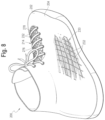
- the article of footwear 100 may include an upper 102, where the upper 102 is substantially formed as a textile component.
- the textile component may be any suitable type of textile, and in some embodiments it may be formed as a knitted component.
- the upper 102 may be secured to a sole structure 106.
- the upper 102 may include a lateral side 108 and a medial side 110.
- the area where the sole structure 106 joins the upper 102 may be referred to as a biteline 112.
- the upper 102 may be joined to the sole structure 106 in a fixed manner using any suitable technique, such as through the use of an adhesive, by sewing, etc.
- the upper 102 may extend partially or completely around a foot of a wearer and/or may be integral with the sole structure 106, and a sockliner may or may not be used.
- the sole structure 106 may include a midsole (not shown) and an outsole.
- the upper 102 may extend under the foot of a wearer and form an underfoot portion, which may be in place of the sole structure 106, if desired.
- an outer surface 130 of the upper 102 be subdivided into two or more generally defined areas referred to as pods 132.
- the pods 132 may be at least partially demarcated by edge regions 134 of the upper 102. in some embodiments, the edge regions 134 may substantially or completely surround at least some of the pods 132.
- the outer surface 130 may be formed primarily of a fused area of material that is heat-processed during the manufacturing of the article of footwear 100.
- fused area is an area where distinct portion(s) of material forming the upper (e.g., distinct individual strands or yarns formed of thermoplastic polymer material) are partially or substantially melted and then cooled such that the material is bonded together.
- a fused area is not required to be formed by any specific process. More specific constructions of the pods 132 and the surrounding edge regions 134 are described in further detail below.
- the upper 102 is described herein as being formed primarily of the knitted component 104, it alternatively or additionally could include a textile component formed by a process other than knitting (e.g., weaving) and may also include other materials including but not limited to leather, plastics, rubbers, and any other materials suitable for incorporation into the upper of an article of footwear.
- the knitted component 104 may also provide desirable aesthetic characteristics by incorporating yarns having different colors, textures or other visual properties arranged in a particular pattern.
- the yarns themselves and/or the knit structure formed by one or more of the yarns of the knitted component 104 may be varied at different locations such that the knitted component 104 has two or more portions with different properties (e.g., a portion forming the throat area 114 of the upper 102 may be relatively elastic while another portion may be relatively inelastic).
- the knitted component 104 may incorporate one or more materials with properties that change in response to a stimulus (e.g., temperature, moisture, electrical current, magnetic field, or light).
- the knitted component 104 may include yarns formed of one or more thermoplastic polymer materials (including material composites) that transition from a solid state to a softened or liquid state when subjected to certain temperatures at or above its melting point and then transitions back to the solid state when cooled.
- the thermoplastic polymer material(s) may provide the ability to heat and then cool a portion of the knitted component 104 to thereby form an area of bonded or continuous material (herein referred to as a "fused area") that exhibits certain advantageous properties including a relatively high degree of rigidity, strength, and water resistance, for example.
- suitable areas of thermoplastic polymer materials are polyurethanes, polyamides, polyolefins, and/or nylons.
- the knitted component 104 may substantially form the pods 132 and the surrounding edge regions 134.
- thermoplastic polymer material may be included and configured to be fused during a heat-processing step, the thermoplastic polymer material may be exposed on the outer surface 130 of the knitted component 104 only at the pods 132, and other materials may be used to form the outer surface 130 at the edge regions 134.
- a heat-processing step e.g., steaming or otherwise applying heat after knitting
- the result of this process may be the formation of a "shell" on the outer surface 130 of the pods 132.
- the shell may enhance the stiffness, strength, rigidity, durability, and other characteristics of the article of footwear 100.
- the enhanced characteristics may provide additional support and structure and may bolster or replace other structural elements (such as a heel counter, brio cables, etc.).
- Certain methods of heat-processing an outer surface of a knitted component are described in detail in U.S. Patent Application No. 15/443,808, filed February 27, 2017 , which is herein incorporated by reference in its entirety.
- the heat-processing of the outer surface 130 of the pods 132 may cause the melted thermoplastic polymer material to flow over the edge regions 134 such that the edge regions 134 are at least partially covered by fused material once it has cooled.
- the fused material may be isolated on the outer surface 130 only adjacent to the pods 132 and may terminate adjacent to the edge regions 134 leaving at least a portion of the outer surface 130 free of the fused material at the edge regions 134.
- the edge regions 134 may have a first degree of flexibility, the pods 132 may have a second degree of flexibility, and the first degree of flexibility may be substantially greater than the second degree of flexibility (which may be at least partially attributed to the lack of fused material on the edge regions 134).
- the edge regions 134 may have a first degree of stiffness, the pods 132 may have a second degree of stiffness, and the first degree of stiffness may be substantially less than the second degree of stiffness.
- the relative degrees of flexibility and stiffness may be compared by applying a force to the respective components and then measuring the amount of displacement through those same components.
- Different pods 132 may have identical dimensions, but at least some of the pods 132 may have dimensions that are substantially different.
- the edge regions 134 may be about the same size throughout the knitted component 104, but alternatively the edge regions 134 may vary in size.
- the sizes and locations of the pods 132 and/or the edge regions 134 may thus be selected to provide the upper 102 with strength, rigidity, protection, and other characteristics where desired, while also providing suitable flexibility, stretchability, and other characteristics at other zones or locations.
- the pods 132 in a first zone 136 may be larger, on average, than the pods 132 located in a second zone 138, where the first zone 136 is located closer to the heel area 126 and the second zone 138 is located closer to the toe area 128.
- the upper 102 may have a single layer or multiple layers.
- at least one pod 132 of the upper 102 may include a first layer 144 and a second layer 146, where the first layer 144 is an outer layer and the second layer 146 is an inner layer nearer the void when incorporated into the article of footwear 100.
- the knitted component may also have the first surface 154 formed by the first layer 144 (which may include the outer surface 130 of FIGS. 1-3 ) and the second surface 156 formed by the second layer 146.
- the second surface 156 and the first surface 154 may face in opposite directions.
- the first surface 154 may face outward (e.g., such that it is exposed for viewing when the article of footwear 100 is in use), and the second surface 156 may face the void, or interior of the article of footwear 100.
- the depicted third yarn 172 may be formed of a material that remains stable during heat processing.
- the third yarn 172 may comprise a plurality of polyester yarns having different colors.
- the third yarn 172 may provide a desirable visual effect when the first yarn 168 forms a transparent shell on the first surface 154 (as described in more detail below).
- the third yarn 172 may additionally or alternatively be formed of a material that provides loft within the pockets 152 to provide the knitted component 104 with a visually-appealing texture where the pods 132 extend outward with respect to the edge regions 134.
- the third yarn 172 may be a yarn that is inlaid between the first layer 144 and the second layer 146. While only one third yarn 172 is depicted in FIG. 6 , a plurality of yarns may be inlaid between the first layer 144 and the second layer 146, and thus the depicted third yarn 172 may represent a plurality of yarns in reality (e.g., a plurality of yarn types, and/or a plurality of individual yarns of the same type). The third yarn 172 may have one or more visual characteristics to provide the knitted component 104 with desirable visual properties.
- the pods 332 of the article 300 may have an irregular shape (and in some embodiments, only one irregular pod may be included).
- the edge regions 334 may extend in an irregular path (e.g., a curved, swerved, jagged, or otherwise non-linear path) through the knitted component 304 of the article 300.
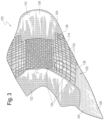
- one or more knitted webbed regions 412 may be located on the first side 414 (or front) of the knitted component 402 to provide advantageous functional characteristics (e.g., flexibility, stretchability, and/or other functional characteristics) along with unique and desirable visual effects.
- the webbed regions 412 may be similar, equivalent, and/or identical to the "edge regions" described above.
- the second side 416 of the tubular knit structure 410 may be formed with a second yarn 426 that is distinct from the first yarn 424.
- the second yarn 426 may be a yarn having a relatively high melting point (relative to the first yarn 424), with specific characteristics desirable for the back surface 406 of the second side 416.
- the second yarn 426 may be a multi-filament polyester yarn (e.g., a yarn formed primarily or entirely of a polyester material), which may have a variety of colors for providing unique visual effects (e.g., to the front and/or back surfaces of the knitted component), and which may have characteristics such as softness and anti-abrasiveness that are desirable on a surface that may contact a user (such as an inner surface of an upper for an article of footwear or a skin-contacting surface of an article of apparel).
- a multi-filament polyester yarn e.g., a yarn formed primarily or entirely of a polyester material
- characteristics such as softness and anti-abrasiveness that are desirable on a surface that may contact a user (such as an inner surface of an upper for an article of footwear or a skin-contacting surface of an article of apparel).
- some (or all) of the tubular knit structures may receive an inlaid strand, such as the second tubular knit structure 410 that receives the inlaid strand 422 in its passage 420.
- the inlaid strand 422 may be referred to as a "cushioning yarn.”
- a cushioning yarn, as described herein, may have a full diameter (e.g., when not restricted or compressed) of about 1/16" or larger, for example, though other cushioning yarns may have other diameters (e.g., 1/8", 1/4", or even larger).
- Two non-limiting exemplary examples of cushioning yarns are a 5500 denier version and a 3500 denier version of multifilament polyester yarn that has been texturized to loft.
- the inlaid strand may be inlaid through the webbed region 412, or may be incorporated into the knit structure of the webbed region 412.
- the inlaid strand 422 is a cushioning yarn, the yarn will expand to a natural equilibrium diameter, but will reduce in diameter if pressure is applied to the strand.
- the webbed region 412 shown in FIG. 11 and FIG. 13 may be formed with any suitable knit structure, and in some embodiments may utilize the structures of the above-described webbed regions.
- the webbed region 412 may be a location where the tubular knit structures 408, 410, and/or the fused surface region 407, terminate. Further, the webbed region 412 may extend through multipole courses (e.g., in the wale-wise direction) and may have an irregular pattern in one non-limiting embodiment, the webbed region 412 may be a double jersey knit structure (and/or any structure incorporating two needle beds), where the first yarn 424 (i.e., the fusible yarn) is located on the back surface of the second side 416 of the knitted component 402.
- FIG. 13 also depicts a second tubular knit structure 410, which appears white in the photograph.
- the white color is a characteristic provided by an inlaid cushioning yarn, such as a "LILY" yarn referenced above.
- the inlaid strand 422 of the second tubular knit structure 410 is visible since the first side 414 ( FIG. 12 ) of the second tubular knit structure 410 is fused to form a transparent front surface.
- the second side 416 ( FIG. 12 ) of the second tubular knit structure 410 is not visible since it is blocked by the inlaid strand 422 from the perspective of FIG. 13 .
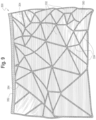
- the knitted component 402 of FIG. 13 also includes a webbed region 412 that extends through the knitted component 402 in an irregular pattern.
- the webbed region 412 may be selectively placed to impart desirable characteristics (e.g., stretchability) to certain areas of the knitted component 402.
- the first yarn e.g., the fusible yarn
- the third yarn may be covered by a third yarn on the first side 414 of the knitted component 402 in the webbed region, thus protecting the first yarn from fusing during heat processing.
- the webbed region is grey, meaning the so-called "third yarn" has a grey color.
- FIG. 14A is a knit diagram showing a knitting method for forming the first tubular knit structure 408 (e.g., as shown in FIG. 13 ).
- the first yarn 424 is knitted on a first needle bed of the knitting machine, which may be a front needle bed.
- the first yarn 424 may be a fusible first yarn 424.
- two polyester yarns may be knitted (e.g., the second yarn 426 and the third yarn 428).
- the second yarn 426 and the third yarn 428 may be plated in such a manner that the second yarn 426 appears on an interior surface of the second side 416 of the first tubular knit structure 408, and thus the third yarn 428 will appear on a back surface of the knitted component 402.
- the first yarn 424 could float (e.g., be located between the needle beds and not looped, similar to an inlaid strand) rather than knit on the back needle bed, which would locate it between both surfaces (e.g., inside the fabric), which may be advantageous when it is desirable to protect it from heat during heat-processing.
- the knitted component may be heat-processed with a contact-based heat plate (e.g., rather than a steam gun), and such loft of the tubular knit structures will cause the tubular knit structures to contact the heat plate prior to the heat plate making contact with the webbed regions.
- a contact-based heat plate e.g., rather than a steam gun
- the heat plate can avoid scorching or otherwise damaging the yarns on the surface in the webbed region while still providing heat to melt fusible yarn(s) on the front surface of the knitted component.
- This may also provide the ability for the heat plate to mold texture-proving characteristics in the front surface of the knitted component at select areas.
- Clause 5 The knitted component of clause 1, wherein at least one end of the first tubular knit structure terminates at a webbed region, and wherein the webbed region includes a non-tubular structure.
- Clause 7 The knitted component of clause 6, wherein a polyester yarn is located on the first side of the knitted component in the webbed region.
- Clause 8 The knitted component of clause 6, wherein the webbed region extends through multiple courses of the knitted component.
- a knitted component comprising:
- Clause 16 The knitted component of clause 15, wherein a polyester yarn is located on the first side of the knitted component in the webbed region.
- Clause 17 The knitted component of clause 15, wherein the webbed region extends through multiple courses of the knitted component.
- Clause 18 The knitted component of clause 15, wherein the inlaid strand extends through the webbed region in a compacted state.
Landscapes
- Engineering & Computer Science (AREA)
- Textile Engineering (AREA)
- Knitting Of Fabric (AREA)
Applications Claiming Priority (3)
| Application Number | Priority Date | Filing Date | Title |
|---|---|---|---|
| US201862716792P | 2018-08-09 | 2018-08-09 | |
| PCT/US2019/045879 WO2020033813A1 (en) | 2018-08-09 | 2019-08-09 | Knitted component with a fused surface region located on a tubular knit structure and a method of knitting a tubular knit structure |
| EP19758582.1A EP3833806B1 (de) | 2018-08-09 | 2019-08-09 | Gestrick mit einem verschmolzenen oberflächenbereich auf einer schlauchförmigen gestrickstruktur und ein verfahren zur herstellung eines gestrickes |
Related Parent Applications (2)
| Application Number | Title | Priority Date | Filing Date |
|---|---|---|---|
| EP19758582.1A Division EP3833806B1 (de) | 2018-08-09 | 2019-08-09 | Gestrick mit einem verschmolzenen oberflächenbereich auf einer schlauchförmigen gestrickstruktur und ein verfahren zur herstellung eines gestrickes |
| EP19758582.1A Division-Into EP3833806B1 (de) | 2018-08-09 | 2019-08-09 | Gestrick mit einem verschmolzenen oberflächenbereich auf einer schlauchförmigen gestrickstruktur und ein verfahren zur herstellung eines gestrickes |
Publications (2)
| Publication Number | Publication Date |
|---|---|
| EP4538439A2 true EP4538439A2 (de) | 2025-04-16 |
| EP4538439A3 EP4538439A3 (de) | 2025-07-09 |
Family
ID=67734844
Family Applications (2)
| Application Number | Title | Priority Date | Filing Date |
|---|---|---|---|
| EP19758582.1A Active EP3833806B1 (de) | 2018-08-09 | 2019-08-09 | Gestrick mit einem verschmolzenen oberflächenbereich auf einer schlauchförmigen gestrickstruktur und ein verfahren zur herstellung eines gestrickes |
| EP25160479.9A Pending EP4538439A3 (de) | 2018-08-09 | 2019-08-09 | Gestrickte komponente mit einem verschmolzenen oberflächenbereich auf einer schlauchförmigen strickstruktur und verfahren zum stricken einer gestrickten komponente |
Family Applications Before (1)
| Application Number | Title | Priority Date | Filing Date |
|---|---|---|---|
| EP19758582.1A Active EP3833806B1 (de) | 2018-08-09 | 2019-08-09 | Gestrick mit einem verschmolzenen oberflächenbereich auf einer schlauchförmigen gestrickstruktur und ein verfahren zur herstellung eines gestrickes |
Country Status (5)
| Country | Link |
|---|---|
| US (3) | US11365494B2 (de) |
| EP (2) | EP3833806B1 (de) |
| CN (2) | CN116288893B (de) |
| TW (1) | TWM594620U (de) |
| WO (1) | WO2020033813A1 (de) |
Families Citing this family (17)
| Publication number | Priority date | Publication date | Assignee | Title |
|---|---|---|---|---|
| EP3644779B1 (de) | 2017-06-27 | 2020-08-12 | Puma Se | Schuh, insbesondere sportschuh |
| US11375774B2 (en) | 2018-08-09 | 2022-07-05 | Nike, Inc. | Knitted component having a knitted anchor portion |
| US11365494B2 (en) * | 2018-08-09 | 2022-06-21 | Nike, Inc. | Knitted component with a fused surface region located on a tubular knit structure |
| US11109641B2 (en) * | 2019-03-22 | 2021-09-07 | Nike, Inc. | Article of footwear having a skin layer between a knitted component and a sole structure |
| USD935760S1 (en) | 2019-07-23 | 2021-11-16 | Puma SE | Shoe |
| USD932762S1 (en) | 2019-07-23 | 2021-10-12 | Puma SE | Shoe |
| USD970869S1 (en) * | 2019-08-16 | 2022-11-29 | Nike, Inc. | Shoe |
| USD918546S1 (en) * | 2019-08-16 | 2021-05-11 | Nike, Inc. | Shoe |
| TWI771813B (zh) * | 2020-11-27 | 2022-07-21 | 薩摩亞商織創流行科技控股有限公司 | 製造防止水份滲透的雙層織物的方法及雙層織物 |
| USD1075256S1 (en) * | 2021-01-25 | 2025-05-20 | Adidas Ag | Shoe |
| US20220240624A1 (en) * | 2021-01-29 | 2022-08-04 | Nike, Inc. | Knitted component with at least one expandable yarn |
| US12043929B2 (en) * | 2021-09-01 | 2024-07-23 | Nike, Inc. | Knitted component with inlay plush |
| WO2023034505A1 (en) * | 2021-09-01 | 2023-03-09 | Nike Innovate C.V. | Knitted component with inlay plush |
| CN118574958A (zh) * | 2022-01-20 | 2024-08-30 | 麦-艾普可有限责任公司 | 双面针织物 |
| USD1037631S1 (en) * | 2023-09-29 | 2024-08-06 | Nike, Inc. | Shoe |
| WO2025085873A1 (en) * | 2023-10-20 | 2025-04-24 | Nike Innovate C.V. | Article of footwear with transparent or translucent portions |
| EP4575057A1 (de) * | 2023-12-20 | 2025-06-25 | F.G.P. S.R.L. | Strickware, insbesondere für eine orthopädische stütze |
Family Cites Families (27)
| Publication number | Priority date | Publication date | Assignee | Title |
|---|---|---|---|---|
| GB970157A (en) | 1960-04-26 | 1964-09-16 | English Rose Ltd | Improvements in and relating to the production of bulked yarns |
| MY106949A (en) | 1988-02-05 | 1995-08-30 | Rudy Marion F | Pressurizable envelope and method |
| ZA963715B (en) | 1995-05-12 | 1996-11-20 | Tensar Corp | Bonded composite open mesh structural textiles |
| US5795835A (en) | 1995-08-28 | 1998-08-18 | The Tensar Corporation | Bonded composite knitted structural textiles |
| US6145348A (en) | 1998-08-19 | 2000-11-14 | Tietex International, Inc. | Fabric and process and apparatus for producing same |
| US6910288B2 (en) * | 2002-12-18 | 2005-06-28 | Nike, Inc. | Footwear incorporating a textile with fusible filaments and fibers |
| WO2009122821A1 (ja) | 2008-03-31 | 2009-10-08 | 美津濃株式会社 | シューズ及びその製造方法 |
| US8490299B2 (en) * | 2008-12-18 | 2013-07-23 | Nike, Inc. | Article of footwear having an upper incorporating a knitted component |
| US8839532B2 (en) * | 2011-03-15 | 2014-09-23 | Nike, Inc. | Article of footwear incorporating a knitted component |
| US8800172B2 (en) * | 2011-04-04 | 2014-08-12 | Nike, Inc. | Article of footwear having a knit upper with a polymer layer |
| US9150986B2 (en) | 2011-05-04 | 2015-10-06 | Nike, Inc. | Knit component bonding |
| KR102069225B1 (ko) | 2012-01-20 | 2020-01-22 | 가부시키가이샤 시마세이키 세이사쿠쇼 | 풋웨어 및 풋웨어의 제조방법 |
| US9986787B2 (en) | 2012-06-29 | 2018-06-05 | Nike, Inc. | Induction heating apparatuses and processes for footwear manufacturing |
| US9861160B2 (en) | 2012-11-30 | 2018-01-09 | Nike, Inc. | Article of footwear incorporating a knitted component |
| US9936757B2 (en) | 2013-03-04 | 2018-04-10 | Nike, Inc. | Article of footwear incorporating a knitted component with integrally knit contoured portion |
| DE102013207156B4 (de) | 2013-04-19 | 2025-12-24 | Adidas Ag | Schuh, insbesondere ein Sportschuh |
| US20150075031A1 (en) * | 2013-09-13 | 2015-03-19 | Nike, Inc. | Article Of Footwear Incorporating A Knitted Component With Monofilament Areas |
| US8997529B1 (en) | 2014-02-03 | 2015-04-07 | Nike, Inc. | Article of footwear including a monofilament knit element with peripheral knit portions |
| US9145629B2 (en) * | 2014-02-03 | 2015-09-29 | Nike, Inc. | Article of footwear including a monofilament knit element with a fusible strand |
| CN105077847A (zh) | 2014-05-24 | 2015-11-25 | 安踏(中国)有限公司 | 一种鞋面成型工艺 |
| US9375046B2 (en) | 2014-09-30 | 2016-06-28 | Nike, Inc. | Article of footwear incorporating a knitted component with inlaid tensile elements and method of assembly |
| CN106136452B (zh) * | 2014-09-30 | 2019-09-17 | 耐克创新有限合伙公司 | 结合有透镜编织结构的鞋类物品 |
| DE102015116398A1 (de) * | 2015-09-28 | 2017-03-30 | Visiotex GmbH | Schuh mit einem textilen Schaft |
| US10524530B2 (en) * | 2016-02-16 | 2020-01-07 | Nike, Inc. | Upper for an article of footwear with at least one molded thermoplastic polymer element |
| EP3474694B1 (de) | 2016-06-27 | 2023-09-13 | Nike Innovate C.V. | Textilie mit gequollenem garn |
| TWI834425B (zh) | 2017-08-04 | 2024-03-01 | 荷蘭商耐克創新有限合夥公司 | 編織組件、包含一編織組件之物品、處理一編織組件的方法及形成一編織組件的方法 |
| US11365494B2 (en) * | 2018-08-09 | 2022-06-21 | Nike, Inc. | Knitted component with a fused surface region located on a tubular knit structure |
-
2019
- 2019-08-07 US US16/534,755 patent/US11365494B2/en active Active
- 2019-08-08 TW TW108210535U patent/TWM594620U/zh unknown
- 2019-08-09 CN CN202310346803.1A patent/CN116288893B/zh active Active
- 2019-08-09 WO PCT/US2019/045879 patent/WO2020033813A1/en not_active Ceased
- 2019-08-09 EP EP19758582.1A patent/EP3833806B1/de active Active
- 2019-08-09 EP EP25160479.9A patent/EP4538439A3/de active Pending
- 2019-08-09 CN CN201980053333.1A patent/CN112840071B/zh active Active
-
2022
- 2022-05-19 US US17/748,991 patent/US11898279B2/en active Active
-
2024
- 2024-01-02 US US18/402,591 patent/US20240133087A1/en active Pending
Also Published As
| Publication number | Publication date |
|---|---|
| EP3833806A1 (de) | 2021-06-16 |
| CN112840071B (zh) | 2023-04-14 |
| CN116288893A (zh) | 2023-06-23 |
| US11898279B2 (en) | 2024-02-13 |
| US11365494B2 (en) | 2022-06-21 |
| EP4538439A3 (de) | 2025-07-09 |
| TWM594620U (zh) | 2020-05-01 |
| US20200048800A1 (en) | 2020-02-13 |
| CN112840071A (zh) | 2021-05-25 |
| CN116288893B (zh) | 2026-02-10 |
| WO2020033813A8 (en) | 2021-04-01 |
| US20240133087A1 (en) | 2024-04-25 |
| EP3833806B1 (de) | 2025-04-30 |
| WO2020033813A1 (en) | 2020-02-13 |
| US20220275544A1 (en) | 2022-09-01 |
Similar Documents
| Publication | Publication Date | Title |
|---|---|---|
| US11898279B2 (en) | Knitted component with a fused surface region located on a tubular knit structure | |
| US20220259779A1 (en) | Article with at least one layered pod | |
| EP3289129B1 (de) | Oberteil für einen fussbekleidungsartikel mit einer krause und ein verfahren zu seiner herstellung | |
| US12426663B2 (en) | Upper for an article of footwear with first and second knitted portions | |
| EP4463030B1 (de) | Schuhwerk mit gestrickte komponente mit eindämmung | |
| HK40053301A (en) | Knitted component with a fused surface region located on a tubular knit structure and a method of knitting a tubular knit structure | |
| HK40019135A (en) | Article formed of a knitted component comprising at least one layered pod and knitted component | |
| HK40019135B (zh) | 由包括至少一个分层荚形物的针织部件形成的物品和针织部件 |
Legal Events
| Date | Code | Title | Description |
|---|---|---|---|
| PUAI | Public reference made under article 153(3) epc to a published international application that has entered the european phase |
Free format text: ORIGINAL CODE: 0009012 |
|
| STAA | Information on the status of an ep patent application or granted ep patent |
Free format text: STATUS: THE APPLICATION HAS BEEN PUBLISHED |
|
| AC | Divisional application: reference to earlier application |
Ref document number: 3833806 Country of ref document: EP Kind code of ref document: P |
|
| AK | Designated contracting states |
Kind code of ref document: A2 Designated state(s): AL AT BE BG CH CY CZ DE DK EE ES FI FR GB GR HR HU IE IS IT LI LT LU LV MC MK MT NL NO PL PT RO RS SE SI SK SM TR |
|
| PUAL | Search report despatched |
Free format text: ORIGINAL CODE: 0009013 |
|
| P01 | Opt-out of the competence of the unified patent court (upc) registered |
Free format text: CASE NUMBER: APP_24993/2025 Effective date: 20250526 |
|
| AK | Designated contracting states |
Kind code of ref document: A3 Designated state(s): AL AT BE BG CH CY CZ DE DK EE ES FI FR GB GR HR HU IE IS IT LI LT LU LV MC MK MT NL NO PL PT RO RS SE SI SK SM TR |
|
| RIC1 | Information provided on ipc code assigned before grant |
Ipc: A43B 1/04 20220101ALN20250605BHEP Ipc: D04B 1/12 20060101AFI20250605BHEP |
|
| STAA | Information on the status of an ep patent application or granted ep patent |
Free format text: STATUS: REQUEST FOR EXAMINATION WAS MADE |
|
| 17P | Request for examination filed |
Effective date: 20260109 |
|
| STAA | Information on the status of an ep patent application or granted ep patent |
Free format text: STATUS: EXAMINATION IS IN PROGRESS |
|
| 17Q | First examination report despatched |
Effective date: 20260318 |