EP4050140B1 - Artikel aus einer gestrickten komponente mit mindestens einer verdickung und einem randbereich zur begrenzung der verdickung, sowie ein verfahren zu seiner herstellung - Google Patents
Artikel aus einer gestrickten komponente mit mindestens einer verdickung und einem randbereich zur begrenzung der verdickung, sowie ein verfahren zu seiner herstellung Download PDFInfo
- Publication number
- EP4050140B1 EP4050140B1 EP22153140.3A EP22153140A EP4050140B1 EP 4050140 B1 EP4050140 B1 EP 4050140B1 EP 22153140 A EP22153140 A EP 22153140A EP 4050140 B1 EP4050140 B1 EP 4050140B1
- Authority
- EP
- European Patent Office
- Prior art keywords
- layer
- yarn
- pod
- article
- pods
- Prior art date
- Legal status (The legal status is an assumption and is not a legal conclusion. Google has not performed a legal analysis and makes no representation as to the accuracy of the status listed.)
- Active
Links
Images




Classifications
-
- A—HUMAN NECESSITIES
- A43—FOOTWEAR
- A43B—CHARACTERISTIC FEATURES OF FOOTWEAR; PARTS OF FOOTWEAR
- A43B23/00—Uppers; Boot legs; Stiffeners; Other single parts of footwear
- A43B23/02—Uppers; Boot legs
- A43B23/0245—Uppers; Boot legs characterised by the constructive form
- A43B23/025—Uppers; Boot legs characterised by the constructive form assembled by stitching
-
- D—TEXTILES; PAPER
- D04—BRAIDING; LACE-MAKING; KNITTING; TRIMMINGS; NON-WOVEN FABRICS
- D04B—KNITTING
- D04B1/00—Weft knitting processes for the production of fabrics or articles not dependent on the use of particular machines; Fabrics or articles defined by such processes
- D04B1/10—Patterned fabrics or articles
-
- D—TEXTILES; PAPER
- D04—BRAIDING; LACE-MAKING; KNITTING; TRIMMINGS; NON-WOVEN FABRICS
- D04B—KNITTING
- D04B1/00—Weft knitting processes for the production of fabrics or articles not dependent on the use of particular machines; Fabrics or articles defined by such processes
- D04B1/10—Patterned fabrics or articles
- D04B1/12—Patterned fabrics or articles characterised by thread material
- D04B1/123—Patterned fabrics or articles characterised by thread material with laid-in unlooped yarn, e.g. fleece fabrics
-
- D—TEXTILES; PAPER
- D04—BRAIDING; LACE-MAKING; KNITTING; TRIMMINGS; NON-WOVEN FABRICS
- D04B—KNITTING
- D04B1/00—Weft knitting processes for the production of fabrics or articles not dependent on the use of particular machines; Fabrics or articles defined by such processes
- D04B1/14—Other fabrics or articles characterised primarily by the use of particular thread materials
- D04B1/16—Other fabrics or articles characterised primarily by the use of particular thread materials synthetic threads
-
- A—HUMAN NECESSITIES
- A43—FOOTWEAR
- A43B—CHARACTERISTIC FEATURES OF FOOTWEAR; PARTS OF FOOTWEAR
- A43B1/00—Footwear characterised by the material
- A43B1/0072—Footwear characterised by the material made at least partially of transparent or translucent materials
-
- A—HUMAN NECESSITIES
- A43—FOOTWEAR
- A43B—CHARACTERISTIC FEATURES OF FOOTWEAR; PARTS OF FOOTWEAR
- A43B23/00—Uppers; Boot legs; Stiffeners; Other single parts of footwear
- A43B23/02—Uppers; Boot legs
- A43B23/0205—Uppers; Boot legs characterised by the material
- A43B23/0215—Plastics or artificial leather
-
- A—HUMAN NECESSITIES
- A43—FOOTWEAR
- A43B—CHARACTERISTIC FEATURES OF FOOTWEAR; PARTS OF FOOTWEAR
- A43B23/00—Uppers; Boot legs; Stiffeners; Other single parts of footwear
- A43B23/02—Uppers; Boot legs
- A43B23/0205—Uppers; Boot legs characterised by the material
- A43B23/0235—Different layers of different material
-
- A—HUMAN NECESSITIES
- A43—FOOTWEAR
- A43B—CHARACTERISTIC FEATURES OF FOOTWEAR; PARTS OF FOOTWEAR
- A43B23/00—Uppers; Boot legs; Stiffeners; Other single parts of footwear
- A43B23/02—Uppers; Boot legs
- A43B23/0245—Uppers; Boot legs characterised by the constructive form
- A43B23/0255—Uppers; Boot legs characterised by the constructive form assembled by gluing or thermo bonding
-
- A—HUMAN NECESSITIES
- A43—FOOTWEAR
- A43B—CHARACTERISTIC FEATURES OF FOOTWEAR; PARTS OF FOOTWEAR
- A43B23/00—Uppers; Boot legs; Stiffeners; Other single parts of footwear
- A43B23/02—Uppers; Boot legs
- A43B23/0245—Uppers; Boot legs characterised by the constructive form
- A43B23/028—Resilient uppers, e.g. shock absorbing
-
- A—HUMAN NECESSITIES
- A43—FOOTWEAR
- A43B—CHARACTERISTIC FEATURES OF FOOTWEAR; PARTS OF FOOTWEAR
- A43B23/00—Uppers; Boot legs; Stiffeners; Other single parts of footwear
- A43B23/26—Tongues for shoes
-
- A—HUMAN NECESSITIES
- A61—MEDICAL OR VETERINARY SCIENCE; HYGIENE
- A61K—PREPARATIONS FOR MEDICAL, DENTAL OR TOILETRY PURPOSES
- A61K9/00—Medicinal preparations characterised by special physical form
- A61K9/0012—Galenical forms characterised by the site of application
- A61K9/0019—Injectable compositions; Intramuscular, intravenous, arterial, subcutaneous administration; Compositions to be administered through the skin in an invasive manner
-
- A—HUMAN NECESSITIES
- A61—MEDICAL OR VETERINARY SCIENCE; HYGIENE
- A61K—PREPARATIONS FOR MEDICAL, DENTAL OR TOILETRY PURPOSES
- A61K9/00—Medicinal preparations characterised by special physical form
- A61K9/14—Particulate form, e.g. powders, Processes for size reducing of pure drugs or the resulting products, Pure drug nanoparticles
- A61K9/16—Agglomerates; Granulates; Microbeadlets ; Microspheres; Pellets; Solid products obtained by spray drying, spray freeze drying, spray congealing,(multiple) emulsion solvent evaporation or extraction
- A61K9/1605—Excipients; Inactive ingredients
- A61K9/1611—Inorganic compounds
-
- A—HUMAN NECESSITIES
- A61—MEDICAL OR VETERINARY SCIENCE; HYGIENE
- A61P—SPECIFIC THERAPEUTIC ACTIVITY OF CHEMICAL COMPOUNDS OR MEDICINAL PREPARATIONS
- A61P35/00—Antineoplastic agents
-
- D—TEXTILES; PAPER
- D10—INDEXING SCHEME ASSOCIATED WITH SUBLASSES OF SECTION D, RELATING TO TEXTILES
- D10B—INDEXING SCHEME ASSOCIATED WITH SUBLASSES OF SECTION D, RELATING TO TEXTILES
- D10B2401/00—Physical properties
- D10B2401/04—Heat-responsive characteristics
- D10B2401/041—Heat-responsive characteristics thermoplastic; thermosetting
-
- D—TEXTILES; PAPER
- D10—INDEXING SCHEME ASSOCIATED WITH SUBLASSES OF SECTION D, RELATING TO TEXTILES
- D10B—INDEXING SCHEME ASSOCIATED WITH SUBLASSES OF SECTION D, RELATING TO TEXTILES
- D10B2403/00—Details of fabric structure established in the fabric forming process
- D10B2403/01—Surface features
- D10B2403/011—Dissimilar front and back faces
- D10B2403/0114—Dissimilar front and back faces with one or more yarns appearing predominantly on one face, e.g. plated or paralleled yarns
-
- D—TEXTILES; PAPER
- D10—INDEXING SCHEME ASSOCIATED WITH SUBLASSES OF SECTION D, RELATING TO TEXTILES
- D10B—INDEXING SCHEME ASSOCIATED WITH SUBLASSES OF SECTION D, RELATING TO TEXTILES
- D10B2403/00—Details of fabric structure established in the fabric forming process
- D10B2403/02—Cross-sectional features
-
- D—TEXTILES; PAPER
- D10—INDEXING SCHEME ASSOCIATED WITH SUBLASSES OF SECTION D, RELATING TO TEXTILES
- D10B—INDEXING SCHEME ASSOCIATED WITH SUBLASSES OF SECTION D, RELATING TO TEXTILES
- D10B2403/00—Details of fabric structure established in the fabric forming process
- D10B2403/02—Cross-sectional features
- D10B2403/022—Lofty fabric with variably spaced front and back plies, e.g. spacer fabrics
- D10B2403/0222—Lofty fabric with variably spaced front and back plies, e.g. spacer fabrics with at least one baggy or puckered ply
-
- D—TEXTILES; PAPER
- D10—INDEXING SCHEME ASSOCIATED WITH SUBLASSES OF SECTION D, RELATING TO TEXTILES
- D10B—INDEXING SCHEME ASSOCIATED WITH SUBLASSES OF SECTION D, RELATING TO TEXTILES
- D10B2403/00—Details of fabric structure established in the fabric forming process
- D10B2403/02—Cross-sectional features
- D10B2403/024—Fabric incorporating additional compounds
- D10B2403/0241—Fabric incorporating additional compounds enhancing mechanical properties
-
- D—TEXTILES; PAPER
- D10—INDEXING SCHEME ASSOCIATED WITH SUBLASSES OF SECTION D, RELATING TO TEXTILES
- D10B—INDEXING SCHEME ASSOCIATED WITH SUBLASSES OF SECTION D, RELATING TO TEXTILES
- D10B2501/00—Wearing apparel
- D10B2501/04—Outerwear; Protective garments
- D10B2501/043—Footwear
Definitions
- the disclosure is directed to articles, including articles of footwear and articles of apparel, having at least one layered pod.
- the layered pod is formed by a knitted component. More specifically, the disclosure relates to articles of footwear and components thereof having a layered pod.
- Conventional articles of footwear generally include two primary elements: an upper and a sole structure.
- the upper is generally secured to the sole structure and may form a void within the article of footwear for comfortably and securely receiving a foot.
- the sole structure is generally secured to a lower surface of the upper so as to be positioned between the upper and the ground.
- the sole structure may include a midsole and an outsole.
- the midsole may be formed from a polymer foam material that attenuates ground reaction forces to lessen stresses upon the foot and leg during walking, running, and other ambulatory activities.
- the outsole may be secured to a lower surface of the midsole and may form a ground-engaging portion of the sole structure that is formed from a durable and wear-resistant material.
- the upper of the article of footwear generally extends over the instep and toe areas of the foot, along the medial and lateral sides of the foot, and around the heel area of the foot and in some instances under the foot. Access to the void in the interior of the upper is generally provided by an ankle opening in and/or adjacent to a heel region of the footwear.
- a lacing system is often incorporated into the upper to adjust the fit of the upper, thereby facilitating entry and removal of the foot from the void within the upper.
- the upper may include a tongue that extends under the lacing system to enhance adjustability of the footwear, and the upper may incorporate other structures such as, for example, a heel counter to provide support and limit movement of the heel.
- WO 03/042441 A1 discloses a three-dimensional double-faced fabric which is produced on a weft knitting machine.
- the fabric comprises two external faces which are connected by means of rows of binding threads.
- Said fabric comprises hollow zones in which: the thread from a first external face works with the second external face; and the binding thread works with only one of the two external faces.
- GB 1 148 086 A discloses an insulating fabric which is formed by knitting a two ply fabric on a circular or flat machine and by laying yarns or rovings in the fabric between the two plies.
- the insulating fabric is formed by knitting one ply on the needles of one bed and the other ply on the needles of the other bed and by laying the yarns or rovings in between the plies by feeding them to the backs of the needles.
- the two plies are secured together by knitting the same yarn simultaneously by selected needles of both beds. The selection can be made to achieve a quilting effect in the fabric.
- US 2012/246973 A1 discloses an article of footwear which has an upper and a sole structure secured to the upper.
- the upper includes a knitted component and a polymer layer.
- the knitted component is formed of unitary knit construction and extends along a lateral side of the upper, along a medial side of the upper, over a forefoot region of the upper, and around a heel region of the upper.
- the polymer layer is bonded to the knitted component and may form a majority of an exterior surface of the upper.
- the polymer layer may be formed from a thermoplastic polymer material and the knitted component comprises doublelayered structures including inlaid yarns.
- the claimed invention provides an article formed of a knitted component according to the subject matter of claim 1.
- the knitted component comprises a first surface and a second surface, the first surface facing opposite the second surface.
- a pod has the first surface formed by a first layer and the second surface formed by a second layer, and an edge region has the first surface and the second surface, where the edge region at least partially demarcates the pod.
- a first yarn forms the first surface of the pod, where the first yarn is a fusible yarn comprising a first material that is a fusible thermoplastic polymer material.
- a second yarn forms the second surface of the pod, and the second yarn forms the first surface of the edge region.
- the pod includes a pocket formed between the first layer and the second layer and a third yarn is laid within the pocket between the first layer and the second layer.
- the first surface within the pod is heat-processed during manufacturing such that the first yarn is fused and forms a fused area of a first material.
- the claimed invention also provides a method according to claim 12.
- This method includes forming an article formed of a knitted component having a first surface and a second surface utilizing a flat knitting machine, wherein the first surface faces opposite the second surface, the method comprising knitting a first layer having the first surface on a first needle bed using a first yarn comprising a first material that is fusible, wherein the first material is a thermoplastic polymer material, knitting a second layer having the second surface on a second needle bed using a second yarn such that a pocket of a pod is formed between the first layer and the second layer, wherein a third yarn is inlaid within the pocket, and knitting an edge region at least partially demarcating the pod having the first surface and the second surface with the second yarn on the first needle bed and the second needle bed, and heat-processing the first surface within the pod to form a fused area of the first material during manufacturing.
- Certain aspects of the present disclosure relate to uppers configured for use in an article of footwear and/or other articles, such as articles of apparel.
- articles of footwear the disclosure may describe basketball shoes, running shoes, biking shoes, cross-training shoes, football shoes, golf shoes, hiking shoes and boots, ski and snowboarding boots, soccer shoes, tennis shoes, and/or walking shoes, as well as footwear styles generally considered non-athletic, including but not limited to dress shoes, loafers, and sandals.
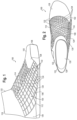
- FIG. 1 is an illustration showing an article of footwear 100
- FIG. 2 is a top view of the article of footwear 100
- the article of footwear 100 may include an upper 102, where the upper 102 is substantially formed as a textile component.
- the textile component is formed as a knitted component.
- the upper 102 may be secured to a sole structure 106.
- the upper 102 may include a lateral side 108 and a medial side 110.
- the area where the sole structure 106 joins the upper 102 may be referred to as a biteline 112.
- the upper 102 may be joined to the sole structure 106 in a fixed manner using any suitable technique, such as through the use of an adhesive, by sewing, etc.
- the upper 102 may extend partially or completely around a foot of a wearer and/or may be integral with the sole structure 106, and a sockliner may or may not be used.
- the sole structure 106 may include a midsole (not shown) and an outsole.
- the upper 102 may extend under the foot of a wearer and form an underfoot portion, which may be in place of the sole structure 106, if desired.
- the upper 102 may additionally include a throat area 114 extending from and an ankle opening 118 leading to the void 120, and a collar 122 may at least partially surround an ankle opening 118.
- the void 120 of the article of footwear 100 may be configured (e.g., sized and shaped) to receive and accommodate a foot of a person.
- the throat area 114 may be generally disposed in a midfoot area 124 of the upper 102.
- the midfoot area 124 of the upper 102 may be located between a heel area 126 and a toe area 128.
- an optional tongue (such as the tongue 276 shown in FIG. 8 ) may be disposed at least partially in the throat area 114, but no tongue is depicted in FIGS. 1-2 . If a tongue is included, the tongue may be any type of tongue, such as a gusseted tongue or a burrito tongue. If a tongue is not included, the lateral and medial sides of the throat area 114 may be joined together.
- an outer surface 130 of the upper 102 be subdivided into two or more generally defined areas referred to as pods 132.
- the pods 132 are at least partially demarcated by edge regions 134 of the upper 102.
- the edge regions 134 may substantially or completely surround at least some of the pods 132.
- the outer surface 130 may be formed primarily of a fused area of material that is heat-processed during the manufacturing of the article of footwear 100.
- a "fused area” is an area where distinct portion(s) of material forming the upper (e.g., distinct individual strands or yarns formed of thermoplastic polymer material) are partially or substantially melted and then cooled such that the material is bonded together.
- a fused area is not required to be formed by any specific process. More specific constructions of the pods 132 and the surrounding edge regions 134 are described in further detail below.
- At least a portion of the upper 102 is formed by a knitted component 104 (and at least a portion of the knitted component may be referred to as a "knit element").
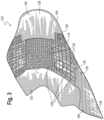
- FIG. 3 shows the knitted component 104 as it may appear after knitting (e.g., on a flat knitting machine) but before being lasted or otherwise manipulated into a wearable shape in the depicted article of footwear 100 of FIGS. 1-2 .
- the upper 102 is described herein as being formed primarily of the knitted component 104, it additionally could include a textile component formed by a process other than knitting (e.g., weaving) and may also include other materials including but not limited to leather, plastics, rubbers, and any other materials suitable for incorporation into the upper of an article of footwear.
- Forming the upper 102 with the knitted component 104 may provide the upper 102 with advantageous characteristics including, but not limited to, a particular degree of elasticity (for example, as expressed in terms of Young's modulus), breathability, bendability, strength, moisture absorption, weight, abrasion resistance, and/or a combination thereof.
- a particular degree of elasticity for example, as expressed in terms of Young's modulus
- breathability for example, as expressed in terms of Young's modulus
- bendability for example, as expressed in terms of Young's modulus
- strength for example, as expressed in terms of Young's modulus
- moisture absorption weight
- abrasion resistance a combination thereof.
- a particular single layer or multi-layer knit structure e.g., a ribbed knit structure, a single jersey knit structure, or a double jersey knit structure
- a particular material e.g., a polyester material, a relatively inelastic material, or a relatively elastic material such as spandex
- yarns of a particular size e.g., denier
- the knitted component 104 may also provide desirable aesthetic characteristics by incorporating yarns having different colors, textures or other visual properties arranged in a particular pattern.
- the yarns themselves and/or the knit structure formed by one or more of the yarns of the knitted component 104 may be varied at different locations such that the knitted component 104 has two or more portions with different properties (e.g., a portion forming the throat area 114 of the upper 102 may be relatively elastic while another portion may be relatively inelastic).
- the knitted component 104 may incorporate one or more materials with properties that change in response to a stimulus (e.g., temperature, moisture, electrical current, magnetic field, or light).
- the knitted component 104 includes yarns formed of one or more thermoplastic polymer materials (including material composites) that transition from a solid state to a softened or liquid state when subjected to certain temperatures at or above its melting point and then transitions back to the solid state when cooled.
- the thermoplastic polymer material(s) may provide the ability to heat and then cool a portion of the knitted component 104 to thereby form an area of bonded or continuous material (herein referred to as a "fused area") that exhibits certain advantageous properties including a relatively high degree of rigidity, strength, and water resistance, for example.
- suitable areas of thermoplastic polymer materials are polyurethanes, polyamides, polyolefins, and/or nylons.
- the knitted component 104 substantially forms the pods 132 and the surrounding edge regions 134.
- thermoplastic polymer material is included and configured to be fused during a heat-processing step, the thermoplastic polymer material is exposed on the outer surface 130 of the knitted component 104 only at the pods 132, and other materials is used to form the outer surface 130 at the edge regions 134.
- the result of this process may be the formation of a "shell" on the outer surface 130 of the pods 132.
- the shell may enhance the stiffness, strength, rigidity, durability, and other characteristics of the article of footwear 100.
- the enhanced characteristics may provide additional support and structure and may bolster or replace other structural elements (such as a heel counter, brio cables, etc.).
- the heat-processing of the outer surface 130 of the pods 132 may cause the melted thermoplastic polymer material to flow over the edge regions 134 such that the edge regions 134 are at least partially covered by fused material once it has cooled.
- the fused material may be isolated on the outer surface 130 only adjacent to the pods 132 and may terminate adjacent to the edge regions 134 leaving at least a portion of the outer surface 130 free of the fused material at the edge regions 134.
- the edge regions 134 may have a first degree of flexibility, the pods 132 may have a second degree of flexibility, and the first degree of flexibility may be substantially greater than the second degree of flexibility (which may be at least partially attributed to the lack of fused material on the edge regions 134).
- the edge regions 134 may have a first degree of stiffness, the pods 132 may have a second degree of stiffness, and the first degree of stiffness may be substantially less than the second degree of stiffness.
- the relative degrees of flexibility and stiffness may be compared by applying a force to the respective components and then measuring the amount of displacement through those same components.
- Different pods 132 may have identical dimensions, but at least some of the pods 132 may have dimensions that are substantially different.
- the edge regions 134 may be about the same size throughout the knitted component 104, but alternatively the edge regions 134 may vary in size.
- the sizes and locations of the pods 132 and/or the edge regions 134 may thus be selected to provide the upper 102 with strength, rigidity, protection, and other characteristics where desired, while also providing suitable flexibility, stretchability, and other characteristics at other zones or locations.
- the pods 132 in a first zone 136 may be larger, on average, than the pods 132 located in a second zone 138, where the first zone 136 is located closer to the heel area 126 and the second zone 138 is located closer to the toe area 128.
- the edge regions 134 may be more prevalent in the second zone 138 than the first zone 136 per unit area.
- the first zone 136 may have a higher degree of strength, rigidity, durability, and stiffness (along with other characteristics associated with the pods 132) while the second zone 138 may have a higher degree of flexibility, stretchability, and other characteristics associated with the edge regions 134.
- different pods 132 may have different material compositions such that, even correcting for size, the pods 132 provide differing degrees of the associated characteristics.
- a first pod may have a greater density of a thermoplastic polymer material on the outer surface 130 than a different second pod, and as a result, the first pod may have a greater degree of stiffness than the second pod.
- the substantial entirety of the heel area 126 may be constructed in a manner similar to the construction of the pods 132 (e.g., such that one large pod 140 forms the majority of the heel area 126).
- substantially the entirety of the toe area 128 may be formed by a large pod 142.
- the heel area 126 and/or the toe area 128 may bolster or replace heel counter and/or toecap elements to thus offer a degree of desirable rigidity, strength, and structural support to a wearer etc. that is desirable in certain applications.
- other portions such as the collar 122 may be formed with an elastic knit structure, and/or may not be heat-processed, such that the collar 122 is configured to stretch when receiving a foot.
- the upper 102 may have a single layer or multiple layers.
- at least one pod 132 of the upper 102 may include a first layer 144 and a second layer 146, where the first layer 144 is an outer layer and the second layer 146 is an inner layer nearer the void when incorporated into the article of footwear 100.
- the knitted component also has the first surface 154 formed by the first layer 144 (which may include the outer surface 130 of FIGS. 1 -3 ) and the second surface 156 formed by the second layer 146.
- the second surface 156 and the first surface 154 face in opposite directions.
- the first surface 154 may face outward (e.g., such that it is exposed for viewing when the article of footwear 100 is in use), and the second surface 156 may face the void, or interior of the article of footwear 100.
- the first layer 144 may include the above-described fused area, such that it can be considered to have formed a "shell" for providing protection and other desirable properties for the outer surface 130, and the second layer 146 may be formed of a material (e.g., elastane, cotton, or polyester) having desirable comfort-related characteristics for contacting a foot or sock of a wearer, such as a desirable elasticity, absorption and/or anti-abrasiveness.
- a third layer 148 is located in a pocket 152 that is formed between the first layer 144 and the second layer 146.
- the third layer 148 may include an inlaid material located at least partially between the first layer 144 and the second layer 146, where the first layer 144 and the second layer 146 are both knitted layers.
- the third layer 148 may be substantially bonded to the first layer 144 due to heat processing of the material of the first layer 144, but this is not required. More or fewer than three layers are also contemplated.
- a fourth layer 150 may be located between the second layer 146 and the third layer 148, but the fourth layer 150 may alternatively be located in any other location.
- the fused material forming the first layer 144 is transparent (at least after heat-processing) such that when a viewer looks at the first surface 154, he or she can detect the visual characteristics of the underlying third layer 148.
- the third layer 148 can be formed/manipulated during the manufacturing process to provide desirable visual effects without limitation, as the third layer 148 may not have the necessity of providing structural characteristics (which may instead be substantially provided by the first layer 144). However, it is also contemplated that the third layer 148 may provide certain structural or other functional characteristics, if desired, such as cushioning. Similarly, the fourth layer 150 may provide cushioning and/or other characteristics, such as additional stiffness, or alternatively, such as a water resistant layer, for example, that may be desired in the upper 102.
- thermoplastic polymer material of the first layer 144 may not be transparent prior to the heat-processing step, and instead may have a color or may be opaque (e.g., white) and may hide or otherwise obscure the third layer 148 from view. This may be advantageous where it is beneficial to easily view the position of the material forming the first layer 144 during manufacturing to ensure quality standards are met.
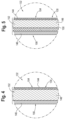
- FIG. 6 is an illustration showing a detailed side-cutout view of a multi-layer knitted component 104 forming the upper 102.
- the depicted knitted component 104 has a first pod 158, a second pod 160, and a third pod 162.
- the first pod 158 and the second pod 160 are separated by a first edge region 164
- the second pod 160 and the third pod 162 are separated by a second edge region 166.
- four yarns e.g., yarn types having one or more strands
- a first yarn 168, a second yarn 170, a third yarn 172, and a fourth yarn 174 are included: a first yarn 168, a second yarn 170, a third yarn 172, and a fourth yarn 174.
- the first yarn 168 is at least partially formed with a thermoplastic polymer material having a suitable melting point that is substantially lower than the melting point and decomposition point of the second yarn 170 (for example, 100°C lower or more) and also substantially lower than the melting point and decomposition point of the third yarn 172 and fourth yarn 174.
- suitable thermoplastic polymer materials include polyurethanes, polyamides, polyolefins, and nylons.
- substantially the entirety of the first yarn 168 may be formed of the thermoplastic polymer material, but alternatively the first yarn 168 may be a yarn with a thermoplastic polymer sheath with a relatively low melting point surrounded by a core that remains stable at higher temperatures.
- the melting temperature of the thermoplastic polymer material may be, for example, between about 80°C and about 200°C, such as from about 100°C to about 125°C based on atmospheric pressure at sea level.
- the thermoplastic polymer may be a nylon co-polymer with a melting point of between about 130°C and about 150°C, such as about 140°C.
- the first yarn 168 may include a thermoplastic polyurethane.
- the thermoplastic polymer material may be formed of a material that becomes translucent or transparent when raised above its melting point and then cooled.
- the second yarn 170 is made from a yarn substantially formed of polyester or a polyester in combination with elastane. Such a yarn may provide elasticity and anti-abrasion that is well suited for forming the inner surface of an upper.
- the melting point or decomposition point of the material(s) forming the second yarn 170 may be relatively high (e.g., above 200°C or higher, such as 260°C or higher for certain polyesters) such that the material remains stable during heat processing of the knitted component 104.
- the depicted third yarn 172 is formed of a material that remains stable during heat processing.
- the third yarn 172 may comprise a plurality of polyester yarns having different colors.
- the third yarn 172 may provide a desirable visual effect when the first yarn 168 forms a transparent shell on the first surface 154 (as described in more detail below).
- the third yarn 172 may additionally or alternatively be formed of a material that provides loft within the pockets 152 to provide the knitted component 104 with a visually-appealing texture where the pods 132 extend outward with respect to the edge regions 134.
- the third yarn 172 may include a bulking material that expands in size after the knitting process (e.g., in response to a stimulus, such as heat), thus enhancing the optional loft provided within the pod 132.
- a bulking material that expands in size after the knitting process (e.g., in response to a stimulus, such as heat), thus enhancing the optional loft provided within the pod 132.
- the fourth yarn 174 may be a monofilament yarn, which may be advantageous for providing a durable and inelastic tie (as described in more detail below).
- Monofilament yarns are formed of a single elongated, continuous filament of a synthetic polymer material. Some monofilament yarns, such as those made of a single filament of an inelastic synthetic polymer material may have substantially no elasticity, or very little, elasticity.
- a monofilament yarn made of an inelastic synthetic polymer material may have maximum elongation of less than 5% (e.g., the maximum length of the yarn when subjected to a tensile force approaching its breaking force is less than 105% of its length when not subjected to a tensile force), and it is contemplated that a such a yarn could have a maximum elongation of 1 %, 0.5%, or even less.
- the knitted component 104 includes the first surface 154 (e.g., an outward-facing surface) and the second surface 156.
- the first surface 154 is formed by the first yarn 168 such that, when heat-processed, the fusible material of the first yarn 168 fuses to form a rigid first surface 154.
- the first surface 154 of the first edge region 164 is formed by the second yarn 170.
- the edge regions 164, 166 remain relatively flexible with respect to the first pod 158 after heat processing (at least on the first surface 154).
- the first surface 154 of the second edge region 166 is formed of the second yarn 170 and also remain relatively flexible with respect to the second pod 160 and third pod 162 after heat processing (at least on the first surface 154).
- the second surface 156 of the knitted component is formed of the second yarn 170 throughout the depicted pods and edge regions.
- the second yarn 170 is a polyester yarn
- the second layer 146 may have characteristics that are desirable for facing a void.
- the second surface 156 may have relative softness and/or other comfort-related characteristics that are suitable and desirable for contacting the foot or sock of a wearer. As described in more detail below, this construction may be achieved by utilizing a knitting process that forms a multi-layer structure.
- the first layer 144 having the first surface 154 is formed on a first needle bed of a flat knitting machine
- the second layer 146 having the second surface 156 is formed on a second bed of the flat knitting machine such that the pocket 152 is formed between the first layer 144 and the second layer 146.
- At least a portion of the second yarn 170 is knit with the first needle bed at the edge regions 164, 166.
- Other suitable knitting processes are also contemplated (e.g., a technique utilizing transfers between both needle beds). A specific knitting process is described in more detail below with reference to FIG. 7 .
- the third yarn 172 is a yarn that is inlaid between the first layer 144 and the second layer 146. While only one third yarn 172 is depicted in FIG. 6 , a plurality of yarns may be inlaid between the first layer 144 and the second layer 146, and thus the depicted third yarn 172 may represent a plurality of yarns in reality (e.g., a plurality of yarn types, and/or a plurality of individual yarns of the same type).
- the third yarn 172 may have one or more visual characteristics to provide the knitted component 104 with desirable visual properties.
- the third yarn 172 may be visible within at least one of the pods 158, 160, 162 due to the transparency of the material of the heat-treated first yarn 168.
- the third yarn 172 may include a variety of colors, visual textures, patters, or other visual properties that may be deemed visually appealing.
- a material e.g., a material other than a yarn
- Such a material may enhance the padding or cushioning-related characteristics of the pod. Alternatively, such material may enhance the rigidity or stiffening characteristics of the pod to provide greater structure to the particular region.
- the fourth yarn 174 may be included to provide a tie (e.g., a structural connection) between the first layer 144 and the second layer 146 within the pods 158, 160, 162.
- the fourth yarn 174 may thus be advantageous for providing the pods 158, 160, 162 with structural integrity and/or for reducing movement of the third yarn 172 within the pod.
- the fourth yarn 174 may be a monofilament yarn or strand.
- monofilament strands are often relatively small in diameter and formed of a transparent material while still having relatively high tenacity and strength, the fourth yarn 174 may provide an adequate tie between the layers 144, 146 without interrupting the visual characteristics provided by the inlaid third yarn 172.
- the resulting knit structure of the knitted component 104 may have suitable strength, durability, rigidity, and other desirable structural characteristics.
- the fourth yarn 174 may be excluded such that the first layer 144 and the second layer 146 are separable at the pods 158, 160, 162.
- Figure 7 illustrates exemplary knit diagrams for the pod and edge regions, respectively, and one skilled in the art would know how to accomplish it based on the diagrams alone.
- the sequence identified as "A" on the left side of FIG. 7 illustrates one embodiment of a knitting sequence that may be used for the pods 158, 160, 162 of the knitted component 104 as shown in FIG. 6 .
- the sequence identified as "B" on the right side of FIG. 7 illustrates a knitting sequence that may be used to form the edge regions 164, 166 of the knitted component 104.
- the types of yarns and manner of knitting each yarn may differ between different areas of the knitted component 104, and the sequences depicted and described herein can be slightly or substantially altered to form similar structures.
- step 1 represents one or more knitting passes of knitting the first yarn 168 on every other needle of a first needle bed (e.g., a front bed).
- the third yarn 172 is inlaid between the first needle bed and a second needle bed of the knitting machine.
- the third yarn 172 may represent a plurality of strands or yarns which are inlaid with one pass or multiple passes.
- the third yarn 172 may include eight (8) inlaid polyester yarns having selected colors or other visual characteristics.
- the fourth yarn 174 may be knit to anchor or secure (e.g., "tie") the first layer 144 to the second layer 146 using tuck stitching.
- step 4 the second yarn 170 is knitted on every other needle of the back bed, as shown, with the second yarn 170 again being knitted in step 5 on the alternate needles of the back bed.
- step 6 the third yarn 172 is again inlaid.
- step 7 the fourth yarn 174 may again be knit to tie the first layer 144 to the second layer 146, using tuck stitches.
- step 8 the first yarn 168 is knit on every other needle of the front bed that was not used in step 1 .
- the resulting structure may be similar to at least one of the pods 158, 160, 162 depicted in FIG. 6 .
- step 1 includes inlaying the first yarn 168.
- step 2 the third yarn 172 is inlaid.
- step 3 the fourth yarn 174 may be knit to anchor the adjacent yarns using tuck stitching.
- step 4 the second yarn 170 is knitted on the back bed, as shown, with the elastic yarn again knitted in step 5 on the front bed.
- step 6 the third yarn 172 is again inlaid.
- step 7 the fourth yarn 174 may again be knit to tie yarns using tuck stitches.
- step 8 the first yarn 168 is inlaid as shown.
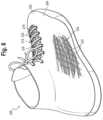
- FIG. 8 is an illustration showing a top perspective view of another embodiment of an article of footwear 200.
- the article of footwear 200 may include an upper 202 that is formed of a knitted component 204.
- the upper 202 may include a tongue 276 extending through a throat area 214 of the upper 202.
- the tongue 276 may be formed as a portion of the knitted component 204 on a knitting machine, or it may be separately formed and then later attached to the knitted component 204 after the knitting process (e.g., via sewing).
- the article of footwear 200 may also include a fastening element. Any suitable type of fastening element may be used, such as the depicted lace 278, a cabletensioning system, and/or any other suitable device.
- the upper 202 may be configured to secure to and communicate with the fastening element such that the fastening element may adjust and/or tighten the upper 202 around a foot of a wearer.
- the upper 202 may include a set of apertures for receiving the fastening element, but other suitable element(s) may alternatively be used.
- the knitted component 204 may include one or more pods 232.
- the pods 232 may incorporate any of the characteristics, constructions, or other features described with respect to the embodiments above. As shown, the pods 232 may be located on the knitted component 204 on an outer surface 230 of the upper 202 in a location other than in the throat area 214. Additionally or alternatively, the pods 232 may be located on the tongue 276.
- the pods 232 on the tongue 276 may provide protection, rigidity, cushioning, durability, and/or other related characteristics in the throat area 214 without sacrificing the ability of the upper 202 to be tightened around the foot.
- FIG. 9 is an illustration showing a top view of an embodiment of an article 300.
- the article 300 may be a swatch for an article of apparel.
- articles of apparel include shirts, pants, socks, footwear, jackets and other outerwear, briefs and other undergarments, hats, and the like.
- the article 300 may include a plurality of pods 332 surrounded by edge regions 334.
- the article 300 is substantially formed by a knitted component 304.
- the knitted component 304 includes a construction similar to the construction described with respect to the embodiments above.
- the pods 332 may include a variety of shapes and sizes. Certain pods 332 may be substantially formed as triangles, rectangles, pentagons, hexagons, etc. Optionally, at least some of the pods 332 may be demarcated by edge regions 334 that are curved, as shown (see, e.g., pod 380).
- dimensions of the edge regions 334 may vary.
- a first edge region 382 may have a first thickness
- a second edge region 384 may have a second thickness
- the first thickness may be greater than the second thickness.
- thicker edge regions may be placed in locations where more flexibility, stretchability, and/or other characteristics are desired.
- larger pods 332 may be placed in locations where stiffness, rigidity and/or structure and other related characteristics are desired.
- the pods 332 of the article 300 may have an irregular shape (and in some embodiments, only one irregular pod may be included).
- the edge regions 334 may extend in an irregular path (e.g., a curved, swerved, jagged, or otherwise nonlinear path) through the knitted component 304 of the article 300.
Landscapes
- Engineering & Computer Science (AREA)
- Textile Engineering (AREA)
- Knitting Of Fabric (AREA)
- Health & Medical Sciences (AREA)
- Chemical & Material Sciences (AREA)
- Pharmacology & Pharmacy (AREA)
- Animal Behavior & Ethology (AREA)
- Medicinal Chemistry (AREA)
- Veterinary Medicine (AREA)
- Public Health (AREA)
- General Health & Medical Sciences (AREA)
- Life Sciences & Earth Sciences (AREA)
- Epidemiology (AREA)
- Bioinformatics & Cheminformatics (AREA)
- Nuclear Medicine, Radiotherapy & Molecular Imaging (AREA)
- Footwear And Its Accessory, Manufacturing Method And Apparatuses (AREA)
- Organic Chemistry (AREA)
- Materials Engineering (AREA)
- Dermatology (AREA)
- General Chemical & Material Sciences (AREA)
- Inorganic Chemistry (AREA)
- Chemical Kinetics & Catalysis (AREA)
- Pharmaceuticals Containing Other Organic And Inorganic Compounds (AREA)
- Medicinal Preparation (AREA)
Claims (13)
- Artikel (100, 200, 300), der aus einer Strickkomponente (104, 204, 304) gebildet ist, wobei der Artikel (100, 200, 300) Folgendes umfasst:eine erste Fläche (154) und eine zweite Fläche (156), wobei die erste Fläche (154) von der zweiten Fläche (156) abgewandt ist,eine Zelle (132, 158, 160, 162, 232, 332), die die erste Fläche (154), die von einer ersten Lage (144) gebildet ist, und die zweite Fläche (156) aufweist, die von einer zweiten Lage (146) gebildet ist, wobei die Zelle (132, 158, 160, 162, 232, 332) eine Tasche (152) aufweist, die zwischen der ersten Lage (144) und der zweiten Lage (146) gebildet ist, undeinen Randbereich (134, 164, 166, 334), der die erste Fläche (154) und die zweite Fläche (156) aufweist, wobei der Randbereich (134, 164, 166, 334) die Zelle (132, 158, 160, 162, 232, 332) zumindest teilweise abgrenzt,ein erstes Garn (168), das ein erstes Material umfasst, das schmelzbar ist, wobei das erste Material ein thermoplastisches Polymermaterial ist, wobei die erste Fläche (154) innerhalb der Zelle (132, 158, 160, 162, 232, 332) aus einem verschmolzenen Bereich gebildet ist,ein zweites Garn (170), das im Wesentlichen die zweite Fläche (156) der Zelle (132, 158, 160, 162, 232, 332) bildet,wobei ein drittes Garn (172) innerhalb der Tasche (152) zwischen der ersten Lage (144) und der zweiten Lage (146) eingelegt ist, dadurch gekennzeichnet, dass der verschmolzene Bereich aus dem ersten Material besteht, das bei der Herstellung so wärmebehandelt wird, dass es verschmolzen ist, und dass das zweite Garn (170) im Wesentlichen die erste Fläche (154) des Randbereichs (134, 164, 166, 334) bildet.
- Artikel (100, 200, 300) nach Anspruch 1, wobei das erste Material des ersten Garns (168) zumindest teilweise durchscheinend oder durchsichtig ist.
- Artikel (100, 200, 300) nach Anspruch 1, wobei das erste Material, das verschmolzen ist, auf der ersten Fläche (154) nur angrenzend an die Zellen (160) isoliert ist und angrenzend an die Randbereiche (164) endet, wodurch zumindest ein Teil der ersten Fläche (154) an den Randbereichen (164) von dem ersten Material, das verschmolzen ist, frei bleibt.
- Artikel (100, 200, 300) nach einem der vorhergehenden Ansprüche, wobei ein zweites Material, das in dem dritten Garn (172) enthalten ist, zwischen der ersten Fläche (154) und der zweiten Fläche (156) der Zelle (160) eingelegt ist.
- Artikel (100, 200, 300) nach einem der Ansprüche 2 bis 4, wobei das erste Material, das verschmolzen ist, an das zweite Material gebunden ist.
- Artikel (100, 200, 300) nach einem der vorhergehenden Ansprüche, ferner mit einem Verbindungsgarn, das zwischen der ersten Fläche (154) und der zweiten Fläche (156) innerhalb der Zelle (160) verläuft.
- Artikel (100, 200, 300) nach Anspruch 6, wobei das Verbindungsgarn ein Monofilamentstrang ist.
- Artikel (100, 200, 300) nach einem der vorhergehenden Ansprüche, wobei eine dritte Lage (148) in die Tasche (152) eingelegt ist.
- Artikel (100, 200, 300) nach Anspruch 8, wobei die dritte Lage (148) ein eingelegtes Material aufweist, das sich zumindest teilweise zwischen der ersten Lage (144) und der zweiten Lage (146) befindet.
- Artikel (100, 200, 300) nach Anspruch 8 oder 9, wobei die dritte Lage (148) aufgrund von Wärmebehandlung des ersten Materials zumindest teilweise an die erste Lage (144) gebunden ist.
- Artikel (100, 200, 300) nach einem der Ansprüche 8 bis 10, wobei sich eine vierte Lage (150) zwischen der ersten Lage (144) und der dritten Lage (148) oder zwischen der zweiten Lage (146) und der dritten Lage (148) befindet.
- Verfahren zur Bildung eines Artikels (100, 200, 300), der aus einer Strickkomponente (104, 204, 304) gebildet ist, die eine erste Fläche (154) und eine zweite Fläche (156) aufweist, unter Verwendung einer Flachstrickmaschine, wobei die erste Fläche (154) von der zweiten Fläche (156) abgewandt ist, wobei das Verfahren Folgendes umfasst:Stricken einer ersten Lage (144), die die erste Fläche (154) aufweist, auf einem ersten Nadelbett unter Verwendung eines ersten Garns (168), das ein erstes Material umfasst, das schmelzbar ist, wobei das erste Material ein thermoplastisches Polymermaterial ist,Stricken einer zweiten Lage (146), die die zweite Fläche (156) aufweist, auf einem zweiten Nadelbett unter Verwendung eines zweiten Garns (170), derart, dass eine Tasche (152) einer Zelle (132, 158, 160, 162, 232, 332) zwischen der ersten Lage (144) und der zweiten Lage (146) gebildet wird, wobei ein drittes Garn (172) in die Tasche (152) eingelegt wird, und gekennzeichnet durchStricken eines Randbereichs (134, 164, 166, 334), der die Zellen (132, 158, 160, 162, 232, 332), die die erste Fläche (154) und die zweite Fläche (156) aufweisen, zumindest teilweise abgrenzt, mit dem zweiten Garn (170) auf dem ersten Nadelbett und dem zweiten Nadelbett, undWärmebehandeln der ersten Fläche (154) innerhalb der Zelle (132, 158, 160, 162, 232, 332) zur Bildung eines verschmolzenen Bereichs des ersten Materials.
- Verfahren nach Anspruch 12, wobei wenigstens ein Verbindungselement zwischen der ersten Lage (144) und der zweiten Lage (146) innerhalb der Zellen (132, 158, 160, 162, 232, 332) vorgesehen ist, das aus einem vierten Garn (174) gebildet ist.
Applications Claiming Priority (3)
| Application Number | Priority Date | Filing Date | Title |
|---|---|---|---|
| US201762541500P | 2017-08-04 | 2017-08-04 | |
| PCT/US2018/045163 WO2019028347A1 (en) | 2017-08-04 | 2018-08-03 | ARTICLE FORMED OF A KNITTED COMPONENT COMPRISING AT LEAST ONE STRATIFIED ENVELOPE AND A KNITTED COMPONENT |
| EP18756123.8A EP3662102B1 (de) | 2017-08-04 | 2018-08-03 | Artikel aus einem gestrickten bestandteil mit mindestens einer aus lagen aufgebauten hülle und gestrick |
Related Parent Applications (1)
| Application Number | Title | Priority Date | Filing Date |
|---|---|---|---|
| EP18756123.8A Division EP3662102B1 (de) | 2017-08-04 | 2018-08-03 | Artikel aus einem gestrickten bestandteil mit mindestens einer aus lagen aufgebauten hülle und gestrick |
Publications (2)
| Publication Number | Publication Date |
|---|---|
| EP4050140A1 EP4050140A1 (de) | 2022-08-31 |
| EP4050140B1 true EP4050140B1 (de) | 2025-05-14 |
Family
ID=63245112
Family Applications (2)
| Application Number | Title | Priority Date | Filing Date |
|---|---|---|---|
| EP18756123.8A Active EP3662102B1 (de) | 2017-08-04 | 2018-08-03 | Artikel aus einem gestrickten bestandteil mit mindestens einer aus lagen aufgebauten hülle und gestrick |
| EP22153140.3A Active EP4050140B1 (de) | 2017-08-04 | 2018-08-03 | Artikel aus einer gestrickten komponente mit mindestens einer verdickung und einem randbereich zur begrenzung der verdickung, sowie ein verfahren zu seiner herstellung |
Family Applications Before (1)
| Application Number | Title | Priority Date | Filing Date |
|---|---|---|---|
| EP18756123.8A Active EP3662102B1 (de) | 2017-08-04 | 2018-08-03 | Artikel aus einem gestrickten bestandteil mit mindestens einer aus lagen aufgebauten hülle und gestrick |
Country Status (5)
| Country | Link |
|---|---|
| US (3) | US11346025B2 (de) |
| EP (2) | EP3662102B1 (de) |
| CN (5) | CN210076733U (de) |
| TW (4) | TWI834425B (de) |
| WO (1) | WO2019028347A1 (de) |
Families Citing this family (28)
| Publication number | Priority date | Publication date | Assignee | Title |
|---|---|---|---|---|
| US20100199406A1 (en) | 2009-02-06 | 2010-08-12 | Nike, Inc. | Thermoplastic Non-Woven Textile Elements |
| US20130255103A1 (en) | 2012-04-03 | 2013-10-03 | Nike, Inc. | Apparel And Other Products Incorporating A Thermoplastic Polymer Material |
| TWI834425B (zh) * | 2017-08-04 | 2024-03-01 | 荷蘭商耐克創新有限合夥公司 | 編織組件、包含一編織組件之物品、處理一編織組件的方法及形成一編織組件的方法 |
| CN112543600B (zh) * | 2018-04-13 | 2023-04-04 | 耐克创新有限合伙公司 | 具有镶嵌缓冲的针织部件 |
| EP3781737B1 (de) | 2018-04-16 | 2025-04-02 | Nike Innovate C.V. | Schuhobermaterial mit gestrickten polsterbereichen und damit versehener schuh |
| US11365494B2 (en) * | 2018-08-09 | 2022-06-21 | Nike, Inc. | Knitted component with a fused surface region located on a tubular knit structure |
| CN112867412B (zh) * | 2018-10-19 | 2023-02-21 | 耐克创新有限合伙公司 | 具有凸起结构的针织部件和制造方法 |
| US11109641B2 (en) * | 2019-03-22 | 2021-09-07 | Nike, Inc. | Article of footwear having a skin layer between a knitted component and a sole structure |
| US12378707B2 (en) * | 2019-05-06 | 2025-08-05 | Nike, Inc. | Multi-layer knitted component |
| EP4649852A2 (de) | 2019-05-31 | 2025-11-19 | NIKE Innovate C.V. | Gestrickte komponente mit einer innenschicht aus thermoplastischem material und zugehöriges verfahren |
| WO2021026030A1 (en) | 2019-08-02 | 2021-02-11 | Nike, Inc. | An upper for an article of footwear |
| USD918546S1 (en) * | 2019-08-16 | 2021-05-11 | Nike, Inc. | Shoe |
| EP4234782A3 (de) * | 2019-11-18 | 2023-11-22 | NIKE Innovate C.V. | Schäumbare und geschäumte textilien, verfahren zu deren herstellung und artikel damit |
| WO2021101979A1 (en) * | 2019-11-18 | 2021-05-27 | Nike Innovate C.V. | Knitted component having a foam surface feature |
| GB2589378B (en) * | 2019-11-29 | 2024-08-21 | Texon Man Limited | A woven upper |
| CN111472084B (zh) * | 2020-02-26 | 2022-04-08 | 信泰(福建)科技有限公司 | 一种动态内置装饰编织鞋面 |
| DE102020207848A1 (de) | 2020-06-24 | 2021-12-30 | Adidas Ag | GewebtesOberteil mit Taschen und Füllungen |
| US11849773B2 (en) | 2020-12-31 | 2023-12-26 | Nike, Inc. | Knit article with variable features |
| EP4271867B1 (de) | 2020-12-31 | 2025-10-08 | NIKE Innovate C.V. | Sportsocke |
| CN116670347A (zh) * | 2020-12-31 | 2023-08-29 | 耐克创新有限合伙公司 | 具有可变特征的针织制品 |
| EP4271868A1 (de) * | 2020-12-31 | 2023-11-08 | NIKE Innovate C.V. | Strickartikel mit variablen merkmalen |
| EP4277490B1 (de) * | 2021-01-15 | 2024-04-03 | Puma Se | Schuhartikel mit gestricktem obermaterial und verfahren zur herstellung eines obermaterials |
| US20220240624A1 (en) * | 2021-01-29 | 2022-08-04 | Nike, Inc. | Knitted component with at least one expandable yarn |
| US20220256939A1 (en) * | 2021-02-17 | 2022-08-18 | Aspen Medical Products, Llc | Customized knitted wearable with reactive material for rigidity |
| US11896076B1 (en) * | 2023-05-07 | 2024-02-13 | Nike, Inc. | Footwear upper having a unitary knit structure and method of manufacturing |
| US12433776B2 (en) | 2023-08-12 | 2025-10-07 | Aspen Medical Products, Llc | Customized wearable with integrated pathways and/or interconnects |
| USD1037631S1 (en) * | 2023-09-29 | 2024-08-06 | Nike, Inc. | Shoe |
| US20260015777A1 (en) * | 2024-07-10 | 2026-01-15 | Nike, Inc. | Textile configured to promote cooling |
Family Cites Families (46)
| Publication number | Priority date | Publication date | Assignee | Title |
|---|---|---|---|---|
| US709734A (en) * | 1902-02-15 | 1902-09-23 | Robert w scott | Knitted fabric. |
| US2108925A (en) * | 1935-02-15 | 1938-02-22 | Raynor Harry Avery | Knitted fabric and the production thereof |
| US2372497A (en) | 1943-06-16 | 1945-03-27 | Clark Co Inc David | Fabric and method of making the same |
| GB1148086A (en) * | 1966-12-23 | 1969-04-10 | Monsanto Textiles Ltd | Fabric and method of knitting same |
| US3964277A (en) * | 1974-07-03 | 1976-06-22 | Miles Thomas E | Weft knit fabric with deflected inlaid yarn |
| GB2233989B (en) * | 1989-07-11 | 1993-12-01 | Courtaulds Plc | Structured knitted fabrics |
| US6974785B1 (en) * | 2000-03-02 | 2005-12-13 | Bacou-Dailoz Protective Apparel | Outer shell fabric for fire protective garments for firefighters and for workers exposed to risk of flash fire or electric arc |
| FR2806424B1 (fr) | 2000-03-15 | 2002-07-05 | Ames Europ | Nouveau tricot epais double face a structure souple |
| FR2832165B1 (fr) * | 2001-11-15 | 2004-01-23 | Textiles Plastiques Chomarat | Tricot double face tridimensionnel |
| US20030148076A1 (en) * | 2002-02-01 | 2003-08-07 | Hsi-Ming Huang | Composite fabric for shoes |
| US6854296B1 (en) * | 2004-01-23 | 2005-02-15 | Sara Lee Corporation | Bi-ply fabric construction and apparel formed therefrom |
| FR2873270B1 (fr) * | 2004-07-26 | 2006-10-13 | Salomon Sa | Element de confort pour article d'habillement ou article chaussant, procede de fabrication et article comportant un tel element |
| US7793434B2 (en) * | 2004-09-03 | 2010-09-14 | Nike, Inc. | Article of footwear having an upper with a structured intermediate layer |
| DE102005030651A1 (de) * | 2005-06-30 | 2007-01-11 | Bst Safety Textiles Gmbh | Verfahren zum Herstellen eines Abstandstextils |
| US8312645B2 (en) * | 2006-05-25 | 2012-11-20 | Nike, Inc. | Material elements incorporating tensile strands |
| US8225530B2 (en) | 2006-11-10 | 2012-07-24 | Nike, Inc. | Article of footwear having a flat knit upper construction or other upper construction |
| US7774956B2 (en) | 2006-11-10 | 2010-08-17 | Nike, Inc. | Article of footwear having a flat knit upper construction or other upper construction |
| US7380420B1 (en) * | 2007-02-05 | 2008-06-03 | Ruey Tay Fibre Industry Co., Ltd. | Fabric with different thicknesses |
| DE102007023062A1 (de) * | 2007-05-16 | 2008-11-20 | Iprotex Gmbh & Co. Kg | Verfahren zum Herstellen eines Gewebes und hierbei hergestelltes Gewebe |
| US9149086B2 (en) | 2009-10-07 | 2015-10-06 | Nike, Inc. | Article of footwear having an upper with knitted elements |
| US8839532B2 (en) * | 2011-03-15 | 2014-09-23 | Nike, Inc. | Article of footwear incorporating a knitted component |
| US9060570B2 (en) * | 2011-03-15 | 2015-06-23 | Nike, Inc. | Method of manufacturing a knitted component |
| US8800172B2 (en) * | 2011-04-04 | 2014-08-12 | Nike, Inc. | Article of footwear having a knit upper with a polymer layer |
| US9150986B2 (en) | 2011-05-04 | 2015-10-06 | Nike, Inc. | Knit component bonding |
| US20130312284A1 (en) * | 2011-05-27 | 2013-11-28 | Nike, Inc. | Article of Footwear Having Welded Upper |
| US8844167B2 (en) * | 2011-07-18 | 2014-09-30 | Nike, Inc. | Article of footwear having an upper with cord elements |
| US8448474B1 (en) * | 2012-02-20 | 2013-05-28 | Nike, Inc. | Article of footwear incorporating a knitted component with a tongue |
| US8887410B2 (en) * | 2012-02-24 | 2014-11-18 | Nike, Inc. | Articles of footwear with tensile strand elements |
| US20140130375A1 (en) * | 2012-11-15 | 2014-05-15 | Nike, Inc. | Article Of Footwear Incorporating A Knitted Component |
| US9226548B2 (en) * | 2013-01-15 | 2016-01-05 | Nike, Inc. | Spacer textile material with channels having multiple tensile strands |
| US9474328B2 (en) | 2013-01-15 | 2016-10-25 | Nike, Inc. | Spacer textile material with tensile strands in non-linear arrangements |
| US10499706B2 (en) * | 2013-03-22 | 2019-12-10 | Reebok International Limited | Molded footwear upper and method of making same |
| DE102013207163B4 (de) | 2013-04-19 | 2022-09-22 | Adidas Ag | Schuhoberteil |
| US8997529B1 (en) * | 2014-02-03 | 2015-04-07 | Nike, Inc. | Article of footwear including a monofilament knit element with peripheral knit portions |
| US9145629B2 (en) * | 2014-02-03 | 2015-09-29 | Nike, Inc. | Article of footwear including a monofilament knit element with a fusible strand |
| EP3122197B1 (de) * | 2014-03-25 | 2022-06-01 | Under Armour, Inc. | Fussbekleidung mit textilelement |
| US9872537B2 (en) * | 2014-04-08 | 2018-01-23 | Nike, Inc. | Components for articles of footwear including lightweight, selectively supported textile components |
| US9510637B2 (en) * | 2014-06-16 | 2016-12-06 | Nike, Inc. | Article incorporating a knitted component with zonal stretch limiter |
| FR3031015B1 (fr) * | 2014-12-31 | 2017-04-28 | Salomon Sas | Procede de fabrication d'un article chaussant |
| DE202015101004U1 (de) * | 2015-03-03 | 2015-03-24 | Bönning + Sommer Gmbh & Co. Kg | Luftdurchlässiges Klimastepp |
| EP3075277B1 (de) | 2015-03-31 | 2019-04-24 | adidas AG | Schuhoberteil für sportschuhe |
| DE102015116398A1 (de) | 2015-09-28 | 2017-03-30 | Visiotex GmbH | Schuh mit einem textilen Schaft |
| CN105747351B (zh) | 2016-01-27 | 2018-03-20 | 厦门翔鹭化纤股份有限公司 | 一种一体成型3d飞织鞋面及其制备方法 |
| EP3474694B1 (de) | 2016-06-27 | 2023-09-13 | Nike Innovate C.V. | Textilie mit gequollenem garn |
| US10753018B2 (en) * | 2016-06-28 | 2020-08-25 | Aknit International Ltd. | Double-sided fabric and method for knitting double-sided fabric |
| TWI834425B (zh) * | 2017-08-04 | 2024-03-01 | 荷蘭商耐克創新有限合夥公司 | 編織組件、包含一編織組件之物品、處理一編織組件的方法及形成一編織組件的方法 |
-
2018
- 2018-08-03 TW TW111147701A patent/TWI834425B/zh active
- 2018-08-03 TW TW107210689U patent/TWM579471U/zh unknown
- 2018-08-03 TW TW107127173A patent/TWI724318B/zh active
- 2018-08-03 WO PCT/US2018/045163 patent/WO2019028347A1/en not_active Ceased
- 2018-08-03 CN CN201821248905.0U patent/CN210076733U/zh active Active
- 2018-08-03 EP EP18756123.8A patent/EP3662102B1/de active Active
- 2018-08-03 CN CN201880028170.7A patent/CN110573665B/zh active Active
- 2018-08-03 EP EP22153140.3A patent/EP4050140B1/de active Active
- 2018-08-03 CN CN202010819364.8A patent/CN111920135B/zh active Active
- 2018-08-03 TW TW110109211A patent/TWI789721B/zh active
- 2018-08-03 CN CN202020139386.5U patent/CN213604796U/zh active Active
- 2018-08-03 CN CN202210358792.4A patent/CN114766780A/zh active Pending
- 2018-08-03 US US16/054,132 patent/US11346025B2/en active Active
- 2018-08-06 US US16/636,478 patent/US20200246278A1/en not_active Abandoned
-
2022
- 2022-05-06 US US17/738,856 patent/US20220259779A1/en active Pending
Also Published As
| Publication number | Publication date |
|---|---|
| EP3662102B1 (de) | 2022-02-09 |
| EP3662102A1 (de) | 2020-06-10 |
| CN111920135A (zh) | 2020-11-13 |
| CN110573665B (zh) | 2022-04-26 |
| CN110573665A (zh) | 2019-12-13 |
| CN114766780A (zh) | 2022-07-22 |
| US20200246278A1 (en) | 2020-08-06 |
| TWI789721B (zh) | 2023-01-11 |
| US20220259779A1 (en) | 2022-08-18 |
| US11346025B2 (en) | 2022-05-31 |
| TWM579471U (zh) | 2019-06-21 |
| TWI834425B (zh) | 2024-03-01 |
| TW202130293A (zh) | 2021-08-16 |
| TW202312901A (zh) | 2023-04-01 |
| WO2019028347A1 (en) | 2019-02-07 |
| EP4050140A1 (de) | 2022-08-31 |
| CN210076733U (zh) | 2020-02-18 |
| CN213604796U (zh) | 2021-07-06 |
| TW201909778A (zh) | 2019-03-16 |
| TWI724318B (zh) | 2021-04-11 |
| CN111920135B (zh) | 2024-11-01 |
| US20190037967A1 (en) | 2019-02-07 |
Similar Documents
| Publication | Publication Date | Title |
|---|---|---|
| US20220259779A1 (en) | Article with at least one layered pod | |
| US11898279B2 (en) | Knitted component with a fused surface region located on a tubular knit structure | |
| US12349759B2 (en) | Upper for an article of footwear with first and second knitted portions | |
| CN110382756B (zh) | 具有在从鞋面的足跟区域到脚趾区域的方向上延伸的第一横列的针织物品及其制造方法 | |
| HK40019135A (en) | Article formed of a knitted component comprising at least one layered pod and knitted component | |
| HK40053301A (en) | Knitted component with a fused surface region located on a tubular knit structure and a method of knitting a tubular knit structure | |
| HK40019135B (zh) | 由包括至少一个分层荚形物的针织部件形成的物品和针织部件 | |
| HK40017026B (en) | Knitted article with a first course extending in a direction from the heel area to the toe area of an upper, and a method of making same | |
| HK40017026A (en) | Knitted article with a first course extending in a direction from the heel area to the toe area of an upper, and a method of making same |
Legal Events
| Date | Code | Title | Description |
|---|---|---|---|
| PUAI | Public reference made under article 153(3) epc to a published international application that has entered the european phase |
Free format text: ORIGINAL CODE: 0009012 |
|
| STAA | Information on the status of an ep patent application or granted ep patent |
Free format text: STATUS: THE APPLICATION HAS BEEN PUBLISHED |
|
| AC | Divisional application: reference to earlier application |
Ref document number: 3662102 Country of ref document: EP Kind code of ref document: P |
|
| AK | Designated contracting states |
Kind code of ref document: A1 Designated state(s): AL AT BE BG CH CY CZ DE DK EE ES FI FR GB GR HR HU IE IS IT LI LT LU LV MC MK MT NL NO PL PT RO RS SE SI SK SM TR |
|
| STAA | Information on the status of an ep patent application or granted ep patent |
Free format text: STATUS: REQUEST FOR EXAMINATION WAS MADE |
|
| 17P | Request for examination filed |
Effective date: 20230228 |
|
| RBV | Designated contracting states (corrected) |
Designated state(s): AL AT BE BG CH CY CZ DE DK EE ES FI FR GB GR HR HU IE IS IT LI LT LU LV MC MK MT NL NO PL PT RO RS SE SI SK SM TR |
|
| P01 | Opt-out of the competence of the unified patent court (upc) registered |
Effective date: 20230515 |
|
| STAA | Information on the status of an ep patent application or granted ep patent |
Free format text: STATUS: EXAMINATION IS IN PROGRESS |
|
| 17Q | First examination report despatched |
Effective date: 20240415 |
|
| GRAP | Despatch of communication of intention to grant a patent |
Free format text: ORIGINAL CODE: EPIDOSNIGR1 |
|
| STAA | Information on the status of an ep patent application or granted ep patent |
Free format text: STATUS: GRANT OF PATENT IS INTENDED |
|
| RIC1 | Information provided on ipc code assigned before grant |
Ipc: A43B 1/04 20220101ALN20241122BHEP Ipc: D04B 1/12 20060101AFI20241122BHEP |
|
| INTG | Intention to grant announced |
Effective date: 20241213 |
|
| GRAS | Grant fee paid |
Free format text: ORIGINAL CODE: EPIDOSNIGR3 |
|
| GRAA | (expected) grant |
Free format text: ORIGINAL CODE: 0009210 |
|
| STAA | Information on the status of an ep patent application or granted ep patent |
Free format text: STATUS: THE PATENT HAS BEEN GRANTED |
|
| AC | Divisional application: reference to earlier application |
Ref document number: 3662102 Country of ref document: EP Kind code of ref document: P |
|
| AK | Designated contracting states |
Kind code of ref document: B1 Designated state(s): AL AT BE BG CH CY CZ DE DK EE ES FI FR GB GR HR HU IE IS IT LI LT LU LV MC MK MT NL NO PL PT RO RS SE SI SK SM TR |
|
| REG | Reference to a national code |
Ref country code: GB Ref legal event code: FG4D |
|
| REG | Reference to a national code |
Ref country code: CH Ref legal event code: EP |
|
| REG | Reference to a national code |
Ref country code: IE Ref legal event code: FG4D |
|
| REG | Reference to a national code |
Ref country code: DE Ref legal event code: R096 Ref document number: 602018082042 Country of ref document: DE |
|
| REG | Reference to a national code |
Ref country code: DE Ref legal event code: R082 Ref document number: 602018082042 Country of ref document: DE Representative=s name: MUELLER-BORE & PARTNER PATENTANWAELTE PARTG MB, DE |
|
| PGFP | Annual fee paid to national office [announced via postgrant information from national office to epo] |
Ref country code: GB Payment date: 20250612 Year of fee payment: 8 |
|
| PGFP | Annual fee paid to national office [announced via postgrant information from national office to epo] |
Ref country code: FR Payment date: 20250610 Year of fee payment: 8 |
|
| REG | Reference to a national code |
Ref country code: NL Ref legal event code: MP Effective date: 20250514 |
|
| PG25 | Lapsed in a contracting state [announced via postgrant information from national office to epo] |
Ref country code: PT Free format text: LAPSE BECAUSE OF FAILURE TO SUBMIT A TRANSLATION OF THE DESCRIPTION OR TO PAY THE FEE WITHIN THE PRESCRIBED TIME-LIMIT Effective date: 20250915 Ref country code: ES Free format text: LAPSE BECAUSE OF FAILURE TO SUBMIT A TRANSLATION OF THE DESCRIPTION OR TO PAY THE FEE WITHIN THE PRESCRIBED TIME-LIMIT Effective date: 20250514 Ref country code: FI Free format text: LAPSE BECAUSE OF FAILURE TO SUBMIT A TRANSLATION OF THE DESCRIPTION OR TO PAY THE FEE WITHIN THE PRESCRIBED TIME-LIMIT Effective date: 20250514 |
|
| PGFP | Annual fee paid to national office [announced via postgrant information from national office to epo] |
Ref country code: DE Payment date: 20250611 Year of fee payment: 8 |
|
| REG | Reference to a national code |
Ref country code: LT Ref legal event code: MG9D |
|
| PG25 | Lapsed in a contracting state [announced via postgrant information from national office to epo] |
Ref country code: GR Free format text: LAPSE BECAUSE OF FAILURE TO SUBMIT A TRANSLATION OF THE DESCRIPTION OR TO PAY THE FEE WITHIN THE PRESCRIBED TIME-LIMIT Effective date: 20250815 Ref country code: NO Free format text: LAPSE BECAUSE OF FAILURE TO SUBMIT A TRANSLATION OF THE DESCRIPTION OR TO PAY THE FEE WITHIN THE PRESCRIBED TIME-LIMIT Effective date: 20250814 |
|
| PG25 | Lapsed in a contracting state [announced via postgrant information from national office to epo] |
Ref country code: NL Free format text: LAPSE BECAUSE OF FAILURE TO SUBMIT A TRANSLATION OF THE DESCRIPTION OR TO PAY THE FEE WITHIN THE PRESCRIBED TIME-LIMIT Effective date: 20250514 Ref country code: PL Free format text: LAPSE BECAUSE OF FAILURE TO SUBMIT A TRANSLATION OF THE DESCRIPTION OR TO PAY THE FEE WITHIN THE PRESCRIBED TIME-LIMIT Effective date: 20250514 |
|
| REG | Reference to a national code |
Ref country code: AT Ref legal event code: MK05 Ref document number: 1794848 Country of ref document: AT Kind code of ref document: T Effective date: 20250514 |
|
| PG25 | Lapsed in a contracting state [announced via postgrant information from national office to epo] |
Ref country code: BG Free format text: LAPSE BECAUSE OF FAILURE TO SUBMIT A TRANSLATION OF THE DESCRIPTION OR TO PAY THE FEE WITHIN THE PRESCRIBED TIME-LIMIT Effective date: 20250514 |
|
| PG25 | Lapsed in a contracting state [announced via postgrant information from national office to epo] |
Ref country code: HR Free format text: LAPSE BECAUSE OF FAILURE TO SUBMIT A TRANSLATION OF THE DESCRIPTION OR TO PAY THE FEE WITHIN THE PRESCRIBED TIME-LIMIT Effective date: 20250514 |
|
| PG25 | Lapsed in a contracting state [announced via postgrant information from national office to epo] |
Ref country code: AT Free format text: LAPSE BECAUSE OF FAILURE TO SUBMIT A TRANSLATION OF THE DESCRIPTION OR TO PAY THE FEE WITHIN THE PRESCRIBED TIME-LIMIT Effective date: 20250514 |
|
| PG25 | Lapsed in a contracting state [announced via postgrant information from national office to epo] |
Ref country code: RS Free format text: LAPSE BECAUSE OF FAILURE TO SUBMIT A TRANSLATION OF THE DESCRIPTION OR TO PAY THE FEE WITHIN THE PRESCRIBED TIME-LIMIT Effective date: 20250814 |
|
| PG25 | Lapsed in a contracting state [announced via postgrant information from national office to epo] |
Ref country code: IS Free format text: LAPSE BECAUSE OF FAILURE TO SUBMIT A TRANSLATION OF THE DESCRIPTION OR TO PAY THE FEE WITHIN THE PRESCRIBED TIME-LIMIT Effective date: 20250914 |
|
| PG25 | Lapsed in a contracting state [announced via postgrant information from national office to epo] |
Ref country code: LV Free format text: LAPSE BECAUSE OF FAILURE TO SUBMIT A TRANSLATION OF THE DESCRIPTION OR TO PAY THE FEE WITHIN THE PRESCRIBED TIME-LIMIT Effective date: 20250514 |
|
| PG25 | Lapsed in a contracting state [announced via postgrant information from national office to epo] |
Ref country code: SM Free format text: LAPSE BECAUSE OF FAILURE TO SUBMIT A TRANSLATION OF THE DESCRIPTION OR TO PAY THE FEE WITHIN THE PRESCRIBED TIME-LIMIT Effective date: 20250514 Ref country code: DK Free format text: LAPSE BECAUSE OF FAILURE TO SUBMIT A TRANSLATION OF THE DESCRIPTION OR TO PAY THE FEE WITHIN THE PRESCRIBED TIME-LIMIT Effective date: 20250514 |
|
| PG25 | Lapsed in a contracting state [announced via postgrant information from national office to epo] |
Ref country code: CZ Free format text: LAPSE BECAUSE OF FAILURE TO SUBMIT A TRANSLATION OF THE DESCRIPTION OR TO PAY THE FEE WITHIN THE PRESCRIBED TIME-LIMIT Effective date: 20250514 |
|
| PG25 | Lapsed in a contracting state [announced via postgrant information from national office to epo] |
Ref country code: EE Free format text: LAPSE BECAUSE OF FAILURE TO SUBMIT A TRANSLATION OF THE DESCRIPTION OR TO PAY THE FEE WITHIN THE PRESCRIBED TIME-LIMIT Effective date: 20250514 |
|
| PG25 | Lapsed in a contracting state [announced via postgrant information from national office to epo] |
Ref country code: SK Free format text: LAPSE BECAUSE OF FAILURE TO SUBMIT A TRANSLATION OF THE DESCRIPTION OR TO PAY THE FEE WITHIN THE PRESCRIBED TIME-LIMIT Effective date: 20250514 |
|
| PG25 | Lapsed in a contracting state [announced via postgrant information from national office to epo] |
Ref country code: IT Free format text: LAPSE BECAUSE OF FAILURE TO SUBMIT A TRANSLATION OF THE DESCRIPTION OR TO PAY THE FEE WITHIN THE PRESCRIBED TIME-LIMIT Effective date: 20250514 |
|
| PG25 | Lapsed in a contracting state [announced via postgrant information from national office to epo] |
Ref country code: RO Free format text: LAPSE BECAUSE OF FAILURE TO SUBMIT A TRANSLATION OF THE DESCRIPTION OR TO PAY THE FEE WITHIN THE PRESCRIBED TIME-LIMIT Effective date: 20250514 |
|
| REG | Reference to a national code |
Ref country code: DE Ref legal event code: R097 Ref document number: 602018082042 Country of ref document: DE |
|
| PLBE | No opposition filed within time limit |
Free format text: ORIGINAL CODE: 0009261 |
|
| STAA | Information on the status of an ep patent application or granted ep patent |
Free format text: STATUS: NO OPPOSITION FILED WITHIN TIME LIMIT |
|
| REG | Reference to a national code |
Ref country code: CH Ref legal event code: H13 Free format text: ST27 STATUS EVENT CODE: U-0-0-H10-H13 (AS PROVIDED BY THE NATIONAL OFFICE) Effective date: 20260324 |
|
| REG | Reference to a national code |
Ref country code: CH Ref legal event code: L10 Free format text: ST27 STATUS EVENT CODE: U-0-0-L10-L00 (AS PROVIDED BY THE NATIONAL OFFICE) Effective date: 20260325 |
|
| PG25 | Lapsed in a contracting state [announced via postgrant information from national office to epo] |
Ref country code: MC Free format text: LAPSE BECAUSE OF FAILURE TO SUBMIT A TRANSLATION OF THE DESCRIPTION OR TO PAY THE FEE WITHIN THE PRESCRIBED TIME-LIMIT Effective date: 20250514 |
|
| PG25 | Lapsed in a contracting state [announced via postgrant information from national office to epo] |
Ref country code: LU Free format text: LAPSE BECAUSE OF NON-PAYMENT OF DUE FEES Effective date: 20250803 |
|
| 26N | No opposition filed |
Effective date: 20260217 |