EP3829954B1 - Bedieneinheit für ein lenkrad und lenkrad hiermit - Google Patents
Bedieneinheit für ein lenkrad und lenkrad hiermit Download PDFInfo
- Publication number
- EP3829954B1 EP3829954B1 EP19755534.5A EP19755534A EP3829954B1 EP 3829954 B1 EP3829954 B1 EP 3829954B1 EP 19755534 A EP19755534 A EP 19755534A EP 3829954 B1 EP3829954 B1 EP 3829954B1
- Authority
- EP
- European Patent Office
- Prior art keywords
- housing
- fan
- steering wheel
- control unit
- operator control
- Prior art date
- Legal status (The legal status is an assumption and is not a legal conclusion. Google has not performed a legal analysis and makes no representation as to the accuracy of the status listed.)
- Active
Links
Images

Classifications
-
- B—PERFORMING OPERATIONS; TRANSPORTING
- B62—LAND VEHICLES FOR TRAVELLING OTHERWISE THAN ON RAILS
- B62D—MOTOR VEHICLES; TRAILERS
- B62D1/00—Steering controls, i.e. means for initiating a change of direction of the vehicle
- B62D1/02—Steering controls, i.e. means for initiating a change of direction of the vehicle vehicle-mounted
- B62D1/04—Hand wheels
- B62D1/06—Rims, e.g. with heating means; Rim covers
- B62D1/065—Steering wheels with heating and ventilating means
-
- B—PERFORMING OPERATIONS; TRANSPORTING
- B60—VEHICLES IN GENERAL
- B60H—ARRANGEMENTS OF HEATING, COOLING, VENTILATING OR OTHER AIR-TREATING DEVICES SPECIALLY ADAPTED FOR PASSENGER OR GOODS SPACES OF VEHICLES
- B60H1/00—Heating, cooling or ventilating devices
- B60H1/00271—HVAC devices specially adapted for particular vehicle parts or components and being connected to the vehicle HVAC unit
- B60H1/00292—HVAC devices specially adapted for particular vehicle parts or components and being connected to the vehicle HVAC unit for steering wheels
-
- B—PERFORMING OPERATIONS; TRANSPORTING
- B62—LAND VEHICLES FOR TRAVELLING OTHERWISE THAN ON RAILS
- B62D—MOTOR VEHICLES; TRAILERS
- B62D1/00—Steering controls, i.e. means for initiating a change of direction of the vehicle
- B62D1/02—Steering controls, i.e. means for initiating a change of direction of the vehicle vehicle-mounted
- B62D1/04—Hand wheels
- B62D1/046—Adaptations on rotatable parts of the steering wheel for accommodation of switches
Definitions
- the invention relates to a steering wheel and an operating unit for this steering wheel with a housing that can be inserted into a steering wheel spoke of the steering wheel and has at least one housing side wall and a housing base, with an electrical contact element provided in the housing and with at least one actuating element that is movably mounted on the housing and switches electrically acts on the contact element.
- Operating units provided in openings in a steering wheel spoke of a steering wheel are known from the prior art (EP2537173B1 ).
- Devices of this type have a housing which can be inserted into the steering wheel spoke and has a housing side wall and a housing base, which housing usually carries a number of electrical switches, for example also rocker switches, for actuating devices in a motor vehicle.
- the switches have a contact element provided in the housing and an actuating element which is movably mounted on the housing and which actuating element has an electrically switching effect on the contact element. Because of the comparatively limited space, such operating units have to be compact.
- the EP2537173B1 shows the preamble of the independent claim.
- the invention has therefore set itself the task of expanding the functionality of an operating unit for a steering wheel, but without giving up compact structural conditions.
- the invention solves the problem set by the features of claim 1.
- the operating unit has a fan and a flow channel acted upon by the fan, the operating unit can contribute to the steering wheel temperature control and its functionality can thus be expanded.
- the flow channel is formed by the housing base and the flow channel has an inlet opening and an outlet opening on the housing, a small overall size of the operating unit can also be ensured. This is based, among other things, on the double bottom of the control unit for forming the flow channel, in order to keep the influence of the flow channel on the overall depth of the control unit low. This can be further improved if the flow channel has the inlet opening and the outlet opening on different end faces.
- the operating unit according to the invention can therefore contribute to controlling the temperature of a steering wheel, but is nevertheless distinguished by its compact size.
- the size of the control unit can be further reduced if the fan has an axial impeller.
- the impeller is preferably provided on the inlet side of the flow channel in order to allow an increased diameter on the impeller, corresponding to the anatomy of a steering wheel spoke, than would be possible with the outlet opening of the housing. An increased pressure ratio and thus improved temperature control of the steering wheel can be expected.
- the housing of the operating unit can protect and also carry the fan. This further reduces the construction effort on the control unit, especially since there is no need for a separate fan housing and the housing base can form this.
- the ventilator has a ventilator housing which is connected to the housing.
- the fan is thus comparatively easily accessible for maintenance purposes, which means that the handling of the operating unit can be further simplified--in particular when the fan housing of the fan is connected to the housing base.
- a simple and secure connection between the housing of the operating unit and the fan housing can be made possible by a snap-in connection.
- the housing forms at least one latching hook, which latches into a latching recess on the fan housing and thus firmly connects the fan housing to the housing.
- This connection is preferably detachable in order to make it easier to replace the fan, for example for maintenance or repairs.
- the assembly of the fan can be further facilitated if the latching hook runs as an extension of the flow channel.
- the size of the operating unit can also be further reduced if the housing base has a recess in which the fan is provided.
- the fan does not protrude from the housing, which can further simplify the installation of the control unit.
- Mounting the operating unit on a steering wheel can be made easier if the housing forms at least one latching element for fastening it to the steering wheel spoke.
- the resulting increase in pressure can further improve the dynamics in the temperature control of the steering wheel.
- the control unit according to the invention is particularly suitable for a steering wheel with a steering wheel spoke that has an inner spoke channel. Precise temperature control of the steering wheel can be made possible if the flow channel of the operating unit inserted into the steering wheel spoke is flow-connected to the spoke inner channel of the steering wheel.
- Adequate coupling of the fan to the inner spoke channel can be ensured if the outlet opening of the operating unit adjoins the inner spoke channel of the steering wheel spoke in a flow-tight manner.
- a fluidic short circuit on the fan can be avoided in a structurally simple manner. Increased temperature control efficiency and improved temperature control can be expected.
- a control unit 1 is used for a dashed in 1 shown steering wheel 2 shown in a sectional view.
- the control unit 1 is detachably fastened in a steering wheel spoke 3 of the steering wheel 2 - for this purpose the steering wheel spoke 3 has a receptacle 3.1, in which the housing 4 of the control unit 1 preferably flush with the steering wheel, as can be seen in a plan view 2 can be seen.
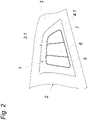
- the housing 4 has a closed housing side wall 4.1 and a housing base 4.2, and it also carries a number of electrical switches 5, 6, 7, as in FIG 2 refer to.
- These switches 5 , 6 , 7 each consist of an electrical contact element 5 . 1 , 6 . 1 , 7 . 1 provided in the housing 4 and an actuating element 5 . 2 , 6 . 2 , 7 . 2 movably mounted on the housing 4 .
- the actuating element 5.2, 6.2, 7.2 has an electrically switching effect on the contact element 5.1, 6.1, 7.1.
- the electrical switches 5, 7 are pushbuttons and the central switch 6 is a rocker switch.
- control unit 1 includes a fan 8 and a flow channel 9 acted upon by the fan 8, with which the steering wheel 2 can be tempered—for example, cooled and/or heated.
- the flow channel 9 is formed by the housing floor 4.2, which is designed as a double floor in this area of the flow channel 9. This construction ensures that the operating unit 1 has a small structural depth.
- the housing 4 has the inlet opening and the outlet opening 9.1, 9.2 on different end faces of the flow channel 9. This makes it easier to connect the operating unit 1 to the inner spoke channel 3.2 of the steering wheel spoke 3.
- These inlet and outlet openings 9.1, 9.2 are also provided on the housing base 4.2, which further simplifies the construction in the area of the flow channel.
- the fan 8 has an electric drive 8.1, an axial impeller 8.2 drivingly connected to the drive 8.1, and a fan housing 8.3 in order to ensure a compact design.
- the fan housing 8.3 protects drive 8.1 and impeller 8.2.
- the fan housing 8.3 connects to the inlet opening 9.2 and is detachably and firmly connected to the housing 4 of the operating unit 1 via a first snap-in connection 10 .
- This snap-in connection 10 is formed by snap-in hooks 10.1, which snap into snap-in recesses 10.2 on the fan housing 8.3. Fan 8 and housing 4 hold together so stably.
- the latching hooks 10.1 run as an extension of the flow channel 9, which enables the fan 8 to be easily installed on the housing 4 and also avoids torsional forces on the latching connection 10.
- the impeller 8.2 is provided on the inlet side of the flow channel 9, which relaxes the construction in the area of the fan. Because of the increased overall depth of the steering wheel spoke 3 in this area, it is possible to provide an impeller 8.2 with a sufficiently large diameter in order to generate high volume flows. This enables precise temperature control of the steering wheel 2.
- the housing base 4.2 has a recess 12 which connects to the inlet opening 9.2 of the flow channel 9.
- the fan 8 is provided in this recess 12 and is designed in such a way that the fan 8 provided there does not protrude laterally from the housing 4 . This makes it easier to insert the control unit 1 into the receptacle 3.1 on the steering wheel spoke 3.
- the recess can, for example, be formed in a simple structurally solved manner in that after the inlet opening 9.2 the upper housing floor wall of the housing floor 4.2 protrudes from the lower housing floor wall of the housing floor 4.2.
- the fan 8 is provided in the flow channel 9 of the housing base 4.2, which is indicated by dashed lines in FIG 1 is shown. This means that no fan housing 8.3 is required for the fan 8 - the housing base 4.2 can thus serve as a support for the remaining components of the fan 8.
- the operating unit 1 is detachably and firmly connected to the steering wheel spoke 3 via a second latching connection 11 .
- the housing 4 forms, for example inclined to the housing base 4.2 running, latching element 11.1, which engages in a complementary thereto trained notch 11.2 on the steering wheel spoke 3.
- outlet opening 9.1 connects to the inner spoke channel 3.2 in a flow-tight manner, which prevents a short circuit in the air duct for temperature control of the steering wheel 2.
Landscapes
- Engineering & Computer Science (AREA)
- Mechanical Engineering (AREA)
- Chemical & Material Sciences (AREA)
- Combustion & Propulsion (AREA)
- Transportation (AREA)
- Power Engineering (AREA)
- Physics & Mathematics (AREA)
- Thermal Sciences (AREA)
- Steering Controls (AREA)
Description
- Die Erfindung betrifft ein Lenkrad und eine Bedieneinheit für dieses Lenkrad mit einem in eine Lenkradspeiche des Lenkrads einsetzbaren Gehäuse, das mindestens eine Gehäuseseitenwand und einen Gehäuseboden aufweist, mit einem im Gehäuse vorgesehenen elektrischen Kontaktelement und mit mindestens einem am Gehäuse beweglich gelagerten Betätigungselement, das elektrisch schaltend auf das Kontaktelement einwirkt.
- In Öffnungen einer Lenkradspeiche eines Lenkrads vorgesehene Bedieneinheiten sind aus dem Stand der Technik bekannt (
EP2537173B1 ). Derartige Vorrichtungen weisen ein in die Lenkradspeiche einsetzbares Gehäuse mit einer Gehäuseseitenwand und mit einem Gehäuseboden auf, welches Gehäuse meist mehrere elektrische Schalter, beispielweise auch Wippschalter, zur Betätigung von Geräten eines Kraftfahrzeugs, trägt. Die Schalter weisen hierzu ein im Gehäuse vorgesehenes Kontaktelement und ein am Gehäuse beweglich gelagertes Betätigungselement auf, welches Betätigungselement auf das Kontaktelement elektrisch schaltend einwirkt. Aufgrund vergleichsweise beengter Platzverhältnisse müssen solche Bedieneinheiten kompakte Bauverhältnisse erfüllen. DieEP2537173B1 zeigt den Oberbegriff des unabhängigen Anspruchs. - Desweitern ist es aus dem Stand der Technik bekannt, Lenkräder von Kraftfahrzeugen zu temperieren (
DE29817868U1 ) - und zwar mit Hilfe von in Lenkradspeichen eingesetzten Ventilatoren. Dies ist allerdings vergleichsweise aufwendig und bedarf zudem auch einer speziellen Schalenkonstruktion des Lenkrads. - Zudem ist eine Lenkradkühlung aus der
US2017/0217284A1 bekannt. - Die Erfindung hat sich daher ausgehend vom eingangs geschilderten Stand der Technik die Aufgabe gestellt, eine Bedieneinheit für ein Lenkrad in seiner Funktionalität zu erweitern, ohne dabei aber kompakte Bauverhältnisse aufzugeben.
- Die Erfindung löst die gestellte Aufgabe durch die Merkmale des Anspruchs 1.
- Weist die Bedieneinheit einen Ventilator und einen vom Ventilator beaufschlagten Strömungskanal auf, kann die Bedieneinheit zur Lenkradtemperierung beitragen und damit in deren Funktionalität erweitert werden. Wird der Strömungskanal vom Gehäuseboden ausgebildet und weist der Strömungskanal am Gehäuse eine Einlassöffnung und eine Auslassöffnung auf, kann zudem eine geringe Baugröße an der Bedieneinheit sichergestellt bleiben. Dies unter anderem auf Basis des doppelten Bodens der Bedieneinheit zur Ausbildung des Strömungskanals, um so den Einfluss des Strömungskanals auf die Bautiefe der Bedieneinheit gering zu halten. Dies kann weiter verbessert werden, wenn der Strömungskanal die Einlassöffnung und die Auslassöffnung an unterschiedlichen Stirnseiten aufweist.
- Die erfindungsgemäße Bedieneinheit kann daher zur Temperierung eines Lenkrads beitragen, sich aber dennoch durch kompakte Baugröße auszeichnen.
- Die Baugröße der Bedieneinheit kann weiter vermindert werden, wenn der Ventilator ein axiales Laufrad aufweist.
- Vorzugsweise ist das Laufrad dem Strömungskanal einlassseitig vorgesehen, um der Anatomie einer Lenkradspeiche entsprechend am Laufrad einen erhöhten Durchmesser zuzulassen, als dies bei der Auslassöffnung des Gehäuses möglich wäre. Mit einem erhöhten Druckverhältnis und damit verbesserten Temperierung des Lenkrads kann gerechnet werden.
- Ist der Ventilator im Strömungskanal des Gehäusebodens vorgesehen, kann das Gehäuse der Bedieneinheit den Ventilator schützen und auch tragen. Dies reduziert den Konstruktionsaufwand an der Bedieneinheit weiter, zumal auf ein eigenes Ventilatorgehäuse verzichtet und der Gehäusebodens dieses ausbilden kann.
- Alternativ ist auch vorstellbar, dass der Ventilator ein Ventilatorgehäuse aufweist, welches an das Gehäuse anschließt. Der Ventilator ist damit für Wartungszwecke vergleichsweise einfach zugänglich, womit die Handhabung der Bedieneinheit weiter erleichtert werden kann - dies insbesondere, wenn das Ventilatorgehäuse des Ventilators an den Gehäuseboden anschließt.
- Eine einfache und sichere Verbindung zwischen dem Gehäuse der Bedieneinheit und dem Ventilatorgehäuse kann durch eine Rastverbindung ermöglicht werden. Hierzu bildet das Gehäuse mindestens einen Rasthaken aus, der in eine Rastausnehmung am Ventilatorgehäuse einrastet und damit das Ventilatorgehäuse mit dem Gehäuse fest verbindet. Vorzugsweise ist diese Verbindung lösbar, um einen Austausch des Ventilators - etwa für Wartung oder Reparatur - zu erleichtern.
- Die Montage des Ventilators kann weiter erleichtert werden, wenn der Rasthaken in Verlängerung des Strömungskanals verläuft.
- Die Baugröße der Bedieneinheit kann zudem weiter verringert werden, wenn der Gehäuseboden eine Ausnehmung aufweist, in die der Ventilator vorgesehen ist. Zudem kragt damit der Ventilator dem Gehäuse nicht vor, was die Montage die Bedieneinheit weiter erleichtern kann.
- Die Montage der Bedieneinheit an einem Lenkrad kann sich dadurch erleichtern, dass das Gehäuse zu seiner Befestigung an der Lenkradspeiche mindestens ein Rastelement ausbildet.
- Verjüngt sich der Strömungskanal im Querschnitt vom Ventilator zur Auslassöffnung hin kann eine sich dadurch ergebende Druckerhöhung die Dynamik in der Temperierung des Lenkrads weiter verbessert werden.
- Die erfindungsgemäße Bedieneinheit eignet sich besonders für ein Lenkrad mit einer Lenkradspeiche, die einen Speicheninnenkanal aufweist. Eine genaue Temperierung des Lenkrads kann ermöglicht werden, wenn der Strömungskanal der in die Lenkradspeiche eingesetzten Bedieneinheit mit dem Speicheninnenkanal des Lenkrads strömungsverbunden ist.
- Für eine ausreichende Kopplung des Ventilators mit dem Speicheninnenkanal kann gesorgt werden, wenn die Auslassöffnung der Bedieneinheit an den Speicheninnenkanal der Lenkradspeiche strömungsdicht anschließt. Zudem kann damit auf konstruktiv einfacher Weise ein strömungstechnischer Kurzschluss am Ventilator vermieden werden. Mit einer erhöhten Effizienz der Temperierung sowie mit einer verbesserten Temperaturführung kann gerechnet werden.
- In den Figuren ist beispielsweise der Erfindungsgegenstand anhand einer Ausführungsvariante näher dargestellt. Es zeigen
-
Fig. 1 eine Schnittansicht auf eine Bedieneinheit und -
Fig. 2 eine Draufsicht auf die Bedieneinheit nachFig. 1 . - Nach
Fig. 1 wird beispielsweise eine Bedieneinheit 1 für ein strichliert inFig. 1 dargestelltes Lenkrad 2 in einer Schnittansicht dargestellt. Die Bedieneinheit 1 ist in einer Lenkradspeiche 3 des Lenkrads 2 lösbar befestigt - hierzu weist die Lenkradspeiche 3 eine Aufnahme 3.1 auf, in die das Gehäuse 4 der Bedieneinheit 1 vorzugsweise bündig mit dem Lenkrad eingesetzt ist, wie dies auch in einer Draufsicht nachFig. 2 zu erkennen ist. - Das Gehäuse 4 weist eine geschlossene Gehäuseseitenwand 4.1 und einen Gehäuseboden 4.2 auf, zudem trägt es mehrere elektrische Schalter 5, 6, 7, wie auch in
Fig. 2 zu entnehmen. Diese Schalter 5, 6, 7 bilden sich jeweils aus einem im Gehäuse 4 vorgesehenen elektrischen Kontaktelement 5.1, 6.1, 7.1 und je einem am Gehäuse 4 beweglich gelagerten Betätigungselement 5.2, 6.2, 7.2. Das Betätigungselement 5.2, 6.2, 7.2 wirkt elektrisch schaltend auf das Kontaktelement 5.1, 6.1, 7.1 ein. Beispielsweise handelt es sich bei den elektrischen Schaltern 5, 7 um Drucktasten und beim dazu mittigen Schalter 6 um einen Wipptaster. - Zudem umfasst die Bedieneinheit 1 einen Ventilator 8 und einen vom Ventilator 8 beaufschlagten Strömungskanal 9 auf, mit dem das Lenkrad 2 temperiert - beispielsweise gekühlt und/oder geheizt - werden kann. Der Strömungskanal 9 wird vom Gehäuseboden 4.2 ausgebildet, welcher in diesem Bereich des Strömungskanals 9 als doppelter Boden ausgeführt ist. Durch diese Konstruktion wird eine geringe Bautiefe der Bedieneinheit 1 gewährleistet.
- Dies zudem auch dadurch, dass das Gehäuse 4 die Einlassöffnung und die Auslassöffnung 9.1, 9.2 an unterschiedlichen Stirnseiten des Strömungskanals 9 aufweist. Dies erleichtert das Anschließen der Bedieneinheit 1 an den Speicheninnenkanal 3.2 der Lenkradspeiche 3. Diese Einlass- und Auslassöffnung 9.1, 9.2 sind zudem am Gehäuseboden 4.2 vorgesehen, was die Konstruktion im Bereich des Strömungskanals weiter vereinfacht.
- Der Ventilator 8 weist einen elektrischen Antrieb 8.1, ein mit dem Antrieb 8.1 antriebsverbundenes axiales Laufrad 8.2, und ein Ventilatorgehäuse 8.3 auf, um eine kompakte Bauform zu gewährleisten. Das Ventilatorgehäuse 8.3 schützt Antrieb 8.1 und Laufrad 8.2.
- Das Ventilatorgehäuse 8.3 schließt an die Einlassöffnung 9.2 an und ist über eine erste Rastverbindung 10 mit dem Gehäuse 4 des Bedieneinheit 1 lösbar und fest verbunden. Diese Rastverbindung 10 wird durch Rasthaken 10.1 ausbildet, die in Rastausnehmungen 10.2 am Ventilatorgehäuse 8.3 einrasten. Ventilator 8 und Gehäuse 4 halten so standfest zusammen. Zudem verlaufen die Rasthaken 10.1 in Verlängerung des Strömungskanals 9, was eine einfache Montage des Ventilators 8 am Gehäuse 4 ermöglicht und auch Torsionskräfte auf die Rastverbindung 10 vermeidet.
- Durch das Vorsehen des Ventilators 8 an der Einlassöffnung 9.2 ist das Laufrad 8.2 dem Strömungskanal 9 einlassseitig vorgesehen, was die Konstruktion im Bereich des Ventilators entspannt. Durch die erhöhte Bautiefe der Lenkradspeiche 3 in diesem Bereich ist es nämlich möglich, ein Laufrad 8.2 mit einem ausreichend großen Durchmesser vorzusehen, um so hohe Volumenströme zu erzeugen. Dies ermöglich ein genaues Temperieren des Lenkrads 2.
- Der Gehäuseboden 4.2 weist eine Ausnehmung 12 aufweist, die an die Einlassöffnung 9.2 des Strömungskanals 9 anschließt. In dieser Ausnehmung 12 ist der Ventilator 8 vorgesehen und derart ausgebildet, dass der dort vorgesehene Ventilator 8 dem Gehäuse 4 seitlich nicht übersteht. Damit ist das Einsetzen der Bedieneinheit 1 in die Aufnahme 3.1 an der Lenkradspeiche 3 erleichtert. Die Ausnehmung kann beispielsweise einfach konstruktiv gelöst dadurch gebildet werden, dass nach der Einlassöffnung 9.2 die obere Gehäusebodenwand des Gehäusebodens 4.2 der unteren Gehäusebodenwand des Gehäusebodens 4.2 vorkragt.
- Alternativ ist vorstellbar, dass der Ventilator 8 im Strömungskanal 9 des Gehäusebodens 4.2 vorgesehen ist, was strichliert in der
Fig. 1 dargestellt ist. Damit wird für den Ventilator 8 kein Ventilatorgehäuse 8.3 benötigt - der Gehäuseboden 4.2 kann so als Träger der restlichen Bauteile des Ventilators 8 dienen. - Die Bedieneinheit 1 ist mit der Lenkradspeiche 3 über eine zweite Rastverbindung 11 lösbar und fest verbunden. Hierzu bildet das Gehäuse 4 ein, beispielsweise geneigt zum Gehäuseboden 4.2 verlaufende, Rastelement 11.1 auf, das in eine komplementäre dazu ausgebildete Raste 11.2 an der Lenkradspeiche 3 einrastet.
- Zudem schließt die Auslassöffnung 9.1 an den Speicheninnenkanal 3.2 strömungsdicht an, was einen Kurzschluss in der Luftführung zur Temperierung des Lenkrads 2 verhindert.
Claims (14)
- Bedieneinheit für ein Lenkrad (2) mit einem in eine Lenkradspeiche (3) des Lenkrads (2) einsetzbaren Gehäuse (4), das mindestens eine Gehäuseseitenwand (4.1) und einen Gehäuseboden (4.2) aufweist, mit einem im Gehäuse (4) vorgesehenen elektrischen Kontaktelement (5.1, 6.1, 7.1) und mit mindestens einem am Gehäuse (4) beweglich gelagerten Betätigungselement (5.2, 6.2, 7.2), das elektrisch schaltend auf das Kontaktelement (5.1, 6.1, 7.1) einwirkt, dadurch gekennzeichnet, dass die Bedieneinheit (1) einen Ventilator (8) für eine Lenkradtemperierung und einen vom Ventilator (8) beaufschlagten Strömungskanal (9) aufweist, welcher Strömungskanal (9) vom Gehäuseboden (4.2) ausgebildet wird und am Gehäuse (4) eine Einlass- und Auslassöffnung (9.2 und 9.1) aufweist.
- Bedieneinheit nach Anspruch 1, dadurch gekennzeichnet, dass der Ventilator (8) ein axiales Laufrad (8.2) aufweist.
- Bedieneinheit nach Anspruch 2, dadurch gekennzeichnet, dass das Laufrad (8.2) dem Strömungskanal (9) einlassseitig vorgesehen ist.
- Bedieneinheit nach einem der Ansprüche 1 bis 3, dadurch gekennzeichnet, dass der Ventilator (8) im Strömungskanal (9) des Gehäusebodens (4.2) vorgesehen ist.
- Bedieneinheit nach einem der Ansprüche 1 bis 3, dadurch gekennzeichnet, dass der Ventilator (8) ein Ventilatorgehäuse (8.3) aufweist, welches an das Gehäuse (4) anschließt.
- Bedieneinheit nach Anspruch 5, dadurch gekennzeichnet, dass das Ventilatorgehäuse (8.3) des Ventilators (8) an den Gehäuseboden (4.2) anschließt.
- Bedieneinheit nach Anspruch 5 oder 6, dadurch gekennzeichnet, dass das Gehäuse (4) mindestens einen Rasthaken (10.1) ausbildet, der in eine Rastausnehmung (10.2) am Ventilatorgehäuse (8.3) einrastet und damit das Ventilatorgehäuse (8.3) mit dem Gehäuse (4) fest verbindet.
- Bedieneinheit nach Anspruch 7, dadurch gekennzeichnet, dass der Rasthaken (10.1), der in eine Rastausnehmung (10.2) am Ventilatorgehäuse (8.3) einrastet, damit das Ventilatorgehäuse (8.3) mit dem Gehäuse (4) lösbar verbindet.
- Bedieneinheit nach Anspruch 7 oder 8, dadurch gekennzeichnet, dass der Rasthaken (10.1) in Verlängerung des Strömungskanals (9) verläuft.
- Bedieneinheit nach einem der Ansprüche 6 bis 9, dadurch gekennzeichnet, dass der Gehäuseboden (4.2) eine Ausnehmung (12) aufweist, in die der Ventilator (8) vorgesehen ist.
- Bedieneinheit nach einem der Ansprüche 1 bis 10, dadurch gekennzeichnet, dass das Gehäuse (4) zu seiner Befestigung an der Lenkradspeiche (3) mindestens ein Rastelement (11.1) ausbildet.
- Bedieneinheit nach einem der Ansprüche 1 bis 11, dadurch gekennzeichnet, dass sich der Strömungskanal (9) im Querschnitt vom Ventilator (8) zur Auslassöffnung (9.1) hin verjüngt.
- Lenkrad mit einer Lenkradspeiche (3), die einen Speicheninnenkanal (3.2) aufweist, und mit einer in die Lenkradspeiche (3) eingesetzten Bedieneinheit (1) nach einem der Ansprüche 1 bis 12, wobei der Strömungskanal (9) der Bedieneinheit (1) mit dem Speicheninnenkanal (3.2) strömungsverbunden ist.
- Lenkrad nach Anspruch 13, dadurch gekennzeichnet, dass die Auslassöffnung (9.1) der Bedieneinheit (1) an den Speicheninnenkanal (3.2) der Lenkradspeiche (3) strömungsdicht anschließt.
Applications Claiming Priority (2)
| Application Number | Priority Date | Filing Date | Title |
|---|---|---|---|
| EP18187380.3A EP3604081A1 (de) | 2018-08-03 | 2018-08-03 | Bedieneinheit für ein lenkrad und lenkrad mit solch einer bedieneinheit |
| PCT/EP2019/070279 WO2020025506A1 (de) | 2018-08-03 | 2019-07-26 | Bedieneinheit für ein lenkrad und lenkrad hiermit |
Publications (2)
| Publication Number | Publication Date |
|---|---|
| EP3829954A1 EP3829954A1 (de) | 2021-06-09 |
| EP3829954B1 true EP3829954B1 (de) | 2022-11-09 |
Family
ID=63165214
Family Applications (2)
| Application Number | Title | Priority Date | Filing Date |
|---|---|---|---|
| EP18187380.3A Withdrawn EP3604081A1 (de) | 2018-08-03 | 2018-08-03 | Bedieneinheit für ein lenkrad und lenkrad mit solch einer bedieneinheit |
| EP19755534.5A Active EP3829954B1 (de) | 2018-08-03 | 2019-07-26 | Bedieneinheit für ein lenkrad und lenkrad hiermit |
Family Applications Before (1)
| Application Number | Title | Priority Date | Filing Date |
|---|---|---|---|
| EP18187380.3A Withdrawn EP3604081A1 (de) | 2018-08-03 | 2018-08-03 | Bedieneinheit für ein lenkrad und lenkrad mit solch einer bedieneinheit |
Country Status (7)
| Country | Link |
|---|---|
| US (1) | US11584424B2 (de) |
| EP (2) | EP3604081A1 (de) |
| JP (1) | JP7351901B2 (de) |
| CN (1) | CN112752696B (de) |
| CA (1) | CA3108557A1 (de) |
| ES (1) | ES2938307T3 (de) |
| WO (1) | WO2020025506A1 (de) |
Families Citing this family (1)
| Publication number | Priority date | Publication date | Assignee | Title |
|---|---|---|---|---|
| CN111907586A (zh) * | 2020-07-28 | 2020-11-10 | 东风汽车股份有限公司 | 一种液体加热的汽车方向盘 |
Family Cites Families (28)
| Publication number | Priority date | Publication date | Assignee | Title |
|---|---|---|---|---|
| JPS62128878A (ja) * | 1985-11-30 | 1987-06-11 | Toyoda Gosei Co Ltd | ステアリングホイ−ル |
| DE19838452C1 (de) * | 1998-08-25 | 2000-05-18 | Trw Automotive Safety Sys Gmbh | Lenkrad für ein Kraftfahrzeug und Verfahren zur Herstellung eines Lenkradkranzes |
| DE29817868U1 (de) * | 1998-10-06 | 1998-12-10 | TRW Automotive Safety Systems GmbH, 63743 Aschaffenburg | Belüftetes Lenkrad |
| DE19951224B4 (de) * | 1999-10-20 | 2005-11-24 | Takata-Petri Ag | Vorrichtung zur Temperierung eines Bauteils |
| DE19953467B4 (de) * | 1999-11-05 | 2005-11-03 | Webasto Ag | Belüftungsvorrichtung für ein Lenkrad eines Fahrzeugs |
| NO20005119L (no) * | 2000-02-18 | 2001-08-20 | Ziad Badarneh | Interaktivt system |
| DE10061087A1 (de) * | 2000-12-08 | 2002-06-13 | Trw Automotive Safety Sys Gmbh | Verfahren zum Herstellen eines Lenkradskeletts und Fahrzeuglenkrad |
| JP2004142615A (ja) * | 2002-10-24 | 2004-05-20 | Denso Corp | 空調式ハンドル |
| JP2004210267A (ja) * | 2003-01-08 | 2004-07-29 | Wet Automotive Syst Ag | 冷却装置を備えたステアリング装置 |
| KR20040090275A (ko) * | 2003-04-17 | 2004-10-22 | 기아자동차주식회사 | 자동차용 스티어링 휠 |
| EP1623885A3 (de) * | 2004-08-03 | 2007-07-18 | TRW Automotive Safety Systems GmbH | Gassackmodul |
| JP2006176037A (ja) * | 2004-12-24 | 2006-07-06 | Aisin Seiki Co Ltd | ハンドル冷却加熱装置 |
| DE102007032657A1 (de) * | 2007-07-13 | 2009-01-15 | Dr. Ing. H.C. F. Porsche Aktiengesellschaft | Betätigungseinrichtung an einem Fahrzeuglenkrad |
| US20090114368A1 (en) * | 2007-11-02 | 2009-05-07 | Minoru Niwa | Heated or cooled steering wheel |
| JP5092815B2 (ja) * | 2008-03-11 | 2012-12-05 | 三菱自動車工業株式会社 | ステアリングスイッチ |
| JP5199371B2 (ja) * | 2008-05-26 | 2013-05-15 | デースン エレクトリック シーオー エルティーディー | ハプティックステアリングホイールスイッチユニット及びこれを備えるハプティックステアリングホイールスイッチシステム |
| DE102011011299A1 (de) | 2010-02-18 | 2011-08-18 | Marquardt GmbH, 78604 | Elektrischer Schalter |
| US8993929B2 (en) * | 2012-01-12 | 2015-03-31 | Ford Global Technologies, Llc | Heated/cooled thermoelectric steering wheel |
| US9308930B2 (en) * | 2012-04-06 | 2016-04-12 | Autoliv Asp, Inc. | Steering wheel with switch assembly |
| DE102012023996A1 (de) * | 2012-09-28 | 2014-06-12 | W.E.T. Automotive Systems Ag | Temperiereinrichtung für Griffe, insbesondere von Lenkeinrichtungen |
| DE102012023777A1 (de) * | 2012-12-05 | 2014-06-05 | GM Global Technology Operations LLC (n. d. Ges. d. Staates Delaware) | Lenkrad mit Aktivbelüftungseinrichtung und Verfahren zur Herstellung eines Lenkrads |
| DE102013005886A1 (de) * | 2013-04-05 | 2014-10-09 | Valeo Schalter Und Sensoren Gmbh | Bedienvorrichtung für ein Kraftfahrzeug und Lenkrad mit einer Bedienvorrichtung |
| WO2015152470A1 (ko) * | 2014-03-31 | 2015-10-08 | 주식회사 대창 | 열 교환 모듈 및 이를 구비한 냉온 송풍 장치 |
| CN206049302U (zh) * | 2014-04-29 | 2017-03-29 | 株式会社大昌 | 车载空气清洁装置 |
| WO2015175483A1 (en) * | 2014-05-13 | 2015-11-19 | Gentherm Canada Ltd. | Conditioned steering wheel |
| JP2015229450A (ja) * | 2014-06-06 | 2015-12-21 | 株式会社東海理化電機製作所 | ステアリングスイッチ装置 |
| DE102015219486B3 (de) * | 2015-10-08 | 2016-10-13 | Volkswagen Aktiengesellschaft | Lenkrad für ein Fahrzeug |
| DE102017107762A1 (de) * | 2017-04-11 | 2018-10-11 | Trw Automotive Safety Systems Gmbh | Lenkrad für ein kraftfahrzeug |
-
2018
- 2018-08-03 EP EP18187380.3A patent/EP3604081A1/de not_active Withdrawn
-
2019
- 2019-07-26 JP JP2021505809A patent/JP7351901B2/ja active Active
- 2019-07-26 CN CN201980051467.XA patent/CN112752696B/zh active Active
- 2019-07-26 US US17/265,770 patent/US11584424B2/en active Active
- 2019-07-26 EP EP19755534.5A patent/EP3829954B1/de active Active
- 2019-07-26 WO PCT/EP2019/070279 patent/WO2020025506A1/de not_active Ceased
- 2019-07-26 ES ES19755534T patent/ES2938307T3/es active Active
- 2019-07-26 CA CA3108557A patent/CA3108557A1/en active Pending
Also Published As
| Publication number | Publication date |
|---|---|
| JP2021533026A (ja) | 2021-12-02 |
| US20210163056A1 (en) | 2021-06-03 |
| US11584424B2 (en) | 2023-02-21 |
| WO2020025506A1 (de) | 2020-02-06 |
| ES2938307T3 (es) | 2023-04-10 |
| EP3829954A1 (de) | 2021-06-09 |
| CN112752696B (zh) | 2023-07-25 |
| EP3604081A1 (de) | 2020-02-05 |
| CN112752696A (zh) | 2021-05-04 |
| CA3108557A1 (en) | 2020-02-06 |
| JP7351901B2 (ja) | 2023-09-27 |
Similar Documents
| Publication | Publication Date | Title |
|---|---|---|
| EP2205922B1 (de) | Wärmetauscher, insbesondere ölkühler | |
| WO2011038884A1 (de) | Diagonalventilator | |
| EP3156659B1 (de) | Pumpenaggregat und hydraulisches system | |
| DE202016101074U1 (de) | Luftpumpe | |
| DE202015100229U1 (de) | Gebläse | |
| DE102018211809A1 (de) | Gehäuse für einen Ventilator und Ventilator | |
| DE102013200177A1 (de) | Dämpfungseinrichtung in einer hydraulischen Strecke | |
| DE112004001723B4 (de) | Gebläse ohne Einfrierblockierphänomen und Wärmetauschvorrichtung mit dem Gebläse | |
| DE102013107128A1 (de) | Nabenerweiterungselement für einen Lüfter | |
| WO2024051966A1 (de) | Thermalmodulvorrichtung und fahrzeug mit der thermalmodulvorrichtung | |
| EP3829954B1 (de) | Bedieneinheit für ein lenkrad und lenkrad hiermit | |
| DE102016225923B4 (de) | Pumpenaggregat für ein Hydrauliksystem und Kanalelement für ein Pumpenaggregat | |
| EP2626644B1 (de) | Lüftungsbauteil, umfassend ein kanalförmiges Gehäuse mit umlaufend angeordneten Gehäusewandungen | |
| EP4083481A1 (de) | Ventil für ein flüssigkeitssystem und flüssigkeitssystem für ein fahrzeug | |
| WO2005026510A1 (de) | Belüftungsmodul | |
| EP2716916A2 (de) | Ventilatoreinheit | |
| EP3285017A1 (de) | Heiz- und kühlsegel mit mindestens einem ventilator | |
| DE102004031159B4 (de) | Gebläsevorrichtung | |
| WO2014124631A1 (de) | Kombinierter kabel- und luftkanal für die schaltschrankklimatisierung sowie ein entsprechender schaltschrank | |
| WO2024046785A1 (de) | Klimagerät | |
| DE102022123882B4 (de) | Vorrichtung zum Leiten von Kühlluft an einer Motoraufnahme für einen Ventilatormotor | |
| DE202014103649U1 (de) | Zentrifugalventilator | |
| DE202013005286U1 (de) | Ventilator mit einer außenliegenden Schaltungsplatte | |
| EP3845403B1 (de) | Wärmetauschergehäuse | |
| DE102016202768A1 (de) | Kochfeldvorrichtung |
Legal Events
| Date | Code | Title | Description |
|---|---|---|---|
| STAA | Information on the status of an ep patent application or granted ep patent |
Free format text: STATUS: UNKNOWN |
|
| STAA | Information on the status of an ep patent application or granted ep patent |
Free format text: STATUS: THE INTERNATIONAL PUBLICATION HAS BEEN MADE |
|
| PUAI | Public reference made under article 153(3) epc to a published international application that has entered the european phase |
Free format text: ORIGINAL CODE: 0009012 |
|
| STAA | Information on the status of an ep patent application or granted ep patent |
Free format text: STATUS: REQUEST FOR EXAMINATION WAS MADE |
|
| 17P | Request for examination filed |
Effective date: 20210303 |
|
| AK | Designated contracting states |
Kind code of ref document: A1 Designated state(s): AL AT BE BG CH CY CZ DE DK EE ES FI FR GB GR HR HU IE IS IT LI LT LU LV MC MK MT NL NO PL PT RO RS SE SI SK SM TR |
|
| DAV | Request for validation of the european patent (deleted) | ||
| DAX | Request for extension of the european patent (deleted) | ||
| INTG | Intention to grant announced |
Effective date: 20220317 |
|
| GRAJ | Information related to disapproval of communication of intention to grant by the applicant or resumption of examination proceedings by the epo deleted |
Free format text: ORIGINAL CODE: EPIDOSDIGR1 |
|
| GRAP | Despatch of communication of intention to grant a patent |
Free format text: ORIGINAL CODE: EPIDOSNIGR1 |
|
| STAA | Information on the status of an ep patent application or granted ep patent |
Free format text: STATUS: GRANT OF PATENT IS INTENDED |
|
| INTC | Intention to grant announced (deleted) | ||
| INTG | Intention to grant announced |
Effective date: 20220524 |
|
| GRAS | Grant fee paid |
Free format text: ORIGINAL CODE: EPIDOSNIGR3 |
|
| GRAA | (expected) grant |
Free format text: ORIGINAL CODE: 0009210 |
|
| STAA | Information on the status of an ep patent application or granted ep patent |
Free format text: STATUS: THE PATENT HAS BEEN GRANTED |
|
| AK | Designated contracting states |
Kind code of ref document: B1 Designated state(s): AL AT BE BG CH CY CZ DE DK EE ES FI FR GB GR HR HU IE IS IT LI LT LU LV MC MK MT NL NO PL PT RO RS SE SI SK SM TR |
|
| REG | Reference to a national code |
Ref country code: GB Ref legal event code: FG4D Free format text: NOT ENGLISH |
|
| REG | Reference to a national code |
Ref country code: CH Ref legal event code: EP Ref country code: AT Ref legal event code: REF Ref document number: 1530172 Country of ref document: AT Kind code of ref document: T Effective date: 20221115 |
|
| REG | Reference to a national code |
Ref country code: DE Ref legal event code: R096 Ref document number: 502019006230 Country of ref document: DE |
|
| REG | Reference to a national code |
Ref country code: IE Ref legal event code: FG4D Free format text: LANGUAGE OF EP DOCUMENT: GERMAN |
|
| REG | Reference to a national code |
Ref country code: NL Ref legal event code: FP |
|
| REG | Reference to a national code |
Ref country code: LT Ref legal event code: MG9D |
|
| REG | Reference to a national code |
Ref country code: ES Ref legal event code: FG2A Ref document number: 2938307 Country of ref document: ES Kind code of ref document: T3 Effective date: 20230410 |
|
| PG25 | Lapsed in a contracting state [announced via postgrant information from national office to epo] |
Ref country code: SE Free format text: LAPSE BECAUSE OF FAILURE TO SUBMIT A TRANSLATION OF THE DESCRIPTION OR TO PAY THE FEE WITHIN THE PRESCRIBED TIME-LIMIT Effective date: 20221109 Ref country code: PT Free format text: LAPSE BECAUSE OF FAILURE TO SUBMIT A TRANSLATION OF THE DESCRIPTION OR TO PAY THE FEE WITHIN THE PRESCRIBED TIME-LIMIT Effective date: 20230309 Ref country code: NO Free format text: LAPSE BECAUSE OF FAILURE TO SUBMIT A TRANSLATION OF THE DESCRIPTION OR TO PAY THE FEE WITHIN THE PRESCRIBED TIME-LIMIT Effective date: 20230209 Ref country code: LT Free format text: LAPSE BECAUSE OF FAILURE TO SUBMIT A TRANSLATION OF THE DESCRIPTION OR TO PAY THE FEE WITHIN THE PRESCRIBED TIME-LIMIT Effective date: 20221109 Ref country code: FI Free format text: LAPSE BECAUSE OF FAILURE TO SUBMIT A TRANSLATION OF THE DESCRIPTION OR TO PAY THE FEE WITHIN THE PRESCRIBED TIME-LIMIT Effective date: 20221109 |
|
| PG25 | Lapsed in a contracting state [announced via postgrant information from national office to epo] |
Ref country code: RS Free format text: LAPSE BECAUSE OF FAILURE TO SUBMIT A TRANSLATION OF THE DESCRIPTION OR TO PAY THE FEE WITHIN THE PRESCRIBED TIME-LIMIT Effective date: 20221109 Ref country code: PL Free format text: LAPSE BECAUSE OF FAILURE TO SUBMIT A TRANSLATION OF THE DESCRIPTION OR TO PAY THE FEE WITHIN THE PRESCRIBED TIME-LIMIT Effective date: 20221109 Ref country code: LV Free format text: LAPSE BECAUSE OF FAILURE TO SUBMIT A TRANSLATION OF THE DESCRIPTION OR TO PAY THE FEE WITHIN THE PRESCRIBED TIME-LIMIT Effective date: 20221109 Ref country code: IS Free format text: LAPSE BECAUSE OF FAILURE TO SUBMIT A TRANSLATION OF THE DESCRIPTION OR TO PAY THE FEE WITHIN THE PRESCRIBED TIME-LIMIT Effective date: 20230309 Ref country code: HR Free format text: LAPSE BECAUSE OF FAILURE TO SUBMIT A TRANSLATION OF THE DESCRIPTION OR TO PAY THE FEE WITHIN THE PRESCRIBED TIME-LIMIT Effective date: 20221109 Ref country code: GR Free format text: LAPSE BECAUSE OF FAILURE TO SUBMIT A TRANSLATION OF THE DESCRIPTION OR TO PAY THE FEE WITHIN THE PRESCRIBED TIME-LIMIT Effective date: 20230210 |
|
| P01 | Opt-out of the competence of the unified patent court (upc) registered |
Effective date: 20230514 |
|
| PG25 | Lapsed in a contracting state [announced via postgrant information from national office to epo] |
Ref country code: SM Free format text: LAPSE BECAUSE OF FAILURE TO SUBMIT A TRANSLATION OF THE DESCRIPTION OR TO PAY THE FEE WITHIN THE PRESCRIBED TIME-LIMIT Effective date: 20221109 Ref country code: RO Free format text: LAPSE BECAUSE OF FAILURE TO SUBMIT A TRANSLATION OF THE DESCRIPTION OR TO PAY THE FEE WITHIN THE PRESCRIBED TIME-LIMIT Effective date: 20221109 Ref country code: EE Free format text: LAPSE BECAUSE OF FAILURE TO SUBMIT A TRANSLATION OF THE DESCRIPTION OR TO PAY THE FEE WITHIN THE PRESCRIBED TIME-LIMIT Effective date: 20221109 Ref country code: DK Free format text: LAPSE BECAUSE OF FAILURE TO SUBMIT A TRANSLATION OF THE DESCRIPTION OR TO PAY THE FEE WITHIN THE PRESCRIBED TIME-LIMIT Effective date: 20221109 Ref country code: CZ Free format text: LAPSE BECAUSE OF FAILURE TO SUBMIT A TRANSLATION OF THE DESCRIPTION OR TO PAY THE FEE WITHIN THE PRESCRIBED TIME-LIMIT Effective date: 20221109 |
|
| REG | Reference to a national code |
Ref country code: DE Ref legal event code: R097 Ref document number: 502019006230 Country of ref document: DE |
|
| PG25 | Lapsed in a contracting state [announced via postgrant information from national office to epo] |
Ref country code: SK Free format text: LAPSE BECAUSE OF FAILURE TO SUBMIT A TRANSLATION OF THE DESCRIPTION OR TO PAY THE FEE WITHIN THE PRESCRIBED TIME-LIMIT Effective date: 20221109 Ref country code: AL Free format text: LAPSE BECAUSE OF FAILURE TO SUBMIT A TRANSLATION OF THE DESCRIPTION OR TO PAY THE FEE WITHIN THE PRESCRIBED TIME-LIMIT Effective date: 20221109 |
|
| PLBE | No opposition filed within time limit |
Free format text: ORIGINAL CODE: 0009261 |
|
| STAA | Information on the status of an ep patent application or granted ep patent |
Free format text: STATUS: NO OPPOSITION FILED WITHIN TIME LIMIT |
|
| 26N | No opposition filed |
Effective date: 20230810 |
|
| PG25 | Lapsed in a contracting state [announced via postgrant information from national office to epo] |
Ref country code: SI Free format text: LAPSE BECAUSE OF FAILURE TO SUBMIT A TRANSLATION OF THE DESCRIPTION OR TO PAY THE FEE WITHIN THE PRESCRIBED TIME-LIMIT Effective date: 20221109 |
|
| PG25 | Lapsed in a contracting state [announced via postgrant information from national office to epo] |
Ref country code: MC Free format text: LAPSE BECAUSE OF FAILURE TO SUBMIT A TRANSLATION OF THE DESCRIPTION OR TO PAY THE FEE WITHIN THE PRESCRIBED TIME-LIMIT Effective date: 20221109 |
|
| PG25 | Lapsed in a contracting state [announced via postgrant information from national office to epo] |
Ref country code: MC Free format text: LAPSE BECAUSE OF FAILURE TO SUBMIT A TRANSLATION OF THE DESCRIPTION OR TO PAY THE FEE WITHIN THE PRESCRIBED TIME-LIMIT Effective date: 20221109 |
|
| REG | Reference to a national code |
Ref country code: CH Ref legal event code: PL |
|
| REG | Reference to a national code |
Ref country code: BE Ref legal event code: MM Effective date: 20230731 |
|
| PG25 | Lapsed in a contracting state [announced via postgrant information from national office to epo] |
Ref country code: LU Free format text: LAPSE BECAUSE OF NON-PAYMENT OF DUE FEES Effective date: 20230726 |
|
| PG25 | Lapsed in a contracting state [announced via postgrant information from national office to epo] |
Ref country code: LU Free format text: LAPSE BECAUSE OF NON-PAYMENT OF DUE FEES Effective date: 20230726 |
|
| REG | Reference to a national code |
Ref country code: IE Ref legal event code: MM4A |
|
| PG25 | Lapsed in a contracting state [announced via postgrant information from national office to epo] |
Ref country code: CH Free format text: LAPSE BECAUSE OF NON-PAYMENT OF DUE FEES Effective date: 20230731 |
|
| PG25 | Lapsed in a contracting state [announced via postgrant information from national office to epo] |
Ref country code: BE Free format text: LAPSE BECAUSE OF NON-PAYMENT OF DUE FEES Effective date: 20230731 |
|
| PG25 | Lapsed in a contracting state [announced via postgrant information from national office to epo] |
Ref country code: IE Free format text: LAPSE BECAUSE OF NON-PAYMENT OF DUE FEES Effective date: 20230726 |
|
| PG25 | Lapsed in a contracting state [announced via postgrant information from national office to epo] |
Ref country code: IE Free format text: LAPSE BECAUSE OF NON-PAYMENT OF DUE FEES Effective date: 20230726 |
|
| REG | Reference to a national code |
Ref country code: DE Ref legal event code: R082 Ref document number: 502019006230 Country of ref document: DE Representative=s name: BENNINGER, JOHANNES, DIPL.-ING., DE |
|
| PG25 | Lapsed in a contracting state [announced via postgrant information from national office to epo] |
Ref country code: BG Free format text: LAPSE BECAUSE OF FAILURE TO SUBMIT A TRANSLATION OF THE DESCRIPTION OR TO PAY THE FEE WITHIN THE PRESCRIBED TIME-LIMIT Effective date: 20221109 |
|
| PG25 | Lapsed in a contracting state [announced via postgrant information from national office to epo] |
Ref country code: BG Free format text: LAPSE BECAUSE OF FAILURE TO SUBMIT A TRANSLATION OF THE DESCRIPTION OR TO PAY THE FEE WITHIN THE PRESCRIBED TIME-LIMIT Effective date: 20221109 |
|
| PG25 | Lapsed in a contracting state [announced via postgrant information from national office to epo] |
Ref country code: CY Free format text: LAPSE BECAUSE OF FAILURE TO SUBMIT A TRANSLATION OF THE DESCRIPTION OR TO PAY THE FEE WITHIN THE PRESCRIBED TIME-LIMIT; INVALID AB INITIO Effective date: 20190726 |
|
| PG25 | Lapsed in a contracting state [announced via postgrant information from national office to epo] |
Ref country code: HU Free format text: LAPSE BECAUSE OF FAILURE TO SUBMIT A TRANSLATION OF THE DESCRIPTION OR TO PAY THE FEE WITHIN THE PRESCRIBED TIME-LIMIT; INVALID AB INITIO Effective date: 20190726 |
|
| PGFP | Annual fee paid to national office [announced via postgrant information from national office to epo] |
Ref country code: NL Payment date: 20250723 Year of fee payment: 7 |
|
| PGFP | Annual fee paid to national office [announced via postgrant information from national office to epo] |
Ref country code: ES Payment date: 20250819 Year of fee payment: 7 |
|
| PGFP | Annual fee paid to national office [announced via postgrant information from national office to epo] |
Ref country code: DE Payment date: 20250722 Year of fee payment: 7 |
|
| PGFP | Annual fee paid to national office [announced via postgrant information from national office to epo] |
Ref country code: TR Payment date: 20250722 Year of fee payment: 7 Ref country code: IT Payment date: 20250731 Year of fee payment: 7 |
|
| PGFP | Annual fee paid to national office [announced via postgrant information from national office to epo] |
Ref country code: GB Payment date: 20250718 Year of fee payment: 7 |
|
| PGFP | Annual fee paid to national office [announced via postgrant information from national office to epo] |
Ref country code: FR Payment date: 20250723 Year of fee payment: 7 Ref country code: AT Payment date: 20250721 Year of fee payment: 7 |