EP3810873B1 - Entriegelungsvorrichtung zum entriegeln eines schlosses eines beweglichen fahrzeugelements und fahrzeug - Google Patents
Entriegelungsvorrichtung zum entriegeln eines schlosses eines beweglichen fahrzeugelements und fahrzeug Download PDFInfo
- Publication number
- EP3810873B1 EP3810873B1 EP19732586.3A EP19732586A EP3810873B1 EP 3810873 B1 EP3810873 B1 EP 3810873B1 EP 19732586 A EP19732586 A EP 19732586A EP 3810873 B1 EP3810873 B1 EP 3810873B1
- Authority
- EP
- European Patent Office
- Prior art keywords
- vehicle
- locking mechanism
- lock
- actuator
- detection unit
- Prior art date
- Legal status (The legal status is an assumption and is not a legal conclusion. Google has not performed a legal analysis and makes no representation as to the accuracy of the status listed.)
- Active
Links
Images


Classifications
-
- E—FIXED CONSTRUCTIONS
- E05—LOCKS; KEYS; WINDOW OR DOOR FITTINGS; SAFES
- E05B—LOCKS; ACCESSORIES THEREFOR; HANDCUFFS
- E05B79/00—Mounting or connecting vehicle locks or parts thereof
- E05B79/10—Connections between movable lock parts
- E05B79/20—Connections between movable lock parts using flexible connections, e.g. Bowden cables
-
- E—FIXED CONSTRUCTIONS
- E05—LOCKS; KEYS; WINDOW OR DOOR FITTINGS; SAFES
- E05B—LOCKS; ACCESSORIES THEREFOR; HANDCUFFS
- E05B81/00—Power-actuated vehicle locks
- E05B81/54—Electrical circuits
- E05B81/64—Monitoring or sensing, e.g. by using switches or sensors
- E05B81/76—Detection of handle operation; Detection of a user approaching a handle; Electrical switching actions performed by door handles
- E05B81/77—Detection of handle operation; Detection of a user approaching a handle; Electrical switching actions performed by door handles comprising sensors detecting the presence of the hand of a user
-
- B—PERFORMING OPERATIONS; TRANSPORTING
- B60—VEHICLES IN GENERAL
- B60Q—ARRANGEMENT OF SIGNALLING OR LIGHTING DEVICES, THE MOUNTING OR SUPPORTING THEREOF OR CIRCUITS THEREFOR, FOR VEHICLES IN GENERAL
- B60Q1/00—Arrangement of optical signalling or lighting devices, the mounting or supporting thereof or circuits therefor
- B60Q1/26—Arrangement of optical signalling or lighting devices, the mounting or supporting thereof or circuits therefor the devices being primarily intended to indicate the vehicle, or parts thereof, or to give signals, to other traffic
- B60Q1/2661—Arrangement of optical signalling or lighting devices, the mounting or supporting thereof or circuits therefor the devices being primarily intended to indicate the vehicle, or parts thereof, or to give signals, to other traffic mounted on parts having other functions
-
- B—PERFORMING OPERATIONS; TRANSPORTING
- B60—VEHICLES IN GENERAL
- B60Q—ARRANGEMENT OF SIGNALLING OR LIGHTING DEVICES, THE MOUNTING OR SUPPORTING THEREOF OR CIRCUITS THEREFOR, FOR VEHICLES IN GENERAL
- B60Q1/00—Arrangement of optical signalling or lighting devices, the mounting or supporting thereof or circuits therefor
- B60Q1/26—Arrangement of optical signalling or lighting devices, the mounting or supporting thereof or circuits therefor the devices being primarily intended to indicate the vehicle, or parts thereof, or to give signals, to other traffic
- B60Q1/2661—Arrangement of optical signalling or lighting devices, the mounting or supporting thereof or circuits therefor the devices being primarily intended to indicate the vehicle, or parts thereof, or to give signals, to other traffic mounted on parts having other functions
- B60Q1/2669—Arrangement of optical signalling or lighting devices, the mounting or supporting thereof or circuits therefor the devices being primarily intended to indicate the vehicle, or parts thereof, or to give signals, to other traffic mounted on parts having other functions on door or boot handles
-
- E—FIXED CONSTRUCTIONS
- E05—LOCKS; KEYS; WINDOW OR DOOR FITTINGS; SAFES
- E05B—LOCKS; ACCESSORIES THEREFOR; HANDCUFFS
- E05B17/00—Accessories in connection with locks
- E05B17/10—Illuminating devices on or for locks or keys; Transparent or translucent lock parts; Indicator lights
-
- E—FIXED CONSTRUCTIONS
- E05—LOCKS; KEYS; WINDOW OR DOOR FITTINGS; SAFES
- E05B—LOCKS; ACCESSORIES THEREFOR; HANDCUFFS
- E05B81/00—Power-actuated vehicle locks
- E05B81/12—Power-actuated vehicle locks characterised by the function or purpose of the powered actuators
- E05B81/20—Power-actuated vehicle locks characterised by the function or purpose of the powered actuators for assisting final closing or for initiating opening
-
- E—FIXED CONSTRUCTIONS
- E05—LOCKS; KEYS; WINDOW OR DOOR FITTINGS; SAFES
- E05B—LOCKS; ACCESSORIES THEREFOR; HANDCUFFS
- E05B83/00—Vehicle locks specially adapted for particular types of wing or vehicle
- E05B83/16—Locks for luggage compartments, car boot lids or car bonnets
- E05B83/24—Locks for luggage compartments, car boot lids or car bonnets for car bonnets
Definitions
- a lock of the type mentioned at the beginning is used, for example, in motor vehicles for locking backrests, doors, tailgates, trunk lids or the like.
- a locking mechanism consisting of a pawl, a rotary latch and a locking element is manually set in motion in order to adjust the pawl from a locked position to an unlocked position.
- unlocking devices or motor vehicle locking systems for vehicle doors are US 2018/029528 A1 and the EN 10 2016 103 425 A1 known.
- the invention is based on the object of specifying an unlocking device that is improved compared to the prior art for unlocking a lock of a movable vehicle element, in particular a vehicle door, vehicle front hood and/or vehicle tailgate, in particular to assist a user in finding the operating area for opening the movable vehicle element.
- the invention is also based on the object of specifying an improved vehicle.
- the object is achieved according to the invention by an unlocking device having the features of claim 1.
- the object is achieved according to the invention with the features of claim 5.
- An unlocking device for unlocking and/or opening a lock of a movable vehicle element in particular a vehicle door, a vehicle front hood and/or a vehicle tailgate, comprises at least one locking mechanism for locking the lock, wherein the locking mechanism holds the lock in at least one primary locking position or a pre-locking position, a detection unit which has a detection area in order to detect at least one object approaching the detection area or located in the detection area or moving, and a lighting unit with an illumination area for illuminating the detection area of the detection unit, wherein the lighting unit is or is activated at least when the locking mechanism is or is placed in the pre-locking position.
- the unlocking device further comprises an actuator which is signal-coupled and/or movement-coupled to the locking mechanism of the lock for completely unlocking the lock, wherein the detection unit is signal-coupled to the actuator, wherein when an object is detected in the detection area, the actuator automatically fully unlocks the locking mechanism and opens the lock.
- the advantages achieved with the invention are in particular that an automatic unlocking of the locking mechanism is made possible for the user.
- the object is a hand of the user or the user himself.
- a keyless operation of the unlocking device and opening of the movable vehicle element is made possible.
- the detection unit detects, for example, an approach of the user's hand to the illuminated detection area or a movement of the hand into the illuminated detection area and controls the actuator when the hand is detected, whereby the actuator automatically fully unlocks the locking mechanism so that the user can then fully open the movable vehicle element, for example lift it or swivel it. This can be done manually by the user.
- the detection unit can be coupled to an adjustment actuator, in particular a servomotor or a spring unit, whereby the detection unit first controls the actuator so that it fully unlocks the locking mechanism and then controls the adjustment actuator so that the movable vehicle element automatically opens fully.
- an adjustment actuator in particular a servomotor or a spring unit
- the detection unit first controls the actuator so that it fully unlocks the locking mechanism and then controls the adjustment actuator so that the movable vehicle element automatically opens fully.
- the installation space for the unlocking device is substantially reduced, for example by eliminating an unlocking lock, comprising a rotary latch and pawl, in the handle area of the movable vehicle element.
- the lighting unit can be activated when an object, in particular a person with access authorization, is detected approaching the movable vehicle element.
- the user carries a transponder to transmit access authorization to the vehicle.
- the lighting unit illuminates a specific path to the movable vehicle element, for example.
- the detection unit and/or another detection unit can comprise a detection area directed towards the surroundings of the movable or fixed vehicle element. If the object is then detected within the illuminated detection area of the detection unit, the locking mechanism is activated.
- the light unit is designed to illuminate a position of the detection unit. This indicates where the object must be positioned, for example inserted or moved, in order to fully unlock the lock.
- the locking mechanism in particular the lock, can be brought into at least three positions.
- the locking mechanism can be brought into at least one primary locking position, a pre-locking position and an unlocking position.
- a locking element for example in the form of a locking and/or hook element, in particular a pawl and/or a safety hook, of the locking mechanism is in a primary locking position in which at least one The striker element is fixed, ie essentially immovably, by means of the locking element.
- the striker element is arranged in the area of the movable vehicle element and the locking mechanism with locking element is arranged on the fixed vehicle element or vice versa.
- the movable vehicle element is attached to the fixed or fixed vehicle element and held, for example, in a closed position.
- the locking element can be transferred or switched from the primary locking position to the pre-locking position, in particular the secondary locking position.
- the locking element and the locking bracket element are in an unlocked and partially released, in particular still secured, position.
- the movable vehicle element is partially raised relative to the fixed or fixed vehicle element and thus placed in an intermediate position, in particular an illumination, release or access position.
- the locking mechanism comprises, for example, an elastic spring element for mechanically lifting the movable vehicle element relative to the fixed vehicle element. The elastic element slightly lifts the movable vehicle element when the locking element is partially released.
- the locking mechanism is coupled, for example, to an actuating element arranged in the vehicle and/or on the movable vehicle element.
- the locking mechanism in particular its locking element, is released from the primary locking position and unlocked.
- the movable vehicle element in particular the hood, is moved into a slightly open position, in particular raised with the aid of a spring, in particular by means of the spring element.
- the lighting unit can be activated or is activated.
- the lighting unit is provided to illuminate a hand engagement or hand insertion position for the complete unlocking of the locking mechanism. Due to the slightly raised movable vehicle element, targeted hand insertion is simplified.
- the light unit can be activated to illuminate the detection area of the detection unit.
- the locking mechanism can then be fully unlocked by inserting a hand underneath the slightly opened, movable vehicle element, in particular the hood, and within the detection area. If the hand is detected within the illuminated detection area of the detection unit, the locking mechanism is automatically unlocked. In the unlocking position of the locking mechanism, the movable vehicle element, in particular the hood, can then be fully lifted, in particular manually or automatically.
- the detection unit comprises at least one electronic sensor and/or actuator, in particular a capacitive sensor.
- the capacitive sensor enables contactless detection of the object approaching and/or located or moving in the detection area. If a user's hand is in the detection area, the actuator is or will be activated and unlocks the locking mechanism.
- the detection unit comprises an electronic actuator, for example a touch sensor, contact sensor and/or touch switch.
- the actuator is signal-coupled and/or motion-coupled to the locking mechanism of the lock for fully unlocking the lock.
- the lock is designed as an electronic lock, for example, the actuator transmits a control signal for automatically fully unlocking the lock.
- the actuator for example a servomotor, is coupled to a Bowden cable, which actuates the lock, in particular the locking element, accordingly, in particular unlocks it by means of pulling force and thus opens it.
- the detection unit is coupled to the actuator in terms of signaling, whereby when an object, such as a hand, is detected in the detection area, the actuator automatically completely unlocks and opens the locking mechanism.
- the detection unit automatically sends a control signal to the actuator, which then actuates the locking element mechanically by means of a Bowden cable.
- a further aspect provides that the detection unit and the lighting unit are coupled to the actuator in terms of signaling in such a way that when the actuator sets or has set the locking mechanism to the unlocking position, at least the lighting unit is deactivated.
- the detection unit is arranged in an insertion, gripping or handle area of the movable vehicle element.
- the user is guided intuitively to the insertion, gripping or handle area by means of the illumination of the detection area.
- the movable vehicle element can be directly can be opened by the user at the handle area, for example by lifting or swiveling.
- the detection unit is designed to detect a touch of the handle area by the object and/or a touch of a contact surface of the detection unit by the object.
- a contact element for detecting the touch is arranged on an underside of the movable vehicle element, i.e., for example, on a side facing away from a user.
- the actuator When touched, the actuator is activated and unlocks the locking mechanism.
- the user does not have to put down his hand, as when opening with a conventional key, and can open the vehicle element directly after unlocking.
- a flowing movement for unlocking the lock and opening i.e., for example, pushing up or pulling up the movable vehicle element, is possible.
- the detection unit is arranged in the area of a fixed vehicle element, for example on a lower body part of the vehicle.
- the detection area is directed upwards.
- the user can touch the contact surface of the detection unit with his hand and/or fingers, whereby the locking mechanism can be unlocked.
- the detection unit is arranged, for example, on a support element, in particular a cross member element.
- the carrier element for example, has a width that corresponds to the width of the fixed vehicle element. This allows the detection unit to be fixed in a simple and robust manner.
- the detection area of the detection unit is directed upwards.
- the detection unit comprises a contact surface for detecting contact by the object.
- the shape and size of the detection area and/or the contact surface is largely adapted to the shape of the object.
- the detection unit has a pillow-like or approximately, at least hand-sized, rectangular or oval detection area and/or contact surface.
- the lighting unit comprises at least one light-emitting diode.
- the lighting unit requires little installation space.
- the service life of the lighting unit is increased by using a light-emitting diode.
- overheating of the illumination area is avoided.
- the actuator is coupled to the locking mechanism via at least one Bowden cable.
- this coupling can be adapted to different installation spaces.
- Laying the Bowden cable is largely simple.
- a quick, mechanical actuation of the locking mechanism is possible when the actuator is activated.
- the actuator comprises an actuating unit that actuates the Bowden cable.
- the Bowden cable is coupled, for example, to a safety hook and/or a locking pawl of the locking mechanism and releases these from a locked position when the Bowden cable is actuated.
- the actuator and the detection unit are coupled to one another at least in terms of signaling.
- the unlocking device comprises wireless and/or wired communication between the individual components.
- the actuator is coupled to the detection unit in terms of signaling by means of a cable.
- the actuator is coupled to the detection unit by means of a radio connection.
- a signal in particular a control signal, is transmitted to the actuator.
- the actuator is then activated and the Bowden cable is operated.
- the invention describes a vehicle with at least one movable vehicle element, which is movably arranged or mounted on a fixed or fixed vehicle element between a closed position, an intermediate position and an open position, and with an unlocking device according to claim 5.
- the locking mechanism In the closed position of the movable vehicle element, the locking mechanism is in the primary locking position. In the intermediate position (also called the illumination, release, unlocking or gripping position) of the movable vehicle element, the locking mechanism is in the pre-locking position. In the open position (also called the open position) of the movable vehicle element, the locking mechanism is in the unlocking position.
- the vehicle can have at least one actuating unit that is coupled to the locking mechanism for partially unlocking the lock.
- the vehicle has an actuator that is coupled to the locking mechanism for completely unlocking and opening the lock, wherein the detection unit and/or the lighting unit are/is coupled to the actuator at least in terms of signaling such that when the actuator sets or has set the locking mechanism in a pre-locking position, the detection unit and/or the lighting unit are/is activated.
- the lighting unit can be designed to illuminate the detection area when the locking mechanism is set to its pre-locking position and the movable vehicle element is set to the intermediate position, in particular to the illumination or release or gripping position.
- the detection area is formed between the fixed or fixed vehicle element and the movable and partially opened vehicle element.
- the detection and illumination areas overlap.
- the detection and illumination areas essentially match in shape, size and dimensions.
- the actuator When the detection area is illuminated and an object located or moving in the illuminated detection area is detected, the actuator then automatically and completely unlocks the locking mechanism so that the locking mechanism is opened and thus the lock is opened.
- Figure 1 shows schematically a movable vehicle element FE of a vehicle F.
- the movable vehicle element FE is in particular a vehicle front hood.
- the vehicle element FE comprises an unlocking device 1 for unlocking at least one lock 2.
- the lock 2 is, for example, a conventional locking mechanism, comprising at least one locking mechanism 3 with, for example, a locking element 3.1, for example a latching and/or hook element, in particular a pawl and/or a safety hook.
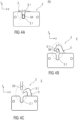
- the locking mechanism 3 can be brought into three positions, for example, one in Figure 4A shown primary locking position PV, one in Figure 4B shown pre-locking position V and one in Figure 4C shown unlocking position E.
- a locking bracket element SB arranged on the movable vehicle element FE can be or is locked relatively in or on the lock 2 by the locking element 3.1 and thus the lock 2 is locked.
- the unlocking device 1 comprises two identical locks 2.
- the number of locks 2 depends in particular on the size of the movable vehicle element FE to be locked. For a small movable vehicle element FE, only one lock 2 can be provided. For a larger movable vehicle element FE, several locks 2 can be provided.
- the unlocking device 1 comprises a detection unit 5, which has a detection area 5.1 in order to detect at least one object O approaching the detection area 5.1 or located or moving in the detection area 5.1, and a lighting unit 6 with an illumination area 6.1 for illuminating the detection area 5.1 of the detection unit 5, wherein the lighting unit 6 and/or the detection unit 5 are/is activated at least when the locking mechanism 3 is or is placed in the pre-locking position V.
- the unlocking device 1 further comprises an actuator 4, which is coupled to the locking mechanism 3 of the lock 2.
- the actuator 4 is, for example, a conventional actuator 4, which is used in unlocking and locking systems for vehicle doors, fuel caps, tailgates or vehicle front flaps.
- the actuator 4 is arranged, for example, in the area of the movable vehicle element FE or in another area of the vehicle F.
- the actuator 4 comprises, for example, an actuating unit (not shown in detail), such as a servomotor or actuating function, by means of which the actuator 4 can actuate the locking mechanism 3, in particular unlock it.
- the detection unit 5 is coupled to the actuator 4.
- the detection unit 5 is coupled to the actuator 4 in terms of signaling, for example by means of a signal transmission line, in particular a data bus connection, such as a CAN bus, or another suitable signal transmission cable 5.
- the lighting unit 6 comprises a number of light-emitting diodes (LEDs).
- LEDs light-emitting diodes
- the actuator 4 unlocks the locking mechanism 3 automatically.
- the actuator 4 is coupled to the locking mechanism 3 in such a way that when the actuator 4 is activated, the locking mechanism 3 is moved into a Figure 4C
- the unlocking position E shown can be set.
- the detection unit 5 comprises a number of capacitive sensors.
- the detection unit 5 comprises a number of electronic actuators.
- the detection unit 5 comprises proximity and/or touch sensors for touch detection, for example to detect an approaching or moving object O on a handle G, such as a front hood handle or bonnet handle, and to enable or disable a function, such as a locking or unlocking function.
- a handle G such as a front hood handle or bonnet handle
- a function such as a locking or unlocking function.
- the object O is an approaching hand and/or fingers of a user or a user of the vehicle F itself.
- the lighting unit 6 can be controlled in such a way that the lighting unit 6 can be activated, in particular automatically, when the user's access authorization is determined by the vehicle F.
- the lighting unit 6 is coupled to a control unit 10 arranged in the vehicle F.
- a position of the detection unit 5 is visible to the user. This allows the user or the object O to intuitively reach into or to the detection area 5.1.
- the illumination area 6.1 corresponds to the detection area 5.1.
- the lighting unit 6 can be controlled in such a way that the lighting unit 6 can be activated, in particular is switched on and lights up, when the locking element 3.1 is transferred from the primary locking position PV to the pre-locking position V.
- the lighting unit 6 is provided for illuminating a manual engagement or manual insertion position for completely unlocking the locking mechanism 3, ie transferring the locking mechanism 3 from the pre-locking position V to the unlocking position E.
- the lighting unit 6 can be activated to illuminate the detection area 5.1 of the detection unit 5.
- the locking mechanism 3 is moved from the primary locking position PV, in which the movable vehicle element FE is in a closed position P1 ( Figures 3A , 4A ) and is thus held securely, upon manual actuation of an actuating element B, in particular a lever in the vehicle interior, by a user by means of a Bowden cable 7 which is pulled as a result, for example, into the pre-locking position V ( Figures 3B , 4B ) brought.
- the unlocking device 1 and the lock 2 or the locks 2 are arranged in the area of a fixed vehicle element FFE.
- the term fixed vehicle element FFE is understood to mean, for example, a vehicle body and/or a storage and/or installation space located underneath the movable vehicle element FE.
- the at least one lock 2 locks the movable vehicle element FE to the fixed vehicle element FFE.
- the detection unit 5 is arranged such that the detection area 5.1 is directed upwards. For example, the object O is detected if the object O is located above the detection unit 5.
- a coordinate system comprising a longitudinal axis x, a transverse axis y and a vertical axis z with respect to the vehicle F.
- At least the detection unit 5 is arranged in a front region of the fixed vehicle element FFE, so that the detection unit 5 is easily accessible for the object O.
- the lighting unit 6 is arranged, for example, in the front area of the movable vehicle element FE.
- the illumination area 6.1 is directed downwards to illuminate the detection area 5.1. This means that the position of the detection unit 5 is visible to the user when stationary, from above. If the object O is in the detection area 5.1, the object O will continue to be illuminated from above by the lighting unit 6.
- the lighting unit 6 is arranged in the lower, fixed vehicle element FFE.
- the lighting unit 6 is arranged in the vicinity of the detection unit 5.
- the illumination area 6.1 is directed upwards to illuminate the detection area 5.1.
- the movable vehicle element FE can be locked to the fixed vehicle element FFE by means of two locks 2.
- the locks 2 are arranged in edge areas of the fixed vehicle element FFE.
- the locks 2 are conventional locking mechanisms.
- the locks 2 each comprise a locking mechanism 3.
- the locking mechanisms comprise a rotary latch with a locking element and a pawl.
- the locks 2 are coupled to one another for synchronous release of the unlocking.
- the locks 2 are coupled to one another by means of the Bowden cable 7 or by means of another force and/or signal transmission element.
- Several individual Bowden cables 7 can also be provided.
- One or both locks 2 is or are coupled to the actuator 4, in particular coupled in terms of movement.
- the lock 2 is coupled to the actuator 4 by means of a Bowden cable 7 or by means of another force and/or signal transmission element.
- the actuator 4 can actuate an associated Bowden cable 7 for each lock 2.
- the locks 2 can be triggered for complete unlocking in particular.
- the locks 2 are moved from the pre-locking position V to the unlocking position E and completely unlocked by actuating the Bowden cable 7 or the Bowden cables 7 by the actuator 4 ( Figures 3C , 4C ). This opens the locks 2.
- the actuator 4 is coupled to the detection unit 5 in terms of signals.
- the actuator 4 is coupled to the detection unit 5 by means of a signal transmission cable 8.
- a detection signal from the detection unit 5 controls the actuator 4 when an object O, such as a hand, is detected in the detection area 5.1.
- the detection unit 5 is arranged, for example, on a carrier element 9, in particular a cross member element.
- the carrier element 9 has, for example, a width that corresponds to a width of the fixed vehicle element FFE, in particular a lower part of the movable vehicle element FE. As a result, the detection unit 5 can be fixed in a simple and robust manner.
- the detection area 5.1 of the detection unit 5 is directed upwards.
- the detection unit 5 comprises a contact surface 5.2 for detecting a contact by the object O.
- the shape and size of the detection area 5.1 and/or the contact surface 5.2 is largely adapted to the shape of the object.
- the detection unit 5 has a pillow-like or approximately, at least hand-sized, rectangular or oval detection area 5.1 and/or contact surface 5.2.
- the lighting unit 6 is arranged on a lower surface side of the movable vehicle element FE. This means that the lighting unit 6 is arranged such that the illumination area 6.1 is directed in the direction of the fixed vehicle element FFE. For example, the lighting unit 6 is aligned centrally to the detection unit 5 in order to effectively illuminate the detection area 5.1. In a further development, the lighting unit 6 comprises several light-emitting diodes in order to correspond with a shape of the detection unit 5.
- Figure 2 shows schematically an actuation of the unlocking device 1 carried out by an object O.
- the object O is a hand of the user.
- the hand is located between the fixed vehicle element FFE and the movable vehicle element FE. Based on the illumination area 6.1 when the light unit 6 is activated, the user knows where the detection area 5.1 and/or the contact surface 5.2 are located.
- Figures 3A and 3B show schematically an opening sequence of the movable vehicle element FE.
- Figure 3A the movable vehicle element FE in a locked and closed position P1.
- Figure 3B shows the movable vehicle element FE in an intermediate position P1b, in particular a partially unlocked and partially opened, but still secured position. In this intermediate position P1b, the movable vehicle element FE is positioned at a distance from the fixed vehicle element FFE, for example, spring-supported and thus partially opened, but is still held secured by the locking mechanism 3 and cannot be opened.
- Figure 3C shows the movable vehicle element FE in a fully unlocked and opened position P2.
- the vehicle F comprises at least the at least one detection unit 5, which has a detection area 5.1 in order to detect at least one object O approaching the detection area 5.1 or located or moving in the detection area 5.1, and the at least one lighting unit 6 with an illumination area 6.1, which illuminates the detection area 5.1 of the detection unit 5, wherein the lighting unit 6 and/or the detection unit 5 are/is activated at least when the movable vehicle element FE is or is placed in the intermediate position P1b.
- the detection area 6.1 can be illuminated by means of the activated and illuminated light unit 6. Due to the slightly open position of the movable vehicle element FE, the detection area 5.1 is visible and can be recognized more easily due to the illumination than in the prior art.
- Figures 4A to 4C each schematically show a simplified embodiment of a lock 2 with a locking mechanism 3.
- Figure 4A shows the lock 2 with the locking mechanism 3 in a primary locking position PV
- Figure 4B shows the lock 2 with the locking mechanism 3 in a pre-locking position V
- Figure 4C shows the lock 2 with the locking mechanism 3 in an unlocking position E.
- the locking element 3.1 for example in the form of a latching and/or hook element, in particular a pawl and/or a safety hook, of the locking mechanism 3 is in a primary latching position in which the locking bracket element SB is fixed firmly, i.e. essentially immovably, to the lock 2 by the locking element 3.1.
- the lock 2 comprises a receptacle 2.1 which is designed to receive and fix the locking bracket element SB relative to the lock 2.
- the receptacle 2.1 is designed in the form of an elongated hole and/or a recess.
- the locking element 3.1 can be transferred or switched from the primary locking position to the pre-locking position V, in particular the secondary locking position.
- the locking element 3.1 and the striker element SB are in a partially released, unlocked and secured position.
- the movable vehicle element FE is partially raised in the pre-locking position V.
- the locking mechanism 3 comprises, for example, an elastic spring element (not shown in detail) for mechanically lifting the movable vehicle element FE depending on the position of the locking element 3.1.
- the elastic element slightly lifts the movable vehicle element FE when the locking element 3.1 is partially unlocked.
- the locking mechanism 3 is coupled, for example, to an actuating element arranged in the vehicle F and/or on the movable vehicle element FE.
- the locking element 3.1 is released from the primary locking position PV.
- the movable vehicle element FE in particular the bonnet, is transferred to a slightly open position, the intermediate position P1b, in particular raised with the aid of a spring.
- the light unit 6 When the locking element 3.1 is transferred from the primary locking position PV to the pre-locking position V, the light unit 6 can be activated or is activated.
- the light unit 6 is intended to illuminate a manual intervention or hand insertion position for further, complete unlocking of the locking mechanism 3, ie for transferring the locking mechanism 3 from the pre-locking position V to the unlocking position E. Due to the slightly raised movable vehicle element FE and the illuminated detection area 5.1, targeted hand insertion is simplified.
Landscapes
- Engineering & Computer Science (AREA)
- Mechanical Engineering (AREA)
- Lock And Its Accessories (AREA)
Description
- Die Erfindung betrifft eine Entriegelungsvorrichtung zum Entriegeln eines Schlosses eines beweglichen Fahrzeugelements, insbesondere einer Fahrzeugtür, einer Fahrzeugfronthaube und/oder Fahrzeugheckklappe. Weiterhin betrifft die Erfindung ein Fahrzeug mit einer solchen Entriegelungsvorrichtung.
- Ein Schloss der eingangs genannten Art wird beispielsweise in Kraftfahrzeugen zur Verriegelung von Rückenlehnen, Türen, Heckklappen, Kofferraumdeckeln oder dergleichen verwendet. Zum Entriegeln des Schlosses wird beispielsweise manuell ein aus einer Sperrklinke, einer Drehfalle und einem Schließelement gebildetes Gesperre in Bewegung versetzt, um die Sperrklinke von einer Sperrstellung in eine Entriegelungsstellung zu verstellen.
- Beispielsweise sind Entriegelungsvorrichtungen beziehungsweise Kraftfahrzeugschließsysteme für Fahrzeugklappen aus der
US 2018/029528 A1 und derDE 10 2016 103 425 A1 bekannt. - Der Erfindung liegt die Aufgabe zu Grunde, eine gegenüber dem Stand der Technik verbesserte Entriegelungsvorrichtung zum Entriegeln eines Schlosses eines beweglichen Fahrzeugelements, insbesondere einer Fahrzeugtür, Fahrzeugfronthaube und/oder Fahrzeugheckklappe, anzugeben, insbesondere einen Nutzer beim Auffinden des Betätigungsbereiches zum Öffnen des beweglichen Fahrzeugelements zu unterstützen. Weiterhin liegt der Erfindung die Aufgabe zu Grunde, ein verbessertes Fahrzeug anzugeben.
- Die Aufgabe wird erfindungsgemäß gelöst durch eine Entriegelungsvorrichtung mit den Merkmalen des Anspruchs 1. Hinsichtlich des Fahrzeugs wird die Aufgabe erfindungsgemäß mit den Merkmalen des Anspruchs 5 gelöst.
- Vorteilhafte Ausgestaltungen der Erfindung sind Gegenstand der abhängigen Patentansprüche.
- Eine Entriegelungsvorrichtung zum Entriegeln und/oder Öffnen eines Schlosses eines beweglichen Fahrzeugelements, insbesondere einer Fahrzeugtür, einer Fahrzeugfronthaube und/oder Fahrzeugheckklappe, umfasst zumindest einen Sperrmechanismus zum Verriegeln des Schlosses, wobei der Sperrmechanismus das Schloss in zumindest einer Primärverriegelungsstellung oder einer Vorraststellung hält, eine Erfassungseinheit, welche einen Erfassungsbereich aufweist, um mindestens ein sich dem Erfassungsbereich annäherndes oder sich im Erfassungsbereich befindendes oder bewegendes Objekt zu erfassen, und eine Leuchteinheit mit einem Ausleuchtbereich zur Ausleuchtung des Erfassungsbereichs der Erfassungseinheit, wobei die Leuchteinheit zumindest dann aktiviert wird oder ist, wenn der Sperrmechanismus in die Vorraststellung gestellt wird oder ist. Die Entriegelungsvorrichtung umfasst weiter ein Aktuator, der mit dem Sperrmechanismus des Schlosses zum vollständigen Entriegeln des Schlosses signaltechnisch gekoppelt und/oder bewegungsgekoppelt ist, wobei die Erfassungseinheit mit dem Aktuator signaltechnisch gekoppelt ist, wobei bei Erfassung eines Objekts im Erfassungsbereich der Aktuator den Sperrmechanismus automatisch vollständig entriegelt und das Schloss öffnet.
- Die mit der Erfindung erzielten Vorteile liegen insbesondere darin, dass eine automatische Entriegelung des Sperrmechanismus für den Nutzer ermöglicht ist. Beispielsweise ist das Objekt eine Hand des Nutzers oder der Nutzer selbst. Insbesondere ist eine schlüssellose Betätigung der Entriegelungsvorrichtung und ein Öffnen des beweglichen Fahrzeugelements ermöglicht. Die Erfassungseinheit erfasst beispielsweise eine Annäherung der Hand des Nutzers an den ausgeleuchteten Erfassungsbereich oder ein Bewegen der Hand in den ausgeleuchteten Erfassungsbereich hinein und steuert den Aktuator bei erfasster Hand, wobei der Aktuator automatisch den Sperrmechanismus vollständig entriegelt, so dass der Nutzer anschließend das bewegliche Fahrzeugelement vollständig öffnen, beispielsweise anheben oder schwenken, kann. Dies kann manuell durch den Nutzer erfolgen. Alternativ kann die Erfassungseinheit mit einem Verstellaktuator, insbesondere einem Stellmotor oder einer Federeinheit gekoppelt sein, wobei die Erfassungseinheit zunächst den Aktuator ansteuert, so dass dieser den Sperrmechanismus vollständig entriegelt und anschließend den Stellaktuator ansteuert, sodass das bewegliche Fahrzeugelement automatisch vollständig öffnet. Hierdurch ist beispielsweise ein Zeit- und Arbeitsaufwand verringert, wenn ein Suchen eines Schlüssels zum Entriegeln des Schlosses vermieden ist. Insbesondere ist ein intuitives Öffnen des beweglichen Fahrzeugelements ermöglicht. Des Weiteren ist ein Bauraum für die Entriegelungsvorrichtung im Wesentlichen verringert, beispielsweise durch Entfall eines Entriegelungsschlosses, umfassend eine Drehfalle und Sperrklinke, im Griffbereich des beweglichen Fahrzeugelements.
- Bei Erfassung eines sich dem Erfassungsbereich annähernden oder in dem Erfassungsbereich befindenden oder bewegenden Objekts, wie der Hand eines Nutzers, wird erfindungsgemäß der Sperrmechanismus automatisch vollständig entriegelt. Damit wird das Schloss geöffnet. Mit anderen Worten:
Durch Ausleuchtung des Erfassungsbereichs zwischen dem, infolge der Vorraststellung des Sperrmechanismus teilweise geöffneten beweglichen Fahrzeugelement und dem festen Fahrzeugelement erkennt der Nutzer in einfacher Art und Weise jenen Bereich, in welchen er seine Hand einführen kann, um den Sperrmechanismus durch seine in diesen Erfassungsbereich eingeführte und erfasste Hand automatisch vollständig entriegeln zu können. Anschließend kann der Nutzer nach automatischer vollständiger Entriegelung des beweglichen Fahrzeugelements das bewegliche Fahrzeugelement manuell öffnen, insbesondere anheben oder schwenken. - Zusätzlich kann die Leuchteinheit bei Erfassung eines sich annähernden Objekts, insbesondere einer zugangsberechtigten Person, an das bewegliche Fahrzeugelement aktiviert werden. Beispielsweise trägt der Nutzer einen Transponder zur Übermittlung einer Zugangsberechtigung an das Fahrzeug bei sich. Bei Erfassung der Zugangsberechtigung beleuchtet die Leuchteinheit beispielsweise einen bestimmten Weg zum beweglichen Fahrzeugelement hin. Hierfür können bzw. kann die Erfassungseinheit und/oder eine weitere Erfassungseinheit einen in eine Umgebung des beweglichen oder festen Fahrzeugelements gerichteten Erfassungsbereich umfassen. Wenn anschließend das Objekt innerhalb des ausgeleuchteten Erfassungsbereichs der Erfassungseinheit erfasst wird, wird der Sperrmechanismus betätigt.
- Insbesondere ist die Leuchteinheit zur Ausleuchtung einer Position der Erfassungseinheit vorgesehen. Dadurch ist angezeigt, wo das Objekt zum insbesondere vollständigen Entriegeln des Schlosses positioniert, beispielsweise eingeführt oder bewegt, werden muss.
- Gemäß einer weiteren Ausführungsform ist der Sperrmechanismus, insbesondere das Schloss, in zumindest drei Stellungen bringbar. Beispielsweise ist der Sperrmechanismus in zumindest eine Primärverriegelungsstellung, eine Vorraststellung und eine Entriegelungsstellung bringbar. In der Primärverriegelungsstellung befindet sich ein Verriegelungselement, beispielsweise in Form eines Rast- und/oder Hakenelements, insbesondere einer Sperrklinke und/oder eines Sicherheitshakens, des Sperrmechanismus in einer primären Raststellung, in welcher zumindest ein Schließbügelelement fest, d. h. im Wesentlichen unbeweglich mittels des Verriegelungselements fixiert ist. Beispielsweise ist das Schließbügelelement im Bereich des beweglichen Fahrzeugelements angeordnet und der Sperrmechanismus mit Verriegelungselement ist am fixierten Fahrzeugelement angeordnet oder umgekehrt. In dieser Primärverriegelungsstellung ist das bewegliche Fahrzeugelement am festen oder fixierten Fahrzeugelement befestigt und beispielsweise in einer geschlossenen Position gehalten.
- Das Verriegelungselement ist von der Primärverriegelungsstellung in die Vorraststellung, insbesondere Sekundärverriegelungsstellung, überführbar bzw. umschaltbar. In dieser Vorraststellung befinden sich das Verriegelungselement und das Schließbügelelement in einer entriegelten und teilweise gelösten, insbesondere noch gesicherten, Stellung. Beispielsweise ist das bewegliche Fahrzeugelement in der Vorraststellung des Sperrmechanismus relativ zum festen oder fixierten Fahrzeugelement teilweise angehoben und somit in eine Zwischenposition, insbesondere eine Ausleucht-, Freigabe- oder Zugriffsposition, gestellt. Hierfür umfasst der Sperrmechanismus beispielsweise ein elastisches Federelement zum mechanischen Anheben des beweglichen Fahrzeugelements relativ zum festen Fahrzeugelement. Das elastische Element hebt das bewegliche Fahrzeugelement bei der teilweisen Lösung des Verriegelungselements leicht an.
- Zur Überführung des Verriegelungselements aus der Primärverriegelungsstellung in die Sekundärverriegelungsstellung ist der Sperrmechanismus beispielsweise mit einem im Fahrzeug und/oder am beweglichen Fahrzeugelement angeordneten Betätigungselement gekoppelt.
- Eine Weiterbildung sieht vor, dass das Betätigungselement mit dem Sperrmechanismus signaltechnisch gekoppelt und/oder bewegungsgekoppelt ist, um den Sperrmechanismus und damit das Schloss in die Vorraststellung zu stellen und somit teilweise zu entriegeln. Hierzu ist das Betätigungselement beispielsweise mit einem Bowdenzug gekoppelt, welcher wiederum mit dem Sperrmechanismus, insbesondere dem Verriegelungselement, gekoppelt ist.
- Bei Betätigung des Betätigungselements, beispielsweise in Form eines Hebels und/oder eines Tasters im Fahrzeuginnenraum und/oder am beweglichen Fahrzeugelement, wird der Sperrmechanismus, insbesondere dessen Verriegelungselement, aus der Primärverriegelungsstellung gelöst und entriegelt. Dadurch wird das bewegliche Fahrzeugelement, insbesondere die Motorhaube, in eine leicht geöffnete Position überführt, insbesondere federgestützt, insbesondere mittels des Federelements, angehoben. Bei Überführung des Verriegelungselements aus der Primärverriegelungsstellung in die Vorraststellung ist oder wird die Leuchteinheit aktivierbar bzw. aktiviert. Die Leuchteinheit ist dabei zur Beleuchtung einer Handeingriffs- bzw. Handeinführungsposition zur vollständigen Entriegelung des Sperrmechanismus vorgesehen. Aufgrund des leicht angehobenen beweglichen Fahrzeugelements ist eine gezielte Handeinführung vereinfacht.
- Mit anderen Worten: Bei Betätigung des Sperrmechanismus zur Überführung des Verriegelungselements von der Primärverriegelungsstellung in die Vorraststellung ist oder wird die Leuchteinheit zur Ausleuchtung des Erfassungsbereichs der Erfassungseinheit aktivierbar bzw. aktiviert. Anschließend ist eine vollständige Entriegelung des Sperrmechanismus durch Handeinführung unterhalb des leicht geöffneten, beweglichen Fahrzeugelements, insbesondere der Motorhaube, und innerhalb des Erfassungsbereichs möglich. Wenn die Hand innerhalb des ausgeleuchteten Erfassungsbereichs der Erfassungseinheit erfasst wird, wird der Sperrmechanismus automatisch entriegelt. In der Entriegelungsstellung des Sperrmechanismus ist das bewegliche Fahrzeugelement, insbesondere die Motorhaube, dann vollständig, insbesondere manuell oder automatisch, anhebbar.
- In einer Weiterbildung umfasst die Erfassungseinheit zumindest einen elektronischen Sensor und/oder Aktuator, insbesondere kapazitiven Sensor. Zum Beispiel ist mittels des kapazitiven Sensors eine berührungslose Erfassung des sich annähernden und/oder sich in dem Erfassungsbereich befindenden oder bewegenden Objekts ermöglicht. Wenn sich eine Hand des Nutzers im Erfassungsbereich befindet, ist oder wird der Aktuator aktiviert und entriegelt den Sperrmechanismus.
- Alternativ oder zusätzlich umfasst die Erfassungseinheit einen elektronischen Aktuator, beispielsweise einen Berührungssensor, Kontaktsensor und/oder Berührungsschalter.
- Erfindungsgemäß ist der Aktuator mit dem Sperrmechanismus des Schlosses zum vollständigen Entriegeln des Schlosses signaltechnisch gekoppelt und/oder bewegungsgekoppelt. Ist das Schloss beispielsweise als ein elektronisches Schloss ausgebildet, so überträgt der Aktuator ein Steuerungssignal zum automatischen vollständigen Entriegeln des Schlosses. Ist das Schloss beispielsweise als ein mechanisches Schloss ausgebildet, so ist der Aktuator, zum Beispiel ein Stellmotor, mit einem Bowdenzug gekoppelt, welcher das Schloss, insbesondere das Verriegelungselement, entsprechend betätigt, insbesondere mittels Zugkraft entriegelt und damit öffnet.
- Erfindungsgemäß ist die Erfassungseinheit mit dem Aktuator signaltechnisch gekoppelt, wobei bei Erfassung eines Objekts, wie einer Hand, im Erfassungsbereich der Aktuator den Sperrmechanismus automatisch vollständig entriegelt und öffnet. Insbesondere sendet die Erfassungseinheit bei einem im Erfassungsbereich identifizierten Objekt automatisch ein Steuersignal an den Aktuator aus, welcher daraufhin das Verriegelungselement mechanisch mittels eines Bowdenzuges betätigt.
- Ein weitere Aspekt sieht vor, dass die Erfassungseinheit und die Leuchteinheit mit dem Aktuator derart signaltechnisch gekoppelt sind, dass, wenn der Aktuator den Sperrmechanismus in die Entriegelungsstellung stellt oder gestellt hat, zumindest die Leuchteinheit deaktiviert wird.
- Gemäß einer weiteren Ausgestaltung ist die Erfassungseinheit in einem Einführungs-, Greif- oder Griffbereich des beweglichen Fahrzeugelements angeordnet. Der Nutzer wird intuitiv mittels der Ausleuchtung des Erfassungsbereichs zum Einführungs-, Greif- oder Griffbereich geführt. Insbesondere kann das bewegliche Fahrzeugelement nach beispielsweise einer berührungslosen Entriegelung direkt vom Nutzer am Griffbereich geöffnet, beispielsweise angehoben oder geschwenkt, werden.
- In einer weiteren möglichen Ausgestaltung ist die Erfassungseinheit zur Erfassung einer Berührung des Griffbereichs durch das Objekt und/oder einer Berührung einer Kontaktfläche der Erfassungseinheit durch das Objekt ausgebildet. Beispielsweise ist an einer Unterseite des beweglichen Fahrzeugelements, d. h. beispielsweise an einer von einem Nutzer abgewandten Seite, ein Kontaktelement zur Erfassung der Berührung angeordnet. Bei Berührung wird der Aktuator aktiviert und entriegelt den Sperrmechanismus. Der Nutzer muss seine Hand nicht ablegen, wie beispielsweise beim Öffnen mit einem herkömmlichen Schlüssel, und kann nach Entriegelung direkt das Fahrzeugelement öffnen. Eine fließende Bewegung zum Entriegeln des Schlosses und zum Öffnen, d. h. beispielsweise Hochdrücken oder Aufziehen des beweglichen Fahrzeugelements, ist ermöglicht. Alternativ ist die Erfassungseinheit im Bereich eines fixierten Fahrzeugelements, beispielsweise an einem unteren Karosserieteil des Fahrzeugs, angeordnet. Dabei ist der Erfassungsbereich nach oben gerichtet. Weiterhin kann der Nutzer mit der Hand und/oder den Fingern die Kontaktfläche der Erfassungseinheit berühren, wodurch der Sperrmechanismus entriegelbar ist. Die Erfassungseinheit ist beispielsweise an einem Trägerelement, insbesondere einem Querträgerelement, angeordnet. Das Trägerelement weist beispielsweise eine Breite auf, die mit einer Breite des fixierten Fahrzeugelements korrespondiert. Dadurch ist die Erfassungseinheit in einfacher und robuster Weise fixierbar.
- Der Erfassungsbereich der Erfassungseinheit ist dabei nach oben gerichtet. Beispielsweise umfasst die Erfassungseinheit eine Kontaktfläche zur Erfassung einer Berührung durch das Objekt. Eine Form und Größe des Erfassungsbereichs und/oder der Kontaktfläche ist weitestgehend an Objektformen angepasst. Beispielsweise weist die Erfassungseinheit einen kissenähnlichen oder annähernd, mindestens handgroßen, rechteckigen oder ovalen Erfassungsbereich und/oder Kontaktfläche auf.
- Gemäß einer möglichen Ausführungsform umfasst die Leuchteinheit zumindest eine Leuchtdiode. Dadurch benötigt die Leuchteinheit einen kleinen Bauraum. Insbesondere ist eine Nutzungsdauer der Leuchteinheit mittels Verwendung einer Leuchtdiode erhöht. Des Weiteren ist eine Überhitzung des Ausleuchtbereichs vermieden.
- Eine weitere Ausführungsform sieht vor, dass der Aktuator über zumindest einen Bowdenzug mit dem Sperrmechanismus gekoppelt ist. Insbesondere ist diese Kopplung an unterschiedliche Bauräume anpassbar. Dabei ist eine Verlegung des Bowdenzugs weitestgehend einfach. Zudem ist eine schnelle, mechanische Betätigung des Sperrmechanismus bei Aktivierung des Aktuators ermöglicht. Beispielsweise umfasst der Aktuator eine Stelleinheit, die den Bowdenzug betätigt. Der Bowdenzug ist beispielsweise mit einem Sicherheitshaken und/oder einer Sperrklinke des Sperrmechanismus gekoppelt und löst diese aus einer Sperrstellung bei einer Betätigung des Bowdenzuges.
- Erfindungsgemäß sind der Aktuator und die Erfassungseinheit zumindest signaltechnisch miteinander gekoppelt. Zum Beispiel umfasst die Entriegelungsvorrichtung eine drahtlose und/oder drahtgebundene Kommunikation zwischen den einzelnen Bestandteilen. Beispielsweise ist der Aktuator mittels eines Kabels mit der Erfassungseinheit signaltechnisch gekoppelt. Alternativ ist der Aktuator mittels einer Funkverbindung mit der Erfassungseinheit gekoppelt. Bei Erfassung eines Objekts von der Erfassungseinheit, wird ein Signal, insbesondere Steuersignal, an den Aktuator übermittelt. Anschließend wird der Aktuator aktiviert und der Bowdenzug betätigt.
- Des Weiteren beschreibt die Erfindung ein Fahrzeug mit zumindest einem beweglichen Fahrzeugelement, welches an einem festen oder fixierten Fahrzeugelement zwischen einer geschlossenen Position, einer Zwischenposition und einer geöffneten Position beweglich angeordnet oder gelagert ist, und mit einer Entriegelungsvorrichtung gemäß Anspruch 5.
- In der geschlossenen Position des beweglichen Fahrzeugelements steht der Sperrmechanismus in der Primärverriegelungsstellung. In der Zwischenposition (auch Ausleucht-, Freigabe-, Entriegelungs- oder Greifposition genannt) des beweglichen Fahrzeugelements steht der Sperrmechanismus in der Vorraststellung. In der geöffneten Position (auch Offenposition genannt) des beweglichen Fahrzeugelements steht der Sperrmechanismus in der Entriegelungsstellung.
- Zusätzlich kann das Fahrzeug zumindest eine Betätigungseinheit, die mit dem Sperrmechanismus zum teilweisen Entriegeln des Schlosses gekoppelt ist, aufweisen. Erfindungsgemäß weist das Fahrzeug einen Aktuator, der mit dem Sperrmechanismus zum vollständigen Entriegeln und Öffnen des Schlosses gekoppelt ist, wobei die Erfassungseinheit und/oder die Leuchteinheit mit dem Aktuator derart zumindest signaltechnisch gekoppelt sind/ist, dass, wenn der Aktuator den Sperrmechanismus in eine Vorraststellung stellt oder gestellt hat, die Erfassungseinheit und/oder die Leuchteinheit aktiviert werden/wird bzw. sind/ist.
- Darüber hinaus kann die Leuchteinheit eingerichtet sein, den Erfassungsbereich auszuleuchten, wenn der Sperrmechanismus in seine Vorraststellung gestellt ist und das bewegliche Fahrzeugelement in die Zwischenposition, insbesondere in die Ausleucht- oder Freigabe- oder Greifposition, gestellt ist. Dabei ist der Erfassungsbereich zwischen dem festen oder fixierten Fahrzeugelement und dem beweglichen und teilweise geöffneten Fahrzeugelement ausgebildet. Dabei überlappen sich der Erfassungs- und Ausleuchtbereich. Im Wesentlichen stimmen der Erfassungs- und der Ausleuchtbereich in Form, Größe und Abmessungen überein.
- Bei Ausleuchtung des Erfassungsbereichs und Erfassung eines sich in dem ausgeleuchteten Erfassungsbereich befindenden oder bewegenden Objekts entriegelt der Aktuator dann den Sperrmechanismus automatisch und vollständig, so dass der Sperrmechanismus geöffnet wird und somit das Schloss geöffnet wird.
- Ausführungsbeispiele der Erfindung werden im Folgenden anhand von Zeichnungen näher erläutert.
- Darin zeigen:
- Figur 1
- schematisch eine perspektivische Darstellung eines Ausführungsbeispiels einer Entriegelungsvorrichtung zum Entriegeln eines Schlosses eines beweglichen Fahrzeugelements, insbesondere einer Fahrzeugfronthaube,
- Figur 2
- schematisch eine von einem Objekt ausgeführte Betätigung der Entriegelungsvorrichtung,
- Figuren 3A bis 3C
- schematisch einen Öffnungsablauf des beweglichen Fahrzeugelements, und
- Figuren 4A bis 4C
- schematisch Ausführungsbeispiele eines Sperrmechanismus des Schlosses in verschiedenen Positionen während des Öffnungsablaufs des beweglichen Fahrzeugelements.
- Einander entsprechende Teile sind in allen Figuren mit den gleichen Bezugszeichen versehen.
-
Figur 1 zeigt schematisch ein bewegliches Fahrzeugelement FE eines Fahrzeugs F. Im dargestellten Ausführungsbeispiel ist das bewegliche Fahrzeugelement FE insbesondere eine Fahrzeugfronthaube. - Das Fahrzeugelement FE umfasst eine Entriegelungsvorrichtung 1 zum Entriegeln zumindest eines Schlosses 2. Das Schloss 2 ist beispielsweise ein herkömmliches Gesperre, umfassend zumindest ein Sperrmechanismus 3 mit beispielsweise einem Verriegelungselement 3.1, beispielsweise einem Rast-und/oder Hakenelement, insbesondere eine Sperrklinke und/oder einen Sicherheitshaken. Der Sperrmechanismus 3 ist beispielsweise in drei Stellungen bringbar, eine in
Figur 4A gezeigte Primärverriegelungsstellung PV, eine inFigur 4B gezeigte Vorraststellung V und eine inFigur 4C gezeigte Entriegelungsstellung E. In der Primärverriegelungsstellung PV und der Vorraststellung V ist zum Beispiel ein am beweglichen Fahrzeugelement FE angeordnetes Schließbügelelement SB durch das Verriegelungselement 3.1 relativ im oder am Schloss 2 arretierbar oder arretiert und somit ist das Schloss 2 verriegelt. - Im Ausführungsbeispiel umfasst die Entriegelungsvorrichtung 1 zwei identische Schlösser 2. Die Anzahl der Schlösser 2 hängt insbesondere von der Größe des zu verriegelnden beweglichen Fahrzeugelements FE ab. Bei einem kleinen beweglichen Fahrzeugelement FE kann auch nur ein Schloss 2 vorgesehen sein. Bei einem größeren beweglichen Fahrzeugelement FE können mehrere Schlösser 2 vorgesehen sein.
- Des Weiteren umfasst die Entriegelungsvorrichtung 1 eine Erfassungseinheit 5, welche einen Erfassungsbereich 5.1 aufweist, um mindestens ein sich dem Erfassungsbereich 5.1 annäherndes oder sich im Erfassungsbereich 5.1 befindendes oder bewegendes Objekt O zu erfassen, und eine Leuchteinheit 6 mit einem Ausleuchtbereich 6.1 zur Ausleuchtung des Erfassungsbereichs 5.1 der Erfassungseinheit 5, wobei die Leuchteinheit 6 und/oder die Erfassungseinheit 5 zumindest dann aktiviert werden/wird oder sind/ist, wenn der Sperrmechanismus 3 in die Vorraststellung V gestellt wird oder ist.
- Die Entriegelungsvorrichtung 1 umfasst des Weiteren einen Aktuator 4, der mit dem Sperrmechanismus 3 des Schlosses 2 gekoppelt ist. Der Aktuator 4 ist beispielsweise ein herkömmlicher Aktuator 4, welcher in Entriegelungs- und Verriegelungssystemen von Fahrzeugtüren, Tankdeckeln, Heckklappen oder Fahrzeugfrontklappen Verwendung findet. Dabei ist der Aktuator 4 beispielsweise im Bereich des beweglichen Fahrzeugelements FE oder in einem anderen Bereich des Fahrzeugs F angeordnet. Der Aktuator 4 umfasst beispielsweise eine nicht näher dargestellte Stelleinheit, wie einen Stellmotor, oder Stellfunktion, mittels welcher der Aktuator 4 den Sperrmechanismus 3 betätigen, insbesondere entriegeln, kann. Bei Entriegelung des Sperrmechanismus 3 wird das Schließbügelelement SB freigelegt, wodurch das bewegliche Fahrzeugelement FE zur Öffnung freigegeben wird.
- Die Erfassungseinheit 5 ist mit dem Aktuator 4 gekoppelt. Insbesondere ist die Erfassungseinheit 5 signaltechnisch, zum Beispiel mittels einer Signalübertragungsleitung, insbesondere einer Datenbusverbindung, wie einem CAN-Bus, oder eines anderen geeigneten Signalübertragungskabels 5, mit dem Aktuator 4 gekoppelt.
- Beispielsweise umfasst die Leuchteinheit 6 eine Anzahl von Leuchtdioden (LED).
- Bei Erfassung eines sich in dem ausgeleuchteten Erfassungsbereich 5.1 befindenden oder bewegenden Objekts O entriegelt der Aktuator 4 den Sperrmechanismus 3 automatisch. Insbesondere ist der Aktuator 4 derart mit dem Sperrmechanismus 3 gekoppelt, dass bei Aktivierung des Aktuators 4 der Sperrmechanismus 3 in eine, in
Figur 4C gezeigte Entriegelungsstellung E stellbar ist. - Zum Beispiel umfasst die Erfassungseinheit 5 eine Anzahl von kapazitiven Sensoren. Alternativ oder zusätzlich umfasst die Erfassungseinheit 5 eine Anzahl von elektronischen Aktuatoren. Insbesondere umfasst die Erfassungseinheit 5 Annäherungs- und/oder Berührungssensoren zur Berührungserkennung, um beispielsweise an einem Griff G, wie Fronthaubengriff bzw. Motorhaubengriff, ein sich annäherndes oder bewegendes Objekt O zu erkennen und eine Funktion, wie eine Verriegelungs- oder Entriegelungsfunktion freizugeben oder zu sperren. Beispielsweise ist das Objekt O eine sich annähernde Hand und/oder Finger eines Nutzers oder ein Nutzer des Fahrzeugs F selbst.
- Zum Beispiel ist die Leuchteinheit 6 derart ansteuerbar, dass die Leuchteinheit 6 bei einem durch das Fahrzeug F ermittelte Zugangsberechtigung des Nutzers aktivierbar, insbesondere automatisch aktivierbar ist. Hierfür ist die Leuchteinheit 6 mit einer im Fahrzeug F angeordneten Steuereinheit 10 gekoppelt. Mittels des Ausleuchtbereichs 6.1 ist eine Position der Erfassungseinheit 5 für den Nutzer sichtbar. Dadurch kann der Nutzer bzw. das Objekt O intuitiv in den bzw. zum Erfassungsbereich 5.1 greifen. Insbesondere korrespondiert der Ausleuchtbereich 6.1 mit dem Erfassungsbereich 5.1.
- Gemäß einer weiteren Ausführungsform ist die Leuchteinheit 6 derart ansteuerbar, dass die Leuchteinheit 6 bei Überführung des Verriegelungselements 3.1 von der Primärverriegelungsstellung PV in die Vorraststellung V aktivierbar ist, insbesondere eingeschaltet wird und leuchtet. Die Leuchteinheit 6 ist zur Ausleuchtung einer Handeingriffs- bzw. Handeinführungsposition zur vollständigen Entriegelung des Sperrmechanismus 3, d. h. Überführung des Sperrmechanismus 3 von der Vorraststellung V in die Entriegelungsstellung E, vorgesehen.
- Mit anderen Worten: Bei Betätigung des Sperrmechanismus 3 zur Überführung des Verriegelungselements 3.1 von der Primärverriegelungsstellung PV in die Vorraststellung V ist die Leuchteinheit 6 zur Ausleuchtung des Erfassungsbereichs 5.1 der Erfassungseinheit 5 aktivierbar. Beispielsweise wird der Sperrmechanismus 3 aus der Primärverriegelungsstellung PV, in welcher das bewegliche Fahrzeugelement FE in einer geschlossenen Position P1 (
Figuren 3A ,4A ) verriegelt und damit gesichert gehalten ist, bei einer manuellen Betätigung eines Betätigungselements B, insbesondere eines Hebels im Fahrzeuginneren, durch einen Nutzer mittels eines beispielsweise daraus resultierend gezogenen Bowdenzugs 7 in die Vorraststellung V (Figuren 3B ,4B ) gebracht. - In einer Weiterbildung sind die Entriegelungsvorrichtung 1 und das Schloss 2 bzw. die Schlösser 2 im Bereich eines fixierten Fahrzeugelements FFE angeordnet. Unter fixiertes Fahrzeugelement FFE wird beispielsweise eine Fahrzeugkarosserie und/oder ein unterhalb des beweglichen Fahrzeugelements FE befindlichen Stau- und/oder Bauraums verstanden. Dabei arretiert das zumindest eine Schloss 2 das bewegliche Fahrzeugelement FE an dem fixierten Fahrzeugelement FFE.
- Die Erfassungseinheit 5 ist derart angeordnet, dass der Erfassungsbereich 5.1 nach oben gerichtet ist. Beispielsweise wird das Objekt O erkannt, wenn das Objekt O sich oberhalb der Erfassungseinheit 5 befindet.
- Zum verbesserten Verständnis der Beschreibung ist ein Koordinatensystem dargestellt, umfassend eine Längsachse x, eine Querachse y und eine Vertikalachse z in Bezug auf das Fahrzeug F.
- Insbesondere ist zumindest die Erfassungseinheit 5 in einem vorderen Bereich des fixierten Fahrzeugelements FFE angeordnet, so dass die Erfassungseinheit 5 für das Objekt O leicht zugänglich ist.
- Die Leuchteinheit 6 ist beispielsweise im vorderen Bereich des beweglichen Fahrzeugelements FE angeordnet. Dabei ist der Ausleuchtbereich 6.1 zur Ausleuchtung des Erfassungsbereichs 5.1 nach unten gerichtet. D. h., die Position der Erfassungseinheit 5 ist für den Nutzer im Stand, von oben sichtbar. Befindet sich das das Objekt O im Erfassungsbereich 5.1, wird das Objekt O von oben von der Leuchteinheit 6 weiterhin beleuchtet.
- Alternativ oder zusätzlich ist die Leuchteinheit 6 im unteren, fixierten Fahrzeugelement FFE angeordnet. Beispielsweise ist die Leuchteinheit 6 im Umfeld der Erfassungseinheit 5 angeordnet. Dabei ist der Ausleuchtbereich 6.1 zur Ausleuchtung des Erfassungsbereichs 5.1 nach oben gerichtet.
- Beispielsweise ist das bewegliche Fahrzeugelement FE mittels zwei Schlössern 2 an dem fixierten Fahrzeugelement FFE verriegelbar. Dabei sind die Schlösser 2 in Randbereichen des fixierten Fahrzeugelements FFE angeordnet.
- Im dargestellten Ausführungsbeispiel sind die Schlösser 2 herkömmliche Gesperre. Die Schlösser 2 umfassen jeweils einen Sperrmechanismus 3. Beispielsweise umfassen die Gesperre eine Drehfalle mit einem Schließelement und eine Sperrklinke.
- Die Schlösser 2 sind zur synchronen Auslösung der Entriegelung miteinander gekoppelt. Zum Beispiel sind die Schlösser 2 mittels des Bowdenzugs 7 oder mittels eines anderen Kraft- und/oder Signalübertragungselements miteinander gekoppelt. Auch können mehrere einzelne Bowdenzüge 7 vorgesehen sein.
- Eines der oder beide Schlösser 2 ist bzw. sind mit dem Aktuator 4 gekoppelt, insbesondere bewegungsgekoppelt. Insbesondere ist das Schloss 2 mittels eines Bowdenzugs 7 oder mittels eines anderen Kraft- und/oder Signalübertragungselements mit dem Aktuator 4 gekoppelt. Alternativ kann der Aktuator 4 je Schloss 2 einen zugehörigen Bowdenzug 7 betätigen. Durch Ansteuerung des Aktuators 4 und einer daraus resultierenden Betätigung des oder der Bowdenzüge 7 sind die Schlösser 2 zur insbesondere vollständigen Entriegelung auslösbar. Insbesondere werden die Schlösser 2 mittels Betätigung des Bowdenzugs 7 oder der Bowdenzüge 7 durch den Aktuator 4 von der Vorraststellung V in die Entriegelungsstellung E gestellt und vollständig entriegelt (
Figuren 3C ,4C ). Damit sind die Schlösser 2 geöffnet. - Der Aktuator 4 ist signaltechnisch mit der Erfassungseinheit 5 gekoppelt. Beispielsweise ist der Aktuator 4 mittels eines Signalübertragungskabels 8 mit der Erfassungseinheit 5 gekoppelt. Ein Erfassungssignal der Erfassungseinheit 5 steuert den Aktuator 4 an, wenn ein Objekt O, wie eine Hand, im Erfassungsbereich 5.1 erfasst wird.
- Die Erfassungseinheit 5 ist beispielsweise an einem Trägerelement 9, insbesondere einem Querträgerelement, angeordnet. Das Trägerelement 9 weist beispielsweise eine Breite auf, die mit einer Breite des fixierten Fahrzeugelements FFE, insbesondere eines Unterteils des beweglichen Fahrzeugelements FE, korrespondiert. Dadurch ist die Erfassungseinheit 5 in einfacher und robuster Weise fixierbar.
- Der Erfassungsbereich 5.1 der Erfassungseinheit 5 ist nach oben gerichtet. Beispielsweise umfasst die Erfassungseinheit 5 eine Kontaktfläche 5.2 zur Erfassung einer Berührung durch das Objekt O. Eine Form und Größe des Erfassungsbereichs 5.1 und/oder der Kontaktfläche 5.2 ist weitestgehend an Objektformen angepasst. Beispielsweise weist die Erfassungseinheit 5 einen kissenähnlichen oder annähernd, mindestens handgroßen, rechteckigen oder ovalen Erfassungsbereich 5.1 und/oder Kontaktfläche 5.2 auf.
- Beispielsweise ist die Leuchteinheit 6 an einer unteren Flächenseite des beweglichen Fahrzeugelements FE angeordnet. D. h., die Leuchteinheit 6 ist derart angeordnet, dass der Ausleuchtbereich 6.1 in Richtung des fixierten Fahrzeugelements FFE gerichtet ist. Beispielsweise ist die Leuchteinheit 6 mittig zur Erfassungseinheit 5 ausgerichtet, um den Erfassungsbereich 5.1 effektiv auszuleuchten. In einer Weiterbildung umfasst die Leuchteinheit 6 mehrere Leuchtdioden, um mit einer Form der Erfassungseinheit 5 zu korrespondieren.
-
Figur 2 zeigt schematisch eine von einem Objekt O ausgeführte Betätigung der Entriegelungsvorrichtung 1. Das Objekt O ist im dargestellten Ausführungsbeispiel eine Hand des Nutzers. Die Hand befindet sich zwischen dem fixierten Fahrzeugelement FFE und dem beweglichen Fahrzeugelement FE. Anhand des Ausleuchtbereichs 6.1 bei aktivierter Leuchteinheit 6 weiß der Nutzer, wo der Erfassungsbereich 5.1 und/oder die Kontaktfläche 5.2 angeordnet sind/ist. -
Figuren 3A und 3B zeigen schematisch einen Öffnungsablauf des beweglichen Fahrzeugelements FE. - Insbesondere zeigt
Figur 3A das bewegliche Fahrzeugelement FE in einer verriegelten und geschlossenen Position P1.Figur 3B zeigt das bewegliche Fahrzeugelement FE in einer Zwischenposition P1b, insbesondere einer teilweise entriegelten und bereichsweise geöffneten, aber noch gesicherten Position. Dabei ist das bewegliche Fahrzeugelement FE in dieser Zwischenposition P1b in einem Abstand zu dem fixierten Fahrzeugelement FFE zum Beispiel federgestützt gestellt und somit teilweise geöffnet, aber immer noch durch den Sperrmechanismus 3 gesichert gehalten und kann nicht geöffnet werden.Figur 3C zeigt das bewegliche Fahrzeugelement FE in einer vollständig entriegelten und geöffneten Position P2. - Das Fahrzeug F umfasst in einer ersten Ausführungsform zumindest die zumindest eine Erfassungseinheit 5, welche einen Erfassungsbereich 5.1 aufweist, um mindestens ein sich dem Erfassungsbereich 5.1 annäherndes oder sich im Erfassungsbereich 5.1 befindliches oder bewegendes Objekt O zu erfassen, und die zumindest eine Leuchteinheit 6 mit einem Ausleuchtbereich 6.1, welcher den Erfassungsbereich 5.1 der Erfassungseinheit 5 ausleuchtet, wobei die Leuchteinheit 6 und/oder die Erfassungseinheit 5 zumindest dann aktiviert werden/wird oder sind/ist, wenn das bewegliche Fahrzeugelement FE in die Zwischenposition P1b gestellt wird oder ist.
- Durch zumindest Aktivierung der Leuchteinheit 6, dann, wenn das bewegliche Fahrzeugelement FE in die Zwischenposition P1b nach
Figur 3A gestellt ist, ist der Erfassungsbereich 6.1 mittels der aktivierten und leuchtenden Leuchteinheit 6 ausleuchtbar. Aufgrund der leicht geöffneten Position des beweglichen Fahrzeugelements FE ist somit der Erfassungsbereich 5.1 einsehbar und durch die Ausleuchtung besser erkennbar als im Stand der Technik. -
Figuren 4A bis 4C zeigen jeweils schematisch ein vereinfachtes Ausführungsbeispiel eines Schlosses 2 mit einem Sperrmechanismus 3. Insbesondere zeigt Figur 4A das Schloss 2 mit dem Sperrmechanismus 3 in einer Primärverriegelungsstellung PV,Figur 4B zeigt das Schloss 2 mit dem Sperrmechanismus 3 in einer Vorraststellung V undFigur 4C zeigt das Schloss 2 mit dem Sperrmechanismus 3 in einer Entriegelungsstellung E. - In der in
Figur 4A gezeigten Primärverriegelungsstellung PV befindet sich das Verriegelungselement 3.1, beispielsweise in Form eines Rast- und/oder Hakenelements, insbesondere einer Sperrklinke und/oder eines Sicherheitshakens, des Sperrmechanismus 3 in einer primären Raststellung, in welcher das Schließbügelelement SB fest, d. h. im Wesentlichen unbeweglich durch das Verriegelungselement 3.1 am Schloss 2 fixiert ist. Beispielsweise umfasst das Schloss 2 eine Aufnahme 2.1, welche zur Aufnahme und Fixierung des Schließbügelelements SB relativ zum Schloss 2 ausgebildet ist. Zum Beispiel ist die Aufnahme 2.1 in Form eines Langlochs und/oder einer Aussparung ausgebildet. - Das Verriegelungselement 3.1 ist von der Primärverriegelungsstellung in die Vorraststellung V, insbesondere Sekundärverriegelungsstellung, überführbar bzw. umschaltbar. In der in
Figur 4B gezeigten Vorraststellung V befinden sich das Verriegelungselement 3.1 und das Schließbügelelement SB in einer teilweisen gelösten, entriegelten und gesicherten Stellung. Beispielsweise ist das bewegliche Fahrzeugelement FE in der Vorraststellung V teilweise angehoben. - Hierfür umfasst der Sperrmechanismus 3 beispielsweise ein nicht näher gezeigtes, elastisches Federelement zum mechanischen Anheben des beweglichen Fahrzeugelements FE in Abhängigkeit der Stellung des Verriegelungselements 3.1. Das elastische Element hebt das bewegliche Fahrzeugelement FE bei der teilweisen Entriegelung des Verriegelungselements 3.1 leicht an. Zur Überführung des Verriegelungselements 3.1 aus der Primärverriegelungsstellung PV in die Vorraststellung V ist der Sperrmechanismus 3 beispielsweise mit einem im Fahrzeug F und/oder am beweglichen Fahrzeugelement FE angeordneten Betätigungselement gekoppelt.
- Bei Betätigung des Betätigungselements B, beispielsweise in Form eines Hebels und/oder eines Tasters im Fahrzeuginnenraum und/oder am beweglichen Fahrzeugelement FE, wird das Verriegelungselement 3.1 aus der Primärverriegelungsstellung PV gelöst. Dadurch wird das bewegliche Fahrzeugelement FE, insbesondere die Motorhaube, in eine leicht geöffnete Stellung, die Zwischenposition P1b, überführt, insbesondere federgestützt angehoben.
- Bei Überführung des Verriegelungselements 3.1 aus der Primärverriegelungsstellung PV in die Vorraststellung V ist die Leuchteinheit 6 aktivierbar oder wird aktiviert. Die Leuchteinheit 6 ist zur Beleuchtung einer Handeingriffs- bzw. Handeinführungsposition zur weiteren, vollständigen Entriegelung des Sperrmechanismus 3, d. h. zur Überführung des Sperrmechanismus 3 von der Vorraststellung V in die Entriegelungsstellung E vorgesehen. Aufgrund des leicht angehobenen beweglichen Fahrzeugelements FE und des beleuchteten Erfassungsbereichs 5.1 ist eine gezielte Handeinführung vereinfacht.
-
- 1
- Entriegelungsvorrichtung
- 2
- Schloss
- 2.1
- Aufnahme
- 3
- Sperrmechanismus
- 3.1
- Verriegelungselement
- 4
- Aktuator
- 5
- Erfassungseinheit
- 5.1
- Erfassungsbereich
- 5.2
- Kontaktfläche
- 6
- Leuchteinheit
- 6.1
- Ausleuchtbereich
- 7
- Bowdenzug
- 8
- Signalübertragungskabel
- 9
- Trägerelement
- 10
- Steuereinheit
- B
- Betätigungselement
- E
- Entriegelungsstellung
- F
- Fahrzeug
- FE
- bewegliches Fahrzeugelement
- FFE
- fixiertes Fahrzeugelement
- G
- Griff
- O
- Objekt
- P1, P2
- Position
- P1b
- Zwischenposition
- PV
- Primärverriegelungsstellung
- SB
- Schließbügelelement
- V
- Vorraststellung
- x
- Längsachse
- y
- Querachse
- z
- Vertikalachse
Claims (12)
- Entriegelungsvorrichtung (1) zum Entriegeln und Öffnen eines Schlosses (2) eines beweglichen Fahrzeugelements (FE), insbesondere einer Fahrzeugtür, einer Fahrzeugfronthaube und/oder Fahrzeugheckklappe, wobei die Entriegelungsvorrichtung (1) zumindest umfasst:- einen Sperrmechanismus (3) zum Verriegeln des Schlosses (2), wobei der Sperrmechanismus (3) das Schloss (2) in zumindest einer Primärverriegelungsstellung (PV) oder einer teilweise entriegelten Vorraststellung (V) hält,- eine Erfassungseinheit (5), welche einen Erfassungsbereich (5.1) aufweist, um mindestens ein sich dem Erfassungsbereich (5.1) annäherndes oder sich im Erfassungsbereich (5.1) befindendes oder bewegendes Objekt (O) zu erfassen, und- eine Leuchteinheit (6) mit einem Ausleuchtbereich (6.1) zur Ausleuchtung des Erfassungsbereichs (5.1) der Erfassungseinheit (5),wobei die Leuchteinheit (6) und/oder die Erfassungseinheit (5) zumindest dann aktiviert werden/wird oder sind/ist, wenn der Sperrmechanismus (3) von der Primärverriegelungsstellung (PV) indie Vorraststellung (V) gestellt wird oder ist,wobei ein Aktuator (4) vorgesehen ist, der mit dem Sperrmechanismus (3) des Schlosses (2) zum vollständigen Entriegeln des Schlosses (2) signaltechnisch gekoppelt und/oder bewegungsgekoppelt ist,wobei die Erfassungseinheit (5) mit dem Aktuator (4) signaltechnisch gekoppelt ist, wobei bei Erfassung eines Objekts (O) im Erfassungsbereich (5.1) der Aktuator (4) den Sperrmechanismus (3) automatisch vollständig entriegelt und das Schloss (2) öffnet.
- Entriegelungsvorrichtung (1) nach Anspruch 1, wobei die Erfassungseinheit (5) zumindest einen elektronischen Sensor, insbesondere einen kapazitiven Sensor, umfasst.
- Entriegelungsvorrichtung (1) nach einem der vorhergehenden Ansprüche, wobei ein Betätigungselement (B) vorgesehen ist, das mit dem Sperrmechanismus (3) zum teilweisen Entriegeln des Schlosses (2) signaltechnisch gekoppelt und/oder bewegungsgekoppelt ist, um das Schloss (2) in die Vorraststellung (V) zu stellen.
- Entriegelungsvorrichtung (1) nach einem der vorhergehenden Ansprüche, wobei die Erfassungseinheit (5) und die Leuchteinheit (6) mit dem Aktuator (4) derart signaltechnisch gekoppelt sind, dass, wenn der Aktuator (4) den Sperrmechanismus (3) in die Entriegelungsstellung (E) stellt oder gestellt hat, zumindest die Leuchteinheit (6) deaktiviert wird.
- Fahrzeug (F) mit einem beweglichen Fahrzeugelement (FE), welches an einem festen oder fixierten Fahrzeugelement (FFE) zwischen einer geschlossenen Position (P1), einer teilweise entriegelten und bereichsweise geöffneten Zwischenposition (P1b) und einer geöffneten Position (P2) beweglich gelagert ist, und mit einer Entriegelungsvorrichtung (1) nach einem der vorhergehenden Ansprüche.
- Fahrzeug (F) nach Anspruch 5, wobei das Fahrzeug (F) zusätzlich zumindest:- ein Betätigungselement (B), das mit dem Sperrmechanismus (3) zum teilweisen Entriegeln des Schlosses (2) gekoppelt ist umfasst,wobei die Erfassungseinheit (5) und die Leuchteinheit (6) mit dem Aktuator (4) derart zumindest signaltechnisch gekoppelt sind, dass, wenn der Aktuator (4) den Sperrmechanismus (3) in eine Vorraststellung (V) stellt oder gestellt hat, die Erfassungseinheit (5) und/oder die Leuchteinheit (6) aktiviert werden bzw. sind.
- Fahrzeug (F) nach Anspruch 6, wobei die Leuchteinheit (6) eingerichtet ist, den Erfassungsbereich (5.1) auszuleuchten, wenn der Sperrmechanismus (3) in eine Vorraststellung (V) gestellt ist und das bewegliche Fahrzeugelement (FE) in die Zwischenposition (P1b) gestellt ist.
- Fahrzeug (F) nach einem der vorhergehenden Ansprüche 5 bis 7,wobei der Erfassungsbereich (5.1) zwischen dem festen oder fixierten Fahrzeugelement (FFE) und dem beweglichen und teilweise geöffneten Fahrzeugelement (FE) ausgebildet ist,wobei bei Ausleuchtung des Erfassungsbereichs (5.1) und Erfassung eines sich in dem ausgeleuchteten Erfassungsbereich (5.1) befindenden oder bewegenden Objekts (O) der Aktuator (4) den Sperrmechanismus (3) vollständig entriegelt und das Schloss (2) öffnet.
- Fahrzeug (F) nach einem der vorhergehenden Ansprüche 5 bis 8, wobei die Erfassungseinheit (5) zumindest einen elektronischen Sensor, insbesondere einen kapazitiven Sensor, umfasst.
- Fahrzeug (F) nach einem der vorhergehenden Ansprüche 5 bis 9, wobei die Erfassungseinheit (5) in einem Griffbereich des beweglichen Fahrzeugelements (FE) und/oder an dem festen oder fixierten Fahrzeugelement (FFE) angeordnet ist.
- Fahrzeug (F) nach einem der vorhergehenden Ansprüche 5 bis 10, wobei die Erfassungseinheit (5) zur Erfassung einer Berührung des Griffbereichs und/oder einer Kontaktfläche (5.2) der Erfassungseinheit (5) durch das Objekt (O) ausgebildet ist.
- Fahrzeug (F) nach einem der vorhergehenden Ansprüche 5 bis 11, wobei der Aktuator (4) über zumindest einen Bowdenzug (7) mit dem Sperrmechanismus (3) gekoppelt ist.
Applications Claiming Priority (2)
| Application Number | Priority Date | Filing Date | Title |
|---|---|---|---|
| DE102018209867.0A DE102018209867A1 (de) | 2018-06-19 | 2018-06-19 | Entriegelungsvorrichtung zum Entriegeln eines Schlosses eines beweglichen Fahrzeugelements |
| PCT/EP2019/066011 WO2019243330A1 (de) | 2018-06-19 | 2019-06-18 | Entriegelungsvorrichtung zum entriegeln eines schlosses eines beweglichen fahrzeugelements und fahrzeug |
Publications (2)
| Publication Number | Publication Date |
|---|---|
| EP3810873A1 EP3810873A1 (de) | 2021-04-28 |
| EP3810873B1 true EP3810873B1 (de) | 2024-05-29 |
Family
ID=67001773
Family Applications (1)
| Application Number | Title | Priority Date | Filing Date |
|---|---|---|---|
| EP19732586.3A Active EP3810873B1 (de) | 2018-06-19 | 2019-06-18 | Entriegelungsvorrichtung zum entriegeln eines schlosses eines beweglichen fahrzeugelements und fahrzeug |
Country Status (5)
| Country | Link |
|---|---|
| US (1) | US12104414B2 (de) |
| EP (1) | EP3810873B1 (de) |
| CN (1) | CN112313386B (de) |
| DE (1) | DE102018209867A1 (de) |
| WO (1) | WO2019243330A1 (de) |
Families Citing this family (3)
| Publication number | Priority date | Publication date | Assignee | Title |
|---|---|---|---|---|
| DE102019125599A1 (de) * | 2019-09-24 | 2021-03-25 | Witte Automotive Gmbh | Vorrichtung zur Öffnungsfreigabe eines beweglichen Fahrzeugelements |
| WO2023061470A1 (zh) * | 2021-10-15 | 2023-04-20 | 九号智能(常州)科技有限公司 | 电动车的鞍座以及电动车 |
| CN115162865B (zh) * | 2022-05-31 | 2023-10-20 | 浙江吉利控股集团有限公司 | 一种车门控制方法、装置、设备及存储介质 |
Citations (1)
| Publication number | Priority date | Publication date | Assignee | Title |
|---|---|---|---|---|
| US6349984B1 (en) * | 1999-04-05 | 2002-02-26 | Diane Marrazzo | Illuminated activator for an internal vehicle trunk release mechanism |
Family Cites Families (20)
| Publication number | Priority date | Publication date | Assignee | Title |
|---|---|---|---|---|
| US5182502A (en) * | 1991-05-06 | 1993-01-26 | Lectron Products, Inc. | Automatic headlamp dimmer |
| CN1214170C (zh) * | 1997-12-12 | 2005-08-10 | 约翰·菲利普·薛瓦利埃 | 汽车门或闭合件的闩锁装置 |
| US6390529B1 (en) * | 1999-03-24 | 2002-05-21 | Donnelly Corporation | Safety release for a trunk of a vehicle |
| US6209933B1 (en) * | 1999-04-19 | 2001-04-03 | Daimlerchrysler Corporation | Trunk release handle |
| DE19927179B4 (de) * | 1999-06-15 | 2005-01-20 | Daimlerchrysler Ag | Vorrichtung zum Öffnen eines Gepäckraums eines Kraftfahrzeugs |
| DE10121046A1 (de) * | 2001-04-28 | 2002-11-07 | Huf Huelsbeck & Fuerst Gmbh | Außenbetätigung für Fahrzeugschlösser von Türen, Klappen oder dgl. |
| KR20070059597A (ko) * | 2005-12-07 | 2007-06-12 | 현대자동차주식회사 | 후드 고정 장치 |
| DE102007050094A1 (de) * | 2007-10-19 | 2009-04-23 | Witte-Velbert Gmbh & Co. Kg | Schließvorrichtung für ein Kraftfahrzeugschloss mit Vorfeld-Griffmuldenbeleuchtung |
| JP5324816B2 (ja) * | 2008-05-08 | 2013-10-23 | アイシン精機株式会社 | 車両用ドアハンドル |
| KR100984959B1 (ko) * | 2008-08-27 | 2010-10-04 | 쌍용자동차 주식회사 | 후드래치에 솔레노이드를 구비한 자동차의 잠금해제장치. |
| DE102015101164A1 (de) * | 2014-01-27 | 2015-07-30 | Huf Hülsbeck & Fürst Gmbh & Co. Kg | Türgriff mit Beleuchtung |
| US9499127B2 (en) | 2014-06-16 | 2016-11-22 | Magna Closures Inc. | Swipe and tap verification for entry system |
| KR102142659B1 (ko) * | 2014-09-05 | 2020-08-07 | 현대자동차주식회사 | 엠블럼을 이용한 후드 오픈 장치 |
| US9777516B2 (en) * | 2015-08-24 | 2017-10-03 | Ford Global Technologies, Llc | Gesture-activated hood release system |
| US20170138098A1 (en) * | 2015-11-13 | 2017-05-18 | Ford Global Technologies, Llc | Hood release system for a motor vehicle that automatically raises the hood |
| DE102016103425A1 (de) | 2016-02-26 | 2017-08-31 | Kiekert Ag | Kraftfahrzeugschloss |
| US10113340B2 (en) * | 2016-07-27 | 2018-10-30 | GM Global Technology Operations LLC | Tell-tale indicator for locating a secondary hood latch release |
| DE102016011749A1 (de) | 2016-09-29 | 2018-03-29 | GM Global Technology Operations LLC (n. d. Ges. d. Staates Delaware) | Betätigungseinrichtung zum Entsichern einer Motorhaube eines Kraftfahrzeugs |
| DE102017108266A1 (de) * | 2017-04-19 | 2018-10-25 | Kiekert Ag | Schloss für ein kraftfahrzeug |
| IT201800001207A1 (it) * | 2018-01-17 | 2019-07-17 | Cebi Italy Spa | Serratura per cofano di veicolo. |
-
2018
- 2018-06-19 DE DE102018209867.0A patent/DE102018209867A1/de active Pending
-
2019
- 2019-06-18 US US17/253,177 patent/US12104414B2/en active Active
- 2019-06-18 EP EP19732586.3A patent/EP3810873B1/de active Active
- 2019-06-18 WO PCT/EP2019/066011 patent/WO2019243330A1/de not_active Ceased
- 2019-06-18 CN CN201980039599.0A patent/CN112313386B/zh active Active
Patent Citations (1)
| Publication number | Priority date | Publication date | Assignee | Title |
|---|---|---|---|---|
| US6349984B1 (en) * | 1999-04-05 | 2002-02-26 | Diane Marrazzo | Illuminated activator for an internal vehicle trunk release mechanism |
Also Published As
| Publication number | Publication date |
|---|---|
| EP3810873A1 (de) | 2021-04-28 |
| CN112313386A (zh) | 2021-02-02 |
| US12104414B2 (en) | 2024-10-01 |
| WO2019243330A1 (de) | 2019-12-26 |
| DE102018209867A1 (de) | 2019-12-19 |
| CN112313386B (zh) | 2023-10-31 |
| US20210270064A1 (en) | 2021-09-02 |
Similar Documents
| Publication | Publication Date | Title |
|---|---|---|
| EP1512814B1 (de) | Kraftfahrzeug-Türschliesssystem und Türgriff | |
| EP3194696B1 (de) | Flächenbündiger komfortgriff | |
| DE60222261T2 (de) | Verschlusssteuerungseinrichtung mit einer Verriegelungsvorrichtung | |
| EP3482024B1 (de) | Griffvorrichtung mit einem flächenbündigen griff | |
| EP3942138B1 (de) | Aufstellvorrichtung für ein kraftfahrzeugtürelement | |
| DE102018117477A1 (de) | Beleuchteter virtueller handgriff für ein kraft-türsystem in kraftfahrzeugen | |
| EP4276263B1 (de) | Fahrzeugtürgriff | |
| EP3303741B1 (de) | Kraftfahrzeugtürverschluss | |
| EP3810873B1 (de) | Entriegelungsvorrichtung zum entriegeln eines schlosses eines beweglichen fahrzeugelements und fahrzeug | |
| DE102018106657A1 (de) | Türgriffmodul | |
| EP3303742B1 (de) | Verfahren zur steuerung eines kraftfahrzeugtürverschlusses | |
| WO2017101900A1 (de) | Schloss für ein kraftfahrzeug | |
| DE102005040775A1 (de) | Kraftfahrzeug und Türschloss für eine Tür eines Kraftfahrzeugs | |
| DE102010002987A1 (de) | Fahrzeuggriff-Verriegelungsgerät | |
| DE102015011468A1 (de) | Schließvorrichtung für eine Fahrzeugtür und ein Fahrzeug | |
| DE102019135038A1 (de) | Ausstellbares griffsystem mit ferngesteuertem stellglied querverweis auf verwandte anwendung | |
| EP3513019B1 (de) | Kraftfahrzeugtürschloss | |
| DE202017105516U1 (de) | Entfernte sekundäre Motorhaubenverriegelungsfreigabe | |
| EP1854945A2 (de) | Schliesssystem für eine Kraftfahrzeugtür mit mehreren Schliesselementen und gemeinsamer Steuereinheit | |
| DE102019112398A1 (de) | Aufstellvorrichtung für ein Kraftfahrzeugtürelement | |
| DE10300572A1 (de) | Türgriff und Schließsystem für eine Fahrzeugtür | |
| WO2024083668A1 (de) | Fahrzeugtür für einen kraftwagen, insbesondere für einen personenkraftwagen, sowie kraftwagen | |
| DE102017108754A1 (de) | Kraftfahrzeugschloss | |
| EP1216334B1 (de) | Elektromotorisch betätigbares schliesssystem sowie verfahren zu dessen ansteuerung | |
| DE102019121620A1 (de) | Verschlusspaneel für kraftfahrzeuge mit einklemm-schutzschild und einklemm-schutzschild für verschlusspaneele |
Legal Events
| Date | Code | Title | Description |
|---|---|---|---|
| STAA | Information on the status of an ep patent application or granted ep patent |
Free format text: STATUS: UNKNOWN |
|
| STAA | Information on the status of an ep patent application or granted ep patent |
Free format text: STATUS: THE INTERNATIONAL PUBLICATION HAS BEEN MADE |
|
| PUAI | Public reference made under article 153(3) epc to a published international application that has entered the european phase |
Free format text: ORIGINAL CODE: 0009012 |
|
| STAA | Information on the status of an ep patent application or granted ep patent |
Free format text: STATUS: REQUEST FOR EXAMINATION WAS MADE |
|
| 17P | Request for examination filed |
Effective date: 20201029 |
|
| AK | Designated contracting states |
Kind code of ref document: A1 Designated state(s): AL AT BE BG CH CY CZ DE DK EE ES FI FR GB GR HR HU IE IS IT LI LT LU LV MC MK MT NL NO PL PT RO RS SE SI SK SM TR |
|
| AX | Request for extension of the european patent |
Extension state: BA ME |
|
| DAV | Request for validation of the european patent (deleted) | ||
| DAX | Request for extension of the european patent (deleted) | ||
| STAA | Information on the status of an ep patent application or granted ep patent |
Free format text: STATUS: EXAMINATION IS IN PROGRESS |
|
| 17Q | First examination report despatched |
Effective date: 20230320 |
|
| REG | Reference to a national code |
Ref legal event code: R079 Ipc: E05B0081760000 Ref country code: DE Ref document number: 502019011368 Country of ref document: DE Free format text: PREVIOUS MAIN CLASS: E05B0081200000 |
|
| RIC1 | Information provided on ipc code assigned before grant |
Ipc: E05B 83/24 20140101ALI20231114BHEP Ipc: B60Q 1/26 20060101ALI20231114BHEP Ipc: E05B 81/20 20140101ALI20231114BHEP Ipc: E05B 81/76 20140101AFI20231114BHEP |
|
| GRAP | Despatch of communication of intention to grant a patent |
Free format text: ORIGINAL CODE: EPIDOSNIGR1 |
|
| STAA | Information on the status of an ep patent application or granted ep patent |
Free format text: STATUS: GRANT OF PATENT IS INTENDED |
|
| INTG | Intention to grant announced |
Effective date: 20240104 |
|
| P01 | Opt-out of the competence of the unified patent court (upc) registered |
Effective date: 20240201 |
|
| GRAS | Grant fee paid |
Free format text: ORIGINAL CODE: EPIDOSNIGR3 |
|
| GRAA | (expected) grant |
Free format text: ORIGINAL CODE: 0009210 |
|
| STAA | Information on the status of an ep patent application or granted ep patent |
Free format text: STATUS: THE PATENT HAS BEEN GRANTED |
|
| AK | Designated contracting states |
Kind code of ref document: B1 Designated state(s): AL AT BE BG CH CY CZ DE DK EE ES FI FR GB GR HR HU IE IS IT LI LT LU LV MC MK MT NL NO PL PT RO RS SE SI SK SM TR |
|
| RIN1 | Information on inventor provided before grant (corrected) |
Inventor name: DUCKA, RADEK Inventor name: MAERZ, TOMAS |
|
| REG | Reference to a national code |
Ref country code: CH Ref legal event code: EP |
|
| REG | Reference to a national code |
Ref country code: IE Ref legal event code: FG4D Free format text: LANGUAGE OF EP DOCUMENT: GERMAN |
|
| REG | Reference to a national code |
Ref country code: DE Ref legal event code: R096 Ref document number: 502019011368 Country of ref document: DE |
|
| REG | Reference to a national code |
Ref country code: LT Ref legal event code: MG9D |
|
| REG | Reference to a national code |
Ref country code: NL Ref legal event code: MP Effective date: 20240529 |
|
| PG25 | Lapsed in a contracting state [announced via postgrant information from national office to epo] |
Ref country code: IS Free format text: LAPSE BECAUSE OF FAILURE TO SUBMIT A TRANSLATION OF THE DESCRIPTION OR TO PAY THE FEE WITHIN THE PRESCRIBED TIME-LIMIT Effective date: 20240929 |
|
| PG25 | Lapsed in a contracting state [announced via postgrant information from national office to epo] |
Ref country code: BG Free format text: LAPSE BECAUSE OF FAILURE TO SUBMIT A TRANSLATION OF THE DESCRIPTION OR TO PAY THE FEE WITHIN THE PRESCRIBED TIME-LIMIT Effective date: 20240529 |
|
| PG25 | Lapsed in a contracting state [announced via postgrant information from national office to epo] |
Ref country code: FI Free format text: LAPSE BECAUSE OF FAILURE TO SUBMIT A TRANSLATION OF THE DESCRIPTION OR TO PAY THE FEE WITHIN THE PRESCRIBED TIME-LIMIT Effective date: 20240529 Ref country code: HR Free format text: LAPSE BECAUSE OF FAILURE TO SUBMIT A TRANSLATION OF THE DESCRIPTION OR TO PAY THE FEE WITHIN THE PRESCRIBED TIME-LIMIT Effective date: 20240529 |
|
| PG25 | Lapsed in a contracting state [announced via postgrant information from national office to epo] |
Ref country code: GR Free format text: LAPSE BECAUSE OF FAILURE TO SUBMIT A TRANSLATION OF THE DESCRIPTION OR TO PAY THE FEE WITHIN THE PRESCRIBED TIME-LIMIT Effective date: 20240830 |
|
| PG25 | Lapsed in a contracting state [announced via postgrant information from national office to epo] |
Ref country code: ES Free format text: LAPSE BECAUSE OF FAILURE TO SUBMIT A TRANSLATION OF THE DESCRIPTION OR TO PAY THE FEE WITHIN THE PRESCRIBED TIME-LIMIT Effective date: 20240529 |
|
| PG25 | Lapsed in a contracting state [announced via postgrant information from national office to epo] |
Ref country code: PL Free format text: LAPSE BECAUSE OF FAILURE TO SUBMIT A TRANSLATION OF THE DESCRIPTION OR TO PAY THE FEE WITHIN THE PRESCRIBED TIME-LIMIT Effective date: 20240529 |
|
| PG25 | Lapsed in a contracting state [announced via postgrant information from national office to epo] |
Ref country code: LV Free format text: LAPSE BECAUSE OF FAILURE TO SUBMIT A TRANSLATION OF THE DESCRIPTION OR TO PAY THE FEE WITHIN THE PRESCRIBED TIME-LIMIT Effective date: 20240529 |
|
| PG25 | Lapsed in a contracting state [announced via postgrant information from national office to epo] |
Ref country code: PL Free format text: LAPSE BECAUSE OF FAILURE TO SUBMIT A TRANSLATION OF THE DESCRIPTION OR TO PAY THE FEE WITHIN THE PRESCRIBED TIME-LIMIT Effective date: 20240529 Ref country code: NO Free format text: LAPSE BECAUSE OF FAILURE TO SUBMIT A TRANSLATION OF THE DESCRIPTION OR TO PAY THE FEE WITHIN THE PRESCRIBED TIME-LIMIT Effective date: 20240829 Ref country code: LV Free format text: LAPSE BECAUSE OF FAILURE TO SUBMIT A TRANSLATION OF THE DESCRIPTION OR TO PAY THE FEE WITHIN THE PRESCRIBED TIME-LIMIT Effective date: 20240529 Ref country code: IS Free format text: LAPSE BECAUSE OF FAILURE TO SUBMIT A TRANSLATION OF THE DESCRIPTION OR TO PAY THE FEE WITHIN THE PRESCRIBED TIME-LIMIT Effective date: 20240929 Ref country code: HR Free format text: LAPSE BECAUSE OF FAILURE TO SUBMIT A TRANSLATION OF THE DESCRIPTION OR TO PAY THE FEE WITHIN THE PRESCRIBED TIME-LIMIT Effective date: 20240529 Ref country code: GR Free format text: LAPSE BECAUSE OF FAILURE TO SUBMIT A TRANSLATION OF THE DESCRIPTION OR TO PAY THE FEE WITHIN THE PRESCRIBED TIME-LIMIT Effective date: 20240830 Ref country code: FI Free format text: LAPSE BECAUSE OF FAILURE TO SUBMIT A TRANSLATION OF THE DESCRIPTION OR TO PAY THE FEE WITHIN THE PRESCRIBED TIME-LIMIT Effective date: 20240529 Ref country code: ES Free format text: LAPSE BECAUSE OF FAILURE TO SUBMIT A TRANSLATION OF THE DESCRIPTION OR TO PAY THE FEE WITHIN THE PRESCRIBED TIME-LIMIT Effective date: 20240529 Ref country code: BG Free format text: LAPSE BECAUSE OF FAILURE TO SUBMIT A TRANSLATION OF THE DESCRIPTION OR TO PAY THE FEE WITHIN THE PRESCRIBED TIME-LIMIT Effective date: 20240529 Ref country code: RS Free format text: LAPSE BECAUSE OF FAILURE TO SUBMIT A TRANSLATION OF THE DESCRIPTION OR TO PAY THE FEE WITHIN THE PRESCRIBED TIME-LIMIT Effective date: 20240829 |
|
| PG25 | Lapsed in a contracting state [announced via postgrant information from national office to epo] |
Ref country code: NL Free format text: LAPSE BECAUSE OF FAILURE TO SUBMIT A TRANSLATION OF THE DESCRIPTION OR TO PAY THE FEE WITHIN THE PRESCRIBED TIME-LIMIT Effective date: 20240529 |
|
| PG25 | Lapsed in a contracting state [announced via postgrant information from national office to epo] |
Ref country code: NL Free format text: LAPSE BECAUSE OF FAILURE TO SUBMIT A TRANSLATION OF THE DESCRIPTION OR TO PAY THE FEE WITHIN THE PRESCRIBED TIME-LIMIT Effective date: 20240529 |
|
| PG25 | Lapsed in a contracting state [announced via postgrant information from national office to epo] |
Ref country code: DK Free format text: LAPSE BECAUSE OF FAILURE TO SUBMIT A TRANSLATION OF THE DESCRIPTION OR TO PAY THE FEE WITHIN THE PRESCRIBED TIME-LIMIT Effective date: 20240529 |
|
| PG25 | Lapsed in a contracting state [announced via postgrant information from national office to epo] |
Ref country code: EE Free format text: LAPSE BECAUSE OF FAILURE TO SUBMIT A TRANSLATION OF THE DESCRIPTION OR TO PAY THE FEE WITHIN THE PRESCRIBED TIME-LIMIT Effective date: 20240529 |
|
| PG25 | Lapsed in a contracting state [announced via postgrant information from national office to epo] |
Ref country code: CZ Free format text: LAPSE BECAUSE OF FAILURE TO SUBMIT A TRANSLATION OF THE DESCRIPTION OR TO PAY THE FEE WITHIN THE PRESCRIBED TIME-LIMIT Effective date: 20240529 |
|
| PG25 | Lapsed in a contracting state [announced via postgrant information from national office to epo] |
Ref country code: SK Free format text: LAPSE BECAUSE OF FAILURE TO SUBMIT A TRANSLATION OF THE DESCRIPTION OR TO PAY THE FEE WITHIN THE PRESCRIBED TIME-LIMIT Effective date: 20240529 Ref country code: RO Free format text: LAPSE BECAUSE OF FAILURE TO SUBMIT A TRANSLATION OF THE DESCRIPTION OR TO PAY THE FEE WITHIN THE PRESCRIBED TIME-LIMIT Effective date: 20240529 |
|
| PG25 | Lapsed in a contracting state [announced via postgrant information from national office to epo] |
Ref country code: SM Free format text: LAPSE BECAUSE OF FAILURE TO SUBMIT A TRANSLATION OF THE DESCRIPTION OR TO PAY THE FEE WITHIN THE PRESCRIBED TIME-LIMIT Effective date: 20240529 |
|
| PG25 | Lapsed in a contracting state [announced via postgrant information from national office to epo] |
Ref country code: SM Free format text: LAPSE BECAUSE OF FAILURE TO SUBMIT A TRANSLATION OF THE DESCRIPTION OR TO PAY THE FEE WITHIN THE PRESCRIBED TIME-LIMIT Effective date: 20240529 Ref country code: SK Free format text: LAPSE BECAUSE OF FAILURE TO SUBMIT A TRANSLATION OF THE DESCRIPTION OR TO PAY THE FEE WITHIN THE PRESCRIBED TIME-LIMIT Effective date: 20240529 Ref country code: RO Free format text: LAPSE BECAUSE OF FAILURE TO SUBMIT A TRANSLATION OF THE DESCRIPTION OR TO PAY THE FEE WITHIN THE PRESCRIBED TIME-LIMIT Effective date: 20240529 Ref country code: EE Free format text: LAPSE BECAUSE OF FAILURE TO SUBMIT A TRANSLATION OF THE DESCRIPTION OR TO PAY THE FEE WITHIN THE PRESCRIBED TIME-LIMIT Effective date: 20240529 Ref country code: DK Free format text: LAPSE BECAUSE OF FAILURE TO SUBMIT A TRANSLATION OF THE DESCRIPTION OR TO PAY THE FEE WITHIN THE PRESCRIBED TIME-LIMIT Effective date: 20240529 Ref country code: CZ Free format text: LAPSE BECAUSE OF FAILURE TO SUBMIT A TRANSLATION OF THE DESCRIPTION OR TO PAY THE FEE WITHIN THE PRESCRIBED TIME-LIMIT Effective date: 20240529 |
|
| REG | Reference to a national code |
Ref country code: CH Ref legal event code: PL |
|
| PG25 | Lapsed in a contracting state [announced via postgrant information from national office to epo] |
Ref country code: MC Free format text: LAPSE BECAUSE OF FAILURE TO SUBMIT A TRANSLATION OF THE DESCRIPTION OR TO PAY THE FEE WITHIN THE PRESCRIBED TIME-LIMIT Effective date: 20240529 Ref country code: IT Free format text: LAPSE BECAUSE OF FAILURE TO SUBMIT A TRANSLATION OF THE DESCRIPTION OR TO PAY THE FEE WITHIN THE PRESCRIBED TIME-LIMIT Effective date: 20240529 |
|
| PG25 | Lapsed in a contracting state [announced via postgrant information from national office to epo] |
Ref country code: LU Free format text: LAPSE BECAUSE OF NON-PAYMENT OF DUE FEES Effective date: 20240618 |
|
| REG | Reference to a national code |
Ref country code: DE Ref legal event code: R097 Ref document number: 502019011368 Country of ref document: DE |
|
| PLBE | No opposition filed within time limit |
Free format text: ORIGINAL CODE: 0009261 |
|
| STAA | Information on the status of an ep patent application or granted ep patent |
Free format text: STATUS: NO OPPOSITION FILED WITHIN TIME LIMIT |
|
| PG25 | Lapsed in a contracting state [announced via postgrant information from national office to epo] |
Ref country code: IE Free format text: LAPSE BECAUSE OF NON-PAYMENT OF DUE FEES Effective date: 20240618 |
|
| GBPC | Gb: european patent ceased through non-payment of renewal fee |
Effective date: 20240829 |
|
| PG25 | Lapsed in a contracting state [announced via postgrant information from national office to epo] |
Ref country code: SI Free format text: LAPSE BECAUSE OF FAILURE TO SUBMIT A TRANSLATION OF THE DESCRIPTION OR TO PAY THE FEE WITHIN THE PRESCRIBED TIME-LIMIT Effective date: 20240529 Ref country code: BE Free format text: LAPSE BECAUSE OF NON-PAYMENT OF DUE FEES Effective date: 20240630 Ref country code: CH Free format text: LAPSE BECAUSE OF NON-PAYMENT OF DUE FEES Effective date: 20240630 |
|
| REG | Reference to a national code |
Ref country code: BE Ref legal event code: MM Effective date: 20240630 |
|
| 26N | No opposition filed |
Effective date: 20250303 |
|
| PGFP | Annual fee paid to national office [announced via postgrant information from national office to epo] |
Ref country code: DE Payment date: 20250618 Year of fee payment: 7 |
|
| PG25 | Lapsed in a contracting state [announced via postgrant information from national office to epo] |
Ref country code: GB Free format text: LAPSE BECAUSE OF NON-PAYMENT OF DUE FEES Effective date: 20240829 |
|
| PGFP | Annual fee paid to national office [announced via postgrant information from national office to epo] |
Ref country code: FR Payment date: 20250626 Year of fee payment: 7 |
|
| REG | Reference to a national code |
Ref country code: AT Ref legal event code: MM01 Ref document number: 1690763 Country of ref document: AT Kind code of ref document: T Effective date: 20240618 |
|
| PG25 | Lapsed in a contracting state [announced via postgrant information from national office to epo] |
Ref country code: SE Free format text: LAPSE BECAUSE OF FAILURE TO SUBMIT A TRANSLATION OF THE DESCRIPTION OR TO PAY THE FEE WITHIN THE PRESCRIBED TIME-LIMIT Effective date: 20240529 |
|
| PG25 | Lapsed in a contracting state [announced via postgrant information from national office to epo] |
Ref country code: PT Free format text: LAPSE BECAUSE OF NON-PAYMENT OF DUE FEES Effective date: 20240529 |
|
| PG25 | Lapsed in a contracting state [announced via postgrant information from national office to epo] |
Ref country code: AT Free format text: LAPSE BECAUSE OF NON-PAYMENT OF DUE FEES Effective date: 20240618 |
|
| PG25 | Lapsed in a contracting state [announced via postgrant information from national office to epo] |
Ref country code: CY Free format text: LAPSE BECAUSE OF FAILURE TO SUBMIT A TRANSLATION OF THE DESCRIPTION OR TO PAY THE FEE WITHIN THE PRESCRIBED TIME-LIMIT; INVALID AB INITIO Effective date: 20190618 |
|
| PG25 | Lapsed in a contracting state [announced via postgrant information from national office to epo] |
Ref country code: HU Free format text: LAPSE BECAUSE OF FAILURE TO SUBMIT A TRANSLATION OF THE DESCRIPTION OR TO PAY THE FEE WITHIN THE PRESCRIBED TIME-LIMIT; INVALID AB INITIO Effective date: 20190618 |