EP3762202B1 - Verfahren zur herstellung eines dekorierten formteils - Google Patents
Verfahren zur herstellung eines dekorierten formteils Download PDFInfo
- Publication number
- EP3762202B1 EP3762202B1 EP19709894.0A EP19709894A EP3762202B1 EP 3762202 B1 EP3762202 B1 EP 3762202B1 EP 19709894 A EP19709894 A EP 19709894A EP 3762202 B1 EP3762202 B1 EP 3762202B1
- Authority
- EP
- European Patent Office
- Prior art keywords
- layer
- transfer
- layers
- foil
- polypropylene
- Prior art date
- Legal status (The legal status is an assumption and is not a legal conclusion. Google has not performed a legal analysis and makes no representation as to the accuracy of the status listed.)
- Active
Links
Images


Classifications
-
- B—PERFORMING OPERATIONS; TRANSPORTING
- B29—WORKING OF PLASTICS; WORKING OF SUBSTANCES IN A PLASTIC STATE IN GENERAL
- B29C—SHAPING OR JOINING OF PLASTICS; SHAPING OF MATERIAL IN A PLASTIC STATE, NOT OTHERWISE PROVIDED FOR; AFTER-TREATMENT OF THE SHAPED PRODUCTS, e.g. REPAIRING
- B29C45/00—Injection moulding, i.e. forcing the required volume of moulding material through a nozzle into a closed mould; Apparatus therefor
- B29C45/14—Injection moulding, i.e. forcing the required volume of moulding material through a nozzle into a closed mould; Apparatus therefor incorporating preformed parts or layers, e.g. injection moulding around inserts or for coating articles
- B29C45/14311—Injection moulding, i.e. forcing the required volume of moulding material through a nozzle into a closed mould; Apparatus therefor incorporating preformed parts or layers, e.g. injection moulding around inserts or for coating articles using means for bonding the coating to the articles
-
- B—PERFORMING OPERATIONS; TRANSPORTING
- B29—WORKING OF PLASTICS; WORKING OF SUBSTANCES IN A PLASTIC STATE IN GENERAL
- B29C—SHAPING OR JOINING OF PLASTICS; SHAPING OF MATERIAL IN A PLASTIC STATE, NOT OTHERWISE PROVIDED FOR; AFTER-TREATMENT OF THE SHAPED PRODUCTS, e.g. REPAIRING
- B29C45/00—Injection moulding, i.e. forcing the required volume of moulding material through a nozzle into a closed mould; Apparatus therefor
- B29C45/14—Injection moulding, i.e. forcing the required volume of moulding material through a nozzle into a closed mould; Apparatus therefor incorporating preformed parts or layers, e.g. injection moulding around inserts or for coating articles
- B29C45/14688—Coating articles provided with a decoration
-
- B—PERFORMING OPERATIONS; TRANSPORTING
- B29—WORKING OF PLASTICS; WORKING OF SUBSTANCES IN A PLASTIC STATE IN GENERAL
- B29C—SHAPING OR JOINING OF PLASTICS; SHAPING OF MATERIAL IN A PLASTIC STATE, NOT OTHERWISE PROVIDED FOR; AFTER-TREATMENT OF THE SHAPED PRODUCTS, e.g. REPAIRING
- B29C45/00—Injection moulding, i.e. forcing the required volume of moulding material through a nozzle into a closed mould; Apparatus therefor
- B29C45/14—Injection moulding, i.e. forcing the required volume of moulding material through a nozzle into a closed mould; Apparatus therefor incorporating preformed parts or layers, e.g. injection moulding around inserts or for coating articles
- B29C45/14778—Injection moulding, i.e. forcing the required volume of moulding material through a nozzle into a closed mould; Apparatus therefor incorporating preformed parts or layers, e.g. injection moulding around inserts or for coating articles the article consisting of a material with particular properties, e.g. porous, brittle
- B29C45/14811—Multilayered articles
-
- B—PERFORMING OPERATIONS; TRANSPORTING
- B44—DECORATIVE ARTS
- B44C—PRODUCING DECORATIVE EFFECTS; MOSAICS; TARSIA WORK; PAPERHANGING
- B44C1/00—Processes, not specifically provided for elsewhere, for producing decorative surface effects
- B44C1/16—Processes, not specifically provided for elsewhere, for producing decorative surface effects for applying transfer pictures or the like
- B44C1/165—Processes, not specifically provided for elsewhere, for producing decorative surface effects for applying transfer pictures or the like for decalcomanias; sheet material therefor
- B44C1/17—Dry transfer
- B44C1/1712—Decalcomanias applied under heat and pressure, e.g. provided with a heat activable adhesive
-
- B—PERFORMING OPERATIONS; TRANSPORTING
- B29—WORKING OF PLASTICS; WORKING OF SUBSTANCES IN A PLASTIC STATE IN GENERAL
- B29C—SHAPING OR JOINING OF PLASTICS; SHAPING OF MATERIAL IN A PLASTIC STATE, NOT OTHERWISE PROVIDED FOR; AFTER-TREATMENT OF THE SHAPED PRODUCTS, e.g. REPAIRING
- B29C45/00—Injection moulding, i.e. forcing the required volume of moulding material through a nozzle into a closed mould; Apparatus therefor
- B29C45/14—Injection moulding, i.e. forcing the required volume of moulding material through a nozzle into a closed mould; Apparatus therefor incorporating preformed parts or layers, e.g. injection moulding around inserts or for coating articles
- B29C45/1418—Injection moulding, i.e. forcing the required volume of moulding material through a nozzle into a closed mould; Apparatus therefor incorporating preformed parts or layers, e.g. injection moulding around inserts or for coating articles the inserts being deformed or preformed, e.g. by the injection pressure
- B29C2045/14237—Injection moulding, i.e. forcing the required volume of moulding material through a nozzle into a closed mould; Apparatus therefor incorporating preformed parts or layers, e.g. injection moulding around inserts or for coating articles the inserts being deformed or preformed, e.g. by the injection pressure the inserts being deformed or preformed outside the mould or mould cavity
-
- B—PERFORMING OPERATIONS; TRANSPORTING
- B29—WORKING OF PLASTICS; WORKING OF SUBSTANCES IN A PLASTIC STATE IN GENERAL
- B29C—SHAPING OR JOINING OF PLASTICS; SHAPING OF MATERIAL IN A PLASTIC STATE, NOT OTHERWISE PROVIDED FOR; AFTER-TREATMENT OF THE SHAPED PRODUCTS, e.g. REPAIRING
- B29C45/00—Injection moulding, i.e. forcing the required volume of moulding material through a nozzle into a closed mould; Apparatus therefor
- B29C45/14—Injection moulding, i.e. forcing the required volume of moulding material through a nozzle into a closed mould; Apparatus therefor incorporating preformed parts or layers, e.g. injection moulding around inserts or for coating articles
- B29C45/1418—Injection moulding, i.e. forcing the required volume of moulding material through a nozzle into a closed mould; Apparatus therefor incorporating preformed parts or layers, e.g. injection moulding around inserts or for coating articles the inserts being deformed or preformed, e.g. by the injection pressure
- B29C2045/14237—Injection moulding, i.e. forcing the required volume of moulding material through a nozzle into a closed mould; Apparatus therefor incorporating preformed parts or layers, e.g. injection moulding around inserts or for coating articles the inserts being deformed or preformed, e.g. by the injection pressure the inserts being deformed or preformed outside the mould or mould cavity
- B29C2045/14245—Injection moulding, i.e. forcing the required volume of moulding material through a nozzle into a closed mould; Apparatus therefor incorporating preformed parts or layers, e.g. injection moulding around inserts or for coating articles the inserts being deformed or preformed, e.g. by the injection pressure the inserts being deformed or preformed outside the mould or mould cavity using deforming or preforming means outside the mould cavity
-
- B—PERFORMING OPERATIONS; TRANSPORTING
- B29—WORKING OF PLASTICS; WORKING OF SUBSTANCES IN A PLASTIC STATE IN GENERAL
- B29C—SHAPING OR JOINING OF PLASTICS; SHAPING OF MATERIAL IN A PLASTIC STATE, NOT OTHERWISE PROVIDED FOR; AFTER-TREATMENT OF THE SHAPED PRODUCTS, e.g. REPAIRING
- B29C45/00—Injection moulding, i.e. forcing the required volume of moulding material through a nozzle into a closed mould; Apparatus therefor
- B29C45/14—Injection moulding, i.e. forcing the required volume of moulding material through a nozzle into a closed mould; Apparatus therefor incorporating preformed parts or layers, e.g. injection moulding around inserts or for coating articles
- B29C45/14688—Coating articles provided with a decoration
- B29C2045/14729—Coating articles provided with a decoration decorations not in contact with injected material
-
- B—PERFORMING OPERATIONS; TRANSPORTING
- B29—WORKING OF PLASTICS; WORKING OF SUBSTANCES IN A PLASTIC STATE IN GENERAL
- B29K—INDEXING SCHEME ASSOCIATED WITH SUBCLASSES B29B, B29C OR B29D, RELATING TO MOULDING MATERIALS OR TO MATERIALS FOR MOULDS, REINFORCEMENTS, FILLERS OR PREFORMED PARTS, e.g. INSERTS
- B29K2623/00—Use of polyalkenes or derivatives thereof for preformed parts, e.g. for inserts
- B29K2623/04—Polymers of ethylene
- B29K2623/06—PE, i.e. polyethylene
-
- B—PERFORMING OPERATIONS; TRANSPORTING
- B29—WORKING OF PLASTICS; WORKING OF SUBSTANCES IN A PLASTIC STATE IN GENERAL
- B29K—INDEXING SCHEME ASSOCIATED WITH SUBCLASSES B29B, B29C OR B29D, RELATING TO MOULDING MATERIALS OR TO MATERIALS FOR MOULDS, REINFORCEMENTS, FILLERS OR PREFORMED PARTS, e.g. INSERTS
- B29K2623/00—Use of polyalkenes or derivatives thereof for preformed parts, e.g. for inserts
- B29K2623/10—Polymers of propylene
Definitions
- the invention relates to a method for producing a decorated molded part, a decorated molded part and the use of a transfer film for producing a decorated molded part.
- US20120189821A1 describes an injection-molded object that has refractive patterns on its surface.
- a multi-layer, plate-shaped body is placed in an injection molding tool and then back-injected.
- the multi-layer, plate-shaped body has at least one heat-insulating layer that protects the refractive pattern from damage caused by heat during the injection molding process.
- US20100196651A1 relates to a component which has an embedded, functional element.
- a decorative transfer film placed in an injection molding tool and then an injection molding process is carried out.
- EP2014440A1 describes back-injectable films or web-like laminates which have a carrier film with a decorative coating or a coated decorative film.
- the films or laminates are brought into the desired shape by press molding.
- DE69918673T2 relates to a layer for foil decoration, a method for its production and a foil-decorated object.
- the layer is an in-mold decorative film with high three-dimensional processability and a multi-layer structure.
- the layer can comprise a reinforcing film made of polypropylene and is three-dimensionally back-injected with synthetic resin in an injection mold.
- DE102005049521A1 relates to a method for producing molded parts comprising a film which has a coating.
- the molded parts have a high dimensional stability and surface quality.
- a composite material with a decoration is described. To produce the composite material, a decoration is first applied to a carrier film and then back-injected,
- the invention is based on the object of providing an improved method for producing a decorated molded part.
- a decorated molded body produced by the preceding method, which has a formed composite body which is back-injected and/or over-injected and/or over-injected with a plastic material, which has a polypropylene film with a transfer layer of a transfer film applied to a first surface, which comprises at least one decorative layer, wherein the transfer layer of the transfer film has an adhesion-promoting layer which is arranged on the side of the one or more decorative layers facing the first surface of the polypropylene film and wherein the adhesion-promoting layer consists of two or more partial layers which are printed on one after the other, wherein the partial layer of the adhesion-promoting layer facing the first surface of the polypropylene film is based on a polyolefin and/or wherein the partial layer of the adhesion-promoting layer facing the one or more decorative layers consists of a solvent-based polyurethane resin.
- This object is further achieved by the Use of a transfer film for producing a decorated molded article according to the method described above.
- Polypropylene is a thermoplastic produced by chain polymerization of propene. It belongs to the group of polyolefins and is semi-crystalline and non-polar. The problem with using polypropylene is that paints do not adhere well to this plastic and paint delamination often occurs. This is why polypropylene is considered difficult to paint. Furthermore, polypropylene is a very sensitive material in terms of its polymer structure; when activated, the formation of weakened interfaces and thus adhesion problems are inevitable. On the other hand, compared to ABS, polypropylene has a significantly lower density, which is preferably between 0.895 g/cm 3 and 0.92 g/cm 3. This makes it possible to produce molded parts with a lower weight and more parts from a certain mass of plastic, so that cost savings can be achieved.
- the invention is based on the finding that the previously described procedure makes it possible to avoid the disadvantages of using polypropylene, i.e. its adhesion properties to applied layers of paint, which make decoration difficult, its poor resistance to environmental influences, particularly outdoors, and its poor mechanical processability, and to produce molded parts that are characterized by low weight, high resistance to environmental influences, particularly a decoration with high resistance to environmental influences, and low overall production costs.
- the problems that occur with polypropylene are thus eliminated by applying the transfer layer to the decoration on the one hand and connecting it by means of injection molding on the other, and these additional measures also achieve resistance to environmental influences and improved mechanical behavior.
- the back-injected and/or over-injected and/or over-injected formed composite body is coated with one or more primer layers and/or one or more paint layers in a step d).
- the one or more primer layers and/or one or more lacquer layers are preferably applied over the entire surface or part of the surface of the transfer layer opposite the first surface of the polypropylene film.
- the transfer layer thus serves as an adhesion-promoting component between the polypropylene film and the one or more primer layers and/or one or more lacquer layers.
- step d) a wet coating with a primer is first carried out and then a wet coating with a protective varnish.
- the primer is preferably colorless and transparent.
- the primer is sprayed in particular with an air pressure of 1 bar to 5 bar, in particular 2 bar to 5 bar, and a material pressure of the paint of 0.2 bar to 2 bar, in particular 0.5 bar to 1.5 bar, with a nozzle diameter of 0.5 mm to 2 mm, in particular 0.7 mm to 1.5 mm.
- the primer is dried. Drying can be in several stages and can in particular involve pre-drying at room temperature for approx. 5 minutes to 20 minutes and a final drying at a temperature of 60°C to 90°C for approx. 20 minutes to 40 minutes.
- the protective varnish is preferably colorless and transparent and, after drying, its surface is in particular satin-matt.
- the protective varnish is in particular sprayed with an air pressure of 1 bar to 5 bar, in particular 2 bar to 5 bar, and a material pressure of the varnish of 0.2 bar to 2 bar, in particular 0.5 bar to 1.5 bar, with a nozzle diameter of 0.5 mm to 2 mm, in particular 0.7 mm to 1.5 mm.
- the drying may be multi-stage and may in particular include pre-drying at room temperature for approximately 5 minutes to 20 minutes and post-drying at a temperature of 60°C to 90°C for approximately 20 minutes to 50 minutes.
- a cross-linking varnish in particular a radiation-curable varnish, for example a UV- or electron beam-curable varnish, is used as the varnish for these one or more primer layers. It is also possible to use a reactive, two-component varnish (2K varnish) or a thermally cross-linking varnish.
- a radiation-curable varnish for example a UV- or electron beam-curable varnish
- a cross-linking varnish in particular a radiation-curable varnish, for example a UV- or electron beam-curable varnish, is used as the varnish for these one or more varnish layers.
- a reactive, two-component varnish (2K varnish) or a thermally cross-linking varnish By using such varnishes, a particularly hard and resistant surface can be achieved.
- the layer thickness of the primer layer or layers applied in step d) is preferably in the range between 0.1 ⁇ m and 25 ⁇ m, in particular in the range between 0.5 ⁇ m and 15 ⁇ m.
- the layer thickness of the lacquer layer or layers applied in step d) is preferably in the range between 3 ⁇ m and 50 ⁇ m, in particular in the range between 5 ⁇ m and 30 ⁇ m.
- dyes and/or pigments are added to the one or more primer layers and/or the one or more lacquer layers, which further improve the decoration of the molded part.
- the polypropylene film is pretreated in step a) before applying the transfer layer of the transfer film.
- the first surface of the polypropylene film is preferably flame treated.
- This type of flame treatment can gently activate the surface: With the flame intensity, the oxygen content and the polar functional groups on the first surface increase, while the roughness remains almost unchanged. The flame creates polar functional groups that are firmly bonded to the base material of the polypropylene film.
- the cleaning processes used as part of the pretreatment are in particular "PowerWash” cleaning, CO 2 snow jet cleaning or water-isopropanol/ultrasonic cleaning.
- the use of chlorinated cleaning agents as part of the pretreatment is advantageous in order to remove the additive substances. This cleaning washes and/or washes out the additives on the first surface. This additional cleaning preferably takes place before flame treatment.
- the first surface of the polypropylene film is pretreated by means of a corona treatment and/or one or more of the cleaning processes described above. This can further improve the adhesion of the subsequently applied transfer film.
- this pre-treatment is preferably carried out immediately before the application of the transfer layer. It has proven to be advantageous that no more than 24 hours should elapse between the pre-treatment, in particular the corona treatment, and the application. preferably no more than 6 hours, particularly preferably no more than 10 minutes. This can also further improve the adhesion of the subsequently applied transfer film.
- the polypropylene film preferably has a layer thickness between 5 ⁇ m and 3 mm, preferably between 200 ⁇ m and 1000 ⁇ m.
- the polypropylene film can contain a variety of other formulation components selected from release agents, additives, fillers, dyes, color pigments, functional pigments, fiber knits, fiber fabrics, individual fibers and mixtures thereof, which can influence and improve the processing and usage properties of the polypropylene film.
- Talc, chalk and/or glass fibers are preferred as fillers.
- the polypropylene film is formed by adding appropriate additional formulation components to achieve the mechanical properties described below: It is therefore advantageous if the Vicat softening temperature of the polypropylene film according to VST A120 is in the range between 140°C and 145°C, measured according to DIN EN ISO 306:2014-03 ("Plastics - Thermoplastics - Determination of Vicat softening temperature (VST) (ISO 306:2013)"; date of issue: 2014-03).
- the melting temperature of the polypropylene film according to dynamic differential scanning calorimetry (DSC) (10 K/min) is in the range between 160°C and 170°C, measured according to DIN EN ISO 11357-3:2013-04 ("Plastics - Dynamic differential thermal analysis (DSC) - Part 3: Determination of melting and crystallization temperature and melting and crystallization enthalpy (ISO 11357-3:2011)"; issue date: 2013-04).
- the shrinkage of the polypropylene film at 115°C/1h is less than 1.0%, determined according to IEC 60674-2:2016 (" Specification for plastic films for electrical purposes - Part 2: Methods of test”; Edition 2.0; Issue date: 2016-11 ).
- the polypropylene film preferably has a tensile modulus of elasticity between 1100 MPa and 1300 MPa, determined according to DIN EN ISO 527 Part 1 to Part 3, preferably Part 3.
- the polypropylene film preferably has a yield stress between 20 MPa and 30 MPa, in particular between 22 MPa and 26 MPa, determined according to DIN EN ISO 527 Part 1 to Part 3, preferably Part 3.
- the polypropylene film has an elongation at break of more than 100%, determined according to DIN EN ISO 527 Part 1 to Part 3, preferably Part 3.
- DIN EN ISO 527 Part 1 refers to DIN EN ISO 527-1:2012-06 ("Plastics - Determination of tensile properties - Part 1: General principles (ISO 527-1:2012); Publication date: 2012-06).
- DIN EN ISO 527 Part 2 refers to DIN EN ISO 527-2:2012-06 ("Plastics - Determination of tensile properties - Part 2: Test conditions for moulding and extrusion materials (ISO 527-2:2012)"; publication date: 2012-06).
- DIN EN ISO 527 Part 3 refers to DIN EN ISO 527-3:2003-07 ("Plastics - Determination of tensile properties - Part 3: Test conditions for films and sheets (ISO 527-3:1995 + Corr 1:1998 + Corr 2:2001) (includes Corrigendum AC:1998 + AC:2002)"; publication date: 2003-07).
- the polypropylene film preferably has a hardness, measured according to Shore D/15sec, between 60 and 65, determined according to DIN EN ISO 7619-1:2012-02 ("Rubber-elastic or thermoplastic elastomers - Determination of indentation hardness - Part 1: Durometer method (Shore hardness) (ISO 7619-1:2010)"; issue date 2012-02).
- the transfer film is thermolaminated onto the first surface of the polypropylene film and then the carrier layer of the transfer film is peeled off from the applied transfer layer.
- the thermolamination is preferably carried out at a temperature between 120°C and 180°C.
- the line printing in particular when using a heated laminating roller and a in particular cooled counterpressure roller in a roller gap in which the transfer film is thermally laminated onto the first surface of the polypropylene film, is preferably between 4 bar and 6 bar.
- the transfer film preferably has a carrier layer, an optional release layer, one or more decorative layers and an adhesion-promoting layer.
- an adhesion-promoting layer is part of the transfer film and it is possible for a further adhesion-promoting layer to be applied, in particular laminated or printed or sprayed, over the entire surface or in certain areas of the first surface of the polypropylene film before the transfer film is applied.
- the adhesion-promoting layer is part of the transfer layer of the transfer film and is arranged within the layer structure of the transfer film on the side of the one or more decorative layers facing the first surface of the polypropylene film.
- the adhesion-promoting layer preferably consists of a thermally activatable adhesive layer, in particular a thermoplastic and/or thermally crosslinking adhesive.
- a thermally activatable adhesive layer in particular a thermoplastic and/or thermally crosslinking adhesive.
- the adhesion-promoting layer it is also possible for the adhesion-promoting layer to also have radiation-crosslinking components, in particular UV-crosslinking or electron beam-crosslinking components.
- the adhesion-promoting layer consists of two or more partial layers that are printed on one after the other. It is particularly advantageous that these partial layers are formulated differently so that a partial layer facing the first surface is optimized for adhesion to the first surface of the polypropylene film, and a second partial layer facing the one or more decorative layers facing partial layers are optimized for adhesion with the decorative layer facing the adhesion-promoting layer.
- the partial layer of the adhesion-promoting layer facing the first surface of the polypropylene film is based on a polyolefin, in particular on a low molecular weight, maleic acid-modified polyolefin.
- the partial layer of the adhesion-promoting layer facing the one or more decorative layers consists of a solvent-based polyurethane resin, which is based in particular on a polycarbonate.
- the layer thickness of the one or more sublayers of the adhesion-promoting layer is preferably in the range between 0.5 ⁇ m and 5 ⁇ m, in particular between 1 ⁇ m and 2 ⁇ m.
- the adhesion-promoting layer and/or the two or more partial layers of the adhesion-promoting layer may consist of a varnish which is provided with fillers.
- the proportion of fillers in the dry mass of the varnish is preferably different between the partial layers in order to create a corresponding mechanical adaptation of the properties of the polypropylene film and the decorative layer and also to improve the storage capacity of the transfer film in the form of roll goods.
- the filler content is between 0 wt.% and 15 wt.%, preferably between 0.1 wt.% and 10 wt.%, in each case based on the dry mass of the paint used.
- the partial layer of the adhesion-promoting layer facing the first surface of the polypropylene film has a filler content that is at least 10% by weight higher, in each case based on the total weight of the solid components of the adhesion-promoting layer, than the one or more It has been shown that the advantages described above can be achieved particularly reliably in this way.
- the one or more decorative layers of the transfer film are selected in particular from: lacquer layer containing pigments and/or fillers, lacquer layer containing pigments and/or dyes, metal layer, layer containing binders and optically variable pigments, in particular interference layer pigments and/or liquid crystal pigments, magnetically alignable pigments, layer containing binders and metal pigments, layer containing thermochromic pigments and/or dyes, layer containing luminescent dyes and/or pigments, layer containing phosphorescent dyes and/or pigments, and/or lacquer layer with a molded surface relief.
- a metal layer it is advantageous to apply this metal layer by vapor deposition, physical vapor deposition (PVD), chemical vapor deposition (CVD) and/or sputtering.
- PVD physical vapor deposition
- CVD chemical vapor deposition
- Different decorative layers can also consist of different and, in particular, differently colored metals.
- Metal layers are preferably applied to a clear coat or to a pigmented paint layer. It is then advantageous to apply an additional paint layer to the metal layer as a metal adhesion layer in order to improve the adhesion of layers built on top of it.
- any of the decorative layers described above can be combined with each other in the decorative layer structure of the transfer film.
- the decorative layers can be present over the entire surface or only partially. If several decorative layers are present partially, individual decorative elements in the decorative layers can be arranged next to each other, in particular directly next to each other, or at least partially overlapping. It is also possible that a partial decorative layer is arranged on a full-surface decorative layer, wherein the full-surface decorative layer serves as a background or substrate for the partial decorative layer, which forms a contrast in particular to the partial decorative layer in color and/or brightness and/or reflectivity and/or roughness.
- the polypropylene film can form part of the resulting decoration by combining the color and/or brightness and/or reflectivity and/or roughness of the polypropylene film with the decorative layers arranged thereon.
- the polypropylene film can be transparent, translucent or opaque and/or colored with dyes and/or pigments.
- the polypropylene film forms a background or substrate for the decorative layers, which contrasts particularly with the decorative layers in terms of color and/or brightness and/or reflectivity and/or roughness.
- the decorative elements can be offset from one another or overlapping when viewed from above on the decorative layer. However, the decorative elements can also be arranged next to one another when viewed from above on the decorative layer.
- the decorative elements can also form one or more motifs.
- a motif can be, for example, a graphically designed outline, a figurative representation, an image, a visually recognizable design element, a symbol, a logo, a portrait, a pattern, an alphanumeric character, a code, a code pattern, a cryptographic pattern, a text, a color design and the like.
- the motif can also be individualized.
- individualized is to be understood in particular as meaning that the print comprises information that is individually unique for each individual print, such as unique serial numbers.
- Individualized is also to be understood in particular as meaning that the print comprises information that is identical for a group of prints, but is unique for each group of prints, for example a batch number. If the term print is used below, This can mean an individualized print or a non-individualized print.
- the decorative elements are advantageously arranged or designed on the decorative layers in such a way that, when looking at the decorative layer from above, at least some of the decorative elements or parts of some of the decorative elements form an overall motif.
- One or more of these decorative elements can be individualized or non-individualized.
- one or more non-individualized decorative elements can complement one or more individualized decorative elements to form an overall motif.
- the prints can be arranged in register with one another.
- Register or registration accuracy or registration accuracy is the positioning accuracy of two or more elements and/or layers relative to one another.
- the registration accuracy should be within a specified tolerance and as low as possible.
- the registration accuracy of several elements and/or layers relative to one another is an important feature in order to increase process reliability.
- the precise positioning can be achieved in particular by means of sensory, preferably optically detectable registration marks or register marks. These registration marks or register marks can either represent special separate elements or areas or layers or can themselves be part of the elements or areas or layers to be positioned.
- one or more transparent or translucent or transparently or translucently colored spacer layers with a thickness of, for example, 0.5 ⁇ m to 10 ⁇ m are arranged in order to create a three-dimensional depth effect of the decoration.
- shading and/or concealing effects of the decorative elements can be achieved, in particular depending on the lighting angle and/or viewing angle of the decorative layers.
- the surface relief can be a surface relief that forms a structure that is optically effective and thus refractive and thus generates a macroscopic optically and/or haptically perceptible motif. It is also possible for the surface relief to be a matt structure, which, for example, generates the optical impression of a matt metallic surface in combination with a corresponding metal layer in the decorative layer structure.
- the surface relief is a surface relief that forms lens structures, microlens structures and/or free-form surface structures, which may also convey a three-dimensional impression of a motif. It is also possible that diffractive structures are used as surface relief, for example holograms or similar.
- the molded surface relief is a surface relief that can only be perceived tactilely, which, for example, reproduces a wooden decor or something similar.
- the transfer layer of the transfer film has a protective lacquer layer which is arranged on the side of the one or more decorative layers facing away from the first surface of the polypropylene film.
- a protective lacquer layer By arranging such a protective lacquer layer, the decorative layers and also the polypropylene film are protected from environmental influences, thus improving the durability of the decorated molded part and preventing delamination of the composite body.
- the protective lacquer layer preferably has a layer thickness of between 0.5 ⁇ m and 5 ⁇ m, in particular between 2 ⁇ m and 4 ⁇ m.
- the protective lacquer layer consists of a cross-linked lacquer, in particular of a polyacrylate, preferably a cross-linked polymethyl acrylate system.
- the protective lacquer layer may consist of two or more partial layers, which are printed in particular one after the other, over the entire surface or over part of the surface.
- the two or more partial layers preferably each have a layer thickness of between 0.5 ⁇ m and 5 ⁇ m.
- These partial layers preferably consist of a differently modified polyacrylate in order to ensure good adhesion between the protective lacquer layer and the decorative layer and good protection against environmental influences.
- PET polyethylene terephthalate
- the forming of a composite body in step b) is carried out by means of thermoforming.
- the composite body is preferably heated to a temperature between 50°C and 190°C and then mechanically deformed.
- the deformation is carried out by means of vacuum deep drawing or high-pressure forming.
- the composite body has proven particularly advantageous to form the composite body by means of vacuum deep drawing with compressed air support, preferably in a roll-to-roll process. Investigations have shown that the composite body is preferably heated to a temperature between 140°C and 190°C, preferably using a negative pressure in a range of 0.4 bar to 0.8 bar, which is preferably a vacuum. between 50% and 95%, each based on the maximum performance of the vacuum pump of 0.85 bar, and the compressed air for the compressed air support has a pressure between 1 bar and 6 bar.
- vacuum deep drawing can be carried out not in a roll-to-roll process, but in a sheet-to-sheet process.
- the process parameters are selected in a similar way.
- the individual sheets for the sheet process are divided from a film roll into corresponding individual sheets as a panel using a cutting, laser cutting, milling and/or punching process.
- a radius of 0.5 mm or larger radii can be achieved and a local deformation of the surface of up to 300%, based on the size of the surface before deformation, can be achieved depending on the component geometry.
- the process therefore preferably allows a local area enlargement of up to 300% of the surface, based on the size of the surface before deformation.
- the composite body can also be formed using high-pressure forming.
- the composite body is preferably heated to a temperature between 50°C and 180°C.
- a negative pressure from a range of 0.4 bar to 0.8 bar is preferably used, which preferably corresponds to a vacuum between 50% and 95%, in each case based on the maximum performance of the vacuum pump of 0.85 bar, and the pressure of the compressed air is selected between 20 bar and 200 bar.
- radii of up to 0.2 mm or larger radii can be achieved and local deformation of the surface of up to a maximum of 300%, based on the size of the surface before deformation, can also be achieved depending on the component geometry.
- a plastic containing or consisting of polypropylene is used as the plastic in step c). This ensures that, due to the achievable match between the mechanical and thermal properties of the polypropylene film and the injection molding material, later delamination of the molded part at the layer boundary between the polypropylene film and the injection molded part is avoided as far as possible and that, furthermore, particularly good adhesion between the injection molded part and the polypropylene film is achieved by carrying out step c). This is because, due to the matching material class, a particularly intimate material bond is achieved when the layer boundary is melted accordingly during the execution of step c).
- a second surface of the polypropylene film which is opposite the first surface of the polypropylene film, is at least partially connected to the plastic material in step c) to form a monolithic laminate body.
- a monolithic laminate body is understood here to mean a laminate body in which the adjacent layers are connected to one another by “welding" the layer boundary and not by using an adhesive layer. This is done by melting the adjacent layers accordingly.
- step c it is particularly advantageous to use polypropylene or modified polypropylene as the plastic in step c), which has comparable thermal and mechanical properties as already described above with regard to the polypropylene film.
- the plastic material can form part of the resulting decoration by combining the colour and/or brightness of the plastic material with the decorative layers arranged thereon and/or the polypropylene film connected thereto.
- the plastic material can be transparent, translucent or opaque and/or coloured with dyes and/or pigments.
- the plastic material forms a background or substrate for the decorative layers and/or the polypropylene film connected thereto, which in particular matches the decorative layers. and/or contrasts with the associated polypropylene film in colour and/or brightness and/or reflectivity and/or roughness.
- plastic material and the associated polypropylene film have the same or very similar optical properties in terms of refractive index and/or transparency and/or opacity and/or color and/or reflectivity and/or clarity.
- the plastic is heated to a melt temperature between 170°C and 290°C. This ensures that the layer boundary between the injection molding material and the polypropylene film is melted accordingly, thus creating a bond between these two materials that adheres well.
- the injection molding tool is heated or preheated to a tool temperature between 15°C and 80°C.
- the plastic material is back-injected and/or over-injected and/or over-injected in a layer thickness between 500 ⁇ m and 5 mm, preferably between 1 mm and 3 mm.
- the composite body is processed in step b) by means of a cutting, laser cutting, milling and/or punching process and thus, for example, the composite body in the form of a film roll is divided into corresponding individual blanks, which are then further processed in step c) to produce the decorated molded part.
- the decorated molded bodies are preferably used in the automotive sector as interior and/or exterior parts of vehicles. Other applications of the decorated molded bodies are in particular in the area of decorating housings or housing elements for electronic devices and/or electrical devices for use in the home, in industry or in medicine.
- Fig. 1 illustrates a basic process for producing a decorated molded part. This process comprises several production steps 71 to 77.
- a transfer film 1 is produced. It is also possible to dispense with production step 71 and to use a correspondingly prefabricated transfer film 1.
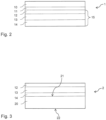
- the transfer film 1 is preferably as in Fig. 2 clearly structured:
- the transfer film has a carrier layer 10, an optional release layer 11, an optional protective lacquer layer 12, one or more decorative layers 13, and an optional adhesion-promoting layer 14.
- the carrier layer 10 consists of a plastic film or a layer composite of one or more plastic and/or paper films. Furthermore, the carrier layer 10 can also have corresponding release layers on its upper side in order to enable the transfer film 1 to be provided in the form of a film roll.
- PET polyethylene terephthalate
- a release layer 11 is then preferably printed onto the carrier layer 10.
- the release layer 11 is preferably a wax-based layer, which improves the detachment of the carrier layer from the subsequent layers 12 to 14 of the transfer film 1, which is referred to below as the transfer layer 15, during the transfer process.
- the release layer 11 can also be dispensed with if the material properties of the carrier layer 10 and the top layer of the transfer layer 15 are adjusted accordingly.
- the layers of the transfer layer 15 of the transfer film are then applied one after the other to the carrier layer 10.
- This application is preferably carried out using a printing process, in particular using gravure printing and/or screen printing.
- Application using slot casting, flexographic printing and inkjet printing is also possible.
- the protective lacquer layer 12 preferably has a layer thickness between 0.5 ⁇ m and 5 ⁇ m, in particular between 2 ⁇ m and 4 ⁇ m.
- the protective lacquer layer 12 preferably consists of two or more partial layers which are printed on one after the other.
- a layer of polyacrylate, in particular a cross-linked polyacrylate system is printed on.
- a reactive component e.g. an aliphatic polyisocyanate.
- the polyacrylate reacts in an exothermic polyadditive reaction of the reactive cross-linking component.
- This varnish is then preferably provided with fillers, preferably with a proportion of fillers in the dry mass in a range of 0.1 wt.% to 10 wt.%.
- This varnish is then printed on in a layer thickness of between 2 ⁇ m and 4 ⁇ m.
- a clear, transparent varnish layer is then applied, which in turn consists of a polyacrylate and has a thickness of 1 ⁇ m.
- a further varnish layer can then be applied, which in turn consists of a polyacrylate and has a thickness of approx. 1 ⁇ m.
- the decorative layer can consist of one or more decorative layers, of which Fig. 2 the decorative layer 13 is shown.
- the decorative layers and thus the decorative layer 13 are preferably a lacquer layer which contains pigments and/or dyes.
- the decorative layer can also be a metal layer, whereby different decorative layers can also be made of different and in particular, differently colored metals.
- the decorative layer can also consist of a layer with one or more binding agents and metal pigments, optically variable pigments, magnetically alignable pigments, thermochromic pigments and/or dyes, luminescent dyes and/or pigments, phosphorescent dyes and/or pigments.
- the decorative layer 13 may consist of a lacquer layer with a molded surface relief, in particular the surface relief of a matt structure, a lens structure, a microlens structure, a refractive structure, a diffractive structure or a haptically perceptible structure. All of these layers can be provided over the entire surface or also partially and in a pattern in any combination in the layer structure of the transfer layer 15 in order to achieve the desired optical and/or haptic result.
- the decorative layer 13 preferably consists of a polyacrylate which is provided with appropriate pigments and/or dyes as described above. This polyacrylate can be cross-linked or uncross-linked.
- the layer thickness of the decorative layer 13 in this case is in the range between 4 ⁇ m and 8 ⁇ m.
- metal layers are used as decorative layer 13, these metal layers are preferably applied by means of vapor deposition, physical vapor deposition (PVD), chemical vapor deposition (CVD) and/or sputtering.
- Metal layers are preferably applied to a clear coat or to a pigmented paint layer. It is then advantageous to apply an additional paint layer to the metal layer as a metal adhesion layer in order to improve the adhesion of layers built on top of it.
- clear varnish layer which consists of a mixture of polyacrylate and polyvinyl chloride and has a thickness between 1 ⁇ m and 2 ⁇ m.
- the adhesion-promoting layer 14 is then applied.
- the adhesion-promoting layer 14 preferably consists of one or more partial layers.
- a layer consisting of a solvent-based polyurethane resin based on a polycarbonate is preferably applied as the first partial layer.
- the solids content is preferably 35% by weight and the dynamic viscosity is preferably between 0.5 mPa s and 100 mPa s, in particular between 10 mPa s and 50 mPa s at approx. 25°C.
- the viscosity was determined in particular according to the method described in DIN EN ISO 3219:1994-10 ("Plastics - Polymers/resins in a liquid, emulsified or dispersed state - Determination of viscosity using a rotational viscometer at a defined velocity gradient" issue date 1994-10), for example using a HAAKE Viscotester ® VT550 (Thermo Fischer Scientific Inc., Waltham, MA, USA), more preferably using a cylinder measuring device NV and a measuring cup NV.
- This varnish can be provided with fillers, preferably with a proportion of fillers in the dry mass in a range of 0.1 wt.% to 10 wt.%.
- the thickness of this layer is preferably in the range of 1 ⁇ m to 2 ⁇ m.
- a second partial layer is then painted to generate the final adhesion to the polypropylene film.
- This paint can also be provided with fillers, whereby the proportion of fillers in the dry mass is preferably between 1% and 12% by weight.
- the thickness of this layer is preferably in the range of approx. 1 ⁇ m.
- the transfer film 1 thus produced in production step 71 is subsequently used to produce a preliminary product in the form of a composite body 2, the layer structure of which is Fig. 3 shown.
- the composite body 2 comprises a polypropylene film (20) with a first surface (21) and a second surface (22) opposite thereto On the first surface (21) of the polypropylene film (20) is applied the transfer layer (15) of the transfer films (1), which, as in Fig. 3 shown, which has a decorative layer 13.
- the polypropylene film 20 preferably has a layer thickness between 5 ⁇ m and 3 mm, more preferably between 20 ⁇ m and 1000 ⁇ m.
- the polypropylene film 20 is preferably formulated as described below: To produce the precursor in the form of composite body 2, proceed as follows: In an optional production step 72, the polypropylene film 20, which is preferably in the form of a film roll, is subjected to a pretreatment. This pretreatment improves the adhesiveness of the first surface 21 of the polypropylene film 20. This pretreatment preferably comprises flame treatment and/or one or more cleaning processes.
- Polypropylene is a plastic that has a low surface energy.
- the surface energy is between 29 dyn/cm and 36 dyn/cm or mN/m (millinewtons per meter).
- Achieving a sufficient level of adhesion on materials with low surface energy such as polypropylene is extremely difficult due to their smoothness. Therefore, this adhesion problem leads to printed inks being rubbed off or the ink not sticking to the surface.
- adhesion problems can also arise when bonding to other layers or between the surface and sealants applied to it.
- polyolefins such as polypropylene have a non-polar surface and a low surface energy, which makes them suitable for printing, binding, coating or painting. is not suitable unless processes are used which are harmful to the environment and very labour-intensive.
- the surface tension and comparative surface energy of a material are critical to the potential for adhesion between the coating and the material itself. Because a solid has a high degree of surface energy compared to the surface tension of a liquid, the increased molecular attraction binds the adhesive, ink and paint together, resulting in excellent bonding strength. Accordingly, when the surface tension of the solid is lower than that of the liquid, the attractive forces are weakened, resulting in the repelling of the coating.
- the pretreatment described below and also the structure of the adhesion-promoting layer 14 already described above ensure that the surface energy of the first surface 21 is at least 5 mN/m (dyn/cm) above the surface tension of the material resting on the first surface 21, here the lowest partial layer of the adhesion-promoting layer 14.
- flame treatment in particular in the form of corona and/or plasma surface activation and/or one or more cleaning processes, is preferably used.
- the surface can be gently activated by such flame treatment.
- the intensity of the flame treatment the oxygen content and the polar functional groups on the material surface increase, while the roughness remains almost unchanged.
- the flame treatment therefore creates polar functional groups that are firmly bonded to the base material.
- Cleaning processes are also used to reduce the additive content on the plastic surface. Studies have shown that as the additive content on the plastic surface increases, the paint adhesion decreases and the adhesive properties of the first surface 21 are thereby significantly reduced.
- the cleaning processes used here are in particular power wash cleaning, CO 2 snow jet cleaning and/or water-isopropanol/ultrasonic cleaning processes.
- a chlorinated cleaning agent to remove the typical additives (antioxidants, waxes, antistatic agents, etc.) is preferred. This additional cleaning preferably takes place before flame treatment.
- the transfer layer 15 of the transfer film 1 is applied to the first surface 21 of the polypropylene film 20.
- the transfer film 1 is thermally laminated onto the first surface 21 of the polypropylene film 20 and then the carrier layer 10 of the transfer film 1 is peeled off.
- the thermal lamination is preferably carried out by passing the transfer films 1 and the polypropylene film 20 through a nip of a heated laminating roller and a particularly cooled counterpressure roller and are connected to form a composite body 2 by means of heat and pressure.
- the thermal lamination is preferably carried out at a temperature between 120°C and 180°C.
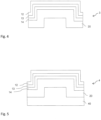
- the composite body 2 is formed so that, as in Fig. 4 indicated, a correspondingly deformed composite body 3 is present.
- the forming of the composite body 2 is preferably carried out using a thermoforming process.
- the forming is preferably carried out using vacuum deep drawing in a temperature range between 140°C and 190°C.
- the composite body 2 is preferably heated to such a temperature using quartz radiators, but also using other energy sources such as ceramic or infrared radiators, and is then formed three-dimensionally using vacuum deep drawing, preferably with the support of compressed air.
- a negative pressure in a range of 0.4 bar to 0.8 bar is used, which preferably corresponds to a vacuum between 50% and 95%, in each case based on the maximum performance of the vacuum pump of 0.85 bar, and the pressure of the compressed air is between 1 bar and 6 bar.
- a film temperature of between 50°C and 180°C, a negative pressure in a range of 0.4 bar to 0.8 bar, which preferably corresponds to a vacuum of between 50% and 95%, in each case based on the maximum capacity of the vacuum pump of 0.85 bar, and a compressed air pressure of between 20 bar and 200 bar are preferred.
- the composite body is shaped accordingly by cutting or punching in order to achieve the desired shape of the decorated molded part. It is also possible for the production step 75 to take place before the production step 74. Furthermore, if the polypropylene film is designed accordingly, it is also possible to dispense with production step 75.
- the formed composite body 3 is then placed in an injection molding tool and back-injected and/or over-injected and/or over-injected with a plastic material, so that, for example, the Fig. 5 shown, back-injected composite body 4 results.
- the injection pressure is further used depending on the geometry of the decorated molded part and the plastic material used.
- the plastic material used is preferably a plastic containing or consisting of polypropylene.
- the composite body 4 is overcoated with one or more primer and/or protective lacquer layers, whereby the decorated molded part is then obtained.
- a primer layer 50 and thereon, as in Fig. 7 shown, a protective lacquer layer 51 is applied.
- the application of the primer layer 50 and the protective lacquer layer 51 takes place by means of flooding and/or by means of painting, in particular spray painting.
- Polyurethanes and/or acrylate lacquers are preferably used as lacquers for the primer layer 50 and the protective lacquer layer 51.
Landscapes
- Engineering & Computer Science (AREA)
- Manufacturing & Machinery (AREA)
- Mechanical Engineering (AREA)
- Laminated Bodies (AREA)
- Injection Moulding Of Plastics Or The Like (AREA)
Applications Claiming Priority (2)
| Application Number | Priority Date | Filing Date | Title |
|---|---|---|---|
| DE102018105523.4A DE102018105523A1 (de) | 2018-03-09 | 2018-03-09 | Verfahren zur Herstellung eines dekorierten Formteils |
| PCT/EP2019/055661 WO2019170794A1 (de) | 2018-03-09 | 2019-03-07 | Verfahren zur herstellung eines dekorierten formteils |
Publications (2)
| Publication Number | Publication Date |
|---|---|
| EP3762202A1 EP3762202A1 (de) | 2021-01-13 |
| EP3762202B1 true EP3762202B1 (de) | 2024-10-02 |
Family
ID=65724392
Family Applications (1)
| Application Number | Title | Priority Date | Filing Date |
|---|---|---|---|
| EP19709894.0A Active EP3762202B1 (de) | 2018-03-09 | 2019-03-07 | Verfahren zur herstellung eines dekorierten formteils |
Country Status (6)
| Country | Link |
|---|---|
| US (1) | US11613055B2 (https=) |
| EP (1) | EP3762202B1 (https=) |
| JP (1) | JP7369134B2 (https=) |
| DE (1) | DE102018105523A1 (https=) |
| ES (1) | ES2993160T3 (https=) |
| WO (1) | WO2019170794A1 (https=) |
Families Citing this family (6)
| Publication number | Priority date | Publication date | Assignee | Title |
|---|---|---|---|---|
| DE102019217560A1 (de) * | 2019-11-14 | 2021-05-20 | Loparex Germany Gmbh & Co. Kg | Transferfolie zum Übertragen von Beschichtungsmaterialien auf Bauteile |
| DE102020105361A1 (de) * | 2020-02-28 | 2021-09-02 | Leonhard Kurz Stiftung & Co. Kg | Verfahren und Vorrichtung zum Dekorieren eines Spritzgussformteils sowie ein Spritzgussformteil |
| DE102023206879A1 (de) * | 2023-07-20 | 2025-01-23 | Stellantis Auto Sas | Flächenhafte Verkleidung für ein Kraftfahrzeug |
| DE102023206878A1 (de) * | 2023-07-20 | 2025-01-23 | Stellantis Auto Sas | Flächenhafte Verkleidung für ein Kraftfahrzeug |
| CN118528623B (zh) * | 2024-05-31 | 2026-01-02 | 奇瑞新能源汽车股份有限公司 | 发光装饰件及其制造方法 |
| CN118721586B (zh) * | 2024-07-31 | 2026-01-02 | 奇瑞新能源汽车股份有限公司 | 一种基于非极性基材的模内上漆方法、设备及外观件 |
Citations (3)
| Publication number | Priority date | Publication date | Assignee | Title |
|---|---|---|---|---|
| DE69918673T2 (de) * | 1998-11-05 | 2005-07-21 | Nissha Printing Co., Ltd. | Lage zur foliendekoration, verfahren zu ihrer herstellung und foliendekorierter gegenstand |
| DE102004027090A1 (de) * | 2004-06-03 | 2006-01-05 | Schott Ag | Verbundmaterial mit einem Dekor und einer Funktionsschicht sowie Verfahren zu desen Herstellung |
| DE102005049521A1 (de) * | 2004-11-04 | 2006-05-11 | Basf Coatings Ag | Verfahren zur Herstellung von Formteilen, insbesondere zur Anwendung im Automobilbau, und hierfür geeignete, eine Beschichtung aufweisende Folien |
Family Cites Families (23)
| Publication number | Priority date | Publication date | Assignee | Title |
|---|---|---|---|---|
| JP2790197B2 (ja) * | 1990-04-19 | 1998-08-27 | 王子油化合成紙株式会社 | 透明なインモールド用ラベル |
| JP2694920B2 (ja) * | 1994-07-28 | 1997-12-24 | 大日本印刷株式会社 | 射出成形同時絵付方法及び装置 |
| JPH08187746A (ja) * | 1995-01-09 | 1996-07-23 | Kansai Paint Co Ltd | プラスチック成型品の製造方法 |
| JP3137618B2 (ja) * | 1998-06-30 | 2001-02-26 | 日本写真印刷株式会社 | インサート成形品製造用積層フィルムとこれを用いたインサートフィルムの製造方法、インサート成形品の製造方法 |
| JP2002018893A (ja) * | 2000-07-06 | 2002-01-22 | Nissha Printing Co Ltd | インサート成形品およびその製造方法 |
| US6768654B2 (en) * | 2000-09-18 | 2004-07-27 | Wavezero, Inc. | Multi-layered structures and methods for manufacturing the multi-layered structures |
| US6490093B2 (en) * | 2000-12-22 | 2002-12-03 | Digital Replay, Inc. | Method of protecting ink and providing enhanced bonding during molding of lenticular lens sheets in plastic objects |
| JP4857488B2 (ja) | 2001-05-31 | 2012-01-18 | 大日本印刷株式会社 | 成形加飾用シート及び射出成形同時積層方法 |
| EP1688248B1 (en) * | 2003-11-28 | 2016-03-30 | Dai Nippon Printing Co., Ltd. | Decorating sheet, decorated resin molded article and method for production thereof |
| US20060019088A1 (en) * | 2004-07-20 | 2006-01-26 | Xiaojia Wang | Adhesive layer composition for in-mold decoration |
| US20100196651A1 (en) | 2005-09-28 | 2010-08-05 | Sipix Chemical Inc. | Mold manufacturing of an object comprising a functional element, transfering process and object |
| EP2014440A1 (de) | 2007-07-13 | 2009-01-14 | Hueck Folien Ges.m.b.H. | Direktbeschichtet Insert Molding - Dekorfolien und Laminate |
| US9132594B2 (en) * | 2008-11-04 | 2015-09-15 | Essilor International (Compagnie Générale d'Optique) | Bi-layer adhesive for lens lamination |
| DE102009049122B4 (de) | 2009-10-12 | 2023-10-19 | Sihl Gmbh | Kratzfeste Polypropylenfolie |
| MX2010007682A (es) * | 2010-03-09 | 2011-09-21 | Travel Tags Inc | Etiqueta en molde metalizada y articulos moldeados que la utilizan. |
| US8486513B2 (en) * | 2011-01-25 | 2013-07-16 | Teng Tsai Special Printing Co., Ltd. | Object structure having patterns of refractive veins thereon |
| JP5700334B2 (ja) * | 2011-02-28 | 2015-04-15 | 株式会社吉野工業所 | ラベル付きカップ容器 |
| KR20130106012A (ko) * | 2012-03-19 | 2013-09-27 | (주)엘지하우시스 | 인몰드 사출용 전사 필름 및 이의 제조방법 |
| JP5975118B2 (ja) * | 2015-01-05 | 2016-08-23 | 大日本印刷株式会社 | 三次元成形用加飾シート、該加飾シートの製造方法、加飾樹脂成形品及び加飾樹脂成形品の製造方法 |
| US10569496B2 (en) * | 2015-03-02 | 2020-02-25 | Panasonic Intellectual Property Management Co., Ltd. | Transfer film and method for manufacturing transfer film |
| JP6503936B2 (ja) | 2015-06-12 | 2019-04-24 | 日本軽金属株式会社 | 金属樹脂複合成形体及びその製造方法 |
| JP2018089952A (ja) * | 2016-12-01 | 2018-06-14 | 株式会社ユポ・コーポレーション | ラベル付き容器の製造装置および製造方法 |
| DE102017102541A1 (de) * | 2017-02-09 | 2018-08-09 | Leonhard Kurz Stiftung & Co. Kg | Verfahren zur Herstellung eines Kunststoffformteils mit einer dekorierten Oberfläche sowie ein Kunststoffformteil |
-
2018
- 2018-03-09 DE DE102018105523.4A patent/DE102018105523A1/de not_active Ceased
-
2019
- 2019-03-07 JP JP2020547107A patent/JP7369134B2/ja active Active
- 2019-03-07 ES ES19709894T patent/ES2993160T3/es active Active
- 2019-03-07 US US16/978,329 patent/US11613055B2/en active Active
- 2019-03-07 EP EP19709894.0A patent/EP3762202B1/de active Active
- 2019-03-07 WO PCT/EP2019/055661 patent/WO2019170794A1/de not_active Ceased
Patent Citations (3)
| Publication number | Priority date | Publication date | Assignee | Title |
|---|---|---|---|---|
| DE69918673T2 (de) * | 1998-11-05 | 2005-07-21 | Nissha Printing Co., Ltd. | Lage zur foliendekoration, verfahren zu ihrer herstellung und foliendekorierter gegenstand |
| DE102004027090A1 (de) * | 2004-06-03 | 2006-01-05 | Schott Ag | Verbundmaterial mit einem Dekor und einer Funktionsschicht sowie Verfahren zu desen Herstellung |
| DE102005049521A1 (de) * | 2004-11-04 | 2006-05-11 | Basf Coatings Ag | Verfahren zur Herstellung von Formteilen, insbesondere zur Anwendung im Automobilbau, und hierfür geeignete, eine Beschichtung aufweisende Folien |
Also Published As
| Publication number | Publication date |
|---|---|
| EP3762202A1 (de) | 2021-01-13 |
| US11613055B2 (en) | 2023-03-28 |
| DE102018105523A1 (de) | 2019-09-12 |
| JP2021515718A (ja) | 2021-06-24 |
| WO2019170794A1 (de) | 2019-09-12 |
| US20210001524A1 (en) | 2021-01-07 |
| JP7369134B2 (ja) | 2023-10-25 |
| ES2993160T3 (en) | 2024-12-23 |
Similar Documents
| Publication | Publication Date | Title |
|---|---|---|
| EP3762202B1 (de) | Verfahren zur herstellung eines dekorierten formteils | |
| DE60102944T2 (de) | Dekorationsfolie zum Dekorieren in der Form beim Spritzgießen, Dekorationsformteil und Verfahren zum Dekorieren in der Form beim Spritzgießen | |
| DE69830001T2 (de) | Metallisierte folie, verbundwerkstoffe, sowie verfahren zu ihrer herstellung | |
| DE102016004047B4 (de) | Verfahren und Formwerkzeug zur Warmumformung eines ebenen thermoplastischen Schichtstoffes | |
| DE102005051126A1 (de) | Folie mit Deckschicht aus einer Polyamidzusammensetzung | |
| WO2006021199A1 (de) | Dekorierter spritzgussartikel, verfahren zur herstellung eines dekorierten spritzgussartikels sowie transferfolie zur verwendung in einem derartigen verfahren | |
| EP2990195A1 (de) | Geprägte und schmelzekaschierte Mehrschichtverbundfolie | |
| EP3580033B1 (de) | Verfahren zur herstellung eines kunststoffformteils mit einer dekorierten oberfläche sowie ein kunststoffformteil mit einer dekorierten oberfläche | |
| DE69909918T2 (de) | Geformter gegenstand und oberflächenbelagfolie dafür | |
| EP3481632B1 (de) | Transferfolie, verfahren zur herstellung einer transferfolie sowie verwendung einer transferfolie und verfahren zur beschichtung eines bauteils | |
| KR20120012016A (ko) | 자동차 내장재용 인서트 시트 및 그 제조 방법 | |
| DE102019106561A1 (de) | Verfahren zur Herstellung eines Bauteils und Vorrichtung zur Herstellung eines Bauteils | |
| EP4337465A2 (de) | Verfahren zur herstellung eines kunststoffartikels, eine vorrichtung zur durchführung des verfahrens und einen kunststoffartikel | |
| AT502319B1 (de) | Substrate mit vorzugsweise transferierbaren schichten und/oder oberflächenstrukturen, verfahren zu deren herstellung und deren verwendung | |
| EP1926634B1 (de) | Herstellungsverfahren für ein dekoriertes verkleidungsteil | |
| DE19610028A1 (de) | Folie zur Beschichtung von nachbearbeitbaren Substraten | |
| DE102010011602B4 (de) | Verfahren zur Herstellung einer Dekorplatte und nach dem Verfahren hergestellte Dekorplatte | |
| EP0883477B1 (de) | Verfahren zum herstellen von mit bedruckten etiketten versehenen formkörpern nach dem sogenannten in-mould-labelling (iml)-verfahren sowie etikett für ein in-mould-labelling (iml)-verfahren | |
| EP4058299B1 (de) | Transferfolie zum übertragen von beschichtungsmaterialien auf bauteile | |
| WO1996035520A1 (de) | Folien zur beschichtung von formteilrohlingen und deren verwendung im automobilbau | |
| EP2164693B1 (de) | Verfahren zur herstellung von hinterspritzbaren folien und laminaten | |
| WO2021170382A1 (de) | Verfahren und vorrichtung zum dekorieren eines spritzgussformteils sowie ein spritzgussformteil | |
| EP3415311A1 (de) | Oberflächenfolie | |
| WO2003039880A2 (de) | Farbdekorübertragungssystem | |
| DE29805614U1 (de) | Umschlagbare Dekorfolie |
Legal Events
| Date | Code | Title | Description |
|---|---|---|---|
| STAA | Information on the status of an ep patent application or granted ep patent |
Free format text: STATUS: UNKNOWN |
|
| STAA | Information on the status of an ep patent application or granted ep patent |
Free format text: STATUS: THE INTERNATIONAL PUBLICATION HAS BEEN MADE |
|
| PUAI | Public reference made under article 153(3) epc to a published international application that has entered the european phase |
Free format text: ORIGINAL CODE: 0009012 |
|
| STAA | Information on the status of an ep patent application or granted ep patent |
Free format text: STATUS: REQUEST FOR EXAMINATION WAS MADE |
|
| 17P | Request for examination filed |
Effective date: 20200922 |
|
| AK | Designated contracting states |
Kind code of ref document: A1 Designated state(s): AL AT BE BG CH CY CZ DE DK EE ES FI FR GB GR HR HU IE IS IT LI LT LU LV MC MK MT NL NO PL PT RO RS SE SI SK SM TR |
|
| AX | Request for extension of the european patent |
Extension state: BA ME |
|
| DAV | Request for validation of the european patent (deleted) | ||
| DAX | Request for extension of the european patent (deleted) | ||
| STAA | Information on the status of an ep patent application or granted ep patent |
Free format text: STATUS: EXAMINATION IS IN PROGRESS |
|
| 17Q | First examination report despatched |
Effective date: 20220201 |
|
| GRAP | Despatch of communication of intention to grant a patent |
Free format text: ORIGINAL CODE: EPIDOSNIGR1 |
|
| STAA | Information on the status of an ep patent application or granted ep patent |
Free format text: STATUS: GRANT OF PATENT IS INTENDED |
|
| RIC1 | Information provided on ipc code assigned before grant |
Ipc: B29K 623/00 20060101ALN20240606BHEP Ipc: B44C 1/17 20060101ALI20240606BHEP Ipc: B29C 45/14 20060101AFI20240606BHEP |
|
| RIC1 | Information provided on ipc code assigned before grant |
Ipc: B29K 623/00 20060101ALN20240607BHEP Ipc: B44C 1/17 20060101ALI20240607BHEP Ipc: B29C 45/14 20060101AFI20240607BHEP |
|
| INTG | Intention to grant announced |
Effective date: 20240627 |
|
| GRAS | Grant fee paid |
Free format text: ORIGINAL CODE: EPIDOSNIGR3 |
|
| GRAA | (expected) grant |
Free format text: ORIGINAL CODE: 0009210 |
|
| STAA | Information on the status of an ep patent application or granted ep patent |
Free format text: STATUS: THE PATENT HAS BEEN GRANTED |
|
| AK | Designated contracting states |
Kind code of ref document: B1 Designated state(s): AL AT BE BG CH CY CZ DE DK EE ES FI FR GB GR HR HU IE IS IT LI LT LU LV MC MK MT NL NO PL PT RO RS SE SI SK SM TR |
|
| REG | Reference to a national code |
Ref country code: GB Ref legal event code: FG4D Free format text: NOT ENGLISH |
|
| REG | Reference to a national code |
Ref country code: CH Ref legal event code: EP |
|
| REG | Reference to a national code |
Ref country code: DE Ref legal event code: R096 Ref document number: 502019012218 Country of ref document: DE |
|
| REG | Reference to a national code |
Ref country code: IE Ref legal event code: FG4D Free format text: LANGUAGE OF EP DOCUMENT: GERMAN |
|
| REG | Reference to a national code |
Ref country code: ES Ref legal event code: FG2A Ref document number: 2993160 Country of ref document: ES Kind code of ref document: T3 Effective date: 20241223 |
|
| REG | Reference to a national code |
Ref country code: LT Ref legal event code: MG9D |
|
| REG | Reference to a national code |
Ref country code: NL Ref legal event code: MP Effective date: 20241002 |
|
| PG25 | Lapsed in a contracting state [announced via postgrant information from national office to epo] |
Ref country code: NL Free format text: LAPSE BECAUSE OF FAILURE TO SUBMIT A TRANSLATION OF THE DESCRIPTION OR TO PAY THE FEE WITHIN THE PRESCRIBED TIME-LIMIT Effective date: 20241002 |
|
| PG25 | Lapsed in a contracting state [announced via postgrant information from national office to epo] |
Ref country code: NL Free format text: LAPSE BECAUSE OF FAILURE TO SUBMIT A TRANSLATION OF THE DESCRIPTION OR TO PAY THE FEE WITHIN THE PRESCRIBED TIME-LIMIT Effective date: 20241002 |
|
| PG25 | Lapsed in a contracting state [announced via postgrant information from national office to epo] |
Ref country code: HR Free format text: LAPSE BECAUSE OF FAILURE TO SUBMIT A TRANSLATION OF THE DESCRIPTION OR TO PAY THE FEE WITHIN THE PRESCRIBED TIME-LIMIT Effective date: 20241002 Ref country code: IS Free format text: LAPSE BECAUSE OF FAILURE TO SUBMIT A TRANSLATION OF THE DESCRIPTION OR TO PAY THE FEE WITHIN THE PRESCRIBED TIME-LIMIT Effective date: 20250202 Ref country code: PT Free format text: LAPSE BECAUSE OF FAILURE TO SUBMIT A TRANSLATION OF THE DESCRIPTION OR TO PAY THE FEE WITHIN THE PRESCRIBED TIME-LIMIT Effective date: 20250203 |
|
| PG25 | Lapsed in a contracting state [announced via postgrant information from national office to epo] |
Ref country code: FI Free format text: LAPSE BECAUSE OF FAILURE TO SUBMIT A TRANSLATION OF THE DESCRIPTION OR TO PAY THE FEE WITHIN THE PRESCRIBED TIME-LIMIT Effective date: 20241002 |
|
| PG25 | Lapsed in a contracting state [announced via postgrant information from national office to epo] |
Ref country code: BG Free format text: LAPSE BECAUSE OF FAILURE TO SUBMIT A TRANSLATION OF THE DESCRIPTION OR TO PAY THE FEE WITHIN THE PRESCRIBED TIME-LIMIT Effective date: 20241002 |
|
| PG25 | Lapsed in a contracting state [announced via postgrant information from national office to epo] |
Ref country code: NO Free format text: LAPSE BECAUSE OF FAILURE TO SUBMIT A TRANSLATION OF THE DESCRIPTION OR TO PAY THE FEE WITHIN THE PRESCRIBED TIME-LIMIT Effective date: 20250102 |
|
| PG25 | Lapsed in a contracting state [announced via postgrant information from national office to epo] |
Ref country code: GR Free format text: LAPSE BECAUSE OF FAILURE TO SUBMIT A TRANSLATION OF THE DESCRIPTION OR TO PAY THE FEE WITHIN THE PRESCRIBED TIME-LIMIT Effective date: 20250103 Ref country code: LV Free format text: LAPSE BECAUSE OF FAILURE TO SUBMIT A TRANSLATION OF THE DESCRIPTION OR TO PAY THE FEE WITHIN THE PRESCRIBED TIME-LIMIT Effective date: 20241002 |
|
| PG25 | Lapsed in a contracting state [announced via postgrant information from national office to epo] |
Ref country code: CZ Free format text: LAPSE BECAUSE OF FAILURE TO SUBMIT A TRANSLATION OF THE DESCRIPTION OR TO PAY THE FEE WITHIN THE PRESCRIBED TIME-LIMIT Effective date: 20241002 Ref country code: PL Free format text: LAPSE BECAUSE OF FAILURE TO SUBMIT A TRANSLATION OF THE DESCRIPTION OR TO PAY THE FEE WITHIN THE PRESCRIBED TIME-LIMIT Effective date: 20241002 |
|
| PG25 | Lapsed in a contracting state [announced via postgrant information from national office to epo] |
Ref country code: RS Free format text: LAPSE BECAUSE OF FAILURE TO SUBMIT A TRANSLATION OF THE DESCRIPTION OR TO PAY THE FEE WITHIN THE PRESCRIBED TIME-LIMIT Effective date: 20250102 |
|
| PG25 | Lapsed in a contracting state [announced via postgrant information from national office to epo] |
Ref country code: SM Free format text: LAPSE BECAUSE OF FAILURE TO SUBMIT A TRANSLATION OF THE DESCRIPTION OR TO PAY THE FEE WITHIN THE PRESCRIBED TIME-LIMIT Effective date: 20241002 |
|
| REG | Reference to a national code |
Ref country code: DE Ref legal event code: R097 Ref document number: 502019012218 Country of ref document: DE |
|
| PG25 | Lapsed in a contracting state [announced via postgrant information from national office to epo] |
Ref country code: DK Free format text: LAPSE BECAUSE OF FAILURE TO SUBMIT A TRANSLATION OF THE DESCRIPTION OR TO PAY THE FEE WITHIN THE PRESCRIBED TIME-LIMIT Effective date: 20241002 |
|
| PGFP | Annual fee paid to national office [announced via postgrant information from national office to epo] |
Ref country code: ES Payment date: 20250416 Year of fee payment: 7 |
|
| PGFP | Annual fee paid to national office [announced via postgrant information from national office to epo] |
Ref country code: IT Payment date: 20250331 Year of fee payment: 7 |
|
| PG25 | Lapsed in a contracting state [announced via postgrant information from national office to epo] |
Ref country code: EE Free format text: LAPSE BECAUSE OF FAILURE TO SUBMIT A TRANSLATION OF THE DESCRIPTION OR TO PAY THE FEE WITHIN THE PRESCRIBED TIME-LIMIT Effective date: 20241002 |
|
| PG25 | Lapsed in a contracting state [announced via postgrant information from national office to epo] |
Ref country code: RO Free format text: LAPSE BECAUSE OF FAILURE TO SUBMIT A TRANSLATION OF THE DESCRIPTION OR TO PAY THE FEE WITHIN THE PRESCRIBED TIME-LIMIT Effective date: 20241002 |
|
| PG25 | Lapsed in a contracting state [announced via postgrant information from national office to epo] |
Ref country code: SK Free format text: LAPSE BECAUSE OF FAILURE TO SUBMIT A TRANSLATION OF THE DESCRIPTION OR TO PAY THE FEE WITHIN THE PRESCRIBED TIME-LIMIT Effective date: 20241002 |
|
| PLBE | No opposition filed within time limit |
Free format text: ORIGINAL CODE: 0009261 |
|
| STAA | Information on the status of an ep patent application or granted ep patent |
Free format text: STATUS: NO OPPOSITION FILED WITHIN TIME LIMIT |
|
| PG25 | Lapsed in a contracting state [announced via postgrant information from national office to epo] |
Ref country code: SE Free format text: LAPSE BECAUSE OF FAILURE TO SUBMIT A TRANSLATION OF THE DESCRIPTION OR TO PAY THE FEE WITHIN THE PRESCRIBED TIME-LIMIT Effective date: 20241002 |
|
| 26N | No opposition filed |
Effective date: 20250703 |
|
| PG25 | Lapsed in a contracting state [announced via postgrant information from national office to epo] |
Ref country code: MC Free format text: LAPSE BECAUSE OF FAILURE TO SUBMIT A TRANSLATION OF THE DESCRIPTION OR TO PAY THE FEE WITHIN THE PRESCRIBED TIME-LIMIT Effective date: 20241002 |
|
| REG | Reference to a national code |
Ref country code: CH Ref legal event code: H13 Free format text: ST27 STATUS EVENT CODE: U-0-0-H10-H13 (AS PROVIDED BY THE NATIONAL OFFICE) Effective date: 20251023 |
|
| PG25 | Lapsed in a contracting state [announced via postgrant information from national office to epo] |
Ref country code: LU Free format text: LAPSE BECAUSE OF NON-PAYMENT OF DUE FEES Effective date: 20250307 |
|
| REG | Reference to a national code |
Ref country code: BE Ref legal event code: MM Effective date: 20250331 |
|
| PG25 | Lapsed in a contracting state [announced via postgrant information from national office to epo] |
Ref country code: BE Free format text: LAPSE BECAUSE OF NON-PAYMENT OF DUE FEES Effective date: 20250331 |
|
| PG25 | Lapsed in a contracting state [announced via postgrant information from national office to epo] |
Ref country code: CH Free format text: LAPSE BECAUSE OF NON-PAYMENT OF DUE FEES Effective date: 20250331 |
|
| PG25 | Lapsed in a contracting state [announced via postgrant information from national office to epo] |
Ref country code: IE Free format text: LAPSE BECAUSE OF NON-PAYMENT OF DUE FEES Effective date: 20250307 |
|
| PGFP | Annual fee paid to national office [announced via postgrant information from national office to epo] |
Ref country code: GB Payment date: 20260324 Year of fee payment: 8 |
|
| PGFP | Annual fee paid to national office [announced via postgrant information from national office to epo] |
Ref country code: DE Payment date: 20260302 Year of fee payment: 8 |
|
| PGFP | Annual fee paid to national office [announced via postgrant information from national office to epo] |
Ref country code: FR Payment date: 20260325 Year of fee payment: 8 |