EP3740200B1 - Verfahren zur vorhersage des risikos und zur schichtung von sarkopenie und nad-mangel - Google Patents
Verfahren zur vorhersage des risikos und zur schichtung von sarkopenie und nad-mangel Download PDFInfo
- Publication number
- EP3740200B1 EP3740200B1 EP19700310.6A EP19700310A EP3740200B1 EP 3740200 B1 EP3740200 B1 EP 3740200B1 EP 19700310 A EP19700310 A EP 19700310A EP 3740200 B1 EP3740200 B1 EP 3740200B1
- Authority
- EP
- European Patent Office
- Prior art keywords
- trigonelline
- subject
- sample
- sarcopenia
- anthranilic acid
- Prior art date
- Legal status (The legal status is an assumption and is not a legal conclusion. Google has not performed a legal analysis and makes no representation as to the accuracy of the status listed.)
- Active
Links
Images





Classifications
-
- G—PHYSICS
- G01—MEASURING; TESTING
- G01N—INVESTIGATING OR ANALYSING MATERIALS BY DETERMINING THEIR CHEMICAL OR PHYSICAL PROPERTIES
- G01N33/00—Investigating or analysing materials by specific methods not covered by groups G01N1/00 - G01N31/00
- G01N33/48—Biological material, e.g. blood, urine; Haemocytometers
- G01N33/50—Chemical analysis of biological material, e.g. blood, urine; Testing involving biospecific ligand binding methods; Immunological testing
- G01N33/68—Chemical analysis of biological material, e.g. blood, urine; Testing involving biospecific ligand binding methods; Immunological testing involving proteins, peptides or amino acids
- G01N33/6887—Chemical analysis of biological material, e.g. blood, urine; Testing involving biospecific ligand binding methods; Immunological testing involving proteins, peptides or amino acids from muscle, cartilage or connective tissue
-
- A—HUMAN NECESSITIES
- A23—FOODS OR FOODSTUFFS; TREATMENT THEREOF, NOT COVERED BY OTHER CLASSES
- A23L—FOODS, FOODSTUFFS OR NON-ALCOHOLIC BEVERAGES, NOT OTHERWISE PROVIDED FOR; PREPARATION OR TREATMENT THEREOF
- A23L33/00—Modifying nutritive qualities of foods; Dietetic products; Preparation or treatment thereof
- A23L33/10—Modifying nutritive qualities of foods; Dietetic products; Preparation or treatment thereof using additives
- A23L33/105—Plant extracts, their artificial duplicates or their derivatives
-
- A—HUMAN NECESSITIES
- A23—FOODS OR FOODSTUFFS; TREATMENT THEREOF, NOT COVERED BY OTHER CLASSES
- A23L—FOODS, FOODSTUFFS OR NON-ALCOHOLIC BEVERAGES, NOT OTHERWISE PROVIDED FOR; PREPARATION OR TREATMENT THEREOF
- A23L33/00—Modifying nutritive qualities of foods; Dietetic products; Preparation or treatment thereof
- A23L33/10—Modifying nutritive qualities of foods; Dietetic products; Preparation or treatment thereof using additives
- A23L33/15—Vitamins
-
- A—HUMAN NECESSITIES
- A61—MEDICAL OR VETERINARY SCIENCE; HYGIENE
- A61K—PREPARATIONS FOR MEDICAL, DENTAL OR TOILETRY PURPOSES
- A61K31/00—Medicinal preparations containing organic active ingredients
- A61K31/33—Heterocyclic compounds
- A61K31/395—Heterocyclic compounds having nitrogen as a ring hetero atom, e.g. guanethidine or rifamycins
- A61K31/435—Heterocyclic compounds having nitrogen as a ring hetero atom, e.g. guanethidine or rifamycins having six-membered rings with one nitrogen as the only ring hetero atom
- A61K31/44—Non condensed pyridines; Hydrogenated derivatives thereof
- A61K31/4425—Pyridinium derivatives, e.g. pralidoxime, pyridostigmine
-
- A—HUMAN NECESSITIES
- A61—MEDICAL OR VETERINARY SCIENCE; HYGIENE
- A61K—PREPARATIONS FOR MEDICAL, DENTAL OR TOILETRY PURPOSES
- A61K31/00—Medicinal preparations containing organic active ingredients
- A61K31/33—Heterocyclic compounds
- A61K31/395—Heterocyclic compounds having nitrogen as a ring hetero atom, e.g. guanethidine or rifamycins
- A61K31/435—Heterocyclic compounds having nitrogen as a ring hetero atom, e.g. guanethidine or rifamycins having six-membered rings with one nitrogen as the only ring hetero atom
- A61K31/44—Non condensed pyridines; Hydrogenated derivatives thereof
- A61K31/455—Nicotinic acids, e.g. niacin; Derivatives thereof, e.g. esters, amides
-
- A—HUMAN NECESSITIES
- A61—MEDICAL OR VETERINARY SCIENCE; HYGIENE
- A61K—PREPARATIONS FOR MEDICAL, DENTAL OR TOILETRY PURPOSES
- A61K31/00—Medicinal preparations containing organic active ingredients
- A61K31/70—Carbohydrates; Sugars; Derivatives thereof
- A61K31/7042—Compounds having saccharide radicals and heterocyclic rings
- A61K31/7052—Compounds having saccharide radicals and heterocyclic rings having nitrogen as a ring hetero atom, e.g. nucleosides, nucleotides
- A61K31/706—Compounds having saccharide radicals and heterocyclic rings having nitrogen as a ring hetero atom, e.g. nucleosides, nucleotides containing six-membered rings with nitrogen as a ring hetero atom
-
- A—HUMAN NECESSITIES
- A61—MEDICAL OR VETERINARY SCIENCE; HYGIENE
- A61K—PREPARATIONS FOR MEDICAL, DENTAL OR TOILETRY PURPOSES
- A61K36/00—Medicinal preparations of undetermined constitution containing material from algae, lichens, fungi or plants, or derivatives thereof, e.g. traditional herbal medicines
- A61K36/18—Magnoliophyta (angiosperms)
- A61K36/185—Magnoliopsida (dicotyledons)
- A61K36/48—Fabaceae or Leguminosae (Pea or Legume family); Caesalpiniaceae; Mimosaceae; Papilionaceae
-
- A—HUMAN NECESSITIES
- A61—MEDICAL OR VETERINARY SCIENCE; HYGIENE
- A61K—PREPARATIONS FOR MEDICAL, DENTAL OR TOILETRY PURPOSES
- A61K36/00—Medicinal preparations of undetermined constitution containing material from algae, lichens, fungi or plants, or derivatives thereof, e.g. traditional herbal medicines
- A61K36/18—Magnoliophyta (angiosperms)
- A61K36/185—Magnoliopsida (dicotyledons)
- A61K36/74—Rubiaceae (Madder family)
- A61K36/742—Coffea, e.g. coffee
-
- A—HUMAN NECESSITIES
- A61—MEDICAL OR VETERINARY SCIENCE; HYGIENE
- A61P—SPECIFIC THERAPEUTIC ACTIVITY OF CHEMICAL COMPOUNDS OR MEDICINAL PREPARATIONS
- A61P21/00—Drugs for disorders of the muscular or neuromuscular system
-
- G—PHYSICS
- G01—MEASURING; TESTING
- G01N—INVESTIGATING OR ANALYSING MATERIALS BY DETERMINING THEIR CHEMICAL OR PHYSICAL PROPERTIES
- G01N33/00—Investigating or analysing materials by specific methods not covered by groups G01N1/00 - G01N31/00
- G01N33/48—Biological material, e.g. blood, urine; Haemocytometers
- G01N33/50—Chemical analysis of biological material, e.g. blood, urine; Testing involving biospecific ligand binding methods; Immunological testing
- G01N33/53—Immunoassay; Biospecific binding assay; Materials therefor
- G01N33/566—Immunoassay; Biospecific binding assay; Materials therefor using specific carrier or receptor proteins as ligand binding reagents where possible specific carrier or receptor proteins are classified with their target compounds
-
- G—PHYSICS
- G01—MEASURING; TESTING
- G01N—INVESTIGATING OR ANALYSING MATERIALS BY DETERMINING THEIR CHEMICAL OR PHYSICAL PROPERTIES
- G01N33/00—Investigating or analysing materials by specific methods not covered by groups G01N1/00 - G01N31/00
- G01N33/48—Biological material, e.g. blood, urine; Haemocytometers
- G01N33/50—Chemical analysis of biological material, e.g. blood, urine; Testing involving biospecific ligand binding methods; Immunological testing
- G01N33/68—Chemical analysis of biological material, e.g. blood, urine; Testing involving biospecific ligand binding methods; Immunological testing involving proteins, peptides or amino acids
- G01N33/6893—Chemical analysis of biological material, e.g. blood, urine; Testing involving biospecific ligand binding methods; Immunological testing involving proteins, peptides or amino acids related to diseases not provided for elsewhere
-
- A—HUMAN NECESSITIES
- A23—FOODS OR FOODSTUFFS; TREATMENT THEREOF, NOT COVERED BY OTHER CLASSES
- A23V—INDEXING SCHEME RELATING TO FOODS, FOODSTUFFS OR NON-ALCOHOLIC BEVERAGES AND LACTIC OR PROPIONIC ACID BACTERIA USED IN FOODSTUFFS OR FOOD PREPARATION
- A23V2002/00—Food compositions, function of food ingredients or processes for food or foodstuffs
-
- G—PHYSICS
- G01—MEASURING; TESTING
- G01N—INVESTIGATING OR ANALYSING MATERIALS BY DETERMINING THEIR CHEMICAL OR PHYSICAL PROPERTIES
- G01N2800/00—Detection or diagnosis of diseases
- G01N2800/10—Musculoskeletal or connective tissue disorders
-
- G—PHYSICS
- G01—MEASURING; TESTING
- G01N—INVESTIGATING OR ANALYSING MATERIALS BY DETERMINING THEIR CHEMICAL OR PHYSICAL PROPERTIES
- G01N2800/00—Detection or diagnosis of diseases
- G01N2800/34—Genitourinary disorders
-
- G—PHYSICS
- G01—MEASURING; TESTING
- G01N—INVESTIGATING OR ANALYSING MATERIALS BY DETERMINING THEIR CHEMICAL OR PHYSICAL PROPERTIES
- G01N2800/00—Detection or diagnosis of diseases
- G01N2800/50—Determining the risk of developing a disease
-
- G—PHYSICS
- G01—MEASURING; TESTING
- G01N—INVESTIGATING OR ANALYSING MATERIALS BY DETERMINING THEIR CHEMICAL OR PHYSICAL PROPERTIES
- G01N2800/00—Detection or diagnosis of diseases
- G01N2800/52—Predicting or monitoring the response to treatment, e.g. for selection of therapy based on assay results in personalised medicine; Prognosis
Definitions
- Age-related loss of muscle mass and function is inevitable in all individuals; however its progression largely depends on genetic and environmental factors such as physical activity and nutritional intake.
- Sarcopenia has been defined as the point where the age-related loss of muscle mass and function gets debilitating and impacts quality of life. In contrast, frailty is another classification of age-related physical function decline that features low muscle strength and functionality, but not muscle mass. Sarcopenia is defined clinically according to low muscle mass and function, using cutoffs which stratify the elderly population for individuals in a state of pathological mobility. Sarcopenia predicts future disability and mortality, and was assigned an official ICD-10 disease code in 2016 (Anker et al., 2016).
- Sarcopenia is common in both men and women over the age of 65 with the worldwide prevalence estimated at 3-30% according to the operational definition implemented. Sarcopenia is associated with a number of adverse physical and metabolic outcomes including frailty, disability, obesity, diabetes and osteoporosis. As a consequence, there is a substantial health care cost attributable to sarcopenia. Although age, gender, size, heritability and physical activity are recognised adult influences, there remains considerable unexplained variation in muscle mass and strength among older individuals.
- Sarcopenia is a multi-factorial syndrome which associates with pathophysiological changes such as impaired neuro-muscular transition, altered excitation/contraction coupling, impaired regenerative capacity linked to stem cell exhaustion, defects of mitochondrial and energy metabolism in myofibers, and finally marbling of skeletal muscle with fat and fibrosis.
- pathophysiological changes such as impaired neuro-muscular transition, altered excitation/contraction coupling, impaired regenerative capacity linked to stem cell exhaustion, defects of mitochondrial and energy metabolism in myofibers, and finally marbling of skeletal muscle with fat and fibrosis.
- the etiology of the syndrome is therefore complex and poorly understood, but low physical activity, hormonal decline in anabolic hormones (androgens, IGF-1) and malnutrition / nutritional deficiencies play an important role.
- the MEMOSA Multi-Ethnic Molecular Determinants of Human Sarcopenia
- Kashani et al (“Evaluating Muscle Mass by Using Markers of Kidney Function: Development of the Sarcopenia Index", Critical Care Medicine, vol. 45, 2017 ) discloses the sarcopenia index, ie serum creatinine/serum cystatin, to measure muscle mass among critically ill patients and predict hospital and 90-day mortality among patients.
- the inventors of the present application have discovered that Anthranilic acid and Trigonelline levels in the body, and the ratio of Trigonelline:Anthranilic Acid levels are indicative of sarcopenia in a subject.
- the invention relates to a method of determining if a subject has sarcopenia comprising:
- the method of the present invention comprises:
- the ratio of Trigonelline and Anthranilic acid in the sample compared to the reference value is indicative of sarcopenia.
- a decrease in the Trigonelline and Anthranilic acid ratio in the sample from the subject compared to the reference value is indicative of sarcopeniain the subject.
- Sarcopenia is characterized by one or more of low muscle mass, low muscle strength, and low physical performance. More preferably, sarcopenia is characterized by two or more of low muscle mass, low muscle strength, and low physical performance. Most preferably, sarcopenia is characterized by low muscle mass, low muscle strength, and low physical performance. These can all be measured by methods well known to the person skilled in the art.
- Muscle mass can be measured by CT (computerised tomography), DXA (Dual-energy X-ray absorptiometry), MRI (Magnetic Resonance Imaging) or D3 creatine dilution methods.
- Muscle strength can be measured by handgrip strength (for example, using hand held dynamometry) or knee extensor strength (for example, using quadriceps torque measurement).
- Physical performance can be measured by gait speed, SPPB, 400m walk test, time up and go test, or stair climbing test.
- the levels of Trigonelline and Anthranilic acid are determined by mass spectrometry.
- the levels of Trigonelline and Anthranilic acid are determined by liquid chromatography followed by mass spectrometry.
- the subject is a human subject.
- the human subject is an older adult. In one embodiment, the human subject is elderly.
- the subject is a companion animal, preferably a dog.
- the reference value is determined from a sample obtained from the same subject or from a group of subjects.
- the reference value is measured in a sample from the same subject.
- the reference value is measured in the same subject before a nutritional intervention, for example with a nutritional composition, and compared to the measurement after nutritional intervention.
- the reference value is measured in a sample from a group of subjects, for example a group of subjects of similar age.
- the subject is an older adult.
- the subject is elderly.
- the sample obtained from the subject is a plasma sample.
- the sample obtained from the subject is a serum sample.
- the sample obtained from the subject is a urine sample.
- the present invention also relates to a method for predicting the responsiveness to nutritional composition for use in the treatment or prevention of sarcopenia in the subject comprising:
- the biomarker is Trigonelline.
- the nutritional composition comprises Vitamin B3.
- the nutritional composition comprises an NAD precursor, for example nicotinamide riboside, nicotinamide mononucleotide, and nicotinamide.
- NAD precursor for example nicotinamide riboside, nicotinamide mononucleotide, and nicotinamide.
- the nutritional composition comprises Trigonelline. In one embodiment, the nutritional composition comprises a precursor of trigonelline. In one embodiment, the nutritional composition comprises a derivative of trigonelline. Trigonelline is an alkaloid with chemical formula C7H7NO2 and CAS number 535-83-1 .
- the nutritional composition comprises coffee extract, for example a coffee bean extract or coffee beverage.
- said coffee extract comprises one or more of caffeic acid, trigonelline, quinolinic acid, and precursors of quinolinic acid.
- the term "subject” means any animal, including humans and companion animals. Generally, the subject is a human or an avian, bovine, canine, equine, feline, hircine, murine, ovine or porcine animal. The subject can be a horse or a companion animal, for example a cat or a dog. Preferably, the subject is a human.
- the term “elderly” in the context of a human means an age from birth of at least 60 years, more preferably above 64 years, and most preferably above 68 years.
- the term "older adult” in the context of a human means an age from birth of at least 45 years, preferably above 50 years, more preferably above 55 years, and includes elderly subjects.
- Sarcopenia can be characterized by one or more of low muscle mass, low muscle strength and low physical performance.
- Sarcopenia can be diagnosed in a subject based on the definition of the AWGSOP (Asian Working Group for Sarcopenia in Older People), for example as described in Chen et al., 2014.
- Low muscle mass can generally be based on low appendicular lean mass normalized to height square (ALM index),particularly ALM index less than 7.00 kg/m 2 for men and 5.40 kg/m 2 for women.
- Low physical performance can generally be based on gait speed, particularly gait speed of ⁇ 0.8 m/sec.
- Low muscle strength can generally be based on low hand grip strength, particularly hand grip strength less than 26 kg in men and less than 18 kg in women.
- Sarcopenia can be diagnosed in a subject based on the definition of the EWGSOP (European Working Group for Sarcopenia in Older People), for example as described in Cruz-Jentoft et al., 2010.
- Low muscle mass can generally be based on low appendicular lean mass normalized to height square (ALM index), particularly ALM index less than 7.23 kg/m 2 for men and 5.67 kg/m 2 for women.
- Low physical performance can generally be based on gait speed, particularly gait speed of ⁇ 0.8 m/sec.
- Low muscle strength can generally be based on low hand grip strength, particularly hand grip strength less than 30kg in men and less than 20kg in women.
- Low muscle mass can generally be based on low appendicular lean mass (ALM) normalized to body mass index (BMI; kg/m2), particularly ALM to BMI less than 0.789 for men and 0.512 for women.
- Low physical performance can generally be based on gait speed, particularly gait speed of ⁇ 0.8 m/sec.
- Low muscle strength can generally be based on low hand grip strength, particularly hand grip strength less than 26kg in men and less than 16kg in women.
- Low muscle strength can also generally be based on low hand grip strength to body mass index, particularly hand grip strength to body mass index less than 1.00 in men and less than 0.56 in women.
- the D3-creatine dilution method is another approach to measure muscle mass. This method is becoming more widely accepted as a robust standard and potentially a future alternative to DXA.
- the D3-creatine dilution method has been described previously in Clark et al. (2014) and Stimpson et al. (2013).
- the present method involves determining the levels of Trigonelline, Anthranilic acid and/or the ratio of their levels in a sample obtained from a subject. This may be referred to as the 'test sample'.
- the present method is typically practiced outside of the human or animal body, e.g. on a body fluid sample that was previously obtained from the subject to be tested.
- the sample may, for example, be a serum, plasma or urine sample.
- the sample can be derived from blood, i.e. the sample comprises whole blood or a blood fraction.
- the sample may comprise blood plasma or serum.
- the sample is a serum sample.
- vena blood samples can be collected from patients using a needle and deposited into plastic tubes.
- the collection tubes may, for example, contain spray-coated silica and a polymer gel for serum separation. Serum can be separated by centrifugation at 1300 RCF for 10 min at room temperature and stored in small plastic tubes at -80°C.
- the present method involves a comparison of Anthranilic acid and Trigonelline levels to reference value levels of Anthranilic acid and Trigonelline.
- reference value is synonymous with 'control value' and broadly includes data that the skilled person would use to facilitate the accurate interpretation of technical data.
- the levels of Anthranilic acid, the levels of Trigonelline, and/or the ratio of Trigonelline:Anthranilic acid levels in a sample from a subject may be compared to that of the same subject or that of one or more cohorts (populations/groups) of control subjects.
- Reference values may be established by assaying samples from the same subject, for example by assay of repeat samples. Reference values may also be established by assaying samples from individuals in the general population or the selected population and using a statistical model such as the predictive value method for selecting a positivity criterion or receiver operator characteristic curve that defines optimum specificity (highest true negative rate) and sensitivity (highest true positive rate) as described in Knapp, R. G., and Miller, M. C. (1992). Clinical Epidemiology and Biostatistics. William and Wilkins, Harual Publishing Co. Malvern, Pa .
- Reference values may be established by assaying at least 1 individual, more preferably at least 5 individuals, more preferably at least 10 individuals, more preferably at least 15 individuals, most preferably at least 20 individuals. All or a substantial number of said individuals preferably do not have sarcopenia.
- a nutritional composition according to the description, but not part of the claimed invention may be a nutraceutical composition, functional food, functional nutrition product, medical food with regulatory status as drugs, medical nutrition product, or dietary supplement.
- nutraceutical combines the words “nutrition” and "pharmaceutical”. It is a food or food product that provides health and medical benefits, including the prevention and treatment of disease.
- a nutraceutical is a product isolated or purified from foods that is generally sold in medicinal forms not usually associated with food. A nutraceutical is demonstrated to have a physiological benefit or provide protection against chronic disease. Such products may range from isolated nutrients, dietary supplements and specific diets to genetically engineered foods, herbal products, and processed foods such as cereals, soups, and beverages.
- nutraceutical as used herein denotes usefulness in both nutritional and pharmaceutical fields of application.
- nutraceutical compositions can be used as supplements to food and beverages and as pharmaceutical formulations for enteral or parenteral application which may be solid formulations, such as capsules or tablets, or liquid formulations, such as solutions or suspensions.
- the nutritional composition may comprise trigonelline, a precursor of trigonelline and/or a derivative of trigonelline.
- the precursor of trigonelline may be, for example, quinolinic acid, nicotinic acid, and/or nicotinamide.
- the nutritional composition comprises an NAD precursor, for example nicotinamide riboside, nicotinamide mononucleotide, nicotinamide and/or nicotinic acid.
- NAD precursor for example nicotinamide riboside, nicotinamide mononucleotide, nicotinamide and/or nicotinic acid.
- Nutritional compositions may further contain protective hydrocolloids (such as gums, proteins, modified starches), binders, film-forming agents, encapsulating agents/materials, wall/shell materials, matrix compounds, coatings, emulsifiers, surface active agents, solubilising agents (oils, fats, waxes, lecithins etc.), adsorbents, carriers, fillers, co-compounds, dispersing agents, wetting agents, processing aids (solvents), flowing agents, taste-masking agents, weighting agents, jellifying agents, gel-forming agents, antioxidants and antimicrobials.
- protective hydrocolloids such as gums, proteins, modified starches
- binders film-forming agents, encapsulating agents/materials, wall/shell materials, matrix compounds, coatings, emulsifiers, surface active agents, solubilising agents (oils, fats, waxes, lecithins etc.), adsorbents, carriers, fillers, co-compounds,
- a multi-vitamin and mineral supplement may be added to nutritional compositions to obtain an adequate amount of an essential nutrient, which is missing in some diets.
- the multi-vitamin and mineral supplement may also be useful for disease prevention and protection against nutritional losses and deficiencies due to lifestyle patterns.
- Nutritional compositions may be in any galenic form that is suitable for administering to the body, especially in any form that is conventional for oral administration, e.g. in solid forms such as (additives/supplements for) food or feed, food or feed premix, fortified food or feed, tablets, pills, granules, dragees, capsules and effervescent formulations, such as powders and tablets, or in liquid forms, such as solutions, emulsions or suspensions as e.g. beverages, pastes and oily suspensions.
- the pastes may be incorporated in hard or soft shell capsules, whereby the capsules feature e.g.
- the nutritional compositions may be in the form of controlled (delayed) release formulations.
- Nutritional compositions may include beverages.
- the term "beverages” encompasses non-alcoholic and alcoholic drinks as well as liquid preparations to be added to drinking water and liquid food.
- Non-alcoholic drinks are e.g. soft drinks, sports drinks, fruit juices, teas and milk-based drinks.
- Liquid foods may include soups and dairy products.
- the nutraceutical composition comprising the compound may be added to a soft drink, an energy bar, or a candy.
- the nutritional composition is a nutraceutical formulation
- the composition further contains pharmaceutically acceptable excipients, diluents or adjuvants then standard techniques may be used for their formulation, as e.g. disclosed in Remington's Pharmaceutical Sciences, 20th edition Williams & Wilkins, PA, USA .
- tablets and capsules are preferably used which contain a suitable binding agent, e.g. gelatine or polyvinyl pyrrolidone, a suitable filler, e.g. lactose or starch, a suitable lubricant, e.g. magnesium stearate, and optionally further additives.
- “Functional food”, “functional nutrition product”, “medical food” and “medical nutrition product” relate to any healthy food claimed to have a health-promoting or disease-preventing property beyond the basic function of supplying nutrients.
- the general category of functional foods includes processed food or foods fortified with health-promoting additives, like “vitamin-enriched” products.
- a dietary supplement also known as food supplement or nutritional supplement, is a preparation intended to supplement the diet and provide nutrients, such as vitamins, minerals, fiber, fatty acids, or amino acids, that may be missing or may not be consumed in sufficient quantities in a person's diet.
- Some countries define dietary supplements as foods, while in others they are defined as drugs or natural health products.
- Supplements containing vitamins or dietary minerals are included as a category of food in the Codex Alimentarius, a collection of internationally recognized standards, codes of practice, guidelines and other recommendations relating to foods, food production and food safety. These texts are drawn up by the Codex Alimentarius Commission, an organization that is sponsored by the Food and Agriculture Organization of the United Nations (FAO) and the World Health Organization (WHO).
- prevention includes reduction of risk and/or severity of a condition or disorder.
- treatment includes both prophylactic or preventive treatment (that prevent and/or slow the development of a targeted pathologic condition or disorder) and curative, therapeutic or disease-modifying treatment, including therapeutic measures that cure, slow down, lessen symptoms of, and/or halt progression of a diagnosed pathologic condition or disorder, and include treatment of patients at risk of contracting a disease or suspected to have contracted a disease, as well as patients who are ill or have been diagnosed as suffering from a disease or medical condition. The term does not necessarily imply that a subject is treated until total recovery.
- All of these terms also refer to the maintenance and/or promotion of health in a subject not suffering from a disease but who may be susceptible to the development of an unhealthy condition. These terms are also intended to include the potentiation or otherwise enhancement of one or more primary prophylactic or therapeutic measure.
- treatment “treat,” “attenuate” and “alleviate” are further intended to include the dietary management of a disease or condition or the dietary management for prophylaxis or prevention a disease or condition.
- a treatment can be patient- or doctor-related.
- sarcopenia The diagnosis of sarcopenia was based on AWGSOP definition that was defined as the total appendicular lean mass normalized for height less than 7.00 kg/m2 , evidence of either low physical performance based on gait speed of ⁇ 0.8 m/sec OR low muscle strength based on hand grip ⁇ 26 kg.
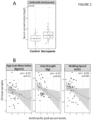
- Figures 1 to 3 show that serum levels of trigonelline, anthranilic acid and trigonelline:anthranilic acid ratio differ in sarcopenic patients and associate with lean muscle mass, grip strength and gait.
- Levels of trigonelline ( Figure 1 ), anthranilic acid ( Figure 2 ) and trigonelline/anthranilic acid ratio ( Figure 3 ) were measured in the serum in a human cohort of 20 sarcopenic patients and 20 age-matched control, all aged 65 and above.
- the left panels represent the log2 values of the analytes in serum of sarcopenic vs control patients.
- the right panels represent the association of analytes in serum with appendicular lean body mass index (ALMi) measured by DXA as surrogate for muscle mass, hand grip strength and gait speed.
- ALMi appendicular lean body mass index
- the orange line shows the fitted regression line of the clinical variables on the analytes and the gray area shows the 95% confidence intervals of the fitted model. P-values reported were computed with a Student T statistics (case control) or Pearson correlation (correlation analysis) on Log2-transformed values.
- RNA sequencing 250 ng of total RNA from each sample was employed as starting material for library preparation and the Ribo-Zero magnetic Kit (Illumina) was used to remove ribosomal RNA.
- Sequencing libraries were prepared using the TruSeq Stranded RNA HT with Ribo-Zero Gold Kit (Illumina) followed by 13 cycles of PCR amplification step with the KAPA HiFi HotStart ReadyMix (Kapa BioSystems). Libraries were quantified with Picogreen (Life Technologies) and size pattern was controlled with the DNA High Sensitivity Reagent kit on a LabChip GX (Perkin Elmer). Libraries were then pooled at an equimolar ratio and clustered at a concentration of 7 pmol on paired-end sequencing flow cell (Illumina). Sequencing was performed for 2 x 101 cycles on a HiSeq 2500 (Illumina) with V3 chemistry. The generated data were demultiplexed using Casava.
- Reads were aligned to the human genome (hs_GRCh38.p2) using STAR (Dobin et al., 2013), and the number of reads mapped within genes was quantified by HTSeq (Anders et al., 2015) (version HTSeq-0.6.1p1, mode union, strand reverse, quality alignment greater than 10). Samples had a sequencing depth of 75-104 million reads per sample, of which 34-77 million reads where uniquely mapped.
- RNA sequencing of human sarcopenic skeletal muscle reveals that mitochondrial dysfunction is the major transcriptional change during sarcopenia.
- A Gene set enrichment analysis of sarcopenic vs control muscle using CAMERA and the hallmark gene set collection from MSigDB. Red bars represent gene sets enriched in sarcopenic muscle, and blue bars represent gene sets repressed in sarcopenic muscle. Gene sets are ordered according to the significance of their enrichment.
- B GSEA enrichment plot for the oxidative phosphorylation gene set selected from A.
- UV_RESPONSE_DN 17. PI3K_AKT_MTOR_SIGNALING, 18. MYC_TARGETS_V2, 19. KRAS_SIGNALING_DN, 20. HEDGEHOG_SIGNALING, 21. E2F_TARGETS, 22. INTERFERON_GAMMA_RESPONSE, 23. APICAL_SURFACE, 24. TGF_BETA_SIGNALING, 25. PROTEIN_SECRETION, 26. IL2_STAT5_SIGNALING.
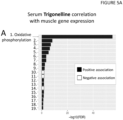
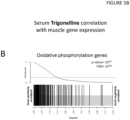
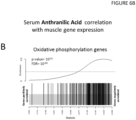
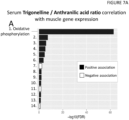
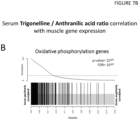
- FIGs 5 to 7 shows the correlation of skeletal muscle gene expression with serum levels of trigonelline, anthranilic acid and trigonelline:anthranilic acid ratio.
- GSEA Gene set enrichment analysis
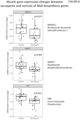
- Figure 8 shows that human sarcopenic muscle has lower expression of genes such as NMAT1, NAMPT and PNP, which control the biosynthesis of NAD from NAD precursors or from the diet and NAD salvage. Gene expression was measured in muscle by high coverage RNA sequencing.
- NMNAT Nicotinamide Nucleotide Adenylyltransferase 1
- NAMPT Nicotinamide phosphoribosyltransferase
- PNP Purine Nucleoside Phosphorylase
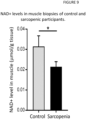
- NAD was measured in aged human muscle biopsy material. NAD+ levels were measured in human muscle biopsies as described in Dall et al, 2018. Briefly, 5mg muscle tissue from remaining biopsies was lysed in 200pL 0.6M perchloric acid and the supernatant was diluted 250-fold in 100mM Na2HPO4 pH 8.0.
- reaction mix 100 ⁇ L of diluted sample was combined with 100 ⁇ L reaction mix (100mM Na2HPO4 pH 8, 2% ethanol, 90U/mL alcohol dehydrogenase, 130mU/mL diaphorase, 10 ⁇ M resazurin, 10 ⁇ M flavin mononucleotide, 10mM nicotinamide), and the fluorescence increase (Ex 540 nm/Em 580) was measured over 10 min.
- NAD+ content was calculated from a standard curve and normalized to tissue weight.
- Figure 9 shows that there was a significant (32%) reduction of NAD levels in human skeletal muscle of aged sarcopenic patients.
- This major reduction of NAD+ levels in skeletal muscle from people with sarcopenia links for the first time low NAD+ levels to an age-related pathology in humans and constitutes the first demonstration of NAD deficiency in human skeletal muscle..
- preclinical efficacy of NAD precursors like NR and NMN on aged muscle in mice this result will expand the clinical relevance of NAD biology in aging, as well as guide clinical translation for sarcopenia and age-related mobility deficits.
- HSS Hertfordshire Sarcopenia Study
- HCS UK Hertfordshire Cohort Study
- DXA dual-energy X-ray absorptiometry
- Figure 10 shows that serum levels of trigonelline:anthranilic acid ratio are associated with lean muscle mass evaluated by the appendicular lean mass index.
- Levels of trigonelline and anthranilic acid were measured in the serum in a human cohort of 70 subjects, 52 females and 18 males, all aged 65 and above.
- the graph represents the association of the log2 values the ratio of the analytes (trigonelline:anthranilic acid) in serum, x axis, with appendicular lean body mass index (ALMi) measured by DXA as surrogate for muscle mass, y axis.
- the line shows the fitted regression line of the ALMi on the log2(trigonelline/anthranilic acid).
Landscapes
- Health & Medical Sciences (AREA)
- Life Sciences & Earth Sciences (AREA)
- Engineering & Computer Science (AREA)
- Chemical & Material Sciences (AREA)
- Natural Medicines & Medicinal Plants (AREA)
- Medicinal Chemistry (AREA)
- General Health & Medical Sciences (AREA)
- Biomedical Technology (AREA)
- Food Science & Technology (AREA)
- Molecular Biology (AREA)
- Immunology (AREA)
- Mycology (AREA)
- Hematology (AREA)
- Urology & Nephrology (AREA)
- Microbiology (AREA)
- Biotechnology (AREA)
- Pharmacology & Pharmacy (AREA)
- Animal Behavior & Ethology (AREA)
- Public Health (AREA)
- Veterinary Medicine (AREA)
- Epidemiology (AREA)
- Polymers & Plastics (AREA)
- Nutrition Science (AREA)
- Botany (AREA)
- General Physics & Mathematics (AREA)
- Cell Biology (AREA)
- Analytical Chemistry (AREA)
- Biochemistry (AREA)
- Physics & Mathematics (AREA)
- Pathology (AREA)
- Proteomics, Peptides & Aminoacids (AREA)
- Medical Informatics (AREA)
- Alternative & Traditional Medicine (AREA)
- Organic Chemistry (AREA)
- Physical Education & Sports Medicine (AREA)
- Chemical Kinetics & Catalysis (AREA)
- General Chemical & Material Sciences (AREA)
- Nuclear Medicine, Radiotherapy & Molecular Imaging (AREA)
- Neurology (AREA)
- Bioinformatics & Cheminformatics (AREA)
Claims (18)
- Verfahren zum Bestimmen, ob ein Subjekt an Sarkopenie leidet, umfassend:(a) Bestimmen des Trigonellin-Spiegels in einer von dem Subjekt erhaltenen Probe;(b) Vergleichen des Trigonellin-Spiegels in der Probe mit einem Referenzwert;wobei ein erniedrigter Trigonellin-Spiegel in der Probe im Vergleich zum Referenzwert auf Sarkopenie bei dem Subjekt hinweist.
- Verfahren nach Anspruch 1, umfassend:(c) ferner Bestimmen des Anthranilsäure-Spiegels in einer von dem Subjekt erhaltenen Probe;(d) Bestimmen des Verhältnisses von Trigonellin und Anthranilsäure in der Probe;(e) Vergleichen des Verhältnisses von Trigonellin und Anthranilsäure in der Probe mit einem Referenzwert;wobei das Verhältnis von Trigonellin und Anthranilsäure in der Probe im Vergleich zum Referenzwert auf Sarkopenie bei dem Subjekt hinweist.
- Verfahren nach Anspruch 2, wobei eine Abnahme des Verhältnisses von Trigonellin und Anthranilsäure in der Probe von dem Subjekt im Vergleich zum Referenzwert auf Sarkopenie bei dem Subjekt hinweist.
- Verfahren nach einem der vorstehenden Ansprüche, wobei Sarkopenie gekennzeichnet ist durch eines oder mehrere von geringer Muskelmasse, geringer Muskelkraft und geringer körperlicher Leistungsfähigkeit.
- Verfahren nach Anspruch 4, wobei (i) die Muskelmasse durch DXA, MRT oder D3-Kreatinverdünnungsverfahren gemessen wird; (ii) die Muskelkraft durch Handgriffstärke oder Kniestreckerstärke gemessen wird; und (iii) die körperliche Leistungsfähigkeit durch Ganggeschwindigkeit, SPPB, 400 m-Gehtest, Time-Upand-Go-Test oder Treppensteigtest gemessen wird.
- Verfahren nach einem der vorstehenden Ansprüche, wobei der Trigonellin- und/oder der Anthranilsäure-Spiegel durch Massenspektrometrie bestimmt wird.
- Verfahren nach einem der vorstehenden Ansprüche, wobei es sich bei dem Subjekt um ein menschliches Subjekt handelt.
- Verfahren nach einem der vorstehenden Ansprüche, wobei es sich bei dem menschlichen Subjekt um einen älteren Erwachsenen oder einen Erwachsenen im hohen Alter handelt.
- Verfahren nach einem der vorstehenden Ansprüche, wobei der Referenzwert aus einer von demselben Subjekt oder von einer Gruppe von Subjekten erhaltenen Probe bestimmt wird.
- Verfahren nach einem der vorstehenden Ansprüche, wobei die von dem Subjekt erhaltene Probe eine aus Blut gewonnene Probe ist.
- Verfahren nach den Ansprüchen 1 bis 10, wobei die von dem Subjekt erhaltene Probe eine Urinprobe ist.
- Verfahren zum Vorhersagen der Ansprechempfindlichkeit auf eine Nährstoffzusammensetzung zur Verwendung bei der Behandlung oder Vorbeugung von Sarkopenie bei dem Subjekt, umfassend:(a) Erfassen des Spiegels von einem oder mehreren Biomarker(n) oder eines Verhältnisses der Spiegel von Biomarkern in einer von dem Subjekt erhaltenen Probe;(b) Vergleichen des Spiegels von einem oder mehreren Biomarker(n) oder eines Verhältnisses der Spiegel von Biomarkern in der Probe mit einem Referenzwert;(c) Vorhersagen der Ansprechempfindlichkeit des Subjekts auf die Nährstoffzusammensetzung auf der Grundlage der Ergebnisse aus Schritt (b),wobei der eine oder die mehreren Biomarker Trigonellin und/oder Trigonellin und Anthranilsäure sind, und wobei vorhergesagt wird, dass das Subjekt auf die Nährstoffzusammensetzung anspricht, wennder Anthranilsäure-Spiegel in der Probe im Vergleich zum Referenzwert erhöht ist, undwenn der Trigonellin-Spiegel in der Probe im Vergleich zum Referenzwert erniedrigt ist,und/oder wenn das Verhältnis von Trigonellin und Anthranilsäure in der Probe im Vergleich zum Referenzwertverhältnis erniedrigt ist.
- Verfahren nach Anspruch 12, wobei die Nährstoffzusammensetzung Vitamin B3 umfasst.
- Verfahren nach Anspruch 12, wobei die Nährstoffzusammensetzung einen NAD-Vorläufer umfasst.
- Verfahren nach Anspruch 14, wobei der NAD-Vorläufer Nicotinamid-Ribosid ist.
- Verfahren nach Anspruch 12, wobei der Biomarker Trigonellin ist.
- Verfahren nach Anspruch 16, wobei die Nährstoffzusammensetzung Trigonellin umfasst.
- Verfahren nach Anspruch 16, wobei die Nährstoffzusammensetzung Kaffeeextrakt umfasst.
Applications Claiming Priority (3)
| Application Number | Priority Date | Filing Date | Title |
|---|---|---|---|
| EP18152186 | 2018-01-17 | ||
| EP18187656 | 2018-08-07 | ||
| PCT/EP2019/050819 WO2019141627A1 (en) | 2018-01-17 | 2019-01-14 | Methods to predict risk of and to stratify sarcopenia and nad deficiency |
Publications (2)
| Publication Number | Publication Date |
|---|---|
| EP3740200A1 EP3740200A1 (de) | 2020-11-25 |
| EP3740200B1 true EP3740200B1 (de) | 2024-12-11 |
Family
ID=65012029
Family Applications (1)
| Application Number | Title | Priority Date | Filing Date |
|---|---|---|---|
| EP19700310.6A Active EP3740200B1 (de) | 2018-01-17 | 2019-01-14 | Verfahren zur vorhersage des risikos und zur schichtung von sarkopenie und nad-mangel |
Country Status (6)
| Country | Link |
|---|---|
| US (1) | US11815515B2 (de) |
| EP (1) | EP3740200B1 (de) |
| JP (2) | JP7294756B2 (de) |
| CN (1) | CN111727038B (de) |
| ES (1) | ES2999269T3 (de) |
| WO (1) | WO2019141627A1 (de) |
Families Citing this family (9)
| Publication number | Priority date | Publication date | Assignee | Title |
|---|---|---|---|---|
| BR112021024291A2 (pt) * | 2019-07-05 | 2022-01-11 | Nestle Sa | Composições e métodos que usam trigonelina e minerais para prevenção ou tratamento de condições ou distúrbios no músculo esquelético |
| EP3993791A1 (de) * | 2019-07-05 | 2022-05-11 | Société des Produits Nestlé S.A. | Zusammensetzungen und verfahren unter verwendung von trigonolin und vitaminen zur prävention oder behandlung von skelettmuskelleiden oder -erkrankungen |
| CN110638826A (zh) * | 2019-10-09 | 2020-01-03 | 泓博元生命科技(深圳)有限公司 | Nadh和/或nmn在制备肌肉增强或抑制肌肉量下降的药物或保健品中的应用 |
| JP7352957B2 (ja) * | 2019-12-27 | 2023-09-29 | 地方独立行政法人東京都健康長寿医療センター | 障害判定装置及び障害判定用プログラム |
| CN116106527A (zh) * | 2021-11-11 | 2023-05-12 | 长庚大学 | 用以预断肌少症患者存活率的方法 |
| WO2023127998A1 (ko) * | 2021-12-29 | 2023-07-06 | 경상국립대학교병원 | 고관절 골절 환자의 근감소증 발병 여부를 예측하기 위한 조성물 |
| US20250362309A1 (en) * | 2022-06-13 | 2025-11-27 | Myomar Molecular Inc. | Biomarkers and use thereof for diagnosis, prevention, and treatment of muscle atrophy |
| CN117990914A (zh) * | 2022-10-28 | 2024-05-07 | 生物岛实验室 | 肌少症的诊断标志物及其应用 |
| JPWO2024210185A1 (de) * | 2023-04-07 | 2024-10-10 |
Family Cites Families (18)
| Publication number | Priority date | Publication date | Assignee | Title |
|---|---|---|---|---|
| US4060638A (en) * | 1975-05-27 | 1977-11-29 | Sandoz, Inc. | Anthranilic acid amides |
| US20060111443A1 (en) * | 2002-08-21 | 2006-05-25 | Kazumasa Fukushima | Preventive therapeutic composition for muscular fatigue, pulled muscle and disease attributed thereto |
| JP2005112750A (ja) * | 2003-10-06 | 2005-04-28 | Nihon Medi Physics Co Ltd | 腎臓トランスポーターによる薬物動態の制御方法および製剤 |
| JP2009528059A (ja) | 2006-02-28 | 2009-08-06 | メタボロン インコーポレイテッド | 筋萎縮性側索硬化症に関するバイオマーカー及びそれらを使用する方法 |
| PT1990420E (pt) * | 2007-05-10 | 2010-11-04 | Neurotune Ag | Método para a detecção da actividade in vivo da neurotripsina, utilização do método e utilização do fragmento de 22 kda c-terminal de agrina como biomarcador no diagnóstico e monitorização de distúrbios relacionados com a neurotripsina |
| EP2440206B1 (de) * | 2009-06-11 | 2018-07-18 | DSM IP Assets B.V. | Trigonellin als Muskelstimulans |
| EP2269607A1 (de) | 2009-06-11 | 2011-01-05 | DSM IP Assets B.V. | Trigonellin als Muskelstimulans |
| JPWO2011019072A1 (ja) * | 2009-08-12 | 2013-01-17 | ヒューマン・メタボローム・テクノロジーズ株式会社 | うつ病のバイオマーカー、うつ病のバイオマーカーの測定法、コンピュータプログラム、及び記憶媒体 |
| WO2011082433A1 (en) * | 2010-01-04 | 2011-07-07 | Lineagen, Inc. | Metabolomics-based biomarkers for lung function |
| WO2013188333A1 (en) * | 2012-06-13 | 2013-12-19 | Metabolon, Inc. | Biomarkers related to nephrotoxicity and methods using the same |
| JP6404834B2 (ja) * | 2013-01-31 | 2018-10-17 | メタボロン,インコーポレイテッド | インスリン抵抗性の進行に関連するバイオマーカー及びこれを使用する方法 |
| KR101462206B1 (ko) * | 2013-06-26 | 2014-11-20 | 한국과학기술연구원 | 트립토판 대사 변화를 이용한 위암 진단용 기초 정보 제공 방법 |
| US20170306400A1 (en) * | 2014-04-03 | 2017-10-26 | Tokyo Metropolitan Geriatric Hospital And Institute Of Gerontology | Biomarker for diagnosis of aging or amyotrophia |
| RU2016149767A (ru) * | 2014-06-06 | 2018-07-16 | Глэксосмитклайн Интеллекчуал Проперти (Но.2) Лимитед | Аналоги никотинамидрибозида и фармацевтические композиции и их применение |
| US20160109460A1 (en) * | 2014-10-16 | 2016-04-21 | The Board Of Regents Of The University Of Texas System | Methods And Compositions For Determining Fortilin Levels |
| ES3044632T3 (en) * | 2015-12-22 | 2025-11-27 | Nestle Sa | A non-therapeutic use of adenosylcobalamin for increasing muscular fiber size |
| EP3393467B1 (de) | 2015-12-24 | 2020-07-01 | Amazentis SA | Zusammensetzungen mit nicotinamidribosid und einem urolithin |
| FR3069434A1 (fr) * | 2018-07-27 | 2019-02-01 | Metabrain Research | Acide anthranilique dans le traitement de l'atrophie musculaire |
-
2019
- 2019-01-14 EP EP19700310.6A patent/EP3740200B1/de active Active
- 2019-01-14 US US16/962,357 patent/US11815515B2/en active Active
- 2019-01-14 JP JP2020538781A patent/JP7294756B2/ja active Active
- 2019-01-14 WO PCT/EP2019/050819 patent/WO2019141627A1/en not_active Ceased
- 2019-01-14 CN CN201980007161.4A patent/CN111727038B/zh active Active
- 2019-01-14 ES ES19700310T patent/ES2999269T3/es active Active
-
2023
- 2023-06-06 JP JP2023093296A patent/JP7650915B2/ja active Active
Non-Patent Citations (3)
| Title |
|---|
| G RUBBIERI ET AL: "Techniques for the diagnosis of sarcopenia", CLINICAL CASES IN MINERAL AND BONE METABOLISM, vol. 11, 1 January 2014 (2014-01-01), pages 181 - 184, XP055460606, DOI: 10.11138/ccmbm/2014.11.3.181 * |
| HIDEKATSU YANAI: "Nutrition for Sarcopenia", JOURNAL OF CLINICAL MEDICINE RESEARCH, vol. 7, no. 12, 1 January 2015 (2015-01-01), CA, pages 926 - 931, XP055526424, ISSN: 1918-3003, DOI: 10.14740/jocmr2361w * |
| MARCO PAHOR ET AL: "Sarcopenia: Clinical evaluation, biological markers and other evaluation tools", THE JOURNAL OF NUTRITION HEALTH & AGING VOLUME, vol. 13, no. 8, 1 January 2009 (2009-01-01), pages 724 - 728, XP055397396, DOI: 10.1007/s12603-009-0204-9 * |
Also Published As
| Publication number | Publication date |
|---|---|
| WO2019141627A1 (en) | 2019-07-25 |
| JP7650915B2 (ja) | 2025-03-25 |
| JP7294756B2 (ja) | 2023-06-20 |
| US20210072258A1 (en) | 2021-03-11 |
| JP2023123510A (ja) | 2023-09-05 |
| EP3740200A1 (de) | 2020-11-25 |
| CN111727038A (zh) | 2020-09-29 |
| US11815515B2 (en) | 2023-11-14 |
| CN111727038B (zh) | 2025-05-13 |
| ES2999269T3 (en) | 2025-02-25 |
| JP2021511497A (ja) | 2021-05-06 |
Similar Documents
| Publication | Publication Date | Title |
|---|---|---|
| US11815515B2 (en) | Methods to predict risk of and to stratify sarcopenia and NAD deficiency | |
| Han et al. | Differences in the gut microbiome and reduced fecal butyrate in elders with low skeletal muscle mass | |
| Wu et al. | Decreased uric acid levels correlate with poor outcomes in acute ischemic stroke patients, but not in cerebral hemorrhage patients | |
| Johnson et al. | Exome sequencing reveals riboflavin transporter mutations as a cause of motor neuron disease | |
| Chikamoto et al. | Rapid response of the steatosis-sensing hepatokine LECT2 during diet-induced weight cycling in mice | |
| CN103957705A (zh) | 适用于预测对醋酸格拉替雷的临床反应的单核苷酸多态性 | |
| Nosal et al. | Blackcurrants shape gut microbiota profile and reduce risk of postmenopausal osteoporosis via the gut-bone axis: Evidence from a pilot randomized controlled trial | |
| Durusu Tanriover et al. | Evaluation of the effects of vitamin D receptor and estrogen receptor 1 gene polymorphisms on bone mineral density in postmenopausal women | |
| US10337069B2 (en) | Method for diagnosing hepatic fibrosis | |
| DK2440049T3 (en) | GENOTYPE-SPECIFIC PROCEDURES FOR TREATING HUMAN INDIVIDUALS USING 4-METHYLPYRAZOLE | |
| Real et al. | Effects of marathon running on plasma total homocysteine concentrations | |
| WO2016049827A1 (en) | Use of bacteroides in prevention and treatment for coronary artery disease | |
| Somekawa et al. | Effects of hormone replacement therapy and methylenetetrahydrofolate reductase polymorphism on plasma folate and homocysteine levels in postmenopausal Japanese women | |
| WO2016049826A1 (en) | Use of bacteroides in the prevention and treatment for coronary artery disease | |
| Liu et al. | Expression profiles of SLC39A/ZIP7, ZIP8 and ZIP14 in response to exercise-induced skeletal muscle damage | |
| RU2700565C1 (ru) | Способ определения предрасположенности к развитию ожирения у детей в условиях избыточной контаминации алюминием | |
| US20250333446A1 (en) | Dietary supplements, compositions, and uses thereof for increasing telomerase activity and extending telomere length | |
| US20150160191A1 (en) | Fucose as a biomarker for gut immunity | |
| JP2020182435A (ja) | アトピー性皮膚炎の診断方法 | |
| KR20260060205A (ko) | 클로스트리디움 렙텀 균주를 유효성분으로 포함하는 건선 진단용 바이오마커 조성물 | |
| WO2026089476A1 (ko) | 클로스트리디움 렙텀 균주를 유효성분으로 포함하는 건선 진단용 바이오마커 조성물 | |
| KR20250172268A (ko) | 식품알레르기 진단, 예후 예측, 치료 또는 예방을 위한 조성물 | |
| WO2025109157A1 (en) | Microbiota signature to detect food addiction and treatment thereof | |
| JP2024075097A (ja) | アンモニア代謝促進効果の有効性検出方法 | |
| CN119523966A (zh) | 橙皮素及其衍生物在治疗肌肉萎缩中的应用 |
Legal Events
| Date | Code | Title | Description |
|---|---|---|---|
| STAA | Information on the status of an ep patent application or granted ep patent |
Free format text: STATUS: UNKNOWN |
|
| STAA | Information on the status of an ep patent application or granted ep patent |
Free format text: STATUS: THE INTERNATIONAL PUBLICATION HAS BEEN MADE |
|
| PUAI | Public reference made under article 153(3) epc to a published international application that has entered the european phase |
Free format text: ORIGINAL CODE: 0009012 |
|
| STAA | Information on the status of an ep patent application or granted ep patent |
Free format text: STATUS: REQUEST FOR EXAMINATION WAS MADE |
|
| 17P | Request for examination filed |
Effective date: 20200817 |
|
| AK | Designated contracting states |
Kind code of ref document: A1 Designated state(s): AL AT BE BG CH CY CZ DE DK EE ES FI FR GB GR HR HU IE IS IT LI LT LU LV MC MK MT NL NO PL PT RO RS SE SI SK SM TR |
|
| AX | Request for extension of the european patent |
Extension state: BA ME |
|
| DAV | Request for validation of the european patent (deleted) | ||
| DAX | Request for extension of the european patent (deleted) | ||
| STAA | Information on the status of an ep patent application or granted ep patent |
Free format text: STATUS: EXAMINATION IS IN PROGRESS |
|
| 17Q | First examination report despatched |
Effective date: 20230119 |
|
| REG | Reference to a national code |
Ref country code: DE Ref legal event code: R079 Ref document number: 602019063324 Country of ref document: DE Free format text: PREVIOUS MAIN CLASS: A61K0031000000 Ipc: G01N0033566000 |
|
| GRAP | Despatch of communication of intention to grant a patent |
Free format text: ORIGINAL CODE: EPIDOSNIGR1 |
|
| STAA | Information on the status of an ep patent application or granted ep patent |
Free format text: STATUS: GRANT OF PATENT IS INTENDED |
|
| INTG | Intention to grant announced |
Effective date: 20240709 |
|
| RIC1 | Information provided on ipc code assigned before grant |
Ipc: G01N 33/566 20060101AFI20240701BHEP |
|
| RIN1 | Information on inventor provided before grant (corrected) |
Inventor name: MIGLIAVACCA, EUGENIA Inventor name: KARNANI, NEERJA Inventor name: GODFREY, KEITH MALCOLM Inventor name: FEIGE, JEROME |
|
| GRAS | Grant fee paid |
Free format text: ORIGINAL CODE: EPIDOSNIGR3 |
|
| GRAA | (expected) grant |
Free format text: ORIGINAL CODE: 0009210 |
|
| STAA | Information on the status of an ep patent application or granted ep patent |
Free format text: STATUS: THE PATENT HAS BEEN GRANTED |
|
| AK | Designated contracting states |
Kind code of ref document: B1 Designated state(s): AL AT BE BG CH CY CZ DE DK EE ES FI FR GB GR HR HU IE IS IT LI LT LU LV MC MK MT NL NO PL PT RO RS SE SI SK SM TR |
|
| REG | Reference to a national code |
Ref country code: GB Ref legal event code: FG4D |
|
| REG | Reference to a national code |
Ref country code: CH Ref legal event code: EP |
|
| REG | Reference to a national code |
Ref country code: DE Ref legal event code: R096 Ref document number: 602019063324 Country of ref document: DE |
|
| REG | Reference to a national code |
Ref country code: IE Ref legal event code: FG4D |
|
| REG | Reference to a national code |
Ref country code: NL Ref legal event code: FP |
|
| REG | Reference to a national code |
Ref country code: SE Ref legal event code: TRGR |
|
| REG | Reference to a national code |
Ref country code: ES Ref legal event code: FG2A Ref document number: 2999269 Country of ref document: ES Kind code of ref document: T3 Effective date: 20250225 |
|
| REG | Reference to a national code |
Ref country code: LT Ref legal event code: MG9D |
|
| PG25 | Lapsed in a contracting state [announced via postgrant information from national office to epo] |
Ref country code: HR Free format text: LAPSE BECAUSE OF FAILURE TO SUBMIT A TRANSLATION OF THE DESCRIPTION OR TO PAY THE FEE WITHIN THE PRESCRIBED TIME-LIMIT Effective date: 20241211 |
|
| PG25 | Lapsed in a contracting state [announced via postgrant information from national office to epo] |
Ref country code: FI Free format text: LAPSE BECAUSE OF FAILURE TO SUBMIT A TRANSLATION OF THE DESCRIPTION OR TO PAY THE FEE WITHIN THE PRESCRIBED TIME-LIMIT Effective date: 20241211 |
|
| PG25 | Lapsed in a contracting state [announced via postgrant information from national office to epo] |
Ref country code: BG Free format text: LAPSE BECAUSE OF FAILURE TO SUBMIT A TRANSLATION OF THE DESCRIPTION OR TO PAY THE FEE WITHIN THE PRESCRIBED TIME-LIMIT Effective date: 20241211 |
|
| PG25 | Lapsed in a contracting state [announced via postgrant information from national office to epo] |
Ref country code: NO Free format text: LAPSE BECAUSE OF FAILURE TO SUBMIT A TRANSLATION OF THE DESCRIPTION OR TO PAY THE FEE WITHIN THE PRESCRIBED TIME-LIMIT Effective date: 20250311 |
|
| PG25 | Lapsed in a contracting state [announced via postgrant information from national office to epo] |
Ref country code: GR Free format text: LAPSE BECAUSE OF FAILURE TO SUBMIT A TRANSLATION OF THE DESCRIPTION OR TO PAY THE FEE WITHIN THE PRESCRIBED TIME-LIMIT Effective date: 20250312 Ref country code: LV Free format text: LAPSE BECAUSE OF FAILURE TO SUBMIT A TRANSLATION OF THE DESCRIPTION OR TO PAY THE FEE WITHIN THE PRESCRIBED TIME-LIMIT Effective date: 20241211 |
|
| PG25 | Lapsed in a contracting state [announced via postgrant information from national office to epo] |
Ref country code: RS Free format text: LAPSE BECAUSE OF FAILURE TO SUBMIT A TRANSLATION OF THE DESCRIPTION OR TO PAY THE FEE WITHIN THE PRESCRIBED TIME-LIMIT Effective date: 20250311 |
|
| PG25 | Lapsed in a contracting state [announced via postgrant information from national office to epo] |
Ref country code: SM Free format text: LAPSE BECAUSE OF FAILURE TO SUBMIT A TRANSLATION OF THE DESCRIPTION OR TO PAY THE FEE WITHIN THE PRESCRIBED TIME-LIMIT Effective date: 20241211 |
|
| PG25 | Lapsed in a contracting state [announced via postgrant information from national office to epo] |
Ref country code: PL Free format text: LAPSE BECAUSE OF FAILURE TO SUBMIT A TRANSLATION OF THE DESCRIPTION OR TO PAY THE FEE WITHIN THE PRESCRIBED TIME-LIMIT Effective date: 20241211 |
|
| PG25 | Lapsed in a contracting state [announced via postgrant information from national office to epo] |
Ref country code: IS Free format text: LAPSE BECAUSE OF FAILURE TO SUBMIT A TRANSLATION OF THE DESCRIPTION OR TO PAY THE FEE WITHIN THE PRESCRIBED TIME-LIMIT Effective date: 20250411 |
|
| PG25 | Lapsed in a contracting state [announced via postgrant information from national office to epo] |
Ref country code: PT Free format text: LAPSE BECAUSE OF FAILURE TO SUBMIT A TRANSLATION OF THE DESCRIPTION OR TO PAY THE FEE WITHIN THE PRESCRIBED TIME-LIMIT Effective date: 20250411 |
|
| PG25 | Lapsed in a contracting state [announced via postgrant information from national office to epo] |
Ref country code: EE Free format text: LAPSE BECAUSE OF FAILURE TO SUBMIT A TRANSLATION OF THE DESCRIPTION OR TO PAY THE FEE WITHIN THE PRESCRIBED TIME-LIMIT Effective date: 20241211 |
|
| PG25 | Lapsed in a contracting state [announced via postgrant information from national office to epo] |
Ref country code: RO Free format text: LAPSE BECAUSE OF FAILURE TO SUBMIT A TRANSLATION OF THE DESCRIPTION OR TO PAY THE FEE WITHIN THE PRESCRIBED TIME-LIMIT Effective date: 20241211 |
|
| PG25 | Lapsed in a contracting state [announced via postgrant information from national office to epo] |
Ref country code: SK Free format text: LAPSE BECAUSE OF FAILURE TO SUBMIT A TRANSLATION OF THE DESCRIPTION OR TO PAY THE FEE WITHIN THE PRESCRIBED TIME-LIMIT Effective date: 20241211 |
|
| PG25 | Lapsed in a contracting state [announced via postgrant information from national office to epo] |
Ref country code: CZ Free format text: LAPSE BECAUSE OF FAILURE TO SUBMIT A TRANSLATION OF THE DESCRIPTION OR TO PAY THE FEE WITHIN THE PRESCRIBED TIME-LIMIT Effective date: 20241211 |
|
| REG | Reference to a national code |
Ref country code: DE Ref legal event code: R097 Ref document number: 602019063324 Country of ref document: DE |
|
| PG25 | Lapsed in a contracting state [announced via postgrant information from national office to epo] |
Ref country code: MC Free format text: LAPSE BECAUSE OF FAILURE TO SUBMIT A TRANSLATION OF THE DESCRIPTION OR TO PAY THE FEE WITHIN THE PRESCRIBED TIME-LIMIT Effective date: 20241211 Ref country code: LU Free format text: LAPSE BECAUSE OF NON-PAYMENT OF DUE FEES Effective date: 20250114 |
|
| PG25 | Lapsed in a contracting state [announced via postgrant information from national office to epo] |
Ref country code: DK Free format text: LAPSE BECAUSE OF FAILURE TO SUBMIT A TRANSLATION OF THE DESCRIPTION OR TO PAY THE FEE WITHIN THE PRESCRIBED TIME-LIMIT Effective date: 20241211 |
|
| PLBE | No opposition filed within time limit |
Free format text: ORIGINAL CODE: 0009261 |
|
| STAA | Information on the status of an ep patent application or granted ep patent |
Free format text: STATUS: NO OPPOSITION FILED WITHIN TIME LIMIT |
|
| REG | Reference to a national code |
Ref country code: CH Ref legal event code: L10 Free format text: ST27 STATUS EVENT CODE: U-0-0-L10-L00 (AS PROVIDED BY THE NATIONAL OFFICE) Effective date: 20251022 |
|
| 26N | No opposition filed |
Effective date: 20250912 |
|
| PGFP | Annual fee paid to national office [announced via postgrant information from national office to epo] |
Ref country code: GB Payment date: 20251204 Year of fee payment: 8 |
|
| PGFP | Annual fee paid to national office [announced via postgrant information from national office to epo] |
Ref country code: NL Payment date: 20251215 Year of fee payment: 8 Ref country code: FR Payment date: 20251208 Year of fee payment: 8 |
|
| PGFP | Annual fee paid to national office [announced via postgrant information from national office to epo] |
Ref country code: SE Payment date: 20251210 Year of fee payment: 8 |
|
| PG25 | Lapsed in a contracting state [announced via postgrant information from national office to epo] |
Ref country code: IE Free format text: LAPSE BECAUSE OF NON-PAYMENT OF DUE FEES Effective date: 20250114 |
|
| REG | Reference to a national code |
Ref country code: CH Ref legal event code: U11 Free format text: ST27 STATUS EVENT CODE: U-0-0-U10-U11 (AS PROVIDED BY THE NATIONAL OFFICE) Effective date: 20260201 |
|
| REG | Reference to a national code |
Ref country code: AT Ref legal event code: UEP Ref document number: 1750774 Country of ref document: AT Kind code of ref document: T Effective date: 20241211 |
|
| PGFP | Annual fee paid to national office [announced via postgrant information from national office to epo] |
Ref country code: ES Payment date: 20260213 Year of fee payment: 8 |
|
| PGFP | Annual fee paid to national office [announced via postgrant information from national office to epo] |
Ref country code: DE Payment date: 20251203 Year of fee payment: 8 |
|
| PGFP | Annual fee paid to national office [announced via postgrant information from national office to epo] |
Ref country code: AT Payment date: 20251230 Year of fee payment: 8 |
|
| PGFP | Annual fee paid to national office [announced via postgrant information from national office to epo] |
Ref country code: BE Payment date: 20260106 Year of fee payment: 8 Ref country code: IT Payment date: 20251219 Year of fee payment: 8 |
|
| PGFP | Annual fee paid to national office [announced via postgrant information from national office to epo] |
Ref country code: TR Payment date: 20260112 Year of fee payment: 8 |
|
| PGFP | Annual fee paid to national office [announced via postgrant information from national office to epo] |
Ref country code: CH Payment date: 20260201 Year of fee payment: 8 |
|
| PG25 | Lapsed in a contracting state [announced via postgrant information from national office to epo] |
Ref country code: CY Free format text: LAPSE BECAUSE OF FAILURE TO SUBMIT A TRANSLATION OF THE DESCRIPTION OR TO PAY THE FEE WITHIN THE PRESCRIBED TIME-LIMIT Effective date: 20241211 |
|
| PG25 | Lapsed in a contracting state [announced via postgrant information from national office to epo] |
Ref country code: LT Free format text: LAPSE BECAUSE OF FAILURE TO SUBMIT A TRANSLATION OF THE DESCRIPTION OR TO PAY THE FEE WITHIN THE PRESCRIBED TIME-LIMIT Effective date: 20241211 |