EP3733076B1 - Verfahren zur bestimmung der uv-lichtempfindlichkeit - Google Patents
Verfahren zur bestimmung der uv-lichtempfindlichkeit Download PDFInfo
- Publication number
- EP3733076B1 EP3733076B1 EP18895200.6A EP18895200A EP3733076B1 EP 3733076 B1 EP3733076 B1 EP 3733076B1 EP 18895200 A EP18895200 A EP 18895200A EP 3733076 B1 EP3733076 B1 EP 3733076B1
- Authority
- EP
- European Patent Office
- Prior art keywords
- irradiation
- biophotons
- test substance
- skin
- period
- Prior art date
- Legal status (The legal status is an assumption and is not a legal conclusion. Google has not performed a legal analysis and makes no representation as to the accuracy of the status listed.)
- Active
Links
Images
Classifications
-
- G—PHYSICS
- G01—MEASURING; TESTING
- G01N—INVESTIGATING OR ANALYSING MATERIALS BY DETERMINING THEIR CHEMICAL OR PHYSICAL PROPERTIES
- G01N21/00—Investigating or analysing materials by the use of optical means, i.e. using sub-millimetre waves, infrared, visible or ultraviolet light
- G01N21/75—Systems in which material is subjected to a chemical reaction, the progress or the result of the reaction being investigated
- G01N21/76—Chemiluminescence; Bioluminescence
- G01N21/763—Bioluminescence
-
- A—HUMAN NECESSITIES
- A61—MEDICAL OR VETERINARY SCIENCE; HYGIENE
- A61B—DIAGNOSIS; SURGERY; IDENTIFICATION
- A61B5/00—Measuring for diagnostic purposes; Identification of persons
- A61B5/0059—Measuring for diagnostic purposes; Identification of persons using light, e.g. diagnosis by transillumination, diascopy, fluorescence
- A61B5/0075—Measuring for diagnostic purposes; Identification of persons using light, e.g. diagnosis by transillumination, diascopy, fluorescence by spectroscopy, i.e. measuring spectra, e.g. Raman spectroscopy, infrared absorption spectroscopy
-
- A—HUMAN NECESSITIES
- A61—MEDICAL OR VETERINARY SCIENCE; HYGIENE
- A61B—DIAGNOSIS; SURGERY; IDENTIFICATION
- A61B5/00—Measuring for diagnostic purposes; Identification of persons
- A61B5/44—Detecting, measuring or recording for evaluating the integumentary system, e.g. skin, hair or nails
- A61B5/441—Skin evaluation, e.g. for skin disorder diagnosis
- A61B5/445—Evaluating skin irritation or skin trauma, e.g. rash, eczema, wound, bed sore
-
- G—PHYSICS
- G01—MEASURING; TESTING
- G01N—INVESTIGATING OR ANALYSING MATERIALS BY DETERMINING THEIR CHEMICAL OR PHYSICAL PROPERTIES
- G01N21/00—Investigating or analysing materials by the use of optical means, i.e. using sub-millimetre waves, infrared, visible or ultraviolet light
- G01N21/17—Systems in which incident light is modified in accordance with the properties of the material investigated
- G01N21/25—Colour; Spectral properties, i.e. comparison of effect of material on the light at two or more different wavelengths or wavelength bands
- G01N21/31—Investigating relative effect of material at wavelengths characteristic of specific elements or molecules, e.g. atomic absorption spectrometry
- G01N21/33—Investigating relative effect of material at wavelengths characteristic of specific elements or molecules, e.g. atomic absorption spectrometry using ultraviolet light
-
- G—PHYSICS
- G01—MEASURING; TESTING
- G01N—INVESTIGATING OR ANALYSING MATERIALS BY DETERMINING THEIR CHEMICAL OR PHYSICAL PROPERTIES
- G01N21/00—Investigating or analysing materials by the use of optical means, i.e. using sub-millimetre waves, infrared, visible or ultraviolet light
- G01N21/62—Systems in which the material investigated is excited whereby it emits light or causes a change in wavelength of the incident light
- G01N21/63—Systems in which the material investigated is excited whereby it emits light or causes a change in wavelength of the incident light optically excited
-
- G—PHYSICS
- G01—MEASURING; TESTING
- G01N—INVESTIGATING OR ANALYSING MATERIALS BY DETERMINING THEIR CHEMICAL OR PHYSICAL PROPERTIES
- G01N33/00—Investigating or analysing materials by specific methods not covered by groups G01N1/00 - G01N31/00
- G01N33/48—Biological material, e.g. blood, urine; Haemocytometers
- G01N33/50—Chemical analysis of biological material, e.g. blood, urine; Testing involving biospecific ligand binding methods; Immunological testing
- G01N33/5005—Chemical analysis of biological material, e.g. blood, urine; Testing involving biospecific ligand binding methods; Immunological testing involving human or animal cells
- G01N33/5008—Chemical analysis of biological material, e.g. blood, urine; Testing involving biospecific ligand binding methods; Immunological testing involving human or animal cells for testing or evaluating the effect of chemical or biological compounds, e.g. drugs, cosmetics
- G01N33/5044—Chemical analysis of biological material, e.g. blood, urine; Testing involving biospecific ligand binding methods; Immunological testing involving human or animal cells for testing or evaluating the effect of chemical or biological compounds, e.g. drugs, cosmetics involving specific cell types
-
- G—PHYSICS
- G01—MEASURING; TESTING
- G01N—INVESTIGATING OR ANALYSING MATERIALS BY DETERMINING THEIR CHEMICAL OR PHYSICAL PROPERTIES
- G01N33/00—Investigating or analysing materials by specific methods not covered by groups G01N1/00 - G01N31/00
- G01N33/48—Biological material, e.g. blood, urine; Haemocytometers
- G01N33/50—Chemical analysis of biological material, e.g. blood, urine; Testing involving biospecific ligand binding methods; Immunological testing
- G01N33/68—Chemical analysis of biological material, e.g. blood, urine; Testing involving biospecific ligand binding methods; Immunological testing involving proteins, peptides or amino acids
- G01N33/6881—Chemical analysis of biological material, e.g. blood, urine; Testing involving biospecific ligand binding methods; Immunological testing involving proteins, peptides or amino acids from skin
-
- G—PHYSICS
- G01—MEASURING; TESTING
- G01N—INVESTIGATING OR ANALYSING MATERIALS BY DETERMINING THEIR CHEMICAL OR PHYSICAL PROPERTIES
- G01N21/00—Investigating or analysing materials by the use of optical means, i.e. using sub-millimetre waves, infrared, visible or ultraviolet light
- G01N21/62—Systems in which the material investigated is excited whereby it emits light or causes a change in wavelength of the incident light
- G01N21/63—Systems in which the material investigated is excited whereby it emits light or causes a change in wavelength of the incident light optically excited
- G01N21/64—Fluorescence; Phosphorescence
- G01N21/6408—Fluorescence; Phosphorescence with measurement of decay time, time resolved fluorescence
-
- G—PHYSICS
- G01—MEASURING; TESTING
- G01N—INVESTIGATING OR ANALYSING MATERIALS BY DETERMINING THEIR CHEMICAL OR PHYSICAL PROPERTIES
- G01N2800/00—Detection or diagnosis of diseases
- G01N2800/20—Dermatological disorders
-
- G—PHYSICS
- G01—MEASURING; TESTING
- G01N—INVESTIGATING OR ANALYSING MATERIALS BY DETERMINING THEIR CHEMICAL OR PHYSICAL PROPERTIES
- G01N33/00—Investigating or analysing materials by specific methods not covered by groups G01N1/00 - G01N31/00
- G01N33/15—Medicinal preparations ; Physical properties thereof, e.g. dissolubility
Definitions
- the present invention relates to determining a UV sensitivity in which the UV sensitivity of human skin is determined and in particular to a method for evaluating a biophoton-reducing agent.
- ROS reactive oxygen species
- the minimum UV radiation to form erythema (MED; Minimal Erythema Dose) 24 hours after UV irradiation can be measured to be used as an index of the likelihood of erythema due to ultraviolet light.
- MED Minimum UV radiation to form erythema
- the erythema formation 24 hours after the UV irradiation needs to be determined, and thus it is not a simple method.
- Biophotons are exceptionally weak spontaneous luminescence emitted by living organisms with life activities. As the origin, singlet oxygen and excited carbonyl compounds are inferred, and it is considered that the luminescence is caused by the oxidation reaction of living organisms.
- Biophotons are observed in various organisms such as plants, microorganisms, and animals. In human skin, biophotons are measured particularly after irradiation with ultraviolet A (UVA). It was reported that the luminescence intensity varies due to the difference in skin color ( Photodermatol. Photoimmunol. Photomed. 25, 65-70 (2009 )), and that the luminescence is reduced by applying an antioxidant cream ( Skin Pharmacol. Physiol. 24, 300-4 (2011 )).
- UVA ultraviolet A
- JAIN A. ET AL "Antioxidant Efficacy on Human Skin in vivo Investigated by UVA-Induced Chemiluminescence Decay Analysis via Induced Chemiluminescence of Human Skin", SKIN PHARMACOLOGY AND PHYSIOLOGY, CH, vol. 23, no. 5, 2010, pages 266 - 272 , is directed to antioxidant efficacy on human skin in vivo investigated by UVA-induced chemiluminescence decay analysis via induced chemiluminescence of human skin. Further reference is made to HAGENS R ET AL, "Non-invasive monitoring of oxidative skin stress by ultraweak photon emission measurement.
- the present invention relates to providing a method for determining a sensitivity to ultraviolet light non-invasively and immediately, and a method for evaluating or searching for a UV sensitivity-reducing (biophotons-reducing) agent.
- biophotons to be detected within a specific time after human skin is irradiated with ultraviolet light are deeply involved in erythema formation to be developed on the next day, and the sensitivity to ultraviolet light can be evaluated, or a material which reduces the UV sensitivity can be evaluated or searched for, using the amount of the biophotons as an index.
- the sensitivity to ultraviolet light can be determined non-invasively and immediately, which can be used for countermeasures for preventing erythema formation due to ultraviolet light in advance, specifically, countermeasures such as physical protection against ultraviolet light and application of a UV protection skin external preparation such as a sunscreen. Also, according to the present invention, a UV sensitivity-reducing agent can be evaluated or searched for easily and efficiently.
- the skin of a test subject is irradiated with ultraviolet light, and the amount of biophotons to be detected within a specific period after the irradiation is used as an index.
- the amount of the biophotons to be detected within a specific period after the irradiation in the case of administering a test substance to the skin or skin cells of a subject or bringing the test substance into contact with the skin or skin cells of the subject and irradiating the skin or skin cells of the subject with ultraviolet light is used as an index.
- the ultraviolet light for irradiation is not specifically limited, as long as it is light rays having a wavelength in the ultraviolet region.
- Specific examples thereof include UV-B radiation having a wavelength of from 285 to 320 nm or UV-A radiation having a wavelength of from 320 to 400 nm.
- mixed ultraviolet light of A radiation and B radiation is preferable, with a ratio of the light intensity (A radiation/B radiation) of preferably from 6 to 20, more preferably from 7 to 15, further preferably from 8 to 12.
- the intensity of the ultraviolet light for irradiation is not specifically limited but is preferably 10 mW/cm 2 or more, more preferably 20 mW/cm 2 or more, more preferably 30 mW/cm 2 or more, and preferably 200 mW/cm 2 or less, more preferably 170 mW/cm 2 or less, more preferably 150 mW/cm 2 or less, for example. Further, the intensity is preferably from 10 to 200 mW/cm 2 , more preferably from 20 to 170 mW/cm 2 , more preferably from 30 to 150 mW/cm 2 .
- the intensity of the ultraviolet light means the intensity of ultraviolet light in the wavelength region combining UV-B radiation and UV-A radiation (285 to 400 nm).
- the intensity of the ultraviolet light can be measured using a commercially available measuring instrument, and examples thereof include Solarmeter Model 5.0 (UVA+B) (Solartech Inc.) and a multipurpose spectroradiometer MSR-7000N (Opto Research Corporation).
- a commercially available measuring instrument examples thereof include Solarmeter Model 5.0 (UVA+B) (Solartech Inc.) and a multipurpose spectroradiometer MSR-7000N (Opto Research Corporation).
- the irradiation time differs depending on the intensity of ultraviolet light for irradiation but is, for example, from 5 to 300 seconds, preferably from 5 to 240 seconds, further preferably from 5 to 200 seconds.
- the UV irradiation dose (irradiation energy) determined depending on the intensity of the ultraviolet light for irradiation and the irradiation time is preferably from 300 to 8000 mJ/cm 2 , more preferably from 500 to 7000 mJ/cm 2 , further preferably from 600 to 6000 mJ/cm 2 .
- the UV irradiation device for irradiation with ultraviolet light is not specifically limited, as long as it is provided with a light source capable of emitting light in the aforementioned wavelength range.
- the light source include low-pressure mercury lamps, high-pressure mercury lamps, ultrahigh-pressure mercury lamps, xenon lamps, metal halide lamps, wood lamps, and fluorescent inspection lamps. Xenon lamps are preferable.
- the irradiation wavelength is adjusted by combining a filter capable of selecting light having a wavelength in the UV region with such a light source, as required.
- the skin site of the test subject to be irradiated with UV is not specifically limited, as long as it is a site which can be subjected to ultraviolet irradiation and biophoton measurement.
- the UV sensitivity of sites which are likely to be exposed to daily UV radiation may possibly vary due to the influence of daily UV irradiation, thereby causing unevenness in measured values in the methods of the present invention. Therefore, sites which are less likely to receive daily UV radiation are preferable.
- examples thereof include the skin in the inner forearms, the upper inner arms, the back, the buttocks, and the abdomen.
- the inner forearms, the upper inner arms, the back, and the buttocks are preferable, and the inner forearms or the abdomen are more preferable.
- examples of the subject in the UV sensitivity-evaluating method or the selection method of the present invention include cultured epidermal cells, a 3D skin model, and a cultured skin tissue other than a human (test subject).
- the UV irradiation is performed on the aforementioned skin sites of the test subject, or the cells or tissue (skin) in the cultured epidermal cells or the skin culture tissue.
- Examples of the cultured epidermal cells preferably include epidermal keratinocytes (keratinocytes).
- EpiDermTM available from MatTek Corporation
- EpiSkin available from Skinethic Laboratories
- RHE available from Skinethic Laboratories
- Labcyte EPI-MODEL available from Japan Tissue Engineering Co., Ltd.
- a period 90% or more of which overlaps a period of from 1 to 3 minutes after the UV irradiation is referred to as a specific period, and the amount of biophotons within the specific period is used for determination or evaluation.
- the specific period is set as a period 90% or more of which overlaps a period of from 1 to 3 minutes after the irradiation, and outside of the scope of the present claims, the period which overlaps the period of from 1 to 3 minutes after the irradiation may be 70% or more, or 80% or more. In line with the invention, it is more preferable that 100% of the period overlaps the period of from 1 to 3 minutes after the irradiation.
- the phrase that a specific period overlaps a period of from 1 to 3 minutes after the irradiation means that the two periods have a certain period in common, and the phrase that for example a period 50% or more of which overlaps the period means that 50% or more of the specific period overlaps the period of from 1 to 3 minutes after the irradiation.
- the specific period of the present invention is preferably set so as not to overlap the initial period immediately after the UV irradiation. Outside the scope of the appended claims, it may be set so as not to overlap the initial period of 15 seconds, or 30 seconds, or 45 seconds after the completion of the irradiation.
- the length of the specific period is preferably from 30 seconds to 2 minutes, more preferably from 50 seconds to 1 minute and 30 seconds.
- More suitable examples of the specific period according to the invention include 1 minute from 1 to 2 minutes after the irradiation, 1 minute from 2 to 3 minutes after the irradiation, and 2 minutes from 1 to 3 minutes after the irradiation.
- Biophotons are detected with an optical detector provided with a detection unit capable of detecting very weak biophotons such as high-sensitivity and low-noise CCD.
- a weak luminescence intensity detector CLA-IDFsk, available from Tohoku Electronic Industrial CO., Ltd.
- the wavelength of the radiation light to be detected differs depending on the photomultiplier tube of the detector, but from 300- to 850-nm biophotons are detected in the aforementioned device.
- the biophotons are preferably measured in a space shielded from light as much as possible, such as a dark room, for suppressing the influence of light derived from the measurement environment as much as possible.
- the UV radiation unit in the UV irradiation device and the detection unit in the weak luminescence intensity detector may be separately provided.
- the UV radiation unit specifically, fibers for light irradiation extending from the UV irradiation device
- the detection unit is preferably integrated with the detection unit to form a structure capable of changing the device to be used by switching the optical path, since the UV irradiation and the detection of biophotons can be performed without replacing the device.
- the luminescence intensity when stable (referred to also as “stationary biophotons") is measured in advance before the UV irradiation, and subsequently the luminescence intensity within the specific period after the UV irradiation (referred to also as “biophotons after the irradiation”) is measured.
- a luminescence increment (referred to also as “response biophotons”) can be calculated by subtracting the luminescence intensity when stable from the latter value.
- the degree of erythema observed 24 hours after the UV irradiation positively correlates with the amount of biophotons to be detected within the period of from 1 to 3 minutes after the UV irradiation. Accordingly, the amount of the biophotons can be utilized as an index for determining a sensitivity to ultraviolet light or for evaluating or searching for a UV sensitivity-reducing agent.
- the "sensitivity to ultraviolet light” refers to the degree of inflammatory reactions such as erythema to be induced by ultraviolet light indicated by the intensity or the duration of the inflammatory reactions, and the degree of the inflammatory reactions means the sensitivity to ultraviolet light.
- reducing the UV sensitivity means to mitigate or suppress the sensitivity to ultraviolet light so as to suppress the development of the inflammatory reactions such as erythema to be induced by ultraviolet light.
- the amount of biophotons to be detected within a certain period after the UV irradiation in the present invention is measured for each age or age range or sex in advance to acquire basic data, and then a deviation value in the age (age range) or the sex of the test subject is calculated from the average and the standard deviation calculated from the basic data, so that the deviation value can be used as an index for determining the sensitivity to ultraviolet light, for example.
- an index for determining the sensitivity to ultraviolet light such as high sensitivity (the skin is likely to be red), slightly high sensitivity (the skin is slightly likely to be red), standard, slightly low sensitivity (the skin is slightly less likely to be red), and low sensitivity (the skin is less likely to be red)
- suitable evaluation criteria for associating the index with a deviation range are prepared, and the sensitivity to ultraviolet light of the test subject can be determined from the deviation value of the test subject based on the criteria.
- the method for determining a UV sensitivity as described above is capable of making a determination in a very short time as compared with conventional MED measurement, and it imposes less burden to the test subject.
- the information relating to the UV sensitivity obtained by the determination method of the present invention can be used for physical protection measures against ultraviolet light and measures against ultraviolet light by application of a UV protection skin external preparation such as a sunscreen, as an index for selecting a product when purchasing the UV protection skin external preparation or recommending a product in recommended sales of the UV protection skin external preparation.
- the method for determining a UV sensitivity of the present invention is one of so-called methods for collecting various data from a human body by, for example, measuring the structure or function of each organ of the human body and is used for the aforementioned purpose. That is, the determination method of the present invention is not used for determining the physical conditions or mental conditions such as human pathologies and health conditions for the purpose of medical care. In such a meaning, the method for determining a UV sensitivity of the present invention can be expressed also as a method for measuring the UV sensitivity or a method for inspecting the UV sensitivity.
- the evaluation or search of the UV sensitivity-reducing agent of the present invention comprises a step of administering a test substance to a subject or bringing the test substance into contact with the subject.
- the skin or skin cells of the subject are irradiated with ultraviolet light, and the test substance is evaluated using the amount of biophotons to be detected within a specific period after the irradiation.
- the test substance to be administered is not specifically limited and may be a substance naturally present or a substance artificially synthesized by a chemical or biological method or may be a compound, a composition, or a mixture.
- the test substance is preferably a known substance ensured to be safe such as substances or compositions used as pharmaceutical products, cosmetics, and raw materials thereof.
- UV protection materials such as ultraviolet absorbers and UV scattering agents contained in the composition may possibly affect the amount of the biophotons to be detected, because of the physical protection against the ultraviolet light to irradiate the skin or skin cells of the subject in the UV irradiation of this evaluation or search method.
- the composition is preferably free from UV protection materials such as ultraviolet absorbers and UV scattering agents.
- UV protection materials such as ultraviolet absorbers and UV scattering agents.
- the administration form of the test substance may be either one of oral and parenteral administration forms but is preferably in the form of parenteral administration.
- the test substance is preferably applied to the skin in various forms such as ointments, creams, milky lotions, lotions, gels, aerosols, patches, tapes, and sprays.
- the number of times of administering the test substance to the subject or bringing the test substance into contact with the subject is not specifically limited.
- the administration or contact may be performed once simultaneously with or immediately before the UV irradiation, but it is preferable that a specific administration or contact period is provided before the UV irradiation, and administration or contact is performed once or multiple times within the period at a specific administration or contact frequency.
- the administration period is preferably one day or more, more preferably one week or more, further preferably 4 weeks or more.
- the administration period is preferably 6 months or less, more preferably 3 months or less, further preferably 2 months or less.
- the administration frequency is preferably once or more, more preferably once to 5 times, further preferably once to 3 times, further preferably twice, per day.
- the contact period is preferably 1 hour or more, more preferably 6 hours or more, further preferably 24 hours or more. Further, the contact period is preferably 72 hours or less, more preferably 36 hours or less, further preferably 48 hours or less.
- the contact frequency is preferably once or more, more preferably once to 4 times, further preferably once or twice, during the contact period.
- the biophotons detected within the specific period after the UV irradiation are measured, and a test substance which reduces the amount of biophotons is evaluated to be a UV sensitivity-reducing agent.
- the test substance which reduces the amount of biophotons can be identified, for example, by comparing the amounts of biophotons measured when administering test substances at different concentrations. More specifically, the amounts of biophotons are compared, for example, between a higher-concentration test substance-administered group and a lower-concentration test substance-administered group; between a test substance-administered group and a placebo-administered group; between a test substance-administered group and a non-administered group; or between before and after administration of each test substance.
- the test substance can be identified to be a substance which reduces the amount of biophotons.
- the test substance can be identified to be a substance which reduces the amount of biophotons.
- test substance which reduces the amount of biophotons identified can be evaluated to be a UV sensitivity-reducing agent.
- the UV sensitivity-reducing agent thus selected can be used as a skin external preparation for reducing the UV sensitivity or can be used as a material or a formulation for reducing the UV sensitivity to be mixed with the skin external preparation, for example.
- UVA ultraviolet A radiation
- UVB ultraviolet B radiation
- Test Example 1 weak luminescence by UV irradiation in human
- the test subject was a healthy male in his 30s and was subjected to measurement after habituation in a dark room for 10 minutes.
- a weak luminescence intensity detector CLA-IDFsk, available from Tohoku Electronic Industrial CO., Ltd.
- Fibers for light irradiation extending from the UV irradiation device were connected to be integrated with the attachment of the detection unit, so as to form a structure capable of switching between UV irradiation and weak luminescence intensity detection by changing the optical path.
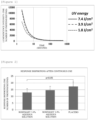
- Figure 1 shows the measurement results. It was confirmed that the amount of biophotons by the UV irradiation from the skin reached a maximum immediately after the UV irradiation, then rapidly decreased, and gradually decreased with time after a certain amount of decrease.
- Test Example 2 Measurement of weak luminescence and evaluation of erythema in human (1)
- erythema formation in each UV-irradiated site was evaluated as the redness difference ( ⁇ a*) between the irradiation site and the non-irradiation site in the vicinity of the irradiation site by measuring the skin color 24 hours after the irradiation using a highspeed spectrophotometer (CMS-35FS, available from MURAKAMI COLOR RESEARCH LABORATORY). Table 1 shows the results.
- the UV irradiation and detection of weak luminescence intensity were performed by the same procedure using the same device as in Test Example 1.
- the test subject was 10 healthy males in their 20s to 30s, and the attachment of the detection unit of the device was brought into close contact with an upper inner arm in the sitting position.
- the luminescence intensity when stable was measured for 3 minutes before the UV irradiation.
- UV irradiation was performed, and the luminescence intensity 2 seconds after the completion of the irradiation was measured for 5 minutes.
- a value obtained by subtracting the luminescence when stable from an average luminescence during each time period was calculated as a luminescence increment by the UV irradiation.
- the UV irradiation and subsequent measurement of weak luminescence were performed under multiple UV irradiation conditions with the irradiation site varied. Table 3 shows specific irradiation conditions and the measurement results.
- erythema formation in the UV-irradiated site was evaluated as the redness difference ( ⁇ a*) in the same manner as in Test Example 2, and Table 3 shows the results.
- the sensitivity related to inflammatory reactions typified by erythema formation by ultraviolet light can be determined using the amount of biophotons to be detected mainly within a period of from 1 to 3 minutes after the UV irradiation as an index.
- Test subject 10 healthy adult Japanese males
- the symbol * represents the concentration of Pharcolex rosemary E (available from ICHIMARU PHARCOS Co., Ltd.) in each aqueous solution that behaves as a test item.
- the response biophotons were calculated by measuring stationary biophotons and biophotons after the irradiation shown below and subtracting the measured value of the stationary biophotons from the measured value of the biophotons after the irradiation during the period of from 1 to 3 minutes after the completion of the photoirradiation.
- a significance test was conducted as statistical analysis by one-way analysis of variance and Bonferroni's multiple comparison.
- the weak luminescence at each test site before the UV irradiation was measured for 1 minute using a weak luminescence intensity detector (CLA-IDFsk, available from Tohoku Electronic Industrial CO., Ltd).
- test site was irradiated with 1430-mJ/cm 2 ultraviolet light (the same wavelength range as sunlight) using the same UV irradiation device as in Test Example 1, and the weak luminescence of each test site from immediately after the UV irradiation to 3 minutes after the UV irradiation was measured using the weak luminescence intensity detector.
- test sites were set in a 5-cm square (5 ⁇ 5 cm). After habituation in a dark room for 10 minutes, biophotons were measured. Each test item was applied to each of the 3 test sites at 2 mg/cm 2 twice per day (morning and evening) for 4 weeks from the evening of the measurement date. After continuous use, biophotons were measured by the same procedure as before continuous use.
- Figure 2 shows the values of response biophotons after continuous use. As a result of comparison with placebo, a significant reduction was observed in the rosemary 3.0% aqueous solution. It is known that preliminary application of an extract of rosemary suppresses erythema formation by UV irradiation ( JP-A-2002-87975 ).
- Test Example 5 Evaluation of UV sensitivity-reducing agent (evaluation using cultured cells)
- the cells were cultured in a growth medium for epidermal keratinocytes (EpiLife, LifeTechnologies) containing a growth additive (HuMedia-KG, available from KURABO INDUSTRIES LTD.) under conditions of 37°C and 5% CO 2 according to a conventional method.
- a cell suspension obtained by suspending cells which were washed with Hank's Balanced Salt Solutions (HBSS, Invitrogen) and then collected, in HBSS at 4 ⁇ 10 6 cells/ml was subjected to the measurement of the weak luminescence.
- HBSS Hank's Balanced Salt Solutions
- the response biophotons were calculated by measuring stationary biophotons and biophotons after the irradiation shown below and subtracting the measured value of the stationary biophotons from the measured value of the biophotons after the irradiation during the period of from 2 to 3 minutes after the completion of the photoirradiation.
- the biophoton measurement and the UV irradiation were performed under conditions with the cover of a dish detached.
- Trolox final concentration of 100 ⁇ M or a control solvent (70% ethanol) was added to normal human epidermal keratinocytes in a 70 to 80% confluent state. 24 hours later, the cells were collected, and response biophotons were measured based on the aforementioned method. The measurement data was relatively evaluated with the value of the control solvent group taken as 1.
- Test Example 6 Evaluation of UV sensitivity-reducing agent (evaluation using tissue culture skin)
- the human skin tissue was cut with a knife into small pieces having a size of about 1 cm ⁇ 1 cm and was cultured under conditions of 37°C and 5% CO 2 using a 6-well plate.
- Advanced Dulbecco's Modified Eagle Medium containing 10% (v/v) Fetal Bovine Serum (FBS) both available from Life Technologies was used for the culture.
- Biophotons were calculated by measuring stationary biophotons and biophotons after the irradiation shown below and subtracting the measured value of the stationary biophotons from the measured value of the biophotons after the irradiation during the period of from 1 to 3 minutes after the completion of the photoirradiation.
- the biophoton measurement and the UV irradiation were performed under conditions in which the skin tissue had been taken out of the culture solution.
- the luminescence intensity before the irradiation with solar UV simulator light was measured in a dark room for 3 minutes using a weak luminescence intensity detector (CLA-IDFsk, available from Tohoku Electronic Industrial CO., Ltd).
- Trolox final concentration of 100 ⁇ M or the control solvent (70% ethanol) was added to the culture medium including the cultured human skin tissue one day after the culture. 24 hours later, the skin tissue was washed with PBS and then subjected to the measurement of response biophotons based on the aforementioned method. The measurement data was relatively evaluated with the value of the control solvent group taken as 1.
Landscapes
- Health & Medical Sciences (AREA)
- Life Sciences & Earth Sciences (AREA)
- Physics & Mathematics (AREA)
- Engineering & Computer Science (AREA)
- Chemical & Material Sciences (AREA)
- Immunology (AREA)
- Pathology (AREA)
- General Health & Medical Sciences (AREA)
- Biomedical Technology (AREA)
- Biochemistry (AREA)
- Analytical Chemistry (AREA)
- General Physics & Mathematics (AREA)
- Molecular Biology (AREA)
- Hematology (AREA)
- Urology & Nephrology (AREA)
- Spectroscopy & Molecular Physics (AREA)
- Cell Biology (AREA)
- Plasma & Fusion (AREA)
- Chemical Kinetics & Catalysis (AREA)
- Medicinal Chemistry (AREA)
- Veterinary Medicine (AREA)
- Surgery (AREA)
- Microbiology (AREA)
- Biotechnology (AREA)
- Medical Informatics (AREA)
- Food Science & Technology (AREA)
- Public Health (AREA)
- Heart & Thoracic Surgery (AREA)
- Biophysics (AREA)
- Animal Behavior & Ethology (AREA)
- Nuclear Medicine, Radiotherapy & Molecular Imaging (AREA)
- Toxicology (AREA)
- Tropical Medicine & Parasitology (AREA)
- Proteomics, Peptides & Aminoacids (AREA)
- Bioinformatics & Cheminformatics (AREA)
- Dermatology (AREA)
- Investigating Or Analysing Biological Materials (AREA)
- Measuring Or Testing Involving Enzymes Or Micro-Organisms (AREA)
- Investigating Or Analysing Materials By The Use Of Chemical Reactions (AREA)
- Investigating, Analyzing Materials By Fluorescence Or Luminescence (AREA)
Claims (13)
- Verfahren zum Bewerten oder Suchen nach einer Menge eines biophotonenreduzierenden Mittels, das aufweist einen Schritt des Verabreichens einer Testsubstanz, die das Mittel aufweist, an ein Versuchsobjekt oder des In-Kontakt-Bringens der Testsubstanz, die das Mittel aufweist, mit dem Versuchsobjekt; einen Schritt des Bestrahlens der Haut oder der Hautzellen des Versuchsobjekts mit ultraviolettem Licht, des Erfassens einer Menge an Biophotonen innerhalb einer spezifischen Zeitspanne nach der Bestrahlung, und dann einen Schritt des Auswertens der Testsubstanz unter Verwendung der Menge an Biophotonen, die innerhalb der spezifischen Zeitspanne nach der Bestrahlung erfasst wurde,
dadurch gekennzeichnet, dass
90 % oder mehr der spezifischen Zeitspanne eine Zeitspanne von 1 bis 3 Minuten nach der Bestrahlung überlappen. - Verfahren nach Anspruch 1, wobei das Versuchsobjekt ein Mensch, kultivierte Epidermiszellen, ein 3D-Hautmodell oder ein kultiviertes Hautgewebe ist.
- Verfahren nach Anspruch 1 oder 2, wobei die Verabreichung der Testsubstanz an das Versuchsobjekt oder der Kontakt der Testsubstanz mit dem Versuchsobjekt mit einer bestimmten Häufigkeit von einmal oder mehrmals innerhalb eines bestimmten Verabreichungs- oder Kontaktzeitraums vor der UV-Bestrahlung durchgeführt wird.
- Verfahren nach einem der Ansprüche 1 bis 3, wobei die Verabreichung der Testsubstanz an das Versuchsobj ekt während eines Verabreichungszeitraums von einem Tag oder mehr und 6 Monaten oder weniger mit einer Verabreichungshäufigkeit von einmal oder mehr pro Tag durchgeführt wird.
- Verfahren nach einem der Ansprüche 1 bis 4, wobei der Kontakt der Testsubstanz mit den kultivierten Epidermiszellen, dem 3D-Hautmodell oder dem kultivierten Hautgewebe während eines Kontaktzeitraums von 1 Stunde oder mehr und 72 Stunden oder weniger mit einer Kontakthäufigkeit von einmal oder mehr während des Kontaktzeitraums durchgeführt wird.
- Verfahren nach einem der Ansprüche 1 bis 5, wobei die Mengen an Biophotonen zwischen einer Gruppe, der eine Testsubstanz in höherer Konzentration verabreicht wurde, und einer Gruppe, der eine Testsubstanz in niedrigerer Konzentration verabreicht wurde, zwischen einer Gruppe, der eine Testsubstanz verabreicht wurde, und einer Gruppe, der ein Placebo verabreicht wurde, zwischen einer Gruppe, der eine Testsubstanz verabreicht wurde, und einer Gruppe, der keine Testsubstanz verabreicht wurde, oder zwischen vor und nach der Verabreichung jeder Testsubstanz verglichen werden.
- Verfahren nach Anspruch 1, wobei die spezifische Zeitspanne eine Länge von 30 Sekunden bis 2 Minuten aufweist.
- Verfahren nach Anspruch 1, wobei die spezifische Zeitspanne eine Länge von 50 Sekunden bis 1 Minute und 30 Sekunden aufweist.
- Verfahren nach Anspruch 1 oder 7, wobei die spezifischen Zeitspanne 1 Minute von 1 bis 2 Minuten nach der UV-Bestrahlung, 1 Minute von 2 bis 3 Minuten nach der UV-Bestrahlung oder 2 Minuten von 1 bis 3 Minuten nach der UV-Bestrahlung beträgt.
- Verfahren nach einem der Ansprüche 1 bis 9, wobei die UV-Bestrahlung eine Bestrahlung mit gemischtem ultraviolettem Licht aus A- und B-Strahlung ist.
- Verfahren nach einem der Ansprüche 1 bis 10, wobei die UV-Bestrahlung mit einer UV-Bestrahlungsdosis von 300 bis 8000 mJ/cm2 durchgeführt wird.
- Verfahren nach einem der Ansprüche 1 bis 11, wobei die Menge der Biophotonen basierend auf der Lumineszenzintensität der Biophotonen berechnet wird.
- Verfahren nach einem der Ansprüche 1 bis 12, wobei eine UV-Empfindlichkeit die Bildung eines Erythems durch ultraviolettes Licht ist.
Applications Claiming Priority (2)
| Application Number | Priority Date | Filing Date | Title |
|---|---|---|---|
| JP2017254004 | 2017-12-28 | ||
| PCT/JP2018/048519 WO2019132014A1 (ja) | 2017-12-28 | 2018-12-28 | 紫外線感受性の判定方法 |
Publications (3)
| Publication Number | Publication Date |
|---|---|
| EP3733076A1 EP3733076A1 (de) | 2020-11-04 |
| EP3733076A4 EP3733076A4 (de) | 2021-08-25 |
| EP3733076B1 true EP3733076B1 (de) | 2024-08-28 |
Family
ID=67063862
Family Applications (1)
| Application Number | Title | Priority Date | Filing Date |
|---|---|---|---|
| EP18895200.6A Active EP3733076B1 (de) | 2017-12-28 | 2018-12-28 | Verfahren zur bestimmung der uv-lichtempfindlichkeit |
Country Status (6)
| Country | Link |
|---|---|
| US (1) | US11486830B2 (de) |
| EP (1) | EP3733076B1 (de) |
| JP (1) | JP7125341B2 (de) |
| CN (1) | CN111511289B (de) |
| SG (1) | SG11202005980SA (de) |
| WO (1) | WO2019132014A1 (de) |
Families Citing this family (2)
| Publication number | Priority date | Publication date | Assignee | Title |
|---|---|---|---|---|
| JP7214679B2 (ja) * | 2019-04-03 | 2023-01-30 | 花王株式会社 | 肌ダメージの判定方法 |
| CN112641429A (zh) * | 2020-12-24 | 2021-04-13 | 上海百雀羚生物科技有限公司 | 一种抗氧化效能的检测方法 |
Family Cites Families (22)
| Publication number | Priority date | Publication date | Assignee | Title |
|---|---|---|---|---|
| US4423736A (en) * | 1981-10-13 | 1984-01-03 | Purdue Research Foundation | Method for evaluation of erythema utilizing skin reflectance measurements |
| JPH0666784A (ja) * | 1992-08-19 | 1994-03-11 | Nippon Nousan Kogyo Kk | 紫外線照射試験法 |
| JPH11146866A (ja) * | 1997-11-18 | 1999-06-02 | Pola Chem Ind Inc | 紫外線の影響を考慮した肌の分類法 |
| EP1126271A1 (de) * | 2000-02-14 | 2001-08-22 | Fritz-Albert Dr.rer.nat.habil. Visiting Professor Popp (mult.) | Verfahren und Vorrichtung zur Bestimmung der Malignität von Tumorgewebe und zur Auswahl von Substanzen, die das Gewebe günstig beeinflussen |
| JP2004506676A (ja) * | 2000-08-18 | 2004-03-04 | ビトプ アクチェンゲゼルシャフト フューア ビオテヒニシェ オプティミールング | 化粧品用調合物 |
| JP2002087975A (ja) | 2000-09-13 | 2002-03-27 | Pias Arise Kk | 一酸化窒素産生抑制剤及び、その一酸化窒素産生抑制剤を配合した皮膚外用剤、化粧料、医薬部外品 |
| DE10147701A1 (de) * | 2001-09-27 | 2003-04-10 | Buehler Ag | Verfahren zur Prüfung geringster Qualitätsunterschiede von Biologischen Geweben |
| KR100836491B1 (ko) | 2002-12-17 | 2008-06-09 | (주)아모레퍼시픽 | 생체광자의 측정을 통한 기능성 화장품의 제조방법 및효능검증방법 및 그 방법에 의해 제조되거나 검증된화장품 조성물 |
| DE10319043A1 (de) | 2003-04-25 | 2004-11-11 | Popp, Fritz Albert, Prof. Dr. habil. | Verfahren zur Prüfung externer Einflüsse auf biologische Gewebe |
| US20050100537A1 (en) * | 2003-11-10 | 2005-05-12 | Evans Gregory S. | Methods and kits for reducing cellular damage, inhibiting free radical production, and scavenging free radicals in mammals |
| DE102004041270A1 (de) * | 2004-08-26 | 2006-03-02 | Merz Pharma Gmbh & Co. Kgaa | Ein Kapillar- Wirksystem enthaltende Zusammensetzungen mit anwendungsbezogener Differenzierbarkeit und deren Verwendung |
| CN101151378B (zh) * | 2005-03-30 | 2013-04-03 | 奥林巴斯株式会社 | 规定部位发光量测定方法、规定部位发光量测定装置、表达量测定方法及测定装置 |
| JP5198037B2 (ja) * | 2007-11-02 | 2013-05-15 | 株式会社 資生堂 | 皮膚外用剤の有効性評価方法、有効性評価装置、及び有効性評価プログラム |
| AU2012296551B2 (en) * | 2011-08-15 | 2014-12-11 | TSI (USA), Inc. | Localized physiologic status from luminosity around fingertip or toe |
| US20130237847A1 (en) * | 2012-03-12 | 2013-09-12 | Ivwatch, Llc | Geometry of a Transcutaneous Sensor |
| US20140276354A1 (en) * | 2013-03-14 | 2014-09-18 | Klox Technologies Inc. | Biophotonic materials and uses thereof |
| CN104374696A (zh) * | 2013-08-15 | 2015-02-25 | 中国医学科学院北京协和医院 | 一种化妆品光敏测试方法 |
| JP6390119B2 (ja) * | 2014-03-06 | 2018-09-19 | 富士通株式会社 | センサユニット、並びに分析装置、及び分析方法 |
| JP7316745B2 (ja) * | 2016-05-20 | 2023-07-28 | 株式会社リコー | 三次元組織体 |
| CN107064038A (zh) * | 2017-04-10 | 2017-08-18 | 杭州紫元科技有限公司 | 一种紫外线辐射对皮肤影响的监测方法及装置 |
| JP7214679B2 (ja) | 2019-04-03 | 2023-01-30 | 花王株式会社 | 肌ダメージの判定方法 |
| JP7239400B2 (ja) | 2019-06-25 | 2023-03-14 | 花王株式会社 | 皮膚抗酸化能の判定方法 |
-
2018
- 2018-12-28 EP EP18895200.6A patent/EP3733076B1/de active Active
- 2018-12-28 US US16/958,354 patent/US11486830B2/en active Active
- 2018-12-28 SG SG11202005980SA patent/SG11202005980SA/en unknown
- 2018-12-28 CN CN201880082942.5A patent/CN111511289B/zh active Active
- 2018-12-28 JP JP2018247729A patent/JP7125341B2/ja active Active
- 2018-12-28 WO PCT/JP2018/048519 patent/WO2019132014A1/ja not_active Ceased
Also Published As
| Publication number | Publication date |
|---|---|
| US11486830B2 (en) | 2022-11-01 |
| CN111511289B (zh) | 2023-05-30 |
| JP2019120704A (ja) | 2019-07-22 |
| US20200393380A1 (en) | 2020-12-17 |
| WO2019132014A1 (ja) | 2019-07-04 |
| EP3733076A4 (de) | 2021-08-25 |
| EP3733076A1 (de) | 2020-11-04 |
| CN111511289A (zh) | 2020-08-07 |
| SG11202005980SA (en) | 2020-07-29 |
| JP7125341B2 (ja) | 2022-08-24 |
Similar Documents
| Publication | Publication Date | Title |
|---|---|---|
| Randhawa et al. | Visible light induces melanogenesis in human skin through a photoadaptive response | |
| US9750449B2 (en) | Method of assessing skin | |
| Knuschke | Sun exposure and vitamin D | |
| Narayanan et al. | Scavenging properties of metronidazole on free oxygen radicals in a skin lipid model system | |
| Pescia et al. | On the assessment of photostability of sunscreens exposed to UVA irradiation: from glass plates to pig/human skin, which is best? | |
| Ou-Yang | The application of ultra-weak photon emission in dermatology | |
| EP3733076B1 (de) | Verfahren zur bestimmung der uv-lichtempfindlichkeit | |
| JP2003502372A (ja) | 創傷治癒および光傷害の防止におけるニトロキシドの使用 | |
| Di Domenico et al. | Protective effect of ferulic acid ethyl ester against oxidative stress mediated by UVB irradiation in human epidermal melanocytes | |
| Alonso et al. | An ex vivo methodology to assess the lipid peroxidation in stratum corneum | |
| JP7214679B2 (ja) | 肌ダメージの判定方法 | |
| HÖNIGSMANN et al. | Unscheduled DNA synthesis in normal human skin after single and combined doses of V‐A, UV‐B and UV‐A with methoxsalen (PUVA) | |
| Jain et al. | Antioxidant efficacy on human skin in vivo investigated by UVA-induced chemiluminescence decay analysis via induced chemiluminescence of human skin | |
| Okano et al. | Pentosidine in advanced glycation end-products (AGEs) during UVA irradiation generates active oxygen species and impairs human dermal fibroblasts | |
| Matsumoto et al. | Effects of low-dose X-ray irradiation on melanin-derived radicals in mouse hair and skin | |
| CN115501128B (zh) | 一种用于肌肤调节、美白提亮的组合物以及精华乳 | |
| Goralczyk et al. | Skin photoprotection by carotenoids | |
| KR20170062222A (ko) | 피부 개선 조성물 | |
| Kim et al. | Chemical stability and in vitro and clinical efficacy of a novel hybrid retinoid derivative, bis-retinamido methylpentane | |
| Gabe et al. | Exploitation of long‐lasting ultraweak photon emission to estimate skin photodamage after ultraviolet exposure | |
| JP7239400B2 (ja) | 皮膚抗酸化能の判定方法 | |
| CN113143784A (zh) | Fto抑制剂在制备皮肤保护及修复产品中的新应用 | |
| Forbes et al. | Photocarcinogenesis | |
| Rowny et al. | 569 Wide spectrum photoprotection in skin with acne, rosacea and after aesthetic treatments | |
| Lee et al. | 566 Late perifollicular repigmentation associated with poliosis |
Legal Events
| Date | Code | Title | Description |
|---|---|---|---|
| STAA | Information on the status of an ep patent application or granted ep patent |
Free format text: STATUS: THE INTERNATIONAL PUBLICATION HAS BEEN MADE |
|
| PUAI | Public reference made under article 153(3) epc to a published international application that has entered the european phase |
Free format text: ORIGINAL CODE: 0009012 |
|
| STAA | Information on the status of an ep patent application or granted ep patent |
Free format text: STATUS: REQUEST FOR EXAMINATION WAS MADE |
|
| 17P | Request for examination filed |
Effective date: 20200628 |
|
| AK | Designated contracting states |
Kind code of ref document: A1 Designated state(s): AL AT BE BG CH CY CZ DE DK EE ES FI FR GB GR HR HU IE IS IT LI LT LU LV MC MK MT NL NO PL PT RO RS SE SI SK SM TR |
|
| AX | Request for extension of the european patent |
Extension state: BA ME |
|
| DAV | Request for validation of the european patent (deleted) | ||
| DAX | Request for extension of the european patent (deleted) | ||
| A4 | Supplementary search report drawn up and despatched |
Effective date: 20210727 |
|
| RIC1 | Information provided on ipc code assigned before grant |
Ipc: A61B 10/00 20060101AFI20210721BHEP Ipc: A61B 5/00 20060101ALI20210721BHEP Ipc: C12Q 1/02 20060101ALI20210721BHEP Ipc: G01N 21/76 20060101ALI20210721BHEP Ipc: G01N 33/15 20060101ALI20210721BHEP Ipc: G01N 33/50 20060101ALI20210721BHEP Ipc: G01N 21/64 20060101ALN20210721BHEP |
|
| STAA | Information on the status of an ep patent application or granted ep patent |
Free format text: STATUS: EXAMINATION IS IN PROGRESS |
|
| 17Q | First examination report despatched |
Effective date: 20220428 |
|
| REG | Reference to a national code |
Ref country code: DE Ref legal event code: R079 Free format text: PREVIOUS MAIN CLASS: A61B0010000000 Ipc: G01N0021760000 Ref country code: DE Ref legal event code: R079 Ref document number: 602018073799 Country of ref document: DE Free format text: PREVIOUS MAIN CLASS: A61B0010000000 Ipc: G01N0021760000 |
|
| GRAP | Despatch of communication of intention to grant a patent |
Free format text: ORIGINAL CODE: EPIDOSNIGR1 |
|
| STAA | Information on the status of an ep patent application or granted ep patent |
Free format text: STATUS: GRANT OF PATENT IS INTENDED |
|
| RIC1 | Information provided on ipc code assigned before grant |
Ipc: G01N 33/15 20060101ALN20240508BHEP Ipc: G01N 21/64 20060101ALN20240508BHEP Ipc: G01N 33/68 20060101ALI20240508BHEP Ipc: G01N 33/50 20060101ALI20240508BHEP Ipc: C12Q 1/02 20060101ALI20240508BHEP Ipc: A61B 5/00 20060101ALI20240508BHEP Ipc: A61B 10/00 20060101ALI20240508BHEP Ipc: G01N 21/76 20060101AFI20240508BHEP |
|
| GRAJ | Information related to disapproval of communication of intention to grant by the applicant or resumption of examination proceedings by the epo deleted |
Free format text: ORIGINAL CODE: EPIDOSDIGR1 |
|
| STAA | Information on the status of an ep patent application or granted ep patent |
Free format text: STATUS: EXAMINATION IS IN PROGRESS |
|
| INTG | Intention to grant announced |
Effective date: 20240528 |
|
| GRAP | Despatch of communication of intention to grant a patent |
Free format text: ORIGINAL CODE: EPIDOSNIGR1 |
|
| STAA | Information on the status of an ep patent application or granted ep patent |
Free format text: STATUS: GRANT OF PATENT IS INTENDED |
|
| GRAS | Grant fee paid |
Free format text: ORIGINAL CODE: EPIDOSNIGR3 |
|
| GRAA | (expected) grant |
Free format text: ORIGINAL CODE: 0009210 |
|
| STAA | Information on the status of an ep patent application or granted ep patent |
Free format text: STATUS: THE PATENT HAS BEEN GRANTED |
|
| INTC | Intention to grant announced (deleted) | ||
| P01 | Opt-out of the competence of the unified patent court (upc) registered |
Free format text: CASE NUMBER: APP_37634/2024 Effective date: 20240624 |
|
| RAP3 | Party data changed (applicant data changed or rights of an application transferred) |
Owner name: KAO CORPORATION |
|
| INTG | Intention to grant announced |
Effective date: 20240716 |
|
| RIC1 | Information provided on ipc code assigned before grant |
Ipc: G01N 33/15 20060101ALN20240705BHEP Ipc: G01N 21/64 20060101ALN20240705BHEP Ipc: G01N 33/68 20060101ALI20240705BHEP Ipc: G01N 33/50 20060101ALI20240705BHEP Ipc: C12Q 1/02 20060101ALI20240705BHEP Ipc: A61B 5/00 20060101ALI20240705BHEP Ipc: A61B 10/00 20060101ALI20240705BHEP Ipc: G01N 21/76 20060101AFI20240705BHEP |
|
| AK | Designated contracting states |
Kind code of ref document: B1 Designated state(s): AL AT BE BG CH CY CZ DE DK EE ES FI FR GB GR HR HU IE IS IT LI LT LU LV MC MK MT NL NO PL PT RO RS SE SI SK SM TR |
|
| REG | Reference to a national code |
Ref country code: GB Ref legal event code: FG4D |
|
| REG | Reference to a national code |
Ref country code: CH Ref legal event code: EP |
|
| REG | Reference to a national code |
Ref country code: DE Ref legal event code: R096 Ref document number: 602018073799 Country of ref document: DE |
|
| REG | Reference to a national code |
Ref country code: IE Ref legal event code: FG4D |
|
| REG | Reference to a national code |
Ref country code: LT Ref legal event code: MG9D |
|
| PG25 | Lapsed in a contracting state [announced via postgrant information from national office to epo] |
Ref country code: NO Free format text: LAPSE BECAUSE OF FAILURE TO SUBMIT A TRANSLATION OF THE DESCRIPTION OR TO PAY THE FEE WITHIN THE PRESCRIBED TIME-LIMIT Effective date: 20241128 |
|
| REG | Reference to a national code |
Ref country code: AT Ref legal event code: MK05 Ref document number: 1718464 Country of ref document: AT Kind code of ref document: T Effective date: 20240828 |
|
| PG25 | Lapsed in a contracting state [announced via postgrant information from national office to epo] |
Ref country code: NL Free format text: LAPSE BECAUSE OF FAILURE TO SUBMIT A TRANSLATION OF THE DESCRIPTION OR TO PAY THE FEE WITHIN THE PRESCRIBED TIME-LIMIT Effective date: 20240828 Ref country code: FI Free format text: LAPSE BECAUSE OF FAILURE TO SUBMIT A TRANSLATION OF THE DESCRIPTION OR TO PAY THE FEE WITHIN THE PRESCRIBED TIME-LIMIT Effective date: 20240828 Ref country code: PT Free format text: LAPSE BECAUSE OF FAILURE TO SUBMIT A TRANSLATION OF THE DESCRIPTION OR TO PAY THE FEE WITHIN THE PRESCRIBED TIME-LIMIT Effective date: 20241230 Ref country code: PL Free format text: LAPSE BECAUSE OF FAILURE TO SUBMIT A TRANSLATION OF THE DESCRIPTION OR TO PAY THE FEE WITHIN THE PRESCRIBED TIME-LIMIT Effective date: 20240828 Ref country code: GR Free format text: LAPSE BECAUSE OF FAILURE TO SUBMIT A TRANSLATION OF THE DESCRIPTION OR TO PAY THE FEE WITHIN THE PRESCRIBED TIME-LIMIT Effective date: 20241129 |
|
| PG25 | Lapsed in a contracting state [announced via postgrant information from national office to epo] |
Ref country code: BG Free format text: LAPSE BECAUSE OF FAILURE TO SUBMIT A TRANSLATION OF THE DESCRIPTION OR TO PAY THE FEE WITHIN THE PRESCRIBED TIME-LIMIT Effective date: 20240828 |
|
| PG25 | Lapsed in a contracting state [announced via postgrant information from national office to epo] |
Ref country code: LV Free format text: LAPSE BECAUSE OF FAILURE TO SUBMIT A TRANSLATION OF THE DESCRIPTION OR TO PAY THE FEE WITHIN THE PRESCRIBED TIME-LIMIT Effective date: 20240828 |
|
| REG | Reference to a national code |
Ref country code: NL Ref legal event code: MP Effective date: 20240828 |
|
| PG25 | Lapsed in a contracting state [announced via postgrant information from national office to epo] |
Ref country code: IS Free format text: LAPSE BECAUSE OF FAILURE TO SUBMIT A TRANSLATION OF THE DESCRIPTION OR TO PAY THE FEE WITHIN THE PRESCRIBED TIME-LIMIT Effective date: 20241228 Ref country code: AT Free format text: LAPSE BECAUSE OF FAILURE TO SUBMIT A TRANSLATION OF THE DESCRIPTION OR TO PAY THE FEE WITHIN THE PRESCRIBED TIME-LIMIT Effective date: 20240828 |
|
| PG25 | Lapsed in a contracting state [announced via postgrant information from national office to epo] |
Ref country code: HR Free format text: LAPSE BECAUSE OF FAILURE TO SUBMIT A TRANSLATION OF THE DESCRIPTION OR TO PAY THE FEE WITHIN THE PRESCRIBED TIME-LIMIT Effective date: 20240828 |
|
| PG25 | Lapsed in a contracting state [announced via postgrant information from national office to epo] |
Ref country code: ES Free format text: LAPSE BECAUSE OF FAILURE TO SUBMIT A TRANSLATION OF THE DESCRIPTION OR TO PAY THE FEE WITHIN THE PRESCRIBED TIME-LIMIT Effective date: 20240828 Ref country code: RS Free format text: LAPSE BECAUSE OF FAILURE TO SUBMIT A TRANSLATION OF THE DESCRIPTION OR TO PAY THE FEE WITHIN THE PRESCRIBED TIME-LIMIT Effective date: 20241128 |
|
| PG25 | Lapsed in a contracting state [announced via postgrant information from national office to epo] |
Ref country code: RS Free format text: LAPSE BECAUSE OF FAILURE TO SUBMIT A TRANSLATION OF THE DESCRIPTION OR TO PAY THE FEE WITHIN THE PRESCRIBED TIME-LIMIT Effective date: 20241128 Ref country code: PT Free format text: LAPSE BECAUSE OF FAILURE TO SUBMIT A TRANSLATION OF THE DESCRIPTION OR TO PAY THE FEE WITHIN THE PRESCRIBED TIME-LIMIT Effective date: 20241230 Ref country code: PL Free format text: LAPSE BECAUSE OF FAILURE TO SUBMIT A TRANSLATION OF THE DESCRIPTION OR TO PAY THE FEE WITHIN THE PRESCRIBED TIME-LIMIT Effective date: 20240828 Ref country code: NO Free format text: LAPSE BECAUSE OF FAILURE TO SUBMIT A TRANSLATION OF THE DESCRIPTION OR TO PAY THE FEE WITHIN THE PRESCRIBED TIME-LIMIT Effective date: 20241128 Ref country code: NL Free format text: LAPSE BECAUSE OF FAILURE TO SUBMIT A TRANSLATION OF THE DESCRIPTION OR TO PAY THE FEE WITHIN THE PRESCRIBED TIME-LIMIT Effective date: 20240828 Ref country code: LV Free format text: LAPSE BECAUSE OF FAILURE TO SUBMIT A TRANSLATION OF THE DESCRIPTION OR TO PAY THE FEE WITHIN THE PRESCRIBED TIME-LIMIT Effective date: 20240828 Ref country code: IS Free format text: LAPSE BECAUSE OF FAILURE TO SUBMIT A TRANSLATION OF THE DESCRIPTION OR TO PAY THE FEE WITHIN THE PRESCRIBED TIME-LIMIT Effective date: 20241228 Ref country code: HR Free format text: LAPSE BECAUSE OF FAILURE TO SUBMIT A TRANSLATION OF THE DESCRIPTION OR TO PAY THE FEE WITHIN THE PRESCRIBED TIME-LIMIT Effective date: 20240828 Ref country code: GR Free format text: LAPSE BECAUSE OF FAILURE TO SUBMIT A TRANSLATION OF THE DESCRIPTION OR TO PAY THE FEE WITHIN THE PRESCRIBED TIME-LIMIT Effective date: 20241129 Ref country code: FI Free format text: LAPSE BECAUSE OF FAILURE TO SUBMIT A TRANSLATION OF THE DESCRIPTION OR TO PAY THE FEE WITHIN THE PRESCRIBED TIME-LIMIT Effective date: 20240828 Ref country code: ES Free format text: LAPSE BECAUSE OF FAILURE TO SUBMIT A TRANSLATION OF THE DESCRIPTION OR TO PAY THE FEE WITHIN THE PRESCRIBED TIME-LIMIT Effective date: 20240828 Ref country code: BG Free format text: LAPSE BECAUSE OF FAILURE TO SUBMIT A TRANSLATION OF THE DESCRIPTION OR TO PAY THE FEE WITHIN THE PRESCRIBED TIME-LIMIT Effective date: 20240828 Ref country code: AT Free format text: LAPSE BECAUSE OF FAILURE TO SUBMIT A TRANSLATION OF THE DESCRIPTION OR TO PAY THE FEE WITHIN THE PRESCRIBED TIME-LIMIT Effective date: 20240828 |
|
| PG25 | Lapsed in a contracting state [announced via postgrant information from national office to epo] |
Ref country code: SM Free format text: LAPSE BECAUSE OF FAILURE TO SUBMIT A TRANSLATION OF THE DESCRIPTION OR TO PAY THE FEE WITHIN THE PRESCRIBED TIME-LIMIT Effective date: 20240828 Ref country code: DK Free format text: LAPSE BECAUSE OF FAILURE TO SUBMIT A TRANSLATION OF THE DESCRIPTION OR TO PAY THE FEE WITHIN THE PRESCRIBED TIME-LIMIT Effective date: 20240828 Ref country code: RO Free format text: LAPSE BECAUSE OF FAILURE TO SUBMIT A TRANSLATION OF THE DESCRIPTION OR TO PAY THE FEE WITHIN THE PRESCRIBED TIME-LIMIT Effective date: 20240828 |
|
| PG25 | Lapsed in a contracting state [announced via postgrant information from national office to epo] |
Ref country code: EE Free format text: LAPSE BECAUSE OF FAILURE TO SUBMIT A TRANSLATION OF THE DESCRIPTION OR TO PAY THE FEE WITHIN THE PRESCRIBED TIME-LIMIT Effective date: 20240828 |
|
| PG25 | Lapsed in a contracting state [announced via postgrant information from national office to epo] |
Ref country code: CZ Free format text: LAPSE BECAUSE OF FAILURE TO SUBMIT A TRANSLATION OF THE DESCRIPTION OR TO PAY THE FEE WITHIN THE PRESCRIBED TIME-LIMIT Effective date: 20240828 |
|
| PG25 | Lapsed in a contracting state [announced via postgrant information from national office to epo] |
Ref country code: SK Free format text: LAPSE BECAUSE OF FAILURE TO SUBMIT A TRANSLATION OF THE DESCRIPTION OR TO PAY THE FEE WITHIN THE PRESCRIBED TIME-LIMIT Effective date: 20240828 Ref country code: IT Free format text: LAPSE BECAUSE OF FAILURE TO SUBMIT A TRANSLATION OF THE DESCRIPTION OR TO PAY THE FEE WITHIN THE PRESCRIBED TIME-LIMIT Effective date: 20240828 |
|
| REG | Reference to a national code |
Ref country code: DE Ref legal event code: R097 Ref document number: 602018073799 Country of ref document: DE |
|
| PLBE | No opposition filed within time limit |
Free format text: ORIGINAL CODE: 0009261 |
|
| STAA | Information on the status of an ep patent application or granted ep patent |
Free format text: STATUS: NO OPPOSITION FILED WITHIN TIME LIMIT |
|
| PG25 | Lapsed in a contracting state [announced via postgrant information from national office to epo] |
Ref country code: MC Free format text: LAPSE BECAUSE OF FAILURE TO SUBMIT A TRANSLATION OF THE DESCRIPTION OR TO PAY THE FEE WITHIN THE PRESCRIBED TIME-LIMIT Effective date: 20240828 |
|
| REG | Reference to a national code |
Ref country code: CH Ref legal event code: PL |
|
| 26N | No opposition filed |
Effective date: 20250530 |
|
| PG25 | Lapsed in a contracting state [announced via postgrant information from national office to epo] |
Ref country code: LU Free format text: LAPSE BECAUSE OF NON-PAYMENT OF DUE FEES Effective date: 20241228 |
|
| GBPC | Gb: european patent ceased through non-payment of renewal fee |
Effective date: 20241228 |
|
| PG25 | Lapsed in a contracting state [announced via postgrant information from national office to epo] |
Ref country code: SE Free format text: LAPSE BECAUSE OF FAILURE TO SUBMIT A TRANSLATION OF THE DESCRIPTION OR TO PAY THE FEE WITHIN THE PRESCRIBED TIME-LIMIT Effective date: 20240828 |
|
| REG | Reference to a national code |
Ref country code: BE Ref legal event code: MM Effective date: 20241231 |
|
| PG25 | Lapsed in a contracting state [announced via postgrant information from national office to epo] |
Ref country code: GB Free format text: LAPSE BECAUSE OF NON-PAYMENT OF DUE FEES Effective date: 20241228 Ref country code: BE Free format text: LAPSE BECAUSE OF NON-PAYMENT OF DUE FEES Effective date: 20241231 |
|
| PG25 | Lapsed in a contracting state [announced via postgrant information from national office to epo] |
Ref country code: CH Free format text: LAPSE BECAUSE OF NON-PAYMENT OF DUE FEES Effective date: 20241231 |
|
| PG25 | Lapsed in a contracting state [announced via postgrant information from national office to epo] |
Ref country code: IE Free format text: LAPSE BECAUSE OF NON-PAYMENT OF DUE FEES Effective date: 20241228 |
|
| PGFP | Annual fee paid to national office [announced via postgrant information from national office to epo] |
Ref country code: DE Payment date: 20251104 Year of fee payment: 8 |
|
| PGFP | Annual fee paid to national office [announced via postgrant information from national office to epo] |
Ref country code: FR Payment date: 20251110 Year of fee payment: 8 |