EP3715037A1 - Laser processing method and laser processing apparatus - Google Patents
Laser processing method and laser processing apparatus Download PDFInfo
- Publication number
- EP3715037A1 EP3715037A1 EP20156433.3A EP20156433A EP3715037A1 EP 3715037 A1 EP3715037 A1 EP 3715037A1 EP 20156433 A EP20156433 A EP 20156433A EP 3715037 A1 EP3715037 A1 EP 3715037A1
- Authority
- EP
- European Patent Office
- Prior art keywords
- laser
- hole
- paths
- composite material
- processing method
- Prior art date
- Legal status (The legal status is an assumption and is not a legal conclusion. Google has not performed a legal analysis and makes no representation as to the accuracy of the status listed.)
- Pending
Links
- 238000003672 processing method Methods 0.000 title claims abstract description 33
- 239000002131 composite material Substances 0.000 claims abstract description 88
- 230000002093 peripheral effect Effects 0.000 claims abstract description 34
- 230000001678 irradiating effect Effects 0.000 claims abstract description 27
- 230000000149 penetrating effect Effects 0.000 claims abstract description 6
- 239000011295 pitch Substances 0.000 claims description 24
- 238000005507 spraying Methods 0.000 claims description 6
- 239000007921 spray Substances 0.000 claims description 5
- 239000007789 gas Substances 0.000 description 27
- 239000003517 fume Substances 0.000 description 26
- 230000003287 optical effect Effects 0.000 description 18
- 239000011162 core material Substances 0.000 description 5
- 239000004918 carbon fiber reinforced polymer Substances 0.000 description 4
- 239000011152 fibreglass Substances 0.000 description 4
- 230000035515 penetration Effects 0.000 description 3
- 229920002430 Fibre-reinforced plastic Polymers 0.000 description 2
- 239000011151 fibre-reinforced plastic Substances 0.000 description 2
- 239000011521 glass Substances 0.000 description 2
- 239000000463 material Substances 0.000 description 2
- 238000000034 method Methods 0.000 description 2
- 229920001169 thermoplastic Polymers 0.000 description 2
- 239000004416 thermosoftening plastic Substances 0.000 description 2
- 230000003247 decreasing effect Effects 0.000 description 1
- 238000005553 drilling Methods 0.000 description 1
- 230000000694 effects Effects 0.000 description 1
- 230000010355 oscillation Effects 0.000 description 1
- 238000004904 shortening Methods 0.000 description 1
Images


Classifications
-
- B—PERFORMING OPERATIONS; TRANSPORTING
- B23—MACHINE TOOLS; METAL-WORKING NOT OTHERWISE PROVIDED FOR
- B23K—SOLDERING OR UNSOLDERING; WELDING; CLADDING OR PLATING BY SOLDERING OR WELDING; CUTTING BY APPLYING HEAT LOCALLY, e.g. FLAME CUTTING; WORKING BY LASER BEAM
- B23K26/00—Working by laser beam, e.g. welding, cutting or boring
- B23K26/36—Removing material
- B23K26/38—Removing material by boring or cutting
- B23K26/382—Removing material by boring or cutting by boring
- B23K26/388—Trepanning, i.e. boring by moving the beam spot about an axis
-
- B—PERFORMING OPERATIONS; TRANSPORTING
- B23—MACHINE TOOLS; METAL-WORKING NOT OTHERWISE PROVIDED FOR
- B23K—SOLDERING OR UNSOLDERING; WELDING; CLADDING OR PLATING BY SOLDERING OR WELDING; CUTTING BY APPLYING HEAT LOCALLY, e.g. FLAME CUTTING; WORKING BY LASER BEAM
- B23K26/00—Working by laser beam, e.g. welding, cutting or boring
- B23K26/36—Removing material
- B23K26/38—Removing material by boring or cutting
- B23K26/382—Removing material by boring or cutting by boring
-
- B—PERFORMING OPERATIONS; TRANSPORTING
- B23—MACHINE TOOLS; METAL-WORKING NOT OTHERWISE PROVIDED FOR
- B23K—SOLDERING OR UNSOLDERING; WELDING; CLADDING OR PLATING BY SOLDERING OR WELDING; CUTTING BY APPLYING HEAT LOCALLY, e.g. FLAME CUTTING; WORKING BY LASER BEAM
- B23K26/00—Working by laser beam, e.g. welding, cutting or boring
- B23K26/02—Positioning or observing the workpiece, e.g. with respect to the point of impact; Aligning, aiming or focusing the laser beam
- B23K26/06—Shaping the laser beam, e.g. by masks or multi-focusing
- B23K26/062—Shaping the laser beam, e.g. by masks or multi-focusing by direct control of the laser beam
-
- B—PERFORMING OPERATIONS; TRANSPORTING
- B23—MACHINE TOOLS; METAL-WORKING NOT OTHERWISE PROVIDED FOR
- B23K—SOLDERING OR UNSOLDERING; WELDING; CLADDING OR PLATING BY SOLDERING OR WELDING; CUTTING BY APPLYING HEAT LOCALLY, e.g. FLAME CUTTING; WORKING BY LASER BEAM
- B23K26/00—Working by laser beam, e.g. welding, cutting or boring
- B23K26/02—Positioning or observing the workpiece, e.g. with respect to the point of impact; Aligning, aiming or focusing the laser beam
- B23K26/06—Shaping the laser beam, e.g. by masks or multi-focusing
- B23K26/062—Shaping the laser beam, e.g. by masks or multi-focusing by direct control of the laser beam
- B23K26/0622—Shaping the laser beam, e.g. by masks or multi-focusing by direct control of the laser beam by shaping pulses
- B23K26/0624—Shaping the laser beam, e.g. by masks or multi-focusing by direct control of the laser beam by shaping pulses using ultrashort pulses, i.e. pulses of 1ns or less
-
- B—PERFORMING OPERATIONS; TRANSPORTING
- B23—MACHINE TOOLS; METAL-WORKING NOT OTHERWISE PROVIDED FOR
- B23K—SOLDERING OR UNSOLDERING; WELDING; CLADDING OR PLATING BY SOLDERING OR WELDING; CUTTING BY APPLYING HEAT LOCALLY, e.g. FLAME CUTTING; WORKING BY LASER BEAM
- B23K26/00—Working by laser beam, e.g. welding, cutting or boring
- B23K26/08—Devices involving relative movement between laser beam and workpiece
- B23K26/082—Scanning systems, i.e. devices involving movement of the laser beam relative to the laser head
-
- B—PERFORMING OPERATIONS; TRANSPORTING
- B23—MACHINE TOOLS; METAL-WORKING NOT OTHERWISE PROVIDED FOR
- B23K—SOLDERING OR UNSOLDERING; WELDING; CLADDING OR PLATING BY SOLDERING OR WELDING; CUTTING BY APPLYING HEAT LOCALLY, e.g. FLAME CUTTING; WORKING BY LASER BEAM
- B23K26/00—Working by laser beam, e.g. welding, cutting or boring
- B23K26/14—Working by laser beam, e.g. welding, cutting or boring using a fluid stream, e.g. a jet of gas, in conjunction with the laser beam; Nozzles therefor
-
- B—PERFORMING OPERATIONS; TRANSPORTING
- B23—MACHINE TOOLS; METAL-WORKING NOT OTHERWISE PROVIDED FOR
- B23K—SOLDERING OR UNSOLDERING; WELDING; CLADDING OR PLATING BY SOLDERING OR WELDING; CUTTING BY APPLYING HEAT LOCALLY, e.g. FLAME CUTTING; WORKING BY LASER BEAM
- B23K26/00—Working by laser beam, e.g. welding, cutting or boring
- B23K26/14—Working by laser beam, e.g. welding, cutting or boring using a fluid stream, e.g. a jet of gas, in conjunction with the laser beam; Nozzles therefor
- B23K26/142—Working by laser beam, e.g. welding, cutting or boring using a fluid stream, e.g. a jet of gas, in conjunction with the laser beam; Nozzles therefor for the removal of by-products
-
- B—PERFORMING OPERATIONS; TRANSPORTING
- B23—MACHINE TOOLS; METAL-WORKING NOT OTHERWISE PROVIDED FOR
- B23K—SOLDERING OR UNSOLDERING; WELDING; CLADDING OR PLATING BY SOLDERING OR WELDING; CUTTING BY APPLYING HEAT LOCALLY, e.g. FLAME CUTTING; WORKING BY LASER BEAM
- B23K2103/00—Materials to be soldered, welded or cut
- B23K2103/16—Composite materials, e.g. fibre reinforced
Definitions
- the present invention relates to a laser processing method and a laser processing apparatus for irradiating a composite material with a laser and processing the composite material.
- Laser processing has high-energy density, is effective in shortening a processing time, and is expected to have the same effects on fiber reinforced plastic composite materials such as carbon fiber reinforced plastics (CFRP), glass fiber reinforced plastics (GFRP), and glass mat reinforced thermoplastics (GMT).
- CFRP carbon fiber reinforced plastics
- GFRP glass fiber reinforced plastics
- GMT glass mat reinforced thermoplastics
- Patent Literature 1 Japanese Patent Application Laid-open No. 2016-107574
- a through hole in a straight shape with a small inclination on a wall surface of a processing hole may be formed.
- a degree of multiple lines is reduced and a wall surface of a through hole 50 has an inclination as illustrated in FIG. 6 .
- a degree of multiple lines is reduced as compared with the degree at a first step, and a length of a radial direction of the through hole orthogonal to a depth direction of the through hole is narrower as a depth of the through hole is deeper.
- a through hole is formed into a tapered shape that is narrower toward a depth direction.
- this inclination is noticeable, and the inclination needs to be corrected by reaming and the like after laser processing, thereby extending a processing time.
- a degree of multiple lines at the first step is larger than that at the second step, and spatters 51 after laser processing are increased on a surface by widening a cutting width, thereby causing more spatters 51 and fumes (high-temperature gas formed by subliming a material to be processed with a laser) to be attached on a surface of a composite material.
- An object of the present invention is to provide a laser processing method and a laser processing apparatus capable of reducing spatters on a surface of a composite material and performing processing with excellent characteristics in the aspect of processing quality such as a processed shape and a heat-affected layer.
- a laser processing method is for performing hole processing in which a composite material is irradiated with a laser to form a through hole.
- the laser processing method includes a first step of irradiating a surface of the composite material with the laser to form a hole processing groove on the composite material in a manner of scanning a plurality of paths from an outside corresponding to an inner peripheral surface side of the through hole to be formed to an inside corresponding to a center side of the through hole, the plurality of paths being across a width direction of the hole processing groove; and a second step of irradiating and penetrating through the hole processing groove with the laser to form the through hole in a manner of scanning a plurality of paths from the outside to the inside after the first step, the plurality of paths being across the width direction of the hole processing groove.
- the laser used at the first step has a smaller heat input amount per unit time than the laser used at the second step.
- a hole processing groove can be formed on a surface of a composite material with a reduced heat input amount per unit time.
- a heat-affected layer can be prevented from being formed on a surface of a composite material.
- a generation amount of fumes can be reduced and the fumes can be prevented from being attached to a surface of a composite material because a heat input amount per unit time added to the surface of the composite material can be made smaller.
- a hole processing groove can be formed deeper along with an irradiation direction of the laser.
- a through hole formed by a laser can be formed in a straight shape in an irradiation direction of the laser.
- a plurality of paths may be concentrically arranged or may be spirally connected.
- the number of paths of the laser at the second step is equal to or more than the number of paths of the laser at the first step.
- a laser can be emitted with the number of paths equal to or more than the number of paths at the first step.
- a length of a hole processing groove in a width direction can be prevented from being shorter than the length at the first step.
- a scan speed of the laser at the first step is faster than a scan speed of the laser at the second step.
- a heat input amount for a composite material by laser irradiation at the first step can be made smaller without changing irradiation conditions at the first step and the second step. It is preferable that a scan speed at the first step be made faster, more than double a scan speed at the second step.
- output of the laser at the first step is smaller than output of the laser at the second step.
- the plurality of paths include three paths or more, and pitches between the plurality of paths are the same in the width direction.
- the pitch between a plurality of respective paths at the first step is the same interval to equalize a groove depth of a hole processing groove.
- the pitch between a plurality of respective paths at the second step is the same interval to equalize a groove depth of a hole processing groove.
- irradiation of the laser is started from the inner peripheral surface corresponding to a product surface of the through hole at the second step.
- hole processing can be performed on an inner peripheral surface of a through hole corresponding to a product surface with high accuracy.
- the laser is an ultrashort pulse laser or a short pulse laser.
- Processing using a laser serving as a continuous wave (CW) is basically heat processing, and generating spatters depending on a heat input amount is inevitable.
- an ultrashort pulse laser or a short pulse laser is used as a laser, a pulse width is shortened, and processing can be non-heat processing to reduce a generation amount of spatters and fumes.
- irradiating a composite material with a laser enables generated spatters to be reduced and fumes to be decreased. Fine fumes generated at the first step easily float to reduce attachment to a composite material.
- An ultrashort pulse laser is a laser oscillator referred to as a picosecond laser and a femtosecond laser, and a pulse width thereof indicates a nanosecond or less.
- a short pulse laser means that a pulse width thereof ranges from a nanosecond to a microsecond.
- a picosecond laser has a pulse interval of 10 picoseconds and 800 picoseconds
- a femtosecond laser has a pulse interval of 100 femtoseconds and 900 femtoseconds.
- a short pulse laser is a laser having a pulse interval of several nanoseconds, 100 nanoseconds, or 10 microseconds.
- the first step includes spraying assist gas toward the hole processing groove to be formed, from a lateral direction intersecting an irradiation direction of the laser.
- assist gas by spraying assist gas using a gas nozzle from a lateral direction of a base material to be processed in order to remove spatters generated upon laser irradiation, fumes generated by irradiating a composite material with a laser can be forcibly removed by the assist gas.
- fumes attached to a composite material can be prevented from being generated.
- assist gas may be also sprayed onto a composite material.
- the method further includes a third step of irradiating, after the second step, the through hole with the laser in a manner of scanning a plurality of paths having a narrower pitch than a pitch between the plurality of paths in the width direction at the second step.
- the number of paths of a laser may be increased and may be the same number as much as the pitch is made narrower.
- irradiation of a laser may be started from an inner peripheral surface side of a through hole.
- a laser processing apparatus performs hole processing in which a composite material is irradiated with a laser to form a through hole.
- the laser processing apparatus includes a laser irradiating unit configured to irradiate a surface of the composite material with an ultrashort pulse laser or a short pulse laser as the laser; a laser scanner configured to cause the laser to scan; a gas nozzle configured to spray assist gas toward a surface of the composite material and spray assist gas in a lateral direction intersecting an irradiation direction of the laser; and a controller configured to control operations of the laser irradiating unit and the laser scanner.
- the controller executes a first step of irradiating a surface of the composite material with the laser to form a hole processing groove on the composite material in a manner of scanning a plurality of paths from an outside corresponding to an inner peripheral surface side of the through hole to be formed to an inside corresponding to a center side of the through hole, the plurality of paths being across a width direction of the hole processing groove; and a second step of irradiating and penetrating through the hole processing groove with the laser to form the through hole in a manner of scanning a plurality of paths from the outside to the inside after the first step, the plurality of paths being across the width direction of the hole processing groove.
- the laser used at the first step has a smaller heat input amount per unit time than the laser used at the second step.
- a hole processing groove can be formed on a surface of a composite material with a reduced heat input amount per unit time.
- a heat-affected layer can be prevented from being formed on a surface of a composite material, and spatters and fumes can be prevented from being attached to the surface.
- a hole processing groove can be cut off along with an irradiation direction of the laser.
- a through hole formed by a laser can be formed in a straight shape in an irradiation direction of the laser.
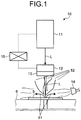
- FIG. 1 is a view schematically illustrating a laser processing apparatus in accordance with a first embodiment.
- a laser processing apparatus 10 according to a first embodiment is an apparatus capable of irradiating a composite material 5 to be processed with a laser L to perform hole processing on the composite material 5.
- Examples of the composite material 5 include fiber reinforced plastics such as carbon fiber reinforced plastics (CFRP), glass fiber reinforced plastics (GFRP), and glass mat reinforced thermoplastics (GMT).
- fiber reinforced plastics such as carbon fiber reinforced plastics (CFRP), glass fiber reinforced plastics (GFRP), and glass mat reinforced thermoplastics (GMT).
- the laser processing apparatus 10 includes a laser oscillator 11, a scanning optical system 12, a condensing optical system 13, a support base 6, a gas nozzle 14, and a controller 15.
- the laser oscillator 11 is an apparatus that outputs the laser L.
- the laser oscillator 11 used in the first embodiment uses a pulse oscillation (pulsed operation) system, and is an ultrashort pulse laser that outputs the ultrashort pulse laser L.
- the ultrashort pulse laser has a pulse width that ranges from several picoseconds to several femtoseconds.
- the first embodiment will be described with application of an ultrashort pulse laser, but a short pulse laser may be applied.
- the short pulse laser has a pulse width of several nanoseconds, 100 nanoseconds, or 10 microseconds.
- the scanning optical system 12 is an optical system that causes the laser L emitted from the laser oscillator 11 to scan on the composite material 5.
- the scanning optical system 12 includes a scanner that can operate the laser on the surface of the composite material 5.
- a prism rotor for rotating a prism or a galvanometer mirror is used, for example.
- the condensing optical system 13 is an optical system that condenses the laser L emitted from the scanning optical system 12 and irradiates the composite material 5 with the condensed laser L.
- the condensing optical system 13 includes optical elements such as a condenser lens.
- the support base 6 supports the composite material 5 at a predetermined position.
- the support base 6 may be a moving stage that causes the composite material 5 to be moved on a horizontal plane. With the laser L emitted from the laser oscillator 11, a surface of the composite material 5 arranged on the support base 6 is irradiated almost vertically.
- the gas nozzle 14 sprays inactive assist gas toward a surface of the composite material 5.
- a spraying direction of assist gas is a lateral direction intersecting an irradiation direction of the laser L, and is a direction along with a surface of the composite material 5.
- a suction aperture for sucking assist gas which is not illustrated, is provided to a side opposite to the gas nozzle 14 across the composite material 5.
- the controller 15 is connected to each of the units including the laser oscillator 11 and the scanning optical system 12, and controls each of the units to control operations of the laser processing apparatus 10. For example, the controller 15 controls the laser oscillator 11 to adjust irradiation conditions of the laser L emitted from the laser oscillator 11. For example, the controller 15 controls the scanning optical system 12 to control scanning operations of the laser L on a surface of the composite material 5.
- the laser oscillator 11 emits the laser L, and the emitted laser L is guided to the scanning optical system 12.
- the laser processing apparatus 10 causes the laser L having entered the scanning optical system 12 to scan to vary an irradiation position of the laser L on a surface of the composite material 5.
- the laser processing apparatus 10 causes the laser L emitted from the scanning optical system 12 to enter the condensing optical system 13, and irradiates the composite material 5 with the condensed laser L.
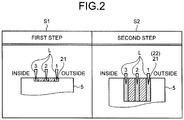
- FIG. 2 is an explanatory view related to processing conditions of the laser processing method in accordance with the first embodiment.
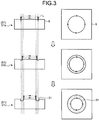
- FIG. 3 is an explanatory view related to a first step of the laser processing method in accordance with the first embodiment.
- FIG. 4 is an explanatory view related to a second step of the laser processing method in accordance with the first embodiment.
- the composite material 5 has, for example, a sheet thickness of 10 mm or more.
- the laser processing method includes a first step S1 for irradiating a surface of the composite material 5 with the laser L and forming a hole processing groove 21 in the composite material 5, and a second step S2 for irradiating and penetrating through the hole processing groove 21 with the laser L to form a through hole 22.
- irradiation conditions of the laser L emitted from the laser oscillator 11 are the same irradiation conditions.
- the laser oscillator 11 emits the picosecond laser L on the irradiation conditions that, in the laser having a pulse width of 10 ps or less and a wavelength of 1,030 nm, pulse repetition frequency and the maximum pulse energy are defined as 100 to 500 kHz and as 2.0 mJ, respectively, and the average output ranges from 200 to 1,000 w.
- the hole processing groove 21 to be formed is made to be a groove having an annular shape on a surface of the composite material 5 as illustrated in FIGS. 2 and 3 .
- the hole processing groove 21 is penetrated through, and a core material inside the hole processing groove 21 is removed to form the through hole 22 into a columnar shape (straight shape) as illustrated in FIGS. 2 and 4 .
- FIG. 2 illustrates a cutting surface orthogonal to the peripheral direction of the hole processing groove 21 formed into an annular shape.
- one side of a radial direction of the hole processing groove 21 corresponds to the inside, and the other side of the radial direction of the hole processing groove 21 (right side in FIG. 2 ) corresponds to the outside.
- a surface on the outside of the hole processing groove 21 corresponds to an inner peripheral surface of the through hole 22.
- the hole processing groove 21 is processed so that the depth thereof is, for example, 0.5 mm.
- processing is laser processing in which a length in a depth direction is shorter than the length at the second step S2.
- the laser L which causes a smaller heat input amount for the composite material 5 per unit time than that at the second step S2 is emitted.
- a scanning speed (scan speed) of the laser L is made faster than that at the second step S2.
- irradiation conditions of the laser L are the same irradiation conditions at the first step S1 and the second step S2.
- a heat input amount for the composite material 5 can be made smaller as much as a scanning speed at the first step S1 is faster.
- the laser L is emitted.
- the laser L is emitted on 3 paths.
- the 3 paths are defined so that the pitch between the respective paths is the same interval.
- the laser L scans and is emitted so that the laser L is directed from the outside path corresponding to an inner peripheral surface side of the through hole 22 to the inside path corresponding to a center side of the through hole 22.
- the hole processing groove 21 is formed into an annular shape, and, at the first step S1, the laser L is revolved in a peripheral direction three times from the outside to the inside to form the hole processing groove 21.
- the laser L scans the outside of the hole processing groove 21 to be formed, in other words, an inner peripheral surface side of the through hole 22 to be formed on a peripheral direction for one revolution to perform irradiation of the first path (step S1a). Subsequently, after execution of the processing at the step S1a, the laser L scans the inside by a predetermined pitch from the first path and scans the inside of the first path in a peripheral direction for one revolution to perform irradiation of the second path (step S1b).
- the laser L scans the inside by a predetermined pitch from the second path and scans the inside of the second path, in other words, the inside of the hole processing groove 21 to be formed in a peripheral direction for one revolution to perform irradiation of the third path (step S1c).
- executing the processing at the first step S1 causes the hole processing groove 21 having a predetermined depth to be formed.
- scanning operations of the laser L may be set so that the scanning operations are concentrically performed on the first path to the third path, and may be set so that the scanning operations are spirally continued on the first path to the third path. Processing at the first step S1 may be repeated a predetermined number of times.
- the composite material 5 is irradiated with the laser L to generate spatters 51 and fumes 52.
- assist gas is sprayed from the gas nozzle 14 toward a surface of the composite material 5 and assist gas including the spatters 51 and the fumes 52 is sucked from a suction aperture, which is not illustrated. In this manner, at the first step S1, the spatters 51 and the fumes 52 are removed.
- the laser L which causes a larger heat input amount for the composite material 5 per unit time than that at the first step S1 is emitted.
- a scanning speed (scan speed) of the laser L is made slower than that at the first step S1.
- irradiation conditions of the laser L are the same irradiation conditions at the first step S1 and the second step S2.
- a heat input amount for the composite material 5 per unit time can be made larder as much as a scanning speed at the second step S2 is slower, and cutting efficiency can be improved.
- the laser L is emitted at the second step S2.
- the laser L is emitted on 3 paths similarly to the processing at the first step S1.
- the number of paths is the same as that at the first step S1, but the number of paths may be larger than that at the first step S1.
- the 3 paths are defined so that the pitch between the respective paths is the same interval.
- the laser L scans and is emitted so that the laser L is directed from the outside path corresponding to an inner peripheral surface side of the through hole 22 to the inside path corresponding to a center side of the through hole 22 similarly to the processing at the first step S1.
- the hole processing groove 21 is formed into an annular shape, and, even at the second step S2, the laser L is revolved in a peripheral direction three times from the outside to the inside to process and penetrate through the hole processing groove 21 in a depth direction.
- irradiation of the laser L is started from an inner peripheral surface corresponding to a product surface of the through hole 22 to be formed.
- the laser L scans the outside of the hole processing groove 21, in other words, an inner peripheral surface side of the through hole 22 to be formed in a peripheral direction for one revolution to perform irradiation of the first path (step S2a). Subsequently, after execution of the processing at the step S2a, the laser L scans the inside by a predetermined pitch from the first path and scans the inside of the first path in a peripheral direction for one revolution to perform irradiation of the second path (step S2b).
- the laser L scans the inside by a predetermined pitch from the second path and scans the inside of the second path, in other words, the inside of the hole processing groove 21 in a peripheral direction for one revolution to perform irradiation of the third path (step S2c).
- executing processing at the second step S2 causes further processing to be performed on the hole processing groove 21 in a depth direction.
- Processing at the second step S2 is repeated until the hole processing groove 21 is penetrated through in a depth direction.
- the composite material 5 is irradiated with the laser L to generate the spatters 51 and the fumes 52.
- assist gas is sprayed from the gas nozzle 14 toward a surface of the composite material 5 and assist gas including the spatters 51 and the fumes 52 is sucked from a suction aperture, which is not illustrated. Thus, the spatters 51 and the fumes 52 are removed.
- the hole processing groove 21 can be formed on a surface of the composite material 5 with a small heat input amount at the first step S1. Even when a thickness of a composite material is thick, a heat-affected layer can be prevented from being formed on a surface of the composite material 5. In addition, a heat input amount added to a surface of the composite material 5 can be made small. Thus, the spatters 51 and the fumes 52 can be prevented from being generated, and the spatters 51 and the fumes 52 can be prevented from being attached to a surface of the composite material 5.
- the hole processing groove 21 can be formed deeper along with an irradiation direction of the laser L.
- the through hole 22 formed by the laser L can be formed in a straight shape in an irradiation direction of the laser L.
- the laser L can be emitted with the number of paths equal to or more than that at the first step S1.
- a length of the hole processing groove 21 in a width direction can be prevented from being shorter than that at the first step S1.
- a heat input amount for the composite material 5 by laser irradiation at the first step S1 can be made smaller without changing irradiation conditions of the laser L at the first step S1 and the second step S2.
- the pitch between a plurality of respective paths at the first step S1 is the same interval.
- a groove depth of the hole processing groove 21 can be equalized.
- the bottom surface of the hole processing groove 21 can be smoothed.
- the pitch between a plurality of respective paths at the second step S2 is the same interval.
- a groove depth of the hole processing groove 21 can be equalized.
- irradiation of the laser L can be started from an inner peripheral surface of the through hole 22 corresponding to a product surface, thereby performing hole processing on the inner peripheral surface of the through hole 22 with high accuracy.
- the fumes 52 generated by irradiating the composite material 5 with the laser L enables the fumes 52 generated by irradiating the composite material 5 with the laser L to be made finer.
- the fumes 52 generated at the first step S1 are made finer and can easily float to reduce generation of the fumes 52 attached to the composite material 5.
- spraying assist gas toward the hole processing groove 21 at the first step S1 and the second step S2 enables the spatters 51 and the fumes 52 generated by irradiating the composite material 5 with the laser L to be removed with the assist gas.
- the spatters 51 and the fumes 52 attached to the composite material 5 can be prevented from being generated.
- a heat input amount for the composite material 5 is adjusted by making a scanning speed of the laser L faster at the first step S1 and making a scanning speed of the laser L slower at the second step S2, but this configuration is not limiting.
- Output of the laser L may be smaller at the first step S1 and output of the laser L may be larger at the second step S2 than the output of the laser at the first step S1.
- the heat input amount for the composite material 5 at the first step S1 and the second step S2 can be adjusted without changing the scanning speed of the laser L at the first step S1 and the second step S2. In this manner, if the configuration is the one in which a heat input amount for the composite material 5 is smaller at the first step and a heat input amount for the composite material 5 at the second step is larger than the heat input amount at the first step S1, any configuration may be applied.
- the through hole 22 is formed into a hollow columnar shape having a circular aperture, but the shape of the through hole 22 is not particularly limiting.
- the shape of an aperture may be polygonal, and any shape may be applied.
- FIG. 5 is an explanatory view related to processing conditions of the laser processing method in accordance with the second embodiment.
- processing at a third step S3 is executed after processing at the second step S2.
- the through hole 22 is irradiated with the laser L in which the pitch between the respective paths in a width direction is narrower than that at the second step S2.
- the laser L is emitted.
- the laser L is emitted on 5 paths.
- the five paths are defined so that the pitch between the respective paths is the same interval.
- a length of the five paths in a width direction is the same as that of the three paths in a width direction at the second step S2.
- the pitch between the respective paths at the third step S3 is narrower than the pitch at the second step S2.
- the laser L scans and is emitted so that the laser L is directed from an inner peripheral surface side of the through hole 22 to a center side of the through hole 22 similarly to the processing at the first step S1 and the second step S2.
- FIG. 5 illustrates that processing at the third step S3 is executed before a remaining core material is removed at the second step S2. Processing at the third step S3 may be executed after a core material is removed.
- the laser L scans an inner peripheral surface side of the through hole 22 in a peripheral direction for one revolution to perform irradiation of the first path. Subsequently, after irradiation of the first path, the laser L scans the inside by a predetermined pitch from the first path and scans the inside of the first path in a peripheral direction for one revolution to perform irradiation of the second path. Because irradiation of the laser L on the third path to the fifth path is the same as that on the second path, the explanation is omitted.
- assist gas is sprayed from the gas nozzle 14 toward a surface of the composite material 5 at the third step S3.
- executing processing at the third step S3 enables an inner peripheral surface of the through hole 22 to be smoothed in a penetration direction and hole processing to be performed on the through hole 22 with high accuracy.
- the number of paths is larger than that of the second step S2, but the number of paths is not particularly limited.
- the number of the paths may be any number.
- the number of paths may be the same as that at the second step S2.
- irradiation of the laser L may be started from an inner peripheral surface side of the through hole 22.
Landscapes
- Physics & Mathematics (AREA)
- Optics & Photonics (AREA)
- Engineering & Computer Science (AREA)
- Plasma & Fusion (AREA)
- Mechanical Engineering (AREA)
- Laser Beam Processing (AREA)
- Moulding By Coating Moulds (AREA)
- Shaping Of Tube Ends By Bending Or Straightening (AREA)
Applications Claiming Priority (1)
| Application Number | Priority Date | Filing Date | Title |
|---|---|---|---|
| JP2019057450A JP7291510B2 (ja) | 2019-03-25 | 2019-03-25 | レーザ加工方法 |
Publications (1)
| Publication Number | Publication Date |
|---|---|
| EP3715037A1 true EP3715037A1 (en) | 2020-09-30 |
Family
ID=69570559
Family Applications (1)
| Application Number | Title | Priority Date | Filing Date |
|---|---|---|---|
| EP20156433.3A Pending EP3715037A1 (en) | 2019-03-25 | 2020-02-10 | Laser processing method and laser processing apparatus |
Country Status (4)
| Country | Link |
|---|---|
| US (1) | US11583957B2 (enExample) |
| EP (1) | EP3715037A1 (enExample) |
| JP (1) | JP7291510B2 (enExample) |
| CA (1) | CA3071681C (enExample) |
Families Citing this family (3)
| Publication number | Priority date | Publication date | Assignee | Title |
|---|---|---|---|---|
| KR102630873B1 (ko) * | 2019-05-03 | 2024-01-31 | 삼성디스플레이 주식회사 | 윈도우의 제조 방법 |
| JP7240774B2 (ja) * | 2020-10-16 | 2023-03-16 | 国立大学法人信州大学 | 光学ユニット及びレーザー加工装置 |
| CN114786340A (zh) * | 2022-03-25 | 2022-07-22 | 武汉华工激光工程有限责任公司 | 一种盲孔加工方法和fpc的加工方法 |
Citations (4)
| Publication number | Priority date | Publication date | Assignee | Title |
|---|---|---|---|---|
| US20100282727A1 (en) * | 2008-01-17 | 2010-11-11 | Honda Motor Co., Ltd. | Laser working apparatus, and laser working method |
| JP2016107574A (ja) | 2014-12-09 | 2016-06-20 | 国立研究開発法人産業技術総合研究所 | 繊維強化複合材料の高速レーザー加工方法及びその高速レーザー加工装置 |
| US20170225271A1 (en) * | 2014-08-06 | 2017-08-10 | Bae Systems Plc | Substrate manufacture |
| US9950392B2 (en) * | 2014-03-04 | 2018-04-24 | Rohr, Inc. | Forming one or more apertures in a fiber-reinforced composite object with a laser |
Family Cites Families (8)
| Publication number | Priority date | Publication date | Assignee | Title |
|---|---|---|---|---|
| JPH0775787B2 (ja) * | 1990-05-23 | 1995-08-16 | 新日本製鐵株式会社 | セラミックスのレーザ穴加工法 |
| JP2001269793A (ja) * | 2000-03-27 | 2001-10-02 | Ricoh Microelectronics Co Ltd | レーザ加工方法 |
| DE10207288B4 (de) * | 2002-02-21 | 2005-05-04 | Newson Engineering Nv | Verfahren zum Bohren von Löchern mittels eines Laserstrahls in einem Substrat, insbesondere in einem elektrischen Schaltungsubstrat |
| JP2004216385A (ja) * | 2003-01-09 | 2004-08-05 | Hitachi Via Mechanics Ltd | レーザ穴明け加工方法 |
| US8716625B2 (en) * | 2012-02-03 | 2014-05-06 | Trumpf Werkzeugmaschinen Gmbh + Co. Kg | Workpiece cutting |
| DE102012219196B3 (de) * | 2012-10-22 | 2014-02-06 | Trumpf Werkzeugmaschinen Gmbh + Co. Kg | Verfahren und Bearbeitungsmaschine zum Einstechen, Bohren oder Schneiden metallischer Werkstücke |
| JP6804224B2 (ja) | 2016-06-22 | 2020-12-23 | 三菱重工業株式会社 | レーザ加工装置およびレーザ加工方法 |
| JP2018016525A (ja) * | 2016-07-29 | 2018-02-01 | 三星ダイヤモンド工業株式会社 | 脆性材料基板のレーザー加工方法およびレーザー加工装置 |
-
2019
- 2019-03-25 JP JP2019057450A patent/JP7291510B2/ja active Active
-
2020
- 2020-02-07 US US16/784,991 patent/US11583957B2/en active Active
- 2020-02-07 CA CA3071681A patent/CA3071681C/en active Active
- 2020-02-10 EP EP20156433.3A patent/EP3715037A1/en active Pending
Patent Citations (4)
| Publication number | Priority date | Publication date | Assignee | Title |
|---|---|---|---|---|
| US20100282727A1 (en) * | 2008-01-17 | 2010-11-11 | Honda Motor Co., Ltd. | Laser working apparatus, and laser working method |
| US9950392B2 (en) * | 2014-03-04 | 2018-04-24 | Rohr, Inc. | Forming one or more apertures in a fiber-reinforced composite object with a laser |
| US20170225271A1 (en) * | 2014-08-06 | 2017-08-10 | Bae Systems Plc | Substrate manufacture |
| JP2016107574A (ja) | 2014-12-09 | 2016-06-20 | 国立研究開発法人産業技術総合研究所 | 繊維強化複合材料の高速レーザー加工方法及びその高速レーザー加工装置 |
Also Published As
| Publication number | Publication date |
|---|---|
| JP7291510B2 (ja) | 2023-06-15 |
| CA3071681C (en) | 2022-05-31 |
| US11583957B2 (en) | 2023-02-21 |
| CA3071681A1 (en) | 2020-09-25 |
| US20200306889A1 (en) | 2020-10-01 |
| JP2020157324A (ja) | 2020-10-01 |
Similar Documents
| Publication | Publication Date | Title |
|---|---|---|
| US11583957B2 (en) | Laser processing method and laser processing apparatus | |
| JP5148717B2 (ja) | パルスレーザ加工装置およびパルスレーザ加工方法 | |
| US11697177B2 (en) | Laser processing method and laser processing apparatus | |
| US20220055149A1 (en) | Beam machining of workpieces | |
| JP5873978B2 (ja) | レーザ加工方法、およびノズルの製造方法 | |
| WO2015008482A1 (ja) | レーザ加工装置、レーザ加工方法、及びレーザ発振装置 | |
| CN110091083A (zh) | 激光制孔方法及激光制孔设备 | |
| US20190255649A1 (en) | Laser beam machining method and laser beam machine | |
| CN112192054A (zh) | 激光加工方法 | |
| CN113828932A (zh) | 基于激光制孔的表面高完整性微孔加工方法及系统 | |
| US20170021450A1 (en) | Method and device for laser machining a substrate with multiple laser radiation deflection | |
| JP5197271B2 (ja) | レーザ加工装置、及び、レーザ加工方法 | |
| CN114505580B (zh) | 用于加工板状或管状工件的方法 | |
| JP2017104875A (ja) | レーザー加工装置及びレーザー加工方法 | |
| CN115041815B (zh) | 一种脆性材料的激光加工系统及加工方法 | |
| JP2004322106A (ja) | レーザ加工方法およびレーザ加工装置 | |
| JP2012066265A (ja) | レーザ加工方法 | |
| US20220258285A1 (en) | Laser cutting method and associated laser cutting device | |
| JP7290239B1 (ja) | レーザ切断加工方法及びレーザ切断加工装置 | |
| CN107662054B (zh) | 脆性材料基板的激光加工方法及激光加工装置 | |
| CN107662055B (zh) | 脆性材料基板的激光加工方法及激光加工装置 | |
| JP2008036697A (ja) | レーザ加工方法及び加工装置 | |
| JP2008284577A (ja) | レーザ加工方法、フレキシブルプリント基板 | |
| KR101666468B1 (ko) | 투광성 물질로 이루어진 플레이트의 가공방법과 가공장치 | |
| Graham et al. | Technical advantages of disk laser technology in short and ultrashort pulse processes |
Legal Events
| Date | Code | Title | Description |
|---|---|---|---|
| PUAI | Public reference made under article 153(3) epc to a published international application that has entered the european phase |
Free format text: ORIGINAL CODE: 0009012 |
|
| STAA | Information on the status of an ep patent application or granted ep patent |
Free format text: STATUS: REQUEST FOR EXAMINATION WAS MADE |
|
| 17P | Request for examination filed |
Effective date: 20200210 |
|
| AK | Designated contracting states |
Kind code of ref document: A1 Designated state(s): AL AT BE BG CH CY CZ DE DK EE ES FI FR GB GR HR HU IE IS IT LI LT LU LV MC MK MT NL NO PL PT RO RS SE SI SK SM TR |
|
| AX | Request for extension of the european patent |
Extension state: BA ME |
|
| STAA | Information on the status of an ep patent application or granted ep patent |
Free format text: STATUS: EXAMINATION IS IN PROGRESS |
|
| 17Q | First examination report despatched |
Effective date: 20230714 |