EP3712904B1 - Pastenzusammensetzung, halbleiterbauelement und elektrische/elektronische komponente - Google Patents
Pastenzusammensetzung, halbleiterbauelement und elektrische/elektronische komponente Download PDFInfo
- Publication number
- EP3712904B1 EP3712904B1 EP18875326.3A EP18875326A EP3712904B1 EP 3712904 B1 EP3712904 B1 EP 3712904B1 EP 18875326 A EP18875326 A EP 18875326A EP 3712904 B1 EP3712904 B1 EP 3712904B1
- Authority
- EP
- European Patent Office
- Prior art keywords
- fine particles
- copper
- acid
- copper fine
- paste composition
- Prior art date
- Legal status (The legal status is an assumption and is not a legal conclusion. Google has not performed a legal analysis and makes no representation as to the accuracy of the status listed.)
- Active
Links
Images

Classifications
-
- B—PERFORMING OPERATIONS; TRANSPORTING
- B22—CASTING; POWDER METALLURGY
- B22F—WORKING METALLIC POWDER; MANUFACTURE OF ARTICLES FROM METALLIC POWDER; MAKING METALLIC POWDER; APPARATUS OR DEVICES SPECIALLY ADAPTED FOR METALLIC POWDER
- B22F1/00—Metallic powder; Treatment of metallic powder, e.g. to facilitate working or to improve properties
- B22F1/05—Metallic powder characterised by the size or surface area of the particles
- B22F1/054—Nanosized particles
-
- B—PERFORMING OPERATIONS; TRANSPORTING
- B22—CASTING; POWDER METALLURGY
- B22F—WORKING METALLIC POWDER; MANUFACTURE OF ARTICLES FROM METALLIC POWDER; MAKING METALLIC POWDER; APPARATUS OR DEVICES SPECIALLY ADAPTED FOR METALLIC POWDER
- B22F1/00—Metallic powder; Treatment of metallic powder, e.g. to facilitate working or to improve properties
- B22F1/05—Metallic powder characterised by the size or surface area of the particles
- B22F1/054—Nanosized particles
- B22F1/056—Submicron particles having a size above 100 nm up to 300 nm
-
- B—PERFORMING OPERATIONS; TRANSPORTING
- B22—CASTING; POWDER METALLURGY
- B22F—WORKING METALLIC POWDER; MANUFACTURE OF ARTICLES FROM METALLIC POWDER; MAKING METALLIC POWDER; APPARATUS OR DEVICES SPECIALLY ADAPTED FOR METALLIC POWDER
- B22F1/00—Metallic powder; Treatment of metallic powder, e.g. to facilitate working or to improve properties
- B22F1/06—Metallic powder characterised by the shape of the particles
-
- B—PERFORMING OPERATIONS; TRANSPORTING
- B22—CASTING; POWDER METALLURGY
- B22F—WORKING METALLIC POWDER; MANUFACTURE OF ARTICLES FROM METALLIC POWDER; MAKING METALLIC POWDER; APPARATUS OR DEVICES SPECIALLY ADAPTED FOR METALLIC POWDER
- B22F1/00—Metallic powder; Treatment of metallic powder, e.g. to facilitate working or to improve properties
- B22F1/10—Metallic powder containing lubricating or binding agents; Metallic powder containing organic material
- B22F1/102—Metallic powder coated with organic material
-
- B—PERFORMING OPERATIONS; TRANSPORTING
- B22—CASTING; POWDER METALLURGY
- B22F—WORKING METALLIC POWDER; MANUFACTURE OF ARTICLES FROM METALLIC POWDER; MAKING METALLIC POWDER; APPARATUS OR DEVICES SPECIALLY ADAPTED FOR METALLIC POWDER
- B22F1/00—Metallic powder; Treatment of metallic powder, e.g. to facilitate working or to improve properties
- B22F1/10—Metallic powder containing lubricating or binding agents; Metallic powder containing organic material
- B22F1/107—Metallic powder containing lubricating or binding agents; Metallic powder containing organic material containing organic material comprising solvents, e.g. for slip casting
-
- B—PERFORMING OPERATIONS; TRANSPORTING
- B22—CASTING; POWDER METALLURGY
- B22F—WORKING METALLIC POWDER; MANUFACTURE OF ARTICLES FROM METALLIC POWDER; MAKING METALLIC POWDER; APPARATUS OR DEVICES SPECIALLY ADAPTED FOR METALLIC POWDER
- B22F1/00—Metallic powder; Treatment of metallic powder, e.g. to facilitate working or to improve properties
- B22F1/16—Metallic particles coated with a non-metal
-
- B—PERFORMING OPERATIONS; TRANSPORTING
- B22—CASTING; POWDER METALLURGY
- B22F—WORKING METALLIC POWDER; MANUFACTURE OF ARTICLES FROM METALLIC POWDER; MAKING METALLIC POWDER; APPARATUS OR DEVICES SPECIALLY ADAPTED FOR METALLIC POWDER
- B22F7/00—Manufacture of composite layers, workpieces, or articles, comprising metallic powder, by sintering the powder, with or without compacting wherein at least one part is obtained by sintering or compression
- B22F7/06—Manufacture of composite layers, workpieces, or articles, comprising metallic powder, by sintering the powder, with or without compacting wherein at least one part is obtained by sintering or compression of composite workpieces or articles from parts, e.g. to form tipped tools
- B22F7/062—Manufacture of composite layers, workpieces, or articles, comprising metallic powder, by sintering the powder, with or without compacting wherein at least one part is obtained by sintering or compression of composite workpieces or articles from parts, e.g. to form tipped tools involving the connection or repairing of preformed parts
-
- B—PERFORMING OPERATIONS; TRANSPORTING
- B22—CASTING; POWDER METALLURGY
- B22F—WORKING METALLIC POWDER; MANUFACTURE OF ARTICLES FROM METALLIC POWDER; MAKING METALLIC POWDER; APPARATUS OR DEVICES SPECIALLY ADAPTED FOR METALLIC POWDER
- B22F7/00—Manufacture of composite layers, workpieces, or articles, comprising metallic powder, by sintering the powder, with or without compacting wherein at least one part is obtained by sintering or compression
- B22F7/06—Manufacture of composite layers, workpieces, or articles, comprising metallic powder, by sintering the powder, with or without compacting wherein at least one part is obtained by sintering or compression of composite workpieces or articles from parts, e.g. to form tipped tools
- B22F7/08—Manufacture of composite layers, workpieces, or articles, comprising metallic powder, by sintering the powder, with or without compacting wherein at least one part is obtained by sintering or compression of composite workpieces or articles from parts, e.g. to form tipped tools with one or more parts not made from powder
-
- B—PERFORMING OPERATIONS; TRANSPORTING
- B22—CASTING; POWDER METALLURGY
- B22F—WORKING METALLIC POWDER; MANUFACTURE OF ARTICLES FROM METALLIC POWDER; MAKING METALLIC POWDER; APPARATUS OR DEVICES SPECIALLY ADAPTED FOR METALLIC POWDER
- B22F9/00—Making metallic powder or suspensions thereof
-
- C—CHEMISTRY; METALLURGY
- C08—ORGANIC MACROMOLECULAR COMPOUNDS; THEIR PREPARATION OR CHEMICAL WORKING-UP; COMPOSITIONS BASED THEREON
- C08K—Use of inorganic or non-macromolecular organic substances as compounding ingredients
- C08K3/00—Use of inorganic substances as compounding ingredients
- C08K3/02—Elements
- C08K3/08—Metals
-
- C—CHEMISTRY; METALLURGY
- C08—ORGANIC MACROMOLECULAR COMPOUNDS; THEIR PREPARATION OR CHEMICAL WORKING-UP; COMPOSITIONS BASED THEREON
- C08K—Use of inorganic or non-macromolecular organic substances as compounding ingredients
- C08K5/00—Use of organic ingredients
- C08K5/02—Halogenated hydrocarbons
- C08K5/03—Halogenated hydrocarbons aromatic, e.g. C6H5-CH2-Cl
-
- C—CHEMISTRY; METALLURGY
- C08—ORGANIC MACROMOLECULAR COMPOUNDS; THEIR PREPARATION OR CHEMICAL WORKING-UP; COMPOSITIONS BASED THEREON
- C08K—Use of inorganic or non-macromolecular organic substances as compounding ingredients
- C08K5/00—Use of organic ingredients
- C08K5/04—Oxygen-containing compounds
- C08K5/09—Carboxylic acids; Metal salts thereof; Anhydrides thereof
-
- C—CHEMISTRY; METALLURGY
- C09—DYES; PAINTS; POLISHES; NATURAL RESINS; ADHESIVES; COMPOSITIONS NOT OTHERWISE PROVIDED FOR; APPLICATIONS OF MATERIALS NOT OTHERWISE PROVIDED FOR
- C09J—ADHESIVES; NON-MECHANICAL ASPECTS OF ADHESIVE PROCESSES IN GENERAL; ADHESIVE PROCESSES NOT PROVIDED FOR ELSEWHERE; USE OF MATERIALS AS ADHESIVES
- C09J11/00—Features of adhesives not provided for in group C09J9/00, e.g. additives
- C09J11/02—Non-macromolecular additives
- C09J11/04—Non-macromolecular additives inorganic
-
- C—CHEMISTRY; METALLURGY
- C09—DYES; PAINTS; POLISHES; NATURAL RESINS; ADHESIVES; COMPOSITIONS NOT OTHERWISE PROVIDED FOR; APPLICATIONS OF MATERIALS NOT OTHERWISE PROVIDED FOR
- C09J—ADHESIVES; NON-MECHANICAL ASPECTS OF ADHESIVE PROCESSES IN GENERAL; ADHESIVE PROCESSES NOT PROVIDED FOR ELSEWHERE; USE OF MATERIALS AS ADHESIVES
- C09J5/00—Adhesive processes in general; Adhesive processes not provided for elsewhere, e.g. relating to primers
- C09J5/06—Adhesive processes in general; Adhesive processes not provided for elsewhere, e.g. relating to primers involving heating of the applied adhesive
-
- C—CHEMISTRY; METALLURGY
- C09—DYES; PAINTS; POLISHES; NATURAL RESINS; ADHESIVES; COMPOSITIONS NOT OTHERWISE PROVIDED FOR; APPLICATIONS OF MATERIALS NOT OTHERWISE PROVIDED FOR
- C09J—ADHESIVES; NON-MECHANICAL ASPECTS OF ADHESIVE PROCESSES IN GENERAL; ADHESIVE PROCESSES NOT PROVIDED FOR ELSEWHERE; USE OF MATERIALS AS ADHESIVES
- C09J9/00—Adhesives characterised by their physical nature or the effects produced, e.g. glue sticks
- C09J9/02—Electrically-conducting adhesives
-
- H—ELECTRICITY
- H01—ELECTRIC ELEMENTS
- H01B—CABLES; CONDUCTORS; INSULATORS; SELECTION OF MATERIALS FOR THEIR CONDUCTIVE, INSULATING OR DIELECTRIC PROPERTIES
- H01B1/00—Conductors or conductive bodies characterised by the conductive materials; Selection of materials as conductors
- H01B1/02—Conductors or conductive bodies characterised by the conductive materials; Selection of materials as conductors mainly consisting of metals or alloys
- H01B1/026—Alloys based on copper
-
- H—ELECTRICITY
- H01—ELECTRIC ELEMENTS
- H01B—CABLES; CONDUCTORS; INSULATORS; SELECTION OF MATERIALS FOR THEIR CONDUCTIVE, INSULATING OR DIELECTRIC PROPERTIES
- H01B1/00—Conductors or conductive bodies characterised by the conductive materials; Selection of materials as conductors
- H01B1/20—Conductive material dispersed in non-conductive organic material
- H01B1/22—Conductive material dispersed in non-conductive organic material the conductive material comprising metals or alloys
-
- H—ELECTRICITY
- H10—SEMICONDUCTOR DEVICES; ELECTRIC SOLID-STATE DEVICES NOT OTHERWISE PROVIDED FOR
- H10H—INORGANIC LIGHT-EMITTING SEMICONDUCTOR DEVICES HAVING POTENTIAL BARRIERS
- H10H20/00—Individual inorganic light-emitting semiconductor devices having potential barriers, e.g. light-emitting diodes [LED]
- H10H20/80—Constructional details
- H10H20/85—Packages
- H10H20/858—Means for heat extraction or cooling
- H10H20/8581—Means for heat extraction or cooling characterised by their material
-
- H—ELECTRICITY
- H10—SEMICONDUCTOR DEVICES; ELECTRIC SOLID-STATE DEVICES NOT OTHERWISE PROVIDED FOR
- H10W—GENERIC PACKAGES, INTERCONNECTIONS, CONNECTORS OR OTHER CONSTRUCTIONAL DETAILS OF DEVICES COVERED BY CLASS H10
- H10W40/00—Arrangements for thermal protection or thermal control
- H10W40/20—Arrangements for cooling
- H10W40/25—Arrangements for cooling characterised by their materials
-
- H—ELECTRICITY
- H10—SEMICONDUCTOR DEVICES; ELECTRIC SOLID-STATE DEVICES NOT OTHERWISE PROVIDED FOR
- H10W—GENERIC PACKAGES, INTERCONNECTIONS, CONNECTORS OR OTHER CONSTRUCTIONAL DETAILS OF DEVICES COVERED BY CLASS H10
- H10W40/00—Arrangements for thermal protection or thermal control
- H10W40/20—Arrangements for cooling
- H10W40/25—Arrangements for cooling characterised by their materials
- H10W40/251—Organics
-
- B—PERFORMING OPERATIONS; TRANSPORTING
- B22—CASTING; POWDER METALLURGY
- B22F—WORKING METALLIC POWDER; MANUFACTURE OF ARTICLES FROM METALLIC POWDER; MAKING METALLIC POWDER; APPARATUS OR DEVICES SPECIALLY ADAPTED FOR METALLIC POWDER
- B22F7/00—Manufacture of composite layers, workpieces, or articles, comprising metallic powder, by sintering the powder, with or without compacting wherein at least one part is obtained by sintering or compression
- B22F7/02—Manufacture of composite layers, workpieces, or articles, comprising metallic powder, by sintering the powder, with or without compacting wherein at least one part is obtained by sintering or compression of composite layers
- B22F7/04—Manufacture of composite layers, workpieces, or articles, comprising metallic powder, by sintering the powder, with or without compacting wherein at least one part is obtained by sintering or compression of composite layers with one or more layers not made from powder, e.g. made from solid metal
- B22F2007/042—Manufacture of composite layers, workpieces, or articles, comprising metallic powder, by sintering the powder, with or without compacting wherein at least one part is obtained by sintering or compression of composite layers with one or more layers not made from powder, e.g. made from solid metal characterised by the layer forming method
- B22F2007/047—Manufacture of composite layers, workpieces, or articles, comprising metallic powder, by sintering the powder, with or without compacting wherein at least one part is obtained by sintering or compression of composite layers with one or more layers not made from powder, e.g. made from solid metal characterised by the layer forming method non-pressurised baking of the paste or slurry containing metal powder
-
- B—PERFORMING OPERATIONS; TRANSPORTING
- B22—CASTING; POWDER METALLURGY
- B22F—WORKING METALLIC POWDER; MANUFACTURE OF ARTICLES FROM METALLIC POWDER; MAKING METALLIC POWDER; APPARATUS OR DEVICES SPECIALLY ADAPTED FOR METALLIC POWDER
- B22F2301/00—Metallic composition of the powder or its coating
- B22F2301/10—Copper
-
- B—PERFORMING OPERATIONS; TRANSPORTING
- B22—CASTING; POWDER METALLURGY
- B22F—WORKING METALLIC POWDER; MANUFACTURE OF ARTICLES FROM METALLIC POWDER; MAKING METALLIC POWDER; APPARATUS OR DEVICES SPECIALLY ADAPTED FOR METALLIC POWDER
- B22F9/00—Making metallic powder or suspensions thereof
- B22F9/16—Making metallic powder or suspensions thereof using chemical processes
- B22F9/18—Making metallic powder or suspensions thereof using chemical processes with reduction of metal compounds
- B22F9/24—Making metallic powder or suspensions thereof using chemical processes with reduction of metal compounds starting from liquid metal compounds, e.g. solutions
-
- B—PERFORMING OPERATIONS; TRANSPORTING
- B22—CASTING; POWDER METALLURGY
- B22F—WORKING METALLIC POWDER; MANUFACTURE OF ARTICLES FROM METALLIC POWDER; MAKING METALLIC POWDER; APPARATUS OR DEVICES SPECIALLY ADAPTED FOR METALLIC POWDER
- B22F9/00—Making metallic powder or suspensions thereof
- B22F9/16—Making metallic powder or suspensions thereof using chemical processes
- B22F9/30—Making metallic powder or suspensions thereof using chemical processes with decomposition of metal compounds, e.g. by pyrolysis
-
- C—CHEMISTRY; METALLURGY
- C08—ORGANIC MACROMOLECULAR COMPOUNDS; THEIR PREPARATION OR CHEMICAL WORKING-UP; COMPOSITIONS BASED THEREON
- C08K—Use of inorganic or non-macromolecular organic substances as compounding ingredients
- C08K3/00—Use of inorganic substances as compounding ingredients
- C08K3/02—Elements
- C08K3/08—Metals
- C08K2003/085—Copper
-
- C—CHEMISTRY; METALLURGY
- C08—ORGANIC MACROMOLECULAR COMPOUNDS; THEIR PREPARATION OR CHEMICAL WORKING-UP; COMPOSITIONS BASED THEREON
- C08K—Use of inorganic or non-macromolecular organic substances as compounding ingredients
- C08K2201/00—Specific properties of additives
- C08K2201/001—Conductive additives
-
- C—CHEMISTRY; METALLURGY
- C08—ORGANIC MACROMOLECULAR COMPOUNDS; THEIR PREPARATION OR CHEMICAL WORKING-UP; COMPOSITIONS BASED THEREON
- C08K—Use of inorganic or non-macromolecular organic substances as compounding ingredients
- C08K9/00—Use of pretreated ingredients
- C08K9/04—Ingredients treated with organic substances
-
- C—CHEMISTRY; METALLURGY
- C09—DYES; PAINTS; POLISHES; NATURAL RESINS; ADHESIVES; COMPOSITIONS NOT OTHERWISE PROVIDED FOR; APPLICATIONS OF MATERIALS NOT OTHERWISE PROVIDED FOR
- C09J—ADHESIVES; NON-MECHANICAL ASPECTS OF ADHESIVE PROCESSES IN GENERAL; ADHESIVE PROCESSES NOT PROVIDED FOR ELSEWHERE; USE OF MATERIALS AS ADHESIVES
- C09J2203/00—Applications of adhesives in processes or use of adhesives in the form of films or foils
- C09J2203/326—Applications of adhesives in processes or use of adhesives in the form of films or foils for bonding electronic components such as wafers, chips or semiconductors
-
- C—CHEMISTRY; METALLURGY
- C09—DYES; PAINTS; POLISHES; NATURAL RESINS; ADHESIVES; COMPOSITIONS NOT OTHERWISE PROVIDED FOR; APPLICATIONS OF MATERIALS NOT OTHERWISE PROVIDED FOR
- C09J—ADHESIVES; NON-MECHANICAL ASPECTS OF ADHESIVE PROCESSES IN GENERAL; ADHESIVE PROCESSES NOT PROVIDED FOR ELSEWHERE; USE OF MATERIALS AS ADHESIVES
- C09J2400/00—Presence of inorganic and organic materials
- C09J2400/10—Presence of inorganic materials
- C09J2400/16—Metal
-
- C—CHEMISTRY; METALLURGY
- C09—DYES; PAINTS; POLISHES; NATURAL RESINS; ADHESIVES; COMPOSITIONS NOT OTHERWISE PROVIDED FOR; APPLICATIONS OF MATERIALS NOT OTHERWISE PROVIDED FOR
- C09J—ADHESIVES; NON-MECHANICAL ASPECTS OF ADHESIVE PROCESSES IN GENERAL; ADHESIVE PROCESSES NOT PROVIDED FOR ELSEWHERE; USE OF MATERIALS AS ADHESIVES
- C09J2400/00—Presence of inorganic and organic materials
- C09J2400/20—Presence of organic materials
-
- C—CHEMISTRY; METALLURGY
- C09—DYES; PAINTS; POLISHES; NATURAL RESINS; ADHESIVES; COMPOSITIONS NOT OTHERWISE PROVIDED FOR; APPLICATIONS OF MATERIALS NOT OTHERWISE PROVIDED FOR
- C09J—ADHESIVES; NON-MECHANICAL ASPECTS OF ADHESIVE PROCESSES IN GENERAL; ADHESIVE PROCESSES NOT PROVIDED FOR ELSEWHERE; USE OF MATERIALS AS ADHESIVES
- C09J2463/00—Presence of epoxy resin
-
- H—ELECTRICITY
- H10—SEMICONDUCTOR DEVICES; ELECTRIC SOLID-STATE DEVICES NOT OTHERWISE PROVIDED FOR
- H10W—GENERIC PACKAGES, INTERCONNECTIONS, CONNECTORS OR OTHER CONSTRUCTIONAL DETAILS OF DEVICES COVERED BY CLASS H10
- H10W72/00—Interconnections or connectors in packages
- H10W72/01—Manufacture or treatment
- H10W72/013—Manufacture or treatment of die-attach connectors
- H10W72/01321—Manufacture or treatment of die-attach connectors using local deposition
- H10W72/01323—Manufacture or treatment of die-attach connectors using local deposition in liquid form, e.g. by dispensing droplets or by screen printing
-
- H—ELECTRICITY
- H10—SEMICONDUCTOR DEVICES; ELECTRIC SOLID-STATE DEVICES NOT OTHERWISE PROVIDED FOR
- H10W—GENERIC PACKAGES, INTERCONNECTIONS, CONNECTORS OR OTHER CONSTRUCTIONAL DETAILS OF DEVICES COVERED BY CLASS H10
- H10W72/00—Interconnections or connectors in packages
- H10W72/01—Manufacture or treatment
- H10W72/013—Manufacture or treatment of die-attach connectors
- H10W72/01321—Manufacture or treatment of die-attach connectors using local deposition
- H10W72/01325—Manufacture or treatment of die-attach connectors using local deposition in solid form
-
- H—ELECTRICITY
- H10—SEMICONDUCTOR DEVICES; ELECTRIC SOLID-STATE DEVICES NOT OTHERWISE PROVIDED FOR
- H10W—GENERIC PACKAGES, INTERCONNECTIONS, CONNECTORS OR OTHER CONSTRUCTIONAL DETAILS OF DEVICES COVERED BY CLASS H10
- H10W72/00—Interconnections or connectors in packages
- H10W72/071—Connecting or disconnecting
- H10W72/073—Connecting or disconnecting of die-attach connectors
-
- H—ELECTRICITY
- H10—SEMICONDUCTOR DEVICES; ELECTRIC SOLID-STATE DEVICES NOT OTHERWISE PROVIDED FOR
- H10W—GENERIC PACKAGES, INTERCONNECTIONS, CONNECTORS OR OTHER CONSTRUCTIONAL DETAILS OF DEVICES COVERED BY CLASS H10
- H10W72/00—Interconnections or connectors in packages
- H10W72/071—Connecting or disconnecting
- H10W72/073—Connecting or disconnecting of die-attach connectors
- H10W72/07331—Connecting techniques
-
- H—ELECTRICITY
- H10—SEMICONDUCTOR DEVICES; ELECTRIC SOLID-STATE DEVICES NOT OTHERWISE PROVIDED FOR
- H10W—GENERIC PACKAGES, INTERCONNECTIONS, CONNECTORS OR OTHER CONSTRUCTIONAL DETAILS OF DEVICES COVERED BY CLASS H10
- H10W72/00—Interconnections or connectors in packages
- H10W72/071—Connecting or disconnecting
- H10W72/073—Connecting or disconnecting of die-attach connectors
- H10W72/07331—Connecting techniques
- H10W72/07337—Connecting techniques using a polymer adhesive, e.g. an adhesive based on silicone or epoxy
- H10W72/07338—Connecting techniques using a polymer adhesive, e.g. an adhesive based on silicone or epoxy hardening the adhesive by curing, e.g. thermosetting
-
- H—ELECTRICITY
- H10—SEMICONDUCTOR DEVICES; ELECTRIC SOLID-STATE DEVICES NOT OTHERWISE PROVIDED FOR
- H10W—GENERIC PACKAGES, INTERCONNECTIONS, CONNECTORS OR OTHER CONSTRUCTIONAL DETAILS OF DEVICES COVERED BY CLASS H10
- H10W72/00—Interconnections or connectors in packages
- H10W72/30—Die-attach connectors
- H10W72/321—Structures or relative sizes of die-attach connectors
- H10W72/325—Die-attach connectors having a filler embedded in a matrix
-
- H—ELECTRICITY
- H10—SEMICONDUCTOR DEVICES; ELECTRIC SOLID-STATE DEVICES NOT OTHERWISE PROVIDED FOR
- H10W—GENERIC PACKAGES, INTERCONNECTIONS, CONNECTORS OR OTHER CONSTRUCTIONAL DETAILS OF DEVICES COVERED BY CLASS H10
- H10W72/00—Interconnections or connectors in packages
- H10W72/30—Die-attach connectors
- H10W72/351—Materials of die-attach connectors
-
- H—ELECTRICITY
- H10—SEMICONDUCTOR DEVICES; ELECTRIC SOLID-STATE DEVICES NOT OTHERWISE PROVIDED FOR
- H10W—GENERIC PACKAGES, INTERCONNECTIONS, CONNECTORS OR OTHER CONSTRUCTIONAL DETAILS OF DEVICES COVERED BY CLASS H10
- H10W72/00—Interconnections or connectors in packages
- H10W72/30—Die-attach connectors
- H10W72/351—Materials of die-attach connectors
- H10W72/352—Materials of die-attach connectors comprising metals or metalloids, e.g. solders
-
- H—ELECTRICITY
- H10—SEMICONDUCTOR DEVICES; ELECTRIC SOLID-STATE DEVICES NOT OTHERWISE PROVIDED FOR
- H10W—GENERIC PACKAGES, INTERCONNECTIONS, CONNECTORS OR OTHER CONSTRUCTIONAL DETAILS OF DEVICES COVERED BY CLASS H10
- H10W72/00—Interconnections or connectors in packages
- H10W72/30—Die-attach connectors
- H10W72/351—Materials of die-attach connectors
- H10W72/353—Materials of die-attach connectors not comprising solid metals or solid metalloids, e.g. ceramics
-
- H—ELECTRICITY
- H10—SEMICONDUCTOR DEVICES; ELECTRIC SOLID-STATE DEVICES NOT OTHERWISE PROVIDED FOR
- H10W—GENERIC PACKAGES, INTERCONNECTIONS, CONNECTORS OR OTHER CONSTRUCTIONAL DETAILS OF DEVICES COVERED BY CLASS H10
- H10W72/00—Interconnections or connectors in packages
- H10W72/30—Die-attach connectors
- H10W72/351—Materials of die-attach connectors
- H10W72/353—Materials of die-attach connectors not comprising solid metals or solid metalloids, e.g. ceramics
- H10W72/354—Materials of die-attach connectors not comprising solid metals or solid metalloids, e.g. ceramics comprising polymers
-
- H—ELECTRICITY
- H10—SEMICONDUCTOR DEVICES; ELECTRIC SOLID-STATE DEVICES NOT OTHERWISE PROVIDED FOR
- H10W—GENERIC PACKAGES, INTERCONNECTIONS, CONNECTORS OR OTHER CONSTRUCTIONAL DETAILS OF DEVICES COVERED BY CLASS H10
- H10W72/00—Interconnections or connectors in packages
- H10W72/50—Bond wires
- H10W72/59—Bond pads specially adapted therefor
-
- H—ELECTRICITY
- H10—SEMICONDUCTOR DEVICES; ELECTRIC SOLID-STATE DEVICES NOT OTHERWISE PROVIDED FOR
- H10W—GENERIC PACKAGES, INTERCONNECTIONS, CONNECTORS OR OTHER CONSTRUCTIONAL DETAILS OF DEVICES COVERED BY CLASS H10
- H10W90/00—Package configurations
- H10W90/701—Package configurations characterised by the relative positions of pads or connectors relative to package parts
- H10W90/731—Package configurations characterised by the relative positions of pads or connectors relative to package parts of die-attach connectors
- H10W90/734—Package configurations characterised by the relative positions of pads or connectors relative to package parts of die-attach connectors between a chip and a stacked insulating package substrate, interposer or RDL
-
- H—ELECTRICITY
- H10—SEMICONDUCTOR DEVICES; ELECTRIC SOLID-STATE DEVICES NOT OTHERWISE PROVIDED FOR
- H10W—GENERIC PACKAGES, INTERCONNECTIONS, CONNECTORS OR OTHER CONSTRUCTIONAL DETAILS OF DEVICES COVERED BY CLASS H10
- H10W90/00—Package configurations
- H10W90/701—Package configurations characterised by the relative positions of pads or connectors relative to package parts
- H10W90/731—Package configurations characterised by the relative positions of pads or connectors relative to package parts of die-attach connectors
- H10W90/736—Package configurations characterised by the relative positions of pads or connectors relative to package parts of die-attach connectors between a chip and a stacked lead frame, conducting package substrate or heat sink
Definitions
- the present disclosure relates to a paste composition, and a semiconductor device and an electrical/electronic component made with the paste composition.
- thermal management of releasing heat from semiconductor products has been attracting attention.
- a method of attaching a heat dissipating member such as a heat spreader or a heat sink to a semiconductor product is typically adopted, and higher thermal conductivity is required of a material itself for bonding the heat dissipating member.
- a method of bonding a heat spreader to a semiconductor element itself or to a die pad portion of a lead frame to which the semiconductor element is bonded is adopted. Also adopted is a method of exposing a die pad portion to a package surface so that the die pad portion has a function as a heat dissipation plate (see, for example, Patent Literature 1).
- a metal filler such as silver powder or copper powder, a ceramic-based filler such as aluminum nitride or boron nitride, or the like usually needs to be dispersed with a high content ratio as a filler in an organic binder (see, for example, Patent Literature 2).
- nano-sized metal fine particles are expected as a conductive material, and their studies are underway. Specifically, a means for providing smaller nano-sized copper fine particles has been studied.
- An example of a known method to produce the copper fine particles is a method that produces copper fine powder by pyrolyzing a copper oxalate-hydrazine complex (see, for example, Patent Literature 4).
- Patent Literature 5 discloses copper fine particles coated with amino alcohol and carboxylic acid, which demonstrate excellent oxidation resistance and sinterability.
- Patent Literatures 6 and 7 describe paste compositions containing copper fine particles coated with amino alcohol, while Patent Literature 8 reveals copper particles coated with an alkylamine.
- a paste composition of the present disclosure contains: (A) copper fine particles having a thickness or minor axis of 10 to 500 nm and coated with amino alcohol represented by the following chemical formula (1); wherein an amine compound including at least one selected from alkylamines and alkoxyamines adheres to a surface of the copper fine particles; and (B) an organic solvent, wherein a compounding amount of (B) the organic solvent is 2 to 20 parts by mass relative to 100 parts by mass of (A) the copper fine particles, (where R 1 s may be identical or different, each independently represent a hydrogen atom, an alkyl group with a carbon number of 1 to 4, a hydroxy group, or a methoxy group, n and m each represent an integer of 0 to 10, and m + n is 10 or less).
- a paste composition of this embodiment contains: (A) copper fine particles having a thickness or minor axis of 10 to 500 nm and coated with amino alcohol having a predetermined structure; and (B) an organic solvent.
- the copper fine particles have a thickness or minor axis of 10 to 500 nm and are coated with amino alcohol represented by the chemical formula (1).
- Such copper fine particles can be produced as follows, for example. Note that, in this specification, coat means that the aforesaid amino alcohol adheres to the whole or part of the surfaces of the copper fine particles.
- the copper fine particles used in this embodiment by mixing a copper-containing compound, the amino alcohol, and a reducing compound in the organic solvent and heating the resultant mixture to a temperature at which the copper-containing compound is pyrolyzed, to produce the copper fine particles.
- the copper fine particles obtained by this production method have surfaces coated with the amino alcohol, and their oxidation is lessened owing to the amino alcohol coating the surfaces, so that copper fine particles with desired properties and qualities are obtained.
- the copper-containing compound used here is a material for precipitating metallic copper to produce the copper fine particles.
- the copper-containing compound is decomposed by the heating to release copper ions.
- the copper-containing compound may be one that releases these copper ions which are then reduced to the metallic copper.
- This copper-containing compound may also be one that is decomposed by the heating to release the copper ions and organic matter ions derived from the copper-containing compound.
- Examples of such a copper-containing compound include copper carboxylate in which carboxylic acid such as formic acid, oxalic acid, malonic acid, benzoic acid, or phthalic acid is combined with copper.
- Other examples of the copper-containing compound include cuprous oxide, copper nitrate, and copper sulfate.
- the amino alcohol used here is alcohol having an amino group represented by the following chemical formula (1).
- R 1 s may be identical or different, and each independently represent a hydrogen atom, an alkyl group with a carbon number of 1 to 4, a hydroxy group, or a methoxy group, n and m each represent an integer of 0 to 10, and m + n is 10 or less.
- aminoethanol examples include aminoethanol, heptaminol, propanolamine, 1-amino-2-propanol, 2-aminodibutanol, 2-diethylaminoethanol, 3-diethylamino-1,2-propanediol, 3-dimethylamino-1,2-propanediol, 3-methylamino-1,2-propanediol, and 3-amino-1,2-propanediol.
- these may have a boiling point of 70 to 300°C from the viewpoint of sinterability.
- the amino alcohol may also be liquid at room temperature.
- the reducing compound used here is not particularly limited as long as it has reducing power to reduce the copper ions generated as a result of the decomposition of the copper-containing compound and liberate the metallic copper.
- the boiling point of the reducing compound may be 70°C or higher.
- the boiling point of the reducing compound may be higher than or equal to a heating temperature in the heating process.
- the reducing compound may be a compound dissolved in (B) the later-described organic solvent formed from carbon, hydrogen, and oxygen.
- Such a reducing compound is typically a hydrazine derivative.
- the hydrazine derivative include hydrazine monohydrate, methylhydrazine, ethylhydrazine, n-propylhydrazine, i-propylhydrazine, n-butylhydrazine, i-butylhydrazine, sec-butylhydrazine, t-butylhydrazine, n-pentylhydrazine, i-pentylhydrazine, neo-pentylhydrazine, t-pentylhydrazine, n-hexylhydrazine, i-hexylhydrazine, n-heptylhydrazine, n-octylhydrazine, n-nonylhydrazine, n-decylhydrazine, n-undecylhydrazine,
- the above-described copper-containing compound, amino alcohol, and reducing compound may be mixed in the organic solvent.
- organic solvent used here one that can be used as a reaction solvent not impairing the natures of a complex and so on generated from the mixture obtained as a result of the above mixing is usable without any particular limitation.
- the organic solvent may also be alcohol that has compatibility with the above-described reducing compound.
- the reduction reaction of the copper ions which is caused by the reducing compound is an exothermic reaction, an organic solvent that does not volatilize during the reduction reaction is also acceptable.
- the organic solvent may have a boiling point of 70°C or higher and may be formed from carbon, hydrogen, and oxygen. If the boiling point of the organic solvent is 70°C or higher, it is easy to control the generation of the copper ions resulting from the decomposition of the copper-containing compound-alcohol amine compound complex and the precipitation of the metallic copper due to the reduction of the generated copper ions, leading to the stability of the shape of the copper fine particles.
- Examples of the aforesaid alcohol used as the organic solvent include 1-propanol, 2-propanol, butanol, pentanol, hexanol, heptanol, octanol, ethylene glycol, 1,3-propanediol, 1,2-propanediol, butyl carbitol, butyl carbitol acetate, ethyl carbitol, ethyl carbitol acetate, diethylene glycol diethyl ether, and butyl cellosolve.
- this organic solvent does not include the aforesaid amino alcohol or reducing compound.
- the other amine compound include a compound containing at least one selected from the following alkylamines and alkoxyamines. This amine compound is not particularly limited as long as it forms a complex with the copper-containing compound.
- alkylamine and alkoxyamine compounds can be used according to the condition of the pyrolysis of the copper-containing compound to be used, the properties expected of the copper fine particles to be produced, and so on.
- These amine compounds have a function of lessening the oxidation of the copper fine particles by adhering to the surfaces of the copper fine particles obtained as a result of the pyrolysis of the copper-containing compound.
- alkyl monoamine examples include dipropylamine, butylamine, dibutylamine, hexylamine, cyclohexylamine, heptylamine, octylamine, nonylamine, decylamine, 3-aminopropyltriethoxysilane, dodecylamine, and oleylamine.
- alkyldiamine examples include ethylenediamine, N,N-dimethylethylenediamine, N,N'-dimethylethylenediamine, N,N-diethylethylenediamine, N,N'-diethylethylenediamine, 1,3-propanediamine, 2,2-dimethyl-1,3-propanediamine, N,N-dimethyl-1,3-diaminopropane, N,N'-dimethyl-1,3-diaminopropane, N,N-diethyl-1,3-diaminopropane, 1,4-diaminobutane, 1,5-diamino-2-methylpentane, 1,6-diaminohexane, N,N'-dimethyl-1,6-diaminohexane, 1,7-diaminoheptane, and 1,8-diaminooctane.
- the boiling point of this amine compound may be not lower than 70°C nor higher than 200°C, or may be not lower than 120°C nor higher than 200°C. If the boiling point of the amine compound is 70°C or higher, the amine volatilizes less in the heating process. If the boiling point of the amine compound is 200°C or lower, the amine compound volatilizes during the sintering of the copper fine particles to be removed to the outside of the system, resulting in good low-temperature sinterability.
- the organic solvent is first put in a reaction vessel, and the above-described copper-containing compound, amino alcohol, and reducing compound, and as required, the organic solvent and the amine compound are mixed in the organic solvent.
- the aforesaid compounds may be mixed in any order.
- the copper-containing compound and the reducing compound may be put into a reaction solution multiple times at predetermined time intervals.
- the copper-containing compound and the amino alcohol react multiple times it is possible to generate the copper fine particles having a desired shape or particle size.
- the copper-containing compound and the amino alcohol may be first mixed and kept mixed at 0 to 50°C for about five to thirty minutes, followed by the addition of the reducing compound and mixing. This results in the efficient formation of the complex of the copper-containing compound and the amino alcohol in the mixture.
- each of the compounds used relative to 1 mol of the copper-containing compound that of the amino alcohol may be 0.5 to 10 mol and that of the reducing compound may be 0.5 to 5 mol.
- the amount of the organic solvent used only needs to be large enough to cause the sufficient reaction of the components, and may be, for example, about 50 to 2000 mL.
- the copper-containing compound forming the complex is decomposed into the organic matter ions derived from the copper-containing compound and the copper ions.
- the copper ions resulting from the decomposition are reduced by the reducing compound, and the metallic copper precipitates and grows into the copper fine particles.
- the later-described amine compound has a function of controlling the grown of the copper fine particles by adhering to their surfaces, thereby preventing the particles from becoming coarse.
- the heating temperature of the mixture is a temperature at which the copper-containing compound can be pyrolyzed and reduced and the polyhedral or plate-shaped copper fine particles can be generated.
- the heating temperature only needs to be 70°C to 150°C or may be 80 to 120°C.
- the heating temperature is preferably lower than the boiling points of the raw material components and the organic solvent. The heating temperature within the above range enables the efficient generation of the copper fine particles and also leads to a decrease in the volatilization of the amine compound.
- the heating temperature of 70°C or higher causes the progress of the quantitative pyrolysis of the copper-containing compound. Further, the heating temperature of 150°C or lower leads to a decrease in the volatilization amount of the amine, resulting in the stable progress of the pyrolysis.
- the copper fine particles of this embodiment are in the state in which the amino alcohol forms a coordination bond with the copper atoms which are generated when the complex formed from the copper-containing compound and the reducing agent are pyrolyzed in the amino alcohol, as described above.
- the copper fine particles coated with the amino alcohol and the organic matter ion species derived from the copper-containing compound are considered to be formed because these copper atoms aggregate.
- the other amine compound is added in the mixture of the copper-containing compound, the amino alcohol, and the reducing agent, the amine compound adheres to the surfaces of the copper fine particles generated by the aforesaid pyrolysis to lessen the oxidation and control the growth direction of the metallic copper.
- the plate shape refers to a particle that has a uniform thickness and whose long side in a direction perpendicular to the thickness direction is three times the thickness or more.
- the polyhedral shape refers to a particle whose shape is similar to the plate shape described above but whose long side in a direction perpendicular to the thickness direction is less than three times the thickness.
- the copper fine particles obtained by the above-described copper fine particle production method can be fired at low temperature.
- a conductive paste using the copper fine particles does not require a reducing atmosphere during the firing. Therefore, the resistance of the copper fine particles of this embodiment can be low even if they are fired at low temperature.
- a fine sintered film can be obtained because the amount of outgassing, which can cause voids, is small.
- the average value is an arithmetic mean value, which may be calculated using ten or more copper fine particles.
- [Cu] represents the content (mass%) of copper (Cu) in the copper fine particles
- [CuO] represents the content (mass%) of copper (II) oxide in the copper fine particles
- [Cu 2 O] represents the content (mass%) of copper (I) oxide in the copper fine particles.
- the degree of oxidation can be calculated from the component contents measured using X-ray diffraction (XRD).
- XRD X-ray diffraction
- the contents of the components can be obtained through the quantification by the RIR (reference intensity ratio) method from an integral intensity ratio of the strongest line peaks of the aforesaid Cu, CuO, and Cu 2 O components obtained by XRD.
- the organic solvent of this embodiment a known organic solvent is usable.
- the organic solvent include alcohol (hydroxy compound) that functions as a reducing agent.
- the organic solvent above is increased in the reducing power by being increased in temperature by a heating process during paste curing (sintering). Consequently, the paste composition can have a dense sintered structure and thus is highly conductive and highly adherent to a substrate such as a lead frame.
- an organic solvent other than the above-mentioned ones may be added according to its use.
- the compounding amount of (B) the organic solvent relative to 100 parts by mass of (A) the copper fine particles only needs to be 2 to 20 parts by mass and may be 5 to 15 parts by mass.
- the compounding amount within this range enables to produce the paste composition having good workability.
- (C) carboxylic acid and (D) a thermosetting resin such as an epoxy compound, a phenolic compound, an acrylic compound, or a maleimide compound may be mixed according to its use.
- a curing agent, a curing accelerator, a dispersant, metal powder of Cu, Ag, Al, Ni, or the like, and metal oxide powder of silica, alumina, or the like may be mixed as required.
- the carboxylic acid may be any of aliphatic carboxylic acid, aromatic carboxylic acid, and an anhydride of any of these carboxylic acids. Adding the carboxylic acid improves the dispersibility and low-temperature sinterability of the copper fine particles, making it possible to obtain stable adhesion strength.
- the carboxylic acid is blended to not only remove an oxide film of a base material to be joined but also remove a coating layer of (A) the copper fine particles which is generated by a ligand (protective group) exchange reaction at the time of the heating for joining, and remove an oxide film and copper oxide which are contained therein.
- the carboxylic acid decomposes or transpires during the heating for joining, it does not impede the progress of the subsequent sintering of the coppers. Because of this, in the paste composition of this embodiment, the sintering of the coppers is promoted at lower temperature than before the addition.
- the decomposition temperature of (C) the carboxylic acid may be 100 to 300°C or may be 150 to 290°C.
- the decomposition temperature of (C) the carboxylic acid within this range is effective for removing the oxide film of the base material to be joined. If the decomposition temperature of (C) the carboxylic acid is 100°C or higher, sinterability becomes good owing to the reducing operation of the carboxylic acid, making it possible to obtain a fine sintered film. Further, if the decomposition temperature of (C) the carboxylic acid is 300°C or lower, the dispersion medium does not remain in the joining member after the sintering.
- aliphatic carboxylic acid examples include malonic acid, methylmalonic acid, dimethylmalonic acid, ethylmalonic acid, arylmalonic acid, 2,2'-thiodiacetic acid, 3,3'-thiodipropionic acid, 2,2'-(ethylenedithio)diacetic acid, 3,3'-dithiodipropionic acid, 2-ethyl-2-hydroxybutyric acid, dithiodiglycolic acid, diglycolic acid, acetylenedicarboxylic acid, maleic acid, malic acid, 2-isopropylmalic acid, tartaric acid, itaconic acid, 1,3-acetonedicarboxylic acid, tricarballylic acid, muconic acid, ⁇ -hydromuconic acid, succinic acid, methylsuccinic acid, dimethylsuccinic acid, glutaric acid, ⁇ -ketoglutaric acid, 2-methylglutaric acid, 3-methylglutaric acid, 2,2-
- aromatic carboxylic acid examples include benzoic acid, 2-hydroxybenzoic acid, 3-hydroxybenzoic acid, 4-hydroxybenzoic acid, 2,3-dihydroxybenzoic acid, 2,4-dihydroxybenzoic acid, 2, 5-dihydroxybenzoic acid, 2,6-dihydroxybenzoic acid, 3,4-dihydroxybenzoic acid, 2,3,4-trihydroxybenzoic acid, 2,4,6-trihydroxybenzoic acid, 3,4,5-trihydroxybenzoic acid, 1,2,3-benzenetricarboxylic acid, 1,2,4-benzenetricarboxylic acid, 1,3,5-benzenetricarboxylic acid, 2-[bis(4-hydroxyphenyl)methyl]benzoic acid, 1-naphthoic acid, 2-naphthoic acid, 1-hydroxy-2-naphthoic acid, 2-hydroxy-1-naphthoic acid, 3-hydroxy-2-naphthoic acid, 6-hydroxy-2-naphthoic acid, 1,4
- succinic acid malic acid, itaconic acid, 2,2-bis(hydroxymethyl)propionic acid, adipic acid, 3,3'-thiodipropionic acid, 3,3'-dithiodipropionic acid, 1,2,3,4-butanetetracarboxylic acid, suberic acid, sebacic acid, phenylsuccinic acid, dodecanedioic acid, diphenylacetic acid, benzilic acid, 4,4-bis(4-hydroxyphenyl)valeric acid, abietic acid, 2,5-dihydroxybenzoic acid, 3,4,5-trihydroxybenzoic acid, 1,2,4-benzenetricarboxylic acid, 1,3,5-benzenetricarboxylic acid, 2-[bis(4-hydroxyphenyl)methyl]benzoic acid, acetic anhydride, propionic anhydride, butyric anhydride, isobutyric anhydride
- the carboxylic acid may also be carboxylic anhydride.
- the carboxylic anhydride substitutes for the protective groups on the surfaces of the copper fine particles, so that the carboxylic anhydride is coordinated on the surfaces of the copper fine particles.
- the copper fine particles on whose surfaces the carboxylic anhydride is coordinated exhibit good dispersibility, and also exhibit good low-temperature sinterability owing to the excellent volatility of the carboxylic anhydride.
- the content of (C) the carboxylic acid relative to 100 parts by mass of the component (A) is 0 to 5 parts by mass and may be 0.01 to 5 parts by mass.
- the paste composition in which this content is 5 parts by mass or less can have good reliability without any void.
- thermosetting resin any thermosetting resin ordinarily used as an adhesive is usable without limitation.
- the thermosetting resin may be a liquid resin, and a resin that is in a liquid state at room temperature (25°C) is usable.
- examples of (D) the thermosetting resin include an epoxy resin, a phenolic resin, a radical polymerizable acrylic resin, and a maleimide resin.
- the paste composition of this embodiment becomes an adhesive material with moderate viscosity by containing (D) the thermosetting resin.
- the paste composition of this embodiment contains (D) the thermosetting resin, the reaction heat at the time of its curing raises the temperature of the resin composition to promote the sinterability of the copper fine particles.
- the compounding amount of (D) the thermosetting resin relative to 100 parts by mass of (A) the copper fine particles is 0 to 10 parts by mass and may be 1 to 10 parts by mass.
- the obtained paste composition exhibits good thermal conductivity and has an excellent heat dissipating property.
- the obtained paste composition is not degraded much by the influences of light and heat, and thus can be used as a joining material for long-life light-emitting devices.
- the paste composition of this embodiment contains: (A) the copper fine particles having a thickness or minor axis of 10 to 500 nm and coated with the amino alcohol represented by the chemical formula (1); and (B) the organic solvent.
- the obtained resin composition is defoamed, whereby the paste composition is obtained.
- the paste composition includes those with a low viscosity such as slurry and ink.
- the viscosity of the paste composition of this embodiment is, for example, 40 to 300 Pa ⁇ s and may be 60 to 200 Pa ⁇ s.
- a semiconductor element is bonded on a substrate that serves as an element support member, using the above-described paste composition. That is, the paste composition is used here as a die attach paste.
- the element support member can be a support member formed of a material such as copper, silver-plated copper, PPF (preplated lead frame), glass epoxy, or ceramic.
- the semiconductor device using the paste composition of this embodiment has advantages that its electrical resistance value is sufficiently small, and it undergoes only a little change over time and thus has a long life with little decrease in output over time even after a long drive time.
- a heat generating member and a heat dissipating member are bonded through the above-described paste composition. That is, the paste composition is used here as a heat dissipating member bonding material.
- the heat generating member may be the aforesaid semiconductor element, a member having the semiconductor element, or any other heat generating member.
- the heat generating member other than the semiconductor element include an optical pickup and a power transistor.
- the heat dissipating member include a heat sink and a heat spreader.
- the heat dissipating member is capable of efficiently releasing the heat generated by the heat generating member to the outside to reduce a temperature increase of the heat generating member.
- the heat generating member and the heat dissipating member may be directly bonded with the paste composition, or may be indirectly bonded with another member high in thermal conductivity therebetween.
- a substrate used as this substrate having the conductive pattern is not particularly limited.
- an organic substrate, a ceramic substrate, a glass substrate, or the like is usable.
- the substrate used may be a film made of polyimide, polyethylene terephthalate (PET), or polyethylene naphthalate (PEN).
- the paste composition containing the copper fine particles is used as a material for forming conductive wiring.
- the above-described paste composition can be low in resistance at 150°C. Therefore, it is possible to form the conductive pattern by directly drawing the conductive pattern with a desired shape by applying the above-described paste composition on the substrate where to form the wiring, and by heating the paste composition to fuse the copper fine particles in the paste composition drawn on the substrate.
- paste composition of this embodiment makes it possible to replace an electronic circuit and electronic element production process which employs a subtractive process by photolithography, a vacuum process such as sputtering, or a wet process such as etching or plating, with a printing method under atmospheric pressure. This can make an electronic circuit manufacturing method resource-saving and highly productive. Examples
- Copper citrate (5 mmol), citric acid (3.75 mmol), and butyl cellosolve (3 ml) were put in a 50 mL sample bottle and mixed at 90°C for five minutes in an aluminum block type thermostirrer.
- 1-amino-2-propanol (60 mmol) was added, followed by heating for another five minutes, whereby a copper precursor solution was prepared.
- This solution was cooled to room temperature, and then hydrazinoethanol (20 mmol) dissolved in 3 mL 1-propanol was added to the copper precursor solution in the sample bottle, followed by five-minute stirring.
- a solid was obtained by the same operation using the same base materials as those in Reference Example 1 except that the 1-amino-2-propanol in Reference Example 1 was replaced with 4-amino-1-butanol (30 mmol) and octylamine (30 mmol) was further added.
- the centrifuged solid was dried under reduced pressure, powdery copper fine particles 2 (0.62 g yield, 94.5% yield ratio) having a copper luster were obtained.
- the copper fine particles 2 had surfaces coated with the 4-amino-1-butanol.
- Cuprous oxide (8.75 mmol) and 1-propanol (5 mL) were put in a 50 mL sample bottle and mixed at 90°C for five minutes in an aluminum block type thermostirrer.
- 4-amino-1-butanol (30 mmol) and octylamine (30 mmol) were added, followed by heating for another five minutes, whereby a copper precursor solution was prepared.
- This solution was cooled to room temperature, and then hydrazine monohydrate (20 mmol) dissolved in 3 mL 1-propanol was added to the copper precursor solution in the sample bottle, followed by five-minute stirring.
- Copper oxalate (3.33 mmol) was put in a mixture solution of hydrazine monohydrate (13.2 mmol) and 5 mL methanol being a reaction medium, which were mixed in advance at room temperature, and then the mixture was stirred for ten minutes, whereby a copper oxalate-hydrazine complex (composite compound) was generated.
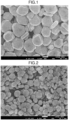
- the obtained copper fine particles of Reference Examples 1 to 4 were observed with a scanning electron microscope (product name: JSM-7600F; SEM, manufactured by JEOL Ltd.), and particle size and particle shape were observed to be evaluated.
- Figs. 1 to 4 are electron micrographs of these copper fine particles. Further, regarding the above copper fine particles, the degree of oxidation, the amount of outgassing, and the yield ratio were also examined as follows. These properties are summarized in Table 1.
- [Cu] represents the content (mass%) of copper (Cu) in the copper fine particles
- [CuO] represents the content (mass%) of copper (II) oxide in the copper fine particles
- [Cu 2 O] represents the content (mass%) of copper (I) oxide in the copper fine particles.
- the particle shape of the copper fine particles was observed with a scanning electron microscope (JSM-7600F; SEM, manufactured by JEOL Ltd.).
- the amount of outgassing of the copper fine particles was measured using dry powder of the obtained copper fine particles by simultaneous differential thermal and thermogravimetric analysis (TG-DTA) while they were heated from 40 to 500°C at a temperature increase rate of 10°C/min., and an amount of mass by which the mass after the measurement decreased from that before the measurement was calculated as the amount of outgassing (%).
- TG-DTA simultaneous differential thermal and thermogravimetric analysis
- paste compositions the components were mixed according to the formulas (part by mass) in Table 2 and the mixtures were kneaded with a roll.
- the obtained paste compositions were evaluated by the following methods. Table 2 also shows the results of the evaluation.
- materials used in Examples 1 to 4 and Comparative Example 1 commercially available products were used, except for the copper fine particles.
- Curing accelerator imidazole (product name: 2E4MZ manufactured by Shikoku Chemicals Corporation)
- the viscosity of each of the paste compositions was measured at 25°C at 5 rpm using an E-type viscometer (3° cone).
- the thermal conductivity of each of the paste compositions cured at 175°C for thirty minutes was measured by a laser flash method according to JIS R 1611-1997.
- thermal-time die shear strength at 260°C was measured using a mount strength measuring device after the paste composition was subjected to 100-cycle and 1000-cycle processes, with one cycle consisting of the operation of heating from -40°C to 250°C and cooling to -40°C.
Landscapes
- Chemical & Material Sciences (AREA)
- Engineering & Computer Science (AREA)
- Organic Chemistry (AREA)
- Nanotechnology (AREA)
- Inorganic Chemistry (AREA)
- Medicinal Chemistry (AREA)
- Health & Medical Sciences (AREA)
- Chemical Kinetics & Catalysis (AREA)
- Polymers & Plastics (AREA)
- Materials Engineering (AREA)
- Dispersion Chemistry (AREA)
- Physics & Mathematics (AREA)
- Spectroscopy & Molecular Physics (AREA)
- Composite Materials (AREA)
- Manufacturing & Machinery (AREA)
- Mechanical Engineering (AREA)
- Conductive Materials (AREA)
- Powder Metallurgy (AREA)
- Manufacture Of Metal Powder And Suspensions Thereof (AREA)
- Adhesives Or Adhesive Processes (AREA)
Claims (10)
- Pastenzusammensetzung, aufweisend:(A) Kupferfeinpartikel, die eine Dicke oder eine Nebenachse von 10 bis 500 nm haben, berechnet als ein Durchschnittswert von 10 zufällig ausgewählten Kupferfeinpartikeln basierend auf einem Beobachtungsbild eines REM, wobei der Durchschnittswert ein arithmetischer Mittelwert ist, und die mit Aminoalkohol beschichtet sind, der durch die folgende chemische Formel (1) dargestellt ist, wobei eine Aminverbindung, die mindestens eines aufweist, das aus Alkylaminen und Alkoxyaminen ausgewählt ist, an einer Fläche der Kupferfeinpartikel haftet, und(B) ein organisches Lösungsmittel,wobei eine Zusammensetzungsmenge (B) des organischen Lösungsmittels 2 bis 20 Masseteile bezogen auf 100 Masseteile (A) der Kupferfeinpartikel beträgt,
 wobei R1s identisch oder unterschiedlich sein können und jeweils unabhängig voneinander ein Wasserstoffatom, eine Alkylgruppe mit einer Kohlenstoffzahl von 1 bis 4, eine Hydroxygruppe oder eine Methoxygruppe darstellen, n und m jeweils eine ganze Zahl von 0 bis 10 darstellen und m + n 10 oder weniger ist.
 - Pastenzusammensetzung gemäß Anspruch 1, wobei (A) die Kupferfeinpartikel polyedrisch oder plattenförmig sind.
- Pastenzusammensetzung gemäß Anspruch 1 oder 2, wobei ein Oxidationsgrad (A) der Kupferfeinpartikel, berechnet nach der folgenden Formel (I), weniger als 3 % beträgt,
[Math. 1]Oxidationsgrad (%) = ([CuO] + [Cu2O])/([Cu] + [CuO] + [Cu2O]) × 100 - Pastenzusammensetzung gemäß irgendeinem der Ansprüche 1 bis 3, wobei (B) das organische Lösungsmittel Alkohol (Hydroxyverbindung) ist, der als ein Reduktionsmittel funktioniert.
- Pastenzusammensetzung gemäß irgendeinem der Ansprüche 1 bis 4, die ferner (C) Carbonsäure enthält.
- Pastenzusammensetzung gemäß Anspruch 5, wobei (C) die Carbonsäure Carbonsäureanyhdrid ist.
- Pastenzusammensetzung gemäß Anspruch 5 oder 6, ferner aufweisend (D) ein wärmehärtbares Harz aufweisend ein Phenolharz, ein radikalisch polymerisierbares Acrylharz und/oder ein Maleimidharz, wobei der Gehalt an (C) der Carbonsäure, bezogen auf 100 Masseteile (A) der Kupferfeinpartikel, 0 bis 5 Masseteile beträgt.
- Halbleitervorrichtung, aufweisend:ein Substrat undein Halbleiterelement, das durch eine gehärtete Substanz eines Die-Attach-Materials auf das Substrat gebondet ist, das die Pastenzusammensetzung gemäß irgendeinem der Ansprüche 1 bis 7 enthält.
- Halbleitervorrichtung gemäß Anspruch 8, wobei das Halbleiterelement ein lichtemittierendes Element ist.
- Elektrische/elektronische Vorrichtung, aufweisend:eine wärmeerzeugende Komponente undein Wärmeabfuhrelement, das über eine gehärtete Substanz eines Wärmeabfuhrelement-Verbindungsmaterials, das die Pastenzusammensetzung gemäß irgendeinem der Ansprüche 1 bis 7 enthält, auf die wärmeerzeugende Komponente gebondet ist.
Applications Claiming Priority (2)
| Application Number | Priority Date | Filing Date | Title |
|---|---|---|---|
| JP2017218316 | 2017-11-13 | ||
| PCT/JP2018/039347 WO2019093121A1 (ja) | 2017-11-13 | 2018-10-23 | ペースト組成物、半導体装置及び電気・電子部品 |
Publications (4)
| Publication Number | Publication Date |
|---|---|
| EP3712904A1 EP3712904A1 (de) | 2020-09-23 |
| EP3712904A4 EP3712904A4 (de) | 2021-08-25 |
| EP3712904B1 true EP3712904B1 (de) | 2025-06-25 |
| EP3712904C0 EP3712904C0 (de) | 2025-06-25 |
Family
ID=66437690
Family Applications (1)
| Application Number | Title | Priority Date | Filing Date |
|---|---|---|---|
| EP18875326.3A Active EP3712904B1 (de) | 2017-11-13 | 2018-10-23 | Pastenzusammensetzung, halbleiterbauelement und elektrische/elektronische komponente |
Country Status (7)
| Country | Link |
|---|---|
| US (1) | US11859112B2 (de) |
| EP (1) | EP3712904B1 (de) |
| JP (1) | JP7222904B2 (de) |
| KR (1) | KR102386033B1 (de) |
| CN (1) | CN111344815A (de) |
| TW (1) | TWI693266B (de) |
| WO (1) | WO2019093121A1 (de) |
Families Citing this family (14)
| Publication number | Priority date | Publication date | Assignee | Title |
|---|---|---|---|---|
| JP2020100888A (ja) * | 2018-12-25 | 2020-07-02 | 京セラ株式会社 | 銅粒子、銅粒子の製造方法、銅ペースト及び半導体装置並びに電気・電子部品 |
| CN114450107A (zh) * | 2019-09-30 | 2022-05-06 | 昭和电工材料株式会社 | 接合用铜糊料、接合体的制造方法及接合体 |
| JP7506404B2 (ja) * | 2019-10-29 | 2024-06-26 | 学校法人 工学院大学 | 金属膜の製造方法、金属膜形成用組成物及び金属膜積層体 |
| JP7380256B2 (ja) * | 2020-01-28 | 2023-11-15 | 三菱マテリアル株式会社 | 接合用シート |
| JP7410742B2 (ja) * | 2020-02-21 | 2024-01-10 | 京セラ株式会社 | 銅粒子の製造方法、銅ペースト及び半導体装置 |
| EP4309828A4 (de) * | 2021-03-17 | 2025-03-05 | Kyocera Corporation | Pastenzusammensetzung, halbleiterbauelement, elektrisches bauelement und elektronisches bauelement |
| JP7162164B1 (ja) | 2021-05-07 | 2022-10-28 | 福建晶▲しい▼新材料科技有限公司 | 半導体電熱膜の前駆体溶液、半導体電熱膜構造、及び電熱構造の製造方法 |
| CN113362984B (zh) * | 2021-06-18 | 2021-11-23 | 西湖未来智造(杭州)科技发展有限公司 | 适用于高精密直写3d打印的纳米颗粒铜浆、制备及用途 |
| JP7740913B2 (ja) * | 2021-06-29 | 2025-09-17 | 日本パーカライジング株式会社 | コーティング層を有する銅粉及びその製造方法 |
| KR20240031329A (ko) * | 2021-07-06 | 2024-03-07 | 가부시끼가이샤 레조낙 | 접합용 금속 페이스트, 및 접합체 및 그 제조 방법 |
| JP7797874B2 (ja) * | 2021-12-28 | 2026-01-14 | 三菱マテリアル株式会社 | 接合用シート、及び接合体の製造方法 |
| WO2023190080A1 (ja) * | 2022-03-30 | 2023-10-05 | 三井金属鉱業株式会社 | 接合体の製造方法及び被接合体の接合方法 |
| JPWO2023191023A1 (de) * | 2022-03-31 | 2023-10-05 | ||
| WO2025209640A1 (en) * | 2024-04-04 | 2025-10-09 | Alpha Assembly Solutions Inc. | Method of forming a sintering powder comprising copper particles |
Family Cites Families (23)
| Publication number | Priority date | Publication date | Assignee | Title |
|---|---|---|---|---|
| JPS5858374B2 (ja) | 1980-01-18 | 1983-12-24 | 日立化成工業株式会社 | 発泡性熱可塑性樹脂粒子 |
| EP0239901B1 (de) * | 1986-03-31 | 1992-11-11 | Tatsuta Electric Wire & Cable Co., Ltd | Leitfähige Kupferpastenzusammensetzung |
| JP3802367B2 (ja) * | 2001-04-27 | 2006-07-26 | ハリマ化成株式会社 | 異方性導電材料を利用する基板間導通の形成方法 |
| JP4395350B2 (ja) | 2003-10-09 | 2010-01-06 | 信越化学工業株式会社 | 硬化性樹脂組成物および導電性接着剤 |
| KR101242966B1 (ko) | 2004-08-20 | 2013-03-12 | 이시하라 산교 가부시끼가이샤 | 구리 미립자 및 구리 미립자의 제조 공정 |
| JP2006086273A (ja) | 2004-09-15 | 2006-03-30 | Dainippon Printing Co Ltd | 樹脂封止型半導体装置 |
| JP4928639B2 (ja) | 2010-03-15 | 2012-05-09 | Dowaエレクトロニクス株式会社 | 接合材およびそれを用いた接合方法 |
| TWI520386B (zh) * | 2010-07-29 | 2016-02-01 | 神基科技股份有限公司 | 發光二極體總成的結構與其製造方法 |
| JP5858374B2 (ja) * | 2010-09-27 | 2016-02-10 | 国立大学法人山形大学 | 被覆銅微粒子の製造方法 |
| WO2012077548A1 (ja) * | 2010-12-10 | 2012-06-14 | 旭硝子株式会社 | 導電ペーストおよびこれを用いた導電膜付き基材、ならびに導電膜付き基材の製造方法 |
| JP2012131894A (ja) * | 2010-12-21 | 2012-07-12 | Tosoh Corp | 導電性インク組成物、及びそれを用いて製造された電気的導通部位 |
| TWI580701B (zh) * | 2011-10-27 | 2017-05-01 | 三菱麗陽股份有限公司 | 乙烯基聚合物粉末、硬化性樹脂組成物及硬化物 |
| JP6106391B2 (ja) * | 2012-09-14 | 2017-03-29 | Dowaエレクトロニクス株式会社 | 板状銅粉とその製造方法および導電性ペースト |
| WO2015104954A1 (ja) * | 2014-01-10 | 2015-07-16 | 古河電気工業株式会社 | 電子回路装置 |
| US10214656B2 (en) | 2014-02-27 | 2019-02-26 | A School Corporation Kansai University | Copper nanoparticles and production method for same, copper nanoparticle fluid dispersion, copper nanoink, copper nanoparticle preservation method, and copper nanoparticle sintering method |
| JP5926322B2 (ja) * | 2014-05-30 | 2016-05-25 | 協立化学産業株式会社 | 被覆銅粒子及びその製造方法 |
| US20170152386A1 (en) * | 2014-06-25 | 2017-06-01 | Sumitomo Metal Mining Co., Ltd. | Copper powder, and copper paste, electrically conductive coating material and electrically conductive sheet each produced using said copper powder |
| US10177069B2 (en) | 2014-09-19 | 2019-01-08 | Hitachi Ltd. | Heat-dissipating structure and semiconductor module using same |
| JP6368925B2 (ja) * | 2014-10-01 | 2018-08-08 | 協立化学産業株式会社 | 被覆銅粒子及びその製造方法 |
| EP3263248A4 (de) * | 2015-02-27 | 2018-10-17 | Hitachi Chemical Company, Ltd. | Kupferhaltige teilchen, leiterherstellungszusammensetzung, verfahren zur herstellung eines leiters, leiter und vorrichtung |
| WO2016140185A1 (ja) * | 2015-03-05 | 2016-09-09 | ナミックス株式会社 | 導電性銅ペースト、導電性銅ペースト硬化膜および半導体装置 |
| JP6033485B2 (ja) | 2016-04-21 | 2016-11-30 | 協立化学産業株式会社 | 被覆銅粒子 |
| JP6857453B2 (ja) * | 2016-05-20 | 2021-04-14 | 京セラ株式会社 | 銅微粒子の製造方法、銅微粒子、ペースト組成物、半導体装置及び電気・電子部品 |
-
2018
- 2018-10-23 JP JP2019552699A patent/JP7222904B2/ja active Active
- 2018-10-23 EP EP18875326.3A patent/EP3712904B1/de active Active
- 2018-10-23 CN CN201880073439.3A patent/CN111344815A/zh active Pending
- 2018-10-23 KR KR1020207013991A patent/KR102386033B1/ko active Active
- 2018-10-23 WO PCT/JP2018/039347 patent/WO2019093121A1/ja not_active Ceased
- 2018-10-29 TW TW107138145A patent/TWI693266B/zh active
-
2020
- 2020-05-13 US US15/930,842 patent/US11859112B2/en active Active
Also Published As
| Publication number | Publication date |
|---|---|
| JPWO2019093121A1 (ja) | 2020-12-24 |
| EP3712904A4 (de) | 2021-08-25 |
| EP3712904A1 (de) | 2020-09-23 |
| TW201922985A (zh) | 2019-06-16 |
| WO2019093121A1 (ja) | 2019-05-16 |
| KR102386033B1 (ko) | 2022-04-14 |
| US11859112B2 (en) | 2024-01-02 |
| KR20200062333A (ko) | 2020-06-03 |
| EP3712904C0 (de) | 2025-06-25 |
| US20200279792A1 (en) | 2020-09-03 |
| JP7222904B2 (ja) | 2023-02-15 |
| CN111344815A (zh) | 2020-06-26 |
| TWI693266B (zh) | 2020-05-11 |
Similar Documents
| Publication | Publication Date | Title |
|---|---|---|
| EP3712904B1 (de) | Pastenzusammensetzung, halbleiterbauelement und elektrische/elektronische komponente | |
| JP7813875B2 (ja) | 銅粒子及びその製造方法、ペースト組成物、半導体装置、電気部品、並びに電子部品 | |
| JP6857453B2 (ja) | 銅微粒子の製造方法、銅微粒子、ペースト組成物、半導体装置及び電気・電子部品 | |
| CN113165069B (zh) | 铜粒子、铜粒子的制造方法、铜膏和半导体装置以及电气/电子部件 | |
| JP6381738B1 (ja) | ペースト状金属粒子組成物、接合方法および電子装置の製造方法 | |
| JP7731972B2 (ja) | ペースト組成物、半導体装置、電気部品及び電子部品 | |
| TW202014260A (zh) | 銅粒子之製造方法、接合用膏及半導體裝置以及電氣‧電子零件 | |
| JP7231734B2 (ja) | 電子装置及び電子装置の製造方法 | |
| TWI699412B (zh) | 糊料組合物、半導體裝置及電氣‧電子零件 | |
| TW202014259A (zh) | 銅粒子之製造方法、接合用膏及半導體裝置以及電氣‧電子零件 | |
| JP2016129101A (ja) | 複合粒子及びその製造方法、導電性ペースト、焼結体、並びに半導体装置 | |
| TW202026074A (zh) | 接合用銅粒子之製造方法、接合用膏及半導體裝置以及電氣、電子零件 | |
| TWI789698B (zh) | 氧化銅糊料及電子零件之製造方法 | |
| WO2025182843A1 (ja) | 銅粒子、ペースト組成物、半導体装置、電気部品及び電子部品 |
Legal Events
| Date | Code | Title | Description |
|---|---|---|---|
| STAA | Information on the status of an ep patent application or granted ep patent |
Free format text: STATUS: THE INTERNATIONAL PUBLICATION HAS BEEN MADE |
|
| PUAI | Public reference made under article 153(3) epc to a published international application that has entered the european phase |
Free format text: ORIGINAL CODE: 0009012 |
|
| STAA | Information on the status of an ep patent application or granted ep patent |
Free format text: STATUS: REQUEST FOR EXAMINATION WAS MADE |
|
| 17P | Request for examination filed |
Effective date: 20200512 |
|
| AK | Designated contracting states |
Kind code of ref document: A1 Designated state(s): AL AT BE BG CH CY CZ DE DK EE ES FI FR GB GR HR HU IE IS IT LI LT LU LV MC MK MT NL NO PL PT RO RS SE SI SK SM TR |
|
| AX | Request for extension of the european patent |
Extension state: BA ME |
|
| DAV | Request for validation of the european patent (deleted) | ||
| DAX | Request for extension of the european patent (deleted) | ||
| A4 | Supplementary search report drawn up and despatched |
Effective date: 20210722 |
|
| RIC1 | Information provided on ipc code assigned before grant |
Ipc: H01B 1/22 20060101AFI20210716BHEP Ipc: B22F 1/00 20060101ALI20210716BHEP Ipc: B22F 1/02 20060101ALI20210716BHEP Ipc: B22F 9/00 20060101ALI20210716BHEP Ipc: C09J 9/02 20060101ALI20210716BHEP Ipc: H01B 1/00 20060101ALI20210716BHEP Ipc: H01L 23/36 20060101ALI20210716BHEP Ipc: H01L 23/373 20060101ALI20210716BHEP |
|
| P01 | Opt-out of the competence of the unified patent court (upc) registered |
Effective date: 20230505 |
|
| REG | Reference to a national code |
Ref country code: DE Ref legal event code: R079 Free format text: PREVIOUS MAIN CLASS: H01B0001220000 Ipc: B22F0001054000 Ref country code: DE Ref legal event code: R079 Ref document number: 602018083008 Country of ref document: DE Free format text: PREVIOUS MAIN CLASS: H01B0001220000 Ipc: B22F0001054000 |
|
| RIC1 | Information provided on ipc code assigned before grant |
Ipc: B22F 9/24 20060101ALI20241206BHEP Ipc: B22F 7/08 20060101ALI20241206BHEP Ipc: H01B 1/22 20060101ALI20241206BHEP Ipc: C09J 9/02 20060101ALI20241206BHEP Ipc: H01L 33/64 20100101ALI20241206BHEP Ipc: H01B 1/02 20060101ALI20241206BHEP Ipc: H01L 23/00 20060101ALI20241206BHEP Ipc: C22C 1/04 20060101ALI20241206BHEP Ipc: C09J 5/06 20060101ALI20241206BHEP Ipc: C09J 11/04 20060101ALI20241206BHEP Ipc: C08K 3/08 20060101ALI20241206BHEP Ipc: C08K 9/04 20060101ALI20241206BHEP Ipc: B22F 7/04 20060101ALI20241206BHEP Ipc: B22F 9/30 20060101ALI20241206BHEP Ipc: B22F 7/06 20060101ALI20241206BHEP Ipc: B22F 1/107 20220101ALI20241206BHEP Ipc: B22F 1/102 20220101ALI20241206BHEP Ipc: B22F 1/06 20220101ALI20241206BHEP Ipc: B22F 1/054 20220101AFI20241206BHEP |
|
| GRAP | Despatch of communication of intention to grant a patent |
Free format text: ORIGINAL CODE: EPIDOSNIGR1 |
|
| STAA | Information on the status of an ep patent application or granted ep patent |
Free format text: STATUS: GRANT OF PATENT IS INTENDED |
|
| INTG | Intention to grant announced |
Effective date: 20250120 |
|
| RIC1 | Information provided on ipc code assigned before grant |
Ipc: B22F 9/24 20060101ALI20250121BHEP Ipc: B22F 7/08 20060101ALI20250121BHEP Ipc: H01B 1/22 20060101ALI20250121BHEP Ipc: C09J 9/02 20060101ALI20250121BHEP Ipc: H10H 20/858 20250101ALI20250121BHEP Ipc: H01B 1/02 20060101ALI20250121BHEP Ipc: H01L 23/00 20060101ALI20250121BHEP Ipc: C22C 1/04 20060101ALI20250121BHEP Ipc: C09J 5/06 20060101ALI20250121BHEP Ipc: C09J 11/04 20060101ALI20250121BHEP Ipc: C08K 3/08 20060101ALI20250121BHEP Ipc: C08K 9/04 20060101ALI20250121BHEP Ipc: B22F 7/04 20060101ALI20250121BHEP Ipc: B22F 9/30 20060101ALI20250121BHEP Ipc: B22F 7/06 20060101ALI20250121BHEP Ipc: B22F 1/107 20220101ALI20250121BHEP Ipc: B22F 1/102 20220101ALI20250121BHEP Ipc: B22F 1/06 20220101ALI20250121BHEP Ipc: B22F 1/054 20220101AFI20250121BHEP |
|
| GRAS | Grant fee paid |
Free format text: ORIGINAL CODE: EPIDOSNIGR3 |
|
| GRAA | (expected) grant |
Free format text: ORIGINAL CODE: 0009210 |
|
| STAA | Information on the status of an ep patent application or granted ep patent |
Free format text: STATUS: THE PATENT HAS BEEN GRANTED |
|
| AK | Designated contracting states |
Kind code of ref document: B1 Designated state(s): AL AT BE BG CH CY CZ DE DK EE ES FI FR GB GR HR HU IE IS IT LI LT LU LV MC MK MT NL NO PL PT RO RS SE SI SK SM TR |
|
| REG | Reference to a national code |
Ref country code: GB Ref legal event code: FG4D |
|
| REG | Reference to a national code |
Ref country code: CH Ref legal event code: EP |
|
| REG | Reference to a national code |
Ref country code: CH Ref legal event code: EP |
|
| REG | Reference to a national code |
Ref country code: IE Ref legal event code: FG4D |
|
| REG | Reference to a national code |
Ref country code: DE Ref legal event code: R096 Ref document number: 602018083008 Country of ref document: DE |
|
| U01 | Request for unitary effect filed |
Effective date: 20250714 |
|
| U07 | Unitary effect registered |
Designated state(s): AT BE BG DE DK EE FI FR IT LT LU LV MT NL PT RO SE SI Effective date: 20250718 |
|
| PG25 | Lapsed in a contracting state [announced via postgrant information from national office to epo] |
Ref country code: NO Free format text: LAPSE BECAUSE OF FAILURE TO SUBMIT A TRANSLATION OF THE DESCRIPTION OR TO PAY THE FEE WITHIN THE PRESCRIBED TIME-LIMIT Effective date: 20250925 Ref country code: GR Free format text: LAPSE BECAUSE OF FAILURE TO SUBMIT A TRANSLATION OF THE DESCRIPTION OR TO PAY THE FEE WITHIN THE PRESCRIBED TIME-LIMIT Effective date: 20250926 |
|
| U20 | Renewal fee for the european patent with unitary effect paid |
Year of fee payment: 8 Effective date: 20250909 |
|
| PG25 | Lapsed in a contracting state [announced via postgrant information from national office to epo] |
Ref country code: HR Free format text: LAPSE BECAUSE OF FAILURE TO SUBMIT A TRANSLATION OF THE DESCRIPTION OR TO PAY THE FEE WITHIN THE PRESCRIBED TIME-LIMIT Effective date: 20250625 |
|
| PG25 | Lapsed in a contracting state [announced via postgrant information from national office to epo] |
Ref country code: RS Free format text: LAPSE BECAUSE OF FAILURE TO SUBMIT A TRANSLATION OF THE DESCRIPTION OR TO PAY THE FEE WITHIN THE PRESCRIBED TIME-LIMIT Effective date: 20250925 |
|
| PG25 | Lapsed in a contracting state [announced via postgrant information from national office to epo] |
Ref country code: IS Free format text: LAPSE BECAUSE OF FAILURE TO SUBMIT A TRANSLATION OF THE DESCRIPTION OR TO PAY THE FEE WITHIN THE PRESCRIBED TIME-LIMIT Effective date: 20251025 |
|
| PG25 | Lapsed in a contracting state [announced via postgrant information from national office to epo] |
Ref country code: SM Free format text: LAPSE BECAUSE OF FAILURE TO SUBMIT A TRANSLATION OF THE DESCRIPTION OR TO PAY THE FEE WITHIN THE PRESCRIBED TIME-LIMIT Effective date: 20250625 |
|
| PG25 | Lapsed in a contracting state [announced via postgrant information from national office to epo] |
Ref country code: CZ Free format text: LAPSE BECAUSE OF FAILURE TO SUBMIT A TRANSLATION OF THE DESCRIPTION OR TO PAY THE FEE WITHIN THE PRESCRIBED TIME-LIMIT Effective date: 20250625 |
|
| PG25 | Lapsed in a contracting state [announced via postgrant information from national office to epo] |
Ref country code: PL Free format text: LAPSE BECAUSE OF FAILURE TO SUBMIT A TRANSLATION OF THE DESCRIPTION OR TO PAY THE FEE WITHIN THE PRESCRIBED TIME-LIMIT Effective date: 20250625 |
|
| PG25 | Lapsed in a contracting state [announced via postgrant information from national office to epo] |
Ref country code: SK Free format text: LAPSE BECAUSE OF FAILURE TO SUBMIT A TRANSLATION OF THE DESCRIPTION OR TO PAY THE FEE WITHIN THE PRESCRIBED TIME-LIMIT Effective date: 20250625 |
|
| PG25 | Lapsed in a contracting state [announced via postgrant information from national office to epo] |
Ref country code: ES Free format text: LAPSE BECAUSE OF FAILURE TO SUBMIT A TRANSLATION OF THE DESCRIPTION OR TO PAY THE FEE WITHIN THE PRESCRIBED TIME-LIMIT Effective date: 20250625 |