EP3709959B1 - Kosmetische emulsion mit einem geminitensid und einem lipophilen polymer - Google Patents
Kosmetische emulsion mit einem geminitensid und einem lipophilen polymer Download PDFInfo
- Publication number
- EP3709959B1 EP3709959B1 EP18800960.9A EP18800960A EP3709959B1 EP 3709959 B1 EP3709959 B1 EP 3709959B1 EP 18800960 A EP18800960 A EP 18800960A EP 3709959 B1 EP3709959 B1 EP 3709959B1
- Authority
- EP
- European Patent Office
- Prior art keywords
- weight
- composition according
- formula
- ranges
- gemini surfactant
- Prior art date
- Legal status (The legal status is an assumption and is not a legal conclusion. Google has not performed a legal analysis and makes no representation as to the accuracy of the status listed.)
- Active
Links
Classifications
-
- A—HUMAN NECESSITIES
- A61—MEDICAL OR VETERINARY SCIENCE; HYGIENE
- A61K—PREPARATIONS FOR MEDICAL, DENTAL OR TOILETRY PURPOSES
- A61K8/00—Cosmetics or similar toiletry preparations
- A61K8/18—Cosmetics or similar toiletry preparations characterised by the composition
- A61K8/30—Cosmetics or similar toiletry preparations characterised by the composition containing organic compounds
- A61K8/40—Cosmetics or similar toiletry preparations characterised by the composition containing organic compounds containing nitrogen
- A61K8/44—Aminocarboxylic acids or derivatives thereof, e.g. aminocarboxylic acids containing sulfur; Salts; Esters or N-acylated derivatives thereof
-
- A—HUMAN NECESSITIES
- A61—MEDICAL OR VETERINARY SCIENCE; HYGIENE
- A61K—PREPARATIONS FOR MEDICAL, DENTAL OR TOILETRY PURPOSES
- A61K8/00—Cosmetics or similar toiletry preparations
- A61K8/02—Cosmetics or similar toiletry preparations characterised by special physical form
- A61K8/04—Dispersions; Emulsions
- A61K8/06—Emulsions
-
- A—HUMAN NECESSITIES
- A61—MEDICAL OR VETERINARY SCIENCE; HYGIENE
- A61K—PREPARATIONS FOR MEDICAL, DENTAL OR TOILETRY PURPOSES
- A61K8/00—Cosmetics or similar toiletry preparations
- A61K8/02—Cosmetics or similar toiletry preparations characterised by special physical form
- A61K8/04—Dispersions; Emulsions
- A61K8/06—Emulsions
- A61K8/062—Oil-in-water emulsions
-
- A—HUMAN NECESSITIES
- A61—MEDICAL OR VETERINARY SCIENCE; HYGIENE
- A61K—PREPARATIONS FOR MEDICAL, DENTAL OR TOILETRY PURPOSES
- A61K8/00—Cosmetics or similar toiletry preparations
- A61K8/18—Cosmetics or similar toiletry preparations characterised by the composition
- A61K8/30—Cosmetics or similar toiletry preparations characterised by the composition containing organic compounds
- A61K8/40—Cosmetics or similar toiletry preparations characterised by the composition containing organic compounds containing nitrogen
- A61K8/42—Amides
-
- A—HUMAN NECESSITIES
- A61—MEDICAL OR VETERINARY SCIENCE; HYGIENE
- A61K—PREPARATIONS FOR MEDICAL, DENTAL OR TOILETRY PURPOSES
- A61K8/00—Cosmetics or similar toiletry preparations
- A61K8/18—Cosmetics or similar toiletry preparations characterised by the composition
- A61K8/30—Cosmetics or similar toiletry preparations characterised by the composition containing organic compounds
- A61K8/40—Cosmetics or similar toiletry preparations characterised by the composition containing organic compounds containing nitrogen
- A61K8/45—Derivatives containing from 2 to 10 oxyalkylene groups
-
- A—HUMAN NECESSITIES
- A61—MEDICAL OR VETERINARY SCIENCE; HYGIENE
- A61K—PREPARATIONS FOR MEDICAL, DENTAL OR TOILETRY PURPOSES
- A61K8/00—Cosmetics or similar toiletry preparations
- A61K8/18—Cosmetics or similar toiletry preparations characterised by the composition
- A61K8/30—Cosmetics or similar toiletry preparations characterised by the composition containing organic compounds
- A61K8/46—Cosmetics or similar toiletry preparations characterised by the composition containing organic compounds containing sulfur
- A61K8/463—Cosmetics or similar toiletry preparations characterised by the composition containing organic compounds containing sulfur containing sulfuric acid derivatives, e.g. sodium lauryl sulfate
-
- A—HUMAN NECESSITIES
- A61—MEDICAL OR VETERINARY SCIENCE; HYGIENE
- A61K—PREPARATIONS FOR MEDICAL, DENTAL OR TOILETRY PURPOSES
- A61K8/00—Cosmetics or similar toiletry preparations
- A61K8/18—Cosmetics or similar toiletry preparations characterised by the composition
- A61K8/30—Cosmetics or similar toiletry preparations characterised by the composition containing organic compounds
- A61K8/46—Cosmetics or similar toiletry preparations characterised by the composition containing organic compounds containing sulfur
- A61K8/466—Cosmetics or similar toiletry preparations characterised by the composition containing organic compounds containing sulfur containing sulfonic acid derivatives; Salts
-
- A—HUMAN NECESSITIES
- A61—MEDICAL OR VETERINARY SCIENCE; HYGIENE
- A61K—PREPARATIONS FOR MEDICAL, DENTAL OR TOILETRY PURPOSES
- A61K8/00—Cosmetics or similar toiletry preparations
- A61K8/18—Cosmetics or similar toiletry preparations characterised by the composition
- A61K8/72—Cosmetics or similar toiletry preparations characterised by the composition containing organic macromolecular compounds
- A61K8/81—Cosmetics or similar toiletry preparations characterised by the composition containing organic macromolecular compounds obtained by reactions involving only carbon-to-carbon unsaturated bonds
- A61K8/8141—Compositions of homopolymers or copolymers of compounds having one or more unsaturated aliphatic radicals, each having only one carbon-to-carbon double bond, and at least one being terminated by only one carboxyl radical, or of salts, anhydrides, esters, amides, imides or nitriles thereof; Compositions of derivatives of such polymers
- A61K8/8152—Homopolymers or copolymers of esters, e.g. (meth)acrylic acid esters; Compositions of derivatives of such polymers
-
- A—HUMAN NECESSITIES
- A61—MEDICAL OR VETERINARY SCIENCE; HYGIENE
- A61K—PREPARATIONS FOR MEDICAL, DENTAL OR TOILETRY PURPOSES
- A61K8/00—Cosmetics or similar toiletry preparations
- A61K8/18—Cosmetics or similar toiletry preparations characterised by the composition
- A61K8/72—Cosmetics or similar toiletry preparations characterised by the composition containing organic macromolecular compounds
- A61K8/84—Cosmetics or similar toiletry preparations characterised by the composition containing organic macromolecular compounds obtained by reactions otherwise than those involving only carbon-carbon unsaturated bonds
- A61K8/86—Polyethers
-
- A—HUMAN NECESSITIES
- A61—MEDICAL OR VETERINARY SCIENCE; HYGIENE
- A61Q—SPECIFIC USE OF COSMETICS OR SIMILAR TOILETRY PREPARATIONS
- A61Q1/00—Make-up preparations; Body powders; Preparations for removing make-up
- A61Q1/14—Preparations for removing make-up
-
- A—HUMAN NECESSITIES
- A61—MEDICAL OR VETERINARY SCIENCE; HYGIENE
- A61Q—SPECIFIC USE OF COSMETICS OR SIMILAR TOILETRY PREPARATIONS
- A61Q17/00—Barrier preparations; Preparations brought into direct contact with the skin for affording protection against external influences, e.g. sunlight, X-rays or other harmful rays, corrosive materials, bacteria or insect stings
- A61Q17/04—Topical preparations for affording protection against sunlight or other radiation; Topical sun tanning preparations
-
- A—HUMAN NECESSITIES
- A61—MEDICAL OR VETERINARY SCIENCE; HYGIENE
- A61Q—SPECIFIC USE OF COSMETICS OR SIMILAR TOILETRY PREPARATIONS
- A61Q19/00—Preparations for care of the skin
- A61Q19/10—Washing or bathing preparations
Definitions
- the present application relates to a composition in the form of an emulsion comprising at least one UV-screening agent, at least one gemini surfactant which has a specific chemical structure with at least two fatty amide groups, and at least one lipophilic polymer which has been suitably selected, and to the use of said composition in the cosmetics and dermatology fields, in particular for caring for, treating keratin materials, and in particular for caring for, protecting and/or making up bodily or facial skin, or for hair care.
- photoprotective compositions are in the form of an emulsion of O/W type, and contain, at various concentrations, one or more liposoluble conventional organic screening agents and/or one or more water-soluble conventional organic screening agents and/or one or more mineral screening agents.
- compositions are capable of selectively absorbing harmful UV radiation, these screening agents and the amount thereof being selected as a function of the sun protection factor (SPF) desired.
- SPDF sun protection factor
- Document EP 2 039 339 describes oil-in-water emulsions which comprise at least one gemini surfactant such as Ceralution H and at least one semi-crystalline polymer such as Intelimer IPA 13-1.
- Document EP 3 235 839 relates to copolymers of C16-C22 alkyl acrylates which are used to stabilize the oily phase of cosmetic compositions without a sticky effect.
- Document DE 26 08 875 describes water-in-oil emulsions which comprise from 2 to 20 % by weight of lipophilic acrylic copolymers.
- the applicant has discovered that the combination of at least one gemini surfactant which has a specific chemical structure with at least two fatty amide groups and of a lipophilic polymer which has been suitably selected, in a cosmetic composition in the form of an emulsion comprising a photoprotective system capable of screening out UV radiation, makes it possible to solve the problem set out above.
- a subject of the present invention is a composition in the form of an emulsion comprising at least one UV-screening agent, at least one gemini surfactant having the chemical formula below, and also the stereoisomers thereof: in which:
- composition in accordance with the invention makes it possible to obtain a cosmetic emulsion having an increased sun protection factor, while at the same time having good cosmetic properties, such as a non-greasy and non-tacky feel, and at the same time being stable, in particular from the physicochemical viewpoint.
- the emulsion obtained according to the invention has good stability over time, even at a temperature above ambient temperature (for example 45°C).
- stable emulsion is intended to mean an emulsion which exhibits no macroscopic and microscopic change (in colour, in odour, in viscosity, nor any variation in pH) after storage and/or temperature change, in particular after 24 hours at a temperature equal to ambient temperature (AT), at 4°C or at 45°C.
- Described herein is also a cosmetic treatment process for caring for and/or making up keratin materials, which consists in applying to the keratin materials a composition as defined above.
- compositions or dermatology field Described herein is also the use of said composition in the cosmetics or dermatology field, and in particular for caring for, protecting and/or making up keratin materials, such as bodily or facial skin, or the hair.
- composition according to the invention is intended for topical application and thus comprises a physiologically acceptable medium.
- physiologically acceptable medium here is understood to mean a medium that is compatible with keratin materials.
- keratin material especially is understood to mean the skin, the scalp, keratin fibres such as the eyelashes, the eyebrows, head hair, bodily hair, the nails, and mucous membranes such as the lips, and more particularly the skin (body, face, area around the eyes, eyelids).
- Gemini surfactants comprising at least two fatty amide groups
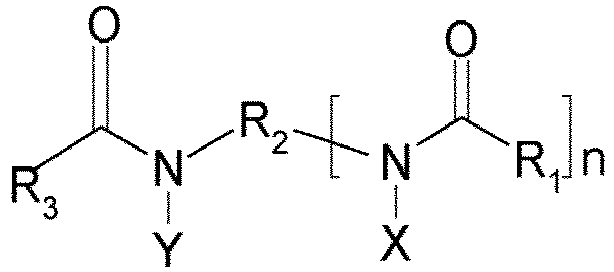
- composition in accordance with the invention comprises at least one gemini surfactant having the chemical formula below, and also the stereoisomers thereof: in which:
- the gemini surfactant(s) are chosen from the compounds of formula (II), and also the stereoisomers thereof: in which:
- the gemini surfactant(s) of formula (II) are such that each of the groups R 1 -CO- and R 3 -CO- comprises from 8 to 20 carbon atoms, and preferably denotes a coconut fatty acid residue (mainly comprising lauric acid and myristic acid).
- the gemini surfactant(s) of formula (II) are such that, for each of the X and Y radicals, the sum of a and b has an average value ranging from 10 to 20 and is preferably equal to 15.
- a preferred group for Z is the group -SO 3 M, where M is preferably an alkali metal ion, such as a sodium ion.
- the spacer R 2 is advantageously constituted of a linear C 1 -C 3 alkylene chain, and preferably a (CH 2 CH 2 ) ethylene chain.
- n is advantageously equal to 1.
- a surfactant of this type is in particular the one identified by the INCI name: Sodium dicocoylethylenediamine PEG-15 sulfate, having the following structure: it being understood that PEG represents the group CH 2 CH 2 O and cocoyl represents the coconut fatty acid residue.
- This surfactant has a molecular structure very similar to that of ceramide-3.
- the gemini surfactant of formula (II) of the invention is used as a mixture with other surfactants, and in particular as a mixture with (a) a glyceryl ester of a C 6 -C 22 fatty acid (preferably C 14 -C 20 such as a stearate), (b) a diester of a C 6 -C 22 fatty acid (preferably C 14 -C 20 such as a stearate) and of citric acid and of glycerol, and (c) a C 10 -C 30 fatty alcohol (preferably behenyl alcohol).
- a glyceryl ester of a C 6 -C 22 fatty acid preferably C 14 -C 20 such as a stearate
- a diester of a C 6 -C 22 fatty acid preferably C 14 -C 20 such as a stearate
- citric acid and of glycerol and
- a C 10 -C 30 fatty alcohol preferably behenyl alcohol
- the gemini surfactant of formula (II) represents from 10% to 20% by weight and advantageously 15% by weight; the glyceryl ester of a C 6 -C 22 fatty acid represents from 30% to 40% by weight, advantageously 35% by weight; the diester of a C 6 -C 22 fatty acid and of citric acid and of glycerol represents from 10% to 20% by weight, advantageously 15% by weight; and the C 10 -C 30 fatty alcohol represents from 30% to 40% by weight, advantageously 35% by weight, relative to the total weight of the mixture of surfactants containing the gemini surfactant.
- the gemini surfactant of formula (II) according to the invention may be used as a mixture with an anionic surfactant, such as an ester of lauric acid, sodium lauryl lactate.
- an anionic surfactant such as an ester of lauric acid, sodium lauryl lactate.
- the gemini surfactant preferably represents from 30 to 50% by weight, and the anionic surfactant represents from 30 to 50% by weight, relative to the total weight of the mixture.
- gemini surfactant may be used, for example, as a mixture with other surfactants in the form of the products sold by the company Sasol under the Ceralution ® names, and in particular the following products:
- the gemini surfactant(s) of formula (II) are in the form of a mixture of surfactants comprising from 3% to 50% by weight of gemini surfactants of formula (II), preferably from 10% to 50% by weight, and even more preferentially from 10% to 20% by weight, relative to the total weight of the mixture.
- the gemini surfactant(s) of formula (II) can be present in the composition according to the invention in a content of active material ranging from 0.01% to 5% by weight, relative to the total weight of the composition, preferably ranging from 0.1% to 3% by weight and better still ranging from 0.2% to 1.5% by weight.
- the gemini surfactant(s) are chosen from the compounds of formula (III), and also the stereoisomers thereof: in which:
- Y' represents -COONa
- I 10.
- gemini surfactants of formula (III) By way of examples of gemini surfactants of formula (III), mention may be made of sodium dilauramidoglutamide lysine, sodium dimyristoylglutamide lysine and sodium distearoylglutamide lysine. Sodium dilauramidoglutamide lysine is particularly preferred. Sodium dilauramidoglutamide lysine is in particular sold by the company Asahi Kasei Chemicals under the names Pellicer L-30 and Pellicer LB-10 .
- gemini surfactant(s) of formula (III) is (are) in particular described in application WO 2004/020394 .
- the gemini surfactant(s) comprising at least two fatty amide groups of formula (III) can be present in the composition in an amount of active material ranging from 0.01% to 5% by weight, preferably from 0.01% to 1% by weight, and even more preferentially from 0.01% to 0.7% by weight, relative to the total weight of the composition.
- the gemini surfactant(s) present in the composition in accordance with the invention are chosen from the compounds of formula (II) as defined above, and also the stereoisomers thereof.
- composition in accordance with the invention comprises at least one lipophilic polymer comprising monomeric units of formulae (A) and (B): in which:
- At least 70% by weight of the R groups are behenyl radicals, preferentially at least 80% by weight, and more preferentially at least 90% by weight.
- all the R groups are behenyl radicals.
- said weight ratio ranges from 1:15 to 1:1, preferentially ranges from 1:10 to 1:4.
- the polymeric units present in the polymer are constituted of the units (A) and (B) previously described.
- the polymer has a number-average molecular weight Mn ranging from 2000 to 9000 g/mol, preferably ranging from 5000 to 9000 g/mol.
- the number-average molecular weight can be measured with the gel permeation chromatography method, for example according to the method described in the example hereinafter.
- the polymer has a melting point ranging from 60°C to 69°C, and preferentially ranging from 63°C to 67°C.
- the melting point is measured by differential scanning calorimetry (DSC), for example according to the method described in the example hereinafter.
- the polymerization can be carried out according to known methods, such as solution polymerization or emulsion polymerization.
- the polymerization is, for example, described in document US 2007/0264204 .
- the lipophilic polymer(s) used in the context of the invention and as previously described can be present in the composition in an amount of active material ranging from 0.1% to 10% by weight, preferably from 0.1% to 3% by weight, relative to the total weight of the composition.
- composition in accordance with the invention comprises one or more UV-screening agents.
- Said UV-screening agents can be chosen from water-soluble, liposoluble or insoluble organic UV-screening agents and/or mineral pigments.
- the composition according to the invention comprises at least one hydrophilic, lipophilic or insoluble organic UV-screening agent.
- water-soluble UV-screening agent is intended to mean any cosmetic or dermatological organic or inorganic compound for screening out UV radiation, which can be fully dissolved in molecular form or miscibilized in a liquid aqueous phase or else can be dissolved in colloidal form (for example in micellar form) in a liquid aqueous phase.
- liposoluble screening agent is intended to mean any cosmetic or dermatological, organic or inorganic compound for screening out UV radiation which can be fully dissolved in molecular form or misciblized in an oily phase or else can be dissolved in colloidal form (for example in micellar form) in an oily phase.
- insoluble UV-screening agent is intended to mean any cosmetic or dermatological organic or mineral compound for screening out UV radiation which has a solubility in water of less than 0.5% by weight and a solubility of less than 0.5% by weight in the majority of organic solvents such as liquid paraffin, fatty alcohol benzoates and fatty acid triglycerides, for example Miglyol 812 ® sold by the company Dynamit Nobel.
- This solubility, determined at 70°C, is defined as the amount of product in solution in the solvent at equilibrium with an excess of solid in suspension after returning to ambient temperature.
- the organic UV-screening agents are in particular chosen from cinnamic compounds; dibenzoylmethane compounds; anthranilate compounds; salicylic compounds; benzylidenecamphor compounds; benzophenone compounds; ⁇ , ⁇ -diphenyl acrylate compounds; triazine compounds; benzotriazole compounds, in particular the silicone benzotriazoles described in patent EP0392883 and the methylenebis(hydroxyphenyl benzotriazole) compounds as described in applications US 5 237 071 , US 5 166 355 , GB2303549 , DE 197 26 184 and EP893119 ; benzalmalonate compounds, in particular those mentioned in patent US 5 624 663 ; benzimidazole derivatives; imidazoline compounds; the bis-benzoazolyl compounds as described in patents EP669323 and US 2 463 264 ; p-aminobenzoic (PABA) compounds; the benzoxazole compounds as described in patent applications EP0832
- organic photoprotective agents mention may be made of those denoted hereinbelow under their INCI name:
- Cinnamic compounds are Cinnamic compounds:
- Ethylhexyl methoxycinnamate sold in particular under the trade name Parsol MCX ® by DSM Nutritional Products,
- Phenylbenzimidazolesulfonic acid sold in particular under the trade name Eusolex 232 ® by Merck.
- Disodium phenyl dibenzimidazole tetrasulfonate sold under the trade name Neo Heliopan AP ® by Symrise.
- Drometrizole trisiloxane manufactured under the name Mexoryl SX ® by Chimex; Methylenebis(benzotriazolyl)tetramethylbutylphenol, in particular in solid form, such as the product sold under the trade name Mixxim BB/100 ® by Fairmount Chemical, or in the form of an aqueous dispersion of micronized particles with an average particle size ranging from 0.01 to 5 ⁇ m, more preferentially from 0.01 to 2 ⁇ m and more particularly from 0.020 to 2 ⁇ m, with at least one alkylpolyglycoside surfactant having the structure C n H 2n+1 O(C 6 H 10 O 5 ) x H, in which n is an integer from 8 to 16 and x is the mean degree of polymerization of the (C 6 H 10 O 5 ) unit and ranges from 1.4 to 1.6, as described in patent GB-A-2 303 549 , sold in particular under the trade name Tinosorb M ® by the company BASF,
- Neo Heliopan MA Menthyl anthranilate, sold under the trade name Neo Heliopan MA ® by Symrise.
- Polyorganosiloxane containing benzalmalonate functions for instance Polysilicone-15, sold under the trade name Parsol SLX ® by DSM Nutritional Products, Inc.
- the preferential organic screening agents are chosen from:
- the particularly preferred organic screening agents are chosen from:
- the mineral UV-screening agents used in accordance with the present invention are metal oxide pigments. More preferentially, the inorganic UV-screening agents of the invention are metal oxide particles with a mean elementary particle size of less than or equal to 0.5 ⁇ m, more preferentially between 0.005 and 0.5 ⁇ m, even more preferentially between 0.01 and 0.2 ⁇ m, better still between 0.01 and 0.1 ⁇ m and more particularly between 0.015 and 0.05 ⁇ m.
- They may be chosen in particular from titanium oxide, zinc oxide, iron oxide, zirconium oxide and cerium oxide, or mixtures thereof.
- Such coated or uncoated metal oxide pigments are described in particular in patent application EP-A-0 518 773 .
- Commercial pigments that may be mentioned include the products sold by the companies Sachtleben Pigments, Tayca, Merck and Degussa.
- the metal oxide pigments may be coated or uncoated.
- the coated pigments are pigments that have undergone one or more surface treatments of chemical, electronic, mechanochemical and/or mechanical nature with compounds such as amino acids, beeswax, fatty acids, fatty alcohols, anionic surfactants, lecithins, sodium, potassium, zinc, iron or aluminium salts of fatty acids, metal alkoxides (of titanium or aluminium), polyethylene, silicones, proteins (collagen, elastin), alkanolamines, silicon oxides, metal oxides or sodium hexametaphosphate.
- compounds such as amino acids, beeswax, fatty acids, fatty alcohols, anionic surfactants, lecithins, sodium, potassium, zinc, iron or aluminium salts of fatty acids, metal alkoxides (of titanium or aluminium), polyethylene, silicones, proteins (collagen, elastin), alkanolamines, silicon oxides, metal oxides or sodium hexametaphosphate.
- coated pigments are more particularly titanium oxides that have been coated:
- the uncoated titanium oxide pigments are sold, for example, by the company Tayca under the trade names Microtitanium Dioxide MT 500 B or Microtitanium Dioxide MT 600 B ® , by the company Degussa under the name P 25, by the company Wacker under the name Transparent titanium oxide PW ® , by the company Miyoshi Kasei under the name UFTR ® , by the company Tomen under the name ITS ® and by the company Tioxide under the name Tioveil AQ.
- the uncoated zinc oxide pigments are, for example:
- coated zinc oxide pigments are, for example:
- the uncoated cerium oxide pigments may be, for example, those sold under the name Colloidal Cerium Oxide ® by the company Rhone-Poulenc.
- the uncoated iron oxide pigments are sold, for example, by the company Arnaud under the names Nanogard WCD 2002 ® (FE 45B ® ), Nanogard Iron FE 45 BL AQ, Nanogard FE 45R AQ ® and Nanogard WCD 2006 ® (FE 45R ® ) or by the company Mitsubishi under the name TY-220 ® .
- the coated iron oxide pigments are sold, for example, by the company Arnaud under the names Nanogard WCD 2008 (FE 45B FN) ® , Nanogard WCD 2009 ® (FE 45B 556 ® ), Nanogard FE 45 BL 345 ® and Nanogard FE 45 BL ® or by the company BASF under the name Transparent Iron Oxide ® .
- the UV-screening agents according to the invention are generally present in the composition according to the invention in a content ranging from 0.1% to 45% by weight and in particular from 1% to 30% by weight relative to the total weight of the composition.
- composition according to the invention is in the form of an emulsion and can be prepared according to the usual methods.
- the composition according to the invention is in the form of an oil-in-water emulsion (direct emulsion) comprising a continuous aqueous phase and an oily phase dispersed in said aqueous phase.
- the composition according to the invention is in the form of a water-in-oil emulsion (inverse emulsion) comprising a continuous oily phase and an aqueous phase dispersed in said oily phase.
- a water-in-oil emulsion inverse emulsion
- the composition according to the invention is in the form of an oil-in-water emulsion.
- This emulsion can have a texture ranging from fluid to thick. It can for example have a viscosity at ambient temperature (25°C) which ranges within a very broad range, for example a viscosity ranging from approximately 1 to 500 poises (0.1 to 50 Pa.s), and preferably from approximately 2 to 10 poises (0.2 to 1 Pa.s).
- the viscosity measurement is generally carried out at 25°C, using a Rheomat RM180 ® viscometer equipped with a No.
- composition according to the invention comprises at least one fatty phase.
- the proportion of the fatty phase can range for example from 1% to 80% by weight, preferably from 5% to 40% by weight, relative to the total weight of the composition.
- the fatty phase includes any fatty substance that is liquid at ambient temperature and atmospheric pressure, generally oils, or that is solid at ambient temperature and atmospheric pressure, like pasty compounds or waxes.
- the term "pasty compound” is intended to mean a compound that is water-immiscible and that undergoes a reversible solid/liquid change of state and that comprises in the solid state an anisotropic crystal organization, and comprises, at a temperature of 23°C, a liquid fraction and a solid fraction.
- the term "wax” is understood to mean a lipophilic compound, which is solid at ambient temperature (25°C), with a reversible solid/liquid change of state, which has a melting point of greater than or equal to 30°C that may be up to 120°C.
- the melting point of the wax may be measured using a differential scanning calorimeter (D.S.C.), for example the calorimeter sold under the name DSC 30 by the company Mettler.
- D.S.C. differential scanning calorimeter
- the measuring protocol is as follows: A sample of 5 mg of wax placed in a crucible is subjected to a first temperature rise passing from -20°C to 100°C, at a heating rate of 10°C/minute, it is then cooled from 100°C to - 20°C at a cooling rate of 10°C/minute and is finally subjected to a second temperature rise passing from -20°C to 100°C at a heating rate of 5°C/minute.
- the variation in the difference in power absorbed by the empty crucible and by the crucible containing the sample of wax is measured as a function of the temperature.
- the melting point of the compound is the temperature value corresponding to the top of the peak of the curve representing the variation in the difference in power absorbed as a function of the temperature.
- the solid fatty substance may be a polymer, in particular a hydrocarbon-based polymer.
- liposoluble polyethers that are particularly preferred are copolymers of ethylene oxide and/or of propylene oxide with C 6 -C 30 long-chain alkylene oxides, more preferably such that the weight ratio of the ethylene oxide and/or of the propylene oxide with the alkylene oxides in the copolymer is from 5:95 to 70:30.
- copolymers such as long-chain alkylene oxides arranged in blocks with an average molecular weight from 1000 to 10 000, for example a polyoxyethylene/polydodecyl glycol block copolymer such as the ethers of dodecanediol (22 mol) and of polyethylene glycol (45 OE) sold under the brand name Elfacos ST9 by AkzoNobel.
- esters the following are especially preferred:
- the composition may comprise from 0.5 to 30% by weight of pasty compounds relative to the total weight of the composition.
- the waxes that may be used in a composition according to the invention are chosen from waxes that are solid at ambient temperature, of animal, plant, mineral or synthetic origin, and mixtures thereof. They may be hydrocarbon-based, fluoro and/or silicone waxes. Examples that may especially be mentioned include hydrocarbon-based waxes, such as natural beeswax (or bleached beeswax), synthetic beeswax, carnauba wax, rice bran wax, such as the product sold under the reference NC 1720 by the company Cera Jamaica Noda, candelilla wax, such as the product sold under the reference SP 75 G by the company Strahl & Pitsch, microcrystalline waxes, for instance the microcrystalline waxes of which the melting point is above 85°C, such as the products HI-MIC ® 1070, 1080, 1090 and 3080 sold by the company Nippon Seiro, ceresins or ozokerites, for instance isoparaffins of which the melting point is below 40°C, such as the
- the other solid fatty substances that may be present in the fatty phase are, for example, fatty acids comprising from 8 to 30 carbon atoms, for instance stearic acid, lauric acid or palmitic acid; fatty alcohols comprising from 8 to 30 carbon atoms, for instance stearyl alcohol or cetyl alcohol and mixtures thereof (cetearyl alcohol).
- the composition may comprise 0.5% (rather 0.2%) to 20% by weight of wax relative to the total weight of the composition.
- the fatty phase of the composition in accordance with the invention can also comprise at least one oil.
- the oil(s) present in the composition may be volatile or non-volatile.
- oil is intended to mean any fatty substance that is in liquid form at ambient temperature (25°C) and at atmospheric pressure.
- the volatile or non-volatile oils may be hydrocarbon-based oils, especially of animal or plant origin, synthetic oils, silicone oils or fluoro oils, or mixtures thereof.
- silicon oil is intended to mean an oil comprising at least one silicon atom, and especially at least one Si-O group.
- hydrocarbon-based oil is intended to mean an oil mainly containing hydrogen and carbon atoms and possibly oxygen, nitrogen, sulfur and/or phosphorus atoms.
- fluoro oil is intended to mean an oil comprising at least one fluorine atom and especially at least one perfluorinated chain.
- non-volatile oil is understood to mean an oil with a vapour pressure of less than 0.13 Pa (0.01 mmHg).
- the non-volatile oils may be chosen especially from non-volatile hydrocarbon-based oils, which may be fluorinated, and/or silicone oils.
- non-volatile hydrocarbon-based oils that are suitable for use in the invention, mention may be made especially of:
- esters may be chosen in particular from esters, in particular fatty acid esters, for instance:
- volatile oil is intended to mean an oil (or nonaqueous medium) that is capable of evaporating on contact with the skin in less than one hour, at ambient temperature and at atmospheric pressure.
- the volatile oil is a volatile cosmetic oil, which is liquid at ambient temperature, especially having a non-zero vapour pressure, at ambient temperature and atmospheric pressure, in particular having a vapour pressure ranging from 0.13 Pa to 40 000 Pa (10 -3 to 300 mmHg), in particular ranging from 1.3 Pa to 13 000 Pa (0.01 to 100 mmHg) and more particularly ranging from 1.3 Pa to 1300 Pa (0.01 to 10 mmHg).
- the volatile hydrocarbon-based oils may be chosen from hydrocarbon-based oils containing from 8 to 16 carbon atoms.
- hydrocarbon-based oil is understood to mean an oil formed essentially from, or even constituted of, carbon and hydrogen atoms, and possibly oxygen, nitrogen, sulfur and/or phosphorus atoms, and containing no silicon or fluorine atoms; it may contain ester, ether, amine or amide groups.
- the volatile hydrocarbon-based oil(s) can in particular be chosen from volatile branched esters, volatile branched alkanes, volatile linear alkanes, and mixtures thereof.
- compositions according to the invention can comprise one or more branched C 8 -C 16 esters, such as isohexyl neopentanoate, isoamyl esters such as isoamyl laurate, or else isononyl isononanoate.
- esters such as isohexyl neopentanoate, isoamyl esters such as isoamyl laurate, or else isononyl isononanoate.
- composition according to the invention may contain one or more volatile branched alkanes.
- the expression "one or more volatile branched alkanes" is intended to mean, without preference, “one or more volatile branched alkane oils”.
- volatile branched alkanes such as C 8 -C 16 branched alkanes, such as C 8 -C 16 isoalkanes (also known as isoparaffins), isododecane (also known as 2,2,4,4,6-pentamethylheptane), isodecane, isohexadecane, and for example the oils sold under the trade names Isopar ® by ExxonMobil or Permethyl ® by Presperse.
- the volatile hydrocarbon-based oil containing from 8 to 16 carbon atoms is chosen from isododecane, isodecane and isohexadecane, and mixtures thereof, and is in particular isododecane.
- composition according to the invention may contain one or more volatile linear alkanes.
- the term "one or more volatile linear alkanes" is intended to mean, without preference, “one or more volatile linear alkane oils”.
- a volatile linear alkane that is suitable for the invention is liquid at ambient temperature (about 25°C) and at atmospheric pressure (760 mmHg).
- a "volatile linear alkane” that is suitable for the invention is intended to mean a cosmetic linear alkane, which is capable of evaporating on contact with the skin in less than one hour, at ambient temperature (25°C) and atmospheric pressure (760 mmHg, i.e. 101 325 Pa), which is liquid at ambient temperature, in particular having an evaporation rate ranging from 0.01 to 15 mg/cm 2 /min, at ambient temperature (25°C) and atmospheric pressure (760 mmHg).
- the "volatile linear alkanes” that are suitable for the invention have an evaporation rate ranging from 0.01 to 3.5 mg/cm 2 /min, at ambient temperature (25°C) and atmospheric pressure (760 mmHg).
- the "volatile linear alkanes” that are suitable for the invention have an evaporation rate ranging from 0.01 to 1.5 mg/cm 2 /min, at ambient temperature (25°C) and atmospheric pressure (760 mmHg).
- the "volatile linear alkanes" that are suitable for the invention have an evaporation rate ranging from 0.01 to 0.8 mg/cm 2 /min, at ambient temperature (25°C) and atmospheric pressure (760 mmHg).
- the "volatile linear alkanes" that are suitable for the invention have an evaporation rate ranging from 0.01 to 0.3 mg/cm 2 /min, at ambient temperature (25°C) and atmospheric pressure (760 mmHg).
- the "volatile linear alkanes" that are suitable for the invention have an evaporation rate ranging from 0.01 to 0.12 mg/cm 2 /min, at ambient temperature (25°C) and atmospheric pressure (760 mmHg).
- the evaporation rate of a volatile alkane in accordance with the invention may in particular be evaluated by means of the protocol described in WO 06/013 413 , and more particularly by means of the protocol described below.
- the liquid is allowed to evaporate freely, without stirring it, while providing ventilation by means of a fan (Papst-Morten, reference 8550 N, rotating at
- the evaporation profile of the solvent is then obtained by plotting the curve of the amount of product evaporated (in mg/cm 2 ) as a function of the time (in min).
- the evaporation rate is then calculated, which corresponds to the tangent to the origin of the curve obtained.
- the evaporation rates are expressed in mg of volatile solvent evaporated per unit of surface area (cm 2 ) and per unit of time (minute).
- the volatile linear alkanes that are suitable for the invention have a non-zero vapour pressure (also known as saturation vapour pressure), at ambient temperature, in particular a vapour pressure ranging from 0.3 Pa to 6000 Pa.
- the "volatile linear alkanes” that are suitable for the invention have a vapour pressure ranging from 0.3 to 2000 Pa, at ambient temperature (25°C).
- the "volatile linear alkanes” that are suitable for the invention have a vapour pressure ranging from 0.3 to 1000 Pa, at ambient temperature (25°C).
- the "volatile linear alkanes" that are suitable for the invention have a vapour pressure ranging from 0.4 to 600 Pa, at ambient temperature (25°C).
- the "volatile linear alkanes” that are suitable for the invention have a vapour pressure ranging from 1 to 200 Pa, at ambient temperature (25°C).
- the "volatile linear alkanes" that are suitable for the invention have a vapour pressure ranging from 3 to 60 Pa, at ambient temperature (25°C).
- a volatile linear alkane that is suitable for use in the invention may have a flash point that is within the range from 30 to 120°C and more particularly from 40 to 100°C.
- the flash point is in particular measured according to standard ISO 3679.
- an alkane that is suitable for use in the invention may be a volatile linear alkane comprising from 8 to 16 carbon atoms.
- the "volatile linear alkanes” that are suitable for use in the invention have an evaporation rate, as defined above, ranging from 0.01 to 3.5 mg/cm 2 /minute, at ambient temperature (25°C) and atmospheric pressure (760 mmHg), and comprise from 8 to 16 carbon atoms.
- a volatile linear alkane that is suitable for the invention may advantageously be of plant origin.
- Such an alkane may be obtained, directly or in several steps, from a plant raw material, such as an oil, a butter, a wax, etc.
- alkanes that are suitable for use in the invention, mention may be made of the alkanes described in patent applications by the company Cognis WO 2007/068 371 or WO 2008/155 059 (mixtures of different alkanes differing by at least one carbon). These alkanes are obtained from fatty alcohols, which are themselves obtained from coconut kernel oil or palm oil.
- linear alkanes that are suitable for use in the invention, mention may be made of n-octane (C8), n-nonane (C9), n-decane (C10), n-undecane (C11), n-dodecane (C12), n-tridecane (C13), n-tetradecane (C14), n-hexadecane (C16) and mixtures thereof.
- the volatile linear alkane is chosen from n-nonane, n-undecane, n-dodecane, n-tridecane and n-tetradecane, and mixtures thereof.
- the volatile linear alkane may be used alone.
- a mixture of at least two different volatile linear alkanes differing from each other by a carbon number n of at least 1, in particular differing from each other by a carbon number of 1 or 2, may be used.
- a mixture of at least two different volatile linear alkanes comprising from 10 to 16 carbon atoms and differing from each other by a carbon number of at least 1 may be used.
- a mixture of at least two different volatile linear alkanes comprising from 10 to 16 carbon atoms and differing from each other by a carbon number of at least 2, is used.
- a mixture of at least two different volatile linear alkanes comprising from 10 to 16 carbon atoms and differing from each other by a carbon number of at least 2, and in particular a mixture of C11/C13 volatile linear alkanes or a mixture of C12/C14 volatile linear alkanes, is used.
- mixtures combining more than two volatile linear alkanes according to the invention for instance a mixture of at least three different volatile linear alkanes comprising from 8 to 16 carbon atoms and differing from each other by a carbon number of at least 1, also form part of the invention, but mixtures of two volatile linear alkanes according to the invention are preferred (binary mixtures), said two volatile linear alkanes preferably representing more than 95% and better still more than 99% by weight of the total content of volatile linear alkanes in the mixture.
- the volatile linear alkane having the smallest carbon number is predominant in the mixture.
- a mixture of volatile linear alkanes in which the volatile linear alkane having the largest carbon number is predominant in the mixture is used.
- said mixture of alkanes according to the invention contains:
- a volatile linear alkane that is suitable for use in the invention may be used in the form of an n-undecane/n-tridecane mixture.
- the mixture of alkanes is an n-undecane/n-tridecane mixture.
- such a mixture may be obtained according to Example 1 or Example 2 of WO 2008/155059 .
- volatile hydrocarbon-based oils that may be used in the invention, mention may be made of:
- Volatile oils that may also be used include volatile silicones, such as, for example, volatile linear or cyclic silicone oils, especially those having a viscosity ⁇ 8 centistokes (8 ⁇ 10 -6 m 2 /s), and especially having from 2 to 10 silicon atoms and in particular from 2 to 7 silicon atoms, these silicones optionally comprising alkyl or alkoxy groups having from 1 to 10 carbon atoms.
- volatile silicones such as, for example, volatile linear or cyclic silicone oils, especially those having a viscosity ⁇ 8 centistokes (8 ⁇ 10 -6 m 2 /s), and especially having from 2 to 10 silicon atoms and in particular from 2 to 7 silicon atoms, these silicones optionally comprising alkyl or alkoxy groups having from 1 to 10 carbon atoms.
- volatile silicone oils that may be used in the invention, mention may be made especially of dimethicones with a viscosity of 5 and 6 cSt, octamethylcyclotetrasiloxane, decamethylcyclopentasiloxane, dodecamethylcyclohexasiloxane, heptamethylhexyltrisiloxane, heptamethyloctyltrisiloxane, hexamethyldisiloxane, octamethyltrisiloxane, decamethyltetrasiloxane and dodecamethylpentasiloxane, and mixtures thereof.
- Volatile fluoro oils such as nonafluoromethoxybutane or perfluoromethylcyclopentane, and mixtures thereof, may also be used.
- the various fatty substances as previously defined may be chosen in a varied manner by those skilled in the art so as to prepare a composition having the desired properties, for example in terms of consistency or texture.
- the fatty phase of the composition comprises at least one oil.
- the composition in accordance with the invention comprises at least one oil chosen from hydrocarbon-based oils and silicone oils. Even more preferentially, the composition in accordance with the invention comprises at least one volatile hydrocarbon-based oil.
- the composition comprises from 0.5% to 70% by weight of oil(s), relative to the total weight of the composition.
- the composition in accordance with the invention comprises at least one aqueous phase.
- the aqueous phase comprises at least water.
- the amount of aqueous phase may range from 0.1% to 99% by weight, preferably from 0.5% to 98% by weight, better still from 30 to 95% by weight and even better still from 40 to 95% by weight relative to the total weight of the composition.
- the amount of water may represent all or a portion of the aqueous phase and it is generally at least 30% by weight relative to the total weight of the composition, preferably at least 50% by weight, better still at least 60% by weight.
- the aqueous phase may comprise at least one organic solvent that is water-miscible at ambient temperature (25°C), for instance linear or branched monoalcohols containing from 2 to 6 carbon atoms, such as ethanol, propanol, butanol, isopropanol, isobutanol, pentanol or hexanol; polyols especially containing from 2 to 20 carbon atoms, preferably from 2 to 6 carbon atoms, such as glycerine, propylene glycol, isoprene glycol, butylene glycol, pentylene glycol, hexylene glycol, dipropylene glycol, diethylene glycol, triethylene glycol, glycerol, sorbitol, and mixtures thereof.
- organic solvent that is water-miscible at ambient temperature (25°C)
- linear or branched monoalcohols containing from 2 to 6 carbon atoms, such as ethanol, propanol, butano
- compositions of the invention may comprise one or more of the adjuvants that are common in cosmetics and dermatology: additional surfactants (different than the gemini surfactants as previously described), hydrophilic or lipophilic gelling agents and/or thickeners; moisturizers; emollients; hydrophilic or lipophilic active agents; free-radical scavengers; sequestrants; antioxidants; preservatives; basifying or acidifying agents; fragrances; film-forming agents; fillers; and mixtures thereof.
- additional surfactants different than the gemini surfactants as previously described
- hydrophilic or lipophilic gelling agents and/or thickeners moisturizers; emollients; hydrophilic or lipophilic active agents; free-radical scavengers; sequestrants; antioxidants; preservatives; basifying or acidifying agents; fragrances; film-forming agents; fillers; and mixtures thereof.
- the amounts of these various adjuvants are those conventionally used in the fields under consideration.
- the amounts of active agents vary according to the desired aim and are those conventionally used in the fields under consideration, for example from 0.1 to 20% and preferably from 0.5 to 10% by weight of the total weight of the composition.
- the composition comprises additional surfactants, the latter are preferably present in the composition in a proportion of active material ranging from 0.1% to 30% by weight, and preferably from 0.2% to 20% by weight, relative to the total weight of the composition.
- Nonlimiting examples of active agents include ascorbic acid and derivatives thereof such as 5,6-di-O-dimethylsilyl ascorbate (sold by the company Exsymol under the reference PRO-AA), the potassium salt of dl-alpha-tocopheryl-2l-ascorbyl phosphate (sold by the company Senju Pharmaceutical under the reference Sepivital EPC), magnesium ascorbyl phosphate, sodium ascorbyl phosphate (sold by the company Roche under the reference Stay-C 50); phloroglucinol; enzymes; and mixtures thereof.
- use is made, among oxidation-sensitive hydrophilic active agents, of ascorbic acid.
- the ascorbic acid may be of any nature. Thus, it may be of natural origin in powder form or in the form of orange juice, preferably orange juice concentrate. It may also be of synthetic origin, preferably in powder form.
- moisturizers such as protein hydrolysates and polyols, for instance glycerol, glycols, for instance polyethylene glycols; natural extracts; antiinflammatories; oligomeric proanthocyanidins; vitamins such as vitamin A (retinol), vitamin E (tocopherol), vitamin B5 (panthenol), vitamin B3 (niacinamide), derivatives of these vitamins (especially esters) and mixtures thereof; urea; caffeine; depigmenting agents such as kojic acid, hydroquinone and caffeic acid; salicylic acid and derivatives thereof; alpha-hydroxy acids, such as lactic acid and glycolic acid and derivatives thereof; retinoids, such as carotenoids and vitamin A derivatives; hydrocortisone; melatonin; extracts of algae, of fungi, of plants, of yeasts, of bacteria; steroids; antibacterial active agents, such as 2,4,4'-
- compositions in accordance with the invention may for example be in the form of a cream, a milk, or a fluid product that can be sprayed.
- compositions according to the invention may in particular be in the form of a vaporizable emulsion applied to the skin or the hair in the form of fine particles by means of pressurization devices.
- the devices in accordance with the invention are well known to those skilled in the art and comprise non-aerosol pumps or "atomizers", aerosol containers comprising a propellant and aerosol pumps using compressed air as propellant. These devices are in particular described in patents US 4 077 441 and US 4 850 517 .
- compositions in accordance with the invention that are packaged in aerosols in accordance with the invention generally contain conventional propellants, for instance hydrofluoro compounds, dichlorodifluoromethane, difluoroethane, dimethyl ether, isobutane, n-butane, propane or trichlorofluoromethane. They are preferably present in amounts ranging from 15% to 50% by weight relative to the total weight of the composition.
- the compositions may also be impregnated onto supports such as wipes, or they may be packaged as lotions in a bottle with a reducing agent.
- GPC gel permeation chromatography
- the sample prepared was analysed using two polypore 300 ⁇ 7.5 mm columns (manufactured by Agilent Technologies), a Waters 2695 chromatographic system, a tetrahydrofuran mobile phase and detection by refractive index.
- the sample was filtered through a 0.45 ⁇ m nylon filter, before being injected into the liquid chromatograph.
- the standard used for the calibration are the Easi Vial narrow polystyrene (PS) standards from Agilent Technologies.
- the system is equipped with a PSS SECcurity 1260 RI detector.
- the polystyrene calibration curve was used to determine the average molecular weight.
- the recording of the diagrams and the determination of the various molecular weights was carried out by the Win GPC Unichrom 81 program.
- DSC differential scanning calorimetry
- the mixture was stirred at 80°C for 3 hours.
- the solvent was then eliminated by vacuum distillation, then 1 g of dilauryl peroxide was added and the reaction was continued for 60 minutes at 110°C.
- the step was repeated.
- the mixture was then cooled to 90°C and a jet of demineralized water was added, then the mixture was stirred.
- the water was eliminated by vacuum distillation.
- compositions described in the examples below were prepared according to the following procedure:
- the viscosity was measured, then the sensory aspect was evaluated during and after application thereof to the skin; the in vitro SPF value was also measured.
- the viscosity measurement is generally performed at 25°C, using a Rheomat RM1800 viscometer equipped with a No. 2 or 3 spindle, the measurement being performed after 10 minutes of rotation of the spindle in the composition (after which time stabilization of the viscosity is observed) at a shear rate of 200 s -1 .
- the tack is evaluated by a panel of sensory experts made up of 5 individuals. Each composition is applied to the forearm at a dose of 2 mg/cm 2 . The product was spread by circular movements until it had penetrated (approximately 30 seconds). The tack is evaluated after 2 minutes of drying, by applying the back of the hand to the treated area, according to scale ranging from 1 to 15 in which 1 constitutes a reference that is not very tacky or not very greasy and 15 constitutes a reference that is very tacky or very greasy.
- the sun protection factor is determined according to the "in vitro" method described by B. L. Diffey in J. Soc. Cosmet. Chem. 40, 127-133, (1989 ). The measurements were taken by means of a UV-2000 spectrophotometer from the company Labsphere. Each composition is applied to a rough plate of PMMA, in the form of a uniform and even deposit in a proportion of 1.3 mg/cm 2 .
- Example 1 composition in the form of a direct emulsion.
- composition A OCTOCRYLENE (UVINUL N539 from BASF) 7.00 ETHYLHEXYL SALICYLATE (NEO HELIOPAN OS/H from SYMRISE) 5.00 BUTYL METHOXYDIBENZOYLMETHANE (CHEM 1789 from EMSPEC CHEMICALS) 3.00 ISONONYL ISONONANOATE (DUB ININ from STEARINERIES DUBOIS) 4.00 DISODIUM ETHYLENEDIAMINE TETRAACETATE DIHYDRATE 0.1 POLYDIMETHYLSILOXANE (VISCOSITY: 5 cSt) 2.5 ALPHA-OMEGA DIHYDROXYL POLYDIMETHYLSILOXANE / POLYDIMETHYLSILOXANE MIXTURE 5 CST 2 GLYCEROL 7.00 XANTHAN GUM 0.25 ETHOXYLATED (15 EO) SODIUM ETHYLDIAMIDO
- composition A in accordance with the present invention has a good sun protection factor, while at the same time having good cosmetic properties, such as a non-greasy and non-tacky feel, while at the same time being stable, in particular from the physicochemical viewpoint.
- Comparative example 2 compositions in the form of direct emulsions
- composition B (invention) C (invention) D (comparative) BIS-ETHYLHEXYLOXYPHENOL METHOXYPHENYL TRIAZINE (TINOSORB S from BASF) 4.50 4.50 4.50 ETHYLHEXYL SALICYLATE (NEO HELIOPAN OS/H from SYMRISE) 5.00 5.00 5.00 DIETHYLAMINO HYDROXYBENZOYL HEXYL BENZOATE (UVINUL A PLUS GRANULAR from BASF) 5.50 5.50 5.50 ETHYLHEXYL TRIAZONE (UVINUL T 150 from BASF) 3.50 3.50 3.50 DICAPRYLYL CARBONATE 10.00 10.00 10.00 DIISOPROPYL SEBACATE 7.00 7.00 7.00 CAPRYLIC/CAPRIC TRIGLYCERIDE 5.00 5.00 5.00 DEXTRIN PALMITATE 2.00 2.00 2.00 ETHOXYLATED (15 EO) SODI
- composition B (invention) C (invention) D (comparative) Viscosity (Pa.s) at 24 h 1.23 1.17 0.94
- compositions B and C according to the invention comprising a gemini surfactant (Ceralution H from Sasol) make it possible to obtain a better sun protection factor than the composition D according to the prior art comprising a surfactant which is not a gemini surfactant and the same UV-screening agent at the same concentration, at the same time having a less tacky and less greasy skin finish.
- Comparative example 3 compositions in the form of direct emulsions
- composition E (invention) F (comparative) BUTYL METHOXYDIBENZOYLMETHANE (EUSOLEX 9020 from MERCK) 3.00 3.00 ETHYLHEXYL SALICYLATE (NEO HELIOPAN OS/H from SYMRISE) 5.00 5.00 ETHYLHEXYL TRIAZONE (UVINUL T 150 from BASF) 2.50 2.50 TEREPHTHALYLIDENE DICAMPHOR SULFONIC ACID (MEXORYL SX from CHIMEX) 0.9 0.9 DROMETRIZOLE TRISILOXANE (SILATRIZOLE from RHODIA) 3.00 3.00 3.00 3.00 BIS-ETHYLHEXYLOXYPHENOL METHOXYPHENYL TRIAZINE (TINOSORB S from BASF) 5.00 5.00 DISODIUM ETHYLENEDIAMINETETRAACETATE DIHYDRATE 0.1 0.1 pH ADJUSTER(S) 0.41
- composition E invention
- F comparative
- Viscosity Pa.s
- composition E comprising a lipophilic polymer according to the invention (Polymer 1) makes it possible to obtain an in vitro SPF value much higher than that which is obtained with the composition F according to the prior art comprising another lipophilic polymer (Interlimer IPA 13-1 NG from Air Products and Chemicals) and the same UV-screening agent, at the same concentration, while at the same time having a less tacky skin finish.
- Polymer 1 a lipophilic polymer according to the invention
Landscapes
- Health & Medical Sciences (AREA)
- Life Sciences & Earth Sciences (AREA)
- Public Health (AREA)
- Veterinary Medicine (AREA)
- Animal Behavior & Ethology (AREA)
- General Health & Medical Sciences (AREA)
- Epidemiology (AREA)
- Birds (AREA)
- Chemical & Material Sciences (AREA)
- Dermatology (AREA)
- Dispersion Chemistry (AREA)
- Oil, Petroleum & Natural Gas (AREA)
- Cosmetics (AREA)
- Emergency Medicine (AREA)
Claims (20)
- Zusammensetzung in Form einer Emulsion, umfassend mindestens eine UV-Filtersubstanz, mindestens ein Gemini-Tensid mit der nachstehenden chemischen Formel sowie die Stereoisomere davon:
 a) R1 einen Alkylrest mit 1 bis 25 Kohlenstoffatomen oder einen Rest mit der nachstehenden Formel bedeutet:
- (CH2)k1-CH[-NH-CO-(CH2)1-CH3]-(CH2)j1-Y',
b) R3 einen Alkylrest mit 1 bis 25 Kohlenstoffatomen oder einen Rest mit der nachstehenden Formel bedeutet:
- (CH2) k2-CH[-NH-CO-(CH2) 1-CH3]-(CH2) j2-Y'
c) R2 einen Spacer bedeutet, der aus einer linearen oder verzweigten Alkylidenkette mit 1 bis 12 Kohlenstoffatomen oder einem Rest der Formel - CH(Y')-(CH2)n'- besteht;
wobei:n' für eine ganze Zahl zwischen 1 und 8, vorzugsweise zwischen 3 und 5 steht und noch weiter bevorzugt gleich 4 ist;Y' unabhängig voneinander für eine Carbonsäuregruppe oder ein alkalisches Salz einer Carbonsäuregruppe, wie ein Natriumsalz einer Carbonsäuregruppe, steht;j1, k1, j2 und k2 für eine solche ganze Zahl stehen, dass (j1, k1, j2, k2) = (2, 0, 2, 0), (2, 0, 0, 2), (0, 2, 2, 0) oder (0, 2, 0, 2); undl für eine ganze Zahl von 6 bis 16, vorzugsweise von 8 bis 14 und weiter bevorzugt von 10 bis 12 steht; undd) X und Y unabhängig voneinander eine Gruppe - (C2H4O)a-(C3H6O)bZ bedeuten, wobei:• Z ein Wasserstoffatom oder einen Rest -CH2-COOM, -SO3M, -P(O)(OM)2, -C2H4-SO3M, -C3H6-SO3M oder -CH2(CHOH)4CH2OH bedeutet, wobei M für H oder ein Alkalimetall- oder Erdalkalimetall- oder Ammonium- oder Alkanolammoniumion steht,• a im Bereich von 0 bis 15 liegt,• b im Bereich von 0 bis 10 liegt und• die Summe von a + b im Bereich von 1 bis 25 liegt; unde) n im Bereich von 1 bis 10 liegt; und mindestens ein lipophiles Polymer, das Monomereinheiten der Formeln (A) und (B) umfasst:wobei: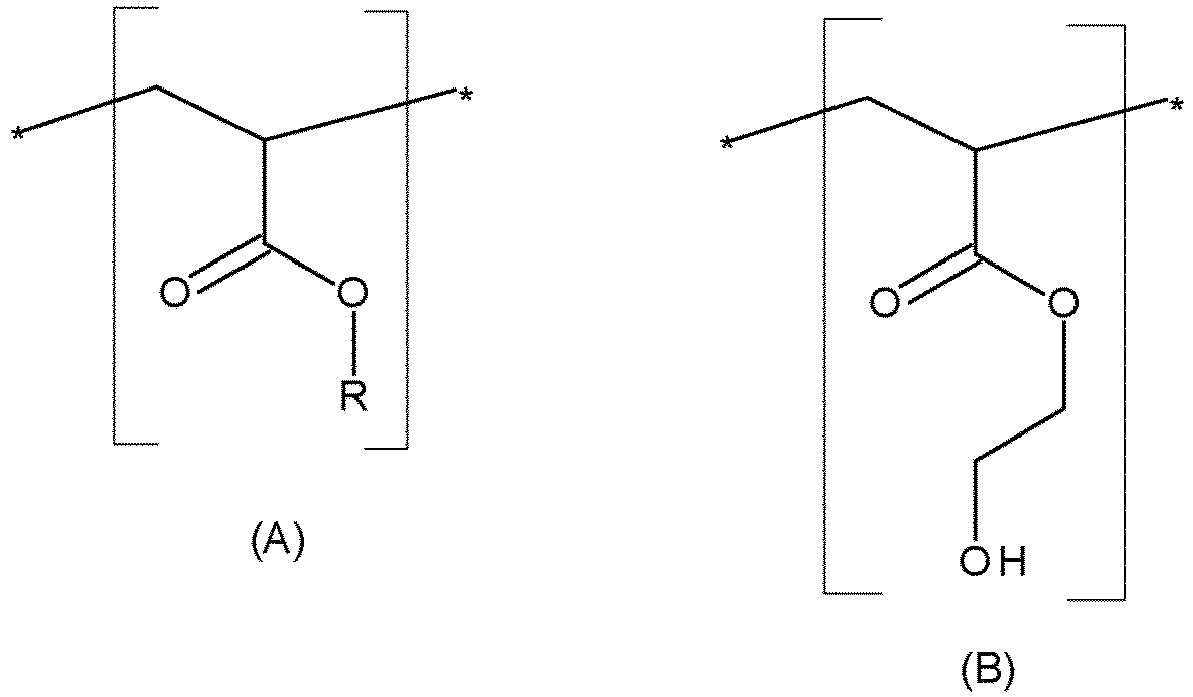 die Reste R unabhängig voneinander aus Alkyl- oder Alkylenresten ausgewählt sind;wobei es sich bei mindestens 60 Gew.-% der R-Gruppen um Behenylreste handelt, wobei sich der Gewichtsprozentanteil auf die Summe aller in dem Polymer vorliegenden R-Gruppen bezieht;das Gewichtsverhältnis der Summe aller Hydroxyethylacrylat-Einheiten zur Summe aller Acrylat-Einheiten, die die R-Gruppe tragen, im Bereich von 1:30 bis 1:1 liegt; unddie Summe der gesamten Einheiten A und B mindestens 95 Gew.-% des Gesamtgewichts des Polymers beträgt;wobei das Polymer ein zahlenmittleres Molekulargewicht Mn im Bereich von 2000 bis 9000 g/mol aufweist.
 - Zusammensetzung nach Anspruch 1, wobei das Gemini-Tensid bzw. die Gemini-Tenside aus den Verbindungen der Formel (II) sowie den Stereoisomeren davon ausgewählt ist bzw. sind:
 - R1 und R3 unabhängig voneinander einen Alkylrest mit 1 bis 25 Kohlenstoffatomen bedeuten;- R2 einen Spacer bedeutet, der aus einer linearen oder verzweigten Alkylenkette mit 1 bis 12 Kohlenstoffatomen besteht;- X und Y unabhängig voneinander eine Gruppe - (C2H4O)a-(C3H6O)bZ bedeuten, wobei:• Z ein Wasserstoffatom oder einen Rest -CH2-COOM, -SO3M, -P(O)(OM)2, -C2H4-SO3M, -C3H6-SO3M oder -CH2(CHOH)4CH2OH bedeutet, wobei M für H oder ein Alkalimetall- oder Erdalkalimetall- oder Ammonium- oder Alkanolammoniumion steht,• a im Bereich von 0 bis 15 liegt,• b im Bereich von 0 bis 10 liegt und• die Summe von a + b im Bereich von 1 bis 25 liegt; und- n im Bereich von 1 bis 10 liegt.
 - Zusammensetzung nach Anspruch 2, wobei für das Gemini-Tensid der Formel (II) jede der Gruppen R1-CO- und R3-CO- 8 bis 20 Kohlenstoffatome umfasst.
- Zusammensetzung nach einem der Ansprüche 2 und 3, wobei für das Gemini-Tensid der Formel (II) jede der Gruppen R1-CO- und R3-CO- einen Kokosnussfettsäurerest bedeutet.
- Zusammensetzung nach einem der Ansprüche 2 bis 4, wobei für das Gemini-Tensid der Formel (II) für jeden der Reste X und Y die Summe von a und b einen mittleren Wert im Bereich von 10 bis 20 aufweist.
- Zusammensetzung nach einem der Ansprüche 2 bis 5, wobei für das Gemini-Tensid der Formel (II) Y die - SO3M-Gruppe ist, wobei M ein Alkalimetallion wie ein Natriumion ist.
- Zusammensetzung nach einem der Ansprüche 2 bis 6, wobei für das Gemini-Tensid der Formel (II) n gleich 1 ist.
- Zusammensetzung nach einem der Ansprüche 2 bis 7, wobei das Tensid der Formel (II) die folgende Struktur aufweist:

- Zusammensetzung nach einem der Ansprüche 2 bis 8, wobei das Gemini-Tensid mit (a) einem Glycerylester einer C6-C22-Fettsäure, (b) einem Diester von einer C6-C22-Fettsäure- und von Citronensäure und von Glycerin und (c) einem C10-C30-Fettalkohol gemischt ist.
- Zusammensetzung nach Anspruch 1, wobei das Gemini-Tensid bzw. die Gemini-Tenside aus Verbindungen der Formel (III) sowie den Stereoisomeren davon ausgewählt ist bzw. sind:
 die Variablen Y' unabhängig voneinander für eine Carbonsäuregruppe oder ein alkalisches Salz einer Carbonsäuregruppe, wie ein Natriumsalz einer Carbonsäuregruppe, stehen;j1, k1, j2 und k2 für eine solche ganze Zahl stehen, dass (j1, k1, j2, k2) = (2, 0, 2, 0), (2, 0, 0, 2), (0, 2, 2, 0) oder (0, 2, 0, 2); undl für eine ganze Zahl von 6 bis 16, vorzugsweise von 8 bis 14 und weiter bevorzugt von 10 bis 12 steht.
 - Zusammensetzung nach Anspruch 10, wobei in Formel (III) l für eine ganze Zahl im Bereich von 8 bis 12 steht, j1 = j2 = 0 und k1 = k2 = 2.
- Zusammensetzung nach einem der Ansprüche 10 und 11, wobei in Formel (III) Y' für -COONa steht, j1 = j2 = 0, k1 = k2 = 2 und l = 10.
- Zusammensetzung nach einem der Ansprüche 10 bis 12, wobei das Gemini-Tensid bzw. die Gemini-Tenside der Formel (III) aus Natriumdilauramidoglutamidlysin, Natriumdimyristoylglutamidlysin und Natriumdistearoylglutamidlysin, vorzugsweise Natriumdilauramidoglutamidlysin, ausgewählt ist bzw. sind.
- Zusammensetzung nach einem der Ansprüche 1 bis 13, wobei in dem lipophilen Polymer R aus Alkylresten, vorzugsweise C16-C22-Alkylresten, weiter bevorzugt Behenylresten (C22-Resten), besteht.
- Zusammensetzung nach einem der Ansprüche 1 bis 14, wobei es sich in dem lipophilen Polymer bei mindestens 70 Gew.-% der R-Gruppen um Behenylreste handelt, vorzugsweise bei mindestens 80 Gew.-% und weiter bevorzugt bei mindestens 90 Gew.-%.
- Zusammensetzung nach einem der Ansprüche 1 bis 15, wobei in dem lipophilen Polymer alle R-Gruppen Behenylreste sind.
- Zusammensetzung nach einem der Ansprüche 1 bis 16, wobei in dem lipophilen Polymer das Gewichtsverhältnis der Summe aller Hydroxyethylacrylat-Einheiten zur Summe aller Acrylat-Einheiten, die die R-Gruppe tragen, im Bereich von 1:15 bis 1:1 liegt und bevorzugt im Bereich von 1:10 bis 1:4 liegt.
- Zusammensetzung nach einem der Ansprüche 1 bis 17, wobei das lipophile Polymer ein zahlenmittleres Molekulargewicht Mn im Bereich von 5000 bis 9000 g/mol aufweist.
- Zusammensetzung nach einem der Ansprüche 1 bis 18, wobei das lipophile Polymer einen Schmelzpunkt im Bereich von 60 °C bis 69 °C und bevorzugt im Bereich von 63 °C bis 67 °C aufweist.
- Zusammensetzung nach einem der Ansprüche 1 bis 19, wobei das lipophile Polymer bzw. die lipophilen Polymere in einer Aktivsubstanzmenge im Bereich von 0,1 bis 10 Gew.-%, vorzugsweise 0,1 bis 3 Gew.-%, bezogen auf das Gesamtgewicht der Zusammensetzung, vorliegt bzw. vorliegen.
Applications Claiming Priority (2)
| Application Number | Priority Date | Filing Date | Title |
|---|---|---|---|
| FR1760735A FR3073400B1 (fr) | 2017-11-15 | 2017-11-15 | Emulsion cosmetique contenant un tensioactif gemine et un polymere lipophile |
| PCT/EP2018/081467 WO2019096953A1 (en) | 2017-11-15 | 2018-11-15 | Cosmetic emulsion containing a gemini surfactant and a lipophilic polymer |
Publications (3)
| Publication Number | Publication Date |
|---|---|
| EP3709959A1 EP3709959A1 (de) | 2020-09-23 |
| EP3709959B1 true EP3709959B1 (de) | 2024-11-20 |
| EP3709959C0 EP3709959C0 (de) | 2024-11-20 |
Family
ID=61258368
Family Applications (1)
| Application Number | Title | Priority Date | Filing Date |
|---|---|---|---|
| EP18800960.9A Active EP3709959B1 (de) | 2017-11-15 | 2018-11-15 | Kosmetische emulsion mit einem geminitensid und einem lipophilen polymer |
Country Status (7)
| Country | Link |
|---|---|
| US (1) | US12303581B2 (de) |
| EP (1) | EP3709959B1 (de) |
| JP (2) | JP7337794B2 (de) |
| CN (1) | CN111343962B (de) |
| ES (1) | ES3010672T3 (de) |
| FR (1) | FR3073400B1 (de) |
| WO (1) | WO2019096953A1 (de) |
Families Citing this family (16)
| Publication number | Priority date | Publication date | Assignee | Title |
|---|---|---|---|---|
| FR3073410B1 (fr) * | 2017-11-15 | 2019-10-11 | L'oreal | Emulsion comprenant un copolymere acrylique anionique et un polymere lipophile |
| DE102018216823A1 (de) | 2018-10-01 | 2020-04-02 | Beiersdorf Ag | Fettalkohol-haltiges, ethanolisches Sonnenschutzmittel mit reduzierter Neigung zur Textilverfleckung |
| FR3112286B1 (fr) * | 2020-07-10 | 2023-02-24 | Oreal | Emulsion eau dans huile à haute teneur en phase interne aqueuse |
| KR20230115322A (ko) * | 2020-12-09 | 2023-08-02 | 디에스엠 아이피 어셋츠 비.브이. | 다이에틸아미노 하이드록시벤조일 헥실 벤조에이트의증가된 가용화 |
| EP4259075B1 (de) * | 2020-12-09 | 2025-06-18 | DSM IP Assets B.V. | Erhöhte solubilisierung von iscotrizinol |
| KR20230115325A (ko) * | 2020-12-09 | 2023-08-02 | 디에스엠 아이피 어셋츠 비.브이. | 비소크트라이졸을 포함하는 미용 조성물의 끈적임의감소 |
| CN113749964B (zh) * | 2021-09-23 | 2023-03-17 | 上海汇朗化学有限公司 | 紫外线过滤剂复合物及其制备方法和应用、防晒产品 |
| US12589059B2 (en) | 2021-09-30 | 2026-03-31 | L'oreal | Mineral sunscreen compositions with high SPF and shelf stability |
| CA3264161A1 (en) * | 2022-08-09 | 2024-02-15 | Elc Management Llc | Encapsulation compositions comprising liquid crystal particles and cosmetic or pharmaceutical compositions and their production processes |
| EP4727518A1 (de) * | 2023-06-19 | 2026-04-22 | L'oreal | Stabile uv-beibehaltbare zusammensetzung |
| FR3151209B3 (fr) | 2023-07-21 | 2025-08-15 | Oreal | Composition stable comprenant de l’huile hydrocarbonée |
| WO2024262650A1 (en) | 2023-06-19 | 2024-12-26 | L'oreal | Stable composition comprising hydrocarbon oil |
| FR3156037A1 (fr) * | 2023-12-01 | 2025-06-06 | L'oreal | Composition comprenant un filtre UV organique lipophile, un tensioactif géminé et au moins 8 % en poids d’un mono-alcool en C1-C4 |
| FR3156035A1 (fr) * | 2023-12-01 | 2025-06-06 | L'oreal | Composition comprenant un filtre UV organique lipophile, un tensioactif géminé et un tensioactif anionique dérivé d’un acide aminé |
| WO2025114438A1 (en) * | 2023-12-01 | 2025-06-05 | L'oreal | Composition comprising a lipophilic organic uv-screening agent, a gemini surfactant and at least 8% by weight of a c1-c4 monoalcohol |
| FR3156034A1 (fr) * | 2023-12-01 | 2025-06-06 | L'oreal | Composition comprenant un filtre UV organique lipophile, un tensioactif géminé, un polymère semi-cristallin contenant au moins une chaine d’alkyl acrylate et un polyol |
Family Cites Families (67)
| Publication number | Priority date | Publication date | Assignee | Title |
|---|---|---|---|---|
| US2463264A (en) | 1942-12-23 | 1949-03-01 | Ciba Ltd | Derivatives of cyclic amidines and process of making same |
| DE2608875A1 (de) * | 1976-03-04 | 1977-09-08 | Henkel & Cie Gmbh | Kosmetische emulsionen vom wasser- in-oel-typ und deren herstellung |
| DE2608834A1 (de) | 1976-03-04 | 1977-09-15 | Henkel & Cie Gmbh | Kosmetische emulsionen vom wasser- in-oel-typ und deren herstellung |
| NL7701484A (nl) | 1976-03-04 | 1977-09-06 | Henkel & Cie Gmbh | Cosmetische emulsies van het water-in-olietype en de bereiding ervan. |
| US4077441A (en) | 1976-08-16 | 1978-03-07 | National Instrument Company | Convertible filling machine |
| JPS53128333A (en) | 1977-04-15 | 1978-11-09 | Fuji Photo Film Co Ltd | Prevention of influences of ultraviolet ray upon photosensitive material of silver halogenide |
| DE8322682U1 (de) | 1983-08-05 | 1986-02-13 | Siemens AG, 1000 Berlin und 8000 München | Mechanische Überlastungssicherung |
| NL8502651A (nl) | 1985-09-27 | 1987-04-16 | Airspray Int Bv | Verstuiver voor een houder voor een te verstuiven vloeistof. |
| US5624663A (en) | 1987-08-28 | 1997-04-29 | L'oreal | Photostable cosmetic filter composition cotaining a UV-A filter and a substituted dialkylbenzalmalonate, the use of substituted dialkylbenzalmalonates in cosmetics as broad-band solar filters and novel substituted dialkyl malonates |
| FR2642968B1 (fr) | 1989-02-15 | 1991-06-07 | Oreal | Utilisation en cosmetique de diorganopolysiloxanes a fonction benzotriazole et nouvelles compositions cosmetiques contenant ces composes, destinees a la protection de la peau et des cheveux |
| US5237071A (en) | 1991-01-22 | 1993-08-17 | Fairmount Chemical Company, Inc. | Process for preparing 2,2'-methylene-bis(6-(2H-benzotriazol-2-yl)-4-hydrocarbyl phenols) |
| US5166355A (en) | 1991-02-04 | 1992-11-24 | Fairmount Chemical Co., Inc. | Process for preparing substituted 2,2'-methylene-bis-[6-(2H-benzotriazol-2-yl)-4-hydrocarbyl-phenols] |
| FR2677544B1 (fr) | 1991-06-14 | 1993-09-24 | Oreal | Composition cosmetique contenant un melange de nanopigments d'oxydes metalliques et de pigments melaniques. |
| FR2680683B1 (fr) | 1991-08-29 | 1993-11-12 | Oreal | Composition cosmetique filtrante contenant un polymere filtre a structure hydrocarbonee et une silicone filtre. |
| ES2157268T5 (es) | 1994-02-24 | 2004-12-01 | SYMRISE GMBH & CO KG | Preparados cosmeticos y dermatologicos que contienen acidos fenilen-1,4-bisbencimidazolsulfonicos. |
| GB9515048D0 (en) | 1995-07-22 | 1995-09-20 | Ciba Geigy Ag | Sunscreen compositions |
| IT1284525B1 (it) | 1996-09-13 | 1998-05-21 | 3V Sigma Spa | Derivati di benzossazolo loro uso come stabilizzanti contro le radiazioni uv |
| FR2755692B1 (fr) | 1996-11-08 | 1998-12-04 | Oreal | Nouveaux filtres solaires, compositions cosmetiques photoprotectrices les contenant et utilisations |
| DE19726184A1 (de) | 1997-06-20 | 1998-12-24 | Beiersdorf Ag | Kosmetische und dermatologische Lichtschutzformulierungen in Form von Emulsionen, insbesondere O/W-Makroemulsionen, O/W-Mikroemulsionen oder O/W/O-Emulsionen, mit einem Gehalt an lichtschutzwirksamen Benzotriazolderivaten |
| GB9715751D0 (en) | 1997-07-26 | 1997-10-01 | Ciba Geigy Ag | Formulations |
| DE19755649A1 (de) | 1997-12-15 | 1999-06-17 | Basf Ag | Photostabile UV-Filter enthaltende kosmetische und pharmazeutische Zubereitungen |
| DE19746654A1 (de) | 1997-08-13 | 1999-02-18 | Basf Ag | Photostabile UV-Filter enthaltende kosmetische und pharmazeutische Zubereitungen |
| DE19828463A1 (de) | 1998-06-26 | 1999-12-30 | Basf Ag | 4,4-Diarylbutadiene als wasserlösliche photostabile UV-Filter für kosmetische und pharmazeutische Zubereitungen |
| DE19855649A1 (de) | 1998-12-03 | 2000-06-08 | Basf Ag | Dimere alpha-Alkyl-Styrolderivate als photostabile UV-Filter in kosmetischen und pharmazeutischen Zubereitungen |
| DE19857127A1 (de) | 1998-12-11 | 2000-06-15 | Basf Ag | Oligomere Diarylbutadiene |
| IT1312374B1 (it) | 1999-01-11 | 2002-04-15 | 3V Sigma Spa | Associazioni di filtri solari e composizioni cosmetiche che licontengono |
| US6225467B1 (en) | 2000-01-21 | 2001-05-01 | Xerox Corporation | Electroluminescent (EL) devices |
| DE10012408A1 (de) | 2000-03-15 | 2001-09-20 | Basf Ag | Verwendung von Lichtschutzmittelkombinationen, die als wesentlichen Bestandteil aminosubstituierte Hydroxybenzophenone enthalten als photostabile UV-Filter in kosmetischen und pharmazeutischen Zubereitungen |
| ITMI20012037A1 (it) | 2001-10-02 | 2003-04-02 | 3V Sigma Spa | Associazioni di filtri solari |
| DE10162844A1 (de) | 2001-12-20 | 2003-07-03 | Beiersdorf Ag | Kosmetische und dermatologische Lichtschutzformulierungen mit einem Gehalt an Bis-Resorcinyltriazinderivaten und Benzoxazol-Derivaten |
| US20040005279A1 (en) | 2002-01-24 | 2004-01-08 | L'oreal | Composition containing a semi-crystalline polymer and methods of use |
| BR0312500B1 (pt) | 2002-07-10 | 2013-12-03 | Uso cosmético de derivados de merocianina e preparação cosmética | |
| EP1386600A1 (de) | 2002-08-02 | 2004-02-04 | L'oreal | Zusammensetzung gelatiniert mit einem Dextrinester |
| FR2843020B1 (fr) | 2002-08-02 | 2007-10-26 | Oreal | Composition cosmetique comprenant un melange d'esters de dextrine |
| TW200413283A (en) | 2002-08-27 | 2004-08-01 | Asahi Chemical Ind | Novel composition containing acyl group |
| FR2851915B1 (fr) | 2003-03-06 | 2006-07-28 | Oreal | Composition cosmetique contenant un ester et un compose pateux |
| BRPI0408994B1 (pt) | 2003-03-24 | 2015-07-14 | Ciba Specialty Chemicals Holding Inc. | Uso não terapêutico de derivados de triazina simétrica, sua preparação cosmética, bem como seu processo de preparação |
| WO2006013413A1 (en) | 2004-07-28 | 2006-02-09 | L'oreal | Cosmetic composition comprising a volatile linear alkyltrisiloxane |
| DE102004047288B4 (de) | 2004-09-27 | 2006-11-30 | Beiersdorf Ag | Lichtschutzemulsion mit hohem Anteil an Lichtschutzfilterpigmenten |
| DE102004047286B4 (de) | 2004-09-27 | 2006-11-23 | Beiersdorf Ag | Kosmetische Lichtschutzzubereitung auf Basis von Mikropigmenten |
| DE102004047285A1 (de) | 2004-09-27 | 2006-04-20 | Beiersdorf Ag | Organische Mikropigmente enthaltende kosmetische Lichtschutzemulsion |
| DE102004047282A1 (de) | 2004-09-27 | 2006-04-20 | Beiersdorf Ag | W/O-Emulsion mit UV-Lichtschutzfilterpigmenten |
| DE102004047283A1 (de) | 2004-09-27 | 2006-04-13 | Beiersdorf Ag | O/W-Emulsionen mit anorganischen UV-Lichtschutzfilterpigmenten |
| DE102004047281A1 (de) | 2004-09-27 | 2006-04-20 | Beiersdorf Ag | Lichtschutzkonzentrat mit organischen Mikropigmenten |
| EP1798213A1 (de) | 2005-12-14 | 2007-06-20 | Cognis IP Management GmbH | Verfahren zur Herstellung von Kohlenwasserstoffen |
| GB2433439A (en) | 2005-12-21 | 2007-06-27 | Ciba Sc Holding Ag | Use of transmission dyes to protect human skin from UV radiation |
| WO2007133720A2 (en) | 2006-05-11 | 2007-11-22 | Air Products And Chemicals, Inc. | Cosmetic compositions containing side chain crystalline (sec) polymers |
| CN101711151B (zh) | 2007-01-25 | 2013-12-18 | 西巴控股公司 | Uv-敏感活性成分的稳定作用 |
| WO2008155059A2 (de) | 2007-06-19 | 2008-12-24 | Cognis Ip Management Gmbh | Kohlenwasserstoff gemische und ihre verwendung |
| KR101721787B1 (ko) | 2007-08-24 | 2017-03-30 | 바스프 에스이 | 벤조트리아졸 및 메로시아닌을 포함하는 혼합물 |
| FR2921262B1 (fr) * | 2007-09-24 | 2009-11-13 | Oreal | Emulsion cosmetique de type huile dans eau |
| JP5270134B2 (ja) | 2007-11-12 | 2013-08-21 | 株式会社コーセー | 紫外線吸収剤水分散組成物 |
| JP5053805B2 (ja) | 2007-11-12 | 2012-10-24 | 株式会社コーセー | 油中水型乳化化粧料 |
| DE102009045998A1 (de) | 2009-10-26 | 2011-04-28 | Henkel Ag & Co. Kgaa | Sonnenschutzzusammensetzungen |
| US20100202985A1 (en) | 2009-02-11 | 2010-08-12 | Amcol International Corporation | Sunscreen compositions including particulate sunscreen actives that exhibit boosting of sun protection factor |
| US20120244202A1 (en) | 2009-10-12 | 2012-09-27 | L'oreal | Methods of photoprotecting a material against solar uv radiation using photonic particles; compositions |
| FR2956579B1 (fr) | 2010-02-24 | 2012-02-10 | Oreal | Composition comprenant un polymere superabsorbant et tensioactif gemine |
| WO2011113718A1 (en) | 2010-03-15 | 2011-09-22 | L'oreal | Composition containing a dibenzoylmethane screening agent and a hydrophilic or water-soluble merocyanin uv-screening agent; process for photostabilizing the dibenzoylmethane screening agent |
| WO2011124528A2 (en) | 2010-04-06 | 2011-10-13 | Unilever Nv | A personal care composition |
| WO2013010590A1 (en) | 2011-07-21 | 2013-01-24 | L'oreal | Cosmetic and/or dermatological composition containing a merocyanine derivative comprising specific polar groups consisting of hydroxyl- and ether-functionalities |
| BR112014001418B1 (pt) | 2011-07-21 | 2021-05-11 | Basf Se | compostos, e, processo para a preparação dos compostos |
| JP2012144580A (ja) | 2012-05-08 | 2012-08-02 | Asahi Kasei Chemicals Corp | 油膜形成性乳化組成物 |
| FR3001131B1 (fr) * | 2013-01-21 | 2015-06-19 | Oreal | Emulsion cosmetique ou dermatologique comprenant une merocyanine et un systeme emulsionnant contenant un tensioactif gemine. |
| JP2015131767A (ja) | 2013-12-10 | 2015-07-23 | 花王株式会社 | 乳化化粧料組成物 |
| EP3235839B8 (de) * | 2014-12-19 | 2020-07-15 | Shiseido Company, Ltd. | Copolymer und öliges geliermittel |
| FR3046076B1 (fr) | 2015-12-29 | 2018-02-02 | L'oreal | Composition comprenant des particules photoniques et une argile |
| JP2024108030A (ja) | 2023-01-30 | 2024-08-09 | 横河電機株式会社 | 測定装置及び制御方法 |
-
2017
- 2017-11-15 FR FR1760735A patent/FR3073400B1/fr active Active
-
2018
- 2018-11-15 EP EP18800960.9A patent/EP3709959B1/de active Active
- 2018-11-15 WO PCT/EP2018/081467 patent/WO2019096953A1/en not_active Ceased
- 2018-11-15 US US16/760,191 patent/US12303581B2/en active Active
- 2018-11-15 ES ES18800960T patent/ES3010672T3/es active Active
- 2018-11-15 CN CN201880073261.2A patent/CN111343962B/zh active Active
- 2018-11-15 JP JP2020526437A patent/JP7337794B2/ja active Active
-
2022
- 2022-01-13 JP JP2022003621A patent/JP7436529B2/ja active Active
Also Published As
| Publication number | Publication date |
|---|---|
| US20210177719A1 (en) | 2021-06-17 |
| WO2019096953A1 (en) | 2019-05-23 |
| JP7337794B2 (ja) | 2023-09-04 |
| JP7436529B2 (ja) | 2024-02-21 |
| EP3709959A1 (de) | 2020-09-23 |
| US12303581B2 (en) | 2025-05-20 |
| BR112020007992A2 (pt) | 2020-10-20 |
| FR3073400B1 (fr) | 2024-08-09 |
| ES3010672T3 (en) | 2025-04-04 |
| CN111343962B (zh) | 2023-06-02 |
| CN111343962A (zh) | 2020-06-26 |
| JP2021502976A (ja) | 2021-02-04 |
| FR3073400A1 (fr) | 2019-05-17 |
| JP2022051754A (ja) | 2022-04-01 |
| EP3709959C0 (de) | 2024-11-20 |
Similar Documents
| Publication | Publication Date | Title |
|---|---|---|
| US12303581B2 (en) | Cosmetic emulsion containing a gemini surfactant and a lipophilic polymer | |
| EP2811969B1 (de) | Nicht pulverförmige sonnenschutzzusammensetzung mit einer polaren ölphase und wasserabweisenden kieselsäure-aerogelteilchen | |
| EP2945710B1 (de) | Kosmetische oder dermatologische emulsion mit einem merocyanin und einem emulgierungssystem mit einem amphiphilen polymer mit mindestens einer 2-acrylamidomethylpropansulfonsäureeinheit | |
| EP3709965B1 (de) | Zusammensetzung enthaltend ein uv-mittel, ein acrylpolymer und einen fettsäureester von dextrin | |
| JP7318028B2 (ja) | メロシアニン及びアクリルポリマーを含む化粧用組成物又は皮膚科用組成物 | |
| EP2945607B1 (de) | Kosmetische oder dermatologische emulsion mit einem merocyanin und einem emulgierenden system mit einem alkalimetallsalz eines phosphorsäureesters eines fettalkohols | |
| US12589059B2 (en) | Mineral sunscreen compositions with high SPF and shelf stability | |
| EP2945606B1 (de) | Kosmetische oder dermatologische wasser-in-öl-emulsion mit einem merocyanin und mindestens einem emulgierenden polymer in form eines polyoxyalkylenierten glycolfettsäureesters | |
| EP2945603B1 (de) | Kosmetische oder dermatologische zusammensetzung mit einem merocyanin und einem uva-screening-mittel mit aminosubstituiertem 2-hydroxybenzophenon und/oder einem hydrophilen organischen uva-screening-mittel | |
| JP2016505034A (ja) | メロシアニン、有機uvb遮蔽剤及び追加の有機uva遮蔽剤を含む化粧用又は皮膚用組成物 | |
| EP3148502B1 (de) | Sonnenschutzzusammensetzung in form einer öl-in-wasser-emulsion mit mindestens einem tensidgemisch | |
| EP2945609B1 (de) | Wasserfreie kosmetische oder dermatologische zusammensetzung mit einem merocyanin und einer ölphase | |
| EP4447900A1 (de) | Kosmetische oder dermatologische zusammensetzung mit einem merocyanin und mindestens einem diol mit 4 bis 7 kohlenstoffatomen | |
| EP2945608B1 (de) | Kosmetische oder dermatologische emulsion mit einem merocyanin und emulgierungssystem mit einem gemini-tensid | |
| EP4447901A1 (de) | Kosmetische oder dermatologische zusammensetzung mit einem merocyanin und pentaerythrityl-tetra-di-t-butyl-hydroxyhydrozimtsäure | |
| BR112020007992B1 (pt) | Composição na forma de uma emulsão | |
| EP4447898A1 (de) | Kosmetische oder dermatologische zusammensetzung mit einem merocyanin und dipropylenglykol | |
| EP4447897A1 (de) | Kosmetische oder dermatologische zusammensetzung mit einem merocyanin und einem gamma-butyrolacton und/oder einem gamma-butyrolactam |
Legal Events
| Date | Code | Title | Description |
|---|---|---|---|
| STAA | Information on the status of an ep patent application or granted ep patent |
Free format text: STATUS: UNKNOWN |
|
| STAA | Information on the status of an ep patent application or granted ep patent |
Free format text: STATUS: THE INTERNATIONAL PUBLICATION HAS BEEN MADE |
|
| PUAI | Public reference made under article 153(3) epc to a published international application that has entered the european phase |
Free format text: ORIGINAL CODE: 0009012 |
|
| STAA | Information on the status of an ep patent application or granted ep patent |
Free format text: STATUS: REQUEST FOR EXAMINATION WAS MADE |
|
| 17P | Request for examination filed |
Effective date: 20200615 |
|
| AK | Designated contracting states |
Kind code of ref document: A1 Designated state(s): AL AT BE BG CH CY CZ DE DK EE ES FI FR GB GR HR HU IE IS IT LI LT LU LV MC MK MT NL NO PL PT RO RS SE SI SK SM TR |
|
| AX | Request for extension of the european patent |
Extension state: BA ME |
|
| DAV | Request for validation of the european patent (deleted) | ||
| DAX | Request for extension of the european patent (deleted) | ||
| STAA | Information on the status of an ep patent application or granted ep patent |
Free format text: STATUS: EXAMINATION IS IN PROGRESS |
|
| 17Q | First examination report despatched |
Effective date: 20210621 |
|
| RAP3 | Party data changed (applicant data changed or rights of an application transferred) |
Owner name: L'OREAL |
|
| GRAP | Despatch of communication of intention to grant a patent |
Free format text: ORIGINAL CODE: EPIDOSNIGR1 |
|
| RIC1 | Information provided on ipc code assigned before grant |
Ipc: A61K 8/06 20060101ALI20240506BHEP Ipc: A61K 8/86 20060101ALI20240506BHEP Ipc: A61K 8/81 20060101ALI20240506BHEP Ipc: A61K 8/46 20060101ALI20240506BHEP Ipc: A61K 8/45 20060101ALI20240506BHEP Ipc: A61K 8/44 20060101AFI20240506BHEP Ipc: C08F 220/20 20060101ALI20240506BHEP Ipc: C08F 220/18 20060101ALI20240506BHEP Ipc: A61Q 17/04 20060101ALI20240506BHEP |
|
| STAA | Information on the status of an ep patent application or granted ep patent |
Free format text: STATUS: GRANT OF PATENT IS INTENDED |
|
| INTG | Intention to grant announced |
Effective date: 20240613 |
|
| GRAS | Grant fee paid |
Free format text: ORIGINAL CODE: EPIDOSNIGR3 |
|
| GRAA | (expected) grant |
Free format text: ORIGINAL CODE: 0009210 |
|
| STAA | Information on the status of an ep patent application or granted ep patent |
Free format text: STATUS: THE PATENT HAS BEEN GRANTED |
|
| AK | Designated contracting states |
Kind code of ref document: B1 Designated state(s): AL AT BE BG CH CY CZ DE DK EE ES FI FR GB GR HR HU IE IS IT LI LT LU LV MC MK MT NL NO PL PT RO RS SE SI SK SM TR |
|
| REG | Reference to a national code |
Ref country code: GB Ref legal event code: FG4D |
|
| REG | Reference to a national code |
Ref country code: CH Ref legal event code: EP |
|
| REG | Reference to a national code |
Ref country code: DE Ref legal event code: R096 Ref document number: 602018076775 Country of ref document: DE |
|
| REG | Reference to a national code |
Ref country code: IE Ref legal event code: FG4D |
|
| U01 | Request for unitary effect filed |
Effective date: 20241120 |
|
| U07 | Unitary effect registered |
Designated state(s): AT BE BG DE DK EE FI FR IT LT LU LV MT NL PT RO SE SI Effective date: 20241127 |
|
| REG | Reference to a national code |
Ref country code: ES Ref legal event code: FG2A Ref document number: 3010672 Country of ref document: ES Kind code of ref document: T3 Effective date: 20250404 |
|
| PG25 | Lapsed in a contracting state [announced via postgrant information from national office to epo] |
Ref country code: IS Free format text: LAPSE BECAUSE OF FAILURE TO SUBMIT A TRANSLATION OF THE DESCRIPTION OR TO PAY THE FEE WITHIN THE PRESCRIBED TIME-LIMIT Effective date: 20250320 Ref country code: HR Free format text: LAPSE BECAUSE OF FAILURE TO SUBMIT A TRANSLATION OF THE DESCRIPTION OR TO PAY THE FEE WITHIN THE PRESCRIBED TIME-LIMIT Effective date: 20241120 |
|
| PG25 | Lapsed in a contracting state [announced via postgrant information from national office to epo] |
Ref country code: NO Free format text: LAPSE BECAUSE OF FAILURE TO SUBMIT A TRANSLATION OF THE DESCRIPTION OR TO PAY THE FEE WITHIN THE PRESCRIBED TIME-LIMIT Effective date: 20250220 |
|
| PG25 | Lapsed in a contracting state [announced via postgrant information from national office to epo] |
Ref country code: GR Free format text: LAPSE BECAUSE OF FAILURE TO SUBMIT A TRANSLATION OF THE DESCRIPTION OR TO PAY THE FEE WITHIN THE PRESCRIBED TIME-LIMIT Effective date: 20250221 |
|
| PG25 | Lapsed in a contracting state [announced via postgrant information from national office to epo] |
Ref country code: PL Free format text: LAPSE BECAUSE OF FAILURE TO SUBMIT A TRANSLATION OF THE DESCRIPTION OR TO PAY THE FEE WITHIN THE PRESCRIBED TIME-LIMIT Effective date: 20241120 |
|
| PG25 | Lapsed in a contracting state [announced via postgrant information from national office to epo] |
Ref country code: RS Free format text: LAPSE BECAUSE OF FAILURE TO SUBMIT A TRANSLATION OF THE DESCRIPTION OR TO PAY THE FEE WITHIN THE PRESCRIBED TIME-LIMIT Effective date: 20250220 |
|
| PG25 | Lapsed in a contracting state [announced via postgrant information from national office to epo] |
Ref country code: SM Free format text: LAPSE BECAUSE OF FAILURE TO SUBMIT A TRANSLATION OF THE DESCRIPTION OR TO PAY THE FEE WITHIN THE PRESCRIBED TIME-LIMIT Effective date: 20241120 |
|
| PG25 | Lapsed in a contracting state [announced via postgrant information from national office to epo] |
Ref country code: SK Free format text: LAPSE BECAUSE OF FAILURE TO SUBMIT A TRANSLATION OF THE DESCRIPTION OR TO PAY THE FEE WITHIN THE PRESCRIBED TIME-LIMIT Effective date: 20241120 |
|
| PG25 | Lapsed in a contracting state [announced via postgrant information from national office to epo] |
Ref country code: CZ Free format text: LAPSE BECAUSE OF FAILURE TO SUBMIT A TRANSLATION OF THE DESCRIPTION OR TO PAY THE FEE WITHIN THE PRESCRIBED TIME-LIMIT Effective date: 20241120 |
|
| PLBE | No opposition filed within time limit |
Free format text: ORIGINAL CODE: 0009261 |
|
| STAA | Information on the status of an ep patent application or granted ep patent |
Free format text: STATUS: NO OPPOSITION FILED WITHIN TIME LIMIT |
|
| PGFP | Annual fee paid to national office [announced via postgrant information from national office to epo] |
Ref country code: GB Payment date: 20250925 Year of fee payment: 8 |
|
| 26N | No opposition filed |
Effective date: 20250821 |
|
| U20 | Renewal fee for the european patent with unitary effect paid |
Year of fee payment: 8 Effective date: 20251008 |
|
| PGFP | Annual fee paid to national office [announced via postgrant information from national office to epo] |
Ref country code: ES Payment date: 20251212 Year of fee payment: 8 |