EP3663243B1 - Verfahren und vorrichtung zum spleissen von einem ersten und einem zweiten folienverbund - Google Patents
Verfahren und vorrichtung zum spleissen von einem ersten und einem zweiten folienverbund Download PDFInfo
- Publication number
- EP3663243B1 EP3663243B1 EP19212787.6A EP19212787A EP3663243B1 EP 3663243 B1 EP3663243 B1 EP 3663243B1 EP 19212787 A EP19212787 A EP 19212787A EP 3663243 B1 EP3663243 B1 EP 3663243B1
- Authority
- EP
- European Patent Office
- Prior art keywords
- clamping
- film
- composite
- film composite
- splicing
- Prior art date
- Legal status (The legal status is an assumption and is not a legal conclusion. Google has not performed a legal analysis and makes no representation as to the accuracy of the status listed.)
- Active
Links
Images

Classifications
-
- B—PERFORMING OPERATIONS; TRANSPORTING
- B65—CONVEYING; PACKING; STORING; HANDLING THIN OR FILAMENTARY MATERIAL
- B65H—HANDLING THIN OR FILAMENTARY MATERIAL, e.g. SHEETS, WEBS, CABLES
- B65H19/00—Changing the web roll
- B65H19/10—Changing the web roll in unwinding mechanisms or in connection with unwinding operations
- B65H19/18—Attaching, e.g. pasting, the replacement web to the expiring web
- B65H19/1805—Flying splicing, i.e. the expiring web moving during splicing contact
- B65H19/1826—Flying splicing, i.e. the expiring web moving during splicing contact taking place at a distance from the replacement roll
- B65H19/1831—Flying splicing, i.e. the expiring web moving during splicing contact taking place at a distance from the replacement roll the replacement web being stationary prior to splicing contact
-
- B—PERFORMING OPERATIONS; TRANSPORTING
- B29—WORKING OF PLASTICS; WORKING OF SUBSTANCES IN A PLASTIC STATE IN GENERAL
- B29C—SHAPING OR JOINING OF PLASTICS; SHAPING OF MATERIAL IN A PLASTIC STATE, NOT OTHERWISE PROVIDED FOR; AFTER-TREATMENT OF THE SHAPED PRODUCTS, e.g. REPAIRING
- B29C65/00—Joining or sealing of preformed parts, e.g. welding of plastics materials; Apparatus therefor
- B29C65/48—Joining or sealing of preformed parts, e.g. welding of plastics materials; Apparatus therefor using adhesives, i.e. using supplementary joining material; solvent bonding
- B29C65/50—Joining or sealing of preformed parts, e.g. welding of plastics materials; Apparatus therefor using adhesives, i.e. using supplementary joining material; solvent bonding using adhesive tape, e.g. thermoplastic tape; using threads or the like
- B29C65/5042—Joining or sealing of preformed parts, e.g. welding of plastics materials; Apparatus therefor using adhesives, i.e. using supplementary joining material; solvent bonding using adhesive tape, e.g. thermoplastic tape; using threads or the like covering both elements to be joined
-
- B—PERFORMING OPERATIONS; TRANSPORTING
- B29—WORKING OF PLASTICS; WORKING OF SUBSTANCES IN A PLASTIC STATE IN GENERAL
- B29C—SHAPING OR JOINING OF PLASTICS; SHAPING OF MATERIAL IN A PLASTIC STATE, NOT OTHERWISE PROVIDED FOR; AFTER-TREATMENT OF THE SHAPED PRODUCTS, e.g. REPAIRING
- B29C65/00—Joining or sealing of preformed parts, e.g. welding of plastics materials; Apparatus therefor
- B29C65/78—Means for handling the parts to be joined, e.g. for making containers or hollow articles, e.g. means for handling sheets, plates, web-like materials, tubular articles, hollow articles or elements to be joined therewith; Means for discharging the joined articles from the joining apparatus
- B29C65/7858—Means for handling the parts to be joined, e.g. for making containers or hollow articles, e.g. means for handling sheets, plates, web-like materials, tubular articles, hollow articles or elements to be joined therewith; Means for discharging the joined articles from the joining apparatus characterised by the feeding movement of the parts to be joined
- B29C65/7888—Means for handling of moving sheets or webs
- B29C65/7894—Means for handling of moving sheets or webs of continuously moving sheets or webs
-
- B—PERFORMING OPERATIONS; TRANSPORTING
- B29—WORKING OF PLASTICS; WORKING OF SUBSTANCES IN A PLASTIC STATE IN GENERAL
- B29C—SHAPING OR JOINING OF PLASTICS; SHAPING OF MATERIAL IN A PLASTIC STATE, NOT OTHERWISE PROVIDED FOR; AFTER-TREATMENT OF THE SHAPED PRODUCTS, e.g. REPAIRING
- B29C66/00—General aspects of processes or apparatus for joining preformed parts
- B29C66/01—General aspects dealing with the joint area or with the area to be joined
- B29C66/05—Particular design of joint configurations
- B29C66/10—Particular design of joint configurations particular design of the joint cross-sections
- B29C66/11—Joint cross-sections comprising a single joint-segment, i.e. one of the parts to be joined comprising a single joint-segment in the joint cross-section
- B29C66/114—Single butt joints
- B29C66/1142—Single butt to butt joints
-
- B—PERFORMING OPERATIONS; TRANSPORTING
- B29—WORKING OF PLASTICS; WORKING OF SUBSTANCES IN A PLASTIC STATE IN GENERAL
- B29C—SHAPING OR JOINING OF PLASTICS; SHAPING OF MATERIAL IN A PLASTIC STATE, NOT OTHERWISE PROVIDED FOR; AFTER-TREATMENT OF THE SHAPED PRODUCTS, e.g. REPAIRING
- B29C66/00—General aspects of processes or apparatus for joining preformed parts
- B29C66/40—General aspects of joining substantially flat articles, e.g. plates, sheets or web-like materials; Making flat seams in tubular or hollow articles; Joining single elements to substantially flat surfaces
- B29C66/41—Joining substantially flat articles ; Making flat seams in tubular or hollow articles
- B29C66/43—Joining a relatively small portion of the surface of said articles
-
- B—PERFORMING OPERATIONS; TRANSPORTING
- B29—WORKING OF PLASTICS; WORKING OF SUBSTANCES IN A PLASTIC STATE IN GENERAL
- B29C—SHAPING OR JOINING OF PLASTICS; SHAPING OF MATERIAL IN A PLASTIC STATE, NOT OTHERWISE PROVIDED FOR; AFTER-TREATMENT OF THE SHAPED PRODUCTS, e.g. REPAIRING
- B29C66/00—General aspects of processes or apparatus for joining preformed parts
- B29C66/70—General aspects of processes or apparatus for joining preformed parts characterised by the composition, physical properties or the structure of the material of the parts to be joined; Joining with non-plastics material
- B29C66/72—General aspects of processes or apparatus for joining preformed parts characterised by the composition, physical properties or the structure of the material of the parts to be joined; Joining with non-plastics material characterised by the structure of the material of the parts to be joined
- B29C66/723—General aspects of processes or apparatus for joining preformed parts characterised by the composition, physical properties or the structure of the material of the parts to be joined; Joining with non-plastics material characterised by the structure of the material of the parts to be joined being multi-layered
-
- B—PERFORMING OPERATIONS; TRANSPORTING
- B29—WORKING OF PLASTICS; WORKING OF SUBSTANCES IN A PLASTIC STATE IN GENERAL
- B29C—SHAPING OR JOINING OF PLASTICS; SHAPING OF MATERIAL IN A PLASTIC STATE, NOT OTHERWISE PROVIDED FOR; AFTER-TREATMENT OF THE SHAPED PRODUCTS, e.g. REPAIRING
- B29C66/00—General aspects of processes or apparatus for joining preformed parts
- B29C66/80—General aspects of machine operations or constructions and parts thereof
- B29C66/83—General aspects of machine operations or constructions and parts thereof characterised by the movement of the joining or pressing tools
- B29C66/834—General aspects of machine operations or constructions and parts thereof characterised by the movement of the joining or pressing tools moving with the parts to be joined
- B29C66/8351—Jaws mounted on rollers, cylinders, drums, bands, belts or chains; Flying jaws
- B29C66/83511—Jaws mounted on rollers, cylinders, drums, bands, belts or chains; Flying jaws jaws mounted on rollers, cylinders or drums
- B29C66/83513—Jaws mounted on rollers, cylinders, drums, bands, belts or chains; Flying jaws jaws mounted on rollers, cylinders or drums cooperating jaws mounted on rollers, cylinders or drums and moving in a closed path
-
- B—PERFORMING OPERATIONS; TRANSPORTING
- B29—WORKING OF PLASTICS; WORKING OF SUBSTANCES IN A PLASTIC STATE IN GENERAL
- B29C—SHAPING OR JOINING OF PLASTICS; SHAPING OF MATERIAL IN A PLASTIC STATE, NOT OTHERWISE PROVIDED FOR; AFTER-TREATMENT OF THE SHAPED PRODUCTS, e.g. REPAIRING
- B29C66/00—General aspects of processes or apparatus for joining preformed parts
- B29C66/80—General aspects of machine operations or constructions and parts thereof
- B29C66/84—Specific machine types or machines suitable for specific applications
- B29C66/853—Machines for changing web rolls or filaments, e.g. for joining a replacement web to an expiring web
-
- B—PERFORMING OPERATIONS; TRANSPORTING
- B65—CONVEYING; PACKING; STORING; HANDLING THIN OR FILAMENTARY MATERIAL
- B65H—HANDLING THIN OR FILAMENTARY MATERIAL, e.g. SHEETS, WEBS, CABLES
- B65H2301/00—Handling processes for sheets or webs
- B65H2301/40—Type of handling process
- B65H2301/46—Splicing
- B65H2301/462—Form of splice
- B65H2301/4622—Abutting article or web portions, i.e. edge to edge
- B65H2301/46222—Abutting article or web portions, i.e. edge to edge involving double butt splice, i.e. adhesive tape applied on both sides of the article or web portions
-
- B—PERFORMING OPERATIONS; TRANSPORTING
- B65—CONVEYING; PACKING; STORING; HANDLING THIN OR FILAMENTARY MATERIAL
- B65H—HANDLING THIN OR FILAMENTARY MATERIAL, e.g. SHEETS, WEBS, CABLES
- B65H2301/00—Handling processes for sheets or webs
- B65H2301/40—Type of handling process
- B65H2301/46—Splicing
- B65H2301/463—Splicing splicing means, i.e. means by which a web end is bound to another web end
- B65H2301/4631—Adhesive tape
-
- B—PERFORMING OPERATIONS; TRANSPORTING
- B65—CONVEYING; PACKING; STORING; HANDLING THIN OR FILAMENTARY MATERIAL
- B65H—HANDLING THIN OR FILAMENTARY MATERIAL, e.g. SHEETS, WEBS, CABLES
- B65H2301/00—Handling processes for sheets or webs
- B65H2301/40—Type of handling process
- B65H2301/46—Splicing
- B65H2301/464—Splicing effecting splice
- B65H2301/46414—Splicing effecting splice by nipping rollers
-
- B—PERFORMING OPERATIONS; TRANSPORTING
- B65—CONVEYING; PACKING; STORING; HANDLING THIN OR FILAMENTARY MATERIAL
- B65H—HANDLING THIN OR FILAMENTARY MATERIAL, e.g. SHEETS, WEBS, CABLES
- B65H2406/00—Means using fluid
- B65H2406/30—Suction means
- B65H2406/33—Rotary suction means, e.g. roller, cylinder or drum
-
- B—PERFORMING OPERATIONS; TRANSPORTING
- B65—CONVEYING; PACKING; STORING; HANDLING THIN OR FILAMENTARY MATERIAL
- B65H—HANDLING THIN OR FILAMENTARY MATERIAL, e.g. SHEETS, WEBS, CABLES
- B65H2406/00—Means using fluid
- B65H2406/30—Suction means
- B65H2406/35—Other elements with suction surface, e.g. plate or wall
- B65H2406/351—Other elements with suction surface, e.g. plate or wall facing the surface of the handled material
-
- B—PERFORMING OPERATIONS; TRANSPORTING
- B65—CONVEYING; PACKING; STORING; HANDLING THIN OR FILAMENTARY MATERIAL
- B65H—HANDLING THIN OR FILAMENTARY MATERIAL, e.g. SHEETS, WEBS, CABLES
- B65H2701/00—Handled material; Storage means
- B65H2701/10—Handled articles or webs
- B65H2701/17—Nature of material
- B65H2701/172—Composite material
Definitions
- the invention relates to a method and a device for splicing one end of a first composite film to a beginning of a second composite film.
- the first and second film composite are cut end to end, with the end of the first film composite and the beginning of the second film composite being fed to a connecting station at the same time, in which a first connecting element is applied to the joint with a roller. Subsequently, another opposing joining element is applied to the joint with an opposing roller in the joining station.
- a splicing device which is provided for splicing one end of a first composite film to a beginning of a second composite film.
- a joint is cut in a first pair of rollers and a connecting element is applied to one side of this joint and then another connecting element is applied to the joint on another pair of rollers arranged separately therefrom on the opposite side.
- a method of a device for producing a film composite in which the film composite comprises at least one polymer layer that is processed, in particular provided with a hologram.
- a first and a second supply roll for the film composite are provided, which are successively fed to a splicing device. If the first supply roll is used up, the second supply roll is used.
- a butt-to-butt joint is created from the end of the composite film from the first supply roll to the beginning of the second composite film from the second supply roll. During the creation of this butt-to-butt joint, there is a brief standstill. Since the film composite is processed continuously, the splicing device is followed by a storage station, so that during the short-term standstill of the splicing device, the subsequent processing stations are continuously supplied with the film composite from the storage device.
- the invention has for its object to propose a method and a device for splicing one end of a first film composite with a beginning of the second film composite, whereby a It is possible to change the supply rolls from a first film composite to a second film composite without stopping subsequent processing stations.
- This object is achieved by a method for splicing one end of the first film composite to the beginning of the second film composite in a splicing device with the following steps.
- the first composite film is guided through the splicing device.
- the beginning of the second composite film is fed to the splicing device.
- the first composite film and the second composite film are cut to butt.
- the joint formed by the end of the first composite film and the beginning of the second composite film are fed together to a connecting station.
- a connecting element is applied to one or both sides of an outer side of the first and second film composite and covers the joint of the first and second film composite.
- the successive work steps in the splicing device can enable the first and second film composite to be fed through continuously, while at the same time the application of the at least one connecting element on the outside of the first and second film composite enables a simple connection of the butt joint of the first and second film composite.
- the connecting station comprises a holding device and a counter-holding element or two holding devices located opposite one another, which form a working gap and the first and second film composite are guided into the working gap, the connecting element being held by a holding force of the holding device until it is introduced into the working gap becomes.
- the holding device can be designed as a roller.
- the counter-holding element can, for example, take the form of a stop, a plate-shaped element or roller be trained. This arrangement enables the connecting element to be easily transferred into the working gap with a continuous passage of the joint through the working gap and a secure application of the connecting element, so that the connecting element acts both at the end of the first film composite and at the beginning of the second film composite and the joint covered.
- this is designed as a vacuum roller in which a holding force for receiving the at least one connecting element is generated on a peripheral surface of the vacuum roller by applying a negative pressure. This enables both a quick fixation of the connecting element on the vacuum roller and a simple and quick detachment of the connecting element within the working gap for attachment to the first and second film composite.
- the holding device which is preferably designed as a vacuum roller, can be subjected to negative pressure in order to adhere the connecting element and can then be switched off as soon as the connecting element has been transferred into the working gap.
- an adhesive strip is applied as the connecting element.
- This adhesive strip preferably has an adhesive surface on one side.
- the adhesive strip designed as a connecting element is preferably held on its non-sticky outer side by the holding device, in particular a vacuum roller. This enables the connecting element to be fitted easily on the holding device and then to be attached to the first and second film composite.
- An advantageous embodiment of the method provides that a connecting element is applied in the connecting station on both sides and simultaneously on an outer side of the joint. As a result, an unintentional detachment of the connection point can be prevented, in particular also in the event of tension peaks in the web tension occurring during the further processing of the film composite in subsequent processing stations.
- the first film composite is guided through a clamping device and then, in the transport direction, through a clamping device and then through the connecting station, and the second film composite is fed through the clamping device to the clamping device, so that at least the beginning of the second film composite is in the clamping device .
- the clamping device and the clamping holding device are then moved or closed into a working position.
- the first and second composite films are positioned in an overlapping manner between the clamping device and the clamping holding device and are held in contact with one another.
- the joint is then introduced with a cutting device. Both film composites are cut at the same time.
- a cutting blade is provided for introducing the impact.
- the clamping device and the clamping holding device are opened, with one of the two clamping blocks of the clamping holding device being subjected to vacuum and a cut section at the beginning of the second film composite being removed from the cutting point.
- a leftover piece or the cut section of the second composite film can be disposed of in a controlled manner.
- the joint at the beginning of the second composite film is thus free and can be positioned directly at the joint at the end of the first composite film.
- a further advantageous embodiment of the method provides that the joint between the first and second composite film is guided from the clamping device by means of guide plates into the connection station. As a result, the joint can be moved in a controlled manner into the connecting station in order to subsequently attach the at least one connecting element.
- a feed roller or a pair of feed rollers of the second film composite and the vacuum rollers of the connecting station are controlled at a synchronous web speed.
- a continuous transfer of the pile into the connection station can thereby be achieved.
- the feed roller or pair of feed rollers of the first composite film can be driven in the opposite direction to the direction of transport of the pile in order to remove a remainder of the supply roll of the first composite film from the splicing device in order to subsequently change it for a new supply roll.
- a first and second film composite is preferably fed to the splicing device, which composite has one or more layers, in particular a triple composite, which consists of a carrier layer, a polymer layer and a protective layer.
- This polymer layer is formed in particular from a holographically exposed layer which is applied to a data carrier or a data card in subsequent processing stations after the carrier layer and the protective layer have been detached.
- the formation of the joint can enable a virtually non-destructive connection of a film composite as a triple composite.
- a splicing device for splicing an end of a first film composite to a beginning of a second film composite, which comprises at least one cutting device, through which a joint joint between the first film composite and the second Film composite can be produced and with a connecting station that applies at least one connecting element on one or both sides to the joint of the first and second film composite.
- This splicing device enables a change from a used supply roll to a new or full supply roll without standstill. As a result, an automatic connection of a first composite film and a second composite film can be created, so that the processing stations following the splicing device can continuously continue the manufacturing process and the further processing of the composite film.
- the at least one connecting element can be applied during a continuous passage of the joint between the first and second film composite in order to create a quasi-endless film composite.
- the holding device is designed as a vacuum roller, which comprises an outer rubber coating as a lateral surface, which has a large number of openings.
- This enables the connecting element, in particular an adhesive strip, to be securely accommodated and fixed by applying a vacuum, it also being possible for the vacuum roller to accommodate different sizes of the connecting element due to the large number of openings.
- This allows the connecting element to be easily and flexibly adapted to the web width of the first and second film composite to be connected.
- the holding device of the connecting station preferably has a marking and/or an alignment element for equipping the connecting element.
- the alignment element can, for example, be a recess in the lateral surface of the holding device designed as a vacuum roller, so that there is a stop for the connection element to rest and thereby align the connection element on the peripheral surface of the vacuum roller.
- the cutting device comprises at least one cutting blade.
- This cutting blade is preferably fed in at right angles to the plane of extension of the first and second film composite for a clean cut.
- the cutting device can also be designed as a laser cutting device.
- the cutting device as well as the clamping and clamping device can carry out a synchronous displacement movement in the transport direction during the cut.
- the cutting device is assigned a clamping device, which is connected downstream of the cutting device, in particular in the transport direction of the first and second film composite, and which can be moved into an open and closed position.
- the first and second film composite can be clamped on one side to create the joint in the first and second film composite, so that an exact joint is formed by the joint cut in the first and second film composite.
- An advantageous embodiment of the splicing device provides that a clamping device is provided in front of the cutting device, viewed in the transport direction of the first and second film composite. This makes it possible for the first and second composite film to be fixed in a defined manner to one another before and after the cutting device in order to make an exact cut.
- opposite guide plates are provided between the clamping device and the connecting station, which can preferably be acted upon by a vacuum. This will make the Junction point of the first and second film composite transferred from the interface to the connection station.
- the transport of the joint of the first and second film composite from the cutting device to the connecting station is controlled via the guide roller of the second film composite and the at least one vacuum roller of the connecting station, with the guide roller of the second film composite and the vacuum rollers of the connecting station being controlled synchronously.
- the end of the first film composite and the start of the second film composite can run synchronously up to the connecting station, in order then to apply the at least one connecting element to the joint.
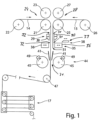
- a splicing device 11 is shown schematically, showing successive work steps.
- This splicing device 11 connects a first composite film 14 to a second composite film 15.
- a composite film 14, 15 can be made available to at least one subsequent processing station for processing or further processing of the composite film 14, 15 without downtime.
- Application-specific can according to figure 1 be provided that the splicing device 11 is connected downstream of a storage device 17, so that the subsequent processing stations can differ in terms of their processing speed from the splicing device 11 and still allow continuous processing of the composite film 14, 15.
- the splicing device 11 includes a first guide roller 21, via which the first composite film 14 is drawn off a supply roll 22 and fed to the splicing device 11.
- a second guide roller 23 can be provided opposite the first guide roller 21 and forms a first pair of guide rollers 24 with the guide roller 21 .
- the splicing device 11 comprises a further guide roller 25 via which the second composite film 15 is drawn off from a supply roll 26 and fed to the splicing device 11 .
- This guide roller 25 can be associated with a second guide roller 27 opposite. These can form a second pair of guide rollers 28 .
- At least the guide roller 21 and the guide roller 25 are driven and arranged at a distance from one another, so that the first composite film 14 and the second composite film 15 can be supplied independently and separately from one another.
- a clamping device 29 is provided downstream of the guide rollers 21, 25, between which a working gap 31 is formed.
- the clamping device 29 consists of mutually associated clamping jaws 30, which figure 1 in an open position 32 are shown. In this open position, the first and/or second composite film 14, 15 can be passed through freely.
- the splicing device 11 also includes a clamping holding device 35 which, viewed in the transport direction of the first and/or second film composite 14, 15, is located downstream of the clamping device 29.
- This clamping holding device 35 has two clamping blocks 36 lying opposite one another. These are in figure 1 in turn arranged in an open position 32, so that a working gap 31 is formed in between and the first and/or second composite film 14, 15 can be guided freely through it.
- the clamping blocks 36 each have vacuum bores aligned with the working gap 31, so that when a vacuum is applied, the first and/or second film composite 14, 15 rests against the clamping block 36 and is held by it.
- a cutting device 38 is provided between the clamping device 29 and the clamping holding device 35 .
- This cutting device 38 is shown in a rest position 39 .
- This cutting device 38 preferably consists of at least one cutting blade.
- This cutting device 38 can preferably be moved perpendicularly to the transport plane of the first and/or second film composite 14, 15.
- Guide plates 41 are provided below the clamping device 35 . These guide plates 41 can each be subjected to a vacuum. These guide plates 41 guide the first or second composite film 14, 15 from the clamping device 35 into a downstream connection station 44.
- the connecting station 44 preferably comprises two holding devices 45 which are arranged opposite one another and in turn form a working gap 31 lying between them.
- the holding devices 45 are preferably designed as vacuum rollers.
- the splicing device 11 is described below using the vacuum rollers 45 as an example, without being limited thereto.
- the vacuum rollers 45 rotate in opposite directions driven to each other, so that the first and / or second composite film 14, 15 can be moved in the transport direction. In particular, the first and/or second composite film 14, 15 is guided out of the splicing device 11 after the connecting station 44.
- a deflection roller 47 can be provided downstream of the splicing device 11 or at the outlet of the splicing device 11 in order to feed the film composite 14, 15 to the storage device 17 and/or to a further processing station, which is not shown.
- the vacuum roller 45 of the connecting station 44 preferably has a rubber coating on its outer circumference.
- the lateral surface of the vacuum roller 45 or the rubber coating of the vacuum roller 45 contains pores or bores, so that the outer lateral surface of the vacuum roller 45 can be subjected to a negative pressure.
- a connecting element 49 can be positioned on this vacuum roller 45 .
- This connecting element 49 can, for example, be in the form of an adhesive strip which, with its non-adhesive rear side, rests against the lateral surface of the vacuum roller 45 and is held in place by the vacuum. The adhesive layer is guided into the working gap 31 during a rotary movement in the transport direction of the vacuum roller 45 .
- the first composite film 14 has passed completely through the splicing device 11 .
- a beginning 51 of the second composite film 15 is fed to the splicing device 11 via the guide roller 25 .
- the beginning 51 of the second film composite 15 is fed in such a way that it is guided through the working gap 31 of the clamping device 29 and is positioned in the working gap 31 between the clamping device 35 ( figure 1 ).
- the connecting element 49 is positioned on the vacuum roller 45 before or up to this point in time.
- the connecting element 49 is cut to size in a separate work step that is not shown in detail.
- the length of the connecting element 49 preferably corresponds to the web width of the first and/or second film composite 14, 15.
- the width of the connecting element 49 can be designed depending on the holding force to be applied for the connection point 61 between the first and second film composite 14, 15 ( figure 6 ).
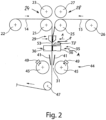
- the clamping device 29 and the clamping holding device 35 are preferably closed at the same time, preferably with a displacement movement according to arrow A, so that the first and second film composite are held clamped to one another in the respective working gap 31 ( figure 2 ).
- the cutting device 38 is activated. According to arrow B, a cutting blade can be moved.
- the first and second composite film 14, 15 are separated by the cutting device 38 and a joint joint 53 is formed.
- a negative pressure is applied to the clamping blocks 36.
- the clamping device 29 and the clamping holding device 35 are moved back into an open position ( figure 3 ).
- the vacuum in the clamping blocks 36 holds a cut section 54 from the beginning 51 of the second film composite 15 and can then be disposed of in a defined manner. This can prevent this cut-off section 54 from causing a disruption in the further processing of the first and second film composite 14, 15 in subsequent stations.
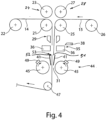
- the joint 53 formed between the first and second composite film 14, 15 is supplied to the connection station 44 by the guide plates 41 in a supporting manner.
- the connecting element 49 is transferred into the working gap 31 at the same time as the stack 53.
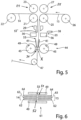
- the connecting elements 49 can each be attached, in particular glued, to the outside of the joint 53 at the end 52 of the first film composite 14 and the start 51 of the second film composite 15 . this is in figure 5 shown.
- the guide roller 27 and the vacuum rollers 45 of the connecting station 44 continue to be driven synchronously, and the connecting point 61, which connects the first and second film composite 14, 15, is guided out of the splicing device 11.
- the supply roll 22 of the first film composite 14 can be wound up so that the remaining second end 55 of the first film composite 14 ( figure 5 ) is led out of the splicing device 11 in order to subsequently change the supply roll with a new composite film.
- the subsequent splicing takes place as a mirror image of the work steps described above Figures 1 to 5 .
- FIG. 6 1 is a schematic sectional view of the splice 61 made with the splicing station 44.
- FIG. Through this connection point 61 is an end 52 of the first composite film 14 connected to the beginning 51 of the second film composite 15.
- the film composite 14, 15 is preferably constructed in three layers.
- This polymer layer 63 can be a photopolymer, in particular a polymer layer with holograms introduced therein.
- This polymer layer 63 is protected from damage by a protective layer 64 .
- This splicing device 11 has the advantage that such triple assemblies are connected to one another simply by lining them up. It is not necessary to detach the protective and/or carrier layer on one or both sides in order to connect the middle polymer layer.
- This splicing device 11 can also process a single-layer web material or a multi-layer film composite in a way that differs from the triple composite shown. ⁇ b>Reference List ⁇ /b> 11.
- Link station 68 21. Guide roller 45. Vacuum roller 69 22. Storage roll 46 70 23. Second leadership role 47. Pulley 71 24. 1st pair of guide rollers 48 72 25. Guide roller 49. Fastener 73 26. Storage roll 50 74 27. Second Guide Roller 51 beginning of 15 75 28. 2nd pair of guide rollers 52. End of 14 76 29. Clamping device 53rd shock 77 30. Jaw 54th section 78 31. Working gap 55 79 32. Opening position 56. Second end of 14 80 33 57 81 34 58 82
Landscapes
- Engineering & Computer Science (AREA)
- Mechanical Engineering (AREA)
- Lining Or Joining Of Plastics Or The Like (AREA)
- Replacement Of Web Rolls (AREA)
Description
- Die Erfindung betrifft ein Verfahren und eine Vorrichtung zum Spleißen von einem Ende eines ersten Folienverbundes mit einem Anfang eines zweiten Folienverbundes.
- Aus der
US 2007/044898 A1 sind ein Verfahren und eine Vorrichtung zum Spleißen eines Endes eines ersten Folienverbundes mit einem Anfang eines zweiten Folienverbundes bekannt. Dabei wird der erste Folienverbund durch die Spleißvorrichtung hindurchgeführt und der Anfang des zweiten Folienverbundes ebenfalls der Spleißvorrichtung zugeführt. - Der erste und zweite Folienverbund werden auf Stoß geschnitten, wobei das Ende des ersten Folienverbundes und der Anfang des zweiten Folienverbundes gleichzeitig einer Verbindungsstation zugeführt werden, in welcher mit einer Walze ein erstes Verbindungselement auf den Stoß aufgebracht wird. Nachfolgend wird mit einer gegenüberliegenden Walze in der Verbindungsstation ein weiteres gegenüberliegendes Verbindungselement auf den Stoß aufgebracht.
- Aus der
US 5,980,060 A ist des Weiteren eine Spleißvorrichtung bekannt, welche zum Spleißen von einem Ende eines ersten Folienverbundes mit einem Anfang eines zweiten Folienverbundes vorgesehen ist. Dabei wird in einem ersten Walzenpaar ein Stoß geschnitten und einseitig auf diesem Stoß ein Verbindungselement aufgebracht sowie nachfolgend an einem weiteren getrennt dazu angeordneten Walzenpaar auf der gegenüberliegenden Seite ein weiteres Verbindungselement auf den Stoß aufgebracht. - Aus der
DE 199 62 413 A1 ist ein Verfahren einer Vorrichtung zur Herstellung eines Folienverbundes bekannt, bei welchem der Folienverbund zumindest eine Polymerschicht umfasst, die bearbeitet, insbesondere mit einem Hologramm versehen wird. Zum kontinuierlichen Betrieb dieser Vorrichtung ist eine erste und zweite Vorratsrolle für den Folienverbund vorgesehen, die aufeinanderfolgend einer Spleißvorrichtung zugeführt werden. Sofern die erste Vorratsrolle aufgebraucht ist, kommt die zweite Vorratsrolle zum Einsatz. In der Spleißvorrichtung wird eine Stoß-an-Stoß-Verbindung von dem Ende des Folienverbundes der ersten Vorratsrolle zum Anfang des zweiten Folienverbundes von der zweiten Vorratsrolle erzeugt. Während der Herstellung dieser Stoß-an-Stoß-Verbindung kommt es zu einem kurzen Stillstand. Da die Verarbeitung des Folienverbundes kontinuierlich erfolgt, ist der Spleißvorrichtung eine Speicherstation nachgeschaltet, so dass während des kurzzeitigen Stillstandes der Spleißvorrichtung die nachfolgenden Bearbeitungsstationen kontinuierlich aus der Speichervorrichtung mit dem Folienverbund versorgt werden. - Der Erfindung liegt die Aufgabe zugrunde, ein Verfahren und eine Vorrichtung zum Spleißen von einem Ende eines ersten Folienverbundes mit einem Anfang des zweiten Folienverbundes vorzuschlagen, wodurch ein Wechsel der Vorratsrollen von einem ersten Folienverbund auf einen zweiten Folienverbund ohne Stillstand von nachfolgenden Bearbeitungsstationen ermöglicht ist.
- Diese Aufgabe wird durch ein Verfahren zum Spleißen von dem einen Ende des ersten Folienverbundes mit dem Anfang des zweiten Folienverbundes in einer Spleißvorrichtung mit folgenden Schritten gelöst. Der erste Folienverbund wird durch die Spleißvorrichtung hindurchgeführt. Der Anfang des zweiten Folienverbundes wird der Spleißvorrichtung zugeführt. Der erste Folienverbund und der zweite Folienverbund werden auf Stoß geschnitten. Der durch das Ende des ersten Folienverbundes und durch den Anfang des zweiten Folienverbundes gebildete Stoß werden gemeinsam einer Verbindungsstation zugeführt. In der Verbindungsstation wird ein- oder beidseitig an einer Außenseite des ersten und zweiten Folienverbundes und den Stoß des ersten und zweiten Folienverbundes überdeckend ein Verbindungselement aufgebracht. Durch dieses Spleißverfahren kann eine Anbindung des Anfangs des zweiten Folienverbundes an das Ende des ersten Folienverbundes für einen unterbrechungsfreien Fertigungsablauf erfolgen. Ein Stillstand des Spleißprozesses ist nicht erforderlich. Durch die aufeinanderfolgenden Arbeitsschritte in der Spleißvorrichtung kann ein kontinuierliches Hindurchführen des ersten und zweiten Folienverbundes ermöglicht sein, wobei gleichzeitig durch das Aufbringen des zumindest einen Verbindungselementes auf der Außenseite des ersten und zweiten Folienverbundes eine einfache Verbindung des Stoßes von dem ersten und zweiten Folienverbund ermöglicht wird.
- Bevorzugt ist vorgesehen, dass die Verbindungsstation eine Halteeinrichtung und ein Gegenhalteelement oder zwei einander gegenüberliegende Halteeinrichtungen umfasst, die einen Arbeitsspalt bilden und der erste und zweite Folienverbund in den Arbeitsspalt hineingeführt werden, wobei das Verbindungselement durch eine Haltekraft der Halteeinrichtung bis zum Einbringen in den Arbeitsspalt gehalten wird. Die Halteeinrichtung kann als Walze ausgebildet sein. Das Gegenhalteelement kann beispielsweise als ein Anschlag, ein plattenförmiges Element oder Walze ausgebildet sein. Diese Anordnung ermöglicht eine einfache Überführung des Verbindungselementes in den Arbeitsspalt bei einer kontinuierlichen Hindurchführung des Stoßes durch den Arbeitsspalt und ein sicheres Aufbringen des Verbindungselementes, so dass das Verbindungselement sowohl an dem Ende des ersten Folienverbundes als auch an dem Anfang des zweiten Folienverbundes angreift und den Stoß überdeckt.
- Gemäß einer bevorzugten Ausführungsform der Halteeinrichtung ist vorgesehen, dass diese als Vakuumwalze ausgebildet wird, bei der durch Anlegen eines Unterdrucks eine Haltekraft zur Aufnahme des zumindest einen Verbindungselements an einer Umfangfläche der Vakuumwalze erzeugt wird. Diese ermöglicht sowohl eine schnelle Fixierung des Verbindungselementes an der Vakuumwalze als auch ein einfaches und schnelles Ablösen des Verbindungselementes innerhalb des Arbeitsspaltes zum Anbringen an den ersten und zweiten Folienverbund.
- Die als Vakuumwalze bevorzugt ausgebildete Halteeinrichtung kann zur Anhaftung des Verbindungselementes mit Unterdruck beaufschlagt und dann abgeschaltet werden, sobald das Verbindungselement in den Arbeitsspalt übergeführt ist.
- Des Weiteren ist bevorzugt vorgesehen, dass als Verbindungselement ein Klebestreifen aufgebracht wird. Dieser Klebestreifen weist vorzugsweise eine einseitige Klebefläche auf. Dadurch kann eine unmittelbare Anbindung bzw. Anhaftung des Verbindungselementes an dem ersten und zweiten Folienverbund erzielt werden.
- Bevorzugt wird der als Verbindungselement ausgebildete Klebestreifen an seiner nicht klebrigen Außenseite von der Halteeinrichtung, insbesondere Vakuumwalze, gehalten. Dies ermöglicht ein einfaches Bestücken des Verbindungselementes auf der Halteeinrichtung sowie darauffolgend ein Anbringen an dem ersten und zweiten Folienverbund.
- Eine vorteilhafte Ausführungsform des Verfahrens sieht vor, dass in der Verbindungsstation beidseitig und gleichzeitig jeweils an einer Außenseite des Stoßes ein Verbindungselement aufgebracht wird. Dadurch kann ein unbeabsichtigtes Lösen der Verbindungsstelle verhindert werden, insbesondere auch bei ggf. auftretenden Spannungsspitzen der Bahnspannung bei der Weiterverarbeitung des Folienverbundes in nachfolgenden Bearbeitungsstationen.
- Zum Schneiden des Stoßes wird der erste Folienverbund durch eine Klemmvorrichtung und in Transportrichtung nachfolgend durch eine Klemmhalteeinrichtung und dieser nachfolgend durch die Verbindungsstation hindurchgeführt, und der zweite Folienverbund wird durch die Klemmvorrichtung hindurch der Klemmhalteeinrichtung zugeführt, so dass zumindest der Anfang des zweiten Folienverbundes in Klemmhalteeinrichtung liegt. Darauffolgend werden die Klemmvorrichtung und die Klemmhalteeinrichtung in eine Arbeitsposition übergeführt bzw. geschlossen. Der erste und zweite Folienverbund sind überlappend zwischen der Klemmvorrichtung und der Klemmhalteeinrichtung positioniert und aneinanderliegend gehalten. Darauffolgend wird mit einer Schneideinrichtung der Stoß eingebracht. Beide Folienverbunde werden gleichzeitig geschnitten. Insbesondere ist ein Schneidmesser zum Einbringen des Stoßes vorgesehen.
- Des Weiteren ist vorgesehen, dass nach dem Schneiden des Stoßes die Klemmvorrichtung und die Klemmhalteeinrichtung geöffnet werden, wobei einer der beiden Klemmblöcke der Klemmhalteeinrichtung mit Vakuum beaufschlagt wird und einen geschnittenen Abschnitt am Anfang des zweiten Folienverbundes von der Schnittstelle entfernt wird. Dadurch kann eine kontrollierte Entsorgung eines Reststückes oder des geschnittenen Abschnittes des zweiten Folienverbundes erfolgen. Die Stoßstelle am Anfang des zweiten Folienverbundes ist somit frei und kann unmittelbar zur Stoßstelle am Ende des ersten Folienverbundes positioniert werden.
- Eine weitere vorteilhafte Ausgestaltung des Verfahrens sieht vor, dass der Stoß zwischen dem ersten und zweiten Folienverbund von der Klemmhalteeinrichtung mittels Leitblechen in die Verbindungsstation geführt wird. Dadurch kann eine kontrollierte Verfahrbewegung des Stoßes in die Verbindungsstation erfolgen, um darauffolgend das zumindest eine Verbindungselement anzubringen.
- Des Weiteren ist bevorzugt vorgesehen, dass beim Überführen des Sto-ßes von der Schnittstelle in die Verbindungsstation eine Zuführwalze oder ein Zuführwalzenpaar des zweiten Folienverbundes und die Vakuumwalzen der Verbindungsstation mit einer synchronen Bahngeschwindigkeit angesteuert werden. Dadurch kann eine kontinuierliche Überführung des Stoßes in die Verbindungsstation erzielt werden. Die Zuführwalze oder das Zuführwalzenpaar des ersten Folienverbundes kann in entgegengesetzter Richtung zur Transportrichtung des Stoßes angetrieben werden, um einen Rest der Vorratsrolle des ersten Folienverbundes aus der Spleißvorrichtung herauszuführen, um darauffolgend einen Wechsel für eine neue Vorratsrolle vorzunehmen.
- Bevorzugt wird der Spleißvorrichtung ein erster und zweiter Folienverbund zugeführt, der ein- oder mehrlagig ausgebildet ist, insbesondere einen Dreifachverbund umfasst, der aus einer Trägerschicht, einer Polymerschicht und einer Schutzschicht besteht. Diese Polymerschicht ist insbesondere aus einer holografisch belichteten Schicht gebildet, welche in nachfolgenden Bearbeitungsstationen auf einen Datenträger oder eine Datenkarte nach Ablösen der Trägerschicht und der Schutzschicht aufgebracht wird. Durch die Bildung der Stoßstelle kann eine quasi zerstörungsfreie Anbindung eines Folienverbundes als Dreifachverbund ermöglicht sein.
- Die der Erfindung zugrundeliegende Aufgabe wird des Weiteren durch eine Spleißvorrichtung zum Spleißen von einem Ende eines ersten Folienverbundes mit einem Anfang eines zweiten Folienverbundes gelöst, welche zumindest eine Schneidvorrichtung umfasst, durch welche ein gemeinsamer Stoß zwischen dem ersten Folienverbund und dem zweiten Folienverbund herstellbar ist und mit einer Verbindungsstation, die zumindest ein Verbindungselement ein- oder beidseitig auf den Stoß des ersten und zweiten Folienverbundes aufbringt. Durch diese Spleißvorrichtung ist ein Wechsel von einer verbrauchten Vorratsrolle zu einer neuen bzw. vollen Vorratsrolle ohne Stillstand ermöglicht. Dadurch kann eine automatische Anbindung eines ersten Folienverbundes und eines zweiten Folienverbundes geschaffen werden, so dass die der Spleißvorrichtung nachfolgenden Bearbeitungsstationen kontinuierlich den Fertigungsprozess und die weitere Bearbeitung des Folienverbundes fortführen können.
- Bevorzugt ist vorgesehen, dass die Verbindungsstation der Spleißvorrichtung eine Halteeinrichtung und ein Gegenhalteelement oder zwei einander gegenüberliegende Halteinrichtungen aufweist, zwischen denen ein Arbeitsspalt zum Aufbringen des zumindest eines Verbindungselements auf den Stoß des ersten Folienverbundes und zweiten Folienverbundes gebildet ist. Dadurch kann während einer kontinuierlichen Hindurchführung des Stoßes zwischen dem ersten und zweiten Folienverbund das zumindest eine Verbindungselement aufgebracht werden, um einen quasi endlosen Folienverbund zu schaffen.
- Eine bevorzugte Ausführungsform sieht vor, dass die Halteeinrichtung als eine Vakuumwalze ausgebildet ist, welche eine äußere Gummierung als Mantelfläche umfasst, welche eine Vielzahl von Durchbrechungen aufweist. Dies ermöglicht eine sichere Aufnahme des Verbindungselementes, insbesondere eines Klebestreifens sowie eine Fixierung durch das Anlegen eines Vakuums, wobei durch die Vielzahl von Durchbrechungen auch unterschiedliche Größen des Verbindungselementes von der Vakuumwalze aufgenommen werden können. Dadurch ist eine einfache und flexible Anpassung des Verbindungselementes an die Bahnbreite des ersten und zweiten zu verbindenden Folienverbundes möglich.
- Die Halteeinrichtung der Verbindungsstation weist bevorzugt eine Markierung und/oder ein Ausrichtelement zur Bestückung des Verbindungselementes auf. Dadurch ist eine schnelle und einfache Positionierung des Verbindungselementes möglich. Das Ausrichtelement kann beispielsweise bei der als Vakuumwalze ausgebildeten Halteeinrichtung eine Vertiefung in der Mantelfläche sein, so dass ein Anschlag zur Anlage des Verbindungselementes und dadurch der Ausrichtung des Verbindungselementes an der Umfangsfläche der Vakuumwalze gegeben ist.
- Des Weiteren ist bevorzugt vorgesehen, dass die Schneideinrichtung zumindest ein Schneidmesser umfasst. Dieses Schneidmesser wird vorzugsweise rechtwinklig zur Erstreckungsebene des ersten und zweiten Folienverbundes für einen sauberen Schnitt zugeführt. Alternativ kann die Schneidvorrichtung auch als eine Laserschneideinrichtung ausgebildet sein. Vorteilhaferweise kann die Schneideinrichtung wie auch die Klemm- und Klemmhalteeinrichtung während des Schnittes eine synchrone Verfahrbewegung in Transportrichtung durchführen.
- Des Weiteren ist bevorzugt vorgesehen, dass der Schneideinrichtung eine Klemmhalteeinrichtung zugeordnet ist, welche insbesondere in Transportrichtung des ersten und zweiten Folienverbundes der Schneideinrichtung nachgeschaltet ist und die in eine Öffnungs- und Schließposition überführbar ist. Dadurch kann für die Einbringung des Stoßes in den ersten und zweiten Folienverbund eine einseitige Klemmung des ersten und zweiten Folienverbundes aneinanderliegend erfolgen, so dass durch den gemeinsamen Schnitt in den ersten und zweiten Folienverbund ein exakter Stoß gebildet ist.
- Eine vorteilhafte Ausgestaltung der Spleißvorrichtung sieht vor, dass in Transportrichtung des ersten und zweiten Folienverbundes gesehen vor der Schneideinrichtung eine Klemmvorrichtung vorgesehen ist. Dies ermöglicht, dass der erste und zweite Folienverbund vor und nach der Schneidvorrichtung definiert zueinander fixiert werden können, um einen exakten Schnitt einzubringen.
- Vorteilhafterweise sind zwischen der Klemmhalteeinrichtung und der Verbindungsstation einander gegenüberliegende Leitbleche vorgesehen, welche vorzugsweise mit Vakuum beaufschlagbar sind. Dadurch wird die Stoßstelle des ersten und zweiten Folienverbundes von der Schnittstelle in die Verbindungsstation übergeführt.
- Der Transport der Stoßstelle des ersten und zweiten Folienverbundes von der Schneideinrichtung zur Verbindungsstation wird über die Führungswalze des zweiten Folienverbundes und die zumindest eine Vakuumwalze der Verbindungsstation angesteuert, wobei die Führungswalze des zweiten Folienverbundes und die Vakuumwalzen der Verbindungsstation synchron angesteuert sind. Dadurch kann ein Gleichlauf des Endes des ersten Folienverbundes und des Anfangs des zweiten Folienverbundes bis in die Verbindungsstation erfolgen, um daraufhin das zumindest eine Verbindungselement auf die Stoßstelle aufzubringen.
- Die Erfindung sowie weitere vorteilhafte Ausführungsformen und Weiterbildungen derselben werden im Folgenden anhand der in den Zeichnungen dargestellten Beispiele näher beschrieben und erläutert. Die der Beschreibung und den Zeichnungen zu entnehmenden Merkmale können einzeln für sich oder zu mehreren in beliebiger Kombination erfindungsgemäß angewandt werden. Es zeigen:
- Figur 1
- eine schematische Ansicht einer Spleißvorrichtung in einem ersten Arbeitsschritt,
- Figur 2
- eine schematische Ansicht der Spleißvorrichtung in einem nachfolgenden Arbeitsschritt zu
Figur 1 , - Figur 3
- eine schematische Ansicht der Spleißvorrichtung in einem weiteren Arbeitsschritt zu
Figur 2 , - Figur 4
- eine schematische Ansicht der Spleißvorrichtung in einem nachfolgenden Arbeitsschritt zu
Figur 3 , - Figur 5
- eine schematische Ansicht der Spleißvorrichtung gemäß
Figur 1 in einem weiteren nachfolgenden Arbeitsschritt, und - Figur 6
- eine schematische Ansicht einer Verbindungsstelle zwischen einem ersten und zweiten Folienverbund.
- In den
Figuren 1 bis 5 ist schematisch eine Spleißvorrichtung 11 dargestellt, welche aufeinanderfolgende Arbeitsschritte zeigt. Diese Spleißvorrichtung 11 verbindet einen ersten Folienverbund 14 mit einem zweiten Folienverbund 15. Dadurch kann ohne Stillstand ein Folienverbund 14, 15 zumindest einer nachfolgenden Bearbeitungsstation für die Bearbeitung oder Weiterverarbeitung des Folienverbundes 14, 15 zur Verfügung gestellt sein. Anwendungsspezifisch kann gemäßFigur 1 vorgesehen sein, dass der Spleißvorrichtung 11 eine Speichervorrichtung 17 nachgeschaltet ist, so dass die nachfolgenden Bearbeitungsstationen bezüglich deren Bearbeitungsgeschwindigkeit abweichend zur Spleißvorrichtung 11 sein können und dennoch eine kontinuierliche Bearbeitung des Folienverbundes 14, 15 ermöglicht ist. - Die Spleißvorrichtung 11 gemäß
Figur 1 umfasst eine erste Führungswalze 21, über welche der erste Folienverbund 14 von einer Vorratsrolle 22 abgezogen und der Spleißvorrichtung 11 zugeführt wird. Der ersten Führungswalze 21 gegenüberliegend kann eine zweite Führungswalze 23 vorgesehen sein, die mit der Führungswalze 21 ein erstes Führungswalzenpaar 24 bildet. - Die Spleißvorrichtung 11 umfasst eine weitere Führungswalze 25, über welche der zweite Folienverbund 15 von einer Vorratsrolle 26 abgezogen und der Spleißvorrichtung 11 zugeführt wird. Dieser Führungswalze 25 kann eine zweite Führungswalze 27 gegenüberliegend zugeordnet sein. Diese können ein zweites Führungswalzenpaar 28 bilden. Zumindest die Führungswalze 21 und die Führungswalze 25 sind angetrieben und beabstandet zueinander angeordnet, so dass der erste Folienverbund 14 und der zweite Folienverbund 15 unabhängig und getrennt voneinander zugeführt werden können. Den Führungswalzen 21, 25 nachgeschaltet ist eine Klemmvorrichtung 29 vorgesehen, zwischen denen ein Arbeitsspalt 31 gebildet ist. Die Klemmvorrichtung 29 besteht aus einander zugeordneten Klemmbacken 30, welche in
Figur 1 in einer Öffnungsposition 32 dargestellt sind. In dieser Öffnungsposition ist der erste und/oder zweite Folienverbund 14, 15 frei hindurchführbar. - Die Spleißvorrichtung 11 umfasst des Weiteren eine Klemmhalteeinrichtung 35, welche in Transportrichtung des ersten und/oder zweiten Folienverbundes 14, 15 gesehen der Klemmvorrichtung 29 nachgeschaltet ist. Diese Klemmhalteeinrichtung 35 weist zwei einander gegenüberliegende Klemmblöcke 36 auf. Diese sind in
Figur 1 wiederum in einer Öffnungsposition 32 angeordnet, so dass sich dazwischen ein Arbeitsspalt 31 bildet und der erste und/oder zweite Folienverbund 14, 15 frei hindurchführbar ist. Die Klemmblöcke 36 weisen zum Arbeitsspalt 31 ausgerichtet jeweils Vakuumbohrungen auf, so dass beim Anlegen eines Vakuums der erste und/oder zweite Folienverbund 14, 15 an dem Klemmblock 36 anliegt und durch diesen gehalten wird. - Zwischen der Klemmvorrichtung 29 und der Klemmhalteeinrichtung 35 ist eine Schneideinrichtung 38 vorgesehen. Diese Schneideinrichtung 38 ist in einer Ruheposition 39 dargestellt. Diese Schneideinrichtung 38 besteht bevorzugt aus zumindest einem Schneidmesser. Diese Schneideinrichtung 38 ist bevorzugt senkrecht zur Transportebene des ersten und/oder zweiten Folienverbundes 14, 15 verfahrbar.
- Der Klemmhalteeinrichtung 35 nachfolgend sind Leitbleche 41 vorgesehen. Diese Leitbleche 41 können jeweils mit Vakuum beaufschlagt werden. Diese Leitbleche 41 führen den ersten oder zweiten Folienverbund 14, 15 von der Klemmhalteeinrichtung 35 in eine nachgeschaltete Verbindungsstation 44.
- Die Verbindungsstation 44 umfasst vorzugsweise zwei Halteeinrichtungen 45, die einander gegenüberliegend angeordnet sind und wiederum dazwischenliegend einen Arbeitsspalt 31 bilden. Die Halteeinrichtungen 45 sind bevorzugt als Vakuumwalzen ausgebildet. Die Spleißvorrichtung 11 wird nachfolgend anhand der Vakuumwalzen 45 beispielhaft beschrieben, ohne darauf beschränkt zu sein. Die Vakuumwalzen 45 sind gegenläufig zueinander angetrieben, so dass der erste und/oder zweite Folienverbund 14, 15 in Transportrichtung verfahren werden kann. Insbesondere wird der erste und/oder zweite Folienverbund 14, 15 nach der Verbindungsstation 44 aus der Spleißvorrichtung 11 herausgeführt.
- Der Spleißvorrichtung 11 nachgeschaltet oder am Ausgang der Spleißvorrichtung 11 kann eine Umlenkrolle 47 vorgesehen sein, um den Folienverbund 14, 15 der Speichervorrichtung 17 und/oder einer weiteren Bearbeitungsstation, die nicht dargestellt ist, zuzuführen.
- Die Vakuumwalze 45 der Verbindungsstation 44 weist bevorzugt an deren Außenumfang eine Gummierung auf. In der Mantelfläche der Vakuumwalze 45 bzw. in der Gummierung der Vakuumwalze 45 sind Poren oder Bohrungen enthalten, so dass die äußere Mantelfläche der Vakuumwalze 45 mit einem Unterdruck beaufschlagbar ist. Auf dieser Vakuumwalze 45 kann ein Verbindungselement 49 positioniert werden. Dieses Verbindungselement 49 kann beispielsweise als ein Klebestreifen ausgebildet sein, der mit seiner klebefreien Rückseite an der Mantelfläche der Vakuumwalze 45 anliegt und durch das Vakuum gehalten wird. Die Klebeschicht wird bei einer Drehbewegung in Transportrichtung der Vakuumwalze 45 in den Arbeitsspalt 31 geführt.
- Das Spleißen eines Endes des ersten Folienverbundes 14 mit einem Anfang des zweiten Folienverbundes 15 wird nachfolgend anhand der
Figuren 1 bis 5 näher beschrieben. - Der erste Folienverbund 14 ist durch die Spleißvorrichtung 11 vollständig hindurchgeführt. Sobald vorzugsweise mittels Sensoren festgestellt wird, dass die Vorratsrolle 22 abgearbeitet ist, wird ein Anfang 51 des zweiten Folienverbundes 15 über die Führungswalze 25 der Spleißvorrichtung 11 zugeführt. Dabei wird der Anfang 51 des zweiten Folienverbundes 15 derart zugeführt, dass dieser durch den Arbeitsspalt 31 der Klemmvorrichtung 29 hindurchgeführt wird und im Arbeitsspalt 31 zwischen der Klemmhalteeinrichtung 35 positioniert wird (
Figur 1 ). Vorzugsweise wird vor oder bis zu diesem Zeitpunkt auf der Vakuumwalze 45 das Verbindungselement 49 positioniert. Das Verbindungselement 49 wird in einem separaten und nicht näher dargestellten Arbeitsschritt auf Maß geschnitten. Vorzugsweise entspricht die Länge des Verbindungselementes 49 der Bahnbreite des ersten und/oder zweiten Folienverbundes 14, 15. Die Breite des Verbindungselementes 49 kann in Abhängigkeit der aufzubringenden Haltekraft für die Verbindungsstelle 61 zwischen dem ersten und zweiten Folienverbund 14, 15 ausgebildet sein (Figur 6 ). - Ausgehend von diesem ersten Arbeitsschritt gemäß
Figur 1 wird in einem nachfolgenden Arbeitsschritt die Klemmvorrichtung 29 und die Klemmhalteeinrichtung 35 vorzugsweise gleichzeitig vorzugsweise mit einer Verfahrbewegung gemäß Pfeil A geschlossen, so dass der erste und zweite Folienverbund im jeweiligen Arbeitsspalt 31 geklemmt zueinander gehalten werden (Figur 2 ). Darauffolgend wird die Schneideinrichtung 38 aktiviert. Gemäß Pfeil B kann ein Schneidmesser verfahren werden. Der erste und zweite Folienverbund 14, 15 werden durch die Schneideinrichtung 38 getrennt und ein gemeinsamer Stoß 53 gebildet. In der Arbeitsposition der Klemmhalteeinrichtung 35 wird ein Unterdruck an den Klemmblöcken 36 angelegt. - Nach dem Einbringen des Stoßes 53 werden die Klemmvorrichtung 29 und die Klemmhalteeinrichtung 35 wieder in eine Öffnungsposition übergeführt (
Figur 3 ). Durch das Vakuum in den Klemmblöcken 36 wird ein geschnittener Abschnitt 54 vom Anfang 51 des zweiten Folienverbundes 15 gehalten und kann anschließend definiert entsorgt werden. Dadurch kann verhindert werden, dass dieser abgeschnittene Abschnitt 54 eine Störung bei der Weiterverarbeitung des ersten und zweiten Folienverbundes 14, 15 in nachfolgende Stationen bewirkt. - Das Ende 52 des ersten Folienverbundes 14 und der Anfang 51 des zweiten Folienverbundes 15 liegen unmittelbar benachbart zueinander. Durch den gemeinsamen Schnitt können diese bündig aneinander liegen. Ausgehend von dieser Arbeitssituation, die in
Figur 3 dargestellt ist, folgt der nachfolgende, inFigur 4 dargestellte Arbeitsschritt. Die Führungswalze 27 und die Vakuumwalzen 45 der Verbindungsstation 44 werden synchron in Transportrichtung angetrieben. Dadurch wird zum einen der zweite Folienverbund 15 in Richtung der Verbindungsstation 44 verfahren und der erste Folienverbund 14 über die Vakuumwalzen 45 weitertransportiert. - Der zwischen dem ersten und zweiten Folienverbund 14, 15 gebildete Stoß 53 wird dabei unterstützend durch die Leitbleche 41 der Verbindungsstation 44 zugeführt. Durch eine Synchronisation der Umfangsgeschwindigkeiten der Vakuumwalzen 45 mit dem jeweils darauf positionierten Verbindungselement 49 und der Zuführbewegung des Stoßes 53 wird erreicht, dass die Verbindungselement 49 in den Arbeitsspalt 31 zeitgleich mit dem Stoß 53 übergeführt sind. Die Verbindungselemente 49 können jeweils an der Außenseite den Stoß 53 überbrückend an dem Ende 52 des ersten Folienverbundes 14 und dem Anfang 51 des zweiten Folienverbundes 15 angebracht, insbesondere angeklebt, werden. Dies ist in
Figur 5 dargestellt. Darauffolgend werden die Führungswalze 27 und die Vakuumwalzen 45 der Verbindungsstation 44 weiterhin synchron angetrieben, und die Verbindungsstelle 61, welche den ersten und zweiten Folienverbund 14, 15 verbindet, wird aus der Spleißvorrichtung 11 herausgeführt. - Nach dem Einbringen des Stoßes 53 kann die Vorratsrolle 22 des ersten Folienverbundes 14 aufgewickelt werden, so dass das verbleibende zweite Ende 55 des ersten Folienverbundes 14 (
Figur 5 ) aus der Spleißvorrichtung 11 herausgeführt wird, um darauffolgend einen Wechsel der Vorratsrolle mit einem neuen Folienverbund vorzunehmen. Die darauffolgende Spleißung erfolgt spiegelbildlich zu den vorbeschriebenen Arbeitsschritten gemäßFiguren 1 bis 5 . - In
Figur 6 ist eine schematische Schnittansicht der Verbindungsstelle 61 dargestellt, welche mit der Verbindungsstation 44 hergestellt wird. Durch diese Verbindungsstelle 61 ist ein Ende 52 des ersten Folienverbundes 14 mit dem Anfang 51 des zweiten Folienverbundes 15 verbunden. Der Folienverbund 14, 15 ist bevorzugt dreilagig aufgebaut. Dieser umfasst eine Trägerschicht 62, auf welcher eine Polymerschicht 63 aufgebracht ist. Bei dieser Polymerschicht 63 kann es sich um ein Photopolymer handeln, insbesondere um eine Polymerschicht mit darin eingebrachten Hologrammen. Diese Polymerschicht 63 ist vor Beschädigungen durch eine Schutzschicht 64 geschützt. - Bei der Herstellung des Stoßes 53, wie dies in
Figur 2 beschrieben ist, werden gleichzeitig alle drei Schichten des ersten Folienverbundes 14 und des zweiten Folienverbundes 15 durchtrennt. Dadurch entsteht eine deckungsgleiche Stirnkante an dem jeweiligen Folienverbund 14, 15. Durch das Einbringen des gemeinsamen Stoßes 53 können diese an den jeweiligen Stirnseiten bündig aneinanderliegen. Jeweils an einer Außenseite ist bevorzugt das Verbindungselement 49 aufgebracht. Dieses überdeckt den Stoß 53 und erstreckt sich darüber hinaus, um eine hinreichende Haltekraft zur Verbindung des Stoßes 53 zu ermöglichen. Dadurch kann ein spaltfreier Übergang zwischen dem ersten und zweiten Folienverbund 14, 15 geschaffen werden. - Diese Spleißvorrichtung 11 weist den Vorteil auf, dass solche Dreifachverbünde durch einfaches Aneinanderreihen miteinander verbunden werden. Ein ein- oder beidseitiges Ablösen der Schutz- und/oder Trägerschicht zum Verbinden der mittleren Polymerschicht ist nicht erforderlich. Diese Spleißvorrichtung 11 kann auch ein einlagiges Bahnmaterial oder einen mehrlagigen Folienverbund abweichend zu dem dargestellten Dreifachverbund verarbeiten.
Bezugszeichenliste 11. Spleißvorrichtung 35. Klemmhalteeinrichtung 59. 12. 36. Klemmblöcke 60. 13. 37. 61. Verbindungsstelle 14. Erster Folienverbund 38. Schneideinrichtung 62. Trägerschicht 15. Zweiter Folienverbund 39. Ruheposition 63. Polymerschicht 16. 40. 64. Schutzschicht 17. Speichervorrichtung 41. Leitblech 65. 18. 42. 66. 19. 43. 67. 20. 44. Verbindungsstation 68. 21. Führungswalze 45. Vakuumwalze 69. 22. Vorratsrolle 46. 70. 23. Zweite Führungsrolle 47. Umlenkrolle 71. 24. 1. Führungswalzenpaar 48. 72. 25. Führungswalze 49. Verbindungselement 73. 26. Vorratsrolle 50. 74. 27. Zweite Führungswalze 51 Anfang von 15 75. 28. 2. Führungswalzenpaar 52. Ende von 14 76 29. Klemmvorrichtung 53. Stoß 77. 30. Klemmbacke 54. Abschnitt 78. 31. Arbeitsspalt 55. 79. 32. Öffnungsposition 56. Zweites Ende von 14 80. 33. 57. 81. 34. 58. 82.
Claims (13)
- Verfahren zum Spleißen eines Endes (52) eines ersten Folienverbundes (14) mit einem Anfang (51) eines zweiten Folienverbundes (15) in einer Spleißvorrichtung (11),- bei dem der erste Folienverbund (14) durch die Spleißvorrichtung (11) hindurchgeführt ist und der Anfang (51) des zweiten Folienverbundes (15) der Spleißvorrichtung (11) zugeführt wird,- bei dem der erste und zweite Folienverbund (14, 15) auf Stoß (53) geschnitten werden,- bei dem der durch das Ende (52) des ersten Folienverbundes (14) und den Anfang (51) des zweiten Folienverbundes (15) gebildete Stoß (53) einer Verbindungsstation (44) zugeführt werden, und- bei dem in der Verbindungsstation (44) ein- oder beidseitig an einer Außenseite des ersten und zweiten Folienverbundes (14, 15) und den Stoß (53) des ersten und zweiten Folienverbundes (14, 15) überdeckend ein Verbindungselement (49) aufgebracht wird,dadurch gekennzeichnet,- dass der erste Folienverbund (14) durch eine Klemmvorrichtung (29) und in Transportrichtung nachfolgend durch eine Klemmhalteeinrichtung (35) und durch die Verbindungsstation (44) hindurchgeführt ist und dass der zweite Folienverbund (15) durch die Klemmvorrichtung (29) hindurchgeführt und der nachfolgenden Klemmhalteeinrichtung (35) zugeführt wird, sodass zumindest der Anfang (51) des zweiten Folienverbundes (15) in der Klemmhalteeinrichtung (35) positioniert wird, und- dass zwischen der Klemmvorrichtung (29) und der Klemmhalteeinrichtung (35) die Schneideinrichtung (38) positioniert wird und der erste und zweite Folienverbund (14, 15) nach dem Schließen der Klemmvorrichtung (29) und der Klemmhalteeinrichtung (35) gemeinsam mit der Schneideinrichtung (38) auf den Stoß (53) geschnitten werden.
- Verfahren nach Anspruch 1, dadurch gekennzeichnet, dass die Verbindungsstation (44) eine Halteeinrichtung (45) und ein Gegenhalteelement oder zwei einander gegenüberliegende Halteeinrichtungen (45) umfasst, die einen Arbeitsspalt (31) bilden, in den der erste und zweite Folienverbund (14, 15) hineingeführt werden und das zumindest eine Verbindungselement (49) mit einer Haltekraft an der Halteeinrichtung (45) bis zum Einbringen in den Arbeitsspalt (31) gehalten wird, und vorzugsweise die an der Halteeinrichtung (45) erzeugte Haltekraft abgeschalten wird, sobald das Verbindungselement (49) in den Arbeitsspalt (31) übergeführt ist.
- Verfahren nach Anspruch 2, dadurch gekennzeichnet, dass die Halteeinrichtung (45) als Vakuumwalze ausgebildet wird, bei der durch Anlegen eines Unterdrucks die Haltekraft zur Aufnahme des zumindest einen Verbindungselementes (49) an einer Umfangsfläche der Vakuumwalze erzeugt wird.
- Verfahren nach Anspruch 3, dadurch gekennzeichnet, dass als Verbindungselement (49) ein Klebestreifen, vorzugsweise mit einer einseitigen Klebefläche, auf den Stoß (53) des ersten und zweiten Folienverbundes (14, 15) aufgebracht wird, und vorzugsweise der Klebestreifen an seiner nicht klebrigen Außenseite von der Vakuumwalze (45) gehalten wird.
- Verfahren nach einem der vorhergehenden Ansprüche, dadurch gekennzeichnet, dass in der Verbindungsstation (44) beidseitig und gleichzeitig jeweils das Verbindungselement (49) an der Außenseite des Stoßes (53) des ersten und zweiten Folienverbunds (14, 15) aufgebracht wird.
- Verfahren nach Anspruch 1, dadurch gekennzeichnet, dass nach dem Schneiden des Stoßes (53) die Klemmvorrichtung (29) und die Klemmhalteeinrichtung (35) geöffnet werden, wobei einer der beiden Klemmblöcke (36) der Klemmhalteeinrichtung (35) mit Unterdruck beaufschlagt wird und einen geschnittenen Abschnitt (54) am Anfang (51) des zweiten Folienverbundes (15) von der Schnittstelle entfernt.
- Verfahren nach einem der Ansprüche 1 oder 6, dadurch gekennzeichnet, dass der Stoß (53) zwischen dem ersten und zweiten Folienverbund (14, 15) durch Leitbleche (41), die vorzugsweise mit Unterdruck beaufschlagt werden, von der Klemmhalteeinrichtung (35) in die Verbindungsstation (45) übergeführt wird.
- Verfahren nach einem der vorhergehenden Ansprüche 3-7, dadurch gekennzeichnet, dass beim Überführen des Stoßes (53) von der Schnittstelle in die Verbindungsstation (44) eine Zuführwalze (27) oder Zuführwalzenpaar (28) des zweiten Folienverbundes (15) und die Vakuumwalzen (45) der Verbindungsstation (44) mit einer synchronen Bahngeschwindigkeit angesteuert werden.
- Verfahren nach einem der vorhergehenden Ansprüche, dadurch gekennzeichnet, dass der Spleißvorrichtung (11) ein erster und zweiter Folienverbund (14, 15) zugeführt wird, der ein- oder mehrlagig ausgebildet ist, insbesondere als ein Dreifachverbund ausgebildet ist, der eine Trägerschicht (62), eine Polymerschicht (63) und eine Schutzschicht (64) umfasst.
- Spleißvorrichtung zum Spleißen von einem Ende eines ersten Folienverbundes (14) mit einem Anfang (51) eines zweiten Folienverbundes (15),- mit zumindest einer Schneideinrichtung (38), durch welche ein gemeinsamer Stoß (53) zwischen dem ersten und zweiten Folienverbund (14, 15) herstellbar ist, und- mit einer Verbindungsstation (44), die zumindest ein Verbindungselement (49) ein- oder beidseitig dem Stoß (53) des ersten und zweiten Folienverbundes (14, 15) zuführt und den Stoß (53) überdeckend aufbringt,dadurch gekennzeichnet,- dass der erste Folienverbund (14) durch eine Klemmvorrichtung (29) und in Transportrichtung nachfolgend durch eine Klemmhalteeinrichtung (35) und durch die Verbindungsstation (44) hindurchführbar ist und dass der zweite Folienverbund (15) durch die Klemmvorrichtung (29) hindurchführbar und der nachfolgenden Klemmhalteeinrichtung (35) zuführbar ist, sodass zumindest der Anfang (51) des zweiten Folienverbundes (15) in der Klemmhalteeinrichtung (35) positioniert ist, und- dass zwischen der Klemmvorrichtung (29) und der Klemmhalteeinrichtung (35) die Schneideinrichtung (38) positioniert ist und der erste und zweite Folienverbund (14, 15) durch die Klemmvorrichtung (29) und die Klemmhalteeinrichtung (35) gemeinsam geklemmt gehalten sind und mit der Schneideinrichtung (38) der Stoß (53) herstellbar ist.
- Spleißvorrichtung nach Anspruch 10, dadurch gekennzeichnet, dass die Verbindungsstation (44) eine Halteeinrichtung (45) und ein Gegenhalteelement oder zwei einander gegenüberliegende Halteeinrichtungen (45) aufweist, zwischen denen ein Arbeitsspalt (31) zum Aufbringen des zumindest einen Verbindungselementes (49) auf den Stoß (53) des ersten und zweiten Folienverbundes (14, 15) gebildet ist, und vorzugsweise dass die Halteeinrichtung (45) als eine Vakuumwalze ausgebildet ist, welche eine äußere Gummierung als Mantelfläche aufweist, welche eine Vielzahl von Durchgangsbohrungen umfasst, und/oder dass die Halteeinrichtung (45) eine Markierung und/oder ein Ausrichtelement zum Bestücken des Verbindungselementes (49) aufweist.
- Spleißvorrichtung nach einem der Ansprüche 10 oder 11, dadurch gekennzeichnet, dass der Schneideinrichtung (38) die Klemmhalteeinrichtung (35) zugeordnet ist, in Transportrichtung des ersten und zweiten Folienverbundes (14, 15) nachgeschaltet ist, welche in eine Öffnungs- oder Schließposition überführbar ist, und dass in Transportrichtung des ersten und zweiten Folienverbundes (14, 15) gesehen vor der Schneideinrichtung (38) die Klemmvorrichtung (29) vorgesehen ist, welche in eine Öffnungs- und Schließposition überführbar ist, und vorzugsweise zwischen der Klemmhalteeinrichtung (35) und der Verbindungsstation (44) einander gegenüberliegende Leitbleche (41) vorgesehen sind, welche vorzugsweise mit Unterdruck beaufschlagbar sind.
- Spleißvorrichtung nach einem der Ansprüche 11 bis 12, dadurch gekennzeichnet, dass jeweils zumindest eine Führungswalze (21, 25) für den ersten Folienverbund (14) und den zweiten Folienverbund (15) vorgesehen ist, welche der Schneideinrichtung (38) vorgeschalten sind und dass die Führungswalze (21, 25) und die Vakuumwalzen (45) der Verbindungsstation (44) synchron ansteuerbar sind.
Applications Claiming Priority (1)
| Application Number | Priority Date | Filing Date | Title |
|---|---|---|---|
| DE102018130674.1A DE102018130674B4 (de) | 2018-12-03 | 2018-12-03 | Verfahren und Vorrichtung zum Spleißen von einem ersten und einem zweiten Folienverbund |
Publications (2)
| Publication Number | Publication Date |
|---|---|
| EP3663243A1 EP3663243A1 (de) | 2020-06-10 |
| EP3663243B1 true EP3663243B1 (de) | 2023-09-06 |
Family
ID=68762538
Family Applications (1)
| Application Number | Title | Priority Date | Filing Date |
|---|---|---|---|
| EP19212787.6A Active EP3663243B1 (de) | 2018-12-03 | 2019-12-02 | Verfahren und vorrichtung zum spleissen von einem ersten und einem zweiten folienverbund |
Country Status (2)
| Country | Link |
|---|---|
| EP (1) | EP3663243B1 (de) |
| DE (1) | DE102018130674B4 (de) |
Families Citing this family (6)
| Publication number | Priority date | Publication date | Assignee | Title |
|---|---|---|---|---|
| CN113103728B (zh) * | 2021-05-19 | 2022-10-28 | 上海紫江彩印包装有限公司 | 一种易撕复合膜的在线制备方法、系统装置及其制备的复合膜 |
| CN114408635A (zh) * | 2021-12-22 | 2022-04-29 | 软控股份有限公司 | 胶条自动续料装置 |
| CN115416317B (zh) * | 2022-09-06 | 2025-09-05 | 深圳鑫富艺科技股份有限公司 | 一种bp膜和cop膜拼接设备及拼接工艺方法 |
| CN116902647B (zh) * | 2023-06-02 | 2024-05-03 | 临沂驰禾塑料制品有限公司 | 一种复合包装膜加工工艺及其加工设备 |
| CN119706463A (zh) * | 2023-09-28 | 2025-03-28 | 宁德时代新能源科技股份有限公司 | 切割拼接装置、包膜系统和料带切割拼接方法 |
| DE102024119966A1 (de) * | 2024-07-12 | 2026-01-15 | Mb Automation Gmbh & Co. Kg | Vorrichtung und Verfahren zum Spleißen wenigstens zweilagiger Material-Bahnen |
Family Cites Families (11)
| Publication number | Priority date | Publication date | Assignee | Title |
|---|---|---|---|---|
| JPS5329174B2 (de) | 1973-11-29 | 1978-08-18 | ||
| FR2679888B1 (fr) | 1991-08-02 | 1993-11-26 | Du Pont De Nemours And Cy | Procede et dispositif pour raccorder en continuite deux feuils minces. |
| US5698060A (en) * | 1995-12-14 | 1997-12-16 | Eastman Kodak Company | Web butt-splicing apparatus |
| WO2000046013A1 (en) | 1999-02-03 | 2000-08-10 | The Goodyear Tire & Rubber Company | Butt splicing of elastomeric sheets |
| US6533891B1 (en) | 1999-02-03 | 2003-03-18 | The Goodyear Tire & Rubber Company | Butt splicing of elastomeric sheets |
| DE19962413A1 (de) | 1999-12-22 | 2001-06-28 | Kiener Maschinenbau Gmbh | Verfahren und Vorrichtung zum Herstellen eines zumindest eine Polymerfolie mit Informationen und zumindest eine Trägerschicht enthaltenden Verbundes zur Weiterverarbeitung für fälschungssichere Dokumente |
| DE10226148B4 (de) | 2002-06-13 | 2011-11-17 | Tetra Laval Holdings & Finance S.A. | Vorrichtung zum Verkleben zweier Verpackungsmaterialbahnen |
| US7073552B2 (en) | 2002-12-20 | 2006-07-11 | The Goodyear Tire & Rubber Company | Tire preparation ply manufacturing apparatus and method |
| JP4487315B2 (ja) * | 2005-08-31 | 2010-06-23 | 富士フイルム株式会社 | ウエブの突き合わせ接合方法及び装置 |
| DE102011111786A1 (de) | 2011-09-01 | 2013-03-07 | Ovd Kinegram Ag | Verfahren und Vorrichtung zum Verbinden von Transfer- oder Laminierfolienbahnen |
| DE102015210522A1 (de) | 2015-06-09 | 2016-12-15 | Bundesdruckerei Gmbh | Verfahren und Vorrichtung zum Herstellen eines Sicherheitselemente aufweisenden mehrlagigen Wert- oder Sicherheitsdokuments |
-
2018
- 2018-12-03 DE DE102018130674.1A patent/DE102018130674B4/de active Active
-
2019
- 2019-12-02 EP EP19212787.6A patent/EP3663243B1/de active Active
Also Published As
| Publication number | Publication date |
|---|---|
| DE102018130674A1 (de) | 2020-06-04 |
| EP3663243A1 (de) | 2020-06-10 |
| DE102018130674B4 (de) | 2021-12-23 |
Similar Documents
| Publication | Publication Date | Title |
|---|---|---|
| DE102018130674B4 (de) | Verfahren und Vorrichtung zum Spleißen von einem ersten und einem zweiten Folienverbund | |
| DE60110653T2 (de) | Vorrichtung und Verfahren zum Verbinden von Folienrollen | |
| DE3811138C2 (de) | ||
| DE2107677B2 (de) | Vorrichtung zum stampfen Verbinden des Hinterendes eines auslaufenden Bahnmaterials mit dem Vorderende eines neuen Bahnmaterials | |
| DE69208883T2 (de) | Methode und vorrichtung zu auflegen von mit haftkleber versehen blättern | |
| DE3334009C2 (de) | Vorrichtung zum Laminieren eines Folienstückes auf einen plattenförmigen Gegenstand | |
| DE4139586C2 (de) | Verfahren und Vorrichtung zum Bilden und Erfassen eines Bahnanfanges einer Ersatz-Wickelrolle | |
| EP3416905B1 (de) | Verfahren und vorrichtung zum herstellen eines vereinzelten bogens in einer druckvorrichtung | |
| DE69507674T2 (de) | Verfahren zum Herstellen eines flachen Kabelbaumes | |
| DE69606448T2 (de) | Abwickelvorrichtung für bandförmiges Material | |
| DE2751862A1 (de) | Verfahren und vorrichtung zum abstreifen und entwickeln eines lichtempfindlichen materials | |
| EP1749590B1 (de) | Verfahren zum Abkleben einer Bandverbindung und Klebebandapplikator | |
| DE2256364C2 (de) | Klebegerät | |
| EP3526497B1 (de) | Verfahren zur herrichtung von strangmaterial für die verarbeitung zu dichtungen und strangmaterial | |
| DE69210611T2 (de) | Vorrichtung und verfahren zum verbinden von zwei dünnen materialbahnen | |
| DE69230396T2 (de) | Verfahren und Vorrichtung zum Beschichten von Filmen | |
| WO2024028168A1 (de) | Vorrichtung und verfahren zum verbinden von endlichen materialbahnen | |
| DE102016206656A1 (de) | Perforierte Etiketten durch Drehbewegung ausrichten und greifen | |
| DE2547699A1 (de) | Verfahren und anlage zur herstellung thermoplastischer folie | |
| DE102020118023A1 (de) | Rollenabwickler, Rollendruckmaschine sowie Verfahren zum Betreiben eines Rollenabwicklers | |
| DE3203644A1 (de) | Verfahren und vorrichtung zum automatischen spleissen bzw. verbinden von folien | |
| EP1014768B1 (de) | Verfahren und Vorrichtung zur Herstellung von Multilayern | |
| DE3503715C2 (de) | ||
| EP3556556A1 (de) | Beschichtungsvorrichtung | |
| DE102022125536A1 (de) | Vorrichtung zum Verbinden von Materialbahnen für die Herstellung von Energiezellen |
Legal Events
| Date | Code | Title | Description |
|---|---|---|---|
| PUAI | Public reference made under article 153(3) epc to a published international application that has entered the european phase |
Free format text: ORIGINAL CODE: 0009012 |
|
| STAA | Information on the status of an ep patent application or granted ep patent |
Free format text: STATUS: THE APPLICATION HAS BEEN PUBLISHED |
|
| AK | Designated contracting states |
Kind code of ref document: A1 Designated state(s): AL AT BE BG CH CY CZ DE DK EE ES FI FR GB GR HR HU IE IS IT LI LT LU LV MC MK MT NL NO PL PT RO RS SE SI SK SM TR |
|
| AX | Request for extension of the european patent |
Extension state: BA ME |
|
| STAA | Information on the status of an ep patent application or granted ep patent |
Free format text: STATUS: REQUEST FOR EXAMINATION WAS MADE |
|
| 17P | Request for examination filed |
Effective date: 20201210 |
|
| RBV | Designated contracting states (corrected) |
Designated state(s): AL AT BE BG CH CY CZ DE DK EE ES FI FR GB GR HR HU IE IS IT LI LT LU LV MC MK MT NL NO PL PT RO RS SE SI SK SM TR |
|
| RIC1 | Information provided on ipc code assigned before grant |
Ipc: B29C 65/50 20060101ALI20220820BHEP Ipc: B29C 65/00 20060101ALI20220820BHEP Ipc: B29C 65/78 20060101ALI20220820BHEP Ipc: B65H 19/18 20060101AFI20220820BHEP |
|
| GRAP | Despatch of communication of intention to grant a patent |
Free format text: ORIGINAL CODE: EPIDOSNIGR1 |
|
| STAA | Information on the status of an ep patent application or granted ep patent |
Free format text: STATUS: GRANT OF PATENT IS INTENDED |
|
| INTG | Intention to grant announced |
Effective date: 20221202 |
|
| GRAJ | Information related to disapproval of communication of intention to grant by the applicant or resumption of examination proceedings by the epo deleted |
Free format text: ORIGINAL CODE: EPIDOSDIGR1 |
|
| STAA | Information on the status of an ep patent application or granted ep patent |
Free format text: STATUS: REQUEST FOR EXAMINATION WAS MADE |
|
| INTC | Intention to grant announced (deleted) | ||
| P01 | Opt-out of the competence of the unified patent court (upc) registered |
Effective date: 20230526 |
|
| GRAP | Despatch of communication of intention to grant a patent |
Free format text: ORIGINAL CODE: EPIDOSNIGR1 |
|
| STAA | Information on the status of an ep patent application or granted ep patent |
Free format text: STATUS: GRANT OF PATENT IS INTENDED |
|
| GRAS | Grant fee paid |
Free format text: ORIGINAL CODE: EPIDOSNIGR3 |
|
| INTG | Intention to grant announced |
Effective date: 20230707 |
|
| GRAA | (expected) grant |
Free format text: ORIGINAL CODE: 0009210 |
|
| STAA | Information on the status of an ep patent application or granted ep patent |
Free format text: STATUS: THE PATENT HAS BEEN GRANTED |
|
| AK | Designated contracting states |
Kind code of ref document: B1 Designated state(s): AL AT BE BG CH CY CZ DE DK EE ES FI FR GB GR HR HU IE IS IT LI LT LU LV MC MK MT NL NO PL PT RO RS SE SI SK SM TR |
|
| REG | Reference to a national code |
Ref country code: GB Ref legal event code: FG4D Free format text: NOT ENGLISH |
|
| REG | Reference to a national code |
Ref country code: CH Ref legal event code: EP |
|
| REG | Reference to a national code |
Ref country code: IE Ref legal event code: FG4D Free format text: LANGUAGE OF EP DOCUMENT: GERMAN |
|
| REG | Reference to a national code |
Ref country code: DE Ref legal event code: R096 Ref document number: 502019009239 Country of ref document: DE |
|
| REG | Reference to a national code |
Ref country code: LT Ref legal event code: MG9D |
|
| REG | Reference to a national code |
Ref country code: NL Ref legal event code: MP Effective date: 20230906 |
|
| PG25 | Lapsed in a contracting state [announced via postgrant information from national office to epo] |
Ref country code: GR Free format text: LAPSE BECAUSE OF FAILURE TO SUBMIT A TRANSLATION OF THE DESCRIPTION OR TO PAY THE FEE WITHIN THE PRESCRIBED TIME-LIMIT Effective date: 20231207 |
|
| PG25 | Lapsed in a contracting state [announced via postgrant information from national office to epo] |
Ref country code: SE Free format text: LAPSE BECAUSE OF FAILURE TO SUBMIT A TRANSLATION OF THE DESCRIPTION OR TO PAY THE FEE WITHIN THE PRESCRIBED TIME-LIMIT Effective date: 20230906 Ref country code: RS Free format text: LAPSE BECAUSE OF FAILURE TO SUBMIT A TRANSLATION OF THE DESCRIPTION OR TO PAY THE FEE WITHIN THE PRESCRIBED TIME-LIMIT Effective date: 20230906 Ref country code: NO Free format text: LAPSE BECAUSE OF FAILURE TO SUBMIT A TRANSLATION OF THE DESCRIPTION OR TO PAY THE FEE WITHIN THE PRESCRIBED TIME-LIMIT Effective date: 20231206 Ref country code: LV Free format text: LAPSE BECAUSE OF FAILURE TO SUBMIT A TRANSLATION OF THE DESCRIPTION OR TO PAY THE FEE WITHIN THE PRESCRIBED TIME-LIMIT Effective date: 20230906 Ref country code: LT Free format text: LAPSE BECAUSE OF FAILURE TO SUBMIT A TRANSLATION OF THE DESCRIPTION OR TO PAY THE FEE WITHIN THE PRESCRIBED TIME-LIMIT Effective date: 20230906 Ref country code: HR Free format text: LAPSE BECAUSE OF FAILURE TO SUBMIT A TRANSLATION OF THE DESCRIPTION OR TO PAY THE FEE WITHIN THE PRESCRIBED TIME-LIMIT Effective date: 20230906 Ref country code: GR Free format text: LAPSE BECAUSE OF FAILURE TO SUBMIT A TRANSLATION OF THE DESCRIPTION OR TO PAY THE FEE WITHIN THE PRESCRIBED TIME-LIMIT Effective date: 20231207 Ref country code: FI Free format text: LAPSE BECAUSE OF FAILURE TO SUBMIT A TRANSLATION OF THE DESCRIPTION OR TO PAY THE FEE WITHIN THE PRESCRIBED TIME-LIMIT Effective date: 20230906 |
|
| PG25 | Lapsed in a contracting state [announced via postgrant information from national office to epo] |
Ref country code: NL Free format text: LAPSE BECAUSE OF FAILURE TO SUBMIT A TRANSLATION OF THE DESCRIPTION OR TO PAY THE FEE WITHIN THE PRESCRIBED TIME-LIMIT Effective date: 20230906 |
|
| PG25 | Lapsed in a contracting state [announced via postgrant information from national office to epo] |
Ref country code: IS Free format text: LAPSE BECAUSE OF FAILURE TO SUBMIT A TRANSLATION OF THE DESCRIPTION OR TO PAY THE FEE WITHIN THE PRESCRIBED TIME-LIMIT Effective date: 20240106 |
|
| PG25 | Lapsed in a contracting state [announced via postgrant information from national office to epo] |
Ref country code: ES Free format text: LAPSE BECAUSE OF FAILURE TO SUBMIT A TRANSLATION OF THE DESCRIPTION OR TO PAY THE FEE WITHIN THE PRESCRIBED TIME-LIMIT Effective date: 20230906 |
|
| PG25 | Lapsed in a contracting state [announced via postgrant information from national office to epo] |
Ref country code: SM Free format text: LAPSE BECAUSE OF FAILURE TO SUBMIT A TRANSLATION OF THE DESCRIPTION OR TO PAY THE FEE WITHIN THE PRESCRIBED TIME-LIMIT Effective date: 20230906 Ref country code: RO Free format text: LAPSE BECAUSE OF FAILURE TO SUBMIT A TRANSLATION OF THE DESCRIPTION OR TO PAY THE FEE WITHIN THE PRESCRIBED TIME-LIMIT Effective date: 20230906 Ref country code: IS Free format text: LAPSE BECAUSE OF FAILURE TO SUBMIT A TRANSLATION OF THE DESCRIPTION OR TO PAY THE FEE WITHIN THE PRESCRIBED TIME-LIMIT Effective date: 20240106 Ref country code: ES Free format text: LAPSE BECAUSE OF FAILURE TO SUBMIT A TRANSLATION OF THE DESCRIPTION OR TO PAY THE FEE WITHIN THE PRESCRIBED TIME-LIMIT Effective date: 20230906 Ref country code: EE Free format text: LAPSE BECAUSE OF FAILURE TO SUBMIT A TRANSLATION OF THE DESCRIPTION OR TO PAY THE FEE WITHIN THE PRESCRIBED TIME-LIMIT Effective date: 20230906 Ref country code: CZ Free format text: LAPSE BECAUSE OF FAILURE TO SUBMIT A TRANSLATION OF THE DESCRIPTION OR TO PAY THE FEE WITHIN THE PRESCRIBED TIME-LIMIT Effective date: 20230906 Ref country code: SK Free format text: LAPSE BECAUSE OF FAILURE TO SUBMIT A TRANSLATION OF THE DESCRIPTION OR TO PAY THE FEE WITHIN THE PRESCRIBED TIME-LIMIT Effective date: 20230906 Ref country code: PT Free format text: LAPSE BECAUSE OF FAILURE TO SUBMIT A TRANSLATION OF THE DESCRIPTION OR TO PAY THE FEE WITHIN THE PRESCRIBED TIME-LIMIT Effective date: 20240108 |
|
| PG25 | Lapsed in a contracting state [announced via postgrant information from national office to epo] |
Ref country code: PL Free format text: LAPSE BECAUSE OF FAILURE TO SUBMIT A TRANSLATION OF THE DESCRIPTION OR TO PAY THE FEE WITHIN THE PRESCRIBED TIME-LIMIT Effective date: 20230906 Ref country code: IT Free format text: LAPSE BECAUSE OF FAILURE TO SUBMIT A TRANSLATION OF THE DESCRIPTION OR TO PAY THE FEE WITHIN THE PRESCRIBED TIME-LIMIT Effective date: 20230906 |
|
| REG | Reference to a national code |
Ref country code: DE Ref legal event code: R097 Ref document number: 502019009239 Country of ref document: DE |
|
| PG25 | Lapsed in a contracting state [announced via postgrant information from national office to epo] |
Ref country code: DK Free format text: LAPSE BECAUSE OF FAILURE TO SUBMIT A TRANSLATION OF THE DESCRIPTION OR TO PAY THE FEE WITHIN THE PRESCRIBED TIME-LIMIT Effective date: 20230906 |
|
| PLBE | No opposition filed within time limit |
Free format text: ORIGINAL CODE: 0009261 |
|
| STAA | Information on the status of an ep patent application or granted ep patent |
Free format text: STATUS: NO OPPOSITION FILED WITHIN TIME LIMIT |
|
| PG25 | Lapsed in a contracting state [announced via postgrant information from national office to epo] |
Ref country code: DK Free format text: LAPSE BECAUSE OF FAILURE TO SUBMIT A TRANSLATION OF THE DESCRIPTION OR TO PAY THE FEE WITHIN THE PRESCRIBED TIME-LIMIT Effective date: 20230906 Ref country code: SI Free format text: LAPSE BECAUSE OF FAILURE TO SUBMIT A TRANSLATION OF THE DESCRIPTION OR TO PAY THE FEE WITHIN THE PRESCRIBED TIME-LIMIT Effective date: 20230906 |
|
| REG | Reference to a national code |
Ref country code: CH Ref legal event code: PL |
|
| 26N | No opposition filed |
Effective date: 20240607 |
|
| PG25 | Lapsed in a contracting state [announced via postgrant information from national office to epo] |
Ref country code: LU Free format text: LAPSE BECAUSE OF NON-PAYMENT OF DUE FEES Effective date: 20231202 |
|
| PG25 | Lapsed in a contracting state [announced via postgrant information from national office to epo] |
Ref country code: MC Free format text: LAPSE BECAUSE OF FAILURE TO SUBMIT A TRANSLATION OF THE DESCRIPTION OR TO PAY THE FEE WITHIN THE PRESCRIBED TIME-LIMIT Effective date: 20230906 |
|
| REG | Reference to a national code |
Ref country code: BE Ref legal event code: MM Effective date: 20231231 |
|
| PG25 | Lapsed in a contracting state [announced via postgrant information from national office to epo] |
Ref country code: MC Free format text: LAPSE BECAUSE OF FAILURE TO SUBMIT A TRANSLATION OF THE DESCRIPTION OR TO PAY THE FEE WITHIN THE PRESCRIBED TIME-LIMIT Effective date: 20230906 Ref country code: LU Free format text: LAPSE BECAUSE OF NON-PAYMENT OF DUE FEES Effective date: 20231202 |
|
| REG | Reference to a national code |
Ref country code: IE Ref legal event code: MM4A |
|
| PG25 | Lapsed in a contracting state [announced via postgrant information from national office to epo] |
Ref country code: IE Free format text: LAPSE BECAUSE OF NON-PAYMENT OF DUE FEES Effective date: 20231202 |
|
| PG25 | Lapsed in a contracting state [announced via postgrant information from national office to epo] |
Ref country code: BE Free format text: LAPSE BECAUSE OF NON-PAYMENT OF DUE FEES Effective date: 20231231 |
|
| PG25 | Lapsed in a contracting state [announced via postgrant information from national office to epo] |
Ref country code: CH Free format text: LAPSE BECAUSE OF NON-PAYMENT OF DUE FEES Effective date: 20231231 |
|
| PG25 | Lapsed in a contracting state [announced via postgrant information from national office to epo] |
Ref country code: IE Free format text: LAPSE BECAUSE OF NON-PAYMENT OF DUE FEES Effective date: 20231202 Ref country code: CH Free format text: LAPSE BECAUSE OF NON-PAYMENT OF DUE FEES Effective date: 20231231 Ref country code: BE Free format text: LAPSE BECAUSE OF NON-PAYMENT OF DUE FEES Effective date: 20231231 |
|
| PG25 | Lapsed in a contracting state [announced via postgrant information from national office to epo] |
Ref country code: BG Free format text: LAPSE BECAUSE OF FAILURE TO SUBMIT A TRANSLATION OF THE DESCRIPTION OR TO PAY THE FEE WITHIN THE PRESCRIBED TIME-LIMIT Effective date: 20230906 |
|
| PG25 | Lapsed in a contracting state [announced via postgrant information from national office to epo] |
Ref country code: BG Free format text: LAPSE BECAUSE OF FAILURE TO SUBMIT A TRANSLATION OF THE DESCRIPTION OR TO PAY THE FEE WITHIN THE PRESCRIBED TIME-LIMIT Effective date: 20230906 |
|
| PG25 | Lapsed in a contracting state [announced via postgrant information from national office to epo] |
Ref country code: CY Free format text: LAPSE BECAUSE OF FAILURE TO SUBMIT A TRANSLATION OF THE DESCRIPTION OR TO PAY THE FEE WITHIN THE PRESCRIBED TIME-LIMIT; INVALID AB INITIO Effective date: 20191202 |
|
| PG25 | Lapsed in a contracting state [announced via postgrant information from national office to epo] |
Ref country code: HU Free format text: LAPSE BECAUSE OF FAILURE TO SUBMIT A TRANSLATION OF THE DESCRIPTION OR TO PAY THE FEE WITHIN THE PRESCRIBED TIME-LIMIT; INVALID AB INITIO Effective date: 20191202 |
|
| PG25 | Lapsed in a contracting state [announced via postgrant information from national office to epo] |
Ref country code: TR Free format text: LAPSE BECAUSE OF FAILURE TO SUBMIT A TRANSLATION OF THE DESCRIPTION OR TO PAY THE FEE WITHIN THE PRESCRIBED TIME-LIMIT Effective date: 20230906 |
|
| PGFP | Annual fee paid to national office [announced via postgrant information from national office to epo] |
Ref country code: GB Payment date: 20251218 Year of fee payment: 7 |
|
| PGFP | Annual fee paid to national office [announced via postgrant information from national office to epo] |
Ref country code: FR Payment date: 20251217 Year of fee payment: 7 |
|
| REG | Reference to a national code |
Ref country code: AT Ref legal event code: MM01 Ref document number: 1608315 Country of ref document: AT Kind code of ref document: T Effective date: 20241202 |
|
| PGFP | Annual fee paid to national office [announced via postgrant information from national office to epo] |
Ref country code: DE Payment date: 20251222 Year of fee payment: 7 |
|
| PG25 | Lapsed in a contracting state [announced via postgrant information from national office to epo] |
Ref country code: AT Free format text: LAPSE BECAUSE OF NON-PAYMENT OF DUE FEES Effective date: 20241202 |
|
| PGFP | Annual fee paid to national office [announced via postgrant information from national office to epo] |
Ref country code: AT Payment date: 20260410 Year of fee payment: 5 |