EP3658696B1 - Aluminum based nanogalvanic compositions useful for generating hydrogen gas and low temperature processing thereof - Google Patents
Aluminum based nanogalvanic compositions useful for generating hydrogen gas and low temperature processing thereof Download PDFInfo
- Publication number
- EP3658696B1 EP3658696B1 EP18838336.8A EP18838336A EP3658696B1 EP 3658696 B1 EP3658696 B1 EP 3658696B1 EP 18838336 A EP18838336 A EP 18838336A EP 3658696 B1 EP3658696 B1 EP 3658696B1
- Authority
- EP
- European Patent Office
- Prior art keywords
- aluminum
- metal
- galvanic
- tin
- alloy
- Prior art date
- Legal status (The legal status is an assumption and is not a legal conclusion. Google has not performed a legal analysis and makes no representation as to the accuracy of the status listed.)
- Active
Links
Images






Classifications
-
- C—CHEMISTRY; METALLURGY
- C22—METALLURGY; FERROUS OR NON-FERROUS ALLOYS; TREATMENT OF ALLOYS OR NON-FERROUS METALS
- C22C—ALLOYS
- C22C1/00—Making non-ferrous alloys
- C22C1/04—Making non-ferrous alloys by powder metallurgy
- C22C1/0408—Light metal alloys
- C22C1/0416—Aluminium-based alloys
-
- B—PERFORMING OPERATIONS; TRANSPORTING
- B22—CASTING; POWDER METALLURGY
- B22F—WORKING METALLIC POWDER; MANUFACTURE OF ARTICLES FROM METALLIC POWDER; MAKING METALLIC POWDER; APPARATUS OR DEVICES SPECIALLY ADAPTED FOR METALLIC POWDER
- B22F9/00—Making metallic powder or suspensions thereof
- B22F9/02—Making metallic powder or suspensions thereof using physical processes
- B22F9/04—Making metallic powder or suspensions thereof using physical processes starting from solid material, e.g. by crushing, grinding or milling
-
- C—CHEMISTRY; METALLURGY
- C01—INORGANIC CHEMISTRY
- C01B—NON-METALLIC ELEMENTS; COMPOUNDS THEREOF; METALLOIDS OR COMPOUNDS THEREOF NOT COVERED BY SUBCLASS C01C
- C01B3/00—Hydrogen; Gaseous mixtures containing hydrogen; Separation of hydrogen from mixtures containing it; Purification of hydrogen; Reversible storage of hydrogen
- C01B3/02—Production of hydrogen; Production of gaseous mixtures containing hydrogen
- C01B3/06—Production of hydrogen; Production of gaseous mixtures containing hydrogen by reaction of inorganic compounds containing electro-positively bound hydrogen with inorganic reducing agents
- C01B3/08—Production of hydrogen; Production of gaseous mixtures containing hydrogen by reaction of inorganic compounds containing electro-positively bound hydrogen with inorganic reducing agents by reaction of inorganic compounds with metals
-
- C—CHEMISTRY; METALLURGY
- C22—METALLURGY; FERROUS OR NON-FERROUS ALLOYS; TREATMENT OF ALLOYS OR NON-FERROUS METALS
- C22C—ALLOYS
- C22C21/00—Alloys based on aluminium
- C22C21/06—Alloys based on aluminium with magnesium as the next major constituent
- C22C21/08—Alloys based on aluminium with magnesium as the next major constituent with silicon
-
- C—CHEMISTRY; METALLURGY
- C25—ELECTROLYTIC OR ELECTROPHORETIC PROCESSES; APPARATUS THEREFOR
- C25B—ELECTROLYTIC OR ELECTROPHORETIC PROCESSES FOR THE PRODUCTION OF COMPOUNDS OR NON-METALS; APPARATUS THEREFOR
- C25B1/00—Electrolytic production of inorganic compounds or non-metals
- C25B1/01—Products
- C25B1/02—Hydrogen or oxygen
- C25B1/04—Hydrogen or oxygen by electrolysis of water
-
- C—CHEMISTRY; METALLURGY
- C25—ELECTROLYTIC OR ELECTROPHORETIC PROCESSES; APPARATUS THEREFOR
- C25B—ELECTROLYTIC OR ELECTROPHORETIC PROCESSES FOR THE PRODUCTION OF COMPOUNDS OR NON-METALS; APPARATUS THEREFOR
- C25B5/00—Electrogenerative processes, i.e. processes for producing compounds in which electricity is generated simultaneously
-
- C—CHEMISTRY; METALLURGY
- C25—ELECTROLYTIC OR ELECTROPHORETIC PROCESSES; APPARATUS THEREFOR
- C25B—ELECTROLYTIC OR ELECTROPHORETIC PROCESSES FOR THE PRODUCTION OF COMPOUNDS OR NON-METALS; APPARATUS THEREFOR
- C25B9/00—Cells or assemblies of cells; Constructional parts of cells; Assemblies of constructional parts, e.g. electrode-diaphragm assemblies; Process-related cell features
- C25B9/40—Cells or assemblies of cells comprising electrodes made of particles; Assemblies of constructional parts thereof
-
- B—PERFORMING OPERATIONS; TRANSPORTING
- B22—CASTING; POWDER METALLURGY
- B22F—WORKING METALLIC POWDER; MANUFACTURE OF ARTICLES FROM METALLIC POWDER; MAKING METALLIC POWDER; APPARATUS OR DEVICES SPECIALLY ADAPTED FOR METALLIC POWDER
- B22F1/00—Metallic powder; Treatment of metallic powder, e.g. to facilitate working or to improve properties
- B22F1/05—Metallic powder characterised by the size or surface area of the particles
- B22F1/054—Nanosized particles
-
- B—PERFORMING OPERATIONS; TRANSPORTING
- B22—CASTING; POWDER METALLURGY
- B22F—WORKING METALLIC POWDER; MANUFACTURE OF ARTICLES FROM METALLIC POWDER; MAKING METALLIC POWDER; APPARATUS OR DEVICES SPECIALLY ADAPTED FOR METALLIC POWDER
- B22F1/00—Metallic powder; Treatment of metallic powder, e.g. to facilitate working or to improve properties
- B22F1/07—Metallic powder characterised by particles having a nanoscale microstructure
-
- B—PERFORMING OPERATIONS; TRANSPORTING
- B22—CASTING; POWDER METALLURGY
- B22F—WORKING METALLIC POWDER; MANUFACTURE OF ARTICLES FROM METALLIC POWDER; MAKING METALLIC POWDER; APPARATUS OR DEVICES SPECIALLY ADAPTED FOR METALLIC POWDER
- B22F9/00—Making metallic powder or suspensions thereof
- B22F9/02—Making metallic powder or suspensions thereof using physical processes
- B22F9/04—Making metallic powder or suspensions thereof using physical processes starting from solid material, e.g. by crushing, grinding or milling
- B22F2009/043—Making metallic powder or suspensions thereof using physical processes starting from solid material, e.g. by crushing, grinding or milling by ball milling
-
- B—PERFORMING OPERATIONS; TRANSPORTING
- B22—CASTING; POWDER METALLURGY
- B22F—WORKING METALLIC POWDER; MANUFACTURE OF ARTICLES FROM METALLIC POWDER; MAKING METALLIC POWDER; APPARATUS OR DEVICES SPECIALLY ADAPTED FOR METALLIC POWDER
- B22F9/00—Making metallic powder or suspensions thereof
- B22F9/02—Making metallic powder or suspensions thereof using physical processes
- B22F9/04—Making metallic powder or suspensions thereof using physical processes starting from solid material, e.g. by crushing, grinding or milling
- B22F2009/049—Making metallic powder or suspensions thereof using physical processes starting from solid material, e.g. by crushing, grinding or milling by pulverising at particular temperature
-
- B—PERFORMING OPERATIONS; TRANSPORTING
- B22—CASTING; POWDER METALLURGY
- B22F—WORKING METALLIC POWDER; MANUFACTURE OF ARTICLES FROM METALLIC POWDER; MAKING METALLIC POWDER; APPARATUS OR DEVICES SPECIALLY ADAPTED FOR METALLIC POWDER
- B22F2998/00—Supplementary information concerning processes or compositions relating to powder metallurgy
- B22F2998/10—Processes characterised by the sequence of their steps
-
- B—PERFORMING OPERATIONS; TRANSPORTING
- B22—CASTING; POWDER METALLURGY
- B22F—WORKING METALLIC POWDER; MANUFACTURE OF ARTICLES FROM METALLIC POWDER; MAKING METALLIC POWDER; APPARATUS OR DEVICES SPECIALLY ADAPTED FOR METALLIC POWDER
- B22F2999/00—Aspects linked to processes or compositions used in powder metallurgy
-
- C—CHEMISTRY; METALLURGY
- C22—METALLURGY; FERROUS OR NON-FERROUS ALLOYS; TREATMENT OF ALLOYS OR NON-FERROUS METALS
- C22C—ALLOYS
- C22C21/00—Alloys based on aluminium
- C22C21/003—Alloys based on aluminium containing at least 2.6% of one or more of the elements: tin, lead, antimony, bismuth, cadmium, and titanium
-
- C—CHEMISTRY; METALLURGY
- C22—METALLURGY; FERROUS OR NON-FERROUS ALLOYS; TREATMENT OF ALLOYS OR NON-FERROUS METALS
- C22C—ALLOYS
- C22C2200/00—Crystalline structure
- C22C2200/04—Nanocrystalline
-
- Y—GENERAL TAGGING OF NEW TECHNOLOGICAL DEVELOPMENTS; GENERAL TAGGING OF CROSS-SECTIONAL TECHNOLOGIES SPANNING OVER SEVERAL SECTIONS OF THE IPC; TECHNICAL SUBJECTS COVERED BY FORMER USPC CROSS-REFERENCE ART COLLECTIONS [XRACs] AND DIGESTS
- Y02—TECHNOLOGIES OR APPLICATIONS FOR MITIGATION OR ADAPTATION AGAINST CLIMATE CHANGE
- Y02E—REDUCTION OF GREENHOUSE GAS [GHG] EMISSIONS, RELATED TO ENERGY GENERATION, TRANSMISSION OR DISTRIBUTION
- Y02E60/00—Enabling technologies; Technologies with a potential or indirect contribution to GHG emissions mitigation
- Y02E60/30—Hydrogen technology
- Y02E60/36—Hydrogen production from non-carbon containing sources, e.g. by water electrolysis
Definitions
- the embodiments herein generally relate to aluminum alloys and aluminum- based microstructures that are useful for generating hydrogen gas.
- Hydrogen has one of the highest energy density values per unit mass, 142 MJ/kg which is equivalent to 39.4 kWh of combustible energy. With such a large energy content, hydrogen can be used to generate power. Hydrogen gas can be used in cars, in houses, for portable power, and in many more military and civilian applications. Hydrogen can be generated by any of the following processes: biomass gasification, biomass derived liquid forming, natural gas reforming, coal gasification, thermochemical water splitting, electrolysis, photobiological, and microbial biomass conversion (https://energy.gov/eere/fuelcells/hydrogen-production).
- the solvent is often necessary for the solvent to be at high temperature and for the water to be additionally alkaline (e.g. sodium hydroxide and potassium hydroxide) or acidic (e.g. hydrochloric acid and nitric acid) for the hydrogen producing reaction to take place. It is also often necessary to use a catalyst e.g. expensive platinum, gallium metal and/or externally applied power etc. Moreover many of the chemicals and the solvents are highly toxic e.g. methanol, sodium borohydride, lithium hydride, etc. and so also the reaction byproduct.
- alkaline e.g. sodium hydroxide and potassium hydroxide
- acidic e.g. hydrochloric acid and nitric acid
- a catalyst e.g. expensive platinum, gallium metal and/or externally applied power etc.
- many of the chemicals and the solvents are highly toxic e.g. methanol, sodium borohydride, lithium hydride, etc. and so also the reaction byproduct.
- the volumetric energy density of aluminum is 65% that of gasoline.
- 50% of the water can be reclaimed and utilized (i.e. removing half of the amount of water) then the energy density equals approximately that of gasoline.
- methanol is the principal choice as the source of hydrogen for fuel cells.
- Hydrogen generated from aluminum can replace methanol.
- Aluminum reacts with water to produce hydrogen via the hydrolysis reaction.
- immediate oxidation referred to in this case as passivation
- passivation occurs at room temperature when the particles come in contact with air or water to form a continuous passivation layer on the free surface.
- This passivation layer inhibits further reaction with water preventing further hydrolysis.
- the ability to disrupt this oxidation/passivation mechanism is key to allowing efficient production of hydrogen via the reaction with water at room temperature without the use of the solvents, acidic and basic solutions, or other catalysts mentioned above.
- U.S. Patent no. 9,011,572 describes aluminum nanoparticles that can be used for generating hydrogen.
- U.S. Patent no. 9,011,572 describes aluminum nanoparticles produced from decomposition for an alane precursor, A1H 3 or (AlH 3 ) n , or alane complexes such as dimethtylethyl alane in the presence of a catalyst.
- the nanoparticles require an organic passivation agent that forms an organic coating around the aluminum nanoparticles.
- US Patent Pub. No.: US 2008/0056986 A1 describes a method of producing aluminum-gallium mixture pellets that is capable of oxidizing in water to form hydrogen and a passivation surface layer of the oxide component and a passivation preventing agent that is substantially inert to water in an effective amount to prevent passivation of the solid-state material during oxidation.
- Gallium is expensive and aluminum-gallium pellets are mechanically unstable and unsuitable for manufacturing bulk mechanically stable structures e.g. self-cannibalizing robots, and drones, utilizing conventional metallurgical and additive manufacturing processes.
- the present invention provides aluminum-based compositions that are capable of generating hydrogen without requiring the inclusion of gallium.
- US Patent Pub. No.: US 2013/0299185 A1 describes a disintegrable metal cone that is formed from a metal composite comprising a cellular nanomatrix and a metal matrix dispersed in the nanomatrix.
- the nanomatrix of the composite is formed from metallic coating layers by the compaction and sintering of the plurality of metallic coating layers with a plurality of powder particles that form the metal matrix.
- EP 2 883 633 A2 describes a method of producing performance enhanced metallic materials, wherein a semifinished metallic billet including a nanocrystalline microstructure is subjected to a rotary incremental forming process and to a high rate forming process.
- an object of the present invention to provide an aluminum -based composition that can generate hydrogen upon contact with water but does not require an alane precursor or an organic passivation agent. Desirably, such an aluminum-based composition would be less expensive and easier to make. It would also be desirable to produce aluminum-based compositions that generate hydrogen but are not necessarily nanoparticle sized. Nanoparticles are considered to be difficult to handle and not as safe as larger particles, for example particles having an average size greater than 100 nm.
- the present invention provides a method of forming an aluminum, an aluminum alloy or other aluminum-based composition that generates hydrogen gas upon contact with water or other aqueous compositions, as defined in the claims.
- the milling occurs at a temperature less than or equal to the ductile to brittle transition temperature of tin (Sn) 13.2 °C (286.2 K). In other embodiments, the milling occurs at a temperature 50°C below the ductile to brittle transition temperature for Tin (Sn). In certain other embodiments, the milling occurs at a temperature 100°C below the ductile to brittle transition temperature for tin (Sn). In other embodiments, the milling occurs at a temperature 150°C below the ductile to brittle transition temperature for tin (Sn). In yet other embodiments the milling occurs at a temperature 270°C below the ductile to brittle transition temperature for tin (Sn).
- the milling occurs at a temperature within 25°C of the ductile to brittle transition temperature for tin (Sn). In yet other embodiments, the milling occurs at a temperature within 50°C of the ductile to brittle transition temperature for tin (Sn), or within 100°C of the ductile to brittle transition temperature for tin (Sn) or is conducted over temperature range from about + 100°C to about -270°C in which the aluminum (Al) undergoes embrittlement.
- the milling occurs over temperature range from about + 100°C to about -270°C and in which the dispersed phase or solute comprises tin (Sn), bismuth (Bi), lead (Pb), gallium (Ga), indium (In), or mixtures thereof and further wherein the disperse phase or solute undergoes embrittlement.
- the milling occurs under or in a low temperature liquid or fluid that is at a temperature ⁇ 24 °C or under or in a cryogenic liquid that is at a temperature ⁇ -75 °C.
- the milled, powder composition comprises at least 0.1 atomic percent tin (Sn), bismuth (Bi), lead (Pb), gallium (Ga), indium (In), or a mixture thereof. In other embodiments, the milled, powder composition comprises at least 1 atomic percent tin (Sn), bismuth (Bi), lead (Pb), gallium (Ga), indium (In), or a mixture thereof. In yet other embodiments, the milled, powder composition comprises at least 2.5 atomic percent tin (Sn), bismuth (Bi), lead (Pb), gallium (Ga), indium (In), or a mixture thereof.
- the milled, powder composition comprises between about 0.1 atomic percent tin and about 49.99 atomic percent tin (Sn), bismuth (Bi), lead (Pb), gallium (Ga), indium (In), or a mixture thereof.
- the milled, powder composition comprises at least 0.1 atomic percent tin or bismuth or a mixture thereof. In certain other embodiments, the milled, powder composition comprises finely divided powder particles having diameters ranging from about 1 micron to about 10,000 microns. In other embodiments, the milled, powder composition comprises finely divided powder particles having diameters ranging from about 1 micron to about 1000 microns. In yet other embodiments, the milled, powder composition comprises finely divided powder particles having diameters ranging from about 10 nanometers to about 1000 nanometers.
- the method further comprises adding a surfactant to prevent the powder from bonding to the milling container during milling.
- the present invention provides a dispersion of solutes in the solvent or matrix resulting in a reaction rate wherein the hydrogen production is greater than 74 % of the theoretical yield for aluminum at 25 °C (298 K) and 1 atm. in less than or equal to 30 seconds.
- the present invention also provides a dispersion of solutes in the solvent or matrix resulting in a reaction rate wherein the hydrogen production is greater than 74 % of the theoretical yield for aluminum at 25 °C (298 K) and 1 atm. in 5 minutes.
- the method further includes compacting the milled, powder composition into a densified structure. And in some embodiments, the method includes compacting the milled, powder composition into a tablet, a rod, a pellet or a bulk part wherein the tablet, rod, pellet or bulk part generates hydrogen when the tablet, rod, pellet or bulk part contacts water or a water containing liquid.
- the present invention also provides a galvanic metal microstructure as defined in the claims, wherein said cathodic disperse phase forms galvanic couples with the anodic matrix and produce hydrogen gas when said galvanic metal microstructure contacts with water, a water containing liquid or another electrolyte.
- the cathodic disperse phase comprises a plurality of discreet particles having a length of less than 100 nanometers or even less than 50 nanometers.
- the cathodic disperse phase comprises tin (Sn). In certain other embodiments, the cathodic disperse phase consists primarily of tin (Sn) or an alloy of tin. In some embodiments, galvanic metal microstructures of the present invention are made by melt spinning, spray atomization, inert gas condensation, solution precipitation, physical vapor deposition, or electrodeposition.
- the present invention also provides a method of generating hydrogen.
- nano-scale means diameter of particles less than 1000 nm, preferably less than 100 nm and even less than 10 nm.
- Micro-scale means diameter of particles less than 1000 micrometers, preferably less than 100 micrometers and even less than 10 micrometers.
- Atomic scale means particles having physical dimensions as small as the atomic diameter of the specified elements and as large as particles containing a few hundred individual atoms of those element.
- Embodiments described herein provide compositions useful for generating hydrogen gas when contacted with water or water containing liquids including but not limited to gray water, urine, pond water and so forth.
- Aluminum based alloys can be made to generate hydrogen very rapidly by reaction with water at room temperature by forming galvanic cells. The galvanic effect continuously allows the exposure of new unoxidized metallic surface thus allowing for further hydrolysis at room temperature.
- the alloys are composed of primarily aluminum and other metals selected from the group consisting of: tin (Sn), bismuth (Bi), lead (Pb), Gallium (Ga), Indium (In), or the like and mixtures thereof.
- the present invention provides nanostructured aluminum-based alloys for spontaneous, facile and rapid generation of hydrogen at room or elevated temperatures without externally applied power, by reacting the composition, for example in powder form, with water and/or liquids containing water.
- the compositions will enable effortless generation of power to run electronic equipment, transportation vehicles, and powered mechanisms and so forth. This will be useful for various products and services for defense and civilian applications. Actuation and propulsion systems that require rapid pressurization may also be benefitted.
- hydrogen generation from water or water based reactions with compositions of the present invention can replace or supplement hydrocarbon fuels.
- a method of producing nanogalvanic structured aluminum based particulate material of the present invention includes high energy ball milling of aluminum and other optional metals at room temperature, preferably at reduced temperatures and more preferably at cryogenic temperatures.
- the method of the present invention includes ball milling of aluminum at temperatures below about 30°C, more preferably below about 25°C, still more preferably below about 20°C, still more preferably below about 10°C, still more preferably below about 5°C, still more preferably below about 0°C, still more preferably below about -25°C, still more preferably below about - 50°C, still more preferably below about -100°C, still more preferably below about -150°C, still more preferably below about -200°C and still more preferably below about -250°C.
- Milling of aluminum and aluminum alloys at reduced temperatures is capable of producing nanogalvanic alloys that can produce hydrogen very rapidly by the hydrolysis reaction with water at room temperature without an externally coupled power supply.
- the method of making compositions of the present invention may include cooling the metal or metallic powders from ambient temperature to cryogenic temperatures during processing of the powders. This can be achieved by cooling the milling device or milling device chamber with coolant fluids or coolant cryogens such as liquid nitrogen, liquid oxygen, liquid argon or even liquid helium.
- the aluminum may be essentially pure aluminum (i.e. greater than 98 atomic percent of aluminum and preferably greater than 99 atomic percent of aluminum), an alloy of aluminum, preferably an alloy of aluminum containing greater than 90 atomic percent of aluminum, more preferably greater than 70 percent of aluminum and more still preferably greater than 50 atomic percent of aluminum, and scrap aluminum for example aluminum cans.
- aluminum alloys include but are not limited to, Al5056 and aluminum alloys of 1000, 2000, 3000, 5000, 6000, and 7000 series.
- the aluminum alloy contains at least 99, 98, 95, 90, and at least 80 atomic percent aluminum.
- Scrap aluminum powders were used to produce scrap Al-Sn alloys that produced hydrogen when the scrap Al-Sn alloys reacted with water.
- Nanogalvanic cells with aluminum as the anode are coupled with another element acting as the cathode e.g. metals selected from the group consisting of tin (Sn), bismuth (Bi), lead (Pb), gallium (Ga), indium (In), or the like and mixtures thereof.
- the galvanic couple is made by the close and intimate contact of the two dissimilar metals which have different corrosion potentials (i.e. one acting as an anode and other as a cathode).
- the nanogalvanic effect disrupts the oxide layer rapidly exposing new metallic surfaces and thus enhances the hydrolysis reaction at room temperature which in turn rapidly accelerates hydrogen production.
- Galvanic corrosion occurs when two dissimilar metals make contact with one another in the presence of an electrolyte thereby forming a galvanic couple.
- the more noble metal (more cathodic on the galvanic series) provides additional surface area for the reduction reaction to occur on. This accelerates the oxidation/corrosion of the less noble metal (more anodic on the galvanic series).
- the extent of corrosion is greatest at the interface of the two metals, but may also occur at some distance away from the actual interface.
- the cell kinetics in this case are enhanced when the cathode is smaller in surface area relative to the anode.
- Nanostructured nanogalvanic binary or higher order alloys consisting of aluminum (Al) metal comprising 50 to 99.9 atomic percent (at. %) as one of the constituents were processed by a non-equilibrium process.
- the other constituent(s) are one or a combination of the following elements selected from the group consisting of tin (Sn), bismuth (Bi), lead (Pb), gallium (Ga), indium (In), and mixtures thereof ranging from about 0.1 to about 50 atomic percent of the constituent(s).
- milling apparatuses can be far ranging to include but not limited to: The SPEX Industries, Edison, N.J. series of mills or Zoz GmbH, Germany, series of mills.
- Relatively lower energy types include the Pulverisette planetary ball mills from Fritsch GmbH, Idar-Oberstein, Germany; the PM series of planetary ball mills from Retsch GmbH, Dusseldorf, Germany; or the attritor type mills from Union Process, Akron, Ohio, Jet Mill and Jar Mill from Glen Mills, Clifton, NJ.
- Relatively lower energy types of suggested milling apparatuses include the Pulverisette planetary ball mills from Fritsch GmbH, Idar-Oberstein, Germany; the PM series of planetary ball mills from Retsch GmbH, Dusseldorf, Germany; or the attritor type mills from Union Process, Akron, Ohio, Jet Mill and Jar Mill from Glen Mills, Clifton, NJ.
- the milling process can be carried out at liquid nitrogen temperatures and/or with surfactants/additives.
- Suggested additives and surfactants include, but are not limited to, stearic acid, oleic acid, oleyl amine, valeric acid, octanoic acid, decanoic acid, undecanoic acid, palmitic acid, ethanol, hexane, dodecane and other long chain hydrocarbon compounds and mixtures thereof.
- Surfactants and additives can be utilized with the metallic powders and milling media and vials during the milling process .
- the surfactant is a solid or a liquid at room temperature particularly when the milling is performed at ambient or room temperature.
- the milling balls and the mixing vials are comprised of hard wear-resistant materials including, but not limited to, metals, ceramics, oxides and combinations thereof.
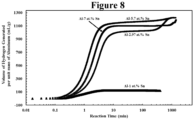
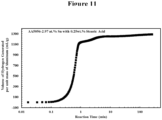
- the alloys described herein due to their unique compositions and synthesis method have the fastest rate of hydrogen generation at room temperature without externally applied power or other catalysts reported in literature when reacted with water - as high as 1000 ml of hydrogen per gram of aluminum in as low as about 30 seconds. These non-hazardous alloys consisting of abundantly available and inexpensive constituents will result in facile production of hydrogen for power generation and various other military and civilian applications. Furthermore, the reaction is so pervasive that the hydrolysis reaction will occur in any fluid containing water and many compounds containing OH (hydroxyl) groups.
- Aluminum oxidizes rapidly when it comes in contact with air or water and an oxide layer is formed on the surface of the particles. This oxide layer typically inhibits reaction with water. In order for the reaction to take place it is necessary to disrupt the oxide layer.
- Current state of the art materials with unstable oxides consist of alloys of aluminum with gallium produced by conventional melt casting. These alloys are very expensive - the price of gallium metal is about 100 times that of aluminum..
- Small grains and/or small anodic or cathodic dispersions provide the efficient nanogalvanic effect that sweeps away the oxide layer rapidly exposing new metallic surfaces and thus enhances the hydrolysis reaction at room temperature reported here. This invention, however, achieves the enhanced reaction kinetics through processing of nanostructured aluminum based galvanic alloys by high energy ball milling at cryogenic temperature.
- the Al-alloy powders may be produced by ball milling pure aluminum with other metals selected from the group consisting of, tin (Sn), bismuth (Bi), lead (Pb), gallium (Ga), indium (In), for 0.01 to 8 hours at cryogenic temperature such as at -100 °C and -196 °C.
- Pure aluminum may be substituted by or commercially available aluminum alloys e.g. AA5056, AA5083, etc.
- the individual powder particulate size can be in the range of 0.01 ⁇ m - 6 mm in diameter. Additionally, the powder could be consolidated to form compacts or functional parts for tuning the hydrogen generation rate and yield.
- powders of the present invention could be consolidated to produce a tablet, a rod, a pellet or a bulk part. Additionally, powders of the present invention would be coated on to the surface of a component or part. Suggested processes include, but are not limited to, metal injection molding, cold and hot isostatic pressing, additive manufacturing techniques including laser and non-laser techniques, thermal and cold spray and additive friction stir welding, powder forging, hot pressing, pressure less sintering, shock consolidation and field assisted sintering.
- tin (Sn), bismuth (Bi), lead (Pb), gallium (Ga), indium (In), or the like by high energy ball milling at cryogenic temperature may produce hydrogen at room temperature when reacted with water without externally coupled power.
- the inherent ability to form corrosive galvanic couples with aluminum was considered in selecting the aforementioned elements.
- the addition of carbon to the alloys during ball milling may enhance hydrogen generation rate, both as a surfactant as well as a galvanic couple.
- the data present here is a starting point, that is the method has not been optimized but rather some adjustments of compositions and processing parameters have been done to maximize the rate and amount of hydrogen generation for a particular composition and processing i.e. cryogenic milling.
- Other alternative processing techniques such as room temperature large scale ball milling utilizing surfactants and or melt-spinning or spray atomization can be used to produce nanogalvanic powders having the same patentable characteristics.
- Alloys consisting of an aluminum alloy AA5056 and tin (Sn) were prepared by loading the respective powders with the correct weight ratio into a clean hardened steel vial to produce the desired atomic percent alloy.
- AA5056 alloy at -140/+325 mesh was obtained from Valimet, Inc., 431 East Sperry Road, Stockton, CA 95206.
- the AA5056 alloy is reported to contain Al (balance), 0.15%Cr, ⁇ 0.01%Cu, 0.10%Fe, 5.22%Mg, 0.13% Mn, 0.04% Si, ⁇ 0.01% Zn, others total ⁇ 0.15%.
- Sn was obtained from Alfa Aesar and is reported to have 98.5%, purity, -325 mesh (approximately 45 ⁇ m).
- Example 1A The AA5056:Sn mass ratio in Example 1A was maintained at 7.5:1. As such, it was expected that the resultant alloy would have had a similar composition of AA5056-2.97.0 at. %Sn.
- Al was obtained from Alfa Aesar and is reported to have 99.5%, purity, -325 mesh (approximately 45 ⁇ m).
- the Al:Sn mass ratio were varied from 19:1 to 1:1 depending on the composition of the powders.
- AA5056-Bi and Al-Bi powders were prepared by loading the respective powders with the correct weight ratio into a clean, hardened steel vial to produce the desired atomic percent alloy.
- Bi -325 mesh (approximately 45 ⁇ m), was obtained from Alfa Aesar and is reported to have 99.5% purity.
- Both the AA5056:Bi and Al:Bi mass ratio here was maintained at 4:1. As such, it was expected that the resultant alloys would have had a similar composition of AA5056-3.1 at. %Bi and Al-3.1 at. %Bi.
- the interior structure of the particles consist of further structural refinement, specifically, grains or subgrains of Al with individual Sn grains or dispersed Sn particles having nanometer (e.g. less than 100 nanometers) or micron (e.g. less than 100 micrometers) dimensions throughout for alloys containing Sn.
- the metal powder may be subjected to a low or cryogenic temperatures to embrittle the constituents.
- all metals become more brittle with decrease in temperature, because their active slip systems (relating to dislocation and other thermally activated processes governing their mechanical behavior become statistically less active).
- the type of embrittlement is clearly demonstrated by the well-known ductile-to-brittle transition (DTBT) of ferritic steels.
- DTBT ductile-to-brittle transition
- Low temperature processing is defined by processing that occurs at temperature ranging from just below room temperature (24 °C) down to -270 °C.
- Low temperature ball milling here is utilized in this example to keep the powders (AA5056, Al, Sn, and Bi) cold, such that they remain as brittle as possible and thereby preventing or, more precisely, reducing and minimizing the powder from adhering to the milling media and walls of the vial.
- An additional benefit of low temperature milling is that certain metals or metal powders will undergo a temperature induced crystallographic transformation, also known as an allotropic transformation, from a ductile to a brittle state.
- pure tin transforms from the silvery, ductile metallic allotrope of ⁇ -form white tin to the brittle, nonmetallic, ⁇ -form grey tin with a diamond cubic structure at a temperature that is equal to or less than 13.2 °C (286.2 K).
- this brittle transformation induces advantageous milling kinetics, resulting in a favorable dispersion of Sn in Al that would otherwise not be possible and or as optimized for producing a dispersed galvanic couple (a microstructural building box required for successful hydrogen production) having reduced length scales.
- cryogenic temperature is typically defined as temperature below about -150 °C.
- Liquid nitrogen for instance, having a temperature as low as -196 °C (77K), may be supplied to provide such cooling.
- Liquid nitrogen milling was made possible by placing the sealed vial in a thick nylon sleeve modified to allow placement into the high energy mill as well as to allow the in-flow and out-flow of liquid nitrogen. The vial was allowed to cool to liquid nitrogen temperature before starting the mill. Mechanical alloying at liquid nitrogen temperatures in the SPEX shaker mill for approximately 4 hours was performed. After the ball milling procedure was completed, the alloyed AA5056-Sn (or Al-Sn) powder was removed from the steel vial in an Ar glove box and stored.
- EXAMPLE 2 FORMATION OF ALUMINUM ALLOY (AA5056)-Sn and Al-Sn POWDER METAL USING HIGH-ENERGY MILLING AT LOW TEMPERATURE ( ⁇ 24 °C)
- alloys consisting of an aluminum alloy AA5056 and tin (Sn) as well as Al and Sn were prepared by loading the respective powders with the correct weight ratio into a clean hardened steel milling jar to produce the desired atomic percent alloy.
- 500 g powder mass of AA5056 and tin and 200 g powder mass of Al and Sn along with 1.25 g and 0.5 g of stearic acid were milled with a 10:1 ball-to-powder mass (weight) ratio (i.e. with 5000 g and 2000 g of stainless steel (440C) ball-bearings respectively) were used as the milling media in CM08 and CM02 Zoz mill respectively.
- Example 2 The AA5056:Sn and Al:Sn mass ratio in Example 2 were maintained at 7.5:1. As such, it was expected that the resultant alloys would have had similar composition of AA 5056-2.97 at. %Sn and Al-2.97 at. %Sn.
- low temperature here is defined as a temperature ranging from just below the room temperature ( ⁇ 24 °C).
- Chilled ethylene glycol may be supplied to provide the cooling down to -20 °C.
- Low temperature milling was made possible by circulating ethylene glycol through the built-in cooling jacket around the milling jars (8 L and 2 L capacity for CM08 and CM02 Zoz Mill respectively). The ethylene glycol was continuously cooled and circulated using a water chiller. The milling was performed at 400 RPM for up to 11 hours.
- Stainless steel milling jars were sealed in (primarily) an Argon atmosphere (i.e., with O 2 ⁇ 1 ppm). After the ball milling procedure was completed, the alloyed powder was transferred from the steel jar into an argon glove box and the powder was stored there. This milling procedure resulted in a finely divided powder mass, consisting of particulates in the micron rage i.e. diameters between 1 and 10,000 microns. However, the interior structure of the particles consist of further structural refinement, specifically, grains or subgrains of Al with individual Sn grains or dispersed Sn particles having nanometer or micron dimensions throughout.
- EXAMPLE 3 FORMATION OF ALUMINUM ALLOY (AA5056)-Sn and Al-Sn POWDER METAL USING HIGH-ENERGY MILLING AT ROOM TEMPERATURE ( ⁇ 24 °C)
- AA5056-Sn and Al-Sn powders were prepared by the inventors by loading the respective powders with the correct weight ratio into a clean hardened steel vial to produce the desired atomic percent alloy.
- the Al:Sn mass ratio in Example 3 was maintained at 7.5:1. Additionally 0.15-0.5 wt% of stearic acid was added. As such, it was expected that the resultant alloy would have had a similar composition of Al-2.97 at. %Sn.
- compositions produced in some of the examples above were characterized using scanning electron microscopy. While not wishing to be bound by the theories provided below, the significance of the structure of some compositions of the present invention is discussed with relation to the hydrogen generation.
- FIG. 1 shows enlarged scanning electron micrograph of one exemplary microstructure of a nanogalvanic metal as it pertains to the invention, specifically Example 2.
- the dark phase in FIGS. 1 and 2 is primarily Al and the lighter/bright phase is primarily Sn.
- the Sn exist primarily as discreet particles and or stringers (elongated thin ribbons of Sn) of varying size and dispersion.
- a galvanic couple is made by the close and intimate contact of the two, in this case Al and Sn, dissimilar metals which have different corrosion potentials (i.e. one acting as an anode and other as a cathode).
- Al is the anode and Sn the cathode.
- Galvanic corrosion occurs when two dissimilar metals make contact with one another in the presence of an electrolyte thereby forming a galvanic couple.
- the more noble metal (more cathodic on the Galvanic Series) provides additional surface area for the reduction reaction to occur on. This accelerates the oxidation/corrosion of the less noble metal (more anodic on the Galvanic Series).
- the extent of corrosion is greatest at the interface of the two metals, but may also occur at some distance away from the actual interface.
- the cell kinetics are enhanced when the cathode is smaller in surface area relative to the anode.
- FIG. 2 is a lower magnification scanning electron micrograph giving a more macroscopic view of the nanogalvanic microstructure than seen in FIG. 1 .
- the nanogalvanic microstructure of the present invention can be defined as a crystallite material in which its microstructure is nano-sized (i.e., on the order or 1, 10 or 100 nm). Some aspects of the microstructure may also be in the ultra-fine length scale (being defined as a length scale between 100 and 1000 nm). Still, some aspects of the microstructure can be even larger i.e. length scales of greater than 1000nm.
- the microstructure consists of phases, i.e. the matrix phase and the dispersed phase have at least some of the length scales mentioned above. These phases i.e.
- matrix phase and the dispersed phase are composed of solvent and solute species.
- the solvent is primarily Al and the solute species primarily is Sn.
- other elements can be acting as both, e.g. bismuth (Bi), lead (Pb), gallium (Ga), indium (In), or the like.
- the matrix phase in this case mainly contains the solvent Al.
- the matrix phase may consist of a solid solution of aluminum in combination with other dissolved solvents and solutes.
- a solid solution is a solid-state solution of one or more solutes in a solvent or solvents.
- Such a multi-component system is considered a solution rather than a compound when the crystal structure of the solvent remains unchanged by addition of the solutes or the solvents in the form of a randomly dispersed atoms i.e. a random solid solution resulting in the chemical components remaining in a single homogeneous phase.
- the dispersed phase is primarily made up of solutes that are dispersed in the matrix solvent.
- Small agglomerations of solute atoms in the solvent are referred to as nuclei or clusters containing one to a few hundred atoms typically being 2-100 nm in diameter. As more and more atoms agglomerate they are termed as particles once the diameters of the agglomerates become greater than 100 nm.
- Stringers are hereby defined as ribbon-shaped particles primarily composed of solutes that are larger than previously described particles having length from 10 nm up to 10 mm.
- the ribbons may have finite dimensions in all the three dimensions and may be termed as sheets also.
- the matrix can consist of a polycrystalline grain structure in which the grains can be nanocrystalline (i.e., on the order or 1, 10 or 100 nm) or ultra-fine (being defined as a length scale between 100 and 1000 nm) or can be even larger i.e. length scales of greater than 1000nm.
- the cellular structure of grains are separated by grain boundary.
- the larger ribbons could contain polycrystalline grain structure in which the grains can be nanocrystalline (i.e., on the order or 1, 10 or 100 nm) or ultra-fine (being defined as a length scale between 100 and 1000 nm) or can be even larger i.e. length scales of greater than 1000nm.
- the cell kinetics are enhanced when the cathode is smaller in surface area relative to the anode.
- the galvanic reactivity is greater.
- the white portion of FIG. 3 represents the matrix. It forms the medium of the metallic material. It may be Al or an Al-based alloy, for instance. While not truly circular (and actually, of a more random polyhedral shape/cellular structure polygonal shape), grains are assumed to have an average diameter. The grains of the matrix having diameters of no more than about 500 nm, typically ranging from about 10-200nm. Grain boundaries occur at the interface of separate adjacent grains.
- a plurality of dispersed metallic particles formed of solute metal(s) in the solvent metal matrix The dispersed solute particle reside within grains and along the grain boundaries. They typically have average diameters in the range 20- 500 nm. However they could be smaller as well as larger than the given range.
- the dispersed particles may further contain additional element(s) such as aspects of the matrix and or other advantageously included elemental species such as oxygen (O), nitrogen (N), carbon (C), sulfur (S), silicon (Si), bismuth (Bi), carbon (C), gallium (Ga), indium (In), lead (Pb) or other element(s) (i.e. from the remainder of the periodic table).
- the particles may comprise solute metal and some small amount of a solvent metal or alloy (such as Al).
- Particles may be characterized as being small or large based on their size or be ribbon-shaped stringers.
- Small particles may have diameters typically 2- 100 nm. They reside with the grains and/or on the grain boundaries, as further depicted in FIGs. 4 and 5 . Large particles reside between the grains of the matrix as further depicted in FIG. 5 .
- the chemistry of these particles will contain the solute metal(s). These larger particles have diameters typically greater than 100 nm and up to 1 mm. The frequency of the appearance of small and large particle will depend on the concentration of the solute metal(s) and the degree of processing.
- Ribbon-shaped stringers solute particles as depicted in FIG. 6 may have dimension from 10 nm up to 10 mm in all dimension and may have the similar compositions as the aforementioned small and large solute particles.
- FIG. 13 provides a flowchart describing a method 100 for generating hydrogen wherein step 110 includes providing a microstructure, step 120 includes contacting the microstructure the microstructure with a liquid, for example water, urine or other water containing liquids and step 130 includes capturing and/or using hydrogen gas that is generated when liquid contacts the composition. And, FIG.
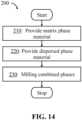
- step 14 provides a flowchart describing a method 200 for producing a nanogalvanic microstructure wherein step wherein step 210 includes providing a matrix phase material, step 220 includes providing a dispersed phase material and step 230 includes milling the combined phases to produce a material that spontaneously generates hydrogen when the material contacts water, urine or another water containing liquid.
- compositions of the present invention may include but are not limited to, milling/machining (including ball milling and especially high energy ball milling), melt spinning, spray atomization, inert gas condensation, solution precipitation, physical vapor deposition, and electrodeposition. Melt spinning forms thin ribbons of material.
Landscapes
- Chemical & Material Sciences (AREA)
- Organic Chemistry (AREA)
- Engineering & Computer Science (AREA)
- Materials Engineering (AREA)
- Metallurgy (AREA)
- Chemical Kinetics & Catalysis (AREA)
- Mechanical Engineering (AREA)
- Inorganic Chemistry (AREA)
- Combustion & Propulsion (AREA)
- Health & Medical Sciences (AREA)
- General Health & Medical Sciences (AREA)
- Electrochemistry (AREA)
- Nanotechnology (AREA)
- Crystallography & Structural Chemistry (AREA)
- Manufacture Of Metal Powder And Suspensions Thereof (AREA)
- Powder Metallurgy (AREA)
- Organic Low-Molecular-Weight Compounds And Preparation Thereof (AREA)
Applications Claiming Priority (2)
| Application Number | Priority Date | Filing Date | Title |
|---|---|---|---|
| US201762536143P | 2017-07-24 | 2017-07-24 | |
| PCT/US2018/043267 WO2019023123A1 (en) | 2017-07-24 | 2018-07-23 | ALUMINUM NANOGALVANIC COMPOSITIONS USEFUL FOR THE PRODUCTION OF HYDROGEN GASES AND THEIR TREATMENT AT LOW TEMPERATURE |
Publications (4)
| Publication Number | Publication Date |
|---|---|
| EP3658696A1 EP3658696A1 (en) | 2020-06-03 |
| EP3658696A4 EP3658696A4 (en) | 2020-07-22 |
| EP3658696B1 true EP3658696B1 (en) | 2023-06-07 |
| EP3658696C0 EP3658696C0 (en) | 2023-06-07 |
Family
ID=65018758
Family Applications (1)
| Application Number | Title | Priority Date | Filing Date |
|---|---|---|---|
| EP18838336.8A Active EP3658696B1 (en) | 2017-07-24 | 2018-07-23 | Aluminum based nanogalvanic compositions useful for generating hydrogen gas and low temperature processing thereof |
Country Status (8)
| Country | Link |
|---|---|
| US (2) | US11198923B2 (https=) |
| EP (1) | EP3658696B1 (https=) |
| JP (1) | JP7000556B2 (https=) |
| KR (1) | KR102256355B1 (https=) |
| CN (1) | CN111133119A (https=) |
| CA (1) | CA3070221C (https=) |
| ES (1) | ES2951821T3 (https=) |
| WO (1) | WO2019023123A1 (https=) |
Families Citing this family (36)
| Publication number | Priority date | Publication date | Assignee | Title |
|---|---|---|---|---|
| WO2016196718A1 (en) | 2015-06-02 | 2016-12-08 | Massachusetts Institute Of Technology | Activated aluminum fuel |
| KR102256355B1 (ko) | 2017-07-24 | 2021-05-28 | 유나이티드 스테이츠 오브 아메리카, 애즈 레프리젠티드 바 이 더 시크레터리 오브 디 아미 | 수소 가스 생성 및 저온 공정에 유용한 알루미늄 기반 나노 갈바닉 조성물 |
| JP7234716B2 (ja) * | 2019-03-15 | 2023-03-08 | 株式会社リコー | 立体造形用粉末、粉末入り容器、立体造形物の製造方法、及び立体造形物の製造装置 |
| US11944956B2 (en) * | 2019-05-02 | 2024-04-02 | The Regents Of The University Of California | Room temperature liquid metal catalysts and methods of use |
| US11298063B2 (en) * | 2019-10-20 | 2022-04-12 | Bao Q Tran | Hydrogen powered device |
| US11986877B1 (en) | 2019-12-10 | 2024-05-21 | Ltag Systems Llc | Activated aluminum formation |
| CN110976848A (zh) * | 2019-12-24 | 2020-04-10 | 哈尔滨工业大学(深圳) | 一种能开花的铝合金粉体及其制备方法和应用 |
| US12129172B2 (en) * | 2020-03-03 | 2024-10-29 | Massachusetts Institute Of Technology | Hydrogen reactor |
| CN112207285B (zh) * | 2020-03-12 | 2022-05-20 | 赵远云 | 粉体材料的制备方法及其应用 |
| US11148840B1 (en) | 2020-05-07 | 2021-10-19 | Ltag Systems Llc | Method of packaging water-reactive aluminum |
| US11332366B2 (en) * | 2020-08-09 | 2022-05-17 | Ltag Systems Llc | Controlling reactability of water-reactive aluminum |
| CN111996403B (zh) * | 2020-08-21 | 2021-07-09 | 中国电子科技集团公司第三十八研究所 | 一种无铅铟锡基焊料合金的制备方法及制得的焊料合金 |
| US11821055B2 (en) * | 2020-09-08 | 2023-11-21 | Massachusetts Institute Of Technology | Articles and methods for processing scrap aluminum |
| US11312466B1 (en) | 2020-09-14 | 2022-04-26 | Ltag Systems Llc | Inflatable structure deployment |
| US11958585B1 (en) | 2020-11-25 | 2024-04-16 | Ltag Systems Llc | Midair deployment of aerostats |
| CN112811392B (zh) * | 2021-01-27 | 2021-12-28 | 苏州大学 | 氘气制备方法及以其作为氘源参与的氘代反应 |
| US12296940B2 (en) | 2021-10-17 | 2025-05-13 | Ltag Systems Llc | Lifting gas generation |
| US12583741B2 (en) | 2021-12-24 | 2026-03-24 | The Hong Kong University Of Science And Technology | Aluminum composite for hydrogen generation and methods of preparation thereof |
| US12606917B2 (en) * | 2022-02-28 | 2026-04-21 | The United States Of America As Represented By The Secretary Of The Army | Method and apparatus for using nanogalvanic alloys to produce hydrogen |
| US12516427B2 (en) * | 2022-03-02 | 2026-01-06 | The United States Of America As Represented By The Secretary Of The Army | Dissolvable engineered components utilizing nanogalvanic alloys |
| CN114833337B (zh) * | 2022-04-08 | 2022-11-11 | 哈尔滨医科大学 | 一种球形镓镁Janus微粒的制备方法 |
| US11548782B1 (en) | 2022-06-28 | 2023-01-10 | Halliburton Energy Services, Inc. | Using converted hydrogen and solid carbon from captured methane to power wellbore equipment |
| US12300861B2 (en) | 2022-07-11 | 2025-05-13 | U.S. Department Of Energy | Systems and methods for generating power |
| GB202211758D0 (en) * | 2022-08-11 | 2022-09-28 | Rolls Royce Plc | Fuel precursor |
| US12145142B1 (en) | 2022-11-02 | 2024-11-19 | Ltag Systems Inc | Containerized processing of activated aluminum |
| CN115818568B (zh) * | 2022-11-25 | 2024-04-09 | 王凯 | 一种裂解水蒸汽制氢的裂解剂、制备、使用及其复活方法 |
| US12589853B1 (en) | 2022-12-12 | 2026-03-31 | Ltag Systems Llc | Actively actuatable valves for aerostat buoyancy control |
| US12269571B1 (en) | 2022-12-14 | 2025-04-08 | Ltag Systems Llc | Aerostat launching system with replaceable liner |
| CN116179898A (zh) * | 2023-01-16 | 2023-05-30 | 中南大学 | 一种与水快速反应制氢铝合金材料及其制备方法 |
| IL322197A (en) * | 2023-01-19 | 2025-09-01 | Found Energy Co | A solid metal alloy at room temperature for the preparation of water-reactive aluminum compounds |
| US12429311B1 (en) | 2023-02-07 | 2025-09-30 | Ltag Systems Llc | Aerostats for aerial platform acquisition |
| US12275516B1 (en) | 2023-02-21 | 2025-04-15 | Ltag Systems Llc | Stabilization and reinforcement of balloons during rapid filling |
| CN116445770B (zh) * | 2023-04-17 | 2024-09-17 | 楚氢(苏州)科技有限公司 | 一种铝基合金颗粒、制备方法及应用 |
| US12113254B1 (en) | 2023-05-15 | 2024-10-08 | Halliburton Energy Services, Inc. | Combined hydrogen supply and fuel cell processes for increased efficiency of electricity generation |
| WO2025238584A1 (en) * | 2024-05-14 | 2025-11-20 | Alumapower Corporation | Combined cycle system for aluminum energy extraction and method for the manufacturing and processing of impure aluminum energy carriers |
| WO2025245611A2 (en) * | 2024-05-31 | 2025-12-04 | The University Of New Brunswick | Methods of purifying and producing aluminum hydroxide, aluminum formate, aluminum acetate, and porous aluminum carboxylate frameworks fromaluminum(0) for alumina formation |
Family Cites Families (31)
| Publication number | Priority date | Publication date | Assignee | Title |
|---|---|---|---|---|
| US3728088A (en) * | 1968-03-01 | 1973-04-17 | Int Nickel Co | Superalloys by powder metallurgy |
| DE2244944B2 (de) * | 1972-09-13 | 1976-06-10 | Siemens AG, 1000 Berlin und 8000 München | Verfahren zur erzeugung von wasserstoff |
| US3814635A (en) * | 1973-01-17 | 1974-06-04 | Int Nickel Co | Production of powder alloy products |
| JPH0546784Y2 (https=) | 1987-05-01 | 1993-12-08 | ||
| US5494538A (en) | 1994-01-14 | 1996-02-27 | Magnic International, Inc. | Magnesium alloy for hydrogen production |
| US6582676B2 (en) * | 2000-08-14 | 2003-06-24 | The University Of British Columbia | Hydrogen generation from water split reaction |
| US6726892B1 (en) | 2001-02-14 | 2004-04-27 | Quantum Fuel Systems Technologies Worldwide, Inc. | Advanced aluminum alloys for hydrogen storage |
| DE10331785B4 (de) * | 2003-07-11 | 2007-08-23 | H. C. Starck Gmbh & Co. Kg | Verfahren zur Herstellung feiner Metall-, Legierungs-und Verbundpulver |
| WO2005097670A1 (en) | 2004-04-09 | 2005-10-20 | The University Of British Columbia | Compositions and methods for generating hydrogen from water |
| US7837976B2 (en) | 2005-07-29 | 2010-11-23 | Brookhaven Science Associates, Llc | Activated aluminum hydride hydrogen storage compositions and uses thereof |
| US8080233B2 (en) | 2006-05-12 | 2011-12-20 | Purdue Research Foundation | Power generation from solid aluminum |
| US7938879B2 (en) | 2006-05-12 | 2011-05-10 | Purdue Research Foundation | Power generation from solid aluminum |
| AT504292A1 (de) * | 2006-09-22 | 2008-04-15 | Alvatec Alkali Vacuum Technolo | Wasserstoffgenerator für brennstoffzellen |
| CN101289163B (zh) | 2007-04-20 | 2011-04-06 | 中国科学院大连化学物理研究所 | 一种水解制氢的铝合金及其制备 |
| US7441717B1 (en) | 2007-10-31 | 2008-10-28 | Eastman Kodak Company | Micromedia milling process |
| EP2271582A4 (en) | 2008-04-02 | 2014-01-22 | Cedar Ridge Research Llc | REUSABLE ALUMINUM ALKALI HYDROXIDE HYDROGEN GENERATOR |
| US9011572B1 (en) | 2009-06-02 | 2015-04-21 | University Of Dayton | Method of generating hydrogen from the reaction of stabilized aluminum nanoparticles with water and method of forming stabilized aluminum nanoparticles |
| CN101798061B (zh) | 2010-03-12 | 2012-11-07 | 上海师范大学 | 一种铝-稀土微纳米复合制氢材料 |
| US20120027671A1 (en) * | 2010-07-28 | 2012-02-02 | Chung Yuan Christian University | Hydrogen-generating material and method for producing hydrogen |
| CN102009950B (zh) | 2010-09-21 | 2012-10-31 | 上海大学 | 一种中性和常温下水解制氢用铝基复合物及其制备方法 |
| CN102408096B (zh) | 2011-07-26 | 2013-08-28 | 辽宁师范大学 | 一种铝基复合制氢材料及其制备方法 |
| US20130181175A1 (en) * | 2012-01-16 | 2013-07-18 | Hsin-Chun Lu | Low-temperature co-precipitation method for fabricating tco powders |
| US9016363B2 (en) | 2012-05-08 | 2015-04-28 | Baker Hughes Incorporated | Disintegrable metal cone, process of making, and use of the same |
| CN102925757B (zh) * | 2012-10-10 | 2014-12-03 | 上海大学 | 一种用纳米粉体制备Al-Fe合金的方法 |
| WO2014062833A1 (en) * | 2012-10-16 | 2014-04-24 | Helton Bill W | Hydrogen production catalysts and associated systems and methods |
| EP2948407A4 (en) | 2013-01-24 | 2016-08-31 | Clean Wave Energy Corp | HYDROGEN PRODUCTION SYSTEM AND METHOD OF USE THEREOF |
| US9147126B2 (en) * | 2013-08-01 | 2015-09-29 | Raytheon Company | Post compression detection (PoCoDe) |
| US9561538B2 (en) | 2013-12-11 | 2017-02-07 | The Boeing Company | Method for production of performance enhanced metallic materials |
| CN106191542B (zh) * | 2016-07-18 | 2017-12-01 | 湖北工业大学 | 一种富氢水用制氢材料及其制备方法和应用 |
| KR102256355B1 (ko) * | 2017-07-24 | 2021-05-28 | 유나이티드 스테이츠 오브 아메리카, 애즈 레프리젠티드 바 이 더 시크레터리 오브 디 아미 | 수소 가스 생성 및 저온 공정에 유용한 알루미늄 기반 나노 갈바닉 조성물 |
| US20200189911A1 (en) | 2018-11-16 | 2020-06-18 | AlGalCo, LLC | Method and apparatus for portable on-demand hydrogen generation |
-
2018
- 2018-07-23 KR KR1020207005052A patent/KR102256355B1/ko active Active
- 2018-07-23 CA CA3070221A patent/CA3070221C/en active Active
- 2018-07-23 EP EP18838336.8A patent/EP3658696B1/en active Active
- 2018-07-23 US US16/042,632 patent/US11198923B2/en active Active
- 2018-07-23 WO PCT/US2018/043267 patent/WO2019023123A1/en not_active Ceased
- 2018-07-23 JP JP2020504403A patent/JP7000556B2/ja active Active
- 2018-07-23 CN CN201880054750.3A patent/CN111133119A/zh active Pending
- 2018-07-23 ES ES18838336T patent/ES2951821T3/es active Active
-
2019
- 2019-09-23 US US16/579,089 patent/US12054809B2/en active Active
Non-Patent Citations (1)
| Title |
|---|
| GUANG R ET AL: "Formation of nanocrystalline and amorphous phase of Al-Pb-Si-Sn-Cu powder during mechanical alloying", MATERIALS SCIENCE AND ENGINEERING: A, ELSEVIER, AMSTERDAM, NL, vol. 416, no. 1-2, 25 January 2006 (2006-01-25), pages 45 - 50, XP027951979, ISSN: 0921-5093, [retrieved on 20060125] * |
Also Published As
| Publication number | Publication date |
|---|---|
| US20200024689A1 (en) | 2020-01-23 |
| US11198923B2 (en) | 2021-12-14 |
| US12054809B2 (en) | 2024-08-06 |
| EP3658696A1 (en) | 2020-06-03 |
| CA3070221C (en) | 2023-10-10 |
| US20190024216A1 (en) | 2019-01-24 |
| CN111133119A (zh) | 2020-05-08 |
| JP7000556B2 (ja) | 2022-01-19 |
| JP2020530880A (ja) | 2020-10-29 |
| EP3658696A4 (en) | 2020-07-22 |
| KR20200027561A (ko) | 2020-03-12 |
| KR102256355B1 (ko) | 2021-05-28 |
| CA3070221A1 (en) | 2019-01-31 |
| ES2951821T3 (es) | 2023-10-25 |
| EP3658696C0 (en) | 2023-06-07 |
| WO2019023123A1 (en) | 2019-01-31 |
Similar Documents
| Publication | Publication Date | Title |
|---|---|---|
| EP3658696B1 (en) | Aluminum based nanogalvanic compositions useful for generating hydrogen gas and low temperature processing thereof | |
| Shuai et al. | Mechanical alloying of immiscible metallic systems: process, microstructure, and mechanism | |
| Nouri et al. | Surfactants in mechanical alloying/milling: a catch-22 situation | |
| Bououdina et al. | Comparative study of mechanical alloying of (Mg+ Al) and (Mg+ Al+ Ni) mixtures for hydrogen storage | |
| Arik | Production and characterization of in situ Al4C3 reinforced aluminum-based composite produced by mechanical alloying technique | |
| Suryanarayana et al. | Mechanical Alloying of Titanium‐Base Alloys | |
| Koch et al. | Nanostructured materials by mechanical alloying: new results on property enhancement | |
| US8628599B2 (en) | Diamondoid stabilized fine-grained metals | |
| Mendoza-Duarte et al. | Aluminum carbide formation in Al-graphite composites: in situ study and effects of processing variables and sintering method | |
| US20230002857A1 (en) | ALUMINUM BASED NANOGALVANIC COMPOSITIONS USrEFUL FOR GENERATING HYDROGEN GAS AND LOW TEMPERATURE PROCESSING THEREOF | |
| Lubnin et al. | Stacking faults and mechanisms strain-induced transformations of hcp metals (Ti, Mg) during mechanical activation in liquid hydrocarbons | |
| Suryanarayana | Mechanical alloying | |
| Zuo et al. | Effect of temperature on mechanical alloying of Cu-Zn and Cu-Cr system | |
| Modi | Effect of Nickel Particle Sizes on Electrically Activated Reaction Syntheisis (EARS) of 3Ni-Al-CNT Composite | |
| Khan | Role of mechanically alloyed materials in energy storage and automotive applications | |
| JP4602926B2 (ja) | 合金粉末の製造方法 | |
| Yoshiichi et al. | Fabrication of Bulk Al-Ti-V-Cr-Si Low-Density High-Entropy Alloy Solid Solution by Shock Solidification | |
| Kushwaha et al. | Nanocrystalline Materials: Synthesis, Characterization, Properties, and Applications. Crystals 2021, 11, 1317 | |
| Routray et al. | Ball Milling of Copper and Zinc Alloys Followed by Their Consolidation and Application | |
| Saiki et al. | Production of Cu/Zn Nanoparticles by Pulsed Laser Ablation in Liquids and Sintered Cu/Zn Alloy | |
| Zhu et al. | The effect of Cu addition and milling contaminations on the microstructure evolution of ball milled Al–Pb alloy during sintering | |
| US20240051820A1 (en) | Fuel precursor | |
| Fu et al. | Microstructure and mechanical behaviour of nano-eutectic Fe83B17 alloy prepared by a self-propagating high temperature synthesis combining rapid solidification | |
| Mashhadi et al. | Mechanochemical synthesis and shock wave consolidation of TiN (Al) nanostructure solid solution | |
| Salazar Sandoval et al. | Review on Generation and Characterization of Copper Particles and Copper Composites Prepared by Mechanical Milling on a Lab-Scale |
Legal Events
| Date | Code | Title | Description |
|---|---|---|---|
| STAA | Information on the status of an ep patent application or granted ep patent |
Free format text: STATUS: THE INTERNATIONAL PUBLICATION HAS BEEN MADE |
|
| PUAI | Public reference made under article 153(3) epc to a published international application that has entered the european phase |
Free format text: ORIGINAL CODE: 0009012 |
|
| STAA | Information on the status of an ep patent application or granted ep patent |
Free format text: STATUS: REQUEST FOR EXAMINATION WAS MADE |
|
| 17P | Request for examination filed |
Effective date: 20200224 |
|
| AK | Designated contracting states |
Kind code of ref document: A1 Designated state(s): AL AT BE BG CH CY CZ DE DK EE ES FI FR GB GR HR HU IE IS IT LI LT LU LV MC MK MT NL NO PL PT RO RS SE SI SK SM TR |
|
| AX | Request for extension of the european patent |
Extension state: BA ME |
|
| A4 | Supplementary search report drawn up and despatched |
Effective date: 20200622 |
|
| RIC1 | Information provided on ipc code assigned before grant |
Ipc: B02C 19/18 20060101ALI20200616BHEP Ipc: B22F 9/04 20060101AFI20200616BHEP Ipc: C22C 21/00 20060101ALN20200616BHEP Ipc: C22C 21/08 20060101ALN20200616BHEP Ipc: C22C 1/04 20060101ALI20200616BHEP Ipc: C01B 3/08 20060101ALI20200616BHEP Ipc: B22F 1/00 20060101ALN20200616BHEP |
|
| DAV | Request for validation of the european patent (deleted) | ||
| DAX | Request for extension of the european patent (deleted) | ||
| STAA | Information on the status of an ep patent application or granted ep patent |
Free format text: STATUS: EXAMINATION IS IN PROGRESS |
|
| 17Q | First examination report despatched |
Effective date: 20210423 |
|
| RIC1 | Information provided on ipc code assigned before grant |
Ipc: C22C 21/08 20060101ALN20211104BHEP Ipc: C22C 21/00 20060101ALN20211104BHEP Ipc: B22F 1/00 20060101ALN20211104BHEP Ipc: B02C 19/18 20060101ALI20211104BHEP Ipc: C22C 1/04 20060101ALI20211104BHEP Ipc: C01B 3/08 20060101ALI20211104BHEP Ipc: B22F 9/04 20060101AFI20211104BHEP |
|
| GRAP | Despatch of communication of intention to grant a patent |
Free format text: ORIGINAL CODE: EPIDOSNIGR1 |
|
| STAA | Information on the status of an ep patent application or granted ep patent |
Free format text: STATUS: GRANT OF PATENT IS INTENDED |
|
| INTG | Intention to grant announced |
Effective date: 20211210 |
|
| GRAJ | Information related to disapproval of communication of intention to grant by the applicant or resumption of examination proceedings by the epo deleted |
Free format text: ORIGINAL CODE: EPIDOSDIGR1 |
|
| STAA | Information on the status of an ep patent application or granted ep patent |
Free format text: STATUS: EXAMINATION IS IN PROGRESS |
|
| GRAS | Grant fee paid |
Free format text: ORIGINAL CODE: EPIDOSNIGR3 |
|
| STAA | Information on the status of an ep patent application or granted ep patent |
Free format text: STATUS: GRANT OF PATENT IS INTENDED |
|
| INTC | Intention to grant announced (deleted) | ||
| GRAP | Despatch of communication of intention to grant a patent |
Free format text: ORIGINAL CODE: EPIDOSNIGR1 |
|
| RIC1 | Information provided on ipc code assigned before grant |
Ipc: C22C 21/08 20060101ALN20220415BHEP Ipc: C22C 21/00 20060101ALN20220415BHEP Ipc: B22F 1/00 20060101ALN20220415BHEP Ipc: B02C 19/18 20060101ALI20220415BHEP Ipc: C22C 1/04 20060101ALI20220415BHEP Ipc: C01B 3/08 20060101ALI20220415BHEP Ipc: B22F 9/04 20060101AFI20220415BHEP |
|
| INTG | Intention to grant announced |
Effective date: 20220525 |
|
| GRAJ | Information related to disapproval of communication of intention to grant by the applicant or resumption of examination proceedings by the epo deleted |
Free format text: ORIGINAL CODE: EPIDOSDIGR1 |
|
| GRAL | Information related to payment of fee for publishing/printing deleted |
Free format text: ORIGINAL CODE: EPIDOSDIGR3 |
|
| REG | Reference to a national code |
Ref country code: DE Ref legal event code: R079 Ref document number: 602018051481 Country of ref document: DE Free format text: PREVIOUS MAIN CLASS: C22C0021000000 Ipc: B22F0009040000 |
|
| STAA | Information on the status of an ep patent application or granted ep patent |
Free format text: STATUS: EXAMINATION IS IN PROGRESS |
|
| GRAP | Despatch of communication of intention to grant a patent |
Free format text: ORIGINAL CODE: EPIDOSNIGR1 |
|
| STAA | Information on the status of an ep patent application or granted ep patent |
Free format text: STATUS: GRANT OF PATENT IS INTENDED |
|
| INTC | Intention to grant announced (deleted) | ||
| RIC1 | Information provided on ipc code assigned before grant |
Ipc: C22C 21/08 20060101ALN20221011BHEP Ipc: C22C 21/00 20060101ALN20221011BHEP Ipc: B22F 1/00 20060101ALN20221011BHEP Ipc: B02C 19/18 20060101ALI20221011BHEP Ipc: C22C 1/04 20060101ALI20221011BHEP Ipc: C01B 3/08 20060101ALI20221011BHEP Ipc: B22F 9/04 20060101AFI20221011BHEP |
|
| INTG | Intention to grant announced |
Effective date: 20221116 |
|
| GRAA | (expected) grant |
Free format text: ORIGINAL CODE: 0009210 |
|
| STAA | Information on the status of an ep patent application or granted ep patent |
Free format text: STATUS: THE PATENT HAS BEEN GRANTED |
|
| AK | Designated contracting states |
Kind code of ref document: B1 Designated state(s): AL AT BE BG CH CY CZ DE DK EE ES FI FR GB GR HR HU IE IS IT LI LT LU LV MC MK MT NL NO PL PT RO RS SE SI SK SM TR |
|
| REG | Reference to a national code |
Ref country code: GB Ref legal event code: FG4D |
|
| REG | Reference to a national code |
Ref country code: CH Ref legal event code: EP Ref country code: AT Ref legal event code: REF Ref document number: 1573479 Country of ref document: AT Kind code of ref document: T Effective date: 20230615 |
|
| REG | Reference to a national code |
Ref country code: DE Ref legal event code: R096 Ref document number: 602018051481 Country of ref document: DE |
|
| U01 | Request for unitary effect filed |
Effective date: 20230627 |
|
| REG | Reference to a national code |
Ref country code: NO Ref legal event code: T2 Effective date: 20230607 |
|
| U07 | Unitary effect registered |
Designated state(s): AT BE BG DE DK EE FI FR IT LT LU LV MT NL PT SE SI Effective date: 20230706 |
|
| U20 | Renewal fee for the european patent with unitary effect paid |
Year of fee payment: 6 Effective date: 20230712 |
|
| REG | Reference to a national code |
Ref country code: NO Ref legal event code: CREP Representative=s name: BRYN AARFLOT AS, STORTINGSGATA 8, 0161 OSLO, NORGE |
|
| REG | Reference to a national code |
Ref country code: LT Ref legal event code: MG9D |
|
| REG | Reference to a national code |
Ref country code: ES Ref legal event code: FG2A Ref document number: 2951821 Country of ref document: ES Kind code of ref document: T3 Effective date: 20231025 |
|
| PG25 | Lapsed in a contracting state [announced via postgrant information from national office to epo] |
Ref country code: RS Free format text: LAPSE BECAUSE OF FAILURE TO SUBMIT A TRANSLATION OF THE DESCRIPTION OR TO PAY THE FEE WITHIN THE PRESCRIBED TIME-LIMIT Effective date: 20230607 Ref country code: HR Free format text: LAPSE BECAUSE OF FAILURE TO SUBMIT A TRANSLATION OF THE DESCRIPTION OR TO PAY THE FEE WITHIN THE PRESCRIBED TIME-LIMIT Effective date: 20230607 Ref country code: GR Free format text: LAPSE BECAUSE OF FAILURE TO SUBMIT A TRANSLATION OF THE DESCRIPTION OR TO PAY THE FEE WITHIN THE PRESCRIBED TIME-LIMIT Effective date: 20230908 |
|
| PG25 | Lapsed in a contracting state [announced via postgrant information from national office to epo] |
Ref country code: SK Free format text: LAPSE BECAUSE OF FAILURE TO SUBMIT A TRANSLATION OF THE DESCRIPTION OR TO PAY THE FEE WITHIN THE PRESCRIBED TIME-LIMIT Effective date: 20230607 |
|
| PG25 | Lapsed in a contracting state [announced via postgrant information from national office to epo] |
Ref country code: IS Free format text: LAPSE BECAUSE OF FAILURE TO SUBMIT A TRANSLATION OF THE DESCRIPTION OR TO PAY THE FEE WITHIN THE PRESCRIBED TIME-LIMIT Effective date: 20231007 |
|
| PG25 | Lapsed in a contracting state [announced via postgrant information from national office to epo] |
Ref country code: SM Free format text: LAPSE BECAUSE OF FAILURE TO SUBMIT A TRANSLATION OF THE DESCRIPTION OR TO PAY THE FEE WITHIN THE PRESCRIBED TIME-LIMIT Effective date: 20230607 Ref country code: SK Free format text: LAPSE BECAUSE OF FAILURE TO SUBMIT A TRANSLATION OF THE DESCRIPTION OR TO PAY THE FEE WITHIN THE PRESCRIBED TIME-LIMIT Effective date: 20230607 Ref country code: RO Free format text: LAPSE BECAUSE OF FAILURE TO SUBMIT A TRANSLATION OF THE DESCRIPTION OR TO PAY THE FEE WITHIN THE PRESCRIBED TIME-LIMIT Effective date: 20230607 Ref country code: IS Free format text: LAPSE BECAUSE OF FAILURE TO SUBMIT A TRANSLATION OF THE DESCRIPTION OR TO PAY THE FEE WITHIN THE PRESCRIBED TIME-LIMIT Effective date: 20231007 Ref country code: CZ Free format text: LAPSE BECAUSE OF FAILURE TO SUBMIT A TRANSLATION OF THE DESCRIPTION OR TO PAY THE FEE WITHIN THE PRESCRIBED TIME-LIMIT Effective date: 20230607 |
|
| PG25 | Lapsed in a contracting state [announced via postgrant information from national office to epo] |
Ref country code: PL Free format text: LAPSE BECAUSE OF FAILURE TO SUBMIT A TRANSLATION OF THE DESCRIPTION OR TO PAY THE FEE WITHIN THE PRESCRIBED TIME-LIMIT Effective date: 20230607 |
|
| REG | Reference to a national code |
Ref country code: DE Ref legal event code: R097 Ref document number: 602018051481 Country of ref document: DE |
|
| PG25 | Lapsed in a contracting state [announced via postgrant information from national office to epo] |
Ref country code: MC Free format text: LAPSE BECAUSE OF FAILURE TO SUBMIT A TRANSLATION OF THE DESCRIPTION OR TO PAY THE FEE WITHIN THE PRESCRIBED TIME-LIMIT Effective date: 20230607 |
|
| PG25 | Lapsed in a contracting state [announced via postgrant information from national office to epo] |
Ref country code: MC Free format text: LAPSE BECAUSE OF FAILURE TO SUBMIT A TRANSLATION OF THE DESCRIPTION OR TO PAY THE FEE WITHIN THE PRESCRIBED TIME-LIMIT Effective date: 20230607 |
|
| PLBE | No opposition filed within time limit |
Free format text: ORIGINAL CODE: 0009261 |
|
| STAA | Information on the status of an ep patent application or granted ep patent |
Free format text: STATUS: NO OPPOSITION FILED WITHIN TIME LIMIT |
|
| REG | Reference to a national code |
Ref country code: IE Ref legal event code: MM4A |
|
| 26N | No opposition filed |
Effective date: 20240308 |
|
| PG25 | Lapsed in a contracting state [announced via postgrant information from national office to epo] |
Ref country code: IE Free format text: LAPSE BECAUSE OF NON-PAYMENT OF DUE FEES Effective date: 20230723 |
|
| PG25 | Lapsed in a contracting state [announced via postgrant information from national office to epo] |
Ref country code: IE Free format text: LAPSE BECAUSE OF NON-PAYMENT OF DUE FEES Effective date: 20230723 |
|
| U20 | Renewal fee for the european patent with unitary effect paid |
Year of fee payment: 7 Effective date: 20240711 |
|
| PG25 | Lapsed in a contracting state [announced via postgrant information from national office to epo] |
Ref country code: CY Free format text: LAPSE BECAUSE OF FAILURE TO SUBMIT A TRANSLATION OF THE DESCRIPTION OR TO PAY THE FEE WITHIN THE PRESCRIBED TIME-LIMIT; INVALID AB INITIO Effective date: 20180723 |
|
| PG25 | Lapsed in a contracting state [announced via postgrant information from national office to epo] |
Ref country code: HU Free format text: LAPSE BECAUSE OF FAILURE TO SUBMIT A TRANSLATION OF THE DESCRIPTION OR TO PAY THE FEE WITHIN THE PRESCRIBED TIME-LIMIT; INVALID AB INITIO Effective date: 20180723 |
|
| U20 | Renewal fee for the european patent with unitary effect paid |
Year of fee payment: 8 Effective date: 20250722 |
|
| PGFP | Annual fee paid to national office [announced via postgrant information from national office to epo] |
Ref country code: ES Payment date: 20250804 Year of fee payment: 8 |
|
| PGFP | Annual fee paid to national office [announced via postgrant information from national office to epo] |
Ref country code: NO Payment date: 20250722 Year of fee payment: 8 |
|
| PGFP | Annual fee paid to national office [announced via postgrant information from national office to epo] |
Ref country code: TR Payment date: 20250716 Year of fee payment: 8 |
|
| PGFP | Annual fee paid to national office [announced via postgrant information from national office to epo] |
Ref country code: GB Payment date: 20250730 Year of fee payment: 8 |
|
| PGFP | Annual fee paid to national office [announced via postgrant information from national office to epo] |
Ref country code: CH Payment date: 20250801 Year of fee payment: 8 |