EP3658643B1 - Haftkleber und artikel mit hyperverzweigtem silsesquioxankern und herstellungsverfahren dafür - Google Patents
Haftkleber und artikel mit hyperverzweigtem silsesquioxankern und herstellungsverfahren dafür Download PDFInfo
- Publication number
- EP3658643B1 EP3658643B1 EP18758774.6A EP18758774A EP3658643B1 EP 3658643 B1 EP3658643 B1 EP 3658643B1 EP 18758774 A EP18758774 A EP 18758774A EP 3658643 B1 EP3658643 B1 EP 3658643B1
- Authority
- EP
- European Patent Office
- Prior art keywords
- core
- group
- silsesquioxane
- polymer
- pressure sensitive
- Prior art date
- Legal status (The legal status is an assumption and is not a legal conclusion. Google has not performed a legal analysis and makes no representation as to the accuracy of the status listed.)
- Active
Links
Images









Classifications
-
- C—CHEMISTRY; METALLURGY
- C09—DYES; PAINTS; POLISHES; NATURAL RESINS; ADHESIVES; COMPOSITIONS NOT OTHERWISE PROVIDED FOR; APPLICATIONS OF MATERIALS NOT OTHERWISE PROVIDED FOR
- C09J—ADHESIVES; NON-MECHANICAL ASPECTS OF ADHESIVE PROCESSES IN GENERAL; ADHESIVE PROCESSES NOT PROVIDED FOR ELSEWHERE; USE OF MATERIALS AS ADHESIVES
- C09J7/00—Adhesives in the form of films or foils
- C09J7/30—Adhesives in the form of films or foils characterised by the adhesive composition
- C09J7/38—Pressure-sensitive adhesives [PSA]
- C09J7/381—Pressure-sensitive adhesives [PSA] based on macromolecular compounds obtained by reactions involving only carbon-to-carbon unsaturated bonds
- C09J7/385—Acrylic polymers
-
- C—CHEMISTRY; METALLURGY
- C09—DYES; PAINTS; POLISHES; NATURAL RESINS; ADHESIVES; COMPOSITIONS NOT OTHERWISE PROVIDED FOR; APPLICATIONS OF MATERIALS NOT OTHERWISE PROVIDED FOR
- C09J—ADHESIVES; NON-MECHANICAL ASPECTS OF ADHESIVE PROCESSES IN GENERAL; ADHESIVE PROCESSES NOT PROVIDED FOR ELSEWHERE; USE OF MATERIALS AS ADHESIVES
- C09J183/00—Adhesives based on macromolecular compounds obtained by reactions forming in the main chain of the macromolecule a linkage containing silicon, with or without sulfur, nitrogen, oxygen, or carbon only; Adhesives based on derivatives of such polymers
- C09J183/10—Block or graft copolymers containing polysiloxane sequences
-
- C—CHEMISTRY; METALLURGY
- C08—ORGANIC MACROMOLECULAR COMPOUNDS; THEIR PREPARATION OR CHEMICAL WORKING-UP; COMPOSITIONS BASED THEREON
- C08G—MACROMOLECULAR COMPOUNDS OBTAINED OTHERWISE THAN BY REACTIONS ONLY INVOLVING UNSATURATED CARBON-TO-CARBON BONDS
- C08G83/00—Macromolecular compounds not provided for in groups C08G2/00 - C08G81/00
- C08G83/002—Dendritic macromolecules
- C08G83/005—Hyperbranched macromolecules
-
- C—CHEMISTRY; METALLURGY
- C08—ORGANIC MACROMOLECULAR COMPOUNDS; THEIR PREPARATION OR CHEMICAL WORKING-UP; COMPOSITIONS BASED THEREON
- C08G—MACROMOLECULAR COMPOUNDS OBTAINED OTHERWISE THAN BY REACTIONS ONLY INVOLVING UNSATURATED CARBON-TO-CARBON BONDS
- C08G77/00—Macromolecular compounds obtained by reactions forming a linkage containing silicon with or without sulfur, nitrogen, oxygen or carbon in the main chain of the macromolecule
- C08G77/42—Block-or graft-polymers containing polysiloxane sequences
- C08G77/442—Block-or graft-polymers containing polysiloxane sequences containing vinyl polymer sequences
-
- C—CHEMISTRY; METALLURGY
- C08—ORGANIC MACROMOLECULAR COMPOUNDS; THEIR PREPARATION OR CHEMICAL WORKING-UP; COMPOSITIONS BASED THEREON
- C08L—COMPOSITIONS OF MACROMOLECULAR COMPOUNDS
- C08L83/00—Compositions of macromolecular compounds obtained by reactions forming in the main chain of the macromolecule a linkage containing silicon with or without sulfur, nitrogen, oxygen or carbon only; Compositions of derivatives of such polymers
- C08L83/10—Block- or graft-copolymers containing polysiloxane sequences
-
- C—CHEMISTRY; METALLURGY
- C09—DYES; PAINTS; POLISHES; NATURAL RESINS; ADHESIVES; COMPOSITIONS NOT OTHERWISE PROVIDED FOR; APPLICATIONS OF MATERIALS NOT OTHERWISE PROVIDED FOR
- C09J—ADHESIVES; NON-MECHANICAL ASPECTS OF ADHESIVE PROCESSES IN GENERAL; ADHESIVE PROCESSES NOT PROVIDED FOR ELSEWHERE; USE OF MATERIALS AS ADHESIVES
- C09J2433/00—Presence of (meth)acrylic polymer
Definitions
- the present subject matter relates to methods of preparing pressure sensitive adhesives with novel architecture signified with a hyperbranched shell which surrounds a silsesquioxane core to which it is chemically bound.
- a precursor unit acting as a building block, undergoes condensation reaction(s) to form the hyperbranched silsesquioxane.
- the architecture is controlled at the core level as well as at the shell level.
- the chemical composition of the core is controlled by incorporation of metal atoms in the core to prepare mixed metal cores.
- the architecture of the hyperbranches is controlled by using a blend of various precursors.
- the present subject matter also relates to the pressure sensitive adhesives formed from the methods. Additionally, the present subject matter relates to tapes and other articles using the pressure sensitive adhesives.
- WO2015/195391A1 describes pressure sensitive adhesive compositions comprising at least one low T g ethylenically unsaturated monomer, and at least one silsesquioxane polymer crosslinker comprising a plurality of ethylenically unsaturated groups. It must be noted that crosslinking is detrimental to 'tack' and 'peel' performance of PSA and should be avoided as much as possible.
- crosslinking is required to build shear strength, to prevent oozing of adhesive from the wound up roll of tape, and to improve die-cuttability of the adhesive. But all this comes at the cost of other properties.
- In an ideal PSA world one strives to achieve high 'shear' but not give up on 'peel' and 'tack' performance. Therefore, a means to eliminate the need for crosslinking can widen the performance window of PSAs.
- the present subject matter provides a polymer comprising, consisting essentially of, or consisting of a hyperbranched polymer comprising at least one pure silsesquioxane core and at least two polymer chains chemically bound to each of said pure silsesquioxane cores.
- the pure silsesquioxane cores may be fully condensed cores, partially condensed cores, or a combination of fully condensed cores and partially condensed cores.
- Each of the said polymer chains of the hyperbranched polymers may be compositionally different polymer chains, compositionally the same polymer chains, or a combination of compositionally different polymer chains and compositionally the same polymer chains.
- the hyperbranched polymers and/or the polymer comprise at least about 50% by weight of (meth)acrylate monomers.
- the present subject matter provides a polymer comprising, consisting essentially of, or consisting of a hyperbranched polymer comprising at least one hybrid silsesquioxane core and at least two polymer chains chemically bound to each of said hybrid silsesquioxane cores.
- the hybrid silsesquioxane cores may be fully condensed cores, partially condensed cores, or a combination of fully condensed cores and partially condensed cores.
- Each of the said polymer chains of the hyperbranched polymers may be compositionally different polymer chains, compositionally the same polymer chains, or a combination of compositionally different polymer chains and compositionally the same polymer chains.
- the hyperbranched polymers and/or the polymer comprise at least about 50% by weight of (meth)acrylate monomers.
- the present subject matter provides a polymer comprising, consisting essentially of, or consisting of a hyperbranched polymer comprising a combination of (i) at least one pure silsesquioxane core and at least two polymer chains chemically bound to each of the pure silsesquioxane cores and (ii) at least one hybrid silsesquioxane core and at least two polymer chains chemically bound to each of the hybrid silsesquioxane cores.
- the pure and/or hybrid silsesquioxane cores may be fully condensed cores, partially condensed cores, or a combination of fully condensed cores and partially condensed cores.
- Each of the said polymer chains of the hyperbranched polymers may be compositionally different polymer chains, compositionally the same polymer chains, or a combination of compositionally different polymer chains and compositionally the same polymer chains. Additionally, the hyperbranched polymers and/or the polymer comprise at least about 50% by weight of (meth)acrylate monomers.
- the hybrid silsesquioxane core described herein is a metallo-silsesquioxane core.
- the present subject matter provides a polymer in which a portion of the discrete silsesquioxane cores may be linked together in a pearl chain or in a multidimensional network structure as shown in Figures 14A and 14B , respectively.
- the present subject matter provides a silsesquioxane core comprising Si atoms attached to at least one of three oxo groups and two oxo groups.
- the present subject matter provides a polymer comprising silsesquioxane cores having the general formula [RSiO 3/2 ] n where n is an even number and R is selected from the group consisting of alkyl, aryl, heterocarbon, polymer, oligomer, (meth)acrylate polymer, (meth)acrylate oligomer, and combinations thereof.
- the present subject matter provides a polymer comprising a majority of the silsesquioxane cores having the general formula [RSiO 3/2 ] n where n is an even number and R is selected from the group consisting of alkyl, aryl, heterocarbon, polymer, oligomer, (meth)acrylate polymer, (meth)acrylate oligomer, and combinations thereof.
- the present subject matter provides a polymer comprising silsesquioxane cores having the general formula [R-SiO 3/2 ] n (H 2 O) (3n/2)-x where 'n' is a positive integer, 'x' is a positive integral value less than or equal to 3n/2, and R is selected from the group consisting of alkyl, aryl, heterocarbon, polymer, oligomer, (meth)acrylate polymer, (meth)acrylate oligomer, and combinations thereof.
- the present subject matter provides a polymer comprising a majority of the silsesquioxane cores having the general formula [R-Si0 3/2 ] n (H 2 O) (3n/2)-x where 'n' is a positive integer, 'x' is a positive integral value less than or equal to 3n/2, and R is selected from the group consisting of alkyl, aryl, heterocarbon, polymer, oligomer, (meth)acrylate polymer, (meth)acrylate oligomer, and combinations thereof.
- the present subject matter provides a pressure sensitive adhesive comprising the polymer(s) described above.
- the present subject matter provides an article comprising, consisting essentially of, or consisting of a pressure sensitive adhesive comprising the polymer(s) described above.
- the present subject matter provides a pressure sensitive adhesive comprising a hyperbranched polymer, the hyperbranched polymer comprising at least one silsesquioxane core and at least two polymer chains chemically bound to each of said silsesquioxane core, wherein at least one of the hyperbranched polymer and the pressure sensitive adhesive comprises at least about 50% by weight of (meth)acrylate monomers. Additionally, the polymer is free of crosslinking.
- the present subject matter provides a pressure sensitive adhesive consisting of a hyperbranched polymer, the hyperbranched polymer having at least one silsesquioxane core and at least two polymer chains chemically bound to each of said silsesquioxane core, wherein at least one of the hyperbranched polymer and the pressure sensitive adhesive comprises at least about 50% by weight of (meth)acrylate monomers. Additionally, the polymer is free of crosslinking.
- the present subject matter provides a method of forming a polymer comprising, consisting essentially of, or consisting of a hyperbranched polymer comprising at least one pure silsesquioxane core and at least two polymer chains chemically bound to each of said pure silsesquioxane cores or at least one hybrid silsesquioxane core and at least two polymer chains chemically bound to each of said hybrid silsesquioxane cores, or a combination of (i) at least one pure silsesquioxane core and at least two polymer chains chemically bound to each of the pure silsesquioxane cores and (ii) at least one hybrid silsesquioxane core and at least two polymer chains chemically bound to each of the hybrid silsesquioxane cores.
- the pure and/or hybrid silsesquioxane cores may be fully condensed cores, partially condensed cores, or a combination of fully condensed cores and partially condensed cores.
- Each of the said polymer chains of the hyperbranched polymers may be compositionally different polymer chains, compositionally the same polymer chains, or a combination of compositionally different polymer chains and compositionally the same polymer chains.
- the hyperbranched polymers and/or the pressure sensitive adhesive comprises at least about 50% by weight of (meth)acrylate monomers.
- the method comprises the steps of providing a precursor having a formula R-Si(X) 3-a (Y) a wherein R is one of a nonhydrolyzable organic group, a nonhydrolyzable oligomer chain, and a nonhydrolyzable polymer chain, and X is a hydrolyzable group, Y is an organofunctional group, and the value of "a" is selected from the group consisting of 0, 1, 2, and combinations thereof.
- the method also comprises subjecting the precursor to both hydrolysis and condensation reactions or to only a condensation reaction to thereby form the hyperbranched polymer.
- the present subject matter provides a pressure sensitive adhesive comprising the polymer formed from the method described above.
- the pressure sensitive adhesive(s) described herein exhibit(s) (i) a glass transition temperature (Tg) of from about 10° C to about -60° C as determined by differential scanning calorimetry (DSC) and (ii) a plateau shear modulus at 25° C and 1 radian per second that is between 5 ⁇ 10 3 and 6 ⁇ 10 5 N/m 2 (5 ⁇ 10 4 and 6 ⁇ 10 6 dynes/cm 2 ) as determined by dynamic mechanical analysis (DMA).
- Tg glass transition temperature
- DSC differential scanning calorimetry
- DMA dynamic mechanical analysis
- hyperbranched (meth)acrylic polymers built on silsesquioxane cores for use in pressure sensitive adhesives without the need for crosslinking.
- hyperbranched polymers of the subject matter described herein are a new class of polymers. They possess unique properties distinguishing them from polymers belonging to linear, branched-linear, and crosslinked classes. Hyperbranched polymers typically exhibit an unusual topological structure, the 'core-shell', characterized by a very high local concentration of chain ends in the peripheral layer (shell) of macromolecules and a very high local concentration of branching points in the core. This topological structure can lead to unique properties.
- the hydrodynamic volume stops increasing after a certain degree of branching has been reached and, beyond a certain value of number average molecular weight, M n (usually starting from M n > 10 4 ), the growth in hydrodynamic volume becomes significantly less than that of linear macromolecules with the same value M n .
- M n number average molecular weight
- Such compact packing of hyperbranched polymers and the large number of free chain ends at the periphery represent the primary structural and physical reasons for the manifestation of the unique properties.
- hyperbranched polymers are amorphous even though their linear counterparts may be crystalline. It is believed that the large number of terminal groups in hyperbranched polymers affect the macromolecular properties, such as the glass transition temperature, solubility, dielectric properties, hydrophobicity, and thermal stability.
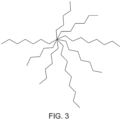
- Hyperbranched topology is characterized with a large number of chain ends per macromolecule which is a basis for its special properties. These special structures can be accomplished if only there is a means to covalently tie the polymer chains at one end in to a bundle while allowing the other end of the chain to dangle freely as illustrated in Figure 3 .
- Two synthetic strategies useful in producing structures like this are, a) grow polymer chains outwards from a central point in a multistep synthesis (divergent approach) or, b) grow individual polymer chains in a first step followed by tying them at one end in a second step (convergent approach).
- FIG. 3 shows depiction of a hyperbranched polymer structure-tied at one end to the central core while the other end can move about freely.
- hyperbranched silicon-core-based PSA includes those illustrated in Figure 4 with a pure silsesquioxane core and in Figure 5 with a hybrid metallo-silsesquioxane core.
- Figure 4 depicts a hyperbranched structure with a silsesquioxane cage at its core and soft polymer chains as the branches.
- Figure 4 is a more general representation of a hyperbranched polymer having a pure silsesquioxane core whereas Figure 6 refers to one discrete hyperbranched polymer having eight silicon atoms in a fully condensed cage.
- the actual polymer comprises one or more hyperbranched polymers which may have either 6, 8, 12, etc. sized cages and/or combinations of different-sized cages. That is, the actual polymer may have six Si atoms in a first cage of a first hyperbranch polymer, eight Si atoms in a second cage of a second hyperbranch polymer as illustrated in Figure 6 , twelve Si atoms in a third cage of a third hyperbranch polymer, etc. and/or combinations of different-sized cages.
- the first hyperbranch polymer may have 6 precursor units
- the second hyperbranched polymer may have 8 precursor units as illustrated in Figure 6
- the third hyperbranched polymer may have 12 precursor units, etc and/or combinations of different-sized cages. Because each precursor has one silicon atom, the number of silicon atoms will be the same as the number of condensed precursors.
- Figure 5 shows a hyperbranched structure with a metallo-silsesquioxane cage at its core and polymer chains as the branches.
- Figure 5 is a more general representation of a hyperbranched polymer having a hybrid silsesquioxane core
- Figure 10A refers to one discrete hyperbranched polymer having seven silicon atoms and one M atom in a fully condensed cage.
- the actual polymer comprises one or more hyperbranched polymers which may have either 6, 8, 12, etc. sized cages and/or combinations of different-sized cages.
- the R's in both Figures 4 and 10A represent the polymer chains of the hyperbranched polymer.
- metallo-silsesquioxane core can generate polymers with altered and/or superior magnetic properties and optical properties (e.g., high refractive index), It must be noted that not all hyperbranched silsesquioxane-based structures result in formation of a PSA because the modulus and/or glass transition temperature of the resulting composition may be outside the range of PSAs.
- the present subject matter provides a normally tacky PSA composition and adhesive coated sheet materials having a requisite fourfold balance of adhesion, cohesion, viscoelasticity, and glass transition temperature.
- (Meth)acrylate-based PSA refers to permanently tacky polymeric compositions comprising acrylate, methacrylate or any combination of such monomers wherein the monomer, an ester of acrylic acid or methacrylic acid, is polymerized or copolymerized with various comonomers containing a polymerizable ethylenic linkage.
- the polymer is formed via chain growth polymerization techniques.
- the (meth)acrylate polymers in pressure sensitive adhesives could be homopolymers, i.e. consisting of the same acrylic monomer to make up the polymer chain.
- the acrylate polymers can be copolymers, i.e. consisting of two or more different monomers placed in a polymer chain.
- polymers consist of linear or branched chains. These polymers are cast on to filmic or foil carriers to form PSA tapes. In practice, most often the polymers also undergo slight crosslinking reaction(s) on the web to improve the polymer's internal strength. Crosslinking is facilitated by introducing reactive groups known in the art.
- the crosslinking of the polymer can be activated by either of the following triggers such as, heat, moisture, ultraviolet, and/or electron beam.
- room temperature refers to temperatures within the range of from about 15° to about 25°C.
- 'acrylic polymer' used herein refers to polymers formed from monomers of acrylates and/or methacrylates or any combination of these in a polymer composition wherein the monomers are esters of acrylic acid or methacrylic acid containing a polymerizable ethylenic linkage. This term also includes other classes of monomers with ethylenic linkage that can copolymerize with acrylate and methacrylate monomers.
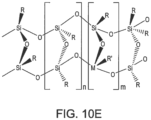
- silsesquioxane core refers to a silsesquioxane core where each silicon or metal atom covalently participates in forming three bonds using any combination of Si-O-Si and Si-O-M bonds (for example Figures 6, 7 , 10A, 10B , and 10E ).
- silsesquioxane core refers to a silsesquioxane core where some of the silicon or metal atoms are covalently attached to any combination of two or less Si-O-Si and Si-O-M bonds (for example Figures 8A through E , 9 , 10C, and 10D ).
- hyperbranched polymer refers to macromolecules composed of multiple polymer units emanating from a central core such as shown in Figure 3 .
- a hyperbranched polymer is characterized by i) core and ii) branches which surround the core also referred to as 'shell' herein.
- the core is characterized by its functionality, which is the number of chemical bonds through which it can be connected to external parts of the molecule. Topologically, these are densely branched synthetic tree-like macromolecules with a large number of end groups.
- 'pure silsesquioxane core' refers to a silsesquioxane core whereby none of the silicon atoms in the core has been substituted with another atom as shown in Figures 4 , 6 , 8A-8E , 9 , and 12 .
- the terms 'pure silsesquioxane core' and 'silsesquioxane core' will be used interchangeably in the description of this present subject matter.
- 'hybrid silsesquioxane core' refers to a silsesquioxane core having one or more of the silicon atoms in the core substituted with another atom, such as, a metal or another Si atom.
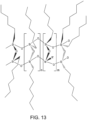
- a metallo-silsesquioxane core has one or more of the silicon atoms in the core substituted with a metal atom as shown in Figures 5 , 10A-10D , and 13 .
- the terms ⁇ metallo-silsesquioxane core' and 'hybrid metallo-silsesquioxane core' will be used interchangeably in the description of this present subject matter.
- 'polymer brush' is often characterized by the immobilization of one end of a polymer chain on to a substrate in high density. The limited space then leads to a strong extension of the chains, and unusual properties of the system.
- the terms 'hyperbranched' and 'brush' will be used interchangeably in the description of this present subject matter.
- the X groups are hydrolyzable groups such as but not limited to methoxy, ethoxy, acetoxy or oxime groups.
- the group R' is hydrogen, or a hydrocarbon.
- the group R can be hydrocarbon, hetero-carbon, polymeric, or functional group, such as epoxy, vinyl, amino, methacryloxy, or sulfido.
- ⁇ hydrolyze' refers to a reaction in which a Si-X bond breaks in the presence of water, even only with moisture adsorbed on the surface, to form silanol Si-OH group.
- 'condensation' refers to a reaction where two silanol groups condense splitting off water to form structures with very stable siloxane Si-O-Si bonds.
- 'precursor' refers to an acrylic or methacrylic polymer, as defined above, which is capped with a single silane unit at one end of the molecule.
- 'precursor,' in the present subject matter refers to a starting molecule or macromolecular unit that can through hydrolysis-condensation reaction(s) or direct condensation bypassing the hydrolysis step self-assemble to form a hyperbranched structure as described herein in detail.
- crosslink' or 'crosslinking' refer to a process of forming chemical bonds that link one polymer chain to another polymer chain at more than one point along the chain.
- a polymer chain is covalently pinned to other chains in more than one location as illustrated in Figure 2 . This is in sharp contrast to hyperbranched polymers where the chains are pinned at only one location as illustrated in Figure 3 .
- a silsesquioxane unit is a family of organosilicon compounds characterized by a ratio of 1.5 between silicon and oxygen atoms signified by the general formula [RSiO 3/2 ] n where n is an even number and R is an organic or inorganic group such as alkyl, aryl, heterocarbon, polymer, oligomer, (meth)acrylate polymer, (meth)acrylate oligomer, and combinations thereof.
- R is an organic or inorganic group such as alkyl, aryl, heterocarbon, polymer, oligomer, (meth)acrylate polymer, (meth)acrylate oligomer, and combinations thereof.
- R is an organic or inorganic group such as alkyl, aryl, heterocarbon, polymer, oligomer, (meth)acrylate polymer, (meth)acrylate oligomer, and combinations thereof.
- R A number of diverse substituents (R) can be attached to the Si centers.
- Molecules of such structure are unusual because they feature an inorganic silicate core and an organic exterior.
- the organic groups emanate from the central silicate core which results in formation of the hyperbranched structure. Additionally, the benefits of hyperbranched and brush structure are inherent in these molecules.
- silsesquioxane structures are also referred to as 'organic-inorganic hybrids.'
- Silsesquioxane structures are formed when select silanes undergo hydrolysis and condensation. Subject to certain reaction conditions, silanes can also undergo direct condensation bypassing the hydrolysis step.
- One such structure belonging to the silsesquioxane family is represented in Figure 6 .
- a polyhydral structure with eight silicon atoms i.e., (R-SiO 1.5 ) 8 is formed to produce a fully condensed silsesquioxane molecule(s).
- the silsesquioxane core renders rigidity and thermal stability to the molecule. It must be noted that not all silanes react to automatically form silsesquioxane structures.
- a description of silsesquioxanes is disclosed by P. Eisenberg, R.
- X is a hydrolyzable group such as halogen, acyloxy, ketoximate, and alkoxy
- R is nonhydrolyzable organic group linked by Si-C bond.
- the alkoxy group is particularly preferable as the X group since its hydrolyzability is mild and is easy to handle.
- silsesquioxanes can also exist in polymeric form. In polymeric form, silsesquioxane takes a ladder structure as shown in Figure 7 .
- each Si center is bonded to three oxo groups, which in turn connect to other Si centers.
- the fourth group on Si is usually a hydrocarbon, alkyl, aryl, heterocarbon, polymer, oligomer, (meth)acrylate polymer, (meth)acrylate oligomer, and combinations thereof.
- Figure 7 shows the chemical structure of a fully condensed polymeric silsesquioxane unit.
- Silsesquioxane structures usually form from the hydrolysis and subsequent condensation of a hydrolyzable silane molecule.
- An idealized synthesis may proceed in the following distinct steps:
- the structure of the silsesquioxane framework depends a great deal on its method of preparation.
- the structure is uniquely sensitive to a highly interdependent combination of experimental factors, including product solubilities, initial silane concentration, nature and stability of the solvent, temperature, pH, the amount of free water available, and the type of catalyst (acid or base) used to facilitate condensation.
- the reaction is generally catalyzed by bronsted acids, lewis acids, bases, and amines. Careful hydrolysis leads to well-defined, fully condensed, structures T4-R, T6-R, T8-R, T10-R, and T12-R.
- polyhedral silsesquioxanes are also referred to as spherosiloxanes, since polyhydral structures are topologically equivalent to a sphere.
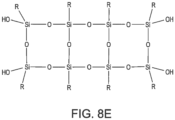
- FIG. 8A-8E provide illustrative examples of partially condensed silsesquioxane structures containing 8, 7, 6 and 5 silicon atoms. Further, to exemplify multiple possibilities, the structure with 6 silicon atoms is illustrated at two levels of condensed state. These partially condensed silsesquioxanes are intermediates en route to the fully condensed cages.
- Figures 8A-8E show various chemical structures of partially condensed silsesquioxane cores having seven silicon atoms ( Figure 8A), Figure 8B six silicon atoms ( Figure 8B ), five silicon atoms ( Figure 8C ), six silicon atoms ( Figure 8D ), and a silsesquioxane in a ladder arrangement having eight silicon atoms ( Figure 8E ).
- polymeric silsesquioxanes have also been reported.
- High molecular weight tractable polymeric silsesquioxanes feature a ladder-type structure such as shown in Figure 7 .
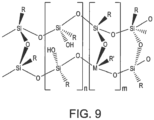
- Other partially condensed species adopt ladder structures wherein two long chains composed of RSiO 3/2 units are connected at regular intervals by Si-O-Si bonds such as shown in Figure 9 .
- amorphous structures include RSiO 3/2 unit(s) connected without any organized structure formation.
- Figure 9 shows a partially condensed polymeric silsesquioxane structure having a ladder arrangement.
- the silanols that are generated in situ within incompletely condensed silsesquioxane intermediates are stable compounds which result in silsesquioxane with one or more hydroxyl group(s) with decent stability.
- the Si-OH groups are sufficiently reactive to further react with metals and metalloids compounds to create new hybrid metallo-silsesquioxanes.
- the incompletely condensed silsesquioxanes bind numerous metals, including Na + , Li + , and Be 2+ as well as metalloids and transition metals.
- silsesquioxane structures are the formation of hybrid core(s) where one or more of the silicon atoms in the core are substituted with another atom.
- Materials added to form hybrid core(s) are referred to as 'core modifier' herein. It must be noted that this results in modification at the core level.
- the hybrid silsesquioxane allows a wide range of applications. Their chemistry has been extensively developed over the past 10-15 years.
- well defined prismatic metallo-silsesquioxane derivatives of the core stoichiometry [(RSi) n (R'M) m O 1.5 ] n+m can be prepared by treating the incomplete cage with a metal halide in the presence of a catalyst. This synthesis can be a sequential reaction or can be a one pot reaction where the metal component is added as an integral blend at the start of the hydrolysis step. An example of its reaction is illustrated below.
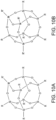
- Figures 10A-10E show various chemical structures of metallo-silsesquioxane units;
- Figure 10 A illustrates a fully condensed core having seven silicon atoms and one metal atom
- Figure 10B illustrates a fully condensed core having five silicon atoms and three metal atoms
- Figure 10C illustrates a partially condensed cores having four silicon atoms and three metal atoms
- Figure 10D illustrates a partially condensed core having four silicon atoms and three metal atoms
- Figure 10E illustrates a polymeric metallo-silsesquioxane in a ladder arrangement.
- partially condensed silsesquioxane can react with, for example, CrOs to yield chromium silsesquioxane.
- Partially condensed silsesquioxane can react with, for example, (C 3 H 7 ) 3 VO to yield vanadium silsesquioxane.
- Partially condensed silsesquioxane can react with, for example, FeCl 3 P(c-C 6 H 11 ) 3 to yield iron silsesquioxane.
- Partially condensed silsesquioxane can be transmetallated with, for example, Mo to yield molybdenum silsesquioxane.
- Other metals known to incorporate in silsesquioxane structures include but are not limited to copper, rhodium, tungsten, osmium, and platinum.
- silsesquioxane In all aspects, despite the possibility of many silsesquioxane structures, the exact structure of silsesquioxane is immaterial to the practice of the present subject matter. In many cases the composition will be a mixture of hyperbranched systems comprising multiple silsesquioxane core structures.
- the hydrolyzable silanes readily undergo another similar type of condensation reaction with organic alcohols if present in the reaction medium.
- a Si-O-C bond is formed through the reaction of Si-X with the hydroxyl functionality of the organic moiety as illustrated in Figure 11.
- Figure 11 shows direct condensation of silane with hydroxyl group. Although the mechanism of this reaction is not completely understood, it is generally regarded to proceed through one step condensation. This method has been utilized in the production of silsesquioxanes with bulky R groups.
- silsesquioxane core All chains emanate from a central silsesquioxane core.
- the structure of the silsesquioxane core can be any of the ones described herein.
- the silsesquioxane core can be either fully or partially condensed.
- the core can be in cage or polymeric form.
- the core can be a mixture of any of the forms noted herein in any combination.
- Figure 13 shows a fully condensed polymeric metallo-silsesquioxane core in which each silicon atom is linked to a polymer chain.
- hyperbranched silsesquioxane can be controlled either through core level modification (e.g., Example 11) or through branch level modification (e.g., Examples 1 to 7) of molecular structure, constitution and molecular weight.
- core level modification e.g., Example 11
- branch level modification e.g., Examples 1 to 7
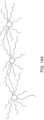
- the discrete silsesquioxane cores may be linked in a pearl chain or in a multidimentional network structure/arrangement as illustrated in Figures 14A and 14B .
- each one of the silsesquioxane cores of a portion of the hyperbranched polymers will serially and covalently link to another silsesquioxane core(s) to form the pearl chain structure.
- a diol one hydroxyl group will react with one silsesquioxane core of a hyperbranch opolymer while the other hydroxyl group will react with a silsesquioxane core of another hyperbranch polymer to form one link of the pearl chain.
- R is a spacer group situated between the OH groups, and n is selected from the group consisting of 2, 3, 4, and combinations thereof.
- Spacer groups are small or large molecules containing two or more hydroxyl groups. As depicted in Figure 11 , these hydroxyl groups directly participate in condensation reaction with a hydrolyzable silane moiety to form Si-O-C bonds. Examples of spacer groups can range from but not limited to polyether-base polyols, polyester-based polyols, and polycarbonate based polyols. It is contemplated that the spacer group can react with two or more neighboring silsesquioxane units to link those in a pearl chain configuration.
- the amount of the polyol can range from about 0% to about 30% or about 0% to about 20% or about 0% to about 30% by weight of the PSA and/or the hyperbranched polymer. Too high an amount will lead to many tightly linked cores which could weigh negatively on PSA performance and in certain applications should be avoided.
- each one of the silsesquioxane cores of a portion of the hyperbranched polymers will covalently linked to other one or more silsesquioxane cores to form a multidimensional network structure.
- the general structure of hydrolyzable di-silane is in which R is an organic group situated between the two hydrolyzable silane moieties, X is a hydrolyzable group selected from the group consisting of halogen, acyloxy, ketoximate, alkoxy, and combinations thereof, Y is an organofunctional group, and each 'a' is independently selected from 0, 1, and 2.
- the amount of the hydrolyzable di-silane can range from about 0% to about 30% or about 0% to about 20% or about 0% to about 30% by weight of the PSA and/or the hyperbranched polymer. Too high an amount will lead to many tightly linked cores could weigh negatively on PSA performance and in certain applications should be avoided.
- Figure 14A shows several hyperbranched silsesquioxane units linked in a 'pearl chain' or serial arrangement.
- Figure 14B shows several hyperbranched silsesquioxane units linked in a multidimensional network structure/arrangement, most commonly being a two dimensional network structure.
- each precursor unit should have essentially a single silane group which should also be located in a terminal position. Not all acrylic precursors bearing silane groups are capable of forming a hyperbranched topology. Instead, most such systems are designed to promote the undesired crosslinking reaction. For example, more than one hydrolyzable silane group will pin the polymer chain at multiple locations resulting in a tightly crosslinked structure which is typically detrimental to pressure sensitive adhesive function. Furthermore, the presence of the hydrolyzable silane group at a position other than the terminal position will sterically impede the formation of a well-defined hyperbranched silsesquioxane core associated with the present subject matter.
- a precursor comprising an acrylate polymer bearing a silane functionality primarily represented with a general formula R-Si(X) 3 wherein R is one of a nonhydrolyzable organic group, a nonhydrolyzable oligomer chain, and a nonhydrolyzable polymer chain, and X is a hydrolyzable group as illustrated in Figure 15 is subjected to hydrolysis and condensation in the presence of a catalyst leading to formation of a hyperbranched silsesquioxane core in a convergent synthetic strategy.
- Figure 15 shows a precursor unit including a polymer chain chemically linked to a silane group.
- the polymer chain itself can comprise homo- or copolymer.
- the polymer chain can be linear or branched.
- the hydrolysis/condensation reaction proceeds readily in the presence of traces of moisture and heat. However, moisture may not be required in the presence of a catalyst or co-reactant.
- compositions including the precursor, core modifier and catalyst according to the present subject matter may be dissolved in theta solvent and cast on a carrier substrate in film form.
- the coated film is subjected to either a temperature range of from about 20 ° C to about 50 ° C or elevated temperature range of from about 51 ° C to about 170 ° C to concurrently evaporate the solvent while undergoing condensation to form the hyperbranched silsesquioxane core.
- compositions including the precursor, core modifier and catalyst according to the present subject matter may be heated to facilitate solvent-free formulation and dispensing.
- the formulation is applied on a carrier substrate in film form.
- the coated film is subjected to condensation reaction(s) at either a temperature range of from about 20 ° C to about 50 ° C or elevated temperature range of from about 51 ° C to about 170 ° C to form hyperbranched hybrid-silsesquioxane core.
- the silane functionality is chemically bound to an acrylate polymer chain through a spacer group.
- the number of silicon atoms contained in this reactive silane group cannot be more than one.
- each precursor molecule cannot have more than one silane groups.
- the silane functionality must bear at least two or three hydrolyzable X groups, and more preferably three groups.
- hydrolyzable X group Several chemistries for the hydrolyzable X group are available and can be used in the present subject matter. However, the alkoxy group is preferred in view of its mild reactivity and availability. Precursors with the following hydrolyzable moieties on silane are preferable:
- the number average molecular weight of the precursor is typically from about 2,000 to about 300,000 g/mole, and preferably from 10,000 to 50,000 g/mole.
- the number average molecular weight of the pressure sensitive adhesive is typically from about 20,000 to about 1,000,000 g/mole or about 30,000 to about 500,000 g/mole, or about 50,000 to about 200,000 g/mole. However, it will be understood that in no way is the present subject matter limited to these molecular weights.
- the chemical composition of the precursor is chosen so that the final overall hyperbranched silsesquioxane conforms to the rules of Dahlquist criteria and glass transition temperature requirements for pressure sensitive materials, which are known in this field of art.
- Dahlquist criteria to perform as a pressure sensitive adhesive, the formulation must have a plateau shear modulus at 25° C and 1 radian per second that is between 5 ⁇ 10 3 and 6 ⁇ 10 5 N/m 2 (5 ⁇ 10 4 and 6 ⁇ 10 6 dynes/cm 2 ) as determined by dynamic mechanical analysis.
- a material having plateau shear modulus greater than 1 ⁇ 10 6 N/m 2 (1 ⁇ 10 7 dynes/cm 2 ) at 25° C will be too stiff to exhibit tack at room temperature to be useful as pressure sensitive adhesive.
- a material with plateau shear modulus less than 1 ⁇ 10 3 N/m 2 (1 ⁇ 10 4 dynes/cm 2 ) at 25° C will lack sufficient cohesive strength to be useful as pressure sensitive adhesive.
- Representative and non-limiting examples of ranges of the DSC measured glass transition temperatures (Tg) for the pressure sensitive adhesives of the instant subject matter are from about 10° C to about -60° C, or from about 0° C to about -40° C, and/or from about -10° C to about -40° C.
- the polymer chain may include compositionally different polymer chains, compositionally the same polymer chains, and/or combinations of compositionally different and compositionally the same polymer chains.
- Compositionally different polymer chains include polymer chains of different lengths, different sizes, different chemical structures (linear, branched), different molecular weight, and/or different monomer units (copolymers).
- compositionally same polymer chains include polymer chains of substantially same lengths, same sizes, same chemical structures (linear, branched), same molecular weight, and/or same monomer units (homopolymers), Furthermore, a mixed polymer chain hyperbranch can be achieved by condensing two or more compositionally different precursors.
- An example of compositionally different polymer chains immobilized on the core could result in an amphiphilic silsesquioxane having various ratios of hydrophilic and hydrophobic polymer chains. These systems are particularly interesting because of their interesting phase behavior.
- Another example of the formation of compositionally different polymer chains is depicted in Figure 11.
- Figure 11 shows how silsesquioxanes with bulky R groups can be produced when a hydrolyzable silane readily undergoes a one-step condensation reaction with an organic alcohol.
- Two different polymer chains are bonded to the silsesquioxane core, namely, the polymer chain of the precursor and the polymer chain of the organic alcohol via Si-O-C bond.
- This facile synthetic method with short step(s) and high yield enables a variety of materials with a range of performance properties.
- M(X) 4 and M(X) a (Z) b wherein M is as previously noted, X is a hydrolyzable group a is preferably 2, b is preferably 2, and Z is an organic ligand of the general formula A-C(O)-(R') n -C(O)-B wherein R' is a hydrocarbon group, A and B are independently organic groups, and n is from 0 to 10.
- the noted co-reactant is not particularly restricted but includes, among others, transition metal chelates, titanate esters such as tetrabutyl titanate and tetraisopropyltitanate; organotin compounds and its carboxylic acid metal salts such as dibutyltin dilaurate, dibutyltin diacetylacetonate, dibutyltin maleate, dibutyltin diacetate, dibutyltin dimethoxide; organoaluminum compounds such as aluminum triacetylacetonate, aluminum tri(ethyl acetoacetate) and diisopropoxyaluminum ethyl acetoacetate; organozirconium compounds such as zirconium tetraacetylacetonate, zirconium tetraisopropoxide and zirconium tetrabutoxide.
- transition metal chelates such as tetrabutyl titanate and tet
- Tyzor ® 9000 has the formula Ti(isopropoxy) 4 .
- An illustrative example of a suitable ligand is acetylacetonate, ethylacetoacetate, glycol ethers, alkanolamines, and/or triethanolamine.
- metal chelates may be compounds prepared by coordinating multivalent metals such as Al, Fe, Zn, Sn, Sb, Mg, and V with a suitable ligand such as, for example, acetylacetonate or ethyl acetoacetonate.
- the mole ratio of metal content M to the silicon content in the hybrid metallo-silsesquioxane is preferably no greater than 30:1, respectively. More preferably, the mole percent is no greater than 20:1.
- the co-condensation of titanium compounds is a facile reaction at a wide range of feed ratios to produce titania-silica mixed oxides.
- core level modification can also be performed by silicon-containing co-reactants.
- the general formula for silicon-containing co-reactant is given as R" 4-q Si(OR # ) q wherein R" represents a functional or non-functional hydrocarbon group and R # represents methyl, ethyl or isopropyl and q has a value of 2 or 3.
- Non-limiting examples of operative silicon compounds are propyltrimethoxy silane, phenyltrimethoxysilane, methyltriethoxysilane,decyltrimethoxysilane, 3-aminopropyltrimetoxy silane, methyl trimethoxy silane, vinyltrimethoxysilane, vinyltriethoxysilane, vinyltripropoxysilane, vinylmethyldimethoxysilane, vinylmethyldiethoxy-silane, vinylmethyldipropoxysilane, ⁇ -methacryloxypropyl-trimethoxysilane, ⁇ - methacryloxypropyltriethoxysilane, ⁇ - methacryloxydimethoxysilane, ⁇ -methacryloxypropyl-methyldimethoxysilane, ⁇ -methacryloxypropylmethyldiethoxysilane, ⁇ - methacryloxymethyl-dimethoxysilane, ⁇ -methacryloxymethyltrimethoxysilane
- tetraalkoxy silanes Si(OR # ) 4
- tetraethoxy and tetramethoxy silanes are yet other types of co-reactants used for core modification in which R # represents methyl, ethyl or the isopropyl group.
- R # represents methyl, ethyl or the isopropyl group.
- TEOS tetraethoxy silane
- Co-condensation of tetraethoxy silane (TEOS) with precursor is a convenient synthetic approach for further tuning of novel silsesquioxane structures such as to modify the solubility, rigidity, modulus, glass transition temperature, and refractive index.
- the film forming properties can be adjusted by altering the composition of the precursor and core modifier feed.
- This novel synthetic strategy provides a means to make designer pressure sensitive adhesives which enables a practitioner in this field of art tremendous latitude to tune performance properties.
- the polymer chain of the noted precursor is composed of acrylate and/or methacrylate monomers linked to form linear and/or branched homopolymers and/or copolymers.
- the pressure sensitive adhesive and/or the hyperbranched polymers include at least about 50% of (meth)acrylate monomers or a majority proportion of (meth)acrylate monomers, segments, and/or branches.
- Majority proportion being defined as greater than about 50% by weight of the PSA and/or hyperbranched polymers, about 57% by weight of the PSA and/or hyperbranched polymers, greater than about 57% by weight of the PSA and/or hyperbranched polymers, a range of from about 50% to about 99.99% or about 60% to about 99.99% or about 70% to about 99.99% by weight of the PSA and/or hyperbranched polymers.
- Monomers which are suitable for use in the precursor include C1 to about C20 alkyl, aryl or cyclic acrylates, and may include, but not limited to the following: methyl acrylate, ethyl acrylate, n-propylacrylate, isopropyl acrylate, benzyl acrylate, phenyl acrylate, 2-phenylethyl acrylate, butyl acrylate, isobutyl acrylate, tert-butyl acrylate, n-hexyl acrylate2-ethylhexyl acrylate, isobornyl acrylate, propyl heptyl acrylate, isooctyl acrylate, n-dodecyl acrylate, n-decyl acrylate, isodecyl acrylate, isostearyl acrylate, methoxyethyl acrylate, ethoxyethyl acrylate, cyclo
- the methacrylate monomers include C1 to about C20 alkyl, aryl or cyclic methacrylates such as methyl methacrylate, ethyl methacrylate, butyl methacrylate, 2-ethylhexyl methacrylate, phenyl methacrylate, isobornyl methacrylate, and functional derivatives of these methacrylates such as 2-hydroxyethyl methacrylate, 2-chloroethyl methacrylate, and the like.
- aryl or cyclic methacrylates such as methyl methacrylate, ethyl methacrylate, butyl methacrylate, 2-ethylhexyl methacrylate, phenyl methacrylate, isobornyl methacrylate, and functional derivatives of these methacrylates such as 2-hydroxyethyl methacrylate, 2-chloroethyl methacrylate, and the like.
- the acrylate monomers may copolymerize with other comonomers with reactive functional groups such as acrylonitrile groups, acrylamide groups, methacrylamide groups, vinyl ester groups, vinyl ether groups, vinyl amide groups, vinyl ketone groups, styrene groups, halogen-containing groups, ionic groups, acid-containing groups, base-containing groups, olefin groups, silane groups, epoxy groups, hydroxyl groups, anhydride groups, and mixtures of two or more groups thereof.
- reactive functional groups such as acrylonitrile groups, acrylamide groups, methacrylamide groups, vinyl ester groups, vinyl ether groups, vinyl amide groups, vinyl ketone groups, styrene groups, halogen-containing groups, ionic groups, acid-containing groups, base-containing groups, olefin groups, silane groups, epoxy groups, hydroxyl groups, anhydride groups, and mixtures of two or more groups thereof.
- silyl groups carboxyl groups, carbonyl groups, carbonate ester groups, isocyanato groups, amino groups, amide groups, imide groups, mercapto groups, and acetoacetyl groups in any combination and/or in combination with one or more of any of the previously noted groups.
- the acrylate monomers may copolymerize with comonomers bearing acrylamide groups.
- comonomers bearing acrylamide groups can include acrylamide and its derivatives including the N-substituted alkyl and aryl derivatives thereof. These include N-methyl acrylamide, N,N-dimethyl acrylamide, t-octyl acrylamide, N-aminoethyl acrylate, N-aminoethyl methacrylate, and the like.
- comonomers include vinyl ester groups such as vinyl acetate, vinyl propionate, vinyl butyrate, vinyl valerate, vinyl versitate, vinyl isobutyrate, and the like.
- comonomers include vinyl ether groups such as vinyl ethers having 1 to about 8 carbon atoms including ethylvinyl ether, butylvinyl ether, 2-ethylhexylvinyl ether, and the like.
- comonomers include acid-containing groups such as unsaturated carboxylic acids containing from 3 to about 20 carbon atoms.
- Preferred groups include acrylic acid, methacrylic acid, vinyl sulfonic acid, itaconic acid, beta carboxyl ethyl acrylate, mono-2-acroyloxypropyl succinate, and the like.
- comonomers include epoxy groups such as for example, glycidyl methacrylate and glycidal acrylate.
- comonomers include hydroxyl groups such as hydroxy ethyl acrylate, hydroxyl ethyl methacrylate, hydroxy isopropyl acrylates, hydroxy isopropyl methacrylate, hydroxy butyl acrylate, hydroxy butyl methacrylate and the like.
- the acrylic precursor may be formed using a macromonomer (also referred to as "macromer").
- the macromonomer may be represented by the general formula: X-(Y) n -Z wherein X is a vinyl group copolymerizable with the other monomers present in the precursor composition; Y is a divalent linking group where n can be 0 or 1; Z is a monovalent polymeric moiety having a T g greater than 20° C and a weight average molecular weight in the range of about 2,000 to about 30,000.
- Various polymerization techniques can be used to produce the precursor including some of the controlled polymerization techniques such as Atom Transfer Radical Polymerization (ATRP); Reversible Addition /Fragmentation Chain Transfer Polymerization (RAFT); and Nitroxide-mediated Polymerization (NMP) or Stable Free Radical Polymerization (SFRP) developed in recent years. Additionally, other techniques stem from the development of new catalyst and initiating systems. Although these methods can be applied to produce the desired precursor, these were generally found to be cumbersome multistep procedures.
- ATRP Atom Transfer Radical Polymerization
- RAFT Reversible Addition /Fragmentation Chain Transfer Polymerization
- NMP Nitroxide-mediated Polymerization
- SFRP Stable Free Radical Polymerization
- acrylate and/or methacrylate monomers polymerized in the presence of a free-radical initiator and a silane-bearing chain transfer agent (CTA) at certain mole ratios of initiator to CTA successfully produced the desired precursor architecture in one single step, thus simplifying the process considerably.
- CTA silane-bearing chain transfer agent
- free-radical initiators are known and can potentially be incorporated in the present subject matter compositions.
- the general class of free-radical initiators belong to the classes of ketone peroxide, diacyl peroxides, dialkyl peroxides, peroxyesters, peroxyketals, peroxydicarbonates, peroxymonocarbonates, and diazo compounds.
- Each class of preceding compound functions as a thermal initiator by absorbing heat energy delivered in the form of convection, conduction or radiation.
- Another general class of free-radical initiators belongs to the classes of ⁇ -hydroxyalkylphenones, ⁇ -aminoalkylphenones, benzyl ketals, benzoin ethers, ⁇ -dialkoxyacetophenones, and acylphosphineoxides.
- Each class of the preceding compound functions as a photoinitiator by absorbing energy within the UV/visible region of the electromagnetic spectrum.
- the initiators falling in the above two listed categories will be particularly useful in the synthesis of precursor as long as each of the radical fragments formed in the initiation step have the following general structures: In these structures, R represents a hydrocarbon fragment.
- each radical fragment formed on initiation preferably bears a hydroxyl group or a hydrolyzable silane group.
- Some examples of commercially available initiators conforming to the desired structures, but not limited to these are 2,2'-Azobis[2-methyl-N-(2-hydroxyethyl)propioamide], 2,2' Azobis[1-(4-hydroxyphenyl)ethane], bis(2-hydroxyethyl) peroxide, and 2-Hydroxy-4'-(2-hydroxyethoxy)-2-methylpropiophenone.
- Useful chain transfer agents comprise various mercapto-based compounds.
- the presence of a hydrolyzable silane moiety on the chain transfer agent is an essential part of the synthetic strategy for preparing the precursor.
- the general structure of the chain transfer agent is: in which R is an organic linking group situated between a thiol and a hydrolyzable silane moiety, Y is an organofunctional group, and the value of 'a' is selected from the group consisting of 0, 1,2, and combinations thereof.
- the value of 'a' is either 0 or 1, and more preferably the value of 'a' is 0.
- the chain transfer agent bear a single thiol group and a single silane group per molecule.
- mercapto group-containing silanes examples include mercaptoalkyltrialkoxysilanes such as mercaptomethyltrimethoxysilane, mercaptomethyltriethoxysilane, ⁇ -mercaptoethyltrimethoxysilane, ⁇ -mercapto-ethyltriethoxysilane, ⁇ -mercaptoethyltripropoxysilane, ⁇ -mercaptoethyltriisopropoxysilane, ⁇ -mercaptoethyltributoxysilane, ⁇ -mercaptopropyltrimethoxysilane, ⁇ -mercaptopropyltrietoxysilane, ⁇ -mercaptopropyltripropoxysilane, ⁇ -mercaptopropyltriisopropoxysilane, and ⁇ -mercaptopropyltributoxysilane; (mercaptoalkyl)alkyldialkoxysilanes such as ⁇ -
- chain transfer agents are as follows but not limited to:
- a successful strategy uses the noted chain transfer agent in conjunction with the noted free-radical initiator.
- the mole ratio of the chain transfer agent to initiator is an important consideration for the synthesis of the desired precursor architecture. By manipulating the ratio of initiator to the chain transfer agent, the ratio of polymer chains bearing terminal hydroxyl to silane groups can be controlled with relative ease. A higher ratio will ensure more chains with terminal silane group. However, a higher ratio will also reduce the molecular weight of the precursor. Not all combinations of the two will deliver a favorable outcome.
- the mole ratio of chain transfer agent to initiator can range from about 200:1 to about 1:2. Such a combination ensures that substantially all polymer chains have either a terminal hydroxyl group or a terminal silane group.
- the precursor can be synthesized in solvent medium or solvent-free (bulk).
- the monomers, initiator(s), and chain transfer agent(s) are dissolved in an inert theta solvent and polymerized to form the precursor.
- the monomers, initiator(s), and chain transfer agent(s) are polymerized in the absence of solvent to form the precursor.
- the present subject matter adhesives and/or precursor compositions comprise a free-radical initiator and in particular aspects an actinic radiation activated initiator. In other aspects the actinic radiation activation can be substituted by a thermally activated initiator.
- the present subject matter includes the use of nearly any type of initiator and is not limited to ⁇ -deavage or hydrogen abstraction types. For example, a variety of initiators are known that decompose or cleave into free-radicals upon exposure to heat or light, and more particularly UV radiation.
- the hyperbranched pressure sensitive adhesive composition may further comprise in addition to the precursor, an oligomer having at least one crosslinkable functional group.
- the oligomer is typically liquid at room temperature (about 25° C).
- useful oligomers include those having a backbone comprising polyether, polyisobutylene, amorphous poly-alpha olefins, polybutadienes, polyisoprenes, polydimethylsiloxanes, polyalkyloxazolines, polyesters, poly(methyl)acrylates, polyurethanes, and mixtures thereof.
- the polyether backbones may comprise, for example, polypropylene oxide, polyethylene oxide, polytetramethylene ether glycol.
- the poly(methyl)acrylate backbones may comprise C 1 to C 30 (meth)acrylate esters that may or may not include modifying monomers.
- the reactive functional groups may comprise silyl, hydroxyl, carboxyl, isocyanato, vinyl, (meth)acryl, epoxy, amino, mercapto and acetoacetyl groups.
- the functional group chosen for the oligomer may be reactive with a corresponding group on the hyperbranched polymer.
- the specific functional groups used may be determined by one skilled in the art.
- amino groups will react with isocyanato, epoxy, and acetoacetyl groups; isocyanoto groups will crosslink with carboxyl, amino and hydroxyl groups; (meth)acryl groups will crosslink with amino and acetoaceyl groups; and epoxy groups will crosslink with amino, carboxyl and hydroxyl groups; etc.
- a tackifier may be combined with the inventive precursor.
- the tackifier is substantially compatible with the precursor.
- the term 'substantially compatible' means that when the tackifier and the precursor are combined, the resulting combination is substantially transparent in dry film format, as opposed to opaque, on normal visual inspection.
- a wide variety of tackifiers can be used to enhance the tack and peel of the adhesive. These include rosins and rosin derivatives including resinous materials that occur naturally in the oleoresin of pine trees, as well as derivatives thereof including rosin esters, modified rosins such as fractionated, hydrogenated, dehydrogenated, and polymerized rosins, modified rosin esters and the like.
- terpene resins which are hydrocarbons of the formula C 10 H 16 , occurring in most essential oils and oleoresins of plants, phenol modified terpene resins like alpha pinene, beta pinene, dipentene, limonene, myrcene, bornylene, camphene, and the like.
- phenol modified terpene resins like alpha pinene, beta pinene, dipentene, limonene, myrcene, bornylene, camphene, and the like.
- Various aliphatic hydrocarbon resins like Escorez 1304, manufactured by Exxon Chemical Co. and the aromatic hydrocarbon resins based on C9, C5, dicyclopentadiene, coumarone, indene, styrene, substituted styrenes and styrene derivatives and the like can also be used.
- Hydrogenated and partially hydrogenated resins such as Regalrez 1018, Regalrez 1033, Regalrez 1078, Regalrez 1094, Regalrez 1126, Regalrez 3102, Regalrez 6108, etc., produced by Eastman Chemical Company, can be used.
- Various mixed aliphatic and aromatic resins, such as Zonatac NG 98, manufactured and sold by Kraton Corporation can be used.
- the particular tackifying resin and/or amounts selected for a given formulation may depend upon the chemical nature of the polymeric system being tackified.
- Many resins which are known in the prior art as being useful for tackifying acrylic based pressure sensitive adhesives can be effectively used in the practice of the present subject matter, although the scope of the present subject matter is not limited to only such resins. Resins described in Satas, Handbook of Pressure Sensitive Adhesive Technology, Von Nostrand Reinhold, Co., Chap 20, pages 527-584 (1989 ) could potentially be used.
- a foam article is formed from a blend comprising (a) the precursor, (b) the liquid oligomer and (c) expandable microspheres or a blowing agent.
- the microspheres may be expandable microspheres such as EXPANCEL ® expandable microspheres available from Expancel, Inc. These microspheres are small spherical rubber particles.
- the microspheres include a polymer shell encapsulating crystals of blowing agent. When the particles are heated, the blowing agent within the particle decomposes to releases gas which goes on to expand the microspheres like a balloon. The expanded spheres within the adhesive article give rise to a foamed structure.
- Blowing agents can also be used for making foamed articles. Blowing agents can be selected from a broad range of materials, including physical and chemical blowing agents. Physical blowing agents such as hydrocarbons, ethers, esters and the like may include, for example, volatile liquids or compressed gasses that are dissolved in a polymer and change state during processing. When physical blowing agents are included in adhesive, the change in state may create pores. The chemical blowing agents function by thermally decomposing during processing to liberate gasses that form foam.
- the chemical blowing agent may be a hydrazine derivative that generates nitrogen in an exothermic reaction.
- These chemical blowing agents include, but are not limited to, azodicarbonamide, sulfonyl hydrazides, p-toluene semicarbazides, tetrazoles, substituted azonitrile compounds, and benzoxazines.
- the pressure sensitive adhesive composition comprising the precursor and the blowing agent/ EXPANCEL ® is mixed thoroughly followed by coating on a substrate at a desired coat weight.
- the coating is subjected to thermal treatment in an oven to activate the foaming agent and condensation reaction.
- the residence time in the oven is adjusted on a case by case basis to allow condensation reaction(s) to continue until the desired cohesive strength is achieved.
- a pressure sensitive adhesive thus obtained has high cohesive strength at room and at elevated temperatures range of about 80 ° C to about 200 ° C.
- the pressure sensitive adhesives of the present subject matter may further comprise additives such as pigments, fillers, plasticizers, diluents, antioxidants, and the like.
- Pigment if desired, is provided in an amount sufficient to impart the desired color to the adhesive.
- pigments include, without limitation, solid inorganic fillers such as carbon black, titanium dioxide and the like, and organic dyes. Additional inorganic fillers such as aluminum trihydrate, cristobalite, glass fibers, kaolin, precipitated or fumed silica, copper, quartz, wollasonite, mica, magnesium hydroxide, silicates (e.g. feldspar), talc, nickel and calcium carbonate are also useful.
- Metal oxides such as aluminum trihydrate and magnesium hydroxide are particularly useful as flame retardants and, unexpectedly, for improving cohesive strength, particularly at elevated temperatures (about 80 ° C to about 200 ° C). These metal oxides also can potentially react with the silane core. It is contemplated that the silane would condense and grow around the surface of metal oxide particle leading to total encapsulation.
- a condensation catalyst may be used to speed up the reaction leading up to core formation.
- the condensation catalyst is not particularly restricted but includes, among others, organotin compounds and their carboxylic acid metal salts such as dibutyltin dilaurate, dibutyltin diacetylacetonate, dibutyltin maleate, dibutyltin diacetate, dibutyltin dimethoxide; organoaluminum compounds such as aluminum triacetylacetonate, aluminum tri(ethyl acetoacetate) and diisopropoxyaluminum ethyl acetoacetate; organozirconium compounds such as zirconium tetraacetylacetonate, zirconium tetraisopropoxide and zirconium tetrabutoxide; titanate esters such as tetrabutyl titanate and tetraisopropyltitante; amine compounds such as butylamine, octy
- stabilizer is optional in the present subject matter. It is possible to modify the pot stability of the precursor against premature condensation during storage, handling and dispensing steps.
- stabilizers include, but not limited to, alcohols such as methanol, ethanol, isopropanol, and butanol; orthoesters such as trimethyl orthoacetate, triethyl orthoformate, methyl orthoformate; oxazolidine compounds such as 3-ethyl-2-methyl-2-(3-methylbutyl)-1,3-oxazolidine; vinyltrimethoxysilane; and carboxylic acids such as 2-ethylhexanoic acid.
- the stabilizer may be added to the precursor in amounts of about 0.01% to about 15% by weight, or 0.1% to about 5% by weight, or about 0.5% to about 3% by weight.
- the present subject matter provides methods of forming a pressure sensitive adhesive with hyperbranched silsesquioxane topology using a thermal process.
- the methods typically comprise a two-step process.
- a first step forms a precursor by providing a composition including at least one monomer having one or more ethylenically unsaturated bonds, a thermal initiator, and a chain transfer agent, subjecting the composition to the activation temperature of the initiator until the polymerization is substantially complete.
- Step one can be conducted either in a solvent of solvent-free environment.
- a second step comprise mixing at least the precursor obtained in the first step and a hydrolysis/condensation catalyst; casting the mixture on a carrier web followed by subjecting the composition to elevated temperature(s) range of about 51 ° C to about 200 ° C thereby forming the adhesive of the present subject matter.
- the present subject matter provides methods of forming a pressure sensitive adhesive with hyperbranched silsesquioxane topology using actinic radiation.
- the methods comprise the two step process, the first to form a precursor by providing a composition including at least one monomer having one or more ethylenically unsaturated bonds, an actinic radiation initiator, and a chain transfer agent, and exposing the composition to actinic radiation at the activation wavelength(s) of the initiator until the polymerization is substantially complete.
- Step one can be conducted in solvent or solvent-free environment.
- a second step comprise mixing at least the precursor obtained in first step and a hydrolysis/condensation catalyst; casting the mixture on a carrier web followed by subjecting the composition to elevated temperature(s) range of about 51 ° C to about 200 ° C thereby forming the adhesive of the present subject matter.
- the present subject matter also provides methods of forming a melt processable composition resulting in the pressure sensitive adhesive with hyperbranched silsesquioxane topology.
- the methods utilize a solvent-free precursor comprised substantially of a silane group located on one terminal end of the precursor.
- the methods additionally comprise admixing the precursor, with the hydrolysis/condensation catalyst to thereby form a melt processable composition.
- the methods also comprise casting the composition on a carrier web followed by subjecting the composition to elevated temperature(s) range of about 51 ° C to about 200 ° C thereby forming the adhesive of the present subject matter.
- the methods also comprise admixing one or more constitutionally different precursors thereby forming a pre-adhesive composition.
- the different precursors include a silane group located on one terminal end of the precursor.
- the methods additionally comprise blending the precursor blend with the hydrolysis/condensation catalyst.
- the methods also comprise casting the composition on a carrier web followed by subjecting the composition to elevated temperature(s) range of about 51 ° C to about 200 ° C thereby forming the adhesive of the present subject matter.
- the methods also comprise blending the precursor or a mixture of precursors with core modifiers thereby forming a pre-adhesive composition.
- the methods additionally comprise blending the precursor-core modifier mixture with the hydrolysis/condensation catalyst to thereby form the pressure sensitive adhesive composition.
- the methods also comprise casting the composition on a carrier web followed by subjecting the composition to elevated temperature(s) (about 51 °C to about 200 ° C) thereby forming the adhesive of the present subject matter.
- the pressure sensitive adhesives may be used in adhesive articles such as labels, tapes, sheets, decorative appliqués, and the like.
- the articles comprise a substrate having at least one face and the pressure sensitive adhesive disposed in a layer form on at least a portion of the face of the substrate.
- Suitable substrates serving as web carriers or adhesive carriers or facestocks to which the adhesive may be applied include non-woven materials, such as, for example, paper, plastic, metal or foam; and woven materials, such as, for example woven cotton or woven synthetic polymers, natural textiles, and synthetic textiles.
- Non-limiting examples of synthetic polymers include polyethylene, polypropylene, polyvinyl chloride, polyester and polyamide.
- the adhesive may be applied to the substrate by any conventional method, including extrusion, spraying, roll coating, curtain coating, etc.
- the present subject matter provides a wide array of articles that include the noted compositions, precursors, and/or adhesives.
- articles include adhesive sheets, foils, films, and tapes including double sided, single sided, and transfer tapes; label stock; label constructions; automotive component bonding, wire harness tapes, permanent fastening adhesives, optically clear adhesives, electronics applications, medical applications, packaging products and assemblies including food packages, packaging for household goods and industrial goods; and other items.
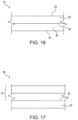
- Figures 16 and 17 are schematic cross sectional view of representative aspect articles 10 and 60 in accordance with the present subject matter.
- the article 10 comprises a substrate or material 20 defining faces 22 and 24.
- a layer or region of pressure sensitive adhesive 30 is disposed on at least one of the faces such as face 24.
- the pressure sensitive adhesive is as described herein and typically comprises a hyperbranched polymer that includes a silsesquioxane core and/or a metallo-silsesquioxane core.
- the layer of PSA 30 typically defines an exposed face 34 for adhesion.
- the article 60 shown in Figure 17 can include the article 10 of Figure 16 and one or more protective release liners 50 that at least partially cover the exposed face 34 of the PSA. Release liners are well known in the art and so are not described herein.
- hyperbranched polymers Discovery of the unique properties of hyperbranched polymers has led to rapid development in the field during the past decade but no activity in pressure sensitive adhesives. Topological specifics of hyperbranched polymers responsible for their most important peculiar properties have been studied. Among those are high level of solubility and thermodynamic compatibility, low viscosity of solutions, resistance to aggregation in solutions (including concentrated solutions), and ability to function as nano-containers for substances sorbed inside macromolecules.
- the main topological feature of hyperbranched polymers is high-volume concentration of chain units inside macromolecules as a consequence of branching without cross-linking. Also, this volume concentration increases as the degree of branching increases.
- hyperbranched polymers are characterized by weak dependence (as compared to linear polymers) of hydrodynamic volume of macromolecules upon molecular weight, because the higher the molecular weight, the more compact the molecular packing.
- Such compact packing of hyperbranched polymers and the large number of free ends of chains with functional groups on their periphery represent the main structural and physical reason for the unique properties.
- a benefit pertinent to adhesives of the present subject matter involves the ability to process without the use of solvents, and the capability to achieve high peel, shear, and thermal resistance.
- a disadvantage of many conventional linear polymer-based PSAs, branched-linear PSAs, and randomly crosslinked adhesive networks is that peel and shear cannot increase simultaneously. One comes at the cost of the other thus limiting the adhesive and/or its performance.
- the present subject matter provides a means to overcome these limitations of conventional PSAs.
- Table 1 Tape Performance Test Methods Test Condition 180° Peel a. Peel: sample applied to a stainless steel panel with a 5 pound roller with 1 pass in each direction. Samples conditioned and tested at 23° C. Shear Strength a. Room temperature shear: 1 Kg weight with a 0.5 inch by 0.5 inch overlap. Sample applied to stainless steel panel with a 5 pound roller with 1 pass in each direction. Samples conditioned and tested at 23° C.
- n-butyl acrylate 7.5g of n-butyl acrylate, 2.5g of Isobornyl acrylate, 0.002g of 2-Hydroxy-4'-(2-hydroxyethoxy)-2-methylpropiophenone, and 0.03g of 3-mercaptopropyltrimethoxysilane were charged in a glass reactor. The contents of the reactor were inerted with nitrogen for 5 minutes. Then the contents were exposed to UV radiation of 365nm for 4hr to produce the precursor in high yield.
- n-butyl acrylate, 4.2g t-butyl acrylate, 0.002g of 2-Hydroxy-4'-(2-hydroxyethoxy)-2-methylpropiophenone, and 0.03g of 3-mercaptopropyltrimethoxysilane were charged in a glass reactor. The contents of the reactor were inerted with nitrogen for 5 minutes. Then the contents were exposed to UV radiation of 365nm for 4hr to produce the precursor in high yield.
- precursor 7 10g was dissolved in 2g ethyl acetate. Then 0.015g of Tyzor AA 105 was added to precursor solution. The solution was cast on a silicone release liner followed by drying in a convection oven at 150 °C for 5 minutes. Upon drying, the resulting material was a non-tacky coating and exhibited a DSC measured Tg of 12.5 ° C and a DMA measured shear modulus of 1 ⁇ 10 7 N/m 2 (1 ⁇ 10 8 dynes/cm 2 ), both values being outside the range of PSAs.
- precursor 4 10g was dissolved in 5g ethyl acetate. Then 0.015g of Tyzor AA 105 was added to precursor solution. The solution was cast on a silicone release liner followed by drying in a convection oven at 150 °C for 5 minutes to obtain pressure sensitive adhesive in transfer tape format.
- precursor 5 10g was dissolved in 5 g ethyl acetate. Then 0.015g of Tyzor AA 105 was added to precursor solution. The solution was cast on a silicone release liner followed by drying in a convection oven at 150 °C for 5 minutes to obtain pressure sensitive adhesive in transfer tape format.
- Example 8 Further testing demonstrated that the shear modulus and the glass transition temperature of material in Example 8 was outside the PSA range.
- Table 3 - Peel and Shear Performance of Hyperbranched Silsesquioxane Pressure Sensitive Adhesives Example Peel (180 ° on stainless steel) lb/in Shear (0.5"x0.5", 1kg) minutes 8 Non-tacky Non-tacky 9 9.20 25 10 3.30 2130
- GPC analysis is a good technique to estimate the number of silicon atoms in the silsesquioxane core.
- the condensed species is solubilized in the GPC solvent followed by molecular weight determination of the sol portion.
- molecular weight of the precursor By comparing the molecular weight of the precursor with that of the condensed species is a direct indication of the number of silicon atoms in the core. This number typically spanned between 6 and 8 in the above examples. However, it will be understood that in no way is the present subject matter limited to this range.
Landscapes
- Chemical & Material Sciences (AREA)
- Chemical Kinetics & Catalysis (AREA)
- Organic Chemistry (AREA)
- Health & Medical Sciences (AREA)
- Medicinal Chemistry (AREA)
- Polymers & Plastics (AREA)
- Silicon Polymers (AREA)
- Adhesives Or Adhesive Processes (AREA)
- Adhesive Tapes (AREA)
Claims (15)
- Haftkleber, umfassend ein hyperverzweigtes Polymer, das hyperverzweigte Polymer umfassend mindestens einen Silsesquioxankern und mindestens zwei Polymerketten, die chemisch an jeden der Silsesquioxankerne gebunden sind,wobei die mindestens zwei Polymerketten von einem mittleren Silikatkern ausgehen, um ein hyperverzweigtes Polymer zu bilden,wobei das hyperverzweigte Polymer durch einen hydrolysierbaren und kondensierbaren oder nur einen kondensierbaren Vorläufer gebildet wird, wobei der Vorläufer eine Formel aufweist:
R-Si(X)3-a(Y)a
wobei R eine von einer nicht-hydrolysierbaren organischen Gruppe, einer nicht-hydrolysierbaren Oligomerkette und einer nicht-hydrolysierbaren Polymerkette ist, X eine hydrolysierbare Gruppe ist, Y eine organofunktionelle Gruppe ist und der Wert von "a" ausgewählt ist aus der Gruppe bestehend aus 0, 1, 2 und Kombinationen davon,wobei X ausgewählt ist aus der Gruppe bestehend aus Halogen, Acyloxy, Ketoximat, Alkoxy und Kombinationen davon,wobei das zahlenmittlere Molekulargewicht (Mn) des Vorläufers in einem Bereich von 2000 bis 300.000 g/Mol ist, bestimmt durch Gelpermeationschromatographie wie beschrieben in der Beschreibung, undwobei der Haftkleber frei von Vernetzungen ist. - Haftkleber nach Anspruch 1, der ferner einen Klebrigmacher beinhaltet.
- Haftkleber nach Anspruch 1 oder 2, wobei jeder der Silsesquioxankerne eines Abschnitts der hyperverzweigten Polymere seriell und kovalent mit einem anderen Silsesquioxankern verbunden ist, um eine Perlenkettenstruktur zu bilden, optional wobei die Verbindung ein Polyol umfasst, das folgende Struktur aufweist:

- Haftkleber nach einem der Ansprüche 1 oder 2, wobei jeder der Silsesquioxankerne eines Abschnitts der hyperverzweigten Polymere kovalent mit einem oder mehreren anderen Silsesquioxankemen verbunden ist, um eine mehrdimensionale Netzwerkstruktur zu bilden, optional wobei eine oder beide der folgenden Aussagen (A)-(B) zutreffen:(A) die Verbindung umfasst ein hydrolysierbares Disilan, das folgende Struktur aufweist:
 (B) das mehrdimensionale Netzwerk ist eine zweidimensionale Struktur.
 - Verfahren zum Bilden eines Haftklebers, umfassend die folgenden Schritte:Bereitstellen eines Vorläufers nach Anspruch 1; undUnterziehen des Vorläufers einer Hydrolyse und einer Kondensationsreaktion oder nur einer Kondensationsreaktion, um dadurch ein hyperverzweigtes Polymer zu bilden, das einen Silsesquioxankern umfasst.
- Verfahren nach Anspruch 5, wobei der Schritt eines Bereitstellens eines Vorläufers ein Polymerisieren von (Meth)acrylatmonomeren in Anwesenheit eines radikalischen Initiators und eines silanhaltigen Kettenübertragungsmittels (CTA) umfasst, optional wobei eine oder beide der folgenden Aussagen (A)-(B) zutreffen:(A) das Molverhältnis von CTA zu Initiator ist in einem Bereich von 200:1 bis 1:2;(B) die Struktur des Kettenübertragungsmittels (CTA) ist
 wobei R eine organische Verbindungsgruppe ist, die sich zwischen einem Thiol und einer hydrolysierbaren Silangruppierung befindet, X eine hydrolysierbare Gruppe ist, Y eine organofunktionelle Gruppe ist und der Wert von "a" ausgewählt ist aus der Gruppe bestehend aus 0, 1, 2 und Kombinationen davon,wobei X ausgewählt ist aus der Gruppe bestehend aus Halogen, Acyloxy, Ketoximat, Alkoxy und Kombinationen davon.
 - Verfahren nach Anspruch 6, wobei der Initiator bei Aussetzung an mindestens eines von Wärme, aktinischer Strahlung oder Elektronenstrahlung aktiviert wird,
optional wobei der Initiator durch Aussetzung an UV-Strahlung aktiviert wird. - Verfahren nach einem der Ansprüche 5-7, wobei die Hydrolyse und die Kondensationsreaktion oder nur die Kondensationsreaktion in einem Temperaturbereich von 20 °C bis 50 °C oder von 51 °C bis 170 °C erfolgt,optional wobei die Hydrolyse und die Kondensationsreaktion oder nur die Kondensationsreaktion in Anwesenheit eines Katalysators erfolgen,und ferner optional wobei der Katalysator in der Menge von 0,5 bis 5 Gewichtsprozent des Vorläufers ist.
- Verfahren nach einem der Ansprüche 5-8, ferner umfassend:
Bereitstellen eines Kernmodifikators bevor und/oder während der Vorläufer der Hydrolyse und der Kondensationsreaktion oder nur der Kondensationsreaktion unterzogen wird. - Verfahren nach einem der Ansprüche 5-9, das ferner den Schritt eines Hinzufügens eines Klebrigmachers beinhaltet,
optional wobei der Klebrigmacher im Wesentlichen mit dem Vorläufer kompatibel ist. - Verfahren nach einem der Ansprüche 5-10, das ferner den Schritt eines Hinzufügens einer Menge eines Polyols während der Kondensationsreaktion beinhaltet, um jeden der Silsesquioxankerne eines Abschnitts der hyperverzweigten Polymere seriell und kovalent mit einem anderen Silsesquioxankern zu verbinden, um eine Perlenkettenstruktur zu bilden, wobei das Polyol folgende Struktur aufweist:
 wobei R eine Spacer-Gruppe ist, die sich zwischen den OH-Gruppen befindet, und n ausgewählt ist aus der Gruppe bestehend aus 2, 3, 4 und Kombinationen davon,und optional wobei das Polyol in der Menge von 0 bis 30 Gewichtsprozent des Haftklebsers ist.
 - Verfahren nach einem der Ansprüche 5-10, das ferner den Schritt eines Hinzufügens einer Menge eines hydrolysierbaren Disilans während der Kondensationsreaktion beinhaltet, um jeden der Silsesquioxankerne eines Abschnitts der hyperverzweigten Polymere mit einem oder mehreren anderen Silsesquioxankemen zu verbinden, um eine mehrdimensionale Netzwerkstruktur zu bilden, wobei das hydrolysierbare Disilan folgende Struktur aufweist:
 (A) das mehrdimensionale Netzwerk ist eine zweidimensionale Struktur,(B) das hydrolysierbare Disilan ist in der Menge von 0 bis 30 Gewichtsprozent von mindestens einem von dem Haftkleber,(C) X ist ausgewählt aus der Gruppe bestehend aus Halogen, Acyloxy, Ketoximat, Alkoxy und Kombinationen davon.
 - Haftkleber nach einem der Ansprüche 1-4, wobei eine der folgenden Aussagen (A)-(M) zutrifft:(A) der Silsesquioxankern ist ausgewählt aus der Gruppe bestehend aus einem reinen Silsesquioxankem, einem hybriden Silsesquioxankern und Kombinationen davon, optional wobei der Silsesquioxankern ausgewählt ist aus der Gruppe bestehend aus einem vollständig kondensierten Kern, einem teilweise kondensierten Kern und Kombinationen davon;(B) der Silsesquioxankern umfasst einen Hybridkern, bei dem ein oder mehrere der Si-Atome in dem Kern durch ein Atom M eines Kernmodifikators substituiert sind, wobei der Kernmodifikator eine Formel aufweist, die ausgewählt ist aus der Gruppe bestehend aus MX, MX2, MX3, MX4, MX5, MX6, RMX, RMX2, RMX3, RMX4, RMX5 und RMX6, wobei R ausgewählt ist aus der Gruppe bestehend aus Alkyl, Alkenyl, Aryl, H und Kombinationen davon, M unabhängig ausgewählt ist aus Al, Si, Ge, Sn, Ti und Zr und X ausgewählt ist aus der Gruppe bestehend aus einem organischen einzähnigen Liganden, einem organischen zweizähnigen Liganden, einem organischen dreizähnigen Liganden, einem organischen beidseitig zähnigen Liganden, Halogen, Alkoxid und Kombinationen davon;(C) der Silsesquioxankern umfasst einen Hybridkern, bei dem ein oder mehrere der Si-Atome in dem Kern durch ein Atom M eines Kernmodifikators substituiert sind, wobei der Kernmodifikator eine Formel aufweist, die ausgewählt ist aus der Gruppe bestehend aus M(X)4 und M(X)a(Z)b, wobei M unabhängig ausgewählt ist aus Al, Si, Ge, Sn, Ti und Zr, a 2 ist, b 2 ist, X eine hydrolysierbare Gruppe ist, Z ein organischer Ligand der Formel A-C(O)-(R')n-C(O)-B ist, wobei R' eine organische Gruppe ist und n eine ganze Zahl von 0 bis 10 ist, A eine organische Gruppe ist und B eine organische Gruppe ist;(D) der Silsesquioxankern umfasst einen Hybridkern, bei dem ein oder mehrere der Si-Atome in dem Kern durch ein anderes Si-Atom eines Kernmodifikators substituiert sind, wobei der Kernmodifikator eine Formel R"4-qSi(OR#)q aufweist, wobei R" eine funktionelle oder nicht-funktionelle Kohlenwasserstoffgruppe ist, R# ausgewählt ist aus der Gruppe bestehend aus Methyl, Ethyl und Isopropyl, und q 2 oder 3 ist;(E) der Silsesquioxankern umfasst einen Hybridkern, bei dem ein oder mehrere der Si-Atome in dem Kern durch ein anderes Si-Atom eines Kernmodifikators substituiert sind, wobei der Kernmodifikator eine Formel Si(OR#)4 aufweist, bei der R# ausgewählt ist aus der Gruppe bestehend aus Methyl, Ethyl und Isopropyl;(F) die Polymerkette enthält keine ethylenische Ungesättigtheit oder acrylatische Ungesättigtheit entlang des Gerüsts der Polymerkette;(G) die Polymerkette umfasst (Meth)acrylatmonomere, die miteinander verbunden sind, um Polymere zu bilden, die ausgewählt sind aus der Gruppe bestehend aus linearen Homopolymeren, verzweigten Homopolymeren, linearen Copolymeren, verzweigten Copolymeren und Kombinationen davon;(H) der Haftkleber umfasst mindestens 50 Gewichtsprozent (Meth)acrylatmonomere;(I) der Haftkleber beinhaltet ferner ein Oligomer, das mindestens eine vernetzbare funktionelle Gruppe aufweist,optional wobei das Oligomer bei Raumtemperatur eine Flüssigkeit ist, undoptional wobei das Oligomer ein Gerüst aufweist, das ausgewählt ist aus der Gruppe bestehend aus Polyether, Polyisobutylen, amorphen Poly-alpha-Olefinen, Polybutadienen, Polyisoprenen, Polydimethylsiloxanen, Polyalkyloxazolinen, Polyestern, Poly(methyl)acrylaten, Polyurethanen und Kombinationen davon;(J) die Silsesquioxankerne weisen die allgemeine Formel [RSiO3/2]n auf, wobei n eine gerade Zahl ist und R ausgewählt ist aus der Gruppe bestehend aus Alkyl, Aryl, Heterokohlenstoff, Polymer, Oligomer, (Meth)acrylatpolymer, (Meth)acrylatoligomer und Kombinationen davon;(K) die Silsesquioxankerne weisen die allgemeine Formel [R-SiO3/2]n(H2O)(3n/2)-x auf, wobei "n" eine positive ganze Zahl ist, "x" ein positiver ganzer Wert kleiner als oder gleich wie 3n/2 ist und R ausgewählt ist aus der Gruppe bestehend aus Alkyl, Aryl, Heterokohlenstoff, Polymer, Oligomer, (Meth)acrylatpolymer, (Meth)acrylatoligomer und Kombinationen davon;(L) der Haftkleber weist eine Glasübergangstemperatur (Tg) von 10 °C bis -60 °C auf, bestimmt durch Differential-Scanning-Kalorimetrie (DSC); oder(M) der Haftkleber weist einen Plateau-Schermodul bei 25 °C und 1 Radiant pro Sekunde auf, der zwischen 5×10³ and 6×10⁵ N/m2 (5×10⁴ und 6×10⁶ dyn/cm2) ist, bestimmt durch eine dynamisch-mechanische Analyse (DMA).
- Verfahren nach einem der Ansprüche 5-12, wobei eine der folgenden Aussagen (A)-(M) zutrifft:(A) der Silsesquioxankern ist ausgewählt aus der Gruppe bestehend aus einem reinen Silsesquioxankem, einem hybriden Silsesquioxankern und Kombinationen davon, optional wobei der Silsesquioxankern ausgewählt ist aus der Gruppe bestehend aus einem vollständig kondensierten Kern, einem teilweise kondensierten Kern und Kombinationen davon;(B) das Verfahren ferner umfassend ein Bereitstellen eines Kernmodifikators bevor und/oder während der Vorläufer der Hydrolyse und der Kondensationsreaktion oder nur der Kondensationsreaktion unterzogen wird, wobei der Silsesquioxankern einen Hybridkern umfasst, bei dem ein oder mehrere der Si-Atome in dem Kern durch ein Atom M eines Kernmodifikators substituiert sind, wobei der Kernmodifikator eine Formel aufweist, die ausgewählt ist aus der Gruppe bestehend aus MX, MX2, MX3, MX4, MX5, MX6, RMX, RMX2, RMX3, RMX4, RMX5 und RMX6, wobei R ausgewählt ist aus der Gruppe bestehend aus Alkyl, Alkenyl, Aryl, H und Kombinationen davon, M unabhängig ausgewählt ist aus Al, Si, Ge, Sn, Ti und Zr und X ausgewählt ist aus der Gruppe bestehend aus einem organischen einzähnigen Liganden, einem organischen zweizähnigen Liganden, einem organischen dreizähnigen Liganden, einem organischen beidseitig zähnigen Liganden, Halogen, Alkoxid und Kombinationen davon;(C) das Verfahren ferner umfassend ein Bereitstellen eines Kernmodifikators bevor und/oder während der Vorläufer der Hydrolyse und der Kondensationsreaktion oder nur der Kondensationsreaktion unterzogen wird, wobei der Silsesquioxankern einen Hybridkern umfasst, bei dem ein oder mehrere der Si-Atome in dem Kern durch ein Atom M eines Kernmodifikators substituiert sind, wobei der Kernmodifikator eine Formel aufweist, die ausgewählt ist aus der Gruppe bestehend aus M(X)4 und M(X)a(Z)b, wobei M unabhängig ausgewählt ist aus Al, Si, Ge, Sn, Ti und Zr, a 2 ist, b 2 ist, X eine hydrolysierbare Gruppe ist, Z ein organischer Ligand der Formel A-C(O)-(R')n-C(O)-B ist, wobei R' eine organische Gruppe ist und n eine ganze Zahl von 0 bis 10 ist, A eine organische Gruppe ist und B eine organische Gruppe ist;(D) das Verfahren ferner umfassend ein Bereitstellen eines Kernmodifikators bevor und/oder während der Vorläufer der Hydrolyse und der Kondensationsreaktion oder nur der Kondensationsreaktion unterzogen wird, wobei der Silsesquioxankern einen Hybridkern umfasst, bei dem ein oder mehrere der Si-Atome in dem Kern durch ein anderes Si-Atom eines Kernmodifikators substituiert sind, wobei der Kernmodifikator eine Formel R"4-qSi(OR#)q aufweist, wobei R" eine funktionelle oder nicht-funktionelle Kohlenwasserstoffgruppe ist, R# ausgewählt ist aus der Gruppe bestehend aus Methyl, Ethyl und Isopropyl, und q 2 oder 3 ist;(E) das Verfahren ferner umfassend ein Bereitstellen eines Kernmodifikators bevor und/oder während der Vorläufer der Hydrolyse und der Kondensationsreaktion oder nur der Kondensationsreaktion unterzogen wird, wobei der Silsesquioxankern einen Hybridkern umfasst, bei dem ein oder mehrere der Si-Atome in dem Kern durch ein anderes Si-Atom eines Kernmodifikators substituiert sind, wobei der Kernmodifikator eine Formel Si(OR#)4 aufweist, bei der R# ausgewählt ist aus der Gruppe bestehend aus Methyl, Ethyl und Isopropyl;(F) die Polymerkette enthält keine ethylenische Ungesättigtheit oder acrylatische Ungesättigtheit entlang des Gerüsts der Polymerkette;(G) die Polymerkette umfasst (Meth)acrylatmonomere, die miteinander verbunden sind, um Polymere zu bilden, die ausgewählt sind aus der Gruppe bestehend aus linearen Homopolymeren, verzweigten Homopolymeren, linearen Copolymeren, verzweigten Copolymeren und Kombinationen davon;(H) der Haftkleber umfasst mindestens 50 Gewichtsprozent (Meth)acrylatmonomere;(I) das Verfahren beinhaltet ferner den Schritt eines Hinzufügens eines Oligomers, das zusätzlich zu dem Vorläufer mindestens eine vernetzbare funktionelle Gruppe aufweist,optional wobei das Oligomer bei Raumtemperatur eine Flüssigkeit ist, undoptional wobei das Oligomer ein Gerüst aufweist, das ausgewählt ist aus der Gruppe bestehend aus Polyether, Polyisobutylen, amorphen Poly-alpha-Olefinen, Polybutadienen, Polyisoprenen, Polydimethylsiloxanen, Polyalkyloxazolinen, Polyestern, Poly(methyl)acrylaten, Polyurethanen und Kombinationen davon;(J) die Silsesquioxankerne weisen die allgemeine Formel [RSiO3/2]n auf, wobei n eine gerade Zahl ist und R ausgewählt ist aus der Gruppe bestehend aus Alkyl, Aryl, Heterokohlenstoff, Polymer, Oligomer, (Meth)acrylatpolymer, (Meth)acrylatoligomer und Kombinationen davon;(K) die Silsesquioxankerne weisen die allgemeine Formel [R-SiO3/2]n(H2O)(3n/2)-x auf, wobei "n" eine positive ganze Zahl ist, "x" ein positiver ganzer Wert kleiner als oder gleich wie 3n/2 ist und R ausgewählt ist aus der Gruppe bestehend aus Alkyl, Aryl, Heterokohlenstoff, Polymer, Oligomer, (Meth)acrylatpolymer, (Meth)acrylatoligomer und Kombinationen davon;(L) der Haftkleber weist eine Glasübergangstemperatur (Tg) von 10 °C bis -60 °C auf, bestimmt durch Differential-Scanning-Kalorimetrie (DSC); oder(M) der Haftkleber weist einen Plateau-Schermodul bei 25 °C und 1 Radiant pro Sekunde auf, der zwischen 5×10³ and 6×10⁵ N/m2 (5×10⁴ und 6×10⁶ dyn/cm2) ist, bestimmt durch eine dynamisch-mechanische Analyse (DMA).
- Gegenstand, umfassend den Haftkleber nach einem der Ansprüche 1-4 oder 13 oder den Haftkleber, der nach dem Verfahren nach einem der Ansprüche 5-12 oder 14 gebildet wird, wobei der Gegenstand ferner Folgendes umfasst:ein Substrat, das eine Oberfläche definiert;wobei der Haftkleber auf mindestens einen Abschnitt der Oberfläche des Substrats aufgebracht ist.
Priority Applications (2)
| Application Number | Priority Date | Filing Date | Title |
|---|---|---|---|
| EP23213129.2A EP4306608A3 (de) | 2017-07-28 | 2018-07-24 | Haftkleber und artikel mit hyperverzweigtem silsesquioxankern und herstellungsverfahren dafür |
| EP23212442.0A EP4303283A3 (de) | 2017-07-28 | 2018-07-24 | Haftkleber und artikel mit hyperverzweigtem silsesquioxankern und herstellungsverfahren dafür |
Applications Claiming Priority (2)
| Application Number | Priority Date | Filing Date | Title |
|---|---|---|---|
| US201762538512P | 2017-07-28 | 2017-07-28 | |
| PCT/US2018/043401 WO2019023178A1 (en) | 2017-07-28 | 2018-07-24 | PRESSURE-SENSITIVE ADHESIVES AND HYPERRAMIFIED SILSESQUIOXANE CORE ARTICLES AND METHODS OF MAKING SAME |
Related Child Applications (4)
| Application Number | Title | Priority Date | Filing Date |
|---|---|---|---|
| EP23212442.0A Division EP4303283A3 (de) | 2017-07-28 | 2018-07-24 | Haftkleber und artikel mit hyperverzweigtem silsesquioxankern und herstellungsverfahren dafür |
| EP23212442.0A Division-Into EP4303283A3 (de) | 2017-07-28 | 2018-07-24 | Haftkleber und artikel mit hyperverzweigtem silsesquioxankern und herstellungsverfahren dafür |
| EP23213129.2A Division EP4306608A3 (de) | 2017-07-28 | 2018-07-24 | Haftkleber und artikel mit hyperverzweigtem silsesquioxankern und herstellungsverfahren dafür |
| EP23213129.2A Division-Into EP4306608A3 (de) | 2017-07-28 | 2018-07-24 | Haftkleber und artikel mit hyperverzweigtem silsesquioxankern und herstellungsverfahren dafür |
Publications (2)
| Publication Number | Publication Date |
|---|---|
| EP3658643A1 EP3658643A1 (de) | 2020-06-03 |
| EP3658643B1 true EP3658643B1 (de) | 2024-01-03 |
Family
ID=63294428
Family Applications (3)
| Application Number | Title | Priority Date | Filing Date |
|---|---|---|---|
| EP18758774.6A Active EP3658643B1 (de) | 2017-07-28 | 2018-07-24 | Haftkleber und artikel mit hyperverzweigtem silsesquioxankern und herstellungsverfahren dafür |
| EP23212442.0A Pending EP4303283A3 (de) | 2017-07-28 | 2018-07-24 | Haftkleber und artikel mit hyperverzweigtem silsesquioxankern und herstellungsverfahren dafür |
| EP23213129.2A Pending EP4306608A3 (de) | 2017-07-28 | 2018-07-24 | Haftkleber und artikel mit hyperverzweigtem silsesquioxankern und herstellungsverfahren dafür |
Family Applications After (2)
| Application Number | Title | Priority Date | Filing Date |
|---|---|---|---|
| EP23212442.0A Pending EP4303283A3 (de) | 2017-07-28 | 2018-07-24 | Haftkleber und artikel mit hyperverzweigtem silsesquioxankern und herstellungsverfahren dafür |
| EP23213129.2A Pending EP4306608A3 (de) | 2017-07-28 | 2018-07-24 | Haftkleber und artikel mit hyperverzweigtem silsesquioxankern und herstellungsverfahren dafür |
Country Status (4)
| Country | Link |
|---|---|
| US (2) | US11661533B2 (de) |
| EP (3) | EP3658643B1 (de) |
| CN (2) | CN111133074B (de) |
| WO (1) | WO2019023178A1 (de) |
Families Citing this family (3)
| Publication number | Priority date | Publication date | Assignee | Title |
|---|---|---|---|---|
| KR102846844B1 (ko) * | 2019-03-14 | 2025-08-18 | 다우 실리콘즈 코포레이션 | 폴리(메트)아크릴레이트기를 갖는 폴리오가노실록산 및 이의 제조 및 사용 방법 |
| CN111851139B (zh) * | 2019-04-30 | 2022-08-12 | 陆筱棣 | 一种制备可膨胀微球的方法及得到的微球与应用 |
| KR20230052927A (ko) * | 2020-08-20 | 2023-04-20 | 주식회사 다이셀 | 실란 커플링제 |
Family Cites Families (35)
| Publication number | Priority date | Publication date | Assignee | Title |
|---|---|---|---|---|
| EP0282000B1 (de) * | 1987-03-11 | 1993-06-09 | Kansai Paint Co., Ltd. | Kathodisch abscheidbares teilchenförmiges Polymergel und dieses enthaltende kathodisch elektroabscheidbare Beschichtungszusammensetzung |
| DE69206431T2 (de) * | 1991-01-28 | 1996-05-02 | Kanegafuchi Chemical Ind | Härtbare Zusammensetzung. |
| US6274688B1 (en) * | 1997-07-28 | 2001-08-14 | Kaneka Corporation | Functional groups-terminated vinyl polymers |
| US6482900B1 (en) * | 1997-09-22 | 2002-11-19 | Kaneka Corporation | Polymer, process for producing the polymer, and curable composition containing the polymer |
| WO2003091291A1 (en) * | 2002-04-25 | 2003-11-06 | Kaneka Corporation | Process for producing (meth)acrylic polymer terminated by crosslinkable silyl group |
| EP1933804A2 (de) | 2005-10-03 | 2008-06-25 | L'Oréal | Nagel-makeup- oder pflege-methode |
| CN101300289B (zh) * | 2005-10-28 | 2012-07-25 | 陶氏环球技术有限责任公司 | 倍半硅氧烷-二氧化钛杂化聚合物 |
| US7897683B2 (en) * | 2006-05-24 | 2011-03-01 | Nitto Denko Corporation | Medical adhesive and medical adhesive tape or sheet |
| EP2035503B1 (de) | 2006-06-20 | 2012-06-13 | Dow Corning Corporation | Härtbare organosiliciumzusammensetzung |
| US20100326273A1 (en) * | 2006-09-29 | 2010-12-30 | Uop Llc | Plasticization resistant membranes |
| WO2008085234A1 (en) | 2007-01-09 | 2008-07-17 | Dow Corning Corporation | Process for forming films and films formed by the process |
| DE102007008663A1 (de) * | 2007-02-20 | 2008-08-21 | Merck Patent Gmbh | Bindemittel |
| US8765112B2 (en) * | 2007-04-19 | 2014-07-01 | University Of Massachusetts | Thermal responsive polymer siloxanes, compositions, and method and applications related thereto |
| DE102007038661A1 (de) * | 2007-08-15 | 2009-02-19 | Henkel Ag & Co. Kgaa | Silanvernetzender Kleb- oder Dichtstoff mit N-Silylakylamiden und seine Verwendung |
| WO2009065873A2 (en) * | 2007-11-21 | 2009-05-28 | Basf Se | Polyhedral oligomeric stannasilsesquioxanes as catalyst for polyurethane curing |
| WO2009080965A2 (fr) | 2007-12-05 | 2009-07-02 | L'oreal | Procede cosmetique utilisant une composition comprenant une resine de siloxane et une charge minerale |
| ATE524530T1 (de) | 2008-01-30 | 2011-09-15 | Dow Corning | Verwendung von glasartigen siliconbasierten hartbeschichtungen als trennbeschichtungen für druckbare elektronik |
| DE102008020441A1 (de) | 2008-04-23 | 2009-10-29 | Merck Patent Gmbh | Klebstoff |
| US8501887B2 (en) | 2008-07-28 | 2013-08-06 | Dow Corning Corporation | Radical polymerizable composition |
| EP2542616A1 (de) | 2010-03-03 | 2013-01-09 | 3M Innovative Properties Company | Mehrschichtige verbundstruktur mit nanostrukturierter oberfläche |
| FR2968938B1 (fr) | 2010-12-21 | 2013-06-21 | Oreal | Composition cosmetique anhydre et solide |
| BR112013023128A2 (pt) | 2011-03-14 | 2019-09-24 | 3M Innovative Properties Co | artigos nanoestruturados |
| JP5653310B2 (ja) * | 2011-07-13 | 2015-01-14 | 日産自動車株式会社 | 塗料組成物及びそれを用いた塗膜形成方法 |
| JP6019910B2 (ja) * | 2011-08-19 | 2016-11-02 | 住友化学株式会社 | 粘着剤組成物、粘着剤シート、粘着剤付き光学フィルム及び光学積層体 |
| US20130241390A1 (en) * | 2012-03-14 | 2013-09-19 | Peter Guschl | Metal-containing encapsulant compositions and methods |
| US9260571B2 (en) * | 2012-05-24 | 2016-02-16 | Lawrence Livermore National Security, Llc | Hybrid polymer networks as ultra low ‘k’ dielectric layers |
| JP6038637B2 (ja) * | 2012-12-21 | 2016-12-07 | メルクパフォーマンスマテリアルズマニュファクチャリング合同会社 | 金属酸化物ナノ粒子とシルセスキオキサンポリマーとの複合体およびその製造方法、ならびにその複合体を用いて製造した複合材料 |
| JP5988889B2 (ja) * | 2013-02-15 | 2016-09-07 | リンテック株式会社 | 粘着性組成物、粘着剤および粘着シート |
| US10072132B2 (en) * | 2014-03-05 | 2018-09-11 | Kaneka Corporation | Curable composition |
| WO2015195391A1 (en) * | 2014-06-20 | 2015-12-23 | 3M Innovative Properties Company | Adhesive compositions comprising a silsesquioxane polymer crosslinker, articles and methods |
| KR20170020869A (ko) * | 2014-06-20 | 2017-02-24 | 쓰리엠 이노베이티브 프로퍼티즈 캄파니 | 실세스퀴옥산 중합체 코어 및 실세스퀴옥산 중합체 외층을 포함하는 경화성 중합체 및 방법 |
| US10048934B2 (en) | 2015-02-16 | 2018-08-14 | International Business Machines Corporation | Learning intended user actions |
| CN104861098B (zh) * | 2015-04-28 | 2017-01-25 | 中科院广州化学有限公司 | 一种具有pH刺激响应性的星型聚合物及其制备方法与应用 |
| CN106188573B (zh) * | 2016-08-05 | 2018-08-07 | 中科院广州化学有限公司 | 一种星型聚合物稳定的pH响应性乳液及制备方法和应用 |
| CN106543444B (zh) * | 2016-10-18 | 2019-11-22 | 中科院广州化学有限公司 | 笼形倍半硅氧烷基星型杂臂双亲性聚合物及其制备方法 |
-
2018
- 2018-07-24 EP EP18758774.6A patent/EP3658643B1/de active Active
- 2018-07-24 EP EP23212442.0A patent/EP4303283A3/de active Pending
- 2018-07-24 CN CN201880059663.7A patent/CN111133074B/zh active Active
- 2018-07-24 CN CN202211712959.9A patent/CN115851187B/zh active Active
- 2018-07-24 WO PCT/US2018/043401 patent/WO2019023178A1/en not_active Ceased
- 2018-07-24 US US16/043,541 patent/US11661533B2/en active Active
- 2018-07-24 EP EP23213129.2A patent/EP4306608A3/de active Pending
-
2023
- 2023-03-08 US US18/180,408 patent/US20230220249A1/en active Pending
Also Published As
| Publication number | Publication date |
|---|---|
| EP4303283A3 (de) | 2024-02-28 |
| US20190031924A1 (en) | 2019-01-31 |
| CN115851187A (zh) | 2023-03-28 |
| CN115851187B (zh) | 2025-10-31 |
| US20230220249A1 (en) | 2023-07-13 |
| CN111133074A (zh) | 2020-05-08 |
| US11661533B2 (en) | 2023-05-30 |
| EP3658643A1 (de) | 2020-06-03 |
| EP4306608A2 (de) | 2024-01-17 |
| EP4306608A3 (de) | 2024-02-21 |
| CN111133074B (zh) | 2023-01-03 |
| WO2019023178A1 (en) | 2019-01-31 |
| EP4303283A2 (de) | 2024-01-10 |
Similar Documents
| Publication | Publication Date | Title |
|---|---|---|
| US20230220249A1 (en) | Pressure Sensitive Adhesives and Articles with Hyperbranched Silsesquioxane Core and Methods of Making the Same | |
| JP3058346B2 (ja) | ペイント塗布支持体へ接着可能な輻射線硬化性アクリレート/シリコーン系感圧接着剤塗布テープ | |
| US6432475B1 (en) | Pressure-sensitive adhesive composition, process for the preparation thereof and pressure-sensitive adhesive sheets | |
| JPH06506014A (ja) | 放射線硬化性ビニル/シリコーン剥離コーティング | |
| JP6138741B2 (ja) | 反応性ホットメルト接着剤 | |
| WO1999005215A1 (en) | Curable adhesive composition | |
| JP2013518950A (ja) | 改善された難燃性を有する硬化性組成物 | |
| JPH03103486A (ja) | 多目的シロキサン剥離被覆 | |
| JP2011525201A (ja) | 水架橋性封止剤 | |
| TW201623383A (zh) | 可熱適形可固化黏著劑薄膜 | |
| JP5833498B2 (ja) | 耐ブリスター用粘着シート | |
| JP6272109B2 (ja) | 粘着剤組成物、粘着シート、および粘着シートの製造方法 | |
| JP2002265922A (ja) | 自動車ガラス用接着剤 | |
| TWI902797B (zh) | 光與濕氣硬化型樹脂組成物、電子零件用接著劑、硬化物及電子零件 | |
| KR102158446B1 (ko) | 매니큐어 스티커의 제조방법 | |
| CN106519876B (zh) | 一种超支化聚合物改性含硅丙烯酸酯防黏剂及其制备方法 | |
| JP5002777B2 (ja) | アクリル系粘着テープの製法およびアクリル系粘着テープ | |
| CN105143387A (zh) | 包含聚碳酸亚烃酯的树脂组合物及由此生产的自粘膜 | |
| CN118703089B (zh) | 一种涂层材料、基于其的具有表面微结构阵列的防雾抗污涂层及涂层的制备方法 | |
| JP2001354745A5 (de) | ||
| JP7530212B2 (ja) | 両面粘着シート及び積層体 | |
| JP2023535923A (ja) | 防水通気性物品を製造するための接着剤組成物 | |
| CN113444191B (zh) | 一种硅烷改性聚烯烃成膜剂及其制备方法与应用 | |
| JPH04202585A (ja) | 湿気硬化型接着剤組成物 | |
| JPH04114078A (ja) | 湿気硬化型接着剤組成物 |
Legal Events
| Date | Code | Title | Description |
|---|---|---|---|
| STAA | Information on the status of an ep patent application or granted ep patent |
Free format text: STATUS: UNKNOWN |
|
| STAA | Information on the status of an ep patent application or granted ep patent |
Free format text: STATUS: THE INTERNATIONAL PUBLICATION HAS BEEN MADE |
|
| PUAI | Public reference made under article 153(3) epc to a published international application that has entered the european phase |
Free format text: ORIGINAL CODE: 0009012 |
|
| STAA | Information on the status of an ep patent application or granted ep patent |
Free format text: STATUS: REQUEST FOR EXAMINATION WAS MADE |
|
| 17P | Request for examination filed |
Effective date: 20200124 |
|
| AK | Designated contracting states |
Kind code of ref document: A1 Designated state(s): AL AT BE BG CH CY CZ DE DK EE ES FI FR GB GR HR HU IE IS IT LI LT LU LV MC MK MT NL NO PL PT RO RS SE SI SK SM TR |
|
| AX | Request for extension of the european patent |
Extension state: BA ME |
|
| DAV | Request for validation of the european patent (deleted) | ||
| DAX | Request for extension of the european patent (deleted) | ||
| RAP3 | Party data changed (applicant data changed or rights of an application transferred) |
Owner name: AVERY DENNISON CORPORATION |
|
| GRAP | Despatch of communication of intention to grant a patent |
Free format text: ORIGINAL CODE: EPIDOSNIGR1 |
|
| STAA | Information on the status of an ep patent application or granted ep patent |
Free format text: STATUS: GRANT OF PATENT IS INTENDED |
|
| INTG | Intention to grant announced |
Effective date: 20230330 |
|
| GRAJ | Information related to disapproval of communication of intention to grant by the applicant or resumption of examination proceedings by the epo deleted |
Free format text: ORIGINAL CODE: EPIDOSDIGR1 |
|
| STAA | Information on the status of an ep patent application or granted ep patent |
Free format text: STATUS: REQUEST FOR EXAMINATION WAS MADE |
|
| INTC | Intention to grant announced (deleted) | ||
| GRAP | Despatch of communication of intention to grant a patent |
Free format text: ORIGINAL CODE: EPIDOSNIGR1 |
|
| STAA | Information on the status of an ep patent application or granted ep patent |
Free format text: STATUS: GRANT OF PATENT IS INTENDED |
|
| INTG | Intention to grant announced |
Effective date: 20231012 |
|
| GRAS | Grant fee paid |
Free format text: ORIGINAL CODE: EPIDOSNIGR3 |
|
| GRAA | (expected) grant |
Free format text: ORIGINAL CODE: 0009210 |
|
| STAA | Information on the status of an ep patent application or granted ep patent |
Free format text: STATUS: THE PATENT HAS BEEN GRANTED |
|
| AK | Designated contracting states |
Kind code of ref document: B1 Designated state(s): AL AT BE BG CH CY CZ DE DK EE ES FI FR GB GR HR HU IE IS IT LI LT LU LV MC MK MT NL NO PL PT RO RS SE SI SK SM TR |
|
| REG | Reference to a national code |
Ref country code: GB Ref legal event code: FG4D |
|
| REG | Reference to a national code |
Ref country code: CH Ref legal event code: EP |
|
| REG | Reference to a national code |
Ref country code: DE Ref legal event code: R096 Ref document number: 602018063624 Country of ref document: DE |
|
| REG | Reference to a national code |
Ref country code: IE Ref legal event code: FG4D |
|
| REG | Reference to a national code |
Ref country code: LT Ref legal event code: MG9D |
|
| PG25 | Lapsed in a contracting state [announced via postgrant information from national office to epo] |
Ref country code: ES Free format text: LAPSE BECAUSE OF FAILURE TO SUBMIT A TRANSLATION OF THE DESCRIPTION OR TO PAY THE FEE WITHIN THE PRESCRIBED TIME-LIMIT Effective date: 20240103 |
|
| PG25 | Lapsed in a contracting state [announced via postgrant information from national office to epo] |
Ref country code: ES Free format text: LAPSE BECAUSE OF FAILURE TO SUBMIT A TRANSLATION OF THE DESCRIPTION OR TO PAY THE FEE WITHIN THE PRESCRIBED TIME-LIMIT Effective date: 20240103 |
|
| REG | Reference to a national code |
Ref country code: NL Ref legal event code: MP Effective date: 20240103 |
|
| REG | Reference to a national code |
Ref country code: AT Ref legal event code: MK05 Ref document number: 1646778 Country of ref document: AT Kind code of ref document: T Effective date: 20240103 |
|
| PG25 | Lapsed in a contracting state [announced via postgrant information from national office to epo] |
Ref country code: NL Free format text: LAPSE BECAUSE OF FAILURE TO SUBMIT A TRANSLATION OF THE DESCRIPTION OR TO PAY THE FEE WITHIN THE PRESCRIBED TIME-LIMIT Effective date: 20240103 |
|
| PG25 | Lapsed in a contracting state [announced via postgrant information from national office to epo] |
Ref country code: NL Free format text: LAPSE BECAUSE OF FAILURE TO SUBMIT A TRANSLATION OF THE DESCRIPTION OR TO PAY THE FEE WITHIN THE PRESCRIBED TIME-LIMIT Effective date: 20240103 |
|
| PG25 | Lapsed in a contracting state [announced via postgrant information from national office to epo] |
Ref country code: IS Free format text: LAPSE BECAUSE OF FAILURE TO SUBMIT A TRANSLATION OF THE DESCRIPTION OR TO PAY THE FEE WITHIN THE PRESCRIBED TIME-LIMIT Effective date: 20240503 |
|
| PG25 | Lapsed in a contracting state [announced via postgrant information from national office to epo] |
Ref country code: LT Free format text: LAPSE BECAUSE OF FAILURE TO SUBMIT A TRANSLATION OF THE DESCRIPTION OR TO PAY THE FEE WITHIN THE PRESCRIBED TIME-LIMIT Effective date: 20240103 |
|
| PG25 | Lapsed in a contracting state [announced via postgrant information from national office to epo] |
Ref country code: GR Free format text: LAPSE BECAUSE OF FAILURE TO SUBMIT A TRANSLATION OF THE DESCRIPTION OR TO PAY THE FEE WITHIN THE PRESCRIBED TIME-LIMIT Effective date: 20240404 |
|
| PG25 | Lapsed in a contracting state [announced via postgrant information from national office to epo] |
Ref country code: RS Free format text: LAPSE BECAUSE OF FAILURE TO SUBMIT A TRANSLATION OF THE DESCRIPTION OR TO PAY THE FEE WITHIN THE PRESCRIBED TIME-LIMIT Effective date: 20240403 Ref country code: HR Free format text: LAPSE BECAUSE OF FAILURE TO SUBMIT A TRANSLATION OF THE DESCRIPTION OR TO PAY THE FEE WITHIN THE PRESCRIBED TIME-LIMIT Effective date: 20240103 |
|
| PG25 | Lapsed in a contracting state [announced via postgrant information from national office to epo] |
Ref country code: AT Free format text: LAPSE BECAUSE OF FAILURE TO SUBMIT A TRANSLATION OF THE DESCRIPTION OR TO PAY THE FEE WITHIN THE PRESCRIBED TIME-LIMIT Effective date: 20240103 Ref country code: CZ Free format text: LAPSE BECAUSE OF FAILURE TO SUBMIT A TRANSLATION OF THE DESCRIPTION OR TO PAY THE FEE WITHIN THE PRESCRIBED TIME-LIMIT Effective date: 20240103 |
|
| PG25 | Lapsed in a contracting state [announced via postgrant information from national office to epo] |
Ref country code: RS Free format text: LAPSE BECAUSE OF FAILURE TO SUBMIT A TRANSLATION OF THE DESCRIPTION OR TO PAY THE FEE WITHIN THE PRESCRIBED TIME-LIMIT Effective date: 20240403 Ref country code: NO Free format text: LAPSE BECAUSE OF FAILURE TO SUBMIT A TRANSLATION OF THE DESCRIPTION OR TO PAY THE FEE WITHIN THE PRESCRIBED TIME-LIMIT Effective date: 20240403 Ref country code: LT Free format text: LAPSE BECAUSE OF FAILURE TO SUBMIT A TRANSLATION OF THE DESCRIPTION OR TO PAY THE FEE WITHIN THE PRESCRIBED TIME-LIMIT Effective date: 20240103 Ref country code: IS Free format text: LAPSE BECAUSE OF FAILURE TO SUBMIT A TRANSLATION OF THE DESCRIPTION OR TO PAY THE FEE WITHIN THE PRESCRIBED TIME-LIMIT Effective date: 20240503 Ref country code: HR Free format text: LAPSE BECAUSE OF FAILURE TO SUBMIT A TRANSLATION OF THE DESCRIPTION OR TO PAY THE FEE WITHIN THE PRESCRIBED TIME-LIMIT Effective date: 20240103 Ref country code: GR Free format text: LAPSE BECAUSE OF FAILURE TO SUBMIT A TRANSLATION OF THE DESCRIPTION OR TO PAY THE FEE WITHIN THE PRESCRIBED TIME-LIMIT Effective date: 20240404 Ref country code: CZ Free format text: LAPSE BECAUSE OF FAILURE TO SUBMIT A TRANSLATION OF THE DESCRIPTION OR TO PAY THE FEE WITHIN THE PRESCRIBED TIME-LIMIT Effective date: 20240103 Ref country code: BG Free format text: LAPSE BECAUSE OF FAILURE TO SUBMIT A TRANSLATION OF THE DESCRIPTION OR TO PAY THE FEE WITHIN THE PRESCRIBED TIME-LIMIT Effective date: 20240103 Ref country code: AT Free format text: LAPSE BECAUSE OF FAILURE TO SUBMIT A TRANSLATION OF THE DESCRIPTION OR TO PAY THE FEE WITHIN THE PRESCRIBED TIME-LIMIT Effective date: 20240103 |
|
| PG25 | Lapsed in a contracting state [announced via postgrant information from national office to epo] |
Ref country code: PL Free format text: LAPSE BECAUSE OF FAILURE TO SUBMIT A TRANSLATION OF THE DESCRIPTION OR TO PAY THE FEE WITHIN THE PRESCRIBED TIME-LIMIT Effective date: 20240103 Ref country code: PT Free format text: LAPSE BECAUSE OF FAILURE TO SUBMIT A TRANSLATION OF THE DESCRIPTION OR TO PAY THE FEE WITHIN THE PRESCRIBED TIME-LIMIT Effective date: 20240503 |
|
| PG25 | Lapsed in a contracting state [announced via postgrant information from national office to epo] |
Ref country code: SE Free format text: LAPSE BECAUSE OF FAILURE TO SUBMIT A TRANSLATION OF THE DESCRIPTION OR TO PAY THE FEE WITHIN THE PRESCRIBED TIME-LIMIT Effective date: 20240103 Ref country code: PT Free format text: LAPSE BECAUSE OF FAILURE TO SUBMIT A TRANSLATION OF THE DESCRIPTION OR TO PAY THE FEE WITHIN THE PRESCRIBED TIME-LIMIT Effective date: 20240503 Ref country code: PL Free format text: LAPSE BECAUSE OF FAILURE TO SUBMIT A TRANSLATION OF THE DESCRIPTION OR TO PAY THE FEE WITHIN THE PRESCRIBED TIME-LIMIT Effective date: 20240103 Ref country code: LV Free format text: LAPSE BECAUSE OF FAILURE TO SUBMIT A TRANSLATION OF THE DESCRIPTION OR TO PAY THE FEE WITHIN THE PRESCRIBED TIME-LIMIT Effective date: 20240103 |
|
| REG | Reference to a national code |
Ref country code: DE Ref legal event code: R097 Ref document number: 602018063624 Country of ref document: DE |
|
| PG25 | Lapsed in a contracting state [announced via postgrant information from national office to epo] |
Ref country code: DK Free format text: LAPSE BECAUSE OF FAILURE TO SUBMIT A TRANSLATION OF THE DESCRIPTION OR TO PAY THE FEE WITHIN THE PRESCRIBED TIME-LIMIT Effective date: 20240103 |
|
| PG25 | Lapsed in a contracting state [announced via postgrant information from national office to epo] |
Ref country code: SM Free format text: LAPSE BECAUSE OF FAILURE TO SUBMIT A TRANSLATION OF THE DESCRIPTION OR TO PAY THE FEE WITHIN THE PRESCRIBED TIME-LIMIT Effective date: 20240103 |
|
| PG25 | Lapsed in a contracting state [announced via postgrant information from national office to epo] |
Ref country code: EE Free format text: LAPSE BECAUSE OF FAILURE TO SUBMIT A TRANSLATION OF THE DESCRIPTION OR TO PAY THE FEE WITHIN THE PRESCRIBED TIME-LIMIT Effective date: 20240103 |
|
| PG25 | Lapsed in a contracting state [announced via postgrant information from national office to epo] |
Ref country code: SK Free format text: LAPSE BECAUSE OF FAILURE TO SUBMIT A TRANSLATION OF THE DESCRIPTION OR TO PAY THE FEE WITHIN THE PRESCRIBED TIME-LIMIT Effective date: 20240103 |
|
| PG25 | Lapsed in a contracting state [announced via postgrant information from national office to epo] |
Ref country code: SM Free format text: LAPSE BECAUSE OF FAILURE TO SUBMIT A TRANSLATION OF THE DESCRIPTION OR TO PAY THE FEE WITHIN THE PRESCRIBED TIME-LIMIT Effective date: 20240103 Ref country code: SK Free format text: LAPSE BECAUSE OF FAILURE TO SUBMIT A TRANSLATION OF THE DESCRIPTION OR TO PAY THE FEE WITHIN THE PRESCRIBED TIME-LIMIT Effective date: 20240103 Ref country code: RO Free format text: LAPSE BECAUSE OF FAILURE TO SUBMIT A TRANSLATION OF THE DESCRIPTION OR TO PAY THE FEE WITHIN THE PRESCRIBED TIME-LIMIT Effective date: 20240103 Ref country code: EE Free format text: LAPSE BECAUSE OF FAILURE TO SUBMIT A TRANSLATION OF THE DESCRIPTION OR TO PAY THE FEE WITHIN THE PRESCRIBED TIME-LIMIT Effective date: 20240103 Ref country code: DK Free format text: LAPSE BECAUSE OF FAILURE TO SUBMIT A TRANSLATION OF THE DESCRIPTION OR TO PAY THE FEE WITHIN THE PRESCRIBED TIME-LIMIT Effective date: 20240103 |
|
| PLBE | No opposition filed within time limit |
Free format text: ORIGINAL CODE: 0009261 |
|
| STAA | Information on the status of an ep patent application or granted ep patent |
Free format text: STATUS: NO OPPOSITION FILED WITHIN TIME LIMIT |
|
| PG25 | Lapsed in a contracting state [announced via postgrant information from national office to epo] |
Ref country code: IT Free format text: LAPSE BECAUSE OF FAILURE TO SUBMIT A TRANSLATION OF THE DESCRIPTION OR TO PAY THE FEE WITHIN THE PRESCRIBED TIME-LIMIT Effective date: 20240103 |
|
| 26N | No opposition filed |
Effective date: 20241007 |
|
| PG25 | Lapsed in a contracting state [announced via postgrant information from national office to epo] |
Ref country code: IT Free format text: LAPSE BECAUSE OF FAILURE TO SUBMIT A TRANSLATION OF THE DESCRIPTION OR TO PAY THE FEE WITHIN THE PRESCRIBED TIME-LIMIT Effective date: 20240103 |
|
| PG25 | Lapsed in a contracting state [announced via postgrant information from national office to epo] |
Ref country code: MC Free format text: LAPSE BECAUSE OF FAILURE TO SUBMIT A TRANSLATION OF THE DESCRIPTION OR TO PAY THE FEE WITHIN THE PRESCRIBED TIME-LIMIT Effective date: 20240103 |
|
| REG | Reference to a national code |
Ref country code: CH Ref legal event code: PL |
|
| PG25 | Lapsed in a contracting state [announced via postgrant information from national office to epo] |
Ref country code: LU Free format text: LAPSE BECAUSE OF NON-PAYMENT OF DUE FEES Effective date: 20240724 |
|
| PG25 | Lapsed in a contracting state [announced via postgrant information from national office to epo] |
Ref country code: LU Free format text: LAPSE BECAUSE OF NON-PAYMENT OF DUE FEES Effective date: 20240724 |
|
| PG25 | Lapsed in a contracting state [announced via postgrant information from national office to epo] |
Ref country code: SI Free format text: LAPSE BECAUSE OF FAILURE TO SUBMIT A TRANSLATION OF THE DESCRIPTION OR TO PAY THE FEE WITHIN THE PRESCRIBED TIME-LIMIT Effective date: 20240103 Ref country code: CH Free format text: LAPSE BECAUSE OF NON-PAYMENT OF DUE FEES Effective date: 20240731 Ref country code: BE Free format text: LAPSE BECAUSE OF NON-PAYMENT OF DUE FEES Effective date: 20240731 |
|
| REG | Reference to a national code |
Ref country code: BE Ref legal event code: MM Effective date: 20240731 |
|
| PGFP | Annual fee paid to national office [announced via postgrant information from national office to epo] |
Ref country code: GB Payment date: 20250612 Year of fee payment: 8 |
|
| PGFP | Annual fee paid to national office [announced via postgrant information from national office to epo] |
Ref country code: FR Payment date: 20250612 Year of fee payment: 8 |
|
| PG25 | Lapsed in a contracting state [announced via postgrant information from national office to epo] |
Ref country code: IE Free format text: LAPSE BECAUSE OF NON-PAYMENT OF DUE FEES Effective date: 20240724 |
|
| PG25 | Lapsed in a contracting state [announced via postgrant information from national office to epo] |
Ref country code: FI Free format text: LAPSE BECAUSE OF FAILURE TO SUBMIT A TRANSLATION OF THE DESCRIPTION OR TO PAY THE FEE WITHIN THE PRESCRIBED TIME-LIMIT Effective date: 20240103 |
|
| PGFP | Annual fee paid to national office [announced via postgrant information from national office to epo] |
Ref country code: DE Payment date: 20250616 Year of fee payment: 8 |
|
| PG25 | Lapsed in a contracting state [announced via postgrant information from national office to epo] |
Ref country code: CY Free format text: LAPSE BECAUSE OF FAILURE TO SUBMIT A TRANSLATION OF THE DESCRIPTION OR TO PAY THE FEE WITHIN THE PRESCRIBED TIME-LIMIT; INVALID AB INITIO Effective date: 20180724 |
|
| PG25 | Lapsed in a contracting state [announced via postgrant information from national office to epo] |
Ref country code: HU Free format text: LAPSE BECAUSE OF FAILURE TO SUBMIT A TRANSLATION OF THE DESCRIPTION OR TO PAY THE FEE WITHIN THE PRESCRIBED TIME-LIMIT; INVALID AB INITIO Effective date: 20180724 |