EP3654988B1 - Sarecycline for the treatment of non-inflammatory acne lesions - Google Patents
Sarecycline for the treatment of non-inflammatory acne lesions Download PDFInfo
- Publication number
- EP3654988B1 EP3654988B1 EP18779747.7A EP18779747A EP3654988B1 EP 3654988 B1 EP3654988 B1 EP 3654988B1 EP 18779747 A EP18779747 A EP 18779747A EP 3654988 B1 EP3654988 B1 EP 3654988B1
- Authority
- EP
- European Patent Office
- Prior art keywords
- methyl
- lesions
- inflammatory lesions
- effective amount
- treatment
- Prior art date
- Legal status (The legal status is an assumption and is not a legal conclusion. Google has not performed a legal analysis and makes no representation as to the accuracy of the status listed.)
- Active
Links
Images



Classifications
-
- A—HUMAN NECESSITIES
- A61—MEDICAL OR VETERINARY SCIENCE; HYGIENE
- A61K—PREPARATIONS FOR MEDICAL, DENTAL OR TOILETRY PURPOSES
- A61K31/00—Medicinal preparations containing organic active ingredients
- A61K31/65—Tetracyclines
-
- A—HUMAN NECESSITIES
- A61—MEDICAL OR VETERINARY SCIENCE; HYGIENE
- A61P—SPECIFIC THERAPEUTIC ACTIVITY OF CHEMICAL COMPOUNDS OR MEDICINAL PREPARATIONS
- A61P17/00—Drugs for dermatological disorders
- A61P17/10—Anti-acne agents
-
- A—HUMAN NECESSITIES
- A61—MEDICAL OR VETERINARY SCIENCE; HYGIENE
- A61K—PREPARATIONS FOR MEDICAL, DENTAL OR TOILETRY PURPOSES
- A61K9/00—Medicinal preparations characterised by special physical form
- A61K9/0012—Galenical forms characterised by the site of application
- A61K9/0053—Mouth and digestive tract, i.e. intraoral and peroral administration
Definitions
- the instant disclosure relates to a compound for use in the treatment of non-inflammatory acne vulgaris lesions.
- Acne vulgaris also referred to as acne
- Acne may also be present with non-inflammatory lesions, also known as open and closed comedones.
- Acne is a disorder resulting from hormones affecting the sebaceous glands, which leads to plugged pores and outbreaks of lesions, or pimples.
- Acne is the most common skin disease in the United States, affecting nearly 17 million people. Severe acne can lead to disfiguration and permanent scarring.
- PSUs pilosebaceous units
- Inflammatory lesions are characterized by the presence of papules, pustules, and nodules (cysts) and are classified as papulopustular and/or nodular.
- a severity grade based on a lesion count approximation is assigned as mild, moderate, or severe (Dermet Skin disease Atlas).
- non-inflammatory lesions consist of open and closed comedones and usually appear before inflammatory lesions. Closed comedones or whiteheads appear as white microcysts.
- the follicular opening is barely perceptible. Open comedones or blackheads have a dilated follicular orifice that contains a plug with a dark surface. The opening may be small or very large.
- Tetracycline compounds or tetracyclines, are known "broad spectrum" antibiotics and have been widely used for therapeutic purposes. Tetracyclines are bacteriostatic drugs and act by binding reversibly to the 30S subunit of the bacterial ribosome. This inhibits the addition of amino acids to the growing peptide resulting in inhibition of protein synthesis. Tetracyclines also exhibit antiinflammatory and anti-collagenolytic properties which are not related to antibiotic activity (Cutis, 75(4 Suppl): 6-11, Apr. 2005).
- tetracyclines have been found to be highly effective pharmacologically against rickettsiae and several gram-positive and gram-negative bacteria, including lymphogranuloma venereum, inclusion conjunctivitis, and psittacosis.
- Examples of pharmaceutically active tetracycline analogue compositions may be found in U.S. Patent Nos. 2,980,584 ; 2,990,331 ; 3,062,717 ; 3,165,531 ; 3,454,697 ; 3,557,280 ; 3,674,859 ; 3,957,980 ; 4,018,889 ; 4,024,272 ; and 4,126,680 .
- Some tetracyclines may also be used to treat inflammatory skin disorders, including dermatitis, psoriasis, pyoderma gangrenosum, acne, and rosacea.
- substituted tetracycline compounds were developed to treat bacterial infections, inflammation, neoplasms, and other conditions.
- these tetracycline compounds include without limitation: chlortetracycline, doxycycline, minocycline, oxytetracycline, demeclocycline, methacycline, sancycline, chelocardin, rolitetracycline, lymecycline, apicycline, clomocycline, guamecycline, meglucycline, mepylcycline, penimepicycline, pipacycline, etamocycline, and penimocycline.
- substituted tetracycline compounds have been disclosed in WO 2008/079339 and WO 2008/079363 .
- the tetracycline compound sarecycline was investigated for its efficacy in the treatment of facial acne vulgaris (primarily inflammatory lesions, but also non-inflammatory lesions as a secondary measure) in https://clinicaltrials.gov/ct2/show/study/NCT01628549 .
- the present invention relates to a compound, which compound is (4S,4aS,5aR,12aS)-4-dimethylamino-3, 10, 12, 12a-tetrahydroxy-7-[(methoxy(methyl)amino)-methyl]-1,11-dioxo-1,4,4a,5,5a,6,11,12a-octahydro-naphthacene-2-carboxylic acid amide or a pharmaceutically acceptable salt thereof, for use in a therapeutically effective amount in the treatment of non-inflammatory acne vulgaris lesion.
- One pharmaceutically acceptable salt may be a crystalline salt of (4S,4aS,5aR,12aS)-4-(dimethylamino)-3,10,12,12a-tetrahydroxy-7-[(methoxy(methyl)amino)methyl]-1,11-dioxo-1,4,4a,5,5a,6,11,12a-octahydro-naphthacene-2-carboxylic acid amide hydrochloride.
- This crystalline salt may be, for example, a mono hydrochloride, a mono mesylate, or a mono sulfate.
- the crystalline salt may be (4S,4aS,5aR,12aS)-4-(dimethylamino)-3,10,12,12a-tetrahydroxy-7-[(methoxy(methyl)amino)methyl]-1,11-dioxo-1,4,4a,5,5a,6,11,12a-octahydro- naphthacene-2-carboxamide hydrochloride.
- non-inflammatory lesions and/or symptoms thereof can be treated using (4S,4aS,5aR, 12aS)-4-dimethylamino-3, 10, 12, 12a-tetrahydroxy-7-[(methoxy(methyl)amino)-methyl]-1,11-dioxo-1,4,4a,5,5a,6,11,12a-octahydro-naphthacene-2-carboxylic acid amide (sarecycline) or a pharmaceutically acceptable salt thereof.
- prophylactic treatment for non-inflammatory lesions and/or symptoms thereof can be performed using (4S,4aS,5aR,12aS)-4-dimethylamino-3, 10, 12, 12a-tetrahydroxy-7-[(methoxy(methyl)amino)-methyl]-1,11-dioxo-1,4,4a,5,5a,6,11,12a-octahydro-naphthacene-2-carboxylic acid amide (sarecycline) or a pharmaceutically acceptable salt thereof.
- Non-inflammatory lesions comprise open and closed comedones.
- An open comedo commonly referred to as a blackhead, is a non-infected plugged hair follicle with a dilated or open orifice.
- a closed comedo commonly referred to as a whitehead, is a non-infected plugged hair follicle having dilated follicular orifice that contains a plug with a dark skin surface.
- Symptoms or signs of non-inflammatory lesions vary depending on the severity of the condition of the subject and may be associated with small epidermal cyst-like masses that manifest on the surface of the skin that may have a flesh-like color and/or dark spots, which may appear to be a brown or black color on the surface of the skin.
- a therapeutically effective amount of the drug, or a safe and clinically effective amount of the drug, is administered , and, preferably, such administration is performed for a time period sufficient to reduce the number, size and/or occurrence of non-inflammatory lesions.
- terapéuticaally effective amount refers to an amount that may be effective to elicit the desired biological or medical response, including the amount of a compound that, when administered to a subject for treating a condition, is sufficient to affect such treatment for the condition.
- the effective amount will vary depending on the condition and its severity, as well as the age, weight and physical condition of the subject, as well as the duration of treatment.
- safe and clinically effective amount refers to an amount of a compound or composition high enough to significantly positively modify the symptoms and/or condition to be treated, but low enough to avoid serious side effects (at a reasonable risk/benefit ratio), within the scope of sound medical judgment.
- the safe and clinically effective amount of active ingredient for use in the method of the invention herein will vary with the particular condition being treated, the age and physical condition of the patient to be treated, the severity of the condition, the duration of the treatment, the nature of concurrent therapy, the particular active ingredient being employed, the particular pharmaceutically-acceptable excipients utilized, and like factors within the knowledge and expertise of the attending physician.
- Subjects who may be treated, according to the present invention are subjects who have and/or exhibit non-inflammatory lesions and subjects who may be prone to developing non-inflammatory lesions.
- the subject may have at least 10 non-inflammatory lesions, at least 20 non-inflammatory lesions, at least 30 non-inflammatory lesions, at least 40 non-inflammatory lesions, at least 50 non-inflammatory lesions, at least 60 non-inflammatory lesions, at least 70 non-inflammatory lesions, at least 80 non-inflammatory lesions, at least 90 non-inflammatory lesions, at least 100 non-inflammatory lesions, or at least 110 non-inflammatory lesions.
- the subject may have fewer than 10 non-inflammatory lesions.
- the subject in accordance with the present invention is a human. In another aspect, the subject is a non-human mammal.
- treatment include therapeutic and/or prophylactic treatment as described herein.
- treatment includes the diminishment in the appearance, or size, or number of these non-inflammatory lesions on the skin and/or alleviation of at least one of the symptoms associated with non-inflammatory lesions.
- prophylactic treatment includes treatment that reduces the increase in the size and/or number of non-inflammatory lesions on the skin that would otherwise occur without such treatment.
- the prophylactic treatment is a preventative treatment of a subject, wherein the preventative treatment may prevent an increase in the number of non-inflammatory lesions.
- the subject in need of the prophylactic treatment may have no non-inflammatory lesions or may have any number of non-inflammatory lesions, such as those mentioned above.
- prophylactic treatment may be appropriate for a subject who is prone to developing non-inflammatory lesions but who may not exhibit non-inflammatory lesions at time of treatment.
- pharmaceutically acceptable salt refers to any adduct between two or more chemical species that are capable of undergoing proton transfer.
- pharmaceutically acceptable salt encompasses adducts in which complete proton transfer has occurred, adducts in which partial proton transfer has occurred (e.g., in which an equilibrium mixture of charged and uncharged species is formed), and/or adducts in which proton transfer has not occurred but the chemical species are associated, e.g., by hydrogen bonding. It is understood that the term “pharmaceutically acceptable salt” also encompasses adducts in which close ion pairs are present.
- pharmaceutically acceptable salt encompasses a continuum of adducts between those adducts in which complete proton transfer has occurred to form discrete ions and/or adducts in which two species are associated but proton transfer has not occurred or has only partially occurred. See, e.g., Childs et al. Mol. Pharmaceutics, 2007, 4 (3), pp 323-338 .
- a given pharmaceutically acceptable salt can contain one or multiple adducts on this continuum.
- Pharmaceutically acceptable salts include salts of acidic or basic groups.
- Pharmaceutically acceptable acid addition salts include, but are not limited to, hydrochloride, hydrobromide, hydroiodide, nitrate, mesylate, sulfate, bisulfate, phosphate, acid phosphate, isonicotinate, acetate, lactate, salicylate, citrate, tartrate, pantothenate, bitartrate, ascorbate, succinate, maleate gentisinate, fumarate, gluconate, glucaronate, saccharate, formate, benzoate, glutamate, methanesulfonate, ethanesulfonate, benzensulfonate, ptoluenesulfonate and pamoate (i.e., 1,1'-methylene-bis-(2-hydroxy-3-naphthoate)) salts.
- Suitable base salts include, but are not limited to, aluminum, calcium, lithium,
- the pharmaceutically acceptable salt may be a crystalline salt of (4S,4aS,5aR,12aS)-4-dimethylamino-3,10,12,12a-tetrahydroxy-7-[(methoxy(methyl)amino)-methyl]-1,11-dioxo-1,4,4a,5,5a,6,11,12a-octahydro-naphthacene-2-carboxylic acid amide.
- Such crystalline salt may be selected from the group consisting of mono hydrochloride, mono mesylate, and mono sulfate. These crystalline salts are described in U.S. Patent No. 9,255,068 .
- the therapeutically effective amount of (4S,4aS,5aR,12aS)-4-dimethylamino-3,10,12,12a-tetrahydroxy-7-[(methoxy(methyl)amino)-methyl]-1,11-dioxo-1,4,4a,5,5a,6,11,12a-octahydro-naphthacene-2-carboxylic acid amide or a pharmaceutically acceptable salt thereof will typically range from 0.75 mg/kg per day to 3.0 mg/kg per day. This amount may be from each of 0.75 mg/kg and 1.1 mg/kg to each of 1.5 mg/kg per day and 1.8 mg/kg per day. For example, the amount may be 3.0 mg/kg per day or 1.5 mg/kg per day.
- the therapeutically effective amount of (4S,4aS,5aR,12aS)-4-dimethylamino-3, 10, 12, 12a-tetrahydroxy-7-[(methoxy(methyl)amino)-methyl]-1,11-dioxo-1,4,4a, 5, 5 a,6,11,12a-octahydro-naphthacene-2-carboxylic acid amide or a pharmaceutically acceptable salt thereof employed is from 1 mg to 200 mg. This amount may be, for example, from each of 60 mg and 65 mg to each of 100 mg, 105 mg, 150 mg, 155 mg, and 160 mg.
- such administration is performed for at least 1 week, at least 2 weeks, at least 3 weeks, at least 4 weeks, at least 5 weeks, at least 6 weeks, at least 7 weeks, at least 8 weeks, at least 9 weeks, at least 10 weeks, at least 11 weeks, or at least 12 weeks.
- (4S,4aS,5aR, 12aS)-4-dimethylamino-3, 10, 12, 12a-tetrahydroxy-7-[(methoxy(methyl)amino)-methyl]-1,11-dioxo-1,4,4a, 5, 5 a,6,11,12a-octahydro-naphthacene-2-carboxylic acid amide or a pharmaceutically acceptable salt thereof may be administered to the subject in need thereof at approximately the same time each day. For example, administration may occur in the evening. Administration may take place at least 1 hour prior to, or 2 hours after, a meal, such as an evening meal.
- (4S,4aS,5aR,12aS)-4-dimethylamino-3,10,12,12a-tetrahydroxy-7-[(methoxy(methyl)amino)-methyl]-1,11-dioxo-1,4,4a,5,5a,6,11,12a-octahydro-naphthacene-2-carboxylic acid amide or a pharmaceutically acceptable salt thereof as discussed throughout this disclosure is administered to the subject orally via an oral dosage form.
- oral dose refers to any pharmaceutical composition intended to be administered to the gastrointestinal tract of a subject via the mouth of said subject, and for purposes of the present disclosure, the oral dosage form as administered and/or delivered can be in liquid, solid, semi-solid, gelatinous form.
- a solid oral dosage form may be a tablet, capsule, granule.
- Such oral dosage forms may contain various excipients such as microcrystalline cellulose, sodium citrate, calcium carbonate, dicalcium phosphate and glycine, along with various disintegrants such as starch (and preferably corn, potato or tapioca starch), alginic acid and certain complex silicates, together with granulation binders like polyvinylpyrrolidone, sucrose, gelatin and acacia.
- the oral dosage form may be film coated.
- lubricating agents such as magnesium stearate, sodium lauryl sulfate and talc may be used.
- Other solid compositions may also be employed as fillers in the oral dosage form including lactose or milk sugar, as well as high molecular weight polyethylene glycols.
- aqueous suspensions and/or elixirs When aqueous suspensions and/or elixirs are desired for oral administration, they may include various sweetening or flavoring agents, coloring matter or dyes, and, if so desired, emulsifying and/or suspending agents, together with such diluents as water, ethanol, propylene glycol, glycerin and various like combinations thereof.
- administering a therapeutically effective amount of (4S,4aS,5aR,12aS)-4-dimethylamino-3, 10, 12, 12a-tetrahydroxy-7-[(methoxy(methyl)amino)-methyl]-1,11-dioxo-1,4,4a,5,5a,6,11,12a-octahydro-naphthacene-2-carboxylic acid amide or a pharmaceutically acceptable salt may result in the mean percent reduction in non-inflammatory lesions from 2% to 75%. In another embodiment, such administration may result in the mean percent reduction in non-inflammatory lesions from 4% to 53%.
- such administration may result in the mean percent reduction in non-inflammatory lesions from 14% to 43%. In another embodiment, such administration can result in the mean percent reduction in non-inflammatory lesions from 16% to 41%. In another embodiment, such administration can result in the mean percent reduction in non-inflammatory lesions from 17% to 39%. In another embodiment, such administration can result in the mean percent reduction in non-inflammatory lesions from 20% to 39%.
- mean percent reduction of non-inflammatory lesions after 3 weeks of treatment with a therapeutically effective amount of (4S,4aS,5aR,12aS)-4-dimethylamino-3,10,12,12a-tetrahydroxy-7-[(methoxy(methyl)amino)-methyl]-1,11-dioxo-1,4,4a,5,5a,6,11,12a-octahydro-naphthacene-2-carboxylic acid amide or a pharmaceutically acceptable salt may range from 10% to 25%.
- mean percent reduction of non-inflammatory lesions after 3 weeks of treatment with a therapeutically effective amount of (4S,4aS,5aR, 12aS)-4-dimethylamino-3,10,12,12a-tetrahydroxy-7-[(methoxy(methyl)amino)-methyl]-1,1 1-dioxo-1,4,4a,5,5a,6,11,12a-octahydro-naphthacene-2-carboxylic acid amide or a pharmaceutically acceptable salt can range from 16% to 23%.
- mean percent reduction of non-inflammatory lesions after 6 weeks of treatment with a therapeutically effective amount of (4S,4aS,5aR, 12aS)-4-dimethylamino-3,10,12,12a-tetrahydroxy-7-[(methoxy(methyl)amino)-methyl]-1,1 1-dioxo-1,4,4a,5,5a,6,11,12a-octahydro-naphthacene-2-carboxylic acid amide or a pharmaceutically acceptable salt may range from 20% to 35%.
- mean percent reduction of non-inflammatory lesions after 6 weeks of treatment with a therapeutically effective amount of (4S,4aS,5aR, 12aS)-4-dimethylamino-3,10,12,12a-tetrahydroxy-7-[(methoxy(methyl)amino)-methyl]-1,1 1-dioxo-1,4,4a,5,5a,6,11,12a-octahydro-naphthacene-2-carboxylic acid amide or a pharmaceutically acceptable salt can range from 25% to 31%.
- mean percent reduction of non-inflammatory lesions after 9 weeks of treatment with a therapeutically effective amount of (4S,4aS,5aR, 12aS)-4-dimethylamino-3,10,12,12a-tetrahydroxy-7-[(methoxy(methyl)amino)-methyl]-1,1 1-dioxo-1,4,4a,5,5a,6,11,12a-octahydro-naphthacene-2-carboxylic acid amide or a pharmaceutically acceptable salt may range from 30% to 45%.
- mean percent reduction of non-inflammatory lesions after 9 weeks of treatment with a therapeutically effective amount of (4S,4aS,5aR, 12aS)-4-dimethylamino-3,10,12,12a-tetrahydroxy-7-[(methoxy(methyl)amino)-methyl]-1,1 1-dioxo-1,4,4a,5,5a,6,11,12a-octahydro-naphthacene-2-carboxylic acid amide or a pharmaceutically acceptable salt can range from 32% to 38%.
- mean percent reduction of non-inflammatory lesions after 12 weeks of treatment with a therapeutically effective amount of (4S,4aS,5aR, 12aS)-4-dimethylamino-3,10,12,12a-tetrahydroxy-7-[(methoxy(methyl)amino)-methyl]-1,1 1-dioxo-1,4,4a,5,5a,6,11,12a-octahydro-naphthacene-2-carboxylic acid amide or a pharmaceutically acceptable salt may range from 35% to 50%.
- mean percent reduction of non-inflammatory lesions after 12 weeks of treatment with a therapeutically effective amount of (4S,4aS,5aR, 12aS)-4-dimethylamino-3,10,12,12a-tetrahydroxy-7-[(methoxy(methyl)amino)-methyl]-1,1 1-dioxo-1,4,4a,5,5a,6,11,12a-octahydro-naphthacene-2-carboxylic acid amide or a pharmaceutically acceptable salt can range from 36% to 41%.
- the difference in mean percent reduction in non-inflammatory lesions of a subject who receives a therapeutically effective amount of (4S,4aS,5aR,12aS)-4-dimethylamino-3,10,12,12a-tetrahydroxy-7-[(methoxy(methyl)amino)-methyl]-1,1 1-dioxo-1,4,4a,5,5a,6,11,12a-octahydro-naphthacene-2-carboxylic acid amide or a pharmaceutically acceptable salt compared to a placebo may range from 1% to 40%. In another embodiment, such administration may result in a difference in mean percent reduction in non-inflammatory lesions from 1% to 21%.
- the difference in mean percent reduction of non-inflammatory lesions after 3 weeks of treatment with a therapeutically effective amount of (4S,4aS,5aR,12aS)-4-dimethylamino-3, 10, 12, 12a-tetrahydroxy-7-[(methoxy(methyl)amino)-methyl]-1,11-dioxo-1,4,4a,5,5a,6,11,12a-octahydro-naphthacene-2-carboxylic acid amide or a pharmaceutically acceptable salt may range from 1% to 10%.
- the difference in mean percent reduction of non-inflammatory lesions after 3 weeks of treatment with a therapeutically effective amount of (4S,4aS,5aR,12aS)-4-dimethylamino-3,10,12,12a-tetrahydroxy-7-[(methoxy(methyl)amino)-methyl]-1,11-dioxo-1,4,4a,5,5a,6,11,12a-octahydro-naphthacene-2-carboxylic acid amide or a pharmaceutically acceptable salt can range from 1% to 8%.
- the difference in mean percent reduction of non-inflammatory lesions after 6 weeks of treatment with a therapeutically effective amount of (4S,4aS,5aR, 12aS)-4-dimethylamino-3,10,12,12a-tetrahydroxy-7-[(methoxy(methyl)amino)-methyl]-1,1 1-dioxo-1,4,4a,5,5a,6,11,12a-octahydro-naphthacene-2-carboxylic acid amide or a pharmaceutically acceptable salt may range from 1% to 17%.
- the difference in mean percent reduction of non-inflammatory lesions after 6 weeks of treatment with a therapeutically effective amount of (4S,4aS,5aR,12aS)-4-dimethylamino-3, 10, 12, 12a-tetrahydroxy-7-[(methoxy(methyl)amino)-methyl]-1,11-dioxo-1,4,4a,5,5a,6,11,12a-octahydro-naphthacene-2-carboxylic acid amide or a pharmaceutically acceptable salt may range from 1% to 12%.
- the difference in mean percent reduction of non-inflammatory lesions after 6 weeks of treatment with a therapeutically effective amount of (4S,4aS,5aR,12aS)-4-dimethylamino-3,10,12,12a-tetrahydroxy-7-[(methoxy(methyl)amino)-methyl]-1,11-dioxo-1,4,4a,5,5a,6,11,12a-octahydro-naphthacene-2-carboxylic acid amide or a pharmaceutically acceptable salt can range from 7% to 11%.
- the difference in mean percent reduction of non-inflammatory lesions after 9 weeks of treatment with a therapeutically effective amount of (4S,4aS,5aR,12aS)-4-dimethylamino-3, 10, 12, 12a-tetrahydroxy-7-[(methoxy(methyl)amino)-methyl]-1,11-dioxo-1,4,4a,5,5a,6,11,12a-octahydro-naphthacene-2-carboxylic acid amide or a pharmaceutically acceptable salt may range from 1% to 19%.
- the difference in mean percent reduction of non-inflammatory lesions after 9 weeks of treatment with a therapeutically effective amount of (4S,4aS,5aR,12aS)-4-dimethylamino-3,10,12,12a-tetrahydroxy-7-[(methoxy(methyl)amino)-methyl]-1,11-dioxo-1,4,4a,5,5a,6,11,12a-octahydro-naphthacene-2-carboxylic acid amide or a pharmaceutically acceptable salt can range from 1% to 13%.
- the difference in mean percent reduction of non-inflammatory lesions after 9 weeks of treatment with a therapeutically effective amount of (4S,4aS,5aR,12aS)-4-dimethylamino-3, 10, 12, 12a-tetrahydroxy-7-[(methoxy(methyl)amino)-methyl]-1,11-dioxo-1,4,4a,5,5a,6,11,12a-octahydro-naphthacene-2-carboxylic acid amide or a pharmaceutically acceptable salt can range from 6% to 10%.
- the difference in mean percent reduction of non-inflammatory lesions after 12 weeks of treatment with a therapeutically effective amount of (4S,4aS,5aR,12aS)-4-dimethylamino-3,10,12,12a-tetrahydroxy-7-[(methoxy(methyl)amino)-methyl]-1,11-dioxo-1,4,4a,5,5a,6,11,12a-octahydro-naphthacene-2-carboxylic acid amide or a pharmaceutically acceptable salt may range from 1% to 20%.
- the difference in mean percent reduction of non-inflammatory lesions after 12 weeks of treatment with a therapeutically effective amount of (4S,4aS,5aR,12aS)-4-dimethylamino-3, 10, 12, 12a-tetrahydroxy-7-[(methoxy(methyl)amino)-methyl]-1,11-dioxo-1,4,4a, 5, 5 a,6,11,12a-octahydro-naphthacene-2-carboxylic acid amide or a pharmaceutically acceptable salt can range from 1% to 15%.
- the difference in mean percent reduction of non-inflammatory lesions after 12 weeks of treatment with a therapeutically effective amount of (4S,4aS,5aR,12aS)-4-dimethylamino-3,10,12,12a-tetrahydroxy-7-[(methoxy(methyl)amino)-methyl]-1,11-dioxo-1,4,4a,5,5a,6,11,12a-octahydro-naphthacene-2-carboxylic acid amide or a pharmaceutically acceptable salt can range from 5% to 11%.
- administering a therapeutically effective amount of (4S,4aS,5aR,12aS)-4-dimethylamino-3, 10, 12, 12a-tetrahydroxy-7-[(methoxy(methyl)amino)-methyl]-1,11-dioxo-1,4,4a,5,5a,6,11,12a-octahydro-naphthacene-2-carboxylic acid amide or a pharmaceutically acceptable salt may result in a mean absolute reduction in non-inflammatory lesions from 1 lesion to 40 lesions. In another embodiment, such administration may result in the mean absolute reduction in non-inflammatory lesions from 1 lesions to 29 lesions.
- mean absolute reduction in non-inflammatory lesions after 3 weeks of treatment with a therapeutically effective amount of (4S,4aS,5aR, 12aS)-4-dimethylamino-3,10,12,12a-tetrahydroxy-7-[(methoxy(methyl)amino)-methyl]-1,1 1-dioxo-1,4,4a,5,5a,6,11,12a-octahydro-naphthacene-2-carboxylic acid amide or a pharmaceutically acceptable salt can range from 8 lesions to 12 lesions.
- mean absolute reduction in non-inflammatory lesions after 3 weeks of treatment with a therapeutically effective amount of (4S,4aS,5aR, 12aS)-4-dimethylamino-3,10,12,12a-tetrahydroxy-7-[(methoxy(methyl)amino)-methyl]-1,1 1-dioxo-1,4,4a,5,5a,6,11,12a-octahydro-naphthacene-2-carboxylic acid amide or a pharmaceutically acceptable salt can range from 9 lesions to 11 lesions.
- mean absolute reduction in non-inflammatory lesions after 6 weeks of treatment with a therapeutically effective amount of (4S,4aS,5aR, 12aS)-4-dimethylamino-3,10,12,12a-tetrahydroxy-7-[(methoxy(methyl)amino)-methyl]-1,1 1-dioxo-1,4,4a,5,5a,6,11,12a-octahydro-naphthacene-2-carboxylic acid amide or a pharmaceutically acceptable salt may range from 4 lesions to 24 lesions.
- mean absolute reduction in non-inflammatory lesions after 6 weeks of treatment with a therapeutically effective amount of (4S,4aS,5aR, 12aS)-4-dimethylamino-3,10,12,12a-tetrahydroxy-7-[(methoxy(methyl)amino)-methyl]-1,1 1-dioxo-1,4,4a,5,5a,6,11,12a-octahydro-naphthacene-2-carboxylic acid amide or a pharmaceutically acceptable salt can range from 12 lesions to 15 lesions.
- mean absolute reduction in non-inflammatory lesions after 6 weeks of treatment with a therapeutically effective amount of (4S,4aS,5aR, 12aS)-4-dimethylamino-3,10,12,12a-tetrahydroxy-7-[(methoxy(methyl)amino)-methyl]-1,1 1-dioxo-1,4,4a,5,5a,6,11,12a-octahydro-naphthacene-2-carboxylic acid amide or a pharmaceutically acceptable salt can range from 13 lesions to 14 lesions.
- mean absolute reduction in non-inflammatory lesions after 9 weeks of treatment with a therapeutically effective amount of (4S,4aS,5aR, 12aS)-4-dimethylamino-3,10,12,12a-tetrahydroxy-7-[(methoxy(methyl)amino)-methyl]-1,1 1-dioxo-1,4,4a,5,5a,6,11,12a-octahydro-naphthacene-2-carboxylic acid amide or a pharmaceutically acceptable salt may range from 6 lesions to 29 lesions.
- mean absolute reduction in non-inflammatory lesions after 9 weeks of treatment with a therapeutically effective amount of (4S,4aS,5aR, 12aS)-4-dimethylamino-3,10,12,12a-tetrahydroxy-7-[(methoxy(methyl)amino)-methyl]-1,1 1-dioxo-1,4,4a,5,5a,6,11,12a-octahydro-naphthacene-2-carboxylic acid amide or a pharmaceutically acceptable salt can range from 15 lesions to 20 lesions.
- mean absolute reduction in non-inflammatory lesions after 9 weeks of treatment with a therapeutically effective amount of (4S,4aS,5aR, 12aS)-4-dimethylamino-3,10,12,12a-tetrahydroxy-7-[(methoxy(methyl)amino)-methyl]-1,1 1-dioxo-1,4,4a,5,5a,6,11,12a-octahydro-naphthacene-2-carboxylic acid amide or a pharmaceutically acceptable salt can range from 16 lesions to 18 lesions.
- mean absolute reduction in non-inflammatory lesions after 12 weeks of treatment with a therapeutically effective amount of (4S,4aS,5aR, 12aS)-4-dimethylamino-3,10,12,12a-tetrahydroxy-7-[(methoxy(methyl)amino)-methyl]-1,1 1-dioxo-1,4,4a,5,5a,6,11,12a-octahydro-naphthacene-2-carboxylic acid amide or a pharmaceutically acceptable salt may range from 8 lesions to 29 lesions.
- mean absolute reduction in non-inflammatory lesions after 12 weeks of treatment with a therapeutically effective amount of (4S,4aS,5aR, 12aS)-4-dimethylamino-3,10,12,12a-tetrahydroxy-7-[(methoxy(methyl)amino)-methyl]-1,1 1-dioxo-1,4,4a,5,5a,6,11,12a-octahydro-naphthacene-2-carboxylic acid amide or a pharmaceutically acceptable salt can range from 17 lesions to 21 lesions.
- mean absolute reduction in non-inflammatory lesions after 12 weeks of treatment with a therapeutically effective amount of (4S,4aS,5aR, 12aS)-4-dimethylamino-3,10,12,12a-tetrahydroxy-7-[(methoxy(methyl)amino)-methyl]-1,1 1-dioxo-1,4,4a,5,5a,6,11,12a-octahydro-naphthacene-2-carboxylic acid amide or a pharmaceutically acceptable salt can range from 18 lesions to 20 lesions.
- the difference in mean absolute reduction in non-inflammatory lesions of a subject who receives a therapeutically effective amount of (4S,4aS,5aR,12aS)-4-dimethylamino-3,10,12,12a-tetrahydroxy-7-[(methoxy(methyl)amino)-methyl]-1,1 1-dioxo-1,4,4a,5,5a,6,11,12a-octahydro-naphthacene-2-carboxylic acid amide or a pharmaceutically acceptable salt compared to a placebo may range from 1 lesion to 15 lesions. In another embodiment, such administration may result in a difference in mean absolute reduction in non-inflammatory lesions from 1 lesion to 10 lesions.
- such administration may result in a difference in mean absolute reduction in non-inflammatory lesions from 1 lesion to 8 lesions.
- the difference in mean absolute reduction of non-inflammatory lesions after 3 weeks of treatment with a therapeutically effective amount of (4S,4aS,5aR,12aS)-4-dimethylamino-3, 10, 12, 12a-tetrahydroxy-7-[(methoxy(methyl)amino)-methyl]-1,11-dioxo-1,4,4a,5,5a,6,11,12a-octahydro-naphthacene-2-carboxylic acid amide or a pharmaceutically acceptable salt may range from 1 lesion to 7 lesions.
- the difference in mean absolute reduction of non-inflammatory lesions after 3 weeks of treatment with a therapeutically effective amount of (4S,4aS,5aR,12aS)-4-dimethylamino-3,10,12,12a-tetrahydroxy-7-[(methoxy(methyl)amino)-methyl]-1,11-dioxo-1,4,4a,5,5a,6,11,12a-octahydro-naphthacene-2-carboxylic acid amide or a pharmaceutically acceptable salt can range from 1 lesion to 4 lesions.
- the difference in mean absolute reduction of non-inflammatory lesions after 3 weeks of treatment with a therapeutically effective amount of (4S,4aS,5aR,12aS)-4-dimethylamino-3, 10, 12, 12a-tetrahydroxy-7-[(methoxy(methyl)amino)-methyl]-1,11-dioxo-1,4,4a, 5, 5 a,6,11,12a-octahydro-naphthacene-2-carboxylic acid amide or a pharmaceutically acceptable salt can range from 1 lesion to 2 lesions.
- the difference in mean absolute reduction of non-inflammatory lesions after 6 weeks of treatment with a therapeutically effective amount of (4S,4aS,5aR,12aS)-4-dimethylamino-3,10,12,12a-tetrahydroxy-7-[(methoxy(methyl)amino)-methyl]-1,11-dioxo-1,4,4a,5,5a,6,11,12a-octahydro-naphthacene-2-carboxylic acid amide or a pharmaceutically acceptable salt may range from 1 lesion to 9 lesions.
- the difference in mean absolute reduction of non-inflammatory lesions after 6 weeks of treatment with a therapeutically effective amount of (4S,4aS,5aR,12aS)-4-dimethylamino-3, 10, 12, 12a-tetrahydroxy-7-[(methoxy(methyl)amino)-methyl]-1,11-dioxo-1,4,4a,5,5a,6,11,12a-octahydro-naphthacene-2-carboxylic acid amide or a pharmaceutically acceptable salt can range from 1 lesion to 5 lesions.
- the difference in mean absolute reduction of non-inflammatory lesions after 6 weeks of treatment with a therapeutically effective amount of (4S,4aS,5aR,12aS)-4-dimethylamino-3,10,12,12a-tetrahydroxy-7-[(methoxy(methyl)amino)-methyl]-1,11-dioxo-1,4,4a,5,5a,6,11,12a-octahydro-naphthacene-2-carboxylic acid amide or a pharmaceutically acceptable salt can range from 2 lesions to 3 lesions.
- the difference in mean absolute reduction of non-inflammatory lesions after 9 weeks of treatment with a therapeutically effective amount of (4S,4aS,5aR,12aS)-4-dimethylamino-3, 10, 12, 12a-tetrahydroxy-7-[(methoxy(methyl)amino)-methyl]-1,11-dioxo-1,4,4a,5,5a,6,11,12a-octahydro-naphthacene-2-carboxylic acid amide or a pharmaceutically acceptable salt may range from 2 lesions to 11 lesions.
- the difference in mean absolute reduction of non-inflammatory lesions after 9 weeks of treatment with a therapeutically effective amount of (4S,4aS,5aR,12aS)-4-dimethylamino-3,10,12,12a-tetrahydroxy-7-[(methoxy(methyl)amino)-methyl]-1,11-dioxo-1,4,4a,5,5a,6,11,12a-octahydro-naphthacene-2-carboxylic acid amide or a pharmaceutically acceptable salt can range from 1 lesion to 7 lesions.
- the difference in mean absolute reduction of non-inflammatory lesions after 9 weeks of treatment with a therapeutically effective amount of (4S,4aS,5aR,12aS)-4-dimethylamino-3, 10, 12, 12a-tetrahydroxy-7-[(methoxy(methyl)amino)-methyl]-1,11-dioxo-1,4,4a, 5, 5 a,6,11,12a-octahydro-naphthacene-2-carboxylic acid amide or a pharmaceutically acceptable salt can range from 3 lesions to 5 lesions.
- the difference in mean absolute reduction of non-inflammatory lesions after 12 weeks of treatment with a therapeutically effective amount of (4S,4aS,5aR,12aS)-4-dimethylamino-3,10,12,12a-tetrahydroxy-7-[(methoxy(methyl)amino)-methyl]-1,11-dioxo-1,4,4a,5,5a,6,11,12a-octahydro-naphthacene-2-carboxylic acid amide or a pharmaceutically acceptable salt may range from 1 lesion to 12 lesions.
- the difference in mean absolute reduction of non-inflammatory lesions after 12 weeks of treatment with a therapeutically effective amount of (4S,4aS,5aR,12aS)-4-dimethylamino-3, 10, 12, 12a-tetrahydroxy-7-[(methoxy(methyl)amino)-methyl]-1,11-dioxo-1,4,4a,5,5a,6,11,12a-octahydro-naphthacene-2-carboxylic acid amide or a pharmaceutically acceptable salt can range from 1 lesion to 8 lesions.
- the difference in mean absolute reduction of non-inflammatory lesions after 12 weeks of treatment with a therapeutically effective amount of (4S,4aS,5aR,12aS)-4-dimethylamino-3,10,12,12a-tetrahydroxy-7-[(methoxy(methyl)amino)-methyl]-1,11-dioxo-1,4,4a,5,5a,6,11,12a-octahydro-naphthacene-2-carboxylic acid amide or a pharmaceutically acceptable salt can range from 3 lesions to 6 lesions.
- IGA Scale used to assess acne vulgaris: Score Grade Description 0 Clear No evidence of papules or pustules 1 Almost Clear Rare: inflammatory papules (papules must be resolving and may be hyperpigmented, though not pink-red) 2 Mild Few: inflammatory lesions (papules/pustules only; no nodulocytic lesions) 3 Moderate Multiple: inflammatory lesions present; many papules/pustules; there may or may not be a few nodulocytic lesions 4* Severe Inflammatory lesions are more apparent, many papules/pustules; there may or may not be a few nodulocytic lesions *Acne that worsens beyond Grade 4 must be recorded as an adverse event on the case report form (CRF).
- Fig. 1 demonstrates the mean absolute reduction in non-inflammatory lesions for participants having 30 or more non-inflammatory lesions on the face at baseline who received daily doses of Formula I compared to the placebo.
- Fig. 2 demonstrates the mean percent reduction from baseline for subjects having 30 or more non-inflammatory lesions on the face at baseline.
- Results in these figures were based on a statistical (analysis of covariance) model used to estimate the mean treatment effects of Formula I and placebo, after adjusting for potential effects of investigative site and baseline value.
- the statistical superiority of Formula I relative to placebo is tested and p-values provided for each study visit.
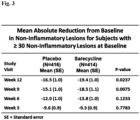
- Fig. 3 demonstrates the mean absolute reduction in non-inflammatory lesions for participants having 30 or more non-inflammatory lesions on the face at baseline who received daily doses of Formula I compared to the placebo.
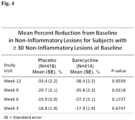
- Fig. 4 demonstrates the mean percent reduction from baseline for subjects having 30 or more non-inflammatory lesions on the face at baseline.
- Results in these figures were based on a statistical (analysis of covariance) model used to estimate the mean treatment effects of Formula I and placebo, after adjusting for potential effects of investigative site and baseline value.
- the statistical superiority of Formula I relative to placebo is tested and p-values provided for each study visit.
- Subjects were randomly assigned in a 1:1:1:1 ratio to one of the said four treatment groups. Subjects were treated for a total of 12 weeks and returned to a clinic to be assessed on Weeks 1, 2, 4, 8, and 12 of treatment. Subjects were assessed through lesion counts and Investigator's Global Assessment (“IGA”) scores.
- IGA Investigator's Global Assessment
- IGA Investigator Global Assessment
- Fig. 5 demonstrates the mean absolute and percent change from baseline to final visit.
Landscapes
- Health & Medical Sciences (AREA)
- Veterinary Medicine (AREA)
- General Health & Medical Sciences (AREA)
- Chemical & Material Sciences (AREA)
- Public Health (AREA)
- Life Sciences & Earth Sciences (AREA)
- Medicinal Chemistry (AREA)
- Animal Behavior & Ethology (AREA)
- Pharmacology & Pharmacy (AREA)
- Epidemiology (AREA)
- General Chemical & Material Sciences (AREA)
- Bioinformatics & Cheminformatics (AREA)
- Nuclear Medicine, Radiotherapy & Molecular Imaging (AREA)
- Organic Chemistry (AREA)
- Chemical Kinetics & Catalysis (AREA)
- Engineering & Computer Science (AREA)
- Nutrition Science (AREA)
- Physiology (AREA)
- Dermatology (AREA)
- Acyclic And Carbocyclic Compounds In Medicinal Compositions (AREA)
- Pharmaceuticals Containing Other Organic And Inorganic Compounds (AREA)
Applications Claiming Priority (2)
| Application Number | Priority Date | Filing Date | Title |
|---|---|---|---|
| US201762535572P | 2017-07-21 | 2017-07-21 | |
| PCT/IB2018/000938 WO2019016609A1 (en) | 2017-07-21 | 2018-07-20 | TREATMENT OF NON-INFLAMMATORY LESIONS |
Publications (2)
| Publication Number | Publication Date |
|---|---|
| EP3654988A1 EP3654988A1 (en) | 2020-05-27 |
| EP3654988B1 true EP3654988B1 (en) | 2023-09-06 |
Family
ID=63713912
Family Applications (1)
| Application Number | Title | Priority Date | Filing Date |
|---|---|---|---|
| EP18779747.7A Active EP3654988B1 (en) | 2017-07-21 | 2018-07-20 | Sarecycline for the treatment of non-inflammatory acne lesions |
Country Status (13)
| Country | Link |
|---|---|
| US (1) | US20200222432A1 (enExample) |
| EP (1) | EP3654988B1 (enExample) |
| JP (1) | JP2020527607A (enExample) |
| KR (1) | KR102662461B1 (enExample) |
| CN (1) | CN111343991A (enExample) |
| AU (1) | AU2018303807B2 (enExample) |
| BR (1) | BR112020000968A2 (enExample) |
| CA (1) | CA3070663A1 (enExample) |
| ES (1) | ES2962380T3 (enExample) |
| IL (1) | IL272124A (enExample) |
| MA (1) | MA49641A (enExample) |
| MX (1) | MX2020000816A (enExample) |
| WO (1) | WO2019016609A1 (enExample) |
Family Cites Families (22)
| Publication number | Priority date | Publication date | Assignee | Title |
|---|---|---|---|---|
| US2990331A (en) | 1956-11-23 | 1961-06-27 | Pfizer & Co C | Stable solutions of salts of tetracyclines for parenteral administration |
| US2980584A (en) | 1957-10-29 | 1961-04-18 | Pfizer & Co C | Parenteral magnesium oxytetracycline acetic or lactic acid carboxamide vehicle preparation |
| US3062717A (en) | 1958-12-11 | 1962-11-06 | Pfizer & Co C | Intramuscular calcium tetracycline acetic or lactic acid carboxamide vehicle preparation |
| US3165531A (en) | 1962-03-08 | 1965-01-12 | Pfizer & Co C | 13-substituted-6-deoxytetracyclines and process utilizing the same |
| US3454697A (en) | 1965-06-08 | 1969-07-08 | American Cyanamid Co | Tetracycline antibiotic compositions for oral use |
| NL6607516A (enExample) | 1966-05-31 | 1967-12-01 | ||
| DE1767891C3 (de) | 1968-06-28 | 1980-10-30 | Pfizer | Verfahren zur Herstellung von wäßrigen arzneilichen Lösungen für die parenterale, perorale und lokale Anwendung mit einem Gehalt an einem Tetracyclinderivat |
| US3957980A (en) | 1972-10-26 | 1976-05-18 | Pfizer Inc. | Doxycycline parenteral compositions |
| DE2442829A1 (de) | 1974-09-06 | 1976-03-18 | Merck Patent Gmbh | Tetracyclische verbindungen und verfahren zu ihrer herstellung |
| US4018889A (en) | 1976-01-02 | 1977-04-19 | Pfizer Inc. | Oxytetracycline compositions |
| US4126680A (en) | 1977-04-27 | 1978-11-21 | Pfizer Inc. | Tetracycline antibiotic compositions |
| KR100926326B1 (ko) * | 2001-04-05 | 2009-11-12 | 콜라제넥스 파마슈티칼스, 인크 | 여드름 치료 방법 |
| US7704959B2 (en) * | 2006-10-03 | 2010-04-27 | Dow Pharmaceutical Sciences | Azithromycin for the treatment of nodular acne |
| PT2109602E (pt) | 2006-12-21 | 2014-05-23 | Paratek Pharm Innc | Derivados de tetraciclina para o tratamento de infecções bacterianas, virais e parasitárias |
| SI2120963T1 (sl) * | 2006-12-21 | 2019-02-28 | Paratek Pharmaceuticals, Inc. | Substituirane spojine tetraciklina za zdravljenje vnetnih kožnih motenj |
| WO2009141406A1 (en) * | 2008-05-21 | 2009-11-26 | Galderma Research & Development | Maintenance therapy regimen for treating acne |
| BRPI0913326C1 (pt) * | 2008-06-05 | 2021-05-25 | Dow Pharmaceutical Sciences | formulação farmacêuticas tópicas contendo uma baixa concentração de peróxido de benzoíla em suspensão aquosa e um solvente orgânico miscível em água |
| RU2012104572A (ru) * | 2009-07-30 | 2013-09-10 | Аллерган, Инк. | Комбинация дапсона с адапаленом |
| US20140121188A1 (en) * | 2009-10-02 | 2014-05-01 | Foamix Ltd. | Compositions for the improved treatment of acne and related disorders |
| WO2012155146A1 (en) | 2011-05-12 | 2012-11-15 | Paratek Pharmaceuticals, Inc. | Crystalline salts of (4s,4as,5ar,12as)-4-dimethylamino-3,10,12,12a-tetrahydroxy-7-[(methoxy(methyl)amino)-methyl]-1,11-dioxo-1,4,4a,5,5a,6,11,12a-octahydro-naphthacene-2-carboxylic acid amide and methods of using the same |
| IL225240A0 (en) * | 2012-03-15 | 2013-06-27 | Meir Eini | Use of tetracycline compounds for wound care and skin restoration |
| GB201615693D0 (en) * | 2016-09-15 | 2016-11-02 | Combinatorx Infection Ltd | Combinations |
-
2018
- 2018-07-20 WO PCT/IB2018/000938 patent/WO2019016609A1/en not_active Ceased
- 2018-07-20 US US16/632,121 patent/US20200222432A1/en not_active Abandoned
- 2018-07-20 MA MA049641A patent/MA49641A/fr unknown
- 2018-07-20 EP EP18779747.7A patent/EP3654988B1/en active Active
- 2018-07-20 CA CA3070663A patent/CA3070663A1/en active Pending
- 2018-07-20 CN CN201880048978.1A patent/CN111343991A/zh active Pending
- 2018-07-20 KR KR1020207003934A patent/KR102662461B1/ko active Active
- 2018-07-20 ES ES18779747T patent/ES2962380T3/es active Active
- 2018-07-20 AU AU2018303807A patent/AU2018303807B2/en active Active
- 2018-07-20 BR BR112020000968-7A patent/BR112020000968A2/pt not_active Application Discontinuation
- 2018-07-20 MX MX2020000816A patent/MX2020000816A/es unknown
- 2018-07-20 JP JP2020524697A patent/JP2020527607A/ja active Pending
-
2020
- 2020-01-19 IL IL272124A patent/IL272124A/en unknown
Non-Patent Citations (2)
| Title |
|---|
| A MOORE ET AL: "Once-Daily Oral Sarecycline 1.5 mg/kg/day Is Effective for Moderate to Severe Acne Vulgaris: Results from Two Identically Designed, Phase 3, Randomized, Double-Blind Clinical Trials.", JOURNAL OF DRUGS IN DERMATOLOGY, vol. 17, no. 9, 1 September 2018 (2018-09-01), US, pages 987 - 996, XP055523735, ISSN: 1545-9616 * |
| J J LEYDEN ET AL: "Efficacy and Safety of Sarecycline, a Novel, Once-Daily, Narrow Spectrum Antibiotic for the Treatment of Moderate to Severe Facial Acne Vulgaris: Results of a Phase 2, Dose-Ranging Study.", JOURNAL OF DRUGS IN DERMATOLOGY, vol. 17, no. 3, 1 March 2018 (2018-03-01), US, pages 333 - 338, XP055523726, ISSN: 1545-9616 * |
Also Published As
| Publication number | Publication date |
|---|---|
| JP2020527607A (ja) | 2020-09-10 |
| CA3070663A1 (en) | 2019-01-24 |
| AU2018303807A1 (en) | 2020-02-13 |
| EP3654988A1 (en) | 2020-05-27 |
| MX2020000816A (es) | 2020-08-17 |
| IL272124A (en) | 2020-03-31 |
| US20200222432A1 (en) | 2020-07-16 |
| AU2018303807B2 (en) | 2023-08-24 |
| CN111343991A (zh) | 2020-06-26 |
| ES2962380T3 (es) | 2024-03-18 |
| WO2019016609A1 (en) | 2019-01-24 |
| KR20200031126A (ko) | 2020-03-23 |
| BR112020000968A2 (pt) | 2020-07-14 |
| KR102662461B1 (ko) | 2024-04-30 |
| MA49641A (fr) | 2021-06-02 |
Similar Documents
| Publication | Publication Date | Title |
|---|---|---|
| US20030082120A1 (en) | Method for reducing systemic effects of aging, effects of aging on the skin, and incidence of skin damage from sun exposure using antibiotics of the tetracycline family | |
| JP5744976B2 (ja) | にきびの治療方法発明の分野 | |
| JP7330471B2 (ja) | 線維症の予防、改善または治療のためのchp(シクロ-ヒスプロ)の用途 | |
| US7485319B2 (en) | Doxycycline metal complex in a solid dosage form | |
| EP3654988B1 (en) | Sarecycline for the treatment of non-inflammatory acne lesions | |
| HK40019815A (en) | Sarecycline for the treatment of non-inflammatory acne lesions | |
| HK40019815B (en) | Sarecycline for the treatment of non-inflammatory acne lesions | |
| CN112770765B (zh) | 用于预防和/或治疗泌尿生殖器粘膜的组合物 | |
| CN110446505A (zh) | 用于治疗皮肤病的联合疗法 | |
| CN109310669A (zh) | 氨基甲酸酯化合物用于预防或治疗三叉神经痛的用途 | |
| CN1852729A (zh) | 疮疱丙酸杆菌的抗菌剂 | |
| WO2013115740A1 (en) | Synergisctic combination comprising a meglitinide derivative and lipoic acid | |
| JPWO2006043336A1 (ja) | 胃粘膜疾患の治療又は予防のための組成物 | |
| CA2480225A1 (en) | Methods for treating rosacea with pyridones | |
| JP2002265354A (ja) | 抗ピロリ菌剤組成物 | |
| US20230218653A1 (en) | Pten inhibitors for treatment and prevention of bone marrow loss | |
| EP2500029A1 (en) | Therapeutic agent for gastrointestinal diseases | |
| JP2023518430A (ja) | 感染症の治療におけるブシラミンの使用 | |
| US20090215889A1 (en) | Novel Use of Zinc Gluconate for Treating Hydradenitis Suppurativa | |
| JP2022542691A (ja) | クリプトスポリジウム症の予防および/または治療のための獣医学的組成物 | |
| HK40063175B (zh) | 用於预防、改善或治疗纤维化的chp的用途 | |
| CN110691591A (zh) | 用于在治疗寻常痤疮中使用的希波酚 | |
| JP2020527607A5 (enExample) | ||
| JP2006117569A (ja) | ステロイド依存性あるいはステロイド抵抗性潰瘍性大腸炎治療薬 | |
| US20120004271A1 (en) | Use of vaginally-administered insulin sensitizing agents |
Legal Events
| Date | Code | Title | Description |
|---|---|---|---|
| STAA | Information on the status of an ep patent application or granted ep patent |
Free format text: STATUS: UNKNOWN |
|
| STAA | Information on the status of an ep patent application or granted ep patent |
Free format text: STATUS: THE INTERNATIONAL PUBLICATION HAS BEEN MADE |
|
| PUAI | Public reference made under article 153(3) epc to a published international application that has entered the european phase |
Free format text: ORIGINAL CODE: 0009012 |
|
| STAA | Information on the status of an ep patent application or granted ep patent |
Free format text: STATUS: REQUEST FOR EXAMINATION WAS MADE |
|
| 17P | Request for examination filed |
Effective date: 20200218 |
|
| AK | Designated contracting states |
Kind code of ref document: A1 Designated state(s): AL AT BE BG CH CY CZ DE DK EE ES FI FR GB GR HR HU IE IS IT LI LT LU LV MC MK MT NL NO PL PT RO RS SE SI SK SM TR |
|
| AX | Request for extension of the european patent |
Extension state: BA ME |
|
| REG | Reference to a national code |
Ref country code: HK Ref legal event code: DE Ref document number: 40019815 Country of ref document: HK |
|
| STAA | Information on the status of an ep patent application or granted ep patent |
Free format text: STATUS: EXAMINATION IS IN PROGRESS |
|
| 17Q | First examination report despatched |
Effective date: 20210504 |
|
| RAP3 | Party data changed (applicant data changed or rights of an application transferred) |
Owner name: ALMIRALL, LLC |
|
| GRAP | Despatch of communication of intention to grant a patent |
Free format text: ORIGINAL CODE: EPIDOSNIGR1 |
|
| STAA | Information on the status of an ep patent application or granted ep patent |
Free format text: STATUS: GRANT OF PATENT IS INTENDED |
|
| INTG | Intention to grant announced |
Effective date: 20230322 |
|
| GRAS | Grant fee paid |
Free format text: ORIGINAL CODE: EPIDOSNIGR3 |
|
| GRAA | (expected) grant |
Free format text: ORIGINAL CODE: 0009210 |
|
| STAA | Information on the status of an ep patent application or granted ep patent |
Free format text: STATUS: THE PATENT HAS BEEN GRANTED |
|
| P01 | Opt-out of the competence of the unified patent court (upc) registered |
Effective date: 20230630 |
|
| AK | Designated contracting states |
Kind code of ref document: B1 Designated state(s): AL AT BE BG CH CY CZ DE DK EE ES FI FR GB GR HR HU IE IS IT LI LT LU LV MC MK MT NL NO PL PT RO RS SE SI SK SM TR |
|
| REG | Reference to a national code |
Ref country code: GB Ref legal event code: FG4D |
|
| REG | Reference to a national code |
Ref country code: CH Ref legal event code: EP |
|
| REG | Reference to a national code |
Ref country code: DE Ref legal event code: R096 Ref document number: 602018057058 Country of ref document: DE |
|
| REG | Reference to a national code |
Ref country code: IE Ref legal event code: FG4D |
|
| REG | Reference to a national code |
Ref country code: LT Ref legal event code: MG9D |
|
| REG | Reference to a national code |
Ref country code: NL Ref legal event code: MP Effective date: 20230906 |
|
| PG25 | Lapsed in a contracting state [announced via postgrant information from national office to epo] |
Ref country code: GR Free format text: LAPSE BECAUSE OF FAILURE TO SUBMIT A TRANSLATION OF THE DESCRIPTION OR TO PAY THE FEE WITHIN THE PRESCRIBED TIME-LIMIT Effective date: 20231207 |
|
| PG25 | Lapsed in a contracting state [announced via postgrant information from national office to epo] |
Ref country code: SE Free format text: LAPSE BECAUSE OF FAILURE TO SUBMIT A TRANSLATION OF THE DESCRIPTION OR TO PAY THE FEE WITHIN THE PRESCRIBED TIME-LIMIT Effective date: 20230906 Ref country code: RS Free format text: LAPSE BECAUSE OF FAILURE TO SUBMIT A TRANSLATION OF THE DESCRIPTION OR TO PAY THE FEE WITHIN THE PRESCRIBED TIME-LIMIT Effective date: 20230906 Ref country code: NO Free format text: LAPSE BECAUSE OF FAILURE TO SUBMIT A TRANSLATION OF THE DESCRIPTION OR TO PAY THE FEE WITHIN THE PRESCRIBED TIME-LIMIT Effective date: 20231206 Ref country code: LV Free format text: LAPSE BECAUSE OF FAILURE TO SUBMIT A TRANSLATION OF THE DESCRIPTION OR TO PAY THE FEE WITHIN THE PRESCRIBED TIME-LIMIT Effective date: 20230906 Ref country code: LT Free format text: LAPSE BECAUSE OF FAILURE TO SUBMIT A TRANSLATION OF THE DESCRIPTION OR TO PAY THE FEE WITHIN THE PRESCRIBED TIME-LIMIT Effective date: 20230906 Ref country code: HR Free format text: LAPSE BECAUSE OF FAILURE TO SUBMIT A TRANSLATION OF THE DESCRIPTION OR TO PAY THE FEE WITHIN THE PRESCRIBED TIME-LIMIT Effective date: 20230906 Ref country code: GR Free format text: LAPSE BECAUSE OF FAILURE TO SUBMIT A TRANSLATION OF THE DESCRIPTION OR TO PAY THE FEE WITHIN THE PRESCRIBED TIME-LIMIT Effective date: 20231207 Ref country code: FI Free format text: LAPSE BECAUSE OF FAILURE TO SUBMIT A TRANSLATION OF THE DESCRIPTION OR TO PAY THE FEE WITHIN THE PRESCRIBED TIME-LIMIT Effective date: 20230906 |
|
| REG | Reference to a national code |
Ref country code: AT Ref legal event code: MK05 Ref document number: 1607603 Country of ref document: AT Kind code of ref document: T Effective date: 20230906 |
|
| PG25 | Lapsed in a contracting state [announced via postgrant information from national office to epo] |
Ref country code: NL Free format text: LAPSE BECAUSE OF FAILURE TO SUBMIT A TRANSLATION OF THE DESCRIPTION OR TO PAY THE FEE WITHIN THE PRESCRIBED TIME-LIMIT Effective date: 20230906 |
|
| REG | Reference to a national code |
Ref country code: ES Ref legal event code: FG2A Ref document number: 2962380 Country of ref document: ES Kind code of ref document: T3 Effective date: 20240318 |
|
| PG25 | Lapsed in a contracting state [announced via postgrant information from national office to epo] |
Ref country code: IS Free format text: LAPSE BECAUSE OF FAILURE TO SUBMIT A TRANSLATION OF THE DESCRIPTION OR TO PAY THE FEE WITHIN THE PRESCRIBED TIME-LIMIT Effective date: 20240106 |
|
| PG25 | Lapsed in a contracting state [announced via postgrant information from national office to epo] |
Ref country code: AT Free format text: LAPSE BECAUSE OF FAILURE TO SUBMIT A TRANSLATION OF THE DESCRIPTION OR TO PAY THE FEE WITHIN THE PRESCRIBED TIME-LIMIT Effective date: 20230906 |
|
| PG25 | Lapsed in a contracting state [announced via postgrant information from national office to epo] |
Ref country code: SM Free format text: LAPSE BECAUSE OF FAILURE TO SUBMIT A TRANSLATION OF THE DESCRIPTION OR TO PAY THE FEE WITHIN THE PRESCRIBED TIME-LIMIT Effective date: 20230906 Ref country code: RO Free format text: LAPSE BECAUSE OF FAILURE TO SUBMIT A TRANSLATION OF THE DESCRIPTION OR TO PAY THE FEE WITHIN THE PRESCRIBED TIME-LIMIT Effective date: 20230906 Ref country code: IS Free format text: LAPSE BECAUSE OF FAILURE TO SUBMIT A TRANSLATION OF THE DESCRIPTION OR TO PAY THE FEE WITHIN THE PRESCRIBED TIME-LIMIT Effective date: 20240106 Ref country code: EE Free format text: LAPSE BECAUSE OF FAILURE TO SUBMIT A TRANSLATION OF THE DESCRIPTION OR TO PAY THE FEE WITHIN THE PRESCRIBED TIME-LIMIT Effective date: 20230906 Ref country code: CZ Free format text: LAPSE BECAUSE OF FAILURE TO SUBMIT A TRANSLATION OF THE DESCRIPTION OR TO PAY THE FEE WITHIN THE PRESCRIBED TIME-LIMIT Effective date: 20230906 Ref country code: AT Free format text: LAPSE BECAUSE OF FAILURE TO SUBMIT A TRANSLATION OF THE DESCRIPTION OR TO PAY THE FEE WITHIN THE PRESCRIBED TIME-LIMIT Effective date: 20230906 Ref country code: PT Free format text: LAPSE BECAUSE OF FAILURE TO SUBMIT A TRANSLATION OF THE DESCRIPTION OR TO PAY THE FEE WITHIN THE PRESCRIBED TIME-LIMIT Effective date: 20240108 Ref country code: SK Free format text: LAPSE BECAUSE OF FAILURE TO SUBMIT A TRANSLATION OF THE DESCRIPTION OR TO PAY THE FEE WITHIN THE PRESCRIBED TIME-LIMIT Effective date: 20230906 |
|
| VS25 | Lapsed in a validation state [announced via postgrant information from nat. office to epo] |
Ref country code: MD Free format text: LAPSE BECAUSE OF FAILURE TO SUBMIT A TRANSLATION OF THE DESCRIPTION OR TO PAY THE FEE WITHIN THE PRESCRIBED TIME-LIMIT Effective date: 20230906 |
|
| PG25 | Lapsed in a contracting state [announced via postgrant information from national office to epo] |
Ref country code: PL Free format text: LAPSE BECAUSE OF FAILURE TO SUBMIT A TRANSLATION OF THE DESCRIPTION OR TO PAY THE FEE WITHIN THE PRESCRIBED TIME-LIMIT Effective date: 20230906 |
|
| REG | Reference to a national code |
Ref country code: DE Ref legal event code: R097 Ref document number: 602018057058 Country of ref document: DE |
|
| PG25 | Lapsed in a contracting state [announced via postgrant information from national office to epo] |
Ref country code: DK Free format text: LAPSE BECAUSE OF FAILURE TO SUBMIT A TRANSLATION OF THE DESCRIPTION OR TO PAY THE FEE WITHIN THE PRESCRIBED TIME-LIMIT Effective date: 20230906 |
|
| PLBE | No opposition filed within time limit |
Free format text: ORIGINAL CODE: 0009261 |
|
| STAA | Information on the status of an ep patent application or granted ep patent |
Free format text: STATUS: NO OPPOSITION FILED WITHIN TIME LIMIT |
|
| PG25 | Lapsed in a contracting state [announced via postgrant information from national office to epo] |
Ref country code: DK Free format text: LAPSE BECAUSE OF FAILURE TO SUBMIT A TRANSLATION OF THE DESCRIPTION OR TO PAY THE FEE WITHIN THE PRESCRIBED TIME-LIMIT Effective date: 20230906 Ref country code: SI Free format text: LAPSE BECAUSE OF FAILURE TO SUBMIT A TRANSLATION OF THE DESCRIPTION OR TO PAY THE FEE WITHIN THE PRESCRIBED TIME-LIMIT Effective date: 20230906 |
|
| 26N | No opposition filed |
Effective date: 20240607 |
|
| PG25 | Lapsed in a contracting state [announced via postgrant information from national office to epo] |
Ref country code: BG Free format text: LAPSE BECAUSE OF FAILURE TO SUBMIT A TRANSLATION OF THE DESCRIPTION OR TO PAY THE FEE WITHIN THE PRESCRIBED TIME-LIMIT Effective date: 20230906 |
|
| PG25 | Lapsed in a contracting state [announced via postgrant information from national office to epo] |
Ref country code: BG Free format text: LAPSE BECAUSE OF FAILURE TO SUBMIT A TRANSLATION OF THE DESCRIPTION OR TO PAY THE FEE WITHIN THE PRESCRIBED TIME-LIMIT Effective date: 20230906 |
|
| PG25 | Lapsed in a contracting state [announced via postgrant information from national office to epo] |
Ref country code: MC Free format text: LAPSE BECAUSE OF FAILURE TO SUBMIT A TRANSLATION OF THE DESCRIPTION OR TO PAY THE FEE WITHIN THE PRESCRIBED TIME-LIMIT Effective date: 20230906 |
|
| REG | Reference to a national code |
Ref country code: CH Ref legal event code: PL |
|
| PG25 | Lapsed in a contracting state [announced via postgrant information from national office to epo] |
Ref country code: LU Free format text: LAPSE BECAUSE OF NON-PAYMENT OF DUE FEES Effective date: 20240720 |
|
| PG25 | Lapsed in a contracting state [announced via postgrant information from national office to epo] |
Ref country code: LU Free format text: LAPSE BECAUSE OF NON-PAYMENT OF DUE FEES Effective date: 20240720 |
|
| PG25 | Lapsed in a contracting state [announced via postgrant information from national office to epo] |
Ref country code: CH Free format text: LAPSE BECAUSE OF NON-PAYMENT OF DUE FEES Effective date: 20240731 Ref country code: BE Free format text: LAPSE BECAUSE OF NON-PAYMENT OF DUE FEES Effective date: 20240731 |
|
| REG | Reference to a national code |
Ref country code: BE Ref legal event code: MM Effective date: 20240731 |
|
| PG25 | Lapsed in a contracting state [announced via postgrant information from national office to epo] |
Ref country code: IE Free format text: LAPSE BECAUSE OF NON-PAYMENT OF DUE FEES Effective date: 20240720 |
|
| PGFP | Annual fee paid to national office [announced via postgrant information from national office to epo] |
Ref country code: ES Payment date: 20250801 Year of fee payment: 8 |
|
| PGFP | Annual fee paid to national office [announced via postgrant information from national office to epo] |
Ref country code: DE Payment date: 20250729 Year of fee payment: 8 |
|
| PGFP | Annual fee paid to national office [announced via postgrant information from national office to epo] |
Ref country code: IT Payment date: 20250721 Year of fee payment: 8 |
|
| PGFP | Annual fee paid to national office [announced via postgrant information from national office to epo] |
Ref country code: GB Payment date: 20250728 Year of fee payment: 8 |
|
| PGFP | Annual fee paid to national office [announced via postgrant information from national office to epo] |
Ref country code: FR Payment date: 20250725 Year of fee payment: 8 |
|
| PG25 | Lapsed in a contracting state [announced via postgrant information from national office to epo] |
Ref country code: CY Free format text: LAPSE BECAUSE OF FAILURE TO SUBMIT A TRANSLATION OF THE DESCRIPTION OR TO PAY THE FEE WITHIN THE PRESCRIBED TIME-LIMIT; INVALID AB INITIO Effective date: 20180720 |