EP3647708B1 - Method for releasing heat - Google Patents
Method for releasing heat Download PDFInfo
- Publication number
- EP3647708B1 EP3647708B1 EP18822641.9A EP18822641A EP3647708B1 EP 3647708 B1 EP3647708 B1 EP 3647708B1 EP 18822641 A EP18822641 A EP 18822641A EP 3647708 B1 EP3647708 B1 EP 3647708B1
- Authority
- EP
- European Patent Office
- Prior art keywords
- heat storage
- storage material
- electrode
- heat
- degrees celsius
- Prior art date
- Legal status (The legal status is an assumption and is not a legal conclusion. Google has not performed a legal analysis and makes no representation as to the accuracy of the status listed.)
- Active
Links
Images

Classifications
-
- C—CHEMISTRY; METALLURGY
- C09—DYES; PAINTS; POLISHES; NATURAL RESINS; ADHESIVES; COMPOSITIONS NOT OTHERWISE PROVIDED FOR; APPLICATIONS OF MATERIALS NOT OTHERWISE PROVIDED FOR
- C09K—MATERIALS FOR MISCELLANEOUS APPLICATIONS, NOT PROVIDED FOR ELSEWHERE
- C09K5/00—Heat-transfer, heat-exchange or heat-storage materials, e.g. refrigerants; Materials for the production of heat or cold by chemical reactions other than by combustion
- C09K5/02—Materials undergoing a change of physical state when used
- C09K5/06—Materials undergoing a change of physical state when used the change of state being from liquid to solid or vice versa
- C09K5/063—Materials absorbing or liberating heat during crystallisation; Heat storage materials
-
- C—CHEMISTRY; METALLURGY
- C09—DYES; PAINTS; POLISHES; NATURAL RESINS; ADHESIVES; COMPOSITIONS NOT OTHERWISE PROVIDED FOR; APPLICATIONS OF MATERIALS NOT OTHERWISE PROVIDED FOR
- C09K—MATERIALS FOR MISCELLANEOUS APPLICATIONS, NOT PROVIDED FOR ELSEWHERE
- C09K5/00—Heat-transfer, heat-exchange or heat-storage materials, e.g. refrigerants; Materials for the production of heat or cold by chemical reactions other than by combustion
- C09K5/02—Materials undergoing a change of physical state when used
- C09K5/06—Materials undergoing a change of physical state when used the change of state being from liquid to solid or vice versa
-
- F—MECHANICAL ENGINEERING; LIGHTING; HEATING; WEAPONS; BLASTING
- F01—MACHINES OR ENGINES IN GENERAL; ENGINE PLANTS IN GENERAL; STEAM ENGINES
- F01P—COOLING OF MACHINES OR ENGINES IN GENERAL; COOLING OF INTERNAL-COMBUSTION ENGINES
- F01P3/00—Liquid cooling
- F01P3/20—Cooling circuits not specific to a single part of engine or machine
-
- F—MECHANICAL ENGINEERING; LIGHTING; HEATING; WEAPONS; BLASTING
- F28—HEAT EXCHANGE IN GENERAL
- F28D—HEAT-EXCHANGE APPARATUS, NOT PROVIDED FOR IN ANOTHER SUBCLASS, IN WHICH THE HEAT-EXCHANGE MEDIA DO NOT COME INTO DIRECT CONTACT
- F28D20/00—Heat storage plants or apparatus in general; Regenerative heat-exchange apparatus not covered by groups F28D17/00 or F28D19/00
- F28D20/02—Heat storage plants or apparatus in general; Regenerative heat-exchange apparatus not covered by groups F28D17/00 or F28D19/00 using latent heat
- F28D20/023—Heat storage plants or apparatus in general; Regenerative heat-exchange apparatus not covered by groups F28D17/00 or F28D19/00 using latent heat the latent heat storage material being enclosed in granular particles or dispersed in a porous, fibrous or cellular structure
-
- F—MECHANICAL ENGINEERING; LIGHTING; HEATING; WEAPONS; BLASTING
- F28—HEAT EXCHANGE IN GENERAL
- F28D—HEAT-EXCHANGE APPARATUS, NOT PROVIDED FOR IN ANOTHER SUBCLASS, IN WHICH THE HEAT-EXCHANGE MEDIA DO NOT COME INTO DIRECT CONTACT
- F28D20/00—Heat storage plants or apparatus in general; Regenerative heat-exchange apparatus not covered by groups F28D17/00 or F28D19/00
- F28D20/02—Heat storage plants or apparatus in general; Regenerative heat-exchange apparatus not covered by groups F28D17/00 or F28D19/00 using latent heat
- F28D20/028—Control arrangements therefor
-
- Y—GENERAL TAGGING OF NEW TECHNOLOGICAL DEVELOPMENTS; GENERAL TAGGING OF CROSS-SECTIONAL TECHNOLOGIES SPANNING OVER SEVERAL SECTIONS OF THE IPC; TECHNICAL SUBJECTS COVERED BY FORMER USPC CROSS-REFERENCE ART COLLECTIONS [XRACs] AND DIGESTS
- Y02—TECHNOLOGIES OR APPLICATIONS FOR MITIGATION OR ADAPTATION AGAINST CLIMATE CHANGE
- Y02E—REDUCTION OF GREENHOUSE GAS [GHG] EMISSIONS, RELATED TO ENERGY GENERATION, TRANSMISSION OR DISTRIBUTION
- Y02E60/00—Enabling technologies; Technologies with a potential or indirect contribution to GHG emissions mitigation
- Y02E60/14—Thermal energy storage
Definitions
- the present invention relates to a method for releasing heat.
- Patent Literature 1 discloses a heat storage system using sodium acetate trihydrate as a heat storage material.
- Sodium acetate trihydrate melts at a melting point of 58 degrees Celsius. However, sodium acetate trihydrate does not solidify immediately even when cooled to not more than the melting point thereof. A state in which a liquid is not solidified even when cooled to not more than the melting point is referred to as a supercooled state.
- the heat storage material containing sodium acetate trihydrate After the heat storage material containing sodium acetate trihydrate is heated and melted, the heat storage material is cooled until the heat storage material is in the supercooled state. In this way, latent heat is stored in the sodium acetate trihydrate.
- the supercooled state of the heat storage material containing the sodium acetate trihydrate is released.
- the state of the sodium acetate trihydrate is changed from a liquid state to a solid state. Due to the change, heat is released from the sodium acetate trihydrate. In other words, the latent heat is taken out. In this way, the heat storage effect is achieved.
- Patent Literature 2 discloses a heat storage tank comprising a silver electrode for applying a voltage to a heat storage material in a supercooled state as a means for releasing the supercooled state.
- Patent Literature 3 discloses a supercooling preventing agent, a heat storage method, and a heat storage system.
- the production method according to Patent Literature 3 comprises steps of immersing a porous material in a melt containing sodium acetate trihydrate, and cooling the melt and the porous material at not more than a temperature at which the supercooling of the melt is released while maintaining the porous material immersed in the melt.
- Heat is stored by heating the heat storage material containing the sodium acetate trihydrate at a temperature higher than the melting point of sodium acetate trihydrate.
- heat is drawn from the heat storage material in such a way that the sodium acetate trihydrate changes from liquid phase to solid phase.
- WO 2016/031275 A1 relates to a heat storage device
- US 2013/139995 A1 relates to a porous material having a micropore.
- An object of the present invention is to provide a method for releasing heat capable of releasing heat by releasing supercooling by voltage application and capable of being used repeatedly.
- a method for releasing heat according to the present invention is defined in claim 1.
- a heat storage device comprising:
- An aspect of the present disclosure includes a heat releasing method using the above-mentioned heat storage device.
- An aspect of the present disclosure includes a vehicle comprising the above-mentioned heat storage device. Furthermore, an aspect of the present disclosure includes a method for applying heat to an engine in the vehicle.
- the present invention provides a method for releasing heat capable of releasing heat by releasing supercooling by voltage application and capable of being used repeatedly.
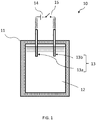
- FIG. 1 shows a schematic view of a heat storage device 10 according to the example.
- the heat storage device 10 comprises a heat storage tank 11 filled with a heat storage material 12, a pair of electrodes 13 comprising a first electrode 13a and a second electrode 13b, a direct-current power supply 14, and a switch 15.
- the heat storage tank 11 is maintained warm by a heat insulating material.
- An example of the heat insulating material is glass wool.
- the heat storage tank 11 contains the heat storage material 12.
- the heat storage material 12 is sodium acetate trihydrate.
- the heat storage material 12 contains sodium acetate trihydrate as a main component.
- the heat storage material 12 contains an inorganic porous material.
- the present inventors believe that the inside of pores of the inorganic porous material has a fine solid-phase heat storage material 12.
- the fine solid-phase heat storage material 12 is also referred to as a "cluster".
- the fine solid-phase heat storage material 12 contained in the pores has stronger intermolecular bonding than the heat storage material 12 located outside the pores due to capillary condensation.
- the voltage is applied to the heat storage material 12 in the supercooled state to crystalize the heat storage material 12 in such a way the crystalized heat storage material 12 is spread from the center of the cluster to the surroundings thereof.
- the crystallization of the heat storage material 12 at the time when the voltage is applied to the heat storage material 12 in the supercooled state starts from the cluster.
- the inorganic porous material contained in the heat storage material 12 has an average pore diameter of not more than 50 nanometers.
- the pore diameter of the inorganic porous material can be measured by a commonly used method. For example, the pore diameter can be calculated based on a nitrogen gas adsorption method or a mercury intrusion method.
- the term "average pore diameter" used in the present specification means a pore diameter at a peak value of a pore diameter distribution curve derived from an adsorption isotherm of nitrogen by a Barret-Joyner-Halenda method (hereinafter, referred to as "BJH method”) or a Horvath-Kawazoe method (hereinafter, referred to as "HK method”).
- the pore diameter distribution curve is drawn on a graph in which the horizontal axis and the vertical axis thereof represent the pore diameter and the volume of pores respectively.
- the average pore diameter is equal to the pore diameter at the maximum of the pore volume.
- the term "average pore diameter" used in the present specification means the pore diameter at the peak value of the pore diameter distribution curve provided by the mercury intrusion method.
- the average pore diameter of zeolite, mesoporous silica, or activated carbon is calculated by the nitrogen gas adsorption method.
- the average pore diameter of silica gel is calculated by the mercury intrusion method.
- the average pore diameter of the commercially available inorganic porous material is often disclosed in its catalog.
- the supercooled state of the sodium acetate trihydrate fails to be released, even when a voltage is applied after the heat storage material 12 is held at a high temperature in a liquid state.
- the present inventors believe that this is because, in the case where the average pore diameter is more than 50 nanometers, the viability of the clusters after the heat storage material 12 is held at the high temperature in the liquid state is significantly lowered due to decrease in the effect of the capillary condensation. Needless to say, even in the case where the heat storage material 12 does not contain the inorganic porous material, the supercooled state of sodium acetate trihydrate fails to be released for the same reason as described above.
- the lower limit of the average pore diameter of the inorganic porous material is not limited, as long as the inside of the pores has the heat storage material 12 and the melting of the cluster is suppressed.
- the average pore diameter of the inorganic porous material is not less than 0.9 nanometers.
- the material of the inorganic porous material is, for example, a metal oxide or carbon.
- An example of the metal oxide is zeolite, silica, alumina, titania, or a tungsten oxide.
- the desirable inorganic porous material is activated carbon or silica gel.
- Activated carbon and silica gel have, on their surfaces, pores each having a size of not more than 50 nanometers (hereinafter, referred to as "micro mesopores”) and pores each having a size of more than 50 nanometers (hereinafter, referred to as “macropores”).
- the micro mesopores communicate with the macropores.
- FIG. 2 shows a schematic view of the pore structure of the inorganic porous material.
- a surface 20 of the activated carbon has a macropore 21.
- the micro mesopores 22 are disposed inside the activated carbon so as to communicate with the macropore 21. Therefore, the heat storage material 12 is easily introduced into the micro mesopores 22. In this way, the fine solid-phase heat storage material 12 is formed in the micro mesopores. This will be described in detail later.
- the heat storage material 12 in larger amount can be disposed in the micro mesopores 22 each having a size of not more than 50 nanometers, as compared to an inorganic porous material having no macropore 21 such as mesoporous silica.
- the viability of the cluster is further improved after the heat storage material 12 is held at the high temperature in the liquid state. For this reason, even if the heat storage material 12 is held at the high temperature for a long time in the liquid state, the supercooling can be released by voltage application.
- the heat storage material 12 may contain an additive.
- An example of the additives is a supercooling release aid, a viscosity modifier, a foam stabilizer, an antioxidant, a defoamer, an abrasive grain, a filler, a pigment, a dye, a colorant, a thickener, a surfactant, a flame retardant, a plasticizers, a lubricant, an antistatic agent, a heat stabilizer, a tackifier, a curing catalyst, a stabilizer, a silane coupling agent, or a wax.
- the type and amount of the additives are not limited, as long as the object of the present invention is not hindered.
- the additives do not have to be added to the heat storage material 12.
- the method for forming the fine solid-phase heat storage material 12 in the pores of the inorganic porous material will be described below.
- the heat storage material 12 containing the inorganic porous material is heated at a temperature equal to or higher than the melting point of the heat storage material 12 (i.e., 58 degrees Celsius).
- the heat storage material 12 is in a liquid state.
- the heat storage material 12 is allowed to leave at rest for a predetermined time, while the temperature is maintained. During this time, the heat storage material 12 is introduced into the pores of the inorganic porous material.
- the present inventors believe that the heat storage material 12 is introduced into the pores of the inorganic porous material by capillary action.
- the heat storage material 12 is cooled at a temperature of minus 30 degrees Celsius or lower.
- the heat storage material 12 is supercooled by being cooled to not more than 58 degrees Celsius, and then, a seed crystal formed of sodium acetate trihydrate is added to the heat storage material 12.
- the heat storage material 12 in the pores is crystallized by cooling at a low temperature of not more than minus 30 degrees Celsius or by the addition of the seed crystal in the supercooled state. In other words, the heat storage material 12 in the pore changes from the liquid phase to the solid phase. In this way, the fine solid-phase heat storage material 12 can be formed in the pores of the inorganic porous material.
- the first electrode 13a and the second electrode 13b are electrically connected to the power supply 14 through an electric wiring and the switch 15.
- the first electrode 13a and the second electrode 13b are both disposed to be in contact with the heat storage material 12.
- the distance between parts of the first electrode 13a and the second electrode 13b which are in contact with the heat storage material 12 is not particularly limited. An example of the distance is not less than 1 millimeter and not more than 30 millimeters.
- the first electrode 13a has silver, a silver alloy, or a silver compound on the surface thereof. Needless to say, the silver or the silver alloy is in contact with the heat storage material 12.
- An example of the silver alloy is a silver palladium alloy or a silver copper alloy.
- An example of the silver compound is a silver halide or a silver oxide.
- An example of the silver halide is silver bromide.
- the second electrode 13b does not have to have silver, a silver alloy, or a silver compound on the surface thereof. Needless to say, the second electrode 13b may also have silver, a silver alloy or a silver compound on the surface thereof.
- the shapes of the first electrode 13a and the second electrode 13b are not limited.
- the shapes of the first electrode 13a and the second electrode 13b are, for example, plate-shaped or linear.
- an alternate-current power supply may be used.
- the heat storage device 10 may comprise a plurality of heat storage tanks 11.
- Each of the heat storage tanks 11 may comprise the first electrode 13a and the second electrode 13b, both of which are in contact with the heat storage material 12.
- the plurality of the heat storage tanks 11 may be electrically connected in parallel to the direct-current power supply 14.
- the heat storage material 12 is cooled and brought into the supercooled state. In this way, the latent heat is stored in the sodium acetate trihydrate.
- the heat storage device After the heat storage material 12 releases the heat, the heat storage device is heated at a temperature of not less than 58 degrees Celsius and not more than 80 degrees Celsius for repeated use. In this way, the sodium acetate trihydrate contained in the heat storage material 12 is melted. In other words, the crystallized sodium acetate trihydrate (i.e., the sodium acetate trihydrate in the solid state) is melted due to the heating.
- the heat storage material 12 must not be heated at a temperature of not less than 90 degrees Celsius. In case where the heat storage material 12 is heated at a temperature of not less than 90 degrees Celsius, as demonstrated in the comparative examples 4 - 12, the viability of the cluster is significantly lowered.
- the fine solid-phase heat storage material 12 may be formed again in the pores of the inorganic porous material by the cooling at the low temperature of not more than minus 30 degrees Celsius or by the addition of the seed crystal in the supercooled state.
- the example 1 is composed of the Examples 1A - 1D
- the heat storage tank 11 was a glass sample bottle having a capacity of 9 milliliters.
- the zeolite was purchased from Tosoh Corporation under the trade name "X-type zeolite, F-9".
- the addition amount of the zeolite was 20% by mass with regard to the total weight of the sodium acetate and the water (i.e., 4.0 grams). In other words, the addition amount of the zeolite was 0.8 grams.
- the heat storage material 12 containing the zeolite and containing the sodium acetate trihydrate as the main component was stored in the heat storage tank 11.
- the first electrode 13a and the second electrode 13b each composed of an electric wire formed of silver were immersed in the heat storage material 12.
- Each of the first electrode 13a and the second electrode 13b had a diameter of 1.5 millimeters.
- the length of the portion where the first electrode 13a and the second electrode 13b were in contact with the heat storage material 12 was approximately 5 millimeters.
- the heat storage tank 11 was covered with a lid. In this way, the heat storage device 10 according to the Example 1 was provided.
- the liquid heat storage material 12 contained in the heat storage tank 11 was allowed to leave at rest at a temperature of 70 degrees Celsius for two hours. The present inventors believe that the heat storage material 12 entered the pores of the zeolite in this period. Subsequently, the heat storage material 12 was cooled to minus 30 degrees Celsius. In this way, the heat storage material 12 was crystallized. The present inventors believed that both the heat storage material 12 in the pores and the heat storage material 12 outside the pores were changed from the liquid state to the solid state.
- the heat storage material 12 contained in the heat storage tank 11 was heated at a temperature of 70 degrees Celsius for one hour. Due to the heating, the heat storage material 12 was melted. Next, the heat storage material 12 was allowed to leave at rest at a stationary temperature of 80 degrees Celsius for a stationary time of 15 minutes. Furthermore, the heat storage material 12 was cooled to room temperature (approximately 25 degrees Celsius). A voltage of two volts was applied for approximately two minutes between the first electrode 13a and the second electrode 13b, and then, the present inventors visually observed whether or not the heat storage material 12 was crystallized. The evaluation was repeated six times. Table 1 shows the observation results. The numerators of the fractions included in Table 1 are the number of times that the heat storage material 12 is crystallized. The denominators of the fractions included in Table 1 are the number of times of the evaluation (i.e., six times).
- Example 1B - 1D the experiment similarly to the Example 1A was conducted except that the stationary time was 30 minutes, one hour, and two hours, respectively.
- the experimental results are shown in Table 1.
- activated carbon purchased from Calgon Carbon Japan Co., Ltd. under the trade name "activated carbon made from coconut shell", average pore diameter: 1.0 nanometer - 3.0 nanometers
- silica gel purchased from Fuji Silysia Chemical Co., Ltd. under the trade name "MB100", average pore diameter: 10 nanometers was used.
- silica gel purchased from Fuji Silysia Chemical Co., Ltd. under the trade name "MB300", average pore diameter: 30 nanometers was used.
- silica gel purchased from Fuji Silysia Chemical Co., Ltd. under the trade name "MB500", average pore diameter: 50 nanometers was used.
- silica gel purchased from Fuji Silysia Chemical Co., Ltd. under the trade name "MB800", average pore diameter: 80 nanometers was used.
- silica purchased from Kanto Chemical Co., Ltd.
- the silica was formed of amorphous silicon dioxide having no pores.
- Denominators evaluation times (i.e., six times) Inorganic Porous Material Average Pore Diameter (nanometers) Stationary Time 15 minutes 30 minutes One hour Two hours
- Example 1 Zeolite 0.9 6/6 6/6 6/6 4/6
- Example 2 Mesoporous silica 2.5 - 3.0 6/6 6/6 6/6 4/6
- Example 3 Activated carbon 1.0 - 3.0 6/6 6/6 6/6 6/6 Inventive Example 4
- Silica gel 10 6/6 6/6 6/6 6/6 Inventive Example 5
- Silica gel 50 6/6 6/6 6/6 6/6 Comparative Example 1 None - 6/6 3/6 3/6 2/6 Comparative Example 2
- Silica gel 80 6/6 3/6 3/6 2/6 Comparative Example 3
- Numerators times that the heat storage material 12 was crystallized.
- Denominators evaluation times (i.e., six times) Inorganic Porous Material Average Pore Diameter (nanometers) stationary time 15 minutes 30 minutes One hour Two hours Comparative Example 4 Zeolite 0.9 3/6 2/6 1/6 0/6 Comparative Example 5 Mesoporous silica 2.5 - 3.0 4/6 2/6 1/6 5/6 Comparative Example 6 Activated carbon 1.0 - 3.0 4/6 4/6 3/6 2/6 Comparative Example 7 Silica gel 10 4/6 4/6 3/6 2/6 Comparative Example 8 Silica gel 30 5/6 4/6 4/6 2/6 Comparative Example 9 Silica gel 50 4/6 3/6 3/6 2/6 Comparative Example 10 None - 2/6 0/6 0/6 0/6 Comparative Example 11 Silica gel 80 2/6 0/6 0/6 0/6 Comparative Example 12 Silica - 2/6 0/6 0/6 0/6 0/6 0/6
- the stationary temperature needs to be not more than 80 degrees Celsius. Otherwise, the crystallization of the heat storage material 12 often fails.
- the average pore diameter needs to be not more than 50 nanometers. Otherwise, the crystallization of the heat storage material 12 often fails.
- the inorganic porous material is silica gel or activated carbon.
- the latent heat is allowed to be taken out by voltage application.
- the latent heat can be taken out by voltage application.
- the heat storage device according to the present disclosure is mounted in a vehicle comprising an engine configured to drive wheels.
- the heat released from the heat storage material 12 is used to warm up an internal combustion engine such as an engine provided in a vehicle.
- the heat storage device according to the present invention is also mounted in a boiler, an air conditioner, or a water heater.
Landscapes
- Engineering & Computer Science (AREA)
- Chemical & Material Sciences (AREA)
- Thermal Sciences (AREA)
- Physics & Mathematics (AREA)
- Combustion & Propulsion (AREA)
- Mechanical Engineering (AREA)
- General Engineering & Computer Science (AREA)
- Materials Engineering (AREA)
- Chemical Kinetics & Catalysis (AREA)
- Organic Chemistry (AREA)
- Dispersion Chemistry (AREA)
- Secondary Cells (AREA)
- Electric Double-Layer Capacitors Or The Like (AREA)
Applications Claiming Priority (2)
| Application Number | Priority Date | Filing Date | Title |
|---|---|---|---|
| JP2017126876A JP6733615B2 (ja) | 2017-06-29 | 2017-06-29 | 蓄熱装置 |
| PCT/JP2018/011975 WO2019003523A1 (ja) | 2017-06-29 | 2018-03-26 | 蓄熱装置 |
Publications (3)
| Publication Number | Publication Date |
|---|---|
| EP3647708A1 EP3647708A1 (en) | 2020-05-06 |
| EP3647708A4 EP3647708A4 (en) | 2020-07-15 |
| EP3647708B1 true EP3647708B1 (en) | 2021-07-21 |
Family
ID=64741410
Family Applications (1)
| Application Number | Title | Priority Date | Filing Date |
|---|---|---|---|
| EP18822641.9A Active EP3647708B1 (en) | 2017-06-29 | 2018-03-26 | Method for releasing heat |
Country Status (4)
| Country | Link |
|---|---|
| US (1) | US11268003B2 (enExample) |
| EP (1) | EP3647708B1 (enExample) |
| JP (1) | JP6733615B2 (enExample) |
| WO (1) | WO2019003523A1 (enExample) |
Families Citing this family (2)
| Publication number | Priority date | Publication date | Assignee | Title |
|---|---|---|---|---|
| EP4102167B1 (en) * | 2021-06-07 | 2024-01-31 | GGD Global Green Developer APS | A thermal system for thermal energy storage |
| US20250188334A1 (en) * | 2022-02-24 | 2025-06-12 | Panasonic Holdings Corporation | Cold storage material |
Family Cites Families (34)
| Publication number | Priority date | Publication date | Assignee | Title |
|---|---|---|---|---|
| US3806433A (en) * | 1966-04-04 | 1974-04-23 | I Diller | Method and apparatus for the activation of an electrolytic cell |
| DE2731572C3 (de) * | 1977-07-13 | 1980-09-18 | Philips Patentverwaltung Gmbh, 2000 Hamburg | Wärmespeichermittel |
| US4248291A (en) * | 1978-10-18 | 1981-02-03 | Seymour Jarmul | Compact thermal energy reservoirs |
| US4491172A (en) * | 1981-04-22 | 1985-01-01 | Thermal Energy Storage, Inc. | Energy storage apparatus |
| US4529488A (en) * | 1982-06-29 | 1985-07-16 | Nippon Gohsei Kagaku Kogyo Kabushiki Kaisha | Process for depositing salts |
| JPS60243189A (ja) * | 1984-05-17 | 1985-12-03 | Nok Corp | 蓄熱材 |
| FR2569418B1 (fr) * | 1984-08-27 | 1986-12-05 | Solvay | Composition a base de chlorure de calcium hexahydrate pour le stockage de calories par changement de phase et procede pour sa preparation |
| JPS61204293A (ja) | 1985-03-07 | 1986-09-10 | Hitachi Chem Co Ltd | 蓄熱槽 |
| JPH0239175Y2 (enExample) | 1986-02-20 | 1990-10-22 | ||
| JPS63116073A (ja) * | 1986-10-31 | 1988-05-20 | 株式会社東芝 | 蓄熱式ヒ−トポンプ |
| JPH0760075B2 (ja) * | 1987-01-31 | 1995-06-28 | 株式会社東芝 | 蓄熱装置 |
| US4949549A (en) * | 1987-07-07 | 1990-08-21 | International Thermal Packaging, Inc. | Cooling device with improved waste-heat handling capability |
| JP2553364Y2 (ja) * | 1991-08-01 | 1997-11-05 | エヌオーケー株式会社 | 過冷却液体の発核装置 |
| US5378337A (en) * | 1992-05-12 | 1995-01-03 | Nok Corporation | Electrical nucleation device for supercooled heat storage medium |
| JPH06117787A (ja) * | 1992-10-05 | 1994-04-28 | Mitsubishi Motors Corp | 蓄熱装置 |
| JP2943609B2 (ja) * | 1994-06-21 | 1999-08-30 | トヨタ自動車株式会社 | 蓄熱装置 |
| GB9514252D0 (en) * | 1995-07-12 | 1995-09-13 | Univ Strathclyde | Mouldable product |
| JPH09143461A (ja) * | 1995-11-24 | 1997-06-03 | Toyota Central Res & Dev Lab Inc | 蓄熱材 |
| CA2208695C (en) * | 1996-06-25 | 2007-03-20 | Kenji Saita | Heat storage system and heat release control method |
| JP3588630B2 (ja) * | 2000-09-06 | 2004-11-17 | 独立行政法人産業技術総合研究所 | 蓄熱式加熱体 |
| JP4175388B2 (ja) * | 2006-06-05 | 2008-11-05 | トヨタ自動車株式会社 | 蓄熱装置及びエンジン |
| JP2008020177A (ja) | 2006-06-15 | 2008-01-31 | Matsushita Electric Ind Co Ltd | 蓄熱システム |
| JP2012078030A (ja) * | 2010-10-04 | 2012-04-19 | Honda Motor Co Ltd | 蓄熱装置 |
| DE202011002156U1 (de) * | 2011-01-31 | 2011-05-26 | Promat GmbH, 40878 | Latentwärmespeicher |
| JP2013067720A (ja) * | 2011-09-22 | 2013-04-18 | Panasonic Corp | 過冷却防止剤、蓄熱方法及び蓄熱システム |
| JP5670853B2 (ja) * | 2011-09-27 | 2015-02-18 | 株式会社東芝 | 空調システム |
| US9410747B2 (en) * | 2011-12-06 | 2016-08-09 | Korea Institute Of Construction Technology | Porous material having micropores capable of storing and releasing heat by phase change and preparation method thereof |
| JP5875532B2 (ja) | 2013-01-15 | 2016-03-02 | 三菱電機株式会社 | 蓄熱装置 |
| US20150241136A1 (en) * | 2014-02-21 | 2015-08-27 | Panasonic Intellectual Property Management Co., Ltd. | Heat storage device and method of using latent heat storage material |
| US10161688B2 (en) * | 2014-04-02 | 2018-12-25 | Panasonic Intellectual Property Management Co., Ltd. | Heat storage apparatus, method for storing heat, and method for producing heat storage apparatus |
| JP2016006370A (ja) * | 2014-05-29 | 2016-01-14 | パナソニックIpマネジメント株式会社 | 潜熱蓄熱材における結晶核形成方法及び蓄熱装置 |
| JP2016044917A (ja) * | 2014-08-25 | 2016-04-04 | 株式会社東芝 | 蓄熱装置 |
| JP6590607B2 (ja) * | 2014-09-29 | 2019-10-16 | パナソニック株式会社 | 蓄熱材組成物、蓄熱装置及び蓄熱方法 |
| JP2017053528A (ja) | 2015-09-08 | 2017-03-16 | 株式会社東芝 | 蓄熱装置、過冷却解除装置 |
-
2017
- 2017-06-29 JP JP2017126876A patent/JP6733615B2/ja active Active
-
2018
- 2018-03-26 EP EP18822641.9A patent/EP3647708B1/en active Active
- 2018-03-26 WO PCT/JP2018/011975 patent/WO2019003523A1/ja not_active Ceased
-
2019
- 2019-10-30 US US16/667,946 patent/US11268003B2/en active Active
Non-Patent Citations (1)
| Title |
|---|
| None * |
Also Published As
| Publication number | Publication date |
|---|---|
| WO2019003523A1 (ja) | 2019-01-03 |
| US11268003B2 (en) | 2022-03-08 |
| EP3647708A4 (en) | 2020-07-15 |
| US20200063012A1 (en) | 2020-02-27 |
| EP3647708A1 (en) | 2020-05-06 |
| JP6733615B2 (ja) | 2020-08-05 |
| JP2019011874A (ja) | 2019-01-24 |
Similar Documents
| Publication | Publication Date | Title |
|---|---|---|
| EP3647708B1 (en) | Method for releasing heat | |
| ES2764075T3 (es) | Material compuesto de metal-aerogel | |
| EP2927299B1 (en) | Heat storage apparatus and method for storing heat | |
| Jia et al. | Preparation and performances of palmitic acid/diatomite form‐stable composite phase change materials | |
| EP1809570B1 (en) | Hollow porous-wall glass microspheres for hydrogen storage | |
| CN103265176B (zh) | 一种封接微晶玻璃、其封接方法及用途 | |
| CA2623871A1 (en) | Hollow porous-wall glass microspheres for hydrogen storage | |
| EP2883928B1 (en) | Heat storage material composition, auxiliary heat source using same, and heat supply method | |
| CA2969553C (en) | Power fuse and fabrication methods with enhanced arc mitigation and thermal management | |
| CN104955776B (zh) | 无定形熔凝二氧化硅玻璃的多孔蜂窝状结构及其制备方法 | |
| JP2009140786A (ja) | 車載用組電池 | |
| EP3757188B1 (en) | Heat-radiating fluid composition and battery module comprising the same | |
| WO2021000439A1 (zh) | 相变储热硅胶、制备方法及其应用 | |
| CN109128104A (zh) | 一种低熔点泡沫金属的制备装置、方法及低熔点泡沫金属 | |
| JP2019196867A (ja) | 蓄熱方法および蓄熱装置 | |
| CN103606394A (zh) | 含多重氢键超分子自组装体系的银浆料及其应用 | |
| JPH10158033A (ja) | CuTi2(PO4)3結晶をスケルトンとする多孔質 結晶化ガラスおよびその製造方法 | |
| JPH10337469A (ja) | 吸着性多孔質焼結体及びその製造方法 | |
| JP2019015438A (ja) | 蓄熱装置 | |
| US8703258B1 (en) | Nucleating agent for lithium nitrate trihydrate thermal energy storage medium | |
| KR20220169113A (ko) | 고전압 퓨즈 장치 및 그의 제조방법 | |
| JP2019074246A (ja) | 蓄熱装置 | |
| CN105958228A (zh) | 一种密封接线座的制备工艺 |
Legal Events
| Date | Code | Title | Description |
|---|---|---|---|
| STAA | Information on the status of an ep patent application or granted ep patent |
Free format text: STATUS: THE INTERNATIONAL PUBLICATION HAS BEEN MADE |
|
| PUAI | Public reference made under article 153(3) epc to a published international application that has entered the european phase |
Free format text: ORIGINAL CODE: 0009012 |
|
| STAA | Information on the status of an ep patent application or granted ep patent |
Free format text: STATUS: REQUEST FOR EXAMINATION WAS MADE |
|
| 17P | Request for examination filed |
Effective date: 20191113 |
|
| AK | Designated contracting states |
Kind code of ref document: A1 Designated state(s): AL AT BE BG CH CY CZ DE DK EE ES FI FR GB GR HR HU IE IS IT LI LT LU LV MC MK MT NL NO PL PT RO RS SE SI SK SM TR |
|
| AX | Request for extension of the european patent |
Extension state: BA ME |
|
| A4 | Supplementary search report drawn up and despatched |
Effective date: 20200617 |
|
| RIC1 | Information provided on ipc code assigned before grant |
Ipc: F01P 3/20 20060101ALI20200610BHEP Ipc: F28D 20/02 20060101AFI20200610BHEP Ipc: C09K 5/06 20060101ALI20200610BHEP |
|
| DAV | Request for validation of the european patent (deleted) | ||
| DAX | Request for extension of the european patent (deleted) | ||
| STAA | Information on the status of an ep patent application or granted ep patent |
Free format text: STATUS: EXAMINATION IS IN PROGRESS |
|
| 17Q | First examination report despatched |
Effective date: 20201117 |
|
| GRAP | Despatch of communication of intention to grant a patent |
Free format text: ORIGINAL CODE: EPIDOSNIGR1 |
|
| STAA | Information on the status of an ep patent application or granted ep patent |
Free format text: STATUS: GRANT OF PATENT IS INTENDED |
|
| INTG | Intention to grant announced |
Effective date: 20210503 |
|
| GRAS | Grant fee paid |
Free format text: ORIGINAL CODE: EPIDOSNIGR3 |
|
| GRAA | (expected) grant |
Free format text: ORIGINAL CODE: 0009210 |
|
| STAA | Information on the status of an ep patent application or granted ep patent |
Free format text: STATUS: THE PATENT HAS BEEN GRANTED |
|
| AK | Designated contracting states |
Kind code of ref document: B1 Designated state(s): AL AT BE BG CH CY CZ DE DK EE ES FI FR GB GR HR HU IE IS IT LI LT LU LV MC MK MT NL NO PL PT RO RS SE SI SK SM TR |
|
| REG | Reference to a national code |
Ref country code: GB Ref legal event code: FG4D |
|
| REG | Reference to a national code |
Ref country code: CH Ref legal event code: EP |
|
| REG | Reference to a national code |
Ref country code: DE Ref legal event code: R096 Ref document number: 602018020581 Country of ref document: DE |
|
| REG | Reference to a national code |
Ref country code: AT Ref legal event code: REF Ref document number: 1412962 Country of ref document: AT Kind code of ref document: T Effective date: 20210815 |
|
| REG | Reference to a national code |
Ref country code: IE Ref legal event code: FG4D |
|
| REG | Reference to a national code |
Ref country code: LT Ref legal event code: MG9D |
|
| REG | Reference to a national code |
Ref country code: NL Ref legal event code: MP Effective date: 20210721 |
|
| REG | Reference to a national code |
Ref country code: AT Ref legal event code: MK05 Ref document number: 1412962 Country of ref document: AT Kind code of ref document: T Effective date: 20210721 |
|
| PG25 | Lapsed in a contracting state [announced via postgrant information from national office to epo] |
Ref country code: HR Free format text: LAPSE BECAUSE OF FAILURE TO SUBMIT A TRANSLATION OF THE DESCRIPTION OR TO PAY THE FEE WITHIN THE PRESCRIBED TIME-LIMIT Effective date: 20210721 Ref country code: NL Free format text: LAPSE BECAUSE OF FAILURE TO SUBMIT A TRANSLATION OF THE DESCRIPTION OR TO PAY THE FEE WITHIN THE PRESCRIBED TIME-LIMIT Effective date: 20210721 Ref country code: NO Free format text: LAPSE BECAUSE OF FAILURE TO SUBMIT A TRANSLATION OF THE DESCRIPTION OR TO PAY THE FEE WITHIN THE PRESCRIBED TIME-LIMIT Effective date: 20211021 Ref country code: PT Free format text: LAPSE BECAUSE OF FAILURE TO SUBMIT A TRANSLATION OF THE DESCRIPTION OR TO PAY THE FEE WITHIN THE PRESCRIBED TIME-LIMIT Effective date: 20211122 Ref country code: LT Free format text: LAPSE BECAUSE OF FAILURE TO SUBMIT A TRANSLATION OF THE DESCRIPTION OR TO PAY THE FEE WITHIN THE PRESCRIBED TIME-LIMIT Effective date: 20210721 Ref country code: AT Free format text: LAPSE BECAUSE OF FAILURE TO SUBMIT A TRANSLATION OF THE DESCRIPTION OR TO PAY THE FEE WITHIN THE PRESCRIBED TIME-LIMIT Effective date: 20210721 Ref country code: BG Free format text: LAPSE BECAUSE OF FAILURE TO SUBMIT A TRANSLATION OF THE DESCRIPTION OR TO PAY THE FEE WITHIN THE PRESCRIBED TIME-LIMIT Effective date: 20211021 Ref country code: FI Free format text: LAPSE BECAUSE OF FAILURE TO SUBMIT A TRANSLATION OF THE DESCRIPTION OR TO PAY THE FEE WITHIN THE PRESCRIBED TIME-LIMIT Effective date: 20210721 Ref country code: ES Free format text: LAPSE BECAUSE OF FAILURE TO SUBMIT A TRANSLATION OF THE DESCRIPTION OR TO PAY THE FEE WITHIN THE PRESCRIBED TIME-LIMIT Effective date: 20210721 Ref country code: RS Free format text: LAPSE BECAUSE OF FAILURE TO SUBMIT A TRANSLATION OF THE DESCRIPTION OR TO PAY THE FEE WITHIN THE PRESCRIBED TIME-LIMIT Effective date: 20210721 Ref country code: SE Free format text: LAPSE BECAUSE OF FAILURE TO SUBMIT A TRANSLATION OF THE DESCRIPTION OR TO PAY THE FEE WITHIN THE PRESCRIBED TIME-LIMIT Effective date: 20210721 |
|
| PG25 | Lapsed in a contracting state [announced via postgrant information from national office to epo] |
Ref country code: PL Free format text: LAPSE BECAUSE OF FAILURE TO SUBMIT A TRANSLATION OF THE DESCRIPTION OR TO PAY THE FEE WITHIN THE PRESCRIBED TIME-LIMIT Effective date: 20210721 Ref country code: LV Free format text: LAPSE BECAUSE OF FAILURE TO SUBMIT A TRANSLATION OF THE DESCRIPTION OR TO PAY THE FEE WITHIN THE PRESCRIBED TIME-LIMIT Effective date: 20210721 Ref country code: GR Free format text: LAPSE BECAUSE OF FAILURE TO SUBMIT A TRANSLATION OF THE DESCRIPTION OR TO PAY THE FEE WITHIN THE PRESCRIBED TIME-LIMIT Effective date: 20211022 |
|
| REG | Reference to a national code |
Ref country code: DE Ref legal event code: R097 Ref document number: 602018020581 Country of ref document: DE |
|
| PG25 | Lapsed in a contracting state [announced via postgrant information from national office to epo] |
Ref country code: DK Free format text: LAPSE BECAUSE OF FAILURE TO SUBMIT A TRANSLATION OF THE DESCRIPTION OR TO PAY THE FEE WITHIN THE PRESCRIBED TIME-LIMIT Effective date: 20210721 |
|
| PLBE | No opposition filed within time limit |
Free format text: ORIGINAL CODE: 0009261 |
|
| STAA | Information on the status of an ep patent application or granted ep patent |
Free format text: STATUS: NO OPPOSITION FILED WITHIN TIME LIMIT |
|
| PG25 | Lapsed in a contracting state [announced via postgrant information from national office to epo] |
Ref country code: SM Free format text: LAPSE BECAUSE OF FAILURE TO SUBMIT A TRANSLATION OF THE DESCRIPTION OR TO PAY THE FEE WITHIN THE PRESCRIBED TIME-LIMIT Effective date: 20210721 Ref country code: SK Free format text: LAPSE BECAUSE OF FAILURE TO SUBMIT A TRANSLATION OF THE DESCRIPTION OR TO PAY THE FEE WITHIN THE PRESCRIBED TIME-LIMIT Effective date: 20210721 Ref country code: RO Free format text: LAPSE BECAUSE OF FAILURE TO SUBMIT A TRANSLATION OF THE DESCRIPTION OR TO PAY THE FEE WITHIN THE PRESCRIBED TIME-LIMIT Effective date: 20210721 Ref country code: EE Free format text: LAPSE BECAUSE OF FAILURE TO SUBMIT A TRANSLATION OF THE DESCRIPTION OR TO PAY THE FEE WITHIN THE PRESCRIBED TIME-LIMIT Effective date: 20210721 Ref country code: CZ Free format text: LAPSE BECAUSE OF FAILURE TO SUBMIT A TRANSLATION OF THE DESCRIPTION OR TO PAY THE FEE WITHIN THE PRESCRIBED TIME-LIMIT Effective date: 20210721 Ref country code: AL Free format text: LAPSE BECAUSE OF FAILURE TO SUBMIT A TRANSLATION OF THE DESCRIPTION OR TO PAY THE FEE WITHIN THE PRESCRIBED TIME-LIMIT Effective date: 20210721 |
|
| RAP4 | Party data changed (patent owner data changed or rights of a patent transferred) |
Owner name: PANASONIC HOLDINGS CORPORATION |
|
| 26N | No opposition filed |
Effective date: 20220422 |
|
| PG25 | Lapsed in a contracting state [announced via postgrant information from national office to epo] |
Ref country code: IT Free format text: LAPSE BECAUSE OF FAILURE TO SUBMIT A TRANSLATION OF THE DESCRIPTION OR TO PAY THE FEE WITHIN THE PRESCRIBED TIME-LIMIT Effective date: 20210721 |
|
| PG25 | Lapsed in a contracting state [announced via postgrant information from national office to epo] |
Ref country code: MC Free format text: LAPSE BECAUSE OF FAILURE TO SUBMIT A TRANSLATION OF THE DESCRIPTION OR TO PAY THE FEE WITHIN THE PRESCRIBED TIME-LIMIT Effective date: 20210721 |
|
| REG | Reference to a national code |
Ref country code: CH Ref legal event code: PL |
|
| GBPC | Gb: european patent ceased through non-payment of renewal fee |
Effective date: 20220326 |
|
| REG | Reference to a national code |
Ref country code: BE Ref legal event code: MM Effective date: 20220331 |
|
| REG | Reference to a national code |
Ref country code: DE Ref legal event code: R081 Ref document number: 602018020581 Country of ref document: DE Owner name: PANASONIC HOLDINGS CORPORATION, KADOMA-SHI, JP Free format text: FORMER OWNER: PANASONIC CORPORATION, KADOMA-SHI, OSAKA, JP |
|
| PG25 | Lapsed in a contracting state [announced via postgrant information from national office to epo] |
Ref country code: LU Free format text: LAPSE BECAUSE OF NON-PAYMENT OF DUE FEES Effective date: 20220326 Ref country code: LI Free format text: LAPSE BECAUSE OF NON-PAYMENT OF DUE FEES Effective date: 20220331 Ref country code: IE Free format text: LAPSE BECAUSE OF NON-PAYMENT OF DUE FEES Effective date: 20220326 Ref country code: GB Free format text: LAPSE BECAUSE OF NON-PAYMENT OF DUE FEES Effective date: 20220326 Ref country code: FR Free format text: LAPSE BECAUSE OF NON-PAYMENT OF DUE FEES Effective date: 20220331 Ref country code: CH Free format text: LAPSE BECAUSE OF NON-PAYMENT OF DUE FEES Effective date: 20220331 |
|
| PG25 | Lapsed in a contracting state [announced via postgrant information from national office to epo] |
Ref country code: BE Free format text: LAPSE BECAUSE OF NON-PAYMENT OF DUE FEES Effective date: 20220331 |
|
| PG25 | Lapsed in a contracting state [announced via postgrant information from national office to epo] |
Ref country code: MK Free format text: LAPSE BECAUSE OF FAILURE TO SUBMIT A TRANSLATION OF THE DESCRIPTION OR TO PAY THE FEE WITHIN THE PRESCRIBED TIME-LIMIT Effective date: 20210721 Ref country code: CY Free format text: LAPSE BECAUSE OF FAILURE TO SUBMIT A TRANSLATION OF THE DESCRIPTION OR TO PAY THE FEE WITHIN THE PRESCRIBED TIME-LIMIT Effective date: 20210721 |
|
| PG25 | Lapsed in a contracting state [announced via postgrant information from national office to epo] |
Ref country code: HU Free format text: LAPSE BECAUSE OF FAILURE TO SUBMIT A TRANSLATION OF THE DESCRIPTION OR TO PAY THE FEE WITHIN THE PRESCRIBED TIME-LIMIT; INVALID AB INITIO Effective date: 20180326 |
|
| PG25 | Lapsed in a contracting state [announced via postgrant information from national office to epo] |
Ref country code: TR Free format text: LAPSE BECAUSE OF FAILURE TO SUBMIT A TRANSLATION OF THE DESCRIPTION OR TO PAY THE FEE WITHIN THE PRESCRIBED TIME-LIMIT Effective date: 20210721 |
|
| PG25 | Lapsed in a contracting state [announced via postgrant information from national office to epo] |
Ref country code: MT Free format text: LAPSE BECAUSE OF FAILURE TO SUBMIT A TRANSLATION OF THE DESCRIPTION OR TO PAY THE FEE WITHIN THE PRESCRIBED TIME-LIMIT Effective date: 20210721 |
|
| PGFP | Annual fee paid to national office [announced via postgrant information from national office to epo] |
Ref country code: DE Payment date: 20250319 Year of fee payment: 8 |