EP3639802B1 - Absorbent article - Google Patents
Absorbent article Download PDFInfo
- Publication number
- EP3639802B1 EP3639802B1 EP18817925.3A EP18817925A EP3639802B1 EP 3639802 B1 EP3639802 B1 EP 3639802B1 EP 18817925 A EP18817925 A EP 18817925A EP 3639802 B1 EP3639802 B1 EP 3639802B1
- Authority
- EP
- European Patent Office
- Prior art keywords
- topsheet
- group
- liquid film
- liquid
- compound
- Prior art date
- Legal status (The legal status is an assumption and is not a legal conclusion. Google has not performed a legal analysis and makes no representation as to the accuracy of the status listed.)
- Active
Links
Images
Classifications
-
- A—HUMAN NECESSITIES
- A61—MEDICAL OR VETERINARY SCIENCE; HYGIENE
- A61F—FILTERS IMPLANTABLE INTO BLOOD VESSELS; PROSTHESES; DEVICES PROVIDING PATENCY TO, OR PREVENTING COLLAPSING OF, TUBULAR STRUCTURES OF THE BODY, e.g. STENTS; ORTHOPAEDIC, NURSING OR CONTRACEPTIVE DEVICES; FOMENTATION; TREATMENT OR PROTECTION OF EYES OR EARS; BANDAGES, DRESSINGS OR ABSORBENT PADS; FIRST-AID KITS
- A61F13/00—Bandages or dressings; Absorbent pads
- A61F13/15—Absorbent pads, e.g. sanitary towels, swabs or tampons for external or internal application to the body; Supporting or fastening means therefor; Tampon applicators
- A61F13/51—Absorbent pads, e.g. sanitary towels, swabs or tampons for external or internal application to the body; Supporting or fastening means therefor; Tampon applicators characterised by the outer layers of the pads
- A61F13/511—Topsheet, i.e. the permeable cover or layer facing the skin
- A61F13/51104—Topsheet, i.e. the permeable cover or layer facing the skin the top sheet having a three-dimensional cross-section, e.g. corrugations, embossments, recesses or projections
-
- A—HUMAN NECESSITIES
- A61—MEDICAL OR VETERINARY SCIENCE; HYGIENE
- A61F—FILTERS IMPLANTABLE INTO BLOOD VESSELS; PROSTHESES; DEVICES PROVIDING PATENCY TO, OR PREVENTING COLLAPSING OF, TUBULAR STRUCTURES OF THE BODY, e.g. STENTS; ORTHOPAEDIC, NURSING OR CONTRACEPTIVE DEVICES; FOMENTATION; TREATMENT OR PROTECTION OF EYES OR EARS; BANDAGES, DRESSINGS OR ABSORBENT PADS; FIRST-AID KITS
- A61F13/00—Bandages or dressings; Absorbent pads
- A61F13/15—Absorbent pads, e.g. sanitary towels, swabs or tampons for external or internal application to the body; Supporting or fastening means therefor; Tampon applicators
- A61F13/51—Absorbent pads, e.g. sanitary towels, swabs or tampons for external or internal application to the body; Supporting or fastening means therefor; Tampon applicators characterised by the outer layers of the pads
- A61F13/511—Topsheet, i.e. the permeable cover or layer facing the skin
- A61F13/513—Topsheet, i.e. the permeable cover or layer facing the skin characterised by its function or properties, e.g. stretchability, breathability, rewet, visual effect; having areas of different permeability
-
- A—HUMAN NECESSITIES
- A61—MEDICAL OR VETERINARY SCIENCE; HYGIENE
- A61F—FILTERS IMPLANTABLE INTO BLOOD VESSELS; PROSTHESES; DEVICES PROVIDING PATENCY TO, OR PREVENTING COLLAPSING OF, TUBULAR STRUCTURES OF THE BODY, e.g. STENTS; ORTHOPAEDIC, NURSING OR CONTRACEPTIVE DEVICES; FOMENTATION; TREATMENT OR PROTECTION OF EYES OR EARS; BANDAGES, DRESSINGS OR ABSORBENT PADS; FIRST-AID KITS
- A61F13/00—Bandages or dressings; Absorbent pads
- A61F13/15—Absorbent pads, e.g. sanitary towels, swabs or tampons for external or internal application to the body; Supporting or fastening means therefor; Tampon applicators
- A61F13/15577—Apparatus or processes for manufacturing
- A61F13/15699—Forming webs by bringing together several webs, e.g. by laminating or folding several webs, with or without additional treatment of the webs
-
- A—HUMAN NECESSITIES
- A61—MEDICAL OR VETERINARY SCIENCE; HYGIENE
- A61F—FILTERS IMPLANTABLE INTO BLOOD VESSELS; PROSTHESES; DEVICES PROVIDING PATENCY TO, OR PREVENTING COLLAPSING OF, TUBULAR STRUCTURES OF THE BODY, e.g. STENTS; ORTHOPAEDIC, NURSING OR CONTRACEPTIVE DEVICES; FOMENTATION; TREATMENT OR PROTECTION OF EYES OR EARS; BANDAGES, DRESSINGS OR ABSORBENT PADS; FIRST-AID KITS
- A61F13/00—Bandages or dressings; Absorbent pads
- A61F13/15—Absorbent pads, e.g. sanitary towels, swabs or tampons for external or internal application to the body; Supporting or fastening means therefor; Tampon applicators
- A61F13/15577—Apparatus or processes for manufacturing
- A61F13/15707—Mechanical treatment, e.g. notching, twisting, compressing, shaping
- A61F13/15731—Treating webs, e.g. for giving them a fibrelike appearance, e.g. by embossing
-
- A—HUMAN NECESSITIES
- A61—MEDICAL OR VETERINARY SCIENCE; HYGIENE
- A61F—FILTERS IMPLANTABLE INTO BLOOD VESSELS; PROSTHESES; DEVICES PROVIDING PATENCY TO, OR PREVENTING COLLAPSING OF, TUBULAR STRUCTURES OF THE BODY, e.g. STENTS; ORTHOPAEDIC, NURSING OR CONTRACEPTIVE DEVICES; FOMENTATION; TREATMENT OR PROTECTION OF EYES OR EARS; BANDAGES, DRESSINGS OR ABSORBENT PADS; FIRST-AID KITS
- A61F13/00—Bandages or dressings; Absorbent pads
- A61F13/15—Absorbent pads, e.g. sanitary towels, swabs or tampons for external or internal application to the body; Supporting or fastening means therefor; Tampon applicators
- A61F13/15577—Apparatus or processes for manufacturing
- A61F13/15804—Plant, e.g. involving several steps
-
- A—HUMAN NECESSITIES
- A61—MEDICAL OR VETERINARY SCIENCE; HYGIENE
- A61F—FILTERS IMPLANTABLE INTO BLOOD VESSELS; PROSTHESES; DEVICES PROVIDING PATENCY TO, OR PREVENTING COLLAPSING OF, TUBULAR STRUCTURES OF THE BODY, e.g. STENTS; ORTHOPAEDIC, NURSING OR CONTRACEPTIVE DEVICES; FOMENTATION; TREATMENT OR PROTECTION OF EYES OR EARS; BANDAGES, DRESSINGS OR ABSORBENT PADS; FIRST-AID KITS
- A61F13/00—Bandages or dressings; Absorbent pads
- A61F13/15—Absorbent pads, e.g. sanitary towels, swabs or tampons for external or internal application to the body; Supporting or fastening means therefor; Tampon applicators
- A61F13/45—Absorbent pads, e.g. sanitary towels, swabs or tampons for external or internal application to the body; Supporting or fastening means therefor; Tampon applicators characterised by the shape
- A61F13/47—Sanitary towels, incontinence pads or napkins
-
- A—HUMAN NECESSITIES
- A61—MEDICAL OR VETERINARY SCIENCE; HYGIENE
- A61F—FILTERS IMPLANTABLE INTO BLOOD VESSELS; PROSTHESES; DEVICES PROVIDING PATENCY TO, OR PREVENTING COLLAPSING OF, TUBULAR STRUCTURES OF THE BODY, e.g. STENTS; ORTHOPAEDIC, NURSING OR CONTRACEPTIVE DEVICES; FOMENTATION; TREATMENT OR PROTECTION OF EYES OR EARS; BANDAGES, DRESSINGS OR ABSORBENT PADS; FIRST-AID KITS
- A61F13/00—Bandages or dressings; Absorbent pads
- A61F13/15—Absorbent pads, e.g. sanitary towels, swabs or tampons for external or internal application to the body; Supporting or fastening means therefor; Tampon applicators
- A61F13/51—Absorbent pads, e.g. sanitary towels, swabs or tampons for external or internal application to the body; Supporting or fastening means therefor; Tampon applicators characterised by the outer layers of the pads
- A61F13/511—Topsheet, i.e. the permeable cover or layer facing the skin
-
- A—HUMAN NECESSITIES
- A61—MEDICAL OR VETERINARY SCIENCE; HYGIENE
- A61F—FILTERS IMPLANTABLE INTO BLOOD VESSELS; PROSTHESES; DEVICES PROVIDING PATENCY TO, OR PREVENTING COLLAPSING OF, TUBULAR STRUCTURES OF THE BODY, e.g. STENTS; ORTHOPAEDIC, NURSING OR CONTRACEPTIVE DEVICES; FOMENTATION; TREATMENT OR PROTECTION OF EYES OR EARS; BANDAGES, DRESSINGS OR ABSORBENT PADS; FIRST-AID KITS
- A61F13/00—Bandages or dressings; Absorbent pads
- A61F13/15—Absorbent pads, e.g. sanitary towels, swabs or tampons for external or internal application to the body; Supporting or fastening means therefor; Tampon applicators
- A61F13/51—Absorbent pads, e.g. sanitary towels, swabs or tampons for external or internal application to the body; Supporting or fastening means therefor; Tampon applicators characterised by the outer layers of the pads
- A61F13/511—Topsheet, i.e. the permeable cover or layer facing the skin
- A61F13/51113—Topsheet, i.e. the permeable cover or layer facing the skin comprising an additive, e.g. lotion or odour control
-
- A—HUMAN NECESSITIES
- A61—MEDICAL OR VETERINARY SCIENCE; HYGIENE
- A61F—FILTERS IMPLANTABLE INTO BLOOD VESSELS; PROSTHESES; DEVICES PROVIDING PATENCY TO, OR PREVENTING COLLAPSING OF, TUBULAR STRUCTURES OF THE BODY, e.g. STENTS; ORTHOPAEDIC, NURSING OR CONTRACEPTIVE DEVICES; FOMENTATION; TREATMENT OR PROTECTION OF EYES OR EARS; BANDAGES, DRESSINGS OR ABSORBENT PADS; FIRST-AID KITS
- A61F13/00—Bandages or dressings; Absorbent pads
- A61F13/15—Absorbent pads, e.g. sanitary towels, swabs or tampons for external or internal application to the body; Supporting or fastening means therefor; Tampon applicators
- A61F13/51—Absorbent pads, e.g. sanitary towels, swabs or tampons for external or internal application to the body; Supporting or fastening means therefor; Tampon applicators characterised by the outer layers of the pads
- A61F13/511—Topsheet, i.e. the permeable cover or layer facing the skin
- A61F13/5116—Topsheet, i.e. the permeable cover or layer facing the skin being formed of multiple layers
-
- A—HUMAN NECESSITIES
- A61—MEDICAL OR VETERINARY SCIENCE; HYGIENE
- A61F—FILTERS IMPLANTABLE INTO BLOOD VESSELS; PROSTHESES; DEVICES PROVIDING PATENCY TO, OR PREVENTING COLLAPSING OF, TUBULAR STRUCTURES OF THE BODY, e.g. STENTS; ORTHOPAEDIC, NURSING OR CONTRACEPTIVE DEVICES; FOMENTATION; TREATMENT OR PROTECTION OF EYES OR EARS; BANDAGES, DRESSINGS OR ABSORBENT PADS; FIRST-AID KITS
- A61F13/00—Bandages or dressings; Absorbent pads
- A61F13/15—Absorbent pads, e.g. sanitary towels, swabs or tampons for external or internal application to the body; Supporting or fastening means therefor; Tampon applicators
- A61F13/51—Absorbent pads, e.g. sanitary towels, swabs or tampons for external or internal application to the body; Supporting or fastening means therefor; Tampon applicators characterised by the outer layers of the pads
- A61F13/511—Topsheet, i.e. the permeable cover or layer facing the skin
- A61F13/513—Topsheet, i.e. the permeable cover or layer facing the skin characterised by its function or properties, e.g. stretchability, breathability, rewet, visual effect; having areas of different permeability
- A61F13/51305—Topsheet, i.e. the permeable cover or layer facing the skin characterised by its function or properties, e.g. stretchability, breathability, rewet, visual effect; having areas of different permeability having areas of different permeability
-
- D—TEXTILES; PAPER
- D04—BRAIDING; LACE-MAKING; KNITTING; TRIMMINGS; NON-WOVEN FABRICS
- D04H—MAKING TEXTILE FABRICS, e.g. FROM FIBRES OR FILAMENTARY MATERIAL; FABRICS MADE BY SUCH PROCESSES OR APPARATUS, e.g. FELTS, NON-WOVEN FABRICS; COTTON-WOOL; WADDING ; NON-WOVEN FABRICS FROM STAPLE FIBRES, FILAMENTS OR YARNS, BONDED WITH AT LEAST ONE WEB-LIKE MATERIAL DURING THEIR CONSOLIDATION
- D04H1/00—Non-woven fabrics formed wholly or mainly of staple fibres or like relatively short fibres
- D04H1/40—Non-woven fabrics formed wholly or mainly of staple fibres or like relatively short fibres from fleeces or layers composed of fibres without existing or potential cohesive properties
- D04H1/42—Non-woven fabrics formed wholly or mainly of staple fibres or like relatively short fibres from fleeces or layers composed of fibres without existing or potential cohesive properties characterised by the use of certain kinds of fibres insofar as this use has no preponderant influence on the consolidation of the fleece
- D04H1/4282—Addition polymers
- D04H1/4291—Olefin series
-
- D—TEXTILES; PAPER
- D04—BRAIDING; LACE-MAKING; KNITTING; TRIMMINGS; NON-WOVEN FABRICS
- D04H—MAKING TEXTILE FABRICS, e.g. FROM FIBRES OR FILAMENTARY MATERIAL; FABRICS MADE BY SUCH PROCESSES OR APPARATUS, e.g. FELTS, NON-WOVEN FABRICS; COTTON-WOOL; WADDING ; NON-WOVEN FABRICS FROM STAPLE FIBRES, FILAMENTS OR YARNS, BONDED WITH AT LEAST ONE WEB-LIKE MATERIAL DURING THEIR CONSOLIDATION
- D04H3/00—Non-woven fabrics formed wholly or mainly of yarns or like filamentary material of substantial length
- D04H3/08—Non-woven fabrics formed wholly or mainly of yarns or like filamentary material of substantial length characterised by the method of strengthening or consolidating
- D04H3/16—Non-woven fabrics formed wholly or mainly of yarns or like filamentary material of substantial length characterised by the method of strengthening or consolidating with bonds between thermoplastic filaments produced in association with filament formation, e.g. immediately following extrusion
-
- D—TEXTILES; PAPER
- D04—BRAIDING; LACE-MAKING; KNITTING; TRIMMINGS; NON-WOVEN FABRICS
- D04H—MAKING TEXTILE FABRICS, e.g. FROM FIBRES OR FILAMENTARY MATERIAL; FABRICS MADE BY SUCH PROCESSES OR APPARATUS, e.g. FELTS, NON-WOVEN FABRICS; COTTON-WOOL; WADDING ; NON-WOVEN FABRICS FROM STAPLE FIBRES, FILAMENTS OR YARNS, BONDED WITH AT LEAST ONE WEB-LIKE MATERIAL DURING THEIR CONSOLIDATION
- D04H5/00—Non woven fabrics formed of mixtures of relatively short fibres and yarns or like filamentary material of substantial length
- D04H5/06—Non woven fabrics formed of mixtures of relatively short fibres and yarns or like filamentary material of substantial length strengthened or consolidated by welding-together thermoplastic fibres, filaments, or yarns
-
- D—TEXTILES; PAPER
- D06—TREATMENT OF TEXTILES OR THE LIKE; LAUNDERING; FLEXIBLE MATERIALS NOT OTHERWISE PROVIDED FOR
- D06M—TREATMENT, NOT PROVIDED FOR ELSEWHERE IN CLASS D06, OF FIBRES, THREADS, YARNS, FABRICS, FEATHERS OR FIBROUS GOODS MADE FROM SUCH MATERIALS
- D06M15/00—Treating fibres, threads, yarns, fabrics, or fibrous goods made from such materials, with macromolecular compounds; Such treatment combined with mechanical treatment
- D06M15/19—Treating fibres, threads, yarns, fabrics, or fibrous goods made from such materials, with macromolecular compounds; Such treatment combined with mechanical treatment with synthetic macromolecular compounds
- D06M15/37—Macromolecular compounds obtained otherwise than by reactions only involving carbon-to-carbon unsaturated bonds
- D06M15/643—Macromolecular compounds obtained otherwise than by reactions only involving carbon-to-carbon unsaturated bonds containing silicon in the main chain
-
- A—HUMAN NECESSITIES
- A61—MEDICAL OR VETERINARY SCIENCE; HYGIENE
- A61F—FILTERS IMPLANTABLE INTO BLOOD VESSELS; PROSTHESES; DEVICES PROVIDING PATENCY TO, OR PREVENTING COLLAPSING OF, TUBULAR STRUCTURES OF THE BODY, e.g. STENTS; ORTHOPAEDIC, NURSING OR CONTRACEPTIVE DEVICES; FOMENTATION; TREATMENT OR PROTECTION OF EYES OR EARS; BANDAGES, DRESSINGS OR ABSORBENT PADS; FIRST-AID KITS
- A61F13/00—Bandages or dressings; Absorbent pads
- A61F13/15—Absorbent pads, e.g. sanitary towels, swabs or tampons for external or internal application to the body; Supporting or fastening means therefor; Tampon applicators
- A61F13/15577—Apparatus or processes for manufacturing
- A61F2013/15821—Apparatus or processes for manufacturing characterized by the apparatus for manufacturing
- A61F2013/15861—Apparatus or processes for manufacturing characterized by the apparatus for manufacturing for bonding
- A61F2013/15878—Apparatus or processes for manufacturing characterized by the apparatus for manufacturing for bonding by thermal bonding
-
- A—HUMAN NECESSITIES
- A61—MEDICAL OR VETERINARY SCIENCE; HYGIENE
- A61F—FILTERS IMPLANTABLE INTO BLOOD VESSELS; PROSTHESES; DEVICES PROVIDING PATENCY TO, OR PREVENTING COLLAPSING OF, TUBULAR STRUCTURES OF THE BODY, e.g. STENTS; ORTHOPAEDIC, NURSING OR CONTRACEPTIVE DEVICES; FOMENTATION; TREATMENT OR PROTECTION OF EYES OR EARS; BANDAGES, DRESSINGS OR ABSORBENT PADS; FIRST-AID KITS
- A61F13/00—Bandages or dressings; Absorbent pads
- A61F13/15—Absorbent pads, e.g. sanitary towels, swabs or tampons for external or internal application to the body; Supporting or fastening means therefor; Tampon applicators
- A61F13/15577—Apparatus or processes for manufacturing
- A61F2013/15821—Apparatus or processes for manufacturing characterized by the apparatus for manufacturing
- A61F2013/15934—Apparatus or processes for manufacturing characterized by the apparatus for manufacturing for making non-woven
Definitions
- the present invention relates to an absorbent article such as a sanitary towel.
- Patent Literature 1 describes that a liquid film formed in narrow interfibre spaces of the nonwoven fabric can be cleaved by a liquid film cleavage agent to reduce residual liquid in the nonwoven fabric. Thus, dryness of the nonwoven fabric can be remarkably improved.
- Patent Literature 1 JP-A-2016-117981 ("JP-A" means unexamined published Japanese patent application)
- the present invention according to claim provides an absorbent article, containing a topsheet, a backsheet, and an absorbent body interposed between the topsheet and the backsheet, in which the topsheet has an arrangement portion of one or more of compounds selected from the following compound C1 and the following compound C2 in a thickness intermediate position or on an absorbent body side, wherein
- compound C1 having a spreading coefficient of 15 mN/m or more to a liquid having surface tension of 50 mN/m, and a water solubility of 0 g or more and 0.025 g or less
- compound C2 is a compound having a spreading coefficient of more than 0 mN/m to a liquid having surface tension of 50 mN/m, a water solubility of 0 g or more and 0.025 g or less, and an interfacial tension of 20 mN/m or less to the liquid having surface tension of 50 mN/m.
- the present invention provides a method for producing a nonwoven fabrich according to claim 9, containing a step of providing one or more of compounds selected from the following compound C1 and the following compound C2 on one surface of a first fibre layer having thermally fusible fibres, a step of laminating a second fibre layer having thermally fusible fibres on the surface of the first fibre layer, on which one or more of compounds selected from the compound C1 and the compound C2 is provided, and a step of bonding the first fibre layer and the second fibre layer by thermal fusion by heat treatment at a temperature higher than or equal to a melting point of the thermally fusible fibres, wherein compound C1 having a spreading coefficient of 15 mN/m or more to a liquid having surface tension of 50 mN/m, and a water solubility of 0 g or more and 0.025 g or less, and compound C2 is a compound having a spreading coefficient of more than 0 mN/m to a liquid having surface tension of 50 mN/m,
- the present invention relates to an absorbent article capable of simultaneously realising reduction of residual liquid and reduction of sticky feeling on skin by using the aforesaid liquid film cleavage agent.
- the present inventors realised reduction of residual liquid in a nonwoven fabric serving as a topsheet by using the liquid film cleavage agent described in Patent Literature 1.
- the absorbent article of the present invention can simultaneously realise reduction of residual liquid and reduction of sticky feeling on skin.
- a side in contact with a human body is referred to as a skin side, a skin-contact surface side or a surface side, and a side opposite thereto is referred to as a non-skin side, a skin non-contact surface side or a back surface side.
- the absorbent article When the absorbent article is worn, the position locating at the front side of the human body is referred to as the front, its edge is referred to as the front edge, and the position locating at the rear side is referred to as the rear, and its edge is referred to as the rear edge.
- the normal direction of the top surface or back surface of the absorbent article is referred to as thickness direction, and its amount is referred to as the thickness.
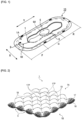
- the sanitary towel 10 of the embodiment has a topsheet 1 arranged on the skin-contact surface side, a backsheet 2 arranged on the skin non-contact surface side, and a liquid-retainable absorbent body 3 interposed between the topsheet 1 and backsheet 2.
- a leak-proof groove 5 compressed from the topsheet 1 to the absorbent body 3 is arranged on the skin-contact surface side of the sanitary towel 10, and the leak-proof groove 5 forms an annular shape in a plane view.
- the leak-proof groove 5 can be arbitrarily arranged, and a shape and the number thereof can be appropriately set according to a purpose of use or the like.
- the sanitary towel 10 may contain other components.
- the sanitary towel 10 may contain an intermediate sheet having liquid diffusibility between the topsheet 1 and the absorbent body 3, or may have a pair of wing portions for fixing the sanitary towel 10 to clothes on both sides in a longitudinal direction of the sanitary towel 10.
- the sanitary towel 10 has a longitudinally long shape having a longitudinal direction (Y direction) and a lateral direction (X direction) perpendicular to the longitudinal direction.
- the sanitary towel 10 is worn by directing a portion on a topsheet 1 side toward a wearer's skin-contact surface side, disposing a portion in the longitudinal direction from a lower abdomen side to a buttocks side, and disposing a portion in the crosswise direction toward a direction along a line connecting right and left legs.
- the sanitary towel 10 has, in the longitudinal direction (Y direction), a crotch portion C which covers a wearer's excretory portion, a front portion F forward of the crotch portion C, corresponding to the lower abdomen side, and a rear portion R backward thereof, corresponding to the buttocks side.
- a liquid-receiving portion Q1 that directly receives an excreted liquid exists in a centre in the crosswise direction of the crotch portion C.
- the liquid-receiving portion Q1 namely, the term "a centre in the crosswise direction" of the crotch portion C means that when the absorbent article is a sanitary towel, a region in 2.5 cm or less in a right-left crosswise direction from a line dividing a length in the crosswise direction into two equal parts in the crosswise direction of the sanitary towel, and a region arranged in a whole area in a longitudinal direction of the crotch portion C in a longitudinal direction of the sanitary towel.
- the crotch portion C is the second region from the front of regions obtained by dividing the sanitary towel into four parts in the longitudinal direction, and when the absorbent article is a sanitary towel for daytime use, the crotch portion C is a middle region of regions obtained by dividing the sanitary towel into three parts in the longitudinal direction.
- the above-described liquid-receiving portion Q1 is a region in 3.5 cm or less in the right-left crosswise direction from a line dividing a length in the crosswise direction into two equal parts in the crosswise direction of the nappy, and a region in 8.0 cm or less in a front portion F direction from a line dividing a length in a longitudinal direction of the nappy into two equal parts in the longitudinal direction.
- the absorbent article is a urine pad or an incontinence pad
- the liquid-receiving portion Q1 is the same as in the sanitary towel for daytime use.
- the liquid-receiving portion Q1 is a region surrounded by the leak-proof groove 5 in the crotch portion.
- Division positions of the crotch portion C, the front portion F and the rear portion R may be appropriately set according to the length of the absorbent article to be set for the purpose of use or the like.
- the sanitary towel 10 of the embodiment an example of a shape set as daytime use or the like is shown, and the length in the longitudinal direction is divided into about three equal parts, and the front portion F, the crotch portion C and the rear portion R are set.
- Specific examples of a shape different therefrom include a shape (not shown) in which a sanitary towel 10 has a wide rear flap covering buttocks as night use or the like, and a rear portion R is formed to be longer than a front portion F and a crotch portion C.
- the crotch portion C exists to the front of the sanitary towel, and the second region from the front portion F of the regions obtained by dividing the sanitary towel into four equal parts in the longitudinal direction may correspond to the crotch portion C, for example. Even if the sanitary towel 10 has any shape, the crotch portion C may be generally set as a site in a position at a predetermined distance from the front portion F.
- the topsheet 1 is formed of a fibre sheet existing on a skin side of the absorbent body 3, and to be in contact with the wearer's skin.
- the fibre sheet has integrity of a sheet by bonding by thermal fusion of the fibres with each other (for example, a nonwoven fabric).
- thermally fusible fibres are used as constituent fibres, for example.
- the thermally fusible fibres are melted by heat treatment, and the fibres are fused with each other by melted components.
- the above-described melting may be induced in both the fibres to be fused, or in the fibres only on one side.
- Examples of the above-described heat treatment include hot-air treatment (airthrough treatment) and embossing compression treatment.
- the fibre sheet is a laminated sheet formed of a plurality of fibre layers, not only the fibres are bonded with each other within each fibre layer, but also the fibre layers are bonded with each other by the above-described thermal fusion or an adhesive. That is, the fibres in both the fibre layers are bonded with each other by the thermal fusion or the adhesive on a boundary surface between the fibre layers. In this case, as long as the integrity as the fibre sheet is retained, the fibre layers may be wholly or partly bonded with each other.
- the fibre layers are preferably bonded only by the thermal fusion without bonding by the adhesive.
- topsheet 1 When the topsheet 1 is formed of the laminated sheet in which the fibres in both the fibre layers are bonded with each other only by the thermal fusion, specific examples include (N1) to (N4) as described below.
- the fibre layers are wholly bonded with each other by the hot-air treatment.
- the fibre layers are mainly bonded with each other in a part subjected to the embossing compression treatment.
- the topsheet 1 has hydrophilicity as a whole, and receives excretion of a bodily fluid to have liquid permeability with which the bodily fluid is quickly sucked into the absorbent body 3 inside the absorbent article.
- various forms ordinarily used for the absorbent article can be adopted without particular restriction. Specific examples thereof include nonwoven fabrics described in the paragraphs ⁇ 0100 ⁇ to ⁇ 0110 ⁇ and FIGs. 3 to 11 in WO 2016/098796 and the like.
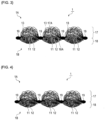
- a surface on a top surface (surface facing the wearer's skin side, and a skin-contact surface) 1A side and a surface on a back surface (surface facing an absorbent body side, and a non-skin contact surface) 1B side of the topsheet 1 are formed in a concavo-convex shape.
- the topsheet 1 has a structure in which a skin side fibre layer (hereinafter, also referred to as a skin side layer) 17 and a non-skin side fibre layer (hereinafter, also referred to as a non-skin side layer) 18 are laminated. Both the layers are partially bonded by a concave bonding portion 19.
- the concave bonding portion 19 is formed by the thermal fusion of the fibres with each other by the embossing compression treatment.
- the top surface 1A has the concavo-concave shape, whereby a contact area between the skin and the topsheet 1 is reduced, and the sticky feeling on skin or damp feeling is suppressed into the topsheet 1 excellent in dry feeling. Moreover, when a convex portion 17P in the concavo-convex shape has a dome shape filled with the fibres, cushioning properties in contact with the skin are improved, and such a case is preferable.
- the topsheet 1 as shown in FIG. 2 preferably has the fibre structure described in the paragraphs [0010] to [0055] of JP-A-2015-110846 .
- the topsheet 1 has a structure in which the non-skin side layer 18 contains helically crimped fibres, and fibre density of the non-skin side layer 18 is adjusted to be higher than the fibre density of the skin side layer 17.
- the topsheet 1 is provided with quick liquid permeability by a capillary pressure difference, and bulkiness and high cushioning properties.
- action of the liquid film cleavage agent for reduction of residual liquid described later can be further enhanced.
- the topsheet 1 has an arrangement portion 11 of the liquid film cleavage agent.
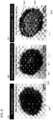
- the arrangement portion 11 is formed into an arrangement shown in FIG. 3 or an arrangement shown in FIG. 4 .
- the topsheet 1 may wholly or partly have the arrangement portion 11 in a plane direction.
- the arrangement portion 11 preferably exists at least in the liquid-receiving region Q1.
- the arrangement portion 11 of the liquid film cleavage agent preferably wholly exists in the plane direction of the topsheet 1. Meanwhile, from a viewpoint of suppressing the sticky feeling, the arrangement portion 11 preferably exists only in the liquid-receiving region Q1.
- the arrangement portion 11 may be arranged in a pattern wholly in the plane direction or wholly in the liquid-receiving region Q1, or the liquid-receiving region Q1 may be wholly formed into the arrangement portion 11.
- the above-described expression "arranged in a pattern” means that a plurality of arrangement portions 11 is separated from each other and regularly arranged.
- the arrangement portion 11 and the non-arrangement portion 12 described later are preferably alternately arranged in the plane direction of the topsheet 1.
- the arrangement portion 11 of the liquid film cleavage agent exists in a thickness intermediate position 13 of the topsheet 1.
- a plurality of arrangement portions 11 exists in the plane direction of the topsheet 1 in the thickness intermediate position 13.
- the arrangement portion 11 of the liquid film cleavage agent exists on a back surface 1B side (absorbent body side) of the topsheet 1.
- a plurality of arrangement portions 11 exists in the plane direction of the topsheet 1 on the back surface 1B side.
- a part other than the arrangement portion 11 is the part in which no liquid film cleavage agent is arranged, and this part is shown as the non-arrangement portion 12 of the liquid film cleavage agent.
- the arrangement portion 11 of the liquid film cleavage agent is judged to exist on a top surface 1A side
- the arrangement portion 11 of the liquid film cleavage agent is judged to exist on the back surface 1B side (absorbent body side)
- the arrangement portion 11 of the liquid film cleavage agent is judged to exist in the thickness intermediate position 13.
- the arrangement portion 11 is patterned, but the arrangement portion 11 cannot be necessarily distinguished by visual observation in practice. Moreover, in FIGs. 3 and 4 , the arrangement portions 11 are shown in a circular shape and separated from each other. However, a specific aspect of an arrangement interval, the number of arrangement portions 11 or the like is not limited thereto, and from a viewpoint of an effect of reduction of residual liquid, the arrangement interval, the number or the like may be appropriately set.
- the liquid film cleavage agent in the arrangement portion 11 is present on the way of a path in which the bodily fluid is permeated through the topsheet 1. Further, in the case of FIG. 4 , the liquid film cleavage agent in the arrangement portion 11 is present in the vicinity of an outlet from which the bodily fluid is transferred from the topsheet 1 to the absorbent body 3 side. In any case, the liquid film cleavage agent is spread (transferred) from a position of the arrangement portion 11 to exhibit the liquid film cleavage action described later on the body fluid. This spread action will be described later.
- the term “thickness intermediate position 13 of the topsheet 1” means a part inward from both a surface of the top surface 1A and a surface of the back surface 1B.
- This thickness intermediate position 13 is preferably a region of a central part of regions obtained by dividing a thickness of the topsheet into three equal parts, and more preferably a region in the vicinity of a centre of a thickness width.
- the thickness intermediate position 13 exists in a position inward from both the surface of the top surface 1A and the surface of the back surface 1B along the concavo-convex shape.
- the thickness intermediate position 13 can be formed as the boundary surface between the fibre layers.
- the arrangement portion 11 may exist on a surface on any side of both surfaces facing an adjacent fibre layer.
- the arrangement portion 11 may exist in any surface of a surface 17A of the skin side layer 17, facing the non-skin side layer 18, and a surface 18A of the non-skin side layer 18, facing the skin side layer 17, or may exist in both the surfaces facing the layers.
- the topsheet is not limited to two layers as shown in FIG.
- the arrangement portion 11 may have three or more layers.
- the arrangement portion 11 only needs to exist at least on any of the boundary surfaces, and may exist on one boundary surface or on a plurality of boundary surfaces.
- the arrangement portion 11 may be arranged inside the fibre layer interposed by the fibre layers on the top surface and on the back surface.
- the arrangement portion 11 can be formed in the "thickness intermediate position 13 of the topsheet 1" by various methods ordinarily used in a production process of the fibre sheet serving as the topsheet 1.
- examples thereof include a method of providing (arranging) a liquid film cleavage agent on the way of fibre-stacking processing for forming a fibre web containing thermally fusible fibres.
- the remaining necessary fibre-stacking processing is performed, whereby the fibres are fused with each other by heat treatment at a temperature higher than or equal to a melting point of the thermally fusible fibres to form the fibre web into the nonwoven fabric.
- the nonwoven fabric can be produced by performing processing steps (P1) to (P3) described below.
- first fibre layer and the “second fibre layer” described above mean various fibre aggregates of the nonwoven fabric, the fibre web, the long fibre layer or the like.
- the "first fibre layer” and the “second fibre layer” may be laminated with each other by using the layers having forms identical to or different from each other.
- the "heat treatment at a temperature higher than or equal to a melting point of the thermal fusible fibres" in the (P3) described above may include any one of the embossing compression treatment and the hot-air treatment, or may include both.
- the hot-air treatment may be performed at a temperature "lower than or equal to the melting point" of the thermally fusible fibres, and not at the "temperature higher than or equal to the melting point of the thermal fusible fibres.”
- a compound having a liquid film cleavage effect one or more of compounds selected from the compound C1 and the compound C2 described later may be used (hereinafter, collectively referred to as "liquid film cleavage agent" for convenience in the present specification).
- coating treatment may be performed in a mixed state of the above-described liquid film cleavage agent and the hydrophilising agent described later.
- the nonwoven fabric produced as described above is cut into a suitable size and formed as the topsheet.
- the topsheet is processed into the absorbent article through a step of laminating and bonding the topsheet with other components of the absorbent article by an ordinary method. Specifically, an absorbent body and a backsheet are laminated and bonded on one surface side (back surface side) of the topsheet in this order to form the absorbent article.
- the absorbent article may be produced by a production method containing a step of assembling other members in addition to the above-described components.
- Examples of the step include a step of laminating side sheets for side-leak prevention on both sides in a longitudinal direction of a topsheet, a step of forming an adhesive portion for fixing an absorbent article to clothes on a non-skin side of a backsheet, a step of assembling a member serving as a wing portion for being wound on clothes and fixing an absorbent article, or a step of interposing a second sheet having liquid diffusibility between a topsheet and an absorbent body.
- the liquid film cleavage agent contained in the topsheet 1 is an agent having the following (Properties of eliminating liquid film).
- the liquid film cleavage agent means an agent which inhibits formation of liquid film by cleaving liquid film formed between fibres or on a surface of the fibres of the nonwoven fabric when a liquid, for example, an excreted liquid (bodily fluid) such as a high viscosity liquid including menstrual blood or urine comes into contact with the nonwoven fabric.
- the liquid film cleavage agent has an effect of cleaving the formed liquid film and an effect of inhibiting formation of liquid film.
- the former and the latter can be referred to as principal action and secondary action, respectively.
- the liquid film cleavage agent takes such action as described in paragraphs ⁇ 0024 ⁇ and ⁇ 0025 ⁇ , FIGs. 1 and 2 in the description of WO 2016/098796 .
- the liquid film cleavage agent cleaves the liquid film itself that is formed between the fibres or on a fibre surface, instead of liquid reforming such as reduction of the surface tension of the liquid film, to inhibit the formation of liquid film while sweeping the liquid film to promote drainage of liquid from the nonwoven fabric.
- the liquid film cleavage agent used in the present invention has properties of eliminating the liquid film, and owing to such properties, the liquid film cleavage agent can develop an effect of eliminating the liquid film when the liquid film cleavage agent is applied to a test liquid mainly containing a plasma component or artificial urine.
- the artificial urine is prepared by adjusting a mixture having a proportion of 1.940 mass% of urea, 0.795 mass% of sodium chloride, 0.111 mass% of magnesium sulphate, 0.062 mass% of calcium chloride, 0.198 mass% of potassium sulphate, 0.005 mass% of red No. 2 (dye), water (96.882 mass%) and polyoxyethylene lauryl ether (0.007 mass%), to the surface tension of 53 ⁇ 1 mN/m (23°C).
- the test liquid is a liquid component extracted from defibrinated equine blood (manufactured by NIPPON BIO-TEST LABORATORIES INC.). Specifically, when 100 mL of the defibrinated equine blood is left to stand under conditions of a temperature of 22°C and a humidity of 65% for 1 hour, the defibrinated equine blood is separated into an upper layer and a lower layer, in which this upper layer is the test liquid.
- the upper layer mainly contains the plasma component and the lower layer mainly contains a blood cell component.
- Transfer Pipet manufactured by Nippon Micro K.K
- the effect of eliminating the liquid film herein includes, with regard to a structure in which air is held by the liquid film formed of the test liquid or the artificial urine, both an effect of inhibiting liquid film formation of the structure and an effect of eliminating the formed structure, and it can be said that the agent of developing at least one effect has properties according to which the effect of eliminating the liquid film can be developed. Specifically, a degree of a certain agent having the "properties of eliminating the liquid film" can be judged by a large or small amount of the structure, namely the liquid film, when a state of easily producing the structure is formed, in which the structure formed of the test liquid or the artificial urine to which the agent is applied.
- a standard sample is obtained by adjusting a temperature of the test liquid or the artificial urine to 25°C, and then putting 10 g thereof in a screw bottle (manufactured by Maruemu Corporation, No. 5, shell diameter: 27 mm, overall length: 55 mm).
- a measurement sample a material prepared by adding 0.01 g of an agent of a measurement target as adjusted beforehand to 25°C to liquid same with the standard sample is obtained. After intensively shaking the standard sample and the measurement sample up and down twice in a vertical direction of the screw bottle, respectively, the samples are immediately placed on a horizontal plane.
- a liquid layer (lower layer) without the structure and a structure layer (upper layer) formed of a large number of the structures formed on the liquid layer are formed inside the screw bottle after shaking by shaking the samples. After elapse of 10 seconds from the time immediately after shaking, a height of the structure layer (height from a liquid level of the liquid layer to a top surface of the structure layer) for both the samples is measured. Then, when the height of the structure layer of the measurement sample reaches 90% or less relative to the height of the structure layer of the standard sample, the agent of the measurement target is deemed as the agent having the liquid film cleavage effect.
- the liquid film cleavage agent used in the present invention is an agent satisfying the properties (an agent which can develop cleavage of the liquid film) by a single compound meeting the properties, a mixture combined with plurality of the single compound meeting the properties, or a combination of a plurality of compounds. That is, the liquid film cleavage agent means only agent limited to a material having the liquid film cleavage effect according to the definition. Accordingly, when a third component not meeting the definition is contained in the compound applied into an absorbent article, such an agent is distinguished from the liquid film cleavage agent.
- the "single compound” means a compound under a concept of including a compound which has the same composition formula, but has a different molecular weight by a difference in the number of repeating units.
- liquid film cleavage agent a material can be appropriately selected from the materials described in the paragraphs ⁇ 0007 ⁇ to ⁇ 0186 ⁇ in WO 2016/098796 , and can be used.
- the topsheet 1 contains the liquid film cleavage agent means that the liquid film cleavage agent is mainly adhered to the surface of the fibres. However, insofar as the liquid film cleavage agent remains present on the surface of the fibres, it is also acceptable for the liquid film cleavage agent to be present inside the fibres, or to be present inside the fibres by internally incorporating.
- a method of adhering (providing) the liquid film cleavage agent to the surface of the fibres any of various commonly utilised methods can be adopted without particular restriction. Specific examples of the methods include applying treatment such as flexographic printing, inkjet printing, gravure printing, screen printing, spraying and brush applying.
- processings may be performed after the fibres are formed into the web by various methods or after the web is then processed into the nonwoven fabric or after the nonwoven fabric is assembled into the absorbent article.
- the fibres on the surface to which the liquid film cleavage agent is adhered are dried, for example, by a dryer of a hot air blowing type at a temperature sufficiently lower than melting point of a fibre resin (for example, 120°C or less).
- liquid film cleavage agent when adhered to the fibres using the above-described adhering method, a solution containing the liquid film cleavage agent which dissolves the liquid film cleavage agent in a solvent, an emulsified liquid, or an applying liquid in a state of a dispersion liquid, may be used, when necessary.
- the liquid film cleavage agent In order for the liquid film cleavage agent to have the liquid film cleavage effect described later in the nonwoven fabric, the liquid film cleavage agent is required to be present in a fluid state when the liquid film cleavage agent touches bodily fluid. Owing to this, melting point of the compound contained in the liquid film cleavage agent is preferably 40°C or less, and more preferably 35°C or less. Further, the melting point of the compound contained in the liquid film cleavage agent according to the present invention is preferably -220°C or more, and more preferably -180°C or more.
- the liquid film cleavage agent exhibits spreadability to a liquid film between the fibres and on the fibres in the arrangement portion 11 to cleave the liquid film. Further, the liquid film cleavage agent moves from a position of the arrangement portion 11 to any other region (a region that is not the arrangement portion, namely, the non-arrangement portion 12) of the topsheet 1 by the spreadability to exhibit the liquid film cleavage action.
- the former is referred to as micro spreadability
- the latter is referred to as macro spreadability.
- the macro spreadability of the liquid film cleavage agent is developed in both the directions of the plane direction and the thickness direction of the topsheet 1.
- the macro spreadability of the liquid film cleavage agent is induced in the plane direction, and therefore an area ratio of the arrangement portion 11 of the liquid film cleavage agent can be suppressed at a low level. That is, in a region having the arrangement portion 11 in the topsheet 1, the non-arrangement portion 12 is further provided, whereby the arrangement portion 11 and the non-arrangement portion (part in which no liquid film cleavage agent is arranged) 12 can be mixed in the plane direction.
- the term "a region having the arrangement portion 11" means a whole region of the topsheet 1 in the plane direction in the thickness immediate position 13 of the topsheet 1, or in the back surface 1B (surface facing the absorbent body side) of the topsheet 1.
- the macro spreadability in the plane direction is confirmed by the experiment as described below. That is, an arrangement portion of a liquid film cleavage agent (basis weight: 1.3 g/m 2 , OPU: 0.4 mass%) was formed in a dot shape having a diameter of 0.8 mm on a surface of a nonwoven fabric having the same structure as the structure of the above-described topsheet 1, and quasi-menstrual blood (6.0 g) was added dropwise thereto. At this time, the liquid film cleavage agent was coloured with a red paint so that a region of the arrangement portion was able to be confirmed. The liquid film cleavage agent may be coloured with an arbitrary colour such as blue as long as the arrangement portion can be visually recognised.
- the quasi-menstrual blood is a material prepared by adjusting a viscosity of defibrinated equine blood manufactured by NIPPON BIO-TEST LABORATORIES INC. to 8.0 cP.
- the used defibrinated equine blood was adjusted by TVB-10 Viscometer manufactured by Toki Sangyo Co., Ltd. under conditions of 30 rpm.
- a part with high viscosity red blood cells or the like
- precipitates a part with low viscosity (plasma) remains as a supernatant.
- a mixing ratio in the parts was adjusted to be 8.0 cP (hereinafter, as the quasi-menstrual blood described in the present specification, blood prepared by the same method is used unless otherwise stated.).
- a topsheet was carefully removed after spraying the sanitary towel with a cold spray to solidify an adhesive (in addition, in the present specification, upon removing a component from the absorbent article, this method is used in all cases.).
- the above-described nonwoven fabric was laminated in such a manner that a surface of a concavo-convex structure existed on a skin-contact surface side, and an acrylic plate having a penetration hole having an inner diameter of 1 cm was placed in such a manner that centres of the penetration hole and the arrangement portion were overlapped.
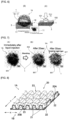
- a predetermined load of 100 Pa was applied to the sanitary towel, 6.0 g of quasi-menstrual blood was injected from the penetration hole of the above-described acrylic plate under such a load, and after leaving the assembly to stand for 60 seconds from completion of injection, the acrylic plate was removed. Then, it was confirmed that the liquid film cleavage agent is concentrically spread in a range (K1) having a diameter of 4.6 mm being about 5.7 times a diameter of the arrangement portion 11 to exhibit the liquid film cleavage action, whereby redness M1 of the quasi-menstrual blood is dissolved (see FIGs. 5(A) and 5(B) ).
- the quasi-menstrual blood remaining as the liquid film was permeated to the absorbent body to reduce the residual liquid of the nonwoven fabric.
- the liquid film cleavage agent may be spread in a wider range to exhibit the liquid film cleavage action.
- the liquid film cleavage agent is concentrically spread in a range (K2) having a diameter of 12 mm being about 15 times the diameter of the arrangement portion 11 to exhibit the liquid film cleavage action, whereby the redness M1 of the quasi-menstrual blood is dissolved (see FIGs. 5(A) and 5(C) ).
- the macro spreadability of the liquid film cleavage agent is also induced in thickness direction.
- the liquid film cleavage agent when liquid flow settles down, as compared with a state during liquid injection and immediately after liquid injection, the liquid film cleavage agent is spread from the thickness immediate position 13 or the back surface 1B side of the topsheet 1 to the top surface 1A side being a liquid-receiving surface.
- a phenomenon of exhibiting the liquid film cleavage action may occur with a time difference in the thickness intermediate position 13 or on the back surface 1B side.
- the residual liquid on the topsheet 1 as a whole can be suppressed at a low level, and dryness at a high level can be realised.
- dissolution of the redness can be confirmed on the top surface 1A side, and therefore a wearer can perceive, with the skin and eyes, that the residual liquid is suppressed at the low level.
- the liquid film cleavage agent may be spread not only in a top surface 1A direction of the topsheet 1, but also in a back surface 1B direction thereof.
- the liquid film cleavage agent is simultaneously spread from the thickness intermediate position 13 to the top surface 1A direction and the back surface 1B direction, whereby the liquid film cleavage action in the thickness of the topsheet 1 as a whole may be efficiently and promptly exhibited. Therefore, the effect of reduction of residual liquid is further improved when the arrangement portion 11 exists in the thickness intermediate position 13 than when the arrangement portion 11 exists on the back surface 1B side.
- the arrangement portion 11 of the liquid film cleavage agent exists in the thickness intermediate position 13 or on the back surface 1B side, whereby the non-arrangement portion on the top surface 1A side is interposed between the skin and the arrangement portion 11 of the liquid film cleavage agent, and thus a contact chance between the liquid film cleavage agent and the wearer's skin is suppressed, and prevention capability of the sticky feeling on skin is high.
- the arrangement portion OPU of the liquid film cleavage agent in the arrangement portion 11 in the thickness intermediate position 13 or on the back surface 1B side is appropriately set, whereby excessive spread of the liquid film cleavage agent to the top surface 1A can be controlled and a contact between the liquid film cleavage agent and the skin can be preferably suppressed. Therefore, the sticky feeling on skin can be made harder to feel in providing the arrangement portion 11 in the thickness intermediate position 13 or on the back surface 1B side than in providing the arrangement portion 11 on the top surface 1A. That is, a feeling of the topsheet 1 sticking to or clinging to the skin can be suppressed, whereby skin dry feeling may be kept at a high level.
- a form of each fibre layer can be changed, and such a case is preferable.
- a capillary pressure on the back surface 1B side can be increased than on the top surface 1A side to increase the capillary pressure difference between both the surfaces, whereby the liquid after the liquid film is cleaved by the liquid film cleavage agent can be further easily sucked into the absorbent body 3 than in a single layer.
- each fibre layer for increasing the capillary pressure difference examples include a form in which basis weight in a non-skin side layer is increased than in a skin side layer, or a fibre diameter in the non-skin side layer is reduced than in the skin side layer to increase fibre density or a degree of hydrophilicity.
- an arrangement pattern of the arrangement portion 11 of the liquid film cleavage agent, or the arrangement proportion of the liquid film cleavage agent can be set with satisfactory precision. Therefore, when the topsheet 1 is the laminated sheet, the liquid film cleavage action of the liquid film cleavage agent arranged with satisfactory precision in the thickness intermediate position 13 is combined with liquid sucking force by the above-described capillary pressure difference or the like, whereby a higher effect of reduction of residual liquid is exhibited, and such a case is preferable.
- a topsheet 1 was placed on an absorbent body 3 with a top surface 1A upward, and an acrylic plate 100 having an input port of a cylinder 101 was placed on a sample. Then, 6.0 g of quasi-menstrual blood was injected thereinto. It was confirmed that redness M1 gradually disappears from a lower side to a top surface 1A side as time passes (a sign K6 in FIG. 7(B) , a sign K7 in FIG. 7(C) ) after 20 seconds (after liquid flow settled down) ( FIG. 7(B) ), and after 30 seconds ( FIG. 7(C) ) from leaving an assembly to stand, from a state immediately after injection of the liquid ( FIG. 7(A) ).
- the liquid film cleavage agent is spread from the back surface 1B side to the top surface 1A side, and the liquid film cleavage action on the quasi-menstrual blood in the thickness direction of the topsheet 1 is exhibited, whereby the quasi-menstrual blood remaining as the liquid film is permeated into the absorbent body.
- a degree of the macro spreadability of the liquid film cleavage agent is determined depending on various factors. For example, as a spreading coefficient described later is larger, a spreading distance in the liquid drop becomes longer to exhibit higher spreadability. Moreover, as an arrangement proportion of the liquid film cleavage agent in the arrangement portion 11 is larger, the spreading distance in the liquid drop becomes longer to exhibit the higher spreadability.
- the liquid film cleavage agent exhibits preferable high spreadability for the liquid drop by moderately suppressing viscosity thereof.
- the arrangement portion 11 of the liquid film cleavage agent exists in the thickness intermediate position 13 or on the back surface 1B side, upon considering spreading of the liquid film cleavage agent in the thickness direction from the arrangement portion 11 to the top surface 1A being the liquid-receiving surface, viscosity of the liquid film cleavage agent is preferably suppressed at a moderate level, as compared with a case where the arrangement portion 11 exists on the top surface 1A.
- the viscosity of the liquid film cleavage agent is 0 cps or more; and preferably 6,000 cps or less, more preferably 600 cps or less, and further preferably 200 cps or less.
- the viscosity of the liquid of the liquid film cleavage agent can be measured by the following method.
- a liquid film cleavage agent 40 g is prepared.
- the viscosity is measured on the liquid film cleavage agent in an environment range of a temperature of 25°C and a relative humidity (RH) of 65% by using Tuning Fork Vibro Viscometer SV-10 (manufactured by A&D Company, Limited). This operation is repeated three times, and an average value is adopted as the viscosity.
- the liquid film cleavage agent is solid, the liquid film cleavage agent is heated to a temperature of a melting point of the liquid film cleavage agent plus 5°C to induce phase transition into liquid, and the measurement is performed with keeping the temperature conditions.
- the liquid film cleavage agent adhered to the fibre is measured, the liquid film cleavage agent is taken out from the fibre based on the method used in measurement of the spreading coefficient or the like described later. In this case, when only a small amount thereof can be taken out for the above-described measurement, the viscosity is measured in the same manner as the case of measurement of the spreading coefficient or the like described later.
- the liquid (bodily fluid) in contact with the topsheet 1 easily passes through a significantly fine inter-fibre space or the like without being stayed therein by the above-described action of the liquid film cleavage agent, whereby reduction of residual liquid in the topsheet 1 may be realised at a higher level.
- the liquid film cleavage agent existing in the thickness intermediate position 13 or on the back surface 1B side develops the above-described macro spreadability, whereby the effect of reduction of residual liquid in the topsheet 1 as a whole can be obtained in the same manner to the case where the liquid film cleavage agent exists on the top surface 1A.
- the contact between the liquid film cleavage agent on the top surface 1A of the topsheet 1 and the skin can be suppressed.
- reduction of residual liquid and reduction of the sticky feeling on skin can be simultaneously realised.
- liquid flow on the surface on the top surface 1A of the topsheet 1 can be preferably suppressed.
- the liquid film cleavage agent has high spreadability to the liquid film, and therefore has smaller surface tension than a conventional hydrophilisation treatment agent or the like used for nonwoven fabric fibres. Therefore, when the liquid film cleavage agent is arranged, wettability of the fibres in an initial stage of contact with the liquid is somewhat reduced, as compared with a case where no liquid film cleavage agent is arranged.
- flow of the bodily fluid for example, the excreted liquid such as menstrual blood or urine
- the arrangement portion 11 of the liquid film cleavage agent is arranged in the thickness intermediate position 13 or on the back surface 1B side of the topsheet 1. That is, the present embodiment is configured in such a manner that reduction of hydrophilicity on the surface of the topsheet 1 by the liquid film cleavage agent is suppressed to retain the wettability on the surface.
- the liquid flow on the surface on the top surface 1A side of the topsheet 1 is prevented, whereby liquid permeability in the thickness direction can be retained.
- the liquid film cleavage agent can exhibit the liquid film cleavage action by the spreadability not only in the arrangement portion 11, but also in a wide range in the thickness direction and the plane direction of the topsheet 1.
- the liquid film cleavage agent may retain a passage space in which the bodily fluid is delivered from the topsheet 1 to the absorbent body 3 on the back surface 1B side of the topsheet 1.
- the liquid sucking force of the absorbent body 3 can be easily transferred to the top surface 1A side through the passage space.
- cooperation performance of liquid sucking is enhanced between the absorbent body 3 and the topsheet 1, whereby liquid absorbency of the sanitary towel 10 may be improved.
- This liquid absorbency is further improved by formation of the top surface 1A side of the topsheet 1 in the concavo-convex shape as shown in Fig. 2 .
- an arrangement of the arrangement portion 11 on the top surface 1A side of the topsheet 1 is preferably reduced.
- the area ratio of the arrangement portion 11 in an area of the topsheet 1 is preferably adjusted to be smaller on the top surface 1A (surface facing the wearer's skin side) of the topsheet 1 than in the thickness intermediate position 13 or on the back surface 1B (surface facing the absorbent body side) of the topsheet 1. Further, it is more preferable that no arrangement portion 11 exists on the top surface 1A (surface facing the wearer's skin side) of the topsheet 1.
- the present embodiment is shown as an aspect in which no arrangement portion 11 of the liquid film cleavage agent is provided on the top surface 1A.
- the area ratio of the arrangement portion 11 is calculated according to a formula: ⁇ (total area of arrangement portion)/(total area of arrangement portion and non-arrangement portion) ⁇ ⁇ 100.
- the term "total area of arrangement portion and non-arrangement portion” means the area of the topsheet 1.
- the area of the topsheet 1 relating to calculation of the above-described area ratio is the area defined by an external shape of the topsheet 1 in any case of the thickness intermediate position 13, the top surface 1A and the back surface 1B of the topsheet 1.
- a topsheet 1 is carefully peeled off and removed from an absorbent article to be measured, and a sample cut out into 3.0 cm square is prepared, and the sample is arranged in a liquid-receiving region of the absorbent article.
- a topsheet is removed from a sanitary towel (trade name "LAURIER F, Shiawase Suhada, 22.5 cm,” manufactured by Kao Corporation in 2016) as one example of an absorbent article, and the sample is prepared. Then, the above-described sample is stacked on the liquid-receiving region of the above-described sanitary towel.
- the liquid-receiving region in the above-described sanitary towel is a region existing from a position of 7.5 cm to 15.0 cm from a front portion F, and in 2.5 cm or less in a crosswise direction from a line dividing a length of the sanitary towel in a transverse direction into two equal parts.
- an acrylic plate having a penetration hole having an inner diameter of 1 cm is placed in such a manner that centres of the penetration hole and the above-described sample are overlapped, and a predetermined load of 100 Pa is applied to the sanitary towel, and 6.0 g of quasi-menstrual blood is injected from the penetration hole of the acrylic plate under such a load.
- the acrylic plate is removed, and the above-described sample is immersed into liquid nitrogen, and the sample is cut along the crosswise direction of the topsheet 1 passing through the centre of the above-described sample by using a cutter.
- a cut cross section is observed with an optical microscope, and in a thickness intermediate position of the above-described sample, a part in which redness of the quasi-menstrual blood is further dissolved than on a top surface side and a back surface side is the arrangement portion 11, and a part other than the above-described part is the non-arrangement portion 12.
- the arrangement portion 11 of the liquid film cleavage agent is judged to exist on the top surface side, if the part in which the redness is dissolved exists in a layer on the surface side of a non-skin side layer being a division farthest from the skin side, the arrangement portion 11 of the liquid film cleavage agent is judged to exist on the back surface side (absorbent body side), and if the part in which the redness is dissolved exists in a layer of a middle division, the arrangement portion 11 of the liquid film cleavage agent is judged to exist in the thickness intermediate position.
- Presence or absence of the liquid film cleavage agent when the arrangement portion 11 of the liquid film cleavage agent of the topsheet 1 exists on the top surface 1A side or the back surface 1B side can be confirmed by the following method. That is, facial oil blotting paper is attached to each surface of the topsheet 1, and then a 4 mm-thick acrylic plate is placed thereon, and a load is applied thereto to be 600 g/cm 2 for 30 seconds with a weight from above. Immediately after application of the load, the facial oil blotting paper is peeled off, and the facial oil blotting paper is placed on a black mat, and a change in colour is visually confirmed. When the change in colour is found, the change shows that the liquid film cleavage agent is contained in the part.
- a part of the topsheet 1 corresponding to a colour-change part of the facial oil blotting paper is the arrangement portion 11 of the liquid film cleavage agent, and a part other than the above-described part is the non-arrangement portion 12.
- Facial blotting paper made from gold leaf pounding paper, manufactured by KATANI co., ltd.
- Presence or absence of the liquid film cleavage agent when the arrangement portion 11 in the topsheet 1 exists in the thickness immediate position as shown in FIG. 3 is confirmed by the same method as the above-described (Method for confirming presence or absence of liquid film cleavage agent in thickness direction), in which a topsheet 1 is removed, and a sample cut out into 3.0 cm square is prepared. Then, the above-described sample is stacked on a liquid-receiving region of the above-described sanitary towel.
- an acrylic cylindrical plate (height: 3.0 cm, thickness of acrylic plate: 3 mm) having an elliptical penetration hole having a major axis of 5.0 cm and a minor axis of 2.3 cm is placed in such a manner that centres of the penetration hole and the above-described sample are overlapped, and 6.0 g of quasi-blood having viscosity adjusted to 40 cP is injected from the penetration hole of the cylindrical plate to be uniformised in the plane direction.
- the cylindrical plate is removed and the sample is left to stand, and a part in which redness is reduced and a part in which the redness is not reduced come out within 60 seconds from injection.
- the part in which the redness is reduced is the arrangement portion 11 and the part in which the redness is not reduced is the non-arrangement portion 12.
- the area ratio is measured according to the procedure described in the former part of the above-mentioned (Method for confirming presence or absence of liquid film cleavage agent in plane direction) for each entire surface of the topsheet 1. That is, a load is applied thereto, and an area of a part in which a colour-change part of facial oil blotting paper is copied on an OHP sheet is taken as an area of the arrangement portion 11, and a value obtained by subtracting the area of the above-described arrangement portion 11 from the area of the topsheet 1 is taken as an area of the non-arrangement portion 12.
- the area ratio is measured according to the procedure described in the latter part of the above-mentioned (Method for confirming presence or absence of liquid film cleavage agent in plane direction), in which no sample is cut out. That is, when quasi-menstrual blood is injected thereinto and the resulting material is left to stand, and a part in which redness is reduced and a part in which the redness is not reduced come out within 60 seconds from injection, a sample is immersed into liquid nitrogen.
- An OHP sheet is immediately placed thereon, and the part in which the redness is reduced is copied on the OHP sheet, and an area of the copied part is taken as an area of the arrangement portion 11, and a value obtained by subtracting the area of the above-described arrangement portion 11 from an area of the topsheet 1 is taken as an area of the non-arrangement portion 12.
- the above-described operation is performed in an arbitrary position of the topsheet 1.
- the area ratio is calculated by using the measured areas of the arrangement portion 11 and the non-arrangement portion 12 according to a formula: ⁇ (total area of arrangement portion)/(total area of arrangement portion and non-arrangement portion) ⁇ ⁇ 100.
- the capillary pressure on the back surface 1B side is preferably increased than on the top surface 1A side to increase the capillary pressure difference between both the surfaces.
- the liquid film cleavage agent somewhat reduces wettability of the fibres. That is, the liquid film cleavage agent has a possibility of somewhat increasing a contact angle of the fibres to influence the above-described capillary pressure difference.
- the capillary pressure difference between both the surfaces can be controlled to a suitable state by taking the following aspect.
- the arrangement portion 11 and the non-arrangement portion 12 of the liquid film cleavage agent are preferably mixed in the thickness intermediate position 13 or on the back surface 1B side of the topsheet 1.
- the liquid film cleavage agent can sufficiently exhibit the liquid film cleavage action also in the non-arrangement portion 12 by the macro spreadability as mentioned above.
- reduction of hydrophilicity of the fibres by the liquid film cleavage agent can be preferably suppressed as a region as a whole on each surface in the thickness intermediate position 13 or on the back surface 1B side. That is, a degree of hydrophilicity on the absorbent body 3 side is increased than on the top surface 1A side for the thickness direction of the topsheet 1, whereby the capillary pressure difference between both the surfaces can be controlled to be large.
- the area ratio of the arrangement portion 11 is preferably 75% or less, more preferably 60% or less and further preferably 50% or less in the thickness intermediate position 13 and on the back surface 1B, respectively. Moreover, from a viewpoint of developing the liquid film cleavage effect effectively, the area ratio of the arrangement portion 11 is preferably 5% or more, more preferably 10% or more, and further preferably 20% or more.
- a pattern of mixture of the arrangement portion 11 and the non-arrangement portion 12 in the plane direction may take various aspects. Specific examples thereof include a pattern in which both an arrangement portion 11 and a non-arrangement portion 12 are extended in a strip shape in a longitudinal direction (Y direction), and a strip-shaped arrangement portion 11 and a strip-shaped non-arrangement portion 12 are alternately arranged in a crosswise direction (X direction) (a vertical stripe pattern); a pattern in which stripes of an arrangement portion 11 and a non-arrangement portion 12 extending in a crosswise direction (X direction) are alternately arranged in a longitudinal direction (Y direction) (a lateral stripe pattern); a pattern in which a plurality of arrangement portions 11 patterned in a rhombus shape is separated from each other and arranged in a lattice-shaped non-arrangement portion 12 (a lattice design); a pattern in which a plurality of non-arrangement portions 12 patterned in a rhombus shape is separated from each other and
- a hydrophilising agent is preferably arranged in the topsheet 1 as described below. That is, an arrangement amount of the hydrophilising agent is increased on the surface (back surface) 1B facing the absorbent body 3 side than on the surface (top surface) 1A facing the wearer's skin side of the topsheet 1.
- coating treatment is preferably performed in a mixed state of the liquid film cleavage agent and the hydrophilising agent. According to a gradient of the arrangement amount of the hydrophilising agent, reduction of hydrophilicity of the fibres by the liquid film cleavage agent can be preferably suppressed, and the capillary pressure difference between both the surfaces can be controlled so as to be increased.
- a mass ratio of a total amount of the arrangement amount of the hydrophilising agent on the back surface 1B of the topsheet 1 to a total amount of the arrangement amount of the hydrophilising agent on the top surface 1A of the topsheet 1 is preferably 1.2 or more, more preferably 1.7 or more, and further preferably 2.7 or more.
- the mass ratio is preferably 17.3 or less, more preferably 9.1 or less, and further preferably 5.9 or less. In addition, this mass ratio is calculated based on "Method for measuring arrangement proportion" of the hydrophilising agent mentioned later.
- a mass ratio of a total amount of the hydrophilising agent in the applying liquid to a total amount of the applying liquid ⁇ (hydrophilising agent)/(applying liquid) ⁇ is preferably 0.3 or more, more preferably 0.5 or more, and further preferably 0.75 or more.
- the above-described mass ratio ⁇ (the hydrophilising agent in the applying liquid)/(the applying liquid) ⁇ is preferably 0.9 or less, more preferably 0.85 or less, and further preferably 0.8 or less.
- this mass ratio is calculated based on "Method for measuring arrangement proportion" of the liquid film cleavage agent and the hydrophilising agent in the applying liquid mentioned later.
- a total amount of the hydrophilising agent (“hydrophilising agent previously coated on the fibre web serving as the nonwoven fabric sample” and "hydrophilising agent in the applying liquid”) is preferably 0.3 mass% or more, more preferably 0.6 mass% or more, and further preferably 0.9 mass% or more in terms of the arrangement proportion (average OPU) to the total fibre mass of the topsheet 1.
- the average OPU of the total amount of the hydrophilising agent is preferably 6 mass% or less, more preferably 3 mass% or less, and further preferably 2 mass% or less.
- a total amount of the liquid film cleavage agent is preferably 0.1 mass% or more, more preferably 0.2 mass% or more, and further preferably 0.3 mass% or more in terms of the arrangement proportion (average OPU) to the total fibre mass of the topsheet 1.
- the average OPU of the liquid film cleavage agent is preferably 10 mass% or less, more preferably 7.5 mass% or less, and further preferably 5 mass% or less.
- the average OPU represents the arrangement proportion of the total amount of each component to the total fibre mass of the topsheet 1.
- the average OPU represents the arrangement proportion of the total amount of the liquid film cleavage agent to the total fibre mass of the topsheet 1.
- the average OPU represents the arrangement proportion of the total amount of the hydrophilising agent and/or the applying liquid to the total fibre mass of the topsheet 1.
- the total amount of the liquid film cleavage agent is preferably 0.1 mass% or more, more preferably 0.4 mass% or more, and further preferably 0.8 mass% or more in terms of the arrangement proportion (arrangement portion OPU) to the fibre mass in the arrangement portion 11 in the topsheet 1.
- the arrangement portion OPU of the liquid film cleavage agent is preferably 8 mass% or less, more preferably 4 mass% or less, and further preferably 1.5 mass% or less.
- the arrangement portion OPU represents the arrangement proportion of the total amount of each component to the fibre mass in the arrangement portion 11 in the topsheet 1.
- the arrangement portion OPU represents the arrangement proportion of the total amount of the liquid film cleavage agent to the fibre mass in the arrangement portion 11 in the topsheet 1
- the arrangement portion OPU represents the arrangement proportion of the total amount of the hydrophilising agent and/or the applying liquid to the fibre mass in the arrangement portion 11 in the topsheet 1.
- a topsheet is removed from a top surface of an absorbent article, and test pieces obtained by dividing the topsheet into three parts in a thickness direction are prepared in the same manner as the above-described (Method for confirming presence or absence of liquid film cleavage agent in plane direction). Mass of each test piece is measured, and then a liquid film cleavage agent, a hydrophilising agent and other components such as an adhesive attached to each test piece are removed by using a solvent such as ethanol and water. Mass obtained by totaling the liquid film cleavage agent, the hydrophilising agent and other components is elucidated from mass of a residue thereof.
- the hydrophilising agent and other components is judged after identifying a molecular structure of a substance according to the following measuring method, and obtaining a structure as a single substance corresponding thereto, and measuring physical properties of the structure.
- a molecular weight of the isolate is measured using any of mass spectrometry (MS) and gel permeation chromatography (GPC).
- MS mass spectrometry
- GPC gel permeation chromatography
- a molecular skeleton is identified by using 1 H-NMR, 13 C-NMR or 29 Si-NMR
- a functional group owned by the isolate is identified by using IR
- a proportion of elements is elucidated by using elemental analysis, and then the molecular structure is identified by comprehensively analysing all the above-described information.
- the area ratio of the total arrangement portion 11 of each layer of the topsheet 1 obtained in the above-mentioned (Method for measuring area ratio of arrangement portion 11 and non-arrangement portion 12), and the arrangement proportion of each component to the total fibre mass of each test piece obtained in the (1) described above are used to calculate the arrangement proportion (arrangement portion OPU) of the liquid film cleavage agent and the hydrophilising agent to the fibre mass in the arrangement portion 11, by a formula: "(arrangement proportion of each component to fibre mass of each test piece)/(area ratio of total arrangement portion 11 of each layer of topsheet 1)".
- topsheet 1 used in the absorbent article according to present invention examples include a topsheet 20 assembling laminated fibre sheets as shown in FIG. 8 .
- a topsheet 20 has a double-layered structure having a hollow portion 21. All layers contain thermoplastic fibres.
- the topsheet 20 has a bonding portion 22 in which an upper layer sheet 20A being a skin side layer and a lower layer sheet 20B being a non-skin side layer are partially thermally fusion bonded.
- a non-bonding portion surrounded by the bonding portions 22 has a large number of convex portions 23 in which the upper layer sheet 20A is projected in a direction apart from the lower layer sheet 20B, with the hollow portion 21 inside thereof.
- the bonding portion 22 is a concave portion positioned between the adjacent convex portions 23 and 23 to form concavity and convexity of the top surface 1A together with the convex portion 23.
- the topsheet fabric 20 can be formed by a method to be ordinarily used.
- the upper layer sheet 20A is imparted to a concavo-convex shape by engagement of two concavo-convex rolls, and then the lower layer sheet is laminated thereon to obtain the topsheet 20.
- any of the upper layer sheet 20A and the lower layer sheet 20B preferably contains thermally non-extensible and thermally non shrinkable thermally fusible fibres.
- the topsheet 20 When the topsheet 20 is laminated on an absorbent body with the top surface 1A directed toward a skin-contact surface side, and used, the topsheet 20 is excellent in liquid permeability from a side of the top surface 1A to a side of the back surface 1B. Specifically, liquid permeation through the hollow portion 21 is excellent. Moreover, a wearer's body pressure is applied to the convex portions 23, and the liquid in the convex portion 23 directly migrates to a lower layer sheet 20B. Thus, residual liquid on the side of the top surface 1A is small.
- Such effect may be sustainably exhibited at a higher level by the effect of the liquid film cleavage agent or the cooperative effect of the liquid film cleavage agent and the phosphoric acid ester type anionic surfactant as mentioned above. That is, even if long-time use or a large amount of drain is experienced, a permeation passage of the liquid is ensured by liquid film cleaving, and therefore the liquid permeability as described above can be sufficiently exhibited.
- an agent used in the topsheet can be used without restriction.
- an agent having difficulty in reducing the liquid film cleavage action of the liquid film cleavage agent is preferable.
- an agent having difficulty in reducing surface tension of the bodily fluid as a target of liquid film cleavage is preferable. That is, an agent having a slow dissolution rate or low solubility in the above-described bodily fluid is preferable.
- the topsheet 1 in which such a hydrophilising agent is arranged in combination with the liquid film cleavage agent the spreadability of the liquid film cleavage agent on the liquid film is retained, whereby the liquid film cleavage action may be sufficiently exhibited.
- the hydrophilising agent preferably contains one or more of compounds selected from a nonionic surfactant (D1), and a compound having surface tension of 42 mN/m or more (D2), as specific examples of the agent having the slow dissolution rate or low solubility in the bodily fluid.
- D1 nonionic surfactant
- D2 compound having surface tension of 42 mN/m or more
- these are referred to as a hydrophilising agent (D1) and a hydrophilising agent (D2), respectively.
- the hydrophilising agent (D1) contains one or more kinds of surfactants selected from a hydrocarbon-based nonionic surfactant and a silicone-based nonionic surfactant as the component for enhancing hydrophilicity on the fibre surface of the nonwoven fabric arranging the liquid film cleavage agent, and the surfactants have a hydrophobic group whose hydrophobicity is lower than the hydrophobicity of a fluorocarbon group. More specifically, examples of the hydrophobic group preferably include a nonionic surfactant having "an alkyl chain or a silicone chain, excluding a polyhydric alcohol fatty acid skeleton".
- examples of a structure of a hydrophilic group of the nonionic surfactant constituting the hydrophilising agent (D1) preferably include a polyethylene oxide type, a polyol (polyhydric alcohol) type, a block polymer type, a nitrogen-containing type and the like.
- polyethylene oxide type nonionic surfactant preferably include polyoxyethylene alkyl ether, polyoxyethylene fatty acid ester and the like.
- polyol (polyhydric alcohol) type nonionic surfactant preferably include sorbitan monoalkylate, polyoxyethylene sorbitan monoalkylate, glycerol monoalkylate, polyglyceryl monoalkylate, alkyl glucoside, pentaerythritol monoalkylate and the like.
- block polymer type nonionic surfactant preferably include alkyl ether of polyoxyethylene polyoxypropylene glycol, polyoxyethylene polyoxypropylene alkylether and the like.
- nitrogen-containing nonionic surfactant preferably include polyoxyethylene alkyl amine, alkyl polyoxyethylene fatty acid amide and the like.
- the hydrophilising agent (D1) independently has solubility in water. That is, the hydrophilising agent (D1) is the surfactant, and an aqueous solution thereof has foamability and foam stability, which is used to judge the solubility in water by the following method.
- the expression "independently has solubility in water” means that, when the hydrophilising agent (D1) is independently immersed into water for 20 minutes to prepare a 2.5 wt% aqueous solution of the hydrophilising agent (D1), a foaming height judged by the following measurement is 10 mm or more.
- 0.2 g of the hydrophilising agent (D1) is weighed, poured into a screw bottle (No. 4, shell diameter: 24 mm, overall length: 53 mm, manufactured by Maruem Co., Ltd.), and 8.0 g of deionised water is further poured thereinto, and then the resulting mixture is allowed to stand for 20 minutes to sufficiently dissolve the component into the deionised water to prepare an aqueous solution.
- the hydrophilising agent (D1) preferably contains a compound having an HLB value higher than the HLB value of the liquid film cleavage agent, from a viewpoint of enhancing the hydrophilicity on the fibre surface.
- the HLB value is more preferably 10 or more, further preferably 11 or more, and particularly preferably 13 or more.
- the HLB value is preferably 20 or less, more preferably 17 or less, and further preferably 15 or less, from a viewpoint of preventing solubility of the agent in bodily fluid from increasing.
- the HLB value in the range can be obtained by appropriately setting an overall molecular weight by selecting the addition number of moles of oxyethylene in a POE chain and an alkyl chain length in the nonionic surfactant.
- the HLB can be determined by the following calculation formula.
- the above-described measurement is performed by elucidating a molecular structure and a molecular weight by such an analysis method as in the above-mentioned (Method for identifying molecular structure), and then, when necessary, obtaining the structure as the single substance as commercially available item or by chemical synthesis.
- Method for identifying the structure and obtaining the structure as the single substance is the same as in other measurements in the present specification.
- the nonionic surfactant of the hydrophilising agent (D1) preferably has the properties and the structure described below, from a viewpoint of suppressing reduction of the surface tension of bodily fluid.
- spreadability spreading coefficient described later
- the liquid film cleavage agent can be retained at a level as high as possible. That is, bodily fluid in contact with the nonwoven fabric of the embodiment is subjected to liquid film cleavage before the surface tension is reduced, and formation of the liquid film is inhibited.
- the nonionic surfactant of the hydrophilising agent (D1) preferably contains no solvent during production, and preferably in liquid state in the component as a single substance.
- the nonionic surfactant preferably has, when the nonionic surfactant is exposed to bodily fluid, the properties in which a rate of dissolution in water is delayed for the reason of (i) or (ii) described below: (i) the nonionic surfactant is gelled by being exposed to bodily fluid, or (ii) the nonionic surfactant is solidified upon being exposed to bodily fluid.
- the rate of dissolution in bodily fluid is reduced, and the liquid film cleavage can be induced before reducing the surface tension of bodily fluid.
- the term "liquid state” means that the nonionic surfactant has fluidity, and the "solidified” indicates that flowability is lost.
- the hydrophilising agent (D1) when a melting point is 5°C or more in the single substance, the hydrophilising agent (D1) is easily solidified during storage of a product, and can maintain a solid state at least until the time of wearing, and therefore reduction of the rate of dissolution is easily induced upon being exposed to bodily fluid.
- the nonionic surfactant of the hydrophilising agent (D1) preferably contains a compound having the structure of (D11) or (D12) described below.
- the hydrophilic group contains the POE group and any other POA group
- the addition number of moles of the POE group is the largest in the hydrophilic group (it is preferable that the addition number of moles of oxyethylene is larger than the addition number of moles of any other oxyalkylene).
- the addition number of moles of oxyethylene in the POE group that forms the hydrophilic group is preferably 5 moles or more, and more preferably 7 moles or more, from a viewpoint of enhancing the hydrophilicity.
- the addition number of moles of oxyethylene in the POE group is preferably 15 moles or less, and more preferably 10 moles or less, from a viewpoint of reducing the rate of dissolution of bodily fluid.
- the hydrocarbon chain that forms the hydrophobic group preferably has an alkyl chain length of about 10 or more and 22 or less carbon atoms.
- the number of carbon atoms is more preferably 10 or more, and further preferably 12 or more, from a viewpoint of reducing the rate of dissolution. Moreover, the number of carbon atoms is more preferably 22 or less, and further preferably 18 or less, from a viewpoint of easily liquefying the (D11) during coating.
- the addition number of moles of oxyalkyl in the POA group including the POE group that forms the hydrophilic group is preferably 30 moles or more.
- the hydrophobic group has a straight-chain structure, whereby the surfactant is easily solidified, compared with the surfactant having a branched-chain structure, and the surface tension of bodily fluid is hard to be reduced, and such a case is preferable. More specifically, any of nonionic surfactants (D11-1) to (D12-2) described below are preferable.
- the term "straight-chain” means that the structure contains no tertiary or more-branched carbon atom in an intermediate of a continuous carbon bond.
- a hydrocarbon-based nonionic surfactant being a straight-chain POE alkyl ether, having, as a hydrophilic group, a POE group in which the addition number of moles of oxyethylene is 5 moles or more, and having, as a hydrophobic group, a straight-chain hydrocarbon chain in which the number of carbon atoms is about 10 or more and 22 or less.
- the number of carbon atoms is preferably 12 or more, from a viewpoint of reducing the rate of dissolution.
- the number of carbon atoms is preferably 18 or less, from a viewpoint of easily liquefying the surfactant during coating.
- a hydrocarbon-based nonionic surfactant having, as a hydrophilic group, a copolymer of a POP group and a POE group, in which the addition number of moles of oxyethylene in the POE group is 5 moles or more, and the addition number of moles of oxypropylene in the POP group is 3 moles or less, and having, as a hydrophobic group, a straight-chain hydrocarbon chain.
- the addition number of moles of oxyethylene in the POE group is more preferably 7 moles or more, from a viewpoint of enhancing the hydrophilicity.
- the addition number of moles of oxyethylene in the POE group is preferably 15 moles or less, and more preferably 10 moles or less, from a viewpoint of reducing the rate of dissolution of bodily fluid.
- a silicone-based nonionic surfactant being a side chain-modified silicone, having a POE group in a straight-chain silicone chain.
- a silicone-based nonionic surfactant prepared by performing side-chain modification of a straight-chain silicone chain in which the surfactant has, as a hydrophilic group, a copolymer in which the addition number of moles of oxyethylene in a POE group and the addition number of moles of oxypropylene in a POP group are 30 moles or more in total, and the addition number of moles of oxyethylene in the POE group is larger than the addition number of moles of oxypropylene in the POP group.
- a total of the addition number of moles in the POE group and the POP group is more preferably 40 moles or more, from a viewpoint of enhancing the hydrophilicity.
- a total of the addition number of moles in the POE group and the POP group is preferably 100 moles or less, and more preferably 90 moles or less, from a viewpoint of adjusting viscosity to an easily handling level in a production step.
- the nonionic surfactant of the hydrophilising agent (D1) is formed into the above-mentioned structure, and in particular is the hydrocarbon-based nonionic surfactant having 5 moles or more in the addition number of moles of oxyethylene in the POE group, or the silicone-based surfactant in which the addition number of moles of oxyalkylene in the POA group is 30 moles or more and the addition number of moles of oxyethylene in the POE group is larger than the addition number of moles of oxypropylene in the POP group, whereby water solubility is higher than the liquid film cleavage agent.
- the hydrophilising agent (D1) is the surfactant having the water solubility, which is different from the liquid film cleavage agent, whereby the aqueous solution has the foamability and the foam stability, and therefore the foaming height after shaking the aqueous solution can be adjusted to 10 mm or more.
- the foaming height of the hydrophilising agent (D1) is preferably 20 mm or less, more preferably 18 mm or less, and further preferably 15 mm or less, from a viewpoint of preferably suppressing reduction of the surface tension of bodily fluid.
- a melting point is preferably 5°C or more, more preferably 10°C or more, and further preferably 15°C or more, from a viewpoint of reducing the rate of dissolution in bodily fluid.
- the melting point is preferably less than 25°C, more preferably 24°C or less, and further preferably 22°C or less, from a viewpoint of easily liquefying the surfactant during coating.
- the melting point in the range can be obtained by shortening the alkyl chain length or adjusting the addition number of moles of oxyethylene in the POE group to 12 or less in the nonionic surfactant.
- the nonionic surfactant of the hydrophilising agent (D1) is further solidified as the melting point is higher, and a straight-chain molecule has a lower rate of diffusion, namely, a lower rate of dissolution, whereby the nonionic surfactant preferably has a melting point of 5°C or more, and the straight-chain hydrocarbon chain or silicone chain.
- a sample obtained is put in a vial, and then the vial is put in a thermostatic humidity chamber that can be visually observed from outside, and the sample is acclimatised for about 30 minutes, and then while the temperature is raised by 1°C as temperature conditions, the temperature at which the substance is melted is observed and is taken as the melting point.
- a sample obtained is put in a vial, and then the vial is put in a thermostatic humidity chamber that can be visually observed from outside, temperature is decreased to -20°C, and the sample is acclimatised for about 30 minutes, and then while the temperature is raised by 1°C as temperature conditions, the temperature at which the substance is melted is observed and is taken as the melting point.
- a mass average molecular weight of the nonionic surfactant of the hydrophilising agent (D1) is preferably 50 or more, more preferably 100 or more, and further preferably 200 or more, from a viewpoint of weakening irritation to skin.
- the mass average molecular weight is preferably 1,500 or less, more preferably 1,000 or less, and further preferably 750 or less, from a viewpoint of adjusting the melting point to a level of easily handling the surfactant in the production step.
- the mass average molecular weight of the nonionic surfactant of the hydrophilising agent (D1) can be measured by a liquid separation technique such as GPC and liquid chromatography mass spectrometry (LC-MS).
- the mass average molecular weight is preferably measured by GPC, and in the case of a low molecular weight, the mass average molecular weight is preferably measured by LC-MS.
- a column and a solvent can be appropriately selected.
- the compound is identified by the method described in (Method for identifying molecular structure) mentioned above in the preceding paragraph of the measurement of the mass average molecular weight, when necessary.
- a material satisfying a preferable range of the melting point and the mass average molecular weight in the hydrophilising agent (D1) include a hydrocarbon-based nonionic surfactant having a melting point of 20°C or more, having, as a hydrophilic group, a POE group in which the addition number of moles of oxyethylene is 9 moles, and having, as a hydrophobic group, a lauryl group.
- hydrophilising agent (D2) Next, the hydrophilising agent (D2) will be described.
- the hydrophilising agent (D2) has surface tension of 42 mN/m or more.
- the surface tension is adjusted to be higher than the surface tension of the liquid film cleavage agent.
- the hydrophilising agent (D2) has such a range of the surface tension, whereby wettability on the fibre surface can be enhanced.
- the surface tension of the hydrophilising agent (D2) has a value close to the surface tension of 50 mN/m that is assumed as the surface tension of bodily fluid that forms the liquid film, and therefore even if the hydrophilising agent (D2) is dissolved in bodily fluid, reduction of the surface tension of bodily fluid can be suppressed.
- the spreadability (spreading coefficient described later) of the liquid film cleavage agent can be retained at a level as high as possible.
- the surface tension is preferably 42.5 mN/m or more, more preferably 43 mN/m or more, and further preferably 44 mN/m or more.
- the surface tension is preferably 60 mN/m or less, more preferably 55 mN/m or less, and further preferably 50 mN/m or less, from a viewpoint of development of the hydrophilicity.
- the surface tension of the hydrophilising agent (D2) is measured in an environmental region of a temperature of 25°C and a relative humidity (RH) of 65%, by a plate method.
- a platinum plate purity of 99.9%, 25 mm width and 10 mm length
- an automatic surface tensiometer "CBVP-Z” (trade name, manufactured by Kyowa Interface Science Co., Ltd.) are used.
- the hydrophilising agent (D2) preferably contains a compound consisting of a structure having the hydrophilic group without a hydrophobic structure in order to be formed into a material having the above-described surface tension.
- the structure having a hydrophilic group is formed of a structure having a POE group or a structure having a block copolymer of a POE group and a POP group.
- the expression "without a hydrophobic structure” means a structure without an alkyl chain having 5 or more carbon atoms, a silicone chain or a fluorine chain.
- the compound of the hydrophilising agent (D2) is preferably polyethylene glycol (PEG) composed of the POE group, or a copolymer of a POE compound and a POP compound, and more preferably PEG, polypropylene glycol (PPG), a copolymer thereof, or polypropylene diglycerol.
- PEG polyethylene glycol
- PPG polypropylene glycol
- a mass average molecular weight of the compound of the hydrophilising agent (D2) is preferably 200 or more, more preferably 300 or more, and further preferably 400 or more, from a viewpoint of suppressing volatility.
- the mass average molecular weight is preferably 10,000 or less, more preferably 8,000 or less, and further preferably 6,000 or less, from a viewpoint of adjusting the viscosity to an easily coating level.
- a polymerisation ratio of the POE compound to the POP compound (POE/POP) in terms of a mass ratio is preferably 3/17 or more, more preferably 4/25 or more, and further preferably 5/35 or more, from a viewpoint of suppressing the rate of dissolution in bodily fluid.
- the polymerisation ratio is preferably 10/65 or less, more preferably 8/50 or less, and further preferably 6/40 or less in terms of a mass ratio, from a viewpoint of enhancing the hydrophilicity.
- the hydrophilising agent (D2) more preferably contains PEG having a mass average molecular weight of 400, or a compound obtained by polymerising PEG and PPG at a ratio of about 1:7 in terms of a mass ratio.
- the preferable aspect of the liquid film cleavage agent in the present invention can include the agent described in the paragraphs ⁇ 0013 ⁇ to ⁇ 0088 ⁇ in WO 2016/098796 .
- the present invention can include the agents in the first aspect and the second aspect described below.
- a spreading coefficient to a liquid having surface tension of 50 mN/m is 15 mN/m or more, and water solubility is 0 g or more and 0.025 g or less.
- the compound having the properties is referred to as a compound C1 in several cases.
- a spreading coefficient to the liquid having surface tension of 50 mN/m is more than 0 mN/m, namely, in a positive value, water solubility is 0 g or more and 0.025 g or less, and interfacial tension to the liquid having surface tension of 50 mN/m is 20 mN/m or less.
- the compound having the properties is referred to as a compound C2 in several cases.
- the spreading coefficient is 15 mN/m or more, whereby the liquid film cleavage agent has high mobility on the surface of the liquid film formed in a narrow interfibre space region, namely, high diffusivity. Further, the liquid film cleavage agent also has the spreadability moving from a region provided with the topsheet 1 to a region provided with no topsheet. From a viewpoint of effectively exhibiting these spreadability described above, the spreading coefficient of the compound contained in the liquid film cleavage agent is preferably 20 mN/m or more, more preferably 25 mN/m or more, and further preferably 30 mN/m or more.
- an upper limit thereof is not particularly limited, but from Expression (1) described in paragraph [0015] of WO 2016/098796 , the surface tension of the liquid which forms the liquid film serves as the upper limit of the spreading coefficient of the liquid film cleavage agent, in such a manner that a value of the upper limit is 50 mN/m when a liquid having surface tension of 50 mN/m is used, a value of the upper limit is 60 mN/m when a liquid having surface tension of 60 mN/m is used, and a value of the upper limit is 70 mN/m when a liquid having surface tension of 70 mN/m is used. Therefore, from a viewpoint of using the liquid having surface tension of 50 mN/m in the present invention, the upper limit is 50 mN/m or less.
- the liquid film cleavage agent in the first aspect when the water solubility is 0 g or more and 0.025 g or less, the liquid film cleavage agent is hard to dissolve and forms the interface with the liquid film to make the above-described diffusivity more effective.
- the water solubility of the compound contained in the liquid film cleavage agent is preferably 0.0025 g or less, more preferably 0.0017 g or less, and further preferably less than 0.0001 g.
- the water solubility is preferably smaller, and is 0 g or more, and from a viewpoint of the diffusivity on the liquid film, the water solubility is practically adjusted to 1.0 ⁇ 10 -9 g or more.
- the water solubility is considered to be applied also to menstrual blood, urine or the like which contains water as a main component.
- the liquid film cleavage agent in the first aspect preferably contains a compound having the interfacial tension of 20 mN/m or less to the liquid having surface tension of 50 mN/m. It means that "interfacial tension ( ⁇ wo ) of the liquid film cleavage agent to the liquid film" being one variable for determining the value of the spreading coefficient (S) in Expression (1) mentioned above is preferably 20 mN/m or less.
- the spreading coefficient of the liquid film cleavage agent is improved by suppressing "interfacial tension ( ⁇ wo ) of the liquid film cleavage agent to the liquid film," and the liquid film cleavage agent easily moves from the surface of the fibres to the vicinity of the centre of the liquid film, and the above-mentioned action becomes clearer.
- the interfacial tension to the liquid having surface tension of 50 mN/m is more preferably 17 mN/m or less, further preferably 13 mN/m or less, still further preferably 10 mN/m or less, particularly preferably 9 mN/m or less, and especially preferably 1 mN/m or less.
- a lower limit thereof is not particularly limited, and only needs to be more than 0 mN/m from a viewpoint of insolubility into the liquid film.
- the interfacial tension is 0 mN/m, that is, if the liquid film cleavage agent is soluble, the interface between the liquid film and the liquid film cleavage agent cannot be formed, and therefore Expression (1) does not hold, and spreading of the agent does not occur.
- a numerical value of the spreading coefficient changes depending on the surface tension of a target liquid. For example, when the surface tension of the target liquid is 72 mN/m, the surface tension of the liquid film cleavage agent is 21 mN/m, and the interfacial tension of these is 0.2 mN/m, the spreading coefficient becomes 50.8 mN/m.
- the surface tension of the target liquid is 30 mN/m
- the surface tension of the liquid film cleavage agent is 21 mN/m
- the interfacial tension of these is 0.2 mN/m
- the spreading coefficient becomes 8.8 mN/m.
- the numerical value in the surface tension of 50 mN/m is defined.
- the surface tension is different, there exists no change in a magnitude relationship of the numerical value of the spreading coefficient between substances. Therefore, even if the surface tension of bodily fluid should be changed depending on a daily physical condition or the like, the agent in which the spreading coefficient is larger shows a superb liquid film cleavage effect.
- the surface tension of the compound contained in the liquid film cleavage agent in the first aspect is preferably 32 mN/m or less, more preferably 30 mN/m or less, further preferably 25 mN/m or less, and particularly preferably 22 mN/m or less. Moreover, the surface tension is preferably smaller, and a lower limit thereof is not particularly limited. From a viewpoint of durability of the liquid film cleavage agent, the surface tension is practically 1 mN/m or more, and may be 20 mN/m or more.
- liquid film cleavage action can be effectively exhibited by adjusting the surface tension of the liquid film cleavage agent to a level equal to or less than the range as described above.
- the diffusivity is high, and therefore a large amount of the liquid film cleavage agent is dispersed to the liquid film from the surface of the fibres, and the same action as the action in the case of the first aspect can be produced by thrusting away the liquid film in many positions.
- the "interfacial tension to the liquid having surface tension of 50 mN/m" of the compound contained in the liquid film cleavage agent in the second aspect is preferably 17 mN/m or less, more preferably 13 mN/m or less, further preferably 10 mN/m or less, still further preferably 9 mN/m or less, and particularly preferably 1 mN/m or less.
- a lower limit is not particular limited in the same manner as the first aspect, and from a viewpoint of insolubility in the liquid film (the liquid having surface tension of 50 mN/m), the interfacial tension is practically adjusted to be more than 0 mN/m, and may be 3 mN/m or more.
- the "spreading coefficient to the liquid having surface tension of 50 mN/m" of the compound contained in the liquid film cleavage agent in the second aspect is preferably 9 mN/m or more, more preferably 10 mN/m or more, and further preferably 15 mN/m or more.
- An upper limit thereof is not particularly limited, but from a viewpoint in which the surface tension of the liquid which forms the liquid film serves as the upper limit from Expression (1), the spreading coefficient is substantially 50 mN/m or less.
- the compound contained in the liquid film cleavage agent in the first aspect has the spreading coefficient and the water solubility described above
- the compound contained in the liquid film cleavage agent in the second aspect has the spreading coefficient, the interfacial tension and the water solubility described above, whereby the compounds can spread on the surface of the liquid film without being dissolved, and can thrust away a layer of the liquid film from the vicinity of the centre of the liquid film.
- the liquid film is destabilised and cleaved.
- the topsheet 1 containing the liquid film cleavage agent in the first aspect and the topsheet 1 containing the liquid film cleavage agent in the second aspect each preferably further arrange a phosphoric acid ester type anionic surfactant.
- hydrophilicity on the surface of the fibres is improved and wettability is improved to increase a contact area in which the liquid film and the liquid film cleavage agent are brought into contact.
- blood and urine contain a surface active substance having a phosphoric acid group which originates in a living body, when the surfactant having the phosphoric acid group is used together with the liquid film cleavage agent, the surfactant has a compatibility with the liquid film cleavage agent, and a fine affinity for phospholipid contained in blood and urine.
- An arrangement ratio of the total amount of the liquid film cleavage agent to the total amount of the phosphoric acid ester type anionic surfactant is preferably 1:1 to 19:1, more preferably 2:1 to 15:1, and further preferably 3:1 to 10:1 in terms of a mass ratio (liquid film cleavage agent: phosphoric acid ester type anionic surfactant).
- the arrangement ratio is preferably 5:1 to 19:1, more preferably 8:1 to 16:1, and further preferably 11:1 to 13:1 in terms of a mass ratio.
- the phosphoric acid ester type anionic surfactant can be used without particular restriction.
- the materials described in the paragraph ⁇ 0031 ⁇ in WO 2016/098796 and the like can be contained.
- the surfactant or the like to be used as the conventional fibre treating agent is basically a water-soluble agent which is practically dissolved in water and used, and is not the liquid film cleavage agent according to the present invention.
- the liquid film cleavage agent in the first aspect and the second aspect preferably contains a compound having a mass average molecular weight of 500 or more.
- the mass average molecular weight greatly influences viscosity of the liquid film cleavage agent.
- the liquid film cleavage agent is hard to flow down when the liquid passes through an interfibre place by keeping high viscosity, and sustainability of the liquid film cleavage effect in the nonwoven fabric can be kept.
- the mass average molecular weight of the compound contained in the liquid film cleavage agent is more preferably 1,000 or more, further preferably 1,500 or more, and particularly preferably 2,000 or more.
- the mass average molecular weight thereof is preferably 50,000 or less, more preferably 20,000 or less, and further preferably 10,000 or less. Measurement of the mass average molecular weight is performed by using GPC "CCPD" (trade name, manufactured by TOSOH CORPORATION). Measurement conditions are as described below. Moreover, calculation of equivalent molecular weight is performed by polystyrene.
- the liquid film cleavage agent in the first aspect preferably contains a compound having at least one kind structure selected from the group consisting of the following structures X, X-Y and Y-X-Y.
- the structure X designates a siloxane chain having a structure in which any of basic structures of >C(A)- (C designates a carbon atom, moreover, ⁇ , > and - each designate a bonding hand, hereinafter, the same applies.), -C(A) 2 -, -C(A)(B)-, >C(A)-C(R 1 ) ⁇ , >C(R 1 )-, -C(R 1 )(R 2 )-, -C(R 1 ) 2 -, >C ⁇ , -Si(R 1 ) 2 O- and -Si(R 1 )(R 2 )O- is repeated, or two or more kinds thereof are combined; or a mixed chain thereof.
- the structure X has, in an end of the structure X, a hydrogen atom or at least one kind of group selected from the group consisting of -C(A) 3 , -C(A) 2 B, -C(A)(B) 2 , -C(A) 2 -C(R 1 ) 3 , -C(R 1 ) 2 A, -C(R 1 ) 3 , -OSi(R 1 ) 3 , -OSi(R 1 ) 2 (R 2 ), -Si(R 1 ) 3 and -Si(R 1 ) 2 (R 2 ).
- R 1 and R 2 each independently designate various substituents such as a hydrogen atom, an alkyl group (the number of carbon atoms is preferably 1 to 20, for example, a methyl group, an ethyl group or a propyl group is preferable.), an alkoxy group (the number of carbon atoms is preferably 1 to 20, for example, a methoxy group or an ethoxy group is preferable.), an aryl group (the number of carbon atoms is preferably 6 to 20, for example, a phenyl group is preferable.) and a halogen atom (for example, a fluorine atom is preferable.).
- substituents such as a hydrogen atom, an alkyl group (the number of carbon atoms is preferably 1 to 20, for example, a methyl group, an ethyl group or a propyl group is preferable.), an alkoxy group (the number of carbon atoms is preferably 1 to 20, for example, a methoxy group
- a and B each independently designate a substituent including an oxygen atom or a nitrogen atom, such as a hydroxy group, a carboxylic acid group, an amino group, an amide group, an imino group and a phenol group.
- a substituent including an oxygen atom or a nitrogen atom such as a hydroxy group, a carboxylic acid group, an amino group, an amide group, an imino group and a phenol group.
- a continuous inter-C (carbon atoms) or inter-Si bonding is ordinarily a single bond, but may include a double bond or a triple bond, and the inter-C or inter-Si bonding may include a linking group such as an ether group (-O-), an amide group (-CONR A -: R A is a hydrogen atom or a monovalent group), an ester group (-COO-), a carbonyl group (-CO-) or a carbonate group (-OCOO-).
- the number of bonding of one C and one Si with any other C or Si is 1 to 4, and a long-chain silicone chain (siloxane chain) or a mixed chain may be branched or may have a radial structure.
- Y designates a hydrophilic group having hydrophilicity, the group containing an atom selected from a hydrogen atom, a carbon atom, an oxygen atom, a nitrogen atom, a phosphorus atom and a sulphur atom.
- a hydrophilic group alone, such as a hydroxy group, a carboxylic acid group, an amino group, an amide group, an imino group, a phenol group, a POA group (the number of carbon atoms of an oxyalkylene group is preferably 1 to 4, for example, a POE group, and a POP group are preferable.), a sulphonic acid group, a sulphate group, a phosphoric acid group, a sulphobetaine group, a carbobetaine group, a phosphobetaine group (the betaine group means a betaine residual group formed by removing one hydrogen atom from each betaine compound.) and a quaternary ammonium group; or a hydrophilic group formed from a combination thereof.
- specific examples thereof also include a group and a functional group listed in M 1 as mentioned below.
- these groups may be identical to or different from each other.
- Y is bonded with X or a group at an end of X.
- Y is bonded with the group at the end of X, for example, the group at the end of X is bonded with Y after hydrogen atoms and the like in the number identical with the number of bonding with Y are eliminated.
- the above-described liquid film cleavage agent preferably contains a compound in which the structure X is a siloxane structure. Further, as specific examples of the above-described structures X, X-Y, and Y-X-Y, the liquid film cleavage agent preferably contains a compound composed of a siloxane chain in which structures represented by any of the following Formulas (1) to (11) are arbitrarily combined. Furthermore, from a viewpoint of the liquid film cleavage action, it is preferable that the compound has a mass average molecular weight in the range mentioned above.
- M 1 , L 1 , R 21 and R 22 designate the following monovalent or polyvalent (divalent or more valent) group.
- R 23 and R 24 designate the following monovalent or polyvalent (divalent or more valent) group or a single bond.
- M 1 designates a POE group, a POP group, a POB group, a group having a POA group in combination therewith, an erythritol group, a xylitol group, a sorbitol group, a hydrophilic group having a plurality of hydroxy groups such as a glycerol group or an ethylene glycol group (a hydrophilic group formed by removing one hydrogen atom from the above-described compound having a plurality of hydroxy groups such as erythritol), a hydroxy group, a carboxylic acid group, a mercapto group, an alkoxy group (the number of carbon atoms is preferably 1 to 20, for example, a methoxy group is preferable.), an amino group, an amide group, an imino group, a phenol group, a sulphonic acid group, a quaternary ammonium group, a sulphobetaine group, a hydroxysulphobetaine group,
- L 1 designates a linking group of an ether group, an amino group (the amino group adoptable as L 1 is represented by >NR C (R C is a hydrogen atom or a monovalent group).), an amide group, an ester group, a carbonyl group or a carbonate group.
- R 21 , R 22 , R 23 and R 24 each independently designate an alkyl group (the number of carbon atoms is preferably 1 to 20, for example, a methyl group, an ethyl group, a propyl group, an isopropyl group, a butyl group, a pentyl group, a hexyl group, a heptyl group, 2-ethylhexyl group, a nonyl group or a decyl group is preferable.), an alkoxy group (the number of carbon atoms is preferably 1 to 20, for example, a methoxy group or an ethoxy group is preferable.), an aryl group (the number of carbon atoms is preferably 6 to 20, for example, a phenyl group is preferable.), a fluoroalkyl group, an aralkyl group, a hydrocarbon group in combination therewith, or a halogen atom (for example, a fluorine atom is prefer
- R 22 or R 23 when R 22 or R 23 is bonded with M 1 , specific examples of a group adoptable as R 22 or R 23 include, in addition to each of the groups, the hydrocarbon group or the halogen atom described above, an imino group adoptable as R 32 .
- the liquid film cleavage agent preferably contains a compound having the structure represented by any of Formulas (1), (2), (5) and (10) as X, and contains a compound having the structure represented by any of the above-described formulas other than these formulas as a group formed of an end of X or formed of the end of X and Y. Further, a group formed of X or formed of the end of X and Y preferably contains a compound composed of a siloxane chain having at least one structure represented by any of the above-described Formulas (2), (4), (5), (6), (8) and (9).
- organic-modified silicone polysiloxane
- organic-modified silicone being modified with a reactive organic group include amino-modified silicone, epoxy-modified silicone, carboxy-modified silicone, diol-modified silicone, carbinol-modified silicone, (meth)acrylic-modified silicone, mercapto-modified silicone and phenol-modified silicone.
- organic-modified silicone being modified with a nonreactive organic group examples include polyether-modified silicone (including POA-modified silicone), methylstyryl-modified silicone, long-chain alkyl-modified silicone, higher fatty acid ester-modified silicone, higher alkoxy-modified silicone, higher fatty acid-modified silicone and fluorine-modified silicone.
- the spreading coefficient at which the above-described liquid film cleavage action is produced can be obtained by appropriately changing a molecular weight of a silicone chain, a modification ratio, the addition number of moles of a modifying group, or the like in corresponding to kinds of the organic-modified silicone, for example.
- long chain herein means a material in which the number of carbon atoms is 12 or more, and preferably 12 to 20.
- higher means a material in which the number of carbon atoms is 6 or more, and preferably 6 to 20.
- modified silicone having a structure in which the liquid film cleavage agent being the modified silicone has at least one oxygen atom in a modifying group, such as POA-modified silicone, epoxy-modified silicone, carbinol-modified silicone and diol-modified silicone, is preferable, and POA-modified silicone is particularly preferable.
- POA-modified silicone is hard to be permeated into the fibres, and easy to remain on the surface thereof because POA-modified silicone has a polysiloxane chain.
- the affinity with water is improved, and the interfacial tension is small by adding a hydrophilic POA chain, and therefore move onto a surface of the liquid film as mentioned above is easily induced, and such a case is preferable.
- the POA-modified silicone include compounds represented by any of the following Formulas [I] to [IV]. Further, the POA-modified silicone preferably has the mass average molecular weight in the above-mentioned range from a viewpoint of the liquid film cleavage action.
- R 31 designates an alkyl group (the number of carbon atoms is preferably 1 to 20, for example, a methyl group, an ethyl group, a propyl group, an isopropyl group, a butyl group, a pentyl group, a hexyl group, a heptyl group, a 2-ethyl-hexyl group, a nonyl group or a decyl group is preferable.).
- R 32 designates a single bond or an alkylene group (the number of carbon atoms is preferably 1 to 20, for example, a methylene group, an ethylene group, a propylene group or a butylene group is preferable.), and preferably designates the alkylene group.
- a plurality of R 31 and a plurality of R 32 may be each identical to or different from each other.
- M 11 designates a group having a POA group, and the POA group is preferable. Specific examples of the above-described POA group include a POE group, a POP group, a POB group or a material in which constituent monomers thereof are copolymerised. Then, m and n are each independently an integer of 1 or more. In addition, signs of these repeating units are separately determined in each of Formulas [I] to [IV], and do not always represent an identical integer, and may be different from each other.
- POA-modified silicone may have either or both of modifying groups of POE modification and POP modification.
- the modified silicone preferably has a methyl group in R 31 as an alkyl group of a silicone chain in order to have insolubility in water and low interfacial tension.
- a material having this modifying group or the silicone chain is not particularly limited, but materials described in the paragraphs ⁇ 0006 ⁇ and ⁇ 0012 ⁇ in JP-A-2002-161474 are exemplified. Further specific examples thereof include POE ⁇ POP-modified silicone, POE-modified silicone and POP-modified silicone. Specific examples of the POE-modified silicone include POE (3)-modified dimethyl silicone to which 3 moles of POE are added.
- POP-modified silicone examples include POP (10)-modified dimethyl silicone, POP (12)-modified dimethyl silicone and POP (24)-modified dimethyl silicone, to which 10 moles of POP, 12 moles of POP and 24 moles of POP are added, respectively.
- the spreading coefficient and the water solubility of the compound contained in the above-mentioned first aspect can be adjusted in predetermined ranges, for example, in the POA-modified silicone, by the addition number of moles of POA groups (the number of bonding oxyalkylene groups which form a POA group based on 1 mole of POA-modified silicone), the following modification ratio or the like.
- the surface tension and the interfacial tension can be adjusted to predetermined ranges in the same manner, respectively.
- the addition number of moles of the POA groups is preferably 1 or more.
- the number of moles is adjusted to a value equal to or more than the lower limit, whereby the interfacial tension is reduced for the above-described liquid film cleavage action, and the spreading coefficient increases, and therefore a sufficient liquid film cleavage effect can be obtained.
- the addition number of moles is more preferably 3 or more, and further preferably 5 or more.
- the addition number of moles is preferably 30 or less, more preferably 20 or less, and further preferably 10 or less.
- the addition number of moles is adjusted to a value equal to or less than the upper limit, whereby the POA-modified silicone becomes hydrophobic, and therefore the water solubility can be kept at a low level.
- the modification ratio of the modified silicone is preferably 5% or more, more preferably 10% or more, and further preferably 20% or more, in order to retain the hydrophilicity necessary for the liquid film cleavage action (in particular, the spreadability). Moreover, the modification ratio is preferably 95% or less, more preferably 70% or less, and further preferably 40% or less, in order to keep the water insolubility necessary for the liquid film cleavage action.
- the modification ratio of the modified silicone means a proportion of the number of repeating units of a modified siloxane bonding portion based on the total number of repeating units of a siloxane bonding portion in one molecule of the modified silicone.
- the modification ratio is expressed by the expression: (n/m + n) ⁇ 100% in Formulas [I] and [IV], the expression: (2/m) ⁇ 100% in Formula [II], and the expression: (1/m) ⁇ 100% in Formula [III].
- the spreading coefficient and the water solubility mentioned above each can be set in a predetermined range, in addition to the material described above, in POA-modified silicone, by simultaneously using a water-soluble POE group, and a water-insoluble POP group and a water-insoluble POB group as a modifying group, by changing a molecular weight of a water-insoluble silicone chain; introducing an amino group, an epoxy group, a carboxy group, a hydroxy group, a carbinol group or the like thereinto in addition to POA modification as the modifying group; or the like.
- Polyalkylene-modified silicone that can be used as the liquid film cleavage agent is preferably contained in 0.02 mass% or more and 5 mass% or less in terms of an arrangement proportion (OPU) to fibre mass.
- the arrangement proportion (OPU) of the polyalkylene modified silicone is more preferably 1 mass% or less, and further preferably 0.4 mass% or less.
- a nonwoven fabric has preferable texture.
- the arrangement proportion (OPU) is more preferably 0.04 mass% or more, and further preferably 0.1 mass% or more.
- the liquid film cleavage agent may contain a compound other than the polyalkylene-modified silicone.
- a total amount of the liquid film cleavage agent in the case is preferably within the above-mentioned range.
- fibre mass herein means fibre mass of the nonwoven fabric as a whole (the same applies also in an arrangement proportion (OPU) described below.) containing the arrangement portion 6 and the non-arrangement portion 7.
- the liquid film cleavage agent in the second aspect preferably contains a compound having at least one kind structure selected from the group consisting of the following structures Z, Z-Y and Y-Z-Y.
- the structure Z designates a hydrocarbon chain having a structure in which any of basic structures of >C(A)- (C: carbon atom), -C(A) 2 -, -C(A)(B)-, >C(A)-C(R 3 ) ⁇ , >C(R 3 )-, -C(R 3 )(R 4 )-, -C(R 3 ) 2 - and >C ⁇ is repeated, or two or more kinds thereof are combined.
- the structure Z has, at an end thereof, a hydrogen atom or at least one kind of group selected from the group consisting of -C(A) 3 , -C(A) 2 B, -C(A)(B) 2 , -C(A) 2 -C(R 3 ) 3 , -C(R 3 ) 2 A and -C(R 3 ) 3 .
- R 3 and R 4 each independently designate various kinds of substituents such as a hydrogen atom, an alkyl group (the number of carbon atoms is preferably 1 to 20, for example, a methyl group, an ethyl group, a propyl group, an isopropyl group, a butyl group, a pentyl group, a hexyl group, a heptyl group, a 2-ethyl-hexyl group, a nonyl group or a decyl group is preferable.), an alkoxy group (the number of carbon atoms is preferably 1 to 20, for example, a methoxy group or an ethoxy group is preferable.), an aryl group (the number of carbon atoms is preferably 6 to 20, for example, a phenyl group is preferable.), a fluoroalkyl group, or an aralkyl group, or a hydrocarbon group in combination therewith, or a fluorine
- a and B each independently designate a substituent containing an oxygen atom or a nitrogen atom, such as a hydroxy group, a carboxylic acid group, an amino group, an amide group, an imino group or a phenol group.
- R 3 , R 4 , A or B When a plurality of R 3 , R 4 , A or B is each included in the structure Z, these may be identical to or different from each other.
- a continuous inter-C (carbon atoms) bonding is ordinarily a single bond, but may include a double bond or a triple bond, and the inter-C bonding may include a linking group such as an ether group, an amide group, an ester group, a carbonyl group or a carbonate group.
- the number of bonding of one C with any other C is 1 to 4, and a long-chain hydrocarbon chain may have a branched structure or may have a radial structure.
- Y designates a hydrophilic group having hydrophilicity, the hydrophilic group containing an atom selected from a hydrogen atom, a carbon atom, an oxygen atom, a nitrogen atom, a phosphorus atom and a sulphur atom.
- a hydroxy group, a carboxylic acid group, an amino group, an amide group, an imino group and a phenol group examples thereof include: a hydroxy group, a carboxylic acid group, an amino group, an amide group, an imino group and a phenol group; a POA group (the number of carbon atoms of an oxyalkylene group is preferably 1 to 4, for example, a POE group, a POP group, a POB group, or a POA group in combination therewith is preferable.); a hydrophilic group having a plurality of hydroxy groups, such as an erythritol group, a xylitol group, a sorbitol group, a glycerol group and an ethylene glycol group; a hydrophilic group alone, such as a sulphonic acid group, a sulphate group, a phosphoric acid group, a sulphobetaine group, a carbobetaine group, a
- Y is bonded with Z or a group at an end of Z.
- the group at the end of Z is bonded with Y, for example, after hydrogen atoms and the like in the number identical with the number of bonding with Y are eliminated.
- the spreading coefficient, the water solubility and the interfacial tension mentioned above can be satisfied by selecting the hydrophilic groups Y, A and B from the groups specifically described.
- an objective liquid film cleavage effect is developed.
- the compound contained in the liquid film cleavage agent is preferably a compound obtained by arbitrarily combining structures represented by any of the following Formulas (12) to (25) as specific examples of the structures Z, Z-Y and Y-Z-Y. Further, from a viewpoint of the liquid film cleavage action, it is preferable that this compound has a mass average molecular weight in the above-mentioned range.
- M 2 , L 2 , R 41 , R 42 and R 43 designate the following monovalent or polyvalent (divalent or more valent) group.
- M 2 designates a POE group, a POP group, a POB group, a group having a POA group in combination therewith, an erythritol group, a xylitol group, a sorbitol group, a hydrophilic group having a plurality of hydroxy groups such as a glycerol group or an ethylene glycol group, a hydroxy group, a carboxylic acid group, a mercapto group, an alkoxy group (the number of carbon atoms is preferably 1 to 20, for example, a methoxy group is preferable.), an amino group, an amide group, an imino group, a phenol group, a sulphonic acid group, a quaternary ammonium group, a sulphobetaine group, a hydroxysulphobetaine group, a phosphobetaine group, an imidazolium betaine group, a carbobetaine group, an epoxy group, a carbinol group,
- L 2 designates a linking group such as an ether group, an amino group, an amide group, an ester group, a carbonyl group, a carbonate group, a POE group, a POP group, a POB group, or a POA group in combination therewith.
- R 41 , R 42 and R 43 each independently designate various substituents such as a hydrogen atom, an alkyl group (the number of carbon atoms is preferably 1 to 20, for example, a methyl group, an ethyl group, a propyl group, an isopropyl group, a butyl group, a pentyl group, a hexyl group, a heptyl group, 2-ethyl-hexyl group, a nonyl group or a decyl group is preferable.), an alkoxy group (the number of carbon atoms is preferably 1 to 20, for example, a methoxy group or an ethoxy group is preferable.), an aryl group (the number of carbon atoms is preferably 6 to 20, for example, a phenyl group is preferable.), a fluoroalkyl group, an aralkyl group, a hydrocarbon group in combination therewith, or a halogen atom (for example,
- R 42 designates a group formed by further removing one or more hydrogen atoms from the above-described each substituent.
- any other structure may be arbitrarily linked, or a hydrogen atom may be introduced.
- examples thereof include a polyether compound and a nonionic surfactant.
- specific examples thereof include POA alkyl ether represented by any of formulas in Formula [V]; POA glycol which is represented by Formula [VI] and has a mass average molecular weight of 1,000 or more, Steareth, Beheneth, PPG myristyl ether, PPG stearyl ether and PPG behenyl ether.
- As the POA alkyl ether lauryl ether to which POP is added in 3 moles or more and 24 moles or less, and preferably in 5 moles, or the like is preferable.
- polyether compound PPG having a mass average molecular weight of 1,000 to 10,000 and preferably 3,000 to which PPG is added in 17 moles or more and 180 moles or less, and preferably in about 50 moles or the like is preferable.
- the measurement of the mass average molecular weight can be performed by the above-mentioned measuring method.
- the polyether compound or nonionic surfactant is preferably arranged in 0.1 mass% or more and 5 mass% or less in terms of an arrangement proportion (OPU) to fibre mass.
- the arrangement proportion (OPU) of the polyether compound or the nonionic surfactant is more preferably 1 mass% or less, and further preferably 0.4 mass% or less.
- a nonwoven fabric has preferable texture.
- the arrangement proportion (OPU) is more preferably 0.15 mass% or more, and further preferably 0.2 mass% or more. or or
- L 21 designates a linking group such as an ether group, an amino group, an amide group, an ester group, a carbonyl group, a carbonate group, a POE group, a POP group, or a POB group, or a POA group in combination therewith.
- R 51 designate various substituents such as a hydrogen atom, a methyl group, an ethyl group, a propyl group, an isopropyl group, a butyl group, a pentyl group, a hexyl group, a heptyl group, 2-ethyl-hexyl group, a nonyl group, a decyl group, a methoxy group, an ethoxy group, a phenyl group, a fluoroalkyl group, an aralkyl group, a hydrocarbon group in combination therewith, or a fluorine atom.
- a, b, m and n each are independently an integer of 1 or more.
- the number of carbon atoms and the number of hydrogen atoms are each independently determined in each of Formulas [V] and [VI], and do not always represent an identical integer and may be different from each other.
- a same rule applies also to m, m', m", n, n' and n" in Formulas [VII] to [XV].
- "m" in -(C a H b O) m - is an integer of 1 or more. Values of the repeating units are each independently determined in each of Formulas [V] and [VI], and do not always represent an identical integer and may be different from each other.
- the spreading coefficient, the surface tension and the water solubility described above in the second aspect each can be set in a predetermined range, in the polyether compound or the nonionic surfactant, for example, by the number of moles of a POA group, or the like.
- the number of moles of the POA group is preferably 1 or more and 70 or less. At the number 1 or more, the above-described liquid film cleavage action is effectively exhibited. From this viewpoint, the number of moles is more preferably 5 or more, and further preferably 7 or more.
- the addition number of moles is preferably 70 or less, more preferably 60 or less, and further preferably 50 or less. Thus, entanglement of molecular chains is moderately weakened and the agent is excellent in the diffusivity in the liquid film, and such a case is preferable.
- the spreading coefficient, the surface tension, interface tension and the water solubility described above each can be set in a predetermined range, in the polyether compound or the nonionic surfactant, by simultaneously using a water-soluble POE group and a water-insoluble POP group and a water-insoluble POB group, by changing a chain length of a hydrocarbon chain, by using a material having a branched chain in a hydrocarbon chain, by using a material having a double bond in a hydrocarbon chain, by using a material having a benzene ring or a naphthalene ring in a hydrocarbon chain, by appropriately combining the above, or the like.
- examples include a hydrocarbon compound having 5 or more carbon atoms.
- the number of carbon atoms is preferably 100 or less, and more preferably 50 or less.
- the hydrocarbon compound, excluding polyorganosiloxane is not limited to a straight chain, and may have a branched chain, in which the chain is not particularly limited to a saturated chain or an unsaturated chain.
- the hydrocarbon compound may have a substituent such as ester and ether in an intermediate and an end thereof. Above all, the hydrocarbon compound in fluid at ordinary temperature is preferable and used alone.
- the hydrocarbon compound is preferably arranged in 0.1 mass% or more and 5 mass% or less in terms of an arrangement proportion (OPU) to fibre mass.
- the arrangement proportion (OPU) of the hydrocarbon compound is preferably 1 mass% or less, more preferably 0.99 mass% or less, and further preferably 0.4 mass% or less.
- a nonwoven fabric has preferable texture.
- the arrangement proportion (OPU) is more preferably 0.15 mass% or more, and further preferably 0.2 mass% or more.
- hydrocarbon compound examples include oil or fat, such as natural oil or natural fat. Specific examples thereof include palm oil, camellia oil, castor oil, coconut oil, corn oil, olive oil, sunflower oil, tall oil, and a mixture thereof.
- fatty acid as represented by Formula [VII], such as caprylic acid, capric acid, oleic acid, lauric acid, palmitic acid, stearic acid, myristic acid, behenic acid, and a mixture thereof.
- Formula [VII] such as caprylic acid, capric acid, oleic acid, lauric acid, palmitic acid, stearic acid, myristic acid, behenic acid, and a mixture thereof.
- n and n each independently are an integer of 1 or more.
- C m H n herein designates a hydrocarbon group of the above-described fatty acid.
- Examples of straight-chain or branched-chain, saturated or unsaturated, or substituted or unsubstituted polyhydric alcohol fatty acid ester or a mixture of polyhydric alcohol fatty acid ester include glycerol fatty acid ester or pentaerythritol fatty acid ester as represented by Formula [VIII-I] or [VIII-II], and specific examples thereof include glyceryl tricaprylate, glyceryl tripalmitate and a mixture thereof.
- a certain amount of monoester, diester and trimester is typically included in the mixture of glycerol fatty acid ester or pentaerythritol fatty acid ester.
- glycerol fatty acid ester examples include a mixture of glyceryl tricaprylate and glyceryl tricapryate.
- polyhydric alcohol fatty acid ester into which a POA group is introduced in a degree at which water insolubility can be maintained may be used.
- m, m', m", n, n' and n" each are independently an integer of 1 or more.
- a plurality of m or a plurality of n each may be identical to or different from each other.
- C m H n , C m 'H n ' and C m "H n " each herein designate a hydrocarbon group of the above-described fatty acid.
- Examples of the fatty acid or a fatty acid mixture in which the straight-chain or branched-chain, or the saturated or unsaturated fatty acid forms ester with polyol having a large number of hydroxy groups, and a part of hydroxy groups remain without being esterified include a partially esterified product of glycerol fatty acid ester, sorbitan fatty acid ester or pentaerythritol fatty acid ester as represented by any of formulas in Formula [IX], any of formulas in Formula [X] or any of formulas in Formula [XI].
- ethylene glycol monomyristate ethylene glycol dimyristate, ethylene glycol palmitate, ethylene glycol dipalmitate, glyceryl dimyristate, glyceryl dipalmitate, glyceryl monooleate, sorbitan monooleate, sorbitan monostearate, sorbitan dioleate, sorbitan tristearyl, pentaerythritol monostearate, pentaerythritol dilaurate, pentaerythritol tristearate, and a mixture thereof.
- a certain quantity of a completely esterified compound is typically included in the mixture formed of the partially esterified product of glycerol fatty acid ester, sorbitan fatty acid ester, pentaerythritol fatty acid ester or the like.
- m and n each are independently an integer of 1 or more.
- a plurality of m or a plurality of n each may be identical to or different from each other.
- C m H n herein designates a hydrocarbon group of the above-described fatty acid.
- R 52 designates a straight-chain or branched-chain, or saturated or unsaturated hydrocarbon group (an alkyl group, an alkenyl group, an alkynyl group or the like) having 2 or more and 22 or less carbon atoms. Specific examples thereof include a 2-ethyl-hexyl group, a lauryl group, a myristyl group, a palmityl group, a stearyl group, a behenyl group, an oleyl group and a linoleic group. or
- m and n each are independently an integer of 1 or more.
- a plurality of m or a plurality of n each may be identical to or different from each other.
- C m H n herein designates a hydrocarbon group of the above-described fatty acid.
- examples include sterol, phytosterol and a sterol derivative.
- Specific examples thereof include cholesterol, sitosterol, stigmasterol, ergosterol, and a mixture thereof, each having a sterol structure of Formula [XII].
- alcohol examples include lauryl alcohol, myristyl alcohol, cetyl alcohol, stearyl alcohol, cetostearyl alcohol, behenyl alcohol and a mixture thereof, as represented by Formula [XIII].
- n each are independently an integer of 1 or more.
- C m H n herein designates a hydrocarbon group of the above-described alcohol.
- fatty acid ester examples include isopropyl myristate, isopropyl palmitate, cetyl ethylhexanoate, triethylhexanoin, octyldodecyl myristate, ethylhexyl palmitate, ethylhexyl stearate, butyl stearate, myristyl myristate, stearyl stearate, cholesteryl isostearate and a mixture thereof, as represented by Formula [XIV].
- m and n each are independently an integer of 1 or more.
- Two pieces of C m H n herein may be identical to or different from each other.
- C m H n in C m H n -COO- designates a hydrocarbon group of each fatty acid described above.
- C m H n in -COOC m H n designates a hydrocarbon group derived from alcohol which forms ester.
- wax examples include ceresin, paraffin, vaseline, mineral oil and liquid isoparaffin, as represented by Formula [XV].
- n each are independently an integer of 1 or more.
- the spreading coefficient, the surface tension, the water solubility and the interfacial tension each mentioned above in the second aspect can be set in a predetermined range, in the above-described hydrocarbon compound having the number of carbon atoms of 5 or more, for example, by introducing a small amount of hydrophilicity POE group thereinto at a degree at which water insolubility can be maintained, by introducing a POP group or POB group which is hydrophobic but can reduce the interfacial tension, by changing a chain length of a hydrocarbon chain, by using a material having a branched chain in a hydrocarbon chain, by using a material having a double bond in a hydrocarbon chain, by using a material having a benzene ring or a naphthalene ring in a hydrocarbon chain, or the like.
- liquid film cleavage agent in the first aspect and the liquid film cleavage agent in the second aspect may be used in combination in addition to an aspect of separate using.
- first compound in the liquid film cleavage agent in the second aspect namely, the polyether compound or the nonionic surfactant described above
- second compound namely, the above-described hydrocarbon compound having 5 or more carbon atoms.
- the compound exhibiting the liquid film cleavage effect one or more of compounds selected from the compound C1 and the compound C2 mentioned above may be used.
- the identifying method described in the above-described measuring method for the surface tension ( ⁇ w ) of the liquid film (the liquid having surface tension of 50 mN/m) or the like can be used.
- an arrangement proportion thereof (OPU) to its fibre mass can be determined by dividing the arrangement proportion of the liquid film cleavage agent by the fibre mass based on mass of substance obtained by the above-described analytical method.
- the sanitary towel 10 in the present embodiment can achieve reduction of residual liquid by the above-described action of the liquid film cleavage agent into a material having excellent liquid permeability.
- the sticky feeling on skin on the top surface 1A of the topsheet 1 is effectively reduced.
- excellent liquid absorption performance and a good wearing feeling can be realised.
- the interfibre distance necessary for liquid permeability of the topsheet 1 can be reduced than ever before.
- a topsheet 1 having softer texture can be obtained by using fibres thinner than ever before.
- the liquid film cleavage agent is preferably localised at least around part of the points that fibres are entangled to each other or the points that fibres are fusion bonded to each other.
- the arrangement portion 11 of the liquid film cleavage agent can be formed by using various methods. For example, a method described in the paragraphs ⁇ 0098 ⁇ to ⁇ 0099 ⁇ in WO 2016/098796 can be used. Among these, coating by a spray, coating by a slot coater, and coating by a gravure system, a flexographic system and a dipping system are preferable. From a viewpoint of the above-mentioned localisation and a viewpoint of preferably controlling a coating range on the back surface 1B side of the topsheet 1, a coating method by the flexographic system is particularly preferable.
- the raw material adopted for an article of this kind can be used without particular restriction.
- the topsheet 1 has liquid permeability, and a material used in the article of this kind can be used without particular restriction. From a viewpoint of rapidly absorbing an excreted body fluid and transferring the fluid to the absorbent body, and from a viewpoint of satisfactory texture, a hydrophilic thermally bonded nonwoven fabric is preferable, and an air-through nonwoven fabric is particularly preferable.
- the fibres to be used are preferably thermoplastic resin fibres subjected to hydrophilic treatment and three-dimensionally crimped fibres, such as secondary or tertiary crimped fibres.
- Specific examples of the topsheet having the concavo-convex shape shown in FIG. 2 include a material assembling a nonwoven fabric described in the paragraphs ⁇ 0010 ⁇ to ⁇ 0055 ⁇ in JP-A-2015-110846 .
- hydrophilising agents include various alkyl sulphonates typified by ⁇ -olefin sulphonate, acrylate, an acrylate-acrylamide copolymer, ester amide, a salt of ester amide, PEG and a derivative thereof, a water-soluble polyester resin, various silicone derivatives, various saccharide derivatives and a mixture thereof, and the hydrophilic treatment with such hydrophilising agents known to a skilled person in the art can be used thereto.
- the raw material used in the article of this kind can be arbitrarily adopted without particular restriction.
- Specific examples thereof include a material prepared by covering an absorbent core formed of a hydrophilic fibre aggregate with a core-wrapping sheet.
- a superabsorbent polymer may be further arranged in the absorbent core.
- Specific examples of the raw material of the core-wrapping sheet include a paper, a pulp sheet and a hydrophilic nonwoven fabric, manufactured by hydrophilic fibres as the raw material.
- the absorbent body 3 may be a material processed into a sheet form.
- the material of the sheet form include a paper and a pulp sheet, manufactured by hydrophilic fibres as the raw material.
- specific examples thereof include a water-absorbing sheet prepared by putting and fixing an absorbent core formed of an aggregate of a superabsorbent polymer member between two substrate sheets (absorbent paper or nonwoven fabric) (for example, the water-absorbing sheet described in JP-A-8-246395 and the polymer sheet described in JP-A-2004-275225 ).
- the fibres of the fibre aggregate or the hydrophilic fibres include natural fibres of wood pulp such as softwood pulp and hardwood pulp or plant pulp, regenerated fibres such as cupra and rayon, semi-synthetic fibres of acetate, and synthetic fibres of polyolefins, polyamides or polyesters, and one kind thereof can be used alone or two or more kinds thereof can be mixed and used.
- a moisture-permeable film alone, or a laminate in which a film and a nonwoven fabric are laminated, or a water-repellent nonwoven fabric (SMS, SMMS or the like) can be used.
- SMS, SMMS or the like a water-repellent nonwoven fabric
- a moisture-permeable film alone is most preferably used as a leak-proofing material.
- the film material in this case include a film prepared by stretching, into a predetermined dimension, a film obtained by melting and kneading a thermoplastic resin and an inorganic filler having no compatibility therewith, and extruding the resulting material, and perforating micropores thereinto; or a non-porous film having substantially high compatibility with moisture and capability of discharging water vapour, such as an osmosis membrane.
- the sanitary towel 10 in the present embodiment is not limited to the above-described configuration, and may be in various modified forms, or may contain other components.
- a leak-proof groove 5 may be in a combination of grooves separated into a plurality, in place of the annular form.
- the absorbent article may be a material having a long stretching rear portion flap portion or the like so as to cover wearer's buttocks in the rear portion R, or a material having a pair of wing portions to be fixed to a crotch of underwear in the crotch portion C.
- water-repellent side sheets for preventing side leak of the excreted liquid may be arranged on both sides on the topsheet 1 in the longitudinal direction (Y direction).
- the absorbent article may have an adhesive portion to be fixed to underwear on the skin non-contact surface side of the backsheet 2, or may further have a release sheet or the like releasably covering the adhesive portion.
- the liquid film cleavage agent may be further incorporated into any other member in addition to the topsheet 1.
- the absorbent article according to the present invention is not limited to the above-described sanitary towel, and various articles which absorb and hold the excreted liquid can be formed.
- the absorbent article may be a pantyliner, an incontinence pad, a nappy and a urine pad.
- a spreading coefficient, an interfacial tension, a surface tension and a water solubility were values to be measured in an environmental region of a temperature of 25°C and a relative humidity (RH) of 65%.
- RH relative humidity
- a surface tension, a water solubility and an interfacial tension of a liquid film cleavage agent in the Examples described below were measured by the measuring method described in the paragraphs ⁇ 0015 ⁇ to ⁇ 0022 ⁇ in WO 2016/098796 described above.
- a sign "-" in the following Tables means that neither an agent shown in a name of an item is used, nor the result has an applicable value in the item, or the like.
- a leftward arrow “ ⁇ ” means that the content is the same as described in an adjacent column indicated by the arrow.
- concentric type sheath-core thermally fusible composite fibres having fineness of 1.2 dtex and formed of a core: polyethylene terephthalate and a sheath: a polyethylene component were used to produce a card web by a carding method, and the card web was subjected to hot-air treatment with an air-through heat treatment machine into a sheet, and a skin-side fibre nonwoven fabric having basis weight of 18 g/m 2 was prepared.
- a raw material fibre web serving as a non-skin side layer As a raw material fibre web serving as a non-skin side layer 18, side-by-side type latently crimpable composite fibres having fineness of 2.3 dtex and formed of two components of polyethylene and polypropylene were used, and a non-skin side fibre web having basis weight of 22 g/m 2 was prepared. In addition, 0.4 mass% of a hydrophilising agent based on fibre mass was coated to the raw material nonwoven fabric and the raw material fibre web used.
- the skin-side fibre nonwoven fabric and the non-skin side fibre web were stacked, and the resulting material was subjected to ultrasonic embossing from a side of the upper layer fibre web with the same embossing pattern as in Example 1 described in the description of JP-A-2015-186543 .
- a concave bonding portion 19 was formed in which the skin-side fibre nonwoven fabric and the non-skin side fibre web were fusion bonded.
- a compound being POE-modified dimethyl silicone (trade name "KF-6015,” manufactured by Shin-Etsu Chemical Co., Ltd.), in which X in a structure X-Y was formed of a dimethyl silicone chain composed of -Si(CH 3 ) 2 O-, Y was formed of a POE chain composed of -(C 2 H 4 O)-, an end group of the POE chain was a methyl group (CH 3 ), a modification ratio was 20%, and the addition number of moles of POE was 3.
- a spreading coefficient of the liquid film cleavage agent to a liquid having surface tension of 50 mN/m and the like are shown in Tables 1 and 2. These numerical values were obtained by measurement by the above-mentioned measuring method, and are similar also in Examples and Reference Examples described below.
- a solution was used, in which the solution was prepared by adding, to 100 g of deionised water, 3.75 ⁇ L of POE sorbitan monolaurate (trade name "RHEODOL Super TW-L120,” manufactured by Kao Corporation) being a nonionic surface active substance by a micropipette (trade name "ACURA 825,” manufactured by Socorex Isba SA), and adjusting the surface tension to 50 ⁇ 1 mN/m. Moreover, the water solubility was measured by adding the agent for every 0.0001 g.
- the viscosity of the liquid film cleavage agent was 163 cps.
- the above-described applying liquid was wholly coated to a surface of the non-skin side layer of the above-described nonwoven fabric sample (surface facing a back surface 1B, namely, an absorbent body 3 side of a topsheet 1) by a flexographic printing system to prepare a topsheet sample in Example 1.
- the applying liquid was wholly coated to the surface, and therefore a whole surface of the back surface 1B served as an arrangement portion 11 of a liquid film cleavage agent. That is, an area ratio of the arrangement portion 11 of the liquid film cleavage agent to an area of the topsheet 1 was 100% on the back surface 1B.
- An average arrangement proportion (average OPU, hereinafter, referred to as "Arrangement proportion 1") of the applying liquid to total fibre mass of the topsheet sample, and an arrangement proportion (arrangement portion OPU, hereinafter, referred to as "Arrangement proportion 2") of the applying liquid to fibre mass in the arrangement portion 11 were adjusted as shown in Table 1.
- an average arrangement proportion of the hydrophilising agent previously coated on the fibre web serving as the nonwoven fabric sample to fibre mass of the topsheet sample is referred to as "Arrangement proportion 3”
- an average arrangement proportion of the hydrophilising agent to the fibre mass of the topsheet sample is referred to as "Arrangement proportion 4".
- Arrangement proportion 5 an average arrangement proportion (hereinafter, referred to as "Arrangement proportion 5") of the hydrophilising agent and the liquid film cleavage agent to the total fibre mass of the topsheet sample was adjusted as shown in Table 1.
- a topsheet was removed from a sanitary towel (trade name "LAURIER F,” Shiawase Suhada, 22.5 cm, manufactured by Kao Corporation in 2016), the above-described topsheet sample was laminated as a topsheet in such a manner that the top surface 1A was disposed to be above.
- a hot-melt adhesive was intermittently coated in a summit form between the topsheet sample and the absorbent body to be 4.0 g/m 2 in coating basis weight, and the topsheet sample and the absorbent body were bonded. Further, a circumference thereof was sealed and fixed.
- a sanitary towel sample in Example 2 was prepared in the same manner to Example 1 except that the arrangement portion of a liquid film cleavage agent was formed in a vertical stripe pattern.
- a longitudinal direction of the arrangement portion 11 and the non-arrangement portion 12 was directed toward a longitudinal direction of the topsheet sample (that is, directed toward a machine direction (MD) during production of a nonwoven fabric sample serving as a topsheet.).
- a width of the arrangement portion 11 and a width of the non-arrangement portion 12 were adjusted to 1.25 mm and 3.75 mm, respectively, and an area ratio of the arrangement portion was adjusted to be 25%.
- a sanitary towel sample in Example 5 was prepared in the same manner to Example 2 except that the applying liquid was applied, in a vertical stripe pattern, on the non-skin side surface (surface facing the non-skin side fibre web) of the skin side fibre web before formation of a nonwoven fabric sample. That is, the arrangement portion 11 of a liquid film cleavage agent was formed in a thickness intermediate position of a topsheet 1.
- the skin-side fibre web is shrunk together with the non-skin side fibre web by hot-air treatment (MD shrinkage: 76%, CD shrinkage: 86%).
- MD shrinkage 76%
- CD shrinkage 86%).
- the vertical stripe pattern of the arrangement portion 11 was formed. That is, a width of the arrangement portion 11 and a width of the non-arrangement portion 12 were adjusted to 1.45 mm and 4.34 mm, respectively.
- the width of the arrangement portion 11 and the width of the non-arrangement portion 12 in the topsheet sample became 1.25 mm and 3.75 mm, respectively, by the above-described CD shrinkage.
- An area ratio of the arrangement portion 11 was not changed and was 25%.
- the arrangement proportions 1, 2 and 5 were adjusted as shown in Table 1.
- a sanitary towel sample in Example 10 was prepared in the same manner to Example 2 except that the liquid film cleavage agent used in Example 2 and the following hydrophilising agent were blended at a mass ratio of 0.65 ⁇ (hydrophilising agent in applying liquid)/(total amount of applying liquid) ⁇ under conditions of room temperature of 25°C to prepare an applying liquid.
- Example 11 A sanitary towel sample in Example 11 was prepared in the same manner to Example 10 except that the arrangement proportions 1, 2 and 5 were changed as shown in Table 1.
- a sanitary towel sample in Example 12 was prepared in the same manner to Example 6 except that the liquid film cleavage agent used in Example 6 and the following hydrophilising agent were blended at a mass ratio of 0.5 ⁇ (hydrophilising agent in applying liquid)/(total amount of applying liquid) ⁇ under conditions of room temperature of 25°C to prepare an applying liquid, and the applying liquid was wholly coated to the non-skin side surface (surface facing the non-skin side fibre web) of the skin side fibre web before formation of a nonwoven fabric sample at the arrangement proportions 1, 2 and 5 adjusted as shown in Table 1.
- a sanitary towel sample in Example 13 was prepared in the same manner to Example 6 except that PPG, in which X in a structure X was formed of a POP chain, and the number of moles of POP groups was 52, was used as the liquid film cleavage agent.
- a sanitary towel sample in Example 14 was prepared in the same manner to Example 6 except that POP-modified dimethyl silicone, in which X in a structure X-Y was a dimethyl silicone chain composed of SiOC 2 H 6 , Y was formed of a POP chain composed of C 3 H 6 O, and the addition number of moles of POP was 12, was used as the liquid film cleavage agent.
- POP-modified dimethyl silicone in which X in a structure X-Y was a dimethyl silicone chain composed of SiOC 2 H 6 , Y was formed of a POP chain composed of C 3 H 6 O, and the addition number of moles of POP was 12, was used as the liquid film cleavage agent.
- a sanitary towel sample in Example 15 was prepared in the same manner to Example 6 except that caprylic/capric triglyceride, in which Z in a structure Z-Y was *-O-CH(CH 2 O-*) 2 ("*" designates a bonding portion.), Y was formed of a hydrocarbon chain of C 8 H 15 O- or C 10 H 19 O-, and a fatty acid composition was composed of 82% of caprylic acid and 18% of capric acid, was used as the liquid film cleavage agent.
- a sanitary towel sample in Example 16 was prepared in the same manner to Example 6 except that liquid isoparaffin was used as the liquid film cleavage agent.
- a sanitary towel sample in Example 17 was prepared in the same manner to Example 6 except that POP alkyl ether, in which Z was formed of a hydrocarbon chain composed of -CH 2 -, Y was formed of a POP chain composed of -(C 3 H 6 O)-, and the number of moles of POP groups was 15, was used as the liquid film cleavage agent.
- a sanitary towel sample in Example 18 was prepared in the same manner to Example 6 except that epoxy-modified dimethyl silicone, in which X in a structure X-Y was formed of a dimethyl silicone chain composed of -Si(CH 3 ) 2 O-, Y was formed of an epoxy group composed of -(RC 2 H 3 O)-, and a modification ratio was 32%, was used as the liquid film cleavage agent.
- a raw material nonwoven fabric serving as an upper layer sheet being a skin-side layer and a raw material nonwoven fabric serving as a lower layer sheet being a non-skin side layer, forming a topsheet having a concavo-convex shape shown in FIG. 8 were prepared by the following method.
- thermally non-extensible and thermally non-shrinkable concentric type sheath-core thermally fusible composite fibres formed of a core: polyethylene terephthalate and a sheath: a polyethylene component were applied, and a nonwoven fabric was prepared, according to the method described in JP-A-2004-174234 , by using the fibres having fineness of 2.3 dtex for the upper layer sheet, and the fibres having fineness of 2.3 dtex for the lower layer sheet.
- Basis weight of the nonwoven fabric was adjusted to 41 g/m 2 .
- the nonwoven fabric obtained was cut into a piece of 400 mm in height by 105 mm in width, and the piece was used as the raw material nonwoven fabric for each of the upper layer sheet and the lower layer sheet used in Example 19.
- Example 2 The similar applying liquid to Example 1 was wholly coated to a non-skin side surface (surface facing the lower layer sheet) of the raw material nonwoven fabric serving as the upper layer sheet in Example 19, and the resulting material was laminated with the nonwoven fabric serving as the lower layer sheet, and bonding portions shown in FIG. 8 were intermittently formed by embossing to prepare a topsheet sample in Example 19. That is, an arrangement portion 11 of the liquid film cleavage agent was formed in a thickness intermediate position of a topsheet 1. The arrangement proportions 1, 2 and 5 were adjusted as shown in Table 2.
- a topsheet was removed from a nappy for babies (trade name " Merries Sarasara Air Through M size, tape type," manufactured by Kao Corporation in 2017 ), and, in place thereof, the topsheet sample was laminated with the top surface 1A upward. A periphery thereof was fixed, and a nappy for babies sample in Example 19 was prepared.
- a sanitary towel sample in Comparative Example 1 was prepared in the same manner to Example 1 except that the raw material nonwoven fabric sample (the applying liquid was not arranged) in Example 1 was applied as the topsheet sample.
- the sanitary towel sample in Comparative Example 1 had no hydrophilising agent derived from the applying liquid, the raw material nonwoven fabric contained a hydrophilising agent (hydrophilising agent not derived from the applying liquid) from the beginning, and the sanitary towel sample had the hydrophilising agent as a whole.
- a baby nappy sample in Comparative Example 2 was prepared in the same manner to Example 19 except that the raw material nonwoven fabric sample (the applying liquid was not arranged) in Example 19 was applied as the topsheet sample.
- the baby nappy sample in Comparative Example 2 had no hydrophilising agent derived from the applying liquid
- the raw material nonwoven fabric contained a hydrophilising agent (hydrophilising agent not derived from the applying liquid) from the beginning, and the baby nappy sample had the hydrophilising agent as a whole.
- a sanitary towel sample in Reference Example 1 was prepared in the same manner to Example 1 except that a surface having the arrangement portion 11 of a liquid film cleavage agent was applied as a top surface 1A of a topsheet sample.
- a sanitary towel sample in Reference Example 2 was prepared in the same manner to Reference Example 1 except that a pattern was formed in a lattice design (longitudinal pitch of the arrangement portion 11: 13 mm, lateral pitch: 0.8 mm, width of the arrangement portion 11: 0.8 mm, area ratio: 23.4%), and the arrangement proportions 1, 2 and 5 were adjusted as shown in Table 2.
- the operation described above was performed 3 times, and a mean value in 3 times operation was taken as an amount of residual liquid (mg).
- the amount of residual liquid serves as an indication as to what degree wearer's skin is wetted, and as the amount of residual liquid is lower, better results are obtained.
- Each baby nappy sample was extended in a plane form and horizontally placed so that a skin side (topsheet side) may be directed upward.
- a procedure of injecting 40 g of artificial urine thereto at a flow rate of 5 g/sec, and then being left to stand for 10 minutes was repeated 3 times in total (injected by 120 g in total), and then mass (W2) of a nonwoven fabric sample was measured to calculate a difference (W2 - W1) from previously measured mass (W1) of the nonwoven fabric sample before flowing the artificial urine.
- W2 - W1 mass of a nonwoven fabric sample was measured to calculate a difference (W2 - W1) from previously measured mass (W1) of the nonwoven fabric sample before flowing the artificial urine.
- the operation described above was performed 3 times, and a mean value in 3 times operation was taken as an amount of residual liquid (mg).
- An injection point of the artificial urine was adjusted in a lateral centre portion in a position separated by 155 mm longitudinally inward from an end portion on a ventral
- Each sanitary towel sample was fixed to a balance (electromagnetic balance, manufactured by Kensei Co., Ltd., trade name GX-6100) so that a topsheet may be faced up, and a ball of an index finger and a ball of a middle finger were pressed to the topsheet with a load of 2 to 3 kg, and reciprocated 40 times over 10 cm in a longitudinal direction of a test sample.
- a balance electronic balance, manufactured by Kensei Co., Ltd., trade name GX-6100
- test sample was rubbed between the ball of the index finger and the ball of the middle finger described above, and a ball of a thumb, and a sticky feeling of the test sample was evaluated in terms of 1 to 5 when the sample (without arrangement of the liquid film cleavage agent) in Comparative Example 1 was deemed as "5" and the sample (average CPU of the liquid film cleavage agent: 0.4 mass%) in Reference Example 1 was deemed as "2" as criteria.
- An average value of four adult men and women (two men and two women) in total was taken as an evaluation value relating to prevention capability of the sticky feeling. A higher point shows that the sample is superior in prevention capability of the sticky feeling on skin.
- FIG. 8 FIG. 2 ⁇ Ex 13 Ex 14 Ex 15 Ex 16 Ex 17 Ex 18 Ex 19 C Ex 1 C Ex 2 R Ex 1 R Ex 2 Arrangement proportion 1 *1 0.4 ⁇ ⁇ ⁇ ⁇ ⁇ 0.7 - - 0.4 0.3 Arrangement proportion 2 *2 0.9 ⁇ ⁇ ⁇ ⁇ ⁇ 1.2 - - 0.9 2.9 Arrangement proportion 3 *3 Top surface 0.4 ⁇ ⁇ ⁇ ⁇ ⁇ ⁇ ⁇ ⁇ ⁇ ⁇ Intermediate 0.4 ⁇ ⁇ ⁇ ⁇ ⁇ ⁇ ⁇ ⁇ ⁇ ⁇ ⁇ ⁇ ⁇ ⁇ ⁇ ⁇ Arrangement proportion 4 *4 Top surface 0.4 ⁇ ⁇ ⁇ ⁇ ⁇ ⁇ ⁇ ⁇ ⁇ ⁇ Intermediate 0.4 ⁇ ⁇ ⁇ ⁇ ⁇ ⁇ ⁇ ⁇ ⁇ ⁇ ⁇ ⁇ Arrangement proportion 5 *5 0.8 ⁇ ⁇
- the arrangement portion contained both the liquid film cleavage agent and the hydrophilising agent, and therefore liquid sucking capability was accompanied, whereby the amount of residual liquid was reduced to about a half or less of the amount in Comparative Examples, and the effect of reduction of residual liquid was higher.
- liquid film cleavage agent was arranged on the back surface (surface facing an absorbent body side) side or in the thickness intermediate position of the topsheet, and therefore the prevention capability of the sticky feeling was higher than in Reference Examples 1 and 2.
Landscapes
- Health & Medical Sciences (AREA)
- Engineering & Computer Science (AREA)
- Life Sciences & Earth Sciences (AREA)
- Epidemiology (AREA)
- Vascular Medicine (AREA)
- Veterinary Medicine (AREA)
- Biomedical Technology (AREA)
- Heart & Thoracic Surgery (AREA)
- Animal Behavior & Ethology (AREA)
- General Health & Medical Sciences (AREA)
- Public Health (AREA)
- Textile Engineering (AREA)
- Manufacturing & Machinery (AREA)
- Mechanical Engineering (AREA)
- Botany (AREA)
- Chemical Kinetics & Catalysis (AREA)
- Chemical & Material Sciences (AREA)
- Absorbent Articles And Supports Therefor (AREA)
Applications Claiming Priority (2)
| Application Number | Priority Date | Filing Date | Title |
|---|---|---|---|
| JP2017119148 | 2017-06-16 | ||
| PCT/JP2018/022798 WO2018230666A1 (ja) | 2017-06-16 | 2018-06-14 | 吸収性物品 |
Publications (3)
| Publication Number | Publication Date |
|---|---|
| EP3639802A1 EP3639802A1 (en) | 2020-04-22 |
| EP3639802A4 EP3639802A4 (en) | 2021-04-07 |
| EP3639802B1 true EP3639802B1 (en) | 2023-12-06 |
Family
ID=64660081
Family Applications (1)
| Application Number | Title | Priority Date | Filing Date |
|---|---|---|---|
| EP18817925.3A Active EP3639802B1 (en) | 2017-06-16 | 2018-06-14 | Absorbent article |
Country Status (7)
| Country | Link |
|---|---|
| US (1) | US20200383844A1 (enExample) |
| EP (1) | EP3639802B1 (enExample) |
| JP (1) | JP6539768B2 (enExample) |
| CN (1) | CN110461290B (enExample) |
| RU (1) | RU2738315C1 (enExample) |
| TW (1) | TWI763865B (enExample) |
| WO (1) | WO2018230666A1 (enExample) |
Families Citing this family (3)
| Publication number | Priority date | Publication date | Assignee | Title |
|---|---|---|---|---|
| JP2019171595A (ja) * | 2018-03-27 | 2019-10-10 | セイコーエプソン株式会社 | インク吸収体 |
| TWI673493B (zh) * | 2018-10-26 | 2019-10-01 | 國立交通大學 | 氣體感測器 |
| WO2022163716A1 (ja) * | 2021-01-27 | 2022-08-04 | 旭化成株式会社 | 繊維用親水剤及び不織布 |
Family Cites Families (23)
| Publication number | Priority date | Publication date | Assignee | Title |
|---|---|---|---|---|
| US5258129A (en) * | 1987-12-02 | 1993-11-02 | Takemoto Yushi Kabushiki Kaisha | Fluid-permeable agent for non-woven sheets of polyolefin fibers and method of application thereof |
| JP2963647B2 (ja) | 1994-12-28 | 1999-10-18 | 伊野紙株式会社 | 吸収性シート及びその製造方法 |
| JP4468575B2 (ja) | 2000-11-22 | 2010-05-26 | 松本油脂製薬株式会社 | 耐久透水性付与剤及びその繊維 |
| JP4033774B2 (ja) * | 2002-03-22 | 2008-01-16 | 花王株式会社 | 吸収性物品 |
| JP4052906B2 (ja) * | 2002-09-09 | 2008-02-27 | 花王株式会社 | 不織布 |
| JP4090420B2 (ja) | 2002-11-13 | 2008-05-28 | 花王株式会社 | 吸収性物品用の表面シート |
| JP4502586B2 (ja) | 2003-03-12 | 2010-07-14 | 株式会社リブドゥコーポレーション | 使い捨て吸収性物品 |
| JP3883530B2 (ja) * | 2003-09-08 | 2007-02-21 | 花王株式会社 | 複合伸縮部材及びその製造方法 |
| JP5665338B2 (ja) * | 2010-03-24 | 2015-02-04 | ユニ・チャーム株式会社 | 体液処理用品およびその製法 |
| JP5449056B2 (ja) * | 2010-06-25 | 2014-03-19 | 花王株式会社 | 吸収性物品の表面シート |
| US8841505B2 (en) * | 2011-01-19 | 2014-09-23 | The Procter & Gamble Company | Process for making a bond between a hydrophilic and a hydrophobic nonwoven |
| CN109045363A (zh) * | 2012-02-20 | 2018-12-21 | 史密夫和内修有限公司 | 多孔结构及其制造方法 |
| WO2014171388A1 (ja) * | 2013-04-19 | 2014-10-23 | 花王株式会社 | 不織布及び繊維処理剤 |
| JP6360295B2 (ja) | 2013-12-06 | 2018-07-18 | 花王株式会社 | 不織布 |
| JP6360399B2 (ja) * | 2013-12-12 | 2018-07-18 | 花王株式会社 | 長繊維不織布 |
| JP6310294B2 (ja) | 2014-03-27 | 2018-04-11 | 花王株式会社 | 吸収性物品用の表面シート |
| JP6408320B2 (ja) * | 2014-09-19 | 2018-10-17 | 花王株式会社 | 親水性不織布及び不織布用繊維処理剤 |
| JP6321505B2 (ja) * | 2014-09-19 | 2018-05-09 | 花王株式会社 | 凹凸不織布 |
| JP5809341B1 (ja) * | 2014-09-29 | 2015-11-10 | 花王株式会社 | 積層不織布及びその製造方法 |
| RU2703625C2 (ru) * | 2014-12-17 | 2019-10-21 | Као Корпорейшн | Разрушающий жидкостную пленку агент |
| JP2017039111A (ja) * | 2015-08-21 | 2017-02-23 | 花王株式会社 | 高吸収ポリマー材 |
| CN107920939A (zh) * | 2015-08-24 | 2018-04-17 | 花王株式会社 | 无纺布及具备其的吸收性物品 |
| JP2017119148A (ja) | 2017-02-09 | 2017-07-06 | 京楽産業.株式会社 | 遊技機 |
-
2018
- 2018-06-14 WO PCT/JP2018/022798 patent/WO2018230666A1/ja not_active Ceased
- 2018-06-14 US US16/607,155 patent/US20200383844A1/en not_active Abandoned
- 2018-06-14 EP EP18817925.3A patent/EP3639802B1/en active Active
- 2018-06-14 RU RU2020100871A patent/RU2738315C1/ru active
- 2018-06-14 CN CN201880018165.8A patent/CN110461290B/zh active Active
- 2018-06-14 TW TW107120442A patent/TWI763865B/zh active
- 2018-06-14 JP JP2018113821A patent/JP6539768B2/ja active Active
Also Published As
| Publication number | Publication date |
|---|---|
| TWI763865B (zh) | 2022-05-11 |
| RU2738315C1 (ru) | 2020-12-11 |
| TW201905274A (zh) | 2019-02-01 |
| CN110461290A (zh) | 2019-11-15 |
| JP2019000645A (ja) | 2019-01-10 |
| CN110461290B (zh) | 2021-12-28 |
| WO2018230666A1 (ja) | 2018-12-20 |
| EP3639802A4 (en) | 2021-04-07 |
| JP6539768B2 (ja) | 2019-07-03 |
| EP3639802A1 (en) | 2020-04-22 |
| US20200383844A1 (en) | 2020-12-10 |
Similar Documents
| Publication | Publication Date | Title |
|---|---|---|
| EP3235945B1 (en) | Liquid film cleavage agent | |
| RU2753916C2 (ru) | Нетканый материал | |
| TWI707670B (zh) | 積層不織布 | |
| EP3639802A1 (en) | Absorbent article | |
| CN108368673B (zh) | 无纺布 | |
| CN109311286B (zh) | 吸收性物品 | |
| JP2017214693A (ja) | 長繊維不織布 | |
| CN109196162B (zh) | 无纺布 | |
| JP6996875B2 (ja) | 不織布 | |
| JP6744134B2 (ja) | 吸収性物品 | |
| CN109219679B (zh) | 无纺布 | |
| JP6329991B2 (ja) | 吸収性物品 |
Legal Events
| Date | Code | Title | Description |
|---|---|---|---|
| STAA | Information on the status of an ep patent application or granted ep patent |
Free format text: STATUS: THE INTERNATIONAL PUBLICATION HAS BEEN MADE |
|
| PUAI | Public reference made under article 153(3) epc to a published international application that has entered the european phase |
Free format text: ORIGINAL CODE: 0009012 |
|
| STAA | Information on the status of an ep patent application or granted ep patent |
Free format text: STATUS: REQUEST FOR EXAMINATION WAS MADE |
|
| 17P | Request for examination filed |
Effective date: 20200114 |
|
| AK | Designated contracting states |
Kind code of ref document: A1 Designated state(s): AL AT BE BG CH CY CZ DE DK EE ES FI FR GB GR HR HU IE IS IT LI LT LU LV MC MK MT NL NO PL PT RO RS SE SI SK SM TR |
|
| AX | Request for extension of the european patent |
Extension state: BA ME |
|
| DAV | Request for validation of the european patent (deleted) | ||
| DAX | Request for extension of the european patent (deleted) | ||
| A4 | Supplementary search report drawn up and despatched |
Effective date: 20210305 |
|
| RIC1 | Information provided on ipc code assigned before grant |
Ipc: A61F 13/511 20060101AFI20210301BHEP Ipc: D04H 3/16 20060101ALI20210301BHEP Ipc: D06M 15/643 20060101ALI20210301BHEP Ipc: D06M 15/647 20060101ALI20210301BHEP Ipc: D04H 5/06 20060101ALI20210301BHEP Ipc: A61F 13/15 20060101ALI20210301BHEP Ipc: A61F 13/513 20060101ALI20210301BHEP Ipc: D04H 1/4291 20120101ALI20210301BHEP |
|
| GRAP | Despatch of communication of intention to grant a patent |
Free format text: ORIGINAL CODE: EPIDOSNIGR1 |
|
| STAA | Information on the status of an ep patent application or granted ep patent |
Free format text: STATUS: GRANT OF PATENT IS INTENDED |
|
| RIC1 | Information provided on ipc code assigned before grant |
Ipc: D06M 15/647 20060101ALI20230609BHEP Ipc: D06M 15/643 20060101ALI20230609BHEP Ipc: D04H 5/06 20060101ALI20230609BHEP Ipc: D04H 3/16 20060101ALI20230609BHEP Ipc: D04H 1/4291 20120101ALI20230609BHEP Ipc: A61F 13/513 20060101ALI20230609BHEP Ipc: A61F 13/15 20060101ALI20230609BHEP Ipc: A61F 13/511 20060101AFI20230609BHEP |
|
| INTG | Intention to grant announced |
Effective date: 20230628 |
|
| GRAS | Grant fee paid |
Free format text: ORIGINAL CODE: EPIDOSNIGR3 |
|
| GRAA | (expected) grant |
Free format text: ORIGINAL CODE: 0009210 |
|
| STAA | Information on the status of an ep patent application or granted ep patent |
Free format text: STATUS: THE PATENT HAS BEEN GRANTED |
|
| AK | Designated contracting states |
Kind code of ref document: B1 Designated state(s): AL AT BE BG CH CY CZ DE DK EE ES FI FR GB GR HR HU IE IS IT LI LT LU LV MC MK MT NL NO PL PT RO RS SE SI SK SM TR |
|
| REG | Reference to a national code |
Ref country code: GB Ref legal event code: FG4D |
|
| REG | Reference to a national code |
Ref country code: CH Ref legal event code: EP |
|
| REG | Reference to a national code |
Ref country code: DE Ref legal event code: R096 Ref document number: 602018062311 Country of ref document: DE |
|
| REG | Reference to a national code |
Ref country code: IE Ref legal event code: FG4D |
|
| REG | Reference to a national code |
Ref country code: LT Ref legal event code: MG9D |
|
| PG25 | Lapsed in a contracting state [announced via postgrant information from national office to epo] |
Ref country code: GR Free format text: LAPSE BECAUSE OF FAILURE TO SUBMIT A TRANSLATION OF THE DESCRIPTION OR TO PAY THE FEE WITHIN THE PRESCRIBED TIME-LIMIT Effective date: 20240307 |
|
| REG | Reference to a national code |
Ref country code: NL Ref legal event code: MP Effective date: 20231206 |
|
| PG25 | Lapsed in a contracting state [announced via postgrant information from national office to epo] |
Ref country code: LT Free format text: LAPSE BECAUSE OF FAILURE TO SUBMIT A TRANSLATION OF THE DESCRIPTION OR TO PAY THE FEE WITHIN THE PRESCRIBED TIME-LIMIT Effective date: 20231206 |
|
| PG25 | Lapsed in a contracting state [announced via postgrant information from national office to epo] |
Ref country code: ES Free format text: LAPSE BECAUSE OF FAILURE TO SUBMIT A TRANSLATION OF THE DESCRIPTION OR TO PAY THE FEE WITHIN THE PRESCRIBED TIME-LIMIT Effective date: 20231206 |
|
| PG25 | Lapsed in a contracting state [announced via postgrant information from national office to epo] |
Ref country code: LT Free format text: LAPSE BECAUSE OF FAILURE TO SUBMIT A TRANSLATION OF THE DESCRIPTION OR TO PAY THE FEE WITHIN THE PRESCRIBED TIME-LIMIT Effective date: 20231206 Ref country code: GR Free format text: LAPSE BECAUSE OF FAILURE TO SUBMIT A TRANSLATION OF THE DESCRIPTION OR TO PAY THE FEE WITHIN THE PRESCRIBED TIME-LIMIT Effective date: 20240307 Ref country code: ES Free format text: LAPSE BECAUSE OF FAILURE TO SUBMIT A TRANSLATION OF THE DESCRIPTION OR TO PAY THE FEE WITHIN THE PRESCRIBED TIME-LIMIT Effective date: 20231206 Ref country code: BG Free format text: LAPSE BECAUSE OF FAILURE TO SUBMIT A TRANSLATION OF THE DESCRIPTION OR TO PAY THE FEE WITHIN THE PRESCRIBED TIME-LIMIT Effective date: 20240306 |
|
| REG | Reference to a national code |
Ref country code: AT Ref legal event code: MK05 Ref document number: 1637711 Country of ref document: AT Kind code of ref document: T Effective date: 20231206 |
|
| PG25 | Lapsed in a contracting state [announced via postgrant information from national office to epo] |
Ref country code: NL Free format text: LAPSE BECAUSE OF FAILURE TO SUBMIT A TRANSLATION OF THE DESCRIPTION OR TO PAY THE FEE WITHIN THE PRESCRIBED TIME-LIMIT Effective date: 20231206 |
|
| PG25 | Lapsed in a contracting state [announced via postgrant information from national office to epo] |
Ref country code: SE Free format text: LAPSE BECAUSE OF FAILURE TO SUBMIT A TRANSLATION OF THE DESCRIPTION OR TO PAY THE FEE WITHIN THE PRESCRIBED TIME-LIMIT Effective date: 20231206 Ref country code: RS Free format text: LAPSE BECAUSE OF FAILURE TO SUBMIT A TRANSLATION OF THE DESCRIPTION OR TO PAY THE FEE WITHIN THE PRESCRIBED TIME-LIMIT Effective date: 20231206 Ref country code: NO Free format text: LAPSE BECAUSE OF FAILURE TO SUBMIT A TRANSLATION OF THE DESCRIPTION OR TO PAY THE FEE WITHIN THE PRESCRIBED TIME-LIMIT Effective date: 20240306 Ref country code: NL Free format text: LAPSE BECAUSE OF FAILURE TO SUBMIT A TRANSLATION OF THE DESCRIPTION OR TO PAY THE FEE WITHIN THE PRESCRIBED TIME-LIMIT Effective date: 20231206 Ref country code: LV Free format text: LAPSE BECAUSE OF FAILURE TO SUBMIT A TRANSLATION OF THE DESCRIPTION OR TO PAY THE FEE WITHIN THE PRESCRIBED TIME-LIMIT Effective date: 20231206 Ref country code: HR Free format text: LAPSE BECAUSE OF FAILURE TO SUBMIT A TRANSLATION OF THE DESCRIPTION OR TO PAY THE FEE WITHIN THE PRESCRIBED TIME-LIMIT Effective date: 20231206 |
|
| PG25 | Lapsed in a contracting state [announced via postgrant information from national office to epo] |
Ref country code: IS Free format text: LAPSE BECAUSE OF FAILURE TO SUBMIT A TRANSLATION OF THE DESCRIPTION OR TO PAY THE FEE WITHIN THE PRESCRIBED TIME-LIMIT Effective date: 20240406 |
|
| PG25 | Lapsed in a contracting state [announced via postgrant information from national office to epo] |
Ref country code: AT Free format text: LAPSE BECAUSE OF FAILURE TO SUBMIT A TRANSLATION OF THE DESCRIPTION OR TO PAY THE FEE WITHIN THE PRESCRIBED TIME-LIMIT Effective date: 20231206 Ref country code: CZ Free format text: LAPSE BECAUSE OF FAILURE TO SUBMIT A TRANSLATION OF THE DESCRIPTION OR TO PAY THE FEE WITHIN THE PRESCRIBED TIME-LIMIT Effective date: 20231206 |
|
| PG25 | Lapsed in a contracting state [announced via postgrant information from national office to epo] |
Ref country code: SK Free format text: LAPSE BECAUSE OF FAILURE TO SUBMIT A TRANSLATION OF THE DESCRIPTION OR TO PAY THE FEE WITHIN THE PRESCRIBED TIME-LIMIT Effective date: 20231206 |
|
| PG25 | Lapsed in a contracting state [announced via postgrant information from national office to epo] |
Ref country code: SM Free format text: LAPSE BECAUSE OF FAILURE TO SUBMIT A TRANSLATION OF THE DESCRIPTION OR TO PAY THE FEE WITHIN THE PRESCRIBED TIME-LIMIT Effective date: 20231206 Ref country code: SK Free format text: LAPSE BECAUSE OF FAILURE TO SUBMIT A TRANSLATION OF THE DESCRIPTION OR TO PAY THE FEE WITHIN THE PRESCRIBED TIME-LIMIT Effective date: 20231206 Ref country code: RO Free format text: LAPSE BECAUSE OF FAILURE TO SUBMIT A TRANSLATION OF THE DESCRIPTION OR TO PAY THE FEE WITHIN THE PRESCRIBED TIME-LIMIT Effective date: 20231206 Ref country code: IT Free format text: LAPSE BECAUSE OF FAILURE TO SUBMIT A TRANSLATION OF THE DESCRIPTION OR TO PAY THE FEE WITHIN THE PRESCRIBED TIME-LIMIT Effective date: 20231206 Ref country code: IS Free format text: LAPSE BECAUSE OF FAILURE TO SUBMIT A TRANSLATION OF THE DESCRIPTION OR TO PAY THE FEE WITHIN THE PRESCRIBED TIME-LIMIT Effective date: 20240406 Ref country code: EE Free format text: LAPSE BECAUSE OF FAILURE TO SUBMIT A TRANSLATION OF THE DESCRIPTION OR TO PAY THE FEE WITHIN THE PRESCRIBED TIME-LIMIT Effective date: 20231206 Ref country code: CZ Free format text: LAPSE BECAUSE OF FAILURE TO SUBMIT A TRANSLATION OF THE DESCRIPTION OR TO PAY THE FEE WITHIN THE PRESCRIBED TIME-LIMIT Effective date: 20231206 Ref country code: AT Free format text: LAPSE BECAUSE OF FAILURE TO SUBMIT A TRANSLATION OF THE DESCRIPTION OR TO PAY THE FEE WITHIN THE PRESCRIBED TIME-LIMIT Effective date: 20231206 |
|
| PG25 | Lapsed in a contracting state [announced via postgrant information from national office to epo] |
Ref country code: PL Free format text: LAPSE BECAUSE OF FAILURE TO SUBMIT A TRANSLATION OF THE DESCRIPTION OR TO PAY THE FEE WITHIN THE PRESCRIBED TIME-LIMIT Effective date: 20231206 Ref country code: PT Free format text: LAPSE BECAUSE OF FAILURE TO SUBMIT A TRANSLATION OF THE DESCRIPTION OR TO PAY THE FEE WITHIN THE PRESCRIBED TIME-LIMIT Effective date: 20240408 |
|
| PG25 | Lapsed in a contracting state [announced via postgrant information from national office to epo] |
Ref country code: PT Free format text: LAPSE BECAUSE OF FAILURE TO SUBMIT A TRANSLATION OF THE DESCRIPTION OR TO PAY THE FEE WITHIN THE PRESCRIBED TIME-LIMIT Effective date: 20240408 Ref country code: PL Free format text: LAPSE BECAUSE OF FAILURE TO SUBMIT A TRANSLATION OF THE DESCRIPTION OR TO PAY THE FEE WITHIN THE PRESCRIBED TIME-LIMIT Effective date: 20231206 |
|
| REG | Reference to a national code |
Ref country code: DE Ref legal event code: R097 Ref document number: 602018062311 Country of ref document: DE |
|
| PG25 | Lapsed in a contracting state [announced via postgrant information from national office to epo] |
Ref country code: DK Free format text: LAPSE BECAUSE OF FAILURE TO SUBMIT A TRANSLATION OF THE DESCRIPTION OR TO PAY THE FEE WITHIN THE PRESCRIBED TIME-LIMIT Effective date: 20231206 |
|
| PLBE | No opposition filed within time limit |
Free format text: ORIGINAL CODE: 0009261 |
|
| STAA | Information on the status of an ep patent application or granted ep patent |
Free format text: STATUS: NO OPPOSITION FILED WITHIN TIME LIMIT |
|
| PG25 | Lapsed in a contracting state [announced via postgrant information from national office to epo] |
Ref country code: SI Free format text: LAPSE BECAUSE OF FAILURE TO SUBMIT A TRANSLATION OF THE DESCRIPTION OR TO PAY THE FEE WITHIN THE PRESCRIBED TIME-LIMIT Effective date: 20231206 |
|
| PG25 | Lapsed in a contracting state [announced via postgrant information from national office to epo] |
Ref country code: SI Free format text: LAPSE BECAUSE OF FAILURE TO SUBMIT A TRANSLATION OF THE DESCRIPTION OR TO PAY THE FEE WITHIN THE PRESCRIBED TIME-LIMIT Effective date: 20231206 Ref country code: DK Free format text: LAPSE BECAUSE OF FAILURE TO SUBMIT A TRANSLATION OF THE DESCRIPTION OR TO PAY THE FEE WITHIN THE PRESCRIBED TIME-LIMIT Effective date: 20231206 |
|
| 26N | No opposition filed |
Effective date: 20240909 |
|
| PG25 | Lapsed in a contracting state [announced via postgrant information from national office to epo] |
Ref country code: MC Free format text: LAPSE BECAUSE OF FAILURE TO SUBMIT A TRANSLATION OF THE DESCRIPTION OR TO PAY THE FEE WITHIN THE PRESCRIBED TIME-LIMIT Effective date: 20231206 |
|
| REG | Reference to a national code |
Ref country code: CH Ref legal event code: PL |
|
| PG25 | Lapsed in a contracting state [announced via postgrant information from national office to epo] |
Ref country code: LU Free format text: LAPSE BECAUSE OF NON-PAYMENT OF DUE FEES Effective date: 20240614 |
|
| GBPC | Gb: european patent ceased through non-payment of renewal fee |
Effective date: 20240614 |
|
| PG25 | Lapsed in a contracting state [announced via postgrant information from national office to epo] |
Ref country code: IE Free format text: LAPSE BECAUSE OF NON-PAYMENT OF DUE FEES Effective date: 20240614 |
|
| PG25 | Lapsed in a contracting state [announced via postgrant information from national office to epo] |
Ref country code: BE Free format text: LAPSE BECAUSE OF NON-PAYMENT OF DUE FEES Effective date: 20240630 Ref country code: CH Free format text: LAPSE BECAUSE OF NON-PAYMENT OF DUE FEES Effective date: 20240630 |
|
| PG25 | Lapsed in a contracting state [announced via postgrant information from national office to epo] |
Ref country code: FR Free format text: LAPSE BECAUSE OF NON-PAYMENT OF DUE FEES Effective date: 20240630 |
|
| PG25 | Lapsed in a contracting state [announced via postgrant information from national office to epo] |
Ref country code: GB Free format text: LAPSE BECAUSE OF NON-PAYMENT OF DUE FEES Effective date: 20240614 |
|
| REG | Reference to a national code |
Ref country code: BE Ref legal event code: MM Effective date: 20240630 |
|
| PG25 | Lapsed in a contracting state [announced via postgrant information from national office to epo] |
Ref country code: FI Free format text: LAPSE BECAUSE OF FAILURE TO SUBMIT A TRANSLATION OF THE DESCRIPTION OR TO PAY THE FEE WITHIN THE PRESCRIBED TIME-LIMIT Effective date: 20231207 |
|
| PG25 | Lapsed in a contracting state [announced via postgrant information from national office to epo] |
Ref country code: CY Free format text: LAPSE BECAUSE OF FAILURE TO SUBMIT A TRANSLATION OF THE DESCRIPTION OR TO PAY THE FEE WITHIN THE PRESCRIBED TIME-LIMIT; INVALID AB INITIO Effective date: 20180614 |
|
| PG25 | Lapsed in a contracting state [announced via postgrant information from national office to epo] |
Ref country code: HU Free format text: LAPSE BECAUSE OF FAILURE TO SUBMIT A TRANSLATION OF THE DESCRIPTION OR TO PAY THE FEE WITHIN THE PRESCRIBED TIME-LIMIT; INVALID AB INITIO Effective date: 20180614 |
|
| PG25 | Lapsed in a contracting state [announced via postgrant information from national office to epo] |
Ref country code: TR Free format text: LAPSE BECAUSE OF FAILURE TO SUBMIT A TRANSLATION OF THE DESCRIPTION OR TO PAY THE FEE WITHIN THE PRESCRIBED TIME-LIMIT Effective date: 20231206 |
|
| PGFP | Annual fee paid to national office [announced via postgrant information from national office to epo] |
Ref country code: DE Payment date: 20260430 Year of fee payment: 9 |