EP3635147B1 - Aluminiumlegierungsartikel mit niedriger textur und herstellungsverfahren dafür - Google Patents
Aluminiumlegierungsartikel mit niedriger textur und herstellungsverfahren dafür Download PDFInfo
- Publication number
- EP3635147B1 EP3635147B1 EP18733145.9A EP18733145A EP3635147B1 EP 3635147 B1 EP3635147 B1 EP 3635147B1 EP 18733145 A EP18733145 A EP 18733145A EP 3635147 B1 EP3635147 B1 EP 3635147B1
- Authority
- EP
- European Patent Office
- Prior art keywords
- component
- aluminum alloy
- texture
- rolling
- surface portion
- Prior art date
- Legal status (The legal status is an assumption and is not a legal conclusion. Google has not performed a legal analysis and makes no representation as to the accuracy of the status listed.)
- Active
Links
Images

Classifications
-
- C—CHEMISTRY; METALLURGY
- C22—METALLURGY; FERROUS OR NON-FERROUS ALLOYS; TREATMENT OF ALLOYS OR NON-FERROUS METALS
- C22F—CHANGING THE PHYSICAL STRUCTURE OF NON-FERROUS METALS AND NON-FERROUS ALLOYS
- C22F1/00—Changing the physical structure of non-ferrous metals or alloys by heat treatment or by hot or cold working
- C22F1/04—Changing the physical structure of non-ferrous metals or alloys by heat treatment or by hot or cold working of aluminium or alloys based thereon
- C22F1/043—Changing the physical structure of non-ferrous metals or alloys by heat treatment or by hot or cold working of aluminium or alloys based thereon of alloys with silicon as the next major constituent
-
- C—CHEMISTRY; METALLURGY
- C22—METALLURGY; FERROUS OR NON-FERROUS ALLOYS; TREATMENT OF ALLOYS OR NON-FERROUS METALS
- C22C—ALLOYS
- C22C21/00—Alloys based on aluminium
-
- C—CHEMISTRY; METALLURGY
- C22—METALLURGY; FERROUS OR NON-FERROUS ALLOYS; TREATMENT OF ALLOYS OR NON-FERROUS METALS
- C22C—ALLOYS
- C22C21/00—Alloys based on aluminium
- C22C21/06—Alloys based on aluminium with magnesium as the next major constituent
-
- C—CHEMISTRY; METALLURGY
- C22—METALLURGY; FERROUS OR NON-FERROUS ALLOYS; TREATMENT OF ALLOYS OR NON-FERROUS METALS
- C22C—ALLOYS
- C22C21/00—Alloys based on aluminium
- C22C21/06—Alloys based on aluminium with magnesium as the next major constituent
- C22C21/08—Alloys based on aluminium with magnesium as the next major constituent with silicon
-
- C—CHEMISTRY; METALLURGY
- C22—METALLURGY; FERROUS OR NON-FERROUS ALLOYS; TREATMENT OF ALLOYS OR NON-FERROUS METALS
- C22F—CHANGING THE PHYSICAL STRUCTURE OF NON-FERROUS METALS AND NON-FERROUS ALLOYS
- C22F1/00—Changing the physical structure of non-ferrous metals or alloys by heat treatment or by hot or cold working
- C22F1/002—Changing the physical structure of non-ferrous metals or alloys by heat treatment or by hot or cold working by rapid cooling or quenching; cooling agents used therefor
-
- C—CHEMISTRY; METALLURGY
- C22—METALLURGY; FERROUS OR NON-FERROUS ALLOYS; TREATMENT OF ALLOYS OR NON-FERROUS METALS
- C22F—CHANGING THE PHYSICAL STRUCTURE OF NON-FERROUS METALS AND NON-FERROUS ALLOYS
- C22F1/00—Changing the physical structure of non-ferrous metals or alloys by heat treatment or by hot or cold working
- C22F1/04—Changing the physical structure of non-ferrous metals or alloys by heat treatment or by hot or cold working of aluminium or alloys based thereon
-
- C—CHEMISTRY; METALLURGY
- C22—METALLURGY; FERROUS OR NON-FERROUS ALLOYS; TREATMENT OF ALLOYS OR NON-FERROUS METALS
- C22C—ALLOYS
- C22C21/00—Alloys based on aluminium
- C22C21/02—Alloys based on aluminium with silicon as the next major constituent
- C22C21/04—Modified aluminium-silicon alloys
Definitions
- the present disclosure relates to metallurgy generally and more specifically to metal manufacturing.
- the disclosure provides rolled aluminum alloy articles having a rolled surface having low texture (e.g., recrystallization texture).
- the disclosure also provides methods of making such articles.
- the disclosure provides various end uses of such articles, such as in automotive, transportation, electronics, and industrial applications.
- Aluminum alloy articles are desirable for use in a number of different applications, such as those where strength and durability are especially desirable.
- aluminum alloys are commonly used for automotive structural applications in place of steel. Because aluminum alloys are generally about 2.8 times less dense than steel, the use of such materials reduces the weight of the vehicle and allows for substantial improvements in its fuel economy. Even so, the use of currently available aluminum alloys in automotive and other applications poses certain challenges.
- aluminum alloy rolled articles e.g., aluminum alloy plates, aluminum alloy shates, and aluminum alloy sheets
- Azari et al. Metallurgical and Materials Transactions A 2004, Vol. 35, pp. 1839-1851 ) refers to an aluminum alloy article obtained by twin belt casting, soaking at 300°C for 2h, warm rolling at 300°C, air cooling to room temperature, recrystallization annealing at 450°C for 2h, cold rolling and final annealing.
- Liu et al. (Scripta Materialia 2006, Vol. 54, pp. 2095-2099 ) concerns the effect of hot and cold deformation on the P recrystallization texture of Al-Mn-Mg aluminum alloys obtained by the method of continuous casting, hot rolling, cold rolling, annealing at 399 °C and quenching.
- Texturing of aluminum alloy rolled articles can modify the mechanical, strength, and forming properties. Thus, it may be desirable to provide an aluminum alloy rolled article having a surface that is nearly isotropic and thus, possessing nearly uniform surface properties.
- the present disclosure provides aluminum articles with surfaces, or portions thereof, that are substantially free of recrystallization texture, as well as methods for making and using such articles.
- the present disclosure includes an aluminum alloy rolled article comprising a rolled surface, which comprises at least a first surface portion having volume fractions of a cube texture component, a goss texture component, a brass texture component, an S texture component, and a copper texture component that are between 0% and 1%, such as a rolled surface that comprises a first surface portion that is substantially free of recrystallization texture.
- the first surface portion can have an isotropic texture, such as an isotropic texture that comprises a plurality of texture components.
- different texture components may comprise less than or about 1 volume percent (vol. %) of the first surface portion.
- the plurality of texture components comprise surface texture components selected from the group consisting of a cube component, a goss component, a brass component, an S component, and a copper component.
- an aluminum alloy rolled article comprises a rolled surface with at least a portion that is free or substantially free of recrystallization texture and includes less than or about 1 volume percent (i.e., between 0 and 1 volume percent) of a cube texture component, a goss texture component, a brass texture component, an S texture component, and a copper texture component.
- Surfaces having significant amounts of cube or other texture components may correspond to surfaces that do not have an isotropic texture. Stated another way, surfaces including significant amounts of cube or other texture components may exhibit Langford coefficients (R-value) that are lower in a direction diagonal from a longitudinal direction (rolling direction) of the surface than those along the longitudinal direction or along a transverse direction (perpendicular to the rolling direction).
- R-value Langford coefficients
- the first surface portion optionally has one or more surface texture ratios between 0.80 and 1.25.
- a surface texture ratio corresponds to a relationship between volume percentages of a first surface texture and a second surface texture.
- the first surface portion has a cube component to brass component ratio of from 0.80 to 1.25, a cube component to goss component ratio of from 0.80 to 1.25, a cube component to S component ratio of from 0.80 to 1.25, a cube component to copper component ratio of from 0.80 to 1.25, a goss component to brass component ratio of from 0.80 to 1.25, a goss component to S component ratio of from 0.80 to 1.25, a goss component to copper component ratio of from 0.80 to 1.25, a brass component to S component ratio of from 0.80 to 1.25, a brass component to copper component ratio of from 0.80 to 1.25, an S component to copper component ratio of from 0.80 to 1.25, a cube component to goss component to brass component ratio of from 0.80 to to
- the aluminum alloy rolled article can have any suitable width or length.
- the alloy of the aluminum alloy rolled article is a 5xxx aluminum alloy or a 6xxx aluminum alloy.
- the aluminum alloy rolled article can be produced without cold rolling (i.e., hot rolled to a final gauge). Stated another way, the aluminum alloy rolled article may optionally be formed by a process that does not use cold rolling of the article to a final gauge or thickness.
- the aluminum alloy rolled article described herein can be formed by a process that comprises providing a molten aluminum alloy composition, continuously casting the molten aluminum alloy composition to form an aluminum alloy cast product, homogenizing the aluminum alloy cast product to form a homogenized aluminum alloy cast product, wherein homogenizing the aluminum alloy cast product includes controlling a homogenization temperature of the aluminum alloy cast product after exiting from a continuous caster, wherein the homogenization temperature is between 400 °C and 600 °C, rolling the homogenized aluminum alloy cast product to form the aluminum alloy rolled article having a thickness between 0.01 mm and 7 mm, such as between 0.01 mm and 6 mm, between 0.01 mm and 5 mm, between 0.01 mm and 4 mm, between 0.01 mm and 3 mm, or between 0.01 mm and 2 mm, wherein the rolling is carried out at a temperature of between 300 °C and 550 °C; and following the rolling, subjecting the aluminum alloy rolled article to quenching. Rolling at elevated temperatures may be useful, in
- the aluminum alloy rolled article is rolled to a final thickness during the rolling and a subsequent cold rolling process is not used to achieve the final thickness of the aluminum alloy rolled article.
- Homogenizing the aluminum alloy cast product includes controlling a homogenization temperature of the aluminum alloy cast product after exiting from a continuous caster.
- the homogenization temperature is between 400 °C and 600 °C, such as between 450 °C and 600 °C, between 400 °C and 500 °C, or between 500 °C and 600 °C.
- the aluminum alloy cast product is not cooled to below 400 °C before the homogenizing (i.e., between the casting and the homogenizing). In other examples, however, the aluminum alloy cast product may be cooled to below 400 °C before the homogenizing (i.e., between the casting and the homogenizing).
- rolling the homogenized aluminum alloy cast product includes controlling a rolling temperature during rolling.
- a starting temperature of the rolling is optionally between 400 °C and 550 °C.
- an exit or finishing temperature of the rolling is between 300 °C and 500 °C.
- rolling the homogenized aluminum alloy cast product includes maintaining the temperature at or above a recrystallization temperature of the homogenized aluminum alloy.
- an aluminum alloy rolled article which is formed by a process comprising providing a molten aluminum alloy composition, continuously casting the molten aluminum alloy composition to form an aluminum alloy cast product, homogenizing the aluminum alloy cast product to form a homogenized aluminum alloy cast product, wherein homogenizing the aluminum alloy cast product includes controlling a homogenization temperature of the aluminum alloy cast product after exiting from a continuous caster, wherein the homogenization temperature is between 400 °C and 600 °C, rolling the homogenized aluminum alloy cast product to form the aluminum alloy rolled article having a thickness between 0.01 mm and 7 mm, such as between 0.01 mm and 6 mm, between 0.01 mm and 5 mm, between 0.01 mm and 4 mm, between 0.01 mm and 3 mm, or between 0.01 mm and 2 mm, with the rolling carried out at a temperature between 300 °C and 550 °C, and following the rolling, subjecting the aluminum alloy rolled article to quenching.
- a thickness between 0.01 mm and 7 mm such as
- the aluminum alloy rolled article comprises a first surface portion portion having volume fractions of a cube texture component, a goss texture component, a brass texture component, an S texture component, and a copper texture component that are between 0% and 1%, such as a first surface portion that is substantially free of recrystallization texture.
- the first surface portion has an isotropic texture, such as an isotropic texture that comprises a plurality of texture components.
- each texture component of the plurality of texture components may optionally comprise less than 1 volume percent of the first surface portion.
- the aluminum alloy rolled article may have an angularly uniform (isotropic) Langford coefficient (R-value), such as an R-value that does not vary appreciably (e.g., less than 10%, less than 5%, or less than 1%) along an angle relative to the rolling direction.
- R-values for an angularly uniform rolled aluminum article may advantageously vary between 0% and 10% (e.g., 0%, 1%, 2%, 3%, 4%, 5%, 6%, 7%, 8%, 9%, or 10%) at directions parallel to the rolling direction (longitudinal), perpendicular to the rolling direction (transverse), and at directions between longitudinal and transverse directions (diagonal).
- an aluminum alloy article of manufacture can be an automotive body part (e.g., a structural part or an outer panel).
- the aluminum alloy article of manufacture can be an electronics device housing, an aerospace body part, a transportation body part, or a container part (e.g., a storage tank or an aluminum can).
- Aluminum alloy articles of manufacture may optionally be formed from an aluminum alloy rolled article having a surface free or substantially free of recrystallization texture, such as by a technique involving subjecting an aluminum alloy rolled article having a surface free or substantially free of recrystallization texture to a stamping, drawing, or other forming process.
- Aluminum alloy articles having isotropic surface textures can further have isotropic mechanical properties, providing highly formable aluminum alloy articles. Further aspects and features of the present disclosure relate to methods to produce aluminum alloy articles having isotropic surface textures. Still further aspects and features of the present disclosure include aluminum alloy rolled articles having isotropic surface textures.
- Aluminum alloys may described in terms of their elemental composition in weight percentage (wt. %) based on the total weight of the alloy. In certain examples of each alloy, the remainder is aluminum, with a maximum wt. % of 0.15 % for the sum of the impurities.
- a plate generally has a thickness greater than about 15 mm.
- a plate may refer to an aluminum or aluminum alloy product or article having a thickness of greater than or about 15 mm, greater than or about 20 mm, greater than or about 25 mm, greater than or about 30 mm, greater than or about 35 mm, greater than or about 40 mm, greater than or about 45 mm, greater than or about 50 mm, or greater than or about 100 mm.
- a shate (also referred to as a sheet plate) generally has a thickness of from about 4 mm to about 15 mm.
- a shate may have a thickness of about 4 mm, about 5 mm, about 6 mm, about 7 mm, about 8 mm, about 9 mm, about 10 mm, about 11 mm, about 12 mm, about 13 mm, about 14 mm, or about 15 mm.
- a sheet generally refers to an aluminum (or aluminum alloy) cast product or article having a thickness of less than about 4 mm.
- a sheet may have a thickness of less than about 4 mm, less than about 3 mm, less than about 2 mm, less than about 1 mm, less than about 0.5 mm, less than about 0.3 mm (e.g., about 0.2 mm), or between 0.2 mm and 4 mm.
- An F condition or temper refers to an aluminum alloy as fabricated.
- An Hxx condition or temper also referred to herein as an H temper, refers to a non-heat treatable aluminum alloy after cold rolling with or without thermal treatment (e.g., annealing). Suitable H tempers include HX1, HX2, HX3 HX4, HX5, HX6, HX7, HX8, or HX9 tempers.
- a T1 condition or temper refers to an aluminum alloy cooled from hot working and naturally aged (e.g., at room temperature).
- a T2 condition or temper refers to an aluminum alloy cooled from hot working, cold worked and naturally aged.
- a T3 condition or temper refers to an aluminum alloy solution heat treated, cold worked, and naturally aged.
- a T4 condition or temper refers to an aluminum alloy solution heat treated and naturally aged.
- a T5 condition or temper refers to an aluminum alloy cooled from hot working and artificially aged (at elevated temperatures).
- a T6 condition or temper refers to an aluminum alloy solution heat treated and artificially aged.
- a T7 condition or temper refers to an aluminum alloy solution heat treated and artificially overaged.
- a T8x condition or temper refers to an aluminum alloy solution heat treated, cold worked, and artificially aged.
- a T9 condition or temper refers to an aluminum alloy solution heat treated, artificially aged, and cold worked.
- a W condition or temper refers to an aluminum alloy after solution heat treatment.
- substantially free of surface texture refers to a characteristic of all or a portion of a surface of a prepared metal plate, shate, or sheet wherein no one of a cube texture component, a goss texture component, a brass texture component, an S texture component, or a copper texture component is a predominant texture component found within the portion of the surface of the prepared metal plate, shate or sheet.
- a surface substantially free of surface texture may have low volume or areal percentages of a cube texture component, a goss texture component, a brass texture component, an S texture component, and a copper texture component, such as less than or about 1 volume percent or less than or about 1 areal percent.
- uniform thinning refers to a rolling deformation wherein a thickness of a prepared metal plate, shate, or sheet is decreased during rolling such that the thickness of a first portion of the prepared metal plate, shate, or sheet remains within ⁇ 2% of a thickness of any other portion of the prepared metal plate, shate, or sheet.
- uniform thinning may refer to a uniformity of the reduction of a thickness of a prepared metal plate, shate, or sheet upon being subjected to a tensile stress along a different directions (e.g., a longitudinal direction (rolling direction), a transverse direction (perpendicular to the rolling direction), or a diagonal direction (direction between the transverse and longitudinal directions).
- a material that undergoes uniform thinning may have a Langford coefficient (R-value) that does not substantially vary as a function of angle (i.e., angle from the rolling direction).
- cast product As used herein, terms such as "cast product,” “cast metal product,” “cast aluminum product,” “cast aluminum alloy product,” “aluminum alloy cast product,” and the like are interchangeable and may refer to a product produced by direct chill casting (including direct chill co-casting), semi-continuous casting, continuous casting (including, for example, by use of a twin belt caster, a twin roll caster, a block caster, or any other continuous caster), electromagnetic casting, hot top casting, or any other casting method.
- direct chill casting including direct chill co-casting
- semi-continuous casting continuous casting
- continuous casting including, for example, by use of a twin belt caster, a twin roll caster, a block caster, or any other continuous caster
- electromagnetic casting hot top casting, or any other casting method.
- An aluminum alloy rolled article having a rolled surface of the present invention has at least a first surface portion that has low volume fractions of a cube texture component, a goss texture component, a brass texture component, an S texture component, and a copper texture component, namely volume fractions that are between 0% and 1%, or that is substantially free of recrystallization texture.
- a surface portion that is substantially free of recrystallization texture refers to a surface portion that is uniform across an area defined as the surface portion, wherein no one recrystallization texture component is dominant.
- a surface portion that has low volume fractions of a cube texture component, a goss texture component, a brass texture component, an S texture component, and a copper texture component, namely volume fractions that are between 0% and 1%, or that is substantially free of recrystallization texture may refer to a surface portion in which recrystallization textures that exhibit angularly dependent Langford coefficients are present only in minor amounts such that the overall Langford coefficient of the surface portion is isotropic (i.e., not substantially angularly dependent or substantially angularly uniform).
- a surface portion can have an isotropic texture, wherein the isotropic texture comprises a plurality of texture components, wherein each texture component comprises less than 1 volume percent (vol. %) of the surface portion.
- the plurality of texture components comprise surface texture components selected from the group consisting of a cube component, a goss component, a brass component, an S component, and a copper component.
- the aluminum alloy rolled article described herein can have an isotropic surface texture described as a ratio between each texture component.
- a surface portion can have a ratio of the cube component to the brass component (and likewise, a ratio of the brass component to the cube component) of from 0.80 to 1.25.
- the surface portion can have a ratio of the cube component to the brass component of 0.80, 0.81, 0.82, 0.83, 0.84, 0.85, 0.86, 0.87, 0.88, 0.89, 0.90, 0.91, 0.92, 0.93, 0.94, 0.95, 0.96, 0.97, 0.98, 0.99, 1.00, 1.01, 1.02, 1.03, 1.04, 1.05, 1.06, 1.07, 1.08, 1.09, 1.10, 1.11, 1.12, 1.13, 1.14, 1.15, 1.16, 1.17, 1.18, 1.19, 1.20, 1.21, 1.22, 1.23, 1.24, or 1.25. In some examples, the ratio of the cube component to the brass component can be less than 1.00.
- the surface portion can have a ratio of the cube component to the goss component (and likewise, a ratio of the goss component to the cube component) of from 0.80 to 1.25.
- the surface portion can have a ratio of the cube component to the goss component of 0.80, 0.81, 0.82, 0.83, 0.84, 0.85, 0.86, 0.87, 0.88, 0.89, 0.90, 0.91, 0.92, 0.93, 0.94, 0.95, 0.96, 0.97, 0.98, 0.99, 1.00, 1.01, 1.02, 1.03, 1.04, 1.05, 1.06, 1.07, 1.08, 1.09, 1.10, 1.11, 1.12, 1.13, 1.14, 1.15, 1.16, 1.17, 1.18, 1.19, 1.20, 1.21, 1.22, 1.23, 1.24, or 1.25.
- the ratio of the cube component to the goss component can be less than 1.00.
- the surface portion can have a ratio of the cube component to the S component (and likewise, a ratio of the S component to the cube component) of from 0.80 to 1.25.
- the surface portion can have a ratio of the cube component to the S component of 0.80, 0.81, 0.82, 0.83, 0.84, 0.85, 0.86, 0.87, 0.88, 0.89, 0.90, 0.91, 0.92, 0.93, 0.94, 0.95, 0.96, 0.97, 0.98, 0.99, 1.00, 1.01, 1.02, 1.03, 1.04, 1.05, 1.06, 1.07, 1.08, 1.09, 1.10, 1.11, 1.12, 1.13, 1.14, 1.15, 1.16, 1.17, 1.18, 1.19, 1.20, 1.21, 1.22, 1.23, 1.24, or 1.25.
- the ratio of the cube component to the S component can be less than 1.00.
- the surface portion can have a ratio of the cube component to the copper component (and likewise, a ratio of the copper component to the cube component) of from 0.80 to 1.25.
- the surface portion can have a ratio of the cube component to the copper component of 0.80, 0.81, 0.82, 0.83, 0.84, 0.85, 0.86, 0.87, 0.88, 0.89, 0.90, 0.91, 0.92, 0.93, 0.94, 0.95, 0.96, 0.97, 0.98, 0.99, 1.00, 1.01, 1.02, 1.03, 1.04, 1.05, 1.06, 1.07, 1.08, 1.09, 1.10, 1.11, 1.12, 1.13, 1.14, 1.15, 1.16, 1.17, 1.18, 1.19, 1.20, 1.21, 1.22, 1.23, 1.24, or 1.25.
- the ratio of the cube component to the copper component can be less than 1.00.
- the surface portion can have a ratio of the goss component to the brass component of from 0.80 to 1.25.
- the surface portion can have a ratio of the goss component to the brass component (and likewise, a ratio of the brass component to the goss component) of 0.80, 0.81, 0.82, 0.83, 0.84, 0.85, 0.86, 0.87, 0.88, 0.89, 0.90, 0.91, 0.92, 0.93, 0.94, 0.95, 0.96, 0.97, 0.98, 0.99, 1.00, 1.01, 1.02, 1.03, 1.04, 1.05, 1.06, 1.07, 1.08, 1.09, 1.10, 1.11, 1.12, 1.13, 1.14, 1.15, 1.16, 1.17, 1.18, 1.19, 1.20, 1.21, 1.22, 1.23, 1.24, or 1.25.
- the ratio of the goss component to the brass component can be less than 1.00.
- the surface portion can have a ratio of the goss component to the S component (and likewise, a ratio of the S component to the goss component) of from 0.80 to 1.25.
- the surface portion can have a ratio of the goss component to the S component of 0.80, 0.81, 0.82, 0.83, 0.84, 0.85, 0.86, 0.87, 0.88, 0.89, 0.90, 0.91, 0.92, 0.93, 0.94, 0.95, 0.96, 0.97, 0.98, 0.99, 1.00, 1.01, 1.02, 1.03, 1.04, 1.05, 1.06, 1.07, 1.08, 1.09, 1.10, 1.11, 1.12, 1.13, 1.14, 1.15, 1.16, 1.17, 1.18, 1.19, 1.20, 1.21, 1.22, 1.23, 1.24, or 1.25.
- the ratio of the goss component to the S component can be less than 1.00.
- the surface portion can have a ratio of the goss component to the copper component (and likewise, a ratio of the copper component to the goss component) of from 0.80 to 1.25.
- the surface portion can have a ratio of the goss component to the copper component of 0.80, 0.81, 0.82, 0.83, 0.84, 0.85, 0.86, 0.87, 0.88, 0.89, 0.90, 0.91, 0.92, 0.93, 0.94, 0.95, 0.96, 0.97, 0.98, 0.99, 1.00, 1.01, 1.02, 1.03, 1.04, 1.05, 1.06, 1.07, 1.08, 1.09, 1.10, 1.11, 1.12, 1.13, 1.14, 1.15, 1.16, 1.17, 1.18, 1.19, 1.20, 1.21, 1.22, 1.23, 1.24, or 1.25.
- the ratio of the goss component to the copper component can be less than 1.00.
- the surface portion can have a ratio of the brass component to the S component (and likewise, a ratio of the S component to the brass component) of from 0.80 to 1.25.
- the surface portion can have a ratio of the brass component to the S component of 0.80, 0.81, 0.82, 0.83, 0.84, 0.85, 0.86, 0.87, 0.88, 0.89, 0.90, 0.91, 0.92, 0.93, 0.94, 0.95, 0.96, 0.97, 0.98, 0.99, 1.00, 1.01, 1.02, 1.03, 1.04, 1.05, 1.06, 1.07, 1.08, 1.09, 1.10, 1.11, 1.12, 1.13, 1.14, 1.15, 1.16, 1.17, 1.18, 1.19, 1.20, 1.21, 1.22, 1.23, 1.24, or 1.25.
- the ratio of the brass component to the S component can be less than 1.00.
- the surface portion can have a ratio of the brass component to the copper component (and likewise, a ratio of the copper component to the brass component) of from 0.80 to 1.25.
- the surface portion can have a ratio of the brass component to the copper component of 0.80, 0.81, 0.82, 0.83, 0.84, 0.85, 0.86, 0.87, 0.88, 0.89, 0.90, 0.91, 0.92, 0.93, 0.94, 0.95, 0.96, 0.97, 0.98, 0.99, 1.00, 1.01, 1.02, 1.03, 1.04, 1.05, 1.06, 1.07, 1.08, 1.09, 1.10, 1.11, 1.12, 1.13, 1.14, 1.15, 1.16, 1.17, 1.18, 1.19, 1.20, 1.21, 1.22, 1.23, 1.24, or 1.25.
- the ratio of the brass component to the copper component can be less than 1.00.
- the surface portion can have a ratio of the S component to the copper component (and likewise, a ratio of the copper component to the S component) of from 0.80 to 1.25.
- the surface portion can have a ratio of the S component to the copper component of 0.80, 0.81, 0.82, 0.83, 0.84, 0.85, 0.86, 0.87, 0.88, 0.89, 0.90, 0.91, 0.92, 0.93, 0.94, 0.95, 0.96, 0.97, 0.98, 0.99, 1.00, 1.01, 1.02, 1.03, 1.04, 1.05, 1.06, 1.07, 1.08, 1.09, 1.10, 1.11, 1.12, 1.13, 1.14, 1.15, 1.16, 1.17, 1.18, 1.19, 1.20, 1.21, 1.22, 1.23, 1.24, or 1.25.
- the ratio of the S component to the copper component can be less than 1.00.
- the surface portion can have a ratio of the cube component to the goss component to the brass component (or any suitable ratio including the cube component, the goss component, and the brass component) of from 0.80 to 1.25.
- the surface portion can have a ratio of the cube component to the goss component to the brass component of 0.80, 0.81, 0.82, 0.83, 0.84, 0.85, 0.86, 0.87, 0.88, 0.89, 0.90, 0.91, 0.92, 0.93, 0.94, 0.95, 0.96, 0.97, 0.98, 0.99, 1.00, 1.01, 1.02, 1.03, 1.04, 1.05, 1.06, 1.07, 1.08, 1.09, 1.10, 1.11, 1.12, 1.13, 1.14, 1.15, 1.16, 1.17, 1.18, 1.19, 1.20, 1.21, 1.22, 1.23, 1.24, or 1.25.
- the ratio of the cube component to the goss component to the brass component can be less than 1.00.
- the surface portion can have a ratio of the cube component to the goss component to the S component (or any suitable ratio including the cube component, the goss component, and the S component) of from 0.80 to 1.25.
- the surface portion can have a ratio of the cube component to the goss component to the S component of 0.80, 0.81, 0.82, 0.83, 0.84, 0.85, 0.86, 0.87, 0.88, 0.89, 0.90, 0.91, 0.92, 0.93, 0.94, 0.95, 0.96, 0.97, 0.98, 0.99, 1.00, 1.01, 1.02, 1.03, 1.04, 1.05, 1.06, 1.07, 1.08, 1.09, 1.10, 1.11, 1.12, 1.13, 1.14, 1.15, 1.16, 1.17, 1.18, 1.19, 1.20, 1.21, 1.22, 1.23, 1.24, or 1.25.
- the ratio of the cube component to the goss component to the S component can be less than 1.00.
- the surface portion can have a ratio of the cube component to the goss component to the copper component (or any suitable ratio including the cube component, the goss component, and the copper component) of from 0.80 to 1.25.
- the surface portion can have a ratio of the cube component to the goss component to the copper component of 0.80, 0.81, 0.82, 0.83, 0.84, 0.85, 0.86, 0.87, 0.88, 0.89, 0.90, 0.91, 0.92, 0.93, 0.94, 0.95, 0.96, 0.97, 0.98, 0.99, 1.00, 1.01, 1.02, 1.03, 1.04, 1.05, 1.06, 1.07, 1.08, 1.09, 1.10, 1.11, 1.12, 1.13, 1.14, 1.15, 1.16, 1.17, 1.18, 1.19, 1.20, 1.21, 1.22, 1.23, 1.24, or 1.25.
- the ratio of the cube component to the goss component to the copper component can be less than 1.00.
- the surface portion can have a ratio of the goss component to the brass component to the S component (or any suitable ratio including the goss component, the brass component, and the S component) of from 0.80 to 1.25.
- the surface portion can have a ratio of the goss component to the brass component to the S component of 0.80, 0.81, 0.82, 0.83, 0.84, 0.85, 0.86, 0.87, 0.88, 0.89, 0.90, 0.91, 0.92, 0.93, 0.94, 0.95, 0.96, 0.97, 0.98, 0.99, 1.00, 1.01, 1.02, 1.03, 1.04, 1.05, 1.06, 1.07, 1.08, 1.09, 1.10, 1.11, 1.12, 1.13, 1.14, 1.15, 1.16, 1.17, 1.18, 1.19, 1.20, 1.21, 1.22, 1.23, 1.24, or 1.25.
- the ratio of the goss component to the brass component to the S component can be less than 1.00.
- the surface portion can have a ratio of the goss component to the brass component to the copper component (or any suitable ratio including the goss component, the brass component, and the copper component) of from 0.80 to 1.25.
- the surface portion can have a ratio of the goss component to the brass component to the copper component of 0.80, 0.81, 0.82, 0.83, 0.84, 0.85, 0.86, 0.87, 0.88, 0.89, 0.90, 0.91, 0.92, 0.93, 0.94, 0.95, 0.96, 0.97, 0.98, 0.99, 1.00, 1.01, 1.02, 1.03, 1.04, 1.05, 1.06, 1.07, 1.08, 1.09, 1.10, 1.11, 1.12, 1.13, 1.14, 1.15, 1.16, 1.17, 1.18, 1.19, 1.20, 1.21, 1.22, 1.23, 1.24, or 1.25.
- the ratio of the goss component to the brass component to the copper component can be less than 1.00.
- the surface portion can have a ratio of the brass component to the S component to the copper component (or any suitable ratio including the brass component, the S component, and the copper component) of from 0.80 to 1.25.
- the surface portion can have a ratio of the brass component to the S component to the copper component of 0.80, 0.81, 0.82, 0.83, 0.84, 0.85, 0.86, 0.87, 0.88, 0.89, 0.90, 0.91, 0.92, 0.93, 0.94, 0.95, 0.96, 0.97, 0.98, 0.99, 1.00, 1.01, 1.02, 1.03, 1.04, 1.05, 1.06, 1.07, 1.08, 1.09, 1.10, 1.11, 1.12, 1.13, 1.14, 1.15, 1.16, 1.17, 1.18, 1.19, 1.20, 1.21, 1.22, 1.23, 1.24, or 1.25.
- the ratio of the brass component to the S component to the copper component can be less than 1.00.
- the surface portion can have a ratio of the cube component to the goss component to the brass component to the S component (or any suitable ratio including the cube component, the goss component, the brass component, and the S component) of from 0.80 to 1.25.
- the surface portion can have a ratio of the cube component to the goss component to the brass component to the S component of 0.80, 0.81, 0.82, 0.83, 0.84, 0.85, 0.86, 0.87, 0.88, 0.89, 0.90, 0.91, 0.92, 0.93, 0.94, 0.95, 0.96, 0.97, 0.98, 0.99, 1.00, 1.01, 1.02, 1.03, 1.04, 1.05, 1.06, 1.07, 1.08, 1.09, 1.10, 1.11, 1.12, 1.13, 1.14, 1.15, 1.16, 1.17, 1.18, 1.19, 1.20, 1.21, 1.22, 1.23, 1.24, or 1.25.
- the ratio of the cube component to the goss component to the brass component to the S component can be less than 1.00.
- the surface portion can have a ratio of the cube component to the goss component to the brass component to the copper component (or any suitable ratio including the cube component, the goss component, the brass component, and the copper component) of from 0.80 to 1.25.
- the surface portion can have a ratio of the cube component to the goss component to the brass component to the copper component of 0.80, 0.81, 0.82, 0.83, 0.84, 0.85, 0.86, 0.87, 0.88, 0.89, 0.90, 0.91, 0.92, 0.93, 0.94, 0.95, 0.96, 0.97, 0.98, 0.99, 1.00, 1.01, 1.02, 1.03, 1.04, 1.05, 1.06, 1.07, 1.08, 1.09, 1.10, 1.11, 1.12, 1.13, 1.14, 1.15, 1.16, 1.17, 1.18, 1.19, 1.20, 1.21, 1.22, 1.23, 1.24, or 1.25.
- the ratio of the cube component to the goss component to the brass component to the copper component can be less than 1.00.
- the surface portion can have a ratio of the goss component to the brass component to the S component to the copper component (or any suitable ratio including the goss component, the brass component, the S component, and the copper component) of from 0.80 to 1.25.
- the surface portion can have a ratio of the goss component to the brass component to the S component to the copper component of 0.80, 0.81, 0.82, 0.83, 0.84, 0.85, 0.86, 0.87, 0.88, 0.89, 0.90, 0.91, 0.92, 0.93, 0.94, 0.95, 0.96, 0.97, 0.98, 0.99, 1.00, 1.01, 1.02, 1.03, 1.04, 1.05, 1.06, 1.07, 1.08, 1.09, 1.10, 1.11, 1.12, 1.13, 1.14, 1.15, 1.16, 1.17, 1.18, 1.19, 1.20, 1.21, 1.22, 1.23, 1.24, or 1.25.
- the ratio of the goss component to the brass component to the S component to the copper component can be less than 1.00.
- the surface portion can have a ratio of the cube component to the goss component to the brass component to the S component to the copper component (or any suitable ratio including the cube component, the goss component, the brass component, the S component, and the copper component) of from 0.80 to 1.25.
- the surface portion can have a ratio of the cube component to the goss component to the brass component to the S component to the copper component of 0.80, 0.81, 0.82, 0.83, 0.84, 0.85, 0.86, 0.87, 0.88, 0.89, 0.90, 0.91, 0.92, 0.93, 0.94, 0.95, 0.96, 0.97, 0.98, 0.99, 1.00, 1.01, 1.02, 1.03, 1.04, 1.05, 1.06, 1.07, 1.08, 1.09, 1.10, 1.11, 1.12, 1.13, 1.14, 1.15, 1.16, 1.17, 1.18, 1.19, 1.20, 1.21, 1.22, 1.23, 1.24, or 1.25.
- the ratio of the cube component to the goss component to the brass component to the S component to the copper component can be less than 1.00.
- an aluminum alloy article having a portion that has low volume fractions of a cube texture component, a goss texture component, a brass texture component, an S texture component, and a copper texture component, namely volume fractions that are between 0% and 1%, or that is substantially free of recrystallization texture (e.g., an isotropic texture, or a texture-less surface) in any direction relative to a rolling direction of the aluminum alloy article (e.g., longitudinal, transverse or diagonal) can provide an aluminum alloy having isotropic mechanical properties in any direction relative to the rolling direction of the aluminum alloy article.
- an aluminum alloy article having isotropic mechanical properties can provide an aluminum alloy article that does not exhibit anisotropic forming in, for example, the diagonal direction while exhibiting isotropic forming in the longitudinal and/or transverse direction.
- comparative aluminum alloy articles may correspond to an aluminum alloy article that can be direct chill cast from a molten aluminum alloy to form an aluminum alloy ingot.
- the aluminum alloy ingot can then be homogenized and hot rolled to an intermediate gauge aluminum alloy plate.
- the intermediate gauge aluminum alloy plate can optionally further be cold rolled to a final gauge aluminum alloy article.
- Comparative aluminum alloy articles can have a plurality of surface portions having a dominant texture component. For example, a first surface portion can be dominated by a cube texture and at least a second surface portion can be dominated by a goss texture component.
- the diagonal direction relative to the rolling direction of the comparative aluminum alloy article can have an anisotropic recrystallization texture, wherein a first surface portion can be dominated by cube texture and at least a second surface portion can be dominated by a goss texture component.
- a lower amount of thinning during rolling in the diagonal direction can be caused by splitting surface portions (e.g., pulling the first surface portion away from the at least second surface portion) in the diagonal direction relative to the rolling direction during forming.
- An exemplary aluminum alloy article, produced according to methods described below, can have an isotropic surface texture in any direction relative to the rolling direction and provide uniform thinning in any direction relative to the rolling direction.
- aluminum alloy rolled articles can be produced in a plate gauge, a shate gauge, or a sheet gauge, as described above.
- the aluminum alloy rolled article can be produced from a molten aluminum alloy.
- the molten aluminum alloy can be a 5xxx series aluminum alloy or a 6xxx series aluminum alloy.
- Non-limiting exemplary AA5xxx series aluminum alloys include AA5005, AA5005A, AA5205, AA5305, AA5505, AA5605, AA5006, AA5106, AA5010, AA5110, AA5110A, AA5210, AA5310, AA5016, AA5017, AA5018, AA5018A, AA5019, AA5019A, AA5119, AA5119A, AA5021, AA5022, AA5023, AA5024, AA5026, AA5027, AA5028, AA5040, AA5140, AA5041, AA5042, AA5043, AA5049, AA5149, AA5249, AA5349, AA5449, AA5449A, AA5050, AA5050A, AA5050C, AA5150, AA5051, AA5051A, AA5151, AA5251,
- Non-limiting exemplary AA6xxx series aluminum alloys include AA6101, AA6101A, AA6101B, AA6201, AA6201A, AA6401, AA6501, AA6002, AA6003, AA6103, AA6005, AA6005A, AA6005B, AA6005C, AA6105, AA6205, AA6305, AA6006, AA6106, AA6206, AA6306, AA6008, AA6009, AA6010, AA6110, AA6110A, AA6011, AA6111, AA6012, AA6012A, AA6013, AA6113, AA6014, AA6015, AA6016, AA6016A, AA6116, AA6018, AA6019, AA6020, AA6021, AA6022, AA6023, AA6024, AA6025, AA6026, AA6027, AA6028, AA6031,
- An exemplary aluminum alloy rolled article can be formed by a process that includes providing a molten aluminum alloy composition, continuously casting the molten aluminum alloy composition to form an aluminum alloy cast product, homogenizing the aluminum alloy cast product to form a homogenized aluminum alloy cast product, wherein homogenizing the aluminum alloy cast product includes controlling a homogenization temperature of the aluminum alloy cast product after exiting from a continuous caster, wherein the homogenization temperature is between 400 °C and 600 °C, hot rolling the homogenized aluminum alloy cast product to form the aluminum alloy rolled article having a thickness between 0.01 mm and 7 mm, such as between 0.01 mm and 6 mm, between 0.01 mm and 5 mm, between 0.01 mm and 4 mm, between 0.01 mm and 3 mm, or between 0.01 mm and 2 mm, wherein the rolling is carried out at a temperature of between 300 °C and 550 °C, and following the rolling, subjecting the aluminum alloy rolled article to quenching.
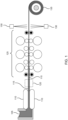
- FIG. 1 provides a schematic example of a method and system of making an aluminum alloy rolled article.
- FIG. 1 provides an overview of a process referred to as a hot roll to final gauge and temper.
- the aluminum alloy products described herein is cast using a continuous casting (CC) process.
- the continuous casting process can be performed, for example, by way of the use of twin belt casters, twin roll casters, or block casters.
- a method of making an aluminum alloy rolled article includes providing a molten aluminum alloy 105 and continuously injecting the molten metal from a molten metal injector into a continuous caster 110 to form an aluminum alloy cast product 115.
- the method also can include withdrawing the aluminum alloy cast product, such as a cast aluminum alloy sheet, plate, or shate, from an exit of the continuous caster.
- the aluminum alloy cast product 115 can then be processed by any suitable means.
- the processing steps can be used to prepare aluminum alloy rolled articles. Such processing steps include, but are not limited to, homogenization, which may occur as illustrated in FIG. 1 at block 120, and hot rolling, which may occur as illustrated in FIG. 1 at section 125.
- a continuously cast aluminum alloy product such as a 6xxx series aluminum alloy or a 5xxx series aluminum alloy, can be hot rolled to a final gauge.
- the processing can be performed without a cold rolling step (i.e., the cast product can be rolled to a final gauge without cold rolling).
- hot rolling a continuously cast aluminum alloy product to a final gauge can provide an isotropic recrystallization texture within a surface of the aluminum alloy rolled article thereby formed. In some further cases, hot rolling a continuously cast aluminum alloy product to a final gauge can improve formability by providing an aluminum alloy rolled article having isotropic mechanical properties.
- homogenization can be performed immediately after casting.
- the temperature of the aluminum alloy cast product 115 is not permitted to fall below 400 °C between casting and homogenizing.
- the homogenization temperature is between 400 °C and 600 °C.
- homogenization may be useful for maintaining a temperature of the cast alloy at a particular value or between a range of values for a duration of time, such as up to 1, 2, 3, 4, 5, 6, 7, 8, 9, 10, 11, 12, 13, 14, 15, 16, 17, 18, 19, 20, 21, 22, 23, 24, 25, 26, 27, 28, 29, or 30 hours in some examples.
- homogenization may be useful for providing the cast alloy to a hot rolling stage at a particular starting temperature.
- the aluminum alloy cast product 115 may be referred to as a homogenized aluminum alloy cast product.
- the hot rolling step is performed following homogenization.
- the hot rolling temperature is between 300 °C and 550 °C.
- the hot rolling temperature can be 300 °C, at least 310 °C, at least 320 °C, at least 330 °C, at least 340 °C, at least 350 °C, at least 360 °C, at least 370 °C, at least 380 °C, at least 390 °C, at least 400 °C, at least 410 °C, at least 420 °C, at least 430 °C, at least 440 °C, at least 450 °C, at least 460 °C, at least 470 °C, at least 480 °C, at least 490 °C, at least 500 °C, at least 510 °C, at least 520 °C, at least 530 °C, at least 540 °C, or up to 550 °C.
- the hot rolling temperature can be or include the recrystall
- the gauge of the aluminum alloy cast product is reduced in thickness.
- the total amount of reduction of thickness during hot rolling can be at or less than 85%, 80%, 75%, 70%, 65%, 60%, 55%, 50%, 45%, 40%, 35%, 30%, 25%, 20%, or 15%.
- the cast product can be a metal sheet wherein the final gauge of the rolled article is 7 mm or less, 6 mm or less, 5 mm or less, 4 mm or less, 3 mm or less, 2 mm or less, 1.9 mm or less, 1.8 mm or less, 1.7 mm or less, 1.6 mm or less, 1.5 mm or less, 1.4 mm or less, 1.3 mm or less, 1.2 mm or less, 1.1 mm, 1.0 mm or less, 0.9 mm or less, 0.8 mm or less, 0.7 mm or less, 0.6 mm or less, 0.5 mm or less, 0.4 mm or less, 0.3 mm or less, 0.2 mm or less, or as small as 0.1 mm.
- the aluminum alloy rolled article can have a temperature of between 300 °C and 500 °C, for example.
- the method includes a step of quenching the aluminum alloy rolled article after hot rolling, as illustrated at element 130 of FIG. 1 .
- the aluminum alloy rolled article can be cooled to a temperature at or below about 300 °C in the quenching step, such as to a temperature between 50 °C and 300 °C.
- the aluminum alloy rolled article can be cooled to a temperature at or below 290 °C, at or below 280 °C, at or below 270 °C, at or below 260 °C, at or below 250 °C, at or below 240 °C, at or below 230 °C, at or below 220 °C, at or below 210 °C, at or below 200 °C, at or below 190 °C, at or below 180 °C, at or below 170 °C, at or below 160 °C, at or below 150 °C, at or below 140 °C, at or below 130 °C, at or about 120 °C, at or below 110 °C, or at or below 100 °C.
- the aluminum alloy rolled article can be quenched immediately after hot rolling or within a short period of time thereafter (e.g., within 10 hours or less, 9 hours or less, 8 hours or less, 7 hours or less, 6 hours or less, 5 hours or less, 4 hours or less, 3 hours or less, 2 hours or less, 1 hour or less, or 30 minutes or less).
- the aluminum alloy rolled article can optionally be coiled and stored after hot rolling and/or quenching, as illustrated at element 135 of FIG. 1 .
- Aluminum alloy articles of manufacture produced from aluminum alloy rolled articles, such as sheets and shates, described herein can be used in automotive applications and other transportation applications, including aircraft and railway applications.
- the aluminum alloy rolled articles can be used to prepare automotive structural parts, such as outer panels, inner panels, side panels, bumpers, side beams, roof beams, cross beams, pillar reinforcements (e.g., A-pillars, B-pillars, and C-pillars), inner hoods, outer hoods, or trunk lid panels.
- the aluminum alloy rolled articles and methods described herein can also be used in aircraft or railway vehicle applications, to prepare, for example, external and internal panels.
- the aluminum alloy rolled articles described herein can also be used in electronics applications.
- the aluminum alloy rolled articles and methods described herein can be used to prepare housings for electronic devices, including mobile phones and tablet computers.
- the aluminum alloy rolled articles can be used to prepare anodized quality sheets and materials.
- the aluminum alloy rolled articles described herein can be used in container applications, including aluminum can body stock and aluminum can end stock.
- the aluminum alloy rolled articles described herein can have a surface that has low volume fractions of a cube texture component, a goss texture component, a brass texture component, an S texture component, and a copper texture component, namely volume fractions that are between 0% and 1%, or that is substantially free of recrystallization texture.
- An aluminum alloy article having a surface of this nature e.g., an isotropic surface
- An aluminum alloy article having isotropic mechanical properties e.g., mechanical properties that can be uniform in any direction across the surface relative to a rolling direction of the aluminum alloy cast product).
- An aluminum alloy rolled article having isotropic mechanical properties can be subjected to forming processes that demand a high formability.
- the aluminum alloy rolled articles described herein can be subjected to complex forming processes.
- the aluminum alloy rolled articles described herein can be subjected to multi-step forming processes.
- the aluminum alloy rolled articles may exhibit advantageous mechanical properties, such as an isotropic surface.
- the aluminum alloy rolled articles may exhibit isotropic thinning properties when subjected to strain, meaning that the aluminum alloy rolled articles may have a tendency to thin during straining by an approximately equal amount in all directions. This property may provide a benefit in forming articles of manufacture using the aluminum alloy rolled articles described herein.
- conventionally cold-rolled aluminum may exhibit mechanical anisotropy, meaning the mechanical properties of the cold-rolled aluminum are not uniform along different directions (e.g., rolling direction, transverse direction, diagonal direction, etc.).
- the material may have a tendency to thin different amounts upon being subjected to strain along different directions.
- the article may thin significantly more in some locations than in others.
- the article of manufacture may break, fracture, or otherwise fail at these critical points or along these critical directions.
- the presently described aluminum alloy cast products and aluminum alloy rolled articles overcome these and other processing difficulties.
- the surface can exhibit isotropic mechanical properties, such as the Langford coefficient (R-value), such that forming an article of manufacture using the presently described aluminum alloy rolled articles does not result in the same failure along the above-described critical directions or at the above-described critical points.
- R-value Langford coefficient
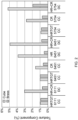
- Aluminum alloy samples were provided according to methods described herein. Alloys 6111, 6451, and 5754 were produced by exemplary methods, including continuous casting, homogenization and hot rolling to a final gauge. Alloys 6451 and 5754 were further produced by an optional method for comparison, including continuous casting, homogenization and cold rolling to a final gauge. Alloys 6111, 6451, and 5754 were produced according to comparative methods, including direct chill casting, homogenization, hot rolling, and cold rolling. The aluminum alloy samples were analyzed for recrystallization texture. FIG. 1 is a bar chart showing results of recrystallization texture analysis. A cube texture component (left histogram in each pair) and a brass texture component (right histogram in each pair) are shown form comparison.
- Texture component volume fraction (%) is shown for cube and brass texture components. Continuously cast alloys are referred to herein as “CC” and direct chill cast alloys are referred to herein as "DC.” Processing methods are described in Table 1 below: Table 1 - Processing Methods HRTGT Hot roll to final gauge and temper HR+CR Hot roll and cold roll CR Cold roll HR Hot roll
- Hot roll to final gauge and temper indicates the exemplary method described herein, including continuous casting, homogenization, and hot rolling to a final gauge, as shown in FIG. 1 .
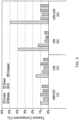
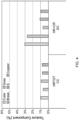
- the exemplary method provided aluminum alloy rolled articles having a uniform distribution of texture components, as shown in FIGs. 2 , 3 , and 4 and described below.
- the comparative methods provided an aluminum alloy rolled article having an anisotropic recrystallization texture, wherein the surface was dominated by cube texture. Isotropic surface recrystallization texture was provided by the exemplary method described herein.
- FIGs. 2 , 3 , and 4 are bar charts showing results of recrystallization texture analysis.
- a cube texture component left histogram in each set
- a goss texture component second from the left histogram in each set
- a brass texture component center histogram in each set
- an S texture component fourth from the left histogram in each set
- a copper texture component right histogram in each set
- the exemplary method provided aluminum alloy rolled articles having a uniform distribution of texture components, wherein no texture component was observed having a volume fraction greater than 1% within the surface of the aluminum alloy.
- the comparative methods provided an aluminum alloy rolled articles having an anisotropic recrystallization texture, wherein the surface was dominated by cube texture. Isotropic surface recrystallization texture was provided by the exemplary method described herein.
- any reference to a series of examples is to be understood as a reference to each of those examples disjunctively (e.g., "examples 1-4" is to be understood as “examples 1, 2, 3, or 4").
- Example 1 is an aluminum alloy rolled article comprising a rolled surface, wherein the rolled surface comprises a first surface portion, comprising at least a first surface portion, and wherein the first surface portion is substantially free of recrystallization texture or wherein the first surface portion has volume fractions of a cube texture component, a goss texture component, a brass texture component, an S texture component, and a copper texture component that are between 0% and 1%.
- Example 2 is the aluminum alloy rolled article of example 1, wherein the first surface portion has an isotropic texture, wherein the isotropic texture comprises a plurality of texture components, wherein each texture component comprises less than 1 volume percent of the first surface portion.
- Example 3 is the aluminum alloy rolled article of example 2, wherein the plurality of texture components comprise surface texture components selected from the group consisting of a cube component, a goss component, a brass component, an S component, and a copper component.
- Example 4 is the aluminum alloy rolled article of examples 1-3, wherein the first surface portion exhibits substantially uniform thinning during forming across the first surface portion in any direction relative to a rolling direction.
- Example 5 is the aluminum alloy rolled article of examples 1-4, wherein the first surface portion has a cube component to brass component ratio of from 0.80 to 1.25.
- Example 6 is the aluminum alloy rolled article of examples 1-5, wherein the first surface portion has a cube component to goss component ratio of from 0.80 to 1.25.
- Example 7 is the aluminum alloy rolled article of examples 1-6, wherein the first surface portion has a cube component to S component ratio of from 0.80 to 1.25.
- Example 8 is the aluminum alloy rolled article of examples 1-7, wherein the first surface portion has a cube component to copper component ratio of from 0.80 to 1.25.
- Example 9 is the aluminum alloy rolled article of examples 1-8, wherein the first surface portion has a goss component to brass component ratio of from 0.80 to 1.25.
- Example 10 is the aluminum alloy rolled article of examples 1-9, wherein the first surface portion has a goss component to S component ratio of from 0.80 to 1.25.
- Example 11 is the aluminum alloy rolled article of examples 1-10, wherein the first surface portion has a goss component to copper component ratio of from 0.80 to 1.25.
- Example 12 is the aluminum alloy rolled article of examples 1-11, wherein the first surface portion has a brass component to S component ratio of from 0.80 to 1.25.
- Example 13 is the aluminum alloy rolled article of examples 1-12, wherein the first surface portion has a brass component to copper component ratio of from 0.80 to 1.25.
- Example 14 is the aluminum alloy rolled article of examples 1-13, wherein the first surface portion has an S component to copper component ratio of from 0.80 to 1.25.
- Example 15 is the aluminum alloy rolled article of examples 1-14, wherein the first surface portion has a cube component to goss component to brass component ratio of from 0.80 to 1.25.
- Example 16 is the aluminum alloy rolled article of examples 1-15, wherein the first surface portion has a cube component to goss component to S component ratio of from 0.80 to 1.25.
- Example 17 is the aluminum alloy rolled article of examples 1-16, wherein the first surface portion has a cube component to goss component to copper component ratio of from 0.80 to 1.25.
- Example 18 is the aluminum alloy rolled article of examples 1-17, wherein the first surface portion has a goss component to brass component to S component ratio of from 0.80 to 1.25.
- Example 19 is the aluminum alloy rolled article of examples 1-18, wherein the first surface portion has a goss component to brass component to copper component ratio of from 0.80 to 1.25.
- Example 20 is the aluminum alloy rolled article of examples 1-19, wherein the first surface portion has a brass component to S component to copper component ratio of from 0.80 to 1.25.
- Example 21 is the aluminum alloy rolled article of examples 1-20, wherein the first surface portion has a cube component to goss component to brass component to S component ratio of from 0.80 to 1.25.
- Example 22 is the aluminum alloy rolled article of examples 1-21, wherein the first surface portion has a cube component to goss component to brass component to copper component ratio of from 0.80 to 1.25.
- Example 23 is the aluminum alloy rolled article of examples 1-22, wherein the first surface portion has a goss component to brass component to S component to copper component ratio of from 0.80 to 1.25.
- Example 24 is the aluminum alloy rolled article of examples 1-23, wherein the first surface portion has a cube component to goss component to brass component to S component to copper component ratio of from 0.80 to 1.25.
- Example 25 is the aluminum alloy rolled article of examples 1-24, wherein the aluminum alloy rolled article has a width or length of from 6.5 mm to 40 m.
- Example 26 is the aluminum alloy rolled article of examples 1-25, wherein the aluminum alloy rolled article comprises or is composed of a 5xxx aluminum alloy.
- Example 27 is the aluminum alloy rolled article of examples 1-26, wherein the aluminum alloy rolled article comprises or is composed of a 6xxx aluminum alloy.
- Example 28 is the aluminum alloy rolled article of examples 1-27, wherein the aluminum alloy rolled article is formed by a process that does not comprise cold rolling.
- Example 29 is the aluminum alloy rolled article of examples 1-28, wherein the aluminum alloy rolled article is formed by a process that comprises: providing a molten aluminum alloy composition; continuously casting the molten aluminum alloy composition to form an aluminum alloy cast product; homogenizing the aluminum alloy cast product to form a homogenized aluminum alloy cast product; and rolling the homogenized aluminum alloy cast product to form the aluminum alloy rolled article having a thickness of between 0.01 mm and 7 mm, wherein the rolling is carried out at a temperature of between 300 °C and 550 °C.
- Example 30 is a method for making an aluminum alloy rolled article, comprising: providing a molten aluminum alloy composition; continuously casting the molten aluminum alloy composition to form an aluminum alloy cast product; homogenizing the aluminum alloy cast product to form a homogenized aluminum alloy cast product, wherein homogenizing the aluminum alloy cast product includes controlling a homogenization temperature of the aluminum alloy cast product after exiting from a continuous caster, wherein the homogenization temperature is between 400 °C and 600 °C; rolling the homogenized aluminum alloy cast product to form an aluminum alloy rolled article having a thickness of between 0.01 mm and 7 mm, wherein the rolling is carried out at a temperature of between 300 °C and 550 °C, and following the rolling, subjecting the aluminum alloy rolled article to quenching.
- Example 31 is the method of example 30, wherein the aluminum alloy cast product is not cooled to below 400 °C before the homogenizing.
- Example 32 is the method of example 30-31, wherein rolling the homogenized aluminum alloy cast product includes controlling a rolling temperature during rolling, wherein a starting temperature of the rolling is between 400 °C and 550 °C, and wherein an exit temperature of the rolling is between 300 °C and 500 °C.
- Example 33 is the method of examples 30-32, wherein rolling the homogenized aluminum alloy cast product includes maintaining the temperature at or above a recrystallization temperature of the homogenized aluminum alloy cast product.
- Example 34 is the method of examples 30-33, wherein the method does not comprise cold rolling the aluminum alloy rolled article to a final thickness.
- Example 35 is the method of examples 30-34, wherein the aluminum alloy rolled article comprises at least a first surface portion, and wherein the first surface portion is substantially free of recrystallization texture or wherein the first surface portion has volume fractions of a cube texture component, a goss texture component, a brass texture component, an S texture component, and a copper texture component that are between 0% and 1%.
- Example 36 is an aluminum alloy rolled article, which is formed by a process comprising: providing a molten aluminum alloy composition; continuously casting the molten aluminum alloy composition to form an aluminum alloy cast product; homogenizing the aluminum alloy cast product to form a homogenized aluminum alloy cast product, wherein homogenizing the aluminum alloy cast product includes controlling a homogenization temperature of the aluminum alloy cast product after exiting from a continuous caster, wherein the homogenization temperature is between 400 °C and 600 °C; rolling the homogenized aluminum alloy cast product to form the aluminum alloy rolled article having a thickness of between 0.01 mm and 7 mm, wherein the rolling is carried out at a temperature of between 300 °C and 550 °C; and following the rolling, subjecting the aluminum alloy rolled article to quenching, the aluminum alloy rolled article comprising at least a first surface portion having volume fractions of a cube texture component, a goss texture component, a brass texture component, an S texture component, and a copper texture component that are between 0% and 1%
- Example 37 is the aluminum alloy rolled article of example 36, wherein the aluminum alloy cast product is not cooled to below 400 °C before the homogenizing.
- Example 38 is the aluminum alloy rolled article of examples 36-37, wherein rolling the homogenized aluminum alloy cast product includes controlling a rolling temperature during rolling, wherein a starting temperature of the rolling is between 400 °C and 550 °C, and wherein an exit temperature of the rolling is between 300 °C and 500 °C.
- Example 39 is the aluminum alloy rolled article of examples 36-38, wherein rolling the homogenized aluminum alloy cast product includes maintaining the temperature at or above a recrystallization temperature of the homogenized aluminum alloy cast product.
- Example 40 is the aluminum alloy rolled article of examples 36-39, wherein the process does not comprise cold rolling the aluminum alloy rolled article to a final thickness.
- Example 41 is the aluminum alloy rolled article of examples 36-40, comprising at least a first surface portion, and wherein the first surface portion is substantially free of recrystallization texture or wherein the first surface portion has volume fractions of a cube texture component, a goss texture component, a brass texture component, an S texture component, and a copper texture component that are between 0% and 1%.
- Example 42 is the aluminum alloy rolled article of example 41, wherein the first surface portion has an isotropic texture.
- Example 43 is the aluminum alloy rolled article of example 42, wherein the isotropic texture comprises a plurality of texture components, and wherein each texture component comprises less than 1 volume percent of the first surface portion.
- Example 44 is the aluminum alloy rolled article of examples 41-43, wherein the first surface portion exhibits substantially uniform thinning during forming across the first surface portion in any direction relative to a rolling direction.
- Example 45 is an aluminum alloy article of manufacture, comprising an aluminum alloy rolled article of examples 1-29, an aluminum alloy rolled article of any one of examples 36-44, or an aluminum alloy rolled article formed by the method of any one of examples 30-35.
- Example 46 is the aluminum alloy article of manufacture of example 45, wherein the aluminum alloy rolled article is subjected to a stamping, forming, or drawing process.
- Example 47 is the aluminum alloy article of manufacture of examples 45-46, wherein the aluminum alloy article of manufacture is an automotive body part.
- Example 48 is the aluminum alloy article of manufacture of example 47, wherein the automotive body part comprises a structural part.
- Example 49 is the aluminum alloy article of manufacture of example 47, wherein the automotive body part is an outer panel.
- Example 50 is the aluminum alloy article of manufacture of examples 45-46, wherein the aluminum alloy article of manufacture is an electronics device housing.
- Example 51 is the aluminum alloy article of manufacture of examples 45-46, wherein the aluminum alloy article of manufacture is an aerospace body part.
- Example 52 is the aluminum alloy article of manufacture of examples 45-46, wherein the aluminum alloy article of manufacture is a transportation body part.
- Example 53 is the aluminum alloy article of manufacture of examples 45-46, wherein the aluminum alloy article of manufacture is a container part.
- Example 54 is the aluminum alloy article of manufacture of example 53, wherein the aluminum alloy article of manufacture is a storage tank.
- Example 55 is the aluminum alloy article of manufacture of example 53, wherein the aluminum alloy article of manufacture is an aluminum can end.
Landscapes
- Chemical & Material Sciences (AREA)
- Engineering & Computer Science (AREA)
- Materials Engineering (AREA)
- Mechanical Engineering (AREA)
- Metallurgy (AREA)
- Organic Chemistry (AREA)
- Physics & Mathematics (AREA)
- Thermal Sciences (AREA)
- Crystallography & Structural Chemistry (AREA)
- Metal Rolling (AREA)
- Conductive Materials (AREA)
Claims (7)
- Verfahren zur Herstellung eines Walzartikels aus einer Aluminiumlegierung, umfassend:Bereitstellen einer geschmolzenen Aluminiumlegierungszusammensetzung;kontinuierliches Gießen der geschmolzenen Aluminiumlegierungszusammensetzung, um ein Aluminiumlegierungsgussprodukt zu bilden;Homogenisieren des Aluminiumlegierungsgussprodukts, um ein homogenisiertes Aluminiumlegierungsgussprodukt zu bilden, wobei Homogenisieren des Aluminiumlegierungsgussprodukts Steuern einer Homogenisierungstemperatur des Aluminiumlegierungsgussprodukts nach einem Austreten aus einer kontinuierlichen Gussvorrichtung umfasst, wobei die Homogenisierungstemperatur zwischen 400 °C und 600 °C liegt;Walzen des homogenisierten Aluminiumlegierungsgussprodukts, um einen Walzartikel aus einer Aluminiumlegierung mit einer Dicke zwischen 0,01 mm und 7 mm zu bilden, wobei das Walzen bei einer Temperatur zwischen 300 °C und 550 °C durchgeführt wird; undnach dem Walzen, Aussetzen des Walzartikels aus einer Aluminiumlegierung einem Abschrecken.
- Verfahren nach Anspruch 1, wobei das Aluminiumlegierungsgussprodukt vor dem Homogenisieren nicht auf unter 400°C abgekühlt wird.
- Verfahren nach Anspruch 1, wobei Walzen des homogenisierten Aluminiumlegierungsgussprodukts Steuern einer Walztemperatur während des Walzens umfasst, wobei eine Anfangstemperatur des Walzens zwischen 400 °C und 550 °C liegt und wobei eine Austrittstemperatur des Walzens zwischen 300 °C und 500 °C liegt oder wobei Walzen des homogenisierten Aluminiumlegierungsgussprodukts Halten der Temperatur auf oder über einer Rekristallisationstemperatur des homogenisierten Aluminiumlegierungsgussprodukts umfasst.
- Verfahren nach Anspruch 1, wobei das Verfahren nicht Kaltwalzen des Walzartikels aus einer Aluminiumlegierung auf eine Enddicke des Walzartikels aus einer Aluminiumlegierung umfasst.
- Verfahren nach Anspruch 1, wobei der Walzartikel aus einer Aluminiumlegierung mindestens einen ersten Oberflächenabschnitt mit Volumenanteilen einer Würfeltexturkomponente, einer Goss-Texturkomponente, einer Brass-Texturkomponente, einer S-Texturkomponente und einer Kupfertexturkomponente umfasst, die zwischen 0% und 1% liegen.
- Walzartikel aus einer Aluminiumlegierung, gebildet durch ein Verfahren nach einem der Ansprüche 1-5, der mindestens einen ersten Oberflächenabschnitt mit Volumenanteilen einer Würfeltexturkomponente, einer Goss-Texturkomponente, einer Brass-Texturkomponente, einer S-Texturkomponente und einer Kupfertexturkomponente umfasst, die zwischen 0% und 1% liegen.
- Walzartikel aus einer Aluminiumlegierung nach Anspruch 6, wobei der erste Oberflächenabschnitt eine isotrope Textur aufweist.
Applications Claiming Priority (2)
| Application Number | Priority Date | Filing Date | Title |
|---|---|---|---|
| US201762515714P | 2017-06-06 | 2017-06-06 | |
| PCT/US2018/036039 WO2018226681A1 (en) | 2017-06-06 | 2018-06-05 | Aluminum alloy article having low texture and methods of making the same |
Publications (2)
| Publication Number | Publication Date |
|---|---|
| EP3635147A1 EP3635147A1 (de) | 2020-04-15 |
| EP3635147B1 true EP3635147B1 (de) | 2023-10-11 |
Family
ID=62685252
Family Applications (1)
| Application Number | Title | Priority Date | Filing Date |
|---|---|---|---|
| EP18733145.9A Active EP3635147B1 (de) | 2017-06-06 | 2018-06-05 | Aluminiumlegierungsartikel mit niedriger textur und herstellungsverfahren dafür |
Country Status (9)
| Country | Link |
|---|---|
| US (1) | US20180347021A1 (de) |
| EP (1) | EP3635147B1 (de) |
| JP (1) | JP7009514B2 (de) |
| KR (1) | KR102356406B1 (de) |
| CN (1) | CN110709530B (de) |
| CA (1) | CA3064600C (de) |
| ES (1) | ES2962451T3 (de) |
| MX (1) | MX2019013330A (de) |
| WO (1) | WO2018226681A1 (de) |
Families Citing this family (1)
| Publication number | Priority date | Publication date | Assignee | Title |
|---|---|---|---|---|
| CN120225716A (zh) * | 2022-12-12 | 2025-06-27 | 奥科宁克技术有限责任公司 | 新型5xxx铝合金及其制造方法 |
Family Cites Families (20)
| Publication number | Priority date | Publication date | Assignee | Title |
|---|---|---|---|---|
| US4808247A (en) * | 1986-02-21 | 1989-02-28 | Sky Aluminium Co., Ltd. | Production process for aluminum-alloy rolled sheet |
| JPH07252574A (ja) * | 1994-03-17 | 1995-10-03 | Kobe Steel Ltd | 靭性に優れたAl−Cu−Mg系合金及びその製造方法 |
| US5985058A (en) * | 1997-06-04 | 1999-11-16 | Golden Aluminum Company | Heat treatment process for aluminum alloys |
| CA2293608A1 (en) * | 1997-06-04 | 1998-12-10 | Golden Aluminum Company | Continuous casting process for producing aluminum alloys having low earing |
| US5976279A (en) * | 1997-06-04 | 1999-11-02 | Golden Aluminum Company | For heat treatable aluminum alloys and treatment process for making same |
| JP2000080431A (ja) * | 1998-09-02 | 2000-03-21 | Kobe Steel Ltd | プレス成形性に優れるAl―Mg系合金板 |
| US6342112B1 (en) * | 1998-09-02 | 2002-01-29 | Alcoa Inc. | A1-mg based alloy sheets with good press formability |
| JP4057199B2 (ja) * | 1998-09-10 | 2008-03-05 | 株式会社神戸製鋼所 | Al−Mg−Si系合金板 |
| JP3676933B2 (ja) * | 1998-12-01 | 2005-07-27 | 株式会社神戸製鋼所 | プレス成形用Al−Mg−Si系Al合金板 |
| JP2000212674A (ja) * | 1999-01-25 | 2000-08-02 | Kobe Steel Ltd | 塗装後耐食性に優れたアルミニウム合金材 |
| JP2001032031A (ja) * | 1999-07-22 | 2001-02-06 | Kobe Steel Ltd | 耐応力腐食割れ性に優れた構造材用アルミニウム合金板 |
| JP3838504B2 (ja) * | 2002-10-04 | 2006-10-25 | 株式会社神戸製鋼所 | パネル成形用アルミニウム合金板およびその製造方法 |
| US6764559B2 (en) * | 2002-11-15 | 2004-07-20 | Commonwealth Industries, Inc. | Aluminum automotive frame members |
| JP4799877B2 (ja) * | 2005-02-09 | 2011-10-26 | 株式会社住軽テクノ | 強度と切削性に優れたアルミニウム合金およびその製造方法 |
| JP2006241548A (ja) * | 2005-03-04 | 2006-09-14 | Sumitomo Light Metal Ind Ltd | 曲げ加工性に優れたAl−Mg−Si系合金板材とその製造方法および該板材から得られる自動車外板 |
| JP2008190021A (ja) * | 2007-02-07 | 2008-08-21 | Kobe Steel Ltd | Al−Mg系合金熱延上り板およびその製造法 |
| JP5758676B2 (ja) * | 2011-03-31 | 2015-08-05 | 株式会社神戸製鋼所 | 成形加工用アルミニウム合金板およびその製造方法 |
| JP5898426B2 (ja) * | 2011-07-25 | 2016-04-06 | 株式会社Uacj | 負圧缶蓋用アルミニウム合金板及びその製造方法 |
| JP5872359B2 (ja) * | 2012-03-30 | 2016-03-01 | 株式会社神戸製鋼所 | 自動車用アルミニウム合金鍛造部材およびその製造方法 |
| MY182369A (en) * | 2014-10-31 | 2021-01-21 | Uacj Corp | Aluminum alloy substrate for magnetic disk |
-
2018
- 2018-06-05 US US16/000,324 patent/US20180347021A1/en not_active Abandoned
- 2018-06-05 CN CN201880037430.7A patent/CN110709530B/zh active Active
- 2018-06-05 CA CA3064600A patent/CA3064600C/en active Active
- 2018-06-05 JP JP2019566250A patent/JP7009514B2/ja active Active
- 2018-06-05 WO PCT/US2018/036039 patent/WO2018226681A1/en not_active Ceased
- 2018-06-05 ES ES18733145T patent/ES2962451T3/es active Active
- 2018-06-05 EP EP18733145.9A patent/EP3635147B1/de active Active
- 2018-06-05 MX MX2019013330A patent/MX2019013330A/es unknown
- 2018-06-05 KR KR1020207000006A patent/KR102356406B1/ko active Active
Also Published As
| Publication number | Publication date |
|---|---|
| JP7009514B2 (ja) | 2022-02-10 |
| MX2019013330A (es) | 2020-01-15 |
| KR20200014879A (ko) | 2020-02-11 |
| EP3635147A1 (de) | 2020-04-15 |
| ES2962451T3 (es) | 2024-03-19 |
| US20180347021A1 (en) | 2018-12-06 |
| WO2018226681A1 (en) | 2018-12-13 |
| CA3064600A1 (en) | 2018-12-13 |
| CN110709530B (zh) | 2021-11-19 |
| JP2020521885A (ja) | 2020-07-27 |
| CN110709530A (zh) | 2020-01-17 |
| CA3064600C (en) | 2022-08-16 |
| KR102356406B1 (ko) | 2022-02-08 |
Similar Documents
| Publication | Publication Date | Title |
|---|---|---|
| EP3631030B1 (de) | Hochfeste korrosionsbeständige aluminiumlegierungen der serie 6xxx und verfahren zur herstellung davon | |
| KR102517599B1 (ko) | 고강도 6xxx 및 7xxx 알루미늄 합금 및 이의 제조 방법 | |
| KR102405219B1 (ko) | 다량의 재생 재료를 함유하는 고성능 알루미늄 합금 및 이를 제조하는 방법 | |
| EP3571326B1 (de) | Schnelle alterung von hochfesten 7xxx-aluminiumlegierungen und verfahren zur herstellung davon | |
| EP3635148B1 (de) | Aluminiumlegierungsprodukte mit selektiv rekristallisierter mikrostruktur und herstellungsverfahren | |
| CN116445835A (zh) | 用于使硬化铝合金温成形的方法 | |
| US20260071303A1 (en) | High recycle content aluminum alloys and methods of making and using | |
| EP3635147B1 (de) | Aluminiumlegierungsartikel mit niedriger textur und herstellungsverfahren dafür | |
| EP4305219B1 (de) | Hochfeste 5xxx-aluminiumlegierungsvarianten und verfahren zur herstellung davon | |
| JP2022532347A (ja) | 超高強度アルミニウム合金製品及びその作製方法 | |
| US20240001437A1 (en) | Cast aluminum alloys comprising calcium and related processes | |
| DE102025133488A1 (de) | Verfahren zur herstellung von aluminiumlegierungsblechen der serien 2xxx im o-temperzustand | |
| WO2024249153A1 (en) | Continuous cast alloy for foil applications | |
| DE102025133642A1 (de) | Verfahren zur herstellung von aluminiumlegierungsblechen der serie 2xxx |
Legal Events
| Date | Code | Title | Description |
|---|---|---|---|
| STAA | Information on the status of an ep patent application or granted ep patent |
Free format text: STATUS: UNKNOWN |
|
| STAA | Information on the status of an ep patent application or granted ep patent |
Free format text: STATUS: THE INTERNATIONAL PUBLICATION HAS BEEN MADE |
|
| PUAI | Public reference made under article 153(3) epc to a published international application that has entered the european phase |
Free format text: ORIGINAL CODE: 0009012 |
|
| STAA | Information on the status of an ep patent application or granted ep patent |
Free format text: STATUS: REQUEST FOR EXAMINATION WAS MADE |
|
| 17P | Request for examination filed |
Effective date: 20191119 |
|
| AK | Designated contracting states |
Kind code of ref document: A1 Designated state(s): AL AT BE BG CH CY CZ DE DK EE ES FI FR GB GR HR HU IE IS IT LI LT LU LV MC MK MT NL NO PL PT RO RS SE SI SK SM TR |
|
| AX | Request for extension of the european patent |
Extension state: BA ME |
|
| DAV | Request for validation of the european patent (deleted) | ||
| DAX | Request for extension of the european patent (deleted) | ||
| STAA | Information on the status of an ep patent application or granted ep patent |
Free format text: STATUS: EXAMINATION IS IN PROGRESS |
|
| 17Q | First examination report despatched |
Effective date: 20221031 |
|
| GRAP | Despatch of communication of intention to grant a patent |
Free format text: ORIGINAL CODE: EPIDOSNIGR1 |
|
| STAA | Information on the status of an ep patent application or granted ep patent |
Free format text: STATUS: GRANT OF PATENT IS INTENDED |
|
| INTG | Intention to grant announced |
Effective date: 20230706 |
|
| GRAS | Grant fee paid |
Free format text: ORIGINAL CODE: EPIDOSNIGR3 |
|
| GRAA | (expected) grant |
Free format text: ORIGINAL CODE: 0009210 |
|
| STAA | Information on the status of an ep patent application or granted ep patent |
Free format text: STATUS: THE PATENT HAS BEEN GRANTED |
|
| AK | Designated contracting states |
Kind code of ref document: B1 Designated state(s): AL AT BE BG CH CY CZ DE DK EE ES FI FR GB GR HR HU IE IS IT LI LT LU LV MC MK MT NL NO PL PT RO RS SE SI SK SM TR |
|
| P01 | Opt-out of the competence of the unified patent court (upc) registered |
Effective date: 20230901 |
|
| REG | Reference to a national code |
Ref country code: GB Ref legal event code: FG4D |
|
| REG | Reference to a national code |
Ref country code: CH Ref legal event code: EP |
|
| REG | Reference to a national code |
Ref country code: DE Ref legal event code: R096 Ref document number: 602018059140 Country of ref document: DE |
|
| REG | Reference to a national code |
Ref country code: IE Ref legal event code: FG4D |
|
| REG | Reference to a national code |
Ref country code: LT Ref legal event code: MG9D |
|
| REG | Reference to a national code |
Ref country code: NL Ref legal event code: MP Effective date: 20231011 |
|
| REG | Reference to a national code |
Ref country code: ES Ref legal event code: FG2A Ref document number: 2962451 Country of ref document: ES Kind code of ref document: T3 Effective date: 20240319 |
|
| PG25 | Lapsed in a contracting state [announced via postgrant information from national office to epo] |
Ref country code: NL Free format text: LAPSE BECAUSE OF FAILURE TO SUBMIT A TRANSLATION OF THE DESCRIPTION OR TO PAY THE FEE WITHIN THE PRESCRIBED TIME-LIMIT Effective date: 20231011 |
|
| PG25 | Lapsed in a contracting state [announced via postgrant information from national office to epo] |
Ref country code: GR Free format text: LAPSE BECAUSE OF FAILURE TO SUBMIT A TRANSLATION OF THE DESCRIPTION OR TO PAY THE FEE WITHIN THE PRESCRIBED TIME-LIMIT Effective date: 20240112 |
|
| PG25 | Lapsed in a contracting state [announced via postgrant information from national office to epo] |
Ref country code: IS Free format text: LAPSE BECAUSE OF FAILURE TO SUBMIT A TRANSLATION OF THE DESCRIPTION OR TO PAY THE FEE WITHIN THE PRESCRIBED TIME-LIMIT Effective date: 20240211 |
|
| PG25 | Lapsed in a contracting state [announced via postgrant information from national office to epo] |
Ref country code: LT Free format text: LAPSE BECAUSE OF FAILURE TO SUBMIT A TRANSLATION OF THE DESCRIPTION OR TO PAY THE FEE WITHIN THE PRESCRIBED TIME-LIMIT Effective date: 20231011 |
|
| REG | Reference to a national code |
Ref country code: DE Ref legal event code: R082 Ref document number: 602018059140 Country of ref document: DE Representative=s name: WEICKMANN & WEICKMANN PATENT- UND RECHTSANWAEL, DE |
|
| PG25 | Lapsed in a contracting state [announced via postgrant information from national office to epo] |
Ref country code: LT Free format text: LAPSE BECAUSE OF FAILURE TO SUBMIT A TRANSLATION OF THE DESCRIPTION OR TO PAY THE FEE WITHIN THE PRESCRIBED TIME-LIMIT Effective date: 20231011 Ref country code: IS Free format text: LAPSE BECAUSE OF FAILURE TO SUBMIT A TRANSLATION OF THE DESCRIPTION OR TO PAY THE FEE WITHIN THE PRESCRIBED TIME-LIMIT Effective date: 20240211 Ref country code: GR Free format text: LAPSE BECAUSE OF FAILURE TO SUBMIT A TRANSLATION OF THE DESCRIPTION OR TO PAY THE FEE WITHIN THE PRESCRIBED TIME-LIMIT Effective date: 20240112 Ref country code: BG Free format text: LAPSE BECAUSE OF FAILURE TO SUBMIT A TRANSLATION OF THE DESCRIPTION OR TO PAY THE FEE WITHIN THE PRESCRIBED TIME-LIMIT Effective date: 20240111 Ref country code: PT Free format text: LAPSE BECAUSE OF FAILURE TO SUBMIT A TRANSLATION OF THE DESCRIPTION OR TO PAY THE FEE WITHIN THE PRESCRIBED TIME-LIMIT Effective date: 20240212 |
|
| PG25 | Lapsed in a contracting state [announced via postgrant information from national office to epo] |
Ref country code: SE Free format text: LAPSE BECAUSE OF FAILURE TO SUBMIT A TRANSLATION OF THE DESCRIPTION OR TO PAY THE FEE WITHIN THE PRESCRIBED TIME-LIMIT Effective date: 20231011 Ref country code: RS Free format text: LAPSE BECAUSE OF FAILURE TO SUBMIT A TRANSLATION OF THE DESCRIPTION OR TO PAY THE FEE WITHIN THE PRESCRIBED TIME-LIMIT Effective date: 20231011 Ref country code: PL Free format text: LAPSE BECAUSE OF FAILURE TO SUBMIT A TRANSLATION OF THE DESCRIPTION OR TO PAY THE FEE WITHIN THE PRESCRIBED TIME-LIMIT Effective date: 20231011 Ref country code: NO Free format text: LAPSE BECAUSE OF FAILURE TO SUBMIT A TRANSLATION OF THE DESCRIPTION OR TO PAY THE FEE WITHIN THE PRESCRIBED TIME-LIMIT Effective date: 20240111 Ref country code: LV Free format text: LAPSE BECAUSE OF FAILURE TO SUBMIT A TRANSLATION OF THE DESCRIPTION OR TO PAY THE FEE WITHIN THE PRESCRIBED TIME-LIMIT Effective date: 20231011 Ref country code: HR Free format text: LAPSE BECAUSE OF FAILURE TO SUBMIT A TRANSLATION OF THE DESCRIPTION OR TO PAY THE FEE WITHIN THE PRESCRIBED TIME-LIMIT Effective date: 20231011 |
|
| PG25 | Lapsed in a contracting state [announced via postgrant information from national office to epo] |
Ref country code: DK Free format text: LAPSE BECAUSE OF FAILURE TO SUBMIT A TRANSLATION OF THE DESCRIPTION OR TO PAY THE FEE WITHIN THE PRESCRIBED TIME-LIMIT Effective date: 20231011 |
|
| REG | Reference to a national code |
Ref country code: DE Ref legal event code: R097 Ref document number: 602018059140 Country of ref document: DE |
|
| PG25 | Lapsed in a contracting state [announced via postgrant information from national office to epo] |
Ref country code: CZ Free format text: LAPSE BECAUSE OF FAILURE TO SUBMIT A TRANSLATION OF THE DESCRIPTION OR TO PAY THE FEE WITHIN THE PRESCRIBED TIME-LIMIT Effective date: 20231011 |
|
| PG25 | Lapsed in a contracting state [announced via postgrant information from national office to epo] |
Ref country code: SK Free format text: LAPSE BECAUSE OF FAILURE TO SUBMIT A TRANSLATION OF THE DESCRIPTION OR TO PAY THE FEE WITHIN THE PRESCRIBED TIME-LIMIT Effective date: 20231011 |
|
| PG25 | Lapsed in a contracting state [announced via postgrant information from national office to epo] |
Ref country code: SM Free format text: LAPSE BECAUSE OF FAILURE TO SUBMIT A TRANSLATION OF THE DESCRIPTION OR TO PAY THE FEE WITHIN THE PRESCRIBED TIME-LIMIT Effective date: 20231011 Ref country code: SK Free format text: LAPSE BECAUSE OF FAILURE TO SUBMIT A TRANSLATION OF THE DESCRIPTION OR TO PAY THE FEE WITHIN THE PRESCRIBED TIME-LIMIT Effective date: 20231011 Ref country code: RO Free format text: LAPSE BECAUSE OF FAILURE TO SUBMIT A TRANSLATION OF THE DESCRIPTION OR TO PAY THE FEE WITHIN THE PRESCRIBED TIME-LIMIT Effective date: 20231011 Ref country code: EE Free format text: LAPSE BECAUSE OF FAILURE TO SUBMIT A TRANSLATION OF THE DESCRIPTION OR TO PAY THE FEE WITHIN THE PRESCRIBED TIME-LIMIT Effective date: 20231011 Ref country code: DK Free format text: LAPSE BECAUSE OF FAILURE TO SUBMIT A TRANSLATION OF THE DESCRIPTION OR TO PAY THE FEE WITHIN THE PRESCRIBED TIME-LIMIT Effective date: 20231011 Ref country code: CZ Free format text: LAPSE BECAUSE OF FAILURE TO SUBMIT A TRANSLATION OF THE DESCRIPTION OR TO PAY THE FEE WITHIN THE PRESCRIBED TIME-LIMIT Effective date: 20231011 |
|
| PLBE | No opposition filed within time limit |
Free format text: ORIGINAL CODE: 0009261 |
|
| REG | Reference to a national code |
Ref country code: AT Ref legal event code: UEP Ref document number: 1620295 Country of ref document: AT Kind code of ref document: T Effective date: 20231011 |
|
| STAA | Information on the status of an ep patent application or granted ep patent |
Free format text: STATUS: NO OPPOSITION FILED WITHIN TIME LIMIT |
|
| 26N | No opposition filed |
Effective date: 20240712 |
|
| PG25 | Lapsed in a contracting state [announced via postgrant information from national office to epo] |
Ref country code: SI Free format text: LAPSE BECAUSE OF FAILURE TO SUBMIT A TRANSLATION OF THE DESCRIPTION OR TO PAY THE FEE WITHIN THE PRESCRIBED TIME-LIMIT Effective date: 20231011 |
|
| PG25 | Lapsed in a contracting state [announced via postgrant information from national office to epo] |
Ref country code: SI Free format text: LAPSE BECAUSE OF FAILURE TO SUBMIT A TRANSLATION OF THE DESCRIPTION OR TO PAY THE FEE WITHIN THE PRESCRIBED TIME-LIMIT Effective date: 20231011 |
|
| PG25 | Lapsed in a contracting state [announced via postgrant information from national office to epo] |
Ref country code: MC Free format text: LAPSE BECAUSE OF FAILURE TO SUBMIT A TRANSLATION OF THE DESCRIPTION OR TO PAY THE FEE WITHIN THE PRESCRIBED TIME-LIMIT Effective date: 20231011 |
|
| REG | Reference to a national code |
Ref country code: CH Ref legal event code: PL |
|
| PG25 | Lapsed in a contracting state [announced via postgrant information from national office to epo] |
Ref country code: LU Free format text: LAPSE BECAUSE OF NON-PAYMENT OF DUE FEES Effective date: 20240605 |
|
| PG25 | Lapsed in a contracting state [announced via postgrant information from national office to epo] |
Ref country code: IE Free format text: LAPSE BECAUSE OF NON-PAYMENT OF DUE FEES Effective date: 20240605 |
|
| PG25 | Lapsed in a contracting state [announced via postgrant information from national office to epo] |
Ref country code: CH Free format text: LAPSE BECAUSE OF NON-PAYMENT OF DUE FEES Effective date: 20240630 |
|
| PGFP | Annual fee paid to national office [announced via postgrant information from national office to epo] |
Ref country code: DE Payment date: 20250520 Year of fee payment: 8 |
|
| PGFP | Annual fee paid to national office [announced via postgrant information from national office to epo] |
Ref country code: GB Payment date: 20250520 Year of fee payment: 8 |
|
| PGFP | Annual fee paid to national office [announced via postgrant information from national office to epo] |
Ref country code: BE Payment date: 20250520 Year of fee payment: 8 Ref country code: IT Payment date: 20250520 Year of fee payment: 8 |
|
| PGFP | Annual fee paid to national office [announced via postgrant information from national office to epo] |
Ref country code: FR Payment date: 20250521 Year of fee payment: 8 |
|
| PGFP | Annual fee paid to national office [announced via postgrant information from national office to epo] |
Ref country code: AT Payment date: 20250522 Year of fee payment: 8 |
|
| PGFP | Annual fee paid to national office [announced via postgrant information from national office to epo] |
Ref country code: TR Payment date: 20250527 Year of fee payment: 8 |
|
| PG25 | Lapsed in a contracting state [announced via postgrant information from national office to epo] |
Ref country code: FI Free format text: LAPSE BECAUSE OF FAILURE TO SUBMIT A TRANSLATION OF THE DESCRIPTION OR TO PAY THE FEE WITHIN THE PRESCRIBED TIME-LIMIT Effective date: 20231011 |
|
| PGFP | Annual fee paid to national office [announced via postgrant information from national office to epo] |
Ref country code: ES Payment date: 20250701 Year of fee payment: 8 |
|
| PG25 | Lapsed in a contracting state [announced via postgrant information from national office to epo] |
Ref country code: CY Free format text: LAPSE BECAUSE OF FAILURE TO SUBMIT A TRANSLATION OF THE DESCRIPTION OR TO PAY THE FEE WITHIN THE PRESCRIBED TIME-LIMIT; INVALID AB INITIO Effective date: 20180605 |
|
| PG25 | Lapsed in a contracting state [announced via postgrant information from national office to epo] |
Ref country code: HU Free format text: LAPSE BECAUSE OF FAILURE TO SUBMIT A TRANSLATION OF THE DESCRIPTION OR TO PAY THE FEE WITHIN THE PRESCRIBED TIME-LIMIT; INVALID AB INITIO Effective date: 20180605 |