EP3635148B1 - Aluminiumlegierungsprodukte mit selektiv rekristallisierter mikrostruktur und herstellungsverfahren - Google Patents
Aluminiumlegierungsprodukte mit selektiv rekristallisierter mikrostruktur und herstellungsverfahren Download PDFInfo
- Publication number
- EP3635148B1 EP3635148B1 EP18769915.2A EP18769915A EP3635148B1 EP 3635148 B1 EP3635148 B1 EP 3635148B1 EP 18769915 A EP18769915 A EP 18769915A EP 3635148 B1 EP3635148 B1 EP 3635148B1
- Authority
- EP
- European Patent Office
- Prior art keywords
- aluminum alloy
- surface portion
- recrystallization
- quotient
- rolled
- Prior art date
- Legal status (The legal status is an assumption and is not a legal conclusion. Google has not performed a legal analysis and makes no representation as to the accuracy of the status listed.)
- Active
Links
Images






Classifications
-
- C—CHEMISTRY; METALLURGY
- C22—METALLURGY; FERROUS OR NON-FERROUS ALLOYS; TREATMENT OF ALLOYS OR NON-FERROUS METALS
- C22F—CHANGING THE PHYSICAL STRUCTURE OF NON-FERROUS METALS AND NON-FERROUS ALLOYS
- C22F1/00—Changing the physical structure of non-ferrous metals or alloys by heat treatment or by hot or cold working
- C22F1/04—Changing the physical structure of non-ferrous metals or alloys by heat treatment or by hot or cold working of aluminium or alloys based thereon
- C22F1/053—Changing the physical structure of non-ferrous metals or alloys by heat treatment or by hot or cold working of aluminium or alloys based thereon of alloys with zinc as the next major constituent
-
- B—PERFORMING OPERATIONS; TRANSPORTING
- B22—CASTING; POWDER METALLURGY
- B22D—CASTING OF METALS; CASTING OF OTHER SUBSTANCES BY THE SAME PROCESSES OR DEVICES
- B22D11/00—Continuous casting of metals, i.e. casting in indefinite lengths
- B22D11/001—Continuous casting of metals, i.e. casting in indefinite lengths of specific alloys
- B22D11/003—Aluminium alloys
-
- C—CHEMISTRY; METALLURGY
- C22—METALLURGY; FERROUS OR NON-FERROUS ALLOYS; TREATMENT OF ALLOYS OR NON-FERROUS METALS
- C22C—ALLOYS
- C22C21/00—Alloys based on aluminium
- C22C21/06—Alloys based on aluminium with magnesium as the next major constituent
-
- C—CHEMISTRY; METALLURGY
- C22—METALLURGY; FERROUS OR NON-FERROUS ALLOYS; TREATMENT OF ALLOYS OR NON-FERROUS METALS
- C22C—ALLOYS
- C22C21/00—Alloys based on aluminium
- C22C21/06—Alloys based on aluminium with magnesium as the next major constituent
- C22C21/08—Alloys based on aluminium with magnesium as the next major constituent with silicon
-
- C—CHEMISTRY; METALLURGY
- C22—METALLURGY; FERROUS OR NON-FERROUS ALLOYS; TREATMENT OF ALLOYS OR NON-FERROUS METALS
- C22C—ALLOYS
- C22C21/00—Alloys based on aluminium
- C22C21/10—Alloys based on aluminium with zinc as the next major constituent
-
- C—CHEMISTRY; METALLURGY
- C22—METALLURGY; FERROUS OR NON-FERROUS ALLOYS; TREATMENT OF ALLOYS OR NON-FERROUS METALS
- C22F—CHANGING THE PHYSICAL STRUCTURE OF NON-FERROUS METALS AND NON-FERROUS ALLOYS
- C22F1/00—Changing the physical structure of non-ferrous metals or alloys by heat treatment or by hot or cold working
- C22F1/04—Changing the physical structure of non-ferrous metals or alloys by heat treatment or by hot or cold working of aluminium or alloys based thereon
- C22F1/047—Changing the physical structure of non-ferrous metals or alloys by heat treatment or by hot or cold working of aluminium or alloys based thereon of alloys with magnesium as the next major constituent
-
- C—CHEMISTRY; METALLURGY
- C22—METALLURGY; FERROUS OR NON-FERROUS ALLOYS; TREATMENT OF ALLOYS OR NON-FERROUS METALS
- C22F—CHANGING THE PHYSICAL STRUCTURE OF NON-FERROUS METALS AND NON-FERROUS ALLOYS
- C22F1/00—Changing the physical structure of non-ferrous metals or alloys by heat treatment or by hot or cold working
- C22F1/04—Changing the physical structure of non-ferrous metals or alloys by heat treatment or by hot or cold working of aluminium or alloys based thereon
- C22F1/05—Changing the physical structure of non-ferrous metals or alloys by heat treatment or by hot or cold working of aluminium or alloys based thereon of alloys of the Al-Si-Mg type, i.e. containing silicon and magnesium in approximately equal proportions
Definitions
- the present disclosure generally provides aluminum alloy products having a selectively recrystallized microstructure at the surface of the product.
- the disclosure also provides methods of making aluminum alloy products, such as through casting and rolling.
- the disclosure also provides various end uses of such products, such as in automotive, transportation, electronics, and industrial applications.
- Aluminum alloy products are desirable for use in a number of different applications, especially those where light weight, strength, and durability are desirable.
- aluminum alloys are increasingly replacing steel as a structural component of automobiles and other transportation equipment. Because aluminum alloys are generally about 2.8 times less dense than steel, the use of such materials reduces the weight of the equipment and allows for substantial improvements in energy efficiency. Even so, the use of aluminum alloy products can pose certain challenges.
- recrystallization refers to the process by which deformed grains (e.g., formed as the result of rolling or other mechanical shaping activities) reorient and convert into defect-free grains that nucleate and gradually replace the deformed grains. Recrystallization generally improves the ductility of the material, but generally does so at the expense of strength and hardness.
- US 2011/027610 A1 and WO 2005/049878 A2 disclose methods of making rolled products from 7xxx series aluminum alloys, the methods involving an inter annealing step.
- the present disclosure provides novel aluminum alloy articles that have surface portions with a higher degree of recrystallization or recrystallization quotient than portions in the interior of the article, where a higher portion of the aluminum alloy material has a recovered and/or unrecrystallized microstructure. Even though the aluminum alloy articles of the present disclosure are made from a monolithic aluminum alloy material, they possess certain benefits of cladded aluminum alloy materials, such as strength in the core of the article and ductility in the clad of the article. The present disclosure also provides methods of making such aluminum alloy articles.
- the aluminum alloy article is a rolled article, such as an aluminum alloy sheet, where the material near the surface of the sheet has a recrystallized microstructure and the material in the interior of the sheet has a recovered and/or unrecrystallized microstructure.
- the resulting article exhibits the strength benefits of material in a recovered and/or unrecrystallized microstructure coupled with desirable bendability and corrosion properties of material in a recrystallized microstructure.
- the present disclosure provides an aluminum alloy article, which is comprised of an aluminum alloy material and further comprises: (a) a first surface portion; (b) a second surface portion opposing the first surface portion; and (c) an intermediate portion between the first surface portion and the second surface portion; wherein the first surface portion and the second surface portion comprise a rolled surface; and wherein the aluminum alloy material of the first surface portion and the second surface portion have a higher degree of recrystallization or recrystallization quotient than the aluminum alloy material of the intermediate portion.
- the aluminum alloy article is an ingot, a strip, a shate, a slab, a billet, or other aluminum alloy product.
- the aluminum alloy article is a rolled aluminum alloy article, which is formed by a process that includes rolling the aluminum alloy article, for example, until a desired thickness is achieved.
- the rolled aluminum alloy article is an aluminum alloy sheet, shate, plate, extrusion, casting or forging in any suitable temper, e.g., an O temper or a temper ranging from the T1 to T9 tempers, and any suitable gauge.
- the aluminum alloy article is made from a 7xxx series alloy as provided herein.
- the present disclosure also provides a method of making an aluminum alloy article as defined in the claims.
- the aluminum alloy articles are subjected to a final solution heat treatment, for example, the article can be solution heat treated either through a CASH (continuous annealing and solution heat treatment) or hot stamping process.
- CASH continuous annealing and solution heat treatment
- the disclosure also provides an aluminum alloy article made by the processes disclosed herein.
- the article of manufacture comprises a rolled aluminum alloy article.
- articles of manufacture include, but are not limited to, a component of an automobile, truck, trailer, train, railroad car, airplane, such as a body panel or other part for any of the foregoing, a bridge, a pipeline, a pipe, a tubing, a boat, a ship, a storage container, a storage tank, an article of furniture, a window, a door, a railing, a functional or decorative architectural piece, a pipe railing, an electrical component, a conduit, a beverage container, a food container, or a foil.
- the articles of manufacture are automotive or transportation body parts, including motor vehicle body parts (e.g., bumpers, side beams, roof beams, cross beams, pillar reinforcements, inner panels, outer panels, side panels, hood inners, hood outers, and trunk lid panels).
- the articles of manufacture can also include aerospace products and electronic device housings.
- the present disclosure provides aluminum alloy articles that exhibit a novel combination of recrystallized, and recovered and/or unrecrystallized, microstructure, and methods of making such articles. These articles can exhibit increased strength over articles made from fully recrystallized material, while retaining the bendability and corrosion resistance that such materials generally possess.
- invention As used herein, the terms "invention,” “the invention,” “this invention” and “the present invention” are intended to refer broadly to all of the subject matter of this patent application and the claims below. Statements containing these terms should be understood not to limit the subject matter described herein or to limit the meaning or scope of the patent claims below.
- a plate generally has a thickness of greater than about 15 mm.
- a plate may refer to an aluminum product having a thickness of greater than about 15 mm, greater than about 20 mm, greater than about 25 mm, greater than about 30 mm, greater than about 35 mm, greater than about 40 mm, greater than about 45 mm, greater than about 50 mm, or greater than about 100 mm.
- a shate (also referred to as a sheet plate) generally has a thickness of from about 4 mm to about 15 mm.
- a shate may have a thickness of about 4 mm, about 5 mm, about 6 mm, about 7 mm, about 8 mm, about 9 mm, about 10 mm, about 11 mm, about 12 mm, about 13 mm, about 14 mm, or about 15 mm.
- a sheet generally refers to an aluminum product having a thickness of less than about 4 mm.
- a sheet may have a thickness of less than about 4 mm, less than about 3 mm, less than about 2 mm, less than about 1 mm, less than about 0.5 mm, or less than about 0.3 mm (e.g., about 0.2 mm).
- the term slab indicates an alloy thickness in a range of 5 mm to 50 mm.
- a slab may have a thickness of about 5 mm, 10 mm, 15 mm, 20 mm, 25 mm, 30 mm, 35 mm, 40 mm, 45 mm, or 50 mm.
- An F condition or temper refers to an aluminum alloy as fabricated.
- An O condition or temper refers to an aluminum alloy after annealing.
- An Hxx condition or temper also referred to herein as an H temper, refers to a non-heat treatable aluminum alloy after cold rolling with or without thermal treatment (e.g., annealing). Suitable H tempers include HX1, HX2, HX3 HX4, HX5, HX6, HX7, HX8, or HX9 tempers.
- a T1 condition or temper refers to an aluminum alloy cooled from hot working and naturally aged (e.g., at room temperature).
- a T2 condition or temper refers to an aluminum alloy cooled from hot working, cold worked and naturally aged.
- a T3 condition or temper refers to an aluminum alloy solution heat treated, cold worked, and naturally aged.
- a T4 condition or temper refers to an aluminum alloy solution heat treated and naturally aged.
- a T5 condition or temper refers to an aluminum alloy cooled from hot working and artificially aged (at elevated temperatures).
- a T6 condition or temper refers to an aluminum alloy solution heat treated and artificially aged.
- a T7 condition or temper refers to an aluminum alloy solution heat treated and artificially overaged.
- a T8x condition or temper refers to an aluminum alloy solution heat treated, cold worked, and artificially aged.
- a T9 condition or temper refers to an aluminum alloy solution heat treated, artificially aged, and cold worked.
- a W condition or temper refers to an aluminum alloy after solution heat treatment.
- cast metal product As used herein, terms such as "cast metal product,” “cast product,” “cast aluminum alloy product,” and the like are interchangeable and refer to a product produced by direct chill casting (including direct chill co-casting) or semi-continuous casting, continuous casting (including, for example, by use of a twin belt caster, a twin roll caster, a block caster, or any other continuous caster), electromagnetic casting, hot top casting, or any other casting method.
- room temperature can include a temperature of from about 15 °C to about 30 °C, for example about 15 °C, about 16 °C, about 17 °C, about 18 °C, about 19 °C, about 20 °C, about 21 °C, about 22 °C, about 23 °C, about 24 °C, about 25 °C, about 26 °C, about 27 °C, about 28 °C, about 29 °C, or about 30 °C.
- ambient conditions can include temperatures of about room temperature, relative humidity of from about 20 % to about 100 %, and barometric pressure of from about 975 millibar (mbar) to about 1050 mbar.
- relative humidity can be about 20 %, about 21 %, about 22 %, about 23 %, about 24 %, about 25 %, about 26 %, about 27 %, about 28 %, about 29 %, about 30 %, about 31 %, about 32 %, about 33 %, about 34 %, about 35 %, about 36 %, about 37 %, about 38 %, about 39 %, about 40 %, about 41 %, about 42 %, about 43 %, about 44 %, about 45 %, about 46 %, about 47 %, about 48 %, about 49 %, about 50 %, about 51 %, about 52 %, about 53 %, about 54 %, about 55 %, about 56 %, about 57 %, about 58 %, about 59 %, about 60 %, about 61 %, about 62 %, about 63 %, about 64 %, about 65 %, about 66 %, about 67 %, about 60
- barometric pressure can be about 975 mbar, about 980 mbar, about 985 mbar, about 990 mbar, about 995 mbar, about 1000 mbar, about 1005 mbar, about 1010 mbar, about 1015 mbar, about 1020 mbar, about 1025 mbar, about 1030 mbar, about 1035 mbar, about 1040 mbar, about 1045 mbar, about 1050 mbar, or anywhere in between.
- the aluminum alloy products and their components are described in terms of their elemental composition in weight percent (wt. %).
- the remainder is aluminum, with a maximum wt. % of 0.15 % for the sum of all impurities.
- Incidental elements such as grain refiners and deoxidizers, or other additives may be present in the invention and may add other characteristics on their own without departing from or significantly altering the alloy described herein or the characteristics of the alloy described herein.
- Unavoidable impurities including materials or elements may be present in the alloy in minor amounts due to inherent properties of aluminum or leaching from contact with processing equipment. Some impurities typically found in aluminum include iron and silicon.
- the alloy, as described, may contain no more than about 0.25 wt. % of any element besides the alloying elements, incidental elements, and unavoidable impurities.
- the present disclosure provides an aluminum alloy article, comprising an aluminum alloy material and having a first surface portion; a second surface portion opposing the first surface portion; and an intermediate portion between the first surface portion and the second surface portion; wherein the aluminum alloy material of the first surface portion and the second surface portion have a higher degree of recrystallization or recrystallization quotient than the aluminum alloy material of the intermediate portion.
- the first surface portion and the second surface portion each comprise a rolled surface.
- the aluminum alloy material is a 7xxx series aluminum alloy.
- the aluminum alloy material is a 7xxx series aluminum alloy that comprises, among other standard elements, an amount of zirconium (Zr), for example, from 0.01 wt. % to 0.50 wt. %, based on the total elemental composition of the alloy.
- Zr zirconium
- the aluminum alloy material can be selected from any suitable 7xxx series aluminum alloy, including, but not limited to, the following 7xxx series aluminum alloys: AA7011, AA7019, AA7020, AA7021, AA7039, AA7072, AA7075, AA7085, AA7108, AA7108A, AA7015, AA7017, AA7018, AA7019A, AA7024, AA7025, AA7028, AA7030, AA7031, AA7033, AA7035, AA7035A, AA7046, AA7046A, AA7003, AA7004, AA7005, AA7009, AA7010, AA7011, AA7012, AA7014, AA7016, AA7116, AA7122, AA7023, AA7026, AA7029, AA7129, AA7229,
- the aluminum alloy material has the elemental composition set forth in Table 1.
- Table 1 Element Weight Percentage (wt. %) Zn 4.0 - 15.0 Cu 0.1 - 3.5 Mg 1.0 - 4.0 Fe 0.05 - 0.50 Si 0.05 - 0.30 Zr 0.01 - 0.50 Mn 0 - 0.25 Cr 0 - 0.20 Ti 0 - 0.15 Impurities 0 - 0.15 Al Remainder
- the aluminum alloy material has the elemental composition set forth in Table 2.
- Table 2 Element Weight Percentage (wt. %) Zn 5.6 - 9.3 Cu 0.2 - 2.6 Mg 1.4 - 2.8 Fe 0.10 - 0.35 Si 0.05 - 0.20 Zr 0.05 - 0.25 Mn 0 - 0.05 Cr 0 - 0.10 Ti 0 - 0.05 Impurities 0 - 0.15 Al Remainder
- the aluminum alloy material includes zinc (Zn) in an amount of from 4% to 15% (e.g., from 5.4% to 9.5%, from 5.6% to 9.3%, from 5.8% to 9.2%, or from 4.0% to 5.0%) based on the total weight of the alloy.
- the aluminum alloy material can include 4.0%, 4.1%, 4.2%, 4.3%, 4.4 %, 4.5%, 4.6 %, 4.7 %, 4.8 %, 4.9 %, 5.0 %, 5.1%, 5.2 %, 5.3%, 5.4%, 5.5%, 5.6%, 5.7%, 5.8%, 5.9%, 6.0%, 6.1%, 6.2 %, 6.3%, 6.4%, 6.5%, 6.6%, 6.7%, 6.8%, 6.9%, 7.0%, 7.1%, 7.2%, 7.3%, 7.4%, 7.5%, 7.6%, 7.7%, 7.8%, 7.9%, 8.0%, 8.1%, 8.2%, 8.3%, 8.4%, 8.5%, 8.6%, 8.7%, 8.8%, 8.9%, 9.0%, 9.1%, 9.2%, 9.3%, 9.4%, 9.5%, 9.6% 9.7%, 9.8%, 9.9%, 10.0%, 10.1%, 10.2%, 10.3%, 10.4%, 10.5%, 10.6%, 10.7%, 10.8%, 10.9%, 11.0%, 11.1%, 11.2%, 11.3%, 11.4%, 11.5%, 11.6%, 10.0%
- the aluminum alloy material includes copper (Cu) in an amount of from 0.1% to 3.5% (e.g., from 0.2% to 2.6%, from 0.3% to 2.5%, or from 0.15% to 0.6%) based on the total weight of the alloy.
- the aluminum alloy material can include 0.1%, 0.11%, 0.12%, 0.13%, 0.14%, 0.15%, 0.16%, 0.17%, 0.18%, 0.19%, 0.20%, 0.21%, 0.22%, 0.23%, 0.24%, 0.25%, 0.26%, 0.27%, 0.28%, 0.29%, 0.30%, 0.35%, 0.40%, 0.45%, 0.50%, 0.55%, 0.60%, 0.65%, 0.70% 0.75%, 0.80%, 0.85%, 0.90%, 0.95%, 1.0%, 1.1%, 1.2%, 1.3%, 1.4%, 1.5%, 1.6%, 1.7%, 1.8%, 1.9%, 2.0%, 2.1%, 2.2%, 2.3%, 2.4%, 2.5%, 2.6%, 2.7%, 2.8%
- the aluminum alloy material includes magnesium (Mg) in an amount of from 1.0% to 4.0% (e.g., from 1.0% to 3.0%, from 1.4% to 2.8%, or from 1.6% to 2.6%).
- Mg magnesium
- the aluminum alloy material can include 1.0%, 1.1%, 1.2%, 1.3%, 1.4%, 1.5%, 1.6%, 1.7%, 1.8%, 1.9%, 2.0%, 2.1%, 2.2%, 2.3%, 2.4%, 2.5%, 2.6%, 2.7%, 2.8%, 2.9%, 3.0%, 3.1%, 3.2%, 3.3%, 3.4%, 3.5%, 3.6%, 3.7%, 3.8%, 3.9%, or 4.0% Mg. All are expressed in wt. %.
- the aluminum alloy material includes a combined content of Zn, Cu, and Mg ranging from 5% to 14% (e.g., from 5.5% to 13.5%, from 6% to 13%, from 6.5% to 12.5%, or from 7% to 12%).
- the combined content of Zn, Cu, and Mg can be 5.0%, 5.5%, 6.0%, 6.5%, 7.0%, 7.5%, 8.0%, 8.5%, 9.0%, 9.5%, 10.0%, 10.5%, 11.0%, 11.5%, 12.0%, 12.5%, 13.0%, 13.5%, or 14.0%. All are expressed in wt. %.
- the aluminum alloy material includes iron (Fe) in an amount of from 0.05% to 0.50% (e.g., from 0.10% to 0.35% or from 0.10% to 0.25%) based on the total weight of the alloy.
- the aluminum alloy material can include 0.05%, 0.06%, 0.07%, 0.08%, 0.09%, 0.10% 0.11%, 0.12%, 0.13%, 0.14%, 0.15%, 0.16%, 0.17%, 0.18%, 0.19%, 0.20%, 0.21%, 0.22%, 0.23%, 0.24%, 0.25%, 0.26%, 0.27%, 0.28%, 0.29%, 0.30%, 0.31%, 0.32%, 0.33%, 0.34%, 0.35%, 0.36%, 0.37%, 0.38%, 0.39%, 0.40%, 0.41%, 0.42%, 0.43%, 0.44% 0.45%, 0.46%, 0.47%, 0.48%, 0.49%, or 0.50% Fe. All are expressed in
- the aluminum alloy material includes silicon (Si) in an amount of from 0.05% to 0.30% (e.g., from 0.05% to 0.25% or from 0.07% to 0.15%) based on the total weight of the alloy.
- the aluminum alloy material can include 0.05%, 0.06%, 0.07%, 0.08%, 0.09%, 0.10% 0.11%, 0.12%, 0.13%, 0.14%, 0.15%, 0.16%, 0.17%, 0.18%, 0.19%, 0.20%, 0.21%, 0.22 %, 0.23%, 0.24 %, 0.25%, 0.26 %, 0.27 %, 0.28%, 0.29%, or 0.30% Si. All are expressed in wt. %.
- the aluminum alloy material includes zirconium (Zr) in an amount of from 0.01% to 0.50% (e.g., from 0.05% to 0.25%, or from 0.05% to 0.20% or from 0.09% to 0.15%) based on the total weight of the alloy.
- Zr zirconium
- the aluminum alloy material can include 0.01%, 0.02%, 0.03%, 0.04%, 0.05%, 0.06%, 0.07%, 0.08%, 0.09%, 0.10%, 0.11%, 0.12%, 0.13%, 0.14%, 0.15%, 0.16%, 0.17%, 0.18%, 0.19%, 0.20%, 0.21%, 0.22%, 0.23%, 0.24%, 0.25%, 0.26%, 0.27%, 0.28%, 0.29%, 0.30%, 0.31%, 0.32%, 0.33%, 0.34%, 0.35%, 0.36%, 0.37%, 0.38%, 0.39%, 0.40%, 0.41%, 0.42%, 0.43%, 0.44%, 0.45%, 0.46%, 0.47%, 0.48%, 0.49%, 0.50% Zr.
- the presence of Zr in the alloy may form Al 3 Zr dispersoids, which can assist in pinning the grain boundaries of the aluminum alloy material.
- the higher strain introduced from the rolling process can at least partially overcome the pinning and allow for a higher degree of recrystallization or recrystallization quotient.
- the pinning is not overcome and recrystallization occurs to a much lower degree.
- Al 3 Zr dispersoids are present in the aluminum alloy material, the dispersoids having a number-average diameter ranging from 1 nm to 20 nm.
- the aluminum alloy material includes manganese (Mn) in an amount of up to 0.25% (e.g., from 0.01% to 0.10% or from 0.02% to 0.05%) based on the total weight of the alloy.
- the aluminum alloy material can include 0.01%, 0.02%, 0.03%, 0.04%, 0.05%, 0.06%, 0.07%, 0.08%, 0.09%, 0.10%, 0.11%, 0.12%, 0.13%, 0.14%, 0.15%, 0.16%, 0.17%, 0.18%, 0.19%, 0.20%, 0.21%, 0.22%, 0.23%, 0.24%, or 0.25% Mn.
- Mn is not present in the alloy (i.e., 0%). All are expressed in wt. %.
- the aluminum alloy material includes chromium (Cr) in an amount of up to 0.20%, or up to 0.10% (e.g., from 0.01% to 0.10%, from 0.01% to 0.05%, or from 0.03% to 0.05%) based on the total weight of the alloy.
- the aluminum alloy material can include 0.01%, 0.02%, 0.03%, 0.04%, 0.05%, 0.06%, 0.07%, 0.08%, 0.09%, 0.10%, 0.11%, 0.12%, 0.13%, 0.14%, 0.15%, 0.16%, 0.17%, 0.18%, 0.19%, or 0.20% Cr. In some cases, Cr is not present in the alloy (i.e., 0%). All are expressed in wt. %.
- the aluminum alloy material includes titanium (Ti) in an amount of up to 0.15% (e.g., from 0.001% to 0.10%, from 0.001% to 0.05%, or from 0.003% to 0.035%) based on the total weight of the alloy.
- the alloy can include 0.001%, 0.002%, 0.003%, 0.004%, 0.005%, 0.006%, 0.007%, 0.008%, 0.009%, 0.010%, 0.011% 0.012%, 0.013%, 0.014%, 0.015%, 0.016%, 0.017%, 0.018%, 0.019%, 0.020%, 0.021% 0.022%, 0.023%, 0.024%, 0.025%, 0.026%, 0.027%, 0.028%, 0.029%, 0.030%, 0.031%, 0.032%, 0.033%, 0.034%, 0.035%, 0.036%, 0.037%, 0.038%, 0.039%, 0.040%, 0.041%, 0.042%, 0.043%, 0.044%, 0.045%, 0.046%, 0.047%, 0.048%, 0.049%, 0.050% , 0.055%, 0.060%, 0.065%, 0.070%, 0.075%, 0.080%, 0.085%, 0.090%, 0.095%, 0.100%, 0.110%, 0.120%, 0.01°
- the aluminum alloy material includes one or more elements selected from the group consisting of Y, La, Ce, Pr, Nd, Pm, Sm, Eu, Gd, Tb, Dy, Ho, Er, Tm, Yb, and Lu in an amount of up to 0.10% (e.g., from 0.01% to 0.10%, from 0.01% to 0.05%, or from 0.03% to 0.05%), based on the total weight of the alloy.
- the aluminum alloy material can include 0.01%, 0.02%, 0.03%, 0.04%, 0.05%, 0.06%, 0.07%, 0.08%, 0.09%, or 0.10 % of one or more elements selected from the group consisting of Y, La, Ce, Pr, Nd, Pm, Sm, Eu, Gd, Tb, Dy, Ho, Er, Tm, Yb, and Lu. All are expressed in wt. %.
- the aluminum alloy material includes one or more elements selected from the group consisting of Mo, Nb, Be, B, Co, Sn, Sr, V, In, Hf, Ag, Sc, and Ni in an amount of up to 0.10% (e.g., from 0.01% to 0.10%, from 0.01% to 0.05%, or from 0.03% to 0.05%), based on the total weight of the alloy.
- the aluminum alloy material can include 0.01%, 0.02%, 0.03%, 0.04%, 0.05%, 0.06%, 0.07%, 0.08%, 0.09%, or 0.10 % of one or more elements selected from the group consisting of Mo, Nb, Be, B, Co, Sn, Sr, V, In, Hf, Ag, Sc, and Ni. All are expressed in wt. %.
- the aluminum alloy material includes other minor elements, sometimes referred to as impurities, in amounts of 0.15% or below, 0.14% or below, 0.13% or below, 0.12% or below, 0.11% or below, 0.10% or below, 0.09% or below, 0.08% or below, 0.07% or below, 0.06% or below, 0.05% or below, 0.04% or below, 0.03% or below, 0.02% or below, or 0.01% or below.
- these impurities include, but are not limited to, Ga, Ca, Bi, Na, Pb, or combinations thereof.
- one or more elements selected from the group consisting of Ga, Ca, Bi, Na, and Pb may be present in the aluminum alloy material in amounts of 0.15% or below, 0.14% or below, 0.13% or below, 0.12% or below, 0.11% or below, 0.10% or below, 0.09% or below, 0.08% or below, 0.07% or below, 0.06% or below, 0.05% or below, 0.04% or below, 0.03% or below, 0.02% or below, or 0.01% or below.
- the sum of all impurities does not exceed 0.15% (e.g., 0.10%). All are expressed in wt. %.
- the remaining percentage of the alloy is aluminum.
- the alloy compositions disclosed herein, including the aluminum alloy material of any of foregoing embodiments, have aluminum (Al) as a major component, for example, in an amount of at least 85.0% of the alloy.
- the alloy compositions have at least 85.5% Al, or at least 86.0% Al, or at least 86.5% Al, or at least 87.0% Al, or at least 87.5% Al, or at least 88.0% Al, or at least 88.5% Al, or at least 89.0% Al, or at least 89.5% Al, or at least 90.0% Al, or at least 90.5% Al, or at least 91.0% Al, or at least 91.5% Al, or at least 92.0% Al. All are expressed in wt. %.
- the aluminum alloy articles disclosed herein can be any suitable aluminum alloy article.
- the articles have a first surface portion and an opposing second surface portion.
- the surface of the first surface portion and the surface of the second surface portion represent opposite sides of an article, such that the two surfaces may be parallel or generally parallel to each other or disposed away from each other and separated by a thickness, e.g., a first thickness, which may represent a distance between the two surfaces along a line perpendicular to the two surfaces or the shortest distance between the two surfaces.
- the first surface portion comprises a rolled surface and the second surface portion comprises a rolled surface, i.e. the surfaces of an article formed by rolling a cast aluminum product, such as a slab, an ingot, a shate, a sheet, a plate and the like.
- these rolled surfaces are formed according to the processes set forth below.
- the rolled surface of the first surface portion and the rolled surface of the second surface portion are formed by a process that comprises cold rolling. The cold rolling is preceded by hot rolling.
- the aluminum alloy article can have any suitable physical configuration.
- the aluminum alloy article is a rolled aluminum alloy plate, shate or sheet.
- the aluminum alloy article is a rolled aluminum alloy shate.
- the rolled aluminum alloy shate can have any suitable thickness, but, in some embodiments, it has a thickness ranging from 4 mm to 15 mm, or no more than 14 mm, or no more than 13 mm, or no more than 12 mm, or no more than 11 mm, or no more than 10 mm, or no more than 9 mm, or no more than 8 mm, or no more than 7 mm, or no more than 6 mm, or no more than 5 mm.
- the aluminum alloy article is a rolled aluminum alloy sheet.
- the rolled aluminum alloy sheet can have any suitable thickness, but, in some embodiments, it has a thickness ranging from 0.05 mm to 4 mm, or no more than 3 mm, or no more than 2 mm, or no more than 1 mm, or no more than 0.5 mm, or no more than 0.3 mm, or no more than 0.1 mm.
- the aluminum alloy article is a rolled aluminum alloy shate or a rolled aluminum alloy sheet having a thickness of 15 mm, or 14 mm, or 13 mm, or 12 mm, or 11 mm, or 10 mm, or 9 mm, or 8 mm, or 7 mm, or 6 mm, or 5 mm, or 4 mm, or 3 mm, or 2 mm, or 1 mm, or 0.5 mm, or 0.3 mm, or 0.1 mm.
- the disclosure refers to certain "surface portion(s)," such as a first surface portion and a second surface portion.
- Such surface portions include a surface of the article, i.e. a rolled surface, and a certain amount of material (e.g., a uniform depth of material) beneath the surface and along the thickness of the article (i.e., the line running perpendicular to the respective surfaces of the first surface portion and the second surface portion).
- the first surface portion extends from the surface of the first surface portion to a depth of no more than 40.0%, or no more than 35.0%, or no more than 33.3%, or no more than 30.0%, or no more than 25.0%, or no more than 20.0%, or no more than 15.0%, or no more than 10.0%, of the thickness of the aluminum alloy article.
- the second surface portion extends from the surface of the second surface portion to a depth of no more than 40.0%, or no more than 35.0%, or no more than 33.3%, or no more than 30.0%, or no more than 25.0%, or no more than 20.0%, or no more than 15.0%, or no more than 10.0%, of the thickness of the aluminum alloy article.
- first surface portion and the second surface portion are of the same depth, i.e., are symmetrical in depth with respect to the midpoint of the distance between the two surfaces. In some other embodiments, however, the first surface portion and the second surface portion have different depths.
- the disclosure also refers to an "intermediate portion" that lies between the first surface portion and the second surface portion.
- the intermediate portion includes the remaining material between the two surfaces that is not included in the first surface portion and the second surface portion, such that the intermediate portion extends from the depth of the first surface portion to the depth of the second surface portion.
- all material between the two surfaces is included in either the first surface portion, the second surface portion, or the intermediate portion.
- the intermediate portion does not include all of the remaining material between the two surfaces that is not included in the first surface portion and the second surface portion.
- the intermediate portion lies between the depth of the first surface portion and the depth of the second surface portion, includes the midpoint in the thickness between the depth of the first surface portion and the depth of the second surface portion, and includes no more than 10.0%, or no more than 20.0%, or no more than 30.0%, or no more than 40.0%, or no more than 50.0%, or no more than 60.0%, or no more than 70.0%, or no more than 80.0%, or no more than 90.0%, or no more than 95.0%, or no more than 97.0%, or no more than 99.0%, of the thickness between the depth of the first surface portion and the depth of the second surface portion.
- the midpoint in the thickness between the depth of the first surface portion and the depth of the second surface portion lies at the midpoint in the thickness of the intermediate portion.
- the disclosure provides aluminum alloy articles in which the aluminum alloy material of the first surface portion has a higher degree of recrystallization or recrystallization quotient than the aluminum alloy material of the intermediate portion.
- the second surface portion also has a higher degree of recrystallization or recrystallization quotient than the aluminum alloy material of the intermediate portion, such that, in the case of an aluminum alloy plate, shate or sheet, the areas nearer to the two surfaces of the plate, shate or sheet have a higher degree of recrystallization or recrystallization quotient than the area lying in the interior of the plate, shate or sheet.
- the degree of recrystallization or recrystallization quotient can be determined by any suitable method known in the art. For example, in a micrograph, such as a scanning electron micrograph (SEM) or an optical micrograph (OM), the higher degree of recrystallization recrystallization quotient can be observed in terms of a grain structure having a higher degree of uniformity. In some other examples, electron backscatter diffraction (EBSD) can also be used to assess the degree of recrystallization.
- the degree of recrystallization is set forth in terms of a "recrystallization quotient," which, as used herein, refers to the formula: 1 - LAGB/(MAGB+HAGB).
- the recrystallization quotient refers to or is representative of a percentage, amount, or volume of material that is recrystallized as compared to a total amount or volume of material.
- LAGB refers to the quantity of grain boundaries in a given volume having misorientation between adjacent grains of 2° to 15° (i.e., a quantity of low-angle grain boundaries).
- MAGB refers to the quantity of grain boundaries in a given volume having misorientation between adjacent grains of greater than 15° but no more than 30° (i.e., the quantity of medium-angle grain boundaries).
- HAGB refers to the quantity of grain boundaries in a given volume having misorientation between adjacent grains of more than 30° (i.e., the quantity of high-angle grain boundaries).
- Quantities or values of LAGB, MAGB, and HAGB may be determined by measuring the angle of misorientation between adjacent grains, as recorded by EBSD.
- the recovery or recrystallization of materials may reduce the stored energy in materials when heavily deformed materials are annealed at high temperature. Recovery competes with recrystallization, as both are driven by the stored energy during annealing. Recovery can be defined as annealing processes occurring in deformed materials that occur without the migration of a high-angle grain boundary.
- the deformed structure is often a cellular structure with walls having dislocation angles. As recovery proceeds, these cell walls undergo a transition towards a genuine subgrain structure. This occurs through a gradual elimination of extraneous dislocations and the rearrangement of the remaining dislocations into low-angle grain boundaries.
- recrystallization is the formation of a new grain structure in a deformed material by the formation and migration of high angle grain boundaries driven by the stored energy of deformation. Therefore, the LAGB is eliminated during the recrystallization process.
- the aluminum alloy material of the first surface portion has a recrystallization quotient that is higher than the recrystallization quotient of the aluminum alloy material of the intermediate portion.
- the first surface portion has a recrystallization quotient that at least 0.01 higher (e.g., 0.01-1.0), or at least 0.03 higher, or at least 0.05 higher, or at least 0.07 higher, or at least 0.10 higher, or at least 0.15 higher, or at least 0.20 higher, or at least 0.25 higher, or at least 0.30 higher, or at least 0.35 higher, or at least 0.40 higher, or at least 0.45 higher, or at least 0.50 higher, than the recrystallization quotient of the aluminum alloy material of the intermediate portion.
- the aluminum alloy material of the second surface portion has a recrystallization quotient that is higher than the recrystallization quotient of the aluminum alloy material of the intermediate portion.
- the second surface portion has a recrystallization quotient that at least 0.01 higher (e.g., 0.01-1.0), or at least 0.03 higher, or at least 0.05 higher, or at least 0.07 higher, or at least 0.10 higher, or at least 0.15 higher, or at least 0.20 higher, or at least 0.25 higher, or at least 0.30 higher, or at least 0.35 higher, or at least 0.40 higher, or at least 0.45 higher, or at least 0.50 higher, than the recrystallization quotient of the aluminum alloy material of the intermediate portion.
- the aluminum alloy material of the first surface portion has a recrystallization quotient of at least 0.50, or at least 0.55, or at least 0.60, or at least 0.65, or at least 0.70, or at least 0.75, or at least 0.80, or at least 0.85, or at least 0.90.
- the first surface portion may have a recrystallization quotient of 0.5 to 1.0.
- the aluminum alloy material of the second surface portion has a recrystallization quotient of at least 0.50, or at least 0.55, or at least 0.60, or at least 0.65, or at least 0.70, or at least 0.75, or at least 0.80, or at least 0.85, or at least 0.90.
- the second surface portion may have a recrystallization quotient of 0.5 to 1.0.
- the aluminum alloy material of the intermediate portion has a recrystallization quotient of no more than 0.25, or no more than 0.30, or no more than 0.35, or no more than 0.40, or no more than 0.45, or no more than 0.50, or no more than 0.55, or no more than 0.60, or no more than 0.65.
- the intermediate portion may have a recrystallization quotient of 0 to 0.65 or 0.01 to 0.65.
- the aluminum alloy article when subjected to bendability testing according to Specification VDA 238-100, has a ⁇ angle of no more than 138°, or no more than 137°, no more than 136°, no more than 135°, no more than 134°, no more than 133°, no more than 132°, or no more than 131°, such as between 100° and 142°.
- the aluminum alloy article when subjected to exfoliation corrosion testing according to ASTM Test No. G34-01, has an exfoliation corrosion rating of EA.
- the disclosed aluminum alloy articles are products of a disclosed method. Without intending to limit the scope of the inventions set forth herein, the properties of the aluminum alloy articles set forth herein are partially determined by the formation of certain microstructures during the preparation thereof.
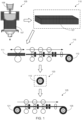
- FIG. 1 provides an overview of a method of making an aluminum alloy article.
- the method of FIG. 1 begins at step 105 where an aluminum alloy 106 is cast to form an aluminum alloy cast product 107, such as an ingot or other cast product.
- the aluminum alloy cast product 107 is homogenized to form a homogenized aluminum alloy cast product 111.
- the homogenized aluminum alloy cast product 111 is subjected to one or more hot rolling passes and one or more cold rolling passes to form a first rolled aluminum alloy product 112.
- the first rolled aluminum alloy product 112 is annealed to form a first annealed aluminum alloy product 121.
- the first annealed aluminum alloy product 121 is subjected to a second rolling process to form a second rolled aluminum product 126, which may correspond to an aluminum alloy article.
- the second rolled aluminum product 126 is subjected to one or more additional forming or stamping processes to form an aluminum alloy article.
- the methods disclosed herein comprise a step of casting a molten aluminum alloy to form an aluminum alloy cast product.
- the molten alloy may be treated before casting.
- the treatment can include one or more of degassing, inline fluxing, and filtering.
- Aluminum alloy cast products can be formed using any casting process performed according to standards commonly used in the aluminum industry as known to one of ordinary skill in the art.
- the casting process can include a Direct Chill (DC) casting process or a Continuous Casting (CC) process.
- the continuous casting system can include a pair of moving opposed casting surfaces (e.g., moving opposed belts, rolls or blocks), a casting cavity between the pair of moving opposed casting surfaces, and a molten metal injector.
- the molten metal injector can have an end opening from which molten metal can exit the molten metal injector and be injected into the casting cavity.
- the CC process may include, but is not limited to, the use of twin-belt casters, twin-roll casters, or block casters.
- the casting process is performed by a CC process to form a cast product in the form of a billet, a slab, a shate, a strip, and the like.
- a clad layer in a cast product may be attached to a core layer in a cast product to form a cladded product by any means known to persons of ordinary skill in the art.
- a clad layer can be attached to a core layer by direct chill co-casting (i.e., fusion casting) as described in, for example, U.S. Patent Nos. 7,748,434 and 8,927,113 ; by hot and cold rolling a composite cast ingot as described in U.S. Patent No. 7,472,740 ; or by roll bonding to achieve the required metallurgical bonding between the core and the cladding.
- the initial dimensions and final dimensions of the clad aluminum alloy products described herein can be determined by the desired properties of the overall final product.
- the roll bonding process can be carried out in different manners, as known to those of ordinary skill in the art.
- the roll-bonding process can include both hot rolling and cold rolling.
- the roll bonding process can be a one-step process or a multi-step process in which the material is gauged down during successive rolling steps. Separate rolling steps can optionally be separated by other processing steps, including, for example, annealing steps, cleaning steps, heating steps, cooling steps, and the like.
- a cast product such as an ingot, billet, slab, shate, strip, etc.
- the processing steps can be used to prepare sheets.
- Such processing steps include, but are not limited to, homogenization, hot rolling, cold rolling, solution heat treatment, and an optional pre-aging step, as known to those of ordinary skill in the art.
- the processing steps can be suitably applied to any cast product, including, but not limited to, ingots, billets, slabs, strips, plates, shates, etc., using modifications and techniques as known to those of skill in the art.
- Specific processing steps may be used to prepare aluminum alloy articles with particular recrystallization quotient distributions, as described below.
- the casting process may impact the recrystallization and reforming that may occur during subsequent processing steps.
- the distribution of dispersoid-forming elements in a cast product, such as an ingot may impact the ability of a cast product to undergo recrystallization.
- Dispersoid forming elements include, for example, Mn, Cr, Ti, Zr, and Sc, which may precipitate out of supersaturated solutions in the form of nano-scale precipitates, which may be, for example, from 10 nm in diameter to 30 nm in diameter.
- These precipitates may have sizes that do not promote recrystallization nucleation in the way that larger particles do. Instead, these particles may inhibit the motion of dislocations and grain boundaries such that recrystallization is inhibited.
- the volume or mass fraction of these dispersoids may determine or impact the specific recrystallization behavior in a cast product.
- dispersoid forming elements may also be selectively enriched in the centerline, and the enrichment may also be enhanced by increasing the casting speed.
- the distributions of dispersoid-forming elements may be optimized at the center of the ingot, which can impact the rate at which recrystallization may occur.
- concentration at the center of the ingot may be increased as compared to slower casting rates.
- the enhanced dispersoid content in the corresponding solidified ingot can then be used during subsequent processing steps (e.g., rolling, annealing, etc.) to impact the rate of recrystallization at the center of a processed object.
- methods disclosed herein may optionally utilize a high-rate casting step, such as greater than about 1.5 inches per minute (IPM), such as 1.5-10 IPM, 2.5-10 IPM, 3.5-10 IPM, or 4.5-10 IPM.
- IPM 1.5 inches per minute
- the methods disclosed herein can also optionally comprise a stress relieving step, which includes heating the aluminum alloy cast product prepared from an alloy composition described herein to attain a peak metal temperature (PMT) of at least 300 °C up to 420 °C.
- the stress relieving is carried out at a temperature of 300 °C, or 310 °C, or 320 °C, or 330 °C, or 340 °C, or 350 °C, or 360 °C, or 370 °C, or 380 °C, or 390 °C, or 400 °C, or 410 °C, or 420 °C.
- the heating is carried out for a period of at least 8 hours and up to, for example, 24 hours.
- the heating is carried out for 8 hours, or 9 hours, or 10 hours, or 11 hours, or 12 hours, or 13 hours, or 14 hours, or 15 hours, or 16 hours, or 17 hours, or 18 hours, or 19 hours, or 20 hours, or 21 hours, or 22 hours, or 23 hours, or 24 hours.
- the microstructure of an aluminum alloy cast or rolled product may be modified, such as by a recrystallization process or recovery process.
- the homogenization step can include heating an aluminum alloy cast product prepared from an alloy composition described herein to attain a peak metal temperature (PMT) of at least 450 °C (e.g., at least 450 °C, at least 460 °C, at least 470 °C, at least 480 °C, at least 490 °C, at least 500 °C, at least 510 °C, at least 520 °C, at least 530 °C, at least 540 °C, at least 550 °C, at least 560 °C, at least 570 °C, or at least 580 °C).
- PMT peak metal temperature
- the aluminum alloy product can be heated to a temperature of from 520 °C to 580 °C, from 530 °C to 575 °C, from 535 °C to 570 °C, from 540 °C to 565 °C, from 545 °C to 560 °C, from 530 °C to 560 °C, or from 550 °C to 580 °C.
- the heating rate to the PMT is 100 °C/hour or less, 75 °C/hour or less, 50 °C/hour or less, 40 °C/hour or less, 30 °C/hour or less, 25 °C/hour or less, 20 °C/hour or less, or 15 °C/hour or less.
- the heating rate to the PMT is from 10 °C/min to 100 °C/min (e.g., 10 °C/min to 90 °C/min, 10 °C/min to 70 °C/min, 10 °C/min to 60 °C/min, from 20 °C/min to 90 °C/min, from 30 °C/min to 80 °C/min, from 40 °C/min to 70 °C/min, or from 50 °C/min to 60 °C/min).
- 10 °C/min to 100 °C/min e.g., 10 °C/min to 90 °C/min, 10 °C/min to 70 °C/min, 10 °C/min to 60 °C/min, from 20 °C/min to 90 °C/min, from 30 °C/min to 80 °C/min, from 40 °C/min to 70 °C/min, or from 50 °C/min to 60 °C/min
- the aluminum alloy cast product is then allowed to soak (i.e., held at a particular temperature, such as a PMT) for a period of time.
- the aluminum alloy cast product is allowed to soak for up to 15 hours (e.g., from 30 minutes to 6 hours, inclusively).
- the aluminum alloy product is soaked at a temperature of at least 450 °C for 30 minutes, for 1 hour, for 2 hours, for 3 hours, for 4 hours, for 5 hours, for 6 hours, for 7 hours, for 8 hours, for 9 hours, for 10 hours, for 11 hours, for 12 hours, for 13 hours, for 14 hours, for 15 hours, or for any time period in between.
- the homogenization described herein can be carried out in a two-stage homogenization process.
- the homogenization process can include the above-described heating and soaking steps, which can be referred to as the first stage, and can further include a second stage.
- the temperature of the aluminum alloy cast product is increased to a temperature higher than the temperature used for the first stage of the homogenization process.
- the aluminum alloy cast product temperature can be increased, for example, to a temperature at least 5 °C higher than the aluminum alloy cast product temperature during the first stage of the homogenization process.
- the aluminum alloy cast product temperature can be increased to a temperature of at least 455 °C (e.g., at least 460 °C, at least 465 °C, or at least 470 °C).
- the heating rate to the second stage homogenization temperature can be 5 °C/hour or less, 3 °C/hour or less, or 2.5 °C/hour or less.
- the aluminum alloy cast product is then allowed to soak for a period of time during the second stage. In some embodiments, the aluminum alloy cast product is allowed to soak for up to 10 hours (e.g., from 30 minutes to 10 hours, inclusively).
- the aluminum alloy cast product can be soaked at the temperature of at least 455 °C for 30 minutes, for 1 hour, for 2 hours, for 3 hours, for 4 hours, for 5 hours, for 6 hours, for 7 hours, for 8 hours, for 9 hours, or for 10 hours.
- the aluminum alloy cast product is allowed to cool to room temperature in the air.
- the aluminum alloy products are laid down and hot rolled at a temperature ranging from 250 °C to 550 °C (e.g., from 300 °C to 500 °C, or from 350 °C to 450 °C).
- the aluminum alloy product is hot rolled to a 4 mm to 15 mm thick gauge (e.g., from 5 mm to 12 mm thick gauge), which is referred to as a shate.
- the aluminum alloy product can be hot rolled to a 15 mm thick gauge, a 14 mm thick gauge, a 13 mm thick gauge, a 12 mm thick gauge, a 11 mm thick gauge, a 10 mm thick gauge, a 9 mm thick gauge, a 8 mm thick gauge, a 7 mm thick gauge, a 6 mm thick gauge, or a 5 mm thick gauge, or anywhere in between.
- the aluminum alloy product can be hot rolled to a gauge greater than 15 mm thick (i.e., a plate).
- the aluminum alloy product can be hot rolled to a 25 mm thick gauge, a 24 mm thick gauge, a 23 mm thick gauge, a 22 mm thick gauge, a 21 mm thick gauge, a 20 mm thick gauge, a 19 mm thick gauge, a 18 mm thick gauge, a 17 mm thick gauge, or a 16 mm thick gauge, or any suitable gauge in between or above 25 mm thick.
- the aluminum alloy product can be hot rolled to a gauge no more than 4 mm (i.e., a sheet).
- the aluminum alloy product is hot rolled to a 1 mm to 4 mm thick gauge, which is referred to as a sheet.
- the aluminum alloy product can be hot rolled to a 4 mm thick gauge, a 3 mm thick gauge, a 2 mm thick gauge, or a 1 mm thick gauge, or anywhere in between.
- the rolled product from the hot rolling step can be cold rolled to a thin gauge shate or sheet.
- this thin-gauge shate or sheet is cold rolled to have a thickness (i.e., a first thickness) ranging from 1.0 mm to 12.0 mm, or from 2.0 mm to 8.0 mm, or from 3.0 mm to 6.0 mm, or from 4.0 mm to 5.0 mm.
- this thin-gauge shate or sheet is cold rolled to have a thickness 12.0 mm, 11.9 mm, 11.8 mm, 11.7 mm, 11.6 mm, 11.5 mm, 11.4 mm, 11.3 mm, 11.2 mm, 11.1 mm, 11.0 mm, 10.9 mm, 10.8 mm, 10.7 mm, 10.6 mm, 10.5 mm, 10.4 mm, 10.3 mm, 10.2 mm, 10.1 mm, 10.0 mm, 9.9 mm, 9.8 mm, 9.7 mm, 9.6 mm, 9.5 mm, 9.4 mm, 9.3 mm, 9.2 mm, 9.1 mm, 9.0 mm, 8.9 mm, 8.8 mm, 8.7 mm, 8.6 mm, 8.5 mm, 8.4 mm, 8.3 mm, 8.2 mm, 8.1 mm, 8.0 mm, 7.9 mm, 7.8 mm, 7.7 mm, 7.6 mm, 7.5 mm,
- the one or more cold rolling passes reduce the thickness of rolled aluminum product by at least 30%, or at least 35%, or at least 40%, or at least 45%, or at least 50%, or at least 55%, or at least 60%, or at least 65%, or at least 70%. In some embodiments, the one or more cold rolling passes reduce the cast product to a thickness (i.e., a first thickness) of no more than 10 mm, or no more than 9 mm, or no more than 8 mm, or no more than 7 mm, or no more than 6 mm, or no more than 5 mm.
- a thickness i.e., a first thickness
- annealing is performed. This can also be referred to as an intermediate annealing or inter-annealing, as it is performed in the middle of the rolling process, as one or more additional rolling passes are carried out after the annealing.
- the annealing step can include heating the rolled aluminum product from room temperature to a temperature from 380 °C to 500 °C (e.g., from 385 °C to 495 °C, from 390 °C to 490 °C, from 395 °C to 485 °C, from 400 °C to 480 °C, from 405 °C to 475 °C, from 410 °C to 470 °C, from 415 °C to 465 °C, from 420 °C to 460 °C, from 425 °C to 455 °C, from 430 °C to 460 °C, from 380 °C to 450 °C, from 405 °C to 475 °C, or from 430 °C to 500 °C).
- a temperature from 380 °C to 500 °C e.g., from 385 °C to 495 °C, from 390 °C to 490 °C,
- This intermediate annealing step can, for example, lead to certain beneficial texture features in the resulting article.
- the intermediate annealing assists in the formation of the recrystallized microstructure on surface of the article and the recovered and/or unrecrystallized structure in the middle of the article.
- the texture on surface of the article will be dominated by recrystallization components, including cube, cube_ND, and cube_RD, rather than deformation type components, such as Bs, S, and Cu. Therefore, the bending performance of the article is improved without reducing the strength.
- the plate, shate, or sheet can soak at the intermediate annealing temperature for a period of time.
- the plate, shate, or sheet is allowed to soak for up to approximately 2 hours (e.g., from about 15 to about 120 minutes, inclusively).
- the plate, shate, or sheet can be soaked at the temperature of from about 400 °C to about 500 °C for 15 minutes, 20 minutes, 25 minutes, 30 minutes, 35 minutes, 40 minutes, 45 minutes, 50 minutes, 55 minutes, 60 minutes, 65 minutes, 70 minutes, 75 minutes, 80 minutes, 85 minutes, 90 minutes, 95 minutes, 100 minutes, 105 minutes, 110 minutes, 115 minutes, or 120 minutes, or anywhere in between.
- the intermediate annealing of the rolled aluminum alloy product is carried out at a temperature of no more than 45 °C, or no more than 40 °C, or no more than 35 °C, or no more than 30 °C, or no more than 25 °C, or no more than 20 °C, or no more than 15 °C, or no more than 10 °C, above the minimum recrystallization temperature of the aluminum alloy.
- the intermediate annealing of the rolled aluminum alloy product is carried out at a temperature above the minimum recrystallization temperature of the aluminum alloy for no more than 3.0 hours, or no more than 2.5 hours, or no more than 2.0 hours, or no more than 1.5 hours, or no more than 1.0 hours.
- the intermediate annealing comprises multiple annealing sub-steps.
- the annealing is carried out at a first temperature above the minimum recrystallization temperature for a first period of time and at a second temperature above the minimum recrystallization temperature for a second period of time
- the first temperature above the minimum recrystallization temperature is greater than the second temperature above the minimum recrystallization temperature.
- Annealing may, for example, subject the surface portions to higher temperature annealing conditions at earlier times than the intermediate portion.
- the surface portions of the rolled aluminum alloy product may be subjected to recrystallization conditions for longer periods of time than the intermediate portion. This may also occur in a single step intermediate annealing process in which a single annealing temperature is used, but the effect may be more pronounced in a multiple step annealing process.
- further rolling is performed, such as cold rolling.
- additional cold rolling passes are performed. This additional rolling brings the aluminum alloy product to a final thickness (i.e., a second thickness). In some embodiments, the final thickness ranges from 0.1 mm to 4.0 mm.
- the final thickness is 4.0 mm, 3.9 mm, 3.8 mm, 3.7 mm, 3.6 mm, 3.5 mm, 3.4 mm, 3.3 mm, 3.2 mm, 3.1 mm, 3.0 mm, 2.9 mm, 2.8 mm, 2.7 mm, 2.6 mm, 2.5 mm, 2.4 mm, 2.3 mm, 2.2 mm, 2.1 mm, 2.0 mm, 1.9 mm, 1.8 mm, 1.7 mm, 1.6 mm, 1.5 mm, 1.4 mm, 1.3 mm, 1.2 mm, 1.1 mm, 1.0 mm, 0.9 mm, 0.8 mm, 0.7 mm, 0.6 mm, 0.5 mm, 0.4 mm, 0.3 mm, 0.2 mm, or 0.1 mm.
- the final thickness is no more than 4.0 mm, or no more than 3.5 mm, or no more than 3.0 mm, or no more than 2.5 mm, or no more than 2.0 mm, or no more than 1.5 mm, or no more than 1.0 mm, or no more than 0.5 mm, or no more than 0.3 mm, or no more than 0.1 mm.
- additional finishing steps can be carried out, including, but not limited to, one or more of solutionizing, quenching, ageing, and coiling.
- a solution heat treatment step can be carried out.
- the solution heat treatment step can include heating the aluminum alloy product from room temperature to a temperature of from 430 °C to 500 °C.
- the solution heat treatment step can include heating the aluminum alloy product from room temperature to a temperature of from 440 °C to 500 °C, from 460 °C to 500 °C, or from 480 °C to 490 °C.
- the heating rate for the solution heat treatment step can be from 250 °C/hour to 350 °C/hour (e.g., 250 °C/hour, 255 °C/hour, 260 °C/hour, 265 °C/hour, 270 °C/hour, 275 °C/hour, 280 °C/hour, 285 °C/hour, 290 °C/hour, 295 °C/hour, 300 °C/hour, 305 °C/hour, 310 °C/hour, 315 °C/hour, 320 °C/hour, 325 °C/hour, 330 °C/hour, 335 °C/hour, 340 °C/hour, 345 °C/hour, or 350 °C/hour).
- the aluminum alloy product can then be cooled to a temperature of about 25 °C at a quench speed that can vary between about 50 °C/s to 400 °C/s in a quenching step that is based on the selected gauge.
- the quench rate can be from about 50 °C/s to about 375 °C/s, from about 60 °C/s to about 375 °C/s, from about 70 °C/s to about 350 °C/s, from about 80 °C/s to about 325 °C/s, from about 90 °C/s to about 300 °C/s, from about 100 °C/s to about 275 °C/s, from about 125 °C/s to about 250 °C/s, from about 150 °C/s to about 225 °C/s, or from about 175 °C/s to about 200 °C/s.
- the aluminum alloy product is rapidly quenched with a liquid (e.g., water) and/or gas or another selected quench medium.
- a liquid e.g., water
- the aluminum alloy product can be rapidly quenched with water.
- the aluminum alloy product is quenched with air.
- the aluminum alloy product can be artificially aged for a period of time to result in the T6 or T7 temper.
- the aluminum alloy product can be artificially aged (AA) at about 100 °C to 225 °C (e.g., 100 °C, 105 °C, 110 °C, 115 °C, 120 °C, 125 °C, 130 °C, 135 °C, 140 °C, 145 °C, 150 °C, 155 °C, 160 °C, 165 °C, 170 °C, 175 °C, 180 °C, 185 °C, 190 °C, 195 °C, 200 °C, 205 °C, 210 °C, 215 °C, 220 °C, or 225 °C) for a period of time.
- the aluminum alloy product can be cold worked and artificially aged for a period from about 15 minutes to about 48 hours (e.g., 15 minutes, 30 minutes, 1 hour, 2 hours, 3 hours, 4 hours, 5 hours, 6 hours, 7 hours, 8 hours, 9 hours, 10 hours, 11 hours, 12 hours, 13 hours, 14 hours, 15 hours, 16 hours, 17 hours, 18 hours, 19 hours, 20 hours, 21 hours, 22 hours, 23 hours, 24 hours, 25 hours, 26 hours, 27 hours, 28 hours, 29 hours, 30 hours, 31 hours, 32 hours, 33 hours, 34 hours, 35 hours, 36 hours, 37 hours, 38 hours, 39 hours, 40 hours, 41 hours, 42 hours, 43 hours, 44 hours, 45 hours, 46 hours, 47 hours, or 48 hours, or anywhere in between).
- an annealing step during or after production can also be applied to produce the aluminum alloy product in a coil form for improved productivity or formability.
- an alloy in coil form can be supplied in the O temper, using a hot or cold rolling step and an annealing step following the hot or cold rolling step. Forming may occur in O temper, which is followed by solution heat treatment, quenching and artificial aging/paint baking.
- an annealing step can be applied to the coil.
- the purpose for the annealing and the annealing parameters may include (1) releasing the work-hardening in the material to gain formability; (2) recrystallizing or recovering the material without causing significant grain growth; (3) engineering or converting texture to be appropriate for forming and for reducing anisotropy during formability; and (4) avoiding the coarsening of pre-existing precipitation particles.
- the disclosure provides aluminum alloy articles formed by the processes set forth above, or any embodiments thereof.
- an article of manufacture which is comprised of an aluminum alloy product disclosed herein.
- the article of manufacture is comprised of a rolled aluminum alloy product.
- articles of manufacture include, but are not limited to, an automobile, a truck, a trailer, a train, a railroad car, an airplane, a body panel or part for any of the foregoing, a bridge, a pipeline, a pipe, a tubing, a boat, a ship, a storage container, a storage tank, a an article of furniture, a window, a door, a railing, a functional or decorative architectural piece, a pipe railing, an electrical component, a conduit, a beverage container, a food container, or a foil.
- the aluminum alloy articles disclosed herein can be used in automotive and/or transportation applications, including motor vehicle, aircraft, and railway applications, or any other desired application.
- the aluminum alloy products disclosed herein can be used to prepare motor vehicle body part products, such as bumpers, side beams, roof beams, cross beams, pillar reinforcements (e.g., A-pillars, B-pillars, and C-pillars), inner panels, outer panels, side panels, inner hoods, outer hoods, or trunk lid panels.
- the aluminum alloys and methods according to the invention can also be used in aircraft or railway vehicle applications, to prepare, for example, external and internal panels.
- the aluminum alloy articles disclosed herein can be used in electronics applications.
- the aluminum alloy products disclosed herein can also be used to prepare housings for electronic devices, including mobile phones and tablet computers.
- the alloys can be used to prepare housings for the outer casing of mobile phones (e.g., smart phones) and tablet bottom chassis.
- the aluminum alloy articles disclosed herein can be used in industrial applications.
- the aluminum alloy products disclosed herein can be used to prepare products for the general distribution market.
- the aluminum alloy articles disclosed herein can be used as aerospace body parts.
- the aluminum alloy articles disclosed herein can be used to prepare structural aerospace body parts, such as a wing, a fuselage, an aileron, a rudder, an elevator, a cowling, or a support.
- the aluminum alloy articles disclosed herein can be used to prepare non-structural aerospace body parts, such as a seat track, a seat frame, a panel, or a hinge.
- test aluminum alloy sheets with chemical composition corresponding to Alloys A1-A6 from Table 3 were cast by Direct Chill (DC) casting. All were stress relieved and homogenized, and subsequently hot-rolled to a hot band having a gauge of 10.5 mm. Each was then subjected to cold rolling. For each, the hot band went through 2 passes of cold rolling from 10.5 mm to 6 mm and 4 mm, respectively.
- Alloys A1, A2 and A3 Inter-annealing of Alloys A1, A2 and A3 was performed at 4.0 mm gauge, with a 50 °C/hr ramping rate to 410 °C, soaked for 60 minutes, then furnace cooled to 350 °C and soaked for 1200 minutes. The coils were allowed to cool to room temperature in air. A final cold rolling was then performed on these three samples, Alloys A1, A2, and A3. The coils were cold rolled to final gauge of 2.0 mm with 1 pass.
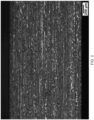
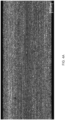
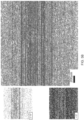
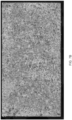
- FIG. 2 shows an optical micrograph (OM) of a cross-section of a sample of Alloy A1 that was lab rolled with inter-annealing, and which shows recovered and/or unrecrystallized microstructure through the thickness of the sample.
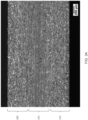
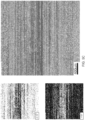
- FIG. 3A shows an optical micrograph (OM) of a cross-section of a sample of Alloy A1 that was plant rolled with inter-annealing.
- the sample of Alloy A1 of FIG. 3A includes a first surface portion 205, an intermediate portion 210, and a second surface portion 215.
- Plant Rolled samples were cold-rolled according to standard plant cold rolling processes.
- Lab Rolled samples were cold-rolled in a laboratory setting from 10.5 mm to 2.0 mm by conducting 17 different passes, each of which reduced the thickness by about 0.5 mm.
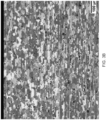
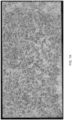
- FIG. 3B shows a surface portion from FIG. 3A , showing recrystallized microstructure, corresponding to at least a portion of first surface portion 205 or second surface portion 215.
- FIG. 3B the grain structure of the sample can be seen, with individual grains not spread significantly in the surface portion, indicating that the crystal structure has been recovered and/or is unrecrystallized by the inter-annealing process.
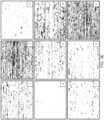
- FIG. 3C shows nine modified reduced-size versions of FIG. 3B , generated by reducing FIG. 3B to 9 individual colors in order to highlight various colors shown in FIG. 3B as black.
- FIG. 3D shows a center section from FIG. 3A , showing recovered and/or unrecrystallized microstructure, corresponding to at least a portion of intermediate portion 210.
- FIG. 3D shows the remnants of grains that were significantly spread during the initial rolling process. The remnants do not all recrystallize during the inter-annealing process and many regions remain spread in the center portion, reflecting the recovered and/or unrecrystallized nature of the intermediate portion 210.
- FIG. 3E shows nine modified reduced-size versions of FIG. 3D , generated by reducing FIG. 3D to 9 individual colors in order to highlight various colors shown in FIG. 3D as black.
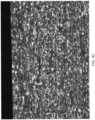
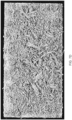
- FIG. 4A shows an optical micrograph of a sample of Alloy A5 that was plant rolled without inter-annealing during the cold rolling process, showing spread grains as horizontal structures in FIG 4A .
- FIG. 4B shows a section from the center portion in FIG. 4A corresponding to at least a portion of the intermediate portion, showing recovered and/or unrecrystallized microstructure.
- FIG. 4C shows a surface portion from FIG. 4A , showing recrystallized microstructure.
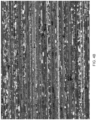
- Electron backscattering diffraction (EBSD) disorientation mapping was carried out on certain samples. Mapping of a cross-section of samples of Alloy A1 that were rolled to a final gauge and finished with a T6 temper is shown in FIGs. 5A , 5B , and 5C . The low angle boundaries (2-15) are marked as darker-color horizontal lines, while the medium to high angle boundaries (>15) are marked as lighter-color horizontal lines.
- FIG. 5A provides mapping for an Alloy A1 sample that was lab rolled, without inter-annealing during the cold rolling process, which has a uniform microstructure with recovered and/or unrecrystallized microstructure through the whole thickness, while FIG.
- FIG. 5B provides mapping for an Alloy A1 sample that was plant rolled, with inter-annealing during the cold rolling process, which shows the recrystallization microstructure near the surface and recovered and/or unrecrystallized microstructure in the center (i.e., intermediate portion).
- FIG. 5C shows mapping for an Alloy A5 sample that was plant rolled, without inter-annealing during the cold rolling process, which has a microstructure between that shown in FIG. 5A and FIG. 5B . Quantitative results from these images are presented in Table 4 below.
- the recrystallization quotient was calculated using the EBSD measurements described in Example 3. Orientation mapping was performed on a square grid across a cross-sectionally cut area. The mapped area was divided into three equally sized areas spanning the thickness of the sheet, and the recrystallization quotient was calculated for each area. Table 4 reports the values of the recrystallization quotient for each of the samples described in Example 3.
- the "Surface RQ” refers to RQ for the two surface areas (i.e., surface portions)
- Center RQ refers to the RQ for the center area (i.e., intermediate portion)
- the “Overall RQ” refers to the RQ across the thickness of the entire sample.
- IA refers to inter-annealing performed during the cold rolling process.
- Table 4 Sample Overall RQ Surface RQ Center RQ Alloy A1, Lab Processed 0.512 0.532 0.467 Alloy A1, Plant Rolled without IA 0.684 0.819 0.553 Alloy A5, Plant Rolled with IA 0.758 0.871 0.592
- the "Plant Rolled” samples were cold-rolled according to standard plant cold rolling processes.
- the "Lab Rolled” sample was cold-rolled in a laboratory setting from 10.5 mm to 2.0 mm by conducting 17 different passes, each of which reduced the thickness by about 0.5 mm.
- the bendability was measured for samples of aluminum alloy sheets prepared according to Example 2.
- the bendability for the samples was measured according to Spec VDA-238-100.
- the samples were tested in the longitudinal and transverse directions in T6 temper.
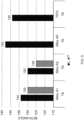
- FIG. 6 shows the 3-point bend results of Alloys A1, A2, A5 (without IA) and a sample of AA7075 sheet. The angle reported was ⁇ angle, thus the lower the better.
- the left bar is for the longitudinal direction and the right bar is for the transverse direction.
- Alloys A5 and the AA7076 sample only the longitudinal direction is shown. All were tested in the T6 temper.
- the exfoliation corrosion (EXCO) was measured for certain aluminum alloy sheets prepared according to Example 2.
- the EXCO was measured according to the procedure set forth in ASTM-G34, which involved the continuous immersion of test materials in a solution containing 4 M sodium chloride, 0.5 M potassium nitrate, and 0.1 M nitric acid at 25 ⁇ 3 °C.
- the susceptibility to exfoliation was determined by visual examination, with performance ratings established by reference to standard photographs (see the G34 test procedure). Visual examination was conducted, along with longitudinal cross-section metallographic examination.
- FIGs. 7A-7E show photographs of tested aluminum alloy sheets, as identified in Table 5 below. Table 5 Sample Figure No.
- the yield strength was measured for certain aluminum alloy sheets prepared according to Example 2. The yield strength was tested in accordance to ASTM E8 with 2" standard gauge length.
- FIG. 8 shows the results of yield strength testing on certain samples, where L, T, and D stand for longitudinal, transverse and diagonal, respectively, with respect to rolling direction.
- Alloy A1, Alloy A2, Alloy A3, and Alloy A6 the three bars show the results of testing in the longitudinal, transverse, and diagonal directions, respectively, from left to right.
- the two bars show the results of testing in the longitudinal and transverse directions, respectively, from left to right.
Landscapes
- Chemical & Material Sciences (AREA)
- Engineering & Computer Science (AREA)
- Mechanical Engineering (AREA)
- Materials Engineering (AREA)
- Metallurgy (AREA)
- Organic Chemistry (AREA)
- Physics & Mathematics (AREA)
- Thermal Sciences (AREA)
- Crystallography & Structural Chemistry (AREA)
- Continuous Casting (AREA)
- Metal Rolling (AREA)
Claims (11)
- Verfahren zum Herstellen eines Aluminiumlegierungsgegenstands, wobei das Verfahren umfasst:Gießen einer Aluminiumlegierung, um ein Aluminiumlegierungsgussprodukt zu bilden;Homogenisieren des Aluminiumlegierungsgussprodukts, um ein homogenisiertes Aluminiumlegierungsgussprodukt zu bilden;Unterziehen des homogenisierten Aluminiumlegierungsgussprodukts einem ersten Walzprozess, um ein erstes gewalztes Aluminiumlegierungsprodukt mit einer ersten Dicke zu bilden, wobei der erste Walzprozess einen oder mehrere Warmwalzstiche gefolgt von einem oder mehreren Kaltwalzstichen umfasst;Tempern des ersten gewalzten Aluminiumlegierungsprodukts bei einer Temperatur von nicht mehr als 50 °C über einer minimalen Rekristallisationstemperatur der Aluminiumlegierung, um ein erstes getempertes Aluminiumlegierungsprodukt zu bilden; undUnterziehen des ersten getemperten Aluminiumlegierungsprodukts einem zweiten Walzprozess, um ein zweites gewalztes Aluminiumlegierungsprodukt mit einer zweiten Dicke zu bilden,wobei das Tempern bei einer ersten Temperatur oberhalb der minimalen Rekristallisationstemperatur für eine erste Zeitperiode und bei einer zweiten Temperatur oberhalb der minimalen Rekristallisationstemperatur für eine zweite Zeitperiode durchgeführt wird, wobei die erste Temperatur oberhalb der minimalen Rekristallisationstemperatur größer ist als die zweite Temperatur oberhalb der minimalen Rekristallisationstemperatur, undwobei die Aluminiumlegierung eine Aluminiumlegierung der Serie 7xxx ist.
- Verfahren nach Anspruch 1, wobei die erste Dicke nicht mehr als 10 mm beträgt und/oderwobei das Tempern bei einer Temperatur oberhalb der minimalen Rekristallisationstemperatur für nicht mehr als 3,0 Stunden durchgeführt wird und/oderwobei die zweite Dicke nicht mehr als 4,0 mm beträgt.
- Verfahren nach einem der Ansprüche 1 oder 2, wobei das zweite gewalzte Aluminiumlegierungsprodukt umfasst:einen ersten Oberflächenabschnitt, wobei der erste Oberflächenabschnitt eine erste gewalzte Oberfläche umfasst, und wobei der erste Oberflächenabschnitt einen ersten Rekristallisationsquotienten aufweist;
einen zweiten Oberflächenabschnitt, dem ersten Oberflächenabschnitt gegenüberliegend, wobei der zweite Oberflächenabschnitt eine zweite gewalzte Oberfläche umfasst, und wobei der zweite Oberflächenabschnitt einen zweiten Rekristallisationsquotienten aufweist; undeinen intermediären Abschnitt, welcher zwischen dem ersten Oberflächenabschnitt und dem zweiten Oberflächenabschnitt positioniert ist, wobei der intermediäre Abschnitt einen dritten Rekristallisationsquotienten aufweist, undwobei der dritte Rekristallisationsquotient kleiner ist als mindestens einer von dem ersten Rekristallisationsquotienten oder dem zweiten Rekristallisationsquotienten. - Verfahren nach Anspruch 3, wobei der erste Rekristallisationsquotient zwischen 0,50 und 1,0 beträgt, wobei der zweite Rekristallisationsquotient zwischen 0,50 und 1,0 beträgt, oder wobei der dritte Rekristallisationsquotient zwischen 0,01 und 0,65 beträgt und/oder
wobei sich der erste Oberflächenabschnitt von einer ersten Oberfläche des ersten Oberflächenabschnitts zu einer ersten Tiefe von weniger als 40 % einer Dicke des zweiten gewalzten Aluminiumlegierungsprodukts erstreckt, und wobei sich der zweite Oberflächenabschnitt von einer zweiten Oberfläche des zweiten Oberflächenabschnitts zu einer zweiten Tiefe von weniger als 40 % der Dicke des zweiten gewalzten Aluminiumlegierungsprodukts erstreckt. - Aluminiumlegierungsgegenstand, umfassend ein Aluminiumlegierungsmaterial, wobei das Aluminiumlegierungsmaterial umfasst:einen ersten Oberflächenabschnitt, wobei der erste Oberflächenabschnitt eine erste gewalzte Oberfläche umfasst, und wobei der erste Oberflächenabschnitt einen ersten Rekristallisationsquotienten aufweist;einen zweiten Oberflächenabschnitt, dem ersten Oberflächenabschnitt gegenüberliegend, wobei der zweite Oberflächenabschnitt eine zweite gewalzte Oberfläche umfasst, und wobei der zweite Oberflächenabschnitt einen zweiten Rekristallisationsquotienten aufweist; undeinen intermediären Abschnitt, welcher zwischen dem ersten Oberflächenabschnitt und dem zweiten Oberflächenabschnitt positioniert ist, wobei der intermediäre Abschnitt einen dritten Rekristallisationsquotienten aufweist, und wobei der dritte Rekristallisationsquotient kleiner ist als mindestens einer von dem ersten Rekristallisationsquotienten oder dem zweiten Rekristallisationsquotienten,wobei ein Rekristallisationsquotient einer prozentualen oder fraktionalen Menge, Volumen oder Masse eines Abschnitts des Aluminiumlegierungsmaterials entspricht, welches im Vergleich zu einer Gesamtmenge, -volumen oder -masse des Abschnitts des Aluminiumlegierungsmaterials rekristallisiert ist,wobei das Aluminiumlegierungsmaterial eine Aluminiumlegierung der Serie 7xxx ist undwobei sowohl die erste gewalzte Oberfläche als auch die zweite gewalzte Oberfläche durch einen Prozess gebildet werden, welcher Kaltwalzen umfasst.
- Aluminiumlegierungsgegenstand nach Anspruch 5, wobei sich der erste Oberflächenabschnitt von einer Oberfläche des ersten Oberflächenabschnitts zu einer ersten Tiefe von nicht mehr als 40,0 % einer Dicke des Aluminiumlegierungsgegenstands erstreckt.
- Aluminiumlegierungsgegenstand nach Anspruch 6, wobei sich der zweite Oberflächenabschnitt von einer Oberfläche des zweiten Oberflächenabschnitts zu einer zweiten Tiefe von nicht mehr als 40,0 % der Dicke des Aluminiumlegierungsgegenstands erstreckt.
- Aluminiumlegierungsgegenstand nach einem der Ansprüche 5 bis 7, wobei sich der intermediäre Abschnitt von einer ersten Tiefe des ersten Oberflächenabschnitts zu einer zweiten Tiefe des zweiten Oberflächenabschnitts erstreckt.
- Aluminiumlegierungsgegenstand nach Anspruch 5, wobei der erste Rekristallisationsquotient mindestens 0,50 beträgt, wobei der zweite Rekristallisationsquotient mindestens 0,50 beträgt, oder wobei der dritte Rekristallisationsquotient nicht mehr als 0,65 beträgt.
- Aluminiumlegierungsgegenstand nach einem der Ansprüche 5 bis 9 mit einem β-Winkel zwischen 100° und 138° für die Biegbarkeitsprüfung gemäß der Spezifikation VDA 238-100 und/oder
mit einer Bewertung der Abblätterungskorrosion von EA für die Prüfung der Abblätterungskorrosion nach dem ASTM-Test Nr. G34-01. - Aluminiumlegierungsgegenstand nach einem der Ansprüche 5 bis 10, wobei sich der erste Oberflächenabschnitt von einer ersten Oberfläche des ersten Oberflächenabschnitts zu einer ersten Tiefe von weniger als 40 % einer Dicke des Aluminiumlegierungsgegenstands erstreckt, und wobei sich der zweite Oberflächenabschnitt von einer zweiten Oberfläche des zweiten Oberflächenabschnitts zu einer zweiten Tiefe von weniger als 40 % der Dicke des Aluminiumlegierungsgegenstands erstreckt.
Applications Claiming Priority (2)
| Application Number | Priority Date | Filing Date | Title |
|---|---|---|---|
| US201762548013P | 2017-08-21 | 2017-08-21 | |
| PCT/US2018/047058 WO2019040356A1 (en) | 2017-08-21 | 2018-08-20 | ALUMINUM ALLOY PRODUCTS HAVING A SELECTIVELY RECRISTALLIZED MICROSTRUCTURE AND METHODS OF MAKING |
Publications (2)
| Publication Number | Publication Date |
|---|---|
| EP3635148A1 EP3635148A1 (de) | 2020-04-15 |
| EP3635148B1 true EP3635148B1 (de) | 2025-01-08 |
Family
ID=63586887
Family Applications (1)
| Application Number | Title | Priority Date | Filing Date |
|---|---|---|---|
| EP18769915.2A Active EP3635148B1 (de) | 2017-08-21 | 2018-08-20 | Aluminiumlegierungsprodukte mit selektiv rekristallisierter mikrostruktur und herstellungsverfahren |
Country Status (9)
| Country | Link |
|---|---|
| US (1) | US20190055637A1 (de) |
| EP (1) | EP3635148B1 (de) |
| JP (1) | JP2020530529A (de) |
| KR (2) | KR20200042919A (de) |
| CN (1) | CN110997964A (de) |
| CA (1) | CA3070005C (de) |
| ES (1) | ES3012652T3 (de) |
| MX (1) | MX2020001755A (de) |
| WO (1) | WO2019040356A1 (de) |
Families Citing this family (6)
| Publication number | Priority date | Publication date | Assignee | Title |
|---|---|---|---|---|
| US11746400B2 (en) * | 2019-06-03 | 2023-09-05 | Novelis Inc. | Ultra-high strength aluminum alloy products and methods of making the same |
| CN111961925B (zh) * | 2020-08-12 | 2022-04-08 | 佛山市三水凤铝铝业有限公司 | 一种铝合金铸棒的制备方法 |
| CN112063899A (zh) * | 2020-09-14 | 2020-12-11 | 肇庆新联昌金属实业有限公司 | 一种高塑性铝合金及其制备方法 |
| JP2023542330A (ja) * | 2020-09-17 | 2023-10-06 | ノベリス・インコーポレイテッド | 高強度で焼入れ感受性の低い7xxx系アルミニウム合金及びその製造方法 |
| CA3195217A1 (en) * | 2020-09-24 | 2022-05-05 | Novelis Inc. | Functionally gradient aluminum alloy products and methods of making |
| EP4306669A4 (de) * | 2021-08-02 | 2025-02-19 | Samsung Electronics Co., Ltd. | Extrudiertes aluminiumlegierungsmaterial und gehäuse für elektronische vorrichtung damit |
Citations (4)
| Publication number | Priority date | Publication date | Assignee | Title |
|---|---|---|---|---|
| US4305763A (en) | 1978-09-29 | 1981-12-15 | The Boeing Company | Method of producing an aluminum alloy product |
| US5496426A (en) | 1994-07-20 | 1996-03-05 | Aluminum Company Of America | Aluminum alloy product having good combinations of mechanical and corrosion resistance properties and formability and process for producing such product |
| WO2005049878A2 (en) * | 2003-10-29 | 2005-06-02 | Corus Aluminium Walzprodukte Gmbh | Method for producing a high damage tolerant aluminium alloy |
| US20110027610A1 (en) * | 2009-07-28 | 2011-02-03 | Kabushiki Kaisha Kobe Seiko Sho (Kobe Steel, Ltd) | Aluminum alloy clad material |
Family Cites Families (11)
| Publication number | Priority date | Publication date | Assignee | Title |
|---|---|---|---|---|
| DE1238678B (de) * | 1965-03-04 | 1967-04-13 | Ver Leichtmetallwerke Gmbh | Verfahren zur Verbesserung der Spannungskorrosionsbestaendigkeit von Schmiedeteilen aus Aluminiumlegierungen |
| WO1992004477A1 (en) * | 1990-09-05 | 1992-03-19 | Golden Aluminum Company | Aluminum alloy composition |
| PT1638715E (pt) | 2003-06-24 | 2008-03-17 | Novelis Inc | Processo para moldagem de uma lingote compósito |
| DE20312889U1 (de) * | 2003-08-21 | 2004-12-30 | Otto Fuchs Kg | Stranggepresstes Profil aus einer hochfesten, schweißbaren Al-Legierung |
| US7748434B2 (en) | 2006-03-01 | 2010-07-06 | Novelis Inc. | Sequential casting of metals having high co-efficients of contraction |
| CN101918601A (zh) * | 2008-02-12 | 2010-12-15 | 株式会社神户制钢所 | 铝合金层合板 |
| JP5415016B2 (ja) * | 2008-04-16 | 2014-02-12 | 株式会社Uacj | 成形加工用アルミニウム合金板およびその製造方法 |
| CN102634701B (zh) * | 2012-03-13 | 2014-01-01 | 浙江永杰铝业有限公司 | 一种船用高镁铝合金板材生产方法 |
| JP5872443B2 (ja) * | 2012-03-30 | 2016-03-01 | 株式会社神戸製鋼所 | 自動車用アルミニウム合金鍛造材およびその製造方法 |
| JP2014234542A (ja) * | 2013-06-04 | 2014-12-15 | 株式会社Uacj | 耐リジング性に優れたアルミニウム合金板 |
| JP2016160515A (ja) * | 2015-03-04 | 2016-09-05 | 株式会社神戸製鋼所 | アルミニウム合金板 |
-
2018
- 2018-08-20 US US16/105,211 patent/US20190055637A1/en not_active Abandoned
- 2018-08-20 WO PCT/US2018/047058 patent/WO2019040356A1/en not_active Ceased
- 2018-08-20 CA CA3070005A patent/CA3070005C/en active Active
- 2018-08-20 EP EP18769915.2A patent/EP3635148B1/de active Active
- 2018-08-20 ES ES18769915T patent/ES3012652T3/es active Active
- 2018-08-20 JP JP2020508400A patent/JP2020530529A/ja active Pending
- 2018-08-20 CN CN201880054073.5A patent/CN110997964A/zh active Pending
- 2018-08-20 KR KR1020207007889A patent/KR20200042919A/ko not_active Ceased
- 2018-08-20 KR KR1020227029366A patent/KR102597364B1/ko active Active
- 2018-08-20 MX MX2020001755A patent/MX2020001755A/es unknown
Patent Citations (4)
| Publication number | Priority date | Publication date | Assignee | Title |
|---|---|---|---|---|
| US4305763A (en) | 1978-09-29 | 1981-12-15 | The Boeing Company | Method of producing an aluminum alloy product |
| US5496426A (en) | 1994-07-20 | 1996-03-05 | Aluminum Company Of America | Aluminum alloy product having good combinations of mechanical and corrosion resistance properties and formability and process for producing such product |
| WO2005049878A2 (en) * | 2003-10-29 | 2005-06-02 | Corus Aluminium Walzprodukte Gmbh | Method for producing a high damage tolerant aluminium alloy |
| US20110027610A1 (en) * | 2009-07-28 | 2011-02-03 | Kabushiki Kaisha Kobe Seiko Sho (Kobe Steel, Ltd) | Aluminum alloy clad material |
Non-Patent Citations (1)
| Title |
|---|
| SACAQDURA, JEAN-FRANCOIS: "Transferts Thermiques – Initiation et approfondissement ", 1 January 2015, LAVOISIER, ISBN: 978-2-7430-1993-8, article ANONYMOUS: "5.1. Epaisseur affectee thermiquement // 5.2. Méthode du corps à température quasi-uniforme", pages: 54 - 60, XP009563554 |
Also Published As
| Publication number | Publication date |
|---|---|
| KR102597364B1 (ko) | 2023-11-06 |
| ES3012652T3 (en) | 2025-04-09 |
| US20190055637A1 (en) | 2019-02-21 |
| MX2020001755A (es) | 2020-03-24 |
| WO2019040356A1 (en) | 2019-02-28 |
| JP2020530529A (ja) | 2020-10-22 |
| KR20220123148A (ko) | 2022-09-05 |
| CN110997964A (zh) | 2020-04-10 |
| CA3070005C (en) | 2023-01-03 |
| KR20200042919A (ko) | 2020-04-24 |
| EP3635148A1 (de) | 2020-04-15 |
| CA3070005A1 (en) | 2019-02-28 |
Similar Documents
| Publication | Publication Date | Title |
|---|---|---|
| US20220333229A1 (en) | High strength 7xxx aluminum alloys and methods of making the same | |
| EP3676412B1 (de) | Produkte aus aluminiumlegierung der serie 7xxx in stabilisiertem t4-härtegrad und verfahren zu ihrer herstellung | |
| US10837086B2 (en) | High-strength corrosion-resistant 6xxx series aluminum alloys and methods of making the same | |
| EP3635148B1 (de) | Aluminiumlegierungsprodukte mit selektiv rekristallisierter mikrostruktur und herstellungsverfahren | |
| EP4067515A1 (de) | Giessen von recyceltem aluminiumschrott | |
| EP4056364B1 (de) | Plattierte aluminiumlegierungsprodukte und verfahren zur herstellung davon | |
| CA3068470C (en) | High performance aluminum alloys having high amounts of recycled material and methods of making the same | |
| EP3652356B1 (de) | Hochfeste korrosionsbeständige aluminiumlegierungen und verfahren zur herstellung davon | |
| EP4305219B1 (de) | Hochfeste 5xxx-aluminiumlegierungsvarianten und verfahren zur herstellung davon | |
| KR20210113350A (ko) | 초고강도 알루미늄 합금 제품 및 이의 제조 방법 | |
| CA3041580C (en) | High strength 7xxx series aluminum alloys and methods of making the same |
Legal Events
| Date | Code | Title | Description |
|---|---|---|---|
| STAA | Information on the status of an ep patent application or granted ep patent |
Free format text: STATUS: UNKNOWN |
|
| STAA | Information on the status of an ep patent application or granted ep patent |
Free format text: STATUS: THE INTERNATIONAL PUBLICATION HAS BEEN MADE |
|
| PUAI | Public reference made under article 153(3) epc to a published international application that has entered the european phase |
Free format text: ORIGINAL CODE: 0009012 |
|
| STAA | Information on the status of an ep patent application or granted ep patent |
Free format text: STATUS: REQUEST FOR EXAMINATION WAS MADE |
|
| 17P | Request for examination filed |
Effective date: 20200109 |
|
| AK | Designated contracting states |
Kind code of ref document: A1 Designated state(s): AL AT BE BG CH CY CZ DE DK EE ES FI FR GB GR HR HU IE IS IT LI LT LU LV MC MK MT NL NO PL PT RO RS SE SI SK SM TR |
|
| AX | Request for extension of the european patent |
Extension state: BA ME |
|
| DAV | Request for validation of the european patent (deleted) | ||
| DAX | Request for extension of the european patent (deleted) | ||
| RIN1 | Information on inventor provided before grant (corrected) |
Inventor name: YUAN, YUDIE Inventor name: BENDZINSKI, DUANE E. Inventor name: MOHANTY, RASHMI RANJAN Inventor name: KAMAT, RAJEEV G. Inventor name: WANG, YI Inventor name: WU, CEDRIC Inventor name: WAGSTAFF, SAMUEL ROBERT Inventor name: KULKARNI, RAHUL VILAS |
|
| STAA | Information on the status of an ep patent application or granted ep patent |
Free format text: STATUS: EXAMINATION IS IN PROGRESS |
|
| 17Q | First examination report despatched |
Effective date: 20231108 |
|
| GRAP | Despatch of communication of intention to grant a patent |
Free format text: ORIGINAL CODE: EPIDOSNIGR1 |
|
| STAA | Information on the status of an ep patent application or granted ep patent |
Free format text: STATUS: GRANT OF PATENT IS INTENDED |
|
| INTG | Intention to grant announced |
Effective date: 20240807 |
|
| GRAS | Grant fee paid |
Free format text: ORIGINAL CODE: EPIDOSNIGR3 |
|
| GRAA | (expected) grant |
Free format text: ORIGINAL CODE: 0009210 |
|
| STAA | Information on the status of an ep patent application or granted ep patent |
Free format text: STATUS: THE PATENT HAS BEEN GRANTED |
|
| AK | Designated contracting states |
Kind code of ref document: B1 Designated state(s): AL AT BE BG CH CY CZ DE DK EE ES FI FR GB GR HR HU IE IS IT LI LT LU LV MC MK MT NL NO PL PT RO RS SE SI SK SM TR |
|
| REG | Reference to a national code |
Ref country code: GB Ref legal event code: FG4D |
|
| REG | Reference to a national code |
Ref country code: CH Ref legal event code: EP |
|
| REG | Reference to a national code |
Ref country code: DE Ref legal event code: R096 Ref document number: 602018078357 Country of ref document: DE |
|
| P01 | Opt-out of the competence of the unified patent court (upc) registered |
Free format text: CASE NUMBER: APP_67838/2024 Effective date: 20241223 |
|
| REG | Reference to a national code |
Ref country code: IE Ref legal event code: FG4D |
|
| REG | Reference to a national code |
Ref country code: ES Ref legal event code: FG2A Ref document number: 3012652 Country of ref document: ES Kind code of ref document: T3 Effective date: 20250409 |
|
| REG | Reference to a national code |
Ref country code: LT Ref legal event code: MG9D |
|
| REG | Reference to a national code |
Ref country code: NL Ref legal event code: MP Effective date: 20250108 |
|
| PG25 | Lapsed in a contracting state [announced via postgrant information from national office to epo] |
Ref country code: NL Free format text: LAPSE BECAUSE OF FAILURE TO SUBMIT A TRANSLATION OF THE DESCRIPTION OR TO PAY THE FEE WITHIN THE PRESCRIBED TIME-LIMIT Effective date: 20250108 |
|
| PG25 | Lapsed in a contracting state [announced via postgrant information from national office to epo] |
Ref country code: RS Free format text: LAPSE BECAUSE OF FAILURE TO SUBMIT A TRANSLATION OF THE DESCRIPTION OR TO PAY THE FEE WITHIN THE PRESCRIBED TIME-LIMIT Effective date: 20250408 |
|
| PG25 | Lapsed in a contracting state [announced via postgrant information from national office to epo] |
Ref country code: FI Free format text: LAPSE BECAUSE OF FAILURE TO SUBMIT A TRANSLATION OF THE DESCRIPTION OR TO PAY THE FEE WITHIN THE PRESCRIBED TIME-LIMIT Effective date: 20250108 |
|
| PG25 | Lapsed in a contracting state [announced via postgrant information from national office to epo] |
Ref country code: PL Free format text: LAPSE BECAUSE OF FAILURE TO SUBMIT A TRANSLATION OF THE DESCRIPTION OR TO PAY THE FEE WITHIN THE PRESCRIBED TIME-LIMIT Effective date: 20250108 |
|
| PG25 | Lapsed in a contracting state [announced via postgrant information from national office to epo] |
Ref country code: NO Free format text: LAPSE BECAUSE OF FAILURE TO SUBMIT A TRANSLATION OF THE DESCRIPTION OR TO PAY THE FEE WITHIN THE PRESCRIBED TIME-LIMIT Effective date: 20250408 Ref country code: IS Free format text: LAPSE BECAUSE OF FAILURE TO SUBMIT A TRANSLATION OF THE DESCRIPTION OR TO PAY THE FEE WITHIN THE PRESCRIBED TIME-LIMIT Effective date: 20250508 |
|
| PG25 | Lapsed in a contracting state [announced via postgrant information from national office to epo] |
Ref country code: HR Free format text: LAPSE BECAUSE OF FAILURE TO SUBMIT A TRANSLATION OF THE DESCRIPTION OR TO PAY THE FEE WITHIN THE PRESCRIBED TIME-LIMIT Effective date: 20250108 |
|
| PG25 | Lapsed in a contracting state [announced via postgrant information from national office to epo] |
Ref country code: LV Free format text: LAPSE BECAUSE OF FAILURE TO SUBMIT A TRANSLATION OF THE DESCRIPTION OR TO PAY THE FEE WITHIN THE PRESCRIBED TIME-LIMIT Effective date: 20250108 Ref country code: PT Free format text: LAPSE BECAUSE OF FAILURE TO SUBMIT A TRANSLATION OF THE DESCRIPTION OR TO PAY THE FEE WITHIN THE PRESCRIBED TIME-LIMIT Effective date: 20250508 |
|
| PG25 | Lapsed in a contracting state [announced via postgrant information from national office to epo] |
Ref country code: BG Free format text: LAPSE BECAUSE OF FAILURE TO SUBMIT A TRANSLATION OF THE DESCRIPTION OR TO PAY THE FEE WITHIN THE PRESCRIBED TIME-LIMIT Effective date: 20250108 Ref country code: GR Free format text: LAPSE BECAUSE OF FAILURE TO SUBMIT A TRANSLATION OF THE DESCRIPTION OR TO PAY THE FEE WITHIN THE PRESCRIBED TIME-LIMIT Effective date: 20250409 |
|
| PG25 | Lapsed in a contracting state [announced via postgrant information from national office to epo] |
Ref country code: SE Free format text: LAPSE BECAUSE OF FAILURE TO SUBMIT A TRANSLATION OF THE DESCRIPTION OR TO PAY THE FEE WITHIN THE PRESCRIBED TIME-LIMIT Effective date: 20250108 |
|
| REG | Reference to a national code |
Ref country code: DE Ref legal event code: R026 Ref document number: 602018078357 Country of ref document: DE |
|
| PG25 | Lapsed in a contracting state [announced via postgrant information from national office to epo] |
Ref country code: SM Free format text: LAPSE BECAUSE OF FAILURE TO SUBMIT A TRANSLATION OF THE DESCRIPTION OR TO PAY THE FEE WITHIN THE PRESCRIBED TIME-LIMIT Effective date: 20250108 |
|
| PGFP | Annual fee paid to national office [announced via postgrant information from national office to epo] |
Ref country code: ES Payment date: 20250901 Year of fee payment: 8 |
|
| PG25 | Lapsed in a contracting state [announced via postgrant information from national office to epo] |
Ref country code: DK Free format text: LAPSE BECAUSE OF FAILURE TO SUBMIT A TRANSLATION OF THE DESCRIPTION OR TO PAY THE FEE WITHIN THE PRESCRIBED TIME-LIMIT Effective date: 20250108 |
|
| PGFP | Annual fee paid to national office [announced via postgrant information from national office to epo] |
Ref country code: DE Payment date: 20250724 Year of fee payment: 8 |
|
| PLBI | Opposition filed |
Free format text: ORIGINAL CODE: 0009260 |
|
| PGFP | Annual fee paid to national office [announced via postgrant information from national office to epo] |
Ref country code: GB Payment date: 20250724 Year of fee payment: 8 |
|
| PGFP | Annual fee paid to national office [announced via postgrant information from national office to epo] |
Ref country code: FR Payment date: 20250725 Year of fee payment: 8 Ref country code: AT Payment date: 20250725 Year of fee payment: 8 |
|
| PG25 | Lapsed in a contracting state [announced via postgrant information from national office to epo] |
Ref country code: EE Free format text: LAPSE BECAUSE OF FAILURE TO SUBMIT A TRANSLATION OF THE DESCRIPTION OR TO PAY THE FEE WITHIN THE PRESCRIBED TIME-LIMIT Effective date: 20250108 Ref country code: CZ Free format text: LAPSE BECAUSE OF FAILURE TO SUBMIT A TRANSLATION OF THE DESCRIPTION OR TO PAY THE FEE WITHIN THE PRESCRIBED TIME-LIMIT Effective date: 20250108 |
|
| PLAX | Notice of opposition and request to file observation + time limit sent |
Free format text: ORIGINAL CODE: EPIDOSNOBS2 |
|
| PG25 | Lapsed in a contracting state [announced via postgrant information from national office to epo] |
Ref country code: RO Free format text: LAPSE BECAUSE OF FAILURE TO SUBMIT A TRANSLATION OF THE DESCRIPTION OR TO PAY THE FEE WITHIN THE PRESCRIBED TIME-LIMIT Effective date: 20250108 |
|
| PG25 | Lapsed in a contracting state [announced via postgrant information from national office to epo] |
Ref country code: SK Free format text: LAPSE BECAUSE OF FAILURE TO SUBMIT A TRANSLATION OF THE DESCRIPTION OR TO PAY THE FEE WITHIN THE PRESCRIBED TIME-LIMIT Effective date: 20250108 |
|
| 26 | Opposition filed |
Opponent name: C-TEC CONSTELLIUM TECHNOLOGY CENTER/CONSTELLIUMISSOIRE Effective date: 20251003 |