EP3605663B1 - Method of manufacturing irregular electrode - Google Patents
Method of manufacturing irregular electrode Download PDFInfo
- Publication number
- EP3605663B1 EP3605663B1 EP18879639.5A EP18879639A EP3605663B1 EP 3605663 B1 EP3605663 B1 EP 3605663B1 EP 18879639 A EP18879639 A EP 18879639A EP 3605663 B1 EP3605663 B1 EP 3605663B1
- Authority
- EP
- European Patent Office
- Prior art keywords
- electrode
- line
- electrode line
- forming
- irregular
- Prior art date
- Legal status (The legal status is an assumption and is not a legal conclusion. Google has not performed a legal analysis and makes no representation as to the accuracy of the status listed.)
- Active
Links
Images


Classifications
-
- H—ELECTRICITY
- H01—ELECTRIC ELEMENTS
- H01M—PROCESSES OR MEANS, e.g. BATTERIES, FOR THE DIRECT CONVERSION OF CHEMICAL ENERGY INTO ELECTRICAL ENERGY
- H01M4/00—Electrodes
- H01M4/02—Electrodes composed of, or comprising, active material
- H01M4/04—Processes of manufacture in general
-
- H—ELECTRICITY
- H01—ELECTRIC ELEMENTS
- H01M—PROCESSES OR MEANS, e.g. BATTERIES, FOR THE DIRECT CONVERSION OF CHEMICAL ENERGY INTO ELECTRICAL ENERGY
- H01M4/00—Electrodes
- H01M4/02—Electrodes composed of, or comprising, active material
- H01M4/04—Processes of manufacture in general
- H01M4/0402—Methods of deposition of the material
- H01M4/0404—Methods of deposition of the material by coating on electrode collectors
-
- B—PERFORMING OPERATIONS; TRANSPORTING
- B26—HAND CUTTING TOOLS; CUTTING; SEVERING
- B26F—PERFORATING; PUNCHING; CUTTING-OUT; STAMPING-OUT; SEVERING BY MEANS OTHER THAN CUTTING
- B26F1/00—Perforating; Punching; Cutting-out; Stamping-out; Apparatus therefor
- B26F1/02—Perforating by punching, e.g. with relatively-reciprocating punch and bed
- B26F1/12—Perforating by punching, e.g. with relatively-reciprocating punch and bed to notch margins of work
-
- H—ELECTRICITY
- H01—ELECTRIC ELEMENTS
- H01M—PROCESSES OR MEANS, e.g. BATTERIES, FOR THE DIRECT CONVERSION OF CHEMICAL ENERGY INTO ELECTRICAL ENERGY
- H01M10/00—Secondary cells; Manufacture thereof
- H01M10/05—Accumulators with non-aqueous electrolyte
- H01M10/058—Construction or manufacture
- H01M10/0585—Construction or manufacture of accumulators having only flat construction elements, i.e. flat positive electrodes, flat negative electrodes and flat separators
-
- H—ELECTRICITY
- H01—ELECTRIC ELEMENTS
- H01M—PROCESSES OR MEANS, e.g. BATTERIES, FOR THE DIRECT CONVERSION OF CHEMICAL ENERGY INTO ELECTRICAL ENERGY
- H01M4/00—Electrodes
- H01M4/02—Electrodes composed of, or comprising, active material
- H01M4/13—Electrodes for accumulators with non-aqueous electrolyte, e.g. for lithium-accumulators; Processes of manufacture thereof
- H01M4/131—Electrodes based on mixed oxides or hydroxides, or on mixtures of oxides or hydroxides, e.g. LiCoOx
-
- H—ELECTRICITY
- H01—ELECTRIC ELEMENTS
- H01M—PROCESSES OR MEANS, e.g. BATTERIES, FOR THE DIRECT CONVERSION OF CHEMICAL ENERGY INTO ELECTRICAL ENERGY
- H01M4/00—Electrodes
- H01M4/02—Electrodes composed of, or comprising, active material
- H01M4/13—Electrodes for accumulators with non-aqueous electrolyte, e.g. for lithium-accumulators; Processes of manufacture thereof
- H01M4/139—Processes of manufacture
-
- H—ELECTRICITY
- H01—ELECTRIC ELEMENTS
- H01M—PROCESSES OR MEANS, e.g. BATTERIES, FOR THE DIRECT CONVERSION OF CHEMICAL ENERGY INTO ELECTRICAL ENERGY
- H01M4/00—Electrodes
- H01M4/02—Electrodes composed of, or comprising, active material
- H01M4/62—Selection of inactive substances as ingredients for active masses, e.g. binders, fillers
- H01M4/621—Binders
-
- H—ELECTRICITY
- H01—ELECTRIC ELEMENTS
- H01M—PROCESSES OR MEANS, e.g. BATTERIES, FOR THE DIRECT CONVERSION OF CHEMICAL ENERGY INTO ELECTRICAL ENERGY
- H01M4/00—Electrodes
- H01M4/02—Electrodes composed of, or comprising, active material
- H01M4/64—Carriers or collectors
- H01M4/66—Selection of materials
- H01M4/661—Metal or alloys, e.g. alloy coatings
-
- Y—GENERAL TAGGING OF NEW TECHNOLOGICAL DEVELOPMENTS; GENERAL TAGGING OF CROSS-SECTIONAL TECHNOLOGIES SPANNING OVER SEVERAL SECTIONS OF THE IPC; TECHNICAL SUBJECTS COVERED BY FORMER USPC CROSS-REFERENCE ART COLLECTIONS [XRACs] AND DIGESTS
- Y02—TECHNOLOGIES OR APPLICATIONS FOR MITIGATION OR ADAPTATION AGAINST CLIMATE CHANGE
- Y02E—REDUCTION OF GREENHOUSE GAS [GHG] EMISSIONS, RELATED TO ENERGY GENERATION, TRANSMISSION OR DISTRIBUTION
- Y02E60/00—Enabling technologies; Technologies with a potential or indirect contribution to GHG emissions mitigation
- Y02E60/10—Energy storage using batteries
Definitions
- the present invention relates to a method of manufacturing an irregular electrode.
- a rechargeable battery as an energy source
- demands in a rechargeable battery as an energy source are remarkably increased, and such a rechargeable battery necessarily includes an electrode assembly as a power generation component.
- An electrode assembly is configured by assembling a positive electrode, a separator, and a negative electrode in a predetermined form, and the positive electrode and the negative electrode may be a plate type electrode formed by coating and drying a positive electrode slurry and a negative electrode slurry including an active material on a current collector formed of metal foil with electric conductivity.
- Manufacture of a plate type electrode may include a process of manufacturing an electrode mixture including an electrode active material, a process of coating the electrode mixture on metal foil to manufacture an electrode sheet, a process of forming an electrode tap on an electrode, a process of rolling electrodes, a process of notching the electrodes to a small width with a desired shape and size to manufacture a unit electrode, and so on.
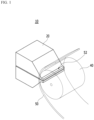
- FIG. 1 a schematic view of the process of manufacturing the electrode sheet is shown in FIG. 1 .
- the electrode sheet is manufactured via a process of allowing a metal sheet 50 moved by a rewinder 40 to contact a slot die coater 20 for discharging electrode slurry and then coating the electrode slurry on the metal sheet 50 to constitute a line 52.
- the electrode line 52 may be formed in one number or may be formed in two or plural number by repeating a plurality of coating processes.
- the metal sheet 50 on which the electrode line 52 is formed may be notched with a desired shape and size to manufacture one unit electrode.
- the rechargeable battery is manufactured with an irregular design of a geometric structure, departing from an already known rectangular or cylindrical structure.
- an 'L' shaped irregular rechargeable battery with lack of a portion in a long direction has attracted attention to be applied to a slim type, curved type, or various designs, and to embody this, an electrode has also been manufactured with the aforementioned irregular structure.
- a portion 54 of the electrode line 52 which is not included in the irregular shape, is discarded, and thus, main components of the electrode line 52, i.e., expensive materials such as an electrode active material of electrode slurry, a binder, and a solvent are wasted.
- the present invention has been made in an effort to overcome the aforementioned problem of the above conventional art and technical objects requested from the past.
- an embodiment of the present invention provides a method of manufacturing an irregular electrode, including forming an electrode line and notching the electrode line in an irregular shape, for manufacturing an electrode in a desired irregular shape and minimizing electrode slurry that is unnecessarily wasted during the manufacturing process.
- a method of manufacturing an irregular electrode includes: forming a first electrode line by continuously coating first electrode slurry on a metal sheet, forming at least one second electrode line formed with a dotted line shape including a plain portion and positioned in parallel to the first electrode line by intermittently coating second electrode slurry on the metal sheet that does not overlap the electrode line, and forming the irregular electrode by notching the metal sheet with an irregular shape including the second electrode line and the first electrode line except for the plain portion.
- the method of manufacturing an irregular electrode according to the present invention has a first feature of performing coating to configure an irregular shape in which an electrode line itself has the plain portion by combining the first electrode line with a straight line shape and a second electrode line with a dotted line shape including the plain portion.
- electrode slurry is saved by as much as the amount of electrode slurry to be coated on the plain portion of the second electrode line, and thus, it may be possible to reduce manufacturing costs of an electrode.
- the method of manufacturing an irregular electrode according to the present invention includes an operation of performing notching on a portion except for the plain portion in which electrode slurry is not present, and thus, has a second feature of minimizing electrode slurry to be discarded during notching, thereby preventing expensive organic and inorganic materials such as an electrode active material, a binder, a solvent, and a conductive material, which are included in the electrode slurry, from being wasted.
- the forming of the first electrode line and the forming of the second electrode line may be simultaneously performed, and the method may further include rolling and drying the first electrode line and the second electrode line prior to the forming of the irregular electrode.
- the electrode lines may be formed using a slot die coater including a plurality of slurry discharge nozzles, and in detail, the forming of the first electrode line and the forming of the second electrode line may be simultaneously performed using a slot die coater including a first slot nozzle for forming the first electrode line, and a second slot nozzle positioned at opposite ends of the first slot nozzle and configured to form the second electrode line.
- a pair of second electrode lines that extends from opposite boundaries of the first electrode line is formed while the second electrode slurry is coated along the opposite boundaries of the first electrode line.
- first electrode line and the second electrode lines may be integrated into each other on a plan to form one irregular line.
- the second electrode lines connected with one side boundary and the other side boundary of the first electrode line may be symmetrical to each other based on an imaginary line for uniformly dividing the first electrode line between the boundaries.
- the second electrode lines connected with one side boundary and the other side boundary of the first electrode line may be asymmetrical based on an imaginary line for uniformly dividing the first electrode line.
- the forming of the irregular electrode may be performed to form an irregular electrode at each of one side and the other side based on an imaginary line for uniformly dividing the first electrode line between boundaries of the first electrode line.
- the irregular shape includes a first electrode portion included in the first electrode line, and a second electrode portion that is included in the second electrode line, extends from the first electrode portion, and has a smaller size than the first electrode portion to form at least one step difference on a plane, and the forming of the irregular electrode includes notching the metal sheet corresponding to the first electrode portion and the second electrode portion.
- the step difference includes a step difference corner formed at a portion at which an external circumference side of the first electrode portion and an external circumference side of the second electrode portion cross each other at an angle equal to or greater than 30 degrees to an angle less than 180 degrees, and the metal sheet is further notched to form an external circumference indented portion formed by indenting a portion of each of the first electrode portion and the second electrode portion inwardly at the step difference corner.
- the step difference may include two or less of the step corner, and in detail, may include only one of the step corner to form the irregular electrode with an 'L' shape on a plane.
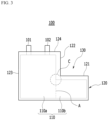
- FIG. 3 is a schematic diagram of a battery cell including an irregular electrode according to the conventional art.
- a battery cell 100 may be configured in such a way that external circumference sides 121, 122, 123, and 124 of a cell case 120 are sealed via thermal bonding in a state in which an electrode assembly 110 is installed in the cell case 120 along with an electrolyte solution.
- the electrode assembly 110 may be configured in such a way that two electrode portions 110a and 110b with different planar shapes and sizes with respect to the ground are separated based on a boundary A, and accordingly, a step difference 130 formed due to the different sizes of the electrode portions 110a and 110b may be formed on the electrode assembly 110.
- the cell case 120 may be configured in a shape corresponding to the electrode assembly 110, and the external circumference sides 121, 122, 123, and 124 may be sealed along end portions of the electrode assembly 110, and thus, the battery cell 100 may be configured with an irregular structure including the step difference 130 to correspond to a shape of the electrode assembly 110, but not a conventional rectangular structure.
- the cell case 120 may be configured in such a way that the different external circumference sides 121 and 122 cross each other to correspond to a shape of an external circumference corner C at the external circumference corner C at a portion at which external circumference sides of the electrode portions 110a and 110b cross each other, and thus, a relatively wide sealing area may be formed at an intersection portion of the external circumference sides 121 and 122.
- a point that shares a sealing portion while the external circumference sides 121 and 122 cross each other has relatively low sealing force compared with other portions, and thus, the external circumference sides 121 and 122 of the cell case 120, adjacent to the external circumference corner C, also requires a relatively wide thermal bonding sealing area compared with the other external circumference sides 123 and 124.
- the structure of the battery cell 100 may be disadvantageous in that spatial utility of a device is degraded by as much as a sealing area which is unnecessarily occupied by the external circumference sides 121 and 122 at the external circumference corner C.
- each of the external circumference sides 121, 122, and 123 that is sealed via thermal bonding in the cell case 120 needs to be bent in a direction of a side surface of the electrode assembly 110 to prevent moisture from penetrating and to reduce an area of a battery cell, but in the structure of FIG. 2 , the external circumference sides 121 and 122 of the cell case 120, adjacent to the external circumference corner C, are connected with each other to correspond to the external circumference corner C, and thus, it may not be easy to bend the external circumference sides 121, 122, and 123 in the direction of the side surface of the electrode assembly 110.
- an irregular electrode may be manufactured to form an external circumference indented portion at an intersection point of the first electrode portion and the second electrode portion cross each other, and thus, a battery cell including the irregular electrode may improve sealing reliability while a cell case is further sealed via thermal bonding at the external circumference indented portion.
- the external circumference indented portion may include, on a plane, a rounded structure including a curved line, a composite structure formed by connecting a curved line and a straight line, or a polygon structure formed by connecting a plurality of straight lines.
- the method of manufacturing the irregular electrode may further include performing notching of forming an electrode tap that protrudes outward from at least one of the first electrode portion and the second electrode portion.
- the method of manufacturing the irregular electrode may further include performing notching of chamfering edges of at least one of the first electrode portion and the second electrode portion.
- the irregular electrode may be a positive electrode or a negative electrode.
- the positive electrode may be manufactured by coating and then drying a mixture of a positive active material, a conductive material, and a binder on, for example, a positive electrode current collector and/or an extension current collector, and as necessary, the mixture may further include a filler.
- the positive electrode current collector and/or the extension current collector may be formed to a thickness of 3 to 500 micrometers.
- the positive electrode current collector and the extension current collector are not particularly limited as long as a corresponding battery has high conductivity while a chemical change is not caused in the battery, and for example, may be formed of stainless steel, aluminum, nickel, titanium, bake carbon, or aluminum, or a material formed by surface-processing a surface of stainless steel with carbon, nickel, titanium, silver, or the like.
- the positive electrode current collector and the extension current collector may have fine protrusions and depressions formed on a surface thereof to enhance adherence of a positive active material, and may be formed in various forms such as a film, a sheet, a foil, a net, a porous body, a foaming body, and a non-woven fabric structure.
- the conductive material may be included with 1 to 30 wt% based on a total weight of a mixture including a positive active material.
- the conductive material is not particularly limited as long as a corresponding battery has high conductivity while a chemical change is not caused in the battery, and for example, may use a conductive material including graphite such as natural graphite or artificial graphite; carbonblack such as carbonblack, acetylene black, ketjen black, channel black, furnace black, lamp black, or thermal black; conductive finer such as carbon fiber or metal fiber; metal powder such as fluoro carbon, aluminum, or nickel powder; conductive whisky such as zinc oxide and potassium titanate; conductive metal oxide such as oxidation titanium; and polyphenylene derivative.
- graphite such as natural graphite or artificial graphite
- carbonblack such as carbonblack, acetylene black, ketjen black, channel black, furnace black, lamp black, or thermal black
- conductive finer such as carbon fiber or metal fiber
- metal powder such as
- the binder may be a component that facilitates coupling of an active material, a conductive material, and so on, and coupling of a current collector, and in general, may be added with 1 to 30 wt% based on a total weight of a mixture including a positive active material.
- binder may include poly vinylidene fluoride, polyvinylalcohol, carboxymethyl cellulose (CMC), starch, hydroxypropyl cellulose, regenerated cellulose, polyvinylpyrrolidone, tetrafluoroethylene, polyethylene, polypropylene, ethylenepropylene-diene terpolymer (EPDM), sulfonate EPDM, styrene butylene rubber, fluorine rubber, and various copolymers.
- CMC carboxymethyl cellulose
- EPDM ethylenepropylene-diene terpolymer
- EPDM ethylenepropylene-diene terpolymer
- EPDM ethylenepropylene-diene terpolymer
- sulfonate EPDM styrene butylene rubber
- fluorine rubber fluorine rubber
- the filler may be selectively used as a component for suppressing expansion of a positive electrode, and is not particularly limited as long as the filler is formed of any material in a fiber phase while a chemical change is not caused in the filler, and may use a material in a fiber phase, for example, an olefin-based polymer such as polyethylene or polypropylene; glass fiber, or carbonfiber.
- a material in a fiber phase for example, an olefin-based polymer such as polyethylene or polypropylene; glass fiber, or carbonfiber.
- the negative electrode may be manufactured by coating and drying a negative active material on a negative electrode current collector and/or an extension current collector, and as necessary, may selectively and further include the aforementioned components.
- the negative electrode current collector and/or the extension current collector may be formed to a thickness of 3 to 500 micrometers.
- the negative electrode current collector and the extension current collector are not particularly limited as long as a corresponding battery has high conductivity while a chemical change is not caused in the battery, and for example, may be formed of copper, stainless steel, aluminum, nickel, titanium, or bake carbon, or a material formed by surface-processing a surface of copper or stainless steel with carbon, nickel, titanium, silver, or the like, or may use an aluminum-cadmium alloy or the like.
- the negative electrode current collector and the extension current collector may have fine protrusions and depressions formed on a surface thereof to enhance adherence of a negative active material, and may be formed in various forms such as a film, a sheet, a foil, a net, a porous body, a foaming body, and a non-woven fabric structure.
- the negative electrode active material may be, for example, carbon such as hard graphitized carbon or graphite-based carbon; Li x Fe 2 O 3 (0 ⁇ x ⁇ 1), Li x WO 2 (0 ⁇ x ⁇ 1), metal composite oxide such as Sn x Me 1-x Me' y O z (Me: Mn, Fe, Pb, Ge; Me': Al, B, P, Si, group 1, 2, or 3 elements in the periodic table, halogen; 0 ⁇ x ⁇ 1; 1 ⁇ y ⁇ 3; 1 ⁇ z ⁇ 8); lithium metal; lithium alloy; silicon-based alloy; tin-based alloy; metal oxide such as SnO, SnO 2 , PbO, PbO 2 , Pb 2 O 3 , Pb 3 O 4 , Sb 2 O 3 , Sb 2 O 4 , Sb 2 O 5 , GeO, GeO 2 , Bi 2 O 3 , Bi 2 O 4 , and Bi 2 O 5 ; and a conductive polymer such as polyacetylene, and a Li-
- the method of manufacturing the irregular electrode according to exemplary embodiments of the present invention may perform coating to configure an irregular shape in which an electrode line itself has the plain portion by combining the first electrode line with a straight line shape and a second electrode line with a dotted line shape including the plain portion, and accordingly, electrode slurry may be advantageously saved by as much as the amount of electrode slurry to be coated on the plain portion of the second electrode line.
- the method may include an operation of performing notching on a portion except for the plain portion in which electrode slurry is not present, and thus, may minimize electrode slurry to be discarded during notching, thereby preventing expensive organic and inorganic materials such as an electrode active material, a binder, a solvent, and a conductive material, which are included in the electrode slurry, from being wasted.
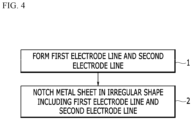
- FIG. 4 is a flowchart of a method of manufacturing an irregular electrode according to an embodiment of the present invention.
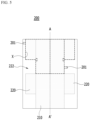
- FIG. 5 is a schematic diagram of a metal sheet.
- first electrode slurry is continuously coated on a metal sheet 200 to form a first electrode line 210
- second electrode slurry is intermittently coated on a portion of the metal sheet 200, which does not overlap the first electrode line 210, to form second electrode lines 220 formed in a dotted line including a plain portion 222 and positioned in parallel to the first electrode line 210.
- the electrode lines 210 and 220 may be formed in operation 1 using a slot die coater including a plurality of slurry discharge nozzles, and in detail, an operation of forming the first electrode line 210 and an operation of forming the second electrode line may be simultaneously performed by a slot die coater including a first slot nozzle for forming the first electrode line 210, and a second slot nozzle positioned at opposite ends of the first slot nozzle and configured to form a second electrode line.
- the second electrode lines 220 connected with one side boundary and the other side boundary of the first electrode line 210 may be symmetrical to each other based on the imaginary line A-A' for uniformly dividing the first electrode line 210 between the boundaries.
- the second electrode lines 220 connected with one side boundary and the other side boundary of the first electrode line 210 may be asymmetrical based on the imaginary line A-A' for uniformly dividing the first electrode line 210.
- Formation of the first electrode line 210 and formation of the second electrode lines 220 may be simultaneously performed, and as necessary, the manufacturing method may include an operation of rolling and drying the first electrode line 210 and the second electrode lines 220 after operation 1.
- the metal sheet 200 may be notched along a perforated line X with an irregular shape including the second electrode line 220 and the first electrode line 210 except for the plain portion 222, to form an irregular electrode.
- operation 2 may be performed to form an irregular electrode at each of one side and the other side based on the imaginary line A-A' for uniformly dividing the first electrode line 210 between the boundaries of the first electrode line 210.
- two irregular electrodes may be manufactured per notching.
- notching for forming the electrode tap 201 that protrudes outward from a second electrode portion 221 may be further performed.
- notching for forming the electrode tap 201 that protrudes outward from a first electrode portion 211 may be performed according to a shape of a desired irregular electrode.
- the aforementioned method of manufacturing an irregular electrode according to the present invention may have a first feature of performing coating to configure an irregular shape in which an electrode line itself has the plain portion 222 by combining the first electrode line 210 with a straight line shape and a second electrode line with a dotted line shape including the plain portion 222.
- the method of manufacturing an irregular electrode according to the present invention may include an operation of performing notching on a portion except for the plain portion 222 in which electrode slurry is not present, and thus, may have a second feature of minimizing electrode slurry to be discarded during notching, thereby preventing expensive organic and inorganic materials such as an electrode active material, a binder, a solvent, and a conductive material, which are included in the electrode slurry, from being wasted.
- FIG. 6 is a schematic diagram of an irregular electrode. With reference to FIG. 6 , the electrode with an irregular shape notched in operation 2 will be described in detail.
- the irregular shape of operation 2 may include the first electrode portion 211 included in the first electrode line 210, and the second electrode portion 221 that is included in the second electrode line 220, extends from the first electrode portion 211, and has a smaller size than the first electrode portion 211 to form a step difference 230 on a plane, and notching may be performed to process the metal sheet 200 corresponding to the first electrode portion 211 and the second electrode portion 221.
- the step difference 230 may include a step difference corner 231 formed at a portion at which an external circumference side 214 of the first electrode portion 211 and an external circumference side 224 of the second electrode portion 221 cross each other at about 90 degrees, and in notching of operation 2, notching for forming an external circumference indented portion 240 formed by indenting a portion of each of the first electrode portion 211 and the second electrode portion 221 inward at the step difference corner 231 may be further performed.
- the electrode manufacturing through this process may be form in an 'L' shape on a plane.
Landscapes
- Chemical & Material Sciences (AREA)
- Engineering & Computer Science (AREA)
- Chemical Kinetics & Catalysis (AREA)
- Electrochemistry (AREA)
- General Chemical & Material Sciences (AREA)
- Manufacturing & Machinery (AREA)
- Materials Engineering (AREA)
- Life Sciences & Earth Sciences (AREA)
- Forests & Forestry (AREA)
- Mechanical Engineering (AREA)
- Battery Electrode And Active Subsutance (AREA)
Applications Claiming Priority (2)
| Application Number | Priority Date | Filing Date | Title |
|---|---|---|---|
| KR1020170154709A KR102261800B1 (ko) | 2017-11-20 | 2017-11-20 | 비정형 전극의 제조 방법 |
| PCT/KR2018/013645 WO2019098614A1 (ko) | 2017-11-20 | 2018-11-09 | 비정형 전극의 제조 방법 |
Publications (3)
| Publication Number | Publication Date |
|---|---|
| EP3605663A1 EP3605663A1 (en) | 2020-02-05 |
| EP3605663A4 EP3605663A4 (en) | 2020-07-08 |
| EP3605663B1 true EP3605663B1 (en) | 2023-11-01 |
Family
ID=66538707
Family Applications (1)
| Application Number | Title | Priority Date | Filing Date |
|---|---|---|---|
| EP18879639.5A Active EP3605663B1 (en) | 2017-11-20 | 2018-11-09 | Method of manufacturing irregular electrode |
Country Status (6)
| Country | Link |
|---|---|
| US (1) | US11283057B2 (pl) |
| EP (1) | EP3605663B1 (pl) |
| KR (1) | KR102261800B1 (pl) |
| CN (1) | CN110546785B (pl) |
| PL (1) | PL3605663T3 (pl) |
| WO (1) | WO2019098614A1 (pl) |
Families Citing this family (1)
| Publication number | Priority date | Publication date | Assignee | Title |
|---|---|---|---|---|
| KR102706400B1 (ko) | 2019-07-30 | 2024-09-13 | 주식회사 엘지에너지솔루션 | 이차전지용 전극 및 전극 제조 방법 |
Family Cites Families (25)
| Publication number | Priority date | Publication date | Assignee | Title |
|---|---|---|---|---|
| JP2001006664A (ja) | 1999-06-22 | 2001-01-12 | Matsushita Electric Ind Co Ltd | 塗布装置 |
| JP2002028554A (ja) * | 2000-07-14 | 2002-01-29 | Konica Corp | 塗布方法及び塗布装置jp5 |
| JP4075034B2 (ja) * | 2001-08-06 | 2008-04-16 | ソニー株式会社 | 非水電解質電池およびその製造方法 |
| JP4669641B2 (ja) * | 2001-08-24 | 2011-04-13 | Necエナジーデバイス株式会社 | 電池電極切断装置 |
| JP4578311B2 (ja) * | 2004-07-28 | 2010-11-10 | 三星エスディアイ株式会社 | 二次電池用電極板の製造方法及びこれを用いて製造される二次電池用電極板 |
| EP1901371A4 (en) | 2005-05-09 | 2011-03-02 | Panasonic Corp | METHOD AND DEVICE FOR APPLYING ELECTRODE PASTE |
| JP4001187B2 (ja) * | 2005-07-08 | 2007-10-31 | 株式会社村田製作所 | 電子部品の外部電極形成方法および装置 |
| JP5419885B2 (ja) | 2008-10-08 | 2014-02-19 | パナソニック株式会社 | 負極およびその製造方法ならびに非水電解質二次電池 |
| CN101612691A (zh) * | 2009-03-31 | 2009-12-30 | 深圳市吉阳自动化科技有限公司 | 极片切割方法 |
| EP2549561B1 (en) * | 2010-03-19 | 2015-05-13 | LG Chem, Ltd. | Pouch type case and battery pack including same |
| EP2800178B1 (en) | 2012-04-16 | 2017-11-01 | LG Chem, Ltd. | Method for manufacturing electrode for lithium secondary battery and electrode manufactured by using same |
| JP2014022149A (ja) | 2012-07-17 | 2014-02-03 | Dainippon Screen Mfg Co Ltd | 電池用電極製造装置、電池用電極製造のためのノズルおよび電池用電極の製造方法 |
| US20150291859A1 (en) | 2012-11-05 | 2015-10-15 | Nitto Denko Corporation | Pressure-sensitive adhesive tape for electrochemical device |
| JP2014179217A (ja) * | 2013-03-14 | 2014-09-25 | Mitsubishi Heavy Ind Ltd | 二次電池の製造方法及び二次電池 |
| CN104377345B (zh) * | 2013-08-15 | 2017-06-16 | 纳米新能源(唐山)有限责任公司 | 微型储能器件电极、微型储能器件及其形成方法 |
| WO2016006420A1 (ja) * | 2014-07-10 | 2016-01-14 | 株式会社村田製作所 | 蓄電デバイスの製造方法及び電極の製造方法 |
| KR20160048527A (ko) * | 2014-10-24 | 2016-05-04 | 주식회사 엘지화학 | 비정형 전지의 커팅 방법 및 이에 의하여 제조된 전지 |
| US10608289B2 (en) | 2014-12-16 | 2020-03-31 | Lg Chem, Ltd. | Method of manufacturing secondary battery electrode containing PTC material and electrode manufactured thereby |
| KR101579578B1 (ko) | 2015-03-24 | 2015-12-22 | 주식회사 엘지화학 | 전극의 제조방법, 이로부터 형성된 전극 및 이를 구비한 전기화학 소자 |
| CN107615523B (zh) * | 2015-05-20 | 2020-11-20 | 远景Aesc能源元器件有限公司 | 二次电池电极、二次电池制造方法及制造装置 |
| KR101950464B1 (ko) * | 2015-11-30 | 2019-02-20 | 주식회사 엘지화학 | 셀 케이스의 밀봉 신뢰성이 향상된 비정형 구조의 전지셀 |
| KR101641095B1 (ko) | 2016-02-22 | 2016-07-20 | 씨아이에스(주) | 이차전지용 활물질 코팅장치 |
| KR101875892B1 (ko) * | 2016-03-10 | 2018-07-06 | 씨아이에스(주) | 이차전지용 슬러리 코팅방법 및 이를 이용하여 제조된 이차전지 전극판 |
| WO2018180019A1 (ja) * | 2017-03-29 | 2018-10-04 | 株式会社村田製作所 | 二次電池の製造方法および製造装置 |
| WO2018221318A1 (ja) * | 2017-06-01 | 2018-12-06 | 株式会社村田製作所 | 二次電池の製造方法 |
-
2017
- 2017-11-20 KR KR1020170154709A patent/KR102261800B1/ko active Active
-
2018
- 2018-11-09 PL PL18879639.5T patent/PL3605663T3/pl unknown
- 2018-11-09 CN CN201880023733.3A patent/CN110546785B/zh active Active
- 2018-11-09 EP EP18879639.5A patent/EP3605663B1/en active Active
- 2018-11-09 US US16/604,334 patent/US11283057B2/en active Active
- 2018-11-09 WO PCT/KR2018/013645 patent/WO2019098614A1/ko not_active Ceased
Also Published As
| Publication number | Publication date |
|---|---|
| EP3605663A1 (en) | 2020-02-05 |
| US20200152958A1 (en) | 2020-05-14 |
| CN110546785A (zh) | 2019-12-06 |
| PL3605663T3 (pl) | 2024-02-26 |
| CN110546785B (zh) | 2022-07-22 |
| KR102261800B1 (ko) | 2021-06-04 |
| US11283057B2 (en) | 2022-03-22 |
| EP3605663A4 (en) | 2020-07-08 |
| KR20190057587A (ko) | 2019-05-29 |
| WO2019098614A1 (ko) | 2019-05-23 |
Similar Documents
| Publication | Publication Date | Title |
|---|---|---|
| EP3584857B1 (en) | Method for manufacturing electrode for rechargeable battery | |
| EP3024084B1 (en) | Method for manufacturing rectangular battery cell using metal plates | |
| CN112335071B (zh) | 电池用电极、电池以及电池用电极的制造方法 | |
| TWI496334B (zh) | 鋰離子二次電池及其製造方法 | |
| CN111527627B (zh) | 制造负极的方法以及由此获得的负极 | |
| WO2017047353A1 (ja) | 非水電解質二次電池 | |
| KR20250041608A (ko) | 전극 제조 방법 및 이차 전지용 전극 | |
| US20230041411A1 (en) | Electrode and Electrode Assembly | |
| EP4027425A1 (en) | Electrode assembly and method for manufacturing same | |
| CN113711380B (zh) | 电极以及用于制造该电极的方法 | |
| EP3605663B1 (en) | Method of manufacturing irregular electrode | |
| JP2017016812A (ja) | 非水電解質二次電池 | |
| KR102881954B1 (ko) | 이온 전도성이 있는 엣지부재를 적용한 무음극 전고체 전지 및 이의 제조방법 | |
| KR20190107503A (ko) | 복수 기재를 갖는 리튬 이온 이차전지 | |
| JP2005339926A (ja) | 帯状電極及びそれを用いた電池 | |
| KR102014458B1 (ko) | 두께 방향성을 갖는 전극조립체 및 이를 포함하는 리튬이차전지 | |
| KR20190110348A (ko) | 음극의 제조방법 및 이로부터 제조된 음극 | |
| EP4585317A1 (en) | Shim plate and die coater comprising same | |
| JP2013206653A (ja) | リチウムイオン二次電池用電極、これを用いた単電池及びリチウムイオン二次電池 | |
| US20250266492A1 (en) | Battery | |
| KR20250148879A (ko) | 다이 코터 | |
| JP2025537930A (ja) | リチウム二次電池用正極及びこれを含むリチウム二次電池 | |
| KR20190107467A (ko) | 정합성이 개선된 이차전지 | |
| JPWO2004102703A1 (ja) | 非水電解質二次電池 | |
| JP2017073329A (ja) | 非水電解質二次電池 |
Legal Events
| Date | Code | Title | Description |
|---|---|---|---|
| STAA | Information on the status of an ep patent application or granted ep patent |
Free format text: STATUS: THE INTERNATIONAL PUBLICATION HAS BEEN MADE |
|
| PUAI | Public reference made under article 153(3) epc to a published international application that has entered the european phase |
Free format text: ORIGINAL CODE: 0009012 |
|
| STAA | Information on the status of an ep patent application or granted ep patent |
Free format text: STATUS: REQUEST FOR EXAMINATION WAS MADE |
|
| 17P | Request for examination filed |
Effective date: 20191029 |
|
| AK | Designated contracting states |
Kind code of ref document: A1 Designated state(s): AL AT BE BG CH CY CZ DE DK EE ES FI FR GB GR HR HU IE IS IT LI LT LU LV MC MK MT NL NO PL PT RO RS SE SI SK SM TR |
|
| AX | Request for extension of the european patent |
Extension state: BA ME |
|
| A4 | Supplementary search report drawn up and despatched |
Effective date: 20200605 |
|
| RIC1 | Information provided on ipc code assigned before grant |
Ipc: B26F 1/12 20060101ALI20200529BHEP Ipc: H01M 4/04 20060101AFI20200529BHEP Ipc: H01M 4/139 20100101ALI20200529BHEP |
|
| DAV | Request for validation of the european patent (deleted) | ||
| DAX | Request for extension of the european patent (deleted) | ||
| STAA | Information on the status of an ep patent application or granted ep patent |
Free format text: STATUS: EXAMINATION IS IN PROGRESS |
|
| 17Q | First examination report despatched |
Effective date: 20220823 |
|
| GRAP | Despatch of communication of intention to grant a patent |
Free format text: ORIGINAL CODE: EPIDOSNIGR1 |
|
| STAA | Information on the status of an ep patent application or granted ep patent |
Free format text: STATUS: GRANT OF PATENT IS INTENDED |
|
| INTG | Intention to grant announced |
Effective date: 20230622 |
|
| GRAS | Grant fee paid |
Free format text: ORIGINAL CODE: EPIDOSNIGR3 |
|
| GRAA | (expected) grant |
Free format text: ORIGINAL CODE: 0009210 |
|
| STAA | Information on the status of an ep patent application or granted ep patent |
Free format text: STATUS: THE PATENT HAS BEEN GRANTED |
|
| P01 | Opt-out of the competence of the unified patent court (upc) registered |
Effective date: 20230901 |
|
| AK | Designated contracting states |
Kind code of ref document: B1 Designated state(s): AL AT BE BG CH CY CZ DE DK EE ES FI FR GB GR HR HU IE IS IT LI LT LU LV MC MK MT NL NO PL PT RO RS SE SI SK SM TR |
|
| REG | Reference to a national code |
Ref country code: GB Ref legal event code: FG4D |
|
| REG | Reference to a national code |
Ref country code: CH Ref legal event code: EP |
|
| REG | Reference to a national code |
Ref country code: DE Ref legal event code: R096 Ref document number: 602018060606 Country of ref document: DE |
|
| REG | Reference to a national code |
Ref country code: IE Ref legal event code: FG4D |
|
| REG | Reference to a national code |
Ref country code: LT Ref legal event code: MG9D |
|
| REG | Reference to a national code |
Ref country code: NL Ref legal event code: MP Effective date: 20231101 |
|
| PG25 | Lapsed in a contracting state [announced via postgrant information from national office to epo] |
Ref country code: GR Free format text: LAPSE BECAUSE OF FAILURE TO SUBMIT A TRANSLATION OF THE DESCRIPTION OR TO PAY THE FEE WITHIN THE PRESCRIBED TIME-LIMIT Effective date: 20240202 |
|
| PG25 | Lapsed in a contracting state [announced via postgrant information from national office to epo] |
Ref country code: IS Free format text: LAPSE BECAUSE OF FAILURE TO SUBMIT A TRANSLATION OF THE DESCRIPTION OR TO PAY THE FEE WITHIN THE PRESCRIBED TIME-LIMIT Effective date: 20240301 |
|
| PG25 | Lapsed in a contracting state [announced via postgrant information from national office to epo] |
Ref country code: LT Free format text: LAPSE BECAUSE OF FAILURE TO SUBMIT A TRANSLATION OF THE DESCRIPTION OR TO PAY THE FEE WITHIN THE PRESCRIBED TIME-LIMIT Effective date: 20231101 |
|
| REG | Reference to a national code |
Ref country code: AT Ref legal event code: MK05 Ref document number: 1628244 Country of ref document: AT Kind code of ref document: T Effective date: 20231101 |
|
| PG25 | Lapsed in a contracting state [announced via postgrant information from national office to epo] |
Ref country code: NL Free format text: LAPSE BECAUSE OF FAILURE TO SUBMIT A TRANSLATION OF THE DESCRIPTION OR TO PAY THE FEE WITHIN THE PRESCRIBED TIME-LIMIT Effective date: 20231101 |
|
| PG25 | Lapsed in a contracting state [announced via postgrant information from national office to epo] |
Ref country code: AT Free format text: LAPSE BECAUSE OF FAILURE TO SUBMIT A TRANSLATION OF THE DESCRIPTION OR TO PAY THE FEE WITHIN THE PRESCRIBED TIME-LIMIT Effective date: 20231101 |
|
| PG25 | Lapsed in a contracting state [announced via postgrant information from national office to epo] |
Ref country code: ES Free format text: LAPSE BECAUSE OF FAILURE TO SUBMIT A TRANSLATION OF THE DESCRIPTION OR TO PAY THE FEE WITHIN THE PRESCRIBED TIME-LIMIT Effective date: 20231101 |
|
| PG25 | Lapsed in a contracting state [announced via postgrant information from national office to epo] |
Ref country code: NL Free format text: LAPSE BECAUSE OF FAILURE TO SUBMIT A TRANSLATION OF THE DESCRIPTION OR TO PAY THE FEE WITHIN THE PRESCRIBED TIME-LIMIT Effective date: 20231101 Ref country code: LT Free format text: LAPSE BECAUSE OF FAILURE TO SUBMIT A TRANSLATION OF THE DESCRIPTION OR TO PAY THE FEE WITHIN THE PRESCRIBED TIME-LIMIT Effective date: 20231101 Ref country code: IS Free format text: LAPSE BECAUSE OF FAILURE TO SUBMIT A TRANSLATION OF THE DESCRIPTION OR TO PAY THE FEE WITHIN THE PRESCRIBED TIME-LIMIT Effective date: 20240301 Ref country code: GR Free format text: LAPSE BECAUSE OF FAILURE TO SUBMIT A TRANSLATION OF THE DESCRIPTION OR TO PAY THE FEE WITHIN THE PRESCRIBED TIME-LIMIT Effective date: 20240202 Ref country code: ES Free format text: LAPSE BECAUSE OF FAILURE TO SUBMIT A TRANSLATION OF THE DESCRIPTION OR TO PAY THE FEE WITHIN THE PRESCRIBED TIME-LIMIT Effective date: 20231101 Ref country code: BG Free format text: LAPSE BECAUSE OF FAILURE TO SUBMIT A TRANSLATION OF THE DESCRIPTION OR TO PAY THE FEE WITHIN THE PRESCRIBED TIME-LIMIT Effective date: 20240201 Ref country code: AT Free format text: LAPSE BECAUSE OF FAILURE TO SUBMIT A TRANSLATION OF THE DESCRIPTION OR TO PAY THE FEE WITHIN THE PRESCRIBED TIME-LIMIT Effective date: 20231101 Ref country code: PT Free format text: LAPSE BECAUSE OF FAILURE TO SUBMIT A TRANSLATION OF THE DESCRIPTION OR TO PAY THE FEE WITHIN THE PRESCRIBED TIME-LIMIT Effective date: 20240301 |
|
| PG25 | Lapsed in a contracting state [announced via postgrant information from national office to epo] |
Ref country code: SE Free format text: LAPSE BECAUSE OF FAILURE TO SUBMIT A TRANSLATION OF THE DESCRIPTION OR TO PAY THE FEE WITHIN THE PRESCRIBED TIME-LIMIT Effective date: 20231101 Ref country code: RS Free format text: LAPSE BECAUSE OF FAILURE TO SUBMIT A TRANSLATION OF THE DESCRIPTION OR TO PAY THE FEE WITHIN THE PRESCRIBED TIME-LIMIT Effective date: 20231101 Ref country code: NO Free format text: LAPSE BECAUSE OF FAILURE TO SUBMIT A TRANSLATION OF THE DESCRIPTION OR TO PAY THE FEE WITHIN THE PRESCRIBED TIME-LIMIT Effective date: 20240201 Ref country code: LV Free format text: LAPSE BECAUSE OF FAILURE TO SUBMIT A TRANSLATION OF THE DESCRIPTION OR TO PAY THE FEE WITHIN THE PRESCRIBED TIME-LIMIT Effective date: 20231101 Ref country code: HR Free format text: LAPSE BECAUSE OF FAILURE TO SUBMIT A TRANSLATION OF THE DESCRIPTION OR TO PAY THE FEE WITHIN THE PRESCRIBED TIME-LIMIT Effective date: 20231101 |
|
| REG | Reference to a national code |
Ref country code: CH Ref legal event code: PL |
|
| PG25 | Lapsed in a contracting state [announced via postgrant information from national office to epo] |
Ref country code: DK Free format text: LAPSE BECAUSE OF FAILURE TO SUBMIT A TRANSLATION OF THE DESCRIPTION OR TO PAY THE FEE WITHIN THE PRESCRIBED TIME-LIMIT Effective date: 20231101 |
|
| PG25 | Lapsed in a contracting state [announced via postgrant information from national office to epo] |
Ref country code: LU Free format text: LAPSE BECAUSE OF NON-PAYMENT OF DUE FEES Effective date: 20231109 |
|
| PG25 | Lapsed in a contracting state [announced via postgrant information from national office to epo] |
Ref country code: CH Free format text: LAPSE BECAUSE OF NON-PAYMENT OF DUE FEES Effective date: 20231130 |
|
| PG25 | Lapsed in a contracting state [announced via postgrant information from national office to epo] |
Ref country code: CZ Free format text: LAPSE BECAUSE OF FAILURE TO SUBMIT A TRANSLATION OF THE DESCRIPTION OR TO PAY THE FEE WITHIN THE PRESCRIBED TIME-LIMIT Effective date: 20231101 |
|
| PG25 | Lapsed in a contracting state [announced via postgrant information from national office to epo] |
Ref country code: SK Free format text: LAPSE BECAUSE OF FAILURE TO SUBMIT A TRANSLATION OF THE DESCRIPTION OR TO PAY THE FEE WITHIN THE PRESCRIBED TIME-LIMIT Effective date: 20231101 |
|
| PG25 | Lapsed in a contracting state [announced via postgrant information from national office to epo] |
Ref country code: SM Free format text: LAPSE BECAUSE OF FAILURE TO SUBMIT A TRANSLATION OF THE DESCRIPTION OR TO PAY THE FEE WITHIN THE PRESCRIBED TIME-LIMIT Effective date: 20231101 Ref country code: SK Free format text: LAPSE BECAUSE OF FAILURE TO SUBMIT A TRANSLATION OF THE DESCRIPTION OR TO PAY THE FEE WITHIN THE PRESCRIBED TIME-LIMIT Effective date: 20231101 Ref country code: LU Free format text: LAPSE BECAUSE OF NON-PAYMENT OF DUE FEES Effective date: 20231109 Ref country code: IT Free format text: LAPSE BECAUSE OF FAILURE TO SUBMIT A TRANSLATION OF THE DESCRIPTION OR TO PAY THE FEE WITHIN THE PRESCRIBED TIME-LIMIT Effective date: 20231101 Ref country code: EE Free format text: LAPSE BECAUSE OF FAILURE TO SUBMIT A TRANSLATION OF THE DESCRIPTION OR TO PAY THE FEE WITHIN THE PRESCRIBED TIME-LIMIT Effective date: 20231101 Ref country code: DK Free format text: LAPSE BECAUSE OF FAILURE TO SUBMIT A TRANSLATION OF THE DESCRIPTION OR TO PAY THE FEE WITHIN THE PRESCRIBED TIME-LIMIT Effective date: 20231101 Ref country code: CZ Free format text: LAPSE BECAUSE OF FAILURE TO SUBMIT A TRANSLATION OF THE DESCRIPTION OR TO PAY THE FEE WITHIN THE PRESCRIBED TIME-LIMIT Effective date: 20231101 Ref country code: CH Free format text: LAPSE BECAUSE OF NON-PAYMENT OF DUE FEES Effective date: 20231130 |
|
| REG | Reference to a national code |
Ref country code: BE Ref legal event code: MM Effective date: 20231130 |
|
| REG | Reference to a national code |
Ref country code: DE Ref legal event code: R097 Ref document number: 602018060606 Country of ref document: DE |
|
| PG25 | Lapsed in a contracting state [announced via postgrant information from national office to epo] |
Ref country code: MC Free format text: LAPSE BECAUSE OF FAILURE TO SUBMIT A TRANSLATION OF THE DESCRIPTION OR TO PAY THE FEE WITHIN THE PRESCRIBED TIME-LIMIT Effective date: 20231101 |
|
| PG25 | Lapsed in a contracting state [announced via postgrant information from national office to epo] |
Ref country code: MC Free format text: LAPSE BECAUSE OF FAILURE TO SUBMIT A TRANSLATION OF THE DESCRIPTION OR TO PAY THE FEE WITHIN THE PRESCRIBED TIME-LIMIT Effective date: 20231101 |
|
| PLBE | No opposition filed within time limit |
Free format text: ORIGINAL CODE: 0009261 |
|
| STAA | Information on the status of an ep patent application or granted ep patent |
Free format text: STATUS: NO OPPOSITION FILED WITHIN TIME LIMIT |
|
| REG | Reference to a national code |
Ref country code: IE Ref legal event code: MM4A |
|
| 26N | No opposition filed |
Effective date: 20240802 |
|
| PG25 | Lapsed in a contracting state [announced via postgrant information from national office to epo] |
Ref country code: IE Free format text: LAPSE BECAUSE OF NON-PAYMENT OF DUE FEES Effective date: 20231109 |
|
| PG25 | Lapsed in a contracting state [announced via postgrant information from national office to epo] |
Ref country code: BE Free format text: LAPSE BECAUSE OF NON-PAYMENT OF DUE FEES Effective date: 20231130 |
|
| GBPC | Gb: european patent ceased through non-payment of renewal fee |
Effective date: 20240201 |
|
| PG25 | Lapsed in a contracting state [announced via postgrant information from national office to epo] |
Ref country code: SI Free format text: LAPSE BECAUSE OF FAILURE TO SUBMIT A TRANSLATION OF THE DESCRIPTION OR TO PAY THE FEE WITHIN THE PRESCRIBED TIME-LIMIT Effective date: 20231101 |
|
| PG25 | Lapsed in a contracting state [announced via postgrant information from national office to epo] |
Ref country code: SI Free format text: LAPSE BECAUSE OF FAILURE TO SUBMIT A TRANSLATION OF THE DESCRIPTION OR TO PAY THE FEE WITHIN THE PRESCRIBED TIME-LIMIT Effective date: 20231101 Ref country code: IE Free format text: LAPSE BECAUSE OF NON-PAYMENT OF DUE FEES Effective date: 20231109 Ref country code: BE Free format text: LAPSE BECAUSE OF NON-PAYMENT OF DUE FEES Effective date: 20231130 |
|
| PG25 | Lapsed in a contracting state [announced via postgrant information from national office to epo] |
Ref country code: GB Free format text: LAPSE BECAUSE OF NON-PAYMENT OF DUE FEES Effective date: 20240201 |
|
| PG25 | Lapsed in a contracting state [announced via postgrant information from national office to epo] |
Ref country code: GB Free format text: LAPSE BECAUSE OF NON-PAYMENT OF DUE FEES Effective date: 20240201 |
|
| PG25 | Lapsed in a contracting state [announced via postgrant information from national office to epo] |
Ref country code: RO Free format text: LAPSE BECAUSE OF FAILURE TO SUBMIT A TRANSLATION OF THE DESCRIPTION OR TO PAY THE FEE WITHIN THE PRESCRIBED TIME-LIMIT Effective date: 20231101 |
|
| PG25 | Lapsed in a contracting state [announced via postgrant information from national office to epo] |
Ref country code: FI Free format text: LAPSE BECAUSE OF FAILURE TO SUBMIT A TRANSLATION OF THE DESCRIPTION OR TO PAY THE FEE WITHIN THE PRESCRIBED TIME-LIMIT Effective date: 20231101 |
|
| PG25 | Lapsed in a contracting state [announced via postgrant information from national office to epo] |
Ref country code: CY Free format text: LAPSE BECAUSE OF FAILURE TO SUBMIT A TRANSLATION OF THE DESCRIPTION OR TO PAY THE FEE WITHIN THE PRESCRIBED TIME-LIMIT; INVALID AB INITIO Effective date: 20181109 |
|
| PG25 | Lapsed in a contracting state [announced via postgrant information from national office to epo] |
Ref country code: HU Free format text: LAPSE BECAUSE OF FAILURE TO SUBMIT A TRANSLATION OF THE DESCRIPTION OR TO PAY THE FEE WITHIN THE PRESCRIBED TIME-LIMIT; INVALID AB INITIO Effective date: 20181109 |
|
| PG25 | Lapsed in a contracting state [announced via postgrant information from national office to epo] |
Ref country code: TR Free format text: LAPSE BECAUSE OF FAILURE TO SUBMIT A TRANSLATION OF THE DESCRIPTION OR TO PAY THE FEE WITHIN THE PRESCRIBED TIME-LIMIT Effective date: 20231101 |
|
| PGFP | Annual fee paid to national office [announced via postgrant information from national office to epo] |
Ref country code: DE Payment date: 20251020 Year of fee payment: 8 |
|
| PGFP | Annual fee paid to national office [announced via postgrant information from national office to epo] |
Ref country code: FR Payment date: 20251021 Year of fee payment: 8 |
|
| PGFP | Annual fee paid to national office [announced via postgrant information from national office to epo] |
Ref country code: PL Payment date: 20251020 Year of fee payment: 8 |