EP3591736B1 - Verbundabscheider für sekundärbatterie - Google Patents
Verbundabscheider für sekundärbatterie Download PDFInfo
- Publication number
- EP3591736B1 EP3591736B1 EP19183789.7A EP19183789A EP3591736B1 EP 3591736 B1 EP3591736 B1 EP 3591736B1 EP 19183789 A EP19183789 A EP 19183789A EP 3591736 B1 EP3591736 B1 EP 3591736B1
- Authority
- EP
- European Patent Office
- Prior art keywords
- core
- composite separator
- shell
- coating layer
- layer
- Prior art date
- Legal status (The legal status is an assumption and is not a legal conclusion. Google has not performed a legal analysis and makes no representation as to the accuracy of the status listed.)
- Active
Links
Images

Classifications
-
- H—ELECTRICITY
- H01—ELECTRIC ELEMENTS
- H01M—PROCESSES OR MEANS, e.g. BATTERIES, FOR THE DIRECT CONVERSION OF CHEMICAL ENERGY INTO ELECTRICAL ENERGY
- H01M50/00—Constructional details or processes of manufacture of the non-active parts of electrochemical cells other than fuel cells, e.g. hybrid cells
- H01M50/40—Separators; Membranes; Diaphragms; Spacing elements inside cells
- H01M50/409—Separators, membranes or diaphragms characterised by the material
- H01M50/446—Composite material consisting of a mixture of organic and inorganic materials
-
- H—ELECTRICITY
- H01—ELECTRIC ELEMENTS
- H01M—PROCESSES OR MEANS, e.g. BATTERIES, FOR THE DIRECT CONVERSION OF CHEMICAL ENERGY INTO ELECTRICAL ENERGY
- H01M10/00—Secondary cells; Manufacture thereof
- H01M10/05—Accumulators with non-aqueous electrolyte
- H01M10/052—Li-accumulators
-
- H—ELECTRICITY
- H01—ELECTRIC ELEMENTS
- H01M—PROCESSES OR MEANS, e.g. BATTERIES, FOR THE DIRECT CONVERSION OF CHEMICAL ENERGY INTO ELECTRICAL ENERGY
- H01M10/00—Secondary cells; Manufacture thereof
- H01M10/42—Methods or arrangements for servicing or maintenance of secondary cells or secondary half-cells
- H01M10/4235—Safety or regulating additives or arrangements in electrodes, separators or electrolyte
-
- H—ELECTRICITY
- H01—ELECTRIC ELEMENTS
- H01M—PROCESSES OR MEANS, e.g. BATTERIES, FOR THE DIRECT CONVERSION OF CHEMICAL ENERGY INTO ELECTRICAL ENERGY
- H01M50/00—Constructional details or processes of manufacture of the non-active parts of electrochemical cells other than fuel cells, e.g. hybrid cells
- H01M50/40—Separators; Membranes; Diaphragms; Spacing elements inside cells
- H01M50/403—Manufacturing processes of separators, membranes or diaphragms
-
- H—ELECTRICITY
- H01—ELECTRIC ELEMENTS
- H01M—PROCESSES OR MEANS, e.g. BATTERIES, FOR THE DIRECT CONVERSION OF CHEMICAL ENERGY INTO ELECTRICAL ENERGY
- H01M50/00—Constructional details or processes of manufacture of the non-active parts of electrochemical cells other than fuel cells, e.g. hybrid cells
- H01M50/40—Separators; Membranes; Diaphragms; Spacing elements inside cells
- H01M50/409—Separators, membranes or diaphragms characterised by the material
- H01M50/411—Organic material
- H01M50/414—Synthetic resins, e.g. thermoplastics or thermosetting resins
- H01M50/42—Acrylic resins
-
- H—ELECTRICITY
- H01—ELECTRIC ELEMENTS
- H01M—PROCESSES OR MEANS, e.g. BATTERIES, FOR THE DIRECT CONVERSION OF CHEMICAL ENERGY INTO ELECTRICAL ENERGY
- H01M50/00—Constructional details or processes of manufacture of the non-active parts of electrochemical cells other than fuel cells, e.g. hybrid cells
- H01M50/40—Separators; Membranes; Diaphragms; Spacing elements inside cells
- H01M50/409—Separators, membranes or diaphragms characterised by the material
- H01M50/431—Inorganic material
-
- H—ELECTRICITY
- H01—ELECTRIC ELEMENTS
- H01M—PROCESSES OR MEANS, e.g. BATTERIES, FOR THE DIRECT CONVERSION OF CHEMICAL ENERGY INTO ELECTRICAL ENERGY
- H01M50/00—Constructional details or processes of manufacture of the non-active parts of electrochemical cells other than fuel cells, e.g. hybrid cells
- H01M50/40—Separators; Membranes; Diaphragms; Spacing elements inside cells
- H01M50/409—Separators, membranes or diaphragms characterised by the material
- H01M50/443—Particulate material
-
- H—ELECTRICITY
- H01—ELECTRIC ELEMENTS
- H01M—PROCESSES OR MEANS, e.g. BATTERIES, FOR THE DIRECT CONVERSION OF CHEMICAL ENERGY INTO ELECTRICAL ENERGY
- H01M50/00—Constructional details or processes of manufacture of the non-active parts of electrochemical cells other than fuel cells, e.g. hybrid cells
- H01M50/40—Separators; Membranes; Diaphragms; Spacing elements inside cells
- H01M50/409—Separators, membranes or diaphragms characterised by the material
- H01M50/449—Separators, membranes or diaphragms characterised by the material having a layered structure
-
- H—ELECTRICITY
- H01—ELECTRIC ELEMENTS
- H01M—PROCESSES OR MEANS, e.g. BATTERIES, FOR THE DIRECT CONVERSION OF CHEMICAL ENERGY INTO ELECTRICAL ENERGY
- H01M50/00—Constructional details or processes of manufacture of the non-active parts of electrochemical cells other than fuel cells, e.g. hybrid cells
- H01M50/40—Separators; Membranes; Diaphragms; Spacing elements inside cells
- H01M50/409—Separators, membranes or diaphragms characterised by the material
- H01M50/449—Separators, membranes or diaphragms characterised by the material having a layered structure
- H01M50/451—Separators, membranes or diaphragms characterised by the material having a layered structure comprising layers of only organic material and layers containing inorganic material
-
- H—ELECTRICITY
- H01—ELECTRIC ELEMENTS
- H01M—PROCESSES OR MEANS, e.g. BATTERIES, FOR THE DIRECT CONVERSION OF CHEMICAL ENERGY INTO ELECTRICAL ENERGY
- H01M50/00—Constructional details or processes of manufacture of the non-active parts of electrochemical cells other than fuel cells, e.g. hybrid cells
- H01M50/40—Separators; Membranes; Diaphragms; Spacing elements inside cells
- H01M50/489—Separators, membranes, diaphragms or spacing elements inside the cells, characterised by their physical properties, e.g. swelling degree, hydrophilicity or shut down properties
-
- H—ELECTRICITY
- H01—ELECTRIC ELEMENTS
- H01M—PROCESSES OR MEANS, e.g. BATTERIES, FOR THE DIRECT CONVERSION OF CHEMICAL ENERGY INTO ELECTRICAL ENERGY
- H01M10/00—Secondary cells; Manufacture thereof
- H01M10/05—Accumulators with non-aqueous electrolyte
- H01M10/052—Li-accumulators
- H01M10/0525—Rocking-chair batteries, i.e. batteries with lithium insertion or intercalation in both electrodes; Lithium-ion batteries
-
- Y—GENERAL TAGGING OF NEW TECHNOLOGICAL DEVELOPMENTS; GENERAL TAGGING OF CROSS-SECTIONAL TECHNOLOGIES SPANNING OVER SEVERAL SECTIONS OF THE IPC; TECHNICAL SUBJECTS COVERED BY FORMER USPC CROSS-REFERENCE ART COLLECTIONS [XRACs] AND DIGESTS
- Y02—TECHNOLOGIES OR APPLICATIONS FOR MITIGATION OR ADAPTATION AGAINST CLIMATE CHANGE
- Y02E—REDUCTION OF GREENHOUSE GAS [GHG] EMISSIONS, RELATED TO ENERGY GENERATION, TRANSMISSION OR DISTRIBUTION
- Y02E60/00—Enabling technologies; Technologies with a potential or indirect contribution to GHG emissions mitigation
- Y02E60/10—Energy storage using batteries
Definitions
- the following disclosure relates to a composite separator and an electrochemical device using the same. More specifically, the following disclosure relates to a composite separator including a coating layer for improving an adhesive property between an electrode and a separator.
- this type of electrode-separator assembly may cause a lifting phenomenon in the preparation or during the use.
- the efficiency is deteriorated, for example failing to achieve a desired high capacity due to problems such as these factors act in a complex manner, resulting in distortion, or the secondary battery is difficult to enlarge due to the occurrence of twisting, or the like.
- US 2018/053963 A1 discloses a composite separator, comprising a porous substrate and a coating layer comprising inorganic particles and a core-shell organic particle binder, wherein in the coating layer, the amount of the core-shell organic particle binder, is increased in the direction of the surface layer which is the opposite side of the bottom surface of the coating layer which is in contact with the porous substrate.
- KR 2018 0003177 A discloses a porous substrate with heat resistant layer comprising a binder based on styrene-butadiene copolymer.
- the document states that such design ensures a separator with an excellent mechanical stability at high temperature, adhesion and workability.
- the scope of the invention is defined by claim 1.
- the present invention is directed to providing a composite separator in which when heat and pressure are applied during the integration process of an electrode and a separator, a fusing force between the electrode and the separator is excellent, such that no lifting phenomenon on an electrode surface and a separator surface occurs.
- the present invention is directed to providing a composite separator in which in the preparation of the composite separator, slipperiness with the electrode is improved, such that assemblability between the electrode surface and the separator is improved, the composite separator is easily seated on an electrode surface due to slipperiness, or the like upon assembly, such that no wrinkles occur, and a coating layer, which does not cause distortion or a lifting phenomenon between the electrode and the separator, is also included.
- the present invention is also directed to providing a composite separator having an effect of reducing pores between an electrode and a separator and having lifetime improvement through prevention of a lifting phenomenon and easy alignment.
- the the present invention is directed to providing a composite separator capable of producing a battery having cycle characteristics and achieving a desired high capacity.
- the present invention is directed to providing a composite separator which sufficiently gives the above-described characteristics without significantly lowering permeability of a separator.
- the present invention is directed to providing a composite separator in which the occurrence of shrinkage is reduced and a blocking phenomenon between coating layers may be improved upon winding a prepared product.
- the composite separator includes: a porous substrate; and a coating layer formed on one surface or both surfaces of the porous substrate, the coating layer containing inorganic particles and a core-shell organic particle binder as an organic particle binder, wherein the core-shell type latex organic particles are distributed more than inorganic particles in the direction of the surface of the coating layer, and the core-shell organic particle binder is less distributed on a bottom surface of the coating layer. That is, in the coating layer, the core-shell organic particle binder may be more present on the surface of the coating layer than on a bottom surface in contact with the porous substrate.
- the present invention provides a composite separator capable of achieving excellent properties of the present invention when the core-shell organic particle binder uses the organic particles whose core has a glass transition temperature higher than that of the shell, wherein the core and the shell consist of an acrylic polymer polymerized from monomers comprising butyl acrylate.
- the core has a glass transition temperature 50 to 80°C and the shell has a glass transition temperature of 0 to 30°C which is necessary for achieving the effect of the present invention.
- the present invention includes the coating layer further including various single layer organic particles in addition to the core-shell organic particle binder and the inorganic particles, as long as the coating layer achieves the object of the present invention.
- the size of the inorganic particles is not particularly limited. However, it is preferable to use particles having an average particle diameter of 10 nm to 5 ⁇ m alone, or to mix with particles having different sizes.
- the inorganic particle binder may more preferably include first inorganic particles having an average particle diameter of less than 1 ⁇ m and second inorganic particles having an average particle diameter of 1 to 3 ⁇ m at a weight ratio of 0.1:99.9 to 10:90.
- the composite separator when the coating layers of each composite separator face each other, are compressed at room temperature and a pressure of 4.7 MPa for 1 minute, and are then subjected to a 180° peel test, the composite separator may have a peel strength of 25 gf/25 mm or less, and particularly, 10 to 25 gf/25 mm.
- the present invention may provide the composite separator for the secondary battery in which when the composite separator of the present invention is laminated on carbon sheet so that the coating layer of the composite separator faces the carbon sheet, the composite separator and the carbon sheet are compressed at 90°C and 35 MPa, and then are subjected to a 180° peel test, the composite separator has a fusing force of peel strength of 40 gf/25 mm or more.
- an electrochemical device comprising a battery including the composite separator.
- another aspect of the present invention may provide an electrode-composite separator assembly in which the surface of the coating layer of the composite separator of the present invention and electrode are face-to-face integrated with each other and an electrochemical device comprising the same.
- FIG. 1 is a cross-sectional photograph showing a composite separator according to Example 1 of the present invention.
- core-shell organic particle binder refers to organic particles in which a core layer and a shell layer surrounding the core layer present.
- the core-shell organic particle binder may be spherical organic particles.
- the present inventors have found that various effects described in the section of the effect of the present invention such as when mixed particles of inorganic particles and core-shell latex organic particles are applied to form a coating layer, the core-shell organic particle binder is less present on the bottom surface of the coating layer in contact with a porous substrate as compared to the surface of the coating layer; when the content of the organic particles is increased in the direction of the surface, adhesion between an electrode and a separator is improved, thereby improving distortion or a lifting phenomenon in the preparation of an electrode-composite separator assembly; and cycle characteristics of the battery are excellent and a desired high capacity may be achieved, may be obtained.
- the present invention has been completed.
- the present inventors have found that in using the core-shell organic particle binder as the binder, the core-shell organic particle binder having a structure in which the core has a glass transition temperature higher than that of the shell is used as the binder, such that not only adhesion between the electrode and the separator is more excellent, but also an air permeability is excellent.
- the present invention has been completed.
- the object of the present invention can be sufficiently achieved.
- the coating layer further includes a single layer organic particle binder having the glass transition temperature lower by 10 to 60°C than that of the shell layer of the core-shell organic particle binder, thereby achieving more excellent physical properties of shrinkage or a fusing force.
- a composite separator includes a porous substrate; and a coating layer formed on the porous substrate, the coating layer containing inorganic particles and a core-shell organic particle binder, wherein in the coating layer, the core-shell organic particle binder is more present on a surface of the coating layer than on a bottom surface in contact with the porous substrate.
- a composite separator includes a porous substrate; and a coating layer formed on the porous substrate, the coating layer containing an inorganic particles and a core-shell organic particle binder, wherein in the coating layer, the core-shell organic particle binder is more present on a surface of the coating layer than on a bottom surface in contact with the porous substrate, and the glass transition temperature of the core layer is higher than that of the shell layer.
- a composite separator includes a porous substrate; and a coating layer formed on one surface or both surfaces of the porous substrate, the coating layer containing inorganic particles and a core-shell organic particle binder, wherein the core-shell particle organic binder is less present on the bottom surface in contact with the substrate layer of the coating layer and the amount of the core-shell organic particle binder is increased in the direction of the surface layer which is the opposite side of the bottom surface of the coating layer.
- a composite separator includes a porous substrate; and a coating layer formed on one surface or both surfaces of the porous substrate, the coating layer containing inorganic particles and a core-shell organic particle binder, wherein the core-shell particle organic binder is less present on the bottom surface in contact with the substrate layer of the coating layer and the amount of the core-shell organic particle binder is increased in the direction of the surface layer which is the opposite side of the bottom surface of the coating layer, and the glass transition temperature of the core layer is higher than that of the shell layer.
- an aspect of the present invention relates to an electrochemical device such as a lithium secondary battery including the composite separator.
- the present invention also provides a method of preparing a composite separator for forming a coating layer having the above characteristics.
- the coating layer in which the core-shell organic particle binder is more present on the surface of the coating layer than on a bottom surface contacting the porous substrate is not prepared by using conventional coating methods such as bar coating, dip coating, and spray coating, and it is necessary to coat the upper surface of the porous substrate with the coating composition and then allowed to stand for a predetermined time to allow for an induction time in order to obtain the structure of the coating layer of the present invention.
- the viscosity may be adjusted by the contents of inorganic and organic materials.
- the inorganic and organic materials so that the solid content is 30 wt.% or less, preferably 20 wt.% or less, and more preferably 15 wt.% or less may be prepared, coated, after an induction time of 1 minute or more, and preferably 5 minutes or more, transferred to a drying zone, and then dried to form a coating layer having the structure of the present invention.
- coating conditions of the present invention are not limited as long as it is a coating layer in which the core-shell organic particle binder is increased in the direction of the surface layer, which is the opposite side of the bottom surface of the coating layer, while the core-shell organic particle binder is not present or is less present on the bottom surface in contact with the substrate layer of the coating layer intended in the present invention.
- the coating layer may further include single layer latex organic particles having the glass transition temperature lower by 10 to 60°C than that of the shell layer of the core-shell organic particle binder.
- the core has the glass transition temperature of 50 to 80°C and the shell has the glass transition temperature of 0 to 30°C.
- both a core layer and a shell layer consist of an acrylic polymer.
- the single layer latex organic particles may consist of an acrylic polymer.
- the core-shell organic particle binder may satisfy the following Equations 1 and 2: 50 ⁇ r3 ⁇ 600 4 ⁇ r2/r1 ⁇ 16 wherein r1 is a radius of the core, r3 is a radius of the core-shell organic particle binder, r2 is a length obtained by subtracting the radius of the core from the radius of the core-shell organic particle binder, and a unit of the radius is nm.
- the coating layer may include 60 to 90 wt.% of the inorganic particles and 10 to 40 wt.% of the organic particle binder, wherein the organic particle binder may include the core-shell organic particle binder alone, or the core-shell organic particle binder and the single layer latex organic particles.
- the organic particle binder may include the core-shell latex particles and the single latex particles at a weight ratio of 10:90 to 90:10.
- the inorganic particles may be first inorganic particles having an average particle diameter of less than 1 ⁇ m alone, or may be mixed particles of the first inorganic particles and second inorganic particles having an average particle diameter of 1 to 3 ⁇ m.
- the inorganic particles may include the first inorganic particles having an average particle diameter of less than 1 ⁇ m and the second inorganic particles having an average particle diameter of less than 2 to 3 ⁇ m at a weight ratio of 0.1:99.9 to 10:90.
- the composite separator may have shrinkage of 7% of less in the machine direction and the transverse direction after maintaining at 130°C for 1 hour.
- the composite separator when the composite separator is laminated on carbon sheet so that the coating layer of the composite separator faces the carbon sheet, the composite separator and the carbon sheet are compressed at 90°C and 35 MPa, and then are subjected to a 180° peel test, the composite separator may have a peel strength of 40 gf/25 mm or more.
- Another aspect of the present invention is an electrochemical device comprising the composite separator according to the above specifications.
- the coating layer may also consist of at least one layer, and more specifically, the coating layer may consist of, for example, single layer or a multilayer of two or more layers.
- the coating layer may consist of multilayer, the binder constituting of each layer may be identical to or different from each other.
- the porous substrate is not limited as long as it is usually used as a separator of a secondary battery.
- the porous substrate may be a woven fabric, a non-woven fabric, a porous film, or the like.
- the porous substrate may also be a single layer or multilayer in which two or more layers are laminated.
- the material of the porous substrate is not limited, but specifically, may be, for example, formed of any one or a mixture of two or more selected from the group consisting of polyethylene, polypropylene, polybutylene, polypentene, polymethylpentene, polyethylene terephthalate, polybutylene terephthalate, polyacetal, polyamide, polycarbonate, polyimide, polyether sulfone, polyphenylene oxide, polyphenylene sulfide, polyethylene naphthalene, and a copolymer thereof.
- a thickness of the porous substrate is not limited, and may be usually 1 to 100 ⁇ m, specifically 5 to 80 ⁇ m, and more preferably 10 to 50 ⁇ m, which is a range used in the art, but is not limited thereto.
- the porous substrate may also include one or multiple heat-resistant layers.
- the heat-resistant layer may be a layer consisting of a high heat-resistant polymer material having a high heat-resistance, and may include inorganic particles.
- the high heat-resistant polymer material may be, for example, selected from fluorine-based polymers such as polyvinylidene fluoride; polyamide-based or polyimide-based polymers such as polyamide 6, polyamide 66, polyamide 11, polyamide 12, aromatic polyamide, polyimide, or the like.
- the heat-resistant polymer material is not limited as long as it is a heat-resistant polymer commonly used in the art.
- any one or a mixture of two or more selected from calcium carbonate, talc, clay, kaolin, silica, hydrotalcite, diatomite, magnesium carbonate, barium carbonate, calcium sulfate, magnesium sulfate, barium sulfate, aluminum hydroxide, magnesium hydroxide, calcium oxide, magnesium oxide, titanium oxide, alumina, mica, zeolite, glass, or the like may be used, but is not limited thereto.
- the coating layer may improve an adhesive property between the electrode and the separator to prevent distortion or a lifting phenomenon between the electrode and the separator in the preparation of the electrode assembly, thereby maximizing the capacity of the battery.
- the coating layer is allowed to adhere in such a range that the permeability of the porous substrate is not significantly impaired, such that the inherent permeability of the separator may be maintained to the maximum even after the composite separator is fused on the electrode to be integrated with the electrode.
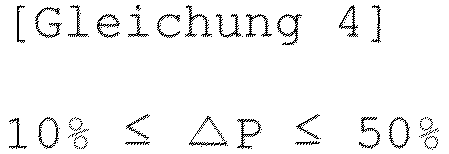
- the coating layer may mean a coating layer in which a permeability change rate ( ⁇ P) measured according to JIS P8117 using a densometer manufactured by Toyoseiki is maintained at 50% or less, in a state in which the composite separator is laminated on Teflon sheet so that the coating layer of the composite separator faces the Teflon sheet, the composite separator and the Teflon sheet are compressed at 90°C and 35 MPa, and the Teflon sheet is then removed.
- ⁇ P (%) (permeability after fusion - permeability before fusion) / permeability before fusion ⁇ 100
- This characteristic is caused by a structure of the coating layer in which the core-shell organic particle binder is increased in the direction of the surface layer which is the opposite side of the bottom surface of the coating layer, while the core-shell organic particle binder is less present on the bottom surface in contact with the substrate layer of the coating layer according to the present invention.
- the coating layer is prepared by containing the inorganic particles, and the core-shell organic particle binder consisting of a core-shell structure as a binder of the inorganic particles. More preferably, the effect may be further increased when in the core-shell organic particle binder, the glass transition temperature of the core is higher than that of the shell, which is preferable.
- the coating layer contains the core-shell organic particle binder as the binder and the distribution of the particles has a structure of the coating layer of the present invention, such that even if the ratio of the binder in the coating layer increases, the problem that the binder blocks the pore of the porous substrate to lower the air permeability may be avoided or minimized, which is preferable.
- a fusing force and heat-resistance may not be achieved at the same time, which is not preferable. That is, any one of heat-resistance and a fusing force may be satisfied, but it is difficult for both of these characteristics to be satisfied at the same time.
- the glass transition temperature of the core is higher than that of the shell while simultaneously being subjected to a pressure and a temperature higher than the glass transition temperature of the shell by adjusting the core-shell ratio in the core-shell organic particle binder, a fusing force with the electrode may be exhibited, the physical properties having characteristics that permeability does not increase by more than 50% in comparison with the permeability of the porous substrate before fusion may be achieved, and heat-resistance may be exhibited due to the core having a high glass transition temperature, which is exposed after the shell has melted. Therefore, since the effect of the present invention may be achieved well, the above conditions are very preferable in terms of the significant effect.
- the core may have a glass transition temperature of 50 to 80°C and the shell may have a glass transition temperature of 0 to 30°C.
- the present invention is not necessarily limited thereto.
- the core-shell organic particle binder may preferably satisfy the following Equations 1 and 2: 50 nm ⁇ r3 ⁇ 600 nm 4 ⁇ r2 / r1 ⁇ 16 wherein r1 is a radius of the core, r3 is a radius of the core-shell organic particle binder, and r2 is a length obtained by subtracting the radius of the core from the radius of the core-shell organic particle binder.
- the binder may be sufficiently exposed to the surface to exhibit an anti-blocking property, phase-stability of the core-shell organic particle binder may be excellent, coating properties may be excellent, permeability of the porous substrate may not be significantly increased after fusing, and heat-resistance may be sufficiently satisfied.
- the core-shell organic particle binder may consist of other kinds of polymers in addition to the acrylic polymer, but is not excluded.
- the core layer and the shell layer both consist of the acrylic polymer, after maintaining the composite separator at 130°C for 1 hour, physical properties of shrinkage of 7% or less in the machine direction and the transverse direction may be achieved.
- the stability of the battery may be further improved, which is preferable.
- the core layer and the shell layer of the core-shell organic particle binder may both consist of an acrylic polymer. More specifically, an acrylic monomer alone or an acrylic polymer polymerized from an acrylic monomer and a comonomer is more preferred.
- the acrylic monomer is butyl acrylate, butyl methacrylate.
- the comonomer is not limited as long as it is capable of polymerizing with the acrylic monomer. Specifically, for example, a styrenic monomer and a vinylic monomer, or the like may be used, and the comonomer may be used alone or in combination of two or more. However, present invention is not limited thereto.
- the styrenic monomer may be, but is not limited thereto, any one or a mixture of two or more selected from the group consisting of styrene, ⁇ -methylstyrene, p-bromostyrene, p-methylstyrene, p-ethylstyrene, m-methylstyrene, m-ethylstyrene, p-chlorostyrene, and m-chlorostyrene.
- the vinylic monomer may be, but is not limited thereto, any one or a mixture of two or more selected from acrylonitrile, acrylamide, and N-vinyl-2-pyrrolidone.
- the core-shell organic particle binder may be prepared by a conventional method of preparing acrylic latex organic particles.
- the core-shell organic particle binder may be prepared by methods such as emulsion polymerization or micro suspension polymerization.
- the coating layer of the present invention may be formed by applying slurry containing the inorganic particles and the core-shell organic particle binder.
- the content of the solid in the slurry may be variously adjusted as long as a desired coating layer of the present invention is formed depending on particle diameters, components, or the like of a solvent, inorganic particles and core-shell latex particles.
- the content of the solid may also be adjusted, depending on the conditions as described above, and viscosity or the induction time adjusted to prepare a coating layer having a form in which the organic particles are substantially less present on the bottom surface of the coating layer and the content of the organic particles is increased in the direction of the surface layer.
- the content of the solid according to the present invention may be 40 wt.% or less, preferably 30 wt.% or less, and more preferably 20 wt.% or less.
- the structure of the coating layer capable of achieving the desired effect of the present invention may be formed within the range as described above.
- the slurry also includes a solvent as a dispersion medium in addition to the inorganic particles and the core-shell organic particle binder.
- the solvent may also include a co-solvent.
- the solvent which is the dispersion medium of the present invention, is not particularly limited as long as it does not dissolve the core-shell organic particle binder, and the inorganic particles and the organic particles may be settled and floated by allowing the induction time depending on the difference in viscosity or specific gravity.
- the solvent any one or a mixture of two or more solvents selected from the group consisting of water, an alcohol-based solvent, an ether-based solvent, a carboxylic acid-based solvent, an organic acid ester-based solvent, a ketone-based solvent, and a dicarboxylic acid-based solvent may be used, but is not limited thereto.
- Water is usually preferred.
- the content of the co-solvent may be 1 to 50 parts by weight based on 100 parts by weight of water, but is not limited thereto.
- any one or a mixture of two or more selected from the group consisting of methanol, ethanol, isopropyl alcohol, 1-butanol, 2-butanol, sec-butyl alcohol, tert-butyl alcohol, ethylene glycol, propylene glycol, and butanediol may be used, but is not limited thereto.
- carboxylic acid-based solvent any one or a mixture of two or more selected from the group consisting of a monocarboxylic acid solvent such as formic acid, acetic acid, acetic anhydride, acrylic acid, citric acid, propionic acid, and butyric acid may be used, but is not limited thereto.
- a monocarboxylic acid solvent such as formic acid, acetic acid, acetic anhydride, acrylic acid, citric acid, propionic acid, and butyric acid may be used, but is not limited thereto.
- any one or a mixture of two or more selected from the group consisting of acetone, ethyl ketone, propyl ketone, butyl ketone, methyl isopropyl ketone, methyl isobutyl ketone, diisobutyl ketone, acetyl acetone, diacetone alcohol, cyclohexanone, cyclopentanone, methyl cyclohexanone, and cycloheptanone may be used, but is not limited thereto.
- any one or a mixture of two or more selected from the group consisting of succinic acid, glutaric acid, adipic acid, undecane diacid, pyruvic acid, and citraconic acid may be used, but is not limited thereto.
- the size of the inorganic particles is not particularly limited. However, the inorganic particles having an average particle diameter of less than 1 ⁇ m is preferred, and if necessary, larger inorganic particles, for example, mixed particles mixed with inorganic particles having an average particle diameter of 1 to 3 ⁇ m may be used.
- the content of the inorganic particles may be 50 to 90 wt.% of the coating layer.
- the slurry may further include single layer latex organic particles in addition to the binder of the core-shell structure.
- the glass transition temperature of the single layer latex organic particles is lower than that of the shell of the core-shell organic particle binder, and thus the adhesion may be further improved, which is preferable.
- the present invention is not necessarily limited thereto.
- the latex organic particles of the single layer particle structure are also included, and thus the binding force of the inorganic particles may be further improved.
- the glass transition temperature of the latex organic particles of the single layer structure may be at least 10°C lower, and more specifically 10 to 60°C lower than the glass transition temperature of the shell. That is, when the shell in the core-shell organic particle binder has the glass transition temperature of 30°C, the latex organic particles of the single layer structure preferably have the glass transition temperature of 20°C or less.
- the content of the latex organic particles of the single layer particle structure is preferably lower than that of the core-shell organic particle binder.
- the content of the latex organic particles may be 10 to 50 wt.% based on the content of the core-shell organic particle binder.
- the binder may further include a binder dissolved in a solvent, in addition to the inorganic particles and the core-shell organic particle binder as the binder as described above.
- the content may be in the range of 0.001 to 5 wt. % .
- the slurry may further include an additive in a range not greatly lowering the applicability and the battery performance.
- an additive for example, a viscosity regulator, a binder aid, a surfactant, or the like may be used, but is not limited thereto.
- a method of providing a coating layer in which the amount of the core-shell organic particle binder is increased in the direction of the surface layer which is the opposite side of the bottom surface of the coating layer while the core-shell organic particle binder is not present on the bottom surface of the coating layer contacting the substrate layer is carried out by conventional coating methods such as bar coating, dip coating, spray coating, or the like as in the conventional preparation method, but requires a means for forming a coating layer having the structure of the present invention such as viscosity, solvent or induction time.
- the coating layer of the present invention for example, it is necessary to apply the slurry of the present invention to the upper surface of the porous substrate, and then allowed to stand for a predetermine time to allow for an induction time in order to obtain the structure of the coating layer of the present invention.
- the viscosity of the coating composition so as to ensure fluidity due to the difference in specific gravity between the inorganic particles and the organic particles, and also by allowing for the induction time in order to obtain the coating layer of a laminated structure of the present invention, before applying (coating) the slurry composition of which viscosity is adjusted to the upper surface of the porous substrate and then drying.
- the viscosity may be adjusted by the contents of the inorganic material and the core-shell latex particles as the binder.
- the inorganic material and the core-shell latex particles so that the solid content is 40 wt.% or less, preferably 30 wt.% or less, and more preferably 15 wt.% or less may be prepared, coated, after an induction time of 1 minute or more, and preferably 5 minutes or more, transferred to a drying zone, and then dried to form a coating layer having the structure of the present invention.
- coating conditions of the present invention are not limited as long as it is a coating layer in which the core-shell organic particle binder is increased in the direction of the surface layer which is the opposite side of the base surface of the coating layer, while the core-shell organic particle binder is not present on the base surface in contact with the substrate layer of the coating layer intended in the present invention.
- the phrase "there is little or no organic particles of the core-shell latex on the bottom surface of the coating layer” means that a case where a portion in which the number of the core-shell organic particle binder presents in 5% or more of the number presenting on the surface, is one or less when the total thickness of the coating layer was enlarged by 10,000 times from the bottom surface of the coating layer to the surface layer by 20% by SEM, and then 20 portions having an area of 13 ⁇ m ⁇ 20 ⁇ m size were randomly observed.
- particularly preferable is a case where a portion in which the number of the core-shell organic particle binder presents in 5% or more of the number presenting on the surface, is one or less.
- specific examples of the coating method for forming the coating layer may include a slot die coating method, a doctor blade method, a dip method, a reverse roll method, a direct roll method, gravure method, a kiss coating method, an extrusion method, a bead method, a curtain coating method, a dot method, a porous coating method, a slot coating method, a spray method, a spiral spray method, a summit spray method, immersion, a brush application, or the like.
- a doctor blade method a gravure method, a kiss coating method, a curtain coating method, a dot method, a porous coating method, a slot coating method, a spray method, a spiral spray method, a summit spray method, or the like may be used, but is not limited thereto.
- the induction time may be given, before the composition is applied and then dried.
- the coating layer having the structure of the present invention may be formed by transferring it to a drying zone after an induction time of 30 seconds or more, preferably 1 minute or more, and more preferably 5 minutes or more, and drying.
- the induction time of the present invention may not be necessary if the viscosity of the slurry is low and the behavior of the inorganic particles and the organic particles sufficiently occurs due to the difference in specific gravity within a sufficiently short time to have the structure of the coating layer of the present invention.
- the drying step may remove low boiling point materials such as a slurry solvent or a co-solvent.
- Examples of the drying method may include drying by hot air, hot air, low-humidity air; vacuum drying; and drying by irradiation with infrared rays, far-infrared rays, electron beams, or the like.
- the drying temperature may be 30 to 200°C, and more specifically 40 to 100°C.
- the coating layer may have a thickness of 0.005 to 100 ⁇ m, and more particularly 0.01 to 50 ⁇ m, after coating and drying.
- the composite separator when the composite separator is laminated on carbon sheet so that the coating layer of the composite separator faces the carbon sheet, the composite separator and the carbon sheet are compressed at 90°C and 35 MPa, and then are subjected to a 180° peel test, the composite separator may have a peel strength of 40 gf/25 mm or more. More particularly, the adhesion is excellent as 40 to 90 gf/25 mm, so that it is possible to improve the occurrence of distortion or a lifting phenomenon in the manufacture of the electrode assembly. Therefore, the capacity of the battery may be maximized and a battery having excellent cycle characteristics may be provided.
- the electrode-composite separator assembly means an assembly obtained by fusing a coating layer of the composite separator on the electrode and integrating them.
- the conditions for fusing the electrode and the coating layer are not limited.
- the electrode and the coating layer may be compressed at a temperature of 30°C or more, more specifically, at a temperature not less than the glass transition temperature of the shell layer of the core-shell latex binder particles, and still more specifically, at a temperature of 30 to 200°C, and then integrated.
- a core-shell organic particle binder (A) was prepared as a binder wherein the core-shell organic particle binder (A) consists of a core consisting of a copolymer of butyl acrylate and methyl methacrylate, and a shell consisting of a polymer of butyl acrylate, methyl methacrylate, styrene and acrylonitrile, the core has a glass transition temperature of 80°C, the shell has a glass transition temperature of 30°C, and an average particle diameter (D50) is 0.8 ⁇ m.
- the core-shell organic particle binder (A) 20 wt.% of the core-shell organic particle binder (A), 79.5 wt.% of the alumina particles having an average particle diameter of 0.6 ⁇ m, and 0.5 wt.% of boehmite particles having an average particle diameter of 1.5 ⁇ m were dispersed in water to prepare a slurry.
- the solid content of the slurry was 18 wt.%.
- the slurry was coated on both surfaces of the porous polyethylene-based substrate (SK Innovation, ENPASS) having a Gurley permeability of 150 sec/100 cc and a thickness of 9 ⁇ m at a rate of 10 m/min using a slot coating die, allowed to stand for 2 minutes, and then dried by passing through a dryer having a length of 6 m at which hot air was generated at 60°C.
- the thicknesses of the both surface of coating layer were 3 ⁇ m, respectively.
- a composite separator was prepared in the same manner as in Example 1, except that 6 wt.% of the single layer latex organic particles (B) having a glass transition temperature of 10°C and an average particle diameter (D50) of 0.2 ⁇ m, was further added as single layer particles consisting of a copolymer of butyl acrylate and methyl methacrylate, and the content of organic particles (A) having an average particle diameter of 0.8 ⁇ m was also changed from 20 wt.% to 14 wt.% to prepare a slurry in Example 1.
- a composite separator was prepared in the same manner as in Example 1, except that a core-shell organic particle binder (C) was used, wherein the core-shell organic particle binder consists of a core consisting of a copolymer of butyl acrylate and methyl methacrylate, and a shell consisting of a ethylene-vinyl acetate copolymer, the core has a glass transition temperature of 80°C, the shell has a glass transition temperature of -20°C, and an average particle diameter (D50) is 0.8 ⁇ m, instead of the core-shell organic particle binder in Example 1.
- C core-shell organic particle binder
- a composite separator was prepared in the same manner as in Example 1, except that a core-shell organic particle binder having an average particle diameter (D50) of 0.8 ⁇ m obtained by reversely synthesizing the core and shell of Example 1, was used.
- the physical properties of prepared composite separator were measured and are shown in Table 1 below.
- a composite separator was prepared in the same manner as in Example 1, except that 20 wt.% of only latex organic particles having a glass transition temperature of 30°C and an average particle diameter (D50) of 0.8 ⁇ m were used as the single layer latex particles consisting of a copolymer of butyl acrylate and methyl methacrylate in Example 1.
- the physical properties of prepared composite separator were measured and are shown in Table 1 below.
- a composite separator was prepared in the same manner as in Example 1, except that 20 wt.% of only latex organic particles having a glass transition temperature of 80°C and an average particle diameter (D50) of 0.8 ⁇ m were used as the single layer latex particles consisting of a copolymer of butyl acrylate and methyl methacrylate in Example 1.
- the physical properties of prepared composite separator were measured and are shown in Table 1 below.
- Example Comparative Example 1 2 3 4 1 2 r2/r1 5 5 5 5 - - Fusing force (gf/25mm) 47 53 60 40 81 21 Gurley permeability (sec/100cc) 228 240 250 260 272 202 ⁇ P (%) 39 44 48 41 80 30 Shrinkage (%) MD 6.3 4.8 6.4 7.0 10.2 4.2 TD 2.0 1.7 2.6 2.9 6.8 1.1 Anti-blocking property ⁇ /x ⁇ ⁇ ⁇ ⁇ x ⁇ Peel strength (gf/25mm) 20 22 24 17 35 8
- Examples 1 to 2 according to the present invention have a high fusing force, a low Gurley permeability, a very good porosity, and very excellent shrinkage and an anti-blocking property. In addition, it was found that fusion and shrinking properties were further increased when a single layer latex was further included.
- the composite separator for a secondary battery according to the present invention improves adhesion between the electrode and the separator when heat and pressure are applied, thereby improving distortion or a lifting phenomenon in the preparation of the electrode-composite separator assembly. Therefore, cycle characteristics are excellent and a desired capacity may be achieved.
- the present invention may provide a composite separator having less heat shrinkage, and an anti-blocking property due to excellent slipperiness.
- a fusing force between the electrode and the separator is excellent, such that no lifting phenomenon on the electrode surface and the separator surface occurs;
- the slipperiness is improved, such that assemblability between the electrode surface and the separator is improved;
- the composite separator is easily seated on an electrode surface due to slipperiness or the like upon assembly, such that no wrinkles occur; and no distortion or a lifting phenomenon between the electrode and the separator occurs.
- the present invention may provide an electrochemical device such as a secondary battery, having an effect of reducing pores between an electrode and a separator and having lifetime improvement through prevention of a lifting phenomenon and ease alignment.
- an object of the present invention is to provide a composite separator in which cycle characteristics are excellent, and a battery capable of achieving a desired high capacity may be prepared by the above-described advantages.
- an object of the present invention is to provide a composite separator which sufficiently gives the above-described characteristics without significantly lowering permeability of a separator.
- an object of the present invention is to provide a composite separator in which the occurrence of shrinkage is reduced and a blocking phenomenon between coating layers may be improved upon winding a prepared product.
Landscapes
- Chemical & Material Sciences (AREA)
- Chemical Kinetics & Catalysis (AREA)
- Electrochemistry (AREA)
- General Chemical & Material Sciences (AREA)
- Inorganic Chemistry (AREA)
- Engineering & Computer Science (AREA)
- Manufacturing & Machinery (AREA)
- Composite Materials (AREA)
- Materials Engineering (AREA)
- Cell Separators (AREA)
Claims (10)
- Verbundseparator, umfassend:ein poröses Substrat; undeine auf dem porösen Substrat ausgebildete Beschichtungsschicht, wobei die Beschichtungsschicht anorganische Partikel und ein organischen Kern-Schale-Partikel-Bindemittels enthält, das eine Kernschicht und eine die Kernschicht umgebende Schalenschicht enthält,wobei in der Beschichtungsschicht die Menge des organischen Kern-Schale-Partikel-Bindemittels in Richtung der Oberflächenschicht, die die gegenüberliegende Seite der unteren Oberfläche der Beschichtungsschicht, die in Kontakt mit dem porösen Substrat ist, darstellt, erhöht ist,wobei die Kernschicht eine Glasübergangstemperatur von 50 bis 80°C und die Schalenschicht eine Glasübergangstemperatur von 0 bis 30°C aufweist, undwobei die Kernschicht und die Schalenschicht aus einem Acrylpolymer bestehen, das aus Butylacrylat umfassenden Monomeren polymerisiert ist.
- Verbundseparator nach Anspruch 1, wobei die anorganischen Partikel erste anorganische Partikel mit einem durchschnittlichen Teilchendurchmesser von weniger als 1 µm enthalten.
- Verbundseparator nach Anspruch 1, wobei die Beschichtungsschicht 50 bis 90 Gew.-% der anorganischen Partikel und 10 bis 40 Gew.-% des organischen Partikel-Bindemittels enthält.
- Verbundseparator nach Anspruch 3, wobei das organische Partikel-Bindemittel das organische Kern-Schale-Partikel-Bindemittel und ein organisches Einzelschicht-Partikel-Bindemittel in einem Gewichtsverhältnis von 10:90 bis 90:10 enthält.
- Verbundseparator nach Anspruch 1, wobei die Beschichtungsschicht außerdem ein organisches Einzelschicht-Partikel-Bindemittel mit einer Glasübergangstemperatur enthält, die um 10 bis 60 °C niedriger ist als die der Schalenschicht des organischen Kern-Schale-Partikel-Bindemittels.
- Verbundseparator nach Anspruch 1, wobei das organische Kern-Schale-Partikel-Bindemittel die folgenden Gleichungen 1 und 2 erfüllt:


- Verbundseparator nach Anspruch 1, wobei der Verbundseparator eine Schälfestigkeit von 10 bis 25 gf/25 mm aufweist, wenn die Beschichtungsschichten der beiden Verbundseparatoren einander zugewandt sind, bei Raumtemperatur und einem Druck von 4,7 MPa eine Minute lang komprimiert werden und dann einem 180°-Schältest unterzogen werden.
- Verbundseparator nach Anspruch 1, wobei eine Gurley-Permeabilität des Verbundseparators die folgende Gleichung 3 erfüllt und eine Gurley-Permeabilitätsänderungsrate (ΔP) des Verbundseparators die folgende Gleichung 4 erfüllt:

- Verbundseparator nach Anspruch 1, wobei der Verbundseparator eine Schälfestigkeit von 40 gf/25 mm oder mehr aufweist, wenn der Verbundseparator auf eine Kohlenstofffolie laminiert wird, so dass die Beschichtungsschicht des Verbundseparators der Kohlenstofffolie zugewandt ist, der Verbundseparator und die Kohlenstofffolie bei 90°C und 35 MPa komprimiert werden und dann einem 180°-Schältest unterzogen werden.
- Elektrochemische Vorrichtung, die den Verbundseparator nach einem der Ansprüche 1 bis 9 umfasst.
Applications Claiming Priority (1)
| Application Number | Priority Date | Filing Date | Title |
|---|---|---|---|
| KR1020180076318A KR102647260B1 (ko) | 2018-07-02 | 2018-07-02 | 이차전지용 복합 분리막 |
Publications (3)
| Publication Number | Publication Date |
|---|---|
| EP3591736A1 EP3591736A1 (de) | 2020-01-08 |
| EP3591736B1 true EP3591736B1 (de) | 2024-10-09 |
| EP3591736C0 EP3591736C0 (de) | 2024-10-09 |
Family
ID=67139670
Family Applications (1)
| Application Number | Title | Priority Date | Filing Date |
|---|---|---|---|
| EP19183789.7A Active EP3591736B1 (de) | 2018-07-02 | 2019-07-02 | Verbundabscheider für sekundärbatterie |
Country Status (4)
| Country | Link |
|---|---|
| US (1) | US11183736B2 (de) |
| EP (1) | EP3591736B1 (de) |
| KR (1) | KR102647260B1 (de) |
| CN (1) | CN110676418B (de) |
Families Citing this family (13)
| Publication number | Priority date | Publication date | Assignee | Title |
|---|---|---|---|---|
| WO2019221056A1 (ja) * | 2018-05-17 | 2019-11-21 | 日本ゼオン株式会社 | 非水系二次電池用スラリー、非水系二次電池用セパレータ、非水系二次電池用電極、非水系二次電池用積層体および非水系二次電池 |
| KR102415151B1 (ko) * | 2018-11-01 | 2022-07-01 | 주식회사 엘지에너지솔루션 | 세퍼레이터 및 이를 포함하는 전기화학소자 |
| WO2021210499A1 (ja) * | 2020-04-17 | 2021-10-21 | 三井化学株式会社 | 二次電池セパレータ用コート材原料、二次電池セパレータ用コート材、二次電池セパレータ、二次電池セパレータの製造方法、および、二次電池 |
| WO2022019572A1 (ko) * | 2020-07-20 | 2022-01-27 | 주식회사 엘지에너지솔루션 | 이차전지용 세퍼레이터, 이의 제조방법, 이를 포함하는 이차전지의 제조방법 및 이에 의해 제조된 이차전지 |
| KR102862242B1 (ko) * | 2021-03-04 | 2025-09-18 | 삼성에스디아이 주식회사 | 세퍼레이터 코팅용 조성물, 이를 이용한 세퍼레이터의 제조 방법, 세퍼레이터 및 이를 채용한 리튬 전지 |
| KR102942003B1 (ko) * | 2021-03-08 | 2026-03-20 | 에스케이온 주식회사 | 이차전지용 복합 분리막, 이의 제조방법 및 이를 포함하는 리튬 이차전지. |
| KR102603959B1 (ko) * | 2021-03-24 | 2023-11-20 | 한양대학교 에리카산학협력단 | 분리막 코팅용 조성물 및 이를 이용한 발수성 세라믹 코팅 분리막 |
| US20230027024A1 (en) * | 2021-07-09 | 2023-01-26 | Lg Energy Solution, Ltd. | Electrode Assembly |
| CN113381125B (zh) * | 2021-07-13 | 2023-02-17 | 上海恩捷新材料科技有限公司 | 一种导离子功能树脂及包含该导离子功能树脂的锂电池隔膜 |
| KR102799124B1 (ko) | 2022-06-09 | 2025-04-23 | 에스케이이노베이션 주식회사 | 분리막, 이의 제조방법 및 상기 분리막을 포함하는 전기화학소자 |
| CN115986322B (zh) * | 2023-03-20 | 2023-06-16 | 中创新航技术研究中心(深圳)有限公司 | 一种电池 |
| KR102865291B1 (ko) * | 2023-12-20 | 2025-09-29 | 에스케이이노베이션 주식회사 | 복합 분리막 및 이를 이용한 이차전지 |
| WO2025254389A1 (ko) * | 2024-06-04 | 2025-12-11 | 주식회사 엘지에너지솔루션 | 전기화학소자용 분리막 및 이를 포함하는 전기화학소자 |
Citations (1)
| Publication number | Priority date | Publication date | Assignee | Title |
|---|---|---|---|---|
| KR20180003177A (ko) * | 2016-06-30 | 2018-01-09 | 삼성에스디아이 주식회사 | 이차 전지용 분리막 및 이를 포함하는 리튬 이차 전지 |
Family Cites Families (18)
| Publication number | Priority date | Publication date | Assignee | Title |
|---|---|---|---|---|
| WO2005011043A1 (ja) | 2003-07-29 | 2005-02-03 | Matsushita Electric Industrial Co., Ltd. | リチウムイオン二次電池 |
| CA2632364C (en) * | 2005-12-06 | 2014-02-18 | Lg Chem, Ltd. | Organic/inorganic composite separator having morphology gradient, manufacturing method thereof and electrochemical device containing the same |
| US9525189B2 (en) | 2011-09-26 | 2016-12-20 | Sumitomo Chemical Company, Limited | Adhesive resin composition for secondary battery |
| KR101358764B1 (ko) * | 2011-11-11 | 2014-02-07 | 주식회사 엘지화학 | 세퍼레이터 및 이를 구비한 전기화학소자 |
| JP5652572B2 (ja) | 2012-03-28 | 2015-01-14 | 日本ゼオン株式会社 | 二次電池用多孔膜及びその製造方法、二次電池用電極、二次電池用セパレーター並びに二次電池 |
| US10096810B2 (en) * | 2012-05-10 | 2018-10-09 | Samsung Sdi Co., Ltd. | Separator and method of manufacturing the same and rechargeable lithium battery including the same |
| KR101735509B1 (ko) * | 2012-11-30 | 2017-05-15 | 주식회사 엘지화학 | 세퍼레이터 및 이를 구비하는 전기화학소자 |
| CN105283979B (zh) | 2013-07-10 | 2017-08-29 | 日本瑞翁株式会社 | 锂离子二次电池用多孔膜组合物、锂离子二次电池用隔板、锂离子二次电池用电极、及锂离子二次电池 |
| US10141557B2 (en) | 2013-07-10 | 2018-11-27 | Zeon Corporation | Adhesive for lithium ion secondary batteries, separator for lithium ion secondary batteries, and lithium ion secondary battery |
| WO2015064411A1 (ja) | 2013-10-31 | 2015-05-07 | 日本ゼオン株式会社 | リチウムイオン二次電池のバインダー用の粒子状重合体、接着層及び多孔膜組成物 |
| JP6413419B2 (ja) | 2014-07-16 | 2018-10-31 | 日本ゼオン株式会社 | 非水系二次電池多孔膜用複合粒子、非水系二次電池用多孔膜、非水系二次電池用電池部材、および非水系二次電池 |
| CN105273444B (zh) | 2014-07-23 | 2017-11-14 | 乐凯胶片股份有限公司 | 一种浆料组合物及包含该浆料组合物的锂离子电池隔膜 |
| HUE044433T2 (hu) | 2014-07-30 | 2019-10-28 | Zeon Corp | Készítmény nemvizes akkumulátor funkcionális rétegeihez, funkcionális réteggel ellátott hordozó nemvizes akkumulátorhoz, eljárás laminátum elõállítására nemvizes akkumulátorhoz, valamint nemvizes akkumulátor |
| JP6504173B2 (ja) | 2014-08-28 | 2019-04-24 | 日本ゼオン株式会社 | 非水系二次電池用積層体および非水系二次電池部材の製造方法 |
| KR20160061165A (ko) | 2014-11-21 | 2016-05-31 | 삼성에스디아이 주식회사 | 이차 전지용 세퍼레이터 및 이를 포함하는 이차 전지 |
| JP6750506B2 (ja) | 2015-01-09 | 2020-09-02 | 日本ゼオン株式会社 | 非水系二次電池用セパレータおよびその製造方法、並びに、非水系二次電池 |
| CN107431169B (zh) * | 2015-03-20 | 2021-04-20 | 日本瑞翁株式会社 | 非水系二次电池功能层用组合物、功能层以及二次电池 |
| JP6456741B2 (ja) | 2015-03-25 | 2019-01-23 | 株式会社クレハ | セパレータ/中間層積層体、非水電解質二次電池用構造体、及び水性ラテックス |
-
2018
- 2018-07-02 KR KR1020180076318A patent/KR102647260B1/ko active Active
-
2019
- 2019-07-01 CN CN201910585097.XA patent/CN110676418B/zh active Active
- 2019-07-01 US US16/459,334 patent/US11183736B2/en active Active
- 2019-07-02 EP EP19183789.7A patent/EP3591736B1/de active Active
Patent Citations (1)
| Publication number | Priority date | Publication date | Assignee | Title |
|---|---|---|---|---|
| KR20180003177A (ko) * | 2016-06-30 | 2018-01-09 | 삼성에스디아이 주식회사 | 이차 전지용 분리막 및 이를 포함하는 리튬 이차 전지 |
Also Published As
| Publication number | Publication date |
|---|---|
| CN110676418A (zh) | 2020-01-10 |
| US20200006733A1 (en) | 2020-01-02 |
| KR20200003486A (ko) | 2020-01-10 |
| CN110676418B (zh) | 2023-11-28 |
| US11183736B2 (en) | 2021-11-23 |
| KR102647260B1 (ko) | 2024-03-13 |
| EP3591736C0 (de) | 2024-10-09 |
| EP3591736A1 (de) | 2020-01-08 |
Similar Documents
| Publication | Publication Date | Title |
|---|---|---|
| EP3591736B1 (de) | Verbundabscheider für sekundärbatterie | |
| JP6523531B2 (ja) | 積層多孔質フィルムの製造方法 | |
| JP5932161B1 (ja) | 積層体、セパレータ及び非水二次電池 | |
| TWI619600B (zh) | Biaxially oriented polyester film for demolding | |
| JP2025098210A (ja) | リチウム電池用の改善されたコーティングしたセパレータおよび関連方法 | |
| JP5283383B2 (ja) | ポリエチレン微多孔膜の製造方法及び電池用セパレータ | |
| US10062890B2 (en) | Laminated porous film, non-aqueous electrolyte secondary battery separator, and non-aqueous electrolyte secondary battery | |
| KR102316033B1 (ko) | 전지용 세퍼레이터 및 이의 제조 방법 | |
| JP7129084B2 (ja) | 粘着層積層ポリエステルフィルム | |
| US20180071774A1 (en) | Method for manufacturing composite film | |
| JP6435886B2 (ja) | 多層耐熱セパレータ材およびその製造方法 | |
| JPH1180395A (ja) | 多孔質膜および非水電解液電池用セパレータ | |
| KR20180090725A (ko) | 적층 폴리올레핀 미세 다공막, 전지용 세퍼레이터 및 그것들의 제조 방법 | |
| JP2009233919A (ja) | 帯電防止性離型用積層ポリエステルフィルム | |
| KR20170016827A (ko) | 전지용 세퍼레이터 및 이의 제조 방법 | |
| KR20170084013A (ko) | 폴리올레핀 미다공막, 전지용 세퍼레이터 및 그 제조 방법 | |
| KR20170093789A (ko) | 폴리올레핀 미다공막, 전지용 세퍼레이터 및 그들의 제조 방법 | |
| US10153468B2 (en) | Laminated porous film, non-aqueous electrolyte secondary battery separator, and non-aqueous electrolyte secondary battery | |
| CN108623876A (zh) | 聚烯烃微多孔膜及聚烯烃微多孔膜的制备方法 | |
| CN121507306A (zh) | 带涂层的多孔膜、复合材料、电池隔板、电池及应用 | |
| JP5378703B2 (ja) | 離型フィルム | |
| JP5914789B1 (ja) | ポリオレフィン微多孔膜、電池用セパレータおよびその製造方法 | |
| JP2010069661A (ja) | 離型フィルムロール | |
| US20180375080A1 (en) | Battery separator film, nonaqueous electrolyte secondary battery separator, and nonaqueous electrolyte secondary battery | |
| EP4435956A1 (de) | Separator und elektrochemische vorrichtung den separator umfassend |
Legal Events
| Date | Code | Title | Description |
|---|---|---|---|
| PUAI | Public reference made under article 153(3) epc to a published international application that has entered the european phase |
Free format text: ORIGINAL CODE: 0009012 |
|
| STAA | Information on the status of an ep patent application or granted ep patent |
Free format text: STATUS: REQUEST FOR EXAMINATION WAS MADE |
|
| 17P | Request for examination filed |
Effective date: 20190702 |
|
| AK | Designated contracting states |
Kind code of ref document: A1 Designated state(s): AL AT BE BG CH CY CZ DE DK EE ES FI FR GB GR HR HU IE IS IT LI LT LU LV MC MK MT NL NO PL PT RO RS SE SI SK SM TR |
|
| AX | Request for extension of the european patent |
Extension state: BA ME |
|
| TPAC | Observations filed by third parties |
Free format text: ORIGINAL CODE: EPIDOSNTIPA |
|
| STAA | Information on the status of an ep patent application or granted ep patent |
Free format text: STATUS: EXAMINATION IS IN PROGRESS |
|
| 17Q | First examination report despatched |
Effective date: 20210129 |
|
| P01 | Opt-out of the competence of the unified patent court (upc) registered |
Effective date: 20230622 |
|
| REG | Reference to a national code |
Ref country code: DE Ref legal event code: R079 Free format text: PREVIOUS MAIN CLASS: H01M0002160000 Ipc: H01M0050446000 Ref country code: DE Ref legal event code: R079 Ref document number: 602019059950 Country of ref document: DE Free format text: PREVIOUS MAIN CLASS: H01M0002160000 Ipc: H01M0050446000 |
|
| GRAP | Despatch of communication of intention to grant a patent |
Free format text: ORIGINAL CODE: EPIDOSNIGR1 |
|
| STAA | Information on the status of an ep patent application or granted ep patent |
Free format text: STATUS: GRANT OF PATENT IS INTENDED |
|
| INTG | Intention to grant announced |
Effective date: 20240506 |
|
| RIC1 | Information provided on ipc code assigned before grant |
Ipc: H01M 50/489 20210101ALI20240419BHEP Ipc: H01M 50/451 20210101ALI20240419BHEP Ipc: H01M 50/431 20210101ALI20240419BHEP Ipc: H01M 50/42 20210101ALI20240419BHEP Ipc: H01M 50/403 20210101ALI20240419BHEP Ipc: H01M 50/446 20210101AFI20240419BHEP |
|
| GRAS | Grant fee paid |
Free format text: ORIGINAL CODE: EPIDOSNIGR3 |
|
| GRAA | (expected) grant |
Free format text: ORIGINAL CODE: 0009210 |
|
| STAA | Information on the status of an ep patent application or granted ep patent |
Free format text: STATUS: THE PATENT HAS BEEN GRANTED |
|
| AK | Designated contracting states |
Kind code of ref document: B1 Designated state(s): AL AT BE BG CH CY CZ DE DK EE ES FI FR GB GR HR HU IE IS IT LI LT LU LV MC MK MT NL NO PL PT RO RS SE SI SK SM TR |
|
| REG | Reference to a national code |
Ref country code: CH Ref legal event code: EP |
|
| REG | Reference to a national code |
Ref country code: DE Ref legal event code: R096 Ref document number: 602019059950 Country of ref document: DE |
|
| REG | Reference to a national code |
Ref country code: IE Ref legal event code: FG4D |
|
| U01 | Request for unitary effect filed |
Effective date: 20241108 |
|
| U07 | Unitary effect registered |
Designated state(s): AT BE BG DE DK EE FI FR IT LT LU LV MT NL PT RO SE SI Effective date: 20241118 |
|
| P04 | Withdrawal of opt-out of the competence of the unified patent court (upc) registered |
Free format text: CASE NUMBER: APP_61033/2024 Effective date: 20241113 |
|
| PG25 | Lapsed in a contracting state [announced via postgrant information from national office to epo] |
Ref country code: IS Free format text: LAPSE BECAUSE OF FAILURE TO SUBMIT A TRANSLATION OF THE DESCRIPTION OR TO PAY THE FEE WITHIN THE PRESCRIBED TIME-LIMIT Effective date: 20250209 Ref country code: HR Free format text: LAPSE BECAUSE OF FAILURE TO SUBMIT A TRANSLATION OF THE DESCRIPTION OR TO PAY THE FEE WITHIN THE PRESCRIBED TIME-LIMIT Effective date: 20241009 |
|
| PG25 | Lapsed in a contracting state [announced via postgrant information from national office to epo] |
Ref country code: ES Free format text: LAPSE BECAUSE OF FAILURE TO SUBMIT A TRANSLATION OF THE DESCRIPTION OR TO PAY THE FEE WITHIN THE PRESCRIBED TIME-LIMIT Effective date: 20241009 |
|
| PG25 | Lapsed in a contracting state [announced via postgrant information from national office to epo] |
Ref country code: NO Free format text: LAPSE BECAUSE OF FAILURE TO SUBMIT A TRANSLATION OF THE DESCRIPTION OR TO PAY THE FEE WITHIN THE PRESCRIBED TIME-LIMIT Effective date: 20250109 |
|
| PG25 | Lapsed in a contracting state [announced via postgrant information from national office to epo] |
Ref country code: GR Free format text: LAPSE BECAUSE OF FAILURE TO SUBMIT A TRANSLATION OF THE DESCRIPTION OR TO PAY THE FEE WITHIN THE PRESCRIBED TIME-LIMIT Effective date: 20250110 |
|
| PG25 | Lapsed in a contracting state [announced via postgrant information from national office to epo] |
Ref country code: PL Free format text: LAPSE BECAUSE OF FAILURE TO SUBMIT A TRANSLATION OF THE DESCRIPTION OR TO PAY THE FEE WITHIN THE PRESCRIBED TIME-LIMIT Effective date: 20241009 |
|
| PG25 | Lapsed in a contracting state [announced via postgrant information from national office to epo] |
Ref country code: RS Free format text: LAPSE BECAUSE OF FAILURE TO SUBMIT A TRANSLATION OF THE DESCRIPTION OR TO PAY THE FEE WITHIN THE PRESCRIBED TIME-LIMIT Effective date: 20250109 |
|
| PG25 | Lapsed in a contracting state [announced via postgrant information from national office to epo] |
Ref country code: SM Free format text: LAPSE BECAUSE OF FAILURE TO SUBMIT A TRANSLATION OF THE DESCRIPTION OR TO PAY THE FEE WITHIN THE PRESCRIBED TIME-LIMIT Effective date: 20241009 |
|
| PGFP | Annual fee paid to national office [announced via postgrant information from national office to epo] |
Ref country code: GB Payment date: 20250624 Year of fee payment: 7 |
|
| PG25 | Lapsed in a contracting state [announced via postgrant information from national office to epo] |
Ref country code: SK Free format text: LAPSE BECAUSE OF FAILURE TO SUBMIT A TRANSLATION OF THE DESCRIPTION OR TO PAY THE FEE WITHIN THE PRESCRIBED TIME-LIMIT Effective date: 20241009 |
|
| PG25 | Lapsed in a contracting state [announced via postgrant information from national office to epo] |
Ref country code: CZ Free format text: LAPSE BECAUSE OF FAILURE TO SUBMIT A TRANSLATION OF THE DESCRIPTION OR TO PAY THE FEE WITHIN THE PRESCRIBED TIME-LIMIT Effective date: 20241009 |
|
| PLBE | No opposition filed within time limit |
Free format text: ORIGINAL CODE: 0009261 |
|
| STAA | Information on the status of an ep patent application or granted ep patent |
Free format text: STATUS: NO OPPOSITION FILED WITHIN TIME LIMIT |
|
| U20 | Renewal fee for the european patent with unitary effect paid |
Year of fee payment: 7 Effective date: 20250723 |
|
| 26N | No opposition filed |
Effective date: 20250710 |
|
| REG | Reference to a national code |
Ref country code: CH Ref legal event code: H13 Free format text: ST27 STATUS EVENT CODE: U-0-0-H10-H13 (AS PROVIDED BY THE NATIONAL OFFICE) Effective date: 20260224 |