EP3581920A1 - System zur beurteilung der reinigungsleistung - Google Patents
System zur beurteilung der reinigungsleistung Download PDFInfo
- Publication number
- EP3581920A1 EP3581920A1 EP18750740.5A EP18750740A EP3581920A1 EP 3581920 A1 EP3581920 A1 EP 3581920A1 EP 18750740 A EP18750740 A EP 18750740A EP 3581920 A1 EP3581920 A1 EP 3581920A1
- Authority
- EP
- European Patent Office
- Prior art keywords
- cleaning
- mist
- performance evaluation
- evaluation system
- mock contaminant
- Prior art date
- Legal status (The legal status is an assumption and is not a legal conclusion. Google has not performed a legal analysis and makes no representation as to the accuracy of the status listed.)
- Granted
Links
Images

Classifications
-
- G—PHYSICS
- G01—MEASURING; TESTING
- G01N—INVESTIGATING OR ANALYSING MATERIALS BY DETERMINING THEIR CHEMICAL OR PHYSICAL PROPERTIES
- G01N21/00—Investigating or analysing materials by the use of optical means, i.e. using sub-millimetre waves, infrared, visible or ultraviolet light
- G01N21/62—Systems in which the material investigated is excited whereby it emits light or causes a change in wavelength of the incident light
- G01N21/63—Systems in which the material investigated is excited whereby it emits light or causes a change in wavelength of the incident light optically excited
- G01N21/64—Fluorescence; Phosphorescence
- G01N21/6402—Atomic fluorescence; Laser induced fluorescence
-
- G—PHYSICS
- G01—MEASURING; TESTING
- G01N—INVESTIGATING OR ANALYSING MATERIALS BY DETERMINING THEIR CHEMICAL OR PHYSICAL PROPERTIES
- G01N21/00—Investigating or analysing materials by the use of optical means, i.e. using sub-millimetre waves, infrared, visible or ultraviolet light
- G01N21/62—Systems in which the material investigated is excited whereby it emits light or causes a change in wavelength of the incident light
- G01N21/63—Systems in which the material investigated is excited whereby it emits light or causes a change in wavelength of the incident light optically excited
- G01N21/64—Fluorescence; Phosphorescence
-
- B—PERFORMING OPERATIONS; TRANSPORTING
- B05—SPRAYING OR ATOMISING IN GENERAL; APPLYING FLUENT MATERIALS TO SURFACES, IN GENERAL
- B05B—SPRAYING APPARATUS; ATOMISING APPARATUS; NOZZLES
- B05B1/00—Nozzles, spray heads or other outlets, with or without auxiliary devices such as valves, heating means
- B05B1/02—Nozzles, spray heads or other outlets, with or without auxiliary devices such as valves, heating means designed to produce a jet, spray, or other discharge of particular shape or nature, e.g. in single drops, or having an outlet of particular shape
- B05B1/10—Nozzles, spray heads or other outlets, with or without auxiliary devices such as valves, heating means designed to produce a jet, spray, or other discharge of particular shape or nature, e.g. in single drops, or having an outlet of particular shape in the form of a fine jet, e.g. for use in wind-screen washers
-
- G—PHYSICS
- G01—MEASURING; TESTING
- G01N—INVESTIGATING OR ANALYSING MATERIALS BY DETERMINING THEIR CHEMICAL OR PHYSICAL PROPERTIES
- G01N1/00—Sampling; Preparing specimens for investigation
- G01N1/02—Devices for withdrawing samples
- G01N1/10—Devices for withdrawing samples in the liquid or fluent state
-
- G—PHYSICS
- G01—MEASURING; TESTING
- G01N—INVESTIGATING OR ANALYSING MATERIALS BY DETERMINING THEIR CHEMICAL OR PHYSICAL PROPERTIES
- G01N15/00—Investigating characteristics of particles; Investigating permeability, pore-volume or surface-area of porous materials
- G01N15/06—Investigating concentration of particle suspensions
-
- G—PHYSICS
- G01—MEASURING; TESTING
- G01N—INVESTIGATING OR ANALYSING MATERIALS BY DETERMINING THEIR CHEMICAL OR PHYSICAL PROPERTIES
- G01N21/00—Investigating or analysing materials by the use of optical means, i.e. using sub-millimetre waves, infrared, visible or ultraviolet light
- G01N21/84—Systems specially adapted for particular applications
- G01N21/88—Investigating the presence of flaws or contamination
- G01N21/94—Investigating contamination, e.g. dust
-
- B—PERFORMING OPERATIONS; TRANSPORTING
- B08—CLEANING
- B08B—CLEANING IN GENERAL; PREVENTION OF FOULING IN GENERAL
- B08B3/00—Cleaning by methods involving the use or presence of liquid or steam
- B08B3/04—Cleaning involving contact with liquid
- B08B3/10—Cleaning involving contact with liquid with additional treatment of the liquid or of the object being cleaned, e.g. by heat, by electricity or by vibration
-
- G—PHYSICS
- G01—MEASURING; TESTING
- G01N—INVESTIGATING OR ANALYSING MATERIALS BY DETERMINING THEIR CHEMICAL OR PHYSICAL PROPERTIES
- G01N15/00—Investigating characteristics of particles; Investigating permeability, pore-volume or surface-area of porous materials
- G01N15/06—Investigating concentration of particle suspensions
- G01N15/075—Investigating concentration of particle suspensions by optical means
-
- G—PHYSICS
- G01—MEASURING; TESTING
- G01N—INVESTIGATING OR ANALYSING MATERIALS BY DETERMINING THEIR CHEMICAL OR PHYSICAL PROPERTIES
- G01N21/00—Investigating or analysing materials by the use of optical means, i.e. using sub-millimetre waves, infrared, visible or ultraviolet light
- G01N21/17—Systems in which incident light is modified in accordance with the properties of the material investigated
- G01N21/47—Scattering, i.e. diffuse reflection
- G01N21/49—Scattering, i.e. diffuse reflection within a body or fluid
- G01N21/53—Scattering, i.e. diffuse reflection within a body or fluid within a flowing fluid, e.g. smoke
Definitions
- the present invention relates to a cleaning-performance evaluation system used for evaluating a cleaning operation predetermined on the inside of manufacturing equipment and others so that substances such as pharmaceuticals with high pharmacological activity that affect the human body and the environment fail to leak to the external environment.
- Patent Document 1 that relates to a freeze-dried preparation manufacturing system. This document provides a proposal for a freeze-dried preparation manufacturing system that prevents a medicine component from being scattered in the surrounding environment in which the manufacturing system is placed.
- Patent Document 1 JP-A-2016-158635
- Patent Document 1 and other related documents relate to sealing technology when equipment for manufacturing and handling pharmaceuticals with high pharmacological activity is used.
- equipment for manufacturing and handling pharmaceuticals with high pharmacological activity essentially needs cleaning.
- handling and cleaning operations are conducted according to a predetermined cleaning manual to deal with solution overspill and vial damage, respectively. Accordingly, it is necessary to prepare a proper cleaning manual by evaluating cleaning operations beforehand.
- manufacturing and handling equipment include various types of apparatuses, doors and ports inside thereof that are complex-shaped, cleaning operations must correspond to respective components.
- a substance is administered as a mock contaminant that is harmless to the human body and environmentally nonpolluting to generate the state of contamination inside the equipment.
- a mock contaminant includes an aqueous solution in which riboflavin as a fluorescence material or a derivative thereof is dissolved.
- Predetermined evaluation points are sprayed with an aqueous solution of these fluorescence materials to visually confirm the degree of contamination using UV light.
- a predetermined cleaning operation is carried out for each of the evaluation points.
- cleaning water's water pressure, time required and water volume are recorded.
- the fluorescence intensity is visually confirmed at an evaluation point.
- the general evaluation criterion is that the fluorescence intensity of an evaluation point after each cleaning operation is 1/100 or less of the fluorescence intensity of a fluorescence material with which an evaluation point is first sprayed.
- the present invention has an object to provide a cleaning-performance evaluation system that can acquire evaluation results in real time as quantitative values without such factors as the experience of evaluators causing variations in evaluations.
- inventors of the present invention have carried out an extended investigation and found that by converting into a mist a waste liquid containing a mock contaminant discharged by a cleaning operation, the fluorescent emission intensity of the mock contaminant contained therein is measured. Based on that information, the present invention was accomplished.
- a cleaning-performance evaluation system of the present invention used for evaluating a cleaning operation inside a work chamber (12), functions as an inspection system (20) for inspecting the cleaning-performance of a mock contaminant generated inside the work chamber, including:
- the present invention is the cleaning-performance evaluation system according to claim 1, in which the detection means includes a fine particle detecting part and a fluorescence detecting part, the fine particle detecting part detects the total particle concentration of the mock contaminant in the inspection air, and the fluorescence detecting part detects the positive particle concentration in the inspection air, whereby the positive particle ratio is calculated by the total particle concentration and the positive particle concentration to confirm the amount of the mock contaminant.
- the detection means includes a fine particle detecting part and a fluorescence detecting part
- the fine particle detecting part detects the total particle concentration of the mock contaminant in the inspection air
- the fluorescence detecting part detects the positive particle concentration in the inspection air, whereby the positive particle ratio is calculated by the total particle concentration and the positive particle concentration to confirm the amount of the mock contaminant.
- the present invention is the cleaning-performance evaluation system according to claim 2, in which the fluorescence detecting part detects the mock contaminant in the inspection air using laser induced fluorometry.
- the present invention is the cleaning-performance evaluation system according to any one of claims 1 to 3, in which the mist generation means is an ultrasonic atomizing device.
- the present invention is the cleaning-performance evaluation system according to any one of claims 1 to 4, in which the mock contaminant is an aqueous solution of a fluorescence material.
- the present invention is the cleaning-performance evaluation system according to claim 5, in which the aqueous solution of the fluorescence material is an aqueous solution in which riboflavin or a derivative thereof is dissolved.
- the present invention is the cleaning-performance evaluation system according to claim 6, in which the aqueous solution of the fluorescence material is an aqueous solution of riboflavin sodium phosphate.
- a cleaning-performance evaluation system of the present invention includes a contamination means, a waste liquid recovery means, a mist generation means, a collection means, and a detection means.
- the contamination means administers a mock contaminant to the inside of a work chamber.
- the waste liquid recovery means performs a cleaning operation and recovers a cleaning waste-liquid that contains the mock contaminant.
- the mist generation means generates a mist of the cleaning waste-liquid.
- the collection means collects inspection air that includes the generated mist.
- the detection means detects the amount of the mock contaminant included in the inspection air collected by the collection means.
- the present invention can provide a cleaning-performance evaluation system that can acquire evaluation results in real time as quantitative values without such factors as the experience of evaluators causing variations in evaluations.
- the detection means includes a fine particle detecting part and a fluorescence detecting part.
- the fine particle detecting part instantly detects the total particle concentration of the mock contaminant in the inspection air.
- the fluorescence detecting part instantly detects the positive particle concentration in the inspection air.
- the positive particle ratio is calculated by the total particle concentration and the positive particle concentration. Accordingly, according to the configuration of the above claim 2, the same effects as claim 1 can be provided more specifically.
- the fluorescence detecting part detects the mock contaminant in the inspection air using laser induced fluorometry. Consequently, according to the configuration of the above claim 3, the same effects as claim 2 can be provided more specifically.
- the mist generation means is an ultrasonic atomizing device. Consequently, according to the configuration of the above claim 4, the same effects as any one of claims 1 to 3 can be provided more specifically.
- the mock contaminant is an aqueous solution of a fluorescence material. Consequently, according to the configuration of the above claim 5, the same effects as any one of claims 1 to 4 can be provided more specifically.
- the aqueous solution of the fluorescence material is an aqueous solution in which riboflavin or a derivative thereof is dissolved. Consequently, according to the configuration of the above claim 6, the same effects as claim 5 can be provided more specifically.
- the aqueous solution of the fluorescence material is an aqueous solution of riboflavin sodium phosphate. Consequently, according to the configuration of the above claim 7, the same effects as claim 6 can be provided more specifically.
- This embodiment relates to an inspection system for evaluating a cleaning operation beforehand to prepare a cleaning manual inside a sealing isolator used in facilities for manufacturing, and researching and developing pharmaceuticals with high pharmacological activity such as anticancer agents that provides the human body with significant pharmacological effects in small quantities.
- FIG. 1 is a front view "A" and a left side view “B” of an isolator 10 for evaluating a cleaning operation according to this embodiment.
- the isolator 10 includes a frame 11 placed on the floor, a work chamber (chamber) 12 mounted on the frame 11, and a controller 13 joined on the wall of the upper surface of the chamber 12.
- the chamber 12 formed of a stainless steel box body airtightly shielded from the external environment, includes filter units 14a, 14b, 14c for intake and exhaust, and a blower 15 for filtering air inside the chamber 12 with the filter units and then discharging the air to the outside.
- the chamber 12 is also provided with a pass box 16 and a bug-out port 17 arranged on the walls on the left side and the right side, respectively.
- the wall in front of the chamber 12 is provided with a door 12a.
- the door 12a includes 3 circular glove ports 12b for connecting the outside and the inside of the chamber 12. To these glove ports 12b are airtightly attached work gloves, respectively.
- the chamber 12 is subjected to a cleaning operation inside the same to evaluate the cleaning-performance. It is to be noted that, inside the chamber 12, several components such as the door 12a, the pass box 16, and the bug-out port 17 have positional difficulties in cleaning. Therefore, before using the isolator 10 as a sealing isolator, it is essential to bring a cleaning manual to completion primarily in these positions.
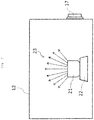
- FIG. 2 is a schematic diagram showing a mock contaminant is scattered inside the chamber 12.
- a mock contaminant inside the chamber 12 are stored a mock contaminant, a container 21 for storing the same, and an ultrasonic atomizing device 22 for generating a mist by providing ultrasonic vibration to them.
- these devices function as a contamination means of a cleaning-performance evaluation system.
- a mock contaminant that is harmless to the human body and environmentally nonpolluting is used as a mist.
- the mock contaminant is an aqueous solution of a fluorescence material (later-described) to generate a mist 23 by providing an aqueous solution stored in a container 21 with ultrasonic vibration by the ultrasonic atomizing device 22 (see FIG. 2 ).
- the generated mist of the mock contaminant attaches to the inner wall of the isolator, and it is subjected to a cleaning operation.
- an aqueous solution of a fluorescence material may be sprayed with a spray as conventionally employed.
- a spraying means such as a spray functions as a contamination means of a cleaning-performance evaluation system.
- the fluorescence material used in the present invention is not particularly restricted so long as it is a fluorescent substance. It is to be noted that, in this embodiment, it is preferably a substance that is harmless to the human body and environmentally nonpolluting, and water-soluble. Since the fluorescence material is water-soluble, without the use of other solvents, an aqueous solution can readily be adjusted to be converted into a mist.
- riboflavin (vitamin B2) or a derivative thereof that is conventionally used in cleaning evaluation is employed. Specifically, riboflavin sodium phosphate was used. The solubility of the riboflavin sodium phosphate to water is 50g/L, showing sufficient water solubility.
- the concentration of an aqueous solution of the riboflavin sodium phosphate may be in the range so that the fluorescence of a mist of a cleaning waste-liquid can be detected by a detector (later-described).
- a detector early-described
- the range of detection of a mist 23 by a detector is 1 ⁇ 10 -6 % by mass to 5.0 % by mass (solubility limit) (the detail later described). It is to be noted that the range of detection is preferably 0.1 % by mass to 2.0 % by mass in aqueous solution.
- the container 21 for storing an aqueous solution of a fluorescence material (0.2% riboflavin sodium phosphate aqueous solution) is placed on the vibration surface of the ultrasonic atomizing device 22 as a mist generation means to generate a mist 23 of the fluorescence material.
- the configuration and performance of the ultrasonic atomizing device 22 are not particularly restricted.
- the mist preferable has a proper drop size by using the aqueous solution of the fluorescence material as a mock contaminant.
- the proper drop size as a mock contaminant refers to scattering behavior that is similar to a mist of an actual pharmaceutical with high pharmacological activity (solution before freeze-drying) or powder (powder after freeze-drying).
- the frequency and output of the ultrasonic atomizing device 22 are adjusted in view of the specific gravity and the drop size of the mist 23 of the mock contaminant.
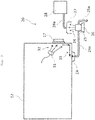
- FIG. 3 is a schematic diagram showing the evaluation of a cleaning operation inside the chamber in which the mock contaminant is scattered.
- the inside of a bug-out port 17 was subjected to a cleaning evaluation as an evaluation point of difficult cleaning.
- the cleaning-performance evaluation system 20 includes a wastewater pit 24 for recovering a cleaning waste-liquid, a waste liquid container 25 for storing the wastewater, an ultrasonic atomizing device 26 for generating a mist by providing ultrasonic vibration to them, a collector 27 for collecting the generated mist, and a detector 28 for detecting the collected mist.
- the wastewater pit 24 and the waste liquid container 25 are connected by a waste liquid pipe 24a, and the collector 27 and the detector 28 are connected by a suction pipe 28a.
- the cleaning operation cleans the bug-out port 17 from the inside of the chamber 12.
- a cleaning water 32 is discharged to the inside of the bug-out port 17 under planned conditions (direction, water pressure, time and water volume).
- the cleaning water 32 for cleaning the inside of the bug-out port 17 is converted into a cleaning waste-liquid 33 to be collected by the wastewater pit 24 of the chamber 12.
- the cleaning waste-liquid 33 collected by the wastewater pit 24 is continuously fed into the waste liquid container 25 via the waste liquid pipe 24a.
- the cleaning waste-liquid 33 in the waste liquid container 25 is discharged via a waste liquid pipe 25a. Accordingly, the cleaning waste-liquid 33 in the waste liquid container 25 always indicates the last cleaning operation, and with time, indicates the concentration of a fluorescence material removed by a cleaning operation.
- the waste liquid container 25 for storing the cleaning waste-liquid 33 fed with time is placed on the vibration surface of the ultrasonic atomizing device 26 as a mist generation means to generate a mist 34 of the cleaning waste-liquid 33.
- the configuration and performance of the ultrasonic atomizing device 26 are not particularly restricted, but the frequency and output of the ultrasonic atomizing device 26 are adjusted in view of the detection accuracy by the later-described detector 28.
- the generated mist 34 is collected by the collector 27 as inspection air together with ambient air.
- the inspection air collected by the collector 27 is fed into the detector 28 as a detection means via the suction pipe 28a.
- the detector 28 includes a pump (not shown) for sucking inspection air.
- a Rapid Microbiological device used in Rapid Microbiological Method can be used as the detector 28.
- the Rapid Microbiological device generally includes a particle counter and a floated microbe counter. These counters suck a certain amount of inspection air fed from the suction pipe from a collecting opening as a sample to detect particles (fine particles) and floated microbes (microorganism fine particles) therein with an optical measuring instrument.
- Rapid Microbiological devices using optical measuring instruments as a method for instantly determining a microorganism-derived fine particle, have been said to achieve more significant work efficiency than conventional culture methods.
- a Rapid Microbiological device is used to detect a fluorescent mist, rather than to measure floated microbes (microorganism fine particles).
- the particle counter As a fine particle detecting part of the detector 28, a particle counter using particle size selection by light scattering method was adopted.
- the particle counter instantly detects the total number of fine particles in inspection air. It is to be noted that, in this embodiment, the total number of fine particles detected by the particle counter is defined as "total particle concentration (/L)" in the inspection air.
- a floated microbe counter using fluorescence identification by laser induced fluorometry, was adopted.
- the laser induced fluorometry refers to the use of fine particles related to microorganisms or cell viability out of fine particles floating in the inspection air that are excited by ultraviolet rays to generate fluorescence.
- the floated microbe counter instantly detects the total number of fluorescence fine particles in the inspection air. It is to be noted that, in this embodiment, the total number of fluorescence fine particles detected by the floated microbe counter is defined as "positive particle concentration (/L)" in the inspection air.
- the positive particle ratio (%) is calculated from the total particle concentration (/L) detected by the particle counter and the positive particle concentration (/L) detected by the floated microbe counter.
- the positive particle ratio (%) can obviously be identified with the positive particle ratio (%) of the background (mist of water containing no fluorescence material), it can be determined that a mock contaminant is found in the inspection air.
- riboflavin sodium phosphate aqueous solutions having varied concentrations are prepared. As described above, the solubility of riboflavin sodium phosphate to water was 50g/L. Subsequently, 5 standard aqueous solution samples: 0.7 ⁇ 10 -2 % by mass (sample 1); 0.7 ⁇ 10 -4 % by mass (sample 2); 0.7 ⁇ 10 -6 % by mass (sample 3); 3.5 ⁇ 10 -8 % by mass (sample 4); and 0.7 ⁇ 10 -8 % by mass (sample 5), and water containing no fluorescence material (comparative sample) were prepared. Table 1 shows the concentrations of these samples.
- mist 34 of each of the samples was generated. It is to be noted that, as to the mist size distribution, the mist of 0.3 ⁇ m or more accounted for 73 to 83% or more, and the mist of 0.5 ⁇ m or more accounted for 13 to 21% or more.
- the collector 27 collected air containing the generated mist 34 as inspection air.
- the inspection air collected by the collector 27 is supplied into the detector 28 via the suction pipe 28a to detect the fluorescence material.
- Table 1 shows the total particle concentration (/L), the positive particle concentration (/L), and the calculated positive particle ratio (%) detected. [Table 1] Fluorescence material concentration (% by mass) Positive particle ratio (%) Total particle concentration (/L) Positive particle concentration (/L) Sample 1 0.7x10 -2 42.0 280 117 Sample 2 0.7x10 -4 5.5 1059 59 Sample 3 0.7x10 -6 3.6 547 16 Sample 4 3.5x10 -8 2.8 2527 92 Sample 5 0.7x10 -8 2.8 623 17 Comparative Sample 0 2.2 345 8
- the positive particle ratios of samples 1 to 3 can be identified with the positive particle ratio of comparative sample (mist of water containing no fluorescence material). It is to be noted that, in samples 1 and 2, the ratios are obviously identified, particularly in sample 1. Accordingly, when a fluorescence material is dissolved in a mist in inspection air, it is found that the concentration of 0.7 ⁇ 10 -6 % by mass or so (in 1 ⁇ 10 -6 % by mass) can readily be detected. In addition, in samples 4 and 5, the concentration of 3.5 ⁇ 10 -8 % by mass or 0.7 ⁇ 10 -8 % by mass or so (in 1 ⁇ 10 -8 % by mass) shows no identification with comparative sample and it can be determined that the fluorescence material is not dissolved.
- the total particle concentration and the positive particle concentration in this embodiment may basically be interpreted as an apparent total particle concentration and an apparent positive particle concentration, respectively.
- the concentration of an aqueous solution of a fluorescence material of 0.7 ⁇ 10 -6 % by mass (1 ⁇ 10 -6 % by mass digit) can be set as the detection limit concentration. It is to be noted that, in this embodiment, as to an actually employed ultrasonic atomizing device and a detector combined, the above mentioned preliminary test is preferably carried out to confirm the detection limit concentration.
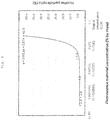
- FIG. 4 shows a graph obtained from the results in Table 1.
- FIG. 4 is a graph showing the relationship between the fluorescence material concentration (% by mass) detected by a detector and the positive particle ratio (%) on each of the samples.
- the concentration of a fluorescence material dissolved into a mist of a mock contaminant administered to the inside of the chamber 12 was 0.2 % by mass (right edge in the graph).
- the fluorescence material of the concentration is diluted by a cleaning operation to be dissolved in the cleaning waste-liquid 33, but this material can readily be detected in the beginning of cleaning.
- the concentration of the fluorescence material declines by a cleaning operation, below the value in 1 ⁇ 10 -6 % by mass as the detection limit concentration, and when it comes to the value in 1 ⁇ 10 -8 % by mass, it can be determined that the mock contaminant is removed by the cleaning operation.
- the detection limit concentration in 1 ⁇ 10 -6 % by mass is 1/10000 of the concentration of the fluorescence material initially administered (0.2 % by mass).
- the value in 1 ⁇ 10 -8 % by mass in which it can be determined that a fluorescence material is not dissolved is 1/1000000 of the concentration of the fluorescence material initially administered (0.2 % by mass). From these observations, in this embodiment, the cleaning-performance can quantitatively be determined in the range significantly above the initial concentration of 1/100 as a conventional standard.
- the present invention can provide a cleaning-performance evaluation system without such factors as the experience of evaluators causing variations in evaluation that can acquire evaluation results in real time as quantitative values.
Landscapes
- Health & Medical Sciences (AREA)
- Chemical & Material Sciences (AREA)
- Life Sciences & Earth Sciences (AREA)
- Physics & Mathematics (AREA)
- Biochemistry (AREA)
- Analytical Chemistry (AREA)
- General Health & Medical Sciences (AREA)
- General Physics & Mathematics (AREA)
- Immunology (AREA)
- Pathology (AREA)
- Nuclear Medicine, Radiotherapy & Molecular Imaging (AREA)
- Dispersion Chemistry (AREA)
- Hydrology & Water Resources (AREA)
- Optics & Photonics (AREA)
- Investigating, Analyzing Materials By Fluorescence Or Luminescence (AREA)
Applications Claiming Priority (2)
| Application Number | Priority Date | Filing Date | Title |
|---|---|---|---|
| JP2017023750A JP6741930B2 (ja) | 2017-02-13 | 2017-02-13 | 洗浄性能評価システム |
| PCT/JP2018/003561 WO2018147178A1 (ja) | 2017-02-13 | 2018-02-02 | 洗浄性能評価システム |
Publications (3)
| Publication Number | Publication Date |
|---|---|
| EP3581920A1 true EP3581920A1 (de) | 2019-12-18 |
| EP3581920A4 EP3581920A4 (de) | 2020-12-02 |
| EP3581920B1 EP3581920B1 (de) | 2021-09-01 |
Family
ID=63107437
Family Applications (1)
| Application Number | Title | Priority Date | Filing Date |
|---|---|---|---|
| EP18750740.5A Active EP3581920B1 (de) | 2017-02-13 | 2018-02-02 | System zur beurteilung einer reinigungsleistung |
Country Status (6)
| Country | Link |
|---|---|
| US (1) | US10712267B2 (de) |
| EP (1) | EP3581920B1 (de) |
| JP (1) | JP6741930B2 (de) |
| KR (1) | KR102312577B1 (de) |
| CN (1) | CN109154572B (de) |
| WO (1) | WO2018147178A1 (de) |
Cited By (1)
| Publication number | Priority date | Publication date | Assignee | Title |
|---|---|---|---|---|
| WO2022214660A1 (en) | 2021-04-09 | 2022-10-13 | Teknologisk Institut | System and method for determining surface cleaning in a food manufacturing facility |
Families Citing this family (5)
| Publication number | Priority date | Publication date | Assignee | Title |
|---|---|---|---|---|
| KR20220000409A (ko) * | 2019-05-23 | 2022-01-03 | 램 리써치 코포레이션 | 챔버 컴포넌트 청정도 측정 시스템 |
| KR102201433B1 (ko) * | 2019-10-10 | 2021-01-13 | 연세대학교 산학협력단 | 기계학습을 이용한 바이오 에어로졸 모니터링 장치 및 그 방법 |
| CN112386982A (zh) * | 2020-11-27 | 2021-02-23 | 重庆秦安机电股份有限公司 | 一种清洁度实验室清洗液过滤循环系统 |
| US11953419B2 (en) | 2021-02-23 | 2024-04-09 | Industry-Academic Cooperation Foundation, Yonsei University | Apparatus for monitoring bioaerosols using machine learning and method thereof |
| KR102883700B1 (ko) * | 2021-03-05 | 2025-11-12 | 삼성전자주식회사 | 오염원 검출 장치 및 이를 포함하는 모니터링 시스템 |
Family Cites Families (30)
| Publication number | Priority date | Publication date | Assignee | Title |
|---|---|---|---|---|
| KR100189777B1 (ko) * | 1995-12-26 | 1999-06-01 | 윤종용 | 용액불순물입자 측정시스템 |
| JP3618198B2 (ja) * | 1997-06-11 | 2005-02-09 | 株式会社東芝 | 元素分析方法 |
| US6394111B1 (en) | 1997-06-11 | 2002-05-28 | Ethicon, Inc. | Detection of cleanliness of a medical device during a washing process |
| JP3343651B2 (ja) * | 1998-02-17 | 2002-11-11 | 東京エレクトロン株式会社 | 洗浄処理方法 |
| JP2000185265A (ja) * | 1998-12-22 | 2000-07-04 | Lion Corp | 液状薬剤製造設備の洗浄方法 |
| JP3658257B2 (ja) * | 1998-12-24 | 2005-06-08 | キヤノン株式会社 | 洗浄方法及び洗浄装置及び電子写真感光体及び電子写真感光体の製造方法 |
| CA2390723A1 (en) * | 1999-11-12 | 2001-05-17 | Merck & Co., Inc. | Melanocortin-3 receptor deficient cells, non-human transgenic animals and methods of selecting compounds which regulate body weight |
| JP2003088816A (ja) * | 2001-09-20 | 2003-03-25 | Mitsubishi Heavy Ind Ltd | 洗浄簡易判定システム |
| JP3593085B2 (ja) | 2001-10-22 | 2004-11-24 | 三菱重工業株式会社 | 試料濃縮装置及び有機微量成分の検出装置 |
| US6850164B2 (en) * | 2002-10-03 | 2005-02-01 | The Boeing Company | Air leak detection system and method |
| JP2004309160A (ja) * | 2003-04-02 | 2004-11-04 | Shimizu Corp | クリーンルームの気密性能試験方法 |
| ATE348303T1 (de) * | 2004-07-22 | 2007-01-15 | Ima Telstar S L | Vorrichtung zum laden und entladen von behältern |
| FR2929707B1 (fr) * | 2008-04-03 | 2010-12-10 | Alcatel Lucent | Procede de controle de l'etancheite d'un contenant a tester et dispositif correspondant de mise en oeuvre |
| CN101428282B (zh) * | 2008-12-23 | 2010-07-14 | 中国科学院广州能源研究所 | 带材连续清洗设备清洗槽 |
| CN102021308B (zh) * | 2010-08-31 | 2012-11-21 | 吕军 | 在线检测连续退火炉炉内气体中油含量的检测方法 |
| JP5861863B2 (ja) * | 2011-08-30 | 2016-02-16 | 清水建設株式会社 | 医薬品粉体の飛散状態評価方法及び当該方法に用いる飛散状態評価用模擬粉体 |
| JP2013146263A (ja) * | 2011-12-21 | 2013-08-01 | Azbil Corp | 微生物検出装置の校正方法、及び微生物検出装置の校正キット |
| JP5934577B2 (ja) * | 2012-05-21 | 2016-06-15 | 株式会社エアレックス | 電子線照射装置 |
| DE102012218489A1 (de) * | 2012-10-10 | 2014-04-10 | Dürr Ecoclean GmbH | Vorrichtung für das Auffangen einer Schmutzpartikelfracht |
| JP6031372B2 (ja) * | 2013-02-12 | 2016-11-24 | アズビル株式会社 | 粒子検出システム及び粒子検出方法 |
| JP2014221012A (ja) * | 2013-05-13 | 2014-11-27 | 清水建設株式会社 | 模擬粉体、粉体飛散状態評価方法、及び粉体取扱い施設 |
| JP6143078B2 (ja) * | 2013-05-13 | 2017-06-07 | 清水建設株式会社 | 模擬粉体の製造方法、及び粉体飛散状態評価方法 |
| JP6143080B2 (ja) * | 2013-05-27 | 2017-06-07 | 清水建設株式会社 | 飛散状態評価用模擬粉体を含有するスプレー剤、及び粉体の飛散状態の評価方法 |
| JP6296288B2 (ja) * | 2014-03-31 | 2018-03-20 | 清水建設株式会社 | 医薬品製造方法 |
| JP6328493B2 (ja) * | 2014-05-28 | 2018-05-23 | 東京エレクトロン株式会社 | 測定装置及び測定方法 |
| US20150359522A1 (en) * | 2014-06-17 | 2015-12-17 | Palo Alto Research Center Incorporated | Point of care urine tester and method |
| JP6455664B2 (ja) | 2015-02-26 | 2019-01-23 | 澁谷工業株式会社 | 凍結乾燥製剤製造システム |
| JP6544564B2 (ja) * | 2015-04-20 | 2019-07-17 | 清水建設株式会社 | 模擬粉体、及び粉体飛散状態評価方法 |
| JP6622069B2 (ja) * | 2015-11-27 | 2019-12-18 | 株式会社エアレックス | 遮蔽作業室を有する装置及びその使用方法 |
| CN106226000B (zh) * | 2016-07-07 | 2019-01-01 | 中国科学院光电研究院 | 一种真空密封性能测量装置和方法 |
-
2017
- 2017-02-13 JP JP2017023750A patent/JP6741930B2/ja active Active
-
2018
- 2018-02-02 EP EP18750740.5A patent/EP3581920B1/de active Active
- 2018-02-02 US US16/304,891 patent/US10712267B2/en active Active
- 2018-02-02 CN CN201880001932.4A patent/CN109154572B/zh active Active
- 2018-02-02 WO PCT/JP2018/003561 patent/WO2018147178A1/ja not_active Ceased
- 2018-02-02 KR KR1020187034091A patent/KR102312577B1/ko active Active
Cited By (1)
| Publication number | Priority date | Publication date | Assignee | Title |
|---|---|---|---|---|
| WO2022214660A1 (en) | 2021-04-09 | 2022-10-13 | Teknologisk Institut | System and method for determining surface cleaning in a food manufacturing facility |
Also Published As
| Publication number | Publication date |
|---|---|
| CN109154572A (zh) | 2019-01-04 |
| KR102312577B1 (ko) | 2021-10-13 |
| WO2018147178A1 (ja) | 2018-08-16 |
| EP3581920B1 (de) | 2021-09-01 |
| EP3581920A4 (de) | 2020-12-02 |
| CN109154572B (zh) | 2022-02-15 |
| KR20190118499A (ko) | 2019-10-18 |
| JP2018132301A (ja) | 2018-08-23 |
| JP6741930B2 (ja) | 2020-08-19 |
| US20200011791A1 (en) | 2020-01-09 |
| US10712267B2 (en) | 2020-07-14 |
Similar Documents
| Publication | Publication Date | Title |
|---|---|---|
| EP3581920B1 (de) | System zur beurteilung einer reinigungsleistung | |
| CN101398367B (zh) | 气溶胶粒子激光分析仪 | |
| KR101721190B1 (ko) | 미생물 필터 테스트 장치 | |
| JPWO2018047409A1 (ja) | 粒子計数器組み込み型隔離装置 | |
| WO2018147176A1 (ja) | 封じ込め性能検査システム | |
| DE102018209184B3 (de) | Prüfkammer, Verwendung und Verfahren zum Testen eines Produkts auf Keim- und/oder Partikeldichtigkeit | |
| Govind et al. | A review on cleaning validation in pharmaceutical industry | |
| JP5787515B2 (ja) | 空中浮遊菌の検査方法 | |
| Teotia et al. | Engineering advances in safe laboratory design for pharmaceutical microbiology and assessment of their biohazard risk measures | |
| Clark | Safety cabinets, fume cupboards and other containment systems | |
| Rydock | A simple method for tracer containment testing of hospital isolation rooms | |
| Neumann et al. | Preventive measures to reduce bioaerosol exposure during refuse collection: results of field studies in the real-life situation | |
| Calfee et al. | Evaluation of sampling methods for Bacillus spore-contaminated HVAC filters | |
| CN112346137A (zh) | 检查站和检查方法 | |
| CN206804484U (zh) | 测霾电路及包含该测霾电路的测霾仪 | |
| US20190316074A1 (en) | Microorganism contamination inspection system | |
| CN108404171A (zh) | 生物生化污染因子检测处置车 | |
| JPH02191517A (ja) | 高効率フイルタの漏洩検査装置 | |
| Daub et al. | Particulate Matter in Inhalation Products, Parenterals and Ophthalmic Solutions: Best Practices for Handling-Part 1. | |
| Zwiebel | Aerosol Testing of Biological Point Detection Systems | |
| Doherty et al. | Collective Protection Factors Methodology Development Using High Concentration Polydisperse Inert Aerosols: Results of FY09 Testing | |
| Melnick et al. | Role of Sample Collection and Scanning Electron Microscopy (SEM) in Contaminant Analysis in Hospital Pharmacies | |
| BIRRER | XV. STERILITY TESTING | |
| Ward | Particle Monitoring: Case Studies | |
| Ucci et al. | Set-Up and Validation of a Clean-In-Place (CIP) System for a Coating Pan |
Legal Events
| Date | Code | Title | Description |
|---|---|---|---|
| STAA | Information on the status of an ep patent application or granted ep patent |
Free format text: STATUS: THE INTERNATIONAL PUBLICATION HAS BEEN MADE |
|
| PUAI | Public reference made under article 153(3) epc to a published international application that has entered the european phase |
Free format text: ORIGINAL CODE: 0009012 |
|
| STAA | Information on the status of an ep patent application or granted ep patent |
Free format text: STATUS: REQUEST FOR EXAMINATION WAS MADE |
|
| 17P | Request for examination filed |
Effective date: 20181025 |
|
| AK | Designated contracting states |
Kind code of ref document: A1 Designated state(s): AL AT BE BG CH CY CZ DE DK EE ES FI FR GB GR HR HU IE IS IT LI LT LU LV MC MK MT NL NO PL PT RO RS SE SI SK SM TR |
|
| AX | Request for extension of the european patent |
Extension state: BA ME |
|
| DAV | Request for validation of the european patent (deleted) | ||
| DAX | Request for extension of the european patent (deleted) | ||
| A4 | Supplementary search report drawn up and despatched |
Effective date: 20201104 |
|
| RIC1 | Information provided on ipc code assigned before grant |
Ipc: G01N 21/53 20060101ALN20201029BHEP Ipc: G01N 15/06 20060101ALI20201029BHEP Ipc: G01N 21/94 20060101ALI20201029BHEP Ipc: G01N 21/64 20060101AFI20201029BHEP |
|
| GRAP | Despatch of communication of intention to grant a patent |
Free format text: ORIGINAL CODE: EPIDOSNIGR1 |
|
| STAA | Information on the status of an ep patent application or granted ep patent |
Free format text: STATUS: GRANT OF PATENT IS INTENDED |
|
| RIC1 | Information provided on ipc code assigned before grant |
Ipc: G01N 21/53 20060101ALN20210319BHEP Ipc: G01N 15/06 20060101ALI20210319BHEP Ipc: G01N 21/94 20060101ALI20210319BHEP Ipc: G01N 21/64 20060101AFI20210319BHEP |
|
| INTG | Intention to grant announced |
Effective date: 20210409 |
|
| RIN1 | Information on inventor provided before grant (corrected) |
Inventor name: KITANO, TSUKASA Inventor name: GUO, ZHIQIANG Inventor name: YAZAKI, YUKIHIRO Inventor name: FUTAMURA, HARUKA Inventor name: KAWASAKI, KOJI |
|
| GRAS | Grant fee paid |
Free format text: ORIGINAL CODE: EPIDOSNIGR3 |
|
| GRAA | (expected) grant |
Free format text: ORIGINAL CODE: 0009210 |
|
| STAA | Information on the status of an ep patent application or granted ep patent |
Free format text: STATUS: THE PATENT HAS BEEN GRANTED |
|
| AK | Designated contracting states |
Kind code of ref document: B1 Designated state(s): AL AT BE BG CH CY CZ DE DK EE ES FI FR GB GR HR HU IE IS IT LI LT LU LV MC MK MT NL NO PL PT RO RS SE SI SK SM TR |
|
| REG | Reference to a national code |
Ref country code: GB Ref legal event code: FG4D |
|
| REG | Reference to a national code |
Ref country code: CH Ref legal event code: EP Ref country code: AT Ref legal event code: REF Ref document number: 1426728 Country of ref document: AT Kind code of ref document: T Effective date: 20210915 |
|
| REG | Reference to a national code |
Ref country code: DE Ref legal event code: R096 Ref document number: 602018022912 Country of ref document: DE |
|
| REG | Reference to a national code |
Ref country code: IE Ref legal event code: FG4D |
|
| REG | Reference to a national code |
Ref country code: LT Ref legal event code: MG9D |
|
| REG | Reference to a national code |
Ref country code: NL Ref legal event code: MP Effective date: 20210901 |
|
| PG25 | Lapsed in a contracting state [announced via postgrant information from national office to epo] |
Ref country code: LT Free format text: LAPSE BECAUSE OF FAILURE TO SUBMIT A TRANSLATION OF THE DESCRIPTION OR TO PAY THE FEE WITHIN THE PRESCRIBED TIME-LIMIT Effective date: 20210901 Ref country code: BG Free format text: LAPSE BECAUSE OF FAILURE TO SUBMIT A TRANSLATION OF THE DESCRIPTION OR TO PAY THE FEE WITHIN THE PRESCRIBED TIME-LIMIT Effective date: 20211201 Ref country code: NO Free format text: LAPSE BECAUSE OF FAILURE TO SUBMIT A TRANSLATION OF THE DESCRIPTION OR TO PAY THE FEE WITHIN THE PRESCRIBED TIME-LIMIT Effective date: 20211201 Ref country code: HR Free format text: LAPSE BECAUSE OF FAILURE TO SUBMIT A TRANSLATION OF THE DESCRIPTION OR TO PAY THE FEE WITHIN THE PRESCRIBED TIME-LIMIT Effective date: 20210901 Ref country code: ES Free format text: LAPSE BECAUSE OF FAILURE TO SUBMIT A TRANSLATION OF THE DESCRIPTION OR TO PAY THE FEE WITHIN THE PRESCRIBED TIME-LIMIT Effective date: 20210901 Ref country code: FI Free format text: LAPSE BECAUSE OF FAILURE TO SUBMIT A TRANSLATION OF THE DESCRIPTION OR TO PAY THE FEE WITHIN THE PRESCRIBED TIME-LIMIT Effective date: 20210901 Ref country code: RS Free format text: LAPSE BECAUSE OF FAILURE TO SUBMIT A TRANSLATION OF THE DESCRIPTION OR TO PAY THE FEE WITHIN THE PRESCRIBED TIME-LIMIT Effective date: 20210901 Ref country code: SE Free format text: LAPSE BECAUSE OF FAILURE TO SUBMIT A TRANSLATION OF THE DESCRIPTION OR TO PAY THE FEE WITHIN THE PRESCRIBED TIME-LIMIT Effective date: 20210901 |
|
| REG | Reference to a national code |
Ref country code: AT Ref legal event code: MK05 Ref document number: 1426728 Country of ref document: AT Kind code of ref document: T Effective date: 20210901 |
|
| PG25 | Lapsed in a contracting state [announced via postgrant information from national office to epo] |
Ref country code: PL Free format text: LAPSE BECAUSE OF FAILURE TO SUBMIT A TRANSLATION OF THE DESCRIPTION OR TO PAY THE FEE WITHIN THE PRESCRIBED TIME-LIMIT Effective date: 20210901 Ref country code: LV Free format text: LAPSE BECAUSE OF FAILURE TO SUBMIT A TRANSLATION OF THE DESCRIPTION OR TO PAY THE FEE WITHIN THE PRESCRIBED TIME-LIMIT Effective date: 20210901 Ref country code: GR Free format text: LAPSE BECAUSE OF FAILURE TO SUBMIT A TRANSLATION OF THE DESCRIPTION OR TO PAY THE FEE WITHIN THE PRESCRIBED TIME-LIMIT Effective date: 20211202 |
|
| PG25 | Lapsed in a contracting state [announced via postgrant information from national office to epo] |
Ref country code: AT Free format text: LAPSE BECAUSE OF FAILURE TO SUBMIT A TRANSLATION OF THE DESCRIPTION OR TO PAY THE FEE WITHIN THE PRESCRIBED TIME-LIMIT Effective date: 20210901 |
|
| PG25 | Lapsed in a contracting state [announced via postgrant information from national office to epo] |
Ref country code: IS Free format text: LAPSE BECAUSE OF FAILURE TO SUBMIT A TRANSLATION OF THE DESCRIPTION OR TO PAY THE FEE WITHIN THE PRESCRIBED TIME-LIMIT Effective date: 20220101 Ref country code: SM Free format text: LAPSE BECAUSE OF FAILURE TO SUBMIT A TRANSLATION OF THE DESCRIPTION OR TO PAY THE FEE WITHIN THE PRESCRIBED TIME-LIMIT Effective date: 20210901 Ref country code: SK Free format text: LAPSE BECAUSE OF FAILURE TO SUBMIT A TRANSLATION OF THE DESCRIPTION OR TO PAY THE FEE WITHIN THE PRESCRIBED TIME-LIMIT Effective date: 20210901 Ref country code: RO Free format text: LAPSE BECAUSE OF FAILURE TO SUBMIT A TRANSLATION OF THE DESCRIPTION OR TO PAY THE FEE WITHIN THE PRESCRIBED TIME-LIMIT Effective date: 20210901 Ref country code: PT Free format text: LAPSE BECAUSE OF FAILURE TO SUBMIT A TRANSLATION OF THE DESCRIPTION OR TO PAY THE FEE WITHIN THE PRESCRIBED TIME-LIMIT Effective date: 20220103 Ref country code: NL Free format text: LAPSE BECAUSE OF FAILURE TO SUBMIT A TRANSLATION OF THE DESCRIPTION OR TO PAY THE FEE WITHIN THE PRESCRIBED TIME-LIMIT Effective date: 20210901 Ref country code: EE Free format text: LAPSE BECAUSE OF FAILURE TO SUBMIT A TRANSLATION OF THE DESCRIPTION OR TO PAY THE FEE WITHIN THE PRESCRIBED TIME-LIMIT Effective date: 20210901 Ref country code: CZ Free format text: LAPSE BECAUSE OF FAILURE TO SUBMIT A TRANSLATION OF THE DESCRIPTION OR TO PAY THE FEE WITHIN THE PRESCRIBED TIME-LIMIT Effective date: 20210901 Ref country code: AL Free format text: LAPSE BECAUSE OF FAILURE TO SUBMIT A TRANSLATION OF THE DESCRIPTION OR TO PAY THE FEE WITHIN THE PRESCRIBED TIME-LIMIT Effective date: 20210901 |
|
| REG | Reference to a national code |
Ref country code: DE Ref legal event code: R097 Ref document number: 602018022912 Country of ref document: DE |
|
| PLBE | No opposition filed within time limit |
Free format text: ORIGINAL CODE: 0009261 |
|
| STAA | Information on the status of an ep patent application or granted ep patent |
Free format text: STATUS: NO OPPOSITION FILED WITHIN TIME LIMIT |
|
| PG25 | Lapsed in a contracting state [announced via postgrant information from national office to epo] |
Ref country code: DK Free format text: LAPSE BECAUSE OF FAILURE TO SUBMIT A TRANSLATION OF THE DESCRIPTION OR TO PAY THE FEE WITHIN THE PRESCRIBED TIME-LIMIT Effective date: 20210901 |
|
| 26N | No opposition filed |
Effective date: 20220602 |
|
| PG25 | Lapsed in a contracting state [announced via postgrant information from national office to epo] |
Ref country code: SI Free format text: LAPSE BECAUSE OF FAILURE TO SUBMIT A TRANSLATION OF THE DESCRIPTION OR TO PAY THE FEE WITHIN THE PRESCRIBED TIME-LIMIT Effective date: 20210901 |
|
| PG25 | Lapsed in a contracting state [announced via postgrant information from national office to epo] |
Ref country code: MC Free format text: LAPSE BECAUSE OF FAILURE TO SUBMIT A TRANSLATION OF THE DESCRIPTION OR TO PAY THE FEE WITHIN THE PRESCRIBED TIME-LIMIT Effective date: 20210901 |
|
| REG | Reference to a national code |
Ref country code: BE Ref legal event code: MM Effective date: 20220228 |
|
| PG25 | Lapsed in a contracting state [announced via postgrant information from national office to epo] |
Ref country code: LU Free format text: LAPSE BECAUSE OF NON-PAYMENT OF DUE FEES Effective date: 20220202 |
|
| PG25 | Lapsed in a contracting state [announced via postgrant information from national office to epo] |
Ref country code: IE Free format text: LAPSE BECAUSE OF NON-PAYMENT OF DUE FEES Effective date: 20220202 |
|
| PG25 | Lapsed in a contracting state [announced via postgrant information from national office to epo] |
Ref country code: BE Free format text: LAPSE BECAUSE OF NON-PAYMENT OF DUE FEES Effective date: 20220228 |
|
| REG | Reference to a national code |
Ref country code: DE Ref legal event code: R082 Ref document number: 602018022912 Country of ref document: DE Representative=s name: KRAUS & LEDERER PARTGMBB, DE |
|
| PG25 | Lapsed in a contracting state [announced via postgrant information from national office to epo] |
Ref country code: MK Free format text: LAPSE BECAUSE OF FAILURE TO SUBMIT A TRANSLATION OF THE DESCRIPTION OR TO PAY THE FEE WITHIN THE PRESCRIBED TIME-LIMIT Effective date: 20210901 Ref country code: CY Free format text: LAPSE BECAUSE OF FAILURE TO SUBMIT A TRANSLATION OF THE DESCRIPTION OR TO PAY THE FEE WITHIN THE PRESCRIBED TIME-LIMIT Effective date: 20210901 |
|
| PG25 | Lapsed in a contracting state [announced via postgrant information from national office to epo] |
Ref country code: HU Free format text: LAPSE BECAUSE OF FAILURE TO SUBMIT A TRANSLATION OF THE DESCRIPTION OR TO PAY THE FEE WITHIN THE PRESCRIBED TIME-LIMIT; INVALID AB INITIO Effective date: 20180202 |
|
| PG25 | Lapsed in a contracting state [announced via postgrant information from national office to epo] |
Ref country code: TR Free format text: LAPSE BECAUSE OF FAILURE TO SUBMIT A TRANSLATION OF THE DESCRIPTION OR TO PAY THE FEE WITHIN THE PRESCRIBED TIME-LIMIT Effective date: 20210901 |
|
| PG25 | Lapsed in a contracting state [announced via postgrant information from national office to epo] |
Ref country code: MT Free format text: LAPSE BECAUSE OF FAILURE TO SUBMIT A TRANSLATION OF THE DESCRIPTION OR TO PAY THE FEE WITHIN THE PRESCRIBED TIME-LIMIT Effective date: 20210901 |
|
| PGFP | Annual fee paid to national office [announced via postgrant information from national office to epo] |
Ref country code: DE Payment date: 20250226 Year of fee payment: 8 |
|
| PGFP | Annual fee paid to national office [announced via postgrant information from national office to epo] |
Ref country code: CH Payment date: 20250301 Year of fee payment: 8 |
|
| PGFP | Annual fee paid to national office [announced via postgrant information from national office to epo] |
Ref country code: FR Payment date: 20250219 Year of fee payment: 8 |
|
| PGFP | Annual fee paid to national office [announced via postgrant information from national office to epo] |
Ref country code: IT Payment date: 20250228 Year of fee payment: 8 Ref country code: GB Payment date: 20250220 Year of fee payment: 8 |