EP3556901B1 - Source d'arc sous vide - Google Patents
Source d'arc sous vide Download PDFInfo
- Publication number
- EP3556901B1 EP3556901B1 EP18168526.4A EP18168526A EP3556901B1 EP 3556901 B1 EP3556901 B1 EP 3556901B1 EP 18168526 A EP18168526 A EP 18168526A EP 3556901 B1 EP3556901 B1 EP 3556901B1
- Authority
- EP
- European Patent Office
- Prior art keywords
- cathode
- vacuum arc
- arc source
- anode
- source according
- Prior art date
- Legal status (The legal status is an assumption and is not a legal conclusion. Google has not performed a legal analysis and makes no representation as to the accuracy of the status listed.)
- Active
Links
Images

Classifications
-
- H—ELECTRICITY
- H01—ELECTRIC ELEMENTS
- H01J—ELECTRIC DISCHARGE TUBES OR DISCHARGE LAMPS
- H01J37/00—Discharge tubes with provision for introducing objects or material to be exposed to the discharge, e.g. for the purpose of examination or processing thereof
- H01J37/32—Gas-filled discharge tubes
- H01J37/32009—Arrangements for generation of plasma specially adapted for examination or treatment of objects, e.g. plasma sources
- H01J37/32055—Arc discharge
-
- C—CHEMISTRY; METALLURGY
- C23—COATING METALLIC MATERIAL; COATING MATERIAL WITH METALLIC MATERIAL; CHEMICAL SURFACE TREATMENT; DIFFUSION TREATMENT OF METALLIC MATERIAL; COATING BY VACUUM EVAPORATION, BY SPUTTERING, BY ION IMPLANTATION OR BY CHEMICAL VAPOUR DEPOSITION, IN GENERAL; INHIBITING CORROSION OF METALLIC MATERIAL OR INCRUSTATION IN GENERAL
- C23C—COATING METALLIC MATERIAL; COATING MATERIAL WITH METALLIC MATERIAL; SURFACE TREATMENT OF METALLIC MATERIAL BY DIFFUSION INTO THE SURFACE, BY CHEMICAL CONVERSION OR SUBSTITUTION; COATING BY VACUUM EVAPORATION, BY SPUTTERING, BY ION IMPLANTATION OR BY CHEMICAL VAPOUR DEPOSITION, IN GENERAL
- C23C14/00—Coating by vacuum evaporation, by sputtering or by ion implantation of the coating forming material
- C23C14/06—Coating by vacuum evaporation, by sputtering or by ion implantation of the coating forming material characterised by the coating material
- C23C14/067—Borides
-
- C—CHEMISTRY; METALLURGY
- C23—COATING METALLIC MATERIAL; COATING MATERIAL WITH METALLIC MATERIAL; CHEMICAL SURFACE TREATMENT; DIFFUSION TREATMENT OF METALLIC MATERIAL; COATING BY VACUUM EVAPORATION, BY SPUTTERING, BY ION IMPLANTATION OR BY CHEMICAL VAPOUR DEPOSITION, IN GENERAL; INHIBITING CORROSION OF METALLIC MATERIAL OR INCRUSTATION IN GENERAL
- C23C—COATING METALLIC MATERIAL; COATING MATERIAL WITH METALLIC MATERIAL; SURFACE TREATMENT OF METALLIC MATERIAL BY DIFFUSION INTO THE SURFACE, BY CHEMICAL CONVERSION OR SUBSTITUTION; COATING BY VACUUM EVAPORATION, BY SPUTTERING, BY ION IMPLANTATION OR BY CHEMICAL VAPOUR DEPOSITION, IN GENERAL
- C23C14/00—Coating by vacuum evaporation, by sputtering or by ion implantation of the coating forming material
- C23C14/22—Coating by vacuum evaporation, by sputtering or by ion implantation of the coating forming material characterised by the process of coating
- C23C14/24—Vacuum evaporation
- C23C14/32—Vacuum evaporation by explosion; by evaporation and subsequent ionisation of the vapours, e.g. ion-plating
- C23C14/325—Electric arc evaporation
-
- C—CHEMISTRY; METALLURGY
- C23—COATING METALLIC MATERIAL; COATING MATERIAL WITH METALLIC MATERIAL; CHEMICAL SURFACE TREATMENT; DIFFUSION TREATMENT OF METALLIC MATERIAL; COATING BY VACUUM EVAPORATION, BY SPUTTERING, BY ION IMPLANTATION OR BY CHEMICAL VAPOUR DEPOSITION, IN GENERAL; INHIBITING CORROSION OF METALLIC MATERIAL OR INCRUSTATION IN GENERAL
- C23C—COATING METALLIC MATERIAL; COATING MATERIAL WITH METALLIC MATERIAL; SURFACE TREATMENT OF METALLIC MATERIAL BY DIFFUSION INTO THE SURFACE, BY CHEMICAL CONVERSION OR SUBSTITUTION; COATING BY VACUUM EVAPORATION, BY SPUTTERING, BY ION IMPLANTATION OR BY CHEMICAL VAPOUR DEPOSITION, IN GENERAL
- C23C14/00—Coating by vacuum evaporation, by sputtering or by ion implantation of the coating forming material
- C23C14/22—Coating by vacuum evaporation, by sputtering or by ion implantation of the coating forming material characterised by the process of coating
- C23C14/56—Apparatus specially adapted for continuous coating; Arrangements for maintaining the vacuum, e.g. vacuum locks
- C23C14/564—Means for minimising impurities in the coating chamber such as dust, moisture, residual gases
-
- H—ELECTRICITY
- H01—ELECTRIC ELEMENTS
- H01J—ELECTRIC DISCHARGE TUBES OR DISCHARGE LAMPS
- H01J37/00—Discharge tubes with provision for introducing objects or material to be exposed to the discharge, e.g. for the purpose of examination or processing thereof
- H01J37/32—Gas-filled discharge tubes
- H01J37/32431—Constructional details of the reactor
- H01J37/32532—Electrodes
- H01J37/32541—Shape
-
- H—ELECTRICITY
- H01—ELECTRIC ELEMENTS
- H01J—ELECTRIC DISCHARGE TUBES OR DISCHARGE LAMPS
- H01J37/00—Discharge tubes with provision for introducing objects or material to be exposed to the discharge, e.g. for the purpose of examination or processing thereof
- H01J37/32—Gas-filled discharge tubes
- H01J37/32431—Constructional details of the reactor
- H01J37/32532—Electrodes
- H01J37/3255—Material
-
- H—ELECTRICITY
- H01—ELECTRIC ELEMENTS
- H01J—ELECTRIC DISCHARGE TUBES OR DISCHARGE LAMPS
- H01J37/00—Discharge tubes with provision for introducing objects or material to be exposed to the discharge, e.g. for the purpose of examination or processing thereof
- H01J37/32—Gas-filled discharge tubes
- H01J37/32431—Constructional details of the reactor
- H01J37/32532—Electrodes
- H01J37/32614—Consumable cathodes for arc discharge
-
- H—ELECTRICITY
- H01—ELECTRIC ELEMENTS
- H01J—ELECTRIC DISCHARGE TUBES OR DISCHARGE LAMPS
- H01J2237/00—Discharge tubes exposing object to beam, e.g. for analysis treatment, etching, imaging
- H01J2237/32—Processing objects by plasma generation
- H01J2237/33—Processing objects by plasma generation characterised by the type of processing
- H01J2237/332—Coating
Definitions
- the invention concerns a vacuum arc source for arc evaporation of Boride with the features of the preamble of claim 1 and use of such a vacuum arc source.
- WO 2011/137472 A1 discloses a TiB 2 target which contains fractions of one or more metals from the group consisting of iron, nickel, cobalt and chromium and also carbon having specific mean grain size of the TiB 2 grains and carbon content
- EP0577246 as well as US2013220800 are both disclosing a boride (TiB2) vacuum arc source with: a cathode of e.g TiB2, an anode (Cu in first document), a body surrounding the cathode and permitting the confinement of the arcs (shields 4 in first Document, and ring 16 in the second one).
- Destructions of TiB 2 -cathodes upon arcing is assumed to be caused by a relatively high thermal expansion coefficient. Local heating of the TiB 2 -cathode by the arc spot leads to high stress, with resulting cracking, upon a temperature gradient.
- the purpose of the invention is to provide a vacuum arc source for arc evaporation of Boride that can be used continuously or for longer periods of time than vacuum arc sources according to the prior art.
- an inventive vacuum arc source there are dissipated arc discharges (as no magnets need be used) leading to less current density and therefore less thermal shock decreasing risk of cracking of cathode. It is achieved that a coating produced using the inventive vacuum arc source is - at least substantially - free from impurities.
- anode Placing the anode near the cathode results in intensive anode heating. Choosing an anode, the material of which is at least 90 at-% (preferably more than 99 at-%) of the same chemical composition as the cathode, cathode contamination of anode material, and resulting unintentional impurity incorporation during materials synthesis, is prevented.
- the cathode is made of TiB 2 , ZrB 2 , VB 2 , TaB 2 , CrB 2 , NbB 2 , W 2 B 5 or WB 2 , HfB 2 , AlB 2 , MoB 2 , or MoB, or mixtures thereof.
- the invention provides for ignition of the discharge at another material with subsequent movement of the arc spot to the Boride cathode.
- the cathode is surrounded by a body made of a material which is less preferred by arc discharge compared to the cathode.
- the invention increases the time a vacuum arc source for arc evaporation of Boride can be used by eliminating cathode destruction due to electrical and/or mechanical effects occurring during the ignition and/or operation of the arc.
- a magnet is used for keeping the arc at the operational cathode surface. Without the magnet and without a body, arc spots start to go to the side of the cathode, where generated metallic flux can disrupt source insulators or the spot can die. Both these effects influence the process stability.
- the invention does not need the use of a magnet, in other words, during operation of the vacuum arc source, motion of the arc discharge is governed by electric field lines extending between cathode and anode and preferably there are no magnets guiding the arc discharge.
- a magnet (which is typically used in prior sources), needs not be used. The absence of the magnet may lead to arc spots going to the edges of the cathode, where they die, and interrupt the deposition process.
- the here proposed body of a material of a higher cathode potential contains the arc in the operational area of the cathode surface limited by the cylinder edges. With no source magnet present, an increase in the strength of the electric field on sharp crystal grains on a Boride-cathode surface supports ignition of simultaneously operating arc spots of a lower spot current. This reduces the temperature gradient at the operational cathode surface and reduces the accompanying stress and a probability of cathode destruction.
- Mo Molybdenum
- TiB 2 a potential around 30 V for the same conditions as used for, e. g., TiB 2 . Comparing the resulting power (potential multiplied with the arc current), in this invention Mo or alloys thereof are preferably used as a material for the body surrounding the cathode.
- Other possible materials are Tungsten, Tantalum, Niobium, or alloys thereof, or electrically insulating ceramics based on Al 2 O 3 , ZrO 2 , BN.
- a shape of the cathode is prismatic or cylindrical and/or a shape of the body is prismatic or cylindrical (having an opening for the cathode), wherein it is preferred that the shape of the cathode and the shape of the body are at least substantially the same. It should be understood, however, that the aforementioned shaped of the cathode can be modified in such a way that the cathode shows tapering towards the arc surface.
- a cylindrical shape of the cathode and a hollow-cylindrical shape of the body allow rotation of the cathode.
- a maximum gap between cathode and body is below 1 Millimeter, preferably below 0,5 Millimeter. Although gaps of such small dimensions are acceptable it is preferred that the body abuts the cathode.
- the height of the body With respect to a height of the body relative to a height of the cathode it is not necessary - although possible - that they are the same. It is sufficient if it is provided that the height of the body is at least 30 % of the height of the cathode.
- the anode - in a view onto the arc surface of the cathode - covers the end face of the body (with the possible exception of a slit for a trigger pin of an ignition system) - leaving an aperture allowing transport of a material flux from the arc surface of the cathode.
- the body surrounding the cathode not only prevents glowing of the arc at the cathode border, but also protect the operational cathode surface from electrical and mechanical damaging effects accompanying ignition of the arc.
- the arc discharge is ignited by a pneumatic system based on a brief touch of the cathode surface by a trigger pin.
- the ignition current flowing through the trigger is typically in the range of tens of amperes, and the contact area is relatively small.
- the trigger pin can be arranged to touch the body surrounding the cathode instead of the cathode itself (e. g. the length of the trigger pin can be adjusted).
- a radial width of the body should be greater than a diameter of the trigger pin thus ensuring reliable ignition.
- the edge of the body then serves as the place for the arc ignition process (only if the material of the body is electrically conductive, this would not work e. g. with electrically insulating materials such as the beforementioned ceramics) with subsequent movement of the discharge to the cathode, where the arc preferentially glows. Tests by the applicant showed that erosion of the body is insignificant compared to the cathode. When using a body made of Molybdenum, diagnostics of plasma generated from the assembly and the resulting films showed no traces of Molybdenum.
- Similar increase in field strength can be achieved by reduction of the cathode-anode distance, by placing the system anode as close to the cathode surface as possible.
- the material flux from the cathode surface, for such configuration, is proposed to go through the anode aperture.
- a short cathode-anode distance results in evaporation of the anode. This may result in deposition of anode material onto the cathode surface, and unintentional incorporation of contaminations during materials synthesis.
- a cooling system for the anode can be utilized, however, in the invention this is not necessary since at least 90 at-% of the material of the anode is of the same chemical composition as the cathode.
- the vacuum arc source according to the invention can be uses for PVD deposition of thin-film-coatings, preferably for cutting and forming tools.
- the proposed vacuum arc source has been successfully tested for a TiB 2 -cathode. Every assembly part was tested separately as well as together. For all performed experiments an arc current equal to 100 Amp has been used in a chamber with operational pressure of 10 -5 Torr.
- a plasma analyzer EQP from Hiden LTD was placed at 35 cm from a TiB 2 -cathode with a diameter of 59 mm surrounded by a Mo cylinder with an inner diameter of about 59 mm and an outer diameter of about 63 mm. Ignition was performed more than 10 times per minute for approximately 1 hour. It was found that ignition of the arc on Mo and subsequent movement to the TiB 2 -cathode was assured for at least 90 % of the attempts. Plasma diagnostics of the resulting material flux showed non-significant amount of Mo. The experiment also showed that with the body surrounding the TiB 2 -cathode, there is no destruction of the cathode surface by the trigger pin. However, from time to time, the arc spot was still able to stick locally.
- a vacuum arc source consisting of the TiB 2 -cathode, the Mo cylinder and the TiB 2 disc anode with a slit for arc ignition was also tested.
- the complete assembly showed a stable arc ignition process and smooth and stable arc plasma generation. Erosion of the operational cathode surface was found smooth and uniform. Sticking of the arc spot and an accompanying destruction of the cathode was not detected for the whole time of the experiment, about 2 hours.
- the performed plasma diagnostic of the generated material flux could be reproduced at different times during the experiment, or between different experiments performed under the same conditions.
- the cathode-assembly according to the invention and/or a vacuum arc source according to the invention can be uses for PVD deposition of coatings for cutting and forming tools.
- a hollow shape of the body is chosen correspondingly, e. g. for a cylindrical cathode the body is in the shape of a hollow cylinder, for a conical cathode the body is in the shape of a hollow cone, for a prismatic cathode the body is in the shape of a hollow prism etc.
- Figure 1 shows a cathode-assembly for arc evaporation of TiB 2 with a cathode 1 made of TiB 2 , the cathode 1 being surrounded by a body 2 made of a material (here: Mo) which is less preferred by arc discharge compared to the TiB 2 -cathode 1.
- An ignition system 3 comprising a trigger pin 4 is shown.
- Figure 2 shows a vacuum arc source for arc evaporation of TiB 2 using the cathode-assembly of Figure 1 .
- the body 2 in form of a Mo cylinder protects the cathode 1 from undesired effects accompanying ignition of the arc and, at the same time, it keeps the arc spot at the operational cathode surface.
- the anode 5 has the shape of a disk with an aperture 7 for transport of the generated material flux to a substrate. It can also be noted that performed experiments showed that arc spots ignited below the anode 5 tend to go to the cathode area below the anode aperture.
- the disk is provided with a slit 6 for the trigger pin 4 providing arc discharge ignition such that the trigger pin 4 can pass through the plane of the disk to touch the body 2.
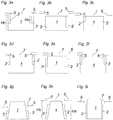
- FIGS 3a to 3i show different possible configurations of cathode 1, body 2 and anode 5.
- cathode 1, body 2 and anode 5 are in the form of rotating bodies:
- the cathode 1 is in the shape of a cylinder having a groove for the body 2 which is in the shape of a hollow cylinder.
- the cathode 1 is in the shape of a (truncated) cone and the body 2 is in the shape of a hollow (truncated) cone.
- the cathode 1 is in the shape of a cylinder which is tapering towards the arc surface.
- the anode 5 is in the form of a ring.
- a height H B of the body 2 is at least 30 % of a height H C of the cathode 1.
- the body 2 abuts a mantle surface of the cathode 1.
- a small gap between body 2 and cathode 1 below 1 Millimeter, preferably below 0,5 Millimeter would be acceptable.
- a top or end surface of the body 2 is coplanar with the arc surface of the cathode 1.
- the body 2 is coplanar with an outer rim of the arc surface of the cathode 1.
- an inner, central region of the arc surface of the cathode 1 lies below the outer rim of the arc surface of the cathode 1.
Landscapes
- Chemical & Material Sciences (AREA)
- Engineering & Computer Science (AREA)
- Materials Engineering (AREA)
- Chemical Kinetics & Catalysis (AREA)
- Mechanical Engineering (AREA)
- Metallurgy (AREA)
- Organic Chemistry (AREA)
- Plasma & Fusion (AREA)
- Analytical Chemistry (AREA)
- Physics & Mathematics (AREA)
- Physical Vapour Deposition (AREA)
- Discharge Heating (AREA)
- Inorganic Insulating Materials (AREA)
- High-Tension Arc-Extinguishing Switches Without Spraying Means (AREA)
Claims (16)
- Source d'arc sous vide pour une évaporation par arc de borure, comprenant :- une cathode (1) constituée d'au moins 90 % atomique de borure, en particulier constituée de plus de 98 % atomique de borure- une anode (5)- un corps (2) constitué d'une matière qui est moins préférée par la décharge par arc en comparaison avec la cathode (1), le corps (2) entourant la cathode (1) de telle sorte que pendant le fonctionnement de la source d'arc sous vide, un déplacement d'un arc sur une surface d'arc de la cathode (1) soit limité par le corps (2)caractérisée en ce que
au moins 90 % atomique de la matière de l'anode (5) est de même composition chimique que la cathode (1). - Source d'arc sous vide selon la revendication 1, dans laquelle l'anode (5) se présente sous la forme d'un disque.
- Source d'arc sous vide selon au moins l'une des revendications précédentes, dans laquelle la cathode (1) est constituée de TiB2, ZrB2, VB2, TaB2, CrB2, NbB2, W2B5 ou WB2, HfB2, AlB2, MoB2, ou MoB, ou des mélanges de ceux-ci.
- Source d'arc sous vide selon au moins l'une des revendications précédentes, dans laquelle une forme de la cathode (1) est prismatique ou cylindrique et/ou une forme du corps (2) est prismatique ou cylindrique, dans laquelle il est préféré que la forme de la cathode (1) et la forme du corps (2) soient au moins sensiblement les mêmes.
- Source d'arc sous vide selon la revendication précédente, dans laquelle la cathode (1) s'effile vers la surface d'arc.
- Source d'arc sous vide selon au moins l'une des revendications précédentes, dans laquelle un écartement maximal entre la cathode (1) et le corps (2) est inférieur à 1 millimètre, de préférence inférieur à 0,5 millimètre et il est préféré que le corps (2) bute contre la cathode (1).
- Source d'arc sous vide selon au moins l'une des revendications précédentes, dans laquelle- le corps (2) fait saillie axialement au-dessus de la surface d'arc de la cathode (1) ou- la cathode (1) fait saillie axialement au-dessus d'une surface d'extrémité du corps (2) ou- la surface d'arc de la cathode (1) et une surface d'extrémité du corps (2) sont coplanaires.
- Source d'arc sous vide selon au moins l'une des revendications précédentes, dans laquelle une hauteur (HB) du corps (2) est d'au moins 30 % d'une hauteur (HC) de la cathode (1).
- Source d'arc sous vide selon au moins l'une des revendications précédentes, dans laquelle le corps (2) entourant la cathode (1) est constitué de- molybdène, tungstène, tantale, niobium, ou des alliages de ceux-ci, ou- céramiques électriquement isolantes à base de Al2O3, ZrO2, BN.
- Source d'arc sous vide selon au moins l'une des revendications précédentes, dans laquelle plus de 99 % atomique de la matière de l'anode (5) est de même composition chimique que la matière de la cathode (1).
- Source d'arc sous vide selon au moins l'une des revendications précédentes, dans laquelle l'anode (5), dans une vue sur la surface d'arc de la cathode (1), couvre la face d'extrémité du corps (2), à l'exception possible d'une fente (6) pour une goupille de déclenchement (4) d'un système d'allumage, laissant une ouverture (7) permettant le transport d'un flux de matière de la surface d'arc à la cathode (1).
- Source d'arc sous vide selon au moins l'une des revendications précédentes, dans laquelle une distance minimale entre- la cathode (1) et l'anode (5) ou- le corps (2) et l'anode (5)est entre 0,5 millimètre et 10 millimètres, de préférence entre 1 millimètre et 5 millimètres.
- Source d'arc sous vide selon au moins l'une des revendications précédentes, dans laquelle un système d'allumage de la source d'arc sous vide comprend une goupille de déclenchement (4), la goupille de déclenchement (4) étant agencée pour toucher le corps (2) entourant la cathode (1).
- Source d'arc sous vide selon la revendication précédente, dans laquelle le corps (2) présente une largeur radiale qui est supérieure à un diamètre de la goupille de déclenchement (4), permettant ainsi un allumage fiable.
- Source d'arc sous vide selon au moins l'une des revendications précédentes, dans laquelle pendant le fonctionnement de la source d'arc sous vide, un mouvement de la décharge d'arc est régi par des lignes de champ électrique s'étendant entre la cathode (1) et l'anode (5) et de préférence il n'y a pas d'aimant pour guider la décharge d'arc.
- Utilisation d'une source d'arc sous vide selon au moins l'une des revendications précédentes pour un dépôt PVD de revêtements en couches minces, de préférence pour des outils de découpe ou des outils de formage.
Priority Applications (7)
| Application Number | Priority Date | Filing Date | Title |
|---|---|---|---|
| EP18168526.4A EP3556901B1 (fr) | 2018-04-20 | 2018-04-20 | Source d'arc sous vide |
| CN201980026736.7A CN112352063B (zh) | 2018-04-20 | 2019-03-13 | 真空电弧源 |
| PCT/EP2019/056291 WO2019201517A1 (fr) | 2018-04-20 | 2019-03-13 | Générateur d'arcs sous vide |
| KR1020207029276A KR102446609B1 (ko) | 2018-04-20 | 2019-03-13 | 진공 아크 소스 |
| US17/049,083 US11610760B2 (en) | 2018-04-20 | 2019-03-13 | Vacuum arc source |
| JP2020556804A JP7253567B2 (ja) | 2018-04-20 | 2019-03-13 | 真空アーク源 |
| TW108112682A TWI707608B (zh) | 2018-04-20 | 2019-04-11 | 真空電弧源 |
Applications Claiming Priority (1)
| Application Number | Priority Date | Filing Date | Title |
|---|---|---|---|
| EP18168526.4A EP3556901B1 (fr) | 2018-04-20 | 2018-04-20 | Source d'arc sous vide |
Publications (2)
| Publication Number | Publication Date |
|---|---|
| EP3556901A1 EP3556901A1 (fr) | 2019-10-23 |
| EP3556901B1 true EP3556901B1 (fr) | 2021-03-31 |
Family
ID=62044580
Family Applications (1)
| Application Number | Title | Priority Date | Filing Date |
|---|---|---|---|
| EP18168526.4A Active EP3556901B1 (fr) | 2018-04-20 | 2018-04-20 | Source d'arc sous vide |
Country Status (7)
| Country | Link |
|---|---|
| US (1) | US11610760B2 (fr) |
| EP (1) | EP3556901B1 (fr) |
| JP (1) | JP7253567B2 (fr) |
| KR (1) | KR102446609B1 (fr) |
| CN (1) | CN112352063B (fr) |
| TW (1) | TWI707608B (fr) |
| WO (1) | WO2019201517A1 (fr) |
Family Cites Families (19)
| Publication number | Priority date | Publication date | Assignee | Title |
|---|---|---|---|---|
| US4536640A (en) * | 1981-07-14 | 1985-08-20 | The Standard Oil Company (Ohio) | High pressure, non-logical thermal equilibrium arc plasma generating apparatus for deposition of coatings upon substrates |
| US4430184A (en) * | 1983-05-09 | 1984-02-07 | Vac-Tec Systems, Inc. | Evaporation arc stabilization |
| DE3413891C2 (de) * | 1984-04-12 | 1987-01-08 | Horst Dipl.-Phys. Dr. 4270 Dorsten Ehrich | Verfahren und Vorrichtung zur Materialverdampfung in einem Vakuumbehälter |
| EP0211413A3 (fr) * | 1985-08-09 | 1989-03-15 | The Perkin-Elmer Corporation | Dispositif d'allumage d'arc |
| US4620913A (en) * | 1985-11-15 | 1986-11-04 | Multi-Arc Vacuum Systems, Inc. | Electric arc vapor deposition method and apparatus |
| US5270667A (en) * | 1992-03-31 | 1993-12-14 | Raytheon Company | Impedance matching and bias feed network |
| US5306408A (en) * | 1992-06-29 | 1994-04-26 | Ism Technologies, Inc. | Method and apparatus for direct ARC plasma deposition of ceramic coatings |
| JPH1068069A (ja) | 1996-08-26 | 1998-03-10 | Nissin Electric Co Ltd | 金属ホウ化物膜の形成方法 |
| DE19924094C2 (de) | 1999-05-21 | 2003-04-30 | Fraunhofer Ges Forschung | Vakuumbogenverdampfer und Verfahren zu seinem Betrieb |
| US6495002B1 (en) | 2000-04-07 | 2002-12-17 | Hy-Tech Research Corporation | Method and apparatus for depositing ceramic films by vacuum arc deposition |
| JP2006111930A (ja) | 2004-10-15 | 2006-04-27 | Nissin Electric Co Ltd | 成膜装置 |
| US20070034501A1 (en) * | 2005-08-09 | 2007-02-15 | Efim Bender | Cathode-arc source of metal/carbon plasma with filtration |
| US7672355B1 (en) * | 2006-06-27 | 2010-03-02 | The United States Of America As Represented By The Secretary Of The Navy | Metal vapor vacuum arc ion source |
| TWI411696B (zh) | 2006-07-19 | 2013-10-11 | Oerlikon Trading Ag | 沉積電絕緣層之方法 |
| US7857948B2 (en) | 2006-07-19 | 2010-12-28 | Oerlikon Trading Ag, Trubbach | Method for manufacturing poorly conductive layers |
| JP5721813B2 (ja) * | 2010-05-04 | 2015-05-20 | エリコン・サーフェス・ソリューションズ・アクチェンゲゼルシャフト,トリュープバッハ | セラミックターゲットによって火花蒸着をする方法 |
| AT11884U1 (de) | 2010-05-04 | 2011-06-15 | Plansee Se | Target |
| JP6095568B2 (ja) | 2010-06-22 | 2017-03-15 | エリコン・サーフェス・ソリューションズ・アクチェンゲゼルシャフト,トリュープバッハ | 定義された電界を有するarc蒸着ソース |
| US10056237B2 (en) * | 2012-09-14 | 2018-08-21 | Vapor Technologies, Inc. | Low pressure arc plasma immersion coating vapor deposition and ion treatment |
-
2018
- 2018-04-20 EP EP18168526.4A patent/EP3556901B1/fr active Active
-
2019
- 2019-03-13 JP JP2020556804A patent/JP7253567B2/ja active Active
- 2019-03-13 KR KR1020207029276A patent/KR102446609B1/ko active Active
- 2019-03-13 US US17/049,083 patent/US11610760B2/en active Active
- 2019-03-13 WO PCT/EP2019/056291 patent/WO2019201517A1/fr not_active Ceased
- 2019-03-13 CN CN201980026736.7A patent/CN112352063B/zh active Active
- 2019-04-11 TW TW108112682A patent/TWI707608B/zh active
Non-Patent Citations (1)
| Title |
|---|
| None * |
Also Published As
| Publication number | Publication date |
|---|---|
| JP7253567B2 (ja) | 2023-04-06 |
| TW201944856A (zh) | 2019-11-16 |
| US20210257186A1 (en) | 2021-08-19 |
| KR20210005572A (ko) | 2021-01-14 |
| EP3556901A1 (fr) | 2019-10-23 |
| CN112352063B (zh) | 2023-05-05 |
| TWI707608B (zh) | 2020-10-11 |
| WO2019201517A1 (fr) | 2019-10-24 |
| KR102446609B1 (ko) | 2022-09-22 |
| CN112352063A (zh) | 2021-02-09 |
| US11610760B2 (en) | 2023-03-21 |
| JP2021521337A (ja) | 2021-08-26 |
Similar Documents
| Publication | Publication Date | Title |
|---|---|---|
| US8387561B2 (en) | Method and apparatus for cathodic arc ion plasma deposition | |
| US20140353518A1 (en) | Insulation structure and insulation method | |
| Ehrich et al. | The anodic vacuum arc and its application to coating | |
| US10354845B2 (en) | Atmospheric pressure pulsed arc plasma source and methods of coating therewith | |
| JPH0261547B2 (fr) | ||
| TWI743879B (zh) | 離子槍及離子銑削裝置 | |
| US11610760B2 (en) | Vacuum arc source | |
| TWI758425B (zh) | 絕緣構造 | |
| JP4118208B2 (ja) | シールド装置 | |
| JP2002241928A (ja) | 放電型プラズマ成膜装置とその方法 | |
| JP4827235B2 (ja) | アーク式蒸発源及び成膜体の製造方法 | |
| US9966234B2 (en) | Film forming device | |
| JP2005126737A (ja) | アーク式蒸発源 | |
| JP5048538B2 (ja) | 同軸型真空アーク蒸着源及び真空蒸着装置 | |
| US10636617B2 (en) | Axial electron gun | |
| US2952573A (en) | Carbide coated tungsten electrode | |
| JP2000340150A (ja) | 接地したシールドを有する電子ビーム銃 | |
| JPS59207600A (ja) | プラズマ電子銃を利用した溶解炉 | |
| Sakamoto et al. | Aluminum Nitride Ion Production by a Magnetron Sputtering Type Ion Source with a Temperature Controlled Al Target | |
| GB2372146A (en) | Cathode with insulating coating on output end | |
| Tiron et al. | Control of the thermionic vacuum arc plasma | |
| JPH1192921A (ja) | 成膜用ホロー陰極装置 | |
| Franceschini et al. | Investigation of metallic element separation effects in rotating cathode arcs | |
| JP2005036300A (ja) | プラズマ成膜装置及びその防着シールド並びに防着シールドの構造設計方法 |
Legal Events
| Date | Code | Title | Description |
|---|---|---|---|
| PUAI | Public reference made under article 153(3) epc to a published international application that has entered the european phase |
Free format text: ORIGINAL CODE: 0009012 |
|
| STAA | Information on the status of an ep patent application or granted ep patent |
Free format text: STATUS: THE APPLICATION HAS BEEN PUBLISHED |
|
| AK | Designated contracting states |
Kind code of ref document: A1 Designated state(s): AL AT BE BG CH CY CZ DE DK EE ES FI FR GB GR HR HU IE IS IT LI LT LU LV MC MK MT NL NO PL PT RO RS SE SI SK SM TR |
|
| AX | Request for extension of the european patent |
Extension state: BA ME |
|
| STAA | Information on the status of an ep patent application or granted ep patent |
Free format text: STATUS: REQUEST FOR EXAMINATION WAS MADE |
|
| 17P | Request for examination filed |
Effective date: 20200423 |
|
| RAV | Requested validation state of the european patent: fee paid |
Extension state: TN Effective date: 20200423 Extension state: KH Effective date: 20200423 Extension state: MA Effective date: 20200423 Extension state: MD Effective date: 20200423 |
|
| RAX | Requested extension states of the european patent have changed |
Extension state: ME Payment date: 20200423 Extension state: BA Payment date: 20200423 |
|
| RBV | Designated contracting states (corrected) |
Designated state(s): AL AT BE BG CH CY CZ DE DK EE ES FI FR GB GR HR HU IE IS IT LI LT LU LV MC MK MT NL NO PL PT RO RS SE SI SK SM TR |
|
| GRAP | Despatch of communication of intention to grant a patent |
Free format text: ORIGINAL CODE: EPIDOSNIGR1 |
|
| STAA | Information on the status of an ep patent application or granted ep patent |
Free format text: STATUS: GRANT OF PATENT IS INTENDED |
|
| RIC1 | Information provided on ipc code assigned before grant |
Ipc: C23C 14/06 20060101ALI20200528BHEP Ipc: C23C 14/56 20060101ALI20200528BHEP Ipc: H05H 1/24 20060101AFI20200528BHEP Ipc: H01J 37/32 20060101ALI20200528BHEP Ipc: C04B 35/58 20060101ALI20200528BHEP Ipc: C23C 14/32 20060101ALI20200528BHEP |
|
| RIC1 | Information provided on ipc code assigned before grant |
Ipc: C23C 14/06 20060101ALI20200602BHEP Ipc: C23C 14/32 20060101AFI20200602BHEP Ipc: H01J 37/32 20060101ALI20200602BHEP Ipc: C23C 14/56 20060101ALI20200602BHEP |
|
| INTG | Intention to grant announced |
Effective date: 20200618 |
|
| GRAS | Grant fee paid |
Free format text: ORIGINAL CODE: EPIDOSNIGR3 |
|
| GRAJ | Information related to disapproval of communication of intention to grant by the applicant or resumption of examination proceedings by the epo deleted |
Free format text: ORIGINAL CODE: EPIDOSDIGR1 |
|
| GRAL | Information related to payment of fee for publishing/printing deleted |
Free format text: ORIGINAL CODE: EPIDOSDIGR3 |
|
| STAA | Information on the status of an ep patent application or granted ep patent |
Free format text: STATUS: REQUEST FOR EXAMINATION WAS MADE |
|
| GRAP | Despatch of communication of intention to grant a patent |
Free format text: ORIGINAL CODE: EPIDOSNIGR1 |
|
| STAA | Information on the status of an ep patent application or granted ep patent |
Free format text: STATUS: GRANT OF PATENT IS INTENDED |
|
| INTC | Intention to grant announced (deleted) | ||
| INTG | Intention to grant announced |
Effective date: 20201112 |
|
| GRAA | (expected) grant |
Free format text: ORIGINAL CODE: 0009210 |
|
| STAA | Information on the status of an ep patent application or granted ep patent |
Free format text: STATUS: THE PATENT HAS BEEN GRANTED |
|
| AK | Designated contracting states |
Kind code of ref document: B1 Designated state(s): AL AT BE BG CH CY CZ DE DK EE ES FI FR GB GR HR HU IE IS IT LI LT LU LV MC MK MT NL NO PL PT RO RS SE SI SK SM TR |
|
| AX | Request for extension of the european patent |
Extension state: BA ME |
|
| REG | Reference to a national code |
Ref country code: GB Ref legal event code: FG4D Ref country code: CH Ref legal event code: EP |
|
| REG | Reference to a national code |
Ref country code: AT Ref legal event code: REF Ref document number: 1377014 Country of ref document: AT Kind code of ref document: T Effective date: 20210415 |
|
| REG | Reference to a national code |
Ref country code: DE Ref legal event code: R096 Ref document number: 602018014583 Country of ref document: DE |
|
| REG | Reference to a national code |
Ref country code: IE Ref legal event code: FG4D |
|
| REG | Reference to a national code |
Ref country code: CH Ref legal event code: NV Representative=s name: DENNEMEYER AG, CH |
|
| REG | Reference to a national code |
Ref country code: NL Ref legal event code: FP |
|
| REG | Reference to a national code |
Ref country code: LT Ref legal event code: MG9D |
|
| PG25 | Lapsed in a contracting state [announced via postgrant information from national office to epo] |
Ref country code: NO Free format text: LAPSE BECAUSE OF FAILURE TO SUBMIT A TRANSLATION OF THE DESCRIPTION OR TO PAY THE FEE WITHIN THE PRESCRIBED TIME-LIMIT Effective date: 20210630 Ref country code: FI Free format text: LAPSE BECAUSE OF FAILURE TO SUBMIT A TRANSLATION OF THE DESCRIPTION OR TO PAY THE FEE WITHIN THE PRESCRIBED TIME-LIMIT Effective date: 20210331 Ref country code: HR Free format text: LAPSE BECAUSE OF FAILURE TO SUBMIT A TRANSLATION OF THE DESCRIPTION OR TO PAY THE FEE WITHIN THE PRESCRIBED TIME-LIMIT Effective date: 20210331 Ref country code: BG Free format text: LAPSE BECAUSE OF FAILURE TO SUBMIT A TRANSLATION OF THE DESCRIPTION OR TO PAY THE FEE WITHIN THE PRESCRIBED TIME-LIMIT Effective date: 20210630 |
|
| PG25 | Lapsed in a contracting state [announced via postgrant information from national office to epo] |
Ref country code: SE Free format text: LAPSE BECAUSE OF FAILURE TO SUBMIT A TRANSLATION OF THE DESCRIPTION OR TO PAY THE FEE WITHIN THE PRESCRIBED TIME-LIMIT Effective date: 20210331 Ref country code: RS Free format text: LAPSE BECAUSE OF FAILURE TO SUBMIT A TRANSLATION OF THE DESCRIPTION OR TO PAY THE FEE WITHIN THE PRESCRIBED TIME-LIMIT Effective date: 20210331 Ref country code: LV Free format text: LAPSE BECAUSE OF FAILURE TO SUBMIT A TRANSLATION OF THE DESCRIPTION OR TO PAY THE FEE WITHIN THE PRESCRIBED TIME-LIMIT Effective date: 20210331 |
|
| REG | Reference to a national code |
Ref country code: AT Ref legal event code: MK05 Ref document number: 1377014 Country of ref document: AT Kind code of ref document: T Effective date: 20210331 |
|
| PG25 | Lapsed in a contracting state [announced via postgrant information from national office to epo] |
Ref country code: AT Free format text: LAPSE BECAUSE OF FAILURE TO SUBMIT A TRANSLATION OF THE DESCRIPTION OR TO PAY THE FEE WITHIN THE PRESCRIBED TIME-LIMIT Effective date: 20210331 Ref country code: SM Free format text: LAPSE BECAUSE OF FAILURE TO SUBMIT A TRANSLATION OF THE DESCRIPTION OR TO PAY THE FEE WITHIN THE PRESCRIBED TIME-LIMIT Effective date: 20210331 Ref country code: EE Free format text: LAPSE BECAUSE OF FAILURE TO SUBMIT A TRANSLATION OF THE DESCRIPTION OR TO PAY THE FEE WITHIN THE PRESCRIBED TIME-LIMIT Effective date: 20210331 Ref country code: LT Free format text: LAPSE BECAUSE OF FAILURE TO SUBMIT A TRANSLATION OF THE DESCRIPTION OR TO PAY THE FEE WITHIN THE PRESCRIBED TIME-LIMIT Effective date: 20210331 |
|
| PG25 | Lapsed in a contracting state [announced via postgrant information from national office to epo] |
Ref country code: IS Free format text: LAPSE BECAUSE OF FAILURE TO SUBMIT A TRANSLATION OF THE DESCRIPTION OR TO PAY THE FEE WITHIN THE PRESCRIBED TIME-LIMIT Effective date: 20210731 Ref country code: RO Free format text: LAPSE BECAUSE OF FAILURE TO SUBMIT A TRANSLATION OF THE DESCRIPTION OR TO PAY THE FEE WITHIN THE PRESCRIBED TIME-LIMIT Effective date: 20210331 Ref country code: SK Free format text: LAPSE BECAUSE OF FAILURE TO SUBMIT A TRANSLATION OF THE DESCRIPTION OR TO PAY THE FEE WITHIN THE PRESCRIBED TIME-LIMIT Effective date: 20210331 Ref country code: PL Free format text: LAPSE BECAUSE OF FAILURE TO SUBMIT A TRANSLATION OF THE DESCRIPTION OR TO PAY THE FEE WITHIN THE PRESCRIBED TIME-LIMIT Effective date: 20210331 Ref country code: PT Free format text: LAPSE BECAUSE OF FAILURE TO SUBMIT A TRANSLATION OF THE DESCRIPTION OR TO PAY THE FEE WITHIN THE PRESCRIBED TIME-LIMIT Effective date: 20210802 |
|
| VS25 | Lapsed in a validation state [announced via postgrant information from nat. office to epo] |
Ref country code: MD Free format text: LAPSE BECAUSE OF FAILURE TO SUBMIT A TRANSLATION OF THE DESCRIPTION OR TO PAY THE FEE WITHIN THE PRESCRIBED TIME-LIMIT Effective date: 20210331 |
|
| PG25 | Lapsed in a contracting state [announced via postgrant information from national office to epo] |
Ref country code: LU Free format text: LAPSE BECAUSE OF NON-PAYMENT OF DUE FEES Effective date: 20210420 |
|
| REG | Reference to a national code |
Ref country code: DE Ref legal event code: R097 Ref document number: 602018014583 Country of ref document: DE |
|
| REG | Reference to a national code |
Ref country code: BE Ref legal event code: MM Effective date: 20210430 |
|
| PG25 | Lapsed in a contracting state [announced via postgrant information from national office to epo] |
Ref country code: MC Free format text: LAPSE BECAUSE OF FAILURE TO SUBMIT A TRANSLATION OF THE DESCRIPTION OR TO PAY THE FEE WITHIN THE PRESCRIBED TIME-LIMIT Effective date: 20210331 Ref country code: AL Free format text: LAPSE BECAUSE OF FAILURE TO SUBMIT A TRANSLATION OF THE DESCRIPTION OR TO PAY THE FEE WITHIN THE PRESCRIBED TIME-LIMIT Effective date: 20210331 Ref country code: DK Free format text: LAPSE BECAUSE OF FAILURE TO SUBMIT A TRANSLATION OF THE DESCRIPTION OR TO PAY THE FEE WITHIN THE PRESCRIBED TIME-LIMIT Effective date: 20210331 Ref country code: ES Free format text: LAPSE BECAUSE OF FAILURE TO SUBMIT A TRANSLATION OF THE DESCRIPTION OR TO PAY THE FEE WITHIN THE PRESCRIBED TIME-LIMIT Effective date: 20210331 |
|
| PLBE | No opposition filed within time limit |
Free format text: ORIGINAL CODE: 0009261 |
|
| STAA | Information on the status of an ep patent application or granted ep patent |
Free format text: STATUS: NO OPPOSITION FILED WITHIN TIME LIMIT |
|
| 26N | No opposition filed |
Effective date: 20220104 |
|
| PG25 | Lapsed in a contracting state [announced via postgrant information from national office to epo] |
Ref country code: IE Free format text: LAPSE BECAUSE OF NON-PAYMENT OF DUE FEES Effective date: 20210420 |
|
| PG25 | Lapsed in a contracting state [announced via postgrant information from national office to epo] |
Ref country code: IS Free format text: LAPSE BECAUSE OF FAILURE TO SUBMIT A TRANSLATION OF THE DESCRIPTION OR TO PAY THE FEE WITHIN THE PRESCRIBED TIME-LIMIT Effective date: 20210731 Ref country code: FR Free format text: LAPSE BECAUSE OF NON-PAYMENT OF DUE FEES Effective date: 20210531 |
|
| PG25 | Lapsed in a contracting state [announced via postgrant information from national office to epo] |
Ref country code: IT Free format text: LAPSE BECAUSE OF FAILURE TO SUBMIT A TRANSLATION OF THE DESCRIPTION OR TO PAY THE FEE WITHIN THE PRESCRIBED TIME-LIMIT Effective date: 20210331 Ref country code: BE Free format text: LAPSE BECAUSE OF NON-PAYMENT OF DUE FEES Effective date: 20210430 |
|
| GBPC | Gb: european patent ceased through non-payment of renewal fee |
Effective date: 20220420 |
|
| PG25 | Lapsed in a contracting state [announced via postgrant information from national office to epo] |
Ref country code: GB Free format text: LAPSE BECAUSE OF NON-PAYMENT OF DUE FEES Effective date: 20220420 |
|
| PG25 | Lapsed in a contracting state [announced via postgrant information from national office to epo] |
Ref country code: CY Free format text: LAPSE BECAUSE OF FAILURE TO SUBMIT A TRANSLATION OF THE DESCRIPTION OR TO PAY THE FEE WITHIN THE PRESCRIBED TIME-LIMIT Effective date: 20210331 |
|
| PG25 | Lapsed in a contracting state [announced via postgrant information from national office to epo] |
Ref country code: HU Free format text: LAPSE BECAUSE OF FAILURE TO SUBMIT A TRANSLATION OF THE DESCRIPTION OR TO PAY THE FEE WITHIN THE PRESCRIBED TIME-LIMIT; INVALID AB INITIO Effective date: 20180420 Ref country code: GR Free format text: LAPSE BECAUSE OF FAILURE TO SUBMIT A TRANSLATION OF THE DESCRIPTION OR TO PAY THE FEE WITHIN THE PRESCRIBED TIME-LIMIT Effective date: 20210331 |
|
| PG25 | Lapsed in a contracting state [announced via postgrant information from national office to epo] |
Ref country code: MK Free format text: LAPSE BECAUSE OF FAILURE TO SUBMIT A TRANSLATION OF THE DESCRIPTION OR TO PAY THE FEE WITHIN THE PRESCRIBED TIME-LIMIT Effective date: 20210331 |
|
| VS25 | Lapsed in a validation state [announced via postgrant information from nat. office to epo] |
Ref country code: MA Free format text: LAPSE BECAUSE OF FAILURE TO SUBMIT A TRANSLATION OF THE DESCRIPTION OR TO PAY THE FEE WITHIN THE PRESCRIBED TIME-LIMIT Effective date: 20210331 |
|
| PG25 | Lapsed in a contracting state [announced via postgrant information from national office to epo] |
Ref country code: MT Free format text: LAPSE BECAUSE OF FAILURE TO SUBMIT A TRANSLATION OF THE DESCRIPTION OR TO PAY THE FEE WITHIN THE PRESCRIBED TIME-LIMIT Effective date: 20210331 |
|
| PGFP | Annual fee paid to national office [announced via postgrant information from national office to epo] |
Ref country code: NL Payment date: 20250418 Year of fee payment: 8 |
|
| PGFP | Annual fee paid to national office [announced via postgrant information from national office to epo] |
Ref country code: DE Payment date: 20250422 Year of fee payment: 8 |
|
| PGFP | Annual fee paid to national office [announced via postgrant information from national office to epo] |
Ref country code: CH Payment date: 20250501 Year of fee payment: 8 |
|
| PGFP | Annual fee paid to national office [announced via postgrant information from national office to epo] |
Ref country code: CZ Payment date: 20250414 Year of fee payment: 8 |
|
| PG25 | Lapsed in a contracting state [announced via postgrant information from national office to epo] |
Ref country code: TR Free format text: LAPSE BECAUSE OF FAILURE TO SUBMIT A TRANSLATION OF THE DESCRIPTION OR TO PAY THE FEE WITHIN THE PRESCRIBED TIME-LIMIT Effective date: 20210331 |
|
| REG | Reference to a national code |
Ref country code: CH Ref legal event code: U11 Free format text: ST27 STATUS EVENT CODE: U-0-0-U10-U11 (AS PROVIDED BY THE NATIONAL OFFICE) Effective date: 20260501 |