EP3556781B1 - Resist, resistzusammensetzung und verfahren zur bildung einer resiststruktur - Google Patents
Resist, resistzusammensetzung und verfahren zur bildung einer resiststruktur Download PDFInfo
- Publication number
- EP3556781B1 EP3556781B1 EP17879787.4A EP17879787A EP3556781B1 EP 3556781 B1 EP3556781 B1 EP 3556781B1 EP 17879787 A EP17879787 A EP 17879787A EP 3556781 B1 EP3556781 B1 EP 3556781B1
- Authority
- EP
- European Patent Office
- Prior art keywords
- group
- formula
- carbon atoms
- structural unit
- hydrocarbon group
- Prior art date
- Legal status (The legal status is an assumption and is not a legal conclusion. Google has not performed a legal analysis and makes no representation as to the accuracy of the status listed.)
- Active
Links
Classifications
-
- C—CHEMISTRY; METALLURGY
- C08—ORGANIC MACROMOLECULAR COMPOUNDS; THEIR PREPARATION OR CHEMICAL WORKING-UP; COMPOSITIONS BASED THEREON
- C08F—MACROMOLECULAR COMPOUNDS OBTAINED BY REACTIONS ONLY INVOLVING CARBON-TO-CARBON UNSATURATED BONDS
- C08F12/00—Homopolymers and copolymers of compounds having one or more unsaturated aliphatic radicals, each having only one carbon-to-carbon double bond, and at least one being terminated by an aromatic carbocyclic ring
- C08F12/34—Monomers containing two or more unsaturated aliphatic radicals
-
- C—CHEMISTRY; METALLURGY
- C08—ORGANIC MACROMOLECULAR COMPOUNDS; THEIR PREPARATION OR CHEMICAL WORKING-UP; COMPOSITIONS BASED THEREON
- C08F—MACROMOLECULAR COMPOUNDS OBTAINED BY REACTIONS ONLY INVOLVING CARBON-TO-CARBON UNSATURATED BONDS
- C08F20/00—Homopolymers and copolymers of compounds having one or more unsaturated aliphatic radicals, each having only one carbon-to-carbon double bond, and only one being terminated by only one carboxyl radical or a salt, anhydride, ester, amide, imide or nitrile thereof
- C08F20/02—Monocarboxylic acids having less than ten carbon atoms, Derivatives thereof
-
- C—CHEMISTRY; METALLURGY
- C08—ORGANIC MACROMOLECULAR COMPOUNDS; THEIR PREPARATION OR CHEMICAL WORKING-UP; COMPOSITIONS BASED THEREON
- C08F—MACROMOLECULAR COMPOUNDS OBTAINED BY REACTIONS ONLY INVOLVING CARBON-TO-CARBON UNSATURATED BONDS
- C08F20/00—Homopolymers and copolymers of compounds having one or more unsaturated aliphatic radicals, each having only one carbon-to-carbon double bond, and only one being terminated by only one carboxyl radical or a salt, anhydride, ester, amide, imide or nitrile thereof
- C08F20/02—Monocarboxylic acids having less than ten carbon atoms, Derivatives thereof
- C08F20/10—Esters
- C08F20/12—Esters of monohydric alcohols or phenols
- C08F20/16—Esters of monohydric alcohols or phenols of phenols or of alcohols containing two or more carbon atoms
- C08F20/18—Esters of monohydric alcohols or phenols of phenols or of alcohols containing two or more carbon atoms with acrylic or methacrylic acids
-
- C—CHEMISTRY; METALLURGY
- C08—ORGANIC MACROMOLECULAR COMPOUNDS; THEIR PREPARATION OR CHEMICAL WORKING-UP; COMPOSITIONS BASED THEREON
- C08F—MACROMOLECULAR COMPOUNDS OBTAINED BY REACTIONS ONLY INVOLVING CARBON-TO-CARBON UNSATURATED BONDS
- C08F220/00—Copolymers of compounds having one or more unsaturated aliphatic radicals, each having only one carbon-to-carbon double bond, and only one being terminated by only one carboxyl radical or a salt, anhydride ester, amide, imide or nitrile thereof
- C08F220/02—Monocarboxylic acids having less than ten carbon atoms; Derivatives thereof
- C08F220/10—Esters
- C08F220/26—Esters containing oxygen in addition to the carboxy oxygen
-
- C—CHEMISTRY; METALLURGY
- C08—ORGANIC MACROMOLECULAR COMPOUNDS; THEIR PREPARATION OR CHEMICAL WORKING-UP; COMPOSITIONS BASED THEREON
- C08F—MACROMOLECULAR COMPOUNDS OBTAINED BY REACTIONS ONLY INVOLVING CARBON-TO-CARBON UNSATURATED BONDS
- C08F220/00—Copolymers of compounds having one or more unsaturated aliphatic radicals, each having only one carbon-to-carbon double bond, and only one being terminated by only one carboxyl radical or a salt, anhydride ester, amide, imide or nitrile thereof
- C08F220/02—Monocarboxylic acids having less than ten carbon atoms; Derivatives thereof
- C08F220/10—Esters
- C08F220/26—Esters containing oxygen in addition to the carboxy oxygen
- C08F220/28—Esters containing oxygen in addition to the carboxy oxygen containing no aromatic rings in the alcohol moiety
-
- C—CHEMISTRY; METALLURGY
- C08—ORGANIC MACROMOLECULAR COMPOUNDS; THEIR PREPARATION OR CHEMICAL WORKING-UP; COMPOSITIONS BASED THEREON
- C08F—MACROMOLECULAR COMPOUNDS OBTAINED BY REACTIONS ONLY INVOLVING CARBON-TO-CARBON UNSATURATED BONDS
- C08F220/00—Copolymers of compounds having one or more unsaturated aliphatic radicals, each having only one carbon-to-carbon double bond, and only one being terminated by only one carboxyl radical or a salt, anhydride ester, amide, imide or nitrile thereof
- C08F220/02—Monocarboxylic acids having less than ten carbon atoms; Derivatives thereof
- C08F220/10—Esters
- C08F220/26—Esters containing oxygen in addition to the carboxy oxygen
- C08F220/28—Esters containing oxygen in addition to the carboxy oxygen containing no aromatic rings in the alcohol moiety
- C08F220/283—Esters containing oxygen in addition to the carboxy oxygen containing no aromatic rings in the alcohol moiety and containing one or more carboxylic moiety in the chain, e.g. acetoacetoxyethyl(meth)acrylate
-
- C—CHEMISTRY; METALLURGY
- C08—ORGANIC MACROMOLECULAR COMPOUNDS; THEIR PREPARATION OR CHEMICAL WORKING-UP; COMPOSITIONS BASED THEREON
- C08F—MACROMOLECULAR COMPOUNDS OBTAINED BY REACTIONS ONLY INVOLVING CARBON-TO-CARBON UNSATURATED BONDS
- C08F220/00—Copolymers of compounds having one or more unsaturated aliphatic radicals, each having only one carbon-to-carbon double bond, and only one being terminated by only one carboxyl radical or a salt, anhydride ester, amide, imide or nitrile thereof
- C08F220/02—Monocarboxylic acids having less than ten carbon atoms; Derivatives thereof
- C08F220/10—Esters
- C08F220/26—Esters containing oxygen in addition to the carboxy oxygen
- C08F220/30—Esters containing oxygen in addition to the carboxy oxygen containing aromatic rings in the alcohol moiety
-
- C—CHEMISTRY; METALLURGY
- C08—ORGANIC MACROMOLECULAR COMPOUNDS; THEIR PREPARATION OR CHEMICAL WORKING-UP; COMPOSITIONS BASED THEREON
- C08F—MACROMOLECULAR COMPOUNDS OBTAINED BY REACTIONS ONLY INVOLVING CARBON-TO-CARBON UNSATURATED BONDS
- C08F220/00—Copolymers of compounds having one or more unsaturated aliphatic radicals, each having only one carbon-to-carbon double bond, and only one being terminated by only one carboxyl radical or a salt, anhydride ester, amide, imide or nitrile thereof
- C08F220/02—Monocarboxylic acids having less than ten carbon atoms; Derivatives thereof
- C08F220/10—Esters
- C08F220/26—Esters containing oxygen in addition to the carboxy oxygen
- C08F220/30—Esters containing oxygen in addition to the carboxy oxygen containing aromatic rings in the alcohol moiety
- C08F220/302—Esters containing oxygen in addition to the carboxy oxygen containing aromatic rings in the alcohol moiety and two or more oxygen atoms in the alcohol moiety
-
- C—CHEMISTRY; METALLURGY
- C08—ORGANIC MACROMOLECULAR COMPOUNDS; THEIR PREPARATION OR CHEMICAL WORKING-UP; COMPOSITIONS BASED THEREON
- C08F—MACROMOLECULAR COMPOUNDS OBTAINED BY REACTIONS ONLY INVOLVING CARBON-TO-CARBON UNSATURATED BONDS
- C08F220/00—Copolymers of compounds having one or more unsaturated aliphatic radicals, each having only one carbon-to-carbon double bond, and only one being terminated by only one carboxyl radical or a salt, anhydride ester, amide, imide or nitrile thereof
- C08F220/02—Monocarboxylic acids having less than ten carbon atoms; Derivatives thereof
- C08F220/10—Esters
- C08F220/38—Esters containing sulfur
-
- C—CHEMISTRY; METALLURGY
- C08—ORGANIC MACROMOLECULAR COMPOUNDS; THEIR PREPARATION OR CHEMICAL WORKING-UP; COMPOSITIONS BASED THEREON
- C08F—MACROMOLECULAR COMPOUNDS OBTAINED BY REACTIONS ONLY INVOLVING CARBON-TO-CARBON UNSATURATED BONDS
- C08F222/00—Copolymers of compounds having one or more unsaturated aliphatic radicals, each having only one carbon-to-carbon double bond, and at least one being terminated by a carboxyl radical and containing at least one other carboxyl radical in the molecule; Salts, anhydrides, esters, amides, imides, or nitriles thereof
- C08F222/10—Esters
- C08F222/12—Esters of phenols or saturated alcohols
- C08F222/18—Esters containing halogen
-
- G—PHYSICS
- G03—PHOTOGRAPHY; CINEMATOGRAPHY; ANALOGOUS TECHNIQUES USING WAVES OTHER THAN OPTICAL WAVES; ELECTROGRAPHY; HOLOGRAPHY
- G03F—PHOTOMECHANICAL PRODUCTION OF TEXTURED OR PATTERNED SURFACES, e.g. FOR PRINTING, FOR PROCESSING OF SEMICONDUCTOR DEVICES; MATERIALS THEREFOR; ORIGINALS THEREFOR; APPARATUS SPECIALLY ADAPTED THEREFOR
- G03F7/00—Photomechanical, e.g. photolithographic, production of textured or patterned surfaces, e.g. printing surfaces; Materials therefor, e.g. comprising photoresists; Apparatus specially adapted therefor
- G03F7/004—Photosensitive materials
-
- G—PHYSICS
- G03—PHOTOGRAPHY; CINEMATOGRAPHY; ANALOGOUS TECHNIQUES USING WAVES OTHER THAN OPTICAL WAVES; ELECTROGRAPHY; HOLOGRAPHY
- G03F—PHOTOMECHANICAL PRODUCTION OF TEXTURED OR PATTERNED SURFACES, e.g. FOR PRINTING, FOR PROCESSING OF SEMICONDUCTOR DEVICES; MATERIALS THEREFOR; ORIGINALS THEREFOR; APPARATUS SPECIALLY ADAPTED THEREFOR
- G03F7/00—Photomechanical, e.g. photolithographic, production of textured or patterned surfaces, e.g. printing surfaces; Materials therefor, e.g. comprising photoresists; Apparatus specially adapted therefor
- G03F7/004—Photosensitive materials
- G03F7/0045—Photosensitive materials with organic non-macromolecular light-sensitive compounds not otherwise provided for, e.g. dissolution inhibitors
-
- G—PHYSICS
- G03—PHOTOGRAPHY; CINEMATOGRAPHY; ANALOGOUS TECHNIQUES USING WAVES OTHER THAN OPTICAL WAVES; ELECTROGRAPHY; HOLOGRAPHY
- G03F—PHOTOMECHANICAL PRODUCTION OF TEXTURED OR PATTERNED SURFACES, e.g. FOR PRINTING, FOR PROCESSING OF SEMICONDUCTOR DEVICES; MATERIALS THEREFOR; ORIGINALS THEREFOR; APPARATUS SPECIALLY ADAPTED THEREFOR
- G03F7/00—Photomechanical, e.g. photolithographic, production of textured or patterned surfaces, e.g. printing surfaces; Materials therefor, e.g. comprising photoresists; Apparatus specially adapted therefor
- G03F7/004—Photosensitive materials
- G03F7/039—Macromolecular compounds which are photodegradable, e.g. positive electron resists
-
- G—PHYSICS
- G03—PHOTOGRAPHY; CINEMATOGRAPHY; ANALOGOUS TECHNIQUES USING WAVES OTHER THAN OPTICAL WAVES; ELECTROGRAPHY; HOLOGRAPHY
- G03F—PHOTOMECHANICAL PRODUCTION OF TEXTURED OR PATTERNED SURFACES, e.g. FOR PRINTING, FOR PROCESSING OF SEMICONDUCTOR DEVICES; MATERIALS THEREFOR; ORIGINALS THEREFOR; APPARATUS SPECIALLY ADAPTED THEREFOR
- G03F7/00—Photomechanical, e.g. photolithographic, production of textured or patterned surfaces, e.g. printing surfaces; Materials therefor, e.g. comprising photoresists; Apparatus specially adapted therefor
- G03F7/20—Exposure; Apparatus therefor
-
- C—CHEMISTRY; METALLURGY
- C08—ORGANIC MACROMOLECULAR COMPOUNDS; THEIR PREPARATION OR CHEMICAL WORKING-UP; COMPOSITIONS BASED THEREON
- C08F—MACROMOLECULAR COMPOUNDS OBTAINED BY REACTIONS ONLY INVOLVING CARBON-TO-CARBON UNSATURATED BONDS
- C08F220/00—Copolymers of compounds having one or more unsaturated aliphatic radicals, each having only one carbon-to-carbon double bond, and only one being terminated by only one carboxyl radical or a salt, anhydride ester, amide, imide or nitrile thereof
- C08F220/02—Monocarboxylic acids having less than ten carbon atoms; Derivatives thereof
- C08F220/10—Esters
- C08F220/26—Esters containing oxygen in addition to the carboxy oxygen
- C08F220/28—Esters containing oxygen in addition to the carboxy oxygen containing no aromatic rings in the alcohol moiety
- C08F220/282—Esters containing oxygen in addition to the carboxy oxygen containing no aromatic rings in the alcohol moiety and containing two or more oxygen atoms
-
- C—CHEMISTRY; METALLURGY
- C08—ORGANIC MACROMOLECULAR COMPOUNDS; THEIR PREPARATION OR CHEMICAL WORKING-UP; COMPOSITIONS BASED THEREON
- C08F—MACROMOLECULAR COMPOUNDS OBTAINED BY REACTIONS ONLY INVOLVING CARBON-TO-CARBON UNSATURATED BONDS
- C08F220/00—Copolymers of compounds having one or more unsaturated aliphatic radicals, each having only one carbon-to-carbon double bond, and only one being terminated by only one carboxyl radical or a salt, anhydride ester, amide, imide or nitrile thereof
- C08F220/02—Monocarboxylic acids having less than ten carbon atoms; Derivatives thereof
- C08F220/10—Esters
- C08F220/26—Esters containing oxygen in addition to the carboxy oxygen
- C08F220/30—Esters containing oxygen in addition to the carboxy oxygen containing aromatic rings in the alcohol moiety
- C08F220/303—Esters containing oxygen in addition to the carboxy oxygen containing aromatic rings in the alcohol moiety and one or more carboxylic moieties in the chain
-
- C—CHEMISTRY; METALLURGY
- C08—ORGANIC MACROMOLECULAR COMPOUNDS; THEIR PREPARATION OR CHEMICAL WORKING-UP; COMPOSITIONS BASED THEREON
- C08F—MACROMOLECULAR COMPOUNDS OBTAINED BY REACTIONS ONLY INVOLVING CARBON-TO-CARBON UNSATURATED BONDS
- C08F220/00—Copolymers of compounds having one or more unsaturated aliphatic radicals, each having only one carbon-to-carbon double bond, and only one being terminated by only one carboxyl radical or a salt, anhydride ester, amide, imide or nitrile thereof
- C08F220/02—Monocarboxylic acids having less than ten carbon atoms; Derivatives thereof
- C08F220/10—Esters
- C08F220/26—Esters containing oxygen in addition to the carboxy oxygen
- C08F220/30—Esters containing oxygen in addition to the carboxy oxygen containing aromatic rings in the alcohol moiety
- C08F220/305—Esters containing oxygen in addition to the carboxy oxygen containing aromatic rings in the alcohol moiety and containing a polyether chain in the alcohol moiety
-
- C—CHEMISTRY; METALLURGY
- C08—ORGANIC MACROMOLECULAR COMPOUNDS; THEIR PREPARATION OR CHEMICAL WORKING-UP; COMPOSITIONS BASED THEREON
- C08F—MACROMOLECULAR COMPOUNDS OBTAINED BY REACTIONS ONLY INVOLVING CARBON-TO-CARBON UNSATURATED BONDS
- C08F220/00—Copolymers of compounds having one or more unsaturated aliphatic radicals, each having only one carbon-to-carbon double bond, and only one being terminated by only one carboxyl radical or a salt, anhydride ester, amide, imide or nitrile thereof
- C08F220/02—Monocarboxylic acids having less than ten carbon atoms; Derivatives thereof
- C08F220/10—Esters
- C08F220/38—Esters containing sulfur
- C08F220/382—Esters containing sulfur and containing oxygen, e.g. 2-sulfoethyl (meth)acrylate
Definitions
- the present invention relates to a resin, a resist composition containing the resin, a method for producing a resist pattern using the resist composition and the like.
- Patent Document 1 mentions a compound of the following structural formula, a resin including a structural unit having an acid-labile group, and a resist composition comprising an acid generator.
- Patent Document 2 relates to a chemically amplified photoresist composition used in the microfabrication of semiconductors, manufacture of circuit boards such as for liquid crystal display and thermal print heads and the like, and furthermore in other photofabrication processes, and a method for forming pattern using this.
- Han et al., Polym. Chem., 2012, 3, 1910 relates to carboxylic acids used as latent initiators of radical polymerization carried out in the presence of hypervalent iodine compounds for the synthesis of branched and transiently crosslinked polymers.
- a method is developed that utilizes the exchange reactions at hypervalent iodine centers to convert carboxylic acid groups to radical polymerization initiating sites.
- the present invention includes the following inventions.
- a resin comprising a structural unit derived from a compound represented by formula (I'): wherein, in formula (I'),
- the resin may further comprise a structural unit which is decomposed upon exposure to radiation to gene rate an acid, said structural unit being represented by formul a (II-2-4): wherein, in formula (II-2-A),
- Ar preferably represent: a phenyl group which may have a hydroxy group, a nitro group, a halogen atom, a cyano group, an alkyl group having 1 to 12 carbon atoms, an alicyclic hydrocarbon group having 3 to 12 carbon atoms or an alkoxy group having 1 to 12 carbon atoms
- the resin can further comprise at least one selected from the group consisting of a structural unit represented by formula (a2-A) and a structural unit represented by formula (a2-1): wherein, in formula (a2-A),
- the resin may further comprise at least one selected from the group consisting of structural units represented by formula (a3-1), formula (a3-2, formula (a3-3) and formula (a3-4): wherein, in formula (a3-1), formula (a3-2), formula (a3-3) and formula (a3-4),
- a resist composition comprising the resin comprising a structural unit derived from a compound of formula (I') and an acid-labile group of formulae (a1-0), (a1-1) or (a1-2) and an acid generator and a resist composition comprising the resin that further comprises a structural unit of formula (II-2-A) which is decomposed upon exposure to radiation to generate an acid.
- the acid generator preferably comprises a salt represented by formula (B1): wherein, in formula (B1),
- the resist composition may further comprise a salt generating an acid having an acidity lower than that of an acid generated from the acid generator.
- the invention also provides a method for producing a resist pattern, which comprises:
- aliphatic hydrocarbon group groups capable of having a linear structure, a branched structure and/or a cyclic structure include all of these forms.
- “Aromatic hydrocarbon group” also includes a group in which a hydrocarbon group is bonded to an aromatic ring. When stereoisomers exist, all stereoisomers are included.
- solid component of the resist composition means the total amount of components in which the below-mentioned solvent (E) is removed from the total amount of the resist composition.
- a resin of the present invention includes a structural unit derived from a compound represented by formula (I') (hereinafter sometimes referred to as compound (I')) (hereinafter sometimes referred to as “structural unit (I)").
- structural unit (I) the resin including a structural unit derived from the compound (I') is referred to as "resin (A)”: wherein, in formula (I'),
- Examples of the alkyl group of R 1 and R 2 include a methyl group, an ethyl group, an n-propyl group, an isopropyl group, an n-butyl group, a sec-butyl group, a tert-butyl group, an n-pentyl group and an n-hexyl group, and the alkyl group is preferably an alkyl group having 1 to 4 carbon atoms, and more preferably a methyl group and an ethyl group.
- halogen atom of R 1 and R 2 examples include a fluorine atom, a chlorine atom, a bromine atom and an iodine atom.
- alkyl group having a halogen atom of R 1 and R 2 examples include a trifluoromethyl group, a perfluoroethyl group, a perfluoropropyl group, a perfluoroisopropyl group, a perfluorobutyl group, a perfluorosec-butyl group, a perfluorotert-butyl group, a perfluoropentyl group, a perfluorohexyl group, a perchloromethyl group, a perbromomethyl group and a periodomethyl group.
- aromatic hydrocarbon group of Ar examples include aryl groups such as a phenyl group, a 1-naphthyl group, a 2-naphthyl group, an anthnyl group, a biphenyl group, an anthryl group, a phenanthryl group and a binaphthyl group; alkyl-aryl groups such as a dimethylphenyl group and an ethylphenyl group; and cycloalkyl-aryl groups such as a 4-cyclohexylphenyl group.
- the aromatic hydrocarbon group preferably has 6 to 14 carbon atoms, and more preferably 6 to 10 carbon atoms.
- substituents examples include a hydroxy group, a nitro group, a halogen atom, a cyano group, an alkoxy group having 1 to 12 carbon atoms or a carboxyl group.
- substituents include a hydroxy group, a nitro group, a halogen atom, a cyano group, an alkoxy group having 1 to 12 carbon atoms or a carboxyl group.
- a hydroxy group, a nitro group, a halogen atom, a cyano group or an alkoxy group having 1 to 12 carbon atoms is preferable.
- halogen atom examples include a fluorine atom, a chlorine atom, a bromine atom, an iodine atom.
- alkoxy group having 1 to 12 carbon atoms examples include a methoxy group, an ethoxy group, a propoxy group, a butoxy group, a pentyloxy group, a hexyloxy group, an octyloxy group, a 2-ethylhexyloxy group, a nonyloxy group, a decyloxy group, an undecyloxy group, a dodecyloxy group.
- Ar is preferably a phenyl group which may have a substituent, more preferably a phenyl group which may have a hydroxy group, a nitro group, a halogen atom, a cyano group, an alkyl group having 1 to 12 carbon atoms, an alicyclic hydrocarbon group having 3 to 12 carbon atoms or an alkoxy group having 1 to 12 carbon atoms, still more preferably a phenyl group which may have a hydroxy group, a nitro group, a halogen atom, a cyano group, an alkyl group having 1 to 12 carbon atoms or an alkoxy group having 1 to 12 carbon atoms, and yet more preferably a phenyl group which may have an alkoxy group having 1 to 12 carbon atoms.
- alkyl group having 1 to 12 carbon atoms examples include a methyl group, an ethyl group, a propyl group, an isopropyl group, a butyl group, a sec-butyl group, a tert-butyl group, a pentyl group, a hexyl group, an octyl group, a 2-ethylhexyl group, a nonyl group.
- Examples of the alicyclic hydrocarbon group having 3 to 12 carbon atoms include the following groups and a cyclohexylcyclohexyl group. * represents a bond to the ring.
- L 1 is preferably a group represented by formula (X 1 -1) or a group represented by formula (X 1 -4), and more preferably a group represented by formula (X 1 -1).
- the compound (I') is particularly preferably a compound represented by formula (I) in which L 1 and L 2 are a group represented by formula (X 1 -1) (hereinafter sometimes referred to as compound (I)): wherein, in formula (I), R 1 , R 2 and Ar are the same as defined above.
- Examples of the compound (I') include compounds represented by the following formulas.
- the compound (I') can be obtained by reacting a compound represented by formula (I-a), a compound represented by formula (I-b1) and a compound represented by formula (I-b2) in a solvent: wherein R 1 , R 2 , L 1 , L 2 and Ar are the same as defined above.
- Examples of the alkyl group of R a1 to R a3 include a methyl group, an ethyl group, a propyl group, an n-butyl group, an n-pentyl group, an n-hexyl group, an n-heptyl group, an n-octyl group and the like.
- the alicyclic hydrocarbon group of R a1 to R a3 may be any one of monocyclic, polycyclic and spiro ring, or may be either saturated or unsaturated.
- Examples of the monocyclic alicyclic hydrocarbon group include cycloalkyl groups such as a cyclopentyl group, a cyclohexyl group, a cycloheptyl group, a cyclooctyl group, a methylcyclohexyl group, a dimethylcyclohexyl group and a methylnorbornyl group.
- Examples of the polycyclic alicyclic hydrocarbon group include a decahydronaphthyl group, an adamantyl group, a norbornyl group, an adamantylcyclohexyl group and the following groups (* represents a bond).
- the number of carbon atoms of the alicyclic hydrocarbon group of R a1 to R a3 is preferably 3 to 16.
- the group obtained by combining an alkyl group with an alicyclic hydrocarbon group includes, for example, cycloalkyl-alkyl groups such as a cyclohexylmethyl group, an adamantylmethyl group, an adamantyldimethyl group and a norbornylethyl group.
- examples of - C(R a1 )(R a2 )(R a3 ) include the following rings.
- the divalent alicyclic hydrocarbon group preferably has 3 to 12 carbon atoms. * represents a bond to -O-.
- Examples of the hydrocarbon group of R a1' to R a3' include an alkyl group, an alicyclic hydrocarbon group, an aromatic hydrocarbon group and groups obtained by combining these groups.
- alkyl group and the alicyclic hydrocarbon group examples include those which are the same as mentioned above.
- aromatic hydrocarbon group examples include aryl groups such as a phenyl group, a naphthyl group, an anthryl group, a biphenyl group and a phenanthryl group; alkyl-aryl groups such as a tolyl group, a xylyl group, a cumenyl group, a mesityl group, a p-tert-butylphenyl group, a 2,6-diethylphenyl group and a 2-methyl-6-ethylphenyl group; and cycloalkyl-aryl groups such as a p-adamantylphenyl group.
- aryl groups such as a phenyl group, a naphthyl group, an anthryl group, a biphenyl group and a phenanthryl group
- alkyl-aryl groups such as a tolyl group, a xylyl group, a cumenyl group, a mesityl
- Examples of the group obtained by combining an alkyl group, an alicyclic hydrocarbon group and an aromatic hydrocarbon group include a cycloalkyl-alkyl group (an adamantylmethyl group, an adamantylethyl group, a cyclohexylmethyl group, a cyclopentylmethyl group), an aralkyl group (e.g., a phenylmethyl group, a 1-phenylethyl group, a 2-phenylethyl group, a 1-phenyl-1-propyl group, a 1-phenyl-2-propyl group, a 2-phenyl-2-propyl group, a 3-phenyl-1-propyl group, a 4-phenyl-1-butyl group, a 5-phenyl-1-pentyl group, a 6-phenyl-1-hexyl group, etc.) and the like.
- a cycloalkyl-alkyl group an adamantyl
- examples of - C(R a11 )(R a3' )-X-R a2' include the following groups. * represents a bond.
- the monomer (a1) is preferably a monomer having an acid-labile group and an ethylenic unsaturated bond, and more preferably a (meth)acrylic monomer having an acid-labile group.
- m1 is preferably an integer of 0 to 3, and more preferably 0 or 1.
- the total content of the structural unit (a1-0) and/or the structural unit (a1-1) and/or the structural unit (a1-2) is usually 10 to 95 mol%, preferably 15 to 90 mol%, and more preferably 20 to 85 mol%, based on all structural units of the resin (A).
- alkyl group having 1 to 6 carbon atoms which may have a halogen atom include a methyl group, an ethyl group, a propyl group, a butyl group, a pentyl group, a hexyl group, a heptyl group, an octyl group, a fluoromethyl group and a trifluoromethyl group.
- R a8 is preferably a hydrogen atom, a methyl group or a trifluoromethyl group
- the monomer from which the structural unit (a1-5) is derived includes, for example, monomers mentioned in JP 2010-61117 A .
- structural units represented by formula (a1-5-1) to formula (a1-5-4) are preferable, and structural units represented by formula (a1-5-1) or formula (a1-5-2) are more preferable.
- the content is preferably 1 to 50 mol%, more preferably 3 to 45 mol%, still more preferably 5 to 40 mol%, based on all structural units of the resin (A).
- the structural unit (a1) also includes the following structural units.
- the content is preferably 10 to 95 mol%, more preferably 15 to 90 mol%, still more preferably 20 to 85 mol%, based on all structural units of the resin (A).
- the resin (A) may further include a structural unit having no acid-labile group mentioned later (hereinafter sometimes referred to as “structural unit (s)”), a structural unit having a halogen atom (hereinafter sometimes referred to as “structural unit (a4)”), a structural unit (a5) having a non-leaving hydrocarbon group and structural units derived from other known monomers.
- structural unit (s) a structural unit having no acid-labile group mentioned later
- structural unit (a4) a structural unit having a halogen atom
- a5 having a non-leaving hydrocarbon group and structural units derived from other known monomers.
- the resin (A) includes a structural unit (s).
- the structural unit (s) is derived from a monomer having no acid-labile group mentioned later (hereinafter sometimes referred to as “monomer (s)"). It is possible to use, as the monomer (s), a monomer having no acid-labile group known in the resist field.
- the structural unit (s) is preferably a structural unit having a hydroxy group or a lactone ring and having no acid-labile group.
- the structural unit (s) usually has no halogen atom in the side chain.
- the hydroxy group possessed by the structural unit (a2) may be either an alcoholic hydroxy group or a phenolic hydroxy group.
- an exposure source is high energy rays such as KrF excimer laser (248 nm), electron beam or extreme ultraviolet light (EUV)
- a structural unit (a2) having a phenolic hydroxy group In case the exposure source is ArF excimer laser (193 nm) or the like, a structural unit (a2) having an alcoholic hydroxy group is preferable.
- the structural unit (a2) may be included alone, or two or more structural units may be included.
- structural unit (a2) having a phenolic hydroxy group examples include a structural unit represented by formula (a2-A) (hereinafter sometimes referred to as “structural unit (a2-A)”): wherein, in formula (a2-A),
- halogen atom in R a50 examples include a fluorine atom, a chlorine atom and a bromine atom.
- Examples of the alkyl group having 1 to 6 carbon atoms which may have a halogen atom in R a50 include a trifluoromethyl group, a difluoromethyl group, a methyl group, a perfluoroethyl group, a 1,1,1-trifluoroethyl group, a 1,1,2,2-tetrafluoroethyl group, an ethyl group, a perfluoropropyl group, a 1,1,1,2,2-pentafluoropropyl group, a propyl group, a perfluorobutyl group, a 1,1,2,2,3,3,4,4-octafluorobutyl group, a butyl group, a perfluoropentyl group, a 1,1,1,2,2,3,3,4,4-nonafluoropentyl group, an n-pentyl group, an n-hexyl group and an n-perfluorohexyl group.
- R a50 is preferably a hydrogen atom or an alkyl group having 1 to 4 carbon atoms.
- Examples of the alkyl group of R a51 include a methyl group, an ethyl group, an n-propyl group, an isopropyl group, an n-butyl group, a sec-butyl group, a tert-butyl group, an n-pentyl group and an n-hexyl group.
- L a3 is preferably -O- or -O-(CH 2 ) f1 -CO-O- (f1 is an integer of 1 to 4), and more preferably -O-,
- cyclic saturated hydrocarbon group examples include cycloalkyl groups such as a cyclopentyl group, a cyclohexyl group, a cycloheptyl group and a cyclooctyl group, a methylcyclohexyl group, a dimethylcyclohexyl group and a methylnorbornyl group; and polycyclic alicyclic hydrocarbon groups such as a decahydronaphthyl group, an adamantyl group, a norbornyl group, an adamantylcyclohexyl group and the following groups (* represents a bond).
- cycloalkyl groups such as a cyclopentyl group, a cyclohexyl group, a cycloheptyl group and a cyclooctyl group, a methylcyclohexyl group, a dimethylcyclohexyl group and a methylnorbornyl
- R a42 may have a halogen atom or a group represented by formula (a-g3) as the substituent.
- the halogen atom include a fluorine atom, a chlorine atom, a bromine atom and an iodine atom, and a fluorine atom is preferable.
- R a42 is a saturated hydrocarbon group having a halogen atom
- the saturated hydrocarbon group is preferably a saturated hydrocarbon group having a fluorine atom, more preferably a perfluoroalkyl group or a perfluorocycloalkyl group, still more preferably a perfluoroalkyl group having 1 to 6 carbon atoms, and particularly preferably a perfluoroalkyl group having 1 to 3 carbon atoms.
- Examples of the perfluoroalkyl group include a perfluoromethyl group, a perfluoroethyl group, a perfluoropropyl group, a perfluorobutyl group, a perfluoropentyl group, a perfluorohexyl group, a perfluoroheptyl group and a perfluorooctyl group.
- Examples of the perfluorocycloalkyl group include a perfluorocyclohexyl group.
- the saturated hydrocarbon group having a group represented by formula (a-g3) is more preferably a group represented by formula (a-g2): *-A a46 -X a44 -A a47 (a-g2) wherein, in formula (a-g2),
- the number of carbon atoms of the saturated hydrocarbon group of A a46 is preferably 1 to 6, and more preferably 1 to 3.
- the number of carbon atoms of the saturated hydrocarbon group of A a47 is preferably 4 to 15, and more preferably 5 to 12, and A a47 is still more preferably a cyclohexyl group or an adamantyl group.
- More preferable structure of a partial structure represented by *-A a46 -X a44 -A a47 is the following structures.
- alkanediyl group of A a41 examples include linear alkanediyl groups such as a methylene group, an ethylene group, a propane-1,3-diyl group, a butane-1,4-diyl group, a pentane-1,5-diyl group and a hexane-1,6-diyl group; and branched alkanediyl groups such as a propane-1,2-diyl group, a butane-1,3-diyl group, a 2-methylpropane-1,2-diyl group, a 1-methylbutane-1,4-diyl group and a 2-methylbutane-1,4-diyl group.
- linear alkanediyl groups such as a methylene group, an ethylene group, a propane-1,3-diyl group, a butane-1,4-diyl group, a pentane-1,5-d
- Examples of the substituent in the alkanediyl group of A a41 include a hydroxy group and an alkoxy group having 1 to 6 carbon atoms.
- the saturated hydrocarbon group of A a42 , A a43 and A a44 in the group represented by formula (a-g1) is preferably a chain and cyclic saturated hydrocarbon group, and groups formed by combining these groups.
- Examples of the saturated hydrocarbon group include a linear or branched alkyl group and a monocyclic alicyclic hydrocarbon group, and a saturated hydrocarbon group formed by combining an alkyl group and an alicyclic hydrocarbon group.
- Specific examples thereof include a methylene group, an ethylene group, a propane-1,3-diyl group, a propane-1,2-diyl group, a butane-1,4-diyl group, a 1-methylpropane-1,3-diyl group, a 2-methylpropane-1,3-diyl group, a 2-methylpropane-1,2-diyl group.
- Examples of the substituent of the saturated hydrocarbon group of A a42 , A a43 and A a44 include a hydroxy group and an alkoxy group having 1 to 6 carbon atoms. s is preferably 0.
- Examples of the group represented by formula (a-g1) in which X a42 represents an oxygen atom, a carbonyl group, a carbonyloxy group or an oxycarbonyl group include the following groups.
- Examples of the structural unit represented by formula (a4-1) include the following structural units, and structural units in which a methyl group corresponding to R a41 in the following structural units is substituted with a hydrogen atom.
- Examples of the structural unit (a4) also include a structural unit represented by formula (a4-4): wherein, in formula (a4-4), R f21 represents a hydrogen atom or a methyl group,
- the hydrocarbon group having a fluorine atom of R f22 includes a chain and cyclic aliphatic hydrocarbon group and aromatic hydrocarbon group, and groups formed by combining these groups.
- the aliphatic hydrocarbon group is preferably an alkyl group (linear or branched) or an alicyclic hydrocarbon group.
- alkyl group examples include a methyl group, an ethyl group, an n-propyl group, an isopropyl group, an n-butyl group, a sec-butyl group, a tert-butyl group, an n-pentyl group, an n-hexyl group, an n-octyl group and a 2-ethylhexyl group.
- the alicyclic hydrocarbon group may be either monocyclic or polycyclic.
- Examples of the monocyclic alicyclic hydrocarbon group include cycloalkyl groups such as a cyclopropyl group, a cyclobutyl group, a cyclopentyl group, a cyclohexyl group, a methylcyclohexyl group, a dimethylcyclohexyl group, a cycloheptyl group, a cyclooctyl group, a cycloheptyl group and a cyclodecyl group.
- cycloalkyl groups such as a cyclopropyl group, a cyclobutyl group, a cyclopentyl group, a cyclohexyl group, a methylcyclohexyl group, a dimethylcyclohexyl group, a cycloheptyl group, a cyclooctyl group,
- polycyclic alicyclic hydrocarbon group examples include a decahydronaphthyl group, an adamantyl group, a 2-alkyladamanthan-2-yl group, a 1-(adamanthan-1-yl)alkan-1-yl group, a norbornyl group, a methylnorbornyl group and an isobornyl group.
- hydrocarbon group having a fluorine atom of R f22 examples include an alkyl group having a fluorine atom, an alicyclic hydrocarbon group having a fluorine atom.
- alkyl group having a fluorine atom examples include fluorinated alkyl groups such as a difluoromethyl group, a trifluoromethyl group, a 1,1-difluoroethyl group, a 2,2-difluoroethyl group, a 2,2,2-trifluoroethyl group, a perfluoroethyl group, a 1,1,2,2-tetrafluoropropyl group, a 1,1,2,2,3,3-hexafluoropropyl group, a perfluoroethylmethyl group, a 1-(trifluoromethyl)-1,2,2,2-tetrafluoroethyl group, a 1-(trifluoromethyl)-2,2,2-trifluoroethyl group, a perfluoropropyl group, a 1,1,2,2-tetrafluorobutyl group, a 1,1,2,2,3,3-hexafluorobutyl group, a 1,1,1,
- Examples of the alicyclic hydrocarbon group having a fluorine atom include fluorinated cycloalkyl groups such as a perfluorocyclohexyl group and a perfluoroadamantyl group.
- R f22 is preferably an alkyl group having 1 to 10 carbon atoms which has a fluorine atom, or an alicyclic hydrocarbon group having 1 to 10 carbon atoms which has a fluorine atom, more preferably an alkyl group having 1 to 10 carbon atoms which has a fluorine atom, and still more preferably an alkyl group having 1 to 6 carbon atoms which has a fluorine atom.
- a f21 is preferably -(CH 2 ) j1 -, more preferably an ethylene group or a methylene group, and still more preferably a methylene group.
- Examples of the structural unit represented by formula (a4-4) include the following structural units, and structural units in which a methyl group corresponding to R f21 is substituted with a hydrogen atom in the structural units represented by the following formulas.
- L x4 is preferably a single bond or a divalent aliphatic saturated hydrocarbon group having 1 to 8 carbon atoms.
- L x9 is preferably a single bond or a divalent aliphatic saturated hydrocarbon group having 1 to 8 carbon atoms, and more preferably a single bond or a methylene group.
- W x1 is preferably a divalent alicyclic saturated hydrocarbon group having 3 to 10 carbon atoms, and more preferably a cyclohexanediyl group or an adamantanediyl group.
- the group represented by formula (L1-1) includes, for example, the following divalent groups.
- the group represented by formula (L1-2) includes, for example, the following divalent groups.
- the group represented by formula (L1-3) includes, for example, the following divalent groups.
- the group represented by formula (L1-4) includes, for example, the following divalent groups.
- L 55 is preferably a single bond or a group represented by formula (L1-1).
- Examples of the structural unit (a5-1) include the following structural units and structural units in which a methyl group corresponding to R 51 in the following structural units is substituted with a hydrogen atom.
- the content is preferably 1 to 30 mol%, more preferably 2 to 20 mol%, and still more preferably 3 to 15 mol%, based on all structural units of the resin (A).
- the resin (A) may further include a structural unit which is decomposed upon exposure to radiation to generate an acid (hereinafter sometimes referred to as "structural unit (II)).
- structural unit (II) include the structural units having a group represented by formula (III-1) or formula (III-2) mentioned in JP 2016-79235 A , and a structural unit having a sulfonate group or a carboxylate group and an organic cation in a side chain or a structural unit having a sulfonio group and an organic anion in a side chain are preferable.
- the structural unit having a sulfonate group or a carboxylate group in a side chain is preferably a structural unit represented by formula (II-2-A'): wherein, in formula (II-2-A'),
- halogen atom represented by R III3 examples include a fluorine atom, a chlorine atom, a bromine atom and an iodine atom.
- Examples of the alkyl group having 1 to 6 carbon atoms which may have a halogen atom represented by R III3 include those which are the same as the alkyl group having 1 to 6 carbon atoms which may have a halogen atom represented by R a8 .
- Examples of the alkanediyl group having 1 to 8 carbon atoms represented by A x1 include a methylene group, an ethylene group, a propane-1,3-diyl group, a butane-1,4-diyl group, a pentane-1,5-diyl group, a hexane-1,6-diyl group, an ethane-1,1-diyl group, a propane-1,1-diyl group, a propane-1,2-diyl group, a propane-2,2-diyl group, a pentane-2,4-diyl group, a 2-methylpropane-1,3-diyl group, a 2-methylpropane-1,2-diyl group, a pentane-1,4-diyl group, a 2-methylbutane-1,4-diyl group.
- Examples of the divalent saturated hydrocarbon group having 1 to 18 carbon atoms represented by X III3 include a linear or branched alkanediyl group, a monocyclic or a polycyclic divalent alicyclic saturated hydrocarbon group, or a combination thereof.
- linear alkanediyl groups such as a methylene group, an ethylene group, a propane-1,3-diyl group, a propane-1,2-diyl group, a butane-1,4-diyl group, a pentane-1,5-diyl group, a hexane-1,6-diyl group, a heptane-1,7-diyl group, an octane-1,8-diyl group, a nonane-1,9-diyl group, a decane-1,10-diyl group, an undecane-1,11-diyl group and a dodecane-1,12-diyl group; branched alkanediyl groups such as a butane-1,3-diyl group, a 2-methylpropane-1,3-diyl group, a 2-methylpropane-1,2-diyl group,
- Examples of the group obtained by combining an alkanediyl group and an alicyclic saturated hydrocarbon group include cycloalkyl-alkanediyl groups such as a cyclohexylmethylene group, an adamantylmethylene group and a norbornylethylene group.
- -CH 2 - included in the saturated hydrocarbon group is replaced by -O-, -S- or -CO- include, for example, divalent groups represented by formula (X1) to formula (X53).
- formula (X1) to formula (X53).
- the number of carbon atoms is 17 or less.
- * represents a bond to A x1 .
- Examples of the organic cation represented by Z a+ include an organic onium cation, an organic sulfonium cation, an organic iodonium cation, an organic ammonium cation, an organic benzothiazolium cation, an organic phosphonium cation and the like, and an organic sulfonium cation and an organic iodonium cation are preferable, and an arylsulfonium cation is more preferable.
- Z a+ is preferably a cation represented by any one of formula (b2-1) to formula (b2-4) [hereinafter sometimes referred to as "cation (b2-1)" according to the number of formula].
- alkyl group examples include a methyl group, an ethyl group, an n-propyl group, an isopropyl group, an n-butyl group, a sec-butyl group, a tert-butyl group, a pentyl group, a hexyl group, an octyl group, a 2-ethylhexyl group and the like.
- the alkyl group of R b9 to R b12 preferably has 1 to 12 carbon atoms.
- the alicyclic hydrocarbon group may be either monocyclic or polycyclic, and examples of the monocyclic alicyclic hydrocarbon group include cycloalkyl groups such as a cyclopropyl group, a cyclobutyl group, a cyclopentyl group, a cyclohexyl group, a cycloheptyl group, a cyclooctyl group and a cyclodecyl group.
- Examples of the polycyclic alicyclic hydrocarbon group include a decahydronaphthyl group, an adamantyl group, a norbornyl group and the following groups.
- the alkyl group of R b9 to R b12 preferably has 3 to 18 carbon atoms, and more preferably 4 to 12 carbon atoms.
- Examples of the alicyclic hydrocarbon group in which a hydrogen atom is substituted with an alkyl group include a methylcyclohexyl group, a dimethylcyclohexyl group, a 2-alkyladamantan-2-yl group, a methylnorbornyl group, an isobornyl group and the like.
- the total number of carbon atoms of the alicyclic hydrocarbon group and the alkyl group is preferably 20 or less.
- Examples of the aliphatic hydrocarbon group of R b7 and R b8 and R b13 to R b18 include those which are the same as the above-mentioned alkyl group, alicyclic hydrocarbon group and group obtained by combining these groups.
- aromatic hydrocarbon group examples include aryl groups such as a phenyl group, a biphenylyl group, a naphthyl group and a phenanthryl group; alkyl-aryl groups such as a tolyl group, a xylyl group, a cumenyl group, a mesityl group, a p-ethylphenyl group, a p-tert-butylphenyl group, a 2,6-diethylphenyl group and a 2-methyl-6-ethylphenyl group; and cycloalkyl-aryl groups such as a p-cyclohexylphenyl group and a p-adamantylphenyl group.
- aryl groups such as a phenyl group, a biphenylyl group, a naphthyl group and a phenanthryl group
- alkyl-aryl groups such as a tolyl group, a
- an alkyl group or an alicyclic hydrocarbon group is included in the aromatic hydrocarbon group, an alkyl group having 1 to 18 carbon atoms and an alicyclic hydrocarbon group having 3 to 18 carbon atoms are preferable.
- Examples of the aromatic hydrocarbon group in which a hydrogen atom is substituted with an alkoxy group include a p-methoxyphenyl group.
- alkyl group in which a hydrogen atom is substituted with an aromatic hydrocarbon group examples include aralkyl groups such as a benzyl group, a phenethyl group, a phenylpropyl group, a trityl group, a naphthylmethyl group and a naphthylethyl group.
- alkoxy group examples include a methoxy group, an ethoxy group, a propoxy group, a butoxy group, a pentyloxy group, a hexyloxy group, a heptyloxy group, an octyloxy group, a decyloxy group and a dodecyloxy group.
- acyl group examples include an acetyl group, a propionyl group and a butyryl group.
- halogen atom examples include a fluorine atom, a chlorine atom, a bromine atom and an iodine atom.
- alkylcarbonyloxy group examples include a methylcarbonyloxy group, an ethylcarbonyloxy group, an n-propylcarbonyloxy group, an isopropylcarbonyloxy group, an n-butylcarbonyloxy group, a sec-butylcarbonyloxy group, a tert-butylcarbonyloxy group, a pentylcarbonyloxy group, a hexylcarbonyloxy group, an octylcarbonyloxy group and a 2-ethylhexylcarbonyloxy group.
- the ring which may be formed by R b4 and R b5 together with sulfur atoms to which R b4 and R b5 are bonded, may be a monocyclic, polycyclic, aromatic, nonaromatic, saturated or unsaturated ring.
- this ring include a ring having 3 to 18 carbon atoms and are preferably a ring having 4 to 18 carbon atoms.
- the ring containing a sulfur atom include a 3-membered to 12-membered ring and are preferably a 3-membered to 7-membered ring, and specific examples thereof include the following rings.
- the ring formed by R b9 and R b10 together with sulfur atoms to which R b4 and R b5 are bonded may be a monocyclic, polycyclic, aromatic, nonaromatic, saturated or unsaturated ring.
- this ring include a 3-membered to 12-membered ring and are preferably a 3-membered to 7-membered ring, and examples thereof include a thiolan-1-ium ring (tetrahydrothiophenium ring), a thian-1-ium ring, a 1,4-oxathian-4-ium ring.
- the ring formed by bonding R b11 and R b12 each other may be a monocyclic, polycyclic, aromatic, nonaromatic, saturated or unsaturated ring.
- this ring include a 3-membered to 12-membered ring and are preferably a 3-membered to 7-membered ring, and examples thereof include an oxocycloheptane ring, an oxocyclohexane ring, an oxonorbornane ring, an oxoadamantane ring.
- a cation (b2-1) is preferable.
- Examples of the cation (b2-1) include the following cations.
- Examples of the cation (b2-2) include the following cations.
- Examples of the cation (b2-3) include the following cations.
- Examples of the cation (b2-4) include the following cations.
- the structural unit represented by formula (II-2-A') is preferably a structural unit represented by formula (II-2-A): wherein, in formula (II-2-A), R III3 , X III3 and Z a+ are the same as defined above, z represents an integer of 0 to 6, R III2 and R III4 each independently represent a hydrogen atom, a fluorine atom or a perfluoroalkyl group having 1 to 6 carbon atoms, and when z is 2 or more, a plurality of R III2 and R III4 may be the same or different from each other, and Q a and Q b each independently represent a fluorine atom or a perfluoroalkyl group having 1 to 6 carbon atoms.
- the structural unit represented by formula (II-2-A-1) is more preferably a structural unit represented by formula (II-2-A-2): wherein, in formula (II-2-A-2), R III3 , R III5 and Z a+ are the same as defined above, and m and n each independently represent 1 or 2.
- the structural unit represented by formula (II-2-A-1) includes, for example, the following structural units and the structural units mentioned in WO 2012/050015 A .
- Z a+ represents an organic cation.
- the structural unit having a sulfonio group and an organic anion in a side chain is preferably a structural unit represented by formula (II-1-1): wherein, in formula (II-1-1),
- Examples of the divalent aromatic hydrocarbon group having 6 to 18 carbon atoms represented by R II1 include a phenylene group and a naphthylene group.
- halogen atom represented by R II4 examples include a fluorine atom, a chlorine atom, a bromine atom and an iodine atom.
- Examples of the structural unit including a cation in formula (II-1-1) include the following structural units.
- the resin (A) is preferably a resin composed of a structural unit (I), a structural unit (a1) and a structural unit (s), i.e. a copolymer of a compound (I'), a monomer (a1) and a monomer (s).
- the structural unit (I), the structural unit (a1), the structural unit (s), the structural unit (a4), the structural unit (a5) and the structural unit (II) which constitute the resin (A) may be used alone, or two or more structural units may be used in combination.
- a monomer from which these structural units are derived it is possible to produce by a known polymerization method (e.g., radical polymerization method).
- the content of the respective structural units included in the resin (A) can be adjusted according to the amount of the monomer used in the polymerization.
- the weight-average molecular weight of the resin (A) is preferably 2,000 or more (more preferably 2,500 or more, and still more preferably 3,000 or more), and 50,000 or less (more preferably 30,000 or less, and still more preferably 15,000 or less).
- the weight-average molecular weight is a value determined by gel permeation chromatography under the conditions mentioned in the Examples.
- the resist composition of the present invention includes, in addition to the resin (A) and the acid generator (B), a resin other than the resin (A), a quencher (hereinafter sometimes referred to as “quencher (C)”) and/or a solvent (hereinafter sometimes referred to as “solvent (E)").
- Examples of the resin other than the resin (A) include a resin including a structural unit (a4) (hereinafter sometimes referred to as "resin (X)").
- Examples of the structural unit, which may be further included in the resin (X), include a structural unit (a1), a structural unit (a2), a structural unit (a3), a structural unit (a5) and other known structural units.
- the resin (X) is more preferably a resin composed of a structural unit (a4) and/or a structural unit (a5).
- resin (X) includes the structural unit (a4)
- the content is preferably 40 mol% or more, more preferably 45 mol% or more, and still more preferably 50 mol% or more, based on all structural units of the resin (X).
- the content is preferably 10 to 60 mol%, more preferably 20 to 55 mol%, and still more preferably 25 to 50 mol%, based on all structural units of the resin (X).
- the structural unit (a1), the structural unit (s), the structural unit (a4) and the structural unit (a5), which constitute the resin (X), may be used alone, or two or more structural units may be used in combination.
- a monomer from which these structural units are derived it is possible to produce by a known polymerization method (e.g., radical polymerization method).
- the content of the respective structural units included in the resin (X) can be adjusted according to the amount of the monomer used in the polymerization.
- the weight-average molecular weight of the resin (X) is preferably 6,000 or more (more preferably 7,000 or more), and 80,000 or less (more preferably 60,000 or less).
- the measurement means of the weight-average molecular weight of such resin (X) is the same as in the case of the resin (A).
- the content is preferably 1 to 60 parts by mass, more preferably 1 to 50 parts by mass, still more preferably 1 to 40 parts by mass, and particularly preferably 2 to 30 parts by mass, based on 100 parts by mass of the resin (A).
- the total content of the resin (A) and the resin other than the resin (A) is preferably 80% by mass or more and 99% by mass or less, and more preferably 90% by mass or more and 99% by mass or less, based on the solid component of the resist composition.
- the solid component of the resist composition and the content of the resin thereto can be measured by a known analysis means such as liquid chromatography or gas chromatography.
- the resist composition of the present invention further include an acid generator (B).
- the acid generator is classified into nonionic and ionic acid generators, and either nonionic or ionic acid generator may be used as the acid generator (B) of the resist composition of the present invention.
- nonionic acid generator include organic halides, sulfonate esters (e.g., 2-nitrobenzyl ester, aromatic sulfonate, oxime sulfonate, N-sulfonyloxyimide, sulfonyloxyketone, diazonaphthoquinone 4-sulfonate), sulfones (e.g., disulfone, ketosulfone, sulfonyldiazomethane).
- sulfonate esters e.g., 2-nitrobenzyl ester, aromatic sulfonate, oxime sulfonate, N-sulfonyloxyimide, sulfonyloxyketone, diazonaphthoquinone
- Typical examples of the ionic acid generator include onium salts containing an onium cation (e.g., diazonium salt, phosphonium salt, sulfonium salt, iodonium salt).
- onium salts containing an onium cation e.g., diazonium salt, phosphonium salt, sulfonium salt, iodonium salt.
- anion of the onium salt include sulfonic acid anion, sulfonylimide anion, sulfonylmethide anion.
- the acid generator (B) include compounds generating an acid upon exposure to radiation mentioned in JP 63-26653 A , JP 55-164824 A , JP 62-69263 A , JP 63-146038 A , JP 63-163452 A , JP 62-153853 A , JP 63-146029 A , US Patent No. 3,779,778 , US Patent No. 3,849,137 , DE Patent No. 3914407 and EP Patent No. 126,712 .
- Compounds produced by a known method may also be used.
- the acid generator (B) may be used alone, or two or more acid generators may also be used in combination.
- the acid generator (B) is preferably a fluorine-containing acid generator, and more preferably a salt represented by formula (B1) (hereinafter sometimes referred to as “acid generator (B1)”): wherein, in formula (B1),
- Examples of the perfluoroalkyl group of Q 1 and Q 2 include a trifluoromethyl group, a perfluoroethyl group, a perfluoropropyl group, a perfluoroisopropyl group, a perfluorobutyl group, a perfluorosec-butyl group, a perfluorotert-butyl group, a perfluoropentyl group and a perfluorohexyl group.
- Q 1 and Q 2 are each independently a fluorine atom or trifluoromethyl group, and more preferably, both are fluorine atoms.
- the divalent saturated hydrocarbon group of L b1 include a linear alkanediyl group, a branched alkanediyl group, and a monocyclic or polycyclic divalent alicyclic saturated hydrocarbon group, or the divalent saturated hydrocarbon group may be a group formed by using two or more of these groups in combination.
- linear alkanediyl groups such as a methylene group, an ethylene group, a propane-1,3-diyl group, a butane-1,4-diyl group, a pentane-1,5-diyl group, a hexane-1,6-diyl group, a heptane-1,7-diyl group, an octane-1,8-diyl group, a nonane-1,9-diyl group, a decane-1,10-diyl group, an undecane-1,11-diyl group, a dodecane-1,12-diyl group, a tridecane-1,13-diyl group, a tetradecane-1,14-diyl group, a pentadecane-1,15-diyl group, a hexadecane-1,16-diyl group and a
- * represents a bond to -Y.
- divalent saturated hydrocarbon group examples include those which are the same as the divalent saturated hydrocarbon group of L b1 .
- L b2 is preferably a single bond.
- L b3 is preferably a divalent saturated hydrocarbon group having 1 to 4 carbon atoms.
- L b4 is preferably a divalent saturated hydrocarbon group having 1 to 8 carbon atoms, and a hydrogen atom included in the divalent saturated hydrocarbon group may be substituted with a fluorine atom.
- L b5 is preferably a single bond or a divalent saturated hydrocarbon group having 1 to 8 carbon atoms.
- L b6 is preferably a single bond or a divalent saturated hydrocarbon group having 1 to 4 carbon atoms, and a hydrogen atom included in the saturated hydrocarbon group may be substituted with a fluorine atom.
- L b7 is preferably a single bond or a divalent saturated hydrocarbon group having 1 to 18 carbon atoms, a hydrogen atom included in the saturated hydrocarbon group may be substituted with a fluorine atom or a hydroxy group, and a methylene group included in the divalent saturated hydrocarbon group may be substituted with an oxygen atom or a carbonyl group.
- the group in which -CH 2 - included in the divalent saturated hydrocarbon group of L b1 is replaced by -O- or -CO- is preferably a group represented by formula (b1-1) or formula (b1-3).
- L b11 is preferably a divalent saturated hydrocarbon group having 1 to 8 carbon atoms.
- L b13 is preferably a divalent saturated hydrocarbon group having 1 to 12 carbon atoms.
- L b14 is preferably a single bond or a divalent saturated hydrocarbon group having 1 to 6 carbon atoms.
- L b15 is preferably a single bond or a divalent saturated hydrocarbon group having 1 to 18 carbon atoms, and more preferably a single bond or a divalent saturated hydrocarbon group having 1 to 8 carbon atoms.
- L b16 is preferably a divalent saturated hydrocarbon group having 1 to 12 carbon atoms.
- L b17 is preferably a divalent saturated hydrocarbon group having 1 to 6 carbon atoms.
- L b18 is preferably a single bond or a divalent saturated hydrocarbon group having 1 to 17 carbon atoms, and more preferably a single bond or a divalent saturated hydrocarbon group having 1 to 4 carbon atoms.
- Examples of the group of formula (b1-3) include groups represented by formula (b1-9) to formula (b1-11).
- acyloxy group examples include an acetyloxy group, a propionyloxy group, a butyryloxy group, a cyclohexylcarbonyloxy group, an adamantylcarbonyloxy group
- acyloxy group having a substituent examples include an oxoadamantylcarbonyloxy group, a hydroxyadamantylcarbonyloxy group, an oxocyclohexylcarbonyloxy group, a hydroxycyclohexylcarbonyloxy group.
- Examples of the group represented by formula (b1-4) of the group represented by formula (b1-1) include the followings.
- Examples of the group represented by formula (b1-5) of the group represented by formula (b1-1) include the followings:
- Examples of the group represented by formula (b1-6) of the group represented by formula (b1-1) include the followings:
- Examples of the group represented by formula (b1-7) of the group represented by formula (b1-1) include the followings:
- Examples of the group represented by formula (b1-8) of the group represented by formula (b1-1) include the followings:
- Examples of the group represented by formula (b1-2) include the followings:
- Examples of the group represented by formula (b1-9) of the group represented by formula (b1-3) include the followings:
- Examples of the group represented by formula (b1-10) of the group represented by formula (b1-3) include the followings:
- Examples of the group represented by formula (b1-11) of the group represented by formula (b1-3) include the followings:
- Examples of the alicyclic hydrocarbon group represented by Y include groups represented by formula (Y1) to formula (Y11) and formula (Y36) to formula (Y38).
- each of two hydrogen atoms included in the alicyclic hydrocarbon group as Y is substituted with an oxygen atom
- two oxygen atoms may form a ketal ring together with an alkanediyl group having 1 to 8 carbon atoms, and may include a structure in which each oxygen atom is bonded to different carbon atoms.
- an alkanediyl group between two oxygens preferably has one or more fluorine atoms.
- methylene groups adjacent to an oxygen atom are preferably those which are not substituted with a fluorine atom.
- a group represented by any one of formula (Y1) to formula (Y20), formula (Y30), formula (Y31) and formula (Y39) to formula (Y40) is preferable, a group represented by formula (Y11), formula (Y15), formula (Y16), formula (Y19), formula (Y20), formula (Y30) to formula (Y31) or formula (Y39) to formula (Y40) are more preferable, and a group represented by formula (Y11), formula (Y15), formula (Y30), formula (Y39) or formula (Y40) is still more preferable.
- Examples of the substituent of the alicyclic hydrocarbon group represented by Y include a halogen atom, a hydroxy group, an alkyl group having 1 to 12 carbon atoms, a hydroxy group-containing alkyl group having 1 to 12 carbon atoms, an alicyclic hydrocarbon group having 3 to 16 carbon atoms, an alkoxy group having 1 to 12 carbon atoms, an aromatic hydrocarbon group having 6 to 18 carbon atoms, an aralkyl group having 7 to 21 carbon atoms, an acyl group having 2 to 4 carbon atoms, a glycidyloxy group or -(CH 2 ) ja -O-CO-R b1 group (in which R b1 represents an alkyl group having 1 to 16 carbon atoms, an alicyclic hydrocarbon group having 3 to 16 carbon atoms or an aromatic hydrocarbon group having 6 to 18 carbon atoms, ja represents an integer of 0 to 4, and - CH 2 - included in the alkyl group having 1 to 16 carbon
- Examples of the hydroxy group-containing alkyl group having 1 to 12 carbon atoms include a hydroxymethyl group, a hydroxyethyl group.
- alkoxy group examples include a methoxy group, an ethoxy group, a propoxy group, a butoxy group, a pentyloxy group, a hexyloxy group, a heptyloxy group, an octyloxy group, a decyloxy group and a dodecyloxy group.
- aromatic hydrocarbon group examples include aryl groups such as a phenyl group, a naphthyl group, an anthryl group, a biphenyl group and a phenanthryl group; alkyl-aryl groups such as a tolyl group, a xylyl group, a cumenyl group, a mesityl group, a 2,6-diethylphenyl group, a p-tert-butylphenyl group and a 2-methyl-6-ethylphenyl group; and cycloalkyl-aryl groups such as a p-adamantylphenyl group.
- aryl groups such as a phenyl group, a naphthyl group, an anthryl group, a biphenyl group and a phenanthryl group
- alkyl-aryl groups such as a tolyl group, a xylyl group, a cumenyl group, a mesityl
- aralkyl group examples include a benzyl group, a phenethyl group, a phenylpropyl group, a naphthylmethyl group and a naphthylethyl group.
- acyl group examples include an acetyl group, a propionyl group and a butyryl group.
- halogen atom examples include a fluorine atom, a chlorine atom, a bromine atom and an iodine atom.
- Examples of Y include the followings.
- Y is preferably an alicyclic hydrocarbon group having 3 to 18 carbon atoms which may have a substituent, more preferably an adamantyl group which may have a substituent, and a methylene group constituting these groups may be substituted with an oxygen atom, a sulfonyl group or a carbonyl group.
- Y is still more preferably an adamantyl group, a hydroxyadamantyl group or an oxoadamantyl group, or groups represented by the following formulas.
- the sulfonic acid anion in the salt represented by formula (B1) is preferably anions represented by formula (B1-A-1) to formula (B1-A-55) [hereinafter sometimes referred to as "anion (B1-A-1)" according to the number of formula], and more preferably an anion represented by any one of formula (B1-A-1) to formula (B1-A-4), formula (B1-A-9), formula (B1-A-10), formula (B1-A-24) to formula (B1-A-33), formula (B1-A-36) to formula (B1-A-40) and formula (B1-A-47) to formula (B1-A-55).
- R i2 to R i7 represent, for example, an alkyl group having 1 to 4 carbon atoms, and preferably a methyl group or an ethyl group.
- Q 1 and Q 2 are the same as defined above.
- the organic cation of Z + includes organic onium cations, for example, an organic sulfonium cation, an organic iodonium cation, an organic ammonium cation, a benzothiazolium cation, an organic phosphonium cation and the like, and is preferably an organic sulfonium cation or an organic iodonium cation, and more preferably an arylsulfonium cation.
- the acid generator (B1) is a combination of the above-mentioned sulfonic acid anions and the above-mentioned organic cations, and these can be optionally combined.
- Examples of the acid generator (B1) are preferably combinations of anions represented by any one of formula (B1a-1) to formula (B1a-3) and formula (B1a-7) to formula (B1a-16) and a cation (b2-1).
- Examples of the acid generator (B1) include those represented by formula (B1-1) to formula (B1-48). Of these, those represented by formula (B1-1) to formula (B1-3), formula (B1-5) to formula (B1-7), formula (B1-11) to formula (B1-14), formula (B1-17), formula (B1-20) to formula (B1-26), formula (B1-29) and formula (B1-31) to formula (B1-48) are preferable.
- the acid generator (B1) may be included alone, or a plurality of acid generators may also be included.
- the content of the acid generator (B1) is preferably 50% by mass or more, more preferably 70% by mass or more, and still more preferably 90% by mass or more, based on the total amount of the acid generator (B). It is particularly preferable that only the acid generator (B1) is included.
- the content of the acid generator (B) is preferably 1 part by mass or more (more preferably 3 parts by mass or more), and more preferably 40 parts by mass or less (more preferably 35 parts by mass or less), based on 100 parts by mass of the resin (A).
- the content of the solvent (E) in the resist composition is usually 90% by mass or more, preferably 92% by mass or more, more preferably 94% by mass or more, 99.9% by mass or less, and preferably 99% by mass or less.
- the content of the solvent (E) can be measured, for example, by a known analysis means such as liquid chromatography or gas chromatography.
- Examples of the solvent (E) include glycol ether esters such as ethylcellosolve acetate, methylcellosolve acetate and propylene glycol monomethyl ether acetate; glycol ethers such as propylene glycol monomethyl ether; esters such as ethyl lactate, butyl acetate, amyl acetate and ethyl pyruvate; ketones such as acetone, methyl isobutyl ketone, 2-heptanone and cyclohexanone; and cyclic esters such as ⁇ -butyrolactone.
- the solvent (E) may be included alone, or two or more solvents may be included.
- the resist composition of the present invention may include a quencher (hereinafter sometimes referred to as "quencher (C)").
- quencher (C) include a basic nitrogen-containing organic compound or a salt generating an acid having an acidity lower than that of an acid generated from an acid generator (B).
- Examples of the basic nitrogen-containing organic compound include amine and an ammonium salt.
- Examples of the amine include an aliphatic amine and an aromatic amine.
- Examples of the aliphatic amine include a primary amine, a secondary amine and a tertiary amine.
- ammonium salt examples include tetramethylammonium hydroxide, tetraisopropylammonium hydroxide, tetrabutylammonium hydroxide, tetrahexylammonium hydroxide, tetraoctylammonium hydroxide, phenyltrimethylammonium hydroxide, 3-(trifluoromethyl)phenyltrimethylammonium hydroxide, tetra-n-butylammonium salicylate and choline.
- the acidity in a salt generating an acid having an acidity lower than that of an acid generated from the acid generator is indicated by the acid dissociation constant (pKa).
- pKa of an acid generated from the salt usually meets the following inequality: -3 ⁇ pKa, preferably -1 ⁇ pKa ⁇ 7, and more preferably 0 ⁇ pKa ⁇ 5.
- Examples of the salt generating an acid weaker than an acid generated from the acid generator include salts represented by the following formulas, a weak acid inner salt mentioned in JP 2015-147926 A , and salts mentioned in JP 2012-229206 A , JP 2012-6908 A , JP 2012-72109 A , JP 2011-39502 A .
- Examples of the salt generating an acid having an acidity lower than that of an acid generated from the acid generator include the following salts.
- the content of the quencher (C) in the solid component of the resist composition is usually 0.01 to 5% by mass, more preferably 0.01 to 4% by mass, and particularly preferably 0.01 to 3% by mass.
- the resist composition of the present invention may also include components other than the components mentioned above (hereinafter sometimes referred to as “other components (F)").
- the other components (F) are not particularly limited and it is possible to use various additives known in the resist field, for example, sensitizers, dissolution inhibitors, surfactants, stabilizers and dyes.
- the resist composition of the present invention can be prepared by mixing a resin (A) and an acid generator (B), as well as a resin (X), a quencher (C), a solvent (E) and other components (F) which are optionally used.
- the order of mixing these components is any order and is not particularly limited. It is possible to select, as the temperature during mixing, appropriate temperature according to the type of the resin, the solubility in the solvent (E) of the resin and the like. Usually, the temperature is 10 to 40°C. It is possible to select, as the mixing time, appropriate time according to the mixing temperature. Usually, the mixing time is 0.5 to 24 hours.
- the mixing means is not particularly limited and it is possible to use mixing with stirring.
- the mixture is preferably filtered through a filter having a pore diameter of about 0.003 to 0.2 ⁇ m.
- the method for producing a resist pattern of the present invention comprises:
- the resist composition can be usually applied on a substrate using a conventionally used apparatus, such as a spin coater.
- a substrate include inorganic substrates such as a silicon wafer.
- the substrate may be washed, and an antireflection film may be formed on the substrate.
- the solvent is removed by drying the applied composition to form a composition layer. Drying is performed by evaporating the solvent using a heating device such as a hot plate (so-called "prebake"), or a decompression device.
- the heating temperature is preferably 50 to 200°C and the heating time is preferably 10 to 180 seconds.
- the pressure during drying under reduced pressure is preferably about 1 to 1.0 ⁇ 10 5 Pa.
- the composition layer thus obtained is usually exposed using an aligner.
- the aligner may be a liquid immersion aligner.
- various exposure sources for example, exposure sources capable of emitting laser beam in an ultraviolet region such as KrF excimer laser (wavelength of 248 nm), ArF excimer laser (wavelength of 193 nm) and F 2 excimer laser (wavelength of 157 nm), an exposure source capable of emitting harmonic laser beam in a far-ultraviolet or vacuum ultra violet region by wavelength-converting laser beam from a solid-state laser source (YAG or semiconductor laser), an exposure source capable of emitting electron beam or EUV and the like.
- exposure to radiation is sometimes collectively referred to as exposure.
- the exposure is usually performed through a mask corresponding to a pattern to be required. When electron beam is used as the exposure source, exposure may be performed by direct writing without using the mask.
- the exposed composition layer is subjected to a heat treatment (so-called "post-exposure bake") to promote the deprotection reaction in an acid-labile group.
- the heating temperature is usually about 50 to 200°C, and preferably about 70 to 150°C.
- the heated composition layer is usually developed with a developing solution using a development apparatus.
- the developing method include a dipping method, a paddle method, a spraying method, a dynamic dispensing method and the like.
- the developing temperature is preferably 5 to 60°C and the developing time is preferably 5 to 300 seconds. It is possible to produce a positive resist pattern or negative resist pattern by selecting the type of the developing solution as follows.
- an alkaline developing solution is used as the developing solution.
- the alkaline developing solution may be various aqueous alkaline solutions used in this field. Examples thereof include aqueous solutions of tetramethylammonium hydroxide and (2-hydroxyethyl) trimethylammonium hydroxide (commonly known as choline).
- the surfactant may be contained in the alkaline developing solution.
- the developed resist pattern is washed with ultrapure water and then water remaining on the substrate and the pattern is removed.
- organic developing solution a developing solution containing an organic solvent (hereinafter sometimes referred to as “organic developing solution”) is used as the developing solution.
- organic solvent contained in the organic developing solution examples include ketone solvents such as 2-hexanone and 2-heptanone; glycol ether ester solvents such as propylene glycol monomethyl ether acetate; ester solvents such as butyl acetate; glycol ether solvents such as propylene glycol monomethyl ether; amide solvents such as N,N-dimethylacetamide; and aromatic hydrocarbon solvents such as anisole.
- ketone solvents such as 2-hexanone and 2-heptanone
- glycol ether ester solvents such as propylene glycol monomethyl ether acetate
- ester solvents such as butyl acetate
- glycol ether solvents such as propylene glycol monomethyl ether
- amide solvents such as N,N-dimethylacetamide
- aromatic hydrocarbon solvents such as anisole.
- the organic developing solution is preferably a developing solution containing butyl acetate and/or 2-heptanone.
- the total content of butyl acetate and 2-heptanone in the organic developing solution is preferably 50% by mass or more and 100% by mass or less, more preferably 90% by mass or more and 100% by mass or less, and still more preferably the organic developing solution is substantially composed of butyl acetate and/or 2-heptanone.
- the surfactant may be contained in the organic developing solution.
- a trace amount of water may be contained in the organic developing solution.
- the development may be stopped by replacing by a solvent with the type different from that of the organic developing solution.
- the developed resist pattern is preferably washed with a rinsing solution.
- the rinsing solution is not particularly limited as long as it does not dissolve the resist pattern, and it is possible to use a solution containing an ordinary organic solvent which is preferably an alcohol solvent or an ester solvent.
- the rinsing solution remaining on the substrate and the pattern is preferably removed.
- the weight-average molecular weight is a value determined by gel permeation chromatography under the following conditions.
- a monomer (a1-1-3), a monomer (a1-2-9), a monomer (a2-1-3), a monomer (a3-2-1), a monomer (a3-1-1) and a monomer (I-1) as monomers, and these monomers were mixed in a molar ratio of 28:25:3:10:31:3 [monomer (a1-1-3):monomer (a1-2-9):monomer (a2-1-3):monomer (a3-2-1):monomer (a3-1-1):monomer (I-1)], and kethyl ethyl ketone was added in the amount of 1.5 mass times the total mass of all monomers to obtain a solution.
- azobisisobutyronitrile and azobis(2,4-dimethylvaleronitrile) as initiators were added in the amounts of 1.5 mol% and 4.5 mol% based on the total molar number of all monomers, and then the mixture was heated at 75°C for about 5 hours.
- the reaction mixture thus obtained was poured into a large amount of a methanol/water mixed solvent to precipitate a resin, and this resin was filtered.
- a copolymer having a weight-average molecular weight of 7.4 ⁇ 10 3 was obtained in a yield of 65%.
- This copolymer includes the following structural unit, and this is called a resin A1.
- a monomer (a1-1-3), a monomer (a1-2-9), a monomer (a2-1-3), a monomer (a3-2-1), a monomer (a3-1-1) and a monomer (I-4) as monomers, and these monomers were mixed in a molar ratio of 28:25:3:10:31:3 [monomer (a1-1-3):monomer (a1-2-9):monomer (a2-1-3):monomer (a3-2-1):monomer (a3-1-1):monomer (I-4)], and kethyl ethyl ketone was added in the amount of 1.5 mass times the total mass of all monomers to obtain a solution.
- azobisisobutyronitrile and azobis(2,4-dimethylvaleronitrile) as initiators were added in the amounts of 1.5 mol% and 4.5 mol% based on the total molar number of all monomers, and then the mixture was heated at 75°C for about 5 hours.
- the reaction mixture thus obtained was poured into a large amount of a methanol/water mixed solvent to precipitate a resin, and this resin was filtered.
- a copolymer having a weight-average molecular weight of 7.6 ⁇ 10 3 was obtained in a yield of 61%.
- This copolymer includes the following structural unit, and this is called a resin A3.
- a monomer (a1-1-3), a monomer (a1-2-9), a monomer (a2-1-3), a monomer (a3-2-1), a monomer (a3-1-1) and a monomer (I-10) as monomers, and these monomers were mixed in a molar ratio of 28:25:3:10:31:3 [monomer (a1-1-3):monomer (a1-2-9):monomer (a2-1-3):monomer (a3-2-1):monomer (a3-1-1):monomer (I-10)], and kethyl ethyl ketone was added in the amount of 1.5 mass times the total mass of all monomers to obtain a solution.
- azobisisobutyronitrile and azobis(2,4-dimethylvaleronitrile) as initiators were added in the amounts of 1.5 mol% and 4.5 mol% based on the total molar number of all monomers, and then the mixture was heated at 75°C for about 5 hours.
- the reaction mixture thus obtained was poured into a large amount of a methanol/water mixed solvent to precipitate a resin, and this resin was filtered.
- a copolymer having a weight-average molecular weight of 7.0 ⁇ 10 3 was obtained in a yield of 58%.
- This copolymer includes the following structural unit, and this is called a resin A4.
- a monomer (a1-1-3), a monomer (a1-2-9), a monomer (a2-1-3), a monomer (a3-2-1), a monomer (a3-1-1) and a monomer (IX-1) as monomers, and these monomers were mixed in a molar ratio of 28:25:3:10:31:3 [monomer (a1-1-3):monomer (a1-2-9):monomer (a2-1-3):monomer (a3-2-1):monomer (a3-1-1):monomer (IX-1)], and kethyl ethyl ketone was added in the amount of 1.5 mass times the total mass of all monomers to obtain a solution.
- azobisisobutyronitrile and azobis(2,4-dimethylvaleronitrile) as initiators were added in the amounts of 1.5 mol% and 4.5 mol% based on the total molar number of all monomers, and then the mixture was heated at 75°C for about 5 hours.
- the reaction mixture thus obtained was poured into a large amount of a methanol/water mixed solvent to precipitate a resin, and this resin was filtered.
- a copolymer having a weight-average molecular weight of 8.8 ⁇ 10 3 was obtained in a yield of 62%.
- This copolymer includes the following structural unit, and this is called a resin AX1.
- a monomer (a5-x1), a monomer (a5-x2) and a monomer (IX-1) as monomers, and these monomers were mixed in a molar ratio of 65:35:5 [monomer (a5-x1):monomer (a5-x2):monomer (IX-1)], and propylene glycol monomethyl ether acetate was added in the amount of 1.5 mass times the total mass of all monomers to obtain a solution.
- azobisisobutyronitrile as an initiator was added in the amounts of 8 mol% based on the total molar number of all monomers, and then the mixture was heated at 75°C for about 5 hours.
- the reaction mixture thus obtained was poured into a large amount of a methanol/water mixed solvent to precipitate a resin, and this resin was filtered.
- the resin thus obtained was poured into methanol again and, after repulping, this resin was filtered to obtain a resin AX2 (copolymer) having a weight-average molecular weight of 1.4 ⁇ 10 4 in a yield of 55%.
- This resin AX2 has the following structural unit.
- a monomer (a1-1-3), a monomer (a1-2-9), a monomer (a2-1-3), a monomer (a3-2-1) and a monomer (a3-1-1) as monomers, and these monomers were mixed in a molar ratio of 28:25:3:10:34 [monomer (a1-1-3):monomer (a1-2-9):monomer (a2-1-3):monomer (a3-2-1):monomer (a3-1-1)], and kethyl ethyl ketone was added in the amount of 1.5 mass times the total mass of all monomers to obtain a solution.
- azobisisobutyronitrile and azobis(2,4-dimethylvaleronitrile) as initiators were added in the amounts of 1 mol% and 3 mol% based on the total molar number of all monomers, and then the mixture was heated at 75°C for about 5 hours.
- the reaction mixture thus obtained was poured into a large amount of a methanol/water mixed solvent to precipitate a resin, and this resin was filtered.
- a copolymer having a weight-average molecular weight of 7.5 ⁇ 10 3 was obtained in a yield of 65%.
- This copolymer includes the following structural unit, and this is called a resin AX3.
- B1-25 Salt represented by formula (B1-25); synthesized by the method mentioned in JP 2011-126869 A
Landscapes
- Chemical & Material Sciences (AREA)
- Health & Medical Sciences (AREA)
- Chemical Kinetics & Catalysis (AREA)
- Medicinal Chemistry (AREA)
- Polymers & Plastics (AREA)
- Organic Chemistry (AREA)
- Physics & Mathematics (AREA)
- General Physics & Mathematics (AREA)
- Spectroscopy & Molecular Physics (AREA)
- Materials For Photolithography (AREA)
- Addition Polymer Or Copolymer, Post-Treatments, Or Chemical Modifications (AREA)
- Exposure And Positioning Against Photoresist Photosensitive Materials (AREA)
Claims (10)
- Harz, umfassend eine Struktureinheit, die von einer Verbindung abgeleitet ist, die durch Formel (I') dargestellt ist:
 R1 und R2 jeweils unabhängig eine Alkylgruppe darstellen, die 1 bis 6 Kohlenstoffatome aufweist, die ein Halogenatom, ein Wasserstoffatom oder ein Halogenatom aufweisen können,Ar eine aromatische Kohlenwasserstoffgruppe ist, die 6 bis 24 Kohlenstoffatome aufweist, die einen Substituenten aufweisen können, undL1 und L2 jeweils unabhängig eine Gruppe darstellen, die durch eine beliebige von Formel (X1-1 bis (X1-8) dargestellt ist:
 wobei in Formel (X1-5) bis Formel (X1-8)L11, L13, L15 und L17 jeweils unabhängig eine Alkandiylgruppe darstellen, die 1 bis 6 Kohlenstoffatome aufweist,L12, L14, L16 und L18 jeweils unabhängig -O-, -CO-, -CO-O-, -O-CO- oder -O-CO-O- darstellen, und* und ** Bindungen sind, und ** eine Bindung an ein Jodatom darstellt,das Harz ferner umfassend eine Struktureinheit, die eine säurelabile Gruppe aufweist, die Struktureinheit, die eine säurelabile Gruppe aufweist, umfassend mindestens eine, die ausgewählt ist aus der Gruppe, bestehend aus einer Struktureinheit, die durch Formel (a1-0) dargestellt ist, einer Struktureinheit, die durch Formel (a1-1) dargestellt ist, und einer Struktureinheit, die durch Formel (a1-2) dargestellt ist:
 wobei in Formel (a1-0), Formel (a1-1) und Formel (a1-2)La01, La1 und La2 jeweils unabhängig -O- oder *-O-(CH2)k1 -CO-O- darstellen, k1 eine ganze Zahl von 1 bis 7 darstellt und * eine Bindung an -CO- darstellt, Ra01, Ra4 und Ra5 jeweils unabhängig ein Wasserstoffatom oder eine Methylgruppe darstellen,Ra02, Ra03 und Ra04 jeweils unabhängig eine Alkylgruppe, die 1 bis 8 Kohlenstoffatome aufweist, eine alicyclische Kohlenwasserstoffgruppe, die 3 bis 18 Kohlenstoffatome aufweist, eine Cyclohexylmethylgruppe, eine Adamantylmethylgruppe, eine Adamantyldimethylgruppe oder eine Norbornylethylgruppe darstellen,Ra6 und Ra7 jeweils unabhängig eine Alkylgruppe, die 1 bis 8 Kohlenstoffatome aufweist, eine alicyclische Kohlenwasserstoffgruppe, die 3 bis 18 Kohlenstoffatome aufweist, eine Cyclohexylmethylgruppe, eine Adamantylmethylgruppe, eine Adamantyldimethylgruppe oder eine Norbornylethylgruppe darstellen,m1 eine ganze Zahl von 0 bis 14 darstellt,n1 eine ganze Zahl von 0 bis 10 darstellt, undn1' eine ganze Zahl von 0 bis 3 darstellt.
 - Harz nach Anspruch 1, ferner umfassend eine Struktureinheit, die bei Aussetzung an Bestrahlung unter Bildung einer Säure zersetzt wird, wobei die Struktureinheit durch Formel (II-2-A) dargestellt ist:
 RIII3 ein Wasserstoffatom, ein Halogenatom oder eine Alkylgruppe darstellt, die 1 bis 6 Kohlenstoffatome aufweist, die ein Halogenatom aufweisen können, XIII3 eine zweiwertige gesättigte Kohlenwasserstoffgruppe darstellt, die 1 bis 18 Kohlenstoffatome aufweist, wobei -CH2-, das in der gesättigten Kohlenwasserstoffgruppe beinhaltet ist, durch -O-, -S- oder -CO- substituiert sein kann und ein Wasserstoffatom, das in der gesättigten Kohlenwasserstoffgruppe beinhaltet ist, durch ein Halogenatom, eine Alkylgruppe, die 1 bis 6 Kohlenstoffatome aufweist, die ein Halogenatom enthalten können, oder eine Hydroxygruppe substituiert sein kann,z eine ganze Zahl von 0 bis 6 darstellt,RIII2 und RIII4 jeweils unabhängig ein Wasserstoffatom, ein Fluoratom oder eine Perfluoralkylgruppe, die 1 bis 6 Kohlenstoffatome aufweist, darstellen, und wenn z 2 oder mehr ist, kann eine Vielzahl von RIII2 und RIII4 gleich oder verschieden voneinander sein,Qa and Qb jeweils unabhängig ein Fluoratom oder eine Perfluoralkylgruppe darstellen, die 1 bis 6 Kohlenstoffatome aufweist, undZa+ ein organisches Kation darstellt.
 - Harz nach Anspruch 1 oder 2, wobei Ar eine Phenylgruppe darstellt, die eine Hydroxygruppe, eine Nitrogruppe, ein Halogenatom, eine Cyanogruppe, eine Alkylgruppe, die 1 bis 12 Kohlenstoffatome aufweist, eine alicyclische Kohlenwasserstoffgruppe, die 3 bis 12 Kohlenstoffatome aufweist, oder eine Alkoxygruppe, die 1 bis 12 Kohlenstoffatome aufweist, aufweisen kann.
- Harz nach einem der Ansprüche 1 bis 3, ferner umfassend mindestens eine Einheit, die ausgewählt ist aus der Gruppe, bestehend aus einer Struktureinheit, die durch Formel (a2-A) dargestellt ist, und einer Struktureinheit, die durch Formel (a2-1) dargestellt ist:
 Ra50 ein Wasserstoffatom, ein Halogenatom oder eine Alkylgruppe darstellt, die 1 bis 6 Kohlenstoffatome aufweist, die ein Halogenatom aufweisen können,Ra51 ein Halogenatom, eine Hydroxygruppe, eine Alkylgruppe, die 1 bis 6 Kohlenstoffatome aufweist, eine Alkoxygruppe, die 1 bis 6 Kohlenstoffatome aufweist, eine Acylgruppe, die 2 bis 4 Kohlenstoffatome aufweist, eine Acyloxygruppe, die 2 bis 4 Kohlenstoffatome aufweist, eine Acryloyloxygruppe oder eine Methacryloyloxygruppe darstellt,Aa50 eine Einfachbindung oder *-Xa51-(Aa52 -Xa52)na- darstellt, und * eine Bindung an Kohlenstoffatome darstellt, an die -Ra50 gebunden ist,Aa52 eine Alkandiylgruppe mit 1 bis 6 Kohlenstoffatomen darstellt,Xa51 und Xa52 jeweils unabhängig -O-, -CO-O- oder -O-CO- darstellen,na 0 oder 1 darstellt, undmb eine ganze Zahl von 0 bis 4 darstellt, und wenn mb eine ganze Zahl von 2 oder mehr ist, kann eine Vielzahl von Ra51 gleich oder verschieden voneinander sein,
 wobei in Formel (a2-1)La3 -O- oder *-O-(CH2 ) k2-CO-O- darstellt,k2 eine ganze Zahl von 1 bis 7 darstellt, und * eine Bindung an -CO- darstellt, Ra14 ein Wasserstoffatom oder eine Methylgruppe darstellt,Ra15 und Ra16 jeweils unabhängig ein Wasserstoffatom, eine Methylgruppe oder eine Hydroxygruppe darstellen, undo1 eine ganze Zahl von 0 bis 10 darstellt.
 - Harz nach einem der Ansprüche 1 bis 4, ferner umfassend mindestens eine Einheit, die ausgewählt ist aus der Gruppe, bestehend aus Struktureinheiten, die durch Formel (a3-1), Formel (a3-2), Formel (a3-3) und Formel (a3-4) dargestellt sind:
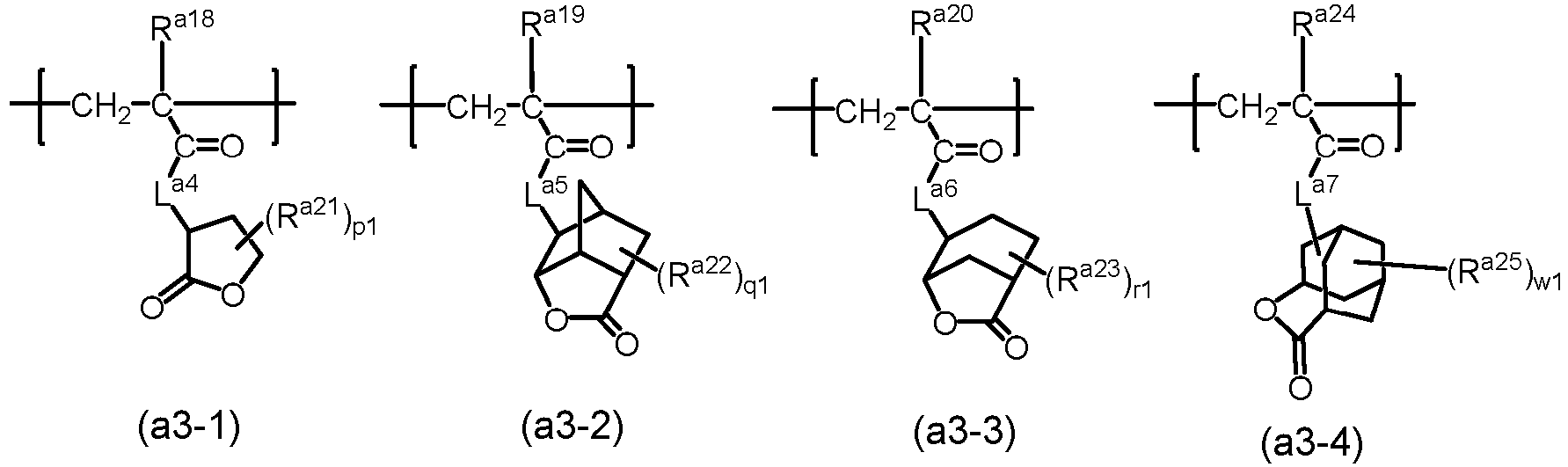 La4, La5 und La6 O- oder eine durch *-O-(CH2)k3·CO-O- dargestellte Gruppe darstellen, wobei k3 eine ganze Zahl von 1 bis 7 darstellt,La7 -O-, *-O-La8-O-, *-O-La8-CO-O-, *-O-La8-CO-O-La9-CO-O- oder *-O-La8-O-CO-La9-O- darstellt,La8 und La9 jeweils unabhängig eine Alkandiylgruppe mit 1 bis 6 Kohlenstoffatomen darstellen,* eine Bindung an eine Carbonylgruppe darstellt,Ra18, Ra19 und Ra20 ein Wasserstoffatom oder eine Methylgruppe darstellen,Ra24 eine Alkylgruppe darstellt, die 1 bis 6 Kohlenstoffatome aufweist, die ein Halogenatom, ein Wasserstoffatom oder ein Halogenatom aufweisen können,Ra21 eine aliphatische Kohlenwasserstoffgruppe darstellt, die 1 bis 4 Kohlenstoffatome aufweist,Ra22, Ra23 und Ra25 eine Carboxygruppe, eine Cyanogruppe oder eine aliphatische Kohlenwasserstoffgruppe, die 1 bis 4 Kohlenstoffatome aufweist, darstellen,p1 eine ganze Zahl von 0 bis 5 darstellt,q1 eine ganze Zahl von 0 bis 3 darstellt,r1 eine ganze Zahl von 0 bis 3 darstellt,w1 eine ganze Zahl von 0 bis 8 darstellt, undwenn p1, q1, r1 und/oder w1 2 oder mehr ist/sind, können eine Vielzahl von Ra21, Ra22, Ra23 und/oder Ra21 gleich oder verschieden voneinander sein.
 - Resistzusammensetzung, umfassend das Harz nach einem der Ansprüche 1 bis 5 und einen Säurebildner.
- Resistzusammensetzung, umfassend das Harz nach Anspruch 2.
- Resistzusammensetzung nach Anspruch 6, wobei der Säurebildner ein Salz umfasst, das durch Formel (B1) dargestellt ist:
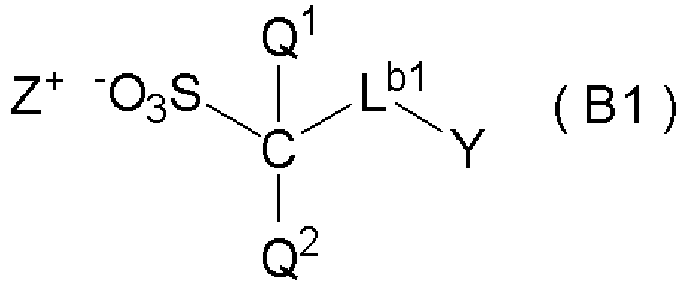 Q1 und Q2 jeweils unabhängig ein Fluoratom oder eine Perfluoralkylgruppe, die 1 bis 6 Kohlenstoffatome aufweist, darstellen,Lb1 eine zweiwertige gesättigte Kohlenwasserstoffgruppe darstellt, die 1 bis 24 Kohlenstoffatome aufweist, die einen Substituenten aufweisen können, wobei -CH2-, das in der zweiwertigen gesättigten Kohlenwasserstoffgruppe beinhaltet ist, durch -O- oder -CO- substituiert sein kann, und ein Wasserstoffatom, das in der zweiwertigen gesättigten Kohlenwasserstoffgruppe beinhaltet ist, durch ein Fluoratom oder eine Hydroxygruppe substituiert sein kann,Y ein Wasserstoffatom oder eine alicyclische Kohlenwasserstoffgruppe darstellt, die 3 bis 18 Kohlenstoffatome aufweist, die einen Substituenten aufweisen können, und -CH2- in der alicyclischen Kohlenwasserstoffgruppe durch -O-, -S(O)2- oder -CO- substituiert sein kann, undZ+ ein organisches Kation darstellt.
 - Resistzusammensetzung nach einem der Ansprüche 6 bis 8, ferner umfassend ein Salz, das eine Säure erzeugt, deren Säuregehalt geringer ist als der einer Säure, die von dem Säuregenerator erzeugt wird.
- Verfahren zum Herstellen eines Resistmusters, das Folgendes umfasst:(1) einen Schritt eines Auftragens der Resistzusammensetzung nach einem der Ansprüche 6 bis 9 auf ein Substrat,(2) einen Schritt eines Trocknens der aufgetragenen Zusammensetzung, um eine Zusammensetzungsschicht zu bilden,(3) einen Schritt eines Freilegens der Zusammensetzungsschicht,(4) einen Schritt eines Erhitzens der freigelegten Zusammensetzungsschicht, und(5) einen Schritt eines Entwickelns der erhitzten Zusammensetzungsschicht.
Applications Claiming Priority (2)
| Application Number | Priority Date | Filing Date | Title |
|---|---|---|---|
| JP2016242645 | 2016-12-14 | ||
| PCT/JP2017/044030 WO2018110429A1 (ja) | 2016-12-14 | 2017-12-07 | 樹脂、レジスト組成物及びレジストパターンの製造方法 |
Publications (3)
| Publication Number | Publication Date |
|---|---|
| EP3556781A1 EP3556781A1 (de) | 2019-10-23 |
| EP3556781A4 EP3556781A4 (de) | 2020-09-09 |
| EP3556781B1 true EP3556781B1 (de) | 2025-07-02 |
Family
ID=62558560
Family Applications (1)
| Application Number | Title | Priority Date | Filing Date |
|---|---|---|---|
| EP17879787.4A Active EP3556781B1 (de) | 2016-12-14 | 2017-12-07 | Resist, resistzusammensetzung und verfahren zur bildung einer resiststruktur |
Country Status (6)
| Country | Link |
|---|---|
| US (1) | US11261273B2 (de) |
| EP (1) | EP3556781B1 (de) |
| JP (1) | JP7042598B2 (de) |
| KR (1) | KR102507577B1 (de) |
| TW (1) | TWI748018B (de) |
| WO (1) | WO2018110429A1 (de) |
Families Citing this family (9)
| Publication number | Priority date | Publication date | Assignee | Title |
|---|---|---|---|---|
| US11214635B2 (en) * | 2017-02-08 | 2022-01-04 | Sumitomo Chemical Company, Limited | Compound, resin, resist composition and method for producing resist pattern |
| KR102848811B1 (ko) * | 2019-12-17 | 2025-08-22 | 삼성전자주식회사 | 레지스트 조성물 및 이를 사용한 반도체 소자 제조 방법 |
| JP7683539B2 (ja) * | 2022-05-12 | 2025-05-27 | 信越化学工業株式会社 | レジスト組成物及びパターン形成方法 |
| JP2024092963A (ja) * | 2022-12-26 | 2024-07-08 | 信越化学工業株式会社 | レジスト組成物及びパターン形成方法 |
| JP2025136880A (ja) | 2024-03-08 | 2025-09-19 | 信越化学工業株式会社 | ネガ型レジストパターン形成方法 |
| JP2025136888A (ja) * | 2024-03-08 | 2025-09-19 | 信越化学工業株式会社 | ネガ型レジストパターン形成方法 |
| JP2025140278A (ja) | 2024-03-14 | 2025-09-29 | 信越化学工業株式会社 | レジスト組成物及びパターン形成方法 |
| JP2026008471A (ja) * | 2024-07-05 | 2026-01-19 | 信越化学工業株式会社 | レジスト組成物及びパターン形成方法 |
| JP2026008473A (ja) * | 2024-07-05 | 2026-01-19 | 信越化学工業株式会社 | レジスト組成物及びパターン形成方法 |
Family Cites Families (43)
| Publication number | Priority date | Publication date | Assignee | Title |
|---|---|---|---|---|
| DE2150691C2 (de) | 1971-10-12 | 1982-09-09 | Basf Ag, 6700 Ludwigshafen | Lichtempfindliches Gemisch und Verwendung eines lichtempfindlichen Gemisches zur Herstellung einer Flachdruckplatte |
| US3779778A (en) | 1972-02-09 | 1973-12-18 | Minnesota Mining & Mfg | Photosolubilizable compositions and elements |
| DE2922746A1 (de) | 1979-06-05 | 1980-12-11 | Basf Ag | Positiv arbeitendes schichtuebertragungsmaterial |
| US5073476A (en) | 1983-05-18 | 1991-12-17 | Ciba-Geigy Corporation | Curable composition and the use thereof |
| JPS62153853A (ja) | 1985-12-27 | 1987-07-08 | Toshiba Corp | 感光性組成物 |
| JPS6269263A (ja) | 1985-09-24 | 1987-03-30 | Toshiba Corp | 感光性組成物 |
| JPS6326653A (ja) | 1986-07-21 | 1988-02-04 | Tosoh Corp | フオトレジスト材 |
| JPS63146029A (ja) | 1986-12-10 | 1988-06-18 | Toshiba Corp | 感光性組成物 |
| JPS63146038A (ja) | 1986-12-10 | 1988-06-18 | Toshiba Corp | 感光性組成物 |
| GB8630129D0 (en) | 1986-12-17 | 1987-01-28 | Ciba Geigy Ag | Formation of image |
| DE3902115A1 (de) * | 1989-01-25 | 1990-08-02 | Basf Ag | Strahlungsempfindliche polymere |
| DE3914407A1 (de) | 1989-04-29 | 1990-10-31 | Basf Ag | Strahlungsempfindliche polymere und positiv arbeitendes aufzeichnungsmaterial |
| CA2187046A1 (fr) | 1996-10-03 | 1998-04-03 | Alain Vallee | Sulfonylimidures et sulfonylmethylures, leur utilisation comme photoinitiateur |
| JP3763693B2 (ja) | 1998-08-10 | 2006-04-05 | 株式会社東芝 | 感光性組成物及びパターン形成方法 |
| JP4410326B2 (ja) * | 1998-10-29 | 2010-02-03 | 信越化学工業株式会社 | 化学増幅ポジ型レジスト材料及びパターン形成方法 |
| JP2003113131A (ja) * | 2001-09-28 | 2003-04-18 | Tokyo Kasei Kogyo Kk | アルコール類の新規酸化法 |
| CN1181029C (zh) * | 2002-04-04 | 2004-12-22 | 湘潭大学 | 自由基和阳离子杂化光固化引发剂及其制备方法和用途 |
| JP2004037789A (ja) * | 2002-07-03 | 2004-02-05 | Kyocera Chemical Corp | ポジ型感光性樹脂組成物およびそのパターン形成方法 |
| JP2004091613A (ja) | 2002-08-30 | 2004-03-25 | Mitsubishi Rayon Co Ltd | 架橋性モノマー、およびそれを用いた熱可塑性架橋ポリマー |
| JP5487784B2 (ja) | 2008-08-07 | 2014-05-07 | 住友化学株式会社 | 化学増幅型ポジ型レジスト組成物 |
| TW201033735A (en) | 2008-12-11 | 2010-09-16 | Sumitomo Chemical Co | Resist composition |
| JP5523854B2 (ja) * | 2009-02-06 | 2014-06-18 | 住友化学株式会社 | 化学増幅型フォトレジスト組成物及びパターン形成方法 |
| JP5466863B2 (ja) * | 2009-03-04 | 2014-04-09 | 株式会社Adeka | 重合性化合物、これを含有する重合性組成物及びその重合体 |
| JP5645165B2 (ja) | 2009-06-03 | 2014-12-24 | 国立大学法人京都大学 | リビングラジカル重合の重合開始剤 |
| JP5750242B2 (ja) | 2009-07-14 | 2015-07-15 | 住友化学株式会社 | レジスト組成物 |
| JP5609569B2 (ja) | 2009-11-18 | 2014-10-22 | 住友化学株式会社 | 酸発生剤用の塩及びレジスト組成物 |
| US8460851B2 (en) | 2010-01-14 | 2013-06-11 | Sumitomo Chemical Company, Limited | Salt and photoresist composition containing the same |
| JP5807334B2 (ja) | 2010-02-16 | 2015-11-10 | 住友化学株式会社 | 塩及び酸発生剤の製造方法 |
| JP5740893B2 (ja) | 2010-05-12 | 2015-07-01 | ナガセケムテックス株式会社 | ハードコート用組成物、ハードコートフィルム及び表示デバイス |
| JP5505371B2 (ja) | 2010-06-01 | 2014-05-28 | 信越化学工業株式会社 | 高分子化合物、化学増幅ポジ型レジスト材料、及びパターン形成方法 |
| JP5565620B2 (ja) * | 2010-07-07 | 2014-08-06 | ナガセケムテックス株式会社 | 帯電防止性粘着剤組成物、粘着剤層、粘着シート、表面保護フィルム及び偏光板 |
| JP5608009B2 (ja) | 2010-08-12 | 2014-10-15 | 大阪有機化学工業株式会社 | ホモアダマンタン誘導体、その製造方法及びフォトレジスト組成物 |
| US9182664B2 (en) | 2010-10-13 | 2015-11-10 | Central Glass Company, Limited | Polymerizable fluorine-containing sulfonate, fluorine-containing sulfonate resin, resist composition and pattern-forming method using same |
| TWI525066B (zh) | 2011-04-13 | 2016-03-11 | 住友化學股份有限公司 | 鹽、光阻組成物及製備光阻圖案之方法 |
| TWI614230B (zh) * | 2011-06-17 | 2018-02-11 | 東京應化工業股份有限公司 | 化合物、自由基聚合起始劑、化合物之製造方法、聚合物、光阻組成物、光阻圖型之形成方法 |
| US20140029267A1 (en) * | 2012-07-25 | 2014-01-30 | Electronics And Telecommunications Research Institute | Chemical compound being used for forming a random wrinkle structure, composition containing the compound, film having the structure, method of forming the film, and oled comprising the film |
| JP5940496B2 (ja) * | 2012-09-26 | 2016-06-29 | 富士フイルム株式会社 | 半硬化物、硬化物およびそれらの製造方法、光学部品、硬化樹脂組成物ならびに化合物 |
| JP5904180B2 (ja) * | 2013-09-11 | 2016-04-13 | 信越化学工業株式会社 | スルホニウム塩、化学増幅型レジスト組成物、及びパターン形成方法 |
| JP2015147925A (ja) | 2014-01-10 | 2015-08-20 | 住友化学株式会社 | 樹脂及びレジスト組成物 |
| JP6471535B2 (ja) * | 2014-03-03 | 2019-02-20 | 住友化学株式会社 | レジスト組成物、レジストパターンの製造方法及び化合物 |
| JP6423681B2 (ja) | 2014-10-14 | 2018-11-14 | 住友化学株式会社 | 樹脂、レジスト組成物及びレジストパターンの製造方法 |
| KR102339283B1 (ko) * | 2014-11-19 | 2021-12-15 | 삼성디스플레이 주식회사 | 유기막 형성용 조성물, 이를 이용하여 제조된 유기 발광 표시 장치 및 이의 제조 방법 |
| US9575408B2 (en) * | 2015-01-07 | 2017-02-21 | Sumitomo Chemical Company, Limited | Photoresist composition and method for producing photoresist pattern |
-
2017
- 2017-12-04 JP JP2017232872A patent/JP7042598B2/ja active Active
- 2017-12-07 EP EP17879787.4A patent/EP3556781B1/de active Active
- 2017-12-07 KR KR1020197020307A patent/KR102507577B1/ko active Active
- 2017-12-07 US US16/465,230 patent/US11261273B2/en active Active
- 2017-12-07 WO PCT/JP2017/044030 patent/WO2018110429A1/ja not_active Ceased
- 2017-12-11 TW TW106143350A patent/TWI748018B/zh active
Also Published As
| Publication number | Publication date |
|---|---|
| US11261273B2 (en) | 2022-03-01 |
| EP3556781A1 (de) | 2019-10-23 |
| US20200010594A1 (en) | 2020-01-09 |
| KR102507577B1 (ko) | 2023-03-09 |
| TWI748018B (zh) | 2021-12-01 |
| JP7042598B2 (ja) | 2022-03-28 |
| JP2018095853A (ja) | 2018-06-21 |
| KR20190091350A (ko) | 2019-08-05 |
| TW201835123A (zh) | 2018-10-01 |
| EP3556781A4 (de) | 2020-09-09 |
| WO2018110429A1 (ja) | 2018-06-21 |
Similar Documents
| Publication | Publication Date | Title |
|---|---|---|
| KR102507577B1 (ko) | 수지, 레지스트 조성물 및 레지스트 패턴의 제조 방법 | |
| KR102661841B1 (ko) | 포토레지스트 조성물 및 포토레지스트 패턴의 제조 방법 | |
| EP3581594B1 (de) | Verbindung, harz, resistzusammensetzung und verfahren zur bildung einer resiststruktur | |
| JP7489222B2 (ja) | カルボン酸塩、カルボン酸発生剤、レジスト組成物及びレジストパターンの製造方法 | |
| JP2025098057A (ja) | レジスト組成物及びレジストパターンの製造方法 | |
| JP2024178328A (ja) | 塩 | |
| JP7591113B2 (ja) | 樹脂、レジスト組成物及びレジストパターンの製造方法 | |
| JP7158946B2 (ja) | 樹脂、レジスト組成物及びレジストパターンの製造方法 | |
| KR102527834B1 (ko) | 화합물, 수지, 포토레지스트 조성물, 및 포토레지스트 패턴의 제조 방법 | |
| JP7519205B2 (ja) | カルボン酸塩、カルボン酸発生剤、レジスト組成物及びレジストパターンの製造方法 | |
| KR102836007B1 (ko) | 수지, 레지스트 조성물 및 레지스트 패턴의 제조 방법 | |
| EP3556783B1 (de) | Resist, resistzusammensetzung und verfahren zur bildung einer resiststruktur | |
| KR102710522B1 (ko) | 염, 산 발생제, 레지스트 조성물 및 레지스트 패턴의 제조 방법 | |
| JP7363018B2 (ja) | 樹脂、レジスト組成物及びレジストパターンの製造方法 | |
| JP7680906B2 (ja) | レジスト組成物及びレジストパターンの製造方法 | |
| JP2024068157A (ja) | 塩、酸発生剤、レジスト組成物及びレジストパターンの製造方法 | |
| JP2024068158A (ja) | 塩、酸発生剤、レジスト組成物及びレジストパターンの製造方法 | |
| JP7672214B2 (ja) | レジスト組成物及びレジストパターンの製造方法 | |
| JP7636200B2 (ja) | レジスト組成物及びレジストパターンの製造方法 | |
| JP7672215B2 (ja) | レジスト組成物及びレジストパターンの製造方法 | |
| JP7545834B2 (ja) | 塩、クエンチャー、レジスト組成物及びレジストパターンの製造方法 | |
| JP7556712B2 (ja) | カルボン酸塩、カルボン酸発生剤、レジスト組成物及びレジストパターンの製造方法 | |
| JP7489229B2 (ja) | 塩、クエンチャー、レジスト組成物及びレジストパターンの製造方法 | |
| JP7545806B2 (ja) | 樹脂、レジスト組成物及びレジストパターンの製造方法 | |
| KR102754090B1 (ko) | 수지, 레지스트 조성물 및 레지스트 패턴의 제조 방법 |
Legal Events
| Date | Code | Title | Description |
|---|---|---|---|
| STAA | Information on the status of an ep patent application or granted ep patent |
Free format text: STATUS: THE INTERNATIONAL PUBLICATION HAS BEEN MADE |
|
| PUAI | Public reference made under article 153(3) epc to a published international application that has entered the european phase |
Free format text: ORIGINAL CODE: 0009012 |
|
| STAA | Information on the status of an ep patent application or granted ep patent |
Free format text: STATUS: REQUEST FOR EXAMINATION WAS MADE |
|
| 17P | Request for examination filed |
Effective date: 20190709 |
|
| AK | Designated contracting states |
Kind code of ref document: A1 Designated state(s): AL AT BE BG CH CY CZ DE DK EE ES FI FR GB GR HR HU IE IS IT LI LT LU LV MC MK MT NL NO PL PT RO RS SE SI SK SM TR |
|
| AX | Request for extension of the european patent |
Extension state: BA ME |
|
| DAV | Request for validation of the european patent (deleted) | ||
| DAX | Request for extension of the european patent (deleted) | ||
| A4 | Supplementary search report drawn up and despatched |
Effective date: 20200810 |
|
| RIC1 | Information provided on ipc code assigned before grant |
Ipc: G03F 7/004 20060101ALI20200804BHEP Ipc: G03F 7/039 20060101ALI20200804BHEP Ipc: C08F 20/02 20060101AFI20200804BHEP Ipc: C08F 222/18 20060101ALI20200804BHEP Ipc: C08F 12/34 20060101ALI20200804BHEP |
|
| STAA | Information on the status of an ep patent application or granted ep patent |
Free format text: STATUS: EXAMINATION IS IN PROGRESS |
|
| 17Q | First examination report despatched |
Effective date: 20220909 |
|
| GRAP | Despatch of communication of intention to grant a patent |
Free format text: ORIGINAL CODE: EPIDOSNIGR1 |
|
| STAA | Information on the status of an ep patent application or granted ep patent |
Free format text: STATUS: GRANT OF PATENT IS INTENDED |
|
| INTG | Intention to grant announced |
Effective date: 20230801 |
|
| GRAJ | Information related to disapproval of communication of intention to grant by the applicant or resumption of examination proceedings by the epo deleted |
Free format text: ORIGINAL CODE: EPIDOSDIGR1 |
|
| STAA | Information on the status of an ep patent application or granted ep patent |
Free format text: STATUS: EXAMINATION IS IN PROGRESS |
|
| INTC | Intention to grant announced (deleted) | ||
| GRAP | Despatch of communication of intention to grant a patent |
Free format text: ORIGINAL CODE: EPIDOSNIGR1 |
|
| STAA | Information on the status of an ep patent application or granted ep patent |
Free format text: STATUS: GRANT OF PATENT IS INTENDED |
|
| INTG | Intention to grant announced |
Effective date: 20240906 |
|
| GRAJ | Information related to disapproval of communication of intention to grant by the applicant or resumption of examination proceedings by the epo deleted |
Free format text: ORIGINAL CODE: EPIDOSDIGR1 |
|
| STAA | Information on the status of an ep patent application or granted ep patent |
Free format text: STATUS: EXAMINATION IS IN PROGRESS |
|
| GRAP | Despatch of communication of intention to grant a patent |
Free format text: ORIGINAL CODE: EPIDOSNIGR1 |
|
| STAA | Information on the status of an ep patent application or granted ep patent |
Free format text: STATUS: GRANT OF PATENT IS INTENDED |
|
| INTC | Intention to grant announced (deleted) | ||
| INTG | Intention to grant announced |
Effective date: 20250127 |
|
| GRAS | Grant fee paid |
Free format text: ORIGINAL CODE: EPIDOSNIGR3 |
|
| GRAA | (expected) grant |
Free format text: ORIGINAL CODE: 0009210 |
|
| STAA | Information on the status of an ep patent application or granted ep patent |
Free format text: STATUS: THE PATENT HAS BEEN GRANTED |
|
| AK | Designated contracting states |
Kind code of ref document: B1 Designated state(s): AL AT BE BG CH CY CZ DE DK EE ES FI FR GB GR HR HU IE IS IT LI LT LU LV MC MK MT NL NO PL PT RO RS SE SI SK SM TR |
|
| REG | Reference to a national code |
Ref country code: GB Ref legal event code: FG4D |
|
| REG | Reference to a national code |
Ref country code: CH Ref legal event code: EP |
|
| REG | Reference to a national code |
Ref country code: DE Ref legal event code: R096 Ref document number: 602017090357 Country of ref document: DE |
|
| REG | Reference to a national code |
Ref country code: IE Ref legal event code: FG4D |
|
| REG | Reference to a national code |
Ref country code: NL Ref legal event code: MP Effective date: 20250702 |
|
| PG25 | Lapsed in a contracting state [announced via postgrant information from national office to epo] |
Ref country code: PT Free format text: LAPSE BECAUSE OF FAILURE TO SUBMIT A TRANSLATION OF THE DESCRIPTION OR TO PAY THE FEE WITHIN THE PRESCRIBED TIME-LIMIT Effective date: 20251103 |
|
| PG25 | Lapsed in a contracting state [announced via postgrant information from national office to epo] |
Ref country code: NL Free format text: LAPSE BECAUSE OF FAILURE TO SUBMIT A TRANSLATION OF THE DESCRIPTION OR TO PAY THE FEE WITHIN THE PRESCRIBED TIME-LIMIT Effective date: 20250702 |
|
| REG | Reference to a national code |
Ref country code: AT Ref legal event code: MK05 Ref document number: 1809196 Country of ref document: AT Kind code of ref document: T Effective date: 20250702 |
|
| PG25 | Lapsed in a contracting state [announced via postgrant information from national office to epo] |
Ref country code: IS Free format text: LAPSE BECAUSE OF FAILURE TO SUBMIT A TRANSLATION OF THE DESCRIPTION OR TO PAY THE FEE WITHIN THE PRESCRIBED TIME-LIMIT Effective date: 20251102 |
|
| PG25 | Lapsed in a contracting state [announced via postgrant information from national office to epo] |
Ref country code: NO Free format text: LAPSE BECAUSE OF FAILURE TO SUBMIT A TRANSLATION OF THE DESCRIPTION OR TO PAY THE FEE WITHIN THE PRESCRIBED TIME-LIMIT Effective date: 20251002 |
|
| REG | Reference to a national code |
Ref country code: LT Ref legal event code: MG9D |
|
| PG25 | Lapsed in a contracting state [announced via postgrant information from national office to epo] |
Ref country code: AT Free format text: LAPSE BECAUSE OF FAILURE TO SUBMIT A TRANSLATION OF THE DESCRIPTION OR TO PAY THE FEE WITHIN THE PRESCRIBED TIME-LIMIT Effective date: 20250702 |
|
| PG25 | Lapsed in a contracting state [announced via postgrant information from national office to epo] |
Ref country code: FI Free format text: LAPSE BECAUSE OF FAILURE TO SUBMIT A TRANSLATION OF THE DESCRIPTION OR TO PAY THE FEE WITHIN THE PRESCRIBED TIME-LIMIT Effective date: 20250702 |
|
| PG25 | Lapsed in a contracting state [announced via postgrant information from national office to epo] |
Ref country code: HR Free format text: LAPSE BECAUSE OF FAILURE TO SUBMIT A TRANSLATION OF THE DESCRIPTION OR TO PAY THE FEE WITHIN THE PRESCRIBED TIME-LIMIT Effective date: 20250702 |
|
| PG25 | Lapsed in a contracting state [announced via postgrant information from national office to epo] |
Ref country code: GR Free format text: LAPSE BECAUSE OF FAILURE TO SUBMIT A TRANSLATION OF THE DESCRIPTION OR TO PAY THE FEE WITHIN THE PRESCRIBED TIME-LIMIT Effective date: 20251003 |
|
| PGFP | Annual fee paid to national office [announced via postgrant information from national office to epo] |
Ref country code: BE Payment date: 20251119 Year of fee payment: 9 |
|
| PG25 | Lapsed in a contracting state [announced via postgrant information from national office to epo] |
Ref country code: CZ Free format text: LAPSE BECAUSE OF FAILURE TO SUBMIT A TRANSLATION OF THE DESCRIPTION OR TO PAY THE FEE WITHIN THE PRESCRIBED TIME-LIMIT Effective date: 20250702 Ref country code: SE Free format text: LAPSE BECAUSE OF FAILURE TO SUBMIT A TRANSLATION OF THE DESCRIPTION OR TO PAY THE FEE WITHIN THE PRESCRIBED TIME-LIMIT Effective date: 20250702 |
|
| PG25 | Lapsed in a contracting state [announced via postgrant information from national office to epo] |
Ref country code: LV Free format text: LAPSE BECAUSE OF FAILURE TO SUBMIT A TRANSLATION OF THE DESCRIPTION OR TO PAY THE FEE WITHIN THE PRESCRIBED TIME-LIMIT Effective date: 20250702 |
|
| PG25 | Lapsed in a contracting state [announced via postgrant information from national office to epo] |
Ref country code: BG Free format text: LAPSE BECAUSE OF FAILURE TO SUBMIT A TRANSLATION OF THE DESCRIPTION OR TO PAY THE FEE WITHIN THE PRESCRIBED TIME-LIMIT Effective date: 20250702 Ref country code: PL Free format text: LAPSE BECAUSE OF FAILURE TO SUBMIT A TRANSLATION OF THE DESCRIPTION OR TO PAY THE FEE WITHIN THE PRESCRIBED TIME-LIMIT Effective date: 20250702 |
|
| PG25 | Lapsed in a contracting state [announced via postgrant information from national office to epo] |
Ref country code: RS Free format text: LAPSE BECAUSE OF FAILURE TO SUBMIT A TRANSLATION OF THE DESCRIPTION OR TO PAY THE FEE WITHIN THE PRESCRIBED TIME-LIMIT Effective date: 20251002 |
|
| PG25 | Lapsed in a contracting state [announced via postgrant information from national office to epo] |
Ref country code: ES Free format text: LAPSE BECAUSE OF FAILURE TO SUBMIT A TRANSLATION OF THE DESCRIPTION OR TO PAY THE FEE WITHIN THE PRESCRIBED TIME-LIMIT Effective date: 20250702 |
|
| PG25 | Lapsed in a contracting state [announced via postgrant information from national office to epo] |
Ref country code: RO Free format text: LAPSE BECAUSE OF FAILURE TO SUBMIT A TRANSLATION OF THE DESCRIPTION OR TO PAY THE FEE WITHIN THE PRESCRIBED TIME-LIMIT Effective date: 20250702 |
|
| PG25 | Lapsed in a contracting state [announced via postgrant information from national office to epo] |
Ref country code: SM Free format text: LAPSE BECAUSE OF FAILURE TO SUBMIT A TRANSLATION OF THE DESCRIPTION OR TO PAY THE FEE WITHIN THE PRESCRIBED TIME-LIMIT Effective date: 20250702 |
|
| REG | Reference to a national code |
Ref country code: DE Ref legal event code: R097 Ref document number: 602017090357 Country of ref document: DE |
|
| PG25 | Lapsed in a contracting state [announced via postgrant information from national office to epo] |
Ref country code: DK Free format text: LAPSE BECAUSE OF FAILURE TO SUBMIT A TRANSLATION OF THE DESCRIPTION OR TO PAY THE FEE WITHIN THE PRESCRIBED TIME-LIMIT Effective date: 20250702 |
|
| PG25 | Lapsed in a contracting state [announced via postgrant information from national office to epo] |
Ref country code: IT Free format text: LAPSE BECAUSE OF FAILURE TO SUBMIT A TRANSLATION OF THE DESCRIPTION OR TO PAY THE FEE WITHIN THE PRESCRIBED TIME-LIMIT Effective date: 20250702 |
|
| PG25 | Lapsed in a contracting state [announced via postgrant information from national office to epo] |
Ref country code: EE Free format text: LAPSE BECAUSE OF FAILURE TO SUBMIT A TRANSLATION OF THE DESCRIPTION OR TO PAY THE FEE WITHIN THE PRESCRIBED TIME-LIMIT Effective date: 20250702 Ref country code: SK Free format text: LAPSE BECAUSE OF FAILURE TO SUBMIT A TRANSLATION OF THE DESCRIPTION OR TO PAY THE FEE WITHIN THE PRESCRIBED TIME-LIMIT Effective date: 20250702 |
|
| PLBE | No opposition filed within time limit |
Free format text: ORIGINAL CODE: 0009261 |
|
| STAA | Information on the status of an ep patent application or granted ep patent |
Free format text: STATUS: NO OPPOSITION FILED WITHIN TIME LIMIT |
|
| REG | Reference to a national code |
Ref country code: CH Ref legal event code: L10 Free format text: ST27 STATUS EVENT CODE: U-0-0-L10-L00 (AS PROVIDED BY THE NATIONAL OFFICE) Effective date: 20260518 |
|
| 26N | No opposition filed |
Effective date: 20260407 |
|
| PG25 | Lapsed in a contracting state [announced via postgrant information from national office to epo] |
Ref country code: LT Free format text: LAPSE BECAUSE OF FAILURE TO SUBMIT A TRANSLATION OF THE DESCRIPTION OR TO PAY THE FEE WITHIN THE PRESCRIBED TIME-LIMIT Effective date: 20250702 |
|
| PG25 | Lapsed in a contracting state [announced via postgrant information from national office to epo] |
Ref country code: MC Free format text: LAPSE BECAUSE OF FAILURE TO SUBMIT A TRANSLATION OF THE DESCRIPTION OR TO PAY THE FEE WITHIN THE PRESCRIBED TIME-LIMIT Effective date: 20250702 |
|
| REG | Reference to a national code |
Ref country code: CH Ref legal event code: H13 Free format text: ST27 STATUS EVENT CODE: U-0-0-H10-H13 (AS PROVIDED BY THE NATIONAL OFFICE) Effective date: 20260723 |