EP3551687B1 - Verfahren zur herstellung einer stabilisatorzusammensetzung und damit hergestellte stabilisatorzusammensetzung - Google Patents
Verfahren zur herstellung einer stabilisatorzusammensetzung und damit hergestellte stabilisatorzusammensetzung Download PDFInfo
- Publication number
- EP3551687B1 EP3551687B1 EP17816395.2A EP17816395A EP3551687B1 EP 3551687 B1 EP3551687 B1 EP 3551687B1 EP 17816395 A EP17816395 A EP 17816395A EP 3551687 B1 EP3551687 B1 EP 3551687B1
- Authority
- EP
- European Patent Office
- Prior art keywords
- extruder
- modules
- carboxylic acid
- reaction
- metal
- Prior art date
- Legal status (The legal status is an assumption and is not a legal conclusion. Google has not performed a legal analysis and makes no representation as to the accuracy of the status listed.)
- Active
Links
Images
Classifications
-
- C—CHEMISTRY; METALLURGY
- C08—ORGANIC MACROMOLECULAR COMPOUNDS; THEIR PREPARATION OR CHEMICAL WORKING-UP; COMPOSITIONS BASED THEREON
- C08J—WORKING-UP; GENERAL PROCESSES OF COMPOUNDING; AFTER-TREATMENT NOT COVERED BY SUBCLASSES C08B, C08C, C08F, C08G or C08H
- C08J3/00—Processes of treating or compounding macromolecular substances
- C08J3/20—Compounding polymers with additives, e.g. colouring
- C08J3/22—Compounding polymers with additives, e.g. colouring using masterbatch techniques
-
- C—CHEMISTRY; METALLURGY
- C08—ORGANIC MACROMOLECULAR COMPOUNDS; THEIR PREPARATION OR CHEMICAL WORKING-UP; COMPOSITIONS BASED THEREON
- C08J—WORKING-UP; GENERAL PROCESSES OF COMPOUNDING; AFTER-TREATMENT NOT COVERED BY SUBCLASSES C08B, C08C, C08F, C08G or C08H
- C08J3/00—Processes of treating or compounding macromolecular substances
- C08J3/20—Compounding polymers with additives, e.g. colouring
- C08J3/22—Compounding polymers with additives, e.g. colouring using masterbatch techniques
- C08J3/223—Packed additives
-
- C—CHEMISTRY; METALLURGY
- C08—ORGANIC MACROMOLECULAR COMPOUNDS; THEIR PREPARATION OR CHEMICAL WORKING-UP; COMPOSITIONS BASED THEREON
- C08K—Use of inorganic or non-macromolecular organic substances as compounding ingredients
- C08K5/00—Use of organic ingredients
- C08K5/04—Oxygen-containing compounds
- C08K5/09—Carboxylic acids; Metal salts thereof; Anhydrides thereof
-
- B—PERFORMING OPERATIONS; TRANSPORTING
- B29—WORKING OF PLASTICS; WORKING OF SUBSTANCES IN A PLASTIC STATE IN GENERAL
- B29B—PREPARATION OR PRETREATMENT OF THE MATERIAL TO BE SHAPED; MAKING GRANULES OR PREFORMS; RECOVERY OF PLASTICS OR OTHER CONSTITUENTS OF WASTE MATERIAL CONTAINING PLASTICS
- B29B7/00—Mixing; Kneading
- B29B7/30—Mixing; Kneading continuous, with mechanical mixing or kneading devices
- B29B7/34—Mixing; Kneading continuous, with mechanical mixing or kneading devices with movable mixing or kneading devices
- B29B7/38—Mixing; Kneading continuous, with mechanical mixing or kneading devices with movable mixing or kneading devices rotary
- B29B7/46—Mixing; Kneading continuous, with mechanical mixing or kneading devices with movable mixing or kneading devices rotary with more than one shaft
- B29B7/48—Mixing; Kneading continuous, with mechanical mixing or kneading devices with movable mixing or kneading devices rotary with more than one shaft with intermeshing devices, e.g. screws
- B29B7/485—Mixing; Kneading continuous, with mechanical mixing or kneading devices with movable mixing or kneading devices rotary with more than one shaft with intermeshing devices, e.g. screws with three or more shafts provided with screws
-
- B—PERFORMING OPERATIONS; TRANSPORTING
- B29—WORKING OF PLASTICS; WORKING OF SUBSTANCES IN A PLASTIC STATE IN GENERAL
- B29B—PREPARATION OR PRETREATMENT OF THE MATERIAL TO BE SHAPED; MAKING GRANULES OR PREFORMS; RECOVERY OF PLASTICS OR OTHER CONSTITUENTS OF WASTE MATERIAL CONTAINING PLASTICS
- B29B7/00—Mixing; Kneading
- B29B7/30—Mixing; Kneading continuous, with mechanical mixing or kneading devices
- B29B7/58—Component parts, details or accessories; Auxiliary operations
- B29B7/60—Component parts, details or accessories; Auxiliary operations for feeding, e.g. end guides for the incoming material
- B29B7/603—Component parts, details or accessories; Auxiliary operations for feeding, e.g. end guides for the incoming material in measured doses, e.g. proportioning of several materials
-
- B—PERFORMING OPERATIONS; TRANSPORTING
- B29—WORKING OF PLASTICS; WORKING OF SUBSTANCES IN A PLASTIC STATE IN GENERAL
- B29B—PREPARATION OR PRETREATMENT OF THE MATERIAL TO BE SHAPED; MAKING GRANULES OR PREFORMS; RECOVERY OF PLASTICS OR OTHER CONSTITUENTS OF WASTE MATERIAL CONTAINING PLASTICS
- B29B7/00—Mixing; Kneading
- B29B7/80—Component parts, details or accessories; Auxiliary operations
- B29B7/82—Heating or cooling
- B29B7/823—Temperature control
-
- B—PERFORMING OPERATIONS; TRANSPORTING
- B29—WORKING OF PLASTICS; WORKING OF SUBSTANCES IN A PLASTIC STATE IN GENERAL
- B29B—PREPARATION OR PRETREATMENT OF THE MATERIAL TO BE SHAPED; MAKING GRANULES OR PREFORMS; RECOVERY OF PLASTICS OR OTHER CONSTITUENTS OF WASTE MATERIAL CONTAINING PLASTICS
- B29B7/00—Mixing; Kneading
- B29B7/80—Component parts, details or accessories; Auxiliary operations
- B29B7/82—Heating or cooling
- B29B7/826—Apparatus therefor
-
- B—PERFORMING OPERATIONS; TRANSPORTING
- B29—WORKING OF PLASTICS; WORKING OF SUBSTANCES IN A PLASTIC STATE IN GENERAL
- B29B—PREPARATION OR PRETREATMENT OF THE MATERIAL TO BE SHAPED; MAKING GRANULES OR PREFORMS; RECOVERY OF PLASTICS OR OTHER CONSTITUENTS OF WASTE MATERIAL CONTAINING PLASTICS
- B29B7/00—Mixing; Kneading
- B29B7/80—Component parts, details or accessories; Auxiliary operations
- B29B7/88—Adding charges, i.e. additives
-
- B—PERFORMING OPERATIONS; TRANSPORTING
- B29—WORKING OF PLASTICS; WORKING OF SUBSTANCES IN A PLASTIC STATE IN GENERAL
- B29B—PREPARATION OR PRETREATMENT OF THE MATERIAL TO BE SHAPED; MAKING GRANULES OR PREFORMS; RECOVERY OF PLASTICS OR OTHER CONSTITUENTS OF WASTE MATERIAL CONTAINING PLASTICS
- B29B9/00—Making granules
- B29B9/02—Making granules by dividing preformed material
- B29B9/06—Making granules by dividing preformed material in the form of filamentary material, e.g. combined with extrusion
- B29B9/065—Making granules by dividing preformed material in the form of filamentary material, e.g. combined with extrusion under-water, e.g. underwater pelletizers
-
- B—PERFORMING OPERATIONS; TRANSPORTING
- B29—WORKING OF PLASTICS; WORKING OF SUBSTANCES IN A PLASTIC STATE IN GENERAL
- B29B—PREPARATION OR PRETREATMENT OF THE MATERIAL TO BE SHAPED; MAKING GRANULES OR PREFORMS; RECOVERY OF PLASTICS OR OTHER CONSTITUENTS OF WASTE MATERIAL CONTAINING PLASTICS
- B29B9/00—Making granules
- B29B9/12—Making granules characterised by structure or composition
-
- C—CHEMISTRY; METALLURGY
- C08—ORGANIC MACROMOLECULAR COMPOUNDS; THEIR PREPARATION OR CHEMICAL WORKING-UP; COMPOSITIONS BASED THEREON
- C08K—Use of inorganic or non-macromolecular organic substances as compounding ingredients
- C08K13/00—Use of mixtures of ingredients not covered by one single of the preceding main groups, each of these compounds being essential
- C08K13/02—Organic and inorganic ingredients
-
- C—CHEMISTRY; METALLURGY
- C08—ORGANIC MACROMOLECULAR COMPOUNDS; THEIR PREPARATION OR CHEMICAL WORKING-UP; COMPOSITIONS BASED THEREON
- C08K—Use of inorganic or non-macromolecular organic substances as compounding ingredients
- C08K5/00—Use of organic ingredients
-
- C—CHEMISTRY; METALLURGY
- C08—ORGANIC MACROMOLECULAR COMPOUNDS; THEIR PREPARATION OR CHEMICAL WORKING-UP; COMPOSITIONS BASED THEREON
- C08K—Use of inorganic or non-macromolecular organic substances as compounding ingredients
- C08K5/00—Use of organic ingredients
- C08K5/0008—Organic ingredients according to more than one of the "one dot" groups of C08K5/01 - C08K5/59
- C08K5/005—Stabilisers against oxidation, heat, light, ozone
-
- C—CHEMISTRY; METALLURGY
- C08—ORGANIC MACROMOLECULAR COMPOUNDS; THEIR PREPARATION OR CHEMICAL WORKING-UP; COMPOSITIONS BASED THEREON
- C08K—Use of inorganic or non-macromolecular organic substances as compounding ingredients
- C08K9/00—Use of pretreated ingredients
- C08K9/02—Ingredients treated with inorganic substances
-
- C—CHEMISTRY; METALLURGY
- C08—ORGANIC MACROMOLECULAR COMPOUNDS; THEIR PREPARATION OR CHEMICAL WORKING-UP; COMPOSITIONS BASED THEREON
- C08K—Use of inorganic or non-macromolecular organic substances as compounding ingredients
- C08K9/00—Use of pretreated ingredients
- C08K9/04—Ingredients treated with organic substances
-
- B—PERFORMING OPERATIONS; TRANSPORTING
- B29—WORKING OF PLASTICS; WORKING OF SUBSTANCES IN A PLASTIC STATE IN GENERAL
- B29B—PREPARATION OR PRETREATMENT OF THE MATERIAL TO BE SHAPED; MAKING GRANULES OR PREFORMS; RECOVERY OF PLASTICS OR OTHER CONSTITUENTS OF WASTE MATERIAL CONTAINING PLASTICS
- B29B7/00—Mixing; Kneading
- B29B7/30—Mixing; Kneading continuous, with mechanical mixing or kneading devices
- B29B7/34—Mixing; Kneading continuous, with mechanical mixing or kneading devices with movable mixing or kneading devices
- B29B7/38—Mixing; Kneading continuous, with mechanical mixing or kneading devices with movable mixing or kneading devices rotary
- B29B7/40—Mixing; Kneading continuous, with mechanical mixing or kneading devices with movable mixing or kneading devices rotary with single shaft
- B29B7/42—Mixing; Kneading continuous, with mechanical mixing or kneading devices with movable mixing or kneading devices rotary with single shaft with screw or helix
-
- B—PERFORMING OPERATIONS; TRANSPORTING
- B29—WORKING OF PLASTICS; WORKING OF SUBSTANCES IN A PLASTIC STATE IN GENERAL
- B29B—PREPARATION OR PRETREATMENT OF THE MATERIAL TO BE SHAPED; MAKING GRANULES OR PREFORMS; RECOVERY OF PLASTICS OR OTHER CONSTITUENTS OF WASTE MATERIAL CONTAINING PLASTICS
- B29B7/00—Mixing; Kneading
- B29B7/30—Mixing; Kneading continuous, with mechanical mixing or kneading devices
- B29B7/34—Mixing; Kneading continuous, with mechanical mixing or kneading devices with movable mixing or kneading devices
- B29B7/38—Mixing; Kneading continuous, with mechanical mixing or kneading devices with movable mixing or kneading devices rotary
- B29B7/46—Mixing; Kneading continuous, with mechanical mixing or kneading devices with movable mixing or kneading devices rotary with more than one shaft
- B29B7/48—Mixing; Kneading continuous, with mechanical mixing or kneading devices with movable mixing or kneading devices rotary with more than one shaft with intermeshing devices, e.g. screws
- B29B7/484—Mixing; Kneading continuous, with mechanical mixing or kneading devices with movable mixing or kneading devices rotary with more than one shaft with intermeshing devices, e.g. screws with two shafts provided with screws, e.g. one screw being shorter than the other
-
- B—PERFORMING OPERATIONS; TRANSPORTING
- B29—WORKING OF PLASTICS; WORKING OF SUBSTANCES IN A PLASTIC STATE IN GENERAL
- B29B—PREPARATION OR PRETREATMENT OF THE MATERIAL TO BE SHAPED; MAKING GRANULES OR PREFORMS; RECOVERY OF PLASTICS OR OTHER CONSTITUENTS OF WASTE MATERIAL CONTAINING PLASTICS
- B29B9/00—Making granules
- B29B9/10—Making granules by moulding the material, i.e. treating it in the molten state
-
- C—CHEMISTRY; METALLURGY
- C08—ORGANIC MACROMOLECULAR COMPOUNDS; THEIR PREPARATION OR CHEMICAL WORKING-UP; COMPOSITIONS BASED THEREON
- C08J—WORKING-UP; GENERAL PROCESSES OF COMPOUNDING; AFTER-TREATMENT NOT COVERED BY SUBCLASSES C08B, C08C, C08F, C08G or C08H
- C08J2327/00—Characterised by the use of homopolymers or copolymers of compounds having one or more unsaturated aliphatic radicals, each having only one carbon-to-carbon double bond, and at least one being terminated by a halogen; Derivatives of such polymers
- C08J2327/02—Characterised by the use of homopolymers or copolymers of compounds having one or more unsaturated aliphatic radicals, each having only one carbon-to-carbon double bond, and at least one being terminated by a halogen; Derivatives of such polymers not modified by chemical after-treatment
- C08J2327/04—Characterised by the use of homopolymers or copolymers of compounds having one or more unsaturated aliphatic radicals, each having only one carbon-to-carbon double bond, and at least one being terminated by a halogen; Derivatives of such polymers not modified by chemical after-treatment containing chlorine atoms
- C08J2327/06—Homopolymers or copolymers of vinyl chloride
-
- C—CHEMISTRY; METALLURGY
- C08—ORGANIC MACROMOLECULAR COMPOUNDS; THEIR PREPARATION OR CHEMICAL WORKING-UP; COMPOSITIONS BASED THEREON
- C08K—Use of inorganic or non-macromolecular organic substances as compounding ingredients
- C08K5/00—Use of organic ingredients
- C08K5/04—Oxygen-containing compounds
- C08K5/09—Carboxylic acids; Metal salts thereof; Anhydrides thereof
- C08K5/098—Metal salts of carboxylic acids
Definitions
- the invention relates to a method for producing a stabilizer composition for a polymer, wherein a carboxylic acid is reacted with at least one metal compound such as at least one metal hydroxide and/or at least one metal oxide and/or at least one metal carbonate to form a metal carboxylate of the carboxylic acid.
- a metal compound such as at least one metal hydroxide and/or at least one metal oxide and/or at least one metal carbonate to form a metal carboxylate of the carboxylic acid.
- the invention further relates to a stabilizer composition for a polymer.
- Stabilizers are usually added to polymers to enable efficient processing. Since a polymer is often exposed to a variety of influences and stresses during use, several components are usually required, which are supplied together or sequentially when producing the stabilizer composition.
- stabilizer compositions that can be used ready-to-use (so-called “one-packs”) have proven to be effective.
- Ready-to-use stabilizer compositions often include metal carboxylates, i.e. reaction products of carboxylic acids, preferably fatty acids, with metal hydroxides and/or metal oxides and/or metal carbonates, e.g. B. basic metal carbonates, and other additives such as zeolites, hydrotalcites, chalk, pigments, other co-stabilizers, antioxidants and the like.
- metal carboxylates i.e. reaction products of carboxylic acids, preferably fatty acids
- metal hydroxides and/or metal oxides and/or metal carbonates e.g. B. basic metal carbonates
- other additives such as zeolites, hydrotalcites, chalk, pigments, other co-stabilizers, antioxidants and the like.
- fatty acids are first reacted with metal hydroxides and/or metal oxides and/or metal carbonates to form the desired metal soaps or metal carboxylates.
- metal hydroxides and/or metal oxides and/or metal carbonates for example, in addition to the common carboxylic acids such as lauric acid or stearic acid, there are also oxides
- oxides of transition metals such as zinc oxide (ZnO) and/or alkali and/or alkaline earth metal oxides and/or hydroxides such as calcium hydroxide [Ca(OH) 2 ] application.
- Carboxylic acid or the metal compound can also be added in excess, so that acidic or basic metal carboxylates are formed.
- the object of the invention is to provide a method of the type mentioned at the outset, with which a higher throughput can be achieved without any loss in terms of product quality.
- a further aim is to provide an improved stabilizer composition.
- the procedural object of the invention is achieved if, in a process of the type mentioned at the outset, the reaction of the carboxylic acid, in particular a fatty acid, with the metal compound is carried out continuously in an extruder with the resulting water of reaction emerging from the extruder.
- An advantage achieved with a process according to the invention is that when the resulting water of reaction emerges from the extruder, the process in this and thus the process as a whole can be carried out continuously. It is possible to adjust the required reaction time for a particularly complete reaction by a length of the extruder or by a free volume in it so that there is no or only a specifically predetermined, reproducible residual water content in the extruder Product is available. This can be easily adjusted as soon as it is recognized that the extruder is to be designed with openings according to the invention, i.e. the resulting water of reaction has the opportunity to escape.
- a continuous process not only requires less control and therefore less personnel effort than a batch process, but also has the particular advantage that the mass of stabilizer composition that can be produced or applied per unit of time is significantly higher and, for example, is many times higher than with a batch process can. This results in a highly productive process that leads to an excellent product, since the educts and later the resulting products are thoroughly mixed in the extruder and further stabilizer components can then be mixed in if necessary.
- Any compound that reacts with the at least one carboxylic acid to form a carboxylate can be used as the metal compound.
- the reaction usually takes place with at least one metal hydroxide and/or at least one metal oxide and/or at least one metal carbonate, with basic metal carbonates also being particularly suitable.
- the carboxylic acids are aliphatic or aromatic, mono- and/or di- and/or polycarboxylic acids, in particular fatty acids, which are constructed with carbon chains with 2 to 30 carbons, which can be linear or branched and which are optionally also partially substituted with hydroxyl groups and amino groups can be, to understand.
- metal hydroxide and/or metal oxide and/or metal carbonates and/or basic metal carbonate including several different metal oxides, hydroxides, carbonates and/or basic metal carbonates can be added.
- the cations can be from the groups of alkali and/or alkaline earth metals, zinc, aluminum, tin and/or from the group of rare earth metals or the like.
- the metal compounds can be added as a mixture of several different metal compounds or preferably sequentially.
- the water of reaction is actively withdrawn from the extruder.
- a negative pressure is applied to one or more points of the extruder, through which the water is withdrawn from the extruder.
- a vacuum can be used, for example a water jet vacuum.
- the water of reaction is allowed to escape.
- the reaction mixture can be processed or operated at atmospheric pressure. In addition to simple process management in terms of apparatus, this also has the advantage that foam formation, which can occur when the carboxylic acids are reacted with metal hydroxides and/or metal oxides, is not actively promoted.
- the water of reaction can exit at any point on the extruder or can be actively promoted. It is preferred that the water of reaction exits through openings in the extruder.
- the openings can be arranged on an outside of the extruder along the material flow. In a preferred variant, it is therefore a so-called open extruder from which the water of reaction escapes in a simple manner and without additional measures. Since the reaction mixture can foam, it is preferred that the openings are provided at the top.
- the openings can be designed in the shape of a slot, whereby the slots can also be surrounded by laterally projecting walls which protrude upwards from the extruder. In this case, a not too strong foam formation in the extruder can be handled without any problems because the foam can still collect within the walls without overflowing from the extruder.
- the at least one carboxylic acid is preferably fed into the extruder in liquid form.
- the carboxylic acid can be fed into the extruder at a temperature of more than 75 ° C, preferably more than 80 ° C, in particular more than 80 ° C up to 150 ° C. Higher temperatures enable the reaction to take place as efficiently as possible in the sense of complete implementation along a short section of the extruder.
- a catalyst is preferably supplied.
- the catalyst it is expedient for the catalyst to be fed into the extruder with the carboxylic acid or with metal hydroxide and/or metal oxide and/or metal carbonate. If the carboxylic acid is first supplied with a metal hydroxide and optionally or alternatively also a metal oxide, the two components can already be at least partially mixed with one another. The downstream addition of the catalyst then promotes a rapid reaction process. The catalyst content can be kept relatively low.
- catalysts are to be understood as substances that react with passivated surfaces of metal hydroxide and/or metal oxide and/or metal carbonates and/or basic metal carbonate particles and thus, on the one hand, make the particle surfaces more reactive and, on the other hand, even with the carboxylates through transfer of the cation continue to react.
- Water, inorganic and organic acids, acid anhydrides, short-chain carboxylic acids, short-chain carboxylates or the like can be used as catalysts.
- catalysts can also be partially or completely eliminated from the process by evaporation from the melt or mixture.
- the reaction of the carboxylic acid with the metal compound such as a metal hydroxide and/or a metal oxide and/or a metal carbonate is carried out in several modules of the extruder connected in series. If several modules are present, there are several advantages: On the one hand, the individual modules can, if necessary, be at least partially tempered separately, which enables a desired temperature setting along the modules and thus a targeted influence on the reaction. On the other hand, elements for better dispersion of the reaction mixture can be provided between the individual modules, in particular dispersion rings or the like, which promotes further thorough mixing. In this context, it can also be provided that further metal compounds are added downstream.
- a sequential addition of, in particular, metal hydroxides and/or metal oxides or further carboxylic acids can be necessary in order to be able to specifically control the viscosity of the reaction mixture.
- further metal compounds can be added, as mentioned.
- openings or slots of different sizes can also be provided in individual modules, which enables optimal coordination of the removal or escape of reaction water in relation to the respective position of the reaction mixture and thus the reaction conversion that has taken place up to that point. Overall, optimal conditions can therefore be found for the desired reaction of the at least one carboxylic acid with the at least one metal compound.
- the modules are at least partially tempered separately.
- a temperature of the modules can be adjusted so that the carboxylic acid is kept in a liquid state.
- a temperature of the modules can be set to at least 50 °C, preferably at least 120 °C, preferably at least 140 °C, in particular 155 °C to 250 °C. This means that even with longer-chain carboxylic acids it can be adjusted if necessary so that they remain in the liquid state during the reaction. At the same time, this makes it possible to influence the reaction rate and thus the residence time in the extruder via the temperature.
- reaction of the carboxylic acid with the at least one metal compound is carried out in several modules of the extruder connected in series and/or further materials are incorporated into the stabilizer composition in several further modules.
- Further materials can be (co-)stabilizers, lubricants, fillers, antioxidants, light stabilizers, pigments, flow aids, impact modifiers and other acrylate derivatives and/or polymers, as are known from the prior art or from the specialist literature.
- (Co-)stabilizers include, for example, organic stabilizers such as urea and its derivatives, aminocrotonates and their derivatives, uracils and their derivatives, thioesters, glycidyl compounds, amines, amides, amino acids and their derivatives, Epoxy compounds, beta-diketones, di- and polyhydropyridines, polyols, isocyanurates, polyalkylpiperidines, layered lattice compounds (LDHs), (earth) alkali aluminosilicates, alkali aluminocarbonates and the like.
- organic stabilizers such as urea and its derivatives, aminocrotonates and their derivatives, uracils and their derivatives, thioesters, glycidyl compounds, amines, amides, amino acids and their derivatives, Epoxy compounds, beta-diketones, di- and polyhydropyridines, polyols, isocyanurates, polyal
- Lubricants include, for example, hydrocarbon waxes (PE waxes, PP waxes, paraffins, FT paraffins and the like), ester waxes and complex esters, ketones and/or alcohols and/or amines of fatty acids, chlorinated paraffins, silicones, polysiloxanes, comb- To understand copolymers, polyesters, polyamines and the like.
- Fillers include, for example, carbonates, calcites, dolomites, talc, kaolins, aluminum salt compounds and the like.
- further components can be incorporated into the composition of the stabilizer.
- additional modules are preferably provided for this purpose. These additional modules can also be at least partially tempered separately from one another. This makes it possible to incorporate certain additional liquid or preferably solid components at controlled temperatures. The method can therefore also be used to incorporate temperature-sensitive components later in the process in a module positioned further back downstream.
- any extruder can be used within the scope of the invention, as long as recesses or the like are provided through which water of reaction can escape in a first extruder section.
- the conveying means can be, for example, a screw if a screw extruder is provided.
- the individual modules are then arranged around the single screw, which is driven by a single motor.
- a planetary roller extruder is used becomes.
- a planetary roller extruder offers the advantage that the material to be processed or reacted is not only mixed particularly thoroughly, but also divided into very thin layers and mixed in this form.
- a planetary extruder it can be provided that a spindle of the planetary roller extruder is partially or continuously tempered inside. In particular, if the modules are also tempered, a large temperature gradient from an outside of the modules towards the extruder axis can be avoided.
- melt viscosity of the melt can be adjusted appropriately for subsequent shaping under water using temperature control. This allows a compact design and a small space requirement on the one hand and, on the other hand, also achieves high throughputs. In the Compared to cooling belts, the investment costs are also relatively low because the melt strands can be extruded via a perforated disk.
- a specific design of the extruder is not important. It can be a planetary roller extruder, but also any other type of extruder that is provided with a perforated plate at the end, for example a screw extruder with one or two screws. A viscosity of the melt is adjusted so that there is sufficient pressure build-up in front of the perforated plate in order to subsequently enable a clean cut, but the melt can still be conveyed in a suitable manner. When the melt is pressed through the perforated disk, individual strands of melt are formed, which are cut to length by one or more rotating knives. The resulting granules are then transported further in the water stream and ultimately dried.
- the stabilizer composition as described above is preferably a so-called one-pack stabilizer composition, so it does not require any further auxiliaries or additives in order to be used immediately as a stabilizer, in particular for halogen-containing polymers such as PVC.
- a stabilizer composition produced using a process according to the invention differs from stabilizer compositions produced in a batch process in that it is more homogeneous and uniform. Accordingly, the further goal is achieved by a stabilizer composition produced according to the invention.
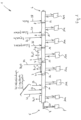
- FIG. 1 a planetary roller extruder.
- an extruder 1 is shown, which is designed as a planetary roller extruder.
- the planetary roller extruder includes several modules 11, 12, 13, 14, 15, 16.
- the modules 11, 12, 13, 14, 15, 16 are arranged one after the other and allow a continuous flow of material in the extruder 1.
- Each of the modules 11, 12, 13 , 14, 15, 16 is connected to a heating/cooling circuit 11a, 12a, 13a, 14a, 15a, 16a.
- Circuits are those that are operated with oil or water or another medium. Oil operation allows a maximum temperature of up to 300 °C and is intended for modules 11, 12, 13, 14, 15. Water operation allows a maximum temperature of 220 °C.
- the circuit is operated with water.
- individual modules 11, 12, 13, 14, 15, 16 are each operated together by a circuit. This is suitable, for example, for the modules 13, 14, which can operate at approximately the same temperature.
- a filling part 10 can additionally be provided, into which at least one carboxylic acid, in particular a fatty acid, as well as at least one metal hydroxide and / or at least one metal oxide and / or at least one metal carbonate and / or at least one basic metal carbonate are fed and mixed. In principle, these components could also be metered into the first module 11 immediately.
- a separate heating/cooling circuit 10a is provided for the filling part 10.
- the extruder 1 is penetrated by a central spindle 4, which is driven by a motor 3.
- the spindle 4 runs through the filling part 10 and all modules 11, 12, 13, 14, 15, 16 of the extruder 1. Since it is a planetary roller extruder, the spindle 4 is surrounded by planetary spindles which are connected to an inside of each of the modules 11 , 12, 13, 14, 15, 16 interlock.
- appropriate helical gearing can ensure that the material is driven downstream after it has been filled into the extruder 1, so that the material can ultimately exit at a rear end 6 of the extruder 1 opposite a front end 5 of the extruder 1.
- Dispersion disks 7 or other means for distributing mass into a subsequent unit can be provided downstream on the modules 11, 12, 13.
- a degassing ring 8 can be connected downstream.
- the spindle 4 can also be temperature-controlled on the inside, for which a separate circuit 9 is provided, which can be operated, for example, with oil up to a temperature of 300 ° C.
- Suitable feeds 21, 22, 23, 24, 25, 26, 27, 28 are provided for feeding material for producing a stabilizer composition.
- openings 2 are provided on the extruder 1 on the side, in particular on the head side as shown or on a vertically upper region.
- the openings 2 can be slot-shaped and are laterally surrounded by projecting walls 3.
- water of reaction formed when the previously applied carboxylic acids react with the metal compounds can escape. It is also possible for this escape of reaction water to be actively promoted, for example by extraction using a pump. In principle, however, a corresponding procedure can be omitted if the modules 11, 12, 13 are designed appropriately. To avoid foam formation, it is also useful if the water of reaction escapes on its own or without any supporting measures.
- a reaction of the at least one carboxylic acid with the at least one metal hydroxide and/or the at least one metal oxide takes place in the modules 11, 12, 13, which essentially represent a boiler cascade.
- the resulting water of reaction has either completely escaped or has at least been reduced to a desired content.
- a temperature of the then still liquid mass can be around 200 ° C to 250 ° C.
- This module 13 can be intended exclusively for the escape of reaction water.
- the walls 3 can be made higher than those on the module 12.
- This mass then passes through a last one of the dispersion rings 7 into the module 14.
- the processed material is still liquid or is in the form of a melt.
- Liquid components, premixed powders and/or pigments can now be introduced via the feed 26.
- a temperature can be around 40 °C to 200 °C.
- further components for example zeolites, chalk or co-stabilizers, can be added via a feed 27. Since the temperature in this area is already significantly lower, the processed mass or the material advanced in the extruder 1 already has a pasty, significantly higher viscosity consistency at this point.
- thermally sensitive substances are finally added via a further feed line 28 at relatively moderate temperatures of 30 ° C to 130 ° C, for example selected raw materials and / or colors.
- the supply line 28 is like that remaining supply lines 21, 22, 23, 24, 25, 26, 27 with suitable dosing agents, e.g. B. a scale or a dosing pump.
- modules 11, 12, 13, 14, 15, 16 can also be combined into a single module.
- the modules 11, 12, 13 can be combined into one or two modules.
- the number of modules 11, 12, 13, 14, 15, 16 is at least two, in particular three or more, but there is no upper limit.
- the stabilizer composition produced in this way emerges from the extruder 1 at the downstream end thereof.
- the strand-shaped material of the stabilizer composition can be removed as such or as a strand. It is also possible for the material created in this way to be granulated afterwards.
- the temperature in module 16 also depends on this. For acceptance as a strand, lower temperatures in the range of 30 °C to 80 °C are usually sufficient. If granulation or tablets are to be produced, the temperature is higher in the range of around 110 °C to 140 °C.
- safety devices such as sieves or magnetic separators can also be attached to the end of the extruder 1 in order to intercept any contamination of the finished stabilizer composition.
- these devices can also be installed on some or all of the feeders 21, 22, 23, 24, 25, 26, 27, 28.
- Tables 1 and 2 below show typical parameters for producing a stabilizer composition with an extruder 1 of the type described above.
- ⁇ b>Table 1 ⁇ /b> - ⁇ b>Composition for stabilizer composition ⁇ /b> component Composition [%] Stearic acid liquid (100 °C) 27.8 Calcium hydroxide Ca(OH) 2 3.9 Zinc oxide ZnO 1.3 Catalyst ( H2O ) 1.7 Paraffin wax (dropping point 55°C to 77°C) 5.5 Dilaurylthiodipropionate 4.6 Antioxidant (Irganox 1076) 4.9 Alcamizer P93 (Kisuma) 50.3 total 100 Plant part Temperature [°C] Spindle 4 160 Filling part 10 passive* Module 11 180 Module 12 160 Module 13 160 Module 14 120 Module 15 60 Module 16 passive* * passive means that the corresponding heating/cooling circuit is not activated
- a stabilizer composition produced in accordance with Tables 1 and 2 can not only be produced in large quantities in a short time as bar material or granules to be cut to length, but also has the right process conditions and extrusion via a planetary roller extruder also has a high level of homogeneity and quality with a predetermined and reproducible water content.
Landscapes
- Chemical & Material Sciences (AREA)
- Health & Medical Sciences (AREA)
- Chemical Kinetics & Catalysis (AREA)
- Medicinal Chemistry (AREA)
- Polymers & Plastics (AREA)
- Organic Chemistry (AREA)
- Engineering & Computer Science (AREA)
- Mechanical Engineering (AREA)
- Compositions Of Macromolecular Compounds (AREA)
- Processes Of Treating Macromolecular Substances (AREA)
- Detergent Compositions (AREA)
- Processing And Handling Of Plastics And Other Materials For Molding In General (AREA)
- Glanulating (AREA)
- Paints Or Removers (AREA)
Description
- Die Erfindung betrifft ein Verfahren zur Herstellung einer Stabilisatorzusammensetzung für ein Polymer, wobei eine Carbonsäure mit zumindest einer Metallverbindung wie zumindest einem Metallhydroxid und/oder zumindest einem Metalloxid und/oder zumindest einem Metallcarbonat unter Bildung eines Metallcarboxylates der Carbonsäure umgesetzt wird.
- Des Weiteren betrifft die Erfindung eine Stabilisatorzusammensetzung für ein Polymer.
- Polymere werden üblicherweise mit Stabilisatoren versetzt, um eine effiziente Verarbeitung zu ermöglichen. Da ein Polymer im Einsatz häufig einer Vielzahl von Einflüssen und Belastungen ausgesetzt ist, sind in der Regel mehrere Komponenten erforderlich, die bei der Herstellung der Stabilisatorzusammensetzung gemeinsam oder sequenziell zugeführt werden.
- Bei der Verarbeitung von Polymeren haben sich Stabilisatorzusammensetzungen bewährt, die gebrauchsfertig eingesetzt werden können (sogenannte "one-packs").
- Gebrauchsfertige Stabilisatorzusammensetzungen umfassen oft Metallcarboxylate, also Reaktionsprodukte von Carbonsäuren, vorzugsweise Fettsäuren, mit Metallhydroxiden und/oder Metalloxiden und/oder Metallcarbonaten, z. B. basischen Metallcarbonaten, und weitere Zusatzstoffe wie Zeolithe, Hydrotalcite, Kreide, Pigmente, weitere Co-Stabilisatoren, Antioxidantien und dergleichen. Eine konkrete Abstimmung der Zusammensetzung wird dabei mit Fokus auf das oder die beabsichtigten Einsatzgebiete des Polymers ausgerichtet.
- Für eine Stabilisatorzusammensetzung in gebrauchsfertiger Form bzw. einen one-pack ist es erforderlich, die einzelnen Komponenten zu mischen. Gemäß dem Stand der Technik wird hierfür in einem ersten Schritt zunächst eine Umsetzung von Fettsäuren mit Metallhydroxiden und/oder Metalloxiden und/oder Metallcarbonaten zur Bildung der gewünschten Metallseifen bzw. Metallcarboxylate durchgeführt. Beispielsweise finden neben den gebräuchlichen Carbonsäuren wie Laurinsäure oder Stearinsäure als Oxide beispielsweise Oxide der Übergangsmetalle wie Zinkoxid (ZnO) und/oder Alkali- und/oder Erdalkalioxide und/oder -hydroxide wie Calciumhydroxid [Ca(OH)2] Anwendung. Es kann auch Carbonsäure oder die Metallverbindung im Überschuss zugegeben werden, sodass saure oder basische Metallcarboxylate entstehen. Nach dieser Reaktion in einem ersten Schritt werden in einem Batch-Verfahren die weiteren Komponenten je nach Bedarf beigemischt und eingearbeitet, um letztlich die Stabilisatorzusammensetzung zu erstellen.
- Bei der Herstellung von gebrauchsfertigen Stabilisatorzusammensetzungen mit Metallcarboxylaten von Carbonsäuren ist eine Verfahrensführung im Batch-Verfahren deswegen erforderlich, weil die Umsetzung von Carbonsäuren mit den Metalloxiden und/oder Metallhydroxiden vollständig abgeschlossen sein soll. Ein unvollständiger oder variierender Reaktionsumsatz führt letztlich zu einer unerwünschten oder von der Charge abhängigen abweichenden Rheologie bei der Polymerverarbeitung, was nicht erwünscht ist. Da aber dieser erste Schritt der Umsetzung der Carbonsäure und die anschließende Beimengung weiterer Komponenten im Batch-Verfahren erfolgen muss, ergibt sich insgesamt ein zeitaufwendiger Prozess mit einem beschränkten Massendurchsatz.
- Hier setzt die Erfindung an. Aufgabe der Erfindung ist es, ein Verfahren der eingangs genannten Art anzugeben, mit dem ein höherer Durchsatz ohne Einbuße in Bezug auf eine Produktgüte erreichbar ist.
- Ein weiteres Ziel ist es, eine verbesserte Stabilisatorzusammensetzung anzugeben.
- Die verfahrensmäßige Aufgabe der Erfindung wird gelöst, wenn bei einem Verfahren der eingangs genannten Art die Umsetzung der Carbonsäure, insbesondere einer Fettsäure, mit der Metallverbindung kontinuierlich in einem Extruder unter Austritt von entstehendem Reaktionswasser aus dem Extruder durchgeführt wird.
- Ein mit einem erfindungsgemäßen Verfahren erzielter Vorteil liegt darin, dass bei Austritt von entstehendem Reaktionswasser aus dem Extruder das Verfahren in diesem und damit der Prozess im Gesamten kontinuierlich gefahren werden kann. Dabei ist es möglich, durch eine Länge des Extruders bzw. durch ein freies Volumen in diesem die erforderliche Reaktionszeit für eine insbesondere vollständige Reaktion so abzustimmen, dass kein oder nur mehr ein gezielt vorbestimmter, reproduzierbarer Restwassergehalt im Produkt vorliegt. Dies lässt sich ohne Weiteres einstellen, sobald erkannt ist, dass der Extruder erfindungsgemäß mit Öffnungen zu gestalten ist, also entstehendes Reaktionswasser die Möglichkeit hat, zu entweichen.
- Eine kontinuierliche Verfahrensführung erfordert nicht nur weniger Kontrolle und damit Personalaufwand als ein Batch-Verfahren, sondern bringt insbesondere auch den Vorteil, dass eine pro Zeiteinheit herstellbare bzw. ausbringbare Masse an Stabilisatorzusammensetzung deutlich höher ist und beispielsweise im Vergleich mit einem Batch-Verfahren ein Vielfaches betragen kann. Es ergibt sich somit ein hochproduktives Verfahren, das zu einem exzellenten Produkt führt, da im Extruder eine innige Durchmischung zunächst der Edukte und später der daraus entstehenden Produkte erfolgt und im Anschluss noch weitere Stabilisatorkomponenten zugemischt werden können, sofern erforderlich.
- Als Metallverbindung können beliebige Verbindungen eingesetzt werden, die mit der zumindest einen Carbonsäure zu einem Carboxylat reagieren. Üblicherweise erfolgt die Umsetzung mit zumindest einem Metallhydroxid und/oder zumindest einem Metalloxid und/oder zumindest einem Metallcarbonat, wobei insbesondere auch basische Metallcarbonate geeignet sind.
- Als Carbonsäuren sind aliphatische oder aromatische, mono- und/oder di- und/oder polyCarbonsäuren, insbesondere Fettsäuren, die mit Kohlenstoffketten mit 2 bis zu 30 Kohlenstoffen aufgebaut sind, die linear oder verzweigt sein können und die optional teilweise auch mit Hydroxylgruppen und Aminogruppen substituiert sein können, zu verstehen.
- Die Kationen, die zu den Metallseifen bzw. Metallcarboxylaten reagieren, werden im Sinne der Erfindung als Metallhydroxid und/oder Metalloxid und/oder Metallcarbonaten und/oder basischen Metallcarbonat zugegeben, wobei auch mehrere unterschiedliche Metalloxide, -hydroxide, -carbonate und/oder basische Metallcarbonate zugegeben werden können.
- Die Kationen können aus den Gruppen der Alkali- und/oder Erdalkalimetalle, Zink, Aluminium, Zinn und/oder aus der Gruppe der Seltenerdmetalle oder dergleichen sein.
- Die Metallverbindungen können als Mischung mehrerer unterschiedlicher Metallverbindungen oder bevorzugt sequenziell zugegeben werden.
- Es ist möglich, dass das Reaktionswasser aktiv aus dem Extruder abgezogen wird. Hierfür kann beispielsweise vorgesehen sein, dass an einer oder mehreren Stellen des Extruders ein Unterdruck angelegt wird, durch welchen das Wasser aus dem Extruder abgezogen wird. Insbesondere kann ein Vakuum Anwendung finden, beispielsweise ein Wasserstrahlvakuum. Bevorzugt ist es jedoch, wenn das Reaktionswasser entweichen gelassen wird. Durch ein passives Entweichen des Reaktionswassers ohne zusätzliche Maßnahmen kann die Reaktionsmischung bei Atmosphärendruck bearbeitet bzw. gefahren werden. Dies bringt neben einer apparativ einfachen Verfahrensführung auch den Vorteil mit sich, dass eine Schaumbildung, welche bei der Umsetzung der Carbonsäuren mit Metallhydroxiden und/oder Metalloxiden auftreten kann, nicht aktiv gefördert wird.
- Der Austritt des Reaktionswassers kann grundsätzlich an beliebigen Stellen des Extruders erfolgen bzw. aktiv gefördert werden. Bevorzugt ist es, dass der Austritt des Reaktionswassers durch Öffnungen des Extruders erfolgt. Die Öffnungen können an einer Außenseite des Extruders entlang des Materialflusses angeordnet sein. Es handelt sich somit in einer bevorzugten Variante um einen sogenannten offenen Extruder, aus dem das Reaktionswasser auf einfache Weise und ohne zusätzliche Maßnahmen entweicht. Da die Reaktionsmischung aufschäumen kann, ist es bevorzugt, dass die Öffnungen kopfseitig vorgesehen sind. Beispielsweise können die Öffnungen dabei schlitzförmig ausgebildet sein, wobei die Schlitze noch von seitlich aufragenden Wänden umgeben sein können, die vom Extruder nach oben hin aufragen. In diesem Fall ist eine nicht allzu starke Schaumbildung im Extruder unproblematisch handhabbar, weil sich der Schaum noch innerhalb der Wände sammeln kann, ohne dass ein Überquellen aus dem Extruder erfolgt.
- Die zumindest eine Carbonsäure wird bevorzugt flüssig in den Extruder zugeführt. Die Carbonsäure kann dabei mit einer Temperatur von mehr als 75 °C, bevorzugt mehr als 80 °C, insbesondere mehr als 80 °C bis zu 150 °C, in den Extruder zugeführt werden. Höhere Temperaturen ermöglichen, dass die Reaktion möglichst effizient im Sinne einer vollständigen Umsetzung entlang einer kurzen Strecke des Extruders erfolgen kann.
- Um eine Umsetzung der Carbonsäure mit dem Metallhydroxid und/oder dem Metalloxid und/oder dem Metallcarbonat und/oder einer anderen Metallverbindung zu initiieren bzw. rascher ablaufen zu lassen, wird bevorzugt ein Katalysator zugeführt. Hierfür ist es zweckmäßig, dass der Katalysator mit der Carbonsäure oder mit Metallhydroxid und/oder Metalloxid und/oder Metallcarbonat in den Extruder zugeführt wird. Wird die Carbonsäure mit einem Metallhydroxid und gegebenenfalls oder alternativ auch einem Metalloxid zuerst zugeführt, können die beiden Komponenten bereits zumindest teilweise miteinander vermischt werden. Die danach stromabwärts folgende Zudosierung des Katalysators fördert dann einen raschen Reaktionsablauf. Dabei kann ein Gehalt an Katalysator relativ gering gehalten werden. Bevorzugt wird ein Gewichtsverhältnis von Carbonsäure zu Katalysator im Bereich von mehr als 0 bis 50, vorzugsweise 20 bis 45 gewählt.
- Als Katalysatoren sind im Rahmen der Erfindung Stoffe zu verstehen, die mit passivierten Oberflächen von Metallhydroxid und/oder Metalloxid und/oder Metallcarbonaten und/oder basischen Metallcarbonat-Partikeln reagieren und damit einerseits die Partikeloberflächen reaktiver machen und andererseits selbst mit den Carboxylaten durch Transfer des Kations weiter reagieren. Wasser, anorganische und organische Säuren, Säureanhydride, kurzkettige Carbonsäuren, kurzkettige Carboxylate oder dergleichen sind als Katalysatoren einsetzbar. Im Verlauf der Reaktion können Katalysatoren auch teilweise oder vollständig aus dem Prozess durch Verdampfen aus der Schmelze oder Mischung ausscheiden.
- Günstig ist es, wenn die Umsetzung der Carbonsäure mit der Metallverbindung wie einem Metallhydroxid und/oder einem Metalloxid und/oder einem Metallcarbonat in mehreren hintereinander geschalteten Modulen des Extruders durchgeführt wird. Sind mehrere Module vorhanden, bieten sich mehrere Vorteile: Zum einen können die einzelnen Module gegebenenfalls zumindest teilweise gesondert temperiert werden, was eine gewünschte Temperatureinstellung entlang der Module und damit eine gezielte Beeinflussung der Reaktion ermöglicht. Zum anderen können zwischen den einzelnen Modulen nochmals Elemente zur besseren Dispergierung der Reaktionsmischung vorgesehen sein, insbesondere Dispergierringe oder dergleichen, was eine weitere innige Durchmischung fördert. In diesem Zusammenhang kann auch vorgesehen sein, dass stromabwärts weitere Metallverbindungen beigemengt werden. Eine sequenzielle Beimengung von insbesondere Metallhydroxiden und/oder Metalloxiden oder weiteren Carbonsäuren kann erforderlich sein, um die Viskosität der Reaktionsmischung gezielt steuern zu können. Ist aber eine Reaktion bereits zumindest teilweise erfolgt, können wie erwähnt weitere Metallverbindungen beigemengt werden. Darüber hinaus können in einzelnen Modulen auch unterschiedlich große Öffnungen bzw. Schlitze vorgesehen sein, was eine optimale Abstimmung des Entziehens bzw. Entweichens von Reaktionswasser in Bezug auf die jeweilige Position der Reaktionsmischung und damit einen bis dahin erfolgten Reaktionsumsatz ermöglicht. Insgesamt lassen sich somit optimale Bedingungen für die gewünschte Umsetzung der zumindest einen Carbonsäure mit der zumindest einen Metallverbindung finden.
- Wie erwähnt kann vorgesehen sein, dass die Module zumindest teilweise gesondert temperiert werden. Dabei kann eine Temperatur der Module insbesondere so eingestellt werden, dass die Carbonsäure in flüssigem Zustand gehalten wird. Eine Temperatur der Module auf zumindest 50 °C, bevorzugt zumindest 120°C, vorzugsweise zumindest 140 °C, insbesondere 155 °C bis 250 °C, eingestellt werden. Dadurch kann auch bei längerkettigen Carbonsäuren gegebenenfalls eingestellt werden, dass diese während der Umsetzung in flüssigem Zustand bleiben. Gleichzeitig ist dadurch die Möglichkeit gegeben, die Reaktionsgeschwindigkeit und damit die Verweilzeit im Extruder über die Temperatur zu beeinflussen.
- Es kann im Rahmen der Erfindung vorgesehen sein, dass die Umsetzung der Carbonsäure mit der zumindest einen Metallverbindung in mehreren hintereinandergeschalteten Modulen des Extruders durchgeführt wird und/oder in mehreren weiteren Modulen weitere Materialien in die Stabilisatorzusammensetzung eingearbeitet werden.
- Weitere Materialien können (Co-)Stabilisatoren, Gleitmittel, Füllstoffe, Antioxidantien, Lichtschutzmittel, Pigmente, Fließhilfen, Schlagzähmodifikatoren und andere Acrylat-Derivate und /oder Polymere sein, wie sie aus dem Stand der Technik oder aus der Fachliteratur bekannt sind.
- Unter (Co-)Stabilisatoren sind zum Beispiel organische Stabilisatoren wie Harnstoff und dessen Derviate, Aminocrotonate und deren Derivate, Uracile und deren Derivate, Thioester, Glycidylverbindungen, Amine, Amide, Aminosäuren und deren Derivate, Epoxyverbindungen, Beta-Diketone, Di- und Polyhydropyridine, Polyole, Isocyanurate, Polyalkylpiperidine, Schichtgitterverbindungen (LDHs), (Erd-)Alkalialumosilikate, Alkalialumocarbonate und dergleichen zu verstehen. Unter Gleitmitteln sind zum Beispiel Kohlenwasserstoff-Wachse (PE-Wachse, PP-Wachse, Paraffine, FT-Paraffine und dergleichen), Esterwachse und Komplexester, Ketone und/oder Alkohole und/oder Amine der Fettsäuren, Chlorparaffine, Silikone, Polysiloxane, Kamm-Co-Polymere, Polyester, Polyamine und dergleichen zu verstehen. Unter Füllstoffen sind zum Beispiel Carbonate, Calcite, Dolomite, Talkum, Kaoline, Alumosalzverbindungen und dergleichen zu verstehen.
- Ist die Reaktion der Carbonsäure mit dem Metallhydroxid und/oder dem Metalloxid abgeschlossen und kein oder nur mehr ein vorbestimmter Reaktionswassergehalt vorhanden, können weitere Komponenten für die Zusammensetzung des Stabilisators eingearbeitet werden. Hierfür sind bevorzugt mehrere weitere Module vorgesehen. Diese weiteren Module können ebenfalls zumindest teilweise gesondert voneinander temperiert werden. Dadurch ist es möglich, bei geregelten Temperaturen bestimmte weitere flüssige oder bevorzugt feste Komponenten einzuarbeiten. Somit können mit dem Verfahren auch temperaturempfindliche Komponenten im weiteren Verlauf des Prozesses in einem stromabwärts betrachtet weiter hinten positionierten Modul eingearbeitet werden.
- Möglich wäre es, dass einzelne Komponenten in (meist) unerwünschten Querreaktionen miteinander reagieren. Hier bietet das Verfahren dann durch die Möglichkeit der bereichsweisen Einstellung der Temperatur Vorteile, da entsprechende Reaktionen durch niedrige Temperaturen unterbunden werden können.
- Für eine effiziente Verfahrensführung ist es von Vorteil, wenn ein oder mehrere Fördermittel in den mehreren Modulen und/oder den weiteren Modulen über einen einzelnen Motor abgetrieben werden. Grundsätzlich können im Rahmen der Erfindung beliebige Extruder eingesetzt werden, solange Aussparungen oder dergleichen vorgesehen sind, über welche Reaktionswasser in einem ersten Extruderabschnitt entweichen kann. Bei dem Fördermittel kann es sich beispielsweise um eine Schnecke handeln, wenn ein Schneckenextruder vorgesehen ist. Die einzelnen Module werden dann um die einzelne Schnecke, die von einem einzigen Motor angetrieben wird, herum angeordnet. Besonders bevorzugt ist es jedoch, dass ein Planetwalzenextruder eingesetzt wird. Ein Planetwalzenextruder bietet den Vorteil, dass das zu verarbeitende bzw. abreagierende Material nicht nur besonders innig vermischt, sondern auch in sehr dünne Schichten aufgeteilt und in dieser Form durchmischt wird. Dies bringt für eine hohe Güte der erzeugten Stabilisatorzusammensetzung Vorteile, weil das zunächst erzeugte Metallcarboxylat und die danach eingearbeiteten Hilfsstoffe bzw. zusätzlichen Komponenten besonders fein miteinander vermischt werden, was zu einer homogenen, feinen Verteilung der eingearbeiteten Komponenten führt. Dies ist in Batch-Verfahren in dieser Güte nicht möglich.
- Für die gewünscht hohe Homogenität des Stabilisators, der beispielsweise als Strang abgenommen wird, können sich große lokale Temperaturdifferenzen im Extruder als nachteilig erweisen. Wird ein Planentenextruder eingesetzt, kann vorgesehen sein, dass eine Spindel des Planetwalzenextruders im Inneren teilweise oder durchgehend temperiert wird. Insbesondere wenn auch die Module temperiert werden, kann dadurch ein großer Temperaturgradient von einer Außenseite der Module zur Extruderachse hin vermieden werden.
- Neben der Abnahme der hergestellten Stabilisatorzusammensetzung als Strang am Ende des Extruders ist es auch möglich, eine Granulation des aus dem Extruder ausfahrenden Materials bzw. der Stabilisatorzusammensetzung vorzunehmen. Eine entsprechende Granulation kann mit an sich bekannten Methoden des Standes der Technik erfolgen, wie beispielsweise in der
DE 1 937 862 A beschrieben. - Eine Ausformung von Stabilisatorschmelzen unter Wasser, gegebenenfalls mit Ablängung, z. B. durch eine Lochdüse hindurch austretende Schmelzestränge, die nachfolgend auf eine vorbestimmte Länge abgeschnitten werden, ist gegenüber einer Abkühlung auf Kühlbändern, die grundsätzlich auch Anwendung finden können, bevorzugt.
- Ein Vorteil bei einer Abkühlung einer Stabilisatorschmelze unter Wasser besteht darin, dass große Freiheiten hinsichtlich der Schmelzeviskosität gegeben sind. Die Viskosität der Schmelze kann für die nachfolgende Ausformung unter Wasser passend über eine Temperaturführung eingestellt werden. Dies erlaubt eine kompakte Bauweise bzw. einen geringen Platzbedarf einerseits und erbringt andererseits auch hohe Durchsätze. Im Vergleich zu Kühlbändern sind darüber hinaus die Investitionskosten relativ gering, da die Schmelzestränge über eine Lochscheibe extrudiert werden können.
- Auf eine bestimmte Bauweise des Extruders kommt es nicht an. Es kann sich dabei um einen Planetwalzenextruder handeln, aber auch irgendeine andere Art eines Extruders, der endseitig mit einer Lochplatte versehen ist, beispielsweise ein Schneckenextruder mit einer oder zwei Schnecken. Eine Viskosität der Schmelze wird dabei so eingestellt, dass vor der Lochplatte ein ausreichender Druckaufbau gegeben ist, um nachfolgend einen sauberen Schnitt zu ermöglichen, wobei aber die Schmelze noch in geeigneter Weise förderbar ist. Beim Pressen der Schmelze durch die Lochscheibe kommt es dann zur Ausformung einzelner Schmelzestränge, welche durch ein oder mehrere rotierende Messer abgelängt werden. Das entstehende Granulat wird anschließend im Wasserstrom weitertransportiert und letztlich getrocknet.
- Die Stabilisatorzusammensetzung wie vorstehend beschrieben ist bevorzugt eine sogenannte one-pack-Stabilisatorzusammensetzung, bedarf also keiner weiteren Hilfs- oder Zuschlagsstoffe, um sofort als Stabilisator insbesondere für halogenhaltige Polymere wie PVC eingesetzt zu werden.
- Entsprechend den vorstehend dargestellten Vorteilen unterscheidet sich eine mit einem erfindungsgemäßen Verfahren hergestellte Stabilisatorzusammensetzung durch eine höhere Homogenität und Gleichmäßigkeit von im Batch-Verfahren hergestellten Stabilisatorzusammensetzungen. Dementsprechend wird das weitere Ziel durch eine erfindungsgemäß hergestellte Stabilisatorzusammensetzung erreicht.
- Weitere Merkmale, Vorteile und Wirkungen ergeben sich aus dem nachfolgend dargestellten Ausführungsbeispiel. In der Zeichnung, auf welche dabei Bezug genommen wird, zeigt
Fig. 1 einen Planetwalzenextruder. - In
Fig. 1 ist ein Extruder 1 dargestellt, der als Planetwalzenextruder ausgebildet ist. Der Planetenwalzextruder umfasst mehrere Module 11, 12, 13, 14, 15, 16. Die Module 11, 12, 13, 14, 15, 16 sind nacheinander angeordnet und erlauben einen durchgängigen Materialfluss im Extruder 1. Jedes der Module 11, 12, 13, 14, 15, 16 ist mit einem Heiz-/Kühlkreislauf 11a, 12a, 13a, 14a, 15a, 16a verbunden. Bei den entsprechenden Kreisläufen handelt es sich um solche, die mit Öl oder Wasser oder einem sonstigen Medium betrieben werden. Ein Ölbetrieb erlaubt eine maximale Temperatur von bis zu 300 °C und ist für die Module 11, 12, 13, 14, 15 vorgesehen. Ein Wasserbetrieb erlaubt eine maximale Temperatur von 220 °C. Für das Modul 16 wird der Kreislauf mit Wasser betrieben. Wenngleich nicht dargestellt, kann auch vorgesehen sein, dass einzelne der Module 11, 12, 13, 14, 15, 16 jeweils durch einen Kreislauf gemeinsam betrieben werden. Dies bietet sich beispielsweise für die Module 13, 14 an, in welchen etwa mit derselben Temperatur gefahren werden kann. - Es kann wie in
Fig. 1 dargestellt zusätzlich ein Füllteil 10 vorgesehen sein, in den zumindest eine Carbonsäure, insbesondere eine Fettsäure, sowie zumindest ein Metallhydroxid und/oder zumindest ein Metalloxid und/oder zumindest ein Metallcarbonlat und/oder zumindest ein basisches Metallcarbonat zugeführt und gemischt werden. Grundsätzlich könnten diese Komponenten aber auch sogleich in das erste Modul 11 eindosiert werden. Für den Füllteil 10 ist ein eigener Heiz-/Kühlkreislauf 10a vorgesehen. - Der Extruder 1 wird von einer zentralen Spindel 4 durchsetzt, die von einem Motor 3 angetrieben wird. Die Spindel 4 läuft durch den Füllteil 10 und alle Module 11, 12, 13, 14, 15, 16 des Extruders 1. Da es sich um einen Planetwalzenextruder handelt, ist die Spindel 4 von Planetenspindeln umgeben, die mit einer Innenseite jedes der Module 11, 12, 13, 14, 15, 16 verzahnen. In Betrieb kann durch eine entsprechende Schrägverzahnung sichergestellt werden, dass das Material nach Einfüllen in den Extruder 1 stromabwärts vorwärtsgetrieben wird, sodass das Material letztlich an einem einem vorderen Ende 5 des Extruders 1 gegenüberliegenden hinteren Ende 6 des Extruders 1 austreten kann.
- An den Modulen 11, 12, 13 können stromabwärts Dispergierscheiben 7 oder andere Mittel zur Verteilung von Masse in eine nachfolgende Einheit vorgesehen sein. Bei den weiteren Modulen 14, 15 kann ein Entgasungsring 8 stromabwärts nachgeschaltet sein. Die Spindel 4 kann innenliegend ebenfalls temperiert werden, wofür ein eigener Kreislauf 9 vorgesehen ist, der beispielsweise mit Öl bis zu einer Temperatur von 300 °C betreibbar ist. Dadurch können starke Temperaturgradienten zwischen einer Außenseite des Extruders 1 bzw. noch präziser ausgedrückt der Innenseite der Module 11, 12, 13, 14, 15, 16 und der Spindel 4 vermieden werden. Mit anderen Worten: Temperaturinhomogenitäten im Extruder 1 können weitgehend vermieden werden.
- Für die Zuführung von Material zur Herstellung einer Stabilisatorzusammensetzung sind geeignete Zuführungen 21, 22, 23, 24, 25, 26, 27, 28 vorgesehen. Des Weiteren sind am Extruder 1 seitlich, insbesondere wie dargestellt kopfseitig bzw. an einem vertikal oberen Bereich Öffnungen 2 vorgesehen. Die Öffnungen 2 können schlitzförmig ausgebildet sein und sind seitlich von aufragenden Wänden 3 umgeben. Durch diese Schlitze bzw. Öffnungen 2 kann bei einer Reaktion der zuvor aufgegebenen Carbonsäuren mit den Metallverbindungen entstehendes Reaktionswasser entweichen. Möglich ist es auch, dass dieses Entweichen von Reaktionswasser aktiv gefördert wird, beispielsweise durch Abzug mittels einer Pumpe. Grundsätzlich kann allerdings eine entsprechende Verfahrensführung bei geeigneter Auslegung der Module 11, 12, 13 unterbleiben. Auch zur Vermeidung einer Schaumbildung ist es zweckmäßig, wenn das Reaktionswasser von selbst bzw. ohne unterstützende Maßnahme entweicht.
- Eine Umsetzung der zumindest einen Carbonsäure mit dem zumindest einen Metallhydroxyd und/oder dem zumindest einem Metalloxid erfolgt in den Modulen 11, 12, 13, welche quasi eine Kesselkaskade darstellen. Am Ende des Moduls 13 ist das entstandene Reaktionswasser entweder vollständig entwichen oder zumindest auf einen gewünschten Gehalt reduziert. Am Ende des Moduls 13 kann eine Temperatur der dann noch flüssigen Masse etwa 200 °C bis 250 °C betragen. Dieses Modul 13 kann ausschließlich für die Entweichung von Reaktionswasser vorgesehen sein. Die Wände 3 können in diesem Fall höher gestaltet sein als jene am Modul 12. Anschließend tritt diese Masse durch einen letzten der Dispergierringe 7 in das Modul 14 über. In diesem Modul 14 ist das verarbeitete Material nach wie vor flüssig bzw. liegt als Schmelze vor. Es können nun über die Zuführung 26 flüssige Komponenten, vorgemischte Pulver und/oder Pigmente eingebracht werden. Eine Temperatur kann hierbei etwa 40 °C bis 200 °C betragen. Im nachfolgenden Modul 15 können wiederum über eine Zuführung 27 weitere Komponenten, beispielsweise Zeolithe, Kreide oder Co-Stabilisatoren beigemengt werden. Da die Temperatur in diesem Bereich bereits deutlich niedriger ist, weist die verarbeitete Masse bzw. das im Extruder 1 vorwärtsgetriebene Material an dieser Stelle bereits eine pastöse, deutlich höher viskose Konsistenz auf. Im Modul 16, das mit Wasser beheizt wird, erfolgt schließlich bei relativ moderaten Temperaturen von 30 °C bis 130 °C eine Beimengung von thermisch empfindlichen Stoffen über eine weitere Zuleitung 28, beispielsweise ausgesuchte Rohstoffen und/oder Farben. Die Zuleitung 28 ist wie die übrigen Zuleitungen 21, 22, 23, 24, 25, 26, 27 mit geeigneten Dosiermitteln, z. B. eine Waage oder eine Dosierpumpe, ausgestattet.
- Es kann vorgesehen sein, dass mehrere der Module 11, 12, 13, 14, 15, 16 auch zu einem einzelnen Modul kombiniert werden können. Beispielsweise können die Module 11, 12, 13 zu einem oder zwei Modulen kombiniert werden. Analoges gilt für die Module 14, 15, 16. Die Anzahl der Module 11, 12, 13, 14, 15, 16 beträgt mindestens zwei, insbesondere drei oder mehr, ist nach oben hin aber nicht limitiert.
- Schließlich tritt die so hergestellte Stabilisatorzusammensetzung am stromabwärts angeordneten Ende des Extruders 1 aus diesem aus. Das strangförmige Material der Stabilisatorzusammensetzung kann dabei als solche bzw. als Strang abgenommen werden. Möglich ist es auch, dass eine Granulation des so erstellten Materials nachgeschaltet ist. Danach richtet sich auch die Temperatur im Modul 16. Für eine Abnahme als Strang sind in der Regel niedrigere Temperaturen im Bereich von 30 °C bis 80 °C ausreichend. Soll granuliert bzw. Tabletten hergestellt werden, liegt die Temperatur höher im Bereich von etwa 110 °C bis 140 °C.
- Optional können auch noch Sicherheitseinrichtungen wie Siebe oder Magnetabscheider an das Ende des Extruders 1 angebracht werden um etwaige Kontaminationen der fertigen Stabilisatorzusammensetzung abzufangen. Diese Einrichtungen können aber auch an einzelnen der oder allen Zuführungen 21, 22, 23, 24, 25, 26, 27, 28 installiert werden.
- In den nachstehenden Tabellen 1 und 2 sind typische Parameter zur Herstellung einer Stabilisatorzusammensetzung mit einem Extruder 1 der vorstehend beschriebenen Art dargestellt.
Tabelle 1 - Zusammensetzung für Stabilisatorzusammensetzung Komponente Zusammensetzung [%] Stearinsäure flüssig (100 °C) 27,8 Calciumhydroxid Ca(OH)2 3,9 Zinkoxid ZnO 1,3 Katalysator (H2O) 1,7 Paraffinwachs (Tropfpunkt 55 °C bis 77 °C) 5,5 Dilaurylthiodipropionat 4,6 Antioxidans (Irganox 1076) 4,9 Alcamizer P93 (Kisuma) 50,3 Summe 100 Tabelle 2 - Temperatureinstellung Anlagenteil Temperatur [°C] Spindel 4 160 Füllteil 10 passiv* Modul 11 180 Modul 12 160 Modul 13 160 Modul 14 120 Modul 15 60 Modul 16 passiv* * passiv bedeutet, dass der entsprechende Heiz-/Kühlkreislauf nicht aktiviert ist - Eine entsprechend Tabelle 1 und 2 hergestellte Stabilisatorzusammensetzung lässt sich nicht nur in großen Mengen in kurzer Zeit als abzulängendes Stangenmaterial oder Granulat produzieren, sondern weist aufgrund der abgestimmten Verfahrensbedingungen und der Extrusion über einen Planetwalzenextruder auch eine hohe Homogenität und Güte bei vorbestimmtem und reproduzierbarem Wassergehalt auf.
Claims (19)
- Verfahren zur Herstellung einer Stabilisatorzusammensetzung für ein Polymer, wobei zumindest eine Carbonsäure mit zumindest einer Metallverbindung wie zumindest einem Metallhydroxid und/oder zumindest einem Metalloxid und/oder zumindest einem Metallcarbonat unter Bildung eines Metallcarboxylates der Carbonsäure umgesetzt wird, dadurch gekennzeichnet, dass die Umsetzung der Carbonsäure mit der Metallverbindung kontinuierlich in einem Extruder (1) unter Austritt von entstehendem Reaktionswasser aus dem Extruder (1) durchgeführt wird.
- Verfahren nach Anspruch 1, dadurch gekennzeichnet, dass das Reaktionswasser entweichen gelassen wird.
- Verfahren nach Anspruch 1 oder 2, dadurch gekennzeichnet, dass der Austritt des Reaktionswassers durch Öffnungen (2), insbesondere kopfseitige Öffnungen (2), des Extruders (1) erfolgt.
- Verfahren nach einem der Ansprüche 1 bis 3, dadurch gekennzeichnet, dass die Carbonsäure flüssig in den Extruder (1) zugeführt wird.
- Verfahren nach Anspruch 4, dadurch gekennzeichnet, dass die Carbonsäure mit einer Temperatur von mehr als 75 °C, bevorzugt mehr als 80 °C, insbesondere mehr als 80 °C bis zu 150 °C, in den Extruder (1) zugeführt wird.
- Verfahren nach einem der Ansprüche 1 bis 5, dadurch gekennzeichnet, dass zur Umsetzung der Carbonsäure mit der Metallverbindung ein Katalysator zugeführt wird.
- Verfahren nach Anspruch 6, dadurch gekennzeichnet, dass ein Gewichtverhältnis von Carbonsäure zu Katalysator im Bereich von mehr als 0 bis 50, vorzugsweise 20 bis 45, gewählt wird.
- Verfahren nach einem der Ansprüche 1 bis 7, dadurch gekennzeichnet, dass die Umsetzung der Carbonsäure mit der Metallverbindung in mehreren hintereinandergeschalteten Modulen (11, 12, 13) des Extruders (1) durchgeführt wird.
- Verfahren nach Anspruch 8, dadurch gekennzeichnet, dass die Module (11, 12, 13) zumindest teilweise gesondert temperiert werden.
- Verfahren nach Anspruch 8 oder 9, dadurch gekennzeichnet, dass eine Temperatur der Module (11, 12, 13) so eingestellt wird, dass die Carbonsäure in flüssigem Zustand gehalten wird.
- Verfahren nach einem der Ansprüche 8 bis 10, dadurch gekennzeichnet, dass eine Temperatur der Module (11, 12, 13) auf zumindest 50 °C, bevorzugt zumindest 120 °C, vorzugsweise zumindest 140 °C, insbesondere 155 °C bis 250 °C, eingestellt wird.
- Verfahren nach einem der Ansprüche 1 bis 11, dadurch gekennzeichnet, dass die Umsetzung der Carbonsäure mit der Metallverbindung in mehreren hintereinandergeschalteten Modulen (11, 12, 13) des Extruders (1) durchgeführt wird und/oder in einem oder mehreren weiteren Modulen (14, 15, 16) weitere Materialien, insbesondere Feststoffe, in die Stabilisatorzusammensetzung eingearbeitet werden.
- Verfahren nach Anspruch 12, dadurch gekennzeichnet, dass die weiteren Module (14, 15, 16) zumindest teilweise gesondert voneinander temperiert werden.
- Verfahren nach einem der Ansprüche 9 bis 13, dadurch gekennzeichnet, dass ein oder mehrere Fördermittel in den mehreren Modulen (11, 12, 13) und/oder den weiteren Modulen (14, 15, 16) über einen einzelnen Motor (3) angetrieben werden.
- Verfahren nach einem der Ansprüche 1 bis 14, dadurch gekennzeichnet, dass ein Planetenwalzextruder eingesetzt wird.
- Verfahren nach Anspruch 15, dadurch gekennzeichnet, dass eine zentrale Spindel (4) des Planetwalzenextruders im Inneren temperiert wird.
- Verfahren nach einem der Ansprüche 1 bis 16, dadurch gekennzeichnet, dass die Stabilisatorzusammensetzung als Strang aus dem Extruder abgenommen wird.
- Verfahren nach einem der Ansprüche 1 bis 17, dadurch gekennzeichnet, dass die Stabilisatorzusammensetzung granuliert wird, insbesondere unter Wasser granuliert wird.
- Stabilisatorzusammensetzung, erhältlich nach einem der Ansprüche 1 bis 18.
Applications Claiming Priority (2)
| Application Number | Priority Date | Filing Date | Title |
|---|---|---|---|
| ATA51127/2016A AT519431B1 (de) | 2016-12-12 | 2016-12-12 | Verfahren zur Herstellung einer Stabilisatorzusammensetzung und damit hergestellte Stabilisatorzusammensetzung |
| PCT/AT2017/060328 WO2018107193A1 (de) | 2016-12-12 | 2017-12-07 | Verfahren zur herstellung einer stabilisatorzusammensetzung und damit hergestellte stabilisatorzusammensetzung |
Publications (3)
| Publication Number | Publication Date |
|---|---|
| EP3551687A1 EP3551687A1 (de) | 2019-10-16 |
| EP3551687B1 true EP3551687B1 (de) | 2024-01-24 |
| EP3551687C0 EP3551687C0 (de) | 2024-01-24 |
Family
ID=60702245
Family Applications (1)
| Application Number | Title | Priority Date | Filing Date |
|---|---|---|---|
| EP17816395.2A Active EP3551687B1 (de) | 2016-12-12 | 2017-12-07 | Verfahren zur herstellung einer stabilisatorzusammensetzung und damit hergestellte stabilisatorzusammensetzung |
Country Status (11)
| Country | Link |
|---|---|
| US (2) | US11760846B2 (de) |
| EP (1) | EP3551687B1 (de) |
| CN (1) | CN110191912B (de) |
| AR (1) | AR110352A1 (de) |
| AT (1) | AT519431B1 (de) |
| AU (1) | AU2017376812B2 (de) |
| ES (1) | ES2977952T3 (de) |
| PL (1) | PL3551687T3 (de) |
| RU (1) | RU2743502C1 (de) |
| TW (1) | TWI772344B (de) |
| WO (1) | WO2018107193A1 (de) |
Families Citing this family (3)
| Publication number | Priority date | Publication date | Assignee | Title |
|---|---|---|---|---|
| AT519431B1 (de) * | 2016-12-12 | 2020-04-15 | Chemson Polymer Additive Ag | Verfahren zur Herstellung einer Stabilisatorzusammensetzung und damit hergestellte Stabilisatorzusammensetzung |
| AT524902B1 (de) * | 2021-03-19 | 2024-11-15 | Akdeniz Chemson Additives Ag | Verfahren zur Herstellung einer Stabilisatorzusammensetzung für ein Polymer und damit hergestellte Stabilisatorzusammensetzung |
| CN120076911A (zh) | 2022-10-17 | 2025-05-30 | 阿登尼斯开米森添加剂股份公司 | 用于生产颗粒形式的稳定剂组合物的方法和装置以及由此生产的稳定剂组合物 |
Citations (14)
| Publication number | Priority date | Publication date | Assignee | Title |
|---|---|---|---|---|
| DE1937862A1 (de) | 1969-07-25 | 1971-02-04 | Werner & Pfleiderer | Verfahren und Vorrichtung zur Unterwassergranulierung |
| EP0238240A2 (de) | 1986-03-20 | 1987-09-23 | UNIROYAL CHEMICAL COMPANY, Inc. | Reaktive Trockenverarbeitung |
| EP0304831A1 (de) | 1987-08-28 | 1989-03-01 | Henkel Kommanditgesellschaft auf Aktien | Verfahren zur kontinuierlichen Herstellung von Fettsäureseifen |
| EP0813904A2 (de) | 1996-06-20 | 1997-12-29 | Basf Aktiengesellschaft | Verfahren zur Herstellung von Salzen von Säuregruppen tragenden pharmazeutischen Wirkstoffen |
| DE19627258A1 (de) | 1996-07-08 | 1998-01-22 | Chemson Polymer Additive | Schmelzbare Stabilisatorkombination |
| DE19755561A1 (de) | 1997-12-13 | 1999-06-17 | Basf Ag | Verfahren zur Herstellung von staubarmen Stabilisatorsystemen zur thermischen Stabilisierung von PVC |
| US6147147A (en) | 1998-05-08 | 2000-11-14 | Flow Polymers, Inc. | Coupling agent composition |
| WO2002032845A2 (en) | 2000-10-19 | 2002-04-25 | Basf Corporation | Method of producing carboxylic acid salts |
| DE102004007429A1 (de) | 2004-02-16 | 2005-09-08 | Baerlocher Gmbh | Granulare Stabilisatorzusammensetzungen für halogenhaltige Polymere und deren Herstellung |
| DE102004024891A1 (de) | 2004-05-19 | 2005-12-15 | Baerlocher Gmbh | In-situ Herstellung von Stabilisatorzusammensetzungen derart hergestellte Stabilisatorzusammensetzungen und deren Verwendung |
| EP2100916A1 (de) | 2008-03-13 | 2009-09-16 | Clariant International Ltd. | Säure-Scavenger-Zusammensetzungen |
| WO2010022936A2 (de) | 2008-08-29 | 2010-03-04 | Baerlocher Gmbh | Verfahren zur herstellung eines gemisches umfassend mindestens einen anorganischen feststoff und mindestens ein fettsäuresalz, entsprechend hergestellte gemische und deren verwendung |
| WO2011110395A1 (de) | 2010-03-11 | 2011-09-15 | Ika Innovative Kunststoffaufbereitung Gmbh & Co. Kg | Stabilisatormischungen für halogenhaltige kunststoffe durch unterwassergranulierung |
| WO2014140383A1 (en) | 2013-03-15 | 2014-09-18 | Baerlocher Gmbh | Stabilized polymer compositions and methods of making same |
Family Cites Families (7)
| Publication number | Priority date | Publication date | Assignee | Title |
|---|---|---|---|---|
| GB1074093A (en) * | 1963-03-01 | 1967-06-28 | Unilever Ltd | Improvements in or relating to the manufacture of dry metallic soaps |
| SU601276A1 (ru) | 1975-02-04 | 1978-04-05 | Институт Органической Химии Ордена Ленина Ан Украинской Сср | Способ получени комплексных стабилизаторов поливинилхлорида |
| US4826906A (en) | 1987-06-22 | 1989-05-02 | Kureha Kagaku Kogyo K.K. | Poly(arylene thioether-ketone) compositions improved in both melt stability and crystallinity |
| RU2087460C1 (ru) | 1995-05-15 | 1997-08-20 | Зотов Юрий Львович | Способ получения стабилизаторов "синстад" для полимеров и его варианты |
| CN1869111A (zh) | 2006-06-16 | 2006-11-29 | 浙江海虹控股有限公司 | 一种复合金属羧酸盐稳定剂及其制备方法 |
| US9102610B2 (en) | 2011-11-29 | 2015-08-11 | Am Stabilizers Corporation | Process for preparing liquid overbased metal carboxylates, mixed metal stabilizers containing same, and stabilized halogen-containing polymers therewith |
| AT519431B1 (de) * | 2016-12-12 | 2020-04-15 | Chemson Polymer Additive Ag | Verfahren zur Herstellung einer Stabilisatorzusammensetzung und damit hergestellte Stabilisatorzusammensetzung |
-
2016
- 2016-12-12 AT ATA51127/2016A patent/AT519431B1/de active
-
2017
- 2017-12-07 ES ES17816395T patent/ES2977952T3/es active Active
- 2017-12-07 EP EP17816395.2A patent/EP3551687B1/de active Active
- 2017-12-07 US US16/466,406 patent/US11760846B2/en active Active
- 2017-12-07 CN CN201780084140.3A patent/CN110191912B/zh active Active
- 2017-12-07 AU AU2017376812A patent/AU2017376812B2/en active Active
- 2017-12-07 PL PL17816395.2T patent/PL3551687T3/pl unknown
- 2017-12-07 RU RU2020123147A patent/RU2743502C1/ru active
- 2017-12-07 WO PCT/AT2017/060328 patent/WO2018107193A1/de not_active Ceased
- 2017-12-08 TW TW106143181A patent/TWI772344B/zh active
- 2017-12-12 AR ARP170103474A patent/AR110352A1/es active IP Right Grant
-
2023
- 2023-04-03 US US18/130,031 patent/US12049544B2/en active Active
Patent Citations (15)
| Publication number | Priority date | Publication date | Assignee | Title |
|---|---|---|---|---|
| DE1937862A1 (de) | 1969-07-25 | 1971-02-04 | Werner & Pfleiderer | Verfahren und Vorrichtung zur Unterwassergranulierung |
| EP0238240A2 (de) | 1986-03-20 | 1987-09-23 | UNIROYAL CHEMICAL COMPANY, Inc. | Reaktive Trockenverarbeitung |
| EP0304831A1 (de) | 1987-08-28 | 1989-03-01 | Henkel Kommanditgesellschaft auf Aktien | Verfahren zur kontinuierlichen Herstellung von Fettsäureseifen |
| US5185457A (en) | 1987-08-28 | 1993-02-09 | Henkel Kommanditgesellschaft Auf Aktien | Process for the continuous production of fatty acid soaps |
| EP0813904A2 (de) | 1996-06-20 | 1997-12-29 | Basf Aktiengesellschaft | Verfahren zur Herstellung von Salzen von Säuregruppen tragenden pharmazeutischen Wirkstoffen |
| DE19627258A1 (de) | 1996-07-08 | 1998-01-22 | Chemson Polymer Additive | Schmelzbare Stabilisatorkombination |
| DE19755561A1 (de) | 1997-12-13 | 1999-06-17 | Basf Ag | Verfahren zur Herstellung von staubarmen Stabilisatorsystemen zur thermischen Stabilisierung von PVC |
| US6147147A (en) | 1998-05-08 | 2000-11-14 | Flow Polymers, Inc. | Coupling agent composition |
| WO2002032845A2 (en) | 2000-10-19 | 2002-04-25 | Basf Corporation | Method of producing carboxylic acid salts |
| DE102004007429A1 (de) | 2004-02-16 | 2005-09-08 | Baerlocher Gmbh | Granulare Stabilisatorzusammensetzungen für halogenhaltige Polymere und deren Herstellung |
| DE102004024891A1 (de) | 2004-05-19 | 2005-12-15 | Baerlocher Gmbh | In-situ Herstellung von Stabilisatorzusammensetzungen derart hergestellte Stabilisatorzusammensetzungen und deren Verwendung |
| EP2100916A1 (de) | 2008-03-13 | 2009-09-16 | Clariant International Ltd. | Säure-Scavenger-Zusammensetzungen |
| WO2010022936A2 (de) | 2008-08-29 | 2010-03-04 | Baerlocher Gmbh | Verfahren zur herstellung eines gemisches umfassend mindestens einen anorganischen feststoff und mindestens ein fettsäuresalz, entsprechend hergestellte gemische und deren verwendung |
| WO2011110395A1 (de) | 2010-03-11 | 2011-09-15 | Ika Innovative Kunststoffaufbereitung Gmbh & Co. Kg | Stabilisatormischungen für halogenhaltige kunststoffe durch unterwassergranulierung |
| WO2014140383A1 (en) | 2013-03-15 | 2014-09-18 | Baerlocher Gmbh | Stabilized polymer compositions and methods of making same |
Non-Patent Citations (6)
| Title |
|---|
| ANONYMOUS: "Baerlocher Additives - Metallic stearates", 1 December 2005 (2005-12-01), pages 1 - 24, XP055611244, Retrieved from the Internet <URL:http://www.baerlocher.com/fileadmin/media/0.5_Service/0.5.1_brochures/0.5.1.3_product_brochures/metallic_stearates.pdf> [retrieved on 20190806] |
| D16 - ANNEXED DATA (SUBMITTED BY THE PATENTEE 21 JANUARY 2021) |
| D17 - "INNOVATIONEN BEI CA/ZN STABILISATOREN FÜR PVC", PUBLIC PRESENTATION AT THE VDI WISSENSFORUM 2013 |
| D17 - "INNOVATIONEN BEI CA/ZN STABILISATOREN FÜR PVC", PUBLIC PRESENTATION AT THE VDI WISSENSFORUM 2013 (no date to be found anywhere in the document) |
| D17a - Flyer advertising the VDI "Fachtagung PVC Extrusion 2014" held from 9 to 11 December 2014 in Nürnberg |
| D17B - LIST OF PARTICIPANTS OF THIS EVENT, INCLUDING DR. WALTER REITH |
Also Published As
| Publication number | Publication date |
|---|---|
| EP3551687A1 (de) | 2019-10-16 |
| PL3551687T3 (pl) | 2024-05-13 |
| BR112019010454A2 (pt) | 2019-09-10 |
| AR110352A1 (es) | 2019-03-20 |
| US12049544B2 (en) | 2024-07-30 |
| AU2017376812B2 (en) | 2022-10-06 |
| US11760846B2 (en) | 2023-09-19 |
| ES2977952T3 (es) | 2024-09-03 |
| AT519431B1 (de) | 2020-04-15 |
| AT519431A1 (de) | 2018-06-15 |
| US20200071472A1 (en) | 2020-03-05 |
| RU2743502C1 (ru) | 2021-02-19 |
| TWI772344B (zh) | 2022-08-01 |
| CN110191912B (zh) | 2022-03-22 |
| CN110191912A (zh) | 2019-08-30 |
| US20230235131A1 (en) | 2023-07-27 |
| TW201821505A (zh) | 2018-06-16 |
| WO2018107193A1 (de) | 2018-06-21 |
| AU2017376812A1 (en) | 2019-06-20 |
| EP3551687C0 (de) | 2024-01-24 |
Similar Documents
| Publication | Publication Date | Title |
|---|---|---|
| EP2853374B1 (de) | Vorrichtung zur Recyclierung von Kunststoffen | |
| DE3885372T2 (de) | Lochplatte für die Unterwassergranulierung von Kunststoffsträngen mit hoher Schmelzströmungsgeschwindigkeit. | |
| AT513443B1 (de) | Verfahren und Vorrichtung zum Erhöhen der Grenzviskosität einer Polykondensatschmelze | |
| EP2180987B1 (de) | Verfahren zur herstellung von hydrolysearmen polyester-granulaten aus hochviskosen polyester-schmelzen sowie vorrichtung zur herstellung der polyester-granulate sowie hydrolysearmes polyestergranulat | |
| EP1673211B1 (de) | Verfahren zur herstellung eines formkörpers aus einem polykondensat | |
| US12049544B2 (en) | Method for producing a stabilizer composition, and stabilizer composition produced using said method | |
| DE1905677A1 (de) | Verfahren zum Kristallisieren von Polyestern | |
| DE1720543B2 (de) | Verfahren und Vorrichtung zur Herstellung von Polypropylen mit vorbestimmtem mittleren Molekulargewicht und vorbestimmter Molekulargewichtsverteilung | |
| EP3281767A1 (de) | Verfahren und vorrichtung zur herstellung einer folie für elektrische energiespeicher | |
| EP0054868A1 (de) | Verfahren zur Herstellung von Granulaten aus organischen, in Form einer Schmelze vorliegenden Stoffen | |
| DE3610159C2 (de) | ||
| EP2125315B1 (de) | Verfahren zur granulierung und kristallisation von thermoplastischen polymeren | |
| DE3405185C2 (de) | Vorrichtung zur Herstellung von Kompaktlingen aus Polymeren und Additiven | |
| EP3860822B1 (de) | Verfahren zur herstellung von polymeren, in welchen füllstoffe eingearbeitet und homogen verteilt sind | |
| AT524309A1 (de) | Verfahren zur Kunststoffaufbereitung | |
| EP3659773B1 (de) | Verfahren und vorrichtung zur aufbereitung einer styrol-acrylnitril-schmelze | |
| EP0330889A1 (de) | Verfahren zur Herstellung von nichtstaubenden, metallhaltigen Stabilisatorgranulaten für halogenhaltige Polymere | |
| DE4111739A1 (de) | Verfahren und vorrichtung zur kontinuierlichen herstellung von schmelzklebstoffen | |
| DE102016218216B4 (de) | Verfahren zur Herstellung großer Duromerteile | |
| AT526635A1 (de) | Formgebungsverfahren zum Herstellen eines Formteils | |
| WO2000032683A1 (de) | Verfahren für die granulation von additiven | |
| BR112019010454B1 (pt) | Composição estabilizadora, e seu processo de produção | |
| DE1778950A1 (de) | Verfahren und Vorrichtung zur Herstellung von vorgeformten Formmassen | |
| DE1569399B2 (de) | Herstellen eines Polymer-Wachs-Gemisches | |
| DE7034444U (de) | Vorrichtung zur herstellung von granulat aus schmelzfluessigen bzw. thermoplastischen kunststoffen |
Legal Events
| Date | Code | Title | Description |
|---|---|---|---|
| STAA | Information on the status of an ep patent application or granted ep patent |
Free format text: STATUS: UNKNOWN |
|
| STAA | Information on the status of an ep patent application or granted ep patent |
Free format text: STATUS: THE INTERNATIONAL PUBLICATION HAS BEEN MADE |
|
| PUAI | Public reference made under article 153(3) epc to a published international application that has entered the european phase |
Free format text: ORIGINAL CODE: 0009012 |
|
| STAA | Information on the status of an ep patent application or granted ep patent |
Free format text: STATUS: REQUEST FOR EXAMINATION WAS MADE |
|
| 17P | Request for examination filed |
Effective date: 20190508 |
|
| AK | Designated contracting states |
Kind code of ref document: A1 Designated state(s): AL AT BE BG CH CY CZ DE DK EE ES FI FR GB GR HR HU IE IS IT LI LT LU LV MC MK MT NL NO PL PT RO RS SE SI SK SM TR |
|
| AX | Request for extension of the european patent |
Extension state: BA ME |
|
| DAV | Request for validation of the european patent (deleted) | ||
| DAX | Request for extension of the european patent (deleted) | ||
| STAA | Information on the status of an ep patent application or granted ep patent |
Free format text: STATUS: EXAMINATION IS IN PROGRESS |
|
| 17Q | First examination report despatched |
Effective date: 20200717 |
|
| RAP1 | Party data changed (applicant data changed or rights of an application transferred) |
Owner name: AKDENIZ CHEMSON ADDITIVES AG |
|
| GRAP | Despatch of communication of intention to grant a patent |
Free format text: ORIGINAL CODE: EPIDOSNIGR1 |
|
| STAA | Information on the status of an ep patent application or granted ep patent |
Free format text: STATUS: GRANT OF PATENT IS INTENDED |
|
| GRAS | Grant fee paid |
Free format text: ORIGINAL CODE: EPIDOSNIGR3 |
|
| INTG | Intention to grant announced |
Effective date: 20231121 |
|
| GRAA | (expected) grant |
Free format text: ORIGINAL CODE: 0009210 |
|
| STAA | Information on the status of an ep patent application or granted ep patent |
Free format text: STATUS: THE PATENT HAS BEEN GRANTED |
|
| AK | Designated contracting states |
Kind code of ref document: B1 Designated state(s): AL AT BE BG CH CY CZ DE DK EE ES FI FR GB GR HR HU IE IS IT LI LT LU LV MC MK MT NL NO PL PT RO RS SE SI SK SM TR |
|
| REG | Reference to a national code |
Ref country code: GB Ref legal event code: FG4D Free format text: NOT ENGLISH |
|
| REG | Reference to a national code |
Ref country code: CH Ref legal event code: EP |
|
| REG | Reference to a national code |
Ref country code: IE Ref legal event code: FG4D Free format text: LANGUAGE OF EP DOCUMENT: GERMAN |
|
| REG | Reference to a national code |
Ref country code: DE Ref legal event code: R096 Ref document number: 502017015792 Country of ref document: DE |
|
| U01 | Request for unitary effect filed |
Effective date: 20240221 |
|
| U07 | Unitary effect registered |
Designated state(s): AT BE BG DE DK EE FI FR IT LT LU LV MT NL PT SE SI Effective date: 20240228 |
|
| REG | Reference to a national code |
Ref country code: LT Ref legal event code: MG9D |
|
| PG25 | Lapsed in a contracting state [announced via postgrant information from national office to epo] |
Ref country code: IS Free format text: LAPSE BECAUSE OF FAILURE TO SUBMIT A TRANSLATION OF THE DESCRIPTION OR TO PAY THE FEE WITHIN THE PRESCRIBED TIME-LIMIT Effective date: 20240524 |
|
| PG25 | Lapsed in a contracting state [announced via postgrant information from national office to epo] |
Ref country code: GR Free format text: LAPSE BECAUSE OF FAILURE TO SUBMIT A TRANSLATION OF THE DESCRIPTION OR TO PAY THE FEE WITHIN THE PRESCRIBED TIME-LIMIT Effective date: 20240425 |
|
| PG25 | Lapsed in a contracting state [announced via postgrant information from national office to epo] |
Ref country code: HR Free format text: LAPSE BECAUSE OF FAILURE TO SUBMIT A TRANSLATION OF THE DESCRIPTION OR TO PAY THE FEE WITHIN THE PRESCRIBED TIME-LIMIT Effective date: 20240124 Ref country code: RS Free format text: LAPSE BECAUSE OF FAILURE TO SUBMIT A TRANSLATION OF THE DESCRIPTION OR TO PAY THE FEE WITHIN THE PRESCRIBED TIME-LIMIT Effective date: 20240424 |
|
| PG25 | Lapsed in a contracting state [announced via postgrant information from national office to epo] |
Ref country code: RS Free format text: LAPSE BECAUSE OF FAILURE TO SUBMIT A TRANSLATION OF THE DESCRIPTION OR TO PAY THE FEE WITHIN THE PRESCRIBED TIME-LIMIT Effective date: 20240424 Ref country code: NO Free format text: LAPSE BECAUSE OF FAILURE TO SUBMIT A TRANSLATION OF THE DESCRIPTION OR TO PAY THE FEE WITHIN THE PRESCRIBED TIME-LIMIT Effective date: 20240424 Ref country code: IS Free format text: LAPSE BECAUSE OF FAILURE TO SUBMIT A TRANSLATION OF THE DESCRIPTION OR TO PAY THE FEE WITHIN THE PRESCRIBED TIME-LIMIT Effective date: 20240524 Ref country code: HR Free format text: LAPSE BECAUSE OF FAILURE TO SUBMIT A TRANSLATION OF THE DESCRIPTION OR TO PAY THE FEE WITHIN THE PRESCRIBED TIME-LIMIT Effective date: 20240124 Ref country code: GR Free format text: LAPSE BECAUSE OF FAILURE TO SUBMIT A TRANSLATION OF THE DESCRIPTION OR TO PAY THE FEE WITHIN THE PRESCRIBED TIME-LIMIT Effective date: 20240425 |
|
| REG | Reference to a national code |
Ref country code: ES Ref legal event code: FG2A Ref document number: 2977952 Country of ref document: ES Kind code of ref document: T3 Effective date: 20240903 |
|
| PG25 | Lapsed in a contracting state [announced via postgrant information from national office to epo] |
Ref country code: SM Free format text: LAPSE BECAUSE OF FAILURE TO SUBMIT A TRANSLATION OF THE DESCRIPTION OR TO PAY THE FEE WITHIN THE PRESCRIBED TIME-LIMIT Effective date: 20240124 |
|
| PG25 | Lapsed in a contracting state [announced via postgrant information from national office to epo] |
Ref country code: CZ Free format text: LAPSE BECAUSE OF FAILURE TO SUBMIT A TRANSLATION OF THE DESCRIPTION OR TO PAY THE FEE WITHIN THE PRESCRIBED TIME-LIMIT Effective date: 20240124 |
|
| REG | Reference to a national code |
Ref country code: DE Ref legal event code: R026 Ref document number: 502017015792 Country of ref document: DE |
|
| PLBI | Opposition filed |
Free format text: ORIGINAL CODE: 0009260 |
|
| PG25 | Lapsed in a contracting state [announced via postgrant information from national office to epo] |
Ref country code: SK Free format text: LAPSE BECAUSE OF FAILURE TO SUBMIT A TRANSLATION OF THE DESCRIPTION OR TO PAY THE FEE WITHIN THE PRESCRIBED TIME-LIMIT Effective date: 20240124 |
|
| PG25 | Lapsed in a contracting state [announced via postgrant information from national office to epo] |
Ref country code: SM Free format text: LAPSE BECAUSE OF FAILURE TO SUBMIT A TRANSLATION OF THE DESCRIPTION OR TO PAY THE FEE WITHIN THE PRESCRIBED TIME-LIMIT Effective date: 20240124 Ref country code: SK Free format text: LAPSE BECAUSE OF FAILURE TO SUBMIT A TRANSLATION OF THE DESCRIPTION OR TO PAY THE FEE WITHIN THE PRESCRIBED TIME-LIMIT Effective date: 20240124 Ref country code: RO Free format text: LAPSE BECAUSE OF FAILURE TO SUBMIT A TRANSLATION OF THE DESCRIPTION OR TO PAY THE FEE WITHIN THE PRESCRIBED TIME-LIMIT Effective date: 20240124 Ref country code: CZ Free format text: LAPSE BECAUSE OF FAILURE TO SUBMIT A TRANSLATION OF THE DESCRIPTION OR TO PAY THE FEE WITHIN THE PRESCRIBED TIME-LIMIT Effective date: 20240124 |
|
| U1O | Appointed representative for the unitary patent procedure deleted after the registration of the unitary effect | ||
| PLAX | Notice of opposition and request to file observation + time limit sent |
Free format text: ORIGINAL CODE: EPIDOSNOBS2 |
|
| U1N | Appointed representative for the unitary patent procedure changed after the registration of the unitary effect |
Representative=s name: CAYLI, HUELYA; TR |
|
| 26 | Opposition filed |
Opponent name: MAIWALD GMBH Effective date: 20241023 Opponent name: IKA INNOVATIVE KUNSTSTOFFAUFBEREITUNGGMBH & CO. KG Effective date: 20241023 |
|
| U20 | Renewal fee for the european patent with unitary effect paid |
Year of fee payment: 8 Effective date: 20241113 |
|
| PLAF | Information modified related to communication of a notice of opposition and request to file observations + time limit |
Free format text: ORIGINAL CODE: EPIDOSCOBS2 |
|
| PLBB | Reply of patent proprietor to notice(s) of opposition received |
Free format text: ORIGINAL CODE: EPIDOSNOBS3 |
|
| PG25 | Lapsed in a contracting state [announced via postgrant information from national office to epo] |
Ref country code: MC Free format text: LAPSE BECAUSE OF FAILURE TO SUBMIT A TRANSLATION OF THE DESCRIPTION OR TO PAY THE FEE WITHIN THE PRESCRIBED TIME-LIMIT Effective date: 20240124 |
|
| REG | Reference to a national code |
Ref country code: CH Ref legal event code: PL |
|
| PG25 | Lapsed in a contracting state [announced via postgrant information from national office to epo] |
Ref country code: CH Free format text: LAPSE BECAUSE OF NON-PAYMENT OF DUE FEES Effective date: 20241231 |
|
| PG25 | Lapsed in a contracting state [announced via postgrant information from national office to epo] |
Ref country code: IE Free format text: LAPSE BECAUSE OF NON-PAYMENT OF DUE FEES Effective date: 20241207 |
|
| U20 | Renewal fee for the european patent with unitary effect paid |
Year of fee payment: 9 Effective date: 20251023 |
|
| PGFP | Annual fee paid to national office [announced via postgrant information from national office to epo] |
Ref country code: GB Payment date: 20251219 Year of fee payment: 9 |
|
| PGFP | Annual fee paid to national office [announced via postgrant information from national office to epo] |
Ref country code: TR Payment date: 20251202 Year of fee payment: 9 |
|
| PGFP | Annual fee paid to national office [announced via postgrant information from national office to epo] |
Ref country code: PL Payment date: 20251127 Year of fee payment: 9 |
|
| PG25 | Lapsed in a contracting state [announced via postgrant information from national office to epo] |
Ref country code: CY Free format text: LAPSE BECAUSE OF FAILURE TO SUBMIT A TRANSLATION OF THE DESCRIPTION OR TO PAY THE FEE WITHIN THE PRESCRIBED TIME-LIMIT; INVALID AB INITIO Effective date: 20171207 |
|
| PGFP | Annual fee paid to national office [announced via postgrant information from national office to epo] |
Ref country code: ES Payment date: 20260130 Year of fee payment: 9 |