EP3543333B1 - Method for screening alpha-amylases - Google Patents
Method for screening alpha-amylases Download PDFInfo
- Publication number
- EP3543333B1 EP3543333B1 EP19163340.3A EP19163340A EP3543333B1 EP 3543333 B1 EP3543333 B1 EP 3543333B1 EP 19163340 A EP19163340 A EP 19163340A EP 3543333 B1 EP3543333 B1 EP 3543333B1
- Authority
- EP
- European Patent Office
- Prior art keywords
- alpha
- amylase
- binding
- variant
- parent
- Prior art date
- Legal status (The legal status is an assumption and is not a legal conclusion. Google has not performed a legal analysis and makes no representation as to the accuracy of the status listed.)
- Revoked
Links
Classifications
-
- C—CHEMISTRY; METALLURGY
- C12—BIOCHEMISTRY; BEER; SPIRITS; WINE; VINEGAR; MICROBIOLOGY; ENZYMOLOGY; MUTATION OR GENETIC ENGINEERING
- C12N—MICROORGANISMS OR ENZYMES; COMPOSITIONS THEREOF; PROPAGATING, PRESERVING, OR MAINTAINING MICROORGANISMS; MUTATION OR GENETIC ENGINEERING; CULTURE MEDIA
- C12N9/00—Enzymes; Proenzymes; Compositions thereof; Processes for preparing, activating, inhibiting, separating or purifying enzymes
- C12N9/14—Hydrolases (3)
- C12N9/24—Hydrolases (3) acting on glycosyl compounds (3.2)
- C12N9/2402—Hydrolases (3) acting on glycosyl compounds (3.2) hydrolysing O- and S- glycosyl compounds (3.2.1)
- C12N9/2405—Glucanases
- C12N9/2408—Glucanases acting on alpha -1,4-glucosidic bonds
- C12N9/2411—Amylases
- C12N9/2414—Alpha-amylase (3.2.1.1.)
-
- C—CHEMISTRY; METALLURGY
- C12—BIOCHEMISTRY; BEER; SPIRITS; WINE; VINEGAR; MICROBIOLOGY; ENZYMOLOGY; MUTATION OR GENETIC ENGINEERING
- C12N—MICROORGANISMS OR ENZYMES; COMPOSITIONS THEREOF; PROPAGATING, PRESERVING, OR MAINTAINING MICROORGANISMS; MUTATION OR GENETIC ENGINEERING; CULTURE MEDIA
- C12N9/00—Enzymes; Proenzymes; Compositions thereof; Processes for preparing, activating, inhibiting, separating or purifying enzymes
- C12N9/14—Hydrolases (3)
- C12N9/24—Hydrolases (3) acting on glycosyl compounds (3.2)
- C12N9/2402—Hydrolases (3) acting on glycosyl compounds (3.2) hydrolysing O- and S- glycosyl compounds (3.2.1)
- C12N9/2405—Glucanases
- C12N9/2408—Glucanases acting on alpha -1,4-glucosidic bonds
- C12N9/2411—Amylases
- C12N9/2414—Alpha-amylase (3.2.1.1.)
- C12N9/2417—Alpha-amylase (3.2.1.1.) from microbiological source
-
- C—CHEMISTRY; METALLURGY
- C11—ANIMAL OR VEGETABLE OILS, FATS, FATTY SUBSTANCES OR WAXES; FATTY ACIDS THEREFROM; DETERGENTS; CANDLES
- C11D—DETERGENT COMPOSITIONS; USE OF SINGLE SUBSTANCES AS DETERGENTS; SOAP OR SOAP-MAKING; RESIN SOAPS; RECOVERY OF GLYCEROL
- C11D3/00—Other compounding ingredients of detergent compositions covered in group C11D1/00
- C11D3/16—Organic compounds
- C11D3/38—Products with no well-defined composition, e.g. natural products
- C11D3/386—Preparations containing enzymes, e.g. protease or amylase
-
- C—CHEMISTRY; METALLURGY
- C12—BIOCHEMISTRY; BEER; SPIRITS; WINE; VINEGAR; MICROBIOLOGY; ENZYMOLOGY; MUTATION OR GENETIC ENGINEERING
- C12Q—MEASURING OR TESTING PROCESSES INVOLVING ENZYMES, NUCLEIC ACIDS OR MICROORGANISMS; COMPOSITIONS OR TEST PAPERS THEREFOR; PROCESSES OF PREPARING SUCH COMPOSITIONS; CONDITION-RESPONSIVE CONTROL IN MICROBIOLOGICAL OR ENZYMOLOGICAL PROCESSES
- C12Q1/00—Measuring or testing processes involving enzymes, nucleic acids or microorganisms; Compositions therefor; Processes of preparing such compositions
- C12Q1/34—Measuring or testing processes involving enzymes, nucleic acids or microorganisms; Compositions therefor; Processes of preparing such compositions involving hydrolase
- C12Q1/40—Measuring or testing processes involving enzymes, nucleic acids or microorganisms; Compositions therefor; Processes of preparing such compositions involving hydrolase involving amylase
-
- C—CHEMISTRY; METALLURGY
- C12—BIOCHEMISTRY; BEER; SPIRITS; WINE; VINEGAR; MICROBIOLOGY; ENZYMOLOGY; MUTATION OR GENETIC ENGINEERING
- C12Y—ENZYMES
- C12Y302/00—Hydrolases acting on glycosyl compounds, i.e. glycosylases (3.2)
- C12Y302/01—Glycosidases, i.e. enzymes hydrolysing O- and S-glycosyl compounds (3.2.1)
- C12Y302/01001—Alpha-amylase (3.2.1.1)
Definitions
- the present invention relates to methods for screening alpha-amylases having high wash performance at low temperature and to methods of selecting variants of a parent alpha-amylase.
- the invention further relates to variant polypeptides having alpha-amylase activity and detergent compositions comprising such alpha-amylase variants.
- the invention relates to the use of a variant alpha-amylases of the invention in a cleaning process.
- Alpha-amylases (alpha-1,4-glucan-4-glucanohydrolases, E.C. 3.2.1.1) constitute a group of enzymes, which catalyses hydrolysis of starch and other linear and branched 1,4-gluosidic oligo-and polysaccharides.
- alpha-amylases There is a long history of industrial use of alpha-amylases in several known applications such as detergent, baking, brewing, starch liquefaction and saccharification e.g. in preparation of high fructose syrups or as part of ethanol production from starch.
- alpha-amylases are known and utilize alpha-amylases derived from microorganisms, in particular bacterial alpha-amylases.
- alpha-amylases Among the first bacterial alpha-amylases to be used were an alpha-amylase from B.licheniformis, also known as Termamyl which have been extensively characterized and the crystal structure has been determined for this enzyme.
- Alkaline amylases such as SP707, form a particular group of alpha-amylases that have found use in detergents. Many of these known bacterial amylases have been modified in order to improve their functionality in a particular application.
- the present invention relates to methods for screening alpha-amylases having high wash performance at low temperature, wherein the alpha-amylases have at least 85% sequence identity to SEQ ID NO: 2; and comprises the steps of
- the invention relates to a method for selecting variants of a parent alpha-amylase, wherein the parent alpha-amylase has at least 85% sequence identity to SEQ ID NO: 2, comprising the steps of
- the invention relates to variant polypeptides having alpha-amylase activity and having at least 80% sequence identity to SEQ ID NO: 2, the variant is derived from a parent alpha-amylase by one or more modifications selected from substitutions, insertions and deletions, wherein the variant alpha-amylase has lower binding to solid starch and higher wash performance at low temperature, compared with the parent alpha-amylase: wherein an amino acid residue in one or more substrate binding sites at the surface of the molecule has been modified.
- the invention relates to detergent compositions comprising a variant alpha-amylase of the invention and the use of a variant alpha-amylase according to the invention in a cleaning process.
- the invention is based on the observation that there exists an inverse correlation between the binding of an amylase to raw starch and low temperature performance, in particular wash performance at low temepratures. For example using data for a number of experimental detergent amylase samples a clear correlation between binding to rice starch and wash performance in AMSA testing.
- alpha-amylases having a low binding to a solid substrate have a high performance at low temperature, in particular a high performance in detergents at low temperatures.
- Alpha-amylase activity means the activity of alpha-1,4-glucan-4-glucanohydrolases, E.C. 3.2.1.1, which constitute a group of enzymes, which catalyze hydrolysis of starch and other linear and branched 1,4-glucosidic oligo- and polysaccharides.
- Substrate binding or “binding to a solid substrate” or grammatically equivalent terms are understood as the property of an alpha-amylase to bind to a solid substrate including a substrate immobilized to a solid material.
- the term is a relative term and it is in general expressed as a relative binding in comparison with a reference alpha-amylase.
- substrate binding is in general measured relativety to the parent alpha-amylse that has served as starting point for the variants.
- Substrate binding may be measured by incubating a solution of the alpha-amylase with the solid substrate, removing the substrate and determining the fraction of the initial amount of alpha-amylase that remain attached to the solid substrate, Preferred methods for determining the substrate binding to a solid substrate is disclosed below in the Materials and Methods section.
- variant means a polypeptide having alpha-amylase activity comprising an alteration, i.e., a substitution, insertion, and/or deletion, at one or more (several) positions.
- a substitution means a replacement of an amino acid occupying a position with a different amino acid;
- a deletion means removal of an amino acid occupying a position; and
- an insertion means adding 1-3 amino acids adjacent to an amino acid occupying a position.
- Mutant means a polynucleotide encoding a variant.
- Wild-Type Enzyme means an alpha-amylase expressed by a naturally occurring microorganism, such as a bacterium, yeast, or filamentous fungus found in nature.
- Parent or Parent alpha-amylase means an alpha-amylase to which an alteration is made to produce the enzyme variants of the present invention.
- the parent may be a naturally occurring (wild-type) polypeptide or a variant thereof.
- the parent polypeptide is the polypeptide having exactly the same sequence as the variant except for the residues specifically altered in the variant.
- Isolated variant means a variant that is modified by the hand of man.
- the variant is at least 1% pure, e.g. , at least 5% pure, at least 10% pure, at least 20% pure, at least 40% pure, at least 60% pure, at least 80% pure, and at least 90% pure, as determined by SDS-PAGE.
- substantially pure variant means a preparation that contains at most 10%, at most 8%, at most 6%, at most 5%, at most 4%, at most 3%, at most 2%, at most 1%, and at most 0.5% by weight of other polypeptide material with which it is natively or recombinantly associated.
- the variant is at least 92% pure, e.g. , at least 94% pure, at least 95% pure, at least 96% pure, at least 97% pure, at least 98% pure, at least 99%, at least 99.5% pure, and 100% pure by weight of the total polypeptide material present in the preparation.
- the variants of the present invention are preferably in a substantially pure form. This can be accomplished, for example, by preparing the variant by well known recombinant methods or by classical purification methods.
- Mature polypeptide means a polypeptide in its final form following translation and any post-translational modifications, such as N-terminal processing, C-terminal truncation, glycosylation, phosphorylation, etc.
- Mature polypeptide coding sequence means a polynucleotide that encodes a mature polypeptide having alpha-amylase activity.
- Sequence Identity The relatedness between two amino acid sequences or between two nucleotide sequences is described by the parameter "sequence identity”.
- the degree of sequence identity between two amino acid sequences is determined using the Needleman-Wunsch algorithm ( Needleman and Wunsch, 1970, J. Mol. Biol. 48: 443-453 ) as implemented in the Needle program of the EMBOSS package ( EMBOSS: The European Molecular Biology Open Software Suite, Rice et al., 2000, Trends Genet. 16: 276-277 ), preferably version 3.0.0 or later.
- the optional parameters used are gap open penalty of 10, gap extension penalty of 0.5, and the EBLOSUM62 (EMBOSS version of BLOSUM62) substitution matrix.
- the degree of sequence identity between two deoxyribonucleotide sequences is determined using the Needleman-Wunsch algorithm (Needleman and Wunsch, 1970, supra) as implemented in the Needle program of the EMBOSS package (EMBOSS: The European Molecular Biology Open Software Suite, Rice et al., 2000, supra), preferably version 3.0.0 or later.
- the optional parameters used are gap open penalty of 10, gap extension penalty of 0.5, and the EDNAFULL (EMBOSS version of NCBI NUC4.4) substitution matrix.
- fragment means a polypeptide having one or more (several) amino acids deleted from the amino and/or carboxyl terminus of a mature polypeptide; wherein the fragment has alpha-amylase activity.
- Subsequence means a polynucleotide having one or more (several) nucleotides deleted from the 5'- and/or 3'-end of a mature polypeptide coding sequence; wherein the subsequence encodes a fragment having alpha-amylase activity.
- allelic variant means any of two or more alternative forms of a gene occupying the same chromosomal locus. Allelic variation arises naturally through mutation,and may result in polymorphism within populations. Gene mutations can be silent (no change in the encoded polypeptide) or may encode polypeptides having altered amino acid sequences.
- An allelic variant of a polypeptide is a polypeptide encoded by an allelic variant of a gene.
- Isolated polynucleotide means a polynucleotide that is modified by the hand of man.
- the isolated polynucleotide is at least 1% pure, e.g. , at least 5% pure, at least 10% pure, at least 20% pure, at least 40% pure, at least 60% pure, at least 80% pure, at least 90% pure, and at least 95% pure, as determined by agarose electrophoresis.
- the polynucleotides may be of genomic, cDNA, RNA, semisynthetic, synthetic origin, or any combinations thereof.
- substantially pure polynucleotide means a polynucleotide preparation free of other extraneous or unwanted nucleotides and in a form suitable for use within genetically engineered polypeptide production systems.
- a substantially pure polynucleotide contains at most 10%, at most 8%, at most 6%, at most 5%, at most 4%, at most 3%, at most 2%, at most 1%, and at most 0.5% by weight of other polynucleotide material with which it is natively or recombinantly associated.
- a substantially pure polynucleotide may, however, include naturally occurring 5'- and 3'- untranslated regions, such as promoters and terminators. It is preferred that the substantially pure polynucleotide is at least 90% pure, e.g. , at least 92% pure, at least 94% pure, at least 95% pure, at least 96% pure, at least 97% pure, at least 98% pure, at least 99% pure, and at least 99.5% pure by weight.
- the polynucleotides of the present invention are preferably in a substantially pure form.
- Coding sequence means a polynucleotide, which directly specifies the amino acid sequence of its polypeptide product.
- the boundaries of the coding sequence are generally determined by an open reading frame, which usually begins with the ATG start codon or alternative start codons such as GTG and TTG and ends with a stop codon such as TAA, TAG, and TGA.
- the coding sequence may be a DNA, cDNA, synthetic, or recombinant polynucleotide.
- cDNA means a DNA molecule that can be prepared by reverse transcription from a mature, spliced, mRNA molecule obtained from a eukaryotic cell. cDNA lacks intron sequences that may be present in the corresponding genomic DNA.
- the initial, primary RNA transcript is a precursor to mRNA that is processed through a series of steps, including splicing, before appearing as mature spliced mRNA.
- nucleic acid construct means a nucleic acid molecule, either single- or double-stranded, which is isolated from a naturally occurring gene or is modified to contain segments of nucleic acids in a manner that would not otherwise exist in nature or which is synthetic.
- nucleic acid construct is synonymous with the term “expression cassette” when the nucleic acid construct contains the control sequences required for expression of a coding sequence of the present invention.
- control sequences means all components necessary for the expression of a polynucleotide encoding a variant of the present invention.
- Each control sequence may be native or foreign to the polynucleotide encoding the variant or native or foreign to each other.
- control sequences include, but are not limited to, a leader, polyadenylation sequence, propeptide sequence, promoter, signal peptide sequence, and transcription terminator.
- the control sequences include a promoter, and transcriptional and translational stop signals.
- the control sequences may be provided with linkers for the purpose of introducing specific restriction sites facilitating ligation of the control sequences with the coding region of the polynucleotide encoding a variant.
- operably linked means a configuration in which a control sequence is placed at an appropriate position relative to the coding sequence of a polynucleotide such that the control sequence directs the expression of the coding sequence.
- expression includes any step involved in the production of the variant including, but not limited to, transcription, post-transcriptional modification, translation, post-translational modification, and secretion.
- Expression vector means a linear or circular DNA molecule that comprises a polynucleotide encoding a variant and is operably linked to additional nucleotides that provide for its expression.
- host cell means any cell type that is susceptible to transformation, transfection, transduction, and the like with a nucleic acid construct or expression vector comprising a polynucleotide of the present invention.
- host cell encompasses any progeny of a parent cell that is not identical to the parent cell due to mutations that occur during replication.
- Starch removing process relates to any kind of process whereby starch is removed (or converted) such as in washing processes where starch is removed from textile e.g. textile cleaning such as laundry.
- a starch removing process could also be hard surface cleaning such as dish wash or it could be cleaning processes in general such as industrial or institutional cleaning.
- the expression also comprises other starch removing processes or starch conversion, ethanol production, starch liquefaction, textile desizing, paper and pulp production, beer making and detergents in general.
- Improved property means a characteristic associated with a variant that is improved compared to the parent. Such improved properties include, but are not limited to, thermal activity, thermostability, pH activity, pH stability, substrate/cofactor specificity, improved surface properties, product specificity, increased stability or solubility in the presence of pretreated biomass, improved stability under storage conditions, and chemical stability.
- wash performance is used as an enzyme's ability to remove starch or starch-containing stains present on the object to be cleaned during e.g. laundry or hard surface cleaning, such as dish wash.
- the wash performance may be quantified by calculating the so-called intensity value (Int) defined in the description of AMSA or in the beaker wash performance test in the Methods section below.
- Improved wash performance is defined herein as a variant enzyme displaying an alteration of the wash performance of an amylase variant relative to the wash performance of the parent amylase or relative to an alpha-amylase having the identical amino acid sequence of said variant but not having the deletion at one or more of the specified positions or relative to the activity of an alpha-amylase having the amino acid sequence shown in SEQ ID NO 4, e.g. by increased stain removal.
- wash performance includes cleaning in general e.g. hard surface cleaning as in dish wash, but also wash performance on textiles such as laundry, and also industrial and institutional cleaning.
- Low temperature is a temperature of 5-35°C, preferably 5-30°C, more preferably 5-25°C, more preferably 5-20°C, most preferably 5-15°C, and in particular 5-10°C.
- “Low temperature” is a temperature of 10-35°C, preferably 10-30°C, more preferably 10-25°C, most preferably 10-20°C, and in particular 10-15°C.
- the present invention relates to methods for screening alpha-amylases having high wash performance at low temperature, wherein the alpha-amylases have at least 85% sequence identity to SEQ ID NO: 2; and comprises the steps of
- the method of the invention is suitable for screening new alpha-amylases in order to find enzymes that have good wash performance at low temperature.
- the method may also with advantage be automized and adapted to a high throughput screening procedure.
- the method is suitable for finding new alpha-amylases.
- One convenient way is to test a number of candidate alpha-amylases and include one known detergent alpha-amylase as a standard and then selecting new candidate alpha-amylases having a lower binding to the substrate than the standard detergent alpha-amylase.
- the selected alpha-amylases will be the candidates having high wash performance and can be further tested for other properties important for detergent enzymes, such as stability, specific activity etc.
- detergent amylases are known from the literature including wild type amylases such as the alpha-amylases having SEQ ID NO: 1, 2, 3, 4, 5, 6, 8, 10, 11 and 12: variants of any of these such as the variants disclosed in WO2001066712 and WO2006002643 .
- the alpha-amylase having SEQ ID NO: 2 as the standard detergent alpha-amylase the method may be used for selecting alpha-amylases having improved wash performance at low temperature by selecting for alpha-amylases having lower binding to the substrate than SP707, preferably less than 90% of the binding; preferably less than 80% of the binding, preferably less than 70% of the binding, preferably less than 60% of the bindingpreferably less than 50% of the binding, preferably less than 40% of the binding, preferably less than 30% of the binding, more preferred less than 20% of the binding and most preferred less than 10% of the binding.
- the invention relates to methods for selecting variants of a parent alpha-amylase, wherein the parent alpha-amylase has at least 85% sequence identity to SEQ ID NO: 2, comprising the steps of
- the parent alpha-amylase shown in SEQ ID NO: 2 is a detergent alpha-amylase i.e. an alpha-amylase having activity under conditions usually applied in cleaning and laundry, such as activity in the presence of surfactants, chelators and other components routinely used in detergents, and activity at an alkaline pH such as in the range of 8-11, such as 9-10.
- a detergent alpha-amylase i.e. an alpha-amylase having activity under conditions usually applied in cleaning and laundry, such as activity in the presence of surfactants, chelators and other components routinely used in detergents, and activity at an alkaline pH such as in the range of 8-11, such as 9-10.
- the variants may be prepared by substituting, deleting or inserting one or more amino acid residue in one or more amino acids located at the surface of the parent alpha-amylase shown in SEQ ID NO: 2.
- residues located at the surface of the parent molecule is understood as residues where at least a part of the residues are in direct contact with the surrounding medium in a natural form of the molecule.
- the identification of residues located on the surface of a given parent alpha-amylase should be based on alignment of the parent alpha-amylase with the 3D structure for the alpha-amylase having the highest sequence identity to the parent alpha-amylase.
- the variants are generated by substituting, deleting or inserting one or more amino acid residue in one or more amino acids located at the surface of the parent alpha-amylase of one or more amino acids residued in positions located on the surface of the parent alpha-amylase, such as substituting, deleting or inserting at least one residues located on the surface, such as at least two residues, e.g.at least three residues, e.g. at least four residues, e.g at least five residues, e.g. at least six residues, e.g. at least seven residues, e.g. at least eight residues, e.g. at least nine residues, e.g. at least ten residues, such as up to fiftheen residue e.g. up to twenty residues or up to thirty residues located on the surface of the parent alpha-amylase.
- the variants may additionally contain further substitutions, deletions or insertions in one or more amino acid residue not located on the surface of the molecule. Many such substitutions, deletions or insertions have been disclosed in the prior art and may also be used according to the present invention.
- variants are generated having at least 90% sequence identity to their parent alpha-amylase, preferably at least 95% sequence identity, more preferred at least 97 % sequence identity, more preferred at least 98% sequence identity and most preferred at least 99% sequence identity to SEQ ID NO: 2.
- the variants are selected to have less binding to the substrate than the parent alpha-amylase shown in SEQ ID NO: 2 such as less than 80% of the binding, preferably less than 70% of the binding, preferably less than 60% of the binding preferably less than 50% of the binding, preferably less than 40% of the binding, preferably less than 30% of the binding, more preferred less than 20% of the binding and most preferred less than 10% of the binding.
- the invention relates to variant polypeptides having alpha-amylase activity and having at least 80% sequence identity to SEQ ID NO: 2, the variant is derived from a parent alpha-amylase by one or more modifications selected from substitutions, insertions and deletions, wherein the variant alpha-amylase has lower binding to solid starch and higher wash performance at low temperature, compared with the parent alpha-amylase: wherein an amino acid residue in one or more substrate binding sites at the surface of the molecule has been modified.
- variant alpha-amylase is disclosed in claim 7. Such variants may be provided using the method of the invention.
- the variants of the invention also include variants wherein one or more residues located on the surface of the parent alpha-amylases and being part of a substrate binding site have been substituted or deleted.
- substrate bindig sites present on the surface of parent alpha-amylases have been disclosed in the literature for a few parent alpha-amylases and the skilled person will appreciate that such substrate binding sites may be identified in other parent alpha-amylases by aligning a given parent alpha-amylase with another alpha-amylase sequence for which such substrate binding sites have been identified.
- residues being part of a substrate binding site can be mentioned: W140, W159, W167, Q169, W189, E194, N260, F262, W284, F289, G304, G305, R320, W347, W439, W469, G476 and G477 in SEQ ID NO: 2.
- the variants of the invention also includes variants including one or more modifications that introduce one or more bulky amino acid residues in a position that is close to a residue being part of a substrate binding site mentioned above.
- a bulky amino acid residue can be selected among amino acids having a large side chain, such as Tyr, Trp, Phe, His and Ile, where Tyr and Trp are preferred.
- Close to a residue being part of a substrate binding site is intended to mean that the modified residue is located less than 10 ⁇ from the residue being part of a substrate binding site, preferably less than 6 ⁇ and most preferred less than 3 ⁇ from such residues. It is within the skilled persons capabilities to identify such residues based on available structure information.
- variants having at least 80% sequence identity to SEQ ID NO: 2, preferably at least 85% sequence identity, more preferred at least 87% sequence identity, more preferred at least 90% sequence identity, more preferred at least 95% sequence identity, more preferred at least 97% sequence identity, more preferred at least 98% identity, more preferred at least 99% sequence identity, but less than 100% sequence identity and comprising the following substitutions:
- variants consisting of SEQ ID NO: 2 with one of the abovementioned substitutions.
- binding of alpha-amylases to a solid or immobilized starch substrate can in principle be determined using any such method for determining binding to a starch substrate known in the art.
- such method involves contacting an alpha-amylase to a solid or immobilized starch substrate and determining the fraction of alpha-amylase bound to the starch substrates.
- the solid or immobilized substrate may be any starch substrate for alpha-amylases that is substratially insoluble under the conditions of the test.
- the solid starch substrate may be wheat starch, maize starch or rice starch, where rice starch is preferred.
- immobilized starch substrate which includes any soluble or insoluble starch substrates for alpha-amylases immobilized on a solid matrix.
- binding of an alpha-amylase to its substrate is determined as the fraction of bound amylase measured at 20°C in the presence of starch at pH 8. Binding of an alpha-amylase to its substrate can be determined by incubating an aqueous solution of the alpha-amylase with the starch and determining the fraction of bound amylase using the method disclosed below.
- the mature polypeptide disclosed in SEQ ID NO: 2 is used to determine the corresponding amino acid residue in another alpha-amylase.
- the amino acid sequence of another alpha-amylase is aligned with the mature polypeptide disclosed in SEQ ID NO: 2 and based on the alignment, the amino acid position number corresponding to any amino acid residue in the mature polypeptide disclosed in SEQ ID NO: 2 is determined using the Needleman-Wunsch algorithm ( Needleman and Wunsch, 1970, J. Mol. Biol. 48: 443-453 ) as implemented in the Needle program of the EMBOSS package ( EMBOSS: The European Molecular Biology Open Software Suite, Rice et al., 2000, Trends Genet. 16: 276-277 ), preferably version 3.0.0 or later.
- GenTHREADER Jones, 1999, J. Mol. Biol. 287: 797-815 ; McGuffin and Jones, 2003, Bioinformatics 19: 874-881
- Programs such as GenTHREADER utilize information from a variety of sources (PSI-BLAST, secondary structure prediction, structural alignment profiles, and solvation potentials) as input to a neural network that predicts the structural fold for a query sequence.
- sources PSI-BLAST, secondary structure prediction, structural alignment profiles, and solvation potentials
- Gough et a/., 2000, J. Mol. Biol. 313: 903-919 can be used to align a sequence of unknown structure with the superfamily models present in the SCOP database.
- These alignments can in turn be used to generate homology models for the polypeptide, and such models can be assessed for accuracy using a variety of tools developed for that purpose.
- proteins of known structure For proteins of known structure, several tools and resources are available for retrieving and generating structural alignments. For example the SCOP superfamilies of proteins have been structurally aligned, and those alignments are accessible and downloadable.
- Two or more protein structures can be aligned using a variety of algorithms such as the distance alignment matrix ( Holm and Sander, 1998, Proteins 33: 88-96 ) or combinatorial extension ( Shindyalov and Bourne, 1998, Protein Engineering 11: 739-747 ), and implementations of these algorithms can additionally be utilized to query structure databases with a structure of interest in order to discover possible structural homologs (e.g., Holm and Park, 2000, Bioinformatics 16: 566-567 ).
- the distance alignment matrix Holm and Sander, 1998, Proteins 33: 88-96
- combinatorial extension Shindyalov and Bourne, 1998, Protein Engineering 11: 739-747
- alpha-amylase variants of the present invention the nomenclature described below is adapted for ease of reference.
- the accepted IUPAC single letter or three letter amino acid abbreviation is employed.
- Insertions For an amino acid insertion, the following nomenclature is used: Original amino acid, position, original amino acid, inserted amino acid. Accordingly the insertion of lysine after glycine at position 195 is designated “Gly195GlyLys" or “G195GK”. An insertion of multiple amino acids is designated [Original amino acid, position, original amino acid, inserted amino acid #1, inserted amino acid #2; etc.]. For example, the insertion of lysine and alanine after glycine at position 195 is indicated as "Gly195GlyLysAla" or "G195GKA”.
- the inserted amino acid residue(s) are numbered by the addition of lower case letters to the position number of the amino acid residue preceding the inserted amino acid residue(s).
- the sequence would thus be: Parent: Variant: 195 195 195a 195b G G - K - A
- variants comprising multiple alterations are separated by addition marks ("+"), e.g. , "Arg170Tyr+Gly195Glu” or “R170Y+G195E” representing a substitution of tyrosine and glutamic acid for arginine and glycine at positions 170 and 195, respectively.
- the parent alpha-amylase may be a polypeptide with at least 80% sequence identity with the mature polypeptide of SEQ ID NO: 2, SP707 disclosed in Tsukamoto et al. 1988, Biochem. Biophys.Res Comm. 151, 25-31 .
- the parent has a sequence identity to the mature polypeptide of SEQ ID NO: 2 of at least 85%, at least 90%, at least 95%, at least 96%, at least 97%, at least 98%, at least 99%, or 100%, which have alpha-amylase activity.
- the amino acid sequence of the parent differs by no more than ten amino acids, e.g. , by five amino acids, by four amino acids, by three amino acids, by two amino acids, and by one amino acid from the mature polypeptide of SEQ ID NO: 2.
- the parent preferably comprises or consists of the amino acid sequence of SEQ ID NO: 2.
- the parent may comprise or consist of the mature polypeptide of SEQ ID NO: 2.
- the parent may be an allelic variant of the mature polypeptide of SEQ ID NO: 2.
- the parent may be obtained from microorganisms of any genus.
- the term "obtained from” as used herein in connection with a given source shall mean that the parent encoded by a polynucleotide is produced by the source or by a cell in which the polynucleotide from the source has been inserted.
- the parent is secreted extracellularly.
- the parent may be a bacterial alpha-amylase.
- the parent may be a gram-positive bacterial polypeptide such as a Bacillus, Clostridium, Enterococcus, Geobacillus, Lactobacillus, Lactococcus, Oceanobacillus, Staphylococcus, Streptococcus, or Streptomyces alpha-amylase, or a gram-negative bacterial polypeptide such as a Campylobacter, E. coli, Flavobacterium, Fusobacterium, Helicobacter, Ilyobacter, Neisseria, Pseudomonas, Salmonella, or Ureaplasma alpha-amylase.
- the parent is a Bacillus alkalophilus, Bacillus amyloliquefaciens, Bacillus brevis, Bacillus circulans, Bacillus clausii, Bacillus coagulans, Bacillus firmus, Bacillus lautus, Bacillus lentus, Bacillus licheniformis, Bacillus megaterium, Bacillus pumilus, Bacillus stearothermophilus, Bacillus subtilis, or Bacillus thuringiensis alpha-amylase.
- the parent is a Streptococcus equisimilis, Streptococcus pyogenes, Streptococcus uberis, or Streptococcus equi subsp. Zooepidemicus alpha-amylase.
- the parent is a Streptomyces achromogenes, Streptomyces avermitilis, Streptomyces coelicolor, Streptomyces griseus, or Streptomyces lividans alpha-amylase.
- the parent may be a fungal alpha-amylase.
- the parent may be a yeast alpha-amylase such as a Candida, Kluyveromyces, Pichia, Saccharomyces, Schizosaccharomyces, or Yarrowia alpha-amylase.
- the parent may be a filamentous fungal alpha-amylase such as an Acremonium, Agaricus, Alternaria, Aspergillus, Aureobasidium, Botryospaeria, Ceriporiopsis, Chaetomidium, Chrysosporium, Claviceps, Cochliobolus, Coprinopsis, Coptotermes, Corynascus, Cryphonectria, Cryptococcus, Diplodia, Exidia, Filibasidium, Fusarium, Gibberella, Holomastigotoides, Humicola, Irpex, Lentinula, Leptospaeria, Magnaporthe, Melanocarpus, Meripilus, Mucor, Myceliophthora, Neocallimastix, Neurospora, Paecilomyces, Penicillium, Phanerochaete, Piromyces, Poitrasia, Pseudoplectania, Pseudotrich
- the parent is a Saccharomyces carlsbergensis, Saccharomyces cerevisiae, Saccharomyces diastaticus, Saccharomyces douglasii, Saccharomyces kluyveri, Saccharomyces norbensis, or Saccharomyces oviformis alpha-amylase.
- the parent is an Acremonium cellulolyticus, Aspergillus aculeatus, Aspergillus awamori, Aspergillus foetidus, Aspergillus fumigatus, Aspergillus japonicus, Aspergillus nidulans, Aspergillus niger, Aspergillus oryzae, Chrysosporium inops, Chrysosporium keratinophilum, Chrysosporium lucknowense, Chrysosporium merdarium, Chrysosporium pannicola, Chrysosporium queenslandicum, Chrysosporium tropicum, Chrysosporium zonatum, Fusarium bactridioides, Fusarium cerealis, Fusarium crookwellense, Fusarium culmorum, Fusarium graminearum, Fusarium graminum, Fusarium heterosporum, Fusarium neg
- the parent may be a Bacillus sp. alpha-amylase, e.g., the alpha-amylase of SEQ ID NO: 2.
- the invention encompasses both the perfect and imperfect states, and other taxonomic equivalents, e.g. , anamorphs, regardless of the species name by which they are known. Those skilled in the art will readily recognize the identity of appropriate equivalents.
- ATCC American Type Culture Collection
- DSM Deutsche Sammlung von Mikroorganismen und Zellkulturen GmbH
- CBS Centraalbureau Voor Schimmelcultures
- NRRL Northern Regional Research Center
- the parent may be identified and obtained from other sources including microorganisms isolated from nature (e.g., soil, composts, water, etc.) or DNA samples obtained directly from natural materials (e.g., soil, composts, water, etc,) using the above-mentioned probes. Techniques for isolating microorganisms and DNA directly from natural habitats are well known in the art.
- the polynucleotide encoding a parent may then be derived by similarly screening a genomic or cDNA library of another microorganism or mixed DNA sample.
- the polynucleotide may be isolated or cloned by utilizing techniques that are known to those of ordinary skill in the art (see, e.g. , Sambrook et a / ., 1989, supra).
- the parent may be a hybrid polypeptide in which a portion of one polypeptide is fused at the N-terminus or the C-terminus of a portion of another polypeptide.
- the parent also may be a fused polypeptide or cleavable fusion polypeptide in which one polypeptide is fused at the N-terminus or the C-terminus of another polypeptide.
- a fused polypeptide is produced by fusing a polynucleotide encoding one polypeptide to a polynucleotide encoding another polypeptide.
- Techniques for producing fusion polypeptides are known in the art, and include ligating the coding sequences encoding the polypeptides so that they are in frame and that expression of the fused polypeptide is under control of the same promoter(s) and terminator.
- Fusion proteins may also be constructed using intein technology in which fusions are created post-translationally ( Cooper et a/., 1993, EMBO J. 12: 2575-2583 ; Dawson et al., 1994, Science 266: 776-779 ).
- a fusion polypeptide can further comprise a cleavage site between the two polypeptides. Upon secretion of the fusion protein, the site is cleaved releasing the two polypeptides.
- cleavage sites include, but are not limited to, the sites disclosed in Martin et a/., 2003, J. Ind. Microbiol. Biotechnol. 3: 568-576 ; Svetina et al., 2000, J. Biotechnol. 76: 245-251 ; Rasmussen-Wilson et al., 1997, Appl. Environ. Microbiol.
- the variants can be prepared using any mutagenesis procedure known in the art, such as site-directed mutagenesis, synthetic gene construction, semi-synthetic gene construction, random mutagenesis, shuffling, etc.
- Site-directed mutagenesis is a technique in which one or more (several) mutations are created at one or more defined sites in a polynucleotide encoding the parent.
- Site-directed mutagenesis can be accomplished in vitro by PCR involving the use of oligonucleotide primers containing the desired mutation. Site-directed mutagenesis can also be performed in vitro by cassette mutagenesis involving the cleavage by a restriction enzyme at a site in the plasmid comprising a polynucleotide encoding the parent and subsequent ligation of an oligonucleotide containing the mutation in the polynucleotide. Usually the restriction enzyme that digests at the plasmid and the oligonucleotide is the same, permitting sticky ends of the plasmid and insert to ligate to one another. See, e.g., Scherer and Davis, 1979, Proc. Natl. Acad. Sci. USA 76: 4949-4955 ; and Barton et al., 1990, Nucleic Acids Res. 18: 7349-4966 .
- Site-directed mutagenesis can also be accomplished in vivo by methods known in the art. See, e.g., U.S. Patent Application Publication No. 2004/0171154 ; Storici et a/., 2001, Nature Biotechnol. 19: 773-776 ; Kren et a/., 1998, Nat. Med. 4: 285-290 ; and Calissano and Macino, 1996, Fungal Genet. Newslett. 43: 15-16 .
- Any site-directed mutagenesis procedure can be used in the present invention.
- Synthetic gene construction entails in vitro synthesis of a designed polynucleotide molecule to encode a polypeptide of interest. Gene synthesis can be performed utilizing a number of techniques, such as the multiplex microchip-based technology described by Tian et al. (2004, Nature 432: 1050-1054 ) and similar technologies wherein olgionucleotides are synthesized and assembled upon photo-programable microfluidic chips.
- Single or multiple amino acid substitutions, deletions, and/or insertions can be made and tested using known methods of mutagenesis, recombination, and/or shuffling, followed by a relevant screening procedure, such as those disclosed by Reidhaar-Olson and Sauer, 1988, Science 241: 53-57 ; Bowie and Sauer, 1989, Proc. Natl. Acad. Sci. USA 86: 2152-2156 ; WO 95/17413 ; or WO 95/22625 .
- Other methods that can be used include error-prone PCR, phage display (e.g., Lowman et a/., 1991, Biochemistry 30: 10832-10837 ; U.S. Patent No. 5,223,409 ; WO 92/06204 ) and region-directed mutagenesis ( Derbyshire et a/., 1986, Gene 46: 145 ; Ner et al., 1988, DNA 7: 127 ).
- Mutagenesis/shuffling methods can be combined with high-throughput, automated screening methods to detect activity of cloned, mutagenized polypeptides expressed by host cells ( Ness et al., 1999, Nature Biotechnology 17: 893-896 ). Mutagenized DNA molecules that encode active polypeptides can be recovered from the host cells and rapidly sequenced using standard methods in the art. These methods allow the rapid determination of the importance of individual amino acid residues in a polypeptide.
- Semi-synthetic gene construction is accomplished by combining aspects of synthetic gene construction, and/or site-directed mutagenesis, and/or random mutagenesis, and/or shuffling.
- Semi-synthetic constuction is typified by a process utilizing polynucleotide fragments that are synthesized, in combination with PCR techniques. Defined regions of genes may thus be synthesized de novo, while other regions may be amplified using site-specific mutagenic primers, while yet other regions may be subjected to error-prone PCR or non-error prone PCR ampflication. Polynucleotide subsequences may then be shuffled.
- Essential amino acids in a parent can be identified according to procedures known in the art, such as site-directed mutagenesis or alanine-scanning mutagenesis ( Cunningham and Wells, 1989, Science 244: 1081-1085 ). In the latter technique, single alanine mutations are introduced at every residue in the molecule, and the resultant mutant molecules are tested for alpha-amylase activity to identify amino acid residues that are critical to the activity of the molecule. See also, Hilton et al., 1996, J. Biol. Chem. 271: 4699-4708 .
- the active site of the alpha-amylase or other biological interaction can also be determined by physical analysis of structure, as determined by such techniques as nuclear magnetic resonance, crystallography, electron diffraction, or photoaffinity labeling, in conjunction with mutation of putative contact site amino acids. See, for example, de Vos et a/., 1992, Science 255: 306-312 ; Smith et a/., 1992, J. Mol. Biol. 224: 899-904 ; Wlodaver et al., 1992, FEBS Lett. 309: 59-64 .
- the identities of essential amino acids can also be inferred from analysis of identities with polypeptides that are related to the parent.
- nucleic acid constructs comprising a polynucleotide encoding a variant of the present invention operably linked to one or more (several) control sequences that direct the expression of the coding sequence in a suitable host cell under conditions compatible with the control sequences.
- a polynucleotide may be manipulated in a variety of ways to provide for expression of a variant. Manipulation of the polynucleotide prior to its insertion into a vector may be desirable or necessary depending on the expression vector. The techniques for modifying polynucleotides utilizing recombinant DNA methods are well known in the art.
- the control sequence may be a promoter sequence, which is recognized by a host cell for expression of the polynucleotide.
- the promoter sequence contains transcriptional control sequences that mediate the expression of the variant.
- the promoter may be any nucleic acid sequence that shows transcriptional activity in the host cell including mutant, truncated, and hybrid promoters, and may be obtained from genes encoding extracellular or intracellular polypeptides either homologous or heterologous to the host cell.
- suitable promoters for directing the transcription of the nucleic acid constructs of the present invention in a bacterial host cell are the promoters obtained from the Bacillus amyloliquefaciens alpha-amylase gene (amyQ), Bacillus licheniformis alpha-amylase gene (amyL), Bacillus licheniformis penicillinase gene (penP), Bacillus stearothermophilus maltogenic amylase gene (amyM), Bacillus subtilis levansucrase gene (sacB), Bacillus subtilis xylA and xylB genes, E.
- amyQ Bacillus amyloliquefaciens alpha-amylase gene
- AmyL Bacillus licheniformis alpha-amylase gene
- penP Bacillus licheniformis penicillinase gene
- penP Bacillus stearothermophilus maltogenic amylase gene
- sacB Bacillus subtil
- Suitable promoters for directing the transcription of the nucleic acid constructs of the present invention in a filamentous fungal host cell are the promoters obtained from the genes for Aspergillus nidulans acetamidase, Aspergillus niger neutral alpha-amylase, Aspergillus niger acid stable alpha-amylase, Aspergillus niger or Aspergillus awamori glucoamylase ( glaA ) , Aspergillus oryzae TAKA amylase, Aspergillus oryzae alkaline protease, Aspergillus oryzae triose phosphate isomerase, Fusarium oxysporum trypsin-like protease ( WO 96/00787 ), Fusarium venenatum amyloglucosidase ( WO 00/56900 ), Fusarium venenatum Daria ( WO 00/56900 ),
- useful promoters are obtained from the genes for Saccharomyces cerevisiae enolase (ENO-1), Saccharomyces cerevisiae galactokinase (GAL1), Saccharomyces cerevisiae alcohol dehydrogenase/glyceraldehyde-3-phosphate dehydrogenase (ADH1, ADH2/GAP), Saccharomyces cerevisiae triose phosphate isomerase (TPI), Saccharomyces cerevisiae metallothionein (CUP1), and Saccharomyces cerevisiae 3-phosphoglycerate kinase.
- ENO-1 Saccharomyces cerevisiae enolase
- GAL1 Saccharomyces cerevisiae galactokinase
- ADH1, ADH2/GAP Saccharomyces cerevisiae triose phosphate isomerase
- TPI Saccharomyces cerevisiae metallothionein
- the control sequence may also be a suitable transcription terminator sequence, which is recognized by a host cell to terminate transcription.
- the terminator sequence is operably linked to the 3'-terminus of the polynucleotide encoding the variant. Any terminator that is functional in the host cell may be used.
- Preferred terminators for filamentous fungal host cells are obtained from the genes for Aspergillus nidulans anthranilate synthase, Aspergillus niger alpha-glucosidase, Aspergillus niger glucoamylase, Aspergillus oryzae TAKA amylase, and Fusarium oxysporum trypsin-like protease.
- Preferred terminators for yeast host cells are obtained from the genes for Saccharomyces cerevisiae enolase, Saccharomyces cerevisiae cytochrome C (CYC1), and Saccharomyces cerevisiae glyceraldehyde-3-phosphate dehydrogenase.
- Other useful terminators for yeast host cells are described by Romanos et al., 1992, supra.
- the control sequence may also be a suitable leader sequence, a nontranslated region of an mRNA that is important for translation by the host cell.
- the leader sequence is operably linked to the 5'-terminus of the polynucleotide encoding the variant. Any leader sequence that is functional in the host cell may be used.
- Preferred leaders for filamentous fungal host cells are obtained from the genes for Aspergillus oryzae TAKA amylase and Aspergillus nidulans triose phosphate isomerase.
- Suitable leaders for yeast host cells are obtained from the genes for Saccharomyces cerevisiae enolase (ENO-1), Saccharomyces cerevisiae 3-phosphoglycerate kinase, Saccharomyces cerevisiae alpha-factor, and Saccharomyces cerevisiae alcohol dehydrogenase/glyceraldehyde-3-phosphate dehydrogenase (ADH2/GAP).
- ENO-1 Saccharomyces cerevisiae enolase
- Saccharomyces cerevisiae 3-phosphoglycerate kinase Saccharomyces cerevisiae alpha-factor
- Saccharomyces cerevisiae alcohol dehydrogenase/glyceraldehyde-3-phosphate dehydrogenase ADH2/GAP
- the control sequence may also be a polyadenylation sequence, a sequence operably linked to the 3'-terminus of the variant-encoding sequence and, when transcribed, is recognized by the host cell as a signal to add polyadenosine residues to transcribed mRNA. Any polyadenylation sequence that is functional in the host cell may be used.
- Preferred polyadenylation sequences for filamentous fungal host cells are obtained from the genes for Aspergillus nidulans anthranilate synthase, Aspergillus niger glucoamylase, Aspergillus niger alpha-glucosidase, Aspergillus oryzae TAKA amylase, and Fusarium oxysporum trypsin-like protease.
- yeast host cells Useful polyadenylation sequences for yeast host cells are described by Guo and Sherman, 1995, Mol. Cellular Biol. 15: 5983-5990 .
- the control sequence may also be a signal peptide coding region that encodes a signal peptide linked to the N-terminus of a variant and directs the variant into the cell's secretory pathway.
- the 5'-end of the coding sequence of the polynucleotide may inherently contain a signal peptide coding region naturally linked in translation reading frame with the segment of the coding region that encodes the variant.
- the 5'-end of the coding sequence may contain a signal peptide coding region that is foreign to the coding sequence.
- the foreign signal peptide coding region may be required where the coding sequence does not naturally contain a signal peptide coding region.
- the foreign signal peptide coding region may simply replace the natural signal peptide coding region in order to enhance secretion of the variant.
- any signal peptide coding region that directs the expressed variant into the secretory pathway of a host cell may be used.
- Effective signal peptide coding sequences for bacterial host cells are the signal peptide coding sequences obtained from the genes for Bacillus NCIB 11837 maltogenic amylase, Bacillus licheniformis subtilisin, Bacillus licheniformis beta-lactamase, Bacillus stearothermophilus alpha-amylase, Bacillus stearothermophilus neutral proteases (nprT, nprS, nprM), and Bacillus subtilis prsA. Further signal peptides are described by Simonen and Palva, 1993, Microbiological Reviews 57: 109-137 .
- Effective signal peptide coding sequences for filamentous fungal host cells are the signal peptide coding sequences obtained from the genes for Aspergillus niger neutral amylase, Aspergillus nigerglucoamylase, Aspergillus oryzae TAKA amylase, Humicola insolens cellulase, Humicola insolens endoglucanase V, Humicola lanuginosa lipase, and Rhizomucor miehei aspartic proteinase.
- Useful signal peptides for yeast host cells are obtained from the genes for Saccharomyces cerevisiae alpha-factor and Saccharomyces cerevisiae invertase. Other useful signal peptide coding sequences are described by Romanos et al., 1992, supra.
- the control sequence may also be a propeptide coding region that encodes a propeptide positioned at the N-terminus of a variant.
- the resultant polypeptide is known as a proenzyme or propolypeptide (or a zymogen in some cases).
- a propolypeptide is generally inactive and can be converted to an active polypeptide by catalytic or autocatalytic cleavage of the propeptide from the propolypeptide.
- the propeptide coding region may be obtained from the genes for Bacillus subtilis alkaline protease (aprE), Bacillus subtilis neutral protease (nprT), Myceliophthora thermophila laccase ( WO 95/33836 ), Rhizomucor miehei aspartic proteinase, and Saccharomyces cerevisiae alpha-factor.
- aprE Bacillus subtilis alkaline protease
- nprT Bacillus subtilis neutral protease
- Myceliophthora thermophila laccase WO 95/33836
- Rhizomucor miehei aspartic proteinase and Saccharomyces cerevisiae alpha-factor.
- the propeptide region is positioned next to the N-terminus of the variant and the signal peptide region is positioned next to the N-terminus of the propeptide region.
- regulatory systems that allow the regulation of the expression of the variant relative to the growth of the host cell.
- regulatory systems are those that cause the expression of the gene to be turned on or off in response to a chemical or physical stimulus, including the presence of a regulatory compound.
- Regulatory systems in prokaryotic systems include the lac, tac, and trp operator systems.
- yeast the ADH2 system or GAL1 system may be used.
- filamentous fungi the Aspergillus niger glucoamylase promoter, Aspergillus oryzae TAKA alpha-amylase promoter, and Aspergillus oryzae glucoamylase promoter may be used.
- Other examples of regulatory sequences are those that allow for gene amplification.
- these regulatory sequences include the dihydrofolate reductase gene that is amplified in the presence of methotrexate, and the metallothionein genes that are amplified with heavy metals.
- the polynucleotide encoding the variant would be operably linked with the regulatory sequence.
- recombinant expression vectors comprising a polynucleotide, a promoter, and transcriptional and translational stop signals.
- the various nucleotide and control sequences may be joined together to produce a recombinant expression vector that may include one or more (several) convenient restriction sites to allow for insertion or substitution of the polynucleotide encoding the variant at such sites.
- the polynucleotide may be expressed by inserting the polynucleotide or a nucleic acid construct comprising the polynucleotide into an appropriate vector for expression.
- the coding sequence is located in the vector so that the coding sequence is operably linked with the appropriate control sequences for expression.
- the recombinant expression vector may be any vector (e.g., a plasmid or virus) that can be conveniently subjected to recombinant DNA procedures and can bring about the expression of the polynucleotide.
- the choice of the vector will typically depend on the compatibility of the vector with the host cell into which the vector is to be introduced.
- the vector may be a linear or closed circular plasmid.
- the vector may be an autonomously replicating vector, i.e. , a vector that exists as an extrachromosomal entity, the replication of which is independent of chromosomal replication, e.g. , a plasmid, an extrachromosomal element, a minichromosome, or an artificial chromosome.
- the vector may contain any means for assuring self-replication.
- the vector may be one that, when introduced into the host cell, is integrated into the genome and replicated together with the chromosome(s) into which it has been integrated.
- a single vector or plasmid or two or more vectors or plasmids that together contain the total DNA to be introduced into the genome of the host cell, or a transposon may be used.
- the vector preferably contains one or more (several) selectable markers that permit easy selection of transformed, transfected, transduced, or the like cells.
- a selectable marker is a gene the product of which provides for biocide or viral resistance, resistance to heavy metals, prototrophy to auxotrophs, and the like.
- bacterial selectable markers are the dal genes from Bacillus licheniformis or Bacillus subtilis, or markers that confer antibiotic resistance such as ampicillin, chloramphenicol, kanamycin, or tetracycline resistance.
- Suitable markers for yeast host cells are ADE2, HIS3, LEU2, LYS2, MET3, TRP1, and URA3.
- Selectable markers for use in a filamentous fungal host cell include, but are not limited to, amdS (acetamidase), argB (ornithine carbamoyltransferase), bar (phosphinothricin acetyltransferase), hph (hygromycin phosphotransferase), niaD (nitrate reductase), pyrG (orotidine-5'-phosphate decarboxylase), sC (sulfate adenyltransferase), and trpC (anthranilate synthase), as well as equivalents thereof.
- Preferred for use in an Aspergillus cell are the amdS and pyrG genes of Aspergillus nidulans or Aspergillus oryzae and the bar gene of Streptomyces hygroscopicus.
- the vector preferably contains an element(s) that permits integration of the vector into the host cell's genome or autonomous replication of the vector in the cell independent of the genome.
- the vector may rely on the polynucleotide's sequence encoding the variant or any other element of the vector for integration into the genome by homologous or nonhomologous recombination.
- the vector may contain additional nucleotide sequences for directing integration by homologous recombination into the genome of the host cell at a precise location(s) in the chromosome(s).
- the integrational elements should contain a sufficient number of nucleic acids, such as 100 to 10,000 base pairs, 400 to 10,000 base pairs, and 800 to 10,000 base pairs, which have a high degree of identity to the corresponding target sequence to enhance the probability of homologous recombination.
- the integrational elements may be any sequence that is homologous with the target sequence in the genome of the host cell. Furthermore, the integrational elements may be non-encoding or encoding nucleotide sequences. On the other hand, the vector may be integrated into the genome of the host cell by non-homologous recombination.
- the vector may further comprise an origin of replication enabling the vector to replicate autonomously in the host cell in question.
- the origin of replication may be any plasmid replicator mediating autonomous replication that functions in a cell.
- the term "origin of replication" or "plasmid replicator” means a nucleotide sequence that enables a plasmid or vector to replicate in vivo.
- bacterial origins of replication are the origins of replication of plasmids pBR322, pUC19, pACYC177, and pACYC184 permitting replication in E. coli, and pUB110, pE194, pTA1060, and pAMß1 permitting replication in Bacillus.
- origins of replication for use in a yeast host cell are the 2 micron origin of replication, ARS1, ARS4, the combination of ARS1 and CEN3, and the combination of ARS4 and CEN6.
- AMA1 and ANS1 examples of origins of replication useful in a filamentous fungal cell are AMA1 and ANS1 ( Gems et al., 1991, Gene 98: 61-67 ; Cullen et al., 1987, Nucleic Acids Res. 15: 9163-9175 ; WO 00/24883 ). Isolation of the AMA1 gene and construction of plasmids or vectors comprising the gene can be accomplished according to the methods disclosed in WO 00/24883 .
- More than one copy of a polynucleotide of the present invention may be inserted into the host cell to increase production of a variant.
- An increase in the copy number of the polynucleotide can be obtained by integrating at least one additional copy of the sequence into the host cell genome or by including an amplifiable selectable marker gene with the polynucleotide where cells containing amplified copies of the selectable marker gene, and thereby additional copies of the polynucleotide, can be selected for by cultivating the cells in the presence of the appropriate selectable agent.
- recombinant host cells comprising a polynucleotide operably linked to one or more (several) control sequences that direct the production of a variant of the present invention.
- a construct or vector comprising a polynucleotide is introduced into a host cell so that the construct or vector is maintained as a chromosomal integrant or as a self-replicating extrachromosomal vector as described earlier.
- the term "host cell” encompasses any progeny of a parent cell that is not identical to the parent cell due to mutations that occur during replication. The choice of a host cell will to a large extent depend upon the gene encoding the variant and its source.
- the host cell may be any cell useful in the recombinant production of a variant, e.g. , a prokaryote or a eukaryote.
- the prokaryotic host cell may be any gram-positive or gram-negative bacterium.
- Gram-positive bacteria include, but are not limited to, Bacillus, Clostridium, Enterococcus, Geobacillus, Lactobacillus, Lactococcus, Oceanobacillus, Staphylococcus, Streptococcus, and Streptomyces.
- Gram-negative bacteria include, but are not limited to, Campylobacter, E. coli, Flavobacterium, Fusobacterium, Helicobacter, Ilyobacter, Neisseria, Pseudomonas, Salmonella, and Ureaplasma.
- the bacterial host cell may be any Bacillus cell, including, but not limited to, Bacillus alkalophilus, Bacillus amyloliquefaciens, Bacillus brevis, Bacillus circulans, Bacillus clausii, Bacillus coagulans, Bacillus firmus, Bacillus lautus, Bacillus lentus, Bacillus licheniformis, Bacillus megaterium, Bacillus pumilus, Bacillus stearothermophilus, Bacillus subtilis, and Bacillus thuringiensis cells.
- Bacillus alkalophilus Bacillus amyloliquefaciens
- Bacillus brevis Bacillus circulans
- Bacillus clausii Bacillus coagulans
- Bacillus firmus Bacillus lautus
- Bacillus lentus Bacillus licheniformis
- Bacillus megaterium Bacillus pumilus
- Bacillus stearothermophilus Bacillus subtilis
- the bacterial host cell may also be any Streptococcus cell, including, but not limited to, Streptococcus equisimilis, Streptococcus pyogenes, Streptococcus uberis, and Streptococcus equi subsp. Zooepidemicus cells.
- the bacterial host cell may also be any Streptomyces cell, including, but not limited to, Streptomyces achromogenes, Streptomyces avermitilis, Streptomyces coelicolor, Streptomyces griseus, and Streptomyces lividans cells.
- the introduction of DNA into a Bacillus cell may, for instance, be effected by protoplast transformation (see, e.g., Chang and Cohen, 1979, Mol. Gen. Genet. 168: 111-115 ), by using competent cells (see, e.g., Young and Spizizen, 1961, J. Bacteriol. 81: 823-829 , or Dubnau and Davidoff-Abelson, 1971, J. Mol. Biol. 56: 209-221 ), by electroporation (see, e.g., Shigekawa and Dower, 1988, Biotechniques 6: 742-751 ), or by conjugation (see, e.g., Koehler and Thorne, 1987, J. Bacteriol.
- the introduction of DNA into an E. coli cell may, for instance, be effected by protoplast transformation (see, e.g., Hanahan, 1983, J. Mol. Biol. 166: 557-580 ) or electroporation (see, e.g., Dower et al., 1988, Nucleic Acids Res. 16: 6127-6145 ).
- the introduction of DNA into a Streptomyces cell may, for instance, be effected by protoplast transformation and electroporation (see, e.g., Gong et al., 2004, Folia Microbiol.
- the introduction of DNA into a Streptococcus cell may, for instance, be effected by natural competence (see, e.g., Perry and Kuramitsu, 1981, Infect. Immun. 32: 1295-1297 ), by protoplast transformation (see, e.g., Catt and Jollick, 1991, Microbios 68: 189-2070 , by electroporation (see, e.g., Buckley et al., 1999, Appl. Environ. Microbiol. 65: 3800-3804 ) or by conjugation (see, e.g., Clewell, 1981, Microbiol. Rev. 45: 409-436 ).
- any method known in the art for introducing DNA into a host cell can be used.
- the host cell may also be a eukaryote, such as a mammalian, insect, plant, or fungal cell.
- the host cell may be a fungal cell.
- "Fungi” as used herein includes the phyla Ascomycota, Basidiomycota, Chytridiomycota, and Zygomycota as well as the Oomycota and all mitosporic fungi (as defined by Hawksworth et al., In, Ainsworth and Bisby's Dictionary of The Fungi, 8th edition, 1995, CAB International, University Press, Cambridge, UK ).
- the fungal host cell may be a yeast cell.
- yeast as used herein includes ascosporogenous yeast (Endomycetales), basidiosporogenous yeast, and yeast belonging to the Fungi Imperfecti (Blastomycetes). Since the classification of yeast may change in the future, for the purposes of this invention, yeast shall be defined as described in Biology and Activities of Yeast ( Skinner, F.A., Passmore, S.M., and Davenport, R.R., eds, Soc. App. Bacteriol. Symposium Series No. 9, 1980 ).
- the yeast host cell may be a Candida, Hansenula, Kluyveromyces, Pichia, Saccharomyces, Schizosaccharomyces, or Yarrowia cell such as a Kluyveromyces lactis, Saccharomyces carlsbergensis, Saccharomyces cerevisiae, Saccharomyces diastaticus, Saccharomyces douglasii, Saccharomyces kluyveri, Saccharomyces norbensis, Saccharomyces oviformis, or Yarrowia lipolytica cell.
- the fungal host cell may be a filamentous fungal cell.
- "Filamentous fungi” include all filamentous forms of the subdivision Eumycota and Oomycota (as defined by Hawksworth et al., 1995, supra).
- the filamentous fungi are generally characterized by a mycelial wall composed of chitin, cellulose, glucan, chitosan, mannan, and other complex polysaccharides. Vegetative growth is by hyphal elongation and carbon catabolism is obligately aerobic. In contrast, vegetative growth by yeasts such as Saccharomyces cerevisiae is by budding of a unicellular thallus and carbon catabolism may be fermentative.
- the filamentous fungal host cell may be an Acremonium, Aspergillus, Aureobasidium, Bjerkandera, Ceriporiopsis, Chrysosporium, Coprinus, Coriolus, Cryptococcus, Filibasidium, Fusarium, Humicola, Magnaporthe, Mucor, Myceliophthora, Neocallimastix, Neurospora, Paecilomyces, Penicillium, Phanerochaete, Phlebia, Piromyces, Pleurotus, Schizophyllum, Talaromyces, Thermoascus, Thielavia, Tolypocladium, Trametes, or Trichoderma cell.
- the filamentous fungal host cell may be an Aspergillus awamori, Aspergillus foetidus, Aspergillus fumigatus, Aspergillus japonicus, Aspergillus nidulans, Aspergillus niger, Aspergillus oryzae, Bjerkandera adusta, Ceriporiopsis aneirina, Ceriporiopsis caregiea, Ceriporiopsis gilvescens, Ceriporiopsis pannocinta, Ceriporiopsis rivulosa, Ceriporiopsis subrufa, Ceriporiopsis subvermispora, Chrysosporium inops, Chrysosporium keratinophilum, Chrysosporium lucknowense, Chrysosporium merdarium, Chrysosporium pannicola, Chrysosporium queenslandicum, Chrysosporium tropicum, Chrysosporium zona
- Fungal cells may be transformed by a process involving protoplast formation, transformation of the protoplasts, and regeneration of the cell wall in a manner known per se. Suitable procedures for transformation of Aspergillus and Trichoderma host cells are described in EP 238023 and Yelton et al., 1984, Proc. Natl. Acad. Sci. USA 81: 1470-1474 . Suitable methods for transforming Fusarium species are described by Malardier et al., 1989, Gene 78: 147-156 , and WO 96/00787 . Yeast may be transformed using the procedures described by Becker and Guarente, In Abelson, J.N.
- the host cells are cultivated in a nutrient medium suitable for production of the variant using methods known in the art.
- the cell may be cultivated by shake flask cultivation, or small-scale or large-scale fermentation (including continuous, batch, fed-batch, or solid state fermentations) in laboratory or industrial fermentors performed in a suitable medium and under conditions allowing the polypeptide to be expressed and/or isolated.
- the cultivation takes place in a suitable nutrient medium comprising carbon and nitrogen sources and inorganic salts, using procedures known in the art. Suitable media are available from commercial suppliers or may be prepared according to published compositions (e.g., in catalogues of the American Type Culture Collection). If the variant is secreted into the nutrient medium, the variant can be recovered directly from the medium. If the variant is not secreted, it can be recovered from cell lysates.
- the variant may be detected using methods known in the art that are specific for the variants. These detection methods may include use of specific antibodies, formation of an enzyme product, or disappearance of an enzyme substrate. For example, an enzyme assay may be used to determine the activity of the variant.
- the variant may be recovered by methods known in the art.
- the variant may be recovered from the nutrient medium by conventional procedures including, but not limited to, collection, centrifugation, filtration, extraction, spray-drying, evaporation, or precipitation.
- the variant may be purified by a variety of procedures known in the art including, but not limited to, chromatography (e.g., ion exchange, affinity, hydrophobic, chromatofocusing, and size exclusion), electrophoretic procedures (e.g., preparative isoelectric focusing), differential solubility (e.g., ammonium sulfate precipitation), SDS-PAGE, or extraction (see, e.g., Protein Purification, J.-C. Janson and Lars Ryden, editors, VCH Publishers, New York, 1989 ) to obtain substantially pure variants.
- chromatography e.g., ion exchange, affinity, hydrophobic, chromatofocusing, and size exclusion
- electrophoretic procedures e.g., preparative isoelectric focusing
- differential solubility e.g., ammonium sulfate precipitation
- SDS-PAGE or extraction (see, e.g., Protein Purification, J.-C. Janson and Lars Ryden, editors, V
- the variant is not recovered, but rather a host cell of the present invention expressing a variant is used as a source of the variant.
- the present invention also relates to detergent compositions comprising a variant of the present invention.
- the compositions are enriched in such a variant.
- enriched means that the alpha-amylase activity of the composition has been increased, e.g. , with an enrichment factor of 1.1.
- the composition may comprise a variant as the major enzymatic component, e.g. , a mono-component composition.
- the composition may comprise multiple enzymatic activities, such as an aminopeptidase, amylase, carbohydrase, carboxypeptidase, catalase, cellulase, chitinase, cutinase, cyclodextrin glycosyltransferase, deoxyribonuclease, esterase, alpha-galactosidase, beta-galactosidase, glucoamylase, alpha-glucosidase, beta-glucosidase, haloperoxidase, invertase, laccase, lipase, mannosidase, oxidase, pectinolytic enzyme, peptidoglutaminase, peroxidase, phytase, polyphenoloxidase, proteolytic enzyme, ribonu
- the additional enzyme(s) may be produced, for example, by a microorganism belonging to the genus Aspergillus, e.g., Aspergillus aculeatus, Aspergillus awamori, Aspergillus foetidus, Aspergillus fumigatus, Aspergillus japonicus, Aspergillus nidulans, Aspergillus niger, or Aspergillus oryzae; Fusarium, e.g., Fusarium bactridioides, Fusarium cerealis, Fusarium crookwellense, Fusarium culmorum, Fusarium graminearum, Fusarium graminum, Fusarium heterosporum, Fusarium negundi, Fusarium oxysporum, Fusarium reticulatum, Fusarium roseum, Fusarium sambucinum, Fusarium sarcochroum, Fus
- compositions may be prepared in accordance with methods known in the art and may be in the form of a liquid or a dry composition.
- the composition may be in the form of a granulate or a microgranulate.
- the variant may be stabilized in accordance with methods known in the art.
- the invention is directed to detergent compositions comprising an enzyme of the present invention in combination with one or more additional cleaning composition components.
- additional components is within the skill of the artisan and includes conventional ingredients, including the exemplary non-limiting components set forth below.
- the choice of components may include, for fabric care, the consideration of the type of fabric to be cleaned, the type and/or degree of soiling, the temperature at which cleaning is to take place, and the formulation of the detergent product.
- components mentioned below are categorized by general header according to a particular functionality, this is not to be construed as a limitation, as a component may comprise additional functionalities as will be appreciated by the skilled artisan.
- the a polypeptide of the present invention may be added to a detergent composition in an amount corresponding to 0.001-100 mg of protein, such as 0.01-100 mg of protein, preferably 0.005-50 mg of protein, more preferably 0.01-25 mg of protein, even more preferably 0.05-10 mg of protein, most preferably 0.05-5 mg of protein, and even most preferably 0.01-1 mg of protein per liter of wash liquor.
- the enzyme(s) of the detergent composition of the invention may be stabilized using conventional stabilizing agents, e.g. , a polyol such as propylene glycol or glycerol, a sugar or sugar alcohol, lactic acid, boric acid, or a boric acid derivative, e.g., an aromatic borate ester, or a phenyl boronic acid derivative such as 4-formylphenyl boronic acid, and the composition may be formulated as described in, for example, WO92/19709 and WO92/19708 .
- a polyol such as propylene glycol or glycerol
- a sugar or sugar alcohol lactic acid, boric acid, or a boric acid derivative, e.g., an aromatic borate ester, or a phenyl boronic acid derivative such as 4-formylphenyl boronic acid
- a polypeptide of the present invention may also be incorporated in the detergent formulations disclosed in WO97/07202 .
- the detergent composition of the present invention may comprise one or more surfactants, which may be anionic and/or cationic and/or non-ionic and/or semi-polar and/or zwitterionic, or a mixture thereof.
- the detergent composition includes a mixture of one or more nonionic surfactants and one or more anionic surfactants.
- the surfactant(s) is typically present at a level of from about 0.1% to 60% by weight, such as about 1% to about 40%, or about 3% to about 20%, or about 3% to about 10%.
- the surfactant(s) is chosen based on the desired cleaning application, and includes any conventional surfactant(s) known in the art. Any surfactant known in the art for use in laundry detergents may be utilized.
- the detergent When included therein the detergent will usually contain from about 1% to about 40% by weight, such as from about 5% to about 30%, including from about 5% to about 15%, or from about 20% to about 25% of an anionic surfactant.
- anionic surfactants include sulfates and sulfonates, in particular, linear alkylbenzenesulfonates (LAS), isomers of LAS, branched alkylbenzenesulfonates (BABS), phenylalkanesulfonates, alpha-olefinsulfonates (AOS), olefin sulfonates, alkene sulfonates, alkane-2,3-diylbis(sulfates), hydroxyalkanesulfonates and disulfonates, alkyl sulfates (AS) such as sodium dodecyl sulfate (SDS), fatty alcohol sulfates (FAS), primary alcohol sulfates (PAS),
- the detergent When included therein the detergent will usually contain from about 0 % to about 40% by weight of a cationic surfactant.
- cationic surfactants include alklydimethylehanolamine quat (ADMEAQ), cetyltrimethylammonium bromide (CTAB), dimethyldistearylammonium chloride (DSDMAC), and alkylbenzyldimethylammonium, and combinations thereof, Alkyl quaternary ammonium compounds, Alkoxylated quaternary ammonium (AQA),
- the detergent When included therein the detergent will usually contain from about 0.2% to about 40% by weight of a non-ionic surfactant, for example from about 0.5% to about 30%, in particular from about 1% to about 20%, from about 3% to about 10%, such as from about 3% to about 5%, or from about 8% to about 12%.
- a non-ionic surfactant for example from about 0.5% to about 30%, in particular from about 1% to about 20%, from about 3% to about 10%, such as from about 3% to about 5%, or from about 8% to about 12%.
- Non-limiting examples of non-ionic surfactants include alcohol ethoxylates (AE or AEO), alcohol propoxylates, propoxylated fatty alcohols (PFA), alkoxylated fatty acid alkyl esters, such as ethoxylated and/or propoxylated fatty acid alkyl esters, alkylphenol ethoxylates (APE), nonylphenol ethoxylates (NPE), alkylpolyglycosides (APG), alkoxylated amines, fatty acid monoethanolamides (FAM), fatty acid diethanolamides (FADA), ethoxylated fatty acid monoethanolamides (EFAM), propoxylated fatty acid monoethanolamide (PFAM), polyhydroxy alkyl fatty acid amides, or N-acyl N-alkyl derivatives of glucosamine (glucamides, GA, or fatty acid glucamide, FAGA), as well as products available under the trade names SPAN and TWEEN, and combinations thereof
- the detergent When included therein the detergent will usually contain from about 0_% to about 40% by weight of a semipolar surfactant.
- semipolar surfactants include amine oxides (AO) such as alkyldimethylamineoxide, N-(coco alkyl)- N , N -dimethylamine oxide and N-(tallow-alkyl)- N , N -bis(2-hydroxyethyl)amine oxide, fatty acid alkanolamides and ethoxylated fatty acid alkanolamides, and combinations thereof.
- AO amine oxides
- the detergent When included therein the detergent will usually contain from about 0_% to about 40% by weight of a zwitterionic surfactant.
- zwitterionic surfactants include betaine, alkyldimethylbetaine, and sulfobetaine, and combinations thereof.
- a hydrotrope is a compound that solubilises hydrophobic compounds in aqueous solutions (or oppositely, polar substances in a non-polar environment).
- hydrotropes typically have both hydrophilic and a hydrophobic character (so-called amphiphilic properties as known from surfactants); however the molecular structure of hydrotropes generally do not favor spontaneous self-aggregation, see e.g. review by Hodgdon and Kaler (2007), Current Opinion in Colloid & Interface Science 12: 121-128 .
- Hydrotropes do not display a critical concentration above which self-aggregation occurs as found for surfactants and lipids forming miceller, lamellar or other well defined meso-phases.
- hydrotropes show a continuous-type aggregation process where the sizes of aggregates grow as concentration increases.
- many hydrotropes alter the phase behavior, stability, and colloidal properties of systems containing substances of polar and non-polar character, including mixtures of water, oil, surfactants, and polymers.
- Hydrotropes are classically used across industries from pharma, personal care, food, to technical applications.
- Use of hydrotropes in detergent compositions allow for example more concentrated formulations of surfactants (as in the process of compacting liquid detergents by removing water) without inducing undesired phenomena such as phase separation or high viscosity.
- the detergent may contain 0-5% by weight, such as about 0.5 to about 5%, or about 3% to about 5%, of a hydrotrope.
- a hydrotrope Any hydrotrope known in the art for use in laundry detergents may be utilized.
- Non-limiting examples of hydrotropes include sodium benzene sulfonate, sodium p-toluene sulfonates (STS), sodium xylene sulfonates (SXS), sodium cumene sulfonates (SCS), sodium cymene sulfonate, amine oxides, alcohols and polyglycolethers, sodium hydroxynaphthoate, sodium hydroxynaphthalene sulfonate, sodium ethylhexyl sulfate, and combinations thereof.
- the detergent composition may contain about 0-65% by weight, such as about 10% to about 40% of a detergent builder or co-builder, or a mixture thereof.
- the level of builder is typically 40-65%, particularly 50-65%.
- the builder and/or co-builder may particularly be a chelating agent that forms water-soluble complexes with Ca and Mg. Any builder and/or co-builder known in the art for use in laundry or dish washing detergents or detergents used for industrial or institutional (?) cleaning may be utilized.
- Non-limiting examples of builders include zeolites, diphosphates (pyrophosphates), triphosphates such as sodium triphosphate (STP or STPP), carbonates such as sodium carbonate, soluble silicates such as sodium metasilicate, layered silicates (e.g., SKS-6 from Hoechst), ethanolamines such as 2-aminoethan-1-ol (MEA), iminodiethanol (DEA) and 2,2',2"-nitrilotriethanol (TEA), and carboxymethylinulin (CMI), and combinations thereof.
- zeolites diphosphates (pyrophosphates), triphosphates such as sodium triphosphate (STP or STPP), carbonates such as sodium carbonate, soluble silicates such as sodium metasilicate, layered silicates (e.g., SKS-6 from Hoechst), ethanolamines such as 2-aminoethan-1-ol (MEA), iminodiethanol (DEA) and 2,2',2
- the detergent composition may also contain 0-50% by weight, such as about 10% to about 40%, of a detergent co-builder, or a mixture thereof.
- the detergent composition may include include a co-builder alone, or in combination with a builder, for example a zeolite builder.
- co-builders include homopolymers of polyacrylates or copolymers thereof, such as poly(acrylic acid) (PAA) or copoly(acrylic acid/maleic acid) (PAA/PMA).
- PAA/PMA poly(acrylic acid)
- Further non-limiting examples include citrate, chelators such as aminocarboxylates, aminopolycarboxylates and phosphonates, and alkyl- or alkenylsuccinic acid.
- NTA 2,2',2"-nitrilotriacetic acid
- EDTA etheylenediaminetetraacetic acid
- DTPA diethylenetriaminepentaacetic acid
- IDS iminodisuccinic acid
- EDDS ethylenediamine-N,N'-disuccinic acid
- MGDA methylglycinediacetic acid
- GLDA glutamic acid-N,N-diacetic acid
- HEDP 1-hydroxyethane-1,1-diylbis(phosphonic acid)
- EDTMPA ethylenediaminetetrakis(methylene)tetrakis(phosphonic acid)
- DTPMPA diethylenetriaminepentakis(methylene)pentakis(phosphonic acid)
- EDG 2,2',2"-nitrilotriacetic acid
- ASMA aspartic acid-N-monoacetic acid
- ASDA aspartic acid- N,N-diacetic
- the detergent may contain 0-20% by weight, such as about 0 % to about 10%, of a bleaching system.
- a bleaching system Any bleaching system known in the art for use in laundry + dish wash + I&I detergents may be utilized.
- Suitable bleaching system components include bleaching catalysts, photobleaches, bleach activators, sources of hydrogen peroxide such as sodium percarbonate and sodium perborates, preformed peracids and mixtures thereof.
- Suitable preformed peracids include, but are not limited to, peroxycarboxylic acids and salts, percarbonic acids and salts, perimidic acids and salts, peroxymonosulfuric acids and salts, for example, Oxone (R), and mixtures thereof.
- Non-limiting examples of bleaching systems include peroxide-based bleaching systems, which may comprise, for example, an inorganic salt, including alkali metal salts such as sodium salts of perborate (usually mono- or tetra-hydrate), percarbonate, persulfate, perphosphate, persilicate salts, in combination with a peracid-forming bleach activator.
- peroxide-based bleaching systems which may comprise, for example, an inorganic salt, including alkali metal salts such as sodium salts of perborate (usually mono- or tetra-hydrate), percarbonate, persulfate, perphosphate, persilicate salts, in combination with a peracid-forming bleach activator.
- Bleach activator is meant herin a compound which reacts with peroxygen bleach like hydrogen peroxide to form a Peracid. The peracid thus formed constitutes the activated bleach.
- Suitable bleach activators to be used herin include those belonging to the class of esters amides, imides or anhydrides, Suitable examples are tetracetyl athylene diamine (TAED), sodium 3,5,5 trimethyl hexanoyloxybenzene sulphonat, diperoxy dodecanoic acid, 4-(dodecanoyloxy)benzenesulfonate (LOBS), 4-(decanoyloxy)benzenesulfonate, 4-(decanoyloxy)benzoate (DOBS), 4-(3,5,5-trimethylhexanoyloxy)benzenesulfonate (ISONOBS), tetraacetylethylenediamine (TAED) and 4-(nonanoyloxy)benzenesulfonate (NOBS), and/or those disclosed in WO98/17767 .
- TAED tetracetyl athylene diamine
- LOBS 4-(decano
- ATC acetyl triethyl citrate
- ATC or a short chain triglyceride like Triacin has the advantage that it is environmental friendly as it eventually degrades into citric acid and alcohol.
- acethyl triethyl citrate and triacetin has a good hydrolytical stability in the product upon storage and it is an efficient bleach activator.
- ATC provides a good building capacity to the laundry additive.
- the bleaching system may comprise peroxyacids of, for example, the amide, imide, or sulfone type.
- the bleaching system may also comprise peracids such as 6-(phthaloylamino)percapronic acid (PAP).
- the bleaching system may also include a bleach catalyst.
- the bleach component may be an organic catalyst selected from the group consisting of organic catalysts having the following formulae: (iii) and mixtures thereof; wherein each R 1 is independently a branched alkyl group containing from 9 to 24 carbons or linear alkyl group containing from 11 to 24 carbons, preferably each R 1 is independently a branched alkyl group containing from 9 to 18 carbons or linear alkyl group containing from 11 to 18 carbons, more preferably each R 1 is independently selected from the group consisting of 2-propylheptyl, 2-butyloctyl, 2-pentylnonyl, 2-hexyldecyl, n- dodecyl, n-tetradecyl, n-hexadecyl, n-octadecyl, is
- Suitable photobleaches may for example be sulfonated zinc phthalocyanine
- the detergent may contain 0-10% by weight, such as 0.5-5%, 2-5%, 0.5-2% or 0.2-1% of a polymer. Any polymer known in the art for use in laundry, dish wash and I&I detergents may be utilized.
- the polymer may function as a co-builder as mentioned above, or may provide antiredeposition, fiber protection, soil release, dye transfer inhibition and/or grease cleaning properties.
- Exemplary antiredeposition polymers include (carboxymethyl)cellulose (CMC), poly(vinyl alcohol) (PVA), poly(vinylpyrrolidone) (PVP), poly(ethyleneglycol) or poly(ethylene oxide) (PEG), ethoxylated poly(ethyleneimine), and polycarboxylates such as PAA, PAA/PMA, and lauryl methacrylate/acrylic acid copolymers.
- Exemplary fiber protection polymers include hydrophobically modified CMC (HM-CMC) and silicones.
- Exemplary soil release polymers include copolymers of terephthalic acid and oligomeric glycols.
- Exemplary dye transfer inhibition polymers include PVP, poly(vinylimidazole) (PVI) and poly(vinylpyridin-N-oxide) (PVPO or PVPNO).
- Other exemplary polymers are disclosed in, e.g., WO 2006/130575 .
- the detergent compositions of the present invention may also include fabric hueing agents such as dyes or pigments which when formulated in detergent compositions can deposit onto a fabric when said fabric is contacted with a wash liquor comprising said detergent compositions thus altering the tint of said fabric through absorption/reflection of visible light.
- fabric hueing agents alter the tint of a surface as they absorb at least a portion of the visible light spectrum.
- Suitable fabric hueing agents include dyes and dye-clay conjugates, and may also include pigments.
- Suitable dyes include small molecule dyes and polymeric dyes.
- Suitable small molecule dyes include small molecule dyes selected from the group consisting of dyes falling into the Colour Index (C.I.) classifications of Direct Blue, Direct Red, Direct Violet, Acid Blue, Acid Red, Acid Violet, Basic Blue, Basic Violet and Basic Red, or mixtures thereof, for example as described in WO2005/03274 , WO2005/03275 , WO2005/03276 and EP1876226 .
- the detergent composition preferably comprises from about 0.00003 wt% to about 0.2 wt%, from about 0.00008 wt% to about 0.05 wt%, or even from about 0.0001 wt% to about 0.04 wt% fabric hueing agent.
- the composition may comprise from 0.0001 wt% to 0.2 wt% fabric hueing agent, this may be especially preferred when the composition is in the form of a unit dose pouch.
- Suitable hueing agents are also disclosed in, e.g., WO 2007/087257 , WO2007/087243 .
- the detergent additive as well as the detergent composition of the present invention may comprise one or more [additional] enzymes such as a protease, lipase, cutinase, an amylase, carbohydrase, cellulase, pectinase, mannanase, arabinase, galactanase, xylanase, oxidase, e.g., a laccase, and/or peroxidase.
- additional enzymes such as a protease, lipase, cutinase, an amylase, carbohydrase, cellulase, pectinase, mannanase, arabinase, galactanase, xylanase, oxidase, e.g., a laccase, and/or peroxidase.
- the properties of the selected enzyme(s) should be compatible with the selected detergent, (i.e., pH-optimum, compatibility with other enzymatic and non-enzymatic ingredients, etc.), and the enzyme(s) should be present in effective amounts.
- Suitable cellulases include those of bacterial or fungal origin. Chemically modified or protein engineered mutants are included. Suitable cellulases include cellulases from the genera Bacillus, Pseudomonas, Humicola, Fusarium, Thielavia, Acremonium, e.g., the fungal cellulases produced from Humicola insolens, Myceliophthora thermophila and Fusarium oxysporum disclosed in US 4,435,307 , US 5,648,263 , US 5,691,178 , US 5,776,757 and WO 89/09259 .
- cellulases are the alkaline or neutral cellulases having color care benefits.
- Examples of such cellulases are cellulases described in EP 0 495 257 , EP 0 531 372 , WO 96/11262 , WO 96/29397 , WO 98/08940 .
- Other examples are cellulase variants such as those described in WO 94/07998 , EP 0 531 315 , US 5,457,046 , US 5,686,593 , US 5,763,254 , WO 95/24471 , WO 98/12307 and PCT/DK98/00299 .
- cellulases include Celluzyme TM , and Carezyme TM (Novozymes A/S), Clazinase TM , and Puradax HA TM (Genencor International Inc.), and KAC-500(B) TM (Kao Corporation).
- proteases include those of animal, vegetable or microbial origin. Microbial origin is preferred. Chemically modified or protein engineered mutants are included.
- the protease may be a serine protease or a metalloprotease, preferably an alkaline microbial protease or a trypsin-like protease.
- alkaline proteases are subtilisins, especially those derived from Bacillus, e.g., subtilisin Novo, subtilisin Carlsberg, subtilisin 309, subtilisin 147 and subtilisin 168 (described in WO 89/06279 ).
- trypsin-like proteases are trypsin (e.g., of porcine or bovine origin) and the Fusarium protease described in WO 89/06270 and WO 94/25583 .
- Examples of useful proteases are the variants described in WO 92/19729 , WO 98/20115 , WO 98/20116 , and WO 98/34946 , especially the variants with substitutions in one or more of the following positions: 27, 36, 57, 76, 87, 97, 101, 104, 120, 123, 167, 170, 194, 206, 218, 222, 224, 235, and 274.
- Preferred commercially available protease enzymes include Alcalase TM , Savinase TM , Primase TM , Duralase TM , Esperase TM , and Kannase TM (Novozymes A/S), Maxatase TM , Maxacal TM , Maxapem TM , Properase TM , Purafect TM , Purafect OxP TM , FN2 TM , and FN3 TM (Genencor International Inc.).
- Lipases include those of bacterial or fungal origin. Chemically modified or protein engineered mutants are included. Examples of useful lipases include lipases from Humicola (synonym Thermomyces ), e.g., from H. lanuginosa ( T. lanuginosus ) as described in EP 258 068 and EP 305 216 or from H. insolens as described in WO 96/13580 , a Pseudomonas lipase, e.g., from P. alcaligenes or P. pseudoalcaligenes ( EP 218 272 ), P. cepacia ( EP 331 376 ), P.
- lipase variants such as those described in WO 92/05249 , WO 94/01541 , EP 407 225 , EP 260 105 , WO 95/35381 , WO 96/00292 , WO 95/30744 , WO 94/25578 , WO 95/14783 , WO 95/22615 , WO 97/04079 and WO 97/07202 .
- Preferred commercially available lipase enzymes include Lipolase TM , Lipolase Ultra TM , and Lipex TM (Novozymes A/S).
- Amylases include those of bacterial or fungal origin. Chemically modified or protein engineered mutants are included. Amylases include, for example, ⁇ -amylases obtained from Bacillus, e.g., a special strain of Bacillus licheniformis, described in more detail in GB 1,296,839 .
- Examples of useful amylases are the variants described in WO 94/02597 , WO 94/18314 , WO 96/23873 , and WO 97/43424 , especially the variants with substitutions in one or more of the following positions: 15, 23, 105, 106, 124, 128, 133, 154, 156, 181, 188, 190, 197, 202, 208, 209, 243, 264, 304, 305, 391, 408, and 444.
- amylases are Stainzyme TM , Stainzyme TM Plus, Natalase TM , Duramyl TM , Termamyl TM , Fungamyl TM and BAN TM (Novozymes A/S), Rapidase TM , Powerase TM and Purastar TM (from Genencor International Inc.).
- Peroxidases/Oxidases include those of plant, bacterial or fungal origin. Chemically modified or protein engineered mutants are included. Examples of useful peroxidases include peroxidases from Coprinus, e.g., from C. cinereus, and variants thereof as those described in WO 93/24618 , WO 95/10602 , and WO 98/15257 .
- peroxidases include Guardzyme TM (Novozymes A/S).
- the detergent enzyme(s) may be included in a detergent composition by adding separate additives containing one or more enzymes, or by adding a combined additive comprising all of these enzymes.
- a detergent additive of the invention i.e., a separate additive or a combined additive, can be formulated, for example, as a granulate, liquid, slurry, etc.
- Preferred detergent additive formulations are granulates, in particular non-dusting granulates, liquids, in particular stabilized liquids, or slurries.
- Non-dusting granulates may be produced, e.g. , as disclosed in US 4,106,991 and 4,661,452 and may optionally be coated by methods known in the art.
- waxy coating materials are poly(ethylene oxide) products (polyethyleneglycol, PEG) with mean molar weights of 1000 to 20000; ethoxylated nonylphenols having from 16 to 50 ethylene oxide units; ethoxylated fatty alcohols in which the alcohol contains from 12 to 20 carbon atoms and in which there are 15 to 80 ethylene oxide units; fatty alcohols; fatty acids; and mono- and di- and triglycerides of fatty acids.
- Liquid enzyme preparations may, for instance, be stabilized by adding a polyol such as propylene glycol, a sugar or sugar alcohol, lactic acid or boric acid according to established methods.
- Protected enzymes may be prepared according to the method disclosed in EP 238,216 .
- any detergent components known in the art for use in laundry, dish wash or I&I detergents may also be utilized.
- Other optional detergent components include anti-corrosion agents, anti-shrink agents, anti-soil redeposition agents, anti-wrinkling agents, bactericides, binders, corrosion inhibitors, disintegrants/disintegration agents, dyes, enzyme stabilizers (including boric acid, borates, CMC, and/or polyols such as propylene glycol), fabric conditioners including clays, fillers/processing aids, fluorescent whitening agents/optical brighteners, foam boosters, foam (suds) regulators, perfumes, soil-suspending agents, softeners, suds suppressors, tarnish inhibitors, and wicking agents, either alone or in combination.
- Any ingredient known in the art for use in laundry, dish wash or I&I detergents may be utilized. The choice of such ingredients is well within the skill of the artisan.
- Dispersants - The detergent compositions of the present invention can also contain dispersants.
- powdered detergents may comprise dispersants.
- Suitable water-soluble organic materials include the homo- or co-polymeric acids or their salts, in which the polycarboxylic acid comprises at least two carboxyl radicals separated from each other by not more than two carbon atoms.
- Suitable dispersants are for example described in Powdered Detergents, Surfactant science series volume 71, Marcel Dekker, Inc .
- the detergent compositions of the present invention may also include one or more dye transfer inhibiting agents.
- Suitable polymeric dye transfer inhibiting agents include, but are not limited to, polyvinylpyrrolidone polymers, polyamine N-oxide polymers, copolymers of N-vinylpyrrolidone and N-vinylimidazole, polyvinyloxazolidones and polyvinylimidazoles or mixtures thereof.
- the dye transfer inhibiting agents may be present at levels from about 0.0001 % to about 10%, from about 0.01% to about 5% or even from about 0.1% to about 3% by weight of the composition.
- Fluorescent whitening agent - The detergent compositions of the present invention will preferably also contain additional components that may tint articles being cleaned, such as fluorescent whitening agent or optical brighteners. Where present the brightener is preferably at a level of about 0,01% to about 0,5%.. Any fluorescent whitening agent suitable for use in a laundry detergent composition may be used in the composition of the present invention. The most commonly used fluorescent whitening agents are those belonging to the classes of diaminostilbene-sulphonic acid derivatives, diarylpyrazoline derivatives and bisphenyl-distyryl derivatives.
- diaminostilbene-sulphonic acid derivative type of fluorescent whitening agents include the sodium salts of: 4,4'-bis-(2-diethanolamino-4-anilino-s-triazin-6-ylamino) stilbene-2,2'-disulphonate; 4,4'-bis-(2,4-dianilino-s-triazin-6-ylamino) stilbene-2.2'-disulphonate; 4,4'-bis-(2-anilino-4(N-methyl-N-2-hydroxy-ethylamino)-s-triazin-6-ylamino) stilbene-2,2'-disulphonate, 4,4'-bis-(4-phenyl-2,1,3-triazol-2-yl)stilbene-2,2'-disulphonate; 4,4'-bis-(2-anilino-4(1-methyl-2-hydroxy-ethylamino)-s-triazin-6-ylamino) stilbene-2,2'-disul
- Preferred fluorescent whitening agents are Tinopal DMS and Tinopal CBS available from Ciba-Geigy AG, Basel, Switzerland.
- Tinopal DMS is the disodium salt of 4,4'-bis-(2-morpholino-4 anilino-s-triazin-6-ylamino) stilbene disulphonate.
- Tinopal CBS is the disodium salt of 2,2'-bis-(phenyl-styryl) disulphonate.
- fluorescent whitening agents is the commercially available Parawhite KX, supplied by Paramount Minerals and Chemicals, Mumbai, India.
- Other fluorescers suitable for use in the invention include the 1-3-diaryl pyrazolines and the 7-alkylaminocoumarins.
- Suitable fluorescent brightener levels include lower levels of from about 0.01, from 0.05, from about 0.1 or even from about 0.2 wt % to upper levels of 0.5 or even 0.75 wt%.
- Soil release polymers - The detergent compositions of the present invention may also include one or more soil release polymers which aid the removal of soils from fabrics such as cotton and polyester based fabrics, in particular the removal of hydrophobic soils from polyester based fabrics.
- the soil release polymers may for example be nonionic or anionic terephthalte based polymers, polyvinyl caprolactam and related copolymers, vinyl graft copolymers, polyester polyamides see for example Chapter 7 in Powdered Detergents, Surfactant science series volume 71, Marcel Dekker, Inc .
- Another type of soil release polymers are amphiphilic alkoxylated grease cleaning polymers comprising a core structure and a plurality of alkoxylate groups attached to that core structure.
- the core structure may comprise a polyalkylenimine structure or a polyalkanolamine structure as described in detail in WO 2009/087523 (hereby incorporated by reference).
- random graft co-polymers are suitable soil release polymers Suitable graft co-polymers are described in more detail in WO 2007/138054 , WO 2006/108856 and WO 2006/113314 .
- Other soil release polymers are substituted polysaccharide structures especially substituted cellulosic structures such as modified cellulose deriviatives such as those described in EP 1867808 or WO 2003/040279 .
- Suitable cellulosic polymers include cellulose, cellulose ethers, cellulose esters, cellulose amides and mixtures thereof.
- Suitable cellulosic polymers include anionically modified cellulose, nonionically modified cellulose, cationically modified cellulose, zwitterionically modified cellulose, and mixtures thereof.
- Suitable cellulosic polymers include methyl cellulose, carboxy methyl cellulose, ethyl cellulose, hydroxyl ethyl cellulose, hydroxyl propyl methyl cellulose, ester carboxy methyl cellulose, and mixtures thereof.
- the detergent compositions of the present invention may also include one or more anti-redeposition agents such as carboxymethylcellulose (CMC), polyvinyl alcohol (PVA), polyvinylpyrrolidone (PVP), polyoxyethylene and/or polyethyleneglycol (PEG), homopolymers of acrylic acid, copolymers of acrylic acid and maleic acid, and ethoxylated polyethyleneimines.
- CMC carboxymethylcellulose
- PVA polyvinyl alcohol
- PVP polyvinylpyrrolidone
- PEG polyethyleneglycol
- homopolymers of acrylic acid copolymers of acrylic acid and maleic acid
- the cellulose based polymers described under soil release polymers above may also function as anti-redeposition agents.
- adjunct materials include, but are not limited to, anti-shrink agents, anti-wrinkling agents, bactericides, binders, carriers, dyes, enzyme stabilizers, fabric softeners, fillers, foam regulators, hydrotropes, perfumes, pigments, sod suppressors, solvents, structurants for liquid detergents and/or structure elasticizing agents.
- the detergent composition of the invention may be in any convenient form, e.g., a bar, a homogenous tablet, a tablet having two or more layers, a regular or compact powder, a granule, a paste, a gel, or a regular, compact or concentrated liquid.
- Detergent formulation forms Layers (same or different phases), Pouches, versus forms for Machine dosing unit.
- Pouches can be configured as single or multicompartments. It can be of any form, shape and material which is suitable for hold the composition, e.g. without allowing the release of the composition to release of the composition from the pouch prior to water contact.
- the pouch is made from water soluble film which encloses an inner volume. Said inner volume can be devided into compartments of the pouch.
- Preferred films are polymeric materials preferably polymers which are formed into a film or sheet.
- Preferred polymers, copolymers or derivates therof are selected polyacrylates, and water soluble acrylate copolymers, methyl cellulose, carboxy methyl cellulose, sodium dextrin, ethyl cellulose, hydroxyethyl cellulose, hydroxypropyl methyl cellulose, malto dextrin, poly methacrylates, most preferably polyvinyl alcohol copolymers and, hydroxyprpyl methyl cellulose (HPMC).
- the level of polymer in the film for example PVA is at least about 60%.
- Preferred average molecular weight will typically be about 20,000 to about 150,000.
- Films can also be of blend compositions comprising hydrolytically degradable and water soluble polymer blends such as polyactide and polyvinyl alcohol (known under the Trade reference M8630 as sold by Chris Craft In. Prod. Of Gary, Ind., US) plus plasticisers like glycerol, ethylene glycerol, Propylene glycol, sorbitol and mixtures thereof.
- the pouches can comprise a solid laundry cleaning composition or part components and/or a liquid cleaning composition or part components separated by the water soluble film.
- the compartment for liquid components can be different in composition than compartments containing solids. Ref: ( US2009/0011970 A1 )
- Detergent ingredients can be separated physically from each other by compartments in water dissolvable pouches or in different layers of tablets. Thereby negative storage interaction between components can be avoided. Different dissolution profiles of each of the compartments can also give rise to delayed dissolution of selected components in the wash solution.
- a granular detergent may be formulated as described in WO09/092699 , EP1705241 , EP1382668 , WO07/001262 , US6472364 , WO04/074419 or WO09/102854 .
- WO2011025615 WO2011016958 , WO2011005803 , WO2011005623 , WO2011005730 , WO2011005844 , WO2011005904 , WO2011005630 , WO2011005830 , WO2011005912 , WO2011005905 , WO2011005910 , WO2011005813 , WO2010135238 , WO2010120863 , WO2010108002 , WO2010111365 , WO2010108000 , WO2010107635 , WO2010090915 , WO2010033976 , WO2010033746 , WO2010033747 , WO2010033897 , WO2010033979 , WO2010030540 , WO2010030541 , WO2010030539 , WO2010024467 , WO2010024469 , WO2010024470 , WO2010025161 ,
- the present invention is also directed to using the detergent compositions of the invention in a cleaning process:
- polypeptides of the present invention may be added to and thus become a component of a detergent composition.
- the detergent composition of the present invention may be formulated, for example, as a hand or machine laundry detergent composition including a laundry additive composition suitable for pretreatment of stained fabrics and a rinse added fabric softener composition, or be formulated as a detergent composition for use in general household hard surface cleaning operations, or be formulated for hand or machine dishwashing operations.
- the detergent composition may further be formulated in unit dosage form or in form a soap bar or a laundry bar,
- the present invention provides a detergent additive comprising a polypeptide of the present invention as described herein.
- the present invention provides a detergent suited to cleaning at temperatures at or below 35 °C.
- washing experiments may be performed.
- the enzymes are tested using the Automatic Mechanical Stress Assay (AMSA).
- AMSA Automatic Mechanical Stress Assay
- the AMSA plate has a number of slots for test solutions and a lid firmly squeezing the textile swatch to be washed against all the slot openings.
- the plate, test solutions, textile and lid are vigorously shaken to bring the test solution in contact with the textile and apply mechanical stress in a regular, periodic oscillating manner.
- a test solution comprising water (15°dH), 0.8 g/L detergent, e.g. model detergent A as described below, or 50 mM HCO 3- , and the enzyme of the invention, e.g. at concentration of 0,1 0.2, 0.3, 0.4, 0.8 and/or 1.2 mg enzyme protein/L, is prepared.
- Fabrics stained with starch e.g. CS-28 from Center For Testmaterials BV, P.O. Box 120, 3133 KT, Vlaardingen, The Netherlands
- the wash performance is compared to that of the parent alpha-amylase, with the performance result of the parent alpha-amylase is assigned the value of 100 and the results of the variants are compared to this value.
- mechanical action is applied during the wash step, e.g. in the form of shaking, rotating or stirring the wash solution with the fabrics.
- Table C Experimental condition Detergent Model detergent X (see below) Detergent dosage 1,75 g/L Test solution volume 160 micro L pH 9.9 Wash time 20 minutes Temperature 15 °C or 40 °C Water hardness 12°dH Enzyme concentration in test solution 0.1; 0.3; 0.6; 1.2 mg/L Test material CS-28 (Rice starch cotton) Table D: Model detergent X Compound wt% Surfactant system LAS 15 AEO 2* soap 0 Builder system sodium carbonate 20 sodium disilicate 12 zeolite A 15 PCA 1 sodium sulfate 37 *Model X is mixed without AEO. AEO is added to the wash separately.
- the wash performance is measured as the brightness of the colour of the textile washed. Brightness can also be expressed as the intensity of the light reflected from the sample when illuminated with white light. When the sample is stained the intensity of the reflected light is lower, than that of a clean sample. Therefore the intensity of the reflected light can be used to measure wash performance.
- Textile sample CS-28 (rice starch on cotton) is obtained from Center For Testmaterials BV, P.O. Box 120, 3133 KT Vlaardingen, the Netherlands.
- This assay is a small scale model of a top loaded washing machine and used to evaluate the washing performance of amylases.
- the beaker wash performance test using 250 mL beakers and a paddle stirrer providing oscillating rotational motion, 180° in each direction, with a frequency of 80 per minute, comprises the following steps: providing 100 mL wash solution (6 °C, 15 °dH, , pH 8.0) containing 50 mM NaHCO 3 and 0.4 mg/L enzyme; adding two swatches of CS-28 (5x5 cm) and two swatches of EMPA 162 (5x5 cm) to the wash solution to start the wash; setting the agitation speed to 80 rpm; stopping the agitation after 60 minutes, rinsing the swatches under cold running tap water; drying the rinsed swatches in the dark over night; and evaluating the wash performance by measuring the remission of incident light at 460 nm using Color Eye as described below.
- test swatches CS-28 (rice starch on cotton) from Center for Testmaterials BV, Vlaardingen, The Netherlands and EMPA 162 (rice starch on cotton/polyester) from EMPA Testmaterials AG, St. Gallen, Switzerland, the swatches are cut into 5x5 cm.
- Wash solution 50 mM NaHCO 3 buffer, pH 8.0, water hardness: 15 °dH, Calcium:Magnesium ratio 4:1.
- Amylase stock solution 1 mg enzyme protein per mL. - A solution of 0.1 % (w/v) Triton X-100 and 0.1 mM CaCl 2 in ultrapure water (MilliQ water) is used for dilution of amylase (amylase dilution buffer).
- Wash performance is expressed as a delta remission value ( ⁇ Rem).
- Light reflectance evaluations of the swatches were done using a Macbeth Color Eye 7000 reflectance spectrophotometer with very small oval aperture, i.e. 0.7 cm 2 (-0.7 x 1.0 cm). The measurements were made without UV in the incident light and remission at 460 nm was extracted. The swatch to be measured was placed on top of another swatch of the same type before being measured to reduce reflection from the piston pushing the swatch up against the measuring opening. Delta remission values for individual swatches were calculated by subtracting the remission value of the swatch washed without added amylase (control) from the remission value of the swatch washed with amylase.
- Mini-wash robot is a small scale model of washing machine and used to evaluate the washing performance of amylases.
- the alpha-amylase activity may be determined by a method employing the G7-pNP substrate.
- G7-pNP which is an abbreviation for 4,6-ethylidene(G 7 )- p -nitrophenyl(G 1 )- ⁇ ,D-maltoheptaoside, a blocked oligosaccharide which can be cleaved by an endo-amylase, such as an alpha-amylase.
- kits containing G7-pNP substrate and alpha-Glucosidase is manufactured by Roche/Hitachi (cat. No.11876473).
- the G7-pNP substrate from this kit contains 22 mM 4,6-ethylidene- G7-pNP and 52.4 mM HEPES (2-[4-(2-hydroxyethyl)-1-piperazinyl]-ethanesulfonic acid), pH 7.0) .
- the alpha-Glucosidase reagent contains 52.4 mM HEPES, 87 mM NaCl, 12.6 mM MgCl 2 , 0.075 mM CaCl 2 , ⁇ 4 kU/L alpha-glucosidase).
- the substrate working solution is made by mixing 1 mL of the alpha-Glucosidase reagent with 0.2 mL of the G7-pNP substrate. This substrate working solution is made immediately before use.
- the amylase sample to be analyzed was diluted in dilution buffer to ensure the pH in the diluted sample is 7.
- the assay was performed by transferring 20 ⁇ l diluted enzyme samples to 96 well microtiter plate and adding 80 ⁇ l substrate working solution. The solution was mixed and preincubated 1 minute at room temperature and absorption is measured every 20 sec. over 5 minutes at OD 405 nm.
- the slope (absorbance per minute) of the time dependent absorption-curve is directly proportional to the specific activity (activity per mg enzyme) of the alpha-amylase in question under the given set of conditions.
- the amylase sample should be diluted to a level where the slope is below 0.4 absorbance units per minute.
- Amylase variants are incubated in the presence or absence of insoluble raw rice starch at a selected pH value, in the range of pH 4.0 to 11.0 depending on the intended pH value for the application of the alpha-amylases to be selected,; e.g. for detergent applications the pH is suitably selected in the alkaline area such as pH 8.0 or pH10.0; at a selected time, in general between 5 minutes and one hour, preferably in the range of 10 to 30 min such as 10 min or 30 minutes; and at a sselected temperature, in general in the range of 0°C to 30°C, preferably at 4°C. After centrifugation, amylase activity is determined in the supernatants. Difference in activity in the samples incubated in the presence and absence of rice starch is a measure of binding of amylase to insoluble starch.
- Rice starch (Sigma Inc, Cat No. S7260), HEPES, Calcium chloride, Triton X-100, Glycine, EnzChek Ultra Amylase Assay Kit (Life Technologies, Cat No. E33651), 96 microwell plates for incubation and dilution (Nunc, Cat No. 269620) and 96 well half-area black plates for fluorescence measurements (Corning, Cat No. 3694).
- Assay buffer contained 50 mM HEPES (pH 8.0), 0.1 mM CaCl 2 and 0.01% Triton X-100. Enzyme protein solutions were diluted to 0.15 mg/ml with the assay buffer.
- High pH binding buffer contained 50 mM Glycine-NaOH (pH 10.0) and 0.01% Triton X-100.
- Rice starch solution (2.5%) was prepared in the assay buffer for the variants of SEQ ID NO: 14 and in high pH binding buffer for the variants OF SEQ ID NO: 2.
- EnzCheck Ultra Amylase substrate solution was prepared according to the manufacturer's instructions and diluted to 50 ⁇ g/ml in the assay buffer.
- Example 1 Determination of binding to amylose and wash performance
- the binding analysis was done at a pH of 8.0, binding period of 10 minutes and at a temperature of 4°C.
- the binding was tested using a 5 % (w/v) amylose (Sigma A0512), and the wash performance test was carried out as described for the AMSA wash performance test using Model detergent A and an enzyme dosage of 0.4 mg enzyme protein/L wash solution and a washing temperature of 15 °C. Wash time was 45 minutes.
- Example 2 Determination of binding to raw rice starch and wash performance
- Example 4 Variants of Bacillus licheniformis alpha-amylase (SEQ ID NO: 13).
- the variants tested had lower binding to starch and better wash performance in comparison with the parent alpha-amylase having SEQ ID NO: 13.
- the binding analysis was done at a pH of 8 with 5% (w/v) insoluble rice starch, binding period of 10 minutes and at a temperature of 5°C.
- wash performance Value Variant ⁇ Blank / Value Termamyl ⁇ Blank * 100 Alpha-amylase having SEQ ID NO: 13 and following substitutions Fraction bound Wash performance in model detergent X Ref. 32 100 W467A 24 370 K315M 23 353 W467F 27 340
- Example 5 Variants of Bacillus sp 707 alpha-amylase (SEQ ID NO: 2)
- the binding analysis was done at a pH of 10.0 with 2.5% (w/v) insoluble rice starch, binding period of 10 minutes and at a temperature of 4°C.
- wash performance is indicated relative to the wash performance of the parent alpha-amylase having SEQ ID NO: 2 with the modifications H183*+G184* Alpha-amylase having SEQ ID NO: 2 and following substitutions
- Fraction bound Wash performance H183*+G184* (REF) 1.0 100 H183*+G184*+W140F 0.4 303 H183*+G184*+Q169N 0.8 163 H183*+G184*+Q169A 0.7 266 H183*+G184*+W189Y+E190P 0.7 209 H183*+G184*+N260D 0.7 198 H183*+G184*+G477E 0.5 273 H183*+G184*+G477Q 0.6 194 H183*+G184*+G477K 0.5 176 H183*+G184*+A51I+W140Y 0.5 184 H183*+G184*+W140Y+W189E 0.4 116 H183*+G184*+W140Y+N260P 0.5
- Example 6 Variants of Bacillus sp 707 alpha-amylase (SEQ ID NO: 2)
- the wash performance is indicated relative to the wash performance of the parent alpha-amylase having SEQ ID NO: 2 with the modifications H183*+G184*.
- Example 7 Variants of Bacillus sp 707 alpha-amylase (SEQ ID NO: 2)
- the binding analysis was done at a pH of 8.0, binding period of 10 minutes and at a temperature of 4°C.
- wash performance is indicated relative to the wash performance of the parent alpha-amylase having SEQ ID NO: 2 with the modifications H183*+G184*.
- Alpha-amylase having SEQ ID NO: 2 and following substitutions Wash performance test H183*+G184*+W159Y+W167Y+N260P+F262P+ W439R+G476E+G477K 215 H183*+G184*+W159Y+W167F+N260P+F262P+ W439Y+W469Y+G476R 199 H183*+G184*+W167F+N260D+F262P+P380Q+ G477K 182 H183*+G184*+W167Y+N260D+F262P+W439R+ W469V+G476Q+G477K 182 H183*+G184*+W167Y+N260D+F262P+W439V+ W469Y 192 H183*+G184*+W159
Landscapes
- Life Sciences & Earth Sciences (AREA)
- Chemical & Material Sciences (AREA)
- Health & Medical Sciences (AREA)
- Engineering & Computer Science (AREA)
- Organic Chemistry (AREA)
- Wood Science & Technology (AREA)
- Zoology (AREA)
- Genetics & Genomics (AREA)
- Bioinformatics & Cheminformatics (AREA)
- Biotechnology (AREA)
- Molecular Biology (AREA)
- Biomedical Technology (AREA)
- General Health & Medical Sciences (AREA)
- Biochemistry (AREA)
- General Engineering & Computer Science (AREA)
- Microbiology (AREA)
- Medicinal Chemistry (AREA)
- Proteomics, Peptides & Aminoacids (AREA)
- Biophysics (AREA)
- Physics & Mathematics (AREA)
- Analytical Chemistry (AREA)
- Immunology (AREA)
- Chemical Kinetics & Catalysis (AREA)
- Oil, Petroleum & Natural Gas (AREA)
- Detergent Compositions (AREA)
- Enzymes And Modification Thereof (AREA)
- Micro-Organisms Or Cultivation Processes Thereof (AREA)
- Measuring Or Testing Involving Enzymes Or Micro-Organisms (AREA)
- Peptides Or Proteins (AREA)
Description
- The present invention relates to methods for screening alpha-amylases having high wash performance at low temperature and to methods of selecting variants of a parent alpha-amylase. The invention further relates to variant polypeptides having alpha-amylase activity and detergent compositions comprising such alpha-amylase variants. Finally, the invention relates to the use of a variant alpha-amylases of the invention in a cleaning process.
- Alpha-amylases (alpha-1,4-glucan-4-glucanohydrolases, E.C. 3.2.1.1) constitute a group of enzymes, which catalyses hydrolysis of starch and other linear and branched 1,4-gluosidic oligo-and polysaccharides.
- There is a long history of industrial use of alpha-amylases in several known applications such as detergent, baking, brewing, starch liquefaction and saccharification e.g. in preparation of high fructose syrups or as part of ethanol production from starch. These and other applications of alpha-amylases are known and utilize alpha-amylases derived from microorganisms, in particular bacterial alpha-amylases.
- Among the first bacterial alpha-amylases to be used were an alpha-amylase from B.licheniformis, also known as Termamyl which have been extensively characterized and the crystal structure has been determined for this enzyme. Alkaline amylases, such as SP707, form a particular group of alpha-amylases that have found use in detergents. Many of these known bacterial amylases have been modified in order to improve their functionality in a particular application.
- Methods of increasing the thermostability of alpha-amylases have been well studied. Suzuki et al. (1989) disclose chimeric alpha-amylases, in which specified regions of a B. amyloliquefaciens alpha-amylase have been substituted for the corresponding regions of a B. licheniformis alpha-amylase. The chimeric alpha-amylases were constructed with the purpose of identifying regions responsible for thermostability. Such regions were found to include amino acid residues 177-186 and amino acid residues 255-270 of the B. amyloliquefaciens alpha-amylase. Igarashi et al. 1998 show that the thermostability of AmyS-type amylases can be increased by the deletion of two amino acid residues, R179-G180, (AmyS numbering) from a loop (F 178 to A184). However, Shiau et al. (2003) showed that an AmyS enzyme with deletion in the same loop has a lower specific activity for corn starch hydrolysis at high-temperature than the parent enzyme, negating one of the principal advantages of AmyS amylases.
- For environmental reasons it has been increasingly important to lower the temperature in washing, dishwashing and/or cleaning processes. However, most enzymes including amylases have a temperature optimum which is above the temperature usually used in low temperature washing. Alpha-amylase is a key enzyme for use in detergent compositions and its use has become increasingly important for removal of starchy stains during laundry washing or dishwashing. Therefore, it is important to find alpha-amylase variants, which retain their wash performance, stain removal effect and/or activity when the temperature is lowered. However, despite the efficiency of current detergents enzyme compositions, there are many stains that are difficult to completely remove. These problems are compounded by the increased use of low (e.g., cold water) wash temperatures and shorter washing cycles. Thus, it is desirable to have amylolytic enzymes that can function under low temperature and at the same time preserve or increase other desirable properties such as specific activity (amylolytic activity), stability and/or wash performance.
- Thus, it is an object of the present invention to provide improved methods for screening alpha-amylases and variants which have high wash performance at low temperatures.
- In a first aspect the present invention relates to methods for screening alpha-amylases having high wash performance at low temperature, wherein the alpha-amylases have at least 85% sequence identity to SEQ ID NO: 2; and comprises the steps of
- a) determining the binding of the alpha-amylases to solid or immobilized starch;
- b) selecting alpha-amylases having a low binding to starch;
wherein the alpha-amylases have less than 90% of the binding to starch than the alpha-amylase having SEQ ID NO: 2 - In a further aspect the invention relates to a method for selecting variants of a parent alpha-amylase, wherein the parent alpha-amylase has at least 85% sequence identity to SEQ ID NO: 2, comprising the steps of
- a) generating variants by substituting, deleting or inserting one or more amino acid residue in one or more amino acids located at the surface of the parent alpha-amylase;
- b) testing the variants for the binding to solid or immobilized starch;
- c) selecting variants having a lower binding to the starch than the parent alpha-amylase;
- In a further aspect the invention relates to variant polypeptides having alpha-amylase activity and having at least 80% sequence identity to SEQ ID NO: 2, the variant is derived from a parent alpha-amylase by one or more modifications selected from substitutions, insertions and deletions, wherein the variant alpha-amylase has lower binding to solid starch and higher wash performance at low temperature, compared with the parent alpha-amylase: wherein an amino acid residue in one or more substrate binding sites at the surface of the molecule has been modified.
- Finally, the invention relates to detergent compositions comprising a variant alpha-amylase of the invention and the use of a variant alpha-amylase according to the invention in a cleaning process.
- The invention is based on the observation that there exists an inverse correlation between the binding of an amylase to raw starch and low temperature performance, in particular wash performance at low temepratures. For example using data for a number of experimental detergent amylase samples a clear correlation between binding to rice starch and wash performance in AMSA testing. Thus, it has surprisingly been found that alpha-amylases having a low binding to a solid substrate have a high performance at low temperature, in particular a high performance in detergents at low temperatures.
- Alpha-amylase activity: The term "alpha-amylase activity" means the activity of alpha-1,4-glucan-4-glucanohydrolases, E.C. 3.2.1.1, which constitute a group of enzymes, which catalyze hydrolysis of starch and other linear and branched 1,4-glucosidic oligo- and polysaccharides.
- Substrate binding: The term "Substrate binding"or "binding to a solid substrate" or grammatically equivalent terms are understood as the property of an alpha-amylase to bind to a solid substrate including a substrate immobilized to a solid material. The term is a relative term and it is in general expressed as a relative binding in comparison with a reference alpha-amylase. For variants, substrate binding is in general measured relativety to the parent alpha-amylse that has served as starting point for the variants. Substrate binding may be measured by incubating a solution of the alpha-amylase with the solid substrate, removing the substrate and determining the fraction of the initial amount of alpha-amylase that remain attached to the solid substrate, Preferred methods for determining the substrate binding to a solid substrate is disclosed below in the Materials and Methods section.
- Variant: The term "variant" means a polypeptide having alpha-amylase activity comprising an alteration, i.e., a substitution, insertion, and/or deletion, at one or more (several) positions. A substitution means a replacement of an amino acid occupying a position with a different amino acid; a deletion means removal of an amino acid occupying a position; and an insertion means adding 1-3 amino acids adjacent to an amino acid occupying a position.
- Mutant: The term "mutant" means a polynucleotide encoding a variant.
- Wild-Type Enzyme: The term "wild-type" alpha-amylase means an alpha-amylase expressed by a naturally occurring microorganism, such as a bacterium, yeast, or filamentous fungus found in nature.
- Parent or Parent alpha-amylase: The term "parent" or "parent alpha-amylase" means an alpha-amylase to which an alteration is made to produce the enzyme variants of the present invention. The parent may be a naturally occurring (wild-type) polypeptide or a variant thereof. In relation to variants the parent polypeptide is the polypeptide having exactly the same sequence as the variant except for the residues specifically altered in the variant.
- Isolated variant: The term "isolated variant" means a variant that is modified by the hand of man. In one aspect, the variant is at least 1% pure, e.g., at least 5% pure, at least 10% pure, at least 20% pure, at least 40% pure, at least 60% pure, at least 80% pure, and at least 90% pure, as determined by SDS-PAGE.
- Substantially pure variant: The term "substantially pure variant" means a preparation that contains at most 10%, at most 8%, at most 6%, at most 5%, at most 4%, at most 3%, at most 2%, at most 1%, and at most 0.5% by weight of other polypeptide material with which it is natively or recombinantly associated. Preferably, the variant is at least 92% pure, e.g., at least 94% pure, at least 95% pure, at least 96% pure, at least 97% pure, at least 98% pure, at least 99%, at least 99.5% pure, and 100% pure by weight of the total polypeptide material present in the preparation. The variants of the present invention are preferably in a substantially pure form. This can be accomplished, for example, by preparing the variant by well known recombinant methods or by classical purification methods.
- Mature polypeptide: The term "mature polypeptide" means a polypeptide in its final form following translation and any post-translational modifications, such as N-terminal processing, C-terminal truncation, glycosylation, phosphorylation, etc.
- Mature polypeptide coding sequence: The term "mature polypeptide coding sequence" means a polynucleotide that encodes a mature polypeptide having alpha-amylase activity.
- Sequence Identity: The relatedness between two amino acid sequences or between two nucleotide sequences is described by the parameter "sequence identity".
- For purposes of the present invention, the degree of sequence identity between two amino acid sequences is determined using the Needleman-Wunsch algorithm (Needleman and Wunsch, 1970, J. Mol. Biol. 48: 443-453) as implemented in the Needle program of the EMBOSS package (EMBOSS: The European Molecular Biology Open Software Suite, Rice et al., 2000, Trends Genet. 16: 276-277), preferably version 3.0.0 or later. The optional parameters used are gap open penalty of 10, gap extension penalty of 0.5, and the EBLOSUM62 (EMBOSS version of BLOSUM62) substitution matrix. The output of Needle labeled "longest identity" (obtained using the -nobrief option) is used as the percent identity and is calculated as follows:

- For purposes of the present invention, the degree of sequence identity between two deoxyribonucleotide sequences is determined using the Needleman-Wunsch algorithm (Needleman and Wunsch, 1970, supra) as implemented in the Needle program of the EMBOSS package (EMBOSS: The European Molecular Biology Open Software Suite, Rice et al., 2000, supra), preferably version 3.0.0 or later. The optional parameters used are gap open penalty of 10, gap extension penalty of 0.5, and the EDNAFULL (EMBOSS version of NCBI NUC4.4) substitution matrix. The output of Needle labeled "longest identity" (obtained using the -nobrief option) is used as the percent identity and is calculated as follows:

- Fragment: The term "fragment" means a polypeptide having one or more (several) amino acids deleted from the amino and/or carboxyl terminus of a mature polypeptide; wherein the fragment has alpha-amylase activity.
- Subsequence: The term "subsequence" means a polynucleotide having one or more (several) nucleotides deleted from the 5'- and/or 3'-end of a mature polypeptide coding sequence; wherein the subsequence encodes a fragment having alpha-amylase activity.
- Allelic variant: The term "allelic variant" means any of two or more alternative forms of a gene occupying the same chromosomal locus. Allelic variation arises naturally through mutation,and may result in polymorphism within populations. Gene mutations can be silent (no change in the encoded polypeptide) or may encode polypeptides having altered amino acid sequences. An allelic variant of a polypeptide is a polypeptide encoded by an allelic variant of a gene.
- Isolated polynucleotide: The term "isolated polynucleotide" means a polynucleotide that is modified by the hand of man. In one aspect, the isolated polynucleotide is at least 1% pure, e.g., at least 5% pure, at least 10% pure, at least 20% pure, at least 40% pure, at least 60% pure, at least 80% pure, at least 90% pure, and at least 95% pure, as determined by agarose electrophoresis. The polynucleotides may be of genomic, cDNA, RNA, semisynthetic, synthetic origin, or any combinations thereof.
- Substantially pure polynucleotide: The term "substantially pure polynucleotide" means a polynucleotide preparation free of other extraneous or unwanted nucleotides and in a form suitable for use within genetically engineered polypeptide production systems. Thus, a substantially pure polynucleotide contains at most 10%, at most 8%, at most 6%, at most 5%, at most 4%, at most 3%, at most 2%, at most 1%, and at most 0.5% by weight of other polynucleotide material with which it is natively or recombinantly associated. A substantially pure polynucleotide may, however, include naturally occurring 5'- and 3'- untranslated regions, such as promoters and terminators. It is preferred that the substantially pure polynucleotide is at least 90% pure, e.g., at least 92% pure, at least 94% pure, at least 95% pure, at least 96% pure, at least 97% pure, at least 98% pure, at least 99% pure, and at least 99.5% pure by weight. The polynucleotides of the present invention are preferably in a substantially pure form.
- Coding sequence: The term "coding sequence" means a polynucleotide, which directly specifies the amino acid sequence of its polypeptide product. The boundaries of the coding sequence are generally determined by an open reading frame, which usually begins with the ATG start codon or alternative start codons such as GTG and TTG and ends with a stop codon such as TAA, TAG, and TGA. The coding sequence may be a DNA, cDNA, synthetic, or recombinant polynucleotide.
- cDNA: The term "cDNA" means a DNA molecule that can be prepared by reverse transcription from a mature, spliced, mRNA molecule obtained from a eukaryotic cell. cDNA lacks intron sequences that may be present in the corresponding genomic DNA. The initial, primary RNA transcript is a precursor to mRNA that is processed through a series of steps, including splicing, before appearing as mature spliced mRNA.
- Nucleic acid construct: The term "nucleic acid construct" means a nucleic acid molecule, either single- or double-stranded, which is isolated from a naturally occurring gene or is modified to contain segments of nucleic acids in a manner that would not otherwise exist in nature or which is synthetic. The term nucleic acid construct is synonymous with the term "expression cassette" when the nucleic acid construct contains the control sequences required for expression of a coding sequence of the present invention.
- Control sequences: The term "control sequences" means all components necessary for the expression of a polynucleotide encoding a variant of the present invention. Each control sequence may be native or foreign to the polynucleotide encoding the variant or native or foreign to each other. Such control sequences include, but are not limited to, a leader, polyadenylation sequence, propeptide sequence, promoter, signal peptide sequence, and transcription terminator. At a minimum, the control sequences include a promoter, and transcriptional and translational stop signals. The control sequences may be provided with linkers for the purpose of introducing specific restriction sites facilitating ligation of the control sequences with the coding region of the polynucleotide encoding a variant.
- Operably linked: The term "operably linked" means a configuration in which a control sequence is placed at an appropriate position relative to the coding sequence of a polynucleotide such that the control sequence directs the expression of the coding sequence.
- Expression: The term "expression" includes any step involved in the production of the variant including, but not limited to, transcription, post-transcriptional modification, translation, post-translational modification, and secretion.
- Expression vector: The term "expression vector" means a linear or circular DNA molecule that comprises a polynucleotide encoding a variant and is operably linked to additional nucleotides that provide for its expression.
- Host cell: The term "host cell" means any cell type that is susceptible to transformation, transfection, transduction, and the like with a nucleic acid construct or expression vector comprising a polynucleotide of the present invention. The term "host cell" encompasses any progeny of a parent cell that is not identical to the parent cell due to mutations that occur during replication.
- Starch removing process: The expression "starch removing process" relates to any kind of process whereby starch is removed (or converted) such as in washing processes where starch is removed from textile e.g. textile cleaning such as laundry. A starch removing process could also be hard surface cleaning such as dish wash or it could be cleaning processes in general such as industrial or institutional cleaning. The expression also comprises other starch removing processes or starch conversion, ethanol production, starch liquefaction, textile desizing, paper and pulp production, beer making and detergents in general.
- Improved property: The term "improved property" means a characteristic associated with a variant that is improved compared to the parent. Such improved properties include, but are not limited to, thermal activity, thermostability, pH activity, pH stability, substrate/cofactor specificity, improved surface properties, product specificity, increased stability or solubility in the presence of pretreated biomass, improved stability under storage conditions, and chemical stability.
- Wash performance: In the present context the term "wash performance" is used as an enzyme's ability to remove starch or starch-containing stains present on the object to be cleaned during e.g. laundry or hard surface cleaning, such as dish wash. The wash performance may be quantified by calculating the so-called intensity value (Int) defined in the description of AMSA or in the beaker wash performance test in the Methods section below.
- Improved wash performance: The term "improved wash performance" is defined herein as a variant enzyme displaying an alteration of the wash performance of an amylase variant relative to the wash performance of the parent amylase or relative to an alpha-amylase having the identical amino acid sequence of said variant but not having the deletion at one or more of the specified positions or relative to the activity of an alpha-amylase having the amino acid sequence shown in SEQ ID NO 4, e.g. by increased stain removal. The term "wash performance" includes cleaning in general e.g. hard surface cleaning as in dish wash, but also wash performance on textiles such as laundry, and also industrial and institutional cleaning.
- Low temperature: "Low temperature" is a temperature of 5-35°C, preferably 5-30°C, more preferably 5-25°C, more preferably 5-20°C, most preferably 5-15°C, and in particular 5-10°C. In a preferred embodiment, "Low temperature" is a temperature of 10-35°C, preferably 10-30°C, more preferably 10-25°C, most preferably 10-20°C, and in particular 10-15°C.
- In a first aspect the present invention relates to methods for screening alpha-amylases having high wash performance at low temperature, wherein the alpha-amylases have at least 85% sequence identity to SEQ ID NO: 2; and comprises the steps of
- a) determining the binding of the alpha-amylases to solid or immobilized starch;
- b) selecting alpha-amylases having a low binding to starch;
- The method of the invention is suitable for screening new alpha-amylases in order to find enzymes that have good wash performance at low temperature. The method may also with advantage be automized and adapted to a high throughput screening procedure.
- In one embodiment the method is suitable for finding new alpha-amylases. One convenient way is to test a number of candidate alpha-amylases and include one known detergent alpha-amylase as a standard and then selecting new candidate alpha-amylases having a lower binding to the substrate than the standard detergent alpha-amylase. The selected alpha-amylases will be the candidates having high wash performance and can be further tested for other properties important for detergent enzymes, such as stability, specific activity etc.
- Several detergent amylases are known from the literature including wild type amylases such as the alpha-amylases having SEQ ID NO: 1, 2, 3, 4, 5, 6, 8, 10, 11 and 12: variants of any of these such as the variants disclosed in
WO2001066712 andWO2006002643 . - Using SP707, the alpha-amylase having SEQ ID NO: 2, as the standard detergent alpha-amylase the method may be used for selecting alpha-amylases having improved wash performance at low temperature by selecting for alpha-amylases having lower binding to the substrate than SP707, preferably less than 90% of the binding; preferably less than 80% of the binding, preferably less than 70% of the binding, preferably less than 60% of the bindingpreferably less than 50% of the binding, preferably less than 40% of the binding, preferably less than 30% of the binding, more preferred less than 20% of the binding and most preferred less than 10% of the binding.
- In a further aspect the invention relates to methods for selecting variants of a parent alpha-amylase, wherein the parent alpha-amylase has at least 85% sequence identity to SEQ ID NO: 2, comprising the steps of
- a) generating variants by substituting, deleting or inserting one or more amino acid residue in one or more amino acids located at the surface of the parent alpha-amylase;
- b) testing the variants for the binding to solid or immobilized starch;
- c) selecting variants having a lower binding to the starch than the parent alpha-amylase;
- The parent alpha-amylase shown in SEQ ID NO: 2 is a detergent alpha-amylase i.e. an alpha-amylase having activity under conditions usually applied in cleaning and laundry, such as activity in the presence of surfactants, chelators and other components routinely used in detergents, and activity at an alkaline pH such as in the range of 8-11, such as 9-10.
- The variants may be prepared by substituting, deleting or inserting one or more amino acid residue in one or more amino acids located at the surface of the parent alpha-amylase shown in SEQ ID NO: 2.
- The skilled person will know how to identify residues to be modified by identifying residues located at the surface of the parent molecule. In this connection residues located on the surface of the molecule is understood as residues where at least a part of the residues are in direct contact with the surrounding medium in a natural form of the molecule. It will be appreciated that the skilled person can extract this kind of information from 3-D structures of the parent molecule in case that a 3-D structure of the parent molecule is available or in case that a 3-D structure of the parent is not available by aligning the parent alpha-amylase with an alpha-amylase for which the 3-D structure is available and identifying residues located on the surface of the molecule as residues of the parent alpha-amylase that in the alignment corresponds to residued located on the surface in the alpha-amylase. As more than one 3-D structure of alpha-amylases are known in the art the identification of residues located on the surface of a given parent alpha-amylase should be based on alignment of the parent alpha-amylase with the 3D structure for the alpha-amylase having the highest sequence identity to the parent alpha-amylase.
- The variants are generated by substituting, deleting or inserting one or more amino acid residue in one or more amino acids located at the surface of the parent alpha-amylase of one or more amino acids residued in positions located on the surface of the parent alpha-amylase, such as substituting, deleting or inserting at least one residues located on the surface, such as at least two residues, e.g.at least three residues, e.g. at least four residues, e.g at least five residues, e.g. at least six residues, e.g. at least seven residues, e.g. at least eight residues, e.g. at least nine residues, e.g. at least ten residues, such as up to fiftheen residue e.g. up to twenty residues or up to thirty residues located on the surface of the parent alpha-amylase.
- The variants may additionally contain further substitutions, deletions or insertions in one or more amino acid residue not located on the surface of the molecule. Many such substitutions, deletions or insertions have been disclosed in the prior art and may also be used according to the present invention.
- Preferably variants are generated having at least 90% sequence identity to their parent alpha-amylase, preferably at least 95% sequence identity, more preferred at least 97 % sequence identity, more preferred at least 98% sequence identity and most preferred at least 99% sequence identity to SEQ ID NO: 2.
- The variants are selected to have less binding to the substrate than the parent alpha-amylase shown in SEQ ID NO: 2 such as less than 80% of the binding, preferably less than 70% of the binding, preferably less than 60% of the binding preferably less than 50% of the binding, preferably less than 40% of the binding, preferably less than 30% of the binding, more preferred less than 20% of the binding and most preferred less than 10% of the binding.
- In a further embodiment the invention relates to variant polypeptides having alpha-amylase activity and having at least 80% sequence identity to SEQ ID NO: 2, the variant is derived from a parent alpha-amylase by one or more modifications selected from substitutions, insertions and deletions, wherein the variant alpha-amylase has lower binding to solid starch and higher wash performance at low temperature, compared with the parent alpha-amylase: wherein an amino acid residue in one or more substrate binding sites at the surface of the molecule has been modified.
- In an embodiment the variant alpha-amylase is disclosed in claim 7. Such variants may be provided using the method of the invention.
- The variants of the invention also include variants wherein one or more residues located on the surface of the parent alpha-amylases and being part of a substrate binding site have been substituted or deleted. Such substrate bindig sites present on the surface of parent alpha-amylases have been disclosed in the literature for a few parent alpha-amylases and the skilled person will appreciate that such substrate binding sites may be identified in other parent alpha-amylases by aligning a given parent alpha-amylase with another alpha-amylase sequence for which such substrate binding sites have been identified.
- As examples of residues being part of a substrate binding site can be mentioned: W140, W159, W167, Q169, W189, E194, N260, F262, W284, F289, G304, G305, R320, W347, W439, W469, G476 and G477 in SEQ ID NO: 2.
- The variants of the invention also includes variants including one or more modifications that introduce one or more bulky amino acid residues in a position that is close to a residue being part of a substrate binding site mentioned above. In this connection a bulky amino acid residue can be selected among amino acids having a large side chain, such as Tyr, Trp, Phe, His and Ile, where Tyr and Trp are preferred. Close to a residue being part of a substrate binding site is intended to mean that the modified residue is located less than 10 Å from the residue being part of a substrate binding site, preferably less than 6Å and most preferred less than 3Å from such residues. It is within the skilled persons capabilities to identify such residues based on available structure information.
- Other preferred variants include variants having at least 80% sequence identity to SEQ ID NO: 2, preferably at least 85% sequence identity, more preferred at least 87% sequence identity, more preferred at least 90% sequence identity, more preferred at least 95% sequence identity, more preferred at least 97% sequence identity, more preferred at least 98% identity, more preferred at least 99% sequence identity, but less than 100% sequence identity and comprising the following substitutions:
- H183*+G184*+W140F;
- H183*+G184*+Q169N;
- H183*+G184*+Q169A;
- H183*+G184*+W189Y+E190P;
- H183*+G184*+N260D;
- H183*+G184*+G477E;
- H183*+G184*+G477Q;
- H183*+G184*+G477K;
- H183*+G184*+W189E+E190P;
- H183*+G184*+A51I+W140Y;
- H183*+G184*+W140Y+W189E;
- H183*+G184*+W140Y+N260P;
- H183*+G184*+W140Y+W284D;
- H183*+G184*+W140Y+G476R;
- H183*+G184*+W140Y+G477E;
- H183*+G184*+W189E+W439R;
- H183*+G184*+W284D+G477E;
- H183*+G184*+W439R+G476R;
- H183*+G184*+W439R+G477E;
- H183*+G184*+E194D;
- H183*+G184*+W439R+D467K;
- H183*+G184*+R320M+W439R;
- H183*+G184*+W439R+K485R;
- H183*+G184*+Y160S;
- H183*+G184*+W189F+E190P;
- H183*+G184*+F262A;
- H183*+G184*+Y363H;
- H183*+G184*+G476E;
- H183*+G184*+N260P+W439R;
- H183*+G184*+N260P+G477E;
- H183*+G184*+W439R+G476R;
- H183*+G184*+K72S+W140Y;
- H183*+G184*+G109A+M202L+Y203G;
- H183*+G184*+E194S;
- H183*+G184*+E345D+G477R;
- H183*+G184*+K302N+W439R;
- H183*+G184*+R320K+W439R
- H183*+G184*+W159Y+W167Y+F262P+W439R+W469Y+G477Q;
- H183*+G184*+W159Y+W167F+N260D+W439Y+W469Y+G476K+G477Q;
- H183*+G184*+W159Y+W167Y+N260D+W439R+W469V+G476E+G477K;
- H183*+G184*+W159Y+W167F+N260P+F262P+W439R+W469Y+G476K+G477E;
- H183*+G184*+W159Y+W167F+F262P+W439V+W469Y+G476K+G477Q;
- H183*+G184*+W159Y+W167F+F262P+W469Y+G476R;
- H183*+G184*+W159Y+W167Y+N260G+W439R+W469Y;
- H183*+G184*+W159Y+W167Y+N260G+W439R+W469Y;
- H183*+G184*+W167Y+N260D+W439R+G476Q+G477E;
- H183*+G184*+W167Y+N260P+F262P+W439R+G476E+G477R;
- H183*+G184*+W159Y+W167F+N260G+W439R+W469Y+G476R;
- H183*+G184*+W159Y+W167Y+N260D+F262P+W439Y;
- H183*+G184*+W159Y+W167F+N260P+W439Y+W469V+G476Q+G477Q;
- H183*+G184*+W167Y+N260D+W439R+W469V+G476Q+G477Q;
- H183*+G184*+W159Y+W167Y+N260P+F262P+W439R+G476E+G477K;
- H183*+G184*+W159Y+W167F+N260P+F262P+W439Y+W469Y+G476R;
- H183*+G184*+W167F+N260D+F262P+P380Q+G477K;
- H183*+G184*+W167Y+N260D+F262P+W439R+W469V+G476Q+G477K;
- H183*+G184*+W167Y+N260D+F262P+W439V+W469Y;
- H183*+G184*+W159Y+W167Y+N260D+W439R+W469V+G476E+G477K;
- H183*+G184*+W167Y+N260D+W439R+W469Y+G476E+G477K;
- H183*+G184*+W159Y+W167Y+N260D+G476E+G477Q;
- H183*+G184*+W159Y+W167F+N260P+F262P+W439Y+G476K+G477Q;
- H183*+G184*+N260D+F262P+W469Y+G476R+G477Q;
- H183*+G184*+W167Y+L230I+N260P+W469Y;
- H183*+G184*+W159Y+W167Y+N260P+E439Y+G476Q+G477Q;
- H183*+G184*+W167Y+F262P+W469Y+G476R+G477Q.
- Other preferred variants include variants consisting of SEQ ID NO: 2 with one of the abovementioned substitutions.
- In a further embodiment the invention relates to a detergent composition comprising a variant alpha-amylase of the invention
- For the purpose of the present invention binding of alpha-amylases to a solid or immobilized starch substrate can in principle be determined using any such method for determining binding to a starch substrate known in the art. In general, such method involves contacting an alpha-amylase to a solid or immobilized starch substrate and determining the fraction of alpha-amylase bound to the starch substrates.
- The solid or immobilized substrate may be any starch substrate for alpha-amylases that is substratially insoluble under the conditions of the test. The solid starch substrate may be wheat starch, maize starch or rice starch, where rice starch is preferred. Alternatively, may the determination be made using immobilized starch substrate which includes any soluble or insoluble starch substrates for alpha-amylases immobilized on a solid matrix. According to the invention binding of an alpha-amylase to its substrate is determined as the fraction of bound amylase measured at 20°C in the presence of starch at pH 8. Binding of an alpha-amylase to its substrate can be determined by incubating an aqueous solution of the alpha-amylase with the starch and determining the fraction of bound amylase using the method disclosed below.
- For purposes of the present invention, the mature polypeptide disclosed in SEQ ID NO: 2 is used to determine the corresponding amino acid residue in another alpha-amylase. The amino acid sequence of another alpha-amylase is aligned with the mature polypeptide disclosed in SEQ ID NO: 2 and based on the alignment, the amino acid position number corresponding to any amino acid residue in the mature polypeptide disclosed in SEQ ID NO: 2 is determined using the Needleman-Wunsch algorithm (Needleman and Wunsch, 1970, J. Mol. Biol. 48: 443-453) as implemented in the Needle program of the EMBOSS package (EMBOSS: The European Molecular Biology Open Software Suite, Rice et al., 2000, Trends Genet. 16: 276-277), preferably version 3.0.0 or later.
- Identification of the corresponding amino acid residue in another alpha-amylase can be confirmed by an alignment of multiple polypeptide sequences using "ClustalW" (Larkin et al., 2007, Bioinformatics 23: 2947-2948).
- When the other enzyme has diverged from the mature polypeptide of SEQ ID NO: 2 such that traditional sequence-based comparison fails to detect their relationship (Lindahl and Elofsson, 2000, J. Mol. Biol. 295: 613-615), other pairwise sequence comparison algorithms can be used. Greater sensitivity in sequence-based searching can be attained using search programs that utilize probabilistic representations of polypeptide families (profiles) to search databases. For example, the PSI-BLAST program generates profiles through an iterative database search process and is capable of detecting remote homologs (Atschul et al., 1997, Nucleic Acids Res. 25: 3389-3402). Even greater sensitivity can be achieved if the family or superfamily for the polypeptide has one or more representatives in the protein structure databases. Programs such as GenTHREADER (Jones, 1999, J. Mol. Biol. 287: 797-815; McGuffin and Jones, 2003, Bioinformatics 19: 874-881) utilize information from a variety of sources (PSI-BLAST, secondary structure prediction, structural alignment profiles, and solvation potentials) as input to a neural network that predicts the structural fold for a query sequence. Similarly, the method of Gough et a/., 2000, J. Mol. Biol. 313: 903-919, can be used to align a sequence of unknown structure with the superfamily models present in the SCOP database. These alignments can in turn be used to generate homology models for the polypeptide, and such models can be assessed for accuracy using a variety of tools developed for that purpose.
- For proteins of known structure, several tools and resources are available for retrieving and generating structural alignments. For example the SCOP superfamilies of proteins have been structurally aligned, and those alignments are accessible and downloadable. Two or more protein structures can be aligned using a variety of algorithms such as the distance alignment matrix (Holm and Sander, 1998, Proteins 33: 88-96) or combinatorial extension (Shindyalov and Bourne, 1998, Protein Engineering 11: 739-747), and implementations of these algorithms can additionally be utilized to query structure databases with a structure of interest in order to discover possible structural homologs (e.g., Holm and Park, 2000, Bioinformatics 16: 566-567).
- In describing the alpha-amylase variants of the present invention, the nomenclature described below is adapted for ease of reference. The accepted IUPAC single letter or three letter amino acid abbreviation is employed.
- Substitutions. For an amino acid substitution, the following nomenclature is used: Original amino acid, position, substituted amino acid. Accordingly, the substitution of threonine with alanine at position 226 is designated as "Thr226Ala" or "T226A". Multiple mutations are separated by addition marks ("+"), e.g., "Gly205Arg + Ser411Phe" or "G205R + S411F", representing substitutions at positions 205 and 411 of glycine (G) with arginine (R) and serine (S) with phenylalanine (F), respectively.
- Deletions. For an amino acid deletion, the following nomenclature is used: Original amino acid, position*. Accordingly, the deletion of glycine at position 195 is designated as "Gly195*" or "G195*". Multiple deletions are separated by addition marks ("+"), e.g., "Gly195* + Ser411*" or "G195* + S411*".
- Insertions. For an amino acid insertion, the following nomenclature is used: Original amino acid, position, original amino acid, inserted amino acid. Accordingly the insertion of lysine after glycine at position 195 is designated "Gly195GlyLys" or "G195GK". An insertion of multiple amino acids is designated [Original amino acid, position, original amino acid, inserted amino acid #1, inserted amino acid #2; etc.]. For example, the insertion of lysine and alanine after glycine at position 195 is indicated as "Gly195GlyLysAla" or "G195GKA".
- In such cases the inserted amino acid residue(s) are numbered by the addition of lower case letters to the position number of the amino acid residue preceding the inserted amino acid residue(s). In the above example, the sequence would thus be:
Parent: Variant: 195 195 195a 195b G G - K - A - Multiple alterations. Variants comprising multiple alterations are separated by addition marks ("+"), e.g., "Arg170Tyr+Gly195Glu" or "R170Y+G195E" representing a substitution of tyrosine and glutamic acid for arginine and glycine at positions 170 and 195, respectively.
- Different substitutions. Where different substitutions can be introduced at a position, the different substitutions are separated by a comma, e.g., "Arg170Tyr,Glu" represents a substitution of arginine with tyrosine or glutamic acid at position 170. Thus, "Tyr167Gly,Ala + Arg170Gly,Ala" designates the following variants:
- "Tyr167Gly+Arg170Gly", "Tyr167Gly+Arg170Ala", "Tyr167Ala+Arg170Gly", and
- "Tyr167Ala+Arg170Ala".
- The parent alpha-amylase may be a polypeptide with at least 80% sequence identity with the mature polypeptide of SEQ ID NO: 2, SP707 disclosed in Tsukamoto et al. 1988, Biochem. Biophys.Res Comm. 151, 25-31.
- In another aspect, the parent has a sequence identity to the mature polypeptide of SEQ ID NO: 2 of at least 85%, at least 90%, at least 95%, at least 96%, at least 97%, at least 98%, at least 99%, or 100%, which have alpha-amylase activity. In one aspect, the amino acid sequence of the parent differs by no more than ten amino acids, e.g., by five amino acids, by four amino acids, by three amino acids, by two amino acids, and by one amino acid from the mature polypeptide of SEQ ID NO: 2.
- The parent preferably comprises or consists of the amino acid sequence of SEQ ID NO: 2. The parent may comprise or consist of the mature polypeptide of SEQ ID NO: 2.
- The parent may be an allelic variant of the mature polypeptide of SEQ ID NO: 2.
- The parent may be obtained from microorganisms of any genus. For purposes of the present invention, the term "obtained from" as used herein in connection with a given source shall mean that the parent encoded by a polynucleotide is produced by the source or by a cell in which the polynucleotide from the source has been inserted. In one aspect, the parent is secreted extracellularly.
- The parent may be a bacterial alpha-amylase. For example, the parent may be a gram-positive bacterial polypeptide such as a Bacillus, Clostridium, Enterococcus, Geobacillus, Lactobacillus, Lactococcus, Oceanobacillus, Staphylococcus, Streptococcus, or Streptomyces alpha-amylase, or a gram-negative bacterial polypeptide such as a Campylobacter, E. coli, Flavobacterium, Fusobacterium, Helicobacter, Ilyobacter, Neisseria, Pseudomonas, Salmonella, or Ureaplasma alpha-amylase.
- In one aspect, the parent is a Bacillus alkalophilus, Bacillus amyloliquefaciens, Bacillus brevis, Bacillus circulans, Bacillus clausii, Bacillus coagulans, Bacillus firmus, Bacillus lautus, Bacillus lentus, Bacillus licheniformis, Bacillus megaterium, Bacillus pumilus, Bacillus stearothermophilus, Bacillus subtilis, or Bacillus thuringiensis alpha-amylase.
- In another aspect, the parent is a Streptococcus equisimilis, Streptococcus pyogenes, Streptococcus uberis, or Streptococcus equi subsp. Zooepidemicus alpha-amylase.
- In another aspect, the parent is a Streptomyces achromogenes, Streptomyces avermitilis, Streptomyces coelicolor, Streptomyces griseus, or Streptomyces lividans alpha-amylase.
- The parent may be a fungal alpha-amylase. For example, the parent may be a yeast alpha-amylase such as a Candida, Kluyveromyces, Pichia, Saccharomyces, Schizosaccharomyces, or Yarrowia alpha-amylase. For example, the parent may be a filamentous fungal alpha-amylase such as an Acremonium, Agaricus, Alternaria, Aspergillus, Aureobasidium, Botryospaeria, Ceriporiopsis, Chaetomidium, Chrysosporium, Claviceps, Cochliobolus, Coprinopsis, Coptotermes, Corynascus, Cryphonectria, Cryptococcus, Diplodia, Exidia, Filibasidium, Fusarium, Gibberella, Holomastigotoides, Humicola, Irpex, Lentinula, Leptospaeria, Magnaporthe, Melanocarpus, Meripilus, Mucor, Myceliophthora, Neocallimastix, Neurospora, Paecilomyces, Penicillium, Phanerochaete, Piromyces, Poitrasia, Pseudoplectania, Pseudotrichonympha, Rhizomucor, Schizophyllum, Scytalidium, Talaromyces, Thermoascus, Thielavia, Tolypocladium, Trichoderma, Trichophaea, Verticillium, Volvariella, or Xylaria alpha-amylase.
- In another aspect, the parent is a Saccharomyces carlsbergensis, Saccharomyces cerevisiae, Saccharomyces diastaticus, Saccharomyces douglasii, Saccharomyces kluyveri, Saccharomyces norbensis, or Saccharomyces oviformis alpha-amylase.
- In another aspect, the parent is an Acremonium cellulolyticus, Aspergillus aculeatus, Aspergillus awamori, Aspergillus foetidus, Aspergillus fumigatus, Aspergillus japonicus, Aspergillus nidulans, Aspergillus niger, Aspergillus oryzae, Chrysosporium inops, Chrysosporium keratinophilum, Chrysosporium lucknowense, Chrysosporium merdarium, Chrysosporium pannicola, Chrysosporium queenslandicum, Chrysosporium tropicum, Chrysosporium zonatum, Fusarium bactridioides, Fusarium cerealis, Fusarium crookwellense, Fusarium culmorum, Fusarium graminearum, Fusarium graminum, Fusarium heterosporum, Fusarium negundi, Fusarium oxysporum, Fusarium reticulatum, Fusarium roseum, Fusarium sambucinum, Fusarium sarcochroum, Fusarium sporotrichioides, Fusarium sulphureum, Fusarium torulosum, Fusarium trichothecioides, Fusarium venenatum, Humicola grisea, Humicola insolens, Humicola lanuginosa, Irpex lacteus, Mucor miehei, Myceliophthora thermophila, Neurospora crassa, Penicillium funiculosum, Penicillium purpurogenum, Phanerochaete chrysosporium, Thielavia achromatica, Thielavia albomyces, Thielavia albopilosa, Thielavia australeinsis, Thielavia fimeti, Thielavia microspora, Thielavia ovispora, Thielavia peruviana, Thielavia setosa, Thielavia spededonium, Thielavia subthermophila, Thielavia terrestris, Trichoderma harzianum, Trichoderma koningii, Trichoderma longibrachiatum, Trichoderma reesei, or Trichoderma viride alpha-amylase.
- The parent may be a Bacillus sp. alpha-amylase, e.g., the alpha-amylase of SEQ ID NO: 2.
- It will be understood that for the aforementioned species, the invention encompasses both the perfect and imperfect states, and other taxonomic equivalents, e.g., anamorphs, regardless of the species name by which they are known. Those skilled in the art will readily recognize the identity of appropriate equivalents.
- Strains of these species are readily accessible to the public in a number of culture collections, such as the American Type Culture Collection (ATCC), Deutsche Sammlung von Mikroorganismen und Zellkulturen GmbH (DSM), Centraalbureau Voor Schimmelcultures (CBS), and Agricultural Research Service Patent Culture Collection, Northern Regional Research Center (NRRL).
- The parent may be identified and obtained from other sources including microorganisms isolated from nature (e.g., soil, composts, water, etc.) or DNA samples obtained directly from natural materials (e.g., soil, composts, water, etc,) using the above-mentioned probes. Techniques for isolating microorganisms and DNA directly from natural habitats are well known in the art. The polynucleotide encoding a parent may then be derived by similarly screening a genomic or cDNA library of another microorganism or mixed DNA sample. Once a polynucleotide encoding a parent has been detected with a probe(s), the polynucleotide may be isolated or cloned by utilizing techniques that are known to those of ordinary skill in the art (see, e.g., Sambrook et a/., 1989, supra).
- The parent may be a hybrid polypeptide in which a portion of one polypeptide is fused at the N-terminus or the C-terminus of a portion of another polypeptide.
- The parent also may be a fused polypeptide or cleavable fusion polypeptide in which one polypeptide is fused at the N-terminus or the C-terminus of another polypeptide. A fused polypeptide is produced by fusing a polynucleotide encoding one polypeptide to a polynucleotide encoding another polypeptide. Techniques for producing fusion polypeptides are known in the art, and include ligating the coding sequences encoding the polypeptides so that they are in frame and that expression of the fused polypeptide is under control of the same promoter(s) and terminator. Fusion proteins may also be constructed using intein technology in which fusions are created post-translationally (Cooper et a/., 1993, EMBO J. 12: 2575-2583; Dawson et al., 1994, Science 266: 776-779).
- A fusion polypeptide can further comprise a cleavage site between the two polypeptides. Upon secretion of the fusion protein, the site is cleaved releasing the two polypeptides. Examples of cleavage sites include, but are not limited to, the sites disclosed in Martin et a/., 2003, J. Ind. Microbiol. Biotechnol. 3: 568-576; Svetina et al., 2000, J. Biotechnol. 76: 245-251; Rasmussen-Wilson et al., 1997, Appl. Environ. Microbiol. 63: 3488-3493; Ward et al., 1995, Biotechnology 13: 498-503; and Contreras et al., 1991, Biotechnology 9: 378-381; Eaton et al., 1986, Biochemistry 25: 505-512; Collins-Racie et al., 1995, Biotechnology 13: 982-987; Carter et a/., 1989, Proteins: Structure, Function, and Genetics 6: 240-248; and Stevens, 2003, Drug Discovery World 4: 35-48.
- The variants can be prepared using any mutagenesis procedure known in the art, such as site-directed mutagenesis, synthetic gene construction, semi-synthetic gene construction, random mutagenesis, shuffling, etc.
- Site-directed mutagenesis is a technique in which one or more (several) mutations are created at one or more defined sites in a polynucleotide encoding the parent.
- Site-directed mutagenesis can be accomplished in vitro by PCR involving the use of oligonucleotide primers containing the desired mutation. Site-directed mutagenesis can also be performed in vitro by cassette mutagenesis involving the cleavage by a restriction enzyme at a site in the plasmid comprising a polynucleotide encoding the parent and subsequent ligation of an oligonucleotide containing the mutation in the polynucleotide. Usually the restriction enzyme that digests at the plasmid and the oligonucleotide is the same, permitting sticky ends of the plasmid and insert to ligate to one another. See, e.g., Scherer and Davis, 1979, Proc. Natl. Acad. Sci. USA 76: 4949-4955; and Barton et al., 1990, Nucleic Acids Res. 18: 7349-4966.
- Site-directed mutagenesis can also be accomplished in vivo by methods known in the art. See, e.g.,
U.S. Patent Application Publication No. 2004/0171154 ; Storici et a/., 2001, Nature Biotechnol. 19: 773-776; Kren et a/., 1998, Nat. Med. 4: 285-290; and Calissano and Macino, 1996, Fungal Genet. Newslett. 43: 15-16. - Any site-directed mutagenesis procedure can be used in the present invention. There are many commercial kits available that can be used to prepare variants.
- Synthetic gene construction entails in vitro synthesis of a designed polynucleotide molecule to encode a polypeptide of interest. Gene synthesis can be performed utilizing a number of techniques, such as the multiplex microchip-based technology described by Tian et al. (2004, Nature 432: 1050-1054) and similar technologies wherein olgionucleotides are synthesized and assembled upon photo-programable microfluidic chips.
- Single or multiple amino acid substitutions, deletions, and/or insertions can be made and tested using known methods of mutagenesis, recombination, and/or shuffling, followed by a relevant screening procedure, such as those disclosed by Reidhaar-Olson and Sauer, 1988, Science 241: 53-57; Bowie and Sauer, 1989, Proc. Natl. Acad. Sci. USA 86: 2152-2156;
WO 95/17413 WO 95/22625 U.S. Patent No. 5,223,409 ;WO 92/06204 - Mutagenesis/shuffling methods can be combined with high-throughput, automated screening methods to detect activity of cloned, mutagenized polypeptides expressed by host cells (Ness et al., 1999, Nature Biotechnology 17: 893-896). Mutagenized DNA molecules that encode active polypeptides can be recovered from the host cells and rapidly sequenced using standard methods in the art. These methods allow the rapid determination of the importance of individual amino acid residues in a polypeptide.
- Semi-synthetic gene construction is accomplished by combining aspects of synthetic gene construction, and/or site-directed mutagenesis, and/or random mutagenesis, and/or shuffling. Semi-synthetic constuction is typified by a process utilizing polynucleotide fragments that are synthesized, in combination with PCR techniques. Defined regions of genes may thus be synthesized de novo, while other regions may be amplified using site-specific mutagenic primers, while yet other regions may be subjected to error-prone PCR or non-error prone PCR ampflication. Polynucleotide subsequences may then be shuffled.
- Essential amino acids in a parent can be identified according to procedures known in the art, such as site-directed mutagenesis or alanine-scanning mutagenesis (Cunningham and Wells, 1989, Science 244: 1081-1085). In the latter technique, single alanine mutations are introduced at every residue in the molecule, and the resultant mutant molecules are tested for alpha-amylase activity to identify amino acid residues that are critical to the activity of the molecule. See also, Hilton et al., 1996, J. Biol. Chem. 271: 4699-4708. The active site of the alpha-amylase or other biological interaction can also be determined by physical analysis of structure, as determined by such techniques as nuclear magnetic resonance, crystallography, electron diffraction, or photoaffinity labeling, in conjunction with mutation of putative contact site amino acids. See, for example, de Vos et a/., 1992, Science 255: 306-312; Smith et a/., 1992, J. Mol. Biol. 224: 899-904; Wlodaver et al., 1992, FEBS Lett. 309: 59-64. The identities of essential amino acids can also be inferred from analysis of identities with polypeptides that are related to the parent.
- Disclosed are isolated polynucleotides that encode any of the variants of the present invention.
- Disclosed are nucleic acid constructs comprising a polynucleotide encoding a variant of the present invention operably linked to one or more (several) control sequences that direct the expression of the coding sequence in a suitable host cell under conditions compatible with the control sequences.
- A polynucleotide may be manipulated in a variety of ways to provide for expression of a variant. Manipulation of the polynucleotide prior to its insertion into a vector may be desirable or necessary depending on the expression vector. The techniques for modifying polynucleotides utilizing recombinant DNA methods are well known in the art.
- The control sequence may be a promoter sequence, which is recognized by a host cell for expression of the polynucleotide. The promoter sequence contains transcriptional control sequences that mediate the expression of the variant. The promoter may be any nucleic acid sequence that shows transcriptional activity in the host cell including mutant, truncated, and hybrid promoters, and may be obtained from genes encoding extracellular or intracellular polypeptides either homologous or heterologous to the host cell.
- Examples of suitable promoters for directing the transcription of the nucleic acid constructs of the present invention in a bacterial host cell are the promoters obtained from the Bacillus amyloliquefaciens alpha-amylase gene (amyQ), Bacillus licheniformis alpha-amylase gene (amyL), Bacillus licheniformis penicillinase gene (penP), Bacillus stearothermophilus maltogenic amylase gene (amyM), Bacillus subtilis levansucrase gene (sacB), Bacillus subtilis xylA and xylB genes, E. coli lac operon, Streptomyces coelicolor agarase gene (dagA), and prokaryotic beta-lactamase gene (Villa-Kamaroff et al., 1978, Proc. Natl. Acad. Sci. USA 75: 3727-3731), as well as the tac promoter (DeBoer et a/., 1983, Proc. Natl. Acad. Sci. USA 80: 21-25). Further promoters are described in "Useful proteins from recombinant bacteria" in Gilbert et al., 1980, Scientific American 242: 74-94; and in Sambrook et al., 1989, supra.
- Examples of suitable promoters for directing the transcription of the nucleic acid constructs of the present invention in a filamentous fungal host cell are the promoters obtained from the genes for Aspergillus nidulans acetamidase, Aspergillus niger neutral alpha-amylase, Aspergillus niger acid stable alpha-amylase, Aspergillus niger or Aspergillus awamori glucoamylase (glaA), Aspergillus oryzae TAKA amylase, Aspergillus oryzae alkaline protease, Aspergillus oryzae triose phosphate isomerase, Fusarium oxysporum trypsin-like protease (
WO 96/00787 WO 00/56900 WO 00/56900 WO 00/56900 - In a yeast host, useful promoters are obtained from the genes for Saccharomyces cerevisiae enolase (ENO-1), Saccharomyces cerevisiae galactokinase (GAL1), Saccharomyces cerevisiae alcohol dehydrogenase/glyceraldehyde-3-phosphate dehydrogenase (ADH1, ADH2/GAP), Saccharomyces cerevisiae triose phosphate isomerase (TPI), Saccharomyces cerevisiae metallothionein (CUP1), and Saccharomyces cerevisiae 3-phosphoglycerate kinase. Other useful promoters for yeast host cells are described by Romanos et al., 1992, Yeast 8: 423-488.
- The control sequence may also be a suitable transcription terminator sequence, which is recognized by a host cell to terminate transcription. The terminator sequence is operably linked to the 3'-terminus of the polynucleotide encoding the variant. Any terminator that is functional in the host cell may be used.
- Preferred terminators for filamentous fungal host cells are obtained from the genes for Aspergillus nidulans anthranilate synthase, Aspergillus niger alpha-glucosidase, Aspergillus niger glucoamylase, Aspergillus oryzae TAKA amylase, and Fusarium oxysporum trypsin-like protease.
- Preferred terminators for yeast host cells are obtained from the genes for Saccharomyces cerevisiae enolase, Saccharomyces cerevisiae cytochrome C (CYC1), and Saccharomyces cerevisiae glyceraldehyde-3-phosphate dehydrogenase. Other useful terminators for yeast host cells are described by Romanos et al., 1992, supra.
- The control sequence may also be a suitable leader sequence, a nontranslated region of an mRNA that is important for translation by the host cell. The leader sequence is operably linked to the 5'-terminus of the polynucleotide encoding the variant. Any leader sequence that is functional in the host cell may be used.
- Preferred leaders for filamentous fungal host cells are obtained from the genes for Aspergillus oryzae TAKA amylase and Aspergillus nidulans triose phosphate isomerase.
- Suitable leaders for yeast host cells are obtained from the genes for Saccharomyces cerevisiae enolase (ENO-1), Saccharomyces cerevisiae 3-phosphoglycerate kinase, Saccharomyces cerevisiae alpha-factor, and Saccharomyces cerevisiae alcohol dehydrogenase/glyceraldehyde-3-phosphate dehydrogenase (ADH2/GAP).
- The control sequence may also be a polyadenylation sequence, a sequence operably linked to the 3'-terminus of the variant-encoding sequence and, when transcribed, is recognized by the host cell as a signal to add polyadenosine residues to transcribed mRNA. Any polyadenylation sequence that is functional in the host cell may be used.
- Preferred polyadenylation sequences for filamentous fungal host cells are obtained from the genes for Aspergillus nidulans anthranilate synthase, Aspergillus niger glucoamylase, Aspergillus niger alpha-glucosidase, Aspergillus oryzae TAKA amylase, and Fusarium oxysporum trypsin-like protease.
- Useful polyadenylation sequences for yeast host cells are described by Guo and Sherman, 1995, Mol. Cellular Biol. 15: 5983-5990.
- The control sequence may also be a signal peptide coding region that encodes a signal peptide linked to the N-terminus of a variant and directs the variant into the cell's secretory pathway. The 5'-end of the coding sequence of the polynucleotide may inherently contain a signal peptide coding region naturally linked in translation reading frame with the segment of the coding region that encodes the variant. Alternatively, the 5'-end of the coding sequence may contain a signal peptide coding region that is foreign to the coding sequence. The foreign signal peptide coding region may be required where the coding sequence does not naturally contain a signal peptide coding region. Alternatively, the foreign signal peptide coding region may simply replace the natural signal peptide coding region in order to enhance secretion of the variant. However, any signal peptide coding region that directs the expressed variant into the secretory pathway of a host cell may be used.
- Effective signal peptide coding sequences for bacterial host cells are the signal peptide coding sequences obtained from the genes for Bacillus NCIB 11837 maltogenic amylase, Bacillus licheniformis subtilisin, Bacillus licheniformis beta-lactamase, Bacillus stearothermophilus alpha-amylase, Bacillus stearothermophilus neutral proteases (nprT, nprS, nprM), and Bacillus subtilis prsA. Further signal peptides are described by Simonen and Palva, 1993, Microbiological Reviews 57: 109-137.
- Effective signal peptide coding sequences for filamentous fungal host cells are the signal peptide coding sequences obtained from the genes for Aspergillus niger neutral amylase, Aspergillus nigerglucoamylase, Aspergillus oryzae TAKA amylase, Humicola insolens cellulase, Humicola insolens endoglucanase V, Humicola lanuginosa lipase, and Rhizomucor miehei aspartic proteinase.
- Useful signal peptides for yeast host cells are obtained from the genes for Saccharomyces cerevisiae alpha-factor and Saccharomyces cerevisiae invertase. Other useful signal peptide coding sequences are described by Romanos et al., 1992, supra.
- The control sequence may also be a propeptide coding region that encodes a propeptide positioned at the N-terminus of a variant. The resultant polypeptide is known as a proenzyme or propolypeptide (or a zymogen in some cases). A propolypeptide is generally inactive and can be converted to an active polypeptide by catalytic or autocatalytic cleavage of the propeptide from the propolypeptide. The propeptide coding region may be obtained from the genes for Bacillus subtilis alkaline protease (aprE), Bacillus subtilis neutral protease (nprT), Myceliophthora thermophila laccase (
WO 95/33836 - Where both signal peptide and propeptide regions are present at the N-terminus of a variant, the propeptide region is positioned next to the N-terminus of the variant and the signal peptide region is positioned next to the N-terminus of the propeptide region.
- It may also be desirable to add regulatory sequences that allow the regulation of the expression of the variant relative to the growth of the host cell. Examples of regulatory systems are those that cause the expression of the gene to be turned on or off in response to a chemical or physical stimulus, including the presence of a regulatory compound. Regulatory systems in prokaryotic systems include the lac, tac, and trp operator systems. In yeast, the ADH2 system or GAL1 system may be used. In filamentous fungi, the Aspergillus niger glucoamylase promoter, Aspergillus oryzae TAKA alpha-amylase promoter, and Aspergillus oryzae glucoamylase promoter may be used. Other examples of regulatory sequences are those that allow for gene amplification. In eukaryotic systems, these regulatory sequences include the dihydrofolate reductase gene that is amplified in the presence of methotrexate, and the metallothionein genes that are amplified with heavy metals. In these cases, the polynucleotide encoding the variant would be operably linked with the regulatory sequence.
- Disclosed are recombinant expression vectors comprising a polynucleotide, a promoter, and transcriptional and translational stop signals. The various nucleotide and control sequences may be joined together to produce a recombinant expression vector that may include one or more (several) convenient restriction sites to allow for insertion or substitution of the polynucleotide encoding the variant at such sites. Alternatively, the polynucleotide may be expressed by inserting the polynucleotide or a nucleic acid construct comprising the polynucleotide into an appropriate vector for expression. In creating the expression vector, the coding sequence is located in the vector so that the coding sequence is operably linked with the appropriate control sequences for expression.
- The recombinant expression vector may be any vector (e.g., a plasmid or virus) that can be conveniently subjected to recombinant DNA procedures and can bring about the expression of the polynucleotide. The choice of the vector will typically depend on the compatibility of the vector with the host cell into which the vector is to be introduced. The vector may be a linear or closed circular plasmid.
- The vector may be an autonomously replicating vector, i.e., a vector that exists as an extrachromosomal entity, the replication of which is independent of chromosomal replication, e.g., a plasmid, an extrachromosomal element, a minichromosome, or an artificial chromosome. The vector may contain any means for assuring self-replication. Alternatively, the vector may be one that, when introduced into the host cell, is integrated into the genome and replicated together with the chromosome(s) into which it has been integrated. Furthermore, a single vector or plasmid or two or more vectors or plasmids that together contain the total DNA to be introduced into the genome of the host cell, or a transposon, may be used.
- The vector preferably contains one or more (several) selectable markers that permit easy selection of transformed, transfected, transduced, or the like cells. A selectable marker is a gene the product of which provides for biocide or viral resistance, resistance to heavy metals, prototrophy to auxotrophs, and the like.
- Examples of bacterial selectable markers are the dal genes from Bacillus licheniformis or Bacillus subtilis, or markers that confer antibiotic resistance such as ampicillin, chloramphenicol, kanamycin, or tetracycline resistance. Suitable markers for yeast host cells are ADE2, HIS3, LEU2, LYS2, MET3, TRP1, and URA3. Selectable markers for use in a filamentous fungal host cell include, but are not limited to, amdS (acetamidase), argB (ornithine carbamoyltransferase), bar (phosphinothricin acetyltransferase), hph (hygromycin phosphotransferase), niaD (nitrate reductase), pyrG (orotidine-5'-phosphate decarboxylase), sC (sulfate adenyltransferase), and trpC (anthranilate synthase), as well as equivalents thereof. Preferred for use in an Aspergillus cell are the amdS and pyrG genes of Aspergillus nidulans or Aspergillus oryzae and the bar gene of Streptomyces hygroscopicus.
- The vector preferably contains an element(s) that permits integration of the vector into the host cell's genome or autonomous replication of the vector in the cell independent of the genome.
- For integration into the host cell genome, the vector may rely on the polynucleotide's sequence encoding the variant or any other element of the vector for integration into the genome by homologous or nonhomologous recombination. Alternatively, the vector may contain additional nucleotide sequences for directing integration by homologous recombination into the genome of the host cell at a precise location(s) in the chromosome(s). To increase the likelihood of integration at a precise location, the integrational elements should contain a sufficient number of nucleic acids, such as 100 to 10,000 base pairs, 400 to 10,000 base pairs, and 800 to 10,000 base pairs, which have a high degree of identity to the corresponding target sequence to enhance the probability of homologous recombination. The integrational elements may be any sequence that is homologous with the target sequence in the genome of the host cell. Furthermore, the integrational elements may be non-encoding or encoding nucleotide sequences. On the other hand, the vector may be integrated into the genome of the host cell by non-homologous recombination.
- For autonomous replication, the vector may further comprise an origin of replication enabling the vector to replicate autonomously in the host cell in question. The origin of replication may be any plasmid replicator mediating autonomous replication that functions in a cell. The term "origin of replication" or "plasmid replicator" means a nucleotide sequence that enables a plasmid or vector to replicate in vivo.
- Examples of bacterial origins of replication are the origins of replication of plasmids pBR322, pUC19, pACYC177, and pACYC184 permitting replication in E. coli, and pUB110, pE194, pTA1060, and pAMß1 permitting replication in Bacillus.
- Examples of origins of replication for use in a yeast host cell are the 2 micron origin of replication, ARS1, ARS4, the combination of ARS1 and CEN3, and the combination of ARS4 and CEN6.
- Examples of origins of replication useful in a filamentous fungal cell are AMA1 and ANS1 (Gems et al., 1991, Gene 98: 61-67; Cullen et al., 1987, Nucleic Acids Res. 15: 9163-9175;
WO 00/24883 WO 00/24883 - More than one copy of a polynucleotide of the present invention may be inserted into the host cell to increase production of a variant. An increase in the copy number of the polynucleotide can be obtained by integrating at least one additional copy of the sequence into the host cell genome or by including an amplifiable selectable marker gene with the polynucleotide where cells containing amplified copies of the selectable marker gene, and thereby additional copies of the polynucleotide, can be selected for by cultivating the cells in the presence of the appropriate selectable agent.
- The procedures used to ligate the elements described above to construct the recombinant expression vectors of the present invention are well known to one skilled in the art (see, e.g., Sambrook et al., 1989, supra) to obtain substantially pure variants.
- Disclosed are recombinant host cells, comprising a polynucleotide operably linked to one or more (several) control sequences that direct the production of a variant of the present invention. A construct or vector comprising a polynucleotide is introduced into a host cell so that the construct or vector is maintained as a chromosomal integrant or as a self-replicating extrachromosomal vector as described earlier. The term "host cell" encompasses any progeny of a parent cell that is not identical to the parent cell due to mutations that occur during replication. The choice of a host cell will to a large extent depend upon the gene encoding the variant and its source.
- The host cell may be any cell useful in the recombinant production of a variant, e.g., a prokaryote or a eukaryote.
- The prokaryotic host cell may be any gram-positive or gram-negative bacterium. Gram-positive bacteria include, but are not limited to, Bacillus, Clostridium, Enterococcus, Geobacillus, Lactobacillus, Lactococcus, Oceanobacillus, Staphylococcus, Streptococcus, and Streptomyces. Gram-negative bacteria include, but are not limited to, Campylobacter, E. coli, Flavobacterium, Fusobacterium, Helicobacter, Ilyobacter, Neisseria, Pseudomonas, Salmonella, and Ureaplasma.
- The bacterial host cell may be any Bacillus cell, including, but not limited to, Bacillus alkalophilus, Bacillus amyloliquefaciens, Bacillus brevis, Bacillus circulans, Bacillus clausii, Bacillus coagulans, Bacillus firmus, Bacillus lautus, Bacillus lentus, Bacillus licheniformis, Bacillus megaterium, Bacillus pumilus, Bacillus stearothermophilus, Bacillus subtilis, and Bacillus thuringiensis cells.
- The bacterial host cell may also be any Streptococcus cell, including, but not limited to, Streptococcus equisimilis, Streptococcus pyogenes, Streptococcus uberis, and Streptococcus equi subsp. Zooepidemicus cells.
- The bacterial host cell may also be any Streptomyces cell, including, but not limited to, Streptomyces achromogenes, Streptomyces avermitilis, Streptomyces coelicolor, Streptomyces griseus, and Streptomyces lividans cells.
- The introduction of DNA into a Bacillus cell may, for instance, be effected by protoplast transformation (see, e.g., Chang and Cohen, 1979, Mol. Gen. Genet. 168: 111-115), by using competent cells (see, e.g., Young and Spizizen, 1961, J. Bacteriol. 81: 823-829, or Dubnau and Davidoff-Abelson, 1971, J. Mol. Biol. 56: 209-221), by electroporation (see, e.g., Shigekawa and Dower, 1988, Biotechniques 6: 742-751), or by conjugation (see, e.g., Koehler and Thorne, 1987, J. Bacteriol. 169: 5271-5278). The introduction of DNA into an E. coli cell may, for instance, be effected by protoplast transformation (see, e.g., Hanahan, 1983, J. Mol. Biol. 166: 557-580) or electroporation (see, e.g., Dower et al., 1988, Nucleic Acids Res. 16: 6127-6145). The introduction of DNA into a Streptomyces cell may, for instance, be effected by protoplast transformation and electroporation (see, e.g., Gong et al., 2004, Folia Microbiol. (Praha) 49: 399-405), by conjugation (see, e.g., Mazodier et a/., 1989, J. Bacteriol. 171: 3583-3585), or by transduction (see, e.g., Burke et al., 2001, Proc. Natl. Acad. Sci. USA 98: 6289-6294). The introduction of DNA into a Pseudomonas cell may, for instance, be effected by electroporation (see, e.g., Choi et al., 2006, J. Microbiol. Methods 64: 391-397) or by conjugation (see, e.g., Pinedo and Smets, 2005, Appl. Environ. Microbiol. 71: 51-57). The introduction of DNA into a Streptococcus cell may, for instance, be effected by natural competence (see, e.g., Perry and Kuramitsu, 1981, Infect. Immun. 32: 1295-1297), by protoplast transformation (see, e.g., Catt and Jollick, 1991, Microbios 68: 189-2070, by electroporation (see, e.g., Buckley et al., 1999, Appl. Environ. Microbiol. 65: 3800-3804) or by conjugation (see, e.g., Clewell, 1981, Microbiol. Rev. 45: 409-436). However, any method known in the art for introducing DNA into a host cell can be used.
- The host cell may also be a eukaryote, such as a mammalian, insect, plant, or fungal cell.
- The host cell may be a fungal cell. "Fungi" as used herein includes the phyla Ascomycota, Basidiomycota, Chytridiomycota, and Zygomycota as well as the Oomycota and all mitosporic fungi (as defined by Hawksworth et al., In, Ainsworth and Bisby's Dictionary of The Fungi, 8th edition, 1995, CAB International, University Press, Cambridge, UK).
- The fungal host cell may be a yeast cell. "Yeast" as used herein includes ascosporogenous yeast (Endomycetales), basidiosporogenous yeast, and yeast belonging to the Fungi Imperfecti (Blastomycetes). Since the classification of yeast may change in the future, for the purposes of this invention, yeast shall be defined as described in Biology and Activities of Yeast (Skinner, F.A., Passmore, S.M., and Davenport, R.R., eds, Soc. App. Bacteriol. Symposium Series No. 9, 1980).
- The yeast host cell may be a Candida, Hansenula, Kluyveromyces, Pichia, Saccharomyces, Schizosaccharomyces, or Yarrowia cell such as a Kluyveromyces lactis, Saccharomyces carlsbergensis, Saccharomyces cerevisiae, Saccharomyces diastaticus, Saccharomyces douglasii, Saccharomyces kluyveri, Saccharomyces norbensis, Saccharomyces oviformis, or Yarrowia lipolytica cell.
- The fungal host cell may be a filamentous fungal cell. "Filamentous fungi" include all filamentous forms of the subdivision Eumycota and Oomycota (as defined by Hawksworth et al., 1995, supra). The filamentous fungi are generally characterized by a mycelial wall composed of chitin, cellulose, glucan, chitosan, mannan, and other complex polysaccharides. Vegetative growth is by hyphal elongation and carbon catabolism is obligately aerobic. In contrast, vegetative growth by yeasts such as Saccharomyces cerevisiae is by budding of a unicellular thallus and carbon catabolism may be fermentative.
- The filamentous fungal host cell may be an Acremonium, Aspergillus, Aureobasidium, Bjerkandera, Ceriporiopsis, Chrysosporium, Coprinus, Coriolus, Cryptococcus, Filibasidium, Fusarium, Humicola, Magnaporthe, Mucor, Myceliophthora, Neocallimastix, Neurospora, Paecilomyces, Penicillium, Phanerochaete, Phlebia, Piromyces, Pleurotus, Schizophyllum, Talaromyces, Thermoascus, Thielavia, Tolypocladium, Trametes, or Trichoderma cell.
- For example, the filamentous fungal host cell may be an Aspergillus awamori, Aspergillus foetidus, Aspergillus fumigatus, Aspergillus japonicus, Aspergillus nidulans, Aspergillus niger, Aspergillus oryzae, Bjerkandera adusta, Ceriporiopsis aneirina, Ceriporiopsis caregiea, Ceriporiopsis gilvescens, Ceriporiopsis pannocinta, Ceriporiopsis rivulosa, Ceriporiopsis subrufa, Ceriporiopsis subvermispora, Chrysosporium inops, Chrysosporium keratinophilum, Chrysosporium lucknowense, Chrysosporium merdarium, Chrysosporium pannicola, Chrysosporium queenslandicum, Chrysosporium tropicum, Chrysosporium zonatum, Coprinus cinereus, Coriolus hirsutus, Fusarium bactridioides, Fusarium cerealis, Fusarium crookwellense, Fusarium culmorum, Fusarium graminearum, Fusarium graminum, Fusarium heterosporum, Fusarium negundi, Fusarium oxysporum, Fusarium reticulatum, Fusarium roseum, Fusarium sambucinum, Fusarium sarcochroum, Fusarium sporotrichioides, Fusarium sulphureum, Fusarium torulosum, Fusarium trichothecioides, Fusarium venenatum, Humicola insolens, Humicola lanuginosa, Mucor miehei, Myceliophthora thermophila, Neurospora crassa, Penicillium purpurogenum, Phanerochaete chrysosporium, Phlebia radiata, Pleurotus eryngii, Thielavia terrestris, Trametes villosa, Trametes versicolor, Trichoderma harzianum, Trichoderma koningii, Trichoderma longibrachiatum, Trichoderma reesei, or Trichoderma viride cell.
- Fungal cells may be transformed by a process involving protoplast formation, transformation of the protoplasts, and regeneration of the cell wall in a manner known per se. Suitable procedures for transformation of Aspergillus and Trichoderma host cells are described in
EP 238023 WO 96/00787 - Disclosed are methods of producing a variant of the invention, comprising: (a) cultivating a host cell under conditions suitable for the expression of the variant; and (b) recovering the variant.
- The host cells are cultivated in a nutrient medium suitable for production of the variant using methods known in the art. For example, the cell may be cultivated by shake flask cultivation, or small-scale or large-scale fermentation (including continuous, batch, fed-batch, or solid state fermentations) in laboratory or industrial fermentors performed in a suitable medium and under conditions allowing the polypeptide to be expressed and/or isolated. The cultivation takes place in a suitable nutrient medium comprising carbon and nitrogen sources and inorganic salts, using procedures known in the art. Suitable media are available from commercial suppliers or may be prepared according to published compositions (e.g., in catalogues of the American Type Culture Collection). If the variant is secreted into the nutrient medium, the variant can be recovered directly from the medium. If the variant is not secreted, it can be recovered from cell lysates.
- The variant may be detected using methods known in the art that are specific for the variants. These detection methods may include use of specific antibodies, formation of an enzyme product, or disappearance of an enzyme substrate. For example, an enzyme assay may be used to determine the activity of the variant.
- The variant may be recovered by methods known in the art. For example, the variant may be recovered from the nutrient medium by conventional procedures including, but not limited to, collection, centrifugation, filtration, extraction, spray-drying, evaporation, or precipitation.
- The variant may be purified by a variety of procedures known in the art including, but not limited to, chromatography (e.g., ion exchange, affinity, hydrophobic, chromatofocusing, and size exclusion), electrophoretic procedures (e.g., preparative isoelectric focusing), differential solubility (e.g., ammonium sulfate precipitation), SDS-PAGE, or extraction (see, e.g., Protein Purification, J.-C. Janson and Lars Ryden, editors, VCH Publishers, New York, 1989) to obtain substantially pure variants.
- In an alternative aspect, the variant is not recovered, but rather a host cell of the present invention expressing a variant is used as a source of the variant.
- The present invention also relates to detergent compositions comprising a variant of the present invention. Preferably, the compositions are enriched in such a variant. The term "enriched" means that the alpha-amylase activity of the composition has been increased, e.g., with an enrichment factor of 1.1.
- The composition may comprise a variant as the major enzymatic component, e.g., a mono-component composition. Alternatively, the composition may comprise multiple enzymatic activities, such as an aminopeptidase, amylase, carbohydrase, carboxypeptidase, catalase, cellulase, chitinase, cutinase, cyclodextrin glycosyltransferase, deoxyribonuclease, esterase, alpha-galactosidase, beta-galactosidase, glucoamylase, alpha-glucosidase, beta-glucosidase, haloperoxidase, invertase, laccase, lipase, mannosidase, oxidase, pectinolytic enzyme, peptidoglutaminase, peroxidase, phytase, polyphenoloxidase, proteolytic enzyme, ribonuclease, transglutaminase, or xylanase. The additional enzyme(s) may be produced, for example, by a microorganism belonging to the genus Aspergillus, e.g., Aspergillus aculeatus, Aspergillus awamori, Aspergillus foetidus, Aspergillus fumigatus, Aspergillus japonicus, Aspergillus nidulans, Aspergillus niger, or Aspergillus oryzae; Fusarium, e.g., Fusarium bactridioides, Fusarium cerealis, Fusarium crookwellense, Fusarium culmorum, Fusarium graminearum, Fusarium graminum, Fusarium heterosporum, Fusarium negundi, Fusarium oxysporum, Fusarium reticulatum, Fusarium roseum, Fusarium sambucinum, Fusarium sarcochroum, Fusarium sulphureum, Fusarium toruloseum, Fusarium trichothecioides, or Fusarium venenatum; Humicola, e.g., Humicola insolens or Humicola lanuginosa; or Trichoderma, e.g., Trichoderma harzianum, Trichoderma koningii, Trichoderma longibrachiatum, Trichoderma reesei, or Trichoderma viride.
- The compositions may be prepared in accordance with methods known in the art and may be in the form of a liquid or a dry composition. For instance, the composition may be in the form of a granulate or a microgranulate. The variant may be stabilized in accordance with methods known in the art.
- In one embodiment, the invention is directed to detergent compositions comprising an enzyme of the present invention in combination with one or more additional cleaning composition components.
- The choice of additional components is within the skill of the artisan and includes conventional ingredients, including the exemplary non-limiting components set forth below. The choice of components may include, for fabric care, the consideration of the type of fabric to be cleaned, the type and/or degree of soiling, the temperature at which cleaning is to take place, and the formulation of the detergent product. Although components mentioned below are categorized by general header according to a particular functionality, this is not to be construed as a limitation, as a component may comprise additional functionalities as will be appreciated by the skilled artisan.
- In one embodiment of the present invention, the a polypeptide of the present invention may be added to a detergent composition in an amount corresponding to 0.001-100 mg of protein, such as 0.01-100 mg of protein, preferably 0.005-50 mg of protein, more preferably 0.01-25 mg of protein, even more preferably 0.05-10 mg of protein, most preferably 0.05-5 mg of protein, and even most preferably 0.01-1 mg of protein per liter of wash liquor.
- The enzyme(s) of the detergent composition of the invention may be stabilized using conventional stabilizing agents, e.g., a polyol such as propylene glycol or glycerol, a sugar or sugar alcohol, lactic acid, boric acid, or a boric acid derivative, e.g., an aromatic borate ester, or a phenyl boronic acid derivative such as 4-formylphenyl boronic acid, and the composition may be formulated as described in, for example,
WO92/19709 WO92/19708 - A polypeptide of the present invention may also be incorporated in the detergent formulations disclosed in
WO97/07202 - The detergent composition of the present invention may comprise one or more surfactants, which may be anionic and/or cationic and/or non-ionic and/or semi-polar and/or zwitterionic, or a mixture thereof. In a particular embodiment, the detergent composition includes a mixture of one or more nonionic surfactants and one or more anionic surfactants. The surfactant(s) is typically present at a level of from about 0.1% to 60% by weight, such as about 1% to about 40%, or about 3% to about 20%, or about 3% to about 10%. The surfactant(s) is chosen based on the desired cleaning application, and includes any conventional surfactant(s) known in the art. Any surfactant known in the art for use in laundry detergents may be utilized.
- When included therein the detergent will usually contain from about 1% to about 40% by weight, such as from about 5% to about 30%, including from about 5% to about 15%, or from about 20% to about 25% of an anionic surfactant. Non-limiting examples of anionic surfactants include sulfates and sulfonates, in particular, linear alkylbenzenesulfonates (LAS), isomers of LAS, branched alkylbenzenesulfonates (BABS), phenylalkanesulfonates, alpha-olefinsulfonates (AOS), olefin sulfonates, alkene sulfonates, alkane-2,3-diylbis(sulfates), hydroxyalkanesulfonates and disulfonates, alkyl sulfates (AS) such as sodium dodecyl sulfate (SDS), fatty alcohol sulfates (FAS), primary alcohol sulfates (PAS), alcohol ethersulfates (AES or AEOS or FES, also known as alcohol ethoxysulfates or fatty alcohol ether sulfates), secondary alkanesulfonates (SAS), paraffin sulfonates (PS), ester sulfonates, sulfonated fatty acid glycerol esters, alpha-sulfo fatty acid methyl esters (alpha-SFMe or SES) including methyl ester sulfonate (MES), alkyl- or alkenylsuccinic acid, dodecenyl/tetradecenyl succinic acid (DTSA), fatty acid derivatives of amino acids, diesters and monoesters of sulfo-succinic acid or soap, and combinations thereof.
- When included therein the detergent will usually contain from about 0 % to about 40% by weight of a cationic surfactant. Non-limiting examples of cationic surfactants include alklydimethylehanolamine quat (ADMEAQ), cetyltrimethylammonium bromide (CTAB), dimethyldistearylammonium chloride (DSDMAC), and alkylbenzyldimethylammonium, and combinations thereof, Alkyl quaternary ammonium compounds, Alkoxylated quaternary ammonium (AQA),
- When included therein the detergent will usually contain from about 0.2% to about 40% by weight of a non-ionic surfactant, for example from about 0.5% to about 30%, in particular from about 1% to about 20%, from about 3% to about 10%, such as from about 3% to about 5%, or from about 8% to about 12%. Non-limiting examples of non-ionic surfactants include alcohol ethoxylates (AE or AEO), alcohol propoxylates, propoxylated fatty alcohols (PFA), alkoxylated fatty acid alkyl esters, such as ethoxylated and/or propoxylated fatty acid alkyl esters, alkylphenol ethoxylates (APE), nonylphenol ethoxylates (NPE), alkylpolyglycosides (APG), alkoxylated amines, fatty acid monoethanolamides (FAM), fatty acid diethanolamides (FADA), ethoxylated fatty acid monoethanolamides (EFAM), propoxylated fatty acid monoethanolamide (PFAM), polyhydroxy alkyl fatty acid amides, or N-acyl N-alkyl derivatives of glucosamine (glucamides, GA, or fatty acid glucamide, FAGA), as well as products available under the trade names SPAN and TWEEN, and combinations thereof.
- When included therein the detergent will usually contain from about 0_% to about 40% by weight of a semipolar surfactant. Non-limiting examples of semipolar surfactants include amine oxides (AO) such as alkyldimethylamineoxide, N-(coco alkyl)-N,N-dimethylamine oxide and N-(tallow-alkyl)-N,N-bis(2-hydroxyethyl)amine oxide, fatty acid alkanolamides and ethoxylated fatty acid alkanolamides, and combinations thereof.
- When included therein the detergent will usually contain from about 0_% to about 40% by weight of a zwitterionic surfactant. Non-limiting examples of zwitterionic surfactants include betaine, alkyldimethylbetaine, and sulfobetaine, and combinations thereof.
- A hydrotrope is a compound that solubilises hydrophobic compounds in aqueous solutions (or oppositely, polar substances in a non-polar environment). Typically, hydrotropes have both hydrophilic and a hydrophobic character (so-called amphiphilic properties as known from surfactants); however the molecular structure of hydrotropes generally do not favor spontaneous self-aggregation, see e.g. review by Hodgdon and Kaler (2007), Current Opinion in Colloid & Interface Science 12: 121-128. Hydrotropes do not display a critical concentration above which self-aggregation occurs as found for surfactants and lipids forming miceller, lamellar or other well defined meso-phases. Instead, many hydrotropes show a continuous-type aggregation process where the sizes of aggregates grow as concentration increases. However, many hydrotropes alter the phase behavior, stability, and colloidal properties of systems containing substances of polar and non-polar character, including mixtures of water, oil, surfactants, and polymers. Hydrotropes are classically used across industries from pharma, personal care, food, to technical applications. Use of hydrotropes in detergent compositions allow for example more concentrated formulations of surfactants (as in the process of compacting liquid detergents by removing water) without inducing undesired phenomena such as phase separation or high viscosity.
- The detergent may contain 0-5% by weight, such as about 0.5 to about 5%, or about 3% to about 5%, of a hydrotrope. Any hydrotrope known in the art for use in laundry detergents may be utilized. Non-limiting examples of hydrotropes include sodium benzene sulfonate, sodium p-toluene sulfonates (STS), sodium xylene sulfonates (SXS), sodium cumene sulfonates (SCS), sodium cymene sulfonate, amine oxides, alcohols and polyglycolethers, sodium hydroxynaphthoate, sodium hydroxynaphthalene sulfonate, sodium ethylhexyl sulfate, and combinations thereof.
- The detergent composition may contain about 0-65% by weight, such as about 10% to about 40% of a detergent builder or co-builder, or a mixture thereof. In a dish wash deteregent, the level of builder is typically 40-65%, particularly 50-65%. The builder and/or co-builder may particularly be a chelating agent that forms water-soluble complexes with Ca and Mg. Any builder and/or co-builder known in the art for use in laundry or dish washing detergents or detergents used for industrial or institutional (?) cleaning may be utilized. Non-limiting examples of builders include zeolites, diphosphates (pyrophosphates), triphosphates such as sodium triphosphate (STP or STPP), carbonates such as sodium carbonate, soluble silicates such as sodium metasilicate, layered silicates (e.g., SKS-6 from Hoechst), ethanolamines such as 2-aminoethan-1-ol (MEA), iminodiethanol (DEA) and 2,2',2"-nitrilotriethanol (TEA), and carboxymethylinulin (CMI), and combinations thereof.
- The detergent composition may also contain 0-50% by weight, such as about 10% to about 40%, of a detergent co-builder, or a mixture thereof. The detergent composition may include include a co-builder alone, or in combination with a builder, for example a zeolite builder. Non-limiting examples of co-builders include homopolymers of polyacrylates or copolymers thereof, such as poly(acrylic acid) (PAA) or copoly(acrylic acid/maleic acid) (PAA/PMA). Further non-limiting examples include citrate, chelators such as aminocarboxylates, aminopolycarboxylates and phosphonates, and alkyl- or alkenylsuccinic acid. Additional specific examples include 2,2',2"-nitrilotriacetic acid (NTA), etheylenediaminetetraacetic acid (EDTA), diethylenetriaminepentaacetic acid (DTPA), iminodisuccinic acid (IDS), ethylenediamine-N,N'-disuccinic acid (EDDS), methylglycinediacetic acid (MGDA), glutamic acid-N,N-diacetic acid (GLDA), 1-hydroxyethane-1,1-diylbis(phosphonic acid) (HEDP), ethylenediaminetetrakis(methylene)tetrakis(phosphonic acid) (EDTMPA), diethylenetriaminepentakis(methylene)pentakis(phosphonic acid) (DTPMPA), N-(2-hydroxyethyl)iminodiacetic acid (EDG), aspartic acid-N-monoacetic acid (ASMA), aspartic acid- N,N-diacetic acid (ASDA), aspartic acid-N- monopropionic acid (ASMP) , iminodisuccinic acid (IDA), N-(2-sulfomethyl) aspartic acid (SMAS), N- (2-sulfoethyl) aspartic acid (SEAS), N- (2- sulfomethyl) glutamic acid (SMGL), N- (2- sulfoethyl) glutamic acid (SEGL), N- methyliminodiacetic acid (MIDA), α- alanine-N,N-diacetic acid (α-ALDA) , serine-N,N-diacetic acid (SEDA), isoserine-N,N-diacetic acid (ISDA), phenylalanine-N,N-diacetic acid (PHDA) , anthranilic acid- N ,N - diacetic acid (ANDA), sulfanilic acid-N, N-diacetic acid (SLDA) , taurine-N, N-diacetic acid (TUDA) and sulfomethyl-N,N-diacetic acid (SMDA), N-(hydroxyethyl)-ethylidenediaminetriacetate (HEDTA), diethanolglycine (DEG), Diethylenetriamine Penta (Methylene Phosphonic acid) (DTPMP), aminotris(methylenephosphonic acid) (ATMP), and combinations and salts thereof. Further exemplary builders and/or co-builders are described in, e.g.,
WO 09/102854 US 5977053 Incrustation inhibitors such as phosphonates. - The detergent may contain 0-20% by weight, such as about 0 % to about 10%, of a bleaching system. Any bleaching system known in the art for use in laundry + dish wash + I&I detergents may be utilized. Suitable bleaching system components include bleaching catalysts, photobleaches, bleach activators, sources of hydrogen peroxide such as sodium percarbonate and sodium perborates, preformed peracids and mixtures thereof. Suitable preformed peracids include, but are not limited to, peroxycarboxylic acids and salts, percarbonic acids and salts, perimidic acids and salts, peroxymonosulfuric acids and salts, for example, Oxone (R), and mixtures thereof. Non-limiting examples of bleaching systems include peroxide-based bleaching systems, which may comprise, for example, an inorganic salt, including alkali metal salts such as sodium salts of perborate (usually mono- or tetra-hydrate), percarbonate, persulfate, perphosphate, persilicate salts, in combination with a peracid-forming bleach activator. By Bleach activator is meant herin a compound which reacts with peroxygen bleach like hydrogen peroxide to form a Peracid. The peracid thus formed constitutes the activated bleach. Suitable bleach activators to be used herin include those belonging to the class of esters amides, imides or anhydrides, Suitable examples are tetracetyl athylene diamine (TAED), sodium 3,5,5 trimethyl hexanoyloxybenzene sulphonat, diperoxy dodecanoic acid, 4-(dodecanoyloxy)benzenesulfonate (LOBS), 4-(decanoyloxy)benzenesulfonate, 4-(decanoyloxy)benzoate (DOBS), 4-(3,5,5-trimethylhexanoyloxy)benzenesulfonate (ISONOBS), tetraacetylethylenediamine (TAED) and 4-(nonanoyloxy)benzenesulfonate (NOBS), and/or those disclosed in
WO98/17767 EP624154 

WO2007/087258 ,WO2007/087244 ,WO2007/087259 ,WO2007/087242 . Suitable photobleaches may for example be sulfonated zinc phthalocyanine - The detergent may contain 0-10% by weight, such as 0.5-5%, 2-5%, 0.5-2% or 0.2-1% of a polymer. Any polymer known in the art for use in laundry, dish wash and I&I detergents may be utilized. The polymer may function as a co-builder as mentioned above, or may provide antiredeposition, fiber protection, soil release, dye transfer inhibition and/or grease cleaning properties. Exemplary antiredeposition polymers include (carboxymethyl)cellulose (CMC), poly(vinyl alcohol) (PVA), poly(vinylpyrrolidone) (PVP), poly(ethyleneglycol) or poly(ethylene oxide) (PEG), ethoxylated poly(ethyleneimine), and polycarboxylates such as PAA, PAA/PMA, and lauryl methacrylate/acrylic acid copolymers. Exemplary fiber protection polymers include hydrophobically modified CMC (HM-CMC) and silicones. Exemplary soil release polymers include copolymers of terephthalic acid and oligomeric glycols. Exemplary dye transfer inhibition polymers include PVP, poly(vinylimidazole) (PVI) and poly(vinylpyridin-N-oxide) (PVPO or PVPNO). Other exemplary polymers are disclosed in, e.g.,
WO 2006/130575 . - The detergent compositions of the present invention may also include fabric hueing agents such as dyes or pigments which when formulated in detergent compositions can deposit onto a fabric when said fabric is contacted with a wash liquor comprising said detergent compositions thus altering the tint of said fabric through absorption/reflection of visible light. Fluorescent whitening agents emit at least some visible light. In contrast, fabric hueing agents alter the tint of a surface as they absorb at least a portion of the visible light spectrum. Suitable fabric hueing agents include dyes and dye-clay conjugates, and may also include pigments. Suitable dyes include small molecule dyes and polymeric dyes. Suitable small molecule dyes include small molecule dyes selected from the group consisting of dyes falling into the Colour Index (C.I.) classifications of Direct Blue, Direct Red, Direct Violet, Acid Blue, Acid Red, Acid Violet, Basic Blue, Basic Violet and Basic Red, or mixtures thereof, for example as described in
WO2005/03274 WO2005/03275 WO2005/03276 EP1876226 . The detergent composition preferably comprises from about 0.00003 wt% to about 0.2 wt%, from about 0.00008 wt% to about 0.05 wt%, or even from about 0.0001 wt% to about 0.04 wt% fabric hueing agent. The composition may comprise from 0.0001 wt% to 0.2 wt% fabric hueing agent, this may be especially preferred when the composition is in the form of a unit dose pouch. Suitable hueing agents are also disclosed in, e.g.,WO 2007/087257 ,WO2007/087243 . - The detergent additive as well as the detergent composition of the present invention may comprise one or more [additional] enzymes such as a protease, lipase, cutinase, an amylase, carbohydrase, cellulase, pectinase, mannanase, arabinase, galactanase, xylanase, oxidase, e.g., a laccase, and/or peroxidase.
- In general the properties of the selected enzyme(s) should be compatible with the selected detergent, (i.e., pH-optimum, compatibility with other enzymatic and non-enzymatic ingredients, etc.), and the enzyme(s) should be present in effective amounts.
- Cellulases: Suitable cellulases include those of bacterial or fungal origin. Chemically modified or protein engineered mutants are included. Suitable cellulases include cellulases from the genera Bacillus, Pseudomonas, Humicola, Fusarium, Thielavia, Acremonium, e.g., the fungal cellulases produced from Humicola insolens, Myceliophthora thermophila and Fusarium oxysporum disclosed in
US 4,435,307 ,US 5,648,263 ,US 5,691,178 ,US 5,776,757 andWO 89/09259 - Especially suitable cellulases are the alkaline or neutral cellulases having color care benefits. Examples of such cellulases are cellulases described in
EP 0 495 257 ,EP 0 531 372 ,WO 96/11262 WO 96/29397 WO 98/08940 WO 94/07998 EP 0 531 315 ,US 5,457,046 ,US 5,686,593 ,US 5,763,254 ,WO 95/24471 WO 98/12307 PCT/DK98/00299 - Commercially available cellulases include Celluzyme™, and Carezyme™ (Novozymes A/S), Clazinase™, and Puradax HA™ (Genencor International Inc.), and KAC-500(B)™ (Kao Corporation).
- Proteases: Suitable proteases include those of animal, vegetable or microbial origin. Microbial origin is preferred. Chemically modified or protein engineered mutants are included. The protease may be a serine protease or a metalloprotease, preferably an alkaline microbial protease or a trypsin-like protease. Examples of alkaline proteases are subtilisins, especially those derived from Bacillus, e.g., subtilisin Novo, subtilisin Carlsberg, subtilisin 309, subtilisin 147 and subtilisin 168 (described in
WO 89/06279 WO 89/06270 WO 94/25583 - Examples of useful proteases are the variants described in
WO 92/19729 WO 98/20115 WO 98/20116 WO 98/34946 - Preferred commercially available protease enzymes include Alcalase™, Savinase™, Primase™, Duralase™, Esperase™, and Kannase™ (Novozymes A/S), Maxatase™, Maxacal™, Maxapem™, Properase™, Purafect™, Purafect OxP™, FN2™, and FN3™ (Genencor International Inc.).
- Lipases: Suitable lipases include those of bacterial or fungal origin. Chemically modified or protein engineered mutants are included. Examples of useful lipases include lipases from Humicola (synonym Thermomyces), e.g., from H. lanuginosa (T. lanuginosus) as described in
EP 258 068 EP 305 216 WO 96/13580 EP 218 272 EP 331 376 GB 1,372,034 WO 95/06720 WO 96/27002 WO 96/12012 JP 64/744992 WO 91/16422 - Other examples are lipase variants such as those described in
WO 92/05249 WO 94/01541 EP 407 225 EP 260 105 WO 95/35381 WO 96/00292 WO 95/30744 WO 94/25578 WO 95/14783 WO 95/22615 WO 97/04079 WO 97/07202 - Preferred commercially available lipase enzymes include Lipolase™, Lipolase Ultra™, and Lipex™ (Novozymes A/S).
- Amylases: Suitable amylases (α and/or β) include those of bacterial or fungal origin. Chemically modified or protein engineered mutants are included. Amylases include, for example, α-amylases obtained from Bacillus, e.g., a special strain of Bacillus licheniformis, described in more detail in
GB 1,296,839 - Examples of useful amylases are the variants described in
WO 94/02597 WO 94/18314 WO 96/23873 WO 97/43424 - Commercially available amylases are Stainzyme™, Stainzyme™ Plus, Natalase™, Duramyl™, Termamyl™, Fungamyl™ and BAN™ (Novozymes A/S), Rapidase™ , Powerase™ and Purastar™ (from Genencor International Inc.).
- Peroxidases/Oxidases: Suitable peroxidases/oxidases include those of plant, bacterial or fungal origin. Chemically modified or protein engineered mutants are included. Examples of useful peroxidases include peroxidases from Coprinus, e.g., from C. cinereus, and variants thereof as those described in
WO 93/24618 WO 95/10602 WO 98/15257 - Commercially available peroxidases include Guardzyme™ (Novozymes A/S).
- The detergent enzyme(s) may be included in a detergent composition by adding separate additives containing one or more enzymes, or by adding a combined additive comprising all of these enzymes. A detergent additive of the invention, i.e., a separate additive or a combined additive, can be formulated, for example, as a granulate, liquid, slurry, etc. Preferred detergent additive formulations are granulates, in particular non-dusting granulates, liquids, in particular stabilized liquids, or slurries.
- Non-dusting granulates may be produced, e.g., as disclosed in
US 4,106,991 and4,661,452 and may optionally be coated by methods known in the art. Examples of waxy coating materials are poly(ethylene oxide) products (polyethyleneglycol, PEG) with mean molar weights of 1000 to 20000; ethoxylated nonylphenols having from 16 to 50 ethylene oxide units; ethoxylated fatty alcohols in which the alcohol contains from 12 to 20 carbon atoms and in which there are 15 to 80 ethylene oxide units; fatty alcohols; fatty acids; and mono- and di- and triglycerides of fatty acids. Examples of film-forming coating materials suitable for application by fluid bed techniques are given inGB 1483591 EP 238,216 - Any detergent components known in the art for use in laundry, dish wash or I&I detergents may also be utilized. Other optional detergent components include anti-corrosion agents, anti-shrink agents, anti-soil redeposition agents, anti-wrinkling agents, bactericides, binders, corrosion inhibitors, disintegrants/disintegration agents, dyes, enzyme stabilizers (including boric acid, borates, CMC, and/or polyols such as propylene glycol), fabric conditioners including clays, fillers/processing aids, fluorescent whitening agents/optical brighteners, foam boosters, foam (suds) regulators, perfumes, soil-suspending agents, softeners, suds suppressors, tarnish inhibitors, and wicking agents, either alone or in combination. Any ingredient known in the art for use in laundry, dish wash or I&I detergents may be utilized. The choice of such ingredients is well within the skill of the artisan.
- Dispersants - The detergent compositions of the present invention can also contain dispersants. In particular powdered detergents may comprise dispersants. Suitable water-soluble organic materials include the homo- or co-polymeric acids or their salts, in which the polycarboxylic acid comprises at least two carboxyl radicals separated from each other by not more than two carbon atoms. Suitable dispersants are for example described in Powdered Detergents, Surfactant science series volume 71, Marcel Dekker, Inc.
- Dye Transfer Inhibiting Agents - The detergent compositions of the present invention may also include one or more dye transfer inhibiting agents. Suitable polymeric dye transfer inhibiting agents include, but are not limited to, polyvinylpyrrolidone polymers, polyamine N-oxide polymers, copolymers of N-vinylpyrrolidone and N-vinylimidazole, polyvinyloxazolidones and polyvinylimidazoles or mixtures thereof. When present in a subject composition, the dye transfer inhibiting agents may be present at levels from about 0.0001 % to about 10%, from about 0.01% to about 5% or even from about 0.1% to about 3% by weight of the composition.
- Fluorescent whitening agent - The detergent compositions of the present invention will preferably also contain additional components that may tint articles being cleaned, such as fluorescent whitening agent or optical brighteners. Where present the brightener is preferably at a level of about 0,01% to about 0,5%.. Any fluorescent whitening agent suitable for use in a laundry detergent composition may be used in the composition of the present invention. The most commonly used fluorescent whitening agents are those belonging to the classes of diaminostilbene-sulphonic acid derivatives, diarylpyrazoline derivatives and bisphenyl-distyryl derivatives. Examples of the diaminostilbene-sulphonic acid derivative type of fluorescent whitening agents include the sodium salts of: 4,4'-bis-(2-diethanolamino-4-anilino-s-triazin-6-ylamino) stilbene-2,2'-disulphonate; 4,4'-bis-(2,4-dianilino-s-triazin-6-ylamino) stilbene-2.2'-disulphonate; 4,4'-bis-(2-anilino-4(N-methyl-N-2-hydroxy-ethylamino)-s-triazin-6-ylamino) stilbene-2,2'-disulphonate, 4,4'-bis-(4-phenyl-2,1,3-triazol-2-yl)stilbene-2,2'-disulphonate; 4,4'-bis-(2-anilino-4(1-methyl-2-hydroxy-ethylamino)-s-triazin-6-ylamino) stilbene-2,2'-disulphonate and 2-(stilbyl-4"-naptho-1.,2':4,5)-1,2,3-trizole-2"-sulphonate. Preferred fluorescent whitening agents are Tinopal DMS and Tinopal CBS available from Ciba-Geigy AG, Basel, Switzerland. Tinopal DMS is the disodium salt of 4,4'-bis-(2-morpholino-4 anilino-s-triazin-6-ylamino) stilbene disulphonate. Tinopal CBS is the disodium salt of 2,2'-bis-(phenyl-styryl) disulphonate. Also preferred are fluorescent whitening agents is the commercially available Parawhite KX, supplied by Paramount Minerals and Chemicals, Mumbai, India. Other fluorescers suitable for use in the invention include the 1-3-diaryl pyrazolines and the 7-alkylaminocoumarins. Suitable fluorescent brightener levels include lower levels of from about 0.01, from 0.05, from about 0.1 or even from about 0.2 wt % to upper levels of 0.5 or even 0.75 wt%.
- Soil release polymers - The detergent compositions of the present invention may also include one or more soil release polymers which aid the removal of soils from fabrics such as cotton and polyester based fabrics, in particular the removal of hydrophobic soils from polyester based fabrics. The soil release polymers may for example be nonionic or anionic terephthalte based polymers, polyvinyl caprolactam and related copolymers, vinyl graft copolymers, polyester polyamides see for example Chapter 7 in Powdered Detergents, Surfactant science series volume 71, Marcel Dekker, Inc. Another type of soil release polymers are amphiphilic alkoxylated grease cleaning polymers comprising a core structure and a plurality of alkoxylate groups attached to that core structure. The core structure may comprise a polyalkylenimine structure or a polyalkanolamine structure as described in detail in
WO 2009/087523 (hereby incorporated by reference). Furthermore random graft co-polymers are suitable soil release polymers Suitable graft co-polymers are described in more detail inWO 2007/138054 ,WO 2006/108856 andWO 2006/113314 . Other soil release polymers are substituted polysaccharide structures especially substituted cellulosic structures such as modified cellulose deriviatives such as those described inEP 1867808 orWO 2003/040279 . Suitable cellulosic polymers include cellulose, cellulose ethers, cellulose esters, cellulose amides and mixtures thereof. Suitable cellulosic polymers include anionically modified cellulose, nonionically modified cellulose, cationically modified cellulose, zwitterionically modified cellulose, and mixtures thereof. Suitable cellulosic polymers include methyl cellulose, carboxy methyl cellulose, ethyl cellulose, hydroxyl ethyl cellulose, hydroxyl propyl methyl cellulose, ester carboxy methyl cellulose, and mixtures thereof. - Anti-redeposition agents - The detergent compositions of the present invention may also include one or more anti-redeposition agents such as carboxymethylcellulose (CMC), polyvinyl alcohol (PVA), polyvinylpyrrolidone (PVP), polyoxyethylene and/or polyethyleneglycol (PEG), homopolymers of acrylic acid, copolymers of acrylic acid and maleic acid, and ethoxylated polyethyleneimines. The cellulose based polymers described under soil release polymers above may also function as anti-redeposition agents.
- Other suitable adjunct materials include, but are not limited to, anti-shrink agents, anti-wrinkling agents, bactericides, binders, carriers, dyes, enzyme stabilizers, fabric softeners, fillers, foam regulators, hydrotropes, perfumes, pigments, sod suppressors, solvents, structurants for liquid detergents and/or structure elasticizing agents.
- The detergent composition of the invention may be in any convenient form, e.g., a bar, a homogenous tablet, a tablet having two or more layers, a regular or compact powder, a granule, a paste, a gel, or a regular, compact or concentrated liquid.
- Detergent formulation forms: Layers (same or different phases), Pouches, versus forms for Machine dosing unit.
- Pouches can be configured as single or multicompartments. It can be of any form, shape and material which is suitable for hold the composition, e.g. without allowing the release of the composition to release of the composition from the pouch prior to water contact. The pouch is made from water soluble film which encloses an inner volume. Said inner volume can be devided into compartments of the pouch. Preferred films are polymeric materials preferably polymers which are formed into a film or sheet. Preferred polymers, copolymers or derivates therof are selected polyacrylates, and water soluble acrylate copolymers, methyl cellulose, carboxy methyl cellulose, sodium dextrin, ethyl cellulose, hydroxyethyl cellulose, hydroxypropyl methyl cellulose, malto dextrin, poly methacrylates, most preferably polyvinyl alcohol copolymers and, hydroxyprpyl methyl cellulose (HPMC). Preferably the level of polymer in the film for example PVA is at least about 60%. Preferred average molecular weight will typically be about 20,000 to about 150,000. Films can also be of blend compositions comprising hydrolytically degradable and water soluble polymer blends such as polyactide and polyvinyl alcohol (known under the Trade reference M8630 as sold by Chris Craft In. Prod. Of Gary, Ind., US) plus plasticisers like glycerol, ethylene glycerol, Propylene glycol, sorbitol and mixtures thereof. The pouches can comprise a solid laundry cleaning composition or part components and/or a liquid cleaning composition or part components separated by the water soluble film. The compartment for liquid components can be different in composition than compartments containing solids. Ref: (
US2009/0011970 A1 ) - Detergent ingredients can be separated physically from each other by compartments in water dissolvable pouches or in different layers of tablets. Thereby negative storage interaction between components can be avoided. Different dissolution profiles of each of the compartments can also give rise to delayed dissolution of selected components in the wash solution.
- A granular detergent may be formulated as described in
WO09/092699 EP1705241 ,EP1382668 ,WO07/001262 US6472364 ,WO04/074419 WO09/102854 WO09/124162 WO09/124163 WO09/117340 WO09/117341 WO09/117342 WO09/072069 WO09/063355 WO09/132870 WO09/121757 WO09/112296 WO09/112298 WO09/103822 WO09/087033 WO09/050026 WO09/047125 WO09/047126 WO09/047127 WO09/047128 WO09/021784 WO09/010375 WO09/000605 WO09/122125 WO09/095645 WO09/040544 WO09/040545 WO09/024780 WO09/004295 WO09/004294 WO09/121725 WO09/115391 WO09/115392 WO09/074398 WO09/074403 WO09/068501 WO09/065770 WO09/021813 WO09/030632 WO09/015951 -
WO2011025615 ,WO2011016958 ,WO2011005803 ,WO2011005623 ,WO2011005730 ,WO2011005844 ,WO2011005904 ,WO2011005630 ,WO2011005830 ,WO2011005912 ,WO2011005905 ,WO2011005910 ,WO2011005813 ,WO2010135238 ,WO2010120863 ,WO2010108002 ,WO2010111365 ,WO2010108000 ,WO2010107635 ,WO2010090915 ,WO2010033976 ,WO2010033746 ,WO2010033747 ,WO2010033897 ,WO2010033979 ,WO2010030540 ,WO2010030541 ,WO2010030539 ,WO2010024467 ,WO2010024469 ,WO2010024470 ,WO2010025161 ,WO2010014395 ,WO2010044905 , -
-
WO2011023716 ,WO2010142539 ,WO2010118959 ,WO2010115813 ,WO2010105942 ,WO2010105961 ,WO2010105962 ,WO2010094356 ,WO2010084203 ,WO2010078979 ,WO2010072456 ,WO2010069905 ,WO2010076165 ,WO2010072603 ,WO2010066486 ,WO2010066631 ,WO2010066632 ,WO2010063689 ,WO2010060821 ,WO2010049187 ,WO2010031607 ,WO2010000636 , - The present invention is also directed to using the detergent compositions of the invention in a cleaning process:
- Laundry/textile/fabric (House hold laundry washing, Industrial laundry washing)
- Hard surface cleaning (ADW, car wash, Industrial surface)
- Use in detergents. The polypeptides of the present invention may be added to and thus become a component of a detergent composition.
- The detergent composition of the present invention may be formulated, for example, as a hand or machine laundry detergent composition including a laundry additive composition suitable for pretreatment of stained fabrics and a rinse added fabric softener composition, or be formulated as a detergent composition for use in general household hard surface cleaning operations, or be formulated for hand or machine dishwashing operations.
- The detergent composition may further be formulated in unit dosage form or in form a soap bar or a laundry bar,
- In a specific aspect, the present invention provides a detergent additive comprising a polypeptide of the present invention as described herein. In another aspect, the present invention provides a detergent suited to cleaning at temperatures at or below 35 °C.
- In order to assess the wash performance of the alpha-amylase variants in a detergent base composition, washing experiments may be performed. The enzymes are tested using the Automatic Mechanical Stress Assay (AMSA). With the AMSA test the wash performance of a large quantity of small volume enzyme-detergent solutions can be examined. The AMSA plate has a number of slots for test solutions and a lid firmly squeezing the textile swatch to be washed against all the slot openings. During the washing time, the plate, test solutions, textile and lid are vigorously shaken to bring the test solution in contact with the textile and apply mechanical stress in a regular, periodic oscillating manner. For further description see
WO 02/42740 - A test solution comprising water (15°dH), 0.8 g/L detergent, e.g. model detergent A as described below, or 50 mM HCO3-, and the enzyme of the invention, e.g. at concentration of 0,1 0.2, 0.3, 0.4, 0.8 and/or 1.2 mg enzyme protein/L, is prepared. Fabrics stained with starch (e.g. CS-28 from Center For Testmaterials BV, P.O. Box 120, 3133 KT, Vlaardingen, The Netherlands) is added and washed for 30 minutes at 20°C, or alternatively 20 minutes at 15 °, or alternatively 45 minutes at 15 °C or alternatively 20 minutes at 15°C or 40°C as specified in the examples. After thorough rinse under running tap water and drying in the dark, the light intensity or reflectance values of the stained fabrics are subsequently measured as a measure for wash performance. The test with 0 mg enzyme protein/L is used as a blank to obtain a delta remission value (ΔREM). Alternatively, the wash performance is compared to that of the parent alpha-amylase, with the performance result of the parent alpha-amylase is assigned the value of 100 and the results of the variants are compared to this value. Preferably mechanical action is applied during the wash step, e.g. in the form of shaking, rotating or stirring the wash solution with the fabrics.
- The AMSA wash performance experiments were conducted under the experimental conditions specified below:
Table A: Experimental condition Detergent Model detergent A (see below) Detergent dosage 0.8 g/L Test solution volume 160 micro L pH As is Wash time 20, 30 or 45 minutes Temperature 15 °C, 20°C or 40°C Water hardness 15°dH Enzyme concentration in test solution 0.1 to 1.2 mg/L Test material CS-28 (Rice starch cotton) Table B: Model detergent A Compound Amount g/100g % active ingredient Surfactants Na-LAS (92%) (Nacconol 90G) (anionic) 21.74 20 STEOL CS-370E (70%) (anionic) 14.28 10 Bio-soft N25-7 (99.5%) (non-ionic) 10 10 Oleic acid (fatty acid) 4 4 Solvents H2O 25 -33 Ethanol 0.5 0.5 STS (sodium p-toluene sulfonate (40%) 3.75 1.5 Mono propylene glycol 7 7 Builder Tri-sodium-citrate 8 8 Triethanolamine (TEA) 0.5 0.5 Inhibitor Boric acid 1.5 1.5 Minors 10N NaOH (for adjustment to pH 8.5) 2 - Water hardness was adjusted to 15°dH by addition of CaCl2, MgCl2, and NaHCO3 (Ca2+:Mg2+:HCO3 - = 4:1:7.5) to the test system. After washing the textiles were flushed in tap water and dried.
Table C: Experimental condition Detergent Model detergent X (see below) Detergent dosage 1,75 g/L Test solution volume 160 micro L pH 9.9 Wash time 20 minutes Temperature 15 °C or 40 °C Water hardness 12°dH Enzyme concentration in test solution 0.1; 0.3; 0.6; 1.2 mg/L Test material CS-28 (Rice starch cotton) Table D: Model detergent X Compound wt% Surfactant system LAS 15 AEO 2* soap 0 Builder system sodium carbonate 20 sodium disilicate 12 zeolite A 15 PCA 1 sodium sulfate 37 *Model X is mixed without AEO. AEO is added to the wash separately. - Water hardness was adjusted to 12 °dH by addition of CaCl2, MgCl2, and NaHCO3 (Ca: Mg: HCO3 =2:1:4.5) to the test system. After washing the textiles were flushed in tap water and dried.
- The wash performance is measured as the brightness of the colour of the textile washed. Brightness can also be expressed as the intensity of the light reflected from the sample when illuminated with white light. When the sample is stained the intensity of the reflected light is lower, than that of a clean sample. Therefore the intensity of the reflected light can be used to measure wash performance.
- Colour measurements are made with a professional flatbed scanner (Kodak iQsmart, Kodak), which is used to capture an image of the washed textile.
- To extract a value for the light intensity from the scanned images, 24-bit pixel values from the image are converted into values for red, green and blue (RGB). The intensity value (Int) is calculated by adding the RGB values together as vectors and then taking the length of the resulting vector:

- Textile sample CS-28 (rice starch on cotton) is obtained from Center For Testmaterials BV, P.O. Box 120, 3133 KT Vlaardingen, the Netherlands.
- This assay is a small scale model of a top loaded washing machine and used to evaluate the washing performance of amylases.
- The beaker wash performance test, using 250 mL beakers and a paddle stirrer providing oscillating rotational motion, 180° in each direction, with a frequency of 80 per minute, comprises the following steps: providing 100 mL wash solution (6 °C, 15 °dH, , pH 8.0) containing 50 mM NaHCO3 and 0.4 mg/L enzyme; adding two swatches of CS-28 (5x5 cm) and two swatches of EMPA 162 (5x5 cm) to the wash solution to start the wash; setting the agitation speed to 80 rpm; stopping the agitation after 60 minutes, rinsing the swatches under cold running tap water; drying the rinsed swatches in the dark over night; and evaluating the wash performance by measuring the remission of incident light at 460 nm using Color Eye as described below.
- Water bath (5 °C) with circulation; glass beakers (250 mL); one rotating arm per beaker with capacity of 100 mL of washing solution; test swatches: CS-28 (rice starch on cotton) from Center for Testmaterials BV, Vlaardingen, The Netherlands and EMPA 162 (rice starch on cotton/polyester) from EMPA Testmaterials AG, St. Gallen, Switzerland, the swatches are cut into 5x5 cm.
- Wash solution: 50 mM NaHCO3 buffer, pH 8.0, water hardness: 15 °dH, Calcium:Magnesium ratio 4:1.
- Amylase stock solution: 1 mg enzyme protein per mL. - A solution of 0.1 % (w/v) Triton X-100 and 0.1 mM CaCl2 in ultrapure water (MilliQ water) is used for dilution of amylase (amylase dilution buffer).
- Wash performance is expressed as a delta remission value (ΔRem). Light reflectance evaluations of the swatches were done using a Macbeth Color Eye 7000 reflectance spectrophotometer with very small oval aperture, i.e. 0.7 cm2 (-0.7 x 1.0 cm). The measurements were made without UV in the incident light and remission at 460 nm was extracted. The swatch to be measured was placed on top of another swatch of the same type before being measured to reduce reflection from the piston pushing the swatch up against the measuring opening. Delta remission values for individual swatches were calculated by subtracting the remission value of the swatch washed without added amylase (control) from the remission value of the swatch washed with amylase.
- Mini-wash robot is a small scale model of washing machine and used to evaluate the washing performance of amylases.
- To 100 mL beakers are added 60 mL wash solution, which is heated to 15°C or 40°C. Then enzyme (Concentrations: 0.00; 0.015; 0.05; 0.25; 0.50; 1.00 mg enzyme protein/L) is added. Textile (CS-28; rice starch on cotton) on rack is submerged into the wash solution containing a certain enzyme concentration and washed for 20 minutes. After wash the textile on rack is dried in drying cupboards without heat. The remission of the textile is measured at 460 nm by use of ZEISS MCS 521 VIS Spectrophotometer. Delta remission values for individual textile were calculated by subtracting the remission value of the textile washed without added amylase (control) from the remission value of the textile washed with amylase.
- The alpha-amylase activity may be determined by a method employing the G7-pNP substrate. G7-pNP which is an abbreviation for 4,6-ethylidene(G7)-p-nitrophenyl(G1)-α,D-maltoheptaoside, a blocked oligosaccharide which can be cleaved by an endo-amylase, such as an alpha-amylase. Following the cleavage, the alpha-Glucosidase included in the kit digest the hydrolysed substrate further to liberate a free p-nitrophenol (pNP) molecule which has a yellow color and thus can be measured by visible spectophometry at λ = 405 nm (400-420 nm). Kits containing G7-pNP substrate and alpha-Glucosidase is manufactured by Roche/Hitachi (cat. No.11876473).
- The G7-pNP substrate from this kit contains 22 mM 4,6-ethylidene- G7-pNP and 52.4 mM HEPES (2-[4-(2-hydroxyethyl)-1-piperazinyl]-ethanesulfonic acid), pH 7.0) .
- The alpha-Glucosidase reagent contains 52.4 mM HEPES, 87 mM NaCl, 12.6 mM MgCl2, 0.075 mM CaCl2, ≥ 4 kU/L alpha-glucosidase).
- The substrate working solution is made by mixing 1 mL of the alpha-Glucosidase reagent with 0.2 mL of the G7-pNP substrate. This substrate working solution is made immediately before use.
- Dilution buffer: 50 mM MOPS, 0.05% (w/v) Triton X100 (polyethylene glycol p-(1,1,3,3-tetramethylbutyl)-phenyl ether (C14H22O(C2H4O) n (n = 9-10))), 1 mM CaCl2, pH 8.0.
- The amylase sample to be analyzed was diluted in dilution buffer to ensure the pH in the diluted sample is 7. The assay was performed by transferring 20 µl diluted enzyme samples to 96 well microtiter plate and adding 80µl substrate working solution. The solution was mixed and preincubated 1 minute at room temperature and absorption is measured every 20 sec. over 5 minutes at OD 405 nm.
- The slope (absorbance per minute) of the time dependent absorption-curve is directly proportional to the specific activity (activity per mg enzyme) of the alpha-amylase in question under the given set of conditions. The amylase sample should be diluted to a level where the slope is below 0.4 absorbance units per minute.
- Amylase variants are incubated in the presence or absence of insoluble raw rice starch at a selected pH value, in the range of pH 4.0 to 11.0 depending on the intended pH value for the application of the alpha-amylases to be selected,; e.g. for detergent applications the pH is suitably selected in the alkaline area such as pH 8.0 or pH10.0; at a selected time, in general between 5 minutes and one hour, preferably in the range of 10 to 30 min such as 10 min or 30 minutes; and at a sselected temperature, in general in the range of 0°C to 30°C, preferably at 4°C. After centrifugation, amylase activity is determined in the supernatants. Difference in activity in the samples incubated in the presence and absence of rice starch is a measure of binding of amylase to insoluble starch.
- Rice starch (Sigma Inc, Cat No. S7260), HEPES, Calcium chloride, Triton X-100, Glycine, EnzChek Ultra Amylase Assay Kit (Life Technologies, Cat No. E33651), 96 microwell plates for incubation and dilution (Nunc, Cat No. 269620) and 96 well half-area black plates for fluorescence measurements (Corning, Cat No. 3694).
- Assay buffer contained 50 mM HEPES (pH 8.0), 0.1 mM CaCl2 and 0.01% Triton X-100. Enzyme protein solutions were diluted to 0.15 mg/ml with the assay buffer. High pH binding buffer contained 50 mM Glycine-NaOH (pH 10.0) and 0.01% Triton X-100. Rice starch solution (2.5%) was prepared in the assay buffer for the variants of SEQ ID NO: 14 and in high pH binding buffer for the variants OF SEQ ID NO: 2. EnzCheck Ultra Amylase substrate solution was prepared according to the manufacturer's instructions and diluted to 50 µg/ml in the assay buffer.
- a) Buffer with or without rice starch (2.5%), 100 µl was added to 96 microwell plate and preincubated at 4°C for 30 min
- b) Enzyme solutions, 20 µl were added to the above wells and the plate was placed on a mixer and mixed at 900 rpm for 30 min at 4°C.
- c) The plate was centrifuged at 2000 rpm for 5 min at 4°C for the starch to settle down and the supernatant was carefully removed and diluted to about 1250 times in the assay buffer so that the enzyme protein concentration is about 20 ng/ml.
- d) Diluted enzyme samples, 25 µl were added to 96 well half-area black plates containing 25 µl of EnzCheck Ultra Amylase substrate solution and the plate was immediately placed in a plate reader for fluorescence measurements.
- e) Change in fluorescence intensity (Δ F.I.) was measured at 25°C for 30 min at an excitation wavelength of 485 nm and emission wavelength of 512 nm. Fluorescence readings between the time intervals of 0.5 to 5 min were taken for the calculation of activity (i.e.) change in fluorescence intensity per min (Δ F.I./min).


- Using the method of measuring the binding to starch and the AMSA wash performance test described in the methods section, a number of amylases and variants thereof were analyzed for binding to amylose and wash performance.
- The binding analysis was done at a pH of 8.0, binding period of 10 minutes and at a temperature of 4°C. The binding was tested using a 5 % (w/v) amylose (Sigma A0512), and the wash performance test was carried out as described for the AMSA wash performance test using Model detergent A and an enzyme dosage of 0.4 mg enzyme protein/L wash solution and a washing temperature of 15 °C. Wash time was 45 minutes.
- The results are presented in table 1 below.
Alpha-amylase Fraction bound Wash performance (Delta-REM) Reduced binding compared with parent SP707 89 4.8 SP707 G182* H183* 66 13.9 74% Alpha-amylase Fraction bound Wash performance (Delta-REM) Reduced binding compared with parent SP690 92 8.6 SP690 T183* G184* 85 11.3 92% - From these results it is clearly seen that there is an inverse correlation between the fraction bound to the starch and the wash performance.
- Principle:
Same principle as described in Example 1, only a suspension of 5 % (w/v) rice starch (Sigma S7260) was used instead of amylose. The binding analysis was done at a pH of 8.0, binding period of 10 minutes and at a temperature of 4°C.Alpha-amylase Fraction bound Wash performance (Delta-REM) Reduced binding compared with parent SP707 49 4.8 SP707 G182* H183* 13 13.9 27% - Same principle as described in Example 1, only a suspension of 5 % (w/v) amylopectin (from Fluka) from corn was used instead of amylose.
Alpha-amylase Fraction bound Wash performance (Delta-REM) Reduced binding compared with parent SP707 51 4.8 SP707 G182* H183* 19 13.9 37% - Variants of B. licheníformis alpha-amylase having SEQ ID NO: 13, were made. The variants tested had lower binding to starch and better wash performance in comparison with the parent alpha-amylase having SEQ ID NO: 13.
- The binding analysis was done at a pH of 8 with 5% (w/v) insoluble rice starch, binding period of 10 minutes and at a temperature of 5°C.
- The wash performance of the variants were tested by use of mini-wash using the conditions described under "Wash performance alpha-amylases using Mini-wash robot" and showed that the variants have improved wash performance using 0.5 mg/L at 40°C compared with the parent alpha-amylase from Bacillus licheniformis. Washing time was 20 minutes.

Alpha-amylase having SEQ ID NO: 13 and following substitutions Fraction bound Wash performance in model detergent X Ref. 32 100 W467A 24 370 K315M 23 353 W467F 27 340 - Additional variants of the alpha-amylase having SEQ ID NO: 2 was generated and the variants tested for substrate binding and AMSA wash performance tested using 0.3 mg enzyme protein/L at 15°C for 20 minutes in Model detergent X.
- The binding analysis was done at a pH of 10.0 with 2.5% (w/v) insoluble rice starch, binding period of 10 minutes and at a temperature of 4°C.
- The wash performance is indicated relative to the wash performance of the parent alpha-amylase having SEQ ID NO: 2 with the modifications H183*+G184*
Alpha-amylase having SEQ ID NO: 2 and following substitutions Fraction bound Wash performance H183*+G184* (REF) 1.0 100 H183*+G184*+W140F 0.4 303 H183*+G184*+Q169N 0.8 163 H183*+G184*+Q169A 0.7 266 H183*+G184*+W189Y+E190P 0.7 209 H183*+G184*+N260D 0.7 198 H183*+G184*+G477E 0.5 273 H183*+G184*+G477Q 0.6 194 H183*+G184*+G477K 0.5 176 H183*+G184*+A51I+W140Y 0.5 184 H183*+G184*+W140Y+W189E 0.4 116 H183*+G184*+W140Y+N260P 0.5 140 H183*+G184*+W140Y+W284D 0.1 107 H183*+G184*+W140Y+G476R 0.6 222 H183*+G184*+W140Y+G477E 0.3 147 H183*+G184*+W189E+W439R 0.6 130 H183*+G184*+W284D+G477E 0.2 236 H183*+G184*+W439R+G477E 0.2 287 H183*+G184*+E194D 0.9 125 H183*+G184*+W439R+D467K 0.4 230 H183*+G184*+R320M+W439R 0.3 315 H183*+G184*+W439R+K485R 0.5 232 H183*+G184*+F262A 0,3 129 H183*+G184*+Y363H 0,5 143 H183*+G184*+G476E 0,7 129 H183*+G184*+W439R+G476R 0,2 157 H183*+G184*+K72S+W140Y 0,4 129 H183*+G184*+R320K+W439R 0,4 129 - Further variants of the alpha-amylase having SEQ ID NO: 2 was generated and the variants tested for substrate binding and wash performance at low temperature, and variants selected having lower substrate binding than the parent alpha-amylase having SEQ ID NO: 2 with the modifications H183*+G184*. AMSA wash tests were performed using 0.3 mg enzyme protein/L at 15°C for 20 minutes in Model detergent X.
- The wash performance is indicated relative to the wash performance of the parent alpha-amylase having SEQ ID NO: 2 with the modifications H183*+G184*.
Alpha-amylase having SEQ ID NO: 2 and following substitutions Relative wash performance H183*+G184* (Ref.) 100 H183*+G184*+W159Y+W167Y+N260P+F262P+W439R+G476E+G477K 215 H183*+G184*+W159Y+W167F+N260P+F262P+W439Y+W469Y+G476R 199 H183*+G184*+W167F+N260D+F262P+P380Q+G477K 182 H183*+G184*+W167Y+N260D+F262P+W439R+W469V+G476Q+G477K 182 H183*+G184*+W167Y+N260D+F262P+W439V+W469Y 192 H183*+G184*+W159Y+W167Y+N260D+W439R+W469V+G476E+G477K 177 H183*+G184*+W167Y+N260D+W439R+W469Y+G476E+G477K 180 H183*+G184*+W159Y+W167Y+N260D+G476E+G477Q 153 H183*+G184*+W159Y+W167F+N260P+F262P+W439Y+G476K+G477Q 217 H183*+G184*+N260D+F262P+W469Y+G476R+G477Q 198 H183*+G184*+W167Y+L230I+N260P+W469Y 133 H183*+G184*+W159Y+W167Y+N260P+E439Y+W469Y+G476Q+G477Q 198 H183*+G184*+W167Y+F262P+W469Y+G476R+G477Q 190 - Further variants of the alpha-amylase having SEQ ID NO: 2 was generated and the variants tested for substrate binding and wash performance at low temperature, and variants selected having lower substrate binding than the parent alpha-amylase having SEQ ID NO: 2 with the modifications H183*+G184*. AMSA wash tests were performed using 0.3 mg enzyme protein/L at 15°C for 20 minutes in Model detergent X.
- The binding analysis was done at a pH of 8.0, binding period of 10 minutes and at a temperature of 4°C.
- The wash performance is indicated relative to the wash performance of the parent alpha-amylase having SEQ ID NO: 2 with the modifications H183*+G184*.
Alpha-amylase having SEQ ID NO: 2 and following substitutions Wash performance test H183*+G184*+W159Y+W167Y+N260P+F262P+ W439R+G476E+G477K 215 H183*+G184*+W159Y+W167F+N260P+F262P+ W439Y+W469Y+G476R 199 H183*+G184*+W167F+N260D+F262P+P380Q+ G477K 182 H183*+G184*+W167Y+N260D+F262P+W439R+ W469V+G476Q+G477K 182 H183*+G184*+W167Y+N260D+F262P+W439V+ W469Y 192 H183*+G184*+W159Y+W167Y+N260D+W439R+ W469V+G476E+G477K; 177 H183*+G184*+W167Y+N260D+W439R+W469Y+ G476E+G477K 180 H183*+G184*+W159Y+W167Y+N260D+G476E+ G477Q 153 H183*+G184*+W159Y+W167F+N260P+F262P+ W439Y+G476K+G477Q 217 H183*+G184*+N260D+F262P+W469Y+G476R+ G477Q 198 H183*+G184*+W167Y+L230I+N260P+W469Y 133 H183*+G184*+W159Y+W167Y+N260P+E439Y+ W469Y+G476Q+G477Q 198 H183*+G184*+W167Y+F262P+W469Y+G476R+ G477Q 190 -
- <110> Novozymes A/S
- <120> Method for screening alpha-amylases
- <130> 12087-EP-ETD
- <160> 15
- <170> PatentIn version 3.5
- <210> 1
<211> 485
<212> PRT
<213> Bacillus sp. - <400> 1


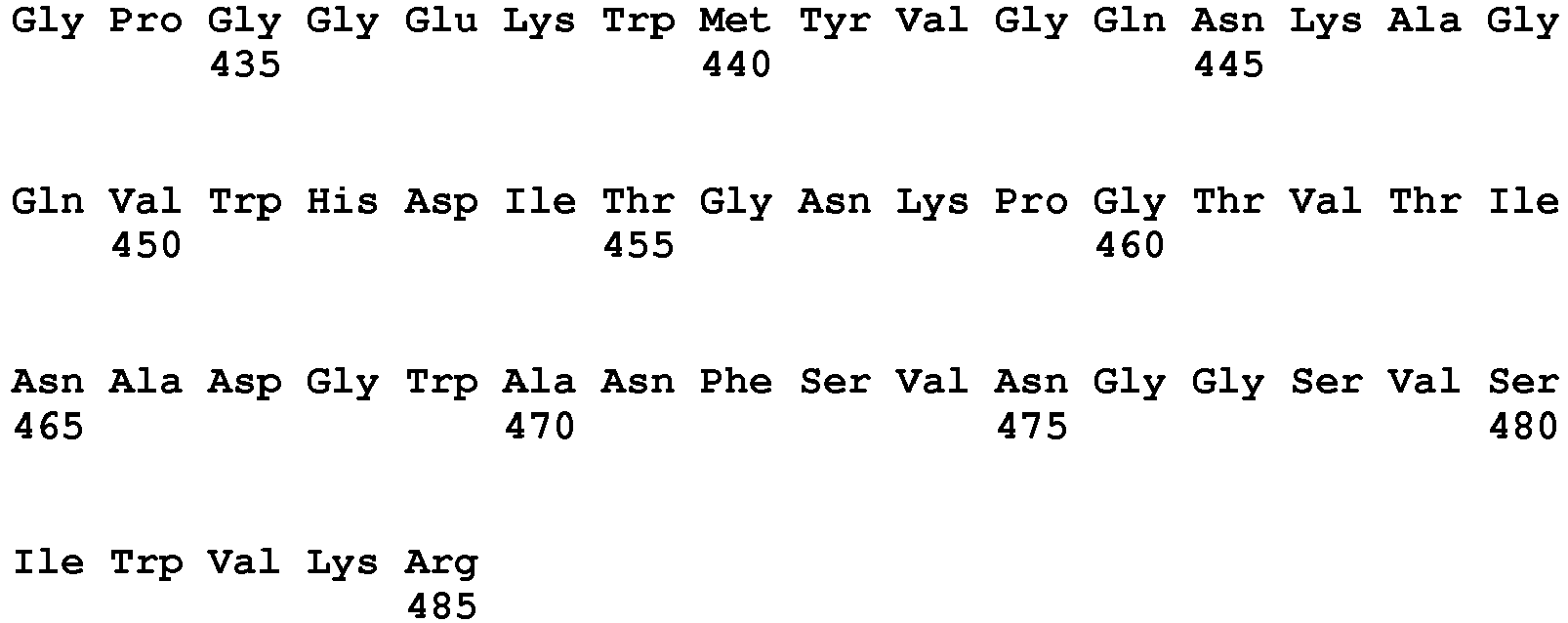
- <210> 2
<211> 485
<212> PRT
<213> Bacillus sp. - <400> 2


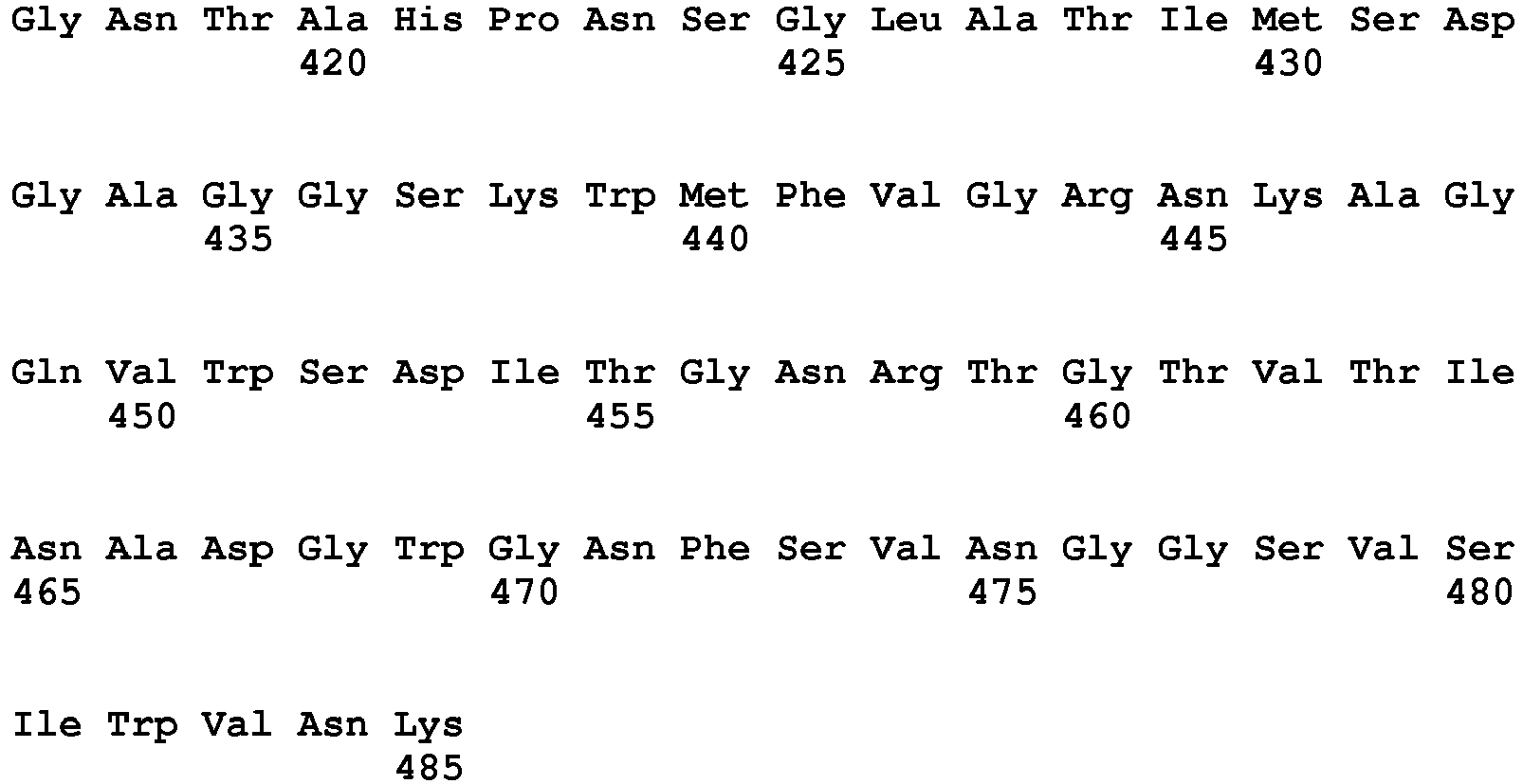
- <210> 3
<211> 485
<212> PRT
<213> Bacillus sp. - <400> 3


- <210> 4
<211> 485
<212> PRT
<213> Bacillus sp. - <400> 4
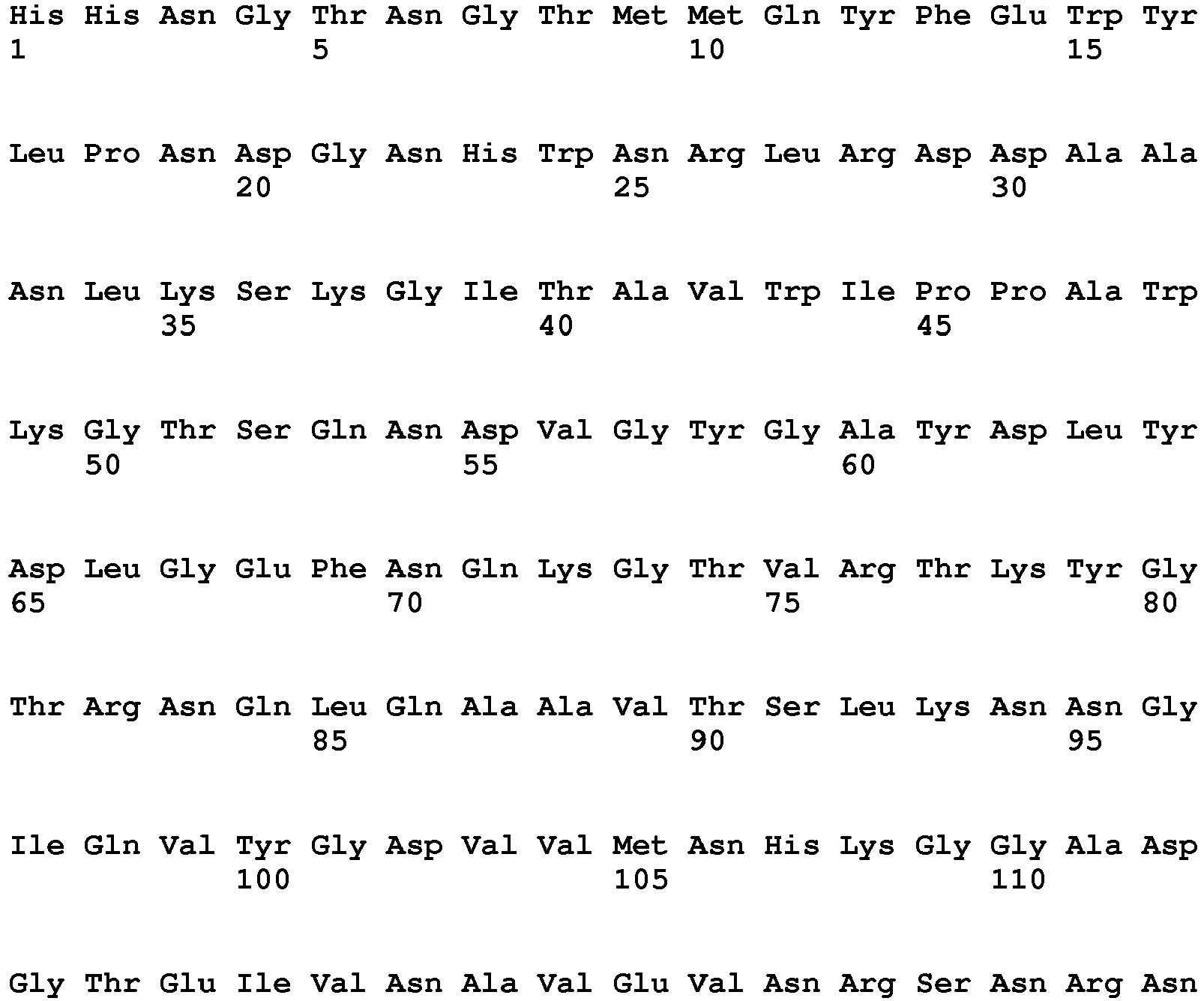


- <210> 5
<211> 485
<212> PRT
<213> Bacillus sp. - <400> 5

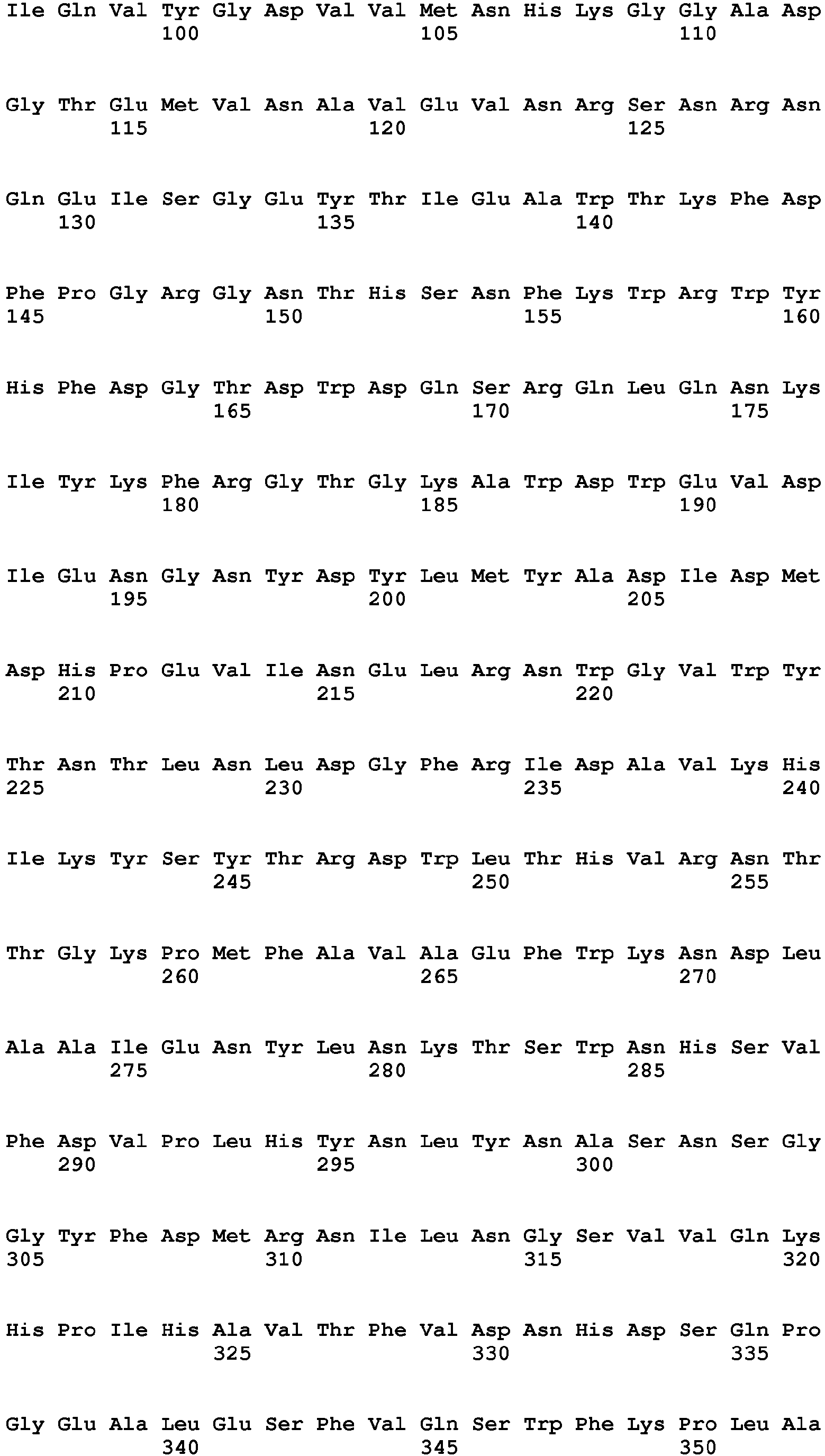

- <210> 6
<211> 485
<212> PRT
<213> Bacillus sp. - <400> 6


- <210> 7
<211> 483
<212> PRT
<213> Artificial - <220>
<223> Variant of SEQ ID NO:1 - <400> 7


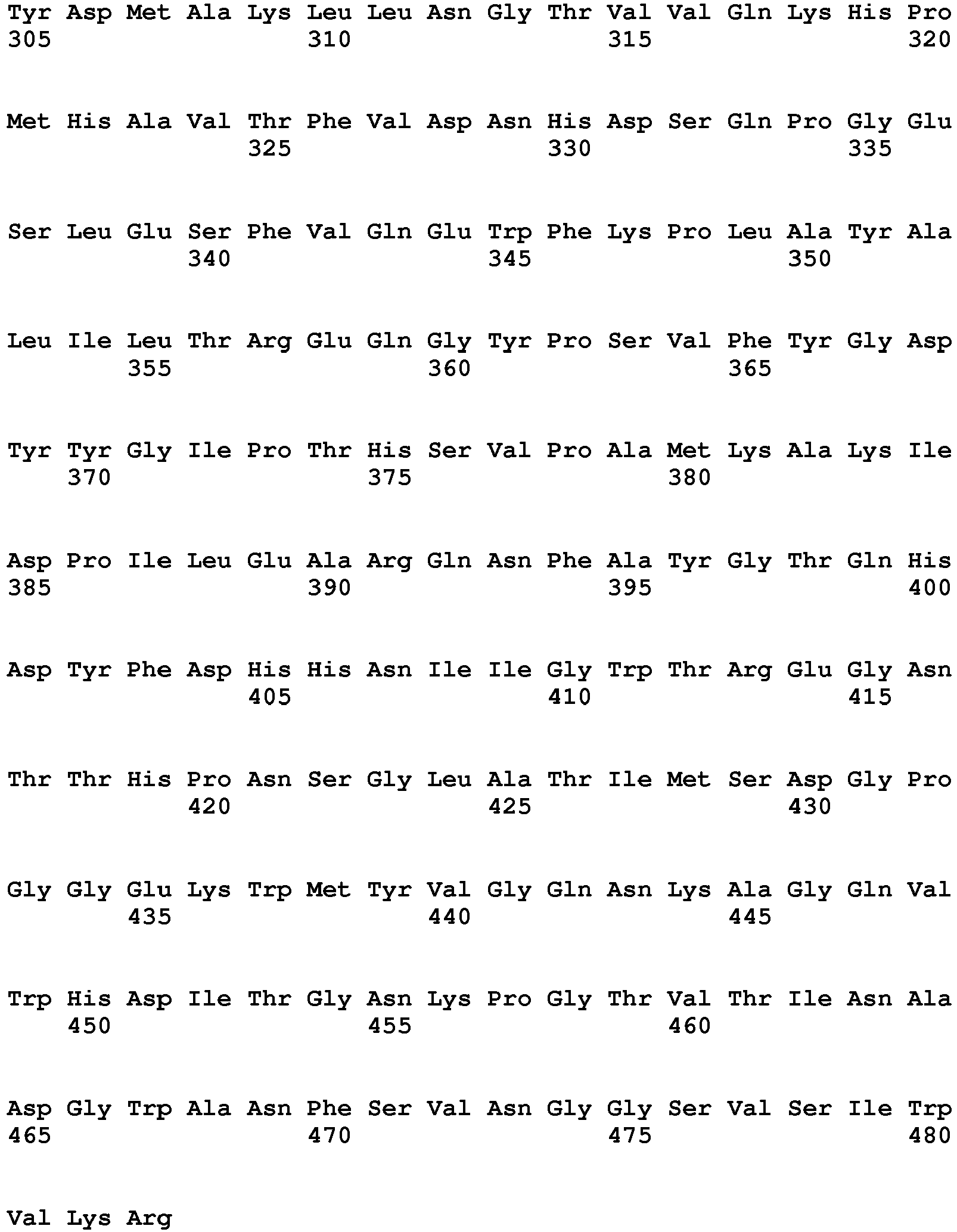
- <210> 8
<211> 483
<212> PRT
<213> Artificial - <220>
<223> Variant of SEQ ID NO:2 - <400> 8

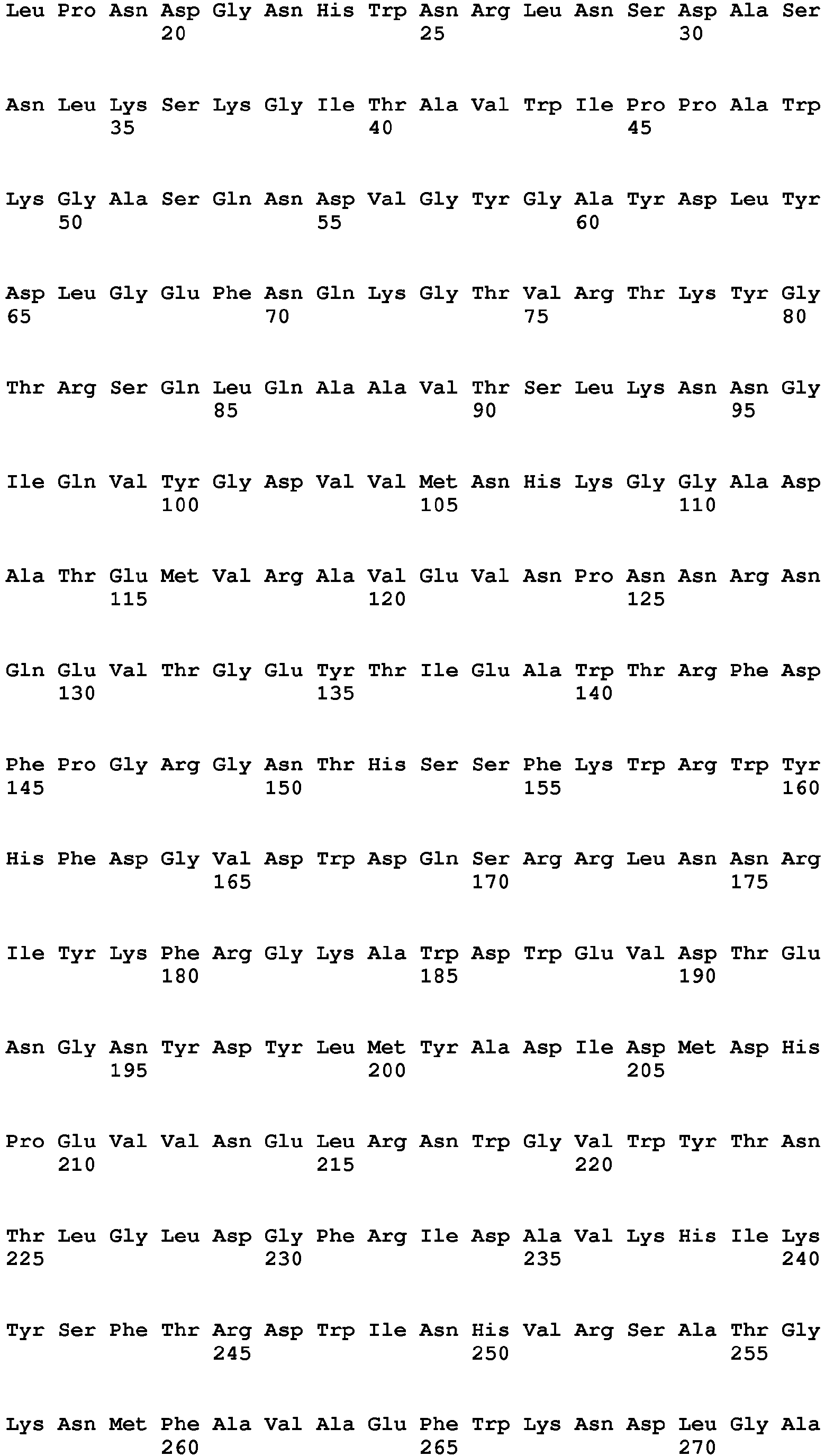

- <210> 9
<211> 483
<212> PRT
<213> Artificial - <220>
<223> Variant of SEQ ID NO:3 - <400> 9


- <210> 10
<211> 483
<212> PRT
<213> Artificial - <220>
<223> Variant of SEQ ID NO:4 - <400> 10


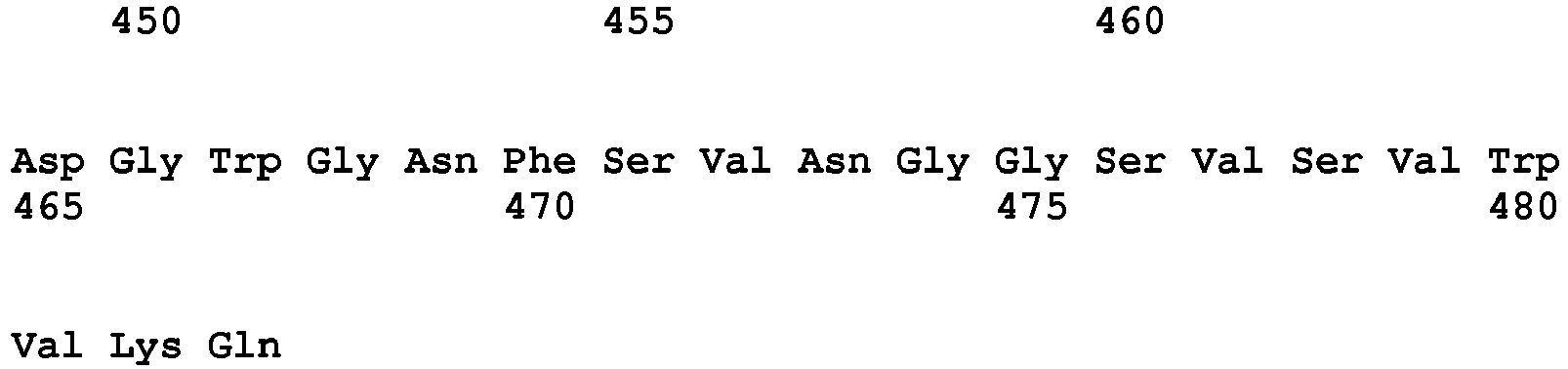
- <210> 11
<211> 483
<212> PRT
<213> Artificial - <220>
<223> Variant of SEQ ID NO:5 - <400> 11


- <210> 12
<211> 483
<212> PRT
<213> Artificial - <220>
<223> Variant of SEQ ID NO:6 - <400> 12


- <210> 13
<211> 483
<212> PRT
<213> Bacillus licheniformis - <400> 13


- <210> 14
<211> 483
<212> PRT
<213> Bacillus amyloliquefaciens - <400> 14


- <210> 15
<211> 515
<212> PRT
<213> Bacillus stearothermophilus - <400> 15
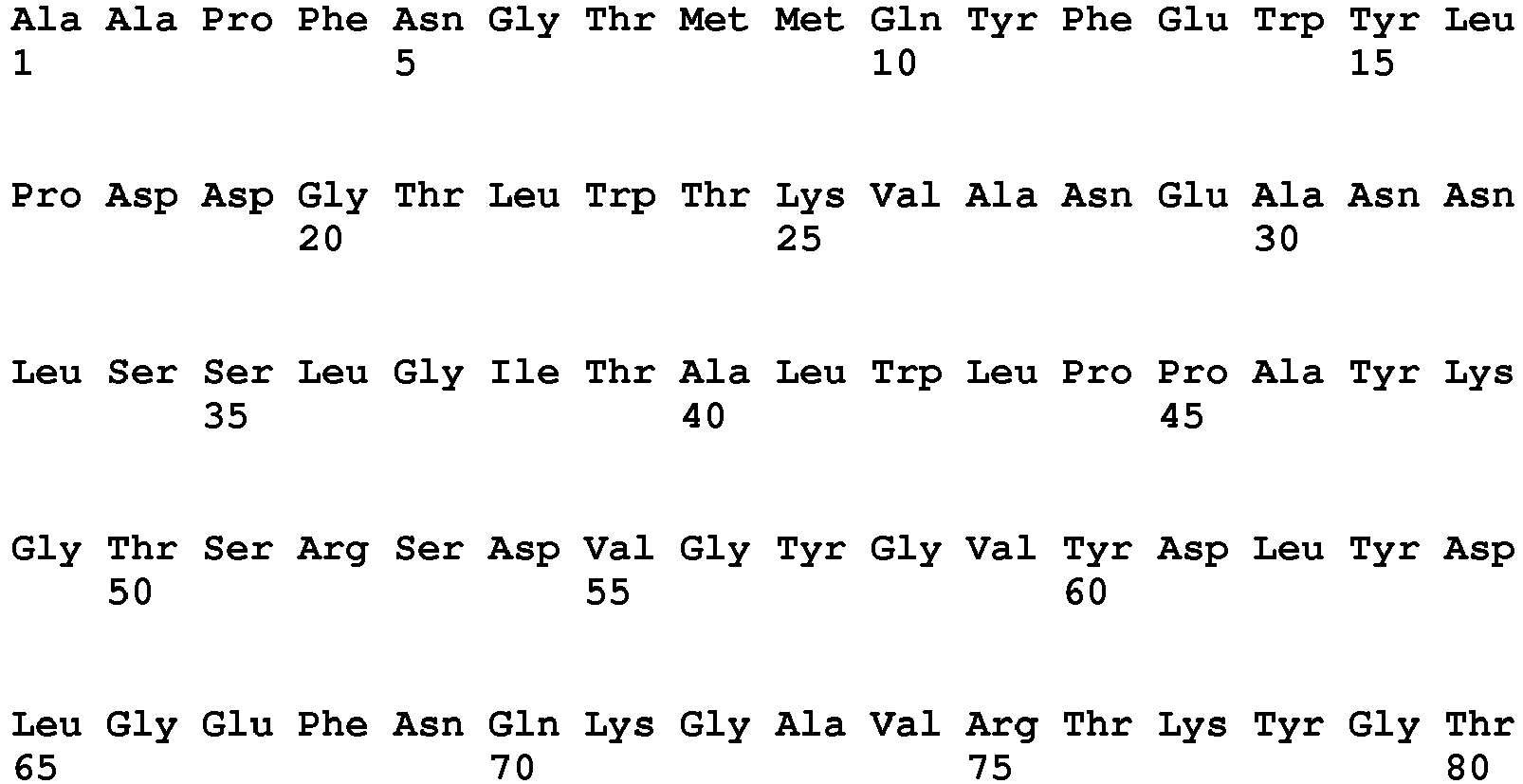
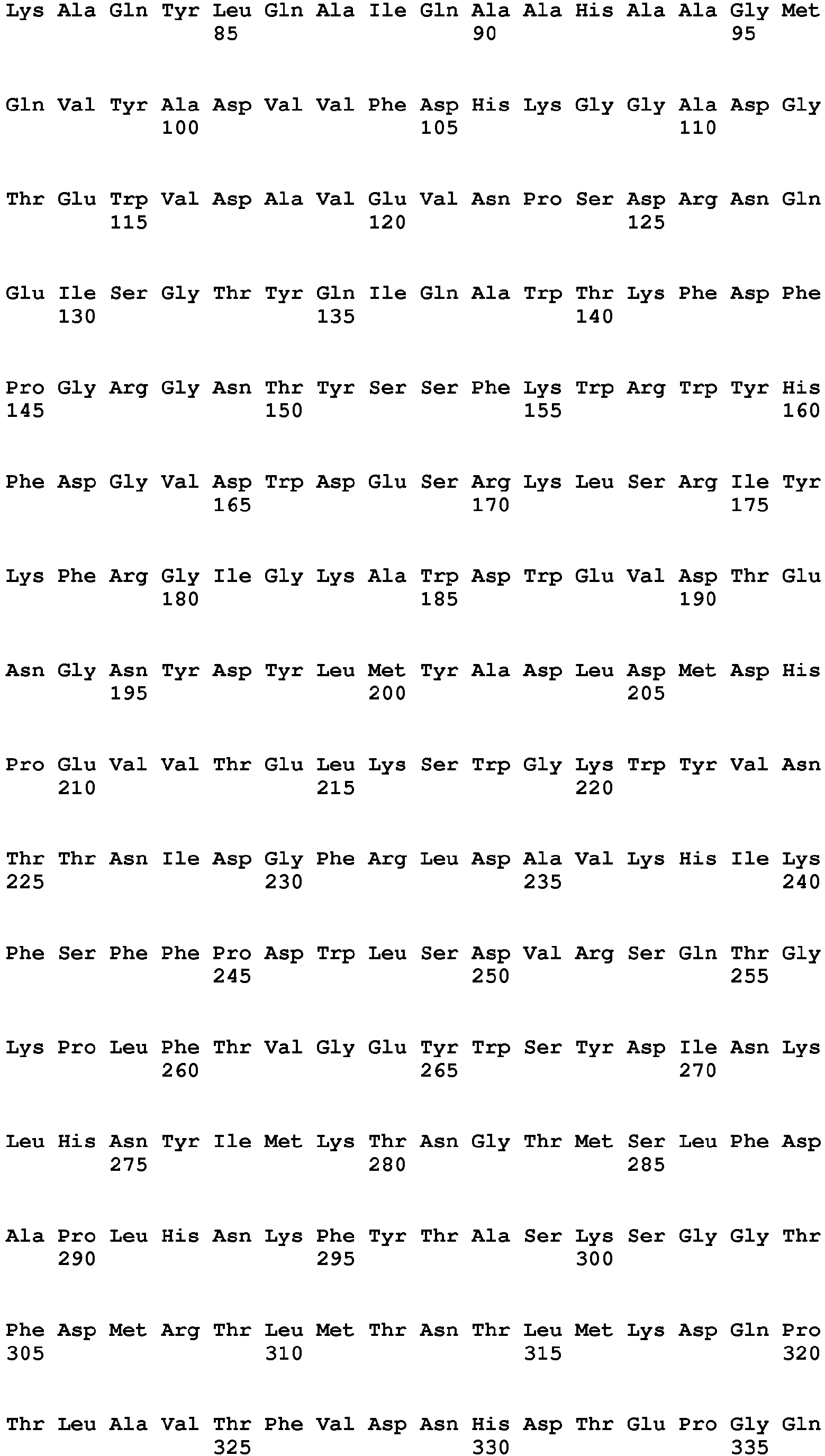

Claims (9)
- A method for screening alpha-amylases having high wash performance at low temperature, wherein the alpha-amylases have at least 85% sequence identity to SEQ ID NO: 2; and comprises the steps ofa) determining the binding of the alpha-amylases to solid or immobilized starch;b) selecting alpha-amylases having a low binding to starch;wherein the alpha-amylases have less than 90% of the binding to starch than the alpha-amylase having SEQ ID NO: 2.
- The method of claim 1, wherein the alpha-amylases have less than 80% of the binding to starch than the alpha-amylase having SEQ ID NO: 2.
- A method for selecting variants of a parent alpha-amylase, wherein the parent alpha-amylase has at least 85% sequence identity to SEQ ID NO: 2, comprising the steps ofa) generating variants by substituting, deleting or inserting one or more amino acid residue in one or more amino acids located at the surface of the parent alpha-amylase;b) testing the variants for the binding to solid or immobilized starch;c) selecting variants having a lower binding to the starch than the parent alpha-amylase;wherein the variants have less than 90% of the binding to starch than the parent alpha-amylase.
- The method of claim 3, wherein the parent alpha-amylase is selected among amylases having at least 90% sequence identity to SEQ ID NO: 2.
- The method of claim 3, wherein the variants have less than 80% of the binding to starch than the parent alpha-amylase.
- A variant polypeptide having alpha-amylase activity and having at least 80% sequence identity to SEQ ID NO: 2, the variant is derived from a parent alpha-amylase by one or more modifications selected from substitutions, insertions and deletions, wherein the variant alpha-amylase has lower binding to solid starch and higher wash performance at low temperature, compared with the parent alpha-amylase: wherein an amino acid residue in one or more substrate binding sites at the surface of the molecule has been modified.
- The variant alpha-amylase of claim 6, selected among
variant alpha-amylases having at least 85% sequence identity to SEQ ID NO: 2, and comprising a deletion of positions 181+182, or 182+183, or 183+184 and further one or two or more modifications in any of positions corresponding to W140, W159, W167, Q169, W189, E194, N260, F262, W284, F289, G304, G305, R320, W347, W439, W469, G476 and G477 in SEQ ID NO: 2 wherein the modifications are substitutions. - A detergent composition comprising a variant alpha-amylase of any of the claims 6 or 7.
- Use of a variant alpha-amylase according to any of the claims 6 or 7 in a cleaning process.
Priority Applications (2)
| Application Number | Priority Date | Filing Date | Title |
|---|---|---|---|
| EP22150021.8A EP4026901B1 (en) | 2011-06-30 | 2012-06-29 | Method for screening alpha-amylases |
| PL19163340T PL3543333T3 (en) | 2011-06-30 | 2012-06-29 | Method for screening alpha-amylases |
Applications Claiming Priority (3)
| Application Number | Priority Date | Filing Date | Title |
|---|---|---|---|
| EP11172286 | 2011-06-30 | ||
| PCT/EP2012/062785 WO2013001087A2 (en) | 2011-06-30 | 2012-06-29 | Method for screening alpha-amylases |
| EP12730571.2A EP2726500B1 (en) | 2011-06-30 | 2012-06-29 | Method for screening alpha-amylases |
Related Parent Applications (1)
| Application Number | Title | Priority Date | Filing Date |
|---|---|---|---|
| EP12730571.2A Division EP2726500B1 (en) | 2011-06-30 | 2012-06-29 | Method for screening alpha-amylases |
Related Child Applications (1)
| Application Number | Title | Priority Date | Filing Date |
|---|---|---|---|
| EP22150021.8A Division EP4026901B1 (en) | 2011-06-30 | 2012-06-29 | Method for screening alpha-amylases |
Publications (3)
| Publication Number | Publication Date |
|---|---|
| EP3543333A2 EP3543333A2 (en) | 2019-09-25 |
| EP3543333A3 EP3543333A3 (en) | 2019-10-23 |
| EP3543333B1 true EP3543333B1 (en) | 2022-01-05 |
Family
ID=46397297
Family Applications (3)
| Application Number | Title | Priority Date | Filing Date |
|---|---|---|---|
| EP12730571.2A Active EP2726500B1 (en) | 2011-06-30 | 2012-06-29 | Method for screening alpha-amylases |
| EP22150021.8A Active EP4026901B1 (en) | 2011-06-30 | 2012-06-29 | Method for screening alpha-amylases |
| EP19163340.3A Revoked EP3543333B1 (en) | 2011-06-30 | 2012-06-29 | Method for screening alpha-amylases |
Family Applications Before (2)
| Application Number | Title | Priority Date | Filing Date |
|---|---|---|---|
| EP12730571.2A Active EP2726500B1 (en) | 2011-06-30 | 2012-06-29 | Method for screening alpha-amylases |
| EP22150021.8A Active EP4026901B1 (en) | 2011-06-30 | 2012-06-29 | Method for screening alpha-amylases |
Country Status (13)
| Country | Link |
|---|---|
| US (2) | US20140206026A1 (en) |
| EP (3) | EP2726500B1 (en) |
| JP (3) | JP6339499B2 (en) |
| KR (1) | KR20140041801A (en) |
| CN (2) | CN103703124B (en) |
| AU (1) | AU2012277729B2 (en) |
| BR (2) | BR122020009747B1 (en) |
| DK (1) | DK3543333T3 (en) |
| HU (1) | HUE058093T2 (en) |
| IN (1) | IN2014CN00597A (en) |
| MX (1) | MX351850B (en) |
| PL (1) | PL3543333T3 (en) |
| WO (1) | WO2013001087A2 (en) |
Families Citing this family (309)
| Publication number | Priority date | Publication date | Assignee | Title |
|---|---|---|---|---|
| EP3421595B1 (en) | 2011-06-30 | 2020-10-07 | Novozymes A/S | Alpha-amylase-variants |
| EP2540824A1 (en) | 2011-06-30 | 2013-01-02 | The Procter & Gamble Company | Cleaning compositions comprising amylase variants reference to a sequence listing |
| WO2013171241A1 (en) | 2012-05-16 | 2013-11-21 | Novozymes A/S | Compositions comprising lipase and methods of use thereof |
| ES2909509T3 (en) | 2012-06-08 | 2022-05-06 | Danisco Us Inc | Alpha-amylases variant with higher activity on starch polymers |
| MX364390B (en) | 2012-06-20 | 2019-04-25 | Novozymes As | Use of polypeptides having protease activity in animal feed and detergents. |
| US9315791B2 (en) | 2012-08-22 | 2016-04-19 | Novozymes A/S | Metalloproteases from alicyclobacillus |
| MX2015002211A (en) | 2012-08-22 | 2015-05-08 | Novozymes As | Metalloprotease from exiguobacterium. |
| TR201910918T4 (en) | 2012-12-07 | 2019-08-21 | Novozymes As | Prevention of bacterial adhesion. |
| US9551042B2 (en) | 2012-12-21 | 2017-01-24 | Novozymes A/S | Polypeptides having protease activity and polynucleotides encoding same |
| EP3321360A3 (en) | 2013-01-03 | 2018-06-06 | Novozymes A/S | Alpha-amylase variants and polynucleotides encoding same |
| WO2014173980A2 (en) | 2013-04-23 | 2014-10-30 | Novozymes A/S | Liquid automatic dish washing detergent compositions |
| CN105164244B (en) | 2013-05-03 | 2019-08-20 | 诺维信公司 | Microencapsulation of detergent enzymes |
| MX392247B (en) | 2013-05-14 | 2025-03-24 | Novozymes As | DETERGENT COMPOSITIONS. |
| CN105209614A (en) * | 2013-05-17 | 2015-12-30 | 诺维信公司 | Polypeptides having alpha amylase activity |
| US20160083703A1 (en) | 2013-05-17 | 2016-03-24 | Novozymes A/S | Polypeptides having alpha amylase activity |
| CN114634921B (en) | 2013-06-06 | 2024-09-10 | 诺维信公司 | Alpha-amylase variants and polynucleotides encoding same |
| EP3011021A1 (en) * | 2013-06-21 | 2016-04-27 | Novozymes A/S | Polypeptides having amylase activity and polynucleotides encoding same |
| WO2014207227A1 (en) | 2013-06-27 | 2014-12-31 | Novozymes A/S | Subtilase variants and polynucleotides encoding same |
| WO2014207224A1 (en) | 2013-06-27 | 2014-12-31 | Novozymes A/S | Subtilase variants and polynucleotides encoding same |
| JP2016523098A (en) | 2013-07-04 | 2016-08-08 | ノボザイムス アクティーゼルスカブ | Polypeptide having anti-reattachment effect and polynucleotide encoding the same |
| CN105358686A (en) | 2013-07-29 | 2016-02-24 | 诺维信公司 | Protease variants and polynucleotides encoding same |
| EP3027747B1 (en) | 2013-07-29 | 2018-02-07 | Novozymes A/S | Protease variants and polynucleotides encoding same |
| WO2015044448A1 (en) * | 2013-09-30 | 2015-04-02 | Novozymes A/S | Alpha-amylase variants and polynucleotides encoding same |
| WO2015049370A1 (en) | 2013-10-03 | 2015-04-09 | Novozymes A/S | Detergent composition and use of detergent composition |
| EP3083952A2 (en) * | 2013-12-20 | 2016-10-26 | Novozymes A/S | Alpha-amylase variants and polynucleotides encoding same |
| EP3453757B1 (en) | 2013-12-20 | 2020-06-17 | Novozymes A/S | Polypeptides having protease activity and polynucleotides encoding same |
| CN106062271A (en) | 2014-03-05 | 2016-10-26 | 诺维信公司 | Compositions and methods for improving properties of cellulosic textile materials with xyloglucan endotransglycosylase |
| CN106062270A (en) | 2014-03-05 | 2016-10-26 | 诺维信公司 | Compositions and methods for improving the properties of non-cellulosic textile materials using endo-xyloglucan glycosyltransferases |
| WO2015150457A1 (en) | 2014-04-01 | 2015-10-08 | Novozymes A/S | Polypeptides having alpha amylase activity |
| WO2015149641A1 (en) * | 2014-04-01 | 2015-10-08 | Novozymes A/S | Detergent composition |
| WO2015157656A1 (en) * | 2014-04-10 | 2015-10-15 | Novozymes A/S | Alpha-amylase variants and polynucleotides encoding same |
| CN106164236B (en) | 2014-04-11 | 2021-02-02 | 诺维信公司 | Detergent composition |
| BR112016024493A2 (en) | 2014-04-25 | 2018-01-23 | Basf Se | amylase, nucleic acid, expression set, recombinant host cell, enzyme composition and substance treatment method |
| US20170044510A1 (en) * | 2014-04-29 | 2017-02-16 | Coldzymes Aps | Cold-active alpha-amylase |
| AR100605A1 (en) | 2014-05-27 | 2016-10-19 | Novozymes As | METHODS FOR LIPASE PRODUCTION |
| EP3149178B1 (en) | 2014-05-27 | 2020-07-15 | Novozymes A/S | Lipase variants and polynucleotides encoding same |
| US20170121695A1 (en) | 2014-06-12 | 2017-05-04 | Novozymes A/S | Alpha-amylase variants and polynucleotides encoding same |
| EP3155083B1 (en) | 2014-06-12 | 2021-08-11 | Novozymes A/S | Alpha-amylase variants |
| WO2016001319A1 (en) | 2014-07-03 | 2016-01-07 | Novozymes A/S | Improved stabilization of non-protease enzyme |
| EP3327122B1 (en) | 2014-07-04 | 2021-02-17 | Novozymes A/S | Subtilase variants and polynucleotides encoding same |
| EP3739029A1 (en) | 2014-07-04 | 2020-11-18 | Novozymes A/S | Subtilase variants and polynucleotides encoding same |
| WO2016079110A2 (en) | 2014-11-19 | 2016-05-26 | Novozymes A/S | Use of enzyme for cleaning |
| MX2017006695A (en) | 2014-12-04 | 2017-08-21 | Novozymes As | SUBTILASS AND POLYNUCLEOTID VARIANTS CODING THEM. |
| EP3227442B1 (en) | 2014-12-05 | 2022-02-16 | Novozymes A/S | Lipase variants and polynucleotides encoding same |
| PL3608403T3 (en) | 2014-12-15 | 2025-06-23 | Henkel Ag & Co. Kgaa | Detergent composition comprising subtilase variants |
| US20180000076A1 (en) | 2014-12-16 | 2018-01-04 | Novozymes A/S | Polypeptides Having N-Acetyl Glucosamine Oxidase Activity |
| EP3034589A1 (en) | 2014-12-17 | 2016-06-22 | The Procter and Gamble Company | Detergent composition |
| EP3034597A1 (en) | 2014-12-17 | 2016-06-22 | The Procter and Gamble Company | Detergent composition |
| ES2733300T3 (en) | 2014-12-17 | 2019-11-28 | Procter & Gamble | Detergent composition |
| EP3034590A1 (en) | 2014-12-17 | 2016-06-22 | The Procter and Gamble Company | Method of automatic dishwashing |
| EP3034596B2 (en) | 2014-12-17 | 2021-11-10 | The Procter & Gamble Company | Detergent composition |
| EP3034591A1 (en) | 2014-12-17 | 2016-06-22 | The Procter and Gamble Company | Method of automatic dishwashing |
| EP3034592A1 (en) | 2014-12-17 | 2016-06-22 | The Procter and Gamble Company | Method of automatic dishwashing |
| EP3741849A3 (en) | 2014-12-19 | 2021-03-17 | Novozymes A/S | Protease variants and polynucleotides encoding same |
| WO2016097352A1 (en) | 2014-12-19 | 2016-06-23 | Novozymes A/S | Protease variants and polynucleotides encoding same |
| WO2016162556A1 (en) | 2015-04-10 | 2016-10-13 | Novozymes A/S | Laundry method, use of dnase and detergent composition |
| CN107636134A (en) | 2015-04-10 | 2018-01-26 | 诺维信公司 | Detergent composition |
| JP7175612B2 (en) | 2015-05-08 | 2022-11-21 | ノボザイムス アクティーゼルスカブ | Alpha-Amylase Variants and Polynucleotides Encoding the Variants |
| AR105416A1 (en) | 2015-05-08 | 2017-10-04 | Novozymes As | A-AMYLASE AND POLINUCLEOTIDE VARIANTS CODING THEM |
| WO2016184944A1 (en) | 2015-05-19 | 2016-11-24 | Novozymes A/S | Odor reduction |
| EP3101109B1 (en) | 2015-06-04 | 2018-03-07 | The Procter and Gamble Company | Hand dishwashing liquid detergent composition |
| ES2665989T3 (en) | 2015-06-04 | 2018-04-30 | The Procter & Gamble Company | Liquid detergent composition for dishwashing by hand |
| EP3310908B1 (en) | 2015-06-16 | 2020-08-05 | Novozymes A/S | Polypeptides with lipase activity and polynucleotides encoding same |
| EP3310688A1 (en) | 2015-06-17 | 2018-04-25 | Novozymes A/S | Container |
| CN121406620A (en) | 2015-06-18 | 2026-01-27 | 诺维信公司 | Bacillus subtilis enzyme variants and the polynucleotides encoding them |
| EP3106508B1 (en) | 2015-06-18 | 2019-11-20 | Henkel AG & Co. KGaA | Detergent composition comprising subtilase variants |
| WO2016135351A1 (en) | 2015-06-30 | 2016-09-01 | Novozymes A/S | Laundry detergent composition, method for washing and use of composition |
| CA2987160C (en) | 2015-07-01 | 2022-12-13 | Novozymes A/S | Methods of reducing odor |
| CN114292829A (en) | 2015-07-06 | 2022-04-08 | 诺维信公司 | Lipase variants and polynucleotides encoding them |
| CA2991114A1 (en) | 2015-09-17 | 2017-03-23 | Novozymes A/S | Polypeptides having xanthan degrading activity and polynucleotides encoding same |
| EP3350303B1 (en) | 2015-09-17 | 2020-04-08 | Henkel AG & Co. KGaA | Detergent compositions comprising polypeptides having xanthan degrading activity |
| WO2017060475A2 (en) | 2015-10-07 | 2017-04-13 | Novozymes A/S | Polypeptides |
| US10675589B2 (en) | 2015-10-14 | 2020-06-09 | Novozymes A/S | Cleaning of water filtration membranes |
| US20180171318A1 (en) | 2015-10-14 | 2018-06-21 | Novozymes A/S | Polypeptides Having Protease Activity and Polynucleotides Encoding Same |
| CN108291212A (en) | 2015-10-14 | 2018-07-17 | 诺维信公司 | Polypeptide variants |
| ES3069936T3 (en) | 2015-10-28 | 2026-06-11 | Novozymes As | Detergent composition comprising amylase and protease variants |
| US11001821B2 (en) | 2015-11-24 | 2021-05-11 | Novozymes A/S | Polypeptides having protease activity and polynucleotides encoding same |
| EP3384019B1 (en) | 2015-12-01 | 2020-06-24 | Novozymes A/S | Methods for producing lipases |
| ES2932192T3 (en) | 2015-12-07 | 2023-01-16 | Henkel Ag & Co Kgaa | Dishwashing compositions comprising polypeptides having beta-glucanase activity and their uses |
| US20190002819A1 (en) | 2015-12-28 | 2019-01-03 | Novozymes Bioag A/S | Heat priming of bacterial spores |
| CN108603185B (en) | 2015-12-30 | 2022-05-17 | 诺维信公司 | Enzyme variants and polynucleotides encoding them |
| US20210171927A1 (en) | 2016-01-29 | 2021-06-10 | Novozymes A/S | Beta-glucanase variants and polynucleotides encoding same |
| EP3433347B1 (en) | 2016-03-23 | 2020-05-06 | Novozymes A/S | Use of polypeptide having dnase activity for treating fabrics |
| EP3440180B1 (en) | 2016-04-08 | 2020-11-11 | Novozymes A/S | Detergent compositions and uses of the same |
| CN105802940B (en) * | 2016-04-18 | 2019-04-16 | 广西大学 | A kind of bacillus licheniformis high-temperatureα-amylase mutant and its application |
| US10626354B2 (en) | 2016-04-29 | 2020-04-21 | Novozymes A/S | Detergent compositions and uses thereof |
| WO2017210188A1 (en) | 2016-05-31 | 2017-12-07 | Novozymes A/S | Stabilized liquid peroxide compositions |
| WO2017207762A1 (en) | 2016-06-03 | 2017-12-07 | Novozymes A/S | Subtilase variants and polynucleotides encoding same |
| EP3257931A1 (en) | 2016-06-17 | 2017-12-20 | The Procter and Gamble Company | Detergent composition |
| CN109563449B (en) | 2016-06-23 | 2022-01-25 | 诺维信公司 | Use of enzymes, compositions and methods for removing soils |
| CN117721095A (en) | 2016-06-30 | 2024-03-19 | 诺维信公司 | Lipase variants and compositions comprising surfactants and lipase variants |
| WO2018002261A1 (en) | 2016-07-01 | 2018-01-04 | Novozymes A/S | Detergent compositions |
| WO2018007573A1 (en) | 2016-07-08 | 2018-01-11 | Novozymes A/S | Detergent compositions with galactanase |
| CN109415708A (en) | 2016-07-13 | 2019-03-01 | 宝洁公司 | Food bacillus deoxyribonuclease variant and application thereof |
| CN109790525A (en) | 2016-07-18 | 2019-05-21 | 诺维信公司 | Lipase Variant, the polynucleotides for encoding it and application thereof |
| ES2790148T3 (en) | 2016-08-17 | 2020-10-27 | Procter & Gamble | Cleaning composition comprising enzymes |
| CN110023474A (en) | 2016-09-29 | 2019-07-16 | 诺维信公司 | Purposes, washing methods and utensil washing composition of the enzyme for washing |
| US20190284647A1 (en) | 2016-09-29 | 2019-09-19 | Novozymes A/S | Spore Containing Granule |
| US20210284933A1 (en) | 2016-10-25 | 2021-09-16 | Novozymes A/S | Detergent compositions |
| US11753605B2 (en) | 2016-11-01 | 2023-09-12 | Novozymes A/S | Multi-core granules |
| US20210292723A1 (en) * | 2016-11-29 | 2021-09-23 | Novozymes A/S | Alpha-Amylase Variants and Polynucleotides Encoding Same |
| KR20190086540A (en) | 2016-12-01 | 2019-07-22 | 바스프 에스이 | Stabilization of enzymes in the composition |
| WO2018108865A1 (en) | 2016-12-12 | 2018-06-21 | Novozymes A/S | Use of polypeptides |
| RU2019123965A (en) | 2017-02-01 | 2021-02-01 | Дзе Проктер Энд Гэмбл Компани | CLEANING COMPOSITIONS CONTAINING AMYLASE VERSIONS |
| US11149233B2 (en) | 2017-03-31 | 2021-10-19 | Novozymes A/S | Polypeptides having RNase activity |
| CN110651041A (en) | 2017-03-31 | 2020-01-03 | 诺维信公司 | Polypeptides having DNase activity |
| EP3601549B1 (en) | 2017-03-31 | 2026-07-01 | Novozymes A/S | Polypeptides having dnase activity |
| CN110651040A (en) | 2017-03-31 | 2020-01-03 | 诺维信公司 | Polypeptides with DNase activity |
| EP3606936B1 (en) | 2017-04-03 | 2021-10-20 | Novozymes A/S | Recovery process |
| WO2018185152A1 (en) | 2017-04-04 | 2018-10-11 | Novozymes A/S | Polypeptide compositions and uses thereof |
| EP3607039A1 (en) | 2017-04-04 | 2020-02-12 | Novozymes A/S | Polypeptides |
| CN110651029B (en) | 2017-04-04 | 2022-02-15 | 诺维信公司 | glycosyl hydrolase |
| EP3385362A1 (en) | 2017-04-05 | 2018-10-10 | Henkel AG & Co. KGaA | Detergent compositions comprising fungal mannanases |
| EP3385361B1 (en) | 2017-04-05 | 2019-03-27 | Henkel AG & Co. KGaA | Detergent compositions comprising bacterial mannanases |
| WO2018184818A1 (en) | 2017-04-06 | 2018-10-11 | Novozymes A/S | Cleaning compositions and uses thereof |
| US20200032170A1 (en) | 2017-04-06 | 2020-01-30 | Novozymes A/S | Cleaning compositions and uses thereof |
| EP3607044B1 (en) | 2017-04-06 | 2024-11-13 | Novozymes A/S | Cleaning compositions and uses thereof |
| DK3478811T3 (en) | 2017-04-06 | 2020-01-27 | Novozymes As | Cleaning compositions and uses thereof |
| WO2018184817A1 (en) | 2017-04-06 | 2018-10-11 | Novozymes A/S | Cleaning compositions and uses thereof |
| US11499121B2 (en) | 2017-04-06 | 2022-11-15 | Novozymes A/S | Detergent compositions and uses thereof |
| EP3607043A1 (en) | 2017-04-06 | 2020-02-12 | Novozymes A/S | Cleaning compositions and uses thereof |
| US10968416B2 (en) | 2017-04-06 | 2021-04-06 | Novozymes A/S | Cleaning compositions and uses thereof |
| WO2018202846A1 (en) | 2017-05-05 | 2018-11-08 | Novozymes A/S | Compositions comprising lipase and sulfite |
| WO2018224544A1 (en) | 2017-06-08 | 2018-12-13 | Novozymes A/S | Compositions comprising polypeptides having cellulase activity and amylase activity, and uses thereof in cleaning and detergent compositions |
| US20200181542A1 (en) | 2017-06-30 | 2020-06-11 | Novozymes A/S | Enzyme Slurry Composition |
| CN111247235A (en) | 2017-09-20 | 2020-06-05 | 诺维信公司 | Use of enzymes to improve water absorption and/or whiteness |
| US11414814B2 (en) | 2017-09-22 | 2022-08-16 | Novozymes A/S | Polypeptides |
| CN118910005A (en) | 2017-09-27 | 2024-11-08 | 诺维信公司 | Lipase variants and microcapsule compositions comprising such lipase variants |
| MX2020003779A (en) | 2017-09-27 | 2020-08-03 | Procter & Gamble | Detergent compositions comprising lipases. |
| CN111373036A (en) | 2017-10-02 | 2020-07-03 | 诺维信公司 | Polypeptides having mannanase activity and polynucleotides encoding same |
| US11746310B2 (en) | 2017-10-02 | 2023-09-05 | Novozymes A/S | Polypeptides having mannanase activity and polynucleotides encoding same |
| CN122465671A (en) | 2017-10-16 | 2026-07-28 | 诺维信公司 | Low dusting granules |
| WO2019076800A1 (en) | 2017-10-16 | 2019-04-25 | Novozymes A/S | Cleaning compositions and uses thereof |
| WO2019076833A1 (en) | 2017-10-16 | 2019-04-25 | Novozymes A/S | Low dusting granules |
| EP3701001B1 (en) | 2017-10-24 | 2026-06-10 | Novozymes A/S | Compositions comprising polypeptides having mannanase activity |
| PL3476936T3 (en) | 2017-10-27 | 2022-04-11 | The Procter & Gamble Company | Detergent compositions comprising polypeptide variants |
| WO2019081724A1 (en) | 2017-10-27 | 2019-05-02 | Novozymes A/S | Dnase variants |
| US20200291330A1 (en) | 2017-11-01 | 2020-09-17 | Novozymes A/S | Polypeptides and Compositions Comprising Such Polypeptides |
| WO2019086532A1 (en) | 2017-11-01 | 2019-05-09 | Novozymes A/S | Methods for cleaning medical devices |
| DE102017125560A1 (en) | 2017-11-01 | 2019-05-02 | Henkel Ag & Co. Kgaa | CLEANSING COMPOSITIONS CONTAINING DISPERSINE III |
| WO2019086530A1 (en) | 2017-11-01 | 2019-05-09 | Novozymes A/S | Polypeptides and compositions comprising such polypeptides |
| DE102017125558A1 (en) | 2017-11-01 | 2019-05-02 | Henkel Ag & Co. Kgaa | CLEANING COMPOSITIONS CONTAINING DISPERSINE I |
| DE102017125559A1 (en) | 2017-11-01 | 2019-05-02 | Henkel Ag & Co. Kgaa | CLEANSING COMPOSITIONS CONTAINING DISPERSINE II |
| US11512268B2 (en) | 2017-11-29 | 2022-11-29 | Basf Se | Storage-stable enzyme preparations, their production and use |
| US11725197B2 (en) | 2017-12-04 | 2023-08-15 | Novozymes A/S | Lipase variants and polynucleotides encoding same |
| US20210071155A1 (en) | 2018-02-08 | 2021-03-11 | Novozymes A/S | Lipase Variants and Compositions Thereof |
| US20210123033A1 (en) | 2018-02-08 | 2021-04-29 | Novozymes A/S | Lipases, Lipase Variants and Compositions Thereof |
| EP3765185B1 (en) | 2018-03-13 | 2023-07-19 | Novozymes A/S | Microencapsulation using amino sugar oligomers |
| US12188064B2 (en) | 2018-03-23 | 2025-01-07 | Novozymes A/S | Subtilase variants and compositions comprising same |
| EP3781660A1 (en) | 2018-04-17 | 2021-02-24 | Novozymes A/S | Polypeptides comprising carbohydrate binding activity in detergent compositions and their use in reducing wrinkles in textile or fabric |
| US11566239B2 (en) | 2018-04-19 | 2023-01-31 | Novozymes A/S | Stabilized cellulase variants |
| CN112272701B (en) | 2018-04-19 | 2024-05-14 | 诺维信公司 | Stabilized cellulase variants |
| US11732250B2 (en) | 2018-04-26 | 2023-08-22 | Basf Se | Lipase enzymes |
| US20210115422A1 (en) | 2018-05-03 | 2021-04-22 | Basf Se | Amylase enzymes |
| WO2019238761A1 (en) | 2018-06-15 | 2019-12-19 | Basf Se | Water soluble multilayer films containing wash active chemicals and enzymes |
| EP3814472A1 (en) | 2018-06-28 | 2021-05-05 | Novozymes A/S | Detergent compositions and uses thereof |
| US20210189297A1 (en) | 2018-06-29 | 2021-06-24 | Novozymes A/S | Subtilase variants and compositions comprising same |
| EP3814473A1 (en) | 2018-06-29 | 2021-05-05 | Novozymes A/S | Detergent compositions and uses thereof |
| WO2020007863A1 (en) | 2018-07-02 | 2020-01-09 | Novozymes A/S | Cleaning compositions and uses thereof |
| ES3027666T3 (en) | 2018-07-03 | 2025-06-16 | Henkel Ag & Co Kgaa | Cleaning compositions and uses thereof |
| US20210253981A1 (en) | 2018-07-06 | 2021-08-19 | Novozymes A/S | Cleaning compositions and uses thereof |
| WO2020008024A1 (en) | 2018-07-06 | 2020-01-09 | Novozymes A/S | Cleaning compositions and uses thereof |
| WO2020028443A1 (en) * | 2018-07-31 | 2020-02-06 | Danisco Us Inc | Variant alpha-amylases having amino acid substitutions that lower the pka of the general acid |
| WO2020070063A2 (en) | 2018-10-01 | 2020-04-09 | Novozymes A/S | Detergent compositions and uses thereof |
| WO2020070014A1 (en) | 2018-10-02 | 2020-04-09 | Novozymes A/S | Cleaning composition comprising anionic surfactant and a polypeptide having rnase activity |
| WO2020070011A1 (en) | 2018-10-02 | 2020-04-09 | Novozymes A/S | Cleaning composition |
| CN112969788A (en) | 2018-10-02 | 2021-06-15 | 诺维信公司 | Endonuclease 1 ribonuclease for cleaning |
| WO2020070209A1 (en) | 2018-10-02 | 2020-04-09 | Novozymes A/S | Cleaning composition |
| WO2020070249A1 (en) | 2018-10-03 | 2020-04-09 | Novozymes A/S | Cleaning compositions |
| CN113056476A (en) | 2018-10-03 | 2021-06-29 | 诺维信公司 | Polypeptides having alpha-mannan degrading activity and polynucleotides encoding same |
| EP3677676A1 (en) | 2019-01-03 | 2020-07-08 | Basf Se | Compounds stabilizing amylases in liquids |
| BR112021005412A2 (en) | 2018-10-05 | 2021-06-15 | Basf Se | enzyme preparation, process for making a stable enzyme preparation, methods for reducing loss of proteolytic activity, for preparing a detergent formulation, for removing stains and for increasing the storage stability of a liquid detergent formulation, uses of a compound and of enzyme preparation, and, detergent formulation |
| EP3861114A1 (en) | 2018-10-05 | 2021-08-11 | Basf Se | Compounds stabilizing amylases in liquids |
| EP3861116A1 (en) | 2018-10-05 | 2021-08-11 | Basf Se | Compounds stabilizing hydrolases in liquids |
| EP3864124A1 (en) | 2018-10-11 | 2021-08-18 | Novozymes A/S | Cleaning compositions and uses thereof |
| EP3647397A1 (en) | 2018-10-31 | 2020-05-06 | Henkel AG & Co. KGaA | Cleaning compositions containing dispersins iv |
| ES2981999T3 (en) | 2018-10-31 | 2024-10-14 | Henkel Ag & Co Kgaa | Cleaning compositions containing dispersins V |
| WO2020114965A1 (en) | 2018-12-03 | 2020-06-11 | Novozymes A/S | LOW pH POWDER DETERGENT COMPOSITION |
| EP3891277A1 (en) | 2018-12-03 | 2021-10-13 | Novozymes A/S | Powder detergent compositions |
| EP3898919A1 (en) | 2018-12-21 | 2021-10-27 | Novozymes A/S | Detergent pouch comprising metalloproteases |
| EP3898962A2 (en) | 2018-12-21 | 2021-10-27 | Novozymes A/S | Polypeptides having peptidoglycan degrading activity and polynucleotides encoding same |
| EP3927809A1 (en) | 2019-02-20 | 2021-12-29 | Basf Se | Industrial fermentation process for bacillus using defined medium and trace element feed |
| EP3927837A1 (en) | 2019-02-20 | 2021-12-29 | Basf Se | Industrial fermentation process for bacillus using defined medium and magnesium feed |
| EP3702452A1 (en) | 2019-03-01 | 2020-09-02 | Novozymes A/S | Detergent compositions comprising two proteases |
| BR112021018731A2 (en) | 2019-03-21 | 2021-12-21 | Novozymes As | Alpha-amylase variants and polynucleotides encoding them |
| WO2020193532A1 (en) | 2019-03-25 | 2020-10-01 | Basf Se | Cleaning composition having amylase enzymes |
| WO2020193535A2 (en) | 2019-03-25 | 2020-10-01 | Basf Se | Amylase enzymes |
| WO2020193534A2 (en) | 2019-03-25 | 2020-10-01 | Basf Se | Amylase enzymes |
| CN113785039B (en) | 2019-04-03 | 2024-06-18 | 诺维信公司 | Polypeptides having beta-glucanase activity, polynucleotides encoding the same, and their use in cleaning and detergent compositions |
| US12247237B2 (en) | 2019-04-10 | 2025-03-11 | Novozymes A/S | Polypeptide variants |
| MX2021012289A (en) | 2019-04-12 | 2021-11-12 | Novozymes As | Stabilized glycoside hydrolase variants. |
| WO2020229480A1 (en) | 2019-05-14 | 2020-11-19 | Basf Se | Compounds stabilizing hydrolases in liquids |
| CN113993878B (en) | 2019-06-13 | 2025-01-03 | 巴斯夫欧洲公司 | Method for recovering protein from fermentation broth using divalent cations |
| US20220251528A1 (en) * | 2019-06-24 | 2022-08-11 | Novozymes A/S | Alpha-Amylase Variants |
| EP3994255A1 (en) | 2019-07-02 | 2022-05-11 | Novozymes A/S | Lipase variants and compositions thereof |
| MX2022000253A (en) | 2019-07-05 | 2022-02-03 | Basf Se | Industrial fermentation process for microbial cells using a fed-batch pre-culture. |
| CN114364778B (en) | 2019-07-12 | 2024-08-13 | 诺维信公司 | Enzymatic emulsions for detergents |
| CN114364795A (en) | 2019-08-22 | 2022-04-15 | 巴斯夫欧洲公司 | Amylase variants |
| WO2021037895A1 (en) | 2019-08-27 | 2021-03-04 | Novozymes A/S | Detergent composition |
| CN114555769A (en) | 2019-08-27 | 2022-05-27 | 诺维信公司 | Composition containing lipase |
| CN114616312A (en) | 2019-09-19 | 2022-06-10 | 诺维信公司 | Detergent composition |
| EP4038170A1 (en) | 2019-10-03 | 2022-08-10 | Novozymes A/S | Polypeptides comprising at least two carbohydrate binding domains |
| CN114585718A (en) | 2019-10-18 | 2022-06-03 | 巴斯夫欧洲公司 | Storage-stable hydrolases-containing liquids |
| CN113891931A (en) | 2019-11-29 | 2022-01-04 | 巴斯夫欧洲公司 | Compositions and polymers useful in such compositions |
| WO2021115912A1 (en) | 2019-12-09 | 2021-06-17 | Basf Se | Formulations comprising a hydrophobically modified polyethyleneimine and one or more enzymes |
| US20230048546A1 (en) | 2019-12-20 | 2023-02-16 | Henkel Ag & Co. Kgaa | Cleaning compositions comprising dispersins vi |
| WO2021122120A2 (en) | 2019-12-20 | 2021-06-24 | Henkel Ag & Co. Kgaa | Cleaning compositions comprising dispersins viii |
| CN114829564A (en) | 2019-12-20 | 2022-07-29 | 汉高股份有限及两合公司 | Cleaning compositions comprising dispersible protein and carbohydrase |
| EP4077656A2 (en) | 2019-12-20 | 2022-10-26 | Novozymes A/S | Polypeptides having proteolytic activity and use thereof |
| EP4752205A3 (en) | 2019-12-20 | 2026-08-19 | Novozymes A/S | Stabilized liquid boron-free enzyme compositions |
| US20230407208A1 (en) | 2020-01-29 | 2023-12-21 | Conopco, Inc., D/B/A Unilever | Laundry detergent product |
| WO2021152123A1 (en) | 2020-01-31 | 2021-08-05 | Novozymes A/S | Mannanase variants and polynucleotides encoding same |
| EP4097226A1 (en) | 2020-01-31 | 2022-12-07 | Novozymes A/S | Mannanase variants and polynucleotides encoding same |
| EP3892708A1 (en) | 2020-04-06 | 2021-10-13 | Henkel AG & Co. KGaA | Cleaning compositions comprising dispersin variants |
| EP4133066A1 (en) | 2020-04-08 | 2023-02-15 | Novozymes A/S | Carbohydrate binding module variants |
| CN115516071A (en) | 2020-04-21 | 2022-12-23 | 诺维信公司 | Cleaning compositions comprising polypeptides having fructan degrading activity |
| EP3907271A1 (en) | 2020-05-07 | 2021-11-10 | Novozymes A/S | Cleaning composition, use and method of cleaning |
| WO2021239818A1 (en) | 2020-05-26 | 2021-12-02 | Novozymes A/S | Subtilase variants and compositions comprising same |
| WO2021259099A1 (en) | 2020-06-24 | 2021-12-30 | Novozymes A/S | Use of cellulases for removing dust mite from textile |
| EP3936593A1 (en) | 2020-07-08 | 2022-01-12 | Henkel AG & Co. KGaA | Cleaning compositions and uses thereof |
| WO2022008732A1 (en) | 2020-07-10 | 2022-01-13 | Basf Se | Enhancing the activity of antimicrobial preservatives |
| WO2022014428A1 (en) | 2020-07-15 | 2022-01-20 | 花王株式会社 | Amylase-incorporated cleaning agent composition |
| EP4189051B1 (en) | 2020-07-27 | 2024-02-28 | Unilever IP Holdings B.V. | Use of an enzyme and surfactant for inhibiting microorganisms |
| JP7885201B2 (en) | 2020-08-25 | 2026-07-06 | ノボザイムス アクティーゼルスカブ | Mutants of Family 44 xyloglucanases |
| EP4204548A1 (en) | 2020-08-28 | 2023-07-05 | Novozymes A/S | Polyester degrading protease variants |
| CN116113329A (en) | 2020-09-15 | 2023-05-12 | 诺维信公司 | Animal feed containing insects or insect meal |
| WO2022063698A1 (en) | 2020-09-22 | 2022-03-31 | Basf Se | Liquid composition comprising peptide aldehyde |
| JP2023544111A (en) | 2020-09-22 | 2023-10-20 | ビーエーエスエフ ソシエタス・ヨーロピア | Improved combinations of proteases and protease inhibitors, including a second enzyme |
| WO2022071451A1 (en) * | 2020-10-02 | 2022-04-07 | 花王株式会社 | α-AMYLASE VARIANT |
| JP7772526B2 (en) * | 2020-10-02 | 2025-11-18 | 花王株式会社 | α-Amylase Variants |
| CN116507725A (en) | 2020-10-07 | 2023-07-28 | 诺维信公司 | Alpha-amylase variant |
| EP4232539A2 (en) | 2020-10-20 | 2023-08-30 | Novozymes A/S | Use of polypeptides having dnase activity |
| EP4237525A1 (en) | 2020-10-28 | 2023-09-06 | Novozymes A/S | Use of lipoxygenase |
| WO2022090361A2 (en) | 2020-10-29 | 2022-05-05 | Novozymes A/S | Lipase variants and compositions comprising such lipase variants |
| EP4244325A1 (en) | 2020-11-13 | 2023-09-20 | Novozymes A/S | Detergent composition comprising a lipase |
| WO2022106400A1 (en) | 2020-11-18 | 2022-05-27 | Novozymes A/S | Combination of immunochemically different proteases |
| WO2022106404A1 (en) | 2020-11-18 | 2022-05-27 | Novozymes A/S | Combination of proteases |
| EP4015629A1 (en) | 2020-12-18 | 2022-06-22 | Basf Se | Polymer mixtures for increasing stability and performance of hydrolase-containing detergents |
| WO2023225459A2 (en) | 2022-05-14 | 2023-11-23 | Novozymes A/S | Compositions and methods for preventing, treating, supressing and/or eliminating phytopathogenic infestations and infections |
| EP4032966A1 (en) | 2021-01-22 | 2022-07-27 | Novozymes A/S | Liquid enzyme composition with sulfite scavenger |
| EP4284905A1 (en) | 2021-01-28 | 2023-12-06 | Novozymes A/S | Lipase with low malodor generation |
| WO2022171780A2 (en) | 2021-02-12 | 2022-08-18 | Novozymes A/S | Alpha-amylase variants |
| US20250075152A1 (en) | 2021-02-12 | 2025-03-06 | Novozymes A/S | Stabilized biological detergents |
| EP4047088A1 (en) | 2021-02-22 | 2022-08-24 | Basf Se | Amylase variants |
| EP4294917A1 (en) | 2021-02-22 | 2023-12-27 | Basf Se | Amylase variants |
| EP4305146A1 (en) | 2021-03-12 | 2024-01-17 | Novozymes A/S | Polypeptide variants |
| EP4060036A1 (en) | 2021-03-15 | 2022-09-21 | Novozymes A/S | Polypeptide variants |
| US20240060061A1 (en) | 2021-03-15 | 2024-02-22 | Novozymes A/S | Dnase variants |
| WO2022199418A1 (en) | 2021-03-26 | 2022-09-29 | Novozymes A/S | Detergent composition with reduced polymer content |
| EP4359518A1 (en) | 2021-06-23 | 2024-05-01 | Novozymes A/S | Alpha-amylase polypeptides |
| WO2023114792A1 (en) * | 2021-12-16 | 2023-06-22 | The Procter & Gamble Company | Home care composition comprising an amylase |
| WO2023114793A1 (en) * | 2021-12-16 | 2023-06-22 | The Procter & Gamble Company | Home care composition |
| CN118871559A (en) | 2021-12-21 | 2024-10-29 | 诺维信公司 | Composition comprising lipase and a enhancer |
| US20250028926A1 (en) | 2021-12-21 | 2025-01-23 | Basf Se | Apparatus for generating a digital access element |
| EP4206309A1 (en) | 2021-12-30 | 2023-07-05 | Novozymes A/S | Protein particles with improved whiteness |
| EP4234664A1 (en) | 2022-02-24 | 2023-08-30 | Evonik Operations GmbH | Composition comprising glucolipids and enzymes |
| CN118660951A (en) | 2022-03-02 | 2024-09-17 | 诺维信公司 | Use of xyloglucanases to improve the sustainability of detergents |
| EP4486876A1 (en) | 2022-03-04 | 2025-01-08 | Novozymes A/S | Dnase variants and compositions |
| AU2023250091A1 (en) | 2022-04-08 | 2024-10-03 | Novozymes A/S | Hexosaminidase variants and compositions |
| EP4532672A1 (en) | 2022-06-03 | 2025-04-09 | Unilever IP Holdings B.V. | Liquid detergent product |
| EP4544036A1 (en) | 2022-06-21 | 2025-04-30 | Novozymes A/S | Mannanase variants and polynucleotides encoding same |
| WO2023247664A2 (en) | 2022-06-24 | 2023-12-28 | Novozymes A/S | Lipase variants and compositions comprising such lipase variants |
| US20250376642A1 (en) | 2022-07-15 | 2025-12-11 | Basf Se | Alkanolamine formates for enzyme stabilization in liquid formulations |
| JP2025526738A (en) | 2022-08-11 | 2025-08-15 | ビーエーエスエフ ソシエタス・ヨーロピア | Amylase variants |
| US20260055347A1 (en) | 2022-08-11 | 2026-02-26 | Basf Se | Amylase variants |
| WO2024094735A1 (en) | 2022-11-04 | 2024-05-10 | Basf Se | Polypeptides having protease activity for use in detergent compositions |
| EP4612286A1 (en) | 2022-11-04 | 2025-09-10 | Basf Se | Polypeptides having protease activity for use in detergent compositions |
| WO2024094733A1 (en) | 2022-11-04 | 2024-05-10 | Basf Se | Polypeptides having protease activity for use in detergent compositions |
| CN120989059A (en) | 2022-12-05 | 2025-11-21 | 诺维信公司 | Protease variants and the polynucleotides encoding them |
| US20260201280A1 (en) | 2022-12-05 | 2026-07-16 | Novozymes A/S | A Composition Comprising A Lipase and a Peptide |
| EP4634355A1 (en) | 2022-12-14 | 2025-10-22 | Novozymes A/S | Improved lipase (gcl1) variants |
| EP4389864A1 (en) | 2022-12-20 | 2024-06-26 | Basf Se | Cutinases |
| KR20250130619A (en) | 2022-12-23 | 2025-09-02 | 노보자임스 에이/에스 | Detergent composition comprising catalase and amylase |
| WO2024146919A1 (en) | 2023-01-05 | 2024-07-11 | Basf Se | Use of foldases to improve heterologous expression of secreted molecules |
| CN120435539A (en) | 2023-01-23 | 2025-08-05 | 诺维信公司 | Cleaning compositions and uses thereof |
| CN120882843A (en) | 2023-03-21 | 2025-10-31 | 诺维信公司 | Detergent compositions based on biosurfactants |
| AU2024252152A1 (en) | 2023-04-12 | 2025-10-23 | Novozymes A/S | Compositions comprising polypeptides having alkaline phosphatase activity |
| CN120936668A (en) | 2023-04-14 | 2025-11-11 | 巴斯夫欧洲公司 | Porous starch |
| JP2026515834A (en) | 2023-04-26 | 2026-05-19 | ノボザイムス アクティーゼルスカブ | Cleaning composition and cleaning method |
| EP4461796A1 (en) | 2023-05-10 | 2024-11-13 | Novozymes A/S | Detergent composition comprising laccase |
| EP4461795A1 (en) | 2023-05-10 | 2024-11-13 | Novozymes A/S | Detergent composition comprising laccase |
| CN121057807A (en) | 2023-05-11 | 2025-12-02 | 诺维信公司 | Automatic dishwashing detergent composition containing lipase |
| MX2025014975A (en) | 2023-06-13 | 2026-02-03 | Basf Se | STABILIZED CLEANING COMPOSITIONS COMPRISING EDDS AND ENZYMES AND THEIR USE |
| EP4735563A1 (en) | 2023-06-28 | 2026-05-06 | Novozymes A/S | Detergent composition comprising lipases |
| WO2025011933A1 (en) | 2023-07-07 | 2025-01-16 | Novozymes A/S | Washing method for removing proteinaceous stains |
| WO2025031865A1 (en) | 2023-08-08 | 2025-02-13 | Basf Se | Improved bacillus cell with inactivated metalloprotease |
| WO2025036643A1 (en) | 2023-08-15 | 2025-02-20 | Evonik Operations Gmbh | Biosurfactant for washing wool |
| CN122029266A (en) | 2023-10-24 | 2026-05-12 | 诺维信公司 | Use of xyloglucanases for replacing optical brighteners |
| CN122095066A (en) | 2023-11-02 | 2026-05-26 | 巴斯夫欧洲公司 | Enzymes in compositions containing protease inhibitors are stable. |
| WO2025103765A1 (en) | 2023-11-17 | 2025-05-22 | Novozymes A/S | Lytic polysaccharide monooxygenases and their use in detergent |
| WO2025114053A1 (en) | 2023-11-30 | 2025-06-05 | Novozymes A/S | Biopolymers for use in detergent |
| CN122422502A (en) | 2023-12-20 | 2026-07-17 | 巴斯夫欧洲公司 | Stable enzyme composition comprising protease |
| CN122555763A (en) | 2024-01-19 | 2026-08-11 | 诺维信公司 | Detergent composition and use thereof |
| WO2025202369A1 (en) | 2024-03-27 | 2025-10-02 | Basf Se | Polypeptides having protease activity for use in detergent compositions |
| WO2025202372A1 (en) | 2024-03-27 | 2025-10-02 | Basf Se | Polypeptides having protease activity for use in detergent compositions |
| WO2025202370A1 (en) | 2024-03-27 | 2025-10-02 | Basf Se | Polypeptides having protease activity for use in detergent compositions |
| WO2025202374A1 (en) | 2024-03-27 | 2025-10-02 | Basf Se | Polypeptides having protease activity for use in detergent compositions |
| WO2025202379A1 (en) | 2024-03-27 | 2025-10-02 | Basf Se | Polypeptides having protease activity for use in detergent compositions |
| EP4624572A1 (en) | 2024-03-27 | 2025-10-01 | Basf Se | Polypeptides having protease activity for use in detergent compositions |
| WO2025257254A1 (en) | 2024-06-12 | 2025-12-18 | Novozymes A/S | Lipases and lipase variants and the use thereof |
| WO2026017636A1 (en) | 2024-07-17 | 2026-01-22 | Novozymes A/S | Compositions comprising combination of enzymes |
| WO2026032785A1 (en) | 2024-08-06 | 2026-02-12 | Evonik Operations Gmbh | Bacillus licheniformis strains in cleaning and animal feeding |
| EP4692292A1 (en) | 2024-08-06 | 2026-02-11 | Evonik Operations GmbH | Improved method for germinating bacterial spores |
| WO2026046881A1 (en) | 2024-08-26 | 2026-03-05 | Novozymes A/S | Compositions comprising a hexosaminidase and a protease |
| WO2026068782A1 (en) | 2024-09-30 | 2026-04-02 | Novozymes A/S | Protease variants and polynucleotides encoding same |
| WO2026093440A1 (en) | 2024-11-04 | 2026-05-07 | Novozymes A/S | Protease variants and compositions comprising same |
| WO2026109480A1 (en) | 2024-11-25 | 2026-05-28 | Novozymes A/S | Gh26 mannanases and their use in detergent |
| CN122256324A (en) | 2024-12-23 | 2026-06-23 | 巴斯夫欧洲公司 | By-product inactivation of enzymes in blends |
| DE202025107340U1 (en) | 2025-08-13 | 2026-06-03 | Dalli-Werke Gmbh & Co. Kg | Aqueous liquid hand dishwashing composition |
Citations (10)
| Publication number | Priority date | Publication date | Assignee | Title |
|---|---|---|---|---|
| WO2001066712A2 (en) | 2000-03-08 | 2001-09-13 | Novozymes A/S | Variants with altered properties |
| WO2006002643A2 (en) | 2004-07-05 | 2006-01-12 | Novozymes A/S | Alpha-amylase variants with altered properties |
| DE102004047777A1 (en) | 2004-10-01 | 2006-04-13 | Henkel Kgaa | Alpha-amylase variants with increased solvent stability, processes for their preparation and detergents and cleaners with these alpha-amylase variants |
| WO2009112993A1 (en) | 2008-03-14 | 2009-09-17 | The Procter & Gamble Company | Automatic dishwashing detergent composition |
| WO2011098531A1 (en) | 2010-02-10 | 2011-08-18 | Novozymes A/S | Variants and compositions comprising variants with high stability in presence of a chelating agent |
| WO2011100410A2 (en) | 2010-02-10 | 2011-08-18 | The Procter & Gamble Company | Cleaning composition comprising amylase variants with high stability in the presence of a chelating agent |
| EP2540824A1 (en) | 2011-06-30 | 2013-01-02 | The Procter & Gamble Company | Cleaning compositions comprising amylase variants reference to a sequence listing |
| WO2013001078A1 (en) | 2011-06-30 | 2013-01-03 | Novozymes A/S | Alpha-amylase variants |
| WO2013063460A2 (en) | 2011-10-28 | 2013-05-02 | Danisco Us Inc. | Variant maltohexaose-forming alpha-amylase variants |
| EP2825643B1 (en) | 2012-06-08 | 2021-11-03 | Danisco US Inc. | Variant alpha amylases with enhanced activity on starch polymers |
Family Cites Families (228)
| Publication number | Priority date | Publication date | Assignee | Title |
|---|---|---|---|---|
| GB1296839A (en) | 1969-05-29 | 1972-11-22 | ||
| GB1372034A (en) | 1970-12-31 | 1974-10-30 | Unilever Ltd | Detergent compositions |
| GB1483591A (en) | 1973-07-23 | 1977-08-24 | Novo Industri As | Process for coating water soluble or water dispersible particles by means of the fluid bed technique |
| GB1590432A (en) | 1976-07-07 | 1981-06-03 | Novo Industri As | Process for the production of an enzyme granulate and the enzyme granuate thus produced |
| DK187280A (en) | 1980-04-30 | 1981-10-31 | Novo Industri As | RUIT REDUCING AGENT FOR A COMPLETE LAUNDRY |
| DK263584D0 (en) | 1984-05-29 | 1984-05-29 | Novo Industri As | ENZYMOUS GRANULATES USED AS DETERGENT ADDITIVES |
| EP0218272B1 (en) | 1985-08-09 | 1992-03-18 | Gist-Brocades N.V. | Novel lipolytic enzymes and their use in detergent compositions |
| EG18543A (en) | 1986-02-20 | 1993-07-30 | Albright & Wilson | Protected enzyme systems |
| DK122686D0 (en) | 1986-03-17 | 1986-03-17 | Novo Industri As | PREPARATION OF PROTEINS |
| EP0258068B1 (en) | 1986-08-29 | 1994-08-31 | Novo Nordisk A/S | Enzymatic detergent additive |
| NZ221627A (en) | 1986-09-09 | 1993-04-28 | Genencor Inc | Preparation of enzymes, modifications, catalytic triads to alter ratios or transesterification/hydrolysis ratios |
| EP0305216B1 (en) | 1987-08-28 | 1995-08-02 | Novo Nordisk A/S | Recombinant Humicola lipase and process for the production of recombinant humicola lipases |
| JPS6474992A (en) | 1987-09-16 | 1989-03-20 | Fuji Oil Co Ltd | Dna sequence, plasmid and production of lipase |
| DK6488D0 (en) | 1988-01-07 | 1988-01-07 | Novo Industri As | ENZYMES |
| JP2624859B2 (en) | 1988-01-07 | 1997-06-25 | ノボ‐ノルディスク アクティーゼルスカブ | Enzyme detergent |
| JP3079276B2 (en) | 1988-02-28 | 2000-08-21 | 天野製薬株式会社 | Recombinant DNA, Pseudomonas sp. Containing the same, and method for producing lipase using the same |
| US5776757A (en) | 1988-03-24 | 1998-07-07 | Novo Nordisk A/S | Fungal cellulase composition containing alkaline CMC-endoglucanase and essentially no cellobiohydrolase and method of making thereof |
| EP0406314B1 (en) | 1988-03-24 | 1993-12-01 | Novo Nordisk A/S | A cellulase preparation |
| US5223409A (en) | 1988-09-02 | 1993-06-29 | Protein Engineering Corp. | Directed evolution of novel binding proteins |
| GB8915658D0 (en) | 1989-07-07 | 1989-08-23 | Unilever Plc | Enzymes,their production and use |
| EP0528828B2 (en) | 1990-04-14 | 1997-12-03 | Genencor International GmbH | Alkaline bacillus lipases, coding dna sequences therefor and bacilli which produce these lipases |
| DK115890D0 (en) | 1990-05-09 | 1990-05-09 | Novo Nordisk As | ENZYME |
| ES2068586T5 (en) | 1990-05-09 | 2004-12-01 | Novozymes A/S | A CELLULASE PREPARATION THAT INCLUDES AN ENDOGLUCANASA ENZYME. |
| ES2121786T3 (en) | 1990-09-13 | 1998-12-16 | Novo Nordisk As | LIPASE VARIANTS. |
| IL99552A0 (en) | 1990-09-28 | 1992-08-18 | Ixsys Inc | Compositions containing procaryotic cells,a kit for the preparation of vectors useful for the coexpression of two or more dna sequences and methods for the use thereof |
| DE69133035T2 (en) | 1991-01-16 | 2003-02-13 | The Procter & Gamble Company, Cincinnati | Compact detergent compositions with highly active cellulases |
| CA2108908C (en) | 1991-04-30 | 1998-06-30 | Christiaan A. J. K. Thoen | Built liquid detergents with boric-polyol complex to inhibit proteolytic enzyme |
| EP0511456A1 (en) | 1991-04-30 | 1992-11-04 | The Procter & Gamble Company | Liquid detergents with aromatic borate ester to inhibit proteolytic enzyme |
| KR100258460B1 (en) | 1991-05-01 | 2000-06-01 | 한센 핀 베네드 | Stabilized enzymes and detergent compositions |
| BR9206918A (en) | 1991-12-13 | 1995-11-21 | Procter & Gamble | Acylated citrate esters used as peracid precursors |
| DK72992D0 (en) | 1992-06-01 | 1992-06-01 | Novo Nordisk As | ENZYME |
| DK88892D0 (en) | 1992-07-06 | 1992-07-06 | Novo Nordisk As | CONNECTION |
| EP0651794B1 (en) | 1992-07-23 | 2009-09-30 | Novozymes A/S | MUTANT $g(a)-AMYLASE, DETERGENT AND DISH WASHING AGENT |
| KR100303619B1 (en) | 1992-10-06 | 2001-11-22 | 피아 스타르 | Cellulase Variants |
| CA2155831C (en) | 1993-02-11 | 2009-11-10 | Richard L. Antrim | Oxidatively stable alpha-amylase |
| KR950702240A (en) | 1993-04-27 | 1995-06-19 | 한스 발터 라벤 | New lipase variant for use as a detergent |
| DK52393D0 (en) | 1993-05-05 | 1993-05-05 | Novo Nordisk As | |
| DE69433032T2 (en) | 1993-05-19 | 2004-06-03 | Kao Corp. | LIQUIDIFYING - [alpha] -AMYLASE, METHOD FOR THE PRODUCTION THEREOF, AND DETERGENT COMPOSITION CONTAINING THE SAME |
| JP2859520B2 (en) | 1993-08-30 | 1999-02-17 | ノボ ノルディスク アクティーゼルスカブ | Lipase, microorganism producing the same, method for producing lipase, and detergent composition containing lipase |
| US6436690B1 (en) * | 1993-09-15 | 2002-08-20 | The Procter & Gamble Company | BPN′ variants having decreased adsorption and increased hydrolysis wherein one or more loop regions are substituted |
| JPH09503664A (en) | 1993-10-13 | 1997-04-15 | ノボ ノルディスク アクティーゼルスカブ | H-lower 2 O-lower 2 stable peroxidase mutant |
| JPH07143883A (en) | 1993-11-24 | 1995-06-06 | Showa Denko Kk | Lipase gene and mutant lipase |
| DE4343591A1 (en) | 1993-12-21 | 1995-06-22 | Evotec Biosystems Gmbh | Process for the evolutionary design and synthesis of functional polymers based on shape elements and shape codes |
| US5605793A (en) | 1994-02-17 | 1997-02-25 | Affymax Technologies N.V. | Methods for in vitro recombination |
| CA2183431A1 (en) | 1994-02-22 | 1995-08-24 | Allan Svendsen | A method of preparing a variant of a lipolytic enzyme |
| DE69534513T2 (en) | 1994-03-08 | 2006-07-27 | Novozymes A/S | NOVEL ALKALINE CELLULASES |
| ES2250969T3 (en) | 1994-03-29 | 2006-04-16 | Novozymes A/S | AMYLASA ALKALINE OF BACILO. |
| AU2524695A (en) | 1994-05-04 | 1995-11-29 | Genencor International, Inc. | Lipases with improved surfactant resistance |
| CA2191718A1 (en) | 1994-06-03 | 1995-12-14 | Randy M. Berka | Phosphonyldipeptides useful in the treatment of cardiovascular diseases |
| AU2884595A (en) | 1994-06-20 | 1996-01-15 | Unilever Plc | Modified pseudomonas lipases and their use |
| WO1996000292A1 (en) | 1994-06-23 | 1996-01-04 | Unilever N.V. | Modified pseudomonas lipases and their use |
| ATE294871T1 (en) | 1994-06-30 | 2005-05-15 | Novozymes Biotech Inc | NON-TOXIC, NON-TOXIGEN, NON-PATHOGENIC FUSARIUM EXPRESSION SYSTEM AND PROMOTORS AND TERMINATORS FOR USE THEREIN |
| EP1995303A3 (en) | 1994-10-06 | 2008-12-31 | Novozymes A/S | Enzyme preparation with endoglucanase activity |
| BE1008998A3 (en) | 1994-10-14 | 1996-10-01 | Solvay | Lipase, microorganism producing the preparation process for the lipase and uses thereof. |
| CA2203398A1 (en) | 1994-10-26 | 1996-05-09 | Thomas Sandal | An enzyme with lipolytic activity |
| AR000862A1 (en) | 1995-02-03 | 1997-08-06 | Novozymes As | VARIANTS OF A MOTHER-AMYLASE, A METHOD TO PRODUCE THE SAME, A DNA STRUCTURE AND A VECTOR OF EXPRESSION, A CELL TRANSFORMED BY SUCH A DNA STRUCTURE AND VECTOR, A DETERGENT ADDITIVE, DETERGENT COMPOSITION, A COMPOSITION FOR AND A COMPOSITION FOR THE ELIMINATION OF |
| JPH08228778A (en) | 1995-02-27 | 1996-09-10 | Showa Denko Kk | Novel lipase gene and method for producing lipase using the same |
| EP2431462A3 (en) | 1995-03-17 | 2012-05-23 | Novozymes A/S | Novel endoglucanases |
| US5736499A (en) * | 1995-06-06 | 1998-04-07 | Genencor International, Inc. | Mutant A-amylase |
| JP3025627B2 (en) | 1995-06-14 | 2000-03-27 | 花王株式会社 | Liquefied alkaline α-amylase gene |
| WO1997007202A1 (en) | 1995-08-11 | 1997-02-27 | Novo Nordisk A/S | Novel lipolytic enzymes |
| ATE282087T1 (en) | 1995-07-14 | 2004-11-15 | Novozymes As | MODIFIED ENZYME WITH LIPOLYTIC ACTIVITY |
| DE19528059A1 (en) | 1995-07-31 | 1997-02-06 | Bayer Ag | Detergent and cleaning agent with imino disuccinates |
| US5763385A (en) | 1996-05-14 | 1998-06-09 | Genencor International, Inc. | Modified α-amylases having altered calcium binding properties |
| AU3938997A (en) | 1996-08-26 | 1998-03-19 | Novo Nordisk A/S | A novel endoglucanase |
| WO1998012307A1 (en) | 1996-09-17 | 1998-03-26 | Novo Nordisk A/S | Cellulase variants |
| CN1232384A (en) | 1996-10-08 | 1999-10-20 | 诺沃挪第克公司 | Diaminobenzoic acid derivatives as dye precursors |
| BR9712360A (en) | 1996-10-18 | 2001-06-19 | Procter & Gamble | Detergent compositions |
| KR100591553B1 (en) | 1996-11-04 | 2006-06-19 | 노보자임스 에이/에스 | Subtilase variants and composition |
| CA2270593C (en) | 1996-11-04 | 2005-06-07 | Novo Nordisk A/S | Subtilase variants and compositions |
| WO1998034946A1 (en) | 1997-02-12 | 1998-08-13 | Massachusetts Institute Of Technology | Daxx, a novel fas-binding protein that activates jnk and apoptosis |
| US6361989B1 (en) * | 1997-10-13 | 2002-03-26 | Novozymes A/S | α-amylase and α-amylase variants |
| EP2386568B1 (en) | 1997-10-30 | 2014-08-06 | Novozymes A/S | Alpha-amylase mutants |
| US6876932B1 (en) * | 1998-02-27 | 2005-04-05 | Novozymes A/S | Maltogenic alpha-amylase variants |
| US6472364B1 (en) | 1998-10-13 | 2002-10-29 | The Procter & Gamble Company | Detergent compositions or components |
| JP5043254B2 (en) | 1998-10-26 | 2012-10-10 | ノボザイムス アクティーゼルスカブ | Production and screening of DNA libraries of interest in filamentous cells |
| EP1194572A2 (en) | 1999-03-22 | 2002-04-10 | Novozymes Biotech, Inc. | Promoter sequences derived from fusarium venenatum and uses thereof |
| US20020068352A1 (en) | 2000-05-12 | 2002-06-06 | Novozymes A/S | Alpha-amylase variants with altered 1, 6-activity |
| CA2702204C (en) * | 2000-08-01 | 2011-09-06 | Novozymes A/S | Alpha-amylase mutants with altered properties |
| US20020155574A1 (en) | 2000-08-01 | 2002-10-24 | Novozymes A/S | Alpha-amylase mutants with altered properties |
| JP4426716B2 (en) * | 2000-10-11 | 2010-03-03 | 花王株式会社 | High productivity α-amylase |
| CN1267720C (en) | 2000-11-27 | 2006-08-02 | 诺和酶股份有限公司 | Automated mechanical stress assay for screening cleaning ingredients |
| ES2613277T3 (en) * | 2001-02-21 | 2017-05-23 | Basf Enzymes Llc | Enzymes that have alpha amylase activity and methods of using them. |
| EP1421187B1 (en) | 2001-07-27 | 2007-10-10 | THE GOVERNMENT OF THE UNITED STATES OF AMERICA, as represented by THE SECRETARY, DEPARTMENT OF HEALTH AND HUMAN SERVICES | Systems for in vivo site-directed mutagenesis using oligonucleotides |
| GB0127036D0 (en) | 2001-11-09 | 2002-01-02 | Unilever Plc | Polymers for laundry applications |
| ES2331788T3 (en) | 2002-06-11 | 2010-01-15 | Unilever N.V. | DETERGENT PADS. |
| US7018805B2 (en) * | 2002-08-29 | 2006-03-28 | Vicam L.P. | α-Amylase assay and uses thereof |
| CA2500903A1 (en) * | 2002-09-13 | 2004-03-25 | Pall Corporation | Preparation and use of mixed mode solid substrates for chromatography adsorbents and biochip arrays |
| CN1751116A (en) | 2003-02-18 | 2006-03-22 | 诺和酶股份有限公司 | Detergent compositions |
| EP1633843A1 (en) | 2003-06-18 | 2006-03-15 | Unilever Plc | Laundry treatment compositions |
| GB0314210D0 (en) | 2003-06-18 | 2003-07-23 | Unilever Plc | Laundry treatment compositions |
| GB0314211D0 (en) | 2003-06-18 | 2003-07-23 | Unilever Plc | Laundry treatment compositions |
| ES2313539T3 (en) | 2005-03-23 | 2009-03-01 | Unilever N.V. | DETERGENT COMPOSITIONS IN THE FORM OF PILLS. |
| ES2355743T3 (en) | 2005-04-15 | 2011-03-30 | THE PROCTER & GAMBLE COMPANY | CLEANING COMPOSITIONS WITH ALCOXYLED POLYCHYLENIMINES. |
| MX292760B (en) | 2005-04-15 | 2011-11-28 | Procter & Gamble | Liquid laundry detergent compositions with modified polyethyleneimine polymers and lipase enzyme. |
| JP2008540814A (en) | 2005-05-31 | 2008-11-20 | ザ プロクター アンド ギャンブル カンパニー | Detergent composition containing polymer and use thereof |
| CN101203590B (en) | 2005-06-17 | 2011-01-26 | 宝洁公司 | Organocatalysts with enhanced enzyme compatibility |
| CA2635947A1 (en) | 2006-01-23 | 2007-08-02 | The Procter & Gamble Company | Enzyme and photobleach containing compositions |
| EP1979452A2 (en) | 2006-01-23 | 2008-10-15 | The Procter and Gamble Company | Detergent compositions |
| BRPI0707209A2 (en) | 2006-01-23 | 2011-04-26 | Procter & Gamble | detergent compositions |
| AR059153A1 (en) | 2006-01-23 | 2008-03-12 | Procter & Gamble | A COMPOSITION THAT INCLUDES A LIPASE AND A WHITENING CATALYST |
| JP2009523900A (en) | 2006-01-23 | 2009-06-25 | ザ プロクター アンド ギャンブル カンパニー | Composition comprising lipase and bleach catalyst |
| HUE063025T2 (en) | 2006-01-23 | 2023-12-28 | Procter & Gamble | Enzyme and fabric hueing agent containing compositions |
| DE602007007940D1 (en) | 2006-05-31 | 2010-09-02 | Procter & Gamble | CLEANING AGENT WITH AMPHIPHILENEPROPYLENE BASED ON POLYALKYLENE OXIDES AND VINYL REAGENTS |
| DE202006009003U1 (en) | 2006-06-06 | 2007-10-25 | BROSE SCHLIEßSYSTEME GMBH & CO. KG | Motor vehicle lock |
| US20080050451A1 (en) * | 2006-06-16 | 2008-02-28 | Mabry Helen C | Methods for assessing dehydration and shock, assays and kits for the methods |
| ES2363788T3 (en) | 2006-07-07 | 2011-08-16 | THE PROCTER & GAMBLE COMPANY | DETERGENT COMPOSITIONS. |
| BRPI0808513A2 (en) * | 2007-03-09 | 2014-08-19 | Danisco Us Inc Genencor Div | ALPHA-AMILASE VARIANTS OF ALKALIFYL BACILLUS SPECIES, COMPOSITIONS UNDERSTANDING ALPHA-AMYLASE VARIANTS AND METHODS OF USE |
| CA2689629A1 (en) * | 2007-05-30 | 2008-12-18 | Danisco Us Inc. | Improved variants of the bacillus licheniformis alpha-amylase |
| EP2069489A1 (en) * | 2007-05-31 | 2009-06-17 | Novozymes, Inc. | Polypeptides having cellulolytic enhancing activity and polynucleotides encoding same |
| EP2162522B1 (en) | 2007-06-22 | 2018-07-04 | Unilever N.V. | Granular enzymatic detergent compositions |
| ES2364193T3 (en) | 2007-07-02 | 2011-08-26 | THE PROCTER & GAMBLE COMPANY | COMPOSITION FOR MULTIPLE COMPARTMENT BAG FOR CLOTHING WASHING. |
| GB0712991D0 (en) | 2007-07-05 | 2007-08-15 | Reckitt Benckiser Nv | Improvement in or relating to compositions |
| GB0712988D0 (en) | 2007-07-05 | 2007-08-15 | Reckitt Benckiser Nv | Improvements in or relating to compositions |
| EP2167624B1 (en) | 2007-07-16 | 2010-12-01 | Unilever PLC | A solid detergent composition |
| DE102007036392A1 (en) | 2007-07-31 | 2009-02-05 | Henkel Ag & Co. Kgaa | Compositions containing perhydrolases and alkylene glycol diacetates |
| DE102007038029A1 (en) | 2007-08-10 | 2009-02-12 | Henkel Ag & Co. Kgaa | Detergents or cleaners with polyester-based soil release polymer |
| BRPI0815363A2 (en) | 2007-08-14 | 2015-02-10 | Unilever Nv | DETERGENT IN NON COMPACTED TABLE OF MULTIPLE REGIONS, PRODUCTION PROCESSES THEREOF, AND METHOD FOR CLEANING TISSUES |
| GB0716228D0 (en) | 2007-08-20 | 2007-09-26 | Reckitt Benckiser Nv | Detergent composition |
| DE102007041754A1 (en) | 2007-09-04 | 2009-03-05 | Henkel Ag & Co. Kgaa | Polycyclic compounds as enzyme stabilizers |
| GB0718777D0 (en) | 2007-09-26 | 2007-11-07 | Reckitt Benckiser Nv | Composition |
| GB0718944D0 (en) | 2007-09-28 | 2007-11-07 | Reckitt Benckiser Nv | Detergent composition |
| EP2201092A1 (en) | 2007-10-12 | 2010-06-30 | Unilever PLC | Granular detergent compositions with contrasting lamellar visual cues |
| ATE531786T1 (en) | 2007-10-12 | 2011-11-15 | Unilever Nv | IMPROVED VISUAL INDICATIONS OF PERFUMED DETERGENT |
| ES2374594T3 (en) | 2007-10-12 | 2012-02-20 | Unilever N.V. | COLADA DETERGENT WITH PRETREATMENT ADDITIVE AND ITS USE. |
| BRPI0818084A2 (en) | 2007-10-12 | 2017-07-04 | Unilever Nv | granular detergent composition comprising a plurality of film particles |
| WO2009050026A2 (en) | 2007-10-17 | 2009-04-23 | Unilever Nv | Laundry compositions |
| AU2008325249B2 (en) * | 2007-11-05 | 2013-10-10 | Danisco Us Inc. | Alpha-amylase variants with altered properties |
| CA2705288A1 (en) | 2007-11-13 | 2009-05-22 | The Procter & Gamble Company | Process for creating a unit dose product with a printed water soluble material |
| DE102007056166A1 (en) | 2007-11-21 | 2009-05-28 | Henkel Ag & Co. Kgaa | Granules of a sensitive detergent or cleaning agent ingredient |
| CN100582219C (en) * | 2007-11-21 | 2010-01-20 | 淮海工学院 | Ocean microorganism low-temperature amylase and strain pseudoalteromonas GS230 producing the same |
| DE102007057583A1 (en) | 2007-11-28 | 2009-06-04 | Henkel Ag & Co. Kgaa | Detergents with stabilized enzymes |
| ATE550420T1 (en) | 2007-12-05 | 2012-04-15 | Procter & Gamble | PACKAGING WITH A CLEANING AGENT |
| DE102007059677A1 (en) | 2007-12-10 | 2009-06-25 | Henkel Ag & Co. Kgaa | cleaning supplies |
| DE102007059970A1 (en) | 2007-12-11 | 2009-09-10 | Henkel Ag & Co. Kgaa | cleaning supplies |
| RU2470069C2 (en) | 2008-01-04 | 2012-12-20 | Дзе Проктер Энд Гэмбл Компани | Laundry detergent composition containing glycosyl hydrolase |
| EP2245133B1 (en) | 2008-01-10 | 2012-05-23 | Unilever Plc, A Company Registered In England And Wales under company no. 41424 of Unilever House | Granules |
| WO2009092699A1 (en) | 2008-01-24 | 2009-07-30 | Unilever Nv | Machine dishwash detergent compositions |
| US9447363B2 (en) | 2008-01-28 | 2016-09-20 | Reckitt Benckiser Finish B.V. | Composition |
| US20090209447A1 (en) | 2008-02-15 | 2009-08-20 | Michelle Meek | Cleaning compositions |
| WO2009112298A1 (en) | 2008-03-14 | 2009-09-17 | Unilever Plc | Laundry treatment composition comprising polymeric lubricants |
| EP2100948A1 (en) * | 2008-03-14 | 2009-09-16 | The Procter and Gamble Company | Automatic dishwashing detergent composition |
| WO2009112296A1 (en) | 2008-03-14 | 2009-09-17 | Unilever Plc | Laundry treatment compositions |
| DE102008014760A1 (en) | 2008-03-18 | 2009-09-24 | Henkel Ag & Co. Kgaa | Imidazolium salts as enzyme stabilizers |
| EP2103675A1 (en) | 2008-03-18 | 2009-09-23 | The Procter and Gamble Company | Detergent composition comprising cellulosic polymer |
| DE102008014759A1 (en) | 2008-03-18 | 2009-09-24 | Henkel Ag & Co. Kgaa | Use of imidazolium salts in detergents and cleaners |
| EP2103678A1 (en) | 2008-03-18 | 2009-09-23 | The Procter and Gamble Company | Detergent composition comprising a co-polyester of dicarboxylic acids and diols |
| EP2103676A1 (en) | 2008-03-18 | 2009-09-23 | The Procter and Gamble Company | A laundry detergent composition comprising the magnesium salt of ethylene diamine-n'n' -disuccinic acid |
| GB0805908D0 (en) | 2008-04-01 | 2008-05-07 | Reckitt Benckiser Inc | Laundry treatment compositions |
| PL3061744T3 (en) | 2008-04-01 | 2018-10-31 | Unilever N.V. | Preparation of free flowing granules of methylglycine diacetic acid |
| ES2647500T3 (en) | 2008-04-02 | 2017-12-21 | The Procter & Gamble Company | Detergent composition comprising non-ionic detersive surfactant and reagent dye |
| EP2107106A1 (en) | 2008-04-02 | 2009-10-07 | The Procter and Gamble Company | A kit of parts comprising a solid laundry detergent composition and a dosing device |
| DE102008017103A1 (en) | 2008-04-02 | 2009-10-08 | Henkel Ag & Co. Kgaa | Detergents and cleaning agents containing proteases from Xanthomonas |
| EP2107105B1 (en) | 2008-04-02 | 2013-08-07 | The Procter and Gamble Company | Detergent composition comprising reactive dye |
| US20090253602A1 (en) | 2008-04-04 | 2009-10-08 | Conopco, Inc. D/B/A Unilever | Novel personal wash bar |
| MY153627A (en) | 2008-05-02 | 2015-02-27 | Unilever Plc | Reduced spotting granules |
| MX2010013113A (en) * | 2008-06-06 | 2010-12-21 | Danisco Inc | Geobacillus stearothermophilus alpha-amylase (amys) variants with improved properties. |
| WO2010000636A1 (en) | 2008-07-03 | 2010-01-07 | Henkel Ag & Co. Kgaa | Solid fabric care composition with a polysaccharide |
| WO2010003792A1 (en) | 2008-07-09 | 2010-01-14 | Unilever Plc | Laundry compositions |
| CN102089338B (en) | 2008-07-11 | 2014-12-31 | 荷兰联合利华有限公司 | Copolymers and detergent compositions |
| EP2154235A1 (en) | 2008-07-28 | 2010-02-17 | The Procter and Gamble Company | Process for preparing a detergent composition |
| DE602008002756D1 (en) | 2008-08-14 | 2010-11-04 | Unilever Nv | build composition |
| EP2163606A1 (en) | 2008-08-27 | 2010-03-17 | The Procter and Gamble Company | A detergent composition comprising gluco-oligosaccharide oxidase |
| US20110245133A1 (en) | 2008-09-01 | 2011-10-06 | Jeffrey Scott Dupont | Composition comprising polyoxyalkylene-based polymer composition |
| MX2011002301A (en) | 2008-09-01 | 2011-04-11 | Procter & Gamble | Hydrophobic group-containing copolymer and process for the production thereof. |
| MX2011002304A (en) | 2008-09-01 | 2011-04-19 | Procter & Gamble | Polymer composition and process for the production thereof. |
| EP2166078B1 (en) | 2008-09-12 | 2018-11-21 | The Procter & Gamble Company | Laundry particle made by extrusion comprising a hueing dye |
| EP2166077A1 (en) | 2008-09-12 | 2010-03-24 | The Procter and Gamble Company | Particles comprising a hueing dye |
| EP2163608A1 (en) | 2008-09-12 | 2010-03-17 | The Procter & Gamble Company | Laundry particle made by extrusion comprising a hueing dye and fatty acid soap |
| DE102008047941A1 (en) | 2008-09-18 | 2010-03-25 | Henkel Ag & Co. Kgaa | Bleach-containing cleaning agent |
| BRPI0920516A2 (en) | 2008-09-19 | 2019-09-24 | Procter & Gamble | dual character biopolymer useful in cleaning products |
| MX2011003034A (en) | 2008-09-19 | 2011-04-12 | Procter & Gamble | Detergent composition containing suds boosting and suds stabilizing modified biopolymer. |
| EP2650275A1 (en) | 2008-09-22 | 2013-10-16 | The Procter & Gamble Company | Specific polybranched alcohols and consumer products based thereon |
| ES2471456T3 (en) | 2008-10-31 | 2014-06-26 | Henkel Ag & Co. Kgaa | Dishwashing machine detergent |
| WO2010054986A1 (en) | 2008-11-12 | 2010-05-20 | Unilever Plc | Fabric whiteness measurement system |
| WO2010057784A1 (en) | 2008-11-20 | 2010-05-27 | Unilever Plc | Fabric whiteness measurement system |
| DE102008059447A1 (en) | 2008-11-27 | 2010-06-02 | Henkel Ag & Co. Kgaa | Detergents and cleaning agents containing proteases from Bacillus pumilus |
| DE102008060469A1 (en) | 2008-12-05 | 2010-06-10 | Henkel Ag & Co. Kgaa | Automatic dishwashing tablet |
| DE102008060886A1 (en) | 2008-12-09 | 2010-06-10 | Henkel Ag & Co. Kgaa | Photolabile fragrance storage materials |
| WO2010066632A1 (en) | 2008-12-12 | 2010-06-17 | Henkel Ag & Co. Kgaa | Laundry article having cleaning and conditioning properties |
| WO2010066631A1 (en) | 2008-12-12 | 2010-06-17 | Henkel Ag & Co. Kgaa | Laundry article having cleaning and conditioning properties |
| DE102008061858A1 (en) | 2008-12-15 | 2010-06-17 | Henkel Ag & Co. Kgaa | Machine dishwashing detergent |
| DE102008061859A1 (en) | 2008-12-15 | 2010-06-17 | Henkel Ag & Co. Kgaa | Machine dishwashing detergent |
| WO2010069718A1 (en) | 2008-12-16 | 2010-06-24 | Unilever Nv | Solid builder composition |
| BRPI0922587B1 (en) | 2008-12-17 | 2019-04-09 | Unilever N.V. | Detergent Wash Composition |
| CN102257117B (en) | 2008-12-18 | 2014-12-03 | 荷兰联合利华有限公司 | Laundry detergent composition |
| DE102008063801A1 (en) | 2008-12-19 | 2010-06-24 | Henkel Ag & Co. Kgaa | Machine dishwashing detergent |
| DE102008063070A1 (en) | 2008-12-23 | 2010-07-01 | Henkel Ag & Co. Kgaa | Use of star-shaped polymers having peripheral negatively charged groups and / or peripheral silyl groups to finish surfaces |
| WO2010076292A1 (en) | 2008-12-29 | 2010-07-08 | Unilever Plc | Structured aqueous detergent compositions |
| DE102009004524A1 (en) | 2009-01-09 | 2010-07-15 | Henkel Ag & Co. Kgaa | Color protective machine dishwashing detergent |
| DE102009000409A1 (en) | 2009-01-26 | 2010-07-29 | Henkel Ag & Co. Kgaa | Washing Amendment |
| MX2011007898A (en) | 2009-01-26 | 2011-08-15 | Unilever Nv | Incorporation of dye into granular laundry composition. |
| EP2216393B1 (en) | 2009-02-09 | 2024-04-24 | The Procter & Gamble Company | Detergent composition |
| WO2010094356A1 (en) | 2009-02-18 | 2010-08-26 | Henkel Ag & Co. Kgaa | Pro-fragrance copolymeric compounds |
| EP2403931B1 (en) | 2009-03-05 | 2014-03-19 | Unilever PLC | Dye radical initiators |
| BRPI1013881B1 (en) | 2009-03-12 | 2023-10-17 | Unilever Ip Holdings B.V. | DETERGENT COMPOSITION, AND, HOUSEHOLD FABRIC TREATMENT METHOD |
| US20100229312A1 (en) | 2009-03-16 | 2010-09-16 | De Buzzaccarini Francesco | Cleaning method |
| US8293697B2 (en) | 2009-03-18 | 2012-10-23 | The Procter & Gamble Company | Structured fluid detergent compositions comprising dibenzylidene sorbitol acetal derivatives |
| US8153574B2 (en) | 2009-03-18 | 2012-04-10 | The Procter & Gamble Company | Structured fluid detergent compositions comprising dibenzylidene polyol acetal derivatives and detersive enzymes |
| DE102009001691A1 (en) | 2009-03-20 | 2010-09-23 | Henkel Ag & Co. Kgaa | Washing or cleaning agent with optionally in situ produced bleach-enhancing transition metal complex |
| DE102009001692A1 (en) | 2009-03-20 | 2010-09-23 | Henkel Ag & Co. Kgaa | Washing or cleaning agent with optionally in situ produced bleach-enhancing transition metal complex |
| DE102009001693A1 (en) | 2009-03-20 | 2010-09-23 | Henkel Ag & Co. Kgaa | 4-aminopyridine derivatives as catalysts for the cleavage of organic esters |
| EP2233557A1 (en) | 2009-03-26 | 2010-09-29 | The Procter & Gamble Company | A perfume encapsulate, a laundry detergent composition comprising a perfume encapsulate, and a process for preparing a perfume encapsulate |
| RU2011144134A (en) * | 2009-04-01 | 2013-05-10 | ДАНИСКО ЮЭс ИНК. | COMPOSITIONS AND METHODS INCLUDING ALFA AMILASE OPTIONS WITH CHANGED PROPERTIES |
| DE102009002262A1 (en) | 2009-04-07 | 2010-10-14 | Henkel Ag & Co. Kgaa | Prebiotic hand dishwashing detergents |
| DE102009002384A1 (en) | 2009-04-15 | 2010-10-21 | Henkel Ag & Co. Kgaa | Granular detergent, cleaning or treatment agent additive |
| US8263543B2 (en) | 2009-04-17 | 2012-09-11 | The Procter & Gamble Company | Fabric care compositions comprising organosiloxane polymers |
| WO2010122051A1 (en) | 2009-04-24 | 2010-10-28 | Unilever Plc | High active detergent particles |
| HUE036954T2 (en) | 2009-05-19 | 2018-08-28 | Procter & Gamble | A method for printing water-soluble film |
| DE102009050438A1 (en) | 2009-06-08 | 2010-12-09 | Henkel Ag & Co. Kgaa | Nanoparticulate manganese dioxide |
| WO2010142503A1 (en) | 2009-06-12 | 2010-12-16 | Unilever Plc | Cationic dye polymers |
| PT2443220E (en) | 2009-06-15 | 2013-10-08 | Unilever Nv | Detergent composition comprising anionic dye polymer |
| MX2012000480A (en) | 2009-07-09 | 2012-01-27 | Procter & Gamble | A catalytic laundry detergent composition comprising relatively low levels of water-soluble electrolyte. |
| EP2451918A1 (en) | 2009-07-09 | 2012-05-16 | The Procter & Gamble Company | Method of laundering fabric using a compacted laundry detergent composition |
| US20110005001A1 (en) | 2009-07-09 | 2011-01-13 | Eric San Jose Robles | Detergent Composition |
| EP2451920A1 (en) | 2009-07-09 | 2012-05-16 | The Procter & Gamble Company | Method of laundering fabric using a compacted laundry detergent composition |
| WO2011005910A1 (en) | 2009-07-09 | 2011-01-13 | The Procter & Gamble Company | Method of laundering fabric using a compacted laundry detergent composition |
| WO2011005623A1 (en) | 2009-07-09 | 2011-01-13 | The Procter & Gamble Company | Laundry detergent composition comprising low level of bleach |
| US20110005002A1 (en) | 2009-07-09 | 2011-01-13 | Hiroshi Oh | Method of Laundering Fabric |
| EP2451932A1 (en) | 2009-07-09 | 2012-05-16 | The Procter & Gamble Company | Method of laundering fabric using a compacted laundry detergent composition |
| US20110009307A1 (en) | 2009-07-09 | 2011-01-13 | Alan Thomas Brooker | Laundry Detergent Composition Comprising Low Level of Sulphate |
| BR112012000492A2 (en) | 2009-07-09 | 2019-09-24 | Procter & Gamble | moderately alkaline, low adjuvant detergent composition comprising peroxycaproic phitalimide acid for solid tissue treatment |
| MX2012000482A (en) | 2009-07-09 | 2012-01-27 | Procter & Gamble | Continuous process for making a laundry detergent composition. |
| WO2011016958A2 (en) | 2009-07-27 | 2011-02-10 | The Procter & Gamble Company | Detergent composition |
| CN102647918B (en) * | 2009-08-07 | 2015-05-27 | 丹尼斯科美国公司 | Alpha-amylase blend for starch processing and method of use thereof |
| PL2292725T5 (en) | 2009-08-13 | 2022-11-07 | The Procter And Gamble Company | Method of laundering fabrics at low temperature |
| DE102009028891A1 (en) | 2009-08-26 | 2011-03-03 | Henkel Ag & Co. Kgaa | Improved washing performance by free radical scavengers |
| WO2011076897A1 (en) * | 2009-12-22 | 2011-06-30 | Novozymes A/S | Use of amylase variants at low temperature |
-
2012
- 2012-06-29 EP EP12730571.2A patent/EP2726500B1/en active Active
- 2012-06-29 US US14/127,781 patent/US20140206026A1/en not_active Abandoned
- 2012-06-29 JP JP2014517752A patent/JP6339499B2/en active Active
- 2012-06-29 EP EP22150021.8A patent/EP4026901B1/en active Active
- 2012-06-29 CN CN201280032797.2A patent/CN103703124B/en active Active
- 2012-06-29 MX MX2014000158A patent/MX351850B/en active IP Right Grant
- 2012-06-29 IN IN597CHN2014 patent/IN2014CN00597A/en unknown
- 2012-06-29 PL PL19163340T patent/PL3543333T3/en unknown
- 2012-06-29 AU AU2012277729A patent/AU2012277729B2/en active Active
- 2012-06-29 EP EP19163340.3A patent/EP3543333B1/en not_active Revoked
- 2012-06-29 DK DK19163340.3T patent/DK3543333T3/en active
- 2012-06-29 KR KR1020147002198A patent/KR20140041801A/en not_active Withdrawn
- 2012-06-29 BR BR122020009747-7A patent/BR122020009747B1/en active IP Right Grant
- 2012-06-29 BR BR112013033524A patent/BR112013033524A2/en not_active Application Discontinuation
- 2012-06-29 CN CN202011497570.8A patent/CN112662734B/en active Active
- 2012-06-29 HU HUE19163340A patent/HUE058093T2/en unknown
- 2012-06-29 WO PCT/EP2012/062785 patent/WO2013001087A2/en not_active Ceased
-
2018
- 2018-05-10 JP JP2018091362A patent/JP2018153191A/en active Pending
-
2019
- 2019-08-05 US US16/531,247 patent/US11718840B2/en active Active
-
2020
- 2020-05-21 JP JP2020088875A patent/JP2020141694A/en active Pending
Patent Citations (10)
| Publication number | Priority date | Publication date | Assignee | Title |
|---|---|---|---|---|
| WO2001066712A2 (en) | 2000-03-08 | 2001-09-13 | Novozymes A/S | Variants with altered properties |
| WO2006002643A2 (en) | 2004-07-05 | 2006-01-12 | Novozymes A/S | Alpha-amylase variants with altered properties |
| DE102004047777A1 (en) | 2004-10-01 | 2006-04-13 | Henkel Kgaa | Alpha-amylase variants with increased solvent stability, processes for their preparation and detergents and cleaners with these alpha-amylase variants |
| WO2009112993A1 (en) | 2008-03-14 | 2009-09-17 | The Procter & Gamble Company | Automatic dishwashing detergent composition |
| WO2011098531A1 (en) | 2010-02-10 | 2011-08-18 | Novozymes A/S | Variants and compositions comprising variants with high stability in presence of a chelating agent |
| WO2011100410A2 (en) | 2010-02-10 | 2011-08-18 | The Procter & Gamble Company | Cleaning composition comprising amylase variants with high stability in the presence of a chelating agent |
| EP2540824A1 (en) | 2011-06-30 | 2013-01-02 | The Procter & Gamble Company | Cleaning compositions comprising amylase variants reference to a sequence listing |
| WO2013001078A1 (en) | 2011-06-30 | 2013-01-03 | Novozymes A/S | Alpha-amylase variants |
| WO2013063460A2 (en) | 2011-10-28 | 2013-05-02 | Danisco Us Inc. | Variant maltohexaose-forming alpha-amylase variants |
| EP2825643B1 (en) | 2012-06-08 | 2021-11-03 | Danisco US Inc. | Variant alpha amylases with enhanced activity on starch polymers |
Non-Patent Citations (9)
| Title |
|---|
| ANDERSEN CARSTEN, VIKSO-NIELSEN, ANDERS & SPENDLER, TINA: "Starch affinity has high importance for industrial applications", 4TH SYMPOSIUM ON THE ALPHA-AMYLASE FAMILY, 1 September 2010 (2010-09-01), pages 44, XP055973486 |
| ANDERSEN, CARSTEN: "Starch affinity has high importance for industrial applications", NOVOZYMES PRESENTATION, 29 September 2010 (2010-09-29), pages 1 - 33, XP055860418 |
| BRZOZOWSKI ANDRZEJ, ET AL.: "Structural Analysis of a Chimeric Bacterial alpha-Amylase. High Resolution Analysis of Native and Ligand Complexes", BIOCHEMISTRY, vol. 39, 1 January 2000 (2000-01-01), pages 9099 - 9107, XP055860416 |
| KANAI RYUTA, ET AL.: "Biochemical and crystallographic analyses of maltohexaose-producing amylase from alkalophilic Bacillus sp. 707", BIOCHEMISTRY, vol. 43, no. 44, 9 November 2004 (2004-11-09), pages 14047 - 14056, XP002511299, ISSN: 0006-2960, DOI: 10.1021/BI048489M |
| KOROPATKIN, N.M. ; SMITH, T.J.: "SusG: A Unique Cell-Membrane-Associated a-Amylase from a Prominent Human Gut Symbiont Targets Complex Starch Molecules", STRUCTURE, vol. 18, no. 2, 10 February 2010 (2010-02-10), AMSTERDAM, NL , pages 200 - 215, XP026894844, ISSN: 0969-2126, DOI: 10.1016/j.str.2009.12.010 |
| LINDEN ANNI, ET AL.: "Differential Regulation of a Hyperthermophilic alpha-Amylase with a Novel (Ca,Zn) Two-metal Center by Zinc", JOURNAL OF BIOLOGICAL CHEMISTRY, vol. 278, no. 11, 14 March 2003 (2003-03-14), pages 9875 - 9884, XP055860415 |
| NIELSEN MORTEN M., BOZONNET SOPHIE, SEO EUN-SEONG, MÓTYÁN JÁNOS A., ANDERSEN JOAKIM M., DILOKPIMOL ADIPHOL, ABOU HACHEM MAHER, GYÉ: "Two Secondary Carbohydrate Binding Sites on the Surface of Barley α-Amylase 1 Have Distinct Functions and Display Synergy in Hydrolysis of Starch Granules", BIOCHEMISTRY, vol. 48, no. 32, 18 August 2009 (2009-08-18), pages 7686 - 7697, XP055973500, ISSN: 0006-2960, DOI: 10.1021/bi900795a |
| R. KANAI: "Role of Trp140 at subsite -6 on the maltohexaose production of maltohexaose-producing amylase from alkalophilic Bacillus sp.707", PROTEIN SCIENCE, vol. 15, no. 3, 1 January 2006 (2006-01-01), pages 468 - 477, XP055008462, ISSN: 09618368, DOI: 10.1110/ps.051877006 |
| ROZEBOOM HENRIËTTE J; LONČAR NIKOLA; SLAVIĆ MARINELA ŠOKARDA; JANSSEN DICK B; VUJČIĆ ZORAN: "Characterization of the starch surface binding site on Bacillus paralicheniformis α-amylase", INTERNATIONAL JOURNAL OF BIOLOGICAL MACROMOLECULES, ELSEVIER BV, NL, vol. 165, 12 October 2020 (2020-10-12), NL , pages 1529 - 1539, XP086386461, ISSN: 0141-8130, DOI: 10.1016/j.ijbiomac.2020.10.025 |
Also Published As
| Publication number | Publication date |
|---|---|
| EP2726500A2 (en) | 2014-05-07 |
| BR112013033524A2 (en) | 2017-02-07 |
| US20140206026A1 (en) | 2014-07-24 |
| JP6339499B2 (en) | 2018-06-06 |
| JP2018153191A (en) | 2018-10-04 |
| JP2014520517A (en) | 2014-08-25 |
| US11718840B2 (en) | 2023-08-08 |
| AU2012277729A1 (en) | 2014-01-16 |
| HUE058093T2 (en) | 2022-06-28 |
| CN112662734A (en) | 2021-04-16 |
| EP4026901C0 (en) | 2025-01-22 |
| EP4026901A3 (en) | 2022-11-23 |
| CN103703124B (en) | 2021-01-15 |
| IN2014CN00597A (en) | 2015-04-03 |
| WO2013001087A2 (en) | 2013-01-03 |
| CN103703124A (en) | 2014-04-02 |
| AU2012277729B2 (en) | 2016-12-08 |
| US20190352628A1 (en) | 2019-11-21 |
| JP2020141694A (en) | 2020-09-10 |
| MX351850B (en) | 2017-10-31 |
| BR122020009747B1 (en) | 2021-07-20 |
| MX2014000158A (en) | 2014-02-19 |
| EP4026901A2 (en) | 2022-07-13 |
| KR20140041801A (en) | 2014-04-04 |
| WO2013001087A3 (en) | 2013-08-08 |
| EP3543333A2 (en) | 2019-09-25 |
| DK3543333T3 (en) | 2022-02-14 |
| EP3543333A3 (en) | 2019-10-23 |
| PL3543333T3 (en) | 2022-06-13 |
| CN112662734B (en) | 2024-09-10 |
| EP2726500B1 (en) | 2019-03-20 |
| EP4026901B1 (en) | 2025-01-22 |
Similar Documents
| Publication | Publication Date | Title |
|---|---|---|
| US11718840B2 (en) | Method for screening alpha-amylases | |
| EP3228703B1 (en) | Stabilized alpha-amylase variants and use of the same | |
| US9902946B2 (en) | Alpha-amylase variants and polynucleotides encoding same | |
| US20220089979A1 (en) | Gh9 endoglucanase variants and polynucleotides encoding same | |
| US10538751B2 (en) | Alpha-amylase variants and polynucleotides encoding same | |
| US20160083703A1 (en) | Polypeptides having alpha amylase activity | |
| US20160083704A1 (en) | Polypeptides having alpha amylase activity | |
| US20170121695A1 (en) | Alpha-amylase variants and polynucleotides encoding same | |
| US20190185792A1 (en) | Detergent composition comprising gh9 endoglucanase variants i | |
| US20210130744A1 (en) | Detergent composition comprising xanthan lyase variants ii | |
| US20200239815A1 (en) | Detergent compositions comprising gh9 endoglucanase variants ii | |
| US20160348084A1 (en) | Alpha-amylase variants and polynucleotides encoding same | |
| US20160312200A1 (en) | Alpha-amylase variants and polynucleotides encoding same | |
| US10287562B2 (en) | Alicyclobacillus variants and polynucleotides encoding same | |
| US20170015950A1 (en) | Polypeptides having alpha amylase activity | |
| US20210155916A1 (en) | GH9 Endoglucanase Variants and Polynucleotides Encoding Same |
Legal Events
| Date | Code | Title | Description |
|---|---|---|---|
| PUAI | Public reference made under article 153(3) epc to a published international application that has entered the european phase |
Free format text: ORIGINAL CODE: 0009012 |
|
| STAA | Information on the status of an ep patent application or granted ep patent |
Free format text: STATUS: THE APPLICATION HAS BEEN PUBLISHED |
|
| PUAL | Search report despatched |
Free format text: ORIGINAL CODE: 0009013 |
|
| AC | Divisional application: reference to earlier application |
Ref document number: 2726500 Country of ref document: EP Kind code of ref document: P |
|
| AK | Designated contracting states |
Kind code of ref document: A2 Designated state(s): AL AT BE BG CH CY CZ DE DK EE ES FI FR GB GR HR HU IE IS IT LI LT LU LV MC MK MT NL NO PL PT RO RS SE SI SK SM TR |
|
| AK | Designated contracting states |
Kind code of ref document: A3 Designated state(s): AL AT BE BG CH CY CZ DE DK EE ES FI FR GB GR HR HU IE IS IT LI LT LU LV MC MK MT NL NO PL PT RO RS SE SI SK SM TR |
|
| RIC1 | Information provided on ipc code assigned before grant |
Ipc: C12N 9/28 20060101ALN20190916BHEP Ipc: C12N 9/24 20060101AFI20190916BHEP Ipc: C12N 9/26 20060101ALN20190916BHEP |
|
| STAA | Information on the status of an ep patent application or granted ep patent |
Free format text: STATUS: REQUEST FOR EXAMINATION WAS MADE |
|
| 17P | Request for examination filed |
Effective date: 20200423 |
|
| RBV | Designated contracting states (corrected) |
Designated state(s): AL AT BE BG CH CY CZ DE DK EE ES FI FR GB GR HR HU IE IS IT LI LT LU LV MC MK MT NL NO PL PT RO RS SE SI SK SM TR |
|
| STAA | Information on the status of an ep patent application or granted ep patent |
Free format text: STATUS: EXAMINATION IS IN PROGRESS |
|
| 17Q | First examination report despatched |
Effective date: 20201012 |
|
| GRAP | Despatch of communication of intention to grant a patent |
Free format text: ORIGINAL CODE: EPIDOSNIGR1 |
|
| STAA | Information on the status of an ep patent application or granted ep patent |
Free format text: STATUS: GRANT OF PATENT IS INTENDED |
|
| GRAJ | Information related to disapproval of communication of intention to grant by the applicant or resumption of examination proceedings by the epo deleted |
Free format text: ORIGINAL CODE: EPIDOSDIGR1 |
|
| GRAP | Despatch of communication of intention to grant a patent |
Free format text: ORIGINAL CODE: EPIDOSNIGR1 |
|
| RIC1 | Information provided on ipc code assigned before grant |
Ipc: C12N 9/28 20060101ALN20210929BHEP Ipc: C12N 9/26 20060101ALN20210929BHEP Ipc: C12N 9/24 20060101AFI20210929BHEP |
|
| INTG | Intention to grant announced |
Effective date: 20211013 |
|
| INTG | Intention to grant announced |
Effective date: 20211027 |
|
| GRAS | Grant fee paid |
Free format text: ORIGINAL CODE: EPIDOSNIGR3 |
|
| GRAA | (expected) grant |
Free format text: ORIGINAL CODE: 0009210 |
|
| STAA | Information on the status of an ep patent application or granted ep patent |
Free format text: STATUS: THE PATENT HAS BEEN GRANTED |
|
| AC | Divisional application: reference to earlier application |
Ref document number: 2726500 Country of ref document: EP Kind code of ref document: P |
|
| AK | Designated contracting states |
Kind code of ref document: B1 Designated state(s): AL AT BE BG CH CY CZ DE DK EE ES FI FR GB GR HR HU IE IS IT LI LT LU LV MC MK MT NL NO PL PT RO RS SE SI SK SM TR |
|
| REG | Reference to a national code |
Ref country code: GB Ref legal event code: FG4D |
|
| REG | Reference to a national code |
Ref country code: CH Ref legal event code: EP |
|
| REG | Reference to a national code |
Ref country code: AT Ref legal event code: REF Ref document number: 1460623 Country of ref document: AT Kind code of ref document: T Effective date: 20220115 |
|
| REG | Reference to a national code |
Ref country code: DE Ref legal event code: R096 Ref document number: 602012077510 Country of ref document: DE |
|
| REG | Reference to a national code |
Ref country code: IE Ref legal event code: FG4D |
|
| REG | Reference to a national code |
Ref country code: DK Ref legal event code: T3 Effective date: 20220208 |
|
| REG | Reference to a national code |
Ref country code: RO Ref legal event code: EPE |
|
| REG | Reference to a national code |
Ref country code: NL Ref legal event code: FP |
|
| REG | Reference to a national code |
Ref country code: LT Ref legal event code: MG9D |
|
| REG | Reference to a national code |
Ref country code: AT Ref legal event code: MK05 Ref document number: 1460623 Country of ref document: AT Kind code of ref document: T Effective date: 20220105 |
|
| REG | Reference to a national code |
Ref country code: HU Ref legal event code: AG4A Ref document number: E058093 Country of ref document: HU |
|
| PGFP | Annual fee paid to national office [announced via postgrant information from national office to epo] |
Ref country code: NL Payment date: 20220527 Year of fee payment: 11 |
|
| PG25 | Lapsed in a contracting state [announced via postgrant information from national office to epo] |
Ref country code: SE Free format text: LAPSE BECAUSE OF FAILURE TO SUBMIT A TRANSLATION OF THE DESCRIPTION OR TO PAY THE FEE WITHIN THE PRESCRIBED TIME-LIMIT Effective date: 20220105 Ref country code: RS Free format text: LAPSE BECAUSE OF FAILURE TO SUBMIT A TRANSLATION OF THE DESCRIPTION OR TO PAY THE FEE WITHIN THE PRESCRIBED TIME-LIMIT Effective date: 20220105 Ref country code: PT Free format text: LAPSE BECAUSE OF FAILURE TO SUBMIT A TRANSLATION OF THE DESCRIPTION OR TO PAY THE FEE WITHIN THE PRESCRIBED TIME-LIMIT Effective date: 20220505 Ref country code: NO Free format text: LAPSE BECAUSE OF FAILURE TO SUBMIT A TRANSLATION OF THE DESCRIPTION OR TO PAY THE FEE WITHIN THE PRESCRIBED TIME-LIMIT Effective date: 20220405 Ref country code: LT Free format text: LAPSE BECAUSE OF FAILURE TO SUBMIT A TRANSLATION OF THE DESCRIPTION OR TO PAY THE FEE WITHIN THE PRESCRIBED TIME-LIMIT Effective date: 20220105 Ref country code: HR Free format text: LAPSE BECAUSE OF FAILURE TO SUBMIT A TRANSLATION OF THE DESCRIPTION OR TO PAY THE FEE WITHIN THE PRESCRIBED TIME-LIMIT Effective date: 20220105 Ref country code: ES Free format text: LAPSE BECAUSE OF FAILURE TO SUBMIT A TRANSLATION OF THE DESCRIPTION OR TO PAY THE FEE WITHIN THE PRESCRIBED TIME-LIMIT Effective date: 20220105 Ref country code: BG Free format text: LAPSE BECAUSE OF FAILURE TO SUBMIT A TRANSLATION OF THE DESCRIPTION OR TO PAY THE FEE WITHIN THE PRESCRIBED TIME-LIMIT Effective date: 20220405 |
|
| PGFP | Annual fee paid to national office [announced via postgrant information from national office to epo] |
Ref country code: RO Payment date: 20220609 Year of fee payment: 11 Ref country code: IT Payment date: 20220526 Year of fee payment: 11 Ref country code: HU Payment date: 20220525 Year of fee payment: 11 Ref country code: GB Payment date: 20220519 Year of fee payment: 11 Ref country code: FR Payment date: 20220523 Year of fee payment: 11 Ref country code: DK Payment date: 20220610 Year of fee payment: 11 Ref country code: DE Payment date: 20220517 Year of fee payment: 11 |
|
| PG25 | Lapsed in a contracting state [announced via postgrant information from national office to epo] |
Ref country code: LV Free format text: LAPSE BECAUSE OF FAILURE TO SUBMIT A TRANSLATION OF THE DESCRIPTION OR TO PAY THE FEE WITHIN THE PRESCRIBED TIME-LIMIT Effective date: 20220105 Ref country code: GR Free format text: LAPSE BECAUSE OF FAILURE TO SUBMIT A TRANSLATION OF THE DESCRIPTION OR TO PAY THE FEE WITHIN THE PRESCRIBED TIME-LIMIT Effective date: 20220406 Ref country code: FI Free format text: LAPSE BECAUSE OF FAILURE TO SUBMIT A TRANSLATION OF THE DESCRIPTION OR TO PAY THE FEE WITHIN THE PRESCRIBED TIME-LIMIT Effective date: 20220105 Ref country code: AT Free format text: LAPSE BECAUSE OF FAILURE TO SUBMIT A TRANSLATION OF THE DESCRIPTION OR TO PAY THE FEE WITHIN THE PRESCRIBED TIME-LIMIT Effective date: 20220105 |
|
| PGFP | Annual fee paid to national office [announced via postgrant information from national office to epo] |
Ref country code: PL Payment date: 20220530 Year of fee payment: 11 Ref country code: BE Payment date: 20220526 Year of fee payment: 11 |
|
| PG25 | Lapsed in a contracting state [announced via postgrant information from national office to epo] |
Ref country code: IS Free format text: LAPSE BECAUSE OF FAILURE TO SUBMIT A TRANSLATION OF THE DESCRIPTION OR TO PAY THE FEE WITHIN THE PRESCRIBED TIME-LIMIT Effective date: 20220505 |
|
| REG | Reference to a national code |
Ref country code: DE Ref legal event code: R026 Ref document number: 602012077510 Country of ref document: DE |
|
| PLBI | Opposition filed |
Free format text: ORIGINAL CODE: 0009260 |
|
| PLAX | Notice of opposition and request to file observation + time limit sent |
Free format text: ORIGINAL CODE: EPIDOSNOBS2 |
|
| PG25 | Lapsed in a contracting state [announced via postgrant information from national office to epo] |
Ref country code: SM Free format text: LAPSE BECAUSE OF FAILURE TO SUBMIT A TRANSLATION OF THE DESCRIPTION OR TO PAY THE FEE WITHIN THE PRESCRIBED TIME-LIMIT Effective date: 20220105 Ref country code: SK Free format text: LAPSE BECAUSE OF FAILURE TO SUBMIT A TRANSLATION OF THE DESCRIPTION OR TO PAY THE FEE WITHIN THE PRESCRIBED TIME-LIMIT Effective date: 20220105 Ref country code: EE Free format text: LAPSE BECAUSE OF FAILURE TO SUBMIT A TRANSLATION OF THE DESCRIPTION OR TO PAY THE FEE WITHIN THE PRESCRIBED TIME-LIMIT Effective date: 20220105 Ref country code: CZ Free format text: LAPSE BECAUSE OF FAILURE TO SUBMIT A TRANSLATION OF THE DESCRIPTION OR TO PAY THE FEE WITHIN THE PRESCRIBED TIME-LIMIT Effective date: 20220105 |
|
| 26 | Opposition filed |
Opponent name: ALTMANN STOESSEL DICK PATENTANWAELTE PARTG MBB Effective date: 20221005 |
|
| PG25 | Lapsed in a contracting state [announced via postgrant information from national office to epo] |
Ref country code: AL Free format text: LAPSE BECAUSE OF FAILURE TO SUBMIT A TRANSLATION OF THE DESCRIPTION OR TO PAY THE FEE WITHIN THE PRESCRIBED TIME-LIMIT Effective date: 20220105 |
|
| PG25 | Lapsed in a contracting state [announced via postgrant information from national office to epo] |
Ref country code: MC Free format text: LAPSE BECAUSE OF FAILURE TO SUBMIT A TRANSLATION OF THE DESCRIPTION OR TO PAY THE FEE WITHIN THE PRESCRIBED TIME-LIMIT Effective date: 20220105 |
|
| REG | Reference to a national code |
Ref country code: CH Ref legal event code: PL |
|
| PLBB | Reply of patent proprietor to notice(s) of opposition received |
Free format text: ORIGINAL CODE: EPIDOSNOBS3 |
|
| RDAE | Information deleted related to despatch of communication that patent is revoked |
Free format text: ORIGINAL CODE: EPIDOSDREV1 |
|
| RDAF | Communication despatched that patent is revoked |
Free format text: ORIGINAL CODE: EPIDOSNREV1 |
|
| PG25 | Lapsed in a contracting state [announced via postgrant information from national office to epo] |
Ref country code: SI Free format text: LAPSE BECAUSE OF FAILURE TO SUBMIT A TRANSLATION OF THE DESCRIPTION OR TO PAY THE FEE WITHIN THE PRESCRIBED TIME-LIMIT Effective date: 20220105 |
|
| REG | Reference to a national code |
Ref country code: DE Ref legal event code: R103 Ref document number: 602012077510 Country of ref document: DE Ref country code: DE Ref legal event code: R064 Ref document number: 602012077510 Country of ref document: DE |
|
| PG25 | Lapsed in a contracting state [announced via postgrant information from national office to epo] |
Ref country code: LU Free format text: LAPSE BECAUSE OF NON-PAYMENT OF DUE FEES Effective date: 20220629 Ref country code: LI Free format text: LAPSE BECAUSE OF NON-PAYMENT OF DUE FEES Effective date: 20220630 Ref country code: IE Free format text: LAPSE BECAUSE OF NON-PAYMENT OF DUE FEES Effective date: 20220629 Ref country code: CH Free format text: LAPSE BECAUSE OF NON-PAYMENT OF DUE FEES Effective date: 20220630 |
|
| RDAG | Patent revoked |
Free format text: ORIGINAL CODE: 0009271 |
|
| STAA | Information on the status of an ep patent application or granted ep patent |
Free format text: STATUS: PATENT REVOKED |
|
| REG | Reference to a national code |
Ref country code: CH Ref legal event code: PL |
|
| 27W | Patent revoked |
Effective date: 20230306 |
|
| GBPR | Gb: patent revoked under art. 102 of the ep convention designating the uk as contracting state |
Effective date: 20230306 |
|
| PG25 | Lapsed in a contracting state [announced via postgrant information from national office to epo] |
Ref country code: MK Free format text: LAPSE BECAUSE OF FAILURE TO SUBMIT A TRANSLATION OF THE DESCRIPTION OR TO PAY THE FEE WITHIN THE PRESCRIBED TIME-LIMIT Effective date: 20220105 Ref country code: CY Free format text: LAPSE BECAUSE OF FAILURE TO SUBMIT A TRANSLATION OF THE DESCRIPTION OR TO PAY THE FEE WITHIN THE PRESCRIBED TIME-LIMIT Effective date: 20220105 |
|
| PG25 | Lapsed in a contracting state [announced via postgrant information from national office to epo] |
Ref country code: MT Free format text: LAPSE BECAUSE OF FAILURE TO SUBMIT A TRANSLATION OF THE DESCRIPTION OR TO PAY THE FEE WITHIN THE PRESCRIBED TIME-LIMIT Effective date: 20220105 |
|
| PG25 | Lapsed in a contracting state [announced via postgrant information from national office to epo] |
Ref country code: TR Free format text: LAPSE BECAUSE OF FAILURE TO SUBMIT A TRANSLATION OF THE DESCRIPTION OR TO PAY THE FEE WITHIN THE PRESCRIBED TIME-LIMIT Effective date: 20220105 |