EP3517536B1 - Aminotriazinderivate zur verwendung als tank-bindende kinaseinhibitorverbindungen - Google Patents
Aminotriazinderivate zur verwendung als tank-bindende kinaseinhibitorverbindungen Download PDFInfo
- Publication number
- EP3517536B1 EP3517536B1 EP19160625.0A EP19160625A EP3517536B1 EP 3517536 B1 EP3517536 B1 EP 3517536B1 EP 19160625 A EP19160625 A EP 19160625A EP 3517536 B1 EP3517536 B1 EP 3517536B1
- Authority
- EP
- European Patent Office
- Prior art keywords
- mmol
- mixture
- triazin
- benzonitrile
- amino
- Prior art date
- Legal status (The legal status is an assumption and is not a legal conclusion. Google has not performed a legal analysis and makes no representation as to the accuracy of the status listed.)
- Active
Links
- 0 CCCC*CC(C1)[C@]1[C@@](*C)[C@](C)CC1C[C@](C)CC1 Chemical compound CCCC*CC(C1)[C@]1[C@@](*C)[C@](C)CC1C[C@](C)CC1 0.000 description 34
- XNGKZCMFTYVTSV-FESMNKHTSA-N C[C@@H](C(N(CC[C@@H]1Oc(ccc(-c2nc(Nc(cc3)ccc3N3CCN(CCO)CC3)ncn2)c2)c2C#N)C[C@H]1F)=O)O Chemical compound C[C@@H](C(N(CC[C@@H]1Oc(ccc(-c2nc(Nc(cc3)ccc3N3CCN(CCO)CC3)ncn2)c2)c2C#N)C[C@H]1F)=O)O XNGKZCMFTYVTSV-FESMNKHTSA-N 0.000 description 2
- JFXFMSJQRUXRSJ-GPNIZQGCSA-N N#Cc(cc(cc1)-c2nc(Nc(cc3)ccc3N(CC3)CCN3C3COC3)ncn2)c1O[C@@H](CCN(C1)C(C(CO)O)=O)C1(F)F Chemical compound N#Cc(cc(cc1)-c2nc(Nc(cc3)ccc3N(CC3)CCN3C3COC3)ncn2)c1O[C@@H](CCN(C1)C(C(CO)O)=O)C1(F)F JFXFMSJQRUXRSJ-GPNIZQGCSA-N 0.000 description 2
- GKRWJJFYLZXFQZ-TVRSUJBRSA-O C/C(/NC)=C(/C=[NH2+])\Nc1ncnc(-c(cc2C#N)ccc2OC(CCN(C2)C([C@H](CO)O)=O)[C@@H]2F)n1 Chemical compound C/C(/NC)=C(/C=[NH2+])\Nc1ncnc(-c(cc2C#N)ccc2OC(CCN(C2)C([C@H](CO)O)=O)[C@@H]2F)n1 GKRWJJFYLZXFQZ-TVRSUJBRSA-O 0.000 description 1
- BMNOGNAKAVWBSE-UDQSNMFXSA-N C/C=C(\C=C/C(Nc1[n]cnc(-c(cc2)cc(C#N)c2O[C@@H](CCN(C2)C=O)C2(F)F)n1)=C)/S(C)(=N)=O Chemical compound C/C=C(\C=C/C(Nc1[n]cnc(-c(cc2)cc(C#N)c2O[C@@H](CCN(C2)C=O)C2(F)F)n1)=C)/S(C)(=N)=O BMNOGNAKAVWBSE-UDQSNMFXSA-N 0.000 description 1
- XDTMQSROBMDMFD-UHFFFAOYSA-N C1CCCCC1 Chemical compound C1CCCCC1 XDTMQSROBMDMFD-UHFFFAOYSA-N 0.000 description 1
- CILWSFPNBCENHO-ZXBAEOAUSA-N C=C([C@@H](C(N(CC[C@@H]1Oc(ccc(-c2nc(NC(C3)C=NN3C(F)F)ncn2)c2)c2C#N)C[C@H]1F)=O)O)O Chemical compound C=C([C@@H](C(N(CC[C@@H]1Oc(ccc(-c2nc(NC(C3)C=NN3C(F)F)ncn2)c2)c2C#N)C[C@H]1F)=O)O)O CILWSFPNBCENHO-ZXBAEOAUSA-N 0.000 description 1
- MMXODLVJGBEKPN-QMMMGPOBSA-N CC(C)(CN(CC1)C(CO)=O)[C@H]1OC Chemical compound CC(C)(CN(CC1)C(CO)=O)[C@H]1OC MMXODLVJGBEKPN-QMMMGPOBSA-N 0.000 description 1
- WPZIBERADWULMN-YTMVLYRLSA-N CC(C)(CN(CC1)C([C@H](CC2)NC2=O)=O)[C@H]1Oc(ccc(-c1nc(Nc(cc2)ccc2N(CC2)CCN2C2COC2)ncn1)c1)c1N Chemical compound CC(C)(CN(CC1)C([C@H](CC2)NC2=O)=O)[C@H]1Oc(ccc(-c1nc(Nc(cc2)ccc2N(CC2)CCN2C2COC2)ncn1)c1)c1N WPZIBERADWULMN-YTMVLYRLSA-N 0.000 description 1
- RGMUAFCJAFFZIR-HTLJXXAVSA-N CC(C)(CN(CC1F)C(CC#N)=O)[C@H]1OC Chemical compound CC(C)(CN(CC1F)C(CC#N)=O)[C@H]1OC RGMUAFCJAFFZIR-HTLJXXAVSA-N 0.000 description 1
- NUBDSDZKTJMNAA-FIBWVYCGSA-N CC(C)(CN(C[C@@H]1F)C(CC#N)=O)[C@H]1Oc(c(C#N)c1)ccc1-c1nc(Nc(cc2)ccc2N(CC2)CCN2C2COC2)ncn1 Chemical compound CC(C)(CN(C[C@@H]1F)C(CC#N)=O)[C@H]1Oc(c(C#N)c1)ccc1-c1nc(Nc(cc2)ccc2N(CC2)CCN2C2COC2)ncn1 NUBDSDZKTJMNAA-FIBWVYCGSA-N 0.000 description 1
- NUBDSDZKTJMNAA-POURPWNDSA-N CC(C)(CN(C[C@H]1F)C(CC#N)=O)[C@@H]1Oc(c(C#N)c1)ccc1-c1nc(Nc(cc2)ccc2N(CC2)CCN2C2COC2)ncn1 Chemical compound CC(C)(CN(C[C@H]1F)C(CC#N)=O)[C@@H]1Oc(c(C#N)c1)ccc1-c1nc(Nc(cc2)ccc2N(CC2)CCN2C2COC2)ncn1 NUBDSDZKTJMNAA-POURPWNDSA-N 0.000 description 1
- UENJGASBFBOBBJ-POURPWNDSA-N CC(C)(CN(C[C@H]1F)C(CCO)=O)[C@@H]1Oc(c(C#N)c1)ccc1-c1nc(Nc(cc2)ccc2N(CC2)CCN2C2COC2)ncn1 Chemical compound CC(C)(CN(C[C@H]1F)C(CCO)=O)[C@@H]1Oc(c(C#N)c1)ccc1-c1nc(Nc(cc2)ccc2N(CC2)CCN2C2COC2)ncn1 UENJGASBFBOBBJ-POURPWNDSA-N 0.000 description 1
- GPRFBLKMAMKTOO-HGPULZNZSA-N CC(C)(CN/C=C(\C=N)/Nc1ncnc(-c(cc2)cc(C#N)c2O[C@@H](CCN(C2)C([C@H](CO)O)=O)[C@@H]2F)n1)O Chemical compound CC(C)(CN/C=C(\C=N)/Nc1ncnc(-c(cc2)cc(C#N)c2O[C@@H](CCN(C2)C([C@H](CO)O)=O)[C@@H]2F)n1)O GPRFBLKMAMKTOO-HGPULZNZSA-N 0.000 description 1
- JYAKYUXJICYFKK-UHFFFAOYSA-N CC(C)(c1ccc(C)cc1N1)C1=O Chemical compound CC(C)(c1ccc(C)cc1N1)C1=O JYAKYUXJICYFKK-UHFFFAOYSA-N 0.000 description 1
- UIAOZACQTYLTEA-ZFOUTQHZSA-N CC(C)[C@@H](C(N(CCC1Oc(ccc(-c2nc(Nc(cc3)ccc3N(CC3)CCN3C3COC3)ncn2)c2)c2C#N)C[C@H]1F)=O)O Chemical compound CC(C)[C@@H](C(N(CCC1Oc(ccc(-c2nc(Nc(cc3)ccc3N(CC3)CCN3C3COC3)ncn2)c2)c2C#N)C[C@H]1F)=O)O UIAOZACQTYLTEA-ZFOUTQHZSA-N 0.000 description 1
- SQBFYICCBCPMJL-UHFFFAOYSA-N CC(CC1)(CN1c1ccc(C)cc1)O Chemical compound CC(CC1)(CN1c1ccc(C)cc1)O SQBFYICCBCPMJL-UHFFFAOYSA-N 0.000 description 1
- RYQFIFAMXTXXOR-SANMLTNESA-N CC(N(CC[C@@H]1Oc(c(C#N)c2)ccc2-c2nc(Nc3ccc(C4CCN(C)CC4)cc3)ncn2)CC1(F)F)=O Chemical compound CC(N(CC[C@@H]1Oc(c(C#N)c2)ccc2-c2nc(Nc3ccc(C4CCN(C)CC4)cc3)ncn2)CC1(F)F)=O RYQFIFAMXTXXOR-SANMLTNESA-N 0.000 description 1
- LNWWQYYLZVZXKS-UHFFFAOYSA-N CC(N1CCCC1)=O Chemical compound CC(N1CCCC1)=O LNWWQYYLZVZXKS-UHFFFAOYSA-N 0.000 description 1
- JFRLWFNTNICIEZ-UHFFFAOYSA-N CC1N2NNNNC12 Chemical compound CC1N2NNNNC12 JFRLWFNTNICIEZ-UHFFFAOYSA-N 0.000 description 1
- RZPSBVAORXPSAL-WIFZPCQCSA-N CCCO[C@@H](CCN(C1)C(C(NNC2C)[NH+]2[O-])=O)[C@@H]1F Chemical compound CCCO[C@@H](CCN(C1)C(C(NNC2C)[NH+]2[O-])=O)[C@@H]1F RZPSBVAORXPSAL-WIFZPCQCSA-N 0.000 description 1
- UXRCKCQJBBVYMQ-TYPXCFOJSA-N CC[C@H](CCC1)CN1c(cc1)ccc1Nc1ncnc(-c(cc2)cc(C#C)c2O[C@@H](CCN(C2)C([C@H](C)O)=O)C2(F)F)n1 Chemical compound CC[C@H](CCC1)CN1c(cc1)ccc1Nc1ncnc(-c(cc2)cc(C#C)c2O[C@@H](CCN(C2)C([C@H](C)O)=O)C2(F)F)n1 UXRCKCQJBBVYMQ-TYPXCFOJSA-N 0.000 description 1
- FFDAQJLOSYOBPZ-UHFFFAOYSA-N CN(C1)CC11CCOCC1 Chemical compound CN(C1)CC11CCOCC1 FFDAQJLOSYOBPZ-UHFFFAOYSA-N 0.000 description 1
- DVOZFIUSZFYBTR-UHFFFAOYSA-N CN(CC1)CC11CCOCC1 Chemical compound CN(CC1)CC11CCOCC1 DVOZFIUSZFYBTR-UHFFFAOYSA-N 0.000 description 1
- QRQGHALETIKFSZ-YNMFNDETSA-N CN(CC1)CCN1C(c(cc1)ccc1Nc1ncnc(-c(cc2)cc(C#N)c2O[C@@H](CCN(C2)C(CO)=O)C2F)n1)=O Chemical compound CN(CC1)CCN1C(c(cc1)ccc1Nc1ncnc(-c(cc2)cc(C#N)c2O[C@@H](CCN(C2)C(CO)=O)C2F)n1)=O QRQGHALETIKFSZ-YNMFNDETSA-N 0.000 description 1
- FAXUVTJLWNOGGL-UHFFFAOYSA-N CN(CC1)CCN1c1cc(Nc2ncnc(-c(cc3)cc(C#N)c3OC3CCOCC3)n2)ccc1 Chemical compound CN(CC1)CCN1c1cc(Nc2ncnc(-c(cc3)cc(C#N)c3OC3CCOCC3)n2)ccc1 FAXUVTJLWNOGGL-UHFFFAOYSA-N 0.000 description 1
- LJZTWZJJLJMKAH-PXJZQJOASA-N CN(CCO)C(N(CC[C@@H]1Oc(c(C#N)c2)ccc2-c2nc(Nc(cc3)ccc3N(CC3)CCN3C3COC3)ncn2)C[C@H]1F)=O Chemical compound CN(CCO)C(N(CC[C@@H]1Oc(c(C#N)c2)ccc2-c2nc(Nc(cc3)ccc3N(CC3)CCN3C3COC3)ncn2)C[C@H]1F)=O LJZTWZJJLJMKAH-PXJZQJOASA-N 0.000 description 1
- WURHZXMTJPTNLC-IMUJWLIWSA-N CN/C=C(\C=N)/Nc1ncnc(-c(cc2)cc(C#N)c2N2CCCC2)n1 Chemical compound CN/C=C(\C=N)/Nc1ncnc(-c(cc2)cc(C#N)c2N2CCCC2)n1 WURHZXMTJPTNLC-IMUJWLIWSA-N 0.000 description 1
- XXDCUVRXYQBFKS-FPZJRCEDSA-N CN/C=C(\C=N)/Nc1ncnc(-c(cc2)cc(C#N)c2OC2CCOCC2)n1 Chemical compound CN/C=C(\C=N)/Nc1ncnc(-c(cc2)cc(C#N)c2OC2CCOCC2)n1 XXDCUVRXYQBFKS-FPZJRCEDSA-N 0.000 description 1
- OGUICICDCJTAAF-CYZBJUQUSA-N CN1C(c(cc2)cc(C#N)c2O[C@@H](CCN(C2)C(C(C3)CNC3=O)=O)[C@@H]2F)=NC=NC1Nc(cc1)ccc1N(CC1)CCN1C1COC1 Chemical compound CN1C(c(cc2)cc(C#N)c2O[C@@H](CCN(C2)C(C(C3)CNC3=O)=O)[C@@H]2F)=NC=NC1Nc(cc1)ccc1N(CC1)CCN1C1COC1 OGUICICDCJTAAF-CYZBJUQUSA-N 0.000 description 1
- FZECISXRMGADKZ-RWMHUUSOSA-N COC(CC(C=C1)Nc2ncnc(-c(cc3)cc(C#N)c3O[C@@H](CCN(C3)C(CC#N)=O)[C@@H]3F)n2)=C1N(CC1)CCN1C1COC1 Chemical compound COC(CC(C=C1)Nc2ncnc(-c(cc3)cc(C#N)c3O[C@@H](CCN(C3)C(CC#N)=O)[C@@H]3F)n2)=C1N(CC1)CCN1C1COC1 FZECISXRMGADKZ-RWMHUUSOSA-N 0.000 description 1
- QZHWEAROBWWCRV-RUZDIDTESA-N COC(N(CC1)C[C@@H]1Oc(ccc(-c1nc(Nc(cc2)ccc2N(CC2)CCN2C2COC2)ncn1)c1)c1C#N)=O Chemical compound COC(N(CC1)C[C@@H]1Oc(ccc(-c1nc(Nc(cc2)ccc2N(CC2)CCN2C2COC2)ncn1)c1)c1C#N)=O QZHWEAROBWWCRV-RUZDIDTESA-N 0.000 description 1
- UWHWNFVVODLFIQ-UHFFFAOYSA-N COC(N1CCCC1)=O Chemical compound COC(N1CCCC1)=O UWHWNFVVODLFIQ-UHFFFAOYSA-N 0.000 description 1
- SUUXCHGPFJXTRY-ZETCQYMHSA-N CO[C@@H](CCC1)CN1C(CO)=O Chemical compound CO[C@@H](CCC1)CN1C(CO)=O SUUXCHGPFJXTRY-ZETCQYMHSA-N 0.000 description 1
- YFGHCJFWMVEIIH-SFYZADRCSA-N CO[C@@H](CCN(C1)C(C2(CC2)O)=O)[C@@H]1F Chemical compound CO[C@@H](CCN(C1)C(C2(CC2)O)=O)[C@@H]1F YFGHCJFWMVEIIH-SFYZADRCSA-N 0.000 description 1
- SDQATLWQSVQGEQ-RQJHMYQMSA-N CO[C@@H](CCN(C1)C=O)[C@@H]1F Chemical compound CO[C@@H](CCN(C1)C=O)[C@@H]1F SDQATLWQSVQGEQ-RQJHMYQMSA-N 0.000 description 1
- PCUZZEHCIDTIHN-RITPCOANSA-N CO[C@@H](CCOC1)[C@@H]1F Chemical compound CO[C@@H](CCOC1)[C@@H]1F PCUZZEHCIDTIHN-RITPCOANSA-N 0.000 description 1
- DOXWMMQSXGTFRX-BDAKNGLRSA-N CO[C@H]([C@@H](C1)F)C=CN1C1COC1 Chemical compound CO[C@H]([C@@H](C1)F)C=CN1C1COC1 DOXWMMQSXGTFRX-BDAKNGLRSA-N 0.000 description 1
- RQXYAXKBYIWIHX-HSZRJFAPSA-N COc(cc(cc1)Nc2ncnc(-c(cc3)cc(C#N)c3N(C[C@@H](CC3)O)C3=O)n2)c1N(CC1)CCN1C1COC1 Chemical compound COc(cc(cc1)Nc2ncnc(-c(cc3)cc(C#N)c3N(C[C@@H](CC3)O)C3=O)n2)c1N(CC1)CCN1C1COC1 RQXYAXKBYIWIHX-HSZRJFAPSA-N 0.000 description 1
- PMHQAZQZXRIEPG-UHFFFAOYSA-N COc(cc(cc1)Nc2ncnc(-c(cc3C#N)ccc3OC3CCOCC3)n2)c1OC(F)F Chemical compound COc(cc(cc1)Nc2ncnc(-c(cc3C#N)ccc3OC3CCOCC3)n2)c1OC(F)F PMHQAZQZXRIEPG-UHFFFAOYSA-N 0.000 description 1
- LTWUQUYWPHRFIK-INOCPDNRSA-N COc(cc(cc1)Nc2ncnc(-c(cc3C#N)ccc3O[C@@H](CCN(C3)C([C@@H](CO)O)=O)[C@@H]3F)n2)c1N(CC1)CCN1C1COC1 Chemical compound COc(cc(cc1)Nc2ncnc(-c(cc3C#N)ccc3O[C@@H](CCN(C3)C([C@@H](CO)O)=O)[C@@H]3F)n2)c1N(CC1)CCN1C1COC1 LTWUQUYWPHRFIK-INOCPDNRSA-N 0.000 description 1
- FZUUBSLIODIIES-UHFFFAOYSA-N COc1cc(-c2nc(Nc(cc3)ccc3N(CC3)CCN3C3COC3)ncn2)cc(C#N)c1 Chemical compound COc1cc(-c2nc(Nc(cc3)ccc3N(CC3)CCN3C3COC3)ncn2)cc(C#N)c1 FZUUBSLIODIIES-UHFFFAOYSA-N 0.000 description 1
- KSGXLLJPSWRACC-UHFFFAOYSA-N COc1cccc(Nc2ncnc(-c(cc3C#N)ccc3OC3CCOCC3)n2)c1 Chemical compound COc1cccc(Nc2ncnc(-c(cc3C#N)ccc3OC3CCOCC3)n2)c1 KSGXLLJPSWRACC-UHFFFAOYSA-N 0.000 description 1
- XDCKRBDBDXPRDX-UHFFFAOYSA-N CS(c(cc1)ccc1-c1nc(Nc(cc2)ccc2N(CC2)CCN2C2COC2)ncn1)(=O)=O Chemical compound CS(c(cc1)ccc1-c1nc(Nc(cc2)ccc2N(CC2)CCN2C2COC2)ncn1)(=O)=O XDCKRBDBDXPRDX-UHFFFAOYSA-N 0.000 description 1
- OFQPKKGMNWASPN-UHFFFAOYSA-N CSCc1ccccc1 Chemical compound CSCc1ccccc1 OFQPKKGMNWASPN-UHFFFAOYSA-N 0.000 description 1
- AAEIQQDLGQELDQ-NRFANRHFSA-N C[C@@H](C(N(CC1)CCC1Oc(ccc(-c1nc(Nc2ccc(C(CC3)CCN3C3COC3)cc2)ncn1)c1)c1C#N)=O)O Chemical compound C[C@@H](C(N(CC1)CCC1Oc(ccc(-c1nc(Nc2ccc(C(CC3)CCN3C3COC3)cc2)ncn1)c1)c1C#N)=O)O AAEIQQDLGQELDQ-NRFANRHFSA-N 0.000 description 1
- DOWWENLAAPMZKO-NRFANRHFSA-N C[C@@H](C(N(CC1)CCC1Oc1cc(-c2nc(Nc(cc3)ccc3N(CC3)CCN3C3COC3)ncn2)cc(C#N)c1)=O)O Chemical compound C[C@@H](C(N(CC1)CCC1Oc1cc(-c2nc(Nc(cc3)ccc3N(CC3)CCN3C3COC3)ncn2)cc(C#N)c1)=O)O DOWWENLAAPMZKO-NRFANRHFSA-N 0.000 description 1
- WXHYZVLRPXCVBN-RZIGYZOXSA-N C[C@@H](C(N(CC1)[C@H](C)C[C@@H]1Oc(c(C#N)c1)ccc1-c1nc(Nc(cc2)ccc2N(CC2)CCN2C2COC2)ncn1)=O)O Chemical compound C[C@@H](C(N(CC1)[C@H](C)C[C@@H]1Oc(c(C#N)c1)ccc1-c1nc(Nc(cc2)ccc2N(CC2)CCN2C2COC2)ncn1)=O)O WXHYZVLRPXCVBN-RZIGYZOXSA-N 0.000 description 1
- KFWQNIISZYDVJT-XYXHBKGXSA-N C[C@@H](C(N(CCC1)CCC1Oc(ccc(-c1nc(Nc(cc2)ccc2N(CC2)CCN2C2COC2)ncn1)c1)c1C#N)=O)O Chemical compound C[C@@H](C(N(CCC1)CCC1Oc(ccc(-c1nc(Nc(cc2)ccc2N(CC2)CCN2C2COC2)ncn1)c1)c1C#N)=O)O KFWQNIISZYDVJT-XYXHBKGXSA-N 0.000 description 1
- XRDWVYVHDJZLKH-PKPIPKONSA-N C[C@@H](C(N(CCC1OC)CC1(F)F)=O)O Chemical compound C[C@@H](C(N(CCC1OC)CC1(F)F)=O)O XRDWVYVHDJZLKH-PKPIPKONSA-N 0.000 description 1
- DQFKGQWWRMKQPC-KJFJCRTCSA-N C[C@@H](C(N(CCC1OC)C[C@H]1F)=O)O Chemical compound C[C@@H](C(N(CCC1OC)C[C@H]1F)=O)O DQFKGQWWRMKQPC-KJFJCRTCSA-N 0.000 description 1
- UOWCUKGLCIGJTB-OUKRDIKDSA-N C[C@@H](C(N(CC[C@@H]1Oc(c(C#N)c2)ccc2-c2nc(Nc(cc3)cc(OC)c3N(CC3)CCN3C3COC3)ncn2)C[C@H]1F)=O)O Chemical compound C[C@@H](C(N(CC[C@@H]1Oc(c(C#N)c2)ccc2-c2nc(Nc(cc3)cc(OC)c3N(CC3)CCN3C3COC3)ncn2)C[C@H]1F)=O)O UOWCUKGLCIGJTB-OUKRDIKDSA-N 0.000 description 1
- YDLBTCJVTZVXDU-YIQSPCMESA-N C[C@@H](C(N(CC[C@@H]1Oc(c(C#N)c2)ccc2-c2nc(Nc(cc3)ccc3N(CC3)C[C@H](CO)N3C3COC3)ncn2)C[C@H]1F)=O)O Chemical compound C[C@@H](C(N(CC[C@@H]1Oc(c(C#N)c2)ccc2-c2nc(Nc(cc3)ccc3N(CC3)C[C@H](CO)N3C3COC3)ncn2)C[C@H]1F)=O)O YDLBTCJVTZVXDU-YIQSPCMESA-N 0.000 description 1
- FUNROEZBQUMBPC-RTDBDVKCSA-N C[C@@H](C(N(CC[C@@H]1Oc(c(C#N)c2)ccc2-c2nc(Nc(cc3)ccc3N3C[C@@H](CO)OCC3)ncn2)C[C@H]1F)=O)O Chemical compound C[C@@H](C(N(CC[C@@H]1Oc(c(C#N)c2)ccc2-c2nc(Nc(cc3)ccc3N3C[C@@H](CO)OCC3)ncn2)C[C@H]1F)=O)O FUNROEZBQUMBPC-RTDBDVKCSA-N 0.000 description 1
- GFUQWWAFJKBDPB-LNXUECGXSA-N C[C@@H](C(N(CC[C@@H]1Oc(c(C#N)c2)ccc2-c2nc(Nc(cc3OC)cnc3N(CC3)CCN3C3COC3)ncn2)C[C@H]1F)=O)O Chemical compound C[C@@H](C(N(CC[C@@H]1Oc(c(C#N)c2)ccc2-c2nc(Nc(cc3OC)cnc3N(CC3)CCN3C3COC3)ncn2)C[C@H]1F)=O)O GFUQWWAFJKBDPB-LNXUECGXSA-N 0.000 description 1
- HXJGFSPYVIHXBB-FESMNKHTSA-N C[C@@H](C(N(CC[C@@H]1Oc(c(C#N)c2)ccc2-c2nc(Nc3cc(C)c(N(CC4)CCN4C4COC4)nc3)ncn2)C[C@H]1F)=O)O Chemical compound C[C@@H](C(N(CC[C@@H]1Oc(c(C#N)c2)ccc2-c2nc(Nc3cc(C)c(N(CC4)CCN4C4COC4)nc3)ncn2)C[C@H]1F)=O)O HXJGFSPYVIHXBB-FESMNKHTSA-N 0.000 description 1
- CMIDPQPFFSHFQU-PWBQRVIASA-N C[C@@H](C(N(CC[C@@H]1Oc(c(C#N)c2)ccc2-c2nc(Nc3ccc([C@H]4N(C)CCN(C)C4=O)cc3)ncn2)C[C@H]1F)=O)O Chemical compound C[C@@H](C(N(CC[C@@H]1Oc(c(C#N)c2)ccc2-c2nc(Nc3ccc([C@H]4N(C)CCN(C)C4=O)cc3)ncn2)C[C@H]1F)=O)O CMIDPQPFFSHFQU-PWBQRVIASA-N 0.000 description 1
- FDPGNOYDIIBHIT-TXQOIQMMSA-N C[C@@H](C(N(CC[C@@H]1Oc(c(C)cc(-c2nc(Nc(cc3)ccc3N(CC3)CCN3C3COC3)ncn2)c2)c2C#N)C[C@H]1F)=O)O Chemical compound C[C@@H](C(N(CC[C@@H]1Oc(c(C)cc(-c2nc(Nc(cc3)ccc3N(CC3)CCN3C3COC3)ncn2)c2)c2C#N)C[C@H]1F)=O)O FDPGNOYDIIBHIT-TXQOIQMMSA-N 0.000 description 1
- HAGNMCNHHLNEOO-BFJTUWMXSA-N C[C@@H](C(N(CC[C@@H]1Oc(ccc(-c2nc(Nc(cc3)cc(C)c3N(CC3)CCN3C3COC3)ncn2)c2)c2C#N)C[C@H]1F)=O)O Chemical compound C[C@@H](C(N(CC[C@@H]1Oc(ccc(-c2nc(Nc(cc3)cc(C)c3N(CC3)CCN3C3COC3)ncn2)c2)c2C#N)C[C@H]1F)=O)O HAGNMCNHHLNEOO-BFJTUWMXSA-N 0.000 description 1
- DGEOOPHPKHRRQY-XECDKEEKSA-N C[C@@H](C(N(CC[C@@H]1Oc(ccc(-c2nc(Nc(cc3)cc(Cl)c3N(CC3)CCN3C3COC3)ncn2)c2)c2C#N)C[C@H]1F)=O)O Chemical compound C[C@@H](C(N(CC[C@@H]1Oc(ccc(-c2nc(Nc(cc3)cc(Cl)c3N(CC3)CCN3C3COC3)ncn2)c2)c2C#N)C[C@H]1F)=O)O DGEOOPHPKHRRQY-XECDKEEKSA-N 0.000 description 1
- OAPMPFIIVDHDKO-MATUZCBOSA-N C[C@@H](C(N(CC[C@@H]1Oc(ccc(-c2nc(Nc(cc3)cc(OC(F)F)c3N(CC3)CCN3C3COC3)ncn2)c2)c2C#N)C[C@H]1F)=O)O Chemical compound C[C@@H](C(N(CC[C@@H]1Oc(ccc(-c2nc(Nc(cc3)cc(OC(F)F)c3N(CC3)CCN3C3COC3)ncn2)c2)c2C#N)C[C@H]1F)=O)O OAPMPFIIVDHDKO-MATUZCBOSA-N 0.000 description 1
- SLSXOXVMJVWWMJ-GFNGZDJJSA-N C[C@@H](C(N(CC[C@@H]1Oc(ccc(-c2nc(Nc(cc3)ccc3N(CC3)CCN3C3COC3)ncn2)c2)c2C#N)C[C@H]1F)=O)O Chemical compound C[C@@H](C(N(CC[C@@H]1Oc(ccc(-c2nc(Nc(cc3)ccc3N(CC3)CCN3C3COC3)ncn2)c2)c2C#N)C[C@H]1F)=O)O SLSXOXVMJVWWMJ-GFNGZDJJSA-N 0.000 description 1
- UUYGOKZIAFBEGX-DLVCFXQMSA-N C[C@@H](C(N(CC[C@@H]1Oc(ccc(-c2nc(Nc(cc3OC)ccc3S(C)(=O)=O)ncn2)c2)c2C#N)C[C@H]1F)=O)O Chemical compound C[C@@H](C(N(CC[C@@H]1Oc(ccc(-c2nc(Nc(cc3OC)ccc3S(C)(=O)=O)ncn2)c2)c2C#N)C[C@H]1F)=O)O UUYGOKZIAFBEGX-DLVCFXQMSA-N 0.000 description 1
- CWMORBXFKYDNLH-DLVCFXQMSA-N C[C@@H](C(N(CC[C@@H]1Oc(ccc(-c2nc(Nc3cc(C(C)(C)O)ncc3)ncn2)c2)c2C#N)C[C@H]1F)=O)O Chemical compound C[C@@H](C(N(CC[C@@H]1Oc(ccc(-c2nc(Nc3cc(C(C)(C)O)ncc3)ncn2)c2)c2C#N)C[C@H]1F)=O)O CWMORBXFKYDNLH-DLVCFXQMSA-N 0.000 description 1
- WUOSUEXRIIWVRA-GFNGZDJJSA-N C[C@@H](C(N(CC[C@@H]1Oc(ccc(-c2nc(Nc3ccc(C4CCN(C)CC4)c(C)c3)ncn2)c2)c2C#N)C[C@H]1F)=O)O Chemical compound C[C@@H](C(N(CC[C@@H]1Oc(ccc(-c2nc(Nc3ccc(C4CCN(C)CC4)c(C)c3)ncn2)c2)c2C#N)C[C@H]1F)=O)O WUOSUEXRIIWVRA-GFNGZDJJSA-N 0.000 description 1
- JOMSKNSFOAKBRO-FODJJAHYSA-N C[C@@H](C(N(CC[C@@H]1Oc(ccc(-c2nc(Nc3ccc(C4CCOCC4)cc3)ncn2)c2)c2C#N)C[C@H]1F)=O)O Chemical compound C[C@@H](C(N(CC[C@@H]1Oc(ccc(-c2nc(Nc3ccc(C4CCOCC4)cc3)ncn2)c2)c2C#N)C[C@H]1F)=O)O JOMSKNSFOAKBRO-FODJJAHYSA-N 0.000 description 1
- GBDGRXDOLFLBAV-GHBLRSOESA-N C[C@@H](C(N(CC[C@@H]1Oc(ccc(-c2nc(Nc3ccc([C@@H]4NCCC4)cc3)ncn2)c2)c2C#N)C[C@H]1F)=O)O Chemical compound C[C@@H](C(N(CC[C@@H]1Oc(ccc(-c2nc(Nc3ccc([C@@H]4NCCC4)cc3)ncn2)c2)c2C#N)C[C@H]1F)=O)O GBDGRXDOLFLBAV-GHBLRSOESA-N 0.000 description 1
- BPNSGZHWOGXFQP-QMIHWGKISA-N C[C@@H](C(N(CC[C@@H]1Oc(ccc(-c2nc(Nc3cnc4NCCOc4c3)ncn2)c2)c2C#N)C[C@H]1F)=O)O Chemical compound C[C@@H](C(N(CC[C@@H]1Oc(ccc(-c2nc(Nc3cnc4NCCOc4c3)ncn2)c2)c2C#N)C[C@H]1F)=O)O BPNSGZHWOGXFQP-QMIHWGKISA-N 0.000 description 1
- FQHZYZUCTQHOSA-ZETCQYMHSA-N C[C@@H](C(N1CCCCC1)=O)O Chemical compound C[C@@H](C(N1CCCCC1)=O)O FQHZYZUCTQHOSA-ZETCQYMHSA-N 0.000 description 1
- FUAWIJHDNNNYRE-SFYZADRCSA-N C[C@@H](C(N1[C@H](C)CCCC1)=O)O Chemical compound C[C@@H](C(N1[C@H](C)CCCC1)=O)O FUAWIJHDNNNYRE-SFYZADRCSA-N 0.000 description 1
- UTSMJDSOWZCJIS-PEXXQYNDSA-N C[C@@H](CO)C(N(CC[C@@H]1Oc(ccc(-c2nc(Nc(cc3)ccc3N(CC3)CCN3C3COC3)ncn2)c2)c2C#N)C[C@H]1F)=O Chemical compound C[C@@H](CO)C(N(CC[C@@H]1Oc(ccc(-c2nc(Nc(cc3)ccc3N(CC3)CCN3C3COC3)ncn2)c2)c2C#N)C[C@H]1F)=O UTSMJDSOWZCJIS-PEXXQYNDSA-N 0.000 description 1
- LBWNFKYKVLAKIG-GFNGZDJJSA-N C[C@@H](C[C@@H]([C@@H](C1)F)Oc(ccc(-c2nc(Nc(cc3)ccc3N(CC3)CCN3C3COC3)ncn2)c2)c2C#N)N1C(CO)=O Chemical compound C[C@@H](C[C@@H]([C@@H](C1)F)Oc(ccc(-c2nc(Nc(cc3)ccc3N(CC3)CCN3C3COC3)ncn2)c2)c2C#N)N1C(CO)=O LBWNFKYKVLAKIG-GFNGZDJJSA-N 0.000 description 1
- XRDWVYVHDJZLKH-ULUSZKPHSA-N C[C@H](C(N(CCC1OC)CC1(F)F)=O)O Chemical compound C[C@H](C(N(CCC1OC)CC1(F)F)=O)O XRDWVYVHDJZLKH-ULUSZKPHSA-N 0.000 description 1
- VEJODSCPAOHWJG-NYMWZLDSSA-N C[C@H](CN(CC1)c(cc2)ccc2Nc2ncnc(-c(cc3)cc(C#N)c3O[C@@H](CCN(C3)C(C(CC4)NC4=O)=O)[C@@H]3F)n2)N1C1COC1 Chemical compound C[C@H](CN(CC1)c(cc2)ccc2Nc2ncnc(-c(cc3)cc(C#N)c3O[C@@H](CCN(C3)C(C(CC4)NC4=O)=O)[C@@H]3F)n2)N1C1COC1 VEJODSCPAOHWJG-NYMWZLDSSA-N 0.000 description 1
- UTSMJDSOWZCJIS-ZRDAYWFMSA-N C[C@H](CO)C(N(CCC1Oc(ccc(-c2nc(Nc(cc3)ccc3N(CC3)CCN3C3COC3)ncn2)c2)c2C#N)C[C@H]1F)=O Chemical compound C[C@H](CO)C(N(CCC1Oc(ccc(-c2nc(Nc(cc3)ccc3N(CC3)CCN3C3COC3)ncn2)c2)c2C#N)C[C@H]1F)=O UTSMJDSOWZCJIS-ZRDAYWFMSA-N 0.000 description 1
- BLDYONOGWCZONO-OFSOJUDTSA-N C[n]1c(C(N(CC[C@@H]2Oc(ccc(-c3nc(Nc(cc4)ccc4N(CC4)CCN4C4COC4)ncn3)c3)c3C#N)C[C@H]2F)=O)cnc1 Chemical compound C[n]1c(C(N(CC[C@@H]2Oc(ccc(-c3nc(Nc(cc4)ccc4N(CC4)CCN4C4COC4)ncn3)c3)c3C#N)C[C@H]2F)=O)cnc1 BLDYONOGWCZONO-OFSOJUDTSA-N 0.000 description 1
- ZADWXFSZEAPBJS-SNVBAGLBSA-N C[n]1c2ccccc2c(C[C@H](C(O)=O)N)c1 Chemical compound C[n]1c2ccccc2c(C[C@H](C(O)=O)N)c1 ZADWXFSZEAPBJS-SNVBAGLBSA-N 0.000 description 1
- CTQCGMUTFIUGBV-VJHAGTGTSA-N Cc(cc(cc1)-c2nc(Nc(cc3)cc(F)c3N(CC3)CCN3C3COC3)ncn2)c1O[C@@H](CCN(C1)C(C(CC2)NC2=O)=O)[C@@H]1F Chemical compound Cc(cc(cc1)-c2nc(Nc(cc3)cc(F)c3N(CC3)CCN3C3COC3)ncn2)c1O[C@@H](CCN(C1)C(C(CC2)NC2=O)=O)[C@@H]1F CTQCGMUTFIUGBV-VJHAGTGTSA-N 0.000 description 1
- DEDWWLFSECZUSN-UHFFFAOYSA-N Cc(cc(cc1)-c2nc(Nc(cc3)ccc3N(CC3)CCN3C3COC3)ncn2)c1OC Chemical compound Cc(cc(cc1)-c2nc(Nc(cc3)ccc3N(CC3)CCN3C3COC3)ncn2)c1OC DEDWWLFSECZUSN-UHFFFAOYSA-N 0.000 description 1
- LOBRDQQMDCAVAK-HSZRJFAPSA-N Cc(cc(cc1)-c2nc(Nc(cc3)ccc3N3C[C@H](CO)OCC3)ncn2)c1OC1CCOCC1 Chemical compound Cc(cc(cc1)-c2nc(Nc(cc3)ccc3N3C[C@H](CO)OCC3)ncn2)c1OC1CCOCC1 LOBRDQQMDCAVAK-HSZRJFAPSA-N 0.000 description 1
- ZUULQRGJBADZKY-KRYHRGCLSA-N Cc(cc(cc1)Nc2ncnc(-c(cc3)cc(C#N)c3OC(CCN(C3)C([C@H](CO)O)=O)[C@@H]3F)n2)c1N(CC1)CCN1C1COC1 Chemical compound Cc(cc(cc1)Nc2ncnc(-c(cc3)cc(C#N)c3OC(CCN(C3)C([C@H](CO)O)=O)[C@@H]3F)n2)c1N(CC1)CCN1C1COC1 ZUULQRGJBADZKY-KRYHRGCLSA-N 0.000 description 1
- KZWITRUPJYQRKV-UHFFFAOYSA-N Cc(cc1)cc(C(F)(F)F)c1N(CC1)CCN1C1COC1 Chemical compound Cc(cc1)cc(C(F)(F)F)c1N(CC1)CCN1C1COC1 KZWITRUPJYQRKV-UHFFFAOYSA-N 0.000 description 1
- ISYVACCQAVWWLZ-UHFFFAOYSA-N Cc(cc1)cc(F)c1N(CC1)CCN1C1CCOCC1 Chemical compound Cc(cc1)cc(F)c1N(CC1)CCN1C1CCOCC1 ISYVACCQAVWWLZ-UHFFFAOYSA-N 0.000 description 1
- BIJOJIFMMCLPNF-UHFFFAOYSA-N Cc(cc1)ccc1N(CC1)CCN1C1COC1 Chemical compound Cc(cc1)ccc1N(CC1)CCN1C1COC1 BIJOJIFMMCLPNF-UHFFFAOYSA-N 0.000 description 1
- JVRUERUJZWATQT-UHFFFAOYSA-N Cc(cc1)ccc1N1CCN(CC2COC2)CC1 Chemical compound Cc(cc1)ccc1N1CCN(CC2COC2)CC1 JVRUERUJZWATQT-UHFFFAOYSA-N 0.000 description 1
- ZIOHHHSNRCMWRD-UHFFFAOYSA-O Cc1c(C2CCN(C)CC2)ccc(Nc2ncnc(-c(cc3C#N)ccc3OC(CCN(C3)C(C(N)=CN(C)[NH3+])=O)C3F)n2)c1 Chemical compound Cc1c(C2CCN(C)CC2)ccc(Nc2ncnc(-c(cc3C#N)ccc3OC(CCN(C3)C(C(N)=CN(C)[NH3+])=O)C3F)n2)c1 ZIOHHHSNRCMWRD-UHFFFAOYSA-O 0.000 description 1
- TUPAGZHESPWJDF-UHFFFAOYSA-N Cc1cc(C)n[n]1CCOc(ccc(-c1nc(Nc(cc2)ccc2N(CC2)CCN2C2COC2)ncn1)c1)c1C#N Chemical compound Cc1cc(C)n[n]1CCOc(ccc(-c1nc(Nc(cc2)ccc2N(CC2)CCN2C2COC2)ncn1)c1)c1C#N TUPAGZHESPWJDF-UHFFFAOYSA-N 0.000 description 1
- JODDBCNNYDJFJQ-UHFFFAOYSA-N Cc1cc(N2CCOCC2)ccc1Nc1ncnc(-c(cc2)cc(C#N)c2OC2CCOCC2)n1 Chemical compound Cc1cc(N2CCOCC2)ccc1Nc1ncnc(-c(cc2)cc(C#N)c2OC2CCOCC2)n1 JODDBCNNYDJFJQ-UHFFFAOYSA-N 0.000 description 1
- ULZDOEIITFGJDE-UHFFFAOYSA-N Cc1ccc(C(CC2)CCN2C2COC2)c(F)c1 Chemical compound Cc1ccc(C(CC2)CCN2C2COC2)c(F)c1 ULZDOEIITFGJDE-UHFFFAOYSA-N 0.000 description 1
- GGOLKCIPSCKELE-UHFFFAOYSA-N Cc1ccc(C2CCN(CC(F)F)CC2)cc1 Chemical compound Cc1ccc(C2CCN(CC(F)F)CC2)cc1 GGOLKCIPSCKELE-UHFFFAOYSA-N 0.000 description 1
- DQXGQHAFADWCKG-UHFFFAOYSA-N Cc1ccc(C[n]2cncc2)cc1 Chemical compound Cc1ccc(C[n]2cncc2)cc1 DQXGQHAFADWCKG-UHFFFAOYSA-N 0.000 description 1
- FWSASYLSNMPCJM-OFSOJUDTSA-N Cc1n[nH]c(C(N(CC[C@@H]2Oc(ccc(-c3nc(Nc(cc4)ccc4N(CC4)CCN4C4COC4)ncn3)c3)c3C#N)C[C@H]2F)=O)c1 Chemical compound Cc1n[nH]c(C(N(CC[C@@H]2Oc(ccc(-c3nc(Nc(cc4)ccc4N(CC4)CCN4C4COC4)ncn3)c3)c3C#N)C[C@H]2F)=O)c1 FWSASYLSNMPCJM-OFSOJUDTSA-N 0.000 description 1
- KFFKOAOSWSOFIH-IAPPQJPRSA-N Cc1n[nH]c(C(N(CC[C@@H]2Oc(ccc(-c3nc(Nc(cc4)ccc4N(CC4)CCN4C4COC4)ncn3)c3)c3C#N)C[C@H]2F)=O)n1 Chemical compound Cc1n[nH]c(C(N(CC[C@@H]2Oc(ccc(-c3nc(Nc(cc4)ccc4N(CC4)CCN4C4COC4)ncn3)c3)c3C#N)C[C@H]2F)=O)n1 KFFKOAOSWSOFIH-IAPPQJPRSA-N 0.000 description 1
- UVPLHKWZLRJFSX-UHFFFAOYSA-N N#Cc(cc(cc1)-c2nc(Nc(cc3)cc(N4)c3OC4=O)ncn2)c1OC1CCOCC1 Chemical compound N#Cc(cc(cc1)-c2nc(Nc(cc3)cc(N4)c3OC4=O)ncn2)c1OC1CCOCC1 UVPLHKWZLRJFSX-UHFFFAOYSA-N 0.000 description 1
- BTAOXJRYFSZFTD-VWLOTQADSA-N N#Cc(cc(cc1)-c2nc(Nc(cc3)ccc3N(CC3)CCN3C3COC3)ncn2)c1/[O]=C(/CCN(C1)C(CO)=O)\[C@H]1F Chemical compound N#Cc(cc(cc1)-c2nc(Nc(cc3)ccc3N(CC3)CCN3C3COC3)ncn2)c1/[O]=C(/CCN(C1)C(CO)=O)\[C@H]1F BTAOXJRYFSZFTD-VWLOTQADSA-N 0.000 description 1
- JKUSWCJYJOTKDH-UHFFFAOYSA-N N#Cc(cc(cc1)-c2nc(Nc(cc3)ccc3N(CC3)CCN3C3COC3)ncn2)c1N1CCCC1 Chemical compound N#Cc(cc(cc1)-c2nc(Nc(cc3)ccc3N(CC3)CCN3C3COC3)ncn2)c1N1CCCC1 JKUSWCJYJOTKDH-UHFFFAOYSA-N 0.000 description 1
- UTNHVNLRKRTNPX-UHFFFAOYSA-N N#Cc(cc(cc1)-c2nc(Nc(cc3)ccc3N(CC3)CCN3C3COC3)ncn2)c1OC(CC(C1)C2)C1N2C(CO)=O Chemical compound N#Cc(cc(cc1)-c2nc(Nc(cc3)ccc3N(CC3)CCN3C3COC3)ncn2)c1OC(CC(C1)C2)C1N2C(CO)=O UTNHVNLRKRTNPX-UHFFFAOYSA-N 0.000 description 1
- IKRZFFRZBMXICR-UHFFFAOYSA-N N#Cc(cc(cc1)-c2nc(Nc(cc3)ccc3N(CC3)CCN3C3COC3)ncn2)c1OC(CC1)CCN1C(CNC=O)=O Chemical compound N#Cc(cc(cc1)-c2nc(Nc(cc3)ccc3N(CC3)CCN3C3COC3)ncn2)c1OC(CC1)CCN1C(CNC=O)=O IKRZFFRZBMXICR-UHFFFAOYSA-N 0.000 description 1
- FBBJFTYWROROHG-UHFFFAOYSA-N N#Cc(cc(cc1)-c2nc(Nc(cc3)ccc3N(CC3)CCN3C3COC3)ncn2)c1OC(CC1)CCN1C(c1c[nH]cc1)=O Chemical compound N#Cc(cc(cc1)-c2nc(Nc(cc3)ccc3N(CC3)CCN3C3COC3)ncn2)c1OC(CC1)CCN1C(c1c[nH]cc1)=O FBBJFTYWROROHG-UHFFFAOYSA-N 0.000 description 1
- QYQFLAQHGHBIFA-UHFFFAOYSA-N N#Cc(cc(cc1)-c2nc(Nc(cc3)ccc3N(CC3)CCN3C3COC3)ncn2)c1OC1CCOCC1 Chemical compound N#Cc(cc(cc1)-c2nc(Nc(cc3)ccc3N(CC3)CCN3C3COC3)ncn2)c1OC1CCOCC1 QYQFLAQHGHBIFA-UHFFFAOYSA-N 0.000 description 1
- OOLXUXAREFXNFR-UHFFFAOYSA-N N#Cc(cc(cc1)-c2nc(Nc(cc3)ccc3N(CC3)CCN3C3COC3)ncn2)c1OCCc1c[nH]c2ccccc12 Chemical compound N#Cc(cc(cc1)-c2nc(Nc(cc3)ccc3N(CC3)CCN3C3COC3)ncn2)c1OCCc1c[nH]c2ccccc12 OOLXUXAREFXNFR-UHFFFAOYSA-N 0.000 description 1
- SEALVQFEVWSWSB-BASRVRKUSA-N N#Cc(cc(cc1)-c2nc(Nc(cc3)ccc3N(CC3)CCN3C3COC3)ncn2)c1O[C@@H](CCN(C1)C(C(CC2)NS2(=O)=O)=O)[C@@H]1F Chemical compound N#Cc(cc(cc1)-c2nc(Nc(cc3)ccc3N(CC3)CCN3C3COC3)ncn2)c1O[C@@H](CCN(C1)C(C(CC2)NS2(=O)=O)=O)[C@@H]1F SEALVQFEVWSWSB-BASRVRKUSA-N 0.000 description 1
- QKOHTLRHPMZEDI-YPXYZIOHSA-N N#Cc(cc(cc1)-c2nc(Nc(cc3)ccc3N(CC3)CCN3C3COC3)ncn2)c1O[C@@H](CCN(C1)C(C(CCC2)NC2=O)=O)[C@@H]1F Chemical compound N#Cc(cc(cc1)-c2nc(Nc(cc3)ccc3N(CC3)CCN3C3COC3)ncn2)c1O[C@@H](CCN(C1)C(C(CCC2)NC2=O)=O)[C@@H]1F QKOHTLRHPMZEDI-YPXYZIOHSA-N 0.000 description 1
- BRFDVBCXJGJSLT-OCDUHGDJSA-N N#Cc(cc(cc1)-c2nc(Nc(cc3)ccc3N(CC3)CCN3C3COC3)ncn2)c1O[C@@H](CCN(C1)C(C(CCN2)C2=O)=O)[C@@H]1F Chemical compound N#Cc(cc(cc1)-c2nc(Nc(cc3)ccc3N(CC3)CCN3C3COC3)ncn2)c1O[C@@H](CCN(C1)C(C(CCN2)C2=O)=O)[C@@H]1F BRFDVBCXJGJSLT-OCDUHGDJSA-N 0.000 description 1
- JTOCWEDXBKMOIY-QQJNOOCOSA-N N#Cc(cc(cc1)-c2nc(Nc(cc3)ccc3N(CC3)CCN3C3COC3)ncn2)c1O[C@@H](CCN(C1)C([C@@H](C2)NCC2(F)F)=O)[C@@H]1F Chemical compound N#Cc(cc(cc1)-c2nc(Nc(cc3)ccc3N(CC3)CCN3C3COC3)ncn2)c1O[C@@H](CCN(C1)C([C@@H](C2)NCC2(F)F)=O)[C@@H]1F JTOCWEDXBKMOIY-QQJNOOCOSA-N 0.000 description 1
- MWFKQNHFTMNLGH-IAPPQJPRSA-N N#Cc(cc(cc1)-c2nc(Nc(cc3)ccc3N(CC3)CCN3C3COC3)ncn2)c1O[C@@H](CCN(C1)C([C@@H](CCO)O)=O)C1(F)F Chemical compound N#Cc(cc(cc1)-c2nc(Nc(cc3)ccc3N(CC3)CCN3C3COC3)ncn2)c1O[C@@H](CCN(C1)C([C@@H](CCO)O)=O)C1(F)F MWFKQNHFTMNLGH-IAPPQJPRSA-N 0.000 description 1
- FFJWWHJFVJPCSI-BDYUSTAISA-N N#Cc(cc(cc1)-c2nc(Nc(cc3)ccc3N(CC3)CCN3C3COC3)ncn2)c1O[C@@H](CCN(C1)C([C@H](CO2)NC2=O)=O)C1(F)F Chemical compound N#Cc(cc(cc1)-c2nc(Nc(cc3)ccc3N(CC3)CCN3C3COC3)ncn2)c1O[C@@H](CCN(C1)C([C@H](CO2)NC2=O)=O)C1(F)F FFJWWHJFVJPCSI-BDYUSTAISA-N 0.000 description 1
- RERCCWNKTWZZCZ-COROXYKFSA-N N#Cc(cc(cc1)-c2nc(Nc(cc3)ccc3N(CC3)CCN3C3COC3)ncn2)c1O[C@@H](CCN(C1)C([C@H](C[C@@H]2O)NC2=O)=O)[C@@H]1F Chemical compound N#Cc(cc(cc1)-c2nc(Nc(cc3)ccc3N(CC3)CCN3C3COC3)ncn2)c1O[C@@H](CCN(C1)C([C@H](C[C@@H]2O)NC2=O)=O)[C@@H]1F RERCCWNKTWZZCZ-COROXYKFSA-N 0.000 description 1
- XQBJNNFWPZYKKY-IAPPQJPRSA-N N#Cc(cc(cc1)-c2nc(Nc(cc3)ccc3N(CC3)CCN3C3COC3)ncn2)c1O[C@@H](CCN(C1)C(c(cn[nH]2)c2Cl)=O)[C@@H]1F Chemical compound N#Cc(cc(cc1)-c2nc(Nc(cc3)ccc3N(CC3)CCN3C3COC3)ncn2)c1O[C@@H](CCN(C1)C(c(cn[nH]2)c2Cl)=O)[C@@H]1F XQBJNNFWPZYKKY-IAPPQJPRSA-N 0.000 description 1
- OQBSSSJJNPKEEP-HHHXNRCGSA-N N#Cc(cc(cc1)-c2nc(Nc(cc3)ccc3N(CC3)CCN3C3COC3)ncn2)c1O[C@H](CC1)CN1C(C1COC1)=O Chemical compound N#Cc(cc(cc1)-c2nc(Nc(cc3)ccc3N(CC3)CCN3C3COC3)ncn2)c1O[C@H](CC1)CN1C(C1COC1)=O OQBSSSJJNPKEEP-HHHXNRCGSA-N 0.000 description 1
- GRMNZGJJAHSVGX-AREMUKBSSA-N N#Cc(cc(cc1)-c2nc(Nc(cc3)ccc3N(CC3)CCN3C3COC3)ncn2)c1O[C@H](CCC1)CN1C(CO)=O Chemical compound N#Cc(cc(cc1)-c2nc(Nc(cc3)ccc3N(CC3)CCN3C3COC3)ncn2)c1O[C@H](CCC1)CN1C(CO)=O GRMNZGJJAHSVGX-AREMUKBSSA-N 0.000 description 1
- WEIINZDVEDDFAB-UHFFFAOYSA-N N#Cc(cc(cc1)-c2nc(Nc(cc3)ccc3N(CC3)CCS3(=O)=O)ncn2)c1OC1CCOCC1 Chemical compound N#Cc(cc(cc1)-c2nc(Nc(cc3)ccc3N(CC3)CCS3(=O)=O)ncn2)c1OC1CCOCC1 WEIINZDVEDDFAB-UHFFFAOYSA-N 0.000 description 1
- RQHCLCYNRFVASZ-UHSQPCAPSA-N N#Cc(cc(cc1)-c2nc(Nc(cc3F)ccc3N(CC3)CCN3C3CCOCC3)ncn2)c1O[C@@H](CCN(C1)C(CO)=O)[C@@H]1F Chemical compound N#Cc(cc(cc1)-c2nc(Nc(cc3F)ccc3N(CC3)CCN3C3CCOCC3)ncn2)c1O[C@@H](CCN(C1)C(CO)=O)[C@@H]1F RQHCLCYNRFVASZ-UHSQPCAPSA-N 0.000 description 1
- ANVBJUPKQASFMW-AEFFLSMTSA-N N#Cc(cc(cc1)-c2nc(Nc3c[n](C(F)F)nc3)ncn2)c1O[C@@H](CCN(C1)C(CCO)=O)[C@@H]1F Chemical compound N#Cc(cc(cc1)-c2nc(Nc3c[n](C(F)F)nc3)ncn2)c1O[C@@H](CCN(C1)C(CCO)=O)[C@@H]1F ANVBJUPKQASFMW-AEFFLSMTSA-N 0.000 description 1
- CWMZYYOGUALWPX-FTJBHMTQSA-N N#Cc(cc(cc1F)-c2nc(Nc(cc3)ccc3N(CC3)CCN3C3COC3)ncn2)c1O[C@@H](CCN(C1)C(CO)=O)[C@@H]1F Chemical compound N#Cc(cc(cc1F)-c2nc(Nc(cc3)ccc3N(CC3)CCN3C3COC3)ncn2)c1O[C@@H](CCN(C1)C(CO)=O)[C@@H]1F CWMZYYOGUALWPX-FTJBHMTQSA-N 0.000 description 1
- LMQJFZKYBABCMS-SXOMAYOGSA-N N#Cc(cc(cc1F)-c2ncnc(Nc(cc3)ccc3N(CC3)CCN3C3COC3)n2)c1O[C@@H](CCN(C1)C(CCO)=O)[C@@H]1F Chemical compound N#Cc(cc(cc1F)-c2ncnc(Nc(cc3)ccc3N(CC3)CCN3C3COC3)n2)c1O[C@@H](CCN(C1)C(CCO)=O)[C@@H]1F LMQJFZKYBABCMS-SXOMAYOGSA-N 0.000 description 1
- XIBSPXSQCNVPPC-QPPBQGQZSA-N N#Cc1cc(-c2nc(Nc(cc3)cc(F)c3N3CCNCC3)ncn2)ccc1O[C@@H](CCN(C1)C=O)[C@@H]1F Chemical compound N#Cc1cc(-c2nc(Nc(cc3)cc(F)c3N3CCNCC3)ncn2)ccc1O[C@@H](CCN(C1)C=O)[C@@H]1F XIBSPXSQCNVPPC-QPPBQGQZSA-N 0.000 description 1
- UGMAHFKADMABPB-UHFFFAOYSA-N N#Cc1cc(-c2nc(Nc(cc3)ccc3N(CC3)CCN3C3COC3)ncn2)ccc1N(CC1)CC11OCC1 Chemical compound N#Cc1cc(-c2nc(Nc(cc3)ccc3N(CC3)CCN3C3COC3)ncn2)ccc1N(CC1)CC11OCC1 UGMAHFKADMABPB-UHFFFAOYSA-N 0.000 description 1
- WJYYXOLTSABIHV-UHFFFAOYSA-N N#Cc1cc(-c2nc(Nc(cc3)ccc3N(CC3)CCN3C3COC3)ncn2)ccc1O Chemical compound N#Cc1cc(-c2nc(Nc(cc3)ccc3N(CC3)CCN3C3COC3)ncn2)ccc1O WJYYXOLTSABIHV-UHFFFAOYSA-N 0.000 description 1
- PVNQDDXPUOQARK-HSLSYKTRSA-N N#Cc1cc(-c2nc(Nc(cc3)ccc3N(CC3)CCN3C3COC3)ncn2)ccc1OC(CCN(C1)C(CCO)=O)[C@@H]1F Chemical compound N#Cc1cc(-c2nc(Nc(cc3)ccc3N(CC3)CCN3C3COC3)ncn2)ccc1OC(CCN(C1)C(CCO)=O)[C@@H]1F PVNQDDXPUOQARK-HSLSYKTRSA-N 0.000 description 1
- IBJMZYXNPZKTJT-QZWVJJBASA-N N#Cc1cc(-c2nc(Nc(cc3)ccc3N(CC3)CCN3C3COC3)ncn2)ccc1OC(CCN(C1)C(c2cnc[nH]2)=O)[C@@H]1F Chemical compound N#Cc1cc(-c2nc(Nc(cc3)ccc3N(CC3)CCN3C3COC3)ncn2)ccc1OC(CCN(C1)C(c2cnc[nH]2)=O)[C@@H]1F IBJMZYXNPZKTJT-QZWVJJBASA-N 0.000 description 1
- SIGUEOLIMUUHDA-UHFFFAOYSA-N N#Cc1cc(-c2nc(Nc(cc3)ccc3N(CC3)CCN3C3COC3)ncn2)ccc1OC1CCCCC1 Chemical compound N#Cc1cc(-c2nc(Nc(cc3)ccc3N(CC3)CCN3C3COC3)ncn2)ccc1OC1CCCCC1 SIGUEOLIMUUHDA-UHFFFAOYSA-N 0.000 description 1
- NWJRJAZHCHVCIY-UHFFFAOYSA-N N#Cc1cc(-c2nc(Nc(cc3)ccc3N(CC3)CCN3C3COC3)ncn2)ccc1OC1COCCC1 Chemical compound N#Cc1cc(-c2nc(Nc(cc3)ccc3N(CC3)CCN3C3COC3)ncn2)ccc1OC1COCCC1 NWJRJAZHCHVCIY-UHFFFAOYSA-N 0.000 description 1
- DCWNXVNZGSMQJH-UNRZKBSHSA-N N#Cc1cc(-c2nc(Nc(cc3)ccc3N(CC3)CCN3C3COC3)ncn2)ccc1O[C@@H](CCN(C1)C([C@H]2NCCC2)=O)[C@@H]1F Chemical compound N#Cc1cc(-c2nc(Nc(cc3)ccc3N(CC3)CCN3C3COC3)ncn2)ccc1O[C@@H](CCN(C1)C([C@H]2NCCC2)=O)[C@@H]1F DCWNXVNZGSMQJH-UNRZKBSHSA-N 0.000 description 1
- CMQXQMALEDSQQH-UHFFFAOYSA-N N#Cc1cc(-c2nc(Nc3ccc(C[n]4cncc4)cc3)ncn2)ccc1OC1CCOCC1 Chemical compound N#Cc1cc(-c2nc(Nc3ccc(C[n]4cncc4)cc3)ncn2)ccc1OC1CCOCC1 CMQXQMALEDSQQH-UHFFFAOYSA-N 0.000 description 1
- UXNBWHSNGHSWNI-OAQYLSRUSA-N NC(c(cc(cc1)-c2nc(Nc(cc3)ccc3N(CC3)CCN3C3COC3)ncn2)c1O[C@H](CC1(F)F)CNC1=O)=O Chemical compound NC(c(cc(cc1)-c2nc(Nc(cc3)ccc3N(CC3)CCN3C3COC3)ncn2)c1O[C@H](CC1(F)F)CNC1=O)=O UXNBWHSNGHSWNI-OAQYLSRUSA-N 0.000 description 1
- UJRUPOXGBVJRCU-PXJZQJOASA-N Nc(cc(cc1)-c2nc(Nc(cc3)ccc3N(CC3)CCN3C3COC3)ncn2)c1O[C@@H](CCN(C1)c2cccnc2)[C@@H]1F Chemical compound Nc(cc(cc1)-c2nc(Nc(cc3)ccc3N(CC3)CCN3C3COC3)ncn2)c1O[C@@H](CCN(C1)c2cccnc2)[C@@H]1F UJRUPOXGBVJRCU-PXJZQJOASA-N 0.000 description 1
- ZEGFTEOLGHYWAY-UHFFFAOYSA-N OCC(N1CCCCC1)=O Chemical compound OCC(N1CCCCC1)=O ZEGFTEOLGHYWAY-UHFFFAOYSA-N 0.000 description 1
Classifications
-
- C—CHEMISTRY; METALLURGY
- C07—ORGANIC CHEMISTRY
- C07D—HETEROCYCLIC COMPOUNDS
- C07D403/00—Heterocyclic compounds containing two or more hetero rings, having nitrogen atoms as the only ring hetero atoms, not provided for by group C07D401/00
- C07D403/02—Heterocyclic compounds containing two or more hetero rings, having nitrogen atoms as the only ring hetero atoms, not provided for by group C07D401/00 containing two hetero rings
- C07D403/12—Heterocyclic compounds containing two or more hetero rings, having nitrogen atoms as the only ring hetero atoms, not provided for by group C07D401/00 containing two hetero rings linked by a chain containing hetero atoms as chain links
-
- C—CHEMISTRY; METALLURGY
- C07—ORGANIC CHEMISTRY
- C07D—HETEROCYCLIC COMPOUNDS
- C07D405/00—Heterocyclic compounds containing both one or more hetero rings having oxygen atoms as the only ring hetero atoms, and one or more rings having nitrogen as the only ring hetero atom
- C07D405/02—Heterocyclic compounds containing both one or more hetero rings having oxygen atoms as the only ring hetero atoms, and one or more rings having nitrogen as the only ring hetero atom containing two hetero rings
- C07D405/12—Heterocyclic compounds containing both one or more hetero rings having oxygen atoms as the only ring hetero atoms, and one or more rings having nitrogen as the only ring hetero atom containing two hetero rings linked by a chain containing hetero atoms as chain links
-
- A—HUMAN NECESSITIES
- A61—MEDICAL OR VETERINARY SCIENCE; HYGIENE
- A61K—PREPARATIONS FOR MEDICAL, DENTAL OR TOILETRY PURPOSES
- A61K31/00—Medicinal preparations containing organic active ingredients
- A61K31/33—Heterocyclic compounds
- A61K31/395—Heterocyclic compounds having nitrogen as a ring hetero atom, e.g. guanethidine or rifamycins
- A61K31/53—Heterocyclic compounds having nitrogen as a ring hetero atom, e.g. guanethidine or rifamycins having six-membered rings with three nitrogens as the only ring hetero atoms, e.g. chlorazanil, melamine
-
- A—HUMAN NECESSITIES
- A61—MEDICAL OR VETERINARY SCIENCE; HYGIENE
- A61K—PREPARATIONS FOR MEDICAL, DENTAL OR TOILETRY PURPOSES
- A61K31/00—Medicinal preparations containing organic active ingredients
- A61K31/33—Heterocyclic compounds
- A61K31/395—Heterocyclic compounds having nitrogen as a ring hetero atom, e.g. guanethidine or rifamycins
- A61K31/535—Heterocyclic compounds having nitrogen as a ring hetero atom, e.g. guanethidine or rifamycins having six-membered rings with at least one nitrogen and one oxygen as the ring hetero atoms, e.g. 1,2-oxazines
- A61K31/5375—1,4-Oxazines, e.g. morpholine
- A61K31/5377—1,4-Oxazines, e.g. morpholine not condensed and containing further heterocyclic rings, e.g. timolol
-
- A—HUMAN NECESSITIES
- A61—MEDICAL OR VETERINARY SCIENCE; HYGIENE
- A61K—PREPARATIONS FOR MEDICAL, DENTAL OR TOILETRY PURPOSES
- A61K31/00—Medicinal preparations containing organic active ingredients
- A61K31/33—Heterocyclic compounds
- A61K31/395—Heterocyclic compounds having nitrogen as a ring hetero atom, e.g. guanethidine or rifamycins
- A61K31/535—Heterocyclic compounds having nitrogen as a ring hetero atom, e.g. guanethidine or rifamycins having six-membered rings with at least one nitrogen and one oxygen as the ring hetero atoms, e.g. 1,2-oxazines
- A61K31/5375—1,4-Oxazines, e.g. morpholine
- A61K31/5383—1,4-Oxazines, e.g. morpholine ortho- or peri-condensed with heterocyclic ring systems
-
- A—HUMAN NECESSITIES
- A61—MEDICAL OR VETERINARY SCIENCE; HYGIENE
- A61K—PREPARATIONS FOR MEDICAL, DENTAL OR TOILETRY PURPOSES
- A61K31/00—Medicinal preparations containing organic active ingredients
- A61K31/33—Heterocyclic compounds
- A61K31/395—Heterocyclic compounds having nitrogen as a ring hetero atom, e.g. guanethidine or rifamycins
- A61K31/54—Heterocyclic compounds having nitrogen as a ring hetero atom, e.g. guanethidine or rifamycins having six-membered rings with at least one nitrogen and one sulfur as the ring hetero atoms, e.g. sulthiame
- A61K31/541—Non-condensed thiazines containing further heterocyclic rings
-
- A—HUMAN NECESSITIES
- A61—MEDICAL OR VETERINARY SCIENCE; HYGIENE
- A61P—SPECIFIC THERAPEUTIC ACTIVITY OF CHEMICAL COMPOUNDS OR MEDICINAL PREPARATIONS
- A61P35/00—Antineoplastic agents
-
- C—CHEMISTRY; METALLURGY
- C07—ORGANIC CHEMISTRY
- C07D—HETEROCYCLIC COMPOUNDS
- C07D401/00—Heterocyclic compounds containing two or more hetero rings, having nitrogen atoms as the only ring hetero atoms, at least one ring being a six-membered ring with only one nitrogen atom
- C07D401/14—Heterocyclic compounds containing two or more hetero rings, having nitrogen atoms as the only ring hetero atoms, at least one ring being a six-membered ring with only one nitrogen atom containing three or more hetero rings
-
- C—CHEMISTRY; METALLURGY
- C07—ORGANIC CHEMISTRY
- C07D—HETEROCYCLIC COMPOUNDS
- C07D403/00—Heterocyclic compounds containing two or more hetero rings, having nitrogen atoms as the only ring hetero atoms, not provided for by group C07D401/00
- C07D403/14—Heterocyclic compounds containing two or more hetero rings, having nitrogen atoms as the only ring hetero atoms, not provided for by group C07D401/00 containing three or more hetero rings
-
- C—CHEMISTRY; METALLURGY
- C07—ORGANIC CHEMISTRY
- C07D—HETEROCYCLIC COMPOUNDS
- C07D405/00—Heterocyclic compounds containing both one or more hetero rings having oxygen atoms as the only ring hetero atoms, and one or more rings having nitrogen as the only ring hetero atom
- C07D405/14—Heterocyclic compounds containing both one or more hetero rings having oxygen atoms as the only ring hetero atoms, and one or more rings having nitrogen as the only ring hetero atom containing three or more hetero rings
-
- C—CHEMISTRY; METALLURGY
- C07—ORGANIC CHEMISTRY
- C07D—HETEROCYCLIC COMPOUNDS
- C07D409/00—Heterocyclic compounds containing two or more hetero rings, at least one ring having sulfur atoms as the only ring hetero atoms
- C07D409/14—Heterocyclic compounds containing two or more hetero rings, at least one ring having sulfur atoms as the only ring hetero atoms containing three or more hetero rings
-
- C—CHEMISTRY; METALLURGY
- C07—ORGANIC CHEMISTRY
- C07D—HETEROCYCLIC COMPOUNDS
- C07D413/00—Heterocyclic compounds containing two or more hetero rings, at least one ring having nitrogen and oxygen atoms as the only ring hetero atoms
- C07D413/14—Heterocyclic compounds containing two or more hetero rings, at least one ring having nitrogen and oxygen atoms as the only ring hetero atoms containing three or more hetero rings
-
- C—CHEMISTRY; METALLURGY
- C07—ORGANIC CHEMISTRY
- C07D—HETEROCYCLIC COMPOUNDS
- C07D417/00—Heterocyclic compounds containing two or more hetero rings, at least one ring having nitrogen and sulfur atoms as the only ring hetero atoms, not provided for by group C07D415/00
- C07D417/14—Heterocyclic compounds containing two or more hetero rings, at least one ring having nitrogen and sulfur atoms as the only ring hetero atoms, not provided for by group C07D415/00 containing three or more hetero rings
-
- C—CHEMISTRY; METALLURGY
- C07—ORGANIC CHEMISTRY
- C07D—HETEROCYCLIC COMPOUNDS
- C07D471/00—Heterocyclic compounds containing nitrogen atoms as the only ring hetero atoms in the condensed system, at least one ring being a six-membered ring with one nitrogen atom, not provided for by groups C07D451/00 - C07D463/00
- C07D471/02—Heterocyclic compounds containing nitrogen atoms as the only ring hetero atoms in the condensed system, at least one ring being a six-membered ring with one nitrogen atom, not provided for by groups C07D451/00 - C07D463/00 in which the condensed system contains two hetero rings
- C07D471/08—Bridged systems
-
- C—CHEMISTRY; METALLURGY
- C07—ORGANIC CHEMISTRY
- C07D—HETEROCYCLIC COMPOUNDS
- C07D471/00—Heterocyclic compounds containing nitrogen atoms as the only ring hetero atoms in the condensed system, at least one ring being a six-membered ring with one nitrogen atom, not provided for by groups C07D451/00 - C07D463/00
- C07D471/02—Heterocyclic compounds containing nitrogen atoms as the only ring hetero atoms in the condensed system, at least one ring being a six-membered ring with one nitrogen atom, not provided for by groups C07D451/00 - C07D463/00 in which the condensed system contains two hetero rings
- C07D471/10—Spiro-condensed systems
-
- C—CHEMISTRY; METALLURGY
- C07—ORGANIC CHEMISTRY
- C07D—HETEROCYCLIC COMPOUNDS
- C07D487/00—Heterocyclic compounds containing nitrogen atoms as the only ring hetero atoms in the condensed system, not provided for by groups C07D451/00 - C07D477/00
- C07D487/02—Heterocyclic compounds containing nitrogen atoms as the only ring hetero atoms in the condensed system, not provided for by groups C07D451/00 - C07D477/00 in which the condensed system contains two hetero rings
- C07D487/04—Ortho-condensed systems
-
- C—CHEMISTRY; METALLURGY
- C07—ORGANIC CHEMISTRY
- C07D—HETEROCYCLIC COMPOUNDS
- C07D491/00—Heterocyclic compounds containing in the condensed ring system both one or more rings having oxygen atoms as the only ring hetero atoms and one or more rings having nitrogen atoms as the only ring hetero atoms, not provided for by groups C07D451/00 - C07D459/00, C07D463/00, C07D477/00 or C07D489/00
- C07D491/02—Heterocyclic compounds containing in the condensed ring system both one or more rings having oxygen atoms as the only ring hetero atoms and one or more rings having nitrogen atoms as the only ring hetero atoms, not provided for by groups C07D451/00 - C07D459/00, C07D463/00, C07D477/00 or C07D489/00 in which the condensed system contains two hetero rings
- C07D491/10—Spiro-condensed systems
- C07D491/107—Spiro-condensed systems with only one oxygen atom as ring hetero atom in the oxygen-containing ring
-
- C—CHEMISTRY; METALLURGY
- C07—ORGANIC CHEMISTRY
- C07D—HETEROCYCLIC COMPOUNDS
- C07D491/00—Heterocyclic compounds containing in the condensed ring system both one or more rings having oxygen atoms as the only ring hetero atoms and one or more rings having nitrogen atoms as the only ring hetero atoms, not provided for by groups C07D451/00 - C07D459/00, C07D463/00, C07D477/00 or C07D489/00
- C07D491/02—Heterocyclic compounds containing in the condensed ring system both one or more rings having oxygen atoms as the only ring hetero atoms and one or more rings having nitrogen atoms as the only ring hetero atoms, not provided for by groups C07D451/00 - C07D459/00, C07D463/00, C07D477/00 or C07D489/00 in which the condensed system contains two hetero rings
- C07D491/10—Spiro-condensed systems
- C07D491/113—Spiro-condensed systems with two or more oxygen atoms as ring hetero atoms in the oxygen-containing ring
-
- C—CHEMISTRY; METALLURGY
- C07—ORGANIC CHEMISTRY
- C07D—HETEROCYCLIC COMPOUNDS
- C07D498/00—Heterocyclic compounds containing in the condensed system at least one hetero ring having nitrogen and oxygen atoms as the only ring hetero atoms
- C07D498/02—Heterocyclic compounds containing in the condensed system at least one hetero ring having nitrogen and oxygen atoms as the only ring hetero atoms in which the condensed system contains two hetero rings
- C07D498/04—Ortho-condensed systems
Definitions
- This application relates to chemical compounds which may inhibit or otherwise modulate the activity of TANK-binding kinase (TBK1) and I-Kappa-B kinase (IKK ⁇ , IKBKE), and to compositions and formulations containing such compounds, and methods of using and making such compounds.
- TK1 TANK-binding kinase
- IKK ⁇ I-Kappa-B kinase
- TBK1 is a serine/threonine kinase with diverse roles in cancer, inflammation, and the host-pathogen response. Shen, R. R. and W. C. Hahn (2011) Oncogene 30(6): 631-641 . TBK1 activates its substrates IRF3 and IRF7 transcription factors by direct phosphorylation of specific sites that induces their localization to the nucleus to drive transcription of type I IFN genes ( Sankar, S., H. Chan, et al., (2006) Cell Signal 18(7): 982-993 ).
- NFkB activation can be bolstered by the kinase activity of TBK1 by phosphorylating the inhibitors of NFkB, which enables activation of the canonical or non-canonical NFkB transcription factors.
- TBK1 has been implicated as being a key gene required for KRAS-dependent cancers, required for HER2+ breast cancers, and contributing to the acquisition of resistance to erlotinib.
- Depletion of TBK1 by shRNA results in synthetic lethality with KRAS-dependent cancer cell lines and xenograft models ( Barbie, D. A., P. Tamayo, et al. (2009) Nature 462(7269): 108-112 ) and TBK1 is required for RAS-mediated transformation of murine embryonic fibroblasts ( Ou, Y. H., M. Torres, et al. (2011) Mol Cell 41(4): 458-470 ).
- TBK1 is downstream of RAS and elicits its oncogenic properties via the RALB-NFkB and AKT pathways ( Chien, Y., S. Kim, et al. (2006) Cell 127(1): 157-170 ). In addition, TBK1 directly phosphorylates AKT at S473 and results in the downstream activation of the mTORC1/2 pathway ( Ou, Y. H., M. Torres, et al. (2011) Mol Cell 41(4): 458-470 ). TBK1 was also identified as being important for the survival of HER2+ breast cancer cell lines via an shRNA kinome screen and showed combination effects with the EGFR/HER2 kinase inhibitor, lapatinib ( Deng, T., J. C.
- integrin alphaVbeta3 was identified as a marker of cells that are resistant to EGFR therapies and have stem-like properties. The signaling cascade required for the survival of these cells was attributed to KRAS-TALB-TBK1-NFkB axis and inhibiting TBK1 was sufficient to block the survival of these cells. Seguin, L., S. Kato, et al. (2014), Nat Cell Biol 16(5): 457-468 .
- IKK ⁇ is a serine/threonine kinase and its gene amplifications have been identified in up to 30% of breast cancers. Depleting IKK ⁇ in cell lines with shRNA that have these amplifications results in their decreased viability ( Boehm, J. S., J. J. Zhao, et al. (2007) Cell 129(6): 1065-1079 ). Overexpression of IKK ⁇ in ovarian cancer has been demonstrated to mediate resistance to cisplatin and is a poor prognostic factor ( Guo, J. P., S. K. Shu, et al. (2009) Am J Pathol 175(1): 324-333 ).
- IKK ⁇ has been shown to be involved in manifestations of rheumatoid arthritis (RA) that include extracellular matrix destruction, synovial inflammation, and activation of the innate immune response ( Sweeney, S. E., D. Hammaker, et al. (2005) J Immunol 174(10): 6424-6430 ). IKK ⁇ and IRF3 protein levels are increased in the synovium of RA patients and mice deficient in IKK ⁇ show reduced clinical signs of arthritis in a collagen-induced arthritis model as well as associated reduction of inflammation and erosion. Corr, M., D. L. Boyle, et al.
- IKK ⁇ is implicated in obesity, type 2 diabetes, and insulin resistance. Mice deficient for IKK ⁇ are protected from obesity induced by a high-fat diet, hepatic steatosis, insulin resistance, and chronic inflammation of the liver and fat. Chiang, S. H., M. Bazuine, et al. (2009) Cell 138(5): 961-975 . Consistent with this, high levels of NFkB activation have been seen in the liver, adipocytes, and adipose tissue resident macrophages as well as increase levels of IKK ⁇ over healthy mice. Treatment with a kinase inhibitor to TBK1/ IKK ⁇ improved obesityrelated metabolic dysfunction in mice fed a high fat diet ( Reilly, S. M., S. H. Chiang, et al. (2013) Nat Med 19(3): 313-321 ).
- WO 2011/046970 relates to certain amino-pyrimidine compounds which inhibit TBK1 and/or IKK ⁇ and which may therefore find application in treating inflammation, cancer, septic shock and/or primary open angle glaucoma (POAG).
- POAG primary open angle glaucoma
- WO 2014/128486 relates to pyrimidine compounds and compositions containing them, and to processes for preparing them.
- the compounds are described to be useful in the treatment of diseases associated with aberrant activity of the protein kinases IKK ⁇ and/or TBK1.
- the present invention provides a compound as specified in claim 1.
- Preferred embodiments of the compound of the first aspect are defined in claims 2 to 9.
- the present invention provides a pharmaceutical composition
- a pharmaceutical composition comprising the compound of the first aspect, or a pharmaceutically acceptable salt thereof, and a pharmaceutically acceptable carrier.
- the present invention provides a compound of the first aspect, or a pharmaceutically acceptable salt thereof, optionally in combination with one or more additional therapeutic agents, for use in therapy.
- the present invention provides a compound of the first aspect, or a pharmaceutically acceptable salt thereof, optionally in combination with one or more additional therapeutic agents, for use in a method of treating a subject having a disease or condition responsive to the inhibition of TBK1, such as cancer; a method of treating a subject having a disease or condition responsive to the inhibition of IKK ⁇ ; a method of treating a subject suffering from a RAS-dependent/mutant cancer, such as non-small cell lung cancer, colorectal cancer, pancreatic cancer, AML, or melanoma; a method of treating a subject suffering from breast or ovarian cancer; a method of treating a subject suffering from cancer resistant to HER2 and EGFR targeted therapies; a method of treating a subject suffering from a disease selected from the group consisting of rheumatoid arthritis (RA), inflammatory bowel disease (IBD), chronic obstructive pulmonary disease (COPD), systemic lupus erythematosus (SLE), poly
- RA
- X 1 is CR 1 . In another embodiment, X 1 is N. In another embodiment, X 2 is CR 4 . In another embodiment, X 2 is N.
- A is a 5-6 membered heteroaryl. In another embodiment, A is phenyl.
- R 3 comprises a piperazinyl group.
- piperazinyl group is substituted with an oxetanyl group.
- R 3 is: wherein,
- R 3 is: wherein,
- R 3 is not H.
- R 4 is H.
- R 1 is H.
- R 2 is -NR a R b .
- R a and R b on R 5 join together with the atoms to which they are attached form a 3-12 membered heterocyclyl which is optionally substituted with one to three of halo, hydroxyl, C 1-6 alkyl, C 1-6 alkoxy, CN or amino.
- R 2 is -O-R 5 .
- R 5 is selected from the group consisting of tetrahydropyranyl, tetrahydrofuranyl, pyrrolidinyl, oxetanylmethyl, 1-(oxetan-3-yl)pyrrolidinyl, oxo-propanylnitrile-pyrrolinyl and piperidinyl.
- R 5 is unsubstituted tetrahydropyranyl.
- R 2 is N-pyrrolidinyloxy or N-piperidinyloxy substituted with C 1-6 alkoxycarbonyl, hydroxyl C 1-6 alkylcarbonyl, hydroxyl 3-6 membered heterocyclyl, halo 3-6 membered heterocyclyl, cyano C 1-6 alkylcarbonyl or C 3-6 cycloalkyl-C 1-6 alkoxy.
- R 5 is substituted with one R 20 group selected from the group consisting of C 1-6 alkoxycarbonyl, hydroxyl C 1-6 alkylcarbonyl, C 1-6 alkoxycarbonyl, cyano C 1-6 alkylcarbonyl or C 3-6 cycloalkyl-C 1-6 alkoxy.
- the R 5 group is substituted with one or two fluoro groups. More particularly, the fluoro groups are substituted at the ortho position with respect to the point of attachment of the R 5 group.
- R 5 is:
- X d is C 1-6 alkyl substituted with hydroxyl.
- X a is CH 2 .
- X b is fluoro.
- X c is H.
- R 2 is selected from the group consisting of:
- the present invention provides a compound selected from the group consisting of: and or a pharmaceutically acceptable salt thereof.
- composition comprising a compound as described herein, or a pharmaceutically acceptable salt thereof, and a pharmaceutically acceptable carrier.
- a compound as described herein, or a pharmaceutically acceptable salt thereof for use in a method of inhibiting TBK1 in a subject, comprising administering the compound as described herein, or a pharmaceutically acceptable salt thereof.
- a compound as described herein, or a pharmaceutically acceptable salt thereof for use in a method of inhibiting IKK ⁇ in a subject, comprising administering the compound as described herein, or a pharmaceutically acceptable salt thereof.
- the compound may be selective against JAK2 or does not substantially inhibit JAK2.
- the present invention provides a compound of the first aspect, or a pharmaceutically acceptable salt thereof, optionally in combination with one or more additional therapeutic agents, for use in therapy.
- RA
- a compound as described herein, or a pharmaceutically acceptable salt thereof for use in a method of inhibiting TBK1 in a subject. Further disclosed is a compound as described herein, or a pharmaceutically acceptable salt thereof, for use in a method of inhibiting IKK ⁇ in a subject.
- a compound as described herein, or a pharmaceutically acceptable salt thereof in the manufacture of a medicament for treating a subject having a disease or condition responsive to the inhibition of TBK1, such as cancer.
- a compound as described herein, or a pharmaceutically acceptable salt thereof in the manufacture of a medicament for treating a subject having a disease or condition responsive to the inhibition of IKK ⁇ .
- a compound as described herein, or a pharmaceutically acceptable salt thereof in the manufacture of a medicament for treating a subject suffering from a RAS-dependent/mutant cancer, such as non-small cell lung cancer, colorectal cancer, pancreatic cancer, AML, or melanoma.
- a RAS-dependent/mutant cancer such as non-small cell lung cancer, colorectal cancer, pancreatic cancer, AML, or melanoma.
- a compound as described herein, or a pharmaceutically acceptable salt thereof in the manufacture of a medicament for treating a subject suffering from breast or ovarian cancer. Further disclosed is the use of a compound as described herein, or a pharmaceutically acceptable salt thereof, in the manufacture of a medicament for treating a subject suffering from cancer resistant to HER2 and EGFR targeted therapies.
- a compound as described herein, or a pharmaceutically acceptable salt thereof in the manufacture of a medicament for treating a subject suffering from a disease selected from the group consisting of rheumatoid arthritis (RA), inflammatory bowel disease (IBD), chronic obstructive pulmonary disease (COPD), systemic lupus erythematosus (SLE), polymyositis, systemic sclerosis, type 2 diabetes, obesity and hepatic steatosis.
- RA rheumatoid arthritis
- IBD inflammatory bowel disease
- COPD chronic obstructive pulmonary disease
- SLE systemic lupus erythematosus
- polymyositis systemic sclerosis
- type 2 diabetes obesity
- obesity hepatic steatosis
- a compound as described herein, or a pharmaceutically acceptable salt thereof in the manufacture of a medicament for inhibiting TBK1 in a subject. Further disclosed is the use of a compound as described herein, or a pharmaceutically acceptable salt thereof, in the manufacture of a medicament for inhibiting IKK ⁇ in a subject.
- a wavy line drawn through a line in a structure indicates a point of attachment of a group, e.g.:
- a dashed line indicates an optional bond.
- a dash at the front or end of a chemical group is a matter of convenience; chemical groups may be depicted with or without one or more dashes without losing their ordinary meaning.
- the point of attachment is at the terminal substituent (e.g. for "alkylaminocarbonyl” the point of attachment is at the carbonyl substituent).
- C x-y indicates that the following group has from x (e.g. 1) to y (e.g. 6) carbon atoms, one or more of which, in certain groups (e.g. heteroalkyl, heteroaryl, heteroarylalkyl, etc.), may be replaced with one or more heteroatoms or heteroatomic groups.
- C 1-6 alkyl indicates that the alkyl group has from 1 to 6 carbon atoms.
- x-y membered refers to a ring containing x-y atoms (e.g. 3-12), of which up to half may be heteroatoms, such as N, O, S, P, and the remaining atoms are carbon.
- a divalent group such as a divalent "alkyl” group, a divalent “aryl” group, etc., may also be referred to as an "alkylene” group or an “alkylenyl” group, or alkylyl group, an "arylene” group or an “arylenyl” group, or arylyl group, respectively.
- Alkyl refers to any group derived from a linear or branched saturated hydrocarbon.
- Alkyl groups include, but are not limited to, methyl, ethyl, propyls such as propan-1-yl, propan-2-yl (iso-propyl), butyls such as butan-1-yl, butan-2-yl (sec-butyl), 2-methyl-propan-1-yl (iso-butyl), 2-methyl-propan-2-yl (t-butyl), pentyls, hexyls, octyls, decyls, and the like.
- an alkyl group has from 1 to 10 carbon atoms, for example from 1 to 6 carbon atoms, for example from 1 to 4 carbon atoms.
- Alkenyl refers to any group derived from a straight or branched hydrocarbon with at least one carbon-carbon double bond. Alkenyl groups include, but are not limited to, ethenyl (vinyl), propenyl (allyl), 1-butenyl, 1,3-butadienyl, and the like. Unless otherwise specified, an alkenyl group has from 2 to 10 carbon atoms, for example from 2 to 6 carbon atoms, for example from 2 to 4 carbon atoms.
- Alkynyl refers to any group derived from a straight or branched hydrocarbon with at least one carbon-carbon triple bond and includes those groups having one triple bond and one double bond.
- alkynyl groups include, but are not limited to, ethynyl (-C ⁇ CH), propargyl (-CH 2 C ⁇ CH), ( E )-pent-3-en-1-ynyl, and the like.
- an alkynyl group has from 2 to 10 carbon atoms, for example from 2 to 6 carbon atoms, for example from 2 to 4 carbon atoms.
- Amino refers to -NH 2 . Amino groups may also be substituted as described herein, such as with alkyl, carbonyl or other amino groups.
- alkylamino refers to an amino group substituted with one or two alkyl substituents (e.g. dimethylamino or propylamino).
- Aryl refers to any group derived from one or more aromatic rings, that is, a single aromatic ring, a bicyclic or a multicyclic ring system.
- Aryl groups include, but are not limited to, those groups derived from acenaphthylene, anthracene, azulene, benzene, chrysene, a cyclopentadienyl anion, naphthalene, fluoranthene, fluorene, indane, perylene, phenalene, phenanthrene, pyrene and the like.
- Arylalkyl refers to any combination aryl group and an alkyl group.
- Arylalkyl groups include, but are not limited to, those groups derived from benzyl, tolyl, dimethylphenyl, 2-phenylethan-1-yl, 2-naphthylmethyl, and the like.
- An arylalkyl group comprises from 6 to 30 carbon atoms, for example the alkyl group can comprise from 1 to 10 carbon atoms and the aryl group can comprise from 5 to 20 carbon atoms.
- Bridged refers to a ring fusion wherein non-adjacent atoms on a ring are joined by a divalent substituent, such as an alkylenyl or heteroalkylenyl group or a single heteroatom.
- Quinuclidinyl and adamantyl are examples of bridged ring systems.
- Cycloalkyl refers to a cyclic alkyl and alkenyl groups.
- a cycloalkyl group can have one or more cyclic rings and includes fused and bridged groups that are fully saturated or partially unsaturated. Examples include, but are not limited to, cyclopropyl, cyclobutyl, cyclopentyl, cyclohexyl, adamantyl, methylcyclopropyl (cyclopropylmethyl), ethylcyclopropyl, cyclohexenyl and the like. Another example includes C 5-7 cycloalkenyl.
- Halo and halogen refer to fluoro, chloro, bromo and iodo.
- Haloalkyl refers to an alkyl wherein one or more hydrogen atoms are each replaced by a halogen. Examples include, but are not limited to, -CH 2 Cl, -CH 2 F, -CH 2 Br, -CFCIBr, -CH 2 CH 2 Cl, -CH 2 CH 2 F, -CF 3 , -CH 2 CF 3 , -CH 2 CCl 3 , and the like, as well as alkyl groups such as perfluoroalkyl in which all hydrogen atoms are replaced by fluorine atoms.
- Hydroalkyl refers to an alkyl wherein one or more hydrogen atoms are each replaced by a hydroxyl group. Examples include, but are not limited to, -CH 2 OH, -CH 2 CH 2 OH, -C(CH 3 ) 2 OH, and the like.
- Halo 3-6 membered heterocyclyl refers to a heterocyclyl group substituted at a carbon atom with at least one halogen atom, and may include multiple halogen atoms, such as 3,3-difluoroazetidinyl.
- Heteroalkyl refers to an alkyl in which one or more of the carbon atoms (and any associated hydrogen atoms) are each independently replaced with the same or different heteroatom or heteroatomic group. Heteroatoms include, but are not limited to, N, P, O, S, etc. Heteroatomic groups include, but are not limited to, -NR-, -O-, -S-, -PH-, -P(O) 2 -, -S(O)-, -S(O) 2 -, and the like, where R is H, alkyl, aryl, cycloalkyl, heteroalkyl, heteroaryl or cycloheteroalkyl.
- Heteroalkyl groups include, but are not limited to, -OCH 3 , -CH 2 OCH 3 , -SCH 3 , -CH 2 SCH 3 , -NRCH 3 , -CH 2 NRCH 3 , -CH 2 OH and the like, where R is hydrogen, alkyl, aryl, arylalkyl, heteroalkyl, or heteroaryl, each of which may be optionally substituted.
- a heteroalkyl group comprises from 1 to 10 carbon and up to three hetero atoms, e.g., from 1 to 6 carbon and from 1 to 2 hetero atoms.
- Heteroaryl refers to mono or multicyclic aryl group in which one or more of the aromatic carbon atoms (and any associated hydrogen atoms) are independently replaced with the same or different heteroatom(s) or heteroatomic group(s), as defined above. Multicyclic ring systems are included in heteroaryl and may be attached at the ring with the heteroatom or the aryl ring.
- Heteroaryl groups include, but are not limited to, groups derived from acridine, benzoimidazole, benzothiophene, benzofuran, benzoxazole, benzothiazole, carbazole, carboline, cinnoline, furan, imidazole, imidazopyridine, indazole, indole, indoline, indolizine, isobenzofuran, isochromene, isoindole, isoindoline, isoquinoline, isothiazole, isoxazole, naphthyridine, oxadiazole, oxazole, perimidine, phenanthridine, phenanthroline, phenazine, phthalazine, pteridine, purine, pyran, pyrazine, pyrazole, pyridazine, pyridine, pyrimidine, pyrrole, pyrrolizine, quinazoline
- Heterocycle refers to a saturated or partially unsaturated non-aromatic ring or a partially non-aromatic multiple-ring system with at least one heteroatom or heteroatomic group, as defined above.
- Heterocycles include, but are not limited to, groups derived from azetidine, aziridine, imidazolidine, morpholine, thiomorpholine, tetrahydro-2H-thiopyran, 1-iminotetrahydro-2H-thiopyran 1-oxide, oxirane (epoxide), oxetane, piperazine, piperidine, pyrazolidine, piperidine, pyrrolidine, pyrrolidinone, tetrahydrofuran, tetrahydrothiophene, dihydropyridine, tetrahydropyridine, quinuclidine, N-bromopyrrolidine, N-chloropiperidine, and the like.
- Heterocyclyl groups also include partially unsaturated ring systems containing one or more double bonds, including fused ring systems with one aromatic ring and one non-aromatic ring, but not fully aromatic ring systems.
- Examples include dihydroquinolines, e.g. 3,4-dihydroquinoline, dihydroisoquinolines, e.g. 1,2-dihydroisoquinoline, dihydroimidazole, tetrahydroimidazole, etc., indoline, isoindoline, isoindolinones (e.g.
- Heterocycle groups may have 3-12 members, or 3-10 members, or 3-7 members, or 5-6 members.
- substituent combinations used herein include: C 1-6 alkylamiocarbonyl (e.g. CH 3 CH 2 NHC(O)-) C 1-6 alkoxycarbonyl (e.g. CH 3 O-C(O)-), 5-7 membered heterocyclyl-C 1-6 alkyl (e.g. piperazinyl-CH 2 -), C 1-6 alkylsulfonyl-5-7 membered heterocyclyl (e.g.
- Spiro refers to a ring substituent which is joined by two bonds at the same carbon atom.
- examples of spiro groups include 1,1-diethylcyclopentane, dimethyldioxolane, and 4-benzyl-4-methylpiperidine, wherein the cyclopentane and piperidine, respectively, are the spiro substituents.
- pharmaceutically acceptable refers to that substance which is generally regarded as safe and suitable for use without undue toxicity, irritation, allergic response, and the like, commensurate with a reasonable benefit/risk ratio.
- the compounds described herein include isomers, stereoisomers and the like.
- isomers refers to different compounds that have the same molecular formula but differ in arrangement and configuration of the atoms.
- an optical isomer or “a stereoisomer” refers to any of the various stereo isomeric configurations which may exist for a given compound of the present invention and includes geometric isomers. It is understood that a substituent may be attached at a chiral center of a carbon atom. Therefore, the invention includes enantiomers, diastereomers or racemates of the compound.
- fused refers to a ring which is bound to an adjacent ring.
- Enantiomers are a pair of stereoisomers that are non-superimposable mirror images of each other. A 1:1 mixture of a pair of enantiomers is a “racemic" mixture.
- para refers to attachment of a substituent at the 4-position with respect to the point of attachment of the ring and “meta” refers to attachment of a substituent at the 3-position with respect to the point of attachment of the ring.
- Diastereoisomers are stereoisomers that have at least two asymmetric atoms, but which are not mirror-images of each other.
- the absolute stereochemistry is specified according to the Cahn-Ingold-Prelog R-S system.
- the stereochemistry at each chiral carbon may be specified by either R or S.
- Resolved compounds whose absolute configuration is unknown can be designated (+) or (-) depending on the direction (dextro- or levorotatory) which they rotate plane polarized light at the wavelength of the sodium D line.
- Certain of the compounds described herein contain one or more asymmetric centers and may thus give rise to enantiomers, diastereomers, and other stereoisomeric forms that may be defined, in terms of absolute stereochemistry, as (R)-or (S)-.
- Optically active (R)-and (S)- isomers may be prepared using chiral synthons or chiral reagents, or resolved using conventional techniques. If the compound contains a double bond, the substituent may be E or Z configuration. If the compound contains a di-substituted cycloalkyl, the cycloalkyl substituent may have a cis- or trans-configuration. All tautomeric forms are also intended to be included.
- “Pharmaceutically acceptable salt” refers to a salt of a compound that is pharmaceutically acceptable and that possesses (or can be converted to a form that possesses) the desired pharmacological activity of the parent compound.
- Such salts include acid addition salts formed with inorganic acids such as hydrochloric acid, hydrobromic acid, sulfuric acid, nitric acid, phosphoric acid, and the like; or formed with organic acids such as acetic acid, benzenesulfonic acid, benzoic acid, camphorsulfonic acid, citric acid, ethanesulfonic acid, fumaric acid, glucoheptonic acid, gluconic acid, lactic acid, maleic acid, malonic acid, mandelic acid, methanesulfonic acid, 2-napththalenesulfonic acid, oleic acid, palmitic acid, propionic acid, stearic acid, succinic acid, tartaric acid, p-toluenesulfonic acid,
- ammonium and substituted or quaternized ammonium salts are also included in this definition.
- Representative non-limiting lists of pharmaceutically acceptable salts can be found in S.M. Berge et al., J. Pharma Sci., 66(1), 1-19 (1977 ), and Remington: The Science and Practice of Pharmacy, R. Hendrickson, ed., 21st edition, Lippincott, Williams & Wilkins, Philadelphia, PA, (2005), at p. 732, Table 38-5 .
- Subject and “subjects” refers to humans, domestic animals (e.g., dogs and cats), farm animals (e.g., cattle, horses, sheep, goats and pigs), laboratory animals (e.g., mice, rats, hamsters, guinea pigs, pigs, pocket pets, rabbits, dogs, and monkeys), and the like.
- domestic animals e.g., dogs and cats
- farm animals e.g., cattle, horses, sheep, goats and pigs
- laboratory animals e.g., mice, rats, hamsters, guinea pigs, pigs, pocket pets, rabbits, dogs, and monkeys
- Treating” and “treatment” of a disease include the following:
- Effective amount refers to an amount that may be effective to elicit the desired biological, clinical, or medical response, including the amount of a compound that, when administered to a subject for treating a disease, is sufficient to effect such treatment.
- the effective amount will vary depending on the compound, the disease and its severity and the age, weight, etc., of the subject to be treated.
- the effective amount can include a range of amounts.
- Reference to a compound that is "selective" against an enzyme, such as JAK2, indicates relative activity versus a target enzyme, such as TBK1 or IKK ⁇ .
- a compound that has 2-10 fold greater inhibitory activity -as measured by IC 50 values-for (a) desired enzyme(s), such as TBK1 and/or IKK ⁇ , as compared to the enzyme for which the compound is selective against, such as JAK2, is selective against the referenced enzyme.
- the compounds of the invention include solvates, hydrates, tautomers, stereoisomers and salt forms thereof.
- n hydrogen atoms attached to a carbon atom may be replaced by a deuterium atom, or tritiated with a tritium atom, in which n is the number of hydrogen atoms in the molecule.
- the deuterium atom is a non-radioactive isotope of the hydrogen atom and tritium is a radioactive isotope.
- Such compounds, particularly deuterated compounds may increase resistance to metabolism, and thus may be useful for increasing the half-life of the compounds when administered to a mammal. See, e.g., Foster, "Deuterium Isotope Effects in Studies of Drug Metabolism," Trends Pharmacol. Sci., 5(12):524-527 (1984 ).
- Such compounds are synthesized by means well known in the art, for example by employing starting materials in which one or more hydrogen atoms have been replaced by deuterium.
- compositions of compounds of Formula (I) may be administered in either single or multiple doses by any of the accepted modes of administration of agents having similar utilities, for example as described in those patents and patent applications disclosed herein, including rectal, buccal, intranasal and transdermal routes, by intra-arterial injection, intravenously, intraperitoneally, parenterally, intramuscularly, subcutaneously, orally, topically, as an inhalant, or via an impregnated or coated device such as a stent, for example, or an artery-inserted cylindrical polymer.
- the compounds described herein may be administered orally. Oral administration may be via, for example, capsule or enteric coated tablets.
- Oral administration may be via, for example, capsule or enteric coated tablets.
- the pharmaceutical compositions that include at least one compound of Formula (I), or a pharmaceutically acceptable salt is usually diluted by an excipient and/or enclosed within such a carrier that can be in the form of a capsule, sachet, paper or other container.
- the excipient serves as a diluent, it can be in the form of a solid, semisolid, or liquid material (as above), which acts as a vehicle, carrier or medium for the active ingredient.
- compositions can be in the form of tablets, pills, powders, lozenges, sachets, cachets, elixirs, suspensions, emulsions, solutions, syrups, aerosols (as a solid or in a liquid medium), ointments containing, for example, up to 10% by weight of the active compound, soft and hard gelatin capsules, sterile injectable solutions, and sterile packaged powders.
- excipients include lactose, dextrose, sucrose, sorbitol, mannitol, starches, gum acacia, calcium phosphate, alginates, tragacanth, gelatin, calcium silicate, microcrystalline cellulose, polyvinylpyrrolidone, cellulose, sterile water, syrup, and methyl cellulose.
- the formulations can additionally include: lubricating agents such as talc, magnesium stearate, and mineral oil; wetting agents; emulsifying and suspending agents; preserving agents such as methyl and propylhydroxybenzoates; sweetening agents; and flavoring agents.
- compositions that include at least one compound of Formula (I), or a pharmaceutically acceptable salt can be formulated so as to provide quick, sustained or delayed release of the active ingredient after administration to the subject by employing procedures known in the art.
- Controlled release drug delivery systems for oral administration include osmotic pump systems and dissolutional systems containing polymer-coated reservoirs or drug-polymer matrix formulations. Examples of controlled release systems are given in U.S. Patent Nos. 3,845,770 ; 4,326,525 ; 4,902,514 ; and 5,616,345 .
- Another formulation for use in the methods described herein employs transdermal delivery devices ("patches"). Such transdermal patches may be used to provide continuous or discontinuous infusion of the compounds of the present invention in controlled amounts.
- transdermal patches for the delivery of pharmaceutical agents is well known in the art. See, e.g., U.S. Patent Nos. 5,023,252 , 4,992,445 and 5,001,139 . Such patches may be constructed for continuous, pulsatile, or on demand delivery of pharmaceutical agents.
- compositions may, in some embodiments, be formulated in a unit dosage form.
- unit dosage forms refers to physically discrete units suitable as unitary dosages for human subjects and other mammals, each unit containing a predetermined quantity of active material calculated to produce the desired therapeutic effect, in association with a suitable pharmaceutical excipient (e.g., a tablet, capsule, ampoule).
- the compounds are generally administered in a pharmaceutically effective amount.
- each dosage unit contains from about 10 mg to about 1000 mg of a compound described herein, for example from about 50 mg to about 500 mg, for example about 50 mg, about 75 mg, about 100 mg, about 150 mg, about 200 mg, about 250 mg, or about 300 mg.
- each dosage unit contains from 0.1 to 700 mg of a compound a compound described herein. It will be understood, however, that the amount of the compound actually administered usually will be determined by a physician, in the light of the relevant circumstances, including the condition to be treated, the chosen route of administration, the actual compound administered and its relative activity, the age, weight, and response of the individual subject, and the severity of the subject's symptoms.
- dosage levels may be from 0.1 mg to 100 mg per kilogram of body weight per day, for example from about 1 mg to about 50 mg per kilogram, for example from about 5 mg to about 30 mg per kilogram. Such dosage levels may, in certain instances, be useful in the treatment of the above-indicated conditions. In other embodiments, dosage levels may be from about 10 mg to about 2000 mg per subject per day.
- the amount of active ingredient that may be combined with the vehicle to produce a single dosage form will vary depending upon the host treated and the particular mode of administration. Dosage unit forms may contain from 1 mg to 500 mg of an active ingredient.
- Frequency of dosage may also vary depending on the compound used and the particular disease or condition treated. In some embodiments, for example, for the treatment of an autoimmune and/or inflammatory disease, a dosage regimen of 4 times daily or less is used. In some embodiments, a dosage regimen of 1 or 2 or 3 times daily is used. It will be understood, however, that the specific dose level for any particular subject will depend upon a variety of factors including the activity of the specific compound employed, the age, body weight, general health, sex, diet, time of administration, route of administration, and rate of excretion, drug combination and the severity of the particular disease in the subject undergoing therapy.
- the principal active ingredient may be mixed with a pharmaceutical excipient to form a solid preformulation composition containing a homogeneous mixture of a compound of Formula (I), or a pharmaceutically acceptable salt, thereof.
- a pharmaceutical excipient When referring to these preformulation compositions as homogeneous, the active ingredient may be dispersed evenly throughout the composition so that the composition may be readily subdivided into equally effective unit dosage forms such as tablets, pills and capsules.
- the tablets or pills of the compounds described herein may be coated or otherwise compounded to provide a dosage form affording the advantage of prolonged action, or to protect from the acid conditions of the stomach.
- the tablet or pill can comprise an inner dosage and an outer dosage component, the latter being in the form of an envelope over the former.
- the two components can be separated by an enteric layer that serves to resist disintegration in the stomach and permit the inner component to pass intact into the duodenum or to be delayed in release.
- enteric layers or coatings such materials including a number of polymeric acids and mixtures of polymeric acids with such materials as shellac, cetyl alcohol, and cellulose acetate.
- Kits that include a compound of Formula (I), or a pharmaceutically acceptable salt, thereof, and suitable packaging are provided.
- a kit further includes instructions for use.
- a kit includes a compound of Formula (I), or a pharmaceutically acceptable salt thereof, and instructions for use of the compounds in the treatment of the diseases or conditions described herein.
- Articles of manufacture that include a compound of Formula (I), or a pharmaceutically acceptable salt thereof, in a suitable container are provided.
- the container may be a vial, jar, ampoule, preloaded syringe and intravenous bag.
- Compounds of Formula (I) may be combined with one or more additional therapeutic agents.
- the one or more therapeutic agents are compounds or molecules that is an Abl inhibitor, an ACK inhibitor, an A2B inhibitor, an ASK inhibitor, an Auroa kinase inhibitor, a BTK inhibitor, a BRD inhibitor, a c-Kit inhibitor, a c-Met inhibitor, a CAK inhibitor, a CaMK inhibitor, a CDK inhibitor, a CK inhibitor, a DDR inhibitor, an EGFR inhibitor, a FAK inhibitor, a Flt-3 inhibitor, a FYN inhibitor, a GSK inhibitor, a HCK inhibitor, a HDAC inhibitor, an IKK inhibitor, an IDH inhibitor, an IKK inhibitor, a JAK inhibitor, a KDR inhibitor, a LCK inhibitor, a LOX inhibitor, a LOXL inhibitor, a LYN inhibitor, a MMP inhibitor, a MEK inhibitor, a MAPK inhibitor, a NEK9 inhibitor, a NPM-ALK inhibitor, a p38 kinase inhibitor, a PD
- the therapeutic agents are compounds or molecules that target a PI3 kinase (PI3K), a spleen tyrosine kinase (SYK), a Janus kinase (JAK), a Bruton's tyrosine kinase (BTK), or any combination thereof, resulting in the inhibition of one or more targets.
- PI3K PI3 kinase
- SYK spleen tyrosine kinase
- JAK Janus kinase
- BTK Bruton's tyrosine kinase
- the therapeutic agent is a PI3K ⁇ inhibitor that selectively inhibits PI3K p110 delta isoform (PI3K ⁇ ).
- the therapeutic agents are a PI3K ⁇ inhibitor and a JAK1/2 inhibitor.
- the JAK inhibitor binds and inhibits one or more members of JAK family, including JAK1, JAK2, and/or JAK3.
- the JAK inhibitor is Compound A having the structure:
- Compound A may be referred to by its compound name: N-(cyanomethyl)-4-[2-(4-morpholinoanilino)pyrimidin-4-yl]benzamide using ChemDraw.
- Compound A also referred to as CYT0387 or momelotinib, is a selective inhibitor to JAK2 and JAK1, relative to JAK3. Methods for synthesizing compounds of formula I and Compound A are previously described in U.S. Patent No. 8,486,941 .
- Additional JAK inhibitors include, but are not limited to, ruxolitinib (INCB018424), fedratinib (SAR302503, TG101348), tofacitinib, baricitinib, lestaurtinib, pacritinib (SB1518), XL019, AZD1480, INCB039110, LY2784544, BMS911543, and NS018.
- the PI3K inhibitors inhibit one or more isoforms of Class I PI3K, including PI3K ⁇ , PI3K ⁇ , PI3K ⁇ , PI3K ⁇ , or any combination thereof.
- the PI3K ⁇ inhibitor is Compound B having the structure:
- Compound B is predominantly the S-enantiomer, having the structure:
- the (S)-enantiomer of Compound B may also be referred to by its compound name: (S)-2-(1-((9H-purin-6-yl)amino)propyl)-5-fluoro-3-phenylquinazolin-4(3H)-one using ChemDraw.
- the PI3K ⁇ inhibitor is Compound C having the structure:
- Compound C is predominantly the S-enantiomer, having the structure:
- the (S)-enantiomer of Compound C may also be referred to by its compound name: (S)-2-(1-((9H-purin-6-yl)amino)ethyl)-6-fluoro-3-phenylquinazolin-4(3H)-one using ChemDraw.
- the PI3K inhibitor is Compound D, having the structure:
- Compound D is predominantly the S-enantiomer, having the structure:
- the (S)-enantiomer of Compound D may also be referred to by its compound name: (S)-2-(1-((9H-purin-6-yl)amino)ethyl)-3-(2,6-difluorophenyl)quinazolin-4(3H)-one using ChemDraw.
- the PI3K inhibitor is Compound E which is named by its compound name: (S)-4-amino-6-((1-(5-chloro-4-oxo-3-phenyl-3,4-dihydroquinazolin-2-yl)ethyl)amino)pyrimidine-5-carbonitrile using ChemDraw.
- the PI3K inhibitor includes the compounds described in U.S. Provisional Application Nos. 61/543,176 ; 61/581,528 ; 61/745,429 ; 61/745,437 ; and 61/835,333 .
- Compounds B, C, D, and E are PI3K ⁇ inhibitors, selectively inhibiting PI3K p110 ⁇ compared to other PI3K isoforms.
- Methods for synthesizing the compounds of formula II, Compounds B, C, D, and E are previously described in U.S. Patent No. 7,932,260 or U.S. Provisional Application No. 61/581,528 .
- Additional PI3K inhibitors include but are not limited to XL147, BKM120, GDC-0941, BAY80-6946, PX-866, CH5132799, XL756, BEZ235, and GDC-0980, wortmannin, LY294002, PI3K II, TGR-1202, AMG-319, GSK2269557, X-339, X-414, RP5090, KAR4141, XL499, OXY111A, IPI-145, IPI-443, GSK2636771, BAY 10824391, buparlisib, BYL719, RG7604, MLN1117, WX-037, AEZS-129, PA799, AS252424, TGX221, TG100115, IC87114, and ZSTK474.
- the SYK inhibitor includes but is not limited to 6-(1 H-indazol-6-yl)-N-(4-morpholinophenyl)imidazo[1,2-a]pyrazin-8-amine, R406 (tamatinib), R788 (fostamatinib), PRT062607, BAY-61-3606, NVP-QAB 205 AA, R112, or R343, or a pharmaceutically acceptable salt thereof. See Kaur et al., European Journal of Medicinal Chemistry 67 (2013) 434-446 .
- the Syk inhibitor is 6-(1H-indazol-6-yl)-N-(4-morpholinophenyl)imidazo[1,2-a]pyrazin-8-amine as described in U.S. Patent No. 8,450,321 .
- compounds of Formula (I) may be combined with one or more therapeutic agents, which are IDO1 inhibitors.
- the IDO1 inhibitor is INCB24360 having the structure:
- the IDO1 inhibitor is NLG-919 having the following structure:
- the IDO1 inhibitor is indoximod having the following structure:
- a compound of formula (I), or a pharmaceutically acceptable salt thereof in combination with a one or more additional therapeutic agents, for example one or more additional therapeutic agents from the above list of additional therapeutic agents, in the manufacture of a medicament for: therapy; treating a subject having a disease or condition responsive to the inhibition of TBK1, such as cancer; treating a subject having a disease or condition responsive to the inhibition of IKK ⁇ ; treating a subject suffering from a RAS-dependent/mutant cancer, such as non-small cell lung cancer, colorectal cancer, pancreatic cancer, AML, and melanoma; treating a subject suffering from breast or ovarian cancer; treating a subject suffering from cancer resistant to HER2 and EGFR targeted therapies; treating a subject suffering from a disease selected from the group consisting of rheumatoid arthritis (RA), inflammatory bowel disease (IBD), chronic obstructive pulmonary disease (COPD), systemic lupus erythematosus (SLE), polymyos
- RA r
- the above combinations may comprise one additional therapeutic agent, for example one additional therapeutic agent selected from the additional therapeutic agents listed above.
- a product comprising a compound of formula (I), or a pharmaceutically acceptable salt thereof, and one or more additional therapeutic agents, such as one or more of the additional therapeutic agents listed above, as a combined preparation for simultaneous, separate or sequential use in therapy.
- NMR Nuclear magnetic resonance
- Scheme 1 shows a general synthesis of compounds of the invention beginning with the displacement of the one chloro from 2,4-Dichloro-1,3,5-triazine with anilines either at rt or at elevated temperature in the presence of an inert solvent such as DMF, DME or acetonitrile or mixture of such solvents in the presence or absence of a base such as DIPEA, or TEA to yield intermediate 1-1 which undergoes metal catalyzed cross coupling reactions (e.g. Suzuki) of A 1 groups to yield final compounds of the type 1-2.
- a 1 is preferably:
- Scheme 2 shows a general synthesis of compounds of the invention beginning with the Metal catalyzed cross coupling reactions (ex: Suzuki, Negishi) to yield intermediate 2-1 which undergoes displacement of the chloro from 2-1 with anilines as in general scheme 1 (at rt or at elevated temperature in the presence of an inert solvent such as DMF, DME or acetonitrile or mixture of such solvents in the presence or absence of a base such as DIPEA, or TEA) to yield final compounds of the type 2-2.
- a 1 is preferably:
- Scheme 3 shows a general synthesis of compounds of the invention beginning with the benzonitrile (3-1), where the Fluorine displacement with nucleophiles (where Z equals Oxygen, Nitrogen or Sulfur) yield 3-2 which on with sodium methoxide gave methyl 3-cyano-4-substituted benzimidate 3-3 which was not isolated and subsequently treated with cyanamide and N-(chloromethylene)-N-methylmethanaminium chloride to give 1,3,5-triazine (3-5).
- Chlorotrizine (3-5) then undergoes displacement of the chloro with anilines as in general scheme 1 (at rt or at elevated temperature in the presence of an inert solvent such as DMF, DME or acetonitrile or mixture of such solvents in the presence or absence of a base such as DIPEA, or TEA) to yield final compounds of the type 3-6.
- an inert solvent such as DMF, DME or acetonitrile or mixture of such solvents in the presence or absence of a base such as DIPEA, or TEA
- Step1 To a solution of cyclopropylmethanol (2.7 g, 38 mmol, 1.52 equiv.) in dry DMF (100 mL) , sodium hydride, 60 % suspension in oil (1.5 g, 38 mmol, 1.52 equiv.) at 0 °C under nitrogen. After 30 minutes at 0 °C, 5-bromo-2-fluorobenzonitrile (5 g, 25 mmol, 1 equiv.) in dry DMF (20 mL) was added and the reaction mixture was heated to 50 °C for 16 h. The reaction mixture is mixed with ice water and ethyl acetate.
- Step2 A solution of 5-bromo-2-(cyclopropylmethoxy)benzonitrile (36 g, 0.144 mol, 1 equiv.) in 1,4-Dioxane (600 mL) was degassed for 10 min, then (Bpin) 2 (40.2 g, 0.156 mol, 1.08 equiv.), [1,1'-bis(diphenylphosphino)ferrocene]dichloropalladium (II) (2.64 g, 3.6 mmol, 0.025 equiv.), 1,1'-bis(diphenylphosphino)ferrocene (1.98 g, 3.6 mmol, 0.025 equiv.) and potassium acetate (28.2 g, 0.288 mol) are added at room temperature and refluxed for 18h.
- the reaction mixture is mixed with ice water (200 mL) and ethyl acetate extracted.
- the organic phases are washed with water and saturated sodium chloride solution and dried with sodium sulfate. After removal of the solvent the crude product was purified by column by chromatography to obtain the title compound.
- Step1 To tetrahydropyranol (30.0 g, 294 mmol) in DMF (400 mL) at 0 °C was added NaH (19.6 g, 294 mmol). 5-bromo-2-fluorobenzonitrile (49.0 g, 245 mmol) was added drop wise as a solution in DMF (100 mL). The reaction was stirred at 45 °C for 16 h. The reaction was cooled to rt and quenched by pouring the reaction into H 2 O. The precipitate was filtered and dried under vacuum to 5-bromo-2-((tetrahydro-2H-pyran-4-yl)oxy)benzonitrile which was used further without purification.
- Step2 To 5-Bromo-2-tetrahydropyran-4-yloxy-benzonitrile (57 g, 202 mmol) in dioxane (550 mL) was added bis(pinacolato)diboron (65 g, 256 mmol), KOAc (50.4 g, 606 mmol), and Pd(dppf)Cl 2 (6.3 g, 10 mmol). The reaction was heated to 90 °C for 16 h. The solvent was removed and the residual was quenched with H 2 O (500 mL), followed by extraction with EtOAc (3 x 1000 mL). The aqueous and organic layers were separated. The organic layer was washed with aq.
- reaction mixture was subjected to flash chromatography (silica gel) to give a semi-pure material, which was taken up as a suspension in aqueous acetonitrile and extracted three times with dichloromethane.
- the combined extracts were washed once with dilute citric acid, dried over anhydrous magnesium sulfate, filtered, and concentrated under reduced pressure.
- the residue was recrystallized from hexanes/ethyl acetate to provide the desired material.
- the cooled reaction mixture was purified by flash chromatography (silica gel), followed by prep HPLC (10 - 80 % acetonitrile in water, 0.1% trifluoroacetic acid buffer) to provide 5-(4-((3-methoxy-4-(4-methylpiperazin-1-yl)phenyl)amino)-1,3,5-triazin-2-yl)-2-((tetrahydro-2H-pyran-4-yl)oxy)benzonitrile.
- the mixture was filtered through a pad of Celite diatomaceous earth and concentrated to dryness under reduced pressure to provide the putative 2-(oxetan-3-yloxy)-5-(4,4,5,5-tetramethyl-1,3,2-dioxaborolan-2-yl)benzonitrile.
- the crude mixture was purified by flash chromatography on silica gel to provide of 4-chloro-N-(4-(4-(oxetan-3-yl)piperazin-1-yl)phenyl)-1,3,5-triazin-2-amine) (0.15 g, 0.44 mmol), 2-(oxetan-3-yloxy)-5-(4,4,5,5-tetramethyl-1,3,2-dioxaborolan-2-yl)benzonitrile (0.27 g, 0.88 mmol), and tetrakis(triphenylphosphine)palladium(0) (0.025 g, 5 mol%) in 1,2-dimethoxyethane (DME, 6 mL) was treated with 2M aqueous sodium carbonate solution (1 mL).
- DME 1,2-dimethoxyethane
- the mixture was irradiated for 1 hour in a microwave reactor at 130 °C.
- the crude mixture was purified by flash chromatography on silica gel to provide 5-(4-((4-(4-(oxetan-3-yl)piperazin-1-yl)phenyl)amino)-1,3,5-triazin-2-yl)-2-(oxetan-3-yloxy)benzonitrile.
- Step 1 Preparation of 5-bromo-2-((3-methyloxetan-3-yl)methoxy)benzonitrile: A solution of 3-methyl-3-oxetanemethanol (Aldrich, 2.0 g, 20 mmol) in N,N- dimethylformamide (40 mL) was stirred in an ice-water bath under an atmosphere of Argon. Sodium hydride (60 % in mineral oil, 0.78 g, 20 mmol) was added in a single portion. Mixture was stirred at 0 °C for 10 minutes and then the cooling bath was removed. The mixture was stirred overnight at room temperature.
- 3-methyl-3-oxetanemethanol Aldrich, 2.0 g, 20 mmol
- N,N- dimethylformamide 40 mL
- Sodium hydride 60 % in mineral oil, 0.78 g, 20 mmol
- Step 2 Preparation of 2-((3-methyloxetan-3-yl)methoxy)-5-(4,4,5,5-tetramethyl-1,3,2-dioxaborolan-2-yl)benzonitrile: A mixture of 5-bromo-2-((3-methyloxetan-3-yl)methoxy)benzonitrile (0.25 g, 0.89 mmol), bis(pinacolato)diboron (0.45 g, 1.8 mmol), potassium acetate (0.26 g, 2.7 mmol), and [1,1'-bis(diphenylphosphino)ferrocene]dichloropalladium(II) complex with dichloromethane (0.066 g, 0.09 mmol) in 1,4-dioxane (8 mL) was heated for 60 minutes at 85 °C.
- Step 3 A mixture of 4-chloro-N-(4-(4-(oxetan-3-yl)piperazin-1-yl)phenyl)-1,3,5-triazin-2-amine (0.15 g, 0.44 mmol), 2-((3-methyloxetan-3-yl)methoxy)-5-(4,4,5,5-tetramethyl-1,3,2-dioxaborolan-2-yl)benzonitrile (0.29 g, 0.88 mmol), and tetrakis(triphenylphosphine)palladium(0) (0.025 g, 5 mol%) in 1,2-dimethoxyethane (DME, 4 mL) was treated with 2M aqueous sodium carbonate solution (1 mL).
- DME 1,2-dimethoxyethane
- Step 1 Preparation of 1-(2,2-difluoroethyl)-4-(2-methoxy-4-nitrophenyl)piperazine: A mixture of 1-fluoro-2-methoxy-4-nitrobenzene (0.83 g, 4.9 mmol), 1-(2,2-difluoroethyl)piperazine hydrochloride (Ryan Scientific, 1.0 g, 5.3 mmol), and potassium carbonate (2.0 g, 15 mmol) in N , N -dimethylformamide (9 mL) was stirred at 100 °C for 20 hours. After cooling to room temperature, the mixture was partitioned between ethyl acetate and saturated aqueous sodium hydrogen carbonate solution.
- the mixture was filtered through a pad of Celite diatomaceous earth. The collected solid was discarded, while the aqueous phase was extracted three times with ethyl acetate. The combined extracts were washed once with saturated aqueous sodium chloride solution, dried over anhydrous magnesium sulfate, filtered, and concentrated under reduced pressure. The crude residue was purified by flash chromatography (silica gel) to provide the desired material.
- Step 3 Preparation of 5-(4-((4-(4-(2,2-difluoroethyl)piperazin-1-yl)-3-methoxyphenyl)amino)-1,3,5-triazin-2-yl)-2-((tetrahydro-2H-pyran-4-yl)oxy)benzonitrile: A suspension of 5-(4-chloro-1,3,5-triazin-2-yl)-2-((tetrahydro-2 H -pyran-4-yl)oxy)benzonitrile (53 mg, 0.17 mmol) and 4-(4-(2,2-difluoroethyl)piperazin-1-yl)-3-methoxyaniline (54 mg, 0.20 mmol) in acetonitrile (3 mL) was treated with N,N- diisopropylethylamine (0.12 mL, 0.67 mmol).
- the mixture was heated in a microwave reactor for 20 minutes at 80 °C.
- the cooled reaction mixture was purified by flash chromatography (silica gel) and then recrystallized from acetonitrile to provide 5-(4-((4-(4-(2,2-difluoroethyl)piperazin-1-yl)-3-methoxyphenyl)amino)-1,3,5-triazin-2-yl)-2-((tetrahydro-2H-pyran-4-yl)oxy)benzonitrile.
- the mixture was irradiated for 1 hour in a microwave reactor at 130 °C.
- the crude mixture was purified by flash chromatography on silica gel to furnish 5-(4-((1-methyl-1H-pyrazol-4-yl)amino)-1,3,5-triazin-2-yl)-2-(pyrrolidin-1-yl)benzonitrile.
- the mixture was irradiated for 1 hour in a microwave reactor at 125 °C.
- the crude mixture was purified by flash chromatography on silica gel to furnish 5-(4-((1-methyl-1H-pyrazol-4-yl)amino)-1,3,5-triazin-2-yl)-2-((tetrahydro-2H-pyran-4-yl)oxy)benzonitrile.
- the mixture was irradiated for 1 hour in a microwave reactor at 130 °C.
- the crude mixture was purified by flash chromatography on silica gel to furnish 5-(4-((4-(4-(oxetan-3-yl)piperazin-1-yl)phenyl)amino)-1,3,5-triazin-2-yl)-2-(pyrrolidin-1-yl)benzonitrile.
- the cooled reaction mixture was purified by prep HPLC (10 - 80 % acetonitrile in water, 0.1% trifluoroacetic acid buffer) to provide 5-(4-((4-(4-acetylpiperazin-1-yl)phenyl)amino)-1,3,5-triazin-2-yl)-2-((tetrahydro-2H-pyran-4-yl)oxy)benzonitrile.
- N -dimethylformamide DMF, 6 mL
- DIEA N,N-diisopropylethylamine
- 3-methoxy-4-(4-(oxetan-3-yl)piperazin-1-yl)aniline 0.65 g, 2.5 mmol
- the aqueous phase was extracted twice with ethyl acetate.
- the combined extracts were washed once each with water and a saturated aqueous sodium chloride solution, then dried over anhydrous magnesium sulfate, filtered, and concentrated under reduced pressure.
- the residue was purified via flash chromatography on silica gel to provide 4-chloro-N-(3-methoxy-4-(4-(oxetan-3-yl)piperazin-1-yl)phenyl)-1,3,5-triazin-2-amine.
- the mixture was irradiated for 1 hour in a microwave reactor at 130 °C.
- the crude mixture was purified by flash chromatography on silica gel, followed by prep HPLC (10 - 70 % acetonitrile in water, 0.1% trifluoroacetic acid buffer). The concentrated residue was partitioned between ethyl acetate and saturated aqueous sodium hydrogen carbonate solution. The aqueous phase was extracted twice with ethyl acetate.
- the mixture was treated successively with N , N -diisopropylethylamine (80 ⁇ L, 0.46 mmol) and N- [(dimethylamino)-1H-1,2,3-triazolo-[4,5-b]pyridin-1-ylmethylene]-N-methylmethanaminiumhexafluorophosphate N -oxide (HATU, 87 mg, 0.23 mmol).
- the mixture was irradiated for 1 hour in a microwave reactor at 130 °C.
- the crude mixture was purified by flash chromatography on silica gel, followed by recrystallization from methanol, to provide 5-(4-((4-(4-(oxetan-3-yl)piperazin-1-yl)phenyl)amino)-1,3,5-triazin-2-yl)-2-((tetrahydro-2H-thiopyran-4-yl)oxy)benzonitrile.
- the mixture was heated in a microwave reactor for 20 minutes at 80 °C.
- the cooled reaction mixture was purified by flash chromatography (silica gel) and then triturated with methanol to provide 5-(4-((3-methoxy-4-(1-(oxetan-3-yl)piperidin-4-yl)phenyl)amino)-1,3,5-triazin-2-yl)-2-((tetrahydro-2H-pyran-4-yl)oxy)benzonitrile.
- the mixture was irradiated for 1 hour in a microwave reactor at 130 °C.
- the crude mixture was purified by flash chromatography on silica gel to provide 4-((4-(3-cyano-4-((tetrahydro-2H-pyran-4-yl)oxy)phenyl)-1,3,5-triazin-2-yl)amino)-2-methoxybenzamide.
- the mixture was treated successively with N , N -diisopropylethylamine (59 ⁇ L, 0.34 mmol) and N- [(dimethylamino)-1H-1,2,3-triazolo-[4,5-b]pyridin-1-ylmethylene]-N-methylmethanaminiumhexafluorophosphate N -oxide (HATU, 65 mg, 0.17 mmol).
- the mixture was irradiated for 1 hour in a microwave reactor at 130 °C.
- the crude mixture was purified by flash chromatography on silica gel to provide two separable diastereomers of unknown relative configuration. Each component was separately flash chromatographed a second time and then triturated with methanol to provide 5-(4-((4-(4-(oxetan-3-yl)piperazin-1-yl)phenyl)amino)-1,3,5-triazin-2-yl)-2-((1-oxidotetrahydro-2H-thiopyran-4-yl)oxy)benzonitrile, non-polar diastereomer 1 and 5-(4-((4-(4-(oxetan-3-yl)piperazin-1-yl)phenyl)amino)-1,3,5-triazin-2-yl)-2-((1-oxidotetrahydro-2H-thiopyran-4-yl)oxy)benzon
- 1-(2-fluoro-4-nitrophenyl)-4-(oxetan-3-yl)piperazine (1.6 g, 5.7 mmol) was taken up in a mixture of 2-methyltetrahydrofuran and methanol. The mixture was degassed, treated with 10 % palladium on carbon (250 mg), and shaken for three days under hydrogen (0.21 MPa (30 psi)). The suspension was filtered through a pad of Celite diatomaceous earth and concentrated under reduced pressure to provide 3-fluoro-4-(4-(oxetan-3-yl)piperazin-1-yl)aniline.
- the mixture was irradiated for 1 hour in a microwave reactor at 130 °C.
- the crude mixture was purified by flash chromatography on silica gel to furnish 5-(4-((3-fluoro-4-(4-(oxetan-3-yl)piperazin-1-yl)phenyl)amino)-1,3,5-triazin-2-yl)-2-((tetrahydro-2H-pyran-4-yl)oxy)benzonitrile.
- reaction mixture was filtered through a pad of Celite diatomaceous earth, and the filtrate was concentrated to dryness under reduced pressure.
- the residue was purified by flash chromatography (silica gel) to provide (R)-2-((tetrahydrofuran-3-yl)oxy)-5-(4,4,5,5-tetramethyl-1,3,2-dioxaborolan-2-yl)benzonitrile.
- the mixture was irradiated for 1 hour in a microwave reactor at 130 °C.
- the crude mixture was purified by flash chromatography on silica gel to provide (R)-5-(4-((4-(4-(oxetan-3-yl)piperazin-1-yl)phenyl)amino)-1,3,5-triazin-2-yl)-2-((tetrahydrofuran-3-yl)oxy)benzonitrile.
- the mixture was treated successively with N , N -diisopropylethylamine (35 ⁇ L, 0.20 mmol) and N- [(dimethylamino)-1H-1,2,3-triazolo-[4,5-b]pyridin-1-ylmethylene]-N-methylmethanaminiumhexafluorophosphate N -oxide (HATU, 57 mg, 0.15 mmol).
- the mixture was heated in a microwave reactor for 20 minutes at 80 °C.
- the cooled reaction mixture was purified by flash chromatography (silica gel) and then recrystallized from methanol to provide 5-(4-((4-(4-acetylpiperazin-1-yl)-3-methoxyphenyl)amino)-1,3,5-triazin-2-yl)-2-((tetrahydro-2H-pyran-4-yl)oxy)benzonitrile.
- the mixture was irradiated for 1 hour in a microwave reactor at 130 °C.
- the crude mixture was purified by flash chromatography on silica gel, followed by precipitation from isopropanol/dichloromethane, to provide the desired material.
- Step 3 A mixture of 4-chloro-N-(4-(4-(oxetan-3-yl)piperazin-1-yl)phenyl)-1,3,5-triazin-2-amine (0.12 g, 0.35 mmol), crude 2-((tetrahydro-2 H -pyran-3-yl)oxy)-5-(4,4,5,5-tetramethyl-1,3,2-dioxaborolan-2-yl)benzonitrile (0.34 g, 1.0 mmol), and tetrakis(triphenylphosphine)palladium(0) (0.030 g, 7.5 mol%) in 1,2-dimethoxyethane (DME, 4 mL) was treated with 2M aqueous sodium carbonate solution (0.78 mL).
- DME 1,2-dimethoxyethane
- the mixture was irradiated for 1 hour in a microwave reactor at 130 °C.
- the crude mixture was purified by flash chromatography on silica gel to provide 2-(3-hydroxyazetidin-1-yl)-5-(4-((4-(4-(oxetan-3-yl)piperazin-1-yl)phenyl)amino)-1,3,5-triazin-2-yl)benzonitrile.
- the mixture was irradiated for 1 hour in a microwave reactor at 130 °C.
- the crude mixture was filtered through a pad of Celite diatomaceous earth.
- the aqueous phase was extracted twice with ethyl acetate.
- the combined extracts were washed once with saturated aqueous sodium chloride solution, dried over anhydrous magnesium sulfate, filtered, concentrated to dryness under reduced pressure.
- the mixture was irradiated for 1 hour in a microwave reactor at 130 °C.
- the crude mixture was purified by flash chromatography on silica gel to furnish 5-((4-(3-cyano-4-((tetrahydro-2H-pyran-4-yl)oxy)phenyl)-1,3,5-triazin-2-yl)amino)-2-(4-(oxetan-3-yl)piperazin-1-yl)benzonitrile.
- N -(4-aminophenyl)acrylamide A nearly homogeneous mixture of p-nitroaniline (2.5 g, 18 mmol) and triethylamine (5.0 mL, 36 mmol) in dichloromethane (40 mL) was stirred in an ice-water bath while acryloyl chloride (1.8 mL, 22 mmol) was added dropwise. At the end of the addition, the mixture was allowed to regain room temperature. The resulting suspension was diluted with water and filtered. The collected solid (assumed 18 mmol) was washed successively with water and dichloromethane and then taken up as a suspension in ethanol/water (5:1, 100 mL).
- N -(4-((4-chloro-1,3,5-triazin-2-yl)amino)phenyl)acrylamide To a solution of 2,4-dichloro-1,3,5-triazine (0.52 g, 3.4 mmol) in N,N-dimethylformamide (DMF, 4 mL) at 0 °C were added sequentially N,N-diisopropylethylamine (DIEA, 0.69 mL, 4.0 mmol) and N -(4-aminophenyl)acrylamide (0.51 g, 3.1 mmol) and the mixture was stirred at 0 °C for 30 minutes and then allowed to warm to room temperature.
- DIEA N,N-diisopropylethylamine
- N -(4-((4-(3-cyano-4-((tetrahydro-2H-pyran-4-yl)oxy)phenyl)-1,3,5-triazin-2-yl)amino)phenyl)acrylannide A suspension of N -(4-((4-chloro-1,3,5-triazin-2-yl)amino)phenyl)acrylamide (0.14 g, 0.49 mmol), 2-((tetrahydro-2H-pyran-4-yl)oxy)-5-(4,4,5,5-tetramethyl-1,3,2-dioxaborolan-2-yl)benzonitrile (0.19 g, 0.59 mmol), palladium (II) acetate (0.005 g, 10 mol%), and triphenylphosphine (0.039 g, 0.15 mmol) in 1,4-dioxane (3 mL) was treated with 2M aqueous sodium carbonate solution (
- the mixture was irradiated for 1 hour in a microwave reactor at 130 °C.
- the crude mixture was purified first by flash chromatography on silica gel and then by prep HPLC (10 - 90 % acetonitrile in water, 0.1% trifluoroacetic acid buffer) to provide N -(4-((4-(3-cyano-4-((tetrahydro-2H-pyran-4-yl)oxy)phenyl)-1,3,5-triazin-2-yl)amino)phenyl)acrylamide.
- Step 1 A solution of 2-(4-nitrophenyl)propan-2-ol (Sigma Aldrich, 0.25 g, 1.4 mmol) in methanol (1 mL) was added to a stirred suspension of 10 % palladium on carbon in methanol (5 mL). Ammonium formate (0.44 g, 6.9 mmol) was added in a single portion. The mixture was stirred for two hours at room temperature before filtration of the mixture through a pad of Celite diatomaceous earth and concentration of the filtration under reduced pressure.
- Step 2 A sample of crude 2-(4-aminophenyl)propan-2-ol (50 mg, 0.33 mmol) in acetonitrile (0.5 mL) was added to a suspension of 5-(4-chloro-1,3,5-triazin-2-yl)-2-((tetrahydro-2H-pyran-4-yl)oxy)benzonitrile (46 mg, 0.15 mmol) in acetonitrile (1 mL). The suspension was treated with N , N -diisopropylethylamine (100 ⁇ L, 0.58 mmol) and then warmed with a heat gun for approximately one minute until homogeneous.
- reaction mixture was concentrated to dryness under reduced pressure and purified by prep HPLC (10 - 85 % acetonitrile in water, 0.1% trifluoroacetic acid buffer) to furnish 5-(4-((4-(2-hydroxypropan-2-yl)phenyl)amino)-1,3,5-triazin-2-yl)-2-((tetrahydro-2H-pyran-4-yl)oxy)benzonitrile.
- the mixture was irradiated for 1 hour in a microwave reactor at 125 °C.
- the crude mixture was purified by flash chromatography on silica gel to furnish N-(2-cyano-4-(4-((4-morpholinophenyl)amino)-1,3,5-triazin-2-yl)phenyl)cyclopropanecarboxamide.
- N -dimethylformamide (6 mL) at 0 °C were added N , N -diisopropylethylamine, followed by 6-(4-(oxetan-3-yl)piperazin-1-yl)pyridin-3-amine (0.50 g, 2.1 mmol) and the mixture was stirred at 0 °C for 30 minutes and then allowed to warm to room temperature.
- the mixture was irradiated for 1 hour in a microwave reactor at 130 °C.
- the crude mixture was purified by flash chromatography on silica gel to furnish 5-(4-((6-(4-(oxetan-3-yl)piperazin-1-yl)pyridin-3-yl)amino)-1,3,5-triazin-2-yl)-2-((tetrahydro-2H-pyran-4-yl)oxy)benzonitrile.
- the mixture was treated successively with N , N -diisopropylethylamine (35 ⁇ L, 0.20 mmol) and N- [(dimethylamino)-1H-1,2,3-triazolo-[4,5-b]pyridin-1-ylmethylene]-N-methylmethanaminiumhexafluorophosphate N -oxide (HATU, 58 mg, 0.15 mmol).
- the cooled reaction mixture was purified by flash chromatography (silica gel) to provide 5-(4-((3-(2-hydroxypropan-2-yl)phenyl)amino)-1,3,5-triazin-2-yl)-2-((tetrahydro-2H-pyran-4-yl)oxy)benzonitrile.
- the mixture was heated in a microwave reactor for 30 minutes at 85 °C.
- the cooled reaction mixture was purified by flash chromatography (silica gel), followed by prep HPLC (10 - 85 % acetonitrile in water, 0.1% trifluoroacetic acid buffer), to provide 2-((tetrahydro-2H-pyran-4-yl)oxy)-5-(4-((3-(2,2,2-trifluoro-1-hydroxyethyl)phenyl)amino)-1,3,5-triazin-2-yl)benzonitrile.
- the mixture was irradiated for 1 hour in a microwave reactor at 125 °C.
- the crude mixture was purified first by flash chromatography on silica gel and then by prep HPLC (10 - 95 % acetonitrile in water, 0.1% trifluoroacetic acid buffer) to furnish 5-(4-((4-morpholinophenyl)amino)-1,3,5-triazin-2-yl)-2-((tetrahydro-2H-pyran-4-yl)oxy)benzonitrile.
- the mixture was treated successively with N,N -diisopropylethylamine (41 ⁇ L, 0.23 mmol) and N-[(dimethylamino)-1H-1,2,3-triazolo-[4,5-b]pyridin-1-ylmethylene]-N-methylmethanaminiumhexafluorophosphate N -oxide (HATU, 67 mg, 0.18 mmol).
- N,N -diisopropylethylamine 41 ⁇ L, 0.23 mmol
- HATU N-[(dimethylamino)-1H-1,2,3-triazolo-[4,5-b]pyridin-1-ylmethylene]-N-methylmethanaminiumhexafluorophosphate N -oxide
- the mixture was irradiated for 1 hour in a microwave reactor at 125 °C.
- the crude mixture was purified first by flash chromatography on silica gel and then by prep HPLC (10 - 95 % acetonitrile in water, 0.1% trifluoroacetic acid buffer) to furnish 5-(4-((4-morpholinophenyl)amino)-1,3,5-triazin-2-yl)-2-(pyrrolidin-1-yl)benzonitrile.
- the mixture was allowed to stir at room temperature for about 2 hours before it was added to ice-water (-200 g) and basified with small additions of solid sodium hydrogen carbonate to ⁇ pH 5.
- the mixture was then brought to pH 14 with 50/50 (w/w) sodium hydroxide solution in an exothermic reaction.
- the mixture was extracted three times with dichloromethane, washed once each with 1 % aqueous sodium hydroxide solution and saturated with sodium chloride, dried over anhydrous magnesium sulfate, filtered, and concentrated under reduced pressure. The gummy residue was triturated with refluxing cyclohexane.
- the resulting powder was collected by vacuum filtration to provide 4-(4-nitrophenyl)piperidine.
- the mixture was irradiated for 1 hour in a microwave reactor at 130 °C.
- the crude mixture was purified by flash chromatography on silica gel to provide 5-(4-((4-(1-(oxetan-3-yl)piperidin-4-yl)phenyl)amino)-1,3,5-triazin-2-yl)-2-((tetrahydro-2 H -pyran-4-yl)oxy)benzonitrile.
- the mixture was irradiated for 1 hour in a microwave reactor at 130 °C.
- the crude mixture was purified by flash chromatography on silica gel to provide 5-((4-chloro-1,3,5-triazin-2-yl)amino)-2-((tetrahydro-2H-pyran-4-yl)oxy)benzonitrile.
- the mixture was irradiated for 1 hour in a microwave reactor at 130 °C.
- the crude mixture was purified by flash chromatography on silica gel to provide 2-(cyclopropylmethoxy)-5-(4-((4-(4-(oxetan-3-yl)piperazin-1-yl)phenyl)amino)-1,3,5-triazin-2-yl)benzonitrile.
- the mixture was irradiated for 1 hour in a microwave reactor at 130 °C.
- the crude mixture was purified by flash chromatography on silica gel, followed by prep HPLC (10 - 65 % acetonitrile in water, 0.1% trifluoroacetic acid buffer) to provide 5-(4-((1-methyl-1H-pyrazol-3-yl)amino)-1,3,5-triazin-2-yl)-2-((tetrahydro-2H-pyran-4-yl)oxy)benzonitrile.
- the mixture was irradiated for 1 hour in a microwave reactor at 130 °C.
- the crude mixture was purified by flash chromatography on silica gel to provide 2-((4,4-difluorocyclohexyl)oxy)-5-(4-((4-(4-(oxetan-3-yl)piperazin-1-yl)phenyl)amino)-1,3,5-triazin-2-yl)benzonitrile.
- the mixture was heated in a microwave reactor for 60 minutes at 100 °C.
- the cooled reaction mixture was purified by flash chromatography (silica gel), followed by trituration with ethyl acetate, to provide 5-(4-((3-fluoro-5-methoxy-4-(4-(oxetan-3-yl)piperazin-1-yl)phenyl)amino)-1,3,5-triazin-2-yl)-2-((tetrahydro-2H-pyran-4-yl)oxy)benzonitrile.
- the cooled reaction mixture was purified by prep HPLC (10 - 80 % acetonitrile in water, 0.1% trifluoroacetic acid buffer), followed by flash chromatography (silica gel) to provide 5-(4-((3-(4-methylpiperazin-1-yl)phenyl)amino)-1,3,5-triazin-2-yl)-2-((tetrahydro-2H-pyran-4-yl)oxy)benzonitrile.
- the mixture was irradiated for 1 hour in a microwave reactor at 130 °C.
- the crude mixture was purified by flash chromatography on silica gel, followed by prep HPLC (10 - 85 % acetonitrile in water, 0.1% trifluoroacetic acid buffer) to provide 5-(4-((3-morpholinophenyl)amino)-1,3,5-triazin-2-yl)-2-((tetrahydro-2H-pyran-4-yl)oxy)benzonitrile.
- the mixture was heated in a microwave reactor for 20 minutes at 80 °C.
- the cooled reaction mixture was purified by flash chromatography (silica gel) to provide 5-(4-((4-(1-(2,2-difluoroethyl)piperidin-4-yl)phenyl)amino)-1,3,5-triazin-2-yl)-2-((tetrahydro-2H-pyran-4-yl)oxy)benzonitrile.
- the mixture was irradiated for 1 hour in a microwave reactor at 130 °C.
- the crude mixture was purified by flash chromatography on silica gel to furnish 5-(4-((4-(4-(oxetan-3-yl)piperazin-1-yl)phenyl)amino)-1,3,5-triazin-2-yl)-2-((tetrahydro-2H-pyran-4-yl)oxy)benzonitrile.
- the mixture was irradiated for 1 hour in a microwave reactor at 130 °C.
- the crude mixture was purified by flash chromatography on silica gel to provide 2-((tetrahydro-2H-pyran-4-yl)oxy)-5-(4-((4-(2,2,2-trifluoroacetyl)phenyl)amino)-1,3,5-triazin-2-yl)benzonitrile.
- the mixture was heated in a microwave reactor for 20 minutes at 85 °C.
- the cooled reaction mixture was purified by flash chromatography (silica gel) to provide 5-(4-((3-(4-(oxetan-3-yl)piperazin-1-yl)phenyl)amino)-1,3,5-triazin-2-yl)-2-((tetrahydro-2H-pyran-4-yl)oxy)benzonitrile.
- the mixture was treated successively with N,N -diisopropylethylamine (35 ⁇ L, 0.20 mmol) and N -[(dimethylamino)-1H-1,2,3-triazolo-[4,5-b]pyridin-1-ylmethylene]-N-methylmethanaminiumhexafluorophosphate N -oxide (HATU, 58 mg, 0.15 mmol).
- the mixture was irradiated for 1 hour in a microwave reactor at 130 °C.
- the crude mixture was filtered through a pad of Celite diatomaceous earth.
- the aqueous phase was extracted twice with ethyl acetate.
- the combined extracts were washed once with saturated aqueous sodium chloride solution, dried over anhydrous magnesium sulfate, filtered, concentrated to dryness under reduced pressure.
- the mixture was stirred at 0 °C for 30 minutes and then allowed to warm to room temperature.
- the mixture was diluted with ethyl acetate and water.
- the suspension was filtered through a plastic frit to provide 4-chloro-N-(3,5-difluoro-4-(4-(oxetan-3-yl)piperazin-1-yl)phenyl)-1,3,5-triazin-2-amine.
- the aqueous phase was extracted twice with ethyl acetate containing a small amount of methanol.
- the mixture was irradiated for 1 hour in a microwave reactor at 130 °C.
- the crude mixture was purified by flash chromatography on silica gel to provide 5-(4-((3,5-difluoro-4-(4-(oxetan-3-yl)piperazin-1-yl)phenyl)amino)-1,3,5-triazin-2-yl)-2-((tetrahydro-2H-pyran-4-yl)oxy)benzonitrile.
- the cooled reaction mixture was purified by prep HPLC (10 - 80 % acetonitrile in water, 0.1% trifluoroacetic acid buffer), followed by flash chromatography (silica gel) to provide 5-(4-((4-(1-methylpiperidin-4-yl)phenyl)amino)-1,3,5-triazin-2-yl)-2-((tetrahydro-2H-pyran-4-yl)oxy)benzonitrile.
- Step 1 To a solution of 2,4-dichloro-1,3,5-triazine (530 mg, 3.54 mmol) in DMF (6 mL) at 0 °C were added DIEA (475 mg, 3.67 mmol), followed by a solution of aniline (300 mg, 3.22 mmol) in DMF (9 mL). The clear, golden mixture was stirred at 0 °C for 30 minutes and then allowed to warm to r.t. where it remained. The mixture was partitioned between ethyl acetate and water. Layers were separated and aqueous phase was extracted twice with EtOAc.
- Step 2 A sealed tube containing a suspension of 4-chloro-N-phenyl-1,3,5-triazin-2-amine (150 mg, 0.73 mmol) and Pd(PPh 3 ) 4 (38 mg, 0.033 mmol) in a degassed mixture of dioxane/H 2 O (3 mL, 4/1), was preheated at 85 °C for 5 min.
- Step 1 To solution of 2,4-dichloro-1,3,5-triazine (500 mg, 3.33 mmol ) in DMF (10 mL) at 0 °C under argon atmosphere were added DIEA (0.602 mL, 3.45 mmol), followed by 4-amino phenyl morpholine (535 mg, 3.0 mmol) at once. The reaction mixture was stirred at 0 °C for 1h. The solvent was concentrated to dryness under reduced pressure. The crude product was purified by flash column chromatography on silica gel to afford 4-chloro-N-(4-morpholinophenyl)-1,3,5-triazin-2-amine. LCMS-ESI + ( m / z ): [M+H] + calcd for C 13 H 14 ClN 5 O: 292.12 found:292.3
- Step 2 To a mixture of 4-chloro-N-(4-morpholinophenyl)-1,3,5-triazin-2-amine (0.25g, 0.86 mmol), 4-(4-(4,4,5,5-tetramethyl-1,3,2-dioxaborolan-2-yl)phenyl)morpholine (0.39 g, 0.94 mmol), and Pd(PPh 3 ) 4 (74 mg, 0.06 mmol) in a 20 mL micro wave vial was added DME (6 mL). To well stirred mixture was added a solution of sodium carbonate (409 mg, 3.85 mmol) in water (3 mL)). The mixture was microwaved for one hour at 130 °C.
- Step 3 (R)-tert-butyl 3-(2-cyano-4-(4-((4-morpholinophenyl)amino)-1,3,5-triazin-2-yl)phenoxy)pyrrolidine-1-carboxylate (431 mg, 0.79 mmol) was dissolved in 20% TFA/DCM (10 mL) and stirred at room temperature for 1h.
- the mixture heated at 95 °C for 4h.
- the reaction mixture was diluted with 30% MeOH/DCM (50 mL) and filtered through short pad of silica gel and washed twice with 30% MeOH/DCM. The filtrate was adsorbed on silica gel and solvent was concentrated under reduced pressure.
- the crude product was purified by flash column chromatography on silica gel to afford 2-fluoro-5-(4-((4-(4-(oxetan-3-yl)piperazin-1-yl)phenyl)amino)-1,3,5-triazin-2-yl)benzonitrile.
- Step 1 (R)-tert-butyl 3-hydroxypyrrolidine-1-carboxylate (430 mg, 2.29 mmol) was added Me-THF (20 mL) under argon atmosphere and cooled at 0 °C. To well stirred solution was added potassium tert-butoxide at one portion and stirred for 30 minutes. To well stirred solution was added 2-fluoro-5-(4-((4-(4-(oxetan-3-yl)piperazin-1-yl)phenyl)amino)-1,3,5-triazin-2-yl)benzonitrile (900 mg, 2.09 mmol) and warmed to room temperature over 10 min. The reaction was heated at 60 °C overnight. The solvent was concentrated under reduced pressure.
- Step 3 To solution of (R)-5-(4-((4-(4-(oxetan-3-yl)piperazin-1-yl)phenyl)amino)-1,3,5-triazin-2-yl)-2-(pyrrolidin-3-yloxy)benzonitrile (60 mg, 0.09 mmol), (S)-2-hydroxypropanoic acid (13 mg, 0.15 mmol), HATU (74 mg, 0.19 mmol) in DMF (3 mL) was added DIPEA (0.205 mL, 1.17 mmol) in a 10 mL microwave vial and sealed. This reaction mixture was stirred at room temperature overnight.
- Step 1 (R)-tert-butyl 3-hydroxypyrrolidine-1-carboxylate (430 mg, 2.29 mmol) was added Me-THF (20 mL) under argon atmosphere and cooled at 0 °C. To well stirred solution was added potassium tert-butoxide at one portion and stirred for 30 minutes. To well stirred solution was added 2-fluoro-5-(4-((4-(4-(oxetan-3-yl)piperazin-1-yl)phenyl)amino)-1,3,5-triazin-2-yl)benzonitrile (900 mg, 2.09 mmol) and warmed to room temperature over 10 min. The reaction was heated at 60 °C overnight. The solvent was concentrated under reduced pressure.
- Example 110 2-(((3R,4S)-3-fluoro-1-(tetrahydrofuran-3-yl)piperidin-4-yl)oxy)-5-(4-((4-(4-(oxetan-3-yl)piperazin-1-yl)phenyl)amino)-1,3,5-triazin-2-yl)benzonitrile
- Example 111 2-(((3R,4S)-3-fluoro-1-(oxetan-3-yl)piperidin-4-yl)oxy)-5-(4-((4-(4-(oxetan-3-yl)piperazin-1-yl)phenyl)amino)-1,3,5-triazin-2-yl)benzonitrile
- Example 112 2-(((3R)-3-fluoro-1-((S)-5-oxopyrrolidine-2-carbonyl)piperidin-4-yl)oxy)-5-(4-((4-(4-(oxetan-3-yl)piperazin-1-yl)phenyl)amino)-1,3,5-triazin-2-yl)benzonitrile
- I-Pyroglutamic acid 26 mg, 0.20 mmol was taken up in 1 mL DMF and treated with HATU (84 mg, 0.221 mmol). After stirring for 30 sec, 2-(((3R,4S)-3-fluoropiperidin-4-yl)oxy)-5-(4-((4-(4-(oxetan-3-yl)piperazin-1-yl)phenyl)amino)-1,3,5-triazin-2-yl)benzonitrile (110 mg, 0.20 mmol) and DIEA (51 uL, 0.30 mmol) were added and the reaction stirred at rt for 45 min. The reaction was diluted with DCM and 2M Na 2 CO 3 solution.
- Example 113 2-(((3R)-3-fluoro-1-((R)-5-oxopyrrolidine-2-carbonyl)piperidin-4-yl)oxy)-5-(4-((4-(4-(oxetan-3-yl)piperazin-1-yl)phenyl)amino)-1,3,5-triazin-2- yl)benzonitrile
Landscapes
- Chemical & Material Sciences (AREA)
- Organic Chemistry (AREA)
- Health & Medical Sciences (AREA)
- General Health & Medical Sciences (AREA)
- Veterinary Medicine (AREA)
- Pharmacology & Pharmacy (AREA)
- Life Sciences & Earth Sciences (AREA)
- Animal Behavior & Ethology (AREA)
- Medicinal Chemistry (AREA)
- Public Health (AREA)
- Epidemiology (AREA)
- Chemical Kinetics & Catalysis (AREA)
- General Chemical & Material Sciences (AREA)
- Nuclear Medicine, Radiotherapy & Molecular Imaging (AREA)
- Pharmaceuticals Containing Other Organic And Inorganic Compounds (AREA)
- Nitrogen Condensed Heterocyclic Rings (AREA)
- Plural Heterocyclic Compounds (AREA)
- Nitrogen And Oxygen Or Sulfur-Condensed Heterocyclic Ring Systems (AREA)
Claims (12)
- Verbindung, die ausgewählt ist aus der Gruppe, bestehend aus:
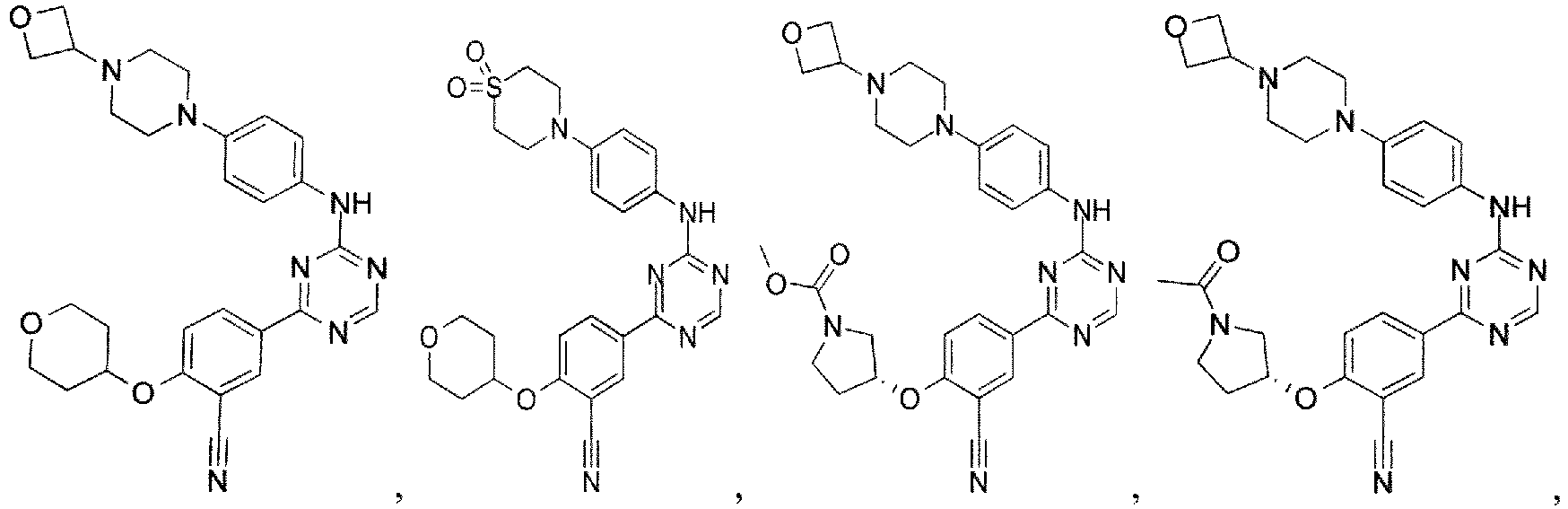


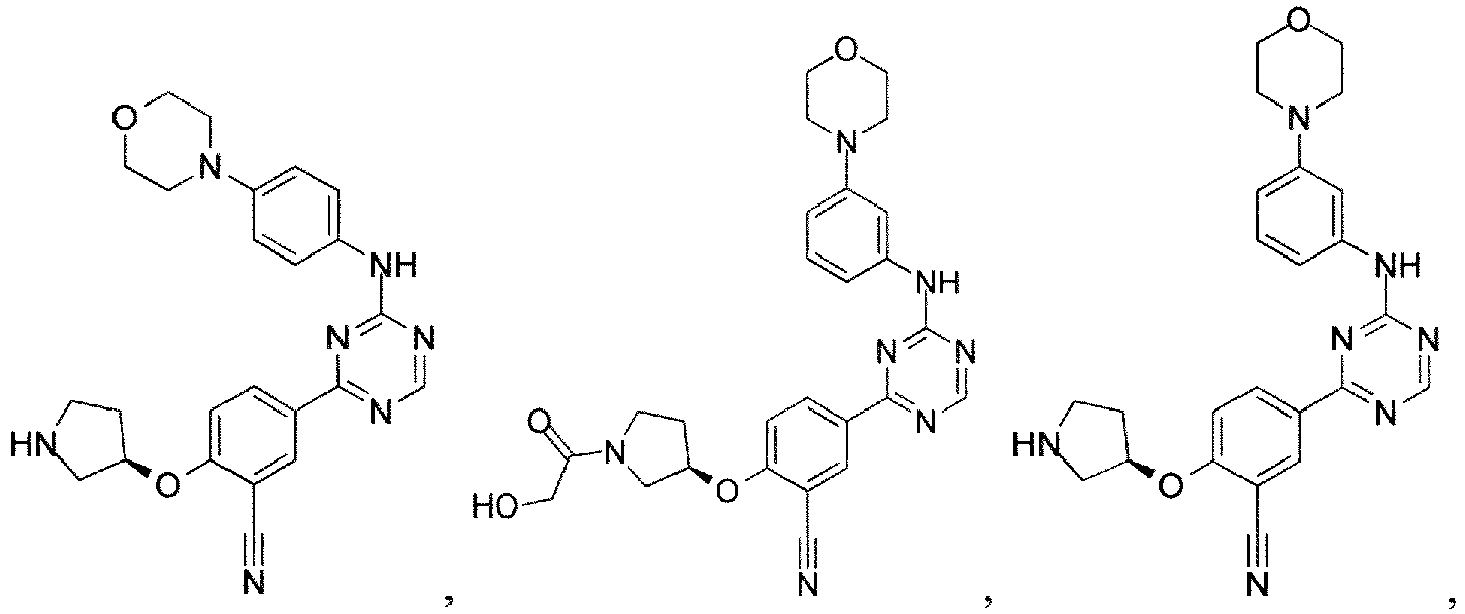


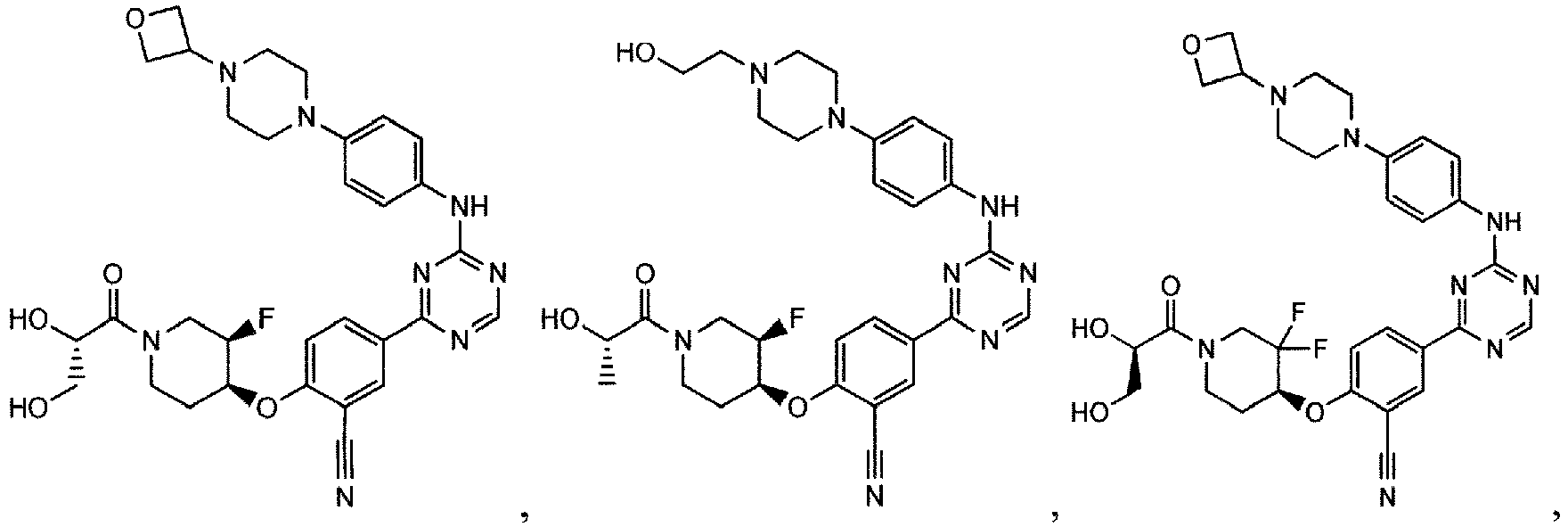


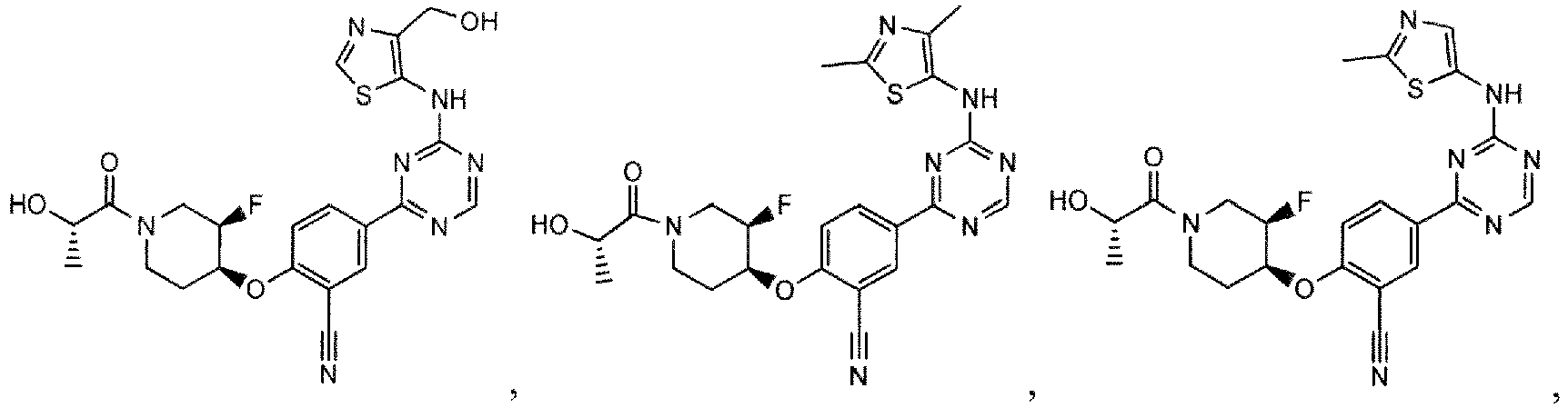
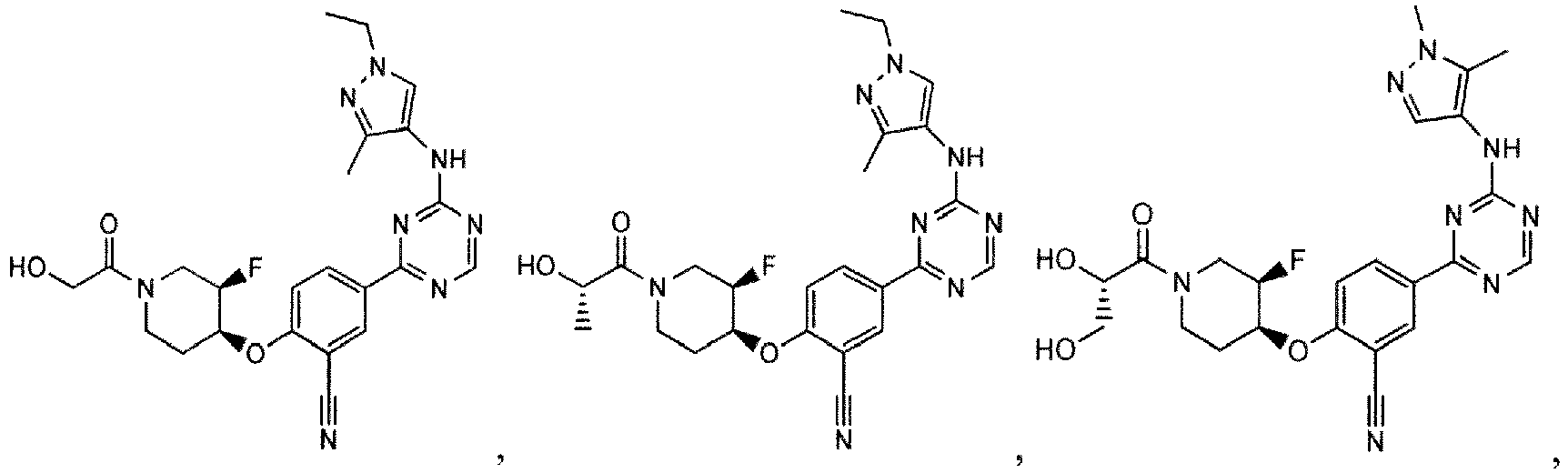


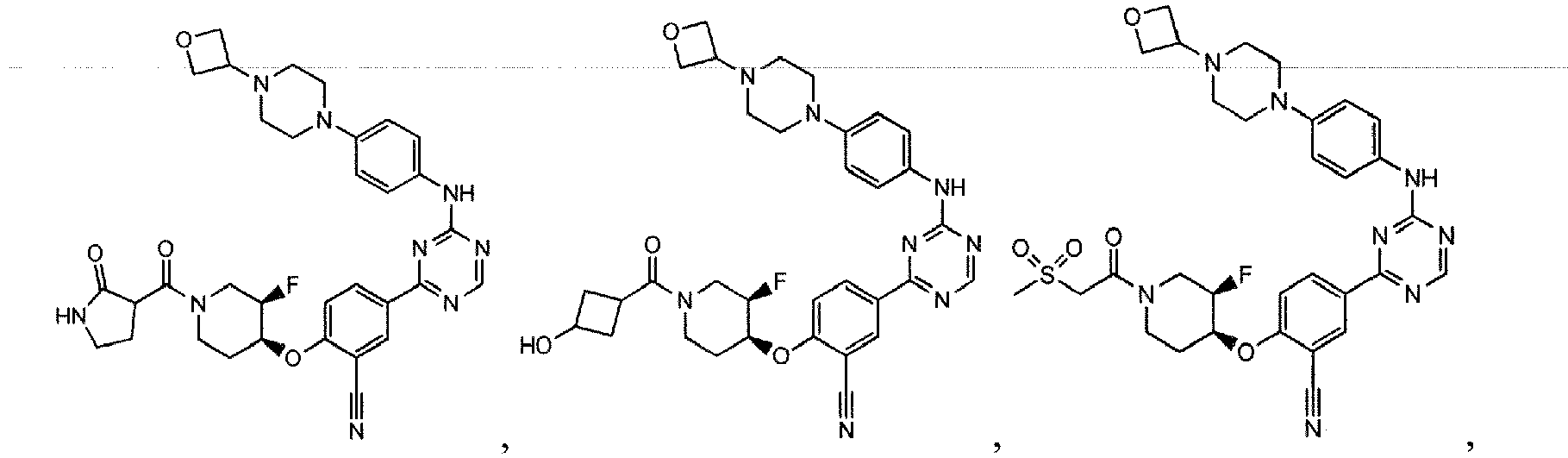


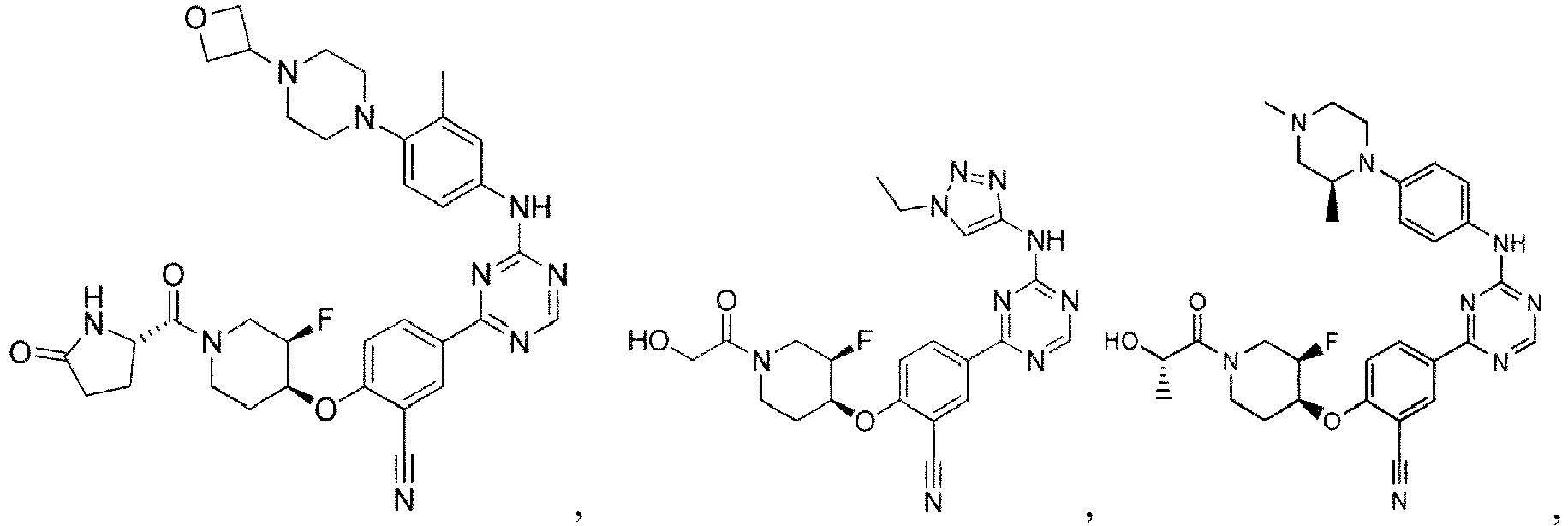

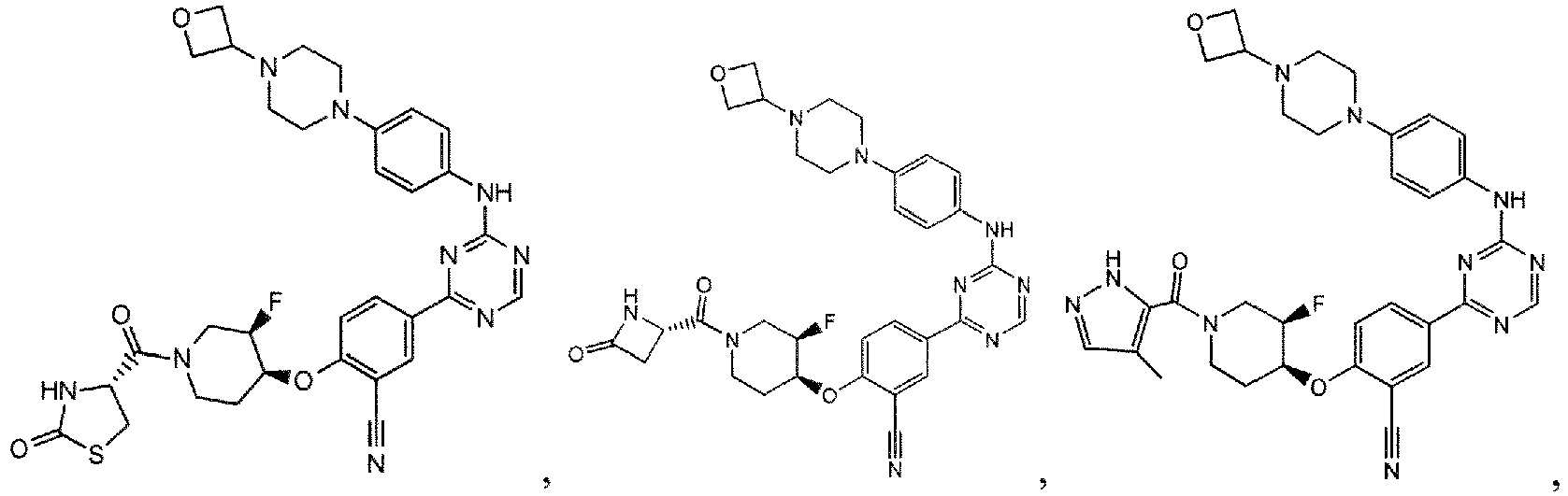
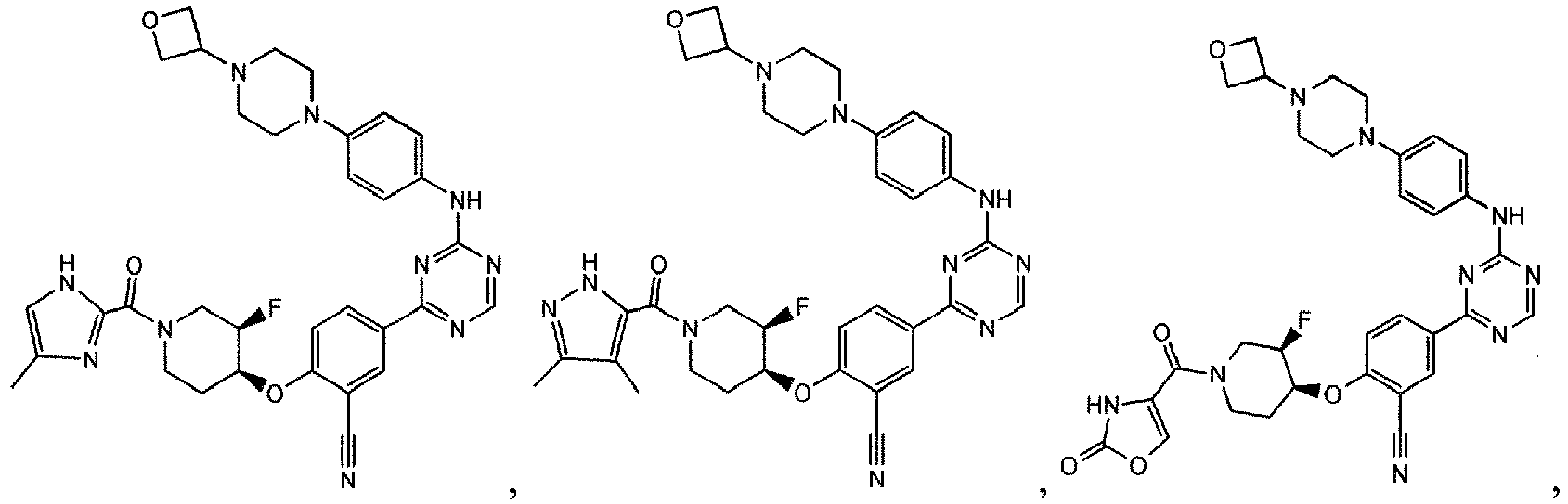


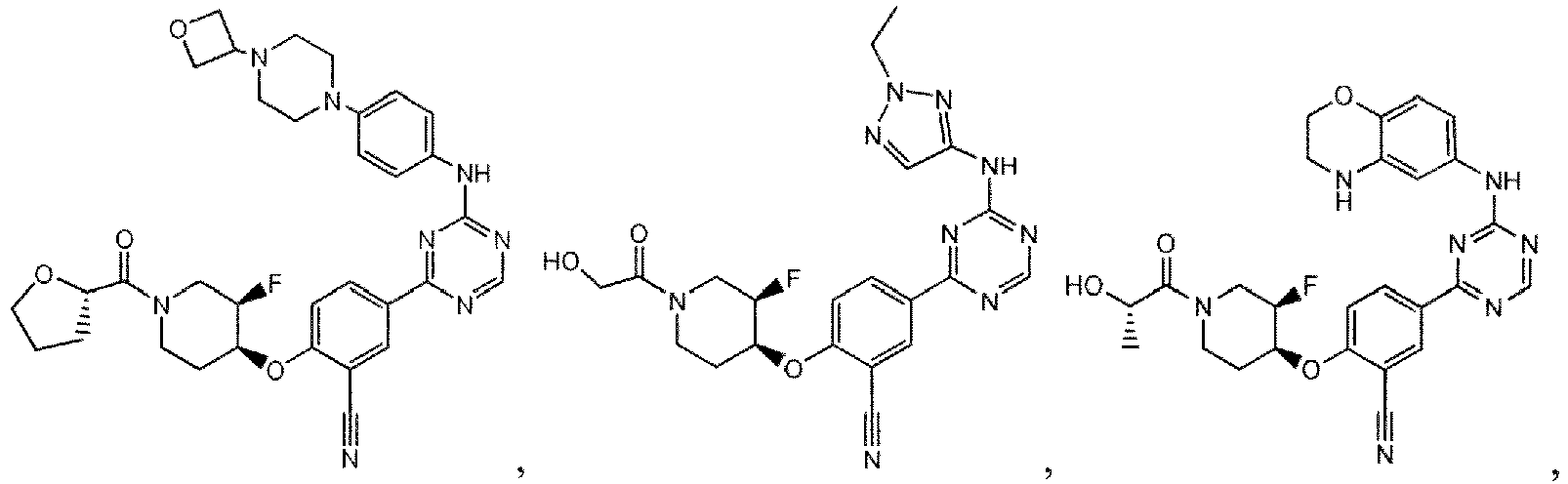
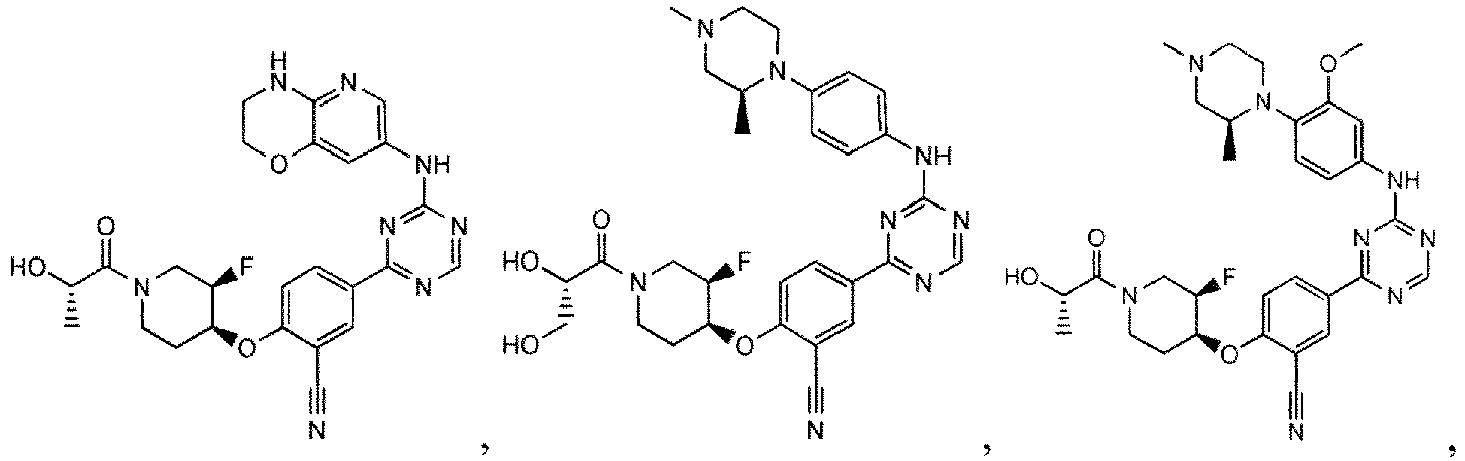


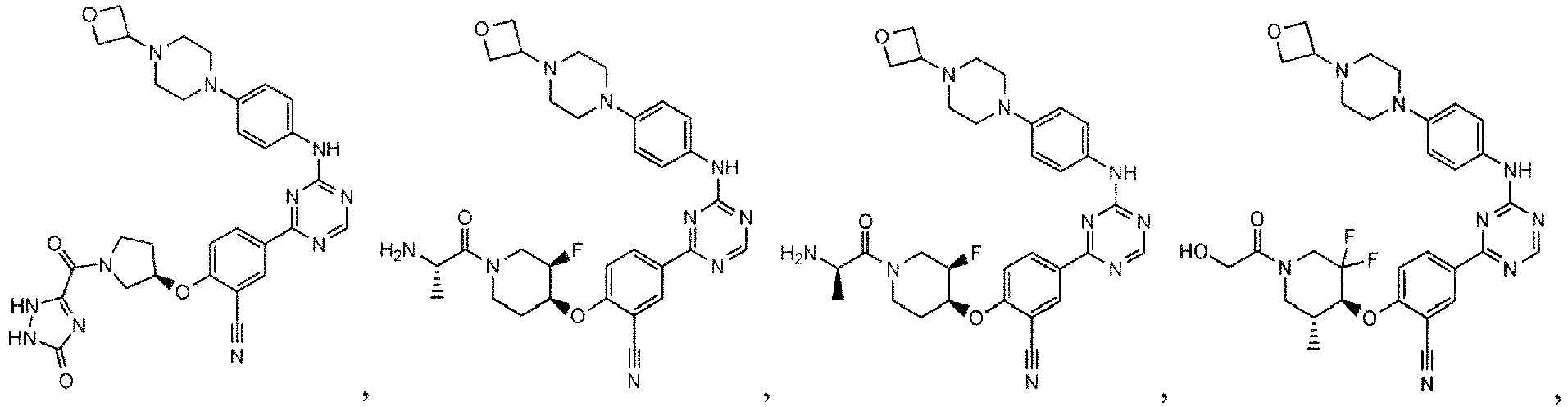


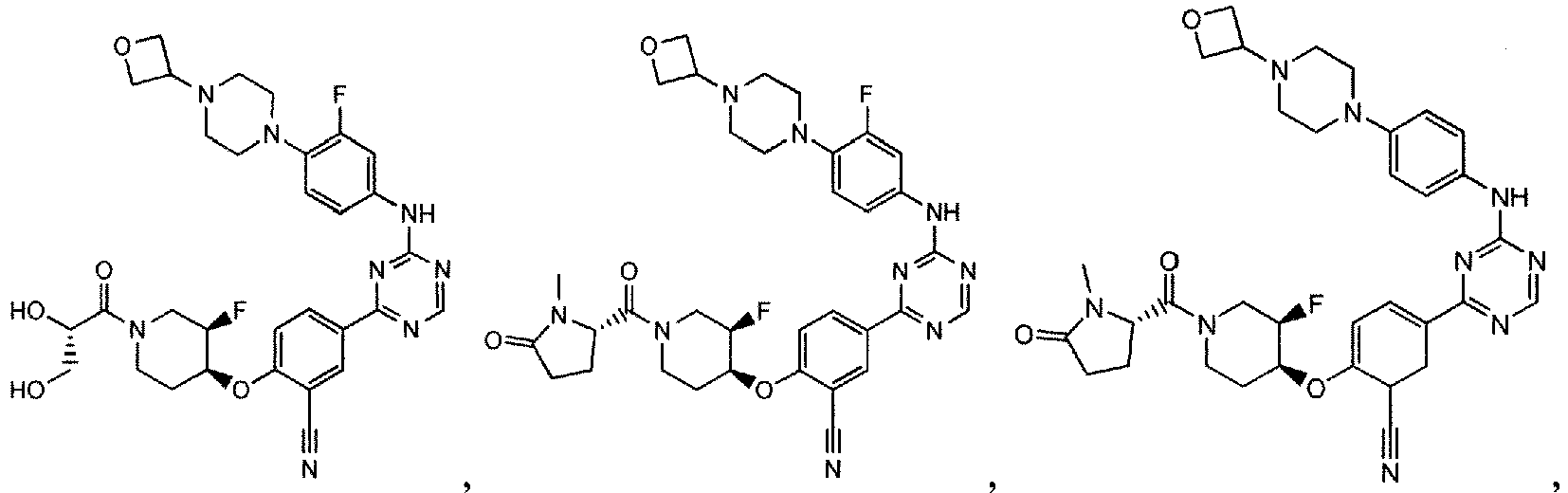


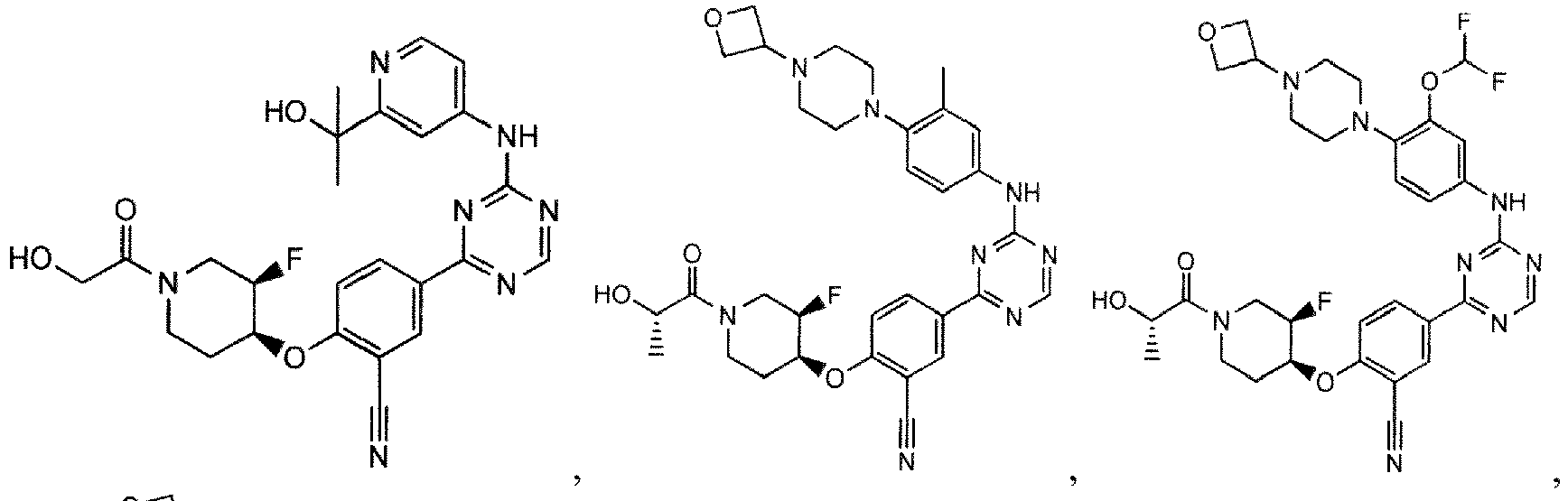


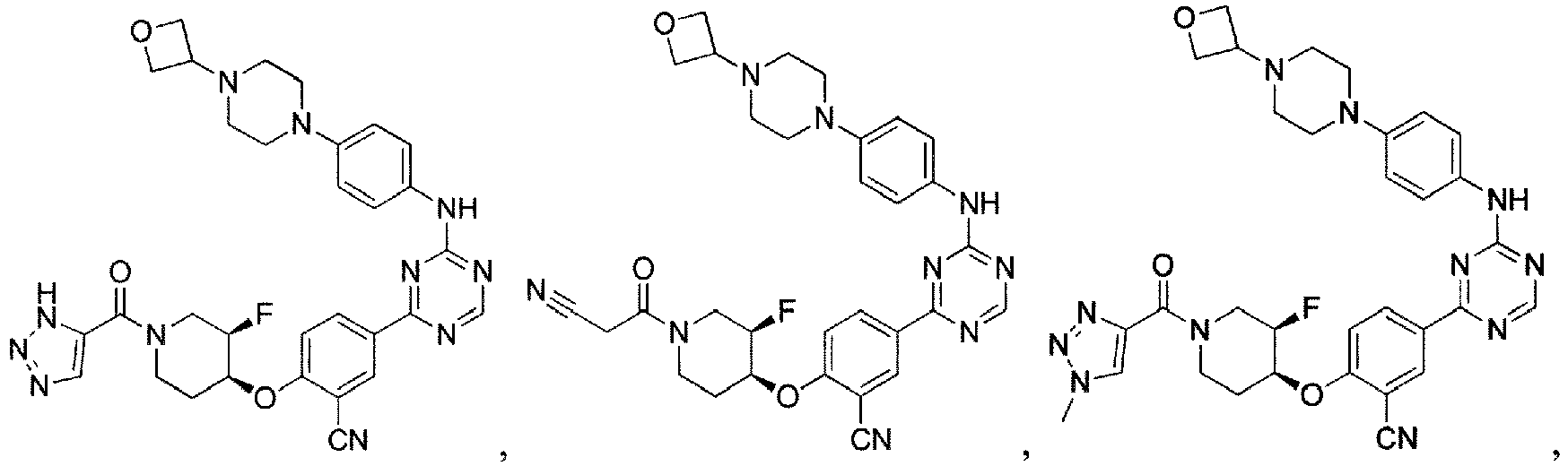


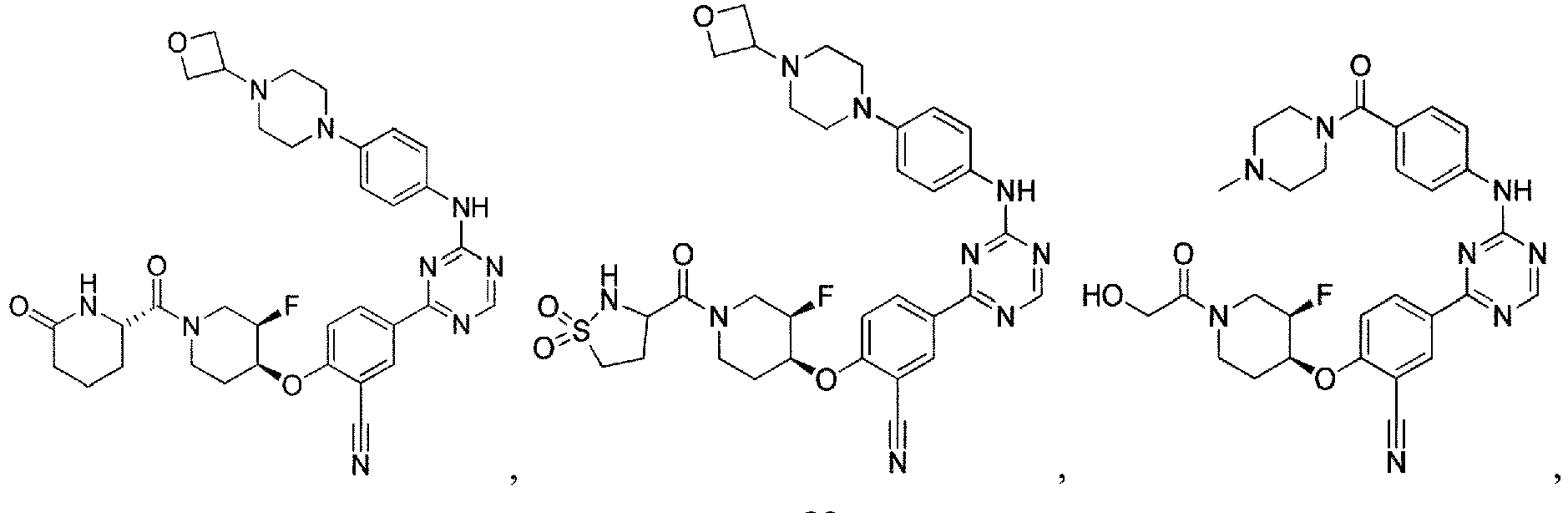

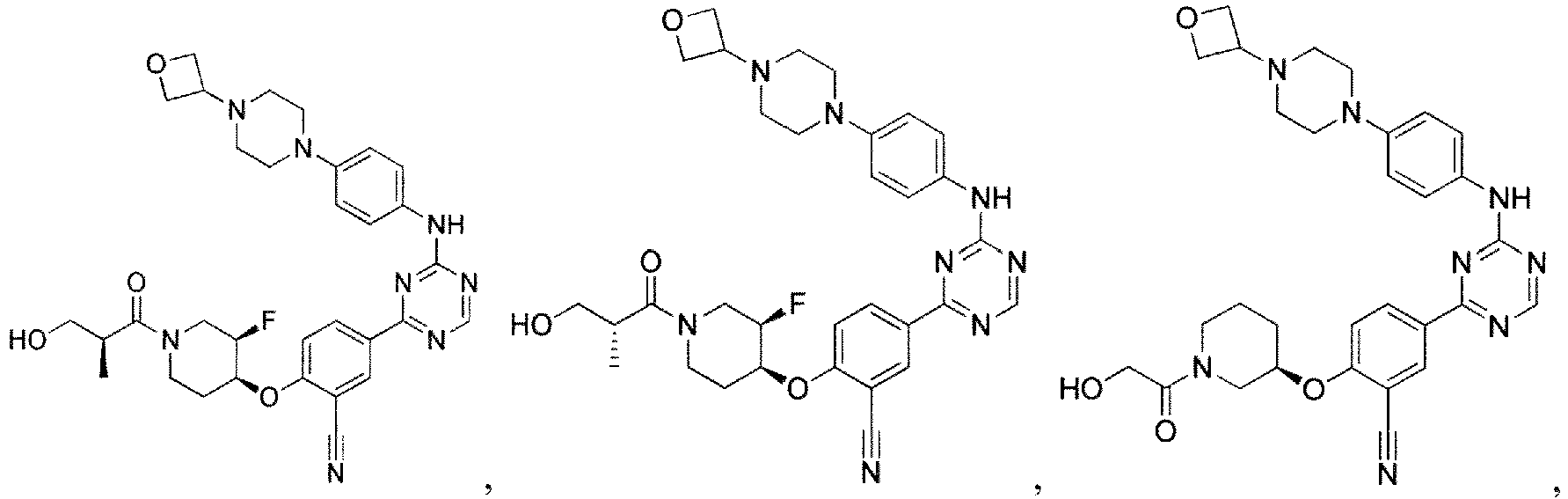


- Verbindung nach Anspruch 1, die ausgewählt ist aus der Gruppe, bestehend aus:
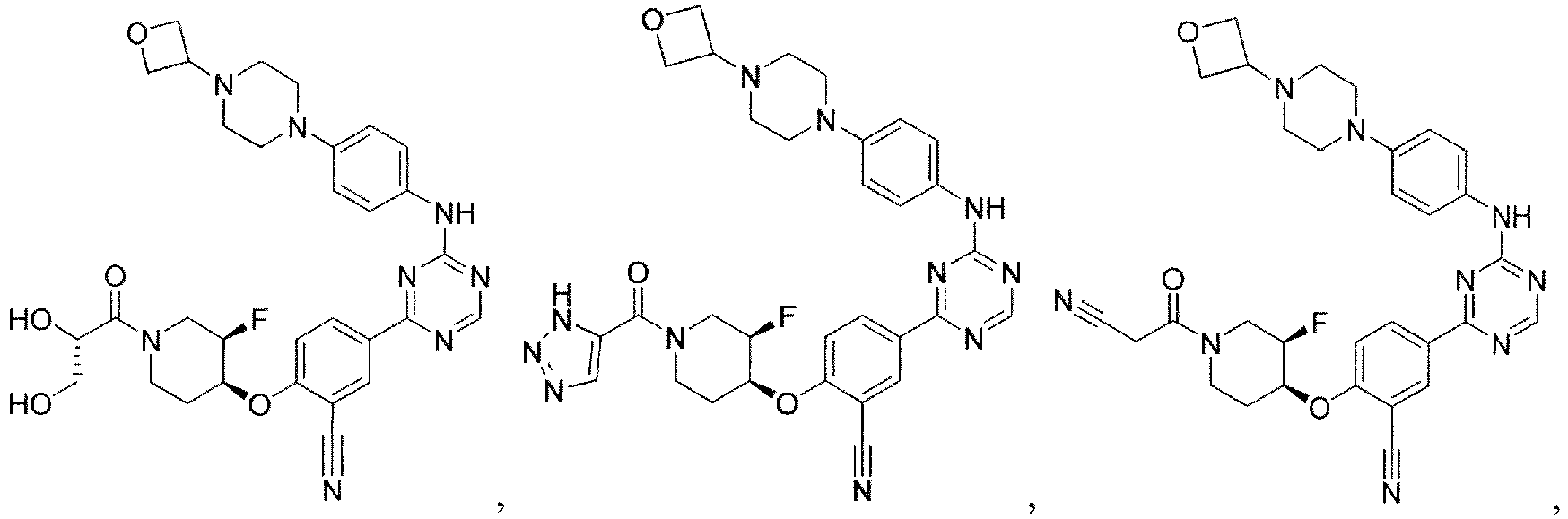


- Verbindung nach Anspruch 2, wobei die Verbindung

- Verbindung nach Anspruch 2, wobei die Verbindung

- Verbindung nach Anspruch 2, wobei die Verbindung

- Verbindung nach Anspruch 2, wobei die Verbindung

- Verbindung nach Anspruch 2, wobei die Verbindung

- Verbindung nach Anspruch 2, wobei die Verbindung

- Verbindung nach Anspruch 2, wobei die Verbindung

- Pharmazeutische Zusammensetzung, die die Verbindung nach einem jeglichen der Ansprüche 1-9 oder ein pharmazeutisch verträgliches Salz davon und einen pharmazeutisch verträglichen Träger umfasst.
- Verbindung nach einem jeglichen der Ansprüche 1-9 oder ein pharmazeutisch verträgliches Salz davon, gegebenenfalls in Kombination mit einem oder mehreren zusätzlichen Therapeutika, zur Verwendung in der Therapie.
- Verbindung nach einem jeglichen der Ansprüche 1-9 oder ein pharmazeutisch verträgliches Salz davon, gegebenenfalls in Kombination mit einem oder mehreren zusätzlichen Therapeutika, zur Verwendung in einem Verfahren zur Behandlung eines Lebewesens mit einer Erkrankung oder einem Zustand, die/der auf die Hemmung von TBK1 anspricht, wie Krebs; einem Verfahren zur Behandlung eines Lebewesens mit einer Erkrankung oder einem Zustand, die/der auf die Hemmung von IKKε anspricht; einem Verfahren zur Behandlung eines Lebewesens, das unter einem RAS-abhängigen/mutierten Krebs, wie nicht-kleinzelligem Lungenkrebs, Kolorektalkrebs, Bauchspeicheldrüsenkrebs, AML oder Melanom, leidet; einem Verfahren zur Behandlung eines Lebewesens, das unter Brust- oder Eierstockkrebs leidet; einem Verfahren zur Behandlung eines Lebewesens, das unter einem Krebstyp leidet, der gegenüber Therapien resistent ist, die auf HER2 und EGFR abzielen; einem Verfahren zur Behandlung eines Lebewesens, das unter einer Erkrankung leidet, die aus der Gruppe ausgewählt ist, die aus rheumatoider Arthritis (RA), entzündlicher Darmerkrankung (IBD), chronisch obstruktiver Lungenerkrankung (COPD), systemischem Lupus erythematodes (SLE), Polymyositis, systemischer Sklerose, Typ 2-Diabetes, Adipositas und Fettleber besteht; oder einem Verfahren zur Behandlung eines Lebewesens, das unter Krebs leidet.
Applications Claiming Priority (4)
| Application Number | Priority Date | Filing Date | Title |
|---|---|---|---|
| US201462056358P | 2014-09-26 | 2014-09-26 | |
| US201562165005P | 2015-05-21 | 2015-05-21 | |
| PCT/US2015/051757 WO2016049211A1 (en) | 2014-09-26 | 2015-09-23 | Aminotriazine derivatives useful as tank-binding kinase inhibitor compounds |
| EP15775054.8A EP3197884B1 (de) | 2014-09-26 | 2015-09-23 | Aminotriazinderivate zur verwendung als tank-bindende kinasehemmerverbindungen |
Related Parent Applications (1)
| Application Number | Title | Priority Date | Filing Date |
|---|---|---|---|
| EP15775054.8A Division EP3197884B1 (de) | 2014-09-26 | 2015-09-23 | Aminotriazinderivate zur verwendung als tank-bindende kinasehemmerverbindungen |
Publications (2)
| Publication Number | Publication Date |
|---|---|
| EP3517536A1 EP3517536A1 (de) | 2019-07-31 |
| EP3517536B1 true EP3517536B1 (de) | 2021-05-05 |
Family
ID=54251749
Family Applications (2)
| Application Number | Title | Priority Date | Filing Date |
|---|---|---|---|
| EP15775054.8A Active EP3197884B1 (de) | 2014-09-26 | 2015-09-23 | Aminotriazinderivate zur verwendung als tank-bindende kinasehemmerverbindungen |
| EP19160625.0A Active EP3517536B1 (de) | 2014-09-26 | 2015-09-23 | Aminotriazinderivate zur verwendung als tank-bindende kinaseinhibitorverbindungen |
Family Applications Before (1)
| Application Number | Title | Priority Date | Filing Date |
|---|---|---|---|
| EP15775054.8A Active EP3197884B1 (de) | 2014-09-26 | 2015-09-23 | Aminotriazinderivate zur verwendung als tank-bindende kinasehemmerverbindungen |
Country Status (17)
| Country | Link |
|---|---|
| US (2) | US10040781B2 (de) |
| EP (2) | EP3197884B1 (de) |
| JP (2) | JP6499282B2 (de) |
| KR (1) | KR101949624B1 (de) |
| CN (1) | CN106715419A (de) |
| AU (1) | AU2015320675B2 (de) |
| BR (1) | BR102015024618A2 (de) |
| CA (1) | CA2962578C (de) |
| EA (1) | EA201790395A1 (de) |
| ES (2) | ES2881195T3 (de) |
| IL (1) | IL250875A0 (de) |
| MX (1) | MX2017003930A (de) |
| NZ (1) | NZ729618A (de) |
| SG (1) | SG11201701724VA (de) |
| TW (1) | TW201629046A (de) |
| UY (1) | UY36330A (de) |
| WO (1) | WO2016049211A1 (de) |
Families Citing this family (21)
| Publication number | Priority date | Publication date | Assignee | Title |
|---|---|---|---|---|
| TW201613916A (en) | 2014-06-03 | 2016-04-16 | Gilead Sciences Inc | TANK-binding kinase inhibitor compounds |
| SG11201701724VA (en) | 2014-09-26 | 2017-04-27 | Gilead Sciences Inc | Aminotriazine derivatives useful as tank-binding kinase inhibitor compounds |
| BR112017002594A2 (pt) | 2015-12-17 | 2017-12-19 | Gilead Sciences Inc | compostos inibidores de cinase de ligação de tank |
| HRP20200133T1 (hr) | 2016-01-22 | 2020-05-15 | Janssen Pharmaceutica Nv | Novi supstituirani derivati cijanoindolina kao inhibitori nik |
| EP3478675B1 (de) * | 2016-06-30 | 2020-04-22 | Janssen Pharmaceutica NV | Heteroaromatische derivate als nik-inhibitoren |
| WO2018002219A1 (en) * | 2016-06-30 | 2018-01-04 | Janssen Pharmaceutica Nv | Cyanoindoline derivatives as nik inhibitors |
| EP3564232B1 (de) | 2016-12-27 | 2022-01-26 | Riken | Bmp-signalhemmende verbindung |
| BR102018007822A2 (pt) | 2017-04-20 | 2018-11-06 | Gilead Sciences, Inc. | composto, métodos para inibir pd-1, pd-l1 e/ou interação de pd-1/pd-l1 e para tratamento de câncer, composição farmacêutica, e, kit para tratamento de ou prevenção de câncer ou uma doença ou condição |
| CN109305944B (zh) * | 2017-07-28 | 2022-09-02 | 深圳睿熙生物科技有限公司 | 布鲁顿酪氨酸激酶的抑制剂 |
| US11440899B2 (en) * | 2017-10-17 | 2022-09-13 | Merck Patent Gmbh | Pyrimidine TBK/IKKe inhibitor compounds and uses thereof |
| WO2019160882A1 (en) | 2018-02-13 | 2019-08-22 | Gilead Sciences, Inc. | Pd-1/pd-l1 inhibitors |
| KR102591947B1 (ko) | 2018-04-19 | 2023-10-25 | 길리애드 사이언시즈, 인코포레이티드 | Pd-1/pd-l1 억제제 |
| JP6899975B2 (ja) | 2018-05-14 | 2021-07-07 | ギリアード サイエンシーズ, インコーポレイテッド | Mcl−1阻害剤 |
| PE20210642A1 (es) | 2018-07-13 | 2021-03-23 | Gilead Sciences Inc | Inhibidores de pd-1/pd-l1 |
| US11236085B2 (en) | 2018-10-24 | 2022-02-01 | Gilead Sciences, Inc. | PD-1/PD-L1 inhibitors |
| EP3902805A4 (de) | 2018-12-28 | 2023-03-01 | SPV Therapeutics Inc. | Cyclinabhängige kinaseinhibitoren |
| CN111377850B (zh) * | 2018-12-31 | 2022-10-18 | 艾琪康医药科技(上海)有限公司 | 一种手性n-取代-3,3-二氟-4-羟基哌啶衍生物及其制备方法 |
| CN109776513A (zh) * | 2019-03-18 | 2019-05-21 | 福建省医学科学研究院 | 一类4-苯基-1,3,5-三嗪-2-胺类抗肿瘤化合物及其制备方法 |
| WO2020206588A1 (en) * | 2019-04-08 | 2020-10-15 | Lynk Pharmaceuticals Co., Ltd. | Benzethers and anilines of pyrazolyl-amino-pyrimidinyl derivatives, and compositions and methods thereof |
| CN110357863B (zh) * | 2019-08-27 | 2023-04-14 | 药雅科技(上海)有限公司 | 一种三嗪双芳香环衍生物表皮生长因子抑制剂及其制备方法与用途 |
| CN110862380A (zh) * | 2019-10-24 | 2020-03-06 | 嘉兴特科罗生物科技有限公司 | 一种小分子化合物 |
Family Cites Families (51)
| Publication number | Priority date | Publication date | Assignee | Title |
|---|---|---|---|---|
| US3845770A (en) | 1972-06-05 | 1974-11-05 | Alza Corp | Osmatic dispensing device for releasing beneficial agent |
| US4326525A (en) | 1980-10-14 | 1982-04-27 | Alza Corporation | Osmotic device that improves delivery properties of agent in situ |
| US5364620A (en) | 1983-12-22 | 1994-11-15 | Elan Corporation, Plc | Controlled absorption diltiazem formulation for once daily administration |
| US5023252A (en) | 1985-12-04 | 1991-06-11 | Conrex Pharmaceutical Corporation | Transdermal and trans-membrane delivery of drugs |
| US5001139A (en) | 1987-06-12 | 1991-03-19 | American Cyanamid Company | Enchancers for the transdermal flux of nivadipine |
| US4992445A (en) | 1987-06-12 | 1991-02-12 | American Cyanamid Co. | Transdermal delivery of pharmaceuticals |
| US4902514A (en) | 1988-07-21 | 1990-02-20 | Alza Corporation | Dosage form for administering nilvadipine for treating cardiovascular symptoms |
| GB0402809D0 (en) | 2004-02-09 | 2004-03-10 | Glaxo Group Ltd | Chemical compounds |
| LT2612862T (lt) | 2004-05-13 | 2017-01-25 | Icos Corporation | Chinazolinonai kaip žmogaus fosfatidilinozitol-3-kinazės delta inhibitoriai |
| MY153898A (en) | 2005-06-22 | 2015-04-15 | Plexxikon Inc | Compounds and methods for kinase modulation, and indications therefor |
| CN101495460A (zh) * | 2006-05-26 | 2009-07-29 | 中外制药株式会社 | Hsp90抑制剂 |
| BRPI0806811A2 (pt) | 2007-01-23 | 2011-09-13 | Palau Pharma Sa | derivados de purina |
| HUE029188T2 (en) | 2007-03-12 | 2017-03-28 | Ym Biosciences Australia Pty | Phenylamino-pyrimidine compounds and their use |
| WO2009030890A1 (en) | 2007-09-03 | 2009-03-12 | University Court Of The University Of Dundee | Pyrimidine compounds for the treatment of cancer, septic shock and/or primary open angle glaucoma |
| WO2009091388A2 (en) * | 2007-12-21 | 2009-07-23 | Progenics Pharmaceuticals, Inc. | Triazines and related compounds having antiviral activity, compositions and methods thereof |
| AR070127A1 (es) | 2008-01-11 | 2010-03-17 | Novartis Ag | Pirrolo - pirimidinas y pirrolo -piridinas |
| GB0805477D0 (en) * | 2008-03-26 | 2008-04-30 | Univ Nottingham | Pyrimidines triazines and their use as pharmaceutical agents |
| US20100056524A1 (en) | 2008-04-02 | 2010-03-04 | Mciver Edward Giles | Compound |
| US8450321B2 (en) | 2008-12-08 | 2013-05-28 | Gilead Connecticut, Inc. | 6-(1H-indazol-6-yl)-N-[4-(morpholin-4-yl)phenyl]imidazo-[1,2-A]pyrazin-8-amine, or a pharmaceutically acceptable salt thereof, as a SYK inhibitor |
| GB0903759D0 (en) | 2009-03-04 | 2009-04-15 | Medical Res Council | Compound |
| DE102009019962A1 (de) | 2009-05-05 | 2010-11-11 | Merck Patent Gmbh | 3-([1,2,3]Triazol-4-yl)-pyrrolo[2,3-b]pyridinderivate |
| KR20120114224A (ko) * | 2009-10-12 | 2012-10-16 | 마이렉시스 인코포레이티드 | Ikk 엡실론 및/또는 tbk1의 억제제로서의 아미노-피리미딘 화합물 |
| EA022120B1 (ru) | 2009-10-20 | 2015-11-30 | Целльзом Лимитид | Аналоги гетероциклил пиразолопиримидина в качестве ингибиторов jak |
| GB201012105D0 (en) * | 2010-07-19 | 2010-09-01 | Domainex Ltd | Novel pyrimidine compounds |
| DE102010049877A1 (de) | 2010-11-01 | 2012-05-03 | Merck Patent Gmbh | 7-((1,2,3)Triazol-4-yl)-pyrrolo(2,3) pyrazinderivate |
| DE102011008352A1 (de) | 2011-01-12 | 2012-07-12 | Merck Patent Gmbh | 5-([1,2,3]Triazol-4-yl)-7H-pyrrolo-[2,3-d]pyrimidinderivate |
| DE102011009961A1 (de) | 2011-02-01 | 2012-08-02 | Merck Patent Gmbh | 7-Azaindolderivate |
| KR20140048873A (ko) | 2011-04-12 | 2014-04-24 | 알츠하이머즈 인스티튜트 오브 아메리카, 인크. | Ikk-관련 키나제 엡실론 및 tank 결합 키나제 1 억제제의 조성물 및 치료학적 용도 |
| PL2714668T3 (pl) | 2011-05-23 | 2017-06-30 | Merck Patent Gmbh | Pochodne tiazolowe |
| LT2714677T (lt) | 2011-05-23 | 2018-12-10 | Merck Patent Gmbh | Piridino ir pirazino dariniai |
| CN102827073A (zh) | 2011-06-17 | 2012-12-19 | 安吉奥斯医药品有限公司 | 治疗活性组合物和它们的使用方法 |
| GB201114051D0 (en) | 2011-08-15 | 2011-09-28 | Domainex Ltd | Compounds and their uses |
| EP2562265A1 (de) * | 2011-08-22 | 2013-02-27 | Lead Discovery Center GmbH | Empfindlichkeit auf selektive CDK9-Inhibitoren |
| DE102011111400A1 (de) | 2011-08-23 | 2013-02-28 | Merck Patent Gmbh | Bicyclische heteroaromatische Verbindungen |
| DE102011112978A1 (de) | 2011-09-09 | 2013-03-14 | Merck Patent Gmbh | Benzonitrilderivate |
| DE102011119127A1 (de) | 2011-11-22 | 2013-05-23 | Merck Patent Gmbh | 3-Cyanaryl-1H-pyrrolo[2.3-b]pyridin-Derivate |
| EP2788000B1 (de) | 2011-12-06 | 2018-05-30 | Merck Sharp & Dohme Corp. | Pyrrolopyrimidine als januskinaseinhibitoren |
| CN104093722B (zh) | 2012-02-09 | 2016-07-27 | 默克专利股份公司 | 作为TBK1和IKK抑制剂的呋喃并[3,2-b]-和噻吩并[3,2-b]吡啶衍生物 |
| WO2013188856A1 (en) | 2012-06-14 | 2013-12-19 | Gilead Connecticut, Inc. | Imidazopyrazine syk inhibitors |
| WO2014004863A2 (en) | 2012-06-27 | 2014-01-03 | Alzheimer's Institute Of America, Inc. | Compounds, compositions, and therapeutic uses thereof |
| GB201303109D0 (en) * | 2013-02-21 | 2013-04-10 | Domainex Ltd | Novel pyrimidine compounds |
| TW201446763A (zh) | 2013-03-14 | 2014-12-16 | Abbvie Inc | 吡咯并[2,3-b]吡啶cdk9激酶抑制劑 |
| CN103251600B (zh) | 2013-05-27 | 2015-05-20 | 中南大学 | 2-氨基-4-(3′-氰基-4′-吡咯烷基)苯基嘧啶化合物的抗肿瘤应用 |
| US10370664B2 (en) | 2013-11-07 | 2019-08-06 | University Of Southern California | Use of IKK epsilon inhibitors to activate NFAT and T cell response |
| WO2015089327A1 (en) | 2013-12-11 | 2015-06-18 | Biogen Idec Ma Inc. | Biaryl compounds useful for the treatment of human diseases in oncology, neurology and immunology |
| US9598424B2 (en) | 2014-03-06 | 2017-03-21 | Takeda Pharmaceutical Company Limited | Heteroarylamide inhibitors of TBK1 |
| TW201613916A (en) | 2014-06-03 | 2016-04-16 | Gilead Sciences Inc | TANK-binding kinase inhibitor compounds |
| SG11201701724VA (en) | 2014-09-26 | 2017-04-27 | Gilead Sciences Inc | Aminotriazine derivatives useful as tank-binding kinase inhibitor compounds |
| WO2016057338A1 (en) | 2014-10-06 | 2016-04-14 | Takeda Pharmaceutical Company Limited | Heteroarylamide inhibitors of tbk1 |
| AU2016287335B2 (en) | 2015-06-29 | 2020-01-23 | Merck Patent Gmbh | TBK/IKKepsilon inhibitor compounds and uses thereof |
| BR112017002594A2 (pt) | 2015-12-17 | 2017-12-19 | Gilead Sciences Inc | compostos inibidores de cinase de ligação de tank |
-
2015
- 2015-09-23 SG SG11201701724VA patent/SG11201701724VA/en unknown
- 2015-09-23 ES ES19160625T patent/ES2881195T3/es active Active
- 2015-09-23 EA EA201790395A patent/EA201790395A1/ru unknown
- 2015-09-23 ES ES15775054T patent/ES2727376T3/es active Active
- 2015-09-23 MX MX2017003930A patent/MX2017003930A/es unknown
- 2015-09-23 KR KR1020177010833A patent/KR101949624B1/ko not_active Ceased
- 2015-09-23 WO PCT/US2015/051757 patent/WO2016049211A1/en not_active Ceased
- 2015-09-23 CN CN201580052292.6A patent/CN106715419A/zh active Pending
- 2015-09-23 CA CA2962578A patent/CA2962578C/en not_active Expired - Fee Related
- 2015-09-23 JP JP2017516318A patent/JP6499282B2/ja not_active Expired - Fee Related
- 2015-09-23 EP EP15775054.8A patent/EP3197884B1/de active Active
- 2015-09-23 EP EP19160625.0A patent/EP3517536B1/de active Active
- 2015-09-23 US US14/863,108 patent/US10040781B2/en active Active
- 2015-09-23 NZ NZ729618A patent/NZ729618A/en not_active IP Right Cessation
- 2015-09-23 AU AU2015320675A patent/AU2015320675B2/en not_active Ceased
- 2015-09-25 UY UY0001036330A patent/UY36330A/es not_active Application Discontinuation
- 2015-09-25 TW TW104131856A patent/TW201629046A/zh unknown
- 2015-09-25 BR BR102015024618A patent/BR102015024618A2/pt not_active Application Discontinuation
-
2017
- 2017-03-01 IL IL250875A patent/IL250875A0/en unknown
-
2018
- 2018-06-25 JP JP2018120056A patent/JP2018158942A/ja active Pending
- 2018-06-27 US US16/020,777 patent/US10253019B2/en active Active
Also Published As
| Publication number | Publication date |
|---|---|
| ES2727376T3 (es) | 2019-10-15 |
| CA2962578C (en) | 2019-01-08 |
| JP6499282B2 (ja) | 2019-04-10 |
| US10253019B2 (en) | 2019-04-09 |
| CA2962578A1 (en) | 2016-03-31 |
| US10040781B2 (en) | 2018-08-07 |
| EP3197884B1 (de) | 2019-03-06 |
| NZ729618A (en) | 2018-07-27 |
| CN106715419A (zh) | 2017-05-24 |
| SG11201701724VA (en) | 2017-04-27 |
| US20180370955A1 (en) | 2018-12-27 |
| US20160096827A1 (en) | 2016-04-07 |
| EP3197884A1 (de) | 2017-08-02 |
| BR102015024618A2 (pt) | 2016-08-23 |
| KR101949624B1 (ko) | 2019-02-18 |
| TW201629046A (zh) | 2016-08-16 |
| JP2017529373A (ja) | 2017-10-05 |
| ES2881195T3 (es) | 2021-11-29 |
| AU2015320675A1 (en) | 2017-03-23 |
| KR20170049609A (ko) | 2017-05-10 |
| MX2017003930A (es) | 2017-06-30 |
| EA201790395A1 (ru) | 2017-08-31 |
| UY36330A (es) | 2016-04-29 |
| EP3517536A1 (de) | 2019-07-31 |
| WO2016049211A1 (en) | 2016-03-31 |
| IL250875A0 (en) | 2017-04-30 |
| AU2015320675B2 (en) | 2018-10-18 |
| JP2018158942A (ja) | 2018-10-11 |
Similar Documents
| Publication | Publication Date | Title |
|---|---|---|
| EP3197884B1 (de) | Aminotriazinderivate zur verwendung als tank-bindende kinasehemmerverbindungen | |
| EP3152210B1 (de) | Tank-bindende kinasehemmerverbindungen | |
| US20240199584A1 (en) | Kras inhibitors | |
| KR20240114793A (ko) | Kras g12c 억제제 | |
| CN116568677A (zh) | 可用于治疗mtap缺乏和/或mta累积癌症的哌啶-1-基-n-吡啶-3-基-2-氧代乙酰胺衍生物 | |
| TW202317574A (zh) | Cdk2抑制劑 | |
| CN111643496A (zh) | 使用mek抑制剂的方法 | |
| JP7651590B2 (ja) | アミノピリミジン誘導体およびアリール炭化水素受容体モジュレーターとしてのその使用 | |
| EP3892278B1 (de) | Cycloalkan-1,3-diamin-derivat | |
| JP7744540B2 (ja) | がんなどの疾患の処置のためのインダゾリル-イソオキサゾール誘導体 | |
| WO2024028169A1 (en) | Novel specifically substituted thiophenolic compounds | |
| WO2023209090A1 (en) | Bicyclic heteroaromatic compounds and their application in the treatment of cancer | |
| HK40011511B (en) | Aminotriazine derivatives useful as tank-binding kinase inhibitor compounds | |
| HK40011511A (en) | Aminotriazine derivatives useful as tank-binding kinase inhibitor compounds | |
| HK1234051A1 (en) | Aminotriazine derivatives useful as tank-binding kinase inhibitor compounds | |
| HK1234051B (en) | Aminotriazine derivatives useful as tank-binding kinase inhibitor compounds | |
| HK1233645A1 (en) | Aminotriazine derivatives useful as tank-binding kinase inhibitor compounds | |
| HK40122817A (en) | Indazolyl-isoxazole derivatives for the treatment of diseases such as cancer | |
| HK40065185B (en) | Indazolyl-isoxazole derivatives for the treatment of diseases such as cancer | |
| HK40065185A (en) | Indazolyl-isoxazole derivatives for the treatment of diseases such as cancer | |
| HK1236197A1 (en) | Tank-binding kinase inhibitor compounds | |
| HK1236197B (en) | Tank-binding kinase inhibitor compounds |
Legal Events
| Date | Code | Title | Description |
|---|---|---|---|
| PUAI | Public reference made under article 153(3) epc to a published international application that has entered the european phase |
Free format text: ORIGINAL CODE: 0009012 |
|
| STAA | Information on the status of an ep patent application or granted ep patent |
Free format text: STATUS: THE APPLICATION HAS BEEN PUBLISHED |
|
| AC | Divisional application: reference to earlier application |
Ref document number: 3197884 Country of ref document: EP Kind code of ref document: P |
|
| AK | Designated contracting states |
Kind code of ref document: A1 Designated state(s): AL AT BE BG CH CY CZ DE DK EE ES FI FR GB GR HR HU IE IS IT LI LT LU LV MC MK MT NL NO PL PT RO RS SE SI SK SM TR |
|
| STAA | Information on the status of an ep patent application or granted ep patent |
Free format text: STATUS: REQUEST FOR EXAMINATION WAS MADE |
|
| 17P | Request for examination filed |
Effective date: 20200117 |
|
| RBV | Designated contracting states (corrected) |
Designated state(s): AL AT BE BG CH CY CZ DE DK EE ES FI FR GB GR HR HU IE IS IT LI LT LU LV MC MK MT NL NO PL PT RO RS SE SI SK SM TR |
|
| GRAP | Despatch of communication of intention to grant a patent |
Free format text: ORIGINAL CODE: EPIDOSNIGR1 |
|
| STAA | Information on the status of an ep patent application or granted ep patent |
Free format text: STATUS: GRANT OF PATENT IS INTENDED |
|
| INTG | Intention to grant announced |
Effective date: 20200515 |
|
| REG | Reference to a national code |
Ref country code: HK Ref legal event code: DE Ref document number: 40011511 Country of ref document: HK |
|
| GRAJ | Information related to disapproval of communication of intention to grant by the applicant or resumption of examination proceedings by the epo deleted |
Free format text: ORIGINAL CODE: EPIDOSDIGR1 |
|
| STAA | Information on the status of an ep patent application or granted ep patent |
Free format text: STATUS: REQUEST FOR EXAMINATION WAS MADE |
|
| INTC | Intention to grant announced (deleted) | ||
| GRAP | Despatch of communication of intention to grant a patent |
Free format text: ORIGINAL CODE: EPIDOSNIGR1 |
|
| STAA | Information on the status of an ep patent application or granted ep patent |
Free format text: STATUS: GRANT OF PATENT IS INTENDED |
|
| INTG | Intention to grant announced |
Effective date: 20201208 |
|
| GRAS | Grant fee paid |
Free format text: ORIGINAL CODE: EPIDOSNIGR3 |
|
| GRAA | (expected) grant |
Free format text: ORIGINAL CODE: 0009210 |
|
| STAA | Information on the status of an ep patent application or granted ep patent |
Free format text: STATUS: THE PATENT HAS BEEN GRANTED |
|
| AC | Divisional application: reference to earlier application |
Ref document number: 3197884 Country of ref document: EP Kind code of ref document: P |
|
| AK | Designated contracting states |
Kind code of ref document: B1 Designated state(s): AL AT BE BG CH CY CZ DE DK EE ES FI FR GB GR HR HU IE IS IT LI LT LU LV MC MK MT NL NO PL PT RO RS SE SI SK SM TR |
|
| REG | Reference to a national code |
Ref country code: GB Ref legal event code: FG4D |
|
| REG | Reference to a national code |
Ref country code: CH Ref legal event code: EP |
|
| REG | Reference to a national code |
Ref country code: AT Ref legal event code: REF Ref document number: 1389697 Country of ref document: AT Kind code of ref document: T Effective date: 20210515 |
|
| REG | Reference to a national code |
Ref country code: IE Ref legal event code: FG4D |
|
| REG | Reference to a national code |
Ref country code: DE Ref legal event code: R096 Ref document number: 602015069159 Country of ref document: DE |
|
| REG | Reference to a national code |
Ref country code: DE Ref legal event code: R082 Ref document number: 602015069159 Country of ref document: DE Representative=s name: ZWICKER SCHNAPPAUF & PARTNER PATENTANWAELTE PA, DE |
|
| REG | Reference to a national code |
Ref country code: LT Ref legal event code: MG9D |
|
| REG | Reference to a national code |
Ref country code: AT Ref legal event code: MK05 Ref document number: 1389697 Country of ref document: AT Kind code of ref document: T Effective date: 20210505 |
|
| PG25 | Lapsed in a contracting state [announced via postgrant information from national office to epo] |
Ref country code: AT Free format text: LAPSE BECAUSE OF FAILURE TO SUBMIT A TRANSLATION OF THE DESCRIPTION OR TO PAY THE FEE WITHIN THE PRESCRIBED TIME-LIMIT Effective date: 20210505 Ref country code: BG Free format text: LAPSE BECAUSE OF FAILURE TO SUBMIT A TRANSLATION OF THE DESCRIPTION OR TO PAY THE FEE WITHIN THE PRESCRIBED TIME-LIMIT Effective date: 20210805 Ref country code: HR Free format text: LAPSE BECAUSE OF FAILURE TO SUBMIT A TRANSLATION OF THE DESCRIPTION OR TO PAY THE FEE WITHIN THE PRESCRIBED TIME-LIMIT Effective date: 20210505 Ref country code: LT Free format text: LAPSE BECAUSE OF FAILURE TO SUBMIT A TRANSLATION OF THE DESCRIPTION OR TO PAY THE FEE WITHIN THE PRESCRIBED TIME-LIMIT Effective date: 20210505 Ref country code: FI Free format text: LAPSE BECAUSE OF FAILURE TO SUBMIT A TRANSLATION OF THE DESCRIPTION OR TO PAY THE FEE WITHIN THE PRESCRIBED TIME-LIMIT Effective date: 20210505 |
|
| REG | Reference to a national code |
Ref country code: ES Ref legal event code: FG2A Ref document number: 2881195 Country of ref document: ES Kind code of ref document: T3 Effective date: 20211129 |
|
| PG25 | Lapsed in a contracting state [announced via postgrant information from national office to epo] |
Ref country code: NO Free format text: LAPSE BECAUSE OF FAILURE TO SUBMIT A TRANSLATION OF THE DESCRIPTION OR TO PAY THE FEE WITHIN THE PRESCRIBED TIME-LIMIT Effective date: 20210805 Ref country code: PL Free format text: LAPSE BECAUSE OF FAILURE TO SUBMIT A TRANSLATION OF THE DESCRIPTION OR TO PAY THE FEE WITHIN THE PRESCRIBED TIME-LIMIT Effective date: 20210505 Ref country code: LV Free format text: LAPSE BECAUSE OF FAILURE TO SUBMIT A TRANSLATION OF THE DESCRIPTION OR TO PAY THE FEE WITHIN THE PRESCRIBED TIME-LIMIT Effective date: 20210505 Ref country code: SE Free format text: LAPSE BECAUSE OF FAILURE TO SUBMIT A TRANSLATION OF THE DESCRIPTION OR TO PAY THE FEE WITHIN THE PRESCRIBED TIME-LIMIT Effective date: 20210505 Ref country code: PT Free format text: LAPSE BECAUSE OF FAILURE TO SUBMIT A TRANSLATION OF THE DESCRIPTION OR TO PAY THE FEE WITHIN THE PRESCRIBED TIME-LIMIT Effective date: 20210906 Ref country code: RS Free format text: LAPSE BECAUSE OF FAILURE TO SUBMIT A TRANSLATION OF THE DESCRIPTION OR TO PAY THE FEE WITHIN THE PRESCRIBED TIME-LIMIT Effective date: 20210505 Ref country code: GR Free format text: LAPSE BECAUSE OF FAILURE TO SUBMIT A TRANSLATION OF THE DESCRIPTION OR TO PAY THE FEE WITHIN THE PRESCRIBED TIME-LIMIT Effective date: 20210806 Ref country code: IS Free format text: LAPSE BECAUSE OF FAILURE TO SUBMIT A TRANSLATION OF THE DESCRIPTION OR TO PAY THE FEE WITHIN THE PRESCRIBED TIME-LIMIT Effective date: 20210905 |
|
| REG | Reference to a national code |
Ref country code: NL Ref legal event code: MP Effective date: 20210505 |
|
| PG25 | Lapsed in a contracting state [announced via postgrant information from national office to epo] |
Ref country code: NL Free format text: LAPSE BECAUSE OF FAILURE TO SUBMIT A TRANSLATION OF THE DESCRIPTION OR TO PAY THE FEE WITHIN THE PRESCRIBED TIME-LIMIT Effective date: 20210505 |
|
| PG25 | Lapsed in a contracting state [announced via postgrant information from national office to epo] |
Ref country code: DK Free format text: LAPSE BECAUSE OF FAILURE TO SUBMIT A TRANSLATION OF THE DESCRIPTION OR TO PAY THE FEE WITHIN THE PRESCRIBED TIME-LIMIT Effective date: 20210505 Ref country code: CZ Free format text: LAPSE BECAUSE OF FAILURE TO SUBMIT A TRANSLATION OF THE DESCRIPTION OR TO PAY THE FEE WITHIN THE PRESCRIBED TIME-LIMIT Effective date: 20210505 Ref country code: SM Free format text: LAPSE BECAUSE OF FAILURE TO SUBMIT A TRANSLATION OF THE DESCRIPTION OR TO PAY THE FEE WITHIN THE PRESCRIBED TIME-LIMIT Effective date: 20210505 Ref country code: RO Free format text: LAPSE BECAUSE OF FAILURE TO SUBMIT A TRANSLATION OF THE DESCRIPTION OR TO PAY THE FEE WITHIN THE PRESCRIBED TIME-LIMIT Effective date: 20210505 Ref country code: EE Free format text: LAPSE BECAUSE OF FAILURE TO SUBMIT A TRANSLATION OF THE DESCRIPTION OR TO PAY THE FEE WITHIN THE PRESCRIBED TIME-LIMIT Effective date: 20210505 Ref country code: SK Free format text: LAPSE BECAUSE OF FAILURE TO SUBMIT A TRANSLATION OF THE DESCRIPTION OR TO PAY THE FEE WITHIN THE PRESCRIBED TIME-LIMIT Effective date: 20210505 |
|
| REG | Reference to a national code |
Ref country code: DE Ref legal event code: R097 Ref document number: 602015069159 Country of ref document: DE |
|
| PLBE | No opposition filed within time limit |
Free format text: ORIGINAL CODE: 0009261 |
|
| STAA | Information on the status of an ep patent application or granted ep patent |
Free format text: STATUS: NO OPPOSITION FILED WITHIN TIME LIMIT |
|
| 26N | No opposition filed |
Effective date: 20220208 |
|
| REG | Reference to a national code |
Ref country code: CH Ref legal event code: PL |
|
| REG | Reference to a national code |
Ref country code: BE Ref legal event code: MM Effective date: 20210930 |
|
| PG25 | Lapsed in a contracting state [announced via postgrant information from national office to epo] |
Ref country code: IS Free format text: LAPSE BECAUSE OF FAILURE TO SUBMIT A TRANSLATION OF THE DESCRIPTION OR TO PAY THE FEE WITHIN THE PRESCRIBED TIME-LIMIT Effective date: 20210905 Ref country code: MC Free format text: LAPSE BECAUSE OF FAILURE TO SUBMIT A TRANSLATION OF THE DESCRIPTION OR TO PAY THE FEE WITHIN THE PRESCRIBED TIME-LIMIT Effective date: 20210505 Ref country code: AL Free format text: LAPSE BECAUSE OF FAILURE TO SUBMIT A TRANSLATION OF THE DESCRIPTION OR TO PAY THE FEE WITHIN THE PRESCRIBED TIME-LIMIT Effective date: 20210505 |
|
| PG25 | Lapsed in a contracting state [announced via postgrant information from national office to epo] |
Ref country code: LU Free format text: LAPSE BECAUSE OF NON-PAYMENT OF DUE FEES Effective date: 20210923 Ref country code: BE Free format text: LAPSE BECAUSE OF NON-PAYMENT OF DUE FEES Effective date: 20210930 |
|
| PG25 | Lapsed in a contracting state [announced via postgrant information from national office to epo] |
Ref country code: LI Free format text: LAPSE BECAUSE OF NON-PAYMENT OF DUE FEES Effective date: 20210930 Ref country code: CH Free format text: LAPSE BECAUSE OF NON-PAYMENT OF DUE FEES Effective date: 20210930 |
|
| PG25 | Lapsed in a contracting state [announced via postgrant information from national office to epo] |
Ref country code: CY Free format text: LAPSE BECAUSE OF FAILURE TO SUBMIT A TRANSLATION OF THE DESCRIPTION OR TO PAY THE FEE WITHIN THE PRESCRIBED TIME-LIMIT Effective date: 20210505 |
|
| PG25 | Lapsed in a contracting state [announced via postgrant information from national office to epo] |
Ref country code: HU Free format text: LAPSE BECAUSE OF FAILURE TO SUBMIT A TRANSLATION OF THE DESCRIPTION OR TO PAY THE FEE WITHIN THE PRESCRIBED TIME-LIMIT; INVALID AB INITIO Effective date: 20150923 |
|
| PG25 | Lapsed in a contracting state [announced via postgrant information from national office to epo] |
Ref country code: MK Free format text: LAPSE BECAUSE OF FAILURE TO SUBMIT A TRANSLATION OF THE DESCRIPTION OR TO PAY THE FEE WITHIN THE PRESCRIBED TIME-LIMIT Effective date: 20210505 |
|
| PG25 | Lapsed in a contracting state [announced via postgrant information from national office to epo] |
Ref country code: TR Free format text: LAPSE BECAUSE OF FAILURE TO SUBMIT A TRANSLATION OF THE DESCRIPTION OR TO PAY THE FEE WITHIN THE PRESCRIBED TIME-LIMIT Effective date: 20210505 |
|
| PG25 | Lapsed in a contracting state [announced via postgrant information from national office to epo] |
Ref country code: MT Free format text: LAPSE BECAUSE OF FAILURE TO SUBMIT A TRANSLATION OF THE DESCRIPTION OR TO PAY THE FEE WITHIN THE PRESCRIBED TIME-LIMIT Effective date: 20210505 |
|
| PGFP | Annual fee paid to national office [announced via postgrant information from national office to epo] |
Ref country code: DE Payment date: 20250702 Year of fee payment: 11 |
|
| PGFP | Annual fee paid to national office [announced via postgrant information from national office to epo] |
Ref country code: IT Payment date: 20250825 Year of fee payment: 11 |
|
| PGFP | Annual fee paid to national office [announced via postgrant information from national office to epo] |
Ref country code: GB Payment date: 20250703 Year of fee payment: 11 |
|
| PGFP | Annual fee paid to national office [announced via postgrant information from national office to epo] |
Ref country code: FR Payment date: 20250808 Year of fee payment: 11 |
|
| PGFP | Annual fee paid to national office [announced via postgrant information from national office to epo] |
Ref country code: IE Payment date: 20250702 Year of fee payment: 11 |
|
| PGFP | Annual fee paid to national office [announced via postgrant information from national office to epo] |
Ref country code: ES Payment date: 20251016 Year of fee payment: 11 |