EP3505536B1 - Antikörper gegen das prostata-spezifische stammzellantigen und dessen verwendung - Google Patents
Antikörper gegen das prostata-spezifische stammzellantigen und dessen verwendung Download PDFInfo
- Publication number
- EP3505536B1 EP3505536B1 EP18207370.0A EP18207370A EP3505536B1 EP 3505536 B1 EP3505536 B1 EP 3505536B1 EP 18207370 A EP18207370 A EP 18207370A EP 3505536 B1 EP3505536 B1 EP 3505536B1
- Authority
- EP
- European Patent Office
- Prior art keywords
- seq
- psca
- antibody
- variable region
- antibodies
- Prior art date
- Legal status (The legal status is an assumption and is not a legal conclusion. Google has not performed a legal analysis and makes no representation as to the accuracy of the status listed.)
- Active
Links
Images
Classifications
-
- C—CHEMISTRY; METALLURGY
- C07—ORGANIC CHEMISTRY
- C07K—PEPTIDES
- C07K16/00—Immunoglobulins [IG], e.g. monoclonal or polyclonal antibodies
- C07K16/18—Immunoglobulins [IG], e.g. monoclonal or polyclonal antibodies against material from animals or humans
- C07K16/28—Immunoglobulins [IG], e.g. monoclonal or polyclonal antibodies against material from animals or humans against receptors, cell surface antigens or cell surface determinants
- C07K16/30—Immunoglobulins [IG], e.g. monoclonal or polyclonal antibodies against material from animals or humans against receptors, cell surface antigens or cell surface determinants from tumour cells
- C07K16/3069—Reproductive system, e.g. ovaria, uterus, testes, prostate
-
- A—HUMAN NECESSITIES
- A61—MEDICAL OR VETERINARY SCIENCE; HYGIENE
- A61K—PREPARATIONS FOR MEDICAL, DENTAL OR TOILETRY PURPOSES
- A61K39/00—Medicinal preparations containing antigens or antibodies
- A61K39/395—Antibodies; Immunoglobulins; Immune serum, e.g. antilymphocytic serum
- A61K39/39533—Antibodies; Immunoglobulins; Immune serum, e.g. antilymphocytic serum against materials from animals
- A61K39/39558—Antibodies; Immunoglobulins; Immune serum, e.g. antilymphocytic serum against materials from animals against tumor tissues, cells, antigens
-
- A—HUMAN NECESSITIES
- A61—MEDICAL OR VETERINARY SCIENCE; HYGIENE
- A61P—SPECIFIC THERAPEUTIC ACTIVITY OF CHEMICAL COMPOUNDS OR MEDICINAL PREPARATIONS
- A61P35/00—Antineoplastic agents
-
- C—CHEMISTRY; METALLURGY
- C07—ORGANIC CHEMISTRY
- C07K—PEPTIDES
- C07K16/00—Immunoglobulins [IG], e.g. monoclonal or polyclonal antibodies
- C07K16/18—Immunoglobulins [IG], e.g. monoclonal or polyclonal antibodies against material from animals or humans
- C07K16/28—Immunoglobulins [IG], e.g. monoclonal or polyclonal antibodies against material from animals or humans against receptors, cell surface antigens or cell surface determinants
-
- C—CHEMISTRY; METALLURGY
- C07—ORGANIC CHEMISTRY
- C07K—PEPTIDES
- C07K16/00—Immunoglobulins [IG], e.g. monoclonal or polyclonal antibodies
- C07K16/18—Immunoglobulins [IG], e.g. monoclonal or polyclonal antibodies against material from animals or humans
- C07K16/28—Immunoglobulins [IG], e.g. monoclonal or polyclonal antibodies against material from animals or humans against receptors, cell surface antigens or cell surface determinants
- C07K16/2803—Immunoglobulins [IG], e.g. monoclonal or polyclonal antibodies against material from animals or humans against receptors, cell surface antigens or cell surface determinants against the immunoglobulin superfamily
- C07K16/2809—Immunoglobulins [IG], e.g. monoclonal or polyclonal antibodies against material from animals or humans against receptors, cell surface antigens or cell surface determinants against the immunoglobulin superfamily against the T-cell receptor (TcR)-CD3 complex
-
- C—CHEMISTRY; METALLURGY
- C07—ORGANIC CHEMISTRY
- C07K—PEPTIDES
- C07K16/00—Immunoglobulins [IG], e.g. monoclonal or polyclonal antibodies
- C07K16/18—Immunoglobulins [IG], e.g. monoclonal or polyclonal antibodies against material from animals or humans
- C07K16/28—Immunoglobulins [IG], e.g. monoclonal or polyclonal antibodies against material from animals or humans against receptors, cell surface antigens or cell surface determinants
- C07K16/30—Immunoglobulins [IG], e.g. monoclonal or polyclonal antibodies against material from animals or humans against receptors, cell surface antigens or cell surface determinants from tumour cells
-
- A—HUMAN NECESSITIES
- A61—MEDICAL OR VETERINARY SCIENCE; HYGIENE
- A61K—PREPARATIONS FOR MEDICAL, DENTAL OR TOILETRY PURPOSES
- A61K39/00—Medicinal preparations containing antigens or antibodies
- A61K2039/505—Medicinal preparations containing antigens or antibodies comprising antibodies
-
- C—CHEMISTRY; METALLURGY
- C07—ORGANIC CHEMISTRY
- C07K—PEPTIDES
- C07K2317/00—Immunoglobulins specific features
- C07K2317/30—Immunoglobulins specific features characterized by aspects of specificity or valency
- C07K2317/31—Immunoglobulins specific features characterized by aspects of specificity or valency multispecific
-
- C—CHEMISTRY; METALLURGY
- C07—ORGANIC CHEMISTRY
- C07K—PEPTIDES
- C07K2317/00—Immunoglobulins specific features
- C07K2317/60—Immunoglobulins specific features characterized by non-natural combinations of immunoglobulin fragments
- C07K2317/62—Immunoglobulins specific features characterized by non-natural combinations of immunoglobulin fragments comprising only variable region components
- C07K2317/622—Single chain antibody (scFv)
-
- C—CHEMISTRY; METALLURGY
- C07—ORGANIC CHEMISTRY
- C07K—PEPTIDES
- C07K2317/00—Immunoglobulins specific features
- C07K2317/90—Immunoglobulins specific features characterized by (pharmaco)kinetic aspects or by stability of the immunoglobulin
- C07K2317/92—Affinity (KD), association rate (Ka), dissociation rate (Kd) or EC50 value
Definitions
- the invention relates to recombinant antibodies binding to prostate-specific stem cell antigen (PSCA) and their use in diagnostics and therapy.
- PSCA prostate-specific stem cell antigen
- the antibodies are suitable for use in the fields of medicine, pharmacy and biomedical research.
- Prostate cancer is one of the most common causes of cancer-related death in Germany.
- the standard treatment for primary, organ-limited prostate cancer is currently radical prostatectomy, i.e. the complete removal of the prostate, seminal vesicles and lymph nodes.
- An alternative to this is radiotherapy, which is carried out by spiking the prostate with radioactive material (brachytherapy).
- brachytherapy radioactive material
- Most patients with primary, local prostate cancer can be successfully treated with radical prostatectomy and radiotherapy. Recurrence occurs in around 20 - 40% of those affected [Roehl 2004].
- a suitable target structure as an attack site for the treatment of prostate cancer are surface proteins that are mainly present in prostate tissue and that show overexpression on malignant compared to healthy cells.
- Prostate-specific stem cell antigen is such a surface molecule that is specifically present on prostate cells and is expressed at higher levels in prostate cancer cells than in healthy tissue (tumor-associated antigen).
- Human PSCA comprises 123 amino acids and has an N-terminal signal sequence, a C-terminal glycosylphosphatidylinositol (GPI) anchoring sequence and several N-glycosylation sites.
- PSCA belongs to the Thy-1/Ly-6 family of GPI-anchored cell surface molecules because it contains, among other things, the conserved cysteine residues characteristic of this family [Reiter 1998]. Due to the increased expression in prostate tumors, PSCA is a suitable target molecule for the treatment of prostate cancer and various therapy strategies that target PSCA have been developed.
- WO 2009/032949 A2 discloses monoclonal anti-PSCA antibodies (1G8) used for tumor targeting and detection.
- the CDR regions of the antibodies have the following amino acid sequences: variable region of the light chain (1G8) variable region of the heavy chain (1G8) CDR1 SASSSVRFIHW SEQ ID No. 69 DYYIHW SEQ ID No. 72 CDR2 DTSKLAS SEQ ID No. 70 WIDPENGDTEFVPKFQG SEQ ID No. 73 CDR3 QQWSSSPFT SEQ ID No. 71 TGGF SEQ ID No. 74
- the antibodies disclosed are preferably used diagnostically in the form of functional murine and humanized monoclonal antibodies as well as radionuclide-labeled PSCA-specific minibodies and diabodies.
- 1G8 and other anti-PSCA antibodies are in WO 01/40309 A2 , WO 01/05427 A1, Lepin et al. 2010 and Morgenroth 2005 revealed.
- PSCA-binding paratope of the bispecific antibodies is derived from the PSCA antibody 7F5 [Morgenroth 2007] and includes CDR regions with the following amino acid sequences: variable region of the light chain (7F5) variable region of the heavy chain (7F5) CDR1 RTSQDISNYLN SEQ ID No. 27 SYTMS SEQ ID No. 30 CDR2 YTLKLNS SEQ ID No. 28 YIHNGGGHTYYPDTIKG SEQ ID No. 31 CDR3 QQSKTLPWT SEQ ID No. 29 RMYYGNSHWYFDV SEQ ID No. 32
- the bispecific antibodies disclosed in [Feldmann 2011] successfully led to the specific T-cell-mediated lysis of PSCA-positive tumor cells in vitro .
- For a specific lysis of about 40% of the PSCA-positive tumor cells used at a ratio of effector cells to PSCA-positive tumor cells of 20:1, at least 5 ng of the bispecific antibodies disclosed in [Feldmann 2011] must be used.
- a specific lysis of a maximum of about 60% of the PSCA-positive tumor cells used could be achieved with the antibody disclosed in [Feldmann 2011] (in the presence of 50 - 100 ng of the antibody). A further increase The effectiveness could not be demonstrated. Even in the presence of 1000 ng of the bispecific antibody, no higher proportion of PSCA-positive tumor cells could be lysed.
- PSCA has great potential as a target antigen for the immunotherapy of prostate cancer and is suitable as a diagnostic target.
- the object of the invention is to provide improved antibodies against PSCA, which are therapeutically effective in particular in the form of bispecific recombinant antibodies in low concentrations and can effectively lyse PSCA-positive tumor cells.
- the antibody according to the invention which is characterized by the aforementioned sequences, is also referred to herein in simplified form as MB1.
- the inventors surprisingly discovered that the antibody according to the invention in the form of recombinantly produced bispecific antibodies can mediate the specific lysis of PSCA-positive tumor cells even in very small amounts. It was also surprisingly discovered that the specific lysis of PSCA-positive tumor cells mediated by the new antibodies is more effective. In in vitro investigations with bispecific antibodies containing an anti-PSCA antibody according to the invention, over 90% of the PSCA-positive tumor cells used could be lysed. The new anti-PSCA antibody can therefore significantly reduce the amount of antibody used.
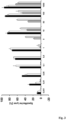
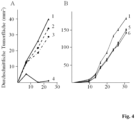
- the therapeutic effectiveness is increased because PSCA-positive tumor cells can be lysed more effectively with the antibody according to the invention. Due to the low concentration at which the antibody according to the invention can be effective, the antibody according to the invention also enables improved killing of metastasizing PSCA-positive cells. Comparative studies with the anti-PSCA 7F5 known from the prior art in a comparable bispecific Construct clearly confirm the superiority of the antibody according to the invention both in vitro ( Fig.3 ) as well as in vivo studies ( Fig.4 ).
- anti-PSCA antibodies with the sequences defined above are preferred, whose variable regions have a humanized structure. Particularly preferred are anti-PSCA antibodies whose variable region of the light chain contains the amino acid sequence according to SEQ ID No. 24 and whose variable region of the heavy chain contains the amino acid sequence according to SEQ ID No. 26.
- antibody in the sense of the invention includes all antibodies or antibody fragments that are able to bind specifically to an antigen.
- Recombinant antibodies are antibodies that are produced using genetically modified organisms.
- the term antibody includes both the complete monoclonal antibodies and their epitope-binding fragments.
- the epitope-binding fragments include those parts of the antibody that are able to bind to the antigen.
- Antibody fragments in the sense of the invention include Fab, Fab', F(ab') 2 , Fd, single-chain variable fragments (scFv), single-chain antibodies, disulfide-linked variable fragments (sdFv) and fragments that contain either a variable region of the light chain (V L ) or a variable region of the heavy chain (V H ).
- Antibody fragments contain the variable regions either alone or in combination with additional regions selected from the hinge region and the first, second and third regions of the constant region (C H 1, C H 2, C H 3).
- antibody includes recombinantly produced antibodies, such as diabodies, tribodies and tetrabodies. Also included in the term antibody are chimeric antibodies, where different parts of the antibody originate from different species, such as antibodies with a murine variable region combined with a human constant region. Humanized antibodies are also included in the term antibody. The aim of humanizing antibodies is to reduce the immunogenicity of a xenogeneic antibody, such as murine antibody, for use in the human system, while retaining full binding affinity and antigen specificity. Humanized antibodies can be produced in various known ways, such as resurfacing and CDR grafting.
- CDR grafting In resurfacing, a combination of molecular modeling, statistical analysis and mutagenesis is used to change all non-CDR regions on the surface of the antibody so that they resemble the surface of antibodies of the target organism.
- CDR grafting the CDR regions of the antibody to be humanized are introduced into human variable regions.
- Antibody fragments are optionally linked to one another via a linker.
- the linker comprises a short (preferably 10 to 50 amino acid residues long) peptide sequence which is selected such that the antibody fragment has such a three-dimensional folding of the V L and V H that it has the antigen specificity of the complete antibody.
- Glycine-serine linkers or linker peptides with an amino acid sequence according to SEQ ID No. 75 or SEQ ID No. 76 are preferred.
- variable region refers here to the parts of the heavy and light chains of antibodies that differ in their sequence between antibodies and determine the specificity of the antibody and binding to its antigen.
- the variability is not evenly distributed in the variable region, but is usually concentrated within three defined segments of the variable region, the complementarity determining regions (CDRs, also called hypervariable regions), which are contained in the variable regions of both the light and heavy chains.
- CDRs complementarity determining regions
- the antigen binding site of an antibody, the so-called paratope is characterized by the hypervariable regions (CDRs) of the light and heavy chains of the antibody.
- an "anti-PSCA antibody” in the sense of the invention is understood to mean an antibody that binds specifically to the antigen PSCA.
- a specific binding of an antibody to a specific antigen is understood here to mean that an antibody binds to the specific antigen with a high affinity and binds with a significantly lower affinity and preferably not to other antigens.
- Preferred antibodies are in the form of an scFv fragment or an F(ab') 2 fragment. Further preferred antibodies are bispecific antibodies that are produced recombinantly.
- anti-PSCA antibodies according to the invention are conjugated with an effector group.
- Conjugation here means the coupling of a substance, i.e. the effector group, to the antibody.
- the connection of the antibody to the effector group is preferably produced by recombinant expression in the form of a fusion protein or by in vitro methods, the effector group preferably being bound to the antibody via chemical linker groups (for example via thioether bonds or disulfide bonds). They can also be bound to the antibody by an intermediate carrier molecule, for example serum albumin.
- An antibody according to the invention optionally contains several effector groups. Effector groups are preferably selected from active substances, peptides (with a length of 10 to 100 amino acids), proteins (with a length of more than 100 amino acids), costimulatory molecules, dyes or contrast agents.
- Preferred anti-PSCA antibodies according to the invention are conjugated with active substances, i.e. with pharmaceutically active substances.
- active substances include toxins, preferably cytostatics, preferably selected from maytansinoids and maytansinoid analogues, taxoids, CC-1065 and CC-1065 analogues, dolastatin and dolastatin analogues, methotrexate, daunorubicin, doxorubicin, vincristine, vinblastine, melphalan, mitomycin C, chlorambucil and calicheamicin.
- toxins preferably cytostatics, preferably selected from maytansinoids and maytansinoid analogues, taxoids, CC-1065 and CC-1065 analogues, dolastatin and dolastatin analogues, methotrexate, daunorubicin, doxorubicin, vincristine, vinblastine, melphalan, mitomycin C, chlorambucil
- contrast agents are radionuclides, preferably the radioactive isotopes of technetium, rhenium, yttrium, copper, gallium, indium, bismuth and platinum, in particular 99m Tc, 90 Y, 186 Re, 188 Re, 68 Ga and 111 In.
- anti-PSCA antibodies according to the invention are conjugated with a protein, preferably an enzyme, preferably an enzyme suitable for the ADEPT system, a costimulatory molecule, preferably Toll-like receptor ligand, preferably CpG, or with a nucleic acid.
- a protein preferably an enzyme, preferably an enzyme suitable for the ADEPT system, a costimulatory molecule, preferably Toll-like receptor ligand, preferably CpG, or with a nucleic acid.
- anti-PSCA antibodies according to the invention are conjugated with a dye, preferably a fluorescent dye.
- antibodies according to the invention are conjugated with a peptide that contains a binding region to which an antibody specific for the peptide specifically binds.
- the peptide preferably comprises a 10 to 50 amino acid long peptide sequence of an alpha-helical region of the human La protein (the amino acid sequence of the human La protein corresponds to SEQ ID No. 77).
- Particularly preferred are peptides with an amino acid sequence identity of at least 90%, preferably at least 95%, particularly preferably at least 99%, to one of the amino acid sequences according to SEQ ID No. 75 or SEQ ID No. 76.
- anti-PSCA antibodies according to the invention are produced recombinantly.
- binding unit in the sense of the invention refers to any molecular structure that specifically binds defined substances or structures. Depending on the substance or structure that is bound, the binding unit has different structures.
- the term “binding unit” in the sense of the invention therefore includes both antibodies (in this case the binding unit contains at least the functional paratope of the antibody) and other molecules, preferably proteins, that form a specific bond with an antigen.
- Such molecules are preferably ligands that specifically bind to a surface structure (for example a surface receptor) on a cell, in particular an effector cell.
- the additional binding unit contained in antibodies according to the invention binds specifically to an effector cell.
- effector cells in the sense of the invention includes all cells of the innate and adaptive immune system that mediate immune reactions or are actively involved in them.
- the effector cell is preferably selected from T lymphocytes, NK cells, monocytes, macrophages, dendritic cells and granulocytes.
- the recombinant antibody contains at least two different antibodies (at least one anti-PSCA antibody according to the invention and at least one further antibody directed against CD3), preferably in the form of a diabody, triabody or tetrabody.
- these are bispecific antibodies made from single-chain antibodies (single chain bispecific diabody, scBsDb) or bispecific tandem antibodies made from single-chain antibodies (single chain bispecific tandem antibody, scBsTaFv).
- a recombinant antibody according to the invention is particularly preferably in the form of a scBsTaFv.
- recombinant anti-PSCA antibodies that contain at least two different binding units, where at least one of the binding units is a ligand (preferably a protein or a glycan) that specifically binds to a surface structure on an effector cell.
- a ligand preferably a protein or a glycan
- Preferred ligands influence the activity of the effector cells by binding them to the (effector) cell surface.
- the ligand is selected so that it specifically binds to surface structures of effector cells and triggers signal cascades to activate the effector cells through the binding.
- the preferred ligand is a protein structure or a glycan. which specifically binds to a receptor that is specifically expressed on the surface of effector cells, whereby the ligand causes activation of the effector cell through its binding to the receptor.
- Particularly preferred protein structures are selected from ULB-Ps (e.g. ULB-P2), MICA, MICB and cytokines (such as IL2 and
- Antibodies according to the invention are suitable for specific binding to PSCA-positive cells in vivo and in vitro. Therefore, the invention also encompasses the use of the anti-PSCA antibodies according to the invention as medicaments, in particular for the treatment of tumor diseases, preferably prostate cancer, or as a diagnostic agent.
- the invention further includes the antibodies according to the invention for use in the therapy of tumor diseases, in particular prostate cancer.
- the invention also includes the use of the antibodies according to the invention for producing a medicament for the treatment of tumor diseases, in particular prostate cancer.
- a preferred therapeutic application of the (preferably recombinant) antibodies according to the invention is the treatment of tumor diseases, preferably prostate cancer.
- the antibodies according to the invention are preferably used to target therapeutically active substances or effector cells to tumor tissue.
- recombinant antibodies according to the invention that are conjugated with an active ingredient are preferably used.
- recombinant antibodies according to the invention that contain at least two different binding units, where at least one of the binding units is an anti-PSCA antibody according to the invention and another of the binding units binds specifically to CD3 on T cells.
- the antibodies mentioned above are preferably used for this purpose.
- the invention also encompasses a pharmaceutical composition containing an antibody according to the invention in association with a pharmaceutically acceptable diluent or carrier.
- a pharmaceutical composition according to the invention is in a form suitable for intravenous administration.
- the antibodies in the pharmaceutical composition according to the invention are present in recombinant form as chimeric or particularly preferably humanized antibodies which have reduced immunogenicity.
- compositions according to the invention comprise various dosage forms and are preferably suitable for parenteral, particularly preferably for intravenous administration.
- the parenteral pharmaceutical composition is in a dosage form suitable for injection.
- Particularly preferred pharmaceutical compositions are therefore solutions, emulsions or suspensions of the antibody in a pharmaceutically acceptable diluent or carrier.
- Pharmaceutically acceptable carriers are preferably sterile liquids, particularly water, buffered water, 0.4% saline, 0.3% glycine and the like.
- the pharmaceutical compositions are sterilized by conventional, well-known techniques.
- the compositions preferably contain pharmaceutically acceptable auxiliary substances, such as those required to provide approximately physiological conditions and/or to increase the stability of the antibodies contained in the composition, such as pH adjusting and buffering agents, toxicity adjusting agents and the like, preferably selected from sodium acetate, sodium chloride, potassium chloride, calcium chloride and sodium lactate.
- the pharmaceutical composition is an injectable buffered solution containing between 0.1 to 500 mg/ml of antibody, particularly preferably between 0.1 to 250 mg/ml of antibody, in particular together with 1 to 500 mmol/l of buffer.
- the injectable solution is preferably in either a liquid or a lyophilized dosage form.
- the buffer is preferably selected from histidine, sodium succinate, sodium citrate, sodium phosphate and potassium phosphate.
- a preferred diagnostic application is in vivo diagnostics, wherein an anti-PSCA antibody according to the invention conjugated with a contrast agent is used for the targeted transport of contrast agents to the tumor tissue.
- a further preferred diagnostic application of the anti-PSCA antibody according to the invention is in vitro diagnostics, wherein an anti-PSCA antibody according to the invention conjugated with a dye is preferably used to detect PSCA-positive cells in a sample, in particular in a tissue sample.
- the invention also encompasses a diagnostic composition which contains an anti-PSCA antibody according to the invention.
- the anti-PSCA antibody is preferably present therein in a buffer solution, preferably in buffered saline solution.
- nucleic acids within the meaning of the invention includes not only deoxyribonucleic acids (DNA) and ribonucleic acids (RNA), but also all other linear polymers in which the bases adenine (A), cytosine (C), guanine (G) and thymine (T) or uracil (U) are arranged in a corresponding sequence (nucleic acid sequence).
- the invention also includes the corresponding RNA sequences (in which thymine is replaced by uracil), complementary sequences and sequences with a modified nucleic acid backbone or 3' or 5' terminus.
- nucleic acid sequences with a modified backbone includes all other linear polymers in which the bases adenine (A), cytosine (C), guanine (G) and thymine (T) or uracil (U) are arranged in a corresponding sequence, such as, for example, B. Sequences with a phosphothioate, phosphoramidate or O-methyl-derivatized backbone, peptide nucleic acids (PNA) and locked nucleic acids (LNA) or mixed backbone.
- modified 3' or 5' terminus includes both modifications that serve to stabilize and the attachment of markers. Examples of markers are enzymes, dyes or fluorescent dyes, radionucleotides, and haptens such as digoxigenin or biotin.
- the invention also includes a vector (also: "expression vector") that contains a nucleic acid according to the invention.
- a vector also: "expression vector” that contains a nucleic acid according to the invention.
- an expression vector is understood to be a plasmid, virus or other carrier that contains a nucleic acid sequence according to the invention recombinantly by insertion or incorporation.
- the expression vector typically contains a replication origin, a promoter, and specific gene sequences that enable phenotypic selection of host cells containing the expression vector.
- the invention further comprises a host cell or a non-human host organism containing a nucleotide sequence according to the invention or a vector according to the invention.
- the nucleotide sequence or the vector are contained recombinantly in the host cell or the non-human host organism.
- a host cell within the meaning of the invention is a naturally occurring cell or a transformed or genetically modified cell line which contains at least one vector according to the invention.
- the invention includes transient transfectants (e.g. by mRNA injection) or host cells in which at least one expression vector according to the invention is contained as a plasmid or artificial chromosome, as well as host cells in which an expression vector according to the invention is stably integrated into the genome of the host.
- the host cell is preferably selected from cells of prokaryotes and eukaryotes.
- Human embryonic stem cells obtained by destroying embryos are not Host cells in the sense of the invention.
- Preferred prokaryotic cells are selected from cells of Escherichia coli and Bacillus subtilis.
- Preferred eukaryotic cells are selected from yeast cells (preferably Saccharomyces cerevisiae or Pichia pastoris), insect cells, amphibian cells and mammalian cells (preferably CHO, HeLa, HEK293).
- Non-human host organisms contain a vector according to the invention which is stably integrated into the genome of the host organism or individual cells of the host organism.
- Preferred host organisms are plants, invertebrates or vertebrates, in particular Bovidae, Drosophila melanogaster, Caenorhabditis elegans, Xenopus laevis, Medaka, zebrafish or Mus musculus, or cells or embryos of the organisms mentioned.
- the invention provides anti-PSCA antibodies and associated expression systems with which human PSCA can be bound more effectively.
- Example 1 Production of bispecific recombinant antibodies (scBsTaFv) that specifically bind to PSCA (direct targeting)
- a bispecific antibody (single chain bispecific diabody, scBsTaFv) was produced that binds to PSCA with one binding unit and to CD3 with the other binding unit.
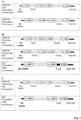
- the bispecific antibody is also referred to simply as CD3-PSCA(MB1) and is shown schematically in Fig. 1A shown.
- the PSCA-binding domain contains the variable region of the anti-PSCA MB1 according to the invention Antibody (murine anti-PSCA antibody: heavy chain SEQ ID No. 22, light chain SEQ ID No. 20; humanized anti-PSCA antibody: heavy chain SEQ ID No. 26, light chain SEQ ID No. 24). It serves to bind to the PSCA-positive tumor cells.
- the other domain binds to CD3, a component of the T cell receptor complex, and serves to activate T cells. This enables the recruitment of T cells to the PSCA-positive cells and thus mediates the specific lysis of the PSCA-positive cells by the T cells.
- H-2d positive C3Hx Balb/c F1 mice were immunized with P815 cells that expressed PSCA recombinantly on the surface.
- the fusion of spleen cells and myeloma cells produced hybridoma cells that secreted monoclonal anti-PSCA antibodies.
- the MB1 clone could be selected.
- the nucleic acid sequences of the variable domain of the heavy (V H ) and light (V L ) antibody chain were identified.
- the mRNA from the anti-PSCA MB1 secreting hybridoma cells was first isolated and transcribed into cDNA. Subsequently, the variable domain of the heavy chain of isotype IgG1 was amplified using degenerate primers (primer pair SEQ ID No. 90 and 91) and the variable domain of the light ⁇ chain was amplified using degenerate primers (primer pair SEQ ID No. 92 and 93). The PCR products were each subcloned into the vector pGEM T-easy and sequenced.
- scFv MB1 murine single chain fragment of the anti-PSCA MB1 antibody
- the variable region of the heavy chain is linked to the variable region of the light chain via three glycine-serine linkers (G 4 S, SEQ ID No. 131)
- the nucleic acid sequence of the variable region of the heavy chain of the anti-PSCA MB1 antibody was amplified using the primer pair according to SEQ ID No. 94 and 95.
- the nucleic acid sequence of the variable region of the light chain of the anti-PSCA MB1 antibody was amplified using the primer pair according to SEQ ID No. 96 and 97.
- the amplified nucleic acids were fused to scFv PSCA MB1 by overlap PCR and cloned into the eukaryotic expression vector pSecTag2B via SfiI and NotI (the expression vector is also referred to herein as "pSecTag2B_scFv MB1 murine").
- the nucleic acid sequence of a murine anti-CD3 scFv was amplified with a primer pair according to SEQ ID No. 98 and 99 and cloned via ApaI 3'-side of the murine scFv MB1 into the previously produced expression vector "pSecTag2B_scFv MB1 murine", so that the vector "pSecTag2B_scBsTaFv PSCA(MB1)-CD3 murine" was created.
- the framework regions (FWR) of the PSCA MB1 and CD3 antibodies were humanized.
- the FWR of the variable murine antibody domains were replaced with the human FWR sequences of a highly homologous human IgG1.
- the humanized antibody sequences were optimized with regard to their expression and secretion by human cell lines.
- the humanized V H and V L sequences were first amplified individually as described above and then combined via PCR.
- the humanization of the V H or V L sequence was carried out by the aggregation of overlapping oligonucleotides and subsequent amplification of the humanized V H or V L nucleic acid sequence.
- the murine V H or V L sequence was first compared with a human IgG database (NCBI IgBlast), the human IgG with the greatest homology was identified and finally the humanized V H or V L sequence was theoretically created and the overlapping oligonucleotides were synthesized.
- Various bispecific antibodies were constructed using linker peptides of different lengths.
- oligonucleotides according to SEQ ID No. 100 to 105 were annealed.
- the humanized nucleic acid sequence of the variable region of the heavy chain of the anti-CD3 antibody (with a G 4 S linker peptide, SEQ ID No. 132) was then amplified using the primer pair according to SEQ ID No. 105 and 106.
- oligonucleotides according to SEQ ID No. 107 to 112 were annealed.
- the humanized nucleic acid sequence of the variable region of the light chain of the anti-CD3 antibody was amplified using the primer pair according to SEQ ID No. 112 and 113.
- the humanized nucleic acid sequence of the variable region of the heavy chain of the anti-CD3 antibody was first cloned into the expression vector pSecTag2B via SfiI and BamHI and then the humanized nucleic acid sequence of the variable region of the light chain of the anti-CD3 antibody was placed downstream of it in the same expression vector via BamHI and NotI.
- the humanized nucleic acid sequence of the variable region of the heavy chain was first Chain of the anti-CD3 antibody with three glycine-serine linkers (G 4 S).
- the humanized nucleic acid sequence of the variable region of the heavy chain of the anti-CD3 antibody was amplified using the primer pair according to SEQ ID No.
- oligonucleotides according to SEQ ID No. 115 to 118 were annealed.
- the humanized nucleic acid sequence of the variable region of the light chain of the anti-PSCA MB1 antibody was amplified with the primer pair according to SEQ ID No. 119 and 120.
- oligonucleotides according to SEQ ID No. 121 to 125 were annealed.
- the humanized nucleic acid sequence of the variable region of the heavy chain of the anti-PSCA MB1 antibody was amplified with the primer pair according to SEQ ID No. 126 and 127.
- the humanized nucleic acid sequences of the variable region of the heavy chain and the variable region of the light chain of the MB1 antibody were annealed and amplified by overlap PCR using the primers according to SEQ ID No. 128 and 129.
- Fig. 1 For the expression of the bispecific humanized antibody according to Fig. 1 A Hek293T cells were transfected with the expression vector and the secreted antibodies were purified from the cell culture supernatants using nickel affinity chromatography, if necessary in combination with fractionated ammonium sulfate precipitation.
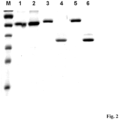
- Fig. 2 Lane 5 shows an SDS gel electrophoresis image of the purified bispecific antibody.
- the humanized scFv PSCA(MB1) with E5B9 epitope at the C-terminus (MB1 [V L -G 4 SG 4 SGASAAG 4 SG 4 S-MB1 V H ]-[G 4 S-E5B9], shown in Fig. 1B below)
- the humanized scFv PSCA(MB1) described in embodiment 1 (MB1 V L -G 4 SG 4 SGASAAG 4 SG 4 S-MB1 V H -G 4 S, linker peptides according to SEQ ID No. 130 and 132) was amplified using the primers according to SEQ ID No. 134 and 135 and then cloned into pSecTag2B using SfiI and NotI.
- the nucleic acid sequence for E5B9 was cloned into the 3'-side of the humanized scFv PSCA(MB1) using NotI and XhoI, resulting in the construct "pSecTag2B_ scFv PSCA(MB1)-E5B9 humanized”.
- variable region of the heavy chain of the 7B6 antibody For the humanization of the variable region of the heavy chain of the 7B6 antibody (specifically directed against the peptide E7B6), overlapping oligonucleotides according to SEQ ID No. 156 to 160 were annealed. Subsequently, the humanized nucleic acid sequence of the variable region of the heavy chain of the 7B6 antibody (with a G 4 S linker peptide, SEQ ID No. 132) was amplified using the primer pair according to SEQ ID No. 161 and 162. For the humanization of the variable region of the light chain of the 7B6 antibody, oligonucleotides according to SEQ ID No. 163 to 167 were annealed. The humanized nucleic acid sequence of the variable region of the light chain of the 7B6 antibody was amplified using the primer pair according to SEQ ID No. 168 and 169.
- the humanized nucleic acid sequences for 7B6 V H and 7B6 V L were annealed and amplified by overlap PCR using the primers according to SEQ ID No. 170 and 171.
- the nucleic acid sequence generated in this way for the humanized scFv 7B6 (V H -3 ⁇ G 4 SV L ) was cloned via XhoI and ApaI downstream of the humanized scFv CD3 V H -G 4 SV L into the "pSecTag2B_scFv CD3 V H -G 4 SV L " humanized, resulting in the vector "pSecTag2B_scBsTaFv CD3(G 4 S)-7B6 humanized".
- Hek293T cells were transfected with the expression vectors and the secreted recombinant scFv (scFv PSCA-E5B9 or scFv PSCA-E7B6) and the bispecific antibodies (scBsTaFv CD3(G 4 S)-5B9 or scBsTaFv CD3(3 ⁇ G 4 S)-5B9 and scBsTaFv CD3-7B6) were purified from the cell culture supernatant using affinity chromatography on Ni-NTA agarose (Qiagen, Hilden, Germany) (if necessary in combination with fractional ammonium sulfate precipitation). The purity and stability of the recombinant antibody derivatives were demonstrated by SDS-PAGE and immunoblotting ( Fig. 2 )
- a mouse anti-c-myc IgG-FITC detection antibody (AbD Serotec, Düsseldorf, Germany) was used, which was incubated with the anti-PSCA antibody-labeled PSCA-positive cells for 30 min at 4°C after completion of the first staining step.
- a sample was included as a negative control in which PSCA-positive cells were only stained with the mouse anti-c-myc IgG-FITC detection antibody.
- the cells were analyzed on a BD FACS Calibur Flow Cytometer (BD Biosciences Pharmingen, Heidelberg, Germany) and the data were evaluated using the software WinMDI 2.8 (Joseph Trotter, La Jolla, CA USA).
- the determined MFI values (mean fluorescence intensity values) were plotted against the tested antibody concentrations and a trend line of the second order polynomial regression type was calculated in each case.
- a trend line of the second order polynomial regression type was calculated and inserted.
- the resulting binding curve served as the basis for calculating the affinity constant K D , which is defined as the concentration that is reached at 50% of the maximum MFI value and thus at half-maximum saturation of the binding.
- K D the affinity constant
- the first derivative of the binding curve which follows a quadratic function, was first calculated. formed. In order to determine the maximum of the function based on this equation, the first derivative was set to "zero" and solved for x.
- the maximum of the function y max and thus y max /2 which corresponds to the MFI value at half-maximum saturation of the binding sites, was calculated. Since the K D value corresponds to the x value at y max /2, this can be finally calculated by inserting the y max /2 value into the quadratic function of the binding curve and rearranging the equation for x.
- the affinity of the anti-PSCA antibody according to the invention to the PSCA antigen is an order of magnitude higher than that of the antibody 7F5 known from the state of the art.
- Fig.3 The results of the in vitro test are shown graphically in Fig.3 shown.
- the percentage of lysed PC3 cells in relation to the total PC3 cells used is shown (y-axis). While the antibodies according to the invention in test groups 1 and 2 show a strong lysis of the PSCA-positive cells even with amounts of less than 1 ng, with the known 7F5 antibody in a comparable construct (test groups 3 and 4) a detectable lysis can only be seen when several ng of the antibody are used. A maximum of about 60% of the PC3 cells used was lysed. With the antibodies according to the invention, a lysis of about 80% of the PC3 cells used could be seen even when a significantly smaller amount of antibody was used. A maximum of more than 90% of the PC3 cells used could be lysed with an antibody according to the invention (test group 1).
- the effect of the bispecific antibodies is based on the recruitment of CD3-positive T cells to the PSCA-positive tumor cells and the resulting lysis of the tumor cells.
- Rapid tumor growth was also observed when the bispecific comparison antibodies containing the variable regions of the anti-PSCA 7F5 antibody were transferred (comparison groups (5) in the form of a tandem antibody and (6) in the form of a diabody) (data not shown). Rapid tumor growth was also observed in a second experiment in which the tumor cells were transferred in an effector-target ratio of 10:1 (i.e. with 10 times the amount of T cells; transfer of 5 ⁇ 10 3 PSCA-positive tumor cells and 5 ⁇ 10 4 T cells), which showed no statistically significant difference to the control group (1) ( Fig. 4B ). Tumor growth was not inhibited by the anti-PSCA 7F5 antibodies, but only slightly delayed. Even in the case of T cell excess, no in vivo inhibition of tumor growth by the anti-PSCA 7F5 antibody can be detected.
- Anti-prostate stem cell antigen monoclonal antibody 1G8 induces cell death in vitro and inhibits tumor growth in vivo via a Fc-independent mechanism. Cancer Res. 2005 Oct 15;65(20):9495-500 .
- PSCA prostate stem cell antigen
- Prostate stem cell antigen A cell surface marker overexpressed in prostate cancer. Proc Natl Acad Sci USA. 95(4): 1735-40 (1998 )
Landscapes
- Health & Medical Sciences (AREA)
- Chemical & Material Sciences (AREA)
- Immunology (AREA)
- Organic Chemistry (AREA)
- Life Sciences & Earth Sciences (AREA)
- Medicinal Chemistry (AREA)
- General Health & Medical Sciences (AREA)
- Proteomics, Peptides & Aminoacids (AREA)
- Molecular Biology (AREA)
- Genetics & Genomics (AREA)
- Biophysics (AREA)
- Biochemistry (AREA)
- Cell Biology (AREA)
- Veterinary Medicine (AREA)
- Public Health (AREA)
- Animal Behavior & Ethology (AREA)
- Pharmacology & Pharmacy (AREA)
- Gynecology & Obstetrics (AREA)
- Engineering & Computer Science (AREA)
- Reproductive Health (AREA)
- Pregnancy & Childbirth (AREA)
- Nuclear Medicine, Radiotherapy & Molecular Imaging (AREA)
- Chemical Kinetics & Catalysis (AREA)
- General Chemical & Material Sciences (AREA)
- Microbiology (AREA)
- Biomedical Technology (AREA)
- Mycology (AREA)
- Bioinformatics & Cheminformatics (AREA)
- Oncology (AREA)
- Epidemiology (AREA)
- Peptides Or Proteins (AREA)
- Medicines Containing Antibodies Or Antigens For Use As Internal Diagnostic Agents (AREA)
- Micro-Organisms Or Cultivation Processes Thereof (AREA)
- Preparation Of Compounds By Using Micro-Organisms (AREA)
- Investigating Or Analysing Biological Materials (AREA)
Applications Claiming Priority (3)
| Application Number | Priority Date | Filing Date | Title |
|---|---|---|---|
| DE102011118022.6A DE102011118022B4 (de) | 2011-06-30 | 2011-06-30 | Antikörper gegen das Prostata-spezifische Stammzellenantigen und dessen Verwendung |
| EP12729996.4A EP2726507B1 (de) | 2011-06-30 | 2012-06-29 | Antikörper gegen das prostata-spezifische stammzellantigen und dessen verwendung |
| PCT/EP2012/062716 WO2013001065A1 (de) | 2011-06-30 | 2012-06-29 | Antikörper gegen das prostata-spezifische stammzellantigen und dessen verwendung |
Related Parent Applications (2)
| Application Number | Title | Priority Date | Filing Date |
|---|---|---|---|
| EP12729996.4A Division EP2726507B1 (de) | 2011-06-30 | 2012-06-29 | Antikörper gegen das prostata-spezifische stammzellantigen und dessen verwendung |
| PCT/EP2012/062716 Previously-Filed-Application WO2013001065A1 (de) | 2011-06-30 | 2012-06-29 | Antikörper gegen das prostata-spezifische stammzellantigen und dessen verwendung |
Publications (3)
| Publication Number | Publication Date |
|---|---|
| EP3505536A1 EP3505536A1 (de) | 2019-07-03 |
| EP3505536B1 true EP3505536B1 (de) | 2024-08-07 |
| EP3505536C0 EP3505536C0 (de) | 2024-08-07 |
Family
ID=46384405
Family Applications (2)
| Application Number | Title | Priority Date | Filing Date |
|---|---|---|---|
| EP18207370.0A Active EP3505536B1 (de) | 2011-06-30 | 2012-06-29 | Antikörper gegen das prostata-spezifische stammzellantigen und dessen verwendung |
| EP12729996.4A Active EP2726507B1 (de) | 2011-06-30 | 2012-06-29 | Antikörper gegen das prostata-spezifische stammzellantigen und dessen verwendung |
Family Applications After (1)
| Application Number | Title | Priority Date | Filing Date |
|---|---|---|---|
| EP12729996.4A Active EP2726507B1 (de) | 2011-06-30 | 2012-06-29 | Antikörper gegen das prostata-spezifische stammzellantigen und dessen verwendung |
Country Status (18)
| Country | Link |
|---|---|
| US (1) | US9200078B2 (enExample) |
| EP (2) | EP3505536B1 (enExample) |
| JP (4) | JP2014528696A (enExample) |
| AU (1) | AU2012277784B2 (enExample) |
| CY (1) | CY1121249T1 (enExample) |
| DE (1) | DE102011118022B4 (enExample) |
| DK (1) | DK2726507T3 (enExample) |
| ES (2) | ES2989975T3 (enExample) |
| HR (1) | HRP20190289T1 (enExample) |
| HU (1) | HUE042008T2 (enExample) |
| LT (1) | LT2726507T (enExample) |
| PL (1) | PL2726507T3 (enExample) |
| PT (1) | PT2726507T (enExample) |
| RS (1) | RS58448B1 (enExample) |
| SI (1) | SI2726507T1 (enExample) |
| SM (1) | SMT201900085T1 (enExample) |
| TR (1) | TR201901991T4 (enExample) |
| WO (1) | WO2013001065A1 (enExample) |
Families Citing this family (17)
| Publication number | Priority date | Publication date | Assignee | Title |
|---|---|---|---|---|
| DE102011118022B4 (de) * | 2011-06-30 | 2018-01-18 | Gemoab Monoclonals Gmbh | Antikörper gegen das Prostata-spezifische Stammzellenantigen und dessen Verwendung |
| ES2688035T3 (es) | 2014-08-29 | 2018-10-30 | Gemoab Monoclonals Gmbh | Receptor de antígeno universal que expresa células inmunes para direccionamiento de antígenos múltiples diversos, procedimiento para fabricación del mismo y utilización del mismo para tratamiento de cáncer, infecciones y enfermedades autoinmunes |
| CN110944651A (zh) | 2017-02-08 | 2020-03-31 | 蜻蜓疗法股份有限公司 | 用于自然杀伤细胞激活的多特异性结合蛋白及其治疗癌症的治疗性用途 |
| EP4273258A3 (en) | 2017-02-20 | 2024-01-17 | Dragonfly Therapeutics, Inc. | Proteins binding her2, nkg2d and cd16 |
| WO2019066093A1 (ko) * | 2017-09-26 | 2019-04-04 | 주식회사 와이바이오로직스 | Scf 특이적 항체 |
| CA3090244A1 (en) | 2018-02-08 | 2019-08-15 | Dragonfly Therapeutics, Inc. | Antibody variable domains targeting the nkg2d receptor |
| MX2020008333A (es) | 2018-02-08 | 2020-09-21 | Dragonfly Therapeutics Inc | Terapia de combinacion del cancer que incluye proteinas de union multiespecificas que activan a las celulas asesinas naturales. |
| CN112119093A (zh) | 2018-02-20 | 2020-12-22 | 蜻蜓治疗公司 | 结合cd33、nkg2d和cd16的多特异性结合蛋白和使用方法 |
| CA3108427A1 (en) | 2018-08-08 | 2020-02-13 | Dragonfly Therapeutics, Inc. | Multi-specific binding proteins that bind bcma, nkg2d and cd16, and methods of use |
| CN113164570B (zh) | 2018-08-08 | 2024-05-14 | 蜻蜓疗法股份有限公司 | 结合nkg2d、cd16和肿瘤相关抗原的蛋白质 |
| EA202091888A1 (ru) | 2018-08-08 | 2020-10-23 | Драгонфлай Терапьютикс, Инк. | Вариабельные домены антител, нацеленные на рецептор nkg2d |
| AU2021268340A1 (en) | 2020-05-06 | 2022-12-08 | Dragonfly Therapeutics, Inc. | Proteins binding NKG2D, CD16 and CLEC12A |
| AU2021276327A1 (en) * | 2020-05-19 | 2022-12-01 | City Of Hope | Engineered anti-prostate stem cell antigen fusion proteins and uses thereof |
| EP4301774A4 (en) | 2021-03-03 | 2025-08-13 | Dragonfly Therapeutics Inc | METHODS OF TREATING CANCER USING MULTI-SPECIFIC BINDING PROTEINS THAT BIND TO NKG2D, CD16, AND A TUMOR-ASSOCIATED ANTIGEN |
| WO2024233662A2 (en) * | 2023-05-09 | 2024-11-14 | University Of Pittsburgh - Of The Commonwealth System Of Higher Education | Molecules that bind to psca polypeptides |
| US20250302763A1 (en) | 2024-02-22 | 2025-10-02 | Capstan Therapeutics, Inc. | Immune engineering amplification |
| CN121673412A (zh) * | 2024-09-12 | 2026-03-17 | 上海医药工业研究院有限公司 | 一种靶向psca的纳米抗体及其应用 |
Family Cites Families (9)
| Publication number | Priority date | Publication date | Assignee | Title |
|---|---|---|---|---|
| JP4404381B2 (ja) * | 1997-03-10 | 2010-01-27 | ザ リージェンツ オブ ザ ユニバーシティ オブ カリフォルニア | Psca:前立腺幹細胞抗原 |
| US6541212B2 (en) | 1997-03-10 | 2003-04-01 | The Regents Of The University Of California | Methods for detecting prostate stem cell antigen protein |
| KR100490077B1 (ko) * | 1999-10-29 | 2005-05-17 | 제넨테크, 인크. | 항-전립선 줄기세포 항원 (psca) 항체 조성물 및 그의사용 방법 |
| US8076459B2 (en) * | 2003-10-16 | 2011-12-13 | Micromet Ag | Multispecfic deimmunized CD3-binders |
| RU2381234C2 (ru) * | 2004-05-28 | 2010-02-10 | Эдженсис, Инк. | Антитела и родственные молекулы, связывающиеся с белками psca |
| US8940298B2 (en) * | 2007-09-04 | 2015-01-27 | The Regents Of The University Of California | High affinity anti-prostate stem cell antigen (PSCA) antibodies for cancer targeting and detection |
| KR101837053B1 (ko) * | 2008-10-01 | 2018-03-12 | 암젠 리서치 (뮌헨) 게엠베하 | 종간 특이적 PSCAxCD3, CD19xCD3, c-METxCD3, 엔도시알린xCD3, EpCAMxCD3, IGF-1RxCD3 또는 FAPαxCD3 이중특이적 단일쇄 항체 |
| US20110142811A1 (en) * | 2009-12-16 | 2011-06-16 | Deutsches Krebsforschungszentrum | Measles virus for the elimination of unwanted cell populations |
| DE102011118022B4 (de) * | 2011-06-30 | 2018-01-18 | Gemoab Monoclonals Gmbh | Antikörper gegen das Prostata-spezifische Stammzellenantigen und dessen Verwendung |
-
2011
- 2011-06-30 DE DE102011118022.6A patent/DE102011118022B4/de not_active Expired - Fee Related
-
2012
- 2012-06-29 ES ES18207370T patent/ES2989975T3/es active Active
- 2012-06-29 EP EP18207370.0A patent/EP3505536B1/de active Active
- 2012-06-29 HR HRP20190289TT patent/HRP20190289T1/hr unknown
- 2012-06-29 HU HUE12729996A patent/HUE042008T2/hu unknown
- 2012-06-29 EP EP12729996.4A patent/EP2726507B1/de active Active
- 2012-06-29 AU AU2012277784A patent/AU2012277784B2/en not_active Ceased
- 2012-06-29 ES ES12729996T patent/ES2711978T3/es active Active
- 2012-06-29 JP JP2014517736A patent/JP2014528696A/ja active Pending
- 2012-06-29 SM SM20190085T patent/SMT201900085T1/it unknown
- 2012-06-29 US US14/129,933 patent/US9200078B2/en active Active
- 2012-06-29 WO PCT/EP2012/062716 patent/WO2013001065A1/de not_active Ceased
- 2012-06-29 PL PL12729996T patent/PL2726507T3/pl unknown
- 2012-06-29 DK DK12729996.4T patent/DK2726507T3/en active
- 2012-06-29 SI SI201231523T patent/SI2726507T1/sl unknown
- 2012-06-29 TR TR2019/01991T patent/TR201901991T4/tr unknown
- 2012-06-29 RS RS20190218A patent/RS58448B1/sr unknown
- 2012-06-29 LT LTEP12729996.4T patent/LT2726507T/lt unknown
- 2012-06-29 PT PT12729996T patent/PT2726507T/pt unknown
-
2017
- 2017-01-12 JP JP2017002983A patent/JP6549622B2/ja not_active Expired - Fee Related
-
2019
- 2019-02-11 CY CY20191100176T patent/CY1121249T1/el unknown
- 2019-06-26 JP JP2019117977A patent/JP6886491B2/ja active Active
-
2021
- 2021-05-13 JP JP2021081553A patent/JP7341185B2/ja active Active
Also Published As
| Publication number | Publication date |
|---|---|
| HUE042008T2 (hu) | 2019-06-28 |
| DK2726507T3 (en) | 2019-03-11 |
| HRP20190289T1 (hr) | 2019-05-03 |
| TR201901991T4 (tr) | 2019-03-21 |
| LT2726507T (lt) | 2019-04-10 |
| DE102011118022B4 (de) | 2018-01-18 |
| SI2726507T1 (sl) | 2019-05-31 |
| JP2017104113A (ja) | 2017-06-15 |
| JP2014528696A (ja) | 2014-10-30 |
| RS58448B1 (sr) | 2019-04-30 |
| EP2726507B1 (de) | 2018-11-21 |
| WO2013001065A1 (de) | 2013-01-03 |
| ES2989975T3 (es) | 2024-11-28 |
| JP2019193652A (ja) | 2019-11-07 |
| JP6549622B2 (ja) | 2019-07-24 |
| JP7341185B2 (ja) | 2023-09-08 |
| PL2726507T3 (pl) | 2019-06-28 |
| CY1121249T1 (el) | 2020-05-29 |
| AU2012277784B2 (en) | 2015-08-20 |
| EP2726507A1 (de) | 2014-05-07 |
| ES2711978T3 (es) | 2019-05-08 |
| EP3505536C0 (de) | 2024-08-07 |
| DE102011118022A1 (de) | 2013-01-03 |
| AU2012277784A1 (en) | 2014-02-06 |
| JP6886491B2 (ja) | 2021-06-16 |
| US9200078B2 (en) | 2015-12-01 |
| SMT201900085T1 (it) | 2019-05-10 |
| PT2726507T (pt) | 2019-02-26 |
| US20140134155A1 (en) | 2014-05-15 |
| JP2021121201A (ja) | 2021-08-26 |
| EP3505536A1 (de) | 2019-07-03 |
Similar Documents
| Publication | Publication Date | Title |
|---|---|---|
| EP2726507B1 (de) | Antikörper gegen das prostata-spezifische stammzellantigen und dessen verwendung | |
| EP2600889B1 (de) | Anti-la antikörper und ihre anwendung zum immunotargeting | |
| EP2480574B1 (de) | Anti-cd33 antikörper und ihre anwendung zum immunotargeting bei der behandlung von cd33-assoziierten erkrankungen | |
| DE60127143T2 (de) | Bispezifische Antikörper gegen CD19 und CD16 und deren Verwendung | |
| KR102749049B1 (ko) | 분자를 표적화하기 위한 항원 결합 구조체 | |
| DE69909459T2 (de) | Cd19xcd3 spezifische polypeptide und deren verwendung | |
| TWI660971B (zh) | Cdh19及cd3抗體構築體 | |
| DE60133479T2 (de) | Modifizierter tpo-agonisten antikörper | |
| DE102010039019B4 (de) | Antikörper gegen 6-sulfo LacNAc positive humane dendritische Zellen und deren Verwendung | |
| DE112023006224T5 (de) | Bcma-gerichtete car-t-zelltherapie für multiples myelom | |
| WO2001027159A2 (de) | Polypeptide zur detektion und elimination ca19-9 antigen positiver zellen | |
| DE19744531A1 (de) | Bindemoleküle gegen Rezeptor-Ligand-Komplexe | |
| HK1197419B (en) | Antibodies against prostate-specific stem cell antigen and use thereof | |
| HK1255107B (en) | Antigen binding constructs to target molecules | |
| HK1197419A (en) | Antibodies against prostate-specific stem cell antigen and use thereof |
Legal Events
| Date | Code | Title | Description |
|---|---|---|---|
| PUAI | Public reference made under article 153(3) epc to a published international application that has entered the european phase |
Free format text: ORIGINAL CODE: 0009012 |
|
| STAA | Information on the status of an ep patent application or granted ep patent |
Free format text: STATUS: THE APPLICATION HAS BEEN PUBLISHED |
|
| AC | Divisional application: reference to earlier application |
Ref document number: 2726507 Country of ref document: EP Kind code of ref document: P |
|
| AK | Designated contracting states |
Kind code of ref document: A1 Designated state(s): AL AT BE BG CH CY CZ DE DK EE ES FI FR GB GR HR HU IE IS IT LI LT LU LV MC MK MT NL NO PL PT RO RS SE SI SK SM TR |
|
| STAA | Information on the status of an ep patent application or granted ep patent |
Free format text: STATUS: REQUEST FOR EXAMINATION WAS MADE |
|
| 17P | Request for examination filed |
Effective date: 20191213 |
|
| RBV | Designated contracting states (corrected) |
Designated state(s): AL AT BE BG CH CY CZ DE DK EE ES FI FR GB GR HR HU IE IS IT LI LT LU LV MC MK MT NL NO PL PT RO RS SE SI SK SM TR |
|
| STAA | Information on the status of an ep patent application or granted ep patent |
Free format text: STATUS: EXAMINATION IS IN PROGRESS |
|
| 17Q | First examination report despatched |
Effective date: 20200421 |
|
| RAP1 | Party data changed (applicant data changed or rights of an application transferred) |
Owner name: GEMOAB GMBH |
|
| GRAP | Despatch of communication of intention to grant a patent |
Free format text: ORIGINAL CODE: EPIDOSNIGR1 |
|
| STAA | Information on the status of an ep patent application or granted ep patent |
Free format text: STATUS: GRANT OF PATENT IS INTENDED |
|
| INTG | Intention to grant announced |
Effective date: 20210324 |
|
| GRAJ | Information related to disapproval of communication of intention to grant by the applicant or resumption of examination proceedings by the epo deleted |
Free format text: ORIGINAL CODE: EPIDOSDIGR1 |
|
| STAA | Information on the status of an ep patent application or granted ep patent |
Free format text: STATUS: EXAMINATION IS IN PROGRESS |
|
| INTC | Intention to grant announced (deleted) | ||
| GRAP | Despatch of communication of intention to grant a patent |
Free format text: ORIGINAL CODE: EPIDOSNIGR1 |
|
| STAA | Information on the status of an ep patent application or granted ep patent |
Free format text: STATUS: GRANT OF PATENT IS INTENDED |
|
| INTG | Intention to grant announced |
Effective date: 20211116 |
|
| GRAJ | Information related to disapproval of communication of intention to grant by the applicant or resumption of examination proceedings by the epo deleted |
Free format text: ORIGINAL CODE: EPIDOSDIGR1 |
|
| STAA | Information on the status of an ep patent application or granted ep patent |
Free format text: STATUS: EXAMINATION IS IN PROGRESS |
|
| RAP3 | Party data changed (applicant data changed or rights of an application transferred) |
Owner name: AVENCELL EUROPE GMBH |
|
| INTC | Intention to grant announced (deleted) | ||
| RAP3 | Party data changed (applicant data changed or rights of an application transferred) |
Owner name: AVENCELL EUROPE GMBH |
|
| P01 | Opt-out of the competence of the unified patent court (upc) registered |
Effective date: 20230515 |
|
| GRAP | Despatch of communication of intention to grant a patent |
Free format text: ORIGINAL CODE: EPIDOSNIGR1 |
|
| STAA | Information on the status of an ep patent application or granted ep patent |
Free format text: STATUS: GRANT OF PATENT IS INTENDED |
|
| INTG | Intention to grant announced |
Effective date: 20240301 |
|
| GRAS | Grant fee paid |
Free format text: ORIGINAL CODE: EPIDOSNIGR3 |
|
| GRAA | (expected) grant |
Free format text: ORIGINAL CODE: 0009210 |
|
| STAA | Information on the status of an ep patent application or granted ep patent |
Free format text: STATUS: THE PATENT HAS BEEN GRANTED |
|
| AC | Divisional application: reference to earlier application |
Ref document number: 2726507 Country of ref document: EP Kind code of ref document: P |
|
| AK | Designated contracting states |
Kind code of ref document: B1 Designated state(s): AL AT BE BG CH CY CZ DE DK EE ES FI FR GB GR HR HU IE IS IT LI LT LU LV MC MK MT NL NO PL PT RO RS SE SI SK SM TR |
|
| REG | Reference to a national code |
Ref country code: GB Ref legal event code: FG4D Free format text: NOT ENGLISH |
|
| REG | Reference to a national code |
Ref country code: CH Ref legal event code: EP |
|
| REG | Reference to a national code |
Ref country code: DE Ref legal event code: R096 Ref document number: 502012017270 Country of ref document: DE |
|
| REG | Reference to a national code |
Ref country code: IE Ref legal event code: FG4D Free format text: LANGUAGE OF EP DOCUMENT: GERMAN |
|
| U01 | Request for unitary effect filed |
Effective date: 20240904 |
|
| U07 | Unitary effect registered |
Designated state(s): AT BE BG DE DK EE FI FR IT LT LU LV MT NL PT RO SE SI Effective date: 20240917 |
|
| P04 | Withdrawal of opt-out of the competence of the unified patent court (upc) registered |
Free format text: CASE NUMBER: APP_51632/2024 Effective date: 20240913 |
|
| REG | Reference to a national code |
Ref country code: ES Ref legal event code: FG2A Ref document number: 2989975 Country of ref document: ES Kind code of ref document: T3 Effective date: 20241128 |
|
| P05 | Withdrawal of opt-out of the competence of the unified patent court (upc) changed |
Free format text: CASE NUMBER: APP_51632/2024 Effective date: 20240917 |
|
| PG25 | Lapsed in a contracting state [announced via postgrant information from national office to epo] |
Ref country code: NO Free format text: LAPSE BECAUSE OF FAILURE TO SUBMIT A TRANSLATION OF THE DESCRIPTION OR TO PAY THE FEE WITHIN THE PRESCRIBED TIME-LIMIT Effective date: 20241107 |
|
| PG25 | Lapsed in a contracting state [announced via postgrant information from national office to epo] |
Ref country code: GR Free format text: LAPSE BECAUSE OF FAILURE TO SUBMIT A TRANSLATION OF THE DESCRIPTION OR TO PAY THE FEE WITHIN THE PRESCRIBED TIME-LIMIT Effective date: 20241108 Ref country code: PL Free format text: LAPSE BECAUSE OF FAILURE TO SUBMIT A TRANSLATION OF THE DESCRIPTION OR TO PAY THE FEE WITHIN THE PRESCRIBED TIME-LIMIT Effective date: 20240807 |
|
| PG25 | Lapsed in a contracting state [announced via postgrant information from national office to epo] |
Ref country code: IS Free format text: LAPSE BECAUSE OF FAILURE TO SUBMIT A TRANSLATION OF THE DESCRIPTION OR TO PAY THE FEE WITHIN THE PRESCRIBED TIME-LIMIT Effective date: 20241207 |
|
| PG25 | Lapsed in a contracting state [announced via postgrant information from national office to epo] |
Ref country code: HR Free format text: LAPSE BECAUSE OF FAILURE TO SUBMIT A TRANSLATION OF THE DESCRIPTION OR TO PAY THE FEE WITHIN THE PRESCRIBED TIME-LIMIT Effective date: 20240807 |
|
| PG25 | Lapsed in a contracting state [announced via postgrant information from national office to epo] |
Ref country code: RS Free format text: LAPSE BECAUSE OF FAILURE TO SUBMIT A TRANSLATION OF THE DESCRIPTION OR TO PAY THE FEE WITHIN THE PRESCRIBED TIME-LIMIT Effective date: 20241107 |
|
| PG25 | Lapsed in a contracting state [announced via postgrant information from national office to epo] |
Ref country code: RS Free format text: LAPSE BECAUSE OF FAILURE TO SUBMIT A TRANSLATION OF THE DESCRIPTION OR TO PAY THE FEE WITHIN THE PRESCRIBED TIME-LIMIT Effective date: 20241107 Ref country code: PL Free format text: LAPSE BECAUSE OF FAILURE TO SUBMIT A TRANSLATION OF THE DESCRIPTION OR TO PAY THE FEE WITHIN THE PRESCRIBED TIME-LIMIT Effective date: 20240807 Ref country code: NO Free format text: LAPSE BECAUSE OF FAILURE TO SUBMIT A TRANSLATION OF THE DESCRIPTION OR TO PAY THE FEE WITHIN THE PRESCRIBED TIME-LIMIT Effective date: 20241107 Ref country code: IS Free format text: LAPSE BECAUSE OF FAILURE TO SUBMIT A TRANSLATION OF THE DESCRIPTION OR TO PAY THE FEE WITHIN THE PRESCRIBED TIME-LIMIT Effective date: 20241207 Ref country code: HR Free format text: LAPSE BECAUSE OF FAILURE TO SUBMIT A TRANSLATION OF THE DESCRIPTION OR TO PAY THE FEE WITHIN THE PRESCRIBED TIME-LIMIT Effective date: 20240807 Ref country code: GR Free format text: LAPSE BECAUSE OF FAILURE TO SUBMIT A TRANSLATION OF THE DESCRIPTION OR TO PAY THE FEE WITHIN THE PRESCRIBED TIME-LIMIT Effective date: 20241108 |
|
| PG25 | Lapsed in a contracting state [announced via postgrant information from national office to epo] |
Ref country code: SM Free format text: LAPSE BECAUSE OF FAILURE TO SUBMIT A TRANSLATION OF THE DESCRIPTION OR TO PAY THE FEE WITHIN THE PRESCRIBED TIME-LIMIT Effective date: 20240807 |
|
| PG25 | Lapsed in a contracting state [announced via postgrant information from national office to epo] |
Ref country code: CZ Free format text: LAPSE BECAUSE OF FAILURE TO SUBMIT A TRANSLATION OF THE DESCRIPTION OR TO PAY THE FEE WITHIN THE PRESCRIBED TIME-LIMIT Effective date: 20240807 |
|
| PG25 | Lapsed in a contracting state [announced via postgrant information from national office to epo] |
Ref country code: SK Free format text: LAPSE BECAUSE OF FAILURE TO SUBMIT A TRANSLATION OF THE DESCRIPTION OR TO PAY THE FEE WITHIN THE PRESCRIBED TIME-LIMIT Effective date: 20240807 |
|
| U20 | Renewal fee for the european patent with unitary effect paid |
Year of fee payment: 14 Effective date: 20250428 |
|
| PLBE | No opposition filed within time limit |
Free format text: ORIGINAL CODE: 0009261 |
|
| STAA | Information on the status of an ep patent application or granted ep patent |
Free format text: STATUS: NO OPPOSITION FILED WITHIN TIME LIMIT |
|
| 26N | No opposition filed |
Effective date: 20250508 |
|
| PGFP | Annual fee paid to national office [announced via postgrant information from national office to epo] |
Ref country code: ES Payment date: 20250718 Year of fee payment: 14 |
|
| PGFP | Annual fee paid to national office [announced via postgrant information from national office to epo] |
Ref country code: CH Payment date: 20250701 Year of fee payment: 14 |
|
| PG25 | Lapsed in a contracting state [announced via postgrant information from national office to epo] |
Ref country code: MC Free format text: LAPSE BECAUSE OF FAILURE TO SUBMIT A TRANSLATION OF THE DESCRIPTION OR TO PAY THE FEE WITHIN THE PRESCRIBED TIME-LIMIT Effective date: 20240807 |
|
| PG25 | Lapsed in a contracting state [announced via postgrant information from national office to epo] |
Ref country code: IE Free format text: LAPSE BECAUSE OF NON-PAYMENT OF DUE FEES Effective date: 20250629 |
|
| U20 | Renewal fee for the european patent with unitary effect paid |
Year of fee payment: 15 Effective date: 20260430 |
|
| REG | Reference to a national code |
Ref country code: CH Ref legal event code: U11 Free format text: ST27 STATUS EVENT CODE: U-0-0-U10-U11 (AS PROVIDED BY THE NATIONAL OFFICE) Effective date: 20260701 |
|
| PGFP | Annual fee paid to national office [announced via postgrant information from national office to epo] |
Ref country code: GB Payment date: 20260623 Year of fee payment: 15 |
|
| PG25 | Lapsed in a contracting state [announced via postgrant information from national office to epo] |
Ref country code: CY Free format text: LAPSE BECAUSE OF FAILURE TO SUBMIT A TRANSLATION OF THE DESCRIPTION OR TO PAY THE FEE WITHIN THE PRESCRIBED TIME-LIMIT Effective date: 20240807 |