EP3490582B1 - Compositions for use in treating myelofibrosis - Google Patents
Compositions for use in treating myelofibrosis Download PDFInfo
- Publication number
- EP3490582B1 EP3490582B1 EP17835212.6A EP17835212A EP3490582B1 EP 3490582 B1 EP3490582 B1 EP 3490582B1 EP 17835212 A EP17835212 A EP 17835212A EP 3490582 B1 EP3490582 B1 EP 3490582B1
- Authority
- EP
- European Patent Office
- Prior art keywords
- activin
- actriib
- amino acid
- polypeptide
- acid sequence
- Prior art date
- Legal status (The legal status is an assumption and is not a legal conclusion. Google has not performed a legal analysis and makes no representation as to the accuracy of the status listed.)
- Active
Links
Images






Classifications
-
- A—HUMAN NECESSITIES
- A61—MEDICAL OR VETERINARY SCIENCE; HYGIENE
- A61K—PREPARATIONS FOR MEDICAL, DENTAL OR TOILETRY PURPOSES
- A61K38/00—Medicinal preparations containing peptides
- A61K38/16—Peptides having more than 20 amino acids; Gastrins; Somatostatins; Melanotropins; Derivatives thereof
- A61K38/17—Peptides having more than 20 amino acids; Gastrins; Somatostatins; Melanotropins; Derivatives thereof from animals; from humans
- A61K38/177—Receptors; Cell surface antigens; Cell surface determinants
- A61K38/179—Receptors; Cell surface antigens; Cell surface determinants for growth factors; for growth regulators
-
- A—HUMAN NECESSITIES
- A61—MEDICAL OR VETERINARY SCIENCE; HYGIENE
- A61K—PREPARATIONS FOR MEDICAL, DENTAL OR TOILETRY PURPOSES
- A61K31/00—Medicinal preparations containing organic active ingredients
- A61K31/33—Heterocyclic compounds
- A61K31/395—Heterocyclic compounds having nitrogen as a ring hetero atom, e.g. guanethidine or rifamycins
- A61K31/495—Heterocyclic compounds having nitrogen as a ring hetero atom, e.g. guanethidine or rifamycins having six-membered rings with two or more nitrogen atoms as the only ring heteroatoms, e.g. piperazine or tetrazines
- A61K31/505—Pyrimidines; Hydrogenated pyrimidines, e.g. trimethoprim
- A61K31/519—Pyrimidines; Hydrogenated pyrimidines, e.g. trimethoprim ortho- or peri-condensed with heterocyclic rings
-
- A—HUMAN NECESSITIES
- A61—MEDICAL OR VETERINARY SCIENCE; HYGIENE
- A61P—SPECIFIC THERAPEUTIC ACTIVITY OF CHEMICAL COMPOUNDS OR MEDICINAL PREPARATIONS
- A61P7/00—Drugs for disorders of the blood or the extracellular fluid
- A61P7/06—Antianaemics
-
- A—HUMAN NECESSITIES
- A61—MEDICAL OR VETERINARY SCIENCE; HYGIENE
- A61K—PREPARATIONS FOR MEDICAL, DENTAL OR TOILETRY PURPOSES
- A61K31/00—Medicinal preparations containing organic active ingredients
- A61K31/13—Amines
- A61K31/155—Amidines (), e.g. guanidine (H2N—C(=NH)—NH2), isourea (N=C(OH)—NH2), isothiourea (—N=C(SH)—NH2)
-
- A—HUMAN NECESSITIES
- A61—MEDICAL OR VETERINARY SCIENCE; HYGIENE
- A61K—PREPARATIONS FOR MEDICAL, DENTAL OR TOILETRY PURPOSES
- A61K38/00—Medicinal preparations containing peptides
- A61K38/16—Peptides having more than 20 amino acids; Gastrins; Somatostatins; Melanotropins; Derivatives thereof
- A61K38/17—Peptides having more than 20 amino acids; Gastrins; Somatostatins; Melanotropins; Derivatives thereof from animals; from humans
-
- A—HUMAN NECESSITIES
- A61—MEDICAL OR VETERINARY SCIENCE; HYGIENE
- A61K—PREPARATIONS FOR MEDICAL, DENTAL OR TOILETRY PURPOSES
- A61K38/00—Medicinal preparations containing peptides
- A61K38/16—Peptides having more than 20 amino acids; Gastrins; Somatostatins; Melanotropins; Derivatives thereof
- A61K38/17—Peptides having more than 20 amino acids; Gastrins; Somatostatins; Melanotropins; Derivatives thereof from animals; from humans
- A61K38/177—Receptors; Cell surface antigens; Cell surface determinants
- A61K38/1796—Receptors; Cell surface antigens; Cell surface determinants for hormones
-
- A—HUMAN NECESSITIES
- A61—MEDICAL OR VETERINARY SCIENCE; HYGIENE
- A61K—PREPARATIONS FOR MEDICAL, DENTAL OR TOILETRY PURPOSES
- A61K39/00—Medicinal preparations containing antigens or antibodies
- A61K39/395—Antibodies; Immunoglobulins; Immune serum, e.g. antilymphocytic serum
- A61K39/39533—Antibodies; Immunoglobulins; Immune serum, e.g. antilymphocytic serum against materials from animals
- A61K39/3955—Antibodies; Immunoglobulins; Immune serum, e.g. antilymphocytic serum against materials from animals against proteinaceous materials, e.g. enzymes, hormones, lymphokines
-
- A—HUMAN NECESSITIES
- A61—MEDICAL OR VETERINARY SCIENCE; HYGIENE
- A61K—PREPARATIONS FOR MEDICAL, DENTAL OR TOILETRY PURPOSES
- A61K45/00—Medicinal preparations containing active ingredients not provided for in groups A61K31/00 - A61K41/00
- A61K45/06—Mixtures of active ingredients without chemical characterisation, e.g. antiphlogistics and cardiaca
-
- A—HUMAN NECESSITIES
- A61—MEDICAL OR VETERINARY SCIENCE; HYGIENE
- A61P—SPECIFIC THERAPEUTIC ACTIVITY OF CHEMICAL COMPOUNDS OR MEDICINAL PREPARATIONS
- A61P7/00—Drugs for disorders of the blood or the extracellular fluid
-
- C—CHEMISTRY; METALLURGY
- C07—ORGANIC CHEMISTRY
- C07K—PEPTIDES
- C07K14/00—Peptides having more than 20 amino acids; Gastrins; Somatostatins; Melanotropins; Derivatives thereof
- C07K14/435—Peptides having more than 20 amino acids; Gastrins; Somatostatins; Melanotropins; Derivatives thereof from animals; from humans
- C07K14/705—Receptors; Cell surface antigens; Cell surface determinants
- C07K14/71—Receptors; Cell surface antigens; Cell surface determinants for growth factors; for growth regulators
-
- A—HUMAN NECESSITIES
- A61—MEDICAL OR VETERINARY SCIENCE; HYGIENE
- A61K—PREPARATIONS FOR MEDICAL, DENTAL OR TOILETRY PURPOSES
- A61K39/00—Medicinal preparations containing antigens or antibodies
- A61K2039/505—Medicinal preparations containing antigens or antibodies comprising antibodies
-
- C—CHEMISTRY; METALLURGY
- C07—ORGANIC CHEMISTRY
- C07K—PEPTIDES
- C07K2319/00—Fusion polypeptide
- C07K2319/30—Non-immunoglobulin-derived peptide or protein having an immunoglobulin constant or Fc region, or a fragment thereof, attached thereto
Definitions
- Myelofibrosis is a rare disease mainly affecting people of older age.
- Myelofibrosis is a BCR-ABL1-negative myeloproliferative neoplasm that presents de novo (primary) or may be preceded by polycythemia vera (post-polycythemia vera) or essential thrombocythemia (post-essential thrombocythemia).
- Clinical features include progressive anemia, marked splenomegaly, fibrosis (e.g., bone marrow fibrosis), constitutional symptoms (e.g., fatigue, night sweats, bone pain, pruritus, and cough), and weight loss [ Tefferi A (2000) N Engl J Med 342:1255-1265 ].
- myelofibrosis The only cure of myelofibrosis is bone marrow transplantation. However, treatment-related mortality is high, and only a minority of patients qualify for transplantation. Many of other currently available treatments are not effective in reversing the process of myelofibrosis, be it primary or secondary disease.
- Myelofibrosis treatments include, for example, cyto-reductive therapy (e.g., treatment with hydroxyurea); treatment of anemia with androgens and/or erythropoietin; and splenectomy. These therapies have not demonstrated improvement in survival and are largely seen as palliative [ Cervantes F., Myelofibrosis: Biology and treatment options, European Journal of Haematology, 2007, 79 (suppl. 68) 13-17 ].
- JAK inhibitors have been used to treat myelofibrosis. JAK inhibitors appear to be useful for reducing splenomegaly in myelofibrosis patients, but their effects on the disease are otherwise largely palliative [ Gupta et al. (2012) Blood 120: 1367-1379 ]. In particular, JAK inhibitors have little to no effect on many manifestations (complications) of the disease including, for example, cytopenia, transfusion dependence, accelerated or blast phase disease, and fibrosis.
- the present invention relates to a composition for use in treating, preventing, or reducing the progression rate and/or severity of myelofibrosis or one or more complications of myelofibrosis in a patient, wherein the composition comprises: a) a Janus kinase inhibitor; and b) an ActRIIB antagonist, wherein the Janus kinase inhibitor and ActRIIB antagonist are administered in an effective amount, wherein the Janus kinase inhibitor is selected from the group consisting of: ruxolitinib, fedratinib (SAR302503), monoelotinib (CYT387), pacritinib, lestaurtinib, AZD-1480, BMS-911543, NS-018, LY2784544, SEP-701, XL019, and AT-9283, and wherein the ActRIIB antagonist is an ActRIIB polypeptide comprising an amino acid sequence that is at least 90% identical to a sequence starting at least
- the composition decreases one or more of: bone marrow fibrosis, spleen fibrosis, liver fibrosis, lung fibrosis, and lymph node fibrosis. In another preferred embodiment, the composition increases red blood cell levels in the patient, and/or increases hemoglobin levels in the patient.
- the patient has anemia
- the composition treats the anemia
- the patient has been administered one or more blood cell transfusions prior to the start of ActRIIB polypeptide treatment and/or the patient is blood cell transfusion-dependent; and the composition for use decreases blood cell transfusion burden by greater than about 30% for 4 to 8 weeks relative to the equal time prior to the start of the ActRIIB polypeptide treatment.
- the patient has primary myelofibrosis, post-polycythemia vera myelofibrosis, and/or post-essential thrombocythemia myelofibrosis.
- the myelofibrosis is associated with one or more mutations in JAK2.
- the JAK2 mutation is JAK2V617F.
- the patient has been treated with a Janus kinase inhibitor, and/or is intolerant of a Janus kinase inhibitor.
- the patient is further administered hydroxyurea, has previously been treated with hydroxyurea, is intolerant of hydroxyurea, and/or has an inadequate response to hydroxyurea.
- the ActRIIB polypeptide is selected from the group consisting of:
- the polypeptide comprises an aspartate residue (D) at the amino acid position corresponding to position 79 of SEQ ID NO: 1.
- the polypeptide comprises a glutamate residue (E) at the amino acid position corresponding to position 79 of SEQ ID NO: 1.
- the polypeptide is a fusion protein comprising an immunoglobulin Fc domain, wherein the immunoglobulin Fc domain is from an IgG1 Fc domain, and wherein the fusion protein further comprises a linker domain positioned between the ActRIIB polypeptide and the immunoglobulin Fc domain.
- the polypeptide is an ActRIIB-Fc fusion protein comprising a polypeptide selected from:
- the ActRIIB polypeptide comprises an amino acid sequence that is at least 95% identical to SEQ ID NO: 53.
- the ActRIIB polypeptide comprises the amino acid sequence of SEQ ID NO: 53.
- an ActRIIB antagonist inhibitor
- myelofibrosis can be used to treat myelofibrosis, particularly ameliorating various complications of the disease including, for example, splenomegaly, extramedullary hematopoiesis, and fibrosis.
- the data presented herein show that a GDF trap polypeptide decrease splenomegaly, extramedullary hematopoiesis, and fibrosis in a JAK2V617F model of myelofibrosis.
- compositions for use in treating myelofibrosis particularly treating or preventing one or more complications of myelofibrosis (e.g., splenomegaly, extramedullary hematopoiesis, anemia, and fibrosis), by administering to a patient in need thereof an effective amount of one or more ActRIIB antagonists, optionally in combination of one or more other supportive therapies or active agents for treating myelofibrosis.
- myelofibrosis e.g., splenomegaly, extramedullary hematopoiesis, anemia, and fibrosis
- GDF trap polypeptides may affect myelofibrosis through a mechanism other than ActRIIB antagonism [e.g., inhibition of one or more of GDF11, GDF8, activin B, BMP6, GDF3, and BMP 10 may be an indicator of the tendency of an agent to inhibit the activities of a spectrum of additional agents, including, perhaps, other members of the TGF-beta superfamily, and such collective inhibition may lead to the desired effect on, for example, myelofibrosis], the disclosure nonetheless demonstrates that desirable therapeutic agents may be selected on the basis of ActRIIB antagonism.
- a mechanism other than ActRIIB antagonism e.g., inhibition of one or more of GDF11, GDF8, activin B, BMP6, GDF3, and BMP 10 may be an indicator of the tendency of an agent to inhibit the activities of a spectrum of additional agents, including, perhaps, other members of the TGF-beta superfamily, and such collective inhibition may lead to the desired effect on, for example, mye
- ActRIIB antagonists e.g., antagonists of the ActRIIB receptor, antagonists of one or more ActRIIB ligand (e.g., GDF11, GDF8, activin B, BMP6, GDF3, and BMP10), antagonists of one or more type I receptor (e.g., ALK4, ALK5, and/or ALK7), antagonists of one or more co-receptor, and/or antagonists of one or more ActRIIB downstream signaling components (e.g., Smads)], or combination of such antagonists] will useful in the treatment of myelofibrosis, particularly in treating or preventing one or more myelofibrosis complications (e.g., splenomegaly, extramedullary hematopoiesis, anemia, and fibrosis).
- Such agents are collectively referred to herein as "ActRIIB antagonists" or "ActRIIB inhibitors”.
- the disclosure relates to reducing the progression rate of myelofibrosis, comprising administering to a patient in need thereof an effective amount of an ActRIIB antagonist.
- the disclosure relates to reducing the progression rate of one or more complications of myelofibrosis, comprising administering to a patient in need thereof an effective amount of an ActRIIB antagonist.
- the disclosure relates to methods of reducing severity of one or more complications of myelofibrosis, comprising administering to a patient in need thereof an effective amount of an ActRIIB antagonist. Also described, yet not claimed, are methods of treating, preventing, or reducing the progression rate and/or severity of myelofibrosis or one or more complications of myelofibrosis, wherein the patient has primary myelofibrosis. Also described, yet not claimed, are methods of treating, preventing, or reducing the progression rate and/or severity of myelofibrosis or one or more complications of myelofibrosis, wherein the patient has post-polycythemia vera myelofibrosis.
- IIPSS International Prognostic Scoring System
- DIPSS dynamic IPSS
- An ActRIIB antagonist may be used to prevent or delay risk progression of myelofibrosis in accordance with any of the recognized risk stratification models for myelofibrosis (e.g., IPSS, DIPPS, and DIPPS-plus).
- an ActRIIB antagonist may be used to prevent or delay myelofibrosis risk progression from low risk to intermediate-1 risk in accordance with IPSS, DIPPS, or DIPPS-plus.
- An ActRIIB antagonist may be used to prevent or delay myelofibrosis risk progression from intermediate-1 risk to intermediate-2 risk in accordance with IPSS, DIPPS, or DIPPS-plus.
- An ActRIIB antagonist may be used to prevent or delay myelofibrosis risk progression from intermediate-2 risk to high risk in accordance with IPSS, DIPPS, or DIPPS-plus.
- An ActRIIB antagonist may be used to promote or increase myelofibrosis risk regression in accordance with any of the recognized risk stratification models for myelofibrosis (e.g., IPSS, DIPPS, and DIPPS-plus).
- an ActRIIB antagonist may be used to promote or increase myelofibrosis risk regression from high risk to intermediate-2 risk in accordance with IPSS, DIPPS, or DIPPS-plus.
- An ActRIIB antagonist may be used to promote or increase myelofibrosis risk regression from intermediate-2 risk to intermediate-1 risk in accordance with IPSS, DIPPS, or DIPPS-plus.
- An ActRIIB antagonist may be used to promote or increase myelofibrosis risk regression from intermediate-1 risk to low risk in accordance with IPSS, DIPPS, or DIPPS-plus.
- ActRIIB antagonists to treat, prevent, or reduce the progression rate and/or severity of myelofibrosis or one or more complications of myelofibrosis wherein the patient comprises one or more gene mutations associated with myelofibrosis.
- an ActRIIB antagonist may be used to treat, prevent, or reduce the progression rate and/or severity of myelofibrosis or one or more complications of myelofibrosis wherein the myelofibrosis is associated with one or more gene mutations selected from the group consisting of: nullizygosity for JAK2 46/1 haplotype, JAK2V617F, IDH1, IDH2, EZH2, SRSF2, ASXL1, JAK1, JAK2, JAK3, TYK2, MPL, CALR, CALR+ASXL1-, CALR-ASKL1+, CALR+ASKL1+, CALR-ASKL1-, TET2, THPO, and LNK.
- An ActRIIB antagonist may be used to treat, prevent, or reduce the progression rate and/or severity of myelofibrosis or one or more complications of myelofibrosis wherein the myelofibrosis is associated with one or more gene mutations in a Janus kinase (JAK) (e.g., JAK1, JAK2, and/or JAK3).
- JAK Janus kinase
- An ActRIIB antagonist may be used to treat, prevent, or reduce the progression rate and/or severity of myelofibrosis or one or more complications of myelofibrosis wherein the myelofibrosis is associated with one or more gene mutations in JAK2.
- An ActRIIB antagonist may be used to treat, prevent, or reduce the progression rate and/or severity of myelofibrosis or one or more complications of myelofibrosis wherein the myelofibrosis is associated with a JAK2V617F mutation. Also described, yet not claimed, are methods of using an ActRIIB antagonist to treat, prevent, or reduce the progression rate and/or severity of myelofibrosis or one or more complications of myelofibrosis wherein the myelofibrosis is associated with one or more elevated serum markers selected from the group consisting of: increased serum IL-8 levels, increased serum IL-2R levels, and increased serum free light chain levels.
- an ActRIIB antagonist to treat, prevent, or reduce the progression rate and/or severity of myelofibrosis or one or more complications of myelofibrosis wherein the patient has been treated with a Janus kinase inhibitor (e.g., ruxolitinib, fedratinib (SAR302503), monoelotinib (CYT387), pacritinib, lestaurtinib, AZD-1480, BMS-911543, NS-018, LY2784544, SEP-701, XL019, and AT-9283).
- a Janus kinase inhibitor e.g., ruxolitinib, fedratinib (SAR302503), monoelotinib (CYT387), pacritinib, lestaurtinib, AZD-1480, BMS-911543, NS-018, LY2784544, SEP-701, XL019, and
- An ActRIIB antagonist may be used to treat, prevent, or reduce the progression rate and/or severity of myelofibrosis or one or more complications of myelofibrosis wherein the patient is intolerant of a Janus kinase inhibitor.
- An ActRIIB antagonist may be used to treat, prevent, or reduce the progression rate and/or severity of myelofibrosis or one or more complications of myelofibrosis wherein the patient has an inadequate response to a Janus kinase inhibitor.
- An ActRIIB antagonist may be used to treat, prevent, or reduce the progression rate and/or severity of myelofibrosis or one or more complications of myelofibrosis wherein the patient is intolerant of hydroxyurea.
- An ActRIIB antagonist may be used to treat, prevent, or reduce the progression rate and/or severity of myelofibrosis or one or more complications of myelofibrosis wherein the patient has an inadequate response to hydroxyurea.
- myelofibrosis is a clonal neoplastic disorder of hematopoiesis that is associated with various clinical complications that may manifest during disease progression in a patient.
- the examples of the disclosure demonstrate that an ActRIIB antagonist may be used to mitigate a number of these clinical complications, indicating that an ActRIIB antagonist may be used to more broadly treat various complications myelofibrosis as opposed to many of the current myelofibrosis therapies, which only treat one or a limited number of complications of the disease. Therefore, an ActRIIB antagonist may be used to treat, prevent, or reduce the progression rate and/or severity of ineffective hematopoiesis in a patient with myelofibrosis.
- An ActRIIB antagonist may be used to treat, prevent, or reduce the progression rate and/or severity of extramedullary hematopoiesis in a patient with myelofibrosis.
- an ActRIIB antagonist may be used to treat, prevent, or reduce the progression rate and/or severity of extramedullary hematopoiesis in the spleen (splenic extramedullary hematopoiesis) in a patient with myelofibrosis.
- An ActRIIB antagonist may be used to treat, prevent, or reduce the progression rate and/or severity of extramedullary hematopoiesis in the liver (hepatic extramedullary hematopoiesis) in a patient with myelofibrosis.
- An ActRIIB antagonist may be used to treat, prevent, or reduce the progression rate and/or severity of extramedullary hematopoiesis in the lung (pulmonary extramedullary hematopoiesis) in a patient with myelofibrosis.
- An ActRIIB antagonist may be used to treat, prevent, or reduce the progression rate and/or severity of extramedullary hematopoiesis in the lymph nodes (lymphatic extramedullary hematopoiesis) in a patient with myelofibrosis.
- An ActRIIB antagonist may be used to treat, prevent, or reduce the progression rate and/or severity of inflammation and/or enlargement (size) of an organ or tissue in a myelofibrosis patient.
- An ActRIIB antagonist may be used to treat, prevent, or reduce the progression rate and/or severity of inflammation and/or enlargement (size) in the spleen of a patient with myelofibrosis.
- An ActRIIB antagonist may be used to treat, prevent, or reduce the progression rate and/or severity of inflammation and/or enlargement (size) in the liver of a patient with myelofibrosis.
- An ActRIIB antagonist may be used to treat, prevent, or reduce the progression rate and/or severity of inflammation and/or enlargement (size) in the lung(s) of a patient with myelofibrosis.
- An ActRIIB antagonist may be used to treat, prevent, or reduce the progression rate and/or severity of inflammation and/or enlargement (size) in the lymph node(s) of a patient with myelofibrosis.
- An ActRIIB antagonist may be used to treat, prevent, or reduce the progression rate and/or severity of splenomegaly in a patient with myelofibrosis.
- An ActRIIB antagonist may be used to treat, prevent, or reduce the progression rate and/or severity of hepatomegaly in a patient with myelofibrosis.
- An ActRIIB antagonist may be used to treat, prevent, or reduce the progression rate and/or severity of fibrosis in a patient with myelofibrosis.
- An ActRIIB antagonist may be used to treat, prevent, or reduce the progression rate and/or severity of bone marrow fibrosis in a patient with myelofibrosis.
- An ActRIIB antagonist may be used to treat, prevent, or reduce the progression rate and/or severity of spleen fibrosis in a patient with myelofibrosis.
- An ActRIIB antagonist may be used to treat, prevent, or reduce the progression rate and/or severity of liver fibrosis in a patient with myelofibrosis.
- An ActRIIB antagonist may be used to treat, prevent, or reduce the progression rate and/or severity of lung fibrosis in a patient with myelofibrosis.
- An ActRIIB antagonist may be used to treat, prevent, or reduce the progression rate and/or severity of lymph node fibrosis in a patient with myelofibrosis.
- An ActRIIB antagonist may be used to treat, prevent, or reduce the progression rate and/or severity of osteosclerosis in a patient with myelofibrosis.
- An ActRIIB antagonist may be used to treat, prevent, or reduce the progression rate and/or severity of osteomyelofibrosis.
- An ActRIIB antagonist may be used to treat, prevent, or reduce the progression rate and/or severity of one or more blood-related complications of myelofibrosis.
- An ActRIIB antagonist may be used to treat, prevent, or reduce the progression rate and/or severity of anemia in a patient with myelofibrosis.
- An ActRIIB antagonist may be used to treat, prevent, or reduce the progression rate and/or severity of thrombocytopenia in a patient with myelofibrosis.
- An ActRIIB antagonist may be used to treat, prevent, or reduce the progression rate and/or severity of pancytopenia in a patient with myelofibrosis.
- An ActRIIB antagonist may be used to treat, prevent, or reduce the progression rate and/or severity of poikilocytosis in a patient with myelofibrosis.
- An ActRIIB antagonist may be used to treat, prevent, or reduce the progression rate and/or severity of bleeding in a patient with myelofibrosis.
- An ActRIIB antagonist may be used to treat, prevent, or reduce the progression rate and/or severity of one or more constitutional symptoms of myelofibrosis (e.g., fatigue, pruritus, weight loss, night sweats, fever, abdominal pain or discomfort, paresthesia, and early satiety).
- An ActRIIB antagonist may be used to treat, prevent, or reduce the progression rate and/or severity of pain in a tissue and/or organ in a patient with myelofibrosis.
- An ActRIIB antagonist may be used to treat, prevent, or reduce the progression rate and/or severity of bone pain in a patient with myelofibrosis.
- An ActRIIB antagonist may be used to treat, prevent, or reduce the progression rate and/or severity of arthralgia in a patient with myelofibrosis.
- An ActRIIB antagonist may be used to treat, prevent, or reduce the progression rate and/or severity of myalgia in a patient with myelofibrosis.
- An ActRIIB antagonist may be used to treat, prevent, or reduce the progression rate and/or severity of cachexia in a patient with myelofibrosis.
- disclosure relates to increasing red blood cell levels in a myelofibrosis patient by administering an effective amount of an ActRIIB antagonist.
- disclosure relates to increasing hemoglobin levels in a myelofibrosis patient by administering an effective amount of an ActRIIB antagonist.
- a myelofibrosis patient to be treated in accordance with the methods described herein has anemia.
- An ActRIIB antagonist may be used to treat, prevent, or reduce the progression rate and/or severity of anemia in a patient with myelofibrosis.
- an ActRIIB antagonist may be used to treat, prevent, or reduce the progression rate and/or severity of myelofibrosis or a complication of myelofibrosis in patient that has been administered one or more blood cell transfusions (whole or red blood cell transfusions).
- an ActRIIB antagonists may be used to treat, prevent, or reduce the progression rate and/or severity of myelofibrosis or a complication of myelofibrosis in patient that is blood cell transfusion-dependent.
- an ActRIIB antagonist may be used to decrease blood cell transfusion burden in a patient with myelofibrosis.
- an ActRIIB antagonist may be used to decrease blood cell transfusion by greater than about 30%, 40%, 50%, 60%, 70%, 80%, 90%, or 100% for 4 to 8 weeks relative to the equal time prior to the start of the ActRIIB antagonist treatment.
- An ActRIIB antagonist may be used to decrease blood cell transfusion by greater than about 50% for 4 to 8 weeks relative to the equal time prior to the start of the ActRIIB antagonist treatment in a patient with myelofibrosis.
- An ActRIIB antagonist may be used to decrease iron overload in a patient with myelofibrosis.
- an ActRIIB antagonist may be used to decrease iron overload in an organ or tissue in a patient with myelofibrosis.
- An ActRIIB antagonist may be used to decrease iron overload in the spleen of a patient with myelofibrosis.
- An ActRIIB antagonist may be used to decrease iron overload in the liver of a patient with myelofibrosis.
- An ActRIIB antagonist may be used to decrease iron overload in the heart of a patient with myelofibrosis.
- a myelofibrosis patient may further be administered one or more additional active agents and/or supportive therapies (in addition to administration of one or more ActRIIB antagonists) for treating, preventing, or reducing, the progression rate and/or severity of myelofibrosis or one or more complications of myelofibrosis.
- a patient may be further administered one or more supportive therapies or active agents is selected from the group consisting of: blood transfusion (whole blood or red blood cell transfusion), iron chelators (e.g., deferoxamine, deferiprone and deferasirox), corticosteroids, prednisone, ESAs (e.g., erythropoietin, epoetin alfa, epoetin beta, darbepoetin alfa, and methoxy polyethylene glycol-epoetin beta), androgens, danazol, thalidomide, lenalidomide, a cytoreductive agent, hydroxyurea, busulfan, melphalm, cladribine, splenectomy, radiotherapy, aspirin, pomalidonmide, Janus kinase inhibitors, mTOR inhibitors (e.g., rapamycin, sirolimus, deforolimus, ever
- An ActRIIB antagonist may be administered prior to treatment with the Janus kinase inhibitor.
- An ActRIIB antagonist may be administered after treatment with the Janus kinase inhibitor.
- An ActRIIB antagonist may be administered concurrently with the Janus kinase inhibitor.
- Janus kinase inhibitors may be an agent that inhibits one or more Janus kinases selected from the group consisting of: JAK1, JAK2, and JAK3.
- a Janus kinase inhibitor may be an agent that inhibits signaling of one or more of JAK1, JAK2, and JAK3 in a cell-based assay.
- a Janus kinase inhibitor may be selected from the group consisting of: ruxolitinib, fedratinib (SAR302503), monoelotinib (CYT387), pacritinib, lestaurtinib, AZD-1480, BMS-911543, NS-018, LY2784544, SEP-701, XL019, and AT-9283.
- a Janus kinase inhibitor may be ruxolitinib.
- Janus kinase inhibitors e.g., ruxolitinib
- Janus kinase inhibitors have been approved for treatment of a variety of disorders including, for example, myelofibrosis.
- a common adverse side-effect of Janus kinase inhibitor therapy is anemia. While blood cell transfusion and EPO receptor activator therapy may be used treated anemia in patients treated with a Janus kinase inhibitor, these anemia therapies also are associated with adverse effects in patients (e.g., promoting or increasing iron overload, inadequate response to EPO, and EPO intolerance).
- compositions and methods for increasing red blood cell/hemoglobin levels and treating or preventing anemia in a patient treated with a Janus kinase inhibitor by administering to a patient in need thereof an effective amount of one or more ActRIIB antagonists, optionally in combination of one or more other supportive therapies or active agents for treating anemia.
- GDF trap polypeptides may affect red blood cell and/or hemoglobin levels through a mechanism other than ActRIIB antagonism [e.g., inhibition of one or more of GDF11, GDF8, activin B, BMP6, GDF3, and BMP10 may be an indicator of the tendency of an agent to inhibit the activities of a spectrum of additional agents, including, perhaps, other members of the TGF-beta superfamily, and such collective inhibition may lead to the desired effect on, for example, red blood cell levels and/or hemoglobin levels in patients treated with a Janus kinase inhibitor], the disclosure nonetheless demonstrates that desirable therapeutic agents may be selected on the basis of ActRIIB antagonism.
- a mechanism other than ActRIIB antagonism e.g., inhibition of one or more of GDF11, GDF8, activin B, BMP6, GDF3, and BMP10 may be an indicator of the tendency of an agent to inhibit the activities of a spectrum of additional agents, including, perhaps, other members of the TGF-bet
- ActRIIB antagonists e.g., antagonists of the ActRIIB receptor, antagonists of one or more ActRIIB ligand (e.g., GDF11, GDF8, activin B, BMP6, GDF3, and BMP10), antagonists of one or more type I receptor (e.g., ALK4, ALK5, and/or ALK7), antagonists of one or more co-receptor, and/or antagonists of one or more ActRIIB downstream signaling components (e.g., Smads)], or combination of such antagonists] will useful in the treatment of patients treated with a Janus kinase, particularly in treating or preventing one or more complications associated with Janus kinase therapy (e.g., anemia, thrombocytopenia, and/or neutropenia).
- Such agents are collectively referred to herein as "ActRIIB antagonists" or "ActRIIB inhibitors”.
- ActRIIB antagonists may be used to treat or prevent anemia in a patient treated with a Janus kinase inhibitor.
- a patient treated with a Janus kinase inhibitor may have been administered one or more blood cell transfusions prior to the start of ActRIIB antagonist treatment.
- a patient treated with a Janus kinase inhibitor is blood cell transfusion-dependent.
- an ActRIIB antagonist may be used to decrease blood cell transfusion by greater than about 30%, 40%, 50%, 60%, 70%, 80%, 90%, or 100% for 4 to 8 weeks relative to the equal time prior to the start of the ActRIIB antagonists treatment in a patient treated with a Janus kinase inhibitor.
- An ActRIIB antagonist may be used to decrease blood cell transfusion by greater than about 50% for 4 to 8 weeks relative to the equal time prior to the start of the ActRIIB antagonists treatment in a patient treated with a Janus kinase inhibitor.
- ActRIIB antagonists may be used to decrease iron content in the liver of a patient treated with a Janus kinase inhibitor.
- ActRIIB antagonists may be used to decrease iron content in the spleen of a patient treated with a Janus kinase inhibitor.
- ActRIIB antagonists may be used to decrease iron content in the heart of a patient treated with a Janus kinase inhibitor.
- the ActRIIB antagonist may be administered prior to treatment with the Janus kinase inhibitor.
- the ActRIIB antagonist may be administered after treatment with the Janus kinase inhibitor.
- the ActRIIB antagonist may be administered concurrently with the Janus kinase inhibitor.
- a patient treated with a Janus kinase inhibitor may have been treated with an agent that inhibitor inhibits one or more of Janus kinases selected from the group consisting of: JAK1, JAK2, and JAK3.
- the Janus kinase inhibitor may inhibit signaling of one or more of JAK1, JAK2, and JAK3 in a cell-based assay.
- a patient may be treated with one or more Janus kinase inhibitors selected from the group consisting of: ruxolitinib, fedratinib (SAR302503), monoelotinib (CYT387), pacritinib, lestaurtinib, AZD-1480, BMS-911543, NS-018, LY2784544, SEP-701, XL019, and AT-9283.
- a patient may be treated with ruxolitinib.
- an ActRIIB antagonist, or combination of antagonists, to be used in accordance with methods and uses described herein is an agent that inhibits at least GDF11 (e.g., a GDF11 antagonist). Effects on GDF11 inhibition may be determined, for example, using a cell-based assay including those described herein (e.g., a Smad signaling reporter assay). Therefore, an ActRIIB antagonist, or combination of antagonists, may bind to at least GDF 11. Ligand binding activity may be determined, for example, using a binding affinity assay including those described herein.
- An ActRIIB antagonist, or combination of antagonists may bind to at least GDF 11 with a K D of at least 1 ⁇ 10 -7 M (e.g., at least 1 x 10 -8 M, at least 1 ⁇ 10 -9 M, at least 1 ⁇ 10 -10 M, at least 1 ⁇ 10 -11 M, or at least 1 x 10 -12 M).
- Various ActRIIB antagonists that inhibit GDF11 can be used in accordance with the herein described methods and uses including, for example, ligand traps (e.g., ActRIIB polypeptides, GDF Traps, follistatin polypeptides, and FLRG polypeptides), antibodies, small molecules, nucleotide sequences, and combinations thereof.
- An ActRIIB antagonist, or combination of antagonists, that inhibits GDF11 may further inhibit one or more of: activin (e.g., activin A, activin B, activin AB, activin C, activin AC, activin BC, activin E, activin AE, and/or activin BE), GDF8, GDF3, BMP6, BMP10, ActRIIB, ALK4, ALK5, and ALK7.
- activin e.g., activin A, activin B, activin AB, activin C, activin AC, activin BC, activin E, activin AE, and/or activin BE
- GDF8 e.g., GDF3, BMP6, BMP10, ActRIIB, ALK4, ALK5, and ALK7.
- An ActRIIB antagonist, or combination of antagonists may be an agent that inhibits at least GDF8 (e.g., a GDF8 antagonist). Effects on GDF8 inhibition may be determined, for example, using a cell-based assay including those described herein (e.g., a Smad signaling reporter assay). Therefore, an ActRIIB antagonist, or combination of antagonists, may bind to at least GDF8. Ligand binding activity may be determined, for example, using a binding affinity assay including those described herein.
- An ActRIIB antagonist, or combination of antagonists may bind to at least GDF8 with a K D of at least 1 x 10 -7 M (e.g., at least 1 x 10 -8 M, at least 1 ⁇ 10 -9 M, at least 1 ⁇ 10 -10 M, at least 1 ⁇ 10 -11 M, or at least 1 ⁇ 10 -12 M).
- Various ActRIIB antagonists that inhibit GDF8 can be used, for example, ligand traps (e.g., ActRIIB polypeptides, GDF Traps, follistatin polypeptides, and FLRG polypeptides), antibodies, small molecules, nucleotide sequences, and combinations thereof.
- An ActRIIB antagonist, or combination of antagonists, that inhibits GDF8 may further inhibit one or more of: activin (e.g., activin A, activin B, activin AB, activin C, activin AC, activin BC, activin E, activin AE, and/or activin BE), GDF11, GDF3, BMP6, BMP10, ActRIIB, ALK4, ALK5, and ALK7.
- activin e.g., activin A, activin B, activin AB, activin C, activin AC, activin BC, activin E, activin AE, and/or activin BE
- GDF11 e.g., activin A, activin B, activin AB, activin C, activin AC, activin BC, activin E, activin AE, and/or activin BE
- GDF11 e.g., activin A, activin B, activin AB, activin C, activin AC, activin BC, activin E, activin AE, and/
- An ActRIIB antagonist, or combination of antagonists may be an agent that inhibits at least GDF3 (e.g., a GDF3 antagonist). Effects on GDF3 inhibition may be determined, for example, using a cell-based assay including those described herein (e.g., a Smad signaling reporter assay). Therefore, an ActRIIB antagonist, or combination of antagonists, may bind to at least GDF3.
- Ligand binding activity may be determined, for example, using a binding affinity assay including those described hereinAn ActRIIB antagonist, or combination of antagonists, may bind to at least GDF3 with a K D of at least 1 x 10 -7 M (e.g., at least 1 x 10 -8 M, at least 1 x 10 -9 M, at least 1 x 10 -10 M, at least 1 x 10 -11 M, or at least 1 x 10 -12 M).
- a binding affinity assay including those described hereinAn ActRIIB antagonist, or combination of antagonists, may bind to at least GDF3 with a K D of at least 1 x 10 -7 M (e.g., at least 1 x 10 -8 M, at least 1 x 10 -9 M, at least 1 x 10 -10 M, at least 1 x 10 -11 M, or at least 1 x 10 -12 M).
- ActRIIB antagonists that inhibit GDF3 can be used including, for example, ligand traps (e.g., ActRIIB polypeptides, GDF Traps, follistatin polypeptides, and FLRG polypeptides), antibodies, small molecules, nucleotide sequences, and combinations thereof.
- An ActRIIB antagonist, or combination of antagonists, that inhibits GDF3 may further inhibit one or more of: activin (e.g., activin A, activin B, activin AB, activin C, activin AC, activin BC, activin E, activin AE, and/or activin BE), GDF8, GDF11, BMP6, BMP10, ActRIIB, ALK4, ALK5, and ALK7.
- An ActRIIB antagonist, or combination of antagonists may be an agent that inhibits at least BMP6 (e.g., a BMP6 antagonist). Effects on BMP6 inhibition may be determined, for example, using a cell-based assay including those described herein (e.g., a Smad signaling reporter assay). Therefore, an ActRIIB antagonist, or combination of antagonists, may bind to at least BMP6. Ligand binding activity may be determined, for example, using a binding affinity assay including those described herein.
- An ActRIIB antagonist, or combination of antagonists may bind to at least BMP6 with a K D of at least 1 ⁇ 10 -7 M (e.g., at least 1 ⁇ 10 -8 M, at least 1 ⁇ 10 -9 M, at least 1 ⁇ 10 -10 M, at least 1 ⁇ 10 -11 M, or at least 1 ⁇ 10 -12 M).
- Various ActRIIB antagonists that inhibit BMP6 can be used including, for example, ligand traps (e.g., ActRIIB polypeptides, GDF Traps, follistatin polypeptides, and FLRG polypeptides), antibodies, small molecules, nucleotide sequences, and combinations thereof.
- An ActRIIB antagonist, or combination of antagonists, that inhibits BMP6 may further inhibit one or more of: activin (e.g., activin A, activin B, activin AB, activin C, activin AC, activin BC, activin E, activin AE, and/or activin BE), GDF8, GDF3, GDF11, BMP10, ActRIIB, ALK4, ALK5, and ALK7.
- activin e.g., activin A, activin B, activin AB, activin C, activin AC, activin BC, activin E, activin AE, and/or activin BE
- GDF8 GDF3, GDF11, BMP10, ActRIIB, ALK4, ALK5, and ALK7.
- An ActRIIB antagonist, or combination of antagonists may be an agent that inhibits at least BMP10 (e.g., a BMP10 antagonist). Effects on BMP10 inhibition may be determined, for example, using a cell-based assay including those described herein (e.g., a Smad signaling reporter assay). Therefore, an ActRIIB antagonist, or combination of antagonists, may bind to at least BMP10. Ligand binding activity may be determined, for example, using a binding affinity assay including those described herein.
- An ActRIIB antagonist, or combination of antagonists, of the disclosure binds to at least BMP 10 with a K D of at least 1 x 10 -7 M (e.g., at least 1 ⁇ 10 -8 M, at least 1 ⁇ 10 -9 M, at least 1 ⁇ 10 -10 M, at least 1 ⁇ 10 -11 M, or at least 1 ⁇ 10 -12 M).
- Various ActRIIB antagonists that inhibit BMP10 can be used including, for example, ligand traps (e.g., ActRIIB polypeptides, GDF Traps, follistatin polypeptides, and FLRG polypeptides), antibodies, small molecules, nucleotide sequences, and combinations thereof.
- An ActRIIB antagonist, or combination of antagonists, that inhibits BMP10 may further inhibit one or more of: activin (e.g., activin A, activin B, activin AB, activin C, activin AC, activin BC, activin E, activin AE, and/or activin BE), GDF8, GDF3, GDF11, BMP6, ActRIIB, ALK4, ALK5, and ALK7.
- activin e.g., activin A, activin B, activin AB, activin C, activin AC, activin BC, activin E, activin AE, and/or activin BE
- GDF8 GDF3, GDF11
- BMP6, ActRIIB e.g., ActRIIB, ALK4, ALK5, and ALK7.
- an ActRIIB antagonist is an agent that inhibits at least activin (e.g., activin A, activin B, activin AB, activin C, activin AC, activin BC, activin E, activin AE, and/or activin BE) (e.g., an activin antagonist). Effects on activin inhibition may be determined, for example, using a cell-based assay including those described herein (e.g., a Smad signaling reporter assay). Therefore, in some unclaimed embodiments not in accordance with the claimed invention, an ActRIIB antagonist, or combination of antagonists, of the disclosure may bind to at least activin.
- activin e.g., activin A, activin B, activin AB, activin C, activin AC, activin BC, activin E, activin AE, and/or activin BE
- an activin antagonist e.g., an activin antagonist. Effects on activin inhibition may be determined, for example, using a cell-based assay including those described herein (e.
- Ligand binding activity may be determined, for example, using a binding affinity assay including those described herein.
- an ActRIIB antagonist, or combination of antagonists, of the disclosure binds to at least activin with a K D of at least 1 ⁇ 10 -7 M (e.g., at least 1 ⁇ 10 -8 M, at least 1 ⁇ 10 -9 M, at least 1 ⁇ 10 -10 M, at least 1 ⁇ 10 -11 M, or at least 1 ⁇ 10 -12 M).
- an ActRIIB antagonist, or combination of antagonists, to be used in accordance with methods and uses described herein does not substantially bind to activin A (e.g., binds to activin A with a K D higher than 1 x 10 -7 M or has relatively modest binding, e.g., about 1 ⁇ 10 -8 M or about 1 ⁇ 10 -9 M) and/or inhibit activin A activity.
- an ActRIIB antagonist, or combination of antagonists, to be used in accordance with methods and uses described herein is an agent that inhibits at least ActRIIB (e.g., an ActRIIB antagonist). Effects on ActRIIB inhibition may be determined, for example, using a cell-based assay including those described herein (e.g., a Smad signaling reporter assay). Therefore, in some unclaimed embodiments, an ActRIIB antagonist, or combination of antagonists, may bind to at least ActRIIB. Ligand binding activity may be determined, for example, using a binding affinity assay including those described herein.
- an ActRIIB antagonist binds to at least ActRIIB with a K D of at least 1 ⁇ 10 -7 M (e.g., at least 1 ⁇ 10 -8 M, at least 1 ⁇ 10 -9 M, at least 1 ⁇ 10 -10 M, at least 1 ⁇ 10 -11 M, or at least 1 ⁇ 10 -12 M).
- Various ActRIIB antagonists that inhibit ActRIIB can be used in such unclaimed embodiments including, for example, ligand traps (e.g., ActRIIB polypeptides, GDF Traps, follistatin polypeptides, and FLRG polypeptides), antibodies, small molecules, nucleotide sequences, and combinations thereof.
- an ActRIIB antagonist, or combination of antagonists, that inhibits ActRIIB may further inhibit one or more of: activin (e.g., activin A, activin B, activin AB, activin C, activin AC, activin BC, activin E, activin AE, and/or activin BE), GDF8, GDF3, GDF11, BMP6, BMP10, ALK4, ALK5, and ALK7.
- activin e.g., activin A, activin B, activin AB, activin C, activin AC, activin BC, activin E, activin AE, and/or activin BE
- GDF8 GDF3, GDF11, BMP6, BMP10, ALK4, ALK5, and ALK7.
- an ActRIIB antagonist, or combination of antagonists may be an agent that inhibits at least ALK4 (e.g., an ALK4 antagonist). Effects on ALK4 inhibition may be determined, for example, using a cell-based assay including those described herein (e.g., a Smad signaling reporter assay). Therefore, in some of such unclaimed embodiments, an ActRIIB antagonist, or combination of antagonists, may bind to at least ALK4. Ligand binding activity may be determined, for example, using a binding affinity assay including those described herein.
- an ActRIIB antagonist binds to at least ALK4 with a K D of at least 1 ⁇ 10 -7 M (e.g., at least 1 ⁇ 10 -8 M, at least 1 ⁇ 10 -9 M, at least 1 ⁇ 10 -10 M, at least 1 ⁇ 10 -11 M, or at least 1 ⁇ 10 -12 M).
- various ActRIIB antagonists that inhibit ALK4 can be used, for example, ligand traps (e.g., ActRIIB polypeptides, GDF Traps, follistatin polypeptides, and FLRG polypeptides), antibodies, small molecules, nucleotide sequences, and combinations thereof.
- an ActRIIB antagonist, or combination of antagonists, that inhibits ALK4 may further inhibit one or more of: activin (e.g., activin A, activin B, activin AB, activin C, activin AC, activin BC, activin E, activin AE, and/or activin BE), GDF8, GDF3, GDF11, BMP6, BMP10, ActRIIB, ALK5, and ALK7.
- activin e.g., activin A, activin B, activin AB, activin C, activin AC, activin BC, activin E, activin AE, and/or activin BE
- GDF8 e.g., GDF3, GDF11, BMP6, BMP10, ActRIIB, ALK5, and ALK7.
- an ActRIIB antagonist, or combination of antagonists may be an agent that inhibits at least ALK5 (e.g., an ALK5 antagonist). Effects on ALK5 inhibition may be determined, for example, using a cell-based assay including those described herein (e.g., a Smad signaling reporter assay). Therefore, in some of such unclaimed embodiments, an ActRIIB antagonist, or combination of antagonist, may bind to at least ALK5. Ligand binding activity may be determined, for example, using a binding affinity assay including those described herein.
- an ActRIIB antagonist, or combination of antagonists, of the disclosure binds to at least ALK5 with a K D of at least 1 ⁇ 10 -7 M (e.g., at least 1 ⁇ 10 -8 M, at least 1 ⁇ 10 -9 M, at least 1 ⁇ 10 -10 M, at least 1 ⁇ 10 -11 M, or at least 1 ⁇ 10 -12 M).
- Various ActRIIB antagonists that inhibit ALK5 can be used including, for example, ligand traps (e.g., ActRIIB polypeptides, GDF Traps, follistatin polypeptides, and FLRG polypeptides), antibodies, small molecules, nucleotide sequences, and combinations thereof.
- an ActRIIB antagonist, or combination of antagonists, that inhibits ALK5 may further inhibit one or more of: activin (e.g., activin A, activin B, activin AB, activin C, activin AC, activin BC, activin E, activin AE, and/or activin BE), GDF8, GDF3, GDF11, BMP6, BMP10, ActRIIB, ALK4, and ALK7.
- activin e.g., activin A, activin B, activin AB, activin C, activin AC, activin BC, activin E, activin AE, and/or activin BE
- GDF8 GDF3, GDF11, BMP6, BMP10, ActRIIB, ALK4, and ALK7.
- an ActRIIB antagonist, or combination of antagonists may be an agent that inhibits at least ALK7 (e.g., an ALK7 antagonist). Effects on ALK7 inhibition may be determined, for example, using a cell-based assay including those described herein (e.g., a Smad signaling reporter assay). Therefore, in some of such unclaimed embodiments, an ActRIIB antagonist, or combination of antagonists, may bind to at least ALK7. Ligand binding activity may be determined, for example, using a binding affinity assay including those described herein.
- an ActRIIB antagonist binds to at least ALK7 with a K D of at least 1 ⁇ 10 -7 M (e.g., at least 1 ⁇ 10 -8 M, at least 1 ⁇ 10 -9 M, at least 1 ⁇ 10 -10 M, at least 1 ⁇ 10 -11 M, or at least 1 x 10 -12 M).
- Various ActRIIB antagonists that inhibit ALK7 can be used including, for example, ligand traps (e.g., ActRIIB polypeptides, GDF Traps, follistatin polypeptides, and FLRG polypeptides), antibodies, small molecules, nucleotide sequences, and combinations thereof.
- an ActRIIB antagonist, or combination of antagonists, that inhibits ALK7 may further inhibit one or more of: activin (e.g., activin A, activin B, activin AB, activin C, activin AC, activin BC, activin E, activin AE, and/or activin BE), GDF8, GDF3, GDF11, BMP6, BMP10, ActRIIB, ALK5, and ALK4.
- activin e.g., activin A, activin B, activin AB, activin C, activin AC, activin BC, activin E, activin AE, and/or activin BE
- GDF8 e.g., GDF3, GDF11, BMP6, BMP10, ActRIIB, ALK5, and ALK4.
- ActRIIB antagonists that are ActRIIB polypeptides.
- ActRIIB polypeptide collectively refers to naturally occurring ActRIIB polypeptides as well as truncations and variants thereof such as those described herein (e.g., GDF trap polypeptides).
- ActRIIB polypeptides may comprise, consist essentially of, or consist of a ligand-binding domain of an ActRIIB polypeptide or modified (variant) form thereof.
- an ActRIIB polypeptide may comprise, consist essentially of, or consist of an ActRIIB ligand-binding domain of an ActRIIB polypeptide, for example, a portion of the ActRIIB extracellular domain.
- ActRIIB polypeptides to be used in accordance with the methods described herein are soluble polypeptides.
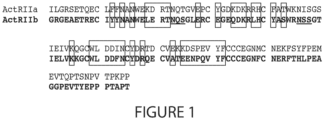
- an ActRIIB polypeptide comprises an amino acid sequence that is at least 90% identical to the sequence of amino acids 29-109 of SEQ ID NO: 1, wherein the ActRIIB polypeptide comprises an acidic amino acid [naturally occurring (E or D) or artificial acidic amino acid] at position 79 with respect to SEQ ID NO: 1.
- an ActRIIB polypeptide may comprise an amino acid sequence that is at least 70%, 75%, 80%, 85%, 90%, 91%, 92%, 93%, 94%, 95%, 96%, 97%, 98%, 99%, or 100% identical to the sequence of amino acids 25-131 of SEQ ID NO: 1.
- an ActRIIB polypeptide may comprise an amino acid sequence that is at least 70%, 75%, 80%, 85%, 90%, 91%, 92%, 93%, 94%, 95%, 96%, 97%, 98%, 99%, or 100% identical to the sequence of amino acids 25-131 of SEQ ID NO: 1, wherein the ActRIIB polypeptide comprises an acidic amino acid at position 79 with respect to SEQ ID NO: 1.
- an ActRIIB polypeptide may comprise an amino acid sequence that is at least 70%, 75%, 80%, 85%, 90%, 91%, 92%, 93%, 94%, 95%, 96%, 97%, 98%, 99%, or 100% identical to the amino acid sequence of SEQ ID NO: 2, wherein the ActRIIB polypeptide comprises an acidic amino acid at position 79 with respect to SEQ ID NO: 1.
- an ActRIIB polypeptide may comprise an amino acid sequence that is at least 70%, 75%, 80%, 85%, 90%, 91%, 92%, 93%, 94%, 95%, 96%, 97%, 98%, 99%, or 100% identical to the amino acid sequence of SEQ ID NO: 3, wherein the ActRIIB polypeptide comprises an acidic amino acid at position 79 with respect to SEQ ID NO: 1.
- an ActRIIB polypeptide may comprise an amino acid sequence that is at least 70%, 75%, 80%, 85%, 90%, 91%, 92%, 93%, 94%, 95%, 96%, 97%, 98%, 99%, or 100% identical to the amino acid sequence of SEQ ID NO: 4, wherein the ActRIIB polypeptide comprises an acidic amino acid at position 79 with respect to SEQ ID NO: 1.
- an ActRIIB polypeptide may comprise an amino acid sequence that is at least 70%, 75%, 80%, 85%, 90%, 91%, 92%, 93%, 94%, 95%, 96%, 97%, 98%, 99%, or 100% identical to the amino acid sequence of SEQ ID NO: 5, wherein the ActRIIB polypeptide comprises an acidic amino acid at position 79 with respect to SEQ ID NO: 1.
- an ActRIIB polypeptide may comprise an amino acid sequence that is at least 70%, 75%, 80%, 85%, 90%, 91%, 92%, 93%, 94%, 95%, 96%, 97%, 98%, 99%, or 100% identical to the amino acid sequence of SEQ ID NO: 6, wherein the ActRIIB polypeptide comprises an acidic amino acid at position 79 with respect to SEQ ID NO: 1.
- an ActRIIB polypeptide may comprise an amino acid sequence that is at least 70%, 75%, 80%, 85%, 90%, 91%, 92%, 93%, 94%, 95%, 96%, 97%, 98%, 99%, or 100% identical to the amino acid sequence of SEQ ID NO: 24.
- an ActRIIB polypeptide may comprise an amino acid sequence that is at least 70%, 75%, 80%, 85%, 90%, 91%, 92%, 93%, 94%, 95%, 96%, 97%, 98%, 99%, or 100% identical to the amino acid sequence of SEQ ID NO: 25.
- an ActRIIB polypeptide may comprise an amino acid sequence that is at least 70%, 75%, 80%, 85%, 90%, 91%, 92%, 93%, 94%, 95%, 96%, 97%, 98%, 99%, or 100% identical to the amino acid sequence of SEQ ID NO: 28.
- an ActRIIB polypeptide may comprise an amino acid sequence that is at least 70%, 75%, 80%, 85%, 90%, 91%, 92%, 93%, 94%, 95%, 96%, 97%, 98%, 99%, or 100% identical to the amino acid sequence of SEQ ID NO: 29.
- an ActRIIB polypeptide may comprise an amino acid sequence that is at least 70%, 75%, 80%, 85%, 90%, 91%, 92%, 93%, 94%, 95%, 96%, 97%, 98%, 99%, or 100% identical to the amino acid sequence of SEQ ID NO: 29, wherein the ActRIIB polypeptide comprises an acidic amino acid at position 79 with respect to SEQ ID NO: 1.
- an ActRIIB polypeptide may comprise an amino acid sequence that is at least 70%, 75%, 80%, 85%, 90%, 91%, 92%, 93%, 94%, 95%, 96%, 97%, 98%, 99%, or 100% identical to the amino acid sequence of SEQ ID NO: 30, wherein the ActRIIB polypeptide comprises an acidic amino acid at position 79 with respect to SEQ ID NO: 1.
- an ActRIIB polypeptide may comprise an amino acid sequence that is at least 70%, 75%, 80%, 85%, 90%, 91%, 92%, 93%, 94%, 95%, 96%, 97%, 98%, 99%, or 100% identical to the amino acid sequence of SEQ ID NO: 31, wherein the ActRIIB polypeptide comprises an acidic amino acid at position 79 with respect to SEQ ID NO: 1.
- an ActRIIB polypeptide may comprise an amino acid sequence that is at least 70%, 75%, 80%, 85%, 90%, 91%, 92%, 93%, 94%, 95%, 96%, 97%, 98%, 99%, or 100% identical to the amino acid sequence of SEQ ID NO: 45, wherein the ActRIIB polypeptide comprises an acidic amino acid at position 79 with respect to SEQ ID NO: 1.
- an ActRIIB polypeptide may comprise an amino acid sequence that is at least 70%, 75%, 80%, 85%, 90%, 91%, 92%, 93%, 94%, 95%, 96%, 97%, 98%, 99%, or 100% identical to the amino acid sequence of SEQ ID NO: 50, wherein the ActRIIB polypeptide comprises an acidic amino acid at position 79 with respect to SEQ ID NO: 1.
- an ActRIIB polypeptide may comprise an amino acid sequence that is at least 70%, 75%, 80%, 85%, 90%, 91%, 92%, 93%, 94%, 95%, 96%, 97%, 98%, 99%, or 100% identical to the amino acid sequence of SEQ ID NO: 53, wherein the ActRIIB polypeptide comprises an acidic amino acid at position 79 with respect to SEQ ID NO: 1.
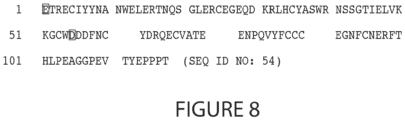
- an ActRIIB polypeptide may comprise an amino acid sequence that is at least 70%, 75%, 80%, 85%, 90%, 91%, 92%, 93%, 94%, 95%, 96%, 97%, 98%, 99%, or 100% identical to the amino acid sequence of SEQ ID NO: 54, wherein the ActRIIB polypeptide comprises an acidic amino acid at position 79 with respect to SEQ ID NO: 1.
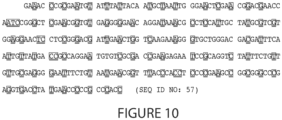
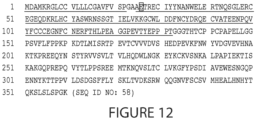
- an ActRIIB polypeptide may comprise an amino acid sequence that is at least 70%, 75%, 80%, 85%, 90%, 91%, 92%, 93%, 94%, 95%, 96%, 97%, 98%, 99%, or 100% identical to the amino acid sequence of SEQ ID NO: 58.
- ActRIIB polypeptides do not comprise an acidic amino acid at the position corresponding to L79 of SEQ ID NO: 1.
- ActRIIB polypeptides and variants thereof may be homomultimers, for example, homodimer, homotrimers, homotetramers, homopentamers, and higher order homomultimer complexes. ActRIIB polypeptides and variants thereof may be homodimers.
- ActRIIB polypeptide dimers described herein may comprise a first ActRIIB polypeptide covalently, or non-covalently, associated with an second ActRIIB polypeptide wherein the first polypeptide comprises an ActRIIB domain and an amino acid sequence of a first member (or second member) of an interaction pair (e.g., a constant domain of an immunoglobulin) and the second polypeptide comprises an ActRIIB polypeptide and an amino acid sequence of a second member (or first member) of the interaction pair.
- ActRIIB polypeptides may be fusion proteins.
- an ActRIIB polypeptide may be a fusion protein comprising an ActRIIB polypeptide domain and one or more heterologous (non-ActRIIB) polypeptide domains.
- An ActRIIB polypeptide may be a fusion protein that has, as one domain, an amino acid sequence derived from an ActRIIB polypeptide (e.g., a ligand-binding domain of an ActRIIB receptor or a variant thereof) and one or more heterologous domains that provide a desirable property, such as improved pharmacokinetics, easier purification, targeting to particular tissues, etc.
- a domain of a fusion protein may enhance one or more of in vivo stability, in vivo half-life, uptake/administration, tissue localization or distribution, formation of protein complexes, multimerization of the fusion protein, and/or purification.
- An ActRIIB polypeptide domain of a fusion protein may be connected directly (fused) to one or more heterologous polypeptide domains, or an intervening sequence, such as a linker, may be positioned between the amino acid sequence of the ActRIIB polypeptide and the amino acid sequence of the one or more heterologous domains.
- An ActRIIB fusion protein may comprise a relatively unstructured linker positioned between the heterologous domain and the ActRIIB domain.
- This unstructured linker may correspond to the roughly 15 amino acid unstructured region at the C-terminal end of the extracellular domain of ActRIIB (the "tail"), or it may be an artificial sequence of between 3 and 15, 20, 30, 50 or more amino acids that are relatively free of secondary structure.
- a linker may be rich in glycine and proline residues and may, for example, contain repeating sequences of threonine/serine and glycines.
- linkers include, but are not limited to, the sequences TGGG (SEQ ID NO: 18), SGGG (SEQ ID NO: 19), TGGGG (SEQ ID NO: 16), SGGGG (SEQ ID NO: 17), GGGGS (SEQ ID NO: 20), GGGG (SEQ ID NO: 15), and GGG (SEQ ID NO: 14).
- ActRIIB fusion proteins may comprise a constant domain of an immunoglobulin, including, for example, the Fc portion of an immunoglobulin.
- an amino acid sequence that is derived from an Fc domain of an IgG (IgG1, IgG2, IgG3, or IgG4), IgA (IgA1 or IgA2), IgE, or IgM immunoglobulin.
- an Fc portion of an immunoglobulin domain may comprise, consist essentially of, or consist of an amino acid sequence that is at least 70%, 75%, 80%, 85%, 90%, 91%, 92%, 93%, 94%, 95%, 96%, 97%, 98%, 99% or 100% identical to any one of SEQ ID NOs: 9-13.
- Such immunoglobulin domains may comprise one or more amino acid modifications (e.g., deletions, additions, and/or substitutions) that confer an altered Fc activity, e.g., decrease of one or more Fc effector functions.
- An ActRIIB fusion protein may comprise an amino acid sequence as set forth in the formula A-B-C.
- the B portion may be an N- and C-terminally truncated ActRIIB polypeptide as described herein.
- the A and C portions may be independently zero, one, or more than one amino acids, and both A and C portions are heterologous to B.
- the A and/or C portions may be attached to the B portion via a linker sequence.
- An ActRIIB fusion protein may comprise a leader sequence.
- the leader sequence may be a native ActRIIB leader sequence or a heterologous leader sequence.
- the leader sequence may be a tissue plasminogen activator (TPA) leader sequence.
- An ActRIIB polypeptide may comprise a purification subsequence, such as an epitope tag, a FLAG tag, a polyhistidine sequence, and a GST fusion.
- an ActRIIB polypeptide may comprise one or more modified amino acid residues selected from: a glycosylated amino acid, a PEGylated amino acid, a famesylated amino acid, an acetylated amino acid, a biotinylated amino acid, and/or an amino acid conjugated to a lipid moiety.
- ActRIIB polypeptides may comprise at least one N-linked sugar, and may include two, three or more N-linked sugars.
- Such polypeptides may also comprise O-linked sugars.
- ActRIIB polypeptides be expressed in a mammalian cell line that mediates suitably natural glycosylation of the polypeptide so as to diminish the likelihood of an unfavorable immune response in a patient.
- ActRIIB polypeptides may be produced in a variety of cell lines that glycosylate the protein in a manner that is suitable for patient use, including engineered insect or yeast cells, and mammalian cells such as COS cells, CHO cells, HEK cells and NSO cells.
- An ActRIIB polypeptide may be glycosylated and may have a glycosylation pattern obtainable from a Chinese hamster ovary cell line.
- ActRIIB polypeptides may exhibit a serum half-life of at least 4, 6, 12, 24, 36, 48, or 72 hours in a mammal (e.g., a mouse or a human).
- ActRIIB may exhibit a serum half-life of at least 6, 8, 10, 12, 14, 20, 25, or 30 days in a mammal (e.g., a mouse or a human).
- compositions comprising one or more ActRIIB antagonists of the present disclosure and a pharmaceutically acceptable carrier.
- a pharmaceutical preparation may also comprise one or more additional active agents such as a compound that is used to treat myelofibrosis, particularly treating or preventing one or more complications of myelofibrosis (e.g., splenomegaly, extramedullary hematopoiesis, anemia, and fibrosis), and/or a patient treated with a Janus kinase inhibitor.
- pharmaceutical preparation will preferably be pyrogen-free (meaning pyrogen free to the extent required by regulations governing the quality of products for therapeutic use).
- an ActRIIB antagonist or combination of antagonists, of the disclosure to disorders or conditions described herein
- the ActRIIB antagonist is an antibody, or combination of antibodies.
- the antibody may bind to at least ActRIIB.
- An antibody that binds to ActRIIB may inhibit ActRIIB signaling, optionally as measured in a cell-based assay such as those described herein.
- An antibody that binds to ActRIIB may inhibit one or more TGF-beta superfamily ligands, TGF-beta superfamily type I receptors, or TGF-beta superfamily co-receptors from binding to ActRIIB.
- An antibody that binds to ActRIIB may inhibit one or more TGF-beta superfamily ligands from binding to ActRIIB selected from the group consisting of: activin (e.g., activin A, activin B, activin C, activin AB, activin AC, activin BC, activin E, activin AE, and activin BE), GDF8, GDF11, GDF3, BMP6, BMP10, BMP9, and BMP5.
- An antibody may bind to at least GDF 11.
- An antibody that binds to GDF 11 may inhibit ActRIIB signaling, optionally as measured in a cell-based assay such as those described herein.
- An antibody that binds to GDF11 may inhibit GDF11-ActRIIB binding.
- An antibody may bind to at least GDF8.
- An antibody that binds to GDF8 may inhibit ActRIIB signaling, optionally as measured in a cell-based assay such as those described herein.
- An antibody that binds to GDF8 may inhibit GDF8-ActRIIB binding.
- An antibody may bind to at least BMP6.
- An antibody that binds to BMP6 may inhibit ActRIIB signaling, optionally as measured in a cell-based assay such as those described herein.
- An antibody that binds to BMP6 may inhibit BMP6-ActRIIB binding.
- An antibody may bind to BMP10.
- An antibody that binds to at least BMP10 may inhibit ActRIIB signaling, optionally as measured in a cell-based assay such as those described herein.
- An antibody that binds to BMP10 may inhibit BMP10-ActRIIB binding.
- the antibody may bind to at least GDF3.
- An antibody that binds to GDF3 may inhibit ActRIIB signaling, optionally as measured in a cell-based assay such as those described herein.
- An antibody that binds to GDF3 may inhibit GDF3-ActRIIB binding.
- the antibody may bind to at least activin (e.g. activin A, activin B, activin C, activin AB, activin AC, activin BC, activin E, activin AE, and activin BE).
- An antibody that binds to activin may inhibit ActRIIB signaling, optionally as measured in a cell-based assay such as those described herein.
- An antibody that binds to activin e.g. activin A, activin B, activin C, activin AB, activin AC, activin BC, activin E, activin AE, and activin BE
- activin-ActRIIB binding may inhibit activin-ActRIIB binding.
- the antibody may bind to activin B.
- An antibody that binds to activin B may inhibit ActRIIB signaling, optionally as measured in a cell-based assay such as those described herein.
- An antibody that binds to activin B may inhibit activin B-ActRIIB binding.
- the antibody may be a multispecific antibody, or a combination of multispecific antibodies that binds to one or more of ActRIIB, GDF11, GDF8, activin A, activin B, BMP6, and BMP10.
- An antibody may bind to at least ALK4.
- An antibody that binds to ALK4 may inhibit ALK4 signaling, optionally as measured in a cell-based assay such as those described herein.
- An antibody that binds to ALK4 may inhibit one or more ActRIIB ligands, type II receptors, or co-receptors from binding to ALK4.
- An antibody that binds to ALK4 may inhibit one or more ActRIIB ligands from binding to ALK4 selected from the group consisting of: activin (e.g., activin A, activin B, activin C, activin AB, activin AC, activin BC, activin E, activin AE, and activin BE), GDF8, GDF11, BMP6, BMP10, and GDF3.
- activin e.g., activin A, activin B, activin C, activin AB, activin AC, activin BC, activin E, activin AE, and activin BE
- GDF8 GDF11, BMP6, BMP10 binds to ALK5 signaling, optionally as measured in a cell-based assay such as those described herein.
- An antibody that binds to ALK5 may inhibit one or more ActRIIB ligands, type II receptors, or co-receptors from binding to ALK5.
- An antibody that binds to ALK5 may inhibit one or more ActRIIB ligands from binding to ALK5 selected from the group consisting of: activin (e.g., activin A, activin B, activin C, activin AB, activin AC, activin BC, activin E, activin AE, and activin BE), GDF8, GDF11, BMP6, BMP10, and GDF3.
- activin e.g., activin A, activin B, activin C, activin AB, activin AC, activin BC, activin E, activin AE, and activin BE
- GDF8 GDF11, BMP6, BMP10 bind to at least ALK7.
- An antibody that binds to ALK7 may inhibit ALK7 signaling, optionally as measured in a cell-based assay such as those described herein.
- An antibody that binds to ALK7 may inhibit one or more ActRIIB ligands, type II receptors, or co-receptors from binding to ALK7.
- An antibody that binds to ALK7 may inhibit one or more ActRIIB ligands from binding to ALK7 selected from the group consisting of: activin (e.g., activin A, activin B, activin C, activin AB, activin AC, activin BC, activin E, activin AE, and activin BE), GDF8, GDF11, BMP6, BMP10, and GDF3.
- activin e.g., activin A, activin B, activin C, activin AB, activin AC, activin BC, activin E, activin AE, and activin BE
- GDF8 GDF11 e.g., activin A, activin
- the antibody may bind to at least GDF11.
- the multispecific antibody, or a combination of multispecific antibodies may inhibit signaling in a cell-based assay of one or more of: ActRIIB, GDF11, GDF8, activin A, activin B, GDF3, BMP6, and BMP10.
- the antibody may be a chimeric antibody, a humanized antibody, or a human antibody.
- the antibody may be a single-chain antibody, an F(ab') 2 fragment, a single-chain diabody, a tandem single-chain Fv fragment, a tandem single-chain diabody, a or a fusion protein comprising a single-chain diabody and at least a portion of an immunoglobulin heavy-chain constant region.
- the ActRIIB antagonist is a small molecule inhibitor or combination of small molecule inhibitors.
- the small molecule inhibitor may be an inhibitor of at least ActRIIB.
- the small molecule inhibitor may be an inhibitor of at least ALK4.
- the small molecule inhibitor may be an inhibitor of at least ALK5.
- the small molecule inhibitor may be an inhibitor of at least ALK7.
- the small molecule inhibitor may be an inhibitor of at least GDF 11.
- the small molecule inhibitor may be an inhibitor of at least GDF8.
- the small molecule inhibitor may be an inhibitor of at least BMP6.
- the small molecule inhibitor may be an inhibitor of at least BMP10.
- the small molecule inhibitor may an inhibitor of at least GDF3.
- the small molecule inhibitor may be an inhibitor of at least activin (e.g. activin A, activin B, activin C, activin AB, activin AC, activin BC, activin E, activin AE, and activin BE).
- the small molecule inhibitor may be an inhibitor of at least activin B.
- the ActRIIB antagonist is a nucleic acid inhibitor or combination of nucleic acid inhibitors.
- the nucleic acid inhibitor may be an inhibitor of at least ActRIIB.
- the nucleic acid inhibitor may be an inhibitor of at least ALK4.
- the nucleic acid inhibitor may be an inhibitor of at least ALK5.
- the nucleic acid inhibitor may be an inhibitor of at least ALK7.
- the nucleic acid inhibitor may be an inhibitor of at least GDF11.
- the nucleic acid inhibitor may be an inhibitor of at least GDF8.
- the nucleic acid inhibitor may be an inhibitor of at least BMP6.
- the nucleic acid inhibitor may be an inhibitor of at least BMP10.
- the nucleic acid inhibitor may be an inhibitor of at least GDF3
- the nucleic acid inhibitor may be an inhibitor of at least activin (e.g. activin A, activin B, activin C, activin AB, activin AC, activin BC, activin E, activin AE, and activin BE).
- the nucleic acid inhibitor may be an inhibitor of at least activin B.
- the ActRIIB antagonist is a follistatin polypeptide.
- the follistatin polypeptide may comprise an amino acid sequence that is at least 70%, 75% 80%, 85%, 90%, 91%, 92%, 93%, 94%, 95%, 96%, 97%, 98%, 99%, or 100% identical to the amino acid sequence of SEQ ID NO: 63.
- the follistatin polypeptide may comprise an amino acid sequence that is at least 70%, 75% 80%, 85%, 90%, 91%, 92%, 93%, 94%, 95%, 96%, 97%, 98%, 99%, or 100% identical to the amino acid sequence of SEQ ID NO: 64.
- the follistatin polypeptide may comprise an amino acid sequence that is at least 70%, 75% 80%, 85%, 90%, 91%, 92%, 93%, 94%, 95%, 96%, 97%, 98%, 99%, or 100% identical to the amino acid sequence of SEQ ID NO: 65.
- the follistatin polypeptide may comprise an amino acid sequence that is at least 70%, 75% 80%, 85%, 90%, 91%, 92%, 93%, 94%, 95%, 96%, 97%, 98%, 99%, or 100% identical to the amino acid sequence of SEQ ID NO: 66.
- the follistatin polypeptide may comprise an amino acid sequence that is at least 70%, 75% 80%, 85%, 90%, 91%, 92%, 93%, 94%, 95%, 96%, 97%, 98%, 99%, or 100% identical to the amino acid sequence of SEQ ID NO: 67.
- the ActRIIB antagonist is a FLRG polypeptide.
- the FLRG polypeptide may comprise an amino acid sequence that is at least 70%, 75% 80%, 85%, 90%, 91%, 92%, 93%, 94%, 95%, 96%, 97%, 98%, 99%, or 100% identical to the amino acid sequence of SEQ ID NO: 68.
- TGF-beta The transforming growth factor-beta (TGF-beta) superfamily contains a variety of growth factors that share common sequence elements and structural motifs. These proteins are known to exert biological effects on a large variety of cell types in both vertebrates and invertebrates. Members of the superfamily perform important functions during embryonic development in pattern formation and tissue specification and can influence a variety of differentiation processes, including adipogenesis, myogenesis, chondrogenesis, cardiogenesis, hematopoiesis, neurogenesis, and epithelial cell differentiation. By manipulating the activity of a member of the TGF-beta family, it is often possible to cause significant physiological changes in an organism.
- the Piedmontese and Belgian Blue cattle breeds carry a loss-of-function mutation in the GDF8 (also called myostatin) gene that causes a marked increase in muscle mass [see, e.g. , Grobet et al. (1997) Nat Genet. 17(1):71-4 ].
- GDF8 also called myostatin
- inactive alleles of GDF8 are associated with increased muscle mass and, reportedly, exceptional strength [see, e . g ., Schuelke et al. (2004) N Engl J Med, 350:2682-8 ].
- TGF- ⁇ signals are mediated by heteromeric complexes of type I and type II serine/threonine kinase receptors, which phosphorylate and activate downstream SMAD proteins (e . g ., SMAD proteins 1, 2, 3, 5, and 8) upon ligand stimulation [see, e.g., Massagué (2000) Nat. Rev. Mol. Cell Biol. 1:169-178 ].
- SMAD proteins e . g ., SMAD proteins 1, 2, 3, 5, and 8
- ActRII Two related type II receptors (ActRII), ActRIIA and ActRIIB, have been identified as the type II receptors for activins [see, e . g ., Mathews and Vale (1991) Cell 65:973-982 ; and Attisano et al. (1992) Cell 68: 97-108 ].
- ActRIIA and ActRIIB can biochemically interact with several other TGF- ⁇ family proteins including, for example, BMP6, BMP7, Nodal, GDF8, and GDF11 [see, e . g ., Yamashita et al. (1995) J. Cell Biol. 130:217-226 ; Lee and McPherron (2001) Proc.
- ALK4 is the primary type I receptor for activins, particularly for activin A, and ALK-7 may serve as a receptor for other activins as well, particularly for activin B.
- Activins are dimeric polypeptide growth factors that belong to the TGF-beta superfamily. There are three principal activin forms (A, B, and AB) that are homo/heterodimers of two closely related ⁇ subunits ( ⁇ A ⁇ A , ⁇ B ⁇ B , and ⁇ A ⁇ B , respectively).
- the human genome also encodes an activin C and an activin E, which are primarily expressed in the liver, and heterodimeric forms containing ⁇ C or ⁇ E are also known.
- activins are unique and multifunctional factors that can stimulate hormone production in ovarian and placental cells, support neuronal cell survival, influence cell-cycle progress positively or negatively depending on cell type, and induce mesodermal differentiation at least in amphibian embryos [ DePaolo et al. (1991) Proc Soc Ep Biol Med. 198:500-512 ; Dyson et al. (1997) Curr Biol. 7:81-84 ; and Woodruff (1998) Biochem Pharmacol. 55:953-963 ]. Moreover, erythroid differentiation factor (EDF) isolated from the stimulated human monocytic leukemic cells was found to be identical to activin A [ Murata et al.
- EDF erythroid differentiation factor
- activin A promotes erythropoiesis in the bone marrow.
- activin signaling is antagonized by its related heterodimer, inhibin.
- FSH follicle-stimulating hormone
- Other proteins that may regulate activin bioactivity and/or bind to activin include follistatin (FS), follistatin-related protein (FSRP, also known as FLRG or FSTL3), and ⁇ 2 -macroglobulin.
- agents that bind to "activin A” are agents that specifically bind to the ⁇ a subunit, whether in the context of an isolated ⁇ a subunit or as a dimeric complex (e . g ., a ⁇ A ⁇ A homodimer or a ⁇ A ⁇ B heterodimer).
- agents that bind to "activin A” are specific for epitopes present within the ⁇ a subunit, but do not bind to epitopes present within the n ⁇ n- ⁇ A subunit of the complex ( e . g ., the ⁇ B subunit of the complex).
- agents disclosed herein that antagonize (inhibit) "activin A" are agents that inhibit one or more activities as mediated by a ⁇ a subunit, whether in the context of an isolated ⁇ a subunit or as a dimeric complex (e . g ., a ⁇ A ⁇ A homodimer or a ⁇ A ⁇ B heterodimer).
- agents that inhibit "activin A” are agents that specifically inhibit one or more activities of the ⁇ a subunit, but do not inhibit the activity of the non- ⁇ a subunit of the complex (e . g ., the ⁇ B subunit of the complex).
- Agents disclosed herein that antagonize "activin AB” are agents that inhibit one or more activities as mediated by the ⁇ a subunit and one or more activities as mediated by the ⁇ B subunit.
- GDF8 Growth and differentiation factor-8
- GDF8 is a negative regulator of skeletal muscle mass. GDF8 is highly expressed in the developing and adult skeletal muscle. The GDF8 null mutation in transgenic mice is characterized by a marked hypertrophy and hyperplasia of the skeletal muscle [ McPherron et al., Nature (1997) 387:83-90 ]. Similar increases in skeletal muscle mass are evident in naturally occurring mutations of GDF8 in cattle [see, e . g ., Ashmore et al. (1974) Growth, 38:501-507 ; Swatland and Kieffer (1994) J. Anim. Sci. 38:752-757 ; McPherron and Lee (1997) Proc.
- the GDF8 propeptide can noncovalently bind to the mature GDF8 domain dimer, inactivating its biological activity [see, e.g. , Miyazono et al. (1988) J. Biol. Chem., 263: 6407-6415 ; Wakefield et al. (1988) J. Biol. Chem., 263: 7646-7654 ; and Brown et al. (1990) Growth Factors, 3: 35-43 ].
- follistatin proteins which bind to GDF8 or structurally related proteins and inhibit their biological activity
- follistatin-related proteins include follistatin, and potentially, follistatin-related proteins [see, e.g. , Gamer et al. (1999) Dev. Biol., 208: 222-232 ].
- GDF11 Growth and differentiation factor-11
- BMP11 is a secreted protein [ McPherron et al. (1999) Nat. Genet. 22: 260-264 ]. GDF11 is expressed in the tail bud, limb bud, maxillary and mandibular arches, and dorsal root ganglia during mouse development [see, e.g. , Nakashima et al. (1999) Mech. Dev. 80: 185-189 ]. GDF11 plays a unique role in patterning both mesodermal and neural tissues [see, e.g. , Gamer et al. (1999) Dev Biol., 208:222-32 ].
- GDF11 was shown to be a negative regulator of chondrogenesis and myogenesis in developing chick limb [see, e.g. , Gamer et al. (2001) Dev Biol. 229:407-20 ].
- the expression of GDF 11 in muscle also suggests its role in regulating muscle growth in a similar way to GDF8.
- the expression of GDF11 in brain suggests that GDF11 may also possess activities that relate to the function of the nervous system.
- GDF 11 was found to inhibit neurogenesis in the olfactory epithelium [see, e.g. , Wu et al. (2003) Neuron. 37:197-207 ].
- an ActRIIB antagonist (inhibitor) can be used to treat myelofibrosis patients, particularly ameliorating various complications of the disease including, for example, splenomegaly, extramedullary hematopoiesis, and fibrosis.
- the data presented herein show that a GDF trap polypeptide decrease splenomegaly, extramedullary hematopoiesis, and fibrosis in a JAK2V617F model of myelofibrosis.
- the disclosure relates to a compositions for use in treating myelofibrosis, particularly treating or preventing one or more complications of myelofibrosis (splenomegaly, extramedullary hematopoiesis, anemia, and fibrosis) as defined by the appended claims.
- the term “homologous,” when modified with an adverb such as "highly,” may refer to sequence similarity and may or may not relate to a common evolutionary origin.
- sequence similarity in all its grammatical forms, refers to the degree of identity or correspondence between nucleic acid or amino acid sequences that may or may not share a common evolutionary origin.
- Percent (%) sequence identity with respect to a reference polypeptide (or nucleotide) sequence is defined as the percentage of amino acid residues (or nucleic acids) in a candidate sequence that are identical to the amino acid residues (or nucleic acids) in the reference polypeptide (nucleotide) sequence, after aligning the sequences and introducing gaps, if necessary, to achieve the maximum percent sequence identity, and not considering any conservative substitutions as part of the sequence identity. Alignment for purposes of determining percent amino acid sequence identity can be achieved in various ways that are within the skill in the art, for instance, using publicly available computer software such as BLAST, BLAST-2, ALIGN or Megalign (DNASTAR) software.
- ALIGN-2 sequence comparison computer program
- the ALIGN-2 sequence comparison computer program was authored by Genentech, Inc., and the source code has been filed with user documentation in the U.S. Copyright Office, Washington D.C., 20559, where it is registered under U.S. Copyright Registration No. TXU510087.
- the ALIGN-2 program is publicly available from Genentech, Inc., South San Francisco, Calif., or may be compiled from the source code.
- the ALIGN-2 program should be compiled for use on a UNIX operating system, including digital UNIX V4.0D. All sequence comparison parameters are set by the ALIGN-2 program and do not vary.
- Alternize in all its grammatical forms, refers to the process of activating a protein and/or gene ( e . g ., by activating or amplifying that protein's gene expression or by inducing an inactive protein to enter an active state) or increasing a protein's and/or gene's activity.
- “Antagonize”, in all its grammatical forms, refers to the process of inhibiting a protein and/or gene (e.g., by inhibiting or decreasing that protein's gene expression or by inducing an active protein to enter an inactive state) or decreasing a protein's and/or gene's activity.
- an ActRIIB antagonist (inhibitor) can be used to treat myelofibrosis patients, particularly ameliorating various complications of the disease including, for example, splenomegaly, extramedullary hematopoiesis, and fibrosis.
- the data presented herein show that a GDF trap polypeptide decreases splenomegaly, extramedullary hematopoiesis, and fibrosis in a JAK2V617F model of myelofibrosis.
- While soluble GDF trap polypeptides may affect myelofibrosis through a mechanism other than ActRIIB antagonism [e.g., inhibition of one or more of GDF11, GDF8, activin B, BMP6, GDF3, and BMP10 may be an indicator of the tendency of an agent to inhibit the activities of a spectrum of additional agents, including, perhaps, other members of the TGF-beta superfamily, and such collective inhibition may lead to the desired effect on, for example, myelofibrosis], the disclosure nonetheless demonstrates that desirable therapeutic agents may be selected on the basis of ActRIIB antagonism.
- a mechanism other than ActRIIB antagonism e.g., inhibition of one or more of GDF11, GDF8, activin B, BMP6, GDF3, and BMP10 may be an indicator of the tendency of an agent to inhibit the activities of a spectrum of additional agents, including, perhaps, other members of the TGF-beta superfamily, and such collective inhibition may lead to the desired effect on, for example
- ActRIIB antagonists e.g., antagonists of the ActRIIB receptor, antagonists of one or more ActRIIB-binding ligand (e.g., GDF11, GDF8, activin, BMP6, GDF3, and BMP10) antagonists of one or more type I receptor (e.g., ALK4, ALK5, and/or ALK7), antagonists of one or more co-receptor, antagonists of one or more ActRIIB downstream signaling components (e.g., Smads), or combination of such antagonists] will useful in the treatment of myelofibrosis, particularly in the treatment or preventing of various myelofibrosis-associated complications (e.g., splenomegaly, extramedullary hematopoiesis, and fibrosis).
- Such agents are collectively referred to herein as "ActRIIB antagonists" or "ActRIIB inhibitors”.
- the present disclosure relates to ActRIIB polypeptides and variants thereof (e.g., GDF traps).
- the disclosure provides methods of using ActRIIB polypeptides, alone or in combination with one or more additional supportive therapies, to treat myelofibrosis, particularly treating or preventing one or more complications of myelofibrosis (e.g., splenomegaly, extramedullary hematopoiesis, anemia, and fibrosis), and/or a patient treated with a Janus kinase inhibitor.
- ActRIIB refers to a family of activin receptor type IIB (ActRIIB) proteins from any species and variants derived from such ActRIIB proteins by mutagenesis or other modification. Reference to ActRIIB herein is understood to be a reference to any one of the currently identified forms. Members of the ActRIIB family are generally transmembrane proteins, composed of a ligand-binding extracellular domain comprising a cysteine-rich region, a transmembrane domain, and a cytoplasmic domain with predicted serine/threonine kinase activity.
- ActRIIB polypeptide includes polypeptides comprising any naturally occurring polypeptide of an ActRIIB family member as well as any variants thereof (including mutants, fragments, fusions, and peptidomimetic forms) that retain a useful activity. Examples of such variant ActRIIB polypeptides are provided throughout the present disclosure as well as in International Patent Application Publication No. WO 2006/012627 and WO 2008/097541 . Numbering of amino acids for all ActRIIB-related polypeptides described herein is based on the numbering of the human ActRIIB precursor protein sequence provided below (SEQ ID NO: 1), unless specifically designated otherwise.
- the human ActRIIB precursor protein sequence is as follows:
- the signal peptide is indicated with a single underline ; the extracellular domain is indicated in bold font; and the potential, endogenous N-linked glycosylation sites are indicated with a double underline.
- the processed (mature) extracellular ActRIIB polypeptide sequence is as follows:
- the protein may be produced with an "SGR" sequence at the N-terminus.
- the C-terminal "tail" of the extracellular domain is indicated by a single underline .
- the sequence with the "tail” deleted is as follows:
- a form of ActRIIB with an alanine at position 64 of SEQ ID NO: 1 (A64) is also reported in the literature [ Hilden et al. (1994) Blood, 83(8): 2163-2170 ].
- Applicants have ascertained that an ActRIIB-Fc fusion protein comprising an extracellular domain of ActRIIB with the A64 substitution has a relatively low affinity for activin and GDF11.
- the same ActRIIB-Fc fusion protein with an arginine at position 64 has an affinity for activin and GDF 11 in the low nanomolar to high picomolar range. Therefore, sequences with an R64 are used as the "wild-type" reference sequence for human ActRIIB in this disclosure.
- the signal peptide is indicated by a single underline and the extracellular domain is indicated by bold font.
- the processed (mature) extracellular ActRIIB polypeptide sequence of the alternative A64 form is as follows:
- the protein may be produced with an "SGR" sequence at the N-terminus.
- the C-terminal "tail" of the extracellular domain is indicated by single underline.
- the sequence with the "tail” deleted is as follows:
- a nucleic acid sequence encoding human ActRIIB precursor protein is shown below (SEQ ID NO: 7), consisting of nucleotides 25-1560 of Genbank Reference Sequence NM_001106.3, which encode amino acids 1-513 of the ActRIIB precursor.
- the sequence as shown provides an arginine at position 64 and may be modified to provide an alanine instead.
- the signal sequence is underlined.
- a nucleic acid sequence encoding the processed extracellular human ActRIIB polypeptide is as follows (SEQ ID NO: 8): The sequence as shown provides an arginine at position 64, and may be modified to provide an alanine instead.
- FIG. 1 An alignment of the amino acid sequences of human ActRIIB extracellular domain and human ActRIIA extracellular domain are illustrated in Figure 1 .
- This alignment indicates amino acid residues within both receptors that are believed to directly contact ActRII ligands.
- the composite ActRII structures indicated that the ActRIIB-ligand binding pocket is defined, in part, by residues Y31, N33, N35, L38 through T41, E47, E50, Q53 through K55, L57, H58, Y60, S62, K74, W78 through N83, Y85, R87, A92, and E94 through F101. At these positions, it is expected that conservative mutations will be tolerated.
- ActRIIB is generally well-conserved among vertebrates, with large stretches of the extracellular domain completely conserved.
- Figure 2 depicts a multi-sequence alignment of a human ActRIIB extracellular domain compared to various ActRIIB orthologs. Many of the ligands that bind to ActRIIB are also highly conserved. Accordingly, from these alignments, it is possible to predict key amino acid positions within the ligand-binding domain that are important for normal ActRIIB-ligand binding activities as well as to predict amino acid positions that are likely to be tolerant to substitution without significantly altering normal ActRIIB-ligand binding activities.
- an active, human ActRIIB variant polypeptide useful in accordance with the presently disclosed methods may include one or more amino acids at corresponding positions from the sequence of another vertebrate ActRIIB, or may include a residue that is similar to that in the human or other vertebrate sequences.
- L46 in the human extracellular domain is a valine in Xenopus ActRIIB (SEQ ID NO: 42), and so this position may be altered, and optionally may be altered to another hydrophobic residue, such as V, I or F, or a non-polar residue such as A.
- E52 in the human extracellular domain is a K in Xenopus , indicating that this site may be tolerant of a wide variety of changes, including polar residues, such as E, D, K, R, H, S, T, P, G, Y and probably A.
- T93 in the human extracellular domain is a K in Xenopus , indicating that a wide structural variation is tolerated at this position, with polar residues favored, such as S, K, R, E, D, H, G, P, G and Y.
- F108 in the human extracellular domain is a Y in Xenopus , and therefore Y or other hydrophobic group, such as I, V or L should be tolerated.
- E111 in the human extracellular domain is K in Xenopus , indicating that charged residues will be tolerated at this position, including D, R, K and H, as well as Q and N.
- R112 in the human extracellular domain is K in Xenopus , indicating that basic residues are tolerated at this position, including R and H.
- a at position 119 in the human extracellular domain is relatively poorly conserved, and appears as P in rodents (SEQ ID NOs: 37 and 39) and V in Xenopus , thus essentially any amino acid should be tolerated at this position.
- ActRII proteins have been characterized in the art in terms of structural/functional characteristics, particularly with respect to ligand binding [ Attisano et al. (1992) Cell 68(1):97-108 ; Greenwald et al. (1999) Nature Structural Biology 6(1): 18-22 ; Allendorph et al. (2006) PNAS 103(20: 7643-7648 ; Thompson et al. (2003) The EMBO Journal 22(7): 1555-1566 ; as well as U.S. Patent Nos: 7,709,605 , 7,612,041 , and 7,842,663 ].
- these references provide amply guidance for how to generate ActRII variants that retain one or more desired activities (e.g., ligand-binding activity).
- a defining structural motif known as a three-finger toxin fold is important for ligand binding by type I and type II receptors and is formed by conserved cysteine residues located at varying positions within the extracellular domain of each monomeric receptor [ Greenwald et al. (1999) Nat Struct Biol 6:18-22 ; and Hinck (2012) FEBS Lett 586:1860-1870 ]. Accordingly, the core ligand-binding domains of human ActRIIB, as demarcated by the outermost of these conserved cysteines, corresponds to positions 29-109 of SEQ ID NO: 1 (ActRIIB precursor).
- the structurally less-ordered amino acids flanking these cysteine-demarcated core sequences can be truncated by about 1, 2, 3, 4, 5, 6, 7, 8, 9, 10, 11, 12, 13, 14, 15, 16, 17, 18, 19, 20, 21, 22, 23, 24, 25, 26, 27, or 28 residues at the N-terminus and/or by about 1, 2, 3, 4, 5, 6, 7, 8, 9, 10, 11, 12, 13, 14, 15, 16, 17, 18, 19, 20, 21, 22, 23, 24, or 25 residues a the C-terminus without necessarily altering ligand binding.
- Exemplary ActRIIB extracellular domains for N-terminal and/or C-terminal truncation include SEQ ID NOs: 2, 3, 5, and 6.
- Attisano et al. showed that a deletion of the proline knot at the C-terminus of the extracellular domain of ActRIIB reduced the affinity of the receptor for activin.
- An ActRIIB-Fc fusion protein containing amino acids 20-119 of present SEQ ID NO: 1, "ActRIIB(20-119)-Fc”, has reduced binding to GDF11 and activin relative to an ActRIIB(20-134)-Fc, which includes the proline knot region and the complete juxtamembrane domain (see, e.g. , U.S. Patent No. 7,842,663 ).
- an ActRIIB(20-129)-Fc protein retains similar, but somewhat reduced activity, relative to the wild-type, even though the proline knot region is disrupted.
- ActRIIB extracellular domains that stop at amino acid 134, 133, 132, 131, 130 and 129 are all expected to be active, but constructs stopping at 134 or 133 may be most active.
- mutations at any of residues 129-134 are not expected to alter ligand-binding affinity by large margins. In support of this, it is known in the art that mutations of P129 and P130 (with respect to SEQ ID NO: 1) do not substantially decrease ligand binding.
- an ActRIIB polypeptide of the present disclosure may end as early as amino acid 109 (the final cysteine), however, forms ending at or between 109 and 119 ( e.g. , 109, 110, 111, 112, 113, 114, 115, 116, 117, 118, or 119) are expected to have reduced ligand binding.
- Amino acid 119 (with respect to present SEQ ID NO: 1) is poorly conserved and so is readily altered or truncated.
- ActRIIB polypeptides ending at 128 (with respect to SEQ ID NO: 1) or later should retain ligand-binding activity.
- ActRIIB polypeptides ending at or between 119 and 127 e.g. , 119, 120, 121, 122, 123, 124, 125, 126, or 127
- ActRIIB polypeptides beginning at position 20, 21, 22, 23, and 24 should retain general ligand-biding activity
- ActRIIB polypeptides beginning at positions 25, 26, 27, 28, and 29 are also expected to retain ligand-biding activity. It has been demonstrated, e . g ., U.S. Patent No. 7,842,663 , that, surprisingly, an ActRIIB construct beginning at 22, 23, 24, or 25 will have the most activity.
- ActRIIB polypeptides may, for example, comprise, consists essentially of, or consists of an amino acid sequence that is at least 70%, 75%, 80%, 85%, 86%, 87%, 88%, 89%, 90%, 91%, 92%, 93%, 94%, 95%, 96%, 97%, 98%, 99%, or 100% identical to a portion of ActRIIB beginning at a residue corresponding to any one of amino acids 20-29 ( e .
- SEQ ID NO: 1 g ., beginning at any one of amino acids 20, 21, 22, 23, 24, 25, 26, 27, 28, or 29) of SEQ ID NO: 1 and ending at a position corresponding to any one amino acids 109-134 (e.g. , ending at any one of amino acids 109, 110, 111, 112, 113, 114, 115, 116, 117, 118, 119, 120, 121, 122, 123, 124, 125, 126, 127, 128, 129, 130, 131, 132, 133, or 134) of SEQ ID NO: 1.
- Other examples include polypeptides that begin at a position from 20-29 ( e.g.
- any one of positions 20, 21, 22, 23, 24, 25, 26, 27, 28, or 29) or 21-29 e . g ., any one of positions 21, 22, 23, 24, 25, 26, 27, 28, or 29
- 21-29 e . g ., any one of positions 21, 22, 23, 24, 25, 26, 27, 28, or 29
- 119-134 e.g. , any one of positions 119, 120, 121, 122, 123, 124, 125, 126, 127, 128, 129, 130, 131, 132, 133, or 134
- 119-133 e.g. , any one of positions 119, 120, 121, 122, 123, 124, 125, 126, 127, 128, 129, 130, 131, 132, or 133
- 129-134 e.g.
- Other examples include constructs that begin at a position from 20-24 ( e.g. , any one of positions 20, 21, 22, 23, or 24), 21-24 ( e.g. , any one of positions 21, 22, 23, or 24), or 22-25 ( e.g. , any one of positions 22, 22, 23, or 25) and end at a position from 109-134 ( e .
- Variants within these ranges are also contemplated, particularly those having at least 70%, 75%, 80%, 85%, 86%, 87%, 88%, 89%, 90%, 91%, 92%, 93%, 94%, 95%, 96%, 97%, 98%, 99%, or 100% identity to the corresponding portion of SEQ ID NO: 1.
- ActRIIB variants may comprise no more than 1, 2, 5, 6, 7, 8, 9, 10 or 15 conservative amino acid changes in the ligand-binding pocket, and zero, one or more non-conservative alterations at positions 40, 53, 55, 74, 79 and/or 82 in the ligand-binding pocket.
- Sites outside the binding pocket, at which variability may be particularly well tolerated, include the amino and carboxy termini of the extracellular domain (as noted above), and positions 42-46 and 65-73 (with respect to SEQ ID NO: 1).
- N65A Asparagine-to-alanine alteration at position 65 (N65A) actually improves ligand binding in the A64 background, and is thus expected to have no detrimental effect on ligand binding in the R64 background [ U.S. Patent No. 7,842,663 ].
- This change probably eliminates glycosylation at N65 in the A64 background, thus demonstrating that a significant change in this region is likely to be tolerated.
- R64A change is poorly tolerated, R64K is well-tolerated, and thus another basic residue, such as H may be tolerated at position 64 [ U.S. Patent No. 7,842,663 ].
- the results of the mutagenesis program described in the art indicate that there are amino acid positions in ActRIIB that are often beneficial to conserve.
- SEQ ID NO: 1 these include position 80 (acidic or hydrophobic amino acid), position 78 (hydrophobic, and particularly tryptophan), position 37 (acidic, and particularly aspartic or glutamic acid), position 56 (basic amino acid), position 60 (hydrophobic amino acid, particularly phenylalanine or tyrosine).
- positions that may be desirable to conserve are as follows: position 52 (acidic amino acid), position 55 (basic amino acid), position 81 (acidic), 98 (polar or charged, particularly E, D, R or K), all with respect to SEQ ID NO: 1.
- N-X-S/T sequences may be generally introduced at positions outside the ligand binding pocket defined in Figure 1 in ActRIIB polypeptide of the present disclosure.
- Particularly suitable sites for the introduction of non-endogenous N-X-S/T sequences include amino acids 20-29, 20-24, 22-25, 109-134, 120-134 or 129-134 (with respect to SEQ ID NO: 1).
- N-X-S/T sequences may also be introduced into the linker between the ActRIIB sequence and an Fc domain or other fusion component.
- Such a site may be introduced with minimal effort by introducing an N in the correct position with respect to a pre-existing S or T, or by introducing an S or T at a position corresponding to a pre-existing N.
- desirable alterations that would create an N-linked glycosylation site are: A24N, R64N, S67N (possibly combined with an N65A alteration), E105N, R112N, G120N, E123N, P129N, A132N, R112S and R112T (with respect to SEQ ID NO: 1).
- an S that is predicted to be glycosylated may be altered to a T without creating an immunogenic site, because of the protection afforded by the glycosylation.
- any T that is predicted to be glycosylated may be altered to an S.
- S67T and S44T are contemplated.
- S26T alteration may be used.
- an ActRIIB polypeptide of the present disclosure may be a variant having one or more additional, non-endogenous N-linked glycosylation consensus sequences as described above.
- the disclosure relates to ActRIIB antagonists that comprise at least one ActRIIB polypeptide, which includes fragments, functional variants, and modified forms thereof.
- ActRIIB polypeptides for use in accordance with the disclosure are soluble ( e . g ., an extracellular domain of ActRIIB).
- ActRIIB polypeptides for use in accordance with the disclosure inhibit (antagonize) activity ( e . g ., Smad signaling) of one or more TGF-beta superfamily ligands [ e .
- ActRIIB polypeptides for use in accordance with the disclosure bind to one or more TGF-beta superfamily ligands [e.g., GDF11, GDF8, activin (activin A, activin B, activin AB, activin C, activin E) BMP6, GDF3, and/or BMP10.
- ActRIIB polypeptides for use in accordance with the disclosure bind to one or more TGF-beta superfamily ligands [e.g., GDF11, GDF8, activin (activin A, activin B, activin AB, activin C, activin E) BMP6, GDF3, BMP10, and/or BMP9].
- ActRIIB polypeptide of the disclosure comprise, consist essentially of, or consist of an amino acid sequence that is at least 70%, 75%, 80%, 85%, 86%, 87%, 88%, 89%, 90%, 91%, 92%, 93%, 94%, 95%, 96%, 97%, 98%, 99%, or 100% identical to a portion of ActRIIB beginning at a residue corresponding to amino acids 20-29 ( e .
- ActRIIB polypeptides of the disclosure comprise, consist, or consist essentially of an amino acid sequence that is at least 70%, 75%, 80%, 85%, 86%, 87%, 88%, 89%, 90%, 91%, 92%, 93%, 94%, 95%, 96%, 97%, 98%, 99%, or 100% identical amino acids 29-109 of SEQ ID NO: 1.
- ActRIIB polypeptides of the disclosure comprise, consist, or consist essentially of an amino acid sequence that is at least 70%, 75%, 80%, 85%, 86%, 87%, 88%, 89%, 90%, 91%, 92%, 93%, 94%, 95%, 96%, 97%, 98%, 99%, or 100% identical amino acids 29-109 of SEQ ID NO: 1, wherein the position corresponding to L79 of SEQ ID NO: 1 is an acidic amino acid (naturally occurring acidic amino acids D and E or an artificial acidic amino acid).
- ActRIIB polypeptides of the disclosure comprise, consist, or consist essentially of an amino acid sequence that is at least 70%, 75%, 80%, 85%, 86%, 87%, 88%, 89%, 90%, 91%, 92%, 93%, 94%, 95%, 96%, 97%, 98%, 99%, or 100% identical amino acids 25-131 of SEQ ID NO: 1.
- ActRIIB polypeptides of the disclosure comprise, consist, or consist essentially of an amino acid sequence that is at least 70%, 75%, 80%, 85%, 86%, 87%, 88%, 89%, 90%, 91%, 92%, 93%, 94%, 95%, 96%, 97%, 98%, 99%, or 100% identical amino acids 25-131 of SEQ ID NO: 1, wherein the position corresponding to L79 of SEQ ID NO: 1 is an acidic amino acid.
- ActRIIB polypeptide of disclosure comprise, consist, or consist essentially of an amino acid sequence that is at least 70%, 75%, 80%, 85%, 86%, 87%, 88%, 89%, 90%, 91%, 92%, 93%, 94%, 95%, 97%, 98%, 99%, or 100% identical to the amino acid sequence of any one of SEQ ID NOs: 1, 2, 3, 4, 5, 6, 24, 25, 28, 29, 30, 31, 33, 34, 35, 45, 50, 53, 54, and 58.
- ActRIIB polypeptide of disclosure comprise, consist, or consist essentially of an amino acid sequence that is at least 70%, 75%, 80%, 85%, 86%, 87%, 88%, 89%, 90%, 91%, 92%, 93%, 94%, 95%, 97%, 98%, 99%, or 100% identical to the amino acid sequence of any one of SEQ ID NOs: 1, 2, 3, 4, 5, 6, 24, 25, 28, 29, 30, 31, 33, 34, 35, 45, 50, 53, 54, and 58, wherein the position corresponding to L79 of SEQ ID NO: 1 is an acidic amino acid.
- ActRIIB polypeptides of the disclosure comprise least one ActRIIB polypeptide wherein the position corresponding to L79 of SEQ ID NO: 1 is not an acidic amino acid (i.e. , is not a naturally occurring acid amino acids D or E or an artificial acidic amino acid residue).
- GDF trap polypeptides also referred to as "GDF traps"
- GDF traps of the present disclosure are variant ActRIIB polypeptides that comprise one or more mutations (e . g ., amino acid additions, deletions, substitutions, and combinations thereof) in the extracellular domain (also referred to as the ligand-binding domain) of an ActRIIB polypeptide ( e . g ., a "wild-type" or unmodified ActRII polypeptide) such that the variant ActRIIB polypeptide has one or more altered ligand-binding activities than the corresponding wild-type ActRIIB polypeptide.
- GDF trap polypeptides of the present disclosure retain at least one similar activity as a corresponding wild-type ActRIIB polypeptide.
- preferable GDF traps bind to and inhibit ( e . g . antagonize) the function of GDF11 and/or GDF8.
- GDF traps of the present disclosure further bind to and inhibit one or more of ligand of the TGF-beta superfamily. Accordingly, the present disclosure provides GDF trap polypeptides that have an altered binding specificity for one or more ActRIIB ligands.
- one or more mutations may be selected that increase the selectivity of the altered ligand-binding domain for GDF11 and/or GDF8 over one or more ActRIIB-binding ligands such as activins (activin A, activin B, activin AB, activin C, and/or activin E), particularly activin A.
- the altered ligand-binding domain has a ratio of K d for activin binding to K d for GDF11 and/or GDF8 binding that is at least 2-, 5-, 10-, 20-, 50-, 100- or even 1000-fold greater relative to the ratio for the wild-type ligand-binding domain.
- the altered ligand-binding domain has a ratio of IC 50 for inhibiting activin to IC 50 for inhibiting GDF11 and/or GDF8 that is at least 2-, 5-, 10-, 20-, 50-, 100- or even 1000-fold greater relative to the wild-type ligand-binding domain.
- the altered ligand-binding domain inhibits GDF11 and/or GDF8 with an IC 50 at least 2-, 5-, 10-, 20-, 50-, 100- or even 1000-times less than the IC 50 for inhibiting activin (e.g., activin A).
- GDF traps of the present disclosure are designed to preferentially bind to GDF11 and/or GDF8 (also known as myostatin).
- GDF11 and/or GDF8-binding traps may further bind to activin B.
- GDF11 and/or GDF8-binding traps may further bind to BMP6.
- GDF11 and/or GDF8-binding traps may further bind to BMP10.
- GDF11 and/or GDF8-binding traps may further bind to activin B and BMP6.
- GDF traps of the present disclosure have diminished binding affinity for activins ( e .
- a GDF trap polypeptide of the present disclosure has diminished binding affinity for activin A.
- Amino acid residues of the ActRIIB proteins are in the ActRIIB ligand-binding pocket and help mediated binding to its ligands including, for example, activin A, GDF11, and GDF8.
- the present disclosure provides GDF trap polypeptides comprising an altered-ligand binding domain (e.g. , a GDF8/GDF11-binding domain) of an ActRIIB receptor which comprises one or more mutations at those amino acid residues.
- the positively-charged amino acid residue Asp (D80) of the ligand-binding domain of ActRIIB can be mutated to a different amino acid residue to produce a GDF trap polypeptide that preferentially binds to GDF8, but not activin.
- the D80 residue with respect to SEQ ID NO: 1 is changed to an amino acid residue selected from the group consisting of: an uncharged amino acid residue, a negative amino acid residue, and a hydrophobic amino acid residue.
- the hydrophobic residue L79 of SEQ ID NO: 1 can be altered to confer altered activin-GDF11/GDF8 binding properties.
- an L79P substitution reduces GDF11 binding to a greater extent than activin binding.
- replacement of L79 with an acidic amino acid [an aspartic acid or glutamic acid; an L79D or an L79E substitution] greatly reduces activin A binding affinity while retaining GDF11 binding affinity.
- the methods described herein may utilize a GDF trap polypeptide which is a variant ActRIIB polypeptide comprising an acidic amino acid ( e . g ., D or E) at the position corresponding to position 79 of SEQ ID NO: 1, optionally in combination with one or more additional amino acid substitutions, additions, or deletions.
- the present disclosure contemplates making functional variants by modifying the structure of an ActRIIB polypeptide for such purposes as enhancing therapeutic efficacy or stability (e . g ., shelf-life and resistance to proteolytic degradation in vivo ) .
- Variants can be produced by amino acid substitution, deletion, addition, or combinations thereof. For instance, it is reasonable to expect that an isolated replacement of a leucine with an isoleucine or valine, an aspartate with a glutamate, a threonine with a serine, or a similar replacement of an amino acid with a structurally related amino acid ( e . g ., conservative mutations) will not have a major effect on the biological activity of the resulting molecule.
- Whether a change in the amino acid sequence of a polypeptide of the disclosure results in a functional homolog can be readily determined by assessing the ability of the variant polypeptide to produce a response in cells in a fashion similar to the wild-type polypeptide, or to bind to one or more TGF-beta ligands including, for example, BMP2, BMP2/7, BMP3, BMP4, BMP4/7, BMP5, BMP6, BMP7, BMP8a, BMP8b, BMP9, BMP10, GDF3, GDF5, GDF6/BMP13, GDF7, GDF8, GDF9b/BMP15, GDF11BMP11, GDF15/MIC1, TGF- ⁇ 1, TGF- ⁇ 2, TGF- ⁇ 3, activin A, activin B, activin C, activin E, activin AB, activin AC, nodal, glial cell-derived neurotrophic factor (GDNF
- the present disclosure contemplates specific mutations of an ActRIIB polypeptide so as to alter the glycosylation of the polypeptide.
- Such mutations may be selected so as to introduce or eliminate one or more glycosylation sites, such as O-linked or N-linked glycosylation sites.
- Asparagine-linked glycosylation recognition sites generally comprise a tripeptide sequence, asparagine-X-threonine or asparagine-X-serine (where "X" is any amino acid) which is specifically recognized by appropriate cellular glycosylation enzymes.
- the alteration may also be made by the addition of, or substitution by, one or more serine or threonine residues to the sequence of the polypeptide (for O-linked glycosylation sites).
- a variety of amino acid substitutions or deletions at one or both of the first or third amino acid positions of a glycosylation recognition site (and/or amino acid deletion at the second position) results in non-glycosylation at the modified tripeptide sequence.
- Another means of increasing the number of carbohydrate moieties on a polypeptide is by chemical or enzymatic coupling of glycosides to the polypeptide.
- the sugar(s) may be attached to (a) arginine and histidine; (b) free carboxyl groups; (c) free sulfhydryl groups such as those of cysteine; (d) free hydroxyl groups such as those of serine, threonine, or hydroxyproline; (e) aromatic residues such as those of phenylalanine, tyrosine, or tryptophan; or (f) the amide group of glutamine. Removal of one or more carbohydrate moieties present on a polypeptide may be accomplished chemically and/or enzymatically.
- Chemical deglycosylation may involve, for example, exposure of a polypeptide to the compound trifluoromethanesulfonic acid, or an equivalent compound. This treatment results in the cleavage of most or all sugars except the linking sugar (N-acetylglucosamine or N-acetylgalactosamine), while leaving the amino acid sequence intact.
- Enzymatic cleavage of carbohydrate moieties on polypeptides can be achieved by the use of a variety of endo- and exo-glycosidases as described by Thotakura et al. [Meth. Enzymol. (1987) 138:350 ].
- polypeptides of the present disclosure for use in humans may be expressed in a mammalian cell line that provides proper glycosylation, such as HEK293 or CHO cell lines, although other mammalian expression cell lines are expected to be useful as well.
- the present disclosure further contemplates a method of generating mutants, particularly sets of combinatorial mutants of an ActRIIB polypeptide as well as truncation mutants. Pools of combinatorial mutants are especially useful for identifying functionally active (e.g., TGF-beta superfamily ligand binding) ActRIIB sequences.
- the purpose of screening such combinatorial libraries may be to generate, for example, polypeptides variants which have altered properties, such as altered pharmacokinetic or altered ligand binding.
- a variety of screening assays are provided below, and such assays may be used to evaluate variants.
- ActRIIB variants may be screened for ability to bind to one or more TGF-beta superfamily ligands (e.g. , BMP2, BMP2/7, BMP3, BMP4, BMP4/7, BMP5, BMP6, BMP7, BMP8a, BMP8b, BMP9, BMP10, GDF3, GDF5, GDF6/BMP13, GDF7, GDF8, GDF9b/BMP15, GDF11BMP11, GDF15/MIC1, TGF- ⁇ 1, TGF- ⁇ 2, TGF- ⁇ 3, activin A, activin B, activin AB, activin AC, nodal, glial cell-derived neurotrophic factor (GDNF), neurturin, artemin, persephin, MIS, and Lefty), to prevent binding of a TGF-beta superfamily ligand to a TGF-beta superfamily receptor, and/or to interfere with signaling caused by an TGF-beta superfamily lig
- the activity of ActRIIB polypeptides may also be tested in a cell-based or in vivo assay. For example, the effect of an ActRIIB polypeptide on the expression of genes involved in myelofibrosis acuity may be assessed. This may, as needed, be performed in the presence of one or more recombinant ActRII ligand proteins ( e .
- GDNF glial cell-derived neurotrophic factor
- an ActRIIB polypeptide may be administered to a mouse or other animal and effects on myelofibrosis may be assessed using art-recognized methods.
- the activity of an ActRIIB polypeptide or variant thereof may be tested in blood cell precursor cells for any effect on growth of these cells, for example, by the assays as described herein and those of common knowledge in the art.
- a SMAD-responsive reporter gene may be used in such cell lines to monitor effects on downstream signaling.
- Combinatorial-derived variants can be generated which have increased selectivity or generally increased potency relative to a reference ActRIIB polypeptide.
- Such variants when expressed from recombinant DNA constructs, can be used in gene therapy protocols.
- mutagenesis can give rise to variants which have intracellular half-lives dramatically different than the corresponding unmodified ActRIIB polypeptide.
- the altered protein can be rendered either more stable or less stable to proteolytic degradation or other cellular processes which result in destruction, or otherwise inactivation, of an unmodified polypeptide.
- Such variants, and the genes which encode them can be utilized to alter polypeptide complex levels by modulating the half-life of the polypeptide.
- a short half-life can give rise to more transient biological effects and, when part of an inducible expression system, can allow tighter control of recombinant polypeptide complex levels within the cell.
- mutations may be made in the linker (if any) and/or the Fc portion to alter the half-life of the ActRIIB polypeptide.
- a combinatorial library may be produced by way of a degenerate library of genes encoding a library of polypeptides which each include at least a portion of potential ActRIIB sequences.
- a mixture of synthetic oligonucleotides can be enzymatically ligated into gene sequences such that the degenerate set of potential ActRIIB encoding nucleotide sequences are expressible as individual polypeptides, or alternatively, as a set of larger fusion proteins ( e . g ., for phage display).
- the library of potential homologs can be generated from a degenerate oligonucleotide sequence.
- Chemical synthesis of a degenerate gene sequence can be carried out in an automatic DNA synthesizer, and the synthetic genes can then be ligated into an appropriate vector for expression.
- the synthesis of degenerate oligonucleotides is well known in the art [ Narang, SA (1983) Tetrahedron 39:3 ; Itakura et al. (1981) Recombinant DNA, Proc. 3rd Cleveland Sympos. Macromolecules, ed. AG Walton, Amsterdam: Elsevier pp273-289 ; Itakura et al. (1984) Annu. Rev. Biochem.
- ActRIIB polypeptides of the disclosure can be generated and isolated from a library by screening using, for example, alanine scanning mutagenesis [ Ruf et al. (1994) Biochemistry 33:1565-1572 ; Wang et al. (1994) J. Biol. Chem. 269:3095-3099 ; Balint et al. (1993) Gene 137:109-118 ; Grodberg et al. (1993) Eur. J. Biochem. 218:597-601 ; Nagashima et al. (1993) J. Biol. Chem. 268:2888-2892 ; Lowman et al.
- a wide range of techniques are known in the art for screening gene products of combinatorial libraries made by point mutations and truncations, and, for that matter, for screening cDNA libraries for gene products having a certain property. Such techniques will be generally adaptable for rapid screening of the gene libraries generated by the combinatorial mutagenesis of ActRIIB polypeptides.
- the most widely used techniques for screening large gene libraries typically comprise cloning the gene library into replicable expression vectors, transforming appropriate cells with the resulting library of vectors, and expressing the combinatorial genes under conditions in which detection of a desired activity facilitates relatively easy isolation of the vector encoding the gene whose product was detected.
- Preferred assays include TGF-beta ligand ( e .
- GDNF glial cell-derived neurotrophic factor
- Functionally active fragments of ActRIIB polypeptides of the present disclosure can be obtained by screening polypeptides recombinantly produced from the corresponding fragment of the nucleic acid encoding an ActRIIB polypeptide (e . g ., SEQ ID NOs: 7, 8, 26, 32, 48, 49, 51, 52, 55, 56, 57, 59, 60, 61, and 62).
- fragments can be chemically synthesized using techniques known in the art such as conventional Merrifield solid phase f-Moc or t-Boc chemistry.
- the fragments can be produced (recombinantly or by chemical synthesis) and tested to identify those peptidyl fragments that can function as antagonists (inhibitors) of ActRII receptors and/or one or more ligands (e . g ., BMP2, BMP2/7, BMP3, BMP4, BMP4/7, BMP5, BMP6, BMP7, BMP8a, BMP8b, BMP9, BMP10, GDF3, GDF5, GDF6/BMP13, GDF7, GDF8, GDF9b/BMP15, GDF11BMP11, GDF15/MIC1, TGF- ⁇ 1, TGF- ⁇ 2, TGF- ⁇ 3, activin A, activin B, activin C, activin E, activin AB, activin AC, nodal, glial cell-derived neurotrophic factor (GDNF), neurturin, artemin, persephin, MIS, and Lefty).
- GDNF glial cell-derived neurotrophic factor
- ActRIIB polypeptides of the present disclosure may further comprise post-translational modifications in addition to any that are naturally present in the ActRIIB polypeptide.
- modifications include, but are not limited to, acetylation, carboxylation, glycosylation, phosphorylation, lipidation, and acylation.
- the ActRIIB polypeptide may contain non-amino acid elements, such as polyethylene glycols, lipids, polysaccharide or monosaccharide, and phosphates. Effects of such non-amino acid elements on the functionality of a ligand trap polypeptide may be tested as described herein for other ActRIIB variants.
- a polypeptide of the disclosure When a polypeptide of the disclosure is produced in cells by cleaving a nascent form of the polypeptide, post-translational processing may also be important for correct folding and/or function of the protein.
- Different cells e . g ., CHO, HeLa, MDCK, 293, WI38, NIH-3T3 or HEK293
- ActRIIB polypeptides of the present disclosure include fusion proteins having at least a portion (domain) of an ActRIIB polypeptide and one or more heterologous portions (domains).
- fusion domains include, but are not limited to, polyhistidine, Glu-Glu, glutathione S-transferase (GST), thioredoxin, protein A, protein G, an immunoglobulin heavy-chain constant region (Fc), maltose binding protein (MBP), or human serum albumin.
- a fusion domain may be selected so as to confer a desired property. For example, some fusion domains are particularly useful for isolation of the fusion proteins by affinity chromatography.
- matrices for affinity chromatography such as glutathione-, amylase-, and nickel- or cobalt- conjugated resins are used.
- Many of such matrices are available in "kit” form, such as the Pharmacia GST purification system and the QIAexpress TM system (Qiagen) useful with (HIS 6 ) fusion partners.
- a fusion domain may be selected so as to facilitate detection of the ActRIIB polypeptide. Examples of such detection domains include the various fluorescent proteins (e . g ., GFP) as well as "epitope tags," which are usually short peptide sequences for which a specific antibody is available.
- the fusion domains have a protease cleavage site, such as for Factor Xa or thrombin, which allows the relevant protease to partially digest the fusion proteins and thereby liberate the recombinant proteins therefrom. The liberated proteins can then be isolated from the fusion domain by subsequent chromatographic separation.
- fusion domains include multimerizing (e.g ., dimerizing, tetramerizing) domains and functional domains (that confer an additional biological function) including, for example constant domains from immunoglobulins (e.g ., Fc domains).
- multimerizing e.g ., dimerizing, tetramerizing
- functional domains that confer an additional biological function
- constant domains from immunoglobulins e.g ., Fc domains
- ActRIIB polypeptides of the present disclosure contain one or more modifications that are capable of “stabilizing” the polypeptides.
- stabilizing is meant anything that increases the in vitro half-life, serum half-life, regardless of whether this is because of decreased destruction, decreased clearance by the kidney, or other pharmacokinetic effect of the agent.
- such modifications enhance the shelf-life of the polypeptides, enhance circulatory half-life of the polypeptides, and/or reduce proteolytic degradation of the polypeptides.
- stabilizing modifications include, but are not limited to, fusion proteins (including, for example, fusion proteins comprising an ActRIIB polypeptide domain and a stabilizer domain), modifications of a glycosylation site (including, for example, addition of a glycosylation site to a polypeptide of the disclosure), and modifications of carbohydrate moiety (including, for example, removal of carbohydrate moieties from a polypeptide of the disclosure).
- fusion proteins including, for example, fusion proteins comprising an ActRIIB polypeptide domain and a stabilizer domain
- modifications of a glycosylation site including, for example, addition of a glycosylation site to a polypeptide of the disclosure
- modifications of carbohydrate moiety including, for example, removal of carbohydrate moieties from a polypeptide of the disclosure.
- stabilizer domain not only refers to a fusion domain (e.g ., an immunoglobulin Fc domain) as in the case of fusion proteins, but also includes nonproteinaceous modifications such as
- An ActRIIB polypeptide may be fused with a heterologous domain that stabilizes the polypeptide (a "stabilizer” domain), preferably a heterologous domain that increases stability of the polypeptide in vivo.
- Fusions with a constant domain of an immunoglobulin e.g., a Fc domain
- Fc domain an immunoglobulin
- fusions to human serum albumin can confer desirable properties.
- G1Fc human IgG1
- SEQ ID NO: 9 An example of a native amino acid sequence that may be used for the Fc portion of human IgG1 (G1Fc) is shown below (SEQ ID NO: 9). Dotted underline indicates the hinge region, and solid underline indicates positions with naturally occurring variants.
- the disclosure provides polypeptides comprising, consisting essential of, or consisting of amino acid sequences with 70%, 75%, 80%, 85%, 86%, 87%, 88%, 89%, 90%, 91%, 92%, 93%, 94%, 95%, 96%, 97%, 98%, 99%, or 100% identity to SEQ ID NO: 9.
- Naturally occurring variants in G1Fc would include E134D and M136L according to the numbering system used in SEQ ID NO: 9 (see Uniprot P01857).
- the IgG1 Fc domain has one or more mutations at residues such as Asp-265, lysine 322, and Asn-434.
- the mutant IgG1 Fc domain having one or more of these mutations e.g ., Asp-265 mutation
- the mutant Fc domain having one or more of these mutations has increased ability of binding to the MHC class I-related Fc-receptor (FcRN) relative to a wild-type IgG1 Fc domain.
- SEQ ID NO: 10 An example of a native amino acid sequence that may be used for the Fc portion of human IgG2 (G2Fc) is shown below (SEQ ID NO: 10). Dotted underline indicates the hinge region and double underline indicates positions where there are data base conflicts in the sequence (according to UniProt P01859).
- the disclosure provides polypeptides comprising, consisting essential of, or consisting of amino acid sequences with 70%, 75%, 80%, 85%, 86%, 87%, 88%, 89%, 90%, 91%, 92%, 93%, 94%, 95%, 96%, 97%, 98%, 99%, or 100% identity to SEQ ID NO: 10.
- G3Fc Two examples of amino acid sequences that may be used for the Fc portion of human IgG3 (G3Fc) are shown below.
- the hinge region in G3Fc can be up to four times as long as in other Fc chains and contains three identical 15-residue segments preceded by a similar 17-residue segment.
- the first G3Fc sequence shown below (SEQ ID NO: 11) contains a short hinge region consisting of a single 15-residue segment, whereas the second G3Fc sequence (SEQ ID NO: 12) contains a full-length hinge region.
- dotted underline indicates the hinge region
- solid underline indicates positions with naturally occurring variants according to UniProt P01859.
- polypeptides comprising, consisting essential of, or consisting of amino acid sequences with 70%, 75%, 80%, 85%, 86%, 87%, 88%, 89%, 90%, 91%, 92%, 93%, 94%, 95%, 96%, 97%, 98%, 99%, or 100% identity to SEQ ID NOs: 11 and 12.
- Naturally occurring variants in G3Fc include E68Q, P76L, E79Q, Y81F, D97N, N100D, T124A, S169N, S169del, F221Ywhen converted to the numbering system used in SEQ ID NO: 11, and the present disclosure provides fusion proteins comprising G3Fc domains containing one or more of these variations.
- the human immunoglobulin IgG3 gene ( IGHG3 ) shows a structural polymorphism characterized by different hinge lengths [see Uniprot P01859]. Specifically, variant WIS is lacking most of the V region and all of the CH1 region.
- Variant ZUC lacks most of the V region, all of the CH1 region, and part of the hinge.
- Variant OMM may represent an allelic form or another gamma chain subclass.
- the present disclosure provides additional fusion proteins comprising G3Fc domains containing one or more of these variants.
- polypeptides comprising, consisting essential of, or consisting of amino acid sequences with 70%, 75%, 80%, 85%, 86%, 87%, 88%, 89%, 90%, 91%, 92%, 93%, 94%, 95%, 96%, 97%, 98%, 99%, or 100% identity to SEQ ID NO: 13.
- G1Fc sequence SEQ ID NO: 9
- analogous mutations in G2Fc, G3Fc, and G4Fc can be derived from their alignment with G1Fc in Figure 11 . Due to unequal hinge lengths, analogous Fc positions based on isotype alignment ( Figure 11 ) possess different amino acid numbers in SEQ ID NOs: 9, 10, 11, 12, and 13.
- a given amino acid position in an immunoglobulin sequence consisting of hinge, C H 2, and C H 3 regions will be identified by a different number than the same position when numbering encompasses the entire IgG1 heavy-chain constant domain (consisting of the C H 1, hinge, C H 2, and C H 3 regions) as in the Uniprot database.
- correspondence between selected C H 3 positions in a human G1Fc sequence (SEQ ID NO: 9), the human IgG1 heavy chain constant domain (Uniprot P01857), and the human IgG1 heavy chain is as follows.
- IgG1 heavy chain constant domain (Numbering begins at C H 1) IgG1 heavy chain (EU numbering scheme of Kabat et al., 1991*) Y127 Y232 Y349 S132 S237 S354 E134 E239 E356 T144 T249 T366 L146 L251 L368 K170 K275 K392 D177 D282 D399 Y185 Y290 Y407 K187 K292 K409 * Kabat et al. (eds) 1991; pp. 688-696 in Sequences of Proteins of Immunological Interest, 5th ed., Vol. 1, NIH, Bethesda, MD .
- an ActRIIB polypeptide domain may be placed C-terminal to a heterologous domain, or alternatively, a heterologous domain may be placed C-terminal to an ActRIIB polypeptide domain.
- the ActRIIB polypeptide domain and the heterologous domain need not be adjacent in a fusion protein, and additional domains or amino acid sequences may be included C- or N-terminal to either domain or between the domains.
- an ActRIIB receptor fusion protein may comprise an amino acid sequence as set forth in the formula A-B-C.
- the B portion corresponds to an ActRIIB polypeptide domain.
- the A and C portions may be independently zero, one, or more than one amino acid, and both the A and C portions when present are heterologous to B.
- the A and/or C portions may be attached to the B portion via a linker sequence.
- a linker may be rich in glycine (e.g., 2-10, 2-5, 2-4, 2-3 glycine residues) or glycine and proline residues and may, for example, contain a single sequence of threonine/serine and glycines or repeating sequences of threonine/serine and/or glycines, e.g., GGG (SEQ ID NO: 14), GGGG (SEQ ID NO: 15), TGGGG(SEQ ID NO: 16), SGGGG(SEQ ID NO: 17), TGGG(SEQ ID NO: 18), SGGG(SEQ ID NO: 19), or GGGGS (SEQ ID NO: 20) singlets, or repeats.
- GGG SEQ ID NO: 14
- GGGG SEQ ID NO: 15
- SGGGG(SEQ ID NO: 17 SGGGG(SEQ ID NO: 17), TGGG(SEQ ID NO: 18),
- An ActRIIB fusion protein may comprise an amino acid sequence as set forth in the formula A-B-C, wherein A is a leader (signal) sequence, B consists of an ActRIIB polypeptide domain, and C is a polypeptide portion that enhances one or more of in vivo stability, in vivo half-life, uptake/administration, tissue localization or distribution, formation of protein complexes, and/or purification.
- An ActRIIB fusion protein may comprise an amino acid sequence as set forth in the formula A-B-C, wherein A is a TPA leader sequence, B consists of an ActRIIB receptor polypeptide domain, and C is an immunoglobulin Fc domain.
- Preferred fusion proteins comprise the amino acid sequence set forth in any one of SEQ ID NOs: 24, 25, 28, 29, 31, 33, 34, 45, 50, 53, and 58.
- ActRIIB polypeptides to be used in accordance with the methods described herein may be isolated polypeptides.
- an isolated protein or polypeptide is one which has been separated from a component of its natural environment.
- a polypeptide of the disclosure may be purified to greater than 95%, 96%, 97%, 98%, or 99% purity as determined by, for example, electrophoretic (e . g ., SDS-PAGE, isoelectric focusing (IEF), capillary electrophoresis) or chromatographic (e.g ., ion exchange or reverse phase HPLC). Methods for assessment of antibody purity are well known in the art [see, e.g ., Flatman et al., (2007) J. Chromatogr. B 848:79-87 ].
- ActRIIB polypeptides to be used in accordance with the methods described herein are recombinant polypeptides.
- ActRIIB polypeptides of the disclosure can be produced by a variety of art-known techniques.
- polypeptides of the disclosure can be synthesized using standard protein chemistry techniques such as those described in Bodansky, M. Principles of Peptide Synthesis, Springer Verlag, Berlin (1993 ) and Grant G. A. (ed.), Synthetic Peptides: A User's Guide, W. H. Freeman and Company, New York (1992 ).
- automated peptide synthesizers are commercially available (e.g ., Advanced ChemTech Model 396; Milligen/Biosearch 9600).
- the polypeptides of the disclosure, including fragments or variants thereof may be recombinantly produced using various expression systems [ e.g.
- the modified or unmodified polypeptides of the disclosure may be produced by digestion of recombinantly produced full-length ActRIIB polypeptides by using, for example, a protease, e.g ., trypsin, thermolysin, chymotrypsin, pepsin, or paired basic amino acid converting enzyme (PACE).
- a protease e.g ., trypsin, thermolysin, chymotrypsin, pepsin, or paired basic amino acid converting enzyme (PACE).
- Computer analysis using commercially available software, e.g ., MacVector, Omega, PCGene, Molecular Simulation, Inc.
- such polypeptides may be produced from recombinantly generated full-length ActRIIB polypeptides using chemical cleavage (e.g. , cyanogen bromide, hydroxylamine, etc. ) .
- nucleic acids encoding the ActRIIB polypeptides (including fragments, functional variants (e.g., GDF traps), and fusion proteins thereof).
- SEQ ID NO: 7 encodes a naturally occurring human ActRIIB precursor polypeptide (the R64 variant described above), while SEQ ID NO: 8 encodes the processed extracellular domain of ActRIIB (the R64 variant described above).
- the subject nucleic acids may be single-stranded or double stranded. Such nucleic acids may be DNA or RNA molecules. These nucleic acids may be used, for example, in methods for making ActRII-based ligand trap polypeptides as described herein.
- isolated nucleic acid(s) refers to a nucleic acid molecule that has been separated from a component of its natural environment.
- An isolated nucleic acid includes a nucleic acid molecule contained in cells that ordinarily contain the nucleic acid molecule, but the nucleic acid molecule is present extrachromosomally or at a chromosomal location that is different from its natural chromosomal location.
- Nucleic acids encoding ActRIIB polypeptides of the disclosure may be understood to include nucleic acids that are variants of any one of SEQ ID NOs: 7, 8, 26, 32, 48, 49, 51, 52, 55, 56, 57, 59, 60, 61, and 62.
- Variant nucleotide sequences include sequences that differ by one or more nucleotide substitutions, additions, or deletions including allelic variants, and therefore, will include coding sequence that differ from the nucleotide sequence designated in any one of SEQ ID NOs: 7, 8, 26, 32, 48, 49, 51, 52, 55, 56, 57, 59, 60, 61, and 62.
- ActRIIB polypeptides of the disclosure may be encoded by isolated and/or recombinant nucleic acid sequences that are at least 70%, 75%, 80%, 85%, 90%, 91%, 92%, 93%, 94% 95%, 96%, 97%, 98%, 99%, or 100% identical to any one of SEQ ID NOs: 7, 8, 26, 32, 48, 49, 51, 52, 55, 56, 57, 59, 60, 61, and 62.
- nucleic acid sequences that are at least 70%, 75%, 80%, 85%, 90%, 91%, 92%, 93%, 94% 95%, 96%, 97%, 98%, 99%, or 100% identical to the sequences complementary to SEQ ID NOs: 7, 8, 26, 32, 48, 49, 51, 52, 55, 56, 57, 59, 60, 61, and 62, and variants thereof, are also within the scope of the present disclosure.
- the nucleic acid sequences of the disclosure can be isolated, recombinant, and/or fused with a heterologous nucleotide sequence, or in a DNA library.
- Nucleic acids of the present disclosure may also include nucleotide sequences that hybridize under highly stringent conditions to the nucleotide sequence designated in SEQ ID NOs: 7, 8, 26, 32, 48, 49, 51, 52, 55, 56, 57, 59, 60, 61, and 62, complement sequences of SEQ ID NOs: 7, 8, 26, 32, 48, 49, 51, 52, 55, 56, 57, 59, 60, 61, and 62, or fragments thereof.
- appropriate stringency conditions which promote DNA hybridization can be varied.
- appropriate stringency conditions which promote DNA hybridization can be varied.
- the hybridization at 6.0 x sodium chloride/sodium citrate (SSC) at about 45 °C, followed by a wash of 2.0 x SSC at 50 °C.
- the salt concentration in the wash step can be selected from a low stringency of about 2.0 x SSC at 50 °C to a high stringency of about 0.2 x SSC at 50 °C.
- the temperature in the wash step can be increased from low stringency conditions at room temperature, about 22 °C, to high stringency conditions at about 65 °C. Both temperature and salt may be varied, or temperature or salt concentration may be held constant while the other variable is changed.
- the disclosure may provide nucleic acids which hybridize under low stringency conditions of 6 x SSC at room temperature followed by a wash at 2 x SSC at room temperature.
- Isolated nucleic acids which differ from the nucleic acids as set forth in SEQ ID NOs: 7, 8, 26, 32, 48, 49, 51, 52, 55, 56, 57, 59, 60, 61, and 62 to degeneracy in the genetic code are also within the scope of the disclosure.
- a number of amino acids are designated by more than one triplet. Codons that specify the same amino acid, or synonyms (for example, CAU and CAC are synonyms for histidine) may result in "silent" mutations which do not affect the amino acid sequence of the protein.
- CAU and CAC are synonyms for histidine
- nucleotides up to about 3-5% of the nucleotides
- nucleic acids encoding a particular protein may exist among individuals of a given species due to natural allelic variation. Any and all such nucleotide variations and resulting amino acid polymorphisms are within the scope of this disclosure.
- the recombinant nucleic acids of the present disclosure may be operably linked to one or more regulatory nucleotide sequences in an expression construct.
- Regulatory nucleotide sequences will generally be appropriate to the host cell used for expression.
- Numerous types of appropriate expression vectors and suitable regulatory sequences are known in the art and can be used in a variety of host cells.
- one or more regulatory nucleotide sequences may include, but are not limited to, promoter sequences, leader or signal sequences, ribosomal binding sites, transcriptional start and termination sequences, translational start and termination sequences, and enhancer or activator sequences. Constitutive or inducible promoters as known in the art are contemplated by the disclosure.
- the promoters may be either naturally occurring promoters, or hybrid promoters that combine elements of more than one promoter.
- An expression construct may be present in a cell on an episome, such as a plasmid, or the expression construct may be inserted in a chromosome.
- the expression vector contains a selectable marker gene to allow the selection of transformed host cells. Selectable marker genes are well known in the art and can vary with the host cell used.
- the subject nucleic acid may be provided in an expression vector comprising a nucleotide sequence encoding an ActRIIB polypeptide and operably linked to at least one regulatory sequence.
- Regulatory sequences are art-recognized and are selected to direct expression of the ActRIIB polypeptide.
- the term regulatory sequence includes promoters, enhancers, and other expression control elements. Exemplary regulatory sequences are described in Goeddel; Gene Expression Technology: Methods in Enzymology, Academic Press, San Diego, CA (1990 ). For instance, any of a wide variety of expression control sequences that control the expression of a DNA sequence when operatively linked to it may be used in these vectors to express DNA sequences encoding an ActRIIB polypeptide.
- Such useful expression control sequences include, for example, the early and late promoters of SV40, tet promoter, adenovirus or cytomegalovirus immediate early promoter, RSV promoters, the lac system, the trp system, the TAC or TRC system, T7 promoter whose expression is directed by T7 RNA polymerase, the major operator and promoter regions of phage lambda , the control regions for fd coat protein, the promoter for 3-phosphoglycerate kinase or other glycolytic enzymes, the promoters of acid phosphatase, e.g ., Pho5, the promoters of the yeast ⁇ -mating factors, the polyhedron promoter of the baculovirus system and other sequences known to control the expression of genes of prokaryotic or eukaryotic cells or their viruses, and various combinations thereof.
- the design of the expression vector may depend on such factors as the choice of the host cell to be transformed and/or the type of protein desired to be expressed. Moreover, the vector's copy number, the ability to control that copy number and the expression of any other protein encoded by the vector, such as antibiotic markers, should also be considered.
- a recombinant nucleic acid of the present disclosure can be produced by ligating the cloned gene, or a portion thereof, into a vector suitable for expression in either prokaryotic cells, eukaryotic cells (yeast, avian, insect or mammalian), or both.
- Expression vehicles for production of a recombinant ActRIIB polypeptide include plasmids and other vectors.
- suitable vectors include plasmids of the following types: pBR322-derived plasmids, pEMBL-derived plasmids, pEX-derived plasmids, pBTac-derived plasmids and pUC-derived plasmids for expression in prokaryotic cells, such as E. coli.
- Some mammalian expression vectors contain both prokaryotic sequences to facilitate the propagation of the vector in bacteria, and one or more eukaryotic transcription units that are expressed in eukaryotic cells.
- the pcDNAI/amp, pcDNAI/neo, pRc/CMV, pSV2gpt, pSV2neo, pSV2-dhfr, pTk2, pRSVneo, pMSG, pSVT7, pko-neo and pHyg derived vectors are examples of mammalian expression vectors suitable for transfection of eukaryotic cells.
- vectors are modified with sequences from bacterial plasmids, such as pBR322, to facilitate replication and drug resistance selection in both prokaryotic and eukaryotic cells.
- bacterial plasmids such as pBR322
- derivatives of viruses such as the bovine papilloma virus (BPV-1), or Epstein-Barr virus (pHEBo, pREP-derived and p205) can be used for transient expression of proteins in eukaryotic cells.
- BBV-1 bovine papilloma virus
- pHEBo Epstein-Barr virus
- pREP-derived and p205 Epstein-Barr virus
- examples of other viral (including retroviral) expression systems can be found below in the description of gene therapy delivery systems.
- the various methods employed in the preparation of the plasmids and in transformation of host organisms are well known in the art.
- baculovirus expression systems include pVL-derived vectors (such as pVL1392, pVL1393 and pVL941), pAcUW-derived vectors (such as pAcUW1), and pBlueBac-derived vectors (such as the ⁇ -gal containing pBlueBac III).
- pVL-derived vectors such as pVL1392, pVL1393 and pVL941
- pAcUW-derived vectors such as pAcUW1
- pBlueBac-derived vectors such as the ⁇ -gal containing pBlueBac III.
- a vector may be designed for production of the subject ActRIIB polypeptides in CHO cells, such as a Pcmv-Script vector (Stratagene, La Jolla, Calif.), pcDNA4 vectors (Invitrogen, Carlsbad, Calif.) and pCI-neo vectors (Promega, Madison, Wisc.).
- the subject gene constructs can be used to cause expression of the subject ActRII polypeptides in cells propagated in culture, e.g ., to produce proteins, including fusion proteins or variant proteins, for purification.
- This disclosure also pertains to a host cell transfected with a recombinant gene including a coding sequence for one or more of the subject ActRIIB polypeptides.
- the host cell may be any prokaryotic or eukaryotic cell.
- an ActRIIB polypeptide of the disclosure may be expressed in bacterial cells such as E. coli, insect cells (e.g., using a baculovirus expression system), yeast, or mammalian cells [ e.g. a Chinese hamster ovary (CHO) cell line].
- Other suitable host cells are known to those skilled in the art.
- a host cell transfected with an expression vector encoding an ActRIIB polypeptide can be cultured under appropriate conditions to allow expression of the ActRIIB polypeptide to occur.
- the polypeptide may be secreted and isolated from a mixture of cells and medium containing the polypeptide.
- the ActRIIB polypeptide may be retained cytoplasmically or in a membrane fraction and the cells harvested, lysed and the protein isolated.
- a cell culture includes host cells, media and other byproducts. Suitable media for cell culture are well known in the art.
- the subject polypeptides can be isolated from cell culture medium, host cells, or both, using techniques known in the art for purifying proteins, including ion-exchange chromatography, gel filtration chromatography, ultrafiltration, electrophoresis, immunoaffinity purification with antibodies specific for particular epitopes of the ActRIIB polypeptides, and affinity purification with an agent that binds to a domain fused to the ActRIIB polypeptide (e.g ., a protein A column may be used to purify an ActRIIB-Fc fusion protein).
- the ActRIIB polypeptide may be a fusion protein containing a domain which facilitates its purification.
- Purification may be achieved by a series of column chromatography steps, including, for example, three or more of the following, in any order: protein A chromatography, Q sepharose chromatography, phenylsepharose chromatography, size exclusion chromatography, and cation exchange chromatography.
- the purification could be completed with viral filtration and buffer exchange.
- An ActRIIB protein may be purified to a purity of >90%, >95%, >96%, >98%, or >99% as determined by size exclusion chromatography and >90%, >95%, >96%, >98%, or >99% as determined by SDS PAGE.
- the target level of purity should be one that is sufficient to achieve desirable results in mammalian systems, particularly non-human primates, rodents (mice), and humans.
- a fusion gene coding for a purification leader sequence such as a poly-(His)/enterokinase cleavage site sequence at the N-terminus of the desired portion of the recombinant ActRIIB polypeptide, can allow purification of the expressed fusion protein by affinity chromatography using a Ni 2+ metal resin.
- the purification leader sequence can then be subsequently removed by treatment with enterokinase to provide the purified ActRIIB polypeptide. See, e.g., Hochuli et al. (1987) J. Chromatography 411:177 ; and Janknecht et al. (1991) PNAS USA 88:8972 .
- fusion genes are well known. Essentially, the joining of various DNA fragments coding for different polypeptide sequences is performed in accordance with conventional techniques, employing blunt-ended or stagger-ended termini for ligation, restriction enzyme digestion to provide for appropriate termini, filling-in of cohesive ends as appropriate, alkaline phosphatase treatment to avoid undesirable joining, and enzymatic ligation.
- the fusion gene can be synthesized by conventional techniques including automated DNA synthesizers. Alternatively, PCR amplification of gene fragments can be carried out using anchor primers which give rise to complementary overhangs between two consecutive gene fragments which can subsequently be annealed to generate a chimeric gene sequence. See, e.g., Current Protocols in Molecular Biology, eds. Ausubel et al., John Wiley & Sons: 1992 .
- an ActRIIB antagonist to be used in accordance with the method and uses disclosed herein is an antibody (ActRIIB antagonist antibody), or combination of antibodies.
- An ActRIIB antagonist antibody, or combination of antibodies may bind to, for example, one or more ActRIIB-binding ligands (e.g., activin, GDF11, GDF8, GDF3, BMP10, and BMP6), ActRIIB receptor, type I receptor (e.g., ALK4, ALK5, and/or ALK7), and/or ActRIIB co-receptor.
- ActRIIB-binding ligands e.g., activin, GDF11, GDF8, GDF3, BMP10, and BMP6
- ActRIIB receptor e.g., type I receptor (e.g., ALK4, ALK5, and/or ALK7), and/or ActRIIB co-receptor.
- ActRIIB antagonist antibodies may be used alone or in combination with one or more supportive therapies or active agents, to treat myelofibrosis, particularly treating or preventing one or more complications of myelofibrosis (e.g., splenomegaly, extramedullary hematopoiesis, anemia, and fibrosis), and/or a patient treated with a Janus kinase inhibitor.
- myelofibrosis e.g., splenomegaly, extramedullary hematopoiesis, anemia, and fibrosis
- a ActRIIB antagonist antibody, or combination of antibodies may be an antibody that inhibits at least activin (e.g., activin A, activin B, activin C, activin E, activin AB, activin AC, activin BC, activin AE, and/or activin BE). Therefore, a ActRIIB antagonist antibody, or combination of antibodies, may bind to at least activin.
- an activin antibody or anti-activin antibody generally refers to an antibody that binds to activin with sufficient affinity such that the antibody is useful as a diagnostic and/or therapeutic agent in targeting activin.
- the extent of binding of an activin antibody to an unrelated, non-activin protein may be less than about 10%, 9%, 8%, 7%, 6%, 5%, 4%, 3%, 2%, or less than about 1% of the binding of the antibody to activin as measured, for example, by a radioimmunoassay (RIA), Biacore, or other protein interaction or binding affinity assay.
- An activin antibody may bind to an epitope of activin that is conserved among activin from different species.
- An anti-activin antibody may bind to human activin.
- An activin antibody may inhibit activin from binding to a type I and/or type II receptor (e.g ., ActRIIB, ALK4, ALK5, and/or ALK7) and thus inhibit activin-mediated signaling (e.g ., Smad signaling).
- An activin antibody may inhibit activin from binding to an ActRIIB co-receptor and thus inhibit activin-mediated signaling (e.g., Smad signaling).
- activin A has similar sequence homology to activin B and therefore antibodies that bind to activin A, in some instances, may also bind to and/or inhibit activin B, which also applies to anti-activin B antibodies.
- a multispecific antibody e.g., bi-specific antibody
- uses thereof that binds to activin and further binds to, for example, one or more additional ActRIIB ligands [e.g., GDF11, GDF8, GDF3, BMP10, and BMP6], one or more type I receptor and/or type II receptors (e.g., ActRIIB, ALK4, ALK5, and/or ALK7), and/or one or more co-receptors.
- additional ActRIIB ligands e.g., GDF11, GDF8, GDF3, BMP10, and BMP6
- type I receptor and/or type II receptors e.g., ActRIIB, ALK4, ALK5, and/or ALK7
- co-receptors e.g., ActRIIB, ALK4, ALK5, and/or ALK7
- a multispecific antibody that binds to activin may not bind or may not substantially bind to BMP9 (e.g., binds to BMP9 with a K D of greater than 1 ⁇ 10 -7 M or has relatively modest binding, e.g., about 1 ⁇ 10 -8 M or about 1 ⁇ 10 -9 M).
- a multispecific antibody that binds to activin may not bind or may not substantially bind to activin A (e.g., binds to activin A with a K D of greater than 1 ⁇ 10 -7 M or has relatively modest binding, e.g., about 1 ⁇ 10 -8 M or about 1 ⁇ 10 -9 M).
- a combination of antibodies that comprises an activin antibody may not comprise a BMP9 antibody.
- a combination of antibodies that comprises an activin antibody may not comprise an activin A antibody.
- an ActRIIB antagonist antibody, or combination of antibodies may be an antibody that inhibits at least activin B. Therefore, an ActRIIB antagonist antibody, or combination of antibodies, may bind to at least activin B.
- an activin B antibody or anti-activin B antibody generally refers to an antibody that binds to activin B with sufficient affinity such that the antibody is useful as a diagnostic and/or therapeutic agent in targeting activin B.
- the extent of binding of an activin B antibody to an unrelated, non-activin B protein may less than about 10%, 9%, 8%, 7%, 6%, 5%, 4%, 3%, 2%, or less than about 1% of the binding of the antibody to activin as measured, for example, by a radioimmunoassay (RIA), Biacore, or other protein interaction or binding affinity assay.
- An activin B antibody may bind to an epitope of activin B that is conserved among activin B from different species.
- An anti-activin B antibody may bind to human activin B.
- An activin B antibody may inhibit activin B from binding to a type I and/or type II receptor (e.g ., ActRIIB, ALK4, ALK5, and/or ALK7) and thus inhibit activin B-mediated signaling (e.g., Smad signaling).
- An activin B antibody may inhibit activin B from binding to a co-receptor and thus inhibit activin B-mediated signaling (e.g., Smad signaling). It should be noted that activin B has similar sequence homology to activin A and therefore antibodies that bind to activin B, in some instances, may also bind to and/or inhibit activin A.
- a multispecific antibody e.g., bi-specific antibody
- uses thereof that binds to activin B and further binds to, for example, one or more additional ActRIIB ligands [e.g., GDF11, GDF8, GDF3, BMP10, and BMP6], one or more type I receptor and/or type II receptors (e.g., ActRIIB, ALK4, ALK5, and/or ALK7), and/or one or more co-receptors.
- additional ActRIIB ligands e.g., GDF11, GDF8, GDF3, BMP10, and BMP6
- type I receptor and/or type II receptors e.g., ActRIIB, ALK4, ALK5, and/or ALK7
- a multispecific antibody that binds to activin B may not bind or may not substantially bind to BMP9 (e.g., binds to BMP9 with a K D of greater than 1 ⁇ 10 -7 M or has relatively modest binding, e.g., about 1 ⁇ 10 -8 M or about 1 ⁇ 10 -9 M).
- a multispecific antibody that binds to activin B may not bind or may not substantially bind to activin A (e.g., binds to activin A with a K D of greater than 1 ⁇ 10 -7 M or has relatively modest binding, e.g., about 1 ⁇ 10 -8 M or about 1 ⁇ 10 -9 M).
- combinations of antibodies, and uses thereof wherein the combination of antibodies comprises an activin B antibody and one or more additional antibodies that bind to, for example, one or more additional ActRIIB ligands [e.g., GDF8, GDF11, GDF3, BMP6, and BMP10], one or more type I receptor and/or type II receptors (e.g., ActRIIB, ALK4, ALK5, and/or ALK7), and/or one or more co-receptors.
- a combination of antibodies that comprises an activin B antibody may not comprise a BMP9 antibody.
- a combination of antibodies that comprises an activin B antibody may not comprise an activin A antibody.
- An ActRIIB antagonist antibody, or combination of antibodies may be an antibody that inhibits at least GDF8. Therefore, an ActRIIB antagonist antibody, or combination of antibodies, may bind to at least GDF8.
- a GDF8 antibody or anti-GDF8 antibody generally refers to an antibody that binds to GDF8 with sufficient affinity such that the antibody is useful as a diagnostic and/or therapeutic agent in targeting GDF8.
- the extent of binding of a GDF8 antibody to an unrelated, non-GDF8 protein may be less than about 10%, 9%, 8%, 7%, 6%, 5%, 4%, 3%, 2%, or less than about 1% of the binding of the antibody to GDF8 as measured, for example, by a radioimmunoassay (RIA), Biacore, or other protein interaction or binding affinity assay.
- RIA radioimmunoassay
- Biacore Biacore
- a GDF8 antibody may bind to an epitope of GDF8 that is conserved among GDF8 from different species.
- An anti-GDF8 antibody may bind to human GDF8.
- a GDF8 antibody may inhibit GDF8 from binding to a type I and/or type II receptor (e.g ., ActRIIB, ALK4, ALK5, and/or ALK7) and thus inhibit GDF8-mediated signaling (e.g., Smad signaling).
- a GDF8 antibody may inhibit GDF8 from binding to a co-receptor and thus inhibit GDF8-mediated signaling (e.g., Smad signaling).
- GDF8 has high sequence homology to GDF 11 and therefore antibodies that bind to GDF8, in some instances, may also bind to and/or inhibit GDF11.
- a multi specific antibody e.g., bi-specific antibody
- uses thereof that binds to GDF8 and further binds to, for example, one or more additional ActRIIB ligands [ e.g ., activin (e.g., activin A, activin B, activin C, activin E, activin AB, activin AC, activin BC, activin AE, activin BE), GDF11, GDF3, BMP10, and BMP6], one or more type I receptor and/or type II receptors (e.g., ActRIIB, ALK4, ALK5, and/or ALK7), and/or one or more co-receptors.
- activin e.g., activin A, activin B, activin C, activin E, activin AB, activin AC, activin BC, activin AE, activin BE
- GDF11, GDF3, BMP10, and BMP6 one or more type I receptor and/or type II receptors (e.g., ActRI
- a multispecific antibody that binds to GDF8 may not bind or may not substantially bind to BMP9 (e.g., binds to BMP9 with a K D of greater than 1 ⁇ 10 -7 M or has relatively modest binding, e.g., about 1 ⁇ 10 -8 M or about 1 ⁇ 10 -9 M).
- a multispecific antibody that binds to GDF8 may not bind or may not substantially bind to activin A (e.g., binds to activin A with a K D of greater than 1 ⁇ 10 -7 M or has relatively modest binding, e.g., about 1 ⁇ 10 -8 M or about 1 ⁇ 10 -9 M).
- the combination of antibodies comprises a GDF8 antibody and one or more additional antibodies that bind to, for example, one or more additional ActRIIB ligands [e.g., activin (e.g., activin A, activin B, activin C, activin E, activin AB, activin AC, activin BC, activin AE, activin BE), GDF11, GDF3, BMP6, BMP10, and BMP15], one or more type I receptor and/or type II receptors (e.g., ActRIIB, ALK4, ALK5, and/or ALK7), and/or one or more co-receptors.
- a combination of antibodies that comprises a GDF8 antibody may not comprise a BMP9 antibody.
- a combination of antibodies that comprises a GDF8 antibody may not comprise an activin A antibody.
- An ActRIIB antagonist antibody, or combination of antibodies may be an antibody that inhibits at least GDF11. Therefore, an ActRIIB antagonist antibody, or combination of antibodies, may bind to at least GDF 11.
- a GDF 11 antibody or anti-GDF11 antibody generally refers to an antibody that binds to GDF11 with sufficient affinity such that the antibody is useful as a diagnostic and/or therapeutic agent in targeting GDF11.
- the extent of binding of a GDF 11 antibody to an unrelated, non-GDF11 protein may be less than about 10%, 9%, 8%, 7%, 6%, 5%, 4%, 3%, 2%, or less than about 1% of the binding of the antibody to GDF 11 as measured, for example, by a radioimmunoassay (RIA), Biacore, or other protein interaction or binding affinity assay.
- RIA radioimmunoassay
- Biacore Biacore
- a GDF11 antibody may bind to an epitope of GDF11 that is conserved among GDF11 from different species.
- An anti-GDF 11 antibody may bind to human GDF11.
- a GDF11 antibody may inhibit GDF11 from binding to a type I and/or type II receptor (e.g ., ActRIIB, ALK4, ALK5, and/or ALK7) and thus inhibit GDF11-mediated signaling (e.g., Smad signaling).
- a GDF11 antibody may inhibit GDF11 from binding to a co-receptor and thus inhibit GDF11-mediated signaling (e.g., Smad signaling).
- GDF 11 has high sequence homology to GDF8 and therefore antibodies that bind to GDF11, in some instances, may also bind to and/or inhibit GDF8.
- a multispecific antibody e.g., bi-specific antibody
- uses thereof that binds to GDF 11 and further binds to, for example, one or more additional ActRIIB ligands [ e.g ., activin (e.g., activin A, activin B, activin C, activin E, activin AB, activin AC, activin BC, activin AE, activin BE), GDF8, GDF3, BMP10, and BMP6], one or more type I receptor and/or type II receptors (e.g., ActRIIB, ALK4, ALK5, and/or ALK7), and/or one or more co-receptors.
- activin e.g., activin A, activin B, activin C, activin E, activin AB, activin AC, activin BC, activin AE, activin BE
- GDF8 GDF3, BMP10 e.g., one or more type I receptor and/or type II receptors
- a multispecific antibody that binds to GDF 11 may not bind or may not substantially bind to BMP9 (e.g., binds to BMP9 with a K D of greater than 1 ⁇ 10 -7 M or may have relatively modest binding, e.g., about 1 ⁇ 10 -8 M or about 1 ⁇ 10 -9 M).
- a multispecific antibody that binds to GDF 11 may not bind or may not substantially bind to activin A (e.g., binds to activin A with a K D of greater than 1 ⁇ 10 -7 M or has relatively modest binding, e.g., about 1 ⁇ 10 -8 M or about 1 ⁇ 10 -9 M).
- the combination of antibodies comprises a GDF11 antibody and one or more additional antibodies that bind to, for example, one or more additional ActRIIB ligands [e.g., activin (e.g., activin A, activin B, activin C, activin E, activin AB, activin AC, activin BC, activin AE, activin BE), GDF8, GDF3, BMP6, and BMP10], one or more type I receptor and/or type II receptors (e.g., ActRIIB, ALK4, ALK5, and/or ALK7), and/or one or more co-receptors.
- a combination of antibodies that comprises a GDF11 antibody may not comprise a BMP9 antibody.
- a combination of antibodies that comprises a GDF11 antibody may not comprise an activin A antibody.
- An ActRIIB antagonist antibody, or combination of antibodies may be an antibody that inhibits at least BMP6. Therefore, an ActRIIB antagonist antibody, or combination of antibodies, may bind to at least BMP6.
- a BMP6 antibody or anti-BMP6 antibody generally refers to an antibody that can bind to BMP6 with sufficient affinity such that the antibody is useful as a diagnostic and/or therapeutic agent in targeting BMP6.
- the extent of binding of a BMP6 antibody to an unrelated, non-BMP6 protein may be less than about 10%, 9%, 8%, 7%, 6%, 5%, 4%, 3%, 2%, or less than about 1% of the binding of the antibody to BMP6 as measured, for example, by a radioimmunoassay (RIA), Biacore, or other protein interaction or binding affinity assay.
- a BMP6 antibody may bind to an epitope of BMP6 that is conserved among BMP6 from different species.
- An anti-BMP6 antibody may bind to human BMP6.
- a BMP6 antibody may inhibit BMP6 from binding to a type I and/or type II receptor (e.g., ActRIIB, ALK4, ALK5, and/or ALK7) and thus inhibit BMP6-mediated signaling (e.g., Smad signaling).
- a BMP6 antibody may inhibit BMP6 from binding to a co-receptor and thus inhibit BMP6-mediated signaling (e.g., Smad signaling).
- a multispecific antibody e.g., bi-specific antibody
- uses thereof that binds to BMP6 and further binds to, for example, one or more additional ActRIIB ligands [ e.g ., activin (e.g., activin A, activin B, activin C, activin E, activin AB, activin AC, activin BC, activin AE, activin BE), GDF8, GDF3, BMP10, and GDF11], one or more type I receptor and/or type II receptors (e.g., ActRIIB, ALK4, ALK5, and/or ALK7), and/or one or more co-receptors.
- activin e.g., activin A, activin B, activin C, activin E, activin AB, activin AC, activin BC, activin AE, activin BE
- GDF8 GDF3, BMP10 e.g., one or more type I receptor and/or type II receptors (e.g., ActRII
- a multispecific antibody that binds to BMP6 may not bind or may not substantially bind to BMP9 (e.g., binds to BMP9 with a K D of greater than 1 ⁇ 10 -7 M or may have relatively modest binding, e.g., about 1 ⁇ 10 -8 M or about 1 ⁇ 10 -9 M).
- a multispecific antibody that binds to BMP6 may not bind or may not substantially bind to activin A (e.g., binds to activin A with a K D of greater than 1 ⁇ 10 -7 M or has relatively modest binding, e.g., about 1 ⁇ 10 -8 M or about 1 ⁇ 10 -9 M).
- the combination of antibodies comprises a BMP6 antibody and one or more additional antibodies that bind to, for example, one or more additional ActRIIB ligands [e.g., activin (e.g., activin A, activin B, activin C, activin E, activin AB, activin AC, activin BC, activin AE, activin BE), GDF8, GDF11, GDF3, and BMP10], one or more type I receptor and/or type II receptors (e.g., ActRIIB, ALK4, ALK5, and/or ALK7), and/or one or more co-receptors.
- a combination of antibodies that comprises a BMP6 antibody may not comprise a BMP9 antibody.
- a combination of antibodies that comprises a BMP6 antibody may not comprise an activin A antibody.
- An ActRIIB antagonist antibody, or combination of antibodies may be an antibody that inhibits at least GDF3. Therefore, an ActRIIB antagonist antibody, or combination of antibodies, may bind to at least GDF3.
- a GDF3 antibody or anti-GDF3antibody generally refers to an antibody that can bind to GDF3 with sufficient affinity such that the antibody is useful as a diagnostic and/or therapeutic agent in targeting GDF3.
- the extent of binding of a GDF3 antibody to an unrelated, non-GDF3 protein may be less than about 10%, 9%, 8%, 7%, 6%, 5%, 4%, 3%, 2%, or less than about 1% of the binding of the antibody to GDF3 as measured, for example, by a radioimmunoassay (RIA), Biacore, or other protein interaction or binding affinity assay.
- RIA radioimmunoassay
- Biacore Biacore
- a GDF3 antibody may bind to an epitope of GDF3 that is conserved among GDF3 from different species.
- An anti-GDF3 antibody may bind to human GDF3.
- a GDF3 antibody may inhibit GDF3 from binding to a type I and/or type II receptor (e.g ., ActRIIB, ALK4, ALK5, and/or ALK7) and thus inhibit GDF3-mediated signaling (e.g., Smad signaling).
- GDF3-mediated signaling e.g., Smad signaling
- a GDF3 antibody may inhibit GDF3 from binding to a co-receptor and thus inhibit GDF3-mediated signaling (e.g., Smad signaling).
- a multispecific antibody e.g., bi-specific antibody
- uses thereof that binds to GDF3 and further binds to, for example, one or more additional ActRIIB ligands [ e.g ., activin (e.g., activin A, activin B, activin C, activin E, activin AB, activin AC, activin BC, activin AE, activin BE), GDF8, BMP6, BMP10, and GDF11], one or more type I receptor and/or type II receptors (e.g., ActRIIB, ALK4, ALK5, and/or ALK7), and/or one or more co-receptors.
- activin e.g., activin A, activin B, activin C, activin E, activin AB, activin AC, activin BC, activin AE, activin BE
- GDF8, BMP6, BMP10 e.g., one or more type I receptor and/or type II receptors (e.g., ActRII
- a multispecific antibody that binds to GDF3 may not bind or may not substantially bind to BMP9 (e.g., binds to BMP9 with a K D of greater than 1 ⁇ 10 -7 M or has relatively modest binding, e.g., about 1 ⁇ 10 -8 M or about 1 ⁇ 10 -9 M).
- a multispecific antibody that binds to GDF3 may not bind or may not substantially bind to activin A (e.g., binds to activin A with a K D of greater than 1 ⁇ 10 -7 M or has relatively modest binding, e.g., about 1 ⁇ 10 -8 M or about 1 ⁇ 10 -9 M).
- the combination of antibodies comprises a GDF3 antibody and one or more additional antibodies that bind to, for example, one or more additional ActRIIB ligands [e.g., activin (e.g., activin A, activin B, activin C, activin E, activin AB, activin AC, activin BC, activin AE, activin BE), GDF8, GDF11, BMP6, and BMP10], one or more type I receptor and/or type II receptors (e.g., ActRIIB, ALK4, ALK5, and/or ALK7), and/or one or more co-receptors.
- a combination of antibodies that comprises a GDF3 antibody may not comprise a BMP9 antibody.
- a combination of antibodies that comprises a GDF3 antibody may not comprise an activin A antibody.
- An ActRIIB antagonist antibody, or combination of antibodies may be an antibody that inhibits at least BMP10. Therefore, an ActRIIB antagonist antibody, or combination of antibodies, may bind to at least BMP 10.
- a BMP 10 antibody or anti-BMP10 antibody generally refers to an antibody that can bind to BMP10 with sufficient affinity such that the antibody is useful as a diagnostic and/or therapeutic agent in targeting BMP10.
- the extent of binding of a BMP10 antibody to an unrelated, non-BMP10 protein may be less than about 10%, 9%, 8%, 7%, 6%, 5%, 4%, 3%, 2%, or less than about 1% of the binding of the antibody to BMP10 as measured, for example, by a radioimmunoassay (RIA), Biacore, or other protein interaction or binding affinity assay.
- RIA radioimmunoassay
- Biacore Biacore
- a BMP10 antibody may bind to an epitope of BMP10 that is conserved among BMP10 from different species.
- An anti-BMP10 antibody may bind to human BMP10.
- a BMP10 antibody may inhibit BMP10 from binding to a type I and/or type II receptor (e.g ., ActRIIB, ALK4, ALK5, and/or ALK7) and thus inhibit BMP10-mediated signaling (e.g., Smad signaling).
- BMP10-mediated signaling e.g., Smad signaling
- a BMP10 antibody may inhibit BMP10 from binding to a co-receptor and thus inhibit BMP10-mediated signaling (e.g., Smad signaling).
- a multispecific antibody e.g., bi-specific antibody
- uses thereof that binds to BMP10 and further binds to, for example, one or more additional ActRIIB ligands [ e.g ., activin (e.g., activin A, activin B, activin C, activin E, activin AB, activin AC, activin BC, activin AE and activin BE), GDF8, GDF11, GDF3, and BMP6], one or more type I receptor and/or type II receptors (e.g., ActRIIB, ALK4, ALK5, and/or ALK7), and/or one or more co-receptors.
- activin e.g., activin A, activin B, activin C, activin E, activin AB, activin AC, activin BC, activin AE and activin BE
- type I receptor and/or type II receptors e.g., ActRIIB, A
- a multispecific antibody that binds to BMP10 may not bind or may not substantially bind to BMP9 (e.g., binds to BMP9 with a K D of greater than 1 ⁇ 10 -7 M or has relatively modest binding, e.g., about 1 ⁇ 10 -8 M or about 1 ⁇ 10 -9 M).
- a multispecific antibody that binds to BMP10 may not bind or may not substantially bind to activin A (e.g., binds to activin A with a K D of greater than 1 ⁇ 10 -7 M or has relatively modest binding, e.g., about 1 ⁇ 10 -8 M or about 1 ⁇ 10 -9 M).
- the combination of antibodies comprises a BMP10 antibody and one or more additional antibodies that bind to, for example, one or more additional ActRIIB ligands [e.g., activin (e.g., activin A, activin B, activin C, activin E, activin AB, activin AC, activin BC, activin AE and activin BE), GDF8, GDF3 BMP6, BMP10, and GDF11], one or more type I receptor and/or type II receptors (e.g., ActRIIB, ALK4, ALK5, and/or ALK7), and/or one or more co-receptors.
- a combination of antibodies that comprises a BMP10 antibody may not comprise a BMP9 antibody.
- a combination of antibodies that comprises a BMP10 antibody may not comprise an activin A antibody.
- An ActRIIB antagonist antibody, or combination of antibodies may be an antibody that inhibits at least ActRIIB. Therefore, an ActRIIB antagonist antibody, or combination of antibodies, may bind to at least ActRIIB.
- an ActRIIB antibody (anti-ActRIIB antibody) generally refers to an antibody that binds to ActRIIB with sufficient affinity such that the antibody is useful as a diagnostic and/or therapeutic agent in targeting ActRIIB.
- the extent of binding of an anti-ActRIIB antibody to an unrelated, non-ActRIIB protein may be less than about 10%, 9%, 8%, 7%, 6%, 5%, 4%, 3%, 2%, or less than about 1% of the binding of the antibody to ActRIIB as measured, for example, by a radioimmunoassay (RIA), Biacore, or other protein-protein interaction or binding affinity assay.
- An anti-ActRIIB antibody may bind to an epitope of ActRIIB that is conserved among ActRIIB from different species.
- An anti-ActRIIB antibody may bind to human ActRIIB.
- An anti-ActRIIB antibody may inhibit one or more ActRIIB ligands [ e.g ., GDF8, activin (e.g., activin A, activin B, activin C, activin E, activin AB, activin AC, activin BC, activin AE and activin BE) GDF11, BMP6, GDF3, and BMP10] from binding to ActRIIB.
- ActRIIB ligands e.g ., GDF8, activin (e.g., activin A, activin B, activin C, activin E, activin AB, activin AC, activin BC, activin AE and activin BE) GDF11, BMP6, GDF3, and BMP10] from binding to ActRIIB.
- An anti-ActRIIB antibody may be a multispecific antibody (e.g., bi-specific antibody) that binds to ActRIIB and one or more ActRIIB ligands [ e.g., GDF11, GDF8, activin (e.g., activin A, activin B, activin C, activin E, activin AB, activin AC) GDF3, BMP6, and BMP10], type I receptor (e.g., ALK4, ALK5, and/or ALK7), co-receptor, and/or an additional type II receptor (e.g., ActRIIA).
- GDF11, GDF8, activin e.g., activin A, activin B, activin C, activin E, activin AB, activin AC
- type I receptor e.g., ALK4, ALK5, and/or ALK7
- co-receptor e.g., ActRIIA
- ActRIIB an anti-ActRIIB antibody and one or more additional antibodies that bind to, for example, one or more ActRIIB ligands [ e.g., GDF11, GDF8, activin (e.g., activin A, activin B, activin C, activin E, activin AB, activin AC, activin BC, activin AE and activin BE) BMP6, GDF3, and BMP10], co-receptors, type I receptors (e.g., ALK4, ALK5, and/or ALK7), and/or additional type II receptors (e.g., ActRIIA).
- ActRIIB has sequence similarity to ActRIIA and therefore antibodies that bind to ActRIIB, in some instances, may also bind to and/or inhibit ActRIIA.
- An ActRIIB antagonist antibody, or combination of antibodies may be an antibody that inhibits at least ALK4. Therefore, an ActRIIB antagonist antibody, or combination of antibodies, may bind to at least ALK4.
- an ALK4 antibody anti-ALK4 antibody generally refers to an antibody that binds to ALK4 with sufficient affinity such that the antibody is useful as a diagnostic and/or therapeutic agent in targeting ALK4.
- the extent of binding of an anti-ALK4 antibody to an unrelated, non-ALK4 protein may be less than about 10%, 9%, 8%, 7%, 6%, 5%, 4%, 3%, 2%, or less than about 1% of the binding of the antibody to ALK4 as measured, for example, by a radioimmunoassay (RIA), Biacore, or other protein-protein interaction or binding affinity assay.
- An anti-ALK4 antibody may bind to an epitope of ALK4 that is conserved among ALK4 from different species.
- An anti-ALK4 antibody may bind to human ALK4.
- An anti-ALK4 antibody may inhibit one or more ActRIIB ligands [ e.g ., GDF8, activin (e.g., activin A, activin B, activin C, activin E, activin AB, activin AC, activin BC, activin AE and activin BE) GDF11, BMP6, GDF3, and BMP10] from binding to ALK4.
- ActRIIB ligands e.g ., GDF8, activin (e.g., activin A, activin B, activin C, activin E, activin AB, activin AC, activin BC, activin AE and activin BE) GDF11, BMP6, GDF3, and BMP10] from binding to ALK4.
- An anti-ALK4 antibody may be a multispecific antibody (e.g., bi-specific antibody) that binds to ALK4 and one or more GDF/BMP ligands [ e.g., GDF11, GDF8, activin (e.g., activin A, activin B, activin C, activin E, activin AB, activin AC) GDF3, BMP6, and BMP10], type II receptor (e.g., ActRIIB), co-receptor, and/or an additional type I receptor (e.g., ALK5 and/or ALK7).
- GDF/BMP ligands e.g., GDF11, GDF8, activin (e.g., activin A, activin B, activin C, activin E, activin AB, activin AC) GDF3, BMP6, and BMP10]
- type II receptor e.g., ActRIIB
- co-receptor e.g., ALK5 and/or ALK7.
- the combination of antibodies comprises an anti-ALK4 antibody and one or more additional antibodies that bind to, for example, one or more ActRIIB ligands [ e.g., GDF11, GDF8, activin (e.g., activin A, activin B, activin C, activin E, activin AB, activin AC, activin BC, activin AE and activin BE) BMP6, and BMP10], co-receptors, type II receptors (e.g., ActRIIB), and/or additional type I receptors (e.g., ALK5 and/or ALK7).
- ActRIIB ligands e.g., GDF11, GDF8, activin (e.g., activin A, activin B, activin C, activin E, activin AB, activin AC, activin BC, activin AE and activin BE) BMP6, and BMP10], co-receptors, type II receptors (e.g., ActRIIB), and/or additional
- An ActRIIB antagonist antibody, or combination of antibodies may be an antibody that inhibits at least ALK5. Therefore, an ActRIIB antagonist antibody, or combination of antibodies, may bind to at least ALK5.
- an ALK5 antibody (anti-ALK5 antibody) generally refers to an antibody that binds to ALK5 with sufficient affinity such that the antibody is useful as a diagnostic and/or therapeutic agent in targeting ALK5.
- the extent of binding of an anti-ALK5 antibody to an unrelated, non-ALK5 protein may be less than about 10%, 9%, 8%, 7%, 6%, 5%, 4%, 3%, 2%, or less than about 1% of the binding of the antibody to ALK5 as measured, for example, by a radioimmunoassay (RIA), Biacore, or other protein-protein interaction or binding affinity assay.
- An anti-ALK5 antibody may bind to an epitope of ALK5 that is conserved among ALK5 from different species.
- An anti-ALK5 antibody may bind to human ALK5.
- An anti-ALK5 antibody may inhibit one or more ActRIIB ligands [ e.g ., GDF8, activin (e.g., activin A, activin B, activin C, activin E, activin AB, activin AC, activin BC, activin AE and activin BE) GDF11, BMP6, GDF3, and BMP10] from binding to ALK5.
- ActRIIB ligands e.g ., GDF8, activin (e.g., activin A, activin B, activin C, activin E, activin AB, activin AC, activin BC, activin AE and activin BE) GDF11, BMP6, GDF3, and BMP10] from binding to ALK5.
- An anti-ALK5 antibody may be a multispecific antibody (e.g., bi-specific antibody) that binds to ALK5 and one or more ActRIIB ligands [ e.g., GDF11, GDF8, activin (e.g., activin A, activin B, activin C, activin E, activin AB, activin AC) GDF3, BMP6, and BMP10], type II receptor (e.g., ActRIIB), co-receptor, and/or an additional type I receptor (e.g., ALK4 and/or ALK7).
- ActRIIB ligands e.g., GDF11, GDF8, activin (e.g., activin A, activin B, activin C, activin E, activin AB, activin AC) GDF3, BMP6, and BMP10]
- type II receptor e.g., ActRIIB
- co-receptor e.g., ALK4 and/or ALK7.
- the combination of antibodies comprises an anti-ALK5 antibody and one or more additional antibodies that bind to, for example, one or more ActRIIB ligands [ e.g., GDF11, GDF8, activin (e.g., activin A, activin B, activin C, activin E, activin AB, activin AC, activin BC, activin AE and activin BE) BMP6, and BMP10], co-receptors, type II receptors (e.g., ActRIIB), and/or additional type I receptors (e.g., ALK4 and/or ALK7).
- ActRIIB ligands e.g., GDF11, GDF8, activin (e.g., activin A, activin B, activin C, activin E, activin AB, activin AC, activin BC, activin AE and activin BE) BMP6, and BMP10], co-receptors, type II receptors (e.g., ActRIIB), and/or additional
- An ActRIIB antagonist antibody, or combination of antibodies may be an antibody that inhibits at least ALK7. Therefore, an ActRIIB antagonist antibody, or combination of antibodies, may bind to at least ALK7.
- an ALK7 antibody (anti-ALK7 antibody) generally refers to an antibody that binds to ALK7 with sufficient affinity such that the antibody is useful as a diagnostic and/or therapeutic agent in targeting ALK7.
- the extent of binding of an anti-ALK7 antibody to an unrelated, non-ALK7 protein may be less than about 10%, 9%, 8%, 7%, 6%, 5%, 4%, 3%, 2%, or less than about 1% of the binding of the antibody to ALK7 as measured, for example, by a radioimmunoassay (RIA), Biacore, or other protein-protein interaction or binding affinity assay.
- An anti-ALK7 antibody may bind to an epitope of ALK7 that is conserved among ALK7 from different species.
- An anti-ALK7 antibody may bind to human ALK7.
- An anti-ALK7 antibody may inhibit one or more ActRIIB ligands [ e.g ., GDF8, activin (e.g., activin A, activin B, activin C, activin E, activin AB, activin AC, activin BC, activin AE and activin BE) GDF11, BMP6, GDF3, and BMP10] from binding to ALK7.
- ActRIIB ligands e.g ., GDF8, activin (e.g., activin A, activin B, activin C, activin E, activin AB, activin AC, activin BC, activin AE and activin BE) GDF11, BMP6, GDF3, and BMP10] from binding to ALK7.
- An anti-ALK7 antibody may be a multispecific antibody (e.g., bi-specific antibody) that binds to ALK7 and one or more ActRIIB ligands [ e.g., GDF11, GDF8, activin (e.g., activin A, activin B, activin C, activin E, activin AB, activin AC) GDF3, BMP6, and BMP10], type II receptor (e.g., ActRIIB), co-receptor, and/or an additional type I receptor (e.g., ALK4 and/or ALK5).
- ActRIIB ligands e.g., GDF11, GDF8, activin (e.g., activin A, activin B, activin C, activin E, activin AB, activin AC) GDF3, BMP6, and BMP10]
- type II receptor e.g., ActRIIB
- co-receptor e.g., ALK4 and/or ALK5
- the combination of antibodies comprises an anti-ALK7 antibody and one or more additional antibodies that bind to, for example, one or more ActRIIB ligands [ e.g., GDF11, GDF8, activin (e.g., activin A, activin B, activin C, activin E, activin AB, activin AC, activin BC, activin AE and activin BE) BMP6, and BMP10], co-receptors, type II receptors (e.g., ActRIIB), and/or additional type I receptors (e.g., ALK4 and/or ALK5).
- ActRIIB ligands e.g., GDF11, GDF8, activin (e.g., activin A, activin B, activin C, activin E, activin AB, activin AC, activin BC, activin AE and activin BE) BMP6, and BMP10], co-receptors, type II receptors (e.g., ActRIIB), and/or additional
- antibody is used herein in the broadest sense and encompasses various antibody structures, including but not limited to monoclonal antibodies, polyclonal antibodies, multispecific antibodies ( e.g ., bispecific antibodies), and antibody fragments so long as they exhibit the desired antigen-binding activity.
- An antibody fragment refers to a molecule other than an intact antibody that comprises a portion of an intact antibody that binds the antigen to which the intact antibody binds.
- antibody fragments include, but are not limited to, Fv, Fab, Fab', Fab'-SH, F(ab') 2 ; diabodies; linear antibodies; single-chain antibody molecules ( e.g ., scFv); and multispecific antibodies formed from antibody fragments [see, e.g., Hudson et al. (2003) Nat. Med. 9:129-134 ; Plückthun, in The Pharmacology of Monoclonal Antibodies, vol. 113, Rosenburg and Moore eds., (Springer-Verlag, New York), pp. 269-315 (1994 ); WO 93/16185 ; and U.S. Pat. Nos.
- Diabodies are antibody fragments with two antigen-binding sites that may be bivalent or bispecific [see, e.g., EP 404,097 ; WO 1993/01161 ; Hudson et al. (2003) Nat. Med. 9:129-134 (2003 ); and Hollinger et al. (1993) Proc. Natl. Acad. Sci. USA 90: 6444-6448 ]. Triabodies and tetrabodies are also described in Hudson et al. (2003) Nat. Med. 9:129-134 .
- Single-domain antibodies are antibody fragments comprising all or a portion of the heavy-chain variable domain or all or a portion of the light-chain variable domain of an antibody.
- a single-domain antibody may be a human single-domain antibody [see, e.g., U.S. Pat. No. 6,248,516 ].
- Antibodies disclosed herein may be polyclonal antibodies or monoclonal antibodies.
- the antibodies also disclosed herein, but not claimed, may comprise a label attached thereto and able to be detected (e.g., the label can be a radioisotope, fluorescent compound, enzyme, or enzyme co-factor).
- the antibodies may be isolated antibodies.
- the antibodies may be recombinant antibodies.
- the antibodies herein may be of any class.
- the class of an antibody refers to the type of constant domain or constant region possessed by its heavy chain.
- the heavy chain constant domains that correspond to the different classes of immunoglobulins are called alpha, delta, epsilon, gamma, and mu.
- an antibody for use in the methods disclosed herein specifically binds to its target antigen, preferably with high binding affinity.
- Affinity may be expressed as a K D value and reflects the intrinsic binding affinity (e.g ., with minimized avidity effects).
- binding affinity is measured in vitro, whether in a cell-free or cell-associated setting. Any of a number of assays known in the art, including those disclosed herein, can be used to obtain binding affinity measurements including, for example, Biacore, radiolabeled antigen-binding assay (RIA), and ELISA.
- Antibodies may bind to their target antigens (e.g.
- K D may be measured by RIA performed with the Fab version of an antibody of interest and its target antigen as described by the following assay.
- Solution binding affinity of Fabs for the antigen is measured by equilibrating Fab with a minimal concentration of radiolabeled antigen (e.g ., 125 I-labeled) in the presence of a titration series of unlabeled antigen, then capturing bound antigen with an anti-Fab antibody-coated plate [see, e.g., Chen et al. (1999) J. Mol. Biol. 293:865-881 ].
- multi-well plates e.g., MICROTITER ® from Thermo Scientific
- a capturing anti-Fab antibody e.g ., from Cappel Labs
- bovine serum albumin preferably at room temperature (approximately 23°C).
- radiolabeled antigen are mixed with serial dilutions of a Fab of interest [e.g., consistent with assessment of the anti-VEGF antibody, Fab-12, in Presta et al., (1997) Cancer Res. 57:4593-4599 ].
- the Fab of interest is then incubated, preferably overnight but the incubation may continue for a longer period (e.g ., about 65 hours) to ensure that equilibrium is reached. Thereafter, the mixtures are transferred to the capture plate for incubation, preferably at room temperature for about one hour. The solution is then removed and the plate is washed times several times, preferably with polysorbate 20 and PBS mixture. When the plates have dried, scintillant (e.g ., MICROSCINT ® from Packard) is added, and the plates are counted on a gamma counter (e.g ., TOPCOUNT ® from Packard).
- a gamma counter e.g ., TOPCOUNT ® from Packard
- K D may alternatively be measured using surface plasmon resonance assays using, for example a BIACORE ® 2000 or a BIACORE ® 3000 (BIAcore, Inc., Piscataway, N.J.) with immobilized antigen CM5 chips at about 10 response units (RU).
- CM5 carboxymethylated dextran biosensor chips
- EDC N-ethyl-N'-(3-dimethylaminopropyl)-carbodiimide hydrochloride
- NHS N-hydroxysuccinimide
- an antigen can be diluted with 10 mM sodium acetate, pH 4.8, to 5 ⁇ g/ml (about 0.2 ⁇ M) before injection at a flow rate of 5 ⁇ l/minute to achieve approximately 10 response units (RU) of coupled protein.
- 1 M ethanolamine is injected to block unreacted groups.
- two-fold serial dilutions of Fab (0.78 nM to 500 nM) are injected in PBS with 0.05% polysorbate 20 (TWEEN-20 ® ) surfactant (PBST) at a flow rate of approximately 25 ⁇ l/min.
- association rates (k on ) and dissociation rates (k off ) are calculated using, for example, a simple one-to-one Langmuir binding model (BIACORE ® Evaluation Software version 3.2) by simultaneously fitting the association and dissociation sensorgrams.
- the equilibrium dissociation constant (K D ) is calculated as the ratio k off / k on [see, e.g., Chen et al., (1999) J. Mol. Biol. 293:865-881 ].
- Antibody fragments can be made by various techniques, including but not limited to proteolytic digestion of an intact antibody as well as production by recombinant host cells (e.g., E. coli or phage), as described herein.
- recombinant host cells e.g., E. coli or phage
- the nucleic acid and amino acid sequences of human ALK4, ALK5, ALK7, ActRIIB, activin (activin A, activin B, activin C, and activin E), GDF11, GDF8, BMP10, GDF3, and BMP6, are known in the art.
- numerous methods for generating antibodies are well known in the art, some of which are described herein. Therefore, antibody antagonists for use in accordance with this disclosure may be routinely made by the skilled person in the art based on the knowledge in the art and teachings provided herein.
- An antibody may be a chimeric antibody.
- a chimeric antibody refers to an antibody in which a portion of the heavy and/or light chain is derived from a particular source or species, while the remainder of the heavy and/or light chain is derived from a different source or species. Certain chimeric antibodies are described, for example, in U.S. Pat. No. 4,816,567 ; and Morrison et al., (1984) Proc. Natl. Acad. Sci. USA, 81:6851-6855 .
- a chimeric antibody may comprise a non-human variable region (e.g ., a variable region derived from a mouse, rat, hamster, rabbit, or non-human primate, such as a monkey) and a human constant region.
- a chimeric antibody may be a "class switched" antibody in which the class or subclass has been changed from that of the parent antibody. In general, chimeric antibodies include antigen-binding fragments thereof.
- a chimeric antibody may be a humanized antibody.
- a humanized antibody refers to a chimeric antibody comprising amino acid residues from non-human hypervariable regions (HVRs) and amino acid residues from human framework regions (FRs).
- a humanized antibody may comprise substantially all of at least one, and typically two, variable domains, in which all or substantially all of the HVRs (e.g., CDRs) correspond to those of a non-human antibody, and all or substantially all of the FRs correspond to those of a human antibody.
- a humanized antibody optionally may comprise at least a portion of an antibody constant region derived from a human antibody.
- a "humanized form" of an antibody e.g ., a non-human antibody, refers to an antibody that has undergone humanization.
- Human framework regions that may be used for humanization include but are not limited to: framework regions selected using the "best-fit” method [see, e.g., Sims et al. (1993) J. Immunol.
- framework regions derived from the consensus sequence of human antibodies of a particular subgroup of light or heavy chain variable regions [see, e.g., Carter et al. (1992) Proc. Natl. Acad. Sci. USA, 89:4285 ; and Presta et al. (1993) J. Immunol., 151:2623 ]; human mature (somatically mutated) framework regions or human germline framework regions [see, e.g ., Almagro and Fransson (2008) Front. Biosci. 13:1619-1633 ]; and framework regions derived from screening FR libraries [see, e.g., Baca et al., (1997) J. Biol. Chem. 272:10678-10684 ; and Rosok et al., (1996) J. Biol. Chem. 271:22611-22618 ].
- An antibody may be a human antibody.
- Human antibodies can be produced using various techniques known in the art. Human antibodies are described generally in van Dijk and van de Winkel (2008) Curr. Opin. Pharmacol. 5: 368-74 (2001 ) and Lonberg, Curr. Opin. Immunol. 20:450-459 .
- human antibodies may be prepared by administering an immunogen (e.g ., a GDF11 polypeptide, an activin B polypeptide, an ActRIIA polypeptide, or an ActRIIB polypeptide) to a transgenic animal that has been modified to produce intact human antibodies or intact antibodies with human variable regions in response to antigenic challenge.
- an immunogen e.g ., a GDF11 polypeptide, an activin B polypeptide, an ActRIIA polypeptide, or an ActRIIB polypeptide
- Such animals typically contain all or a portion of the human immunoglobulin loci, which replace the endogenous immunoglobulin loci, or which are present extrachromosomally or integrated randomly into the animal's chromosomes.
- the endogenous immunoglobulin loci have generally been inactivated.
- Human antibodies provided herein can also be made by hybridoma-based methods. Human myeloma and mouse-human heteromyeloma cell lines for the production of human monoclonal antibodies have been described [see, e.g ., Kozbor J. Immunol., (1984) 133: 3001 ; Brodeur et al. (1987) Monoclonal Antibody Production Techniques and Applications, pp. 51-63, Marcel Dekker, Inc., New York ; and Boerner et al. (1991) J. Immunol., 147: 86 ]. Human antibodies generated via human B-cell hybridoma technology are also described in Li et al., (2006) Proc. Natl. Acad. Sci.
- Human antibodies provided herein may also be generated by isolating Fv clone variable-domain sequences selected from human-derived phage display libraries. Such variable-domain sequences may then be combined with a desired human constant domain. Techniques for selecting human antibodies from antibody libraries are known in the art and described herein.
- antibodies of the present disclosure may be isolated by screening combinatorial libraries for antibodies with the desired activity or activities.
- a variety of methods are known in the art for generating phage display libraries and screening such libraries for antibodies possessing the desired binding characteristics. Such methods are reviewed, for example, in Hoogenboom et al. (2001) in Methods in Molecular Biology 178:1-37, O'Brien et al., ed., Human Press, Totowa, N.J . and further described, for example, in the McCafferty et al. (1991) Nature 348:552-554 ; Clackson et al., (1991) Nature 352: 624-628 ; Marks et al. (1992) J. Mol. Biol.
- repertoires of VH and VL genes are separately cloned by polymerase chain reaction (PCR) and recombined randomly in phage libraries, which can then be screened for antigen-binding phage as described in Winter et al. (1994) Ann. Rev. Immunol., 12: 433-455 .
- Phage typically display antibody fragments, either as single-chain Fv (scFv) fragments or as Fab fragments.
- Libraries from immunized sources provide high-affinity antibodies to the immunogen (e.g ., ALK4, ALK5, ALK7, ActRIIB, activin, GDF11, GDF8, GDF3, BMP10, or BMP6) without the requirement of constructing hybridomas.
- naive repertoire can be cloned (e.g., from human) to provide a single source of antibodies to a wide range of non-self and also self-antigens without any immunization as described by Griffiths et al. (1993) EMBO J, 12: 725-734 .
- naive libraries can also be made synthetically by cloning unrearranged V-gene segments from stem cells, and using PCR primers containing random sequence to encode the highly variable CDR3 regions and to accomplish rearrangement in vitro, as described by Hoogenboom and Winter (1992) J. Mol. Biol., 227: 381-388 .
- Patent publications describing human antibody phage libraries include, for example: U.S. Pat. No.
- An antibody provided herein may be a multispecific antibody, for example, a bispecific antibody.
- Multispecific antibodies typically monoclonal antibodies
- that have binding specificities for at least two different epitopes e.g ., two, three, four, five, or six or more
- one or more e.g ., two, three, four, five, six or more
- Techniques for making multispecific antibodies include, but are not limited to, recombinant co-expression of two immunoglobulin heavy-chain/light-chain pairs having different specificities [see, e.g ., Milstein and Cuello (1983) Nature 305: 537 ; International patent publication no. WO 93/08829 ; and Traunecker et al. (1991) EMBO J. 10: 3655 , and U.S. Pat. No. 5,731,168 ("knob-in-hole” engineering)].
- Multispecific antibodies may also be made by engineering electrostatic steering effects for making antibody Fc-heterodimeric molecules (see, e.g ., WO 2009/089004A1 ); cross-linking two or more antibodies or fragments [see, e.g., U.S. Pat. No. 4,676,980 ; and Brennan et al. (1985) Science, 229: 81 ]; using leucine zippers to produce bispecific antibodies [see, e.g ., Kostelny et al. (1992) J. Immunol., 148(5):1547-1553 ]; using "diabody” technology for making bispecific antibody fragments [see, e.g., Hollinger et al. (1993) Proc.
- Multispecific antibodies can be prepared as full-length antibodies or antibody fragments.
- Engineered antibodies with three or more functional antigen-binding sites, including "Octopus antibodies,” are also included herein [see, e.g ., US 2006/0025576A1 ].
- An antibody may be a monoclonal antibody.
- Monoclonal antibody refers to an antibody obtained from a population of substantially homogeneous antibodies, i.e ., the individual antibodies comprising the population are identical and/or bind the same epitope, except for possible variant antibodies, e.g ., containing naturally occurring mutations or arising during production of a monoclonal antibody preparation, such variants generally being present in minor amounts.
- polyclonal antibody preparations which typically include different antibodies directed against different epitopes
- each monoclonal antibody of a monoclonal antibody preparation is directed against a single epitope on an antigen.
- the modifier "monoclonal” indicates the character of the antibody as being obtained from a substantially homogeneous population of antibodies, and is not to be construed as requiring production of the antibody by any particular method.
- the monoclonal antibodies to be used in accordance with the present methods may be made by a variety of techniques, including but not limited to the hybridoma method, recombinant DNA methods, phage-display methods, and methods utilizing transgenic animals containing all or part of the human immunoglobulin loci, such methods and other exemplary methods for making monoclonal antibodies being described herein.
- anti-protein/anti-peptide antisera or monoclonal antibodies can be made by standard protocols [see, e.g., Antibodies: A Laboratory Manual ed. by Harlow and Lane (1988) Cold Spring Harbor Press: 1988 ].
- a mammal such as a mouse, hamster, or rabbit, can be immunized with an immunogenic form of the activin polypeptide, an antigenic fragment which is capable of eliciting an antibody response, or a fusion protein.
- Techniques for conferring immunogenicity on a protein or peptide include conjugation to carriers or other techniques well known in the art.
- An immunogenic portion of an activin polypeptide can be administered in the presence of adjuvant. The progress of immunization can be monitored by detection of antibody titers in plasma or serum. Standard ELISA or other immunoassays can be used with the immunogen as antigen to assess the levels of antibody production and/or level of binding affinity.
- antibody-producing cells can be harvested from an immunized animal and fused by standard somatic cell fusion procedures with immortalizing cells such as myeloma cells to yield hybridoma cells.
- immortalizing cells such as myeloma cells.
- Hybridoma cells can be screened immunochemically for production of antibodies specifically reactive with a activin polypeptide, and monoclonal antibodies isolated from a culture comprising such hybridoma cells.
- the Fc region variant may comprise a human Fc region sequence (e.g ., a human IgG1, IgG2, IgG3 or IgG4 Fc region) comprising an amino acid modification (e.g ., a substitution, deletion, and/or addition) at one or more amino acid positions.
- a human Fc region sequence e.g ., a human IgG1, IgG2, IgG3 or IgG4 Fc region
- an amino acid modification e.g ., a substitution, deletion, and/or addition
- the present disclosure contemplates an antibody variant that possesses some but not all effector functions, which make it a desirable candidate for applications in which the half-life of the antibody in vivo is important yet certain effector functions [ e.g., complement-dependent cytotoxicity (CDC) and antibody-dependent cellular cytotoxicity (ADCC)] are unnecessary or deleterious.
- CDC complement-dependent cytotoxicity
- ADCC antibody-dependent cellular cytotoxicity
- In vitro and/or in vivo cytotoxicity assays can be conducted to confirm the reduction/depletion of CDC and/or ADCC activities.
- Fc receptor (FcR) binding assays can be conducted to ensure that the antibody lacks FcyR binding (hence likely lacking ADCC activity), but retains FcRn binding ability.
- NK cells express FcyRIII only, whereas monocytes express FcyRI, FcyRII and FcyRIII.
- FcR expression on hematopoietic cells is summarized in, for example, Ravetch and Kinet (1991) Annu. Rev. Immunol. 9:457-492 .
- Non-limiting examples of in vitro assays to assess ADCC activity of a molecule of interest are described in U.S. Pat. No. 5,500,362 ; Hellstrom, I. et al. (1986) Proc. Natl. Acad. Sci. USA 83:7059-7063 ]; Hellstrom, I et al. (1985) Proc. Natl. Acad. Sci.
- non-radioactive assays methods may be employed (e.g ., ACTI TM , non-radioactive cytotoxicity assay for flow cytometry; CellTechnology, Inc. Mountain View, Calif.; and CytoTox 96 ® non-radioactive cytotoxicity assay, Promega, Madison, Wis.).
- Useful effector cells for such assays include peripheral blood mononuclear cells (PBMC) and natural killer (NK) cells.
- ADCC activity of the molecule of interest may be assessed in vivo, for example, in an animal model such as that disclosed in Clynes et al. (1998) Proc. Natl. Acad. Sci. USA 95:652-656 .
- C1q binding assays may also be carried out to confirm that the antibody is unable to bind C1q and hence lacks CDC activity [see, e.g., C1q and C3c binding ELISA in WO 2006/029879 and WO 2005/100402 ].
- a CDC assay may be performed [see, e.g, Gazzano-Santoro et al. (1996) J. Immunol.
- FcRn binding and in vivo clearance/half-life determinations can also be performed using methods known in the art [see, e.g., Petkova, S. B. et al. (2006) Intl. Immunol. 18(12):1759-1769 ].
- Antibodies of the present disclosure with reduced effector function include those with substitution of one or more of Fc region residues 238, 265, 269, 270, 297, 327 and 329 ( U.S. Pat. No. 6,737,056 ).
- Such Fc mutants include Fc mutants with substitutions at two or more of amino acid positions 265, 269, 270, 297 and 327, including the so-called "DANA" Fc mutant with substitution of residues 265 and 297 to alanine ( U.S. Pat. No. 7,332,581 ).
- cysteine engineered antibodies e.g ., "thioMAbs”
- one or more residues of an antibody are substituted with cysteine residues.
- the substituted residues may occur at accessible sites of the antibody.
- reactive thiol groups are thereby positioned at accessible sites of the antibody and may be used to conjugate the antibody to other moieties, such as drug moieties or linker-drug moieties, to create an immunoconjugate, as described further herein.
- Cysteine engineered antibodies may be generated as described, for example, in U.S. Pat. No. 7,521,541 .
- the techniques used to screen antibodies in order to identify a desirable antibody may influence the properties of the antibody obtained. For example, if an antibody is to be used for binding an antigen in solution, it may be desirable to test solution binding.
- a variety of different techniques are available for testing interactions between antibodies and antigens to identify particularly desirable antibodies. Such techniques include ELISAs, surface plasmon resonance binding assays (e.g ., the Biacore binding assay, Biacore AB, Uppsala, Sweden), sandwich assays (e.g ., the paramagnetic bead system of IGEN International, Inc., Gaithersburg, Maryland), western blots, immunoprecipitation assays, and immunohistochemistry.
- Amino acid sequence variants of the antibodies and/or the binding polypeptides are contemplated. For example, it may be desirable to improve the binding affinity and/or other biological properties of the antibody and/or binding polypeptide.
- Amino acid sequence variants of an antibody and/or binding polypeptides may be prepared by introducing appropriate modifications into the nucleotide sequence encoding the antibody and/or binding polypeptide, or by peptide synthesis. Such modifications include, for example, deletions from, and/or insertions into and/or substitutions of residues within the amino acid sequences of the antibody and/or binding polypeptide.
- deletion, insertion, and substitution can be made to arrive at the final construct, provided that the final construct possesses the desired characteristics, e.g ., target-binding (e.g., and activin such as activin E and/or activin C binding).
- target-binding e.g., and activin such as activin E and/or activin C binding.
- Alterations may be made in HVRs, for example, to improve antibody affinity. Such alterations may be made in HVR "hotspots," i.e ., residues encoded by codons that undergo mutation at high frequency during the somatic maturation process [see, e.g ., Chowdhury (2008) Methods Mol. Biol. 207:179-196 (2008 )], and/or SDRs (a-CDRs), with the resulting variant VH or VL being tested for binding affinity.
- HVR hotspots
- SDRs a-CDRs
- Affinity maturation by constructing and reselecting from secondary libraries has been described in the art [see, e.g ., Hoogenboom et al., in Methods in Molecular Biology 178:1-37, O'Brien et al., ed., Human Press, Totowa, N.J., (2001 ).
- affinity maturation diversity may be introduced into the variable genes chosen for maturation by any of a variety of methods (e.g ., error-prone PCR, chain shuffling, or oligonucleotide-directed mutagenesis).
- a secondary library is then created. The library is then screened to identify any antibody variants with the desired affinity.
- HVR-directed approaches in which several HVR residues (e.g ., 4-6 residues at a time) are randomized.
- HVR residues involved in antigen binding may be specifically identified, e.g ., using alanine scanning mutagenesis or modeling.
- CDR-H3 and CDR-L3 in particular are often targeted.
- Substitutions, insertions, or deletions may occur within one or more HVRs so long as such alterations do not substantially reduce the ability of the antibody to bind to the antigen.
- conservative alterations e.g ., conservative substitutions as provided herein
- Such alterations may be outside of HVR "hotspots" or SDRs.
- each HVR either is unaltered, or contains no more than one, two or three amino acid substitutions.
- a useful method for identification of residues or regions of the antibody and/or the binding polypeptide that may be targeted for mutagenesis is called "alanine scanning mutagenesis" as described by Cunningham and Wells (1989) Science, 244:1081-1085 .
- a residue or group of target residues e.g. , charged residues such as Arg, Asp, His, Lys, and Glu
- a neutral or negatively charged amino acid e.g ., alanine or polyalanine
- a crystal structure of an antigen-antibody complex is determined to identify contact points between the antibody and antigen. Such contact residues and neighboring residues may be targeted or eliminated as candidates for substitution. Variants may be screened to determine whether they contain the desired properties.
- Amino acid sequence insertions include amino- and/or carboxyl-terminal fusions ranging in length from one residue to polypeptides containing a hundred or more residues, as well as intrasequence insertions of single or multiple amino acid residues.
- terminal insertions include an antibody with an N-terminal methionyl residue.
- Other insertional variants of the antibody molecule include the fusion of the N- or C-terminus of the antibody to an enzyme (e.g ., for ADEPT) or a polypeptide which increases the serum half-life of the antibody.
- An antibody and/or binding polypeptide may be further modified to contain additional nonproteinaceous moieties that are known in the art and readily available.
- the moieties suitable for derivatization of the antibody and/or binding polypeptide include but are not limited to water soluble polymers.
- Non-limiting examples of water soluble polymers include, but are not limited to, polyethylene glycol (PEG), copolymers of ethylene glycol/propylene glycol, carboxymethylcellulose, dextran, polyvinyl alcohol, polyvinyl pyrrolidone, poly-1,3-dioxolane, poly-1,3,6-trioxane, ethylene/maleic anhydride copolymer, polyaminoacids (either homopolymers or random copolymers), and dextran or poly(n-vinyl pyrrolidone)polyethylene glycol, propropylene glycol homopolymers, prolypropylene oxide/ethylene oxide copolymers, polyoxyethylated polyols (e.g., glycerol), polyvinyl alcohol, and mixtures thereof.
- PEG polyethylene glycol
- copolymers of ethylene glycol/propylene glycol carboxymethylcellulose
- dextran polyvinyl alcohol
- Polyethylene glycol propionaldehyde may have advantages in manufacturing due to its stability in water.
- the polymer may be of any molecular weight, and may be branched or unbranched.
- the number of polymers attached to the antibody and/or binding polypeptide may vary, and if more than one polymer are attached, they can be the same or different molecules. In general, the number and/or type of polymers used for derivatization can be determined based on considerations including, but not limited to, the particular properties or functions of the antibody and/or binding polypeptide to be improved, whether the antibody derivative and/or binding polypeptide derivative will be used in a therapy under defined conditions.
- an ActRIIB antagonist to be used in accordance with the methods and uses described herein may be a small molecule (ActRIIB antagonists small molecule), or combination of small molecule antagonists.
- An ActRIIB antagonist small molecule, or combination of small molecule antagonists may inhibit, for example, one or more ActRIIB ligands (e.g., activin, GDF11, GDF8, GDF3, BMP6, and/or BMP10), a type I receptor (e.g., ALK4, ALK5, and/or ALK7), a type II receptor (e.g., ActRIIB), and/or a co-receptor.
- ActRIIB ligands e.g., activin, GDF11, GDF8, GDF3, BMP6, and/or BMP10
- a type I receptor e.g., ALK4, ALK5, and/or ALK7
- a type II receptor e.g., ActRIIB
- co-receptor e.
- An ActRIIB antagonist small molecule may inhibit signaling mediated by one or more ActRIIB ligands, for example, as determined in a cell-based assay such as those described herein.
- An ActRIIB antagonist small molecule may be used, alone or in combination with one or more supportive therapies or active agents, to treat, prevent, or reduce the progression rate and/or severity of myelofibrosis particularly treating, preventing or reducing the progression rate and/or severity of one or more myelofibrosis-associated complications (e.g., splenomegaly, extramedullary hematopoiesis, anemia and fibrosis and/or treat a patient treated with a Janus kinase inhibitor.
- myelofibrosis-associated complications e.g., splenomegaly, extramedullary hematopoiesis, anemia and fibrosis and/or treat a patient treated with a Janus kinase inhibitor.
- An ActRIIB antagonist small molecule, or combination of small molecule antagonists may inhibit at least GDF11, optionally further inhibiting one or more of GDF8, activin (e.g., activin A, activin B, activin C, activin E, activin AB, activin AC, activin BC, activin AE and/or activin BE), GDF3, BMP6, BMP10, ActRIIB, ALK4, ALK5, and ALK7.
- GDF8 activin e.g., activin A, activin B, activin C, activin E, activin AB, activin AC, activin BC, activin AE and/or activin BE
- GDF3, BMP6, BMP10 e.g., activin A, activin B, activin C, activin E, activin AB, activin AC, activin BC, activin AE and/or activin BE
- GDF3 e.g., activin A, activin B, activin C, activin E, activin AB, activin
- An ActRIIB antagonist small molecule, or combination of small molecule antagonists may inhibit at least GDF8, optionally further inhibiting one or more of GDF11, activin (e.g., activin A, activin B, activin C, activin E, activin AB, activin AC, activin BC, activin AE and/or activin BE), GDF3, BMP6, BMP10, ActRIIB, ALK4, ALK5, and ALK7.
- activin e.g., activin A, activin B, activin C, activin E, activin AB, activin AC, activin BC, activin AE and/or activin BE
- GDF3 BMP6, BMP10, ActRIIB, ALK4, ALK5, and ALK7.
- An ActRIIB antagonist small molecule, or combination of small molecule antagonists may inhibit at least activin (activin A, activin B, activin C, activin E, activin AB, activin AC, activin BC, activin AE and/or activin BE), optionally further inhibiting one or more of GDF8, GDF11, GDF3, BMP6, BMP10, ActRIIB, ALK4, ALK5, and ALK7.
- An ActRIIB antagonist small molecule, or combination of small molecule antagonists may inhibit at least activin B, optionally further inhibiting one or more of GDF8, GDF11, GDF3, BMP6, BMP10, ActRIIB, ALK4, ALK5, and ALK7.
- An ActRIIB antagonist small molecule, or combination of small molecule antagonists may inhibit at least BMP6, optionally further inhibiting one or more of GDF8, activin (e.g., activin A, activin B, activin C, activin E, activin AB, activin AC, activin BC, activin AE and/or activin BE), GDF3, GDF11, BMP10, ActRIIB, ALK4, ALK5, and ALK7.
- GDF8 activin e.g., activin A, activin B, activin C, activin E, activin AB, activin AC, activin BC, activin AE and/or activin BE
- GDF3 GDF11
- BMP10 e.g., ActRIIB, ALK4, ALK5, and ALK7.
- An ActRIIB antagonist small molecule, or combination of small molecule antagonists may inhibit at least GDF3, optionally further inhibiting one or more of GDF8, activin (e.g., activin A, activin B, activin C, activin E, activin AB, activin AC, activin BC, activin AE and/or activin BE), BMP15, BMP6, GDF11, BMP10, ActRIIB, ALK4, ALK5, and ALK7.
- GDF8 activin e.g., activin A, activin B, activin C, activin E, activin AB, activin AC, activin BC, activin AE and/or activin BE
- BMP15 e.g., activin A, activin B, activin C, activin E, activin AB, activin AC, activin BC, activin AE and/or activin BE
- BMP15 e.g., activin A, activin B, activin C, activin E, activin AB, activin AC,
- An ActRIIB antagonist small molecule, or combination of small molecule antagonists may inhibit at least BMP10, optionally further inhibiting one or more of GDF8, activin (e.g., activin A, activin B, activin C, activin E, activin AB, activin AC, activin BC, activin AE and/or activin BE), BMP15, BMP6, GDF11, GDF3, ActRIIB, ALK4, ALK5, and ALK7.
- GDF8 activin e.g., activin A, activin B, activin C, activin E, activin AB, activin AC, activin BC, activin AE and/or activin BE
- BMP15 e.g., activin A, activin B, activin C, activin E, activin AB, activin AC, activin BC, activin AE and/or activin BE
- BMP15 e.g., activin A, activin B, activin C, activin E, activin AB, activin AC,
- An ActRIIB antagonist small molecule, or combination of small molecule antagonists may inhibit at least ActRIIB, optionally further inhibiting one or more of GDF8, activin (e.g., activin A, activin B, activin C, activin E, activin AB, activin AC, activin BC, activin AE and/or activin BE), BMP15, BMP6, GDF11, GDF3, BMP10, ALK4, ALK5, and ALK7.
- GDF8 activin e.g., activin A, activin B, activin C, activin E, activin AB, activin AC, activin BC, activin AE and/or activin BE
- BMP15 e.g., activin A, activin B, activin C, activin E, activin AB, activin AC, activin BC, activin AE and/or activin BE
- BMP15 e.g., activin A, activin B, activin C, activin E, activin AB, activin AC,
- An ActRIIB antagonist small molecule, or combination of small molecule antagonists may inhibit at least ALK4, optionally further inhibiting one or more of GDF8, activin (e.g., activin A, activin B, activin C, activin E, activin AB, activin AC, activin BC, activin AE and/or activin BE), BMP15, BMP6, GDF11, GDF3, ActRIIB, BMP10, ALK5, and ALK7.
- GDF8 activin e.g., activin A, activin B, activin C, activin E, activin AB, activin AC, activin BC, activin AE and/or activin BE
- BMP15 e.g., activin A, activin B, activin C, activin E, activin AB, activin AC, activin BC, activin AE and/or activin BE
- BMP15 e.g., activin A, activin B, activin C, activin E, activin AB, activin AC,
- An ActRIIB antagonist small molecule, or combination of small molecule antagonists may inhibit at least ALK5, optionally further inhibiting one or more of GDF8, activin (e.g., activin A, activin B, activin C, activin E, activin AB, activin AC, activin BC, activin AE and/or activin BE), BMP15, BMP6, GDF11, GDF3, ActRIIB, ALK4, BMP10, and ALK7.
- GDF8 activin e.g., activin A, activin B, activin C, activin E, activin AB, activin AC, activin BC, activin AE and/or activin BE
- BMP15 e.g., activin A, activin B, activin C, activin E, activin AB, activin AC, activin BC, activin AE and/or activin BE
- BMP15 e.g., activin A, activin B, activin C, activin E, activin AB, activin AC,
- An ActRIIB antagonist small molecule, or combination of small molecule antagonists may inhibit at least ALK7, optionally further inhibiting one or more of GDF8, activin (e.g., activin A, activin B, activin C, activin E, activin AB, activin AC, activin BC, activin AE and/or activin BE), BMP15, BMP6, GDF11, GDF3, ActRIIB, ALK4, ALK5, and BMP10.
- An ActRIIB antagonist small molecule, or combination of small molecule antagonists, as disclosed herein may not inhibit or may not substantially inhibit BMP9.
- An ActRIIB antagonist small molecule, or combination of small molecule antagonists may not inhibit or may not substantially inhibit activin A.
- ActRIIB antagonist small molecules can be direct or indirect inhibitors.
- an indirect small molecule antagonist, or combination of small molecule antagonists may inhibit the expression (e.g ., transcription, translation, cellular secretion, or combinations thereof) of at least one or more ActRIIB ligands [ e.g ., activin (e.g., activin A, activin B, activin C, activin E, activin AB, activin AC, activin B, activin BC, activin AE, or activin BE), GDF11, BMP10, BMP9, BMP6, BMP5, GDF3, and/or GDF8], type I receptor (e.g., ALK4, ALK5, and/or ALK7), type II receptors (e.g., ActRIIB), co-receptor, and/or one or more downstream ActRIIB signaling components (e.g., Smads).
- activin e.g., activin A, activin B, activin C, activin E, activin
- a direct small molecule antagonist, or combination of small molecule antagonists may directly bind to and inhibit, for example, one or more one or more ActRIIB ligands [ e.g ., activin (e.g., activin A, activin B, activin C, activin E, activin AB, activin AC, activin B, activin BC, activin AE, or activin BE), GDF11, BMP10, BMP9, BMP6, BMP5, GDF3, and/or GDF8], type I receptor (e.g., ALK4, ALK5 and/or ALK7), type II receptors (e.g., ActRIIB), co-receptor, and/or one or more downstream ActRIIB signaling components (e.g., Smads).
- activin e.g., activin A, activin B, activin C, activin E, activin AB, activin AC, activin B, activin BC, activin AE, or activin BE
- Binding small-molecule antagonists of the present disclosure may be identified and chemically synthesized using known methodology (see, e.g., PCT Publication Nos. WO 00/00823 and WO 00/39585 ).
- small molecule antagonists of the disclosure are usually less than about 2000 daltons in size, alternatively less than about 1500, 750, 500, 250 or 200 daltons in size, wherein such organic small molecules that are capable of binding, preferably specifically, to a polypeptide as described herein. These small molecule antagonists may be identified without undue experimentation using well-known techniques.
- Binding organic small molecules of the present disclosure may be, for example, aldehydes, ketones, oximes, hydrazones, semicarbazones, carbazides, primary amines, secondary amines, tertiary amines, N-substituted hydrazines, hydrazides, alcohols, ethers, thiols, thioethers, disulfides, carboxylic acids, esters, amides, ureas, carbamates, carbonates, ketals, thioketals, acetals, thioacetals, aryl halides, aryl sulfonates, alkyl halides, alkyl sulfonates, aromatic compounds, heterocyclic compounds, anilines, alkenes, alkynes, diols, amino alcohols, oxazolidines, oxazolines, thiazolidines, thiazolines, enamines, sulfonamide
- an ActRIIB antagonist to be used in accordance with the methods and uses disclosed herein is a polynucleotide (ActRIIB antagonist polynucleotide), or combination of polynucleotides.
- An ActRIIB antagonist polynucleotide, or combination of polynucleotide antagonists may inhibit, for example, one or more ActRIIB ligands (e.g., activin, GDF11, GDF8, GDF3, BMP6, and/or BMP10,), type I receptors (e.g., ALK4, ALK5, and/or ALK7), type II receptors (e.g., ActRIIB), co-receptor, and/or downstream signaling component (e.g., Smads).
- ActRIIB ligands e.g., activin, GDF11, GDF8, GDF3, BMP6, and/or BMP10
- type I receptors e.g., ALK4, ALK5, and/or ALK7
- an ActRIIB antagonist polynucleotide or combination of polynucleotide antagonists, inhibits signaling mediated by one or more ActRIIB ligands, for example, as determined in a cell-based assay such as those described herein.
- ActRIIB antagonist polynucleotides may be used, alone or in combination with one or more supportive therapies or active agents, to treat, prevent, or reduce the progression rate and/or severity of myelofibrosis, particularly treating, preventing or reducing the progression rate and/or severity of one or more myelofibrosis-associated complications (e.g., splenomegaly, extramedullary hematopoiesis, anemia, and fibrosis) and/or treat a patient treated with a Janus kinase inhibitor.
- myelofibrosis-associated complications e.g., splenomegaly, extramedullary hematopoiesis, anemia, and fibrosis
- An ActRIIB antagonist polynucleotide, or combination of polynucleotide antagonists may inhibit at least GDF11, optionally further inhibiting one or more of GDF8, activin (e.g., activin A, activin B, activin C, activin E, activin AB, activin AC, activin BC, activin AE and/or activin BE), GDF3, BMP6, BMP10, ActRIIB, ALK4, ALK5, and ALK7.
- GDF8 activin e.g., activin A, activin B, activin C, activin E, activin AB, activin AC, activin BC, activin AE and/or activin BE
- GDF3, BMP6, BMP10 e.g., activin A, activin B, activin C, activin E, activin AB, activin AC, activin BC, activin AE and/or activin BE
- GDF3 e.g., activin A, activin B, activin C, activin E
- An ActRIIB antagonist polynucleotide, or combination of polynucleotide antagonists may inhibit at least GDF8, optionally further inhibiting one or more of GDF11, activin (e.g., activin A, activin B, activin C, activin E, activin AB, activin AC, activin BC, activin AE and/or activin BE), GDF3, BMP6, BMP10, ActRIIB, ALK4, ALK5, and ALK7.
- activin e.g., activin A, activin B, activin C, activin E, activin AB, activin AC, activin BC, activin AE and/or activin BE
- GDF3 BMP6, BMP10, ActRIIB, ALK4, ALK5, and ALK7.
- An ActRIIB antagonist polynucleotide, or combination of polynucleotide antagonists may inhibit at least activin (activin A, activin B, activin C, activin E, activin AB, activin AC, activin BC, activin AE and/or activin BE), optionally further inhibiting one or more of GDF8, GDF11, GDF3, BMP6, BMP10, ActRIIB, ALK4, ALK5, and ALK7.
- An ActRIIB antagonist polynucleotide, or combination of polynucleotide antagonists, may inhibit at least activin B, optionally further inhibiting one or more of GDF8, GDF11, GDF3, BMP6, BMP10, ActRIIB, ALK4, ALK5, and ALK7.
- An ActRIIB antagonist polynucleotide, or combination of polynucleotide antagonists may inhibit at least BMP6, optionally further inhibiting one or more of GDF8, activin (e.g., activin A, activin B, activin C, activin E, activin AB, activin AC, activin BC, activin AE and/or activin BE), GDF3, GDF11, BMP10, ActRIIB, ALK4, ALK5, and ALK7.
- GDF8 activin e.g., activin A, activin B, activin C, activin E, activin AB, activin AC, activin BC, activin AE and/or activin BE
- An ActRIIB antagonist polynucleotide, or combination of polynucleotide antagonists may inhibit at least GDF3, optionally further inhibiting one or more of GDF8, activin (e.g., activin A, activin B, activin C, activin E, activin AB, activin AC, activin BC, activin AE and/or activin BE), BMP6, GDF11, BMP10, ActRIIB, ALK4, ALK5, and ALK7.
- GDF8 activin e.g., activin A, activin B, activin C, activin E, activin AB, activin AC, activin BC, activin AE and/or activin BE
- BMP6, GDF11, BMP10, ActRIIB, ALK4, ALK5, and ALK7 e.g., activin A, activin B, activin C, activin E, activin AB, activin AC, activin BC, activin AE and/or activin BE
- An ActRIIB antagonist polynucleotide, or combination of polynucleotide antagonists may inhibit at least BMP10, optionally further inhibiting one or more of GDF8, activin (e.g., activin A, activin B, activin C, activin E, activin AB, activin AC, activin BC, activin AE and/or activin BE), BMP6, GDF11, GDF3, ActRIIB, ALK4, ALK5, and ALK7.
- GDF8 activin e.g., activin A, activin B, activin C, activin E, activin AB, activin AC, activin BC, activin AE and/or activin BE
- BMP6 e.g., activin A, activin B, activin C, activin E, activin AB, activin AC, activin BC, activin AE and/or activin BE
- BMP6 e.g., activin A, activin B, activin C, activin E, activin AB
- An ActRIIB antagonist polynucleotide, or combination of polynucleotide antagonists may inhibit at least ActRIIB, optionally further inhibiting one or more of GDF8, activin (e.g., activin A, activin B, activin C, activin E, activin AB, activin AC, activin BC, activin AE and/or activin BE), BMP6, GDF11, GDF3, BMP10, ALK4, ALK5, and ALK7.
- GDF8 activin e.g., activin A, activin B, activin C, activin E, activin AB, activin AC, activin BC, activin AE and/or activin BE
- BMP6, GDF11, GDF3, BMP10, ALK4, ALK5, and ALK7 e.g., activin A, activin B, activin C, activin E, activin AB, activin AC, activin BC, activin AE and/or activin BE
- a GDF/BMP polynucleotide antagonist an ActRIIB antagonist polynucleotide, or combination of polynucleotide antagonists may inhibit at least ALK4, optionally further inhibiting one or more of GDF8, activin (e.g., activin A, activin B, activin C, activin E, activin AB, activin AC, activin BC, activin AE and/or activin BE), BMP6, GDF11, GDF3, ActRIIB, BMP10, ALK5, and ALK7.
- GDF8 activin e.g., activin A, activin B, activin C, activin E, activin AB, activin AC, activin BC, activin AE and/or activin BE
- BMP6, GDF11, GDF3, ActRIIB, BMP10, ALK5, and ALK7 e.g., activin A, activin B, activin C, activin E, activin AB, activin AC, activin BC, activin AE and
- An ActRIIB antagonist polynucleotide, or combination of polynucleotide antagonists may inhibit at least ALK5, optionally further inhibiting one or more of GDF8, activin (e.g., activin A, activin B, activin C, activin E, activin AB, activin AC, activin BC, activin AE and/or activin BE), BMP6, GDF11, GDF3, ActRIIB, ALK4, BMP10, and ALK7.
- GDF8 activin e.g., activin A, activin B, activin C, activin E, activin AB, activin AC, activin BC, activin AE and/or activin BE
- BMP6 e.g., activin A, activin B, activin C, activin E, activin AB, activin AC, activin BC, activin AE and/or activin BE
- BMP6 e.g., activin A, activin B, activin C, activin E, activin AB
- An ActRIIB antagonist polynucleotide, or combination of polynucleotide antagonists may inhibit at least ALK7, optionally further inhibiting one or more of GDF8, activin (e.g., activin A, activin B, activin C, activin E, activin AB, activin AC, activin BC, activin AE and/or activin BE), BMP6, GDF11, GDF3, ActRIIB, ALK4, ALK5, and BMP10.
- An ActRIIB antagonist polynucleotide, or combination of polynucleotide antagonists may not inhibit or may not substantially inhibit BMP9.
- An ActRIIB antagonist polynucleotide, or combination of polynucleotide antagonists may not inhibit or may not substantially inhibit activin A.
- the polynucleotide antagonists may be an antisense nucleic acid, an RNAi molecule [e.g., small interfering RNA (siRNA), small-hairpin RNA (shRNA), microRNA (miRNA)], an aptamer and/or a ribozyme.
- RNAi molecule e.g., small interfering RNA (siRNA), small-hairpin RNA (shRNA), microRNA (miRNA)
- the nucleic acid and amino acid sequences of human GDF11, GDF8, activin (activin A, activin B, activin C, and activin E), BMP6, GDF3, ActRIIB, ALK4, ALK5, ALK7, and BMP10 are known in the art.
- many different methods of generating polynucleotide antagonists are well known in the art. Therefore polynucleotide antagonists for use in accordance with this disclosure may be routinely made by the skilled person in the art based on the knowledge in the
- Antisense technology can be used to control gene expression through antisense DNA or RNA, or through triple-helix formation.
- Antisense techniques are discussed, for example, in Okano (1991) J. Neurochem. 56:560 ; Oligodeoxynucleotides as Antisense Inhibitors of Gene Expression, CRC Press, Boca Raton, Fla. (1988 ).
- Triple-helix formation is discussed in, for instance, Cooney et al. (1988) Science 241:456 ; and Dervan et al., (1991) Science 251:1300 .
- the methods are based on binding of a polynucleotide to a complementary DNA or RNA.
- the antisense nucleic acids may comprise a single-stranded RNA or DNA sequence that is complementary to at least a portion of an RNA transcript of a gene disclosed herein. However, absolute complementarity, although preferred, is not required.
- a sequence "complementary to at least a portion of an RNA,” referred to herein, means a sequence having sufficient complementarity to be able to hybridize with the RNA, forming a stable duplex; in the case of double-stranded antisense nucleic acids of a gene disclosed herein, a single strand of the duplex DNA may thus be tested, or triplex formation may be assayed.
- the ability to hybridize will depend on both the degree of complementarity and the length of the antisense nucleic acid. Generally, the larger the hybridizing nucleic acid, the more base mismatches with an RNA it may contain and still form a stable duplex (or triplex as the case may be).
- One skilled in the art can ascertain a tolerable degree of mismatch by use of standard procedures to determine the melting point of the hybridized complex.
- Polynucleotides that are complementary to the 5' end of the message should work most efficiently at inhibiting translation.
- sequences complementary to the 3'-untranslated sequences of mRNAs have been shown to be effective at inhibiting translation of mRNAs as well [see, e.g., Wagner, R., (1994) Nature 372:333-335 ].
- oligonucleotides complementary to either the 5'- or 3'-non-translated, non-coding regions of a gene of the disclosure could be used in an antisense approach to inhibit translation of an endogenous mRNA.
- Antisense polynucleotides complementary to the 5'-untranslated region of the mRNA should include the complement of the AUG start codon.
- Antisense polynucleotides complementary to mRNA coding regions are less efficient inhibitors of translation but could be used in accordance with the methods of the present disclosure.
- antisense nucleic acids should be at least six nucleotides in length, and are preferably oligonucleotides ranging from 6 to about 50 nucleotides in length.
- the oligonucleotide may be at least 10 nucleotides, at least 17 nucleotides, at least 25 nucleotides or at least 50 nucleotides.
- the antisense nucleic acid may be produced intracellularly by transcription from an exogenous sequence.
- a vector or a portion thereof is transcribed, producing an antisense nucleic acid (RNA) of a gene of the disclosure.
- RNA antisense nucleic acid
- Such a vector would contain a sequence encoding the desired antisense nucleic acid.
- Such a vector can remain episomal or become chromosomally integrated, as long as it can be transcribed to produce the desired antisense RNA.
- Such vectors can be constructed by recombinant DNA technology methods standard in the art. Vectors can be plasmid, viral, or others known in the art, used for replication and expression in vertebrate cells.
- Expression of the sequence encoding desired genes of the instant disclosure, or fragments thereof, can be by any promoter known in the art to act in vertebrate, preferably human cells.
- Such promoters can be inducible or constitutive.
- Such promoters include, but are not limited to, the SV40 early promoter region [see, e.g., Benoist and Chambon (1981) Nature 290:304-310 ], the promoter contained in the 3' long-terminal repeat of Rous sarcoma virus [see, e.g., Yamamoto et al. (1980) Cell 22:787-797 ], the herpes thymidine promoter [see, e.g., Wagner et al. (1981) Proc. Natl. Acad. Sci. U.S.A. 78:1441-1445 ], and the regulatory sequences of the metallothionein gene [see, e.g., Brinster, et al. (1982) Nature 296:39-42
- the polynucleotide antagonists may be interfering RNA (RNAi) molecules that target the expression of one or more of: GDF11, GDF8, activin (activin A, activin B, activin C, and activin E), BMP6, ActRIIB, GDF3, ALK4, ALK5, ALK7, and BMP10.
- RNAi refers to the expression of an RNA which interferes with the expression of the targeted mRNA. Specifically, RNAi silences a targeted gene via interacting with the specific mRNA through a siRNA (small interfering RNA). The ds RNA complex is then targeted for degradation by the cell.
- siRNA molecule is a double-stranded RNA duplex of 10 to 50 nucleotides in length, which interferes with the expression of a target gene which is sufficiently complementary (e.g. at least 80% identity to the gene).
- the siRNA molecule may comprise a nucleotide sequence that is at least 85, 90, 95, 96, 97, 98, 99, or 100% identical to the nucleotide sequence of the target gene.
- RNAi molecules include short-hairpin RNA (shRNA); also short-interfering hairpin and microRNA (miRNA).
- shRNA short-hairpin RNA
- miRNA microRNA
- the shRNA molecule contains sense and antisense sequences from a target gene connected by a loop. The shRNA is transported from the nucleus into the cytoplasm, and it is degraded along with the mRNA.
- Pol III or U6 promoters can be used to express RNAs for RNAi.
- Paddison et al. [Genes & Dev. (2002) 16:948-958, 2002 ] have used small RNA molecules folded into hairpins as a means to affect RNAi. Accordingly, such short-hairpin RNA (shRNA) molecules are also advantageously used in the methods described herein.
- stem lengths can range anywhere from about 25 to about 30 nt, and loop size can range between 4 to about 25 nt without affecting silencing activity. While not wishing to be bound by any particular theory, it is believed that these shRNAs resemble the double-stranded RNA (dsRNA) products of the DICER RNase and, in any event, have the same capacity for inhibiting expression of a specific gene.
- the shRNA can be expressed from a lentiviral vector.
- An miRNA is a single-stranded RNA of about 10 to 70 nucleotides in length that are initially transcribed as pre-miRNA characterized by a "stem-loop" structure, which are subsequently processed into mature miRNA after further processing through the RISC.
- RNAi molecules that mediate RNAi, including without limitation siRNA
- chemical synthesis Hohjoh, FEBS Lett 521:195-199, 2002
- hydrolysis of dsRNA Yang et al., Proc Natl Acad Sci USA 99:9942-9947, 2002
- T7 RNA polymerase Donzeet et al., Nucleic Acids Res 30:e46, 2002 ; Yu et al., Proc Natl Acad Sci USA 99:6047-6052, 2002
- hydrolysis of double-stranded RNA using a nuclease such as E. coli RNase III ( Yang et al., Proc Natl Acad Sci USA 99:9942-9947, 2002 ).
- polynucleotide antagonists including but not limited to, a decoy DNA, a double-stranded DNA, a single-stranded DNA, a complexed DNA, an encapsulated DNA, a viral DNA, a plasmid DNA, a naked RNA, an encapsulated RNA, a viral RNA, a double-stranded RNA, a molecule capable of generating RNA interference, or combinations thereof.
- the polynucleotide antagonists may be aptamers.
- Aptamers are nucleic acid molecules, including double-stranded DNA and single-stranded RNA molecules, which bind to and form tertiary structures that specifically bind to a target molecule.
- the generation and therapeutic use of aptamers are well established in the art (see, e.g., U.S. Pat. No. 5,475,096 ). Additional information on aptamers can be found in U.S. Patent Application Publication No. 20060148748 .
- Nucleic acid aptamers are selected using methods known in the art, for example via the Systematic Evolution of Ligands by Exponential Enrichment (SELEX) process.
- SELEX is a method for the in vitro evolution of nucleic acid molecules with highly specific binding to target molecules as described in, e.g., U.S. Pat. Nos. 5,475,096 ; 5,580,737 ; 5,567,588 ; 5,707,796 ; 5,763,177 ; 6,011,577 ; and 6,699,843 .
- Another screening method to identify aptamers is described in U.S. Pat. No. 5,270,163 .
- the SELEX process is based on the capacity of nucleic acids for forming a variety of two- and three-dimensional structures, as well as the chemical versatility available within the nucleotide monomers to act as ligands (form specific binding pairs) with virtually any chemical compound, whether monomeric or polymeric, including other nucleic acid molecules and polypeptides. Molecules of any size or composition can serve as targets.
- the SELEX method involves selection from a mixture of candidate oligonucleotides and step-wise iterations of binding, partitioning and amplification, using the same general selection scheme, to achieve desired binding affinity and selectivity.
- the SELEX method includes steps of contacting the mixture with the target under conditions favorable for binding; partitioning unbound nucleic acids from those nucleic acids which have bound specifically to target molecules; dissociating the nucleic acid-target complexes; amplifying the nucleic acids dissociated from the nucleic acid-target complexes to yield a ligand enriched mixture of nucleic acids.
- the steps of binding, partitioning, dissociating and amplifying are repeated through as many cycles as desired to yield nucleic acid ligands which bind with high affinity and specificity to the target molecule.
- binding molecules are separately administered to the animal [see, e.g., O'Connor (1991) J. Neurochem. 56:560 ], but such binding molecules can also be expressed in vivo from polynucleotides taken up by a host cell and expressed in vivo [see, e.g., Oligodeoxynucleotides as Antisense Inhibitors of Gene Expression, CRC Press, Boca Raton, Fla. (1988 )].
- an ActRIIB antagonist is a follistatin or FLRG polypeptide.
- follistatin and/or FLRG polypeptides may be used, alone or in combination with one or more supportive therapies or active agents, to treat, prevent, or reduce the progression rate and/or severity of myelofibrosis, particularly treating, preventing or reducing the progression rate and/or severity of one or more myelofibrosis-associated complications (e.g., splenomegaly, extramedullary hematopoiesis, anemia, and fibrosis) and/or treat a patient treated with a Janus kinase inhibitor.
- myelofibrosis-associated complications e.g., splenomegaly, extramedullary hematopoiesis, anemia, and fibrosis
- follistatin polypeptide includes polypeptides comprising any naturally occurring polypeptide of follistatin as well as any variants thereof (including mutants, fragments, fusions, and peptidomimetic forms) that retain a useful activity, and further includes any functional monomer or multimer of follistatin.
- Follistatin polypeptides may bind to and/or inhibit activin activity, particularly activin A.
- Variants of follistatin polypeptides that retain activin binding properties can be identified based on previous studies involving follistatin and activin interactions. For example, WO2008/030367 discloses specific follistatin domains ("FSDs”) that are shown to be important for activin binding.
- follistatin N-terminal domain As shown below in SEQ ID NOs: 65-67, the follistatin N-terminal domain (“FSND” SEQ ID NO: 65), FSD2 (SEQ ID NO: 67), and to a lesser extent FSD1 (SEQ ID NO: 66) represent exemplary domains within follistatin that are important for activin binding.
- FSD1 SEQ ID NO: 66
- methods for making and testing libraries of polypeptides are described above in the context of ActRII polypeptides, and such methods also pertain to making and testing variants of follistatin.
- Follistatin polypeptides include polypeptides derived from the sequence of any known follistatin having a sequence at least about 80% identical to the sequence of a follistatin polypeptide, and optionally at least 85%, 90%, 95%, 96%, 97%, 98%, 99% or greater identity.
- follistatin polypeptides include the mature follistatin polypeptide or shorter isoforms or other variants of the human follistatin precursor polypeptide (SEQ ID NO: 63) as described, for example, in WO2005/025601 .
- the human follistatin precursor polypeptide isoform FST344 is as follows:
- the signal peptide is underlined ; also underlined above are the last 27 residues which represent the C-terminal extension distinguishing this follistatin isoform from the shorter follistatin isoform FST317 shown below.
- the human follistatin precursor polypeptide isoform FST317 is as follows: The signal peptide is underlined.
- FSND follistatinN-terminal domain
- the FSD1 and FSD2 sequences are as follows:
- an agent for use in accordance with the methods disclosed herein is a follistatin-like related gene (FLRG), also known as follistatin-related protein 3 (FSTL3).
- FLRG polypeptide includes polypeptides comprising any naturally occurring polypeptide of FLRG as well as any variants thereof (including mutants, fragments, fusions, and peptidomimetic forms) that retain a useful activity. FLRG polypeptides may bind to and/or inhibit activin activity, particularly activin A. Variants of FLRG polypeptides that retain activin binding properties can be identified using routine methods to assay FLRG and activin interactions (see, e.g., US 6,537,966 ).
- FLRG polypeptides include polypeptides derived from the sequence of any known FLRG having a sequence at least about 80% identical to the sequence of an FLRG polypeptide, and optionally at least 85%, 90%, 95%, 97%, 99% or greater identity.
- the human FLRG precursor (follistatin-related protein 3 precursor) polypeptide is as follows: The signal peptide is underlined.
- Functional variants or modified forms of the follistatin polypeptides and FLRG polypeptides may include fusion proteins having at least a portion of the follistatin polypeptide or FLRG polypeptide and one or more fusion domains, such as, for example, domains that facilitate isolation, detection, stabilization or multimerization of the polypeptide. Suitable fusion domains are discussed in detail above with reference to the ActRIIB polypeptides.
- an antagonist agent of the disclosure is a fusion protein comprising an activin-binding portion of a follistatin polypeptide fused to an Fc domain.
- an antagonist agent of the disclosure is a fusion protein comprising an activin binding portion of an FLRG polypeptide fused to an Fc domain.
- the present disclosure relates to the use of the subject ActRIIB polypeptides and variants thereof (e.g., GDF8 traps) to identify compounds (agents) which are agonist or antagonists of ActRIIB polypeptides.
- Compounds identified through this screening can be tested to assess their ability to treat myelofibrosis, for example, in animal models.
- High-throughput screening of compounds can be carried out to identify agents that perturb ActRIIB-mediated effects on a selected cell line.
- the assay may be carried out to screen and identify compounds that specifically inhibit or reduce binding of an ActRIIB polypeptide to its binding partner, such as an ActRIIB ligand (e.g., activin A, activin B, activin AB, activin C, GDF8, GDF3, GDF11 or BMP10).
- an ActRIIB ligand e.g., activin A, activin B, activin AB, activin C, GDF8, GDF3, GDF11 or BMP10
- the assay can be used to identify compounds that enhance binding of an ActRII polypeptide to its binding partner such as an ActRIIB ligand.
- the compounds can be identified by their ability to interact with an ActRIIB polypeptide.
- test compounds (agents) of the invention may be created by any combinatorial chemical method.
- the subject compounds may be naturally occurring biomolecules synthesized in vivo or in vitro.
- Compounds (agents) to be tested for their ability to act as modulators of tissue growth can be produced, for example, by bacteria, yeast, plants or other organisms ( e.g ., natural products), produced chemically (e.g ., small molecules, including peptidomimetics), or produced recombinantly.
- Test compounds contemplated by the present invention include non-peptidyl organic molecules, peptides, polypeptides, peptidomimetics, sugars, hormones, and nucleic acid molecules.
- the test agent may be a small organic molecule having a molecular weight of less than about 2,000 Daltons.
- test compounds of the disclosure can be provided as single, discrete entities, or provided in libraries of greater complexity, such as made by combinatorial chemistry.
- libraries can comprise, for example, alcohols, alkyl halides, amines, amides, esters, aldehydes, ethers and other classes of organic compounds.
- Presentation of test compounds to the test system can be in either an isolated form or as mixtures of compounds, especially in initial screening steps.
- the compounds may be optionally derivatized with other compounds and have derivatizing groups that facilitate isolation of the compounds.
- Non-limiting examples of derivatizing groups include biotin, fluorescein, digoxygenin, green fluorescent protein, isotopes, polyhistidine, magnetic beads, glutathione S-transferase (GST), photoactivatible crosslinkers or any combinations thereof.
- the effects of cellular toxicity or bioavailability of the test compound can be generally ignored in the in vitro system, the assay instead being focused primarily on the effect of the drug on the molecular target as may be manifest in an alteration of binding affinity between an ActRIIB polypeptide and its binding partner (e.g ., an ActRIIB ligand).
- an ActRIIB polypeptide and its binding partner e.g ., an ActRIIB ligand
- the compound of interest is contacted with an isolated and purified ActRIIB polypeptide which is ordinarily capable of binding to an ActRIIB ligand, as appropriate for the intention of the assay.
- an isolated and purified ActRIIB polypeptide which is ordinarily capable of binding to an ActRIIB ligand, as appropriate for the intention of the assay.
- an ActRIIB ligand e.g ., GDF11
- Detection and quantification of ActRIIB/ActRIIB-ligand complexes provides a means for determining the compound's efficacy at inhibiting (or potentiating) complex formation between the ActRIIB polypeptide and its binding protein.
- the efficacy of the compound can be assessed by generating dose-response curves from data obtained using various concentrations of the test compound.
- a control assay can also be performed to provide a baseline for comparison.
- isolated and purified ActRIIB ligand is added to a composition containing the ActRIIB polypeptide, and the formation of ActRIIB/ActRIIB ligand complex is quantitated in the absence of the test compound.
- the order in which the reactants may be admixed can be varied, and can be admixed simultaneously.
- cellular extracts and lysates may be used to render a suitable cell-free assay system.
- Complex formation between an ActRIIB polypeptide and its binding protein may be detected by a variety of techniques. For instance, modulation of the formation of complexes can be quantitated using, for example, detectably labeled proteins such as radiolabeled (e.g ., 32 P, 35 S, 14 C or 3 H), fluorescently labeled (e.g., FITC), or enzymatically labeled ActRIIB polypeptide and/or its binding protein, by immunoassay, or by chromatographic detection.
- detectably labeled proteins such as radiolabeled (e.g ., 32 P, 35 S, 14 C or 3 H), fluorescently labeled (e.g., FITC), or enzymatically labeled ActRIIB polypeptide and/or its binding protein, by immunoassay, or by chromatographic detection.
- the present disclosure contemplates the use of fluorescence polarization assays and fluorescence resonance energy transfer (FRET) assays in measuring, either directly or indirectly, the degree of interaction between an ActRIIB polypeptide and its binding protein.
- FRET fluorescence resonance energy transfer
- other modes of detection such as those based on optical waveguides (see, e.g., PCT Publication WO 96/26432 and U.S. Pat. No. 5,677,196 ), surface plasmon resonance (SPR), surface charge sensors, and surface force sensors, are compatible with many embodiments of the disclosure.
- an interaction trap assay also known as the "two-hybrid assay” for identifying agents that disrupt or potentiate interaction between an ActRIIB polypeptide and its binding partner. See, e.g., U.S. Pat. No. 5,283,317 ; Zervos et al. (1993) Cell 72:223-232 ; Madura et al. (1993) J Biol Chem 268:12046-12054 ; Bartel et al. (1993) Biotechniques 14:920-924 ; and Iwabuchi et al. (1993) Oncogene 8:1693-1696 ).
- the present disclosure contemplates the use of reverse two-hybrid systems to identify compounds (e.g ., small molecules or peptides) that dissociate interactions between an ActRII polypeptide or GDF trap and its binding protein [see, e.g., Vidal and Legrain, (1999) Nucleic Acids Res 27:919-29 ; Vidal and Legrain, (1999) Trends Biotechnol 17:374-81 ; and U.S. Pat. Nos. 5,525,490 ; 5,955,280 ; and 5,965,368 ].
- compounds e.g ., small molecules or peptides
- the compounds may be identified by their ability to interact with an ActRIIB polypeptide.
- the interaction between the compound and the ActRIIB polypeptide may be covalent or non-covalent.
- such interaction can be identified at the protein level using in vitro biochemical methods, including photo-crosslinking, radiolabeled ligand binding, and affinity chromatography [see, e.g ., Jakoby WB et al. (1974) Methods in Enzymology 46:1 ].
- the compounds may be screened in a mechanism-based assay, such as an assay to detect compounds which bind to an ActRIIB polypeptide. This may include a solid-phase or fluid-phase binding event.
- the gene encoding an ActRIIB polypeptide can be transfected with a reporter system (e.g ., ⁇ -galactosidase, luciferase, or green fluorescent protein) into a cell and screened against the library preferably by high-throughput screening or with individual members of the library.
- a reporter system e.g ., ⁇ -galactosidase, luciferase, or green fluorescent protein
- Other mechanism-based binding assays may be used; for example, binding assays which detect changes in free energy. Binding assays can be performed with the target fixed to a well, bead or chip or captured by an immobilized antibody or resolved by capillary electrophoresis. The bound compounds may be detected usually using colorimetric endpoints or fluorescence or surface plasmon resonance.
- an ActRIIB antagonist can be used to treat myelofibrosis patients, particularly ameliorating various complications of the disease including, for example, splenomegaly, extramedullary hematopoiesis, and fibrosis.
- the data presented herein show that a GDF trap polypeptide decrease splenomegaly, extramedullary hematopoiesis, and fibrosis in a JAK2V617F model of myelofibrosis.
- the discloses relates to compositions and method for treating myelofibrosis, particularly treating or preventing one or more complications of myelofibrosis (splenomegaly, extramedullary hematopoiesis, anemia, and fibrosis), by administering to a patient in need thereof an effective amount of one or more ActRIIB antagonists, optionally in combination of one or more other supportive therapies or active agents for treating myelofibrosis.
- a therapeutic that "prevents" a disorder or condition refers to a compound that, in a statistical sample, reduces the occurrence of the disorder or condition in the treated sample relative to an untreated control sample, or delays the onset or reduces the severity of one or more symptoms of the disorder or condition relative to the untreated control sample.
- treating includes amelioration or elimination of the condition once it has been established. In either case, prevention or treatment may be discerned in the diagnosis provided by a physician or other health care provider and the intended result of administration of the therapeutic agent.
- treatment or prevention of a disease or condition as described in the present disclosure is achieved by administering an ActRIIB antagonist in an effective amount.
- An effective amount of an agent refers to an amount effective, at dosages and for periods of time necessary, to achieve the desired therapeutic or prophylactic result.
- a therapeutically effective amount of an agent of the present disclosure may vary according to factors such as the disease state, age, sex, and weight of the individual, and the ability of the agent to elicit a desired response in the individual.
- a prophylactically effective amount refers to an amount effective, at dosages and for periods of time necessary, to achieve the desired prophylactic result.
- mammals include, but are not limited to, domesticated animals (e.g., cows, sheep, cats, dogs, and horses), primates (e.g., humans and non-human primates such as monkeys), rabbits, and rodents (e.g., mice and rats).
- domesticated animals e.g., cows, sheep, cats, dogs, and horses
- primates e.g., humans and non-human primates such as monkeys
- rabbits e.g., mice and rats.
- Myelofibrosis is a clonal neoplastic disorder of hematopoiesis, generally characterized by progressive bone marrow fibrosis resulting in increasingly ineffective hematopoiesis, extramedullary hematopoiesis, a variety of inflammatory complications, and shortened survival [ Mascarenhas et al. (2012) Curr Med Chem 19:4399-4413 ; and Vannucchi et al. (2011) Hematol Am Soc Hematol Educ Prog 2011:222-230 ]. It is one of the myeloproliferative disorders of the bone marrow in which excess cells are produced.
- cytokines such fibroblast growth factor by the abnormal hematopoietic cell clone leads to replacement of the hematopoietic tissue of the bone marrow by connective tissue via collagen fibrosis.
- the decrease in hematopoietic tissue impairs the patient's ability to generate new blood cells, resulting in progressive pancytopenia, a shortage of all blood types.
- the proliferation and fibroblasts and deposition of collagen is a secondary phenomenon, and the fibroblasts themselves are not part of the abnormal cell clone.
- myelofibrosis Common clinical manifestations of myelofibrosis include progressive hepatosplenomegaly, abnormal blood counts, and debilitating symptoms such as fatigue, weight loss, night sweats, fever, pruritus, bone pain, early satiety, abdominal pain or discomfort, arthralgias, myalgias, parasthesias, cachexia, splenic infarct and bleeding.
- arthralgias myalgias, parasthesias, cachexia, splenic infarct and bleeding.
- the only treatment with a clearly demonstrated impact on disease progression has been allogeneic hematopoietic stem cell transplantation alloHSCT, but treatment-related mortality is high and only a minority of patients qualify for this intensive therapy [ Gupta et al. (2012) Blood 120: 1367-1379 ].
- ActRIIB antagonists may be used, alone or in combination with one or more supportive therapies or active agents, to treat, prevent, or reduce the progression rate and/or severity of myelofibrosis (e.g., primary myelofibrosis, post-polycythemia vera myelofibrosis, and post-essential thrombocythemia myelofibrosis).
- myelofibrosis e.g., primary myelofibrosis, post-polycythemia vera myelofibrosis, and post-essential thrombocythemia myelofibrosis.
- ActRIIB antagonists may be used, alone or in combination with one or more supportive therapies or active agents, to treat, prevent, or reduce the progression rate and/or severity of one or more complications of myelofibrosis including, for example, ineffective hematopoiesis, anemia, inflammation, fibrosis (e.g., bone marrow fibrosis, spleen fibrosis, and liver fibrosis), pancytopenia, thrombocytopenia, extramedullary hematopoiesis (e.g., splenic extramedullary hematopoiesis, hepatic extramedullary hematopoiesis, pulmonary extramedullary hematopoiesis, and lymphatic extramedullary hematopoiesis), hepatomegaly, splenomegaly, osteosclerosis, osteomyelofibrosis, poikilocytosis, fatigue, weight loss, night sweats, fever, pruritus,
- Bone marrow fibrosis in PMF is usually associated with JAK2V617F or mutant CALR, or MPL, trisomy 9, or del(13q) [ Hussein et al. (2009) Eur J Haematol. 82:329-338 ].
- the presence of these genetic markers therefore, strongly supports a diagnosis of PMF, in the presence of a myeloid neoplasm associated with bone marrow fibrosis.
- ActRIIB antagonists to treat, prevent, or reduce the progression rate and/or severity of primary myelofibrosis, particularly treating, preventing, or reducing the progression rate and/or severity of one or more complications of primary myelofibrosis.
- post-PV MF post-polycythemia vera myelofibrosis
- post-ET MF post-essential thrombocythemia myelofibrosis
- IWG-MRT International Working Group for MPN Research and Treatment
- Grade 2-3 according to the European classification: diffuse, often coarse fiber network with no evidence of collagenization (negative trichrome stain) or diffuse, coarse fiber network with areas of collagenization (positive trichrome stain) [ Thiele et al. (2005) Haematologica. 90:1128-1132 ].
- Grade 3-4 according to the standard classification: diffuse and dense increase in reticulin with extensive intersections, occasionally with only focal bundles of collagen and/or focal osteosclerosis or diffuse and dense increase in reticulin with extensive intersections with coarse bundles of collagen, often associated with significant osteosclerosis [ Manoharan et al. (1979) Br J Haematol 43:185-190 ].
- IWG-MRT diagnostic secondary criteria of which two must be detected in a patient along with the IWG-MRT primary criteria for a post-PV MF diagnosis: 1) anemia or sustained loss of requirement for phlebotomy in the absence of cytoreductive therapy, 2) a leukoerythroblastic peripheral blood picture, 3) increasing splenomegaly defined as either an increase in palpable splenomegaly of ⁇ 5 cm or the appearance of a newly palpable splenomegaly, 4) development of ⁇ 1 of three constitutional symptoms: > 10% weight loss in six months, night sweats, unexplained fever.
- IWG-MRT primary criteria for post-ET MF There are two IWG-MRT primary criteria for post-ET MF: 1) documentation of a previous diagnosis of polycythemia vera as defined by the WHO criteria, 2) bone marrow fibrosis grade 2-3 (on 0-3 scale) or grade 3-4 (on 0-4 scale).
- IWG-MRT diagnostic secondary criteria of which two must be detected in a patient along with the IWG-MRT primary criteria for a post-ET MF diagnosis: 1) anemia and a ⁇ 2 g/dL decrease from baseline hemoglobin levels, 2) a leukoerythroblastic peripheral blood picture, 3) increasing splenomegaly defined as either an increase in palpable splenomegaly of ⁇ 5 cm or the appearance of a newly palpable splenomegaly, 4) increased lactate dehydrogenase, and 5) development of ⁇ 1 of three constitutional symptoms: > 10% weight loss in six months, night sweats, unexplained fever.
- ActRIIB antagonists to treat, prevent, or reduce the progression rate and/or severity of post-polycythemia vera myelofibrosis, particularly treating, preventing, or reducing the progression rate and/or severity of one or more complications of post-polycythemia vera myelofibrosis.
- methods and uses of ActRIIB antagonists to treat, prevent, or reduce the progression rate and/or severity of post-essential thrombocythemia myelofibrosis, particularly treating, preventing, or reducing the progression rate and/or severity of one or more complications of post-essential thrombocythemia myelofibrosis.
- ActRIIB antagonists to treat, prevent, or reduce the progression rate and/or severity of myelofibrosis in a patient that has low, intermediate-1, intermediate-2, or high-risk myelofibrosis according to the IPSS.
- the disclosure relates to methods and uses of ActRIIB antagonists to prevent or delay myelofibrosis risk progression according to the IPSS (e.g., prevents or delays risk progression from low to intermediate-1 risk, intermediate-1 to intermediate-2 risk, and intermediate-2 to high risk according to the IPSS).
- the disclosure relates to methods and uses of ActRIIB antagonists to promote or increase myelofibrosis risk regression according to the IPSS (e.g., promotes or increase regression from high to intermediate-2 risk, intermediate-2 to intermediate-1 risk, and intermediate-1 to low risk according to the IPSS).
- ActRIIB antagonists to promote or increase myelofibrosis risk regression according to the IPSS (e.g., promotes or increase regression from high to intermediate-2 risk, intermediate-2 to intermediate-1 risk, and intermediate-1 to low risk according to the IPSS).
- the IWG-MRT subsequently developed a dynamic prognostic model (dynamic international prognostic scoring system [DIPSS]) that uses the same prognostic variables used in IPSS but can be applied at any time during the disease course [ Passamonti F et al. (2010) Blood. 115:1703-1708 ].
- DIPSS assigns two, instead of one, adverse points for hemoglobin ⁇ 10 g/dL and risk categorization is accordingly modified: low (0 adverse points), intermediate-1 (1 or 2 points), intermediate-2 (3 or 4 points), and high (5 or 6 points). The corresponding median survivals were not reached, 14.2, 4, and 1.5 years.
- the disclosure relates to uses of ActRIIB antagonists to treat, prevent, or reduce the progression rate and/or severity of myelofibrosis in a patient that has low, intermediate-1, intermediate-2, or high-risk myelofibrosis according to the DIPSS.
- the disclosure relates to uses of ActRIIB antagonists to prevent or delay myelofibrosis risk progression according to the DIPSS (e.g., prevents or delays risk progression from low to intermediate-1 risk, intermediate-1 to intermediate-2 risk, and intermediate-2 to high risk according to the DIPSS).
- the disclosure relates to uses of ActRIIB antagonists to promote or increase myelofibrosis risk regression according to the DIPSS (e.g., promotes or increase regression from high to intermediate-2 risk, intermediate-2 to intermediate-1 risk, and intermediate-1 to low risk according to the DIPSS).
- ActRIIB antagonists to promote or increase myelofibrosis risk regression according to the DIPSS (e.g., promotes or increase regression from high to intermediate-2 risk, intermediate-2 to intermediate-1 risk, and intermediate-1 to low risk according to the DIPSS).
- IPSS- and DIPSS-independent risk factors for survival in myelofibrosis were subsequently identified and included unfavorable karyotype (i.e., complex karyotype or sole or two abnormalities that include +8, -7/7q-, i(17q), inv(3), -5/5q-, 12p-, or 11q23 rearrangement) [ Hussein et al. (2010) Blood. 115:496-499 ], red cell transfusion need [ Tefferi et al. (2009) Am J Hematol. 85:14-17 ], and platelet count ⁇ 100 ⁇ 109/L [ Patnaik et al. (2010) Eur J Haematol. 84:105-108 ].
- unfavorable karyotype i.e., complex karyotype or sole or two abnormalities that include +8, -7/7q-, i(17q), inv(3), -5/5q-, 12p-, or 11q23 rearrangement
- DIPSS was modified into DIPSS-plus by incorporating these three additional DIPSS-independent risk factors: platelet count ⁇ 100 ⁇ 109/L, red cell transfusion need, and unfavorable karyotype.
- the four DIPSS-plus risk categories based on the aforementioned eight risk factors are low (no risk factors), intermediate-1 (one risk factor), intermediate-2 (two or three risk factors), and high (four or more risk factors) with respective median survivals of 15.4, 6.5, 2.9, and 1.3 years.
- ActRIIB antagonists to treat, prevent, or reduce the progression rate and/or severity of myelofibrosis in a patient that has low, intermediate-1, intermediate-2, or high-risk myelofibrosis according to the DIPSS-plus.
- the disclosure relates to uses of ActRIIB antagonists to prevent or delay myelofibrosis risk progression according to the DIPSS-plus (e.g., prevents or delays risk progression from low to intermediate-1 risk, intermediate-1 to intermediate-2 risk, and intermediate-2 to high risk according to the DIPSS-plus).
- the disclosure relates to uses of ActRIIB antagonists to promote or increase myelofibrosis risk regression according to the DIPSS-plus (e.g., promotes or increase regression from high to intermediate-2 risk, intermediate-2 to intermediate-1 risk, and intermediate-1 to low risk according to the DIPSS-plus).
- ActRIIB antagonists to promote or increase myelofibrosis risk regression according to the DIPSS-plus (e.g., promotes or increase regression from high to intermediate-2 risk, intermediate-2 to intermediate-1 risk, and intermediate-1 to low risk according to the DIPSS-plus).
- CALR mutational frequency in JAK2/MPL-unmutated cases was 74%.
- CALR mutations were associated with younger age, higher platelet count, and lower DIPSS-plus score.
- CALR-mutated patients were also less likely to be anemic, require transfusions, or display leukocytosis. Spliceosome mutations were infrequent in CALR-mutated patients.
- CALR+ASXL1- patients In a subsequent international study of 570 patients, the authors reported the longest survival in CALR+ASXL1- patients (median 10.4 years) and shortest in CALR-ASXL1+ patients (median 2.3 years) [ Tefferi et al. (2014) Leukemia. prepublished as DOI 10.1038/leu.2014.57 ].
- CALR+ASXL1+ and CALR-ASXLL- patients had similar survival and were grouped together in an intermediate risk category (median survival 5.8 years).
- leukemia-free survival is also significantly compromised in patients carrying certain mutations including IDH and SRSF2 [ Tefferi et al. (2012) Leukemia. 26:475-480 ; Lasho et al. (2012) Blood. 120:4168-4171 ].
- mutations in LNK and THPO have also been associated with myelofibrosis.
- JAK2 Janus kinase 2
- JAK2V617F Janus kinase 2
- JAK2V617F a Janus kinase 2 gain-of-function mutation
- the Janus kinase family of receptor tyrosine kinases includes four different proteins (JAK1, JAK2, JAK3 and TYK2), and this family proteins is known to play a crucial role in myeloid and lymphoid cell growth and development. In particular, they mediate intracellular interactions from cytokine receptors, resulting in activation of signal transducer activator of transcription (STAT) factors and downstream promotion of genes that regulate cellular proliferation and differentiation [ Quintas-Cardama et al. (2011) Nat Rev Drug Discov 10:127-140 ].
- STAT signal transducer activator of transcription
- the JAK2V617F mutation results in constitutive activation of JAK2 and thus promotes myeloid cell proliferation and differentiation.
- Janus kinase inhibitors undergoing clinical trials include, for example, fedratinib (SAR302503), monoelotinib (CYT387), pacritinib, lestaurtinib, AZD-1480, BMS-911543, NS-018, LY2784544, SEP-701, XL019, and AT-9283.
- ActRIIB antagonists to treat, prevent, or reduce the progression rate and/or severity of myelofibrosis in a patient that has one or more of: monosomal karyotype, inv(3)/i(17q) abnormalities, circulating blasts >9% and/or leukocytes ⁇ 40 ⁇ 109/L, nullizygosity for JAK2 46/1 haplotype, JAK2V617F mutation, IDH1 mutation, IDH2 mutation, EZH2 mutation, SRSF2 mutation, ASXL1 mutation, increased serum IL-8 levels, increased serum IL-2R levels, increased free light chain levels, JAK1 mutation, JAK2 mutation, JAK3 mutation, TYK2 mutation, MPL mutation, CALR mutation, CALR+ASXL1-, CALR-ASKL1+, CALR+ASKL1+, CALR-ASKL1-, TET2 mutation, THPO mutation, and LNK mutation.
- Blood transfusion whole blood or red blood cell transfusion
- myelofibrosis a standard therapy for symptomatically anemic myelofibrosis patients.
- transfusion there are a variety of conventional agents used to treat anemia in these patients.
- erythropoiesis-stimulating agents e.g., ESAs such as erythropoietin (EPO) and derivatives thereof
- ESAs erythropoietin
- androgens e.g., testosterone enanthate and fluoxymesterone
- prednisone danazol
- thalidomide e.g., prednisone
- lenalidomide e.g., prednisone
- ESAs e.g., testosterone enanthate and fluoxymesterone
- prednisone e.g., danazol
- thalidomide e.g., prednisone
- lenalidomide e.g., prednisone, danazol
- lenalidomide e.g., prednisone, danazol
- ESAs e.g., testosterone enanthate and fluoxymesterone
- ESAs responses are usually short-lived (around 1 year). If ESAs do not work or have poor efficacy, danazol or androgen preparations are typically used to treat anemic patients with a response rate around 20%. Low-dose thalidomide in association with tapering prednisone has produced responses in anemia in approximately 20-40% of patients [ Thapaliya et al. (2011) Am J Hematol 86(1):86-98 ]. However, thalidomide treatment is often poorly tolerated with peripheral neuropathies, constipation, and somnolence leading to discontinuation of the drug in most patients.
- lenalidomide is the recommended first line therapy because significant improvement, with resolution of anemia and occasionally evidenced of molecular remission, has been reported [ Tefferi et al. (2007) Leukemia 21(8):1827-1828 ]. Also described, yet not claimed, are methods and uses of ActRIIB antagonists to treat, prevent, or reduce the progression rate and/or severity of myelofibrosis in a patient that has anemia. In some embodiments, the disclosure relates to uses of ActRIIB antagonists to treat, prevent, or reduce the progression rate and/or severity of anemia in a myelofibrosis patient.
- a method of treating, preventing, or reducing the progression rate and/or severity myelofibrosis in a patient in need thereof of comprises administration of one or more ActRIIB antagonists conjointly with one or more additional active agents selected from the group consisting of: an erythropoiesis-stimulating agent [e.g., ESAs such as erythropoietin (EPO) and derivatives thereof], androgen (e.g., testosterone enanthate and fluoxymesterone), prednisone, danazol, thalidomide, prednisone, and lenalidomide.
- ESAs erythropoiesis-stimulating agent
- EPO erythropoietin
- additional active agents selected from the group consisting of: an erythropoiesis-stimulating agent [e.g., ESAs such as erythropoietin (EPO) and derivatives thereof], androgen (e.g., testosterone en
- a method of treating, preventing, or reducing the progression rate and/or severity anemia in a myelofibrosis patient in need thereof of comprises administration of one or more ActRIIB antagonists conjointly with one or more additional active agents selected from the group consisting of: an erythropoiesis-stimulating agent [e.g., ESAs such as erythropoietin (EPO) and derivatives thereof], androgen (e.g., testosterone enanthate and fluoxymesterone), prednisone, danazol, thalidomide, prednisone, and lenalidomide.
- ESAs erythropoiesis-stimulating agent
- EPO erythropoietin
- additional active agents selected from the group consisting of: an erythropoiesis-stimulating agent [e.g., ESAs such as erythropoietin (EPO) and derivatives thereof], androgen (e.g., testosterone
- Also described herein, but not claimed, is a method of treating, preventing, or reducing the progression rate and/or severity anemia in a myelofibrosis patient in need thereof of comprises administration of one or more ActRIIB antagonists conjointly with a blood transfusion (whole blood or red blood cell transfusion).
- a level of less than normal for the appropriate age and gender category may be indicative of anemia, although individual variations are taken into account.
- a hemoglobin level from 10-12.5 g/dl, and typically about 11.0 g/dl is considered to be within the normal range in healthy adults, although, in terms of therapy, a lower target level may cause fewer cardiovascular side effects. See, e.g., Jacobs et al. (2000) Nephrol Dial Transplant 15, 15-19 .
- hematocrit levels (percentage of the volume of a blood sample occupied by the cells) can be used as a measure of anemia.
- Hematocrit levels for healthy individuals range from about 41-51% for adult males and from 35-45% for adult females.
- a patient may be treated with a dosing regimen intended to restore the patient to a target level of red blood cells, hemoglobin, and/or hematocrit or allow the reduction or elimination of red blood cell transfusions (reduce transfusion burden) while maintaining an acceptable level of red blood cells, hemoglobin and/or hematocrit.
- the target hemoglobin and/or hematocrit level can be individualized for each patient.
- red blood cell transfusions require exposure to various donor units of blood and hence a higher risk of alloimmunization. Difficulties with vascular access, availability of and compliance with iron chelation, and high cost are some of the reasons why it can be beneficial to limit the number of red blood cell transfusions.
- One or more ActRIIB antagonists may be used in combination with one or more iron-chelating molecules to promote iron excretion in the urine and/or stool and thereby prevent or reverse tissue iron overload in myelofibrosis patients.
- Effective iron-chelating agents should be able to selectively bind and neutralize ferric iron, the oxidized form of non-transferrin bound iron which likely accounts for most iron toxicity through catalytic production of hydroxyl radicals and oxidation products [see, e.g., Esposito et al. (2003) Blood 102:2670-2677 ].
- iron-chelating agents are structurally diverse, but all possess oxygen or nitrogen donor atoms able to form neutralizing octahedral coordination complexes with individual iron atoms in stoichiometries of 1:1 (hexadentate agents), 2:1 (tridentate), or 3:1 (bidentate) [ Kalinowski et al. (2005) Pharmacol Rev 57:547-583 ].
- effective iron-chelating agents also are relatively low molecular weight (e.g., less than 700 daltons), with solubility in both water and lipids to enable access to affected tissues.
- iron-chelating molecules include deferoxamine, a hexadentate agent of bacterial origin requiring daily parenteral administration, and the orally active synthetic agents deferiprone (bidentate) and deferasirox (tridentate).
- Combination therapy consisting of same-day administration of two iron-chelating agents shows promise in patients unresponsive to chelation monotherapy and also in overcoming issues of poor patient compliance with dereroxamine alone [ Cao et al. (2011) Pediatr Rep 3(2):e17 ; and Galanello et al. (2010) Ann NY Acad Sci 1202:79-86 ].
- One or more ActRIIB antagonists of the disclosure may be used in combination with an EPO receptor activator to achieve an increase in red blood cells, particularly at lower dose ranges. This may be beneficial in reducing the known off-target effects and risks associated with high doses of EPO receptor activators.
- the primary adverse effects of ESAs include, for example, an excessive increase in the hematocrit or hemoglobin levels and polycythemia. Elevated hematocrit levels can lead to hypertension (more particularly aggravation of hypertension).
- An ActRIIB antagonist may be used in combination with EPO receptor activators to reduce the required dose of these activators in patients that are susceptible to adverse effects of ESAs. These methods may be used for therapeutic and prophylactic treatments of a patient.
- ActRIIB antagonists of the present disclosure act by a different mechanism that ESAs, these antagonists may be useful for increasing red blood cell and hemoglobin levels in patients that do not respond well to ESAs or other EPO receptor activators.
- an ActRIIB antagonist of the present disclosure may be beneficial for a patient in which administration of a normal to increased (> 300 IU/kg/week) dose of ESA does not result in the increase of hemoglobin level up to the target level.
- An inadequate response to ESAs can be either constitutive (observed upon the first treatment with ESA) or acquired (observed upon repeated treatment with ESA).
- Cytoreductive agents have been the treatment of choice for most patients with symptomatic splenomegaly.
- Hydroxycarbamide hydroxyurea, HC
- HC hydroxyurea
- Reductions in spleen size from 25%-50% have been reported in up to 35% of the patients treated with HC [Martinez-Trillos et al. (2010) Ann Hematol. 89(12):1233-1237 ].
- busulfan or melphalan may be used, especially in older patients, since there is evidence that these agents can increase the frequency of leukemic transformation.
- Spleen responses with low-dose thalidomide are low ( ⁇ 20%).
- lenalidomide has been shown to result in a 33% response rate in a study that included some patients who had failed prior thalidomide therapy.
- monthly intravenous cladribine courses have produced responses up to 50%, with severe but reversible cytopenias being the primary toxicity [ Faoro et al. (2005) Eur J Haematol 74(2):117-120 ].
- Ruxolitinib has proven superior to HC in recent studies and thus is becoming first line agent to control symptomatic or progressive splenomegaly.
- JAK inhibitors may be useful to treat splenomegaly, they may actually worsen other complications of myelofibrosis, particularly anemia and anemia-associated disorders.
- immunomodulating drugs e.g., pomalidomide
- inhibitors of the mammalian target of the mTOR pathway e.g., rapamycin, sirolimus, deforolimus, everolimus, temsirolimus, NVP-BEZ235, BGT226, SF1126, PK1-587, INK128, AZD8055, and AZD2014
- epigenetic factors modulators e.g., histone deacetylases inhibitors such as givinostat (ITF2357), panobinostat (LBH589) and pracinostat
- ActRIIB antagonists in combination with one or more other therapeutic modalities in the treatment of patients as described herein.
- ActRIIB antagonists can be administered in combination with cytotoxins, immunosuppressive agents, radiotoxic agents, and/or therapeutic antibodies.
- Particular co-therapeutics contemplated by the present invention include, but are not limited to, steroids (e.g., corticosteroids, such as Prednisone), immune-suppressing and/or antiinflammatory agents (e.g., gamma-interferon, cyclophosphamide, azathioprine, methotrexate, penicillamine, cyclosporine, colchicine, antithymocyte globulin, mycophenolate mofetil, and hydroxychloroquine), cytotoxic drugs, calcium channel blockers (e.g., nifedipine), angiotensin converting enzyme inhibitors (ACE) inhibitors, para-aminobenzoic acid (PABA), dimethyl sulfoxide, transforming growth factor beta (TGF ⁇ ) inhibitors, interleukin-5 (IL-5) inhibitors, and pan caspase inhibitors.
- steroids e.g., corticosteroids, such as Prednisone
- Additional agents that may be used in combination with ActRIIB antagonist include, but are not limited to, lectins (as described in, for example, U.S. Patent No.: 7,026,283 ), as well as the anti-fibrotic agents described by Wynn et al (2007, J Clin Invest 117:524-529 ).
- additional anti-fibrotic agents and therapies include, but are not limited to, various anti-inflammatory/immunosuppressive/cytotoxic drugs (including colchicine, azathioprine, cyclophosphamide, prednisone, thalidomide, pentoxifylline and theophylline), TGF ⁇ signaling modifiers (including relaxin, SMAD7, HGF, and BMP7, as well as TGF ⁇ l, T ⁇ RI, T ⁇ RII, EGR-I, and CTGF inhibitors), cytokine and cytokine receptor antagonists (inhibitors of IL-l ⁇ , IL-5, IL-6, IL- 13, IL-21, IL-4R, IL-13R ⁇ l, GM-CSF, TNF- ⁇ , oncostatin M, WlSP-I, and PDGFs), cytokines and chemokincs (IFN- ⁇ , IFN- ⁇ / ⁇ , IL-12, IL-10, HGF, CXCLl0
- An ActRIIB antagonist can be used alone to treat a patient in need thereof.
- the ActRIIB antagonists may be used in combination with conventional therapeutic approaches directed to treatment or prevention of proliferative disorders described herein, including, for example, surgery (e.g., splenectomy) , cytotoxic agents, radiological treatments involving irradiation or administration of radioactive substances, chemotherapeutic agents, anti-hormonal agents, growth inhibitory agents, anti-neoplastic compositions, and treatment with anti-cancer agents listed herein and known in the art, or combinations thereof.
- cytotoxic agent refers to a substance that inhibits or prevents the function of cells and/or causes destruction of cells.
- the term is intended to include radioactive isotopes (e.g., At 211 , 1 131 , 1 125 , Y 90 , Re 186 , Re 188 , Sm 153 , Bi 212 , P 32 and radioactive isotopes of Lu), chemotherapeutic agents e.g.
- methotrexate adriamicin, vinca alkaloids (vincristine, vinblastine, etoposide), doxorubicin, melphalan, mitomycin C, chlorambucil, daunorubicin or other intercalating agents, enzymes and fragments thereof such as nucleolytic enzymes, antibiotics, and toxins such as small molecule toxins or enzymatically active toxins of bacterial, fungal, plant or animal origin, including fragments and/or variants thereof, and the various antitumor or anticancer agents disclosed below. Other cytotoxic agents are described below.
- a tumoricidal agent causes destruction of tumor cells.
- a chemotherapeutic agent is a chemical compound useful in the treatment of cancer.
- chemotherapeutic agents include alkylating agents such as thiotepa and CYTOXAN ® cyclosphosphamide; alkyl sulfonates such as busulfan, improsulfan and piposulfan; aziridines such as benzodopa, carboquone, meturedopa, and uredopa; ethylenimines and methylamelamines including altretamine, triethylenemelamine, trietylenephosphoramide, triethiylenethiophosphoramide and trimethylolomelamine; acetogenins (especially bullatacin and bullatacinone); delta-9-tetrahydrocannabinol (dronabinol, MARINOL ® ); beta-lapachone; lapachol; colchicines; betulinic acid; a camptothecin (including the synthetic an
- dynemicin including dynemicin A; an esperamicin; as well as neocarzinostatin chromophore and related chromoprotein enediyne antiobiotic chromophores), aclacinomysins, actinomycin, authramycin, azaserine, bleomycins, cactinomycin, carabicin, carminomycin, carzinophilin, chromomycinis, dactinomycin, daunorubicin, detorubicin, 6-diazo-5-oxo-L-norleucine, ADRIAMYCIN ® doxorubicin (including morpholino-doxorubicin, cyanomorpholino-doxorubicin, 2-pyrrolino-doxorubicin and deoxydoxorubicin), epirubicin, esorubicin, i
- anti-hormonal agents that act to regulate, reduce, block, or inhibit the effects of hormones that can promote the growth of cancer, and are often in the form of systemic, or whole-body treatment. They may be hormones themselves.
- SERMs selective estrogen receptor modulators
- tamoxifen including NOLVADEX ® tamoxifen
- EVISTA ® raloxifene droloxifene
- 4-hydroxytamoxifen 4-hydroxytamoxifen
- trioxifene keoxifene
- LYl 17018, onapristone and FARESTON ® toremifene
- anti-progesterones anti-progesterones
- estrogen receptor down-regulators (ERDs) agents that function to suppress or shut down the ovaries, for example, luteinizing hormone-releasing hormone (LHRH) agonists such as LUPRON ® and ELIGARD ® leuprolide acetate, goserelin acetate, buserelin
- chemotherapeutic agents includes bisphosphonates such as clodronate (for example, BONEFOS ® or OSTAC ® ), DIDROC AL ® etidronate, NE-58095, ZOMET A ® zoledronic acid/zoledronate, FOSAMAX ® alendronate, AREDIA ® pamidronate, SKELID ® tiludronate, or ACTONEL ® risedronate; as well as troxacitabine (a 1,3-dioxolane nucleoside cytosine analog); antisense oligonucleotides, particularly those that inhibit expression of genes in signaling pathways implicated in aberrant cell proliferation, such as, for example, PKC-alpha, Raf, H-Ras, and epidermal growth factor receptor (EGF-R); vaccines such as THERATOPE ® vaccine and gene therapy vaccines, for example, ALLOVECTIN ® vaccine, LEUVECTIN ® vaccine,
- a growth inhibitory agent generally refers to a compound or composition which inhibits growth of a cell either in vitro or in vivo.
- the growth inhibitory agent may be one which significantly reduces the percentage of cells in S phase.
- growth inhibitory agents include agents that block cell cycle progression (at a place other than S phase), such as agents that induce Gl arrest and M-phase arrest.
- Classical M-phase blockers include the vincas (vincristine and vinblastine), taxanes, and topoisomerase II inhibitors such as doxorubicin, epirubicin, daunorubicin, etoposide, and bleomycin.
- DNA alkylating agents such as tamoxifen, prednisone, dacarbazine, mechlorethamine, cisplatin, methotrexate, 5-fluorouracil, and ara-C.
- DNA alkylating agents such as tamoxifen, prednisone, dacarbazine, mechlorethamine, cisplatin, methotrexate, 5-fluorouracil, and ara-C.
- DNA alkylating agents such as tamoxifen, prednisone, dacarbazine, mechlorethamine, cisplatin, methotrexate, 5-fluorouracil, and ara-C.
- Docetaxel (TAXOTERE ® , Rhone -Poulenc Rorer), derived from the European yew, is a semisynthetic analogue of paclitaxel (TAXOL ® , Bristol-Myers Squibb). Paclitaxel and docetaxel promote the assembly of microtubules from tubulin dimers and stabilize microtubules by preventing depolymerization, which results in the inhibition of mitosis in cells.
- an ActRIIB antagonist and an additional active agent can be administered in the same formulation or separately.
- the ActRIIB antagonist can be administered before, after, or concurrently with the additional active agent.
- One agent may precede or follow administration of the other agent by intervals ranging from minutes to weeks.
- the hematologic parameters may be used to evaluate appropriate dosing for a patient who is a candidate to be treated with the antagonist of the present disclosure, to monitor the hematologic parameters during treatment, to evaluate whether to adjust the dosage during treatment with one or more antagonist of the disclosure, and/or to evaluate an appropriate maintenance dose of one or more antagonists of the disclosure. If one or more of the hematologic parameters are outside the normal level, dosing with one or more ActRIIB antagonists may be reduced, delayed or terminated.
- Hematologic parameters that may be measured in accordance with the methods provided herein include, for example, red blood cell levels, blood pressure, iron stores, and other agents found in bodily fluids that correlate with increased red blood cell levels, using art recognized methods. Such parameters may be determined using a blood sample from a patient. Increases in red blood cell levels, hemoglobin levels, and/or hematocrit levels may cause increases in blood pressure.
- hematologic parameters are outside the normal range or on the high side of normal in a patient who is a candidate to be treated with one or more ActRIIB antagonists, then onset of administration of the one or more antagonists of the disclosure may be delayed until the hematologic parameters have returned to a normal or acceptable level either naturally or via therapeutic intervention. For example, if a candidate patient is hypertensive or pre-hypertensive, then the patient may be treated with a blood pressure lowering agent in order to reduce the patient's blood pressure.
- Any blood pressure lowering agent appropriate for the individual patient's condition may be used including, for example, diuretics, adrenergic inhibitors (including alpha blockers and beta blockers), vasodilators, calcium channel blockers, angiotensin-converting enzyme (ACE) inhibitors, or angiotensin II receptor blockers.
- Blood pressure may alternatively be treated using a diet and exercise regimen.
- the patient may be treated with an appropriate regimen of diet and/or iron supplements until the patient's iron stores have returned to a normal or acceptable level.
- administration of the one or more antagonists of the disclosure may be delayed until the levels have returned to a normal or acceptable level.
- the dosage amount or frequency of dosing of the one or more antagonists of the disclosure may be set at an amount that would reduce the risk of an unacceptable increase in the hematologic parameters arising upon administration of the one or more antagonists of the disclosure.
- a therapeutic regimen may be developed for the patient that combines one or more ActRIIB antagonists with a therapeutic agent that addresses the undesirable level of the hematologic parameter.
- a therapeutic regimen may be designed involving administration of one or more ActRIIB antagonist agents of the and a blood pressure lowering agent.
- a therapeutic regimen may be developed involving one or more ActRIIB antagonists of the disclosure and iron supplementation.
- Baseline parameter(s) for one or more hematologic parameters may be established for a patient who is a candidate to be treated with one or more ActRIIB antagonists of the disclosure and an appropriate dosing regimen established for that patient based on the baseline value(s).
- established baseline parameters based on a patient's medical history could be used to inform an appropriate antagonist dosing regimen for a patient. For example, if a healthy patient has an established baseline blood pressure reading that is above the defined normal range it may not be necessary to bring the patient's blood pressure into the range that is considered normal for the general population prior to treatment with the one or more antagonist of the disclosure.
- a patient's baseline values for one or more hematologic parameters prior to treatment with one or more ActRIIB antagonists of the disclosure may also be used as the relevant comparative values for monitoring any changes to the hematologic parameters during treatment with the one or more antagonists of the disclosure.
- One or more hematologic parameters are measured in patients who are being treated with a one or more ActRIIB antagonists.
- the hematologic parameters may be used to monitor the patient during treatment and permit adjustment or termination of the dosing with the one or more antagonists of the disclosure or additional dosing with another therapeutic agent. For example, if administration of one or more ActRIIB antagonists results in an increase in blood pressure, red blood cell level, or hemoglobin level, or a reduction in iron stores, then the dose of the one or more antagonists of the disclosure may be reduced in amount or frequency in order to decrease the effects of the one or more antagonists of the disclosure on the one or more hematologic parameters.
- the dosing of the one or more antagonists of the disclosure may be terminated either temporarily, until the hematologic parameter(s) return to an acceptable level, or permanently. Similarly, if one or more hematologic parameters are not brought within an acceptable range after reducing the dose or frequency of administration of the one or more antagonists of the disclosure, then the dosing may be terminated.
- the patient may be dosed with an additional therapeutic agent that addresses the undesirable level in the hematologic parameter(s), such as, for example, a blood pressure lowering agent or an iron supplement.
- an additional therapeutic agent that addresses the undesirable level in the hematologic parameter(s), such as, for example, a blood pressure lowering agent or an iron supplement.
- dosing with the one or more antagonists of the disclosure may continue at the same level and a blood-pressure-lowering agent is added to the treatment regimen, dosing with the one or more antagonist of the disclosure may be reduced ( e.g ., in amount and/or frequency) and a blood-pressure-lowering agent is added to the treatment regimen, or dosing with the one or more antagonist of the disclosure may be terminated and the patient may be treated with a blood-pressure-lowering agent.
- in combination with refers to any form of administration such that additional therapies (e.g., second, third, fourth, etc.) are still effective in the body (e.g., multiple compounds are simultaneously effective in the patient, which may include synergistic effects of those compounds). Effectiveness may not correlate to measurable concentration of the agent in blood, serum, or plasma.
- the different therapeutic compounds can be administered either in the same formulation or in separate formulations, either concomitantly or sequentially, and on different schedules. Thus, an individual who receives such treatment can benefit from a combined effect of different therapies.
- One or more ActRIIB antagonists, or combinations of such polypeptides, of the disclosure can be administered concurrently with, prior to, or subsequent to, one or more other additional agents or supportive therapies.
- each therapeutic agent will be administered at a dose and/or on a time schedule determined for that particular agent.
- the particular combination to employ in a regimen will take into account compatibility of the antagonist of the present disclosure with the therapy and/or the desired.
- compositions for use in accordance with the present disclosure may be formulated in conventional manner using one or more physiologically acceptable carriers or excipients. Such formulations will generally be substantially pyrogen-free, in compliance with most regulatory requirements.
- the therapeutic method may include administering the composition systemically, or locally as an implant or device.
- the therapeutic composition for use in this disclosure is in a pyrogen-free, physiologically acceptable form.
- Therapeutically useful agents other than the ActRIIB signaling antagonists which may also optionally be included in the composition as described above, may be administered simultaneously or sequentially with the subject compounds (e.g., ActRIIB polypeptides) in the methods disclosed herein.
- compositions suitable for parenteral administration may comprise one or more ActRIIB antagonist in combination with one or more pharmaceutically acceptable sterile isotonic aqueous or nonaqueous solutions, dispersions, suspensions or emulsions, or sterile powders which may be reconstituted into sterile injectable solutions or dispersions just prior to use, which may contain antioxidants, buffers, bacteriostats, solutes which render the formulation isotonic with the blood of the intended recipient or suspending or thickening agents.
- aqueous and nonaqueous carriers examples include water, ethanol, polyols (such as glycerol, propylene glycol, polyethylene glycol, and the like), and suitable mixtures thereof, vegetable oils, such as olive oil, and injectable organic esters, such as ethyl oleate.
- polyols such as glycerol, propylene glycol, polyethylene glycol, and the like
- vegetable oils such as olive oil
- injectable organic esters such as ethyl oleate.
- Proper fluidity can be maintained, for example, by the use of coating materials, such as lecithin, by the maintenance of the required particle size in the case of dispersions, and by the use of surfactants.
- compositions and formulations may, if desired, be presented in a pack or dispenser device which may contain one or more unit dosage forms containing the active ingredient.
- the pack may for example comprise metal or plastic foil, such as a blister pack.
- the pack or dispenser device may be accompanied by instructions for administration
- compositions of the present invention may include a matrix capable of delivering one or more therapeutic compounds (e.g., ActRIIB polypeptides) to a target tissue site, providing a structure for the developing tissue and optimally capable of being resorbed into the body.
- the matrix may provide slow release of the ActRIIB antagonist.
- Such matrices may be formed of materials presently in use for other implanted medical applications.
- matrix material is based on biocompatibility, biodegradability, mechanical properties, cosmetic appearance and interface properties.
- the particular application of the subject compositions will define the appropriate formulation.
- Potential matrices for the compositions may be biodegradable and chemically defined calcium sulfate, tricalcium phosphate, hydroxyapatite, polylactic acid and polyanhydrides.
- Other potential materials are biodegradable and biologically well defined, such as bone or dermal collagen.
- Further matrices are comprised of pure proteins or extracellular matrix components.
- Other potential matrices are non-biodegradable and chemically defined, such as sintered hydroxyapatite, bioglass, aluminates, or other ceramics.
- Matrices may be comprised of combinations of any of the above mentioned types of material, such as polylactic acid and hydroxyapatite or collagen and tricalcium phosphate.
- the bioceramics may be altered in composition, such as in calcium-aluminate-phosphate and processing to alter pore size, particle size, particle shape, and biodegradability.
- compositions of the invention can be administered for orally, e.g., in the form of capsules, cachets, pills, tablets, lozenges (using a flavored basis, usually sucrose and acacia or tragacanth), powders, granules, or as a solution or a suspension in an aqueous or non-aqueous liquid, or as an oil-in-water or water-in-oil liquid emulsion, or as an elixir or syrup, or as pastilles (using an inert base, such as gelatin and glycerin, or sucrose and acacia) and/or as mouth washes and the like, each containing a predetermined amount of an agent as an active ingredient.
- An agent may also be administered as a bolus, electuary or paste.
- one or more therapeutic compounds of the present invention may be mixed with one or more pharmaceutically acceptable carriers, such as sodium citrate or dicalcium phosphate, and/or any of the following: (1) fillers or extenders, such as starches, lactose, sucrose, glucose, mannitol, and/or silicic acid; (2) binders, such as, for example, carboxymethylcellulose, alginates, gelatin, polyvinyl pyrrolidone, sucrose, and/or acacia; (3) humectants, such as glycerol; (4) disintegrating agents, such as agar-agar, calcium carbonate, potato or tapioca starch, alginic acid, certain silicates, and sodium carbonate; (5) solution retarding agents, such as paraffin; (6) absorption accelerators, such as quaternary ammonium compounds; (7) wetting agents, such as
- compositions may also comprise buffering agents.
- Solid compositions of a similar type may also be employed as fillers in soft and hard-filled gelatin capsules using such excipients as lactose or milk sugars, as well as high molecular weight polyethylene glycols and the like.
- Liquid dosage forms for oral administration include pharmaceutically acceptable emulsions, microemulsions, solutions, suspensions, syrups, and elixirs.
- the liquid dosage forms may contain inert diluents commonly used in the art, such as water or other solvents, solubilizing agents and emulsifiers, such as ethyl alcohol, isopropyl alcohol, ethyl carbonate, ethyl acetate, benzyl alcohol, benzyl benzoate, propylene glycol, 1,3-butylene glycol, oils (in particular, cottonseed, groundnut, corn, germ, olive, castor, and sesame oils), glycerol, tetrahydrofuryl alcohol, polyethylene glycols and fatty acid esters of sorbitan, and mixtures thereof.
- the oral compositions can also include adjuvants such as wetting agents, emulsifying and suspending agents,
- Suspensions in addition to the active compounds, may contain suspending agents such as ethoxylated isostearyl alcohols, polyoxyethylene sorbitol, and sorbitan esters, microcrystalline cellulose, aluminum metahydroxide, bentonite, agar-agar and tragacanth, and mixtures thereof.
- suspending agents such as ethoxylated isostearyl alcohols, polyoxyethylene sorbitol, and sorbitan esters, microcrystalline cellulose, aluminum metahydroxide, bentonite, agar-agar and tragacanth, and mixtures thereof.
- compositions of the invention may also contain adjuvants, such as preservatives, wetting agents, emulsifying agents and dispersing agents. Prevention of the action of microorganisms may be ensured by the inclusion of various antibacterial and antifungal agents, for example, paraben, chlorobutanol, phenol sorbic acid, and the like. It may also be desirable to include isotonic agents, such as sugars, sodium chloride, and the like into the compositions. In addition, prolonged absorption of the injectable pharmaceutical form may be brought about by the inclusion of agents which delay absorption, such as aluminum monostearate and gelatin.
- the dosage regimen will be determined by the attending physician considering various factors which modify the action of the subject compounds of the invention (e.g., T ⁇ RII polypeptides).
- the various factors include, but are not limited to, the patient's age, sex, and diet, the severity disease, time of administration, and other clinical factors.
- the dosage may vary with the type of matrix used in the reconstitution and the types of compounds in the composition.
- the addition of other known growth factors to the final composition may also affect the dosage. Progress can be monitored by periodic assessment of bone growth and/or repair, for example, X-rays (including DEXA), histomorphometric determinations, and tetracycline labeling.
- ActRIIB antagonist for the in vivo production of ActRIIB antagonist.
- Such therapy would achieve its therapeutic effect by introduction of the ActRIIB polynucleotide sequences into cells or tissues having the disorders as listed above.
- Delivery of ActRIIB polynucleotide sequences can be achieved using a recombinant expression vector such as a chimeric virus or a colloidal dispersion system.
- Preferred for therapeutic delivery of ActRIIB polynucleotide sequences is the use of targeted liposomes.
- RNA virus such as a retrovirus
- retroviral vector is a derivative of a murine or avian retrovirus.
- retroviral vectors in which a single foreign gene can be inserted include, but are not limited to: Moloney murine leukemia virus (MoMuLV), Harvey murine sarcoma virus (HaMuSV), murine mammary tumor virus (MuMTV), and Rous Sarcoma Virus (RSV).
- MoMuLV Moloney murine leukemia virus
- HaMuSV Harvey murine sarcoma virus
- MuMTV murine mammary tumor virus
- RSV Rous Sarcoma Virus
- Retroviral vectors can transfer or incorporate a gene for a selectable marker so that transduced cells can be identified and generated.
- Retroviral vectors can be made target-specific by attaching, for example, a sugar, a glycolipid, or a protein. Preferred targeting is accomplished by using an antibody.
- specific polynucleotide sequences can be inserted into the retroviral genome or attached to a viral envelope to allow target specific delivery of the retroviral vector containing the ActRIIB polynucleotide.
- the vector may be targeted to bone or cartilage.
- tissue culture cells can be directly transfected with plasmids encoding the retroviral structural genes gag, pol and env, by conventional calcium phosphate transfection. These cells are then transfected with the vector plasmid containing the genes of interest. The resulting cells release the retroviral vector into the culture medium.
- colloidal dispersion systems include macromolecule complexes, nanocapsules, microspheres, beads, and lipid-based systems including oil-in-water emulsions, micelles, mixed micelles, and liposomes.
- the preferred colloidal system of this invention is a liposome.
- Liposomes are artificial membrane vesicles which are useful as delivery vehicles in vitro and in vivo. RNA, DNA and intact virions can be encapsulated within the aqueous interior and be delivered to cells in a biologically active form (see e.g., Fraley, et al., Trends Biochem. Sci., 6:77, 1981 ).
- compositions of the liposome is usually a combination of phospholipids, usually in combination with steroids, especially cholesterol. Other phospholipids or other lipids may also be used.
- the physical characteristics of liposomes depend on pH, ionic strength, and the presence of divalent cations.
- lipids useful in liposome production include phosphatidyl compounds, such as phosphatidylglycerol, phosphatidylcholine, phosphatidylserine, phosphatidylethanolamine, sphingolipids, cerebrosides, and gangliosides.
- Illustrative phospholipids include egg phosphatidylcholine, dipalmitoylphosphatidylcholine, and distearoylphosphatidylcholine.
- the targeting of liposomes is also possible based on, for example, organ-specificity, cell-specificity, and organelle-specificity and is known in the art.
- the disclosure provides formulations that may be varied to include acids and bases to adjust the pH; and buffering agents to keep the pH within a narrow range.
- the constructs are referred to as ActRIIB-hFc and ActRIIB-Fc, respectively.
- ActRIIB-hFc is shown below as purified from CHO cell lines (SEQ ID NO: 24):
- the ActRIIB-hFc and ActRIIB-Fc proteins were expressed in CHO cell lines.
- Three different leader sequences were considered: (i) Honey bee mellitin (HBML): MKFLVNVALVFMVVYISYIYA (SEQ ID NO: 21), ii) Tissue plasminogen activator (TPA): MDAMKRGLCCVLLLCGAVFVSP (SEQ ID NO: 22), and (iii) Native: MGAAAKLAFAVFLISCSSGA (SEQ ID NO: 23).
- the selected form employs the TPA leader and has the following unprocessed amino acid sequence (SEQ ID NO: 25):
- This polypeptide is encoded by the following nucleic acid sequence (SEQ ID NO: 26):
- N-terminal sequencing of the CHO-cell-produced material revealed a major sequence of -GRGEAE (SEQ ID NO: 27). Notably, other constructs reported in the literature begin with an -SGR... sequence.
- Purification could be achieved by a series of column chromatography steps, including, for example, three or more of the following, in any order: protein A chromatography, Q sepharose chromatography, phenylsepharose chromatography, size exclusion chromatography, and cation exchange chromatography.
- the purification could be completed with viral filtration and buffer exchange.
- ActRIIB-Fc fusion proteins were also expressed in HEK293 cells and COS cells. Although material from all cell lines and reasonable culture conditions provided protein with muscle-building activity in vivo, variability in potency was observed perhaps relating to cell line selection and/or culture conditions.
- the background ActRIIB-Fc fusion has the sequence of SEQ ID NO: 24.
- HEK293T cells were set up at 6 ⁇ 10 5 cells/ml in Freestyle (Invitrogen) media in 250ml volume and grown overnight. Next day, these cells were treated with DNA:PEI (1:1) complex at 0.5 ug/ml final DNA concentration. After 4 hrs, 250 ml media was added and cells were grown for 7 days. Conditioned media was harvested by spinning down the cells and concentrated.
- Mutants were purified using a variety of techniques, including, for example, a protein A column, and eluted with low pH (3.0) glycine buffer. After neutralization, these were dialyzed against PBS.
- Mutants were also produced in CHO cells by similar methodology. Mutants were tested in binding assays and/or bioassays described in WO 2008/097541 and WO 2006/012627 . In some instances, assays were performed with conditioned medium rather than purified proteins. Additional variations of ActRIIB are described in U.S. Patent No. 7,842,663 .
- Applicant generated an ActRIIB(25-131)-hFc fusion protein, which comprises the human ActRIIB extracellular domain with N-terminal and C-terminal truncations (residues 25-131 of the native protein SEQ ID NO: 1) fused N-terminally with a TPA leader sequence substituted for the native ActRIIB leader and C-terminally with a human Fc domain via a minimal linker (three glycine residues) ( Figure 12 ).
- a nucleotide sequence encoding this fusion protein is shown in Figure 13 . Applicants modified the codons and found a variant nucleic acid encoding the ActRIIB(25-131)-hFc protein that provided substantial improvement in the expression levels of initial transformants ( Figure 14 ).
- the mature protein has an amino acid sequence as follows (N-terminus confirmed by N-terminal sequencing)(SEQ ID NO: 28): Amino acids 1-107 are derived from ActRIIB.
- the expressed molecule was purified using a series of column chromatography steps, including for example, three or more of the following, in any order: Protein A chromatography, Q sepharose chromatography, phenylsepharose chromatography, size exclusion chromatography and cation exchange chromatography.
- the purification could be completed with viral filtration and buffer exchange.
- a polypeptide having a modified extracellular domain of ActRIIB amino acids 20-134 of SEQ ID NO: 1 with an L79D substitution
- myostatin as a consequence of a leucine-to-aspartate substitution at position 79 in SEQ ID NO: 1
- the constructs are referred to as ActRIIB(L79D 20-134)-hFc and ActRIIB(L79D 20-134)-Fc, respectively.
- the GDF trap ActRIIB(L79D 20-134)-hFc is shown below as purified from CHO cell lines (SEQ ID NO: 29).
- the ActRIIB-derived portion of the GDF trap has an amino acid sequence set forth below (SEQ ID NO: 30), and that portion could be used as a monomer or as a non-Fc fusion protein as a monomer, dimer, or greater-order complex.
- the GDF trap protein was expressed in CHO cell lines. Three different leader sequences were considered: (i) Honey bee melittin (HBML), (ii) Tissue plasminogen activator (TPA), and (iii) Native.
- the selected form employs the TPA leader and has the following unprocessed amino acid sequence:
- This polypeptide is encoded by the following nucleic acid sequence (SEQ ID NO: 32):
- Purification could be achieved by a series of column chromatography steps, including, for example, three or more of the following, in any order: protein A chromatography, Q sepharose chromatography, phenylsepharose chromatography, size exclusion chromatography, and cation exchange chromatography.
- the purification could be completed with viral filtration and buffer exchange.
- the cell culture medium is passed over a protein A column, washed in 150 mM Tris/NaCl (pH 8.0), then washed in 50 mM Tris/NaCl (pH 8.0) and eluted with 0.1 M glycine, pH 3.0.
- the low pH eluate is kept at room temperature for 30 minutes as a viral clearance step.
- the eluate is then neutralized and passed over a Q-sepharose ion-exchange column and washed in 50 mM Tris pH 8.0, 50 mM NaCl, and eluted in 50 mM Tris pH 8.0, with an NaCl concentration between 150 mM and 300 mM.
- the eluate is then changed into 50 mM Tris pH 8.0, 1.1 M ammonium sulfate and passed over a phenyl sepharose column, washed, and eluted in 50 mM Tris pH 8.0 with ammonium sulfate between 150 and 300 mM.
- the eluate is dialyzed and filtered for use.
- A-204 reporter gene assay was used to evaluate the effects of ActRIIB-Fc proteins and GDF traps on signaling by GDF-11 and activin A.
- Cell line human rhabdomyosarcoma (derived from muscle).
- Reporter vector pGL3(CAGA)12 (described in Dennler et al, 1998, EMBO 17: 3091-3100 ).
- the CAGA12 motif is present in TGF-beta responsive genes (e.g., PAI-1 gene), so this vector is of general use for factors signaling through SMAD2 and 3.
- activin A showed 10-fold stimulation of reporter gene expression and an ED50 ⁇ 2 ng/ml.
- GDF-11 16 fold stimulation
- ED50 ⁇ 1.5 ng/ml.
- ActRIIB(20-134) is a potent inhibitor of activin A, GDF-8, and GDF-11 activity in this assay. As described below, ActRIIB variants were also tested in this assay.
- ActRIIB-Fc Variations Portion of ActRIIB (corresponds to amino acids of SEQ ID NO:1) GDF11 Inhibition Activity Activin Inhibition Activity R64 20-134 +++ (approx. 10 -8 M K I ) +++ (approx. 10 -8 M K I ) A64 20-134 + (approx. 10 -6 M K I ) + (approx.
- ActRIIB(20-134)-Fc has a serum half-life of approximately 70 hours.
- ActRIIB(A24N 20-134)-Fc has a serum half-life of approximately 100-150 hours. Any of the variants tested above, may be combined with the GDF trap molecules.
- Example 5 GDF-11 and Activin A Binding.
- the ActRIIB-Fc variants or wild-type protein were captured onto the system using an anti-hFc antibody. Ligands were injected and flowed over the captured receptor proteins. Results are summarized in the tables below.
- a GDF trap referred to as ActRIIB(L79D 20-134)-hFc was generated by N-terminal fusion of TPA leader to the ActRIIB extracellular domain (residues 20-134 in SEQ ID NO:1) containing a leucine-to-aspartate substitution (at residue 79 in SEQ ID NO:1) and C-terminal fusion of human Fc domain with minimal linker (three glycine residues) ( Figure 3 ).
- a nucleotide sequence corresponding to this fusion protein is shown in Figure 4 .
- a GDF trap with truncated ActRIIB extracellular domain referred to as ActRIIB(L79D 25-131)-hFc, was generated by N-terminal fusion of TPA leader to truncated extracellular domain (residues 25-131 in SEQ ID NO:1) containing a leucine-to-aspartate substitution (at residue 79 in SEQ ID NO:1) and C-terminal fusion of human Fc domain with minimal linker (three glycine residues) ( Figure 5 , SEQ ID NO: 50).
- Figure 6 SEQ ID NO: 51
- an alternative nucleotide sequence encoding exactly the same fusion protein is shown in Figure 9 (SEQ ID NO: 55).
- ActRIIB5 an alternate, soluble form of ActRIIB (designated ActRIIB5), in which exon 4, including the ActRIIB transmembrane domain, has been replaced by a different C-terminal sequence (see, e.g ., WO 2007/053775 ).
- An leucine-to-aspartate substitution, or other acidic substitutions, may be performed at native position 79 (underlined) as described to construct the variant ActRIIB5(L79D), which has the following sequence:
- This variant may be connected to human Fc ( double underline ) with a TGGG linker ( single underline ) to generate a human ActRIIB5(L79D)-hFc fusion protein with the following sequence:
- This construct may be expressed in CHO cells.
- Transgenic JAK2V617F mutant mice [the A line as described in Xing et al. (2008) Blood 111: 5109-5117 ] were used to understand the effects of ActRIIB(L79D 25-131)-Fc on myelofibrosis.
- JAK2V617F mice To understand the onset and progression of myelofibrosis disease, the complete blood counts and degree of fibrosis in JAK2V617F mice was compared, at various ages, to data obtained from control animals (age-matched wild-type mice). Red blood cell (RBC) and platelet levels were elevated in JAK2V617F mice at all ages compared to wild-type, with a trend toward increased levels in mutant animals between 2 to 5 months followed by a progressive decrease between 8 to 12 months. Fibrosis was detectable in bone marrow of JAK2V617F mice starting around 5 months, which worsened with age. JAK2V617F mice also displayed splenomegaly around 3 to 4 months, which also worsened with age.
- RBC Red blood cell
- platelet levels were elevated in JAK2V617F mice at all ages compared to wild-type, with a trend toward increased levels in mutant animals between 2 to 5 months followed by a progressive decrease between 8 to 12 months
- mice were placed into one of two groups: i) treatment of JAK2V617F mice with ActRIIB(L79D 25-131)-Fc on a dosing schedule of 10 mg/kg twice weekly; and ii) treatment of JAK2V617F mice with vehicle (TBS) twice weekly (i.e., control animals). Following 10 weeks, ActRIIB(L79D 25-131)-Fc treated animals displayed reduced spleen size (-12.5%) compared to control animals.
- histopathology revealed a decrease of extramedullary hematopoiesis in the spleens of ActRIIB(L79D 25-131)-Fc treated mice compared to control animals. Histopathology also showed decreased bone marrow fibrosis in ActRIIB(L79D 25-131)-Fc treated mice compared to control animals.
- treatment with a GDF trap is effective at ameliorating various complications of myelofibrosis in this JAK2V617F model, particularly in decreasing splenomegaly, extramedullary hematopoiesis, and fibrosis.
- ActRIIB antagonists may be used for treating myelofibrosis.
- ActRIIB antagonists may be particularly useful in the treatment of various complications of myelofibrosis including, for example, decreasing splenomegaly, decreasing extramedullary hematopoiesis, increasing red blood cell levels, and/or decreasing fibrosis (e.g., bone marrow fibrosis).
- Ruxolitinib is a Janus kinase inhibitor that has been approved for the treatment of intermediate or high-risk myelofibrosis.
- ruxolitinib shows significant effects in reduction of spleen size and ameliorating symptoms associated with splenomegaly in myelofibrosis patients.
- hematological side effects have been observed in patients treated with ruxolitinib including, for example, anemia.
- ActRIIB(L79D 25-131)-Fc treatment were used to understand the effects of ActRIIB(L79D 25-131)-Fc treatment on various hematological parameters in ruxolitinib treated mice.
- mice were placed into one of four groups: i) treatment with ActRIIB(L79D 25-131)-Fc on a dosing schedule of 10 mg/kg twice weekly; ii) treatment with ruxolitinib on a dosing schedule of 60 mg/kg twice daily; iii) treatment with ActRIIB(L79D 25-131)-Fc on a dosing schedule of 10 mg/kg twice weekly and ruxolitinib on a dosing schedule of 60 mg/kg twice daily; and iv) treatment with vehicle (TBS) twice weekly (i.e., control animals).
- TBS vehicle
- ActRIIB(L79D 25-131)-Fc mice were observed to have increased red blood cell (-15%) and hemoglobin (-13%) levels compared to control (TBS treated) mice, demonstrating ActRIIB(L79D 25-131)-Fc increases erythropoietic activity in C57BL/6 mice.
- ruxolitinib treatment resulted in a decrease of red blood cell (-4%) and hemoglobin ( ⁇ 4%) levels compared to control animals.
- ActRIIB(L79D 25-131)-Fc and ruxolitinib conjointly treated mice displayed an increase in red blood cell (-8%) and hemoglobin ( ⁇ 5%) levels compared to control animals.
- ActRIIB(L79D 25-131)-Fc can reverse ruxolitinib-induced anemia in normal, healthy mice. Therefore, the data suggest that ActRIIB antagonists may be useful in alleviating Janus kinase inhibitor induced-anemia in a variety of patient populations including, for example, myelofibrosis patients that have been or are undergoing treatment with one or more Janus kinase inhibitors. Accordingly, ActRIIB antagonists may be useful as part of a conjoint therapy with Janus kinase inhibitors to treat a variety of patient populations including, for example, myelofibrosis patients that have been or are undergoing treatment with one or more Janus kinase inhibitors, particularly those that present anemia.
Landscapes
- Health & Medical Sciences (AREA)
- Life Sciences & Earth Sciences (AREA)
- Chemical & Material Sciences (AREA)
- Medicinal Chemistry (AREA)
- General Health & Medical Sciences (AREA)
- Veterinary Medicine (AREA)
- Public Health (AREA)
- Animal Behavior & Ethology (AREA)
- Pharmacology & Pharmacy (AREA)
- Engineering & Computer Science (AREA)
- Epidemiology (AREA)
- Bioinformatics & Cheminformatics (AREA)
- Organic Chemistry (AREA)
- Immunology (AREA)
- Zoology (AREA)
- Gastroenterology & Hepatology (AREA)
- Proteomics, Peptides & Aminoacids (AREA)
- Cell Biology (AREA)
- Diabetes (AREA)
- Nuclear Medicine, Radiotherapy & Molecular Imaging (AREA)
- Hematology (AREA)
- Chemical Kinetics & Catalysis (AREA)
- General Chemical & Material Sciences (AREA)
- Endocrinology (AREA)
- Genetics & Genomics (AREA)
- Toxicology (AREA)
- Biochemistry (AREA)
- Biophysics (AREA)
- Molecular Biology (AREA)
- Biomedical Technology (AREA)
- Neurology (AREA)
- Microbiology (AREA)
- Mycology (AREA)
- Medicines That Contain Protein Lipid Enzymes And Other Medicines (AREA)
- Medicines Containing Antibodies Or Antigens For Use As Internal Diagnostic Agents (AREA)
- Pharmaceuticals Containing Other Organic And Inorganic Compounds (AREA)
- Peptides Or Proteins (AREA)
- Medicines Containing Material From Animals Or Micro-Organisms (AREA)
- Acyclic And Carbocyclic Compounds In Medicinal Compositions (AREA)
- Measuring Or Testing Involving Enzymes Or Micro-Organisms (AREA)
Priority Applications (4)
| Application Number | Priority Date | Filing Date | Title |
|---|---|---|---|
| HRP20240974TT HRP20240974T1 (hr) | 2016-07-27 | 2017-07-26 | Pripravci za uporabu u liječenju mijelofibroze |
| SM20240299T SMT202400299T1 (it) | 2016-07-27 | 2017-07-26 | Composizioni per l'uso nel trattamento della mielofibrosi |
| RS20240798A RS65735B1 (sr) | 2016-07-27 | 2017-07-26 | Kompozicije za upotrebu u lečenju mijelofibroze |
| SI201731537T SI3490582T1 (sl) | 2016-07-27 | 2017-07-26 | Sestavki za uporabo proti zdravljenju mielofibroze |
Applications Claiming Priority (2)
| Application Number | Priority Date | Filing Date | Title |
|---|---|---|---|
| US201662367289P | 2016-07-27 | 2016-07-27 | |
| PCT/US2017/043967 WO2018022762A1 (en) | 2016-07-27 | 2017-07-26 | Methods and compositions for treating myelofibrosis |
Publications (3)
| Publication Number | Publication Date |
|---|---|
| EP3490582A1 EP3490582A1 (en) | 2019-06-05 |
| EP3490582A4 EP3490582A4 (en) | 2020-04-01 |
| EP3490582B1 true EP3490582B1 (en) | 2024-06-12 |
Family
ID=61017458
Family Applications (1)
| Application Number | Title | Priority Date | Filing Date |
|---|---|---|---|
| EP17835212.6A Active EP3490582B1 (en) | 2016-07-27 | 2017-07-26 | Compositions for use in treating myelofibrosis |
Country Status (23)
| Country | Link |
|---|---|
| US (3) | US20180050085A1 (enExample) |
| EP (1) | EP3490582B1 (enExample) |
| JP (2) | JP7264580B2 (enExample) |
| KR (1) | KR20190040972A (enExample) |
| CN (1) | CN109789184A (enExample) |
| AU (1) | AU2017302282B2 (enExample) |
| BR (1) | BR112019001615A2 (enExample) |
| CA (1) | CA3031909A1 (enExample) |
| DK (1) | DK3490582T3 (enExample) |
| EA (1) | EA201990226A1 (enExample) |
| ES (1) | ES2984470T3 (enExample) |
| FI (1) | FI3490582T3 (enExample) |
| HR (1) | HRP20240974T1 (enExample) |
| HU (1) | HUE067225T2 (enExample) |
| LT (1) | LT3490582T (enExample) |
| MA (1) | MA45811A (enExample) |
| MX (1) | MX2019001043A (enExample) |
| PL (1) | PL3490582T3 (enExample) |
| PT (1) | PT3490582T (enExample) |
| RS (1) | RS65735B1 (enExample) |
| SI (1) | SI3490582T1 (enExample) |
| SM (1) | SMT202400299T1 (enExample) |
| WO (1) | WO2018022762A1 (enExample) |
Cited By (1)
| Publication number | Priority date | Publication date | Assignee | Title |
|---|---|---|---|---|
| EP3638243B1 (en) | 2017-06-14 | 2024-08-07 | Celgene Corporation | Methods for treating myeloproliferative neoplasm-associated myelofibrosis and anemia |
Families Citing this family (23)
| Publication number | Priority date | Publication date | Assignee | Title |
|---|---|---|---|---|
| RU2678117C2 (ru) | 2012-11-02 | 2019-01-23 | Селджин Корпорейшн | Антагонисты активина-actrii и их применение для лечения нарушений костной ткани и других нарушений |
| MA41052A (fr) | 2014-10-09 | 2017-08-15 | Celgene Corp | Traitement d'une maladie cardiovasculaire à l'aide de pièges de ligands d'actrii |
| EP3227675B1 (en) | 2014-12-03 | 2023-03-15 | Celgene Corporation | Activin-actrii antagonists and uses for treating myelodysplastic syndrome |
| EP3298034A4 (en) | 2015-05-20 | 2019-02-13 | Celgene Corporation | IN VITRO CELL CULTURE PROCEDURE FOR BETA THALASSEMIA BY MEANS OF ACTIVIN TYPE II RECEPTOR LIGANDS |
| JP7072507B2 (ja) | 2015-11-23 | 2022-05-20 | アクセルロン ファーマ インコーポレイテッド | 眼の障害を処置するための方法 |
| LT3490582T (lt) | 2016-07-27 | 2024-07-25 | Acceleron Pharma Inc. | Kompozicijos, skirtos naudoti gydant mielofibrozę |
| CA3043184A1 (en) | 2016-11-10 | 2018-05-17 | Keros Therapeutics, Inc. | Activin receptor type iia variants and methods of use thereof |
| EP3706777B1 (en) | 2017-11-09 | 2024-05-22 | Keros Therapeutics, Inc. | Activin receptor type iia variants and methods of use thereof |
| IL320014A (en) | 2018-01-12 | 2025-06-01 | Keros Therapeutics Inc | Activin receptor type iib variants and methods of use thereof |
| IL278546B2 (en) | 2018-05-09 | 2026-03-01 | Keros Therapeutics Inc | Activin receptor type IIA variants and methods of using them |
| US20220372136A1 (en) * | 2019-09-27 | 2022-11-24 | Disc Medicine, Inc. | Methods for treating anemia of chronic disease |
| CA3156007A1 (en) | 2019-09-27 | 2021-04-01 | Disc Medicine, Inc. | METHODS OF TREATING MYELOFIBROSE AND ASSOCIATED CONDITIONS |
| WO2021138391A1 (en) | 2019-12-30 | 2021-07-08 | Tyra Biosciences, Inc. | Indazole compounds |
| EP4121078A4 (en) | 2020-03-20 | 2024-08-14 | Keros Therapeutics, Inc. | ACTIVIN RECEPTOR TYPE II CHIMERAS AND METHODS OF USE THEREOF |
| EP4121088A4 (en) | 2020-03-20 | 2024-07-03 | Keros Therapeutics, Inc. | Methods of using activin receptor type iib variants |
| US20230181690A1 (en) * | 2020-04-13 | 2023-06-15 | Celgene Corporation | Methods for treating anemia using an actriib ligand trap and fedratinib |
| ES3075793T3 (en) | 2020-05-13 | 2026-08-07 | Disc Medicine Inc | Anti-hemojuvelin (hjv) antibodies for treating myelofibrosis |
| AU2021273014A1 (en) | 2020-05-13 | 2022-11-17 | AbbVie Deutschland GmbH & Co. KG | Anti-hemojuvelin (HJV) antibodies for treating anemia of chronic disease |
| CA3177632A1 (en) * | 2020-05-15 | 2021-11-18 | Melih ACAR | Methods and compositions for treating anemia using actriib ligand traps and mtor inhibitors |
| US12186370B1 (en) | 2020-11-05 | 2025-01-07 | Celgene Corporation | ACTRIIB ligand trap compositions and uses thereof |
| EP4387737A4 (en) * | 2021-08-19 | 2025-06-18 | Keros Therapeutics, Inc. | METHODS OF USING INHIBITORS OF ACTIVIN RECEPTOR TYPE II SIGNALING |
| US20250041385A1 (en) * | 2021-12-10 | 2025-02-06 | Biogen Ma Inc. | Modified actrii proteins and methods of use thereof |
| WO2025184284A1 (en) * | 2024-02-27 | 2025-09-04 | Keros Therapeutics, Inc. | Methods of using activin receptor type ii signaling inhibitors |
Citations (4)
| Publication number | Priority date | Publication date | Assignee | Title |
|---|---|---|---|---|
| US20100028332A1 (en) | 2006-12-18 | 2010-02-04 | Acceleron Pharma Inc. | Antagonists of actriib and uses for increasing red blood cell levels |
| WO2013059347A1 (en) | 2011-10-17 | 2013-04-25 | Acceleron Pharma, Inc. | Methods and compositions for treating ineffective erythropoiesis |
| WO2015143403A1 (en) | 2014-03-21 | 2015-09-24 | Acceleron Pharma, Inc. | Methods for increasing red blood cell levels and treating ineffective erythropoiesis by inhibiting activin b and/or gdf11 |
| WO2015192111A1 (en) | 2014-06-13 | 2015-12-17 | Acceleron Pharma, Inc. | Methods and compositions for treating ulcers |
Family Cites Families (104)
| Publication number | Priority date | Publication date | Assignee | Title |
|---|---|---|---|---|
| US4816567A (en) | 1983-04-08 | 1989-03-28 | Genentech, Inc. | Recombinant immunoglobin preparations |
| US4676980A (en) | 1985-09-23 | 1987-06-30 | The United States Of America As Represented By The Secretary Of The Department Of Health And Human Services | Target specific cross-linked heteroantibodies |
| US6548640B1 (en) | 1986-03-27 | 2003-04-15 | Btg International Limited | Altered antibodies |
| IL85035A0 (en) | 1987-01-08 | 1988-06-30 | Int Genetic Eng | Polynucleotide molecule,a chimeric antibody with specificity for human b cell surface antigen,a process for the preparation and methods utilizing the same |
| US5080891A (en) | 1987-08-03 | 1992-01-14 | Ddi Pharmaceuticals, Inc. | Conjugates of superoxide dismutase coupled to high molecular weight polyalkylene glycols |
| US5223409A (en) | 1988-09-02 | 1993-06-29 | Protein Engineering Corp. | Directed evolution of novel binding proteins |
| FI903489A7 (fi) | 1988-11-11 | 1990-07-10 | Medical Res Council | Yhden osan sisältävät ligandit, näitä ligandeja sisältävät reseptorit, menetelmiä niiden valmistamiseksi sekä ligandien ja reseptorien käytt ö |
| US5198346A (en) | 1989-01-06 | 1993-03-30 | Protein Engineering Corp. | Generation and selection of novel DNA-binding proteins and polypeptides |
| US5096815A (en) | 1989-01-06 | 1992-03-17 | Protein Engineering Corporation | Generation and selection of novel dna-binding proteins and polypeptides |
| DE3920358A1 (de) | 1989-06-22 | 1991-01-17 | Behringwerke Ag | Bispezifische und oligospezifische, mono- und oligovalente antikoerperkonstrukte, ihre herstellung und verwendung |
| US6075181A (en) | 1990-01-12 | 2000-06-13 | Abgenix, Inc. | Human antibodies derived from immunized xenomice |
| US6150584A (en) | 1990-01-12 | 2000-11-21 | Abgenix, Inc. | Human antibodies derived from immunized xenomice |
| ATE318832T1 (de) | 1990-06-11 | 2006-03-15 | Gilead Sciences Inc | Verfahren zur vervendung von nukleinsäureliganden |
| US5763177A (en) | 1990-06-11 | 1998-06-09 | Nexstar Pharmaceuticals, Inc. | Systematic evolution of ligands by exponential enrichment: photoselection of nucleic acid ligands and solution selex |
| US5707796A (en) | 1990-06-11 | 1998-01-13 | Nexstar Pharmaceuticals, Inc. | Method for selecting nucleic acids on the basis of structure |
| US5580737A (en) | 1990-06-11 | 1996-12-03 | Nexstar Pharmaceuticals, Inc. | High-affinity nucleic acid ligands that discriminate between theophylline and caffeine |
| US5270163A (en) | 1990-06-11 | 1993-12-14 | University Research Corporation | Methods for identifying nucleic acid ligands |
| US5567588A (en) | 1990-06-11 | 1996-10-22 | University Research Corporation | Systematic evolution of ligands by exponential enrichment: Solution SELEX |
| US5770429A (en) | 1990-08-29 | 1998-06-23 | Genpharm International, Inc. | Transgenic non-human animals capable of producing heterologous antibodies |
| EP0548276A4 (en) | 1990-09-13 | 1993-12-29 | Children's Hospital Medical Center Of Northern California | Method for increasing red blood cell production by treatment with activin or activin-related peptides |
| DE69129154T2 (de) | 1990-12-03 | 1998-08-20 | Genentech, Inc., South San Francisco, Calif. | Verfahren zur anreicherung von proteinvarianten mit geänderten bindungseigenschaften |
| US5571894A (en) | 1991-02-05 | 1996-11-05 | Ciba-Geigy Corporation | Recombinant antibodies specific for a growth factor receptor |
| EP0590058B1 (en) | 1991-06-14 | 2003-11-26 | Genentech, Inc. | HUMANIZED Heregulin ANTIBODy |
| GB9114948D0 (en) | 1991-07-11 | 1991-08-28 | Pfizer Ltd | Process for preparing sertraline intermediates |
| FI941572L (fi) | 1991-10-07 | 1994-05-27 | Oncologix Inc | Anti-erbB-2-monoklonaalisten vasta-aineiden yhdistelmä ja käyttömenetelmä |
| WO1993008829A1 (en) | 1991-11-04 | 1993-05-13 | The Regents Of The University Of California | Compositions that mediate killing of hiv-infected cells |
| US5288931A (en) * | 1991-12-06 | 1994-02-22 | Genentech, Inc. | Method for refolding insoluble, misfolded insulin-like growth factor-I into an active conformation |
| CA2372813A1 (en) | 1992-02-06 | 1993-08-19 | L.L. Houston | Biosynthetic binding protein for cancer marker |
| US5677196A (en) | 1993-05-18 | 1997-10-14 | University Of Utah Research Foundation | Apparatus and methods for multi-analyte homogeneous fluoro-immunoassays |
| US5525490A (en) | 1994-03-29 | 1996-06-11 | Onyx Pharmaceuticals, Inc. | Reverse two-hybrid method |
| US5885574A (en) | 1994-07-26 | 1999-03-23 | Amgen Inc. | Antibodies which activate an erythropoietin receptor |
| US5814565A (en) | 1995-02-23 | 1998-09-29 | University Of Utah Research Foundation | Integrated optic waveguide immunosensor |
| US5731168A (en) | 1995-03-01 | 1998-03-24 | Genentech, Inc. | Method for making heteromultimeric polypeptides |
| EP0830459B1 (en) | 1995-04-11 | 2007-01-24 | The General Hospital Corporation | Reverse two-hybrid systems |
| US5869046A (en) | 1995-04-14 | 1999-02-09 | Genentech, Inc. | Altered polypeptides with increased half-life |
| US6699843B2 (en) | 1995-06-07 | 2004-03-02 | Gilead Sciences, Inc. | Method for treatment of tumors using nucleic acid ligands to PDGF |
| US6423501B2 (en) | 1996-12-13 | 2002-07-23 | Beth Israel Deaconess Medical Center | Calcium-independent negative regulation by CD81 of receptor signaling |
| US6011577A (en) | 1997-06-30 | 2000-01-04 | Polaroid Corporation | Modular optical print head assembly |
| US6953662B2 (en) | 1997-08-29 | 2005-10-11 | Human Genome Sciences, Inc. | Follistatin-3 |
| AU8921698A (en) | 1997-08-29 | 1999-03-16 | Human Genome Sciences, Inc. | Follistatin-3 |
| US6610833B1 (en) | 1997-11-24 | 2003-08-26 | The Institute For Human Genetics And Biochemistry | Monoclonal human natural antibodies |
| WO1999029888A1 (en) | 1997-12-05 | 1999-06-17 | The Scripps Research Institute | Humanization of murine antibody |
| US6335155B1 (en) | 1998-06-26 | 2002-01-01 | Sunesis Pharmaceuticals, Inc. | Methods for rapidly identifying small organic molecule ligands for binding to biological target molecules |
| CA2355215A1 (en) | 1998-12-28 | 2000-07-06 | Jim Wells | Identifying small organic molecule ligands for binding |
| US6737056B1 (en) | 1999-01-15 | 2004-05-18 | Genentech, Inc. | Polypeptide variants with altered effector function |
| JP2003517580A (ja) | 1999-01-21 | 2003-05-27 | メタモーフイクス・インコーポレーテツド | 増殖分化因子インヒビター及びそれらの用途 |
| GB9912350D0 (en) * | 1999-05-26 | 1999-07-28 | European Molecular Biology Lab Embl | Modified cytokine |
| DE60042021D1 (de) | 1999-07-29 | 2009-05-28 | Gilead Sciences Inc | Nukleinsäureliganden für den hepatozytischen wachstumsfaktor/dispersionsfaktor (hgf/sf) und seines c-met rezeptors |
| JP2003516755A (ja) | 1999-12-15 | 2003-05-20 | ジェネンテック・インコーポレーテッド | ショットガン走査、すなわち機能性タンパク質エピトープをマッピングするための組み合わせ方法 |
| PT2857516T (pt) | 2000-04-11 | 2017-08-28 | Genentech Inc | Anticorpos multivalentes e utilizações dos mesmos |
| US6596541B2 (en) | 2000-10-31 | 2003-07-22 | Regeneron Pharmaceuticals, Inc. | Methods of modifying eukaryotic cells |
| DE60131456T2 (de) | 2000-11-30 | 2008-07-10 | Medarex, Inc., Milpitas | Transchromosomale transgen-nagetiere zur herstellung von humanen antikörpern |
| PL374966A1 (en) | 2002-02-21 | 2005-11-14 | Wyeth | Follistatin domain containing proteins |
| EP1513879B1 (en) | 2002-06-03 | 2018-08-22 | Genentech, Inc. | Synthetic antibody phage libraries |
| MXPA05003889A (es) | 2002-10-15 | 2005-06-22 | Celgene Corp | Farmacos inhibidores de citosina selectiva para tratar sindrome mielodisplastico. |
| US20040223966A1 (en) | 2002-10-25 | 2004-11-11 | Wolfman Neil M. | ActRIIB fusion polypeptides and uses therefor |
| AU2004205631A1 (en) | 2003-01-16 | 2004-08-05 | Genentech, Inc. | Synthetic antibody phage libraries |
| WO2005028517A2 (en) | 2003-05-09 | 2005-03-31 | The General Hospital Corporation | SOLUBLE TGF-β TYPE III RECEPTOR FUSION PROTEINS |
| WO2005025601A1 (en) | 2003-09-15 | 2005-03-24 | Monash University | Follistatin isoforms and uses thereof |
| CN1961003B (zh) | 2004-03-31 | 2013-03-27 | 健泰科生物技术公司 | 人源化抗TGF-β抗体 |
| US7785903B2 (en) | 2004-04-09 | 2010-08-31 | Genentech, Inc. | Variable domain library and uses |
| WO2005100402A1 (en) | 2004-04-13 | 2005-10-27 | F.Hoffmann-La Roche Ag | Anti-p-selectin antibodies |
| JP2008507288A (ja) | 2004-07-23 | 2008-03-13 | アクセルロン ファーマ インコーポレーテッド | ActRII受容体ポリペプチド、方法、および組成物 |
| MX2007000976A (es) | 2004-08-12 | 2007-04-10 | Wyeth Corp | Tratamiento combinado para diabetes, obesidad y enfermedades cardiovasculares utilizando inhibidores del factor 8 de crecimiento y diferenciacion. |
| TWI309240B (en) | 2004-09-17 | 2009-05-01 | Hoffmann La Roche | Anti-ox40l antibodies |
| TR201808537T4 (tr) | 2004-09-23 | 2018-07-23 | Genentech Inc | Sistein değiştirilmiş antikorlar ve konjugatlar. |
| WO2006052842A2 (en) | 2004-11-09 | 2006-05-18 | The Trustees Of The University Of Pennsylvania | Methods for diagnosis of myelodysplastic syndromes (mds) |
| US8067562B2 (en) | 2005-11-01 | 2011-11-29 | Amgen Inc. | Isolated nucleic acid molecule comprising the amino acid sequence of SEQ ID NO:1 |
| EP1957531B1 (en) | 2005-11-07 | 2016-04-13 | Genentech, Inc. | Binding polypeptides with diversified and consensus vh/vl hypervariable sequences |
| BRPI0618947B1 (pt) | 2005-11-23 | 2022-07-19 | Acceleron Pharma Inc | Polipeptídeo actriia que se liga à ativina, polinucleotídeo isolado, polinucleotídeo recombinante, métodopara preparar um polipeptídeo actriia que se liga à ativina, preparação farmacêutica e uso de uma proteína de fusão actriia-fc para promover o crescimento ósseo e inibir a ressorção óssea |
| WO2007064919A2 (en) | 2005-12-02 | 2007-06-07 | Genentech, Inc. | Binding polypeptides with restricted diversity sequences |
| EP2016101A2 (en) | 2006-05-09 | 2009-01-21 | Genentech, Inc. | Binding polypeptides with optimized scaffolds |
| WO2008030367A2 (en) | 2006-09-01 | 2008-03-13 | The General Hospital Corporation | Selective myostatin inhibitors |
| WO2008073292A2 (en) | 2006-12-08 | 2008-06-19 | Caritas St. Elizabeth's Medical Center Of Boston, Inc. | Method for protecting renal tubular epithelial cells from radiocontrast nephro parhy (rcn) |
| CA2672758C (en) | 2006-12-18 | 2019-07-30 | Acceleron Pharma Inc. | Activin-actrii antagonists and uses for increasing red blood cell levels |
| US8895016B2 (en) | 2006-12-18 | 2014-11-25 | Acceleron Pharma, Inc. | Antagonists of activin-actriia and uses for increasing red blood cell levels |
| AU2013221910B2 (en) | 2006-12-18 | 2016-11-17 | Acceleron Pharma Inc. | Activin-ActRII antagonists and uses for increasing red blood cell levels |
| TWI584815B (zh) | 2007-02-01 | 2017-06-01 | 艾瑟勒朗法瑪公司 | 活化素-ActRIIa拮抗劑及其治療或預防乳癌之用途 |
| TW201627320A (zh) | 2007-02-02 | 2016-08-01 | 艾瑟勒朗法瑪公司 | 衍生自ActRIIB的變體與其用途 |
| CN100592373C (zh) | 2007-05-25 | 2010-02-24 | 群康科技(深圳)有限公司 | 液晶显示面板驱动装置及其驱动方法 |
| EP3663318A1 (en) | 2008-01-07 | 2020-06-10 | Amgen Inc. | Method for making antibody fc-heterodimeric molecules using electrostatic steering effects |
| KR20110031951A (ko) | 2008-06-26 | 2011-03-29 | 악셀레론 파마 인코포레이티드 | 액티빈-actriia의 길항물질 및 적혈구 수준을 증가시키기 위한 이들의 용도 |
| EP2315602A4 (en) | 2008-06-26 | 2011-11-02 | Acceleron Pharma Inc | METHOD OF DOSING AN ACTRIIB ANTAGONIST AND MONITORING TREATED PATIENTS |
| DK3750552T5 (da) | 2008-08-14 | 2024-08-26 | Acceleron Pharma Inc | Gdf-fælder |
| US8216997B2 (en) * | 2008-08-14 | 2012-07-10 | Acceleron Pharma, Inc. | Methods for increasing red blood cell levels and treating anemia using a combination of GDF traps and erythropoietin receptor activators |
| KR102170682B1 (ko) * | 2009-08-13 | 2020-10-28 | 악셀레론 파마 인코포레이티드 | 적혈구 수준을 증가시키기 위한 gdf 트랩과 에리트로포이에틴 수용체 활성인자의 병용 |
| WO2012027065A2 (en) * | 2010-08-27 | 2012-03-01 | Celgene Corporation | Combination therapy for treatment of disease |
| AU2010363329A1 (en) | 2010-11-07 | 2013-05-09 | Targegen, Inc. | Compositions and methods for treating myelofibrosis |
| JP6472999B2 (ja) | 2011-07-01 | 2019-02-20 | ノバルティス アーゲー | 代謝障害を治療するための方法 |
| JP6401172B2 (ja) | 2012-10-24 | 2018-10-10 | セルジーン コーポレイション | 貧血の治療方法 |
| CA2889209C (en) | 2012-10-24 | 2023-08-22 | Celgene Corporation | Biomarker for use in treating anemia |
| KR20150136061A (ko) | 2013-02-01 | 2015-12-04 | 산타 마리아 바이오테라퓨틱스, 인코포레이티드 | 대상에 항-액티빈-a 화합물의 투여 |
| WO2015081127A2 (en) * | 2013-11-26 | 2015-06-04 | Gilead Sciences, Inc. | Therapies for treating myeloproliferative disorders |
| EP3131931B1 (en) | 2014-04-18 | 2020-10-21 | Acceleron Pharma Inc. | Methods for increasing red blood cell levels and treating sickle-cell disease |
| EP3227675B1 (en) | 2014-12-03 | 2023-03-15 | Celgene Corporation | Activin-actrii antagonists and uses for treating myelodysplastic syndrome |
| MA41119A (fr) | 2014-12-03 | 2017-10-10 | Acceleron Pharma Inc | Méthodes de traitement de syndromes myélodysplasiques et d'anémie sidéroblastique |
| CA2983440C (en) | 2015-04-22 | 2024-03-12 | Alivegen Usa Inc. | Novel hybrid actriib ligand trap proteins for treating muscle wasting diseases |
| TWI814187B (zh) | 2015-05-13 | 2023-09-01 | 美商西建公司 | 使用ACTRII配位體捕捉以治療β-地中海型貧血 |
| WO2017024171A1 (en) | 2015-08-04 | 2017-02-09 | Acceleron Pharma Inc. | Methods for treating myeloproliferative disorders |
| EP3370754B1 (en) | 2015-11-04 | 2026-04-29 | Acceleron Pharma, Inc. | Methods for increasing red blood cell levels and treating ineffective erythropoiesis |
| JP7072507B2 (ja) | 2015-11-23 | 2022-05-20 | アクセルロン ファーマ インコーポレイテッド | 眼の障害を処置するための方法 |
| AU2017296040C1 (en) | 2016-07-15 | 2023-06-22 | Acceleron Pharma Inc. | Compositions and methods for treating pulmonary hypertension |
| LT3490582T (lt) | 2016-07-27 | 2024-07-25 | Acceleron Pharma Inc. | Kompozicijos, skirtos naudoti gydant mielofibrozę |
| WO2018231905A1 (en) * | 2017-06-14 | 2018-12-20 | Celgene Corporation | Methods for treating myeloproliferative neoplasm-associated myelofibrosis and anemia |
-
2017
- 2017-07-26 LT LTEPPCT/US2017/043967T patent/LT3490582T/lt unknown
- 2017-07-26 MX MX2019001043A patent/MX2019001043A/es unknown
- 2017-07-26 SM SM20240299T patent/SMT202400299T1/it unknown
- 2017-07-26 SI SI201731537T patent/SI3490582T1/sl unknown
- 2017-07-26 JP JP2019503972A patent/JP7264580B2/ja active Active
- 2017-07-26 CN CN201780057961.8A patent/CN109789184A/zh active Pending
- 2017-07-26 FI FIEP17835212.6T patent/FI3490582T3/fi active
- 2017-07-26 PT PT178352126T patent/PT3490582T/pt unknown
- 2017-07-26 KR KR1020197005397A patent/KR20190040972A/ko not_active Ceased
- 2017-07-26 ES ES17835212T patent/ES2984470T3/es active Active
- 2017-07-26 US US15/660,421 patent/US20180050085A1/en not_active Abandoned
- 2017-07-26 HU HUE17835212A patent/HUE067225T2/hu unknown
- 2017-07-26 HR HRP20240974TT patent/HRP20240974T1/hr unknown
- 2017-07-26 CA CA3031909A patent/CA3031909A1/en active Pending
- 2017-07-26 WO PCT/US2017/043967 patent/WO2018022762A1/en not_active Ceased
- 2017-07-26 RS RS20240798A patent/RS65735B1/sr unknown
- 2017-07-26 BR BR112019001615-5A patent/BR112019001615A2/pt unknown
- 2017-07-26 MA MA045811A patent/MA45811A/fr unknown
- 2017-07-26 AU AU2017302282A patent/AU2017302282B2/en active Active
- 2017-07-26 EP EP17835212.6A patent/EP3490582B1/en active Active
- 2017-07-26 DK DK17835212.6T patent/DK3490582T3/da active
- 2017-07-26 PL PL17835212.6T patent/PL3490582T3/pl unknown
- 2017-07-26 EA EA201990226A patent/EA201990226A1/ru unknown
-
2021
- 2021-03-23 US US17/210,037 patent/US12194076B2/en active Active
-
2022
- 2022-12-05 JP JP2022194095A patent/JP2023014373A/ja active Pending
-
2024
- 2024-12-06 US US18/971,571 patent/US20250222069A1/en active Pending
Patent Citations (5)
| Publication number | Priority date | Publication date | Assignee | Title |
|---|---|---|---|---|
| US20100028332A1 (en) | 2006-12-18 | 2010-02-04 | Acceleron Pharma Inc. | Antagonists of actriib and uses for increasing red blood cell levels |
| WO2013059347A1 (en) | 2011-10-17 | 2013-04-25 | Acceleron Pharma, Inc. | Methods and compositions for treating ineffective erythropoiesis |
| EP3520805B1 (en) | 2011-10-17 | 2021-03-10 | Acceleron Pharma Inc. | Compositions for treating myelofibrosis |
| WO2015143403A1 (en) | 2014-03-21 | 2015-09-24 | Acceleron Pharma, Inc. | Methods for increasing red blood cell levels and treating ineffective erythropoiesis by inhibiting activin b and/or gdf11 |
| WO2015192111A1 (en) | 2014-06-13 | 2015-12-17 | Acceleron Pharma, Inc. | Methods and compositions for treating ulcers |
Non-Patent Citations (51)
| Title |
|---|
| "Clinician’s Manual on Myelodysplastic Syndromes", 2 November 2011, SPRINGER HEALTHCARE, ISBN: 978-1-85873-427-9, article LIST ALAN: "Chapter 1: Introduction to myelodysplastic syndromes", pages: 1 - 7, XP093223997, DOI: 10.1007/978-1-907673-36-8_1 |
| "Clinician’s Manual on Myelodysplastic Syndromes", 2 November 2011, SPRINGER HEALTHCARE, ISBN: 978-1-85873-427-9, article LIST ALAN: "Chapter 2: Etiology and pathophysiology", pages: 9 - 10, XP093223996, DOI: 10.1007/978-1-907673-36-8_2 |
| "Clinician’s Manual on Myelodysplastic Syndromes", 2 November 2011, SPRINGER HEALTHCARE, ISBN: 978-1-85873-427-9, article LIST ALAN: "Chapter 3: Signs and symptoms of myelodysplastic syndromes", pages: 11 - 16, XP093223998, DOI: 10.1007/978-1-907673-36-8_3 |
| A PARDANANI, A M VANNUCCHI, F PASSAMONTI, F CERVANTES, T BARBUI, A TEFFERI: "JAK inhibitor therapy for myelofibrosis: critical assessment of value and limitations", LEUKEMIA, STOCKTON PRESS, vol. 25, no. 2, 1 February 2011 (2011-02-01), pages 218 - 225, XP055116971, ISSN: 08876924, DOI: 10.1038/leu.2010.269 |
| ANONYMOUS: "Acceleron Announces New Data Presentations at the 2015 American Society of Hematology Annual Meeting", BUSINESSWIRE, 5 November 2015 (2015-11-05), XP093266238 |
| ANONYMOUS: "Common Terminology Criteria for Adverse Events v3.0 (CTCAE)", U.S.DEPARTMENT OF HEALTH AND HUMAN SERVICES, 9 August 2006 (2006-08-09), pages 1 - 71, XP055336151 |
| ANONYMOUS: "International Nonproprietary Names for Pharmaceutical Substances (INN) - RECOMMENDED International Nonproprietary Names: List 72", WHO DRUG INFORMATION, GENEVA, CH, vol. 28, no. 3, 1 January 2014 (2014-01-01), CH , pages 379 - 422, XP093266221, ISSN: 1010-9609 |
| ANONYMOUS: "JAKAFI® (ruxolitinib) tablets, for oral use - HIGHLIGHTS OF PRESCRIBING INFORMATION", FDA, 1 December 2014 (2014-12-01), XP093266153, Retrieved from the Internet <URL:https://www.accessdata.fda.gov/drugsatfda_docs/label/2014/202192s009lbl.pdf> |
| ANONYMOUS: "Myelofibrosis Facts", LEUKEMIA & LYMPHOMA SOCIETY (LLS) FS14, 1 November 2015 (2015-11-01), XP093266246, Retrieved from the Internet <URL:https://www.lls.org/sites/default/files/file_assets/FS14_Myelofibrosis%20Fact%20Sheet.pdf> |
| ANONYMOUS: "REBLOZYL ® (luspatercept-aamt) for injection, for subcutaneous use - HIGHLIGHTS OF PRESCRIBING INFORMATION", FDA, 1 April 2020 (2020-04-01), XP093266226, Retrieved from the Internet <URL:https://www.accessdata.fda.gov/drugsatfda_docs/label/2020/761136orig2lbl.pdf> |
| ANONYMOUS: "Vidaza FDA Approval History", DRUGS.COM, 19 May 2004 (2004-05-19), XP093266200, Retrieved from the Internet <URL:https://www.drugs.com/history/vidaza.html> |
| ANTONIO G. PIGA, SILVERIO PERROTTA, ANGELA MELPIGNANO, CATERINA BORGNA-PIGNATTI, ERSI VOSKARIDOU, VINCENZO CARUSO, ALDO FILOSA, YE: "ACE-536 increases hemoglobin and decreases transfusion burden and serum ferritin in adults with beta-thalassemia: preliminary results from a phase 2 study", BLOOD, W.B. SAUNDERS, AMSTERDAM, NL, vol. 124, no. 21, 4 December 2014 (2014-12-04), AMSTERDAM, NL, XP002786379, ISSN: 0006-4971 |
| BARRACO D, ELALA Y C, LASHO T L, BEGNA K H, GANGAT N, FINKE C, HANSON C A, KETTERLING R P, PARDANANI A, TEFFERI A: "Molecular correlates of anemia in primary myelofibrosis: a significant and independent association with U2AF1 mutations", BLOOD CANCER JOURNAL, NATURE PUBLISHING GROUP, GB, vol. 6, no. 4, GB , pages e415 - e415, XP093266164, ISSN: 2044-5385, DOI: 10.1038/bcj.2016.22 |
| BRONSON SARAH: "New Drugs for myeloproliferative neoplasms ease suffering and extend life", MD ANDERSON CANCER CENTER, 9 December 2014 (2014-12-09), XP093266244, Retrieved from the Internet <URL:https://www.mdanderson.org/publications/cancer-frontline/myeloproliferative-neoplasm-drugs-ease-suffering-extend-life.h00-158914068.html> |
| CELGENE (RESPONSIBLE PARTY): "A Safety and Efficacy Study to Evaluate Luspatercept in Subjects With Myeloproliferative Neoplasm-associated Myelofibrosis Who Have Anemia With and Without Red Blood Cell-transfusion Dependence - NCT03194542", CLINICAL TRIALS, CLINICALTRIALS.GOV, 20 June 2017 (2017-06-20), XP093266231, Retrieved from the Internet <URL:https://clinicaltrials.gov/study/NCT03194542?tab=history&a=1#version- content-pane> |
| D39 - Platzbecker et al. 2014 presentation at ASH 2014 "Luspatercept (ACE-536) increases Hemoglobin and Reduces Transfusion Burden in Patients with Low or Intermediate-1 Risk Myelodysplastic Syndromes (MDS): Preliminary Results form a Phase 2 Study |
| D40 - Platzbecker et al. 2015 presentation at EHA 2015 "Luspatercept increases hemoglobin and reduces transfusion burden in patients with low or intermediate-1 risk myelodysplastic syndromes (MDS): preliminary results from a phase 2 study" |
| D41 - Platzbecker et al. 2016 presentation at EHA 2016 (June 9-12, 2016) "Luspatercept increases hemoglobin and reduces transfusion burden in patients with low-intermediate risk myelodysplastic syndromes (MDS): long-term results from phase 2 PACE-MDS study" |
| D46 - McMullin et al. 2015 Exp. Hematol. Oncol. 4:26 |
| E BULYCHEVA, M RAUNER, H MEDYOUF, I THEURL, M BORNHäUSER, L C HOFBAUER, U PLATZBECKER: "Myelodysplasia is in the niche: novel concepts and emerging therapies", BLOOD CANCER JOURNAL, NATURE PUBLISHING GROUP UK, LONDON, vol. 29, no. 2, 1 February 2015 (2015-02-01), London, pages 259 - 268, XP055518203, ISSN: 0887-6924, DOI: 10.1038/leu.2014.325 |
| ESCOBAR ÁLVAREZ Y.; DE LAS PEñAS BATALLER R.; PEREZ ALTOZANO J.; ROS MARTíNEZ S.; SABINO ÁLVAREZ A.; BLASCO CO: "SEOM clinical guidelines for anaemia treatment in cancer patients (2020)", CLINICAL AND TRANSLATIONAL ONCOLOGY, SPRINGER ITALIA SRL, ITALY, SPAIN, vol. 23, no. 5, 25 March 2021 (2021-03-25), Italy, Spain , pages 931 - 939, XP037429495, ISSN: 1699-048X, DOI: 10.1007/s12094-021-02580-2 |
| FDA: "FDA Jakafi Label", 1 November 2011 (2011-11-01), XP093096965 |
| FRANCISCO CERVANTES; ALBERTO ALVAREZ‐LARRáN; JUAN‐CARLOS HERNáNDEZ‐BOLUDA; ANA SUREDA; MONTSERRAT TORR: "Erythropoietin treatment of the anaemia of myelofibrosis with myeloid metaplasia: results in 20 patients and review of the literature", BRITISH JOURNAL OF HAEMATOLOGY, JOHN WILEY, HOBOKEN, USA, vol. 127, no. 4, 21 October 2004 (2004-10-21), Hoboken, USA, pages 399 - 403, XP071053941, ISSN: 0007-1048, DOI: 10.1111/j.1365-2141.2004.05229.x |
| GERDS AARON T., HARRISON CLAIRE, KILADJIAN JEAN-JACQUES, MESA RUBEN, VANNUCCHI ALESSANDRO M., KOMROKJI RAMI, BOSE PRITHVIRAJ, KREM: "Safety and efficacy of luspatercept for the treatment of anemia in patients with myelofibrosis", BLOOD ADVANCES, AMERICAN SOCIETY OF HEMATOLOGY, vol. 8, no. 17, 10 September 2024 (2024-09-10), pages 4511 - 4522, XP093266183, ISSN: 2473-9529, DOI: 10.1182/bloodadvances.2024012939 |
| INMAN SILAS: "Sotatercept Effectively Treats Anemia in MDS and Non-Proliferative CMML", ONCLIVE.COM, 30 April 2015 (2015-04-30), XP093266234, Retrieved from the Internet <URL:https://www.onclive.com/view/sotatercept-effectively-treats-anemia-in-mds-and-non-proliferative-cmml> |
| JABBOUR ELIAS, THOMAS DEBORAH, KANTARJIAN HAGOP, ZHOU LINGSHA, PIERCE SHERRY, CORTES JORGE, VERSTOVSEK SRDAN: "Comparison of thalidomide and lenalidomide as therapy for myelofibrosis", BLOOD, W.B. SAUNDERS, AMSTERDAM, NL, vol. 118, no. 4, 28 July 2011 (2011-07-28), AMSTERDAM, NL, pages 899 - 902, XP093266193, ISSN: 0006-4971, DOI: 10.1182/blood-2010-12-325589 |
| K. HADDLEY: "Luspatercept. TGF-beta inhibitor, Antianemic, Hematopoietic agent", DRUGS OF THE FUTURE, PROUS SCIENCE, ES, vol. 40, no. 5, 1 January 2015 (2015-01-01), ES , pages 293 - 299, XP009560419, ISSN: 0377-8282, DOI: 10.1358/dof.2015.040.05.2336972 |
| KAMINSKAS EDVARDAS, FARRELL ANN T., WANG YONG‐CHENG, SRIDHARA RAJESHWARI, PAZDUR RICHARD: "FDA Drug Approval Summary: Azacitidine (5‐azacytidine, Vidaza™) for Injectable Suspension", THE ONCOLOGIST, ALPHAMED PRESS, vol. 10, no. 3, 1 March 2005 (2005-03-01), pages 176 - 182, XP093266198, ISSN: 1083-7159, DOI: 10.1634/theoncologist.10-3-176 |
| KENNETH M. ATTIE, MARK J. ALLISON, TY MCCLURE, INGRID E. BOYD, DAWN M. WILSON, AMELIA E. PEARSALL, MATTHEW L. SHERMAN: "A phase 1 study of ACE-536, a regulator of erythroid differentiation, in healthy volunteers", AMERICAN JOURNAL OF HEMATOLOGY, NEW YORK, NY, US, vol. 89, no. 7, 1 July 2014 (2014-07-01), US , pages 766 - 770, XP055321131, ISSN: 0361-8609, DOI: 10.1002/ajh.23732 |
| KOMROKJI R.S., LIST A.F.: "Short- and long-term benefits of lenalidomide treatment in patients with lower-risk del(5q) myelodysplastic syndromes", ANNALS OF ONCOLOGY, ELSEVIER, vol. 27, no. 1, 1 January 2016 (2016-01-01), pages 62 - 68, XP093266190, ISSN: 0923-7534, DOI: 10.1093/annonc/mdv488 |
| M.D. ANDERSON CANCER CENTER: "Sotatercept in Treating Patients With Myeloproliferative Neoplasm-Associated Myelofibrosis or Anemia - NCT01712308", CLINICAL TRIALS, CLINICALTRIALS.GOV, 29 June 2016 (2016-06-29), XP093266248, Retrieved from the Internet <URL:https://clinicaltrials.gov/study/NCT01712308?term=nct01712308&rank=1&tab=history&a=19#version-content-panel> |
| MARISAVLJEVIĆ DRAGOMIR, ROLOVIĆ Z, CEMERIKIĆ V, BOSKOVIĆ D, COLOVIĆ M: "Myelofibrosis in Primary Myelodysplastic Syndromes", MEDICAL ONCOLOGY, vol. 21, no. 4, 1 January 2004 (2004-01-01), pages 325 - 331, XP093266211, DOI: 10.1385/MO:21:4:325 |
| MICHAEL DUSSIOT, ET AL: "An activin receptor IIA ligand trap corrects ineffective erythropoiesis in β-thalassemia", NATURE MEDICINE(AUTHOR MANUSCRIPT ), NATURE PUBLISHING GROUP US, NEW YORK, vol. 20, no. 4, New York, pages 398 - 407, XP055423095, ISSN: 1078-8956, DOI: 10.1038/nm.3468 |
| MUGHAL T. I., CROSS N. C. P., PADRON E., TIU R. V., SAVONA M., MALCOVATI L., TIBES R., KOMROKJI R. S., KILADJIAN J.-J., GARCIA-MAN: "An International MDS/MPN Working Group's perspective and recommendations on molecular pathogenesis, diagnosis and clinical characterization of myelodysplastic/myeloproliferative neoplasms", HAEMATOLOGICA, vol. 100, no. 9, 1 September 2015 (2015-09-01), pages 1117 - 1130, XP093266208, ISSN: 0390-6078, DOI: 10.3324/haematol.2014.114660 |
| NASEEMA GANGAT; MRINAL M. PATNAIK; AYALEW TEFFERI: "Myelodysplastic syndromes: Contemporary review and how we treat", AMERICAN JOURNAL OF HEMATOLOGY, NEW YORK, NY, US, vol. 91, no. 1, 23 December 2015 (2015-12-23), US , pages 76 - 89, XP071630722, ISSN: 0361-8609, DOI: 10.1002/ajh.24253 |
| PARDANANI A., TEFFERI A.: "Prognostic relevance of anemia and transfusion dependency in myelodysplastic syndromes and primary myelofibrosis", HAEMATOLOGICA, vol. 96, no. 1, 1 January 2011 (2011-01-01), pages 8 - 10, XP093266212, ISSN: 0390-6078, DOI: 10.3324/haematol.2010.035519 |
| PLATZBECKER UWE, A GIAGOUNIDIS, U GERMING, K GÖTZE, P KIEWE, K MAYER, J CHROMIK, M RADSAK, T WOLFF, E DONOVAN, D WILSON, X ZHANG, : "LUSPATERCEPT INCREASES HEMOGLOBIN AND REDUCES TRANSFUSION BURDEN IN PATIENTS WITH LOW-INTERMEDIATE RISK MYELODYSPLASTIC SYNDROMES (MDS): LONG-TERM RESULTS FROM PHASE 2 PACE-MOS STUDY", ABSTRACT S131, PAGE 16, CONFERENCE ABSTRACT, 21TH CONGRESS OF THE EUROPEAN HEMATOLOGY ASSOCIATION; PRESENTED AT THE CONFERENCE ON JUNE 9 - 12, 2016, 9 June 2016 (2016-06-09) - 12 June 2016 (2016-06-12), pages S16, XP093266181 |
| QUINTÁS-CARDAMA A; TONG W; KANTARJIAN H; THOMAS D; RAVANDI F; KORNBLAU S; MANSHOURI T; CORTES J E; GARCIA-MANERO G; VERSTOVSEK S: "A phase II study of 5-azacitidine for patients with primary and post-essential thrombocythemia/polycythemia vera myelofibrosis", BLOOD CANCER JOURNAL, NATURE PUBLISHING GROUP UK, LONDON, vol. 22, no. 5, 3 April 2008 (2008-04-03), London, pages 965 - 970, XP037785926, ISSN: 0887-6924, DOI: 10.1038/leu.2008.91 |
| R. N. V. S. SURAGANI, CAWLEY S. M., LI R., WALLNER S., ALEXANDER M. J., MULIVOR A. W., GARDENGHI S., RIVELLA S., GRINBERG A. V., P: "Modified activin receptor IIB ligand trap mitigates ineffective erythropoiesis and disease complications in murine -thalassemia", BLOOD, W.B. SAUNDERS, AMSTERDAM, NL, vol. 123, no. 25, 19 June 2014 (2014-06-19), AMSTERDAM, NL, pages 3864 - 3872, XP055423087, ISSN: 0006-4971, DOI: 10.1182/blood-2013-06-511238 |
| RAJASEKHAR N V S SURAGANI, SAMUEL M CADENA, SHARON M CAWLEY, DIANNE SAKO, DIANNE MITCHELL, ROBERT LI, MONIQUE V DAVIES, MARK J ALE: "Transforming growth factor-β superfamily ligand trap ACE-536 corrects anemia by promoting late-stage erythropoiesis", NATURE MEDICINE(AUTHOR MANUSCRIPT ), NATURE PUBLISHING GROUP US, NEW YORK, vol. 20, no. 4, New York, pages 408 - 414, XP055410209, ISSN: 1078-8956, DOI: 10.1038/nm.3512 |
| ROSENTHAL ALLISON, MESA RUBEN A: "Janus kinase inhibitors for the treatment of myeloproliferative neoplasms", EXPERT OPIN PHARMACOTHER, ASHLEY PUBLICATIONS LTD, LONDON, UK, vol. 15, no. 9, 1 June 2014 (2014-06-01), London, UK , pages 1265 - 1276, XP093266203, ISSN: 1465-6566, DOI: 10.1517/14656566.2014.913024 |
| SHU XING, WANTING TINA HO, ZHAO WANMING, MA JUNFENG, WANG SHAOFENG, XU XUESONG, LI QINGSHAN, FU XUEQI, XU MINGJIANG, ZHAO ZHIZHUAN: "Transgenic expression of JAK2(V617F) causes myeloproliferative disorders in mice", BLOOD, W.B. SAUNDERS, AMSTERDAM, NL, vol. 111, no. 10, 15 May 2008 (2008-05-15), AMSTERDAM, NL, pages 5109 - 5117, XP055669003, ISSN: 0006-4971, DOI: 10.1182/blood-2007-05-091579 |
| STARR PHOEBE: "The Hematologic Drug Pipeline: Exciting New Treatment Options Looming", AMERICAN HEALTH & DRUG BENEFITS, vol. 9, 1 February 2016 (2016-02-01), XP093266168 |
| STEGELMANN FRANK; BANGERTER MARKUS; HEIDEL FLORIAN H; GRIESSHAMMER MARTIN; HEBART HOLGER; HOCHHAUS ANDREAS; KOSCHMIEDER STEFFEN; M: "A Phase-Ib/II Study of Ruxolitinib Plus Pomalidomide in Myelofibrosis", BLOOD, W.B. SAUNDERS, AMSTERDAM, NL, vol. 126, no. 23, 3 December 2015 (2015-12-03), AMSTERDAM, NL, pages 826, XP086644884, ISSN: 0006-4971, DOI: 10.1182/blood.V126.23.826.826 |
| STEIN RICHARD S., ABELS ROBERT I., KRANTZ SANFORD B.: "Pharmacologic Doses of Recombinant Human Erythropoietin in the Treatment of Myelodysplastic Syndromes", BLOOD, W.B. SAUNDERS, AMSTERDAM, NL, vol. 78, no. 7, 1 October 1991 (1991-10-01), AMSTERDAM, NL, pages 1658 - 1663, XP093266185, ISSN: 0006-4971, DOI: 10.1182/blood.V78.7.1658.1658 |
| SURAGANI RAJASEKHAR NVS; MARTINEZ PEDRO A.; CAWLEY SHARON M; LI ROBERT; PEARSALL ROBERT SCOTT; KUMAR RAVINDRA: "TGFb1 Antagonist Inhibits Fibrosis in a Murine Model of Myelofibrosis", BLOOD, W.B. SAUNDERS, AMSTERDAM, NL, vol. 126, no. 23, 3 December 2015 (2015-12-03), AMSTERDAM, NL, pages 605, XP086649454, ISSN: 0006-4971, DOI: 10.1182/blood.V126.23.605.605 |
| TEFFERI AYALEW, ET AL: "Pomalidomide is active in the treatment of anemia associated with myelofibrosis", JOURNAL OF CLINICAL ONCOLOGY, GRUNE & STRATTON, vol. 27, no. 27, 20 September 2009 (2009-09-20), pages 4563 - 4569, XP002669498, ISSN: 0732-183X, DOI: 10.1200/JCO.2008.21.7356 |
| TEFFERI AYALEW: "How I treat myelofibrosis", BLOOD, vol. 117, no. 13, 31 March 2011 (2011-03-31), pages 3494 - 3504, XP093266206, DOI: 10.1182/blood-2010-11-315614 |
| TSIARA SN, CHAIDOS A, BOURANTAS LK, KAPSALI HD, BOURANTAS KL.: "Recombinant human erythropoietin for the treatment of anaemia in patients with chronic idiopathic myelofibrosis", ACTA HAEMATOLOGICA, S. KARGER, BASEL, CH, vol. 117, no. 3, 1 March 2007 (2007-03-01), CH , pages 156 - 161, XP009560420, ISSN: 0001-5792, DOI: 10.1159/000097463 |
| U. PLATZBECKER, U. GERMING, A. GIAGOUNIDIS, K. GÖTZE, P. KIEWE, K. MAYER, O. OTTMANN, M. RADSAK, T. WOLFF, D. HAASE, M. HANKIN, D.: "Abstract S509 LUSPATERCEPT INCREASES HEMOGLOBIN AND REDUCES TRANSFUSION BURDEN IN PATIENTS WITH LOW OR INTERMEDIATE-1 RISK MYELODYSPLASTIC SYNDROMES (MDS): PRELIMINARY RESULTS FROM THE PHASE 2 PACE-MDS STUDY", HAEMATOLOGICA, vol. 100, no. Suppl. 1, 1 June 2015 (2015-06-01) - 14 June 2015 (2015-06-14), pages 192, XP009558263, ISSN: 0390-6078 |
| VADDI KRIS, SARLIS NICHOLAS J, GUPTA VIKAS: "Ruxolitinib, an oral JAK1 and JAK2 inhibitor, in myelofibrosis", EXPERT OPIN PHARMACOTHER, ASHLEY PUBLICATIONS LTD, LONDON, UK, vol. 13, no. 16, 1 November 2012 (2012-11-01), London, UK , pages 2397 - 2407, XP093266214, ISSN: 1465-6566, DOI: 10.1517/14656566.2012.732998 |
Cited By (1)
| Publication number | Priority date | Publication date | Assignee | Title |
|---|---|---|---|---|
| EP3638243B1 (en) | 2017-06-14 | 2024-08-07 | Celgene Corporation | Methods for treating myeloproliferative neoplasm-associated myelofibrosis and anemia |
Also Published As
| Publication number | Publication date |
|---|---|
| DK3490582T3 (da) | 2024-07-29 |
| JP2023014373A (ja) | 2023-01-26 |
| PL3490582T3 (pl) | 2024-09-23 |
| ES2984470T3 (es) | 2024-10-29 |
| FI3490582T3 (fi) | 2024-08-01 |
| HUE067225T2 (hu) | 2024-10-28 |
| AU2017302282B2 (en) | 2024-07-25 |
| CN109789184A (zh) | 2019-05-21 |
| US20180050085A1 (en) | 2018-02-22 |
| JP7264580B2 (ja) | 2023-04-25 |
| SMT202400299T1 (it) | 2024-09-16 |
| LT3490582T (lt) | 2024-07-25 |
| EA201990226A1 (ru) | 2019-08-30 |
| MX2019001043A (es) | 2019-09-26 |
| WO2018022762A1 (en) | 2018-02-01 |
| EP3490582A1 (en) | 2019-06-05 |
| EP3490582A4 (en) | 2020-04-01 |
| SI3490582T1 (sl) | 2024-09-30 |
| CA3031909A1 (en) | 2018-02-01 |
| RS65735B1 (sr) | 2024-08-30 |
| US20210322514A1 (en) | 2021-10-21 |
| AU2017302282A1 (en) | 2019-02-07 |
| MA45811A (fr) | 2019-06-05 |
| KR20190040972A (ko) | 2019-04-19 |
| PT3490582T (pt) | 2024-08-21 |
| JP2019522022A (ja) | 2019-08-08 |
| HRP20240974T1 (hr) | 2024-10-25 |
| US12194076B2 (en) | 2025-01-14 |
| US20250222069A1 (en) | 2025-07-10 |
| BR112019001615A2 (pt) | 2019-04-30 |
Similar Documents
| Publication | Publication Date | Title |
|---|---|---|
| US20250222069A1 (en) | Methods and compositions for treating myelofibrosis | |
| US10829531B2 (en) | Methods for treating myelodysplastic syndromes and sideroblastic anemias | |
| EP3370754B1 (en) | Methods for increasing red blood cell levels and treating ineffective erythropoiesis | |
| EP3331550B1 (en) | Composition for treating myeloproliferative disorders | |
| EP3131931B1 (en) | Methods for increasing red blood cell levels and treating sickle-cell disease | |
| EP3119418B1 (en) | Composition for use in a method of treating or preventing anemia by inhibiting activin b and gdf11 | |
| EP3154566B1 (en) | Actrii antagonist for the treatment or prevention of a cutaneous ulcer in a subject that has anemia | |
| JP2015187180A (ja) | アクチビン−ActRIIaのアンタゴニストおよび赤血球レベルを高めるためのその使用 | |
| EA043914B1 (ru) | Способы увеличения уровней эритроцитов и/или гемоглобина и лечения миелофиброза | |
| HK40008525A (en) | Methods and compositions for treating myelofibrosis | |
| HK1234417B (en) | Methods for increasing red blood cell levels and treating sickle-cell disease | |
| HK1236427A1 (en) | Actrii antagonist for the treatment or prevention of a cutaneous ulcer in a subject that has anemia | |
| HK1236427B (en) | Actrii antagonist for the treatment or prevention of a cutaneous ulcer in a subject that has anemia |
Legal Events
| Date | Code | Title | Description |
|---|---|---|---|
| REG | Reference to a national code |
Ref country code: HR Ref legal event code: TUEP Ref document number: P20240974T Country of ref document: HR |
|
| STAA | Information on the status of an ep patent application or granted ep patent |
Free format text: STATUS: THE INTERNATIONAL PUBLICATION HAS BEEN MADE |
|
| PUAI | Public reference made under article 153(3) epc to a published international application that has entered the european phase |
Free format text: ORIGINAL CODE: 0009012 |
|
| STAA | Information on the status of an ep patent application or granted ep patent |
Free format text: STATUS: REQUEST FOR EXAMINATION WAS MADE |
|
| 17P | Request for examination filed |
Effective date: 20190131 |
|
| AK | Designated contracting states |
Kind code of ref document: A1 Designated state(s): AL AT BE BG CH CY CZ DE DK EE ES FI FR GB GR HR HU IE IS IT LI LT LU LV MC MK MT NL NO PL PT RO RS SE SI SK SM TR |
|
| AX | Request for extension of the european patent |
Extension state: BA ME |
|
| A4 | Supplementary search report drawn up and despatched |
Effective date: 20200228 |
|
| RIC1 | Information provided on ipc code assigned before grant |
Ipc: C07K 14/71 20060101ALI20200222BHEP Ipc: A61K 31/519 20060101ALI20200222BHEP Ipc: A61P 7/00 20060101ALI20200222BHEP Ipc: A61K 38/17 20060101AFI20200222BHEP Ipc: A61K 47/68 20170101ALI20200222BHEP Ipc: A61P 7/06 20060101ALI20200222BHEP |
|
| REG | Reference to a national code |
Ref country code: HK Ref legal event code: DE Ref document number: 40009682 Country of ref document: HK |
|
| STAA | Information on the status of an ep patent application or granted ep patent |
Free format text: STATUS: EXAMINATION IS IN PROGRESS |
|
| 17Q | First examination report despatched |
Effective date: 20230502 |
|
| GRAP | Despatch of communication of intention to grant a patent |
Free format text: ORIGINAL CODE: EPIDOSNIGR1 |
|
| STAA | Information on the status of an ep patent application or granted ep patent |
Free format text: STATUS: GRANT OF PATENT IS INTENDED |
|
| RIC1 | Information provided on ipc code assigned before grant |
Ipc: A61K 45/06 20060101ALI20231130BHEP Ipc: C07K 14/71 20060101ALI20231130BHEP Ipc: A61K 31/519 20060101ALI20231130BHEP Ipc: A61P 7/06 20060101ALI20231130BHEP Ipc: A61P 7/00 20060101ALI20231130BHEP Ipc: A61K 47/68 20170101ALI20231130BHEP Ipc: A61K 38/17 20060101AFI20231130BHEP |
|
| INTG | Intention to grant announced |
Effective date: 20240103 |
|
| RIN1 | Information on inventor provided before grant (corrected) |
Inventor name: VENKATA SAI RAJASEKHAR SURAGANI, NAGA Inventor name: KUMAR, RAVINDRA |
|
| GRAS | Grant fee paid |
Free format text: ORIGINAL CODE: EPIDOSNIGR3 |
|
| GRAA | (expected) grant |
Free format text: ORIGINAL CODE: 0009210 |
|
| STAA | Information on the status of an ep patent application or granted ep patent |
Free format text: STATUS: THE PATENT HAS BEEN GRANTED |
|
| P01 | Opt-out of the competence of the unified patent court (upc) registered |
Effective date: 20240430 |
|
| AK | Designated contracting states |
Kind code of ref document: B1 Designated state(s): AL AT BE BG CH CY CZ DE DK EE ES FI FR GB GR HR HU IE IS IT LI LT LU LV MC MK MT NL NO PL PT RO RS SE SI SK SM TR |
|
| REG | Reference to a national code |
Ref country code: GB Ref legal event code: FG4D |
|
| REG | Reference to a national code |
Ref country code: CH Ref legal event code: EP |
|
| REG | Reference to a national code |
Ref country code: DE Ref legal event code: R096 Ref document number: 602017082575 Country of ref document: DE |
|
| REG | Reference to a national code |
Ref country code: IE Ref legal event code: FG4D |
|
| REG | Reference to a national code |
Ref country code: DK Ref legal event code: T3 Effective date: 20240726 |
|
| REG | Reference to a national code |
Ref country code: FI Ref legal event code: FGE |
|
| REG | Reference to a national code |
Ref country code: SE Ref legal event code: TRGR |
|
| REG | Reference to a national code |
Ref country code: NL Ref legal event code: FP |
|
| REG | Reference to a national code |
Ref country code: PT Ref legal event code: SC4A Ref document number: 3490582 Country of ref document: PT Date of ref document: 20240821 Kind code of ref document: T Free format text: AVAILABILITY OF NATIONAL TRANSLATION Effective date: 20240813 |
|
| REG | Reference to a national code |
Ref country code: SK Ref legal event code: T3 Ref document number: E 44505 Country of ref document: SK |
|
| REG | Reference to a national code |
Ref country code: HR Ref legal event code: ODRP Ref document number: P20240974T Country of ref document: HR Payment date: 20240725 Year of fee payment: 8 |
|
| REG | Reference to a national code |
Ref country code: EE Ref legal event code: FG4A Ref document number: E024432 Country of ref document: EE Effective date: 20240808 |
|
| REG | Reference to a national code |
Ref country code: GR Ref legal event code: EP Ref document number: 20240401824 Country of ref document: GR Effective date: 20241007 |
|
| REG | Reference to a national code |
Ref country code: HR Ref legal event code: T1PR Ref document number: P20240974 Country of ref document: HR |
|
| REG | Reference to a national code |
Ref country code: HU Ref legal event code: AG4A Ref document number: E067225 Country of ref document: HU |
|
| REG | Reference to a national code |
Ref country code: ES Ref legal event code: FG2A Ref document number: 2984470 Country of ref document: ES Kind code of ref document: T3 Effective date: 20241029 |
|
| PG25 | Lapsed in a contracting state [announced via postgrant information from national office to epo] |
Ref country code: AL Free format text: LAPSE BECAUSE OF FAILURE TO SUBMIT A TRANSLATION OF THE DESCRIPTION OR TO PAY THE FEE WITHIN THE PRESCRIBED TIME-LIMIT Effective date: 20240612 |
|
| PG25 | Lapsed in a contracting state [announced via postgrant information from national office to epo] |
Ref country code: AL Free format text: LAPSE BECAUSE OF FAILURE TO SUBMIT A TRANSLATION OF THE DESCRIPTION OR TO PAY THE FEE WITHIN THE PRESCRIBED TIME-LIMIT Effective date: 20240612 |
|
| REG | Reference to a national code |
Ref country code: DE Ref legal event code: R026 Ref document number: 602017082575 Country of ref document: DE |
|
| PLBI | Opposition filed |
Free format text: ORIGINAL CODE: 0009260 |
|
| PLAX | Notice of opposition and request to file observation + time limit sent |
Free format text: ORIGINAL CODE: EPIDOSNOBS2 |
|
| 26 | Opposition filed |
Opponent name: MAIWALD GMBH Effective date: 20250312 Opponent name: WUESTHOFF & WUESTHOFF PATENTANWAELTE UNDRECHTSANWALT PARTG MBB Effective date: 20250310 |
|
| VS25 | Lapsed in a validation state [announced via postgrant information from nat. office to epo] |
Ref country code: MD Free format text: LAPSE BECAUSE OF FAILURE TO SUBMIT A TRANSLATION OF THE DESCRIPTION OR TO PAY THE FEE WITHIN THE PRESCRIBED TIME-LIMIT Effective date: 20240612 |
|
| PGFP | Annual fee paid to national office [announced via postgrant information from national office to epo] |
Ref country code: TR Payment date: 20250625 Year of fee payment: 9 |
|
| PLBB | Reply of patent proprietor to notice(s) of opposition received |
Free format text: ORIGINAL CODE: EPIDOSNOBS3 |
|
| REG | Reference to a national code |
Ref country code: HR Ref legal event code: ODRP Ref document number: P20240974 Country of ref document: HR Payment date: 20250701 Year of fee payment: 9 |
|
| PGFP | Annual fee paid to national office [announced via postgrant information from national office to epo] |
Ref country code: HU Payment date: 20250707 Year of fee payment: 9 |
|
| PGFP | Annual fee paid to national office [announced via postgrant information from national office to epo] |
Ref country code: ES Payment date: 20250814 Year of fee payment: 9 |
|
| PGFP | Annual fee paid to national office [announced via postgrant information from national office to epo] |
Ref country code: DE Payment date: 20250616 Year of fee payment: 9 |
|
| PGFP | Annual fee paid to national office [announced via postgrant information from national office to epo] |
Ref country code: IT Payment date: 20250714 Year of fee payment: 9 |
|
| PGFP | Annual fee paid to national office [announced via postgrant information from national office to epo] |
Ref country code: AL Payment date: 20250710 Year of fee payment: 9 Ref country code: AT Payment date: 20250625 Year of fee payment: 9 |
|
| PGFP | Annual fee paid to national office [announced via postgrant information from national office to epo] |
Ref country code: SE Payment date: 20250708 Year of fee payment: 9 Ref country code: CH Payment date: 20250801 Year of fee payment: 9 |
|
| PGFP | Annual fee paid to national office [announced via postgrant information from national office to epo] |
Ref country code: RO Payment date: 20250702 Year of fee payment: 9 |
|
| PGFP | Annual fee paid to national office [announced via postgrant information from national office to epo] |
Ref country code: IS Payment date: 20250707 Year of fee payment: 9 |
|
| PGFP | Annual fee paid to national office [announced via postgrant information from national office to epo] |
Ref country code: MK Payment date: 20250630 Year of fee payment: 9 |
|
| PGFP | Annual fee paid to national office [announced via postgrant information from national office to epo] |
Ref country code: CY Payment date: 20250620 Year of fee payment: 9 |
|
| VS25 | Lapsed in a validation state [announced via postgrant information from nat. office to epo] |
Ref country code: MA Free format text: FAILURE TO ELECT DOMICILE IN THE NATIONAL COUNTRY Effective date: 20240913 |
|
| REG | Reference to a national code |
Ref country code: AT Ref legal event code: UEP Ref document number: 1693665 Country of ref document: AT Kind code of ref document: T Effective date: 20240612 |
|
| VS25 | Lapsed in a validation state [announced via postgrant information from nat. office to epo] |
Ref country code: MA Free format text: LAPSE BECAUSE OF FAILURE TO SUBMIT A TRANSLATION OF THE DESCRIPTION OR TO PAY THE FEE WITHIN THE PRESCRIBED TIME-LIMIT Effective date: 20240612 |
|
| PGFP | Annual fee paid to national office [announced via postgrant information from national office to epo] |
Ref country code: SM Payment date: 20260626 Year of fee payment: 10 |
|
| PGFP | Annual fee paid to national office [announced via postgrant information from national office to epo] |
Ref country code: RS Payment date: 20260629 Year of fee payment: 10 Ref country code: DK Payment date: 20260626 Year of fee payment: 10 Ref country code: PL Payment date: 20260617 Year of fee payment: 10 Ref country code: GB Payment date: 20260618 Year of fee payment: 10 |
|
| PGFP | Annual fee paid to national office [announced via postgrant information from national office to epo] |
Ref country code: GR Payment date: 20260625 Year of fee payment: 10 Ref country code: MC Payment date: 20260626 Year of fee payment: 10 |
|
| PGFP | Annual fee paid to national office [announced via postgrant information from national office to epo] |
Ref country code: LT Payment date: 20260618 Year of fee payment: 10 |
|
| PGFP | Annual fee paid to national office [announced via postgrant information from national office to epo] |
Ref country code: NO Payment date: 20260625 Year of fee payment: 10 |
|
| PGFP | Annual fee paid to national office [announced via postgrant information from national office to epo] |
Ref country code: FI Payment date: 20260626 Year of fee payment: 10 |
|
| PGFP | Annual fee paid to national office [announced via postgrant information from national office to epo] |
Ref country code: LU Payment date: 20260618 Year of fee payment: 10 Ref country code: IE Payment date: 20260617 Year of fee payment: 10 Ref country code: BE Payment date: 20260618 Year of fee payment: 10 |
|
| PGFP | Annual fee paid to national office [announced via postgrant information from national office to epo] |
Ref country code: HR Payment date: 20260618 Year of fee payment: 10 Ref country code: EE Payment date: 20260625 Year of fee payment: 10 |
|
| PGFP | Annual fee paid to national office [announced via postgrant information from national office to epo] |
Ref country code: PT Payment date: 20260626 Year of fee payment: 10 |
|
| PGFP | Annual fee paid to national office [announced via postgrant information from national office to epo] |
Ref country code: CZ Payment date: 20260624 Year of fee payment: 10 Ref country code: NL Payment date: 20260623 Year of fee payment: 10 |
|
| PGFP | Annual fee paid to national office [announced via postgrant information from national office to epo] |
Ref country code: FR Payment date: 20260618 Year of fee payment: 10 |
|
| PGFP | Annual fee paid to national office [announced via postgrant information from national office to epo] |
Ref country code: LV Payment date: 20260617 Year of fee payment: 10 |
|
| PGFP | Annual fee paid to national office [announced via postgrant information from national office to epo] |
Ref country code: SK Payment date: 20260616 Year of fee payment: 10 |
|
| PGFP | Annual fee paid to national office [announced via postgrant information from national office to epo] |
Ref country code: BG Payment date: 20260622 Year of fee payment: 10 |
|
| PGFP | Annual fee paid to national office [announced via postgrant information from national office to epo] |
Ref country code: MT Payment date: 20260626 Year of fee payment: 10 |
|
| PGFP | Annual fee paid to national office [announced via postgrant information from national office to epo] |
Ref country code: SI Payment date: 20260619 Year of fee payment: 10 |
|
| REG | Reference to a national code |
Ref country code: HR Ref legal event code: ODRP Ref document number: P20240974 Country of ref document: HR Payment date: 20260618 Year of fee payment: 10 |
|
| REG | Reference to a national code |
Ref country code: CH Ref legal event code: U11 Free format text: ST27 STATUS EVENT CODE: U-0-0-U10-U11 (AS PROVIDED BY THE NATIONAL OFFICE) Effective date: 20260801 |