EP3459953B1 - Neuartiges 5h-pyrrolo[2,3-d]pyrimidin-6(7h)-on-derivat - Google Patents
Neuartiges 5h-pyrrolo[2,3-d]pyrimidin-6(7h)-on-derivat Download PDFInfo
- Publication number
- EP3459953B1 EP3459953B1 EP17799511.5A EP17799511A EP3459953B1 EP 3459953 B1 EP3459953 B1 EP 3459953B1 EP 17799511 A EP17799511 A EP 17799511A EP 3459953 B1 EP3459953 B1 EP 3459953B1
- Authority
- EP
- European Patent Office
- Prior art keywords
- group
- compound
- salt
- hydrogen atom
- amino
- Prior art date
- Legal status (The legal status is an assumption and is not a legal conclusion. Google has not performed a legal analysis and makes no representation as to the accuracy of the status listed.)
- Active
Links
- 0 CC*C=CCCC1CCCCC1 Chemical compound CC*C=CCCC1CCCCC1 0.000 description 7
- ZEFSHHCIZUSSQS-UHFFFAOYSA-N CC(C)(c1c(N2)ncnc1N(CC1)CCC1c1nc(-c(cn3)ccc3F)ccc1NCCN1CCCC1)C2=O Chemical compound CC(C)(c1c(N2)ncnc1N(CC1)CCC1c1nc(-c(cn3)ccc3F)ccc1NCCN1CCCC1)C2=O ZEFSHHCIZUSSQS-UHFFFAOYSA-N 0.000 description 2
- AAFFTDXPYADISO-UHFFFAOYSA-N C1CC#CCC1 Chemical compound C1CC#CCC1 AAFFTDXPYADISO-UHFFFAOYSA-N 0.000 description 1
- CJROUFPGIGKBGZ-UHFFFAOYSA-N CC(C)(c1c(N2)ncnc1N(CC1)CCC1c(nc(cc1)-c3nnc(C(F)F)[o]3)c1NCCN1CCCC1)C2=O Chemical compound CC(C)(c1c(N2)ncnc1N(CC1)CCC1c(nc(cc1)-c3nnc(C(F)F)[o]3)c1NCCN1CCCC1)C2=O CJROUFPGIGKBGZ-UHFFFAOYSA-N 0.000 description 1
- AIZHXUUSVDWSRD-UHFFFAOYSA-N CC(C)NCCNc(cc1)c(C(CC2)CCN2c2ncnc(N3)c2C(C)C3=O)nc1-c1cncc(OC)c1 Chemical compound CC(C)NCCNc(cc1)c(C(CC2)CCN2c2ncnc(N3)c2C(C)C3=O)nc1-c1cncc(OC)c1 AIZHXUUSVDWSRD-UHFFFAOYSA-N 0.000 description 1
- NBCDCMYRULBOTN-UHFFFAOYSA-N CC(C)NCCNc1ccc(-c2nnc(C(F)F)[o]2)nc1C(CC1)CCN1c1ncnc(N2)c1C(C)(C)C2=O Chemical compound CC(C)NCCNc1ccc(-c2nnc(C(F)F)[o]2)nc1C(CC1)CCN1c1ncnc(N2)c1C(C)(C)C2=O NBCDCMYRULBOTN-UHFFFAOYSA-N 0.000 description 1
Classifications
-
- C—CHEMISTRY; METALLURGY
- C07—ORGANIC CHEMISTRY
- C07D—HETEROCYCLIC COMPOUNDS
- C07D487/00—Heterocyclic compounds containing nitrogen atoms as the only ring hetero atoms in the condensed system, not provided for by groups C07D451/00 - C07D477/00
- C07D487/02—Heterocyclic compounds containing nitrogen atoms as the only ring hetero atoms in the condensed system, not provided for by groups C07D451/00 - C07D477/00 in which the condensed system contains two hetero rings
- C07D487/04—Ortho-condensed systems
-
- A—HUMAN NECESSITIES
- A61—MEDICAL OR VETERINARY SCIENCE; HYGIENE
- A61K—PREPARATIONS FOR MEDICAL, DENTAL OR TOILETRY PURPOSES
- A61K31/00—Medicinal preparations containing organic active ingredients
- A61K31/33—Heterocyclic compounds
- A61K31/395—Heterocyclic compounds having nitrogen as a ring hetero atom, e.g. guanethidine or rifamycins
- A61K31/495—Heterocyclic compounds having nitrogen as a ring hetero atom, e.g. guanethidine or rifamycins having six-membered rings with two or more nitrogen atoms as the only ring heteroatoms, e.g. piperazine or tetrazines
- A61K31/505—Pyrimidines; Hydrogenated pyrimidines, e.g. trimethoprim
- A61K31/519—Pyrimidines; Hydrogenated pyrimidines, e.g. trimethoprim ortho- or peri-condensed with heterocyclic rings
-
- A—HUMAN NECESSITIES
- A61—MEDICAL OR VETERINARY SCIENCE; HYGIENE
- A61P—SPECIFIC THERAPEUTIC ACTIVITY OF CHEMICAL COMPOUNDS OR MEDICINAL PREPARATIONS
- A61P35/00—Antineoplastic agents
-
- A—HUMAN NECESSITIES
- A61—MEDICAL OR VETERINARY SCIENCE; HYGIENE
- A61P—SPECIFIC THERAPEUTIC ACTIVITY OF CHEMICAL COMPOUNDS OR MEDICINAL PREPARATIONS
- A61P43/00—Drugs for specific purposes, not provided for in groups A61P1/00-A61P41/00
Definitions
- the present invention relates to a novel 5H-pyrrolo[2,3-d]pyrimidin-6(7H)-one derivative, an inhibitor against at least one kinase selected from the group consisting of Akt kinase, Rsk kinase, and S6K kinase, a pharmaceutical composition for the treatment of a disease associated with at least one kinase selected from the group consisting of Akt kinase, Rsk kinase, and S6K kinase, and an anti-tumor agent.
- Akt kinase (hereafter, referred to as "Akt") is serine/threonine kinase, which is also referred to as "PKB,” and it is a molecule playing a key role in survival, growth, metabolism, and other functions of a cell (Non Patent Literature 1).
- Non Patent Literatures 2 and 3 In various types of cancers, abnormal activation of Akt or mutation of the Akt gene has been observed, and involvement of Akt in onset, maintenance, and development of cancer phenotype has been strongly implied (Non Patent Literatures 2 and 3).
- cancer types on which the Akt inhibitor exerts certain effects are limited to cells or models of, for example, breast cancer, prostate cancer, and glioma (Non Patent Literatures 4 and 6), and examples exerting strong effects on other cancer species, such as colon cancer, are not known.
- Rsk kinase with a molecular weight of 90 kDa
- Rsk p90 Rsk kinase
- Rsk has been reported that it is located downstream of the Ras-Raf-MAPK signaling cascade, it is an important signal transducing molecule having functions of regulating growth, survival, metabolism, and motility of a cell, and it has various functions necessary for cancer cell proliferation (Non Patent Literature 7).
- Non Patent Literatures 7, 8, and 9 Although the antitumor effects are limited. While it has been reported in non-clinical studies that an Rsk inhibitor has exerted certain effects on lung cancer, breast cancer, thyroid cancer, prostate cancer, and other cancer species in the past, there is no Rsk inhibitor that has been developed in clinical trials.
- S6K kinase (hereafter, referred to as "S6K”) is serine/threonine kinase that is indispensable for regulation of phosphorylation of the 40S ribosomal protein S6, as well as Rsk. It is considered that S6K is activated through the PI3K/mTOR signaling pathway upon stimulation of a growth factor, such as an insulin-like growth factor, and S6K regulates cancer through phosphorylation of various functional molecules necessary for various cancer properties (e.g., growth, survival, invasion, and metastasis) (Non Patent Literature 10). Also, ubiquitous high-level expression of S6K in tumors has been reported, and S6K inhibition has been expected to exert antitumor effects.
- S6K serine/threonine kinase that is indispensable for regulation of phosphorylation of the 40S ribosomal protein S6, as well as Rsk. It is considered that S6K is activated through the PI3K/mTOR signaling pathway upon stimulation of
- Non Patent Literature 11 a compound having S6K-selective inhibitory activity was reported. In clinical studies, however, a response has not been achieved at MTD (Non Patent Literature 11).
- the present inventors have conducted concentrated studies in order to attain the objects. As a result, they discovered that a compound comprising 5H-pyrrolo[2,3-d]pyrimidin-6(7H)-one as a basic structure, which has a 6-membered nitrogen-containing unsaturated heterocycle at position 4 thereof via piperazine or piperidine, and a particular substituent in the unsaturated heterocycle, has excellent inhibitory activity and/or cancer cell growth suppression activity against at least one kinase selected from the group consisting of Akt, Rsk, and S6K, and/or such compound is useful as a medicine for the treatment of various diseases (cancer, in particular) associated with at least one kinase selected from the group consisting of Akt, Rsk, and S6K. This has led to the completion of the present invention.
- the present invention includes the following.
- the present invention further encompasses the following.
- the present invention provides a novel 5H-pyrrolo[2,3-d]pyrimidin-6(7H)-one derivative, an inhibitor against at least one kinase selected from the group consisting of Akt, Rsk, and S6K, a pharmaceutical composition for the treatment of a disease associated with at least one kinase selected from the group consisting of Akt, Rsk, and S6K, or an anti-tumor agent.
- the compound or the salt thereof according to the present invention was found to have excellent inhibitory activity against at least one kinase selected from the group consisting of Akt, Rsk, and S6K, and exert growth suppression effects on cancer cell lines. Accordingly, the compound or the salt thereof according to the present invention is useful for an agent for the prevention and/or treatment of a disease associated with at least one kinase selected from the group consisting of Akt, Rsk, and S6K, such as cancer.
- the compound represented by Formula (I) according to the present invention comprises 5H-pyrrolo[2,3-d]pyrimidin-6(7H)-one as a basic structure, which has a 6-membered nitrogen-containing unsaturated heterocycle at position 4 thereof via piperazine or piperidine, and a particular substituent in the unsaturated heterocycle.
- This compound is a novel compound that is not described in any of the prior art documents mentioned above.
- substituteduents include a halogen atom, a hydroxyl group, a cyano group, a nitro group, a C1-C6 alkyl group, a C1-C6 haloalkyl group, a C3-C10 cycloalkyl group, a C2-C6 alkenyl group, a C2-C6 alkynyl group, a C1-C6 alkoxy group, an amino group, a mono- or dialkylamino group, an acyl group, a carboxyl group, an alkoxycarbonyl group, a carbamoyl group, a 4- to 10-membered saturated or unsaturated heterocyclic group having 1 to 4 hetero atoms selected from among N, S, and O, and a C6-C14 aromatic hydrocarbon group. When the substituent is present, the number thereof is typically 1 to 3.
- halogen atom herein include chlorine, bromine, fluorine, and iodine atoms, with chlorine and fluorine atoms being preferable and a fluorine atom being more preferable.
- C1-C6 alkyl group refers to a linear or branched saturated hydrocarbon group having 1 to 6 carbon atoms. Specific examples thereof include methyl, ethyl, n-propyl, isopropyl, n-butyl, isobutyl, sec-butyl, tert-butyl, pentyl, and hexyl groups, with a linear alkyl group having 1 to 4 carbon atoms or a branched alkyl group having 3 or 4 carbon atoms being preferable, and methyl, isopropyl, and tert-butyl groups being more preferable.
- C2-C6 alkenyl group refers to a linear or branched hydrocarbon group having 2 to 6 carbon atoms that contains at least one carbon-carbon double bond. Specific examples thereof include vinyl, allyl, methylvinyl, propenyl, butenyl, pentenyl, and hexenyl groups, with a linear or branched hydrocarbon group having 2 to 4 carbon atoms that contains at least one carbon-carbon double bond being preferable.
- C2-C6 alkynyl group refers to a linear or branched hydrocarbon group having 2 to 6 carbon atoms that contains at least one carbon-carbon triple bond. Specific examples thereof include ethynyl and 2-propynyl groups, with a linear or branched hydrocarbon group having 2 to 4 carbon atoms that contains at least one carbon-carbon triple bond being preferable.
- C1-C6 haloalkyl group refers to a linear or branched saturated hydrocarbon group having 1 to 6 carbon atoms in which one to all hydrogen atoms are substituted with the halogen atom. Specific examples thereof include monofluoromethyl, difluoromethyl, trifluoromethyl, 1-fluoroethyl, 2-fluoroethyl, 1,1-difluoroethyl, 1,2-difluoroethyl, 2,2-difluoroethyl, and 2,2,2-trifluoroethyl groups, with a linear or branched saturated hydrocarbon group having 1 to 6 carbon atoms in which 1 to 3 hydrogen atoms are substituted with the halogen atom with being preferable, and difluoromethyl and trifluoromethyl groups being more preferable.
- C1-C6 alkoxy group refers to an oxy group to which a linear or branched saturated hydrocarbon group having 1 to 6 carbon atoms has been bound. Specific examples thereof include methoxy, ethoxy, n-propoxy, isopropoxy, n-butoxy, isobutoxy, and tert-butoxy groups, with an oxy group to which a linear or branched saturated hydrocarbon group having 1 to 4 carbon atoms has bound being preferable, and a methoxy group being more preferable.
- C3-C10 cycloalkyl group refers to a monocyclic or polycyclic saturated hydrocarbon group having 3 to 10 carbon atoms. Specific examples thereof include cyclopropyl, cyclobutyl, cyclopentyl, cyclohexyl, cycloheptyl, and decalyl groups, with a monocyclic saturated hydrocarbon group having 3 to 6 carbon atoms being preferable, and a cyclopropyl group being more preferable.
- 4- to 10-membered saturated heterocyclic group refers to a 4-to 10-membered monocyclic or polycyclic fully saturated heterocyclic group. Specific examples thereof include azetidinyl, pyrrolidinyl, piperidinyl, piperazinyl, hexamethyleneimino, morpholino, thiomorpholino, homopiperazinyl, tetrahydrofuranyl, and tetrahydropyranyl groups, with a 4- to 10-membered monocyclic or polycyclic fully saturated heterocyclic group having 1 to 4 hetero atoms selected from among N, S, and O being preferable.
- 4- to 6-membered monocyclic saturated heterocyclic group refers to a 4- to 6-membered monocyclic fully saturated heterocyclic group. Specific examples thereof include azetidinyl, pyrrolidinyl, piperidinyl, piperazinyl, hexamethyleneimino, morpholino, and thiomorpholino groups, with a 4- to 6-membered monocyclic fully saturated heterocyclic group having 1 to 4 hetero atoms selected from among N, S, and O being preferable, a 5- to 6-membered monocyclic fully saturated heterocyclic group having 1 to 3 hetero atoms selected from among N, S, and O being more preferable, and a pyrrolidinyl group being particularly preferable.
- 4- to 10-membered unsaturated heterocyclic group refers to a 4- to 10-membered monocyclic or polycyclic fully unsaturated or partially saturated heterocyclic group.
- fully unsaturated heterocyclic groups include pyrrolyl, imidazolyl, pyrazolyl, triazolyl, tetrazolyl, furanyl, oxazolyl, isoxazolyl, oxadiazolyl, thienyl, thiazolyl, isothiazolyl, thiadiazolyl, pyridinyl, pyrimidinyl, pyrazinyl, pyridazinyl, indolyl, isoindolyl, indazolyl, benzimidazolyl, benzotriazolyl, azaindolyl, pyrrolopyridinyl, imidazopyridinyl, pyrazolopyridinyl, triazopyridinyl
- partially saturated heterocyclic groups include indolinyl, methylenedioxyphenyl, ethylenedioxyphenyl, and dihydrobenzofuranyl groups.
- a 4- to 10-membered monocyclic or polycyclic fully unsaturated or partially saturated heterocyclic group having 1 to 4 hetero atoms selected from among N, S, and O is preferable.
- 4- to 6-membered monocyclic unsaturated heterocyclic group refers to a 4- to 6-membered monocyclic fully unsaturated or partially unsaturated heterocyclic group.
- fully unsaturated heterocyclic groups include pyrrolyl, imidazolyl, pyrazolyl, triazolyl, tetrazolyl, furanyl, oxazolyl, isoxazolyl, oxadiazolyl, thienyl, thiazolyl, isothiazolyl, thiadiazolyl, pyridinyl, pyrimidinyl, and pyridazinyl groups.
- partially unsaturated heterocyclic groups include tetradihydrofuranyl, dihydropyranyl, dihydrothienyl, tetrahydropyridinyl, and dihydrothiopyranyl groups.
- a 4- to 6-membered monocyclic fully unsaturated heterocyclic group having 1 to 4 hetero atoms selected from among N, S, and O is preferable, a 5- to 6-membered monocyclic fully unsaturated heterocyclic group having 1 to 3 hetero atoms selected from among N, S, and O is more preferable, and pyridinyl, pyrazolyl, thiazolyl, oxazolyl, oxadiazolyl, thiadiazolyl, furanyl, and thienyl groups are more preferable.
- C6-C14 aromatic hydrocarbon group refers to a monocyclic or polycyclic aromatic hydrocarbon group having 6 to 14 carbon groups. Specific examples thereof include phenyl, naphthyl, tetrahydronaphthyl, and anthracenyl groups.
- R 1 represents "an optionally substituted 4- to 6-membered monocyclic unsaturated heterocyclic group having 1 to 3 heteroatoms selected from among N, S, and O.”
- R 1 An example of "a 4- to 6-membered monocyclic unsaturated heterocyclic group having 1 to 3 heteroatoms selected from among N, S, and O" represented by R 1 is the “4- to 6-membered monocyclic unsaturated heterocyclic group" described above.
- a 5- to 6-membered monocyclic fully unsaturated heterocyclic group having 1 to 3 hetero atoms selected from among N, S, and O is preferable, and pyridinyl, pyrazolyl, thiazolyl, oxazolyl, oxadiazolyl, thiadiazolyl, furanyl, and thienyl groups are more preferable.
- a 4- to 6-membered monocyclic unsaturated heterocyclic group having 1 to 3 heteroatoms selected from among N, S, and O may or may not be substituted.
- the number of substituents is preferably 1 to 3.
- the "substituents" mentioned above can be used herein.
- a substituent can be preferably selected from the group consisting of a halogen atom, a C1-C6 alkyl group, a C1-C6 alkoxy group, a C1-C6 haloalkyl group, and a C3-C10 cycloalkyl group, more preferably selected from the group consisting of a halogen atom, a C1-C6 alkyl group, a C1-C6 alkoxy group, and a C1-C6 haloalkyl group, and further preferably a C1-C6 alkyl group and/or a C1-C6 haloalkyl group.
- R 1 preferably represents a 4- to 6-membered monocyclic unsaturated heterocyclic group having 1 to 3 heteroatoms selected from among N, S, and O, which may comprise 1 to 3 substituents selected from the group consisting of a halogen atom, a C1-C6 alkyl group, a C1-C6 haloalkyl group, a C1-C6 alkoxy group, and a C3-C10 cycloalkyl group.
- R 1 further preferably represents a furanyl group, a thienyl group, a thiazolyl group, a thiadiazolyl group, an oxazolyl group, an oxadiazolyl group, a pyridinyl group, or a pyrazolyl group, which may comprise 1 to 3 substituents selected from among a halogen atom, a C1-C6 alkyl group, a C1-C6 haloalkyl group, a C1-C6 alkoxy group, and a C3-C10 cycloalkyl group.
- R 1 further preferably represents a pyridinyl group, a pyrazolyl group, a thiazolyl group, an oxadiazolyl group, or a thiadiazolyl group having 1 to 3 substituents selected from among a halogen atom, a C1-C6 alkyl group, a C1-C6 haloalkyl group, a C1-C6 alkoxy group, and a C3-C10 cycloalkyl group or an unsubstituted furanyl, thienyl, thiazolyl, or oxazolyl group.
- R 1 further preferably represents a pyridinyl group having a halogen atom or a C1-C6 alkoxy group, a pyrazolyl group having a C1-C6 alkyl group and a C1-C6 haloalkyl group, an oxadiazolyl group having a C1-C6 haloalkyl group or an unsubstituted furanyl or thiazolyl group.
- R 1 particularly preferably represents a pyrazolyl group having a C1-C6 alkyl group and a C1-C6 haloalkyl group or an oxadiazolyl group having a C1-C6 haloalkyl group.
- R 2 represents a hydrogen atom, a halogen atom, a hydroxyl group, an amino group, a cyano group, a nitro group, a C1-C6 alkyl group, a C1-C6 haloalkyl group, a C2-C6 alkenyl group, a C2-C6 alkynyl group, or a C3-C6 cycloalkyl group.
- R 2 preferably represents a hydrogen atom, a halogen atom, or a C1-C6 alkyl group, more preferably a hydrogen atom or a halogen atom, and particularly preferably a hydrogen atom.
- R 3 , R 4 , and R 5 which may be the same or different, each represent a hydrogen atom, a C1-C6 alkyl group, a C1-C6 haloalkyl group, or a C3-C6 cycloalkyl group.
- R 3 and R 4 together with a nitrogen atom to which they are bound, form a 4- to 6-membered monocyclic saturated heterocycle having 1 to 3 hetero atoms selected from among N, S, and O
- R 5 represents a hydrogen atom, a C1-C6 alkyl group, a C1-C6 haloalkyl group, or a C3-C6 cycloalkyl group
- R 4 and R 5 together with a nitrogen atom to which they are bound and a carbon atom adjacent thereto, form a 4- to 6-membered monocyclic saturated heterocycle having 1 to 3 hetero atoms selected from among N, S, and O
- R 3 represents a hydrogen atom, a C1-C6 alkyl group, a C1-C6 haloalkyl group, or a C3-C6 cycloalkyl group.
- R 3 and R 4 together with a nitrogen atom to which they are bound, form a 4- to 6-membered monocyclic saturated heterocycle having 1 to 3 hetero atoms selected from among N, S, and O" is to form the "4- to 6-membered monocyclic saturated heterocycle" described above. It is preferably a 4- to 6-membered monocyclic saturated heterocycle comprising a nitrogen atom, and particularly preferably a pyrrolidinyl group.
- R 4 and R 5 together with a nitrogen atom to which they are bound and a carbon atom adjacent thereto, form a 4- to 6-membered monocyclic saturated heterocycle having 1 to 3 hetero atoms selected from among N, S, and O" is to form "the 4- to 6-membered monocyclic saturated heterocycle. It is preferably a 4- to 6-membered monocyclic saturated heterocycle comprising one nitrogen atom, and particularly preferably a pyrrolidinyl group.
- R 3 , R 4 , and R 5 which may be the same or different, each represent a hydrogen atom or a C1-C6 alkyl group.
- R 3 and R 4 together with a nitrogen atom to which they are bound, form a 4- to 6-membered monocyclic saturated heterocycle having a nitrogen atom
- R 5 represents a hydrogen atom or a C1-C6 alkyl group
- R 4 and R 5 together with a nitrogen atom to which they are bound and a carbon atom adjacent thereto, form a 4- to 6-membered monocyclic saturated heterocycle having a nitrogen atom
- R 3 represents a hydrogen atom or a C1-C6 alkyl group.
- R 3 and R 5 each represent a hydrogen atom, and R 4 represents a C1-C6 alkyl group; or R 3 and R 4 , together with a nitrogen atom to which they are bound, form a 4- to 6-membered monocyclic saturated heterocycle, and R 5 represents a hydrogen atom.
- R 6 represents a hydrogen atom, a C1-C6 alkyl group, a C1-C6 haloalkyl group, or a C3-C6 cycloalkyl group.
- R 6 preferably represents a hydrogen atom or a C1-C6 alkyl group, and particularly preferably a hydrogen atom.
- R 7 and R 8 which may be the same or different, each represent a hydrogen atom, a halogen atom, a hydroxyl group, an amino group, a cyano group, a nitro group, a C1-C6 alkyl group, a C1-C6 haloalkyl group, a C2-C6 alkenyl group, a C2-C6 alkynyl group, or a C3-C6 cycloalkyl group; or R 7 and R 8 , together with a carbon atom to which they are bound, form a C3-C10 cycloalkyl group.
- R 7 and R 8 which may be the same or different, each represent a hydrogen atom or a C1-C6 alkyl group.
- R 7 represents a C1-C6 alkyl group and R 8 represents a hydrogen atom or a C1-C6 alkyl group. It is particularly preferable that R 7 represent a methyl group and R 8 represent a hydrogen atom or a methyl group.
- X 1 and X 2 which may be the same or different, each represent N or CR 9
- R 9 represents a hydrogen atom, a halogen atom, a hydroxyl group, an amino group, a cyano group, a nitro group, a C1-C6 alkyl group, a C1-C6 haloalkyl group, a C2-C6 alkenyl group, a C2-C6 alkynyl group, or a C3-C6 cycloalkyl group, provided that at least either X 1 or X 2 represents N.
- X 1 represents N or CR 9
- R 9 represents a hydrogen atom, a halogen atom, or a C1-C6 alkyl group
- X 2 represents N or CH, provided that at least either X 1 or X 2 represents N. More preferably, X 1 represents N and X 2 represents CH.
- X 1 represents CR 9
- R 9 represents a hydrogen atom or a halogen atom
- X 2 represents N.
- X 1 and X 2 which may be different from each other, each represent N or CH. Particularly preferably, X 1 represents N, and X 2 represents CH.
- X 3 represents N or CH when a broken line ( ) indicates a single bond, or C when a broken line indicates a double bond.
- X 3 preferably represents CH when a broken line ( ) indicates a single bond, or C when a broken line indicates a double bond. It is particularly preferable that a broken line ( ) indicates a single bond and X 3 represents CH.
- a preferable compound according to the present invention is represented by Formula (I): wherein
- Specific examples of the compound according to the present invention include compounds produced in the following examples, although the compounds are not limited thereto.
- Examples of preferable compounds according to the present invention include the following compounds:
- More preferable examples of the compounds of the present invention include the following compounds:
- Particularly preferable examples of the compounds of the present invention include the following compounds from the viewpoint of oral absorption properties and the hERG test (cardiotoxicity):
- the compound represented by Formula (I) according to the present invention can be produced by, for example, the method of production described below or the method described in the examples. It should be noted that the method for producing the compound represented by Formula (I) according to the present invention is not limited to the reaction examples described herein. Products obtained in each step can be subjected to the subsequent steps with or without known means of separation and purification, such as concentration, vacuum concentration, crystallization, solvent extraction, reprecipitation, or chromatography.
- R 9 represents a hydrogen atom or PG 1 ; R 7 and R 8 are as defined above;
- X 3a represents NPG 2 , NH, or CHR 10 when a broken line ( ) indicates a single bond, or CR 10 when a broken line indicates a double bond;
- R 10 represents B(OR 11 ) 2 , a hydroxyl group, a halogen group, or a substituent represented by Formula (VI): wherein X 1 , X 2 , and R 2 are as defined above;
- R 1a represents a hydrogen atom, a halogen group, a cyano group, or CO 2 R 11 , or is as defined as R 1 ;
- R 12 represents an amino group, a 2-hydroxyethyl group, or a substituent represented by Formula (VII): wherein R 3 , R 4 , R 5 , and R 6 are as defined above;
- R 11 represents a hydrogen atom or an optionally substituted lower alkyl group (two R 11 substitu
- Step 1 comprises treating a compound represented by Formula (II) with a base and an alkylating agent to produce a compound represented by Formula (III) via an alkylation reaction.
- bases used in this step include organic bases, such as triethylamine, diisopropylethylamine, pyridine, 4-dimethylaminopyridine, potassium-tert-butylate, sodium-tert-butylate, sodium methoxide, sodium ethoxide, lithium hexamethyl disilazide, sodium hexamethyl disilazide, potassium hexamethyl disilazide, lithium diisopropylamide, and butyllithium, and inorganic bases, such as sodium bicarbonate, sodium carbonate, potassium carbonate, cesium carbonate, sodium hydroxide, and sodium hydride.
- organic bases such as triethylamine, diisopropylethylamine, pyridine, 4-dimethylaminopyridine, potassium-tert-butylate, sodium-tert-butylate, sodium methoxide, sodium ethoxide, lithium hexamethyl disilazide, sodium hexamethyl disilazi
- An alkylating agent used in this step is not particularly limited, provided that R 7 and R 8 can be introduced. Examples thereof include iodomethane, iodoethane, 1,2-dibromoethane, 1,3-dibromopropane, and 1,4-dibromobutane.
- copper (I) bromide or the like can be used as a catalyst.
- This step is generally carried out with the use of a base in an amount of 0.5 to 5 moles, and preferably 1 to 2 moles, and an alkylating agent in an amount of 0.5 to 5 moles, and preferably 1 to 3 moles, relative to 1 mole of a compound represented by Formula (II).
- a reaction solvent is not particularly limited, provided that the reaction is not adversely affected.
- Preferable examples thereof include isopropanol, tert-butyl alcohol, toluene, benzene, methylene chloride, chloroform, tetrahydrofuran, dioxane, N,N-dimethylformamide, N,N-dimethylacetamide, N-methylpyrrolidinone, dimethyl sulfoxide, and a mixture of any thereof.
- a reaction temperature is generally -78°C to a solvent reflux temperature, and preferably 0°C to room temperature.
- a reaction time is generally 10 minutes to 24 hours, and preferably 10 minutes to 1 hour.
- Step 2 comprises subjecting to a S N Ar reaction between a compound represented by Formula (III) and a compound represented by Formula (IV) to produce a compound represented by Formula (V).
- PG 1 and PG 2 are not particularly limited, provided that it is a common amino protective group.
- PG 1 include 2,4,6-trimethoxybenzyl, 2,4-dimethoxybenzyl, and 4-methoxybenzyl groups
- PG 2 include tert-butoxycarbonyl, benzyloxycarbonyl, and 4-methoxybenzy groups.
- This step is generally carried out with the use of a compound represented by Formula (IV) in an amount of 0.5 to 5 moles, and preferably 1 to 2 moles, relative to 1 mole of a compound represented by Formula (III).
- bases used in this step include organic bases, such as triethylamine, diisopropylethylamine, pyridine, lutidine, collidine, 4-dimethylaminopyridine, potassium-tert-butylate, sodium-tert-butylate, sodium methoxide, sodium ethoxide, lithium hexamethyl disilazide, sodium hexamethyl disilazide, potassium hexamethyl disilazide, and butyllithium, and inorganic bases, such as sodium bicarbonate, sodium carbonate, potassium carbonate, cesium carbonate, sodium hydroxide, sodium hydride, sodium phosphate, and potassium phosphate.
- organic bases such as triethylamine, diisopropylethylamine, pyridine, lutidine, collidine, 4-dimethylaminopyridine, potassium-tert-butylate, sodium-tert-butylate, sodium methoxide, sodium ethoxide, lithium hexa
- a reaction solvent is not particularly limited, provided that the reaction is not adversely affected.
- Preferable examples thereof include isopropanol, tert-butyl alcohol, toluene, benzene, methylene chloride, chloroform, tetrahydrofuran, dioxane, N,N-dimethylformamide, N,N-dimethylacetamide, N-methylpyrrolidinone, dimethyl sulfoxide, and a mixture of any thereof.
- a reaction temperature is generally 0°C to 200°C, and preferably 80°C to 180°C.
- a reaction time is generally 10 minutes to 3 days, and preferably 1 hour to 10 hours.
- R 1a , R 2 , R 7 , R 8 , R 9 , R 12 , X 1 , X 2 , and X 3 are as defined above
- X 3b represents NH or CHR 10a when a broken line ( ) indicates a single bond, or CR 10a when a broken line represents a double bond
- R 10a represents B(OR 11 ) 2 or a halogen group
- X 4 represents a hydrogen atom or a halogen group
- R 11 are as defined above.
- Step 3 comprises subjecting to a cross-coupling reaction of a compound represented by Formula (VIII) and a compound represented by Formula (IX) to produce a compound represented by Formula (X).
- Step 3 can adopt, for example, known coupling reactions, such as the Suzuki coupling reaction, the Negishi coupling reaction, or the method of aromatic amine synthesis from an aryl halide and an amine in the presence of a palladium catalyst, which is reported by Buchwald and Hartwig et al.
- known coupling reactions such as the Suzuki coupling reaction, the Negishi coupling reaction, or the method of aromatic amine synthesis from an aryl halide and an amine in the presence of a palladium catalyst, which is reported by Buchwald and Hartwig et al.
- This reaction can be carried out, for example, in the presence or absence of a palladium catalyst in an adequate solvent by heating at 20°C to 200°C.
- Examples of a palladium catalyst that can be used include palladium acetate, palladium chloride, tetrakis(triphenylphosphine)palladium, dichlorobis(triphenylphosphine) palladium, dichloro [1,1'-bis(diphenylphosphino)ferrocene]palladium, dichlorobisacetonitrilepalladium, and tris(dibenzylideneacetone)dipalladium (0).
- An adequate amount of palladium catalysts that can be used is 0.001 to 1 mole, relative to 1 mole of a compound represented by Formula (VIII).
- 1-1'-bis(diphenylphosphino)ferrocene 4,5-bis(diphenylphosphino)-9,9'-dimethylxanthene
- 2-dicyclohexylphosphino-2',4',6'-triisopropyl-biphenyl 2-dicyclohexylphosphino-2',6'-dimethoxybiphenyl
- 2-di-tert-butylphosphino-3,4,5,6-tetramethyl-2',4',6'-tri-i-propylbiphenyl can be used as a palladium ligand.
- a reaction solvent can be used without particular limitation, provided that it is not involved in the reaction.
- examples thereof include an ether such as tetrahydrofuran and 1,4-dioxane, an alcohol such as methanol and ethanol, an amide such as N,N-dimethylformamide, N,N-dimethylacetamide, and N-methyl-2-pyrrolidone, a hydrocarbon such as benzene and toluene, acetonitrile, dimethyl sulfoxide, water, and a solvent mixture of any thereof.
- an ether such as tetrahydrofuran and 1,4-dioxane
- an alcohol such as methanol and ethanol
- an amide such as N,N-dimethylformamide, N,N-dimethylacetamide, and N-methyl-2-pyrrolidone
- a hydrocarbon such as benzene and toluene
- acetonitrile dimethyl sulfoxide
- water and
- bases examples include organic bases, such as potassium-tert-butylate, sodium-tert-butylate, sodium methoxide, sodium ethoxide, lithium hexamethyl disilazide, sodium hexamethyl disilazide, potassium hexamethyl disilazide, and butyllithium, and inorganic bases, such as sodium carbonate, potassium carbonate, cesium carbonate, sodium hydroxide, sodium phosphate, and potassium phosphate.
- organic bases such as potassium-tert-butylate, sodium-tert-butylate, sodium methoxide, sodium ethoxide, lithium hexamethyl disilazide, sodium hexamethyl disilazide, potassium hexamethyl disilazide, and butyllithium
- inorganic bases such as sodium carbonate, potassium carbonate, cesium carbonate, sodium hydroxide, sodium phosphate, and potassium phosphate.
- reaction time varies depending on a type of a starting material used and a reaction temperature, in general, it is adequately within a range of 30 minutes to 24 hours.
- R 1b represents a hydrogen atom, a cyano group, or CO 2 R 11 or as defined with respect to R 1 ;
- R 13 represents PG 2 or a substituent represented by Formula (XIII): wherein R 7 , R 8 , and R 9 are as defined above; and PG 2 is as defined above.
- Step 4 comprises reducing a compound represented by Formula (XI) to produce a compound represented by Formula (XII).
- Step 4 can be carried out, for example, in an adequate solvent that does not adversely affect the reaction, such as acetonitrile, ethyl acetate, THF, methanol, ethanol, DMF, DMA, or NMP with the use of a hydrogen source, such as hydrogen, formic acid, ammonium formate, or cyclohesadiene, and palladium/carbon or palladium hydroxide/carbon as a catalyst.
- Step 4 is generally carried out with the use of a catalyst in an amount of 0.01 to 5 moles, and preferably 0.05 to 1 mole, relative to 1 mole of a compound represented by Formula (XI).
- a reaction temperature is generally room temperature to a solvent reflux temperature.
- a reaction time is generally 1 hour to 24 hours.
- R 1b , R 2 , R 12 , R 13 , X 1 , X 2 , and X 3 are as defined above; and R 1C represents a halogen group.
- Step 5 comprises halogenating a compound represented by Formula (XIV) to produce a compound represented by Formula (XV).
- Step 5 can be carried out with the use of, for example, N-chlorosuccinimide, N-bromosuccinimide, N-iodosuccinimide, bromine, and iodine.
- Any solvent can be used without particular limitation, provided that it does not adversely affect the reaction.
- Step 5 can be carried out in an adequate solvent that does not adversely affect the reaction, such as acetonitrile, ethyl acetate, THF, methanol, ethanol, DMF, DMA, or NMP.
- a reaction temperature is generally 0°C to 100°C, and preferably room temperature to reflux temperature.
- a reaction time is generally 10 minutes to 3 days, and preferably 30 minutes to 24 hours.
- Step 6 comprises performing a cyanidation reaction between a compound represented by Formula (XV) and sodium cyanide, potassium cyanide, or the like, or a cross-coupling reaction between a compound represented by Formula (XV) and an organic boron reagent, an organic tin reagent, an organic zinc reagent, or the like, or an ester synthesis reaction via introduction of carbon monoxide to produce a compound represented by Formula (XVI).
- This reaction can be carried out, for example, in the presence or absence of a palladium catalyst in an adequate solvent by heating at 20°C to 200°C.
- palladium catalysts examples include palladium acetate, palladium chloride, tetrakis(triphenylphosphine) palladium, dichlorobis(triphenylphosphine)palladium, dichloro [1,1 '-bis(diphenylphosphino) ferrocene]palladium, dichlorobisacetonitrilepalladium, and tris(dibenzylideneacetone) dipalladium (0).
- An adequate amount of a palladium catalyst that can be used is 0.001 to 1 mole, relative to 1 mole of a compound represented by Formula (XV).
- 1-1'-bis(diphenylphosphino)ferrocene 4,5-bis(diphenylphosphino)-9,9'-dimethylxanthene
- 2-dicyclohexylphosphino-2',4',6'-triisopropylbiphenyl 2-dicyclohexyl-phosphino-2',6'-dimethoxybiphenyl
- 2-di-tert-butylphosphino-3,4,5,6-tetramethyl-2',4',6'-tri-i-propylbiphenyl can be used as a palladium ligand.
- bases examples include organic bases, such as potassium-tert-butylate, sodium-tert-butylate, sodium methoxide, sodium ethoxide, lithium hexamethyl disilazide, sodium hexamethyl disilazide, potassium hexamethyl disilazide, and butyllithium, and inorganic bases, such as sodium carbonate, potassium carbonate, cesium carbonate, sodium hydroxide, sodium phosphate, and potassium phosphate.
- organic bases such as potassium-tert-butylate, sodium-tert-butylate, sodium methoxide, sodium ethoxide, lithium hexamethyl disilazide, sodium hexamethyl disilazide, potassium hexamethyl disilazide, and butyllithium
- inorganic bases such as sodium carbonate, potassium carbonate, cesium carbonate, sodium hydroxide, sodium phosphate, and potassium phosphate.
- Any reaction solvent can be used without particular limitation, provided that it is not involved in the reaction.
- examples thereof include an ether, such as tetrahydrofuran and 1,4-dioxane, an alcohol, such as methanol and ethanol, an amide, such as N,N-dimethylformamide, N,N-dimethylacetamide, and N-methyl-2-pyrrolidone, a hydrocarbon, such as benzene and toluene, acetonitrile, dimethyl sulfoxide, water, and a mixed solvent of any thereof.
- a reaction time varies depending on a type of a starting material used and a reaction temperature. In general, an adequate time is within a range of 30 minutes to 24 hours.
- R 2 , R 12 , R 13 , X 1 , X 2 , and X 3 are as defined above; and R 14 represents a hydrogen atom, an optionally substituted alkyl group, or an optionally substituted cycloalkyl group.
- Step 7 comprises subjecting to a reaction of a compound represented by Formula (XVII) and hydroxyamine to produce a compound represented by Formula (XVIII).
- Hydroxylamine can be used as an aqueous solution or a salt with hydrochloric acid or the like, and, according to need, in combination with a base.
- bases include organic bases, such as triethylamine and diisopropylethylamine, and inorganic bases, such as sodium carbonate and potassium phosphate.
- a reaction solvent is not particularly limited, provided that it does not adversely affect the reaction.
- Preferable examples thereof include methanol, ethanol, propanol, isopropanol, tert-butyl alcohol, toluene, benzene, methylene chloride, chloroform, tetrahydrofuran, 1,4-dioxane, N,N-dimethylformamide, N,N-dimethylacetamide, N-methylpyrrolidinone, dimethyl sulfoxide, and a mixed solvent of any thereof.
- a reaction temperature is generally 0°C to solvent reflux temperature, and preferably room temperature to solvent reflux temperature.
- a reaction time is generally 10 minutes to 24 hours, and preferably 10 minutes to 1 hour.
- Step 8 comprises subjecting to acylation and cyclization of a compound represented by Formula (XVIII) to produce a compound represented by Formula (XIX).
- acylation agent carboxylic anhydride, mixed acid anhydride, acid chloride, or carboxylic acid having R 14 can be used.
- the subsequent cyclization reaction can be carried out with the use of an excess amount of the acylation agent or with the use of a dehydration-condensation agent, such as triphenylphosphine-carbon tetrabromide, phosphoryl chloride, propylphosphonic anhydride (cyclic trimer), or dicyclohexylcarbodiimide.
- a reaction solvent is not particularly limited, provided that it does not adversely affect the reaction.
- reaction temperature is generally 0°C to solvent reflux temperature, and preferably room temperature to solvent reflux temperature.
- reaction time is generally 10 minutes to 24 hours, and preferably 10 minutes to 1 hour.
- Step 9 comprises subjecting to an isomerization reaction of a compound represented by Formula (XIX) to produce a compound represented by Formula (XX).
- This step can be carried out by, for example, allowing hydroxyamine to act on the compound represented by Formula (XIX) in a reaction solvent, such as toluene, benzene, methylene chloride, chloroform, tetrahydrofuran, 1,4-dioxane, N,N-dimethylformamide, N,N-dimethylacetamide, N-methylpyrrolidinone, or a mixed solvent of any thereof.
- a reaction solvent is not particularly limited, provided that it does not adversely affect the reaction.
- a reaction temperature is generally 0°C to solvent reflux temperature, and preferably room temperature to solvent reflux temperature.
- a reaction time is generally 10 minutes to 24 hours, and preferably 10 minutes to 1 hour.
- R 2 , R 11 , R 12 , R 14 , X 1 , and X 2 are as defined above;
- X 4 represents an oxygen atom or a sulfur atom;
- R 15 represents a hydrogen atom, a halogen group, or a substituent represented by Formula (XXIV): wherein X 3 and R 13 are as defined above.
- Step 10 comprises producing a compound represented by Formula (XXII) from a compound represented by Formula (XXI) and hydrazine.
- Hydrazine can be used in the form of a hydrate thereof or a salt with hydrochloric acid or the like.
- a dehydration-condensation agent such as carbonyldiimidazole, phosphoryl chloride, propylphosphonic anhydride (cyclic trimer), or dicyclohexylcarbodiimide, can be used as an activation agent.
- a reaction solvent is not particularly limited, provided that it does not adversely affect the reaction.
- Preferable examples thereof include ethanol, propanol, toluene, benzene, tetrahydrofuran, 1,4-dioxane, N,N-dimethylformamide, N,N-dimethylacetamide, N-methylpyrrolidinone, dimethyl sulfoxide, and a mixed solvent of any thereof.
- a reaction temperature is generally 0°C to solvent reflux temperature, and preferably room temperature to solvent reflux temperature.
- a reaction time is generally 10 minutes to 24 hours, and preferably 30 minutes to 12 hours.
- Step 11 comprises subjecting to acylation and cyclization of a compound represented by Formula (XXII) to produce a compound represented by Formula (XXIII). Step 11 can be carried out in the same manner as with Step 8.
- R 1a , R 2 , R 3 , R 4 , R 5 , R 6 , R 15 , X 1 , and X 2 are as defined above;
- R 16 represents a leaving group, such as a halogen group, a tosyl group, a mesyl group, or a trifluoromethanesulfonyl group; and
- R 17 represents a halogen group.
- Step 12 comprises reducing a nitro group of a compound represented by Formula (XXV) to produce a compound represented by Formula (XXVI).
- Step 12 can be carried out via a hydrogenation reaction involving the use of a catalyst such as palladium on carbon or a reaction involving the use of a metal such as iron and zinc and tin (II) chloride as a reducing agent.
- a reaction solvent is not particularly limited, provided that it does not adversely affect the reaction.
- reaction temperature is generally 0°C to solvent reflux temperature, and preferably room temperature to solvent reflux temperature.
- reaction time is generally 10 minutes to 24 hours, and preferably 30 minutes to 12 hours.
- Step 13 comprises subjecting to a reductive amination reaction of a compound represented by Formula (XXVI) and an aldehyde or an equivalent thereof to produce a compound represented by Formula (XXVII).
- Examples of an aldehyde or an equivalent thereof that can be used in Step 13 include 1,4-dioxane-2,5-diol and 2-hydroxyacetaldehyde.
- Examples of reducing agents that can be used include sodium borohydride, sodium cyanoborohydride, and sodium triacetoxyborohydride.
- a reaction solvent is not particularly limited, provided that it does not adversely affect the reaction.
- Preferable examples include methanol, ethanol, propanol, toluene, benzene, tetrahydrofuran, 1,4-dioxane, N,N-dimethylformamide, N,N-dimethylacetamide, N-methylpyrrolidinone, dimethyl sulfoxide, and a mixed solvent of any thereof.
- a reaction temperature is generally 0°C to solvent reflux temperature, and preferably room temperature to solvent reflux temperature.
- a reaction time is generally 10 minutes to 24 hours, and preferably 30 minutes to 12 hours.
- Step 14 comprises converting a hydroxyl group of a compound represented by Formula (XXVII) into a leaving group such as a halogen group or methanesulfonyl group to produce a compound represented by Formula (XXVIII).
- a leaving group such as a halogen group or methanesulfonyl group
- sulfonyl esterification may be carried out with the use of methanesulfonyl chloride or toluenesulfonyl chloride in combination with an adequate base.
- Halogenation can be carried out with the use of a halogenation agent such as carbon tetrachloride, carbon tetrabromide, or iodine in combination with triphenylphosphine.
- halogenation can be carried out by treating the sulfonylester with halogenated lithium or the like to convert the sulfonylester into a halogen group.
- a compound represented by Formula (XXVIII) can also be synthesized from a compound represented by Formula (XXVI) via a direct reductive amination or other means.
- 2-chloroacetaldehyde or 2-bromoacetaldehyde can be used as an aldehyde, and a compound represented by Formula (XXVIII) can be synthesized in the same manner as in Step 13.
- Step 15 comprises subjecting to a reaction of a compound represented by Formula (XXVIII) and amine represented by HNR 3 R 4 to produce a compound represented by Formula (XXIX).
- Step 15 can be carried out with the use of an excess amount of amine represented by HNR 3 R 4 or by allowing amine represented by HNR 3 R 4 to react with a compound represented by Formula (XXVIII) in the presence of an adequate base.
- Step 15 can be carried out without the use of a solvent.
- a reaction temperature is generally 0°C to solvent reflux temperature, and preferably room temperature to solvent reflux temperature.
- a reaction time is generally 10 minutes to 24 hours, and preferably 30 minutes to 12 hours.
- Step 16 comprises subjecting to a reaction of a compound represented by Formula (XXX) and amine represented by Formula (XXXI): wherein R 3 , R 4 , R 5 , and R 6 are as defined above, to produce a compound represented by Formula (XXIX).
- Step 16 can be carried out with the use of an excess amount of amine represented by Formula (XXXI) or with the use of an amine represented by Formula (XXXI) in combination with an adequate base.
- This reaction can involve the use of a palladium or copper catalyst.
- palladium catalysts examples include palladium acetate, palladium chloride, tetrakis(triphenylphosphine)palladium, dichlorobis(triphenylphosphine)palladium, dichloro[1,1'-bis(diphenylphosphino)ferrocene]palladium, dichlorobisacetonitrilepalladium, and tris(dibenzylideneacetone)dipalladium (0).
- An adequate amount of a palladium catalyst that can be used is 0.001 to 1 mole, relative to 1 mole of a compound represented by Formula (XXX).
- 1-1'-bis(diphenylphosphino)ferrocene 4,5-bis(diphenylphosphino)-9,9'-dimethylxanthene
- 2-dicyclohexylphosphino-2',4',6'-triisopropyl-biphenyl 2-dicyclohexylphosphino-2',6'-dimethoxybiphenyl
- 2-di-tert-butylphosphino-3,4,5,6-tetramethyl-2',4',6'-tri-i-propylbiphenyl can be used as a palladium ligand.
- bases that can be used in Step 16 include organic bases, such as triethylamine, diisopropylethylamine, potassium-tert-butylate, sodium-tert-butylate, sodium methoxide, sodium ethoxide, lithium hexamethyl disilazide, sodium hexamethyl disilazide, and potassium hexamethyl disilazide, and inorganic bases, such as sodium carbonate, potassium carbonate, cesium carbonate, sodium hydroxide, sodium phosphate, and potassium phosphate.
- organic bases such as triethylamine, diisopropylethylamine, potassium-tert-butylate, sodium-tert-butylate, sodium methoxide, sodium ethoxide, lithium hexamethyl disilazide, sodium hexamethyl disilazide, and potassium hexamethyl disilazide
- inorganic bases such as sodium carbonate, potassium carbonate, cesium carbonate, sodium hydroxide,
- reaction solvents include ethanol, propanol, toluene, benzene, tetrahydrofuran, 1,4-dioxane, N,N-dimethylformamide, N,N-dimethylacetamide, N-methylpyrrolidinone, dimethyl sulfoxide, and a mixed solvent of any thereof.
- a reaction temperature is generally 0°C to solvent reflux temperature, and preferably room temperature to solvent reflux temperature.
- a reaction time is generally 10 minutes to 24 hours, and preferably 30 minutes to 12 hours.
- Step 17 comprises subjecting to a reaction of a compound represented by Formula (XXX) and an amine represented by Formula (XXXII): wherein R 5 and R 6 are as defined above; and R 18 represents a protective group or a hydrogen atom, to produce a compound represented by Formula (XXVII).
- Step 17 can be carried out in the same manner as in Step 16.
- the compound or the salt thereof according to the present invention may be amorphous or crystalline.
- Compounds of a single crystalline form or a mixture of many crystalline forms are within the scope of the compound or the salt thereof according to the present invention. Crystals can be produced with the application of known crystallization techniques.
- the compound or the salt thereof according to the present invention may be in the form of a solvate (e.g., a hydrate) or a non-solvate.
- Compounds labeled with isotope ligands e.g., 3 H, 14 C, 3S S, or 125 I are also mentioned in this description.
- the salt of the compound according to the present invention means a pharmaceutically acceptable salt.
- prodrug refers to a compound that is converted into the compound or the salt thereof according to the present invention via a reaction mediated by an enzyme, gastric acid, or the like under physiological conditions in vivo; i.e., a compound that enzymatically causes oxidation, reduction, hydrolysis, or other reactions and is then converted into the compound or the salt thereof according to the present invention, or a compound that causes hydrolysis or other reactions with the aid of gastric acid or the like and is then converted into the compound or the salt thereof according to the present invention.
- a prodrug may be a compound that is converted into the compound or the salt thereof according to the present invention under physiological conditions as described in " Iyakuhin no Kaihatsu (Pharmaceutical Research and Development),” Hirokawa Publishing Company, 1990, vol. 7, Bunshi Sekkei (Drug Design), p. 163-198 .
- the compound or the salt thereof according to the present invention has an excellent inhibitory activity against Akt.
- Akt used herein encompasses Akt of a human or non-human mammalian, with human Akt being preferable.
- the term "Akt” also encompasses a plurality of isoforms. In the case of human Akt, for example, Akt1, Akt2, and Akt3 are within the scope thereof.
- the compound or the salt thereof according to the present invention has an inhibitory activity against at least one type, preferably two or more types, more preferably three or more types, and further preferably all types of such isoforms. Specifically, Aktl or Akt2 is preferable, and Aktl is more preferable.
- An inhibitory activity of the compound according to the present invention on Akt can be assayed by a conventional technique known in the art ( Biochem. J. vol. 385, pp. 399-408, 2005 , and Cancer Res., vol. 68, pp. 2366-2374, 2008 ).
- the compound or the salt thereof according to the present invention has an excellent inhibitory activity against Rsk.
- Rsk used herein encompasses Rsk of a human or non-human mammalian, with human Rsk being preferable.
- the term “Rsk” also encompasses a plurality of isoforms.
- Rsk1 RPS6KA1
- Rsk2 RPS6KA3
- Rsk3 RPS6KA2
- Rsk4
- the compound or the salt thereof according to the present invention has an inhibitory activity against at least one type, preferably two or more types, more preferably three or more types, and further preferably all types of such isoforms.
- Rsk1 is preferable.
- An inhibitory activity of the compound according to the present invention on Rsk can be assayed by a conventional technique known in the art ( Biol. Pharm. Bull., vol. 39. pp. 547-555, 2016 ).
- the compound or the salt thereof according to the present invention has an excellent inhibitory activity against S6K.
- S6K used herein encompasses S6K of a human or non-human mammalian, with human S6K being preferable.
- S6K also encompasses a plurality of isoforms.
- S6K1 RPS6KB1
- S6K2 RPS6KB2
- the compound or the salt thereof according to the present invention has an inhibitory activity against at least one type, and preferably all types of such isoforms. Specifically, S6K1 is preferable.
- An inhibitory activity of the compound according to the present invention on S6K can be assayed by a conventional technique known in the art ( J. Biol. Chem., vol. 285, pp. 4587-4594, 2010 ).
- the compound or the salt thereof according to the present invention has an excellent inhibitory activity against Akt.
- it is useful as a medicine for the prevention or treatment of a disease associated with Akt.
- the term "disease associated with Akt" refers to a disease that can achieve a decreased incidence, remission and relief of symptoms, and/or full recovery as a result of deletion, suppression, and/or inhibition of Akt functions.
- the compound or the salt thereof according to the present invention has an excellent inhibitory activity against Rsk.
- it is useful as a medicine for the prevention or treatment of a disease associated with Rsk.
- the term "disease associated with Rsk” refers to a disease that can achieve a decreased incidence, remission and relief of symptoms, and/or full recovery as a result of deletion, suppression, and/or inhibition of Rsk functions.
- the compound or the salt thereof according to the present invention has an excellent inhibitory activity against S6K.
- it is useful as a medicine for the prevention or treatment of a disease associated with S6K.
- disease associated with S6K refers to a disease that can achieve a decreased incidence, remission and relief of symptoms, and/or full recovery as a result of deletion, suppression, and/or inhibition of S6K functions.
- Examples of “diseases associated with Akt,” “diseases associated with Rsk,” and “diseases associated with S6K” include, but are not limited to, cancer, autoimmune diseases, and macroglobulinemia. Tumors targeted by the present invention are not particularly limited.
- Examples thereof include head and neck cancer, digestive system cancers (e.g., esophageal cancer, gastric cancer, duodenal carcinoma, liver cancer, biliary tract cancer including gallbladder cancer and bile duct adenocarcinoma, pancreatic cancer, and large bowel cancer including colorectal cancer, colonic cancer, and rectal cancer), lung cancer (e.g., non-small cell lung cancer, small cell lung cancer, and mesothelial tumor), breast cancer, genital cancer (e.g., ovarian cancer and uterine cancer including cervix cancer and endometrial cancer), urologic cancer (e.g., renal cancer, bladder cancer, prostate cancer, and testicular tumor), hematopoietic tumors (e.g., leukemia, malignant lymphoma, and multiple myeloma), bone and soft tissue tumors, skin cancer, and brain tumor.
- Tumors targeted by the present invention are preferably digestive system cancers and genital cancer, and
- the compound or the salt thereof according to the present invention simultaneously inhibits at least two kinases selected from the group consisting of Akt, Rsk, and S6K.
- the compound or the salt thereof according to the present invention simultaneously inhibits Akt and Rsk.
- the compound or the salt thereof according to the present invention simultaneously inhibits Akt and S6K.
- the compound or the salt thereof according to the present invention simultaneously inhibits Rsk and S6K.
- the compound or the salt thereof according to the present invention simultaneously inhibits Akt, Rsk, and S6K.
- Akt, Rsk, and S6K By simultaneously inhibiting at least two kinases selected from the group consisting of Akt, Rsk, and S6K with the use of a single compound, side effects can be reduced and synergistic therapeutic effects can be attained more efficiently, compared with the case in which such kinases are simultaneously inhibited with the use of a plurality of compounds.
- a pharmaceutical carrier is incorporated according to need, and any dosage form may be adopted in accordance with preventive or therapeutic effects of interest.
- Any of dosage forms such as an oral preparation, injection preparation, suppository, ointment, inhalant, adhesive skin patch, and the like may be adopted, with an oral preparation being preferable.
- Such dosage forms can be prepared in accordance with conventional techniques known to a person skilled in the art.
- a pharmaceutically acceptable carrier various types of organic or inorganic carriers that are commonly used for pharmaceutical preparations are used.
- a pharmaceutically acceptable carrier is incorporated into a medicine in the form of, for example, an excipient, a binder, a disintegrator, a lubricant, or a colorant in a solid preparation or a solvent, a solubilizer, a suspension agent, an isotonizing agent, a buffer, or a soothing agent in a liquid preparation.
- an additive such as an antipreservative, an antioxidant, a colorant, a sweetening agent, a stabilizer, or the like, can be used.
- an excipient and, according to need, a binder, a disintegrator, a lubricant, a colorant, a flavoring agent, and the like are added to the compound according to the present invention. Thereafter, tablets, coated tablets, granules, powders, capsules, and the like can be prepared in accordance with conventional techniques.
- injection preparations for subcutaneous, intramuscular, and intravenous administration can be prepared in accordance with conventional techniques.
- the amount of the compound according to the present invention to be incorporated into the dosage unit form varies depending on, for example, the symptom of a patient to which the compound is to be administered or a dosage form thereof.
- the amount thereof is about 0.05 to 1,000 mg in the case of an oral preparation, it is about 0.01 to 500 mg in the case of an injection preparation, and it is about 1 to 1,000 mg in the case of a suppository per dosage unit form.
- a dose of the medicine having the dosage form described above per day varies depending on, for example, the symptom, the body weight, the age, the sex, and other conditions of the patient. Accordingly, such dose cannot be collectively determined.
- the amount of the compound according to the present invention may generally be about 0.05 to 5,000 mg, and preferably 0.1 to 1,000 mg per day per adult (body weight: 50 kg). The compound in such amount is preferably administered once or 2 or 3 separate times a day.
- Reference Example (2-1) 1.2 g
- phosphorus oxychloride 3.5 ml
- N,N-diethylaniline 4.0 ml
- the resulting mixture was cooled to room temperature, diluted with toluene (40 ml), and poured into ice water.
- the organic layer was separated, dried over anhydrous sodium sulfate, filtered, and then concentrated.
- the resulting residue was purified via silica gel column chromatography to obtain methyl 2-(4,6-dichloropyrimidin-5-yl)propionate as a brown solid (Reference Example (2-2)).
- EXAMPLE 1 4-(4-(5-((2-(Tert-butylamino)ethyl)amino)-5'-fluoro-[2,3'-bipyridin]-6-yl)piperidin-1-yl)-5,5-dimethyl-5H-pyrrolo[2,3-d]pyrimidin-6(7H)-one (Compound (1))
- EXAMPLE 7 4-(4-(5'-Methoxy-5-((2-(pyrrolidin-1-yl)ethyl)amino)-[2,3'-bipyridin]-6-yl)piperidin-1-yl)-5,5-dimethyl-5H-pyrrolo[2,3-d]pyrimidin-6(7H)-one (Compound (7))
- EXAMPLE 8 4-(4-(5'-Fluoro-5-((2-(pyrrolidin-1-yl)ethyl)amino)-[2,3'-bipyridin]-6-yl)piperidin-1-yl)-5,5-dimethyl-5H-pyrrolo[2,3-d]pyrimidin-6(7H)-one (Compound (8))
- EXAMPLE 10 4-(4-(3-((2-(Isopropylamino)ethyl)amino)-6-(1-methyl-3-(trifluoromethyl)-1H-pyrazol-5-yl)pyridin-2-yl)piperidin-1-yl)-5,5-dimethyl-5H-pyrrolo[2,3-d]pyrimidin-6(7H)-one (Compound (10))
- EXAMPLE 12 4-(4-(5-((2-(Ethylamino)ethyl)amino)-5'-fluoro[2,3'-bipyridin]-6-yl)piperidin-1-yl)-5,5-dimethyl-5H-pyrrolo[2,3-d]pyrimidin-6(7H)-one (Compound (12))
- EXAMPLE 13 4-(4-(2'-Fluoro-5-((2-(pyrrolidin-1-yl)ethyl)amino)-[2,4'-bipyridin]-6-yl)piperidin-1-yl)-5-methyl-5H-pyrrolo[2,3-d]pyrimidin-6(7H)-one (Compound (13))
- EXAMPLE 16 4-(4-(5'-Fluoro-2'-methoxy-5-((2-(pyrrolidin-1-yl)ethyl)amino)-[2,4'-bipyridin]-6-yl)piperidin-1-yl)-5-methyl-5H-pyrrolo[2,3-d]pyrimidin-6(7H)-one (Compound (16))
- EXAMPLE 17 4-(4-(2'-Fluoro-5-((2-(pyrrolidin-1-yl)ethyl)amino)-[2,3'-bipyridin]-6-yl)piperidin-1-yl)-5-methyl-5H-pyrrolo[2,3-d]pyrimidin-6(7H)-one (Compound (17))
- EXAMPLE 20 5-Methyl-4-(4-(6-(1-methyl-3-(trifluoromethyl)-1H-pyrazol-5-yl)-3-((2-(pyrrolidin-1-yl)ethyl)amino)pyridin-2-yl)piperidin-1-yl)-5H-pyrrolo[2,3-d]pyrimidin-6(7H)-one (Compound (20))
- EXAMPLE 21 4-(4-(5-((2-(Dimethylamino)ethyl)amino)-5'-methoxy-[2,3'-bipyridin]-6-yl)piperidin-1-yl)-5-methyl-5H-pyrrolo[2,3-d]pyrimidin-6(7H)-one (Compound (21))
- EXAMPLE 22 5-Methyl-4-(4-(2'-methyl-5-((2-(pyrrolidin-1-yl)ethyl)amino)-[2,3'-bipyridin]-6-yl)piperidin-1-yl)-5H-pyrrolo[2,3-d]pyrimidin-6(7H)-one (Compound (22))
- EXAMPLE 26 4-(5-Fluoro-5'-((2-(pyrrolidin-1-yl)ethyl)amino)-5",6"-dihydro-[3,2':6',4"-terpyridine-]-1" (2"H)-yl)-5-methyl-5H-pyrrolo[2,3-d]pyrimidin-6(7H)-one (Compound (26))
- EXAMPLE 27 5-Methyl-4-(4-(5-(1-methyl-3-(trifluoromethyl)-1H-pyrazol-5-yl)-2-((2-(pyrrolidin-1-yl)ethyl)amino)pyridin-3-yl)piperidin-1-yl)-5H-pyrrolo[2,3-d]pyrimidin-6(7H)-one (Compound (27))
- EXAMPLE 28 4-(4-(3,5'-Difluoro-5-((2-(isopropylamino)ethyl)amino)-[2,3'-bipyridin]-6-yl)piperidin-1-yl)-5,5-dimethyl-5H-pyrrolo[2,3-d]pyrimidin-6(7H)-one (Compound (28)) Step 1:
- EXAMPLE 29 4-(4-(5-((2-(Dimethylamino)ethyl)amino)-5'-fluoro-[2,3'-bipyridin]-6-yl) piperazin-1-yl)-5-methyl-5H-pyrrolo[2,3-d]pyrimidin-6(7H)-one (Compound (29))
- a boran-dimethyl sulfide complex (2 ml) was added to a solution of Compound (29-3) (0.66 g) in THF (10 ml), and the mixture was stirred at room temperature for 18 hours. After water was added thereto slowly, 2N hydrochloric acid (4 ml) was added, and the mixture was stirred at 60°C for 12 hours. After the reaction mixture was cooled to room temperature, 5 N aqueous sodium hydroxide (5 ml) and di-tert-butyl dicarbonate (1 M, THF solution, 1.7 ml) were added thereto, and the mixture was stirred for 24 hours. After the reaction mixture was diluted with water, the resultant was extracted with ethyl acetate.
- EXAMPLE 30 4-(4-(6-(5-(Difluoromethyl)-1,3,4-oxadiazol-2-yl)-3-((2-(pyrrolidin-1-yl)ethyl)amino)pyridin-2-yl)piperidin-1-yl)-5,5-dimethyl-5H-pyrrolo[2,3-d]pyrimidin-6(7H)-one (Compound (30))
- EXAMPLE 31 4-(4-(6-(5-(Difluoromethyl)-1,3,4-oxadiazol-2-yl)-3-((2-(isopropylamino)ethyl)amino)pyridin-2-yl)piperidin-1-yl)-5,5-dimethyl-5H-pyrrolo[2,3-d]pyrimidin-6(7H)-one (Compound (31))
- EXAMPLE 32 4-(4-(3-((2-(Tert-butylamino)ethyl)amino)-6-(5-(trifluoromethyl)-1,3,4-oxadiazol-2-yl)pyridin-2-yl)piperidin-1-yl)-5,5-dimethyl-5H-pyrrolo[2,3-d]pyrimidin-6(7H)-one (Compound (32))
- EXAMPLE 33 4-(4-(3-((2-(Isopropylamino)ethyl)amino)-6-(5-(trifluoromethyl)-1,3,4-oxadiazol-2-yl)pyridin-2-yl)piperidin-1-yl)-5,5-dimethyl-5H-pyrrolo[2,3-d]pyrimidin-6(7H)-one (Compound (33))
- EXAMPLE 34 4-(4-(3-((2-(Tert-butyl(methyl)amino)ethyl)amino)-6-(5-(trifluoromethyl)-1,3,4-oxadiazol-2-yl)pyridin-2-yl)piperidin-1-yl)-5,5-dimethyl-5H-pyrrolo[2,3-d]pyrimidin-6(7H)-one (Compound (34))
- EXAMPLE 36 5,5-Dimethyl-4-(4-(6-(5-methyl-1,3,4-thiadiazol-2-yl)-3-((2-(pyrrolidin-1-yl)ethyl)amino)pyridin-2-yl)piperidin-1-yl)-5H-pyrrolo[2,3-d]pyrimidin-6(7H)-one (Compound (36))
- EXAMPLE 37 4-(4-(3-((2-(Tert-butylamino)ethyl)amino)-6-(5-(difluoromethyl)-1,3,4-thiadiazol-2-yl)pyridin-2-yl)piperidin-1-yl)-5,5-dimethyl-5H-pyrrolo[2,3-d]pyrimidin-6(7H)-one (Compound (37))
- EXAMPLE 38 4-(4-(6-(5-(Difluoromethyl)-1,3,4-thiadiazol-2-yl)-3-((2-(dimethylamino)ethyl)amino)pyridin-2-yl)piperidin-1-yl)-5,5-dimethyl-5H-pyrrolo[2,3-d] pyrimidin-6(7H)-one (Compound (38))
- EXAMPLE 40 4-(4-(3-((2-(Tert-butylamino)ethyl)amino)-6-(5-cyclopropyl-1,3,4-thiadiazol-2-yl)pyridin-2-yl)piperidin-1-yl)-5,5-dimethyl-5H-pyrrolo[2,3-d]pyrimidin-6(7H)-one (Compound (40))
- EXAMPLE 41 4-(4-(3-((2-(Tert-butylamino)ethyl)amino)-6-(5-(difluoromethyl)-1,2,4-oxadiazol-3-yl)pyridin-2-yl)piperidin-1-yl)-5,5-dimethyl-5H-pyrrolo[2,3-d]pyrimidin-6(7H)-one (Compound (41))
- EXAMPLE 43 4-(4-(3-((2-(Tert-butylamino)ethyl)amino)-6-(3-(trifluoromethyl)-1,2,4-oxadiazol-5-yl)pyridin-2-yl)piperidin-1-yl)-5,5-dimethyl-5H-pyrrolo[2,3-d]pyrimidin-6(7H)-one (Compound (43))
- COMPARATIVE EXAMPLE B 4-(4-(4-((2-(Tert-butylamino)ethyl)amino)-5'-fluoro-[2,3'-bipyridin]-6-yl)piperidin-1-yl)-5,5-dimethyl-5H-pyrrolo[2,3-d]pyrimidin-6(7H)-one
- Akt1 was prepared and assays of inhibitory activity of the compound according to the present invention against Akt1 kinase activity in vitro were conducted according to the method described in Biochem. J., vol. 385, pp. 399-408, 2005 and Cancer Res., vol. 68, pp. 2366-2374, 2008 .
- human Akt1 tagged with the middle T antigen was expressed in an insect cell Sf9, Akt1 was prepared through affinity purification and activation by PDK1, and the resultant was stored at -80°C until the inhibition assays of the compounds.
- Akt1 and the compound according to the present invention were subjected to pre-incubation at 25°C for 120 minutes in a reaction buffer (15 mM Tris-HCl, pH 7.5, 0.01% Tween-20, 2 mM DTT). Subsequently, biotinylated Crosstide (biotin-KGSGSGRPRTSSFAEG, Millipore), MgCl 2 , and ATP were added as substrates at the final concentration of 500 nM, 10 mM, and 150 ⁇ M, respectively, and the reaction was allowed to proceed at 25°C for 60 minutes.
- a reaction buffer 15 mM Tris-HCl, pH 7.5, 0.01% Tween-20, 2 mM DTT.
- EDTA was added to the final concentration of 40 mM to terminate the reaction, a detection liquid containing the Eu-anti-phospho-Crosstide antibody (PerkinElmer) and SureLight APC-SA (PerkinElmer) at the final concentration of 0.5 nM and 62.5 nM, respectively was added, and the reaction was allowed to proceed at room temperature for 2 hours.
- the fluorescence levels irradiated with an excitation light of 337 nm were assayed at two different wavelength levels (i.e., 620 nm and 665 nm) using PHERAstar FS (BMG LABTECH) or PHERAstar (BMG LABTECH).
- the level of the phosphorylation reaction was determined on the basis of the ratio of fluorescence levels at two wavelength levels, and the concentration of the compound at which phosphorylation could be inhibited by 50% was defined as the IC 50 level (nM) and shown in Table 2.
- the test compound was diluted by serial dilution with dimethyl sulfoxide (DMSO). Subsequently, an Rsk1 protein, a substrate peptide (final concentration: 100 nM), magnesium chloride (final concentration: 10 mM), ATP (final concentration: 30 ⁇ M), and the solution of the test compound in DMSO (DMSO final concentration: 5%) were added to the kinase reaction buffer (20 mM HEPES (pH 7.4), 2 mM dithiothreitol, 0.01% Tween-20), and the mixture was incubated at 25°C for 40 minutes to perform the kinase reaction.
- DMSO dimethyl sulfoxide
- the IMAP Progressive Binding Reagent diluted to 400-fold with the IMAP Progressive Binding Buffer A (Molecular Devices, LLC) was added to terminate the kinase reaction.
- the reaction product was allowed to stand at room temperature in the dark for 120 minutes and assayed with the use of PHERAstar (BMG LABTECH; excitation wavelength: 485 nm; detection wavelength: 520 nm).
- the phosphorylation reaction level was determined based on the degree of fluorescence polarization, and the concentration of the compound at which phosphorylation could be inhibited by 50% was defined as the IC 50 level (nM) and shown in Table 3.
- the test compound was diluted by serial dilution with dimethyl sulfoxide (DMSO). Subsequently, an S6K protein, a substrate peptide (final concentration: 100 nM), magnesium chloride (final concentration: 5 mM), ATP (final concentration: 25 ⁇ M), and the solution of the test compound in DMSO (final DMSO concentration: 5%) were added to the kinase reaction buffer (20 mM HEPES (pH 7.4), 2 mM dithiothreitol, 0.01% Tween-20), and the mixture was incubated at 25°C for 30 minutes to perform the kinase reaction.
- DMSO dimethyl sulfoxide
- the reaction product was allowed to stand at room temperature in the dark for 120 minutes and assayed with the use of PHERAstar (BMG LABTECH; excitation wavelength: 485 nm; detection wavelength: 520 nm).
- the level of phosphorylation reaction was determined based on the degree of fluorescence polarization, and the concentration of the compound at which phosphorylation could be inhibited by 50% was defined as the IC 50 level (nM) and shown in Table 4.
- RKO cells (ATCC, Cat#: CRL-2577) cultured in a MEM medium (GIBCO, Cat#:10370-088) supplemented with 10% FBS, 1 mM L-glutamine (GIBCO, Cat#:25030), and 1 mM sodium pyruvate (GIBCO, Cat#:11360) were seeded in a 96-well flat bottom microplate (COSTAR, Cat#:3904) at 2 ⁇ 10 3 cells (150 ⁇ l) and cultured in an incubator containing 5% CO 2 at 37°C for 1 day.
- MEM medium GEM medium
- FBS 1 mM L-glutamine
- GIBCO 1 mM sodium pyruvate
- the compound according to the present invention subjected to serial dilution with dimethyl sulfoxide or dimethyl sulfoxide alone was added to a MEM medium containing 10% FBS, 1 mM L-glutamine, and 1 mM sodium pyruvate.
- the resultant medium containing the compound or dimethyl sulfoxide alone was added to the RKO cells in the culture plate by 50 ⁇ l/well at the final concentration of the compound to 10, 3, 1, 0.3, 0.1, 0.03, 0.01, 0.003, and 0 ⁇ M, respectively.
- RKO cell culture plate separately prepared was allowed to stand at room temperature for 30 minutes, then 100 ⁇ l of the medium was removed, and added 50 ⁇ l of CellTiter-Glo® 2.0 Assay (Promega, Cat#:G9242) to each well. After the plates were placed in the dark for 10 minutes, the luminescence level derived from viable cells in each well was measured by the Multimode Plate Reader (PerkinElmer, EnSpire). The cells treated with the compound or dimethyl sulfoxide alone were cultured at 37°C in an incubator containing 5% CO 2 for an additional 3 days.
- the culture plate was placed at room temperature for 30 minutes, and 150 ⁇ l of the supernatant was removed from each well to adjust the amount of the remaining cell culture solution to 50 ⁇ l each. To 50 ⁇ l of the remaining cell culture solution, the equivalent amount of CellTiter-Glo® 2.0 Assay was added. After the cell culture plate was placed in the dark for 10 minutes, the luminescence level derived from viable cells in each well was assayed with the use of the Multimode Plate Reader. The cell growth rate was calculated by the formulae shown below and the concentration at which the cell growth rate became 50%; i.e., the concentration of the compound according to the present invention at which cell growth would be inhibited by 50% was determined (GI 50 (nM)).
- Cell growth rate % T ⁇ C 0 / C ⁇ C 0 ⁇ 100 , provided that T is equal to or greater than C 0 T ⁇ C 0
- Cell growth rate % T ⁇ C 0 / C 0 ⁇ 100 , provided that T is less than C 0 T ⁇ C 0
- GI 50 levels of representative compounds according to the present invention and reference compounds in RKO cells were evaluated, and the results are shown in Table 5.
- TABLE 5 Compound No. Cell growth inhibition GI 50 (nM) 1 136 13 111 14 118 15 122 24 130 26 124 27 48 30 82 32 89 41 86 44 102 A 1048 B 2641
- sites of substitution in an amino acid side chain including R 3 , R 4 , R 5 , and R 6 were found to significantly influence the cell growth inhibitory activity. A difference in activity caused by such sites of substitution is not known and thus is a surprising discovery.
- HEC-6 cells Health Science Research Resources Bank, Cell Number: JCRB1118
- MEM medium containing 15% FBS GEBCO, Cat#: 10370
- CORNING Cat#: 3571
- the compound according to the present invention subjected to serial dilution with dimethyl sulfoxide or dimethyl sulfoxide alone was added to a MEM medium containing 15% FBS.
- the resultant medium containing the compounds or dimethyl sulfoxide alone was added to the HEC-6 cells by 5 ⁇ l/well at the final concentration of the compound to 10, 3, 1, 0.3, 0.1, 0.03, 0.01, 0.003, 0.001, 0.0003, and 0 ⁇ M, respectively.
- Another HEC-6 cell culture plate separately prepared was placed at room temperature for 30 minutes, and 20 ⁇ l of CellTiter-Glo® 2.0 Assay (Promega, Cat#:G9243) was added to each well. The plate was shaken with a plate shaker for 10 minutes and placed in the dark for 30 minutes. Thereafter, the luminescence level derived from viable cells in each well was assayed with the use of the Multimode Plate Reader (PerkinElmer, EnVision).
- the cells to which the compound or dimethyl sulfoxide had been added alone were cultured at 37°C in an incubator containing 5% carbon dioxide for an additional 3 days. After the culture, the culture product was placed at room temperature for 30 minutes, and CellTiter-Glo® 2.0 Assay was added at 25 ⁇ l/well. The plate was shaken with a plate shaker for 10 minutes and placed in the dark for 30 minutes. Thereafter, the luminescence level derived from viable cells in each well was assayed with the use of the Multimode Plate Reader.
- the cell growth rate was calculated by the formulae shown below and the concentration at which the cell growth rate became 50%; i.e., the concentration of the compound according to the present invention at which cell growth would be inhibited by 50% (GI 50 (nM)) was determined.
- Cell growth rate % T ⁇ C 0 / C ⁇ C 0 ⁇ 100 , provided that T is equal to or greater than C 0 T ⁇ C 0
- Cell growth rate % T ⁇ C 0 / C 0 ⁇ 100 , provided that T is less than C 0 T ⁇ C 0
- GI 50 levels of representative compounds according to the present invention on HEC-6 cells were evaluated, and the results are shown in Table 6.
- Table 6 Compound No. Cell growth inhibition GI 50 (mM) 13 89 14 103 17 40 18 84 19 19 20 53 22 43 23 105 24 108 26 109 27 58 29 142 30 146 32 84 34 72 41 138 43 42 44 57 A 1042 B 2916
Landscapes
- Health & Medical Sciences (AREA)
- Chemical & Material Sciences (AREA)
- Organic Chemistry (AREA)
- Animal Behavior & Ethology (AREA)
- Pharmacology & Pharmacy (AREA)
- Life Sciences & Earth Sciences (AREA)
- General Health & Medical Sciences (AREA)
- Public Health (AREA)
- Veterinary Medicine (AREA)
- Medicinal Chemistry (AREA)
- Chemical Kinetics & Catalysis (AREA)
- Nuclear Medicine, Radiotherapy & Molecular Imaging (AREA)
- General Chemical & Material Sciences (AREA)
- Epidemiology (AREA)
- Bioinformatics & Cheminformatics (AREA)
- Engineering & Computer Science (AREA)
- Pharmaceuticals Containing Other Organic And Inorganic Compounds (AREA)
- Nitrogen Condensed Heterocyclic Rings (AREA)
Claims (14)
- Verbindung der Formel (I) oder ein Salz davon
 R1 für eine gegebenenfalls substituierte 4-bis 6-gliedrige monocyclische ungesättigte heterocyclische Gruppe mit 1 bis 3 aus N, S und O ausgewählten Heteroatomen steht,R2 für ein Wasserstoffatom, ein Halogenatom, eine Hydroxylgruppe, eine Aminogruppe, eine Cyanogruppe, eine Nitrogruppe, eine C1-C6-Alkylgruppe, eine C1-C6-Halogenalkylgruppe, eine C2-C6-Alkenylgruppe, eine C2-C6-Alkinylgruppe oder eine C3-C6-Cycloalkylgruppe steht,R3, R4 und R5, die gleich oder verschieden sein können, jeweils für ein Wasserstoffatom, eine C1-C6-Alkylgruppe, eine C1-C6-Halogenalkylgruppe oder eine C3-C6-Cycloalkylgruppe stehen oder R3 und R4 zusammen mit einem Stickstoffatom, an das sie gebunden sind, einen 4- bis 6-gliedrigen monocyclischen gesättigten Heterocyclus mit 1 bis 3 aus N, S und O ausgewählten Heteroatomen bilden und R5 für ein Wasserstoffatom, eine C1-C6-Alkylgruppe, eine C1-C6-Halogenalkylgruppe oder eine C3-C6-Cycloalkylgruppe steht oder R4 und R5 zusammen mit einem Stickstoffatom, an das sie gebunden sind, und einem dazu benachbarten Kohlenstoffatom einen 4- bis 6-gliedrigen monocyclischen gesättigten Heterocyclus mit 1 bis 3 aus N, S und O ausgewählten Heteroatomen bilden und R3 für ein Wasserstoffatom, eine C1-C6-Alkylgruppe, eine C1-C6-Halogenalkylgruppe oder eine C3-C6-Cycloalkylgruppe steht,R6 für ein Wasserstoffatom, eine C1-C6-Alkylgruppe, eine C1-C6-Halogenalkylgruppe oder eine C3-C6-Cycloalkylgruppe steht,R7 und R8, die gleich oder verschieden sein können, jeweils für ein Wasserstoffatom, ein Halogenatom, eine Hydroxylgruppe, eine Aminogruppe, eine Cycanogruppe, eine Nitrogruppe, eine C1-C6-Alkylgruppe, eine C1-C6-Halogenalkylgruppe, eine C2-C6-Alkenylgruppe, eine C2-C6-Alkinylgruppe oder eine C3-C6-Cycloalkylgruppe stehen oder R7 und R8 zusammen mit einem Kohlenstoffatom, an das sie gebunden sind, eine C3-C10-Cycloalkylgruppe bilden,X1 und X2, die gleich oder verschieden sein können, jeweils für N oder CR9 stehen und R9 für ein Wasserstoffatom, ein Halogenatom, eine Hydroxylgruppe, eine Aminogruppe, eine Cyanogruppe, eine Nitrogruppe, eine C1-C6-Alkylgruppe, eine C1-C6-Halogenalkylgruppe, eine C2-C6-Alkenylgruppe, eine C2-C6-Alkinylgruppe oder eine C3-C6-Cycloalkylgruppe stehen undX3 für N oder CH steht, wenn eine gestrichelte Linie () für eine Einfachbindung steht, oder für C steht, wenn eine gestrichelte Linie für eine Doppelbindung steht, mit der Maßgabe, dass mindestens einer der Reste X1 und X2 für N steht.
- Verbindung oder Salz davon nach Anspruch 1, wobei R1 für eine 4- bis 6-gliedrige monocyclische ungesättigte heterocyclische Gruppe mit 1 bis 3 aus N, S und O ausgewählten Heteroatomen steht, die 1 bis 3 aus einem Halogenatom, einer C1-C6-Alkylgruppe, einer C1-C6-Halogenalkylgruppe, einer C1-C6-Alkoxygruppe und einer C3-C10-Cycloalkylgruppe ausgewählte Substituenten umfassen kann.
- Verbindung oder Salz davon nach Anspruch 1 oder 2, wobei R2 für ein Wasserstoffatom oder ein Halogenatom steht, R6 für ein Wasserstoffatom steht, R7 für eine C1-C6-Alkylgruppe steht, R8 für ein Wasserstoffatom oder eine C1-C6-Alkylgruppe steht, X1 für N oder CR9 steht, R9 für ein Wasserstoffatom oder ein Halogenatom steht und X2 für N oder CH steht.
- Verbindung oder Salz davon nach einem der Ansprüche 1 bis 3, wobei R1 für eine Furanylgruppe, eine Thienylgruppe, eine Thiazolylgruppe, eine Thiadiazolylgruppe, eine Oxazolylgruppe, eine Oxadiazolylgruppe, eine Pyridinylgruppe oder eine Pyrazolylgruppe steht, die 1 bis 3 aus einem Halogenatom, einer C1-C6-Alkylgruppe, einer C1-C6-Halogenalkylgruppe, einer C1-C6-Alkoxygruppe und einer C3-C10-Cycloalkylgruppe ausgewählte Substituenten umfassen kann.
- Verbindung oder Salz davon nach einem der Ansprüche 1 bis 4, wobei R3, R4 und R5, die gleich oder verschieden sein können, jeweils für ein Wasserstoffatom oder eine C1-C6-Alkylgruppe stehen oder R3 und R4 zusammen mit einem Stickstoffatom, an das sie gebunden sind, einen 4- bis 6-gliedrigen monocyclischen gesättigten Heterocyclus mit einem Stickstoffatom bilden und R5 für ein Wasserstoffatom oder eine C1-C6-Alkylgruppe steht oder R4 und R5 zusammen mit einem Stickstoffatom, an das sie gebunden sind, und einem dazu benachbarten Kohlenstoffatom einen 4- bis 6-gliedrigen monocyclischen gesättigten Heterocyclus mit einem Stickstoffatom bilden und R3 für ein Wasserstoffatom oder eine C1-C6-Alkylgruppe steht.
- Verbindung oder Salz davon nach einem der Ansprüche 1 bis 5, wobei R1 für eine Pyridinylgruppe mit einem Halogenatom oder einer C1-C6-Alkoxygruppe, eine Pyrazolylgruppe mit einer C1-C6-Alkylgruppe und einer C1-C6-Halogenalkylgruppe, eine Oxadiazolylgruppe mit einer C1-C6-Halogenalkylgruppe oder eine unsubstituierte Furanylgruppe oder Thiazolylgruppe steht,R2, R5 und R6 jeweils für ein Wasserstoffatom stehen,R3 für ein Wasserstoffatom steht und R4 für eine C1-C6-Alkylgruppe steht oder R3 und R4 zusammen mit einem Stickstoffatom, an das sie gebunden sind, einen 4- bis 6-gliedrigen monocyclischen gesättigten Heterocyclus mit einem Stickstoffatom bilden,R7 für eine C1-C6-Alkylgruppe steht, R8 für ein Wasserstoffatom oder eine C1-C6-Alkylgruppe steht undX1 und X2, die verschieden voneinander sein können, jeweils für N oder CH stehen undeine gestrichelte Linie () für eine Einfachbindung steht und X3 für CH steht.
- Verbindung oder Salz davon nach Anspruch 6, wobei R1 für eine Pyrazolylgruppe mit einer C1-C6-Alkylgruppe und einer C1-C6-Halogenalkylgruppe oder eine Oxadiazolylgruppe mit einer C1-C6-Halogenalkylgruppe steht.
- Verbindung oder Salz davon nach Anspruch 1, wobei die Verbindung aus den unten aufgeführten Verbindungen Nr. 1 bis 44 ausgewählt ist:
Verbindung Nr. Strukturformel 1 
2 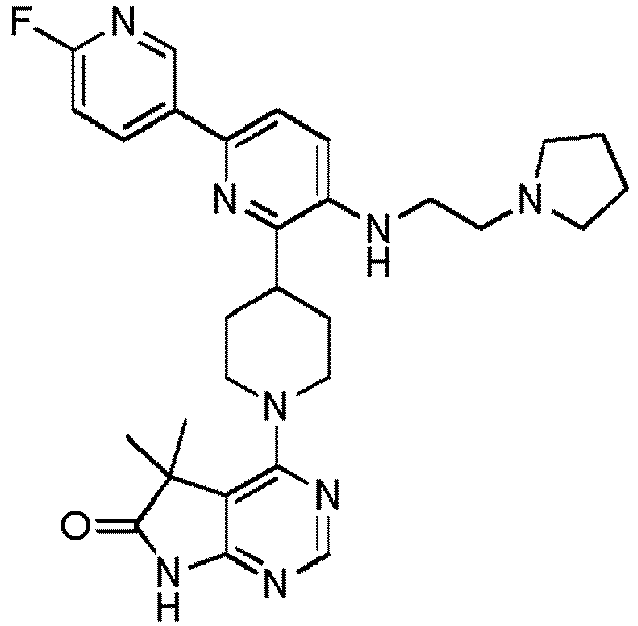
3 
4 
5 
6 
7 
8 
9 
10 
11 
12 
13 
14 
15 
16 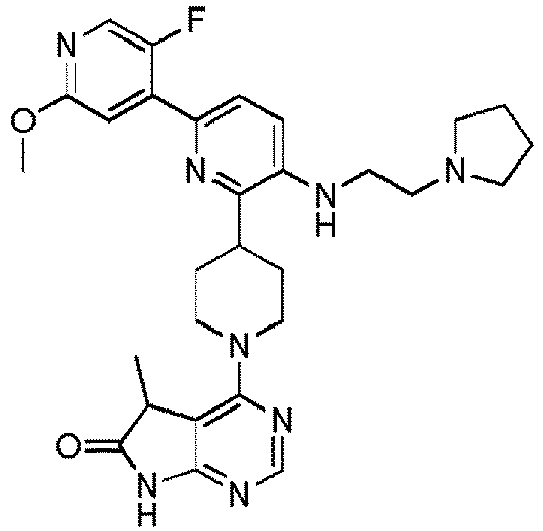
17 
18 
19 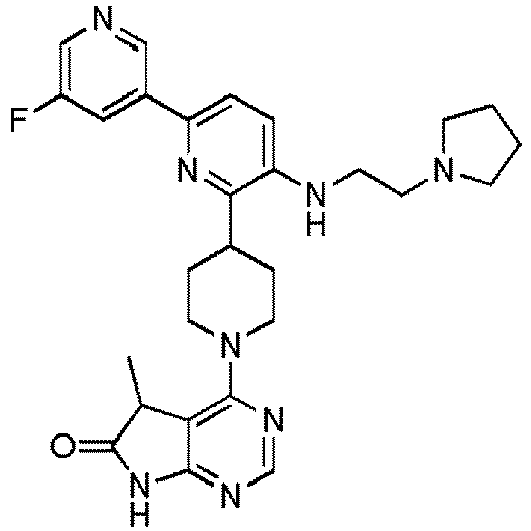
20 
21 
22 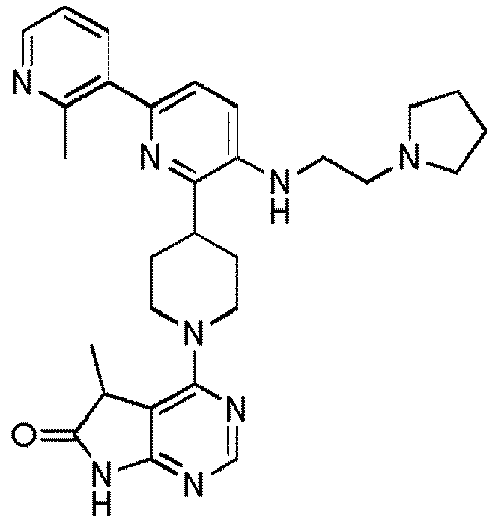
23 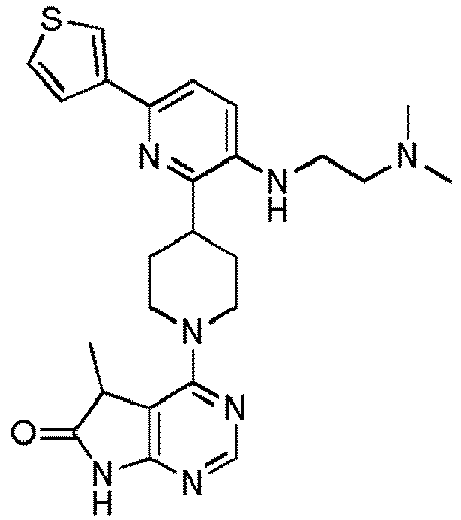
24 
25 
26 
27 
28 
29 
30 
31 
32 
33 
34 
35 
36 
37 
38 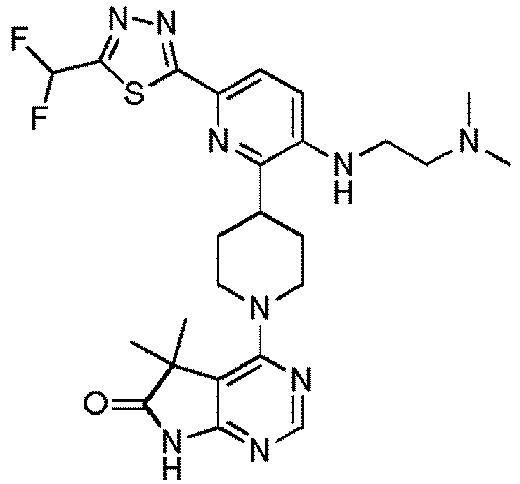
39 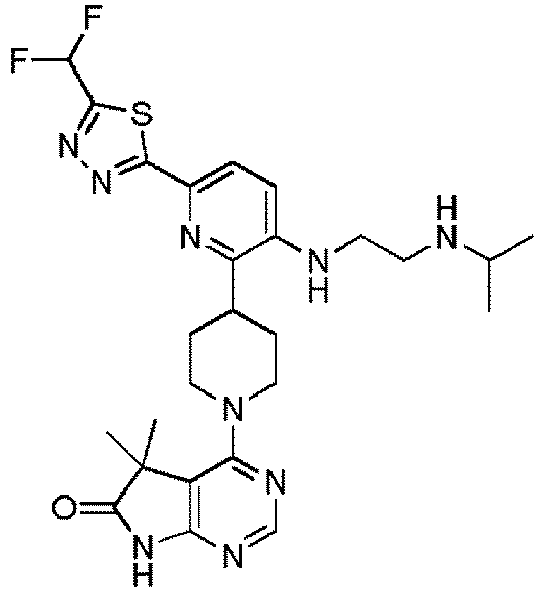
40 
41 
42 
43 
44 
- Verbindung oder Salz davon nach Anspruch 8, wobei die Verbindung aus den Verbindungen Nr. 1, 13, 14, 15, 17, 18, 19, 20, 22, 23, 24, 26, 27, 29, 30, 32, 34, 41, 43 und 44 ausgewählt ist.
- Verbindung oder Salz davon nach einem der Ansprüche 1 bis 7, wobei die Verbindung aus den unten aufgeführten Verbindungen ausgewählt ist:4-(4-(6-(5-(Difluormethyl)-1,3,4-oxadiazol-2-yl)3-((2-(pyrrolidin-1-yl)ethyl)amino)pyridin-2-yl)piperidin-1-yl)-5,5-dimethyl-5H-pyrrolo[2,3-d]pyrimidin-6(7H)-on,4-(4-(3-((2-(tert.-Butylamino)ethyl)amino)-6-(5-(trifluormethyl)-1,3,4-oxadiazol-2-yl)pyridin-2-yl)piperidin-1-yl)-5,5-dimethyl-5H-pyrrolo[2,3-d]pyrimidin-6(7H)-on und4-(4-(3-((2-(tert.-Butylamino)ethyl)amino)-6-(5-(difluormethyl)-1,2,4-oxadiazol-3-yl)pyridin-2-yl)piperidin-1-yl)-5,5-dimethyl-5H-pyrrolo[2,3-d]pyrimidin-6(7H)-on.
- Pharmazeutische Zusammensetzung, die sich zur Behandlung eines Tumors eignet, umfassend, als einen Wirkstoff, die Verbindung oder das Salz davon nach einem der Ansprüche 1 bis 10.
- Verbindung oder Salz davon oder pharmazeutische Zusammensetzung nach einem der Ansprüche 1 bis 11 zur Verwendung bei der Behandlung eines Tumors.
- Verbindung oder Salz davon oder pharmazeutische Zusammensetzung zur Verwendung nach Anspruch 12, wobei es sich bei dem Tumor um eine Krebserkrankung des Verdauungssystems oder einen Genitalkrebs handelt.
- Verbindung oder Salz davon oder pharmazeutische Zusammensetzung zur Verwendung nach Anspruch 12, wobei es sich bei dem Tumor um einen Dickdarmkrebs oder Endometriumkrebs handelt.
Priority Applications (1)
| Application Number | Priority Date | Filing Date | Title |
|---|---|---|---|
| PL17799511T PL3459953T3 (pl) | 2016-05-20 | 2017-05-19 | Nowa pochodna 5h-pirolo[2,3-d]pirymidyn-6(7h)-onu |
Applications Claiming Priority (2)
| Application Number | Priority Date | Filing Date | Title |
|---|---|---|---|
| JP2016101599 | 2016-05-20 | ||
| PCT/JP2017/018825 WO2017200087A1 (ja) | 2016-05-20 | 2017-05-19 | 新規5H-ピロロ[2,3-d]ピリミジン-6(7H)-オン誘導体 |
Publications (3)
| Publication Number | Publication Date |
|---|---|
| EP3459953A1 EP3459953A1 (de) | 2019-03-27 |
| EP3459953A4 EP3459953A4 (de) | 2020-01-08 |
| EP3459953B1 true EP3459953B1 (de) | 2021-06-30 |
Family
ID=60325930
Family Applications (1)
| Application Number | Title | Priority Date | Filing Date |
|---|---|---|---|
| EP17799511.5A Active EP3459953B1 (de) | 2016-05-20 | 2017-05-19 | Neuartiges 5h-pyrrolo[2,3-d]pyrimidin-6(7h)-on-derivat |
Country Status (21)
| Country | Link |
|---|---|
| US (1) | US10538528B2 (de) |
| EP (1) | EP3459953B1 (de) |
| JP (1) | JP6576553B2 (de) |
| KR (1) | KR102149734B1 (de) |
| CN (1) | CN109153681B (de) |
| AU (1) | AU2017265769B9 (de) |
| BR (1) | BR112018073721B1 (de) |
| CA (1) | CA3024831C (de) |
| DK (1) | DK3459953T3 (de) |
| ES (1) | ES2882018T3 (de) |
| HU (1) | HUE055846T2 (de) |
| MA (1) | MA45048A (de) |
| MX (1) | MX374576B (de) |
| MY (1) | MY185962A (de) |
| PH (1) | PH12018502411A1 (de) |
| PL (1) | PL3459953T3 (de) |
| PT (1) | PT3459953T (de) |
| RU (1) | RU2713181C1 (de) |
| SG (1) | SG11201810360YA (de) |
| TW (2) | TWI679202B (de) |
| WO (1) | WO2017200087A1 (de) |
Families Citing this family (5)
| Publication number | Priority date | Publication date | Assignee | Title |
|---|---|---|---|---|
| AU2022366515A1 (en) * | 2021-10-13 | 2024-04-04 | Taiho Pharmaceutical Co., Ltd. | Treatment methods for subjects having cancer with a dysregulated mapk and/or pi3k pathway |
| WO2023143424A1 (zh) * | 2022-01-27 | 2023-08-03 | 四川海思科制药有限公司 | 一种氮杂并环衍生物及其在医药上的应用 |
| TW202421127A (zh) * | 2022-07-05 | 2024-06-01 | 日商大鵬藥品工業股份有限公司 | 5H-吡咯并〔2,3-d〕嘧啶-6(7H)-酮及其鹽體之結晶 |
| CN115850244B (zh) * | 2023-02-24 | 2023-05-16 | 成都大学 | 一种托吡司他的制备方法 |
| WO2025260014A1 (en) * | 2024-06-14 | 2025-12-18 | Tenvie Therapeutics, Inc. | Compounds, compositions, and methods |
Family Cites Families (8)
| Publication number | Priority date | Publication date | Assignee | Title |
|---|---|---|---|---|
| US8076338B2 (en) * | 2004-04-23 | 2011-12-13 | Exelixis, Inc. | Kinase modulators and methods of use |
| GB0608184D0 (en) * | 2006-04-25 | 2006-06-07 | Astex Therapeutics Ltd | Pharmaceutical compounds |
| AR064416A1 (es) * | 2006-12-21 | 2009-04-01 | Cancer Rec Tech Ltd | Derivados de purina, piridina y pirimidina condensadas con heterociclos, moduladores de pka y/o pkb, composiciones farmaceuticas que los contienen, y usos para el tratamiento de enfermedades hiperproliferativas. |
| ES2539306T3 (es) * | 2008-08-08 | 2015-06-29 | Nestec S.A. | Máquina de bebidas con mango de transporte y con funciones de apariencia y laterales configurables |
| AR074072A1 (es) | 2008-11-11 | 2010-12-22 | Lilly Co Eli | Compuesto de imidazol -piperidin -pirrol-pirimidin-6-ona, composicion farmaceutica que lo comprende y su uso para preparar un medicamento util para tratar el glioblastoma multiforme |
| US8436002B2 (en) * | 2009-10-23 | 2013-05-07 | Eli Lilly And Company | AKT inhibitors |
| AR095202A1 (es) * | 2013-03-11 | 2015-09-30 | Merck Patent Gmbh | Heterociclos como moduladores de la actividad quinasa |
| JP6398659B2 (ja) | 2014-11-28 | 2018-10-03 | アイシン・エィ・ダブリュ株式会社 | 歯形部品の製造方法および歯形部品製造装置 |
-
2017
- 2017-05-19 ES ES17799511T patent/ES2882018T3/es active Active
- 2017-05-19 MX MX2018014022A patent/MX374576B/es active IP Right Grant
- 2017-05-19 US US16/302,829 patent/US10538528B2/en active Active
- 2017-05-19 DK DK17799511.5T patent/DK3459953T3/da active
- 2017-05-19 MA MA045048A patent/MA45048A/fr unknown
- 2017-05-19 CN CN201780030144.3A patent/CN109153681B/zh active Active
- 2017-05-19 EP EP17799511.5A patent/EP3459953B1/de active Active
- 2017-05-19 TW TW106116606A patent/TWI679202B/zh active
- 2017-05-19 HU HUE17799511A patent/HUE055846T2/hu unknown
- 2017-05-19 PL PL17799511T patent/PL3459953T3/pl unknown
- 2017-05-19 AU AU2017265769A patent/AU2017265769B9/en active Active
- 2017-05-19 RU RU2018144542A patent/RU2713181C1/ru active
- 2017-05-19 JP JP2018518384A patent/JP6576553B2/ja active Active
- 2017-05-19 MY MYPI2018704229A patent/MY185962A/en unknown
- 2017-05-19 SG SG11201810360YA patent/SG11201810360YA/en unknown
- 2017-05-19 BR BR112018073721-6A patent/BR112018073721B1/pt active IP Right Grant
- 2017-05-19 TW TW108107835A patent/TWI732187B/zh active
- 2017-05-19 PT PT177995115T patent/PT3459953T/pt unknown
- 2017-05-19 WO PCT/JP2017/018825 patent/WO2017200087A1/ja not_active Ceased
- 2017-05-19 CA CA3024831A patent/CA3024831C/en active Active
- 2017-05-19 KR KR1020187030344A patent/KR102149734B1/ko active Active
-
2018
- 2018-11-15 PH PH12018502411A patent/PH12018502411A1/en unknown
Non-Patent Citations (1)
| Title |
|---|
| None * |
Also Published As
Similar Documents
| Publication | Publication Date | Title |
|---|---|---|
| EP3788042B1 (de) | Bcl-2-inhibitoren | |
| EP3768671B1 (de) | Substituierte imidazolidin-2-on-derivate als prmt5-inhibitoren | |
| CN112574255B (zh) | 一类基于有机胂的cdk抑制剂及其制备方法和用途 | |
| CN114437035A (zh) | 一种抑制并降解irak4的化合物及其药物组合物和药学上的应用 | |
| EP3459953B1 (de) | Neuartiges 5h-pyrrolo[2,3-d]pyrimidin-6(7h)-on-derivat | |
| EP3168219B1 (de) | Pyridonderivat mit tetrahydropyranyl-methylgruppe | |
| CN112552294A (zh) | 含哌嗪杂环类衍生物抑制剂、其制备方法和应用 | |
| JP2016512239A (ja) | Atrキナーゼの阻害剤として有用な化合物 | |
| TW200815417A (en) | New compounds II | |
| JP2016512816A (ja) | Atrキナーゼの阻害剤として有用な化合物 | |
| JP2016512815A (ja) | Atrキナーゼの阻害剤として有用な縮合ピラゾロピリミジン誘導体 | |
| JP2018504449A (ja) | ヘテロ環化合物及びそれを含む薬剤学的組成物 | |
| CA3078942A1 (en) | Pyrrolotriazine compounds and methods of inhibiting tam kinases | |
| EP3992193A1 (de) | Pyrazolopyrimidinverbindung, herstellungsverfahren dafür und anwendungen davon | |
| EP4471030A1 (de) | Propylenketonhaltiger bioinhibitor, herstellungsverfahren dafür und verwendung davon | |
| CN113493439A (zh) | 取代的丙烯酰胺衍生物及其组合物及用途 | |
| CN120112532A (zh) | Parg抑制性化合物 | |
| HK40105836A (en) | Ubiquitin-specific protease 1 (usp1) inhibitor | |
| HK1259613B (zh) | 新型5H-吡咯并[2,3-d]嘧啶-6(7H)-酮衍生物 | |
| HK40038513B (en) | Bcl-2 inhibitors | |
| HK40038513A (en) | Bcl-2 inhibitors | |
| HK1260629B (en) | 4-(3h-indol-5-yl)-n-(pyridin-2-yl)pyrimidin-2-amine derivatives as protein kinase inhibitors, preparation method and medical use thereof | |
| HK1260629A1 (en) | 4-(3h-indol-5-yl)-n-(pyridin-2-yl)pyrimidin-2-amine derivatives as protein kinase inhibitors, preparation method and medical use thereof | |
| TW201127837A (en) | Certain triazolopyridines and triazolopyrazines, compositions thereof and methods of use therefor |
Legal Events
| Date | Code | Title | Description |
|---|---|---|---|
| STAA | Information on the status of an ep patent application or granted ep patent |
Free format text: STATUS: THE INTERNATIONAL PUBLICATION HAS BEEN MADE |
|
| PUAI | Public reference made under article 153(3) epc to a published international application that has entered the european phase |
Free format text: ORIGINAL CODE: 0009012 |
|
| STAA | Information on the status of an ep patent application or granted ep patent |
Free format text: STATUS: REQUEST FOR EXAMINATION WAS MADE |
|
| 17P | Request for examination filed |
Effective date: 20181217 |
|
| AK | Designated contracting states |
Kind code of ref document: A1 Designated state(s): AL AT BE BG CH CY CZ DE DK EE ES FI FR GB GR HR HU IE IS IT LI LT LU LV MC MK MT NL NO PL PT RO RS SE SI SK SM TR |
|
| AX | Request for extension of the european patent |
Extension state: BA ME |
|
| A4 | Supplementary search report drawn up and despatched |
Effective date: 20191205 |
|
| RIC1 | Information provided on ipc code assigned before grant |
Ipc: C07D 487/04 20060101AFI20191130BHEP Ipc: A61K 31/519 20060101ALI20191130BHEP Ipc: A61P 35/00 20060101ALI20191130BHEP |
|
| RIC1 | Information provided on ipc code assigned before grant |
Ipc: C07D 487/04 20060101AFI20200714BHEP Ipc: A61P 35/00 20060101ALI20200714BHEP Ipc: A61K 31/519 20060101ALI20200714BHEP |
|
| GRAP | Despatch of communication of intention to grant a patent |
Free format text: ORIGINAL CODE: EPIDOSNIGR1 |
|
| STAA | Information on the status of an ep patent application or granted ep patent |
Free format text: STATUS: GRANT OF PATENT IS INTENDED |
|
| INTG | Intention to grant announced |
Effective date: 20200821 |
|
| GRAJ | Information related to disapproval of communication of intention to grant by the applicant or resumption of examination proceedings by the epo deleted |
Free format text: ORIGINAL CODE: EPIDOSDIGR1 |
|
| STAA | Information on the status of an ep patent application or granted ep patent |
Free format text: STATUS: REQUEST FOR EXAMINATION WAS MADE |
|
| INTC | Intention to grant announced (deleted) | ||
| GRAP | Despatch of communication of intention to grant a patent |
Free format text: ORIGINAL CODE: EPIDOSNIGR1 |
|
| STAA | Information on the status of an ep patent application or granted ep patent |
Free format text: STATUS: GRANT OF PATENT IS INTENDED |
|
| INTG | Intention to grant announced |
Effective date: 20210126 |
|
| GRAS | Grant fee paid |
Free format text: ORIGINAL CODE: EPIDOSNIGR3 |
|
| GRAA | (expected) grant |
Free format text: ORIGINAL CODE: 0009210 |
|
| STAA | Information on the status of an ep patent application or granted ep patent |
Free format text: STATUS: THE PATENT HAS BEEN GRANTED |
|
| AK | Designated contracting states |
Kind code of ref document: B1 Designated state(s): AL AT BE BG CH CY CZ DE DK EE ES FI FR GB GR HR HU IE IS IT LI LT LU LV MC MK MT NL NO PL PT RO RS SE SI SK SM TR |
|
| REG | Reference to a national code |
Ref country code: CH Ref legal event code: EP |
|
| REG | Reference to a national code |
Ref country code: AT Ref legal event code: REF Ref document number: 1406269 Country of ref document: AT Kind code of ref document: T Effective date: 20210715 |
|
| REG | Reference to a national code |
Ref country code: DE Ref legal event code: R096 Ref document number: 602017041323 Country of ref document: DE |
|
| REG | Reference to a national code |
Ref country code: PT Ref legal event code: SC4A Ref document number: 3459953 Country of ref document: PT Date of ref document: 20210729 Kind code of ref document: T Free format text: AVAILABILITY OF NATIONAL TRANSLATION Effective date: 20210723 |
|
| REG | Reference to a national code |
Ref country code: IE Ref legal event code: FG4D |
|
| REG | Reference to a national code |
Ref country code: FI Ref legal event code: FGE |
|
| REG | Reference to a national code |
Ref country code: RO Ref legal event code: EPE |
|
| REG | Reference to a national code |
Ref country code: DK Ref legal event code: T3 Effective date: 20210820 |
|
| REG | Reference to a national code |
Ref country code: NL Ref legal event code: FP |
|
| REG | Reference to a national code |
Ref country code: SE Ref legal event code: TRGR |
|
| REG | Reference to a national code |
Ref country code: LT Ref legal event code: MG9D |
|
| PG25 | Lapsed in a contracting state [announced via postgrant information from national office to epo] |
Ref country code: HR Free format text: LAPSE BECAUSE OF FAILURE TO SUBMIT A TRANSLATION OF THE DESCRIPTION OR TO PAY THE FEE WITHIN THE PRESCRIBED TIME-LIMIT Effective date: 20210630 Ref country code: BG Free format text: LAPSE BECAUSE OF FAILURE TO SUBMIT A TRANSLATION OF THE DESCRIPTION OR TO PAY THE FEE WITHIN THE PRESCRIBED TIME-LIMIT Effective date: 20210930 |
|
| REG | Reference to a national code |
Ref country code: NO Ref legal event code: T2 Effective date: 20210630 |
|
| REG | Reference to a national code |
Ref country code: GR Ref legal event code: EP Ref document number: 20210402049 Country of ref document: GR Effective date: 20211013 |
|
| PG25 | Lapsed in a contracting state [announced via postgrant information from national office to epo] |
Ref country code: LV Free format text: LAPSE BECAUSE OF FAILURE TO SUBMIT A TRANSLATION OF THE DESCRIPTION OR TO PAY THE FEE WITHIN THE PRESCRIBED TIME-LIMIT Effective date: 20210630 Ref country code: RS Free format text: LAPSE BECAUSE OF FAILURE TO SUBMIT A TRANSLATION OF THE DESCRIPTION OR TO PAY THE FEE WITHIN THE PRESCRIBED TIME-LIMIT Effective date: 20210630 |
|
| REG | Reference to a national code |
Ref country code: ES Ref legal event code: FG2A Ref document number: 2882018 Country of ref document: ES Kind code of ref document: T3 Effective date: 20211130 |
|
| REG | Reference to a national code |
Ref country code: HU Ref legal event code: AG4A Ref document number: E055846 Country of ref document: HU |
|
| PG25 | Lapsed in a contracting state [announced via postgrant information from national office to epo] |
Ref country code: EE Free format text: LAPSE BECAUSE OF FAILURE TO SUBMIT A TRANSLATION OF THE DESCRIPTION OR TO PAY THE FEE WITHIN THE PRESCRIBED TIME-LIMIT Effective date: 20210630 Ref country code: SM Free format text: LAPSE BECAUSE OF FAILURE TO SUBMIT A TRANSLATION OF THE DESCRIPTION OR TO PAY THE FEE WITHIN THE PRESCRIBED TIME-LIMIT Effective date: 20210630 Ref country code: SK Free format text: LAPSE BECAUSE OF FAILURE TO SUBMIT A TRANSLATION OF THE DESCRIPTION OR TO PAY THE FEE WITHIN THE PRESCRIBED TIME-LIMIT Effective date: 20210630 |
|
| VS25 | Lapsed in a validation state [announced via postgrant information from nat. office to epo] |
Ref country code: MD Free format text: LAPSE BECAUSE OF FAILURE TO SUBMIT A TRANSLATION OF THE DESCRIPTION OR TO PAY THE FEE WITHIN THE PRESCRIBED TIME-LIMIT Effective date: 20210630 |
|
| REG | Reference to a national code |
Ref country code: DE Ref legal event code: R097 Ref document number: 602017041323 Country of ref document: DE |
|
| PLBE | No opposition filed within time limit |
Free format text: ORIGINAL CODE: 0009261 |
|
| STAA | Information on the status of an ep patent application or granted ep patent |
Free format text: STATUS: NO OPPOSITION FILED WITHIN TIME LIMIT |
|
| PG25 | Lapsed in a contracting state [announced via postgrant information from national office to epo] |
Ref country code: AL Free format text: LAPSE BECAUSE OF FAILURE TO SUBMIT A TRANSLATION OF THE DESCRIPTION OR TO PAY THE FEE WITHIN THE PRESCRIBED TIME-LIMIT Effective date: 20210630 |
|
| 26N | No opposition filed |
Effective date: 20220331 |
|
| PG25 | Lapsed in a contracting state [announced via postgrant information from national office to epo] |
Ref country code: MC Free format text: LAPSE BECAUSE OF FAILURE TO SUBMIT A TRANSLATION OF THE DESCRIPTION OR TO PAY THE FEE WITHIN THE PRESCRIBED TIME-LIMIT Effective date: 20210630 Ref country code: LU Free format text: LAPSE BECAUSE OF NON-PAYMENT OF DUE FEES Effective date: 20220519 |
|
| PG25 | Lapsed in a contracting state [announced via postgrant information from national office to epo] |
Ref country code: LT Free format text: LAPSE BECAUSE OF FAILURE TO SUBMIT A TRANSLATION OF THE DESCRIPTION OR TO PAY THE FEE WITHIN THE PRESCRIBED TIME-LIMIT Effective date: 20210630 |
|
| P01 | Opt-out of the competence of the unified patent court (upc) registered |
Effective date: 20230522 |
|
| PG25 | Lapsed in a contracting state [announced via postgrant information from national office to epo] |
Ref country code: MK Free format text: LAPSE BECAUSE OF FAILURE TO SUBMIT A TRANSLATION OF THE DESCRIPTION OR TO PAY THE FEE WITHIN THE PRESCRIBED TIME-LIMIT Effective date: 20210630 Ref country code: CY Free format text: LAPSE BECAUSE OF FAILURE TO SUBMIT A TRANSLATION OF THE DESCRIPTION OR TO PAY THE FEE WITHIN THE PRESCRIBED TIME-LIMIT Effective date: 20210630 |
|
| VS25 | Lapsed in a validation state [announced via postgrant information from nat. office to epo] |
Ref country code: MA Free format text: LAPSE BECAUSE OF FAILURE TO SUBMIT A TRANSLATION OF THE DESCRIPTION OR TO PAY THE FEE WITHIN THE PRESCRIBED TIME-LIMIT Effective date: 20210630 |
|
| PG25 | Lapsed in a contracting state [announced via postgrant information from national office to epo] |
Ref country code: MT Free format text: LAPSE BECAUSE OF FAILURE TO SUBMIT A TRANSLATION OF THE DESCRIPTION OR TO PAY THE FEE WITHIN THE PRESCRIBED TIME-LIMIT Effective date: 20210630 |
|
| PGFP | Annual fee paid to national office [announced via postgrant information from national office to epo] |
Ref country code: GB Payment date: 20250327 Year of fee payment: 9 |
|
| PGFP | Annual fee paid to national office [announced via postgrant information from national office to epo] |
Ref country code: NL Payment date: 20250409 Year of fee payment: 9 |
|
| PGFP | Annual fee paid to national office [announced via postgrant information from national office to epo] |
Ref country code: FI Payment date: 20250513 Year of fee payment: 9 |
|
| PGFP | Annual fee paid to national office [announced via postgrant information from national office to epo] |
Ref country code: PL Payment date: 20250415 Year of fee payment: 9 Ref country code: DE Payment date: 20250402 Year of fee payment: 9 |
|
| PGFP | Annual fee paid to national office [announced via postgrant information from national office to epo] |
Ref country code: ES Payment date: 20250602 Year of fee payment: 9 Ref country code: DK Payment date: 20250516 Year of fee payment: 9 |
|
| PGFP | Annual fee paid to national office [announced via postgrant information from national office to epo] |
Ref country code: HU Payment date: 20250429 Year of fee payment: 9 Ref country code: NO Payment date: 20250509 Year of fee payment: 9 |
|
| PGFP | Annual fee paid to national office [announced via postgrant information from national office to epo] |
Ref country code: IT Payment date: 20250422 Year of fee payment: 9 Ref country code: BE Payment date: 20250410 Year of fee payment: 9 |
|
| PGFP | Annual fee paid to national office [announced via postgrant information from national office to epo] |
Ref country code: PT Payment date: 20250519 Year of fee payment: 9 |
|
| PGFP | Annual fee paid to national office [announced via postgrant information from national office to epo] |
Ref country code: FR Payment date: 20250401 Year of fee payment: 9 |
|
| PGFP | Annual fee paid to national office [announced via postgrant information from national office to epo] |
Ref country code: GR Payment date: 20250416 Year of fee payment: 9 |
|
| PGFP | Annual fee paid to national office [announced via postgrant information from national office to epo] |
Ref country code: CH Payment date: 20250601 Year of fee payment: 9 |
|
| PGFP | Annual fee paid to national office [announced via postgrant information from national office to epo] |
Ref country code: AT Payment date: 20250425 Year of fee payment: 9 Ref country code: RO Payment date: 20250415 Year of fee payment: 9 |
|
| PGFP | Annual fee paid to national office [announced via postgrant information from national office to epo] |
Ref country code: TR Payment date: 20250508 Year of fee payment: 9 |
|
| PGFP | Annual fee paid to national office [announced via postgrant information from national office to epo] |
Ref country code: CZ Payment date: 20250430 Year of fee payment: 9 |
|
| PGFP | Annual fee paid to national office [announced via postgrant information from national office to epo] |
Ref country code: IE Payment date: 20250402 Year of fee payment: 9 |
|
| PGFP | Annual fee paid to national office [announced via postgrant information from national office to epo] |
Ref country code: SE Payment date: 20250411 Year of fee payment: 9 |