EP3447128A1 - Methods for the production of ips cells using non-viral approach - Google Patents
Methods for the production of ips cells using non-viral approach Download PDFInfo
- Publication number
- EP3447128A1 EP3447128A1 EP18187583.2A EP18187583A EP3447128A1 EP 3447128 A1 EP3447128 A1 EP 3447128A1 EP 18187583 A EP18187583 A EP 18187583A EP 3447128 A1 EP3447128 A1 EP 3447128A1
- Authority
- EP
- European Patent Office
- Prior art keywords
- cells
- cell
- vector
- ebna
- reprogramming
- Prior art date
- Legal status (The legal status is an assumption and is not a legal conclusion. Google has not performed a legal analysis and makes no representation as to the accuracy of the status listed.)
- Withdrawn
Links
Images


Classifications
-
- C—CHEMISTRY; METALLURGY
- C12—BIOCHEMISTRY; BEER; SPIRITS; WINE; VINEGAR; MICROBIOLOGY; ENZYMOLOGY; MUTATION OR GENETIC ENGINEERING
- C12N—MICROORGANISMS OR ENZYMES; COMPOSITIONS THEREOF; PROPAGATING, PRESERVING, OR MAINTAINING MICROORGANISMS; MUTATION OR GENETIC ENGINEERING; CULTURE MEDIA
- C12N5/00—Undifferentiated human, animal or plant cells, e.g. cell lines; Tissues; Cultivation or maintenance thereof; Culture media therefor
- C12N5/06—Animal cells or tissues; Human cells or tissues
- C12N5/0602—Vertebrate cells
- C12N5/0696—Artificially induced pluripotent stem cells, e.g. iPS
-
- C—CHEMISTRY; METALLURGY
- C07—ORGANIC CHEMISTRY
- C07K—PEPTIDES
- C07K14/00—Peptides having more than 20 amino acids; Gastrins; Somatostatins; Melanotropins; Derivatives thereof
- C07K14/005—Peptides having more than 20 amino acids; Gastrins; Somatostatins; Melanotropins; Derivatives thereof from viruses
-
- C—CHEMISTRY; METALLURGY
- C12—BIOCHEMISTRY; BEER; SPIRITS; WINE; VINEGAR; MICROBIOLOGY; ENZYMOLOGY; MUTATION OR GENETIC ENGINEERING
- C12N—MICROORGANISMS OR ENZYMES; COMPOSITIONS THEREOF; PROPAGATING, PRESERVING, OR MAINTAINING MICROORGANISMS; MUTATION OR GENETIC ENGINEERING; CULTURE MEDIA
- C12N15/00—Mutation or genetic engineering; DNA or RNA concerning genetic engineering, vectors, e.g. plasmids, or their isolation, preparation or purification; Use of hosts therefor
- C12N15/09—Recombinant DNA-technology
- C12N15/63—Introduction of foreign genetic material using vectors; Vectors; Use of hosts therefor; Regulation of expression
- C12N15/79—Vectors or expression systems specially adapted for eukaryotic hosts
- C12N15/85—Vectors or expression systems specially adapted for eukaryotic hosts for animal cells
-
- C—CHEMISTRY; METALLURGY
- C12—BIOCHEMISTRY; BEER; SPIRITS; WINE; VINEGAR; MICROBIOLOGY; ENZYMOLOGY; MUTATION OR GENETIC ENGINEERING
- C12N—MICROORGANISMS OR ENZYMES; COMPOSITIONS THEREOF; PROPAGATING, PRESERVING, OR MAINTAINING MICROORGANISMS; MUTATION OR GENETIC ENGINEERING; CULTURE MEDIA
- C12N2501/00—Active agents used in cell culture processes, e.g. differentation
- C12N2501/60—Transcription factors
- C12N2501/602—Sox-2
-
- C—CHEMISTRY; METALLURGY
- C12—BIOCHEMISTRY; BEER; SPIRITS; WINE; VINEGAR; MICROBIOLOGY; ENZYMOLOGY; MUTATION OR GENETIC ENGINEERING
- C12N—MICROORGANISMS OR ENZYMES; COMPOSITIONS THEREOF; PROPAGATING, PRESERVING, OR MAINTAINING MICROORGANISMS; MUTATION OR GENETIC ENGINEERING; CULTURE MEDIA
- C12N2501/00—Active agents used in cell culture processes, e.g. differentation
- C12N2501/60—Transcription factors
- C12N2501/603—Oct-3/4
-
- C—CHEMISTRY; METALLURGY
- C12—BIOCHEMISTRY; BEER; SPIRITS; WINE; VINEGAR; MICROBIOLOGY; ENZYMOLOGY; MUTATION OR GENETIC ENGINEERING
- C12N—MICROORGANISMS OR ENZYMES; COMPOSITIONS THEREOF; PROPAGATING, PRESERVING, OR MAINTAINING MICROORGANISMS; MUTATION OR GENETIC ENGINEERING; CULTURE MEDIA
- C12N2501/00—Active agents used in cell culture processes, e.g. differentation
- C12N2501/60—Transcription factors
- C12N2501/604—Klf-4
-
- C—CHEMISTRY; METALLURGY
- C12—BIOCHEMISTRY; BEER; SPIRITS; WINE; VINEGAR; MICROBIOLOGY; ENZYMOLOGY; MUTATION OR GENETIC ENGINEERING
- C12N—MICROORGANISMS OR ENZYMES; COMPOSITIONS THEREOF; PROPAGATING, PRESERVING, OR MAINTAINING MICROORGANISMS; MUTATION OR GENETIC ENGINEERING; CULTURE MEDIA
- C12N2501/00—Active agents used in cell culture processes, e.g. differentation
- C12N2501/60—Transcription factors
- C12N2501/605—Nanog
-
- C—CHEMISTRY; METALLURGY
- C12—BIOCHEMISTRY; BEER; SPIRITS; WINE; VINEGAR; MICROBIOLOGY; ENZYMOLOGY; MUTATION OR GENETIC ENGINEERING
- C12N—MICROORGANISMS OR ENZYMES; COMPOSITIONS THEREOF; PROPAGATING, PRESERVING, OR MAINTAINING MICROORGANISMS; MUTATION OR GENETIC ENGINEERING; CULTURE MEDIA
- C12N2501/00—Active agents used in cell culture processes, e.g. differentation
- C12N2501/60—Transcription factors
- C12N2501/606—Transcription factors c-Myc
-
- C—CHEMISTRY; METALLURGY
- C12—BIOCHEMISTRY; BEER; SPIRITS; WINE; VINEGAR; MICROBIOLOGY; ENZYMOLOGY; MUTATION OR GENETIC ENGINEERING
- C12N—MICROORGANISMS OR ENZYMES; COMPOSITIONS THEREOF; PROPAGATING, PRESERVING, OR MAINTAINING MICROORGANISMS; MUTATION OR GENETIC ENGINEERING; CULTURE MEDIA
- C12N2501/00—Active agents used in cell culture processes, e.g. differentation
- C12N2501/60—Transcription factors
- C12N2501/608—Lin28
-
- C—CHEMISTRY; METALLURGY
- C12—BIOCHEMISTRY; BEER; SPIRITS; WINE; VINEGAR; MICROBIOLOGY; ENZYMOLOGY; MUTATION OR GENETIC ENGINEERING
- C12N—MICROORGANISMS OR ENZYMES; COMPOSITIONS THEREOF; PROPAGATING, PRESERVING, OR MAINTAINING MICROORGANISMS; MUTATION OR GENETIC ENGINEERING; CULTURE MEDIA
- C12N2510/00—Genetically modified cells
-
- C—CHEMISTRY; METALLURGY
- C12—BIOCHEMISTRY; BEER; SPIRITS; WINE; VINEGAR; MICROBIOLOGY; ENZYMOLOGY; MUTATION OR GENETIC ENGINEERING
- C12N—MICROORGANISMS OR ENZYMES; COMPOSITIONS THEREOF; PROPAGATING, PRESERVING, OR MAINTAINING MICROORGANISMS; MUTATION OR GENETIC ENGINEERING; CULTURE MEDIA
- C12N2710/00—MICROORGANISMS OR ENZYMES; COMPOSITIONS THEREOF; PROPAGATING, PRESERVING, OR MAINTAINING MICROORGANISMS; MUTATION OR GENETIC ENGINEERING; CULTURE MEDIA dsDNA viruses
- C12N2710/00011—Details
- C12N2710/16011—Herpesviridae
- C12N2710/16211—Lymphocryptovirus, e.g. human herpesvirus 4, Epstein-Barr Virus
- C12N2710/16222—New viral proteins or individual genes, new structural or functional aspects of known viral proteins or genes
-
- C—CHEMISTRY; METALLURGY
- C12—BIOCHEMISTRY; BEER; SPIRITS; WINE; VINEGAR; MICROBIOLOGY; ENZYMOLOGY; MUTATION OR GENETIC ENGINEERING
- C12N—MICROORGANISMS OR ENZYMES; COMPOSITIONS THEREOF; PROPAGATING, PRESERVING, OR MAINTAINING MICROORGANISMS; MUTATION OR GENETIC ENGINEERING; CULTURE MEDIA
- C12N2800/00—Nucleic acids vectors
- C12N2800/10—Plasmid DNA
- C12N2800/106—Plasmid DNA for vertebrates
- C12N2800/107—Plasmid DNA for vertebrates for mammalian
-
- C—CHEMISTRY; METALLURGY
- C12—BIOCHEMISTRY; BEER; SPIRITS; WINE; VINEGAR; MICROBIOLOGY; ENZYMOLOGY; MUTATION OR GENETIC ENGINEERING
- C12N—MICROORGANISMS OR ENZYMES; COMPOSITIONS THEREOF; PROPAGATING, PRESERVING, OR MAINTAINING MICROORGANISMS; MUTATION OR GENETIC ENGINEERING; CULTURE MEDIA
- C12N2800/00—Nucleic acids vectors
- C12N2800/10—Plasmid DNA
- C12N2800/108—Plasmid DNA episomal vectors
-
- C—CHEMISTRY; METALLURGY
- C12—BIOCHEMISTRY; BEER; SPIRITS; WINE; VINEGAR; MICROBIOLOGY; ENZYMOLOGY; MUTATION OR GENETIC ENGINEERING
- C12N—MICROORGANISMS OR ENZYMES; COMPOSITIONS THEREOF; PROPAGATING, PRESERVING, OR MAINTAINING MICROORGANISMS; MUTATION OR GENETIC ENGINEERING; CULTURE MEDIA
- C12N2800/00—Nucleic acids vectors
- C12N2800/24—Vectors characterised by the absence of particular element, e.g. selectable marker, viral origin of replication
-
- C—CHEMISTRY; METALLURGY
- C12—BIOCHEMISTRY; BEER; SPIRITS; WINE; VINEGAR; MICROBIOLOGY; ENZYMOLOGY; MUTATION OR GENETIC ENGINEERING
- C12N—MICROORGANISMS OR ENZYMES; COMPOSITIONS THEREOF; PROPAGATING, PRESERVING, OR MAINTAINING MICROORGANISMS; MUTATION OR GENETIC ENGINEERING; CULTURE MEDIA
- C12N2820/00—Vectors comprising a special origin of replication system
- C12N2820/60—Vectors comprising a special origin of replication system from viruses
-
- C—CHEMISTRY; METALLURGY
- C12—BIOCHEMISTRY; BEER; SPIRITS; WINE; VINEGAR; MICROBIOLOGY; ENZYMOLOGY; MUTATION OR GENETIC ENGINEERING
- C12N—MICROORGANISMS OR ENZYMES; COMPOSITIONS THEREOF; PROPAGATING, PRESERVING, OR MAINTAINING MICROORGANISMS; MUTATION OR GENETIC ENGINEERING; CULTURE MEDIA
- C12N2840/00—Vectors comprising a special translation-regulating system
- C12N2840/10—Vectors comprising a special translation-regulating system regulates levels of translation
- C12N2840/105—Vectors comprising a special translation-regulating system regulates levels of translation enhancing translation
-
- C—CHEMISTRY; METALLURGY
- C12—BIOCHEMISTRY; BEER; SPIRITS; WINE; VINEGAR; MICROBIOLOGY; ENZYMOLOGY; MUTATION OR GENETIC ENGINEERING
- C12N—MICROORGANISMS OR ENZYMES; COMPOSITIONS THEREOF; PROPAGATING, PRESERVING, OR MAINTAINING MICROORGANISMS; MUTATION OR GENETIC ENGINEERING; CULTURE MEDIA
- C12N2840/00—Vectors comprising a special translation-regulating system
- C12N2840/20—Vectors comprising a special translation-regulating system translation of more than one cistron
- C12N2840/203—Vectors comprising a special translation-regulating system translation of more than one cistron having an IRES
- C12N2840/206—Vectors comprising a special translation-regulating system translation of more than one cistron having an IRES having multiple IRES
Definitions
- the present invention relates generally to the field of molecular biology, stem cells and differentiated cells. More particularly, it concerns differentiation programming or reprogramming of somatic cells and undifferentiated cells.
- Induced pluripotent stem cells are a type of pluripotent stem cell artificially derived from a non-pluripotent cell, typically an adult somatic cell, by inserting certain genes. Induced pluripotent stem cells are believed to be identical to natural pluripotent stem cells, such as embryonic stem cells in many respects, such as in terms of the expression of certain stem cell genes and proteins, chromatin methylation patterns, doubling time, embryoid body formation, teratoma formation, viable chimera formation, and potency and differentiability, but the full extent of their relation to natural pluripotent stem cells is still being assessed.
- iPS induced pluripotent stem
- the similar mechanisms may also apply to dedifferentiation, for example, inducing pluripotency from somatic cells as mentioned above, and transdifferentiation, specifically referring to transformation of one differentiated cell type into another.
- Transcription factors controlling the development choices have been studied to change differentiation status; however, viral vectors have also been widely used. Therefore, there is a need for improved viral free differentiation programming methods.
- the iPS reprogramming factors may comprise at least one member from Sox family and at least one member from Oct family, specifically, Sox-2 and Oct-4. Sox and Oct are thought to be central to the transcriptional regulatory hierarchy that specifies ES cell identity. Additional factors may increase the reprogramming efficiency, such as a set comprising Sox-2, Oct-4, Nanog and, optionally, Lin-28; or comprising Sox-2, Oct-4, Klf and, optionally, c-Myc.
- the replication origin may be a replication origin of a lymphotrophic herpes virus or a gammaherpesvirus, an adenovirus, SV40, a bovine papilloma virus, or a yeast, such as a replication origin of a lymphotrophic herpes virus or a gammaherpesvirus corresponding to oriP of EBV.
- the viral-free methods can be used for inducing any changes in differentiation status of a cell.
- a method of providing a cell population having an altered differentiation status relative to a starting cell population and having cells that are essentially free of programming vector genetic elements comprising the steps of: a) obtaining a starting population of cells having a first differentiation status; b) obtaining one or more differentiation programming vectors, each vector comprising a replication origin and one or more expression cassettes encoding one or more differentiation programming factors that, in combination, can alter the differentiation status of the starting cell population to a second differentiation status, wherein one or more of said expression cassettes comprise a nucleotide sequence encoding a trans-acting factor that binds to the replication origin to replicate an extra-chromosomal template, and/or wherein the cells of the starting population express such a trans-acting factor; c) introducing the differentiation programming vector(s) into cells of the starting cell population; d) culturing the cells to effect expression of the one or
- the replication origin may be a replication origin of a lymphotrophic herpes virus or a gamma herpesvirus, an adenovirus, SV40, a bovine papilloma virus, or a yeast, specifically a replication origin of a lymphotrophic herpes virus or a gamma herpesvirus corresponding to oriP of EBV.
- the lymphotrophic herpes virus may be Epstein Barr virus (EBV), Kaposi's sarcoma herpes virus (KSHV), Herpes virus saimiri (HS), or Marek's disease virus (MDV).
- Epstein Barr virus (EBV) and Kaposi's sarcoma herpes virus (KSHV) are also examples of a gamma herpesvirus.
- the trans-acting factor may be a polypeptide corresponding to, or a derivative of a wild-type protein corresponding to EBNA-1 of EBV.
- the derivative may activate transcription at least 5% that of the corresponding wild-type protein from an extra-chromosomal template after the derivative binds the replication origin, and/or have a reduced ability to activate transcription from an integrated template as compared to wild-type EBNA-1 and thus reduced chances to ectopically activate chromosome genes to cause oncogenic transformation.
- Example of a derivative may include a derivative which lacks sequences present in the wild-type EBNA-1 protein that activate transcription from an integrated template, a derivative which has a nuclear localization sequence, a derivative which has a deletion of residues corresponding to residues about 65 to about 89 of EBNA-1, and/or has a deletion of residues corresponding to residues about 90 to about 328 of EBNA-1, a derivative with at least 80% amino acid sequence identity to residues 1 to about 40 and residues about 328 to 641 of EBNA-1, or a derivative comprising a first nucleotide sequence encoding residues 1 to about 40 of the corresponding wild-type EBNA-1 and a second nucleotide sequence encoding residues about 328 to 641 of the corresponding wild-type EBNA-1.
- Reprogramming is a process that confers on a cell a measurably increased capacity to form progeny of at least one new cell type, either in culture or in vivo, than it would have under the same conditions without reprogramming. More specifically, reprogramming is a process that confers on a somatic cell a pluripotent potential. This means that after sufficient proliferation, a measurable proportion of progeny having phenotypic characteristics of the new cell type if essentially no such progeny could form before reprogramming; otherwise, the proportion having characteristics of the new cell type is measurably more than before reprogramming. Under certain conditions, the proportion of progeny with characteristics of the new cell type may be at least about 1%, 5%, 25% or more in the in order of increasing preference.
- “Differentiation programming” is a process that changes a cell to form progeny of at least one new cell type with a new differentiation status, either in culture or in vivo, than it would have under the same conditions without differentiation reprogramming. This process includes differentiation, dedifferentiation and transdifferentiation. "Differentiation” is the process by which a less specialized cell becomes a more specialized cell type. "Dedifferentiation” is a cellular process in which a partially or terminally differentiated cell reverts to an earlier developmental stage, such as pluripotency or multipotency. "Transdifferentiation” is a process of transforming one differentiated cell type into another differentiated cell type.
- An "origin of replication” (“ori") or “replication origin” is a DNA sequence, e.g., in a lymphotrophic herpes virus, that when present in a plasmid in a cell is capable of maintaining linked sequences in the plasmid, and/or a site at or near where DNA synthesis initiates.
- An ori for EBV includes FR sequences (20 imperfect copies of a 30 bp repeat), and preferably DS sequences, however, other sites in EBV bind EBNA-1, e.g ., Rep* sequences can substitute for DS as an origin of replication (Kirshmaier and Sugden, 1998).
- a "lymphotrophic" herpes virus is a herpes virus that replicates in a lymphoblast (e.g. , a human B lymphoblast) or other cell types and replicates extra-chromosomally for at least a part of its natural life-cycle. After infecting a host, these viruses latently infect the host by maintaining the viral genome as a plasmid.
- Herpes simplex virus (HSV) is not a "lymphotrophic" herpes virus.
- Exemplary lymphotropic herpes viruses include, but are not limited to EBV, Kaposi's sarcoma herpes virus (KSHV), Herpes virus saimiri (HS) and Marek's disease virus (MDV).
- a "plasmid”, a common type of a vector, is an extra-chromosomal DNA molecule separate from the chromosomal DNA which is capable of replicating independently of the chromosomal DNA. In certain cases, it is circular and double-stranded.
- expression construct or "expression cassette” is meant a nucleic acid molecule that is capable of directing transcription.
- An expression construct includes, at the least, a promoter or a structure functionally equivalent to a promoter. Additional elements, such as an enhancer, and/or a transcription termination signal, may also be included.
- exogenous when used in relation to a protein, gene, nucleic acid, or polynucleotide in a cell or organism refers to a protein, gene, nucleic acid, or polynucleotide which has been introduced into the cell or organism by artificial or natural means, or in relation a cell refers to a cell which was isolated and subsequently introduced to other cells or to an organism by artificial or natural means.
- An exogenous nucleic acid may be from a different organism or cell, or it may be one or more additional copies of a nucleic acid which occurs naturally within the organism or cell.
- An exogenous cell may be from a different organism, or it may be from the same organism.
- an exogenous nucleic acid is in a chromosomal location different from that of natural cells, or is otherwise flanked by a different nucleic acid sequence than that found in nature.
- a gene can include, but is not limited to, cDNA from prokaryotic or eukaryotic mRNA, genomic DNA sequences from prokaryotic or eukaryotic DNA, and synthetic DNA sequences.
- a transcription termination sequence will usually be located 3' to the gene sequence.
- promoter is used herein in its ordinary sense to refer to a nucleotide region comprising a DNA regulatory sequence, wherein the regulatory sequence is derived from a gene which is capable of binding RNA polymerase and initiating transcription of a downstream (3' direction) coding sequence.
- homology refers to the percent of identity between two polynucleotides or two polypeptides. The correspondence between one sequence and to another can be determined by techniques known in the art. For example, homology can be determined by a direct comparison of the sequence information between two polypeptide molecules by aligning the sequence information and using readily available computer programs. Alternatively, homology can be determined by hybridization of polynucleotides under conditions which form stable duplexes between homologous regions, followed by digestion with single strand-specific nuclease(s), and size determination of the digested fragments.
- stem cell refers to a cell capable of self replication and pluripotency. Typically, stem cells can regenerate an injured tissue.
- Stem cells herein may be, but are not limited to, embryonic stem (ES) cells or tissue stem cells (also called tissue-specific stem cell, or somatic stem cell). Any artificially produced cell which can have the above-described abilities (e.g ., fusion cells, reprogrammed cells, or the like used herein) may be a stem cell.
- Embryonic stem (ES) cells are pluripotent stem cells derived from early embryos. An ES cell was first established in 1981, which has also been applied to production of knockout mice since 1989. In 1998, a human ES cell was established, which is currently becoming available for regenerative medicine.
- LIN28 is an mRNA binding protein expressed in embryonic stem cells and embryonic carcinoma cells associated with differentiation and proliferation. Thomson et al. demonstrated it is a factor in iPS generation, although it is unnecessary.
- lymphotrophic herpes virus-based including or Epstein Barr Virus (EBV) as defined above may also replicate extra-chromosomally and help deliver reprogramming genes to somatic cells.
- Epstein Barr Virus EBV
- the replication origins of these viruses or ARS element are well characterized, they have never been known for reprogramming differentiated cells to public until this disclosure.
- the plasmid-based approach used in the invention extracts robust elements necessary for the successful replication and maintenance of an EBV element-based system without compromising the system's tractability in a clinical setting as described in detail below.
- the essential EBV elements are OriP and EBNA-1 or their variants or functional equivalents.
- An additional advantage of this system is that these exogenous elements will be lost with time after being introduced into cells, leading to self-sustained iPS cells essentially free of these elements.
- FR is composed of 21 imperfect copies of a 30 bp repeat and contains 20 high affinity EBNA1-binding sites ( FIG. 1 ).
- EBNA1 high affinity EBNA1-binding sites
- FR When FR is bound by EBNA1, it both serves as a transcriptional enhancer of promoters in cis up to 10 kb away (Reisman and Sugden, 1986; Yates, 1988; Sugden and Warren, 1989; Wysokenski and Yates, 1989; Gahn and Sugden, 1995;Kennedy and Sugden, 2003; Altmann et al., 2006), and contributes to the nuclear retention and faithful maintenance of FR containing plasmids (Langle-Rouault et al., 1998; Kirchmaier and Sugden, 1995; Wang et al., 2006; Nanbo and Sugden, 2007).
- DS contains four EBNA1-binding sites, albeit with lower affinity than those found in FR (Reisman et al., 1985).
- a third of EBNA1's residues consist of glycine-glycine-alanine (GGA) repeats, implicated in EBNA1's ability to evade the host immune response by inhibiting proteosomal degradation and presentation (Levitskaya et al., 1995; Levitskaya et al., 1997). These repeats have also been found to inhibit translation of EBNA1 in vitro and in vivo (Yin et al., 2003). However, the deletion of much of this domain has no apparent effect on functions of EBNA1 in cell culture, making the role that this domain plays difficult to elucidate.
- GGA glycine-glycine-alanine
- an exemplary derivative the abbreviated form of EBNA1, known as deltaUR1 (the derivative with a protein sequence SEQ ID NO:3, which is encoded by SEQ ID NO:4), could be used alongside oriP within this plasmid-based system.
- deltaUR1 the derivative with a protein sequence SEQ ID NO:3, which is encoded by SEQ ID NO:4
- More examples of EBNA1 derivatives that can activate transcription from an extra-chromosomal template see, for example, Kirchmaier and Sugden, 1997, and Kennedy and Sugden, 2003, both incorporated herein by reference.
- a derivative of EBNA-1 used in the invention is a polypeptide which, relative to a corresponding wild-type polypeptide, has a modified amino acid sequence.
- the modifications include the deletion, insertion or substitution of at least one amino acid residue in a region corresponding to the unique region (residues about 65 to about 89) of LR1 (residues about 40 to about 89) in EBNA-1, and may include a deletion, insertion and/or substitution of one or more amino acid residues in regions corresponding to other residues of EBNA-1, e.g., about residue 1 to about residue 40, residues about 90 to about 328 ("Gly-Gly-Ala" repeat region), residues about 329 to about 377 (LR2), residues about 379 to about 386 (NLS), residues about 451 to about 608 (DNA binding and dimerization), or residues about 609 to about 641, so long as the resulting derivative has the desired properties, e.g ., dimerizes and
- reprogramming or differentiation programming vectors could be constructed to comprise additional elements in addition to nucleic acid sequences encoding reprogramming factors or differentiation programming factors as described above to express these reprogramming factors in cells.
- the novel features of these methods are use of extra-chromosomally replicating vectors, which will not be integrated into the host cell genome and may be lost during generations of replication. Details of components of these vectors and delivery methods are disclosed below.
- Eukaryotic expression cassettes included in the vectors preferably contain (in a 5'-to-3' direction) a eukaryotic transcriptional promoter operably linked to a protein-coding sequence, splice signals including intervening sequences, and a transcriptional termination/polyadenylation sequence.
- a coding sequence "under the control of' a promoter, one positions the 5' end of the transcription initiation site of the transcriptional reading frame "downstream" of ( i.e., 3' of) the chosen promoter.
- the "upstream” promoter stimulates transcription of the DNA and promotes expression of the encoded RNA.
- promoter elements frequently are flexible, so that promoter function is preserved when elements are inverted or moved relative to one another.
- the spacing between promoter elements can be increased to 50 bp apart before activity begins to decline.
- individual elements can function either cooperatively or independently to activate transcription.
- a promoter may or may not be used in conjunction with an "enhancer,” which refers to a cis-acting regulatory sequence involved in the transcriptional activation of a nucleic acid sequence.
- a promoter may be one naturally associated with a nucleic acid sequence, as may be obtained by isolating the 5' non-coding sequences located upstream of the coding segment and/or exon. Such a promoter can be referred to as "endogenous.”
- an enhancer may be one naturally associated with a nucleic acid sequence, located either downstream or upstream of that sequence.
- certain advantages will be gained by positioning the coding nucleic acid segment under the control of a recombinant or heterologous promoter, which refers to a promoter that is not normally associated with a nucleic acid sequence in its natural environment.
- a recombinant or heterologous enhancer refers also to an enhancer not normally associated with a nucleic acid sequence in its natural environment.
- promoters or enhancers may include promoters or enhancers of other genes, and promoters or enhancers isolated from any other virus, or prokaryotic or eukaryotic cell, and promoters or enhancers not "naturally occurring," i.e., containing different elements of different transcriptional regulatory regions, and/or mutations that alter expression.
- promoters that are most commonly used in recombinant DNA construction include the ⁇ -lactamase (penicillinase), lactose and tryptophan (trp) promoter systems.
- Non-limiting examples of promoters include early or late viral promoters, such as, SV40 early or late promoters, cytomegalovirus (CMV) immediate early promoters, Rous Sarcoma Virus (RSV) early promoters; eukaryotic cell promoters, such as, e.g., beta actin promoter ( Ng, S. Y., Nuc. Acid Res. 17: 601-615,1989 , Quitsche et al., J. Biol. Chem. 264: 9539-9545,1989 ), GADPH promoter ( Alexander et al., Proc. Nat. Acad. Sci. USA 85: 5092- 5096,1988 , Ercolani et al., J.
- early or late viral promoters such as, SV40 early or late promoters, cytomegalovirus (CMV) immediate early promoters, Rous Sarcoma Virus (RSV) early promoters
- eukaryotic cell promoters
- a specific initiation signal also may be required for efficient translation of coding sequences. These signals include the ATG initiation codon or adjacent sequences. Exogenous translational control signals, including the ATG initiation codon, may need to be provided. One of ordinary skill in the art would readily be capable of determining this and providing the necessary signals. It is well known that the initiation codon must be "in-frame" with the reading frame of the desired coding sequence to ensure translation of the entire insert. The exogenous translational control signals and initiation codons can be either natural or synthetic. The efficiency of expression may be enhanced by the inclusion of appropriate transcription enhancer elements.
- each open reading frame is accessible to ribosomes for efficient translation.
- Multiple genes can be efficiently expressed using a single promoter/enhancer to transcribe a single message (see U.S. Patent Nos. 5,925,565 and 5,935,819 , each herein incorporated by reference).
- Vectors can include a multiple cloning site (MCS), which is a nucleic acid region that contains multiple restriction enzyme sites, any of which can be used in conjunction with standard recombinant technology to digest the vector (see, for example, Carbonelli et al., 1999, Levenson et al., 1998, and Cocea, 1997, incorporated herein by reference.)
- MCS multiple cloning site
- Restriction enzyme digestion refers to catalytic cleavage of a nucleic acid molecule with an enzyme that functions only at specific locations in a nucleic acid molecule. Many of these restriction enzymes are commercially available. Use of such enzymes is widely understood by those of skill in the art.
- a vector is linearized or fragmented using a restriction enzyme that cuts within the MCS to enable exogenous sequences to be ligated to the vector.
- "Ligation” refers to the process of forming phosphodiester bonds between two nucleic acid fragments, which may or may not be contiguous with each other. Techniques involving restriction enzymes and ligation reactions are well known to those of skill in the art of recombinant technology.
- One of skill in the art would also know how to employ immunologic markers, possibly in conjunction with FACS analysis.
- the marker used is not believed to be important, so long as it is capable of being expressed simultaneously with the nucleic acid encoding a gene product.
- Further examples of selection and screenable markers are well known to one of skill in the art.
- One feature of the present invention includes using selection and screenable markers to select vector-free cells after the differentiation programming factors have effected a desired altered differentiation status in those cells.
- a liposome may be complexed with a hemagglutinating virus (HVJ). This has been shown to facilitate fusion with the cell membrane and promote cell entry of liposome-encapsulated DNA (Kaneda et al., 1989).
- a liposome may be complexed or employed in conjunction with nuclear non-histone chromosomal proteins (HMG-1) (Kato et al., 1991).
- HMG-1 nuclear non-histone chromosomal proteins
- a liposome may be complexed or employed in conjunction with both HVJ and HMG-1.
- a delivery vehicle may comprise a ligand and a liposome.
- the nucleic acid delivery vehicle component of a targeted delivery vehicle may be a liposome itself, which will preferably comprise one or more lipids or glycoproteins that direct cell-specific binding.
- lipids or glycoproteins that direct cell-specific binding.
- lactosyl-ceramide, a galactose-terminal asialganglioside have been incorporated into liposomes and observed an increase in the uptake of the insulin gene by hepatocytes (Nicolau et al., 1987). It is contemplated that the tissue-specific transforming constructs of the present invention can be specifically delivered into a target cell in a similar manner.
- Microprojectile bombardment techniques can be used to introduce a nucleic acid into at least one, organelle, cell, tissue or organism ( U.S. Patent No. 5,550,318 ; U.S. Patent No. 5,538,880 ; U.S. Patent No. 5,610,042 ; and PCT Application WO 94/09699 ; each of which is incorporated herein by reference).
- This method depends on the ability to accelerate DNA-coated microprojectiles to a high velocity allowing them to pierce cell membranes and enter cells without killing them (Klein et al., 1987).
- microprojectile bombardment techniques There are a wide variety of microprojectile bombardment techniques known in the art, many of which are applicable to the invention.
- cells in suspension are concentrated on filters or solid culture medium.
- immature embryos or other target cells may be arranged on solid culture medium.
- the cells to be bombarded are positioned at an appropriate distance below the macroprojectile stopping plate.
- reprogramming vectors after a reprogramming vector is introduced into somatic cells, cells will be cultured for expansion (optionally selected for the presence of vector elements like positive selection or screenable marker to concentrate transfected cells) and reprogramming vectors will express reprogramming factors in these cells and replicate and partition along with cell division. These expressed reprogramming factors will reprogram somatic cell genome to establish a self-sustaining pluripotent state, and in the meantime or after removal of positive selection of the presence of vectors, exogenous genetic elements will be lost gradually.
- These induced pluripotent stem cells could be selected from progeny derived from these somatic cells based on embryonic stem cell characteristics because they are expected to be substantially identical to pluripotent embryonic stem cells.
- An additional negative selection step could be also employed to accelerate or help selection of iPS cells essentially free of exogenous genetic elements by testing the absence of reprogramming vector DNA or using selection markers.
- iPSCs could be mitotically active, actively self-renewing, proliferating, and dividing at a rate equal to ESCs.
- iPSCs may express cell surface antigenic markers expressed on ESCs.
- Human iPSCs expressed the markers specific to hESC, including, but not limited to, SSEA-3, SSEA-4, TRA-1-60, TRA-1-81, TRA-2-49/6E, and Nanog.
- Mouse iPSCs expressed SSEA-1 but not SSEA-3 nor SSEA-4, similarly to mESCs.
- iPSCs may express genes expressed in undifferentiated ESCs, including Oct-3/4, Sox-2, Nanog, GDF3, REX1, FGF4, ESG1, DPPA2, DPPA4, and hTERT.
- Telomerases are necessary to sustain cell division unrestricted by the Hayflick limit of ⁇ 50 cell divisions. hESCs express high telomerase activity to sustain self-renewal and proliferation, and iPSCs also demonstrate high telomerase activity and express hTERT (human telomerase reverse transcriptase), a necessary component in the telomerase protein complex.
- hTERT human telomerase reverse transcriptase
- iPSCs will be capable of differentiation in a fashion similar to ESCs into fully differentiated tissues.
- iPSCs could be differentiated into neurons, expressing ⁇ III-tubulin, tyrosine hydroxylase, AADC, DAT, ChAT, LMX1B, and MAP2.
- catecholamine-associated enzymes may indicate that iPSCs, like hESCs, may be differentiable into dopaminergic neurons.
- Stem cell-associated genes will be downregulated after differentiation.
- iPSCs could be differentiated into cardiomyocytes that spontaneously began beating. Cardiomyocytes expressed TnTc, MEF2C, MYL2A, MYHC ⁇ , and NKX2.5. Stem cell-associated genes will be downregulated after differentiation.
- Teratoma Formation iPSCs injected into immunodeficient mice may spontaneously formed teratomas after certain time, such as nine weeks. Teratomas are tumors of multiple lineages containing tissue derived from the three germ layers endoderm, mesoderm and ectoderm; this is unlike other tumors, which typically are of only one cell type. Teratoma formation is a landmark test for pluripotency.
- Embryoid Body hESCs in culture spontaneously form ball-like embryo-like structures termed "embryoid bodies," which consist of a core of mitotically active and differentiating hESCs and a periphery of fully differentiated cells from all three germ layers. iPSCs may also form embryoid bodies and have peripheral differentiated cells.
- Methylation is the transfer of a methyl group to a DNA base, typically the transfer of a methyl group to a cytosine molecule in a CpG site (adjacent cytosine/guanine sequence). Widespread methylation of a gene interferes with expression by preventing the activity of expression proteins or recruiting enzymes that interfere with expression. Thus, methylation of a gene effectively silences it by preventing transcription. Promoters of pluripotency-associated genes, including Oct-3/4, Rex1, and Nanog, may be demethylated in iPSCs, showing their promoter activity and the active promotion and expression of pluripotency-associated genes in iPSCs.
- Histones are compacting proteins that are structurally localized to DNA sequences that can effect their activity through various chromatin-related modifications.
- H3 histones associated with Oct-3/4, Sox-2, and Nanog may be demethylated to activate the expression of Oct-3/4, Sox-2, and Nanog.
- a reprogramming vector such as oriP-based plasmid in this invention will replicate extra-chromosomally and lose it presence in host cells after generations.
- an additional selection step for progeny cells essentially free of exogenous vector elements may facilitate this process.
- a sample of progeny cell may be extracted to test the presence or loss of exogenous vector elements as known in the art ( Leight and Sugden, Molecular and Cellular Biology, 2001 ).
- An alternative or complementary approach is to test the absence of exogenous genetic elements in progeny cells, using conventional methods, such as RT-PCR, PCR, FISH (Fluorescent in situ hybridization), gene array, or hybridization (e.g. , Southern blot).
- conventional methods such as RT-PCR, PCR, FISH (Fluorescent in situ hybridization), gene array, or hybridization (e.g. , Southern blot).
- IPS cells like ES cells, have characteristic antigens that can be identified by immunohistochemistry or flow cytometry, using antibodies for SSEA-1, SSEA-3 and SSEA-4 (Developmental Studies Hybridoma Bank, National Institute of Child Health and Human Development, Bethesda Md.), and TRA-1-60 and TRA-1-81 ( Andrews et al., in Robertson E, ed. Teratocarcinomas and Embryonic Stem Cells. IRL Press, 207-246,1987 ). Pluripotency of embryonic stem cells can be confirmed by injecting approximately 0.5-10 10 6 cells into the rear leg muscles of 8-12 week old male SCID mice. Teratomas develop that demonstrate at least one cell type of each of the three germ layers.
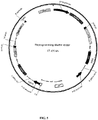
- the inventors construct a recipient backbone plasmid which contains the oriP sequence including DS and FR separated by approximately 1,000 base pairs derived from EBV (see Lindner and Sugden, 2007) and the abbreviated form of wild-type EBNA1 known as deltaUR1 (referred to as DomNeg2 in Kennedy et al. 2003) ( FIG. 3 ).
- the plasmid is currently built to express deltaUR1 driven by the elongation factor 1a (EF1a) promoter which also contains an intronic sequence to maximize the expression of deltaUR1.
- EF1a elongation factor 1a
- the backbone plasmid has been currently set up to include a selection marker for mammalian cells encoding resistance to Hygromycin; however, the choice of resistance marker remains flexible according to the sensitivity of the cell line in which the plasmid will be introduced.
- the plasmid encodes drug-resistance for prokaryotic selection and, in this case, the plasmid encodes resistance to ampicillin.
- the inventors integrated a number of cassettes within the recipient plasmid described above that encode the genes required for and contribute to reprogramming cells to become pluripotent (i.e ., iPS cells).
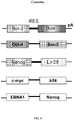
- One cassette encoded two genes essential for the reprogramming process, Sox-2 and Oct-4 ( FIG. 4 ).
- the inventors could use the phosphoglycerate kinase (PGK) promoter, cytomegalovirus immediate-early gene (CMV) promoter or SV40 promoter to drive the expression of Sox-2 and Oct-4 but this choice is subject to change depending on the efficiency of that expression.
- PGK phosphoglycerate kinase
- CMV cytomegalovirus immediate-early gene
- SV40 promoter SV40 promoter
- they have also included the second intron from the human beta-globin gene to also maximize expression of the transcript.
- the master shuttling plasmid or reprogramming plasmid could encode Sox-2, Oct-4, Nanog, and possibly Lin28 ( FIG. 5 ) while its replication and maintenance could be promoted by the presence of oriP and deltaUR1.
- This plasmid will also be poised for future modifications to include a negative selection marker such as thymidine kinase and an additional positive selection marker such as sequences encoding green or red fluorescent protein.
- the inventors will likely select colonies resembling stem cells around twenty days post-transfection and transfer them to MEFs or matrigel in 6 well culture plates while feeding daily or every other day with specialized media. Once sufficient expansion has taken place, clones will be karyotyped and tested for proper markers specific to stem cells.
Landscapes
- Health & Medical Sciences (AREA)
- Life Sciences & Earth Sciences (AREA)
- Engineering & Computer Science (AREA)
- Genetics & Genomics (AREA)
- Chemical & Material Sciences (AREA)
- Organic Chemistry (AREA)
- Biomedical Technology (AREA)
- Zoology (AREA)
- Biotechnology (AREA)
- Wood Science & Technology (AREA)
- Bioinformatics & Cheminformatics (AREA)
- General Engineering & Computer Science (AREA)
- General Health & Medical Sciences (AREA)
- Biochemistry (AREA)
- Microbiology (AREA)
- Molecular Biology (AREA)
- Biophysics (AREA)
- Developmental Biology & Embryology (AREA)
- Transplantation (AREA)
- Cell Biology (AREA)
- Plant Pathology (AREA)
- Physics & Mathematics (AREA)
- Virology (AREA)
- Gastroenterology & Hepatology (AREA)
- Medicinal Chemistry (AREA)
- Proteomics, Peptides & Aminoacids (AREA)
- Micro-Organisms Or Cultivation Processes Thereof (AREA)
Applications Claiming Priority (6)
| Application Number | Priority Date | Filing Date | Title |
|---|---|---|---|
| US5885808P | 2008-06-04 | 2008-06-04 | |
| US16058409P | 2009-03-16 | 2009-03-16 | |
| EP17179349.0A EP3279314A1 (en) | 2008-06-04 | 2009-06-04 | Methods for the production of ips cells using non-viral approach |
| EP16165367.0A EP3112456A1 (en) | 2008-06-04 | 2009-06-04 | Methods for the production of ips cells using non-viral approach |
| EP09759392.5A EP2297307B1 (en) | 2008-06-04 | 2009-06-04 | Methods for the production of ips cells using non-viral approach |
| PCT/US2009/046209 WO2009149233A1 (en) | 2008-06-04 | 2009-06-04 | Methods for the production of ips cells using non-viral approach |
Related Parent Applications (3)
| Application Number | Title | Priority Date | Filing Date |
|---|---|---|---|
| EP17179349.0A Division EP3279314A1 (en) | 2008-06-04 | 2009-06-04 | Methods for the production of ips cells using non-viral approach |
| EP09759392.5A Division EP2297307B1 (en) | 2008-06-04 | 2009-06-04 | Methods for the production of ips cells using non-viral approach |
| EP16165367.0A Division EP3112456A1 (en) | 2008-06-04 | 2009-06-04 | Methods for the production of ips cells using non-viral approach |
Publications (1)
| Publication Number | Publication Date |
|---|---|
| EP3447128A1 true EP3447128A1 (en) | 2019-02-27 |
Family
ID=40977641
Family Applications (4)
| Application Number | Title | Priority Date | Filing Date |
|---|---|---|---|
| EP18187583.2A Withdrawn EP3447128A1 (en) | 2008-06-04 | 2009-06-04 | Methods for the production of ips cells using non-viral approach |
| EP09759392.5A Revoked EP2297307B1 (en) | 2008-06-04 | 2009-06-04 | Methods for the production of ips cells using non-viral approach |
| EP17179349.0A Withdrawn EP3279314A1 (en) | 2008-06-04 | 2009-06-04 | Methods for the production of ips cells using non-viral approach |
| EP16165367.0A Withdrawn EP3112456A1 (en) | 2008-06-04 | 2009-06-04 | Methods for the production of ips cells using non-viral approach |
Family Applications After (3)
| Application Number | Title | Priority Date | Filing Date |
|---|---|---|---|
| EP09759392.5A Revoked EP2297307B1 (en) | 2008-06-04 | 2009-06-04 | Methods for the production of ips cells using non-viral approach |
| EP17179349.0A Withdrawn EP3279314A1 (en) | 2008-06-04 | 2009-06-04 | Methods for the production of ips cells using non-viral approach |
| EP16165367.0A Withdrawn EP3112456A1 (en) | 2008-06-04 | 2009-06-04 | Methods for the production of ips cells using non-viral approach |
Country Status (10)
| Country | Link |
|---|---|
| US (4) | US8546140B2 (enExample) |
| EP (4) | EP3447128A1 (enExample) |
| JP (5) | JP2011522540A (enExample) |
| KR (2) | KR101871192B1 (enExample) |
| AU (1) | AU2009256202B2 (enExample) |
| CA (2) | CA2954948A1 (enExample) |
| DK (1) | DK2297307T3 (enExample) |
| ES (1) | ES2587395T3 (enExample) |
| IL (1) | IL209740A (enExample) |
| WO (1) | WO2009149233A1 (enExample) |
Cited By (1)
| Publication number | Priority date | Publication date | Assignee | Title |
|---|---|---|---|---|
| WO2023077050A1 (en) * | 2021-10-29 | 2023-05-04 | FUJIFILM Cellular Dynamics, Inc. | Dopaminergic neurons comprising mutations and methods of use thereof |
Families Citing this family (128)
| Publication number | Priority date | Publication date | Assignee | Title |
|---|---|---|---|---|
| US20090227032A1 (en) * | 2005-12-13 | 2009-09-10 | Kyoto University | Nuclear reprogramming factor and induced pluripotent stem cells |
| US8278104B2 (en) | 2005-12-13 | 2012-10-02 | Kyoto University | Induced pluripotent stem cells produced with Oct3/4, Klf4 and Sox2 |
| US8129187B2 (en) | 2005-12-13 | 2012-03-06 | Kyoto University | Somatic cell reprogramming by retroviral vectors encoding Oct3/4. Klf4, c-Myc and Sox2 |
| KR101420740B1 (ko) * | 2005-12-13 | 2014-07-17 | 교또 다이가꾸 | 핵초기화 인자 |
| EP2137296A2 (en) | 2007-03-23 | 2009-12-30 | Wisconsin Alumni Research Foundation | Somatic cell reprogramming |
| JP2008307007A (ja) * | 2007-06-15 | 2008-12-25 | Bayer Schering Pharma Ag | 出生後のヒト組織由来未分化幹細胞から誘導したヒト多能性幹細胞 |
| US9213999B2 (en) * | 2007-06-15 | 2015-12-15 | Kyoto University | Providing iPSCs to a customer |
| ES2722198T3 (es) | 2008-05-02 | 2019-08-08 | Univ Kyoto | Método de reprogramación nuclear |
| EP3447128A1 (en) | 2008-06-04 | 2019-02-27 | FUJIFILM Cellular Dynamics, Inc. | Methods for the production of ips cells using non-viral approach |
| CN105671065A (zh) * | 2008-06-13 | 2016-06-15 | 怀特黑德生物医学研究所 | 细胞编程和重编程 |
| CN102171348A (zh) * | 2008-08-12 | 2011-08-31 | 细胞动力国际有限公司 | 产生ips细胞的方法 |
| EP3450545B1 (en) * | 2008-10-24 | 2023-08-23 | Wisconsin Alumni Research Foundation | Pluripotent stem cells obtained by non-viral reprogramming |
| WO2011071476A2 (en) * | 2008-11-14 | 2011-06-16 | Life Technologies Corporation | Compositions and methods for engineering cells |
| WO2010124142A2 (en) | 2009-04-22 | 2010-10-28 | Cythera, Inc. | Cell compositions derived from dedifferentiated reprogrammed cells |
| US9109245B2 (en) | 2009-04-22 | 2015-08-18 | Viacyte, Inc. | Cell compositions derived from dedifferentiated reprogrammed cells |
| CN103087991B (zh) | 2009-06-05 | 2018-06-12 | 富士胶片细胞动力公司 | 重编程t细胞和造血细胞的方法 |
| WO2011016588A1 (en) | 2009-08-07 | 2011-02-10 | Kyoto University | Method of efficiently establishing induced pluripotent stem cells |
| JP5880868B2 (ja) | 2009-09-30 | 2016-03-09 | エージェンシー フォー サイエンス,テクノロジー アンド リサーチ | 核内受容体及びその変異体、並びに細胞の再プログラミングにおけるその使用 |
| ES2539487T3 (es) * | 2009-11-04 | 2015-07-01 | Cellular Dynamics International, Inc. | Reprogramación episómica con compuestos químicos |
| WO2011119942A1 (en) * | 2010-03-25 | 2011-09-29 | Vistagen Therapeutics, Inc. | Induction of ips cells using transient episomal vectors |
| AU2011235212B2 (en) | 2010-03-31 | 2014-07-31 | The Scripps Research Institute | Reprogramming cells |
| US8048675B1 (en) | 2010-05-12 | 2011-11-01 | Ipierian, Inc. | Integration-free human induced pluripotent stem cells from blood |
| US8691574B2 (en) | 2010-06-15 | 2014-04-08 | Cellular Dynamics International, Inc. | Generation of induced pluripotent stem cells from small volumes of peripheral blood |
| WO2011159797A2 (en) | 2010-06-15 | 2011-12-22 | Cellular Dynamics International, Inc. | A compendium of ready-built stem cell models for interrogation of biological response |
| KR101861171B1 (ko) | 2010-06-18 | 2018-05-31 | 후지필름 셀룰러 다이내믹스, 인코포레이티드 | 투석된 혈청이 있는 심근세포 배지 |
| US8765470B2 (en) | 2010-08-04 | 2014-07-01 | Cellular Dynamics International, Inc. | Reprogramming immortalized B-cells to induced pluripotent stem cells |
| US20130309209A1 (en) * | 2010-10-22 | 2013-11-21 | Center For Regenerative Medicine Of Barcelona | Formation of hematopoietic progenitor cells from mesenchymal stem cells |
| EP2673358B1 (en) | 2011-02-08 | 2019-01-09 | FUJIFILM Cellular Dynamics, Inc. | Hematopoietic precursor cell production by programming |
| US9228204B2 (en) | 2011-02-14 | 2016-01-05 | University Of Utah Research Foundation | Constructs for making induced pluripotent stem cells |
| EP4086338A1 (en) | 2011-03-17 | 2022-11-09 | Minerva Biotechnologies Corporation | Method for making pluripotent stem cells |
| WO2012159079A1 (en) | 2011-05-18 | 2012-11-22 | The Parkinson's Institute | Assay to determine lrrk2 activity in parkinson's disease |
| JP2014520551A (ja) * | 2011-07-11 | 2014-08-25 | セルラー ダイナミクス インターナショナル, インコーポレイテッド | 細胞のリプログラミング方法およびゲノムの改変方法 |
| WO2013022022A1 (ja) * | 2011-08-08 | 2013-02-14 | 国立大学法人京都大学 | 効率的な人工多能性幹細胞の樹立方法 |
| WO2013059373A2 (en) | 2011-10-17 | 2013-04-25 | Minerva Biotechnologies Corporation | Media for stem cell proliferation and induction |
| US8497124B2 (en) | 2011-12-05 | 2013-07-30 | Factor Bioscience Inc. | Methods and products for reprogramming cells to a less differentiated state |
| DK3260140T3 (da) | 2011-12-05 | 2021-04-19 | Factor Bioscience Inc | Fremgangsmåder og produkter til transficering af celler |
| EP2826855B1 (en) | 2012-03-15 | 2018-08-29 | iHeart Japan Corporation | Myocardial sheet |
| JP6335117B2 (ja) | 2012-03-21 | 2018-05-30 | 国立大学法人京都大学 | アルツハイマー病の治療薬および/または予防薬のスクリーニング方法 |
| US9334475B2 (en) | 2012-04-06 | 2016-05-10 | Kyoto University | Method for inducing erythropoietin-producing cell |
| WO2013159103A1 (en) * | 2012-04-20 | 2013-10-24 | Whitehead Institute For Biomedical Research | Programming and reprogramming of cells |
| JP6084605B2 (ja) | 2012-04-27 | 2017-02-22 | 日野自動車株式会社 | バーナー、および、フィルター再生装置 |
| EP2853592B1 (en) * | 2012-05-23 | 2019-02-20 | Kyoto University | Highly efficient method for establishing artificial pluripotent stem cell |
| US9175263B2 (en) | 2012-08-22 | 2015-11-03 | Biotime, Inc. | Methods and compositions for targeting progenitor cell lines |
| US9382531B2 (en) | 2012-10-22 | 2016-07-05 | Wisconsin Alumni Research Foundation | Induction of hemogenic endothelium from pluripotent stem cells |
| BR122019025681B1 (pt) | 2012-11-01 | 2023-04-18 | Factor Bioscience Inc | Método para inserir uma sequência de ácido nucleico em uma localização segura de um genoma de uma célula |
| US8859286B2 (en) | 2013-03-14 | 2014-10-14 | Viacyte, Inc. | In vitro differentiation of pluripotent stem cells to pancreatic endoderm cells (PEC) and endocrine cells |
| US10266807B2 (en) | 2013-04-03 | 2019-04-23 | FUJIFILM Cellular Dynamics, Inc. | Methods and compositions for culturing endoderm progenitor cells in suspension |
| EP2986713A1 (en) * | 2013-04-16 | 2016-02-24 | Glykos Finland Oy | A method for generating induced pluripotent stem cells |
| EP3003290B1 (en) | 2013-06-05 | 2021-03-10 | AgeX Therapeutics, Inc. | Compositions for use in the treatment of wounds in mammalian species |
| WO2014197934A1 (en) | 2013-06-14 | 2014-12-18 | The University Of Queensland | Renal progenitor cells |
| CN103333918B (zh) * | 2013-06-19 | 2015-12-02 | 中山大学 | 一种提高猪克隆胚胎体外发育效率的方法 |
| WO2015006725A2 (en) | 2013-07-12 | 2015-01-15 | Cedars-Sinai Medical Center | Generation of induced pluripotent stem cells from normal human mammary epithelial cells |
| JP6536871B2 (ja) | 2013-12-02 | 2019-07-03 | 国立大学法人京都大学 | Fgfr3病の予防および治療剤ならびにそのスクリーニング方法 |
| US9988605B2 (en) | 2013-12-11 | 2018-06-05 | Korea Advanced Institute Of Science And Technology | Method for preparing endocrine aggregate of insulin-producing beta cells from human pluripotent stem cells |
| WO2015117021A1 (en) | 2014-01-31 | 2015-08-06 | Factor Bioscience Inc. | Methods and products for nucleic acid production and delivery |
| US11078462B2 (en) | 2014-02-18 | 2021-08-03 | ReCyte Therapeutics, Inc. | Perivascular stromal cells from primate pluripotent stem cells |
| CA2945393C (en) | 2014-04-24 | 2021-03-23 | Board Of Regents, The University Of Texas System | Application of induced pluripotent stem cells to generate adoptive cell therapy products |
| US10947500B2 (en) | 2014-06-27 | 2021-03-16 | Angiocrine Bioscience, Inc. | Neural cells expressing adenovirus E4ORF1, and methods of making and using the same |
| US10240127B2 (en) | 2014-07-03 | 2019-03-26 | ReCyte Therapeutics, Inc. | Exosomes from clonal progenitor cells |
| EP3183338B1 (en) | 2014-08-19 | 2020-03-04 | FUJIFILM Cellular Dynamics, Inc. | Neural networks formed from cells derived from pluripotent stem cells |
| EP3207122B1 (en) | 2014-10-14 | 2019-05-08 | FUJIFILM Cellular Dynamics, Inc. | Generation of keratinocytes from pluripotent stem cells and maintenance of keratinocyte cultures |
| US9828634B2 (en) | 2015-01-22 | 2017-11-28 | Regenerative Medical Solutions, Inc. | Markers for differentiation of stem cells into differentiated cell populations |
| EP3543339A1 (en) | 2015-02-13 | 2019-09-25 | Factor Bioscience Inc. | Nucleic acid products and methods of administration thereof |
| AU2016318774B2 (en) | 2015-09-08 | 2022-08-18 | FUJIFILM Cellular Dynamics, Inc. | MACS-based purification of stem cell-derived retinal pigment epithelium |
| ES2970537T3 (es) | 2015-09-08 | 2024-05-29 | Us Health | Método para la diferenciación reproducible de células epiteliales del pigmento retiniano de calidad clínica |
| US10865381B2 (en) | 2015-10-20 | 2020-12-15 | FUJIFILM Cellular Dynamics, Inc. | Multi-lineage hematopoietic precursor cell production by genetic programming |
| JP2018536438A (ja) | 2015-12-07 | 2018-12-13 | バイオタイム,インコーポレーテッド | 多様な多能性幹細胞から誘導された褐色脂肪細胞の再誘導のための方法 |
| CA3010764A1 (en) * | 2016-01-12 | 2017-07-20 | Lonza Walkersville, Inc. | Methods and vectors to produce vector free induced pluripotent stem cells |
| WO2017196175A1 (en) | 2016-05-12 | 2017-11-16 | Erasmus University Medical Center Rotterdam | A method for culturing myogenic cells, cultures obtained therefrom, screening methods, and cell culture medium. |
| US10221395B2 (en) | 2016-06-16 | 2019-03-05 | Cedars-Sinai Medical Center | Efficient method for reprogramming blood to induced pluripotent stem cells |
| US11572545B2 (en) | 2016-06-16 | 2023-02-07 | Cedars-Sinai Medical Center | Efficient method for reprogramming blood to induced pluripotent stem cells |
| US20180030478A1 (en) | 2016-07-01 | 2018-02-01 | Research Development Foundation | Elimination of proliferating cells from stem cell-derived grafts |
| WO2018035214A1 (en) | 2016-08-16 | 2018-02-22 | Cellular Dynamics International., Inc. | Methods for differentiating pluripotent cells |
| CN109803977B (zh) | 2016-08-17 | 2023-03-17 | 菲克特生物科学股份有限公司 | 核酸产品及其施用方法 |
| JP2019537729A (ja) | 2016-09-28 | 2019-12-26 | オルガノボ インコーポレイテッド | アッセイにおける人工腎臓組織の使用 |
| ES3009605T3 (en) | 2016-10-05 | 2025-03-27 | Fujifilm Cellular Dynamics Inc | Generating mature lineages from induced pluripotent stem cells with mecp2 disruption |
| WO2018089515A1 (en) | 2016-11-09 | 2018-05-17 | The United States Of America, As Represented By The Secretary, Department Of Health And Human Services | 3d vascularized human ocular tissue for cell therapy and drug discovery |
| MX2019011897A (es) | 2017-04-18 | 2019-11-28 | Fujifilm Cellular Dynamics Inc | Celulas efectoras inmunitarias especificas de antigenos. |
| NL2019517B1 (en) | 2017-09-08 | 2019-03-19 | Univ Erasmus Med Ct Rotterdam | New therapy for Pompe disease |
| EP3692139B1 (en) | 2017-10-03 | 2024-11-06 | SDF BioPharma Inc. | Treating diabetes with genetically modified beta cells |
| CA3078734A1 (en) | 2017-10-11 | 2019-04-18 | Fate Therapeutics, Inc. | Cellular reprogramming using temporal and transient plasmid vector expression system |
| GB201805683D0 (en) * | 2018-04-05 | 2018-05-23 | Touchlight Ip Ltd | Reprogramming vectors |
| AU2019256723B2 (en) | 2018-04-20 | 2025-09-04 | FUJIFILM Cellular Dynamics, Inc. | Method for differentiation of ocular cells and use thereof |
| AU2019347666B2 (en) | 2018-09-28 | 2025-10-02 | President And Fellows Of Harvard College | Cellular reprogramming to reverse aging and promote organ and tissue regeneration |
| KR20210095885A (ko) | 2018-11-19 | 2021-08-03 | 더 유나이티드 스테이츠 오브 어메리카, 애즈 리프리젠티드 바이 더 세크러테리, 디파트먼트 오브 헬쓰 앤드 휴먼 서비씨즈 | 생분해성 조직 대체 임플란트 및 그의 용도 |
| AU2019386140A1 (en) | 2018-11-28 | 2021-06-24 | Board Of Regents, The University Of Texas System | Multiplex genome editing of immune cells to enhance functionality and resistance to suppressive environment |
| CN113316455A (zh) | 2018-11-29 | 2021-08-27 | 得克萨斯大学体系董事会 | 用于离体扩增自然杀伤细胞的方法及其用途 |
| WO2020237104A1 (en) * | 2019-05-23 | 2020-11-26 | The Mclean Hospital Corporation | Autologous cell replacement therapy for parkinson's disease |
| US12410401B2 (en) | 2019-06-06 | 2025-09-09 | Wisconsin Alumni Research Foundation (Warf) | Generation of functional neutrophils and macrophages from induced pluripotent stem cells in chemically defined conditions using transient expression of ETV2 |
| WO2021003462A1 (en) | 2019-07-03 | 2021-01-07 | Factor Bioscience Inc. | Cationic lipids and uses thereof |
| US10501404B1 (en) | 2019-07-30 | 2019-12-10 | Factor Bioscience Inc. | Cationic lipids and transfection methods |
| EP4074321A4 (en) | 2019-12-12 | 2024-01-03 | National University Corporation Chiba University | Freeze-dried preparation containing megakaryocytes and platelets |
| US20230212509A1 (en) | 2020-05-29 | 2023-07-06 | FUJIFILM Cellular Dynamics, Inc. | Bilayer of retinal pigmented epithelium and photoreceptors and use thereof |
| JP2023528377A (ja) | 2020-05-29 | 2023-07-04 | フジフィルム セルラー ダイナミクス,インコーポレイテッド | 網膜色素上皮及び光受容体の二重細胞凝集体、並びにその使用方法 |
| EP3922431A1 (en) | 2020-06-08 | 2021-12-15 | Erasmus University Medical Center Rotterdam | Method of manufacturing microdevices for lab-on-chip applications |
| US20230374452A1 (en) | 2020-10-07 | 2023-11-23 | Mican Technologies Inc. | Coronavirus-infective cells and method of preparing same |
| AU2021377699A1 (en) | 2020-11-13 | 2023-06-15 | Catamaran Bio, Inc. | Genetically modified natural killer cells and methods of use thereof |
| AU2021388155A1 (en) | 2020-11-25 | 2023-06-15 | Catamaran Bio, Inc. | Cellular therapeutics engineered with signal modulators and methods of use thereof |
| AU2021392032A1 (en) | 2020-12-03 | 2023-06-22 | Century Therapeutics, Inc. | Genetically engineered cells and uses thereof |
| US11661459B2 (en) | 2020-12-03 | 2023-05-30 | Century Therapeutics, Inc. | Artificial cell death polypeptide for chimeric antigen receptor and uses thereof |
| EP4314249A1 (en) * | 2021-03-25 | 2024-02-07 | Bluerock Therapeutics LP | Methods for obtaining induced pluripotent stem cells |
| JP2024519515A (ja) | 2021-04-07 | 2024-05-15 | センチュリー セラピューティクス,インコーポレイテッド | 人工多能性幹細胞からガンマ-デルタt細胞を生成するための組成物および方法 |
| WO2022216524A1 (en) | 2021-04-07 | 2022-10-13 | Century Therapeutics, Inc. | Combined artificial cell death/reporter system polypeptide for chimeric antigen receptor cell and uses thereof |
| US20240219375A1 (en) | 2021-04-07 | 2024-07-04 | FUJIFILM Cellular Dynamics, Inc. | Dopaminergic precursor cells and methods of use |
| CN117441010A (zh) | 2021-04-07 | 2024-01-23 | 世纪治疗股份有限公司 | 从诱导多能干细胞产生α-βT细胞的组合物和方法 |
| CA3210702A1 (en) | 2021-04-07 | 2022-10-13 | Century Therapeutics, Inc. | Gene transfer vectors and methods of engineering cells |
| KR20240011831A (ko) | 2021-05-26 | 2024-01-26 | 후지필름 셀룰러 다이내믹스, 인코포레이티드 | 만능 줄기 세포에서 유전자의 신속한 사일런싱을 방지하기 위한 방법 |
| US20240271089A1 (en) | 2021-05-28 | 2024-08-15 | The U.S.A., As Represented By The Secretary, Department Of Health And Human Services | Methods to generate macular, central and peripheral retinal pigment epithelial cells |
| US20240261474A1 (en) | 2021-05-28 | 2024-08-08 | The U.S.A., As Represented By The Secretary, Department Of Health And Human Services | Biodegradable tissue scaffold with secondary matrix to host weakly adherent cells |
| JP2024531682A (ja) | 2021-09-13 | 2024-08-29 | フジフィルム セルラー ダイナミクス,インコーポレイテッド | コミットされた心臓始原細胞の製造方法 |
| EP4456912A1 (en) | 2021-12-29 | 2024-11-06 | Century Therapeutics, Inc. | Genetically engineered cells having anti-cd19 / anti-cd22 chimeric antigen receptors, and uses thereof |
| WO2023172514A1 (en) | 2022-03-07 | 2023-09-14 | Catamaran Bio, Inc. | Engineered immune cell therapeutics targeted to her2 and methods of use thereof |
| WO2023196577A1 (en) * | 2022-04-08 | 2023-10-12 | New York Stem Cell Foundation, Inc. | Methods for production of ipscs |
| CN119365492A (zh) | 2022-05-04 | 2025-01-24 | 世纪治疗股份有限公司 | 用hla-e和hla-g转基因工程化的细胞 |
| CN119630695A (zh) | 2022-06-08 | 2025-03-14 | 世纪治疗股份有限公司 | 表达cd16变体和nkg2d的遗传工程化细胞及其用途 |
| WO2023240169A1 (en) | 2022-06-08 | 2023-12-14 | Century Therapeutics, Inc. | Immunoeffector cells derived from induced pluripotent stem cells genetically engineered with membrane bound il12 and uses thereof |
| US20250090582A1 (en) | 2022-06-08 | 2025-03-20 | Century Therapeutics, Inc. | Genetically engineered cells having anti-cd133 / anti-egfr chimeric antigen receptors, and uses thereof |
| WO2023247532A1 (en) | 2022-06-21 | 2023-12-28 | Institut National de la Santé et de la Recherche Médicale | A method for producing a bioengineered mammal induced pluripotent stem cell-derived cardiac organoid |
| US20240003871A1 (en) | 2022-06-29 | 2024-01-04 | FUJIFILM Cellular Dynamics, Inc. | Ipsc-derived astrocytes and methods of use thereof |
| WO2024073776A1 (en) | 2022-09-30 | 2024-04-04 | FUJIFILM Cellular Dynamics, Inc. | Methods for the production of cardiac fibroblasts |
| WO2024102838A1 (en) | 2022-11-09 | 2024-05-16 | Century Therapeutics, Inc. | Engineered interleukin-7 receptors and uses thereof |
| WO2024103017A2 (en) | 2022-11-10 | 2024-05-16 | Century Therapeutics, Inc. | Genetically engineered cells having anti-nectin4 chimeric antigen receptors, and uses thereof |
| WO2024192329A1 (en) | 2023-03-16 | 2024-09-19 | The United States Of America, As Represented By The Secretary, Department Of Health And Human Services | Methods for producing stable human chondroctyes and their use for promoting cartillage growth and repair |
| WO2025101938A2 (en) | 2023-11-10 | 2025-05-15 | Century Therapeutics, Inc. | Genetically engineered cells having multi-transmembrane domain chimeric antigen receptors utilizing g protein-coupled receptor scaffolds, and uses thereof |
| WO2025106626A1 (en) | 2023-11-15 | 2025-05-22 | Century Therapeutics, Inc. | Genetically engineered cells expressing c-x-c chemokine receptor type 4, and uses thereof |
| WO2025207795A1 (en) | 2024-03-26 | 2025-10-02 | Juno Therapeutics, Inc. | Genetically engineered cells having anti-cd33 / anti-cd123 chimeric antigen receptors, and uses thereof |
| WO2025207798A1 (en) | 2024-03-26 | 2025-10-02 | Century Therapeutics, Inc. | Genetically engineered cells having anti-cd123 chimeric antigen receptors, and uses thereof |
| WO2025245202A1 (en) | 2024-05-21 | 2025-11-27 | FUJIFILM Cellular Dynamics, Inc. | Particle counting and biomass measurements of aggregated cell compositions |
Citations (33)
| Publication number | Priority date | Publication date | Assignee | Title |
|---|---|---|---|---|
| EP0045665A1 (en) | 1980-08-06 | 1982-02-10 | Aktiebolaget Hässle | Enzyme inhibitors |
| US4683202A (en) | 1985-03-28 | 1987-07-28 | Cetus Corporation | Process for amplifying nucleic acid sequences |
| US4684611A (en) | 1982-02-11 | 1987-08-04 | Rijksuniversiteit Leiden | Process for the in-vitro transformation of plant protoplasts with plasmid DNA |
| EP0273085A1 (en) | 1986-12-29 | 1988-07-06 | IntraCel Corporation | A method for internalizing nucleic acids into eukaryotic cells |
| US4952500A (en) | 1988-02-01 | 1990-08-28 | University Of Georgia Research Foundation, Inc. | Cloning systems for Rhodococcus and related bacteria |
| US5302523A (en) | 1989-06-21 | 1994-04-12 | Zeneca Limited | Transformation of plant cells |
| WO1994009699A1 (en) | 1992-10-30 | 1994-05-11 | British Technology Group Limited | Investigation of a body |
| US5322783A (en) | 1989-10-17 | 1994-06-21 | Pioneer Hi-Bred International, Inc. | Soybean transformation by microparticle bombardment |
| US5384253A (en) | 1990-12-28 | 1995-01-24 | Dekalb Genetics Corporation | Genetic transformation of maize cells by electroporation of cells pretreated with pectin degrading enzymes |
| WO1995006128A2 (en) | 1993-08-25 | 1995-03-02 | Dekalb Genetics Corporation | Fertile, transgenic maize plants and methods for their production |
| US5538880A (en) | 1990-01-22 | 1996-07-23 | Dekalb Genetics Corporation | Method for preparing fertile transgenic corn plants |
| US5550318A (en) | 1990-04-17 | 1996-08-27 | Dekalb Genetics Corporation | Methods and compositions for the production of stably transformed, fertile monocot plants and cells thereof |
| US5563055A (en) | 1992-07-27 | 1996-10-08 | Pioneer Hi-Bred International, Inc. | Method of Agrobacterium-mediated transformation of cultured soybean cells |
| US5580859A (en) | 1989-03-21 | 1996-12-03 | Vical Incorporated | Delivery of exogenous DNA sequences in a mammal |
| US5591616A (en) | 1992-07-07 | 1997-01-07 | Japan Tobacco, Inc. | Method for transforming monocotyledons |
| US5610042A (en) | 1991-10-07 | 1997-03-11 | Ciba-Geigy Corporation | Methods for stable transformation of wheat |
| US5656610A (en) | 1994-06-21 | 1997-08-12 | University Of Southern California | Producing a protein in a mammal by injection of a DNA-sequence into the tongue |
| US5702932A (en) | 1992-07-20 | 1997-12-30 | University Of Florida | Microinjection methods to transform arthropods with exogenous DNA |
| EP0826775A1 (de) * | 1996-09-02 | 1998-03-04 | GSF-Forschungszentrum für Umwelt und Gesundheit GmbH | Vektorsysteme zur konditionalen Genexpression |
| US5736524A (en) | 1994-11-14 | 1998-04-07 | Merck & Co.,. Inc. | Polynucleotide tuberculosis vaccine |
| US5780448A (en) | 1995-11-07 | 1998-07-14 | Ottawa Civic Hospital Loeb Research | DNA-based vaccination of fish |
| US5789215A (en) | 1991-08-20 | 1998-08-04 | Genpharm International | Gene targeting in animal cells using isogenic DNA constructs |
| US5885808A (en) | 1992-11-04 | 1999-03-23 | Imperial Cancer Research Technology Limited | Adenovirus with modified binding moiety specific for the target cells |
| WO1999020741A1 (en) | 1997-10-23 | 1999-04-29 | Geron Corporation | Methods and materials for the growth of primate-derived primordial stem cells |
| US5925565A (en) | 1994-07-05 | 1999-07-20 | Institut National De La Sante Et De La Recherche Medicale | Internal ribosome entry site, vector containing it and therapeutic use |
| US5928906A (en) | 1996-05-09 | 1999-07-27 | Sequenom, Inc. | Process for direct sequencing during template amplification |
| US5935819A (en) | 1992-08-27 | 1999-08-10 | Eichner; Wolfram | Process for producing a pharmaceutical preparation of PDGF-AB |
| US5945100A (en) | 1996-07-31 | 1999-08-31 | Fbp Corporation | Tumor delivery vehicles |
| US5981274A (en) | 1996-09-18 | 1999-11-09 | Tyrrell; D. Lorne J. | Recombinant hepatitis virus vectors |
| US5994624A (en) | 1997-10-20 | 1999-11-30 | Cotton Incorporated | In planta method for the production of transgenic plants |
| US20030211603A1 (en) | 2001-08-14 | 2003-11-13 | Earp David J. | Reprogramming cells for enhanced differentiation capacity using pluripotent stem cells |
| US20070238170A1 (en) | 2004-09-08 | 2007-10-11 | Thomson James A | Culturing human embryonic stem cells |
| WO2009115295A1 (en) * | 2008-03-17 | 2009-09-24 | Helmholtz Zentrum München - Deutsches Forschungszentrum für Gesundheit und Umwelt (GmbH) | Vectors and methods for generating vector-free induced pluripotent stem (ips) cells using site-specific recombination |
Family Cites Families (44)
| Publication number | Priority date | Publication date | Assignee | Title |
|---|---|---|---|---|
| DE4228458A1 (de) | 1992-08-27 | 1994-06-01 | Beiersdorf Ag | Multicistronische Expressionseinheiten und deren Verwendung |
| US5843780A (en) | 1995-01-20 | 1998-12-01 | Wisconsin Alumni Research Foundation | Primate embryonic stem cells |
| US20040199935A1 (en) | 1999-06-30 | 2004-10-07 | Chapman Karen B. | Cytoplasmic transfer to de-differentiate recipient cells |
| WO2001096532A2 (en) | 2000-06-15 | 2001-12-20 | Tanja Dominko | Method of generating pluripotent mammalian cells by fusion of a cytoplast fragment with a karyoplast |
| US20040235173A1 (en) | 2000-07-03 | 2004-11-25 | Gala Design, Inc. | Production of host cells containing multiple integrating vectors by serial transduction |
| US20020136709A1 (en) | 2000-12-12 | 2002-09-26 | Nucleus Remodeling, Inc. | In vitro-derived adult pluripotent stem cells and uses therefor |
| US20030044976A1 (en) | 2001-08-27 | 2003-03-06 | Advanced Cell Technology | De-differentiation and re-differentiation of somatic cells and production of cells for cell therapies |
| JP2004248505A (ja) * | 2001-09-21 | 2004-09-09 | Norio Nakatsuji | 移植抗原の一部または全てを欠除したes細胞由来の未分化な体細胞融合細胞およびその製造 |
| ITMI20012110A1 (it) | 2001-10-12 | 2003-04-12 | Keryos Spa | Vettori multi-cistronici utilizzabili in protocolli di trsferimento genico |
| WO2003056019A1 (en) * | 2001-12-24 | 2003-07-10 | Es Cell International Pte Ltd | Method of transducing es cells |
| GB0202149D0 (en) | 2002-01-30 | 2002-03-20 | Univ Edinburgh | Pluripotency determining factors and uses thereof |
| GB0206357D0 (en) * | 2002-03-18 | 2002-05-01 | Univ Bath | Cells |
| CA2515108A1 (en) | 2003-02-07 | 2004-08-26 | Wisconsin Alumni Research Foundation | Directed genetic modifications of human stem cells |
| US7682828B2 (en) | 2003-11-26 | 2010-03-23 | Whitehead Institute For Biomedical Research | Methods for reprogramming somatic cells |
| KR100484653B1 (ko) | 2004-05-06 | 2005-04-20 | 주식회사 대웅 | 원핵세포에서 활성형의 가용성 단백질을 제조하는 방법 및 이를 위한 폴리시스트론 벡터 |
| US7465580B2 (en) | 2004-05-19 | 2008-12-16 | Wisconsin Alumni Research Foundation | Non-cytotoxic oriP replicon |
| US20070087437A1 (en) | 2005-10-14 | 2007-04-19 | Jifan Hu | Methods for rejuvenating cells in vitro and in vivo |
| KR101420740B1 (ko) | 2005-12-13 | 2014-07-17 | 교또 다이가꾸 | 핵초기화 인자 |
| US8278104B2 (en) | 2005-12-13 | 2012-10-02 | Kyoto University | Induced pluripotent stem cells produced with Oct3/4, Klf4 and Sox2 |
| JP4803584B2 (ja) * | 2006-02-08 | 2011-10-26 | 独立行政法人産業技術総合研究所 | 脂質生産性の高い形質転換微生物 |
| TW200817512A (en) | 2006-07-07 | 2008-04-16 | Kirin Pharma Kk | Human artificial chromosome (hac) vector, and human cell pharmaceutical comprising human artificial chromosome (hac) vector |
| US20100137202A1 (en) | 2006-07-19 | 2010-06-03 | University Of Florida Research Foundation | Compositions for reprogramming a cell and uses therefor |
| US20110318792A1 (en) | 2006-08-15 | 2011-12-29 | Ishihara Sangyo Kaisha, Ltd. | Novel method for utilization of microbial mutant |
| JP2008067693A (ja) * | 2006-08-15 | 2008-03-27 | Ishihara Sangyo Kaisha Ltd | 微生物変異体の新規利用方法 |
| WO2008033469A1 (en) | 2006-09-15 | 2008-03-20 | Children's Medical Center Corporation | Methods for producing embryonic stem cells from parthenogenetic embryos |
| EP2137296A2 (en) | 2007-03-23 | 2009-12-30 | Wisconsin Alumni Research Foundation | Somatic cell reprogramming |
| SG10201903161XA (en) | 2007-05-29 | 2019-05-30 | Christopher Reid | Methods for production and uses of multipotent cell populations |
| CN101802172A (zh) * | 2007-05-30 | 2010-08-11 | 通用医疗公司 | 由体细胞产生多能细胞的方法 |
| JP2008307007A (ja) | 2007-06-15 | 2008-12-25 | Bayer Schering Pharma Ag | 出生後のヒト組織由来未分化幹細胞から誘導したヒト多能性幹細胞 |
| US20120282229A1 (en) | 2007-08-01 | 2012-11-08 | Christian Kannemeier | Non-viral delivery of transcription factors that reprogram human somatic cells into a stem cell-like state |
| EP3078738B1 (en) | 2007-08-31 | 2020-05-20 | Whitehead Institute for Biomedical Research | Wnt pathway stimulation in reprogramming somatic cells |
| KR101564044B1 (ko) | 2007-10-31 | 2015-10-28 | 고쿠리츠 다이가쿠 호진 교토 다이가쿠 | 핵초기화 방법 |
| US20110151447A1 (en) | 2007-11-06 | 2011-06-23 | Children's Medical Center Corporation | Method to produce induced pluripotent stem (ips) cells from non-embryonic human cells |
| US9005966B2 (en) | 2007-11-19 | 2015-04-14 | The Regents Of The University Of California | Generation of pluripotent cells from fibroblasts |
| EP2072618A1 (en) * | 2007-12-14 | 2009-06-24 | Johannes Gutenberg-Universität Mainz | Use of RNA for reprogramming somatic cells |
| WO2009091543A1 (en) | 2008-01-14 | 2009-07-23 | Lindner Scott E | An efficient orip/ebna-1 plasmid vector |
| WO2009092042A1 (en) | 2008-01-18 | 2009-07-23 | Nevada Cancer Institute | Reprogramming of differentiated progenitor or somatic cells using homologous recombination |
| ES2722198T3 (es) * | 2008-05-02 | 2019-08-08 | Univ Kyoto | Método de reprogramación nuclear |
| EP3447128A1 (en) | 2008-06-04 | 2019-02-27 | FUJIFILM Cellular Dynamics, Inc. | Methods for the production of ips cells using non-viral approach |
| WO2009157201A1 (en) | 2008-06-26 | 2009-12-30 | Osaka University | Method and kit for preparing ips cells |
| WO2010012077A1 (en) | 2008-07-28 | 2010-02-04 | Mount Sinai Hospital | Compositions, methods and kits for reprogramming somatic cells |
| CN102171348A (zh) | 2008-08-12 | 2011-08-31 | 细胞动力国际有限公司 | 产生ips细胞的方法 |
| WO2010028019A2 (en) * | 2008-09-03 | 2010-03-11 | The General Hospital Corporation | Direct reprogramming of somatic cells using non-integrating vectors |
| EP3450545B1 (en) | 2008-10-24 | 2023-08-23 | Wisconsin Alumni Research Foundation | Pluripotent stem cells obtained by non-viral reprogramming |
-
2009
- 2009-06-04 EP EP18187583.2A patent/EP3447128A1/en not_active Withdrawn
- 2009-06-04 EP EP09759392.5A patent/EP2297307B1/en not_active Revoked
- 2009-06-04 US US12/478,154 patent/US8546140B2/en active Active
- 2009-06-04 JP JP2011512634A patent/JP2011522540A/ja active Pending
- 2009-06-04 WO PCT/US2009/046209 patent/WO2009149233A1/en not_active Ceased
- 2009-06-04 KR KR1020167005088A patent/KR101871192B1/ko active Active
- 2009-06-04 KR KR1020107029686A patent/KR101648019B1/ko active Active
- 2009-06-04 DK DK09759392.5T patent/DK2297307T3/en active
- 2009-06-04 ES ES09759392.5T patent/ES2587395T3/es active Active
- 2009-06-04 CA CA2954948A patent/CA2954948A1/en not_active Abandoned
- 2009-06-04 CA CA2726990A patent/CA2726990C/en active Active
- 2009-06-04 EP EP17179349.0A patent/EP3279314A1/en not_active Withdrawn
- 2009-06-04 EP EP16165367.0A patent/EP3112456A1/en not_active Withdrawn
- 2009-06-04 AU AU2009256202A patent/AU2009256202B2/en active Active
-
2010
- 2010-12-02 IL IL209740A patent/IL209740A/en active IP Right Grant
-
2013
- 2013-03-11 US US13/794,297 patent/US9644184B2/en active Active
- 2013-08-07 US US13/961,858 patent/US9328332B2/en active Active
-
2014
- 2014-06-12 JP JP2014121146A patent/JP2014209912A/ja not_active Withdrawn
-
2017
- 2017-07-06 JP JP2017132684A patent/JP2018007667A/ja active Pending
- 2017-07-06 JP JP2017132685A patent/JP2018019684A/ja active Pending
- 2017-12-15 US US15/844,497 patent/US20180340150A1/en not_active Abandoned
-
2020
- 2020-04-09 JP JP2020070205A patent/JP2020115881A/ja active Pending
Patent Citations (38)
| Publication number | Priority date | Publication date | Assignee | Title |
|---|---|---|---|---|
| EP0045665A1 (en) | 1980-08-06 | 1982-02-10 | Aktiebolaget Hässle | Enzyme inhibitors |
| US4684611A (en) | 1982-02-11 | 1987-08-04 | Rijksuniversiteit Leiden | Process for the in-vitro transformation of plant protoplasts with plasmid DNA |
| US4683202A (en) | 1985-03-28 | 1987-07-28 | Cetus Corporation | Process for amplifying nucleic acid sequences |
| US4683202B1 (enExample) | 1985-03-28 | 1990-11-27 | Cetus Corp | |
| EP0273085A1 (en) | 1986-12-29 | 1988-07-06 | IntraCel Corporation | A method for internalizing nucleic acids into eukaryotic cells |
| US4952500A (en) | 1988-02-01 | 1990-08-28 | University Of Georgia Research Foundation, Inc. | Cloning systems for Rhodococcus and related bacteria |
| US5580859A (en) | 1989-03-21 | 1996-12-03 | Vical Incorporated | Delivery of exogenous DNA sequences in a mammal |
| US5589466A (en) | 1989-03-21 | 1996-12-31 | Vical Incorporated | Induction of a protective immune response in a mammal by injecting a DNA sequence |
| US5464765A (en) | 1989-06-21 | 1995-11-07 | Zeneca Limited | Transformation of plant cells |
| US5302523A (en) | 1989-06-21 | 1994-04-12 | Zeneca Limited | Transformation of plant cells |
| US5322783A (en) | 1989-10-17 | 1994-06-21 | Pioneer Hi-Bred International, Inc. | Soybean transformation by microparticle bombardment |
| US5538880A (en) | 1990-01-22 | 1996-07-23 | Dekalb Genetics Corporation | Method for preparing fertile transgenic corn plants |
| US5538877A (en) | 1990-01-22 | 1996-07-23 | Dekalb Genetics Corporation | Method for preparing fertile transgenic corn plants |
| US5550318A (en) | 1990-04-17 | 1996-08-27 | Dekalb Genetics Corporation | Methods and compositions for the production of stably transformed, fertile monocot plants and cells thereof |
| US5384253A (en) | 1990-12-28 | 1995-01-24 | Dekalb Genetics Corporation | Genetic transformation of maize cells by electroporation of cells pretreated with pectin degrading enzymes |
| US5789215A (en) | 1991-08-20 | 1998-08-04 | Genpharm International | Gene targeting in animal cells using isogenic DNA constructs |
| US5610042A (en) | 1991-10-07 | 1997-03-11 | Ciba-Geigy Corporation | Methods for stable transformation of wheat |
| US5591616A (en) | 1992-07-07 | 1997-01-07 | Japan Tobacco, Inc. | Method for transforming monocotyledons |
| US5702932A (en) | 1992-07-20 | 1997-12-30 | University Of Florida | Microinjection methods to transform arthropods with exogenous DNA |
| US5563055A (en) | 1992-07-27 | 1996-10-08 | Pioneer Hi-Bred International, Inc. | Method of Agrobacterium-mediated transformation of cultured soybean cells |
| US5935819A (en) | 1992-08-27 | 1999-08-10 | Eichner; Wolfram | Process for producing a pharmaceutical preparation of PDGF-AB |
| WO1994009699A1 (en) | 1992-10-30 | 1994-05-11 | British Technology Group Limited | Investigation of a body |
| US5885808A (en) | 1992-11-04 | 1999-03-23 | Imperial Cancer Research Technology Limited | Adenovirus with modified binding moiety specific for the target cells |
| WO1995006128A2 (en) | 1993-08-25 | 1995-03-02 | Dekalb Genetics Corporation | Fertile, transgenic maize plants and methods for their production |
| US5656610A (en) | 1994-06-21 | 1997-08-12 | University Of Southern California | Producing a protein in a mammal by injection of a DNA-sequence into the tongue |
| US5925565A (en) | 1994-07-05 | 1999-07-20 | Institut National De La Sante Et De La Recherche Medicale | Internal ribosome entry site, vector containing it and therapeutic use |
| US5736524A (en) | 1994-11-14 | 1998-04-07 | Merck & Co.,. Inc. | Polynucleotide tuberculosis vaccine |
| US5780448A (en) | 1995-11-07 | 1998-07-14 | Ottawa Civic Hospital Loeb Research | DNA-based vaccination of fish |
| US5928906A (en) | 1996-05-09 | 1999-07-27 | Sequenom, Inc. | Process for direct sequencing during template amplification |
| US5945100A (en) | 1996-07-31 | 1999-08-31 | Fbp Corporation | Tumor delivery vehicles |
| EP0826775A1 (de) * | 1996-09-02 | 1998-03-04 | GSF-Forschungszentrum für Umwelt und Gesundheit GmbH | Vektorsysteme zur konditionalen Genexpression |
| US5981274A (en) | 1996-09-18 | 1999-11-09 | Tyrrell; D. Lorne J. | Recombinant hepatitis virus vectors |
| US5994624A (en) | 1997-10-20 | 1999-11-30 | Cotton Incorporated | In planta method for the production of transgenic plants |
| WO1999020741A1 (en) | 1997-10-23 | 1999-04-29 | Geron Corporation | Methods and materials for the growth of primate-derived primordial stem cells |
| US20030211603A1 (en) | 2001-08-14 | 2003-11-13 | Earp David J. | Reprogramming cells for enhanced differentiation capacity using pluripotent stem cells |
| US20070238170A1 (en) | 2004-09-08 | 2007-10-11 | Thomson James A | Culturing human embryonic stem cells |
| WO2009115295A1 (en) * | 2008-03-17 | 2009-09-24 | Helmholtz Zentrum München - Deutsches Forschungszentrum für Gesundheit und Umwelt (GmbH) | Vectors and methods for generating vector-free induced pluripotent stem (ips) cells using site-specific recombination |
| EP2268796A1 (en) * | 2008-03-17 | 2011-01-05 | Helmholtz Zentrum München Deutsches Forschungszentrum für Gesundheit und Umwelt (GmbH) | Vectors and methods for generating vector-free induced pluripotent stem (ips) cells using site-specific recombination |
Non-Patent Citations (137)
| Title |
|---|
| ADAMS, J. VIROL, vol. 61, no. 5, 1987, pages 1743 - 1746 |
| AIYAR ET AL., EMBO J., vol. 17, no. 21, 1998, pages 6394 - 6403 |
| ALEXANDER ET AL., PROC. NAT. ACAD. SCI. USA, vol. 85, 1988, pages 5092 - 5096 |
| ALMQUIST ET AL., MED. CHEM., vol. 23, no. 12, 1980, pages 1392 - 1398 |
| ALTMANN ET AL., PROC. NATL. ACAD. SCI. USA, vol. 103, no. 38, 2006, pages 14188 - 14193 |
| ANDREWS ET AL.: "Teratocarcinomas and Embryonic Stem Cells", 1987, IRL PRESS, pages: 207 - 246 |
| ARAVIND; LANDSMAN, NUCLEIC ACIDS RES., vol. 26, no. 19, 1998, pages 4413 - 4421 |
| AUSUBEL ET AL.: "Current Protocols in Molecular Biology", 1994, GREENE PUBL. ASSOC. INC. & JOHN WILEY & SONS, INC. |
| BAER ET AL., BIOCHEMISTRY, vol. 39, 2000, pages 7041 - 7049 |
| BAER ET AL., NATURE, vol. 310, no. 5974, 1984, pages 207 - 211 |
| BINGHAM, CELL, vol. 90, no. 3, 1997, pages 385 - 387 |
| BOCHKAREV ET AL., CELL, vol. 84, no. 5, 1996, pages 791 - 800 |
| BODE ET AL., BIOL. CHEM., vol. 381, 2000, pages 801 - 813 |
| BODE ET AL., GENE THER. MOL. BIOL., vol. 6, 2001, pages 33 - 46 |
| BODE ET AL., SCIENCE, vol. 255, no. 5041, 1992, pages 195 - 197 |
| BOYER ET AL., CELL, vol. 122, no. 6, 2005, pages 947 - 56 |
| BRAMBRINK ET AL., CELL STEM CELL, vol. 7, no. 2, 2008, pages 151 - 159 |
| CARBONELLI ET AL., FEMSMICROBIOL. LETT., vol. 177, no. l, 1999, pages 75 - 82 |
| CHAMBERS ET AL., CELL, vol. 113, no. 5, 2003, pages 643 - 55 |
| CHANDLER ET AL., PROC. NATL. ACAD. SCI. USA, vol. 94, no. 8, 1997, pages 3596 - 601 |
| CHAUDHURI ET AL., PROC. NATL. ACAD. SCI. USA, vol. 98, no. 18, 2001, pages 10085 - 10089 |
| CHEN; OKAYAMA, MOL. CELL BIOL., vol. 7, no. 8, 1987, pages 2745 - 2752 |
| COCEA, BIOTECHNIQUES, vol. 23, no. 5, 1997, pages 814 - 816 |
| CONESE M ET AL: "Gene therapy progress and prospects: Episomally maintained self-replicating systems", GENE THERAPY, vol. 11, no. 24, December 2004 (2004-12-01), pages 1735 - 1741, XP002571324, ISSN: 0969-7128, [retrieved on 20040923], DOI: 10.1038/SJ.GT.3302362 * |
| DHAR ET AL., CELL, vol. 106, no. 3, 2001, pages 287 - 296 |
| ERCOLANI ET AL., J. BIOL. CHEM., vol. 263, 1988, pages 15335 - 15341 |
| ERMAKOVA ET AL., J. BIOL. CHEM., vol. 271, no. 51, 1996, pages 33009 - 33017 |
| EVANS ET AL.: "Cancer Principles and Practice of Oncology", 1997, LIPPINCOT-RAVEN, pages: 1054 - 1087 |
| FECHHEIMER ET AL., PROC NATL. ACAD. SCI. USA, vol. 84, 1987, pages 8463 - 8467 |
| FISCHER ET AL., J. VIROL., vol. 71, 1997, pages 5148 - 5146 |
| FRALEY ET AL., PROC. NATL. ACAD. SCI. USA, vol. 76, 1979, pages 3348 - 3352 |
| FRAPPIER; O'DONNELL, PROC. NATL. ACAD. SCI. USA, vol. 88, no. 23, 1991, pages 10875 - 10879 |
| GAHN; SCHILDKRAUT, CELL, vol. 58, no. 3, 1989, pages 527 - 535 |
| GAHN; SUGDEN, J. VIROL., vol. 69, no. 4, 1995, pages 2633 - 2636 |
| GARRICK ET AL., NAT. GENET., vol. 18, 1998, pages 56 - 59 |
| GOPAL, MOL. CELL BIOL., vol. 5, 1985, pages 1188 - 1190 |
| GRAHAM; VAN DER EB, VIROLOGY, vol. 52, 1973, pages 456 - 467 |
| HANN, J. CHEM. SOC. PERKIN TRANS., 1982, pages 1307 - 314 |
| HARLAND; WEINTRAUB, J. CELL BIOL., vol. 101, no. 3, 1985, pages 1094 - 1099 |
| HEGDE ET AL., NATURE, vol. 359, no. 6395, 1992, pages 505 - 512 |
| HOLLADAY ET AL., TETRAHEDRON. LETT., vol. 24, 1983, pages 4401 - 4404 |
| HRUBY, LIFE SCI., vol. 31, 1982, pages 189 - 199 |
| HUDSON ET AL., INT. J. PEPT. PROT. RES., vol. 14, 1979, pages 177 - 185 |
| HUNG ET AL., PROC. NATL. ACAD. SCI. USA, vol. 98, no. 4, 2001, pages 1865 - 1870 |
| JACKSON D A ET AL: "Designing Nonviral Vectors for Efficient Gene Transfer and Long-Term Gene Expression", MOLECULAR THERAPY, vol. 14, no. 5, November 2006 (2006-11-01), pages 613 - 626, XP005683384, ISSN: 1525-0016, DOI: 10.1016/J.YMTHE.2006.03.026 * |
| JENKE ET AL., PROC. NATL. ACAD. SCI. USA, vol. 101, no. 31, 2004, pages 11322 - 11327 |
| JENNINGS-WHITE ET AL., TETRAHEDRON LETT., vol. 23, 1982, pages 2533 |
| JULIEN ET AL., VIROLOGY, vol. 326, no. 2, 2004, pages 317 - 328 |
| KAEPPLER ET AL., PLANT CELL REPORTS, vol. 9, 1990, pages 415 - 418 |
| KANDA ET AL., MOL. CELL. BIOL., vol. 21, no. 10, 2001, pages 3576 - 3588 |
| KANEDA ET AL., SCIENCE, vol. 243, 1989, pages 375 - 378 |
| KARIN ET AL., CELL, vol. 36, 1989, pages 371 - 379 |
| KATO ET AL., J. BIOL. CHEM., vol. 266, 1991, pages 3361 - 3364 |
| KENNEDY ET AL., PROC. NATL. ACAD. SCI. USA, vol. 100, 2003, pages 14269 - 14274 |
| KENNEDY; SUGDEN, MOL. CELL. BIOL., vol. 23, no. 19, 2003, pages 6901 - 6908 |
| KIM ET AL., J. BIOL. CHEM., vol. 275, no. 40, 2000, pages 31245 - 31254 |
| KIM ET AL., VIROLOGY, vol. 239, no. 2, 1997, pages 340 - 351 |
| KIRCHMAIER; SUGDEN, J. VIROL, vol. 69, no. 2, 1995, pages 1280 - 1283 |
| KIRCHMAIER; SUGDEN, J. VIROL., vol. 71, no. 3, 1997, pages 1766 - 1775 |
| KIRCHMAIER; SUGDEN, J. VIROL., vol. 72, no. 6, 1998, pages 4657 - 4666 |
| KLEIN ET AL., NATURE, vol. 327, 1987, pages 70 - 73 |
| LANGLE-ROUAULT ET AL., J. VIROL., vol. 72, no. 7, 1998, pages 6181 - 6185 |
| LEIGHT; SUGDEN, MOT. CELL BIO., vol. 21, 2001, pages 4149 - 61 |
| LEVENSON ET AL., HUM. GENE THER., vol. 9, no. 8, 1998, pages 1233 - 1236 |
| LEVITSKAYA ET AL., NATURE, vol. 375, no. 6533, 1995, pages 685 - 688 |
| LEVITSKAYA ET AL., PROC. NATL. ACAD. SCI. USA, vol. 94, no. 23, 1997, pages 12616 - 12621 |
| LINDNER ET AL., J. VIROL., vol. 82, no. 12, 2008, pages 5693 - 702 |
| LINDNER; SUGDEN, PLASMID, vol. 58, 2007, pages 1 - 12 |
| MACEJAK; SARNOW, NATURE, vol. 353, 1991, pages 90 - 94 |
| MACKEY ET AL., J. VIROL., vol. 69, no. 10, 1995, pages 6199 - 6208 |
| MACKEY; SUGDEN, MOL. CELL. BIOL., vol. 19, no. 5, 1999, pages 3349 - 3359 |
| MANIATIS ET AL.: "Molecular Cloning, A Laboratory Manual", 1988, COLD SPRING HARBOR PRESS |
| MANZINI ET AL., PROC. NATL. ACAD. SCI. USA, vol. 103, no. 47, 2006, pages 17672 - 17677 |
| MARECHAL ET AL., J. VIROL., vol. 73, no. 5, 1999, pages 4385 - 4392 |
| MIDDLETON; SUGDEN, J. VIROL., vol. 66, no. 1, 1992, pages 489 - 495 |
| MORLEY, TRENDS PHARM. SCI., 1980, pages 463 - 468 |
| NABEL ET AL., SCIENCE, vol. 244, no. 4910, 1989, pages 1342 - 1344 |
| NANBO; SUGDEN, EMBO J., vol. 26, 2007, pages 4252 - 62 |
| NG, NUC. ACID RES., vol. 17, 1989, pages 601 - 615 |
| NG, S. Y., NUC. ACID RES., vol. 17, 1989, pages 601 - 615 |
| NICOLAU ET AL., METHODS ENZYMOL., vol. 149, 1987, pages 157 - 176 |
| NICOLAU; SENE, BIOCHIM. BIOPHYS. ACTA, vol. 721, 1982, pages 185 - 190 |
| NILLER ET AL., J. BIOL. CHEM., vol. 270, no. 21, 1995, pages 12864 - 12868 |
| OMIRULLEH, PLANT MOL. BIOL., vol. 21, no. 3, 1993, pages 415 - 428 |
| PELLETIER; SONENBERG, NATURE, vol. 334, no. 6180, 1988, pages 320 - 325 |
| PERALES ET AL., PROC. NATL. ACAD. SCI. USA, vol. 91, 1994, pages 4086 - 4090 |
| PIECHACZEK ET AL., NUCLEIC ACIDS RES., vol. 27, no. 2, 1999, pages 426 - 428 |
| POTRYKUS ET AL., MOL. GEN. GENET., vol. 199, no. 2, 1985, pages 169 - 177 |
| POTTER, PROC. NATL. ACAD. SCI. USA, vol. 81, 1984, pages 7161 - 7165 |
| QUITSCHE ET AL., J. BIOL. CHEM., vol. 264, 1989, pages 9539 - 9545 |
| QUITSCHE, J. BIOL. CHEM., vol. 264, 1989, pages 9539 - 9545 |
| RAWLINS ET AL., CELL, vol. 42, no. 3, 1985, pages 859 - 868 |
| REISMAN ET AL., MOL. CELL. BIOL., vol. 5, no. 8, 1985, pages 1822 - 1832 |
| REISMAN; SUGDEN, MOL. CELL. BIOL., vol. 6, no. 11, 1986, pages 3838 - 3846 |
| REN CAIPING ET AL: "Establishment and applications of Epstein-Barr virus-based episomal vectors in human embryonic stem cells.", STEM CELLS, vol. 24, no. 5, May 2006 (2006-05-01), pages 1338 - 1347, XP009068053, ISSN: 1066-5099 * |
| RICHARDS ET AL., CELL, vol. 37, 1984, pages 263 - 272 |
| RIPPE ET AL., MOL. CELL BIOL., vol. 10, 1990, pages 689 - 695 |
| RITZI ET AL., J. CELL SCI., vol. 116, 2003, pages 3971 - 3984 |
| SAMBROOK ET AL.: "Molecular cloning: a laboratory manual", 1989, COLD SPRING HARBOR LABORATORY PRESS |
| SCHAARSCHMIDT, EMBO J., vol. 23, no. 1, 2004, pages 191 - 201 |
| SCHEPERS ET AL., EMBO J., vol. 20, no. 16, 2001, pages 4588 - 4602 |
| SEARS ET AL., J. VIROL., vol. 77, no. 21, 2003, pages 11767 - 11780 |
| SEARS ET AL., J. VIROL., vol. 78, no. 21, 2004, pages 11487 - 11505 |
| SHIRE ET AL., J. VIROL., vol. 73, no. 4, 1999, pages 2587 - 2595 |
| SPATOLA ET AL., LIFE SCI., vol. 38, 1986, pages 1243 - 1249 |
| SPATOLA, PEPTIDE BACKBONE MODIFICATIONS, vol. 1, 1983, pages 3 |
| SPATOLA: "Chemistry and Biochemistry of Amino Acids, Peptides, and Proteins", 1983, MARCEL DEKKER, pages: 267 |
| STADTFELD ET AL., CELL STEM CELL, vol. 2, 2008, pages 230 - 240 |
| SU ET AL., PROC. NATL. ACAD. SCI. USA, vol. 88, no. 23, 1991, pages 10870 - 19874 |
| SUGDEN; WARREN, J. VIROL., vol. 63, no. 6, 1989, pages 2644 - 2649 |
| TAKAHASHI ET AL., CELL, vol. 126, no. 4, 2006, pages 663 - 676 |
| TAKAHASHI, CELL, vol. 126, no. 4, 2007, pages 663 - 76 |
| TORCHIA ET AL., CURR. OPIN. CELL BIOL., vol. 10, 1998, pages 373 - 383 |
| TUR-KASPA ET AL., MOL. CELL BIOL., vol. 6, 1986, pages 716 - 718 |
| WAGNER ET AL., PROC. NATL. ACAD. SCI. USA, vol. 87, no. 9, 1990, pages 3410 - 3414 |
| WANG ET AL., MOL. CELL. BIOL., vol. 26, no. 3, 2006, pages 1124 - 1134 |
| WILSON ET AL., SCIENCE, vol. 244, 1989, pages 1344 - 1346 |
| WONG ET AL., GENE, vol. 10, 1980, pages 87 - 94 |
| WU ET AL., J. VIROL., vol. 76, no. 5, 2002, pages 2480 - 2490 |
| WU; WU, ADV. DRUG DELIVERY REV., vol. 12, 1993, pages 159 - 167 |
| WU; WU, BIOCHEMISTRY, vol. 27, 1988, pages 887 - 892 |
| WU; WU, J. BIOL. CHEM., vol. 262, 1987, pages 4429 - 4432 |
| WYSOKENSKI; YATES, J. VIROL., vol. 63, no. 6, 1989, pages 2657 - 2666 |
| YAMANAKA ET AL., CELL, vol. 131, no. 5, 2007, pages 861 - 72 |
| YANG; RUSSELL, PROC. NATL. ACAD. SCI. USA, vol. 87, 1990, pages 4144 - 4148 |
| YATES ET AL., J. VIROL., vol. 74, no. 10, 2000, pages 4512 - 4522 |
| YATES ET AL., NATURE, vol. 313, 1985, pages 812 - 815 |
| YATES ET AL., PROC. NATL. ACAD. SCI. USA, vol. 81, 1984, pages 3806 - 3810 |
| YATES, CANCER CELLS, vol. 6, 1988, pages 197 - 205 |
| YATES; GUAN, J. VIROL., vol. 65, no. l, 1991, pages 483 - 488 |
| YIN ET AL., SCIENCE, vol. 301, no. 5638, 2003, pages 1371 - 1374 |
| YU ET AL., SCIENCE, vol. 318, 2007, pages 1917 - 1920 |
| YU J ET AL: "Human Induced Pluripotent Stem Cells Free of Vector and Transgene Sequences", SCIENCE, 26 March 2009 (2009-03-26), pages 1 - 17, XP055435368, ISSN: 0036-8075, DOI: 10.1126/science.1172482 * |
| YU J ET AL: "Human Induced Pluripotent Stem Cells Free of Vector and Transgene Sequences", SCIENCE, vol. 324, no. 5928, 26 March 2009 (2009-03-26), pages 797 - 801, XP055307181, ISSN: 0036-8075, DOI: 10.1126/science.1172482 * |
| YU J ET AL: "Induced Pluripotent Stem Cell Lines Derived from Human Somatic Cells: Supporting Material", SCIENCE, 21 December 2007 (2007-12-21), pages 1 - 23, XP055435356, ISSN: 0036-8075, DOI: 10.1126/science.1151526 * |
| YU JUNYING ET AL: "Induced pluripotent stem cell lines derived from human somatic cells", SCIENCE, vol. 318, no. 5858, 21 December 2007 (2007-12-21), pages 1917 - 1920, XP009105055, ISSN: 1095-9203 * |
| ZHOU ET AL., EMBO J., vol. 24, no. 7, 2005, pages 1406 - 1417 |
Cited By (1)
| Publication number | Priority date | Publication date | Assignee | Title |
|---|---|---|---|---|
| WO2023077050A1 (en) * | 2021-10-29 | 2023-05-04 | FUJIFILM Cellular Dynamics, Inc. | Dopaminergic neurons comprising mutations and methods of use thereof |
Also Published As
| Publication number | Publication date |
|---|---|
| EP2297307B1 (en) | 2016-06-01 |
| US20180340150A1 (en) | 2018-11-29 |
| IL209740A0 (en) | 2011-02-28 |
| ES2587395T3 (es) | 2016-10-24 |
| IL209740A (en) | 2014-01-30 |
| WO2009149233A1 (en) | 2009-12-10 |
| US9328332B2 (en) | 2016-05-03 |
| US20130189778A1 (en) | 2013-07-25 |
| KR101871192B1 (ko) | 2018-06-27 |
| JP2011522540A (ja) | 2011-08-04 |
| US8546140B2 (en) | 2013-10-01 |
| AU2009256202A1 (en) | 2009-12-10 |
| US9644184B2 (en) | 2017-05-09 |
| KR20110036548A (ko) | 2011-04-07 |
| AU2009256202B2 (en) | 2014-07-03 |
| US20100003757A1 (en) | 2010-01-07 |
| KR101648019B1 (ko) | 2016-08-16 |
| EP2297307A1 (en) | 2011-03-23 |
| DK2297307T3 (en) | 2016-07-25 |
| EP3112456A1 (en) | 2017-01-04 |
| JP2018019684A (ja) | 2018-02-08 |
| JP2014209912A (ja) | 2014-11-13 |
| EP3279314A1 (en) | 2018-02-07 |
| JP2020115881A (ja) | 2020-08-06 |
| US20140038293A1 (en) | 2014-02-06 |
| CA2726990C (en) | 2020-09-08 |
| CA2726990A1 (en) | 2009-12-10 |
| CA2954948A1 (en) | 2009-12-10 |
| KR20160025045A (ko) | 2016-03-07 |
| JP2018007667A (ja) | 2018-01-18 |
Similar Documents
| Publication | Publication Date | Title |
|---|---|---|
| US9328332B2 (en) | Methods for the production of IPS cells using non-viral approach | |
| JP2011522540A5 (enExample) | ||
| AU2010315166B2 (en) | Episomal reprogramming with chemicals | |
| AU2009282133B2 (en) | Methods for the Production of IPS Cells | |
| US20170226483A1 (en) | Methods and Vectors to Produce Vector Free Induced Pluripotent Stem Cells | |
| US20110061118A1 (en) | Vectors and methods for generating vector-free induced pluripotent stem (ips) cells using site-specific recombination | |
| EP2103685A1 (en) | Vectors and methods for generating vector-free induced pluripotent stem (iPS) cells using site-specific recombination | |
| EP2446023A2 (en) | Adult animals generated from induced pluripotent cells | |
| HK1262665A1 (en) | Methods and vectors to produce vector free induced pluripotent stem cells |
Legal Events
| Date | Code | Title | Description |
|---|---|---|---|
| PUAI | Public reference made under article 153(3) epc to a published international application that has entered the european phase |
Free format text: ORIGINAL CODE: 0009012 |
|
| AC | Divisional application: reference to earlier application |
Ref document number: 3279314 Country of ref document: EP Kind code of ref document: P Ref document number: 3112456 Country of ref document: EP Kind code of ref document: P Ref document number: 2297307 Country of ref document: EP Kind code of ref document: P |
|
| AK | Designated contracting states |
Kind code of ref document: A1 Designated state(s): AT BE BG CH CY CZ DE DK EE ES FI FR GB GR HR HU IE IS IT LI LT LU LV MC MK MT NL NO PL PT RO SE SI SK TR |
|
| 17P | Request for examination filed |
Effective date: 20190826 |
|
| RBV | Designated contracting states (corrected) |
Designated state(s): AT BE BG CH CY CZ DE DK EE ES FI FR GB GR HR HU IE IS IT LI LT LU LV MC MK MT NL NO PL PT RO SE SI SK TR |
|
| TPAC | Observations filed by third parties |
Free format text: ORIGINAL CODE: EPIDOSNTIPA |
|
| 17Q | First examination report despatched |
Effective date: 20200520 |
|
| STAA | Information on the status of an ep patent application or granted ep patent |
Free format text: STATUS: THE APPLICATION IS DEEMED TO BE WITHDRAWN |
|
| 18D | Application deemed to be withdrawn |
Effective date: 20201201 |