EP3441240A1 - Moule pour pneu et pneu - Google Patents
Moule pour pneu et pneu Download PDFInfo
- Publication number
- EP3441240A1 EP3441240A1 EP16897968.0A EP16897968A EP3441240A1 EP 3441240 A1 EP3441240 A1 EP 3441240A1 EP 16897968 A EP16897968 A EP 16897968A EP 3441240 A1 EP3441240 A1 EP 3441240A1
- Authority
- EP
- European Patent Office
- Prior art keywords
- concave
- convex
- sipe
- tire
- range
- Prior art date
- Legal status (The legal status is an assumption and is not a legal conclusion. Google has not performed a legal analysis and makes no representation as to the accuracy of the status listed.)
- Granted
Links
Images


Classifications
-
- B—PERFORMING OPERATIONS; TRANSPORTING
- B60—VEHICLES IN GENERAL
- B60C—VEHICLE TYRES; TYRE INFLATION; TYRE CHANGING; CONNECTING VALVES TO INFLATABLE ELASTIC BODIES IN GENERAL; DEVICES OR ARRANGEMENTS RELATED TO TYRES
- B60C11/00—Tyre tread bands; Tread patterns; Anti-skid inserts
- B60C11/03—Tread patterns
- B60C11/12—Tread patterns characterised by the use of narrow slits or incisions, e.g. sipes
- B60C11/1204—Tread patterns characterised by the use of narrow slits or incisions, e.g. sipes with special shape of the sipe
- B60C11/1222—Twisted or warped shape in the sipe plane
-
- B—PERFORMING OPERATIONS; TRANSPORTING
- B60—VEHICLES IN GENERAL
- B60C—VEHICLE TYRES; TYRE INFLATION; TYRE CHANGING; CONNECTING VALVES TO INFLATABLE ELASTIC BODIES IN GENERAL; DEVICES OR ARRANGEMENTS RELATED TO TYRES
- B60C11/00—Tyre tread bands; Tread patterns; Anti-skid inserts
- B60C11/03—Tread patterns
- B60C11/12—Tread patterns characterised by the use of narrow slits or incisions, e.g. sipes
- B60C11/1204—Tread patterns characterised by the use of narrow slits or incisions, e.g. sipes with special shape of the sipe
- B60C11/1218—Three-dimensional shape with regard to depth and extending direction
-
- B—PERFORMING OPERATIONS; TRANSPORTING
- B29—WORKING OF PLASTICS; WORKING OF SUBSTANCES IN A PLASTIC STATE IN GENERAL
- B29D—PRODUCING PARTICULAR ARTICLES FROM PLASTICS OR FROM SUBSTANCES IN A PLASTIC STATE
- B29D30/00—Producing pneumatic or solid tyres or parts thereof
- B29D30/06—Pneumatic tyres or parts thereof (e.g. produced by casting, moulding, compression moulding, injection moulding, centrifugal casting)
- B29D30/0601—Vulcanising tyres; Vulcanising presses for tyres
- B29D30/0606—Vulcanising moulds not integral with vulcanising presses
-
- B—PERFORMING OPERATIONS; TRANSPORTING
- B60—VEHICLES IN GENERAL
- B60C—VEHICLE TYRES; TYRE INFLATION; TYRE CHANGING; CONNECTING VALVES TO INFLATABLE ELASTIC BODIES IN GENERAL; DEVICES OR ARRANGEMENTS RELATED TO TYRES
- B60C11/00—Tyre tread bands; Tread patterns; Anti-skid inserts
- B60C11/03—Tread patterns
- B60C11/0306—Patterns comprising block rows or discontinuous ribs
-
- B—PERFORMING OPERATIONS; TRANSPORTING
- B29—WORKING OF PLASTICS; WORKING OF SUBSTANCES IN A PLASTIC STATE IN GENERAL
- B29D—PRODUCING PARTICULAR ARTICLES FROM PLASTICS OR FROM SUBSTANCES IN A PLASTIC STATE
- B29D30/00—Producing pneumatic or solid tyres or parts thereof
- B29D30/06—Pneumatic tyres or parts thereof (e.g. produced by casting, moulding, compression moulding, injection moulding, centrifugal casting)
- B29D30/0601—Vulcanising tyres; Vulcanising presses for tyres
- B29D30/0606—Vulcanising moulds not integral with vulcanising presses
- B29D2030/0607—Constructional features of the moulds
- B29D2030/0613—Means, e.g. sipes or blade-like elements, for forming narrow recesses in the tyres, e.g. cuts or incisions for winter tyres
-
- B—PERFORMING OPERATIONS; TRANSPORTING
- B60—VEHICLES IN GENERAL
- B60C—VEHICLE TYRES; TYRE INFLATION; TYRE CHANGING; CONNECTING VALVES TO INFLATABLE ELASTIC BODIES IN GENERAL; DEVICES OR ARRANGEMENTS RELATED TO TYRES
- B60C11/00—Tyre tread bands; Tread patterns; Anti-skid inserts
- B60C11/03—Tread patterns
- B60C11/11—Tread patterns in which the raised area of the pattern consists only of isolated elements, e.g. blocks
-
- B—PERFORMING OPERATIONS; TRANSPORTING
- B60—VEHICLES IN GENERAL
- B60C—VEHICLE TYRES; TYRE INFLATION; TYRE CHANGING; CONNECTING VALVES TO INFLATABLE ELASTIC BODIES IN GENERAL; DEVICES OR ARRANGEMENTS RELATED TO TYRES
- B60C11/00—Tyre tread bands; Tread patterns; Anti-skid inserts
- B60C11/03—Tread patterns
- B60C11/12—Tread patterns characterised by the use of narrow slits or incisions, e.g. sipes
- B60C11/1272—Width of the sipe
- B60C11/1281—Width of the sipe different within the same sipe, i.e. enlarged width portion at sipe bottom or along its length
-
- B—PERFORMING OPERATIONS; TRANSPORTING
- B60—VEHICLES IN GENERAL
- B60C—VEHICLE TYRES; TYRE INFLATION; TYRE CHANGING; CONNECTING VALVES TO INFLATABLE ELASTIC BODIES IN GENERAL; DEVICES OR ARRANGEMENTS RELATED TO TYRES
- B60C11/00—Tyre tread bands; Tread patterns; Anti-skid inserts
- B60C11/03—Tread patterns
- B60C11/12—Tread patterns characterised by the use of narrow slits or incisions, e.g. sipes
- B60C11/1204—Tread patterns characterised by the use of narrow slits or incisions, e.g. sipes with special shape of the sipe
- B60C2011/1209—Tread patterns characterised by the use of narrow slits or incisions, e.g. sipes with special shape of the sipe straight at the tread surface
Definitions
- the present invention relates to a tire mold and a tire, in particular, a sipe opened to a wheel tread portion of a tire.
- a sipe is a cut opened to a wheel tread portion of a tire.
- the sipe is formed by a blade having a thin plate shape embedded in a vulcanizing mold for a tire.
- the sipe is served to remove a water screen formed between the wheel tread portion of the tire and a road surface when the tire travels on an ice and to enhance a resistance of the tire against the road surface.
- Conventionally, a tire in which a projection or a recess having various configurations is formed on a wall surface of the sipe so as to remove the water screen and to enhance draining performance is known.
- Patent Literature 1 a fine concave and convex having a satin finished surface is formed on an inner wall surface of a sipe is disclosed in Patent Literature 1. Accordingly, surface tension of water entered into the sipe is relaxed so that the water in the sipe flows easily. Consequently, draining performance is improved.
- Patent Literature 1 does not disclose a dimensional relationship, a positional relationship, shapes, and sizes of a concave portion and a convex portion in a concave-convex surface.
- the convex portions facing each other on the inner wall surfaces are not meshed depending on the shape of the concave-convex surface, and therefore sufficient friction is not generated. Consequently, rigidity of a block in which the sipe is formed might be deteriorated.
- An object of the present invention is, in consideration of the problem described above, to provide a tire mold and a tire that optimize a relationship between a concave portion and a convex portion formed in the sipe, so that rigidity of a block in which a sipe is formed is improved.
- a tire mold includes a mold surface that vulcanizes and molds a tire, and a blade that vulcanizes and molds a sipe in a tire, the blade being formed in the mold surface.
- the blade includes a concave-convex surface in which a plurality of convex portions formed adjacent to each other and a plurality of concave portions formed between the convex portions adjacent to each other are formed.
- a length of the concave portion is smaller than a length of the convex portion in a concave-convex surface view.
- the concave portion is sharp in a depth direction of the concave portion.
- an average width length of the concave portions is set in a range between 0.0005 mm and 0.5 mm in the concave-convex surface view. Further, an area of the concave portion is set in a range between 0.0000002 mm 2 and 0.2 mm 2 . Further, a depth of the concave portion is set in a range between 0.0001 mm and 0.25 mm.
- a first layer extended from one end to another end in a predetermined direction of the blade is formed on a side surface of the blade.
- the first layers are formed adjacent to each other in a direction orthogonal to the predetermined direction at an interval of 0.1 mm to 0.5 mm.
- a second layer extended from one end to another end in the predetermined direction of the blade is formed on the side surface of the blade.
- the second layers are formed between the first layers to be adjacent to each other in a direction orthogonal to the predetermined direction at an interval of 0.035 mm to 0.165 mm.
- a longer side length of the convex portion is set in a range between 0.085 mm and 0.4 mm, and a shorter side length of the convex portion is set in a range between 0.035 mm and 0.165 mm. Further, the convex portions are formed in a predetermined direction of the blade at an interval of 0.035 mm to 0.165 mm.
- a tire according to a second aspect includes a tread surface, a plurality of circumferential direction grooves formed on the tread surface and extended in a tire circumferential direction, a plurality of lateral grooves formed on the tread surface and extended in a tire width direction, the lateral groove crossing the circumferential direction groove, a block formed in the tread surface and defined by a plurality of the circumferential direction grooves and a plurality of the lateral grooves, and a plurality of sipes extended in the tire width direction and formed in the block.
- Each of inner wall surfaces facing each other of the sipe includes a concave-convex surface in which a plurality of concave portions formed adjacent to each other and a plurality of convex portions formed between the concave portions adjacent to each other are formed.
- a length of the convex portion is smaller than a length of the concave portion in a concave-convex surface view.
- the convex portion is sharp in a depth direction of the convex portion.
- an average width length of the convex portions is set in a range between 0.0005 mm and 0.5 mm in the concave-convex surface view. Further an area of the convex portion is set in a range between 0.0000002 mm 2 and 0.2 mm 2 . Further, a depth of the convex portion is set in a range between 0.0001 mm and. 0.25 mm.
- a first layer extended from one side to another side in a predetermined direction of the sipe is formed on each of the inner wall surfaces facing each other of the sipe.
- the first layers are formed in a direction orthogonal to the predetermined direction to be adjacent to each other at an interval of 0.1 mm to 0.5 mm.
- a longer side length of the concave portion is set in a range between 0.085 mm and 0.4 mm, and a shorter side length of the concave portion is set in a range between 0.035 mm and 0.165 mm.
- the concave portions are formed in a predetermined direction of the sipe at an interval of 0.035 mm and 0.165 mm.
- rigidity of the block in which the sipe is formed can be improved.
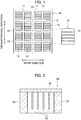
- a configuration of a tire 10 according to the present embodiment is described with reference to Fig. 1 .
- a tread pattern formed by a plurality of blocks 13 defined by a plurality of circumferential direction grooves 11 extended along a tire circumferential direction shown by an arrow A and a plurality of lateral grooves 12 crossing the circumferential direction groove 11 is formed on a tread surface of the tire 10.
- the lateral groove 12 is extended along a tire width direction shown by an arrow B.
- a plurality of sipes 14 is formed on a wheel tread portion of the block 13. Specifically, the sipe 14 is formed linearly in a tire width direction.
- the shape of the sipe 14 is not limited to a linear shape.
- the sipe 14 may be formed in a zigzag shape, a corrugated shape, or a crank shape.
- the tire mold 20 is a mold having a mold surface for vulcanizing and molding the tire 10.
- the tire mold 20 includes a block surface molding portion 22 for molding a surface of each block 13 that forms the tread pattern, a bone portion 24 for molding the circumferential direction grooves 11 and the lateral grooves 12 of the tread pattern, and a plurality of blades 26 for molding a plurality of the sipes 14.
- the blades 26 are arranged on each block surface molding portion 22 with a gap therebetween.
- a concave-convex surface is formed on a side surface of the blade 26.
- the tire 10 is manufactured by being vulcanized and molded by the tire mold 20. Further, when rubber is entered into the concave-convex surface of the blade 26, a concave-convex surface is formed on each of inner wall surfaces facing each other of the sipe 14 (hereinafter, merely referred to as an inner wall surface of the sipe 14).
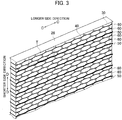
- the concave-convex surface of the blade 26 is described with reference to Fig. 3 , and Figs. 4(a) and 4(b) .
- the blade 26 is formed in a plate shape having a plate thickness corresponding to a width of the sipe 14.
- a convex portion 30 and a concave portion 40 are formed on the side surface of the blade 26.
- the convex portion 30 and the concave portion 40 are transferred so as to form the concave-convex surface of the inner wall surface of the sipe 14.
- the convex portions 30, each of which has an oval shape are continuously formed along a longitudinal direction (tire width direction) of the blade 26 shown by an arrow C, on the side surface of the blade 26. Further, the convex portions 30 are laminated along a depth direction (tire radial direction) of the blade 26 shown by an arrow D.
- the convex portion 30 is formed in an oval shape, however a shape of the convex portion 30 is not limited to an oval shape, and therefore the convex portion 30 may be formed in other shape. Further, the convex portions 30 arranged adjacent to each other may be overlapped with each other.
- the blade 26 is relatively easily manufactured by using, for example, a precision casting method using a collapsible mold formed of plaster or the like, an electroforming method (a manufacturing method of a metal product using electroplating), a diffusion bonding method (a bonding method using diffusion of atoms caused between bonded surfaces while pressurizing base materials to adhere to each other to such an extent in which plastic deformation is hardly caused at a temperature less than a melting point of the base material), or a lamination forming method.
- a precision casting method using a collapsible mold formed of plaster or the like an electroforming method (a manufacturing method of a metal product using electroplating), a diffusion bonding method (a bonding method using diffusion of atoms caused between bonded surfaces while pressurizing base materials to adhere to each other to such an extent in which plastic deformation is hardly caused at a temperature less than a melting point of the base material), or a lamination forming method.
- the concave portions 40 are formed between the convex portions 30 adjacent to each other.
- the concave portions 40 are formed irregularly to make a coarse-dense distribution and to fill a gap between the convex portions 30 adjacent to each other.
- a longer side length of the convex portion 30 is set in a range between 0.085 mm and 0.4 mm.
- a shorter side length of the convex portion 30 is set in a range between 0.035 mm and 0.165 mm.
- the longer side length of the convex portion 30 is preferably set in a range between 0.125 mm and 0.375 mm.
- the shorter side length of the convex portion 30 is preferably set in a range between 0.05 mm and 0.15 mm.
- the longer side length of the convex portion 30 is more preferably set in a range between 0.165 mm and 0.335 mm.
- the shorter side length of the convex portion 30 is more preferably set in a range between 0.065 mm and 0.135 mm.
- the convex portions 30 are formed at an interval of 0.035 mm to 0.165 mm in the depth direction of the blade 26.
- An average width length of the concave portions 40 is set in a range between 0.0005 mm and 0.5 mm when the side surface of the blade 26 is seen from the front thereof (concave-convex surface view).
- the average width length of the concave portions 40 is not a length in a width direction defined by the longitudinal direction of the blade 26 but an average length of a length of a maximum length portion and a length of a minimum length portion of the concave portion 40 having an outline of a polygonal shape.
- the average width length of the concave portions 40 is preferably set in a range between 0.005 mm and 0.35 mm.
- the average width length of the concave portions 40 is more preferably set in a range between 0.05 mm and 0.2 mm.
- an area of the concave portion 40 is set in a range between 0.0000002 mm 2 and 0.2 mm 2 .
- the area of the concave portion 40 is preferably set in a range between 0.00002 mm 2 and 0.1 mm 2 .
- the area of the concave portion 40 is more preferably set in a range between 0.002 mm 2 and 0.03 mm 2 .
- a depth of the concave portion 40 is set in a range between 0.0001 mm and 0.25 mm.
- the depth of the concave portion 40 is preferably set in a range between 0.0025 mm and 0.18 mm.
- the depth of the concave portion 40 is more preferably set in a range between 0.005 mm and 0.12 mm.
- a height of the convex portion 30 is set in a range between 0.0001 mm and 0.25 mm.
- the height of the convex portion 30 is preferably set in a range between 0.0025 mm and 0.18 mm.
- the height of the convex portion 30 is more preferably set in a range between 0.005 mm and 0.12 mm.
- the shape of the outline of the concave portion 40 is not a circular shape and an oval shape but a polygonal shape having many sides and having many concave-convex surfaces on the outline. Further, as shown in Fig. 4(b) , the concave portion 40 is formed in a sharp shape having a sharp distal end toward the side surface of the blade 26. In other words, the concave portion 40 is sharp in a depth direction of the concave portion 40.
- a length of the concave portion 40 is smaller than a length of the convex portion 30 when the side surface of the blade 26 is seen from the front thereof.
- a first layer 50 and a second layer 60 are formed on the side surface of the blade 26.
- each of the first layer 50 and the second layer 60 is formed as a layer extended from one end to another end of the blade 26 along the longitudinal direction of the blade 26.
- the first layer 50 and the second layer 60 are formed when the blade 26 is manufactured by using the method described above.
- a shape of each of the first layer 50 and the second layer 60 is formed in a corrugated shape.
- the first layers 50 are formed in a step-like shape so as to be adjacent to each other at an interval of 0.1 mm to 0.5 mm in the depth direction of the blade 26.
- the first layers 50 are preferably formed to be adjacent to each other at an interval of 0.15 mm to 0.45 mm in the depth direction of the blade 26.
- the first layers 50 are more preferably formed to be adjacent to each other at an interval of 0.2 mm to 0.4 mm.
- the second layers 60 are formed between the first layers 50 at an interval smaller than that of the first layers 50.
- the second layers 60 are formed in a step-like shape so as to be adjacent to each other at an interval of 0.035 mm to 0.165 mm in the depth direction of the blade 26.
- the second layers 60 are preferably formed to be adjacent to each other at an interval of 0.05 mm to 0.15 mm in the depth direction of the blade 26.
- the second layers 60 are more preferably formed to be adjacent to each other at an interval of 0.065 mm to 0.135 mm in the depth direction of the blade 26.
- a concave-convex surface (not shown) formed on the inner wall surface of the sipe 14 is described.
- a convex portion formed on the inner wall surface of the sipe 14 is merely called a convex portion of the sipe 14, or a convex portion.
- a concave portion formed on the inner wall surface of the sipe 14 is merely called a concave portion of the sipe 14, or a concave portion.
- the concave portions are continuously formed on the inner wall surface of the sipe 14, along the longitudinal direction (tire width direction) of the sipe 14. Further, the concave portions are laminated along a depth direction (tire radial direction) of the sipe 14.
- the concave portion of the sipe 14 is formed in an oval shape, however the shape of the concave portion is not limited to the oval shape, and therefore the concave portion may be formed in other shape. Further, the concave portions of the sipe 14 adjacent to each other may be overlapped with each other.
- the convex portions are formed between the concave portions adjacent to each other.
- the convex portions of the sipe 14 are formed irregularly to make a coarse-dense distribution and to fill a gap between the concave portions adjacent to each other.
- a shape of an outline of the concave portion of the sipe 14 is not a circular shape and an oval shape but a polygonal shape having many sides and having many concave-convex surfaces on the outline. Further, the convex portion of the sipe 14 is formed in a sharp shape having a sharp distal end toward the inner side wall facing the sipe 14. In other words, the convex portion of the sipe 14 is sharp in a depth direction of the convex portion of the sipe 14.
- An average width length of the convex portions of the sipe 14 is set in a range between 0.0005 mm and 0.5 mm when the inner wall surface of the sipe 14 is seen from the front thereof (concave-convex surface view).
- the average width length of the convex portions of the sipe 14 is preferably set in a range between 0.005 mm and 0.35 mm.
- the average width length of the convex portions of the sipe 14 is more preferably set in a range between 0.05 mm and 0.2 mm.
- an area of the convex portion of the sipe 14 is set in a range between 0.0000002 mm 2 and 0.2 mm 2 .
- the area of the convex portion of the sipe 14 is preferably set in a range between 0.00002 mm 2 and 0.1 mm 2 .
- the area of the convex portion of the sipe 14 is more preferably set in a range between 0.002 mm 2 and 0.03 mm 2 .
- a height of the convex portion of the sipe 14 is set in a range between 0.0001 mm and 0.25 mm.
- the height of the convex portion of the sipe 14 is preferably set in a range between 0.0025 mm and 0.18 mm.
- the height of the convex portion of the sipe 14 is more preferably set in a range between 0.005 mm and 0.12 mm.
- a longer side length of the concave portion of the sipe 14 is set in a range between 0.085 mm and 0.4 mm.
- a shorter side length of the concave portion of the sipe 14 is set in a range between 0.035 mm and 0.165 mm.
- the longer side length of the concave portion of the sipe 14 is preferably set in a range between 0.125 mm and 0.375 mm.
- the shorter side length of the concave portion of the sipe 14 is preferably set in a range between 0.05 mm and 0.15 mm.
- the longer side length of the concave portion of the sipe 14 is more preferably set in a range between 0.165 mm and 0.335 mm.
- the shorter side length of the concave portion of the sipe 14 is more preferably set in a range between 0.065 mm and 0.135 mm. Further, the concave portions of the sipe 14 are formed at an interval of 0.035 mm to 0.165 mm in the depth direction of the sipe 14.
- a length of the convex portion of the sipe 14 is smaller than a length of the concave portion of the sipe 14 when the inner wall surface of the sipe 14 is seen from the front thereof.
- layers to which the first layer 50 and the second layer 60 shown in Fig. 3 are transferred are formed on the inner wall surface of the sipe 14.
- a layer to which the first layer 50 is transferred is called a first layer formed in the sipe 14.
- a layer to which the second layer 60 is transferred is called a second layer formed in the sipe 14.
- Each of the first layer and the second layer formed in the sipe 14 is extended from one end to another end of the sipe 14 in the longitudinal direction of the sipe 14.
- each shape of the first layer and the second layer formed in the sipe 14 is formed in a corrugated shape.
- the first layers formed in the sipe 14 are formed in a step-like shape so as to be adjacent to each other at an interval of 0.1 mm to 0.5 mm in the depth direction of the sipe 14.
- the first layers formed in the sipe 14 are preferably formed to be adjacent to each other at an interval of 0.15 mm to 0.45 mm.
- the first layers formed in the sipe 14 are more preferably formed to be adjacent to each other at an interval of 0.2 mm to 0.4 mm.
- the second layers formed in the sipe 14 are formed between the first layers formed in the sipe 14 at an interval smaller than that of the first layers formed in the sipe 14.
- the second layers formed in the sipe 14 are formed in a step-like shape so as to be adjacent to each other at an interval of 0.035 mm to 0.165 mm.
- the second layers formed in the sipe 14 are preferably formed to be adjacent to each other at an interval of 0.05 mm to 0.15 mm.
- the second layers formed in the sipe 14 are more preferably formed to be adjacent to each other at an interval of 0.065 mm to 0.135 mm.
- the convex portion 30 and the concave portion 40 formed in the blade 26 are transferred, so that the sharp convex portion is formed on the inner wall surface of the sipe 14. Accordingly, when the bending deformation of the block 13 is caused in braking or driving of the tire 10, a relatively large friction resistance is generated due to a contact between the convex portions on the inner wall surface of the sipe 14. Consequently, rigidity of the block 13 (hereinafter, merely referred to as block rigidity) in which the sipe 14 is formed is improved. Thus, the deformation of the block 13 is suppressed.
- the first layers 50 formed in the blade 26 are transferred, so that the first layers are formed in a step-like shape on the inner wall surface of the sipe 14.
- the first layers formed in a step-like shape mutually support the inner wall surface of the sipe 14. Consequently, the block rigidity is improved.
- the second layers 60 formed in the blade 26 are transferred, so that the second layers are formed in a step-like shape on the inner wall surface of the sipe 14.
- the second layer formed in the sipe 14 is formed between the first layers formed in the sipe 14.
- arithmetic average roughness Ra of the concave-convex surface formed in the blade 26 (hereinafter, it is similarly applied to the transferred concave-convex surface in the sipe 14) is preferably set in a range between 6 ⁇ m and 20 ⁇ m.
- a friction coefficient ⁇ between rubber and rubber is largely improved. This is because rubber surfaces are meshed with each other when the arithmetic average roughness Ra is set in the range between 6 ⁇ m and 20 ⁇ m.
- the rubber surfaces are excessively smooth and slippery. Consequently, the rubber surfaces are not meshed with each other. Further, in a case in which the arithmetic average roughness Ra is more than 20 ⁇ m, the rubber surfaces are excessively rough and a large gap is generated. Consequently, the rubber surfaces are not meshed with each other.
- an evaluation length, a reference length, and the like relating to the arithmetic average roughness Ra in the present embodiment are based on JIS standard.
- the friction coefficient ⁇ between rubber and rubber is largely improved, and therefore the block rigidity is largely improved as shown in Fig. 6 .
- the arithmetic average roughness Ra of the concave-convex surface is set in the range between 6 ⁇ m and 20 ⁇ m.
- samples according to a conventional example samples according to comparative examples 1 and 2, and samples according to examples 1 to 6 were prepared.
- a tire size of each sample is 195/65R15, and a parameter of each sample is shown in Table 1.
- the block rigidity was measured.
- a measured result is shown in Table 1.
- the measured result is indexed as the result of the sample according to the conventional example 1 is defined as 100. As the value is larger, the block rigidity is superior.
- each of the convex portion 30 and the concave portion 40 of the blade 26 is set in the following length.
- the longer side length of the convex portion 30 is set in a range between 0.085 mm and 0.4 mm
- the shorter side length of the convex portion 30 is set in a range between 0.035 mm and 0.165 mm
- the average width length of the concave portions 40 is set in a range between 0.0005 mm and 0.5 mm
- the area of the concave portion 40 is set in a range between 0.0000002 mm 2 and 0.2 mm 2
- the depth of the concave portion 40 is set in a range between 0.0001 mm and 0.25 mm.
- each of the convex portion 30 and the concave portion 40 of the blade 26 is set in the following length. That is, the longer side length of the convex portion 30 is set in a range between 0.125 mm and 0.375 mm, the shorter side length of the convex portion 30 is set in a range between 0.05 mm and 0.15 mm, the average width length of the concave portions 40 is set in a range between 0.005 mm and 0.35 mm, the area of the concave portion 40 is set in a range between 0.00002 mm 2 and 0.1 mm 2 , and the depth of the concave portion 40 is set in a range between 0.0025 mm and 0.18 mm.
- each of the convex portion 30 and the concave portion 40 of the blade 26 is set in the following length. That is, the longer side length of the convex portion 30 is set in a range between 0.165 mm and 0.335 mm, the shorter side length of the convex portion 30 is set in a range between 0.065 mm and 0.135 mm, the average width length of the concave portions 40 is set in a range between 0.05 mm and 0.2 mm, the area of the concave portion 40 is set in a range between 0.002 mm 2 and 0.03 mm 2 , and the depth of the concave portion 40 is set in a range between 0.005 mm and 0.12 mm.
- each the convex portion 30 and the concave portion 40 is set out of the range of each of the convex portion 30 and the concave portion 40 of the tires according to the examples 1 and 6 shown in Table 1.
- the convex portions 30 are formed continuously along the longitudinal direction of the blade 26, however it is not limited to this.
- the convex portions 30 may be formed continuously along the depth direction of the blade 26.
- the convex portions 30 are laminated along the longitudinal direction of the blade 26.
- each of the first layer 50 and the second layer 60 is extended along the depth direction of the blade 26 from one end to another end of the blade 26.
- each of the first layers 50 and the second layers 60 are formed in a step-like shape so as to be adjacent to each other at a predetermined interval in the longitudinal direction of the blade 26.
- each of the first layers 50 and the second layers 60 are formed in a step-like shape so as to be adjacent to each other at a predetermined interval in a direction orthogonal to its extending direction (predetermined direction).
- the convex portions 30 may be formed continuously along a certain direction of the blade 26. In a case in which the convex portions 30 are formed continuously along a certain direction of the blade 26, the convex portions 30 are laminated in a direction orthogonal to the certain direction.
Landscapes
- Engineering & Computer Science (AREA)
- Mechanical Engineering (AREA)
- Tires In General (AREA)
- Moulds For Moulding Plastics Or The Like (AREA)
Applications Claiming Priority (2)
| Application Number | Priority Date | Filing Date | Title |
|---|---|---|---|
| JP2016076377A JP6609214B2 (ja) | 2016-04-06 | 2016-04-06 | タイヤモールド及びタイヤ |
| PCT/JP2016/084919 WO2017175416A1 (fr) | 2016-04-06 | 2016-11-25 | Moule pour pneu et pneu |
Publications (3)
| Publication Number | Publication Date |
|---|---|
| EP3441240A1 true EP3441240A1 (fr) | 2019-02-13 |
| EP3441240A4 EP3441240A4 (fr) | 2019-04-03 |
| EP3441240B1 EP3441240B1 (fr) | 2020-08-26 |
Family
ID=60000989
Family Applications (1)
| Application Number | Title | Priority Date | Filing Date |
|---|---|---|---|
| EP16897968.0A Active EP3441240B1 (fr) | 2016-04-06 | 2016-11-25 | Moule pour pneu et pneu |
Country Status (5)
| Country | Link |
|---|---|
| US (1) | US20190100058A1 (fr) |
| EP (1) | EP3441240B1 (fr) |
| JP (1) | JP6609214B2 (fr) |
| CN (1) | CN108883671B (fr) |
| WO (1) | WO2017175416A1 (fr) |
Families Citing this family (3)
| Publication number | Priority date | Publication date | Assignee | Title |
|---|---|---|---|---|
| CN109849393B (zh) * | 2019-02-28 | 2021-02-05 | 安徽佳通乘用子午线轮胎有限公司 | 一种标准化轮胎的制造方法 |
| JP7103306B2 (ja) * | 2019-06-04 | 2022-07-20 | 横浜ゴム株式会社 | タイヤ成形用金型 |
| JP7436803B2 (ja) * | 2020-01-17 | 2024-02-22 | 横浜ゴム株式会社 | タイヤ |
Family Cites Families (10)
| Publication number | Priority date | Publication date | Assignee | Title |
|---|---|---|---|---|
| DE19812778C2 (de) * | 1998-03-24 | 2002-07-04 | Continental Ag | Hochstabile Lamelle, Vulkanisationsform mit solchen Lamellen, Fahrzeugreifen mit Lauffläche, in die Einschnitte mittels solcher Lamellen gebracht sind |
| JP3811045B2 (ja) * | 2001-03-27 | 2006-08-16 | 日本碍子株式会社 | サイプブレード成形用金型及びその製造方法 |
| JP3648179B2 (ja) * | 2001-07-18 | 2005-05-18 | 住友ゴム工業株式会社 | 空気入りタイヤ及びその加硫金型 |
| JP3811052B2 (ja) * | 2001-11-13 | 2006-08-16 | 日本碍子株式会社 | タイヤ金型用サイプブレードの製造方法 |
| JP4312528B2 (ja) * | 2003-07-16 | 2009-08-12 | 横浜ゴム株式会社 | 空気入りタイヤ、タイヤ加硫モールドおよび空気入りタイヤの製造方法 |
| US7143799B2 (en) * | 2003-11-20 | 2006-12-05 | The Goodyear Tire & Rubber Company | Three-dimensional sipes for treads |
| JP2005262973A (ja) * | 2004-03-17 | 2005-09-29 | Bridgestone Corp | 空気入りタイヤ、サイプ形成用ブレード及びそのサイプ形成用ブレードを備えたタイヤ形成用金型 |
| US7793692B2 (en) * | 2005-10-31 | 2010-09-14 | The Goodyear Tire & Rubber Company | Pneumatic tire tread having sipe that devolves into groove as tread wears |
| JP5231349B2 (ja) * | 2009-07-09 | 2013-07-10 | 東洋ゴム工業株式会社 | 空気入りタイヤ |
| JP5429267B2 (ja) * | 2011-11-28 | 2014-02-26 | 横浜ゴム株式会社 | 空気入りタイヤ |
-
2016
- 2016-04-06 JP JP2016076377A patent/JP6609214B2/ja not_active Expired - Fee Related
- 2016-11-25 WO PCT/JP2016/084919 patent/WO2017175416A1/fr not_active Ceased
- 2016-11-25 CN CN201680084269.XA patent/CN108883671B/zh not_active Expired - Fee Related
- 2016-11-25 US US16/088,987 patent/US20190100058A1/en not_active Abandoned
- 2016-11-25 EP EP16897968.0A patent/EP3441240B1/fr active Active
Also Published As
| Publication number | Publication date |
|---|---|
| JP6609214B2 (ja) | 2019-11-20 |
| WO2017175416A1 (fr) | 2017-10-12 |
| CN108883671B (zh) | 2020-09-18 |
| EP3441240A4 (fr) | 2019-04-03 |
| JP2017185901A (ja) | 2017-10-12 |
| CN108883671A (zh) | 2018-11-23 |
| EP3441240B1 (fr) | 2020-08-26 |
| US20190100058A1 (en) | 2019-04-04 |
Similar Documents
| Publication | Publication Date | Title |
|---|---|---|
| CN101022965B (zh) | 充气轮胎及其制造方法 | |
| CN105730152B (zh) | 充气轮胎及其成型模 | |
| JP7419742B2 (ja) | 重荷重用タイヤの加硫金型及び重荷重用タイヤの製造方法 | |
| EP3441240B1 (fr) | Moule pour pneu et pneu | |
| JP2005262973A (ja) | 空気入りタイヤ、サイプ形成用ブレード及びそのサイプ形成用ブレードを備えたタイヤ形成用金型 | |
| WO2016158460A1 (fr) | Élément de moulage de moule de pneumatique, moule de moulage pour vulcanisation de pneumatique, et pneumatique | |
| EP2436537A1 (fr) | Bandage pneumatique pour roue de véhicule | |
| RU2530200C2 (ru) | Протектор шины, имеющий полости и прорези | |
| JP4219178B2 (ja) | 空気入りタイヤ及びその製造方法 | |
| JP2005505456A (ja) | 切り込みを備えたトレッド、およびこれらの切り込みを成形する層板 | |
| JP2006044570A (ja) | 空気入りタイヤとその製造方法 | |
| JPH0994828A (ja) | 加硫成形モールド及びこれを用いて製造された空気入 りタイヤ | |
| CN109476103B (zh) | 旨在用于轮胎硫化的模具内镶物的变化薄板 | |
| JP4905654B2 (ja) | 空気入りタイヤ | |
| CN105307844B (zh) | 用于模制和硫化轮胎胎面的包括切割构件的模制元件 | |
| JPH1142913A (ja) | 空気入りタイヤ及びその成形金型 | |
| CN105829086B (zh) | 用于模制和硫化轮胎胎面的包括切割构件的模制元件 | |
| CN111065529A (zh) | 用于包括隐藏通道的轮胎胎面的模具 | |
| JPH0596654A (ja) | 更生タイヤ用プレキユアトレツド、その製造方法及びこれを用いた更生タイヤ | |
| JP7081177B2 (ja) | タイヤ用モールド | |
| JP4270374B2 (ja) | 空気入りタイヤ及びタイヤ用モールド | |
| CN109397585B (zh) | 轮胎硫化模具、用于铸造轮胎硫化模具的铸模、以及轮胎硫化模具的制造方法 | |
| WO2017210185A1 (fr) | Bandes de roulement de pneus à lamelles améliorées et procédés de formation de ces dernières | |
| JP6801432B2 (ja) | タイヤ製造用モールド | |
| JP4940710B2 (ja) | 空気入りタイヤ |
Legal Events
| Date | Code | Title | Description |
|---|---|---|---|
| STAA | Information on the status of an ep patent application or granted ep patent |
Free format text: STATUS: THE INTERNATIONAL PUBLICATION HAS BEEN MADE |
|
| PUAI | Public reference made under article 153(3) epc to a published international application that has entered the european phase |
Free format text: ORIGINAL CODE: 0009012 |
|
| STAA | Information on the status of an ep patent application or granted ep patent |
Free format text: STATUS: REQUEST FOR EXAMINATION WAS MADE |
|
| 17P | Request for examination filed |
Effective date: 20181030 |
|
| AK | Designated contracting states |
Kind code of ref document: A1 Designated state(s): AL AT BE BG CH CY CZ DE DK EE ES FI FR GB GR HR HU IE IS IT LI LT LU LV MC MK MT NL NO PL PT RO RS SE SI SK SM TR |
|
| AX | Request for extension of the european patent |
Extension state: BA ME |
|
| A4 | Supplementary search report drawn up and despatched |
Effective date: 20190228 |
|
| RIC1 | Information provided on ipc code assigned before grant |
Ipc: B60C 11/12 20060101ALI20190222BHEP Ipc: B60C 11/11 20060101ALN20190222BHEP Ipc: B29D 30/06 20060101AFI20190222BHEP |
|
| DAV | Request for validation of the european patent (deleted) | ||
| DAX | Request for extension of the european patent (deleted) | ||
| STAA | Information on the status of an ep patent application or granted ep patent |
Free format text: STATUS: EXAMINATION IS IN PROGRESS |
|
| 17Q | First examination report despatched |
Effective date: 20191111 |
|
| REG | Reference to a national code |
Ref country code: DE Ref legal event code: R079 Ref document number: 602016043002 Country of ref document: DE Free format text: PREVIOUS MAIN CLASS: B60C0011120000 Ipc: B29D0030060000 |
|
| RIC1 | Information provided on ipc code assigned before grant |
Ipc: B29D 30/06 20060101AFI20200116BHEP Ipc: B60C 11/11 20060101ALN20200116BHEP Ipc: B60C 11/12 20060101ALI20200116BHEP |
|
| GRAP | Despatch of communication of intention to grant a patent |
Free format text: ORIGINAL CODE: EPIDOSNIGR1 |
|
| STAA | Information on the status of an ep patent application or granted ep patent |
Free format text: STATUS: GRANT OF PATENT IS INTENDED |
|
| INTG | Intention to grant announced |
Effective date: 20200312 |
|
| GRAS | Grant fee paid |
Free format text: ORIGINAL CODE: EPIDOSNIGR3 |
|
| GRAA | (expected) grant |
Free format text: ORIGINAL CODE: 0009210 |
|
| STAA | Information on the status of an ep patent application or granted ep patent |
Free format text: STATUS: THE PATENT HAS BEEN GRANTED |
|
| AK | Designated contracting states |
Kind code of ref document: B1 Designated state(s): AL AT BE BG CH CY CZ DE DK EE ES FI FR GB GR HR HU IE IS IT LI LT LU LV MC MK MT NL NO PL PT RO RS SE SI SK SM TR |
|
| REG | Reference to a national code |
Ref country code: GB Ref legal event code: FG4D |
|
| REG | Reference to a national code |
Ref country code: CH Ref legal event code: EP |
|
| REG | Reference to a national code |
Ref country code: AT Ref legal event code: REF Ref document number: 1305975 Country of ref document: AT Kind code of ref document: T Effective date: 20200915 |
|
| REG | Reference to a national code |
Ref country code: IE Ref legal event code: FG4D |
|
| REG | Reference to a national code |
Ref country code: DE Ref legal event code: R096 Ref document number: 602016043002 Country of ref document: DE |
|
| REG | Reference to a national code |
Ref country code: LT Ref legal event code: MG4D |
|
| PG25 | Lapsed in a contracting state [announced via postgrant information from national office to epo] |
Ref country code: NO Free format text: LAPSE BECAUSE OF FAILURE TO SUBMIT A TRANSLATION OF THE DESCRIPTION OR TO PAY THE FEE WITHIN THE PRESCRIBED TIME-LIMIT Effective date: 20201126 Ref country code: GR Free format text: LAPSE BECAUSE OF FAILURE TO SUBMIT A TRANSLATION OF THE DESCRIPTION OR TO PAY THE FEE WITHIN THE PRESCRIBED TIME-LIMIT Effective date: 20201127 Ref country code: BG Free format text: LAPSE BECAUSE OF FAILURE TO SUBMIT A TRANSLATION OF THE DESCRIPTION OR TO PAY THE FEE WITHIN THE PRESCRIBED TIME-LIMIT Effective date: 20201126 Ref country code: SE Free format text: LAPSE BECAUSE OF FAILURE TO SUBMIT A TRANSLATION OF THE DESCRIPTION OR TO PAY THE FEE WITHIN THE PRESCRIBED TIME-LIMIT Effective date: 20200826 Ref country code: PT Free format text: LAPSE BECAUSE OF FAILURE TO SUBMIT A TRANSLATION OF THE DESCRIPTION OR TO PAY THE FEE WITHIN THE PRESCRIBED TIME-LIMIT Effective date: 20201228 Ref country code: HR Free format text: LAPSE BECAUSE OF FAILURE TO SUBMIT A TRANSLATION OF THE DESCRIPTION OR TO PAY THE FEE WITHIN THE PRESCRIBED TIME-LIMIT Effective date: 20200826 Ref country code: FI Free format text: LAPSE BECAUSE OF FAILURE TO SUBMIT A TRANSLATION OF THE DESCRIPTION OR TO PAY THE FEE WITHIN THE PRESCRIBED TIME-LIMIT Effective date: 20200826 Ref country code: LT Free format text: LAPSE BECAUSE OF FAILURE TO SUBMIT A TRANSLATION OF THE DESCRIPTION OR TO PAY THE FEE WITHIN THE PRESCRIBED TIME-LIMIT Effective date: 20200826 |
|
| REG | Reference to a national code |
Ref country code: NL Ref legal event code: MP Effective date: 20200826 |
|
| REG | Reference to a national code |
Ref country code: AT Ref legal event code: MK05 Ref document number: 1305975 Country of ref document: AT Kind code of ref document: T Effective date: 20200826 |
|
| PG25 | Lapsed in a contracting state [announced via postgrant information from national office to epo] |
Ref country code: LV Free format text: LAPSE BECAUSE OF FAILURE TO SUBMIT A TRANSLATION OF THE DESCRIPTION OR TO PAY THE FEE WITHIN THE PRESCRIBED TIME-LIMIT Effective date: 20200826 Ref country code: NL Free format text: LAPSE BECAUSE OF FAILURE TO SUBMIT A TRANSLATION OF THE DESCRIPTION OR TO PAY THE FEE WITHIN THE PRESCRIBED TIME-LIMIT Effective date: 20200826 Ref country code: PL Free format text: LAPSE BECAUSE OF FAILURE TO SUBMIT A TRANSLATION OF THE DESCRIPTION OR TO PAY THE FEE WITHIN THE PRESCRIBED TIME-LIMIT Effective date: 20200826 Ref country code: RS Free format text: LAPSE BECAUSE OF FAILURE TO SUBMIT A TRANSLATION OF THE DESCRIPTION OR TO PAY THE FEE WITHIN THE PRESCRIBED TIME-LIMIT Effective date: 20200826 Ref country code: IS Free format text: LAPSE BECAUSE OF FAILURE TO SUBMIT A TRANSLATION OF THE DESCRIPTION OR TO PAY THE FEE WITHIN THE PRESCRIBED TIME-LIMIT Effective date: 20201226 |
|
| PG25 | Lapsed in a contracting state [announced via postgrant information from national office to epo] |
Ref country code: DK Free format text: LAPSE BECAUSE OF FAILURE TO SUBMIT A TRANSLATION OF THE DESCRIPTION OR TO PAY THE FEE WITHIN THE PRESCRIBED TIME-LIMIT Effective date: 20200826 Ref country code: CZ Free format text: LAPSE BECAUSE OF FAILURE TO SUBMIT A TRANSLATION OF THE DESCRIPTION OR TO PAY THE FEE WITHIN THE PRESCRIBED TIME-LIMIT Effective date: 20200826 Ref country code: RO Free format text: LAPSE BECAUSE OF FAILURE TO SUBMIT A TRANSLATION OF THE DESCRIPTION OR TO PAY THE FEE WITHIN THE PRESCRIBED TIME-LIMIT Effective date: 20200826 Ref country code: EE Free format text: LAPSE BECAUSE OF FAILURE TO SUBMIT A TRANSLATION OF THE DESCRIPTION OR TO PAY THE FEE WITHIN THE PRESCRIBED TIME-LIMIT Effective date: 20200826 Ref country code: SM Free format text: LAPSE BECAUSE OF FAILURE TO SUBMIT A TRANSLATION OF THE DESCRIPTION OR TO PAY THE FEE WITHIN THE PRESCRIBED TIME-LIMIT Effective date: 20200826 |
|
| REG | Reference to a national code |
Ref country code: DE Ref legal event code: R097 Ref document number: 602016043002 Country of ref document: DE |
|
| PG25 | Lapsed in a contracting state [announced via postgrant information from national office to epo] |
Ref country code: AT Free format text: LAPSE BECAUSE OF FAILURE TO SUBMIT A TRANSLATION OF THE DESCRIPTION OR TO PAY THE FEE WITHIN THE PRESCRIBED TIME-LIMIT Effective date: 20200826 Ref country code: AL Free format text: LAPSE BECAUSE OF FAILURE TO SUBMIT A TRANSLATION OF THE DESCRIPTION OR TO PAY THE FEE WITHIN THE PRESCRIBED TIME-LIMIT Effective date: 20200826 Ref country code: ES Free format text: LAPSE BECAUSE OF FAILURE TO SUBMIT A TRANSLATION OF THE DESCRIPTION OR TO PAY THE FEE WITHIN THE PRESCRIBED TIME-LIMIT Effective date: 20200826 |
|
| PG25 | Lapsed in a contracting state [announced via postgrant information from national office to epo] |
Ref country code: MC Free format text: LAPSE BECAUSE OF FAILURE TO SUBMIT A TRANSLATION OF THE DESCRIPTION OR TO PAY THE FEE WITHIN THE PRESCRIBED TIME-LIMIT Effective date: 20200826 Ref country code: SK Free format text: LAPSE BECAUSE OF FAILURE TO SUBMIT A TRANSLATION OF THE DESCRIPTION OR TO PAY THE FEE WITHIN THE PRESCRIBED TIME-LIMIT Effective date: 20200826 |
|
| REG | Reference to a national code |
Ref country code: CH Ref legal event code: PL |
|
| PLBE | No opposition filed within time limit |
Free format text: ORIGINAL CODE: 0009261 |
|
| STAA | Information on the status of an ep patent application or granted ep patent |
Free format text: STATUS: NO OPPOSITION FILED WITHIN TIME LIMIT |
|
| GBPC | Gb: european patent ceased through non-payment of renewal fee |
Effective date: 20201126 |
|
| PG25 | Lapsed in a contracting state [announced via postgrant information from national office to epo] |
Ref country code: IT Free format text: LAPSE BECAUSE OF FAILURE TO SUBMIT A TRANSLATION OF THE DESCRIPTION OR TO PAY THE FEE WITHIN THE PRESCRIBED TIME-LIMIT Effective date: 20200826 Ref country code: LU Free format text: LAPSE BECAUSE OF NON-PAYMENT OF DUE FEES Effective date: 20201125 |
|
| 26N | No opposition filed |
Effective date: 20210527 |
|
| REG | Reference to a national code |
Ref country code: BE Ref legal event code: MM Effective date: 20201130 |
|
| PG25 | Lapsed in a contracting state [announced via postgrant information from national office to epo] |
Ref country code: CH Free format text: LAPSE BECAUSE OF NON-PAYMENT OF DUE FEES Effective date: 20201130 Ref country code: SI Free format text: LAPSE BECAUSE OF FAILURE TO SUBMIT A TRANSLATION OF THE DESCRIPTION OR TO PAY THE FEE WITHIN THE PRESCRIBED TIME-LIMIT Effective date: 20200826 Ref country code: LI Free format text: LAPSE BECAUSE OF NON-PAYMENT OF DUE FEES Effective date: 20201130 |
|
| PG25 | Lapsed in a contracting state [announced via postgrant information from national office to epo] |
Ref country code: IE Free format text: LAPSE BECAUSE OF NON-PAYMENT OF DUE FEES Effective date: 20201125 |
|
| PG25 | Lapsed in a contracting state [announced via postgrant information from national office to epo] |
Ref country code: GB Free format text: LAPSE BECAUSE OF NON-PAYMENT OF DUE FEES Effective date: 20201126 |
|
| PG25 | Lapsed in a contracting state [announced via postgrant information from national office to epo] |
Ref country code: IS Free format text: LAPSE BECAUSE OF FAILURE TO SUBMIT A TRANSLATION OF THE DESCRIPTION OR TO PAY THE FEE WITHIN THE PRESCRIBED TIME-LIMIT Effective date: 20201226 Ref country code: TR Free format text: LAPSE BECAUSE OF FAILURE TO SUBMIT A TRANSLATION OF THE DESCRIPTION OR TO PAY THE FEE WITHIN THE PRESCRIBED TIME-LIMIT Effective date: 20200826 Ref country code: MT Free format text: LAPSE BECAUSE OF FAILURE TO SUBMIT A TRANSLATION OF THE DESCRIPTION OR TO PAY THE FEE WITHIN THE PRESCRIBED TIME-LIMIT Effective date: 20200826 Ref country code: CY Free format text: LAPSE BECAUSE OF FAILURE TO SUBMIT A TRANSLATION OF THE DESCRIPTION OR TO PAY THE FEE WITHIN THE PRESCRIBED TIME-LIMIT Effective date: 20200826 |
|
| PG25 | Lapsed in a contracting state [announced via postgrant information from national office to epo] |
Ref country code: MK Free format text: LAPSE BECAUSE OF FAILURE TO SUBMIT A TRANSLATION OF THE DESCRIPTION OR TO PAY THE FEE WITHIN THE PRESCRIBED TIME-LIMIT Effective date: 20200826 |
|
| PG25 | Lapsed in a contracting state [announced via postgrant information from national office to epo] |
Ref country code: BE Free format text: LAPSE BECAUSE OF NON-PAYMENT OF DUE FEES Effective date: 20201130 |
|
| P01 | Opt-out of the competence of the unified patent court (upc) registered |
Effective date: 20230531 |
|
| PGFP | Annual fee paid to national office [announced via postgrant information from national office to epo] |
Ref country code: FR Payment date: 20231120 Year of fee payment: 8 Ref country code: DE Payment date: 20231121 Year of fee payment: 8 |
|
| REG | Reference to a national code |
Ref country code: DE Ref legal event code: R119 Ref document number: 602016043002 Country of ref document: DE |
|
| PG25 | Lapsed in a contracting state [announced via postgrant information from national office to epo] |
Ref country code: DE Free format text: LAPSE BECAUSE OF NON-PAYMENT OF DUE FEES Effective date: 20250603 |
|
| PG25 | Lapsed in a contracting state [announced via postgrant information from national office to epo] |
Ref country code: FR Free format text: LAPSE BECAUSE OF NON-PAYMENT OF DUE FEES Effective date: 20241130 |