EP3438182B1 - Dispersion diameter adjustment method and thermoplastic resin composition - Google Patents
Dispersion diameter adjustment method and thermoplastic resin composition Download PDFInfo
- Publication number
- EP3438182B1 EP3438182B1 EP17774357.2A EP17774357A EP3438182B1 EP 3438182 B1 EP3438182 B1 EP 3438182B1 EP 17774357 A EP17774357 A EP 17774357A EP 3438182 B1 EP3438182 B1 EP 3438182B1
- Authority
- EP
- European Patent Office
- Prior art keywords
- mass
- less
- compatibilizer
- polyamide
- dispersed phase
- Prior art date
- Legal status (The legal status is an assumption and is not a legal conclusion. Google has not performed a legal analysis and makes no representation as to the accuracy of the status listed.)
- Active
Links
Images


Classifications
-
- C—CHEMISTRY; METALLURGY
- C08—ORGANIC MACROMOLECULAR COMPOUNDS; THEIR PREPARATION OR CHEMICAL WORKING-UP; COMPOSITIONS BASED THEREON
- C08J—WORKING-UP; GENERAL PROCESSES OF COMPOUNDING; AFTER-TREATMENT NOT COVERED BY SUBCLASSES C08B, C08C, C08F, C08G or C08H
- C08J3/00—Processes of treating or compounding macromolecular substances
- C08J3/20—Compounding polymers with additives, e.g. colouring
- C08J3/201—Pre-melted polymers
-
- C—CHEMISTRY; METALLURGY
- C08—ORGANIC MACROMOLECULAR COMPOUNDS; THEIR PREPARATION OR CHEMICAL WORKING-UP; COMPOSITIONS BASED THEREON
- C08L—COMPOSITIONS OF MACROMOLECULAR COMPOUNDS
- C08L23/00—Compositions of homopolymers or copolymers of unsaturated aliphatic hydrocarbons having only one carbon-to-carbon double bond; Compositions of derivatives of such polymers
- C08L23/26—Compositions of homopolymers or copolymers of unsaturated aliphatic hydrocarbons having only one carbon-to-carbon double bond; Compositions of derivatives of such polymers modified by chemical after-treatment
-
- C—CHEMISTRY; METALLURGY
- C08—ORGANIC MACROMOLECULAR COMPOUNDS; THEIR PREPARATION OR CHEMICAL WORKING-UP; COMPOSITIONS BASED THEREON
- C08J—WORKING-UP; GENERAL PROCESSES OF COMPOUNDING; AFTER-TREATMENT NOT COVERED BY SUBCLASSES C08B, C08C, C08F, C08G or C08H
- C08J3/00—Processes of treating or compounding macromolecular substances
- C08J3/20—Compounding polymers with additives, e.g. colouring
- C08J3/203—Solid polymers with solid and/or liquid additives
-
- C—CHEMISTRY; METALLURGY
- C08—ORGANIC MACROMOLECULAR COMPOUNDS; THEIR PREPARATION OR CHEMICAL WORKING-UP; COMPOSITIONS BASED THEREON
- C08J—WORKING-UP; GENERAL PROCESSES OF COMPOUNDING; AFTER-TREATMENT NOT COVERED BY SUBCLASSES C08B, C08C, C08F, C08G or C08H
- C08J3/00—Processes of treating or compounding macromolecular substances
- C08J3/005—Processes for mixing polymers
-
- C—CHEMISTRY; METALLURGY
- C08—ORGANIC MACROMOLECULAR COMPOUNDS; THEIR PREPARATION OR CHEMICAL WORKING-UP; COMPOSITIONS BASED THEREON
- C08J—WORKING-UP; GENERAL PROCESSES OF COMPOUNDING; AFTER-TREATMENT NOT COVERED BY SUBCLASSES C08B, C08C, C08F, C08G or C08H
- C08J3/00—Processes of treating or compounding macromolecular substances
- C08J3/20—Compounding polymers with additives, e.g. colouring
-
- C—CHEMISTRY; METALLURGY
- C08—ORGANIC MACROMOLECULAR COMPOUNDS; THEIR PREPARATION OR CHEMICAL WORKING-UP; COMPOSITIONS BASED THEREON
- C08L—COMPOSITIONS OF MACROMOLECULAR COMPOUNDS
- C08L23/00—Compositions of homopolymers or copolymers of unsaturated aliphatic hydrocarbons having only one carbon-to-carbon double bond; Compositions of derivatives of such polymers
- C08L23/02—Compositions of homopolymers or copolymers of unsaturated aliphatic hydrocarbons having only one carbon-to-carbon double bond; Compositions of derivatives of such polymers not modified by chemical after-treatment
-
- C—CHEMISTRY; METALLURGY
- C08—ORGANIC MACROMOLECULAR COMPOUNDS; THEIR PREPARATION OR CHEMICAL WORKING-UP; COMPOSITIONS BASED THEREON
- C08L—COMPOSITIONS OF MACROMOLECULAR COMPOUNDS
- C08L23/00—Compositions of homopolymers or copolymers of unsaturated aliphatic hydrocarbons having only one carbon-to-carbon double bond; Compositions of derivatives of such polymers
- C08L23/02—Compositions of homopolymers or copolymers of unsaturated aliphatic hydrocarbons having only one carbon-to-carbon double bond; Compositions of derivatives of such polymers not modified by chemical after-treatment
- C08L23/10—Homopolymers or copolymers of propene
- C08L23/12—Polypropene
-
- C—CHEMISTRY; METALLURGY
- C08—ORGANIC MACROMOLECULAR COMPOUNDS; THEIR PREPARATION OR CHEMICAL WORKING-UP; COMPOSITIONS BASED THEREON
- C08L—COMPOSITIONS OF MACROMOLECULAR COMPOUNDS
- C08L77/00—Compositions of polyamides obtained by reactions forming a carboxylic amide link in the main chain; Compositions of derivatives of such polymers
-
- C—CHEMISTRY; METALLURGY
- C08—ORGANIC MACROMOLECULAR COMPOUNDS; THEIR PREPARATION OR CHEMICAL WORKING-UP; COMPOSITIONS BASED THEREON
- C08J—WORKING-UP; GENERAL PROCESSES OF COMPOUNDING; AFTER-TREATMENT NOT COVERED BY SUBCLASSES C08B, C08C, C08F, C08G or C08H
- C08J2323/00—Characterised by the use of homopolymers or copolymers of unsaturated aliphatic hydrocarbons having only one carbon-to-carbon double bond; Derivatives of such polymers
- C08J2323/02—Characterised by the use of homopolymers or copolymers of unsaturated aliphatic hydrocarbons having only one carbon-to-carbon double bond; Derivatives of such polymers not modified by chemical after treatment
- C08J2323/10—Homopolymers or copolymers of propene
- C08J2323/12—Polypropene
-
- C—CHEMISTRY; METALLURGY
- C08—ORGANIC MACROMOLECULAR COMPOUNDS; THEIR PREPARATION OR CHEMICAL WORKING-UP; COMPOSITIONS BASED THEREON
- C08J—WORKING-UP; GENERAL PROCESSES OF COMPOUNDING; AFTER-TREATMENT NOT COVERED BY SUBCLASSES C08B, C08C, C08F, C08G or C08H
- C08J2477/00—Characterised by the use of polyamides obtained by reactions forming a carboxylic amide link in the main chain; Derivatives of such polymers
- C08J2477/02—Polyamides derived from omega-amino carboxylic acids or from lactams thereof
-
- C—CHEMISTRY; METALLURGY
- C08—ORGANIC MACROMOLECULAR COMPOUNDS; THEIR PREPARATION OR CHEMICAL WORKING-UP; COMPOSITIONS BASED THEREON
- C08L—COMPOSITIONS OF MACROMOLECULAR COMPOUNDS
- C08L2201/00—Properties
- C08L2201/56—Non-aqueous solutions or dispersions
-
- C—CHEMISTRY; METALLURGY
- C08—ORGANIC MACROMOLECULAR COMPOUNDS; THEIR PREPARATION OR CHEMICAL WORKING-UP; COMPOSITIONS BASED THEREON
- C08L—COMPOSITIONS OF MACROMOLECULAR COMPOUNDS
- C08L2205/00—Polymer mixtures characterised by other features
- C08L2205/08—Polymer mixtures characterised by other features containing additives to improve the compatibility between two polymers
Definitions
- the present invention relates to a use of a compatibilizer for adjusting a dispersion diameter and a thermoplastic resin composition. More specifically, the present invention relates to a use of a compatibilizer for adjusting a dispersion diameter which is capable of adjusting the dispersion diameter of a dispersed phase in a thermoplastic resin composition having a multiphase structure.
- a conventional technique is known in which different raw material resins are mixed to obtain a resin composition (polymer blend, polymer alloy) having synergistic properties exceeding their respective properties.
- Patent Literatures 1 to 4 a technique using a polyolefin resin and a polyamide resin as raw material resins having poor compatibility.
- Patent Literature 5 a technique is known in which the properties of a resin composition having a multiphase structure are improved by making dispersed particles in the resin composition smaller, that is, by more uniformly mixing raw material resins of the resin composition.
- thermoplastic resin composition obtained by mixing a polyolefin resin, a polyamide resin, and a compatibilizer.
- the thermoplastic resin composition has a resin phase separate structure, wherein the resin phase separate structure consists of a continuous phase and a disperse phase which is dispersed in the continuous phase, there is a microdisperse phase in the disperse phase, and the average diameter of the microdisperse phase is 5 to 1,200 nm.
- EP 2 716 691 A1 describes a process for producing a polymer alloy, comprising melt-kneading at least two incompatible crystalline resins in a supercooled state by chaotic mixing using a twin-screw extruder and a polymer alloy obtainable by melt-kneading at least two incompatible crystalline resins, which has such a dispersed structure that particles dispersed in the polymer alloy have an average particle size of 0.001 to 1 ⁇ m, wherein in scattering measurement, (a) a peak half-width in a spectrum obtained by plotting scattering intensity against the wavenumber of scattered light and (b) a maximum wavenumber of the peak satisfies the relationship: 0 ⁇ (a)/(b) ⁇ 1.5
- EP 2 796 497 A1 describes a thermoplastic resin composition, wherein a polyolefin resin contains a polyamide resin that is dispersed therein, and the thermoplastic resin composition is obtained by melting and kneading a polyolefin resin and a mixed resin that is obtained by melting and kneading a polyamide resin and a compatibilizer; and the compatibilizer is a modified elastomer that is obtained by providing an elastomer with a reactive group that is reactive with the polyamide resin.
- Patent Literature 5 discloses that a study has been made to obtain a dispersed phase finer than that obtained by conventional melt-kneading by taking a physical approach of applying a high shear during melt-kneading.
- Patent Literature 5 is intended to obtain a resin composition with the use of a large-size twin screw extruder having a predetermined screw shape and screw structure and an L/Do of 50 or more (paragraphs [0050] and [0120] to [0123] etc.). Further, the screw rotation speed of the twin screw extruder and the retention time in the twin screw extruder need to be controlled to fall within their respective predetermined ranges (paragraphs [0120] to [0123]). As described above, a special twin screw extruder that is capable of applying a high shear is required to reduce the dispersion diameter of a dispersed phase in a multiphase structure, and in addition, high-level control is required.
- the present invention provides the following.
- a use of a compatibilizer for adjusting a dispersion diameter according to claim 1 is a method for adjusting a dispersion diameter of a dispersed phase in a thermoplastic resin composition that is obtained by mixing a polyolefin resin, a polyamide resin, and the compatibilizer and has a continuous phase composed of the polyolefin resin and a dispersed phase dispersed in the continuous phase and composed of the polyamide resin characterized in that
- a use according to claim 2 is the use according to claim 1, wherein the dispersed phase has a fine dispersed phase having a major axis-average diameter of 50 nm or more or 500 nm or less, dispersed in the dispersed phase.
- a use according to claim 3 is the use according to claim 1 or 2, wherein the compatibilizer is an olefin-based thermoplastic elastomer.
- a use according to claim 4 is the use according to any one of claims 1 to 3, wherein the reactive group is at least one of an acid anhydride group and a carboxyl group.
- a use according to claim 5 is the use according to any one of claims 1 to 4, which comprises the step of further melt-kneading a melt-kneaded product, which is obtained by melt-kneading the polyamide resin and the compatibilizer out of the polyolefin resin, the polyamide resin, and the compatibilizer, with the polyolefin resin to obtain the thermoplastic resin composition.
- a compatibilizer for adjusting a dispersion diameter of the present invention it is possible to control the dispersion diameter of a dispersed phase in a thermoplastic resin composition having a multiphase structure by a non-physical approach. More specifically, the dispersion diameter is adjusted by selecting a predetermined polymer as the compatibilizer and varying the amount of the compatibilizer to be mixed.
- the compatibilizer is an olefin-based thermoplastic elastomer or the reactive group of the compatibilizer is at least one of an acid anhydride group and a carboxyl group, an excellent function of adjusting a dispersion diameter can be fulfilled.
- thermoplastic resin composition according to the present invention having a multiphase structure using a polyolefin resin and a polyamide resin has a very large number of the dispersed phase of 50 or more but 450 or less per 10 micrometers square. This makes it possible to highly achieve both impact resistance and high flexural modulus.
- a use for adjusting a dispersion diameter according to the present invention is intended to adjust the dispersion diameter of a dispersed phase in a thermoplastic resin composition, which is obtained by mixing a polyolefin resin, a polyamide resin, and a compatibilizer and has a continuous phase (1) composed of the polyolefin resin and a dispersed phase (2) dispersed in the continuous phase (1) and composed of the polyamide resin, by using a polymer having a reactive group that reacts with the polyamide resin as the compatibilizer and varying the amount of the polymer to be mixed (see FIG. 1 ).
- thermoplastic resin composition obtained by the adjusting use usually contains a polyolefin resin, a polyamide resin, and a compatibilizer the whole or part of which has been reacted with the polyamide resin.
- the polyolefin resin constitutes a continuous phase (1)
- the polyamide resin constitutes a dispersed phase (2) dispersed in the continuous phase (1) (see FIG. 1 , all the reference signs 2(a), 2(b), and 2(c) denote the dispersed phase 2).
- the dispersed phase (2) may be a dispersed phase (2(a)) not having a fine dispersed phase (3) further dispersed therein or a dispersed phase (2(b) or 2(c)) having a fine dispersed phase (3) further dispersed therein.
- the fine dispersed phase (3) can be composed of the compatibilizer or a reaction product thereof. Further, when having a fine dispersed phase (3), the dispersed phase (2) has a continuous phase (4) therein.
- the dispersed phase (2) may have an interfacial phase (5).
- the interfacial phase (5) is a thick interface between the continuous phase (1) and the dispersed phase (2).
- the interfacial phase (5) can be formed by, for example, the accumulation of the compatibilizer or a reaction product thereof at the phase boundary.
- the fine dispersed phase (3) and the interfacial phase (5) may have the same composition or different compositions.
- the magnitude of dispersion diameter of the dispersed phase (2) out of the above-described phases can be controlled by changing the amount (ratio) of the compatibilizer to be mixed. That is, the dispersion diameter can be controlled to be decreased or increased, if necessary.
- This control makes it possible to adjust properties that change due to a change in the magnitude of the dispersion diameter.
- the properties that can change due to a change in the magnitude of the dispersion diameter include mechanical properties. More specific examples of the properties include impact resistance and bending elasticity.
- thermoplastic resin composition contains, as the compatibilizer, a polymer having a reactive group that reacts with the polyamide resin has some effect.
- the reactive group is added to the surface of the polyamide resin by performing kneading at the time when the polyamide resin and the compatibilizer are reacted so that polyamide resin particles are formed which have a reaction product of the compatibilizer bound to the surfaces thereof. Then, the polyamide resin particles having a reaction product of the compatibilizer bound to the surfaces thereof are sheared by further kneading so that the unreacted surface of the polyamide resin appears. Then, the unreacted compatibilizer further reacts with this unreacted surface.
- the adjusting use preferably includes the step of melt-kneading the polyamide resin and the compatibilizer out of the polyolefin resin, the polyamide resin, and the compatibilizer separately from the polyolefin resin. Further, the adjusting use preferably includes the step of further melt-kneading a melt-kneaded product, which is obtained by melt-kneading the polyamide resin and the compatibilizer, with the polyolefin resin to obtain the thermoplastic resin composition.
- the adjusting use includes the step of melt-kneading the polyamide resin and the compatibilizer separately from the polyolefin resin, as described above, the unreacted surface of the polyamide resin can be easily formed by shearing polyamide resin particles having a reaction product of the compatibilizer bound thereto, and therefore the adjusting use easily exerts its action.
- the adjusting use is capable of adjusting a dispersion diameter by a chemical approach that is a non-physical approach (control of the type and/or quantitative ratio of the compatibilizer to be mixed to obtain the thermoplastic resin composition). Therefore, according to the adjusting use, it is possible to adjust a dispersion diameter only by the chemical approach of controlling the type and quantitative ratio of the compatibilizer regardless of the presence or absence of a physical approach, and therefore the flexibility of an apparatus to be used to obtain the resin composition can be increased. Further, a conventional physical approach can be used in combination with the chemical approach, which makes it possible to diversify the manufacturing conditions of the resin composition having a multiphase structure.
- the polyolefin resin is an olefin homopolymer and/or an olefin copolymer.
- An olefin constituting the polyolefin resin is not particularly limited, and examples thereof include ethylene, propylene, 1-butene, 3-methyl-1-butene, 1-pentene, 3-methyl-1-pentene, 4-methyl-1-pentene, 1-hexene, and 1-octene. These olefins may be used singly or in combination of two or more of them.
- polystyrene resin examples include a polyethylene resin, a polypropylene resin, poly-1-butene, poly-1-hexene, and poly-4-methyl-1-pentene. These polymers may be used singly or in combination of two or more of them. That is, the polyolefin resin may be a mixture of two or more of the above polymers.
- polyethylene resin examples include an ethylene homopolymer and a copolymer of ethylene and another olefin. Examples of the latter include an ethylene-1-butene copolymer, an ethylene-1-hexene copolymer, an ethylene-1-octene copolymer, and an ethylene-4-methyl-1-pentene copolymer (the content of an ethylene-derived structural unit is 50% or more of the total structural units).
- polypropylene resin examples include a propylene homopolymer and a copolymer of propylene and another olefin.
- Examples of the other olefin constituting the copolymer of propylene and another olefin include the above-mentioned various olefins (except for propylene). Among them, for example, ethylene and 1-butene are preferred. That is, the copolymer of propylene and another olefin is preferably a propylene-ethylene copolymer or a propylene-1-butene copolymer.
- the copolymer of propylene and another olefin may be either a random copolymer or a block copolymer.
- a block copolymer is preferred in terms of excellent mechanical strength.
- a propylene-ethylene block copolymer having ethylene as another olefin is preferred.
- This propylene-ethylene block copolymer is a block copolymerized polypropylene having an ethylene block as a dispersed phase.
- the propylene-ethylene block copolymer is a polypropylene resin having a continuous phase composed of homopolypropylene and a dispersed phase present in the continuous phase and containing polyethylene.
- Such a block copolymerized polypropylene having an ethylene block as a dispersed phase is also called, for example, an impact copolymer, a polypropylene impact copolymer, a heterophasic polypropylene, or a heterophasic block polypropylene.
- This block copolymerized polypropylene is preferred in terms of excellent mechanical strength.
- the content of a propylene-derived structural unit of the copolymer of propylene and another olefin is 50% or more of the total structural units.
- the weight-average molecular weight (based on polystyrene standards) of the polyolefin resin measured by gel permeation chromatography (GPC) is not particularly limited, and may be, for example, 10,000 or more but 500,000 or less, but is preferably 100,000 or more but 450,000 or less, more preferably 200,000 or more but 400,000 or less.
- the polyolefin resin is a polyolefin that has no affinity for the polyamide resin, which will be described later, and that has no reactive group capable of reacting with the polyamide resin, either.
- the polyolefin resin is different from the compatibilizer in this point.
- polyamide resin is a polymer having a chain-like skeleton formed by polymerizing a plurality of monomers via amide bonds (-NH-CO-).
- Examples of a monomer constituting the polyamide resin include: amino acids such as 6-aminocaproic acid, 11-aminoundecanoic acid, 12-aminododecanoic acid, and para-aminomethylbenzoic acid; and lactams such as ⁇ -caprolactam, undecane lactam, and ⁇ -lauryllactam. These olefins may be used singly or in combination of two or more of them.
- the polyamide resin can be obtained also by copolymerization of a diamine and a dicarboxylic acid.
- the diamine as a monomer include: aliphatic diamines such as ethylenediamine, 1,3-diaminopropane, 1,4-diaminobutane, 1,6-diaminohexane, 1,7-diaminoheptane, 1,8-diaminooctane, 1,9-diaminononane, 1,10-diaminodecane, 1,11-diaminoundecane, 1,12-diaminododecane, 1,13-diaminotridecane, 1,14-diaminotetradecane, 1,15-diaminopentadecane, 1,16-diaminohexadecane, 1,17-diaminoheptadecane, 1,18-diaminooct
- examples of the dicarboxylic acid as a monomer include: aliphatic dicarboxylic acids such as oxalic acid, malonic acid, succinic acid, glutaric acid, adipic acid, pimelic acid, suberic acid, azelaic acid, sebacic acid, undecanedioic acid, dodecanedioic acid, brasylic acid, tetradecanedioic acid, pentadecanedioic acid, and octadecanedioic acid; alicyclic dicarboxylic acids such as cyclohexanedicarboxylic acids; and aromatic dicarboxylic acids such as phthalic acid, terephthalic acid, isophthalic acid, and naphthalene dicarboxylic acid. These olefins may be used singly or in combination of two or more of them.
- polyamide resin examples include polyamide 6, polyamide 66, polyamide 11, polyamide 610, polyamide 612, polyamide 614, polyamide 12, polyamide 6T, polyamide 6I, polyamide 9T, polyamide M5T, polyamide 1010, polyamide 1012, polyamide 10T, polyamide MXD6, polyamide 6T/66, polyamide 6T/6I, polyamide 6T/6I/66, polyamide 6T/2M-5T, and polyamide 9T/2M-8T. These polyamides may be used singly or in combination of two or more of them.
- plant-derived polyamide resins can be used.
- Plant-derived polyamide resins are preferred from the viewpoint of environmental protection (particularly from the viewpoint of carbon neutral) because they are resins using monomers derived from plant-derived components such as vegetable oils.
- Examples of the plant-derived polyamide resins include polyamide 11 (hereinafter, also simply referred to as "PA11”), polyamide 610 (hereinafter, also simply referred to as “PA610”), polyamide 612 (hereinafter, also simply referred to as “PA612”), polyamide 614 (hereinafter, also simply referred to as “PA614"), polyamide 1010 (hereinafter, also simply referred to as “PA1010”), polyamide 1012 (hereinafter, also simply referred to as “PA1012”), and polyamide 10T (hereinafter, also simply referred to as "PA10T”). These olefins may be used singly or in combination of two or more of them.
- PA11 has a structure in which monomers having 11 carbon atoms are linked via amide bonds.
- PA11 can be obtained using aminoundecanoic acid derived from castor oil as a monomer.
- the content of a structural unit derived from the monomer having 11 carbon atoms in PA11 is preferably 50% or more or may be 100% of all the structural units of PA11.
- PA610 has a structure in which monomers having 6 carbon atoms and monomers having 10 carbon atoms are linked via amide bonds. PA610 can be obtained using sebacic acid derived from castor oil as a monomer. The total content of a structural unit derived from the monomer having 6 carbon atoms and a structural unit derived from the monomer having 10 carbon atoms in PA610 is preferably 50% or more or may be 100% of all the structural units of PA610.
- PA1010 has a structure in which a diamine having 10 carbon atoms and a dicarboxylic acid having 10 carbon atoms are copolymerized.
- PA1010 can be obtained using 1,10-decanediamine (decamethylenediamine) and sebacic acid, which are derived from castor oil, as monomers.
- the total content of a structural unit derived from the diamine having 10 carbon atoms and a structural unit derived from the dicarboxylic acid having 10 carbon atoms in PA1010 is preferably 50% or more or may be 100% of all the structural units of PA1010.
- PA614 has a structure in which monomers having 6 carbon atoms and monomers having 14 carbon atoms are linked via amide bonds. PA614 can be obtained using a plant-derived dicarboxylic acid having 14 carbon atoms as a monomer.
- the total content of a structural unit derived from the monomer having 6 carbon atoms and a structural unit derived from the monomer having 14 carbon atoms in PA614 is preferably 50% or more or may be 100% of all the structural units of PA614.
- PA10T has a structure in which a diamine having 10 carbon atoms and terephthalic acid are linked via amide bonds.
- PA10T can be obtained using 1,10-decanediamine (decamethylenediamine) derived from castor oil as a monomer.
- the total content of a structural unit derived from the diamine having 10 carbon atoms and a structural unit derived from terephthalic acid in PA10T is preferably 50% or more or may be 100% of all the structural units of PA10T.
- PA11 is superior to the other four plant-derived polyamide resins in terms of low water absorbability, low specific gravity, and high biomass degree.
- Polyamide 610 is inferior to PA11 in water absorption rate, chemical resistance, and impact strength, but is excellent in heat resistance (melting point) and rigidity (strength). Further, polyamide 610 is superior to polyamide 6 or polyamide 66 in terms of low water absorbability and excellent size stability, and therefore can be used as an alternative to polyamide 6 or polyamide 66.
- Polyamide 1010 is superior to PA11 in heat resistance and rigidity. Further, the biomass degree of polyamide 1010 is comparable to that of PA11, and therefore polyamide 1010 can be used for parts required to have higher durability.
- Polyamide 10T has an aromatic ring in its molecular framework, and therefore has a higher melting point and higher rigidity than polyamide 1010. Therefore, polyamide 10T can be used in harsh environments (parts required to have heat resistance, parts on which a force is to be exerted).
- the weight-average molecular weight (based on polystyrene standards) of the polyamide resin measured by gel permeation chromatography (GPC) is not particularly limited, and may be, for example, 5,000 or more but 100,000 or less, but is preferably 7,500 or more but 50,000 or less, more preferably 10,000 or more but 50,000 or less.
- the compatibilizer is a component capable of exhibiting compatibility with both the polyamide resin and the polyolefin resin.
- the compatibilizer used is a polymer having a reactive group that reacts with the polyamide resin.
- the compatibilizer is preferably an elastomer.
- Examples of the reactive group include an acid anhydride group (-COO-OC-), a carboxyl group (-COOH), an epoxy group ⁇ -C 2 O (a threemembered ring structure composed of two carbon atoms and one oxygen atom) ⁇ , an oxazoline group (-C 3 H 4 NO), and an isocyanate group (-NCO). These olefins may be used singly or in combination of two or more of them.
- the compatibilizer is preferably a modified elastomer (modified product obtained by introducing the above reactive group into the elastomer by modification).
- a modified elastomer include an acid-modified elastomer, an epoxy-modified elastomer, and an oxazoline-modified elastomer.
- an acid-modified elastomer is preferred, and an acid anhydride-modified elastomer or a carboxylic acid-modified elastomer is more preferred.
- the compatibilizer is particularly preferably an elastomer having an acid anhydride group or a carboxyl group in the side chain or at the end of its molecule.
- the amount of acid modification is not particularly limited.
- the number of acid anhydride groups or carboxyl groups contained in one molecule of the acid-modified elastomer is preferably 1 or more, more preferably 2 or more but 50 or less, even more preferably 3 or more but 30 or less, particularly preferably 5 or more but 20 or less.
- the above compatibilizers may be used singly or in combination of two or more of them.
- the elastomer before modification examples include an olefin-based elastomer and a styrene-based elastomer.
- the elastomer before modification is preferably an olefin-based elastomer. That is, the elastomer before modification is preferably one having an olefin skeleton.
- This olefin skeleton has, as a basic structure, a polymer obtained by using an olefin.
- the olefin include ethylene, propylene, and ⁇ -olefins having 4 to 8 carbon atoms.
- the ⁇ -olefin having 4 to 8 carbon atoms include 1-butene, 3-methyl-1-butene, 1-pentene, 3-methyl-1-pentene, 4-methyl-1-pentene, 1-hexene, and 1-octene.
- the olefin skeleton may be a homopolymer of any of these olefins, but is preferably a copolymer of two or more olefins, more preferably an olefin-based thermoplastic elastomer.
- the olefin-based thermoplastic elastomer include a copolymer of ethylene and an ⁇ -olefin having 3 to 8 carbon atoms and a copolymer of propylene and an ⁇ -olefin having 4 to 8 carbon atoms.
- copolymer of ethylene and an ⁇ -olefin having 3 to 8 carbon atoms examples include ethylene-propylene copolymers (EPRs), ethylene-1-butene copolymers (EBRs), ethylene-1-pentene copolymers, and ethylene-1-octene copolymers (EORs).
- EPRs ethylene-propylene copolymers
- EBRs ethylene-1-butene copolymers
- EORs ethylene-1-octene copolymers
- copolymer of propylene and an ⁇ -olefin having 4 to 8 carbon atoms examples include propylene-1-butene copolymers (PBRs), propylene-1-pentene copolymers, and propylene-1-octene copolymers (PORs). These olefins may be used singly or in combination of two or more of them.
- an olefin-derived structural unit of the olefin skeleton is preferably 50% or more, but may be 100% of all the structural units constituting the olefin skeleton.
- the olefin skeleton may contain a structural unit other than the olefin.
- the structural unit other than the olefin include a structural unit derived from a styrene-based compound and a structural unit derived from a conjugated diene compound.
- styrene-based compound examples include: styrene; alkylstyrenes such as ⁇ -methylstyrene, p-methylstyrene, and p-t-butylstyrene; p-methoxystyrene; and vinylnaphthalene. These olefins may be used singly or in combination of two or more of them.
- conjugated diene compound examples include butadiene, isoprene, piperylene, methylpentadiene, phenylbutadiene, 3,4-dimethyl-1,3-hexadiene, and 4,5-diethyl-1,3-octadiene. These olefins may be used singly or in combination of two or more of them.
- styrene-based elastomer examples include styrene-butadiene-styrene copolymers (SBSs), styrene-isoprene-styrene copolymers (SISs), styrene-ethylene/butylene-styrene copolymers (SEBSs), and styrene-ethylene/propylene-styrene copolymers (SEPSs).
- SBSs styrene-butadiene-styrene copolymers
- SISs styrene-isoprene-styrene copolymers
- SEBSs styrene-ethylene/butylene-styrene copolymers
- SEPSs styrene-ethylene/propylene-styrene copolymers
- the compatibilizer examples include a polymer using any monomer capable of introducing a reactive group (compatibilizer obtained by polymerization using a monomer capable of introducing a reactive group), an oxidative degradation product of any polymer (compatibilizer having a reactive group formed by oxidative degradation), and a graft polymer in which an organic acid is grafted on any polymer (compatibilizer having a reactive group introduced by graft polymerization of an organic acid).
- These olefins may be used singly or in combination of two or more of them. These olefins may be used singly or in combination of two or more of them.
- Examples of the monomer capable of introducing a reactive group include: a monomer having a polymerizable unsaturated bond and an acid anhydride group; a monomer having a polymerizable unsaturated bond and a carboxyl group; and a monomer having a polymerizable unsaturated bond and an epoxy group.
- acid anhydrides such as maleic anhydride, phthalic anhydride, itaconic anhydride, succinic anhydride, glutaric anhydride, adipic anhydride, citraconic anhydride, tetrahydrophthalic anhydride, and butenyl succinic anhydride
- carboxylic acids such as maleic acid, itaconic acid, fumaric acid, acrylic acid, methacrylic acid, and citraconic acid.
- acid anhydrides are preferred, maleic anhydride, phthalic anhydride, and itaconic anhydride are more preferred, and maleic anhydride is particularly preferred.
- the compatibilizer is preferably an acid-modified ⁇ -olefin-based copolymer containing a structural unit derived from an ⁇ -olefin having 3 to 8 carbon atoms, more preferably a maleic anhydride-modified elastomer such as a maleic anhydride-modified ethylene-propylene copolymer, a maleic anhydride-modified ethylene-1-butene copolymer, a maleic anhydride-modified ethylene-1-hexene copolymer, or a maleic anhydride-modified ethylene-1-octene copolymer. More specifically, for example, an ⁇ -olefin copolymer "TAFMER series” (trade name) manufactured by Mitsui Chemicals, Inc. or "AMPLIFY series” (trade name) manufactured by The Dow Chemical Company can be used.
- TAFMER series trade name
- AMPLIFY series trademark
- the weight-average molecular weight (based on polystyrene standards) of the compatibilizer measured by gel permeation chromatography (GPC) is not particularly limited, and may be, for example, 10,000 or more but 500,000 or less, but is preferably 35,000 or more but 500,000 or less, more preferably 35,000 or more but 300,000 or less.
- components other than the polyolefin resin, the polyamide resin, and the compatibilizer, such as another thermoplastic resin, may also be used.
- these olefins may be used singly or in combination of two or more of them.
- thermoplastic resin examples include polyester-based resins (polybutylene terephthalate, polyethylene terephthalate, polycarbonate, polybutylene succinate, polyethylene succinate, and polylactic acid). These olefins may be used singly or in combination of two or more of them.
- the mixing ratio of the compatibilizer is not particularly limited, but is preferably adjusted to fall within the range of 1% by mass or more but 60% by mass or less.
- the mixing ratio may be adjusted to be less than 1% by mass or more than 60% by mass.
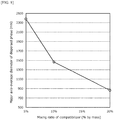
- the effect of adjusting a dispersion diameter can be particularly easily obtained. That is, when the mixing ratio is within the above range, a dispersion diameter can be remarkably changed. More specifically, the major axis-average diameter of the dispersed phase (2) can be changed within the range of 300 nm or more but 3000 nm or less.
- the major axis-average diameter can usually be adjusted to be smaller as the mixing ratio of the compatibilizer increases, and can be adjusted to be larger as the mixing ratio of the compatibilizer decreases.
- the "dispersion diameter” refers to a major axis-average diameter unless otherwise specified.
- the mixing ratio of the compatibilizer is more preferably adjusted to fall within the range of 5% by mass or more but 48% by mass or less, even more preferably within the range of 6% by mass or more but 45% by mass or less, even more preferably within the range of 7% by mass or more but 43% by mass or less, even more preferably within the range of 10% by mass or more but 38% by mass or less, even more preferably within the range of 11% by mass or more but 35% by mass or less, even more preferably within the range of 12% by mass or more but 33% by mass or less, even more preferably within the range of 15% by mass or more but 30% by mass or less, even more preferably within the range of 16% by mass or more but 25% by mass or less, even more preferably within the range of 18% by mass or more but 22% by mass or less.
- the dispersion diameter can be adjusted to achieve a steeper distribution.
- the mixing ratio of the polyolefin resin and the mixing ratio of the polyamide resin are not particularly limited, and the polyolefin resin and the polyamide resin can be appropriately mixed according to desired properties.
- the mixing ratio of the polyolefin resin may be 2% by mass or more but 90% by mass or less.
- the mixing ratio of the polyolefin resin is preferably 5% by mass or more but 85% by mass or less, more preferably 10% by mass or more but 83% by mass or less, even more preferably 15% by mass or more but 80% by mass or less, even more preferably 20% by mass or more but 78% by mass or less, even more preferably 25% by mass or more but 75% by mass or less, even more preferably 30% by mass or more but 73% by mass or less, even more preferably 35% by mass or more but 70% by mass or less.
- the mixing ratio of the polyamide resin may be 1% by mass or more but 75% by mass or less.
- the mixing ratio of the polyamide resin is preferably 3% by mass or more but 70% by mass or less, more preferably 5% by mass or more but 65% by mass or less, even more preferably 7% by mass or more but 60% by mass or less, even more preferably 10% by mass or more but 57% by mass or less, even more preferably 13% by mass or more but 55% by mass or less, even more preferably 15% by mass or more but 50% by mass or less, even more preferably 20% by mass or more but 45% by mass or less.
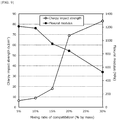
- the thermoplastic resin composition obtained by the adjusting use can have high impact resistance or high flexural modulus or can have both of these properties. More specifically, when the mixing ratio of the compatibilizer determined by conversion based on the mixing ratio is 1% by mass or more but 60% by mass or less, the Charpy impact strength of the thermoplastic resin composition can be adjusted to 5 kJ/m 2 or more but 120 kJ/m 2 or less. The flexural modulus can be adjusted to 500 MPa or more but 1500 MPa or less. Further, when the mixing ratio of the compatibilizer is 5% by mass or more but 48% by mass or less, the Charpy impact strength can be adjusted to 4 kJ/m 2 or more but 90 kJ/m 2 or less.
- the flexural modulus can be adjusted to 500 MPa or more but 1300 MPa or less. Further, when the mixing ratio of the compatibilizer is 7% by mass or more but 43% by mass or less, the Charpy impact strength can be adjusted to 6 kJ/m 2 or more but 85 kJ/m 2 or less. The flexural modulus can be adjusted to 500 MPa or more but 1250 MPa or less. Further, when the mixing ratio of the compatibilizer is 10% by mass or more but 38% by mass or less, the Charpy impact strength can be adjusted to 8 kJ/m 2 or more but 85 kJ/m 2 or less. The flexural modulus can be adjusted to 500 MPa or more but 1200 MPa or less.
- the mixing ratio of the compatibilizer is 12% by mass or more but 33% by mass or less
- the Charpy impact strength can be adjusted to 10 kJ/m 2 or more but 85 kJ/m 2 or less.
- the flexural modulus can be adjusted to 500 MPa or more but 1100 MPa or less.
- a Charpy impact strength of 13 kJ/m 2 or more but 80 kJ/m 2 or less and a flexural modulus of 500 MPa or more but 1050 MPa or less can be both achieved.
- the mixing ratio of the compatibilizer is 16% by mass or more but 25% by mass or less, a Charpy impact strength of 20 kJ/m 2 or more but 80 kJ/m 2 or less and a flexural modulus of 600 MPa or more but 950 MPa or less can be both achieved. Further, when the mixing ratio of the compatibilizer is 18% by mass or more but 22% by mass or less, a Charpy impact strength of 45 kJ/m 2 or more but 75 kJ/m 2 or less and a flexural modulus of 5750 MPa or more but 900 MPa or less can be both achieved.
- the adjusting use can be performed using a conventionally-known apparatus capable of performing melt-kneading. More specifically, the melt-kneading can be performed using a kneading apparatus such as an extruder (e.g., a single screw extruder or a twin screw kneading extruder), a kneader, or a mixer (e.g., a high-speed flow mixer, a paddle mixer, or a ribbon mixer). These apparatuses may be used singly or in combination of two or more of them. When two or more of the apparatuses are used, they may be operated continuously or batch-wise. Further, all the raw materials may be mixed at a time or may be mixed by adding them in several batches (multistage addition).
- a kneading apparatus such as an extruder (e.g., a single screw extruder or a twin screw kneading extruder), a kneader, or a
- the kneading temperature of the first melt-kneading is preferably 190°C or more but 350°C or less, more preferably 200°C or more but 330°C or less, even more preferably 205°C or more but 310°C or less.
- the kneading temperature of the second melt-kneading is preferably 190°C or more but 350°C or less, more preferably 200°C or more but 300°C or less, even more preferably 205°C or more but 260°C or less.
- melt-kneaded product obtained by first melt-kneading may be solidified by, for example, pelletization, or may be kept in a molten state or softened state when subjected to the second melt-kneading.
- the dispersion diameter (2) can be adjusted. More specifically, the major axis-average diameter can be adjusted to be smaller as the mixing ratio of the compatibilizer increases, and the major axis-average diameter can be adjusted to be larger as the mixing ratio of the compatibilizer decreases.
- the major axis-average diameter of the dispersed phase (2) can be changed within the range of 300 nm or more but 3000 nm or less.
- the major axis-average diameter of the dispersed phase (2) can be changed within the range of 450 nm or more but 2000 nm or less.
- the major axis-average diameter of the dispersed phase (2) can be changed within the range of 500 nm or more but 1500 nm or less. Further, when the mixing ratio of the compatibilizer is in the range ⁇ 4> of 18% by mass or more but 22% by mass or less, the major axis-average diameter of the dispersed phase (2) can be changed within the range of 550 nm or more but 1100 nm or less.
- the dispersion diameter can be adjusted by a smaller vary in the mixing ratio of the compatibilizer to achieve a steep distribution.
- the dispersion diameter of the fine dispersed phase (3) can be decreased by decreasing the dispersion diameter of the dispersed phase (2) by the adjusting use.
- the dispersion diameter of the fine dispersed phase (3) can be increased by increasing the dispersion diameter of the dispersed phase (2).
- the fine dispersed phase 3 usually has a major axis-average diameter of 50 nm or more but 500 nm or less (which is of course smaller than the major axis-average diameter of the dispersed phase (2)).
- the major axis-average diameter of the fine dispersed phase at the time when the major axis-average diameter of the dispersed phase 2 exceeds 1700 nm is 250 nm or more, but the major axis-average diameter of the fine dispersed phase at the time when the major axis-average diameter of the dispersed phase 2 is 1700 nm or less is less than 250 nm.
- the fine dispersed phase can have a major axis-average diameter of 180 nm or more but 225 nm or less.
- the above-described major axis-average diameter is determined in the following manner using the image of a test specimen, which is made of the obtained thermoplastic resin composition, magnified 2500 times or more.
- the longest diameter of each of 20 dispersed phases (2) randomly selected within a predetermined region of the image is measured, and the average of the measured longest diameters is determined as a first average value.
- the first average value of each of five different regions in the image is determined, and the average of the first average values is further determined as a major axis-average diameter.
- the image to be used for the above measurements is preferably one obtained by subjecting the fracture surface of a test specimen to oxygen plasma etching treatment and then osmium coating treatment and then magnifying the osmium-coated surface of the test specimen by a field emission scanning electron microscope.
- other components may also be used in addition to the polyolefin resin, the polyamide resin, and the compatibilizer.
- the other components include a nucleating agent, an antioxidant, a heat stabilizer, a weathering agent, a light stabilizer, a plasticizer, an ultraviolet absorber, an antistatic agent, a flame retardant, a slip agent, an antiblocking agent, an antifogging agent, a lubricant, a pigment, a dye, a dispersant, a copper inhibitor, a neutralizer, an antifoaming agent, a weld strength improver, a natural oil, a synthetic oil, and a wax.
- nucleating agent and the reinforcing filler examples include: silicates such as talc, silica, clay, montmorillonite, and kaolin; carbonates such as calcium carbonate, lithium carbonate, and magnesium carbonate; metal oxides such as alumina, titanium oxide, and zinc oxide; metals such as aluminum, iron, silver, and copper; hydroxides such as aluminum hydroxide and magnesium hydroxide; sulfides such as barium sulfate; carbides such as charcoal and bamboo charcoal; titanides such as potassium titanate and barium titanate; celluloses such as cellulose microfibrils and cellulose acetate; resin fibers such as polyethylene terephthalate fibers, nylon fibers, polyethylene naphthalate fibers, aramid fibers, vinylon fibers, and polyarylate fibers; and carbons such as fullerene and carbon nanotubes.
- silicates such as talc, silica, clay, montmorillonite, and kaolin
- carbonates such as
- antioxidant examples include phenol-based compounds, organic phosphite-based compounds, and thioether-based compounds.
- heat stabilizer examples include hindered amine-based compounds.
- ultraviolet absorber examples include benzophenone-based compounds, benzotriazole-based compounds, and benzoate-based compounds.
- antistatic agent examples include nonionic compounds, cationic compounds, and anionic compounds.
- the flame retardant examples include halogen-based compounds, phosphorus-based compounds (e.g., nitrogen-containing phosphate compounds and phosphate esters), nitrogen-based compounds (e.g., guanidine, triazine, melamine, and derivatives thereof), inorganic compounds (e.g., metal hydroxides), boron-based compounds, silicone-based compounds, sulfur-based compounds, and red phosphorus-based compounds.
- phosphorus-based compounds e.g., nitrogen-containing phosphate compounds and phosphate esters
- nitrogen-based compounds e.g., guanidine, triazine, melamine, and derivatives thereof
- inorganic compounds e.g., metal hydroxides
- boron-based compounds silicone-based compounds
- sulfur-based compounds sulfur-based compounds
- red phosphorus-based compounds examples include halogen-based compounds, phosphorus-based compounds (e.g., nitrogen-containing phosphate compounds and phosphate esters), nitrogen-based compounds (e
- flame retardant aid examples include antimony compounds, zinc compounds, bismuth compounds, magnesium hydroxide, and clayey silicate.
- thermoplastic resin composition according to the present invention is obtained by mixing a polyolefin resin, a polyamide resin, and a compatibilizer having a reactive group that reacts with the polyamide resin, and has a continuous phase composed of the polyolefin resin and a dispersed phase dispersed in the continuous phase and composed of the polyamide resin characterized in that the number of the dispersed phase per 10 micrometers square is 50 or more but 450 or less.
- phase structure, the polyolefin resin, the polyamide resin, and the compatibilizer described above with reference to the use for adjusting a dispersion diameter can be directly applied to those of this composition.
- phase structure of this composition is the same as the phase structure described above with reference to the use for adjusting a dispersion diameter also in that the dispersed phase (2) may have a fine dispersed phase (3) and may further have an interfacial phase (5).
- the number of the dispersed phase per 10 micrometers square of the composition is 50 or more but 450 or less. That is, this composition is a thermoplastic resin composition having a high density of the dispersed phase (2).
- the thermoplastic resin composition can achieve both high impact resistance and high flexural modulus. More specifically, the thermoplastic resin composition can achieve both a Charpy impact strength of 5 kJ/m 2 or more and a flexural modulus of 500 MPa or more at the same time.
- both a Charpy impact strength of 15 kJ/m 2 or more but 90 kJ/m 2 or less and a flexural modulus of 600 MPa or more but 1100 MPa or less can be achieved at the same time.
- both a Charpy impact strength of 25 kJ/m 2 or more but 80 kJ/m 2 or less and a flexural modulus of 600 MPa or more but 900 MPa or less can be achieved at the same time.
- the number of the dispersed phase is preferably 53 or more but 425 or less, more preferably 80 or more but 410 or less, even more preferably 100 or more but 390 or less, even more preferably 140 or more but 370 or less, even more preferably 180 or more but 350 or less, even more preferably 200 or more but 330 or less, even more preferably 210 or more but 300 or less.
- the dispersed phase of the thermoplastic resin composition having 50 or more but 450 or less dispersed phases per 10 micrometers square can have a dispersion diameter (major axis-average diameter) of 300 nm or more but 3000 nm or less.
- the dispersed phase can have a dispersion diameter of 350 nm or more but 2800 nm or less, a dispersion diameter of 400 nm or more but 2500 nm or less, a dispersion diameter of 480 nm or more but 2200 nm or less, a dispersion diameter of 510 nm or more but 1800 nm or less, a dispersion diameter of 550 nm or more but 1400 nm or less, or a dispersion diameter of 580 nm or more but 1100 nm or less.
- dispersion diameter can be measured by the same method as described above with reference to the adjusting use.
- the mixing ratio of each of the polyolefin resin, the polyamide resin, and the compatibilizer in the thermoplastic resin composition is not particularly limited, but may be as follows.
- the mixing ratio of the polyolefin resin may be 2% by mass or more but 90% by mass or less.
- the mixing ratio of the polyolefin resin is preferably 5% by mass or more but 85% by mass or less, more preferably 10% by mass or more but 83% by mass or less, even more preferably 15% by mass or more but 80% by mass or less, even more preferably 20% by mass or more but 78% by mass or less, even more preferably 25% by mass or more but 75% by mass or less, even more preferably 30% by mass or more but 73% by mass or less, even more preferably 35% by mass or more but 70% by mass or less.
- the mixing ratio of the polyamide resin may be 1% by mass or more but 75% by mass or less.
- the mixing ratio of the polyamide resin is preferably 3% by mass or more but 70% by mass or less, more preferably 5% by mass or more but 65% by mass or less, even more preferably 7% by mass or more but 60% by mass or less, even more preferably 10% by mass or more but 57% by mass or less, even more preferably 13% by mass or more but 55% by mass or less, even more preferably 15% by mass or more but 50% by mass or less, even more preferably 20% by mass or more but 45% by mass or less.
- the mixing ratio of the compatibilizer is preferably 1% by mass or more but 60% by mass or less, more preferably 5% by mass or more but 48% by mass or less, more preferably 6% by mass or more but 45% by mass or less, even more preferably 7% by mass or more but 43% by mass or less, even more preferably 10% by mass or more but 38% by mass or less, even more preferably 11% by mass or more but 35% by mass or less, even more preferably 12% by mass or more but 33% by mass or less, even more preferably 15% by mass or more but 30% by mass or less, even more preferably 16% by mass or more but 25% by mass or less, even more preferably 18% by mass or more but 22% by mass or less.
- the mixing ratio of the compatibilizer is preferably 20% by mass or more but 90% by mass or less, more preferably 22% by mass or more but 88% by mass or less, even more preferably 25% by mass or more but 86% by mass or less, even more preferably 27% by mass or more but 75% by mass or less, even more preferably 29% by mass or more but 70% by mass or less, even more preferably 32% by mass or more but 66% by mass or less, even more preferably 36% by mass or more but 60% by mass or less.
- the mixing ratio of the polyamide resin in the total of the polyamide resin and the compatibilizer is preferably 10% by mass or more but 80% by mass or less, more preferably 12% by mass or more but 78% by mass or less, even more preferably 14% by mass or more but 75% by mass or less, even more preferably 25% by mass or more but 73% by mass or less, even more preferably 30% by mass or more but 71% by mass or less, even more preferably 34% by mass or more but 68% by mass or less, even more preferably 40% by mass or more but 64% by mass or less.
- the mixing ratio of the compatibilizer is within the above range, the dispersed phase to be dispersed can be made smaller. Further, the amount of the polyamide resin having a large specific gravity to be used can be reduced, and therefore the weight of the thermoplastic resin composition can be reduced. At the same time, a molded body obtained using the thermoplastic resin composition has a relaxing appearance with low surface luster, and therefore can offer excellent design flexibility and can be applied to exterior and interior materials that are directly visually recognized.
- the mixing ratio of the polyamide resin is preferably 1.5% by mass or more but 88% by mass or less, more preferably 3% by mass or more but 75% by mass or less, even more preferably 5% by mass or more but 70% by mass or less, even more preferably 10% by mass or more but 65% by mass or less, even more preferably 15% by mass or more but 60% by mass or less, even more preferably 18% by mass or more but 55% by mass or less, even more preferably 20% by mass or more but 50% by mass or less, even more preferably 25% by mass or more but 45% by mass or less.
- the mixing ratio of the polyolefin resin is preferably 12% by mass or more but 98.5% by mass or less, more preferably 25% by mass or more but 97% by mass or less, more preferably 30% by mass or more but 95% by mass or less, more preferably 35% by mass or more but 90% by mass or less, even more preferably 40% by mass or more but 85% by mass or less, even more preferably 45% by mass or more but 82% by mass or less, even more preferably 50% by mass or more but 80% by mass or less, even more preferably 55% by mass or more but 75% by mass or less.
- thermoplastic resin composition can have both high impact resistance and high flexural modulus.
- the ratio of the dispersed phase is preferably 2% by mass or more but 90% by mass or less, more preferably 5% by mass or more but 85% by mass or less, even more preferably 10% by mass or more but 83% by mass or less, even more preferably 15% by mass or more but 80% by mass or less, even more preferably 20% by mass or more but 78% by mass or less, even more preferably 25% by mass or more but 75% by mass or less, even more preferably 30% by mass or more but 73% by mass or less, even more preferably 35% by mass or more but 70% by mass or less.
- the ratio of the continuous phase is preferably 10% by mass or more but 98% by mass or less, more preferably 15% by mass or more but 95% by mass or less, even more preferably 17% by mass or more but 90% by mass or less, even more preferably 20% by mass or more but 85% by mass or less, even more preferably 22% by mass or more but 80% by mass or less, even more preferably 25% by mass or more but 75% by mass or less, even more preferably 27% by mass or more but 70% by mass or less, even more preferably 30% by mass or more but 65% by mass or less.
- thermoplastic resin composition can have both high impact resistance and high flexural modulus.
- thermoplastic resin composition can be subjected to injection molding, extrusion molding (sheet extrusion, profile extrusion), T-die molding, blow molding, injection blow molding, inflation molding, blow molding, vacuum molding, compression molding, press molding, stamping molding, transfer molding, or the like.
- extrusion molding sheet extrusion, profile extrusion
- T-die molding blow molding, injection blow molding, inflation molding, blow molding, vacuum molding, compression molding, press molding, stamping molding, transfer molding, or the like.
- thermoplastic resin composition obtained by the adjusting use according to the present invention or the thermoplastic resin composition according to the present invention can be formed into a molded body having the effects of the thermoplastic resin composition.
- the molded body can be obtained by any method, and a molding method to be used is not particularly limited.
- the shape, size, thickness, etc. of the molded body are not particularly limited, and the intended use of the molded body is not particularly limited, either.
- This molded body can be used for, for example, exterior materials, interior materials, structural materials, and shock absorbers for automobiles, railway vehicles, ships, and airplanes.
- Examples of the molded body used for automobiles include exterior materials for automobiles, interior materials for automobiles, structural materials for automobiles, shock absorbers for automobiles, and parts in engine rooms.
- bumpers include bumpers, spoilers, cowlings, front grills, garnishes, hoods, trunk lids, fender panels, door panels, roof panels, instrument panels, center clusters, door trims, quarter trims, roof linings, pillar garnishes, deck trims, tonneau boards, package trays, dashboards, console boxes, kicking plates, switch bases, seat backboards, seat frames, armrests, sunvisors, intake manifolds, engine head covers, engine under covers, oil filter housings, housings of in-car electronic parts (e.g., ECUs and TV monitors), and air filter boxes.
- in-car electronic parts e.g., ECUs and TV monitors
- the molded body can be used for, for example, interior materials, exterior materials, and structural materials of buildings, furniture, and the like. Specific examples thereof include door covering materials, door structural materials, and covering materials and structural materials of various kinds of furniture (e.g., desks, chairs, shelves, and chests of drawers). Further, the molded body can also be used for packages, containers (e.g., trays), protecting members, and partition members. Further, the molded body can also be used for housings and structures of household appliances (e.g., flat-panel TVs, refrigerators, washing machines, vacuum cleaners, mobile phones, mobile game machines, and laptop personal computers).
- household appliances e.g., flat-panel TVs, refrigerators, washing machines, vacuum cleaners, mobile phones, mobile game machines, and laptop personal computers.
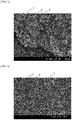
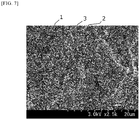
- Example 1 The fracture surface of each of the test specimens that had been subjected to the Charpy impact strength measurement in the above (1) was subjected to oxygen plasma etching treatment at 100 W for 1 minute and then to osmium coating treatment and observed with a field emission scanning electron microscope ("JSM-7100F TTL LV" manufactured by JEOL Ltd.) to obtain an image (FE-SEM image).
- JSM-7100F TTL LV field emission scanning electron microscope
- the component constituting each phase was identified by energy dispersive X-ray spectrometry (EDS) during the above FE-SEM observation.
- EDS energy dispersive X-ray spectrometry
- the longest diameter (major axis dispersion diameter) of each of 20 dispersed phases (2) randomly selected within each of five different regions in the image obtained above was measured, and the average of the measured longest diameters was determined as a first average value, and the average of the first average values measured in the five different regions was further determined as a major axis-average diameter.
- the dispersion diameter of the dispersed phase 2 can be controlled by increasing or decreasing the amount of the compatibilizer according to the adjusting method of the present invention. That is, the results revealed that the dispersion diameter conventionally controlled only by a physical approach can be controlled by a chemical means.
Landscapes
- Chemical & Material Sciences (AREA)
- Health & Medical Sciences (AREA)
- Chemical Kinetics & Catalysis (AREA)
- Medicinal Chemistry (AREA)
- Polymers & Plastics (AREA)
- Organic Chemistry (AREA)
- General Chemical & Material Sciences (AREA)
- Compositions Of Macromolecular Compounds (AREA)
- Processes Of Treating Macromolecular Substances (AREA)
Applications Claiming Priority (2)
| Application Number | Priority Date | Filing Date | Title |
|---|---|---|---|
| JP2016072743A JP6288142B2 (ja) | 2016-03-31 | 2016-03-31 | 分散径の調整方法及び熱可塑性樹脂組成物 |
| PCT/JP2017/010533 WO2017169813A1 (ja) | 2016-03-31 | 2017-03-15 | 分散径の調整方法及び熱可塑性樹脂組成物 |
Publications (3)
| Publication Number | Publication Date |
|---|---|
| EP3438182A1 EP3438182A1 (en) | 2019-02-06 |
| EP3438182A4 EP3438182A4 (en) | 2020-01-08 |
| EP3438182B1 true EP3438182B1 (en) | 2021-03-03 |
Family
ID=59965470
Family Applications (1)
| Application Number | Title | Priority Date | Filing Date |
|---|---|---|---|
| EP17774357.2A Active EP3438182B1 (en) | 2016-03-31 | 2017-03-15 | Dispersion diameter adjustment method and thermoplastic resin composition |
Country Status (9)
| Country | Link |
|---|---|
| US (1) | US10829626B2 (enExample) |
| EP (1) | EP3438182B1 (enExample) |
| JP (1) | JP6288142B2 (enExample) |
| KR (2) | KR102275080B1 (enExample) |
| CN (1) | CN108602996B (enExample) |
| BR (1) | BR112018068020A2 (enExample) |
| RU (1) | RU2727188C2 (enExample) |
| SG (1) | SG11201806644UA (enExample) |
| WO (1) | WO2017169813A1 (enExample) |
Families Citing this family (6)
| Publication number | Priority date | Publication date | Assignee | Title |
|---|---|---|---|---|
| US10954412B1 (en) * | 2015-02-05 | 2021-03-23 | Ultra Tech Extrusions of Tennessee, inc. | Extended melt-temp range and low energy absorptive edge banding adhesive system and edge banding |
| ES3002718T3 (en) | 2015-12-01 | 2025-03-07 | Toyota Boshoku Kk | Modifier, usage therefor, production method for modifier, and carrier for additive material |
| CN110177826A (zh) * | 2017-01-30 | 2019-08-27 | 丰田纺织株式会社 | 改性剂和其使用方法、改性剂的制造方法以及添加材料用载体 |
| JP7524683B2 (ja) * | 2020-09-01 | 2024-07-30 | 株式会社リコー | トナー、現像剤、トナーセット、トナー収容ユニット、画像形成装置及び画像形成方法 |
| JP7677996B2 (ja) * | 2020-12-22 | 2025-05-15 | 三井化学株式会社 | 熱可塑性樹脂組成物およびその製造方法 |
| WO2026043194A1 (ko) * | 2024-08-19 | 2026-02-26 | 주식회사 엘지화학 | 수지 조성물 |
Family Cites Families (35)
| Publication number | Priority date | Publication date | Assignee | Title |
|---|---|---|---|---|
| JPH075784B2 (ja) | 1986-08-12 | 1995-01-25 | 鐘淵化学工業株式会社 | 熱可塑性樹脂予備発泡粒子の製造方法 |
| KR960013123B1 (ko) | 1986-09-25 | 1996-09-30 | 셀 인터나쵸나아레 레사아치 마아츠샤피 비이부이 | 내충격성 중합체 조성물 및 그 제조 방법 |
| JPH0366735A (ja) | 1989-08-04 | 1991-03-22 | Tonen Chem Corp | 多層成形品用熱可塑性樹脂組成物 |
| JPH0496969A (ja) | 1990-08-10 | 1992-03-30 | Tonen Chem Corp | 熱可塑性樹脂組成物 |
| JP2885507B2 (ja) | 1990-11-20 | 1999-04-26 | 株式会社豊田中央研究所 | ポリプロピレン樹脂組成物からなる高剛性部品 |
| JP2885492B2 (ja) | 1990-08-14 | 1999-04-26 | 株式会社豊田中央研究所 | 高衝撃性部品用ポリプロピレン組成物 |
| EP0472344A3 (en) | 1990-08-14 | 1992-09-30 | Ube Industries, Ltd. | Reinforced elastomer composition and polypropylene composition containing same |
| JP3007139B2 (ja) | 1990-11-29 | 2000-02-07 | 三菱化学株式会社 | 耐衝撃性に優れたオレフィン重合体組成物 |
| JPH0718088A (ja) | 1993-07-05 | 1995-01-20 | Nippon Petrochem Co Ltd | 樹脂組成物の製造方法 |
| FR2783747B1 (fr) | 1998-09-30 | 2000-12-08 | Atochem Elf Sa | Film comprenant une couche centrale en polyolefine et deux couches externes en alliage polyamide/polyolefine |
| JP2001226537A (ja) | 2000-02-17 | 2001-08-21 | Toray Ind Inc | 熱可塑性樹脂構造体および成形品 |
| JP4078823B2 (ja) | 2001-10-26 | 2008-04-23 | 東レ株式会社 | バリア性多層中空容器およびその製造方法 |
| JP3931622B2 (ja) | 2001-10-26 | 2007-06-20 | 東レ株式会社 | 樹脂構造体 |
| KR100849962B1 (ko) | 2001-12-03 | 2008-08-01 | 디아이씨 가부시끼가이샤 | 열가소성 수지 미립자 수성 분산체의 제조 방법 및전자사진용 토너 |
| RU2324713C2 (ru) | 2003-03-06 | 2008-05-20 | Эксонмобил Кемикал Пэйтентс, Инк. | Способ регулирования размера дисперсных частиц эластомера в термопластичной эластомерной композиции |
| JP4241624B2 (ja) | 2003-03-06 | 2009-03-18 | エクソンモービル ケミカル パテンツ,インコーポレイティド | 熱可塑性エラストマー組成物中のエラストマーの分散サイズの制御方法 |
| US7015283B2 (en) | 2003-10-10 | 2006-03-21 | Exxonmobil Chemical Patents Inc. | Compositions of polypropylene and polyamide |
| JP4703962B2 (ja) | 2004-02-20 | 2011-06-15 | 旭化成イーマテリアルズ株式会社 | 改良された熱可塑性樹脂成形体 |
| JP2006124558A (ja) | 2004-10-29 | 2006-05-18 | Japan Polypropylene Corp | 高圧放電処理したポリオレフィンとポリアミドからなる新規組織構造をもつ重合体アロイ |
| JP5391509B2 (ja) | 2005-12-16 | 2014-01-15 | 東レ株式会社 | ポリアミド樹脂組成物 |
| JP5469322B2 (ja) | 2007-08-31 | 2014-04-16 | ユニチカ株式会社 | 環境配慮型熱可塑性樹脂組成物 |
| JP5469321B2 (ja) | 2007-08-31 | 2014-04-16 | ユニチカ株式会社 | 難燃性環境配慮型熱可塑性樹脂組成物 |
| JPWO2009069725A1 (ja) | 2007-11-30 | 2011-04-14 | 東レ株式会社 | ポリアミド樹脂組成物および成形品 |
| JP5200989B2 (ja) | 2009-02-23 | 2013-06-05 | 東レ株式会社 | 熱可塑性樹脂組成物およびその製造方法 |
| JP5505304B2 (ja) | 2009-03-16 | 2014-05-28 | 東レ株式会社 | 繊維強化樹脂組成物、成形材料および繊維強化樹脂組成物の製造方法 |
| US9175164B2 (en) | 2011-05-31 | 2015-11-03 | Torray Industries, Inc. | Process for producing polymer alloy, polymer alloy, and molded article |
| JP5914318B2 (ja) | 2011-12-22 | 2016-05-11 | トヨタ紡織株式会社 | 熱可塑性樹脂組成物の製造方法 |
| JP2013129800A (ja) * | 2011-12-22 | 2013-07-04 | Toyota Boshoku Corp | 熱可塑性樹脂組成物及びその製造方法 |
| KR101675654B1 (ko) * | 2011-12-22 | 2016-11-11 | 도요다 보쇼꾸 가부시키가이샤 | 열가소성 수지 조성물 및 그의 제조 방법, 및 성형체 |
| KR101675655B1 (ko) * | 2011-12-22 | 2016-11-11 | 도요다 보쇼꾸 가부시키가이샤 | 열가소성 수지 조성물 및 그의 제조 방법 |
| JP5836923B2 (ja) | 2011-12-22 | 2015-12-24 | トヨタ紡織株式会社 | 植物由来ポリアミド樹脂を用いた熱可塑性樹脂組成物及び成形体 |
| JP5879253B2 (ja) | 2011-12-22 | 2016-03-08 | トヨタ紡織株式会社 | 熱可塑性樹脂組成物及びその製造方法 |
| JP5798595B2 (ja) | 2012-06-22 | 2015-10-21 | 株式会社豊田中央研究所 | 樹脂組成物 |
| ES3002718T3 (en) | 2015-12-01 | 2025-03-07 | Toyota Boshoku Kk | Modifier, usage therefor, production method for modifier, and carrier for additive material |
| EP3385321B1 (en) | 2015-12-01 | 2024-09-04 | Toyota Boshoku Kabushiki Kaisha | Molded body and production method therefor |
-
2016
- 2016-03-31 JP JP2016072743A patent/JP6288142B2/ja active Active
-
2017
- 2017-03-15 KR KR1020207007798A patent/KR102275080B1/ko active Active
- 2017-03-15 RU RU2018136576A patent/RU2727188C2/ru active
- 2017-03-15 SG SG11201806644UA patent/SG11201806644UA/en unknown
- 2017-03-15 EP EP17774357.2A patent/EP3438182B1/en active Active
- 2017-03-15 US US16/086,696 patent/US10829626B2/en active Active
- 2017-03-15 WO PCT/JP2017/010533 patent/WO2017169813A1/ja not_active Ceased
- 2017-03-15 CN CN201780010956.1A patent/CN108602996B/zh active Active
- 2017-03-15 KR KR1020187029067A patent/KR20180116432A/ko not_active Ceased
- 2017-03-15 BR BR112018068020A patent/BR112018068020A2/pt not_active Application Discontinuation
Non-Patent Citations (1)
| Title |
|---|
| None * |
Also Published As
| Publication number | Publication date |
|---|---|
| SG11201806644UA (en) | 2018-09-27 |
| KR20180116432A (ko) | 2018-10-24 |
| RU2018136576A (ru) | 2020-04-30 |
| KR20200032257A (ko) | 2020-03-25 |
| CN108602996B (zh) | 2019-10-01 |
| RU2727188C2 (ru) | 2020-07-21 |
| CN108602996A (zh) | 2018-09-28 |
| US10829626B2 (en) | 2020-11-10 |
| BR112018068020A2 (pt) | 2019-01-08 |
| JP2017179282A (ja) | 2017-10-05 |
| US20190100645A1 (en) | 2019-04-04 |
| JP6288142B2 (ja) | 2018-03-07 |
| RU2018136576A3 (enExample) | 2020-04-30 |
| EP3438182A4 (en) | 2020-01-08 |
| KR102275080B1 (ko) | 2021-07-08 |
| WO2017169813A1 (ja) | 2017-10-05 |
| EP3438182A1 (en) | 2019-02-06 |
Similar Documents
| Publication | Publication Date | Title |
|---|---|---|
| EP2796497B1 (en) | Thermoplastic resin composition, method for producing same, and molded body | |
| US11299608B2 (en) | Thermoplastic resin composition, method for producing same and molded body | |
| JP5798595B2 (ja) | 樹脂組成物 | |
| US9353251B2 (en) | Thermoplastic resin composition and method for producing same | |
| US10829626B2 (en) | Dispersion diameter adjustment method and thermoplastic resin composition | |
| EP2796496B1 (en) | Thermoplastic resin composition and method for producing same | |
| JP6916459B2 (ja) | 樹脂組成物 | |
| EP3438180B1 (en) | Energy absorber | |
| EP3597699A1 (en) | Thermoplastic resin sheet, laminated sheet, and molded object | |
| EP3578592A1 (en) | Fiber-reinforced material and structure | |
| JP7582426B2 (ja) | 熱可塑性樹脂組成物及びその製造方法、成形体及びその製造方法、並びに改質剤及び改質方法 | |
| EP3438181B1 (en) | Thermoplastic resin composition and molded body | |
| JP7677996B2 (ja) | 熱可塑性樹脂組成物およびその製造方法 |
Legal Events
| Date | Code | Title | Description |
|---|---|---|---|
| STAA | Information on the status of an ep patent application or granted ep patent |
Free format text: STATUS: THE INTERNATIONAL PUBLICATION HAS BEEN MADE |
|
| PUAI | Public reference made under article 153(3) epc to a published international application that has entered the european phase |
Free format text: ORIGINAL CODE: 0009012 |
|
| STAA | Information on the status of an ep patent application or granted ep patent |
Free format text: STATUS: REQUEST FOR EXAMINATION WAS MADE |
|
| 17P | Request for examination filed |
Effective date: 20180625 |
|
| AK | Designated contracting states |
Kind code of ref document: A1 Designated state(s): AL AT BE BG CH CY CZ DE DK EE ES FI FR GB GR HR HU IE IS IT LI LT LU LV MC MK MT NL NO PL PT RO RS SE SI SK SM TR |
|
| AX | Request for extension of the european patent |
Extension state: BA ME |
|
| DAV | Request for validation of the european patent (deleted) | ||
| DAX | Request for extension of the european patent (deleted) | ||
| A4 | Supplementary search report drawn up and despatched |
Effective date: 20191209 |
|
| RIC1 | Information provided on ipc code assigned before grant |
Ipc: C08J 3/20 20060101ALI20191203BHEP Ipc: C08L 77/00 20060101ALI20191203BHEP Ipc: C08L 23/26 20060101ALI20191203BHEP Ipc: C08L 23/02 20060101AFI20191203BHEP |
|
| GRAP | Despatch of communication of intention to grant a patent |
Free format text: ORIGINAL CODE: EPIDOSNIGR1 |
|
| STAA | Information on the status of an ep patent application or granted ep patent |
Free format text: STATUS: GRANT OF PATENT IS INTENDED |
|
| INTG | Intention to grant announced |
Effective date: 20200925 |
|
| GRAS | Grant fee paid |
Free format text: ORIGINAL CODE: EPIDOSNIGR3 |
|
| GRAA | (expected) grant |
Free format text: ORIGINAL CODE: 0009210 |
|
| STAA | Information on the status of an ep patent application or granted ep patent |
Free format text: STATUS: THE PATENT HAS BEEN GRANTED |
|
| AK | Designated contracting states |
Kind code of ref document: B1 Designated state(s): AL AT BE BG CH CY CZ DE DK EE ES FI FR GB GR HR HU IE IS IT LI LT LU LV MC MK MT NL NO PL PT RO RS SE SI SK SM TR |
|
| REG | Reference to a national code |
Ref country code: GB Ref legal event code: FG4D |
|
| REG | Reference to a national code |
Ref country code: AT Ref legal event code: REF Ref document number: 1367164 Country of ref document: AT Kind code of ref document: T Effective date: 20210315 Ref country code: CH Ref legal event code: EP |
|
| REG | Reference to a national code |
Ref country code: DE Ref legal event code: R096 Ref document number: 602017033890 Country of ref document: DE |
|
| REG | Reference to a national code |
Ref country code: IE Ref legal event code: FG4D |
|
| REG | Reference to a national code |
Ref country code: LT Ref legal event code: MG9D |
|
| PG25 | Lapsed in a contracting state [announced via postgrant information from national office to epo] |
Ref country code: HR Free format text: LAPSE BECAUSE OF FAILURE TO SUBMIT A TRANSLATION OF THE DESCRIPTION OR TO PAY THE FEE WITHIN THE PRESCRIBED TIME-LIMIT Effective date: 20210303 Ref country code: FI Free format text: LAPSE BECAUSE OF FAILURE TO SUBMIT A TRANSLATION OF THE DESCRIPTION OR TO PAY THE FEE WITHIN THE PRESCRIBED TIME-LIMIT Effective date: 20210303 Ref country code: GR Free format text: LAPSE BECAUSE OF FAILURE TO SUBMIT A TRANSLATION OF THE DESCRIPTION OR TO PAY THE FEE WITHIN THE PRESCRIBED TIME-LIMIT Effective date: 20210604 Ref country code: NO Free format text: LAPSE BECAUSE OF FAILURE TO SUBMIT A TRANSLATION OF THE DESCRIPTION OR TO PAY THE FEE WITHIN THE PRESCRIBED TIME-LIMIT Effective date: 20210603 Ref country code: LT Free format text: LAPSE BECAUSE OF FAILURE TO SUBMIT A TRANSLATION OF THE DESCRIPTION OR TO PAY THE FEE WITHIN THE PRESCRIBED TIME-LIMIT Effective date: 20210303 Ref country code: BG Free format text: LAPSE BECAUSE OF FAILURE TO SUBMIT A TRANSLATION OF THE DESCRIPTION OR TO PAY THE FEE WITHIN THE PRESCRIBED TIME-LIMIT Effective date: 20210603 |
|
| REG | Reference to a national code |
Ref country code: NL Ref legal event code: MP Effective date: 20210303 |
|
| REG | Reference to a national code |
Ref country code: AT Ref legal event code: MK05 Ref document number: 1367164 Country of ref document: AT Kind code of ref document: T Effective date: 20210303 |
|
| PG25 | Lapsed in a contracting state [announced via postgrant information from national office to epo] |
Ref country code: SE Free format text: LAPSE BECAUSE OF FAILURE TO SUBMIT A TRANSLATION OF THE DESCRIPTION OR TO PAY THE FEE WITHIN THE PRESCRIBED TIME-LIMIT Effective date: 20210303 Ref country code: LV Free format text: LAPSE BECAUSE OF FAILURE TO SUBMIT A TRANSLATION OF THE DESCRIPTION OR TO PAY THE FEE WITHIN THE PRESCRIBED TIME-LIMIT Effective date: 20210303 Ref country code: RS Free format text: LAPSE BECAUSE OF FAILURE TO SUBMIT A TRANSLATION OF THE DESCRIPTION OR TO PAY THE FEE WITHIN THE PRESCRIBED TIME-LIMIT Effective date: 20210303 Ref country code: PL Free format text: LAPSE BECAUSE OF FAILURE TO SUBMIT A TRANSLATION OF THE DESCRIPTION OR TO PAY THE FEE WITHIN THE PRESCRIBED TIME-LIMIT Effective date: 20210303 |
|
| PG25 | Lapsed in a contracting state [announced via postgrant information from national office to epo] |
Ref country code: NL Free format text: LAPSE BECAUSE OF FAILURE TO SUBMIT A TRANSLATION OF THE DESCRIPTION OR TO PAY THE FEE WITHIN THE PRESCRIBED TIME-LIMIT Effective date: 20210303 |
|
| PG25 | Lapsed in a contracting state [announced via postgrant information from national office to epo] |
Ref country code: EE Free format text: LAPSE BECAUSE OF FAILURE TO SUBMIT A TRANSLATION OF THE DESCRIPTION OR TO PAY THE FEE WITHIN THE PRESCRIBED TIME-LIMIT Effective date: 20210303 Ref country code: CZ Free format text: LAPSE BECAUSE OF FAILURE TO SUBMIT A TRANSLATION OF THE DESCRIPTION OR TO PAY THE FEE WITHIN THE PRESCRIBED TIME-LIMIT Effective date: 20210303 Ref country code: SM Free format text: LAPSE BECAUSE OF FAILURE TO SUBMIT A TRANSLATION OF THE DESCRIPTION OR TO PAY THE FEE WITHIN THE PRESCRIBED TIME-LIMIT Effective date: 20210303 Ref country code: AT Free format text: LAPSE BECAUSE OF FAILURE TO SUBMIT A TRANSLATION OF THE DESCRIPTION OR TO PAY THE FEE WITHIN THE PRESCRIBED TIME-LIMIT Effective date: 20210303 |
|
| REG | Reference to a national code |
Ref country code: CH Ref legal event code: PL |
|
| PG25 | Lapsed in a contracting state [announced via postgrant information from national office to epo] |
Ref country code: IS Free format text: LAPSE BECAUSE OF FAILURE TO SUBMIT A TRANSLATION OF THE DESCRIPTION OR TO PAY THE FEE WITHIN THE PRESCRIBED TIME-LIMIT Effective date: 20210703 Ref country code: PT Free format text: LAPSE BECAUSE OF FAILURE TO SUBMIT A TRANSLATION OF THE DESCRIPTION OR TO PAY THE FEE WITHIN THE PRESCRIBED TIME-LIMIT Effective date: 20210705 Ref country code: RO Free format text: LAPSE BECAUSE OF FAILURE TO SUBMIT A TRANSLATION OF THE DESCRIPTION OR TO PAY THE FEE WITHIN THE PRESCRIBED TIME-LIMIT Effective date: 20210303 Ref country code: SK Free format text: LAPSE BECAUSE OF FAILURE TO SUBMIT A TRANSLATION OF THE DESCRIPTION OR TO PAY THE FEE WITHIN THE PRESCRIBED TIME-LIMIT Effective date: 20210303 |
|
| REG | Reference to a national code |
Ref country code: DE Ref legal event code: R097 Ref document number: 602017033890 Country of ref document: DE |
|
| REG | Reference to a national code |
Ref country code: BE Ref legal event code: MM Effective date: 20210331 |
|
| PLBE | No opposition filed within time limit |
Free format text: ORIGINAL CODE: 0009261 |
|
| STAA | Information on the status of an ep patent application or granted ep patent |
Free format text: STATUS: NO OPPOSITION FILED WITHIN TIME LIMIT |
|
| PG25 | Lapsed in a contracting state [announced via postgrant information from national office to epo] |
Ref country code: AL Free format text: LAPSE BECAUSE OF FAILURE TO SUBMIT A TRANSLATION OF THE DESCRIPTION OR TO PAY THE FEE WITHIN THE PRESCRIBED TIME-LIMIT Effective date: 20210303 Ref country code: DK Free format text: LAPSE BECAUSE OF FAILURE TO SUBMIT A TRANSLATION OF THE DESCRIPTION OR TO PAY THE FEE WITHIN THE PRESCRIBED TIME-LIMIT Effective date: 20210303 Ref country code: CH Free format text: LAPSE BECAUSE OF NON-PAYMENT OF DUE FEES Effective date: 20210331 Ref country code: MC Free format text: LAPSE BECAUSE OF FAILURE TO SUBMIT A TRANSLATION OF THE DESCRIPTION OR TO PAY THE FEE WITHIN THE PRESCRIBED TIME-LIMIT Effective date: 20210303 Ref country code: LI Free format text: LAPSE BECAUSE OF NON-PAYMENT OF DUE FEES Effective date: 20210331 Ref country code: LU Free format text: LAPSE BECAUSE OF NON-PAYMENT OF DUE FEES Effective date: 20210315 Ref country code: ES Free format text: LAPSE BECAUSE OF FAILURE TO SUBMIT A TRANSLATION OF THE DESCRIPTION OR TO PAY THE FEE WITHIN THE PRESCRIBED TIME-LIMIT Effective date: 20210303 Ref country code: IE Free format text: LAPSE BECAUSE OF NON-PAYMENT OF DUE FEES Effective date: 20210315 Ref country code: FR Free format text: LAPSE BECAUSE OF NON-PAYMENT OF DUE FEES Effective date: 20210503 |
|
| 26N | No opposition filed |
Effective date: 20211206 |
|
| GBPC | Gb: european patent ceased through non-payment of renewal fee |
Effective date: 20210603 |
|
| PG25 | Lapsed in a contracting state [announced via postgrant information from national office to epo] |
Ref country code: SI Free format text: LAPSE BECAUSE OF FAILURE TO SUBMIT A TRANSLATION OF THE DESCRIPTION OR TO PAY THE FEE WITHIN THE PRESCRIBED TIME-LIMIT Effective date: 20210303 |
|
| PG25 | Lapsed in a contracting state [announced via postgrant information from national office to epo] |
Ref country code: IT Free format text: LAPSE BECAUSE OF FAILURE TO SUBMIT A TRANSLATION OF THE DESCRIPTION OR TO PAY THE FEE WITHIN THE PRESCRIBED TIME-LIMIT Effective date: 20210303 Ref country code: GB Free format text: LAPSE BECAUSE OF NON-PAYMENT OF DUE FEES Effective date: 20210603 |
|
| PG25 | Lapsed in a contracting state [announced via postgrant information from national office to epo] |
Ref country code: IS Free format text: LAPSE BECAUSE OF FAILURE TO SUBMIT A TRANSLATION OF THE DESCRIPTION OR TO PAY THE FEE WITHIN THE PRESCRIBED TIME-LIMIT Effective date: 20210703 |
|
| PG25 | Lapsed in a contracting state [announced via postgrant information from national office to epo] |
Ref country code: BE Free format text: LAPSE BECAUSE OF NON-PAYMENT OF DUE FEES Effective date: 20210331 |
|
| PG25 | Lapsed in a contracting state [announced via postgrant information from national office to epo] |
Ref country code: CY Free format text: LAPSE BECAUSE OF FAILURE TO SUBMIT A TRANSLATION OF THE DESCRIPTION OR TO PAY THE FEE WITHIN THE PRESCRIBED TIME-LIMIT Effective date: 20210303 |
|
| PG25 | Lapsed in a contracting state [announced via postgrant information from national office to epo] |
Ref country code: HU Free format text: LAPSE BECAUSE OF FAILURE TO SUBMIT A TRANSLATION OF THE DESCRIPTION OR TO PAY THE FEE WITHIN THE PRESCRIBED TIME-LIMIT; INVALID AB INITIO Effective date: 20170315 |
|
| PG25 | Lapsed in a contracting state [announced via postgrant information from national office to epo] |
Ref country code: MK Free format text: LAPSE BECAUSE OF FAILURE TO SUBMIT A TRANSLATION OF THE DESCRIPTION OR TO PAY THE FEE WITHIN THE PRESCRIBED TIME-LIMIT Effective date: 20210303 |
|
| PG25 | Lapsed in a contracting state [announced via postgrant information from national office to epo] |
Ref country code: MT Free format text: LAPSE BECAUSE OF FAILURE TO SUBMIT A TRANSLATION OF THE DESCRIPTION OR TO PAY THE FEE WITHIN THE PRESCRIBED TIME-LIMIT Effective date: 20210303 |
|
| PG25 | Lapsed in a contracting state [announced via postgrant information from national office to epo] |
Ref country code: TR Free format text: LAPSE BECAUSE OF FAILURE TO SUBMIT A TRANSLATION OF THE DESCRIPTION OR TO PAY THE FEE WITHIN THE PRESCRIBED TIME-LIMIT Effective date: 20210303 |
|
| PGFP | Annual fee paid to national office [announced via postgrant information from national office to epo] |
Ref country code: DE Payment date: 20260128 Year of fee payment: 10 |