EP3436863B1 - Interactions with 3d virtual objects using poses and multiple-dof controllers - Google Patents
Interactions with 3d virtual objects using poses and multiple-dof controllers Download PDFInfo
- Publication number
- EP3436863B1 EP3436863B1 EP17776592.2A EP17776592A EP3436863B1 EP 3436863 B1 EP3436863 B1 EP 3436863B1 EP 17776592 A EP17776592 A EP 17776592A EP 3436863 B1 EP3436863 B1 EP 3436863B1
- Authority
- EP
- European Patent Office
- Prior art keywords
- user
- objects
- cone
- wearable system
- multiplier
- Prior art date
- Legal status (The legal status is an assumption and is not a legal conclusion. Google has not performed a legal analysis and makes no representation as to the accuracy of the status listed.)
- Active
Links
Images







Classifications
-
- G—PHYSICS
- G06—COMPUTING OR CALCULATING; COUNTING
- G06F—ELECTRIC DIGITAL DATA PROCESSING
- G06F3/00—Input arrangements for transferring data to be processed into a form capable of being handled by the computer; Output arrangements for transferring data from processing unit to output unit, e.g. interface arrangements
- G06F3/01—Input arrangements or combined input and output arrangements for interaction between user and computer
- G06F3/011—Arrangements for interaction with the human body, e.g. for user immersion in virtual reality
-
- G—PHYSICS
- G06—COMPUTING OR CALCULATING; COUNTING
- G06F—ELECTRIC DIGITAL DATA PROCESSING
- G06F3/00—Input arrangements for transferring data to be processed into a form capable of being handled by the computer; Output arrangements for transferring data from processing unit to output unit, e.g. interface arrangements
- G06F3/01—Input arrangements or combined input and output arrangements for interaction between user and computer
- G06F3/011—Arrangements for interaction with the human body, e.g. for user immersion in virtual reality
- G06F3/013—Eye tracking input arrangements
-
- G—PHYSICS
- G06—COMPUTING OR CALCULATING; COUNTING
- G06F—ELECTRIC DIGITAL DATA PROCESSING
- G06F3/00—Input arrangements for transferring data to be processed into a form capable of being handled by the computer; Output arrangements for transferring data from processing unit to output unit, e.g. interface arrangements
- G06F3/01—Input arrangements or combined input and output arrangements for interaction between user and computer
- G06F3/017—Gesture based interaction, e.g. based on a set of recognized hand gestures
-
- G—PHYSICS
- G06—COMPUTING OR CALCULATING; COUNTING
- G06F—ELECTRIC DIGITAL DATA PROCESSING
- G06F3/00—Input arrangements for transferring data to be processed into a form capable of being handled by the computer; Output arrangements for transferring data from processing unit to output unit, e.g. interface arrangements
- G06F3/01—Input arrangements or combined input and output arrangements for interaction between user and computer
- G06F3/03—Arrangements for converting the position or the displacement of a member into a coded form
- G06F3/033—Pointing devices displaced or positioned by the user, e.g. mice, trackballs, pens or joysticks; Accessories therefor
- G06F3/0346—Pointing devices displaced or positioned by the user, e.g. mice, trackballs, pens or joysticks; Accessories therefor with detection of the device orientation or free movement in a three-dimensional [3D] space, e.g. 3D mice, 6-DOF [six degrees of freedom] pointers using gyroscopes, accelerometers or tilt-sensors
-
- G—PHYSICS
- G06—COMPUTING OR CALCULATING; COUNTING
- G06F—ELECTRIC DIGITAL DATA PROCESSING
- G06F3/00—Input arrangements for transferring data to be processed into a form capable of being handled by the computer; Output arrangements for transferring data from processing unit to output unit, e.g. interface arrangements
- G06F3/01—Input arrangements or combined input and output arrangements for interaction between user and computer
- G06F3/048—Interaction techniques based on graphical user interfaces [GUI]
- G06F3/0481—Interaction techniques based on graphical user interfaces [GUI] based on specific properties of the displayed interaction object or a metaphor-based environment, e.g. interaction with desktop elements like windows or icons, or assisted by a cursor's changing behaviour or appearance
- G06F3/04815—Interaction with a metaphor-based environment or interaction object displayed as three-dimensional [3D], e.g. changing the user viewpoint with respect to the environment or object
-
- G—PHYSICS
- G06—COMPUTING OR CALCULATING; COUNTING
- G06T—IMAGE DATA PROCESSING OR GENERATION, IN GENERAL
- G06T19/00—Manipulating three-dimensional [3D] models or images for computer graphics
- G06T19/006—Mixed reality
-
- G—PHYSICS
- G06—COMPUTING OR CALCULATING; COUNTING
- G06F—ELECTRIC DIGITAL DATA PROCESSING
- G06F1/00—Details not covered by groups G06F3/00 - G06F13/00 and G06F21/00
- G06F1/16—Constructional details or arrangements
- G06F1/1613—Constructional details or arrangements for portable computers
- G06F1/163—Wearable computers, e.g. on a belt
Definitions
- the present disclosure relates to a method and a system for interacting with objects of a wearable device.
- a virtual reality, or "VR”, scenario typically involves presentation of digital or virtual image information without transparency to other actual real-world visual input
- an augmented reality, or “AR” scenario typically involves presentation of digital or virtual image information as an augmentation to visualization of the actual world around the user
- a mixed reality, or "MR” related to merging real and virtual worlds to produce new environments where physical and virtual objects co-exist and interact in real time.
- the human visual perception system is very complex, and producing a VR, AR, or MR technology that facilitates a comfortable, natural-feeling, rich presentation of virtual image elements amongst other virtual or real-world imagery elements is challenging.
- a wearable system can be configured to display virtual content in an AR/VR/MR environment.
- the wearable system can allow a user to interact with physical or virtual objects in the user's environment.
- a user can interact with the objects, e.g., by selecting and moving objects, using poses or by actuating a user input device. For example, the user may move the user input device for a certain distance and the virtual object will follow the user input device and move the same amount of distance.
- the wearable system may use cone casting to allow a user to select or target the virtual object with poses. As the user moves his head, the wearable system can accordingly target and select different virtual objects in the user's field of view.
- the wearable system can automatically adjust the user interface operations based on contextual information.
- the wearable system can automatically update the aperture of the cone in cone casting based on contextual factors. For example, if the user turns her head toward a direction with a high density of objects, the wearable system may automatically decrease the cone aperture so that there are fewer virtual, selectable objects within the cone. Similarly, if the user turns her head to a direction with a low density of objects, the wearable system may automatically increase the cone aperture to either include more objects within the cone or to decrease the amount of movement necessary in order to overlap the cone with a virtual object.
- the wearable system can provide a multiplier which can translate the amount of movement of the user input device (and/or the movements of the user) to a greater amount of movement of the virtual object.
- the multiplier may be set to one when the virtual object is close to the user (e.g., within the user's hand reach).
- the wearable system can provide one-to-one manipulation between the user movement and the virtual object's movement. This may allow the user to interact with the nearby virtual object with increased precision. Examples of user interactions based on contextual information are described in details below.
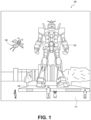
- FIG. 1 depicts an illustration of a mixed reality scenario with certain virtual reality objects, and certain physical objects viewed by a person.
- an MR scene 100 is depicted wherein a user of an MR technology sees a real-world park-like setting 110 featuring people, trees, buildings in the background, and a concrete platform 120.
- the user of the MR technology also perceives that he "sees" a robot statue 130 standing upon the real-world platform 120, and a cartoon-like avatar character 140 flying by which seems to be a personification of a bumble bee, even though these elements do not exist in the real world.
- each point in the display's visual field may be desirable for each point in the display's visual field to generate an accommodative response corresponding to its virtual depth. If the accommodative response to a display point does not correspond to the virtual depth of that point, as determined by the binocular depth cues of convergence and stereopsis, the human eye may experience an accommodation conflict, resulting in unstable imaging, harmful eye strain, headaches, and, in the absence of accommodation information, almost a complete lack of surface depth.
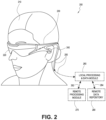
- FIG. 2 illustrates an example of wearable system 200.
- the wearable system 200 includes a display 220, and various mechanical and electronic modules and systems to support the functioning of display 220.
- the display 220 may be coupled to a frame 230, which is wearable by a user, wearer, or viewer 210.
- the display 220 can be positioned in front of the eyes of the user 210.
- the display 220 can present AR/VR/MR content to a user.
- the display 220 can comprise a head mounted display (HMD) that is worn on the head of the user.
- HMD head mounted display
- the wearable system 200 can use the outward-facing imaging system 464 or the inward-facing imaging system 462 to acquire images of a pose of the user.
- the images may be still images, frames of a video, or a video, in combination or the like.
- the display 220 can be operatively coupled 250, such as by a wired lead or wireless connectivity, to a local data processing module 260 which may be mounted in a variety of configurations, such as fixedly attached to the frame 230, fixedly attached to a helmet or hat worn by the user, embedded in headphones, or otherwise removably attached to the user 210 (e.g., in a backpack-style configuration, in a beltcoupling style configuration).
- a local data processing module 260 which may be mounted in a variety of configurations, such as fixedly attached to the frame 230, fixedly attached to a helmet or hat worn by the user, embedded in headphones, or otherwise removably attached to the user 210 (e.g., in a backpack-style configuration, in a beltcoupling style configuration).
- the local processing and data module 260 may comprise a hardware processor, as well as digital memory, such as non-volatile memory (e.g., flash memory), both of which may be utilized to assist in the processing, caching, and storage of data.
- the data may include data a) captured from sensors (which may be, e.g., operatively coupled to the frame 230 or otherwise attached to the user 210), such as image capture devices (e.g., cameras in the inward-facing imaging system or the outward-facing imaging system), microphones, inertial measurement units (IMUs), accelerometers, compasses, global positioning system (GPS) units, radio devices, or gyroscopes; or b) acquired or processed using remote processing module 270 or remote data repository 280, possibly for passage to the display 220 after such processing or retrieval.
- sensors which may be, e.g., operatively coupled to the frame 230 or otherwise attached to the user 210
- image capture devices e.g., cameras in the inward-facing
- the local processing and data module 260 may be operatively coupled by communication links 262 or 264, such as via wired or wireless communication links, to the remote processing module 270 or remote data repository 280 such that these remote modules are available as resources to the local processing and data module 260.
- remote processing module 280 and remote data repository 280 may be operatively coupled to each other.
- the remote processing module 270 may comprise one or more processors configured to analyze and process data and/or image information.
- the remote data repository 280 may comprise a digital data storage facility, which may be available through the internet or other networking configuration in a "cloud" resource configuration. In some embodiments, all data is stored and all computations are performed in the local processing and data module, allowing fully autonomous use from a remote module.
- the human visual system is complicated and providing a realistic perception of depth is challenging. Without being limited by theory, it is believed that viewers of an object may perceive the object as being three-dimensional due to a combination of vergence and accommodation. Vergence movements (i.e., rolling movements of the pupils toward or away from each other to converge the lines of sight of the eyes to fixate upon an object) of the two eyes relative to each other are closely associated with focusing (or "accommodation") of the lenses of the eyes.
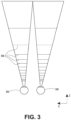
- FIG. 3 illustrates aspects of an approach for simulating a three-dimensional imagery using multiple depth planes.
- objects at various distances from eyes 302 and 304 on the z-axis are accommodated by the eyes 302 and 304 so that those objects are in focus.
- the eyes 302 and 304 assume particular accommodated states to bring into focus objects at different distances along the z-axis. Consequently, a particular accommodated state may be said to be associated with a particular one of depth planes 306, with has an associated focal distance, such that objects or parts of objects in a particular depth plane are in focus when the eye is in the accommodated state for that depth plane.
- three-dimensional imagery may be simulated by providing different presentations of an image for each of the eyes 302 and 304, and also by providing different presentations of the image corresponding to each of the depth planes. While shown as being separate for clarity of illustration, it will be appreciated that the fields of view of the eyes 302 and 304 may overlap, for example, as distance along the z-axis increases. In addition, while shown as flat for the ease of illustration, it will be appreciated that the contours of a depth plane may be curved in physical space, such that all features in a depth plane are in focus with the eye in a particular accommodated state. Without being limited by theory, it is believed that the human eye typically can interpret a finite number of depth planes to provide depth perception. Consequently, a highly believable simulation of perceived depth may be achieved by providing, to the eye, different presentations of an image corresponding to each of these limited number of depth planes.
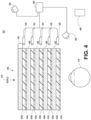
- the waveguide assembly 480 may also include a plurality of features 458, 456, 454, 452 between the waveguides.
- the features 458, 456, 454, 452 may be lenses.
- the features 458, 456, 454, 452 may not be lenses. Rather, they may simply be spacers (e.g., cladding layers or structures for forming air gaps).
- the image injection devices 420, 422, 424, 426, 428 are discrete displays that each produce image information for injection into a corresponding waveguide 440b, 438b, 436b, 434b, 432b, respectively.
- the image injection devices 420, 422, 424, 426, 428 are the output ends of a single multiplexed display which may, e.g., pipe image information via one or more optical conduits (such as fiber optic cables) to each of the image injection devices 420, 422, 424, 426, 428.
- the waveguides 440b, 438b, 436b, 434b, 432b may each include light extracting optical elements 440a, 438a, 436a, 434a, 432a that are configured to extract light out of a waveguide by redirecting the light, propagating within each respective waveguide, out of the waveguide to output image information to the eye 410.
- Extracted light may also be referred to as outcoupled light
- light extracting optical elements may also be referred to as outcoupling optical elements.
- An extracted beam of light is outputted by the waveguide at locations at which the light propagating in the waveguide strikes a light redirecting element.
- the light extracting optical elements may, for example, be reflective or diffractive optical features. While illustrated disposed at the bottom major surfaces of the waveguides 440b, 438b, 436b, 434b, 432b for ease of description and drawing clarity, in some embodiments, the light extracting optical elements 440a, 438a, 436a, 434a, 432a may be disposed at the top or bottom major surfaces, or may be disposed directly in the volume of the waveguides 440b, 438b, 436b, 434b, 432b.
- First lens 452 may be configured to create a slight convex wavefront curvature so that the eye/brain interprets light coming from that next waveguide up 434b as coming from a first focal plane closer inward toward the eye 410 from optical infinity.
- the third up waveguide 436b passes its output light through both the first lens 452 and second lens 454 before reaching the eye 410.
- the combined optical power of the first and second lenses 452 and 454 may be configured to create another incremental amount of wavefront curvature so that the eye/brain interprets light coming from the third waveguide 436b as coming from a second focal plane that is even closer inward toward the person from optical infinity than was light from the next waveguide up 434b.
- the other waveguide layers e.g., waveguides 438b, 440b
- lenses e.g., lenses 456, 458
- the highest waveguide 440b in the stack sending its output through all of the lenses between it and the eye for an aggregate focal power representative of the closest focal plane to the person.
- a compensating lens layer 430 may be disposed at the top of the stack to compensate for the aggregate power of the lens stack 458, 456, 454, 452 below.
- Such a configuration provides as many perceived focal planes as there are available waveguide/lens pairings.
- Both the light extracting optical elements of the waveguides and the focusing aspects of the lenses may be static (e.g., not dynamic or electro-active). In some alternative embodiments, either or both may be dynamic using electro-active features.
- the light extracting optical elements 440a, 438a, 436a, 434a, 432a are diffractive features that form a diffraction pattern, or "diffractive optical element” (also referred to herein as a "DOE").
- the DOE has a relatively low diffraction efficiency so that only a portion of the light of the beam is deflected away toward the eye 410 with each intersection of the DOE, while the rest continues to move through a waveguide via total internal reflection.
- the number and distribution of depth planes or depth of field may be varied dynamically based on the pupil sizes or orientations of the eyes of the viewer.
- Depth of field may change inversely with a viewer's pupil size.
- the depth of field increases such that one plane that is not discernible because the location of that plane is beyond the depth of focus of the eye may become discernible and appear more in focus with reduction of pupil size and commensurate with the increase in depth of field.
- the number of spaced apart depth planes used to present different images to the viewer may be decreased with the decreased pupil size.
- an exit beam may be desirable to have an exit beam meet the condition of having a diameter that is less than the diameter of the eye of a viewer.
- meeting this condition may be challenging in view of the variability in size of the viewer's pupils.
- this condition is met over a wide range of pupil sizes by varying the size of the exit beam in response to determinations of the size of the viewer's pupil. For example, as the pupil size decreases, the size of the exit beam may also decrease.
- the exit beam size may be varied using a variable aperture.
- the wearable system 400 can include an outward-facing imaging system 464 (e.g., a digital camera) that images a portion of the world 470.
- This portion of the world 470 may be referred to as the field of view (FOV) and the imaging system 464 is sometimes referred to as an FOV camera.
- the entire region available for viewing or imaging by a viewer may be referred to as the field of regard (FOR).
- the FOR may include 4 ⁇ steradians of solid angle surrounding the wearable system 400 because the wearer can move his body, head, or eyes to perceive substantially any direction in space. In other contexts, the wearer's movements may be more constricted, and accordingly the wearer's FOR may subtend a smaller solid angle.
- Images obtained from the outward-facing imaging system 464 can be used to track gestures made by the user (e.g., hand or finger gestures), detect objects in the world 470 in front of the user, and so forth.
- the pupil diameter or orientation of only a single eye 410 is determined and assumed to be similar for both eyes of the user.
- the images obtained by the inward-facing imaging system 466 may be analyzed to determine the user's eye pose or mood, which can be used by the wearable system 400 to decide which audio or visual content should be presented to the user.
- the wearable system 400 may also determine head pose (e.g., head position or head orientation) using sensors such as IMUs, accelerometers, gyroscopes, etc.
- the wearable system 400 can include a user input device 466 by which the user can input commands to the controller 460 to interact with the wearable system 400.
- the user input device 466 can include a trackpad, a touchscreen, a joystick, a multiple degree-of-freedom (DOF) controller, a capacitive sensing device, a game controller, a keyboard, a mouse, a directional pad (D-pad), a wand, a haptic device, a totem (e.g., functioning as a virtual user input device), and so forth.
- DOF multiple degree-of-freedom
- the distribution planar waveguide 622b may be similar or identical in at least some respects to the primary planar waveguide 632b, having a different orientation therefrom.
- at least one DOE 622a may be similar or identical in at least some respects to the DOE 632a.
- the distribution planar waveguide 622b or DOE 622a may be comprised of the same materials as the primary planar waveguide 632b or DOE 632a, respectively.
- Embodiments of the optical display system 600 shown in FIG. 6 can be integrated into the wearable system 200 shown in FIG. 2 .
- the tip of the fiber cantilever 644 is scanned biaxially in an area filling two-dimensional (2D) scan.
- 2D two-dimensional
- a fraction e.g. 10%
- the exit pupil of the light can be expanded vertically by the DOE 4 in the distribution planar waveguide 622b. This vertically expanded light coupled out of distribution planar waveguide 622b can enter the edge of the primary planar waveguide 632b.
- Light entering primary waveguide 632b can propagate horizontally (relative to the view of FIG. 6 ) along the primary waveguide 632b via TIR. As the light intersects with DOE 632a at multiple points as it propagates horizontally along at least a portion of the length of the primary waveguide 632b via TIR.
- the DOE 632a may advantageously be designed or configured to have a phase profile that is a summation of a linear diffraction pattern and a radially symmetric diffractive pattern, to produce both deflection and focusing of the light.
- the DOE 632a may advantageously have a low diffraction efficiency (e.g., 10%), so that only a portion of the light of the beam is deflected toward the eye of the view with each intersection of the DOE 632a while the rest of the light continues to propagate through the primary waveguide 632b via TIR.
- a low diffraction efficiency e.g. 10%
- haptic devices and totems usable with the wearable devices, HMD, and display systems of the present disclosure are described in U.S. Patent Publication No. 2015/0016777 .
- the wearable systems can use various sensors (e.g., accelerometers, gyroscopes, temperature sensors, movement sensors, depth sensors, GPS sensors, inward-facing imaging system, outward-facing imaging system, etc.) to determine the location and various other attributes of the environment of the user. This information may further be supplemented with information from stationary cameras in the room that may provide images or various cues from a different point of view. The image data acquired by the cameras (such as the room cameras and/or the cameras of the outward-facing imaging system) may be reduced to a set of mapping points.
- sensors e.g., accelerometers, gyroscopes, temperature sensors, movement sensors, depth sensors, GPS sensors, inward-facing imaging system, outward-facing imaging system, etc.
- individual models can be customized for individual data sets.
- the wearable device can generate or store a base model.
- the base model may be used as a starting point to generate additional models specific to a data type (e.g., a particular user in the telepresence session), a data set (e.g., a set of additional images obtained of the user in the telepresence session), conditional situations, or other variations.
- the wearable HMD can be configured to utilize a plurality of techniques to generate models for analysis of the aggregated data. Other techniques may include using predefined thresholds or data values.
- the MR environment 700 may include information about a scene happening in California.
- the environment 700 may be transmitted to one or more users in New York.
- the object recognizers and other software components can map the points collected from the various images, recognize objects etc., such that the scene may be accurately "passed over" to a second user, who may be in a different part of the world.
- the environment 700 may also use a topological map for localization purposes.
- mathematically definable surfaces may be efficient (e.g., relative to a large point cloud) and digestible inputs to other processing devices like game engines.
- the output of the stereo process e.g., a depth map
- Pose may be an input to this fusion process 930 as well, and the output of fusion 930 becomes an input to populating the map process 920.
- Sub-surfaces may connect with each other, such as in topographical mapping, to form larger surfaces, and the map becomes a large hybrid of points and surfaces.
- the wearable system Based at least partly on the detected gesture, eye pose, head pose, or input through the totem, the wearable system detects a position, orientation, and/or movement of the totem (or the user's eyes or head or gestures) with respect to a reference frame, at block 1020.
- the reference frame may be a set of map points based on which the wearable system translates the movement of the totem (or the user) to an action or command.
- the user's interaction with the totem is mapped. Based on the mapping of the user interaction with respect to the reference frame 1020, the system determines the user input at block 1040.
- the wearable system may then wait for the command (a gesture, a head or eye movement, input from a user input device, etc.), and if it is recognized (block 1160), virtual content associated with the command may be displayed to the user (block 1170).
- the wearable system may wait for user's hand gestures before mixing multiple steam tracks.
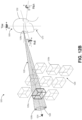
- the wearable system may also initiate a cone cast based on a pose of the user 1210, such as, e.g., an extended period of gaze toward one direction or a hand gesture (e.g., waving in front of the outward-facing imaging system 464).
- the wearable system can automatically begin the cone cast event based on contextual information. For example, the wearable system may automatically begin the cone cast when the user is at the main page of the AR display.
- the wearable system can determine relative positions of the objects in a user's direction of gaze. If the wearable system determines that the objects are located relatively far apart from each other, the wearable system may automatically begin a cone cast so the user does not have to move with precision to select an object in a group of the sparsely located objects.
- the aperture can be adjusted by the user, the wearable system, or in combination.
- the user may adjust the aperture through user interface operations such as selecting an option of the aperture shown on the AR display.
- the user may also adjust the aperture by actuating the user input device, for example, by scrolling the user input device, or by pressing a button to anchor the size of the aperture.
- the wearable system can update the size of the aperture based on one or more contextual factors described below.
- Cone casting can be used to increase precision when interacting with objects in the user's environment, especially when those objects are located at a distance where small amounts of movement from the user could translate to large movements of the ray. Cone casting could also be used to decrease the amount of movement necessary from the user in order to have the cone overlap one or more virtual objects.
- the user can manually update the aperture of the cone and improve the speed and precision of selecting a target object, for example, by using narrower cones when there are many objects and wider cones when there are fewer objects.
- the wearable system can determine contextual factors associated with objects in the user's environment and permit automatic cone updating, additionally or alternatively to manual updating, which can advantageously make it easier for users to interact with objects in the environment since less user input is needed.
- the wearable system can automatically update the aperture based on contextual information.
- the contextual information may include information related to the user's environment (e.g. light conditions of the user's virtual or physical environment), the user's preferences, the user's physical conditions (e.g. whether a user is near-sighted), information associated with objects in the user's environment, such as the type of the objects (e.g., physical or virtual) in the user's environment, or the layout of the objects (e.g., the density of the objects, the locations and sizes of the objects, and so forth), the characteristics of the objects that a user is interacting with (e.g., the functions of the objects, the type of user interface operations supported by the objects, etc.), in combination or the like.
- the user's environment e.g. light conditions of the user's virtual or physical environment
- the user's preferences e.g. whether a user is near-sighted
- information associated with objects in the user's environment such as the type of the objects (e.g., physical or virtual
- the density can be measured in a variety of ways, e.g., a number of objects per projected area, a number of objects per solid angle, etc.
- the density may be represented in other ways such as, e.g., a spacing between neighboring objects (with smaller spacing reflecting increased density).
- the wearable system can use location information of the objects to determine the layout and density of the objects in a region. As shown in FIG. 12B , the wearable system may determine that the density of the group 1230 of the objects is high. The wearable system may accordingly use a cone 1220 with a smaller aperture. In FIG.
- the wearable system can dynamically update the aperture (e.g. size or shape) based on the user's pose. For example, the user may initially look at the group 1230 of the objects in FIG. 12B , but as the user turns his head, the user may now look at the group of objects in FIG. 12C (where the objects are located sparsely relative to each other). As a result, the wearable system may increase the size of the aperture (e.g., as shown by the change in the aperture of the cone between FIG. 12B and FIG. 12C ). Similarly, if the user turns his head back to look at the group 1230 of the objects in FIG. 12B , the wearable system may decrease the size of the aperture.
- the aperture e.g. size or shape
- the wearable system can update the aperture size based on user's preference. For example, if the user prefers to select a large group of items at the same time, the wearable system may increase the size of the aperture.
- a first cone cast can capture multiple objects.
- the wearable system can perform a second cone cast to further select a target object among the captured objects.
- the wearable system can also allow a user to select the target object from the captured objects using body poses or a user input device.
- the object selection process can be a recursive process where one, two, three, or more cone casts may be performed to select the target object.
- the aperture of the cone can be dynamically updated during a cone cast based on the density of objects in the user's FOR.
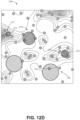
- FIGS. 12D , 12E , 12F , 12G , and 12H describe examples of dynamically adjusting an aperture based on the density of objects.
- FIG. 12D illustrates a contour map associated with density of objects in the user's FOR 1208.
- the virtual objects 1271 are represented by small textured dots.
- the density of the virtual objects is reflected by the amount of contour lines in a given region.
- the counter lines are close to each other in the region 1272 which represents that the density of objects in the region 1272 is high.
- the contour lines in the region 1278 are relatively sparse. Accordingly, the density of objects in the region 1278 is low.
- the visual presentation the aperture 1270 is illustrated in shaded circles in FIG. 12D .
- the visual representation in this example can correspond to the distal end 1228b of the virtual cone 1220.
- the aperture size can change based on the density of objects in a given region. For example, the aperture size can depend on the density of objects where the center of the circle falls. As illustrated in FIG. 12D , when the aperture is at the region 1272, the size of the aperture 1270 can decrease (as shown by the relatively small size of the aperture circle). However, when the user is staring at the region 1276 in the FOR 1208, the size of the aperture 1270 became slightly bigger than the size at the region 1272.
- the size of the aperture 1270 will increase because there are rarely any objects in the region 1278 of the FOR 1208.
- the density is illustrated with contour maps in these examples, the density can also be determined using a heat map, surface plot, or other graphical or numerical representations.
- the term contour map includes these other types of density representations (in 1D, 2D, or 3D).
- the contour map generally is not presented to the user, but may be calculated and used by the ARD processor to dynamically determine the properties of the cone.
- the contour map may be dynamically updated as the physical or virtual objects move in the user's FOV or FOR.
- the density can be calculated by counting all of the virtual objects within a user's FOV.
- the number of the virtual objects may be used as an input to a function which specifies the size of the aperture based on the number of virtual objects in the FOV.
- the image 1282a in FIG. 12E shows an FOV with three virtual objects, represented by a circle, an ellipse, and a triangle as well as a virtual representation of an aperture 1280 which is illustrated using a textured circle.
- the wearable system can use the function 1288 in FIG.
- the size of the aperture is represented by the y-axis 1286b while the number (or density) of virtual objects in the FOV is represented by the x-axis 1286a.
- the number of virtual objects increases (e.g., the density increases)
- the size of the aperture decreases according to function 1288.
- the smallest aperture size is zero which reduces the cone to a single ray.
- the function 1288 is illustrated as a linear function, any other type of functions, such as one or more power law functions, may also be used.
- the function 1288 may include one or more threshold conditions.
- the size of the aperture 1280 when the density of objects has reached a certain low threshold, the size of the aperture 1280 will no longer increase even though the density of objects may further decrease.
- the size of the aperture 1280 when the density of objects has reached a certain high threshold, the size of the aperture 1280 will no longer decrease even though the density of the objects may further increase.
- the aperture size may decrease following an exponential function, for example.
- FIG. 12G illustrates another example technique for calculating density.
- the wearable system can calculate the percentage of the FOV covered by virtual objects.
- the images 1292a and 1292b illustrate adjusting the aperture size based on the number of objects in the FOV. As illustrated in this example, although the percentage of the FOV covered by virtual images is different between the images 1292a and 1292b (where the objects in the image 1292a are positioned more sparsely), the size of the aperture 1280 does not change in these two images because the number of objects (e.g., three virtual objects) is the same across the images 1292a and 1292b.
- the images 1294a and 1294b illustrate adjusting aperture size based on the percentage of FOV covered by the virtual objects.
- the aperture 1280 will increase in size (as opposed to remaining the same in the image 1292a) because a lower percentage of the FOV is covered by the virtual objects.
- the wearable system may provide a focus indicator to objects that collide with the cone.
- the focus indicator may be a red highlight around all or part of the object.
- the wearable system can display a red highlight around the object 1230a to the user 1210.
- the wearable system identifies the object 1230e and the 1230d as objects intersecting with the cone 1220. The wearable system can provide red highlights around object 1230d and object 1230e.
- the wearable system may present a user interface element for selecting one or more objects among the multiple objects.
- the wearable system can provide a focus indicator which can indicate a target object with which a user is currently interacting. The user can use hand gestures to actuate a user input device and move the focus indicator to another target object.
- an object may be behind another object in the user's 3D environment (e.g., the nearby object at least partly occludes the more distant object).
- the wearable system may apply disambiguation techniques (e.g., to determine occluded objects, determine depth ordering or position among occluded objects, etc.) during a cone cast to capture both the object in the front and the object in the back.
- disambiguation techniques e.g., to determine occluded objects, determine depth ordering or position among occluded objects, etc.
- a paper shredder may be behind a computer in the user's room.
- the wearable system can cast a cone in the direction of the computer and detect collisions for both the shredder and the computer (because both the shredder and the computer are in the wearable system's world map).
- the wearable system can display a pop up menu to provide a choice for the user to select either the shredder or the computer or the wearable system may use the contextual information to determine which object to select (e.g., if the user is attempting to delete a document, the system may select the paper shredder).
- the wearable system may be configured to only capture the object in the front. In this example, the wearable system will only detect collision between the cone and the paper shredder.
- the wearable system may allow the user to interact with interactable objects in a variety of ways, such as, e.g., selecting the objects, moving the objects, opening a menu or toolbar associated with an object, or performing a game operation on an avatar in a game, etc.
- the user may interact with the interactable objects through poses (e.g. head, body poses), hand gestures, inputs from a user input device, in combination or the like. For example, when the cone collides with multiple interactable objects, the user may actuate a user input device to select among the multiple interactable objects.
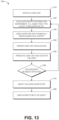
- FIG. 13 is a flowchart of an example process for selecting objects using cone casting with dynamically adjustable aperture. This process 1300 can be performed by the wearable system (shown in FIGS. 2 and 4 ).
- the wearable system can initiate a cone cast.
- the cone cast can be triggered by a user's pose or hand gestures on a user input device.
- the cone cast may be triggered by a click on the user input device and/or by the user looking in a direction for an extended period of time.
- the wearable system can analyze salient features of the user's environment, such as, e.g., type of the objects, layout of the objects (physical or virtual), location of the objects, size of the objects, density of the objects, distance between the objects and the user, etc.
- the wearable system can calculate the density of the objects in the user's direction of gaze by determining the number of objects and the size of the objects in front of the user.
- the salient features of the environment may be part of the contextual information described herein.
- the wearable system can adjust the size of the aperture based on the contextual information. As discussed with reference to FIGS. 12B and 12C , the wearable system can increase the aperture size when the objects are sparsely located and/or when there is no obstruction.
- the large aperture size can correspond to a large diameter 1226 on the distal end 1228b of the cone 1220.
- the wearable system may update the size of the aperture based on the contextual information.
- the contextual information can be combined with other information such as user's preference, user's pose, characteristics of the cone (such as, e.g., depth, color, location, etc.) to determine and update the aperture.
- the user can optionally interact with the collided object in various ways as described with reference to FIGS. 12A , 12B , and 12C .
- the user can select an object, open a menu associated with the object, or move an object, etc.
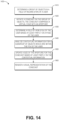
- FIG. 14 is another flowchart of an example process for selecting objects using cone casting with dynamically adjustable aperture.
- This process 1400 can be performed by the wearable system (shown in FIGS. 2 and 4 ).
- the wearable system determines a group of objects in the user's FOR.
- the wearable system can detect collision between an object and the cone. In some embodiments, the wearable system can detect the collision based on the location of the object and the location of the cone. If at least a portion of the object overlaps with the cone, then a collision is detected. In some embodiments, the cone may collide with multiple objects. The wearable system can apply disambiguation techniques to capture one or more occluded objects. As a result, the wearable system can detect collision between the cone and the occluded objects.
- the contextual information is used to translate a movement associated with a user input device or a portion of a user's body (e.g., a change in a user's pose) to a user interface operation, such as, e.g., moving a virtual object.
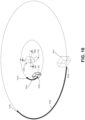
- FIG. 16 schematically illustrates an example of moving a virtual object using a user input device, according to the invention.
- a user may hold and move a virtual object by selecting the virtual object using the user input device and move the virtual object by physically moving the user input device 466.
- the user input device 466 may initially be at a first position 1610a.
- the user 1210 may select a target virtual object 1640 located at a first position 1610b by actuating the user input device 466 (e.g., by actuating a touch sensitive pad on the device).
- the target virtual object 1640 can be any type of virtual object that can be displayed and moved by the wearable system.
- the wearable system calculates a multiplier for mapping movement of the user input device to the movement of the target virtual object.
- the movement of the target virtual object is based on the movement of the input controller and the multiplier.
- the amount of movements of the target virtual object may be equal to the amount of movements of the input controller multiplied by the multiplier. This may reduce the amount the user needs to move before the target virtual object reaches the desired location.
- the wearable system may determine a multiplier which allows the user to move the user input device along the trajectory 1650a (which is shorter than the trajectory 1650b) in order to move the virtual object from position 1620b to position 1610b.
- the user 1210 can move a virtual object using head poses.
- a head may have multiple degrees of freedom. As the head moves toward different directions, the head pose will change relative to the natural resting direction 1260.
- the example coordinate system in FIG. 16 shows three angular degrees of freedom (e.g., yaw, pitch, and roll) that can be used for measuring the head pose relative to the natural resting state 1260 of the head.
- the head can tilt forward and backward (e.g. pitching), turning left and right (e.g. yawing), and tilting side to side (e.g. rolling).
- the movement of the virtual object (e.g., an angular movement) may be represented by a variable, delta object, and the movement of the user input device may be represented by a variable, delta input.
- Sensors in the user input device or the outward facing camera of the ARD may be used to measure delta input.
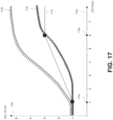
- the multiplier as a function of distance d can be determined from a look-up table, a functional form (e.g., power law), or a curve (see, e.g., the examples in FIG. 17 ).
- the distance may be normalized by the distance from the user to the input device.
- the normalized distance is dimensionless and equal to one if the object is at the distance of the input device.
- the wearable system can allow the user to configure the multiplier.
- the wearable system may give the user several options for choosing a multiplier. A user preferring slow movements can choose the multiplier with a small magnitude.
- the user may also provide certain factors and/or the importance of the factors which the wearable system will use to automatically determine the multiplier. For example, the user can set a weight of the distance to be higher than the weight associated with the properties of the virtual objects. Accordingly, the distance will have a larger impact on the magnitude of the multiplier than the properties of the virtual objects.
- a multiplier may have one or more thresholds. One or more of the thresholds may be calculated based on values of a set of factors (such as factors determined from contextual information). In certain embodiments, one threshold may be calculated based on one set of factors while another threshold may be calculated based on another set of factors (which may not be overlapping with the first set of factors).
- the wearable system may use a focus indicator to show current position of the user input device and/or a user's pose (e.g. head, body, eye pose).
- the multiplier may be applied to indicate the position change of the focus indicator.
- the wearable system may show a virtual cone during a cone cast (see descriptions of cone casting in FIGS. 12 - 15 ). When the depth of the cone is set at a distant location, the wearable system may apply large multiplier. Accordingly, as the user moves around, the virtual cone may move a great amount of distance.
- the wearable system can map the movements of the user input device to the movements of multiple virtual objects. For example, in a virtual game, the player can move a group of virtual soldiers together by actuating the user input device. The wearable system can translate the movements of the user input device to the movements of the group of virtual soldiers by applying the multiplier to the group of virtual soldiers together and/or by applying the multiplier to each of the virtual soldiers in the group.
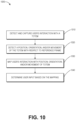
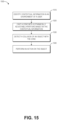
- FIG. 18 illustrates a flowchart of an example process for moving a virtual object in response to movements of the user input device, according to the invention.
- the process 1800 can be performed by the wearable system shown in FIGS. 2 and 4 .
- the wearable system receives a selection of a target virtual object.
- the virtual object is displayed by the wearable system at a first position in a 3D space.
- the user can select the target virtual object by actuating the user input device.
- the wearable system can be configured to support a user to move the target virtual object using various body, head, or eye poses. For example, the user may select the target virtual object by pointing his finger at the target virtual object and may move the target virtual object by moving his arm.
- the wearable system receives an indication of a movement for the target virtual object.
- the wearable system may receive such indication from the user input device.
- the wearable system may also receive such indication from the sensors (such as, e.g., the outward-facing imaging system 464) which can determine changes in the user's pose.
- the indication can be a trajectory of movements or changes in a position of a portion of a user's body or the user input device.
- this multiplier may be used to calculate the amount of movement for the target virtual object.
- the multiplier is calculated using the distance between the object and the user input device, the multiplier might therefore be large for a faraway target virtual object.
- the wearable system may use Equation (3) to relate the amount of movement of the input device and the multiplier to yield the amount of movement of the target virtual object.
- the trajectory of the target virtual object's movements may be calculated using other factors together with the multiplier. For example, the wearable system may calculate the trajectory based on the environment of the user. When there is another object along the path of the target virtual object, the wearable system may be configured to move the target virtual object so as to circumvent collision with that other object.
- a phrase referring to "at least one of" a list of items refers to any combination of those items, including single members.
- "at least one of: A, B, or C” is intended to cover: A, B, C, A and B, A and C, B and C, and A, B, and C.
- Conjunctive language such as the phrase "at least one of X, Y and Z," unless specifically stated otherwise, is otherwise understood with the context as used in general to convey that an item, term, etc. may be at least one of X, Y or Z. Thus, such conjunctive language is not generally intended to imply that certain embodiments require at least one of X, at least one of Y and at least one of Z to each be present.
Landscapes
- Engineering & Computer Science (AREA)
- Theoretical Computer Science (AREA)
- General Engineering & Computer Science (AREA)
- Physics & Mathematics (AREA)
- General Physics & Mathematics (AREA)
- Human Computer Interaction (AREA)
- Computer Hardware Design (AREA)
- Computer Graphics (AREA)
- Software Systems (AREA)
- User Interface Of Digital Computer (AREA)
- Processing Or Creating Images (AREA)
- Image Generation (AREA)
- Testing, Inspecting, Measuring Of Stereoscopic Televisions And Televisions (AREA)
- Controls And Circuits For Display Device (AREA)
Priority Applications (1)
| Application Number | Priority Date | Filing Date | Title |
|---|---|---|---|
| EP24187288.6A EP4418070A3 (en) | 2016-03-31 | 2017-03-29 | Interactions with 3d virtual objects using poses and multiple-dof controllers |
Applications Claiming Priority (3)
| Application Number | Priority Date | Filing Date | Title |
|---|---|---|---|
| US201662316030P | 2016-03-31 | 2016-03-31 | |
| US201662325679P | 2016-04-21 | 2016-04-21 | |
| PCT/US2017/024844 WO2017172982A1 (en) | 2016-03-31 | 2017-03-29 | Interactions with 3d virtual objects using poses and multiple-dof controllers |
Related Child Applications (1)
| Application Number | Title | Priority Date | Filing Date |
|---|---|---|---|
| EP24187288.6A Division EP4418070A3 (en) | 2016-03-31 | 2017-03-29 | Interactions with 3d virtual objects using poses and multiple-dof controllers |
Publications (3)
| Publication Number | Publication Date |
|---|---|
| EP3436863A1 EP3436863A1 (en) | 2019-02-06 |
| EP3436863A4 EP3436863A4 (en) | 2019-11-27 |
| EP3436863B1 true EP3436863B1 (en) | 2024-07-10 |
Family
ID=59961806
Family Applications (2)
| Application Number | Title | Priority Date | Filing Date |
|---|---|---|---|
| EP17776592.2A Active EP3436863B1 (en) | 2016-03-31 | 2017-03-29 | Interactions with 3d virtual objects using poses and multiple-dof controllers |
| EP24187288.6A Pending EP4418070A3 (en) | 2016-03-31 | 2017-03-29 | Interactions with 3d virtual objects using poses and multiple-dof controllers |
Family Applications After (1)
| Application Number | Title | Priority Date | Filing Date |
|---|---|---|---|
| EP24187288.6A Pending EP4418070A3 (en) | 2016-03-31 | 2017-03-29 | Interactions with 3d virtual objects using poses and multiple-dof controllers |
Country Status (10)
| Country | Link |
|---|---|
| US (9) | US10078919B2 (enExample) |
| EP (2) | EP3436863B1 (enExample) |
| JP (6) | JP6904973B2 (enExample) |
| KR (3) | KR20230098927A (enExample) |
| CN (2) | CN109196447B (enExample) |
| AU (2) | AU2017244109B2 (enExample) |
| CA (1) | CA3018758A1 (enExample) |
| IL (3) | IL303608B2 (enExample) |
| NZ (1) | NZ746640A (enExample) |
| WO (1) | WO2017172982A1 (enExample) |
Families Citing this family (176)
| Publication number | Priority date | Publication date | Assignee | Title |
|---|---|---|---|---|
| IL308285B2 (en) | 2013-03-11 | 2024-11-01 | Magic Leap Inc | System and method for augmentation and virtual reality |
| KR102271198B1 (ko) | 2013-03-15 | 2021-06-29 | 매직 립, 인코포레이티드 | 디스플레이 시스템 및 방법 |
| JP6344311B2 (ja) * | 2015-05-26 | 2018-06-20 | ソニー株式会社 | 表示装置、情報処理システム及び制御方法 |
| CA3002369A1 (en) | 2015-10-20 | 2017-04-27 | Magic Leap, Inc. | Selecting virtual objects in a three-dimensional space |
| KR20230098927A (ko) | 2016-03-31 | 2023-07-04 | 매직 립, 인코포레이티드 | 포즈들 및 멀티-dof 제어기들을 사용하는 3d 가상 객체들과상호작용들 |
| WO2018013495A1 (en) * | 2016-07-11 | 2018-01-18 | Gravity Jack, Inc. | Augmented reality methods and devices |
| US11269480B2 (en) * | 2016-08-23 | 2022-03-08 | Reavire, Inc. | Controlling objects using virtual rays |
| US10692287B2 (en) * | 2017-04-17 | 2020-06-23 | Microsoft Technology Licensing, Llc | Multi-step placement of virtual objects |
| US10768693B2 (en) | 2017-04-19 | 2020-09-08 | Magic Leap, Inc. | Multimodal task execution and text editing for a wearable system |
| US11112857B2 (en) * | 2017-04-28 | 2021-09-07 | Sony Interactive Entertainment Inc. | Information processing apparatus, information processing method, and program |
| US11184574B2 (en) | 2017-07-17 | 2021-11-23 | Facebook, Inc. | Representing real-world objects with a virtual reality environment |
| GB2567172A (en) * | 2017-10-04 | 2019-04-10 | Nokia Technologies Oy | Grouping and transport of audio objects |
| KR102029906B1 (ko) * | 2017-11-10 | 2019-11-08 | 전자부품연구원 | 이동수단의 가상현실 콘텐츠 제공 장치 및 방법 |
| KR102040858B1 (ko) | 2017-11-29 | 2019-11-06 | 한국과학기술연구원 | 가상 공간의 인터랙션 분석 시스템 및 방법 |
| CN111630435B (zh) * | 2017-12-15 | 2025-03-14 | 奇跃公司 | 用于显示装置的增强的姿势确定 |
| CN109074095B (zh) * | 2017-12-26 | 2022-04-01 | 深圳市大疆创新科技有限公司 | 一种飞行轨迹原路复演方法及飞行器 |
| CN108319363A (zh) * | 2018-01-09 | 2018-07-24 | 北京小米移动软件有限公司 | 基于vr的产品展示方法、装置及电子设备 |
| US10855564B2 (en) | 2018-01-15 | 2020-12-01 | Worcester Polytechnic Institute | Visualization of network data as a three-dimensional hierarchical data structure in a mixed reality environment |
| US10854003B2 (en) * | 2018-01-15 | 2020-12-01 | Worcester Polytechnic Institute | Visualization of network data as a three-dimensional hierarchical data structure in a mixed reality environment |
| US11567627B2 (en) | 2018-01-30 | 2023-01-31 | Magic Leap, Inc. | Eclipse cursor for virtual content in mixed reality displays |
| US10540941B2 (en) | 2018-01-30 | 2020-01-21 | Magic Leap, Inc. | Eclipse cursor for mixed reality displays |
| US10565718B2 (en) * | 2018-04-18 | 2020-02-18 | Faro Technologies, Inc. | System and method of scanning an environment |
| EP3782010A1 (en) * | 2018-04-20 | 2021-02-24 | PCMS Holdings, Inc. | Method and system for gaze-based control of mixed reality content |
| US11380067B2 (en) * | 2018-04-30 | 2022-07-05 | Campfire 3D, Inc. | System and method for presenting virtual content in an interactive space |
| US10861242B2 (en) | 2018-05-22 | 2020-12-08 | Magic Leap, Inc. | Transmodal input fusion for a wearable system |
| US10984600B2 (en) | 2018-05-25 | 2021-04-20 | Tiff's Treats Holdings, Inc. | Apparatus, method, and system for presentation of multimedia content including augmented reality content |
| US10818093B2 (en) | 2018-05-25 | 2020-10-27 | Tiff's Treats Holdings, Inc. | Apparatus, method, and system for presentation of multimedia content including augmented reality content |
| US11157159B2 (en) | 2018-06-07 | 2021-10-26 | Magic Leap, Inc. | Augmented reality scrollbar |
| US10885709B2 (en) * | 2018-06-14 | 2021-01-05 | Robert Labron | Virtual reality software system and method for treating medical condition in user |
| US11733824B2 (en) | 2018-06-22 | 2023-08-22 | Apple Inc. | User interaction interpreter |
| CN112352189B (zh) * | 2018-06-29 | 2022-07-22 | 华为技术有限公司 | 用于显示三维图像的装置和方法 |
| EP3599539B1 (en) * | 2018-07-26 | 2023-08-23 | Nokia Technologies Oy | Rendering objects in virtual views |
| US10861249B2 (en) | 2018-07-27 | 2020-12-08 | The Q Digital Technologies, Inc. | Methods and system for manipulating digital assets on a three-dimensional viewing platform |
| US11141645B2 (en) | 2018-09-11 | 2021-10-12 | Real Shot Inc. | Athletic ball game using smart glasses |
| US11103763B2 (en) | 2018-09-11 | 2021-08-31 | Real Shot Inc. | Basketball shooting game using smart glasses |
| WO2020059277A1 (ja) * | 2018-09-20 | 2020-03-26 | 富士フイルム株式会社 | 情報処理装置、情報処理システム、情報処理方法、及びプログラム |
| ES2716012B2 (es) * | 2018-09-28 | 2020-07-22 | Univ Leon | Sistema y metodo de interaccion en entornos virtuales utilizando dispositivos hapticos |
| KR20200094396A (ko) * | 2019-01-30 | 2020-08-07 | 삼성전자주식회사 | 전자 장치 및 복수의 액션들을 포함하는 태스크를 결정하는 방법 |
| US11442549B1 (en) * | 2019-02-07 | 2022-09-13 | Apple Inc. | Placement of 3D effects based on 2D paintings |
| US10895949B2 (en) * | 2019-02-22 | 2021-01-19 | Htc Corporation | Head mounted display and display method for eye-tracking cursor |
| CN111752425B (zh) * | 2019-03-27 | 2022-02-15 | 北京外号信息技术有限公司 | 用于选择在设备的显示媒介上的交互对象的方法 |
| CN110287764B (zh) * | 2019-05-06 | 2022-01-11 | 深圳大学 | 姿势预测方法、装置、计算机设备和存储介质 |
| CN110162178A (zh) * | 2019-05-22 | 2019-08-23 | 努比亚技术有限公司 | 说明信息的展示方法、可穿戴设备以及存储介质 |
| DE102019207803A1 (de) * | 2019-05-28 | 2020-12-03 | Friedrich-Alexander-Universität Erlangen-Nürnberg | Registrierungseinrichtung, Verfahren zum Registrieren, entsprechendes Computerprogramm und computerlesbares Speichermedium |
| WO2020247863A1 (en) * | 2019-06-06 | 2020-12-10 | Magic Leap, Inc. | Photoreal character configurations for spatial computing |
| US11334212B2 (en) | 2019-06-07 | 2022-05-17 | Facebook Technologies, Llc | Detecting input in artificial reality systems based on a pinch and pull gesture |
| US10890983B2 (en) | 2019-06-07 | 2021-01-12 | Facebook Technologies, Llc | Artificial reality system having a sliding menu |
| US11533468B2 (en) | 2019-06-27 | 2022-12-20 | Samsung Electronics Co., Ltd. | System and method for generating a mixed reality experience |
| CN111857367B (zh) * | 2019-07-10 | 2023-06-27 | 深圳市工匠社科技有限公司 | 虚拟角色控制方法及装置 |
| US10841483B1 (en) * | 2019-07-11 | 2020-11-17 | Denso International America, Inc. | System and method for calibrating at least one camera and a light detection and ranging sensor |
| KR102614496B1 (ko) * | 2019-08-09 | 2023-12-15 | 엘지전자 주식회사 | Xr 디바이스 및 그 제어 방법 |
| US12196964B2 (en) * | 2019-08-27 | 2025-01-14 | Apple Inc. | Transparent display system with peripheral illumination |
| US11307647B2 (en) | 2019-09-11 | 2022-04-19 | Facebook Technologies, Llc | Artificial reality triggered by physical object |
| US11170576B2 (en) | 2019-09-20 | 2021-11-09 | Facebook Technologies, Llc | Progressive display of virtual objects |
| US11086406B1 (en) | 2019-09-20 | 2021-08-10 | Facebook Technologies, Llc | Three-state gesture virtual controls |
| US11189099B2 (en) * | 2019-09-20 | 2021-11-30 | Facebook Technologies, Llc | Global and local mode virtual object interactions |
| US10991163B2 (en) | 2019-09-20 | 2021-04-27 | Facebook Technologies, Llc | Projection casting in virtual environments |
| US11176745B2 (en) * | 2019-09-20 | 2021-11-16 | Facebook Technologies, Llc | Projection casting in virtual environments |
| US10802600B1 (en) * | 2019-09-20 | 2020-10-13 | Facebook Technologies, Llc | Virtual interactions at a distance |
| EP3928192B1 (en) | 2019-09-26 | 2023-10-18 | Apple Inc. | Wearable electronic device presenting a computer-generated reality environment |
| DE112020001415T5 (de) | 2019-09-27 | 2021-12-09 | Apple Inc. | Umgebung für Fernkommunikation |
| WO2021073733A1 (en) * | 2019-10-16 | 2021-04-22 | Supsi | Method for controlling a device by a human |
| US11086476B2 (en) * | 2019-10-23 | 2021-08-10 | Facebook Technologies, Llc | 3D interactions with web content |
| US11493989B2 (en) | 2019-11-08 | 2022-11-08 | Magic Leap, Inc. | Modes of user interaction |
| US11175730B2 (en) | 2019-12-06 | 2021-11-16 | Facebook Technologies, Llc | Posture-based virtual space configurations |
| JP7693673B2 (ja) * | 2019-12-06 | 2025-06-17 | マジック リープ, インコーポレイテッド | 仮想、拡張、および複合現実システムおよび方法 |
| US11475639B2 (en) | 2020-01-03 | 2022-10-18 | Meta Platforms Technologies, Llc | Self presence in artificial reality |
| US11687778B2 (en) | 2020-01-06 | 2023-06-27 | The Research Foundation For The State University Of New York | Fakecatcher: detection of synthetic portrait videos using biological signals |
| WO2021150623A1 (en) * | 2020-01-24 | 2021-07-29 | Magic Leap, Inc. | Content movement and interaction using a single controller |
| WO2021162769A1 (en) | 2020-02-10 | 2021-08-19 | Magic Leap, Inc. | Body-centric content positioning relative to three-dimensional container in a mixed reality environment |
| US11726349B2 (en) | 2020-02-14 | 2023-08-15 | Magic Leap, Inc. | Virtual object movement speed curve for virtual and augmented reality display systems |
| CN115443445A (zh) | 2020-02-26 | 2022-12-06 | 奇跃公司 | 用于可穿戴系统的手部手势输入 |
| WO2021173850A1 (en) * | 2020-02-27 | 2021-09-02 | Magic Leap, Inc. | Cross reality system for large scale environment reconstruction |
| CN111383348A (zh) * | 2020-03-17 | 2020-07-07 | 北京理工大学 | 一种虚拟现实远程同步控制机器人的方法 |
| JP2021157277A (ja) * | 2020-03-25 | 2021-10-07 | ソニーグループ株式会社 | 情報処理装置、情報処理方法及びプログラム |
| JP2021162993A (ja) | 2020-03-31 | 2021-10-11 | ソニーグループ株式会社 | 情報処理装置、情報処理方法および情報処理プログラム |
| US11455078B1 (en) | 2020-03-31 | 2022-09-27 | Snap Inc. | Spatial navigation and creation interface |
| US11257280B1 (en) * | 2020-05-28 | 2022-02-22 | Facebook Technologies, Llc | Element-based switching of ray casting rules |
| CN111651048B (zh) * | 2020-06-08 | 2024-01-05 | 浙江商汤科技开发有限公司 | 多虚拟对象排列展示方法、装置、电子设备及存储介质 |
| WO2021262507A1 (en) * | 2020-06-22 | 2021-12-30 | Sterling Labs Llc | Displaying a virtual display |
| US11256336B2 (en) | 2020-06-29 | 2022-02-22 | Facebook Technologies, Llc | Integration of artificial reality interaction modes |
| ES2894178B2 (es) * | 2020-08-07 | 2022-09-13 | Ascasibar Ioritz Hontecillas | Sistema de generación de gráficos en tres dimensiones |
| US20220057914A1 (en) * | 2020-08-19 | 2022-02-24 | Jason Sauers | Augmented reality targeting system |
| US11176755B1 (en) | 2020-08-31 | 2021-11-16 | Facebook Technologies, Llc | Artificial reality augments and surfaces |
| WO2022046340A1 (en) | 2020-08-31 | 2022-03-03 | Sterling Labs Llc | Object engagement based on finger manipulation data and untethered inputs |
| US11227445B1 (en) | 2020-08-31 | 2022-01-18 | Facebook Technologies, Llc | Artificial reality augments and surfaces |
| US11178376B1 (en) | 2020-09-04 | 2021-11-16 | Facebook Technologies, Llc | Metering for display modes in artificial reality |
| CN116507997A (zh) | 2020-09-11 | 2023-07-28 | 苹果公司 | 在环境中显示用户界面的方法及对应电子设备和计算机可读存储介质 |
| EP4722883A2 (en) * | 2020-09-11 | 2026-04-08 | Apple Inc. | Methods for manipulating objects in an environment |
| US12236546B1 (en) | 2020-09-24 | 2025-02-25 | Apple Inc. | Object manipulations with a pointing device |
| WO2022067302A1 (en) | 2020-09-25 | 2022-03-31 | Apple Inc. | Methods for navigating user interfaces |
| CN117555417B (zh) | 2020-09-25 | 2024-07-19 | 苹果公司 | 用于调节和/或控制与用户界面相关联的沉浸度的方法 |
| CN112198962B (zh) * | 2020-09-30 | 2023-04-28 | 聚好看科技股份有限公司 | 一种与虚拟现实设备交互的方法及虚拟现实设备 |
| US12036443B2 (en) * | 2020-11-11 | 2024-07-16 | Total Gym Global Corp. | Exercise device system and method of using same |
| US11113893B1 (en) | 2020-11-17 | 2021-09-07 | Facebook Technologies, Llc | Artificial reality environment with glints displayed by an extra reality device |
| US12105283B2 (en) * | 2020-12-22 | 2024-10-01 | Snap Inc. | Conversation interface on an eyewear device |
| US12229342B2 (en) | 2020-12-22 | 2025-02-18 | Snap Inc. | Gesture control on an eyewear device |
| US11409405B1 (en) | 2020-12-22 | 2022-08-09 | Facebook Technologies, Llc | Augment orchestration in an artificial reality environment |
| US11461973B2 (en) | 2020-12-22 | 2022-10-04 | Meta Platforms Technologies, Llc | Virtual reality locomotion via hand gesture |
| US11797162B2 (en) | 2020-12-22 | 2023-10-24 | Snap Inc. | 3D painting on an eyewear device |
| US11782577B2 (en) | 2020-12-22 | 2023-10-10 | Snap Inc. | Media content player on an eyewear device |
| US12223104B2 (en) | 2020-12-22 | 2025-02-11 | Meta Platforms Technologies, Llc | Partial passthrough in virtual reality |
| KR102861516B1 (ko) | 2020-12-22 | 2025-09-18 | 스냅 인코포레이티드 | 안경류 디바이스 상의 미디어 콘텐츠 플레이어 |
| US12198277B1 (en) | 2020-12-29 | 2025-01-14 | Apple Inc. | Displaying a prioritized offscreen indicator |
| US11294475B1 (en) | 2021-02-08 | 2022-04-05 | Facebook Technologies, Llc | Artificial reality multi-modal input switching model |
| US11995230B2 (en) * | 2021-02-11 | 2024-05-28 | Apple Inc. | Methods for presenting and sharing content in an environment |
| US12183035B1 (en) | 2021-03-08 | 2024-12-31 | Meta Platforms, Inc. | System and method for positioning a 3D eyeglasses model |
| US12333083B2 (en) | 2021-03-22 | 2025-06-17 | Apple Inc. | Methods for manipulating objects in an environment |
| EP4089506A1 (en) * | 2021-05-10 | 2022-11-16 | Facebook Technologies, LLC | Element-based switching of ray casting rules |
| US11676348B2 (en) | 2021-06-02 | 2023-06-13 | Meta Platforms Technologies, Llc | Dynamic mixed reality content in virtual reality |
| US11762952B2 (en) | 2021-06-28 | 2023-09-19 | Meta Platforms Technologies, Llc | Artificial reality application lifecycle |
| US11295503B1 (en) | 2021-06-28 | 2022-04-05 | Facebook Technologies, Llc | Interactive avatars in artificial reality |
| US12141423B2 (en) | 2021-06-29 | 2024-11-12 | Apple Inc. | Techniques for manipulating computer graphical objects |
| US12141914B2 (en) | 2021-06-29 | 2024-11-12 | Apple Inc. | Techniques for manipulating computer graphical light sources |
| US11521361B1 (en) | 2021-07-01 | 2022-12-06 | Meta Platforms Technologies, Llc | Environment model with surfaces and per-surface volumes |
| US12008717B2 (en) | 2021-07-07 | 2024-06-11 | Meta Platforms Technologies, Llc | Artificial reality environment control through an artificial reality environment schema |
| US12236515B2 (en) | 2021-07-28 | 2025-02-25 | Apple Inc. | System and method for interactive three- dimensional preview |
| US12242706B2 (en) | 2021-07-28 | 2025-03-04 | Apple Inc. | Devices, methods and graphical user interfaces for three-dimensional preview of objects |
| CN113838215B (zh) * | 2021-07-30 | 2024-09-24 | 歌尔科技有限公司 | Vr碰撞检测方法及系统 |
| US12056268B2 (en) | 2021-08-17 | 2024-08-06 | Meta Platforms Technologies, Llc | Platformization of mixed reality objects in virtual reality environments |
| US12179106B2 (en) | 2021-09-12 | 2024-12-31 | Sony Interactive Entertainment Inc. | Local environment scanning to characterize physical environment for use in VR/AR |
| CN119960596A (zh) | 2021-09-23 | 2025-05-09 | 苹果公司 | 用于内容应用的设备、方法和图形用户界面 |
| US20250225727A1 (en) * | 2021-10-08 | 2025-07-10 | Here Global B.V. | Apparatus and methods for providing a map layer including one or more light-based objects and using the map layer for localization |
| US11798247B2 (en) | 2021-10-27 | 2023-10-24 | Meta Platforms Technologies, Llc | Virtual object structures and interrelationships |
| US11748944B2 (en) | 2021-10-27 | 2023-09-05 | Meta Platforms Technologies, Llc | Virtual object structures and interrelationships |
| TW202324172A (zh) | 2021-11-10 | 2023-06-16 | 美商元平台技術有限公司 | 自動建立人工實境世界 |
| US12456271B1 (en) | 2021-11-19 | 2025-10-28 | Apple Inc. | System and method of three-dimensional object cleanup and text annotation |
| JP7844859B2 (ja) * | 2021-12-14 | 2026-04-14 | 富士電機株式会社 | 作業支援装置、作業支援方法およびプログラム |
| WO2023126836A1 (en) | 2021-12-28 | 2023-07-06 | The Joan and Irwin Jacobs Technion-Cornell Institute | Techniques for performing and utilizing frequency signature mapping |
| US12093447B2 (en) | 2022-01-13 | 2024-09-17 | Meta Platforms Technologies, Llc | Ephemeral artificial reality experiences |
| US11726578B1 (en) | 2022-02-11 | 2023-08-15 | Meta Platforms Technologies, Llc | Scrolling and navigation in virtual reality |
| US20230260239A1 (en) * | 2022-02-14 | 2023-08-17 | Meta Platforms, Inc. | Turning a Two-Dimensional Image into a Skybox |
| US12067688B2 (en) | 2022-02-14 | 2024-08-20 | Meta Platforms Technologies, Llc | Coordination of interactions of virtual objects |
| US12541280B2 (en) | 2022-02-28 | 2026-02-03 | Apple Inc. | System and method of three-dimensional placement and refinement in multi-user communication sessions |
| US12272005B2 (en) | 2022-02-28 | 2025-04-08 | Apple Inc. | System and method of three-dimensional immersive applications in multi-user communication sessions |
| US12008160B2 (en) * | 2022-03-30 | 2024-06-11 | Apple Inc. | Eye tracking based selection of a user interface (UI) element based on targeting criteria |
| US12619316B1 (en) | 2022-04-08 | 2026-05-05 | Meta Platforms Technologies, Llc | Ultra low friction gestural interface for artificial reality |
| US12164741B2 (en) | 2022-04-11 | 2024-12-10 | Meta Platforms Technologies, Llc | Activating a snap point in an artificial reality environment |
| US11836205B2 (en) | 2022-04-20 | 2023-12-05 | Meta Platforms Technologies, Llc | Artificial reality browser configured to trigger an immersive experience |
| CN119404170A (zh) | 2022-04-20 | 2025-02-07 | 苹果公司 | 三维环境中的被遮蔽对象 |
| US12026527B2 (en) * | 2022-05-10 | 2024-07-02 | Meta Platforms Technologies, Llc | World-controlled and application-controlled augments in an artificial-reality environment |
| US12141345B2 (en) * | 2022-05-11 | 2024-11-12 | Google Llc | Adapting assistant suggestions rendered at computerized glasses according to changes in user gaze and/or other user input |
| US12620187B2 (en) | 2022-05-17 | 2026-05-05 | Apple Inc. | Systems, methods, and user interfaces for generating a three-dimensional virtual representation of an object |
| CA3251523A1 (en) * | 2022-05-24 | 2023-11-30 | Flybits Inc. | TOOL FOR SUPPORTING CONTEXTUAL DECISION-MAKING, DECENTRALIZED OPEN BANKING OPERATIONS FOR VIRTUAL, AUGMENTED AND MIXED REALITY |
| US12058301B2 (en) | 2022-06-03 | 2024-08-06 | Apple Inc. | Electronic device that displays virtual objects |
| US20230419617A1 (en) | 2022-06-22 | 2023-12-28 | Meta Platforms Technologies, Llc | Virtual Personal Interface for Control and Travel Between Virtual Worlds |
| CN115328309B (zh) * | 2022-08-10 | 2025-07-25 | 北京字跳网络技术有限公司 | 用于虚拟对象的交互方法、装置、设备和存储介质 |
| CN115344121A (zh) * | 2022-08-10 | 2022-11-15 | 北京字跳网络技术有限公司 | 用于处理手势事件的方法、装置、设备和存储介质 |
| US12277301B2 (en) | 2022-08-18 | 2025-04-15 | Meta Platforms Technologies, Llc | URL access to assets within an artificial reality universe on both 2D and artificial reality interfaces |
| US12236512B2 (en) | 2022-08-23 | 2025-02-25 | Snap Inc. | Avatar call on an eyewear device |
| US12097427B1 (en) | 2022-08-26 | 2024-09-24 | Meta Platforms Technologies, Llc | Alternate avatar controls |
| US12287921B2 (en) | 2022-09-23 | 2025-04-29 | Apple Inc. | Methods for manipulating a virtual object |
| CN120266077A (zh) | 2022-09-24 | 2025-07-04 | 苹果公司 | 用于控制三维环境并与之交互的方法 |
| EP4591145A1 (en) | 2022-09-24 | 2025-07-30 | Apple Inc. | Methods for time of day adjustments for environments and environment presentation during communication sessions |
| US12536762B2 (en) | 2022-09-24 | 2026-01-27 | Apple Inc. | Systems and methods of creating and editing virtual objects using voxels |
| US12175603B2 (en) | 2022-09-29 | 2024-12-24 | Meta Platforms Technologies, Llc | Doors for artificial reality universe traversal |
| US12218944B1 (en) | 2022-10-10 | 2025-02-04 | Meta Platform Technologies, LLC | Group travel between artificial reality destinations |
| US12296261B2 (en) * | 2022-10-11 | 2025-05-13 | Sony Interactive Entertainment Inc. | Customizable virtual reality scenes using eye tracking |
| JP2024060973A (ja) * | 2022-10-20 | 2024-05-07 | キヤノン株式会社 | 情報処理装置および情報処理方法 |
| US12444152B1 (en) | 2022-10-21 | 2025-10-14 | Meta Platforms Technologies, Llc | Application multitasking in a three-dimensional environment |
| WO2024090299A1 (ja) * | 2022-10-24 | 2024-05-02 | ソニーグループ株式会社 | 情報処理装置及び情報処理方法 |
| US12547237B1 (en) | 2022-10-24 | 2026-02-10 | Meta Platforms Technologies, Llc | Artificial reality input for two-dimensional virtual objects |
| JP7704135B2 (ja) * | 2022-12-28 | 2025-07-08 | トヨタ自動車株式会社 | 端末装置 |
| US11947862B1 (en) | 2022-12-30 | 2024-04-02 | Meta Platforms Technologies, Llc | Streaming native application content to artificial reality devices |
| CN118335018A (zh) * | 2023-01-12 | 2024-07-12 | 奥图码股份有限公司 | 显示器、控制显示器的方法以及显示系统 |
| WO2024163514A1 (en) | 2023-01-30 | 2024-08-08 | Apple Inc. | Devices, methods, and graphical user interfaces for displaying sets of controls in response to gaze and/or gesture inputs |
| US12387449B1 (en) | 2023-02-08 | 2025-08-12 | Meta Platforms Technologies, Llc | Facilitating system user interface (UI) interactions in an artificial reality (XR) environment |
| US12400414B2 (en) | 2023-02-08 | 2025-08-26 | Meta Platforms Technologies, Llc | Facilitating system user interface (UI) interactions in an artificial reality (XR) environment |
| WO2024172607A1 (ko) * | 2023-02-17 | 2024-08-22 | 삼성전자 주식회사 | 아이콘을 표시하기 위한 전자 장치, 그 동작 방법과, 비 일시적 컴퓨터 판독 가능 저장 매체 |
| US12548245B2 (en) | 2023-03-31 | 2026-02-10 | Meta Platforms Technologies, Llc | Rendering an artificial reality environment based on a defined hierarchy of multiple states including multiple artificial reality experiences with augments |
| US11991222B1 (en) | 2023-05-02 | 2024-05-21 | Meta Platforms Technologies, Llc | Persistent call control user interface element in an artificial reality environment |
| US12443286B2 (en) | 2023-06-02 | 2025-10-14 | Apple Inc. | Input recognition based on distinguishing direct and indirect user interactions |
| WO2025146728A1 (ja) * | 2024-01-05 | 2025-07-10 | ソニーグループ株式会社 | 情報処理装置、情報処理プログラム、および情報処理方法 |
| KR20250108481A (ko) * | 2024-01-08 | 2025-07-15 | 삼성전자주식회사 | 전자 장치 및 그 제어 방법 |
| US12608877B2 (en) | 2024-06-09 | 2026-04-21 | Apple Inc. | Methods of interacting with content in a virtual environment |
| CN119927949B (zh) * | 2025-04-07 | 2025-06-24 | 南方科技大学 | 一种机器人、机器人交互方法及存储介质 |
Family Cites Families (282)
| Publication number | Priority date | Publication date | Assignee | Title |
|---|---|---|---|---|
| JPH04372012A (ja) | 1991-06-20 | 1992-12-25 | Fuji Xerox Co Ltd | 入力装置 |
| US6222525B1 (en) | 1992-03-05 | 2001-04-24 | Brad A. Armstrong | Image controllers with sheet connected sensors |
| JP3310086B2 (ja) * | 1993-03-31 | 2002-07-29 | 株式会社東芝 | 作業環境評価装置及び作業環境評価方法 |
| US5590268A (en) | 1993-03-31 | 1996-12-31 | Kabushiki Kaisha Toshiba | System and method for evaluating a workspace represented by a three-dimensional model |
| JP3461980B2 (ja) | 1995-08-25 | 2003-10-27 | 株式会社東芝 | 高速描画方法および装置 |
| US5670988A (en) | 1995-09-05 | 1997-09-23 | Interlink Electronics, Inc. | Trigger operated electronic device |
| JP3758735B2 (ja) | 1996-02-16 | 2006-03-22 | 角田 達雄 | ボタン操作による入力処理装置 |
| JP3822357B2 (ja) | 1998-02-09 | 2006-09-20 | 株式会社東芝 | マルチモーダル入出力装置のインタフェース装置及びその方法 |
| US6396509B1 (en) * | 1998-02-21 | 2002-05-28 | Koninklijke Philips Electronics N.V. | Attention-based interaction in a virtual environment |
| JP2000113220A (ja) | 1998-09-30 | 2000-04-21 | Sony Corp | 情報処理装置および方法、並びに提供媒体 |
| JP3126700B2 (ja) | 1999-02-05 | 2001-01-22 | キヤノン株式会社 | 光学機器 |
| US6771294B1 (en) | 1999-12-29 | 2004-08-03 | Petri Pulli | User interface |
| US20050275626A1 (en) | 2000-06-21 | 2005-12-15 | Color Kinetics Incorporated | Entertainment lighting system |
| JP3442736B2 (ja) * | 2000-11-30 | 2003-09-02 | コナミ株式会社 | 画像処理装置、画像処理方法及び情報記憶媒体 |
| US7215322B2 (en) | 2001-05-31 | 2007-05-08 | Siemens Corporate Research, Inc. | Input devices for augmented reality applications |
| GB2376397A (en) * | 2001-06-04 | 2002-12-11 | Hewlett Packard Co | Virtual or augmented reality |
| US7259747B2 (en) | 2001-06-05 | 2007-08-21 | Reactrix Systems, Inc. | Interactive video display system |
| US6776480B2 (en) | 2001-07-18 | 2004-08-17 | Sola International Holdings, Ltd. | Spectacle frames for shaped lenses defined by monoformal carrier surfaces |
| US6885363B2 (en) | 2002-05-09 | 2005-04-26 | Gateway, Inc. | Pointing device dwell time |
| JP2004110112A (ja) | 2002-09-13 | 2004-04-08 | Sony Corp | 情報処理装置および方法、並びにプログラム |
| US7257575B1 (en) | 2002-10-24 | 2007-08-14 | At&T Corp. | Systems and methods for generating markup-language based expressions from multi-modal and unimodal inputs |
| US7322889B2 (en) | 2003-10-23 | 2008-01-29 | Ssd Company Limited | Game for moving an object on a screen in response to movement of an operation article |
| FR2861858B1 (fr) | 2003-10-29 | 2014-09-05 | Snecma Moteurs | Deplacement d'un objet articule virtuel dans un environnement virtuel en evitant les collisions entre l'objet articule et l'environnement |
| WO2005043218A1 (ja) | 2003-10-30 | 2005-05-12 | Brother Kogyo Kabushiki Kaisha | 画像表示装置 |
| CN1547131A (zh) | 2003-12-03 | 2004-11-17 | 谭日辉 | 一种虚拟现实交互式控制系统 |
| JP2005222103A (ja) | 2004-02-03 | 2005-08-18 | Dainippon Printing Co Ltd | 音声視線複合入力システム |
| KR20050087377A (ko) | 2004-02-26 | 2005-08-31 | 삼성전자주식회사 | 이동 단말기의 인체 건강 지표 측정에 따른 홈 네트워크시스템에서의 주거 분위기 자동 조성 방법 |
| USD514570S1 (en) | 2004-06-24 | 2006-02-07 | Microsoft Corporation | Region of a fingerprint scanning device with an illuminated ring |
| US7561717B2 (en) | 2004-07-09 | 2009-07-14 | United Parcel Service Of America, Inc. | System and method for displaying item information |
| WO2006023153A1 (en) | 2004-08-23 | 2006-03-02 | Gamecaster, Inc. | Apparatus, methods and systems for viewing and manipulating a virtual environment |
| JP4500632B2 (ja) | 2004-09-07 | 2010-07-14 | キヤノン株式会社 | 仮想現実感提示装置および情報処理方法 |
| JP4574323B2 (ja) | 2004-10-26 | 2010-11-04 | キヤノン株式会社 | 画像処理方法、画像処理装置 |
| WO2006073936A2 (en) * | 2005-01-04 | 2006-07-13 | Qmotions, Inc. | Baseball simulation device |
| US8717423B2 (en) * | 2005-05-09 | 2014-05-06 | Zspace, Inc. | Modifying perspective of stereoscopic images based on changes in user viewpoint |
| US7564476B1 (en) | 2005-05-13 | 2009-07-21 | Avaya Inc. | Prevent video calls based on appearance |
| US7737965B2 (en) * | 2005-06-09 | 2010-06-15 | Honeywell International Inc. | Handheld synthetic vision device |
| US8696113B2 (en) | 2005-10-07 | 2014-04-15 | Percept Technologies Inc. | Enhanced optical and perceptual digital eyewear |
| US11428937B2 (en) | 2005-10-07 | 2022-08-30 | Percept Technologies | Enhanced optical and perceptual digital eyewear |
| US20070081123A1 (en) | 2005-10-07 | 2007-04-12 | Lewis Scott W | Digital eyewear |
| JP4895352B2 (ja) | 2006-02-07 | 2012-03-14 | 任天堂株式会社 | 対象選択プログラム、対象選択装置、対象選択システム、および対象選択方法 |
| JP5305561B2 (ja) | 2006-02-22 | 2013-10-02 | 任天堂株式会社 | ゲームプログラムおよびゲーム装置 |
| US20070222746A1 (en) * | 2006-03-23 | 2007-09-27 | Accenture Global Services Gmbh | Gestural input for navigation and manipulation in virtual space |
| US20080211771A1 (en) | 2007-03-02 | 2008-09-04 | Naturalpoint, Inc. | Approach for Merging Scaled Input of Movable Objects to Control Presentation of Aspects of a Shared Virtual Environment |
| JP2008307091A (ja) | 2007-06-12 | 2008-12-25 | Akira Tomono | 実物体干渉表示装置 |
| JP4989383B2 (ja) * | 2007-09-10 | 2012-08-01 | キヤノン株式会社 | 情報処理装置、情報処理方法 |
| JP4931240B2 (ja) * | 2007-09-13 | 2012-05-16 | インターナショナル・ビジネス・マシーンズ・コーポレーション | 画像の認識を支援するシステム |
| JP5145569B2 (ja) | 2007-12-19 | 2013-02-20 | 株式会社国際電気通信基礎技術研究所 | 対象物特定方法および装置 |
| JP2009187426A (ja) | 2008-02-08 | 2009-08-20 | Sony Corp | 記録再生装置 |
| JP2009237863A (ja) | 2008-03-27 | 2009-10-15 | Nomura Research Institute Ltd | 電子ファイル管理装置および仮想店舗管理装置 |
| US8466931B2 (en) | 2008-04-24 | 2013-06-18 | International Business Machines Corporation | Color modification of objects in a virtual universe |
| JP5258399B2 (ja) | 2008-06-06 | 2013-08-07 | キヤノン株式会社 | 画像投影装置及びその制御方法 |
| EP2329636A1 (en) | 2008-07-15 | 2011-06-08 | Immersion Corporation | Systems and methods for haptic message transmission |
| JP2010033296A (ja) * | 2008-07-28 | 2010-02-12 | Namco Bandai Games Inc | プログラム、情報記憶媒体及び画像生成システム |
| US8266536B2 (en) * | 2008-11-20 | 2012-09-11 | Palo Alto Research Center Incorporated | Physical-virtual environment interface |
| US9176579B2 (en) | 2008-12-29 | 2015-11-03 | Avaya Inc. | Visual indication of user interests in a computer-generated virtual environment |
| US9064023B2 (en) | 2008-12-29 | 2015-06-23 | Avaya Inc. | Providing web content in the context of a virtual environment |
| US20100177117A1 (en) | 2009-01-14 | 2010-07-15 | International Business Machines Corporation | Contextual templates for modifying objects in a virtual universe |
| JP2010218195A (ja) | 2009-03-17 | 2010-09-30 | Cellius Inc | 画像生成システム、プログラム、情報記憶媒体、及びサーバシステム |
| US20100240988A1 (en) | 2009-03-19 | 2010-09-23 | Kenneth Varga | Computer-aided system for 360 degree heads up display of safety/mission critical data |
| JP5315111B2 (ja) | 2009-03-31 | 2013-10-16 | 株式会社エヌ・ティ・ティ・ドコモ | 端末装置、情報提示システム及び端末画面表示方法 |
| US20120105486A1 (en) | 2009-04-09 | 2012-05-03 | Dynavox Systems Llc | Calibration free, motion tolerent eye-gaze direction detector with contextually aware computer interaction and communication methods |
| US20100265182A1 (en) | 2009-04-20 | 2010-10-21 | Microsoft Corporation | Context-based state change for an adaptive input device |
| US20100325572A1 (en) | 2009-06-23 | 2010-12-23 | Microsoft Corporation | Multiple mouse character entry |
| JP5499355B2 (ja) | 2009-09-14 | 2014-05-21 | 国立大学法人電気通信大学 | 移動環境認識装置及び方法 |
| US9542010B2 (en) | 2009-09-15 | 2017-01-10 | Palo Alto Research Center Incorporated | System for interacting with objects in a virtual environment |
| KR101647722B1 (ko) | 2009-11-13 | 2016-08-23 | 엘지전자 주식회사 | 영상표시장치 및 그 동작방법 |
| EP2333651B1 (en) | 2009-12-11 | 2016-07-20 | Dassault Systèmes | Method and system for duplicating an object using a touch-sensitive display |
| US20110161060A1 (en) | 2009-12-29 | 2011-06-30 | Changkyu Kim | Optimization-Based exact formulation and solution of crowd simulation in virtual worlds |
| KR101114750B1 (ko) | 2010-01-29 | 2012-03-05 | 주식회사 팬택 | 다차원 영상을 이용한 사용자 인터페이스 장치 |
| EP2545426A4 (en) | 2010-03-12 | 2017-05-17 | Nuance Communications, Inc. | Multimodal text input system, such as for use with touch screens on mobile phones |
| JP5786854B2 (ja) | 2010-03-15 | 2015-09-30 | 日本電気株式会社 | 入力装置、入力方法及びプログラム |
| US8963954B2 (en) * | 2010-06-30 | 2015-02-24 | Nokia Corporation | Methods, apparatuses and computer program products for providing a constant level of information in augmented reality |
| JP2012014067A (ja) | 2010-07-02 | 2012-01-19 | Olympus Corp | 光学素子とその製造方法 |
| US20120005624A1 (en) | 2010-07-02 | 2012-01-05 | Vesely Michael A | User Interface Elements for Use within a Three Dimensional Scene |
| US8643569B2 (en) * | 2010-07-14 | 2014-02-04 | Zspace, Inc. | Tools for use within a three dimensional scene |
| US8645136B2 (en) | 2010-07-20 | 2014-02-04 | Intellisist, Inc. | System and method for efficiently reducing transcription error using hybrid voice transcription |
| US8704879B1 (en) * | 2010-08-31 | 2014-04-22 | Nintendo Co., Ltd. | Eye tracking enabling 3D viewing on conventional 2D display |
| JP2012058968A (ja) | 2010-09-08 | 2012-03-22 | Namco Bandai Games Inc | プログラム、情報記憶媒体及び画像生成システム |
| KR101337555B1 (ko) | 2010-09-09 | 2013-12-16 | 주식회사 팬택 | 객체 연관성을 이용한 증강 현실 제공 장치 및 방법 |
| US9619104B2 (en) | 2010-10-01 | 2017-04-11 | Smart Technologies Ulc | Interactive input system having a 3D input space |
| KR101260576B1 (ko) | 2010-10-13 | 2013-05-06 | 주식회사 팬택 | Ar 서비스를 제공하기 위한 사용자 단말기 및 그 방법 |
| US9122053B2 (en) * | 2010-10-15 | 2015-09-01 | Microsoft Technology Licensing, Llc | Realistic occlusion for a head mounted augmented reality display |
| US8884984B2 (en) | 2010-10-15 | 2014-11-11 | Microsoft Corporation | Fusing virtual content into real content |
| US20120113223A1 (en) | 2010-11-05 | 2012-05-10 | Microsoft Corporation | User Interaction in Augmented Reality |
| US9292973B2 (en) * | 2010-11-08 | 2016-03-22 | Microsoft Technology Licensing, Llc | Automatic variable virtual focus for augmented reality displays |
| US8576276B2 (en) | 2010-11-18 | 2013-11-05 | Microsoft Corporation | Head-mounted display device which provides surround video |
| US9304319B2 (en) | 2010-11-18 | 2016-04-05 | Microsoft Technology Licensing, Llc | Automatic focus improvement for augmented reality displays |
| JP5472056B2 (ja) | 2010-11-19 | 2014-04-16 | コニカミノルタ株式会社 | 表示システム、表示処理装置、表示方法、および表示プログラム |
| KR101997845B1 (ko) | 2010-12-24 | 2019-10-01 | 매직 립, 인코포레이티드 | 인체공학적 머리 장착식 디스플레이 장치 및 광학 시스템 |
| US10156722B2 (en) | 2010-12-24 | 2018-12-18 | Magic Leap, Inc. | Methods and systems for displaying stereoscopy with a freeform optical system with addressable focus for virtual and augmented reality |
| JP5834232B2 (ja) * | 2011-01-17 | 2015-12-16 | パナソニックIpマネジメント株式会社 | 撮像画像認識装置、撮像画像認識システム及び撮像画像認識方法 |
| JP5565331B2 (ja) | 2011-01-28 | 2014-08-06 | コニカミノルタ株式会社 | 表示システム、表示処理装置、表示方法、および表示プログラム |
| JP5799521B2 (ja) | 2011-02-15 | 2015-10-28 | ソニー株式会社 | 情報処理装置、オーサリング方法及びプログラム |
| KR101334049B1 (ko) | 2011-03-16 | 2013-11-28 | 성준형 | 증강 현실 기반 사용자 인터페이스 제공 장치 및 방법 |
| US9217867B2 (en) | 2011-03-24 | 2015-12-22 | Seiko Epson Corporation | Head-mounted display device and control method for the head-mounted display device |
| US8736583B2 (en) | 2011-03-29 | 2014-05-27 | Intel Corporation | Virtual links between different displays to present a single virtual object |
| EP3654146A1 (en) | 2011-03-29 | 2020-05-20 | QUALCOMM Incorporated | Anchoring virtual images to real world surfaces in augmented reality systems |
| US20120264510A1 (en) * | 2011-04-12 | 2012-10-18 | Microsoft Corporation | Integrated virtual environment |
| CN102193631A (zh) | 2011-05-05 | 2011-09-21 | 上海大学 | 可穿戴式三维手势交互系统及其使用方法 |
| EP3462286B1 (en) | 2011-05-06 | 2026-02-11 | Magic Leap, Inc. | Massive simultaneous remote digital presence world |
| US20120320080A1 (en) * | 2011-06-14 | 2012-12-20 | Microsoft Corporation | Motion based virtual object navigation |
| USD658094S1 (en) | 2011-06-18 | 2012-04-24 | Dunn Scott E | Rounded square display device for a cord |
| US8912979B1 (en) | 2011-07-14 | 2014-12-16 | Google Inc. | Virtual window in head-mounted display |
| US20140132633A1 (en) | 2011-07-20 | 2014-05-15 | Victoria Fekete | Room design system with social media interaction |
| US9417754B2 (en) | 2011-08-05 | 2016-08-16 | P4tents1, LLC | User interface system, method, and computer program product |
| US10019962B2 (en) | 2011-08-17 | 2018-07-10 | Microsoft Technology Licensing, Llc | Context adaptive user interface for augmented reality display |
| WO2013028813A1 (en) | 2011-08-23 | 2013-02-28 | Microsoft Corporation | Implicit sharing and privacy control through physical behaviors using sensor-rich devices |
| JP5762892B2 (ja) | 2011-09-06 | 2015-08-12 | ビッグローブ株式会社 | 情報表示システム、情報表示方法、及び情報表示用プログラム |
| WO2013093906A1 (en) | 2011-09-19 | 2013-06-27 | Eyesight Mobile Technologies Ltd. | Touch free interface for augmented reality systems |
| US8942913B2 (en) | 2011-09-20 | 2015-01-27 | Infosys Limited | System and method for on-road traffic density analytics using video stream mining and statistical techniques |
| EP2760363A4 (en) | 2011-09-29 | 2015-06-24 | Magic Leap Inc | TACTILE GLOVE FOR HUMAN COMPUTER INTERACTION |
| US20130104085A1 (en) | 2011-10-21 | 2013-04-25 | Digital Artforms, Inc. | Systems and methods for human-computer interaction using a two handed interface |
| CA3048647C (en) * | 2011-10-28 | 2022-08-16 | Magic Leap, Inc. | System and method for augmented and virtual reality |
| US20130125066A1 (en) | 2011-11-14 | 2013-05-16 | Microsoft Corporation | Adaptive Area Cursor |
| KR102116697B1 (ko) | 2011-11-23 | 2020-05-29 | 매직 립, 인코포레이티드 | 3차원 가상 및 증강 현실 디스플레이 시스템 |
| EP2608153A1 (en) | 2011-12-21 | 2013-06-26 | Harman Becker Automotive Systems GmbH | Method and system for playing an augmented reality game in a motor vehicle |
| JP2013152711A (ja) | 2011-12-28 | 2013-08-08 | Nikon Corp | 投影装置及び表示装置 |
| JP5957892B2 (ja) | 2012-01-13 | 2016-07-27 | ソニー株式会社 | 情報処理装置及び情報処理方法、並びにコンピューター・プログラム |
| US20130191781A1 (en) | 2012-01-20 | 2013-07-25 | Microsoft Corporation | Displaying and interacting with touch contextual user interface |
| US8854433B1 (en) * | 2012-02-03 | 2014-10-07 | Aquifi, Inc. | Method and system enabling natural user interface gestures with an electronic system |
| US20130215230A1 (en) * | 2012-02-22 | 2013-08-22 | Matt Miesnieks | Augmented Reality System Using a Portable Device |
| US20130215109A1 (en) | 2012-02-22 | 2013-08-22 | Silka Miesnieks | Designating Real World Locations for Virtual World Control |
| US8878840B2 (en) * | 2012-03-06 | 2014-11-04 | Autodesk, Inc. | Devices and methods for displaying a sub-section of a virtual model |
| US20130246967A1 (en) | 2012-03-15 | 2013-09-19 | Google Inc. | Head-Tracked User Interaction with Graphical Interface |
| NZ725322A (en) | 2012-04-05 | 2017-12-22 | Magic Leap Inc | Wide-field of view (fov) imaging devices with active foveation capability |
| JP6056178B2 (ja) | 2012-04-11 | 2017-01-11 | ソニー株式会社 | 情報処理装置、表示制御方法及びプログラム |
| JP5306506B1 (ja) | 2012-04-17 | 2013-10-02 | シャープ株式会社 | 表示装置、テレビジョン受像機、検索方法、プログラムおよび記録媒体 |
| US20130285885A1 (en) | 2012-04-25 | 2013-10-31 | Andreas G. Nowatzyk | Head-mounted light-field display |
| US9170667B2 (en) | 2012-06-01 | 2015-10-27 | Microsoft Technology Licensing, Llc | Contextual user interface |
| US8989535B2 (en) | 2012-06-04 | 2015-03-24 | Microsoft Technology Licensing, Llc | Multiple waveguide imaging structure |
| WO2013188464A1 (en) | 2012-06-11 | 2013-12-19 | Magic Leap, Inc. | Multiple depth plane three-dimensional display using a wave guide reflector array projector |
| US9671566B2 (en) | 2012-06-11 | 2017-06-06 | Magic Leap, Inc. | Planar waveguide apparatus with diffraction element(s) and system employing same |
| WO2014008185A1 (en) | 2012-07-02 | 2014-01-09 | Sony Computer Entertainment Inc. | Methods and systems for interaction with an expanded information space |
| JP5891131B2 (ja) | 2012-07-11 | 2016-03-22 | 株式会社ソニー・コンピュータエンタテインメント | 画像生成装置および画像生成方法 |
| US8754829B2 (en) | 2012-08-04 | 2014-06-17 | Paul Lapstun | Scanning light field camera and display |
| US9530232B2 (en) | 2012-09-04 | 2016-12-27 | Qualcomm Incorporated | Augmented reality surface segmentation |
| US8836768B1 (en) | 2012-09-04 | 2014-09-16 | Aquifi, Inc. | Method and system enabling natural user interface gestures with user wearable glasses |
| WO2014043196A1 (en) | 2012-09-11 | 2014-03-20 | Magic Leap, Inc | Ergonomic head mounted display device and optical system |
| US9310611B2 (en) | 2012-09-18 | 2016-04-12 | Qualcomm Incorporated | Methods and systems for making the use of head-mounted displays less obvious to non-users |
| JP2014085954A (ja) | 2012-10-25 | 2014-05-12 | Kyocera Corp | 携帯端末装置、プログラムおよび入力操作受け付け方法 |
| KR101621524B1 (ko) | 2012-11-02 | 2016-05-31 | 삼성전자 주식회사 | 디스플레이장치 및 그 제어방법 |
| US9092600B2 (en) | 2012-11-05 | 2015-07-28 | Microsoft Technology Licensing, Llc | User authentication on augmented reality display device |
| US10503359B2 (en) | 2012-11-15 | 2019-12-10 | Quantum Interface, Llc | Selection attractive interfaces, systems and apparatuses including such interfaces, methods for making and using same |
| US20140152558A1 (en) * | 2012-11-30 | 2014-06-05 | Tom Salter | Direct hologram manipulation using imu |
| US20140160157A1 (en) | 2012-12-11 | 2014-06-12 | Adam G. Poulos | People-triggered holographic reminders |
| US20140168261A1 (en) | 2012-12-13 | 2014-06-19 | Jeffrey N. Margolis | Direct interaction system mixed reality environments |
| US9317972B2 (en) | 2012-12-18 | 2016-04-19 | Qualcomm Incorporated | User interface for augmented reality enabled devices |
| KR20140082266A (ko) * | 2012-12-24 | 2014-07-02 | 한국전자통신연구원 | 혼합현실 콘텐츠 시뮬레이션 시스템 |
| KR101800617B1 (ko) | 2013-01-02 | 2017-12-20 | 삼성전자주식회사 | 디스플레이 장치 및 이의 화상 통화 방법 |
| JP2014134922A (ja) | 2013-01-09 | 2014-07-24 | Sony Corp | 情報処理装置、情報処理方法およびプログラム |
| CA2898283C (en) | 2013-01-15 | 2021-05-11 | Magic Leap, Inc. | Ultra-high resolution scanning fiber display |
| US10241639B2 (en) * | 2013-01-15 | 2019-03-26 | Leap Motion, Inc. | Dynamic user interactions for display control and manipulation of display objects |
| US9202313B2 (en) * | 2013-01-21 | 2015-12-01 | Microsoft Technology Licensing, Llc | Virtual interaction with image projection |
| US20150262424A1 (en) | 2013-01-31 | 2015-09-17 | Google Inc. | Depth and Focus Discrimination for a Head-mountable device using a Light-Field Display System |
| EP2767953A1 (en) | 2013-02-13 | 2014-08-20 | BlackBerry Limited | Device with enhanced augmented reality functionality |
| US10133342B2 (en) * | 2013-02-14 | 2018-11-20 | Qualcomm Incorporated | Human-body-gesture-based region and volume selection for HMD |
| GB2511096A (en) | 2013-02-22 | 2014-08-27 | Fox Murphy Ltd | A Mobile Indoor Navigation System |
| WO2014129105A1 (ja) | 2013-02-22 | 2014-08-28 | ソニー株式会社 | ヘッドマウントディスプレイシステム、ヘッドマウントディスプレイ及びヘッドマウントディスプレイ制御プログラム |
| US20140240351A1 (en) * | 2013-02-27 | 2014-08-28 | Michael Scavezze | Mixed reality augmentation |
| US20140258942A1 (en) | 2013-03-05 | 2014-09-11 | Intel Corporation | Interaction of multiple perceptual sensing inputs |
| CN203133391U (zh) | 2013-03-06 | 2013-08-14 | 昂纳信息技术(深圳)有限公司 | 一种光栅型的可调滤波器 |
| JP5962547B2 (ja) | 2013-03-08 | 2016-08-03 | ソニー株式会社 | 情報処理装置、情報処理方法およびプログラム |
| IL308285B2 (en) | 2013-03-11 | 2024-11-01 | Magic Leap Inc | System and method for augmentation and virtual reality |
| US20140267228A1 (en) | 2013-03-14 | 2014-09-18 | Microsoft Corporation | Mapping augmented reality experience to various environments |
| KR102271198B1 (ko) | 2013-03-15 | 2021-06-29 | 매직 립, 인코포레이티드 | 디스플레이 시스템 및 방법 |
| US10025486B2 (en) * | 2013-03-15 | 2018-07-17 | Elwha Llc | Cross-reality select, drag, and drop for augmented reality systems |
| US20140267411A1 (en) * | 2013-03-15 | 2014-09-18 | Elwha Llc | Indicating observation or visibility patterns in augmented reality systems |
| KR102019125B1 (ko) | 2013-03-18 | 2019-09-06 | 엘지전자 주식회사 | 3d 디스플레이 디바이스 장치 및 제어 방법 |
| JP2014182719A (ja) | 2013-03-21 | 2014-09-29 | Yasuaki Iwai | 仮想現実提示システム、仮想現実提示方法 |
| JP5900393B2 (ja) | 2013-03-21 | 2016-04-06 | ソニー株式会社 | 情報処理装置、操作制御方法及びプログラム |
| WO2014197109A2 (en) | 2013-03-22 | 2014-12-11 | Seiko Epson Corporation | Infrared video display eyewear |
| US9335547B2 (en) | 2013-03-25 | 2016-05-10 | Seiko Epson Corporation | Head-mounted display device and method of controlling head-mounted display device |
| EP2983138A4 (en) | 2013-04-04 | 2017-02-22 | Sony Corporation | Display control device, display control method and program |
| US9245387B2 (en) | 2013-04-12 | 2016-01-26 | Microsoft Technology Licensing, Llc | Holographic snap grid |
| US9367136B2 (en) | 2013-04-12 | 2016-06-14 | Microsoft Technology Licensing, Llc | Holographic object feedback |
| US9443354B2 (en) | 2013-04-29 | 2016-09-13 | Microsoft Technology Licensing, Llc | Mixed reality interactions |
| US9245388B2 (en) | 2013-05-13 | 2016-01-26 | Microsoft Technology Licensing, Llc | Interactions of virtual objects with surfaces |
| US9489774B2 (en) * | 2013-05-16 | 2016-11-08 | Empire Technology Development Llc | Three dimensional user interface in augmented reality |
| US9367960B2 (en) | 2013-05-22 | 2016-06-14 | Microsoft Technology Licensing, Llc | Body-locked placement of augmented reality objects |
| US9383819B2 (en) | 2013-06-03 | 2016-07-05 | Daqri, Llc | Manipulation of virtual object in augmented reality via intent |
| US9908048B2 (en) | 2013-06-08 | 2018-03-06 | Sony Interactive Entertainment Inc. | Systems and methods for transitioning between transparent mode and non-transparent mode in a head mounted display |
| US10262462B2 (en) | 2014-04-18 | 2019-04-16 | Magic Leap, Inc. | Systems and methods for augmented and virtual reality |
| US9874749B2 (en) | 2013-11-27 | 2018-01-23 | Magic Leap, Inc. | Virtual and augmented reality systems and methods |
| US9329682B2 (en) | 2013-06-18 | 2016-05-03 | Microsoft Technology Licensing, Llc | Multi-step virtual object selection |
| KR101566013B1 (ko) | 2013-06-19 | 2015-11-05 | 주식회사 이드웨어 | 전자책 낭독을 통한 발화 정확도 및 표현력 향상을 제공하는 방법 및 시스템 |
| US20140376773A1 (en) | 2013-06-21 | 2014-12-25 | Leap Motion, Inc. | Tunable operational parameters in motion-capture and touchless interface operation |
| US10025378B2 (en) | 2013-06-25 | 2018-07-17 | Microsoft Technology Licensing, Llc | Selecting user interface elements via position signal |
| US9129430B2 (en) | 2013-06-25 | 2015-09-08 | Microsoft Technology Licensing, Llc | Indicating out-of-view augmented reality images |
| EP3015954B1 (en) | 2013-06-26 | 2022-05-25 | Sony Interactive Entertainment Inc. | Information processing device, control method for information processing device, program, and information storage medium |
| US9563331B2 (en) | 2013-06-28 | 2017-02-07 | Microsoft Technology Licensing, Llc | Web-like hierarchical menu display configuration for a near-eye display |
| US10228242B2 (en) | 2013-07-12 | 2019-03-12 | Magic Leap, Inc. | Method and system for determining user input based on gesture |
| CN105324736B (zh) | 2013-07-23 | 2018-09-11 | 英特尔公司 | 触摸式和非触摸式用户交互输入的技术 |
| US9437170B1 (en) | 2013-08-12 | 2016-09-06 | Roberto Quevedo Montesdeoca | Systems and methods for augmented reality display |
| KR102165444B1 (ko) | 2013-08-28 | 2020-10-14 | 엘지전자 주식회사 | 증강현실 이미지를 디스플레이하는 포터블 디바이스 및 그 제어 방법 |
| US9710067B2 (en) * | 2013-09-05 | 2017-07-18 | Atheer, Inc. | Method and apparatus for manipulating content in an interface |
| KR20150037254A (ko) | 2013-09-30 | 2015-04-08 | 엘지전자 주식회사 | 착용형 디스플레이 디바이스 및 레이어 제어 방법 |
| US10217284B2 (en) | 2013-09-30 | 2019-02-26 | Qualcomm Incorporated | Augmented virtuality |
| JP6668247B2 (ja) | 2013-10-01 | 2020-03-18 | クアンタム インターフェイス エルエルシー | 選択引力インターフェース、このようなインターフェースを有するシステム及び装置、これを作成及び使用する方法 |
| EP4321915B1 (en) | 2013-10-16 | 2026-05-13 | Magic Leap, Inc. | Virtual or augmented reality headsets having adjustable interpupillary distance |
| WO2015059976A1 (ja) | 2013-10-24 | 2015-04-30 | ソニー株式会社 | 情報処理装置、情報処理方法、及びプログラム |
| US9652892B2 (en) * | 2013-10-29 | 2017-05-16 | Microsoft Technology Licensing, Llc | Mixed reality spotlight |
| US9857591B2 (en) | 2014-05-30 | 2018-01-02 | Magic Leap, Inc. | Methods and system for creating focal planes in virtual and augmented reality |
| CN107193126B (zh) * | 2013-11-27 | 2020-06-05 | 奇跃公司 | 虚拟和增强现实系统与方法 |
| JP2015114757A (ja) | 2013-12-10 | 2015-06-22 | ソニー株式会社 | 情報処理装置、情報処理方法及びプログラム |
| CN103713737B (zh) | 2013-12-12 | 2017-01-11 | 中国科学院深圳先进技术研究院 | 用于智能眼镜的虚拟键盘系统 |
| US20150187357A1 (en) | 2013-12-30 | 2015-07-02 | Samsung Electronics Co., Ltd. | Natural input based virtual ui system for mobile devices |
| US20150193982A1 (en) | 2014-01-03 | 2015-07-09 | Google Inc. | Augmented reality overlays using position and orientation to facilitate interactions between electronic devices |
| US9244539B2 (en) | 2014-01-07 | 2016-01-26 | Microsoft Technology Licensing, Llc | Target positioning with gaze tracking |
| KR20150084485A (ko) * | 2014-01-14 | 2015-07-22 | 엘지전자 주식회사 | 이동 단말기 및 이의 제어 방법 |
| JP2015133088A (ja) | 2014-01-16 | 2015-07-23 | カシオ計算機株式会社 | Guiシステム、表示処理装置、入力処理装置及びプログラム |
| US9836122B2 (en) | 2014-01-21 | 2017-12-05 | Osterhout Group, Inc. | Eye glint imaging in see-through computer display systems |
| CN110376743B (zh) | 2014-01-31 | 2022-03-04 | 奇跃公司 | 多焦点显示系统和方法 |
| US10386636B2 (en) | 2014-01-31 | 2019-08-20 | Magic Leap, Inc. | Multi-focal display system and method |
| JP2015145934A (ja) | 2014-02-03 | 2015-08-13 | セイコーエプソン株式会社 | プロジェクター |
| JP6303550B2 (ja) | 2014-02-03 | 2018-04-04 | ブラザー工業株式会社 | 表示プログラムおよび表示装置 |
| US10303324B2 (en) | 2014-02-10 | 2019-05-28 | Samsung Electronics Co., Ltd. | Electronic device configured to display three dimensional (3D) virtual space and method of controlling the electronic device |
| US20150231509A1 (en) | 2014-02-17 | 2015-08-20 | Xaviant, LLC (a GA Limited Liability Company) | System, Method, and Apparatus for Smart Targeting |
| JP2017511041A (ja) | 2014-02-18 | 2017-04-13 | マージ ラブス インコーポレイテッド | モバイルコンピューティングデバイスと共に使用するためのヘッドマウントディスプレイゴーグル |
| JP6181574B2 (ja) | 2014-02-20 | 2017-08-16 | ヤフー株式会社 | 情報通知装置、情報通知方法および情報通知プログラム |
| US10203762B2 (en) | 2014-03-11 | 2019-02-12 | Magic Leap, Inc. | Methods and systems for creating virtual and augmented reality |
| US9804753B2 (en) | 2014-03-20 | 2017-10-31 | Microsoft Technology Licensing, Llc | Selection using eye gaze evaluation over time |
| KR20150110257A (ko) | 2014-03-21 | 2015-10-02 | 삼성전자주식회사 | 웨어러블 디바이스에서 가상의 입력 인터페이스를 제공하는 방법 및 이를 위한 웨어러블 디바이스 |
| EP2921899B1 (en) * | 2014-03-21 | 2018-07-04 | Samsung Electronics Co., Ltd | Head-mounted display and method of operating the same |
| WO2015156149A1 (ja) * | 2014-04-10 | 2015-10-15 | ソニー株式会社 | 画像処理装置および画像処理方法 |
| WO2015161307A1 (en) | 2014-04-18 | 2015-10-22 | Magic Leap, Inc. | Systems and methods for augmented and virtual reality |
| US9681122B2 (en) | 2014-04-21 | 2017-06-13 | Zspace, Inc. | Modifying displayed images in the coupled zone of a stereoscopic display based on user comfort |
| AU2015255652B2 (en) | 2014-05-09 | 2018-03-29 | Google Llc | Systems and methods for using eye signals with secure mobile communications |
| USD759657S1 (en) | 2014-05-19 | 2016-06-21 | Microsoft Corporation | Connector with illumination region |
| KR102219464B1 (ko) | 2014-05-23 | 2021-02-25 | 삼성전자주식회사 | 보안 운용 방법 및 이를 지원하는 전자 장치 |
| JP6446835B2 (ja) | 2014-05-28 | 2019-01-09 | ブラザー工業株式会社 | 光偏向装置および画像形成装置 |
| JP6577962B2 (ja) | 2014-05-30 | 2019-09-18 | マジック リープ, インコーポレイテッドMagic Leap,Inc. | 仮想または拡張現実装置を用いて仮想コンテンツ表示を生成する方法およびシステム |
| CA2948732A1 (en) | 2014-06-02 | 2015-12-10 | Apelab Sarl | A method and system for providing interactivity within a virtual environment |
| US9971492B2 (en) | 2014-06-04 | 2018-05-15 | Quantum Interface, Llc | Dynamic environment for object and attribute display and interaction |
| USD752529S1 (en) | 2014-06-09 | 2016-03-29 | Comcast Cable Communications, Llc | Electronic housing with illuminated region |
| CN115359567A (zh) | 2014-06-14 | 2022-11-18 | 奇跃公司 | 用于产生虚拟和增强现实的方法和系统 |
| US20150378440A1 (en) * | 2014-06-27 | 2015-12-31 | Microsoft Technology Licensing, Llc | Dynamically Directing Interpretation of Input Data Based on Contextual Information |
| WO2016013272A1 (ja) | 2014-07-23 | 2016-01-28 | ソニー株式会社 | 情報処理装置及び情報処理方法、並びに画像表示システム |
| US20160027218A1 (en) | 2014-07-25 | 2016-01-28 | Tom Salter | Multi-user gaze projection using head mounted display devices |
| US9766460B2 (en) | 2014-07-25 | 2017-09-19 | Microsoft Technology Licensing, Llc | Ground plane adjustment in a virtual reality environment |
| JP6320220B2 (ja) | 2014-07-29 | 2018-05-09 | みこらった株式会社 | 電子機器、電子機器の表示画面の表示制御方法及びプログラム |
| US9990774B2 (en) | 2014-08-08 | 2018-06-05 | Sony Interactive Entertainment Inc. | Sensory stimulus management in head mounted display |
| CA2993876C (en) | 2014-08-15 | 2023-03-07 | The University Of British Columbia | Methods and systems for performing medical procedures and for accessing and/or manipulating medically relevant information |
| WO2016031358A1 (ja) | 2014-08-27 | 2016-03-03 | ソニー株式会社 | 表示制御装置、表示制御方法およびプログラム |
| KR102029756B1 (ko) | 2014-11-03 | 2019-10-08 | 삼성전자주식회사 | 웨어러블 디바이스 및 그 제어 방법 |
| CN106663411A (zh) | 2014-11-16 | 2017-05-10 | 易欧耐特感知公司 | 用于增强现实准备、处理和应用的系统和方法 |
| FR3028727B1 (fr) | 2014-11-21 | 2018-01-26 | L'oreal | Applicateur pour appliquer un produit cosmetique de maquillage ou de soin |
| CN104536166B (zh) | 2014-12-18 | 2017-09-01 | 深圳市华星光电技术有限公司 | 铜互连coa型液晶面板暗点修复方法及铜互连coa型液晶面板结构 |
| US9778814B2 (en) | 2014-12-19 | 2017-10-03 | Microsoft Technology Licensing, Llc | Assisted object placement in a three-dimensional visualization system |
| US9746921B2 (en) | 2014-12-31 | 2017-08-29 | Sony Interactive Entertainment Inc. | Signal generation and detector systems and methods for determining positions of fingers of a user |
| US10740971B2 (en) * | 2015-01-20 | 2020-08-11 | Microsoft Technology Licensing, Llc | Augmented reality field of view object follower |
| US9911232B2 (en) | 2015-02-27 | 2018-03-06 | Microsoft Technology Licensing, Llc | Molding and anchoring physically constrained virtual environments to real-world environments |
| US9576190B2 (en) | 2015-03-18 | 2017-02-21 | Snap Inc. | Emotion recognition in video conferencing |
| USD758367S1 (en) | 2015-05-14 | 2016-06-07 | Magic Leap, Inc. | Virtual reality headset |
| US9965697B2 (en) * | 2015-05-18 | 2018-05-08 | Intel Corporation | Head pose determination using a camera and a distance determination |
| WO2016203792A1 (ja) | 2015-06-15 | 2016-12-22 | ソニー株式会社 | 情報処理装置、情報処理方法及びプログラム |
| US9824499B2 (en) | 2015-06-23 | 2017-11-21 | Microsoft Technology Licensing, Llc | Mixed-reality image capture |
| EP3118722B1 (en) | 2015-07-14 | 2020-07-01 | Nokia Technologies Oy | Mediated reality |
| US10101803B2 (en) | 2015-08-26 | 2018-10-16 | Google Llc | Dynamic switching and merging of head, gesture and touch input in virtual reality |
| US9766713B2 (en) | 2015-09-08 | 2017-09-19 | Unity IPR ApS | System and method for providing user interface tools |
| KR102389807B1 (ko) | 2015-09-16 | 2022-04-21 | 매직 립, 인코포레이티드 | 오디오 파일들의 헤드 포즈 혼합 |
| CA3002369A1 (en) | 2015-10-20 | 2017-04-27 | Magic Leap, Inc. | Selecting virtual objects in a three-dimensional space |
| JP6065084B2 (ja) | 2015-10-30 | 2017-01-25 | ソニー株式会社 | 情報処理装置、情報処理方法およびプログラム |
| CN107533360B (zh) | 2015-12-07 | 2021-06-15 | 华为技术有限公司 | 一种显示、处理的方法及相关装置 |
| CN106997235B (zh) | 2016-01-25 | 2018-07-13 | 亮风台(上海)信息科技有限公司 | 用于实现增强现实交互和展示的方法、设备 |
| US10229541B2 (en) | 2016-01-28 | 2019-03-12 | Sony Interactive Entertainment America Llc | Methods and systems for navigation within virtual reality space using head mounted display |
| US9928661B1 (en) | 2016-03-02 | 2018-03-27 | Meta Company | System and method for simulating user interaction with virtual objects in an interactive space |
| US9984510B1 (en) | 2016-03-02 | 2018-05-29 | Meta Company | System and method for modifying virtual elements in a virtual environment using hierarchical anchors incorporated into virtual elements |
| USD805734S1 (en) | 2016-03-04 | 2017-12-26 | Nike, Inc. | Shirt |
| USD794288S1 (en) | 2016-03-11 | 2017-08-15 | Nike, Inc. | Shoe with illuminable sole light sequence |
| US10373381B2 (en) | 2016-03-30 | 2019-08-06 | Microsoft Technology Licensing, Llc | Virtual object manipulation within physical environment |
| KR20230098927A (ko) | 2016-03-31 | 2023-07-04 | 매직 립, 인코포레이티드 | 포즈들 및 멀티-dof 제어기들을 사용하는 3d 가상 객체들과상호작용들 |
| WO2017184604A1 (en) | 2016-04-18 | 2017-10-26 | Ifm Therapeutics, Inc | Compounds and compositions for treating conditions associated with nlrp activity |
| AU2017252557B2 (en) | 2016-04-21 | 2022-01-27 | Magic Leap, Inc. | Visual aura around field of view |
| US10068134B2 (en) | 2016-05-03 | 2018-09-04 | Microsoft Technology Licensing, Llc | Identification of objects in a scene using gaze tracking techniques |
| IL290933B2 (en) | 2016-05-20 | 2023-10-01 | Magic Leap Inc | Contextual awareness of user interface menus |
| IL310337A (en) | 2016-08-11 | 2024-03-01 | Magic Leap Inc | Automatic placement of a virtual object in a three-dimensional space |
| US10536691B2 (en) | 2016-10-04 | 2020-01-14 | Facebook, Inc. | Controls and interfaces for user interactions in virtual spaces |
| CN108664201B (zh) | 2017-03-29 | 2021-12-28 | 北京搜狗科技发展有限公司 | 一种文本编辑方法、装置及电子设备 |
| US10768693B2 (en) | 2017-04-19 | 2020-09-08 | Magic Leap, Inc. | Multimodal task execution and text editing for a wearable system |
| US10453273B2 (en) | 2017-04-25 | 2019-10-22 | Microsoft Technology Licensing, Llc | Method and system for providing an object in virtual or semi-virtual space based on a user characteristic |
| WO2019067901A2 (en) | 2017-09-29 | 2019-04-04 | Apple Inc. | USER INTERACTIONS BASED ON THE LOOK |
| JP7775705B2 (ja) | 2021-12-27 | 2025-11-26 | 株式会社リコー | 液体吐出装置及び液体吐出方法 |
-
2017
- 2017-03-29 KR KR1020237021779A patent/KR20230098927A/ko not_active Ceased
- 2017-03-29 CA CA3018758A patent/CA3018758A1/en active Pending
- 2017-03-29 IL IL303608A patent/IL303608B2/en unknown
- 2017-03-29 AU AU2017244109A patent/AU2017244109B2/en active Active
- 2017-03-29 EP EP17776592.2A patent/EP3436863B1/en active Active
- 2017-03-29 JP JP2018550396A patent/JP6904973B2/ja active Active
- 2017-03-29 CN CN201780033339.3A patent/CN109196447B/zh active Active
- 2017-03-29 WO PCT/US2017/024844 patent/WO2017172982A1/en not_active Ceased
- 2017-03-29 NZ NZ746640A patent/NZ746640A/en unknown
- 2017-03-29 KR KR1020187031477A patent/KR102438052B1/ko active Active
- 2017-03-29 US US15/473,444 patent/US10078919B2/en active Active
- 2017-03-29 IL IL289973A patent/IL289973B2/en unknown
- 2017-03-29 EP EP24187288.6A patent/EP4418070A3/en active Pending
- 2017-03-29 KR KR1020227029325A patent/KR102551198B1/ko active Active
- 2017-03-29 CN CN202210649442.3A patent/CN114995594A/zh active Pending
-
2018
- 2018-08-02 US US16/053,620 patent/US10417831B2/en active Active
- 2018-09-20 IL IL261890A patent/IL261890B/en unknown
-
2019
- 2019-08-02 US US16/530,901 patent/US10510191B2/en active Active
- 2019-11-13 US US16/682,851 patent/US10733806B2/en active Active
-
2020
- 2020-06-24 US US16/911,166 patent/US11049328B2/en active Active
-
2021
- 2021-05-17 JP JP2021083134A patent/JP7209041B2/ja active Active
- 2021-06-28 US US17/361,059 patent/US11657579B2/en active Active
-
2022
- 2022-08-12 JP JP2022128859A patent/JP7186913B2/ja active Active
- 2022-08-31 AU AU2022224790A patent/AU2022224790A1/en not_active Abandoned
-
2023
- 2023-01-06 JP JP2023001014A patent/JP7549681B2/ja active Active
- 2023-04-11 US US18/298,983 patent/US12051167B2/en active Active
-
2024
- 2024-06-18 US US18/746,617 patent/US12406454B2/en active Active
- 2024-08-30 JP JP2024148488A patent/JP7707394B2/ja active Active
-
2025
- 2025-07-02 JP JP2025112424A patent/JP2025133851A/ja active Pending
- 2025-07-24 US US19/279,516 patent/US20250349096A1/en active Pending
Also Published As
Similar Documents
| Publication | Publication Date | Title |
|---|---|---|
| US12406454B2 (en) | Interactions with 3D virtual objects using poses and multiple-dof controllers | |
| US10838484B2 (en) | Visual aura around field of view | |
| NZ786547A (en) | Interactions with 3d virtual objects using poses and multiple-dof controllers | |
| NZ786551A (en) | Interactions with 3d virtual objects using poses and multiple-dof controllers |
Legal Events
| Date | Code | Title | Description |
|---|---|---|---|
| STAA | Information on the status of an ep patent application or granted ep patent |
Free format text: STATUS: THE INTERNATIONAL PUBLICATION HAS BEEN MADE |
|
| PUAI | Public reference made under article 153(3) epc to a published international application that has entered the european phase |
Free format text: ORIGINAL CODE: 0009012 |
|
| STAA | Information on the status of an ep patent application or granted ep patent |
Free format text: STATUS: REQUEST FOR EXAMINATION WAS MADE |
|
| 17P | Request for examination filed |
Effective date: 20180921 |
|
| AK | Designated contracting states |
Kind code of ref document: A1 Designated state(s): AL AT BE BG CH CY CZ DE DK EE ES FI FR GB GR HR HU IE IS IT LI LT LU LV MC MK MT NL NO PL PT RO RS SE SI SK SM TR |
|
| AX | Request for extension of the european patent |
Extension state: BA ME |
|
| DAV | Request for validation of the european patent (deleted) | ||
| DAX | Request for extension of the european patent (deleted) | ||
| A4 | Supplementary search report drawn up and despatched |
Effective date: 20191030 |
|
| RIC1 | Information provided on ipc code assigned before grant |
Ipc: G06F 3/01 20060101ALI20191024BHEP Ipc: G06T 15/10 20110101ALI20191024BHEP Ipc: G06F 3/00 20060101ALI20191024BHEP Ipc: G02B 13/06 20060101AFI20191024BHEP Ipc: G02B 27/01 20060101ALI20191024BHEP Ipc: G06F 3/0481 20130101ALI20191024BHEP Ipc: G06T 15/00 20110101ALI20191024BHEP |
|
| STAA | Information on the status of an ep patent application or granted ep patent |
Free format text: STATUS: EXAMINATION IS IN PROGRESS |
|
| 17Q | First examination report despatched |
Effective date: 20210927 |
|
| STAA | Information on the status of an ep patent application or granted ep patent |
Free format text: STATUS: REQUEST FOR EXAMINATION WAS MADE |
|
| STAA | Information on the status of an ep patent application or granted ep patent |
Free format text: STATUS: EXAMINATION IS IN PROGRESS |
|
| 17Q | First examination report despatched |
Effective date: 20211125 |
|
| GRAP | Despatch of communication of intention to grant a patent |
Free format text: ORIGINAL CODE: EPIDOSNIGR1 |
|
| STAA | Information on the status of an ep patent application or granted ep patent |
Free format text: STATUS: GRANT OF PATENT IS INTENDED |
|
| RIC1 | Information provided on ipc code assigned before grant |
Ipc: G06F 1/16 20060101ALI20240119BHEP Ipc: G06F 3/04815 20220101ALI20240119BHEP Ipc: G06F 3/0481 20130101ALI20240119BHEP Ipc: G06T 15/10 20110101ALI20240119BHEP Ipc: G06T 15/00 20110101ALI20240119BHEP Ipc: G06F 3/01 20060101ALI20240119BHEP Ipc: G06F 3/00 20060101ALI20240119BHEP Ipc: G02B 27/01 20060101ALI20240119BHEP Ipc: G02B 13/06 20060101AFI20240119BHEP |
|
| INTG | Intention to grant announced |
Effective date: 20240205 |
|
| GRAS | Grant fee paid |
Free format text: ORIGINAL CODE: EPIDOSNIGR3 |
|
| GRAA | (expected) grant |
Free format text: ORIGINAL CODE: 0009210 |
|
| STAA | Information on the status of an ep patent application or granted ep patent |
Free format text: STATUS: THE PATENT HAS BEEN GRANTED |
|
| AK | Designated contracting states |
Kind code of ref document: B1 Designated state(s): AL AT BE BG CH CY CZ DE DK EE ES FI FR GB GR HR HU IE IS IT LI LT LU LV MC MK MT NL NO PL PT RO RS SE SI SK SM TR |
|
| P01 | Opt-out of the competence of the unified patent court (upc) registered |
Free format text: CASE NUMBER: APP_33550/2024 Effective date: 20240605 |
|
| REG | Reference to a national code |
Ref country code: CH Ref legal event code: EP |
|
| REG | Reference to a national code |
Ref country code: DE Ref legal event code: R096 Ref document number: 602017083203 Country of ref document: DE |
|
| REG | Reference to a national code |
Ref country code: NL Ref legal event code: FP |
|
| REG | Reference to a national code |
Ref country code: LT Ref legal event code: MG9D |
|
| PG25 | Lapsed in a contracting state [announced via postgrant information from national office to epo] |
Ref country code: PT Free format text: LAPSE BECAUSE OF FAILURE TO SUBMIT A TRANSLATION OF THE DESCRIPTION OR TO PAY THE FEE WITHIN THE PRESCRIBED TIME-LIMIT Effective date: 20241111 |
|
| REG | Reference to a national code |
Ref country code: AT Ref legal event code: MK05 Ref document number: 1702544 Country of ref document: AT Kind code of ref document: T Effective date: 20240710 |
|
| PG25 | Lapsed in a contracting state [announced via postgrant information from national office to epo] |
Ref country code: PT Free format text: LAPSE BECAUSE OF FAILURE TO SUBMIT A TRANSLATION OF THE DESCRIPTION OR TO PAY THE FEE WITHIN THE PRESCRIBED TIME-LIMIT Effective date: 20241111 |
|
| PG25 | Lapsed in a contracting state [announced via postgrant information from national office to epo] |
Ref country code: NO Free format text: LAPSE BECAUSE OF FAILURE TO SUBMIT A TRANSLATION OF THE DESCRIPTION OR TO PAY THE FEE WITHIN THE PRESCRIBED TIME-LIMIT Effective date: 20241010 |
|
| PG25 | Lapsed in a contracting state [announced via postgrant information from national office to epo] |
Ref country code: GR Free format text: LAPSE BECAUSE OF FAILURE TO SUBMIT A TRANSLATION OF THE DESCRIPTION OR TO PAY THE FEE WITHIN THE PRESCRIBED TIME-LIMIT Effective date: 20241011 Ref country code: PL Free format text: LAPSE BECAUSE OF FAILURE TO SUBMIT A TRANSLATION OF THE DESCRIPTION OR TO PAY THE FEE WITHIN THE PRESCRIBED TIME-LIMIT Effective date: 20240710 Ref country code: FI Free format text: LAPSE BECAUSE OF FAILURE TO SUBMIT A TRANSLATION OF THE DESCRIPTION OR TO PAY THE FEE WITHIN THE PRESCRIBED TIME-LIMIT Effective date: 20240710 |
|
| PG25 | Lapsed in a contracting state [announced via postgrant information from national office to epo] |
Ref country code: BG Free format text: LAPSE BECAUSE OF FAILURE TO SUBMIT A TRANSLATION OF THE DESCRIPTION OR TO PAY THE FEE WITHIN THE PRESCRIBED TIME-LIMIT Effective date: 20240710 |
|
| PG25 | Lapsed in a contracting state [announced via postgrant information from national office to epo] |
Ref country code: LV Free format text: LAPSE BECAUSE OF FAILURE TO SUBMIT A TRANSLATION OF THE DESCRIPTION OR TO PAY THE FEE WITHIN THE PRESCRIBED TIME-LIMIT Effective date: 20240710 |
|
| PG25 | Lapsed in a contracting state [announced via postgrant information from national office to epo] |
Ref country code: AT Free format text: LAPSE BECAUSE OF FAILURE TO SUBMIT A TRANSLATION OF THE DESCRIPTION OR TO PAY THE FEE WITHIN THE PRESCRIBED TIME-LIMIT Effective date: 20240710 Ref country code: IS Free format text: LAPSE BECAUSE OF FAILURE TO SUBMIT A TRANSLATION OF THE DESCRIPTION OR TO PAY THE FEE WITHIN THE PRESCRIBED TIME-LIMIT Effective date: 20241110 |
|
| PG25 | Lapsed in a contracting state [announced via postgrant information from national office to epo] |
Ref country code: HR Free format text: LAPSE BECAUSE OF FAILURE TO SUBMIT A TRANSLATION OF THE DESCRIPTION OR TO PAY THE FEE WITHIN THE PRESCRIBED TIME-LIMIT Effective date: 20240710 |
|
| PG25 | Lapsed in a contracting state [announced via postgrant information from national office to epo] |
Ref country code: ES Free format text: LAPSE BECAUSE OF FAILURE TO SUBMIT A TRANSLATION OF THE DESCRIPTION OR TO PAY THE FEE WITHIN THE PRESCRIBED TIME-LIMIT Effective date: 20240710 Ref country code: RS Free format text: LAPSE BECAUSE OF FAILURE TO SUBMIT A TRANSLATION OF THE DESCRIPTION OR TO PAY THE FEE WITHIN THE PRESCRIBED TIME-LIMIT Effective date: 20241010 |
|
| PG25 | Lapsed in a contracting state [announced via postgrant information from national office to epo] |
Ref country code: RS Free format text: LAPSE BECAUSE OF FAILURE TO SUBMIT A TRANSLATION OF THE DESCRIPTION OR TO PAY THE FEE WITHIN THE PRESCRIBED TIME-LIMIT Effective date: 20241010 Ref country code: PL Free format text: LAPSE BECAUSE OF FAILURE TO SUBMIT A TRANSLATION OF THE DESCRIPTION OR TO PAY THE FEE WITHIN THE PRESCRIBED TIME-LIMIT Effective date: 20240710 Ref country code: NO Free format text: LAPSE BECAUSE OF FAILURE TO SUBMIT A TRANSLATION OF THE DESCRIPTION OR TO PAY THE FEE WITHIN THE PRESCRIBED TIME-LIMIT Effective date: 20241010 Ref country code: LV Free format text: LAPSE BECAUSE OF FAILURE TO SUBMIT A TRANSLATION OF THE DESCRIPTION OR TO PAY THE FEE WITHIN THE PRESCRIBED TIME-LIMIT Effective date: 20240710 Ref country code: IS Free format text: LAPSE BECAUSE OF FAILURE TO SUBMIT A TRANSLATION OF THE DESCRIPTION OR TO PAY THE FEE WITHIN THE PRESCRIBED TIME-LIMIT Effective date: 20241110 Ref country code: HR Free format text: LAPSE BECAUSE OF FAILURE TO SUBMIT A TRANSLATION OF THE DESCRIPTION OR TO PAY THE FEE WITHIN THE PRESCRIBED TIME-LIMIT Effective date: 20240710 Ref country code: GR Free format text: LAPSE BECAUSE OF FAILURE TO SUBMIT A TRANSLATION OF THE DESCRIPTION OR TO PAY THE FEE WITHIN THE PRESCRIBED TIME-LIMIT Effective date: 20241011 Ref country code: FI Free format text: LAPSE BECAUSE OF FAILURE TO SUBMIT A TRANSLATION OF THE DESCRIPTION OR TO PAY THE FEE WITHIN THE PRESCRIBED TIME-LIMIT Effective date: 20240710 Ref country code: ES Free format text: LAPSE BECAUSE OF FAILURE TO SUBMIT A TRANSLATION OF THE DESCRIPTION OR TO PAY THE FEE WITHIN THE PRESCRIBED TIME-LIMIT Effective date: 20240710 Ref country code: BG Free format text: LAPSE BECAUSE OF FAILURE TO SUBMIT A TRANSLATION OF THE DESCRIPTION OR TO PAY THE FEE WITHIN THE PRESCRIBED TIME-LIMIT Effective date: 20240710 Ref country code: AT Free format text: LAPSE BECAUSE OF FAILURE TO SUBMIT A TRANSLATION OF THE DESCRIPTION OR TO PAY THE FEE WITHIN THE PRESCRIBED TIME-LIMIT Effective date: 20240710 |
|
| REG | Reference to a national code |
Ref country code: DE Ref legal event code: R097 Ref document number: 602017083203 Country of ref document: DE |
|
| PG25 | Lapsed in a contracting state [announced via postgrant information from national office to epo] |
Ref country code: SM Free format text: LAPSE BECAUSE OF FAILURE TO SUBMIT A TRANSLATION OF THE DESCRIPTION OR TO PAY THE FEE WITHIN THE PRESCRIBED TIME-LIMIT Effective date: 20240710 Ref country code: DK Free format text: LAPSE BECAUSE OF FAILURE TO SUBMIT A TRANSLATION OF THE DESCRIPTION OR TO PAY THE FEE WITHIN THE PRESCRIBED TIME-LIMIT Effective date: 20240710 Ref country code: RO Free format text: LAPSE BECAUSE OF FAILURE TO SUBMIT A TRANSLATION OF THE DESCRIPTION OR TO PAY THE FEE WITHIN THE PRESCRIBED TIME-LIMIT Effective date: 20240710 |
|
| PG25 | Lapsed in a contracting state [announced via postgrant information from national office to epo] |
Ref country code: EE Free format text: LAPSE BECAUSE OF FAILURE TO SUBMIT A TRANSLATION OF THE DESCRIPTION OR TO PAY THE FEE WITHIN THE PRESCRIBED TIME-LIMIT Effective date: 20240710 |
|
| PG25 | Lapsed in a contracting state [announced via postgrant information from national office to epo] |
Ref country code: CZ Free format text: LAPSE BECAUSE OF FAILURE TO SUBMIT A TRANSLATION OF THE DESCRIPTION OR TO PAY THE FEE WITHIN THE PRESCRIBED TIME-LIMIT Effective date: 20240710 |
|
| PG25 | Lapsed in a contracting state [announced via postgrant information from national office to epo] |
Ref country code: SK Free format text: LAPSE BECAUSE OF FAILURE TO SUBMIT A TRANSLATION OF THE DESCRIPTION OR TO PAY THE FEE WITHIN THE PRESCRIBED TIME-LIMIT Effective date: 20240710 Ref country code: IT Free format text: LAPSE BECAUSE OF FAILURE TO SUBMIT A TRANSLATION OF THE DESCRIPTION OR TO PAY THE FEE WITHIN THE PRESCRIBED TIME-LIMIT Effective date: 20240710 |
|
| PLBE | No opposition filed within time limit |
Free format text: ORIGINAL CODE: 0009261 |
|
| STAA | Information on the status of an ep patent application or granted ep patent |
Free format text: STATUS: NO OPPOSITION FILED WITHIN TIME LIMIT |
|
| 26N | No opposition filed |
Effective date: 20250411 |
|
| PG25 | Lapsed in a contracting state [announced via postgrant information from national office to epo] |
Ref country code: SE Free format text: LAPSE BECAUSE OF FAILURE TO SUBMIT A TRANSLATION OF THE DESCRIPTION OR TO PAY THE FEE WITHIN THE PRESCRIBED TIME-LIMIT Effective date: 20240710 |
|
| PG25 | Lapsed in a contracting state [announced via postgrant information from national office to epo] |
Ref country code: MC Free format text: LAPSE BECAUSE OF FAILURE TO SUBMIT A TRANSLATION OF THE DESCRIPTION OR TO PAY THE FEE WITHIN THE PRESCRIBED TIME-LIMIT Effective date: 20240710 |
|
| REG | Reference to a national code |
Ref country code: CH Ref legal event code: H13 Free format text: ST27 STATUS EVENT CODE: U-0-0-H10-H13 (AS PROVIDED BY THE NATIONAL OFFICE) Effective date: 20251023 |
|
| PG25 | Lapsed in a contracting state [announced via postgrant information from national office to epo] |
Ref country code: LU Free format text: LAPSE BECAUSE OF NON-PAYMENT OF DUE FEES Effective date: 20250329 |
|
| PG25 | Lapsed in a contracting state [announced via postgrant information from national office to epo] |
Ref country code: CH Free format text: LAPSE BECAUSE OF NON-PAYMENT OF DUE FEES Effective date: 20250331 |
|
| PG25 | Lapsed in a contracting state [announced via postgrant information from national office to epo] |
Ref country code: IE Free format text: LAPSE BECAUSE OF NON-PAYMENT OF DUE FEES Effective date: 20250329 |
|
| PGFP | Annual fee paid to national office [announced via postgrant information from national office to epo] |
Ref country code: NL Payment date: 20260219 Year of fee payment: 10 |
|
| PGFP | Annual fee paid to national office [announced via postgrant information from national office to epo] |
Ref country code: GB Payment date: 20260220 Year of fee payment: 10 |
|
| PGFP | Annual fee paid to national office [announced via postgrant information from national office to epo] |
Ref country code: DE Payment date: 20260219 Year of fee payment: 10 |
|
| PGFP | Annual fee paid to national office [announced via postgrant information from national office to epo] |
Ref country code: BE Payment date: 20260219 Year of fee payment: 10 |
|
| PGFP | Annual fee paid to national office [announced via postgrant information from national office to epo] |
Ref country code: FR Payment date: 20260219 Year of fee payment: 10 |