EP3422088A1 - Mikroskop und mikroskopierverfahren - Google Patents
Mikroskop und mikroskopierverfahren Download PDFInfo
- Publication number
- EP3422088A1 EP3422088A1 EP17202895.3A EP17202895A EP3422088A1 EP 3422088 A1 EP3422088 A1 EP 3422088A1 EP 17202895 A EP17202895 A EP 17202895A EP 3422088 A1 EP3422088 A1 EP 3422088A1
- Authority
- EP
- European Patent Office
- Prior art keywords
- microscope
- phase
- polarization
- paths
- optical
- Prior art date
- Legal status (The legal status is an assumption and is not a legal conclusion. Google has not performed a legal analysis and makes no representation as to the accuracy of the status listed.)
- Withdrawn
Links
- 238000000034 method Methods 0.000 title claims description 26
- 238000000386 microscopy Methods 0.000 title claims description 19
- 238000005286 illumination Methods 0.000 claims abstract description 29
- 230000003287 optical effect Effects 0.000 claims abstract description 27
- 238000001514 detection method Methods 0.000 claims abstract description 23
- 230000010287 polarization Effects 0.000 claims description 50
- 239000013307 optical fiber Substances 0.000 claims description 18
- 230000005855 radiation Effects 0.000 claims description 9
- 230000008878 coupling Effects 0.000 claims description 8
- 238000010168 coupling process Methods 0.000 claims description 8
- 238000005859 coupling reaction Methods 0.000 claims description 8
- 235000012489 doughnuts Nutrition 0.000 claims description 8
- 238000009826 distribution Methods 0.000 claims description 6
- 230000036962 time dependent Effects 0.000 claims description 4
- 239000000835 fiber Substances 0.000 description 23
- 239000011521 glass Substances 0.000 description 8
- 230000008859 change Effects 0.000 description 7
- 239000013078 crystal Substances 0.000 description 7
- 238000005259 measurement Methods 0.000 description 7
- 230000008901 benefit Effects 0.000 description 5
- 230000010363 phase shift Effects 0.000 description 5
- 230000005284 excitation Effects 0.000 description 4
- 210000001747 pupil Anatomy 0.000 description 4
- 230000001419 dependent effect Effects 0.000 description 3
- 230000000694 effects Effects 0.000 description 3
- 230000002123 temporal effect Effects 0.000 description 3
- VYPSYNLAJGMNEJ-UHFFFAOYSA-N Silicium dioxide Chemical compound O=[Si]=O VYPSYNLAJGMNEJ-UHFFFAOYSA-N 0.000 description 2
- 101100117436 Thermus aquaticus polA gene Proteins 0.000 description 2
- 210000003128 head Anatomy 0.000 description 2
- 238000003384 imaging method Methods 0.000 description 2
- 230000005693 optoelectronics Effects 0.000 description 2
- 230000035515 penetration Effects 0.000 description 2
- 238000000926 separation method Methods 0.000 description 2
- 230000007704 transition Effects 0.000 description 2
- 101100028789 Arabidopsis thaliana PBS1 gene Proteins 0.000 description 1
- 229910000831 Steel Inorganic materials 0.000 description 1
- 101100388071 Thermococcus sp. (strain GE8) pol gene Proteins 0.000 description 1
- 230000001133 acceleration Effects 0.000 description 1
- 230000009471 action Effects 0.000 description 1
- 238000013459 approach Methods 0.000 description 1
- 230000005540 biological transmission Effects 0.000 description 1
- 230000015572 biosynthetic process Effects 0.000 description 1
- 238000010276 construction Methods 0.000 description 1
- 230000001066 destructive effect Effects 0.000 description 1
- 230000023077 detection of light stimulus Effects 0.000 description 1
- 238000011161 development Methods 0.000 description 1
- 230000018109 developmental process Effects 0.000 description 1
- 230000005684 electric field Effects 0.000 description 1
- 238000005516 engineering process Methods 0.000 description 1
- 239000000284 extract Substances 0.000 description 1
- 238000002955 isolation Methods 0.000 description 1
- 239000000463 material Substances 0.000 description 1
- 238000012986 modification Methods 0.000 description 1
- 230000004048 modification Effects 0.000 description 1
- 238000011017 operating method Methods 0.000 description 1
- 238000005457 optimization Methods 0.000 description 1
- 230000008569 process Effects 0.000 description 1
- 230000000644 propagated effect Effects 0.000 description 1
- 238000004621 scanning probe microscopy Methods 0.000 description 1
- 239000010959 steel Substances 0.000 description 1
- 239000013589 supplement Substances 0.000 description 1
- 230000001629 suppression Effects 0.000 description 1
- 230000001360 synchronised effect Effects 0.000 description 1
- 230000009466 transformation Effects 0.000 description 1
- 238000011144 upstream manufacturing Methods 0.000 description 1
Images





Classifications
-
- G—PHYSICS
- G02—OPTICS
- G02B—OPTICAL ELEMENTS, SYSTEMS OR APPARATUS
- G02B21/00—Microscopes
- G02B21/0004—Microscopes specially adapted for specific applications
- G02B21/002—Scanning microscopes
- G02B21/0024—Confocal scanning microscopes (CSOMs) or confocal "macroscopes"; Accessories which are not restricted to use with CSOMs, e.g. sample holders
- G02B21/0052—Optical details of the image generation
- G02B21/0068—Optical details of the image generation arrangements using polarisation
-
- G—PHYSICS
- G02—OPTICS
- G02B—OPTICAL ELEMENTS, SYSTEMS OR APPARATUS
- G02B21/00—Microscopes
- G02B21/0004—Microscopes specially adapted for specific applications
- G02B21/0092—Polarisation microscopes
-
- G—PHYSICS
- G02—OPTICS
- G02B—OPTICAL ELEMENTS, SYSTEMS OR APPARATUS
- G02B21/00—Microscopes
- G02B21/24—Base structure
- G02B21/241—Devices for focusing
-
- G—PHYSICS
- G02—OPTICS
- G02B—OPTICAL ELEMENTS, SYSTEMS OR APPARATUS
- G02B26/00—Optical devices or arrangements for the control of light using movable or deformable optical elements
- G02B26/06—Optical devices or arrangements for the control of light using movable or deformable optical elements for controlling the phase of light
-
- G—PHYSICS
- G02—OPTICS
- G02F—OPTICAL DEVICES OR ARRANGEMENTS FOR THE CONTROL OF LIGHT BY MODIFICATION OF THE OPTICAL PROPERTIES OF THE MEDIA OF THE ELEMENTS INVOLVED THEREIN; NON-LINEAR OPTICS; FREQUENCY-CHANGING OF LIGHT; OPTICAL LOGIC ELEMENTS; OPTICAL ANALOGUE/DIGITAL CONVERTERS
- G02F1/00—Devices or arrangements for the control of the intensity, colour, phase, polarisation or direction of light arriving from an independent light source, e.g. switching, gating or modulating; Non-linear optics
- G02F1/01—Devices or arrangements for the control of the intensity, colour, phase, polarisation or direction of light arriving from an independent light source, e.g. switching, gating or modulating; Non-linear optics for the control of the intensity, phase, polarisation or colour
- G02F1/0136—Devices or arrangements for the control of the intensity, colour, phase, polarisation or direction of light arriving from an independent light source, e.g. switching, gating or modulating; Non-linear optics for the control of the intensity, phase, polarisation or colour for the control of polarisation, e.g. state of polarisation [SOP] control, polarisation scrambling, TE-TM mode conversion or separation
-
- G—PHYSICS
- G02—OPTICS
- G02F—OPTICAL DEVICES OR ARRANGEMENTS FOR THE CONTROL OF LIGHT BY MODIFICATION OF THE OPTICAL PROPERTIES OF THE MEDIA OF THE ELEMENTS INVOLVED THEREIN; NON-LINEAR OPTICS; FREQUENCY-CHANGING OF LIGHT; OPTICAL LOGIC ELEMENTS; OPTICAL ANALOGUE/DIGITAL CONVERTERS
- G02F1/00—Devices or arrangements for the control of the intensity, colour, phase, polarisation or direction of light arriving from an independent light source, e.g. switching, gating or modulating; Non-linear optics
- G02F1/01—Devices or arrangements for the control of the intensity, colour, phase, polarisation or direction of light arriving from an independent light source, e.g. switching, gating or modulating; Non-linear optics for the control of the intensity, phase, polarisation or colour
- G02F1/11—Devices or arrangements for the control of the intensity, colour, phase, polarisation or direction of light arriving from an independent light source, e.g. switching, gating or modulating; Non-linear optics for the control of the intensity, phase, polarisation or colour based on acousto-optical elements, e.g. using variable diffraction by sound or like mechanical waves
-
- G—PHYSICS
- G02—OPTICS
- G02F—OPTICAL DEVICES OR ARRANGEMENTS FOR THE CONTROL OF LIGHT BY MODIFICATION OF THE OPTICAL PROPERTIES OF THE MEDIA OF THE ELEMENTS INVOLVED THEREIN; NON-LINEAR OPTICS; FREQUENCY-CHANGING OF LIGHT; OPTICAL LOGIC ELEMENTS; OPTICAL ANALOGUE/DIGITAL CONVERTERS
- G02F1/00—Devices or arrangements for the control of the intensity, colour, phase, polarisation or direction of light arriving from an independent light source, e.g. switching, gating or modulating; Non-linear optics
- G02F1/01—Devices or arrangements for the control of the intensity, colour, phase, polarisation or direction of light arriving from an independent light source, e.g. switching, gating or modulating; Non-linear optics for the control of the intensity, phase, polarisation or colour
- G02F1/11—Devices or arrangements for the control of the intensity, colour, phase, polarisation or direction of light arriving from an independent light source, e.g. switching, gating or modulating; Non-linear optics for the control of the intensity, phase, polarisation or colour based on acousto-optical elements, e.g. using variable diffraction by sound or like mechanical waves
- G02F1/116—Devices or arrangements for the control of the intensity, colour, phase, polarisation or direction of light arriving from an independent light source, e.g. switching, gating or modulating; Non-linear optics for the control of the intensity, phase, polarisation or colour based on acousto-optical elements, e.g. using variable diffraction by sound or like mechanical waves using an optically anisotropic medium, wherein the incident and the diffracted light waves have different polarizations, e.g. acousto-optic tunable filter [AOTF]
Definitions
- the circuit between the optical phases of other partial beams Similar to the above-described Halbpupillenscrien can advantageously be used, the circuit between the optical phases of other partial beams.
- fast mode switches for this purpose.
- the circuit of the polarization is also proposed as a further possibility to quickly switch between two different field modes of the To change excitation spots, whereby the radiation coming from the Fokalvolumen is modulated. It has been recognized that this one can achieve a similar effect, as with the switching of the phase.
- the effects of switching in particular affect the excitation of fluorescence in the focus.
- the proposed solutions should lead to a modulation in the range of several MHz.
- they are basically suitable for advantageous use in laser scanning microscopes (LSM) to increase the penetration depth without sacrificing the scanning speed.
- LSM laser scanning microscopes
- a further increase in speed results from parallelization by means of multispot microscopy.
- a slower modulation is always possible and can be adjusted accordingly.
- the phases are generated on a passive element which introduces a polarization-dependent phase deviation in different spatial regions, preferably in an objective pupil.
- the polarization is e.g. by means of an EOM or another suitable element, e.g. nematic crystals, but which react more slowly, or constructions which produce a different polarization via a path distribution and this path, e.g. quickly changed over an AOM / AOTF, temporally manipulated.
- phase plates passing through the beam is influenced in its optical phase, while the portions of the beam passing through the polarization-independent portion of the disk do not experience a phase shift.
- phase plates are only examples. In principle, different geometries are conceivable here.
- the polarization state can be varied either sinusoidally or with a rectangular profile or other advantageous waveform. As a result, the transition in the focus of the microscope is influenced differently in time.
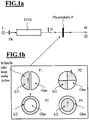
- phase plate P in the form of a split ⁇ / 2 plate, and a component which is polarization-direction independent with respect to the phase, for example formed as glass.
- the phase plate is aligned so that the fast direction of the crystal is advantageously aligned parallel or perpendicular or at a further optimized angle to the incident laser polarization.
- phase plate P various modifications of the phase plate P are shown, a half-sided division into a half-half and a half-glass in P1, a quarter-division into opposite half-quarter and quarter-glass in P2, an outboard ⁇ / 2 ring and an inner glass core in P3 and vice versa an external glass ring and an internal ⁇ / 2 core in P4.
- Glass is only listed here by way of example.
- Amorphous quartz [Suprasil] or other non-birefringent materials can also be used.
- the orientation of the extraordinary axis of the respective ⁇ / 2 part is shown in each case as an arrow.
- a light beam polarized parallel to this direction of the arrow passes through this element, a phase shift of half a wavelength relative to the glass part is produced in the ⁇ / 2 part. If, however, its polarization is oriented perpendicular to the direction of the arrow, no phase delay is generated.
- the element P is in operative connection with the EOM, which causes by appropriate control a rapid rotation of the polarization direction PR of the incident light beam L, usually a linearly polarized laser beam.
- the light beam continues in the direction of the microscope M via a scanning unit, not shown, to the sample, as is also known from the prior art. Due to the half-sided phase change through the plate P, the light beam undergoes the FMM-typical field modulation.
- the invention also relates to a control method, wherein advantageously the formation of the phase element, for example by replacement or control of a SLM is changed and a measurement of the modulation contrast, for example via measurements with activated disk P and swung plate P (without FMM) an optimization of the FMM Signal can occur.
- a rotation of the plate P can be carried out with a fixed light beam L instead of the rotation of the polarization by the EOM.
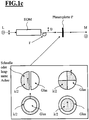
- Fig. 1c shows as in Fig. 1a the fast optical mode switch based on an EOM and passive phase elements.
- the inventive approach is extended to the point that now the modulation of the polarization direction of the laser before coupling into a fiber F can take place, if this fiber, as known in polarization-maintaining fibers, receives the polarization state of the light.
- the phase element is then after the fiber again in a pupil of the optical system.
- This embodiment is particularly advantageous if there is little space available in the actual optical system / device / microscope / scan head.
- a solution is realized according to the invention, in which the two modes are already present and switched between these modes by means of an EOM, AOM or AOTF.
- This principle differs even further from the previously documented prior art, since now switching in focus does not take place via a switching of the optical phases, but between two optical field modes.
- an equivalent initial and final state is established, but the transition from one configuration to the other configuration, characterized by the respective focus field structure, is incoherent.
- C (r) denotes the spatially varying concentration of excitable molecules.
- the integral extends over an area containing the focal volume.
- I P ( r, t ) denotes the temporally varying excitation intensity, which in the case of switching between two modes by I P r ⁇ G r 1 + cos .omega.t + LG r 1 + Sin .omega.t given is.
- the time-varying proportion can then be separated from the time-constant proportion. This time-varying proportion corresponds to the difference between the two different focus fields, wherein the non-modulated off-focus portion is constant in time and is eliminated by the in-phase detection via, for example, a lock-in detection.
- Figure 2b shows the intensity distribution of a Gaussian mode and a Donut mode (Laguerre-Gauss mode).
- the axes indicate a scaled lateral spatial extent in the focal plane.
- the proposed solution differs from the prior art in particular the fact that here the light field is not broken down into its components in the pupil and is influenced by a phase modulator in different spatial parts, but that there is a temporally varying switching between two different focus fields.
- Another advantage of the solution is its easy expandability to multiple focal volumes. In this case, for example, one would irradiate several Gaussian beams into the arrangement and transform these on the corresponding optical path by means of an array transformer (eg a spiral phase mask array).
- an array transformer eg a spiral phase mask array
- FIG Fig. 2c Shown here is a multispot variant for mode modulation with the example of 4 preferably collimated beams L1-4, which are finally focused in the microscope M in the direction of the focal plane.
- the passage of L1-4 is analog 2a by the arrangement shown there, wherein instead of a single spiral phase mask here an SPP array, shown schematically by four SPP, is provided.
- SPP array shown schematically by four SPP.
- the rays L1-4 through the EOM this may have a correspondingly large cross-section or the multi-spot generation in the light direction also be arranged upstream or it can be several EOM for L1-4, even with different modulation frequencies, or a segmented EOM with differently controlled cross-sectional areas, be provided.
- Switching between two modes can also be done very quickly by means of an acousto-optic modulator (AOM).
- AOM acousto-optic modulator
- Fig. 3 shows the fast switching between two field modes (eg Laguerre-Gauss and Gaussian mode) by means of an AOM, ie transformation of a Gaussian field into a time-dependent superposition of a Gaussian and Gaussian Laguerre mode.
- AOM arranged in the O.
- first order reflection elements S are the Reflect light in the same direction back into the AOM.
- a "donut mode generator” DMG (eg spiral phase plate or “radial polarizer”) is provided in the beam path between AOM and S,
- This embodiment of the invention represents an advantageous variation of the above-mentioned embodiment 2a.
- a Gaussian beam with a linear polarization through a polarizing beam splitter and a polarization influencing quarter wave plate, into an AOM or AOTF controlled by a drive unit AS for very fast switching an AOM, with slower, but polychromatic modulation also an AOTF can be used ).
- a time-varying lattice can be formed in the AOM, at which this beam, for example, into its own 0.
- a mode-generating element such as a donut mode generating element DMG, where in addition to donut modes, other mode-generating elements, eg for generating higher Gauss-Laguerre modes, are conceivable, and is subsequently at a first Mirror reflected. Thereafter, the element will pass a second time. The other order, however, is reflected only on a mirror.
- Both orders then again pass through the AOM and are again brought into a beam direction in the AOM, whereby they usually leave the AOM again in the linear output polarization depending on the mode-generating element.
- the beam is then brought to the reflection at the polarizing beam splitter cube PBS and can thus move in the direction of the microscope M and the sample.
- the detection of the emitted fluorescence radiation takes place with corresponding optoelectronic detectors and an optical or electronic demodulation.
- LIT Lock-in techniques
- the sample is excited at a particular frequency, while the LI measures the signal at the reference frequency.
- the lock-in system LI detects the signal at this specific reference frequency as a function of the reference phase position. Relative to the reference phase, LI amplifiers generate their own internal measurement phase (usually through a so-called phase-locked Ioop).
- LI ref V L sin ⁇ L t + ⁇ ref
- the signal is first amplified and then multiplied by the LI reference LI ref using a phase-sensitive detector (PSD) or a multiplier.
- PSD phase-sensitive detector
- the output of the PSD provides two time-varying signals: one at the differential and one at the sum frequency of the LI reference phase and signal phase.
- TP 1 / 2 V S V L cos ⁇ S - ⁇ ref ,
- optical modulators are used for demodulation in the detection or the operation of the detectors used for demodulation.
- Figure 4a shows a microscope structure to increase the penetration depth / scattered light suppression being provided in a schematic beam path of a laser L in the direction of a sample P, a dichroic splitter mirror D for the separation of illumination and detection beam path.
- the detection is split by a beam splitter BS into two partial beam paths in which detectors d1, d2 are located: Also shown are optical modulators m1, m2, a phasing element Ph, a filter F, a focus modulator FM and a subtraction operator O-.
- the laser L for fluorescence excitation is using a focus modulator (FM) such as Fig. 1 and 2 described modulated with the frequency ⁇ .
- FM focus modulator
- the fluorescence radiation of the sample (P), which is also reflected by the dichroic reflection (D) and is now also modulated with ⁇ , is detected in a phase-sensitive manner by two detectors d1 and d2 via a 50/50 beam splitter (BS).
- BS beam splitter
- one modulator m is used in each case before d1 and d2 (m1, m2 in FIG. 3a) or the detector gain of d1 and d2 is modulated (3b).
- the smoothed signals (filter F, eg integrator) are then subtracted from each other (operator O-).
- the modulators M1, m2 can advantageously be optical modulators such as EOM m1 is directly modulated and m2 undergoes a phase shift via Ph, thereby two partial signals are detected which have a phase difference to each other (delta Phi) and mixed and filtered with low-pass filter, so there is advantageously a optical demodulation with set relative phase, ideally 90 degrees between the two detection components, to be able to subtract the states with intact focus and the shifted states in which the focus is disturbed by the destructive interference from each other (- operator), Thus, on each pixel, the signal from the focus subtracts the extra-focal background (stray light).
- Fig. 4b is not the optical signal modulated but the "gain" of the detectors (eg acceleration voltage of a PMT), each controlled via FM and again set the phase of Ph, the signals filtered with F and subtracted with O-.
- the detectors d1, d2 are switched on and off, for example, with frequency ⁇ (and set phase shift).
- a beam switchover is used for demodulation by means of AOM.
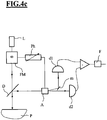
- Figure 4c shows a ray path similar to Fig. 3 shown.
- switching between the detectors d1 and d2 with the frequency ⁇ advantageously by means of an AOD (A), similar to in Fig.2 shown, but here in the detection.
- Ph can be used to set the phase difference.
- Fig. 6-8 are further advantageous embodiments shown in addition.
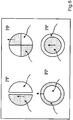
- the first supplement concerns the structure of the phase plate itself. This was originally described as consisting of a combination of a lambda / 2 plate and an isotropically acting plate. However, more general combinations are also conceivable.
- the plate PP as in Fig. 6 be composed of areas that have the effect of a lambda plate (and thus the phase corresponding to lambda and not lambda / 2 push) and areas in which a lambda / 2-phase shift is achieved.
- any phase shift in different subregions of the phase plate can be realized by setting the difference to the advantageous value of lambda / 2.
- Fig. 1 illustrated different embodiments of a combination of different areas can be as in Fig. 6 shown, even for different areas, for example, have a phase delay of lambda or lambda / half as shown. It is also particularly advantageous to achromatize the phase deviation of the two subregions against each other.
- achromatic wave plates or “achromatic retardation plates” which consist for example of different birefringent crystals and have the same optical properties (the same phase delay) for a broadband wavelength range and then the phase characteristic of the isotropic subplate is adapted thereon by, for example Plates consisting of at least two glasses can be used.
- the polarization after the PBS has a predetermined value.
- a rotatable or otherwise adjustable with respect to its polarization influencing polarizer can be introduced.
- an intensity balance between the two partial beams can be made after the optical fibers.
- the relevant measurement can be performed in a microscope or with an external monitor diode.
- a part of the beam can be coupled to a diode D after the PBS.
- the intensity fluctuations, which are measured with the diode, are used inter alia as a control variable to set the maximum amplitudes of the frequencies f ac 1 and f ac 2 .
- the method can be used for the switching of N light states with, for example, N fibers.
- Fig. 7 describes the fast switching of the polarization by means of an AOD in combination with a fiber optic F1, F2 for generating the phase switching by means of a suitable phase plate PP. Embodiments for balancing the intensities of both switching states are shown.
- the light of the laser light wave L is irradiated via a lens L1 in the plane of an AOD (acousto-optical deflector) whose sound wave is switched in the crystal with a frequency F between different acoustic frequencies F1 and F2, which generate alternately different deflection angle of the laser beam.
- the alternately deflected laser beams La1, La2 are in each case introduced via fiber coupler FKein in optical fiber F1, F2 and coupled out by means of Faserauskopplern FKaus from at different positions on a pole piece PBS.
- the fibers F1 and F2 are in this case set up so that their (preferably linear) polarization is perpendicular to the PBS laterally and perpendicular to each other from above.
- the phase plate PP is as in Fig. 6 arranged and generated by the phase jump between their halves the FMM signal for transmission into the microscope and the scanning device.
- a monitor diode D can be coupled, which serves via a drive unit AS for setting the signal intensities and the ratio of the two pole components.
- a rotatable polarizer is advantageously provided between PP and ST, which can serve to fine tune the ratio of the two pole components and to compensate for possible errors in the orientation of the fibers F1, F2 to each other as mentioned above.
- the detection via the monitor diode can be synchronized to the frequency of the switching by the AOD, so that the individual intensity components can be separated from one another.
- Fig. 8 describes a further embodiment with an EOM for switching the polarization and thus the phase after the phase plate in conjunction with the components, as described above Fig. 7 represented, in analogous mode of action as in Fig7 ,
- the separation into the individual polarization components takes place by means of a pole splitter PBS1 behind the EOM, wherein after the PBS the different pole components are in turn coupled into separate fibers F1, F2, which in turn on PBS 2 by orientation of the fibers or the outcouplings FK with each other perpendicular polarizations are irradiated.
Landscapes
- Physics & Mathematics (AREA)
- General Physics & Mathematics (AREA)
- Optics & Photonics (AREA)
- Nonlinear Science (AREA)
- Chemical & Material Sciences (AREA)
- Analytical Chemistry (AREA)
- Microscoopes, Condenser (AREA)
Applications Claiming Priority (3)
| Application Number | Priority Date | Filing Date | Title |
|---|---|---|---|
| DE102010047352 | 2010-10-01 | ||
| DE102011013613A DE102011013613A1 (de) | 2010-10-01 | 2011-03-08 | Mikroskop und Mikroskopierverfahren |
| EP11007920.9A EP2437096B1 (de) | 2010-10-01 | 2011-09-29 | Mikroskop und Mikroskopierverfahren |
Related Parent Applications (1)
| Application Number | Title | Priority Date | Filing Date |
|---|---|---|---|
| EP11007920.9A Division EP2437096B1 (de) | 2010-10-01 | 2011-09-29 | Mikroskop und Mikroskopierverfahren |
Publications (1)
| Publication Number | Publication Date |
|---|---|
| EP3422088A1 true EP3422088A1 (de) | 2019-01-02 |
Family
ID=44992443
Family Applications (2)
| Application Number | Title | Priority Date | Filing Date |
|---|---|---|---|
| EP17202895.3A Withdrawn EP3422088A1 (de) | 2010-10-01 | 2011-09-29 | Mikroskop und mikroskopierverfahren |
| EP11007920.9A Active EP2437096B1 (de) | 2010-10-01 | 2011-09-29 | Mikroskop und Mikroskopierverfahren |
Family Applications After (1)
| Application Number | Title | Priority Date | Filing Date |
|---|---|---|---|
| EP11007920.9A Active EP2437096B1 (de) | 2010-10-01 | 2011-09-29 | Mikroskop und Mikroskopierverfahren |
Country Status (4)
| Country | Link |
|---|---|
| US (2) | US10156710B2 (https=) |
| EP (2) | EP3422088A1 (https=) |
| JP (2) | JP5911683B2 (https=) |
| DE (1) | DE102011013613A1 (https=) |
Cited By (1)
| Publication number | Priority date | Publication date | Assignee | Title |
|---|---|---|---|---|
| DE102018110083A1 (de) * | 2018-04-26 | 2019-10-31 | Carl Zeiss Microscopy Gmbh | Optikanordnung zur flexiblen Mehrfarbbeleuchtung für ein Lichtmikroskop und Verfahren hierzu |
Families Citing this family (31)
| Publication number | Priority date | Publication date | Assignee | Title |
|---|---|---|---|---|
| DE102010013830A1 (de) * | 2010-03-26 | 2011-09-29 | Carl Zeiss Microlmaging Gmbh | Mikroskop und Verfahren zur mikroskopischen Erfassung von Licht einer Probe |
| DE102012010207B4 (de) * | 2012-05-15 | 2024-02-29 | Carl Zeiss Microscopy Gmbh | Mikroskop und Mikroskopieverfahren |
| EP2888620A1 (en) * | 2012-08-24 | 2015-07-01 | Advanced Micro Devices, Inc. | Laser scanning module including an optical isolator |
| DE102012017922B4 (de) | 2012-09-11 | 2024-03-14 | Carl Zeiss Microscopy Gmbh | Optikanordnung und Lichtmikroskop |
| DE102012019464A1 (de) * | 2012-09-28 | 2014-04-03 | Carl Zeiss Microscopy Gmbh | Konfokales Auflicht-Rastermikroskop zur Multifleck-Abtastung |
| CN103197411B (zh) * | 2013-03-20 | 2017-05-10 | 中国科学院苏州生物医学工程技术研究所 | 一种位相板组件及可变景深的显微镜系统 |
| DE102013227103B4 (de) * | 2013-09-03 | 2018-05-30 | Leica Microsystems Cms Gmbh | Mikroskop mit einer akustooptischen Vorrichtung |
| DE102013218231A1 (de) * | 2013-09-11 | 2015-03-12 | Sirona Dental Systems Gmbh | Optisches System zur Erzeugung eines sich zeitlich ändernden Musters für ein Konfokalmikroskop |
| WO2015151461A1 (ja) * | 2014-04-01 | 2015-10-08 | 株式会社ニコン | 超解像観察装置及び超解像観察方法 |
| WO2015163261A1 (ja) | 2014-04-24 | 2015-10-29 | オリンパス株式会社 | 顕微鏡および顕微鏡観察方法 |
| JP2015210517A (ja) * | 2014-09-09 | 2015-11-24 | 株式会社ニコン | パターン描画装置、パターン描画方法、および、デバイス製造方法 |
| WO2016208322A1 (ja) * | 2015-06-23 | 2016-12-29 | オリンパス株式会社 | 画像取得装置および画像取得方法 |
| US10067072B2 (en) * | 2015-07-10 | 2018-09-04 | Kla-Tencor Corporation | Methods and apparatus for speckle suppression in laser dark-field systems |
| JP6594437B2 (ja) | 2015-09-15 | 2019-10-23 | オリンパス株式会社 | 顕微鏡および顕微鏡観察方法 |
| DE102016211374A1 (de) | 2016-06-24 | 2017-12-28 | Carl Zeiss Microscopy Gmbh | Mikroskopieverfahren unter Nutzung zeitlicher Fokusmodulation und Mikroskop |
| EP3371631B1 (en) | 2016-12-22 | 2021-08-18 | Advanced Optical Technologies, Inc. | Polarimeter with multiple independent tunable channels and method for material and object classification and recognition |
| US11867891B2 (en) | 2016-12-22 | 2024-01-09 | Advanced Optical Technologies, Inc. | Polarimeter with multiple independent tunable channels and method for material orientation imaging |
| CA3083287C (en) * | 2017-12-12 | 2024-02-20 | Allen Institute | Systems, apparatuses and methods for simultaneous multi-plane imaging |
| KR102617346B1 (ko) * | 2018-06-28 | 2023-12-26 | 삼성전자주식회사 | 산란 억제를 위한 절단용 레이저 장치 |
| US11075496B2 (en) | 2018-06-28 | 2021-07-27 | Samsung Electronics Co., Ltd. | Laser dicing device, method of laser beam modulation, and method of dicing a substrate |
| KR102155329B1 (ko) * | 2018-11-09 | 2020-09-11 | 경북대학교 산학협력단 | 라이트 필드 이미징 시스템 |
| US10942135B2 (en) * | 2018-11-14 | 2021-03-09 | Kla Corporation | Radial polarizer for particle detection |
| CN109539976A (zh) * | 2018-11-23 | 2019-03-29 | 哈尔滨工业大学 | 基于螺旋相位板的零差干涉仪非线性误差修正方法与装置 |
| US11395714B2 (en) | 2019-11-11 | 2022-07-26 | Dermlite Llc | Medical illuminator with variable polarization |
| US11346769B2 (en) | 2020-02-20 | 2022-05-31 | Onto Innovation Inc. | Fast generalized multi-wavelength ellipsometer |
| US11346768B1 (en) * | 2020-12-02 | 2022-05-31 | Onto Innovation Inc. | Vortex polarimeter |
| CN112505914B (zh) * | 2020-12-10 | 2022-03-22 | 武汉先河激光技术有限公司 | 一种涡旋光束生成系统、方法及相位调制组合装置 |
| CN112987321B (zh) * | 2021-03-22 | 2022-08-02 | 中国科学院光电技术研究所 | 一种生成高功率涡旋激光的方法和装置 |
| CN113467073B (zh) * | 2021-04-29 | 2022-08-09 | 西安交通大学 | 一种基于柱矢量光场的激光微小频率偏移装置及方法 |
| CN113608359B (zh) * | 2021-08-19 | 2023-08-11 | 中国科学院光电技术研究所 | 一种模式可调的腔内涡旋光束生成装置 |
| WO2023148907A1 (ja) * | 2022-02-04 | 2023-08-10 | 三菱電機株式会社 | 動的光パターン生成装置 |
Citations (6)
| Publication number | Priority date | Publication date | Assignee | Title |
|---|---|---|---|---|
| DE19904592A1 (de) | 1999-02-05 | 2000-09-28 | Lavision Gmbh | Optische Vorrichtung |
| US20020154317A1 (en) * | 1998-05-28 | 2002-10-24 | Michael Kempe | Confocal microscopy |
| EP0500717B2 (en) | 1989-11-14 | 2003-11-19 | Cornell Research Foundation, Inc. | Two-photon laser scanning microscopy |
| EP1617268A2 (de) * | 2004-07-16 | 2006-01-18 | CARL ZEISS JENA GmbH | Lichtrastermikroskop mit einem Beleuchtungsmodul |
| WO2009008838A1 (en) | 2007-07-06 | 2009-01-15 | National University Of Singapore | Fluorescence focal modulation microscopy system and method |
| WO2011116901A2 (de) * | 2010-03-26 | 2011-09-29 | Carl Zeiss Microimaging Gmbh | Mikroskop und verfahren zur erfassung von probenlicht |
Family Cites Families (15)
| Publication number | Priority date | Publication date | Assignee | Title |
|---|---|---|---|---|
| US3628848A (en) * | 1969-12-23 | 1971-12-21 | Anvar | Variable phase contrast microscopy |
| JPH07167933A (ja) * | 1993-12-15 | 1995-07-04 | Nikon Corp | 磁気偏光顕微鏡 |
| JPH07187933A (ja) * | 1993-12-24 | 1995-07-25 | Sekisui Plastics Co Ltd | 土壌抗菌剤 |
| GB9603788D0 (en) * | 1996-02-22 | 1996-04-24 | Isis Innovation | Confocal microscope |
| US6134010A (en) * | 1997-11-07 | 2000-10-17 | Lucid, Inc. | Imaging system using polarization effects to enhance image quality |
| US20050134841A1 (en) * | 1998-09-18 | 2005-06-23 | Mehdi Vacz-Iravani | Sample inspection system |
| DE60016761T2 (de) * | 1999-08-02 | 2005-12-15 | Zetetic Institute, Tucson | Interferometrische konfokale nahfeld-abtastmikroskopie |
| US7038848B2 (en) * | 2002-12-27 | 2006-05-02 | Olympus Corporation | Confocal microscope |
| JP2005345561A (ja) * | 2004-05-31 | 2005-12-15 | Olympus Corp | 走査型レーザ顕微鏡装置 |
| JP2006058477A (ja) * | 2004-08-18 | 2006-03-02 | Olympus Corp | 超解像顕微鏡 |
| JP5189301B2 (ja) * | 2007-03-12 | 2013-04-24 | オリンパス株式会社 | レーザー走査型顕微鏡 |
| JP5622571B2 (ja) * | 2007-07-20 | 2014-11-12 | メディツィーニシェ・ウニヴェルジテート・インスブルックMedizinische Universitaet Innsbruck | 一対の回折光学要素を備える光学デバイス |
| JP5484879B2 (ja) * | 2009-12-11 | 2014-05-07 | オリンパス株式会社 | 超解像顕微鏡 |
| HRP20201813T1 (hr) * | 2010-03-05 | 2021-03-19 | The General Hospital Corporation | Uređaj za pružanje elektromagnetnog zračenja na uzorak |
| JP5752360B2 (ja) * | 2010-03-12 | 2015-07-22 | 富士フイルム株式会社 | ポリエステルフィルムの溶融製膜方法及び太陽電池部材用ポリエステルフィルム |
-
2011
- 2011-03-08 DE DE102011013613A patent/DE102011013613A1/de not_active Withdrawn
- 2011-08-31 JP JP2011189560A patent/JP5911683B2/ja active Active
- 2011-09-29 EP EP17202895.3A patent/EP3422088A1/de not_active Withdrawn
- 2011-09-29 EP EP11007920.9A patent/EP2437096B1/de active Active
- 2011-10-03 US US13/251,452 patent/US10156710B2/en active Active
-
2016
- 2016-03-30 JP JP2016067831A patent/JP6453266B2/ja active Active
- 2016-10-20 US US15/298,424 patent/US20170068082A1/en not_active Abandoned
Patent Citations (6)
| Publication number | Priority date | Publication date | Assignee | Title |
|---|---|---|---|---|
| EP0500717B2 (en) | 1989-11-14 | 2003-11-19 | Cornell Research Foundation, Inc. | Two-photon laser scanning microscopy |
| US20020154317A1 (en) * | 1998-05-28 | 2002-10-24 | Michael Kempe | Confocal microscopy |
| DE19904592A1 (de) | 1999-02-05 | 2000-09-28 | Lavision Gmbh | Optische Vorrichtung |
| EP1617268A2 (de) * | 2004-07-16 | 2006-01-18 | CARL ZEISS JENA GmbH | Lichtrastermikroskop mit einem Beleuchtungsmodul |
| WO2009008838A1 (en) | 2007-07-06 | 2009-01-15 | National University Of Singapore | Fluorescence focal modulation microscopy system and method |
| WO2011116901A2 (de) * | 2010-03-26 | 2011-09-29 | Carl Zeiss Microimaging Gmbh | Mikroskop und verfahren zur erfassung von probenlicht |
Non-Patent Citations (7)
| Title |
|---|
| A. LERAY; J. MERTZ, OPT. EXPRESS, vol. 14, 2006, pages 10565 |
| CHEN ET AL., OPT. EXPRESS, vol. 16, 2008, pages 18764 |
| JONATHAN LEACH; ERIC YAO; MILES J PADGETT: "Observation of the vortex structure of a non-integer vortex beam", NEW J. PHYS., vol. 6, 2004, pages 71, XP020080429, DOI: doi:10.1088/1367-2630/6/1/071 |
| N. G. CHEN ET AL: "Real-time focal modulation microscopy", PROCEEDINGS OF SPIE, vol. 7570, 25 January 2010 (2010-01-25), pages 75700Q - 75700Q-6, XP055000327, ISSN: 0277-786X, DOI: 10.1117/12.841511 * |
| SHAU POH CHONG ET AL: "High-speed focal modulation microscopy using acousto-optical modulators", BIOMEDICAL OPTICS EXPRESS, vol. 1, no. 3, 30 September 2010 (2010-09-30), United States, pages 1026, XP055526079, ISSN: 2156-7085, DOI: 10.1364/BOE.1.001026 * |
| SUEDA ET AL., OPT. EXPRESS, vol. 12, 2004, pages 3548 |
| WONG ET AL., APPL. OPT., vol. 48, 2009, pages 3237 |
Cited By (2)
| Publication number | Priority date | Publication date | Assignee | Title |
|---|---|---|---|---|
| DE102018110083A1 (de) * | 2018-04-26 | 2019-10-31 | Carl Zeiss Microscopy Gmbh | Optikanordnung zur flexiblen Mehrfarbbeleuchtung für ein Lichtmikroskop und Verfahren hierzu |
| US11796782B2 (en) | 2018-04-26 | 2023-10-24 | Carl Zeiss Microscopy Gmbh | Optics arrangement for flexible multi-color illumination for a light microscope and method to this end |
Also Published As
| Publication number | Publication date |
|---|---|
| JP2012078802A (ja) | 2012-04-19 |
| US10156710B2 (en) | 2018-12-18 |
| EP2437096B1 (de) | 2017-11-22 |
| EP2437096A2 (de) | 2012-04-04 |
| JP5911683B2 (ja) | 2016-04-27 |
| US20120268812A1 (en) | 2012-10-25 |
| JP2016118811A (ja) | 2016-06-30 |
| DE102011013613A1 (de) | 2012-04-05 |
| JP6453266B2 (ja) | 2019-01-16 |
| EP2437096A3 (de) | 2012-05-09 |
| US20170068082A1 (en) | 2017-03-09 |
Similar Documents
| Publication | Publication Date | Title |
|---|---|---|
| EP2437096B1 (de) | Mikroskop und Mikroskopierverfahren | |
| EP2149070B1 (de) | Durchstimmbares akusto-optisches filterelement | |
| EP2788810B1 (de) | Hochauflösendes lichtmikroskop | |
| DE2240968A1 (de) | Optisches verfahren zur messung der relativen verschiebung eines beugungsgitters sowie einrichtungen zu seiner durchfuehrung | |
| DE10042840A1 (de) | Vorrichtung und Verfahren zur Anregung von Fluoreszenzmikroskopmarkern bei der Mehrphotonen-Rastermikroskopie | |
| DE102012010207B4 (de) | Mikroskop und Mikroskopieverfahren | |
| DE102010013830A1 (de) | Mikroskop und Verfahren zur mikroskopischen Erfassung von Licht einer Probe | |
| EP3042239B1 (de) | Rastermikroskop mit polarisierter probenbeleuchtung | |
| DE10016377A1 (de) | Vorrichtung zum Vereinigen von Licht | |
| DE3013498A1 (de) | Optischer modulator sowie laser-graviervorrichtung mit einem derartigen modulator | |
| DE2127483A1 (de) | Verfahren zur interferentiellen Messung von Langen, Winkeln, Gangunter schieden oder Geschwindigkeiten | |
| EP3042233B1 (de) | Mikroskop mit einer akustooptischen vorrichtung | |
| EP2553512A2 (de) | Mikroskop und verfahren zur erfassung von probenlicht | |
| EP3042232A1 (de) | Scanmikroskop und akustooptischer hauptstrahlteiler für ein scanmikroskop | |
| DE102010026205A1 (de) | Mikroskop, insbesondere Fluoreszenzmikroskop, dichroitischer Strahlteiler und dessen Verwendung | |
| WO2017060506A1 (de) | Verfahren und vorrichtung zum untersuchen einer probe mit einer strukturiereten lichtblattbeleuchtung | |
| EP1720052A1 (de) | Vorrichtung zur Steuerung von Lichtstrahlung | |
| DE102018110072A1 (de) | Optikanordnung zur strukturierten Beleuchtung für ein Lichtmikroskop und Verfahren hierzu | |
| WO2017220668A1 (de) | Mikroskopieverfahren unter nutzung zeitlicher fokusmodulation und mikroskop | |
| DE2814476A1 (de) | Interferometer mit einer spule aus einem einmode-wellenleiter | |
| DE102008019957A1 (de) | Verfahren zum Bestrahlen einer Probe mit Licht und Fluoreszenzlichtmikroskop mit einer Beleuchtungseinheit zum Bestrahlen einer Probe mit Licht | |
| WO2012096629A1 (en) | Spatial-temporal optical phase modulation method and apparatus | |
| DE102023102378A1 (de) | Lichtmikroskop und verfahren zur abbildung einer probe oder zum lokalisieren oder verfolgen von emittern in einer probe | |
| DE102010018967A1 (de) | Anordnung und Verfahren zur nichtlinearen Mikroskopie | |
| WO2019149666A1 (de) | Verfahren zum abbilden einer probe mittels eines lichtblattmikroskops |
Legal Events
| Date | Code | Title | Description |
|---|---|---|---|
| STAA | Information on the status of an ep patent application or granted ep patent |
Free format text: STATUS: UNKNOWN |
|
| PUAI | Public reference made under article 153(3) epc to a published international application that has entered the european phase |
Free format text: ORIGINAL CODE: 0009012 |
|
| STAA | Information on the status of an ep patent application or granted ep patent |
Free format text: STATUS: REQUEST FOR EXAMINATION WAS MADE |
|
| 17P | Request for examination filed |
Effective date: 20171218 |
|
| AC | Divisional application: reference to earlier application |
Ref document number: 2437096 Country of ref document: EP Kind code of ref document: P |
|
| AK | Designated contracting states |
Kind code of ref document: A1 Designated state(s): AL AT BE BG CH CY CZ DE DK EE ES FI FR GB GR HR HU IE IS IT LI LT LU LV MC MK MT NL NO PL PT RO RS SE SI SK SM TR |
|
| STAA | Information on the status of an ep patent application or granted ep patent |
Free format text: STATUS: THE APPLICATION IS DEEMED TO BE WITHDRAWN |
|
| 18D | Application deemed to be withdrawn |
Effective date: 20190703 |