EP3383166B1 - Landschaftsbewässerungsanbausystem - Google Patents
Landschaftsbewässerungsanbausystem Download PDFInfo
- Publication number
- EP3383166B1 EP3383166B1 EP17711096.2A EP17711096A EP3383166B1 EP 3383166 B1 EP3383166 B1 EP 3383166B1 EP 17711096 A EP17711096 A EP 17711096A EP 3383166 B1 EP3383166 B1 EP 3383166B1
- Authority
- EP
- European Patent Office
- Prior art keywords
- irrigation
- water absorbent
- landscape
- blanket
- growing system
- Prior art date
- Legal status (The legal status is an assumption and is not a legal conclusion. Google has not performed a legal analysis and makes no representation as to the accuracy of the status listed.)
- Active
Links
Images




Classifications
-
- A—HUMAN NECESSITIES
- A01—AGRICULTURE; FORESTRY; ANIMAL HUSBANDRY; HUNTING; TRAPPING; FISHING
- A01G—HORTICULTURE; CULTIVATION OF VEGETABLES, FLOWERS, RICE, FRUIT, VINES, HOPS OR SEAWEED; FORESTRY; WATERING
- A01G20/00—Cultivation of turf, lawn or the like; Apparatus or methods therefor
-
- A—HUMAN NECESSITIES
- A01—AGRICULTURE; FORESTRY; ANIMAL HUSBANDRY; HUNTING; TRAPPING; FISHING
- A01G—HORTICULTURE; CULTIVATION OF VEGETABLES, FLOWERS, RICE, FRUIT, VINES, HOPS OR SEAWEED; FORESTRY; WATERING
- A01G25/00—Watering gardens, fields, sports grounds or the like
-
- A—HUMAN NECESSITIES
- A01—AGRICULTURE; FORESTRY; ANIMAL HUSBANDRY; HUNTING; TRAPPING; FISHING
- A01G—HORTICULTURE; CULTIVATION OF VEGETABLES, FLOWERS, RICE, FRUIT, VINES, HOPS OR SEAWEED; FORESTRY; WATERING
- A01G13/00—Protection of plants
- A01G13/30—Ground coverings
- A01G13/32—Mats; Nets; Sheets or films
-
- A—HUMAN NECESSITIES
- A01—AGRICULTURE; FORESTRY; ANIMAL HUSBANDRY; HUNTING; TRAPPING; FISHING
- A01G—HORTICULTURE; CULTIVATION OF VEGETABLES, FLOWERS, RICE, FRUIT, VINES, HOPS OR SEAWEED; FORESTRY; WATERING
- A01G24/00—Growth substrates; Culture media; Apparatus or methods therefor
- A01G24/40—Growth substrates; Culture media; Apparatus or methods therefor characterised by their structure
- A01G24/44—Growth substrates; Culture media; Apparatus or methods therefor characterised by their structure in block, mat or sheet form
-
- A—HUMAN NECESSITIES
- A01—AGRICULTURE; FORESTRY; ANIMAL HUSBANDRY; HUNTING; TRAPPING; FISHING
- A01G—HORTICULTURE; CULTIVATION OF VEGETABLES, FLOWERS, RICE, FRUIT, VINES, HOPS OR SEAWEED; FORESTRY; WATERING
- A01G24/00—Growth substrates; Culture media; Apparatus or methods therefor
- A01G24/40—Growth substrates; Culture media; Apparatus or methods therefor characterised by their structure
- A01G24/44—Growth substrates; Culture media; Apparatus or methods therefor characterised by their structure in block, mat or sheet form
- A01G24/46—Growth substrates; Culture media; Apparatus or methods therefor characterised by their structure in block, mat or sheet form multi-layered
-
- A—HUMAN NECESSITIES
- A01—AGRICULTURE; FORESTRY; ANIMAL HUSBANDRY; HUNTING; TRAPPING; FISHING
- A01G—HORTICULTURE; CULTIVATION OF VEGETABLES, FLOWERS, RICE, FRUIT, VINES, HOPS OR SEAWEED; FORESTRY; WATERING
- A01G25/00—Watering gardens, fields, sports grounds or the like
- A01G25/02—Watering arrangements located above the soil which make use of perforated pipe-lines or pipe-lines with dispensing fittings, e.g. for drip irrigation
-
- A—HUMAN NECESSITIES
- A01—AGRICULTURE; FORESTRY; ANIMAL HUSBANDRY; HUNTING; TRAPPING; FISHING
- A01G—HORTICULTURE; CULTIVATION OF VEGETABLES, FLOWERS, RICE, FRUIT, VINES, HOPS OR SEAWEED; FORESTRY; WATERING
- A01G25/00—Watering gardens, fields, sports grounds or the like
- A01G25/06—Watering arrangements making use of perforated pipe-lines located in the soil
-
- A—HUMAN NECESSITIES
- A01—AGRICULTURE; FORESTRY; ANIMAL HUSBANDRY; HUNTING; TRAPPING; FISHING
- A01G—HORTICULTURE; CULTIVATION OF VEGETABLES, FLOWERS, RICE, FRUIT, VINES, HOPS OR SEAWEED; FORESTRY; WATERING
- A01G25/00—Watering gardens, fields, sports grounds or the like
- A01G25/16—Control of watering
- A01G25/167—Control by humidity of the soil itself or of devices simulating soil or of the atmosphere; Soil humidity sensors
-
- E—FIXED CONSTRUCTIONS
- E01—CONSTRUCTION OF ROADS, RAILWAYS, OR BRIDGES
- E01C—CONSTRUCTION OF, OR SURFACES FOR, ROADS, SPORTS GROUNDS, OR THE LIKE; MACHINES OR AUXILIARY TOOLS FOR CONSTRUCTION OR REPAIR
- E01C13/00—Pavings or foundations specially adapted for playgrounds or sports grounds; Drainage, irrigation or heating of sports grounds
- E01C13/08—Surfaces simulating grass ; Grass-grown sports grounds
- E01C13/083—Construction of grass-grown sports grounds; Drainage, irrigation or heating arrangements therefor
Definitions
- This invention relates to a landscape growing system, notably using a combination of a water absorbent blanket and a covering layer of soil.
- a greening system is disclosed in JP2015122983 ;
- WO2012/164044 discloses a mineral wool product for growing vegetation in which water retention and/or the avoidance of run-off is of interest.
- the present invention provides a fixed irrigation landscape growing system defined by the features of independent claim 1.
- the present disclosure provides a fixed irrigation landscape growing system comprising:
- the present disclosure provides a fixed irrigation landscape growing system comprising:
- the present disclosure provides a fixed irrigation landscape growing system, notably installed in a region selected from: a Köppen climate region BWh (warm desert climate), BWk (cold desert climate), BSh (warm semi-arid climate), BSk (cold semi-arid climate), Csa (warm mediterranean climate), Csb (temperate mediterranean climate), whatsoever, Kuwait, Oman, Quatar, Saudi Arabia, the United Arab Emirates, California and a Köppen zone Csb, Csa, BS and BW in California; the landscape growing system comprising: a supporting substrate; a water absorbent blanket arranged above the substrate; a growing medium, notably a soil layer, arranged above the water absorbent blanket; and an irrigation system, notably an irrigation system selected from: an irrigation system comprising a plurality of spaced irrigation pipes arranged above the water absorbent blanket in which the average spacing between the irrigation pipes is at least 30cm, preferably at least 40cm, more preferably at least
- the present disclosure provides a method of irrigating a landscape growing system
- the landscape growing system comprises: a supporting substrate; a water absorbent blanket arranged above the substrate; a growing medium, notably a soil layer, arranged above the water absorbent blanket; and a fixed irrigation system, notably an irrigation system selected from an irrigation system comprising a plurality of spaced irrigation pipes arranged above the water absorbent blanket and an irrigation system comprising a plurality of spaced circle irrigation sprinklers arranged above the growing medium;
- the method comprises supplying irrigation water to the landscape growing system through the irrigation system, notably an average quantity of irrigation water which is ⁇ 3 L/m 2 per day and ⁇ 15 L/m 2 per day, preferably ⁇ 12 L/m 2 per day over at least one period of five consecutive days during i) the months of June, July and August in the northern hemisphere or ii) the months of December, January and February in the southern hemisphere.
- fixed irrigation landscape growing system or “fixed irrigation system” as used herein means a growing system in which, during application of irrigation water to the landscape, the irrigation outlets, for example irrigation sprays, irrigation nozzles or irrigation pipes, remain in a fixed position with respect to the landscape. This is in contrast to mobile irrigation system, for example an irrigation trailer having series of water sprays which is advanced over a landscape by a tractor.
- the irrigation outlets of the fixed irrigation landscape growing system may be permanently fixed, that is to say they may be kept in the same position in a permanent structure, for example by irrigation pipes being incorporated in the soil or growing medium or by irrigation sprays or irrigation nozzles being secured by permanent building structures such as concrete posts.
- the irrigation outlets of the fixed irrigation landscape growing system may be moveable, for example comprising moveable irrigation pipes laid on top of the ground or moveable irrigation sprays or irrigation nozzles arranged on spikes or posts which are removably embedded in the ground.
- Specific challenges presented by fixed irrigation landscape growing systems include a desire to optimise capital investment, efficient water management and vegetation growth.
- a particular challenge is to ensure consistency of the quality and appearance of the vegetation over the entire landscape; for example, a poor patch of vegetation adjacent to good or lush vegetation detracts noticeably from desired homogeneity.
- the desired homogeneity of the vegetation over a large area may be ensured by overwatering; this ensures that all areas receive adequate water for optimum vegetation growth but is wasteful of available water resources.
- reducing the spacing between irrigation sprays may improve homogeneity of water distribution but requires greater capital investment and more complex irrigation systems.
- the present invention is based on the realisation that good vegetation homogeneity can be achieved by the combination of features described and claimed herein.
- the invention is particularly advantageous for use in arid climates and/or in a Köppen climate zone B or zone C, notable in one of the following Köppen climate zones: BWh (warm desert climate); BWk (cold desert climate); BSh (warm semi-arid climate); BSk (cold semi-arid climate); Csa (warm mediterranean climate); Csb (temperate mediterranean climate); Csc (Cold-summer Mediterranean).
- the invention is particularly applicable for use in climate zone BWh (warm desert climate) and/or in a country selected fromoane, Kuwait, Oman, Quatar, Saudi Arabia and The United Arab Emirates. It is also particularly applicable for use in California, notably in climate zones Cs, BS and BW in California. Irrigation requirements in such climates zones are incompatible with requirements in other or more temperate climate zones such as Köppen zones Cw and Cf.
- the invention may be used for a landscape in a climate in which, for the summer months, particularly during June, July and August for the northern hemisphere, a) the average monthly rainfall is ⁇ 10mm or ⁇ 5mm and/or b) the average day time temperature is ⁇ 25°C or ⁇ 30°C.
- the landscape of the growing system may by a park, a public or residential garden, a green roof, a cemetery or a sports facility, for example a sports pitch or a golf course.
- the system is particularly suitable for relatively large landscapes or areas of vegetation, for examples having an area which is ⁇ 2000m 2 , notably ⁇ 5000m 2 , ⁇ 10000m 2 or ⁇ 20000m 2 .
- the landscape may be substantially horizontal and planar, for example in the case of a sports pitch.
- the growing system is advantageous for landscapes which are undulating or non-planar, for example landscapes incorporating distinct slopes and/or having differences in elevation which are ⁇ 0.5m, ⁇ 0.7m, ⁇ 1m or ⁇ 2m.
- the average spacing between adjacent irrigation pipes is at least 30cm; it may be ⁇ 40cm, ⁇ 50cm, ⁇ 60cm, ⁇ 80cm, ⁇ 1m or ⁇ 1.2m and/or ⁇ 2m or 1.6m.
- the average spacing refers to portions of the irrigation pipes at which water is distributed at the landscape. Where the adjacent irrigation pipes are parallel, the average distance is simply the distance between the parallel irrigation pipes at the portions at which water is distributed at the landscape.
- the irrigation pipes may be sprinkler hoses or soaker hoses. Particularly when laid on top of the vegetation, the irrigation pipe may be green in colour; this allow it to visually blend with the vegetation. Alternatively, it may be of a colour intended to allow easy identification against the vegetation, for example, blue, red or orange.
- the irrigation pipes may provide a water drip supply or a micro-drip. Where the irrigation pipes are arranged between the water absorbent blanket and the growing medium they are preferably positioned directly on an upper surface of the water absorbent blanket and subsequently covered with the growing medium; this facilitates laying down of the system.
- one or more sprinklers may be a rotor, a rotating sprinkler, a pulse sprinkler, a full or part circle pulse sprinkler or an oscillating sprinkler.
- the sprinklers may be arranged on spikes embedded in the growing system or on stands.
- the sprinkler patterns may be substantially circular when viewed from above, or have the form of a sector of a circle; in this case, the radius of the sprinkler patterns may be ⁇ 1m, ⁇ 2m, ⁇ 2.5m, ⁇ 3m or ⁇ 3.5m and/or ⁇ 8m or ⁇ 5m.
- the term "circle sprinkler” means a sprinkler which provides a sprinkler pattern when viewed from above which is or which is substantially a circle or a sector or a circle.
- the radius of the sprinkler patterns is ⁇ 2m or ⁇ 2.5m and/or ⁇ 3.5m or ⁇ 3m.
- a common practice in the arrangement of sprinklers, notably full circle sprinklers, half circle sprinklers and quarter circle sprinklers is an arrangement of "head-to-head" spacing in which adjacent sprinklers are spaced at a distance which is equal to the radius of the sprinkler pattern.
- the spacing between a first sprinkler and at least one of its adjacent sprinklers, preferably between the first sprinkler and each of its adjacent sprinklers, is ⁇ 1.1 times the radius of the first sprinkler pattern; the spacing may be ⁇ 1.2, ⁇ 1.3, ⁇ 1.4, ⁇ 1.5, ⁇ 1.6, ⁇ 1.7, ⁇ 1.8, ⁇ 1.9, ⁇ 2, ⁇ 2.1, ⁇ 2.2, ⁇ 2.3, ⁇ 24 or ⁇ 25 and/or ⁇ 35 or ⁇ 3 times the radius of the sprinkler pattern.
- the sprinkler patterns of adjacent sprinklers leaves gaps or non-sprinkled areas.
- Such gaps may have an area which is ⁇ 0.01%, ⁇ 0.03%, ⁇ 0.05%, ⁇ 0.08%, ⁇ 0.1%, ⁇ 0.2% or ⁇ 0.3% and/or ⁇ 5%, ⁇ 2% or ⁇ 1% of the area of the sprinkler pattern of one of the sprinklers.
- sprinkler pattern means the extent of the area over which a sprinkler will provide irrigation water to the upper surface of the growing system when operating at its nominal system conditions, notably at its nominal or intended water pressure and water flow rate without wind.
- the system comprises a plurality of sprinklers having one of more of the aforementioned features, notably at least 20, at least 30 or at least 40 such sprinklers.
- the irrigation pipes or sprinklers may comprise spray nozzles.
- the quantity of irrigation water distributed over the landscape by the system may be ⁇ 75% or ⁇ 70% of the recognised Evapotranspiration Data for the location and the time of year.
- the Evapotranspiration Data is preferably Evapotranspiration Data for Irrigation Scheduling and Design where such specific data exists.
- the quantity of irrigation water distributed over the landscape by the system may be ⁇ 60% or ⁇ 50% of the recognised Evapotranspiration Data for the location.
- the growing medium notably a top or uppermost growing medium, is preferably a loose material; it may be selected from soil, loam or sand. Where it comprises soil, the soil may comprise sand, loam and clay.
- the thickness of the growing medium may be ⁇ 0.5cm or ⁇ 1 cm and/or ⁇ 30cm, ⁇ 20cm ⁇ 10cm or ⁇ 6cm.
- the depth of the water absorbent blanket within the growing system should be selected according to the vegetation to be grown. The water absorbent blanket tends to draw irrigation water to the bottom part of the overlying growing medium, towards or in to the water absorbent blanket, and away from an exposed surface of the system. This reduces the tendency of irrigation water to evaporate from the surface and facilities efficient water management.
- the present landscaping system may be used to reduce inhomogeneity in water distribution and/or vegetation growth due to such variations in the thickness of the growing medium, notably where the variation in the thickness of the growing medium is i) ⁇ 1cm, ⁇ 2cm or ⁇ 2.5cm and/or ⁇ 20cm, ⁇ 15cm ⁇ 10cm or ⁇ 5cm; and/or ii) ⁇ 10% ⁇ 15% or ⁇ 20% and/or ⁇ 50% or ⁇ 40% of the nominal or average thickness, particularly where such variations of thickness apply to two areas each of 1m 2 whose peripheries are spaced between 10 m and 20 m apart.
- the water absorbent blanket comprises mineral wool fibres, notably rock mineral wool fibres. It comprises needled mineral wool fibres.
- the fibres may have an average diameter between 2 ⁇ m and 9 ⁇ m.
- Physical integrity of the blanket is preferably provided by intertwining of the mineral wool fibres, notably by needling; this provides an advantageous structure. Avoiding the use a binder, particularly avoiding constituents of some binder systems, notably constituents of phenol formaldehyde based binder systems, which may be deleterious to plant growth and/or water absorption, provides an additional advantage.
- the water absorbent blanket is substantially free of organic binders and/or other organic materials.
- the preferred structure of the water absorbent blanket when installed in the system is believed to facilitate water take-up and distribution, particularly over the lifetime of the system.
- needling aids for example oils or lubricants, may be used; in this case, these materials are preferably removed prior to use, for example by heat decomposition.
- the majority of the fibres of the needled mineral wool blanket are orientated substantially parallel to its major surface prior to installation in the system and/or substantially parallel to the supporting substrate when installed in the system.
- At least 50%, at least 60%, at least 70% or at least 80% of the fibres by number are orientated at an angle which is ⁇ 20°, ⁇ 15°or ⁇ 10° with respect to the major surface and/or the supporting substrate. This provides advantageous distribution of irrigation water throughout the area over which the water absorbent blanket extends.
- the water absorbent blanket may have dimensions before installation and/or when installed which include:
- the water absorbent blanket may be substantially flexible or non-rigid allowing it to be rolled and/or to conform the contours of the supporting substrate when laid. Such dimensions, especially when the blanket is flexible, facilitate manual application of the blanket over the supporting substrate.
- the blanket may be provided in the form of a roll, notably a roll having a height corresponding to the widths mentioned above and/or a weight which is ⁇ 20kg, ⁇ 18kg or ⁇ 15; this facilitated manual handling.
- the blanket when intended for mechanical handling, for example using tractors or other mechanical equipment, the blanket may be rolled on a core, for example a metal, plastic or cardboard; particularly in such a case, the blanket may have: a length which is ⁇ 8 m or ⁇ 10m and/or ⁇ 25m ⁇ 15m; and/or a weight which is ⁇ 20kg or ⁇ 25 kg and/or ⁇ 100kg, ⁇ 60kg or ⁇ 32kg.
- the water absorbent blanket may have a density (when dry) which is ⁇ 70 kg/m 3 , ⁇ 80 kg/m 3 , ⁇ 90 kg/m 3 or ⁇ 100 kg/m 3 and/or ⁇ 140 kg/m 3 , ⁇ 130 kg/m 3 or ⁇ 120 kg/m 3 .
- It may have a water retention, particularly when is does not comprise water absorbent polymers, which is ⁇ 500 l/m 3 , ⁇ 600 l/m 3 or ⁇ 700 l/m 3 and/or ⁇ 1200 l/m 3 , ⁇ 1000 l/m 3 or ⁇ 950.
- This water retention may be the level when first installed and/or after a duration in use of at least 12 months, at least 24 months or at least 36 months.
- the water absorbent blanket does not comprise water absorbent polymers or water absorbent polymer particles.
- the long term ecological impact of such materials has not been widely studied and such materials may have a tendency to lose performance over the lifetime of the system.
- the water absorbent blanket may comprise one or more fertilisers and/or growing aids and/or seeds.
- the blanket may be installed at its desired site prior to seeding or planting of vegetation. Alternatively, the blanket may be used as a support for the initial growing of vegetation under controlled or favourable conditions prior to its transfer and incorporation at its desired site.
- the landscape growing system may be used to grow one or more of grass, turf, turfgrass, passpalum, bermudagrass, buffalograss or zoysiagrass, ground cover, shrubs or trees.
- the system may comprise a moisture sensor configured to detect the amount of water or moisture in the water absorbent blanket.
- a signal from such sensor may be used to monitor, control, activate or deactivate the irrigation system; this facilitates efficient use of irrigation water to achieve a desired level of moisture for plant growth.
- Such a system is particularly advantageous where the position of the water absorbent blanket corresponds in general to the upper layer of the vegetation rooting system. This allow the quantity of moisture at the depth of the roots to be monitored directly and with good accuracy.
- measurement of moisture content at one part of the water absorbent blanket for example at a conveniently located edge of the blanket, provides a rapid and convenient indication of moisture content at all positions of the blanket.
- Positioning of the moisture sensor below the vegetation and below the growth medium also protects it from damage, for example from sunlight, mowers and foot traffic.
- the growing system may be installed by:
- the system may then be seeded, for example by applying grass or other seeds to the growing medium, or planted.
- pre-grown vegetation for example grass sods comprising grass growing in soil, may be applied instead of or in addition to the growing medium.
- existing top soil from the installation site may be removed to the desired depth of the water absorbent blanket and subsequently used as the growing medium, notably by being placed over the water absorbent blanket once the water absorbent blanket has been positioned.
- the irrigation system may be configured to supply a quantity of irrigation water which is ⁇ 60%, ⁇ 50%, ⁇ 40% or ⁇ 30% of the quantity of irrigation water supplied by comparable prior known irrigation systems. It is surprising that good vegetation growth can be achieved with levels of irrigation so much lower than those that were previously thought necessary.
- the irrigation system may be configured to supply an average quantity of irrigation water during summer months, notably the months of June and/or July and/or August in the northern hemisphere, which is ⁇ 3 L/m 2 , ⁇ 6 L/m 2 or ⁇ 9 L/m 2 per day and/or ⁇ 10 L/m 2 , ⁇ 12 L/m 2 , ⁇ 13 L/m 2 or ⁇ 15 L/m 2 per day.
- the average quantity of irrigation water is calculated over at least one period of consecutive days, for example five, ten, fifteen or thirty consecutive days, notably during the summer months of June and/or July and/or August.
- the five, ten, fifteen or thirty consecutive days may be consecutive within one of the months of June, July and August or may be a period overlapping two of the months.
- the irrigation system is configured to supply, over at least one period of five consecutive days during the months of June and/or July and/or August, an average quantity of irrigation water which is ⁇ 3 L/m 2 per day and ⁇ 15 L/m 2 per day and preferably ⁇ 12 L/m 2 , notably in a BWh climate zone (warm desert climate).
- the landscape growing system of Fig 1 and Fig 2 is part of a public park and comprises:
- adjacent irrigation pipes are substantially parallel at portions where they provide irrigation; this is the case for irrigation pipes 15 and 16 which are spaced at a distance d1 of about 50cm. Irrigation pipes 16 and 17 are non-parallel; as each of these irrigation pipes is laid straight their average spacing is the average of the spacing d2 and d3 at their extremities.
- Fig 3 illustrates a prior art arrangement for circle sprinklers typically adopted with the aim of ensuring even distribution of water and avoidance of dry spots.
- Each sprinkler 31, 32 is spaced from its adjacent sprinklers by a distance which is equal to the radius of its sprinkler pattern 311, 321.
- Fig 4 illustrates an arrangement using six rotating circle sprinklers 41, 42, 43, 44, 45, 46 each having a respective sprinkler pattern 51, 52, 53, 54, 55, 56.
- the sprinkler patterns of adjacent sprinklers overlap, for example as shown between the first 41 and fourth 44 sprinkler at 61 and between the fourth 44 and fifth 45 sprinkler at 62.
- a gap or non-sprinkled portion 71 nevertheless remains.
- Each sprinkler is spaced from its adjacent sprinklers by a distance which is greater than the radius of its sprinkler pattern.
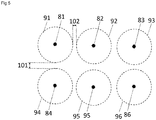
- the sprinkler patterns 91, 92, 93, 94, 95, 96 of adjacent sprinklers 81, 82, 83, 84, 85, 86, 87 do not overlap. Indeed, there is a separation 101, 102 of at least 2 cm between adjacent sprinkler patterns.
- the combination of the elements of the system in accordance with at least preferred embodiments of the invention provide adequate water distribution, notably thanks to the effect water distribution provided by the water absorbent blanket, such that the configurations illustrated in Fig 4 and Fig 5 may be used to ensure adequate water distribution, notably in real conditions, notably which include wind and water pressure drops.
- Table 1 shows an example of the quantity of irrigation water supplied according to an embodiment of the invention during the first 15 days of the summer month of June in climate zone B in the northern hemisphere.
- Table 1 Day Daily quantity of irrigation water supplied Average daily quantity of irrigation water supplied over consecutive five-day period (L/m 2 ) period (L/m 2 ) 1 0.8 2 1.1 3 2.3 4 3.8 5 4.0 days 1 to 5 2.4 6 3.8 days 2 to 6* 3.0 7 7.6 days 3 to 7* 4.3 8 13.2 days 4 to 8* 6.5 9 15.1 days 5 to 9* 8.7 10 22.7 days 6 to 10* 12.5 11 16.5 days 7 to 11* 15.0 12 13.2 days 8 to 12 16.2 13 13.2 days 9 to 13 16.2 14 11.7 days 10 to 15 15.5 15 10.6 days 11 to 16* 13.1
- the periods marked * represent consecutive five day periods over which the average daily quantity of irrigation water supplied was ⁇ 3 L/m 2 per day and ⁇ 15 L/m 2 .
- the expression L/m 2 as used herein refers to litres of irrigation water per m 2 of the irrigation landscape growing system.
Landscapes
- Life Sciences & Earth Sciences (AREA)
- Environmental Sciences (AREA)
- Engineering & Computer Science (AREA)
- Water Supply & Treatment (AREA)
- Soil Sciences (AREA)
- Toxicology (AREA)
- General Health & Medical Sciences (AREA)
- Health & Medical Sciences (AREA)
- Architecture (AREA)
- Civil Engineering (AREA)
- Structural Engineering (AREA)
- Cultivation Of Plants (AREA)
- Hydroponics (AREA)
- Cultivation Receptacles Or Flower-Pots, Or Pots For Seedlings (AREA)
Claims (15)
- Stationäres Bewässerungssystem für den Landschaftsbau, das in einer Region installiert ist, ausgewählt aus: einer Köppen-Klimaregion BWh (warmes Wüstenklima), BWk (kaltes Wüstenklima), BSh (warmes halbtrockenes Klima), BSk (kaltes halbtrockenes Klima), Csa (warmes Mittelmeerklima), Csb (gemäßigtes Mittelmeerklima), Bahrain, Kuwait, Oman, Quatar, Saudi-Arabien, den Vereinigten Arabischen Emiraten, Kalifornien und einer Köppen-Zone Csb, Csa, BS und BW in Kalifornien; umfassend:ein unterstützendes Substrat;eine wasserabsorbierende Decke, die genadelte Mineralwollfasern umfasst und über dem Substrat angeordnet ist, wobei mindestens 50% der Fasern nach Anzahl der genadelten Mineralwolldecke in einem Winkel von ≤ 20° in Bezug auf die Hauptoberfläche der genadelten Mineralwolldecke orientiert sind;ein Wachstumsmedium, vorzugsweise eine Erdschicht, das über der wasserabsorbierenden Decke angeordnet ist; undein Bewässerungssystem, ausgewählt aus: einer Vielzahl von beabstandeten Bewässerungsrohren, die über der wasserabsorbierenden Decke angeordnet sind, wobei der durchschnittliche Abstand zwischen den Bewässerungsrohren mindestens 30 cm, vorzugsweise mindestens 40 cm, besonders bevorzugt mindestens 45 cm beträgt; und einer Vielzahl von beabstandeten Kreisbewässerungssprinktern, die über dem Wachstumsmedium angeordnet sind, wobei der Abstand zwischen einem ersten Sprinkler und jedem seiner benachbarten Sprinkler größer als das 1,2-fache des Radius des Sprinklermusters des ersten Sprinklers ist;wobei das Bewässerungssystem vorzugsweise so ausgelegt ist, dass es über mindestens einen Zeitraum von fünf aufeinanderfolgenden Tagen während der Monate Juni, Juli und August, vorzugsweise über einen Zeitraum von zehn, fünfzehn oder dreißig aufeinanderfolgenden Tagen während der Monate Juni, Juli und August, eine durchschnittliche Menge an Bewässerungswasser bereitstellt, die ≥ 3 L/m2 pro Tag und ≤ 15 L/m2 pro Tag, vorzugsweise ≤ 12 L/m2 pro Tag beträgt.
- Stationäres Bewässerungssystem für den Landschaftsbau nach Anspruch 1, wobei die voneinander beabstandeten Bewässerungsrohre zwischen der wasserabsorbierenden Decke und dem Wachstumsmedium angeordnet sind.
- Stationäres Bewässerungssystem für den Landschaftsbau nach Anspruch 1, wobei die voneinander beabstandeten Bewässerungsrohre über dem Wachstumsmedium angeordnet sind.
- Stationäres Bewässerungssystem für den Landschaftsbau nach Anspruch 1, wobei die Sprinklermuster der benachbarten Sprinkler einen nicht beregneten Bereich freilassen, der ≥ 0,01 % der Fläche des Sprinklermusters eines der Sprinkler beträgt.
- Stationäres Bewässerungssystem für den Landschaftsbau nach einem der vorhergehenden Ansprüche, wobei die Bewässerungssprinkler mit einem Abstand von mindestens 2 cm, vorzugsweise mindestens 4 cm, zwischen den Sprinklermustern benachbarter Sprinkler angeordnet sind.
- Stationäres Bewässerungssystem für den Landschaftsbau nach einem der vorhergehenden Ansprüche, wobei die wasserabsorbierende Decke bindemittelfreie Mineralwollfasern enthält.
- Stationäres Bewässerungssystem für den Landschaftsbau nach einem der vorhergehenden Ansprüche, wobei die wasserabsorbierende Decke eine Dicke im Bereich von 10 mm bis 50 mm, vorzugsweise 15 mm bis 25 mm, aufweist.
- Stationäres Bewässerungssystem für den Landschaftsbau nach einem der vorhergehenden Ansprüche, wobei die wasserabsorbierende Decke die Form eines kontinuierlichen Streifens hat, der:- eine Länge von ≥ 4m und eine Breite von ≥ 0,7m, vorzugsweise eine Länge von ≥ 5m und eine Breite von ≥ 0,8m; und/oder- eine Länge von ≤ 9 m und eine Breite von ≤ 2 m, vorzugsweise eine Länge von ≤ 8 m und eine Breite von ≤ 1,6 m,
aufweist. - Stationäres Bewässerungssystem für den Landschaftsbau nach einem der vorhergehenden Ansprüche, wobei die wasserabsorbierende Decke eine Wasserretention von ≥ 500 l/m3 aufweist.
- Stationäres Bewässerungssystem für den Landschaftsbau nach einem der vorhergehenden Ansprüche, wobei die wasserabsorbierende Decke frei von superabsorbierenden Polymeren ist.
- Stationäres Bewässerungssystem für den Landschaftsbau nach einem der vorhergehenden Ansprüche, wobei das Anbausystem Gras umfasst, welches durch das Wachstumsmedium hindurch wächst und aus diesem herausragt.
- Stationäres Bewässerungssystem für den Landschaftsbau nach einem der vorhergehenden Ansprüche, wobei das Landschaftsbausystem ein grasbedeckter Teil eines Parks ist, vorzugsweise ein grasbedeckter Teil mit einer Fläche von mindestens 10000 m2.
- Stationäres Bewässerungssystem für den Landschaftsbau nach einem der Ansprüche 1 bis 12, wobei das Landschaftsbausystem Teil einer Sportfläche ist, ausgewählt aus einem Golfplatz und einem Sportplatz.
- Stationäres Bewässerungssystem für den Landschaftsbau nach einem der vorhergehenden Ansprüche, wobei der durchschnittliche Abstand zwischen den Bewässerungsrohren ≤ 2 m beträgt.
- Verfahren zur Bewässerung eines Landschaftsbausystems, vorzugsweise eines Landschaftsbausystems gemäß einem der Ansprüche 1 bis 14, das in einer Region installiert ist, ausgewählt aus: einer Köppen-Klimaregion BWh (warmes Wüstenklima), BWk (kaltes Wüstenklima), BSh (warmes halbtrockenes Klima), BSk (kaltes halbtrockenes Klima), Csa (warmes Mittelmeerklima), Csb (gemäßigtes Mittelmeerklima), Bahrain, Kuwait, Oman, Quatar, Saudi-Arabien, den Vereinigten Arabischen Emiraten, Kalifornien und einer Köppen-Zone Csb, Csa, BS und BW in Kalifornien;
wobei das Landschaftsbausystem umfasst:ein unterstützendes Substrat;eine wasserabsorbierende Decke, die genadelte Mineralwollfasern umfasst und über dem Substrat angeordnet ist, wobei mindestens 50% der Fasern nach Anzahl der genadelten Mineralwolldecke in einem Winkel von ≤ 20° in Bezug auf die Hauptoberfläche der genadelten Mineralwolldecke orientiert sind;ein Wachstumsmedium, vorzugsweise eine Erdschicht, das über der wasserabsorbierenden Decke angeordnet ist; undein stationäres Bewässerungssystem, vorzugsweise ein Bewässerungssystem, ausgewählt aus: einem Bewässerungssystem, das eine Vielzahl von beabstandeten Bewässerungsrohren umfasst, die über der wasserabsorbierenden Decke angeordnet sind, und einem Bewässerungssystem, das eine Vielzahl von beabstandeten Kreisbewässerungssprinklern umfasst, die über dem Wachstumsmedium angeordnet sind,wobei das Verfahren das Bereitstellen einer durchschnittlichen Menge von Bewässerungswasser umfasst, die ≥ 3 L/m2 pro Tag und ≤ 15 L/m2 pro Tag, vorzugsweise ≤ 12 L/m2 pro Tag, an das Landschaftsbausystem durch das Bewässerungssystem über mindestens einen Zeitraum von fünf aufeinanderfolgenden Tagen während der Monate Juni, Juli und August, vorzugsweise über einen Zeitraum von zehn, fünfzehn oder dreißig aufeinanderfolgenden Tagen während der Monate Juni, Juli und August, beträgt.
Priority Applications (3)
| Application Number | Priority Date | Filing Date | Title |
|---|---|---|---|
| HRP20201531TT HRP20201531T1 (hr) | 2016-01-05 | 2017-01-05 | Sustav za navodnjavanje okoliša |
| RS20201101A RS60809B1 (sr) | 2016-01-05 | 2017-01-05 | Sistem ozelenjavanja predela sa navodnjavanjem |
| SI201730424T SI3383166T1 (sl) | 2016-01-05 | 2017-01-05 | Namakalni sistem za zaraščanje pokrajine |
Applications Claiming Priority (2)
| Application Number | Priority Date | Filing Date | Title |
|---|---|---|---|
| GBGB1600117.4A GB201600117D0 (en) | 2016-01-05 | 2016-01-05 | Landscaping |
| PCT/EP2017/050230 WO2017118710A1 (en) | 2016-01-05 | 2017-01-05 | Irrigation landscape and growing system |
Publications (2)
| Publication Number | Publication Date |
|---|---|
| EP3383166A1 EP3383166A1 (de) | 2018-10-10 |
| EP3383166B1 true EP3383166B1 (de) | 2020-07-01 |
Family
ID=55406687
Family Applications (1)
| Application Number | Title | Priority Date | Filing Date |
|---|---|---|---|
| EP17711096.2A Active EP3383166B1 (de) | 2016-01-05 | 2017-01-05 | Landschaftsbewässerungsanbausystem |
Country Status (9)
| Country | Link |
|---|---|
| US (1) | US10874058B2 (de) |
| EP (1) | EP3383166B1 (de) |
| ES (1) | ES2820363T3 (de) |
| GB (1) | GB201600117D0 (de) |
| HR (1) | HRP20201531T1 (de) |
| PT (1) | PT3383166T (de) |
| RS (1) | RS60809B1 (de) |
| SI (1) | SI3383166T1 (de) |
| WO (1) | WO2017118710A1 (de) |
Families Citing this family (3)
| Publication number | Priority date | Publication date | Assignee | Title |
|---|---|---|---|---|
| WO2023093600A1 (zh) * | 2021-11-29 | 2023-06-01 | 成都名富园艺有限公司 | 种子无土生长诱导结构和植生卷 |
| CN114946630B (zh) * | 2022-06-17 | 2023-07-28 | 中煤湖北地质勘察基础工程有限公司 | 一种绿色矿山恢复治理系统及其治理方法 |
| CN119547677A (zh) * | 2024-11-08 | 2025-03-04 | 中国标准化研究院 | 一种灌溉喷头及大棚自动化灌溉系统 |
Citations (3)
| Publication number | Priority date | Publication date | Assignee | Title |
|---|---|---|---|---|
| US20110042480A1 (en) * | 2004-09-07 | 2011-02-24 | Hitt Dale K | Wireless Sprinkler Control |
| WO2012164044A1 (en) * | 2011-05-31 | 2012-12-06 | Knauf Insulation | Mineral wool product |
| JP2015122983A (ja) * | 2013-12-26 | 2015-07-06 | 日東紡績株式会社 | 緑化システム |
Family Cites Families (7)
| Publication number | Priority date | Publication date | Assignee | Title |
|---|---|---|---|---|
| US3613309A (en) * | 1969-07-03 | 1971-10-19 | Ickes Braun Glasshouses Inc | Plant cultivation |
| DE3805069A1 (de) | 1988-02-18 | 1989-09-21 | Wolfgang Behrens | Vegetationselement als fertigelement |
| US5752784A (en) * | 1995-02-17 | 1998-05-19 | The Motz Group | Low profile drainage network for athletic field drainage system |
| US8567117B2 (en) * | 2004-10-04 | 2013-10-29 | Profile Products, Llc | Netless fiber mulch mats bound with bicomponent fibers |
| JP2007189936A (ja) * | 2006-01-18 | 2007-08-02 | Okumura Corp | 緑化基盤用シート、緑化基盤材、並びに建物の緑化システム |
| JP2012085549A (ja) | 2010-10-18 | 2012-05-10 | Clear System Co Ltd | 吸排水マットとそれを用いた植物植栽機構と排水機構 |
| WO2017132683A1 (en) * | 2016-01-28 | 2017-08-03 | Tatro Inc. | Engineered surfaces |
-
2016
- 2016-01-05 GB GBGB1600117.4A patent/GB201600117D0/en not_active Ceased
-
2017
- 2017-01-05 US US16/068,108 patent/US10874058B2/en active Active
- 2017-01-05 SI SI201730424T patent/SI3383166T1/sl unknown
- 2017-01-05 ES ES17711096T patent/ES2820363T3/es active Active
- 2017-01-05 RS RS20201101A patent/RS60809B1/sr unknown
- 2017-01-05 HR HRP20201531TT patent/HRP20201531T1/hr unknown
- 2017-01-05 PT PT177110962T patent/PT3383166T/pt unknown
- 2017-01-05 WO PCT/EP2017/050230 patent/WO2017118710A1/en not_active Ceased
- 2017-01-05 EP EP17711096.2A patent/EP3383166B1/de active Active
Patent Citations (3)
| Publication number | Priority date | Publication date | Assignee | Title |
|---|---|---|---|---|
| US20110042480A1 (en) * | 2004-09-07 | 2011-02-24 | Hitt Dale K | Wireless Sprinkler Control |
| WO2012164044A1 (en) * | 2011-05-31 | 2012-12-06 | Knauf Insulation | Mineral wool product |
| JP2015122983A (ja) * | 2013-12-26 | 2015-07-06 | 日東紡績株式会社 | 緑化システム |
Also Published As
| Publication number | Publication date |
|---|---|
| WO2017118710A1 (en) | 2017-07-13 |
| RS60809B1 (sr) | 2020-10-30 |
| PT3383166T (pt) | 2020-10-06 |
| US10874058B2 (en) | 2020-12-29 |
| ES2820363T3 (es) | 2021-04-20 |
| EP3383166A1 (de) | 2018-10-10 |
| SI3383166T1 (sl) | 2020-11-30 |
| GB201600117D0 (en) | 2016-02-17 |
| US20200163288A1 (en) | 2020-05-28 |
| HRP20201531T1 (hr) | 2021-02-19 |
Similar Documents
| Publication | Publication Date | Title |
|---|---|---|
| US5938372A (en) | Subsurface irrigation apparatus and method | |
| US5765304A (en) | Turf-growing process | |
| CN105123212B (zh) | 一种利用植物纤维毯进行坡面植被防护的方法 | |
| CN110714469A (zh) | 一种红砂岩硬质边坡生态绿化系统及其施工方法 | |
| US10874058B2 (en) | Irrigation landscape and growing system | |
| EP1065921B1 (de) | Verfahren und vorrichtung zur bildung von grünflächen | |
| WO2008007722A1 (en) | Planting base, plant-bearing mass, planting base unit, planting system and method of planting | |
| JP3285201B2 (ja) | 自生型屋上緑化施工方法 | |
| Schreiber et al. | Increasing rangeland forage production by water harvesting | |
| CN109863945A (zh) | 一种环保草毯的生产方法 | |
| JP3504928B2 (ja) | 植生構造 | |
| CN117468476A (zh) | 一种林业种植用植被绿化坡及修建方法 | |
| JPH08266149A (ja) | 植物緑化施設の施工方法及び緑化施設 | |
| JP2003169545A (ja) | 多肉植物類による薄層緑化方法 | |
| JP4703617B2 (ja) | 緑化保持体および緑化保持体の栽培植生方法 | |
| JP4401128B2 (ja) | 人工緑地 | |
| JP2002235327A (ja) | 緑化システムとそれによる緑化方法およびこれに用いる見切り材 | |
| JPH0310764B2 (de) | ||
| JPH0231615A (ja) | 芝生マット構造 | |
| JP6978055B2 (ja) | 定植方法、緑化方法及び緑化システム | |
| KR20070121874A (ko) | 갓길용 클로버 뗏장 식재방법 | |
| JPH03110213A (ja) | 芝生等地表植生物の給水および排水方法 | |
| KR100517238B1 (ko) | 폐타이어와 골재를 이용한 스포츠 시설의 천연잔디 식재 및 생육 시공방법 | |
| JPH0358247B2 (de) | ||
| JPH04222526A (ja) | 緑化ユニット |
Legal Events
| Date | Code | Title | Description |
|---|---|---|---|
| STAA | Information on the status of an ep patent application or granted ep patent |
Free format text: STATUS: UNKNOWN |
|
| STAA | Information on the status of an ep patent application or granted ep patent |
Free format text: STATUS: THE INTERNATIONAL PUBLICATION HAS BEEN MADE |
|
| PUAI | Public reference made under article 153(3) epc to a published international application that has entered the european phase |
Free format text: ORIGINAL CODE: 0009012 |
|
| STAA | Information on the status of an ep patent application or granted ep patent |
Free format text: STATUS: REQUEST FOR EXAMINATION WAS MADE |
|
| 17P | Request for examination filed |
Effective date: 20180706 |
|
| AK | Designated contracting states |
Kind code of ref document: A1 Designated state(s): AL AT BE BG CH CY CZ DE DK EE ES FI FR GB GR HR HU IE IS IT LI LT LU LV MC MK MT NL NO PL PT RO RS SE SI SK SM TR |
|
| AX | Request for extension of the european patent |
Extension state: BA ME |
|
| DAV | Request for validation of the european patent (deleted) | ||
| DAX | Request for extension of the european patent (deleted) | ||
| RIC1 | Information provided on ipc code assigned before grant |
Ipc: A01G 25/16 20060101ALN20190613BHEP Ipc: E01C 13/08 20060101ALN20190613BHEP Ipc: A01G 24/46 20180101AFI20190613BHEP Ipc: A01G 25/00 20060101ALI20190613BHEP |
|
| RIC1 | Information provided on ipc code assigned before grant |
Ipc: E01C 13/08 20060101ALN20190712BHEP Ipc: A01G 25/16 20060101ALN20190712BHEP Ipc: A01G 24/46 20180101AFI20190712BHEP Ipc: A01G 25/00 20060101ALI20190712BHEP |
|
| GRAP | Despatch of communication of intention to grant a patent |
Free format text: ORIGINAL CODE: EPIDOSNIGR1 |
|
| STAA | Information on the status of an ep patent application or granted ep patent |
Free format text: STATUS: GRANT OF PATENT IS INTENDED |
|
| RIC1 | Information provided on ipc code assigned before grant |
Ipc: A01G 25/16 20060101ALN20190912BHEP Ipc: A01G 24/46 20180101AFI20190912BHEP Ipc: A01G 25/00 20060101ALI20190912BHEP Ipc: E01C 13/08 20060101ALN20190912BHEP |
|
| INTG | Intention to grant announced |
Effective date: 20190925 |
|
| GRAJ | Information related to disapproval of communication of intention to grant by the applicant or resumption of examination proceedings by the epo deleted |
Free format text: ORIGINAL CODE: EPIDOSDIGR1 |
|
| STAA | Information on the status of an ep patent application or granted ep patent |
Free format text: STATUS: REQUEST FOR EXAMINATION WAS MADE |
|
| REG | Reference to a national code |
Ref country code: DE Ref legal event code: R079 Ref document number: 602017018999 Country of ref document: DE Free format text: PREVIOUS MAIN CLASS: A01G0025000000 Ipc: A01G0024460000 |
|
| GRAP | Despatch of communication of intention to grant a patent |
Free format text: ORIGINAL CODE: EPIDOSNIGR1 |
|
| STAA | Information on the status of an ep patent application or granted ep patent |
Free format text: STATUS: GRANT OF PATENT IS INTENDED |
|
| INTC | Intention to grant announced (deleted) | ||
| RIC1 | Information provided on ipc code assigned before grant |
Ipc: A01G 25/00 20060101ALI20200123BHEP Ipc: A01G 25/16 20060101ALN20200123BHEP Ipc: A01G 24/46 20180101AFI20200123BHEP Ipc: E01C 13/08 20060101ALN20200123BHEP |
|
| INTG | Intention to grant announced |
Effective date: 20200203 |
|
| GRAS | Grant fee paid |
Free format text: ORIGINAL CODE: EPIDOSNIGR3 |
|
| GRAA | (expected) grant |
Free format text: ORIGINAL CODE: 0009210 |
|
| STAA | Information on the status of an ep patent application or granted ep patent |
Free format text: STATUS: THE PATENT HAS BEEN GRANTED |
|
| AK | Designated contracting states |
Kind code of ref document: B1 Designated state(s): AL AT BE BG CH CY CZ DE DK EE ES FI FR GB GR HR HU IE IS IT LI LT LU LV MC MK MT NL NO PL PT RO RS SE SI SK SM TR |
|
| REG | Reference to a national code |
Ref country code: AT Ref legal event code: REF Ref document number: 1285250 Country of ref document: AT Kind code of ref document: T Effective date: 20200715 Ref country code: CH Ref legal event code: EP |
|
| REG | Reference to a national code |
Ref country code: IE Ref legal event code: FG4D |
|
| REG | Reference to a national code |
Ref country code: DE Ref legal event code: R096 Ref document number: 602017018999 Country of ref document: DE |
|
| REG | Reference to a national code |
Ref country code: HR Ref legal event code: TUEP Ref document number: P20201531T Country of ref document: HR |
|
| REG | Reference to a national code |
Ref country code: PT Ref legal event code: SC4A Ref document number: 3383166 Country of ref document: PT Date of ref document: 20201006 Kind code of ref document: T Free format text: AVAILABILITY OF NATIONAL TRANSLATION Effective date: 20200925 |
|
| REG | Reference to a national code |
Ref country code: LT Ref legal event code: MG4D |
|
| PG25 | Lapsed in a contracting state [announced via postgrant information from national office to epo] |
Ref country code: BG Free format text: LAPSE BECAUSE OF FAILURE TO SUBMIT A TRANSLATION OF THE DESCRIPTION OR TO PAY THE FEE WITHIN THE PRESCRIBED TIME-LIMIT Effective date: 20201001 |
|
| REG | Reference to a national code |
Ref country code: NL Ref legal event code: MP Effective date: 20200701 |
|
| REG | Reference to a national code |
Ref country code: HR Ref legal event code: ODRP Ref document number: P20201531T Country of ref document: HR Payment date: 20201218 Year of fee payment: 5 |
|
| PG25 | Lapsed in a contracting state [announced via postgrant information from national office to epo] |
Ref country code: SE Free format text: LAPSE BECAUSE OF FAILURE TO SUBMIT A TRANSLATION OF THE DESCRIPTION OR TO PAY THE FEE WITHIN THE PRESCRIBED TIME-LIMIT Effective date: 20200701 Ref country code: NO Free format text: LAPSE BECAUSE OF FAILURE TO SUBMIT A TRANSLATION OF THE DESCRIPTION OR TO PAY THE FEE WITHIN THE PRESCRIBED TIME-LIMIT Effective date: 20201001 Ref country code: GR Free format text: LAPSE BECAUSE OF FAILURE TO SUBMIT A TRANSLATION OF THE DESCRIPTION OR TO PAY THE FEE WITHIN THE PRESCRIBED TIME-LIMIT Effective date: 20201002 Ref country code: CZ Free format text: LAPSE BECAUSE OF FAILURE TO SUBMIT A TRANSLATION OF THE DESCRIPTION OR TO PAY THE FEE WITHIN THE PRESCRIBED TIME-LIMIT Effective date: 20200701 Ref country code: LT Free format text: LAPSE BECAUSE OF FAILURE TO SUBMIT A TRANSLATION OF THE DESCRIPTION OR TO PAY THE FEE WITHIN THE PRESCRIBED TIME-LIMIT Effective date: 20200701 Ref country code: FI Free format text: LAPSE BECAUSE OF FAILURE TO SUBMIT A TRANSLATION OF THE DESCRIPTION OR TO PAY THE FEE WITHIN THE PRESCRIBED TIME-LIMIT Effective date: 20200701 |
|
| REG | Reference to a national code |
Ref country code: HR Ref legal event code: T1PR Ref document number: P20201531 Country of ref document: HR |
|
| PG25 | Lapsed in a contracting state [announced via postgrant information from national office to epo] |
Ref country code: IS Free format text: LAPSE BECAUSE OF FAILURE TO SUBMIT A TRANSLATION OF THE DESCRIPTION OR TO PAY THE FEE WITHIN THE PRESCRIBED TIME-LIMIT Effective date: 20201101 Ref country code: LV Free format text: LAPSE BECAUSE OF FAILURE TO SUBMIT A TRANSLATION OF THE DESCRIPTION OR TO PAY THE FEE WITHIN THE PRESCRIBED TIME-LIMIT Effective date: 20200701 Ref country code: PL Free format text: LAPSE BECAUSE OF FAILURE TO SUBMIT A TRANSLATION OF THE DESCRIPTION OR TO PAY THE FEE WITHIN THE PRESCRIBED TIME-LIMIT Effective date: 20200701 |
|
| PG25 | Lapsed in a contracting state [announced via postgrant information from national office to epo] |
Ref country code: NL Free format text: LAPSE BECAUSE OF FAILURE TO SUBMIT A TRANSLATION OF THE DESCRIPTION OR TO PAY THE FEE WITHIN THE PRESCRIBED TIME-LIMIT Effective date: 20200701 |
|
| REG | Reference to a national code |
Ref country code: DE Ref legal event code: R097 Ref document number: 602017018999 Country of ref document: DE |
|
| REG | Reference to a national code |
Ref country code: ES Ref legal event code: FG2A Ref document number: 2820363 Country of ref document: ES Kind code of ref document: T3 Effective date: 20210420 |
|
| PG25 | Lapsed in a contracting state [announced via postgrant information from national office to epo] |
Ref country code: IT Free format text: LAPSE BECAUSE OF FAILURE TO SUBMIT A TRANSLATION OF THE DESCRIPTION OR TO PAY THE FEE WITHIN THE PRESCRIBED TIME-LIMIT Effective date: 20200701 Ref country code: EE Free format text: LAPSE BECAUSE OF FAILURE TO SUBMIT A TRANSLATION OF THE DESCRIPTION OR TO PAY THE FEE WITHIN THE PRESCRIBED TIME-LIMIT Effective date: 20200701 Ref country code: SM Free format text: LAPSE BECAUSE OF FAILURE TO SUBMIT A TRANSLATION OF THE DESCRIPTION OR TO PAY THE FEE WITHIN THE PRESCRIBED TIME-LIMIT Effective date: 20200701 Ref country code: RO Free format text: LAPSE BECAUSE OF FAILURE TO SUBMIT A TRANSLATION OF THE DESCRIPTION OR TO PAY THE FEE WITHIN THE PRESCRIBED TIME-LIMIT Effective date: 20200701 Ref country code: DK Free format text: LAPSE BECAUSE OF FAILURE TO SUBMIT A TRANSLATION OF THE DESCRIPTION OR TO PAY THE FEE WITHIN THE PRESCRIBED TIME-LIMIT Effective date: 20200701 |
|
| PLBE | No opposition filed within time limit |
Free format text: ORIGINAL CODE: 0009261 |
|
| STAA | Information on the status of an ep patent application or granted ep patent |
Free format text: STATUS: NO OPPOSITION FILED WITHIN TIME LIMIT |
|
| PG25 | Lapsed in a contracting state [announced via postgrant information from national office to epo] |
Ref country code: AL Free format text: LAPSE BECAUSE OF FAILURE TO SUBMIT A TRANSLATION OF THE DESCRIPTION OR TO PAY THE FEE WITHIN THE PRESCRIBED TIME-LIMIT Effective date: 20200701 |
|
| 26N | No opposition filed |
Effective date: 20210406 |
|
| REG | Reference to a national code |
Ref country code: AT Ref legal event code: UEP Ref document number: 1285250 Country of ref document: AT Kind code of ref document: T Effective date: 20200701 |
|
| PG25 | Lapsed in a contracting state [announced via postgrant information from national office to epo] |
Ref country code: SK Free format text: LAPSE BECAUSE OF FAILURE TO SUBMIT A TRANSLATION OF THE DESCRIPTION OR TO PAY THE FEE WITHIN THE PRESCRIBED TIME-LIMIT Effective date: 20200701 |
|
| PG25 | Lapsed in a contracting state [announced via postgrant information from national office to epo] |
Ref country code: MC Free format text: LAPSE BECAUSE OF FAILURE TO SUBMIT A TRANSLATION OF THE DESCRIPTION OR TO PAY THE FEE WITHIN THE PRESCRIBED TIME-LIMIT Effective date: 20200701 |
|
| REG | Reference to a national code |
Ref country code: CH Ref legal event code: PL |
|
| GBPC | Gb: european patent ceased through non-payment of renewal fee |
Effective date: 20210105 |
|
| PG25 | Lapsed in a contracting state [announced via postgrant information from national office to epo] |
Ref country code: LU Free format text: LAPSE BECAUSE OF NON-PAYMENT OF DUE FEES Effective date: 20210105 |
|
| REG | Reference to a national code |
Ref country code: BE Ref legal event code: MM Effective date: 20210131 |
|
| PG25 | Lapsed in a contracting state [announced via postgrant information from national office to epo] |
Ref country code: CH Free format text: LAPSE BECAUSE OF NON-PAYMENT OF DUE FEES Effective date: 20210131 Ref country code: GB Free format text: LAPSE BECAUSE OF NON-PAYMENT OF DUE FEES Effective date: 20210105 Ref country code: LI Free format text: LAPSE BECAUSE OF NON-PAYMENT OF DUE FEES Effective date: 20210131 |
|
| REG | Reference to a national code |
Ref country code: HR Ref legal event code: ODRP Ref document number: P20201531 Country of ref document: HR Payment date: 20211220 Year of fee payment: 6 |
|
| PG25 | Lapsed in a contracting state [announced via postgrant information from national office to epo] |
Ref country code: IE Free format text: LAPSE BECAUSE OF NON-PAYMENT OF DUE FEES Effective date: 20210105 |
|
| PG25 | Lapsed in a contracting state [announced via postgrant information from national office to epo] |
Ref country code: IS Free format text: LAPSE BECAUSE OF FAILURE TO SUBMIT A TRANSLATION OF THE DESCRIPTION OR TO PAY THE FEE WITHIN THE PRESCRIBED TIME-LIMIT Effective date: 20201101 |
|
| PG25 | Lapsed in a contracting state [announced via postgrant information from national office to epo] |
Ref country code: BE Free format text: LAPSE BECAUSE OF NON-PAYMENT OF DUE FEES Effective date: 20210131 |
|
| REG | Reference to a national code |
Ref country code: HR Ref legal event code: ODRP Ref document number: P20201531 Country of ref document: HR Payment date: 20221221 Year of fee payment: 7 |
|
| P01 | Opt-out of the competence of the unified patent court (upc) registered |
Effective date: 20230421 |
|
| PG25 | Lapsed in a contracting state [announced via postgrant information from national office to epo] |
Ref country code: CY Free format text: LAPSE BECAUSE OF FAILURE TO SUBMIT A TRANSLATION OF THE DESCRIPTION OR TO PAY THE FEE WITHIN THE PRESCRIBED TIME-LIMIT Effective date: 20200701 |
|
| PG25 | Lapsed in a contracting state [announced via postgrant information from national office to epo] |
Ref country code: HU Free format text: LAPSE BECAUSE OF FAILURE TO SUBMIT A TRANSLATION OF THE DESCRIPTION OR TO PAY THE FEE WITHIN THE PRESCRIBED TIME-LIMIT; INVALID AB INITIO Effective date: 20170105 |
|
| REG | Reference to a national code |
Ref country code: HR Ref legal event code: ODRP Ref document number: P20201531 Country of ref document: HR Payment date: 20231219 Year of fee payment: 8 |
|
| PG25 | Lapsed in a contracting state [announced via postgrant information from national office to epo] |
Ref country code: MK Free format text: LAPSE BECAUSE OF FAILURE TO SUBMIT A TRANSLATION OF THE DESCRIPTION OR TO PAY THE FEE WITHIN THE PRESCRIBED TIME-LIMIT Effective date: 20200701 |
|
| PG25 | Lapsed in a contracting state [announced via postgrant information from national office to epo] |
Ref country code: MT Free format text: LAPSE BECAUSE OF FAILURE TO SUBMIT A TRANSLATION OF THE DESCRIPTION OR TO PAY THE FEE WITHIN THE PRESCRIBED TIME-LIMIT Effective date: 20200701 |
|
| PGFP | Annual fee paid to national office [announced via postgrant information from national office to epo] |
Ref country code: PT Payment date: 20241218 Year of fee payment: 9 |
|
| REG | Reference to a national code |
Ref country code: HR Ref legal event code: ODRP Ref document number: P20201531 Country of ref document: HR Payment date: 20241218 Year of fee payment: 9 |
|
| PGFP | Annual fee paid to national office [announced via postgrant information from national office to epo] |
Ref country code: HR Payment date: 20241218 Year of fee payment: 9 |
|
| PGFP | Annual fee paid to national office [announced via postgrant information from national office to epo] |
Ref country code: RS Payment date: 20241219 Year of fee payment: 9 |
|
| PGFP | Annual fee paid to national office [announced via postgrant information from national office to epo] |
Ref country code: SI Payment date: 20241217 Year of fee payment: 9 |
|
| PGFP | Annual fee paid to national office [announced via postgrant information from national office to epo] |
Ref country code: DE Payment date: 20250129 Year of fee payment: 9 |
|
| PGFP | Annual fee paid to national office [announced via postgrant information from national office to epo] |
Ref country code: ES Payment date: 20250203 Year of fee payment: 9 |
|
| PGFP | Annual fee paid to national office [announced via postgrant information from national office to epo] |
Ref country code: AT Payment date: 20241219 Year of fee payment: 9 |
|
| PGFP | Annual fee paid to national office [announced via postgrant information from national office to epo] |
Ref country code: FR Payment date: 20250127 Year of fee payment: 9 |
|
| PG25 | Lapsed in a contracting state [announced via postgrant information from national office to epo] |
Ref country code: TR Free format text: LAPSE BECAUSE OF FAILURE TO SUBMIT A TRANSLATION OF THE DESCRIPTION OR TO PAY THE FEE WITHIN THE PRESCRIBED TIME-LIMIT Effective date: 20200701 |