EP3367480B1 - Verfahren zur herstellung einer sekundärbatterie, einschliesslich einer elektrode mit hoher kapazität - Google Patents
Verfahren zur herstellung einer sekundärbatterie, einschliesslich einer elektrode mit hoher kapazität Download PDFInfo
- Publication number
- EP3367480B1 EP3367480B1 EP17849027.2A EP17849027A EP3367480B1 EP 3367480 B1 EP3367480 B1 EP 3367480B1 EP 17849027 A EP17849027 A EP 17849027A EP 3367480 B1 EP3367480 B1 EP 3367480B1
- Authority
- EP
- European Patent Office
- Prior art keywords
- electrode
- coated
- electrode mixture
- shape
- portions
- Prior art date
- Legal status (The legal status is an assumption and is not a legal conclusion. Google has not performed a legal analysis and makes no representation as to the accuracy of the status listed.)
- Active
Links
Images


Classifications
-
- H—ELECTRICITY
- H01—ELECTRIC ELEMENTS
- H01M—PROCESSES OR MEANS, e.g. BATTERIES, FOR THE DIRECT CONVERSION OF CHEMICAL ENERGY INTO ELECTRICAL ENERGY
- H01M4/00—Electrodes
- H01M4/02—Electrodes composed of, or comprising, active material
- H01M4/04—Processes of manufacture in general
- H01M4/0402—Methods of deposition of the material
- H01M4/0404—Methods of deposition of the material by coating on electrode collectors
-
- H—ELECTRICITY
- H01—ELECTRIC ELEMENTS
- H01M—PROCESSES OR MEANS, e.g. BATTERIES, FOR THE DIRECT CONVERSION OF CHEMICAL ENERGY INTO ELECTRICAL ENERGY
- H01M4/00—Electrodes
- H01M4/02—Electrodes composed of, or comprising, active material
- H01M4/04—Processes of manufacture in general
- H01M4/0402—Methods of deposition of the material
-
- H—ELECTRICITY
- H01—ELECTRIC ELEMENTS
- H01M—PROCESSES OR MEANS, e.g. BATTERIES, FOR THE DIRECT CONVERSION OF CHEMICAL ENERGY INTO ELECTRICAL ENERGY
- H01M4/00—Electrodes
- H01M4/02—Electrodes composed of, or comprising, active material
- H01M4/04—Processes of manufacture in general
- H01M4/043—Processes of manufacture in general involving compressing or compaction
- H01M4/0435—Rolling or calendering
-
- H—ELECTRICITY
- H01—ELECTRIC ELEMENTS
- H01M—PROCESSES OR MEANS, e.g. BATTERIES, FOR THE DIRECT CONVERSION OF CHEMICAL ENERGY INTO ELECTRICAL ENERGY
- H01M4/00—Electrodes
- H01M4/02—Electrodes composed of, or comprising, active material
- H01M4/04—Processes of manufacture in general
- H01M4/0471—Processes of manufacture in general involving thermal treatment, e.g. firing, sintering, backing particulate active material, thermal decomposition, pyrolysis
-
- H—ELECTRICITY
- H01—ELECTRIC ELEMENTS
- H01M—PROCESSES OR MEANS, e.g. BATTERIES, FOR THE DIRECT CONVERSION OF CHEMICAL ENERGY INTO ELECTRICAL ENERGY
- H01M4/00—Electrodes
- H01M4/02—Electrodes composed of, or comprising, active material
- H01M4/13—Electrodes for accumulators with non-aqueous electrolyte, e.g. for lithium-accumulators; Processes of manufacture thereof
- H01M4/139—Processes of manufacture
-
- H—ELECTRICITY
- H01—ELECTRIC ELEMENTS
- H01M—PROCESSES OR MEANS, e.g. BATTERIES, FOR THE DIRECT CONVERSION OF CHEMICAL ENERGY INTO ELECTRICAL ENERGY
- H01M10/00—Secondary cells; Manufacture thereof
- H01M10/05—Accumulators with non-aqueous electrolyte
- H01M10/052—Li-accumulators
- H01M10/0525—Rocking-chair batteries, i.e. batteries with lithium insertion or intercalation in both electrodes; Lithium-ion batteries
-
- Y—GENERAL TAGGING OF NEW TECHNOLOGICAL DEVELOPMENTS; GENERAL TAGGING OF CROSS-SECTIONAL TECHNOLOGIES SPANNING OVER SEVERAL SECTIONS OF THE IPC; TECHNICAL SUBJECTS COVERED BY FORMER USPC CROSS-REFERENCE ART COLLECTIONS [XRACs] AND DIGESTS
- Y02—TECHNOLOGIES OR APPLICATIONS FOR MITIGATION OR ADAPTATION AGAINST CLIMATE CHANGE
- Y02E—REDUCTION OF GREENHOUSE GAS [GHG] EMISSIONS, RELATED TO ENERGY GENERATION, TRANSMISSION OR DISTRIBUTION
- Y02E60/00—Enabling technologies; Technologies with a potential or indirect contribution to GHG emissions mitigation
- Y02E60/10—Energy storage using batteries
-
- Y—GENERAL TAGGING OF NEW TECHNOLOGICAL DEVELOPMENTS; GENERAL TAGGING OF CROSS-SECTIONAL TECHNOLOGIES SPANNING OVER SEVERAL SECTIONS OF THE IPC; TECHNICAL SUBJECTS COVERED BY FORMER USPC CROSS-REFERENCE ART COLLECTIONS [XRACs] AND DIGESTS
- Y02—TECHNOLOGIES OR APPLICATIONS FOR MITIGATION OR ADAPTATION AGAINST CLIMATE CHANGE
- Y02P—CLIMATE CHANGE MITIGATION TECHNOLOGIES IN THE PRODUCTION OR PROCESSING OF GOODS
- Y02P70/00—Climate change mitigation technologies in the production process for final industrial or consumer products
- Y02P70/50—Manufacturing or production processes characterised by the final manufactured product
Definitions
- the present disclosure relates to a method of preparing a secondary battery including a high-capacity electrode.
- lithium secondary batteries which have high energy density, high operating voltage, a long cycle lifespan, and a low self-discharge rate, have been commercially available and widely used.
- Ni-MH secondary batteries are mainly used as a power source for EVs, HEVs, and the like, research on the use of lithium secondary batteries having high energy density, high discharge voltage, and output stability has been actively conducted, and some lithium secondary batteries have been commercialized.
- Lithium secondary batteries have a structure in which a non-aqueous electrolyte containing a lithium salt is impregnated in an electrode assembly in which a porous separator is interposed between positive and negative electrodes that are each prepared by coating an active material on an electrode current collector.
- each of the electrodes is prepared by mixing an active material and a binder resin component and dispersing the mixture in a solvent to prepare an electrode mixture, coating the electrode mixture on a surface of a current collector, and performing a rolling process, a drying process, a notching process, a slitting process, and the like.
- an electrode mixture layer on which the large amount of the electrode mixture is coated and a non-coated portion on which the electrode mixture is not coated have different rolling ratios in a rolling process performed after a coating process, and thus the non-coated portion may be bent during the rolling process or the electrode mixture layer is discharged from an electrode sheet, which is a problem.
- the present disclosure is provided to solve the above-described problems of the related art and technical problems which have been identified in the past.
- the present disclosure provides a method of preparing an electrode that exhibits high productivity and improved capacity by minimizing a phenomenon in which an excessive stress is applied to an electrode mixture layer of coated portions so that the electrode mixture layer is discharged from an electrode sheet, and a phenomenon in which a rolling rate of an uncoated portion is relatively higher than that of the coated portion so that the uncoated portion is bent which occur in a rolling process during preparation of high capacity electrodes.
- the present disclosure provides a method of preparing an electrode for a secondary battery including: (a) a process of partially coating an electrode slurry containing an electrode mixture and a solvent on an electrode sheet so that coated portions are positioned with an uncoated portion interposed therebetween; (b) a process of drying the coated portions to remove the solvent; and (c) a process of rolling the dried coated portions, wherein a thickness of the coated portion is decreased and the electrode mixture moves to the uncoated portions, resulting in the coated portions disappearing, in the process (c).
- the electrode slurry is partially coated so that the uncoated portion is formed between the coated portions, and then, during the rolling process, a part of the electrode mixture layer is pushed from the coated portions to fill the uncoated portion such that stress is dispersed. Accordingly, it is possible to remarkably reduce the chance of a defective electrode in which the electrode mixture layer of the coated portions is discharged from the electrode sheet being prepared. Generally, a problem in that the electrode is bent occurs due to a high rolling rate of an uncoated portion.
- the electrode mixture fills the uncoated portion, and thus an electrode having an overall uniform thickness may be prepared. Accordingly, lithium ion conductivity of the electrode becomes uniform, a resistance decreases, and an electrode and secondary battery having improved capacity and lifespan characteristics may be prepared.
- a coating amount of the electrode mixture may be 4 mAh/cm 2 or more, and, more specifically, 5 mAh/cm 2 or more, in the electrode prepared by rolling in the process (c), the coating amount of the electrode mixture of the present disclosure can be about four times a coating amount in the preparation of an electrode in the related art or more.
- an amount of an active material required for movement of lithium ions during a charge/discharge cycle per one electrode prepared according to the preparing method of the present disclosure is increased, and thus high capacity and improved cycle characteristics may be exhibited. Further, even when the electrode mixture is coated at a high amount of 4 mAh/cm 2 or 5 mAh/cm 2 or more, the above-mentioned preparing method may solve the problem of a defective electrode which may occur during the rolling.
- specific pattern shapes are formed by the uncoated portion in the process (a), and a plurality of coated portions having predetermined intervals or shapes due to the uncoated portion may be formed on the electrode sheet.
- Each of the uncoated portions serves as a buffer space so that the electrode mixture layer pushed during rolling is not discharged from the electrode sheet, as a result, a thickness of the coated portions at which rolling is completed may be constant, and an electrode having uniform quality may be prepared.
- the term "forming a pattern shape” means that the coated portions and the uncoated portions are present together on the electrode sheet, and the electrode slurry is partially coated to form a specific pattern thereon when the electrode sheet is viewed in a plan view and to form a concavo-convex shape when viewed from a side of the electrode sheet.
- Patterns of the uncoated portion may have, for example, a straight line shape, a zigzag shape, a wave pattern shape, a lattice pattern shape, or a honeycomb shape on a plane, but are not limited thereto, and various patterns may be formed.
- Pattern shapes of the uncoated portion are not particularly limited as long as shapes of all of the coated portions after rolling are allowed to be uniform, but may be, for example, triangular, quadrangular or hexagonal on a plane, and the pattern shapes may be determined by various coating materials or methods used to coat the electrode slurry on the electrodes.
- a width of an uncoated portion at which a pattern shape disappears after rolling is 10 ⁇ m to 300 ⁇ m, may more specifically be 50 ⁇ m to 200 ⁇ m, and may most preferably be 50 ⁇ m to 100 ⁇ m.
- the width of the uncoated portion is less than 10 ⁇ m outside of the above preferable ranges, an originally intended buffering action may not be performed during rolling, which is not preferable.
- the uncoated portion exceeds 300 ⁇ m, a pattern shape does not disappear locally even when the rolling is completed, and thus an electrode having uniform thickness or size may not be formed, which is also not preferable.
- the method used in the coating process of the process (a) is not particularly limited as long as the method is a method of coating the electrode slurry so that the uncoated portion is allowed to form a specific pattern shape as described above, and it may be implemented through one method selected from the group consisting of, for example, nozzle scanning, die casting, comma coating, screen printing, and the like.
- the preparing method is performed in the order of the process (a) followed by the processes (b) and (c).
- the preparing method may be performed in the order of the processes (c) and (b), and is not particularly limited as long as the method is a method that the drying in the process (b) allows the solvent mixed in the mixture to rapidly move but does not cause chemical changes in the electrode mixture.
- the drying process may be performed by hot air drying, by vacuum drying, or by mixing hot air drying and vacuum drying. After the drying process, a cooling process at room temperature may be further performed to stabilize the electrode mixture.
- the amount of the solvent to be dried and removed is 20 % to 60 % by weight of the amount of the solvent initially added to prepare the electrode slurry, and may more specifically be 20 % to 40 % by weight, and thus, when an amount of the solvent within such ranges is removed, fluidity sufficient to push the electrode mixture layer to the uncoated portion in the rolling process of the process (c) may be secured, which is preferable.
- a thickness of the electrode mixture layer in the uncoated portion which disappeared due to movement of the electrode mixture is the thickness of the electrode mixture layer of the coated portion or less, and, more preferably, the thickness of the electrode mixture layer in the uncoated portion which disappeared due to movement of the electrode mixture may be the same as a thickness of an electrode mixture layer of a rolled coated portion. Therefore, the finally prepared electrode has an overall uniform thickness, and accordingly an impregnation rate of an electrolyte in each of the portions of the electrode and conductivity of lithium ions are also uniform, and thus charging and discharging efficiency of the secondary battery may be improved, which is preferable.
- the thickness of the electrode mixture layer of the coated portion rolled in the process (c) may be 100 ⁇ m to 300 ⁇ m.
- the thickness of the electrode mixture layer is less than 100 ⁇ m, the coating amount is decreased, and thus a high capacity and performance electrode may not be prepared, which is not preferable.
- the thickness of the electrode mixture layer exceeds 300 ⁇ m, the thickness of the active material layer is too great, and thus an impregnating property of the electrolyte is lowered, which is also not preferable.
- the present disclosure also provides an electrode prepared by the above-described preparing method, wherein the electrode for a secondary battery may be a positive electrode and/or a negative electrode.
- the positive electrode is prepared by coating a mixture of a positive electrode active material, a conductive material, and a binder on a positive electrode current collector so that an uncoated portion forms a predetermined pattern, and rolling and drying, and a filler may be further added to the mixture as necessary.
- the conductive agent is generally added so that the conductive agent has 1 to 30 wt% based on the total weight of the compound including the positive electrode active material.
- the conductive agent is not particularly restricted so long as the conductive agent exhibits high conductivity while the conductive agent does not induce any chemical change in a battery to which the conductive agent is applied.
- graphite such as natural graphite or artificial graphite
- carbon black such as carbon black, acetylene black, Ketjen black, channel black, furnace black, lamp black, thermal black
- conductive fiber such as carbon fiber or metallic fiber
- metallic powder such as carbon fluoride powder, aluminum powder, or nickel powder
- conductive whisker such as zinc oxide or potassium titanate
- conductive metal oxide such as titanium oxide
- polyphenylene derivatives may be used as the conductive agent.
- the binder is a component assisting in binding between the active material and conductive agent and in binding with the current collector.
- the binder is generally added in an amount of 1 to 30 wt% based on the total weight of the compound including the positive electrode active material.
- binder there may be used polyvinylidene fluoride(PVdF), polyvinyl alcohol(PVA), carboxymethylcellulose (CMC), starch, hydroxypropylcellulose, regenerated cellulose, polyvinyl pyrollidone, tetrafluoroethylene, polyethylene, polypropylene, ethylene-propylene-diene terpolymer (EPDM), sulfonated EPDM, styrene butadiene rubber, fluoro rubber, and various copolymers.
- PVdF polyvinylidene fluoride
- PVA polyvinyl alcohol
- CMC carboxymethylcellulose
- EPDM ethylene-propylene-diene terpolymer
- EPDM ethylene-propylene-diene terpolymer
- EPDM ethylene-propylene-diene terpolymer
- sulfonated EPDM styrene butadiene rubber
- fluoro rubber fluoro rubber
- the filler is an optional component used to inhibit expansion of the positive electrode.
- the filler there is no particular limit to the filler so long as the filler does not cause chemical changes in a battery to which the filler is applied, and is made of a fibrous material.
- the filler there may be used olefin polymers, such as polyethylene and polypropylene; and fibrous materials, such as glass fiber and carbon fiber.
- the negative electrode is prepared by coating a negative electrode active material on a negative electrode current collector so that an uncoated portion forms a predetermined pattern, and rolling and drying.
- the above-described components may optionally be further included.
- the negative electrode active material examples include carbon such as non-graphitized carbon or graphite carbon; a metal complex oxide such as Li x Fe 2 O 3 (0 ⁇ x ⁇ 1), Li x WO 2 ( ⁇ x ⁇ 1), Sn x Me 1-x Me' y O z (Me: Mn, Fe, Pb, Ge; Me' : Al, B, P, Si, elements in Group I, II, and III on the periodic table, a halogen; 0 ⁇ x ⁇ 1); 1 ⁇ y ⁇ 3; 1 ⁇ z ⁇ 8), a lithium metal; a lithium alloy; a silicon-based alloy; a tin-based alloy; a metal oxide such as SnO, SnO 2 , PbO, PbO 2 , Pb 2 O 3 , Pb 3 O 4 , GeO, GeO 2 , Bi 2 O 3 , or Bi 2 O 5 ; a conductive polymer such as polyacetylene; a Li-Co-Ni-based material, or the like.
- the electrolyte may be a non-aqueous electrolyte containing a lithium salt, and may be composed of a non-aqueous electrolyte and a lithium salt.
- a non-aqueous organic solvent, an organic solid electrolyte, an inorganic solid electrolyte, and the like may be used as the non-aqueous electrolyte, but the present disclosure is not limited thereto.
- non-protic organic solvents such as N-methyl-2-pyrollidinone, propylene carbonate, ethylene carbonate, butylene carbonate, dimethyl carbonate, diethyl carbonate, gamma-butyro lactone, 1,2-dimethoxy ethane, tetrahydroxy Franc, 2-methyl tetrahydrofuran, dimethylsulfoxide, 1,3-dioxolane, formamide, dimethylformamide, dioxolane, acetonitrile, nitromethane, methyl formate, methyl acetate, phosphoric acid triester, trimethoxy methane, dioxolane derivatives, sulfolane, methyl sulfolane, 1,3-dimethyl-2-imidazolidinone, propylene carbonate derivatives, tetrahydrofuran derivatives, ether, methyl propionate, and ethyl propionate
- non-protic organic solvents such as N-methyl-2-pyr
- organic solid electrolyte examples include polyethylene derivatives, polyethylene oxide derivatives, polypropylene oxide derivatives, phosphoric acid ester polymers, poly agitation lysine, polyester sulfide, polyvinyl alcohols, polyvinylidene fluoride, and polymers containing ionic dissociation groups.
- lithium Li
- Li lithium
- Li nitrides, halides, and sulphates of lithium (Li), such as Li 3 N, LiI, Li 5 NI 2 , Li 3 N-LiI-LiOH, LiSiO 4 , LiSiO 4 -LiI-LiOH, Li 2 SiS 3 , Li 4 SiO 4 , Li 4 SiO 4 -LiI-LiOH, and Li 3 PO 4 -Li 2 S-SiS 2 .
- Li lithium
- the lithium salt is a material that is readily soluble in the above-mentioned non-aqueous electrolyte, and may include, for example, LiCl, LiBr, LiI, LiClO 4 , LiBF 4 , LiB 10 C 10 , LiPF 6 , LiCF 3 SO 3 , LiCF 3 CO 2 , LiAsF 6 , LiSbF 6 , LiAlCl 4 , CH 3 SO 3 Li, CF 3 SO 3 Li, (CF 3 SO 2 ) 2 NLi, chloroborane lithium, lower aliphatic carboxylic acid lithium, lithium tetraphenyl borate, and imide.
- pyridine triethylphosphite, triethanolamine, cyclic ether, ethylenediamine, n-glyme, hexaphosphoric triamide, nitrobenzene derivatives, sulfur, quinone imine dyes, N-substituted oxazolidinone, N,N-substituted imidazolidine, ethylene glycol dialkyl ether, ammonium salts, pyrrole, 2-methoxy ethanol, aluminum trichloride, or the like may be added to the non-aqueous electrolytic solution.
- the non-aqueous electrolytic solution may further include halogen-containing solvents, such as carbon tetrachloride and ethylene trifluoride.
- the non-aqueous electrolytic solution may further include carbon dioxide gas, and may further include fluoroethylene carbonate(FEC), propene sultone(PRS), etc.
- a lithium salt such as LiPF 6 , LiClO 4 , LiBF 4 , or LiN (SO 2 CF 3 ) 2 is added to a mixed solvent of a cyclic carbonate such as ethylene carbonate (EC) or propylene carbonate (PC) which is a high-dielectric solvent and a linear carbonate such as diethyl carbonate (DEC), dimethyl carbonate (DMC) or ethylmethyl carbonate (EMC) which is a low-viscosity solvent to prepare a non-aqueous electrolyte containing a lithium salt.
- a cyclic carbonate such as ethylene carbonate (EC) or propylene carbonate (PC) which is a high-dielectric solvent
- a linear carbonate such as diethyl carbonate (DEC), dimethyl carbonate (DMC) or ethylmethyl carbonate (EMC) which is a low-viscosity solvent to prepare a non-aqueous electrolyte containing a lithium
- the present disclosure provides a secondary battery including an electrode for a secondary battery.
- the secondary battery is not particularly limited, but specific examples thereof include lithium secondary batteries such as Li-ion secondary batteries, Li-polymer secondary batteries, Li-ion polymer secondary batteries, or the like, which have advantages such as high energy density, discharge voltage, output stability, and the like.
- the present disclosure also provides a battery pack including the secondary battery, and a device including the battery pack as a power source.
- the device may be selected from a cell phone, a portable computer, a smart phone, a tablet PC, a smart pad, a netbook, a light electronic vehicle (LEV), an EV, a hybrid EV (HEV), a plug-in HEV, a power storage device, and the like. Since structures of these devices and preparing methods thereof are well known in the art, detailed descriptions thereof will be omitted in this specification.
- an uncoated portion can serve as a buffer space for a coated portion in a rolling process by performing a coating process so that the coated portion is formed with the uncoated portion having a specific pattern shape interposed therebetween, an excellent quality electrode can be prepared by reducing a defect rate at a time at which an electrode is prepared and ensuring that an electrode mixture layer after a rolling process has an overall uniform thickness.
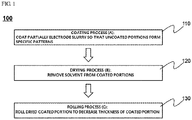
- FIG. 1 is a flowchart showing a preparing method according to one embodiment of the present disclosure.
- a method 100 of preparing an electrode for a secondary battery includes, a process 110 of partially coating an electrode slurry containing an electrode mixture and a solvent on an electrode sheet so that coated portions are positioned with an uncoated portion interposed therebetween, a process 120 of drying the coated portion to remove the solvent; and a process 130 of rolling the dried coated portion.
- the electrode slurry is coated on the electrode sheet so that a coating amount of the electrode mixture is 4 mAh/cm 2 or more to prepare a high-capacity electrode.
- the coating amount is about four times a coating amount of an electrode mixture used in a conventional electrode or more.
- the electrode and secondary battery prepared according to the preparing method of the present disclosure exhibit a high capacity and improved cycle characteristics.
- the electrode slurry is coated to form the uncoated portion having a predetermined pattern shape allowing a buffering action during a rolling process in process 110.
- a thickness of the uncoated portion filled with the electrode mixture pushed from the coated portion may be a thickness of the rolled coated portion or less. Accordingly, since an electrode having an overall uniform thickness exhibits better performance, it is more preferable for the thickness of the uncoated portion filled with the electrode mixture layer and the thickness of the coated portion from which the electrode mixture layer is partially pushed to be equal.
- process 120 may be performed after process 130, in which case all of the solvent in the electrode slurry may be removed.
- FIG. 2 is a cross-sectional view showing a change in a shape of an electrode prepared by the preparing method according to FIG. 1 on a vertical plane in a coating direction.
- an electrode slurry 221 is partially coated on an electrode sheet 210 to form a coated portion 220 and an uncoated portion 230.
- a side of the electrode sheet i.e., a vertical cross section of the coating direction, a concavo-convex structure is formed due to the coated portion 220 and the uncoated portion 230 as shown.
- an interval between the coated portions 220 that is, a width D of the uncoated portion 230
- a width D of the uncoated portion 230 should be secured such that all uncoated portions 230 may disappear while a buffering action occurs between the coated portions 220 during rolling, wherein the width D may be may be 10 ⁇ m to 300 ⁇ m, may more specifically be 50 ⁇ m to 200 ⁇ m, and may most preferably be 50 ⁇ m to 100 ⁇ m.
- the coated portion 240 having an overall uniform height may be formed in a state in which the uncoated portion 230 is rolled and disappears.
- the thickness of the uncoated portion filled with the electrode mixture layer is preferably equal to a thickness W2 of the electrode mixture layer of the rolled coated portion.
- the thickness of the uncoated portion which disappeared may be smaller than the thickness W2 of the electrode mixture layer of the rolled coated portion.
- a linear pressure at a time at which the dried coated portion is rolled may be 0.5 to 3.5 ton/cm, may more preferably be 1 to 3 ton/cm, and may most preferably be 1 to 2 ton/cm. It is not preferable for the linear pressure to be less than 0.5 ton/cm during rolling in terms of the uniformity of the electrode. When the linear pressure exceeds 3.5 ton/cm, the electrode may be broken.
- the number of times the dried coated portion is rolled is preferably 1 to 3. When the number of times exceeds 3, the electrode mixture may be broken, which is not preferable.
- the thickness W2 of the electrode mixture layer of the rolled coated portion may be 100 ⁇ m to 300 ⁇ m, may preferably be 110 ⁇ m to 250 ⁇ m, and may most preferably be 130 ⁇ m to 200 ⁇ m. It is not preferable for the thickness of the electrode mixture layer of the rolled coated portion to be less than 100 ⁇ m in terms of preparing a high capacity and performance electrode, and it is not preferable for the thickness of the electrode mixture layer of the rolled coated portion to exceed 300 ⁇ m in terms of electrolyte impregnation.
- the thickness of the electrode mixture layer of the coated portion after rolling may be 30 % to 80 % of the thickness of the electrode mixture layer of the coated portion before rolling, may more preferably be 40 % to 75 %, and may most preferably be 50 % to 70 %.
- FIGS. 3 to 7 are plan views showing pattern shapes of an electrode mixture according to one embodiment.
- an electrode mixture is coated on an electrode sheet so that uncoated portions 320 are formed between coated portions 310, uncoated portions 420 are formed between coated portions 410, uncoated portions 520 are formed between coated portions 510, uncoated portions 620 are formed between coated portions 610, or uncoated portions 720 are formed between coated portions 710 to form pattern shapes 300, 400, 500, 600, or 700 of the uncoated portions.
- the pattern shapes 300, 400, 500, 600, or 700 of the uncoated portions may have a straight shape 300, a zigzag shape 400, a wavy pattern shape 500, a lattice pattern shape 600, or a honeycomb shape 700, but are not limited thereto, and an electrode slurry may be coated on the electrode sheet to form a specific pattern at intervals such that the uncoated portions disappear during rolling.
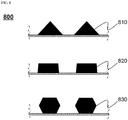
- FIG. 8 is a vertical cross-sectional view in the coating direction showing a shape of a coated portion according to another embodiment.
- Each of the coated portions formed by the pattern shapes 300, 400, 500, 600, and 700 of the uncoated portions according to FIGS. 3 to 7 may have various shapes on a plane apart from the patterns shapes 300, 400, 500, 600, and 700 of the uncoated portions, specifically, the coated portions may have a triangular shape 810, a quadrangular shape 820, or a hexagonal shape 830.
- the coated portion may have various shapes, and in the preparing method according to the present disclosure, various discharge members or methods may be used when coating the electrode slurry on the electrode sheet.
- a phenomenon in which a electrode mixture layer is discharged from an electrode sheet or a phenomenon in which a rolled electrode is bent is minimized, and thus it is possible to significantly reduce a preparation defect rate and to prepare a high capacity and efficiency electrode.
Landscapes
- Engineering & Computer Science (AREA)
- Chemical & Material Sciences (AREA)
- Manufacturing & Machinery (AREA)
- Chemical Kinetics & Catalysis (AREA)
- Electrochemistry (AREA)
- General Chemical & Material Sciences (AREA)
- Materials Engineering (AREA)
- Battery Electrode And Active Subsutance (AREA)
Claims (6)
- Verfahren zum Anfertigen einer Elektrode für eine Sekundärbatterie, umfassend aufeinanderfolgend:(a) einen Prozess eines teilweisen Beschichtens einer Elektrodensuspension (221), welche ein Elektrodengemisch und ein Lösungsmittel an einer Elektrodenbahn enthält, so dass beschichtete Abschnitte (220) mit einem unbeschichteten Abschnitt (230) dazwischen angeordnet positioniert werden und der unbeschichtete Abschnitt (230) eine Breite von 10 µm bis 300 µm aufweist;(b) einen Prozess eines Trocknens der beschichteten Abschnitte (220), um das Lösungsmittel bei einer Entfernungsrate von 20 Gew% bis 60 Gew% der Menge des Lösungsmittels zu entfernen, welche anfänglich hinzugefügt wurde, um die Elektrodensuspension (221) anzufertigen; und(c) einen Prozess eines Rollens der getrockneten beschichteten Abschnitte (220),wobei, in dem Prozess (c), eine Dicke des beschichteten Abschnitts (220) abnimmt und sich das Elektrodengemisch zu den unbeschichteten Abschnitten (230) bewegt, was darin resultiert, dass die beschichteten Abschnitte (220) verschwinden,
eine Mehrzahl von beschichteten Abschnitten (220) an der Elektrodenbahn durch den unbeschichteten Abschnitt (230) einer Musterform (300, 400, 500, 600, 700) in dem Prozess (a) gebildet wird, und
eine Dicke der Elektrodengemisch-Schicht in dem unbeschichteten Abschnitt (230), welcher aufgrund einer Bewegung des Elektrodengemischs verschwand, die gleiche ist wie eine Dicke einer Elektrodengemisch-Schicht eines gerollten beschichteten Abschnitts (220) oder weniger. - Verfahren nach Anspruch 1, wobei eine Beschichtungsmenge des Elektrodengemischs 4 mAh/cm2 oder mehr in der Elektrode ist, welche durch Rollen in dem Prozess (c) angefertigt worden ist.
- Verfahren nach Anspruch 1, wobei Muster des unbeschichteten Abschnitts (230) eine gerade Linienform (300), eine Zickzack-Form (400), eine Wellenmusterform (500), eine Gittermusterform (600) oder eine Bienenwabenform (700) an einer Ebene aufweisen.
- Verfahren nach Anspruch 1, wobei jeder der beschichteten Abschnitte (220) eine Dreiecksform (810), eine Rechtecksform (820) oder eine hexagonale Form (830) an einer Ebene aufweist.
- Verfahren nach Anspruch 1, wobei der Beschichtungsprozess des Prozesses (a) durch ein Verfahren implementiert wird, welches aus der Gruppe ausgewählt wird, bestehend aus Nozzle-Scanning, Spritzgießen, Comma-Coating, Siebdruck und dergleichen.
- Verfahren nach Anspruch 1, wobei die Dicke der Elektrodengemisch-Schicht des beschichteten Abschnitts, welcher gerollt ist, 100 µm bis 300 µm beträgt.
Priority Applications (1)
| Application Number | Priority Date | Filing Date | Title |
|---|---|---|---|
| PL17849027T PL3367480T3 (pl) | 2016-09-09 | 2017-09-01 | Sposób produkcji akumulatora, w tym elektrody o wysokiej pojemności |
Applications Claiming Priority (3)
| Application Number | Priority Date | Filing Date | Title |
|---|---|---|---|
| KR20160116233 | 2016-09-09 | ||
| KR1020170107284A KR102053239B1 (ko) | 2016-09-09 | 2017-08-24 | 고용량의 전극을 포함하는 이차전지의 제조 방법 |
| PCT/KR2017/009595 WO2018048143A1 (ko) | 2016-09-09 | 2017-09-01 | 고용량의 전극을 포함하는 이차전지의 제조 방법 |
Publications (3)
| Publication Number | Publication Date |
|---|---|
| EP3367480A1 EP3367480A1 (de) | 2018-08-29 |
| EP3367480A4 EP3367480A4 (de) | 2018-12-05 |
| EP3367480B1 true EP3367480B1 (de) | 2019-11-20 |
Family
ID=61911287
Family Applications (1)
| Application Number | Title | Priority Date | Filing Date |
|---|---|---|---|
| EP17849027.2A Active EP3367480B1 (de) | 2016-09-09 | 2017-09-01 | Verfahren zur herstellung einer sekundärbatterie, einschliesslich einer elektrode mit hoher kapazität |
Country Status (5)
| Country | Link |
|---|---|
| US (1) | US10818907B2 (de) |
| EP (1) | EP3367480B1 (de) |
| KR (1) | KR102053239B1 (de) |
| CN (1) | CN108370031B (de) |
| PL (1) | PL3367480T3 (de) |
Families Citing this family (4)
| Publication number | Priority date | Publication date | Assignee | Title |
|---|---|---|---|---|
| CN110880580B (zh) * | 2018-09-06 | 2021-05-04 | 宁德时代新能源科技股份有限公司 | 辊压装置 |
| CN110085431B (zh) * | 2019-04-08 | 2021-08-24 | 宁波中车新能源科技有限公司 | 一种防过放电电池电容的负极及其制备方法 |
| US11751133B2 (en) * | 2021-02-18 | 2023-09-05 | Qualcomm Incorporated | Techniques for setting a quantity of bits for an adaptive low-resolution analog-to digital converter (ADC) in higher band operation |
| CN118352460A (zh) * | 2022-01-25 | 2024-07-16 | 上海兰钧新能源科技有限公司 | 一种极片制作方法 |
Family Cites Families (20)
| Publication number | Priority date | Publication date | Assignee | Title |
|---|---|---|---|---|
| JP4581888B2 (ja) * | 2005-07-25 | 2010-11-17 | Tdk株式会社 | 電気化学素子用電極の製造方法および電気化学素子の製造方法 |
| JP4957167B2 (ja) | 2006-10-13 | 2012-06-20 | パナソニック株式会社 | 集電体、非水電解質二次電池用極板、およびそれを用いた非水電解質二次電池の製造方法 |
| JP4362539B2 (ja) * | 2007-07-20 | 2009-11-11 | パナソニック株式会社 | 電池用電極板、電池用極板群、リチウム二次電池、電池用電極板の製造方法、及び電池用電極板の製造装置 |
| JP4487220B1 (ja) * | 2009-01-26 | 2010-06-23 | トヨタ自動車株式会社 | リチウム二次電池用正極およびその製造方法 |
| WO2011043026A1 (ja) | 2009-10-07 | 2011-04-14 | パナソニック株式会社 | リチウムイオン二次電池用負極およびリチウムイオン二次電池 |
| JP2011175739A (ja) * | 2010-02-23 | 2011-09-08 | Hitachi Ltd | リチウム二次電池及びその製造方法 |
| JP5547556B2 (ja) | 2010-06-08 | 2014-07-16 | 大日本スクリーン製造株式会社 | 電池、車両、電子機器および電池の製造方法 |
| KR101198672B1 (ko) | 2010-06-10 | 2012-11-12 | 현대자동차주식회사 | 이차전지용 전극의 제조방법, 이에 의해 제조되는 이차전지용 전극, 및 이를 포함하는 이차전지 |
| JP5462758B2 (ja) | 2010-09-28 | 2014-04-02 | 大日本スクリーン製造株式会社 | リチウムイオン二次電池、車両、電子機器およびリチウムイオン二次電池の製造方法 |
| KR20130129967A (ko) * | 2010-11-09 | 2013-11-29 | 쓰리엠 이노베이티브 프로퍼티즈 컴파니 | 고용량 합금 애노드 및 이를 포함하는 리튬-이온 전기화학 전지 |
| CN102208598B (zh) * | 2011-05-12 | 2014-03-12 | 中国科学院宁波材料技术与工程研究所 | 石墨烯涂层改性的锂二次电池的电极极片及其制作方法 |
| US20130157136A1 (en) | 2011-12-15 | 2013-06-20 | Enerdel, Inc. | Coating of disordered carbon active material using water-based binder slurry |
| CN107425178B (zh) | 2012-04-16 | 2020-12-01 | 株式会社Lg 化学 | 制造二次电池用电极的方法 |
| EP2819234B1 (de) * | 2012-04-20 | 2017-06-21 | LG Chem, Ltd. | Elektrolyt für eine sekundärbatterie und lithiumsekundärbatterie damit |
| US20140050977A1 (en) | 2012-08-20 | 2014-02-20 | Dainippon Screen Mfg. Co., Ltd. | Method of and apparatus for manufacturing electrode for lithium-ion secondary battery and electrode for lithium-ion secondary battery |
| JP2014060014A (ja) | 2012-09-14 | 2014-04-03 | Dainippon Screen Mfg Co Ltd | 電池用電極製造方法及び電池用電極製造装置 |
| KR101577188B1 (ko) * | 2013-09-30 | 2015-12-15 | 주식회사 엘지화학 | 전극의 불량률이 개선된 전극 제조 방법 |
| KR101562571B1 (ko) | 2015-02-05 | 2015-10-22 | 주식회사 엘지화학 | 전극 코팅량 자동 조절 장치 |
| US10547044B2 (en) * | 2015-09-01 | 2020-01-28 | Worcester Polytechnic Institute | Dry powder based electrode additive manufacturing |
| KR101647777B1 (ko) * | 2016-02-22 | 2016-08-11 | 씨아이에스(주) | 이차전지용 슬러리 코팅방법 및 이를 이용하여 제조된 이차전지 전극판 |
-
2017
- 2017-08-24 KR KR1020170107284A patent/KR102053239B1/ko active Active
- 2017-09-01 EP EP17849027.2A patent/EP3367480B1/de active Active
- 2017-09-01 US US15/770,699 patent/US10818907B2/en active Active
- 2017-09-01 PL PL17849027T patent/PL3367480T3/pl unknown
- 2017-09-01 CN CN201780004286.2A patent/CN108370031B/zh active Active
Non-Patent Citations (1)
| Title |
|---|
| None * |
Also Published As
| Publication number | Publication date |
|---|---|
| EP3367480A1 (de) | 2018-08-29 |
| US20190067674A1 (en) | 2019-02-28 |
| KR20180028917A (ko) | 2018-03-19 |
| PL3367480T3 (pl) | 2020-04-30 |
| CN108370031A (zh) | 2018-08-03 |
| US10818907B2 (en) | 2020-10-27 |
| KR102053239B1 (ko) | 2019-12-06 |
| CN108370031B (zh) | 2021-01-15 |
| EP3367480A4 (de) | 2018-12-05 |
Similar Documents
| Publication | Publication Date | Title |
|---|---|---|
| US10910639B2 (en) | Multi-layer negative electrode with different binder content and different particle size of active material in each layer and lithium secondary battery comprising the same | |
| KR102095930B1 (ko) | 도핑 원소를 가진 고전압용 리튬 코발트 산화물을 포함하는 리튬 이차전지용 양극 활물질 및 이를 제조하는 방법 | |
| US10573888B2 (en) | Cathode active material for secondary batteries and secondary battery including the same | |
| EP3182487A1 (de) | Elektrode mit mehrschichtiger struktur und lithiumsekundärbatterie damit | |
| EP2800178B1 (de) | Verfahren zur herstellung einer elektrode für eine lithium-sekundärbatterie und damit hergestellte elektrode | |
| KR102071585B1 (ko) | 각 층의 바인더의 함량이 상이한 다층 전극 | |
| US10256462B2 (en) | Negative electrode for secondary battery comprising CMC-Li salt and lithium secondary battery comprising the same | |
| US20190305308A1 (en) | Multi-layer negative electrode comprising natural graphite and artificial graphite and lithium secondary battery comprising the same | |
| KR102091214B1 (ko) | 고전압용 리튬 코발트 산화물을 포함하는 리튬 이차전지용 양극 활물질 및 이를 제조하는 방법 | |
| KR102079929B1 (ko) | 균일한 품질을 가지는 전극들의 제조 방법 및 이를 포함하는 전극조립체 제조 방법 | |
| US11283101B2 (en) | Method of preparing electrodes having uniform quality and electrode assembly preparation method including the same | |
| EP2802031A1 (de) | Verfahren zur herstellung einer elektrode für eine lithium-sekundärbatterie und damit hergestellte elektrode | |
| EP3367480B1 (de) | Verfahren zur herstellung einer sekundärbatterie, einschliesslich einer elektrode mit hoher kapazität | |
| US12126008B2 (en) | Multi-layer electrode having plural active material layers including binders with different elastic recovery rates and uniform porosity and lithium secondary battery including the same | |
| US11024845B2 (en) | Moisture-limited electrode active material, moisture-limited electrode and lithium secondary battery comprising the same | |
| US20180337408A1 (en) | Electrode including electrode current collector with three-dimensional network structure | |
| US10147935B2 (en) | Electrode including alternately arranged electrode mixture parts and irreversible parts and secondary battery including the same | |
| KR101636451B1 (ko) | 로딩량이 다른 활물질층을 포함하고 있는 젤리-롤 | |
| KR101836436B1 (ko) | 수명특성이 향상된 이차전지용 양극 활물질 및 제조방법 | |
| KR102074302B1 (ko) | 활물질 도포 유도 부재를 포함하는 이차전지용 전극 시트 | |
| WO2018048143A1 (ko) | 고용량의 전극을 포함하는 이차전지의 제조 방법 | |
| KR101547919B1 (ko) | 수명특성이 향상된 이차전지용 양극 활물질 및 이의 제조방법 | |
| KR20180081228A (ko) | 단위셀의 위치에 따라 기공률이 상이한 전극을 포함하는 전극조립체 | |
| KR20150060160A (ko) | 금속 시트 슬리팅용 슬리터 | |
| KR20120094844A (ko) | 신규한 화합물과 이의 제조방법 및 이를 포함하는 리튬 이차전지 |
Legal Events
| Date | Code | Title | Description |
|---|---|---|---|
| STAA | Information on the status of an ep patent application or granted ep patent |
Free format text: STATUS: THE INTERNATIONAL PUBLICATION HAS BEEN MADE |
|
| PUAI | Public reference made under article 153(3) epc to a published international application that has entered the european phase |
Free format text: ORIGINAL CODE: 0009012 |
|
| STAA | Information on the status of an ep patent application or granted ep patent |
Free format text: STATUS: REQUEST FOR EXAMINATION WAS MADE |
|
| 17P | Request for examination filed |
Effective date: 20180525 |
|
| AK | Designated contracting states |
Kind code of ref document: A1 Designated state(s): AL AT BE BG CH CY CZ DE DK EE ES FI FR GB GR HR HU IE IS IT LI LT LU LV MC MK MT NL NO PL PT RO RS SE SI SK SM TR |
|
| AX | Request for extension of the european patent |
Extension state: BA ME |
|
| A4 | Supplementary search report drawn up and despatched |
Effective date: 20181026 |
|
| RIC1 | Information provided on ipc code assigned before grant |
Ipc: H01M 4/13 20100101ALI20181022BHEP Ipc: H01M 10/0525 20100101ALI20181022BHEP Ipc: H01M 4/139 20100101AFI20181022BHEP Ipc: H01M 4/04 20060101ALI20181022BHEP |
|
| GRAP | Despatch of communication of intention to grant a patent |
Free format text: ORIGINAL CODE: EPIDOSNIGR1 |
|
| STAA | Information on the status of an ep patent application or granted ep patent |
Free format text: STATUS: GRANT OF PATENT IS INTENDED |
|
| DAV | Request for validation of the european patent (deleted) | ||
| DAX | Request for extension of the european patent (deleted) | ||
| INTG | Intention to grant announced |
Effective date: 20190819 |
|
| GRAA | (expected) grant |
Free format text: ORIGINAL CODE: 0009210 |
|
| STAA | Information on the status of an ep patent application or granted ep patent |
Free format text: STATUS: THE PATENT HAS BEEN GRANTED |
|
| GRAS | Grant fee paid |
Free format text: ORIGINAL CODE: EPIDOSNIGR3 |
|
| AK | Designated contracting states |
Kind code of ref document: B1 Designated state(s): AL AT BE BG CH CY CZ DE DK EE ES FI FR GB GR HR HU IE IS IT LI LT LU LV MC MK MT NL NO PL PT RO RS SE SI SK SM TR |
|
| REG | Reference to a national code |
Ref country code: GB Ref legal event code: FG4D |
|
| REG | Reference to a national code |
Ref country code: CH Ref legal event code: EP |
|
| REG | Reference to a national code |
Ref country code: DE Ref legal event code: R096 Ref document number: 602017008972 Country of ref document: DE |
|
| REG | Reference to a national code |
Ref country code: IE Ref legal event code: FG4D |
|
| REG | Reference to a national code |
Ref country code: AT Ref legal event code: REF Ref document number: 1205204 Country of ref document: AT Kind code of ref document: T Effective date: 20191215 |
|
| REG | Reference to a national code |
Ref country code: NL Ref legal event code: MP Effective date: 20191120 |
|
| REG | Reference to a national code |
Ref country code: LT Ref legal event code: MG4D |
|
| PG25 | Lapsed in a contracting state [announced via postgrant information from national office to epo] |
Ref country code: NL Free format text: LAPSE BECAUSE OF FAILURE TO SUBMIT A TRANSLATION OF THE DESCRIPTION OR TO PAY THE FEE WITHIN THE PRESCRIBED TIME-LIMIT Effective date: 20191120 Ref country code: LV Free format text: LAPSE BECAUSE OF FAILURE TO SUBMIT A TRANSLATION OF THE DESCRIPTION OR TO PAY THE FEE WITHIN THE PRESCRIBED TIME-LIMIT Effective date: 20191120 Ref country code: SE Free format text: LAPSE BECAUSE OF FAILURE TO SUBMIT A TRANSLATION OF THE DESCRIPTION OR TO PAY THE FEE WITHIN THE PRESCRIBED TIME-LIMIT Effective date: 20191120 Ref country code: NO Free format text: LAPSE BECAUSE OF FAILURE TO SUBMIT A TRANSLATION OF THE DESCRIPTION OR TO PAY THE FEE WITHIN THE PRESCRIBED TIME-LIMIT Effective date: 20200220 Ref country code: GR Free format text: LAPSE BECAUSE OF FAILURE TO SUBMIT A TRANSLATION OF THE DESCRIPTION OR TO PAY THE FEE WITHIN THE PRESCRIBED TIME-LIMIT Effective date: 20200221 Ref country code: LT Free format text: LAPSE BECAUSE OF FAILURE TO SUBMIT A TRANSLATION OF THE DESCRIPTION OR TO PAY THE FEE WITHIN THE PRESCRIBED TIME-LIMIT Effective date: 20191120 Ref country code: FI Free format text: LAPSE BECAUSE OF FAILURE TO SUBMIT A TRANSLATION OF THE DESCRIPTION OR TO PAY THE FEE WITHIN THE PRESCRIBED TIME-LIMIT Effective date: 20191120 Ref country code: BG Free format text: LAPSE BECAUSE OF FAILURE TO SUBMIT A TRANSLATION OF THE DESCRIPTION OR TO PAY THE FEE WITHIN THE PRESCRIBED TIME-LIMIT Effective date: 20200220 |
|
| PG25 | Lapsed in a contracting state [announced via postgrant information from national office to epo] |
Ref country code: RS Free format text: LAPSE BECAUSE OF FAILURE TO SUBMIT A TRANSLATION OF THE DESCRIPTION OR TO PAY THE FEE WITHIN THE PRESCRIBED TIME-LIMIT Effective date: 20191120 Ref country code: IS Free format text: LAPSE BECAUSE OF FAILURE TO SUBMIT A TRANSLATION OF THE DESCRIPTION OR TO PAY THE FEE WITHIN THE PRESCRIBED TIME-LIMIT Effective date: 20200320 Ref country code: HR Free format text: LAPSE BECAUSE OF FAILURE TO SUBMIT A TRANSLATION OF THE DESCRIPTION OR TO PAY THE FEE WITHIN THE PRESCRIBED TIME-LIMIT Effective date: 20191120 |
|
| PG25 | Lapsed in a contracting state [announced via postgrant information from national office to epo] |
Ref country code: AL Free format text: LAPSE BECAUSE OF FAILURE TO SUBMIT A TRANSLATION OF THE DESCRIPTION OR TO PAY THE FEE WITHIN THE PRESCRIBED TIME-LIMIT Effective date: 20191120 |
|
| PG25 | Lapsed in a contracting state [announced via postgrant information from national office to epo] |
Ref country code: CZ Free format text: LAPSE BECAUSE OF FAILURE TO SUBMIT A TRANSLATION OF THE DESCRIPTION OR TO PAY THE FEE WITHIN THE PRESCRIBED TIME-LIMIT Effective date: 20191120 Ref country code: PT Free format text: LAPSE BECAUSE OF FAILURE TO SUBMIT A TRANSLATION OF THE DESCRIPTION OR TO PAY THE FEE WITHIN THE PRESCRIBED TIME-LIMIT Effective date: 20200412 Ref country code: EE Free format text: LAPSE BECAUSE OF FAILURE TO SUBMIT A TRANSLATION OF THE DESCRIPTION OR TO PAY THE FEE WITHIN THE PRESCRIBED TIME-LIMIT Effective date: 20191120 Ref country code: DK Free format text: LAPSE BECAUSE OF FAILURE TO SUBMIT A TRANSLATION OF THE DESCRIPTION OR TO PAY THE FEE WITHIN THE PRESCRIBED TIME-LIMIT Effective date: 20191120 Ref country code: ES Free format text: LAPSE BECAUSE OF FAILURE TO SUBMIT A TRANSLATION OF THE DESCRIPTION OR TO PAY THE FEE WITHIN THE PRESCRIBED TIME-LIMIT Effective date: 20191120 Ref country code: RO Free format text: LAPSE BECAUSE OF FAILURE TO SUBMIT A TRANSLATION OF THE DESCRIPTION OR TO PAY THE FEE WITHIN THE PRESCRIBED TIME-LIMIT Effective date: 20191120 |
|
| REG | Reference to a national code |
Ref country code: AT Ref legal event code: MK05 Ref document number: 1205204 Country of ref document: AT Kind code of ref document: T Effective date: 20191120 |
|
| REG | Reference to a national code |
Ref country code: DE Ref legal event code: R097 Ref document number: 602017008972 Country of ref document: DE |
|
| PG25 | Lapsed in a contracting state [announced via postgrant information from national office to epo] |
Ref country code: SK Free format text: LAPSE BECAUSE OF FAILURE TO SUBMIT A TRANSLATION OF THE DESCRIPTION OR TO PAY THE FEE WITHIN THE PRESCRIBED TIME-LIMIT Effective date: 20191120 Ref country code: SM Free format text: LAPSE BECAUSE OF FAILURE TO SUBMIT A TRANSLATION OF THE DESCRIPTION OR TO PAY THE FEE WITHIN THE PRESCRIBED TIME-LIMIT Effective date: 20191120 |
|
| PLBE | No opposition filed within time limit |
Free format text: ORIGINAL CODE: 0009261 |
|
| STAA | Information on the status of an ep patent application or granted ep patent |
Free format text: STATUS: NO OPPOSITION FILED WITHIN TIME LIMIT |
|
| 26N | No opposition filed |
Effective date: 20200821 |
|
| PG25 | Lapsed in a contracting state [announced via postgrant information from national office to epo] |
Ref country code: SI Free format text: LAPSE BECAUSE OF FAILURE TO SUBMIT A TRANSLATION OF THE DESCRIPTION OR TO PAY THE FEE WITHIN THE PRESCRIBED TIME-LIMIT Effective date: 20191120 Ref country code: AT Free format text: LAPSE BECAUSE OF FAILURE TO SUBMIT A TRANSLATION OF THE DESCRIPTION OR TO PAY THE FEE WITHIN THE PRESCRIBED TIME-LIMIT Effective date: 20191120 |
|
| PG25 | Lapsed in a contracting state [announced via postgrant information from national office to epo] |
Ref country code: IT Free format text: LAPSE BECAUSE OF FAILURE TO SUBMIT A TRANSLATION OF THE DESCRIPTION OR TO PAY THE FEE WITHIN THE PRESCRIBED TIME-LIMIT Effective date: 20191120 |
|
| REG | Reference to a national code |
Ref country code: CH Ref legal event code: PL |
|
| REG | Reference to a national code |
Ref country code: BE Ref legal event code: MM Effective date: 20200930 |
|
| PG25 | Lapsed in a contracting state [announced via postgrant information from national office to epo] |
Ref country code: LU Free format text: LAPSE BECAUSE OF NON-PAYMENT OF DUE FEES Effective date: 20200901 |
|
| PG25 | Lapsed in a contracting state [announced via postgrant information from national office to epo] |
Ref country code: IE Free format text: LAPSE BECAUSE OF NON-PAYMENT OF DUE FEES Effective date: 20200901 Ref country code: LI Free format text: LAPSE BECAUSE OF NON-PAYMENT OF DUE FEES Effective date: 20200930 Ref country code: BE Free format text: LAPSE BECAUSE OF NON-PAYMENT OF DUE FEES Effective date: 20200930 Ref country code: CH Free format text: LAPSE BECAUSE OF NON-PAYMENT OF DUE FEES Effective date: 20200930 |
|
| PG25 | Lapsed in a contracting state [announced via postgrant information from national office to epo] |
Ref country code: TR Free format text: LAPSE BECAUSE OF FAILURE TO SUBMIT A TRANSLATION OF THE DESCRIPTION OR TO PAY THE FEE WITHIN THE PRESCRIBED TIME-LIMIT Effective date: 20191120 Ref country code: MT Free format text: LAPSE BECAUSE OF FAILURE TO SUBMIT A TRANSLATION OF THE DESCRIPTION OR TO PAY THE FEE WITHIN THE PRESCRIBED TIME-LIMIT Effective date: 20191120 Ref country code: CY Free format text: LAPSE BECAUSE OF FAILURE TO SUBMIT A TRANSLATION OF THE DESCRIPTION OR TO PAY THE FEE WITHIN THE PRESCRIBED TIME-LIMIT Effective date: 20191120 |
|
| PG25 | Lapsed in a contracting state [announced via postgrant information from national office to epo] |
Ref country code: MK Free format text: LAPSE BECAUSE OF FAILURE TO SUBMIT A TRANSLATION OF THE DESCRIPTION OR TO PAY THE FEE WITHIN THE PRESCRIBED TIME-LIMIT Effective date: 20191120 Ref country code: MC Free format text: LAPSE BECAUSE OF FAILURE TO SUBMIT A TRANSLATION OF THE DESCRIPTION OR TO PAY THE FEE WITHIN THE PRESCRIBED TIME-LIMIT Effective date: 20191120 |
|
| P01 | Opt-out of the competence of the unified patent court (upc) registered |
Effective date: 20230512 |
|
| REG | Reference to a national code |
Ref country code: DE Ref legal event code: R081 Ref document number: 602017008972 Country of ref document: DE Owner name: LG ENERGY SOLUTION, LTD., KR Free format text: FORMER OWNER: LG CHEM. LTD., SEOUL, KR |
|
| REG | Reference to a national code |
Ref country code: GB Ref legal event code: 732E Free format text: REGISTERED BETWEEN 20230824 AND 20230831 |
|
| PGFP | Annual fee paid to national office [announced via postgrant information from national office to epo] |
Ref country code: DE Payment date: 20250820 Year of fee payment: 9 |
|
| PGFP | Annual fee paid to national office [announced via postgrant information from national office to epo] |
Ref country code: PL Payment date: 20250822 Year of fee payment: 9 |
|
| PGFP | Annual fee paid to national office [announced via postgrant information from national office to epo] |
Ref country code: GB Payment date: 20250820 Year of fee payment: 9 |
|
| PGFP | Annual fee paid to national office [announced via postgrant information from national office to epo] |
Ref country code: FR Payment date: 20250821 Year of fee payment: 9 |