EP3357945B1 - Klebstoffpolymer und medizinisches klebepflaster - Google Patents
Klebstoffpolymer und medizinisches klebepflaster Download PDFInfo
- Publication number
- EP3357945B1 EP3357945B1 EP16851862.9A EP16851862A EP3357945B1 EP 3357945 B1 EP3357945 B1 EP 3357945B1 EP 16851862 A EP16851862 A EP 16851862A EP 3357945 B1 EP3357945 B1 EP 3357945B1
- Authority
- EP
- European Patent Office
- Prior art keywords
- meth
- acrylic acid
- hydrochloride
- ester
- adhesive
- Prior art date
- Legal status (The legal status is an assumption and is not a legal conclusion. Google has not performed a legal analysis and makes no representation as to the accuracy of the status listed.)
- Active
Links
Images
Classifications
-
- A—HUMAN NECESSITIES
- A61—MEDICAL OR VETERINARY SCIENCE; HYGIENE
- A61K—PREPARATIONS FOR MEDICAL, DENTAL OR TOILETRY PURPOSES
- A61K9/00—Medicinal preparations characterised by special physical form
- A61K9/70—Web, sheet or filament bases ; Films; Fibres of the matrix type containing drug
- A61K9/7023—Transdermal patches and similar drug-containing composite devices, e.g. cataplasms
- A61K9/703—Transdermal patches and similar drug-containing composite devices, e.g. cataplasms characterised by shape or structure; Details concerning release liner or backing; Refillable patches; User-activated patches
- A61K9/7038—Transdermal patches of the drug-in-adhesive type, i.e. comprising drug in the skin-adhesive layer
- A61K9/7046—Transdermal patches of the drug-in-adhesive type, i.e. comprising drug in the skin-adhesive layer the adhesive comprising macromolecular compounds
- A61K9/7053—Transdermal patches of the drug-in-adhesive type, i.e. comprising drug in the skin-adhesive layer the adhesive comprising macromolecular compounds obtained by reactions only involving carbon to carbon unsaturated bonds, e.g. polyvinyl, polyisobutylene, polystyrene
- A61K9/7061—Polyacrylates
-
- A—HUMAN NECESSITIES
- A61—MEDICAL OR VETERINARY SCIENCE; HYGIENE
- A61K—PREPARATIONS FOR MEDICAL, DENTAL OR TOILETRY PURPOSES
- A61K31/00—Medicinal preparations containing organic active ingredients
- A61K31/13—Amines
- A61K31/135—Amines having aromatic rings, e.g. ketamine, nortriptyline
-
- A—HUMAN NECESSITIES
- A61—MEDICAL OR VETERINARY SCIENCE; HYGIENE
- A61K—PREPARATIONS FOR MEDICAL, DENTAL OR TOILETRY PURPOSES
- A61K31/00—Medicinal preparations containing organic active ingredients
- A61K31/16—Amides, e.g. hydroxamic acids
- A61K31/165—Amides, e.g. hydroxamic acids having aromatic rings, e.g. colchicine, atenolol, progabide
- A61K31/167—Amides, e.g. hydroxamic acids having aromatic rings, e.g. colchicine, atenolol, progabide having the nitrogen of a carboxamide group directly attached to the aromatic ring, e.g. lidocaine, paracetamol
-
- A—HUMAN NECESSITIES
- A61—MEDICAL OR VETERINARY SCIENCE; HYGIENE
- A61K—PREPARATIONS FOR MEDICAL, DENTAL OR TOILETRY PURPOSES
- A61K31/00—Medicinal preparations containing organic active ingredients
- A61K31/16—Amides, e.g. hydroxamic acids
- A61K31/18—Sulfonamides
-
- A—HUMAN NECESSITIES
- A61—MEDICAL OR VETERINARY SCIENCE; HYGIENE
- A61K—PREPARATIONS FOR MEDICAL, DENTAL OR TOILETRY PURPOSES
- A61K31/00—Medicinal preparations containing organic active ingredients
- A61K31/21—Esters, e.g. nitroglycerine, selenocyanates
- A61K31/215—Esters, e.g. nitroglycerine, selenocyanates of carboxylic acids
-
- A—HUMAN NECESSITIES
- A61—MEDICAL OR VETERINARY SCIENCE; HYGIENE
- A61K—PREPARATIONS FOR MEDICAL, DENTAL OR TOILETRY PURPOSES
- A61K31/00—Medicinal preparations containing organic active ingredients
- A61K31/33—Heterocyclic compounds
- A61K31/395—Heterocyclic compounds having nitrogen as a ring hetero atom, e.g. guanethidine or rifamycins
- A61K31/40—Heterocyclic compounds having nitrogen as a ring hetero atom, e.g. guanethidine or rifamycins having five-membered rings with one nitrogen as the only ring hetero atom, e.g. sulpiride, succinimide, tolmetin, buflomedil
- A61K31/403—Heterocyclic compounds having nitrogen as a ring hetero atom, e.g. guanethidine or rifamycins having five-membered rings with one nitrogen as the only ring hetero atom, e.g. sulpiride, succinimide, tolmetin, buflomedil condensed with carbocyclic rings, e.g. carbazole
- A61K31/404—Indoles, e.g. pindolol
- A61K31/4045—Indole-alkylamines; Amides thereof, e.g. serotonin, melatonin
-
- A—HUMAN NECESSITIES
- A61—MEDICAL OR VETERINARY SCIENCE; HYGIENE
- A61K—PREPARATIONS FOR MEDICAL, DENTAL OR TOILETRY PURPOSES
- A61K31/00—Medicinal preparations containing organic active ingredients
- A61K31/33—Heterocyclic compounds
- A61K31/395—Heterocyclic compounds having nitrogen as a ring hetero atom, e.g. guanethidine or rifamycins
- A61K31/435—Heterocyclic compounds having nitrogen as a ring hetero atom, e.g. guanethidine or rifamycins having six-membered rings with one nitrogen as the only ring hetero atom
- A61K31/44—Non condensed pyridines; Hydrogenated derivatives thereof
- A61K31/445—Non condensed piperidines, e.g. piperocaine
- A61K31/4468—Non condensed piperidines, e.g. piperocaine having a nitrogen directly attached in position 4, e.g. clebopride, fentanyl
-
- A—HUMAN NECESSITIES
- A61—MEDICAL OR VETERINARY SCIENCE; HYGIENE
- A61K—PREPARATIONS FOR MEDICAL, DENTAL OR TOILETRY PURPOSES
- A61K31/00—Medicinal preparations containing organic active ingredients
- A61K31/33—Heterocyclic compounds
- A61K31/395—Heterocyclic compounds having nitrogen as a ring hetero atom, e.g. guanethidine or rifamycins
- A61K31/435—Heterocyclic compounds having nitrogen as a ring hetero atom, e.g. guanethidine or rifamycins having six-membered rings with one nitrogen as the only ring hetero atom
- A61K31/47—Quinolines; Isoquinolines
- A61K31/48—Ergoline derivatives, e.g. lysergic acid, ergotamine
-
- A—HUMAN NECESSITIES
- A61—MEDICAL OR VETERINARY SCIENCE; HYGIENE
- A61K—PREPARATIONS FOR MEDICAL, DENTAL OR TOILETRY PURPOSES
- A61K31/00—Medicinal preparations containing organic active ingredients
- A61K31/33—Heterocyclic compounds
- A61K31/395—Heterocyclic compounds having nitrogen as a ring hetero atom, e.g. guanethidine or rifamycins
- A61K31/435—Heterocyclic compounds having nitrogen as a ring hetero atom, e.g. guanethidine or rifamycins having six-membered rings with one nitrogen as the only ring hetero atom
- A61K31/47—Quinolines; Isoquinolines
- A61K31/485—Morphinan derivatives, e.g. morphine, codeine
-
- A—HUMAN NECESSITIES
- A61—MEDICAL OR VETERINARY SCIENCE; HYGIENE
- A61K—PREPARATIONS FOR MEDICAL, DENTAL OR TOILETRY PURPOSES
- A61K45/00—Medicinal preparations containing active ingredients not provided for in groups A61K31/00 - A61K41/00
-
- A—HUMAN NECESSITIES
- A61—MEDICAL OR VETERINARY SCIENCE; HYGIENE
- A61K—PREPARATIONS FOR MEDICAL, DENTAL OR TOILETRY PURPOSES
- A61K47/00—Medicinal preparations characterised by the non-active ingredients used, e.g. carriers or inert additives; Targeting or modifying agents chemically bound to the active ingredient
- A61K47/30—Macromolecular organic or inorganic compounds, e.g. inorganic polyphosphates
- A61K47/32—Macromolecular compounds obtained by reactions only involving carbon-to-carbon unsaturated bonds, e.g. carbomers, poly(meth)acrylates, or polyvinyl pyrrolidone
-
- A—HUMAN NECESSITIES
- A61—MEDICAL OR VETERINARY SCIENCE; HYGIENE
- A61K—PREPARATIONS FOR MEDICAL, DENTAL OR TOILETRY PURPOSES
- A61K9/00—Medicinal preparations characterised by special physical form
- A61K9/0012—Galenical forms characterised by the site of application
- A61K9/0014—Skin, i.e. galenical aspects of topical compositions
-
- A—HUMAN NECESSITIES
- A61—MEDICAL OR VETERINARY SCIENCE; HYGIENE
- A61K—PREPARATIONS FOR MEDICAL, DENTAL OR TOILETRY PURPOSES
- A61K9/00—Medicinal preparations characterised by special physical form
- A61K9/70—Web, sheet or filament bases ; Films; Fibres of the matrix type containing drug
-
- A—HUMAN NECESSITIES
- A61—MEDICAL OR VETERINARY SCIENCE; HYGIENE
- A61K—PREPARATIONS FOR MEDICAL, DENTAL OR TOILETRY PURPOSES
- A61K9/00—Medicinal preparations characterised by special physical form
- A61K9/70—Web, sheet or filament bases ; Films; Fibres of the matrix type containing drug
- A61K9/7023—Transdermal patches and similar drug-containing composite devices, e.g. cataplasms
- A61K9/703—Transdermal patches and similar drug-containing composite devices, e.g. cataplasms characterised by shape or structure; Details concerning release liner or backing; Refillable patches; User-activated patches
- A61K9/7084—Transdermal patches having a drug layer or reservoir, and one or more separate drug-free skin-adhesive layers, e.g. between drug reservoir and skin, or surrounding the drug reservoir; Liquid-filled reservoir patches
-
- C—CHEMISTRY; METALLURGY
- C08—ORGANIC MACROMOLECULAR COMPOUNDS; THEIR PREPARATION OR CHEMICAL WORKING-UP; COMPOSITIONS BASED THEREON
- C08F—MACROMOLECULAR COMPOUNDS OBTAINED BY REACTIONS ONLY INVOLVING CARBON-TO-CARBON UNSATURATED BONDS
- C08F293/00—Macromolecular compounds obtained by polymerisation on to a macromolecule having groups capable of inducing the formation of new polymer chains bound exclusively at one or both ends of the starting macromolecule
-
- C—CHEMISTRY; METALLURGY
- C09—DYES; PAINTS; POLISHES; NATURAL RESINS; ADHESIVES; COMPOSITIONS NOT OTHERWISE PROVIDED FOR; APPLICATIONS OF MATERIALS NOT OTHERWISE PROVIDED FOR
- C09J—ADHESIVES; NON-MECHANICAL ASPECTS OF ADHESIVE PROCESSES IN GENERAL; ADHESIVE PROCESSES NOT PROVIDED FOR ELSEWHERE; USE OF MATERIALS AS ADHESIVES
- C09J7/00—Adhesives in the form of films or foils
- C09J7/20—Adhesives in the form of films or foils characterised by their carriers
Definitions
- the present invention relates to a star-shaped acrylic block polymer in which a weakly basic monomer is copolymerized, a method for producing the star-shaped acrylic block polymer and a medical patch comprising a backing and an adhesive layer comprising an adhesive and a salt of a basic drug, wherein the adhesive polymer as an adhesive is the star-shaped acrylic block polymer.
- a patch is a formulation for treating or preventing diseases by administering a drug in vivo, which can avoid the drug metabolism caused by a first-pass effect in tissues such as intestine and liver, which can decrease side effects, and which can continuously administer a drug over a long period of time.
- a transdermal formulation comprising a drug in an adhesive has been earnestly developed because it can be easily administered and strictly control the dose.
- a medical patch consists of a backing, an adhesive layer (i.e., adhesive composition) comprising an adhesive base comprising an adhesive as the main ingredient and a drug, and a release liner.
- an adhesive layer i.e., adhesive composition
- a release liner is removed, and the patch is applied on an appropriate area.
- a medical patch must be adhered to a skin over a certain period of time in order to achieve sufficient transdermal permeation of a drug in the formulation, and thus is required to have sufficient adhesive force.
- a drug contained in a medical patch can achieve higher transdermal absorbability when used in the form of free base as compared to being used in a salt form.
- many drugs are unstable in the form of free base, and the commercially available active pharmaceutical ingredients for medical use are often provided in a salt form.
- Patent Document 1 It is reported that a drug in a salt form is converted into a free base in a patch by using a basic additive to increase the transdermal absorbability (Patent Document 1).
- addition of the additive may impair the properties of an adhesive base such as adhesive property and thermostability and decrease the adhesive force required for the adhesion to a skin.
- the basic additive is reacted with a salt of a basic drug, a basic salt is produced with a free base.
- some basic salts may crystallize in an intermediate product during the preparation process of the patch or in the patch, and may decrease the production efficiency and may impair the physical properties of the patch. Further, many basic salts by themselves cause skin irritation.
- Patent Document 2 discloses that an aminated methacrylic acid copolymer is contained in a patch to convert a salt of a basic drug into a free base in the patch. However, said method decreases the adhesive force of the patch.
- Patent Document 3 discloses a patch using an acrylic adhesive comprising (meth)acrylamide having an amino group as a copolymerizing component.
- the adhesive property of the patch is not good.
- JP 2001 139646 A relates to the problem to provide an acrylic block polymer which has a high heat resistance though it has a low viscosity and to provide the use and production method of the same.
- the document describes an acrylic block polymer which essentially contains (meth)acrylate structural units in a content of 50-100 wt.%, has a specifically defined holding power of 100 min or longer, is suitable for a hot-melt pressure-sensitive adhesive, and is prepared by homogenously mixing a polymer solution prepared at the first step of a multistep free-radical polymerization process with a polymerizable monomer at the second step of the process.
- JP H06 199952 A relates to the problem to easily obtain a star polymer for moldings, coatings, adhesives, coating agents, dispersants, etc. by polymerization using a vinyl monomer as branch constituent, a multifunctional thiol as initiator, a metal salt and/or metal complex as polymerization promoter.
- a three-necked flask equipped with an agitator, a reflux condenser and a thermometer is charged with a vinyl chloride-based monomer together with toluene as solvent, a vinyl monomer (e.g. methyl methacrylate) as branch constituent, a multi (23) functional thiol [e.g.
- EP 1 580 202 A1 relates to the problem to provide an acrylic polymer which has little skin stimulating property, is excellent in balance between the adhesive strength and the cohesive strength without using a crosslinking agent, and is useful for a pressure-sensitive adhesive layer of a pressure-sensitive adhesive material to skin, a pressure-sensitive adhesive (containing the above polymer) for pressure-sensitive adhesion to skin, and a pressure-sensitive adhesive material to skin using the above pressure-sensitive adhesive.
- the document describes a polymer which is a star-shaped acrylic block copolymer obtained by polymerizing a polymerizable monomer in the presence of tri- or more-functional polyvalent mercaptan, wherein 50 to 100% by weight of a total structural unit of a polymer part is a (meth)acrylic acid alkyl ester structural part of a carbon number of 7 to 17, and an amount of remaining (meth)acrylic acid alkyl ester of a carbon number of 7 to 17 is 900 ppm or less relative to the total nonvolatile component content.
- JP 2 842782 B2 relates to the problem to obtain a polymer being a star-shaped block polymer centering a polyfunctional mercaptan part, capable of exhibiting various kinds of physical properties such as impact resistance fluidity and tacky adhesiveness and useful as an impact resistance-improving resin, a solubilizing agent, a hot melt adhesive, etc.
- the document describes a polymer which is provided with a structure in which plural polymer parts having ⁇ 2 different compositions are radially extended centering a polyfunctional mercaptan part derived from a polyfunctional mercaptan such as trimethylolpropane-trithioglycolate or dipentaerythritol hexakisthioglycolate, and has a number-average molecular weight of 2000-1000000.
- JP 4 916200 B2 relates to the problem to provide an adhesive material for the skin significantly antibacterial even after sterilized with electron beam irradiation.
- the document describes an adhesive material for the skin which includes a pressure-sensitive adhesive layer including methyl-cyclodextrin iodine clathrate as an antibacterial agent provided on a substrate.
- WO 01/96411 A1 describes water soluble amphiphilic heteroatom star polymers and their use as emulsion stabilizers in emulsion polymerization.
- An object of the present invention is to provide a patch exhibiting high drug efficacy, an unimpaired adhesive property, and decrease in skin irritation by using a weakly basic functional group in a star-shaped acrylic block polymer which enables the conversion of a salt of a basic drug into a free base without a basic additive in the patch.
- a medical patch comprising a salt of a basic drug having high drug efficacy, an unimpaired adhesive property of an adhesive base, and a decrease in skin irritation can be provided by using a star-shaped acrylic block polymer as an adhesive in which a weakly basic monomer is copolymerized in the medical patch.
- the present inventors have found for the first time that by using a star-shaped acrylic block polymer as an adhesive polymer having a copolymer structure comprising a weakly basic monomer as a polymerizable monomer in a patch comprising a drug, especially a basic drug, in contrast to the conventional star-shaped acrylic block polymers, the conventional problems of the physical properties of patch (for example, adhesive property and retention property) caused by the basic drug can be solved, and as a result, an excellent medical patch which can be applied to a skin over a long period of time, decreases skin irritation, and has a high drug-release property can be provided.
- the invention provides the star-shaped acrylic block polymer defined in claim 1, the method for producing a star-shaped acrylic block polymer defined in claim 5 and the medical patch defined in claim 6.
- Preferred embodiments of the invention are defined in the dependent claims.
- the (meth)acrylic acid alkyl ester structural units having 7-17 carbon atoms account for 50-99.9% by mass of whole structural units of said star-shaped acrylic block polymer.
- the medical patch comprises an adhesive composition comprising a salt of a basic drug and an adhesive, wherein said adhesive is a star-shaped acrylic block polymer having a star-shaped structure in which at least three chain polymer portions radiate from a polyvalent mercaptan situated at the center, and (meth)acrylic acid alkyl ester structural units having 7-17 carbon atoms account for 50-99.9% by mass of whole structural units of said polymer portions, and at least one of said chain polymer portions has a copolymer structure of polymerizable monomers comprising a (meth)acrylic acid alkyl ester having 7-17 carbon atoms and a weakly basic monomer.
- said adhesive is a star-shaped acrylic block polymer having a star-shaped structure in which at least three chain polymer portions radiate from a polyvalent mercaptan situated at the center, and (meth)acrylic acid alkyl ester structural units having 7-17 carbon atoms account for 50-99.9% by mass of whole structural units of said polymer portions,
- the polymerizable monomers may further comprise one or a combination of two or more selected from the group consisting of other polymerizable monomers and polyfunctional monomers.
- the (meth)acrylic acid alkyl ester having 7-17 carbon atoms is one or a combination of two selected from the group consisting of acrylic acid butyl ester and acrylic acid 2-ethylhexyl ester.
- the weakly basic monomer is dimethylaminoethyl methacrylate or dimethylaminopropyl acrylamide.
- the salt of the basic drug is rasagiline mesylate.
- a preferred embodiment of the medical patch does not comprise a basic additive.
- a method for producing the medical patch comprises the steps:
- a medical patch comprising a drug, especially a basic drug which can convert a salt of the basic drug into a free base in the formulation in high efficiency, exhibits a high drug-release property, does not decrease the adhesive property or retention property of an adhesive base, and has lowered skin irritation
- a basic additive for example, amines such as diethanolamine; a basic salt such as sodium acetate; and a basic polymer such as aminoalkyl methacrylate polymer (for example, EUDRAGIT E-100)
- a star-shaped acrylic block polymer as an adhesive in which a weakly basic monomer is copolymerized.
- a drug can be absorbed into circulating blood via a skin in high efficiency, and side effects in gastrointestinal system due to oral administration and side effects which may be caused by the rapid increase in blood concentration can be avoided.
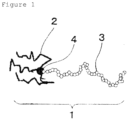
- Figure 1 shows an example of schematic diagram of a star-shaped acrylic block polymer of the present invention.
- the symbols in the Figure means 1: star-shaped structure, 2: chain polymer portions formed in the first polymerization step, 3: a chain polymer portion formed in the second polymerization step, and 4: a mercapto group.
- the medical patch of the present invention can be prepared by using a star-shaped acrylic block polymer as defined in claim 1 in which a weakly basic monomer is copolymerized acting as an adhesive polymer as an adhesive, and adding a salt of a basic drug as an active ingredient therein to obtain an adhesive layer as a composition (i.e., adhesive composition), and laminating the adhesive layer on a backing.
- a star-shaped acrylic block polymer as defined in claim 1 in which a weakly basic monomer is copolymerized acting as an adhesive polymer as an adhesive, and adding a salt of a basic drug as an active ingredient therein to obtain an adhesive layer as a composition (i.e., adhesive composition), and laminating the adhesive layer on a backing.
- the above star-shaped acrylic block polymer (also referred to as star-shaped acrylic block copolymer) has a star-shaped structure in which at least three chain polymer portions radiate from polyvalent mercaptan situated at the center.
- Such star-shaped structure is also disclosed in documents (for example, JP 2842782 B2 , JP 3385177 B2 , JP 4603398 B2 , JP 4744481 B2 , and JP 4916200 B2 ).
- An example of schematic diagram of the star-shaped acrylic block polymer structure of the present invention is shown in Figure 1 .
- (meth)acrylic acid alkyl ester structural units having 7-17 carbon atoms account for 30-99.9% by mass of whole structural units in said star-shaped acrylic block polymer.
- the content of the (meth)acrylic acid alkyl ester structural units having 7-17 carbon atoms in whole structural units of said star-shaped acrylic block polymer is preferably 60-99.9% by mass, 35-97% by mass, more preferably 70-99.9% by mass, 40-95% by mass, still more preferably 50-85% by mass.
- the content of the (meth)acrylic acid alkyl ester structural units having 7-17 carbon atoms in whole structural units of said star-shaped acrylic block polymer is less than 50% by mass, the polymer does not have a sufficient adhesive force.
- (meth)acrylic acid means acrylic acid or methacrylic acid
- structural unit(s) in a polymer portion means unit(s) consisting of a structure derived from polymerizable monomers constituting the polymer.
- the sulfur residue of a mercapto group situated at the center means the backbone per se derived from a polyvalent mercaptan having a sulfur residue.
- X-Y% by mass in a numerical range means “X% by mass or more to Y% by mass or less” unless otherwise specified.
- Examples of the polymerizable monomer corresponding to (meth)acrylic acid alkyl ester structural units having 7-17 carbon atoms (hereinafter also referred to as "(meth)acrylic acid alkyl ester monomer having 7-17 carbon atoms"), namely, (meth)acrylic acid alkyl ester having 7-17 carbon atoms include one or a combination of two or more selected from the group consisting of (meth)acrylic acid butyl ester, (meth)acrylic acid t-butyl ester, (meth)acrylic acid pentyl ester, (meth)acrylic acid hexyl ester, (meth)acrylic acid heptyl ester, (meth)acrylic acid octyl ester, (meth)acrylic acid isooctyl ester, (meth)acrylic acid nonyl ester, (meth)acrylic acid isononyl ester, (meth)acrylic acid decyl ester, (
- (meth)acrylic acid alkyl ester monomer having 7-17 carbon atoms include (meth)acrylic acid butyl ester, (meth)acrylic acid t-butyl ester, (meth)acrylic acid 2-ethylhexyl ester, (meth)acrylic acid octyl ester, (meth)acrylic acid isooctyl ester, (meth)acrylic acid nonyl ester, and (meth)acrylic acid isononyl ester, more preferable examples include a combination of (meth)acrylic acid butyl ester and (meth)acrylic acid 2-ethylhexyl ester, and still more preferable examples include a combination of acrylic acid butyl ester and acrylic acid 2-ethylhexyl ester.
- the (meth)acrylic acid alkyl ester monomer having 7-17 carbon atoms is used as a first polymerizable monomer and a second polymerizable monomer
- the weakly basic monomer is one or a combination of two or more selected from the group consisting of (meth)acrylates having a tertiary amine as a side chain, and amides.
- the weakly basic monomer include one or a combination of two or more selected from the group consisting of dialkylaminoalkyl (meth)acrylates such as dimethylaminoethyl (meth)acrylate and diethylaminoethyl (meth)acrylate; dialkylaminoalkyl (meth)acrylate quaternary ammonium salts such as dimethylaminoethyl (meth)acrylate quaternary ammonium salt:(meth)acrylamides such as dimethylaminopropyl acrylamide, diethylaminopropyl acrylamide, (meth)acrylamide, N-methyl (meth)acrylamide, and N-propyl (meth)acrylamide; and the like.
- the weakly basic monomer include dialkylaminoalkyl (meth)acrylates, (meth)aminoalkylacrylamides, and (meth)acrylamides
- more preferable examples include dimethylaminoethyl (meth)acrylate, diethylaminoethyl (meth)acrylate, dimethylaminopropyl acrylamide, diethylaminopropyl acrylamide, (meth)acrylamide, N-methyl (meth)acrylamide, and N-propyl (meth)acrylamide
- any one of the above weakly basic monomers may be used alone, or in combination of two or more of them.
- the total content of the weakly basic monomer in whole structural units of the above star-shaped acrylic block polymer is 0.1-39% by mass, preferably 1-39% by mass, more preferably 1.5-39% by mass.
- the total content of the weakly basic monomer in whole structural units of a star-shaped acrylic block polymer is 0.1-39% by mass, preferably 1-39% by mass, more preferably 1.5-39% by mass.
- the total content of the weakly basic monomer is less than 0.1% by mass, a salt of a basic drug is not converted into a free base. Meanwhile, when the total content of the weakly basic monomer is more than 39% by mass, the physical property balance as adhesive polymer is impaired.
- the chain polymer portion comprises a polymeric structure of radical polymerizable monomers, wherein the radical polymerizable monomers are, for example, (meth)acrylic acid alkyl ester monomers having 7-17 carbon atoms, weakly basic monomers, and other polymerizable monomers.
- radical polymerizable monomers are, for example, (meth)acrylic acid alkyl ester monomers having 7-17 carbon atoms, weakly basic monomers, and other polymerizable monomers.
- the chain polymer portion of the star-shaped acrylic block polymer may comprise structural units derived from a polymerizable monomer other than the (meth)acrylic acid alkyl ester having 7-17 carbon atoms and the weakly basic monomer (hereinafter referred to as "another polymerizable monomer (or other polymerizable monomers)”) and/or the following polyfunctional monomers in the content of less than 70% by mass, preferably less than 50% by mass in whole structural units, in addition to the weakly basic monomer.
- another polymerizable monomer or other polymerizable monomers
- Examples of other polymerizable monomers include polymerizable monomers which are homopolymerizable or copolymerizable by radical polymerization, and include one or a combination of two or more selected from the group consisting of (meth)acrylic acid alkyl esters having 6 or less carbon atoms such as methyl (meth)acrylate and ethyl (meth)acrylate; styrene monomers such as ⁇ -methylstyrene, vinyl toluene, and styrene; maleimide monomers such as phenylmaleimide and cyclohexylmaleimide; vinyl ether monomers such as methyl vinyl ether, ethyl vinyl ether, and isobutyl vinyl ether; fumaric acid monoalkyl esters and fumaric acid dialkyl esters; maleic acid monoalkyl esters and maleic acid dialkyl esters; itaconic acid monoalkyl esters and itaconic acid dialkyl esters;
- the other polymerizable monomers include (meth)acrylic acid alkyl esters having 6 or less carbon atoms and vinyl compounds, and more preferable examples include methyl (meth)acrylate, ethyl (meth)acrylate, (meth)acrylonitrile, butadiene, isoprene, vinyl chloride, vinylidene chloride, vinyl acetate, vinyl ketone, vinyl pyridine, and vinyl carbazole, and still more preferable examples include methyl methacrylate and vinyl acetate.
- the other polymerizable monomers may be the same or different from each other.
- a polyfunctional monomer may be comprised in combination with the above "another polymerizable monomer (or other polymerizable monomers)", and examples of said polyfunctional monomer include one or a combination of two or more selected from the group consisting of diester compounds of diols and (meth)acrylic acids such as alkylene glycol di(meth)acrylate, ethylene glycol di(meth)acrylate, tetraethylene glycol di(meth)acrylate, polyethylene glycol di(meth)acrylate, propylene glycol di(meth)acrylate, polypropylene glycol (meth)acrylate, 1,3-butylene glycol di(meth)acrylate, 1,6-hexanediol di(meth)acrylate, neopentyl glycol di(meth)acrylate, 2-hydroxy-1,3-di(meth)acryloxypropane, 2,2-bis[4-(acryloxyethoxy)phenyl]propane, 2,2-bis[4-(me
- polyfunctional monomer examples include tetraethylene glycol di(meth)acrylate, and more preferable examples include tetraethylene glycol di(meth)acrylate and ethylene glycol di(meth)acrylate.
- polymerizable monomers and polyfunctional monomers may be used alone, or in combination of two or more of them.
- the radical polymerizable monomer constituting a certain polymer portion in at least three or more chain polymer portions is one or a combination of two or more selected from the group consisting of (meth)acrylic acid alkyl esters having 6 or less carbon atoms, and vinyl compounds.
- the radical polymerizable monomer constituting a certain polymer portion in at least three or more chain polymer portions is one or a combination of two or more selected from the group consisting of methyl methacrylate and vinyl acetate.
- the star-shaped acrylic block polymer can achieve physical cross-linking caused by the microphase-separated structure, and achieve balanced adhesive force and cohesive force without using a cross-linking agent.
- An especially appropriate method for producing the star-shaped acrylic block polymer includes a multistep radical polymerization method using a polyvalent mercaptan, wherein after the provision of all polymerizable monomers to a reaction system is completed, a polymerization initiator is subsequently added thereto.
- a polymerization initiator subsequently added is referred to as "booster" in the present invention.
- the radical polymerization of the first polymerizable monomers for example, any one of the (meth)acrylic acid alkyl ester monomers having 7-17 carbon atoms, the weakly basic monomers, or the other polymerizable monomers, or a mixture thereof, preferably the other polymerizable monomers alone
- the first polymerizable monomers are radically polymerized from a sulfur residue of a mercapto group of a polyvalent mercaptan as an origin, and chain polymer portions radiate from the polyvalent mercaptan situated at the center to form a first star-shaped structure.
- the second polymerizable monomers for example, any one of the (meth)acrylic acid alkyl ester monomers having 7-17 carbon atoms, the weakly basic monomers, or the other polymerizable monomers, or the polyfunctional monomers, or a mixture thereof, preferably a mixture of the (meth)acrylic acid alkyl ester monomers having 7-17 carbon atoms, the weakly basic monomers, the other polymerizable monomers, and polyfunctional monomers
- the second polymerizable monomers are radically polymerized from the remaining mercapto group of the polyvalent mercaptan as an origin to form the second star-shaped structure different from the first star-shaped structure.
- said multistep radical polymerization method especially preferably consists of two steps.
- said production method especially preferably comprises the first polymerization step in which radical polymerization of polymerizable monomers is carried out in the presence of a polyvalent mercaptan and the second polymerization step in which radical polymerization of an intermediate polymer obtained in said first polymerization step and polymerizable monomers is carried out, wherein (meth)acrylic acid alkyl ester having 7 or more carbon atoms accounts for 30-99.9% by mass of the total amount of all polymerizable monomers to be used, and a booster is added after the provision of all polymerizable monomers to a reaction system is completed.
- a polymer solution obtained in the first polymerization step is mixed with the polymerizable monomers used in the second polymerization step, and then polymerization is carried out.
- a polymer solution obtained in the first polymerization step and the polymerizable monomers used in the second polymerization step may be mixed at one time to be subjected to polymerization, or the polymerizable monomers used in the second polymerization step may be gradually added to and mixed with a polymer solution obtained in the first polymerization step.
- an initial preparation mixture (1) essentially comprising a part of (1a) a polymer solution obtained in the first polymerization step and (1b) the polymerizable monomers used in the second polymerization step is added a polymerization initiator to initiate the polymerization, and then a monomer mixture (2) essentially comprising the remainder of (2a) the polymer solution obtained in the first polymerization step and (2b) the polymerizable monomers used in the second polymerization step and a polymerization initiator are gradually added and mixed (preferably added dropwise and mixed) thereto, and after the addition and mixing are completed (namely, after the provision of all polymerizable monomers to the reaction system is completed), a booster is subsequently added thereto.
- Said method can sufficiently homogeneously mix the polymer solution obtained in the first polymerization step and the polymerizable monomers used in the second polymerization step.
- the addition and mixing are preferably carried out by dropwise, and the drop hour is preferably 20-300 minutes, more preferably 40-200 minutes, still more preferably 60-120 minutes.
- the temperature of the reaction system in the addition and mixing is preferably 30-200°C, more preferably 50-150°C.
- the polymerization of the polymer solution (i.e., the above (1a) and (2a)) obtained in the first polymerization step is preferably stopped when the solution is used in the second polymerization step, and the total polymerization rate of the polymerizable monomers at that time is preferably 50-90%, more preferably 55-85%, still more preferably 60-80%.
- the method for stopping the polymerization include a method comprising adding a polymerization inhibitor to the polymer solution obtained in the first polymerization step, and a method comprising lowering the temperature of the polymer solution.
- Examples of the polymerization inhibitor which may be used for stopping the polymerization include phenols such as hydroquinone, hydroquinone monomethyl ether, 2,5-bis(1,1,3,3-tetramethylbutyl)hydroquinone, 2,5-bis(1,1-dimethylbutyl)hydroquinone, methoxyphenol, 6-tert-butyl-2,4-xylenol, and 3,5-ditert-butylcatechol; N-nitroso phenylhydroxylamine aluminum salt; and phenothiazine, and any one of them may be used alone or in combination of two or more of them.
- Preferable examples of the polymerization inhibitor include phenols, and more preferable examples include hydroquinone monomethyl ether.
- the total amount to be used is preferably 1-10000 ppm, more preferably 10-1000 ppm, still more preferably 20-200 ppm relative to the polymerizable monomers used in the first polymerization step.
- the total amount of the polymerization inhibitor to be used is less than 1 ppm, the polymerization may not be efficiently stopped. Meanwhile, when the total amount to be used is more than 10000 ppm, the polymerization of the second polymerization step may not be initiated.
- the polymerization of the first polymerization step can be substantially stopped by lowering the temperature of the polymer solution to 40°C or less.
- the degradation rate of the polymerization initiator depends on the temperature, and thus a radical is hardly produced when the temperature of the polymer solution is 40°C or less.
- the temperature of the polymer solution may be lowered to 20°C or less.
- the (meth)acrylic acid alkyl ester having 7-17 carbon atoms accounts for 30-99.9% by mass (typically, 50-99.9% by mass) in the total amount to be used of the polymerizable monomers which may be used in the present invention.
- the total content of the (meth)acrylic acid alkyl ester having 7-17 carbon atoms in all polymerizable monomers is preferably 60-99.9% by mass, 35-97.0% by mass, more preferably 70-99.9% by mass, 40-95.0% by mass, more preferably 80-99.9% by mass, 42-90.0% by mass, especially preferably 90-99.9% by mass, 50-86% by mass.
- the total content of the (meth)acrylic acid alkyl ester having 7-17 carbon atoms in all polymerizable monomers is less than 50% by mass (typically, less than 30% by mass), the obtained polymer does not have sufficiently adhesive force.
- the preferable specific examples of the (meth)acrylic acid alkyl ester having 7-17 carbon atoms are as stated above, and any one of them may be used alone or in combination of two or more of them.
- the (meth)acrylic acid alkyl ester having 7-17 carbon atoms may be used in any step of the multistep radical polymerization steps, and preferably used in the second polymerization step (or the final polymerization step in case there are three or more polymerization steps).
- the polymerizable monomer which may be used in the present invention may comprise a polymerizable monomer other than the (meth)acrylic acid alkyl ester having 7-17 carbon atoms (i.e., the weakly basic monomers and the other polymerizable monomers) at the content of less than 70% by mass (typically, less than 50% by mass) in the total amount to be used.
- the weakly basic monomer may be used in any step of the multistep radical polymerization steps, and preferably used in the second polymerization step (or the final polymerization step in case there are three or more polymerization steps).
- the content of the weakly basic monomer which may be used in the present invention in all polymerizable monomers is 0.1-39% by mass, preferably 1-39% by mass (typically 1-35% by mass), more preferably 1.5-39% by mass (typically 1.5-32% by mass).
- the total content of the weakly basic monomer is 0.1-39% by mass, preferably 1-39% by mass (typically, 1-35% by mass), more preferably 1.5-39% by mass (typically, 1.5-32% by mass) relative to whole structural units of said star-shaped acrylic block polymer.
- the total content of the weakly basic monomer is less than 0.1% by mass, a salt of a basic drug is not converted into a free base. Meanwhile, when the total content of the weakly basic monomer is more than 39% by mass, the balanced physical properties of the adhesive polymer are impaired.
- Examples of the other polymerizable monomers include polymerizable monomers which are homopolymerizable or copolymerizable by radical polymerization, and preferable specific examples are as stated above, and any one of them may be used alone or in combination of two or more of them.
- the other polymerizable monomers may be used in any step of the multistep radical polymerization step, and preferably used in the first and the second polymerization steps (or all polymerization steps in case there are three or more polymerization steps).
- radical polymerization in the presence of a polyvalent mercaptan is carried out in multistep comprising two or more steps, and different kinds of polymerizable monomers are preferably used in each elementary step.
- the "different kinds of polymerizable monomers” mean not only polymerizable monomers having different chemical structures, but also combinations of polymerizable monomers having the same chemical structure in different mixture ratio.
- Examples of using different kinds of polymerizable monomers in each elementary step include using a combination of polymerizable monomers consisting of methyl methacrylate (90 parts by mass) and butyl acrylate (10 parts by mass) in the first polymerization step, and a combination of polymerizable monomers consisting of methyl methacrylate (10 parts by mass) and butyl acrylate (90 parts by mass) in the second polymerization step.
- the obtained star-shaped acrylic block polymer has chain polymer portions having very different glass transition temperatures (Tg), and can sufficiently achieve the effects of the present invention, and has practically high performance.
- the polyvalent mercaptan which is used in the above method one or a combination of two or more selected from the group consisting of: diesters of diols selected from ethylene glycol and 1,4-butanediol and carboxyl group-containing mercaptans selected from ethylene glycol dithioglycolate, ethylene glycol dithiopropionate, 1,4-butanediol dithioglycolate, and 1,4-butanediol dithiopropionate; triesters of trimethylolpropane and carboxyl group-containing mercaptans selected from trimethylolpropane trithioglycolate and trimethylolpropane trithiopropionate; polyesters of pentaerythritol and carboxyl group-containing mercaptans selected from pentaerythritol tetrakisthioglycolate and pentaerythritol tetrakisthiopropionate; polyester
- Preferable polyvalent mercaptan is a mercaptan having three or more valences
- preferable examples of the polyvalent mercaptan include polyester compounds of dipentaerythritol or pentaerythritol and carboxyl group-containing mercaptans, and more preferable examples include dipentaerythritol hexakisthioglycolate, dipentaerythritol hexakisthiopropionate (alias: dipentaerythritol- ⁇ -mercaptopropionate) (hereinafter abbreviate as DPMP), pentaerythritol tetrakisthioglycolate, and pentaerythritol tetrakisthiopropionate, and more preferable examples include dipentaerythritol hexakisthiopropionate.
- DPMP dipentaerythritol tetrakisthioglycolate
- the temperature in carrying out the radical polymerization is preferably 30-200°C, more preferably 50-150°C.
- a conventional polymerization initiator may be used in the radical polymerization.
- the polymerization initiator include azo initiators such as dimethyl-2,2'-azobis(2-methylpropionate) (abbreviate as V-601), 2,2'-azobisisobutyronitrile, 2,2'-azobis(2-methylbutyronitrile), 2,2'-azobis(2,4-dimethylvaleronitrile), and dimethyl 2,2'-azobisisobutyrate; peroxide polymerization initiators such as benzoyl peroxide; and the like, and any one of them may be used alone or in combination of two or more of them.
- azo initiators such as dimethyl-2,2'-azobis(2-methylpropionate) (abbreviate as V-601), 2,2'-azobisisobutyronitrile, 2,2'-azobis(2-methylbutyronitrile), 2,2'-azobis(2,4-dimethylvaleronitrile), and dimethyl 2,2'-azobisis
- the polymerization initiator include dimethyl-2,2'-azobis(2-methylpropionate) (V-601).
- the total amount of the polymerization initiator used in the radical polymerization is preferably 1/3 or less, more preferably 1/5 or less of the amount of the polyvalent mercaptan by mass ratio.
- the polymerization initiator may be added to the reaction system at one time or in several divided parts. In case of adding in several divided parts, each part may be added at one time or added sequentially.
- a conventional solvent may be used in the radical polymerization.
- the solvent include ester solvents such as ethyl acetate, propyl acetate, and butyl acetate; ketone solvents such as methyl ethyl ketone and cyclohexanone; aromatic solvents such as benzene and toluene; cellosolve solvents such as methyl cellosolve and ethyl cellosolve; and the like, and any one of them may be used alone or in combination of two or more of them.
- a booster is preferably subsequently added after the provision of all polymerizable monomers used in the second polymerization step (or the final polymerization step in case there are three or more polymerization steps) to a reaction system is completed.
- the booster include the above polymerization initiators, and any one of them may be used alone or in combination of two or more of them.
- the total amount of the booster to be used is not especially limited, and preferably 0.1-5% by mass, more preferably 0.2-2% by mass, still more preferably 0.3-1% by mass relative to the total amount of the polymerizable monomers to be used. When the total amount of the booster to be used is less than 0.1% by mass, the booster cannot exert the effect.
- Examples of the method for adding the booster is not especially limited, and include the continuously dropping method in which the booster is continuously added dropwise, and the dividedly dropping method in which the booster is added at specific time interval.
- the temperature in adding the booster is not especially limited, and preferably 30-200°C, more preferably 50-150°C.
- the addition time of the booster is not especially limited, and preferably 1-10 hours, more preferably 2-8 hours.
- the reaction system may be further maturated preferably at 30-200°C, more preferably at 50-150°C.
- the maturation is preferably carried out under a reflux condition (i.e., within the above temperature range) of a solvent to be used.
- the maturation time is not especially limited, and preferably 1 hour or more, more preferably 2 hours or more, still more preferably 3 hours or more.
- the upper limit of the maturation hours is not especially limited, and usually preferably within 20 hours.
- the total time from the start of the polymerization to the completion of the above maturation in the second polymerization step is preferably 8-20 hours, more preferably 12-20 hours, still more preferably 15-20 hours.
- the total time of less than 8 hours from the start of the polymerization to the completion of the above maturation in the second polymerization step is not preferable, because the effects of the present invention cannot be sufficiently achieved in the obtained star-shaped acrylic block polymer, and especially, the remained amount of the (meth)acrylic acid alkyl ester having 7-17 carbon atoms increases.
- the total time of more than 20 hours from the start of the polymerization to the completion of the above maturation in the second polymerization step is also not preferable, because the productivity significantly decreases, the energy cost increases, and the performance of the obtained star-shaped acrylic block polymer may also decrease.
- a general method used in a conventional method for producing a star-shaped acrylic block polymer may be appropriately used as a preferable method for preparing the star-shaped acrylic block polymer.
- the star-shaped acrylic block polymer is generally obtained as a polymer solution.
- the total non-volatile content in the solution is preferably 40-70% by mass, more preferably 45-65% by mass, still more preferably 45-60% by mass.
- the viscosity of the solution decreases to cause the difficulty in coating the polymer, and such content is uneconomical because the amount of the solvent to be volatilized increases and much energy is required for drying.
- the content is more than 70% by mass, the viscosity of the solution significantly increases to cause the difficulty in handling.
- any one of the above adhesives may be used alone or in a mixture or two or more of them.
- an acrylic polymer and a star-shaped acrylic block polymer are preferable, and the star-shaped acrylic block polymer is especially preferable because of the excellently balanced adhesive force and cohesive force.
- the adhesive is added to an adhesive composition in the total amount of 50-99.9% by mass, preferably 50-99% by mass, more preferably 50-95% by mass.
- the adhesive composition of the medical patch of the present invention may further comprise transdermal absorption enhancer etc. to increase the transdermal absorbability of a drug.
- transdermal absorption enhancer include, but is not limited to, fatty acid esters such as isopropyl myristate, diisopropyl adipate, myristyl myristate, octyldodecyl myristate, isopropyl palmitate, butyl stearate, hexyl laurate, and decyl oleate; higher fatty acids such as caprylic acid, capric acid, isostearic acid, oleic acid, and myristic acid; amines such as diisopropanolamine and triethanolamine; polyvalent alcohol fatty acid esters such as propylene glycol monolaurate, propylene glycol fatty acid esters, glycerin fatty acid esters, sorbitan fatty acid esters, and sucrose fatty acid est
- an additive used in a conventional patch may be appropriately selected and used in the adhesive composition of the medical patch of the present invention if necessary in order to adjust the adhesive force and stability of the adhesive base.
- water-soluble polymers such as polyvinylpyrrolidone and polyvinyl alcohol; cellulose derivatives such as ethylcellulose, hydroxypropyl cellulose, and hydroxypropyl methylcellulose; silicon compounds such as anhydrous silicic acid and light anhydrous silicic acid; inorganic fillers such as zinc oxide, aluminum oxide, magnesium oxide, iron oxide, titanium dioxide, and silica compounds; and antioxidants such as dibutylhydroxytoluene; and the like may be appropriately contained at an appropriate amount.
- the adhesive composition of the medical patch of the present invention may comprise cross-linking agents, tackifiers, softeners, plasticizers, and the like if necessary. Further, the adhesive composition of the medical patch of the present invention may comprise preservatives, fresheners, fungicides, flavoring agents, coloring agents, and the like if necessary. These ingredients which may be used if necessary are not especially limited, and known ingredients are appropriately used at an appropriate amount.
- Examples of the salt of the basic drug used in the medical patch of the present invention include carboxylates such as citrate, succinate, fumarate, maleate, and tartrate; and hydrochloride, sulfate, and phosphate of the basic drug, and include narcotic analgesics (for example, fentanyl citrate, morphine sulfate, oxycodone hydrochloride, or buprenorphine hydrochloride), urological agents (for example, oxybutynin hydrochloride, tamsulosin hydrochloride, or tolterodine tartrate), antiparkinsonian agents (rasagiline mesylate, pergolide mesylate, amantadine hydrochloride, trihexyphenidyl hydrochloride, or ropinirole hydrochloride), local anesthetics (for example, lidocaine hydrochloride or procaine hydrochloride), antidementia agents (for
- the backing of the medical patch of the present invention is not especially limited, and an elastic or non-elastic backing usually used for a patch may be used.
- a film or a sheet made from a synthetic resin such as polyethylene terephthalate, polyethylene, polypropylene, polybutadiene, ethylene vinyl acetate copolymer, polyvinyl chloride, polyester, nylon, and polyurethan, or a laminate thereof, a porous membrane, a foam, a woven fabric, a nonwoven fabric, a paper, or the like may be used.
- the adhesive layer laminated on said backing is covered by a release liner, and the release liner is peeled off when the patch is used, and the surface of the adhesive layer is applied to a desired skin.
- the release liner used in the patch of the present invention may be one usually used for a patch, and may be polyethylene terephthalate, polypropylene, a paper, or the like, and especially preferably polyethylene terephthalate.
- the release liner may be siliconized if necessary in order to optimize the peel force.
- the medical patch of the present invention may coexist with a deoxidant in order to enhance the stability of the drug during storage.
- a deoxidant include a deoxidant made from iron and a deoxidant made from a nonferrous metal.
- coexisting method of the deoxidant include a method wherein a deoxidant is directly included in a packaging container or a method wherein a deoxidizing film is laminated in a packaging container.
- Examples of the method for preparing the medical patch of the present invention include the following method.
- a salt of a basic drug is dispersed in an appropriate solvent to prepare a drug solution.
- a star-shaped acrylic block polymer in which a weakly basic monomer is copolymerized, and other ingredients are mixed and dissolved or dispersed in an appropriate solvent to obtain an adhesive base.
- the solvent include toluene, ethyl acetate, ethanol, and methanol, and appropriately selected depending on ingredients, and any one of the solvents may be used alone or in a mixture of two or more.
- the adhesive base is added the drug solution, and the mixture is homogeneously stirred and mixed to obtain an adhesive solution, and the adhesive solution is coated on a release liner or a backing, the solvent is removed by drying to obtain an adhesive layer, and then the adhesive layer is covered by a backing or a release liner to obtain a medical patch of the present invention.
- the thickness of the adhesive layer is 30-200 um, more preferably 30-100 um. When the thickness is less than 30 ⁇ m, the drug-release is not sustained for a long period of time. When the thickness is more than 200 ⁇ m, the drug content in the adhesive layer increases, which cause the increase in residual drug content and the increase in manufacturing cost.
- methyl methacrylate 24 parts
- DPMP dipentaerythritol- ⁇ -mercaptopropionate
- ethyl acetate 24.82 parts
- the mixture was stirred under nitrogen stream and kept at 83 ⁇ 2°C, and to the mixture were added dimethyl-2,2'-azobis(2-methylpropionate) (trade name: V-601, manufactured by Wako Pure Chemical Industries, Ltd., hereinafter abbreviate as V-601) (0.048 parts) as a polymerization initiator and ethyl acetate (0.432 parts) as a solvent for dissolution to initiate the polymerization.
- V-601 dimethyl-2,2'-azobis(2-methylpropionate)
- the obtained intermediate polymer solution (A1) had a non-volatile content of 34.5%, and a viscosity of 90 mPa•s.
- V-601 solution a mixture of V-601 (0.02 parts) and ethyl acetate (1 part)
- a polymerization initiator to initiate the polymerization.
- V-601 solution a mixture of V-601 (0.08 parts) and ethyl acetate (4 parts)
- ethyl acetate 20.3 parts
- the obtained polymer solution (B1) had a non-volatile content of 47.6%, and a viscosity of 500 mPa•s.
- the obtained polymer had a number average molecular weight (Mn) of 30,000, and a weight average molecular weight (Mw) of 77,000.
- Viscosity was measured by a type B viscometer at 25°C. The number of revolutions was 12 revolutions per minute.
- a mixture was dried at 150°C for 15 minutes in a circulating hot air dryer, and a non-volatile content was calculated by mass change.
- Rasagiline mesylate was dispersed in ethyl acetate to prepare a drug solution. Subsequently, to the acrylic adhesive obtained in Preparation example 1 was added the drug solution, and the mixture was homogeneously stirred and mixed to obtain an adhesive composition, and the adhesive composition was coated on a release liner and dried to remove the solvent and form an adhesive layer having a thickness of 30 ⁇ m, and then the adhesive layer was covered by a backing to prepare a medical patch. The amount of each ingredient is shown in Table 1-1.
- a medical patch of Example 2 was prepared according to the production method of Example 1 using the ingredients shown in the following Table 1-1 except that rasagiline mesylate was replaced with asenapine maleate.
- Rasagiline mesylate was dispersed in ethyl acetate to prepare a drug solution. Subsequently, to an acrylic adhesive DURO-TAK 87-4098 (manufactured by Henkel) or DURO-TAK 87-9301 (manufactured by Henkel) was added the drug solution, and further added one kind of basic additive selected from diethanolamine, sodium acetate, and EUDRAGIT E-100 (aminoalkyl methacrylate polymer), and the mixture was homogeneously stirred and mixed to obtain an adhesive composition, and the adhesive composition was coated on a release liner and dried to remove the solvent and form an adhesive layer having a thickness of 30 ⁇ m, and then the adhesive layer was covered by a backing to prepare a medical patch. The amount of each ingredient is shown in Table 1-2 and Table 1-3.
- Each medical patch of Comparative examples 8-10 was prepared according to the production method of the above Comparative examples 1-7 using the ingredients shown in the following Table 1-4 except that rasagiline mesylate was replaced with asenapine maleate.
- the patch of the present invention had high peel force as compared to each patch of Comparative examples. Namely, these results demonstrate that the formulations of the present invention have excellent adhesive force, because the patches of the present invention do not need an additive used for the conversion of a salt of a basic drug into a free base and do not suffer the decrease in peel force from such additive.
- Example 1 and Comparative examples 1 and 4 were stored at 60°C for 2 weeks, and subjected to the same tests as Test example 1 and Test example 2 to evaluate the tack force and the peel force.
- the results are shown in Table 4.
- the results are shown by the ratio (%) of tack force or peel force relative to the tack force or the peel force (100) of an adhesive alone which does not comprise a drug and an additive to evaluate the effect of the addition of the drug and additives on the adhesive composition.
- the patch of the present invention had higher tack force and peel force as compared to each patch of Comparative examples. Namely, these results demonstrate that the formulations of the present invention have excellent adhesive force, because the patches of the present invention do not need an additive used for the conversion of a salt of a basic drug into a free base and do not suffer the decrease in tack force and peel force from such additive.
- each patch of Example 1, Comparative example 3, and Comparative example 7 was subjected to an in vitro transdermal permeation test using a hairless rat.
- the thickness of the adhesive layer of each formulation was adjusted to 100 um.
- An excised abdominal skin of a hairless rat HWY series, 7 weeks old was put on a Franz diffusion cell, and each test formulation cut into a round shape ( ⁇ 14 mm) was applied thereto.
- the receptor side was filled with phosphate buffered saline, and hot water of 37°C was circulated in the water jacket.
- the formulation of Comparative example 7 which does not comprise an additive used for converting rasagiline mesylate into a free base, had lower transdermal permeability of the drug, and transdermal permeability less than 1/20 as compared to Example 1.
- the patches of the present invention comprise star-shaped acrylic block polymers in which weakly basic monomers are copolymerized to sufficiently convert rasagiline mesylate into a free base, and thereby have excellent transdermal absorbability of the drug.
- the formulation of Example 1 had comparable or higher transdermal absorbability as compared to the formulation of Comparative example 3, which comprises EUDRAGIT E-100 to convert the salt of the basic drug into the free base.
- a skin primary irritation test in a rabbit was carried out using the formulation of Example 1.
- the formulation was applied onto a dehaired rabbit back for 24 hours, and the Primary Irritation Index (P.I.I) was determined by the skin symptom at 1 hour, 24 hours, and 48 hours after peeling off.
- P.I.I Primary Irritation Index
- the skin irritation of the patch of the present invention is very low. Namely, it was confirmed that the patches of the present invention do not comprise a basic additive for converting a salt of a basic drug into a free base, and do not suffer from the skin irritation caused by a basic additive per se and the skin irritation caused by a basic salt produced by the reaction of a basic additive and a salt of a basic drug, and thus are very safe patches.
- V-601 solution a mixture of V-601 (0.03 parts) and ethyl acetate (1 part)
- a polymerization initiator to initiate the polymerization.
- the obtained polymer solution (B2) had a non-volatile content of 48.0%, a viscosity of 682 mPa•s, a number average molecular weight of 37,000, and a weight average molecular weight of 117,000.
- V-601 solution a mixture of V-601 (0.02 parts) and ethyl acetate (1 part)
- a polymerization initiator to initiate the polymerization.
- V-601 solution a mixture of V-601 (0.02 parts) and ethyl acetate (1 part)
- a polymerization initiator to initiate the polymerization.
- a V-601 solution (a mixture of V-601 (0.17 parts) and ethyl acetate (12 parts)) as a booster over 3 hours, and the reaction was carried out under reflux for additional 10 hours.
- ethyl acetate 63 parts
- the obtained polymer solution (B4) had a non-volatile content of 38.3%, and a viscosity of 14,410 mPa•s.
- the molecular weight could not be measured due to the clogging in the filtration process of a solution sample of the polymer solution (B4) in THF.
- V-601 solution a mixture of V-601 (0.03 parts) and ethyl acetate (1 part)
- a polymerization initiator to initiate the polymerization.
- the obtained polymer solution (B5) had a non-volatile content of 44.8%, a viscosity of 1,030 mPa•s, a number average molecular weight of 62,000, and a weight average molecular weight of 271,000.
- V-601 solution a mixture of V-601 (0.03 parts) and ethyl acetate (1 part)
- a polymerization initiator to initiate the polymerization.
- a V-601 solution (a mixture of V-601 (0.17 parts) and ethyl acetate (12 parts)) as a booster over 3 hours, and the reaction was carried out under reflux for additional 10 hours.
- ethyl acetate (20.3 parts) as a dilution solvent, and the mixture was cooled to obtain a polymer solution (B7) for an adhesive.
- the obtained polymer solution (B7) had a non-volatile content of 39.1%, and a viscosity of 4,090 mPa•s. However, the molecular weight could not be measured due to clogging in the filtration process of a solution sample of the polymer solution (B7) in THF.
- the medical patch of Example 3 was prepared according to the production method in the above Example 1 using the ingredients shown in the following Table 8 except that the acrylic adhesive was replaced with the adhesive of Preparation example 2.
- the medical patch of Example 4 was prepared according to the production method in the above Example 1 using the ingredients shown in the following Table 8 except that the acrylic adhesive was replaced with the adhesive of Preparation example 3.
- the medical patch of Example 5 was prepared according to the production method in the above Example 1 using the ingredients shown in the following Table 8 except that the acrylic adhesive was replaced with the adhesive of Preparation example 4.
- the medical patch of Comparative example 11 was prepared according to the production method in the above Example 1 using the ingredients shown in the following Table 8 except that the acrylic adhesive was replaced with the adhesive of Preparation example 5.
- the medical patch of Comparative example 12 was prepared according to the production method in the above Example 1 using the ingredients shown in the following Table 8 except that the acrylic adhesive was replaced with the adhesive of Preparation example 6.
- the medical patch of Comparative example 13 was prepared according to the production method in the above Example 1 using the ingredients shown in the following Table 8 except that the acrylic adhesive was replaced with the adhesive of Preparation example 7.
- each patch of Examples 3-5 and Comparative examples 11-13 was subjected to a probe tack test according to the method in Test example 1.
- the results are shown in Table 8.
- some formulations of Comparative examples caused cohesive failure, and thus the physical properties were evaluated according to the 3 grade evaluation criteria shown in Table 9 using the comprehensive evaluation of the tack force and the presence of cohesive failure in the pasty preparation.
- Evaluation division Evaluation criteria ⁇ No cohesive failure was observed in pasty preparation, and the tack force was excellent. ⁇ A certain degree of cohesive failure was observed in pasty preparation. ⁇ Terrible cohesive failure was observed in pasty preparation, and a test could not be carried out.
- each patch of Examples 3-5 and Comparative examples 11-13 was subjected to a peel test according to the method in Test example 2. The results are shown in Table 8.
- each patch of Examples 3-5, and Comparative examples 11-13 was subjected to a holding force test.
- Each test formulation was cut into a size of 1 cm ⁇ 5cm, and the release film was peeled off, and the formulation was folded back at the point of 1 cm from the end of the longer direction to superpose two pasty preparation surfaces with each other.
- the residual 3cm portion in which the pasty preparation surface was exposed was applied to a stainless steel 304-BA test plate, and a roller of 2 kg was reciprocated on the patch at the rate of 300 mm per minute, and the patch was left to stand for 20 minutes.
- the patches of the present invention had more excellent physical properties in the tack force, the peel force, and the holding force as compared to each patch of the Comparative examples. Especially, the patches of the present invention were far more excellent in the holding force as compared to the formulations of Comparative examples. It could be understood that these excellent cohesive and adhesive properties of the present patches are caused by the star-shaped acrylic block polymer of the present invention in which a weakly basic monomer is copolymerized.
- each patch of Example 3 and Comparative example 12 was subjected to a drug-release test.
- Each test formulation was punched into a round shape having a diameter of 14 mm ( ⁇ 14 mm), and the backing side of each test formulation was applied to a slide glass using a double sided tape and fixed thereto.
- the test formulation fixed on the slide glass was put on a Franz diffusion cell in which the receptor bath was preliminarily filled with a test solution* so that the adhesive layer side contacted the receptor side, and the test solution was sampled with lapse of time, and the amount of rasagiline released to the test solution was measured by liquid chromatography, and the release rate (%)**, which is the rate of rasagiline released from the formulation, was calculated.
- the results are shown in Table 10.
- test solution a mixed solution of 40% polyethylene glycol / 10% isopropanol / 50% phosphate buffered saline **release rate: amount (mg) of rasagiline in test solution after 6 hours from the start of the test / content (mg) of rasagiline in test formulation ( ⁇ 14 mm) ⁇ 100 [Table 10] Test formulation Drug-release rate (%) Example 3 100.0 Comparative example 12 85.4
- the patches of the present invention have excellent drug-release properties as compared to patches of Comparative examples, and have both of excellent formulation properties and drug-release properties.
- a medical patch comprising a star-shaped acrylic block polymer as an adhesive polymer
- a medical patch which has unimpaired formulation properties such as adhesive property and retention property of patch, low skin irritation, and a high drug-release property, can be provided.
Landscapes
- Health & Medical Sciences (AREA)
- Chemical & Material Sciences (AREA)
- Medicinal Chemistry (AREA)
- Veterinary Medicine (AREA)
- Pharmacology & Pharmacy (AREA)
- Epidemiology (AREA)
- Life Sciences & Earth Sciences (AREA)
- Animal Behavior & Ethology (AREA)
- General Health & Medical Sciences (AREA)
- Public Health (AREA)
- Engineering & Computer Science (AREA)
- Bioinformatics & Cheminformatics (AREA)
- Dermatology (AREA)
- Organic Chemistry (AREA)
- Emergency Medicine (AREA)
- Polymers & Plastics (AREA)
- Chemical Kinetics & Catalysis (AREA)
- Inorganic Chemistry (AREA)
- Pain & Pain Management (AREA)
- Medicinal Preparation (AREA)
- Graft Or Block Polymers (AREA)
- Adhesive Tapes (AREA)
- Adhesives Or Adhesive Processes (AREA)
- Medicines That Contain Protein Lipid Enzymes And Other Medicines (AREA)
- Pharmaceuticals Containing Other Organic And Inorganic Compounds (AREA)
- Acyclic And Carbocyclic Compounds In Medicinal Compositions (AREA)
Claims (10)
- Sternförmiges Acrylblockpolymer mit einer sternförmigen Struktur, in der mindestens drei Kettenpolymerteile von einem im Zentrum befindlichen mehrwertigen Mercaptan ausgehen, wobei(Meth)acrylsäurealkylester-Struktureinheiten mit 7-17 Kohlenstoffatomen 30-99,9 Massenprozent der gesamten Struktureinheiten des sternförmigen Acrylblockpolymers ausmachen,mindestens einer der Kettenpolymerteile eine Struktureinheit mit einer Copolymerstruktur aus polymerisierbaren Monomeren aufweist, die einen (Meth)acrylsäurealkylester mit 7-17 Kohlenstoffatomen und ein schwach basisches Monomer umfassen,das schwach basische Monomer ein oder eine Kombination von zwei oder mehr Monomeren ist, die aus der Gruppe ausgewählt sind, die aus (Meth)acrylaten mit einem tertiären Amin als Seitenkette und Amiden besteht,das mehrwertige Mercaptan eines oder eine Kombination von zwei oder mehr ist, ausgewählt aus der Gruppe bestehend aus- Diestern aus- Diolen, ausgewählt aus Ethylenglykol und 1,4-Butandiol und- carboxylgruppenhaltigen Mercaptanen, ausgewählt aus Ethylenglycoldithioglycolat, Ethylenglycoldithiopropionat, 1,4-Butandioldithioglycolat und 1,4-Butandioldithiopropionat;- Triestern aus- Trimethylolpropan und- carboxylgruppenhaltigen Mercaptanen, ausgewählt aus Trimethylolpropantrithioglykolat und Trimethylolpropantrithiopropionat;- Polyestern aus- Pentaerythritol und- carboxylgruppenhaltigen Mercaptanen, ausgewählt aus Pentaerythritoltetrakisthioglykolat und Pentaerythritoltetrakisthiopropionat;- Polyesterverbindungen aus- Dipentaerythrit und- carboxylgruppenhaltigen Mercaptanen, ausgewählt aus Dipentaerythritolhexakisthioglykolat und Dipentaerythritolhexakisthiopropionat;- anderen Polyesterverbindungen aus- Verbindungen mit drei oder mehr Hydroxygruppen und- carboxylgruppenhaltigen Mercaptanen;- Trithioglycerin;- Triazinen, ausgewählt aus 2-Di-n-butylamino-4,6-dimercapto-S-triazin und 2,4,6-Trimercapto-S-triazin;- Verbindungen, bei denen Schwefelwasserstoff an zwei oder mehr Epoxygruppen von mehrwertigen Epoxyverbindungen hinzugefügt wird, um zwei oder mehr Mercaptogruppen einzuführen; und- Esterverbindungen, hergestellt durch Veresterung von zwei oder mehr Carboxylgruppen mehrwertiger Carbonsäuren und Mercaptoethanol, undder Gehalt des schwach basischen Monomers pro ganzer Struktureinheiten in dem sternförmigen Acrylblockpolymer 0,1 bis 39 Masseprozent beträgt.
- Sternförmiges Acrylblockpolymer nach Anspruch 1, wobei der Kettenpolymeranteil eine Polymerstruktur aus radikalisch polymerisierbaren Monomeren umfasst.
- Sternförmiges Acrylblockpolymer nach Anspruch 1 oder 2, wobei der (Meth)acrylsäurealkylester mit 7-17 Kohlenstoffatomen einer oder eine Kombination von zwei oder mehr ist, ausgewählt aus der Gruppe bestehend aus (Meth)acrylsäurebutylester, (Meth)acrylsäure-t-butylester, (Meth)acrylsäurepentylester, (Meth)acrylsäurehexylester, (Meth)acrylsäureheptylester, (Meth)acrylsäureoctylester, (Meth)acrylsäureisoctylester, (Meth)acrylsäurenonylester, (Meth)acrylsäureisononylester, (Meth)acrylsäuredecylester, (Meth)acrylsäureundecylester, (Meth)acrylsäuredodecylester und (Meth)acrylsäure-2-ethylhexylester.
- Sternförmiges Acrylblockpolymer nach einem der Ansprüche 1 bis 3, wobei das schwach basische Monomer eines oder eine Kombination von zwei oder mehr ist, ausgewählt aus der Gruppe bestehend aus Dimethylaminoethyl(meth)acrylat Dimethylaminoethyl(meth)acrylat, quaternärem Ammoniumsalz von Dimethylaminoethyl(meth)acrylat, Dimethylaminopropylacrylamid, Diethylaminopropylacrylamid, (Meth)acrylamid, N-Methyl(meth)acrylamid und N-Propyl(meth)acrylamid.
- Verfahren zur Herstellung eines sternförmigen Acrylblockpolymers, dadurch gekennzeichnet, dass das sternförmige Acrylblockpolymer, in dem mindestens drei Kettenpolymerteile von einem im Zentrum befindlichen mehrwertigen Mercaptan ausgehen, nach einem der Ansprüche 1 bis 4 durch Schritte erhalten wird, die umfassen:den ersten Polymerisationsschritt, in dem die radikalische Polymerisation der polymerisierbaren Monomere in Gegenwart eines mehrwertigen Mercaptans durchgeführt wird und ein Teil der Wertigkeit des Schwefelrestes der Mercaptogruppe des mehrwertigen Mercaptans nicht als Ursprung der radikalischen Polymerisation verwendet wird und nicht umgesetzt bleibt; undden zweiten Polymerisationsschritt, in dem die radikalische Polymerisation eines in dem ersten Polymerisationsschritt erhaltenen Zwischenpolymers und polymerisierbarer Monomere durchgeführt wird,wobei in der zweiten Reaktionsstufe des ersten Polymerisationsschritts und des zweiten Polymerisationsschritts die in dem ersten Polymerisationsschritt erhaltene Polymerlösung und die in dem zweiten Polymerisationsschritt verwendeten polymerisierbaren Monomere zuvor gemeinsam gemischt werden und die Polymerisation der zweiten Reaktionsstufe unter Verwendung der resultierenden gemischten Lösung durchgeführt wird, unddas polyvalente Mercaptan wie in Anspruch 1 definiert ist.
- Medizinisches Pflaster, umfassend eine Klebstoffzusammensetzung, die ein Salz eines basischen Arzneimittels und einen Klebstoff umfasst, dadurch gekennzeichnet, dass der Klebstoff eine polymere Struktur aus radikalisch polymerisierbaren Monomeren nach einem der Ansprüche 1 bis 4 umfasst, wobeider Klebstoff ein sternförmiges Acrylblockpolymer mit einer sternförmigen Struktur ist, bei der mindestens drei Kettenpolymerteile von einem im Zentrum befindlichen mehrwertigen Mercaptan ausgehen,(Meth)acrylsäurealkylester-Struktureinheiten mit 7-17 Kohlenstoffatomen 30-99,9 Massenprozent der gesamten Struktureinheiten des sternförmigen Acrylblockpolymers ausmachen,mindestens einer der Kettenpolymerteile eine Struktureinheit mit einer Copolymerstruktur aus polymerisierbaren Monomeren aufweist, die einen (Meth)acrylsäurealkylester mit 7-17 Kohlenstoffatomen und ein schwach basisches Monomer umfassen,das schwach basische Monomer ein oder eine Kombination von zwei oder mehr Monomeren ist, die aus der Gruppe ausgewählt sind, die aus (Meth)acrylaten mit einem tertiären Amin als Seitenkette und Amiden besteht,das mehrwertige Mercaptan wie in Anspruch 1 definiert ist, undder Gehalt des schwach basischen Monomers im Verhältnis zum nichtflüchtigen Anteil in dem Klebstoff 0,1 bis 39 Masseprozent beträgt.
- Medizinisches Pflaster nach Anspruch 6, wobei der Gehalt des Salzes des basischen Arzneimittels 0,1-50 Masseprozent und der Gehalt des Klebstoffs 50-99,9 Masseprozent in der Klebstoffzusammensetzung beträgt.
- Medizinisches Pflaster nach einem der Ansprüche 6 oder 7, wobei der (Meth)acrylsäurealkylester mit 7-17 Kohlenstoffatomen einer oder eine Kombination von zwei oder mehr ist, ausgewählt aus der Gruppe bestehend aus (Meth)acrylsäurebutylester, (Meth)acrylsäuretbutylester, (Meth)acrylsäurepentylester, (Meth)acrylsäurehexylester, (Meth)acrylsäureheptylester, (Meth)acrylsäureoctylester, (Meth)acrylsäureisoctylester, (Meth)acrylsäurenonylester, (Meth)acrylsäureisononylester, (Meth)acrylsäuredecylester, (Meth)acrylsäureundecylester, (Meth)acrylsäuredodecylester und (Meth)acrylsäure-2-ethylhexylester.
- Medizinisches Pflaster nach einem der Ansprüche 6 bis 8, wobei das schwach basische Monomer eines oder eine Kombination von zwei oder mehr ist, ausgewählt aus der Gruppe bestehend aus Dimethylaminoethyl(meth)acrylat, Dimethylaminoethyl(meth)acrylat, quaternärem Ammoniumsalz von Dimethylaminoethyl(meth)acrylat, Dimethylaminopropylacrylamid, Diethylaminopropylacrylamid, (Meth)acrylamid, N-Methyl(meth)acrylamid und N-Propyl(meth)acrylamid.
- Medizinisches Pflaster nach einem der Ansprüche 6 bis 9, wobei das Salz des basischen Arzneimittels eines oder eine Kombination von zwei oder mehr ist, ausgewählt aus der Gruppe bestehend aus Fentanylcitrat, Morphinsulfat, Oxycodonhydrochlorid, Buprenorphinhydrochlorid, Oxybutyninhydrochlorid, Tamsulosinhydrochlorid, Tolterodin-Tartrat, Rasagilin-Mesylat, Pergolid-Mesylat, Amantadin-Hydrochlorid, Trihexyphenidyl-Hydrochlorid, Ropinirol-Hydrochlorid, Lidocain-Hydrochlorid, Procain-Hydrochlorid, Donepezil-Hydrochlorid, Memantin-Hydrochlorid, Tandospiron-Citrat, Methylphenidat-Hydrochlorid, Lurasidon-Hydrochlorid, Chlorpromazin-Hydrochlorid, Imipramin-Hydrochlorid, Asenapin-Maleat, Salbutamol-Sulfat, Clenbuterol-Hydrochlorid, Tulobuterol-Hydrochlorid, Procaterol-Hydrochlorid, Butorphanol-Tartrat, Perisoxal-Zitrat, Enalapril-Maleat, Propranolol-Hydrochlorid, Bisoprolol-Hydrochlorid, Clonidinhydrochlorid, Diltiazemhydrochlorid, Verapamilhydrochlorid, Isosorbiddinitrat, Ketotifenfumarat, Chlorpheniraminmaleat, Azelastinhydrochlorid, Diphenhydraminhydrochlorid, Granisetronhydrochlorid, Ramosetronhydrochlorid, Palonosetronhydrochlorid und Ondansetronhydrochlorid.
Applications Claiming Priority (2)
| Application Number | Priority Date | Filing Date | Title |
|---|---|---|---|
| JP2015193844 | 2015-09-30 | ||
| PCT/JP2016/079056 WO2017057693A1 (ja) | 2015-09-30 | 2016-09-30 | 粘着性ポリマーおよび医療用貼付剤 |
Publications (4)
| Publication Number | Publication Date |
|---|---|
| EP3357945A1 EP3357945A1 (de) | 2018-08-08 |
| EP3357945A4 EP3357945A4 (de) | 2019-06-26 |
| EP3357945C0 EP3357945C0 (de) | 2024-10-30 |
| EP3357945B1 true EP3357945B1 (de) | 2024-10-30 |
Family
ID=58423714
Family Applications (1)
| Application Number | Title | Priority Date | Filing Date |
|---|---|---|---|
| EP16851862.9A Active EP3357945B1 (de) | 2015-09-30 | 2016-09-30 | Klebstoffpolymer und medizinisches klebepflaster |
Country Status (10)
| Country | Link |
|---|---|
| US (1) | US11077069B2 (de) |
| EP (1) | EP3357945B1 (de) |
| JP (1) | JP6639513B2 (de) |
| KR (1) | KR102700227B1 (de) |
| CN (1) | CN108290990B (de) |
| AU (1) | AU2016332531B2 (de) |
| CA (1) | CA3000619C (de) |
| ES (1) | ES2993032T3 (de) |
| TW (1) | TWI775728B (de) |
| WO (1) | WO2017057693A1 (de) |
Families Citing this family (5)
| Publication number | Priority date | Publication date | Assignee | Title |
|---|---|---|---|---|
| CN107847488A (zh) * | 2015-07-27 | 2018-03-27 | 久光制药株式会社 | 含有阿塞那平的贴剂的制造方法 |
| KR102005202B1 (ko) | 2015-07-27 | 2019-07-29 | 히사미쓰 세이야꾸 가부시키가이샤 | 아세나핀 함유 첩부제 |
| JP2021028294A (ja) * | 2017-09-22 | 2021-02-25 | 株式会社 メドレックス | ヒドロモルホンを薬効成分とする外用剤組成物 |
| CN110115710B (zh) * | 2018-02-06 | 2022-12-13 | 北京泰德制药股份有限公司 | 一种用于治疗哮喘的透皮吸收制剂 |
| KR102295720B1 (ko) | 2019-10-29 | 2021-08-31 | (주)아팩 | 의료용 밀착포에 사용되는 수성 점착제 조성물 및 이를 이용한 의료용 점착 시트 |
Family Cites Families (21)
| Publication number | Priority date | Publication date | Assignee | Title |
|---|---|---|---|---|
| JPS463398Y1 (de) | 1970-02-18 | 1971-02-05 | ||
| JPS4916200B1 (de) | 1970-12-15 | 1974-04-20 | ||
| US4954343A (en) | 1986-03-29 | 1990-09-04 | Nitto Electric Industrial Co., Ltd. | Dermal pharmaceutical preparations |
| JPH0745400B2 (ja) | 1986-03-29 | 1995-05-17 | 日東電工株式会社 | 外用医薬製剤 |
| JPH06199952A (ja) | 1992-12-28 | 1994-07-19 | Nippon Shokubai Co Ltd | スター型ポリマーおよびその製造方法 |
| DE69420131D1 (de) | 1993-12-24 | 1999-09-23 | Nippon Catalytic Chem Ind | Blockpolymer, thermoplastisches additionspolymer, ihr herstellungsverfahren und verwendung |
| JP2842782B2 (ja) | 1993-12-24 | 1999-01-06 | 株式会社日本触媒 | 星型ブロック重合体およびその製造方法 |
| JP3465833B2 (ja) * | 1995-06-07 | 2003-11-10 | 株式会社日本触媒 | 溶剤型の粘着剤組成物 |
| JP3385177B2 (ja) | 1997-04-10 | 2003-03-10 | 株式会社日本触媒 | 星形ブロック重合体とその製造方法 |
| GB9714650D0 (en) | 1997-07-11 | 1997-09-17 | Strakan Ltd | Block copolymer |
| JP2001139646A (ja) | 1999-11-12 | 2001-05-22 | Nippon Shokubai Co Ltd | アクリル系ブロック重合体およびその用途と製造方法 |
| AU2000251761A1 (en) | 2000-06-02 | 2001-12-17 | National Starch And Chemical Investment Holding Corporation | The use of star-branched polymers in pressure sensitive adhesives |
| WO2001096411A1 (en) | 2000-06-02 | 2001-12-20 | National Starch And Chemical Investment Holding Corporation | Water soluble ampiphilic heteratom star polymers and their use as emulsion stabilizers in emulsion polymerization |
| US20060052545A1 (en) | 2002-07-26 | 2006-03-09 | Olvier Guerret | Adhesive composition for a humid medium, based on block compolymers comprising at least one hydrophilic block |
| WO2004062600A2 (en) * | 2003-01-08 | 2004-07-29 | Lectec Corporation | Antiviral patch |
| JP4603398B2 (ja) | 2004-03-25 | 2010-12-22 | 株式会社日本触媒 | 皮膚貼着用粘着剤とその用途 |
| EP1580202A1 (de) * | 2004-03-25 | 2005-09-28 | Nippon Shokubai Co., Ltd. | Acrylatblockcopolymer und seine Verwendung |
| JP4916200B2 (ja) * | 2005-03-25 | 2012-04-11 | 株式会社日本触媒 | 皮膚貼着材およびその製造方法 |
| JP4744481B2 (ja) | 2007-06-01 | 2011-08-10 | 株式会社日本触媒 | アクリル系ブロック重合体およびその用途と製造方法 |
| JP5675225B2 (ja) | 2009-09-01 | 2015-02-25 | 久光製薬株式会社 | 貼付製剤 |
| AU2011248904B2 (en) | 2010-04-30 | 2014-02-27 | Teikoku Seiyaku Co., Ltd. | Propynylaminoindan transdermal compositions |
-
2016
- 2016-09-30 US US15/764,422 patent/US11077069B2/en active Active
- 2016-09-30 WO PCT/JP2016/079056 patent/WO2017057693A1/ja not_active Ceased
- 2016-09-30 TW TW105131720A patent/TWI775728B/zh active
- 2016-09-30 AU AU2016332531A patent/AU2016332531B2/en active Active
- 2016-09-30 KR KR1020187011790A patent/KR102700227B1/ko active Active
- 2016-09-30 CN CN201680069496.5A patent/CN108290990B/zh active Active
- 2016-09-30 CA CA3000619A patent/CA3000619C/en active Active
- 2016-09-30 JP JP2017543622A patent/JP6639513B2/ja active Active
- 2016-09-30 EP EP16851862.9A patent/EP3357945B1/de active Active
- 2016-09-30 ES ES16851862T patent/ES2993032T3/es active Active
Also Published As
| Publication number | Publication date |
|---|---|
| TW201734066A (zh) | 2017-10-01 |
| WO2017057693A1 (ja) | 2017-04-06 |
| AU2016332531B2 (en) | 2021-05-20 |
| EP3357945C0 (de) | 2024-10-30 |
| CN108290990B (zh) | 2022-02-01 |
| EP3357945A4 (de) | 2019-06-26 |
| JPWO2017057693A1 (ja) | 2018-09-06 |
| US20180280315A1 (en) | 2018-10-04 |
| CA3000619A1 (en) | 2017-04-06 |
| CN108290990A (zh) | 2018-07-17 |
| TWI775728B (zh) | 2022-09-01 |
| KR102700227B1 (ko) | 2024-08-30 |
| HK1255948A1 (en) | 2019-09-06 |
| US11077069B2 (en) | 2021-08-03 |
| JP6639513B2 (ja) | 2020-02-05 |
| EP3357945A1 (de) | 2018-08-08 |
| AU2016332531A1 (en) | 2018-05-10 |
| KR20180059870A (ko) | 2018-06-05 |
| ES2993032T3 (en) | 2024-12-20 |
| CA3000619C (en) | 2024-01-16 |
Similar Documents
| Publication | Publication Date | Title |
|---|---|---|
| EP3357945B1 (de) | Klebstoffpolymer und medizinisches klebepflaster | |
| US8962012B2 (en) | Nonaqueous pressure-sensitive adhesive for medicinal tape preparation for percutaneous absorption, medicinal tape preparation for percutaneous absorption, and process for producing the same | |
| CN100577207C (zh) | 用于皮肤贴剂的可用活性能量束固化的组合物和皮肤贴剂 | |
| US10406115B2 (en) | Pressure-sensitive adhesives for transdermal drug delivery | |
| JP2021530540A (ja) | パッチ | |
| US20150209302A1 (en) | Adhesive skin patch | |
| US20120225110A1 (en) | Patch and patch preparation | |
| US7645813B2 (en) | Pressure-sensitive adhesive for the skin and tapes or sheets for the skin made by using the same | |
| HK1255948B (en) | Adhesive polymer and medical adhesive patch | |
| TWI783984B (zh) | 含有利培酮之貼附劑 | |
| TWI478998B (zh) | Percutaneous absorption type preparation | |
| US20050214529A1 (en) | Acrylic block copolymer and uses thereof | |
| HK1116099A1 (en) | Medical tape preparation |
Legal Events
| Date | Code | Title | Description |
|---|---|---|---|
| STAA | Information on the status of an ep patent application or granted ep patent |
Free format text: STATUS: THE INTERNATIONAL PUBLICATION HAS BEEN MADE |
|
| PUAI | Public reference made under article 153(3) epc to a published international application that has entered the european phase |
Free format text: ORIGINAL CODE: 0009012 |
|
| STAA | Information on the status of an ep patent application or granted ep patent |
Free format text: STATUS: REQUEST FOR EXAMINATION WAS MADE |
|
| 17P | Request for examination filed |
Effective date: 20180329 |
|
| AK | Designated contracting states |
Kind code of ref document: A1 Designated state(s): AL AT BE BG CH CY CZ DE DK EE ES FI FR GB GR HR HU IE IS IT LI LT LU LV MC MK MT NL NO PL PT RO RS SE SI SK SM TR |
|
| AX | Request for extension of the european patent |
Extension state: BA ME |
|
| DAV | Request for validation of the european patent (deleted) | ||
| DAX | Request for extension of the european patent (deleted) | ||
| RIC1 | Information provided on ipc code assigned before grant |
Ipc: C09J 7/02 20060101ALI20170421BHEP Ipc: A61K 45/00 20060101ALI20170421BHEP Ipc: A61K 9/70 20060101ALI20170421BHEP Ipc: A61K 31/135 20060101ALI20170421BHEP Ipc: A61K 47/32 20060101ALI20170421BHEP Ipc: C08F 293/00 20060101AFI20170421BHEP |
|
| REG | Reference to a national code |
Ref country code: DE Ref legal event code: R079 Free format text: PREVIOUS MAIN CLASS: C08F0293000000 Ipc: A61K0009700000 |
|
| A4 | Supplementary search report drawn up and despatched |
Effective date: 20190527 |
|
| RIC1 | Information provided on ipc code assigned before grant |
Ipc: A61K 31/135 20060101ALI20190521BHEP Ipc: C08F 293/00 20060101ALI20190521BHEP Ipc: A61K 9/70 20060101AFI20190521BHEP Ipc: A61K 47/32 20060101ALI20190521BHEP Ipc: A61K 45/00 20060101ALI20190521BHEP |
|
| REG | Reference to a national code |
Ref country code: HK Ref legal event code: DE Ref document number: 1255948 Country of ref document: HK |
|
| STAA | Information on the status of an ep patent application or granted ep patent |
Free format text: STATUS: EXAMINATION IS IN PROGRESS |
|
| 17Q | First examination report despatched |
Effective date: 20200929 |
|
| REG | Reference to a national code |
Ref country code: DE Ref legal event code: R079 Free format text: PREVIOUS MAIN CLASS: A61K0009700000 Ipc: A61K0009000000 Ref country code: DE Ref legal event code: R079 Ref document number: 602016090065 Country of ref document: DE Free format text: PREVIOUS MAIN CLASS: A61K0009700000 Ipc: A61K0009000000 |
|
| RIC1 | Information provided on ipc code assigned before grant |
Ipc: A61K 31/4468 20060101ALI20240320BHEP Ipc: A61K 31/485 20060101ALI20240320BHEP Ipc: A61K 31/48 20060101ALI20240320BHEP Ipc: A61K 31/4045 20060101ALI20240320BHEP Ipc: A61K 31/215 20060101ALI20240320BHEP Ipc: A61K 31/18 20060101ALI20240320BHEP Ipc: A61K 31/135 20060101ALI20240320BHEP Ipc: A61K 31/167 20060101ALI20240320BHEP Ipc: C09J 7/20 20180101ALI20240320BHEP Ipc: C08F 293/00 20060101ALI20240320BHEP Ipc: A61K 45/00 20060101ALI20240320BHEP Ipc: A61K 47/32 20060101ALI20240320BHEP Ipc: A61K 9/70 20060101ALI20240320BHEP Ipc: A61K 9/00 20060101AFI20240320BHEP |
|
| GRAP | Despatch of communication of intention to grant a patent |
Free format text: ORIGINAL CODE: EPIDOSNIGR1 |
|
| STAA | Information on the status of an ep patent application or granted ep patent |
Free format text: STATUS: GRANT OF PATENT IS INTENDED |
|
| INTG | Intention to grant announced |
Effective date: 20240429 |
|
| GRAS | Grant fee paid |
Free format text: ORIGINAL CODE: EPIDOSNIGR3 |
|
| GRAA | (expected) grant |
Free format text: ORIGINAL CODE: 0009210 |
|
| STAA | Information on the status of an ep patent application or granted ep patent |
Free format text: STATUS: THE PATENT HAS BEEN GRANTED |
|
| AK | Designated contracting states |
Kind code of ref document: B1 Designated state(s): AL AT BE BG CH CY CZ DE DK EE ES FI FR GB GR HR HU IE IS IT LI LT LU LV MC MK MT NL NO PL PT RO RS SE SI SK SM TR |
|
| REG | Reference to a national code |
Ref country code: GB Ref legal event code: FG4D |
|
| REG | Reference to a national code |
Ref country code: CH Ref legal event code: EP |
|
| REG | Reference to a national code |
Ref country code: IE Ref legal event code: FG4D |
|
| REG | Reference to a national code |
Ref country code: DE Ref legal event code: R096 Ref document number: 602016090065 Country of ref document: DE |
|
| REG | Reference to a national code |
Ref country code: ES Ref legal event code: FG2A Ref document number: 2993032 Country of ref document: ES Kind code of ref document: T3 Effective date: 20241220 |
|
| U01 | Request for unitary effect filed |
Effective date: 20241122 |
|
| U07 | Unitary effect registered |
Designated state(s): AT BE BG DE DK EE FI FR IT LT LU LV MT NL PT RO SE SI Effective date: 20241129 |
|
| PG25 | Lapsed in a contracting state [announced via postgrant information from national office to epo] |
Ref country code: HR Free format text: LAPSE BECAUSE OF FAILURE TO SUBMIT A TRANSLATION OF THE DESCRIPTION OR TO PAY THE FEE WITHIN THE PRESCRIBED TIME-LIMIT Effective date: 20241030 Ref country code: IS Free format text: LAPSE BECAUSE OF FAILURE TO SUBMIT A TRANSLATION OF THE DESCRIPTION OR TO PAY THE FEE WITHIN THE PRESCRIBED TIME-LIMIT Effective date: 20250228 |
|
| PG25 | Lapsed in a contracting state [announced via postgrant information from national office to epo] |
Ref country code: NO Free format text: LAPSE BECAUSE OF FAILURE TO SUBMIT A TRANSLATION OF THE DESCRIPTION OR TO PAY THE FEE WITHIN THE PRESCRIBED TIME-LIMIT Effective date: 20250130 |
|
| PG25 | Lapsed in a contracting state [announced via postgrant information from national office to epo] |
Ref country code: GR Free format text: LAPSE BECAUSE OF FAILURE TO SUBMIT A TRANSLATION OF THE DESCRIPTION OR TO PAY THE FEE WITHIN THE PRESCRIBED TIME-LIMIT Effective date: 20250131 |
|
| PG25 | Lapsed in a contracting state [announced via postgrant information from national office to epo] |
Ref country code: PL Free format text: LAPSE BECAUSE OF FAILURE TO SUBMIT A TRANSLATION OF THE DESCRIPTION OR TO PAY THE FEE WITHIN THE PRESCRIBED TIME-LIMIT Effective date: 20241030 |
|
| PG25 | Lapsed in a contracting state [announced via postgrant information from national office to epo] |
Ref country code: RS Free format text: LAPSE BECAUSE OF FAILURE TO SUBMIT A TRANSLATION OF THE DESCRIPTION OR TO PAY THE FEE WITHIN THE PRESCRIBED TIME-LIMIT Effective date: 20250130 |
|
| PG25 | Lapsed in a contracting state [announced via postgrant information from national office to epo] |
Ref country code: SM Free format text: LAPSE BECAUSE OF FAILURE TO SUBMIT A TRANSLATION OF THE DESCRIPTION OR TO PAY THE FEE WITHIN THE PRESCRIBED TIME-LIMIT Effective date: 20241030 |
|
| PG25 | Lapsed in a contracting state [announced via postgrant information from national office to epo] |
Ref country code: SK Free format text: LAPSE BECAUSE OF FAILURE TO SUBMIT A TRANSLATION OF THE DESCRIPTION OR TO PAY THE FEE WITHIN THE PRESCRIBED TIME-LIMIT Effective date: 20241030 |
|
| PG25 | Lapsed in a contracting state [announced via postgrant information from national office to epo] |
Ref country code: CZ Free format text: LAPSE BECAUSE OF FAILURE TO SUBMIT A TRANSLATION OF THE DESCRIPTION OR TO PAY THE FEE WITHIN THE PRESCRIBED TIME-LIMIT Effective date: 20241030 |
|
| PLBE | No opposition filed within time limit |
Free format text: ORIGINAL CODE: 0009261 |
|
| STAA | Information on the status of an ep patent application or granted ep patent |
Free format text: STATUS: NO OPPOSITION FILED WITHIN TIME LIMIT |
|
| REG | Reference to a national code |
Ref country code: CH Ref legal event code: U11 Free format text: ST27 STATUS EVENT CODE: U-0-0-U10-U11 (AS PROVIDED BY THE NATIONAL OFFICE) Effective date: 20251001 |
|
| 26N | No opposition filed |
Effective date: 20250731 |
|
| PGFP | Annual fee paid to national office [announced via postgrant information from national office to epo] |
Ref country code: GB Payment date: 20250818 Year of fee payment: 10 |
|
| U20 | Renewal fee for the european patent with unitary effect paid |
Year of fee payment: 10 Effective date: 20250924 |
|
| PGFP | Annual fee paid to national office [announced via postgrant information from national office to epo] |
Ref country code: CH Payment date: 20251001 Year of fee payment: 10 |
|
| PGFP | Annual fee paid to national office [announced via postgrant information from national office to epo] |
Ref country code: ES Payment date: 20251001 Year of fee payment: 10 |