EP3353299B1 - Verfahren und substanzen zur gerichteten rna-editierung - Google Patents
Verfahren und substanzen zur gerichteten rna-editierung Download PDFInfo
- Publication number
- EP3353299B1 EP3353299B1 EP16766834.2A EP16766834A EP3353299B1 EP 3353299 B1 EP3353299 B1 EP 3353299B1 EP 16766834 A EP16766834 A EP 16766834A EP 3353299 B1 EP3353299 B1 EP 3353299B1
- Authority
- EP
- European Patent Office
- Prior art keywords
- segment
- guide rna
- nucleotide sequence
- length
- rna
- Prior art date
- Legal status (The legal status is an assumption and is not a legal conclusion. Google has not performed a legal analysis and makes no representation as to the accuracy of the status listed.)
- Active
Links
Images


Classifications
-
- C—CHEMISTRY; METALLURGY
- C12—BIOCHEMISTRY; BEER; SPIRITS; WINE; VINEGAR; MICROBIOLOGY; ENZYMOLOGY; MUTATION OR GENETIC ENGINEERING
- C12N—MICROORGANISMS OR ENZYMES; COMPOSITIONS THEREOF; PROPAGATING, PRESERVING, OR MAINTAINING MICROORGANISMS; MUTATION OR GENETIC ENGINEERING; CULTURE MEDIA
- C12N15/00—Mutation or genetic engineering; DNA or RNA concerning genetic engineering, vectors, e.g. plasmids, or their isolation, preparation or purification; Use of hosts therefor
- C12N15/09—Recombinant DNA-technology
- C12N15/10—Processes for the isolation, preparation or purification of DNA or RNA
- C12N15/102—Mutagenizing nucleic acids
-
- C—CHEMISTRY; METALLURGY
- C12—BIOCHEMISTRY; BEER; SPIRITS; WINE; VINEGAR; MICROBIOLOGY; ENZYMOLOGY; MUTATION OR GENETIC ENGINEERING
- C12N—MICROORGANISMS OR ENZYMES; COMPOSITIONS THEREOF; PROPAGATING, PRESERVING, OR MAINTAINING MICROORGANISMS; MUTATION OR GENETIC ENGINEERING; CULTURE MEDIA
- C12N15/00—Mutation or genetic engineering; DNA or RNA concerning genetic engineering, vectors, e.g. plasmids, or their isolation, preparation or purification; Use of hosts therefor
- C12N15/09—Recombinant DNA-technology
- C12N15/11—DNA or RNA fragments; Modified forms thereof; Non-coding nucleic acids having a biological activity
- C12N15/111—General methods applicable to biologically active non-coding nucleic acids
-
- C—CHEMISTRY; METALLURGY
- C12—BIOCHEMISTRY; BEER; SPIRITS; WINE; VINEGAR; MICROBIOLOGY; ENZYMOLOGY; MUTATION OR GENETIC ENGINEERING
- C12N—MICROORGANISMS OR ENZYMES; COMPOSITIONS THEREOF; PROPAGATING, PRESERVING, OR MAINTAINING MICROORGANISMS; MUTATION OR GENETIC ENGINEERING; CULTURE MEDIA
- C12N15/00—Mutation or genetic engineering; DNA or RNA concerning genetic engineering, vectors, e.g. plasmids, or their isolation, preparation or purification; Use of hosts therefor
- C12N15/09—Recombinant DNA-technology
- C12N15/11—DNA or RNA fragments; Modified forms thereof; Non-coding nucleic acids having a biological activity
- C12N15/113—Non-coding nucleic acids modulating the expression of genes, e.g. antisense oligonucleotides; Antisense DNA or RNA; Triplex- forming oligonucleotides; Catalytic nucleic acids, e.g. ribozymes; Nucleic acids used in co-suppression or gene silencing
-
- C—CHEMISTRY; METALLURGY
- C12—BIOCHEMISTRY; BEER; SPIRITS; WINE; VINEGAR; MICROBIOLOGY; ENZYMOLOGY; MUTATION OR GENETIC ENGINEERING
- C12N—MICROORGANISMS OR ENZYMES; COMPOSITIONS THEREOF; PROPAGATING, PRESERVING, OR MAINTAINING MICROORGANISMS; MUTATION OR GENETIC ENGINEERING; CULTURE MEDIA
- C12N2310/00—Structure or type of the nucleic acid
- C12N2310/10—Type of nucleic acid
- C12N2310/11—Antisense
-
- C—CHEMISTRY; METALLURGY
- C12—BIOCHEMISTRY; BEER; SPIRITS; WINE; VINEGAR; MICROBIOLOGY; ENZYMOLOGY; MUTATION OR GENETIC ENGINEERING
- C12N—MICROORGANISMS OR ENZYMES; COMPOSITIONS THEREOF; PROPAGATING, PRESERVING, OR MAINTAINING MICROORGANISMS; MUTATION OR GENETIC ENGINEERING; CULTURE MEDIA
- C12N2310/00—Structure or type of the nucleic acid
- C12N2310/50—Physical structure
- C12N2310/53—Physical structure partially self-complementary or closed
- C12N2310/531—Stem-loop; Hairpin
-
- C—CHEMISTRY; METALLURGY
- C12—BIOCHEMISTRY; BEER; SPIRITS; WINE; VINEGAR; MICROBIOLOGY; ENZYMOLOGY; MUTATION OR GENETIC ENGINEERING
- C12N—MICROORGANISMS OR ENZYMES; COMPOSITIONS THEREOF; PROPAGATING, PRESERVING, OR MAINTAINING MICROORGANISMS; MUTATION OR GENETIC ENGINEERING; CULTURE MEDIA
- C12N2320/00—Applications; Uses
- C12N2320/30—Special therapeutic applications
- C12N2320/34—Allele or polymorphism specific uses
-
- C—CHEMISTRY; METALLURGY
- C12—BIOCHEMISTRY; BEER; SPIRITS; WINE; VINEGAR; MICROBIOLOGY; ENZYMOLOGY; MUTATION OR GENETIC ENGINEERING
- C12Y—ENZYMES
- C12Y305/00—Hydrolases acting on carbon-nitrogen bonds, other than peptide bonds (3.5)
- C12Y305/04—Hydrolases acting on carbon-nitrogen bonds, other than peptide bonds (3.5) in cyclic amidines (3.5.4)
-
- C—CHEMISTRY; METALLURGY
- C12—BIOCHEMISTRY; BEER; SPIRITS; WINE; VINEGAR; MICROBIOLOGY; ENZYMOLOGY; MUTATION OR GENETIC ENGINEERING
- C12Y—ENZYMES
- C12Y305/00—Hydrolases acting on carbon-nitrogen bonds, other than peptide bonds (3.5)
- C12Y305/04—Hydrolases acting on carbon-nitrogen bonds, other than peptide bonds (3.5) in cyclic amidines (3.5.4)
- C12Y305/04004—Adenosine deaminase (3.5.4.4)
Definitions
- the present invention relates to a method and substances for the targeted modification of genetic information at the RNA level.
- the nucleoside adenosine can be enzymatically deaminated. This creates inosine, which is read during translation like guanosine. This nucleoside change is called A-to-I editing and can be used to insert individual point mutations in RNA in order to specifically change the resulting proteins.
- hADARs human adenosine deaminase acting on RNA
- the enzyme hADAR2 can recognize and edit thousands of different substrates, whereby almost any double-stranded RNA with a length of more than 30 base pairs can serve as the substrate. However, only a few substrates are edited very selectively and efficiently (7). The reason for this seems to be the recognition of special sequences and secondary structures by the dsRBD (dsRNA binding domains).
- ADAR2 has two dsRBD (1 & 2) in the N-terminus.
- dsRBD1 & 2 each have different Bind areas in the GluR2 transcript in defined modes (8, Fig. 1 ).
- the deaminase domain is placed at the C-terminal end of hADAR2.
- a method is known from the prior art of how to direct their enzyme activity to new substrates in a highly specific and RNA-dependent manner (1, 2, 4, 6, 9).
- the dsRBD protein domains are replaced by a so-called SNAP tag, to which a specially constructed guide RNA is covalently coupled.
- This specially constructed attached guide RNA activates the above-mentioned SNAP tag construct.
- an natural peptide is added to the natural hADAR2 and a BoxB motif is added to the guide RNA to enable binding (3).
- a major disadvantage of the methods known from the prior art is that they do not use the naturally occurring ADAR2 enzyme, but rather the enzyme variant modified with the SNAP tag or in-peptide.
- Another disadvantage is that the guide RNA contains chemically modified nucleotides, such as benzylguanine (BG), which cannot be genetically encoded. For this reason, the guide RNA must first be produced in vitro and only then transfected into the cell.
- BG benzylguanine
- the object of the present invention is to provide a method and substances with which it is possible to introduce point mutations into gene products (RNA) efficiently and reversibly without changing the coding gene.
- segments A and G, B and F or C and E pair to form a double helix and the nucleotides of segment D form one Hairpin structure, with segments H and I constructed to mate with the mRNA to be edited ( Fig. 2 ).
- the segment A is in particular the length of four nucleotides and has the nucleotide sequence GUGG.
- the segment B is in particular the length of four nucleotides and has the nucleotide sequence AAUA.
- the segment C is in particular the length of nine nucleotides and has the nucleotide sequence GUAUAACAA.
- the segment E is in particular the length of new nucleotides and has the nucleotide sequence UUGUUAUAG.
- the segment F is in particular the length of four nucleotides and has the nucleotide sequence UAUC.
- the segment G is in particular the length of four nucleotides and has the nucleotide sequence CCAC.
- the segments H and I are constructed in such a way that they pair with the target mRNA and place the target base to be edited in an A: C mismatch.
- the guide RNA is additionally provided with a hairpin structure, e.g. a BoxB motif attached.
- a hairpin structure e.g. a BoxB motif attached.
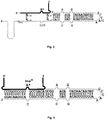
- the structure of the particularly preferred embodiment of the guide RNA according to the invention is in the Fig. 3 shown.
- the editing enzymes are primarily about hADAR enzymes, in particular the enzymes hADAR2 or hADAR1. Since both enzymes serve different substrates and are differently expanded in body tissues, can According to the invention, specific tissues or cells can be specifically controlled via the selection of the editing enzymes.
- nucleotide exchange achieved in this way, repairs of individual point mutations, such as, for example, those which lead to premature stop signals, can be carried out.
- the nucleotide exchange can be achieved at one or more sites on the target RNAs, so that multigenetic diseases can also be treated with the method according to the invention.
- therapy-relevant guide RNAs can either be targeted to the patient via individual doses, e.g. administered in affected organs or cells, or they can be permanently expressed via an installation in the cells or organs of the patient.
- the transfer of the therapeutic guide RNA can e.g. viral, as a stabilized mRNA or genetically encoded.
- the desired point mutations can be switched in a tissue-specific, inducible or reversible manner.
- the extent of editing can also be adjusted as required and adjusted depending on specific circumstances and therapy goals, so that editing can be achieved to a degree between 0 and 100%.
- the method according to the invention can be used for the treatment of neuronal diseases which are caused, for example, by single point mutations.
- the intrinsically present ADARs could be recruited for corrective RNA editing by simple administration or ectopic expression of small synthetic guide RNAs.
- a great advantage of the method according to the invention is that it uses endogenous, ie cell-specific, editing enzymes in order to introduce targeted point mutations into the RNA.
- the method is particularly simple and inexpensive because the constructs used can be coded, because there is no need to synthesize chemically stabilized guide RNAs: the guide RNA is encoded on a plasmid, transfected into the cell and formed by the cell itself.
- HEK 293T cells were used for the transfection of the guide RNA according to the invention. For each experiment, 1.75 ⁇ 10 ⁇ 5 cells were laid out in a 24-well plate format the day before the transfection. Plasmids specific to human cell lines were used for the experiments. Lipofectamine TM 2000 (Invitrogen) was used as a transfection reagent.
- the successful editing was shown in the microscope using the fluorescent GFP signal inside the cells. A positive editing result can be seen if the W58X GFP is edited and thus corrected. This means that successful editing in a microscope can be equated with fluorescent cells.
- the cells transfected with the plasmids mentioned above were analyzed in the fluorescence microscope and fluorescent cells were observed, which indicates successful editing.
- a positive control was analyzed in which the plasmid for the correct wild-type GFP was transfected instead of the plasmid for W58X GFP.
- fluorescent cells were observed in the positive control under the microscope.
- test part a) provided when using the Plasmids which code for the guide RNA with SEQ ID No. 1, an editing yield of 58% and with the guide RNA with SEQ ID No. 3 an editing yield of 38%.
- the guide RNA with SEQ ID No. 1 delivered an editing yield of 42% and the guide RNA with SEQ ID No. 3 delivered an editing yield of 58%.
- PINK1 gene is related to Parkinson's disease.
- the so-called R407Q mutation was edited in the "CAG" codon.
- the guide RNA constructed for this embodiment is shown in Fig. 6 displayed.
- the editing was analyzed using RNA isolation.
- the editing in the with all of the above Plasmid-transfected cells reached 35-40% at the target site.
- the W437X mutation was edited in the "TAG" codon. This enabled a disease-related phenotype (loss of mitophagy) to be repaired.
- the guide RNA constructed for this embodiment is shown in Fig. 7 displayed.
- the editing was analyzed using RNA isolation.
- the editing in the with all of the above Plasmid-transfected cells reached 30% at the target site.
- a PINK1 functionality assay was carried out in HeLa cells, in which the loss-of-function phenotype could only be restored (microscopic analysis) if hADAR2 and the guide RNA were transfected.
- the restoration of mitophagy in HeLa cells could be demonstrated under the microscope.
- the so-called W417X mutation was edited in the "TAG" codon.
- the guide RNA constructed for this embodiment is shown in Fig. 8 displayed.
- the editing of the W417X luciferase mRNA was analyzed by means of RNA isolation. Editing in all plasmids mentioned above transfected cells reached 48% at the target site. In the negative control, the plasmid with the specific guide RNA was omitted from the transfection. No editing was carried out in the negative control, which indicates the exclusivity of the guide RNA during editing.
- This gene is related to ALS (Amyotrophic lateral sclerosis), a fatal neurodegenerative disorder.
- the mutation of this gene is named R521H and contains a, CAC 'codon, while the functional FUS carries a, CGC' codon.
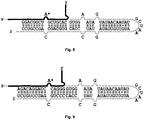
- the guide RNA constructed for this embodiment is shown in Fig. 9 displayed.
- the editing of this gene was carried out in the PCR reaction vessel.
- 350nM purified ADAR2 protein, 125 nM specific 16 nt long guide RNA and 25 nM of the mutated R521H FUS mRNA were used.
- the sequencing result shows that 51% of the adenosines have been successfully edited to inosine.
- the individual letters stand for: a for adenine, g for guanine, c for cytosine, u for uracil, s for a guanine or a cytosine, and m for an adenine or cytosine.
Landscapes
- Engineering & Computer Science (AREA)
- Health & Medical Sciences (AREA)
- Life Sciences & Earth Sciences (AREA)
- Genetics & Genomics (AREA)
- Biomedical Technology (AREA)
- Chemical & Material Sciences (AREA)
- Wood Science & Technology (AREA)
- Organic Chemistry (AREA)
- Biotechnology (AREA)
- General Engineering & Computer Science (AREA)
- Zoology (AREA)
- Bioinformatics & Cheminformatics (AREA)
- Molecular Biology (AREA)
- Microbiology (AREA)
- Plant Pathology (AREA)
- Biophysics (AREA)
- Biochemistry (AREA)
- General Health & Medical Sciences (AREA)
- Physics & Mathematics (AREA)
- Crystallography & Structural Chemistry (AREA)
- Micro-Organisms Or Cultivation Processes Thereof (AREA)
- Enzymes And Modification Thereof (AREA)
Description
- Die vorliegende Erfindung betrifft ein Verfahren und Substanzen zur gezielten Veränderung genetischer Information auf der RNA-Ebene.
- Das Nukleosid Adenosin kann enzymatisch desaminiert werden. Dabei entsteht Inosin, welches bei einer Translation wie Guanosin gelesen wird. Diese Nukleosid-Änderung wird als A-nach-I-Editierung bezeichnet und kann dazu verwendet werden, einzelne Punktmutationen in RNA einzufügen, um daraus resultierende Proteine gezielt zu verändern.
- Von den natürlich vorkommenden Enzymen hADARs (human adenosine deaminase acting on RNA) ist bekannt, dass sie Adenosin desaminieren können und dabei hoch promiskuitiv sind (5). So kann das Enzym hADAR2 tausende verschiedene Substrate erkennen und editieren, wobei als Substrat fast jede Doppelstrang-RNA mit einer Länge von mehr als 30 Basenpaaren dienen kann. Dennoch werden nur einige wenige Substrate hochselektiv und effizient editiert (7). Der Grund dafür scheint die Erkennung spezieller Sequenzen und Sekundärstrukturen durch die dsRBD (dsRNA binding domains) zu sein. ADAR2 hat zwei dsRBD (1&2) im N-Terminus. An Modelsubstraten, wie dem GluR2-Transkript, konnte gezeigt werden, dass die dsRBD1&2 an jeweils verschiedene Bereiche im GluR2-Transkript in definierten Modi binden (8,
Fig. 1 ). Am C-terminalen Ende von hADAR2 ist die Deaminase-Domäne platziert. - Aus dem Stand der Technik ist eine Methode bekannt, wie man ihre Enzymaktivität hoch-spezifisch und RNA-abhängig an neue Substrate lenken kann (1, 2, 4, 6, 9). Dabei werden die dsRBD-Proteindomänen durch ein so genanntes SNAP-tag ersetzt, an das eine speziell konstruierte guide-RNA kovalent gekoppelt ist. Durch diese speziell konstruierte anhängende guide-RNA wird das o.g. SNAP-tag-Konstrukt aktiviert.
- Bei einem anderen bekannten Verfahren wird dem natürlichen hADAR2 ein In-peptid angefügt und der guide-RNA ein BoxB-motif, um die Bindung zu ermöglichen (3).
- Ein großer Nachteil der aus dem Stand der Technik bekannten Verfahren besteht darin, dass sie nicht das natürlich vorkommende ADAR2 Enzym nutzen, sondern die mit dem SNAP-tag bzw. In-peptid modifizierte Enzymvariante. Ein weiterer Nachteil besteht darin, dass die guide-RNA chemisch veränderte Nukleotide, wie z.B. Benzylguanin (BG), enthält, die nicht genetisch kodierbar sind. Die guide-RNA muss deswegen bei diesen Verfahren zuerst in vitro hergestellt und erst dann in die Zelle transfiziert werden.
- Die Aufgabe der vorliegenden Erfindung ist es, ein Verfahren und Substanzen bereit zu stellen, mit denen es möglich ist, Punktmutationen in Genprodukte (RNA) effizient und reversibel einzubringen, ohne das kodierende Gen zu verändern.
- Diese Aufgabe wird durch die Bereitstellung von speziell konstruierten, genetisch kodierbaren guide-RNAs gelöst, die in der Lage sind, endogene Editierungsenzyme zu rekrutieren, um gezielt Punktmutationen in ausgesuchten RNAs einzubringen.
- Im Einzelnen enthält die erfindungsgemäße guide-RNA mindestens folgende aneinandergekoppelte Nukleotid-Segmente, vom 5'-Ende aufgelistet (
Fig. 2 ): - Segment A: Nukleotid-Sequenz mit einer Länge von drei bis fünf Basen, wobei in der Position 1 immer ein Guanosin und in der Position 2 immer ein Uridin steht;
- Segment B: Nukleotid-Sequenz mit einer Länge von drei bis fünf Basen, wobei in der Position 1 immer ein Adenosin steht;
- Segment C: Nukleotid-Sequenz mit einer Länge von acht bis zehn Basen, wobei in der Position 1 immer ein Guanosin steht;
- Segment D: Nukleotid-Sequenz UAUGCUAAAUG oder UAUGCUCAAUG;
- Segment E: Nukleotid-Sequenz mit einer Länge von acht bis zehn Basen, wobei in der letzten Position immer ein Guanosin steht;
- Segment F: Nukleotid-Sequenz mit einer Länge von drei bis fünf Basen, wobei in der letzten Position immer ein Cytosin steht;
- Segment G: Nukleotid-Sequenz mit einer Länge von drei bis fünf Basen, wobei in der vorletzten Position immer ein Adenosin und in der letzten Position ein Cytosin steht;
- Segment H: Nukleotid-Sequenz mit einer Länge von fünf bis neun Basen, wobei in der letzten Position immer ein Cytosin oder ein Uridin steht;
- Segment I: Nukleotid-Sequenz mit einer Länge von acht bis zwanzig Basen,
- Dabei paaren sich einzelne Nukleotide der Segmente A und G, B und F bzw. C und E zu einer Doppelhelix und die Nukleotide des Segments D bilden eine Haarnadelstruktur, wobei Segmente H und I so konstruiert sind, dass sie mit der zu editierenden mRNA paaren (
Fig. 2 ). - Das Segment A beträgt insbesondere die Länge von vier Nukleotiden und weist die Nukleotid-Sequenz GUGG auf.
- Das Segment B beträgt insbesondere die Länge von vier Nukleotiden und weist die Nukleotid-Sequenz AAUA auf.
- Das Segment C beträgt insbesondere die Länge von neun Nukleotiden und weist die Nukleotid-Sequenz GUAUAACAA auf.
- Das Segment E beträgt insbesondere die Länge von neuen Nukleotiden und weist die Nukleotid-Sequenz UUGUUAUAG auf.
- Das Segment F beträgt insbesondere die Länge von vier Nukleotiden und weist die Nukleotid-Sequenz UAUC auf.
- Das Segment G beträgt insbesondere die Länge von vier Nukleotiden und weist die Nukleotid-Sequenz CCAC auf.
- Die Segmente H und I sind so konstruiert, dass sie mit der Ziel-mRNA paaren und die zu editierende Zielbase in ein A:C Fehlpaar platzieren.
- In einer speziellen Ausführung der Erfindung wird der guide-RNA am 3'-Ende zur Stabilisierung zusätzlich eine Haarnadelstruktur, z.B. ein BoxB-Motiv, angehängt.
- Die Struktur der besonders bevorzugten Ausführung der erfindungsgemäßen guide-RNA ist in der
Fig. 3 dargestellt. - Bei den Editierungsenzymen geht es vor allem um hADAR-Enzyme, insbesondere um die Enzyme hADAR2 oder hADAR1. Da beide Enzyme unterschiedliche Substrate bedienen und unterschiedlich in Körpergeweben expimiert sind, können erfindungsgemäß über die Auswahl der Editierungsenzyme bestimmte Gewebe bzw. Zellen gezielt angesteuert werden.
- Mittels eines auf diese Weise erzielten Nukleotid-Austausches können Reparaturen einzelner Punktmutationen, wie beispielsweise solche, die zu vorzeitigen Stopp-Signalen führen, vorgenommen werden. Dabei kann der Nukleotid-Austausch an einem oder an mehreren Stellen der Ziel-RNAs erzielt werden, sodass auch multigenetische Krankheiten mit dem erfindungsgemäßen Verfahren behandelt werden können.
- Erfindungsgemäß können therapierelevante guide-RNAs entweder über einzelne Gaben an die Patienten gezielt, z.B. in betroffenen Organen oder Zellen verabreicht werden, oder sie können über eine Installation in den Zellen bzw. Organen des Patienten dauerhaft exprimiert werden. Die Übertragung der therapeutischen guide-RNA kann dabei z.B. viral, als stabilisierte mRNA oder genetisch codiert erfolgen. Die erwünschten Punktmutationen können dabei gewebespezifisch, induzierbar oder reversibel geschaltet werden. Ebenfalls kann das Ausmaß der Editierung nach Bedarf eingestellt und abhängig von konkreten Gegebenheiten und Therapiezielen angepasst werden, so dass eine Editierung zu einem Grad zwischen 0 und 100% erzielt werden kann.
- Da die ADAR-Deaminasen in Säugertieren insbesondere in Neuronen stark expimiert werden, kann das erfindungsgemäße Verfahren zur Behandlung von neuronalen Erkrankungen eingesetzt werden, die beispielsweise durch einzelne Punktmutationen hervorgerufen werden. Dabei könnte die intrinsisch vorhandenen ADARs durch eine einfache Gabe oder eine ektopische Expression von kleinen synthetischen guide-RNAs zu einer korrigierenden RNA-Editierung rekrutiert werden.
- Ein großer Vorteil des erfindungsgemäßen Verfahrens besteht darin, dass dabei endogene, d.h. zelleigene Editierungsenzyme verwendet werden, um gezielte Punktmutationen in die RNA einzubringen. Nur die kurze guide-RNA, die erfindungsgemäß zur Rekrutierung endogener Editierungsenzyme verwendet wird, muss für jede spezielle Fragestellung künstlich hergestellt und ektopisch exprimiert werden. Dadurch wird die gezielte Veränderung von Proteinen auf Translationsebene besonders einfach, so dass eine Korrektur krankheitsverursachender Punktmutationen ermöglicht wird. Im Vergleich zum Stand der Technik ist es beim erfindungsgemäßen Verfahren nicht notwendig, ein zusätzliches, körperfremdes Protein zu exprimieren, was insbesondere für die medizinische Anwendung von großem Vorteil ist. Auch die Effizienz ist höher und die unerwünschten Nebeneffekte geringer, weil nur ein statt zwei oder mehr Konstrukte an die Zielgewebe übertragen werden müssen.
- Das Verfahren ist wegen der Kodierbarkeit der verwendeten Konstrukte besonders einfach und günstig, denn die Synthese chemisch stabilisierter guide-RNAs entfällt: die guide-RNA wird auf einem Plasmid kodiert, in die Zelle transfiziert und von der Zelle selbst gebildet.
- Weitere Vorteile, Merkmale und Anwendungsmöglichkeiten der Erfindung werden nachstehend anhand der unten beschriebenen Ausführungsbeispiele mit Bezug auf die Figuren beschrieben.
- In den Figuren stellt die gestrichelte Linie die konstruierte erfindungsgemäße guide-RNA, die durchgezogene Linie die zu editierende Target-mRNA dar; das Sternchen markiert das zu editierende Nukleotid in der Target-mRNA. In den Figuren wird gezeigt:
-
Fig. 1 : Die Struktur eines natürlichen Editierungs-Motivs des GluR2-Transkriptes mit der gebundenen ADAR2, die eine Deaminase-Domäne und zwei dsRNA-Bindedomänen (dsRBD1 und dsRBD2) aufweist. -
Fig. 2 : Die allgemeine Struktur der erfindungsgemäßen guide-RNA. Die Buchstaben A bis I markieren die einzelnen Segmente der guide-RNA; -
Fig. 3 : Die Struktur der bevorzugten Ausführung der erfindungsgemäßen guide-RNA; -
Fig. 4 : Die Struktur der konstruierten guide-RNA für die zielgerichtete Editierung von W58X-Stop-Codon im GFP-Gen als Ausführungsbeispiel nach der SEQ ID NO 1; -
Fig. 5 : Die Struktur der konstruierten guide-RNA für die zielgerichtete Editierung von W58X-Stop-Codon im GFP-Gen als Ausführungsbeispiel nach der SEQ ID NO 3. -
Fig. 6 : Die Struktur der konstruierten guide-RNA für die zielgerichtete Editierung der R407Q Mutation im "CAG" Codon im PINK1-Gen als Ausführungsbeispiel; -
Fig. 7 : Die Struktur der konstruierten guide-RNA für die zielgerichtete Editierung der W437X Mutation im "UAG" Codon im PINK1-Gen als Ausführungsbeispiel; -
Fig. 8 : Die Struktur der konstruierten guide-RNA für die zielgerichtete Editierung der W417X Mutation im "UAG" Codon im Luciferase-Gen als Ausführungsbeispiel; -
Fig. 9 : Die Struktur der konstruierten guide-RNA für die zielgerichtete Editierung einer krankheitsrelevanten Mutation R521H im "CAC" Codon im FUS-Gen als Ausführungsbeispiel. - Für die Transfektion der erfindungsgemäßen guide-RNA wurden HEK 293T Zellen verwendet. Für jedes Experiment wurden in einem 24-well-Plattenformat 1,75∗10^5 Zellen am Tag vor der Transfektion ausgelegt. Es wurden Plasmide für die Versuche verwendet, die für humane Zelllinien spezifisch sind. Lipofectamine™ 2000 (Invitrogen) wurde als Transfektionsreagenz eingesetzt.
- Bei dem W58X handelt es sich um eine Mutation im Codon "TGG", die zum Stop-Codon "TAG" führt. Die für dieses Ausführungsbeispiel konstruierten guide-RNAs sind in
Fig. 4 undFig. 5 abgebildet. - a) Standard HEK293T-Zellen wie oben beschrieben
- b) HEK293T-Zellen mit induzierbarer ADAR2 Protein Expression (genomisch integriertes ADAR2). Diese integrierte Zelllinie, bei der ADAR2 induziert wird, hat eine ca. 20-fach geringere Expression des Proteins als die Zellen in vorhergehenden Beispielen, die ADAR2 nach einer Transfektion mit je 300 ng Plasmid exprimieren. Die intrazellulären Konzentrationen des ADAR2-Proteins entsprechen somit in diesem Beispiel mehr denen, die in einer natürlichen Zelle vorzufinden sind.
- a) Die Zellen wurden mit folgenden Plasmiden co-transfiziert:
- 300 ng Plasmid, das für W58X kodiert. Das Plasmid ist ein pcDNA3.1 Vektor, der einen CMV-Promotor für die Genexpression von W58X enthält;
- 300 ng Plasmid, das für hADAR2 kodiert. Das Plasmid ist ein pcDNA3.1 Vektor, der einen CMV-Promotor für die Genexpression von hADAR2 enthält;
- 1600 ng Plasmid, das für die guide-RNA kodiert. Das Plasmid ist ein 2.1-U6 hygro Vektor, der einen U6 Promotor für die Transkription der guide-RNA enthält.
- b) Die Zellen wurden mit folgendem Plasmid co-transfiziert und mit Doxycyclin die hADAR2Expression induziert:
- 1300 ng Plasmid, das für die guide-RNA kodiert.
- Die Beurteilung, ob die Editierung der W58X GFP mRNA stattgefunden hatte, erfolgte sowohl mikroskopisch als auch anhand von RNA-Isolierung.
- Im Mikroskop wurde die erfolgreiche Editierung anhand von fluoreszierendem GFP-Signal innerhalb der Zellen gezeigt. Ein positives Editierungs-Ergebnis ist zu sehen, wenn das W58X GFP editiert und damit korrigiert wird. Dadurch ist eine erfolgreiche Editierung im Mikroskop mit fluoreszierenden Zellen gleichzusetzen.
- Es wurden in verschiedenen unabhängigen Experimenten die mit den oben genannten Plasmiden transfizierten Zellen im Fluoreszenzmikroskop analysiert und es konnten fluoreszierende Zellen beobachtet werden, was auf eine erfolgreiche Editierung hindeutet. Zusätzlich wurde eine Positivkontrolle analysiert, bei der anstelle des Plasmids für W58X GFP das Plasmid für das korrekte Wildtyp-GFP transfiziert wurde. Wie erwartet, konnten bei der Positivkontrolle im Mikroskop fluoreszierende Zellen beobachtet werden.
- Als Negativkontrolle wurden dieselben Experimente durchgeführt, wobei entweder das Plasmid, das für die guide-RNA kodiert, oder das Plasmid, das für das ADAR2 Enzym kodiert, weggelassen wurde. Im Fluoreszenzmikroskop war dabei kein GFP, d.h. keine positive Editierung nachweisbar. Auch in der Sequenzierung dieser RNA-Isolationsproben war keine Editierung nachweisbar, was auf die Spezifität dieses Verfahrens hindeutet.
- Bei der Analyse der isolierten RNA erfolgte zunächst eine reverse Transkription zur cDNA, die im Anschluss durch PCR (Polymerase-Kettenreaktion) vervielfältigt wurde, um dann sequenziert zu werden. Das Verhältnis von Adenin zu Guanin in den Sequenzier-Spuren an der Zielstelle gab darüber Auskunft, wie stark die Editierung erfolgte. Im Vergleich zu Negativkontrollen war das Verhältnis von Adenin zu Guanin im Experiment in den mit den oben genannten Plasmiden transfizierten Zellen um einiges höher, was auf eine erfolgreiche Editierung hindeutet. Die Durchführung von Versuchsteil a) lieferte bei der Verwendung des Plasmides, das für die guide-RNA mit der SEQ ID Nr. 1 kodiert, eine Editingausbeute von 58% und mit der guide-RNA mit der SEQ ID Nr. 3 eine Editingausbeute von 38%. Bei der Versuchsdurchführung von Teil b) lieferte die guide-RNA mit der SEQ ID Nr. 1 eine Editingausbeute von 42% und die guide-RNA mit der SEQ ID Nr. 3 eine Editingausbeute von 58%.
- PINK1-Gen steht im Zusammenhang mit der Parkinson Krankheit. In diesem Ausführungsbeispiel wurde die sog. R407Q Mutation im "CAG" Codon editiert.
- Die für dieses Ausführungsbeispiel konstruierte guide-RNA ist in
Fig. 6 abgebildet. - Die Zellen wurden mit folgenden Plasmiden co-transfiziert:
- 300 ng Plasmid, das für PINK1 R407Q kodiert. Das Plasmid ist ein pcDNA3.1 Vektor, mit einem CMV-Promotor für die Genexpression;
- 300 ng Plasmid, das für hADAR2 kodiert;
- 1600 ng Plasmid, das für die guide-RNA kodiert.
- Die Analyse der Editierung erfolgte mittels RNA-Isolierung. Die Editierung in den mit allen o.g. Plasmiden transfizierten Zellen erreichte 35-40% an der Zielstelle. Im anderen Ausführungsbeispiel wurde die W437X Mutation im "TAG" Codon editiert. Dadurch konnte ein krankheitsrelevanter Phänotyp (Verlust der Mitophagie) repariert werden.
- Die für dieses Ausführungsbeispiel konstruierte guide-RNA ist in
Fig 7 abgebildet. - Die Zellen wurden mit folgenden Plasmiden co-transfiziert:
- 300 ng Plasmid, das für PINK1 W437X kodiert. Das Plasmid ist ein pcDNA3.1 Vektor, mit einem CMV-Promotor für die Genexpression;
- 300 ng Plasmid, das für hADAR2 kodiert;
- 1600 ng Plasmid, das für die guide-RNA kodiert.
- Die Analyse der Editierung erfolgte mittels RNA-Isolierung. Die Editierung in den mit allen o.g. Plasmiden transfizierten Zellen erreichte 30% an der Zielstelle. Zusätzlich wurde ein PINK1 Funktionalitätsassay in HeLa Zellen durchgeführt, bei dem der loss-of-function Phänotyp nur dann wiederhergestellt werden konnte (mikroskopische Analyse), wenn hADAR2 und die guide-RNA transfiziert wurden. Die Wiederherstellung der Mitophagie in HeLa Zellen konnte im Mikroskop nachgewiesen werden.
- In diesem Ausführungsbeispiel wurde die sog. W417X-Mutation im "TAG" Codon editiert. Die für dieses Ausführungsbeispiel konstruierte guide-RNA ist in
Fig. 8 abgebildet. - Die Zellen wurden mit folgenden Plasmiden co-transfiziert:
- 300 ng Plasmid, das für W417X Luciferase kodiert. Das Plasmid ist ein pcDNA3.1 Vektor, mit einem CMV-Promotor für die Genexpression;
- 300 ng Plasmid, das für hADAR2 kodiert;
- 1600 ng Plasmid, das für die guide-RNA kodiert
- Die Analyse der Editierung der W417X Luciferase mRNA wurde mittels RNA-Isolierung durchgeführt. Die Editierung in den mit allen o.g. Plasmiden transfizierten Zellen erreichte 48% an der Zielstelle. In der Negativkontrolle wurde das Plasmid mit der spezifischen guide-RNA bei der Transfektion weggelassen. Bei der Negativkontrolle erfolgte keine Editierung, was auf die Ausschließlichkeit der guide-RNA bei der Editierung hindeutet.
- Dieses Gen steht im Zusammenhang von ALS (Amyotrophic lateral sclerosis), einer tödlichen neuro-degenerativen Funktionsstörung. Die Mutation dieses Gens wird als R521H benannt und beinhaltet ein ,CAC' Codon, während das funktionale FUS ein ,CGC' Codon trägt.
- Die für dieses Ausführungsbeispiel konstruierte guide-RNA ist in
Fig. 9 abgebildet. - Die Editierung dieses Gens wurde im PCR-Reaktionsgefäß durchgeführt. Hierzu wurden 350nM gereinigtes ADAR2 Protein, 125 nM spezifischen 16 nt langen guide-RNA und 25 nM der mutierten R521H FUS mRNA eingesetzt. Das Sequenzier-Ergebnis zeigt, dass 51% der Adenosine erfolgreichzu Inosin editiert wurden.
- Es wurden sechs verschiedene Gene editiert (β-actin, GAPDH, GPI, GUSB, VCP, RAB7A), die unterschiedlich stark endogen expremiert werden. Hierbei handelt es sich nicht um krankheitsrelevante Mutationen, die adressiert wurden, sondern um eine Darstellung der Erreichbarkeit natürlich expremierter mRNAs. Für die Transfektion wurden folgende Zellen verwendet:
- a) standard HEK293T-Zellen(wie oben) und
- b) HEK-Zellenmit induzierbarer ADAR2 Protein Expression (genomisch integriertes ADAR2). Diese integrierte Zelllinie, bei der ADAR2 induziert wird, hat eine ca. 20-fach geringere Expression des Proteins als die Zellen in vorhergehenden Beispielen, die ADAR2 nach einer Transfektion mit je 300 ng Plasmid exprimieren. Die intrazellulären Konzentrationen des ADAR2-Proteins entsprechen somit in diesem Beispiel mehr denen, die in einer natürlichen Zelle vorzufinden sind.
- Die guide-RNA Strukturen, des flexiblen Teils H + I für die jeweiligen Zielgene sind in Tabelle 2 angegeben.
Tabelle 2: Liste der guideRNAs, die für die Editierung endogener Zielgene verwendet wurden. Name der guideRNA Sequenz von H+I 5'→3' TAG#1 β-Actin ACGCAACCAAGUCAUA TAG#3 β-Actin GCAAUGCCAUCACCUC TAG#1 GAPDH AGGGGUCCACAUGGCA TAG#2 GAPDH GGCUCCCCAGGCCCCU TAG#1 GPI UGCCGUCCACCAGGAU TAG#1 GusB CAGAUUCCAGGUGGGA TAG#2 GusB UCCCUGCCAGAAUAGA TAG#1 VCP CUCCGCCCACCAAAUG TAG#2 VCP CCCAAACCACAACAGA TAG#3 VCP ACCCACCCACCCAGGU TAG#1 RAB7A CUGCCGCCAGCUGGAU TAG#2 RAB7A AGGGAACCAGACAGUU - a) Die Zellen wurden mit folgenden Plasmiden co-transfiziert:
- 300 ng Plasmid, das für hADAR2 kodiert;
- 1300 ng Plasmid, das für die guide-RNA kodiert.
Die Analyse der Editierung erfolgte mittels RNA-Isolierung. Das Verhältnis von Adenin zu Guanin bei den mit diesen Plasmiden transfizierten Zellen war um einiges höher als in den Negativkontrollen, was auf eine erfolgreiche Editierung hindeutet. - b) Die Zellen wurden mit folgendem Plasmid co-transfiziert und mit Doxycyclin die hADAR2 Expression induziert:
- 1300 ng Plasmid, das für die guide-RNA kodiert.
- Die Analyse der Editierung erfolgte mittels RNA-Isolierung. Das Verhältnis von Adenin zu Guanin bei den mit diesen Plasmiden transfizierten Zellen war um einiges höher als in den Negativkontrollen, was auf eine erfolgreiche Editierung hindeutet.
Gen Versuchsteil a) Versuchsteil b) β-Actin TAG#1 26% 16% TAG#3 24% 14% GAPDH TAG#1 19% 10% TAG#2 20% 11% GPI TAG#1 16% 12% GUSB TAG#1 10% 10% TAG#2 23% 18% VCP TAG#1 23% 23% TAG#2 16% 15% TAG#3 12% 13% RAB7A TAG#1 31% 38% TAG#2 28% 35% -
- 1) T. Stafforst, M. F. Schneider; Ein RNA-Deaminase-Konjugat ermöglicht die selektive Reparatur von Punktmutationen. Angew. Chem. 2012, 124, 11329-32.
- 2) Marius F. Schneider, Jacqueline Wettengel, Patrick C. Hoffmann and Thorsten Stafforst; Optimal guideRNAs for re-directing deaminase activity of hADAR1 and hADAR2 in trans. Nucleic Acids Research, 2014, Vol. 42, No. 10 e87
- 3) Montiel-Gonzales M.F., Vallecillo-Viejo, I., Yudowski, G.A. and Rosenthal, J.J. (2013) Correction of mutations within the cystic fibrosis transmembrane conductance regulator by site-directed RNA editing. Proceedings of the National Academy of Sciences of the United States of America, 110, 18285-18290
- 4) Vogel, P. and Stafforst, T. (2014) Site-directed RNA editing with antagomir deaminases - a tool to study protein and RNA function. ChemMedChem, 9, 2021-2025.
- 5) Nishikura, K. (2010) Functions and regulation of RNA editing by ADAR deaminases. Annual review of biochemistry, 79, 321.
- 6) Vogel, P., Schneider, M.F., Wettengel, J. and Stafforst, T. (2014) Improving site-directed RNA editing in vitro and in cell culture by chemical modification of the guideRNA. Angewandte Chemie, 53, 6267-6271.
- 7) Bass, B.L. (2002) RNA editing by adenosine deaminases that act on RNA. Annual review of biochemistry, 71, 817.
- 8) Stefl, R., Oberstrass, F.C., Hood, J.L., Jourdan, M., Zimmermann, M., Skrisovska, L., Maris, C., Peng, L., Hofr, C. and Emeson, R.B. (2010) The solution structure of the ADAR2 dsRBM-RNA complex reveals a sequencespecific readout of the minor groove. Cell, 143, 225-237.
- 9) Hanswillemenke, A., Kuzdere, T., Vogel, P., Jékely, G. and Stafforst, T. (2015) Site-Directed RNA Editing in Vivo can be Triggered by the Light-Driven Assembly of an Artificial Riboprotein. Journal of the American Chemical Society, 137, 15875-15881.
-
- <110> Eberhard Karls Universität Tübingen
- <120> Verfahren und Substanzen zur gerichteten RNA-Editierung
- <130>
- <150>
DE 10 2015 012 522 - <151> 26.09.2015
- <160> 7
- <210> SEQ ID NO: 1
<211> 44
<212> RNA
<213> künstliche Sequenz - <400> 1
guggauagua uaacaauaug cumaauguug uuauaguauc ccac 44 - <110> Eberhard Karls Universität Tübingen
- <120> Verfahren und Substanzen zur gerichteten RNA-Editierung
- <130>
- <150>
DE 10 2015 012 522
<151> 26.09.2015 - <160> 7
- <210> SEQ ID NO: 2
<211> 45
<212> RNA
<213> künstliche Sequenz - <400> 1
guggasssgs asascaauau gcumaauguu gsususgsss cccac 45 - <110> Eberhard Karls Universität Tübingen
- <120> Verfahren und Substanzen zur gerichteten RNA-Editierung
- <130>
- <150>
DE 10 2015 012 522 - <151> 26.09.2015
- <160> 7
- <210> SEQ ID NO: 3
<211> 45
<212> RNA
<213> künstliche Sequenz - <400> 1
guggaasags asaacaauau gcumaauguu guususgusu cccac 45 - <110> Eberhard Karls Universität Tübingen
- <120> Verfahren und Substanzen zur gerichteten RNA-Editierung
- <130>
- <150>
DE 10 2015 012 522
<151> 26.09.2015 - <160> 7
- <210> SEQ ID NO: 4
<211> 44
<212> RNA
<213> künstliche Sequenz - <400> 1
guggasasua uaacaauaug cumaauguug uuauagyayc ccac 44 - <110> Eberhard Karls Universität Tübingen
- <120> Verfahren und Substanzen zur gerichteten RNA-Editierung
- <130>
- <150>
DE 10 2015 012 522 - <151> 26.09.2015
- <160> 7
- <210> SEQ ID NO: 5
<211> 45
<212> RNA
<213> künstliche Sequenz - <400> 1
guggasssgs sssssssuau gcumaaugss ssssssgsss cccac 45 - <110> Eberhard Karls Universität Tübingen
- <120> Verfahren und Substanzen zur gerichteten RNA-Editierung
- <130>
- <150>
DE 10 2015 012 522 - <151> 26.09.2015
- <160> 7
- <210> SEQ ID NO: 6
<211> 45
<212> RNA
<213> künstliche Sequenz - <400> 1
guggaassgs asascaauau gcumaauguu gsususgssu cccac 45 - <110> Eberhard Karls Universität Tübingen
- <120> Verfahren und Substanzen zur gerichteten RNA-Editierung
- <130>
- <150>
DE 10 2015 012 522 - <151> 26.09.2015
- <160> 7
- <210> SEQ ID NO: 7
<211> 46
<212> RNA
<213> künstliche Sequenz - <400> 1
guggsauagu auaacaauau gcumaauguu guuauagüau scccac 46 - Die einzelnen Buchstaben stehen für: a für Adenin, g für Guanin, c für Cytosin, u für Uracil, s für ein Guanin oder ein Cytosin, und m für ein Adenin oder Cytosin.
Claims (14)
- Guide-RNA zur gerichteten RNA-Editierung mit mindestens folgenden aneinandergekoppelten Nukleotid-Segmenten, vom 5'-Ende aufgelistet:- Segment A: Nukleotid-Sequenz mit einer Länge von drei bis fünf Basen, wobei in der Position 1 immer ein Guanosin und in der Position 2 immer ein Uridin steht;- Segment B: Nukleotid-Sequenz mit einer Länge von drei bis fünf Basen, wobei in der Position 1 immer ein Adenosin steht;- Segment C: Nukleotid-Sequenz mit einer Länge von acht bis zehn Basen, wobei in der Position 1 immer ein Guanosin steht;- Segment D: Nukleotid-Sequenz UAUGCUAAAUG oder UAUGCUCAAUG;- Segment E: Nukleotid-Sequenz mit einer Länge von acht bis zehn Basen, wobei in der letzten Position immer ein Guanosin steht;- Segment F: Nukleotid-Sequenz mit einer Länge von drei bis fünf Basen, wobei in der letzten Position immer ein Cytosin steht;- Segment G: Nukleotid-Sequenz mit einer Länge von drei bis fünf Basen, wobei in der vorletzten Position immer ein Adenosin und in der letzten Position ein Cytosin steht;- Segment H: Nukleotid-Sequenz mit einer Länge von fünf bis neun Basen, wobei in der letzten Position immer ein Cytosin oder ein Uridin steht;- Segment I: Nukleotid-Sequenz mit einer Länge von acht bis zwanzig Basen,wobei einzelne Nukleotide der Segmente A und G, B und F bzw. C und E sich jeweils zu einer Doppelhelix paaren und die Nukleotide des Segments D eine Haarnadelstruktur bilden, und
wobei Segmente H und I so konstruiert sind, dass sie mit der zu editierenden mRNA paaren. - Guide-RNA nach Anspruch 1, wobei Segment A die Länge von vier Nukleotiden, insbesondere die Nukleotid-Sequenz GUGG aufweist.
- Guide-RNA nach mindestens einem der vorhergehenden Ansprüche, wobei Segment B die Länge von vier Nukleotiden, insbesondere die Nukleotid-Sequenz AAUA aufweist.
- Guide-RNA nach mindestens einem der vorhergehenden Ansprüche, wobei Segment C die Länge von neun Nukleotiden, insbesondere die Nukleotid-Sequenz GUAUAACAA aufweist.
- Guide-RNA nach mindestens einem der vorhergehenden Ansprüche, wobei Segment E die Länge von neun Nukleotiden, insbesondere die Nukleotid-Sequenz UUGUUAUAG aufweist.
- Guide-RNA nach mindestens einem der vorhergehenden Ansprüche, wobei Segment F die Länge von vier Nukleotiden, insbesondere die Nukleotid-Sequenz UAUC aufweist.
- Guide-RNA nach mindestens einem der vorhergehenden Ansprüche, wobei Segment G die Länge von vier Nukleotiden, insbesondere die Nukleotid-Sequenz CCAC aufweist.
- Guide-RNA nach mindestens einem der vorhergehenden Ansprüche, wobei Segmente H und I so konstruiert sind, dass sie die zu editierende Base in ein A:C Fehlpaar platzieren.
- Guide-RNA nach mindestens einem der vorhergehenden Ansprüche, wobei am 3'-Ende eine Haarnadelstruktur, insbesondere ein BoxB-Motiv, angehängt ist.
- Guide-RNA nach mindestens einem der vorhergehenden Ansprüche zur Verwendung als Arzneimittel, wobei die Guide-RNA in die Zellen transfiziert wird, in denen die RNA-Editierung vorgenommen werden soll.
- Guide-RNA zur Verwendung nach Anspruch 10, wobei die Transfektion mittels eines Plasmids erfolgt, welches für die guide-RNA sowie mindestens einen U6-Promotor für die Transkription der guide-RNA kodiert.
- Guide-RNA zur Verwendung nach einem der Ansprüche 10 oder 11 zur gezielten Veränderung genetischer Information auf der RNA-Ebene, bevorzugt für Reparaturen einzelner Punktmutationen.
- In-vitro-Verfahren zur gerichteten RNA-Editierung, bei dem die Guide-RNA nach mindestens einem der Ansprüche 1 bis 9 wie in einem der Ansprüche 10 oder 11 definiert in die Zellen transfiziert wird.
- Verwendung der Guide-RNA nach einem der Ansprüche 1 bis 9 in vitro zur gezielten Veränderung genetischer Information auf der RNA-Ebene, bevorzugt für Reparaturen einzelner Punktmutationen.
Applications Claiming Priority (2)
| Application Number | Priority Date | Filing Date | Title |
|---|---|---|---|
| DE102015012522.2A DE102015012522B3 (de) | 2015-09-26 | 2015-09-26 | Verfahren und Substanzen zur gerichteten RNA-Editierung |
| PCT/DE2016/000309 WO2017050306A1 (de) | 2015-09-26 | 2016-08-09 | Verfahren und substanzen zur gerichteten rna-editierung |
Publications (2)
| Publication Number | Publication Date |
|---|---|
| EP3353299A1 EP3353299A1 (de) | 2018-08-01 |
| EP3353299B1 true EP3353299B1 (de) | 2020-03-04 |
Family
ID=55968076
Family Applications (1)
| Application Number | Title | Priority Date | Filing Date |
|---|---|---|---|
| EP16766834.2A Active EP3353299B1 (de) | 2015-09-26 | 2016-08-09 | Verfahren und substanzen zur gerichteten rna-editierung |
Country Status (5)
| Country | Link |
|---|---|
| US (1) | US20190093098A1 (de) |
| EP (1) | EP3353299B1 (de) |
| DE (1) | DE102015012522B3 (de) |
| DK (1) | DK3353299T3 (de) |
| WO (1) | WO2017050306A1 (de) |
Cited By (6)
| Publication number | Priority date | Publication date | Assignee | Title |
|---|---|---|---|---|
| US11274300B2 (en) | 2017-01-19 | 2022-03-15 | Proqr Therapeutics Ii B.V. | Oligonucleotide complexes for use in RNA editing |
| US11827880B2 (en) | 2019-12-02 | 2023-11-28 | Shape Therapeutics Inc. | Therapeutic editing |
| US11851656B2 (en) | 2016-09-01 | 2023-12-26 | Proqr Therapeutics Ii B.V. | Chemically modified single-stranded RNA-editing oligonucleotides |
| US11866702B2 (en) | 2018-03-27 | 2024-01-09 | University Of Rochester | Nucleic acid molecules for pseudouridylation |
| US12018257B2 (en) | 2016-06-22 | 2024-06-25 | Proqr Therapeutics Ii B.V. | Single-stranded RNA-editing oligonucleotides |
| US12275937B2 (en) | 2018-05-18 | 2025-04-15 | Proqr Therapeutics Ii B.V. | Stereospecific linkages in RNA editing oligonucleotides |
Families Citing this family (43)
| Publication number | Priority date | Publication date | Assignee | Title |
|---|---|---|---|---|
| ES2810375T3 (es) | 2014-12-17 | 2021-03-08 | Proqr Therapeutics Ii Bv | Edición direccionada de ARN |
| JP6624743B2 (ja) * | 2015-07-14 | 2019-12-25 | 学校法人福岡大学 | 部位特異的rna変異導入方法およびそれに使用する標的編集ガイドrnaならびに標的rna−標的編集ガイドrna複合体 |
| CN118416088A (zh) | 2017-03-03 | 2024-08-02 | 加利福尼亚大学董事会 | 经由抑制性tRNAs和脱氨酶对突变进行RNA靶向 |
| US20200291383A1 (en) * | 2017-10-06 | 2020-09-17 | Oregon Health & Science University | Compositions and methods for editing rna |
| WO2019111957A1 (ja) * | 2017-12-06 | 2019-06-13 | 学校法人福岡大学 | オリゴヌクレオチド、その製造方法及び標的rnaの部位特異的編集方法 |
| JP7347830B2 (ja) | 2018-06-29 | 2023-09-20 | エバーハルト カール ウニヴェルジテート テュービンゲン | Rna編集のための人工核酸 |
| EP4527931A1 (de) * | 2018-10-12 | 2025-03-26 | Peking University | Verfahren und zusammensetzungen zur bearbeitung von rnas |
| JP2022519184A (ja) | 2019-01-22 | 2022-03-22 | コロ バイオ, インコーポレイテッド | Rna編集オリゴヌクレオチド及びその使用 |
| CA3126947A1 (en) | 2019-01-22 | 2020-07-30 | Korro Bio, Inc. | Rna-editing oligonucleotides and uses thereof |
| CA3127243A1 (en) | 2019-01-22 | 2020-07-30 | Korro Bio, Inc. | Rna-editing oligonucleotides and uses thereof |
| PH12021552613A1 (en) * | 2019-04-15 | 2022-06-27 | Edigene Therapeutics Beijing Inc | METHODS AND COMPOSITIONS FOR EDITING RNAs |
| CN114269919B (zh) | 2019-07-12 | 2023-08-18 | 北京大学 | 采用工程化rna利用内源adar进行靶向的rna编辑 |
| US20220275359A1 (en) | 2019-08-01 | 2022-09-01 | Astellas Pharma Inc. | Guide rna for editing target, with functional nucleotide sequence added |
| JP7754721B2 (ja) | 2019-12-09 | 2025-10-15 | アステラス製薬株式会社 | 標的rnaを編集するための機能性領域を付加したアンチセンス型ガイドrna |
| US20240247258A1 (en) * | 2020-03-12 | 2024-07-25 | Frest Inc. | Oligonucleotide and target rna site-specific editing method |
| WO2021216853A1 (en) * | 2020-04-22 | 2021-10-28 | Shape Therapeutics Inc. | Compositions and methods using snrna components |
| WO2022078569A1 (en) | 2020-10-12 | 2022-04-21 | Eberhard Karls Universität Tübingen | Artificial nucleic acids for rna editing |
| IL278401A (en) | 2020-10-29 | 2022-05-01 | Yeda Res & Dev | Polynucleotides for editing RNA and a method for using them |
| US20240150754A1 (en) | 2020-12-25 | 2024-05-09 | Astellas Pharma Inc. | Guide rna for editing polyadenylation signal sequence of target rna |
| GB202107553D0 (en) * | 2021-05-27 | 2021-07-14 | Univ Oxford Innovation Ltd | Method |
| US20250154504A1 (en) | 2022-02-14 | 2025-05-15 | Proqr Therapeutics Ii B.V. | Guide oligonucleotides for nucleic acid editing in the treatment of hypercholesterolemia |
| EP4555086A1 (de) | 2022-07-15 | 2025-05-21 | ProQR Therapeutics II B.V. | Oligonukleotide zur adar-vermittelten rna-editierung und verwendung davon |
| EP4555085A1 (de) | 2022-07-15 | 2025-05-21 | ProQR Therapeutics II B.V. | Chemisch modifizierte oligonukleotide zur adar-vermittelten rna-editierung |
| GB202215614D0 (en) | 2022-10-21 | 2022-12-07 | Proqr Therapeutics Ii Bv | Heteroduplex rna editing oligonucleotide complexes |
| WO2024110565A1 (en) | 2022-11-24 | 2024-05-30 | Proqr Therapeutics Ii B.V. | Antisense oligonucleotides for the treatment of hereditary hfe-hemochromatosis |
| GB202218090D0 (en) | 2022-12-01 | 2023-01-18 | Proqr Therapeutics Ii Bv | Antisense oligonucleotides for the treatment of aldehyde dehydrogenase 2 deficiency |
| CN120322556A (zh) | 2022-12-09 | 2025-07-15 | ProQR治疗上市公司Ⅱ | 用于治疗心血管疾病的反义寡核苷酸 |
| GB202300865D0 (en) | 2023-01-20 | 2023-03-08 | Proqr Therapeutics Ii Bv | Delivery of oligonucleotides |
| WO2024175550A1 (en) | 2023-02-20 | 2024-08-29 | Proqr Therapeutics Ii B.V. | Antisense oligonucleotides for the treatment of atherosclerotic cardiovascular disease |
| JP2026510408A (ja) | 2023-03-24 | 2026-04-02 | プロキューアール セラピューティクス ツー ベスローテン フェンノートシャップ | 神経障害の処置のためのアンチセンスオリゴヌクレオチド |
| GB202304363D0 (en) | 2023-03-24 | 2023-05-10 | Proqr Therapeutics Ii Bv | Chemically modified antisense oligonucleotides for use in RNA editing |
| CN121002181A (zh) | 2023-03-27 | 2025-11-21 | ProQR治疗上市公司Ⅱ | 用于治疗肝脏疾病的反义寡核苷酸 |
| AR132964A1 (es) | 2023-06-16 | 2025-08-13 | Proqr Therapeutics Ii Bv | Oligonucleótidos antisentido para el tratamiento de enfermedades neurodegenerativas |
| WO2025051946A1 (en) | 2023-09-07 | 2025-03-13 | Proqr Therapeutics Ii B.V. | Antisense oligonucleotides for the treatment of metabolic disorders |
| AU2024379264A1 (en) | 2023-11-16 | 2026-05-14 | Proqr Therapeutics Ii B.V. | Antisense oligonucleotides for the treatment of classic galactosemia |
| WO2025132708A1 (en) | 2023-12-20 | 2025-06-26 | Proqr Therapeutics Ii B.V. | Antisense oligonucleotides for the treatment of huntington's disease |
| GB202404661D0 (en) | 2024-04-02 | 2024-05-15 | Proqr Therapeutics Ii Bv | Antisense oligoncleotides for the treatment of liver disease |
| WO2025224230A1 (en) | 2024-04-25 | 2025-10-30 | Proqr Therapeutics Ii B.V. | Antisense oligonucleotides for the treatment of fatty liver disease |
| GB202410081D0 (en) | 2024-07-11 | 2024-08-28 | Proqr Therapeutics Ii Bv | Antisense oligonucleotides for the treatment of cardiovascular disease |
| WO2026022136A1 (en) | 2024-07-23 | 2026-01-29 | Proqr Therapeutics Ii B.V. | Antisense oligonucleotides for the treatment of metabolic disorders |
| WO2026060374A2 (en) | 2024-09-16 | 2026-03-19 | Proqr Therapeutics Ii B.V. | Antisense oligonucleotides for the treatment of neurological disorders |
| WO2026068781A1 (en) | 2024-09-30 | 2026-04-02 | Proqr Therapeutics Ii B.V. | Antisense oligonucleotides for the treatment of liver disease |
| WO2026093339A1 (en) | 2024-10-29 | 2026-05-07 | Proqr Therapeutics Ii B.V. | Antisense oligonucleotides for the treatment of peroxisome biogenesis disorders in the zellweger spectrum (pbd-zsd) |
Citations (2)
| Publication number | Priority date | Publication date | Assignee | Title |
|---|---|---|---|---|
| WO2016097212A1 (en) | 2014-12-17 | 2016-06-23 | Proqr Therapeutics Ii B.V. | Targeted rna editing |
| US9650627B1 (en) | 2012-07-19 | 2017-05-16 | University Of Puerto Rico | Site-directed RNA editing |
Family Cites Families (1)
| Publication number | Priority date | Publication date | Assignee | Title |
|---|---|---|---|---|
| JP6624743B2 (ja) * | 2015-07-14 | 2019-12-25 | 学校法人福岡大学 | 部位特異的rna変異導入方法およびそれに使用する標的編集ガイドrnaならびに標的rna−標的編集ガイドrna複合体 |
-
2015
- 2015-09-26 DE DE102015012522.2A patent/DE102015012522B3/de active Active
-
2016
- 2016-08-09 DK DK16766834.2T patent/DK3353299T3/da active
- 2016-08-09 EP EP16766834.2A patent/EP3353299B1/de active Active
- 2016-08-09 US US15/763,351 patent/US20190093098A1/en active Pending
- 2016-08-09 WO PCT/DE2016/000309 patent/WO2017050306A1/de not_active Ceased
Patent Citations (2)
| Publication number | Priority date | Publication date | Assignee | Title |
|---|---|---|---|---|
| US9650627B1 (en) | 2012-07-19 | 2017-05-16 | University Of Puerto Rico | Site-directed RNA editing |
| WO2016097212A1 (en) | 2014-12-17 | 2016-06-23 | Proqr Therapeutics Ii B.V. | Targeted rna editing |
Non-Patent Citations (8)
| Title |
|---|
| ARUSCAVAGE ET AL.: "A phylogenetic analysis reveals an unusual sequence conservation within introns involved in RNA editing", RNA, vol. 6, no. 2, 2000, pages 257 - 269, XP055539609 |
| CANTARA ET AL.: "The RNA modification database, RNAMDB: 2011 update", NUCLEIC ACIDS RES., vol. 39, 2011, pages D195 - D201, XP055763016 |
| LOMELI: "Control of kinetic properties of AMPA receptor channels by nuclear RNA editing", SCIENCE, vol. 266, no. 5191, 1994, pages 1709 - 1713, XP055763015 |
| MONTIEL-GONZALEZ ET AL.: "Correction of mutations within the cystic fibrosis transmembrane conductance regulator by site-directed RNA editing", PNAS, vol. 110, no. 45, 2013, pages 18285 - 18290, XP055404008 |
| STEFL ET AL.: "A novel RNA pentaloop fold involved in targeting ADAR2", RNA, vol. 11, no. 5, 2005, pages 592 - 597, XP055763012 |
| VOGEL ET AL.: "Improving Site-Directed RNA Editing In Vitro and in Cell Culture by Chemical Modification of the GuideRNA", ANGEWANDTE CHEMIE, vol. 53, no. 24, 2014, pages 6267 - 6271, XP055763014 |
| WONG ET AL.: "Substrate recognition by ADAR1 and ADAR2", RNA, vol. 7, no. 6, 2001, pages 846 - 858, XP055763013 |
| WOOLF ET AL.: "Toward the therapeutic editing of mutated RNA sequences", PNAS, vol. 92, no. 18, 1995, pages 8298 - 8302, XP000574995 |
Cited By (8)
| Publication number | Priority date | Publication date | Assignee | Title |
|---|---|---|---|---|
| US12018257B2 (en) | 2016-06-22 | 2024-06-25 | Proqr Therapeutics Ii B.V. | Single-stranded RNA-editing oligonucleotides |
| US12545911B2 (en) | 2016-06-22 | 2026-02-10 | Proqr Therapeutics Ii B.V. | Single-stranded RNA-editing oligonucleotides |
| US11851656B2 (en) | 2016-09-01 | 2023-12-26 | Proqr Therapeutics Ii B.V. | Chemically modified single-stranded RNA-editing oligonucleotides |
| US12203072B2 (en) | 2016-09-01 | 2025-01-21 | Proqr Therapeutics Ii B.V. | Chemically modified single-stranded rna-editing oligonucleotides |
| US11274300B2 (en) | 2017-01-19 | 2022-03-15 | Proqr Therapeutics Ii B.V. | Oligonucleotide complexes for use in RNA editing |
| US11866702B2 (en) | 2018-03-27 | 2024-01-09 | University Of Rochester | Nucleic acid molecules for pseudouridylation |
| US12275937B2 (en) | 2018-05-18 | 2025-04-15 | Proqr Therapeutics Ii B.V. | Stereospecific linkages in RNA editing oligonucleotides |
| US11827880B2 (en) | 2019-12-02 | 2023-11-28 | Shape Therapeutics Inc. | Therapeutic editing |
Also Published As
| Publication number | Publication date |
|---|---|
| EP3353299A1 (de) | 2018-08-01 |
| WO2017050306A1 (de) | 2017-03-30 |
| US20190093098A1 (en) | 2019-03-28 |
| DK3353299T3 (da) | 2020-06-08 |
| DE102015012522B3 (de) | 2016-06-02 |
Similar Documents
| Publication | Publication Date | Title |
|---|---|---|
| DE102015012522B3 (de) | Verfahren und Substanzen zur gerichteten RNA-Editierung | |
| DE102013111099B4 (de) | Permanente Genkorrektur mittels nukleotidmodifizierter messenger RNA | |
| DE69634412T2 (de) | Regulierte gene und ihre verwendungen | |
| DE69529276T2 (de) | Gezielte gentherapie | |
| DE202018006334U1 (de) | Neue CRISPR-RNA-TARGETING-Enzyme und -Systeme und Verwendung davon | |
| CN109477102A (zh) | 核酸产品及其施用方法 | |
| Fei et al. | Tissue-and time-directed electroporation of CAS9 protein–gRNA complexes in vivo yields efficient multigene knockout for studying gene function in regeneration | |
| WO2001081565A2 (de) | Sleeping beauty, ein transposonvektor mit breitem wirtsbereich für die genetische transformation bei wirbeltieren | |
| EP0919619B1 (de) | Optimierung von Zellen für die endogene Genaktivierung | |
| Rustighi et al. | A polypyrimidine/polypurine tract within the Hmga2 minimal promoter: a common feature of many growth-related genes | |
| DE60218843T2 (de) | Verfahren zur identifizierung von mitteln zur behandlung von diabetes | |
| Scandaglia et al. | Fine-tuned SRF activity controls asymmetrical neuronal outgrowth: implications for cortical migration, neural tissue lamination and circuit assembly | |
| DE69232768T2 (de) | Einzelsträngige hybride DNS-RNS Moleküle und Methoden zur Herstellung | |
| EP0299303B1 (de) | Eukaryotische Expressionsvektoren mit multimeren Enhancer-Subelementen, Verfahren zu ihrer Herstellung und Verwendung | |
| DE10047217A1 (de) | Verfahren zur Herstellung von Ribonukleinsäure (RNS) | |
| DE19815128A1 (de) | Transgenes Tiermodell für humane Kardiomyopathien | |
| DE4319875C1 (de) | Plasmid zur Herstellung von sense- und antisense-RNA-Proben des menschlichen MGMT-Gens | |
| EP0670904B1 (de) | Vektor zur expression von therapeutisch relevanten genen | |
| EP1483588A2 (de) | Screeningverfahren zum identifizieren protektiver substanzen für die behandlung neurodegenerativer und/oder ischämischer erkrankungen | |
| DE19845420C2 (de) | Interzelluläre Ausbreitung rekombinanter DNA | |
| DE102017103383A1 (de) | System und Verfahren zur Zelltyp-spezifischen Translation von RNA-Molekülen in Eukaryoten | |
| DE60111818T2 (de) | Rekombinanter Vektor zur Gentherapie für Insulin-abhängige Diabetes mellitus und therapeutische Zusammensetzungen davon | |
| EP1068233A1 (de) | Transkriptionsfaktoren und deren verwendung | |
| Kim | A novel enhancer of Dbx1 is able to drive neural tissue specific reporter gene expression | |
| DE4041464A1 (de) | 5-ht(pfeil abwaerts)1(pfeil abwaerts)-rezeptor |
Legal Events
| Date | Code | Title | Description |
|---|---|---|---|
| STAA | Information on the status of an ep patent application or granted ep patent |
Free format text: STATUS: THE INTERNATIONAL PUBLICATION HAS BEEN MADE |
|
| PUAI | Public reference made under article 153(3) epc to a published international application that has entered the european phase |
Free format text: ORIGINAL CODE: 0009012 |
|
| STAA | Information on the status of an ep patent application or granted ep patent |
Free format text: STATUS: REQUEST FOR EXAMINATION WAS MADE |
|
| 17P | Request for examination filed |
Effective date: 20180322 |
|
| AK | Designated contracting states |
Kind code of ref document: A1 Designated state(s): AL AT BE BG CH CY CZ DE DK EE ES FI FR GB GR HR HU IE IS IT LI LT LU LV MC MK MT NL NO PL PT RO RS SE SI SK SM TR |
|
| AX | Request for extension of the european patent |
Extension state: BA ME |
|
| DAV | Request for validation of the european patent (deleted) | ||
| DAX | Request for extension of the european patent (deleted) | ||
| STAA | Information on the status of an ep patent application or granted ep patent |
Free format text: STATUS: EXAMINATION IS IN PROGRESS |
|
| 17Q | First examination report despatched |
Effective date: 20190227 |
|
| REG | Reference to a national code |
Ref country code: DE Ref legal event code: R079 Ref document number: 502016009052 Country of ref document: DE Free format text: PREVIOUS MAIN CLASS: C12N0015110000 Ipc: C12N0015113000 |
|
| RIC1 | Information provided on ipc code assigned before grant |
Ipc: C12N 15/11 20060101ALI20190716BHEP Ipc: C12N 15/113 20100101AFI20190716BHEP |
|
| GRAP | Despatch of communication of intention to grant a patent |
Free format text: ORIGINAL CODE: EPIDOSNIGR1 |
|
| STAA | Information on the status of an ep patent application or granted ep patent |
Free format text: STATUS: GRANT OF PATENT IS INTENDED |
|
| INTG | Intention to grant announced |
Effective date: 20190925 |
|
| GRAS | Grant fee paid |
Free format text: ORIGINAL CODE: EPIDOSNIGR3 |
|
| GRAA | (expected) grant |
Free format text: ORIGINAL CODE: 0009210 |
|
| STAA | Information on the status of an ep patent application or granted ep patent |
Free format text: STATUS: THE PATENT HAS BEEN GRANTED |
|
| AK | Designated contracting states |
Kind code of ref document: B1 Designated state(s): AL AT BE BG CH CY CZ DE DK EE ES FI FR GB GR HR HU IE IS IT LI LT LU LV MC MK MT NL NO PL PT RO RS SE SI SK SM TR |
|
| REG | Reference to a national code |
Ref country code: GB Ref legal event code: FG4D Free format text: NOT ENGLISH |
|
| REG | Reference to a national code |
Ref country code: CH Ref legal event code: EP |
|
| REG | Reference to a national code |
Ref country code: AT Ref legal event code: REF Ref document number: 1240387 Country of ref document: AT Kind code of ref document: T Effective date: 20200315 |
|
| REG | Reference to a national code |
Ref country code: DE Ref legal event code: R096 Ref document number: 502016009052 Country of ref document: DE |
|
| REG | Reference to a national code |
Ref country code: IE Ref legal event code: FG4D Free format text: LANGUAGE OF EP DOCUMENT: GERMAN |
|
| REG | Reference to a national code |
Ref country code: DK Ref legal event code: T3 Effective date: 20200603 |
|
| REG | Reference to a national code |
Ref country code: CH Ref legal event code: NV Representative=s name: RIEDERER HASLER AND PARTNER PATENTANWAELTE AG, LI |
|
| PG25 | Lapsed in a contracting state [announced via postgrant information from national office to epo] |
Ref country code: NO Free format text: LAPSE BECAUSE OF FAILURE TO SUBMIT A TRANSLATION OF THE DESCRIPTION OR TO PAY THE FEE WITHIN THE PRESCRIBED TIME-LIMIT Effective date: 20200604 Ref country code: FI Free format text: LAPSE BECAUSE OF FAILURE TO SUBMIT A TRANSLATION OF THE DESCRIPTION OR TO PAY THE FEE WITHIN THE PRESCRIBED TIME-LIMIT Effective date: 20200304 Ref country code: RS Free format text: LAPSE BECAUSE OF FAILURE TO SUBMIT A TRANSLATION OF THE DESCRIPTION OR TO PAY THE FEE WITHIN THE PRESCRIBED TIME-LIMIT Effective date: 20200304 |
|
| REG | Reference to a national code |
Ref country code: NL Ref legal event code: MP Effective date: 20200304 |
|
| PG25 | Lapsed in a contracting state [announced via postgrant information from national office to epo] |
Ref country code: GR Free format text: LAPSE BECAUSE OF FAILURE TO SUBMIT A TRANSLATION OF THE DESCRIPTION OR TO PAY THE FEE WITHIN THE PRESCRIBED TIME-LIMIT Effective date: 20200605 Ref country code: SE Free format text: LAPSE BECAUSE OF FAILURE TO SUBMIT A TRANSLATION OF THE DESCRIPTION OR TO PAY THE FEE WITHIN THE PRESCRIBED TIME-LIMIT Effective date: 20200304 Ref country code: LV Free format text: LAPSE BECAUSE OF FAILURE TO SUBMIT A TRANSLATION OF THE DESCRIPTION OR TO PAY THE FEE WITHIN THE PRESCRIBED TIME-LIMIT Effective date: 20200304 Ref country code: HR Free format text: LAPSE BECAUSE OF FAILURE TO SUBMIT A TRANSLATION OF THE DESCRIPTION OR TO PAY THE FEE WITHIN THE PRESCRIBED TIME-LIMIT Effective date: 20200304 Ref country code: BG Free format text: LAPSE BECAUSE OF FAILURE TO SUBMIT A TRANSLATION OF THE DESCRIPTION OR TO PAY THE FEE WITHIN THE PRESCRIBED TIME-LIMIT Effective date: 20200604 |
|
| REG | Reference to a national code |
Ref country code: LT Ref legal event code: MG4D |
|
| PG25 | Lapsed in a contracting state [announced via postgrant information from national office to epo] |
Ref country code: NL Free format text: LAPSE BECAUSE OF FAILURE TO SUBMIT A TRANSLATION OF THE DESCRIPTION OR TO PAY THE FEE WITHIN THE PRESCRIBED TIME-LIMIT Effective date: 20200304 |
|
| PG25 | Lapsed in a contracting state [announced via postgrant information from national office to epo] |
Ref country code: PT Free format text: LAPSE BECAUSE OF FAILURE TO SUBMIT A TRANSLATION OF THE DESCRIPTION OR TO PAY THE FEE WITHIN THE PRESCRIBED TIME-LIMIT Effective date: 20200729 Ref country code: ES Free format text: LAPSE BECAUSE OF FAILURE TO SUBMIT A TRANSLATION OF THE DESCRIPTION OR TO PAY THE FEE WITHIN THE PRESCRIBED TIME-LIMIT Effective date: 20200304 Ref country code: CZ Free format text: LAPSE BECAUSE OF FAILURE TO SUBMIT A TRANSLATION OF THE DESCRIPTION OR TO PAY THE FEE WITHIN THE PRESCRIBED TIME-LIMIT Effective date: 20200304 Ref country code: RO Free format text: LAPSE BECAUSE OF FAILURE TO SUBMIT A TRANSLATION OF THE DESCRIPTION OR TO PAY THE FEE WITHIN THE PRESCRIBED TIME-LIMIT Effective date: 20200304 Ref country code: EE Free format text: LAPSE BECAUSE OF FAILURE TO SUBMIT A TRANSLATION OF THE DESCRIPTION OR TO PAY THE FEE WITHIN THE PRESCRIBED TIME-LIMIT Effective date: 20200304 Ref country code: LT Free format text: LAPSE BECAUSE OF FAILURE TO SUBMIT A TRANSLATION OF THE DESCRIPTION OR TO PAY THE FEE WITHIN THE PRESCRIBED TIME-LIMIT Effective date: 20200304 Ref country code: SM Free format text: LAPSE BECAUSE OF FAILURE TO SUBMIT A TRANSLATION OF THE DESCRIPTION OR TO PAY THE FEE WITHIN THE PRESCRIBED TIME-LIMIT Effective date: 20200304 Ref country code: SK Free format text: LAPSE BECAUSE OF FAILURE TO SUBMIT A TRANSLATION OF THE DESCRIPTION OR TO PAY THE FEE WITHIN THE PRESCRIBED TIME-LIMIT Effective date: 20200304 Ref country code: IS Free format text: LAPSE BECAUSE OF FAILURE TO SUBMIT A TRANSLATION OF THE DESCRIPTION OR TO PAY THE FEE WITHIN THE PRESCRIBED TIME-LIMIT Effective date: 20200704 |
|
| REG | Reference to a national code |
Ref country code: DE Ref legal event code: R026 Ref document number: 502016009052 Country of ref document: DE |
|
| PLBI | Opposition filed |
Free format text: ORIGINAL CODE: 0009260 |
|
| PLAX | Notice of opposition and request to file observation + time limit sent |
Free format text: ORIGINAL CODE: EPIDOSNOBS2 |
|
| 26 | Opposition filed |
Opponent name: MARGARET DIXON LIMITED Effective date: 20201202 |
|
| PG25 | Lapsed in a contracting state [announced via postgrant information from national office to epo] |
Ref country code: SI Free format text: LAPSE BECAUSE OF FAILURE TO SUBMIT A TRANSLATION OF THE DESCRIPTION OR TO PAY THE FEE WITHIN THE PRESCRIBED TIME-LIMIT Effective date: 20200304 Ref country code: PL Free format text: LAPSE BECAUSE OF FAILURE TO SUBMIT A TRANSLATION OF THE DESCRIPTION OR TO PAY THE FEE WITHIN THE PRESCRIBED TIME-LIMIT Effective date: 20200304 |
|
| PG25 | Lapsed in a contracting state [announced via postgrant information from national office to epo] |
Ref country code: MC Free format text: LAPSE BECAUSE OF FAILURE TO SUBMIT A TRANSLATION OF THE DESCRIPTION OR TO PAY THE FEE WITHIN THE PRESCRIBED TIME-LIMIT Effective date: 20200304 |
|
| PLBB | Reply of patent proprietor to notice(s) of opposition received |
Free format text: ORIGINAL CODE: EPIDOSNOBS3 |
|
| PG25 | Lapsed in a contracting state [announced via postgrant information from national office to epo] |
Ref country code: LU Free format text: LAPSE BECAUSE OF NON-PAYMENT OF DUE FEES Effective date: 20200809 |
|
| REG | Reference to a national code |
Ref country code: BE Ref legal event code: MM Effective date: 20200831 |
|
| PG25 | Lapsed in a contracting state [announced via postgrant information from national office to epo] |
Ref country code: BE Free format text: LAPSE BECAUSE OF NON-PAYMENT OF DUE FEES Effective date: 20200831 |
|
| PG25 | Lapsed in a contracting state [announced via postgrant information from national office to epo] |
Ref country code: TR Free format text: LAPSE BECAUSE OF FAILURE TO SUBMIT A TRANSLATION OF THE DESCRIPTION OR TO PAY THE FEE WITHIN THE PRESCRIBED TIME-LIMIT Effective date: 20200304 Ref country code: MT Free format text: LAPSE BECAUSE OF FAILURE TO SUBMIT A TRANSLATION OF THE DESCRIPTION OR TO PAY THE FEE WITHIN THE PRESCRIBED TIME-LIMIT Effective date: 20200304 Ref country code: CY Free format text: LAPSE BECAUSE OF FAILURE TO SUBMIT A TRANSLATION OF THE DESCRIPTION OR TO PAY THE FEE WITHIN THE PRESCRIBED TIME-LIMIT Effective date: 20200304 |
|
| PG25 | Lapsed in a contracting state [announced via postgrant information from national office to epo] |
Ref country code: MK Free format text: LAPSE BECAUSE OF FAILURE TO SUBMIT A TRANSLATION OF THE DESCRIPTION OR TO PAY THE FEE WITHIN THE PRESCRIBED TIME-LIMIT Effective date: 20200304 Ref country code: AL Free format text: LAPSE BECAUSE OF FAILURE TO SUBMIT A TRANSLATION OF THE DESCRIPTION OR TO PAY THE FEE WITHIN THE PRESCRIBED TIME-LIMIT Effective date: 20200304 |
|
| REG | Reference to a national code |
Ref country code: AT Ref legal event code: MM01 Ref document number: 1240387 Country of ref document: AT Kind code of ref document: T Effective date: 20210809 |
|
| REG | Reference to a national code |
Ref country code: DE Ref legal event code: R082 Ref document number: 502016009052 Country of ref document: DE |
|
| PG25 | Lapsed in a contracting state [announced via postgrant information from national office to epo] |
Ref country code: AT Free format text: LAPSE BECAUSE OF NON-PAYMENT OF DUE FEES Effective date: 20210809 |
|
| P01 | Opt-out of the competence of the unified patent court (upc) registered |
Effective date: 20230524 |
|
| PLAB | Opposition data, opponent's data or that of the opponent's representative modified |
Free format text: ORIGINAL CODE: 0009299OPPO |
|
| R26 | Opposition filed (corrected) |
Opponent name: MARGARET DIXON LIMITED Effective date: 20201202 |
|
| APAH | Appeal reference modified |
Free format text: ORIGINAL CODE: EPIDOSCREFNO |
|
| APBM | Appeal reference recorded |
Free format text: ORIGINAL CODE: EPIDOSNREFNO |
|
| APBP | Date of receipt of notice of appeal recorded |
Free format text: ORIGINAL CODE: EPIDOSNNOA2O |
|
| APBQ | Date of receipt of statement of grounds of appeal recorded |
Free format text: ORIGINAL CODE: EPIDOSNNOA3O |
|
| PLAB | Opposition data, opponent's data or that of the opponent's representative modified |
Free format text: ORIGINAL CODE: 0009299OPPO |
|
| R26 | Opposition filed (corrected) |
Opponent name: MARGARET DIXON LIMITED Effective date: 20201202 |
|
| PGFP | Annual fee paid to national office [announced via postgrant information from national office to epo] |
Ref country code: GB Payment date: 20250619 Year of fee payment: 10 |
|
| PGFP | Annual fee paid to national office [announced via postgrant information from national office to epo] |
Ref country code: FR Payment date: 20250623 Year of fee payment: 10 |
|
| APBU | Appeal procedure closed |
Free format text: ORIGINAL CODE: EPIDOSNNOA9O |
|
| PGFP | Annual fee paid to national office [announced via postgrant information from national office to epo] |
Ref country code: IE Payment date: 20250624 Year of fee payment: 10 |
|
| PGFP | Annual fee paid to national office [announced via postgrant information from national office to epo] |
Ref country code: DK Payment date: 20250814 Year of fee payment: 10 Ref country code: DE Payment date: 20250624 Year of fee payment: 10 |
|
| PGFP | Annual fee paid to national office [announced via postgrant information from national office to epo] |
Ref country code: IT Payment date: 20250722 Year of fee payment: 10 |
|
| PGFP | Annual fee paid to national office [announced via postgrant information from national office to epo] |
Ref country code: CH Payment date: 20250901 Year of fee payment: 10 |
|
| PLAY | Examination report in opposition despatched + time limit |
Free format text: ORIGINAL CODE: EPIDOSNORE2 |