EP3332438B1 - Redox-flow-zelle zur speicherung elektrischer energie und deren verwendung - Google Patents
Redox-flow-zelle zur speicherung elektrischer energie und deren verwendung Download PDFInfo
- Publication number
- EP3332438B1 EP3332438B1 EP16747731.4A EP16747731A EP3332438B1 EP 3332438 B1 EP3332438 B1 EP 3332438B1 EP 16747731 A EP16747731 A EP 16747731A EP 3332438 B1 EP3332438 B1 EP 3332438B1
- Authority
- EP
- European Patent Office
- Prior art keywords
- group
- alkyl
- substituted
- residue
- divalent
- Prior art date
- Legal status (The legal status is an assumption and is not a legal conclusion. Google has not performed a legal analysis and makes no representation as to the accuracy of the status listed.)
- Active
Links
- 0 CC(*)(CC(***)CC1(C)*)*1O Chemical compound CC(*)(CC(***)CC1(C)*)*1O 0.000 description 6
Images




Classifications
-
- C—CHEMISTRY; METALLURGY
- C07—ORGANIC CHEMISTRY
- C07F—ACYCLIC, CARBOCYCLIC OR HETEROCYCLIC COMPOUNDS CONTAINING ELEMENTS OTHER THAN CARBON, HYDROGEN, HALOGEN, OXYGEN, NITROGEN, SULFUR, SELENIUM OR TELLURIUM
- C07F1/00—Compounds containing elements of Groups 1 or 11 of the Periodic Table
-
- H—ELECTRICITY
- H01—ELECTRIC ELEMENTS
- H01M—PROCESSES OR MEANS, e.g. BATTERIES, FOR THE DIRECT CONVERSION OF CHEMICAL ENERGY INTO ELECTRICAL ENERGY
- H01M8/00—Fuel cells; Manufacture thereof
- H01M8/18—Regenerative fuel cells, e.g. redox flow batteries or secondary fuel cells
- H01M8/184—Regeneration by electrochemical means
- H01M8/188—Regeneration by electrochemical means by recharging of redox couples containing fluids; Redox flow type batteries
-
- H—ELECTRICITY
- H01—ELECTRIC ELEMENTS
- H01M—PROCESSES OR MEANS, e.g. BATTERIES, FOR THE DIRECT CONVERSION OF CHEMICAL ENERGY INTO ELECTRICAL ENERGY
- H01M2250/00—Fuel cells for particular applications; Specific features of fuel cell system
- H01M2250/10—Fuel cells in stationary systems, e.g. emergency power source in plant
-
- H—ELECTRICITY
- H01—ELECTRIC ELEMENTS
- H01M—PROCESSES OR MEANS, e.g. BATTERIES, FOR THE DIRECT CONVERSION OF CHEMICAL ENERGY INTO ELECTRICAL ENERGY
- H01M2250/00—Fuel cells for particular applications; Specific features of fuel cell system
- H01M2250/20—Fuel cells in motive systems, e.g. vehicle, ship, plane
-
- H—ELECTRICITY
- H01—ELECTRIC ELEMENTS
- H01M—PROCESSES OR MEANS, e.g. BATTERIES, FOR THE DIRECT CONVERSION OF CHEMICAL ENERGY INTO ELECTRICAL ENERGY
- H01M2300/00—Electrolytes
- H01M2300/0002—Aqueous electrolytes
-
- Y—GENERAL TAGGING OF NEW TECHNOLOGICAL DEVELOPMENTS; GENERAL TAGGING OF CROSS-SECTIONAL TECHNOLOGIES SPANNING OVER SEVERAL SECTIONS OF THE IPC; TECHNICAL SUBJECTS COVERED BY FORMER USPC CROSS-REFERENCE ART COLLECTIONS [XRACs] AND DIGESTS
- Y02—TECHNOLOGIES OR APPLICATIONS FOR MITIGATION OR ADAPTATION AGAINST CLIMATE CHANGE
- Y02E—REDUCTION OF GREENHOUSE GAS [GHG] EMISSIONS, RELATED TO ENERGY GENERATION, TRANSMISSION OR DISTRIBUTION
- Y02E60/00—Enabling technologies; Technologies with a potential or indirect contribution to GHG emissions mitigation
- Y02E60/30—Hydrogen technology
- Y02E60/50—Fuel cells
Definitions
- the invention relates to a redox flow cell, also commonly referred to as redox flow battery or redox flow battery, for storing electrical energy.
- the redox flow cell contains two polarity-specific chambers, in each of which a redox-active chemical compound or a redox-active compound in both chambers in dissolved form or dispersed in an electrolyte solvent and is in communication with a liquid storage.
- two independent circulations are formed for the redox-active compounds, for example dissolved or dispersed in water or organic solvent, in an electrolyte solvent, which are separated by a membrane between the polarity-specific chambers. This membrane is an ion exchange between the two chambers.
- the cells are particularly suitable for stationary storage applications, for example as backup battery for wind turbines or solar systems or as power and control reserves for load balancing in power grids, but also as a mobile energy storage, for example, for the operation of electric cars and electronic devices.
- Redox flow batteries are electrochemical energy storage devices.
- the compounds necessary for the potential adjustment at the electrodes are dissolved, redox-active species which are converted into their respective other redox stage during the charging or discharging process in an electrochemical reactor.
- the electrolyte solutions (catholyte, anolyte) are removed from a tank and actively pumped to the electrodes.
- Anode and cathode compartment are in the reactor separated by an ion-selective membrane, which usually shows a high selectivity for cations, in particular protons (eg Nafion TM).
- size-selective membranes eg dialysis or ultrafiltration membranes
- the cathode compartment contains the catholyte as electrolyte and is bounded by the cathode and the membrane surface which faces the cathode.
- the anode compartment contains the anolyte as electrolyte and is bounded by the anode and the membrane surface facing the anode.
- the cathode takes place during the discharge, the reduction and the loading of the oxidation of the redox-active component.
- the oxidation takes place during unloading and the reduction of the redox-active component during charging.
- RFB have a complex system technology (BoP - Balance of Plant), which corresponds approximately to that of a fuel cell. Typical sizes of the individual reactors are in the range of approximately 2 to 50 kW. The reactors can be easily combined in a modular way, as well as the tank size can be adjusted almost arbitrarily. Of particular importance is RFBs, which work with vanadium compounds as redox couple on both sides (VRFB). This system was first described in 1986 ( AU 575247 B ) and currently represents the technical standard.
- Redox flow cells with semipermeable membranes are known in which high molecular weight compounds are used as redox couple.
- the catholyte used is a poly (2,2,6,6-tetramethylpiperidinyloxymethacrylate-co-poly (ethylene glycol methyl ether methacrylate and, as anolyte, a poly (4,4'-bipyridine-co-poly (ethylene glycol).
- This invention has for its object to provide a redox flow cell with selected redox-active material systems, which can be safely, inexpensively and efficiently operated, which contains an electrolyte solution with improved pumpability, which can continue to work even with cross-contamination of membrane defects and in a compared to known solutions increased potential level can be achieved.
- the redox-active components used according to the invention are distinguished in comparison to those WO 2014/026728 A1 known polymeric redox-active compounds by a significantly reduced viscosity. In comparison to the known polymeric redox systems, the viscosity of concentrated solutions at comparable capacity (1 mol / L redox-active units) is significantly lower, so that when pumping the solutions lower pressure losses occur, which manifests itself in a better energy efficiency.
- concentrated solutions of N- dimethyl viologen chloride have a viscosity of 5 mPas at room temperature
- concentrated solutions of the N- methyl viologen polymer have the same capacity at room temperature have a viscosity of 20 mPas.
- the material systems used according to the invention are also characterized by a lower corrosivity than acid-based electrolytes.
- the object is achieved by providing redox flow cells with selected redox-active material systems which can be operated without catalysts, are very soluble in water, inexpensive and compatible with each other.
- the redox-active material systems can also be used as dispersions.
- Redox-active components which are particularly preferably used in the catholyte are compounds of the formulas VI, VIa, VIIc, VIIIc, IXc and / or Xc as defined above.
- those of the formulas Ib, IIb, VIId, VIIe, VIIId and / or VIIIe are used in the anolyte and those of the formulas VIId, VIIe, VIIId and / or VIIIe in the catholyte.
- the catholyte contains compounds of the formulas IIIa, IIIb or IIIc defined above and the anolyte contains the compounds of the formulas Ib or IIb defined above.
- the catholyte contains compounds of formula IIIb as defined above and the anolyte contains the compounds of formula Ib defined above.
- Examples of preferred compounds of the formula IIIb are salts of 2,2,6,6-tetramethylpiperidine-4- (N, N, N-trialkylammonium), in particular salts of 2,2,6,6-tetramethylpiperidine-4- (N , N, N-trimethylammoniums) and more particularly 2,2,6,6-tetramethylpiperidine-4- (N, N, N-trimethylammonium) chloride.
- Examples of preferred compounds of the formula Ib are salts of N, N'-dialkylviologen, in particular salts of N, N'-dimethylviologen and especially N, N'-dialkylviologen chloride
- Particularly preferred redox-active compounds are those of the above-defined formulas VII, VIIa, VIIb, VIIc, VIId, VIIe, VIII, VIIIa, VIIIb, VIIIc, VIIId, VIIIe, IX, IXa, IXb, IXc, X, Xa, Xa and Xc.
- These contain both electroactive bipyridyl radicals and electroactive nitroxide radicals and can be used both in the catholyte and in the anolyte, preferably in both chambers the same compounds.
- the redox-active compounds of the above-defined formulas VII, VIIa, VIIb, VIIc, VIId, VIIe, VIII, VIIIa, VIIIb, VIIIc, VIIId, VIIIe, IX, IXa, IXb, IXc, X, Xa, Xb and Xc are combination molecules of positive and negative redox active unit (TEMPO and viologen). So far, these redox-active units have always been used only in the form of two different substances.
- the combination molecules particularly preferred according to the invention can both be oxidized and reduced.
- One of the resulting advantages is that the solutions are no longer irreversibly damaged when mixed, caused for example by membrane defects.
- the potentials can also be adjusted by selecting the two redox active units and thus optimized for different application scenarios.
- the alkyl group may be both branched and unbranched .
- An alkyl group typically contains one to twenty carbon atoms, preferably one to ten carbon atoms.
- alkyl groups are: methyl, ethyl, n-propyl, isopropyl, n- butyl, sec -butyl, tert -butyl, pentyl, n-hexyl, n-heptyl, 2-ethylhexyl, n-octyl, n-nonyl, n-decyl, n-undecyl, n-dodecyl, n-tridecyl, n-tetradecyl, n-pentadecyl, n-hexadecyl, n-heptadecyl, n-octadecyl, n-nonadecyl or eicosyl.
- alkyl groups having one to six carbon atoms.
- Alkyl groups may optionally be substituted, for example with carboxyl or sulfonic acid groups, with carboxyl ester or sulfonic acid ester groups, with carboxamide or sulfonamide groups, with hydroxyl or amino groups or with halogen atoms.
- the alkoxy group may consist of an alkyl moiety which may be both branched and unbranched.
- An alkoxy group typically contains one to twenty carbon atoms, preferably one to ten carbon atoms.
- alkoxy groups are: methoxy, ethoxy, isopropoxy, n-butoxy, sec-butoxy, tert-butoxy, pentyloxy, n-hexyloxy, n-heptyloxy, 2-ethylhexyloxy, n-octyloxy, n-nonyloxy, n-decyloxy , n-Tridecyloxy, n-tetradecyloxy, n-pentadecyloxy, n-hexadecyloxy, n-octadecyloxy or eicosyloxy.
- Particularly preferred are alkoxy groups having one to six carbon atoms.
- the haloalkyl group may be both branched and unbranched.
- a haloalkyl group typically contains one to twenty carbon atoms, which in turn are independently substituted with one or more halogen atoms, preferably one to ten carbon atoms. Examples of halogen atoms are fluorine, chlorine, bromine or iodine. Preference is given to fluorine and chlorine.
- haloalkyl groups are: trifluoromethyl, difluoromethyl, fluoromethyl, bromodifluoromethyl, 2-chloroethyl, 2-bromoethyl, 1,1-difluoroethyl, 2,2,2-trifluoroethyl, 1,1,2,2-tetrafluoroethyl, 2-chloro-1 , 1,2-trifluoroethyl, pentafluoroethyl, 3-bromopropyl, 2,2,3,3-tetrafluoropropyl, 1,1,2,3,3,3-hexafluoropropyl, 1,1,1,3,3,3-hexafluoropropyl , 3-bromo-2-methylpropyl, 4-bromobutyl, perfluoropentyl.
- the cycloalkyl group is typically a cyclic group containing three to eight, preferably five, six or seven ring carbon atoms, each of which may be independently substituted.
- substituents are alkyl groups or two alkyl groups which can form another ring together with the ring carbons to which they are attached.
- cycloalkyl groups are cyclopropyl, cyclopentyl or cyclohexyl.
- Cycloalkyl groups may optionally be substituted, for example with carboxyl or sulfonic acid groups, with carboxyl ester or sulfonic acid ester groups, with carboxamide or sulfonamide groups, with hydroxyl or amino groups or with halogen atoms.
- the aryl group is typically a cyclic aromatic group, containing five to fourteen carbon atoms, each of which may be independently substituted.
- substituents are alkyl groups or two alkyl groups which together with the ring carbon atoms to which they are attached can form a further ring.
- aryl groups are phenyl, biphenyl, anthryl or phenantolyl.
- Aryl groups may optionally be substituted, for example with carboxyl or sulfonic acid groups, with carboxyl ester or sulfonic acid ester groups, with carboxamide or sulfonamide groups, with hydroxyl or amino groups or with halogen atoms.
- the heterocyclyl group may typically have a cyclic group having four to ten ring carbon atoms and at least one ring heteroatom, each of which may be independently substituted.
- substituents are alkyl groups, or two alkyl groups which together with the ring carbons to which they are attached can form a further ring.
- heteroatoms are oxygen, nitrogen, phosphorus, boron, selenium or sulfur.
- heterocyclyl groups are furyl, thienyl, pyrrolyl or imidazolyl.
- Heterocyclyl groups are preferably aromatic.
- Heterocyclyl groups may optionally be substituted, for example with carboxyl or sulfonic acid groups, with carboxyl ester or sulfonic acid ester groups, with carboxamide or sulfonamide groups, with hydroxyl or amino groups or with halogen atoms.
- the aralkyl group is typically an aryl group, wherein aryl previously defined, to which an alkyl group is covalently bonded.
- the aralkyl group may be substituted on the aromatic ring, for example with alkyl groups or with halogen atoms.
- An example of an aralkyl group is benzyl.
- Aralkyl groups may optionally be substituted, for example with carboxyl or sulfonic acid groups, with carboxyl ester or sulfonic acid ester groups, with carboxamide or sulfonamide groups, with hydroxyl or amino groups or with halogen atoms.
- a mono- or dialkylamino group typically contains one or two alkyl groups of one to twenty carbon atoms, preferably one to six carbon atoms. Examples of monoalkylamino groups are methylamino, ethylamino, propylamino or butylamino. Examples of dialkylamino groups are: di-ethylamino, di-propylamino or di-butylamino. Examples of trialkylamino groups are: triethylamino, tri-propylamino or tributylamino.
- radicals R 2 , R 3 and / or R 13 are halogen, this is to be understood as meaning a covalently bonded fluorine, chlorine, bromine or iodine atom. Preference is given to fluorine or chlorine.
- R 1 is a divalent bridging group, this is to be understood as meaning a divalent inorganic or organic radical.
- divalent inorganic radicals are -O-, -S-, -SO-, -SO 2 -, -OP (O) O- or -NH-.
- divalent organic radicals are alkylene, cycloalkylene, arylene, aralkylene or heterocyclylene.
- R 14 and R 22 are a divalent organic bridging group, they are understood as meaning an organic radical which is linked to the rest of the molecule via two covalent bonds.
- divalent organic radicals R 14 or R 22 are alkylene, alkyleneoxy, poly (alkyleneoxy), alkyleneamino, poly (alkyleneamino), cycloalkylene, arylene, aralkylene or heterocyclylene.
- Alkylene groups can be both branched and unbranched.
- An alkylene group typically contains one to twenty carbon atoms, preferably two to four carbon atoms.
- Examples of alkylene groups are: methylene, ethylene, propylene and butylene.
- Alkylene groups may optionally be substituted, for example with carboxyl or sulfonic acid groups, with carboxyl ester or sulfonic acid ester groups, with carboxamide or sulfonamide groups, with hydroxyl or amino groups or with halogen atoms.
- Alkyleneoxy and poly (alkyleneoxy) groups may contain both branched and unbranched alkylene groups.
- An alkylene group occurring in an alkyleneoxy or in a poly (alkyleneoxy) group typically contains from two to four carbon atoms, preferably two or three carbon atoms.
- the number of repeating units in the poly (alkyleneoxy) groups can vary widely. Typical numbers of repeating units range from 2 to 50.
- Examples of alkyleneoxy groups are: ethyleneoxy, propyleneoxy and butyleneoxy.
- Examples of poly (alkyleneoxy) groups are: poly (ethyleneoxy), poly (propyleneoxy) and poly (butyleneoxy).
- Alkyleneamino and poly (alkyleneamino) groups may contain both branched and unbranched alkylene groups.
- An alkylene group occurring in an alkyleneamino or in a poly (alkyleneamino) group typically contains from two to four carbon atoms, preferably two or three carbon atoms.
- the number of repeating units in the poly (alkyleneamino) groups can vary widely. Typical numbers of repeating units range from 2 to 50.
- Examples of alkyleneamino groups are: ethylene-amino, propyl-diamino and butyleneamino.
- Examples of poly (alkyleneamino) groups are: poly (ethyleneamino), poly (propyleneamino) and poly (butyleneamino).
- Cycloalkylene groups typically contain five, six or seven ring carbon atoms, each of which may be independently substituted. Examples of substituents are alkyl groups or two alkyl groups which can form another ring together with the ring carbons to which they are attached. An example of a cycloalkylene group is cyclohexylene. Cycloalkylene groups may optionally be substituted, for example with carboxyl or sulfonic acid groups, with carboxyl ester or sulfonic acid ester groups, with carboxamide or sulfonamide groups, with hydroxyl or amino groups or with halogen atoms.
- Arylene groups are typically cyclic aromatic groups containing from five to fourteen carbon atoms, each of which may be independently substituted.
- arylene groups are o-phenylene, m-phenylene, p-phenyl, o-biphenylyl, m-biphenylyl, p-biphenylyl, 1-anthryl, 2-anthryl, 9-anthryl, 1-phenantolyl, 2-phenantolyl, 3 Phenantolyl, 4-phenantolyl or 9-phenantolyl.
- Arylene groups may optionally be substituted, for example with carboxyl or sulfonic acid groups, with carboxyl ester or sulfonic acid ester groups, with carboxamide or sulfonamide groups, with hydroxyl or amino groups or with halogen atoms.
- substituents are alkyl groups or two alkyl groups which together with the ring carbon atoms to which they are attached can form a further ring.
- Heterocyclyl groups are typically cyclic groups having four to ten ring carbon atoms and at least one ring heteroatom, each of which may be independently substituted. Examples of heteroatoms are oxygen, nitrogen, phosphorus, boron, selenium or sulfur. Examples of heterocyclylene groups are furandiyl, thiophenediyl, pyrrolidinyl or imidazolediyl. Heterocyclylene groups are preferably aromatic. Heterocyclyl groups may optionally be substituted, for example with carboxyl or sulfonic acid groups, with carboxyl ester or sulfonic acid ester groups, with carboxamide or sulfonamide groups, with hydroxyl or amino groups or with halogen atoms. Further examples of substituents are alkyl groups, or two alkyl groups which together with the ring carbons to which they are attached can form a further ring.
- Aralkylene groups are typically aryl groups to which one or two alkyl groups are covalently bonded. Aralkyl groups can be covalently linked via their aryl radical and their alkyl radical or via two alkyl radicals to the rest of the molecule.
- the aralkylene group may be substituted on the aromatic ring for example with alkyl groups or with halogen atoms. Examples of aralkylene groups are benzylene or dimethylphenylene (xylylene).
- One of the radicals R 9, R 11, R 12 or R 15 is a di- to hexavalent organic linking group, it is including an organic radical to be understood that two, three, four, five or six covalent bonds with the remainder of the molecule connected is.
- divalent organic radicals are alkylene, alkyleneoxy, poly (alkyleneoxy), alkyleneamino, poly (alkyleneamino), cycloalkylene, arylene, aralkylene or heterocyclylene. These radicals have already been described in detail above.
- trivalent organic radicals examples include alkyltriyl, alkoxytriyl, tris-poly (alkyleneoxy), tris-poly (alkyleneamino), cycloalkyltriyl, aryltriyl, aralkyltriyl or heterocyclyltriyl. These radicals correspond to the bivalent radicals already described in detail above with the difference that they are connected to three covalent bonds instead of two covalent bonds to the rest of the molecule.
- tetravalent organic radicals are alkylquaternyl, alkoxyquaternyl, quater-poly (alkyleneoxy), quater-poly (alkyleneamino), cycloalkylquaternyl, arylquaternyl, aralkylquaternyl or heterocyclylquaternyl. These radicals correspond to the bivalent radicals already described in detail above, with the difference that they are connected to four covalent bonds instead of two covalent bonds to the rest of the molecule.
- pentovalent organic radicals are alkylquinquinyl, alkoxyquinquinyl, quinquiphenyl (alkyleneoxy), quinquiphenyl (alkyleneamino), cycloalkylquinquinyl, arylquinquinyl, aralkylquinquinyl or heterocyclylquinquinyl. These radicals correspond to the bivalent radicals already described in detail above, with the difference that they are connected to five covalent bonds instead of two covalent bonds to the rest of the molecule.
- hexavalent organic radicals are alkylhexyl, alkoxyhexyl, hexyl-poly (alkyleneoxy), hexyl-poly (alkyleneamino), cycloalkylhexyl, arylhexyl, aralkylhexyl or heterocyclylhexyl. These radicals correspond to the divalent radicals already described in detail above with the difference that they are connected to six covalent bonds instead of two covalent bonds to the rest of the molecule.
- R 16 is an o-fold positively charged, preferably a singly positively charged monovalent organic radical. This is usually alkyl, alkoxy, haloalkyl, cycloalkyl, aryl, aralkyl or heterocyclyl, one to four positive contains charged radicals, in particular quaternary ammonium radicals, quaternary phosphonium radicals, ternary sulfonium radicals or a mono- to quadruple charged monohydric heterocyclic radical.
- the charge equalization takes place via the anions or X q- .
- the attachment of the o-fold positively charged radical to the piperidine-1-oxylrest preferably takes place via the heteroatom of the o-fold positively charged radical.
- radicals R 16 are the radicals -N + R 26 R 27 R 28 , -P + R 26 R 27 R 28 , -S + R 26 R 27 or -Het + , wherein R 26 , R 27 and R 28 are each independently of one another hydrogen, alkyl, cycloalkyl, aryl, aralkyl or heterocyclyl, in particular C 1 -C 6 -alkyl, cyclohexyl, phenyl or benzyl, and Het represents a monovalent and singly positively charged heterocyclic radical containing one to three ring nitrogen atoms or a Ring nitrogen atom and one to two ring oxygen atoms or ring sulfur atoms, more preferably a monovalent imidazolium, pyridinium, guanidinium, uronium, thiouronium, piperidinium or Morpholiniumrest.
- R 19 is an o-fold positively charged, preferably a singly positively charged divalent organic radical.
- These are usually alkylene, haloalkylene, cycloalkylene, arylene, aralkylene or heterocyclylene containing one to four positively charged radicals, in particular one to four quaternary ammonium radicals, one to four quaternary phosphonium radicals, one to four ternary sulfonium radicals or a mono- to quadruple positively charged divalent heterocyclic radical.
- the charge equalization takes place via the anions or X q- .
- the attachment of the o-fold positively charged radical to the piperidine-1-oxylrest preferably takes place via the heteroatom of the singly positively charged radical.
- R 19 is the radicals -N + R 26 R 27 R 29 -, -P + R 26 R 27 R 29 -, -S + R 26 R 29 - or -Het + -, wherein R 26 and R 27 are each independently hydrogen, alkyl, cycloalkyl, aryl, aralkyl or heterocyclyl, in particular C 1 -C 6 -alkyl, cyclohexyl, phenyl or benzyl, R 29 is a divalent organic radical, and Het is a divalent and simply positively charged heterocyclic radical represents one to three ring nitrogen atoms or a ring nitrogen atom and one to two ring oxygen atoms or ring sulfur atoms, particularly preferably a monovalent imidazolium, pyridinium, guanidinium, uronium, thiour
- R 17 is an m-fold positively charged bivalent to tetravalent organic residue. It is an organic residue that has m positively charged groups and is linked to the rest of the molecule through two, three, or four covalent bonds.
- positively charged radicals are quaternary ammonium, quaternary phosphonium, ternary sulfonium or an m-fold charged di- to tetravalent heterocyclic radical.
- the m-fold positively charged radical to the piperidine-1-oxylreste preferably takes place via the heteroatoms of the m -fold positively charged residue.
- radicals R 17 are the radicals -N + R 30 R 31 - [R 32 -N + R 30 R 31 ] f -, -P + R 30 R 31 - [R 32 -PR 30 R 31 ] f -, -S + R 30 - [R 24 -S + R 30 ] f - or [Het m + ,] f - wherein R 30 and R 31 independently of one another are alkyl, cycloalkyl, aryl, aralkyl or heterocyclyl, in particular C 1 -C 6 -alkyl, cyclohexyl, phenyl or benzyl, f has the meaning defined above, R 32 represents an f + 1-valent organic radical and Het is a di- to tetravalent and m-fold positively charged heterocyclic radical, the one to three Ring nitrogen atoms or a ring nitrogen atom and one to two ring oxygen atoms or ring sulfur atoms, more
- R 18 is an o-fold positively charged bivalent to tetravalent organic radical. It is an organic radical that has o positively charged groups and is linked to the rest of the molecule through two, three, or four covalent bonds. R 18 is covalently linked to the nitrogen atom of the bipyridyl radical (s) via a carbon atom.
- positively charged radicals are quaternary ammonium, quaternary phosphonium, ternary sulfonium or an o-fold charged di- to tetravalent heterocyclic radical.
- the binding of the o-fold positively charged radical to the piperidine-1-oxylreste preferably takes place via the heteroatoms of the o-fold positively charged radical.
- radicals R 18 are the radicals - [N + R 30 R 31 ] g - [R 33 -N + R 30 R 31 ] h -, - [P + R 30 R 31 ] g - [R 33 - PR 30 R 31 ] h -, - [S + R 30 ] g - [R 33 -S + R 30 ] h - or [Het m + ,] g + h -, wherein R 30 and R 31 are each independently alkyl, cycloalkyl , Aryl, aralkyl or heterocyclyl, in particular C 1 -C 6 -alkyl, cyclohexyl, phenyl or benzyl, g and h have the meanings defined above, R 33 is a g + h-valent organic radical and Het is a bi- or tetravalent and o-times positively charged heterocyclic radical having one to three ring nitrogen atoms or
- divalent organic radicals R 29 , R 32 and R 33 are alkylene, cycloalkylene, arylene, aralkylene or heterocyclylene. These radicals have already been described in detail above.
- trivalent organic radicals R 32 and R 33 are alkyltriyl, cycloalkyltriyl, aryltriyl, aralkyltriyl or heterocyclyltriyl. These radicals correspond to the bivalent radicals already described in detail above with the difference that they are connected to three covalent bonds instead of two covalent bonds to the rest of the molecule.
- Examples of tetravalent organic radicals R 32 and R 33 are alkylquaternyl, cycloalkylquaternyl, arylquaternyl, aralkylquaternyl or heterocyclylquaternyl. These radicals correspond to the bivalent radicals already described in detail above, with the difference that they are connected to four covalent bonds instead of two covalent bonds to the rest of the molecule.
- R 23 is a bi-negatively charged divalent to tetravalent organic residue. It is an organic group that contains u negatively charged groups and is linked to the rest of the molecule through two, three, or four covalent bonds. R 23 is covalently linked to the nitrogen atom of the bipyridyl radical (s) via a carbon atom.
- Examples of negatively charged radicals are alkylene radicals or arylene radicals which are substituted by carboxylic acid or sulfonic acid radicals, it being possible for hydrocarbon units of the alkylene radicals or a plurality of arylene radicals to be interrupted by one or more -O-, -CO-O-, -CO-NH- or -NH- groups or a mono- to tetravalent heterocyclic radical which is substituted by up to two carboxylic acid or sulfonic acid radicals.
- the U-fold negatively charged radical is preferably attached to the piperidine-1-oxyl radicals via carbon atoms of the U-fold negatively charged radical.
- Particularly preferred examples of radicals R 23 are alkylene radicals or arylene radicals which are substituted by one or two carboxylic acid or sulfonic acid radicals.
- R 24 is a divalent negatively charged, preferably a singly negatively charged divalent organic radical.
- divalent organic radicals usually alkylene, haloalkylene, cycloalkylene, arylene, aralkylene or heterocyclylene containing one to four simply negatively charged radicals, in particular an alkylene or arylene radical having one to four carboxylic acid or sulfonic acid substituents, wherein hydrocarbon moieties of the alkylene radicals or multiple arylene radicals may be interrupted by one or more -O-, -CO-O-, -CO-NH- or -NH- groups, or a one to fourfold negatively charged divalent heterocyclic radical.
- the charge equalization takes place via the anion or anions X q- or via the cation (s) Y x + .
- the connection of the u-fold negatively charged radical to the piperidine-1-oxylrest preferably takes place via a carbon atom of the u-fold negatively charged radical.
- R 25 is a monounsaturated negatively charged, preferably a singly negatively charged monovalent organic radical. This is usually alkyl, alkoxy, Haloalkyl, cycloalkyl, aryl, aralkyl or heterocyclyl containing one to four simply negatively charged radicals, in particular one to four carboxylic acid residues or one to four sulfonic or one to four carboxylic acid residues or one to four sulfonic acid substituted monovalent heterocyclic radical.
- the charge balance takes place via the cation (s) Z q + .
- the connection of the u-fold negatively charged radical to the piperidine-1-oxylrest preferably takes place via a carbon atom of the singly negatively charged radical.
- the redox-active components used according to the invention having one to six radicals of the formula I or having one to six radicals of the formula II in the molecule have counterions X.sup.q- . These compensate for the ionic charges generated during charging or discharging.
- the counterions X q- can be inorganic or organic q-valent anions.
- inorganic anions x q- are halide ions, such as fluoride, chloride, bromide or iodide, or hydroxide ions or anions of inorganic acids, such as phosphate, sulfate, nitrate, hexafluorophosphate, tetrafluoroborate, perchlorate, chlorate, hexafluoroantimonate, hexafluoroarsenate, cyanide.
- halide ions such as fluoride, chloride, bromide or iodide
- hydroxide ions or anions of inorganic acids such as phosphate, sulfate, nitrate, hexafluorophosphate, tetrafluoroborate, perchlorate, chlorate, hexafluoroantimonate, hexafluoroarsenate, cyanide.
- organic anions X q- are anions of mono- or polybasic carboxylic acids or mono- or polyhydric sulfonic acids, these acids being saturated or unsaturated.
- organic acid anions are acetate, formate, trifluoroacetate, trifluoromethanesulfonate, pentafluoroethanesulfonate, nonofluorobutanesulfonate, butyrate, citrate, fumarate, glutarate, lactate, malate, malonate, oxalate, pyruvate or tartrate.
- the redox-active components used according to the invention may contain inorganic cations, such as mono- or polyvalent metal ions, or organic cations, such as ammonium, imidazolium, pyridinium, guanidinium, uronium, thiouronium, piperidinium, morpholinium or phosphonium. Charge compensation is performed by the anions X q- .
- the redox-active components used according to the invention carry one or more negative charges.
- the charge compensation takes place by counterions Y x or Z q + .
- the redox-active components have a zwitterionic structure and do not require any further anions or cations for charge balancing.
- the anions Y x- may be inorganic or organic x-valent anions. Examples of anions Y x- correspond to those of the examples given above for anions X q- .
- the cations Y x + may be inorganic or organic x-valent cations.
- examples thereof are x-valent metal ions, or x-valent organic cations, such as ammonium, imidazolium, pyridinium, guanidinium, uronium, thiouronium, piperidinium, morpholinium or phosphonium.
- the cations Z q + may be inorganic or organic q-valent cations. Examples of these are q-valent metal ions, or q-valent organic cations, such as ammonium, imidazolium, pyridinium, guanidinium, uronium, thiouronium, piperidinium, morpholinium or phosphonium. Preference is given to using monovalent or divalent metal ions, in particular alkali metal or alkaline earth metal cations.
- halide ions hydroxide ions, phosphate ions, sulfate ions, perchlorate ions, hexafluorophosphate ions or tetrafluoroborate ions and, preferably, cations selected from the group of hydrogen ions (H + ), alkali metal or alkaline earth metal cations (for example lithium, Sodium, potassium, magnesium, calcium), as well as the substituted or unsubstituted ammonium cations (eg Tetrabutylammonium, tetramethylammonium, tetraethylammonium), which substituents may generally be alkyl groups.
- H + hydrogen ions
- alkali metal or alkaline earth metal cations for example lithium, Sodium, potassium, magnesium, calcium
- substituted or unsubstituted ammonium cations eg Tetrabutylammonium, tetramethylammonium, tetraethylammonium
- redox-active compounds containing one to four, in particular one to two, structural units of the formula I or II in which R 1 is a covalent C-C bond or -O-, -NH-, arylene or heteroarylene, and very particularly preferably a covalent one CC bond, phenylene, biphenylene or thiophenediyl.
- redox-active compounds are those containing one to four structural units, in particular one to two structural units of the formula I and / or II, especially those of the formulas Ia or IIa and very particularly preferably those of the formulas Ib, IIb, IV, V, VII.
- VIII, IX, IXa, X or Xa and most preferably those of the formulas IVa, Va, VIIa, VIIb, VIIc, VIId, VIIIa, VIIIb, VIIIc, VIIId, IXa, IXb, Xa or Xb in which b and c are the same are zero or in which b and c are 1 or 2 and R 2 and R 3 are each methyl, ethyl, methoxy, ethoxy, trifluoromethyl, difluoromethyl, fluorine, chlorine, hydroxyl, amino or nitro.
- redox-active compounds are those of the formula III, VII, VIIa, VIIb VIII, VIIIa, VIIIb, IX, IXa, IXb, X, Xa or Xb, especially those of the formulas IIIa, IIIb, V, VIa, VIIc, VIId, VIIe, VIIIc, VIIId, VIIIe, IXc or Xc in which R 4 , R 5 , R 6 and R 7 are each C 1 -C 6 alkyl and most preferably ethyl or methyl.
- redox-active compounds are those of the formula IV, V, VII, VIIa, VIIb, VIII, VIIIa or VIIIb, especially those of the formulas IVa, Va, VIIc or VIIIc and very particularly preferably those of the formulas Ib, VIId, VIIe, VIIId or VIIIe in which R 8 or R 8 and R 10 are hydrogen, C 1 -C 6 alkyl, C 1 -C 6 -alkyl substituted by a carboxylic acid alkylester group, C 1 -C 6 -alkyl substituted by a carboxylic acid amide group and having a carboxylic acid group substituted C 1 -C 6 alkyl, substituted with a sulfonic acid group C 1 -C 6 alkyl or with a Amino group substituted C 1 -C 6 alkyl, and very particularly preferably mean hydrogen, ethyl or methyl.
- redox-active compounds are those of the formula IIb in which R 20 and R 21 are hydrogen, C 1 -C 6 -alkyl substituted by a carboxylic acid alkyl ester C 1 -C 6 -alkyl, substituted by a carboxylic acid amide C 1 -C 6 alkyl , substituted with a carboxylic acid group, C 1 -C 6 alkyl, substituted with a sulfonic acid C most preferably mean or C 1 -C 6 alkyl, or substituted with an amino C 1 -C 6 alkyl, and hydrogen, ethyl or methyl in which the Radicals R 20 and R 21 together form a C 1 -C 3 alkylene group, in particular ethylene.
- redox-active compounds are those of the formula IIIa in which R 13 is hydrogen, C 1 -C 6 -alkyl, C 1 -C 6 -alkoxy, C 1 -C 6 -particyl or perfluoroalkyl, C 1 -C 6 - Is partial or perchloroalkyl, C 1 -C 6 fluorochloroalkyl, phenyl, benzyl, fluoro, chloro, hydroxy, amino or nitro.
- redox-active compounds are those of the formula IV or V, in particular those of the formulas IVa or Va, in which R 9 is alkylene, poly (alkyleneamino), arylene, aryltriyl, arylquaternyl, heterocyclylene, heterocyclyltriyl or heterocyclylquaternyl, very particularly preferably C 2 C 6 alkylene, di- (C 2 -C 6 alkyleneamino), tri- (C 2 -C 6 alkyleneamino), quater (C 2 -C 6 alkyleneamino), phenylene, phenyltriyl or phenylquaternyl.
- redox-active compounds are those of the formula VII or VIII, in particular those of the formulas VIIc or VIIIc in which R 12 is alkylene, alkyltriyl, alkylquaternyl, alkyloxydiyl, alkyloxytriyl, alkyloxyquaternyl, arylene, aryltriyl, arylquaternyl, heterocyclylene, heterocyclyltriyl or heterocyclylquaternyl, very particularly preferably C 2 -C 6 -alkylene, such as ethylene or propylene, or C 2 -C 6 -alkoxydiyl, such as 1,2-dioxyethylene or 1,3-dioxypropylene, or C 3 -C 6 -alkoxytriyl, as a 1,2,3-propanetriol radical or a trimethylolpropane radical, or C 4 -C 6 alkoxyquaternyl such as a pentaerythritol radical, or phenylene
- redox-active compounds are those of the formula IX or X, in particular those of the formulas VIId or VIIId, in which R 14 is alkylene, alkyleneamino, poly (alkyleneamino), arylene or heterocyclylene, very particularly preferably C 2 -C 6 -alkylene, C 2 -C 6 alkylene amino or phenylene.
- redox-active compounds are those of the formula IX or X, in particular those of the formulas IXc or Xc in which R 15 is alkylene, alkyltriyl, alkylquaternyl, arylene, aryltriyl, arylquaternyl, heterocyclylene, heterocyclyltriyl or heterocyclylquaternyl, very particularly preferably C 2 - C 6 alkylene, such as ethylene or propylene, or phenylene, phenyltriyl or phenylquaternyl.
- R 11 is alkylene, alkyltriyl, alkylquaternyl, alkyloxydiyl, alkyloxytriyl, alkyloxyquaternyl, arylene, aryltriyl, arylquaternyl, heterocyclylene, heterocyclyltriyl or heterocyclylquaternyl, very particularly preferably C 2 -C 6 -alkylene such as ethylene or propylene, or C 2 -C 6 -alkoxydiyl, such as 1,2-dioxyethylene or 1,3-dioxypropylene, or C 3 -C 6 -alkoxytriyl, such as a 1,2,3-propanetriol radical or a trimethylolpropane radical, or C 4 -C 6 alkoxyquaternyl, such as a pentaerythritol radical, or phenylene, phenyltriyl or phenylquaternyl, very particularly preferably C 2 -C 6
- the indices b and c are preferably each 0 or independently 1 or 2.
- Index a is preferably 1 or 2 and especially 2.
- Index q is preferably 1 or 2 and especially 1.
- Index d is preferably 1 or 2 and especially 1.
- Index g is preferably 1 or 2 and especially 1.
- Index h is preferably 1 or 2 and especially 1.
- Index i is preferably 1 or 2 and in particular 1.
- Index j is preferably 1 or 2 and especially 1.
- Index k is preferably 1, 2 or 4 and in particular 2 or 4.
- Index f is preferably 1 or 2 and especially 1.
- Index m is preferably 1 or 2 and especially 1.
- n is preferably 1/2, 1 or 2 and especially 1/2 or 1.
- I is preferably 1/2 or 1 and especially 1.
- Index o is preferably 1 or 2 and especially 1.
- Index p is preferably 6, 5, 4, 3, 5/2, 2 or 3/2 and especially 3 or 5.
- Index r is preferably 9, 6, 9/2 or 3 and in particular 9 or 6.
- Index s is preferably 3 or 3/2 and especially 3.
- Index t is preferably 0.
- Index u is preferably 1 or 2, in particular 1.
- v is preferably -1 or -2 and especially -1.
- Index x is preferably -1 or -2 and especially -1.
- Index x1 is preferably -1 or -2 and especially -1.
- Index y is preferably 1 or 2 and especially 2.
- Index z is preferably 1 or 2 and especially 2.
- Index z1 is preferably 3 or 1.5 and especially 1.5.
- iron salts used according to the invention as catholyte are water-soluble iron salts in the oxidation states II and / or III. Iron salts may have any anions, as long as the water solubility of these salts is not questioned.
- Water solubility of a compound in the context of this description is understood as meaning a solubility of at least 1 g of the compound in 1 l of water at 25.degree.
- iron salts are combinations of Fe (II) chloride with Fe (III) chloride or of Fe (II) sulfate with Fe (III) sulfate.
- iron salts with inorganic anions it is also possible to use iron salts with organic anions, for example Fe (II) acetate with Fe (III) acetate.
- the redox system used according to the invention has many advantages in comparison to other material systems for redox flow batteries. For example, no noble metal catalysts are needed as in the cell type iron / chromium, since the reaction kinetics of viologen compared to chromium is much faster. Furthermore, the redox-active materials (TEMPO derivatives, iron (II / III) chloride and dimethylviologen chloride) are very readily water-soluble even at neutral pH (more than 2 mol / L at room temperature). This results in high storage capacities (over 53 Ah / l at 2 mol / l of active materials). The solutions may further dispense with the use of aggressive acid as an electrolyte, as commonly used in the prior art systems (e.g., in vanadium systems).
- the redox-active materials used in the invention are also compatible with each other, i. a mixed solution of TEMPO derivatives and Viologenderivaten or from iron (II / III) -Chorid and Viologenderivaten can be prepared and this solution can be used both as anolyte and as a catholyte. This significantly reduces the problem of cross-contamination via membrane imperfections, which is a major problem for long-term stability in the other organic / partially organic redox flow systems.
- the combination molecules which carry both a TEMPO functionality and a viologen functionality linked in one molecule, significantly reduce the problem of cross-contamination across membrane defects. Should a cross-contamination occur, the same substance is still present in Anolyt as well as catholyte.
- the combination molecules thus simulate substances - usually metals / metal salts, which can occupy at least three different redox states, as is the case for example with the metal vanadium.
- Another advantage is that the formation of hydrogen that is detrimental to system operation and system security can be suppressed because the viologen is able to oxidize hydrogen ( CL Bird, AT Kuhn, Chem. Soc. Rev .: "Electrochemistry of the viologens" 40, 1981, p49-82 ). Hydrogen produced during charging is no longer available to the battery system and therefore means a loss of efficiency of the battery. Viologene derivatives can therefore also be used as redox-active additives for further redox flow battery systems.
- an advantage of this system is the ability to achieve rebalancing of the capacity by light, in which the viologen molecule can be photoinduced converted into the reduced form ( TW Ebbesen, G.
- Rebalancing is a step necessary in vanadium systems to set the same amount of charge carriers on both the anode and cathode sides.
- the redox-active components are used in dissolved form; including their use as a dispersion to understand.
- the molecular weights of the redox-active components used according to the invention containing radicals of the formula I or II or III or of the formulas I and III or II and III can vary within wide limits. Particular preference is given to using redox-active components containing radicals of the formula I or II or III or of the formulas I and III or II and III whose molar masses are less than 500 g / mol.
- the viscosity of the electrolyte used according to the invention is typically in the range from 1 mPas to 10 3 mPas, particularly preferably 10 -2 to 10 2 mPas and very particularly preferably 1 to 20 mPas (measured at 25 ° C. with a rotational viscometer, plate / plate).
- the preparation of the redox-active components used according to the invention can be carried out by standard methods of organic synthesis. The person skilled in these procedures are known.
- the redox flow cell according to the invention may contain, in addition to the above-described redox-active components, further elements or components customary for such cells.
- redox-active components are used in both chambers, which are separated by an ion-conducting membrane and which are present in the chambers in dissolved or dispersed form.
- the electrolyte contains the redox-active components. Furthermore, an organic solvent and / or water is used. In addition, the electrolyte may contain at least one conductive salt. In addition, additives can be used. Examples thereof are surfactants, viscosity modifiers, pesticides, buffers, stabilizers, catalysts, conductive additives, antifreeze agents, temperature stabilizers and / or foam breakers.
- electrolyte solvents examples include water, alcohols (eg ethanol), carbonic acid esters (eg propylene carbonate), nitriles (eg acetonitrile), amides (eg dimethylformamide, dimethylacetamide), sulfoxides (eg dimethyl sulfoxide), ketones (eg acetone), lactones (eg gamma-butyrolactone ), Lactams (eg N- methyl-2-pyrrolidone), nitro compounds (eg nitromethane), ethers (eg tetrahydrofuran), chlorinated hydrocarbons (eg dichloromethane), carboxylic acids (eg formic acid, acetic acid), mineral acids (eg sulfuric acid, hydrogen halides or hydrohalic acids ) and their mixtures are used.
- conducting salts are salts containing anions selected from the group of halide ions (fluoride ion, chloride ion, bromide ion, iodide ion), hydroxide ions, anions of inorganic acids (for example phosphate ions, sulfate ions, nitrate ions, Hexafluorophosphate ion, tetrafluoroborate ion, perchlorate ion, chlorate ion, hexafluoroantimonate ion, hexafluoro arene ion, cyanide ion) or anions of organic acids (eg acetate ions, formations, trifluoroacetic acid ions, trifluoromethanesulfonate, pentafluoroethanesulfonate, nonofluorobutanesulfonate, butyrate, citrate, fumarate, glutarate, lactate, malate, malonate, mal
- chloride and fluoride ions particularly preferred are chloride and fluoride ions, hydroxide ions, phosphate ions, sulfate ions, perchlorate ions, hexafluorophosphate ions and tetrafluoroborate ions; and cations selected from the group consisting of hydrogen ions (H + ), alkali or alkaline earth metal cations (eg, lithium, sodium, potassium, magnesium, calcium), zinc, iron, and substituted or unsubstituted ammonium cations (eg, tetrabutylammonium, tetramethylammonium, tetraethylammonium); Substituents may be generally alkyl groups.
- Hydrogen ions, lithium ions, sodium ions, potassium ions, tetrabutylammonium ions and mixtures thereof are particularly preferred.
- the conducting salts NaCl, KCl, LiPF 6 , LiBF 4 , NaBF 4 , NaPF 6 , NaClO 4 , NaOH, KOH, Na 3 PO 4 , K 3 PO 4 , Na 2 SO 4 , NaSO 3 CF 3 , LiSO 3 CF 3 , (CH 3 ) 4 NOH, n-Bu 4 NOH, (CH 3 ) 4 NCl, n-Bu 4 NCl, (CH 3 ) 4 NBr, n-Bu 4 NBr, n-Bu 4 NPF 6 , n- Bu 4 NBF 4 , n-Bu 4 NClO 4 and mixtures thereof where n-Bu represents the n-butyl group
- electrolyte additives examples include surfactants which may be nonionic, anionic, cationic or amphoteric. Particular preference is given to nonionic surfactants (for example polyalkylene glycol ethers, fatty alcohol propoxylates, alkylglucosides, alkylpolyglucosides, octylphenolethoxylates, nonylphenolethoxylates, saponins, phospholipids)
- nonionic surfactants for example polyalkylene glycol ethers, fatty alcohol propoxylates, alkylglucosides, alkylpolyglucosides, octylphenolethoxylates, nonylphenolethoxylates, saponins, phospholipids
- electrolyte additives are buffers (eg, carbonic acid-bicarbonate buffer, carbonic acid-silicate buffer, acetic acid-acetate buffer, phosphate buffer, ammonia buffer, citric acid or citrate buffer, tris (hydroxymethyl) -aminomethane, 4- (2-hydroxyethyl ) -1-piperazineethanesulfonic acid, 4- (2-hydroxyethyl) -piperazine-1-propanesulfonic acid, 2- (N-morpholino) ethanesulfonic acid, barbital acetate buffer).
- buffers eg, carbonic acid-bicarbonate buffer, carbonic acid-silicate buffer, acetic acid-acetate buffer, phosphate buffer, ammonia buffer, citric acid or citrate buffer, tris (hydroxymethyl) -aminomethane, 4- (2-hydroxyethyl ) -1-piperazineethanesulfonic acid, 4- (2-hydroxyethyl) -piperazine
- the selection of the redox-active components is such that the redox-active component in the catholyte has a different, preferably higher, more positive redox potential than that of the redox-active component in the anolyte.
- redox-active component are meant all redox states associated with this component or all their reduction / oxidation states.
- the potential difference between the redox reactions of the redox-active components taking place in the anolyte and catholyte is between greater than 0 V and 4.0 V; preferably between 0.5 and 2.5 V; more preferably between 0.9 and 1.6 V.
- the redox potential of the redox-active component can be determined, for example, by cyclic voltammetry. This process is known to the person skilled in the art (cf. Allen J. Bard and Larry R. Faulkner, "Electrochemical Methods: Fundamentals and Applications", 2001, 2nd Edition, John Wiley & Sons ; Richard G. Compton, Craig E. Banks, "Understanding Voltammetry", 2010, 2nd Edition, Imperial College Press ).
- the proposed membrane for example a membrane permeable to ions of the conducting salt or a dialysis membrane, separates the redox-active components with comparatively low molar masses in the two chambers.
- the materials of the membrane may consist of plastics, ceramics, glasses, metals or textile fabrics.
- materials are organic polymers, such as cellulose or modified cellulose, for example cellulose ethers or cellulose esters, polyethersulfone, polysulfone, polyvinylidene fluoride, polyesters, polyurethanes, polyamides, polypropylene, polyvinyl chloride, polyacrylonitrile, polystyrene, polyvinyl alcohol, polyphenylene oxide, polyimides, polytetrafluoroethylene and derivatives thereof, or furthermore ceramics, glasses or felts. Also made of several materials existing membranes (composites) are possible.
- the membranes and the resulting redox flow cells can be used in various forms. Examples include flat membranes, pocket filter design and wound modules. These embodiments are known to the person skilled in the art. Flat membranes are preferably used.
- the membrane used according to the invention can for better stability, for. B. by a sieve-shaped or perforated plastic material or - be supported.
- the thickness of the membrane used according to the invention can vary within wide limits. Typical thicknesses are in the range between 0.1 ⁇ m and 5 mm, particularly preferably between 10 ⁇ m and 200 ⁇ m.
- Coated electrode materials may employ the following known coating techniques: chemical vapor deposition (CVD), physical vapor deposition (PVD), electrodeposition, electroless plating from a liquid solution containing the metal in dissolved form and a reducing agent, and wherein the reducing agent controls the deposition of the catalyst desired metal on a surface causes.
- CVD chemical vapor deposition
- PVD physical vapor deposition
- electrodeposition electroless plating from a liquid solution containing the metal in dissolved form and a reducing agent, and wherein the reducing agent controls the deposition of the catalyst desired metal on a surface causes.
- the negative electrode may contain or consist of the following materials: Zinc, stainless steel, Hastelloy or iron-chromium-nickel-containing alloys, graphite, graphite fleece, graphite paper, carbon nanotube carpets, activated carbon, carbon black or graphene.
- the redox flow cells according to the invention contain current arresters as a further optional but preferred component. These have the task of producing the best possible electrical contact between the electrode material and the external power source or current sink.
- aluminum, aluminum alloys, stainless steel, Hastelloy, iron-chromium-nickel alloys, noble metal coated titanium or tantalum, in particular platinum and / or iridium and / or ruthenium oxide coated titanium, niobium, Tantalum, hafnium, zirconium can be used.
- CVD chemical vapor deposition
- PVD physical vapor deposition
- electrodeposition electroless deposition from a liquid solution containing the metal in dissolved form and a reducing agent and wherein the reducing agent causes the deposition of the desired metal on a surface.
- the redox flow cell according to the invention can be used in a wide variety of fields. In the broadest sense, this can be the storage of electrical energy for mobile and stationary applications.
- the invention also relates to the use of the redox flow cell for these purposes.
- Examples of applications include stationary backup storage, peak load balancing, and caching of electricity from renewable energy sources, especially in the photovoltaic and wind power sectors, from gas, coal, biomass, tidal, and marine power plants and operations in the field of electromobility, such as storage in land, air and water vehicles.
- the redox flow cell according to the invention is preferably used as stationary storage for electrical energy.
- the redox flow cells according to the invention can be interconnected in a manner known per se in a serial or parallel manner.
- E 0 is defined as the redox potential in water at 20 ° C against a silver / silver chloride reference electrode
- E 0 Fe 2+ / Fe 3+ 0.77V
- An electrolyte solution was prepared which consists of 1 mol / L FeCl 2 and 1 mol / L dimethylviologen chloride dissolved in an electrolytic solution of 2 mol / L NaCl.
- the substances are available in the chemicals trade.
- the electrolyte solution was tested in a redox flow cell with an active area of 5 cm 2 . Loading and unloading were carried out both statically (liquid was not pumped) and with pumped liquid. It was possible to achieve energy densities of up to 120 mW / cm 2 .
- the storage capacity was 25 Ah / L. Considering overvoltages, a cell voltage of about 1.0 V was observed.
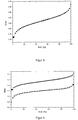
- FIG. 1 the OCV curve of this cell is plotted as a function of its state of charge.
- the OCV curve shows the dependence of the cell voltage on the state of charge.
- the cell voltage is measured in the "open circuit", ie it is the cell voltage (open-circuit voltage, in short: OCV), which results in a given state of charge without external load.
- OCV open-circuit voltage
- FIG. 2 shows the charge curve of this cell.
- Example 2 TEMPO Ammonium Chloride / Viologen Redox Flow Battery
- the solution for the working electrode was prepared from 1.0 g of TEMPO ammonium chloride having the structure below and 0.55 g of NaCl in 10 ml of water.
- the solution for the counterelectrode was prepared from 1.5 g of dimethylviologen chloride and 0.55 g of NaCl in 10 ml of water.
- the solutions were tested in a redox flow cell with an active area of 5 cm 2 (analogous to Example 1). The cell was cyclically charged and discharged.
- FIG. 4 It is shown that the achievable potential level of the single cell is higher if, instead of a polymeric redox system, a small-molecule redox system is used.
- a small-molecule redox system is used.
- FIG. 4 is the OCV curve of a cell containing the above-described TEMPO ammonium chloride and Dimethylviologen with chloride as counterion as redox-active components (upper curve).
- the OCV curve of a cell which is a TEMPO- and a viologen-based polymer as redox-active component contains. It can be seen that the cell voltage of the small molecule system is increased by about 0.2 V; that is, the energy density of the small molecule system is increased by more than 15% even at the same concentration.
- E 0 MV-TEMPO 2+ / MV-TEMPO 3+ 0.68V
- An electrolytic solution was prepared from 213 mg of methyl viologen TEMPO having the structure below and 235 mg of NaCl in 4 ml of water.
- the solution was used both for the working electrode (plus pole of the battery) and for the counter electrode (minus pole of the battery) and tested in a redox flow cell with an active area of 5 cm 2 (analogous to Example 1, liquid was not pumped). The cell was cyclically charged and discharged. Furthermore, an OCV curve was recorded.
- FIG. 6 shows the charge curve of this cell.
- An electrolytic solution was prepared from 110 mg of propanoate viologen TEMPO having the structure below and 117 mg of NaCl in 2 ml of water.
- the solution was used both for the working electrode (plus pole of the battery) and for the counter electrode (minus pole of the battery) and tested in a redox flow cell with an active area of 5 cm 2 (analogous to Example 1, liquid was not pumped). The cell was cyclically charged and discharged. Furthermore, an OCV curve was recorded.
- FIG. 8 shows the charge curve of this cell.
- the crude product 4- (dimethylamino) -2,2,6,6-tetramethylpiperidine-1-oxyl (3) was completely dissolved in 20 ml of diethyl ether, solids were removed by filtration and a solution of 1.42 g of methyl iodide in 5 ml of diethyl ether was added , After the solution was stirred at room temperature for 20 hours, the resulting precipitate was separated and washed with 20 ml of diethyl ether. The precipitate was dissolved in 50 ml of water and an ion exchange of the counterion of iodide on Chloride on an ion exchange resin (Dowex Marathon A2, chloride form) made. The resulting solution was freeze-dried and the product obtained as an orange powder (yield 89%).
- Variant A To a solution of 2 g of 1- (4 - (((1-oxyl-2,2,6,6-tetramethylpiperidin-4-yl) oxy) carbonyl) benzyl) - [4,4'-bipyridine] 1-ium chloride (8) in 8 ml of water was added chloromethane (pressure 2 bar) in a pressure reactor. The reaction solution was stirred at 95 ° C for 35 hours and the product was obtained as a solid (yield 95%) by freeze-drying.
- Variant B To a solution of 0.5 g of 1- (4 - ((((1-oxyl-2,2,6,6-tetramethylpiperidin-4-yl) oxy) carbonyl) benzyl) - [4,4'- bipyridine] -1-ium chloride (8) in 12 ml of DMSO was added 0.14 ml of methyl iodide. The reaction mixture was stirred for 6 hours at 60 ° C and then precipitated in 150 ml of ethyl acetate. The precipitate was dissolved in water and the ion exchange of the counter ion from iodide to chloride carried out on an ion exchange resin (Dowex Marathon A2, chloride form). The resulting solution was freeze-dried and the product obtained as an orange powder (yield 82%).
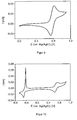
- the cyclic voltammograms were measured in a 3-electrode setup using a glassy carbon disc electrode as a working electrode, a platinum wire as a counter electrode, and a silver / silver chloride electrode as a reference.
- the electrolyte used was aqueous sodium chloride solutions (0.1 mol / l).
- FIG. 9 shows a cyclic voltammogram of the substance in aqueous sodium chloride solution (0.1 mol / l), measured against a silver / silver chloride reference electrode.
- FIG. 10 shows a cyclic voltammogram of the substance in aqueous sodium chloride solution (0.1 mol / l), measured against a silver / silver chloride reference electrode.
- FIG. 11 shows a cyclic voltammogram of the substance in aqueous sodium chloride solution (0.1 mol / l), measured against a silver / silver chloride reference electrode.
- the solid lines here represent the individual measurement of the anodic or cathodic area, while the dashed line represents a measurement over the entire area.
Landscapes
- Chemical & Material Sciences (AREA)
- Chemical Kinetics & Catalysis (AREA)
- Manufacturing & Machinery (AREA)
- Sustainable Development (AREA)
- Sustainable Energy (AREA)
- Engineering & Computer Science (AREA)
- Life Sciences & Earth Sciences (AREA)
- Electrochemistry (AREA)
- General Chemical & Material Sciences (AREA)
- Organic Chemistry (AREA)
- Fuel Cell (AREA)
- Inert Electrodes (AREA)
- Organic Low-Molecular-Weight Compounds And Preparation Thereof (AREA)
- Pyridine Compounds (AREA)
Description
- Die Erfindung betrifft eine Redox-Flow-Zelle, im allgemeinen Sprachgebrauch auch als Redox-Flow-Batterie oder als Redox-Fluss-Batterie bezeichnet, zur Speicherung elektrischer Energie. Die Redox-Flow-Zelle enthält zwei polaritätsspezifische Kammern, in denen jeweils eine redoxaktive chemische Verbindung bzw. eine redoxaktive Verbindung in beiden Kammern in gelöster Form oder dispergiert in einem Elektrolytlösungsmittel vorliegen und mit einem Flüssigkeitsspeicher in Verbindung steht. Auf diese Weise werden zwei unabhängige Kreisläufe für die beispielsweise in Wasser oder organischem Lösungsmittel gelösten oder dispergiert in einem Elektrolytlösungsmittel vorliegenden redoxaktiven Verbindungen gebildet, welche durch eine Membran zwischen den polaritätsspezifischen Kammern getrennt sind. Über diese Membran erfolgt ein lonenaustausch zwischen den beiden Kammern.
- Die Zellen eigenen sich besonders für stationäre Speicheranwendungen, zum Beispiel als Pufferbatterie für Windkraft- oder Solaranlagen beziehungsweise als Leistungs- und Regelreserven zum Lastausgleich in Stromnetzen, aber auch als mobiler Energiespeicher, zum Beispiel für den Betrieb von Elektroautos und elektronischen Geräten.
- Redox-Flow-Batterien (RFB) sind elektrochemische Energiespeicher. Die zur Potentialeinstellung an den Elektroden nötigen Verbindungen sind gelöste, redoxaktive Spezies, die beim Lade- bzw. Entladevorgang in einem elektrochemischen Reaktor in ihre jeweils andere Redoxstufe überführt werden. Dazu werden die Elektrolytlösungen (Katholyt, Anolyt) aus einem Tank entnommen und aktiv an die Elektroden gepumpt. Anoden- und Kathodenraum sind im Reaktor durch eine ionenselektive Membran getrennt, welche meist eine hohe Selektivität für Kationen, insbesondere Protonen zeigt (z. B. Nafion™). Daneben existieren auch Membranen, welche selektiv negativ geladene Ionen passieren lassen und positiv geladene Ionen blockieren. Weiterhin werden größenselektive Membranen (z. B. Dialyse- oder Ultrafiltrationsmembranen) genutzt, die sowohl Anionen als auch Kationen passieren lassen.
- Anoden- und Kathodenraum im Sinne dieser Erfindung werden wie folgt definiert: Der Kathodenraum enthält den Katholyten als Elektrolyt und ist begrenzt durch die Kathode und diejenige Membranfäche, welche der Kathode zugewandt ist. Der Anodenraum enthält den Anolyten als Elektrolyt und ist begrenzt durch die Anode und diejenige Membranfäche, welche der Anode zugewandt ist.
- An der Kathode findet beim Entladen die Reduktion und beim Laden die Oxidation der redoxaktiven Komponente statt. An der Anode findet beim Entladen die Oxidation und beim Laden die Reduktion der redoxaktiven Komponente statt.
- Beispielhafte Beschreibungen der Reaktionen in einer Redox-Flow-Zelle während des Ladevorganges:
Anode
A + e- → A- oder A- + e- → A2- oder An+ + x e- → A(n-x)+ oder An- + x e- → A(n+x)-
- Hierbei ist A die redoxaktive Komponente und n und x kann eine natürliche Zahl >= eins annehmen. Elektronen werden durch e- symbolisiert.
Kathode
K → K+ + e- oder K- → K + e- oder Kn+ → K(n+y)+ + y e- oder Kn- → K(n-y)- + y e-
- Hierbei ist K die redoxaktive Komponente und n und y kann eine natürliche Zahl >=eins annehmen. Elektronen werden durch e- symbolisiert.
- Beim Entladen der Zelle kehren sich die vorstehenden Reaktionen um.
- Solange Elektrolytlösung gepumpt wird, kann Strom entnommen werden (Entladung) oder in das System gespeist werden (Ladung). Damit ist die Energiemenge, die in einer RFB gespeichert werden kann, direkt proportional zur Größe der Vorratstanks. Die entnehmbare Leistung dagegen ist eine Funktion der Größe des elektrochemischen Reaktors.
- RFB haben eine komplexe Systemtechnik (BoP - Balance of Plant), die in etwa der einer Brennstoffzelle entspricht. Übliche Baugrößen der Einzel-Reaktoren bewegen sich im Bereich von circa 2 bis 50 kW. Die Reaktoren können sehr einfach modular kombiniert werden, ebenso kann die Tankgröße nahezu beliebig angepasst werden. Eine besondere Bedeutung kommt RFBs zu, welche mit Vanadiumverbindungen als Redoxpaar auf beiden Seiten arbeiten (VRFB). Dieses System wurde 1986 erstmals beschrieben (
AU 575247 B - Weitere anorganische, niedermolekulare Redoxpaare (redoxaktiven Verbindungen) wurden untersucht, unter anderem auf Basis von
- Cer (B. Fang, S. Iwasa, Y. Wei, T. Arai, M. Kumagai: "A study of the Ce(III)/Ce(IV) redox couple for redox flow battery application", Electrochimica Acta 47, 2002, 3971-3976),
- Ruthenium (M. H. Chakrabarti, E. Pelham, L. Roberts, C. Bae, M. Saleem: "Ruthenium based redox flow battery for solar energy storage", Energy Conv. Manag. 52, 2011,2501-2508]
- Chrom (C-H. Bae, E. P. L. Roberts, R. A. W. Dryfe: "Chromium redox couples for application to redox flow batteries", Electrochimica Acta 48, 2002, 279-87)
- Uran (T. Yamamura, Y. Shiokawa, H. Yamana, H. Moriyama: "Electrochemical investigation of uranium ß-diketonates for all-uranium redox flow battery", Electrochimica Acta 48, 2002, 43-50)
- Mangan (F. Xue, Y. Wang, W. Hong Wang, X. Wang: "Investigation on the electrode process of the Mn(II)/Mn(III) couple in redox flow battery", Electrochimica Acta 53, 2008, 6636-6642)
- Eisen (L. W. Hruska, R. F. Savinell: "Investigation of Factors Affecting Performance of the Iron-Redox Battery", J. Electrochem. Soc.,128:1, 1981, 18-25).
- Organische und teilorganische Systeme in wässrigen Lösungen geraten ebenfalls in den Fokus der Aufmerksamkeit. So wurde im Januar 2014 das System Anthrachinon-Disulphonsäure/Brom veröffentlicht, das sehr hohe Stromdichten erlaubt, allerdings durch die Verwendung von elementarem Brom hohe Ansprüche an die Materialien aller Batteriekomponenten und die Sicherheit des Systems stellt. (B. Huskinson, M. P. Marshak, C. Suh, S. Er, M. R. Gerhardt, C. J. Galvin, X. Chen, A. Aspuru-Guzik, R. G. Gordon, M. J. Aziz: "A metal free organic-inorganic aqueous flow battery", Nature 505, 2014, 195-198). Als voll organisches Systeme in wässriger Lösung werden ebenfalls Chinone getestet (B. Yang, L. Hoober-Burkhard, F. Wang, G. K. Surya Prakash, S. R. Narayanan: "An inexpensive aqueous flow battery for large-scale electrical energy storage based on eater-doluble organic redox couples": J. Electrochem. Soc., 161 (9), 2014, A1361 - A1380). Die in Redox-System sinnvoll anwendbaren Stromdichten sind allerdings auf weniger als 5 mA/cm2 beschränkt und die maximal erreichbare Kapazität liegt bei unter 10 Ah/I. Das stabile Radikal-Molekül 2,2,6,6-Tetramethyl-1-piperidonyloxyl (TEMPO) wurde ebenfalls schon in Redox-Flow-Batterien zusammen mit N-Methylphtalimide eingesetzt. (Z. Li, S. Li, S. Liu, K. Huang, D. Fang, F. Wang, S. Peng: "Electrochemical properties of an allorganic redox flow battery using 2,2,6,6-Tetramethyl-1-Piperidonyloxyl and N-Methylphtalimid": Electrochemical and Solid-State Letters, 14 (12), 2011, A171-A173) Aufgrund der sich ergebenden Potenziale und Löslichkeiten der Ausgangsstoffe kann dieses Materialsystem nicht ohne Weiteres im wässrigen Medium eingesetzt werden, sondern setzt Gefahrstoffe als Lösemittel, wie z.B. Acetonitril, voraus. Weiterhin sind bei diesem System die erreichbaren Stromdichten mit 0,35 mA/cm2 um mindestens Faktor 100 kleiner als bei den in der Erfinung vorgeschlagenen Materialsystemen. Andere Elektrolytsysteme, wie LiPF6 und TEMPO (X. Wie, W. Xu, M. Vijayakumar, L. Cosimbescu, T. Liu, V. Sprenkle, W. Wang: " TEMPO-based catholyte for high-energy densitiy redox flow batteries" Adv. Mater. 2014 Vol. 26, 45, p7649-7653) setzen ebenfalls organische Lösemittel und Leitsalze voraus, die im Versagensfall giftige Gase, wie z.B. Fluorwasserstoff, freisetzen können und stellen damit hohe Anforderungen an die Systemsicherheit.
- Aus der
WO 2014/026728 A1 sind Redox-Flow-Zellen mit semipermeablen Membranen bekannt, bei denen als Redoxpaar hochmolekulare Verbindungen eingesetzt werden. Im Beispiel wird als Katholyt ein Poly(2,2,6,6-tetramethylpiperidinyloxymethacrylat-co-poly(ethylenglykolmethylether-methacrylat eingesetzt und als Anolyt ein Poly(4,4'-bipyridin-co-poly(ethylenglykol). - Dieser Erfindung liegt die Aufgabe zugrunde, eine Redox-Flow-Zelle mit ausgewählten redoxaktiven Materialsystemen bereitzustellen, die sicher, kostengünstig und effizient betrieben werden kann, die eine Elektrolytlösung mit verbesserter Pumpbarkeit enthält, die auch bei Querkontamination über Membranfehlstellen weiterhin arbeiten kann und bei der ein gegenüber bekannten Lösungen vergrößertes Potentialniveau erreicht werden kann. Die erfindungsgemäß eingesetzten redoxaktiven Komponenten zeichnen sich im Vergleich zu den aus
WO 2014/026728 A1 bekannten polymeren redoxaktiven Verbindungen durch eine deutlich verringerte Viskosität aus. Im Vergleich zu den bekannten polymeren Redoxsystemen ist die Viskosität konzentrierter Lösungen bei vergleichbarer Kapazität (1 mol/L redoxaktive Einheiten) deutlich geringer, so dass beim Pumpen der Lösungen geringere Druckverluste auftreten, was sich in einer besseren Energieeffizienz äußert. So weisen konzentrierte Lösungen von N-Dimethylviologenchlorid bei Raumtemperatur eine Viskosität von 5 mPas auf, während konzentrierte Lösungen des N-Methylviologenpolymers bei gleicher Kapazität bei Raumtemperatur eine Viskosität von 20 mPas aufweisen. Die erfindungsgemäß eingesetzten Materialsysteme zeichnen sich darüber hinaus auch durch eine gegenüber säurebasierten Elektrolyten geringere Korrosivität aus. - Die Aufgabe wird durch die Bereitstellung von Redox-Flow-Zellen mit ausgewählten redoxaktiven Materialsystemen gelöst, welche ohne Katalysatoren betrieben werden können, sehr gut in Wasser löslich sind, preiswert und miteinander kompatibel sind. Die redoxaktiven Materialsysteme können auch als Dispersionen eingesetzt werden.
- Die vorliegende Erfindung betrifft eine Redox-Flow-Zelle zur Speicherung elektrischer Energie enthaltend eine Reaktionszelle mit zwei Elektrodenkammern für Katholyt und Anolyt, die jeweils mit mindestens einem Flüssigkeitsspeicher in Verbindung stehen, die durch eine ionenleitende Membran getrennt sind, und die mit Elektroden ausgerüstet sind, wobei die Elektrodenkammern jeweils mit Elektrolytlösungen gefüllt sind, die redoxaktive Komponenten gelöst oder dispergiert in einem Elektrolytlösungsmittel enthalten, sowie gegebenenfalls darin gelöste Leitsalze und eventuell weitere Additive. Die erfindungsgemäße Redox-Flow-Zelle ist dadurch gekennzeichnet, dass der Anolyt eine redoxaktive Komponente enthält, die ein bis sechs, vorzugsweise ein bis vier, insbesondere ein bis drei und ganz besonders bevorzugt ein bis zwei Reste der Formel I im Molekül enthält oder die ein bis sechs, vorzugsweise ein bis vier, insbesondere ein bis drei und ganz besonders bevorzugt ein bis zwei Reste der Formel II im Molekül enthält und dass der Katholyt eine redoxaktive Komponente enthält, die ein bis sechs, vorzugsweise ein bis vier, insbesondere ein bis drei und ganz besonders bevorzugt ein bis zwei Reste der Formel III im Molekül enthält oder die Eisensalze enthält oder dass Anolyt und Katholyt eine redoxaktive Komponente enthält, die ein bis sechs, vorzugsweise ein bis vier, insbesondere ein bis drei und ganz besonders bevorzugt ein bis zwei Reste der Formel I oder der Formel II in Kombination mit ein bis sechs, vorzugsweise ein bis vier, insbesondere ein bis drei und ganz besonders bevorzugt ein bis zwei Resten der Formel III im Molekül enthält


- die von den Stickstoffatomen in den Strukturen der Formeln I und II abgehenden Linien und die von der 4-Position in der Struktur der Formel III abgehende Linie kovalente Bindungen darstellen, welche die Strukturen der Formeln I, II und III mit dem Rest des Moleküls verbinden,
- R1 eine kovalente C-C-Bindung ist oder eine zweiwertige Brückengruppe, insbesondere eine kovalente C-C-Bindung, eine Arylengruppe oder eine Heteroarylengruppe, und ganz besonders bevorzugt eine kovalente C-C-Bindung, eine Phenylengruppe, eine Biphenylengruppe oder eine Thiophendiylgruppe,
- R2 und R3 unabhängig voneinander Alkyl, Alkoxy, Haloalkyl, Cycloalkyl, Aryl, Aralkyl, Heterocyclyl, Halogen, Hydroxy, Amino, Nitro oder Cyano bedeuten,
- X ein q-wertiges anorganisches oder organisches Anion oder eine Mischung derartiger Anionen bedeutet,
- b und c unabhängig voneinander ganze Zahlen von 0 bis 4, vorzugsweise 0, 1 oder 2 sind,
- q eine ganze Zahl von 1 bis 3 ist,
- a eine Zahl mit dem Wert 2/q ist, und
- R4, R5, R6 und R7 unabhängig voneinander Alkyl, Cycloalkyl, Aryl oder Aralkyl bedeuten, insbesondere C1-C6-Alkyl und ganz besonders bevorzugt Ethyl oder Methyl.
- Bevorzugt im Anolyten eingesetzte redoxaktive Komponenten enthalten ein bis vier Reste der Formel la und/oder der Formel IIa im Molekül


- die von den Stickstoffatomen in den Strukturen der Formeln la und IIa abgehenden Linien kovalente Bindungen darstellen, welche die Strukturen der Formeln Ia und IIa mit dem Rest des Moleküls verbinden, und
- R2, R3, X, a, b, c und q die oben definierte Bedeutung besitzen.
- Bevorzugt im Anolyten eingesetzte redoxaktive Komponenten sind Verbindungen der Formeln Ib, IIb, IV, V, VII, VIIa, VIIb VIII, VIIIa, VIIIb, IX, IXa, IXb, X, Xa, Xb, XI, XIa, XIb, XII, XIIa und XIIb


- R1, R2, R3, R4, R5, R6, R7 und X die oben definierte Bedeutung besitzen,
- R8 und R10 unabhängig voneinander Wasserstoff, gegebenenfalls mit einer Carbonsäureester-, Carbonsäureamid-, Carbonsäure-, Sulfonsäure- oder Aminogruppe substituiertes Alkyl, gegebenenfalls mit einer Carbonsäureester-, Carbonsäureamid-, Carbonsäure-, Sulfonsäure- oder Aminogruppe substituiertes Cycloalkyl, gegebenenfalls mit einer Carbonsäureester-, Carbonsäureamid-, Carbonsäure-, Sulfonsäure- oder Aminogruppe substituiertes Aryl oder gegebenenfalls mit einer Carbonsäureester-, Carbonsäureamid-, Carbonsäure-, Sulfonsäure- oder Aminogruppe substituiertes Aralkyl bedeuten, insbesondere C1-C6-Alkyl, mit einer Carbonsäureestergruppe substituiertes C1-C6-Alkyl, mit einer Carbonsäureamidgruppe substituiertes C1-C6-Alkyl, mit einer Carbonsäuregruppe substituiertes C1-C6-Alkyl, mit einer Sulfonsäuregruppe substituiertes C1-C6-Alkyl, oder mit einer Aminogruppe substituiertes C1-C6-Alkyl, und ganz besonders bevorzugt Propionat, Isobutionat, Ethyl oder Methyl,
- R9 eine zwei- bis sechswertige, insbesondere zwei- bis vierwertige organische Brückengruppe ist,
- R12 eine kovalente Bindung ist oder eine zwei- bis sechswertige, insbesondere zweibis vierwertige organische Brückengruppe ist,
- R14 eine kovalente Bindung ist oder eine zweiwertige organische Brückengruppe ist, R15 eine zwei- bis sechswertige, insbesondere zwei- bis vierwertige organische Brückengruppe ist,
- R18 ein o-fach positiv geladener zwei- bis sechswertiger, insbesondere zwei- bis vierwertiger organischer Rest ist, der mit dem Stickstoffatom des Bipyridylrests über ein Kohlenstoffatom kovalent verbunden ist, insbesondere ein zwei- bis vierwertiger quaternärer Ammoniumrest, ein zwei- bis vierwertiger quaternärer Phosphoniumrest, ein zwei- bis dreiwertiger ternärer Sulfoniumrest oder ein o-fach positiv geladener zwei- bis sechswertiger, insbesondere zwei- bis vierwertiger heterocyclischer Rest, R19 ein o-fach, vorzugsweise einfach positiv geladener zweiwertiger organischer Rest ist, der mit dem Stickstoffatom des Bipyridylrests über ein Kohlenstoffatom kovalent verbunden ist, insbesondere ein quaternärer Ammoniumrest, ein quaternärer Phosphoniumrest, ein ternärer Sulfoniumrest oder ein o-fach, vorzugsweise einfach positiv geladener zweiwertiger heterocyclischer Rest ist,
- R20 und R21 unabhängig voneinander Wasserstoff, gegebenenfalls mit einer Carbonsäureester-, Carbonsäureamid-, Carbonsäure-, Sulfonsäure- oder Aminogruppe substituiertes Alkyl, gegebenenfalls mit einer Carbonsäureester-, Carbonsäureamid-, Carbonsäure-, Sulfonsäure- oder Aminogruppe substituiertes Cycloalkyl, gegebenenfalls mit einer Carbonsäureester-, Carbonsäureamid-, Carbonsäure-, Sulfonsäure- oder Aminogruppe substituiertes Aryl oder gegebenenfalls mit einer Carbonsäureester-, Carbonsäureamid-, Carbonsäure-, Sulfonsäure- oder Aminogruppe substituiertes Aralkyl bedeuten oder zwei Reste R20 und R21 zusammen eine C1-C3-Alkylengruppe bilden, insbesondere C1-C6-Alkyl, mit einer Carbonsäureestergruppe substituiertes C1-C6-Alkyl, mit einer Carbonsäureamidgruppe substituiertes C1-C6-Alkyl, mit einer Carbonsäuregruppe substituiertes C1-C6-Alkyl, mit einer Sulfonsäuregruppe substituiertes C1-C6-Alkyl, oder mit einer Aminogruppe substituiertes C1-C6-Alkyl sind oder zusammen Ethylen bedeuten, und ganz besonders bevorzugt Propionat, Isobutionat, Ethyl oder Methyl oder zusammen Ethylen bedeuten,
- R22 eine zweiwertige organische Brückengruppe ist,
- R23 ein u-fach negativ geladener zwei- bis sechswertiger, insbesondere zwei- bis vierwertiger organischer Rest ist, der mit dem Stickstoffatom des Bipyridylrests über ein Kohlenstoffatom kovalent verbunden ist, insbesondere ein mit ein oder zwei Carboxyl- oder Sulfonsäuregruppen substituierter Alkylenrest, ein mit ein oder zwei Carboxyl- oder Sulfonsäuregruppen substituierter Phenylenrest oder ein mit ein oder zwei Carboxyl- oder Sulfonsäuregruppen substituierter zweiwertiger heterocyclischer Rest ist,
- R24 ein u-fach, vorzugsweise einfach negativ geladener zweiwertiger organischer Rest ist, der mit dem Stickstoffatom des Bipyridylrests über ein Kohlenstoffatom kovalent verbunden ist, insbesondere ein mit einer Carboxyl- oder Sulfonsäuregruppe substituierter Alkylenrest, ein mit einer Carboxyl- oder Sulfonsäuregruppe substituierter Phenylenrest oder ein mit einer Carboxyl- oder Sulfonsäuregruppe substituierter zweiwertiger heterocyclischer Rest ist,
- a, b, c und q die oben definierte Bedeutung besitzen,
- d eine ganze Zahl von 1 bis 5, vorzugsweise von 1 bis 3 ist,
- e eine Zahl mit dem Wert (2 + 2d + 2t) / q ist,
- g eine ganze Zahl von 1 bis 5, vorzugsweise von 1 bis 3 ist
- h eine ganze Zahl von 1 bis 5, vorzugsweise von 1 bis 3 ist,
- wobei die Summe von g und h eine ganze Zahl von 2 bis 6, vorzugsweise von 2 bis 4 ist,
- i eine Zahl mit dem Wert 2h / q ist,
- j eine ganze Zahl von 1 bis 5, vorzugsweise von 1 bis 3 ist,
- k eine Zahl mit dem Wert von (2 + 2j) / q ist,
- o eine ganze Zahl von 1 bis 4 ist,
- p eine Zahl mit dem Wert (o + 2h) / q ist,
- r eine Zahl mit dem Wert (3 + 3j) / q ist,
- t 0 ist oder, falls R9 eine zweiwertige organische Brückengruppe ist, 0 oder 1 bedeutet,
- u eine ganze Zahl von 1 bis 4 ist,
- z eine Zahl mit dem Wert 2 / q ist,
- z1 eine Zahl mit dem Wert (o+2) / q ist,
- Y für den Fall, dass 2h - u oder 2 (2 - u) - u größer als 0 ist, ein v- oder x-wertiges anorganisches oder organisches Anion oder eine Mischung derartiger Anionen bedeutet, oder für den Fall, dass 2h - u oder 2 (2 - u) - u kleiner als 0 ist, ein v- oder x-wertiges anorganisches oder organisches Kation oder eine Mischung derartiger Kationen bedeutet,
- v eine ganze Zahl von -1 bis -3 oder von +1 bis +3 ist,
- x eine ganze Zahl von -1 bis -3 oder von +1 bis +3 ist,
- w 0 oder eine positive Zahl mit dem Wert (-u + 2h) / v ist,
- y 0 oder eine positive Zahl mit dem Wert (2 - u) (j + 1) / x ist,
- Y1 für den Fall, dass 2 - 2u kleiner als 0 ist, ein x1-wertiges anorganisches oder organisches Kation oder eine Mischung derartiger Kationen bedeutet,
- x1 eine ganze Zahl von -1 bis -3 oder von +1 bis +3 ist, und
- y1 0 oder eine positive Zahl mit dem Wert (2 - 2u) / x1 ist.
- Besonders bevorzugt im Anolyten eingesetzte redoxaktive Komponenten sind Verbindungen der Formeln IVa, Va, VIIc, VIIIc, IXc und Xc


- R2, R3, R4, R5, R6, R7, R8, R9, R10, R12, R14, R15 und X die oben definierte Bedeutung besitzen, und
- b, c, d, e, g, h, i, j, k und q die oben definierte Bedeutung besitzen.
- Bevorzugt im Katholyten eingesetzte redoxaktive Komponenten sind Verbindungen der Formeln lila, IIIb, IIIc, VI, VIa und/oder VIb sowie der oben definierten Formeln VII, VIIa, VIIb, VIII, VIIIb, VIIIa, IX, IXa, IXb, X, Xa und/oder Xb


- R4, R5, R6, R7, X, o, u und q die oben definierte Bedeutung besitzen,
- R11 eine zwei- bis vierwertige organische Brückengruppe ist,
- R13 Wasserstoff, Alkyl, Alkoxy, Haloalkyl, Cycloalkyl, Aryl, Aralkyl, Heterocyclyl, Halogen, Hydroxy, Amino, Nitro oder Cyano ist, und
- R16 ein o-fach, vorzugsweise ein einfach positiv geladener einwertiger organischer Rest, insbesondere ein quaternärer Ammoniumrest, ein quaternärer Phosphoniumrest, ein ternärer Sulfoniumrest oder ein o-fach, vorzugsweise ein einfach positiv geladener einwertiger heterocyclischer Rest ist, und
- R17 ein m-fach positiv geladener zwei- bis vierwertiger organischer Rest, insbesondere zwei- bis vierwertiger quaternärer Ammoniumrest, ein zwei- bis vierwertiger quaternärer Phosphoniumrest, ein zwei- bis vierwertiger ternärer Sulfoniumrest oder ein m-fach positiv geladener zwei- bis vierwertiger heterocyclischer Rest ist,
- R25 ein u-fach, vorzugsweise ein einfach negativ geladener einwertiger Rest, insbesondere ein Carboxyl- oder Sulfonsäurerest oder ein u-fach, vorzugsweise ein einfach negativ geladener einwertiger heterocyclischer Rest ist,
- R26 ein m-fach negativ geladener zwei- bis vierwertiger organischer Rest, insbesondere ein mit ein oder zwei Carboxyl- oder Sulfonsäuregruppen substituierter Alkylenrest, oder ein mit ein oder zwei Carboxyl- oder Sulfonsäuregruppen substituierter Phenylenrest oder ein mit ein oder zwei Carboxyl- oder Sulfonsäuregruppen substituierter zweiwertiger heterocyclischer Rest ist,
- Z ein q-wertiges anorganisches oder organisches Kation oder eine Mischung derartiger Kationen bedeutet,
- f eine ganze Zahl von 1 bis 3 ist,
- l eine Zahl mit dem Wert o / q oder u / q ist,
- m eine ganze Zahl von 1 bis 4 ist, und
- n eine Zahl mit dem Wert m / q bedeutet.
- Besonders bevorzugt im Katholyten eingesetzte redoxaktive Komponenten sind Verbindungen der oben definierten Formeln VI, VIa, VIIc, VIIIc, IXc und/oder Xc.
- Ganz besonders bevorzugt erfindungsgemäß eingesetzte redoxaktive Verbindungen sind solche der Formeln Ib, IIb, VIId, VIIe, VIIId und/oder VIIIe


- R2, R3, R4, R5, R6, R7, R8, R10, R14, R19 und X die oben definierte Bedeutung besitzen,
- R20 und R21 unabhängig voneinander Wasserstoff, gegebenenfalls mit einer Carbonsäureester-, Carbonsäureamid-, Carbonsäure-, Sulfonsäure- oder Aminogruppe substituiertes Alkyl, gegebenenfalls mit einer Carbonsäureester-, Carbonsäureamid-, Carbonsäure-, Sulfonsäure- oder Aminogruppe substituiertes Cycloalkyl, gegebenenfalls mit einer Carbonsäureester-, Carbonsäureamid-, Carbonsäure-, Sulfonsäure- oder Aminogruppe substituiertes Aryl oder gegebenenfalls mit einer Carbonsäureester-, Carbonsäureamid-, Carbonsäure-, Sulfonsäure- oder Aminogruppe substituiertes Aralkyl bedeuten oder zwei Reste R20 und R21 zusammen eine C1-C3-Alkylengruppe bilden, insbesondere C1-C6-Alkyl, mit einer Carbonsäureestergruppe substituiertes C1-C6-Alkyl, mit einer Carbonsäureamidgruppe substituiertes C1-C6-Alkyl, mit einer Carbonsäuregruppe substituiertes C1-C6-Alkyl, mit einer Sulfonsäuregruppe substituiertes C1-C6-Alkyl, oder mit einer Aminogruppe substituiertes C1-C6-Alkyl sind oder zusammen Ethylen bedeuten, und ganz besonders bevorzugt Propionat, Isobutionat, Ethyl oder Methyl oder zusammen Ethylen bedeuten,
- a, b, c und q die oben definierte Bedeutung besitzen, und
- s eine Zahl mit dem Wert 3 / q ist.
- Von diesen besonders bevorzugt eingesetzten Verbindungen werden solche der Formeln Ib, IIb, VIId, VIIe, VIIId und/oder VIIIe im Anolyten eingesetzt und solche der Formeln VIId, VIIe, VIIId und/oder VIIIe im Katholyten.
- Ganz besonders bevorzugt enthält der Katholyt Verbindungen der oben definierten Formeln IIIa, IIIb oder IIIc und der Anolyt enthält die Verbindungen der oben definierten Formeln Ib oder IIb.
- Insbesondere enthält der Katholyt Verbindungen der oben definierten Formel IIIb und der Anolyt enthält die Verbindungen der oben definierten Formel Ib.
- Beispiele für bevorzugte Verbindungen der Formel IIIb sind Salze des 2,2,6,6-Tetramethylpiperidin-4-(N,N,N-trialkylammoniums), insbesondere Salze des 2,2,6,6,-Tetramethylpiperidin-4-(N,N,N-trimethylammoniums) und ganz besonders 2,2,6,6-Tetramethylpiperidin-4-(N, N, N-trimethylammonium)-chlorid.
- Beispiele für bevorzugte Verbindungen der Formel Ib sind Salze des N, N'-Dialkylviologens, insbesondere Salze des N, N'-Dimethylviologens und ganz besonders N, N'-Dialkylviologenchlorid
- Besonders bevorzugte redoxaktive Verbindungen sind solche der oben definierten Formeln VII, VIIa, VIIb, VIIc, VIId, VIIe, VIII, VIIIa, VIIIb, VIIIc, VIIId, VIIIe, IX, IXa, IXb, IXc, X, Xa, Xa und Xc. Diese enthalten sowohl elektroaktive Bipyridylreste als auch elektroaktive Nitroxidreste und können sowohl im Katholyten als auch im Anolyten eingesetzt werden, vorzugsweise in beiden Kammern die gleichen Verbindungen.
- Die redoxaktive Verbindungen der oben definierten Formeln VII, VIIa, VIIb, VIIc, VIId, VIIe, VIII, VIIIa, VIIIb, VIIIc, VIIId, VIIIe, IX, IXa, IXb, IXc, X, Xa, Xb und Xc sind Kombinationsmoleküle aus positiver und negativer redoxaktiver Einheit (TEMPO und Viologen). Bislang wurden diese redoxaktiven Einheiten immer nur in der Form zweier verschiedener Substanzen verwendet. Die erfindungsgemäß besonders bevorzugten Kombinationsmoleküle können sowohl oxidiert als auch reduziert werden. Einer der dadurch ergebenden Vorteile ist, dass die Lösungen bei Vermischung verursacht beispielsweise durch Membrandefekte nicht mehr irreversibel geschädigt werden. Auch können die Potenziale durch Wahl der beiden redoxaktiven Einheiten eingestellt werden und so auf verschiedene Anwendungsszenarien optimiert werden.
- Bedeutet einer der Reste R2, R3, R4, R5, R6, R7, R8, R10, R13, R20 und/oder R21 Alkyl, so kann die Alkylgruppe sowohl verzweigt als auch unverzweigt sein. Eine Alkylgruppe enthält typischerweise ein bis zu zwanzig Kohlenstoffatome, bevorzugt ein bis zu zehn Kohlenstoffatome. Beispiele für Alkylgruppen sind: Methyl, Ethyl, n-Propyl, Isopropyl, n-Butyl, sec-Butyl, tert.-Butyl, Pentyl, n-Hexyl, n-Heptyl, 2-Ethylhexyl, n-Octyl, n-Nonyl, n-Decyl, n-Undecyl, n-Dodecyl, n-Tridecyl, n-Tetradecyl, n-Pentadecyl, n-Hexadecyl, n-Heptadecyl, n-Octadecyl, n-Nonadecyl oder Eicosyl. Besonders bevorzugt sind Alkylgruppen mit ein bis sechs Kohlenstoffatomen. Alkylgruppen können gegebenenfalls substituiert sein, beispielsweise mit Carboxyl- oder Sulfonsäuregruppen, mit Carboxylester- oder Sulfonsäureestergruppen, mit Carboxylamid- oder Sulfonsäureamidgruppen, mit Hydroxyl- oder Aminogruppen oder mit Halogenatomen.
- Bedeutet einer der Reste R2, R3 und/oder R13 Alkoxy, so kann die Alkoxygruppe aus einer Alkyleinheit bestehen, die sowohl verzweigt als auch unverzweigt sein kann. Eine Alkoxygruppe enthält typischerweise ein bis zu zwanzig Kohlenstoffatome, bevorzugt ein bis zu zehn Kohlenstoffatome. Beispiele für Alkoxygruppen sind: Methoxy, Ethoxy, Isopropoxy, n-Butoxy, sec.-Butoxy, tert.-Butoxy, Pentyloxy, n-Hexyloxy, n-Heptyloxy, 2-Ethylhexyloxy, n-Octyloxy, n-Nonyloxy, n-Decyloxy, n-Tridecyloxy, n-Tetradecyloxy, n-Pentadecyloxy, n-Hexadecyloxy, n-Octadecyloxy oder Eicosyloxy. Besonders bevorzugt sind Alkoxygruppen mit ein bis sechs Kohlenstoffatomen.
- Bedeutet einer der Reste R2, R3 und/oder R13 Haloalkyl, so kann die Haloalkylgruppe sowohl verzweigt als auch unverzweigt sein. Eine Haloalkylgruppe enthält typischerweise ein bis zu zwanzig Kohlenstoffatome, die wiederum unabhängig voneinander mit einem oder mehreren Halogenatomen substituiert sind, bevorzugt ein bis zehn Kohlenstoffatome. Beispiele für Halogenatome sind Fluor, Chlor, Brom oder Iod. Bevorzugt sind Fluor und Chlor. Beispiele für Haloalkylgruppen sind: Trifluoromethyl, Difluoromethyl, Fluoromethyl, Bromodifluoromethyl, 2-Chloroethyl, 2-Bromoethyl, 1,1-Difluoroethyl, 2,2,2-Trifluoroethyl, 1,1,2,2-Tetrafluoroethyl, 2-Chloro-1,1,2-trifluoroethyl, Pentafluoroethyl, 3-Bromopropyl, 2,2,3,3-Tetrafluoropropyl, 1,1,2,3,3,3-Hexafluoropropyl, 1,1,1,3,3,3-Hexafluoropropyl, 3-Bromo-2-methylpropyl, 4-Bromobutyl, Perfluoropentyl.
- Bedeutet einer der Reste R2, R3, R4, R5, R6, R7, R8, R10, R13, R20 und/oder R21 Cycloalkyl, so ist die Cycloalkylgruppe typischerweise eine cyclische Gruppe, enthaltend drei bis acht, vorzugsweise fünf, sechs oder sieben Ringkohlenstoffatome, die jeweils unabhängig voneinander substituiert sein können. Beispiele für Substituenten sind Alkylgruppen oder zwei Alkylgruppen, die zusammen mit den Ringkohlenstoffen, an denen sie gebunden sind, einen weiteren Ring bilden können. Beispiele für Cycloalkylgruppen sind Cyclopropyl, Cyclopentyl oder Cyclohexyl. Cycloalkylgruppen können gegebenenfalls substituiert sein, beispielsweise mit Carboxyl- oder Sulfonsäuregruppen, mit Carboxylester- oder Sulfonsäureestergruppen, mit Carboxylamid- oder Sulfonsäureamidgruppen, mit Hydroxyl- oder Aminogruppen oder mit Halogenatomen.
- Bedeutet einer der Reste R2, R3, R4, R5, R6, R7, R8, R10, R13, R20 und/oder R21 Aryl, so ist die Arylgruppe typischerweise eine cyclische aromatische Gruppe, enthaltend fünf bis vierzehn Kohlenstoffatome, die jeweils unabhängig voneinander substituiert sein können. Beispiele für Substituenten sind Alkylgruppen oder zwei Alkylgruppen, die gemeinsam mit den Ringkohlenstoffatomen, an denen sie gebunden sind, einen weiteren Ring bilden können. Beispiele für Arylgruppen sind Phenyl, Biphenyl, Anthryl oder Phenantolyl. Arylgruppen können gegebenenfalls substituiert sein, beispielsweise mit Carboxyl- oder Sulfonsäuregruppen, mit Carboxylester- oder Sulfonsäureestergruppen, mit Carboxylamid- oder Sulfonsäureamidgruppen, mit Hydroxyl- oder Aminogruppen oder mit Halogenatomen.
- Bedeutet einer der Reste R2, R3 und/oder R13 Heterocyclyl, so kann die Heterocyclylgruppe typischerweise eine cyclische Gruppe mit vier bis zehn Ringkohlenstoffatomen und mindestens einem Ringheteroatom aufweisen, die jeweils unabhängig voneinander substituiert sein können. Beispiele für Substituenten sind Alkylgruppen, oder zwei Alkylgruppen die zusammen mit den Ringkohlenstoffen an denen sie gebunden sind einen weiteren Ring bilden können. Beispiele für Heteroatome sind Sauerstoff, Stickstoff, Phosphor, Bor, Selen oder Schwefel. Beispiele für Heterocyclylgruppen sind Furyl, Thienyl, Pyrrolyl oder Imidazolyl. Heterocyclylgruppen sind vorzugsweise aromatisch. Heterocyclylgruppen können gegebenenfalls substituiert sein, beispielsweise mit Carboxyl- oder Sulfonsäuregruppen, mit Carboxylester- oder Sulfonsäureestergruppen, mit Carboxylamid- oder Sulfonsäureamidgruppen, mit Hydroxyl- oder Aminogruppen oder mit Halogenatomen.
- Bedeutet einer der Reste R2, R3, R4, R5, R6, R7, R8, R10, R13, R20 und/oder R21 Aralkyl, so ist die Aralkylgruppe typischerweise eine Arylgruppe, wobei Aryl zuvor bereits definiert wurde, an die kovalent eine Alkylgruppe gebunden ist. Die Aralkylgruppe kann am aromatischen Ring beispielsweise mit Alkylgruppen oder mit Halogenatomen substituiert sein. Ein Beispiel für eine Aralkylgruppe ist Benzyl. Aralkylgruppen können gegebenenfalls substituiert sein, beispielsweise mit Carboxyl- oder Sulfonsäuregruppen, mit Carboxylester- oder Sulfonsäureestergruppen, mit Carboxylamid- oder Sulfonsäureamidgruppen, mit Hydroxyl- oder Aminogruppen oder mit Halogenatomen.
- Bedeutet einer der Reste R2, R3 und/oder R13 Amino, so kann die Aminogruppe unsubstituiert sein oder ein oder zwei oder drei Substituten tragen, vorzugsweise Alkyl- und/oder Arylgruppen. Alkylsubstituenten können sowohl verzweigt als auch unverzweigt sein. Eine Mono- oder Dialkylaminogruppe enthält typischerweise ein oder zwei Alkylgruppen mit ein bis zu zwanzig Kohlenstoffatomen, vozugsweise mit ein bis sechs Kohlenstoffatomen. Beispiele für Monoalkylaminogruppen sind Methylamino, Ethylamino, Propylamino oder Butylamino. Beispiele für Dialkylaminogruppen sind: Di-ethylamino, Di-propylamino oder Di-butylamino.. Beispiele für Trialkylaminogruppen sind: Tri-ethylamino, Tri-propylamino oder Tributylamino.
- Bedeutet einer der Reste R2, R3 und/oder R13 Halogen, so ist darunter ein kovalent gebundenes Fluor-, Chlor-, Brom- oder lodatom zu verstehen. Bevorzugt sind Fluor oder Chlor.
- Bedeutet R1 eine zweiwertige Brückengruppe, so ist darunter ein zweiwertiger anorganischer oder organischer Rest zu verstehen. Beispiele für zweiwertige anorganische Reste sind -O-, -S-, -SO-, -SO2-, -OP(O)O- oder -NH-. Beispiele für zweiwertige organische Reste sind Alkylen, Cycloalkylen, Arylen, Aralkylen oder Heterocyclylen.
- Bedeuten R14 und R22 eine zweiwertige organische Brückengruppe, so ist darunter ein organischer Rest zu verstehen, der über zwei kovalente Bindungen mit dem Rest des Moleküls verbunden ist. Beispiele für zweiwertige organische Reste R14 oder R22 sind Alkylen, Alkylenoxy, Poly(alkylenoxy), Alkylenamino, Poly(alkylenamino), Cycloalkylen, Arylen, Aralkylen oder Heterocyclylen.
- Alkylengruppen können sowohl verzweigt als auch unverzweigt sein. Eine Alkylengruppe enthält typischerweise ein bis zu zwanzig Kohlenstoffatome, bevorzugt zwei bis zu vier Kohlenstoffatome. Beispiele für Alkylengruppen sind: Methylen, Ethylen, Propylen und Butylen. Alkylengruppen können gegebenenfalls substituiert sein, beispielsweise mit Carboxyl- oder Sulfonsäuregruppen, mit Carboxylester- oder Sulfonsäureestergruppen, mit Carboxylamid- oder Sulfonsäureamidgruppen, mit Hydroxyl- oder Aminogruppen oder mit Halogenatomen.
- Alkylenoxy- und Poly(alkylenoxy)gruppen können sowohl verzweigte als auch unverzweigte Alkylengruppen enthalten. Eine in einer Alkylenoxy- oder in einer Poly(alkylenoxy)gruppe auftretende Alkylengruppe enthält typischerweise zwei bis vier Kohlenstoffatome, bevorzugt zwei oder drei Kohlenstoffatome. Die Anzahl der Wiederholeinheiten in den Poly(alkylenoxy)gruppen kann in weiten Bereichen schwanken. Typische Anzahlen von Wiederholeinheiten bewegen sich im Bereich von 2 bis 50. Beispiele für Alkylenoxygruppen sind: Ethylenoxy, Propylenoxy und Butylenoxy. Beispiele für Poly(alkylenoxy)gruppen sind: Poly(ethylenoxy), Poly(propylenoxy) und Poly(butylenoxy).
- Alkylenamino- und Poly(alkylenamino)gruppen können sowohl verzweigte als auch unverzweigte Alkylengruppen enthalten. Eine in einer Alkylenamino- oder in einer Poly(alkylenamino)gruppe auftretende Alkylengruppe enthält typischerweise zwei bis vier Kohlenstoffatome, bevorzugt zwei oder drei Kohlenstoffatome. Die Anzahl der Wiederholeinheiten in den Poly(alkylenamino)gruppen kann in weiten Bereichen schwanken. Typische Anzahlen von Wiederholeinheiten bewegen sich im Bereich von 2 bis 50. Beispiele für Alkylenaminogruppen sind: Ethylenamino, Propyleriamino und Butylenamino. Beispiele für Poly(alkylenamino)gruppen sind: Poly(ethylenamino), Poly(propylenamino) und Poly(butylenamino).
- Cycloalkylengruppen enthalten typischerweise fünf, sechs oder sieben Ringkohlenstoffatome, die jeweils unabhängig voneinander substituiert sein können. Beispiele für Substituenten sind Alkylgruppen oder zwei Alkylgruppen, die zusammen mit den Ringkohlenstoffen, an denen sie gebunden sind, einen weiteren Ring bilden können. Ein Beispiel für eine Cycloalkylengruppe ist Cyclohexylen. Cycloalkylengruppen können gegebenenfalls substituiert sein, beispielsweise mit Carboxyl- oder Sulfonsäuregruppen, mit Carboxylester- oder Sulfonsäureestergruppen, mit Carboxylamid- oder Sulfonsäureamidgruppen, mit Hydroxyl- oder Aminogruppen oder mit Halogenatomen.
- Arylengruppen sind typischerweise cyclische aromatische Gruppen, die fünf bis vierzehn Kohlenstoffatome enthalten, die jeweils unabhängig voneinander substituiert sein können. Beispiele für Arylengruppen sind o-Phenylen, m-Phenylen, p-Phenyl, o-Biphenylyl, m-Biphenylyl, p-Biphenylyl, 1-Anthryl, 2-Anthryl, 9-Anthryl, 1-Phenantolyl, 2-Phenantolyl, 3-Phenantolyl, 4-Phenantolyl oder 9-Phenantolyl. Arylengruppen können gegebenenfalls substituiert sein, beispielsweise mit Carboxyl- oder Sulfonsäuregruppen, mit Carboxylester- oder Sulfonsäureestergruppen, mit Carboxylamid- oder Sulfonsäureamidgruppen, mit Hydroxyl- oder Aminogruppen oder mit Halogenatomen. Weitere Beispiele für Substituenten sind Alkylgruppen oder zwei Alkylgruppen, die gemeinsam mit den Ringkohlenstoffatomen, an denen sie gebunden sind, einen weiteren Ring bilden können.
- Heterocyclylgruppen sind typischerweise cyclische Gruppen mit vier bis zehn Ringkohlenstoffatomen und mindestens einem Ringheteroatom, die jeweils unabhängig voneinander substituiert sein können. Beispiele für Heteroatome sind Sauerstoff, Stickstoff, Phosphor, Bor, Selen oder Schwefel. Beispiele für Heterocyclylengruppen sind Furandiyl, Thiophendiyl, Pyrroldiyl oder Imidazoldiyl. Heterocyclylengruppen sind vorzugsweise aromatisch. Heterocyclylgruppen können gegebenenfalls substituiert sein, beispielsweise mit Carboxyl- oder Sulfonsäuregruppen, mit Carboxylester- oder Sulfonsäureestergruppen, mit Carboxylamid- oder Sulfonsäureamidgruppen, mit Hydroxyl- oder Aminogruppen oder mit Halogenatomen. Weitere Beispiele für Substituenten sind Alkylgruppen, oder zwei Alkylgruppen die zusammen mit den Ringkohlenstoffen an denen sie gebunden sind einen weiteren Ring bilden können.
- Aralkylengruppe sind typischerweise Arylgruppen, an die ein oder zwei Alkylgruppen kovalent gebunden sind. Aralkylgruppen können über ihren Arylrest und ihren Alkylrest oder über zwei Alkylreste mit dem Rest des Moleküls kovalent verbunden sein. Die Aralkylengruppe kann am aromatischen Ring beispielsweise mit Alkylgruppen oder mit Halogenatomen substituiert sein. Beispiel für Aralkylengruppen sind Benzylen oder Dimethylphenylen (Xylylen).
- Bedeutet einer der Reste R9, R11, R12 oder R15 eine zwei- bis sechswertige organische Brückengruppe, so ist darunter ein organischer Rest zu verstehen, der über zwei, drei, vier, fünf oder sechs kovalente Bindungen mit dem Rest des Moleküls verbunden ist.
- Beispiele für zweiwertige organische Reste sind Alkylen, Alkylenoxy, Poly(alkylenoxy), Alkylenamino, Poly(alkylenamino), Cycloalkylen, Arylen, Aralkylen oder Heterocyclylen. Diese Reste sind bereits weiter oben eingehend beschrieben worden.
- Beispiele für dreiwertige organische Reste sind Alkyltriyl, Alkoxytriyl, Tris-poly(alkylenoxy), Tris-poly(alkylenamino), Cycloalkyltriyl, Aryltriyl, Aralkyltriyl oder Heterocyclyltriyl. Diese Reste entsprechen den bereits weiter oben eingehend beschriebenen zweiwertigen Resten mit dem Unterschied, dass diese mit drei kovalenten Bindungen anstelle von zwei kovalenten Bindungen mit dem Rest des Moleküls verbunden sind.
- Beispiele für vierwertige organische Reste sind Alkylquaternyl, Alkoxyquaternyl, Quater-poly(alkylenoxy), Quater-poly(alkylenamino), Cycloalkylquaternyl, Arylquaternyl, Aralkylquaternyl oder Heterocyclylquaternyl. Diese Reste entsprechen den bereits weiter oben eingehend beschriebenen zweiwertigen Resten mit dem Unterschied, dass diese mit vier kovalenten Bindungen anstelle von zwei kovalenten Bindungen mit dem Rest des Moleküls verbunden sind.
- Beispiele für fünfwertige organische Reste sind Alkylquinquinyl, Alkoxyquinquinyl, Quinqui-poly(alkylenoxy), Quinqui-poly(alkylenamino), Cycloalkylquinquinyl, Arylquinquinyl, Aralkylquinquinyl oder Heterocyclylquinquinyl. Diese Reste entsprechen den bereits weiter oben eingehend beschriebenen zweiwertigen Resten mit dem Unterschied, dass diese mit fünf kovalenten Bindungen anstelle von zwei kovalenten Bindungen mit dem Rest des Moleküls verbunden sind.
- Beispiele für sechswertige organische Reste sind Alkylhexyl, Alkoxyhexyl, Hexyl-poly(alkylenoxy), Hexyl-poly(alkylenamino), Cycloalkylhexyl, Arylhexyl, Aralkylhexyl oder Heterocyclylhexyl. Diese Reste entsprechen den bereits weiter oben eingehend beschriebenen zweiwertigen Resten mit dem Unterschied, dass diese mit sechs kovalenten Bindungen anstelle von zwei kovalenten Bindungen mit dem Rest des Moleküls verbunden sind.
- R16 ist ein o-fach positiv geladener, vorzugsweise ein einfach positiv geladener einwertiger organischer Rest. Dabei handelt es sich in der Regel um Alkyl, Alkoxy, Haloalkyl, Cycloalkyl, Aryl, Aralkyl oder Heterocyclyl, das einen bis vier positiv geladene Reste enthält, insbesondere quaternäre Ammoniumreste, quaternäre Phosphoniumreste, ternäre Sulfoniumreste oder einen ein- bis vierfach geladenen einwertigen heterocyclischen Rest. Der Ladungsausgleich erfolgt über das oder die Anionen Xq-. Die Anbindung des o-fach positiv geladenen Restes an den Piperidin-1-oxylrest erfolgt vorzugsweise über das Heteroatom des o-fach positiv geladenen Restes. Besonders bevorzugte Beispiele für Reste R16 sind die Reste -N+R26R27R28, -P+R26R27R28, -S+R26R27 oder -Het+, worin R26, R27 und R28 unabhängig voneinander Wasserstoff, Alkyl, Cycloalkyl, Aryl, Aralkyl oder Heterocyclyl, insbesondere C1-C6-Alkyl, Cyclohexyl, Phenyl oder Benzyl sind, und Het einen einwertigen und einfach positiv geladenen heterocyclischen Rest darstellt, der ein bis drei Ringstickstoffatome oder ein Ringstickstoffatom und ein bis zwei Ringsauerstoffatome oder Ringschwefelatome aufweist, besonders bevorzugt einen einwertigen Imidazolium-, Pyridinium-, Guanidinium-, Uronium-, Thiouronium-, Piperidinium- oder Morpholiniumrest.
- R19 ist ein o-fach positiv geladener, vorzugsweise ein einfach positiv geladener zweiwertiger organischer Rest. Dabei handelt es sich in der Regel um Alkylen, Haloalkylen, Cycloalkylen, Arylen, Aralkylen oder Heterocyclylen, das einen bis vier positiv geladene Reste enhält, insbesondere ein bis vier quaternäre Ammoniumreste, ein bis vier quaternäre Phosphoniumreste, ein bis vier ternäre Sulfoniumreste oder einen ein- bis vierfach positiv geladenen zweiwertigen heterocyclischen Rest. Der Ladungsausgleich erfolgt über das oder die Anionen Xq-. Die Anbindung des o-fach positiv geladenen Restes an den Piperidin-1-oxylrest erfolgt vorzugsweise über das Heteroatom des einfach positiv geladenen Restes. Die Anbindung von R19 and das Stickstoffatom des Bipyridylrestes erfolgt über ein Kohlenstoffatom des R19-Restes. Besonders bevorzugte Beispiele für Reste R19 sind die Reste -N+R26R27R29-, -P+R26R27R29-, -S+R26R29- oder -Het+-, worin R26 und R27 unabhängig voneinander Wasserstoff, Alkyl, Cycloalkyl, Aryl, Aralkyl oder Heterocyclyl, insbesondere C1-C6-Alkyl, Cyclohexyl, Phenyl oder Benzyl sind, R29 einen zweiwertigen organischen Rest darstellt, und Het einen zweiwertigen und einfach positiv geladenen heterocyclischen Rest darstellt, der ein bis drei Ringstickstoffatome oder ein Ringstickstoffatom und ein bis zwei Ringsauerstoffatome oder Ringschwefelatome aufweist, besonders bevorzugt einen einwertigen Imidazolium-, Pyridinium-, Guanidinium-, Uronium-, Thiouronium-, Piperidinium- oder Morpholiniumrest.
- R17 ist ein m-fach positiv geladener zwei- bis vierwertiger organischer Rest. Dabei handelt es sich um einen organischen Rest, der m positiv geladene Gruppen aufweist und der über zwei, drei oder vier kovalente Bindungen mit dem Rest des Moleküls verbunden ist. Beispiele für positiv geladenene Reste sind quaternäres Ammonium, quaternäres Phosphonium, ternäres Sulfonium oder ein m-fach geladener zwei- bis vierwertiger heterocyclischer Rest. Die Anbindung des m-fach positiv geladenen Restes an die Piperidin-1-oxylreste erfolgt vorzugsweise über die Heteroatome des m-fach positiv geladenen Restes. Besonders bevorzugte Beispiele für Reste R17 sind die Reste -N+R30R31-[R32-N+R30R31]f-, -P+R30R31-[R32-PR30R31]f-, -S+R30-[R24-S+R30]f- oder [Hetm+,]f- worin R30 und R31 unabhängig voneinander Alkyl, Cycloalkyl, Aryl, Aralkyl oder Heterocyclyl, insbesondere C1-C6-Alkyl, Cyclohexyl, Phenyl oder Benzyl sind, f die oben definierte Bedeutung besitzt, R32 einen f+1-wertigen organischen Rest darstellt und Het einen zwei- bis vierwertigen und m-fach positiv geladenen heterocyclischen Rest darstellt, der ein bis drei Ringstickstoffatome oder ein Ringstickstoffatom und ein bis zwei Ringsauerstoffatome oder Ringschwefelatome aufweist, besonders bevorzugt einen zwei- bis vierwertigen Imidazolium-, Pyridinium-, Guanidinium-, Uronium-, Thiouronium-, Piperidinium- oder Morpholiniumrest.
- R18 ist ein o-fach positiv geladener zwei- bis vierwertiger organischer Rest. Dabei handelt es sich um einen organischen Rest, der o positiv geladene Gruppen aufweist und der über zwei, drei oder vier kovalente Bindungen mit dem Rest des Moleküls verbunden ist. R18 ist mit dem Stickstoffatom des oder der Bipyridylreste über ein Kohlenstoffatom kovalent verbunden. Beispiele für positiv geladenene Reste sind quaternäres Ammonium, quaternäres Phosphonium, ternäres Sulfonium oder ein o-fach geladener zwei- bis vierwertiger heterocyclischer Rest. Die Anbindung des o-fach positiv geladenen Restes an die Piperidin-1-oxylreste erfolgt vorzugsweise über die Heteroatome des o-fach positiv geladenen Restes. Besonders bevorzugte Beispiele für Reste R18 sind die Reste -[N+R30R31]g-[R33-N+R30R31]h-, -[P+R30R31]g-[R33-PR30R31]h-, -[S+R30]g-[R33-S+R30]h- oder [Hetm+,]g+h-, worin R30 und R31 unabhängig voneinander Alkyl, Cycloalkyl, Aryl, Aralkyl oder Heterocyclyl, insbesondere C1-C6-Alkyl, Cyclohexyl, Phenyl oder Benzyl sind, g und h die oben definierten Bedeutungen besitzen, R33 einen g+h-wertigen organischen Rest darstellt und Het einen zwei- bis vierwertigen und o-fach positiv geladenen heterocyclischen Rest darstellt, der ein bis drei Ringstickstoffatome oder ein Ringstickstoffatom und ein bis zwei Ringsauerstoffatome oder Ringschwefelatome aufweist, besonders bevorzugt einen zwei- bis vierwertigen Imidazolium-, Pyridinium-, Guanidinium-, Uronium-, Thiouronium-, Piperidinium- oder Morpholiniumrest.
- Beispiele für zweiwertige organische Reste R29, R32 und R33 sind Alkylen, Cycloalkylen, Arylen, Aralkylen oder Heterocyclylen. Diese Reste sind bereits weiter oben eingehend beschrieben worden.
- Beispiele für dreiwertige organische Reste R32 und R33 sind Alkyltriyl, Cycloalkyltriyl, Aryltriyl, Aralkyltriyl oder Heterocyclyltriyl. Diese Reste entsprechen den bereits weiter oben eingehend beschriebenen zweiwertigen Resten mit dem Unterschied, dass diese mit drei kovalenten Bindungen anstelle von zwei kovalenten Bindungen mit dem Rest des Moleküls verbunden sind.
- Beispiele für vierwertige organische Reste R32 und R33 sind Alkylquaternyl, Cycloalkylquaternyl, Arylquaternyl, Aralkylquaternyl oder Heterocyclylquaternyl. Diese Reste entsprechen den bereits weiter oben eingehend beschriebenen zweiwertigen Resten mit dem Unterschied, dass diese mit vier kovalenten Bindungen anstelle von zwei kovalenten Bindungen mit dem Rest des Moleküls verbunden sind.
- R23 ist ein u-fach negativ geladener zwei- bis vierwertiger organischer Rest. Dabei handelt es sich um einen organischen Rest, der u negativ geladene Gruppen aufweist und der über zwei, drei oder vier kovalente Bindungen mit dem Rest des Moleküls verbunden ist. R23 ist mit dem Stickstoffatom des oder der Bipyridylreste über ein Kohlenstoffatom kovalent verbunden. Beispiele für negativ geladenene Reste sind mit Carbonsäure- oder Sulfonsäureresten substituierte Alkylenreste oder Arylenreste, wobei Kohlenwasserstoffeinheiten der Alkylenreste oder mehrere Arylenreste durch ein oder mehrere -O-, -CO-O-, -CO-NH- oder -NH- Gruppen unterbrochen sein können, oder ein mit bis zwei Carbonsäure- oder Sulfonsäureresten substituierter zwei- bis vierwertiger heterocyclischer Rest. Die Anbindung des u-fach negativ geladenen Restes an die Piperidin-1-oxylreste erfolgt vorzugsweise über Kohlenstoffatome des u-fach negativ geladenen Restes. Besonders bevorzugte Beispiele für Reste R23 sind Alkylenreste oder Arylenreste, die mit ein oder zwei Carbonsäure- oder Sulfonsäureresten substituiert sind.
- R24 ist ein u-fach negativ geladener, vorzugsweise ein einfach negativ geladener zweiwertiger organischer Rest. Dabei handelt es sich in der Regel um Alkylen, Haloalkylen, Cycloalkylen, Arylen, Aralkylen oder Heterocyclylen, das ein bis vier einfach negativ geladene Reste enhält, insbesondere einen Alkylen- oder Arylenrest mit ein bis vier Carbonsäure- oder Sulfonsäuresubstituenten, wobei Kohlenwasserstoffeinheiten der Alkylenreste oder mehrere Arylenreste durch ein oder mehrere -O-, -CO-O-, -CO-NH- oder -NH- Gruppen unterbrochen sein können, oder einen ein bis vierfach negativ geladenen zweiwertigen heterocyclischen Rest. Der Ladungsausgleich erfolgt über das oder die Anionen Xq- oder über das oder die Kationen Yx+. Die Anbindung des u-fach negativ geladenen Restes an den Piperidin-1-oxylrest erfolgt vorzugsweise über ein Kohlenstoffatom des u-fach negativ geladenen Restes. Die Anbindung von R24 and das Stickstoffatom des Bipyridylrestes erfolgt über ein Kohlenstoffatom des R24-Restes.
- R25 ist ein u-fach negativ geladener, vorzugsweise ein einfach negativ geladener einwertiger organischer Rest. Dabei handelt es sich in der Regel um Alkyl, Alkoxy, Haloalkyl, Cycloalkyl, Aryl, Aralkyl oder Heterocyclyl, das ein bis vier einfach negativ geladene Reste enhält, insbesondere ein bis vier Carbonsäurereste oder ein bis vier Sulfonsäurereste oder einen mit ein bis vier Carbonsäureresten oder mit ein bis vier Sulfonsäureresten substituierten einwertigen heterocyclischen Rest. Der Ladungsausgleich erfolgt über das oder die Kationen Zq+. Die Anbindung des u-fach negativ geladenen Restes an den Piperidin-1-oxylrest erfolgt vorzugsweise über ein Kohlenstoffatom des einfach negativ geladenen Restes.
- Die erfindungsgemäß eingesetzten redoxaktiven Komponenten mit ein bis sechs Resten der Formel I oder mit ein bis sechs Resten der Formel II im Molekül weisen Gegenionen Xq- auf. Durch diese werden die beim Laden oder Entladen entstehenden ionischen Ladungen ausgeglichen. Bei den Gegenionen Xq- kann es sich um anorganische oder um organische q-wertige Anionen handeln.
- Beispiele für anorganische Anionen xq- sind Halogenidionen, wie Fluorid, Chlorid, Bromid oder lodid, oder Hydroxidionen oder Anionen anorganischer Säuren, wie Phosphat, Sulfat, Nitrat, Hexafluorophosphat, Tetrafluoroborat, Perchlorat, Chlorat, Hexafluoroantimonat, Hexafluoroarsenat, Cyanid.
- Beispiele für organische Anionen Xq- sind Anionen ein- oder mehrwertiger Carbonsäuren oder ein- oder mehrwertiger Sulfonsäuren, wobei diese Säuren gesättigt oder ungesättigt sein können. Beispiele für Anionen organischer Säuren sind Acetat, Formiat, Trifluoroacetat, Trifluormethansulfonat, Pentafluorethansulfonat, Nonofluorbutansulfonat, Butyrat, Citrat, Fumarat, Glutarat, Lactat, Malat, Malonat, Oxalat, Pyruvat oder Tartrat.
- Weiterhin können die erfindungsgemäß eingesetzten redoxaktiven Komponenten anorganische Kationen, wie ein- oder mehrwertige Metallionen, oder organische Kationen, wie Ammonium, Imidazolium, Pyridinium, Guanidinium, Uronium, Thiouronium, Piperidinium, Morpholinium oder Phosphonium, enthalten. Der Ladungsausgleich erfolgt durch die Anionen Xq-.
- In manchen Fällen tragen die erfindungsgemäß eingesetzten redoxaktiven Komponenten eine oder mehrere negative Ladungen. Hier erfolgt der Ladungsausgleich durch Gegenionen Yx oder Zq+. Es kann aber auch Fälle geben, in denen die redoxaktiven Komponenten eine zwitterionische Struktur haben und keine weiteren Anionen oder Kationen für den Ladungsausgleich benötigen.
- Bei den Anionen Yx- kann es sich um anorganische oder organische x-wertige Anionen handeln. Beispiele für Anionen Yx- entsprechen denen der oben für Anionen Xq- genannten Beispiele.
- Bei den Kationen Yx+ kann es sich um anorganische oder organische x-wertige Kationen handeln. Beispiele dafür sind x-wertige Metallionen, oder x-wertige organische Kationen, wie Ammonium, Imidazolium, Pyridinium, Guanidinium, Uronium, Thiouronium, Piperidinium, Morpholinium oder Phosphonium. Bevorzugt werden ein- oder zweiwertige Metallionen, insbesonder Alkali- oder Erdalkalikationen eingesetzt.
- Bei den Kationen Zq+ kann es sich um anorganische oder organische q-wertige Kationen handeln. Beispiele dafür sind q-wertige Metallionen, oder q-wertige organische Kationen, wie Ammonium, Imidazolium, Pyridinium, Guanidinium, Uronium, Thiouronium, Piperidinium, Morpholinium oder Phosphonium. Bevorzugt werden ein- oder zweiwertige Metallionen, insbesonder Alkali- oder Erdalkalikationen eingesetzt.
- Bevorzugt werden in den erfindungsgemäßen Redox-Flow-Zellen Verbindungen eingesetzt, die Halogenidionen, Hydroxidionen, Phosphationen, Sulfationen, Perchlorationen, Hexafluorophosphationen oder Tetrafluoroborationen enthalten sowie vorzugsweise Kationen ausgewählt aus der Gruppe der Wasserstoffionen (H+), Alkali- oder Erdalkalimetallkatiönen (z.B. Lithium, Natrium, Kalium, Magnesium, Calcium), sowie der substituierten oder unsubstituierten Ammoniumkationen (z.B. Tetrabutylammonium, Tetramethylammonium, Tetraethylammonium), wobei die Substituenten im Allgemeinen Alkylgruppen sein können.
- Bevorzugt werden redoxaktive Verbindungen enthaltend ein bis vier, insbesondere ein bis zwei Struktureinheiten der Formel I oder II eingesetzt, in denen R1 eine kovalente C-C-Bindung ist oder -O-, -NH-, Arylen oder Heteroarylen, und ganz besonders bevorzugt eine kovalente C-C-Bindung, Phenylen, Biphenylen oder Thiophendiyl ist.
- Weitere bevorzugt eingesetzte redoxaktive Verbindungen sind solche enthaltend ein bis vier Struktureinheiten, insbesondere ein bis zwei Struktureinheiten der Formel I und/oder II, insbesondere solche der Formeln Ia oder IIa und ganz besonders bevorzugt solche der Formeln Ib, IIb, IV, V, VII. VIII, IX, IXa, X oder Xa, und äußerst bevorzugt solche der Formeln IVa, Va, VIIa, VIIb, VIIc, VIId, VIIIa, VIIIb, VIIIc, VIIId, IXa, IXb, Xa oder Xb, in denen b und c gleich null sind oder in denen b und c 1 oder 2 bedeuten und R2 und R3 jeweils Methyl, Ethyl, Methoxy, Ethoxy, Trifluormethyl, Difluormethyl, Fluor, Chlor, Hydroxy, Amino oder Nitro bedeuten.
- Weitere bevorzugt eingesetzte redoxaktive Verbindungen sind solche der Formel III, VII, VIIa, VIIb VIII, VIIIa, VIIIb, IX, IXa, IXb, X, Xa oder Xb, insbesondere solche der Formeln IIIa, IIIb, V, VIa, VIIc, VIId, VIIe, VIIIc, VIIId, VIIIe, IXc oder Xc, in denen R4, R5, R6 und R7 jeweils C1-C6-Alkyl und ganz besonders bevorzugt Ethyl oder Methyl bedeuten.
- Weitere bevorzugt eingesetzte redoxaktive Verbindungen sind solche der Formel IV, V, VII, VIIa, VIIb, VIII, VIIIa oder VIIIb, insbesondere solche der Formeln IVa, Va, Vllc oder VIIIc und ganz besonders bevorzugt solche der Formeln Ib, VIId, VIIe, VIIId oder VIIIe, in denen R8 oder R8 und R10 Wasserstoff, C1-C6-Alkyl, mit einer Carbonsäurealkylestergruppe substituiertes C1-C6-Alkyl, mit einer Carbonsäureamidgruppe substituiertes C1-C6-Alkyl, mit einer Carbonsäuregruppe substituiertes C1-C6-Alkyl, mit einer Sulfonsäuregruppe substituiertes C1-C6-Alkyl oder mit einer Aminogruppe substituiertes C1-C6-Alkyl bedeuten, und ganz besonders bevorzugt Wasserstoff, Ethyl oder Methyl bedeuten.
- Weitere bevorzugt eingesetzte redoxaktive Verbindungen sind solche der Formel IIb, in denen R20 und R21 Wasserstoff, C1-C6-Alkyl mit einer Carbonsäurealkylestergruppe substituiertes C1-C6-Alkyl, mit einer Carbonsäureamidgruppe substituiertes C1-C6-Alkyl, mit einer Carbonsäuregruppe substituiertes C1-C6-Alkyl, mit einer Sulfonsäuregruppe substituiertes C1-C6-Alkyl oder mit einer Aminogruppe substituiertes C1-C6-Alkyl und ganz besonders bevorzugt Wasserstoff, Ethyl oder Methyl bedeuten oder in denen die Reste R20 und R21 zusammen eine C1-C3-Alkylengruppe bilden, insbesondere Ethylen.
- Weitere bevorzugt eingesetzte redoxaktive Verbindungen sind solche der Formel IIIa, in denen R13 Wasserstoff, C1-C6-Alkyl, C1-C6-Alkoxy, C1-C6-Teil- oder Perfluoralkyl, C1-C6-Teil- oder Perchloralkyl, C1-C6-Fluorchloralkyl, Phenyl, Benzyl, Fluor, Chlor, Hydroxy, Amino oder Nitro ist.
- Weitere bevorzugt eingesetzte redoxaktive Verbindungen sind solche der Formel IV oder V, insbesondere solche der Formeln IVa oder Va, in denen R9 Alkylen, Poly(alkylenamino), Arylen, Aryltriyl, Arylquaternyl, Heterocyclylen, Heterocyclyltriyl oder Heterocyclylquaternyl ist, ganz besonders bevorzugt C2-C6-Alkylen, Di-(C2-C6-alkylenamino), Tri-(C2-C6-alkylenamino), Quater-(C2-C6-alkylenamino), Phenylen, Phenyltriyl oder Phenylquaternyl ist.
- Weitere bevorzugt eingesetzte redoxaktive Verbindungen sind solche der Formel VII oder VIII, insbesondere solche der Formeln VIIc oder VIIIc, in denen R12 Alkylen, Alkyltriyl, Alkylquaternyl, Alkyloxydiyl, Alkyloxytriyl, Alkyloxyquaternyl, Arylen, Aryltriyl, Arylquaternyl, Heterocyclylen, Heterocyclyltriyl oder Heterocyclylquaternyl ist, ganz besonders bevorzugt C2-C6-Alkylen, wie Ethylen oder Propylen, oder C2-C6-Alkoxydiyl, wie 1,2-Dioxyethylen oder 1,3-Dioxypropylen, oder C3-C6-Alkoxytriyl, wie ein 1,2,3-Propantriolrest oder ein Trimethylolpropanrest, oder C4-C6-Alkoxyquaternyl, wie ein Pentaerithritolrest, oder Phenylen, Phenyltriyl oder Phenylquaternyl ist.
- Weitere bevorzugt eingesetzte redoxaktive Verbindungen sind solche der Formel IX oder X, insbesondere solche der Formeln VIId oder VIIId, in denen R14 Alkylen, Alkylenamino, Poly(alkylenamino), Arylen oder Heterocyclylen ist, ganz besonders bevorzugt C2-C6-Alkylen, C2-C6-Alkylenamino oder Phenylen ist.
- Weitere bevorzugt eingesetzte redoxaktive Verbindungen sind solche der Formel IX oder X, insbesondere solche der Formeln IXc oder Xc, in denen R15 Alkylen, Alkyltriyl, Alkylquaternyl, Arylen, Aryltriyl, Arylquaternyl, Heterocyclylen, Heterocyclyltriyl oder Heterocyclylquaternyl ist, ganz besonders bevorzugt C2-C6-Alkylen, wie Ethylen oder Propylen, oder Phenylen, Phenyltriyl oder Phenylquaternyl ist.
- Weitere bevorzugt eingesetzte redoxaktive Verbindungen sind solche der Formel VI, in denen R11 Alkylen, Alkyltriyl, Alkylquaternyl, Alkyloxydiyl, Alkyloxytriyl, Alkyloxyquaternyl, Arylen, Aryltriyl, Arylquaternyl, Heterocyclylen, Heterocyclyltriyl oder Heterocyclylquaternyl ist, ganz besonders bevorzugt C2-C6-Alkylen, wie Ethylen oder Propylen, oder C2-C6-Alkoxydiyl, wie 1,2-Dioxyethylen oder 1,3-Dioxypropylen, oder C3-C6-Alkoxytriyl, wie ein 1,2,3-Propantriolrest oder ein Trimethylolpropanrest, oder C4-C6-Alkoxyquaternyl, wie ein Pentaerithritolrest, oder Phenylen, Phenyltriyl oder Phenylquaternyl ist.
- Die Indizes b und c sind vorzugsweise jeweils 0 oder unabhängig voneinander 1 oder 2.
- Index a ist vorzugsweise 1 oder 2 und insbesondere 2.
- Index q ist vorzugsweise 1 oder 2 und insbesondere 1.
- Index d ist vorzugsweise 1 oder 2 und insbesondere 1.
- Index g ist vorzugsweise 1 oder 2 und insbesondere 1.
- Index h ist vorzugsweise 1 oder 2 und insbesondere 1.
- Besonders bevorzugt werden Verbindungen der Formeln VII oder VIII, insbesondere solche der Formeln VIIa oder VIIIa und ganz besonders bevorzugt solche der Formeln VIIc oder VIIIc eingesetzt in denen Index g 1 ist und Index h 1 oder 2 bedeutet oder in denen Index g 1 oder 2 ist und Index h 1 bedeutet.
- Index i ist vorzugsweise 1 oder 2 und insbesondere 1.
- Index j ist vorzugsweise 1 oder 2 und insbesondere 1.
- Index k ist vorzugsweise 1, 2 oder 4 und insbesondere 2 oder 4.
- Index f ist vorzugsweise 1 oder 2 und insbesondere 1.
- Index m ist vorzugsweise 1 oder 2 und insbesondere 1.
- Index n ist vorzugsweise 1/2, 1 oder 2 und insbesondere 1/2 oder 1.
- Index l ist vorzugsweise 1/2 oder 1 und insbesondere 1.
- Index o ist vorzugsweise 1 oder 2 und insbesondere 1.
- Index p ist vorzugsweise 6, 5, 4, 3, 5/2, 2 oder 3/2 und insbesondere 3 oder 5.
- Index r ist vorzugsweise 9, 6, 9/2 oder 3 und insbesondere 9 oder 6.
- Index s ist vorzugsweise 3 oder 3/2 und insbesondere 3.
- Index t ist vorzugsweise 0.
- Index u ist vorzugsweise 1 oder 2, insbesondere 1.
- Index v ist vorzugsweise -1 oder -2 und insbesondere -1.
- Index x ist vorzugsweise -1 oder -2 und insbesondere -1.
- Index x1 ist vorzugsweise -1 oder -2 und insbesondere -1.
- Index y ist vorzugsweise 1 oder 2 und insbesondere 2.
- Index z ist vorzugsweise 1 oder 2 und insbesondere 2.
- Index z1 ist vorzugsweise 3 oder 1,5 und insbesondere 1,5.
- Bei den erfindungsgemäß als Katholyt eingesetzten Eisensalzen handelt es sich um wasserlösliche Eisensalze in den Oxidationsstufen II und/oder III. Eisensalze können beliebige Anionen aufweisen, solange dadurch die Wasserlöslichkeit dieser Salze nicht in Frage gestellt ist.
- Unter Wasserlöslichkeit einer Verbindung wird im Rahmen dieser Beschreibung eine Löslichkeit von mindestens 1 g der Verbindung in 1 I Wasser bei 25°C verstanden.
- Beispiele für Eisensalze sind Kombinationen von Fe-II-chlorid mit Fe-III-chlorid oder von Fe-II-sulfat mit Fe-III-sulfat. Neben Eisensalzen mit anorganischen Anionen lassen sich auch Eisensalze mit organischen Anionen einsetzen, beispielsweise Fe-II-acetat mit Fe-III-acetat.
- Das erfindungsgemäß eingesetzte Redoxsystem weist viele Vorteile im Vergleich zu anderen Materialsystemen für Redox-Flow-Batterien auf. Beispielsweise werden keine Edelmetallkatalysatoren wie beim Zelltyp Eisen/Chrom benötigt, da die Reaktionskinetik von Viologen im Vergleich zu Chrom deutlich schneller ist. Des Weiteren sind die redoxaktiven Materialien (TEMPO-Derivaten, Eisen(II/III)-Chlorid und Dimethylviologenchlorid) auch bei neutralem pH-Wert sehr gut wasserlöslich (bei Raumtemperatur mehr als 2 mol/L). Hieraus resultieren hohe Speicherkapazitäten (über 53 Ah/l bei 2 mol/l an aktiven Materialien). In den Lösungen kann weiterhin auf aggressive Säure als Elektrolyt verzichtet werden, wie sie bei den Systemen nach dem Stand der Technik (z.B. bei Vanadium-Systemen) häufig eingesetzt werden.
- Die erfindungsgemäß eingesetzten redoxaktiven Materialien sind auch untereinander kompatibel, d.h. es kann eine Mischlösung aus TEMPO-Derviaten und Viologenderivaten oder aus Eisen (II/III)-Chorid und Viologenderivaten hergestellt werden und diese Lösung kann sowohl als Anolyt als auch als Katholyt Verwendung finden. Dadurch wird die Problematik der Querkontamination über Membranfehlstellen deutlich reduziert, die bei den anderen organischen / teilorganischen Redox-Flow-Systemen ein wesentliches Problem für die Langzeitstabilität darstellt.
- Insbesondere die Kombinationsmoleküle, die sowohl eine TEMPO-Funktionalität als auch eine Viologen-Funktionalität in einem Molekül verknüpft tragen, reduzieren das Problem der Querkontamination über Membranfehlstellen erheblich. Sollte eine Querkontamination auftreten, so liegt noch immer in Anolyt als auch als Katholyt die gleiche Substanz vor. Die Kombinationsmoleküle simulieren folglich Stoffe - meist Metalle/Metallsalze, die mindestens drei verschiedene Redoxzustände einnehmen können, wie dies zum Beispiel für das Metall Vanadium der Fall ist.
- Ein weiterer Vorteil ist, dass die für den Systembetrieb und die Systemsicherheit nachteilige Entstehung von Wasserstoff unterdrückt werden kann, da das Viologen in der Lage ist, Wasserstoff zu oxidieren (C.L. Bird, A.T. Kuhn, Chem. Soc. Rev.: "Electrochemistry of the viologens" 40, 1981, p49-82). Beim Laden entstehender Wasserstoff steht dem Batteriesystem nicht mehr zur Verfügung und bedeutet daher einen Effizienzverlust der Batterie. Viologenderivate können daher auch als redoxaktive Zusatzstoffe für weitere Redox-Flow-Batteriesysteme Einsatz finden. Daneben ist ein Vorteil dieses Systems die Möglichkeit, eine Rebalanzierung der Kapazität durch Licht zu erzielen, in dem das Viologenmolekül photoinduziert in die reduzierte Form überführt werden kann (T.W. Ebbesen, G. Levey, L. K. Patterson "Photoreduction of methyl viologen in aqueous neutral solution without additives" Nature, 1982 vol 298, p545 - 548). Dadurch können aufwändige externe Rebalanzierungszyklen gespart werden. Die Rebalanzierung ist ein in Vanadium-Systemen notwendiger Schritt, um sowohl auf der Anoden- als auch auf der Kathodenseite die gleiche Menge an Ladungsträgern einzustellen.
- Die redoxaktiven Komponenten werden in gelöster Form eingesetzt; darunter ist auch deren Einsatz als Dispersion zu verstehen.
- Die Molmassen der erfindungsgemäß eingesetzten redoxaktiven Komponenten enthaltend Reste der Formel I oder II oder III oder der Formeln I und III oder II und III können in weiten Bereichen schwanken. Besonders bevorzugt werden redoxaktive Komponenten enthaltend Reste der Formel I oder II oder III oder der Formeln I und III oder II und III eingesetzt, deren Molmassen kleiner als 500 g/molsind.
- Die Viskosität des erfindungsgemäß eingesetzten Elektrolyten liegt typischerweise im Bereich von 1 mPas bis zu 103 mPas, insbesondere bevorzugt 10-2 bis 102 mPas und ganz besonders bevorzugt 1 bis 20 mPas (gemessen bei 25 °C mit einem Rotationsviskosimeter, Platte/Platte).
- Die Herstellung der erfindungsgemäß eingesetzten redoxaktiven Komponenten kann nach Standardverfahren der organischen Synthese erfolgen. Dem Fachmann sind diese Vorgehensweisen bekannt.
- Die erfindungsgemäße Redox-Flow-Zelle kann neben den oben beschriebenen redoxaktiven Komponenten noch weitere für solche Zellen übliche Elemente oder Komponenten enthalten.
- In der erfindungsgemäßen Redox-Flow-Zelle kommen in beiden Kammern ausgewählte redoxaktive Komponenten zum Einsatz, die durch eine ionenleitende Membran voneinander getrennt sind und die in den Kammern in gelöster oder in dispergierter Form vorliegen.
- Der Elektrolyt enthält die redoxaktiven Komponenten. Weiterhin wird ein organisches Lösungsmittel und/oder Wasser verwendet. Darüber hinaus kann der Elektrolyt mindestens ein Leitsalz enthalten. Zusätzlich können noch Additive verwendet werden. Beispiele dafür sind Tenside, Viskositätsmodifizierer, Pestizide, Puffer, Stabilisatoren, Katalysatoren, Leitadditive, Frostschutzmittel, Temperaturstabilisatoren und/oder Schaumbrecher.
- Beispiele für Elektrolytlösungsmittel sind Wasser, Alkohole (z.B. Ethanol), Kohlensäureester (z.B. Propylencarbonat), Nitrile (z.B. Acetonitril), Amide (z.B. Dimethylformamid, Dimethylacetamid), Sulfoxide (z.B. Dimethylsulfoxid), Ketone (z.B. Aceton), Lactone (z.B. gamma-Butyrolacton), Lactame (z.B. N-Methyl-2-pyrrolidon), Nitroverbindungen (z.B. Nitromethan), Ether (z.B. Tetrahydrofuran), chlorierte Kohlenwasserstoffe (z.B. Dichlormethan), Carbonsäuren (z.B. Ameisensäure, Essigsäure), Mineralsäuren (z.B. Schwefelsäure, Halogenwasserstoffe bzw. Halogenwasserstoffsäuren) und deren Gemische zum Einsatz. Bevorzugt sind Wasser, Kohlensäureester (z.B. Propylencarbonat), Nitrile (z.B. Acetonitril) und deren Gemische. Besonders bevorzugt ist Wasser.
- Beispiele für Leitsalze sind Salze enthaltend Anionen ausgewählt aus der Gruppe Halogenidionen (Fluoridion, Chloridion, Bromidion, Iodidion), Hydroxidionen, Anionen anorganischer Säuren (z. B. Phosphationen, Sulfationen, Nitrationen, Hexafluorophosphationen, Tetrafluoroborationen, Perchlorationen, Chlorationen, Hexafluoroantimonationen, Hexafluoroarsenationen, Cyanidionen) oder Anionen organischer Säuren (z.B. Acetationen, Formiationen, Trifluoroessigsäureionen, Trifluormethansulfonation, Pentafluorethansulfonationen, Nonofluorbutansulfonationen, Butyrationen, Citrationen, Fumarationen, Glutarationen, Lactationen, Malationen, Malonationen, Oxalationen, Pyruvationen, Tartrationen) sein. Besonders bevorzugt sind Chlorid- und Fluoridionen, Hydroxidionen, Phosphationen, Sulfationen, Perchlorationen, Hexafluorophosphationen und Tetrafluoroborationen; sowie Kationen ausgewählt aus der Gruppe der Wasserstoffionen (H+), Alkali- oder Erdalkalimetallkationen (z.B. Lithium, Natrium, Kalium, Magnesium, Calcium), Zink, Eisen, sowie substituierten oder unsubstituierten Ammoniumkationen (z.B. Tetrabutylammonium, Tetramethylammonium, Tetraethylammonium), wobei die Substituenten im Allgemeinen Alkylgruppen sein können. Wasserstoffionen, Lithiumionen, Natriumionen, Kaliumionen, Tetrabutylammoniumionen und deren Gemische sind besonders bevorzugt. Insbesondere die Leitsalze: NaCl, KCl, LiPF6, LiBF4, NaBF4, NaPF6, NaClO4, NaOH, KOH, Na3PO4, K3PO4, Na2SO4, NaSO3CF3, LiSO3CF3, (CH3)4NOH, n-Bu4NOH, (CH3)4NCl, n-Bu4NCl, (CH3)4NBr, n-Bu4NBr, n-Bu4NPF6, n-Bu4NBF4, n-Bu4NClO4 und deren Gemische wobei n-Bu für die n-Butylgruppe steht
- Beispiele für Elektrolyt-Additive sind Tenside, welche nichtionisch, anionisch, kationisch oder amphoter sein können. Besonders bevorzugt sind nichtionische Tenside (z.B. Polyalkylenglycolether, Fettalkoholpropoxylate, Alkylglucoside, Alkylpolyglucoside, Oktylphenolethoxylate, Nonylphenolethoxylate, Saponine, Phospholipide)
- Weitere Beispiele für Elektrolyt-Additive sind Puffer (z.B. Kohlensäure-Bicarbonat-Puffer, Kohlensäure-Silicat-Puffer, Essigsäure-Acetat-Puffer, Phosphatpuffer, Ammoniakpuffer, Citronensäure- oder Citratpuffer, Tris(hydroxymethyl)-aminomethan, 4-(2-Hydroxyethyl)-1-piperazinethanesulfonsäure, 4-(2-Hydroxyethyl)-piperazin-1-propansulfonsäure, 2-(N-Morpholino)ethansulfonsäure, Barbital-Acetat-Puffer).
- Die Auswahl der redoxaktiven Komponenten erfolgt so, dass die redoxaktive Komponente im Katholyten ein anderes, bevorzugt höheres, positiveres Redoxpotential aufweist als das der redoxaktiven Komponente im Anolyten. Unter redoxaktiver Komponente sind hier alle zu dieser Komponente zugehörigen Redoxzustände bzw. alle ihre Reduktions-/Oxidationsstufen zu verstehen. Die redoxaktive Komponente kann >= 2 Oxidations- und/oder Reduktionszustände annehmen. Sollte die redoxaktive Komponente > 2 Oxidations- und/oder Reduktionszustände annehmen, so ist das Redoxpotential von mindestens zwei Oxidations- und/oder Reduktionszustände insoweit verschieden, dass zwischen Katholyten und Anolyten eine Potentialdifferenz aufgebaut werden kann.
- Die Potentialdifferenz zwischen den jeweils im Anolyten und Katholyten ablaufenden Redoxreaktionen der redoxaktiven Komponenten liegt erfindungsgemäß zwischen größer als 0 V und 4,0 V; bevorzugt zwischen 0,5 und 2,5 V; besonders bevorzugt zwischen 0,9 und 1,6 V.
- Das Redoxpotential der redoxaktiven Komponente kann zum Beispiel mittels Cyclovoltammetrie bestimmt werden. Dieses Verfahren ist dem Fachmann bekannt (vergleiche Allen J. Bard und Larry R. Faulkner, "Electrochemical Methods: Fundamentals and Applications", 2001, 2. Auflage, John Wiley & Sons; Richard G. Compton, Craig E. Banks, "Understanding Voltammetry", 2010, 2. Auflage, Imperial College Press).
- Die erfindungsgemäße Redox-Flow-Zelle enthält eine ionenleitende Membran. Diese erfüllt folgende Funktionen
- Trennung von Anoden- und Kathodenraum
- Zurückhalten beider redoxaktiver Komponenten
- Durchlässigkeit für die Leitsalze des Elektrolyten, die zum Ladungsausgleich dienen, also für Anionen und/oder Kationen des Leitsalzes bzw. für die im Elektrolyten enthaltenen Ladungsträger allgemein.
- Die vorgeschlagene Membran, beispielsweise eine für Ionen des Leitsalzes permeable Membran oder eine Dialysemembran, trennt die redoxaktiven Komponenten mit vergleichsweise niedrigen Molmassen in den beiden Kammern.
- Die Werkstoffe der Membran können je nach Anwendungsfall aus Kunststoffen, Keramiken, Gläsern, Metallen oder textilen Flächengebilden bestehen. Beispiele für Werkstoffe sind organische Polymere, wie Cellulose oder modifizierte Cellulose, beispielsweise Celluloseether oder Celluloseester, Polyethersulfon, Polysulfon, Polyvinylidenfluorid, Polyester, Polyurethane, Polyamide, Polypropylen, Polyvinylchlorid, Polyacrylnitril, Polystyrol, Polyvinylalkohol, Polyphenylenoxid, Polyimide, Polytetrafluorethylen und deren Derivate, oder weiterhin Keramiken, Gläser oder Filze. Auch aus mehreren Materialien bestehende Membranen (Komposite) sind möglich.
- Die Membranen und die daraus resultierenden Redox-Flow-Zellen können in verschiedenen Erscheinungsformen eingesetzt werden. Beispiele dafür sind Flachmembranen, Taschenfilterbauweise und gewickelte Module. Diese Ausführungsformen sind dem Fachmann bekannt. Bevorzugt werden Flachmembranen eingesetzt.
- Die erfindungsgemäß eingesetzte Membran kann zur besseren Stabilität, z. B. durch ein siebförmiges oder perforiertes Kunststoffmaterial oder - gewebe, geträgert sein.
- Die Dicke der erfindungsgemäßen eingesetzten Membran kann in weiten Bereichen schwanken. Typische Dicken liegen im Bereich zwischen 0,1 µm und 5 mm, insbesondere bevorzugt zwischen 10 µm und 200 µm.
- Neben den oben beschriebenen elektroaktiven Komponenten, Elektrolyten und Membranen enthält die erfindungsgemäße Redox-Flow-Zelle weitere Komponenten. Dabei handelt es sich um
- Fördermittel, wie Pumpen, sowie Tanks und Rohre für den Transport und die Lagerung von redoxaktiven Komponenten
- Elektroden, bevorzugt bestehend aus oder enthaltend Graphit, Graphitvlies, Graphitpapier, Carbon-Nano-Tube-Teppichen, Aktivkohle, Russ oder Graphen
- gegebenenfalls Stromableiter, wie z.B. aus Graphit oder aus Metallen
- Die positive Elektrode kann folgende weitere Materialien enthalten oder aus diesen bestehen:
- Edelmetallbeschichtetes oder diamantbeschichtes Titan, Niob, Wolfram, Graphit, Siliziumkarbid oder Tantal, insbesondere Platin- und/oder Iridium- und/oder Rhuteniumoxid-beschichtetes Titan, Diamant bzw. mit elektrisch leitfähigen Bestandteilen, z. B. Bor, dotierter Diamant, Glaskohlenstoff (Lothar Dunsch: Elektrochemische Reaktionen an Glaskohlenstoff, Zeitschrift für Chemie, 14, 12, p463-468, Dezember 1974, Indium-Zinn-Oxid, Blei, Blei-Silber-Legierung, z. B. Blei-Silber-Legierung mit 1% Silber, Zinn, Zinnoxid, Ruß, Spinnelle (wie z. B. in
EP 0042984 beschrieben), Perowskite (CaTiO3), Delafossite (ent-haltend Kupfer- und/oder Eisenoxid), Antimon, Wismut, Kobalt, Platin und/oder Platinmohr, Palladium und/oder Palladiummohr, Mangan, Polypyrrol (wie z. B. inEP 0191726 A2 ,EP 0206133 A1 beschrieben), Edelstahl, Hastelloy oder Eisen-Chrom-Nickel-haltige Legierungen - Nickel enthaltende positive Elektroden werden bevorzugt dann eingesetzt, wenn der Elektrolyt einen alkalischen pH-Wert von >= 7-8 aufweist.
- Bei beschichteten Elektrodenmaterialien können folgende bekannte Beschichtungsverfahren zur Anwendung kommen: chemische Dampfabscheidung (CVD), physikalische Dampfabscheidung (PVD), galvanische Abscheidung, stromlose Abscheidung aus einer flüssigen Lösung, welche das Metall in gelöster Form und ein Reduktionsmittel enthält und wobei das Reduktionsmittel die Abscheidung des gewünschten Metalls auf einer Oberfläche bewirkt.
- Die negative Elektrode kann folgende Materialien enthalten oder aus diesen bestehen:
Zink, Edelstahl, Hastelloy oder Eisen-Chrom-Nickel-haltige Legierungen, Graphit, Graphitvlies, Graphitpapier, Carbon-Nano-Tube-Teppichen, Aktivkohle, Russ oder Graphen. - Nickel enthaltende negative Elektroden werden bevorzugt dann eingesetzt, wenn der Elektrolyt einen alkalischen pH-Wert von >= 7-8 aufweist.
- Die erfindungsgemäßen Redox-Flow-Zellen enthalten als weitere optionale aber bevorzugte Komponente Stromableiter. Diese haben die Aufgabe, einen möglichst guten elektrischen Kontakt zwischen Elektrodenmaterial und der externen Stromquelle bzw. Stromsenke herzustellen.
- Als Stromableiter können in den erfindungsgemäßen Redox-Flow-Zellen Aluminium, Alumiumlegierungen, Edelstahl, Hastelloy, Eisen-Chrom-Nickel-Legierungen, edelmetallbeschichtetes Titan oder Tantal, insbesondere Platin- und/oder Iridium- und/oder Rutheniumoxid-beschichtetes Titan, Niob, Tantal, Hafnium, Zirkonium verwendet werden.
- Zur Herstellung beschichteter Stromableiter können u. a. folgende bekannte Beschichtungsverfahren zur Anwendung kommen: chemische Dampfabscheidung (CVD), physikalische Dampfabscheidung (PVD), galvanische Abscheidung, stromlose Abscheidung aus einer flüssigen Lösung, welche das Metall in gelöster Form und ein Reduktionsmittel enthält und wobei das Reduktionsmittel die Abscheidung des gewünschten Metalls auf einer Oberfläche bewirkt.
- Die erfindungsgemäße Redox-Flow-Zelle kann auf unterschiedlichsten Gebieten eingesetzt werden. Dabei kann es sich im weitesten Sinne um die Speicherung von elektrischer Energie für mobile und stationäre Anwendungen handeln. Die Erfindung betrifft auch die Verwendung der Redox-Flow-Zelle für diese Zwecke.
- Beispiele für Anwendungen sind Einsätze als stationäre Speicher für die Notstromversorgung, den Spitzenlastausgleich, sowie für die Zwischenspeicherung elektrischer Energie aus erneuerbaren Energiequellen, insbesondere auf dem Sektor der Photovoltaik und der Windkraft, aus Gas-, Kohle-, Biomasse-, Gezeiten,- und Meereskraftwerken und Einsätze auf dem Gebiet der Elektromobilität, wie als Speicher in Land-, Luft- und Wasserfahrzeugen.
- Die erfindungsgemäße Redox-Flow-Zelle wird bevorzugt als stationärer Speicher für elektrische Energie eingesetzt.
- Die erfindungsgemäßen Redox-Flow-Zellen können in an sich bekannte Weise in serieller oder paralleler Weise miteinander verschaltet werden.
- Die nachfolgenden Beispiele erläutern die Erfindung ohne diese darauf zu begrenzen.
- Theoretisches Potenzial der Zelle (E0 ist definiert als das Redoxpotential in Wasser bei 20 °C gegen eine Silber/Silberchlorid-Referenzelektrode):
E0 Fe2+/Fe3+ = 0,77 V E0 MV2+/MV+ = -0,43 V → Zellspannung = 1,2 V - Es wurde eine Elektrolytlösung hergestellt, die aus je 1 mol/L FeCl2 und 1 mol/L Dimethylviologenchlorid, gelöst in einer Elektrolytlösung von 2 mol/L NaCl, besteht. Die Substanzen sind im Chemikalienhandel erhältlich. Die Elektrolytlösung wurde in einer Redox-Flow-Zelle mit einer aktiven Fläche von 5 cm2 getestet. Es wurden Lade- und Entladevorgänge sowohl statisch (Flüssigkeit wurde nicht gepumpt) als auch mit gepumpter Flüssigkeit durchgeführt. Dabei konnten Energiedichten von bis zu 120 mW/cm2 erzielt werden. Die Speicherkapazität lag bei 25 Ah/L. Es wurde unter Berücksichtigung von Überspannungen eine Zellspannung von ca. 1,0 V beobachtet.
- In
Figur 1 ist die OCV-Kurve dieser Zelle in Abhängigkeit von deren Ladezustand aufgetragen. Die OCV-Kurve zeigt die Abhängigkeit der Zellspannung vom Ladezustand an. Die Zellspannung wird dabei im "offenen Stromkreis" gemessen, d.h. es handelt sich um die Zellspannung (open-circuit voltage, kurz: OCV), die sich bei gegebenem Ladezustand ohne externe Last ergibt. Je höher diese Spannungswerte sind, umso höher ist der Energiegehalt und umso effizienter kann das System betrieben werden. -
Figur 2 zeigt die Ladekurve dieser Zelle. - Theoretisches Potenzial der Zelle:
E0 TEMPO-N+/TEMPO-N2+ = 0,78 V E0 MV2+/MV+ = -0,43 V → Zellspannung = 1,21 V - Es wurden zwei Elektrolytlösungen hergestellt: Die Lösung für die Arbeitselektrode (Plus-Pol der Batterie) wurde aus 1,0 g TEMPO-Ammoniumchlorid mit der nachfolgenden Struktur und 0,55 g NaCl in 10 ml Wasser bereitet. Die Lösung für die Gegenelektrode (Minus-Pol der Batterie) wurde aus 1,5 g Dimethylviologenchlorid und 0,55 g NaCl in 10 ml Wasser hergestellt. Die Lösungen wurden in einer Redox-Flow-Zelle mit einer aktiven Fläche von 5 cm2 getestet (analog Beispiel 1). Die Zelle wurde zyklisch geladen und entladen.
- Struktur des TEMPO-Ammoniumchlorids:

- In
Figur 3 ist die OCV-Kurve dieser Zelle in Abhängigkeit von deren Ladezustand aufgetragen. - In
Figur 4 wird gezeigt, dass das erreichbare Potenzialniveau der Einzelzelle höher ist, wenn anstelle eines polymeren Redoxsystems ein aus kleinen Molekülen bestehendes Redoxsystem eingesetzt wird. InFigur 4 wird die OCV-Kurve einer Zelle dargestellt, die das oben beschriebene TEMPO-Ammoniumchlorid sowie Dimethylviologen mit Chlorid als Gegenion als redoxaktive Komponenten enthält (obere Kurve). Weiterhin dargestellt wird die OCV-Kurve einer Zelle, welche ein TEMPO- und ein Viologen-basiertes Polymer als redoxaktive Komponente enthält. Man erkennt, dass die Zellspannung des Systems mit den kleinen Molekülen um ca. 0,2 V erhöht ist; d.h. die Energiedichte des Systems kleiner Moleküle ist auch bei gleicher Konzentration um mehr als 15 % erhöht. - Theoretisches Potenzial der Zelle:
E0 MV-TEMPO2+/MV-TEMPO3+ = 0,68 V E0 MV-TEMPO2+/MV-TEMPO+ = -0,46 V → Zellspannung = 1,14 V - Es wurde eine Elektrolytlösung hergestellt aus 213 mg Methylviologen-TEMPO mit der nachfolgenden Struktur und 235 mg NaCl in 4 ml Wasser. Die Lösung wurde sowohl für die Arbeitselektrode (Plus-Pol der Batterie) als auch für die Gegenelektrode (Minus-Pol der Batterie) genutzt und in einer Redox-Flow-Zelle mit einer aktiven Fläche von 5 cm2 getestet (analog Beispiel 1, Flüssigkeit wurde nicht gepumpt). Die Zelle wurde zyklisch geladen und entladen. Weiterhin wurde eine OCV-Kurve aufgenommen.
- Struktur des Methylviologen-TEMPO:

- In
Figur 5 ist die OCV-Kurve dieser Zelle in Abhängigkeit von deren Ladezustand (SOC) aufgetragen. -
Figur 6 zeigt die Ladekurve dieser Zelle. - Theoretisches Potenzial der Zelle:
E0 MV-TEMPO2+/MV-TEMPO3+ = 0,67 V E0 MV-TEMPO2+/MV-TEMPO+ = -0,49 V → Zellspannung = 1,16V - Es wurde eine Elektrolytlösung hergestellt aus 110 mg Propanoatviologen-TEMPO mit der nachfolgenden Struktur und 117 mg NaCl in 2 ml Wasser. Die Lösung wurde sowohl für die Arbeitselektrode (Plus-Pol der Batterie) als auch für die Gegenelektrode (Minus-Pol der Batterie) genutzt und in einer Redox-Flow-Zelle mit einer aktiven Fläche von 5 cm2 getestet (analog Beispiel 1, Flüssigkeit wurde nicht gepumpt). Die Zelle wurde zyklisch geladen und entladen. Weiterhin wurde eine OCV-Kurve aufgenommen.
- Struktur des Propanoatviologen-TEMPO:

- In
Figur 7 ist die OCV-Kurve dieser Zelle in Abhängigkeit von deren Ladezustand (SOC) aufgetragen. -
Figur 8 zeigt die Ladekurve dieser Zelle. -

- 20 g 4-Oxo-2,2,6,6-tetramethylpiperidin (1), 2 g Na2WO4×2 H2O and 2 g Na2H2EDTA wurden in 133 ml Wasser bei Raumtemperatur gelöst. Es wurden 26,6 ml Wasserstoffperoxid (30%) unter Rühren hinzugegeben. Der Reaktionsfortschritt wurde mittels Gaschromatographie (GC) verfolgt und bis zum vollständigen Umsatz von (1) weitere 5 ml-Portionen Wasserstoffperoxid zugegeben. Die rote Reaktionslösung wurde vom grünen Niederschlag abgetrennt und mit 150 ml Wasser gewaschen. Die wässrige Phase wurde sieben Mal mit 50 ml Dichlormethan extrahiert und über Magnesiumsulfat getrocknet. Das Lösungsmittel wurde entfernt und das Produkt (Ausbeute 60%) im Vakuum getrocknet.
- 2 g 4-Oxo-2,2,6,6-tetramethylpiperidin-N-oxyl (2) wurden in 20 ml trockenem Methanol gelöst und 7,3 g Dimethylaminhydrochlorid unter Argon-Schutzgasatmosphäre hinzugegeben. Unter Kühlung und Rühren wurde das Reaktionsgemisch mit 444 mg NaBH3CN versetzt. Nach 48 Stunden wurde mit Natronlauge alkalisiert und mit 50 mL Dichlormethan drei Mal extrahiert. Die organische Phase wurde über Magnesiumsulfat getrocknet, das Lösungsmittel entfernt und das Rohprodukt im Vakuum getrocknet. Das erhaltene Rohprodukt wurde ohne weitere Aufreinigung im nächsten Schritt weiterverwendet.
- Das Rohprodukt 4-(Dimethylamino)-2,2,6,6-tetramethylpiperidin-1-oxyl (3) wurde vollständig in 20 ml Diethylether gelöst, Feststoffe durch Filtration entfernt und eine Lösung aus 1,42 g Methyliodid in 5 ml Diethylether hinzugegeben. Nachdem die Lösung 20 Stunden bei Raumtemperatur gerührt wurde, wurde der entstandene Niederschlag abgetrennt und mit 20 ml Diethylether gewaschen. Der Niederschlag wurde in 50 ml Wasser gelöst und ein lonenaustausch des Gegenions von lodid auf Chlorid an einem lonentauscherharz (Dowex Marathon A2, Chlorid-Form) vorgenommen. Die erhaltene Lösung wurde gefriergetrocknet und das Produkt als oranges Pulver (Ausbeute 89%) erhalten.
-

- Zu einer Lösung von 5 g 4-Hydroxy-2,2,6,6-tetramethylpiperidin-N-oxyl (6) in 80 ml trockenem Chloroform und 8 ml trockenem Triethylamin wurden 4,3 mL 4-(Chlormethyl)benzoylchlorid (5) unter Rühren bei Raumtemperatur tropfenweise gegeben. Nach sechs Stunden wurde das Reaktionsgemisch auf eine Mischung aus 300 ml Eiswasser und 50 ml 5%-iger Bicarbonatlösung gegeben, verrührt und mit 200 ml Chloroform drei Mal extrahiert. Die organische Phase wurde mit 200 ml Wasser gewaschen, über Magnesiumsulfat getrocknet und das Lösungsmittel im Vakuum entfernt. Nach Trocknung im Vakuum wurde das Rohprodukt als oranges Pulver (Ausbeute 95%) erhalten. Das erhaltene Rohprodukt wurde ohne weitere Aufreinigung im nächsten Schritt weiterverwendet.
- Zu 4,5 g des Rohproduktes von 1-Oxyl-2,2,6,6-tetramethylpiperidin-4-yl-4-(chloromethyl)benzoat (7) und 2,2 g 4,4'-Bipyridin wurden 80 ml Acetonitril gegeben und die Lösung bei 80 °C für 72 Stunden gerührt. Das Reaktionsgemisch wurde in 450 ml kalten Essigester gefällt, der entstandene Niederschlag abgetrennt und im Vakuum getrocknet. Das Produkt wurde als orangefarbener Feststoff (Ausbeute 78%) erhalten.
- Variante A: Zu einer Lösung von 2 g 1-(4-(((1-Oxyl-2,2,6,6-tetramethylpiperidin-4-yl)oxy)carbonyl)benzyl)-[4,4'-bipyridin]-1-ium-chlorid (8) in 8 ml Wasser wurde in einem Druckreaktor Chlormethan (Druck 2 bar) gegeben. Die Reaktionslösung wurde 35 Stunden bei 95 °C gerührt und das Produkt als Feststoff (Ausbeute 95%) durch Gefriertrocknung erhalten.
- Variante B: Zu einer Lösung von 0,5 g 1-(4-(((1-Oxyl-2,2,6,6-tetramethylpiperidin-4-yl)oxy)carbonyl)benzyl)-[4,4'-bipyridin]-1-ium-chlorid (8) in 12 ml DMSO wurde 0,14 ml Methyliodid gegeben. Das Reaktionsgemisch wurde 6 Stunden bei 60 °C gerührt und anschließend in 150 ml Essigester gefällt. Der Niederschlag wurde in Wasser gelöst und der lonenaustausch des Gegenions von lodid auf Chlorid an einem lonentauscherharz (Dowex Marathon A2, Chlorid-Form) vorgenommen. Die erhaltene Lösung wurde gefriergetrocknet und das Produkt als oranges Pulver (Ausbeute 82%) erhalten.
-

- Zu 2 g 1-(4-(((1-Oxyl-2,2,6,6-tetramethylpiperidin-4-yl)oxy)carbonyl)benzyl)-[4,4'-bipyridin]-1-ium-chlorid (8) in 10 ml Acetonitril wurden unter Rühren 3 ml Acrylsäure gegeben. Die Lösung wurde bei 60 °C für 30 Minuten gerührt, abgekühlt und in kaltem Essigester gefällt. Der Niederschlag wurde abgetrennt, im Vakuum getrocknet und das Zielprodukt als Pulver (Ausbeute 56%) erhalten.
-

- In einem Druckreaktor wurden 100 g 4,4'-Bipyridin in 200 ml Acetonitril und 200 ml Toluol vorgelegt. Nach Zugabe von 32,4 g Chlormethan wurde die Lösung bei 70 °C gerührt 26 Stunden gerührt. Das Lösungsmittel wurde im Vakuum entfernt und das Produkt (Ausbeute 98%) als graues Pulver erhalten.
- Zu 0,2 g 1-Methyl-[4,4'-bipyridin]-1-ium-chlorid (11) wurden 61 µl 1-Brom-2-(2-bromethoxy)ethan (12), 18 mg Tetrabutylammoniumiodid und 2 ml DMSO gegeben. Das Reaktionsgemisch wurde bei 110 °C für 3 Tage gerührt, abgekühlt und in kaltem Essigester gefällt. Der Niederschlag wurde in Wasser gelöst und ein lonenaustausch des Gegenions von lodid auf Chlorid an einem lonentauscherharz (Dowex Marathon A2, Chlorid-Form) vorgenommen. Die erhaltene Lösung wurde gefriergetrocknet und das Produkt als oranges Pulver (Ausbeute 73%) erhalten.
- 1H NMR-Spektren wurden auf einem Bruker Fourier 300 (300 MHz) aufgenommen. TEMPO-Radikale wurde mit Phenylhydrazin oder Hydrazinhydrat reduziert, sodass keine paramagnetischen Spezies, welche die Messungen beeinträchtigen können, vorlagen.
- Die Cyclovoltammogramme wurden in einem 3-Elektroden-Setup vermessen, wobei eine Glaskohlenstoff-Scheibenelektrode als Arbeitselektrode, ein Platindraht als Gegenelektrode und eine Silber/Silberchlorid-Elektrode als Referenz dienten. Als Elektrolyt kamen wässrige Natriumchloridlösungen (0,1 mol/l) zum Einsatz.
- 1H NMR (DMSO, 300 MHz) δ: 3,73 (1H, m); 3,02 (9H, s); 1,99 (2H, m); 1,55 (2H, m); 1,09 (12H, d).
-
Figur 9 zeigt ein Cyclovoltammogramm des Stoffes in wässriger Natriumchloridlösung (0,1 mol/l), gemessen gegen eine Silber/Silberchlorid-Referenzelektrode. - 1H NMR (D2O, 300 MHz) δ: 9,09 (2H, d); 8,94 (2H, d); 8,44 (4H, m); 8,01 (2H, d); 7,52 (2H, d); 5,93 (2H, s); 5,28 (1H, m); 4,40 (3H, s); 2,13 (2H, m); 1,82 (2H, m); 1,24 (12H, s).
-
Figur 10 zeigt ein Cyclovoltammogramm des Stoffes in wässriger Natriumchloridlösung (0,1 mol/l), gemessen gegen eine Silber/Silberchlorid-Referenzelektrode. - 1H NMR (D2O, 300 MHz) δ: 9,05 (4H, m); 8,43 (4H, m); 8,02 (2H, d); 7,51 (2H, d); 5,92 (2H, s); 5,31 (1H, m); 4,81 (2H, t); 2,87 (2H, t); 2,16 (2H, m); 1,84 (2H, m); 1,26 (12H, d).
-
Figur 11 zeigt ein Cyclovoltammogramm des Stoffes in wässriger Natriumchloridlösung (0,1 mol/l), gemessen gegen eine Silber/Silberchlorid-Referenzelektrode. Die durchgezogenen Linien stellen hierbei die Einzelmessung des anodischen bzw. kathodischen Bereichs dar, während die gestrichelte Linie eine Messung über den Gesamtbereich darstellt. - 1H NMR (DMSO, 300 MHz) δ: 9,09 (4H, m); 8,99 (4H, m); 8,50 (8H, m); 4,88 (4H, m); 4,45 (6H, s); 4,06 (4H, m).
Claims (15)
- Redox-Flow-Zelle zur Speicherung elektrischer Energie enthaltend eine Reaktionszelle mit zwei Elektrodenkammern für Katholyt und Anolyt, die jeweils mit mindestens einem Flüssigkeitsspeicher in Verbindung stehen, die durch eine ionenleitende Membran getrennt sind, und die mit Elektroden ausgerüstet sind, wobei die Elektrodenkammern jeweils mit Elektrolytlösungen gefüllt sind, die redoxaktive Komponenten gelöst oder dispergiert in einem Elektrolytlösungsmittel enthalten, sowie gegebenenfalls darin gelöste Leitsalze und eventuell weitere Additive, dadurch gekennzeichnet, dass der Anolyt eine redoxaktive Komponente enthält, die ein bis sechs Reste der Formel I im Molekül enthält oder die ein bis sechs Reste der Formel II im Molekül enthält und dass der Katholyt eine redoxaktive Komponente enthält, die ein bis sechs Reste der Formel III im Molekül enthält oder die Eisensalze enthält oder dass Anolyt und Katholyt eine redoxaktive Komponente enthalten, die ein bis sechs Reste der Formel I oder der Formel II in Kombination mit ein bis sechs Resten der Formel III im Molekül enthält


 R1 eine kovalente C-C-Bindung ist oder eine zweiwertige Brückengruppe,R2 und R3 unabhängig voneinander Alkyl, Alkoxy, Haloalkyl, Cycloalkyl, Aryl, Aralkyl, Heterocyclyl, Halogen, Hydroxy, Amino, Nitro oder Cyano bedeuten,X ein q-wertiges anorganisches oder organisches Anion oder eine Mischung derartiger Anionen bedeutet,b und c unabhängig voneinander ganze Zahlen von 0 bis 4 sind,q eine ganze Zahl von 1 bis 3 ist,a eine Zahl mit dem Wert 2/q ist, undR4, R5, R6 und R7 unabhängig voneinander Alkyl, Cycloalkyl, Aryl oder Aralkyl bedeuten.
 - Redox-Flow-Zelle nach Anspruch 1, dadurch gekennzeichnet, dass im Anolyt eine Verbindung der Formeln Ib, IIb, IV, V, VII, VIIa, VIIb VIII, VIIIa, VIIIb, IX, IXa, IXb, X, Xa, Xb, XI, XIa, XIb, XII, XIIa und/oder XIIb als redoxaktive Komponente eingesetzt wird


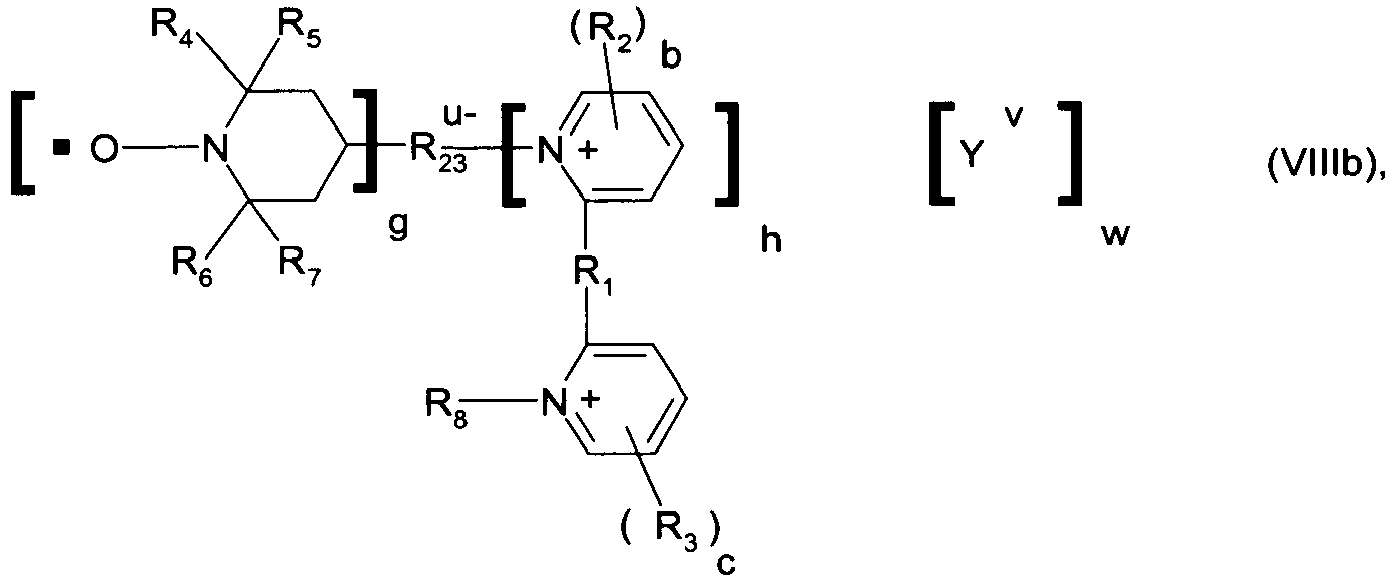


 R1, R2, R3, R4, R5, R6, R7 und X die in Anspruch 1 definierte Bedeutung besitzen, R8 und R10 unabhängig voneinander Wasserstoff, gegebenenfalls mit einer Carbonsäureester-, Carbonsäureamid-, Carbonsäure-, Sulfonsäure- oder Aminogruppe substituiertes Alkyl, gegebenenfalls mit einer Carbonsäureester-, Carbonsäureamid-, Carbonsäure-, Sulfonsäure- oder Aminogruppe substituiertes Cycloalkyl, gegebenenfalls mit einer Carbonsäureester-, Carbonsäureamid-, Carbonsäure-, Sulfonsäure- oder Aminogruppe substituiertes Aryl oder gegebenenfalls mit einer Carbonsäureester-, Carbonsäureamid-, Carbonsäure-, Sulfonsäure- oder Aminogruppe substituiertes Aralkyl bedeuten, insbesondere C1-C6-Alkyl, mit einer Carbonsäureestergruppe substituiertes C1-C6-Alkyl, mit einer Carbonsäureamidgruppe substituiertes C1-C6-Alkyl, mit einer Carbonsäuregruppe substituiertes C1-C6-Alkyl, mit einer Sulfonsäuregruppe substituiertes C1-C6-Alkyl, oder mit einer Aminogruppe substituiertes C1-C6-Alkyl, und ganz besonders bevorzugt Wasserstoff, Propionat, Isobutionat, Ethyl oder Methyl,Rg eine zwei- bis sechswertige, insbesondere zwei- bis vierwertige organische Brückengruppe ist,R12 eine kovalente Bindung ist oder eine zwei- bis sechswertige, insbesondere zwei- bis vierwertige organische Brückengruppe ist,R14 eine kovalente Bindung ist oder eine zweiwertige organische Brückengruppe ist,R15 eine zwei- bis sechswertige, insbesondere zwei- bis vierwertige organische Brückengruppe ist,R18 ein o-fach positiv geladener zwei- bis sechswertiger, insbesondere zwei- bis vierwertiger organischer Rest ist, der mit dem Stickstoffatom des Bipyridylrests über ein Kohlenstoffatom kovalent verbunden ist, insbesondere ein zwei- bis vierwertiger quaternärer Ammoniumrest, ein zwei- bis vierwertiger quaternärer Phosphoniumrest, ein zwei- bis dreiwertiger ternärer Sulfoniumrest oder ein o-fach positiv geladener zwei- bis sechswertiger, insbesondere zwei- bis vierwertiger heterocyclischer Rest,R19 ein o-fach, vorzugsweise einfach positiv geladener zweiwertiger organischer Rest ist, der mit dem Stickstoffatom des Bipyridylrests über ein Kohlenstoffatom kovalent verbunden ist, insbesondere ein quaternärer Ammoniumrest, ein quaternärer Phosphoniumrest, ein ternärer Sulfoniumrest oder ein o-fach, vorzugsweise einfach positiv geladener zweiwertiger heterocyclischer Rest ist, R20 und R21 unabhängig voneinander Wasserstoff, gegebenenfalls mit einer Carbonsäureester-, Carbonsäureamid-, Carbonsäure-, Sulfonsäure- oder Aminogruppe substituiertes Alkyl, gegebenenfalls mit einer Carbonsäureester-, Carbonsäureamid-, Carbonsäure-, Sulfonsäure- oder Aminogruppe substituiertes Cycloalkyl, gegebenenfalls mit einer Carbonsäureester-, Carbonsäureamid-, Carbonsäure-, Sulfonsäure- oder Aminogruppe substituiertes Aryl oder gegebenenfalls mit einer Carbonsäureester-, Carbonsäureamid-, Carbonsäure-, Sulfonsäure- oder Aminogruppe substituiertes Aralkyl bedeuten oder zwei Reste R20 und R21 zusammen eine C1-C3-Alkylengruppe bilden, insbesondere C1-C6-Alkyl, mit einer Carbonsäureestergruppe substituiertes C1-C6-Alkyl, mit einer Carbonsäureamidgruppe substituiertes C1-C6-Alkyl, mit einer Carbonsäuregruppe substituiertes C1-C6-Alkyl, mit einer Sulfonsäuregruppe substituiertes C1-C6-Alkyl, oder mit einer Aminogruppe substituiertes C1-C6-Alkyl sind oder zusammen Ethylen bedeuten, und ganz besonders bevorzugt Wasserstoff, Propionat, Isobutionat, Ethyl oder Methyl oder zusammen Ethylen bedeuten,R22 eine zweiwertige organische Brückengruppe ist,R23 ein u-fach negativ geladener zwei- bis sechswertiger, insbesondere zwei- bis vierwertiger organischer Rest ist, der mit dem Stickstoffatom des Bipyridylrests über ein Kohlenstoffatom kovalent verbunden ist, insbesondere ein mit ein oder zwei Carboxyl- oder Sulfonsäuregruppen substituierter Alkylenrest, ein mit ein oder zwei Carboxyl- oder Sulfonsäuregruppen substituierter Phenylenrest oder ein mit ein oder zwei Carboxyl- oder Sulfonsäuregruppen substituierter zweiwertiger heterocyclischer Rest ist,R24 ein u-fach, vorzugsweise einfach negativ geladener zweiwertiger organischer Rest ist, der mit dem Stickstoffatom des Bipyridylrests über ein Kohlenstoffatom kovalent verbunden ist, insbesondere ein mit einer Carboxyl- oder Sulfonsäuregruppe substituierter Alkylenrest, ein mit einer Carboxyl- oder Sulfonsäuregruppe substituierter Phenylenrest oder ein mit einer Carboxyl- oder Sulfonsäuregruppe substituierter zweiwertiger heterocyclischer Rest ist,a, b, c und q die in Anspruch 1 definierte Bedeutung besitzen,d eine ganze Zahl von 1 bis 5, vorzugsweise von 1 bis 3 ist,e eine Zahl mit dem Wert (2 + 2d + 2t) / q ist,g eine ganze Zahl von 1 bis 5, vorzugsweise von 1 bis 3 isth eine ganze Zahl von 1 bis 5, vorzugsweise von 1 bis 3 ist,wobei die Summe von g und h eine ganze Zahl von 2 bis 6, vorzugsweise von 2 bis 4 ist,i eine Zahl mit dem Wert 2h / q ist,j eine ganze Zahl von 1 bis 5, vorzugsweise von 1 bis 3 ist,k eine Zahl mit dem Wert von (2 + 2j) / q ist,o eine ganze Zahl von 1 bis 4 ist,p eine Zahl mit dem Wert (o + 2h) / q ist,r eine Zahl mit dem Wert (3 + 3j) / q ist,t 0 ist oder, falls Rg eine zweiwertige organische Brückengruppe ist, 0 oder 1 bedeutet,u eine ganze Zahl von 1 bis 4 ist,z eine Zahl mit dem Wert 2 / q ist,z1 eine Zahl mit dem Wert (o+2) / q istY für den Fall, dass 2h - u oder 2 (2 - u) - u größer als 0 ist, ein v- oder x-wertiges anorganisches oder organisches Anion oder eine Mischung derartiger Anionen bedeutet, oder für den Fall, dass 2h - u oder 2 (2 - u) - u kleiner als 0 ist, ein v- oder x-wertiges anorganisches oder organisches Kation oder eine Mischung derartiger Kationen bedeutet,v eine ganze Zahl von -1 bis -3 oder von +1 bis +3 ist,x eine ganze Zahl von -1 bis -3 oder von +1 bis +3 ist,w 0 oder eine positive Zahl mit dem Wert (-u + 2h) / v ist,y 0 oder eine positive Zahl mit dem Wert (2 - u) (j + 1) / x ist,Y1 für den Fall, dass 2 - 2u kleiner als 0 ist, ein x1-wertiges anorganisches oder organisches Kation oder eine Mischung derartiger Kationen bedeutet,x1 eine ganze Zahl von -1 bis -3 oder von +1 bis +3 ist, undy1 0 oder eine positive Zahl mit dem Wert (2 - 2u) / x1 ist.
 - Redox-Flow-Zelle nach Anspruch 2, dadurch gekennzeichnet, dass im Anolyt eine Verbindung der Formeln IVa, Va, VIIc, VIIIc, IXc und/oder Xc als redoxaktive Komponente eingesetzt wird


 R2, R3, R4, R5, R6, R7 und X die in Anspruch 1 definierte Bedeutung besitzen,R8, R9, R10, R12, R14 und R15 die in Anspruch 2 definierte Bedeutung besitzen,b, c und q die in Anspruch 1 definierte Bedeutung besitzen,
undd, e, g, h, i, j und k die in Anspruch 2 definierte Bedeutung besitzen. - Redox-Flow-Zelle nach Anspruch 1, dadurch gekennzeichnet, dass im Katholyt eine Verbindung der Formeln IIIa, IIIb, IIIc, VI, VIa und/oder VIb oder der in Anspruch 2 definierten Formeln VII, VIIa, VIIb, VIII, VIIIa, VIIIb, IX, IXa, IXb, X, Xa und/oder Xb als redoxaktive Komponente eingesetzt wird


 R4, R5, R6, R7, X und q die in Anspruch 1 definierte Bedeutung besitzen,o und u die in Anspruch 2 definierte Bedeutung besitzen,R11 eine zwei- bis vierwertige organische Brückengruppe ist,R13 Wasserstoff, Alkyl, Alkoxy, Haloalkyl, Cycloalkyl, Aryl, Aralkyl, Heterocyclyl, Halogen, Hydroxy, Amino, Nitro oder Cyano ist, undR16 ein o-fach, vorzugsweise ein einfach positiv geladener einwertiger organischer Rest, insbesondere ein quaternärer Ammoniumrest, ein quaternärer Phosphoniumrest, ein ternärer Sulfoniumrest oder ein o-fach, vorzugsweise ein einfach positiv geladener einwertiger heterocyclischer Rest ist,R17 ein m-fach positiv geladener zwei- bis vierwertiger organischer Rest, insbesondere zwei- bis vierwertiger quaternärer Ammoniumrest, ein zwei- bis vierwertiger quaternärer Phosphoniumrest, ein zwei- bis vierwertiger ternärer Sulfoniumrest oder ein m-fach positiv geladener zwei- bis vierwertiger heterocyclischer Rest ist,R25 ein u-fach, vorzugsweise ein einfach negativ geladener einwertiger Rest, insbesondere ein Carboxyl- oder Sulfonsäurerest oder ein u-fach, vorzugsweise ein einfach negativ geladener einwertiger heterocyclischer Rest ist,R26 ein m-fach negativ geladener zwei- bis vierwertiger organischer Rest, insbesondere ein mit ein oder zwei Carboxyl- oder Sulfonsäuregruppen substituierter Alkylenrest, oder ein mit ein oder zwei Carboxyl- oder Sulfonsäuregruppen substituierter Phenylenrest oder ein mit ein oder zwei Carboxyl- oder Sulfonsäuregruppen substituierter zweiwertiger heterocyclischer Rest ist,Z ein q-wertiges anorganisches oder organisches Kation oder eine Mischung derartiger Kationen bedeutet,f eine ganze Zahl von 1 bis 3 ist,l eine Zahl mit dem Wert o / q oder u / q ist,m eine ganze Zahl von 1 bis 4 ist, undn eine Zahl mit dem Wert m/q bedeutet.
 - Redox-Flow-Zelle nach einem der Ansprüche 3 oder 4, dadurch gekennzeichnet, dass im Katholyt eine Verbindung der in Anspruch 3 oder 4 definierten Formeln VI, VIa, VIIc, VIIIc, IXc und/oder Xc als redoxaktive Verbindung eingesetzt wird.
- Redox-Flow-Zelle nach Anspruch 1, dadurch gekennzeichnet, dass eine Verbindung der Formeln Ib, IIb, VIId, VIIe, VIIId und/oder VIIIe als redoxaktive Verbindung eingesetzt wird


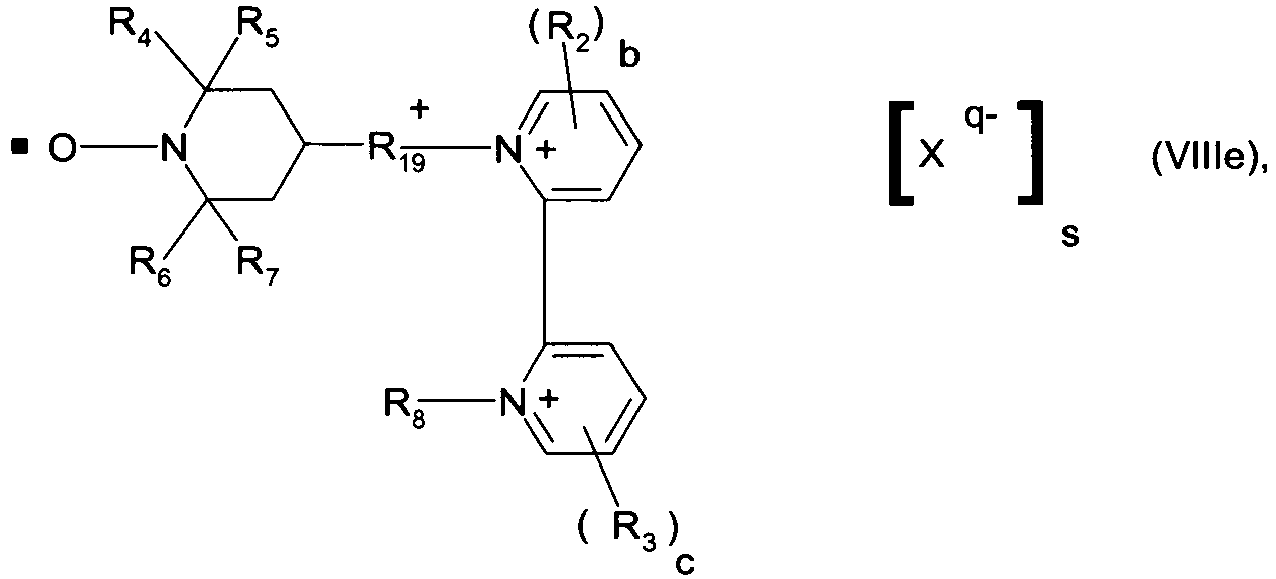 R2, R3, R4, R5, R6, R7 und X die in Anspruch 1 definierte Bedeutung besitzen,R8, R10, R14 und R19 die in Anspruch 2 definierte Bedeutung besitzen,R20 und R21 unabhängig voneinander Wasserstoff, gegebenenfalls mit einer Carbonsäureester-, Carbonsäureamid-, Carbonsäure-, Sulfonsäure- oder Aminogruppe substituiertes Alkyl, gegebenenfalls mit einer Carbonsäureester-, Carbonsäureamid-, Carbonsäure-, Sulfonsäure- oder Aminogruppe substituiertes Cycloalkyl, gegebenenfalls mit einer Carbonsäureester-, Carbonsäureamid-, Carbonsäure-, Sulfonsäure- oder Aminogruppe substituiertes Aryl oder gegebenenfalls mit einer Carbonsäureester-, Carbonsäureamid-, Carbonsäure-, Sulfonsäure- oder Aminogruppe substituiertes Aralkyl bedeuten oder zwei Reste R20 und R21 zusammen eine C1-C3-Alkylengruppe bilden, insbesondere C1-C6-Alkyl, mit einer Carbonsäureestergruppe substituiertes C1-C6-Alkyl, mit einer Carbonsäureamidgruppe substituiertes C1-C6-Alkyl, mit einer Carbonsäuregruppe substituiertes C1-C6-Alkyl, mit einer Sulfonsäuregruppe substituiertes C1-C6-Alkyl, oder mit einer Aminogruppe substituiertes C1-C6-Alkyl sind oder zusammen Ethylen bedeuten, und ganz besonders bevorzugt Wasserstoff, Propionat, Isobutionat, Ethyl oder Methyl oder zusammen Ethylen bedeuten,a, b, c und q die in Anspruch 1 definierte Bedeutung besitzen,s eine Zahl mit dem Wert 3 / q ist, undwobei die Verbindungen der Formeln Ib, IIb, VIId, VIIe, VIIId und/oder VIIIe im Anolyten eingesetzt werden und die Verbindungen der Formeln VIIc, VIId, VIIIc und/oder Vllld im Katholyten eingesetzt werden.
 - Redox-Flow-Zelle nach Anspruch 1, dadurch gekennzeichnet, dass der Katholyt Verbindungen der Formeln IIIa, IIIb oder IIIc gemäß Anspruch 4 und der Anolyt Verbindungen der Formeln Ib oder IIb gemäß Anspruch 2 enthält.
- Redox-Flow-Zelle nach Anspruch 7, dadurch gekennzeichnet, dass der Katholyt eine Verbindung der Formel IIIb und der Anolyt eine Verbindung der Formel Ib enthält.
- Redox-Flow-Zelle nach Anspruch 8, dadurch gekennzeichnet dass die Verbindung der Formel IIIb ein Salz des 2,2,6,6-Tetramethylpiperidin-4-(N,N,N-trialkylammoniums) ist und dass die Verbindung der Formel Ib ein Salz des N, N'-Dialkylviologens ist.
- Redox-Flow-Zelle nach Anspruch 1, dadurch gekennzeichnet, dass im Katholyt und/oder im Anolyt Verbindungen der in Ansprüchen 2, 3 oder 6 definierten Formeln VII, VIIa, VIIb, VIIc, VIId, VIIe, VIII, VIIIa, VIIIb, VIIIc, VIIId, VIIIe, IX, IXa, IXb, IXc, X, Xa, Xb oder Xc eingesetzt werden.
- Redox-Flow-Zelle nach einem der Ansprüche 1 bis 10, dadurch gekennzeichnet, dass Verbindungen eingesetzt werden, die Halogenidionen, Hydroxidionen, Phosphationen, Sulfationen, Perchlorationen, Hexafluorophosphationen oder Tetrafluoroborationen enthalten sowie vorzugsweise Kationen ausgewählt aus der Gruppe der Wasserstoffionen, Alkali- oder Erdalkalimetallkationen, sowie der substituierten oder unsubstituierten Ammoniumkationen.
- Redox-Flow-Zelle nach einem der Ansprüche 1 bis 11, dadurch gekennzeichnet, dass redoxaktive Verbindungen enthaltend ein bis vier Struktureinheiten der Formel III, VII, VIIa, VIIb VIII, VIIIa, VIIIb, IX, IXa, IXb, X, Xa oder Xb, insbesondere solche der Formeln IIIa, IIIb, V, VIa, VIIc, VIId, VIIe, VIIIc, VIIId, VIIIe, IXc oder Xc eingesetzt werden, in denen R4, R5, R6 und R7 jeweils C1-C6-Alkyl und ganz besonders bevorzugt Ethyl oder Methyl bedeuten.
- Redox-Flow-Zelle nach einem der Ansprüche 2, 3 oder 6, dadurch gekennzeichnet, dass redoxaktive Verbindungen der Formeln IV, V, VII, VIIa, VIIb, VIII, VIIIa oder VIIIb, insbesondere solche der Formeln IVa, Va, VIIc oder VIIIc und ganz besonders bevorzugt solche der Formeln Ib, VIId, VIIe, VIIId oder VIIIe eingesetzt werden, in denen R8 oder R8 und R10 Wasserstoff, C1-C6-Alkyl, mit einer Carbonsäurealkylestergruppe substituiertes C1-C6-Alkyl, mit einer Carbonsäureamidgruppe substituiertes C1-C6-Alkyl, mit einer Carbonsäuregruppe substituiertes C1-C6-Alkyl, mit einer Sulfonsäuregruppe substituiertes C1-C6-Alkyl oder mit einer Aminogruppe substituiertes C1-C6-Alkyl bedeuten, und ganz besonders bevorzugt Wasserstoff, Propionat, Isobutionat, Ethyl oder Methyl bedeuten.
- Redox-Flow-Zelle nach Anspruch 4, dadurch gekennzeichnet, dass redoxaktive Verbindungen der Formel IIIa eingesetzt werden, in denen R13 Wasserstoff, C1-C6-Alkyl, C1-C6-Alkoxy, C1-C6-Teil- oder Perfluoralkyl, C1-C6-Teil- oder Perchloralkyl, C1-C6-Fluorchloralkyl, Phenyl, Benzyl, Fluor, Chlor, Hydroxy, Amino, oder Nitro ist.
- Verwendung der Redox-Flow-Zelle nach einem der Ansprüche 1 bis 14 zur Speicherung von elektrischer Energie für stationäre und mobile Anwendungen, insbesondere als stationäre Speicher für die Notstromversorgung, den Spitzenlastausgleich, für die Zwischenspeicherung elektrischer Energie aus erneuerbaren Energiequellen, insbesondere auf dem Sektor der Photovoltaik und der Windkraft, oder aus Gas-, Kohle-, Biomasse-, Gezeiten- und Meereskraftwerken und für Einsätze auf dem Gebiet der Elektromobilität, als Speicher in Land-, Luft- und Wasserfahrzeugen.
Priority Applications (4)
| Application Number | Priority Date | Filing Date | Title |
|---|---|---|---|
| MA43560A MA43560B1 (fr) | 2015-08-07 | 2016-08-03 | Cellule d'écoulement de redox pour le stockage d'énergie électrique et l'utilisation de cela |
| SI201630310T SI3332438T1 (sl) | 2015-08-07 | 2016-08-03 | Redoks pretočna celica za shranjevanje električne energije in njena uporaba |
| HRP20191286TT HRP20191286T1 (hr) | 2015-08-07 | 2016-08-03 | Redoks protočna ćelija za pohranu električne energije i njezina uporaba |
| PL16747731T PL3332438T3 (pl) | 2015-08-07 | 2016-08-03 | Ogniwo przepływowe redoks do magazynowania energii elektrycznej i jego zastosowanie |
Applications Claiming Priority (2)
| Application Number | Priority Date | Filing Date | Title |
|---|---|---|---|
| DE102015010083.1A DE102015010083A1 (de) | 2015-08-07 | 2015-08-07 | Redox-Flow-Zelle zur Speicherung elektrischer Energie und deren Verwendung |
| PCT/EP2016/001338 WO2017025177A1 (de) | 2015-08-07 | 2016-08-03 | Redox-flow-zelle zur speicherung elektrischer energie und deren verwendung |
Publications (3)
| Publication Number | Publication Date |
|---|---|
| EP3332438A1 EP3332438A1 (de) | 2018-06-13 |
| EP3332438B1 true EP3332438B1 (de) | 2019-05-01 |
| EP3332438B8 EP3332438B8 (de) | 2019-07-03 |
Family
ID=56571291
Family Applications (1)
| Application Number | Title | Priority Date | Filing Date |
|---|---|---|---|
| EP16747731.4A Active EP3332438B8 (de) | 2015-08-07 | 2016-08-03 | Redox-flow-zelle zur speicherung elektrischer energie und deren verwendung |
Country Status (26)
| Country | Link |
|---|---|
| US (2) | US11515557B2 (de) |
| EP (1) | EP3332438B8 (de) |
| JP (1) | JP6814366B2 (de) |
| KR (1) | KR102661988B1 (de) |
| CN (1) | CN108140864B (de) |
| AU (1) | AU2016305138B2 (de) |
| BR (1) | BR112018002468B1 (de) |
| CA (1) | CA2993464C (de) |
| CY (1) | CY1121797T1 (de) |
| DE (1) | DE102015010083A1 (de) |
| DK (1) | DK3332438T3 (de) |
| ES (1) | ES2736129T3 (de) |
| HR (1) | HRP20191286T1 (de) |
| HU (1) | HUE044843T2 (de) |
| IL (1) | IL257325B (de) |
| MA (1) | MA43560B1 (de) |
| MX (1) | MX384581B (de) |
| PL (1) | PL3332438T3 (de) |
| PT (1) | PT3332438T (de) |
| RU (1) | RU2722695C2 (de) |
| SA (1) | SA518390879B1 (de) |
| SG (1) | SG11201800805QA (de) |
| SI (1) | SI3332438T1 (de) |
| TR (1) | TR201910276T4 (de) |
| WO (1) | WO2017025177A1 (de) |
| ZA (1) | ZA201800437B (de) |
Cited By (1)
| Publication number | Priority date | Publication date | Assignee | Title |
|---|---|---|---|---|
| WO2022251610A1 (en) | 2021-05-28 | 2022-12-01 | Wisconsin Alumni Research Foundation | Ionic cyclic nitroxyl radical oligomers |
Families Citing this family (34)
| Publication number | Priority date | Publication date | Assignee | Title |
|---|---|---|---|---|
| DE102015014828A1 (de) | 2015-11-18 | 2017-05-18 | Friedrich-Schiller-Universität Jena | Hybrid-Flow-Zelle zur Speicherung elektrischer Energie und deren Verwendung |
| US10374239B2 (en) * | 2016-12-29 | 2019-08-06 | Uchicago Argonne, Llc | Aqueous pyridinium cation-based redox flow batteries |
| EP3565044A1 (de) * | 2018-04-30 | 2019-11-06 | Siemens Aktiengesellschaft | Redox-flow-batterie und verfahren zum betreiben einer redox-flow-batterie |
| CN109378510B (zh) * | 2018-10-25 | 2021-03-02 | 中盐金坛盐化有限责任公司 | 基于盐穴的水相体系有机液流电池系统 |
| CN111244518B (zh) * | 2018-11-28 | 2021-02-12 | 中国科学院大连化学物理研究所 | 一种水系中性有机液流电池 |
| DE102018009393A1 (de) | 2018-11-29 | 2020-06-04 | Friedrich-Schiller-Universität Jena | Wässriger Elektrolyt, Redox-Flow-Batterie und deren Verwendung |
| DE102018009363A1 (de) * | 2018-11-29 | 2020-06-04 | Friedrich-Schiller-Universität Jena | Redox-Flow-Batterie zur Speicherung von elektrischer Energie in Erdspeichern und deren Verwendung |
| GB201819459D0 (en) * | 2018-11-29 | 2019-01-16 | Imperial Innovations Ltd | Redox flow battery |
| DE102018132669A1 (de) * | 2018-12-18 | 2020-06-18 | Spiraltec Gmbh | Gewickelte Redoxflowbatterie |
| GB201902695D0 (en) | 2019-02-28 | 2019-04-17 | Imperial Innovations Ltd | Redox flow cell |
| JP7258350B2 (ja) * | 2019-04-03 | 2023-04-17 | 国立研究開発法人産業技術総合研究所 | 規則構造を有する高水溶性、高エネルギー密度化有機系活物質を用いた電気化学デバイス |
| CN110668996B (zh) * | 2019-09-25 | 2021-06-29 | 中盐金坛盐化有限责任公司 | 联吡啶类化合物、合成方法及其对称性液流电池系统 |
| KR102088601B1 (ko) * | 2019-12-12 | 2020-03-12 | 서울과학기술대학교 산학협력단 | 멤브레인 없는 레독스 흐름 전지 |
| CN112993282A (zh) * | 2019-12-13 | 2021-06-18 | 长春理工大学 | 一种联吡啶钴/石墨烯复合材料及其制备方法 |
| CN111266086B (zh) * | 2020-01-22 | 2022-05-17 | 青岛农业大学 | 一种利用餐厨垃圾制取磁性生物炭的方法 |
| PL4128403T3 (pl) * | 2020-04-01 | 2024-09-16 | Basf Se | Roztwór pochodnych tempo do zastosowania jako elektrolit w ogniwach przepływowych redoks |
| KR20220161419A (ko) | 2020-04-01 | 2022-12-06 | 바스프 에스이 | 산화환원-유동 전지에서 전해질로서 사용하기 위한 tempo-유도체의 용액 |
| CN111564649B (zh) * | 2020-06-18 | 2021-06-29 | 中盐金坛盐化有限责任公司 | 一种有机聚合物液流电池系统 |
| CN111624153B (zh) * | 2020-07-09 | 2020-12-15 | 西南石油大学 | 一种山地湿气管道气液两相流腐蚀试验装置 |
| CN112103546B (zh) * | 2020-09-16 | 2021-09-03 | 中盐金坛盐化有限责任公司 | 不对称型双电子紫精化合物的制备方法 |
| DE102020133090A1 (de) | 2020-12-11 | 2022-06-15 | Schaeffler Technologies AG & Co. KG | Elektrodenblech für eine Redox-Flow-Zelle und Redox-Flow-Zelle |
| US11837767B2 (en) * | 2020-12-23 | 2023-12-05 | Uop Llc | Electrolyte compositions for redox flow batteries |
| EP4320665A1 (de) * | 2021-04-07 | 2024-02-14 | Basf Se | Lösung alkylierter piperidinamin- und piperidinaminiumderivate zur herstellung gereinigter lösungen von tempo-derivaten zur verwendung als elektrolyt in redox-flow-zellen |
| US12291513B2 (en) | 2021-05-03 | 2025-05-06 | Wisconsin Alumni Research Foundation | Pyridinium derivatives made by hydrothermal synthesis for use as anolytes in electrochemical cells |
| US12551879B2 (en) | 2021-05-19 | 2026-02-17 | Uop Llc | Sandwich-structured thin film composite anion exchange membrane for redox flow battery applications |
| CN113666864A (zh) * | 2021-09-15 | 2021-11-19 | 宿迁时代储能科技有限公司 | 一种tempo-4-氯化铵的制备方法 |
| US20230086739A1 (en) * | 2021-09-21 | 2023-03-23 | Uop Llc | Mitigation of solution cross-over using differential electrolyte formulations in redox flow battery systems |
| CN114122414B (zh) * | 2021-11-05 | 2024-07-16 | 西安交通大学 | 一种哌啶氮氧自由基/锌复合氧化还原液流电池及其制备方法 |
| CN115732731A (zh) * | 2022-11-02 | 2023-03-03 | 宿迁时代储能科技有限公司 | 一种水相-有机氧化还原液流电池 |
| GB202300538D0 (en) | 2023-01-13 | 2023-03-01 | Cambridge Entpr Ltd | Redox flow battery |
| CN117712439A (zh) * | 2023-12-22 | 2024-03-15 | 宿迁时代储能科技有限公司 | 用于储能的氧化还原有机液流电池及其应用 |
| WO2026002560A1 (fr) | 2024-06-28 | 2026-01-02 | Universite Paris Cite | Molecules organiques radicalaires bi-redox multifonctionnelles |
| CN119264112B (zh) * | 2024-09-26 | 2025-10-17 | 浙江大学 | 一种水溶性双电极液流电池系统用复合双极分子及其制备方法及其应用 |
| CN120261648B (zh) * | 2025-04-03 | 2025-10-14 | 宿迁时代储能科技有限公司 | 一种低成本的液流电池及其应用 |
Family Cites Families (15)
| Publication number | Priority date | Publication date | Assignee | Title |
|---|---|---|---|---|
| DE3024611A1 (de) | 1980-06-28 | 1982-01-28 | Basf Ag, 6700 Ludwigshafen | Edelmetallfreie elektrode |
| EP0191726A3 (de) | 1985-01-17 | 1988-05-11 | Ciba-Geigy Ag | Polypyrrol-Polyimidzusammensetzungen |
| EP0206133B1 (de) | 1985-06-12 | 1991-07-31 | BASF Aktiengesellschaft | Verwendung von Polypyrrol zur Abscheidung von metallischem Kupfer auf elektrisch nichtleitende Materialen |
| AU575247B2 (en) | 1986-02-11 | 1988-07-21 | Pinnacle Vrb Limited | All vanadium redox battery |
| US5439757A (en) * | 1992-10-14 | 1995-08-08 | National Power Plc | Electrochemical energy storage and/or power delivery cell with pH control |
| JP2009290116A (ja) | 2008-05-30 | 2009-12-10 | Kaneka Corp | エネルギー貯蔵デバイス |
| JP5596908B2 (ja) | 2008-06-09 | 2014-09-24 | 株式会社カネカ | エネルギー貯蔵デバイス |
| CN102035007A (zh) * | 2009-09-25 | 2011-04-27 | 中国人民解放军63971部队 | 一种水溶性有机电对液流电池 |
| KR101638595B1 (ko) * | 2010-01-29 | 2016-07-12 | 삼성전자주식회사 | 레독스 플로우 전지 |
| US9966625B2 (en) * | 2012-02-28 | 2018-05-08 | Uchicago Argonne, Llc | Organic non-aqueous cation-based redox flow batteries |
| US9300000B2 (en) | 2012-02-28 | 2016-03-29 | Uchicago Argonne, Llc | Organic non-aqueous cation-based redox flow batteries |
| DE102012016317A1 (de) | 2012-08-14 | 2014-02-20 | Jenabatteries GmbH | Redox-Flow-Zelle zur Speicherung elektrischer Energie |
| NO2751376T3 (de) * | 2014-02-13 | 2018-03-24 | ||
| US9793566B2 (en) * | 2015-04-17 | 2017-10-17 | Battelle Memorial Institute | Aqueous electrolytes for redox flow battery systems |
| DE102015014828A1 (de) | 2015-11-18 | 2017-05-18 | Friedrich-Schiller-Universität Jena | Hybrid-Flow-Zelle zur Speicherung elektrischer Energie und deren Verwendung |
-
2015
- 2015-08-07 DE DE102015010083.1A patent/DE102015010083A1/de not_active Withdrawn
-
2016
- 2016-08-03 SI SI201630310T patent/SI3332438T1/sl unknown
- 2016-08-03 WO PCT/EP2016/001338 patent/WO2017025177A1/de not_active Ceased
- 2016-08-03 DK DK16747731.4T patent/DK3332438T3/da active
- 2016-08-03 CN CN201680053440.0A patent/CN108140864B/zh active Active
- 2016-08-03 SG SG11201800805QA patent/SG11201800805QA/en unknown
- 2016-08-03 JP JP2018526295A patent/JP6814366B2/ja active Active
- 2016-08-03 HR HRP20191286TT patent/HRP20191286T1/hr unknown
- 2016-08-03 TR TR2019/10276T patent/TR201910276T4/tr unknown
- 2016-08-03 ES ES16747731T patent/ES2736129T3/es active Active
- 2016-08-03 EP EP16747731.4A patent/EP3332438B8/de active Active
- 2016-08-03 CA CA2993464A patent/CA2993464C/en active Active
- 2016-08-03 AU AU2016305138A patent/AU2016305138B2/en active Active
- 2016-08-03 MA MA43560A patent/MA43560B1/fr unknown
- 2016-08-03 PL PL16747731T patent/PL3332438T3/pl unknown
- 2016-08-03 US US15/750,766 patent/US11515557B2/en active Active
- 2016-08-03 PT PT16747731T patent/PT3332438T/pt unknown
- 2016-08-03 HU HUE16747731 patent/HUE044843T2/hu unknown
- 2016-08-03 RU RU2018108046A patent/RU2722695C2/ru active
- 2016-08-03 MX MX2018001565A patent/MX384581B/es unknown
- 2016-08-03 BR BR112018002468-6A patent/BR112018002468B1/pt active IP Right Grant
- 2016-08-03 KR KR1020187006471A patent/KR102661988B1/ko active Active
-
2018
- 2018-01-22 ZA ZA2018/00437A patent/ZA201800437B/en unknown
- 2018-02-04 IL IL257325A patent/IL257325B/en active IP Right Grant
- 2018-02-05 SA SA518390879A patent/SA518390879B1/ar unknown
-
2019
- 2019-07-10 CY CY20191100723T patent/CY1121797T1/el unknown
-
2022
- 2022-07-22 US US17/871,467 patent/US20220384834A1/en not_active Abandoned
Non-Patent Citations (1)
| Title |
|---|
| None * |
Cited By (1)
| Publication number | Priority date | Publication date | Assignee | Title |
|---|---|---|---|---|
| WO2022251610A1 (en) | 2021-05-28 | 2022-12-01 | Wisconsin Alumni Research Foundation | Ionic cyclic nitroxyl radical oligomers |
Also Published As
Similar Documents
| Publication | Publication Date | Title |
|---|---|---|
| DE102015010083A1 (de) | Redox-Flow-Zelle zur Speicherung elektrischer Energie und deren Verwendung | |
| EP3378115B1 (de) | Hybrid-flow-batterie zur speicherung elektrischer energie und deren verwendung | |
| EP2997613B1 (de) | Redox-flow-zelle zur speicherung elektrischer energie und deren verwendung | |
| JP7619945B2 (ja) | 水性電解質、酸化還元フロー電池とその使用 | |
| WO2020108788A2 (de) | Redox-flow-batterie zur speicherung von elektrischer energie in erdspeichern und deren verwendung | |
| DE112018003716B4 (de) | Redox-Flow Batterie | |
| US11056705B2 (en) | Organic anolyte materials for flow batteries | |
| Alkhayri et al. | Evaluation of two-electron bispyridinylidene anolytes and a TEMPO catholyte for non-aqueous redox flow batteries | |
| EP3510061B1 (de) | Verfahren zur verbesserten oxidation sekundärer amingruppen | |
| WO2019210995A1 (de) | Sole-hybrid-redox-flow-batterie | |
| EP3888162A1 (de) | Wässriger elektrolyt, redox-flow-batterie und deren verwendung | |
| HK1255214B (zh) | 用於储存电能的氧化还原液流电池及其用途 | |
| DE102017005924A1 (de) | Verwendung benzotriazinyl-haltiger Polymere als Ladungsspeicher |
Legal Events
| Date | Code | Title | Description |
|---|---|---|---|
| STAA | Information on the status of an ep patent application or granted ep patent |
Free format text: STATUS: THE INTERNATIONAL PUBLICATION HAS BEEN MADE |
|
| PUAI | Public reference made under article 153(3) epc to a published international application that has entered the european phase |
Free format text: ORIGINAL CODE: 0009012 |
|
| STAA | Information on the status of an ep patent application or granted ep patent |
Free format text: STATUS: REQUEST FOR EXAMINATION WAS MADE |
|
| 17P | Request for examination filed |
Effective date: 20180307 |
|
| AK | Designated contracting states |
Kind code of ref document: A1 Designated state(s): AL AT BE BG CH CY CZ DE DK EE ES FI FR GB GR HR HU IE IS IT LI LT LU LV MC MK MT NL NO PL PT RO RS SE SI SK SM TR |
|
| AX | Request for extension of the european patent |
Extension state: BA ME |
|
| RIN1 | Information on inventor provided before grant (corrected) |
Inventor name: MARTIN, NORBERT Inventor name: JANOSCHKA, TOBIAS Inventor name: SCHUBERT, ULRICH SIGMAR |
|
| DAX | Request for extension of the european patent (deleted) | ||
| RAV | Requested validation state of the european patent: fee paid |
Extension state: MA Effective date: 20180307 |
|
| GRAP | Despatch of communication of intention to grant a patent |
Free format text: ORIGINAL CODE: EPIDOSNIGR1 |
|
| STAA | Information on the status of an ep patent application or granted ep patent |
Free format text: STATUS: GRANT OF PATENT IS INTENDED |
|
| INTG | Intention to grant announced |
Effective date: 20190109 |
|
| GRAS | Grant fee paid |
Free format text: ORIGINAL CODE: EPIDOSNIGR3 |
|
| GRAA | (expected) grant |
Free format text: ORIGINAL CODE: 0009210 |
|
| STAA | Information on the status of an ep patent application or granted ep patent |
Free format text: STATUS: THE PATENT HAS BEEN GRANTED |
|
| AK | Designated contracting states |
Kind code of ref document: B1 Designated state(s): AL AT BE BG CH CY CZ DE DK EE ES FI FR GB GR HR HU IE IS IT LI LT LU LV MC MK MT NL NO PL PT RO RS SE SI SK SM TR |
|
| REG | Reference to a national code |
Ref country code: GB Ref legal event code: FG4D Free format text: NOT ENGLISH |
|
| REG | Reference to a national code |
Ref country code: AT Ref legal event code: REF Ref document number: 1128146 Country of ref document: AT Kind code of ref document: T Effective date: 20190515 Ref country code: CH Ref legal event code: EP |
|
| REG | Reference to a national code |
Ref country code: DE Ref legal event code: R096 Ref document number: 502016004468 Country of ref document: DE |
|
| REG | Reference to a national code |
Ref country code: IE Ref legal event code: FG4D Free format text: LANGUAGE OF EP DOCUMENT: GERMAN |
|
| REG | Reference to a national code |
Ref country code: MA Ref legal event code: VAGR Ref document number: 43560 Country of ref document: MA Kind code of ref document: B1 |
|
| RAP2 | Party data changed (patent owner data changed or rights of a patent transferred) |
Owner name: JENABATTERIES GMBH |
|
| REG | Reference to a national code |
Ref country code: CH Ref legal event code: PK Free format text: BERICHTIGUNG B8 |
|
| REG | Reference to a national code |
Ref country code: NL Ref legal event code: FP |
|
| REG | Reference to a national code |
Ref country code: CH Ref legal event code: NV Representative=s name: PATENTANWAELTE SCHAAD, BALASS, MENZL AND PARTN, CH |
|
| REG | Reference to a national code |
Ref country code: PT Ref legal event code: SC4A Ref document number: 3332438 Country of ref document: PT Date of ref document: 20190708 Kind code of ref document: T Free format text: AVAILABILITY OF NATIONAL TRANSLATION Effective date: 20190625 |
|
| REG | Reference to a national code |
Ref country code: BE Ref legal event code: PD Owner name: JENABATTERIES GMBH; DE Free format text: DETAILS ASSIGNMENT: CHANGE OF OWNER(S), CESSION; FORMER OWNER NAME: FRIEDRICH-SCHILLER-UNIVERSITAET JENA Effective date: 20190426 |
|
| REG | Reference to a national code |
Ref country code: HR Ref legal event code: TUEP Ref document number: P20191286 Country of ref document: HR |
|
| REG | Reference to a national code |
Ref country code: DK Ref legal event code: T3 Effective date: 20190801 |
|
| REG | Reference to a national code |
Ref country code: SE Ref legal event code: TRGR |
|
| REG | Reference to a national code |
Ref country code: NO Ref legal event code: T2 Effective date: 20190501 |
|
| REG | Reference to a national code |
Ref country code: LT Ref legal event code: MG4D |
|
| REG | Reference to a national code |
Ref country code: HR Ref legal event code: ODRP Ref document number: P20191286 Country of ref document: HR Payment date: 20190726 Year of fee payment: 4 |
|
| REG | Reference to a national code |
Ref country code: HR Ref legal event code: T1PR Ref document number: P20191286 Country of ref document: HR |
|
| REG | Reference to a national code |
Ref country code: GR Ref legal event code: EP Ref document number: 20190402105 Country of ref document: GR Effective date: 20191016 |
|
| PG25 | Lapsed in a contracting state [announced via postgrant information from national office to epo] |
Ref country code: AL Free format text: LAPSE BECAUSE OF FAILURE TO SUBMIT A TRANSLATION OF THE DESCRIPTION OR TO PAY THE FEE WITHIN THE PRESCRIBED TIME-LIMIT Effective date: 20190501 Ref country code: LT Free format text: LAPSE BECAUSE OF FAILURE TO SUBMIT A TRANSLATION OF THE DESCRIPTION OR TO PAY THE FEE WITHIN THE PRESCRIBED TIME-LIMIT Effective date: 20190501 |
|
| REG | Reference to a national code |
Ref country code: HU Ref legal event code: AG4A Ref document number: E044843 Country of ref document: HU |
|
| PG25 | Lapsed in a contracting state [announced via postgrant information from national office to epo] |
Ref country code: LV Free format text: LAPSE BECAUSE OF FAILURE TO SUBMIT A TRANSLATION OF THE DESCRIPTION OR TO PAY THE FEE WITHIN THE PRESCRIBED TIME-LIMIT Effective date: 20190501 Ref country code: BG Free format text: LAPSE BECAUSE OF FAILURE TO SUBMIT A TRANSLATION OF THE DESCRIPTION OR TO PAY THE FEE WITHIN THE PRESCRIBED TIME-LIMIT Effective date: 20190801 Ref country code: RS Free format text: LAPSE BECAUSE OF FAILURE TO SUBMIT A TRANSLATION OF THE DESCRIPTION OR TO PAY THE FEE WITHIN THE PRESCRIBED TIME-LIMIT Effective date: 20190501 |
|
| PG25 | Lapsed in a contracting state [announced via postgrant information from national office to epo] |
Ref country code: CZ Free format text: LAPSE BECAUSE OF FAILURE TO SUBMIT A TRANSLATION OF THE DESCRIPTION OR TO PAY THE FEE WITHIN THE PRESCRIBED TIME-LIMIT Effective date: 20190501 Ref country code: RO Free format text: LAPSE BECAUSE OF FAILURE TO SUBMIT A TRANSLATION OF THE DESCRIPTION OR TO PAY THE FEE WITHIN THE PRESCRIBED TIME-LIMIT Effective date: 20190501 Ref country code: SK Free format text: LAPSE BECAUSE OF FAILURE TO SUBMIT A TRANSLATION OF THE DESCRIPTION OR TO PAY THE FEE WITHIN THE PRESCRIBED TIME-LIMIT Effective date: 20190501 Ref country code: EE Free format text: LAPSE BECAUSE OF FAILURE TO SUBMIT A TRANSLATION OF THE DESCRIPTION OR TO PAY THE FEE WITHIN THE PRESCRIBED TIME-LIMIT Effective date: 20190501 |
|
| REG | Reference to a national code |
Ref country code: DE Ref legal event code: R097 Ref document number: 502016004468 Country of ref document: DE |
|
| PG25 | Lapsed in a contracting state [announced via postgrant information from national office to epo] |
Ref country code: SM Free format text: LAPSE BECAUSE OF FAILURE TO SUBMIT A TRANSLATION OF THE DESCRIPTION OR TO PAY THE FEE WITHIN THE PRESCRIBED TIME-LIMIT Effective date: 20190501 |
|
| PLBE | No opposition filed within time limit |
Free format text: ORIGINAL CODE: 0009261 |
|
| STAA | Information on the status of an ep patent application or granted ep patent |
Free format text: STATUS: NO OPPOSITION FILED WITHIN TIME LIMIT |
|
| 26N | No opposition filed |
Effective date: 20200204 |
|
| PG25 | Lapsed in a contracting state [announced via postgrant information from national office to epo] |
Ref country code: LU Free format text: LAPSE BECAUSE OF NON-PAYMENT OF DUE FEES Effective date: 20190803 Ref country code: MC Free format text: LAPSE BECAUSE OF FAILURE TO SUBMIT A TRANSLATION OF THE DESCRIPTION OR TO PAY THE FEE WITHIN THE PRESCRIBED TIME-LIMIT Effective date: 20190501 |
|
| REG | Reference to a national code |
Ref country code: HR Ref legal event code: ODRP Ref document number: P20191286 Country of ref document: HR Payment date: 20200727 Year of fee payment: 5 |
|
| VSFP | Annual fee paid to validation state [announced via postgrant information from national office to epo] |
Ref country code: MA Payment date: 20190806 Year of fee payment: 4 |
|
| REG | Reference to a national code |
Ref country code: HR Ref legal event code: ODRP Ref document number: P20191286 Country of ref document: HR Payment date: 20210727 Year of fee payment: 6 |
|
| PG25 | Lapsed in a contracting state [announced via postgrant information from national office to epo] |
Ref country code: MK Free format text: LAPSE BECAUSE OF FAILURE TO SUBMIT A TRANSLATION OF THE DESCRIPTION OR TO PAY THE FEE WITHIN THE PRESCRIBED TIME-LIMIT Effective date: 20190501 |
|
| REG | Reference to a national code |
Ref country code: HR Ref legal event code: ODRP Ref document number: P20191286 Country of ref document: HR Payment date: 20220726 Year of fee payment: 7 |
|
| REG | Reference to a national code |
Ref country code: HR Ref legal event code: ODRP Ref document number: P20191286 Country of ref document: HR Payment date: 20230801 Year of fee payment: 8 |
|
| PGFP | Annual fee paid to national office [announced via postgrant information from national office to epo] |
Ref country code: CY Payment date: 20230724 Year of fee payment: 8 |
|
| PGFP | Annual fee paid to national office [announced via postgrant information from national office to epo] |
Ref country code: HR Payment date: 20230801 Year of fee payment: 8 |
|
| PGFP | Annual fee paid to national office [announced via postgrant information from national office to epo] |
Ref country code: MT Payment date: 20230721 Year of fee payment: 8 |
|
| REG | Reference to a national code |
Ref country code: FI Ref legal event code: PCE Owner name: JENA FLOW BATTERIES GMBH |
|
| PGFP | Annual fee paid to national office [announced via postgrant information from national office to epo] |
Ref country code: IS Payment date: 20240814 Year of fee payment: 9 |
|
| REG | Reference to a national code |
Ref country code: HU Ref legal event code: GB9C Owner name: JENA FLOW BATTERIES GMBH, DE Free format text: FORMER OWNER(S): JENABATTERIES GMBH, DE |
|
| REG | Reference to a national code |
Ref country code: GB Ref legal event code: 732E Free format text: REGISTERED BETWEEN 20241010 AND 20241016 |
|
| REG | Reference to a national code |
Ref country code: ES Ref legal event code: PC2A Owner name: JENA FLOW BATTERIES GMBH Effective date: 20241120 |
|
| REG | Reference to a national code |
Ref country code: DE Ref legal event code: R081 Ref document number: 502016004468 Country of ref document: DE Owner name: JENABATTERIES GMBH, DE Free format text: FORMER OWNERS: FRIEDRICH-SCHILLER-UNIVERSITAET JENA, 07743 JENA, DE; JENABATTERIES GMBH, 07745 JENA, DE Ref country code: DE Ref legal event code: R081 Ref document number: 502016004468 Country of ref document: DE Owner name: JENA FLOW BATTERIES GMBH, DE Free format text: FORMER OWNERS: FRIEDRICH-SCHILLER-UNIVERSITAET JENA, 07743 JENA, DE; JENABATTERIES GMBH, 07745 JENA, DE |
|
| REG | Reference to a national code |
Ref country code: HR Ref legal event code: PBON Ref document number: P20191286 Country of ref document: HR Effective date: 20240803 |
|
| PG25 | Lapsed in a contracting state [announced via postgrant information from national office to epo] |
Ref country code: HR Free format text: LAPSE BECAUSE OF NON-PAYMENT OF DUE FEES Effective date: 20240803 |
|
| PG25 | Lapsed in a contracting state [announced via postgrant information from national office to epo] |
Ref country code: CY Free format text: LAPSE BECAUSE OF NON-PAYMENT OF DUE FEES Effective date: 20240803 |
|
| REG | Reference to a national code |
Ref country code: SI Ref legal event code: SP73 Owner name: JENA FLOW BATTERIES GMBH; DE Effective date: 20250313 |
|
| REG | Reference to a national code |
Ref country code: DE Ref legal event code: R082 Ref document number: 502016004468 Country of ref document: DE Representative=s name: DENNEMEYER & ASSOCIATES RECHTSANWALTSGESELLSCH, DE Ref country code: DE Ref legal event code: R081 Ref document number: 502016004468 Country of ref document: DE Owner name: JENA FLOW BATTERIES GMBH, DE Free format text: FORMER OWNER: JENABATTERIES GMBH, 07745 JENA, DE |
|
| REG | Reference to a national code |
Ref country code: NL Ref legal event code: PD Owner name: JENA FLOW BATTERIES GMBH; DE Free format text: DETAILS ASSIGNMENT: CHANGE OF OWNER(S), ASSIGNMENT; FORMER OWNER NAME: JENABATTERIES GMBH Effective date: 20250516 |
|
| REG | Reference to a national code |
Ref country code: BE Ref legal event code: PD Owner name: JENA FLOW BATTERIES GMBH; DE Free format text: DETAILS ASSIGNMENT: CHANGE OF OWNER(S), ASSIGNMENT; FORMER OWNER NAME: HENNIN CAROLINE Effective date: 20250428 |
|
| PGFP | Annual fee paid to national office [announced via postgrant information from national office to epo] |
Ref country code: NL Payment date: 20250821 Year of fee payment: 10 |
|
| PGFP | Annual fee paid to national office [announced via postgrant information from national office to epo] |
Ref country code: HU Payment date: 20250825 Year of fee payment: 10 |
|
| PGFP | Annual fee paid to national office [announced via postgrant information from national office to epo] |
Ref country code: ES Payment date: 20250926 Year of fee payment: 10 Ref country code: PT Payment date: 20250724 Year of fee payment: 10 Ref country code: FI Payment date: 20250822 Year of fee payment: 10 |
|
| PGFP | Annual fee paid to national office [announced via postgrant information from national office to epo] |
Ref country code: DK Payment date: 20250825 Year of fee payment: 10 Ref country code: DE Payment date: 20250820 Year of fee payment: 10 |
|
| PGFP | Annual fee paid to national office [announced via postgrant information from national office to epo] |
Ref country code: GR Payment date: 20250822 Year of fee payment: 10 Ref country code: NO Payment date: 20250826 Year of fee payment: 10 |
|
| PGFP | Annual fee paid to national office [announced via postgrant information from national office to epo] |
Ref country code: IT Payment date: 20250825 Year of fee payment: 10 Ref country code: TR Payment date: 20250728 Year of fee payment: 10 |
|
| PGFP | Annual fee paid to national office [announced via postgrant information from national office to epo] |
Ref country code: BE Payment date: 20250820 Year of fee payment: 10 Ref country code: GB Payment date: 20250821 Year of fee payment: 10 |
|
| PGFP | Annual fee paid to national office [announced via postgrant information from national office to epo] |
Ref country code: FR Payment date: 20250828 Year of fee payment: 10 Ref country code: AT Payment date: 20250821 Year of fee payment: 10 |
|
| PGFP | Annual fee paid to national office [announced via postgrant information from national office to epo] |
Ref country code: SE Payment date: 20250820 Year of fee payment: 10 Ref country code: CH Payment date: 20250901 Year of fee payment: 10 |
|
| PGFP | Annual fee paid to national office [announced via postgrant information from national office to epo] |
Ref country code: IE Payment date: 20250820 Year of fee payment: 10 |
|
| VSFP | Annual fee paid to validation state [announced via postgrant information from national office to epo] |
Ref country code: MA Payment date: 20230731 Year of fee payment: 8 |
|
| VSFP | Annual fee paid to validation state [announced via postgrant information from national office to epo] |
Ref country code: MA Payment date: 20220728 Year of fee payment: 7 Ref country code: MA Payment date: 20210830 Year of fee payment: 6 Ref country code: MA Payment date: 20200824 Year of fee payment: 5 |
|
| PGFP | Annual fee paid to national office [announced via postgrant information from national office to epo] |
Ref country code: SI Payment date: 20250724 Year of fee payment: 10 |
|
| REG | Reference to a national code |
Ref country code: AT Ref legal event code: PC Ref document number: 1128146 Country of ref document: AT Kind code of ref document: T Owner name: JENA FLOW BATTERIES GMBH, DE Effective date: 20251013 |
|
| VSFP | Annual fee paid to validation state [announced via postgrant information from national office to epo] |
Ref country code: MA Payment date: 20250801 Year of fee payment: 10 Ref country code: MA Payment date: 20240805 Year of fee payment: 9 Ref country code: MA Payment date: 20190806 Year of fee payment: 4 |
|
| PGFP | Annual fee paid to national office [announced via postgrant information from national office to epo] |
Ref country code: PL Payment date: 20250724 Year of fee payment: 10 |